
Johnson v. Royal Caribbean Cruises, Ltd., 2011 U.S. Dist. LEXIS 28128; 2011 AMC 1171
Posted: June 18, 2012 Filed under: Florida, Legal Case, Release (pre-injury contract not to sue) | Tags: #Cruise, #FlowRider, Assumption of risk, Electronic Release, Miami, Negligence, Release, Royal Caribbean Cruises, Royal Caribbean International, Summary judgment, Waiver 2 CommentsTo Read an Analysis of this decision see: Electronic release upheld in Florida federal court for surfing on a cruise ship
Johnson v. Royal Caribbean Cruises, Ltd., 2011 U.S. Dist. LEXIS 28128; 2011 AMC 1171
Charlene I. Johnson, Plaintiff, vs. Royal Caribbean Cruises, Ltd., Defendant.
Case Number: 10-21650-CIV-MORENO
UNITED STATES DISTRICT COURT FOR THE SOUTHERN DISTRICT OF FLORIDA, MIAMI DIVISION
2011 U.S. Dist. LEXIS 28128; 2011 AMC 1171
March 18, 2011, Decided
March 18, 2011, Filed
COUNSEL: [*1] For Charlene I. Johnson, Plaintiff: Jonathan Bruce Aronson, ARONSON LAW FIRM, Miami, FL; James Madison Walker, Walker & O’Neill PA, South Miami, FL.
For Royal Caribbean Cruises, Ltd., a Liberian corporation, Defendant: Curtis Jay Mase, LEAD ATTORNEY, Lauren E DeFabio, Scott P. Mebane, Valentina M. Tejera, Mase, Lara, Eversole PA, Miami, FL.
JUDGES: FEDERICO A. MORENO, UNITED STATES DISTRICT JUDGE.
OPINION BY: FEDERICO A. MORENO
OPINION
ORDER GRANTING DEFENDANT’S MOTION FOR SUMMARY JUDGMENT; ORDER DENYING PLAINTIFF’S MOTION FOR SUMMARY JUDGMENT
This is a personal injury action against the cruise line arising out of an accident that occurred while Plaintiff was taking a private lesson on the FlowRider, a simulated surfing activity onboard the Defendant’s cruise ship. Defendant argues that Plaintiff’s suit is barred by her execution of a waiver which released Defendant from liability for any negligence or damages associated with Plaintiff’s use of the FlowRider. Plaintiff contends that the waiver is void under 46 U.S.C. § 30509 and general maritime law, and in the alternative, that the waiver should not be enforced on equitable grounds. Both parties have moved for summary judgment. Because the simulated surfing activity [*2] is inherently dangerous and is not an essential function of a common carrier, the Court finds that the waiver is valid and enforceable, and accordingly, GRANTS Defendant’s Motion for Summary Judgment and DENIES Plaintiff’s Motion for Summary Judgment.
I. Background
On January 30, 2010, Plaintiff Charlene Johnson, a 35-year-old woman, departed on a seven-day cruise aboard the M/S Oasis of the Seas (“the vessel”), a cruise ship owned and operated by Defendant Royal Caribbean Cruises, Ltd. On January 31, 2010 Plaintiff purchased a private lesson on the FlowRider. Passenger participation in the FlowRider is voluntary and requires payment of a fee that is separate and distinct from the cruise fare. Prior to using the FlowRider, passengers must sign an electronic Onboard Activity Waiver (“Waiver”), which is presented to passengers in color on an electronic screen. The Waiver is attached hereto as Exhibit “A.” The Waiver states at the top in bold, “Express Assumption of Risk – Waiver & Release of Liability.” The Waiver is three pages long and is designed so that passengers must scroll through all of its language before execution; otherwise it is simply impossible to execute the Waiver.
Plaintiff [*3] signed and executed the Waiver, thereby agreeing to “fully release and forever discharge” Defendant from “any and all actions” arising from “any accident [or] injury” in any way connected to Plaintiff’s use of the FlowRider. The Waiver expressly warns passengers that the “rider/participant can, intentionally or inadvertently, move quickly and unexpectedly from side to side or any direction, which will necessarily result in falls [or wipeouts] from the bodyboard” and which may cause serious injury. The Waiver further provides that the passenger agrees not to use the FlowRider until she has watched a safety video. At the time of the alleged incident, the FlowRider safety video was in circulation on the stateroom channel, which is available to all passengers on their cabin TVs. 1
1 Barbara Cobas, one of the defense witnesses, initially testified in her deposition that the safety video was not in circulation on the vessel at the time of the alleged incident. Ms. Cobas subsequently discovered that she was mistaken and that the video was in fact in circulation. Defendant accordingly filed an errata sheet, which Plaintiff then moved to strike. The Court, finding sufficient justification for [*4] the change, has denied Plaintiff’s motion.
Before her private lesson on the FlowRider, Plaintiff had observed others using the device, and throughout her lesson she had ridden the FlowRider and fallen off her board multiple times. Approximately forty minutes into her private lesson, Plaintiff was instructed to stand on the board, and once Plaintiff was standing, the instructor let go of the board. Plaintiff immediately fell off the board and hit the back wall of the FlowRider, fracturing her right ankle. As a result, Plaintiff filed the instant negligence action against Defendant.
II. Standard of Review
[HN1] Summary judgment is authorized when there is no genuine issue of material fact. Fed. R. Civ. P. 56(c). [HN2] The party seeking summary judgment bears the initial burden of demonstrating the absence of a genuine issue of material fact. Adickes v. S.H. Kress & Co., 398 U.S. 144, 157, 90 S. Ct. 1598, 26 L. Ed. 2d 142 (1970). The burden then shifts to the party opposing the motion, who must set forth specific facts and establish the essential elements of the case on which it will bear the burden of proof at trial. Celotex Corp. v. Catrett, 477 U.S. 317, 106 S. Ct. 2548, 91 L. Ed. 2d 265 (1986); Matsushita Elec. Indus. Co. v. Zenith Radio Corp., 475 U.S. 574, 587, 106 S. Ct. 1348, 89 L. Ed. 2d 538 (1986). [*5] The nonmoving party may not simply rest upon mere allegations or denials of the pleadings; it must present more than a scintilla of evidence in support of its position. A jury must be able reasonably to find for the nonmovant. Anderson v Liberty Lobby, Inc., 477 U.S. 242, 254, 106 S. Ct. 2505, 91 L. Ed. 2d 202 (1986). [HN3] In reviewing a motion for summary judgment, the Court must view the evidence and draw all reasonable inferences in the light most favorable to the non-moving party. Id. at 255.
III. Discussion
The parties have not cited any case with facts similar to this one-where the injury resulted from a recreational and inherently dangerous activity on board a cruise ship, for which a waiver was executed. The core issue presented by the parties’ Motions for Summary Judgment is the validity and enforceability of the Waiver. Plaintiff argues that the Waiver is void under 46 U.S.C. § 30509 and general maritime law, and in the alternative, that the Waiver should not be enforced on equitable grounds. Defendant argues that general maritime law does not apply under the facts of this case, and even if it does, 46 U.S.C. § 30509 does not apply to invalidate the Waiver. Defendant also argues that equity does not prevent enforcement [*6] of the Waiver.
A. Whether General Maritime Law Applies
At the outset, the Court notes that [HN4] admiralty jurisdiction must exist before the Court may apply admiralty law. See Doe v. Celebrity Cruises, Inc., 394 F.3d 891, 899 (11th Cir. 2004). Whether admiralty jurisdiction exists is an independent determination that must be made by the Court. See id. at 900. In order for admiralty jurisdiction to exist, two tests must be satisfied: the location test and the connection test. See Jerome B. Grubart, Inc. v. Great Lakes Dredge & Dock Co., 513 U.S. 527, 534, 115 S. Ct. 1043, 130 L. Ed. 2d 1024 (1995) (“[A] party seeking to invoke federal admiralty jurisdiction . . . over a tort claim must satisfy conditions both of location and of connection with maritime activity.”). The location test, requiring that the incident causing the alleged harm occurred in navigable waters, is plainly satisfied.
The connection test has two prongs, both of which must be met: (1) the incident causing the alleged harm must have a potentially disruptive impact on maritime commerce; and (2) the activity giving rise to the incident must bear a substantial relationship to traditional maritime activity. See id.; Doe, 394 F.3d at 900. The Court finds that neither [*7] prong of the connection test is met. While the cruise line industry is itself maritime commerce, it is unlikely that the cruise line industry would be disrupted by future FlowRider-related injuries, as falling off the board and injuring oneself is an inherent and unavoidable risk of using the FlowRider, an activity which is completely voluntary and must be purchased separately from the cruise fare. Even assuming, arguendo, that the first prong of the connection test is satisfied, the second prong is clearly not, as the FlowRider is a purely recreational activity that bears no relationship to traditional maritime activities such as navigation, piloting, and shipping. See Foster v. Peddicord, 826 F.2d 1370, 1376 (4th Cir. 1987) (“[T]his case is about swimming and diving . . . It is not about piloting, shipping, or navigational error, or other aspects of traditional maritime activity. There is simply no predicative relationship upon which an otherwise typical tort claim may properly be described as relating to ‘matters with which admiralty is basically concerned.'”) (quoting Exec. Jet Aviation, Inc. v. City of Cleveland, Ohio, 409 U.S. 249, 270, 93 S. Ct. 493, 34 L. Ed. 2d 454 (1972)). Therefore, because neither prong [*8] of the connection test is satisfied, Federal admiralty jurisdiction is not invoked and general maritime law does not apply.
B. Whether 46 U.S.C. § 30509 Applies
Even assuming, however, that admiralty jurisdiction exists and general maritime law applies, 46 U.S.C. § 30509-the statute under which Plaintiff challenges the Waiver-is inapplicable here. 46 U.S.C. § 30509, formerly cited as 46 U.S.C. § 183(c), reads in pertinent part as follows:
[HN5] (a) Prohibition.–
(1) In general.– The owner, master, manager, or agent of a vessel transporting passengers between ports in the United States, or between a port in the United States and a port in a foreign country, may not include in a regulation or contract a provision limiting–
(A) the liability of the owner, master, or agent for personal injury or death caused by the negligence or fault of the owner or the owner’s employees or agents; or
(B) the right of a claimant for personal injury or death to a trial by court of competent jurisdiction.
(2) Voidness.–A provision described in paragraph (1) is void.
Plaintiff argues that the Waiver in this case is void under § 30509 because it attempts to absolve Defendant from its own negligence in the operation, design, [*9] maintenance, and supervision of the FlowRider. This argument, however, ignores [HN6] the policy rationale behind the statute, which is that common carriers should not be able to secure immunity from liability for their own negligence in providing transportation and other essential functions of common carriers. See Chervy v. Peninsular & Oriental Steam Navigation. Co., 243 F. Supp. 654, 655 (S.D. Cal. 1964) (“[T]he provisions of Title [46 U.S.C. § 30509]… were intended to apply as between common carrier and passengers.”); Weade v. Dichmann, Wright & Pugh, 337 U.S. 801, 807, 69 S. Ct. 1326, 93 L. Ed. 1704 (1949) (“The duty of a common carrier . . . is to transport for hire whoever employs it.”); Liverpool & G. W. Steam Co. v. Phenix Ins. Co., 129 U.S. 397, 441, 9 S. Ct. 469, 32 L. Ed. 788 (1889) (“[T]he law does not allow a public carrier to abandon altogether his obligations to the public, and to stipulate for exemptions which are unreasonable and improper, amounting to an abnegation of the essential duties of his employment.”); Shultz v. Florida Keys Dive Ctr, Inc., 224 F.3d 1269, 1271 (11th Cir. 2000) (“Congress enacted [§ 30509]… to put a stop to practices like providing [exculpatory clauses] on the reverse side of steamship tickets.”) (internal [*10] quotations omitted); Chan v. Society Expeditions, Inc., 123 F.3d 1287, 1292 (9th Cir. 1997) (“[A]dmiralty law has generally prohibited carriers from limiting their liability for transporting passengers from ship to shore.”); Kornberg v. Carnival Cruise Lines, Inc., 741 F.2d 1332, 1336 (11th Cir. 1984) (relying on § 30509 in holding that the provision of an adequate sanitary system on a cruise ship is an “essential function” for which a sea carrier cannot disclaim responsibility).
[HN7] While courts have expanded the essential functions of a ship as common carrier to include the provision of “comfortable accommodations” to passengers, see id. at 1334, recreational and inherently dangerous activities such as the FlowRider can hardly be considered essential functions of a common carrier, nor are they at all related to a carrier’s duty to provide safe transportation to its passengers. Plaintiff has cited to no case suggesting otherwise.
On the other hand, Defendant has cited to two scuba diving cases which, though not directly on point, are particularly illustrative. In Shultz, 224 F.3d at 1269, a widower sued a dive center for the wrongful death of his wife, who died of an apparent drowning while [*11] scuba diving on a trip conducted by the dive center. Id. at 1270. The district court granted summary judgment for the dive center on the basis of a liability release signed by the decedent which the court determined to be valid under 46 U.S.C. § 30509. The Eleventh Circuit, after examining the legislative history of § 30509, affirmed, finding that the statute did not cover the release. In particular, the court stated:
[HN8] Congress enacted [§ 30509] . . . to ‘put a stop to’ practices like ‘providing on the reverse side of steamship tickets that in the event of damage or injury caused by the negligence or fault of the owner or his servants, the liability of the owner shall be limited.’ That ‘practice’ that Congress intended to outlaw was much different than the practice here-requiring a signed liability release to participate in the recreational and inherently risky activity of scuba diving.
Id. at 1271 (internal quotations omitted).
In Borden v. Phillips, 752 So. 2d 69 (Fla. 1st DCA 2000), a decedent’s personal representative sued the defendant boat owner and operator for the wrongful death of the decedent, who died while participating in an advanced scuba diving course taught by the defendant. [*12] Prior to participating in the course, the decedent had signed a waiver releasing the defendant from liability for injuries related to the decedent’s participation in the course. The court held that although 46 U.S.C. § 30509 applied to the dive boat’s voyage because it was a vessel engaged in passenger transportation, id. at 72, the waiver was not void under § 30509, as the alleged negligence was related solely to the activity of scuba diving and the decedent’s death had no relationship to the defendant’s operation or maintenance of the vessel, id. at 73.
While both Shultz and Borden are distinguishable in several respects, as neither involved an injury on board a cruise ship, the Court nonetheless finds their reasoning persuasive and wholly applicable to the instant case. The FlowRider, like scuba diving, is a recreational and inherently dangerous activity. The alleged negligence here is related solely to the FlowRider, and Plaintiff’s injury stems entirely from her use of the FlowRider and has no relationship to the operation or navigation of the cruise ship. The Waiver does not attempt to limit Defendant’s liability associated with its duty to provide safe transport or any other [*13] essential functions, but applies solely to limit Defendant’s liability associated with Plaintiff’s use of the FlowRider, a recreational and inherently dangerous activity that Defendant would simply not be able to offer its passengers otherwise.
Moreover, [HN9] courts have upheld waivers releasing land-based operators from liability for similarly inherently dangerous activities. See In re. Compl. of Royal Caribbean Cruises, Ltd., 403 F. Supp. 2d 1168 (S.D. Fla. 2005)(jet-skiing); Waggoner v. Nags Head Water Sports, Inc., 141 F.3d 1162 (4th Cir. 1998) (same); Theis v. J & J Racing Promotions, 571 So. 2d 92 (Fla. 2d DCA 1990) (race car driving). [HN10] To declare void an otherwise valid waiver simply because the complained-of injury occurred on board a cruise ship, even though the activity giving rise to the injury was totally unrelated to the ship’s duty to provide safe transport or other essential functions, defies both the legislative history of § 30509 as well as common sense. Accordingly, the Court finds that 46 U.S.C. § 30509 does not apply to invalidate the Waiver here.
C. Whether the Waiver is Valid on Equitable Grounds
Finally, the Court rejects Plaintiff’s argument that the Waiver should not [*14] be enforced on equitable grounds. The Waiver clearly and unambiguously released Defendant from liability for any negligence or damages associated with Plaintiff’s use of the FlowRider. The bolded language at the top of the first page of the Waiver conspicuously indicated the nature and purpose of the document, and the second page of the Waiver specifically explained the potential risks associated with using the FlowRider. Furthermore, Plaintiff had observed others using the FlowRider, and had ridden the FlowRider and fallen off her board multiple times throughout her private lesson before injuring herself, so she clearly knew or should have known that she could fall and consequently injure herself while using the FlowRider. That Plaintiff was not provided a hard copy of the Waiver is irrelevant, as the Waiver is only three pages long and Plaintiff had to scroll through its entire language in order to execute her full signature on the third and final page. Moreover, it is Defendant’s policy not to provide a hard copy of the Waiver to any of its passengers. Finally, while Plaintiff asserts she thought she was signing for a room charge when executing the Waiver, this mistaken belief is [*15] solely the result of [HN11] her own failure to read the contractual language clearly presented to her, for which the law of equity provides no remedy.
IV. Conclusion
The Court finds the Waiver here-limited to the inherently dangerous simulated surfing activity-to be valid and enforceable. Because Plaintiff’s execution of the Waiver released the cruise line from liability for any negligence or damages associated with Plaintiff’s use of the FlowRider, Plaintiff’s suit for negligence is barred. Accordingly, it is
ADJUDGED that Defendant’s Motion for Summary Judgment (D.E. 93), filed on January 28, 2011, is GRANTED. Further, it is
ADJUDGED that Plaintiff’s Motion for Summary Judgment (D.E. 90), filed on January 28, 2011, is DENIED.
DONE AND ORDERED in Chambers at Miami, Florida, this 18th day of March, 2011.
/s/ Federico A. Moreno
FEDERICO A. MORENO
UNITED STATES DISTRICT JUDGE
G-YQ06K3L262
Ohio Appellate decision upholds the use of a release for a minor for a commercial activity.
Posted: June 11, 2012 Filed under: Minors, Youth, Children, Ohio, Release (pre-injury contract not to sue) | Tags: #OH, Minor, Ohio, Release Leave a commentWolfe v. AmeriCheer, Inc., 2012 Ohio 941; 2012 Ohio App. LEXIS 827
More support that the original Zivich decision did not just apply to non-profits or charities.
Many decisions from other states have dismissed Ohio’s court decision upholding the right of a parent to sign away a minor’s right to sue. Several other state courts have dismissed the Ohio decision Zivich v. Mentor Soccer Club, Inc., 696 N.E.2d 201, 82 Ohio St.3d 367 (1998), decision as “non-persuasive.” These courts have identified the decision as applying only to charities or non-profits to keep insurance costs down.
This decision from an Ohio Appellate court dismisses those ideas and holds a release used by a commercial enterprise signed by a parent on behalf of minor stops the lawsuit by the minor.
This case involved an accident at a cheerleading competition. (Yes, it is outside the normal range of cases I write about; however, it is valuable to the outdoor recreation community.) The plaintiff was 13 years of age and part of a cheerleading team sponsored by a commercial business. This team was not part of a public or private school.
The competition was put on by the defendant. To enter the competition the mother of the plaintiff had to sign a Medical Treatment Authorization and Release of Liability. The language of the release part of the form is included in the decision, but that language barely makes the minimum language necessary to be a release.
The plaintiff was a “base” who supported and lifted other cheerleaders into the air. In this case, the “flyer” fell landing on the plaintiff injuring her. She suffered a T8 spinal compression fracture.
The plaintiff sued based on the:
…wreckless, wanton and complete disregard for the safety of Plaintiff, Defendant failed to provide the proper spotters and coaching, as a result Plaintiff was caused to sustain severe and permanent injuries to her person when her team members fell onto her person.
She claimed the failure of the spotters to be in a proper position was more than negligence it “constituted reckless and wanton disregard for Lindsay’s [the plaintiff] safety.” These allegations would take the issue out of simple negligence, which can be protected by a release, to an issue that must be decided by a jury.
The defendants argued the release and the doctrine of primary assumption of the risk. The trial court granted the defendants motion for summary judgment holding both the release and the doctrine of primary assumption of the risk barred the plaintiff’s claims.
So?
In Ohio, the doctrine of Primary Assumption of the risk is occurs when a plaintiff:
…voluntarily engaged in a recreational activity assumes the inherent risks of that activity and cannot recover for injuries sustained while engaging in that activity unless the defendant acted recklessly or intentionally in causing the injuries
As long as the rules of the game or sport are being followed or someone is acting recklessly or intentionally, a player cannot recover from their injuries.
Negligence is synonymous with:
…with heedlessness, thoughtlessness, inattention, inadvertence, and oversight, and conveys the idea of inadvertence as distinguished from premeditated or formed intention, or a conscious purpose to do a wrong act or to omit the performance of a duty.
Negligence is not converted into wanton misconduct unless the evidence establishes a disposition to perversity on the part of the tortfeasor.
Contrast negligence with Willful, wanton or reckless conduct which is defined by Ohio’s law as:
….a failure to exercise any care whatsoever by one who owes a duty of care to another, and the failure must occur under circumstances where there is a great probability that harm will result from the lack of care
Evidence of willful, wanton or reckless conduct can be shown by acts of “…stubbornness, obstinacy, or persistency in opposing that which is right, reasonable, correct, or generally accepted as a course to follow in protecting the safety of others.”
Reckless disregard for the safety of another occurs if one does an act or intentionally fails to do an act which it is his duty to the other to do, knowing or having reason to know of facts which would lead a reasonable person to realize, not only that his conduct creates an unreasonable risk of harm to another, but also that such risk is substantially greater than that which is necessary to make his conduct negligent.
The court characterized the cheerleading competition as a sporting event. As such, unreasonable risk by participants at a sporting event must take into account the way the particular game is played, including the rules, customs and foreseeable conduct of the participants.
To continue her claim based on the greater than simple negligence allegations, the complaint and motions of the plaintiff must assert acts or omissions on the part of the defendant that prove the willful, wanton or reckless conduct or misconduct. The court could not find anything in the pleadings or the motions that supported those claims.
These facts do not demonstrate a disposition to perversity on the part of the spotters or a failure to exercise any care whatsoever. Therefore, an issue as to whether the spotters’ conduct was wanton does not exist.
The court upheld the lower court decision. In doing so the court did make one statement, which was quite interesting.
It is unfortunate that Lindsay was seriously injured at the competition, and we realize that, because of the accident, she has suffered a great deal. However, there was no evidence of recklessness or wantonness that renders AmeriCheer [Defendant] liable for damages.
So Now What?
This decision upholds the prior decision in Zivich. Decisions that I’ve written about where Zivich was dismissed will not be changed, but those decisions will have a lesser effect in the future. See Delaware holds that mothers signature on contract forces change of venue for minors claims and Alabama follows the majority of states and does not allow a parent to sign away a minor’s right to sue, (Zivich only applies to charities), Texas follows majority with appellate court decision holding a parent cannot sign away a minor’s right to sue and Iowa does not allow a parent to sign away a minor’s right to sue (Zivich only applies to protect volunteers).
This case also supports the use of a release in Ohio to stop a lawsuit by a minor when a minor is injured and the release is signed by a parent or guardian.
What do you think? Leave a comment.
If you like this let your friends know or post it on FB, Twitter or LinkedIn
Copyright 2012 Recreation Law (720) Edit Law
Twitter: RecreationLaw
Facebook: Rec.Law.Now
Facebook Page: Outdoor Recreation & Adventure Travel Law
Blog: www.recreation-law.com
Mobile Site: http://m.recreation-law.com
#RecreationLaw, #@RecreationLaw, #Cycling.Law #Fitness.Law, #Ski.Law, #Outside.Law, #Recreation.Law, #Recreation-Law.com, #Outdoor Law, #Recreation Law, #Outdoor Recreation Law, #Adventure Travel Law, #law, #Travel Law, #Jim Moss, #James H. Moss, #Attorney at Law, #Tourism, #Adventure Tourism, #Rec-Law, #Rec-Law Blog, #Recreation Law, #Recreation Law Blog, #Risk Management, #Human Powered, #Human Powered Recreation,# Cycling Law, #Bicycling Law, #Fitness Law, #Recreation-Law.com, #Backpacking, #Hiking, #Mountaineering, #Ice Climbing, #Rock Climbing, #Ropes Course, #Challenge Course, #Summer Camp, #Camps, #Youth Camps, #Skiing, #Ski Areas, #Negligence, #Snowboarding, #RecreationLaw, #@RecreationLaw, #Cycling.Law #Fitness.Law, #SkiLaw, #Outside.Law, #Recreation.Law, #RecreationLaw.com, #OutdoorLaw, #RecreationLaw, #OutdoorRecreationLaw, #AdventureTravelLaw, #Law, #TravelLaw, #JimMoss, #JamesHMoss, #AttorneyatLaw, #Tourism, #AdventureTourism, #RecLaw, #RecLawBlog, #RecreationLawBlog, #RiskManagement, #HumanPowered, #HumanPoweredRecreation,# CyclingLaw, #BicyclingLaw, #FitnessLaw, #RecreationLaw.com, #Backpacking, #Hiking, #Mountaineering, #IceClimbing, #RockClimbing, #RopesCourse, #ChallengeCourse, #SummerCamp, #Camps, #YouthCamps, #Skiing, #Ski Areas, #Negligence, #Snowboarding, sport and recreation laws, ski law, cycling law, Colorado law, law for recreation and sport managers, bicycling and the law, cycling and the law, ski helmet law, skiers code, skiing accidents, Recreation Lawyer, Ski Lawyer, Paddlesports Lawyer, Cycling Lawyer, Recreational Lawyer, Fitness Lawyer, Rec Lawyer, Challenge Course Lawyer, Ropes Course Lawyer, Zip Line Lawyer, Rock Climbing Lawyer, Adventure Travel Lawyer, Outside Lawyer, Recreation Lawyer, Ski Lawyer, Paddlesports Lawyer, Cycling Lawyer, #RecreationalLawyer, #FitnessLawyer, #RecLawyer, #ChallengeCourseLawyer, #RopesCourseLawyer, #ZipLineLawyer, #RockClimbingLawyer, #AdventureTravelLawyer, #OutsideLawyer, #AmeriCheer, #Cheerleading, Cheerleading Compeition, Competition, Minor, Ohio, OH, Release, Zivich, #Wiffful, #Wanton, #Reckless,
WordPress Tags: Ohio,Appellate,decision,Wolfe,AmeriCheer,LEXIS,Zivich,charities,Many,decisions,Several,Mentor,Soccer,Club,insurance,enterprise,lawsuit,accident,competition,recreation,plaintiff,team,defendant,Medical,Treatment,Authorization,Release,cheerleaders,compression,injuries,person,failure,negligence,Lindsay,allegations,jury,defendants,doctrine,assumption,judgment,Primary,player,inattention,inadvertence,intention,purpose,performance,misconduct,disposition,Contrast,Willful,Evidence,obstinacy,event,participants,account,complaint,omissions,statement,Delaware,signature,venue,minors,Alabama,Texas,Iowa,guardian,Leave,Twitter,LinkedIn,Edit,RecreationLaw,Facebook,Page,Outdoor,Adventure,Travel,Blog,Mobile,Site,Outside,Moss,James,Attorney,Tourism,Risk,Management,Human,Rock,Ropes,Course,Challenge,Summer,Camp,Camps,Youth,Areas,SkiLaw,OutdoorLaw,OutdoorRecreationLaw,AdventureTravelLaw,TravelLaw,JimMoss,JamesHMoss,AttorneyatLaw,AdventureTourism,RecLaw,RecLawBlog,RecreationLawBlog,RiskManagement,HumanPoweredRecreation,CyclingLaw,BicyclingLaw,FitnessLaw,RopesCourse,ChallengeCourse,SummerCamp,YouthCamps,laws,Colorado,managers,helmet,accidents,Lawyer,Paddlesports,Recreational,Line,RecreationalLawyer,FitnessLawyer,RecLawyer,ChallengeCourseLawyer,RopesCourseLawyer,ZipLineLawyer,RockClimbingLawyer,AdventureTravelLawyer,OutsideLawyer,Compeition,Minor,Wiffful,Wanton,spotters
Wolfe v. AmeriCheer, Inc., 2012 Ohio 941; 2012 Ohio App. LEXIS 827
Posted: June 11, 2012 Filed under: Legal Case, Minors, Youth, Children, Ohio, Release (pre-injury contract not to sue) | Tags: #Cheerleading, #OH, Minor, Ohio, Release, Summary judgment Leave a commentWolfe v. AmeriCheer, Inc., 2012 Ohio 941; 2012 Ohio App. LEXIS 827
Lindsay M. Wolfe, Plaintiff-Appellant, v. AmeriCheer, Inc., Defendant-Appellee.
No. 11AP-550
COURT OF APPEALS OF OHIO, TENTH APPELLATE DISTRICT, FRANKLIN COUNTY
2012 Ohio 941; 2012 Ohio App. LEXIS 827
March 8, 2012, Rendered
PRIOR HISTORY: [**1]
APPEAL from the Franklin County Court of Common Pleas. (C.P.C. No. 10CVH-05-7045).
DISPOSITION: Judgment affirmed.
COUNSEL: Plevin & Gallucci Co., LPA, Michael D. Shroge, and Frank L. Gallucci, III, for appellant.
Reminger Co., L.P.A., Martin T. Galvin and Rafael P. McLaughlin, for appellee.
JUDGES: TYACK, J. BROWN, P.J., and DORRIAN, J., concur.
OPINION BY: TYACK
OPINION
(REGULAR CALENDAR)
DECISION
TYACK, J.
[*P1] Plaintiff-appellant, Lindsay M. Wolfe, was seriously injured while competing in a cheerleading event. She appeals from the May 24, 2011 decision and entry granting defendant-appellee AmeriCheer, Inc.’s (“AmeriCheer”) motion for summary judgment. For the reasons that follow, we affirm.
[*P2] Lindsay M. Wolfe, then 13 years old, participated in a cheerleading competition on February 2, 2003 at the Columbus Convention Center. Americheer sponsored the competition known as the 2003 Winter Championship. As a prerequisite to Lindsay being allowed to participate in the competition, Lindsay’s mother, Barbara Wolfe, signed a “Medical Treatment Authorization and Release of Liability” before the competition. The release contained, in pertinent part, the following language:
I further release AmeriCheer and its representatives from any claims for injury [**2] or illness that may be sustained as a result of their participation in this event. I acknowledge and understand that in participating in this event, there is the possibility they may sustain physical illness or injury in connection with his or her participation. I further understand and acknowledge that my daughter [or] [son] and I assume the full risk of physical injury by their participation and I further release the event location, AmeriCheer, Inc., as well as it’s [sic] representatives, from any claims for personal injury, [or] illness that they may sustain during camp.
[*P3] Lindsay was a member of the Xtreme Team Athletics All-Star Cheer & Dance, a private all-star cheerleading team. Xtreme team members trained and competed in a style of cheerleading characterized by gymnastic-type stunts. At the time of her injury, Lindsay was acting as a “base” who, along with others, supported and lifted another cheerleader, the “flyer,” into the air. At a point in the routine where Lindsay had assisted in raising the flyer, the flyer slipped or lost her balance and fell, landing on Lindsay. Lindsay sustained a T8 spinal compression fracture as a result of the fall.
[*P4] Teams use spotters when cheerleaders [**3] are learning new skills, practicing, or performing stunts in which one or more cheerleaders are elevated above the floor. The spotters are there to catch a cheerleader in case of a fall. AmeriCheer provided the spotters used for the 2003 Winter Championship. In her complaint, Lindsay alleged that:
[D]ue to the wreckless [sic], wanton and complete disregard for the safety of Plaintiff, Defendant failed to provide the proper spotters and coaching, as a result Plaintiff was caused to sustain severe and permanent injuries to her person when her team members fell onto her person.
(Complaint, at ¶ 3.)
[*P5] AmeriCheer moved for summary judgment on the grounds that the release signed by Lindsay’s mother barred any negligence claims. Additionally, AmeriCheer argued that the doctrine of primary assumption of risk also acted to bar Lindsay’s claims.
[*P6] Lindsay responded that the spotters’ failure to be properly positioned and failure to move in when the team started the stunt constituted reckless and wanton disregard for Lindsay’s safety, not mere negligence. Therefore, she argued there existed a genuine issue of material fact as to whether the conduct of the spotters was wanton or reckless.
[*P7] The trial [**4] court found that the release signed by Barbara Wolfe on behalf of her daughter was valid, and therefore, the trial court concluded that Lindsay was precluded, by operation of the lease, from bringing any negligence claims against AmeriCheer related to her injuries. The court also agreed with AmeriCheer that the doctrine of primary assumption of risk precluded the negligence claims. Lindsay has not challenged those issues on appeal.
[*P8] The trial court then considered whether there existed a genuine issue of material fact concerning the issue of willful, wanton, or reckless conduct. The court found that Lindsay had failed to present evidence that satisfied the threshold required for a showing of wanton or reckless conduct.
[*P9] On appeal, Lindsay assigns the following as error:
I. The trial court erred in granting Defendant’s Motion for Summary Judgment because material facts of willful, wanton or reckless conduct exist, placing that issue in dispute for a jury to determine.
II. The trial court erred in concluding that Plaintiff set forth no facts other than those alleged by Plaintiff herself. The trial court’s own Order citing statements garnered from the deposition testimony of Defendant’s President [**5] and CEO clearly establishe a question of fact for which a jury is to determine.
[*P10] At the outset, we address the issue of the deposition testimony of Elizabeth Rossetti, the president and CEO of AmeriCheer. Ms. Rossetti’s deposition was not filed with the court of common pleas. AmeriCheer attached a few pages of excerpts from Ms. Rossetti’s deposition as an exhibit to its reply in support of summary judgment, but the deposition itself was never filed with the court of common pleas. Only the following three depositions were made part of the record: 1) Lindsay Wolfe’s deposition taken on Friday, October 10, 2008; 2) Barbara Wolfe’s deposition taken on December 9, 2008; and 3) Lindsay Wolfe’s second deposition taken on March 15, 2011. A copy of Ms. Rossetti’s entire deposition was attached as part of AmeriCheer’s appendix to its appellate brief. However, since the complete deposition was not made part of the record, we will not consider the entirety of Ms. Rossetti’s deposition.
[*P11] Nevertheless, both parties and the trial court relied on the excerpts of Ms. Rossetti’s deposition without objection in the summary judgment proceedings. The trial court could and did rely on those representations [**6] when it quoted some of Ms. Rossetti’s testimony. Sicard v. Univ. of Dayton, 104 Ohio App.3d 27, 30, 660 N.E.2d 1241 (2d Dist.1995), fn. 1. [HN1] “A trial court, however, can consider non-complying documents in adjudicating a summary judgment motion when no objection to the documents is raised.” New Falls Corp. v. Russell-Seitz, 10th Dist. No. 08AP-397, 2008 Ohio 6514, ¶ 12. “Absent an objection, a trial court has the discretion to consider unauthenticated documents when rendering summary judgment.” Columbus v. Bahgat, 10th Dist. No 10AP-943, 2011 Ohio 3315, ¶ 16. Accordingly, we shall consider the deposition excerpts as well since both parties argue that Ms. Rossetti’s deposition supports their respective arguments.
[*P12] Lindsay’s assignments of error challenge the trial court’s ruling on AmeriCheer’s motion for summary judgment. We [HN2] review the trial court’s grant of summary judgment de novo. Coventry Twp. v. Ecker, 101 Ohio App.3d 38, 41, 654 N.E.2d 1327 (9th Dist.1995). [HN3] Summary judgment is proper only when the party moving for summary judgment demonstrates: (1) no genuine issue of material fact exists; (2) the moving party is entitled to judgment as a matter of law; and (3) reasonable minds could come to but one conclusion, [**7] and that conclusion is adverse to the party against whom the motion for summary judgment is made, when the evidence is construed in a light most favorable to the non-moving party. Civ.R 56(C); State ex rel. Grady v. State Emp. Relations Bd., 78 Ohio St. 3d 181, 1997 Ohio 221, 677 N.E.2d 343 (1997).
[*P13] [HN4] Under summary judgment motion practice, the moving party bears an initial burden to inform the trial court of the basis for its motion and to point to portions of the record that indicate that there are no genuine issues of material fact on a material element of the non-moving party’s claim. Dresher v. Burt, 75 Ohio St.3d 280, 1996 Ohio 107, 662 N.E.2d 264 (1996). Once the moving party has met its initial burden, the non-moving party must produce competent evidence establishing the existence of a genuine issue for trial. Id. Additionally, a moving party cannot discharge its burden under Civ.R. 56 simply by making conclusory assertions that the non-moving party has no evidence to prove its case. Id. Rather, the moving party must point to some evidence that affirmatively demonstrates that the non-moving party has no evidence to support his or her claims. Id. “Permitting a nonmoving party to avoid summary judgment by asserting nothing more than ‘bald contradictions [**8] of the evidence offered by the moving party’ would necessarily abrogate the utility of the summary judgment exercise. C.R. Withem Enterprises v. Maley, 5th dist. No. 01 CA 54, 2002 Ohio 5056, at ¶24. Courts would be unable to use Civ.R. 56 as a means of assessing the merits of a claim at an early stage of the litigation and unnecessary dilate the civil process.” Greaney v. Ohio Turnpike Comm., 11th Dist. No. 2005-P-0012, 2005 Ohio 5284, ¶ 16. Bearing this standard in mind, we shall address the two assignments of error as one.
[*P14] Because of the release signed by Lindsay’s mother and the doctrine of primary assumption of risk, Lindsay is precluded from bringing a negligence action against AmeriCheer. [HN5] Under the doctrine of primary assumption of the risk, a plaintiff voluntarily engaged in a recreational activity assumes the inherent risks of that activity and cannot recover for injuries sustained while engaging in that activity unless the defendant acted recklessly or intentionally in causing the injuries. Marchetti v. Kalish, 53 Ohio St.3d 95, 559 N.E.2d 699 (1990), syllabus; Crace v. Kent State Univ., 185 Ohio App.3d 534, 2009 Ohio 6898, ¶ 13, 924 N.E.2d 906 (10th Dist.).
[*P15] In Crace, this court found that the doctrine [**9] of primary assumption of risk barred a negligence claim against a university in connection with a cheerleading injury. Crace, the captain of the Kent State University varsity cheerleading team, was the flyer during a human pyramid stunt. The first two attempts failed, and both times Crace fell from around 15 feet in the air where the spotter at the front of the formation caught her. On the third attempt the stunt failed again. When Crace came down for the third time, the spotter behind her panicked, shielded his eyes and moved out of the way. As a result, Crace’s fall was unbroken, and caused catastrophic injuries. Id. at ¶ 7.
[*P16] As was the case with Crace, Lindsay can only proceed with her personal injury claims if AmeriCheer acted willfully, wantonly, or recklessly. The issue is whether Lindsay has set forth competent evidence establishing a genuine issue of material fact on the issue of willful, wanton, or reckless conduct.
[*P17] [HN6] Ordinarily, the issue of willful, wanton, or reckless conduct is a question for the jury. Matkovitch v. Penn Cent. Transp. Co., 69 Ohio St. 2d 210, 214, 431 N.E.2d 652 (1982). In order to find wanton misconduct, there must be a failure to exercise any care whatsoever by one who [**10] owes a duty of care to another, and the failure must occur under circumstances where there is a great probability that harm will result from the lack of care. Hawkins v. Ivy, 50 Ohio St.2d 114, 363 N.E.2d 367 (1977). By way of contrast, the term “negligence” is synonymous with heedlessness, thoughtlessness, inattention, inadvertence, and oversight, and conveys the idea of inadvertence as distinguished from premeditated or formed intention, or a conscious purpose to do a wrong act or to omit the performance of a duty. Tighe v. Diamond, 149 Ohio St. 520, 525, 80 N.E.2d 122 (1948). Negligence is not converted into wanton misconduct unless the evidence establishes a disposition to perversity on the part of the tortfeasor. Roszman v. Sammett, 26 Ohio St.2d 94, 96-97, 269 N.E.2d 420, (1971), paragraph two of the syllabus. Evidence of a disposition to perversity may be shown by acts of stubbornness, obstinacy, or persistency in opposing that which is right, reasonable, correct, or generally accepted as a course to follow in protecting the safety of others. Id.
[*P18] [HN7] Reckless disregard for the safety of another occurs if one does an act or intentionally fails to do an act which it is his duty to the other to do, knowing or having reason to know [**11] of facts which would lead a reasonable person to realize, not only that his conduct creates an unreasonable risk of harm to another, but also that such risk is substantially greater than that which is necessary to make his conduct negligent. Thompson v. McNeill, 53 Ohio St.3d 102, 104-05, 559 N.E.2d 705 (1990).
[*P19] “What constitutes an unreasonable risk under the circumstances of a sporting event must be delineated with reference to the way the particular game is played, i.e., the rules and customs that shape the participants’ ideas of foreseeable conduct in the course of a game.” Id.
[*P20] Examining the evidence in the light most favorable to the non-moving party, Lindsay has set forth evidence that two of the three spotters provided by AmeriCheer were not in the positions they should have been at the time of the injury. Whether those actions or inactions create a factual issue as to wanton or reckless misconduct must be determined by applying the evidence to the standards for wanton or reckless disregard for safety. Only one of the spotters was on the mat during the formation of the stunt. The videotape of the competition was not made part of the record, and therefore it is not possible to determine the exact [**12] placement of the spotters during Lindsay’s routine. All that is known is that at least one spotter was standing on the edge of the mat, and two others were observing in the back. (Barbara Wolfe Depo., at 36.) According to Ms. Rossetti’s testimony while watching the video, the middle spotter was moving forward as the team was preparing to execute the mount. Barbara Wolfe estimated the spotters were at the edge of the mat approximately six to eight feet from the cheerleaders. (Barbara Wolfe Depo., at 72.) Lindsay estimated the spotters were 25 feet from where the cheerleaders were forming the stunt. (Lindsay Wolfe Depo., at 165.)
[*P21] Ms. Rossetti testified that spotters were not even necessary at AmeriCheer competitions, but were there to provide additional lines of safety and to help prevent injuries if they were able to do so. (Elizabeth Rossetti Depo., at 17.) When the cheerleaders are about to perform a stunt like the one in which Lindsay was injured, Ms. Rossetti said: “They should be present, near the – – on the mat. If they’re on the mat, they’re close enough to be at a given particular time, if they’re needed.” When asked where on the mat they should be positioned, Ms. Rossetti answered: [**13] “Well, it depends on the routine. It’s hard to point out. But there’s no – – again, it’s judgment on their part. It’s not trained; it’s learned. It’s judgment. If they feel that they can be there or they’re there, then it’s their judgment to make that call. * * * It’s not my judgment to make that call. * * * It’s their judgment to be on the mat and provide an additional level of safety, yes.” (Elizabeth Rossetti Depo, at 52.)
[*P22] In Dresher, 75 Ohio St.3d at 292, the Supreme Court of Ohio explicitly stated that [HN8] when a court receives a properly presented motion for summary judgment, a non-moving party may not rely upon the mere allegations of its complaint, but, instead, must demonstrate that a material issue of fact exists by directing the court’s attention to evidentiary materials of the type listed in Civ.R. 56(C). Id. Here, Lindsay has failed to cite to facts that support her contention. For example, Lindsay argues that there was a great probability that harm would result from lack of care. She claims that the spotters’ failure to move in when Lindsay’s team began the stunt is a perverse act and conscious disregard of their duty to provide safety. These types of statements add nothing [**14] to the analysis required by a court in addressing a motion for summary judgment.
[*P23] There is no evidence in the record that supports these assertions. Cheerleading carries inherent risks to those participants engaging in stunts of the kind performed at the Winter Championship. (Barbara Wolfe Depo., at 36; see Crace at ¶ 34, 35.) There was no evidence that in 2003 there were standards for spotters or even how many spotters were needed. (Elizabeth Rossetti Depo., at 17, 60.) The only evidence put forth was testimony that two of the spotters were not standing on the mat. Ms. Rossetti watched the video during her deposition, and testified that one spotter was moving in. (Elizabeth Rossetti Depo., at 90.) There was no testimony that the spotters had a duty to move closer when the team began the stunt apart from Lindsay’s observation that at every competition she attended the spotters would walk up. (Lindsay Wolfe Depo., at 66-67.) Lindsay claims that when the cheerleaders were practicing or learning stunts that the coaches stood on the mat and spotted for them. While for summary judgment purposes this statement is taken as true, it is somewhat of a red herring. Ms. Rossetti testified that, [**15] at camp, the spotters can be close by, but, in a competition, they cannot always be on top of them because they will interfere with something else going on. (Elizabeth Rossetti Depo., at 91.) Lindsay also testified that the coaches spotted them during practices. She then stated: “Once we were comfortable with, you know, and they were comfortable with us doing it, yes, they would like stand on the edge of the mat and watch.” (Lindsay Wolfe Depo., at 66.) Taken at face value, by the time a team is ready to perform the routine in competition, the coaches, who formerly spotted, would stand at the edge of the mat. Thus, the evidence suggests the spotters were properly positioned. Even if, as Lindsay testified, the spotters should have moved closer in preparation for the stunt, at least one of them did. These facts do not demonstrate a disposition to perversity on the part of the spotters or a failure to exercise any care whatsoever. Therefore, an issue as to whether the spotters’ conduct was wanton does not exist.
[*P24] Similarly, evidence regarding reckless misconduct is lacking. As stated above, in order to show reckless misconduct, one must act or intentionally fail to act when it is his duty [**16] to the other to do so, knowing or having reason to know of facts which would lead a reasonable person to realize, not only that his conduct creates an unreasonable risk of harm to another, but also that such risk is substantially greater than that which is necessary to make his conduct negligent. Thompson, 53 Ohio St.3d at 104-05.
[*P25] The [**17] unrefuted evidence is that in 2003 AmeriCheer was under no duty to provide spotters at its competitions, but did provide them to create an additional layer of safety. There was testimony that the spotters were, themselves, trained cheerleaders from AmeriCheer’s summer camp. There was no evidence that AmeriCheer inadequately trained its spotters. According to Lindsay, the spotters were in a location where coaches would stand after they were comfortable with how the cheerleaders were performing the routine. Lindsay testified that she had no opportunity to catch the flyer as she was falling. Lindsay’s mother believed that if the spotters had been doing their job the accident probably would not have been as severe or have happened. She also acknowledged that it was possible that the spotter could have been right there and not have been able to stop the accident.
[*P26] There is no evidence that the spotters themselves recognized any facts that would lead them to believe that their conduct could or did create an unreasonable risk of harm to another. There was no evidence at all from the spotters at the event. At best, their actions could be considered negligent. Therefore, Lindsay has failed to [**18] establish a genuine issue of material fact with regard to recklessness.
[*P27] The first assignment of error is overruled. The second assignment of error is also overruled since all parties relied on the deposition testimony of Ms. Rossetti and, as discussed above, it was not error for the trial court to rely on the excerpts. Since our review is de novo and we considered all the evidence that was in the record, there was no error.
[*P28] It is unfortunate that Lindsay was seriously injured at the competition, and we realize that, because of the accident, she has suffered a great deal. But there was no evidence of recklessness or wantonness that renders AmeriCheer liable for damages.
[*P29] Accordingly, appellant’s assignments of error are overruled and the judgment of the Franklin County Court of Common Pleas is affirmed.
Judgment affirmed.
BROWN, P.J., and DORRIAN, J., concur.
Auto Service Company to offer Bicycle Insurance, It All ready offers Rides
Posted: June 5, 2012 Filed under: Cycling, Insurance | Tags: bicycle, Bikeing, Cycling, Environmental, League of American Bicyclists, Vehicle insurance Leave a comment
|
||||||||||||


The standard of care for a ropes or challenge course changes based on who is running it and who is using it
Posted: June 4, 2012 Filed under: Assumption of the Risk, Challenge or Ropes Course, New York | Tags: #AR, assumption of the risk, challenge course, Expert Witness, New York, Project Adventure, School, School district Leave a commentLinthwaite v. Mount Sinai Union Free School District, 2011 N.Y. Misc. LEXIS 6525; 2011 NY Slip Op 33569U
A school owes a higher degree of care to students then a non-school.

This decision was based on a motion for summary judgment filed by the defendants in this matter. The court denied the motion for summary judgment because there were numerous facts at issue. If there are facts that cannot be resolved or are at dispute a motion for summary judgment cannot be granted. The basis for denial was the motion filed by the defendants was deficient on several grounds.
The plaintiff was a student of the defendant. She was participating in a rope’s course described by the court as a challenge by choice event. She was injured when she fell off a low element wall, a wall, attempting to help another student over the wall. Her complaint alleged the defendants had actual and constructive notice of the dangerous conditions which lead to her injury.
The defendant argued the plaintiff assumed the risk of the activity, that it was not negligent in its supervision, and that it did not fail to provide a safe place.
So?
Because the defendant was a school, the court reviewed the standard of care that a school owed to a student.
Schools are under a duty to adequately supervise the students in their charge and they will be held liable for foreseeable injuries proximately related to the absence of adequate supervision. The school’s standard of duty to a student is what a reasonable prudent parent would have done under the same circumstances. “The standard for determining whether a school was negligent in executing its supervisory responsibility is, whether a parent of ordinary prudence, placed in the identical situation and armed with the same information, would invariably have provided greater supervision”
Schools are under a duty to adequately supervise its students and can be held liable for foreseeable injuries proximately caused by the failure of supervision. The standard of care for a school is higher than the standard of care for a commercial challenge course, meaning the school owes a higher degree of review and supervision to prevent injuries of students.
The plaintiff must show that the school had sufficient specific knowledge or notice of the dangerous condition or conduct and the breach of the duty to supervise was the cause of the injury.
In order to support its motion the defendants presented attorney affidavits, pleadings and a report from its expert witness. The report from the expert witness went through all the issues and said the school met the standard of care for each of those issues. However, the expert witness failed to attach or explain the standards, failed to identify any support or identify any support for his opinions, and the judge ignored the report.
The expert witness just can’t state a fact; the fact or opinion in the report must be substantiated by research, experience or other information in the field. Worse the expert kept referring to the work of a builder in the industry and then never produced any proof from the builder.
Neither the expert or either party has submitted a copy of the industry standards for Project Adventure, the number and positioning of spotters for the specific activity, the student to adult ratio, the instructions given to spotters, or the instructions to be provided to students participating in the event pursuant to the industry standard.
The next issue that the court quickly dismissed was the extension of the assumption of the risk defense labeled challenge by choice. A witness for the defense testified that the plaintiff was informed the event was a challenge by choice activity and what that meant. Meaning the plaintiff did not have to participate in any or all the activities.
However, the plaintiff came back and testified that during the activity she was told she had to undertake the wall. “However, when it came time for the wall activity, she and her friends were told they had to do it; they were not told that there would be repercussions if they did not do it.” This is enough to create a factual issue that defeats a motion for summary judgment.
This is another problem in this type of activity. The challenge by choice theory is usually repudiated by the defendant during the activity.
The court then listed all the issues the plaintiff had introduced that were still at issue.
Additional factual issues exist as to whether the supervision and spotting was adequate, whether the spotters were properly trained and instructed, and whether a parent of ordinary prudence, placed in the identical situation and armed with the same information, would have provided greater supervision to the students, including adequate placement and training of the appropriate number of spotters.
The defendant’s expert witness had covered all of these issues; however, he had failed to support his opinion in his report with the standards he constantly referred to:
Although Mr. Demas averred that the use of helmets, matting, or the belay system is not consistent with industry standards, he does not state what the industry standard is, and whether the failure to provide such safety equipment is inconsistent with industry standards.
The defendant’s motion for summary judgment was denied.
So Now What?
A school can rarely use a release to stop lawsuits. In New York, it may or not have worked anyway because of New York laws on releases. See States that do not Support the Use of a Release and New York Law Restricting the Use of Releases.
However, the assumption of risk defense could have been stronger if pre-activity work had been done to support the defense.

Assumption of the risk usually means the person assuming the risk knows about, understands and assumes those risks. See Assumption of the Risk. Those risks can be explained in a way that can be reproduced for the court such as a video. For a great example of how this can be done see the OARSWhitewater Orientation Video Series. These videos cover 90% of the risks of whitewater. A plaintiff would be hard-pressed to argue they did not know and understand the risks if they saw the videos.
To prove the client saw the videos, you can have the client prove it in writing. A written (express) assumption of the risk document is a great way to prove the plaintiff assumed the risk. The document can list the major risks and the ones that occur frequently. A jurisdiction and venue clause can be included as well as a statement saying the client has seen and understood the videos.
Plaintiffs will always argue that they were told incorrectly, did not understand, or as in this case, were told conflicting, things that lead to their injury. If your only defense is assumption of the risk, you must be prepared to prove that your version of what happened as well as well, the plaintiff knew and assumed is the only version.
You also need to make sure your expert witness report will meet the scrutiny of the court.
What do you think? Leave a comment.
If you like this let your friends know or post it on FB, Twitter or LinkedIn
Copyright 2012 Recreation Law (720) Edit Law
Twitter: RecreationLaw
Facebook: Rec.Law.Now
Facebook Page: Outdoor Recreation & Adventure Travel Law
Mobile Site: http://m.recreation-law.com
#RecreationLaw, #@RecreationLaw, #Cycling.Law #Fitness.Law, #Ski.Law, #Outside.Law, #Recreation.Law, #Recreation-Law.com, #Outdoor Law, #Recreation Law, #Outdoor Recreation Law, #Adventure Travel Law, #law, #Travel Law, #Jim Moss, #James H. Moss, #Attorney at Law, #Tourism, #Adventure Tourism, #Rec-Law, #Rec-Law Blog, #Recreation Law, #Recreation Law Blog, #Risk Management, #Human Powered, #Human Powered Recreation,# Cycling Law, #Bicycling Law, #Fitness Law, #Recreation-Law.com, #Backpacking, #Hiking, #Mountaineering, #Ice Climbing, #Rock Climbing, #Ropes Course, #Challenge Course, #Summer Camp, #Camps, #Youth Camps, #Skiing, #Ski Areas, #Negligence, #Snowboarding, #RecreationLaw, #@RecreationLaw, #Cycling.Law #Fitness.Law, #SkiLaw, #Outside.Law, #Recreation.Law, #RecreationLaw.com, #OutdoorLaw, #RecreationLaw, #OutdoorRecreationLaw, #AdventureTravelLaw, #Law, #TravelLaw, #JimMoss, #JamesHMoss, #AttorneyatLaw, #Tourism, #AdventureTourism, #RecLaw, #RecLawBlog, #RecreationLawBlog, #RiskManagement, #HumanPowered, #HumanPoweredRecreation,# CyclingLaw, #BicyclingLaw, #FitnessLaw, #RecreationLaw.com, #Backpacking, #Hiking, #Mountaineering, #IceClimbing, #RockClimbing, #RopesCourse, #ChallengeCourse, #SummerCamp, #Camps, #YouthCamps, #Skiing, #Ski Areas, #Negligence, #Snowboarding, sport and recreation laws, ski law, cycling law, Colorado law, law for recreation and sport managers, bicycling and the law, cycling and the law, ski helmet law, skiers code, skiing accidents, Recreation Lawyer, Ski Lawyer, Paddlesports Lawyer, Cycling Lawyer, Recreational Lawyer, Fitness Lawyer, Rec Lawyer, Challenge Course Lawyer, Ropes Course Lawyer, Zip Line Lawyer, Rock Climbing Lawyer, Adventure Travel Lawyer, Outside Lawyer, Recreation Lawyer, Ski Lawyer, Paddlesports Lawyer, Cycling Lawyer, #RecreationalLawyer, #FitnessLawyer, #RecLawyer, #ChallengeCourseLawyer, #RopesCourseLawyer, #ZipLineLawyer, #RockClimbingLawyer, #AdventureTravelLawyer, #OutsideLawyer, Ropes Course, Challenge Course, Climbing Wall, Challenge by Choice, Mount Sinai Union Free School District, Sachem School District, #NY, New York, #AR, Assumption of the Risk,
WordPress Tags: Linthwaite,Mount,Sinai,Union,Free,School,District,Misc,LEXIS,Slip,degree,students,decision,judgment,defendants,basis,denial,plaintiff,student,defendant,event,complaint,injury,supervision,Schools,injuries,absence,prudence,situation,information,failure,knowledge,attorney,affidavits,opinions,fact,opinion,Worse,builder,industry,Neither,Project,Adventure,ratio,instructions,extension,assumption,repercussions,theory,Additional,placement,Although,Demas,helmets,system,equipment,lawsuits,York,laws,States,Support,Release,Releases,person,Risk,example,OARS,Whitewater,Orientation,Video,Series,client,jurisdiction,venue,clause,statement,Plaintiffs,version,scrutiny,Leave,Twitter,LinkedIn,Recreation,Edit,RecreationLaw,Facebook,Page,Outdoor,Travel,Blog,Mobile,Site,Outside,Moss,James,Tourism,Management,Human,Rock,Ropes,Course,Challenge,Summer,Camp,Camps,Youth,Areas,Negligence,SkiLaw,OutdoorLaw,OutdoorRecreationLaw,AdventureTravelLaw,TravelLaw,JimMoss,JamesHMoss,AttorneyatLaw,AdventureTourism,RecLaw,RecLawBlog,RecreationLawBlog,RiskManagement,HumanPoweredRecreation,CyclingLaw,BicyclingLaw,FitnessLaw,RopesCourse,ChallengeCourse,SummerCamp,YouthCamps,Colorado,managers,helmet,accidents,Lawyer,Paddlesports,Recreational,Line,RecreationalLawyer,FitnessLawyer,RecLawyer,ChallengeCourseLawyer,RopesCourseLawyer,ZipLineLawyer,RockClimbingLawyer,AdventureTravelLawyer,OutsideLawyer,Wall,Choice,Sachem,whether,spotters
Linthwaite v. Mount Sinai Union Free School District, 2011 N.Y. Misc. LEXIS 6525; 2011 NY Slip Op 33569U
Posted: June 4, 2012 Filed under: Assumption of the Risk, Challenge or Ropes Course, Legal Case, New York | Tags: assumption of the risk, challenge course, Mount Sinai, New York, New York City, Plaintiff, Ropes course, Sachem School District Leave a commentLinthwaite v. Mount Sinai Union Free School District, 2011 N.Y. Misc. LEXIS 6525; 2011 NY Slip Op 33569U
[**1] Rebecca Linthwaite, Plaintiff, – against – Mount Sinai Union Free School District and Sachem School District, Defendants. Index No. 09-26360
09-26360
SUPREME COURT OF NEW YORK, SUFFOLK COUNTY
2011 N.Y. Misc. LEXIS 6525; 2011 NY Slip Op 33569U
December 28, 2011, Decided
NOTICE: THIS OPINION IS UNCORRECTED AND WILL NOT BE PUBLISHED IN THE PRINTED OFFICIAL REPORTS.
CORE TERMS: summary judgment, supervision, industry standards, school district, spotters, adventure, spotting, teacher, rope, certified transcript, entitlement, notice, supporting papers, factual issues, issues of fact, extracurricular activity, citations omitted, participating, supervising, proximately, positioning, photograph, opposing, platform, matter of law, notice of claim, cross claims, issue of liability, claims asserted, prima facie
COUNSEL: [*1] For Plaintiff: GLYNN MERCEP & PURCELL LLP, Stony Brook, New York.
For Mount Sinai UFSD, Defendant: CONGDON, FLAHERTY, O’CALLAGHAN, et al., Uniondale, New York.
For Sachem SD, Defendant: DONAHUE, MCGAHAN, CATALANO, et al., Jericho, New York.
JUDGES: PRESENT: Hon. W. GERARD ASHER, Justice of the Supreme Court.
OPINION BY: W. GERARD ASHER
OPINION
Upon the following papers numbered 1 to 46 read on these motions for summary judgment; Notice of Motion/ Order to Show Cause and supporting papers (001) 1-14; Notice of Cross Motion and supporting papers (002) 15-34; Answering Affidavits and supporting papers 35-39; Replying Affidavits and supporting papers 40-41; 42-44; Other 45-46, (and after hearing counsel in support and opposed to the motion) it is,
ORDERED that motion (001) by the defendant, Mount Sinai Union Free School District, pursuant to CPLR 3212 for summary judgment dismissing the complaint on the issue of liability is denied; and it is further
ORDERED that motion (002) by the defendant, Sachem Central School, pursuant to CPLR 3212 for summary judgment dismissing the complaint and cross claims asserted against it on the issue of liability is denied.
In this action, the plaintiff asserts that the defendants, Sachem [*2] School District (“Sachem”) and Mount Sinai Union Free School District (“Mount Sinai”), were negligent in failing to provide proper instruction and safety equipment, and in supervising the plaintiff while she was taking part in a Mount [**2] plaintiff, after having climbed to the top of a ten foot climbing wall in a “challenge by choice” event, tried to help another student over the wail, lost her balance, and fell backwards. The plaintiff asserts that the defendants had actual and constructive notice of the dangerous conditions which caused her to sustain injury.
In motion (001), the defendant, Mount Sinai, seeks summary judgment dismissing the complaint on the basis that it was not negligent in supervising the plaintiff or in failing to provide a safe and padded area and to warn students not to help others over the wall. It further asserts that the plaintiff assumed the risk of the extracurricular activity, that it exercised reasonable care, that the plaintiff’s injuries were not the result of any breach of duty owed to the plaintiff, that the climbing wall was not located on the grounds of Mount Sinai, and that Mount Sinai did not maintain the wall.
In motion (002), Sachem seeks summary [*3] judgment dismissing the complaint and cross claims against it on the basis that it did not breach any duty to the plaintiff, and that its alleged negligence did not proximately cause the injuries claimed by the plaintiff.
The proponent of a summary judgment motion must make a prima facie showing of entitlement to judgment as a matter of law, tendering sufficient evidence to eliminate any material issues of fact from the case. To grant summary judgment it must clearly appear that no material and triable issue of fact is presented (Friends of Animals v Associated Fur Mfrs., 46 NY2d 1065, 390 N.E.2d 298, 416 NYS2d 790 [1979]; Sillman v Twentieth Century-Fox Film Corporation, 3 NY2d 395, 144 N.E.2d 387, 165 NYS2d 498 [1957]). The movant has the initial burden of proving entitlement to summary judgment (Winegrad v N.Y.U. Medical Center, 64 NY2d 851, 476 N.E.2d 642, 487 NYS2d 316 [1985]). Failure to make such a showing requires denial of the motion, regardless of the sufficiency of the opposing papers (Winegrad v N.Y.U. Medical Center, supra). Once such proof has been offered, the burden then shifts to the opposing party, who, in order to defeat the motion for summary judgment, must proffer evidence in admissible form…and must “show [*4] facts sufficient to require a trial of any issue of fact” (CPLR 3212 [b]; Zuckerman v City of New York, 49 NY2d 557, 404 N.E.2d 718, 427 NYS2d 595 [1980]). The opposing party must assemble, lay bare and reveal his proof in order to establish that the matters set forth in his pleadings are real and capable of being established (Castro v Liberty Bus Co., 79 AD2d 1014, 435 NYS2d 340 [2d Dept 1981]).
In support of motion (001), Mount Sinai has submitted, inter alia, an attorney’s affirmation; copies of the notice of claim dated July 2, 2008, summons and complaint, its answer with a cross claim asserted against Sachem, discovery demands, and plaintiff’s verified bill of particulars; a photograph of the wall; copy of the unsigned but certified transcript of the General Municipal Law 50-h hearing of Rebecca Linthwaite dated January 8, 2009; copies of the signed and certified transcript of the examination before trial of Rebecca Linthwaite dated September 21, 2010; the unsigned but certified transcript of Margaret Tuttie on behalf of Sachem dated November 29, 2010; the signed transcript of Karen Blumenthal on behalf of Mount Sinai dated November 29, 2010; and the affidavit of Kenneth R. Demas dated March 15, [*5] 2011, with attendant curriculum vitae.
In support of motion (002), Sachem has submitted, inter alia, two attorney’s affirmations; copies of the notices of claim dated July 2, 2008 with a copy of a photograph of a wall; a copy of the summons and complaint, defendants’ respective answers with cross claims, Mount Sinai’s answer to the cross [**3] claim, plaintiff’s verified bills of particulars: photographs of the wall; a copy of the signed General Municipal Law 50-h transcript of Rebecca Linthwaite dated January 8, 2009; copies of the signed transcript of the examination before trial of Rebecca Linthwaite dated September 21, 2010; Mission Statement by Sachem; the signed and certified transcript of Margaret Tuttle on behalf of Sachem dated November 29, 2010; another copy of the Mission Statement of Sachem with annexed letter from Karen Blumenthal, undated, and a copy of the student accident report signed by Karen Blumenthal; the signed transcript of the examination before trial of Karen Blumenthal on behalf of Mount Sinai dated November 29, 2010; the affidavit of Kenneth R. Demas dated March 15, 2011 with attendant curriculum vitae; and a demand and response to the demand for discovery and [*6] inspection.
Schools are under a duty to adequately supervise the students in their charge and they will be held liable for foreseeable injuries proximately related to the absence of adequate supervision (Mirand v City of New York, 84 NY2d 44, 637 N.E.2d 263, 614 NYS2d 372 [1994]). The school’s standard of duty to a student is what a reasonable prudent parent would have done under the same circumstances (NY PJI 2:227). “The standard for determining whether a school was negligent in executing its supervisory responsibility is, [w]hether a parent of ordinary prudence, placed in the identical situation and armed with the same information, would invariably have provided greater supervision” (Mirand v City of New York, 190 AD2d 282, 598 NYS2d 464, aff’d 84 NY2d 44, 637 N.E.2d 263, 614 NYS2d 372 [1994]; see, In the Matter of the Claim of Jane Doe v Board of Education of Penfield School District, et al, 2006 NY Slip Op 51615U, 12 Misc3d 1197A, 824 NYS2d 768 [Sup. Ct. of New York, Monroe County 2006]).
As set forth in Bowles v The Board of Education of the City of New York and the City of New York, 15 Misc. 3d 1110[A], 839 N.Y.S.2d 431, 2007 NY Slip op 50573[U] [Supreme Court of New York, Kings County 2007], “Schools are under a duty to adequately supervise the students [*7] in their charge and they will be held liable for foreseeable injuries proximately related to the absence of adequate supervision…. To find that a school district has breached its duty to provide adequate supervision, a plaintiff must show that the district had sufficient specific knowledge or notice of the dangerous conduct and that the alleged breach was the proximate cause of the injuries sustained…. Moreover, when an accident occurs in so short a span of time that even the most intense supervision could not have prevented it any lack of supervision is not the proximate cause of the injury and summary judgment in favor of the [defendant school district] is warranted.” citing, Ronan v School District of the City of New Rochelle, citations omitted, quoting Mirand v City of New York, citations omitted, Nocilla v Middle Country School Dist., citations omitted.
Based upon the evidentiary submissions, it is determined that neither Sachem nor Mount Sinai have established prima facie entitlement to summary judgement dismissing the complaint due to the existence of factual issues in the moving papers which preclude summary judgment.
Kenneth Demas set forth in his affidavit that he has been [*8] in the adventure education field since 1982 and has been certified as a national trainer for Project Adventure for 23 years. He set forth the transcripts and materials reviewed and states that the level of supervision was appropriate and in keeping with the nature of the activity. He stated that the Sachem teacher. Margaret Tuttle, was in a position which enabled her to move to either direction in front of or behind the wall, and permitted her to move to an appropriate position in the event that additional spotting was required. He states that both teachers were placed appropriately. He continues that both teachers responded to the loss of balance of Rebecca [**4] in addition to other spotters being present. He continues that the instructions given by Ms. Tuttle was appropriate and in keeping with the accepted model for instruction on this activity. While explaining the challenge to the group, Ms. Tuttle walked the group to the front and rear of the wall and explained the responsibilities associated with each side. She was clear that students were spotters from beginning to end. Demas continues that instruction in any Adventure Education program never explains how to do a particular challenge, [*9] as students, while working together, are to utilize previously learned concepts and experiences to solve the problem. He continues that the wall is considered a low element, and that spotting is the accepted safety procedure for the activity. The use of helmets, matting, and the belay systems is not consistent with industry standards, Demas continues that level 2 certification, which both Karen Blumenthal of Mount Sinai and Tuttle have, involves both a written test and hands on application of skills, such as quality and clarity of instructions, as well as spotting technique, positioning, and practice.
The affidavit of Mr. Demas is not supported by admissible evidence. Expert testimony is limited to facts in evidence (see Allen v Uh, 82 AD3d 1025, 919 NYS2d 179 [2d Dept 2011]; Hornbrook v Peak Resorts, Inc. 194 Misc2d 273, 754 NYS2d 132 [Sup Ct, Tomkins County 2002]; Marzuillo v Isom, 277 AD2d 362, 716 NYS2d 98 [2d Dept 2000]; Stringile v Rothman, 142 AD2d 637, 530 NYS2d 838 [2d Dept 1988]; O’Shea v Sarro, 106 AD2d 435, 482 NYS2d 529 [2d Dept 1984]), which evidence has not been provided herein. Neither the expert or either party has submitted a copy of the industry standards for Project [*10] Adventure, [*11] the number and positioning of spotters for the specific activity, the student to adult ratio, the instructions given to spotters, or the instructions to be provided to students participating in the event pursuant to the industry standard. Although Demas avers that teacher training involves spotting technique, positioning and practice, he does not set forth the standards for the same or aver that such was utilized during the event in which the plaintiff sustained injury. The exact number of students participating has not been established, as Ms. Blumenthal stated she had about fifty students in her two classes and was unsure how many students attended the field trip, but thought it was about 40 students. There was only one teacher supervising the students until Ms. Blumenthal arrived at that particular event, immediately prior to the plaintiff’s fall. Although the defendants claim that Project Adventure is an extracurricular activity and that the plaintiff assumed the risk of the activity, the plaintiff testified that this class was taken in place of the usual physical education class. Thus whether the class was for credit or was an extracurricular activity has not been established.
There [*12] was testimony by Ms. Blumenthal that the event in which the plaintiff was injured was “challenge by choice”, meaning each student did not have to participate in the event. However, the plaintiff testified that her understanding of “challenge by choice” was that she could do the activity by her own free will and that no one was to be forced into an activity. However, when it came time for the wall activity, she and her friends were told they had to do it; they were not told that there would be repercussions if they did not do it. Thus, there are factual issues concerning the definition of “challenge by choice”, if the students had a choice as to participating in the event, or whether there was pressure exerted on them to participate.
There are further factual issues concerning whether the students were properly instructed with regard to the presence and the use of the ropes on the back of the wall, and whether the ropes were suitable to stabilize the student and prevent the student from falling off the narrow platform. The [**5] plaintiff testified that on the date of the incident, there were no mats or other safety precautions. The rope that was on the back wall was used for walking down [*13] the wall and was not there to stabilize when up on the platform. She never noticed loops on the ropes. Ms. Tuttle testified that she tells students there are ropes to put a hand in, if needed, and that there will be spoilers to help them walk down. Additional factual issues exist as to whether the supervision and spotting was adequate, whether the spotters were properly trained and instructed, and whether a parent of ordinary prudence, placed in the identical situation and armed with the same information, would have provided greater supervision to the students including adequate placement and training of the appropriate number of spotters. Although Mr. Demas averred that the use of helmets, matting, or the belay system is not consistent with industry standards, he does not state what the industry standard is, and whether the failure to provide such safety equipment is inconsistent with industry standards. A further question exists as to whether the platform was constructed pursuant to industry standards.
Since defendants failed to establish their entitlement to judgment as a matter of law, the burden has not shifted to the plaintiff to raise a triable issue of tact (see, Krayn v Torella, 40 A.D.3d 588, 833 NYS2d 406, NY Slip Op 03885 [2d Dept 2007] [*14] ; Walker v Village of Ossining, 18 AD3d 867, 796 NYS2d 658 [2d Dept 2005]).
Accordingly, motions (001) and (002) by Sachem and Mount Sinai for summary judgment dismissing the complaint are denied.
Date: Dec. 28, 2011
/s/ W. Gerard Asher
J.S.C.
Latest edition of the WMS Wilderness & Environmental Medicine Journal is out.
Posted: April 5, 2012 Filed under: First Aid, Medical | Tags: #Edema, #HAPE, #Nifedipine, Altitude, AltitudeSickness, health, High Altitude Pulmonary Edema, Journal, Medicine, Wilderness Medical Society, WMS Leave a commentIf you work in the Outdoor Industry, you should be a member of the WMS.

The Articles in the Volume 23, Number 1, Spring 2012 edition of the Wilderness Medical Society (WMS) journal are great!
· Nifedipine for the Treatment of High Altitude Pulmonary Edema
· Background Rates of Acute Mountain Sickness-Like Symptoms at Low Altitude in Adolescents Using Lake Louise Score
· Peripheral Arterial Desaturation is Further Exacerbated by Exercise Adolescents with Acute Mountain Sickness
· Recombinant Angiotension-Converting Enzyme 2 Suppresses Pulmonary Vasoconstriction in Acute Hypoxia
· Physiological Bone Responses in the Fingers after More than 10 Years of High-Level Sport Climbing: Analysis of Cortical Parameters
· Medical Direction of Wilderness and Other Operational Emergency Medical Services Programs
· Novel Use of a Hemostatic Dressing in the Management of a Bleeding Leech Bite: A Case Report and Review of the Literature
· Wolf Spider Envenomation
· Managing Anaphylaxis in a Jungle Environment
· Increasing Creating Kinase Concentrations at the 161-km Western States Endurance Run
· Improvised Traction Splints: A Wilderness Medicine Tool or Hindrance?
· Animal-related Motorcycle Collisions in North Dakota
You are going to get great information by reading the newsletter, website and journal of the WMS. More importantly, I find the information is just as critical in telling you what not to do.
You can become a member of the WMS by going here. Sign up today and learn for the rest of the year.
What do you think? Leave a comment.
If you like this let your friends know or post it on FB, Twitter or LinkedIn
Copyright 2012 Recreation Law (720) Edit Law
Twitter: RecreationLaw
Facebook: Rec.Law.Now
Facebook Page: Outdoor Recreation & Adventure Travel Law
Mobile Site: http://m.recreation-law.com
#RecreationLaw, #@RecreationLaw, #Cycling.Law #Fitness.Law, #Ski.Law, #Outside.Law, #Recreation.Law, #Recreation-Law.com, #Outdoor Law, #Recreation Law, #Outdoor Recreation Law, #Adventure Travel Law, #law, #Travel Law, #Jim Moss, #James H. Moss, #Attorney at Law, #Tourism, #Adventure Tourism, #Rec-Law, #Rec-Law Blog, #Recreation Law, #Recreation Law Blog, #Risk Management, #Human Powered, #Human Powered Recreation,# Cycling Law, #Bicycling Law, #Fitness Law, #Recreation-Law.com, #Backpacking, #Hiking, #Mountaineering, #Ice Climbing, #Rock Climbing, #Ropes Course, #Challenge Course, #Summer Camp, #Camps, #Youth Camps, #Skiing, #Ski Areas, #Negligence, #Snowboarding, #RecreationLaw, #@RecreationLaw, #Cycling.Law #Fitness.Law, #SkiLaw, #Outside.Law, #Recreation.Law, #RecreationLaw.com, #OutdoorLaw, #RecreationLaw, #OutdoorRecreationLaw, #AdventureTravelLaw, #Law, #TravelLaw, #JimMoss, #JamesHMoss, #AttorneyatLaw, #Tourism, #AdventureTourism, #RecLaw, #RecLawBlog, #RecreationLawBlog, #RiskManagement, #HumanPowered, #HumanPoweredRecreation,# CyclingLaw, #BicyclingLaw, #FitnessLaw, #RecreationLaw.com, #Backpacking, #Hiking, #Mountaineering, #IceClimbing, #RockClimbing, #RopesCourse, #ChallengeCourse, #SummerCamp, #Camps, #YouthCamps, #Skiing, #Ski Areas, #Negligence, #Snowboarding, sport and recreation laws, ski law, cycling law, Colorado law, law for recreation and sport managers, bicycling and the law, cycling and the law, ski helmet law, skiers code, skiing accidents, #WMS, Wilderness Medical Society, #Journal, #Nifedipine, High Altitude Pulmonary Edema, #HAPE, #Edema, Acute Mountain Sickness, #AMS, #Hypoxia, Sport Climbing, #Envenomation, #Anaphylaxis, Western States Endurance Run, Traction Splints,
WordPress Tags: Latest,edition,Environmental,Medicine,Journal,Outdoor,Industry,member,Articles,Volume,Number,Medical,Nifedipine,Treatment,High,Altitude,Pulmonary,Edema,Background,Rates,Acute,Mountain,Symptoms,Adolescents,Lake,Louise,Peripheral,Arterial,Desaturation,Further,Exercise,Recombinant,Angiotension,Enzyme,Suppresses,Vasoconstriction,Hypoxia,Physiological,Responses,Fingers,Level,Sport,Analysis,Cortical,Parameters,Direction,Operational,Emergency,Services,Programs,Novel,Hemostatic,Management,Leech,Bite,Case,Report,Review,Literature,Wolf,Spider,Envenomation,Anaphylaxis,Jungle,Environment,Kinase,Concentrations,Western,States,Endurance,Traction,Splints,Tool,Hindrance,Animal,Motorcycle,Collisions,North,Dakota,information,newsletter,Sign,Leave,Twitter,LinkedIn,Recreation,Edit,RecreationLaw,Facebook,Page,Adventure,Travel,Blog,Mobile,Site,Outside,Moss,James,Attorney,Tourism,Risk,Human,Rock,Ropes,Course,Challenge,Summer,Camp,Camps,Youth,Areas,Negligence,SkiLaw,OutdoorLaw,OutdoorRecreationLaw,AdventureTravelLaw,TravelLaw,JimMoss,JamesHMoss,AttorneyatLaw,AdventureTourism,RecLaw,RecLawBlog,RecreationLawBlog,RiskManagement,HumanPoweredRecreation,CyclingLaw,BicyclingLaw,FitnessLaw,RopesCourse,ChallengeCourse,SummerCamp,YouthCamps,Colorado,managers,helmet,accidents,HAPE
Insurance company release fails, even in the state where the company is located
Posted: April 4, 2012 Filed under: Insurance, Release (pre-injury contract not to sue) | Tags: healthinsurance, Insurance, Insurance policy, Law, Montana, New York, Sports Underwriters, Waiver Leave a commentSport Underwriters.com release has some good points, but overall it has major flaws.
I received this release, which was provided with a quote for insurance. The quote was great. The quote required the insured to have a Waiver and Release System:
Waiver & Release System:
The insured must maintain a system to regularly secure signed Waiver and Release forms from participants. For minor participants, these waiver/release forms should be signed by a parent or guardian. Unintentional error on your part in securing Waiver and Release forms will not void your coverage in the event of a claim by a participant; however, your failure to maintain an adequate system to regularly secure Waiver and Release forms will void your coverage in the event of a claim. All waivers & medical release forms must be approved by underwriters; if you do not have one, we will provide for you.
Overall, that is a good thing. It is also not so different from what most insurance companies want to achieve. However, very few make it such a mandatory issue.
However, I am curious if their system allows for states to not have a system if they are prohibited by law or where releases have no legal value. (See: States that do not Support the Use of a Release.) Montana not only does not allow the use of a release, if an outfitter is found using one, their state license will be yanked, and they will be prohibited from engaging in any business.
Let’s look at the release itself:
This release came from a Sport Underwriters.com. The release also says it is a division of Sport and Special Event Insurance Agency USA which can be found here. That agency is located in New York, which does not allow the use of a release for commercial activities. (See New York Law Restricting the Use of Releases)
The release in its first paragraph states it covers “traveling to and from activity sites in which I am about to engage.”Some states consider transportation to be defined as a “public policy” which is not covered by a release. Some states allow a release to cover transportation if it is incidental to the activity; however, this release does not go deep enough into the issue, in my opinion, to make it effective to stop a suit over a car or bus accident.
The release also states in bold letters that the signor “…will wear approved protective gear as decreed by the governing body of the sport…” Very few outdoor recreation programs have a governing body that decrees safety gear. Some state or federal regulations may require some gear such as PFDs on whitewater for commercial operators, but very little in the rest of the industry.
The release, midway down the page, has a page for the signor to fill in the name of the company or person the release protecting. This is just plain confusing. What if that is skipped, is the release invalid? What if they spell the name wrong or put the wrong name down?
Then the release starts using the term releasees. Releasees is the term applied to the name in the blank. The language is quite broad, but the people being released are, by nature of the way the release is written, very narrowly defined. I generally, in any document being used with the general consumer, avoid using a legal term. It just becomes confusing for the consumer to understand, if they read the document and can make judges and juries mad. Use the name of the company so that everyone knows no matter how confusing, at least who is being protected.
The release also says you are indemnifying the releasee. I’ve not read a single decision that allows indemnification to work in a release. There is a major difference between indemnifying against losses and stopping them to begin with, unless the indemnification language is written very specifically for a specific reason.
The release has two areas for signatures. One area is for adults to sign, and one area is for parents to sign. Consequently, either you are going to have a parent sign twice or signature line that is blank. There is no place for the minor to sign the agreement.
The parental signage line is preceded by a clause.
FOR PARTICIPANTS OF MINORITY AGE: This is to certify that I, as a Parent, Guardian, Temporary Guardian with legal responsibility for this participant, do consent and agree not only to his/her release of all Releasees, but also to release and indemnify the Releasees from any and all liability incident o his/her involvement in these programs for myself, my heirs, assigns and next of kin.
First, the paragraph is directed to the participants in the first line then refers to the parent guardian. I’ve never heard of a Temporary Guardian. My concern with this is, volunteer youth leaders (church groups, Scout groups, etc.) probably believe they are temporary guardians and sign the form. The outfitter will probably accept the form, not knowing that the signature of the adult has no legal value.
Then the telltale clause that makes me think the release was not written by an attorney: “…agree not only to his/her release of all Releasees, but also to release and indemnify the Releasees…” This language says you are releasing the outfitter and releasing and indemnifying the outfitter. In effect, whoever wrote this stuttered.
Then hint two: “…for myself, my heirs, assigns and next of kin.” The person signing is signing away their right to sue, their heirs, which may include their child’s right to sue, and the adults next of kin. If the child is a minor, they have not signed away the child’s right to sue or the right to sue of the child’s heirs or next of kin.
None of the language above conforms to the required language in Colorado or Florida or the language that other statutes and court cases suggest. As far as a release against the claims of a minor this release fails miserably.
Finally, there is no jurisdiction and venue clause. See Four releases signed and all of them thrown out because they lacked one simple sentence!
My Legal Stutter
An attorney has to write your release. Your release must meet your state laws. Your release must meet the requirements of your program.
Free releases cost you a fortune. The amount of time you will spend defending a release given to you by an insurance company or created by someone who does not understand the legal ramifications is not worth it. No trial will cost you less than ten days, and if you are making less than $1500 in profit in ten days, you need to get another job. J
What do you think? Leave a comment.
If you like this let your friends know or post it on FB, Twitter or LinkedIn
Copyright 2012 Recreation Law (720) Edit Law
Twitter: RecreationLaw
Facebook: Rec.Law.Now
Facebook Page: Outdoor Recreation & Adventure Travel Law
Mobile Site: http://m.recreation-law.com
#RecreationLaw, #@RecreationLaw, #Cycling.Law #Fitness.Law, #Ski.Law, #Outside.Law, #Recreation.Law, #Recreation-Law.com, #Outdoor Law, #Recreation Law, #Outdoor Recreation Law, #Adventure Travel Law, #law, #Travel Law, #Jim Moss, #James H. Moss, #Attorney at Law, #Tourism, #Adventure Tourism, #Rec-Law, #Rec-Law Blog, #Recreation Law, #Recreation Law Blog, #Risk Management, #Human Powered, #Human Powered Recreation,# Cycling Law, #Bicycling Law, #Fitness Law, #Recreation-Law.com, #Backpacking, #Hiking, #Mountaineering, #Ice Climbing, #Rock Climbing, #Ropes Course, #Challenge Course, #Summer Camp, #Camps, #Youth Camps, #Skiing, #Ski Areas, #Negligence, #Snowboarding, #RecreationLaw, #@RecreationLaw, #Cycling.Law #Fitness.Law, #SkiLaw, #Outside.Law, #Recreation.Law, #RecreationLaw.com, #OutdoorLaw, #RecreationLaw, #OutdoorRecreationLaw, #AdventureTravelLaw, #Law, #TravelLaw, #JimMoss, #JamesHMoss, #AttorneyatLaw, #Tourism, #AdventureTourism, #RecLaw, #RecLawBlog, #RecreationLawBlog, #RiskManagement, #HumanPowered, #HumanPoweredRecreation,# CyclingLaw, #BicyclingLaw, #FitnessLaw, #RecreationLaw.com, #Backpacking, #Hiking, #Mountaineering, #IceClimbing, #RockClimbing, #RopesCourse, #ChallengeCourse, #SummerCamp, #Camps, #YouthCamps, #Skiing, #Ski Areas, #Negligence, #Snowboarding, sport and recreation laws, ski law, cycling law, Colorado law, law for recreation and sport managers, bicycling and the law, cycling and the law, ski helmet law, skiers code, skiing accidents, #Insurance, Insurance Company, Sport Underwriters, Sport and Special Event Insurance Agency USA, New York, #NY, #minor, parental rights, #waiver,
WordPress Tags: Insurance,Sport,Underwriters,flaws,Waiver,Release,System,participants,guardian,Unintentional,error,coverage,event,participant,failure,waivers,Overall,States,Support,Montana,Special,Agency,York,Releases,paragraph,Some,transportation,policy,opinion,accident,gear,Very,recreation,PFDs,whitewater,operators,industry,person,Releasees,consumer,juries,decision,difference,areas,signatures,area,adults,parents,signature,agreement,clause,Parent,Temporary,incident,involvement,heirs,youth,leaders,Scout,guardians,attorney,Colorado,Florida,statutes,jurisdiction,venue,Four,Legal,Stutter,laws,requirements,Free,cost,ramifications,worth,Leave,Twitter,LinkedIn,Edit,RecreationLaw,Facebook,Page,Outdoor,Adventure,Travel,Blog,Mobile,Site,Outside,Moss,James,Tourism,Risk,Management,Human,Rock,Ropes,Course,Challenge,Summer,Camp,Camps,Negligence,SkiLaw,OutdoorLaw,OutdoorRecreationLaw,AdventureTravelLaw,TravelLaw,JimMoss,JamesHMoss,AttorneyatLaw,AdventureTourism,RecLaw,RecLawBlog,RecreationLawBlog,RiskManagement,HumanPoweredRecreation,CyclingLaw,BicyclingLaw,FitnessLaw,RopesCourse,ChallengeCourse,SummerCamp,YouthCamps,managers,helmet,accidents,Company,outfitter,signor,indemnification
Delaware holds that mothers signature on contract forces change of venue for minors claims.
Posted: April 2, 2012 Filed under: California, Delaware, Jurisdiction and Venue (Forum Selection), Summer Camp | Tags: American Arbitration Association, Arbitration, California, Minor, Summer Camp, Youth Camp Leave a commentDoe v. Cedars Academy, LLC, 2010 Del. Super. LEXIS 559
Court recognizes that you can’t argue rights under the contract and void other parts of the contract in the same lawsuit.
This case alleges that the minor was assaulted at a school for students who have a need for academic and social skills development. To be enrolled in the school the mother had to sign a substantial contract. The contract included a release of liability (pre-injury release) and a venue and jurisdiction clause.
The minor was allegedly threatened and sexually assaulted by another student. The mother and son sued for.
“….negligence, gross negligence, and recklessness; one count raises a breach of contract claim, and one count raises a claim that Defendants violated John Doe’s substantive due process right to bodily integrity.”
The defendants, the school and the parent company of the school moved to dismiss the complaint for lack of personal jurisdiction. This means the contract says the jurisdiction is located in another state, therefor this court does not have the legal right to hear the claim. i.e. the jurisdiction clause in the contract between the parties.
Summary of the case
The school was located in Delaware; however, the agreement required arbitration in California. The venue and jurisdiction clause was extensive in the contract.
21. Governing Law/Venue: This Agreement, and all matters relating hereto, including any matter or dispute arising between the parties out of this Agreement, tort or otherwise, shall be interpreted, governed and enforced according to the laws of the State of California; and the parties consent and submit to the exclusive jurisdiction and venue of the California Courts in Los Angeles County, California, and any qualified (American Arbitration Association-approved) arbitration service in the State of California, County of Los Angeles, to enforce this Agreement. The parties acknowledge that this Agreement constitutes a business transaction within the State of California. 10
The court looked at four issues in reviewing the contract and the claims of the plaintiffs:
(A) whether the Agreement is binding as to Jane Doe; [the mother]
(B) whether the Agreement is binding as to John Doe; [the son]
(C) whether the pre-injury release provision renders the entire Agreement unenforceable; and, if not
(D) whether the choice of law, choice of forum, and/or arbitration provisions of the Agreement are controlling.
The issue of whether the contract is binding on the mother. The court found it was because the mother also sued for damages under the contract. Here the court found if you are suing for damages under the contract, you cannot claim you are not part of the contract.
The court also held, in what was one of the clearest statements on this issue I’ve read, that the mother could not avail herself of the services of the defendant and put her son in the school and then claim the contract did not apply to her. If the contract allowed her to put her son in the school, then the contract applied to her.
But for the right to contact as a mother, there would be no services for children.
This same analysis was applied to whether or not the minor was bound by the agreement. If the minor could attend the school, based on the contract, then the minor had to be bound by the contract.
To conclude that John Doe is not bound by the Agreements otherwise enforceable terms, as Plaintiffs contend, simply because he is a minor would be tantamount to concluding that a parent can never contract with a private school (or any other service provider) on behalf and for the benefit of her child. As a practical matter, no service provider would ever agree to a contract with a parent if a child could ignore the provisions of the contract that pertain to him without recourse.
The court did not determine or decided if a parent can bind a minor to a pre-injury release. The court held that the contract allowed the court to exclude for the sake of argument, any part of the contract that it felt was unenforceable and therefore, the court could decide the issue without deciding the release issue.
The court then found the jurisdiction and venue clause were valid, and the case must be sent to California. Whether that was going to be a California court or arbitration, as required by the contract, in California was up to the California court.
At this point, the plaintiff argued the minute aspects of the contract did not force the case to be sent to California. This forced the court to scrutinize the agreement, down to the placement of a semi-colon. The court determined the jurisdiction and venue portion of the agreement applied.
Unless the forum selection clause “is shown by the resisting party to be unreasonable under the circumstances,” such clauses are prima facie valid. A choice of forum provision will be deemed “unreasonable” only when its enforcement would seriously impair the plaintiff’s ability to pursue its cause of action.” Mere inconvenience or additional expense is not sufficient evidence of unreasonableness.
So Now What?
Over and over I have stressed the importance of a well-written jurisdiction and venue (choice of forums) clause in your release and in all documents. Here again, this clause will make litigation more difficult for the plaintiff.
You want the lawsuit in your community. Most of the witnesses are usually located there, the business is there, and you are better prepared to defend a claim there.
Another issue that was not brought up the court, but is present in the case is the decision on arbitration. Arbitration may be a great item for you to use if you are dealing with minors for several reasons.
Arbitration is cheaper and quicker than a trial. The rules governing arbitration have a shorter time frame and do not allow as much time for discovery.
Arbitrators, by statute, are usually limited on the type of amount of damages that they can award. As such, punitive or other excessive damages may not be awarded by an arbitrator.
However, arbitration is not necessarily the way to go in every case. Arbitration does not allow, normally for motions for summary judgment. If you have a well-written release in a state that allows the use of releases, you will have a faster and better result going to court and filing a motion for summary judgment.
Whether or not to put arbitration in a release or other contract is one to be carefully reviewed based on your state, your state law and your situation with your attorney.
What do you think? Leave a comment.
 James H. “Jim” Moss |
Jim Moss is an attorney specializing in the legal issues of the outdoor recreation community. He represents guides, guide services, and outfitters both as businesses and individuals and the products they use for their business. He has defended Mt. Everest guide services, summer camps, climbing rope manufacturers; avalanche beacon manufacturers, and many more manufacturers and outdoor industries. Contact Jim at Jim@Rec-Law.us |
Jim is the author or co-author of eight books about legal issues in the outdoor recreation world; the latest is Outdoor Recreation Insurance, Risk Management,
Outdoor Recreation Insurance, Risk Management, and Law
To see Jim’s complete bio go here and to see his CV you can find it here. To find out the purpose of this website go here.
If you are interested in having me write your release, download the form and return it to me.
Connect
If you like this let your friends know or post it on FB, Twitter, or LinkedIn
 X, Formerly Twitter |
 Facebook Logo |
 Threads |
 Recreation Law |
By Recreation Law Rec-law@recreation-law.com James H. Moss
@2012-2023 Summit Magic Publishing, LLC
G-YQ06K3L262
#RecreationLaw, #@RecreationLaw, #Cycling.Law #Fitness.Law, #Ski.Law, #Outside.Law, #Recreation.Law, #Recreation-Law.com, #Outdoor Law, #Recreation Law, #Outdoor Recreation Law, #Adventure Travel Law, #law, #Travel Law, #Jim Moss, #James H. Moss, #Attorney at Law, #Tourism, #Adventure Tourism, #Rec-Law, #Rec-Law Blog, #Recreation Law, #Recreation Law Blog, #Risk Management, #Human Powered, #Human Powered Recreation,# Cycling Law, #Bicycling Law, #Fitness Law, #Recreation-Law.com, #Backpacking, #Hiking, #Mountaineering, #Ice Climbing, #Rock Climbing, #Ropes Course, #Challenge Course, #Summer Camp, #Camps, #Youth Camps, #Skiing, #Ski Areas, #Negligence, #Snowboarding, #RecreationLaw, #@RecreationLaw, #Cycling.Law #Fitness.Law, #SkiLaw, #Outside.Law, #Recreation.Law, #RecreationLaw.com, #OutdoorLaw, #RecreationLaw, #OutdoorRecreationLaw, #AdventureTravelLaw, #Law, #TravelLaw, #JimMoss, #JamesHMoss, #AttorneyatLaw, #Tourism, #AdventureTourism, #RecLaw, #RecLawBlog, #RecreationLawBlog, #RiskManagement, #HumanPowered, #HumanPoweredRecreation,# CyclingLaw, #BicyclingLaw, #FitnessLaw, #RecreationLaw.com, #Backpacking, #Hiking, #Mountaineering, #IceClimbing, #RockClimbing, #RopesCourse, #ChallengeCourse, #SummerCamp, #Camps, #YouthCamps, #Skiing, #Ski Areas, #Negligence, #Snowboarding, sport and recreation laws, ski law, cycling law, Colorado law, law for recreation and sport managers, bicycling and the law, cycling and the law, ski helmet law, skiers code, skiing accidents, #arbitration,
WordPress Tags: Delaware,signature,venue,Cedars,Academy,Super,LEXIS,Court,lawsuit,students,skills,development,injury,jurisdiction,clause,student,negligence,Defendants,John,complaint,Summary,agreement,arbitration,California,tort,laws,State,Courts,Angeles,American,Association,transaction,plaintiffs,Jane,provision,forum,Here,statements,avail,defendant,analysis,Agreements,provider,recourse,argument,Whether,plaintiff,aspects,placement,selection,clauses,enforcement,action,Mere,expense,Over,importance,forums,litigation,Most,Another,decision,item,minors,discovery,Arbitrators,statute,arbitrator,judgment,situation,attorney,Leave,Twitter,LinkedIn,Recreation,Edit,RecreationLaw,Facebook,Page,Outdoor,Adventure,Travel,Blog,Mobile,Site,Outside,Moss,James,Tourism,Risk,Management,Human,Rock,Ropes,Course,Challenge,Summer,Camp,Camps,Youth,Areas,SkiLaw,OutdoorLaw,OutdoorRecreationLaw,AdventureTravelLaw,TravelLaw,JimMoss,JamesHMoss,AttorneyatLaw,AdventureTourism,RecLaw,RecLawBlog,RecreationLawBlog,RiskManagement,HumanPoweredRecreation,CyclingLaw,BicyclingLaw,FitnessLaw,RopesCourse,ChallengeCourse,SummerCamp,YouthCamps,Colorado,managers,helmet,accidents,unenforceable
Doe v. Cedars Academy, LLC, 2010 Del. Super. LEXIS 559
Posted: April 2, 2012 Filed under: California, Delaware, Jurisdiction and Venue (Forum Selection), Legal Case, Summer Camp | Tags: Aspen Education Group, California, Delaware, Minor, Parol evidence rule, Summer Camp, Youth Camp Leave a commentTo Read an Analysis of this decision see
Delaware holds that mothers signature on contract forces change of venue for minors claims.
Doe v. Cedars Academy, LLC, 2010 Del. Super. LEXIS 559
John Doe and Jane Doe, individually, and as Guardian and Next Friend of John Doe, a minor, Plaintiffs, v. Cedars Academy, LLC, and Aspen Education Group, Inc., Defendants.
C.A. No. 09C-09-136 JRS
Superior Court of Delaware, New Castle
2010 Del. Super. LEXIS 559
July 20, 2010, Submitted
October 27, 2010, Decided
Notice:
This opinion has not been released for publication. Until released, it is subject to revision or withdrawal.
SUBSEQUENT HISTORY: Reargument denied by Doe v. Cedars Acad., LLC, 2011 Del. Super. LEXIS 18 (Del. Super. Ct., Jan. 19, 2011)
PRIOR HISTORY: [*1]
Upon Consideration of Defendants’ Motions to Dismiss.
DISPOSITION: GRANTED.
CASE SUMMARY:
PROCEDURAL POSTURE: The court considered a motion to dismiss (Del. Super. Ct. R. Civ. P. 12(b)(6)) filed by the defendants, a limited liability company (LLC) and a corporation, seeking an order dismissing a complaint filed by plaintiffs, a mother and her son, in which plaintiffs alleged the mother entered into a contract with the LLC to enroll her son in a boarding school and that, while a student there, he was sexually assaulted and threatened by a fellow student.
OVERVIEW: A fair reading of the complaint indicated plaintiffs alleged defendants were liable for damages for breach of the contract and for breach of common law duties of care. The court found a reasonable person would conclude that the mother objectively manifested her assent to be bound by the terms of the contract by paying tuition to the school and entrusting her son to the school as contemplated by the contract. The son, a minor, was also bound by the agreement, entered into on his behalf. Even if a pre-injury release was invalid, it would not render the entire agreement unenforceable. After reviewing the provisions within the four corners of the contract, the court concluded the parties intended to consent to the exclusive jurisdiction of California courts or arbitration panels to litigate their claims, based on a forum selection clause. Other than arguing that the contract was invalid because it was unconscionable, plaintiffs did not provide any support for their claim that the court should ignore the forum selection clause. Given the law in Delaware that choice of forum provisions were enforceable absent a showing of unreasonableness, the court declined to exercise jurisdiction.
OUTCOME: The motion to dismiss was granted.
COUNSEL: Joseph J. Rhoades, Esquire, Stephen T. Morrow, Esquire, LAW OFFICE OF JOSEPH J. RHOADES, Wilmington, Delaware. Attorneys for Plaintiffs.
Norman H. Brooks, Jr., MARKS, O’NEILL, O’BRIEN & COURTNEY, P.C., Wilmington, Delaware. Attorney for Defendants.
JUDGES: Joseph R. Slights, III, Judge.
OPINION BY: Joseph R. Slights, III
OPINION
MEMORANDUM OPINION
SLIGHTS, J.
I.
Before the Court is a Motion to Dismiss filed by the Defendants, Cedars Academy, LLC (“Cedars”) and Aspen Education Group, Inc. (“Aspen”) (collectively “the Defendants”). The motion seeks an order dismissing the Complaint filed by John Doe and his mother Jane Doe (collectively “Plaintiffs”), 1 in which Plaintiffs allege that Jane Doe entered into a contract with Cedars to enroll her son in the Cedars Academy Boarding School (“Cedars Academy”) and that, while a student there, John Doe was sexually assaulted and threatened by a fellow student. 2
1 Plaintiffs have used pseudonyms, presumably because of the sensitive nature of the allegations.
2 Compl. ¶ 7.
The Complaint contains five counts: three counts raise tort-based claims including negligence, gross negligence, and recklessness; 3 one count raises a [*2] breach of contract claim, 4 and one count raises a claim that Defendants violated John Doe’s substantive due process right to bodily integrity. 5 Defendants move to dismiss all counts for lack of subject matter jurisdiction and improper venue, and also based on a pre-injury release signed by Jane Doe. Defendant Aspen also moves to dismiss for lack of personal jurisdiction. Upon review of the motion, and the responses thereto, the Court determines that the forum selection clause of the operative contract (selecting California as the exclusive forum) is enforceable as to all of the parties and, as such, the motion to dismiss this action must be GRANTED.
3 Compl. ¶¶ 11-20, 26-29, 30-31.
4 Compl. ¶¶ 21-25.
5 Compl. ¶¶ 32-39.
II.
On September 15, 2007, Jane Doe entered into a contract with Cedars (hereinafter “the Agreement”) to enroll her minor son, John Doe, as a full time student at the Cedars Academy in Bridgeville, Delaware. 6 Cedars Academy is a private preparatory boarding school for students who demonstrate a need for academic and social skill development. 7 The Agreement between Ms. Doe and Cedars contained the following provisions relevant to the controversy sub judice:
5. Assumption of [*3] the Risks; Releases and Indemnities: Sponsor acknowledges serious hazards and dangers, known and unknown, inherent in the Program, including but not limited to vocational activities, emotional and physical injuries, illness or death that may arise from strenuous hiking, climbing, camping in a natural environment, exposure to the elements, plants and animals, running away from the Program, “acts of God” (nature), physical education activities, water sports, stress, involvement with other students, self-inflicted injuries, and transportation to and from activities. Sponsor understands that in participating in the Program Student will be in locations and using facilities where many hazards exist and is aware of and appreciates the risks, [sic] which may result. Sponsor understands that accidents occur during such activities due to the negligence of others, which may result in death or serious injury. Sponsor and Student are voluntarily participating in the Program with knowledge of the dangers involved and agree to accept any and all risks. In consideration for being permitted to participate in the Program, Sponsor agrees to not sue, to assume all risks and to release, hold harmless, [*4] and indemnify Cedars and any and all of its predecessors, successors, officers, directors, trustees, insurers, employees … including, but not limited to, Aspen Education Group, Inc. (collectively all of these above persons and entities shall be referred to as the “Released Parties” hereafter) who, through negligence, carelessness or any other cause might otherwise be liable to Sponsor or Student under theories of contract or tort law. Sponsor intends by this Waiver and Release to release, in advance, and to waive his or her rights and discharge each and every one of the Released Parties, from any and all claims for damages for death, personal injury or property damage which Sponsor may have, or which may hereafter accrue as a result of Student’s participation in any aspect of the Program, even though that liability may arise from negligence or carelessness on the part of the persons or entities being released, from dangerous or defective property or equipment owned, maintained, or controlled by them, or because of their possible liability without fault. Additionally, Sponsor covenants not to sue any of the Released Parties based upon their breach of any duty owed to Sponsor or Student [*5] as a result of their participation in any aspect of the Program. Sponsor understands and agrees that this Waiver and Release is binding on his or her heirs, assigns and legal representatives. 8
15. Binding Arbitration: Any controversy or claim arising out of or relating to this contract, except at Cedars’ option the collection of monies owed by Sponsor to Cedars, shall be settled by binding arbitration conducted in the State of California in accordance with the rules of the American Arbitration Association; 9 and
21. Governing Law/Venue: This Agreement, and all matters relating hereto, including any matter or dispute arising between the parties out of this Agreement, tort or otherwise, shall be interpreted, governed and enforced according to the laws of the State of California; and the parties consent and submit to the exclusive jurisdiction and venue of the California Courts in Los Angeles County, California, and any qualified (American Arbitration Association-approved) arbitration service in the State of California, County of Los Angeles, to enforce this Agreement. The parties acknowledge that this Agreement constitutes a business transaction within the State of California. 10
6 Compl. [*6] ¶ 2.
7 Pls.’ Resp. Defs.’ Mot. to Dismiss Ex. A.
8 Agreement ¶ 5.
9 Agreement ¶ 15.
10 Agreement ¶ 21.
On September 21, 2007, John Doe began attending Cedars Academy and residing in one of its dormitories. 11 While there, John Doe was propositioned by another student to perform sexual acts. According to the Complaint, on one or more occasion, the other student (not named as a defendant or otherwise in the Complaint) entered John Doe’s dormitory room, threatened him and sexually assaulted him. 12 Plaintiffs allege that these sexual assaults resulted in physical and emotional injuries to John Doe and economic damages to both Plaintiffs. 13 A fair reading of the Complaint indicates that Plaintiffs allege Defendants are liable for their damages both as a result of having breached the Agreement and having breached common law duties of care. 14
11 Compl. ¶ 7.
12 Id.
13 Compl. ¶¶ 7-10.
14 See Id. (Counts I through IV).
III.
In support of their motion, Defendants argue that the Agreement is enforceable against Jane Doe as the signatory and John Doe as a third party beneficiary. 15 Because both parties are bound by the Agreement, Defendants argue that Delaware’s preference for enforcing choice of forum provisions [*7] should prevail when, as here, the selected jurisdiction (California) has a “material connection” with the transaction. 16 Finally, Defendants assert that the arbitration provision of the Agreement should be honored because Jane Doe freely entered into the Agreement for the benefit of her minor son and John Doe received the benefit of the Agreement in the form of student housing, meals, and education. 17 According to the Defendants, he “who accepts the benefits of the contract, is also bound by any burdens or restrictions created by it.” 18
15 Defs.’ Letter Mem. pgs. 1-4.
16 Id. at 5.
17 Id. at 4.
18 Id.
In response, Plaintiffs first argue that the Agreement is not enforceable as to Jane Doe or John Doe because its “assumption of the risks; releases and indemnities” provision is invalid as a matter of law. According to Plaintiffs, Delaware courts look with disfavor upon clauses which exculpate a party from the consequences of that party’s own negligence. 19 Moreover, Plaintiffs argue that parents do not have the authority to execute a pre-injury release on behalf of their children. Such pre-injury releases “deprive children of the legal relief necessary to redress negligently inflicted injuries,” [*8] according to Plaintiffs, and are thus void as against public policy. 20 Because the Agreement contains a pre-injury release provision that purports to release a minor’s claim, and an invalid indemnification provision, Plaintiffs contend that the entire Agreement is unenforceable. 21
19 Pls.’ Resp. Defs.’ Letter Mem. pg. 2.
20 Id. at 7.
21 Id. at 6-7.
Plaintiffs next argue that even if the Agreement is enforceable against Jane Doe, it is not enforceable against John Doe because he is not a party to the Agreement. In this regard, Plaintiffs contend that the Agreement fails to identify John Doe as a party to the Agreement, that John Doe is not a signatory to the Agreement, and that there is no language in the Agreement to suggest that Jane Doe was contracting on John Doe’s behalf. 22 Thus, according to the Plaintiffs, the Agreement is between Jane Doe and Cedars only and does not bind John Doe. 23 Plaintiffs further contend that even if John Doe is considered a third party beneficiary, he is still not bound to the Agreement because he did not sign it. 24
22 Id. at 4.
23 Id.
24 Id. at 6.
Finally, Plaintiffs assert that the choice of forum and arbitration provisions of the Agreement are unenforceable [*9] against both Plaintiffs because the Agreement is over-broad and unconscionable. 25 The Plaintiffs contend that the Agreement is too broad because there is no evidence that the parties contemplated “Cedars’ common law duty to prevent sexual assaults on John Doe or the manner in which breaches of that duty would be redressed when they entered into the Agreement.” 26 In addition, they argue that the Agreement is unconscionable because “John Doe was in need of specialized care and Cedars purported to be uniquely qualified to render such care,” leaving Jane Doe with little choice but to “sign on the dotted line.” 27
25 Id. at 8-10.
26 Id. at 9.
27 Id. at 10.
IV.
[HN1] In evaluating a Motion to Dismiss under Superior Court Civil Rule 12(b)(6), the Court must assume all well plead facts in the complaint to be true. 28 A complaint will not be dismissed unless the plaintiff would not be entitled to recover under any reasonable set of circumstances susceptible of proof. 29 Stated differently, a complaint may not be dismissed unless it is clearly not viable, which may be determined as a matter of law or fact. 30
28 Ramunno v. Cawley, 705 A.2d 1029, 1034 (Del. 1998).
29 Nix v. Sawyer, 466 A.2d 407, 410 (Del. Super. 1983).
30 Diamond State Tel. Co. v. Univ. of Del., 269 A.2d 52, 58 (Del. 1970).
V.
Plaintiffs’ [*10] Motion and the Defendants’ response implicate the following issues, which the Court will address seriatim: (A) whether the Agreement is binding as to Jane Doe; (B) whether the Agreement is binding as to John Doe; (C) whether the pre-injury release provision renders the entire Agreement unenforceable; and, if not (D) whether the choice of law, choice of forum, and/or arbitration provisions of the Agreement are controlling.
A. Jane Doe Is Bound By The Agreement She Entered Into With Cedars On Behalf Of Her Son
[HN2] Both Delaware and California measure the formation of a contract by an objective test. 31 Specifically, a contract is formed if “a reasonable person would conclude, based on the objective manifestations of assent and the surrounding circumstances, that the parties intended to be bound to their agreement on all essential terms.” 32 At the outset, the Court notes that [HN3] it is counter-intuitive to seek enforcement of an agreement that one alleges to be invalid. Stated differently, a party cannot “simultaneously seek to avoid the contract … and at the same time sue for damages for breach of [that] contract ….” 33 And yet, this is precisely what the Plaintiffs are attempting to do in [*11] this case. 34
31 The Court has considered both Delaware and California law in construing the Agreement given the Agreement’s choice of California law. See Leeds v. First Allied Conn. Corp., 521 A.2d 1095, 1097 (Del. Ch. 1986); Founding Members of Newport Beach Country Club v. Newport Beach Country Club, Inc., 109 Cal. App. 4th 944, 955, 135 Cal. Rptr. 2d 505 (Cal. Ct. App. 2003).
32 Leeds, 521 A.2d at 1101. See also Founding Members, 109 Cal. App. 4th at 955 (“California recognizes the objective theory of contracts, under which [it] is the objective intent, as evidenced by the words of the contract, rather than the subjective intent of one of the parties, that controls interpretation.”).
33 In re Verilink Corp., 405 B.R. 356, 378 (N.D. Ala. 2009).
34 Compl. ¶¶ 21-25.
Moreover, a reasonable person would conclude that Jane Doe objectively manifested her assent to be bound by the terms of the Agreement by paying tuition to Cedars Academy as required by the Agreement and entrusting her son to the school as contemplated by the Agreement. 35 As a person with the capacity to contract, and in the absence of allegations of fraud, duress, or undue influence, Jane Doe is bound to the Agreement she signed with Cedars so that [*12] her son could attend Cedars Academy. 36
35 Compl. ¶¶ 5 and 22.
36 2 Williston on Contracts § 6:44 (4th ed.) (“Because the offeree’s action naturally indicates assent, at least in the absence of an invalidating cause such as fraud, duress, mutual mistake, or unconscionability, where an offeree signs a document it is generally held to be bound by the document’s terms, even if the offeree signs in ignorance of those terms.”). See, e.g., Indus. Am., Inc v. Fulton Indus., Inc., 285 A.2d 412, 415 (Del. 1971) (“Where an offeror requests an act in return for his promise and the act is performed, the act performed becomes the requisite overt manifestation of assent if the act is done intentionally; i.e., if there is a ‘conscious will’ to do it.”); Main Storage & Trucking Inc. v. Benco Contracting and Eng’g Inc., 89 Cal. App. 4th 1042, 1049, 107 Cal. Rptr. 2d 645 (Cal. Ct. App. 2001)( [HN4] “Every contract requires mutual assent or consent, and ordinarily one who signs an instrument which on its face is a contract is deemed to assent to all its terms.”).
B. John Doe Is Bound By The Agreement Entered Into On His Behalf By His Mother
The parties focused much of their energy on whether John Doe should be considered a third party [*13] beneficiary of the Agreement. This focus, however, misses the mark in that it ignores the realities of the relationship between parent and child. As a matter of law, and as a practical matter, John Doe, a minor, could not obtain a private boarding school education from a facility like Cedars Academy without his mother contracting for such services on his behalf. 37 As the guardian of John Doe, Jane Doe was authorized to provide for her minor son’s education in the manner she saw fit. 38
37 6 Del. C. § 2705 ( [HN5] A person does not have the capacity to contract until he or she reaches the age of majority); Cal. Fam. Code Ann. § 6700 (West 1994)(“A minor may make a contract … subject to the power of disaffirmance.”); Cal. Fam. Code Ann. § 6500 (“A minor is an individual who is under 18 years of age.”).
38 Ide v. Brown, 178 N.Y. 26, 70 N.E. 101, 102 ( N.Y.1904) (“As guardian, we assume that [father] had the power to provide for her support and maintenance during [daughter’s] minority.”); Pierce v. Soc’y of the Sisters of the Holy Names of Jesus & Mary, 268 U.S. 510, 534-35, 45 S. Ct. 571, 69 L. Ed. 1070 (1925) (Parents have the liberty “to direct the upbringing and education of children under their control.”); Hohe v. San Diego Unified Sch. Dist., 224 Cal. App. 3d 1559, 1565, 274 Cal. Rptr. 647 (Cal. Ct. App. 1990)(same).
To [*14] conclude that John Doe is not bound by the Agreement’s otherwise enforceable terms, as Plaintiffs contend, simply because he is a minor would be tantamount to concluding that a parent can never contract with a private school (or any other service provider) on behalf and for the benefit of her child. As a practical matter, no service provider would ever agree to a contract with a parent if a child could ignore the provisions of the contract that pertain to him without recourse. 39 Such a result is inconsistent with the law’s concept of the family which “rests on a presumption that parents possess what a child lacks in maturity, experience, and capacity for judgment required for making life’s difficult decisions.” 40 In this case, as a parent, Jane Doe was authorized to enter into the Agreement with Cedars on behalf of her minor son and to bind him to its enforceable terms.
39 For instance, in this case, Cedars reserved the right to terminate John Doe’s enrollment in Cedars Academy if he engaged in “illegal, uncontrollable, or dangerous behavior” or “for any other reason … deem[ed] necessary for the protection of [John Doe], any other student(s) or the integrity of Cedar’s program.” [*15] Agreement, ¶ 9. This provision implicitly imposes upon John Doe certain obligations to behave in an appropriate manner. If this obligation was deemed by the Court to be non-binding upon John Doe simply because he is a minor, then Cedars, in turn, would lose its authority to discharge him or any other student whose behavior justified termination from the program. No private school would ever enroll a student under such circumstances.
40 Parham v. J.R., 442 U.S. 584, 602, 99 S. Ct. 2493, 61 L. Ed. 2d 101 (1979).
C. Even If The Pre-Injury Release Provision Is Invalid, It is Severable and Does Not Affect The Overall Enforceability Of The Agreement
Plaintiffs argue that parents do not possess the authority to bind their children to pre-injury releases. 41 According to Plaintiffs, the pre-injury release is invalid, 42 and, therefore, John Doe should not be bound by the balance of the Agreement’s terms. 43
41 Agreement ¶ 5.
42 Pls.’ Resp. Defs.’ Letter Mem. pg. 7.
43 Pls.’ Resp. Defs.’ Mot. to Dismiss ¶ 8.
It appears that no Delaware court has specifically addressed whether parents can bind their children to a pre-injury release. Further, it appears that there is a split among those jurisdictions that have addressed the issue. 44 This [*16] Court need not weigh in on behalf of Delaware, however, because even if the pre-injury release is invalid, the presence of the provision would not render the entire Agreement unenforceable. 45 [HN6] When “determining whether a contract is divisible … the essential question … is ‘did the parties give a single assent to the whole transaction, or did they assent separately to several things?'” 46 If there is evidence that clearly shows that the parties intended to enter into an integrated contract, then the contract should be read in its entirety. 47 In this regard, Delaware courts recognize that “[t]he parties’ intent to enter into a divisible contract may be expressed in the contract directly, through a severability clause.” 48 The Agreement between the parties in this case contains a clear and unambiguous severability clause. 49 Accordingly, the invalidity of the pre-injury release would not render the remainder of the Agreement unenforceable.
44 Compare Cooper v. Aspen Skiing Co., 48 P.3d 1229 (Colo. 2002)(holding that Colorado’s public policy affords minors significant protections which preclude parents or guardians from releasing a minor’s own prospective claim for negligence); Hawkins ex rel. Hawkins v. Peart, 2001 UT 94, 37 P.3d 1062 (Utah 2001)(holding [*17] that a parent cannot release a child’s causes of action against a third party before or after an injury); with Sharon v. City of Newton, 437 Mass. 99, 769 N.E.2d 738 (Mass. 2002)(holding that releases of liability for ordinary negligence involving private parties are valid as a general proposition in the Commonwealth and, thus, it was not contrary to the purposes of the Tort Claims Act to allow city to use releases as a precondition for student’s participation in voluntary, nonessential activities, such as cheerleading at public school activities); Zivich v. Mentor Soccer Club, Inc., 82 Ohio St. 3d 367, 1998 Ohio 389, 696 N.E.2d 201 (Ohio 1998) (Holding that mother had authority to bind her minor child to exculpatory agreement in favor of volunteers and sponsors of nonprofit soccer organization, where cause of action sounded in negligence; agreement could not be disaffirmed by child on whose behalf it was executed).
45 See McInerney v. Slights, 1988 Del. Ch. LEXIS 47, 1988 WL 34528, *7 (Del. Ch. Apr. 13, 1988)(“… where a contract as negotiated cannot be enforced by reason of a legally-recognized policy, a court should simply [imply] a severability clause in the contract if to enforce such an implied term may be done sensibly.”); Abramson v. Juniper Networks, Inc. 115 Cal. App. 4th 638, 658-59, 9 Cal. Rptr. 3d 422 (Cal. Ct. App. 2004)(“Where [*18] a contract has several distinct objects, of which one at least is lawful, and one at least is unlawful, in whole or in part, the contract is void as to the latter and valid as to the rest.”).
46 Orenstein v. Kahn, 13 Del. Ch. 376, 119 A. 444, 446 (Del. Ch. 1922) (“Although the consideration is apportioned on the face of a contract, if there be a special agreement to take the whole or nothing, or if the evidence clearly shows that such was the purpose of the parties, the contract should be entire.”).
47 Id.
48 15 Williston on Contracts § 45:6 (4th ed.). See also Evans, 872 A.2d at 552 (“Generally, a severability clause is enforceable.”).
49 Agreement ¶ 22 (“In the event that any provision of this agreement, or any operation contemplated hereunder, is found by a court of competent jurisdiction to be inconsistent with or contrary to any law, ordinance, or regulation, the latter shall be deemed to control and the Agreement shall be regarded as modified accordingly and, in any event, the remainder of this agreement shall continue in full force and effect.”).
D. The Choice of Forum Provision is Controlling
Having determined that the pre-injury release provision may be excised, the Court now turns to the balance of [*19] the Agreement to determine if any remaining provisions support the Defendants’ motion. In this regard, the Court’s attention is drawn immediately to provisions of the Agreement which suggest that the parties intended to resolve their disputes in California, not Delaware. Not surprisingly, Defendants interpret these provisions as requiring the Court to dismiss this action so that Plaintiffs’ claims may be brought in California as intended. Plaintiffs, not surprisingly, argue that the Agreement’s arbitration and choice of forum provisions do not apply here. The parties’ differing views of these provisions require the Court to interpret the Agreement and to determine in which forum this controversy belongs.
[HN7] Both Delaware and California courts honor the parol evidence rule. 50 This rule provides that “[w]hen two parties have made a contract and have expressed it in a writing to which they have both assented as to the complete and accurate integration of that contract, evidence . . . of antecedent understandings and negotiations will not be admitted for the purpose of varying or contradicting the writing.” 51 To ensure compliance with the parol evidence rule, the court first must determine [*20] whether the terms of the contract it has been asked to construe clearly state the parties’ agreement. 52 In this regard, the court must remember that a contract is not rendered ambiguous simply because the parties disagree as to the meaning of its terms. 53 “Rather, a contract is ambiguous only when the provisions in controversy are reasonably or fairly susceptible of different interpretations or may have two or more different meanings.” 54 Upon concluding that the contract clearly and unambiguously reflects the parties’ intent, the court’s interpretation of the contract must be confined to the document’s “four corners.” 55 The court will interpret the contract’s terms according to the meaning that would be ascribed to them by a reasonable third party. 56
50 See Rhone-Poulenc Basic Chem. Co. v. American Motorists Ins. Co., 616 A.2d 1192, 1196 (Del. 1992); Wolf v. Walt Disney Pictures & Television, 162 Cal. App. 4th 1107, 1126, 76 Cal. Rptr. 3d 585 (Cal. Ct. App. 2008).
51 26 Corbin on Contracts § 573 (1960).
52 Comrie v. Enterasys Networks, Inc., 837 A.2d 1, 13 (Del. Ch. 2003)(citing In Re. Explorer Pipeline Co., 781 A.2d 705, 713 (Del. Ch. 2001)); Wolf, 162 Cal. App. 4th at 1126 (“[w]hen a contract is reduced [*21] to writing, the intention of the parties is to be ascertained from the writing alone, if possible….”)(citation omitted).
53 See Rhone-Poulenc Basic Chem. Co. v. American Motorists Ins. Co., 616 A.2d 1192, 1196 (Del. 1992)(“A contract is not rendered ambiguous simply because the parties do not agree upon its proper construction.”); Curry v. Moody, 40 Cal. App. 4th 1547, 1552, 48 Cal. Rptr. 2d 627 (Cal. Ct. App. 1995)(“When the parties dispute the meaning of a contract term, the trial court’s first step is to determine whether the term is ambiguous … “).
54 Id. (citation omitted).
55 See O’Brien v. Progressive Northern, Ins. Co., 785 A.2d 281, 288-89 (Del. 2001); Wolf, 162 Cal. App.4th at 1126.
56 Comrie, 837 A.2d at 13 (citations omitted); Wolf, 162 Cal. App. 4th at 1126.
As directed by the parol evidence rule, the Court looks first to the Agreement itself (the text within the “four corners”) to determine if it unambiguously reflects the parties’ intent with respect to choice of forum. To discern the parties’ intent, the Court has utilized certain settled tenets of contract interpretation. 57 The first, and [HN8] perhaps most fundamental, tenet of contract interpretation requires the court to render a “reasonable, [*22] fair and practical” interpretation of the contract’s clear and unambiguous terms. 58 In addition, the court must be mindful that “[a] contract should be read as a whole and every part should be interpreted with reference to the whole, and if possible should be so interpreted as to give effect to its general purpose.” 59 In this regard, the court must interpret the contract “so as to conform to an evident consistent purpose” and “in a manner that makes the contract internally consistent.” 60
57 “An abstract distinction exists between ‘construction’ and ‘interpretation,’ in that ‘construction’ is the drawing of conclusions from elements known from, given in, and indicated by the language used, while ‘interpretation’ is the art of finding the true sense of the language itself ….” 17A Am. Jur. 2d Contracts §328.
58 Id. at §338.
59 Id. at §376.
60 Id.
Here, the Agreement’s choice of law and choice of forum provisions are combined in one paragraph, and together they state, in pertinent part, as follows: “This Agreement, and all matters pertaining hereto, including any matter or dispute arising between the parties out of this Agreement, tort or otherwise, shall be interpreted, governed and enforced [*23] according to the laws of the State of California; and the Parties consent and submit to the exclusive jurisdiction and venue of the California Courts … to enforce this Agreement.” 61 After reading this provision, the Court can mine only two sources of possible ambiguity in relation to the facts sub judice: (1) whether the choice of forum provision applies only to actions “to enforce the Agreement;” and, if not (2) whether Plaintiffs’ claims, including their tort claims, “aris[e] out of the Agreement” such that they implicate the choice of law and choice of forum provisions. As discussed below, neither of these phrases render the Agreement ambiguous.
61 Agreement ¶ 21.
As the Court considers whether Plaintiffs’ claims implicate the Agreement’s choice of forum provision, the Court takes notice of the placement of the semicolon to separate the choice of law and choice of forum provisions. At first glance, the semicolon might suggest an intent to separate the two provisions such that one will not modify the other. And, if the provisions are separated, one might read the choice of forum provision as applying only to actions “to enforce the Agreement.” But this reading would run counter to [*24] the theme of the entire Agreement, which is designed to ground all aspects of the parties’ relationship in California. For instance, the Agreement provides that payments, notices, and correspondence between Jane Doe and Cedars are to be mailed to a California location; 62 disputes between the parties are to be resolved by arbitration that must occur in California; and California law is to apply to all disputes between the parties, whether based in tort or contract. 63 Given the parties’ clear intent to base their relationship in California, the Court will not read the placement of a semicolon as an intent to limit the scope of the choice of forum provision. 64
62 Id. at ¶ 17.
63 Id. at ¶ 21.
64 See Reliance-Grant Elevator Equipment Corp. v. Reliance Ball-Bearing Door Hanger Co., 205 A.D. 320, 199 N.Y.S. 476, 478 (N.Y. App. Div. 1923) (“If for the comma we substitute a period, and make the phrase an independent sentence, all ambiguity will disappear, and the cancellation proviso will clearly refer to the duration of the agreement, and not to the making of extensions.”). See also 11 Williston on Contracts § 32:9 (4th ed.) (“Attention is often paid to grammar and punctuation in determining the proper interpretation [*25] of a contract, but a court will disregard both grammatical constructs and the punctuation used in the written agreement where the context of the contract shows that grammatical or punctuation errors have occurred.”); 17A Am. Jur. 2d Contracts § 365 ( [HN9] “while a court, in construing a contract, will give due force to the grammatical arrangement of the clauses, it will disregard the grammatical construction if it is at variance with the intent of the parties as indicated by the contract as a whole.”).
The semicolon issue aside, the choice of law/choice of forum paragraph, according to its terms, applies to all actions that “aris[e] out of the Agreement.” The question, then, is whether Plaintiffs’ tort and contract claims may properly be said to “aris[e] out of the Agreement.” [HN10] “Where there is a contractual relationship between the parties, a cause of action in tort may sometimes arise out of the negligent manner in which the contractual duty is performed, or out of a failure to perform such duty.” 65 The Agreement mandates that “[o]n the arrival date, [Jane Doe] shall transfer, by a Power of Attorney … temporary custody of the Student [John Doe] to Cedars ….” 66 From the moment Jane Doe [*26] dropped her son off at Cedars Academy, therefore, the school was entrusted with “duties correspondent to the role of a caregiver.” 67 All of Plaintiffs’ claims, based as they are on an alleged failure to protect John Doe while he resided in a Cedars Academy dormitory, directly involve Cedars’ contractual undertaking to care for John Doe as “temporary custod[ian].” As such, the Court is satisfied that the claims “aris[e] out of the Agreement.”
65 Eads v. Marks, 39 Cal. 2d 807, 810-11, 249 P.2d 257 (Cal.1952). See also N. Am. Chem. Co. v. Superior Court, 59 Cal. App. 4th 764, 775, 69 Cal. Rptr. 2d 466(Cal. Ct. App. 1997); Southgate Recreation & Park Dist. v. California Assn. for Park & Recreation Ins., 106 Cal. App. 4th 293, 301-02, 130 Cal. Rptr. 2d 728 (Cal. Ct. App. 2003).
66 Agreement ¶ 3.
67 People v. Toney, 76 Cal. App. 4th 618, 621-22, 90 Cal. Rptr. 2d 578 (Cal. Ct. App. 1999)(citing People v. Cochran, 62 Cal.App. 4th 826, 832, 73 Cal. Rptr. 2d 257 (Cal. Ct. App. 1998))(” The terms ‘care or custody’ do not imply a familial relationship but only a willingness to assume duties correspondent to the role of a caregiver.”).
After reviewing all of the provisions within the four corners of the Agreement, the Court concludes that the parties intended to consent to the exclusive jurisdiction [*27] of California courts or arbitration panels to litigate their claims. [HN11] When “there is a forum selection clause in a contract, even when the venue where the suit is filed is proper, the court should decline to proceed when the parties freely agreed that litigation should be conducted in another forum.” 68 Unless the forum selection clause “is shown by the resisting party to be unreasonable under the circumstances,” such clauses are prima facie valid. 69 A choice of forum provision will be deemed “unreasonable” only when its enforcement would seriously impair the plaintiff’s ability to pursue its cause of action.” 70 Mere inconvenience or additional expense is not sufficient evidence of unreasonableness. 71
68 Eisenmann Corp. v. Gen. Motors Corp., 2000 Del. Super. LEXIS 25, 2000 WL 140781, *7 (Del. Super. Jan. 28, 2000) (citing Elia Corp. v. Paul N. Howard Co., 391 A.2d 214, 216 (Del. Super. 1978)).
69 Id. (citing M/S Bremen v. Zapata Off-Shore Co., 407 U.S. 1, 10, 92 S. Ct. 1907, 32 L. Ed. 2d 513 (1972)). Defendants have argued that the forum selection provision should be enforced if California has a “material connection” to the controversy. This inquiry is implicated by a choice of law analysis, but not by a choice of forum analysis. See Weil v. Morgan Stanley DW, Inc., 877 A.2d 1024 (Del. Ch. 2005).
70 Id.
71 Elia Corp., 391 A.2d at 216.
Other [*28] than arguing that the Agreement is invalid in its entirety because it is unconscionable, Plaintiffs do not provide any support for their contention that the Court should ignore the forum selection clause. 72 They have not, for instance, pointed to any circumstance that would suggest that litigating their claims in California “would seriously impair [their] ability to pursue [their] cause of action.” 73 Having determined that the Agreement is valid and enforceable as to both Jane Doe and John Doe, the Court is left with no basis in fact or law to suggest that the forum selection clause seriously impairs the Plaintiffs’ ability to pursue their cause of action. 74 Accordingly, given the well settled law [HN12] in Delaware that choice of forum provisions are enforceable absent a showing of unreasonableness, the Court must enforce the provision here and decline to exercise jurisdiction in this matter.
72 Beyond the pre-injury release provision, Plaintiffs have pointed to nothing in the Agreement to support an unconscionability argument, and the Court has discerned no basis for the argument on its own.
73 Eisenmann Corp., 2000 Del. Super. LEXIS 25, 2000 WL 140781 at 7 (citing M/S Bremen, 407 U.S. 1 at 10, 92 S. Ct. 1907, 32 L. Ed. 2d 513).
74 Here again, Plaintiffs [*29] have not argued that their ability to pursue their claims in California would be “seriously impaired,” e.g. by virtue of a statute of limitations that would bar their claims there or otherwise, and the Court can fathom no reason why the identical claims sub judice could not be raised in California.
Since the Court has determined that it should decline to exercise its jurisdiction over this dispute for the reasons set forth above, the Court need not decide the validity of the mandatory arbitration provision, nor whether Aspen should be dismissed based upon a lack of personal jurisdiction. These questions will be left to the California forum (be it a court or arbitration panel) that ultimately decides this case.
VI.
Based on the foregoing, Defendants’ Motion to Dismiss is hereby GRANTED.
IT IS SO ORDERED.
/s/ Joseph R. Slights, III
Joseph R. Slights, III, Judge
Every time someone comes to your business or every time they sign up again they should sign a release. This time it got rid of a major problem.
Posted: March 19, 2012 Filed under: New Jersey, Release (pre-injury contract not to sue), Ski Area | Tags: Adhesion Contract, Exculpatory Agreement, Federal Rules of Civil Procedure, Injury, Mountain Creek, Plaintiff, Pre-injury Release, Release, ski area, skiing, Summary judgment, Unconscionability Leave a commentDearnley v. Mountain Creek, 2012 N.J. Super. Unpub. LEXIS 527
Releases work for future injuries and for injuries that may have all ready occurred.
This is a case where as part of the employment at a ski area, the family of the employee was able to get season passes. A requirement for the season pass was to sign a release.
In this case, the plaintiff was injured skiing on a season pass issued to the family member of an employee. The plaintiff sued the ski resort for his injuries. After the lawsuit had commenced but before trial, the plaintiff got another season pass and signed another release. The second release language was sufficient to stop the lawsuit.
The release was called a post injury release now because it stopped a lawsuit after the injury. Normally, I discuss pre-injury releases. Pre-Injury releases are releases that are signed in case someone is injured in a negligent manner.
Summary of the case
After it was discovered the plaintiff had signed a second release, the defense moved to amend their answer and filed a motion for summary judgment. The trial court granted the motion to amend and add the defense of release and accord and satisfaction. The plaintiff appealed.
“Release” is an affirmative defense. An affirmative defense is one that must be plead immediately in the answer of the defendant or the defense is waived. Release as a defense means that the parties have executed an agreement that releases the defendant from any claims.
“Accord and Satisfaction” are also an affirmative defense. Accord and Satisfaction means the party have come to an agreement, an accord and resolved their differences to the satisfaction of all parties.
The plaintiff argued that the post injury release was unconscionable. The contract should not be enforced because of:
“….inadequacies, such as age, literacy, lack of sophistication, hidden or unduly complex contract terms, bargaining tactics, and the particular setting existing during the contract formation process.”
An unconscionable contract or a contract of adhesion is one that the terms were offered on a take or leave it basis the terms are unjust to the point the court cannot allow the contract to stand. The contract must be so bad as to shock the conscience of the court. However, the contract cannot just be bad to one party.
Here, there are several factors that would not make the contract unconscionable. The contract is not for a necessary service. The services could be received from the same party in other ways. (Instead of signing a release and getting a season pass, the plaintiff could have purchased daily lift tickets and not signed a release.) The services were available from other providers.
The court found there were no coercion, duress, fraud or “sharp practices” by the defendant. The agreement did not change the duty of care nor did it “incentivize negligence.” Each of the contracting parties gained or gave away something of value.
So Now What?
Here the defendant was lucky. The plaintiff unknowingly signed a release to get his season pass that had the language necessary to stop a claim that had already occurred. There are two important points to bring up from this case.
1 Make sure your release has language to top future claims and past claims.
2. Every single time have every single-person sign a release. Get a new season pass, you sign the release again. Go rafting again, you sign the release. Buy another widget sign the release.
You just never know when a release from the future may stop a claim from the past.
What do you think? Leave a comment.
If you like this let your friends know or post it on FB, Twitter or LinkedIn
Copyright 2012 Recreation Law (720) Edit Law
Twitter: RecreationLaw
Facebook: Rec.Law.Now
Facebook Page: Outdoor Recreation & Adventure Travel Law
Mobile Site: http://m.recreation-law.com
#RecreationLaw, #@RecreationLaw, #Cycling.Law #Fitness.Law, #Ski.Law, #Outside.Law, #Recreation.Law, #Recreation-Law.com, #Outdoor Law, #Recreation Law, #Outdoor Recreation Law, #Adventure Travel Law, #law, #Travel Law, #Jim Moss, #James H. Moss, #Attorney at Law, #Tourism, #Adventure Tourism, #Rec-Law, #Rec-Law Blog, #Recreation Law, #Recreation Law Blog, #Risk Management, #Human Powered, #Human Powered Recreation,# Cycling Law, #Bicycling Law, #Fitness Law, #Recreation-Law.com, #Backpacking, #Hiking, #Mountaineering, #Ice Climbing, #Rock Climbing, #Ropes Course, #Challenge Course, #Summer Camp, #Camps, #Youth Camps, #Skiing, #Ski Areas, #Negligence, #Snowboarding, #RecreationLaw, #@RecreationLaw, #Cycling.Law #Fitness.Law, #SkiLaw, #Outside.Law, #Recreation.Law, #RecreationLaw.com, #OutdoorLaw, #RecreationLaw, #OutdoorRecreationLaw, #AdventureTravelLaw, #Law, #TravelLaw, #JimMoss, #JamesHMoss, #AttorneyatLaw, #Tourism, #AdventureTourism, #RecLaw, #RecLawBlog, #RecreationLawBlog, #RiskManagement, #HumanPowered, #HumanPoweredRecreation,# CyclingLaw, #BicyclingLaw, #FitnessLaw, #RecreationLaw.com, #Backpacking, #Hiking, #Mountaineering, #IceClimbing, #RockClimbing, #RopesCourse, #ChallengeCourse, #SummerCamp, #Camps, #YouthCamps, #Skiing, #Ski Areas, #Negligence, #Snowboarding, sport and recreation laws, ski law, cycling law, Colorado law, law for recreation and sport managers, bicycling and the law, cycling and the law, ski helmet law, skiers code, skiing accidents, Mountain Creek, Adhesion Contract, Pre-Injury, Post-Injury, Pre-Injury Release, Post Injury Release, Employee Benefit, #Unconscionable, #Exculpatory, Exculpatory Agreement, #Adhesion,
WordPress Tags: Dearnley,Mountain,Creek,Super,Unpub,LEXIS,Releases,injuries,employment,area,employee,requirement,plaintiff,member,resort,lawsuit,injury,manner,Summary,judgment,satisfaction,Release,defendant,agreement,Accord,differences,inadequacies,literacy,sophistication,tactics,formation,adhesion,basis,conscience,Here,factors,Instead,tickets,providers,coercion,fraud,negligence,Make,person,widget,Leave,Twitter,LinkedIn,Recreation,Edit,RecreationLaw,Facebook,Page,Outdoor,Adventure,Travel,Blog,Mobile,Site,Outside,Moss,James,Attorney,Tourism,Risk,Management,Human,Rock,Ropes,Course,Challenge,Summer,Camp,Camps,Youth,Areas,SkiLaw,OutdoorLaw,OutdoorRecreationLaw,AdventureTravelLaw,TravelLaw,JimMoss,JamesHMoss,AttorneyatLaw,AdventureTourism,RecLaw,RecLawBlog,RecreationLawBlog,RiskManagement,HumanPoweredRecreation,CyclingLaw,BicyclingLaw,FitnessLaw,RopesCourse,ChallengeCourse,SummerCamp,YouthCamps,Colorado,managers,helmet,accidents,Contract,Post,Benefit,Unconscionable,Exculpatory
Dearnley v. Mountain Creek, 2012 N.J. Super. Unpub. LEXIS 527
Posted: March 19, 2012 Filed under: Legal Case, Release (pre-injury contract not to sue), Ski Area | Tags: Adhesion Contract, Appeal, Defendant, Exculpatory Agreement, Law Division, Mountain Creek, New Jersey Superior Court, Pre-injury Release, Release, ski area, skiing, Summary judgment, Unpub Leave a commentDearnley v. Mountain Creek, 2012 N.J. Super. Unpub. LEXIS 527
Derek Dearnley and Vicky Dearnley, his wife, Plaintiffs-Appellants, v. Mountain Creek, its agents, servants and employees, Defendant-Respondent.
Docket no. A-5517-10T1
Superior Court of New Jersey, Appellate Division
2012 N.J. Super. Unpub. LEXIS 527
February 29, 2012, Argued
March 12, 2012, Decided
Notice: not for publication without the approval of the appellate division.
Please consult new jersey rule 1:36-3 for citation of unpublished opinions.
Prior History: [*1]
On appeal from the Superior Court of New Jersey, Law Division, Sussex County, Docket No. L-540-09.
CORE TERMS: season, summary judgment, ski area, unconscionability, unconscionable, affirmative defenses, resort, Law Division, contract of adhesion, exculpatory provisions, releasor’s, surgery, ski, pass holder, bold, tort liability, de novo, contracting party’s, public policy, sliding scale, unenforceable, snowboarding, exculpatory, non-moving, favorable, equitable, adhesion, binding, bargain, quod
COUNSEL: Evan D. Baker argued the cause for appellants (Law Offices of Rosemarie Arnold, attorneys; Mr. Baker, of counsel and on the brief).
Samuel J. McNulty argued the cause for respondent (Hueston McNulty, P.C., attorneys; Mr. McNulty, of counsel and on the brief; John F. Gaffney and Stephen H. Shaw on the brief).
JUDGES: Before Judges Harris and Koblitz.
OPINION
PER CURIAM
Plaintiffs Derek Dearnley and Vicky Dearnley appeal from the June 16, 2011, summary judgment dismissal of their six-count complaint. Plaintiffs sought tort remedies for injuries suffered by Mr. Dearnley while snowboarding at defendant Mountain Creek Resort, Inc.’s ski area in Vernon. We affirm.
I.1
1 This appeal arises from the motion court’s grant of summary judgment in defendant’s favor. Accordingly, we present the evidence in the light most favorable to plaintiffs. See Durand v. The Nutley Sun, N.J. , (2012) (slip op. at 3 n.1) (citing G.D. v. Kenny, 205 N.J. 275, 304 (2011) (citations omitted); R. 4:46-2(c)).
Between 1998 and 2010, Mrs. Dearnley was employed by defendant in its retail department. As part of her compensation benefits, [*2] she and her family members were entitled to apply for, and obtain, a free season pass to use defendant’s facilities at its Vernon ski resort. On November 25, 2008, because her husband desired to take advantage of this benefit for the 2008-2009 winter season, Mrs. Dearnley applied for, and obtained, the pass. She signed, on his behalf, a document entitled, “Season Pass Contract, Student Ski & Ride Voucher Program, Rules and Conditions of Sale, Release of Liability and Indemnity Agreement” (the 2008 agreement). The 2008 agreement contained exculpatory provisions purporting to release tort claims before they occurred. For example, the pass holder “fully release[d] Mountain Creek FROM ANY AND ALL LIABILITY for personal injury, death or property damage arising out of or resulting from [the pass holder’s] participation in this sport, MOUNTAIN CREEK’S NEGLIGENCE, conditions on or about the premises and facilities or the operations of the ski area” (capitalization in the original). The outcome of this appeal, however, does not turn on this language.
On January 4, 2009, Mr. Dearnley was snowboarding at the Mountain Creek ski area when he suffered an accident that he attributes to defendant’s [*3] negligence and breach of its duties under N.J.S.A. 5:13-1 to -11 (the Ski Act). As a result of the accident, Mr. Dearnley incurred serious injuries, which required immediate emergency surgery to stabilize his back by the implantation of metal rods and screws. According to his answers to interrogatories, Mr. Dearnley ultimately spent approximately six weeks in the hospital, had to endure three surgeries, and underwent weeks of physical therapy and rehabilitation.
On October 13, 2009, plaintiffs filed their personal injury and per quod complaint against defendant in the Law Division, Sussex Vicinage. Defendant’s answer listed ten affirmative defenses, but did not assert that the 2008 agreement’s exculpatory provisions barred the action.
Two months later, on December 21, 2009, while his wife was still employed by defendant, Mr. Dearnley applied for a season pass for the 2009-2010 winter season. He was presented with, and signed, a two-page document entitled, “Mountain Creek Resort, Inc. 2009-’10 Season Pass Wavier” (the 2009 agreement). In bold, capitalized print at the top of the first page, the 2009 agreement stated, “RELEASE, WARNINGS AND DISCLAIMERS ON SKIING.”
At the top of the second [*4] page, to which Mr. Dearnley affixed his signature, the following appeared in bold typeface:
I FURTHER RELEASE AND GIVE UP ANY AND ALL CLAIMS AND RIGHTS THAT I MAY NOW HAVE AGAINST MOUNTAIN CREEK RESORT, INC. THIS RELEASES ALL CLAIMS, INCLUDING THOSE OF WHICH I AM NOT AWARE AND THOSE NOT MENTIONED IN THIS RELEASE. THIS RELEASE APPLIES TO CLAIMS RESULTING FROM ANYTHING WHICH HAS HAPPENED UP TO NOW.
The 2009 agreement also stated in bold typeface: “I AM AWARE THAT THIS CONTRACT IS LEGALLY BINDING AND THAT I AM RELEASING LEGAL RIGHTS BY SIGNING IT.”
During discovery, the 2008 and 2009 agreements were exchanged between the parties’ attorneys. Upon the realization of what Mr. Dearnley had signed, plaintiffs filed a motion “for an Order barring the affirmative defenses related to two adhesion contracts.” Defendant filed a cross-motion seeking (1) summary judgment, (2) permission to file an amended answer, and (3) denial of plaintiffs’ motion.
On April 29, 2011, Judge Edward V. Gannon heard oral argument. The judge granted defendant’s motion to amend its answer to permit the pleading of (1) release and (2) accord and satisfaction as affirmative defenses. The judge noted that the 2009 agreement [*5] was executed after both the filing of plaintiffs’ complaint and defendant’s answer, and therefore could not have been contemplated by the first exchange of pleadings. Reciprocally, he denied plaintiff’s motion to bar the affirmative defenses. Finally, he reserved decision on what he called “a matter of first impression with regard to this particular type of release.”
On June 16, 2011, Judge Gannon entered an order granting summary judgment dismissing plaintiffs’ complaint with prejudice. He explained his decision in a thorough ten-page statement of reasons, taking pains to carefully explicate the two agreements and then analyze them under the lens of applicable law. This appeal ensued.
II.
Orders granting summary judgment pursuant to Rule 4:46-2 are reviewed de novo, and we apply the same legal standard employed by the Law Division. Canter v. Lakewood of Voorhees, 420 N.J. Super. 508, 515 (App. Div. 2011). In performing our appellate function we consider, as did the motion court, “‘whether the competent evidential materials presented, when viewed in the light most favorable to the non-moving party, are sufficient to permit a rational factfinder to resolve the alleged disputed issue in [*6] favor of the non-moving party.'” Advance Hous., Inc. v. Twp. of Teaneck, 422 N.J. Super. 317, 327 (App. Div. 2011) (quoting Brill v. Guardian Life Ins. Co. of Am., 142 N.J. 520, 540 (1995)), certif. granted, N.J. (Jan. 24, 2012).
Similarly, when the legal conclusions of a motion court’s Rule 4:46-2 summary judgment decision are reviewed on appeal, “‘[a] trial court’s interpretation of the law and the legal consequences that flow from established facts are not entitled to any special deference[,]’ and, hence, an ‘issue of law is subject to de novo plenary appellate review.'” Estate of Hanges v. Metro. Prop. Cas. Ins. Co., 202 N.J. 369, 382-83 (2010) (quoting City of Atl. City v. Trupos, 201 N.J. 447, 463 (2010)).
Judge Gannon dismissed plaintiffs’ claims based upon the release contained in the 2009 agreement, which was personally executed by Mr. Dearnley months after his injuries and surgeries, months after he hired a lawyer, and months after he filed suit. From our review of the undisputed factual record, we are satisfied that this case does not present any novel or first impression issues. Rather, it revolves around an ordinary release —- not exculpatory —- clause and is governed [*7] by familiar principles of contract interpretation. As Judge Gannon stated,
Invalidating the agreed upon waiver would signal judicial mistrust of our citizen’s ability to intelligently enter contracts, in which benefits derive from the assumptions of burdens. In this case, Mr. Dearnley surrendered his right to maintain this suit in exchange for the benefits afforded to season pass holders. A contracting party’s assumption of a substantial burden is no basis for interfering with our citizens’ right to freely contract.
We affirm substantially for the reasons expressed by Judge Gannon, and add only the following brief comments.
Plaintiffs condemn the 2009 agreement as a contract of adhesion, fraught with unconscionabilty, and contrary to public policy. We emphasize that our review is limited to the 2009 agreement, not the 2008 agreement. We are not concerned with defendant’s efforts to exculpate itself from tort liability before an invitee becomes injured at its ski area. Instead, we parse Mr. Dearnley’s release of a claim after it allegedly accrued.
We begin our analysis of the enforceability of the release contained in the 2009 agreement with recognition of the deep-seated principle that [*8] contracts will be enforced as written. Vasquez v. Glassboro Serv. Ass’n, Inc., 83 N.J. 86, 98-100 (1980). Ordinarily, courts will not rewrite contracts to favor a party, for the purpose of giving that party a better bargain. Relief is not available merely because enforcement of the contract causes oppression, improvidence, or unprofitability, or because it produces hardship to one of the parties. Brunswick Hills Racquet Club, Inc. v. Route 18 Shopping Ctr. Assocs., 182 N.J. 210, 223 (2005). A court cannot “‘abrogate the terms of a contract unless there is a settled equitable principle, such as fraud, mistake, or accident, allowing for such intervention.'” Id. at 223-24 (quoting Dunkin’ Donuts of America, Inc. v. Middletown Donut Corp., 100 N.J. 166, 183-84 (1985)).
Rational personal and economic behavior in the modern post-industrial world is only possible if agreements between parties are respected. The reasonable expectations created by mutual assent ought to receive the protection of the law and courts should not be encouraged to fashion a better arrangement for a party because of a gaffe to which the other party is not privy. In other words, avoidance of a contract is a very stern [*9] remedy that requires clear evidence demonstrating that the consequences of the mistake are so grave that enforcement of the contract would be unconscionable. That formidable threshold has not been surmounted here.
Notwithstanding the foregoing, a contract provision that is procedurally and substantively unconscionable can be set aside. See Muhammad v. Cnty. Bank of Rehoboth Beach, 189 N.J. 1, 15 (2006), cert. denied, 549 U.S. 1338, 127 S. Ct. 2032, 167 L. Ed. 2d 763 (2007). “[P]rocedural unconscionability . . . ‘can include a variety of inadequacies, such as age, literacy, lack of sophistication, hidden or unduly complex contract terms, bargaining tactics, and the particular setting existing during the contract formation process[.]'” Ibid. (quoting Sitogum Holdings, Inc. v. Ropes, 352 N.J. Super. 555, 564-66 (Ch. Div. 2002). A contract of adhesion, presented by the drafting party to the other party on a take-it-or-leave-it basis, as here, typically involves “some characteristics of procedural unconscionability[.]” Id. at 16. The determination “that a contract is one of adhesion, however, ‘is the beginning, not the end, of the inquiry’ into whether a contract, or any specific term therein, [*10] should be deemed unenforceable based on policy considerations.” Id. at 28 (citing Rudbart v. N. Jersey Dist. Water Supply Comm., 127 N.J. 344 (1992)).
Substantive unconscionability essentially refers to the inclusion within a contract of “harsh or unfair one-sided terms.” Id. at 15 (citing Sitogum, supra, 352 N.J. Super. at 564-66). It is also described as “‘the exchange of obligations so one-sided as to shock the court’s conscience.'” B & S Ltd., Inc. v. Elephant & Castle Intern., Inc., 388 N.J. Super. 160, 176 (Ch. Div. 2006)(quoting Sitogum, supra, 352 N.J. Super. at 565).
Generally, courts must undertake “a careful fact sensitive examination into [claims of] substantive unconscionability.” Id. at 16 (footnote omitted). “When making the determination that a contract of adhesion is unconscionable and unenforceable, we consider, using a sliding scale analysis, the way in which the contract was formed and, further, whether enforcement of the contract implicates matters of public interest.” Stelluti v. Casapenn Enters., LLC, 203 N.J. 286, 301 (2010).
The release provisions of the 2009 agreement are not the analytical equivalent of its exculpatory provisions. “The law does not favor exculpatory [*11] agreements because they encourage a lack of care.” Gershon v. Regency Diving Ctr., Inc., 368 N.J. Super. 237, 247 (App. Div. 2004). For that reason, courts closely scrutinize attempts to contract in advance to release tort liability. “‘[C]ourts have not hesitated to strike limited liability clauses that are unconscionable or in violation of public policy.'” Hojnowski v. Vans Skate Park, 187 N.J. 323, 333 (2004) (quoting Lucier v. Williams, 366 N.J. Super. 485, 491 (App. Div. 2004)).
The subject release does not call forth any of the foregoing concerns. Mr. Dearnley’s 2009 agreement with defendant neither eroded defendant’s duty of care nor did it incentivize negligence. Each of the contracting parties gained or gave away something of value. There was no coercion, duress, fraud, or sharp practices afoot. Public policy is not offended by requiring a non-incapacitated adult to honor the type of promise given here. See Raroha v. Earle Fin. Corp., 47 N.J. 229, 234 (1966) (holding that in the absence of fraud, misrepresentation or overreaching by the releasee, in the absence of a showing that the releasor was suffering from an incapacity affecting his ability to understand the meaning of [*12] the release and in the absence of any other equitable ground, it is the law of this State that the release is binding and that the releasor will be held to the terms of the bargain he willingly and knowingly entered).
Judge Gannon properly calibrated the “sliding scale” of our unconscionabilty jurisprudence and correctly determined that the 2009 agreement’s release was enforceable. Mr. Dearnley’s releasor’s remorse is an insufficient basis to return this matter to the Law Division for trial.2
2 Mrs. Dearnley’s claims are entirely derivative of her husband’s and consequently her per quod action must fall in the wake of Mr. Dearnley’s release. See Ryan v. Renny, 203 N.J. 37, 62 n.1 (2011) (noting that “the viability of [that claim] is subject to the survival of [her husband]’s claim” (quoting Sciarrotta v. Global Spectrum, 194 N.J. 345, 350 n.3 (2008)).)
Affirmed.
Why accident reports can come back to haunt you.
Posted: March 12, 2012 Filed under: New Hampshire, Release (pre-injury contract not to sue) | Tags: Alpine Slide, Attitasha Ski Area, Court, Expert Witness, Federal Supplement, Medicaid, Motion in Limine, New Hampshire Department of Safety, Ski Resort 4 CommentsHerbst v. L.B.O. Holding, Inc., 2011 DNH 72; 783 F. Supp. 2d 262; 2011 U.S. Dist. LEXIS 46977; 85 Fed. R. Evid. Serv. (Callaghan) 285
Accident reports can be admitted, if the accident is substantially similar, which proves to the jury that you don’t mind injuring people.
In this case, the plaintiff as an adult, was using a ski area alpine slide when his sled left the track causing him injury. He sued for his injuries. The ski area,

Image via Wikipedia
Attitash Bear Peak Resort, in Bartlett, New Hampshire had filed a motion in limine with the court which gave rise to this decision.
A motion in limine is a motion where one party asks the court to exclude testimony or statements being proffered by the other party. Here the Ski area was attempting to have prior reports from accidents on the alpine slide kept out of the trial. The ski area and the plaintiff were also attempting to restrict or prohibit other testimony and exhibits also.
One of the first issues was the background and history of the plaintiff. The plaintiff was trying to prevent the defendant from brining in the issue that the plaintiff had been convicted of mail fraud. An issue like this is based on whether the felony conviction is a conviction for dishonesty or fraud. Here it was a felony conviction for dishonesty. A felony normally cannot be brought in, absent special circumstances if the conviction is greater than ten (10) years old. Although the plaintiff’s conviction was greater than ten years old, because of the type of conviction, the judge thought it was relevant and allowed the conviction to be used at trial.
The next issue was the amount of medical bills incurred by the plaintiff. The plaintiffs’ medical bills were paid by Medicaid. As such, those bills when paid were discounted substantially. The plaintiff wanted to claim the medical bills were the amount prior to the Medicaid discount. Here the judge found that the full value of the medical bills was to be admitted not the discounted amount paid by Medicaid.
The value of the medical bills is always an important point. The jury usually bases its damages as a function of the medical bills.
The defendant wanted to exclude expert testimony of the plaintiff’s expert witness about warning signs or the inadequacy thereof. The plaintiff’s expert had only mentioned the signs in one sentence of his report and included photographs of the signs in his report. An expert witness report must contain a complete statement of the opinions he or she will express and the basis or the reasons for those opinions. The defense argued the one sentence was not enough to be a complete statement of the opinion. However, the court found it to be enough and will allow the testimony of the expert about the inadequacy of the signage into the trial.
The final argument was the plaintiff wanted to admit into evidence the accident reports of the 22 similar prior accidents. Six of the reports came from the New Hampshire Department of Safety, and 15 were from Attitash itself. One of the reports was based on an observation of the plaintiff’s expert witness when he was at the site investigating the scene.
So?
For an accident report to be admitted into trial the report must be substantially similar to the accident at issue.
Evidence of prior accidents is admissible . . . only if the proponent of the evidence shows that the accidents occurred under circumstances substantially similar to those at issue in the case at bar
The court found that four of the reports would be admitted of the six filed with the state and the 15 kept by the defendant. Those six were substantially similar to the accident that injured the plaintiff. Here, that similarity was the sled leaving the track on a curve.
The court found the following four reports significant and similar.
· the accident on July 12, 2005 (where the rider “came through [the] dip, came to next set of banks, came out of track”);
· the accident on July 23, 2005 (where the “sled came off track” near a bank);
· the accident on August 3, 2005 (where the rider “hit the curve, jumped the track”); and
· the accident on July 16, 2006 (where the rider “came from a right turn into a left turn and his cart flew off”).
The court also agreed to allow the report of the plaintiff’s expert witness of the accident he observed.
The issue then becomes what does this prove?
I believe it proves that it proves to the jury that the defendant has a dangerous track. The jury will see four reports from injuries substantially similar to the one the plaintiff is complaining about. How else could you look at these reports, except as proof that the track was dangerous AND that the defendant had done nothing to correct the problems or make the track safe.
Here were accidents for five years prior to the plaintiff’s accident and one, the expert witness one, occurring after the injury that showed there was a problem.
No matter, how much your employees and expert witness argue that the track is not dangerous, the jury is going to be looking at reports, written documents, prepared by you the defendant, saying the exact opposite.
So Now What?
Do you not create accident reports. No, you must keep records of problems, until they are fixed or used in litigation. However the reason for the reports is critical. If you are keeping them to track accidents, you are doing it for the wrong reason. You use them to do two things and two things only.
· Provide information in case there is a need such as state or federal investigation or litigation.
· To solve problems.
1. Any accident report must be solely that, the basic facts, who, what, where, when; never ever, ever a why.
Accident reports should never have speculation or opinion in them.
2. You must do something with the information you gather on accident reports. You cannot just collect them. If you notice a trend or locations fix it.
If you can’t fix it, put up a sign, put it in the waiver, instruct the people about it and tell them they will get hurt if they don’t pay attention.
Below is the accident report used by a major ski area. If you look, the information collected is done so to gather information and prevent litigation.
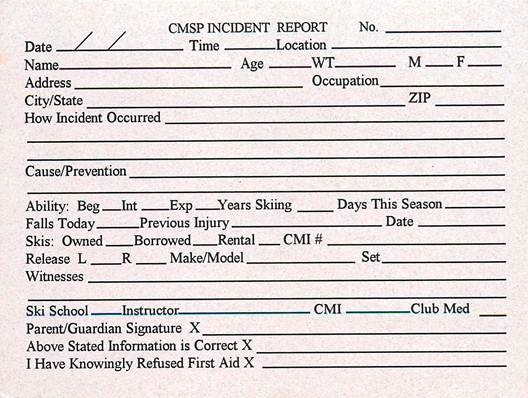
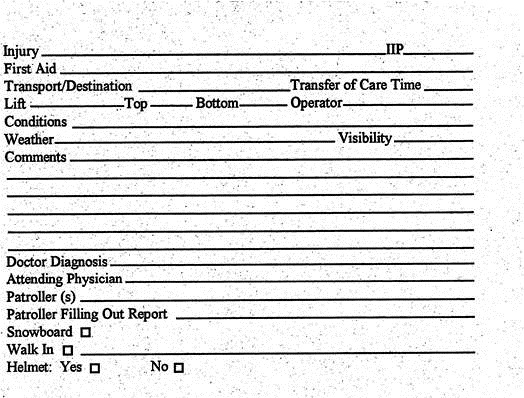
Nothing more than the absolute essentials is captured. These are 5 X 7 cards. The information on the form is 100% from the injured party. No information is put on the card by the patrollers unless it is direct information acquired by the patroller such as the release number setting on the skis, etc.
If there are witnesses then there are 5 X 7 cards for them to complete. There was also a form if a ski school student was injured. If the accident was a life changing incident, major trauma then there were more forms. But for 99% of the accidents, the entire report fit in a patroller’s pocket.
If the injured party cannot fill out the card, then the patroller asks the questions and writes down what the injured party says.
No opinion, no estimates, no guesses, just the facts. (Remember Dragnet the TV show from the 60s.)
Then, once you have the information it must be used. Where are the problems, can we fix the problems, should we warn people about the problems? What can we do to prevent injuries, and if we can’t can we warn people they don’t get injured?
If not, those reports will show up in trial, and probably not to help you.
For an article about bad accident reports see Be Afraid, be very afraid of pre-printed forms for your recreation business.
What do you think? Leave a comment.
If you like this let your friends know or post it on FB, Twitter or LinkedIn
Copyright 2012 Recreation Law (720) Edit Law
Twitter: RecreationLaw
Facebook: Rec.Law.Now
Facebook Page: Outdoor Recreation & Adventure Travel Law
Mobile Site: http://m.recreation-law.com
#RecreationLaw, #@RecreationLaw, #Cycling.Law #Fitness.Law, #Ski.Law, #Outside.Law, #Recreation.Law, #Recreation-Law.com, #Outdoor Law, #Recreation Law, #Outdoor Recreation Law, #Adventure Travel Law, #law, #Travel Law, #Jim Moss, #James H. Moss, #Attorney at Law, #Tourism, #Adventure Tourism, #Rec-Law, #Rec-Law Blog, #Recreation Law, #Recreation Law Blog, #Risk Management, #Human Powered, #Human Powered Recreation,# Cycling Law, #Bicycling Law, #Fitness Law, #Recreation-Law.com, #Backpacking, #Hiking, #Mountaineering, #Ice Climbing, #Rock Climbing, #Ropes Course, #Challenge Course, #Summer Camp, #Camps, #Youth Camps, #Skiing, #Ski Areas, #Negligence, #Snowboarding, #RecreationLaw, #@RecreationLaw, #Cycling.Law #Fitness.Law, #SkiLaw, #Outside.Law, #Recreation.Law, #RecreationLaw.com, #OutdoorLaw, #RecreationLaw, #OutdoorRecreationLaw, #AdventureTravelLaw, #Law, #TravelLaw, #JimMoss, #JamesHMoss, #AttorneyatLaw, #Tourism, #AdventureTourism, #RecLaw, #RecLawBlog, #RecreationLawBlog, #RiskManagement, #HumanPowered, #HumanPoweredRecreation,# CyclingLaw, #BicyclingLaw, #FitnessLaw, #RecreationLaw.com, #Backpacking, #Hiking, #Mountaineering, #IceClimbing, #RockClimbing, #RopesCourse, #ChallengeCourse, #SummerCamp, #Camps, #YouthCamps, #Skiing, #Ski Areas, #Negligence, #Snowboarding, sport and recreation laws, ski law, cycling law, Colorado law, law for recreation and sport managers, bicycling and the law, cycling and the law, ski helmet law, skiers code, skiing accidents, #Accident, Accident Report, Alpine Slide, #Slide, #Sled,
Herbst v. L.B.O. Holding, Inc., 2011 DNH 72; 783 F. Supp. 2d 262; 2011 U.S. Dist. LEXIS 46977; 85 Fed. R. Evid. Serv. (Callaghan) 285
Posted: March 12, 2012 Filed under: Legal Case, New Hampshire, Release (pre-injury contract not to sue) | Tags: Alpine Slide, Attitash, Attitash Ski Area, Federal Supplement, Motion in Limine, New Hampshire, United States, United States district court Leave a commentHerbst v. L.B.O. Holding, Inc., 2011 DNH 72; 783 F. Supp. 2d 262; 2011 U.S. Dist. LEXIS 46977; 85 Fed. R. Evid. Serv. (Callaghan) 285
Edward Herbst v. L.B.O. Holding, Inc., d/b/a Attitash Bear Peak Resort
Civil No. 09-cv-233-JL
UNITED STATES DISTRICT COURT FOR THE DISTRICT OF NEW HAMPSHIRE
2011 DNH 72; 783 F. Supp. 2d 262; 2011 U.S. Dist. LEXIS 46977; 85 Fed. R. Evid. Serv. (Callaghan) 285
May 2, 2011, Decided
May 2, 2011, Filed
COUNSEL: [**1] For Edward Herbst, Dina Herbst, Plaintiffs: R. Peter Taylor, McNeill Taylor & Gallo PA, Dover, NH.
For L.B.O. Holding, Inc., Defendant: Thomas B.S. Quarles, Jr., Devine Millimet & Branch PA (Manchester), Manchester, NH.
JUDGES: Joseph N. Laplante, United States District Judge.
OPINION BY: Joseph N. Laplante
OPINION
[*264] MEMORANDUM ORDER
This case arises from injuries, including a broken ankle, that plaintiff Edward Herbst suffered after falling off an alpine slide at Attitash Bear Peak Resort, a ski area in Bartlett, New Hampshire that offers the slide as a summer recreational activity. Herbst brought suit against the resort’s owner, L.B.O. Holding, Inc. (“Attitash”), asserting claims for strict products liability and negligence. Specifically, he alleges that the slide is unreasonably dangerous to its riders, that Attitash was negligent in operating it, and that Attitash failed to adequately instruct and warn Herbst on its proper use. Attitash denies those allegations and asserts that Herbst’s [*265] own negligence caused the accident. This court has subject-matter jurisdiction under 28 U.S.C. § 1332(a)(1) (diversity).
Both parties have moved in limine to admit or exclude various types of evidence at the upcoming jury trial, currently [**2] scheduled for May 2011. See L.R. 16.2(b)(3). Specifically, Attitash has moved to admit evidence of Herbst’s prior conviction for mail fraud, to exclude evidence of the face amount of Herbst’s medical bills, and to preclude Herbst’s expert witness from testifying about the adequacy of the slide’s warnings. Herbst, in turn, has moved to admit evidence of prior and subsequent accidents on Attitash’s alpine slide. Following oral argument, this court rules on the limine motions as set forth below.
I.Attitash’s motion to admit prior conviction1
1 Document no. 19.
Attitash has moved to admit evidence that Herbst was convicted of felony mail fraud, see 18 U.S.C. § 1341, in a New York federal court on July 30, 1999, when he was 46 years old. See United States v. Herbst, No. 98-cr-771-001 (S.D.N.Y. July 27, 1999). Specifically, Herbst pled guilty to using the mails in connection with bribing an employee of the New York City Department of Finance to reduce or eliminate his overdue property taxes and interest. He served a three-month prison sentence, ending on or before January 1, 2000, and then remained on supervised release for a period of three years.
As a general rule, [HN1] “evidence that any witness [**3] has been convicted of a crime shall be admitted” for impeachment purposes “if it readily can be determined that establishing the elements of the crime required proof or admission of an act of dishonesty or false statement by the witness.” Fed. R. Evid. 609(a)(2). Herbst concedes that his mail fraud conviction involved dishonesty or false statement and therefore falls within that rule. See, e.g., United States v. Orlando-Figueroa, 229 F.3d 33, 46 (1st Cir. 2000).
But evidence of such a conviction “is not admissible if a period of more than ten years has elapsed since the date of the conviction or of the release of the witness from the confinement imposed for that conviction, whichever is later, unless the court determines, in the interests of justice, that the probative value of the conviction supported by specific facts and circumstances substantially outweighs its prejudicial effect.” Fed. R. Evid. 609(b).2
2 Rule 609(b) also requires “sufficient advance written notice to provide the adverse party with a fair opportunity to contest the use” of the prior conviction, which Herbst concedes he has received.
More than ten years have passed since Herbst was released from the confinement imposed [**4] for his mail fraud conviction. Attitash argues that Herbst is to blame for that fact, because he waited nearly three years after his 2006 accident to bring this action, and then requested a trial continuance in 2010. But Attitash has not shown that Herbst acted improperly in either regard, or that he “manipulated either the calendar or the scheduling process in order to postpone the trial and allow the clock to run on [his] conviction.”3 United States v. Nguyen, 542 F.3d 275, 280 (1st Cir. 2008) (rejecting a similar argument that “had [the] trial started a few months earlier–as did the trial of [certain] codefendants–the ten-year window would have [*266] remained open”). So there is no reason not to apply Rule 609(b) here. Id. at 281.
3 Indeed, personal injury actions are routinely brought near the end of the limitations period, so as to allow the nature of the injury to become fully understood.
[HN2] “Given the tenor of Rule 609(b), common sense suggests that felony convictions more than ten years old should be admitted only sparingly and in especially compelling circumstances,” based on a “particularized showing” that their probative value substantially outweighs their prejudicial effect. Id. at 278 [**5] (citing 4 Jack B. Weinstein & Margaret A. Berger, Weinstein’s Federal Evidence § 609.06[1] (2d ed. 2007)). Factors to consider in making that determination “may include (i) the impeachment value of the particular convictions, (ii) their immediacy or remoteness . . .; (iii) the degree of potential prejudice that they portend; (iv) the importance of the defendant’s testimony; and (v) the salience of the credibility issue in the circumstances of the particular case.” United States v. Brito, 427 F.3d 53, 64 (1st Cir. 2005).
Here, Herbst’s mail fraud conviction has a direct bearing on his credibility and veracity, and thus a high degree of impeachment value. He demonstrated a willingness to defraud others to improve his own financial situation. Because Herbst is the primary, and in some respects only, witness to his accident and the ride(s) leading up to it (which allegedly affected his state of mind, making him feel the need to slide faster), and because Attitash contends that Herbst himself was at fault for the accident, his testimony is likely to be of great importance at trial, and his credibility is likely to be a particularly salient issue for the jury.
“Of course, [HN3] the mere fact that [**6] [a witness’s] credibility is in issue . . . cannot, by itself, justify admission of evidence of convictions over ten years old,” because that “would make the ten year limit in Rule 609(b) meaningless.” United States v. Brown, 603 F.2d 1022, 1028 (1st Cir. 1979). But the case for admitting evidence of Herbst’s mail fraud conviction is especially compelling here, given the fraudulent nature of his crime, the likely importance of his testimony and credibility with regard to events that only he (and, in some respects, his daughter) witnessed, and that his conviction, which occurred when he was 46 years old, is barely older than ten years.4
4 In fact, as noted supra, had this action been filed earlier, or trial not been continued, impeachment would have been permitted under Rule 609(a).
While the admission of a prior felony conviction always carries some risk of prejudice, that risk is much lower here than it would be, for example, in a criminal case brought against Herbst. See, e.g., Orlando-Figueroa, 229 F.3d at 46 (noting that “Rule 609 is primarily concerned with potential unfairness to a [criminal] defendant when his prior convictions are offered” and concluding that, even under the particular [**7] circumstances of that criminal case, the court could have admitted evidence of a witness’s mail fraud conviction under Rule 609(b), over the defendant’s objection).
The risk of prejudice is further reduced because Herbst suffered objectively verifiable injuries in the accident (including a broken ankle) and is not the only person who has done so in recent years. See Part IV, infra. Given that evidence, the jury is unlikely to regard the accident itself, or Herbst’s decision to bring this lawsuit, as fraudulent, or to reject his claims merely because he has a criminal history. Rather, it is likely to consider Herbst’s conviction for the limited, and proper, purpose of determining whether to believe his specific testimony regarding his conduct on the slide, the reasons for it (including his state of mind), and the pain and suffering it caused him.
[*267] Having considered the specific facts and circumstances of this case, the court concludes that the probative value of Herbst’s mail fraud conviction substantially outweighs its prejudicial effect, and that it is in the interests of justice to admit it into evidence. Attitash’s motion to admit that evidence is therefore granted. To further reduce [**8] any risk of prejudice, Herbst may request a limiting instruction to the jury, both when the evidence is admitted and in the final jury charge. See, e.g., United States v. Tracy, 36 F.3d 187, 194 (1st Cir. 1994).
II.Attitash’s motion to exclude medical bills5
5 Document no. 20.
Attitash has moved to preclude Herbst from introducing evidence of the face amounts of his medical bills, arguing that the reasonable value of medical services is the amount actually paid for them (here, by Medicaid), not the higher amount billed. [HN4] This court has repeatedly refused, however, “‘to exclude evidence of the billed cost of medical services’ in favor of ‘the amounts actually paid’ in satisfaction of those costs by the plaintiff’s health insurers.” Reed v. Nat’l Council of Boy Scouts of Am., Inc., 706 F. Supp. 2d 180, 190 (D.N.H. 2010) (quoting Aumand v. Dartmouth Hitchcock Med. Ctr., 611 F. Supp. 2d 78, 91 (D.N.H. 2009)); see also Bartlett v. Mut. Pharm. Co., 2010 U.S. Dist. LEXIS 142906, 2010 WL 3156555, at * 2; Williamson v. Odyssey House, Inc., 2000 DNH 238, 2000 WL 1745101, at *1 (DiClerico, D.J.).
As explained more fully in those decisions, Medicaid write-offs fall within the scope of New Hampshire’s collateral source [**9] rule, which “provides that ‘if a plaintiff is compensated in whole or part for his damages by some source independent of the tort-feasor, he is still permitted to make full recovery against the tort-feasor.'” Reed, 706 F. Supp. 2d at 190 (quoting Moulton v. Groveton Papers Co., 114 N.H. 505, 509, 323 A.2d 906 (1974)). Accordingly, this court has not only permitted plaintiffs to present evidence of the amounts billed, but has prohibited defendants from presenting evidence of the amounts actually paid, deeming such evidence unfairly prejudicial. See, e.g., Bartlett, 2010 U.S. Dist. LEXIS 142906, 2010 WL 3156555, at *2 (citing Fed. R. Evid. 403).
Attitash notes that a number of New Hampshire Superior Court judges have reached the opposite conclusion. But this court considered much, if not all, of that case law in Reed, which noted that there is Superior Court precedent in both directions and announced that “unless and until this state’s version of the collateral source rule is changed by the New Hampshire legislature or New Hampshire Supreme Court, this court will continue to apply it to billed amounts ‘written off’ by a plaintiff’s providers, in accordance with existing law here and in the vast majority of other jurisdictions.” [**10] 706 F. Supp. 2d at 190, 194.6
6 This is not to say, however, that the court finds the contrary Superior Court decisions wholly unpersuasive, at least as a policy matter, particularly in the context of private health insurance (as opposed to Medicaid or other public health insurance). But it is this state’s legislature–or, with respect to common-law rules, its Supreme Court–which decides such matters, not this court.
Attitash’s motion in limine is therefore denied. It is important to note, however, that Attitash may still challenge whether the billed amounts reflect the reasonable value of Herbst’s medical services, provided it does not use evidence of the Medicaid write-offs to do so, and otherwise complies with the rules of evidence. See [*268] Bartlett, 2010 U.S. Dist. LEXIS 142906, 2010 WL 3156555, at *2 (citing Reed, 706 F. Supp. 2d at 194).
III.Attitash’s motion to exclude expert testimony on warnings7
7 Document no. 34. The court discussed this issue with the parties at oral argument (before Attitash’s motion had been filed) and then gave both parties an opportunity to brief it before trial.
Attitash has also moved to preclude Herbst’s expert witness, engineer John Mroszczyk, from testifying that the slide’s warnings were [**11] inadequate, arguing that no such opinion was disclosed in his expert report. See [HN5] Fed. R. Civ. P. 26(a)(2)(B) (expert “report must contain . . . a complete statement of all opinions the witness will express and the basis and reasons for them“) and 37(c)(1) (where “a party fails to provide information . . . as required by Rule 26(a),” it “is not allowed to use that information . . . at a trial, unless the failure was substantially justified or is harmless“). The only warning-related opinion expressly set forth in Mroszczyk’s report was that the slide had “a number of instruction and warning signs at the slide loading area” (photos of which he attached to the report), but “no speed limit signs posted along the slide.”
Herbst concedes “that it would certainly have been preferable to ensure that Mroszczyk clearly expressed his opinion” about the warnings in his expert report, see document no. 33, at 4, but nevertheless argues that it is a reasonable inference from the report that he considers the warnings inadequate, and that he should therefore be allowed to offer that opinion at trial. See, e.g., Metavante Corp. v. Emigrant Sav. Bank, 619 F.3d 748, 762 (7th Cir. 2010) (expert report need [**12] not “replicate every word that the expert might say on the stand,” as long as it sufficiently “convey[s] the substance of the expert’s opinion . . . so that the opponent will be ready to rebut, to cross-examine, and to offer a competing expert, if necessary”) (quotation omitted).
Herbst has submitted an affidavit from Mroszczyk clarifying that he “do[es] not believe that any warning in a sign regarding the particular problems” that Herbst encountered on the alpine slide “would be adequate to make this ride safe,” i.e., he “do[es] not believe that this condition in the slide could be made safe by warnings.” Document no. 33-1, at 2. This court agrees that such an opinion can be reasonably inferred from his report, which, after noting the existing signs and the lack of speed limits, states that riders have no ability to gauge their speed anyway and that, even “at a reasonable speed,” they could still “leave the track.” The strong implication is that no warning would be adequate.
The problem with that opinion, at least for Herbst, is that it means that Attitash’s alleged failure to warn did not cause his accident and injuries, because, according to Mroszczyk, no warning would have been adequate [**13] to protect Herbst from the particular problems he encountered. See, e.g., Trull v. Volkswagen of Am., Inc., 145 N.H. 259, 264, 761 A.2d 477 (2000) (“failure to warn must be [a] proximate cause of plaintiff’s injuries”); LeBlanc v. Am. Honda Motor Co., 141 N.H. 579, 586, 688 A.2d 556 (1997) (“[t]he issue in [a] failure to warn claim . . . is whether the danger . . . was or could have been made reasonable by the issuance of adequate warnings”). In other words, the opinion supports Herbst’s unreasonable dangerousness theory, but at the expense of his failure-to-warn theory.
Nevertheless, if Herbst wishes to offer Mroszczyk’s opinion at trial that the slide’s warnings were inadequate because no warning regarding the particular problems [*269] that Herbst encountered would have made the ride safe, this court will allow him to do so. While not expressly disclosed in Mroszczyk’s report, that opinion can be reasonably inferred from the substance of the report, and Attitash has received sufficient notice to “be ready to rebut [it], to cross-examine, and to offer a competing expert, if necessary.” Metavante, 619 F.3d at 762. Attitash’s motion to exclude such testimony is denied.8
8 Mroszczyk should be careful, however, not to venture [**14] beyond the limited opinion set forth above, or to suggest (contrary to that opinion) that some other warning by Attitash would have been adequate to prevent Herbst’s accident.
IV.Herbst’s motion to admit evidence of other accidents9
9 Document no. 15.
Herbst, in turn, has moved to admit evidence of various other accidents on Attitash’s alpine slide, including 21 that occurred between 2004 and 2006 (either prior to or just after his accident), and also one that his expert witness, Mroszczyk, happened to observe in 2010 while conducting a site visit for purposes of inspecting the slide and preparing his expert report in this case.10 Attitash objects that those accidents were not substantially similar to Herbst’s accident and that, in any event, evidence of other accidents–particularly the one Mroszczyk witnessed in 2010–would be unfairly prejudicial, would confuse the jury, and would unduly delay the trial. See Fed. R. Evid. 403.
10 Herbst initially sought to admit evidence of even more accidents, including some involving collisions between two riders. At oral argument and in his subsequent briefing, however, he narrowed his request to those accidents that he considers most similar to his [**15] own.
[HN6] “Evidence of prior accidents is admissible . . . only if the proponent of the evidence shows that the accidents occurred under circumstances substantially similar to those at issue in the case at bar.” Moulton v. Rival Co., 116 F.3d 22, 26-27 (1st Cir. 1997) (quoting McKinnon v. Skil Corp., 638 F.2d 270, 277 (1st Cir. 1981)). Both parties agree that the same requirement applies to subsequent accidents, as other courts have held. See, e.g., Reddin v. Robinson Prop. Group, LP, 239 F.3d 756, 760 (5th Cir. 2001). “At bottom, the ‘substantially similar’ requirement is a more particularized approach to the requirement that evidence be probative.” Trull v. Volkswagen of Am., Inc., 187 F.3d 88, 98 n.9 (1st Cir. 1999).
“‘Substantial similarity’ is a function of the theory of the case.” Moulton, 116 F.3d at 27. Here, Herbst’s theory (supported by expert testimony) is that Attitash’s alpine slide causes riders to move side-to-side within the slide and sometimes to lose control, particularly through curves; and that if a rider reaches the end of a curve embankment in that state, there is a risk of falling off the slide, as allegedly happened in his accident. According to Herbst’s expert, many [**16] curves in the slide pose that risk. In light of that theory, this court construes “substantially similar” to mean, for purposes of this case, that the rider in the other accident must have lost control around a curve and fallen off the slide.
A.2004-2006 accidents
Herbst has made evidentiary proffers regarding each of the accidents at issue. For the 21 accidents occurring between 2004 and 2006, he has submitted accident reports (6 from the New Hampshire Department of Safety and 15 from Attitash itself). The reports, however, provide very little detail. Most of them [*270] indicate that the rider fell off the slide, but not how or where it happened. Mroszczyk believes that each accident “probably” involved loss of control and ejection around a curve, because riders ordinarily would not fall off the slide on a straightaway. But at least two of the accidents were described as occurring on a straightaway, and some had other causes (e.g., a squirrel in the track). So that assumption seems flawed.
This court has closely reviewed each of the accident reports and finds that Herbst has met his burden of showing substantial similarity only as to four accidents:
· the accident on July 12, 2005 (where the [**17] rider “came through [the] dip, came to next set of banks, came out of track”);
· the accident on July 23, 2005 (where the “sled came off track” near a bank);
· the accident on August 3, 2005 (where the rider “hit the curve, jumped the track”); and
· the accident on July 16, 2006 (where the rider “came from a right turn into a left turn and his cart flew off”).
All of the other accidents involved materially different circumstances, or at least were not sufficiently described for this court to deem them substantially similar. See, e.g., Downey v. Bob’s Disc. Furniture Holdings, Inc., 633 F.3d 1, 9 (1st Cir. 2011) (affirming the exclusion of such evidence where plaintiffs proffered only a “bare bones” printout containing a “cryptic description” of prior incidents, with “no details,” and “conducted no investigation into the underlying facts”).11
11 Herbst argues that Attitash admitted, in an interrogatory, that all 15 of the accident reports it produced involved “accidents similar to the plaintiff’s: where an operator left the track and was injured.” But, [HN7] for purposes of discovery, “a flexible treatment of relevance is required and the making of discovery . . . is not a concession or determination [**18] of relevance for purposes of trial,” or admissibility. Fed. R. Civ. P. 26(b)(1), advisory committee notes (1970). Attitash’s interrogatory answer was not an admission of substantial similarity within the meaning of Moulton.
Attitash argues that evidence of even the substantially similar accidents should be excluded as unfairly prejudicial, confusing to the jury, and likely to unduly delay the trial. See Fed. R. Evid. 403. But this court sees little to no risk in any of those respects. Because the accident reports provide so little detail, and appear to be the only available evidence of what happened, the use of such evidence will necessarily be limited in scope. Its main purpose is simply to show that riders occasionally lose control and fall off the track around a curve, as Herbst did, and that Attitash had notice of that risk. That is a proper and probative purpose, which outweighs any of the countervailing concerns listed in Rule 403.
This court therefore grants Herbst’s request to admit evidence of the four accidents noted above, but denies his request to admit evidence of the other accidents between 2004 and 2006. If Herbst believes that this court has overlooked any accident(s) [**19] with circumstances comparably similar to those four accidents, or has additional evidence of substantial similarity beyond that proffered to date, he may raise that issue and/or make a further evidentiary proffer at trial, outside the presence of the jury.
B.2010 accident
For the accident in 2010, Herbst has submitted an affidavit from Mroszczyk explaining what he observed. According to Mroszczyk, that accident, like Herbst’s, involved a rider’s loss of control, side-to-side movement within the slide, and then [*271] ejection from the slide around a curve (albeit a different curve, more than 100 feet down the slide from where Herbst fell). Mroszczyk claims that sequence of events “is precisely what I believe occurred to Mr. Herbst.” Based on that proffer, this court finds that Herbst has sufficiently shown that the 2010 accident was substantially similar to his own, clearing that hurdle for admissibility.12
12 Attitash argues that the 2010 accident resulted from the rider going airborne over a slide feature called “the dip” (not from being ejected around a curve), but that strikes the court as implausible, given the considerable distance between the dip and the place where the rider landed. Attitash [**20] has not proffered any evidence to support that version of events. In any event, if Attitash wishes to challenge Mroszczyk’s testimony regarding how that accident happened, it may do so at trial. An adjuster from Attitash’s insurance company also witnessed the accident and could be called as a witness.
Attitash argues that evidence of the 2010 accident should nevertheless be excluded as unfairly prejudicial, confusing to the jury, and likely to unduly delay the trial. See Fed. R. Evid. 403. It is true that such evidence may pose some risk of prejudice and juror confusion, since the accident happened, incidentally, on the day when Herbst’s expert was inspecting the slide, which might suggest to the jury that accidents happen on the alpine slide with greater frequency than they actually do. Attitash, though, has the ability to present evidence of how often accidents actually happen.13 The jury should not have any trouble understanding or accepting that the timing was just a coincidence.
13 The standard for defendants to introduce evidence of prior accidents is more lenient than for plaintiffs. See Trull, 187 F.3d at 98 n.9.
Conversely, evidence of the 2010 accident has very high probative [**21] value. Mroszczyk’s direct observation of an accident substantially similar to the one that Herbst suffered has the ability to inform, and even corroborate, his expert opinions about what happened to Herbst, and the reason(s) for it. That firsthand experience could make his testimony much more persuasive and helpful to the jury, whereas preventing him from discussing the accident could leave the jury with an incomplete, and potentially inaccurate, understanding of the basis for and reliability of his opinions.
On balance, this court concludes that the probative value of the 2010 accident outweighs the risk of prejudice and juror confusion, and therefore grants Herbst’s motion to admit evidence of that accident. As to Attitash’s argument that such evidence will cause undue delay, this court doubts that will happen, but will keep that concern in mind during trial and will be open to any proposals that Attitash may have (short of outright exclusion) for reasonably limiting the amount of such evidence, and the manner in which it is presented, so as to avoid undue delay and reduce the risk of prejudice.
V.Conclusion
For the reasons set forth above, Attitash’s motion to admit evidence of Herbst’s [**22] prior conviction14 is GRANTED, Attitash’s motion to exclude evidence of Herbst’s medical bills15 is DENIED, Attitash’s motion to preclude Mroszczyk from testifying about the slide’s warnings16 is DENIED, and Herbst’s motion to admit evidence of [*272] prior and subsequent accidents17 is GRANTED in part and DENIED in part.
14 Document no. 19.
15 Document no. 20.
16 Document no. 34.
17 Document no. 15.
SO ORDERED.
/s/ Joseph N. Laplante
Joseph N. Laplante
United States District Judge
Dated: May 2, 2011
Is there a duty to notify parents when an investigation is being conducted by the state to protect campers?
Posted: February 27, 2012 Filed under: Florida, Jurisdiction and Venue (Forum Selection), Minors, Youth, Children, Summer Camp | Tags: Florida, Jurisdiction, Long-Arm Jurisdiction, Motion (legal), North Carolina, Parental Responsibility, summer camp, Youth Camp Leave a commentCamp Illahee Investors, Inc., v. Blackman, 870 So. 2d 80; 2003 Fla. App. LEXIS 17549; 28 Fla. L. Weekly D 2672
Parents claim the camp was negligent in not informing them the state department of social services was going to or had interviewed their kids.
The problem is the case does not answer the question. This again, is a jurisdiction and venue motion that was appealed. The defendant camp was located in North Carolina. The plaintiffs were Florida’s residents. The only contact the camp had with Florida was 22% of its campers came from Florida, and one of the owners would spend a week in Florida every year drumming up business for the next summer.
The initial allegations giving rise to the litigation are very interesting. The plaintiff’s claim, the camp and the owners were negligent because the:
…Defendants had a duty, after being informed that the North Carolina County Department of Social Services desired to interview the Plaintiffs’ minor children, to notify the Plaintiffs of the fact that the minor children were to be interviewed by the North Carolina County Department of Social Services about possible child abuse….
There was a second allegation that a junior counselor had injured one of the plaintiff’s when he stepped on her feet. (Where they dancing?) This claim was not resolved in this appeal either.
Summary of the case
The plaintiff’s sued in Florida, and the defendants moved to dismiss. The trial court did not dismiss for lack of jurisdiction, and the defendants appealed. The defendants argued that they were:
…not subject to the jurisdiction of a Florida court and, even if jurisdiction existed in Florida, that North Carolina was an adequate alternative forum. Camp Illahee further argued that it was immune from suit under North Carolina law and that Florida’s impact rule required dismissal.
To support their argument the defendant must show the facts that prove their allegations. That is usually done by affidavits of the defendants and possibly others to prove the issue, or really, the lack of contact with the state.
Camp Illahee is a North Carolina corporation; the summer camp is located in North Carolina; Camp Illahee has no offices in Florida; it has no employees in Florida, although some of the employees who work at the camp during the summer are from Florida; Camp Illahee does no advertising in Florida by newspapers, radio, or television, but it has a one and one-half page posting on its internet website advising of “fall reunion and video shows.”
The court must then look at the State Long Arm Statute to determine if the facts make the defendant subject to the jurisdiction of the court. Under Florida’s law that analysis is:
…whether (1) there are sufficient jurisdictional facts to bring the action within the purview of the long-arm statute; and (2) the nonresident defendant involved has sufficient minimum contacts with Florida to satisfy constitutional due process requirements.
The Florida Long Arm Statute sets forth the minimum requirements to establish jurisdiction over out of state parties.
Section 48.193(1)(a)
(1) Any person, whether or not a citizen or resident of this state, who personally or through an agent does any of the acts enumerated in this subsection thereby submits himself or herself and, if he or she is a natural person, his or her personal representative to the jurisdiction of the courts of this state for any cause of action arising from the doing of any of the following acts:
(a) Operating, conducting, engaging in, or carrying on a business or business venture in this state or having an office or agency in this state.
Section 48.193(2):
A defendant who is engaged in substantial and not isolated activity within this state, whether such activity is wholly interstate, intrastate, or otherwise, is subject to the jurisdiction of the courts of this state, whether or not the claim arises from that activity.
The court then applies the information presented by the parties to the requirements of the statutes to see if the defendant has the necessary minimum contacts with the state to be sued in that state and subject to the laws of that state.
So Now What?
The trend from the courts is to allow you to be brought into distant states and their judicial system. This case is a rarity. This is another example of where the agreement between the camp and the parents or any parties to any outdoor recreation, should agree in advance to where any litigation will be developed.
As far as notifying parents of an interview by social services for possible child abuse, I think I would always lean towards notifying the parents. In fact, I think I would notify the parents immediately. A parent must believe that their child is safe. Whether the child is safe is put into question, if social services is investigating your camp.
This may be a PR nightmare or disaster for any camp or program dealing with minors. You will need to make sure you bring in PR professionals and probably your attorney if this situation arises.
You should also set up a program and working relationship where anyone can come and talk to you about problems. Hopefully, before social services had been called, you are on top of the issue and have dealt with it.
What do you think? Leave a comment.
If you like this let your friends know or post it on FB, Twitter or LinkedIn
Copyright 2012 Recreation Law (720) Edit Law
Twitter: RecreationLaw
Facebook: Rec.Law.Now
Facebook Page: Outdoor Recreation & Adventure Travel Law
Mobile Site: http://m.recreation-law.com
#RecreationLaw, #@RecreationLaw, #Cycling.Law #Fitness.Law, #Ski.Law, #Outside.Law, #Recreation.Law, #Recreation-Law.com, #Outdoor Law, #Recreation Law, #Outdoor Recreation Law, #Adventure Travel Law, #law, #Travel Law, #Jim Moss, #James H. Moss, #Attorney at Law, #Tourism, #Adventure Tourism, #Rec-Law, #Rec-Law Blog, #Recreation Law, #Recreation Law Blog, #Risk Management, #Human Powered, #Human Powered Recreation,# Cycling Law, #Bicycling Law, #Fitness Law, #Recreation-Law.com, #Backpacking, #Hiking, #Mountaineering, #Ice Climbing, #Rock Climbing, #Ropes Course, #Challenge Course, #Summer Camp, #Camps, #Youth Camps, #Skiing, #Ski Areas, #Negligence, #Snowboarding, #RecreationLaw, #@RecreationLaw, #Cycling.Law #Fitness.Law, #SkiLaw, #Outside.Law, #Recreation.Law, #RecreationLaw.com, #OutdoorLaw, #RecreationLaw, #OutdoorRecreationLaw, #AdventureTravelLaw, #Law, #TravelLaw, #JimMoss, #JamesHMoss, #AttorneyatLaw, #Tourism, #AdventureTourism, #RecLaw, #RecLawBlog, #RecreationLawBlog, #RiskManagement, #HumanPowered, #HumanPoweredRecreation,# CyclingLaw, #BicyclingLaw, #FitnessLaw, #RecreationLaw.com, #Backpacking, #Hiking, #Mountaineering, #IceClimbing, #RockClimbing, #RopesCourse, #ChallengeCourse, #SummerCamp, #Camps, #YouthCamps, #Skiing, #Ski Areas, #Negligence, #Snowboarding, sport and recreation laws, ski law, cycling law, Colorado law, law for recreation and sport managers, bicycling and the law, cycling and the law, ski helmet law, skiers code, skiing accidents, Camp Illahee, summer camp, camp, camper, social services, North Carolina, Florida, FL, NC,
WordPress Tags: parents,investigation,campers,Camp,Illahee,Investors,Blackman,LEXIS,department,jurisdiction,venue,defendant,North,Carolina,plaintiffs,Florida,residents,owners,allegations,litigation,plaintiff,Defendants,Social,Services,fact,allegation,counselor,feet,Where,Summary,forum,impact,dismissal,argument,affidavits,corporation,offices,employees,newspapers,radio,television,reunion,State,Long,Statute,Under,analysis,action,requirements,Section,person,citizen,agent,subsection,office,agency,information,statutes,laws,trend,system,example,agreement,recreation,Whether,disaster,minors,professionals,attorney,situation,relationship,Leave,Twitter,LinkedIn,Edit,RecreationLaw,Facebook,Page,Outdoor,Adventure,Travel,Blog,Mobile,Site,Outside,Moss,James,Tourism,Risk,Management,Human,Rock,Ropes,Course,Challenge,Summer,Camps,Youth,Areas,Negligence,SkiLaw,OutdoorLaw,OutdoorRecreationLaw,AdventureTravelLaw,TravelLaw,JimMoss,JamesHMoss,AttorneyatLaw,AdventureTourism,RecLaw,RecLawBlog,RecreationLawBlog,RiskManagement,HumanPoweredRecreation,CyclingLaw,BicyclingLaw,FitnessLaw,RopesCourse,ChallengeCourse,SummerCamp,YouthCamps,Colorado,managers,helmet,accidents,camper
Camp Illahee Investors, Inc., v. Blackman, 870 So. 2d 80; 2003 Fla. App. LEXIS 17549; 28 Fla. L. Weekly D 2672
Posted: February 27, 2012 Filed under: Florida, Jurisdiction and Venue (Forum Selection), Legal Case, Minors, Youth, Children, Summer Camp | Tags: Camp, Florida, Long-Arm Jurisdiction, Motion (legal), North Carolina, Recreation, summer camp Leave a commentCamp Illahee Investors, Inc., v. Blackman, 870 So. 2d 80; 2003 Fla. App. LEXIS 17549; 28 Fla. L. Weekly D 2672
Camp Illahee Investors, Inc., a North Carolina Corporation, Appellant, v. Michael Blackman and Patrice Blackman, Individually and as the Parents, Natural Guardians and next best friends of Olivia Blackman and Sophie Blackman, minor children, and Frank Tindall and Elizabeth Tindall, Appellees.
Case No. 2D02-4324
COURT OF APPEAL OF FLORIDA, SECOND DISTRICT
870 So. 2d 80; 2003 Fla. App. LEXIS 17549; 28 Fla. L. Weekly D 2672
November 19, 2003, Opinion Filed
PRIOR HISTORY: [**1] Appeal from nonfinal order of the Circuit Court for Hillsborough County; Daniel E. Gallagher, Senior Judge.
DISPOSITION: Reversed and remanded with directions.
COUNSEL: J. Gregory Giannuzzi of Rissman, Weisberg, Barrett, Hurt, Donahue & McLain, P.A., Tampa, for Appellant.
Jeffrey A. Blau, Tampa, for Appellees Michael Blackman and Patrice Blackman, Individually and as the Parents, Natural Guardians and next best friends of Olivia Blackman and Sophie Blackman, minor children.
No appearance for Appellees, Frank Tindall and Elizabeth Tindall.
JUDGES: SILBERMAN, Judge. STRINGER, J., and THREADGILL, EDWARD F., SENIOR JUDGE, Concur.
OPINION BY: SILBERMAN
OPINION
[*82] SILBERMAN, Judge.
Camp Illahee Investors, Inc., a North Carolina corporation, appeals a nonfinal [*83] order that denied its motion to dismiss for lack of personal jurisdiction. Because jurisdiction was not established under Florida’s long-arm statute, we reverse.
Appellees Michael and Patrice Blackman, individually and on behalf of their minor daughters, sued Camp Illahee and its owners, Frank and Elizabeth Tindall, for alleged torts committed in North Carolina while [**2] the Blackmans’ two daughters were attending summer camp in 2001. 1 In their first amended complaint, the Blackmans alleged that while their daughters were at the camp, someone placed an “anonymous child abuse call” to a county department of social services in North Carolina, whose representatives then interviewed the Blackmans’ daughters. The Blackmans alleged that the “Defendants had a duty, after being informed that the North Carolina County Department of Social Services desired to interview the Plaintiffs’ minor children, to notify the Plaintiffs of the fact that the minor children were to be interviewed by the North Carolina County Department of Social Services about possible child abuse.” The Blackmans also alleged that a junior counselor battered one of the daughters “by stepping on her feet and inflicting other physical injuries and mental abuse” on her.
1 The trial court dismissed the Tindalls from the litigation, and the Blackmans have not appealed that ruling.
Camp Illahee filed a motion to dismiss [**3] and asserted, among other grounds, that it was not subject to the jurisdiction of a Florida court and, even if jurisdiction existed in Florida, that North Carolina was an adequate alternative forum. Camp Illahee further argued that it was immune from suit under North Carolina law and that Florida’s impact rule required dismissal.
Camp Illahee submitted affidavits from the Tindalls, the owners and operators of the camp. The affidavits reflect that Camp Illahee is a North Carolina corporation; the summer camp is located in North Carolina; Camp Illahee has no offices in Florida; it has no employees in Florida, although some of the employees who work at the camp during the summer are from Florida; Camp Illahee does no advertising in Florida by newspapers, radio, or television, but it has a one and one-half page posting on its internet website advising of “fall reunion and video shows.”
Mrs. Tindall’s affidavit also reflects that she travels to various states to engage in the reunion and video shows, which are designed to have “the children get together to talk about Camp, and to become excited for camp the next summer.” The reunions take place in the homes of camp families, and the [**4] families receive a discount in the camp fee for hosting the reunions. The discounts amounted to .15% of Camp Illahee’s gross revenues in 2000 and .08% in 2001. In 2000 and 2001, 22% of the campers were from Florida.
Although Camp Illahee argues that its motion to dismiss could properly have been granted on any of the grounds raised in its motion, the key issue is whether the trial court had long-arm jurisdiction over Camp Illahee. [HN1] Our standard of review on the issue of personal jurisdiction over a foreign corporation is de novo. See Execu-Tech Bus. Sys., Inc. v. New Oji Paper Co., 752 So. 2d 582, 584 (Fla. 2000). [HN2] Additionally, we are required to strictly construe Florida’s long-arm statute. See Esberger v. First Fla. Bus. Consultants, Inc., 338 So. 2d 561, 562 (Fla. 2d DCA 1976).
The pertinent facts relating to jurisdiction are not in dispute. [HN3] The determination [*84] of whether the trial court has personal jurisdiction over Camp Illahee turns on “whether (1) there are sufficient jurisdictional facts to bring the action within the purview of the long-arm statute; and (2) the nonresident defendant involved has sufficient minimum contacts with Florida to [**5] satisfy constitutional due process requirements.” Kin Yong Lung Indus. Co. v. Temple, 816 So. 2d 663, 666 (Fla. 2d DCA 2002); see also Venetian Salami Co. v. Parthenais, 554 So. 2d 499, 502 (Fla. 1989).
In its order denying the motion to dismiss, the trial court did not discuss this two-prong test. Instead, it simply stated, “Jurisdiction as to Camp Illahee Investors, Inc. will remain in Florida pursuant to the doctrine of forum non conveniens, as set forth in Fla. R. Civ. P. 1.061.” However, [HN4] before reaching the issue of forum non conveniens under Florida Rule of Civil Procedure 1.061, the trial court was required to first determine whether it had in personam jurisdiction in accordance with the two-prong test. See La Reunion Francaise, S.A. v. La Costena, 818 So. 2d 657, 659 (Fla. 3d DCA 2002) (concluding that there was no personal jurisdiction over the foreign defendant and, therefore, no need to reach other issues raised in the motion to dismiss, including the issue of forum non conveniens).
After reviewing the record and the applicable statutory language in light of the required two-prong jurisdictional analysis, we conclude [**6] that the trial court should have dismissed the Blackmans’ first amended complaint for lack of in personam jurisdiction. The allegations of the first amended complaint establish that the only possible bases for jurisdiction are under sections 48.193(1)(a) or 48.193(2) of the long-arm statute. Section 48.193(1)(a) [HN5] provides as follows:
(1) Any person, whether or not a citizen or resident of this state, who personally or through an agent does any of the acts enumerated in this subsection thereby submits himself or herself and, if he or she is a natural person, his or her personal representative to the jurisdiction of the courts of this state for any cause of action arising from the doing of any of the following acts:
(a) Operating, conducting, engaging in, or carrying on a business or business venture in this state or having an office or agency in this state.
Section 48.193(2) [HN6] states as follows:
A defendant who is engaged in substantial and not isolated activity within this state, whether such activity is wholly interstate, intrastate, or otherwise, is subject to the jurisdiction of the courts of this state, whether or not the claim arises from that activity.
In the trial [**7] court, the Blackmans asserted that because Mrs. Tindall came to Florida one week a year for the reunion and video shows, Camp Illahee was conducting business in Florida. They also argued that the families that hosted the reunions were agents of Camp Illahee.
Concerning the agency argument, nothing in the record reflects that either an apparent or actual agency relationship existed between the host families and Camp Illahee. In particular, there was no showing that Camp Illahee made any representations that the host families were the agents of Camp Illahee, or that Camp Illahee, as principal, exercised control over the families, as agents. See Ilgen v. Henderson Props., Inc., 683 So. 2d 513, 514-15 (Fla. 2d DCA 1996) (discussing the elements necessary to establish apparent or actual agency); State v. Am. Tobacco Co., 707 So. 2d 851, 854 (Fla. 4th DCA 1998) (stating that control by the principal [*85] over the agent is a necessary element of agency).
The Blackmans’ second argument is premised on section 48.193(1), which confers jurisdiction for “any cause of action arising from the doing of” any of the enumerated items, such as conducting business in Florida. [**8] [HN7] By its terms, section 48.193(1) requires connexity between the defendant’s activities and the cause of action. Wendt v. Horowitz, 822 So. 2d 1252, 1260 (Fla. 2002). Here, the record reflects that the connexity requirement has not been met because the Blackmans’ claims did not arise from the reunions and video shows that took place in Florida during one week per year. Rather, the claims arose out of alleged torts that occurred in North Carolina while the Blackmans’ daughters attended the camp.
Even if the undisputed facts fell within the ambit of section 48.193(1), Camp Illahee must have sufficient minimum contacts with Florida to satisfy due process requirements. See Venetian Salami, 554 So. 2d at 500. [HN8] The test is whether Camp Illahee’s conduct is such that it “should reasonably anticipate being haled into court” in Florida. See Venetian Salami, 554 So. 2d at 500 (quoting World-Wide Volkswagen Corp. v. Woodson, 444 U.S. 286, 297, 62 L. Ed. 2d 490, 100 S. Ct. 559 (1980)); see also Emerson v. Cole, 847 So. 2d 606, 608 (Fla. 2d DCA 2003). We agree with Camp Illahee that the limited contact between it [**9] and Florida as a result of the yearly reunion and video shows is insufficient to establish that it could reasonably anticipate being haled into court in Florida for the allegedly tortious conduct occurring in North Carolina.
A second potential basis for jurisdiction is section 48.193(2), which provides that a defendant is subject to a Florida court’s jurisdiction when the defendant “is engaged in substantial and not isolated activity within this state . . . whether or not the claim arises from that activity.” [HN9] This section “does not require connexity between a defendant’s activities and the cause of action.” Woods v. Nova Cos. Belize Ltd., 739 So. 2d 617, 620 (Fla. 4th DCA 1999). Additionally, if the defendant’s activities meet the requirements of this section, the due process requirement of minimum contacts is fulfilled. Id. However, the record before us does not support a conclusion that Camp Ilahee’s conduct constitutes substantial activity in Florida. See deMco Techs., Inc. v. C.S. Engineered Castings, Inc., 769 So. 2d 1128, 1132 (Fla. 3d DCA 2000) (stating that sporadic sales in Florida could not provide jurisdiction for litigation regarding [**10] an unrelated promissory note); Price v. Point Marine, Inc., 610 So. 2d 1339, 1341 (Fla. 1st DCA 1992) (noting that sporadic activities or visits to Florida consisting of the occasional solicitation of business in Florida do not constitute “substantial and not isolated activity”).
Because the undisputed facts do not demonstrate a basis for jurisdiction under Florida’s long-arm statute, we reverse and remand with directions that the trial court dismiss the Blackmans’ claims without prejudice to their refiling the claims in the appropriate jurisdiction. In light of our conclusion regarding the lack of in personam jurisdiction, the other grounds asserted by Camp Illahee in support of reversal are moot.
Reversed and remanded with directions.
STRINGER, J., and THREADGILL, EDWARD F., SENIOR JUDGE, Concur.
Pagel v. Marcus Corporation, 2008 WI App 110; 313 Wis. 2d 78; 756 N.W.2d 447; 2008 Wisc. App. LEXIS 423
Posted: February 24, 2012 Filed under: Assumption of the Risk, Legal Case, Wisconsin | Tags: Appeal, Appellate Court, Milwaukee, Summary judgment, Trial court, Wisconsin Leave a commentPagel v. Marcus Corporation, 2008 WI App 110; 313 Wis. 2d 78; 756 N.W.2d 447; 2008 Wisc. App. LEXIS 423
Briane F. Pagel, Jr. and Joy Pagel, Plaintiffs-Appellants, v. Marcus Corporation d/b/a Hilton Milwaukee City Center, Defendant, Milwaukee City Center LLC, Defendant-Respondent.
Appeal No. 2007AP1369
COURT OF APPEALS OF WISCONSIN, DISTRICT ONE
2008 WI App 110; 313 Wis. 2d 78; 756 N.W.2d 447; 2008 Wisc. App. LEXIS 423
June 3, 2008, Decided
June 3, 2008, Filed
PRIOR HISTORY:
APPEAL from a judgment of the circuit court for Milwaukee County: RICHARD J. SANKOVITZ, Judge. Cir. Ct. No. 2006CV1145.
DISPOSITION: Affirmed.
COUNSEL: On behalf of the plaintiff-appellant, the cause was submitted on the briefs of J. David Krekeler and Anthony Baer of Krekeler Strother, S.C., of Madison.
On behalf of the defendant-respondent, the cause was submitted on the brief of Ronald G. Pezze, Jr. and Ahndrea R. Van Den Elzen of Peterson, Johnson & Murray, S.C., of Milwaukee.
JUDGES: Before Curley, P.J., Fine and Kessler, JJ.
OPINION BY: KESSLER
OPINION
[**81] [***448] [*P1] KESSLER, J. Briane F. Pagel, Jr., and Joy Pagel (individually and collectively, Pagel) appeal from an order granting summary judgment to Milwaukee City Center LLC (MCC), dismissing all claims by Pagel against it. Pagel asserts that the trial court erred when it applied § 388 of the RESTATEMENT (SECOND) OF TORTS to the [***449] facts here, and concluded that the hazard, which Pagel claims caused his injury, was open and obvious to Pagel, thus relieving MCC of a duty to provide signs warning of the open and obvious hazard. We affirm.
Background
[*P2] Pagel and his family visited an indoor water park owned by MCC in a hotel in Milwaukee. Among the water attractions used by Pagel and his family was a “Lily Pad Walk” which Pagel described as:
The lily pads were a couple of large floating cushions underneath a cargo-style net. Each pad was about [four feet] in diameter and had a vinyl-like coating on them.
….
You grabbed the cargo net and stepped onto the lily pads, holding yourself by your arms as you used the lily pads to try to go ahead. The lily pads were chained to the bottom but loosely so they could float around, and they didn’t float well enough to hold up even a little kid.
[*P3] Pagel testified that before he used the Lily Pad Walk, he “knew the lily pads could tip to cause you to fall into the water.” When he used the Lily Pad Walk the first time, Pagel said his hand slipped off the ropes, the lily pad moved away from his feet, and, as a result, he dropped into the water rather than hanging from the [**82] ropes. Pagel testified about his observation of the mechanics of the Lily Pad Walk during his first time across:
Q: When you used the Lily Pad attraction the first time, why didn’t you continue to hold on to the rope when the lily pad tipped?
A: Because I was going to drop into the water.
Q: Well, you did drop into the water. But my question was, why didn’t you continue holding on to the rope?
A: I didn’t want to be just be [sic] hanging from the rope. When I couldn’t get it by the foot, your only option at that point would be just to hang by the rope and try to go across just with your arms, I guess. And I – that didn’t seem like a smart move, so I just dropped.
Pagel acknowledged that before using the Lily Pad Walk he watched other people using it, saw people fall into the water using it, and saw people trying to traverse across the Lily Pad Walk while he was waiting in line to use it.
[*P4] Pagel alleged that he was injured when he used the Lily Pad Walk when his foot slipped from the lily pad, he lost his grip on the cargo net ropes above the water and lily pads, and fell into the water, injuring his back. The injury occurred the second time he used the Lily Pad Walk. His amended complaint alleged, as material to this appeal, negligence by MCC for failure “to provide a warning of the unsafe condition of the lily pad section of its water park.”
[*P5] Relying on Kessel ex rel. Swenson v. Stansfield Vending, Inc., 2006 WI App 68, 291 Wis. 2d 504, 714 N.W.2d 206, and § 388 of the RESTATEMENT (SECOND) [**83] OF TORTS, the trial court observed that [HN1] “where an injured person already knows what he or she needs to know to avoid a danger, the law does not impose a duty to warn on a person who provides a product for the use of another.” Based on the undisputed facts, the trial court then granted summary judgment dismissing Pagel’s negligence claim against MCC. Pagel appeals.
Standard of Review
[*P6] [HN2] In reviewing motions for summary judgment, we apply the standards set forth in WIS. STAT. § 802.08 (2005-06), 1 in [***450] the same manner as the trial court. Moua v. Northern States Power Co., 157 Wis. 2d 177, 184, 458 N.W.2d 836 (Ct. App. 1990). “Summary judgment is [properly] granted when there is no genuine issue of material fact and only a question of law is at issue.” Id. The historical facts here are not in dispute. “Whether facts fulfill a particular legal standard is a question of law to which we give de novo review.” Bantz v. Montgomery Estates, Inc., 163 Wis. 2d 973, 978, 473 N.W.2d 506 (Ct. App. 1991); see also DOR v. Exxon Corp., 90 Wis. 2d 700, 713, 281 N.W.2d 94 (1979), aff’d, 447 U.S. 207, 100 S. Ct. 2109, 65 L. Ed. 2d 66 (1980).
1 All references to the Wisconsin Statutes are to the 2005-06 version unless otherwise noted.
[*P7] [HN3] “Where the facts alleged to give rise to a duty are agreed upon, the question of the existence of a duty is one of law.” Rockweit v. Senecal, 197 Wis. 2d 409, 419, 541 N.W.2d 742 (1995) (quoting Olson v. Ratzel, 89 Wis. 2d 227, 251, 278 N.W.2d 238 (Ct. App. 1979)). Where the undisputed facts establish that a danger is open and obvious to the user of the product, as a matter [**84] of law there is no duty to warn the user of that danger and summary judgment is proper. Griebler v. Doughboy Recreational, Inc., 160 Wis. 2d 547, 561, 466 N.W.2d 897 (1991).
Analysis
[*P8] The role an open and obvious danger plays in our tort law has evolved over a long period of time. Describing the open and obvious nature of the danger as a “defense,” the trial court in Griebler granted summary judgment, dismissing a claim of injury in a shallow water diving accident. Id. at 551, 554. The court of appeals reversed, relying on § 343A(1) of the RESTATEMENT (SECOND) OF TORTS (1965) and a related comment which required not only that the reasonable person/user must recognize that an open and obvious danger exists, but that person must also appreciate the gravity of the harm threatened by that danger. Griebler, 160 Wis. 2d at 556-57. Our supreme court rejected § 343A(1), noting that, as in all of the earlier diving cases, the condition of the water is the obvious danger, the risk is that the person diving will hit bottom, and the type of injury that might result (or the person’s knowledge thereof) is irrelevant. Griebler, 160 Wis. 2d at 558. The supreme court reversed our decision and reinstated summary judgment dismissing Griebler’s complaint, stating:
We hold that the open and obvious danger defense applies whenever a plaintiff voluntarily 2 confronts an open and obvious condition and a reasonable person in [**85] the position of the plaintiff would recognize the condition and the risk the condition presents.
Id. at 551 (footnote modified). Relying on “nearly twenty years of Wisconsin law holding that diving into water of unknown depth is an open and obvious danger,” 3 id. at 557, where Griebler admitted that he dove headfirst [***451] into water, whose depth he did not know, id. at 557, the supreme court described such conduct as “unreasonable as a matter of law,” id. at 561.
2 By footnote, the court recognized two conditions which would preclude invoking the open and obvious danger defense, namely if the injured person was distracted or if the injured person could not avoid the condition. Griebler v. Doughboy Recreational, Inc., 160 Wis. 2d 547, 551, 466 N.W.2d 897 (1991) (citing Waters v. U.S. Fid. & Guar. Co., 124 Wis. 2d 275, 369 N.W.2d 755 (Ct. App. 1985), and Maci v. State Farm Fire & Cas. Co., 105 Wis. 2d 710, 314 N.W.2d 914 (Ct. App. 1981), overruled on other grounds by Rockweit v. Senecal, 197 Wis. 2d 409, 423, 541 N.W.2d 742 (1995)).
3 The Griebler court relied on Scheeler v. Bahr, 41 Wis. 2d 473, 164 N.W.2d 310 (1969), and Davenport v. Gillmore, 146 Wis. 2d 498, 431 N.W.2d 701 (Ct. App. 1988), for the duration of these holdings. Griebler, 160 Wis. 2d at 557.
[*P9] Four years later, in Rockweit, when a small child walking with his mother fell into a campground fire pit with smoldering embers, our supreme court noted that in previous cases it had
abrogated the common law immunity [for owners of premises] by subsuming the concept of open and obvious danger into the consideration of common law negligence. In the ordinary negligence case, if an open and obvious danger is confronted by the plaintiff, it is merely an element to be considered by the jury in apportioning negligence and will not operate to completely bar the plaintiff’s recovery.
Id., 197 Wis. 2d at 423. This holding placed the characterization of an open and obvious danger as a defense to negligence in the context of applying a comparative negligence analysis. Pagel relies on specific Rockweit [**86] language 4 [4] to argue that summary judgment was not proper here because the lack of warning is merely a fact to be considered in apportioning the negligence attributable to MCC. Pagel argues that a jury must decide whether MCC’s common law duty of care is overcome by the defense that there was an open and obvious danger which Pagel recognized before he was injured.
4 [HN4] “In the ordinary negligence case, if an open and obvious danger is confronted by the plaintiff, it is merely an element to be considered by the jury in apportioning negligence ….” Rockweit, 197 Wis. 2d at 423.
[*P10] Pagel’s reliance on this isolated language in Rockweit is misplaced. In Rockweit, a fire pit at a commercial campground was used in common by the large extended family of the child victim, who were camping together. Id. at 414. A family friend, who was staying at a different area of the campground, was invited to a social gathering with the extended family at a fire pit the night before the accident occurred. Id. at 415. The friend, who was also named as a defendant, did not select the fire pit site, took no part in setting, controlling or managing the fire, and did not use that fire pit while she was camping. Id. Her only connection with the fire pit was attending the social gathering to which she was invited. Id. at 415. When the friend and two members of the child’s extended family were the last to leave the social gathering, no one extinguished the embers. Id. at 415-16. The next morning the child was walking with his mother when he stumbled into the pit which still contained live embers. Id. at 416. The child alleged negligence by the friend and the others who were the last to leave and did not extinguish the embers. Id. The jury found the campground owner, the family members present, the child’s mother, and the friend were all negligent. Id.
[**87] [*P11] On appeal, our supreme court concluded that public policy considerations precluded imposing liability on the invited friend. Id. at 429. The court noted that fire is commonly known to be dangerous, id. at 427 (“The dangerous propensities akin to fire are commonplace to a campsite.”), and that the child’s mother, who was with the child when he fell into the pit, knew as much about the danger of the fire pit as the invited friend, id. at 428 (“[Mother] testified that she was fully aware that the fire pit constituted a hazard at the time of the accident and had not relied on a supposition that someone the [***452] night before might have doused the embers ….”). These considerations foreshadowed the court’s later decision to adopt § 388 of the RESTATEMENT (SECOND) OF TORTS in the context of the open and obvious danger of a chattel which is alleged to have caused injury.
[*P12] Five years after Rockweit, our supreme court in Strasser v. Transtech Mobile Fleet Service, Inc., 2000 WI 87, PP57-59, 236 Wis. 2d 435, 613 N.W.2d 142, adopted the RESTATEMENT (SECOND) OF TORTS § 388 (1965), which provides:
[HN5] One who supplies directly or through a third person a chattel for another to use is subject to liability to those whom the supplier should expect to use the chattel with the consent of the other or to be endangered by its probable use, for physical harm caused by the use of the chattel in the manner for which and by a person for whose use it is supplied, if the supplier
(a) knows or has reason to know that the chattel is or is likely to be dangerous for the use for which it is supplied, and
[**88] (b) has no reason to believe that those for whose use the chattel is supplied will realize its dangerous condition, and
(c) fails to exercise reasonable care to inform them of its dangerous condition or of the facts which make it likely to be dangerous.
Strasser involved personal property–a ladder fabricated without safety treads on the rungs–which Strasser used many times before he slipped on a rung and fell. Id., 236 Wis. 2d 435, P19. Our supreme court did not overrule Rockweit (which involved only real property–a fire pit in the ground). Strasser, 2000 WI 87, 236 Wis. 2d 435, P60, 613 N.W.2d 142. Rather, by adopting § 388, the supreme court adopted the law of a real property owner’s responsibility to invitees to codify the common law duty of due care owed by the provider of personal property to the user of personal property when the use for which the property is intended causes injury. Although somewhat awkwardly stated in the negative, § 388(1) establishes that when the danger is open and obvious to a reasonable person, warning of what the reasonable person already knows is unnecessary; thus, the failure to warn cannot be negligent. Strasser, 2000 WI 87, 236 Wis. 2d 435, PP59-60, 613 N.W.2d 142.
[*P13] The adoption of RESTATEMENT (SECOND) OF TORTS § 388 moved the open and obvious danger to the level of being not only a jury issue as a defense to negligence when the material facts of whether the danger is open and obvious are disputed, but also removed any duty to warn from the negligence calculus when the undisputed material facts establish that the danger is open and obvious and the user recognizes/observes/knows of the danger. Approximately four years after Strasser, in Mohr v. St. Paul Fire & Marine Insurance Co., 2004 WI App 5, 269 Wis. 2d 302, 674 N.W.2d 576 (Ct. App. 2003), we discussed § 388(b), noting that:
[**89] As the court explained in Strasser, one of the situations under § 388(b) in which a supplier or manufacturer has no duty to warn of a danger is when “‘a mere casual looking over will disclose [the dangerous condition] unless the circumstances under which the chattel is supplied are such as to make it likely that even so casual an inspection will not be made.'” … When danger is obvious from a mere casual looking over, the supplier or manufacturer has reason to believe that the user will realize the danger.
Mohr, 2004 WI App 5, 269 Wis. 2d 302, P23, 674 N.W.2d 576 (citing Strasser, 2000 WI 87, 236 Wis. 2d 435, PP58-59, 613 N.W.2d 142).
[***453] [*P14] Mohr presented a factual dispute as to whether a diving platform used by a high school for racing dives into 3.5 feet of water, rather than 5 feet of water, was something that a casual observation would disclose as dangerous. Id., P3 (discussing RESTATEMENT (SECOND) OF TORTS § 388 cmt. k). We concluded that summary judgment was inappropriate, not because a jury must always decide whether a danger is open and obvious, but because the facts material to that question were disputed–one high school swim coach had one view, and another swim coach at the same high school had a different view. Id., PP17-18, 25.
[*P15] Later, in Kessel, we held there was no duty to warn of danger from steaming water coming from a hot water dispenser (provided in a hospital waiting room to let patients’ families make hot chocolate) where the hot temperature was obvious from the steam, and both parents admitted they took precautions because they knew that hot water could injure their young child (who tipped the cup and was injured by the scalding water). Id., 291 Wis. 2d 504, PP3-4, 23, 32. We discussed whether Strasser held that RESTATEMENT (SECOND) OF TORTS § 388(1) inevitably required a warning to comply with the duty of care:
[**90] In essence, the court in Strasser concluded that RESTATEMENT (SECOND) OF TORTS § 388 and cmt. k defined the standard of ordinary care in that situation: “This exception in cmt. k recognizes that a warning is not necessary to satisfy the standard of ordinary care when the condition at issue is known to the user.”
Kessel, 2006 WI App 68, 291 Wis. 2d 504, P21, 714 N.W.2d 206 (citation and brackets omitted; emphasis added).
[*P16] As we explained in Kessel, where the supplier of the tangible property has reason to believe that casual inspection will disclose the danger, and the user is aware of the danger, RESTATEMENT (SECOND) OF TORTS § 388 does not require a warning. Kessel, 2006 WI App 68, 291 Wis. 2d 504, P21, 714 N.W.2d 206. Here, it is undisputed that Pagel used the Lily Pad Walk once without injury. It is also undisputed that before, or during, his first use, Pagel personally observed how the Lily Pad Walk worked, knew from observation and experience that the lily pads were not stable, knew that they could not hold up even a small child, and that because of their obvious instability, the only alternatives available to users of the Lily Pad Walk were to drop or fall into the water 5 or use their hands to hold on to the cargo net ropes above to cross the area hand over hand. On his first use of the Lily Pad Walk, Pagel chose to get wet rather than travel by hand on the cargo net ropes. Thus, he knew both from experience and from observation that when the pad moved, the only two choices were to drop or fall into the water or to use his hands to hold onto the cargo net ropes to cross the [**91] area. The danger–that the pads would move–was open and obvious. The only ways to avoid the danger while using the Lily Pad Walk–get wet or travel hand over hand on the cargo net ropes–were equally open and obvious.
5 It would seem that the primary purpose of a water park is to get into the water. One would expect that the possibility of getting wet, or even drenched, is the very attraction that brings visitors to these facilities.
[*P17] The terms of RESTATEMENT (SECOND) OF TORTS § 388 apply here. MCC supplied the Lily Pad Walk in the water park for use by visitors to the water park. Section 388(1) (“One who supplies … a chattel for another to use is subject to liability to those whom the supplier should expect to use the chattel” under certain conditions.). MCC is liable if it “has reason to know [***454] that the chattel is likely to be dangerous for the use for which it is supplied.” Id. The lily pads were obviously unstable, tending to cause (or allow) users to fall into the water, or to traverse the area using their hands on the cargo net ropes. The “danger” of falling into the water or the “danger” of crossing by hands on ropes is the very purpose of the Lily Pad Walk. These “dangers” are not hidden in any way. These properties were apparent to Pagel before and/or during his uneventful first use of the Lily Pad Walk. Section 388(b) imposes liability if the supplier of the product “has no reason to believe that those for whose use the chattel is supplied will realize its dangerous condition.” Id. (emphasis added). Here, the converse is the fact. Because the mechanics of the moving lily pads and cargo net ropes for hand use were open and obvious to anyone who looked, MCC had reason to believe these “dangers” would be immediately apparent to any reasonable person. Hence, as in Strasser, where the lack of safety treads on the ladder was obvious to anyone who looked, and specifically known to Strasser who used the treadless ladder multiple times before his injury, the liability imposed by § 388(b) is not applicable here, where MCC had no [**92] reason to believe these conditions would not be immediately apparent to users of the Lily Pad Walk, and these dangers were specifically known to Pagel, in part because he had used the Lily Pad Walk before the use during which he was injured.
[*P18] Pagel urges us to adopt RESTATEMENT (SECOND) OF TORTS § 343A(1) and apply it to his case. As we explained above, when we relied on the § 343A(1) analysis in Griebler, our supreme court rejected our analysis and overruled our conclusion. See P8, supra. [HN6] It is not our role to reject our supreme court’s policy conclusions. See Cook v. Cook, 208 Wis. 2d 166, 189, 560 N.W.2d 246 (1997):
[HN7] [T]he supreme court’s primary function is that of law defining and law development. The supreme court, unlike the court of appeals, has been designated by the constitution and the legislature as a law-declaring court. The purpose of the supreme court is to oversee and implement the statewide development of the law. The supreme court is the only state court with the power to overrule, modify or withdraw language from a previous supreme court case.
(Citations and internal quotation marks omitted.)
[*P19] Where, based on the undisputed facts, the dangerous condition of a chattel is open and obvious to the reasonable user, no warning is required under RESTATEMENT (SECOND) OF TORTS § 388(1), and summary judgment dismissing a negligence claim premised on failure to warn is proper.
By the Court.–Judgment affirmed.
Help End the Hit and Run Loophole in Colorado. Support Bicycle Colorado!
Posted: February 17, 2012 Filed under: Colorado, Criminal Liability, Cycling | Tags: Bicycle Colorado, Colorado, Colorado State Patrol, Denver, Driving under the influence, Law Leave a commentBicycle Colorado is working hard to make Cycling Safer in Colorado

Image via Wikipedia
Bicycle Colorado announces support for the “End the Hit and Run Loophole” Act (HB12-1084) introduced in the Colorado House by Representatives Kathleen Conti (R) and Rhonda Fields (D). The act will increase the penalty for a hit-and-run crash causing serious bodily injury from a Class 5 felony to a more serious Class 4, removing a dangerous loophole in Colorado law by giving a hit-and-run offense the same penalty as drunk driving.
At present it is better to flee and avoid getting caught drunk than it is to stay at the scene.
Hit-and-run crashes disproportionately affect people who walk and ride bicycles. Bicycle and pedestrian fatalities are four times more likely to be the result of a hit and run than other roadway crashes. The difference between life and death may be the immediate help that is offered at the time of the crash.
The bill will soon be heard in the Judiciary Committee, and we will keep you updated on its progress. For more information, go to the legislative page on our website.
Do Something
To receive all the latest news from Bicycle Colorado, sign up for the free eNews or read archived eNews publications.

Image via Wikipedia
What do you think? Leave a comment.
If you like this let your friends know or post it on FB, Twitter or LinkedIn
Copyright 2012 Recreation Law (720) Edit Law
Twitter: RecreationLaw
Facebook: Rec.Law.Now
Facebook Page: Outdoor Recreation & Adventure Travel Law
Mobile Site: http://m.recreation-law.com
#RecreationLaw, #@RecreationLaw, #Cycling.Law #Fitness.Law, #Ski.Law, #Outside.Law, #Recreation.Law, #Recreation-Law.com, #Outdoor Law, #Recreation Law, #Outdoor Recreation Law, #Adventure Travel Law, #law, #Travel Law, #Jim Moss, #James H. Moss, #Attorney at Law, #Tourism, #Adventure Tourism, #Rec-Law, #Rec-Law Blog, #Recreation Law, #Recreation Law Blog, #Risk Management, #Human Powered, #Human Powered Recreation,# Cycling Law, #Bicycling Law, #Fitness Law, #Recreation-Law.com, #Backpacking, #Hiking, #Mountaineering, #Ice Climbing, #Rock Climbing, #Ropes Course, #Challenge Course, #Summer Camp, #Camps, #Youth Camps, #Skiing, #Ski Areas, #Negligence, #Snowboarding, #RecreationLaw, #@RecreationLaw, #Cycling.Law #Fitness.Law, #SkiLaw, #Outside.Law, #Recreation.Law, #RecreationLaw.com, #OutdoorLaw, #RecreationLaw, #OutdoorRecreationLaw, #AdventureTravelLaw, #Law, #TravelLaw, #JimMoss, #JamesHMoss, #AttorneyatLaw, #Tourism, #AdventureTourism, #RecLaw, #RecLawBlog, #RecreationLawBlog, #RiskManagement, #HumanPowered, #HumanPoweredRecreation,# CyclingLaw, #BicyclingLaw, #FitnessLaw, #RecreationLaw.com, #Backpacking, #Hiking, #Mountaineering, #IceClimbing, #RockClimbing, #RopesCourse, #ChallengeCourse, #SummerCamp, #Camps, #YouthCamps, #Skiing, #Ski Areas, #Negligence, #Snowboarding, sport and recreation laws, ski law, cycling law, Colorado law, law for recreation and sport managers, bicycling and the law, cycling and the law, ski helmet law, skiers code, skiing accidents, Bicycle Colorado, Colorado, CO, Judiciary Committee, Legislature, Colorado Legislature, Kathleen Conti, Rhonda Fields, Felony, Hit and Run,
WordPress Tags: Help,Loophole,Colorado,Support,Bicycle,Safer,House,Conti,Rhonda,Fields,injury,Class,felony,bicycles,roadway,difference,life,death,Judiciary,Committee,information,news,publications,Leave,Twitter,LinkedIn,Recreation,Edit,RecreationLaw,Facebook,Page,Outdoor,Adventure,Travel,Blog,Mobile,Site,Outside,Moss,James,Attorney,Tourism,Risk,Management,Human,Rock,Ropes,Course,Challenge,Summer,Camp,Camps,Youth,Areas,Negligence,SkiLaw,OutdoorLaw,OutdoorRecreationLaw,AdventureTravelLaw,TravelLaw,JimMoss,JamesHMoss,AttorneyatLaw,AdventureTourism,RecLaw,RecLawBlog,RecreationLawBlog,RiskManagement,HumanPoweredRecreation,CyclingLaw,BicyclingLaw,FitnessLaw,RopesCourse,ChallengeCourse,SummerCamp,YouthCamps,managers,helmet,accidents,Legislature,eNews
Alaska statute on Parents right to sign away minors right to sue
Posted: February 17, 2012 Filed under: Minors, Youth, Children, Release (pre-injury contract not to sue) | Tags: Adventure travel, Alaska, Department of Health, JimMoss, Minor, Parental Rights, Rock climbing, Waiver Leave a commentTITLE 9. CODE OF CIVIL PROCEDURE

Image via Wikipedia
CHAPTER 65. ACTIONS, IMMUNITIES, DEFENSES, AND DUTIES
Go to the Alaska Code Archive Directory
Alaska Stat. § 09.65.292 (2012)
Sec. 09.65.292. Parental waiver of child’s negligence claim against provider of sports or recreational activity
(a) Except as provided in (b) of this section, a parent may, on behalf of the parent’s child, release or waive the child’s prospective claim for negligence against the provider of a sports or recreational activity in which the child participates to the extent that the activities to which the waiver applies are clearly and conspicuously set out in the written waiver and to the extent the waiver is otherwise valid. The release or waiver must be in writing and shall be signed by the child’s parent.
(b) A parent may not release or waive a child’s prospective claim against a provider of a sports or recreational activity for reckless or intentional misconduct.
(c) In this section,
(1) “child” means a minor who is not emancipated;
(2) “parent” means
(A) the child’s natural or adoptive parent;
(B) the child’s guardian or other person appointed by the court to act on behalf of the child;
(C) a representative of the Department of Health and Social Services if the child is in the legal custody of the state;
(D) a person who has a valid power of attorney concerning the child; or
(E) for a child not living with the child’s natural or adoptive parent, the child’s grandparent, aunt, uncle, sister, or brother who has reached the age of majority and with whom the child lives;
(3) “provider” has the meaning given in AS 09.65.290;
(4) “sports or recreational activity” has the meaning given in AS 09.65.290.
HISTORY: (§ 2 ch 67 SLA 2004)
NOTES: CROSS REFERENCES. –For findings and legislative intent statement applicable to the enactment of this section, see § 1, ch. 67, SLA 2004, in the 2004 Temporary and Special Acts.
EDITOR’S NOTES. –Section 3, ch. 67, SLA 2004 provides that this section applies “to acts or omissions that occur on or after September 14, 2004.”
USER NOTE: For more generally applicable notes, see notes under the first section of this article, chapter or title.
What do you think? Leave a comment.
If you like this let your friends know or post it on FB, Twitter or LinkedIn
Copyright 2012 Recreation Law (720) Edit Law
Twitter: RecreationLaw
Facebook: Rec.Law.Now
Facebook Page: Outdoor Recreation & Adventure Travel Law
Mobile Site: http://m.recreation-law.com
#RecreationLaw, #@RecreationLaw, #Cycling.Law #Fitness.Law, #Ski.Law, #Outside.Law, #Recreation.Law, #Recreation-Law.com, #Outdoor Law, #Recreation Law, #Outdoor Recreation Law, #Adventure Travel Law, #law, #Travel Law, #Jim Moss, #James H. Moss, #Attorney at Law, #Tourism, #Adventure Tourism, #Rec-Law, #Rec-Law Blog, #Recreation Law, #Recreation Law Blog, #Risk Management, #Human Powered, #Human Powered Recreation,# Cycling Law, #Bicycling Law, #Fitness Law, #Recreation-Law.com, #Backpacking, #Hiking, #Mountaineering, #Ice Climbing, #Rock Climbing, #Ropes Course, #Challenge Course, #Summer Camp, #Camps, #Youth Camps, #Skiing, #Ski Areas, #Negligence, #Snowboarding, #RecreationLaw, #@RecreationLaw, #Cycling.Law #Fitness.Law, #SkiLaw, #Outside.Law, #Recreation.Law, #RecreationLaw.com, #OutdoorLaw, #RecreationLaw, #OutdoorRecreationLaw, #AdventureTravelLaw, #Law, #TravelLaw, #JimMoss, #JamesHMoss, #AttorneyatLaw, #Tourism, #AdventureTourism, #RecLaw, #RecLawBlog, #RecreationLawBlog, #RiskManagement, #HumanPowered, #HumanPoweredRecreation,# CyclingLaw, #BicyclingLaw, #FitnessLaw, #RecreationLaw.com, #Backpacking, #Hiking, #Mountaineering, #IceClimbing, #RockClimbing, #RopesCourse, #ChallengeCourse, #SummerCamp, #Camps, #YouthCamps, #Skiing, #Ski Areas, #Negligence, #Snowboarding, sport and recreation laws, ski law, cycling law, Colorado law, law for recreation and sport managers, bicycling and the law, cycling and the law, ski helmet law, skiers code, skiing accidents, #Alaska, #AK, Parental Rights,
WordPress Tags: Alaska,statute,Parents,TITLE,CODE,CIVIL,PROCEDURE,CHAPTER,ACTIONS,IMMUNITIES,DEFENSES,DUTIES,Archive,Directory,Stat,Parental,waiver,negligence,provider,Except,extent,misconduct,guardian,person,Department,Health,Social,Services,custody,attorney,grandparent,brother,HISTORY,NOTES,CROSS,REFERENCES,findings,statement,enactment,Temporary,Special,Acts,EDITOR,Section,omissions,September,USER,NOTE,article,Leave,Twitter,LinkedIn,Recreation,Edit,RecreationLaw,Facebook,Page,Outdoor,Adventure,Travel,Blog,Mobile,Site,Outside,Moss,James,Tourism,Risk,Management,Human,Rock,Ropes,Course,Challenge,Summer,Camp,Camps,Youth,Areas,SkiLaw,OutdoorLaw,OutdoorRecreationLaw,AdventureTravelLaw,TravelLaw,JimMoss,JamesHMoss,AttorneyatLaw,AdventureTourism,RecLaw,RecLawBlog,RecreationLawBlog,RiskManagement,HumanPoweredRecreation,CyclingLaw,BicyclingLaw,FitnessLaw,RopesCourse,ChallengeCourse,SummerCamp,YouthCamps,Colorado,managers,helmet,accidents,Rights,behalf,adoptive
This case is a summer camp lawsuit and the decision looks at venue and jurisdiction; however the complaint alleges medical malpractice against a camp!
Posted: February 13, 2012 Filed under: Jurisdiction and Venue (Forum Selection), New York, Pennsylvania, Summer Camp | Tags: American Camp Association, Camp, Lawsuit, Medical Malpractice, New York, parent, Physician, summer camp, United States Leave a commentI really wish I could find out how this case resolved
This case covers a fact pattern that probably occurs weekly during the summer. The camper started suffering some illness. The camper was treated at camp by the camp physician and camp nurse then sent to a local hospital.
The parents sued the camp, camp physician, camp nurse and the treating physicians at the hospital for medical malpractice. The specific claim against the camp and its nurse and physician was a failure to “…timely recognize and properly care for and treat Jordan’s condition.”
In order to enroll the child in the camp, the parents were required to sign a camp contract. The contract covered many different details but was never identified by the court as a release.
The mother sued the camp in New York for the alleged injuries to her son.
So?
The second paragraph of the camp contract gave the camp permission to treat the child for any medical surgical or dental issues.
If it is necessary to obtain off-camp medical/surgical/dental services for the camper, such as expenses shall be paid by the parent except the portion supplied by the camp medical staff. Authority is granted without limitation to the camp/assigns in all medical matters to hospitalize/treat/order injections/anesthesia/surgery for the camper. The parent is responsible for all pre-existing medical conditions, out of camp medical/surgical/hospital/pharmaceutical/allergy expenses and for providing adequate quantities of necessary medications and allergy serums to camp in pharmacy containers with doctor’s instructions. The parent(s) or legal guardian(s) hereby states that the camper is in good, normal health and has no abnormal physical, emotional, or mental handicaps”.
(For other articles looking at the medical issues of camps and outdoor activities see Texas makes it easier to write a release because the law is clear, North Carolina may allow a parent to sign away a minor’s right to sue for injuries when the minor is engaged in non-profit activities sponsored by schools, volunteers, or community organizations, ACA Standards are used by Expert for the Plaintiff in a lawsuit against a Camp, Adult volunteer responsibility ends when the minor is delivered back to his parents.)
The basis of the legal arguments on appeal were the jurisdiction and venue of the lawsuit. (For more articles on venue and jurisdiction see Four releases signed and all of them thrown out because they lacked one simple sentence!, A Recent Colorado Supreme Court Decision lowers the requirements to be brought into the state to defend a lawsuit., Jurisdiction in Massachusetts allows a plaintiff to bring in Salomon France to the local court., The legal relationship created between manufactures and US consumers.). The camp was located in Pennsylvania and the jurisdiction and venue clause required any suit to be in Pennsylvania.
The venue of any dispute that may arise out of this agreement or otherwise between the parties to which the camp or its agents is a party shall be either the local District Justice Court or the Court of Common Pleas, Wayne County, Pennsylvania”
The camp operated out of an office in Pennsylvania in the summer where the camp was located, but it had an office in New York during the winter. When the child was ill, he was taken to a hospital which was located in New York.
The camp, camp nurse and camp physician filed motions to dismiss the complaint based on the jurisdiction and venue clause in the contract. The hospital and other physicians being sued also filed motions to dismiss based on the jurisdiction and venue clause in the contract. The contract stated, “the forum selection clause applies to “any dispute that may arise out of this agreement or otherwise between the parties to which the camp or its agents is a party”
To void a jurisdiction and/or venue clause the party opposing it must prove that the clause is:
…unreasonable, unjust, in contravention of public policy, invalid due to fraud or overreaching, or it is shown that a trial in the selected forum would be so gravely difficult that the challenging party would, for all practical purposes, be deprived of its day in court.
Without proof of such an issue, then jurisdiction and venue clause are valid and enforceable and will not be set aside. The plaintiff did not prove to the court any of the necessary elements to have the clause set aside.
Thus, the contract allowed the court to dismiss the camp, camp nurse and camp physician’s as defendant and force the plaintiff to re-file the lawsuit in the Wayne County Pennsylvania court. “Accordingly, since the forum selection clause addresses jurisdiction and contains mandatory venue language, the clause fixing venue is enforceable…”
Third Parties – non camp employees
The physicians and hospital argued the language in the contact and the relationship between themselves and the camp then extended the jurisdiction and venue of the contact to them. As such they should be sued in the Common Pleas court of Wayne County Pennsylvania. However, the court found the parties to the original contract, the camp and the parents did not foresee the contract extending that far to third parties.
To reach to third parties in such a case the contract must.
…there are three sets of circumstances under which a non-party may invoke a forum selection clause: First, it is well settled that an entity or individual that is a third-party beneficiary of the agreement may enforce a forum selection clause found within the agreement. Second, parties to a ‘global transaction’ who are not signatories to a specific agreement within that transaction may nonetheless benefit from a forum selection clause contained in such agreement if the agreements are executed at the same time, by the same parties or for the same purpose. Third, a nonparty that is ‘closely related’ to one of the signatories can enforce a forum selection clause. The relationship between the nonparty and the signatory in such cases must be sufficiently close so that enforcement of the clause is foreseeable by virtue of the relationship between them.
Because the parties to the original contract did not contemplate in their formation of the contract, that hospital and physicians would be part of the agreement, the court could not extend the agreement to them in the suit.
So Now What?
This is a good discussion and points out the importance of having a forum selection clause in your documents and especially your release.
The scary and still unanswered part of the decision is the claims of medical malpractice can still be raised against the camp in Pennsylvania.
Make sure you contact your insurance agent and verify that you would be covered if a medical-malpractice claim is brought against you in a case like this. If you have or employee physicians, nurses or other licensed health care providers, you will need to have specific medical-malpractice coverage to cover them if you are sued. However, coverage for a non-entity such as a camp is rarely written into a policy.
What do you think? Leave a comment.
If you like this let your friends know or post it on FB, Twitter or LinkedIn
Copyright 2012 Recreation Law (720) Edit Law
Twitter: RecreationLaw
Facebook: Rec.Law.Now
Facebook Page: Outdoor Recreation & Adventure Travel Law
Mobile Site: http://m.recreation-law.com
#RecreationLaw, #@RecreationLaw, #Cycling.Law #Fitness.Law, #Ski.Law, #Outside.Law, #Recreation.Law, #Recreation-Law.com, #Outdoor Law, #Recreation Law, #Outdoor Recreation Law, #Adventure Travel Law, #law, #Travel Law, #Jim Moss, #James H. Moss, #Attorney at Law, #Tourism, #Adventure Tourism, #Rec-Law, #Rec-Law Blog, #Recreation Law, #Recreation Law Blog, #Risk Management, #Human Powered, #Human Powered Recreation,# Cycling Law, #Bicycling Law, #Fitness Law, #Recreation-Law.com, #Backpacking, #Hiking, #Mountaineering, #Ice Climbing, #Rock Climbing, #Ropes Course, #Challenge Course, #Summer Camp, #Camps, #Youth Camps, #Skiing, #Ski Areas, #Negligence, #Snowboarding, #RecreationLaw, #@RecreationLaw, #Cycling.Law #Fitness.Law, #SkiLaw, #Outside.Law, #Recreation.Law, #RecreationLaw.com, #OutdoorLaw, #RecreationLaw, #OutdoorRecreationLaw, #AdventureTravelLaw, #Law, #TravelLaw, #JimMoss, #JamesHMoss, #AttorneyatLaw, #Tourism, #AdventureTourism, #RecLaw, #RecLawBlog, #RecreationLawBlog, #RiskManagement, #HumanPowered, #HumanPoweredRecreation,# CyclingLaw, #BicyclingLaw, #FitnessLaw, #RecreationLaw.com, #Backpacking, #Hiking, #Mountaineering, #IceClimbing, #RockClimbing, #RopesCourse, #ChallengeCourse, #SummerCamp, #Camps, #YouthCamps, #Skiing, #Ski Areas, #Negligence, #Snowboarding, sport and recreation laws, ski law, cycling law, Colorado law, law for recreation and sport managers, bicycling and the law, cycling and the law, ski helmet law, skiers code, skiing accidents, camp, summer camp, medical, first aid, medical malpractice, camp nurse, camp physician, camp doctor, jurisdiction, venue, Pennsylvania, New York, PA, NY,
WordPress Tags: lawsuit,decision,venue,jurisdiction,complaint,malpractice,Bernstein,Wysoki,LEXIS,Slip,fact,camper,physician,hospital,parents,physicians,failure,Jordan,York,injuries,paragraph,permission,limitation,injections,surgery,allergy,quantities,medications,pharmacy,instructions,guardian,health,Texas,North,Carolina,Standards,Expert,Plaintiff,Camp,Adult,basis,arguments,Four,Recent,Colorado,Supreme,Court,requirements,Massachusetts,Salomon,France,relationship,consumers,Pennsylvania,clause,agreement,agents,District,Justice,Common,Pleas,Wayne,office,winter,forum,selection,contravention,policy,fraud,purposes,Thus,defendant,Third,Parties,employees,beneficiary,Second,transaction,signatories,agreements,purpose,signatory,enforcement,virtue,formation,discussion,importance,Make,insurance,agent,employee,providers,coverage,Leave,Twitter,LinkedIn,Recreation,Edit,RecreationLaw,Facebook,Page,Outdoor,Adventure,Travel,Blog,Mobile,Site,Outside,Moss,James,Attorney,Tourism,Risk,Management,Human,Rock,Ropes,Course,Challenge,Summer,Camps,Youth,Areas,Negligence,SkiLaw,OutdoorLaw,OutdoorRecreationLaw,AdventureTravelLaw,TravelLaw,JimMoss,JamesHMoss,AttorneyatLaw,AdventureTourism,RecLaw,RecLawBlog,RecreationLawBlog,RiskManagement,HumanPoweredRecreation,CyclingLaw,BicyclingLaw,FitnessLaw,RopesCourse,ChallengeCourse,SummerCamp,YouthCamps,managers,helmet,accidents,dental,enforceable
Tough fight on a case, release used to stop all but one claim for a CO ski accident
Posted: February 6, 2012 Filed under: Colorado, Release (pre-injury contract not to sue), Skiing / Snow Boarding | Tags: Adventure travel, AEE, Alpine skiing, BOEC, Breckenridge Outdoor Education Center, Breckenridge Ski Area, Camp Fire USA, Colorado, Lawsuit, Marketing, PSIA, Standards, Summary judgment Leave a commentSquires v. Goodwin, 2011 U.S. Dist. LEXIS 129234
But for an outrageous expert opinion, the release would have ended this lawsuit.
This case is a lawsuit against Breckenridge Outdoor Education Center (BOEC) and two of its employees by a disabled skier. Also sued was the manufacturer of the bi-ski, a device that allows people with no mobility to experience skiing. BOEC is a non-profit that provides tons of great services for people, most of whom are disabled. In this case, the plaintiff was a “legally blind, cognitively delayed, and physically limited by cerebral palsy” minor.
The plaintiff went to BOEC with a group people from Kansas, the Adventure Fitness Program at Camp Fire USA. Before going on the trip the plaintiff’s mother signed the necessary documents, including a release and reviewed the marketing and other information provided to her. Upon arrival, the plaintiff was taken to Breckenridge Ski Area with two BOEC employees. She was skiing in a bi-ski with the two defendant skiers. One was a lookout or later termed blocker in the case and one held tethers, which controlled the bi-ski.
On the second run, the three were skiing down a blue or intermediate ski run. A third party not part of the suit lost control and skied between the defendant employee and the bi-ski into the tethers. This separated the BOEC employee from the bi-ski. The bi-ski proceeded down the ski slope, out of control hitting a tree. The injuries to the plaintiff were not described.
The plaintiff through her mother sued the bi-ski manufacture, BOEC and the two BOEC employees. The plaintiff claimed four counts of negligence per se because of violations of the Colorado Skier Safety Act against the defendant employee who was holding the tethers. (To see a definition of Negligence Per Se under Colorado law see Instructional Colorado decision Negligence, Negligence Per Se and Premises Liability.) The plaintiff argued another claim sounding in “negligence, willful and wanton, reckless, and/or gross negligence” against BOEC. The remaining claims were against the manufacturer of the bi-ski which was dismissed in another action not the subject of this opinion.
This motion was a motion for Summary Judgment filed by BOEC to eliminate the fifth claim, the negligence, willful and wanton, reckless, and/or gross negligence of BOEC.
Validity of a Release for a minor signed by a parent under the CO Statute
The court first looked at the requirements for a release signed by a parent to be upheld under Colo. Rev. Stat. § 13-22-107, generally that the parent’s signature must be voluntary and informed. Prior to this decision, the only case that has taken a look at this issue was Wycoff v. Grace Community Church of the Assemblies of God, 251 P.3d 1260, 1277 (Colo. App. 2010) which I reviewed in Releases are legal documents and need to be written by an attorney that understands the law and the risks of your program/business/activity and your guests/members/clientele.
In Wycoff, the release signed by the mother for the child was not upheld. The Wycoff release only had one sentence referring to releasing any claims. Here, the BOEC release had a minimum of six paragraphs informing the plaintiff’s mother that she was waiving her daughter and her legal rights.
Colorado law does not require the specific use of the word negligence in a release. However, all Supreme Court decisions to date had some language referencing waiving personal injury claims based on the activity the release covered.
The court concluded that the plaintiff’s mother signed a document that was clearly identified as a release, and thus she signed it voluntarily.
The court then looked at the release to see if it informed the plaintiff’s mother of the risks of the activity. The release had one full page that explained in detail the degree of risk involved in the BOEC programs. On top of that, the plaintiff’s mother had called and talked to the staff at BOEC as well as the staff of Adventure Fitness Program at Camp Fire USA that was taking her daughter on the trip.
After all of this, the plaintiff’s mother the court concluded was informed of the risks of the trip and the activity.
Validity of the Release
The court started by reviewing the Colorado requirements on how a release will be reviewed under Colorado law. This is fairly standard in all legal decisions.
Exculpatory agreements are construed strictly against the party seeking to limit its liability.” Hamill v. Cheley Colorado Camps, Inc., P. 3d , 2011 Colo. App. LEXIS 495, 2011 WL 1168006, (Colo. App. March 31, 2011) (Reviewed here in Release stops suit for falling off horse at Colorado summer Camp.)
The determination of the sufficiency and validity of an exculpatory agreement is a question of law for the court to determine. B & B Livery, Inc. v. Riehl, 960 P.2d 134, 136 (Colo. 1998)
Although an exculpatory agreement that attempts to insulate a party from liability for his own simple negligence” is disfavored, “it is not necessarily void as against public policy . . . as long as one party is not at such obvious disadvantage in bargaining power that the effect of the contract is to put him at the mercy of the other’s negligence. Chadwick v. Colt Ross Outfitters, Inc., 100 P.3d 465, 467 (Colo. 2004)
To be effective, the release must meet four criteria: (i) there must not have been an obvious disparity in bargaining power between the releasor and releasee; (ii) the agreement must set forth the parties’ intentions in clear and unambiguous language; (iii) the circumstances and the nature of the service must indicate that the agreement was fairly entered into; and (iv) the agreement may not violate public policy. Robinette, 2009 U.S. Dist. LEXIS 34873, 2009 WL 1108093
BOEC bears the burden of proving each of these elements
The court then went through each of the four steps to make sure this release met the requirements.
(i) there must not have been an obvious disparity in bargaining power between the releasor and releasee;
(ii) the agreement must set forth the parties’ intentions in clear and unambiguous language;
(iii) the circumstances and the nature of the service must indicate that the agreement was fairly entered into; and
(iv) the agreement may not violate public policy
Other courts had found that recreation services are not essential services and there is no unfair bargaining advantage in these types of services. Those recreational services in Colorado where courts had made this decision included mountain biking, bicycle rental, skydiving, handicapped downhill ski racing, and rental of ski equipment.
The issue of whether the party’s intentions are clear and unambiguous requires a review of the document. To do that the court looked at the requirements for a contract in general. (A release is a contract, an agreement between two parties with consideration flowing between the parties.) “Interpretation of a written contract and the determination of whether a provision in the contract is ambiguous are questions of law.“
In determining whether a provision in a contract is ambiguous, the instrument’s language must be examined and construed in harmony with the plain and generally accepted meanings of the words used, and reference must be made to all the agreement’s provisions.
The meaning and effect of a contract is to be determined from a review of the entire instrument, not merely from isolated clauses or phrases.
Here, the release was written in simple and clear terms that were free from legal jargon, not inordinately long and/or complicated. Finally, the fact that the plaintiff’s mother indicated she understood the release satisfied this requirement.
The third requirement requires that the contract be fairly entered into. That means that one party is not so obviously disadvantaged that they are at the mercy of the other party. Because recreational activities are not essential services, and those services can be found through other parties who offer them this requirement is always met in the recreational setting. Essential services are those necessary for life. Examples are public transportation, utilities or food.
The last requirement is that the release does not violate public policy. This means that the release does not waive a duty of BOEC’s which cannot be waived. Again, recreational services do not make up a public policy or violate a public policy. In fact, under Colorado law, the public policy is to support recreational activities and thus have parent’s sign releases.
The expressed public policy in Colorado is “to encourage the affordability and availability of youth activities in this state by permitting a parent of a child to release a prospective negligence claim of the child against certain persons and entities involved in providing the opportunity to participate in the activities. Colo. Rev. Stat. § 13-22-107(1)(a)(VI)
Was there a Material Misrepresentation or Fraud in the Inducement in the relationship between the plaintiff and her mother and the defendant BOEC.
or
Marketing makes promises that Risk Management must pay for.
A release is voidable if it was secured based on a material misrepresentation or fraud in the inducement. Here, the plaintiff argued that BOEC claimed it met the highest standards of the Association of Experiential Education (AEE), which it did not. The plaintiff claimed that BOEC claimed that it was accredited by AEE when it was not, and it met the standards of AEE for adaptive ski programs when there was not any standard for that program.
BOEC stated that at the time of the accident, BOEC did not have any written ski lesson policies and procedures for the adaptive ski program. BOEC also admitted that at the time of the accident the accreditation was for other programs of BOEC, and that AEE did not accredit adaptive ski programs.
Based on these two representations, the plaintiff then argued that BOEC misrepresented itself to the plaintiff.
To establish fraud, a plaintiff has to prove that
(1) a fraudulent misrepresentation of material fact was made by the defendant;
(2) at the time the representation was made, the defendant knew the representation was false or was aware that he did not know whether the representation was true or false;
(3) the plaintiff relied on the misrepresentation;
(4) the plaintiff had the right to rely on, or was justified in relying on, the misrepresentation; and
(5) the reliance resulted in damages.
Here, the plaintiff could not prove that it relied on the misrepresentations of the BOEC and that the reliance was justified. The court did not find that BOEC had not misrepresented itself or its credentials. The court found the plaintiff had not proven reliance the final step needed to prove fraud.
The court also found that BOEC had not misrepresented the facts to the extent needed to be an intentional fraudulent misrepresentation.
At the time, BOEC followed the adaptive ski standards of the Professional Ski Instructors of America, (PSIA). BOEC was accredited by AEE for its other programs. The letter which had the critical information in it about standards, and accreditation was a letter used for all BOEC programs.
Was the conduct of the parties Willful and Wanton rising to the level of Gross Negligence?
This is always an issue when a release is signed because if the actions of the defendant rise to this level than the release cannot be used to stop claims for gross negligence or intentional acts.
“Gross negligence is willful and wanton conduct; that is, action committed recklessly, with conscious disregard for the safety of others.”
The court then reviewed the opinion of the plaintiff’s expert witness. His report labeled the BOEC program as inherently unsafe and went on from there. (See Come on! Expert’s will say anything sometimes.)
Based on the expert witness report, the court did not dismiss the last claim of the plaintiffs for gross negligence. The opinion of the expert raised enough facts to create an issue that could not be decided by the court.
All but this final claim was dismissed by the court.
A well-written release in this case almost won the day; it definitely took a lot of fight out of the plaintiff’s case. The only issue the release could not beat was an outrageous opinion by the plaintiff’s expert witness.
So Now What?
1. Don’t make the court look for a clause to support your release. Put in the release the magic word negligence and that the signor is giving up their legal rights for any injury or claims based on your negligence. Here, the court was able to find six paragraphs that did the same thing. You can eliminate a few paragraphs if you are up front and honest. You are giving up your right to sue me for any claim or loss based on my negligence.
2. Identify your document as a release. The court based its decision upholding the release based on the language in the release, and because it was labeled a release.
3. If you communicate with a client in advance of the activity about the risks or the release, make a note of it. This again was important to the court in proving the mother was not misled and knew what she was signing.
4. Besides specifically informing the signor of the fact they are giving up their right to sue, your release needs to point out the risks of your activity. Here, the court points out the page long list of risks as important in upholding the release. Too many releases do not include the risks.
5. Make it easy for your guests to contact you and ask questions about your release, your activity and the risks. Again, the court pointed this out as a specific issue that was important in the court finding for the defendant in this case.
6. The burden on proving that the release meets the requirements needed in a specific state is on the defendant. Consequently, it behooves the defendant recreation provider to place those requirements in the release so the plaintiff, upon signing, helps prove the document is valid.
7. Marketing sinks more ships in the outdoor recreation industry than injuries. Make sure your marketing matches who you are and what you do, and that you are not misrepresenting who you are and what you can do. In this case, BOEC escaped a disaster with its marketing of standards and accreditation that either did not exist, or that it did not have.
|
Jim Moss is an attorney specializing in the legal issues of the outdoor recreation community. He represents guides, guide services, outfitters both as businesses and individuals and the products they use for their business. He has defended Mt. Everest guide services, summer camps, climbing rope manufacturers; avalanche beacon manufactures and many more manufacturers and outdoor industries. Contact Jim at Jim@Rec-Law.us |
Jim is the author or co-author of six books about the legal issues in the outdoor recreation world; the latest is Outdoor Recreation Insurance, Risk Management and Law.
To see Jim’s complete bio go here and to see his CV you can find it here. To find out the purpose of this website go here.
G-YQ06K3L262
What do you think? Leave a comment.
If you like this let your friends know or post it on FB, Twitter or LinkedIn
Author: Outdoor Recreation Insurance, Risk Management and Law
Facebook Page: Outdoor Recreation & Adventure Travel Law
Email: Jim@Rec-Law.US
By Recreation Law Rec-law@recreation-law.com James H. Moss
@2023 Summit Magic Publishing, LLC
WordPress Tags: Tough,accident,Squires,Goodwin,Dist,LEXIS,opinion,lawsuit,Breckenridge,Outdoor,Education,Center,BOEC,employees,Also,manufacturer,device,plaintiff,Kansas,Adventure,Program,Camp,Fire,information,Upon,arrival,Area,defendant,lookout,employee,tree,injuries,negligence,violations,Colorado,Skier,definition,Instructional,decision,Premises,action,Summary,Judgment,Release,Statute,requirements,Colo,Stat,signature,Prior,Wycoff,Grace,Church,Assemblies,Releases,attorney,guests,clientele,Here,paragraphs,daughter,Supreme,Court,decisions,injury,degree,Exculpatory,agreements,Hamill,Cheley,Camps,March,horse,determination,sufficiency,agreement,Livery,Riehl,Although,policy,disadvantage,mercy,Chadwick,Colt,Ross,Outfitters,criteria,intentions,Robinette,recreation,advantage,mountain,bicycle,rental,equipment,Interpretation,provision,instrument,harmony,meanings,reference,clauses,jargon,fact,requirement,Essential,life,Examples,transportation,utilities,food,Again,youth,entities,Material,Misrepresentation,Fraud,Inducement,relationship,Risk,Management,Association,Experiential,lesson,policies,procedures,accreditation,representations,representation,reliance,misrepresentations,credentials,extent,Professional,Instructors,America,PSIA,letter,Willful,Wanton,Gross,Come,Expert,plaintiffs,clause,Identify,client,Besides,Make,provider,industry,disaster,Leave,Twitter,LinkedIn,Edit,RecreationLaw,Facebook,Page,Travel,Blog,Mobile,Site,Outside,Moss,James,Tourism,Human,Rock,Ropes,Course,Challenge,Summer,Areas,SkiLaw,OutdoorLaw,OutdoorRecreationLaw,AdventureTravelLaw,TravelLaw,JimMoss,JamesHMoss,AttorneyatLaw,AdventureTourism,RecLaw,RecLawBlog,RecreationLawBlog,RiskManagement,HumanPoweredRecreation,CyclingLaw,BicyclingLaw,FitnessLaw,RopesCourse,ChallengeCourse,SummerCamp,YouthCamps,managers,helmet,accidents,skiers,third,four,releasor,releasee,whether,adaptive,signor
Squires v. Goodwin, 2011 U.S. Dist. LEXIS 129234
Posted: February 6, 2012 Filed under: Colorado, Legal Case, Release (pre-injury contract not to sue), Ski Area | Tags: AEE, BOEC, Breckenridge Outdoor Education Center, Breckenridge Ski Area, Breckenridge Ski Resort, Colorado, Colorado Ski Safety Act, Denver, Federal Rules of Civil Procedure, Minor, PSIA, Release, Summary judgment, United States Magistrate Judge Leave a commentSquires v. Goodwin, 2011 U.S. Dist. LEXIS 129234
To Read an Analysis of this case see Tough fight on a case, release used to stop all but one claim for a CO ski accident
Kimberly N. Squires, by and through her Guardian and Natural Parent, LYLE K. Squires, Plaintiff, v. James Michael Goodwin, an individual, Breckenridge Outdoor Education Center, a Colorado corporation, and Mountain Man, Inc., a Montana corporation, Defendants.
Civil Action No. 10-cv-00309-CBS-BNB
United States District Court For The District Of Colorado
2011 U.S. Dist. LEXIS 129234
November 8, 2011, Decided
November 8, 2011, Filed
Prior History: Squires v. Goodwin, 2011 U.S. Dist. LEXIS 128565 (D. Colo., Nov. 7, 2011)
CORE TERMS: ski, bi-ski, skiing, misrepresentation, willful, reckless, citations omitted, exculpatory, deposition, wanton, trip, instructor, adaptive, omission, outdoor, summary judgment, wilderness, public policy, bargaining, mountain, knot, recreational, disability, recklessly, daughter’s, sit-down, entity, lesson, negligence claim, precautions
COUNSEL: [*1] For Kimberly N. Squires, by and through her guardian and natural parent, Lyle K. Squires other, Lyle K. Squires, Plaintiff: Colleen M. Parsley, LEAD ATTORNEY, Gregory A. Gold, Gold Law Firm, L.L.C, Greenwood Village, CO; Richard Waldron Bryans, Jr., Bryans Law Office, Denver, CO.
For James Michael Goodwin, an individual, Defendant: Gary L. Palumbo, Bayer & Carey, P.C., Denver, CO.
For Breckenridge Outdoor Education Center, a Colorado corporation, Defendant: Deana R. Dagner, Joan S. Allgaier, John W. Grund, Grund Dagner, P.C., Denver, CO.
JUDGES: Craig B. Shaffer, United States Magistrate Judge.
OPINION BY: Craig B. Shaffer
OPINION
MEMORANDUM OPINION AND ORDER
This civil action comes before the court on Defendant Breckenridge Outdoor Education Center’s (BOEC’s) Motion for Summary Judgment (filed December 3, 2010) (Doc. # 52). On September 16, 2010, the above-captioned case was referred to Magistrate Judge Craig B. Shaffer to handle all dispositive matters including trial and entry of a final judgment in accordance with 28 U.S.C. 636(c), Fed. R. Civ. P. 73, and D.C. COLO. LCivR 72.2. (See Doc. # 42). The court has reviewed the Motion, Ms. Squires’ Response (filed January 6, 2011) (Doc. # 56), BOEC’s Reply (filed January [*2] 24, 2011) (Doc. # 61), BOEC’s Notice of Supplemental Authority (filed April 18, 2011) (Doc. # 76), Ms. Squires’ Response to BOEC’s Notice of Supplemental Authority (filed May 12, 2011) (Doc. # 81), Ms. Squires’ Reply Memorandum Brief Regarding Misrepresentation (filed May 30, 2011) (Doc. # 84), BOEC’s Surreply Brief regarding Misrepresentation (filed June 6, 20110) (Doc. # 89), the affidavit, the exhibits, the arguments presented at the hearing held on July 20, 2011, and the entire case file and is sufficiently advised in the premises.
I. Statement of the Case
Ms. Squires’ claim against BOEC arises out of a ski accident (“the Accident”) that occurred at Breckenridge Ski Resort, Colorado on February 13, 2008. BOEC is a nonprofit Colorado corporation that provides outdoor experiences for people with disabilities. (See SAC (Doc. # 13) at 2-3, ¶ 6; Scheduling Order (“SO”) (Doc. # 40) at 7 of 15 (Undisputed Facts)). At all relevant times, Ms. Squires was 17 years old, legally blind, cognitively delayed, and physically limited by cerebral palsy. (See SAC at 1-2, ¶ 2).
BOEC employed Jennifer Phillips as a para-ski instructor at the time of the Accident. (See SO at 7 of 15). On the morning of [*3] the Accident, Ms. Squires was paired with Ms. Phillips and placed in a bi-ski. (See id.). The bi-ski was manufactured by Defendant Mountain Man. (See id.). Ms. Phillips and Ms. Squires went to Peak 9 at Breckenridge Ski Resort. (See id.). Ms. Phillips utilized tethers as a means to control the bi-ski. (See SAC at 5 of 13, ¶ 16). On their second run, Ms. Squires and Ms. Phillips skied down Cashier trail. (See SO at 7 of 15). Defendant Goodwin was also skiing down Cashier trail. (See id.). Defendant Goodwin lost control and skied into the tethers between Ms. Squires and Ms. Phillips. (See Goodwin Deposition, Exhibit B to Motion (Doc. # 52-2), at 2, 3 of 3). Due to the force of the collision with Defendant Goodwin, Ms. Phillips lost control of the tethers and the bi-ski containing Ms. Squires continued down Cashier trail unrestrained until it collided with a tree. (See SAC at 5 of 13, ¶ 19; BOEC’s Answer to SAC (Doc. # 27) at 2-3 of 8, ¶ 12). Ms. Squires was injured when the bi-ski collided with a tree. (See SO at 7 of 15).
Ms. Squires filed her initial Complaint on February 12, 2010, alleging five claims for relief against Defendants Goodwin and BOEC based on diversity of citizenship [*4] jurisdiction. (See Doc. # 1). She filed her First Amended Complaint (“FAC”) on April 15, 2010, alleging nine claims for relief against Defendants Goodwin, BOEC, and Mountain Man, Inc. (“Mountain Man”). (See Doc. # 5). Ms. Squires refiled her First Amended Complaint on April 19, 2010 pursuant to a request from the Clerk of the Court. (See Doc. # 11). Ms. Squires filed her Second Amended Complaint (“SAC”), the current operative pleading, on June 2, 2011, alleging nine claims against Defendants Goodwin, BOEC, and Mountain Man. (See Doc. # 13). Ms. Squires’ First, Second, Third, and Fourth Claims for Relief allege negligence per se under the Ski Safety Act, Colo. Rev. Stat. § 33-44-109(2) and common law negligence against Defendant Goodwin. (See Doc. # 13 at 6-7 of 13). Ms. Squires’ Fifth Claim for Relief alleges negligence, willful and wanton, reckless, and/or gross negligence against Defendant BOEC. (See id. at 8-9 of 13). The court granted summary judgment in favor of Defendant Mountain Man on Ms. Squires’ Sixth, Seventh, Eighth, and Ninth Claims for Relief for strict products liability, breach of implied warranty of fitness and/or merchantability, common law negligence, and breach [*5] of express warranty. (See id. at 9-12 of 13; “Order on Pending Motions” (Doc. # 119)).
Defendant BOEC moves for summary judgment on the Fifth Claim for Relief in the SAC on the grounds that Ms. Squires is prevented from bringing the claim by a valid release of liability.
II. Standard of Review
“Pursuant to Rule 56(c) of the Federal Rules of Civil Procedure, the court may grant summary judgment where the pleadings, depositions, answers to interrogatories, and admissions on file, together with the affidavits, if any, show that there is no genuine issue as to any material fact and the . . . moving party is entitled to judgment as a matter of law.” Montgomery v. Board of County Commissioners of Douglas County, Colorado, 637 F. Supp. 2d 934, 939 (D. Colo. 2009) (internal quotation marks and citations omitted). “When applying this standard, the court must view the evidence and draw all reasonable inferences therefrom in the light most favorable to the party opposing summary judgment.” Id. “All doubts must be resolved in favor of the existence of triable issues of fact.” Id. However, if a party fails to properly support an assertion of fact or fails to properly address another party’s assertion [*6] of fact, “the court may . . . grant summary judgment if the motions and supporting materials — including the facts considered undisputed — show that the moving party is entitled to it.” Fed. R. Civ. P. 56(e).
III. Analysis
A. Release of Negligence Claim under Colo. Rev. Stat. § 13-22-107
Prior to the Accident, on January 13, 2008, Ms. Squires and her mother, Mrs. Squires, signed an “Acknowledgement [sic] of Risk and Release of Liability” (“Release”). In Colorado, the parent of a child may, on behalf of the child, release or waive the child’s prospective claim for negligence. Colo. Rev. Stat. § 13-22-107. The statute requires that such a decision be “voluntary and informed.” Colo. Rev. Stat. § 13-22-107(1)(a)(V).
(1)(a) The general assembly hereby finds, determines, and declares it is the public policy of this state that:
(I) Children of this state should have the maximum opportunity to participate in sporting, recreational, educational, and other activities where certain risks may exist;
(II) Public, private, and non-profit entities providing these essential activities to children in Colorado need a measure of protection against lawsuits, and without the measure of protection these entities [*7] may be unwilling or unable to provide the activities;
(III) Parents have a fundamental right and responsibility to make decisions concerning the care, custody, and control of their children. The law has long presumed that parents act in the best interest of their children.
(IV) Parents make conscious choices every day on behalf of their children concerning the risks and benefits of participation in activities that may involve risk;
(V) These are proper parental choices on behalf of children that should not be ignored. So long as the decision is voluntary and informed, the decision should be given the same dignity as decisions regarding schooling, medical treatment, and religious education; and
(VI) It is the intent of the general assembly to encourage the affordability and availability of youth activities in this state by permitting a parent of a child to release a prospective negligence claim of the child against certain persons and entities involved in providing the opportunity to participate in the activities.
. . .
(3) A parent of a child may, on behalf of the child, release or waive the child’s prospective claim for negligence.
(4) Nothing in this section shall be construed to permit [*8] a parent acting on behalf of his or her child to waive the child’s prospective claim against a person or entity for a willful and wanton act or omission, a reckless act or omission, or a grossly negligent act or omission.
Colo. Rev. Stat. § 13-22-107.
“Because waiver is an affirmative defense, the Defendant has the burden to prove waiver.” Wycoff v. Grace Community Church of the Assemblies of God, 251 P.3d 1260, 1277 (Colo. App. 2010) (Furman, J, dissenting) (citing C.R.C.P. 8(c)). Ms. Squires argues that BOEC is not entitled to summary judgment on the Fifth Claim for Relief based on the Release because her mother’s decision to sign the Release was not informed.1 Relying on Wycoff, 251 P.3d at 1260, Ms. Squires argues that the decision was not informed because the Release did not inform Mrs. Squires of the risks associated with BOEC’s winter program, failing to “mention skiing, skis, ski slopes, ski lifts, or anything at all specific to skiing.” (See Response (Doc. # 56) at 9 of 19).
1 Ms. Squires concedes that Mrs. Squires signed the Release voluntarily. (See, e.g., Doc. # 84-4 at 6 of 7).
In Wycoff, a 17-year old minor attending a church-sponsored event was injured when she was riding [*9] on an inner-tube towed by an ATV on a frozen lake. Wycoff, 251 P.3d at 1263. The minor and her mother had signed the registration and information form that contained a release. Id. While the minor was aware that riding on an inner-tube towed by an ATV on a frozen lake would be an activity at the event, her mother was not. Wycoff, 251 P.3d at 1263. The court in Wycoff interpreted § 13-22-107(3) to require that a parent’s decision to release a child’s prospective claims be “voluntary and informed.” Id. Although the court noted the standard for informed consent to a medical procedure, it did not adopt that standard for a parental release of claim. Wycoff, 251 P.3d at 1264. Without setting forth precisely how much information is required for a parental release to be “voluntary and informed,” the court held that a one-page “registration and information” form, which happened to contain one sentence in the last paragraph stating, “I will not hold Grace Community Church or it’s [sic] participants responsible for any liability which may result from participation,” was legally insufficient to release a child’s negligence claim. Id. at 1265. The court agreed that “[a] release need not contain [*10] any magic words to be valid,” but recognized that “in every Colorado Supreme Court case upholding an exculpatory clause, the clause contained some reference to waiving personal injury claims based on the activity being engaged in.” Wycoff, 251 P.3d at 1265. The “registration and information” form held inadequate in Wycoff made no reference to the subject activity or to waiving personal injury claims, nor did it provide parents with information allowing them to assess the degree of risk and the extent of possible injuries from any activity. Id.
The Release here provides in pertinent part:
In consideration of being allowed to participate in any way in Breckenridge Outdoor Education Center (BOEC) programs, and related events and activities. . . I, and/or the minor student, and/or the person for which I am legal guardian, the undersigned:
1. Understand that although the BOEC has taken precautions to provide proper organization, supervision, instruction and equipment for each course, it is impossible for the BOEC to guarantee absolute safety. Also, I understand that I share the responsibility for safety during all activities, and I assume that
2. Understand that risks during outdoor programs [*11] include but are not limited to loss or damage to personal property, injury, permanent disability, fatality, exposure to inclement weather, slipping, falling, insect or animal bites, being struck by falling objects, immersion in cold water, hypothermia (cold exposure), hyperthermia (heat exposure), and severe social or economic losses that may result from any such incident. I also understand that such accidents or illnesses may occur in remote areas without easy access to medical facilities or while traveling to and form the activity sites. Further, there may be other risks not known to me or not reasonably foreseeable at this time.
3. Agree that prior to participation, I will inspect, to the best of my ability, the facilities and equipment to be used. If I believe anything is unsafe, I will immediately advise the BOEC staff present of such condition and refuse to participate.
4. Assume all the foregoing risks and accept personal responsibility for the damages due to such injury, permanent disability or death resulting from participating in any BOEC activity.
I hereby release the BOEC, its successors, representatives, assigns, and employees from any and all claims, demands, and causes [*12] of action, whether resulting from negligence or otherwise, of every nature and in conjunction with a BOEC activity.
(See Exhibit A to Motion (Doc. # 52-1)). On the other side of the Release was a letter of explanation (“Greetings Letter”) that the court may consider as evidence of whether the decision to sign the Release was informed. (See id. at 4 of 5; Deposition of Sara Squires, Appendix 4 to Ms. Squires’ Reply (Doc. # 84-4) at 3 of 7). See Wycoff, 251 P.3d at 1264 (“We will assume for purposes of this case that a facially deficient exculpatory contract could be cured by extrinsic evidence.”); Glover v. Innis, 252 P.3d 1204, 1209 (Colo. App. 2011) (extrinsic evidence permitted not to contradict or vary terms of an agreement, but to show waiver of a provision of the agreement). The Greetings Letter stated in pertinent part:
Your ski lesson or course will involve risk, which may be greater than most people encounter in their daily lives. Providing high quality programs in a risk-managed environment is a priority at the BOEC. It is, however, impossible to eliminate all risks. It is very important that you follow all directions given by staff and that you ask questions whenever a procedure [*13] or activity is unclear to you.
While the BOEC maintains rigorous standards, it is in everyone’s best interest that risks are disclosed, understood, and assumed prior to participation. After you have reviewed the acknowledgement of risk and waiver of liability on the reverse side of this letter and if you understand and agree with its contents, please sign in the appropriate places. If you are the parent or legal guardian of a student, please read both sides of this document to the student, and if you both agree and understand their content, place YOUR signature in the three appropriate places[.]
(See Doc. # 61-1 at 4 of 5).
A finding that Mrs. Squires’ decision to sign the Release was informed is not inconsistent with the analysis in Wycoff, 251 P.3d at 1260. First, the release in Wycoff was one sentence that “state[d] only that plaintiff will not hold Grace ‘responsible for any liability which may result from participation,'” surrounded by sentences addressing different topics. Here, the Release was clearly entitled at the top “Acknowledgement [sic] of Risk and Release of Liability,” in large, italicized letters. (See Doc. # 52-1). The first sentence again states, “ACKNOWLEDGMENT OF [*14] RISK AND RELEASE OF LIABILITY (REQUIRED)” in capital letters and underlined. Id. The Release signed by Ms. Squires was clearly identified as a waiver and release of liability.
Second, the Release includes one full page that explains in detail the degree of risk involved with BOEC outdoor programs, events, activities, and/or courses; the extent of possible injuries from any activity, including injury, permanent disability, fatality, and other risks not known or not reasonably foreseeable; participation in activities and the use of equipment; and the release of BOEC from any all and claims, whether resulting from negligence or otherwise. (See Doc. # 52-1). Ms. Squires was a participant in a BOEC winter outdoor program that included skiing. The Release refers to outdoor programs and sets forth a detailed explanation of the possible risks of injury to property and person. (See id.).
It is conceded that when she signed the Release, Mrs. Squires knew that her daughter would be skiing during her trip to Colorado. (See Doc. # 56 at 10 of 19). Nevertheless, Ms. Squires argues that the Release did not provide any, much less adequate, information regarding the inherent risks of skiing or describe [*15] the particular risks of the sit-down ski that she used and that it would be controlled by her instructor with tethers. Ms. Squires provides an affidavit from Mrs. Squires stating that, in response to her telephone inquiry, a BOEC employee instructed her to mark “Sit-Down” and “Bi-Ski” on the “Wilderness/Ski Group Information” Form, and that no one from BOEC explained to her what a “Sit-Down” or “Bi-Ski” was. (See Affidavit of Sara A. Squires, Exhibit 1 to Response (Doc. # 56-1); Doc. # 84-4 at 5 of 7).
Mr. and Mrs. Squires were provided the BOEC forms and applications to be completed in advance of the trip, including the Release, by Andrea Breier, Director of the Adventure Fitness Program at Camp Fire USA at the time, the group that organized the ski trip that Ms. Squires attended. (See Affidavit of Andrea Breier, Exhibit D to Reply (Doc. # 61-1) at 1-2 of 5). Mrs. Squires had opportunities to ask questions about the ski trip and the forms before her daughter’s trip to Colorado. (See id. at 2 of 5). Ms. Breier specifically recalls explaining to Mrs. Squires that Ms. Squires would be seated when skiing, that BOEC uses sleeping bags to pad the bucket seat, that students in wheelchairs [*16] have two assistants helping them, and that the instructor uses guide ropes to steer the ski down the mountain. (See id.). Mrs. Squires knew that her daughter would be using some form of sit-down ski on this trip because her primary means of mobility was by wheelchair and she would not have been able to ski down the mountain standing up. (See id.). Mrs. Squires completed the BOEC application and Release and provided Ms. Breier a typewritten summary that explained Ms. Squires’ conditions, limitations, and medical needs. (See Doc. # 61-1 at 2 of 5, ¶ 11). Mrs. Squires also wrote a detailed letter to BOEC, stating in pertinent part:
Sometimes during activities such as skiing, kids who have an implanted baclofen pump can experience withdrawal.2 If she is in a “bucket”/”basket” type ski, where she might be more scrunched up, or her body is more compressed down, then the catheter line can become pinched or kinked up. If they use the bucket type, then her rehab doctor recommends that she ski for about 2 hrs and then be allowed to stand up to help “straighten” out the line. Then, go back to skiing again. If they use a “sit down ski” where she is more upright (like sitting in a wheelchair), then [*17] she shouldn’t have any problems. I am not familiar with the types of equipment they have, but am only saying what other families whose children also have pumps have told me about the equipment.
(Letter from Sara Squires dated February 12, 2008, Exhibit E to Reply (Doc. # 61-2)).
2 Ms. Squires had a surgically inserted baclofen pump, which dispenses medication for muscle spasms.
Despite that the Release does not specifically include the words, “skiing,” “sit-down,” or “bi-ski,” Mrs. Squires understood that her daughter would be seated in some type of sit-ski on the trip. While Mrs. Squires claims to have had no knowledge of what a sit-down bi-ski was at the time she signed the Release, the evidence demonstrates that she had sufficient notice and knowledge of the activities that her daughter would be participating in and the associated risks. Mrs. Squires conscientiously made inquiries to BOEC about the forms and the trip. (See Doc. # 84-4 at 5 of 7). Mrs. Squires was familiar with releases generally. (See Doc. # 84-4 at 4 of 7 (“Because . . . every single program on the face of the earth has a risk and release of liability and some verbiage to that effect.”); see also 6 of 7 (“It’s the [*18] same identical verbiage that is in every single risk and release of liability that I’ve signed for 20 years on Kimberley’s behalf for everything that she has ever participated in.”). Ms. Squires’ parents were informed that she would be skiing in Breckenridge, Colorado, in a type of sit-down ski, controlled by an instructor with tethers. The Release specifically refers to outdoor activities and associated risks and was accompanied by a cover letter that explained the risks involved with ski lessons, including the possibility of serious injury and even death. The Release provides that risks during outdoor programs include injury, permanent disability, fatality, severe social or economic losses, and other risks not known or reasonably foreseeable. See Hamill, 2011 Colo. App. LEXIS 495, 2011 WL 1168006 at * 8 (that “mother may not have contemplated the precise mechanics of her daughter’s fall does not invalidate the release and does not create a genuine issue of material fact”). When she signed the Release, Mrs. Squires had sufficient information “to assess the degree of risk and the extent of possible injuries from any activity,” Wycoff, 251 P.3d at 1265, and to make an informed decision to release any claims that [*19] Ms. Squires may have had against BOEC.
B. Validity of Release
The court having determined that the decision to release Ms. Squires’ prospective claims was informed pursuant to Colo. Rev. Stat. § 13-22-107(1)(a)(V), the court must next determine whether the Release was legally valid. “Exculpatory agreements are construed strictly against the party seeking to limit its liability.” Hamill v. Cheley Colorado Camps, Inc., P. 3d , 2011 Colo. App. LEXIS 495, 2011 WL 1168006, * 1 (Colo. App. March 31, 2011) (citation omitted). “The determination of the sufficiency and validity of an exculpatory agreement is a question of law for the court to determine.” B & B Livery, Inc. v. Riehl, 960 P.2d 134, 136 (Colo. 1998); see also Robinette v. Aspen Skiing Co., L.L.C., 2009 U.S. Dist. LEXIS 34873, 2009 WL 1108093 at *2 (D. Colo. Apr. 23, 2009), aff’d, 363 Fed. Appx. 547 (10th Cir. 2010) (citing B & B Livery, 960 P.2d at 136). “Although an exculpatory agreement that attempts to insulate a party from liability for his own simple negligence” is disfavored, “it is not necessarily void as against public policy . . . as long as one party is not at such obvious disadvantage in bargaining power that the effect of the contract is to put him at the mercy of the [*20] other’s negligence.” Chadwick v. Colt Ross Outfitters, Inc., 100 P.3d 465, 467 (Colo. 2004) (citation omitted). “To be effective, the release must meet four criteria: (i) there must not have been an obvious disparity in bargaining power between the releasor and releasee; (ii) the agreement must set forth the parties’ intentions in clear and unambiguous language; (iii) the circumstances and the nature of the service must indicate that the agreement was fairly entered into; and (iv) the agreement may not violate public policy.” Robinette, 2009 U.S. Dist. LEXIS 34873, 2009 WL 1108093 at *2 (citations omitted). BOEC bears the burden of proving each of these elements. See id.
Where, as here, the service provided is a recreational service and not an essential service, there is no unfair bargaining advantage. See Mincin v. Vail Holdings, Inc., 308 F.3d 1105, 1112 (10th Cir. 2002) (public need and disparity of bargaining power absent in context of mountain biking and bicycle rental); Jones v. Dressel, 623 P.2d 370, 377-78 (Colo. 1981) (because recreational skydiving service “was not a matter of practical necessity for even some members of the public” and thus “not an essential service,” Defendant did not possess a decisive [*21] advantage of bargaining strength over plaintiff); Potter v. Nat’l Handicapped Sports, 849 F. Supp. 1407, 1409-10 (D. Colo. 1994) (handicapped downhill ski racing was “a recreational activity, . . . neither a matter of great public importance nor a matter of practical necessity”) (citing Bauer v. Aspen Highlands Skiing Corp., 788 F. Supp. 472, 475 (D. Colo. 1992) (upholding an exculpatory clause in the context of ski equipment rental)). Ms. Squires does not challenge BOEC’s ability to prove this first element.
Second, the court evaluates whether the Release expresses the parties’ intent in clear and unambiguous language. “Interpretation of a written contract and the determination of whether a provision in the contract is ambiguous are questions of law.” Dorman v. Petrol Aspen, Inc., 914 P.2d 909, 912 (Colo. 1996) (citation omitted). Ms. Squires argues that the Release is ambiguous and, therefore, invalid, because the language, “[a]lso I understand that I share the responsibility for safety during all activities” expresses a “shared regime of risk,” contradicts the language “I hereby release the BOEC, its successors, representatives, assigns, and employees from any and all claims, demands, [*22] and causes of action, whether resulting from negligence or otherwise, of every nature and in conjunction with a BOEC activity,” and makes the participant/signer solely responsible for any injuries or bad outcomes. (See Doc. # 52-1; Doc. # 56 at 15-17 of 19).
“Terms used in a contract are ambiguous when they are susceptible to more than one reasonable interpretation.” Ad Two, Inc. v. City and County of Denver, 9 P.3d 373, 376 (Colo. 2000). “In determining whether a provision in a contract is ambiguous, the instrument’s language must be examined and construed in harmony with the plain and generally accepted meanings of the words used, and reference must be made to all the agreement’s provisions.” Ringquist v. Wall Custom Homes, LLC, 176 P.3d 846, 849 (Colo. App. 2007) (citations omitted). “The meaning and effect of a contract is to be determined from a review of the entire instrument, not merely from isolated clauses or phrases.” Moland v. Industrial Claim Appeals Office of State, 111 P.3d 507, 510 (Colo. App. 2004). Specific terms, such as “negligence,” are not required for an exculpatory agreement to shield a party from negligence claims. Potter, 849 F. Supp. at 1410 (citing Heil Valley Ranch, Inc. v. Simkin, 784 P.2d 781, 785 (Colo. 1989) [*23] (noting that the release was written in simple and clear terms that were free from legal jargon, the release was not inordinately long and complicated, the plaintiff indicated in her deposition that she understood the release, and the first sentence of the release specifically addressed a risk that described the circumstances of the plaintiff’s injury)). The inquiry is not whether specific terms are used, but “whether the intent of the parties was to extinguish liability and whether this intent was clearly and unambiguously expressed.” Id. See also Chadwick, 100 P.3d at 467 (Colorado Supreme Court has “previously examined the actual language of the agreement for legal jargon, length and complication, and any likelihood of confusion or failure of a party to recognize the full extent of the release provisions”). “If there is no ambiguity, a contract will be enforced according to the express provision of the agreement.” B & B Livery, 960 P.2d at 136.
Here, the Release is written in clear and simple terms, is free from legal jargon, is neither long nor complicated, and encompasses the risks encompassed by Ms. Squires’ Fifth Claim for Relief. The Release specifically includes claims for [*24] negligence. The specific risk of what occurred in the Accident is encompassed within the risks of BOEC’s outdoor winter program. See Robinette, 2009 U.S. Dist. LEXIS 34873, 2009 WL 1108093 at * 3 (“specific risk of colliding with a snowmobile being operated by a ski resort employee is necessarily within the risks of skiing/riding”) (internal quotation marks omitted). The court does not find the Release ambiguous.
Nor does the court find the Release is reasonably susceptible to Ms. Squires’ interpretation. Ms. Squires interprets two provisions in the Release in a way that strains logic to conclude that the Release as a whole is ambiguous. That Ms. Squires agrees to share the responsibility of safety during BOEC activities is not mutually exclusive from Ms. Squires agreeing to release claims arising out of BOEC activities.
Ms. Squires also notes the Release language that “BOEC has taken precautions to provide proper organization, supervision, instruction and equipment for each course,” claiming that BOEC failed to do this, and querying how BOEC could shift this responsibility to its participants. Ms. Squires claims that BOEC’s failures related to the equipment used, terrain selected, use of volunteers, control of [*25] the bi-ski, training and selection of instructors, assessment of plaintiff’s disabilities, provision of instructions and safety precautions, and prevention of accidents with other skiers. The Release specifically addresses that “although the BOEC has taken precautions to provide proper organization, supervision, instruction and equipment for each course, it is impossible for the BOEC to guarantee absolute safety.” (See Doc. # 52-1).
When the Release is read as a whole and the words are given their generally accepted meaning, it is susceptible to one reasonable interpretation: that although BOEC has taken precautions, it cannot guarantee absolute safety; that there are serious risks involved in BOEC activities; and that, to participate in BOEC activities, the releaser agrees to release BOEC from any and all claims related to a BOEC activity. The Release by its plain language expresses the parties’ intent to release BOEC from liability for all personal injuries resulting from negligence in conjunction with a BOEC activity.
Third, the court examines whether the Release was fairly entered into. “A contract is fairly entered into if one party is not so obviously disadvantaged with respect [*26] to bargaining power that the resulting contract essentially places him at the mercy of the other party’s negligence.” Hamill, 2011 Colo. App. LEXIS 495, 2011 WL 1168006 at *3 (citations omitted). Ms. Squires does not challenge BOEC’s ability to prove that the service provided here is a recreational service, not an essential service, and thus there is no unfair bargaining advantage. Where the releasor fails to point to any other unfair circumstances surrounding the exculpatory agreement, the third factor is satisfied. See Mincin, 308 F.3d at 1111. As in Chadwick, Mrs. Squires signed the Release at home in Kansas, in advance of the ski trip. 100 P.3d at 469. Mrs. Squires signed the Release voluntarily. There is no suggestion that Mrs. Squires is not competent. It is clear that Mrs. Squires is a devoted parent who has zealously tried to enhance her daughter’s quality of life. There is no evidence that the services provided by BOEC could not have been obtained elsewhere. See Hamill, 2011 Colo. App. LEXIS 495, 2011 WL 1168006 at * 3 (“in assessing fairness, courts may also examine whether the services provided could have been obtained elsewhere”) (citing Jones, 623 P.2d at 375). Mrs. Squires is experienced and familiar with liability releases [*27] in general. Ms. Squires has not demonstrated any other unfair circumstances surrounding the execution of the Release.
Finally, the court finds that the Release does not violate public policy. The adaptive recreational ski services provided by BOEC are recreational and not a matter of great public importance or practical necessity. The evidence does not indicate that the Release was entered into in any unfair manner. The Release does not exculpate BOEC from any duty in violation of public policy. The Release does not undermine any competing public policy. See Robinette, 2009 U.S. Dist. LEXIS 34873, 2009 WL 1108093 at *4. The expressed public policy in Colorado is “to encourage the affordability and availability of youth activities in this state by permitting a parent of a child to release a prospective negligence claim of the child against certain persons and entities involved in providing the opportunity to participate in the activities.” Colo. Rev. Stat. § 13-22-107(1)(a)(VI).
In sum, as the court finds no obvious disparity in bargaining power between the parties to the Release, that the parties’ intentions are clear and unambiguous, that the agreement was fairly entered into, and that the Release does not violate [*28] public policy, the court concludes that the Release is valid. See Hamill, 2011 Colo. App. LEXIS 495, 2011 WL 1168006 at *6 (Colo. App. Mar. 31, 2011) (determining exculpatory agreement was valid because it “did not implicate a public duty, did not involve an essential service, was fairly entered into, and it plainly expressed the intent to release prospective negligence claims”); Chadwick, 100 P.3d at 469-70 (enforcing exculpatory agreement releasing organizer of hunting trip from injuries sustained when he was thrown off mule, where exculpatory agreement unambiguously expressed the intent of the parties, was not unfairly entered into, injured party read agreement and understood he was executing a release of liability when he signed it, and agreement violated no duty to the public). Ms. Squires has released “BOEC, its successors, representatives, assigns, and employees from any and all claims, demands, and causes of action” from any claims resulting from negligence in conjunction with a BOEC activity.
C. Material Misrepresentation and Fraud in the Inducement
Ms. Squires argues that BOEC’s Motion for Summary Judgment must be denied because the Release is voidable based on material misrepresentation and fraud in [*29] the inducement. “A release is an agreement to which the general contract rules of interpretation and construction apply.” Chase v. Dow Chemical Company, 875 F.2d 278 (10th Cir. 1989) (citations omitted). “Like any contract, a release procured through fraud can be set aside.” Id.
Ms. Squires argues that BOEC fraudulently misrepresented in the Greetings Letter, on the reverse side of the Release, that all of its “activities are conducted in a manner consistent with the highest standards, as defined by the Association of Experiential Education (“AEE”),” when in fact there were no written standards for the adaptive ski program, and that the program was accredited by AEE when in fact the program was not so accredited. (See Doc. # 61-1 at 4 of 5). There is no statement regarding AEE standards or accreditation in the Release itself. (See Doc. # 52-1). BOEC representative and Ski Program Director Paul Gamber testified that on the day of the Accident, BOEC did not have any written ski lesson policies and procedures for the adaptive ski program. (See Doc. # 84-6 at 2 of 2). BOEC’s Ski Program Director, Jeffrey Inouye, testified that the AEE accreditation related to programs other than the adaptive [*30] ski program that Ms. Squires attended. (See Deposition of Jeffrey Inouye (Doc. # 84-2) at 2 of 2). Ms. Squires argues that based on the lack of written safety standards, “it is not a stretch to conclude that the adaptive skiing program was not conducted in a manner consistent with the highest standards of the AEE, contrary to the representations made by BOEC in its Greetings Letter.” (Reply Memorandum Brief Regarding Misrepresentation (Doc. # 84) at 4 of 11). Ms. Squires argues that Mrs. Squires relied on these claimed misrepresentation when she signed the Release on January 13, 2008.
In addition to its adaptive ski program, BOEC has a department that operates its wilderness program, which facilitates year-around programming for people with disabilities and special needs. (See Doc. # 89-3 at 3 of 3). The Greetings Letter is sent to participants involved in a wilderness course, who may or may not participate in the ski program. (See Doc. # 89-1 at 2-5 of 5). Groups interested in a wilderness course, which includes lodging and activities other than skiing, such as a ropes course, and climbing wall, will complete paperwork through the wilderness program. Id. Each program has its own separate [*31] set of forms to be completed by participants. Id. Groups who are interested only in skiing at BOEC will complete paperwork for the ski program. (See Doc. # 89-1 at 2-5 of 5). Ms. Squires was a student of BOEC as a participant of the Camp Fire USA group (“Camp Fire”). (See Doc. # 61-1 at 1-2 of 5). For its trip to Colorado, Camp Fire contracted with the wilderness program for a five-day wilderness course that included transportation and lodging in addition to skiing. (See Wilderness Course Contract (Doc. # 89-2) at 1-2 of 2). The Release and Greetings Letter were from the wilderness program. (See Doc. # 89-1 at 3 of 5).
While BOEC’s adaptive ski program did not have its own written ski lesson policies and procedures at the time of the Accident, it has at all times trained its instructors and followed the standards for adaptive skiing set forth by the PSIA, the governing body that establishes national standards for skiing. (See Doc. # 89-3 at 2 of 3). BOEC’s adaptive ski program used the PSIA Core Concepts book, the Adaptive Ski Program Manual, and the Alpine Technical Manual. (See id.; see also Doc. # 84-5).
“To establish fraud, a plaintiff has to prove that (1) a fraudulent misrepresentation [*32] of material fact was made by the defendant; (2) at the time the representation was made, the defendant knew the representation was false or was aware that he did not know whether the representation was true or false; (3) the plaintiff relied on the misrepresentation; (4) the plaintiff had the right to rely on, or was justified in relying on, the misrepresentation; and (5) the reliance resulted in damages.” Barfield v. Hall Realty, Inc., 232 P.3d 286, 290 (Colo. App. 2010) (citing CJI-Civ. 4th 19:1 (1998)). See also J.A. Walker Co., Inc. v. Cambria Corp., 159 P.3d 126, 132 (Colo. 2007) (applying same elements to a fraudulent inducement claim). “Implicit within these elements are the requirements that the claimant demonstrate that it relied on the misrepresentation and that its reliance was justified under the circumstances.” Loveland Essential Group, LLC v. Grommon Farms, Inc., 251 P.3d 1109, 1116 (Colo. App. 2010) (citation omitted).
“The misrepresentation must be made with the intent to deceive and for the purpose of inducing the other party to act on it, and there must be evidence that the other party did in fact rely on it and was induced thereby to act to his injury or damage.” Club Valencia Homeowners Ass’n v. Valencia Assocs., 712 P.2d 1024, 1026-27 (Colo. App. 1985) [*33] (citation omitted). Ms. Squires has not produced any evidence that BOEC made the alleged misrepresentations with the intent to deceive. For failure to demonstrate this element, Ms. Squires’ argument that the Release is voidable based on material misrepresentation and fraud in the inducement must fail.
Reasonable and justifiable reliance is also required for a claim of fraudulent misrepresentation. Ivar v. Elk River Partners, LLC, 705 F. Supp. 2d 1220, 1238 (D. Colo. 2010). See also Sheffield Services Co. v. Trowbridge, 211 P.3d 714, 725 (Colo. App. 2009) (“a necessary element to all fraud actions is that the plaintiff justifiably relied on the misrepresentation or the nondisclosure”); Williams v. Boyle, 72 P.3d 392, 399 (Colo. App. 2003) (element of fraudulent misrepresentation is “the right or justification in relying on the misrepresentation”).
The evidence fails to demonstrate justifiable reliance by Mrs. Squires on the statements regarding AEE standards and accreditation in the Greetings Letter. The Greetings Letter emphasized the importance of reading and signing the Release on the reverse side. (See Doc. # 84-1 at 1 of 1). The Release explains that skiing involves a risk of serious [*34] bodily injury and that it is impossible to eliminate all risk. (See Doc. # 52-1). Despite the emphasis on the importance of reading and signing the Release, Mrs. Squires did not take particular note of the language in the Release. “I can only say I assume I read it. I have no recollection of reading it before I signed it.” (See Doc. # 84-4 at 6 of 7). Ms. Squires propounds that Mrs. Squires paid close attention to the Greetings Letter but did not place any importance on the Release itself, which contained the exculpatory provisions. (See id. (the Release contained “the same identical verbiage that is in every single risk and release of liability that I’ve signed for 20 years on Kimberly’s behalf for everything that she has ever participated in. So I did not put any more credence towards this particular document than I did anything else.”)). Mrs. Squires had substantial knowledge about the ski trip, learned from Camp Fire’s past experiences, communications with Ms. Breier, and BOEC’s written materials. (See Doc. # 84-4 at 2-7 of 7). The evidence does not support a finding that Mrs. Squires justifiably relied on the information in the Greetings Letter regarding the AEE while taking no [*35] notice of the exculpatory language in the Release she signed. The evidence shows that Mrs. Squires did not make the decision for Ms. Squires to participate in the ski trip in reliance on the alleged misrepresentations. The court concludes that Ms. Squires has not created a genuine issue of fact for trial on the element of justifiable reliance on the Greetings Letter. For this reason also, Ms. Squires’ argument that the Release is voidable based on material misrepresentation and fraud in the inducement must fail.
D. Willful and Wanton Conduct
The parties acknowledge that the Release cannot bar civil liability for gross negligence. See Colo. Rev. Stat. § 13-22-107(4) (“Nothing in this section shall be construed to permit a parent acting on behalf of his or her child to waive the child’s prospective claim against a person or entity for a willful and wanton act or omission, a reckless act or omission, or a grossly negligent act or omission.”); Chadwick, 100 P.3d at 467 (“In no event will an exculpatory agreement be permitted to shield against a claim of willful and wanton negligence.”).
“Although the issue of whether a defendant’s conduct is purposeful or reckless is ordinarily a question [*36] of fact, if the record is devoid of sufficient evidence to raise a factual issue, then the question may be resolved by the court as a matter of law.” Forman v. Brown, 944 P.2d 559, 564 (Colo. App. 1996). See also Terror Mining Co. v. Roter, 866 P.2d 929, 935 (Colo. 1994) (summary judgment proper even when willful and wanton conduct alleged, where facts are undisputed and do not establish or imply willful conduct); United States Fire Insurance Co. v. Sonitrol Management Corp., 192 P.3d 543 (Colo. App. 2008) (“Ordinarily, determining whether a defendant’s conduct is willful and wanton is a question of fact.”) (citation omitted).
“Gross negligence is willful and wanton conduct, that is, action committed recklessly, with conscious disregard for the safety of others.” Hamill, 2011 Colo. App. LEXIS 495, 2011 WL 1168006 at *9 (citing Forman, 944 P.2d at 564. “Willful and wanton conduct is purposeful conduct committed recklessly that exhibits an intent consciously to disregard the safety of others. Such conduct extends beyond mere unreasonableness.” Forman, 944 P.2d at 564. See also Stamp v. Vail Corp., 172 P.3d 437, 449 (Colo. 2007) (“Conduct is willful and wanton if it is a dangerous course of action that is consciously [*37] chosen with knowledge of facts, which to a reasonable mind creates a strong probability that injury to others will result.”) (internal quotation marks and citation omitted); United Blood Servs. v. Quintana, 827 P.2d 509, 523 n. 10 (Colo. 1992) (“Willful misconduct consists of conduct purposely committed under circumstances where the actor realizes that the conduct is dangerous but nonetheless engages in the conduct without regard to the safety of others.”) (citation omitted); Safehouse Progressive Alliance for Nonviolence, Inc. v. Qwest Corporation, 174 P.3d 821, 830 (Colo. App. 2007) (“Willful and wanton behavior is defined as a mental state of the actor consonant with purpose, intent, and voluntary choice.”) (internal quotation marks and citation omitted).
Based on her expert witness, Mr. Gale’s, opinion, Ms. Squires argues that BOEC acted recklessly, precluding application of the Release. Mr. Gale, a snow sports safety consultant with 43 years of ski safety training and experience, concludes that BOEC acted recklessly based on: (1) “an inherently unsafe bi-ski program administered and conducted by BOEC,” (2) BOEC instructor Jennifer Phillips’ selection of inappropriately difficult [*38] terrain and failure to follow proper lesson plan procedures, and (3) BOEC volunteer Jim Trisler’s failure to “do his job as a blocker, look-out . . . .” (See Doc. # 56-4 at 9-11 of 11; Doc. # 56-5 at 1-2 of 8; Doc. # 88-8 (Curriculum Vitae)).
In his Expert Report, Mr. Gale concludes:
The incident was the cumulative result of an inherently unsafe bi-ski program administered and conducted by BOEC. It knew or should have known that its “word of mouth” rather than written safety protocols and procedures were ineffective and substantially enhanced the risk over and above the inherent risks of skiing to Miss Squires. It purposely chose a dangerous course of training, supervision, and bi-ski program implementation. In doing do it created a strong probability that this circumstance was [a] predictable incident that was bound to happen sooner or later. It failed to address fundamental safety procedures even though it appears to do so in its other adaptive program offerings. . . This further demonstrates BOEC’s willful, reckless, and comprehensive disregard for Miss Squire’s safety.
(Doc. # 56-5 at 1 of 8, ¶ 5.2). Mr. Gale also concludes that the conduct of BOEC’s instructor, Ms. Phillips, was [*39] intentional, willful, and reckless.
The conduct of BOEC’s instructor Jennifer Phillips fell well below the PSIA standards. As a PSIA certified instructor, she was or should be well aware of the policies, procedures, and standards for bi-ski instruction particularly terrain selection. The plethora of written PSIA instructional methodology and information addresses skill based instructional activities with safety as a fundamental priority and duty. She intentionally made the decision to abandon the PSIA lesson plan and sequential format for bi-ski instruction. This conduct demonstrates intentional, willful, and reckless disregard for Miss Squire[s’] safety.
(Doc. # 56-5 at 1 of 8, ¶ 5.3). Mr. Gale further identifies reckless conduct with regard to the use of slip knots to ensure that the bi-ski would remain tethered to the BOEC instructor. He concludes that:
Defendant BOEC was or should have been fully aware of the dangers of a detached bi-ski caused by the reckless choice not to properly utilize or dangerously utilize BOEC’s own slip knot rule powerfully hitting some object, person, or a tree. The safety procedures, training, and program risk management did not match the risk nor fully [*40] address the safety requirements dealing with a detached and out of control bi-ski loose on the slope. The foreseeable consequence was a serious injury to the student, the public, or both. The entities recklessly disregarded Miss Squires[‘] safety and willfully created this higher than normal risk for Miss Squires. There were no prudent or careful precautions taken to reduce or lessen the risk of this predictable and foreseeable incident.
(Doc. # 56-5 at 2 of 8, ¶ 5.5).
Mr. Bil Hawkins of Knott Laboratories also provided an expert report. (See Doc. # 56-2). Mr. Hawkins has a B.S. in civil engineering and is a certified Level II Rope Access Technician. (See Doc. # 88-5). Mr. Hawkins examined the safety knot, or slip knot, used to fasten the bi-ski’s tether to BOEC instructor Ms. Phillips. This knot was the only mechanism that prevented the downhill movement of the bi-ski. Mr. Hawkins concludes in his expert report:
Based upon Knott Laboratory’s inspection, the available evidence, and this engineer’s education, training, and experience, the following conclusions have been reached within a reasonable degree of engineering certainty:
o Ms. Phillips was not certified to [i]nstruct students on [*41] a bi-ski device at the time of Ms. Squires[‘] accident on February 13, 2010
o BOEC knew or should have known that Ms. Phillips was not certified to instruct participants on a bi-ski device at the time of Ms. Squires[‘] accident on February 13, 2010
o Ms. Phillips did not follow BOEC’s written policy by providing two independent means of anchor when providing sole support to a participant on a rope device
o The safety knot Ms. Phillips reportedly tied directly against the skin of her wrist would not have slipped off her arm had it been tied properly
(Doc. # 56-2 at 11 of 11).
There is thus some evidence in the record that it may have been reckless for Ms. Phillips to take Ms. Squires on Cashier, a blue run, on the day of the Accident. Ms. Squires was a blind, first-time skier strapped to a bi-ski with no means to control her own speed or direction. It was BOEC policy to start such a student on a green run. (See Deposition of Paul E. Gamber (Doc. # 97-11) at 2 of 2). But see Deposition of Stanley Gale (Doc. # 90-5) at 2 of 2 (“Q: Are you saying — are you saying that it’s wrong to have an adaptive bi-skier on Cashier run? A: No.”); Expert Report of Ruth Ann DeMuth (Doc. # 100-5) at 5 of 6 [*42] (BOEC employee Jennifer Phillips “did not compromise the safety of Miss Squires by going up the Beaver Run Lift to Cashier.”).
The court cannot conclusively determine based on the evidence before it whether there was a purposeful or conscious failure to use a slipknot or tie the properly. The use of a slipknot with a bi-ski is the established BOEC policy. (See Deposition of Jennifer L. Phillips (Doc. # 100-3) at 2-3 of 3; Deposition of Paul E. Gamber (Doc. # 100-4) at 4 of 4). Witnesses who were asked agreed that it could be reckless to conduct a bi-ski lesson without a properly-tied slip knot tethering a bi-ski with fixed outriggers. (See Deposition of Jennifer L. Phillips (Doc. # 90-8) at 2 of 2; Deposition of Peter W. Axelson (Doc. # 97-9) at 3 of 3; Deposition of Paul E. Gamber (Doc. # 97-11) at 2 of 2; (Doc. # 90-7) at 2 of 2; Deposition of Ruth Ann DeMuth (Doc. # 90-6) at 2 of 2; Deposition of Patrick B. Kelley (Doc. # 90-4) at 2 of 3). Mr. Hawkins concludes that “[t]he safety knot Ms. Phillips reportedly tied directly against the skin of her wrist would not have slipped off her arm had it been tied properly.” (Doc. # 56-2 at 11 of 11).
This evidence and these conclusions by the [*43] expert witnesses could demonstrate reckless, grossly negligent, and willful and wanton acts and omissions. A jury could conclude there was purposeful conduct committed recklessly with conscious disregard for the rights and safety of Ms. Squires. The evidence, viewed in a light most favorable to Ms. Squires, might lead a reasonable jury to conclude that BOEC was conscious of its conduct and the existing conditions and knew there was a strong probability that injury to Ms. Squires would result. The court concludes that Ms. Squires is properly afforded an opportunity to present to a jury evidence of the alleged willful and wanton, reckless, or grossly negligent acts or omissions. It will best be determined at trial, after the submission of Ms. Squires’ case in chief, whether BOEC acted recklessly.
The court addresses separately Ms. Squires’ argument that BOEC volunteer, Mr. Trisler’s, “acts and omissions” were “more than mere recklessness.” (See Doc. # 56 at 14 of 19). Mr. Gale concludes that
[t]he conduct of BOEC trained Jim Trisler fell below the duty of a blocker. He did absolutely nothing to prevent the collision or intervene prior to the collision between Jennifer Phillips and Michael [*44] Goodwin. He failed in his essential duties which were to prevent the collision, or at the very least, to reduce the severity of the consequences.
(See Doc. # 56-5 at 2 of 8, ¶ 5.4). See also Doc. # 56-4 at 10 of 11 (“he did not do his job as a blocker, look-out, or make his presence known to Michael Goodwin. Apparently, he did not hear or see Michael Goodwin coming down out of control before the powerful impact. He was not vigilant nor did he fulfill his duty and responsibility to protect and warn. It seems that he was not on the look-out as he should have been or he would have likely seen Michael Goodwin skiing too close, out of control, and headed for Jennifer Philips and Miss Squires[‘] bi-ski device.”). Ms. Squires argues that ‘[a]lthough Mr. Gale does not specifically use the word reckless in describing Mr. Trisler’s acts and omissions, his analysis and description describe more than mere recklessness.” (Response (Doc. # 56) at 14 of 19). The court disagrees. Colorado law defines negligence as “a failure to do an act which a reasonably careful person would do, or the doing of an act which a reasonably careful person would not do, under the same or similar circumstances to protect [*45] . . . others from bodily injury, . . .” CJI-Civ. 9:6 (2011). The evidence in the record, including Mr. Gale’s opinion, amounts to no more than negligence by Mr. Trisler. As to Mr. Trisler, there is insufficient evidence to create a genuine issue of material fact that he acted willfully and wantonly, that is, that he consciously chose a dangerous course of action with knowledge of facts that, to a reasonable mind, created a strong probability that injury to Ms. Squires would result. The Release thus bars Ms. Squires’ claim based on Mr. Trisler’s conduct.
Accordingly, IT IS ORDERED that:
1. Defendant BOEC’s Motion for Summary Judgment (filed December 3, 2010) (Doc. # 52) is GRANTED IN PART AND DENIED IN PART.
2. The Fifth Claim for Relief in the Second Amended Complaint (Doc. # 13) shall proceed against Defendant Breckenridge Outdoor Education Center only on the alleged willful and wanton, reckless, or grossly negligent acts or omissions.
3. The court will hold a Telephonic Status Conference on Thursday December 8, 2011 at 8:30 a.m. Counsel for the parties shall create a conference call and then telephone the court at 303-844-2117 at the scheduled time.
DATED at Denver, Colorado, this 8th [*46] day of November, 2011.
BY THE COURT:
/s/ Craig B. Shaffer
United States Magistrate Judge
Her life is permanently changed, but she really wants an apology
Posted: January 25, 2012 Filed under: Criminal Liability | Tags: accident, Automobile, Car Accident Leave a commentJustice will be served when defendant admits guilt
The first sentence in the article tells a lot:
Laura Fralin might have recently received a large insurance settlement, but the University of Georgia graduate won’t be satisfied until the man who nearly killed her two years ago owns up.
The injured lady in this case was crossing the street when she was hit by a driver who fled the scene. Witnesses boxed the driver in and he was caught. He was not charged with felony hit and run, but misdemeanor traffic violations. He claimed his medication affected him at the time of the article and is trying to enter a “no-contest” plea on the charges.
A no contest plea neither admits nor denies guilt, but accepts the charges.
Although the injured lady does not want the defendant to be able to plead no contest and she is not advocating for jail time, she really wants an apology. “I will feel like justice has been served is if Mr. Hale owns up to what he did wrong.”
See UGA grad wants apology in collision that left her disabled
Additional Articles on Why People Sue:
Why do people sue? Not for the money.
Money is important in some lawsuits, but the emotions that starts a lawsuit.
Serious Disconnect: Why people sue.
Great article on why some corporate apologies fall short and they are not sincere
What do you think? Leave a comment.
Copyright 2011 Recreation Law (720) Edit Law, Recreation.Law@Gmail.com
Twitter: RecreationLaw
Facebook: Rec.Law.Now
Facebook Page: Outdoor Recreation & Adventure Travel Law
Mobile Site: http://m.recreation-law.com
#RecreationLaw, #@RecreationLaw, #Cycling.Law #Fitness.Law, #Ski.Law, #Outside.Law, #Recreation.Law, #Recreation-Law.com, #Outdoor Law, #Recreation Law, #Outdoor Recreation Law, #Adventure Travel Law, #law, #Travel Law, #Jim Moss, #James H. Moss, #Attorney at Law, #Tourism, #Adventure Tourism, #Rec-Law, #Rec-Law Blog, #Recreation Law, #Recreation Law Blog, #Risk Management, #Human Powered, #Human Powered Recreation,# Cycling Law, #Bicycling Law, #Fitness Law, #Recreation-Law.com, #Backpacking, #Hiking, #Mountaineering, #Ice Climbing, #Rock Climbing, #Ropes Course, #Challenge Course, #Summer Camp, #Camps, #Youth Camps, #Skiing, #Ski Areas, #Negligence, #Snowboarding, #RecreationLaw, #@RecreationLaw, #Cycling.Law #Fitness.Law, #SkiLaw, #Outside.Law, #Recreation.Law, #RecreationLaw.com, #OutdoorLaw, #RecreationLaw, #OutdoorRecreationLaw, #AdventureTravelLaw, #Law, #TravelLaw, #JimMoss, #JamesHMoss, #AttorneyatLaw, #Tourism, #AdventureTourism, #RecLaw, #RecLawBlog, #RecreationLawBlog, #RiskManagement, #HumanPowered, #HumanPoweredRecreation,# CyclingLaw, #BicyclingLaw, #FitnessLaw, #RecreationLaw.com, #Backpacking, #Hiking, #Mountaineering, #IceClimbing, #RockClimbing, #RopesCourse, #ChallengeCourse, #SummerCamp, #Camps, #YouthCamps, #Skiing, #Ski Areas, #Negligence, #Snowboarding, #Georgia, #University of Georgia, #accident, #automobile, #apology, #misdemeanor, #traffic,
WordPress Tags: life,apology,Justice,defendant,guilt,article,Laura,Fralin,insurance,settlement,Georgia,lady,street,driver,Witnesses,felony,misdemeanor,violations,medication,plea,Although,Hale,collision,Additional,Articles,People,Money,lawsuits,emotions,lawsuit,Serious,Disconnect,Great,apologies,Church,Leave,Recreation,Edit,Gmail,Twitter,RecreationLaw,Facebook,Page,Outdoor,Adventure,Travel,Blog,Mobile,Site,Outside,Moss,James,Attorney,Tourism,Risk,Management,Human,Rock,Ropes,Course,Challenge,Summer,Camp,Camps,Youth,Areas,Negligence,SkiLaw,OutdoorLaw,OutdoorRecreationLaw,AdventureTravelLaw,TravelLaw,JimMoss,JamesHMoss,AttorneyatLaw,AdventureTourism,RecLaw,RecLawBlog,RecreationLawBlog,RiskManagement,HumanPoweredRecreation,CyclingLaw,BicyclingLaw,FitnessLaw,RopesCourse,ChallengeCourse,SummerCamp,YouthCamps,accident,automobile
Cyclists! We need to change this. It is legal to change it, it is right to change it.
Posted: January 18, 2012 Filed under: Criminal Liability, Cycling, Uncategorized | Tags: Cycling, Driving, Law, Maui, Organizations, Sports, Traffic Leave a comment
Image via Wikipedia
We have to get/force/educate law enforcement that cyclists are not just future road kill!
If you ride regularly, other than on a trainer, you’ve probably been scared, brushed or hit on a bike by a vehicle. If you are injured or your bike or other property is damaged, a
nd you call the police/state patrol/sheriff, you are probably ignored, or if they respond, still ignored.
People are starting to take action about the issue of motorists killing or almost killing cyclists. See Tell Maui and HI that you’re not coming until they prove the place is safe and the news article Family Of Killed Cyclist Mathieu Lefevre Sues NYPD For Withholding Information. The horses are hitched; it’s time to get on the band wagon!
This has to stop!
There are several things you must do (yes I’m not suggesting I’m telling you).
Before an incident.
1. Get a law passed that gives cyclists the right to call law enforcement that makes law enforcement respond.
The law should say the cops have to show up.
The law should say the cops have to take a report.
2. If you are politically active, ask politicians if they support the right of cyclists to be on the road. The law has already allowed it, so this is to find out any bias.
Once you get an answer if is one you like to tell them you are going to support them and tell everyone.
If it is an answer, you do not like, get it confirmed somehow. Record the response or get a written response, some way to hold the person accountable later. Usually when a politician finds out, they’re commented was stupid, they correct it.
If they still stand by a negative answer, let the world know. If proof of the claim I’ll post it, and I know of a lot of other cycling blogs that will post it. Let your local bicycle advocacy groups know. (You are a member right!).
After an Incident

Image via Wikipedia
For what to do before an incident and what to do after an incident see: How do you prove to a cop that you were not at fault in an accident with a car when you were on a bike?
If you follow the advice in How do you prove to a cop that you were not at fault in an accident with a car when you were on a bike?You should get a response. If not, then proceed to step 3.
After an Incident and you do not get a response!
1. Make noise. Make lots of noise. To borrow an old slogan, be loud and proud.
Contact the head of the law enforcement agency and get a reason why you have not had a response. Furthermore, ask for a copy of the file on the incident. In most states, you have the right and can get this file.
Contact the District Attorney’s office and find out why charges have not been pressed against the driver. Ask for a copy of the file.
Contact the chief political politician, mayor, commissioner, governor and ask them why nothing has happened. Ask them to investigate. A month later asks for a copy of their file on the incident.
Contact the local Visitors Bureau and let them know that you have that their city/county/state is dangerous, and you will let other cyclists know. Those cyclists’ make up a big part of the economy and cyclists visit the area to ride.
The more the merrier!
Ask your friends and other cyclists to help. They can also contact law enforcement, the District Attorney, the visitor’s bureau and the media to add weight and support to what you are doing.
In all communications, it is important for both you, and others that are assisting, to copy people on the communications. In many cases the people you copy are the most important part of the letter. CC everyone above on each other’s letters. Always include any bicycle groups or clubs with a copy. Include bike shops as a cc in your communication so the people you are contacting understand that you are getting the word out.
In your communications be polite and be persistent. Set up a schedule. Give the prosecutor and law enforcement a month at first. No response gives them another month, then 2 weeks then every week. I would suggest you do this in such a way you can keep records of your communications. What you said and when you said it. Email or in writing is best.
In your communications be polite and be persistent. Do not threaten anything except your vote and your obligation to communicate. You do not want to put yourself in any box except as an aggrieved citizen or worse charged with harassing a government official.
If you have not heard anything after the first week, get on the publicity horn. Prepare a written statement of what occurred. Include any witness names and contact information. Include any photographs, GPS files, etc. and send it to every media outlet in your community and every cycling media outlet. Most will ignore it, but on a slow news day, you may get lucky.
You want your initial contact to be valid enough so that you are not considered a whack job by the media. You want to come across as a member of the community hat was almost killed, and you want to know why the police have not done anything.
If you want to invest a ton of time, you can go to the courts in many jurisdictions and request a special prosecutor. A special prosecutor is one from another county whom the court orders to investigate the case and see if charges should be brought. This is rarely granted, however, it will show that you are serous, and it will help get more media interest in your case.
You may never get a ticket issued against the driver. However, you will let the community know that cycling is dangerous in your community and what politicians and other elected officials think about the issue.
If enough people do something, something will happen. Eventually, law enforcement will track down and start issuing tickets to.
What do you think? Leave a comment.
If you like this let your friends know or post it on FB, Twitter or LinkedIn
Copyright 2012 Recreation Law (720) Edit Law
Twitter: RecreationLaw
Facebook: Rec.Law.Now
Facebook Page: Outdoor Recreation & Adventure Travel Law
Mobile Site: http://m.recreation-law.com
#RecreationLaw, #@RecreationLaw, #Cycling.Law #Fitness.Law, #Ski.Law, #Outside.Law, #Recreation.Law, #Recreation-Law.com, #Outdoor Law, #Recreation Law, #Outdoor Recreation Law, #Adventure Travel Law, #law, #Travel Law, #Jim Moss, #James H. Moss, #Attorney at Law, #Tourism, #Adventure Tourism, #Rec-Law, #Rec-Law Blog, #Recreation Law, #Recreation Law Blog, #Risk Management, #Human Powered, #Human Powered Recreation,# Cycling Law, #Bicycling Law, #Fitness Law, #Recreation-Law.com, #Backpacking, #Hiking, #Mountaineering, #Ice Climbing, #Rock Climbing, #Ropes Course, #Challenge Course, #Summer Camp, #Camps, #Youth Camps, #Skiing, #Ski Areas, #Negligence, #Snowboarding, #RecreationLaw, #@RecreationLaw, #Cycling.Law #Fitness.Law, #SkiLaw, #Outside.Law, #Recreation.Law, #RecreationLaw.com, #OutdoorLaw, #RecreationLaw, #OutdoorRecreationLaw, #AdventureTravelLaw, #Law, #TravelLaw, #JimMoss, #JamesHMoss, #AttorneyatLaw, #Tourism, #AdventureTourism, #RecLaw, #RecLawBlog, #RecreationLawBlog, #RiskManagement, #HumanPowered, #HumanPoweredRecreation,# CyclingLaw, #BicyclingLaw, #FitnessLaw, #RecreationLaw.com, #Backpacking, #Hiking, #Mountaineering, #IceClimbing, #RockClimbing, #RopesCourse, #ChallengeCourse, #SummerCamp, #Camps, #YouthCamps, #Skiing, #Ski Areas, #Negligence, #Snowboarding, sport and recreation laws, ski law, cycling law, Colorado law, law for recreation and sport managers, bicycling and the law, cycling and the law, ski helmet law, skiers code, skiing accidents, law enforcement, police, media, advocacy group, cycling clubs, sheriff,
WordPress Tags: Cyclists,enforcement,road,trainer,bike,vehicle,People,action,motorists,Tell,Maui,news,article,Cyclist,Mathieu,Lefevre,Sues,NYPD,Information,horses,band,wagon,incident,politicians,bias,Once,Record,response,person,politician,bicycle,advocacy,member,accident,advice,Make,noise,slogan,Contact,agency,District,Attorney,office,driver,commissioner,governor,Visitors,Bureau,area,visitor,media,letter,Include,communication,Give,prosecutor,Email,obligation,citizen,government,horn,Prepare,statement,outlet,Most,jurisdictions,ticket,officials,tickets,Leave,Twitter,LinkedIn,Recreation,Edit,RecreationLaw,Facebook,Page,Outdoor,Adventure,Travel,Blog,Mobile,Site,Outside,Moss,James,Tourism,Risk,Management,Human,Rock,Ropes,Course,Challenge,Summer,Camp,Camps,Youth,Areas,Negligence,SkiLaw,OutdoorLaw,OutdoorRecreationLaw,AdventureTravelLaw,TravelLaw,JimMoss,JamesHMoss,AttorneyatLaw,AdventureTourism,RecLaw,RecLawBlog,RecreationLawBlog,RiskManagement,HumanPoweredRecreation,CyclingLaw,BicyclingLaw,FitnessLaw,RopesCourse,ChallengeCourse,SummerCamp,YouthCamps,Colorado,managers,helmet,accidents,sheriff,month,week
WMS Trailblazer – January 2012
Posted: January 17, 2012 Filed under: First Aid, Utah | Tags: Conference, first aid, Medical, Physcian, Recreation, Wilderness Medical Society (WMS), WMS Leave a comment[Wilderness Medical Society (WMS) Updates]

|
 Leading the worldwide community of Wilderness Medicine
 February 4-8, 2012


 Recreation Law