
Ohio Zip Line Association meeting to deal with Ohio Department of Agriculture wanting to control Zip Lines in the State
Posted: April 5, 2014 Filed under: Ohio, Zip Line | Tags: Canopy Tour, Columbus Ohio, Insurance, Ohio, Ohio Zip Line Association, zip line, Zip Lines Leave a commentJoin now and fight or forever hold your piece
Some of you may know that in the state of Ohio the Department of Agriculture has been discussing creating legislation for zip

lines. Some of the owners of Zip Line and Canopy Tours in the state have gotten together and formed the Ohio Zip Line Association. As a group we have been working with the state to figure out where zip lines may or may not fit with their legislation.
We wanted to send an email notifying all interested parties that we will be holding an open meeting of the Ohio Zip Line Association for anyone who may want an update of what is going on in Ohio, or anyone who may want to become members of our group.
The next Ohio Zip Line Association meeting, it will be held on:
April 18, 2014 at 1:00 pm
Location:
3347 McDowell Rd.
Grove City, OH 43123
If you would like to be a part of the meeting, but cannot attend, you can use the following call in number:
Dial +1 (312) 757-3131 +1 (312) 757-3131
Access Code: 130-237-621
Audio PIN: Shown after joining the meeting
Meeting ID: 130-237-621
Feel free to email me off-list if you have any questions.
Lori Pingle
Owner
ZipZone Canopy Tours
Board President
Ohio Zip Line Association
Direct: 614-906-5674614-906-5674
What do you think? Leave a comment.
If you like this let your friends know or post it on FB, Twitter or LinkedIn
Copyright 2014 Recreation Law (720) Edit Law
Email: Rec-law@recreation-law.com
Google+: +Recreation
Twitter: RecreationLaw
Facebook: Rec.Law.Now
Facebook Page: Outdoor Recreation & Adventure Travel Law
Mobile Site: http://m.recreation-law.com
By Recreation Law Rec-law@recreation-law.com James H. Moss #Authorrank
<rel=”author” link=” https://plus.google.com/u/0/b/112453188060350225356/” />
#AdventureTourism, #AdventureTravelLaw, #AdventureTravelLawyer, #AttorneyatLaw, #Backpacking, #BicyclingLaw, #Camps, #ChallengeCourse, #ChallengeCourseLaw, #ChallengeCourseLawyer, #CyclingLaw, #FitnessLaw, #FitnessLawyer, #Hiking, #HumanPowered, #HumanPoweredRecreation, #IceClimbing, #JamesHMoss, #JimMoss, #Law, #Mountaineering, #Negligence, #OutdoorLaw, #OutdoorRecreationLaw, #OutsideLaw, #OutsideLawyer, #RecLaw, #Rec-Law, #RecLawBlog, #Rec-LawBlog, #RecLawyer, #RecreationalLawyer, #RecreationLaw, #RecreationLawBlog, #RecreationLawcom, #Recreation-Lawcom, #Recreation-Law.com, #RiskManagement, #RockClimbing, #RockClimbingLawyer, #RopesCourse, #RopesCourseLawyer, #SkiAreas, #Skiing, #SkiLaw, #Snowboarding, #SummerCamp, #Tourism, #TravelLaw, #YouthCamps, #ZipLineLawyer, Ohio, Ohio Zip Line Association, Zip Lines,
WordPress Tags: Ohio,Line,Association,Department,Agriculture,Lines,State,Join,Some,legislation,owners,Canopy,Tours,April,Location,McDowell,Grove,Dial,Code,Audio,Shown,Feel,Lori,Pingle,Owner,Board,President,Direct,Leave,Twitter,LinkedIn,Recreation,Edit,Email,Google,RecreationLaw,Facebook,Page,Outdoor,Adventure,Travel,Blog,Mobile,Site,James,Moss,Authorrank,author,AdventureTourism,AdventureTravelLaw,Adven,AttorneyatLaw,BicyclingLaw,Camps,ChallengeCourse,ChallengeCourseLaw,ChallengeCourseLawyer,CyclingLaw,FitnessLaw,FitnessLawyer,HumanPoweredRecreation,JamesHMoss,JimMoss,Negligence,OutdoorLaw,OutdoorRecreationLaw,OutsideLaw,OutsideLawyer,RecLaw,RecLawBlog,LawBlog,RecLawyer,RecreationalLawyer,RecreationLawBlog,RecreationLawcom,Lawcom,RiskManagement,RockClimbingLawyer,RopesCourse,RopesCourseLawyer,SkiAreas,SkiLaw,SummerCamp,Tourism,TravelLaw,YouthCamps,ZipLineLawyer

Indiana decision upholds release signed by mother for claims of an injured daughter for the inherent risks of softball. However, language of the decision may apply to well written releases to stop all claims for negligence.
Posted: March 31, 2014 Filed under: Indiana, Minors, Youth, Children, Release (pre-injury contract not to sue) | Tags: base, Brian Thompson, Indiana, Inherent Risk, Minor, Negligence, parent, Plaintiff, Release, Sliding, softball, Summary judgment, YMCA 3 CommentsDecision appears to add Indiana to the list of states were a parent can sign away a minor’s right to sue for injuries.
Wabash County Young Men’s Christian Association, Inc. v. Thompson, 2012 Ind. App. LEXIS 428
Date of the Decision: August 31, 2012
Plaintiff: Wabash County Young Men’s Christian Association, Inc. f/k/a Wabash Community Service, Appellant-Defendant
Defendant: Taylor M. Thompson, a minor, by next friends, Brian Thompson and Charlene Thompson
Plaintiff (Defendant on Appeal) Claims: negligent and violated its duty to protect Taylor by its failure to inspect, warn, and implement preventive measures designed to eliminate or reduce dangers posed by the condition of the second base “such that it was fixed as a rigid obstacle for participants to encounter while sliding into the base and, thereby, posing a clear safety hazard
Defendant Defenses: Release
Holding: Release signed by the mother of the injured plaintiff (defendant on appeal) barred claims for the inherent risks of playing softball
Again, the plaintiff on appeal was the defendant in the trial court. The defendant at the trial court level filed a motion to dismiss. The motion was denied, and the defendant appealed that decision. Because of that timeline, the defendant became the plaintiff on appeal. Because of the confusion, I’ll just refer to the parties by their names: YMCA and Thompson.
The mother of Thompson, 17 years old at the time of her injury, signed a release to allow her daughter to play softball. The release was quite bad. It did not contain solid language, the word release, or explain any risks except the inherent risks of softball. The trial court rejected the YMCA’s argument and denied its motion for summary judgment based on the release.
The YMCA appealed the decision to the Indiana Appellate Court which reversed the decision.
Of note and of interest, Indian defines negligence in three steps, not the normal four steps as defined by the appellate court in this case.
In order to prevail on a claim of negligence, a plaintiff is required to prove:
(1) a duty owed by the defendant to the plaintiff;
(2) a breach of that duty by the defendant; and
(3) an injury to the plaintiff proximately caused by the breach.”
Basically, Indiana combines the majority third and fourth step into Indiana’s third step to define the requirements to prove negligence.
Summary of the case
Thompson first argued that an Indiana statute required any release for a minor to be approved by the court before it became effective. Many states require court approval of the settlement of the claims of minors.
The court quickly dismissed this argument because the statute in question was part of the probate law of Indiana and only dealt with post injury claims. Thompson did not raise any other arguments against the release so the court declared the release valid.
The court then went through the requirements for a valid release under Indiana’s law.
It is well established in Indiana that exculpatory agreements are not against public policy. “Generally, parties are permitted to agree that a party owes no obligation of care for the benefit of another, and thus, shall not be liable for consequences that would otherwise be considered negligent.” However, this court has held that an exculpatory clause will not act to absolve a party from liability unless it “‘specifically and explicitly refer[s] to the negligence of the party seeking release from liability.'” An exculpatory clause may be found sufficiently specific and explicit on the issue of negligence even in the absence of the word itself. Furthermore, an exculpatory clause not referring to the negligence of the releasee may act to bar liability for those damages incurred which are inherent in the nature of the activity.
Of greater note was this statement from the court. “The requirement of specificity is only necessary when the risk of harm is a latent danger, i.e. the defendant’s own negligence.”
This may lead you to believe, and I believe properly that a properly written release would top a minor’s claim for negligence under Indiana Law.
The court concluded the release signed by the mother did not release the YMCA for all negligent acts because it was written so poorly. However, it will release the YMCA for what was stated in the release, the inherent risks of softball.
The court then reviewed whether sliding into a base was an inherent risk of softball.
Sliding into second base, notwithstanding its rigidity, is an activity inherent in the nature of playing baseball or softball and we conclude that Taylor’s injury was derived from a risk inherent in the nature of the activity.
So Now What?
It appears that Indiana will allow a parent to sign away a minor’s right to sue. A well-written release, including the magic word negligence, which identifies the risks other than the inherent risks, would stop a claim for negligence.
A well-written release would have eliminated half of this decision, maybe even the appeal. If the proper language, the magic word negligence and a broader definition of the risks were in the release, this case would have been decided faster and with less worthy.
What do you think? Leave a comment.
If you like this let your friends know or post it on FaceBook, Twitter or LinkedIn
Copyright 2014 Recreation Law (720) Edit Law
Email: Rec-law@recreation-law.com
Google+: +Recreation
Twitter: RecreationLaw
Facebook: Rec.Law.Now
Facebook Page: Outdoor Recreation & Adventure Travel Law
Blog: www.recreation-law.com
Mobile Site: http://m.recreation-law.com
By Recreation Law Rec-law@recreation-law.com James H. Moss #Authorrank
<rel=”author” link=” https://plus.google.com/u/0/b/112453188060350225356/” />
#AdventureTourism, #AdventureTravelLaw, #AdventureTravelLawyer, #AttorneyatLaw, #Backpacking, #BicyclingLaw, #Camps, #ChallengeCourse, #ChallengeCourseLaw, #ChallengeCourseLawyer, #CyclingLaw, #FitnessLaw, #FitnessLawyer, #Hiking, #HumanPowered, #HumanPoweredRecreation, #IceClimbing, #JamesHMoss, #JimMoss, #Law, #Mountaineering, #Negligence, #OutdoorLaw, #OutdoorRecreationLaw, #OutsideLaw, #OutsideLawyer, #RecLaw, #Rec-Law, #RecLawBlog, #Rec-LawBlog, #RecLawyer, #RecreationalLawyer, #RecreationLaw, #RecreationLawBlog, #RecreationLawcom, #Recreation-Lawcom, #Recreation-Law.com, #RiskManagement, #RockClimbing, #RockClimbingLawyer, #RopesCourse, #RopesCourseLawyer, #SkiAreas, #Skiing, #SkiLaw, #Snowboarding, #SummerCamp, #Tourism, #TravelLaw, #YouthCamps, #ZipLineLawyer, Minor, Parent, Release, Negligence, Softball, Sliding, Base, Inherent Risk,
WordPress Tags: Indiana,decision,daughter,negligence,injuries,Wabash,Young,Christian,Association,Thompson,LEXIS,Date,August,Plaintiff,Service,Appellant,Defendant,Taylor,Brian,Charlene,Appeal,Claims,failure,dangers,obstacle,participants,Defenses,Release,Again,YMCA,injury,argument,judgment,Appellate,Court,Indian,fourth,requirements,Summary,statute,Many,approval,settlement,minors,probate,arguments,agreements,policy,obligation,consequences,clause,absence,statement,requirement,danger,definition,Leave,FaceBook,Twitter,LinkedIn,Recreation,Edit,Email,Google,RecreationLaw,Page,Outdoor,Adventure,Travel,Blog,Mobile,Site,James,Moss,Authorrank,author,AdventureTourism,AdventureTravelLaw,AdventureTravelLawyer,AttorneyatLaw,BicyclingLaw,Camps,ChallengeCourse,ChallengeCourseLaw,ChallengeCourseLawyer,CyclingLaw,FitnessLaw,FitnessLawyer,HumanPoweredRecreation,JamesHMoss,JimMoss,OutdoorLaw,OutdoorRecreationLaw,OutsideLaw,OutsideLawyer,RecLaw,RecLawBlog,LawBlog,RecLawyer,RecreationalLawyer,RecreationLawBlog,RecreationLawcom,Lawcom,RiskManagement,RockClimbingLawyer,RopesCourse,RopesCourseLawyer,SkiAreas,SkiLaw,SummerCamp,Tourism,TravelLaw,YouthCamps,ZipLineLawyer,Minor,Parent,Softball,Base,Inherent,Risk,third,exculpatory
Wabash County Young Men’s Christian Association, Inc. v. Thompson, 2012 Ind. App. LEXIS 428
Posted: March 31, 2014 Filed under: Indiana, Legal Case, Release (pre-injury contract not to sue), Sports | Tags: IN, Indiana, Indianapolis, Inherent Risk, Judgment as a matter of law, Magic Words, Minor, Motion (legal), Negligence, parent, Release, Summary judgment, YMCA Leave a commentWabash County Young Men’s Christian Association, Inc. v. Thompson, 2012 Ind. App. LEXIS 428
Wabash County Young Men’s Christian Association, Inc. f/k/a Wabash Community Service, Appellant-Defendant, vs. Taylor M. Thompson, a minor, by next friends, Brian Thompson and Charlene Thompson, Appellees-Plaintiffs.
No. 85A05-1203-CT-138
COURT OF APPEALS OF INDIANA
2012 Ind. App. LEXIS 428
August 31, 2012, Decided
August 31, 2012, Filed
PRIOR HISTORY: [*1]
APPEAL FROM THE WABASH CIRCUIT COURT. The Honorable Robert R. McCallen, III, Judge. Cause No. 85C01-1110-CT-839.
COUNSEL: FOR APPELLANT: RANDALL W. GRAFF, ORFEJ P. NAJDESKI, LESLIE B. POLLIE, Kopka, Pinkus, Dolin & Eads, LLC, Indianapolis, Indiana.
FOR APPELLEES: JOSEF MUSSER, Spitzer Herriman Stephenson, Holderead Musser & Conner, LLP, Marion, Indiana.
JUDGES: BROWN, Judge. FRIEDLANDER, J., and PYLE, J., concur.
OPINION BY: BROWN
OPINION
OPINION – FOR PUBLICATION
BROWN, Judge
Wabash County Young Men’s Christian Association, Inc., (“YMCA”) appeals the trial court’s order denying its motion for summary judgment. The YMCA raises one issue which we revise and restate as whether the trial court erred in denying the YMCA’s motion for summary judgment. We reverse.
The relevant facts follow. On October 13, 2011, Taylor Thompson, by next friends Brian Thompson and Charlene Thompson, filed a complaint against the YMCA alleging that she was at the premises known as the Field of Dreams which was owned by the YMCA on May 28, 2009, and was injured when she slid into second base while participating in the Wabash Metro Summer Baseball/Softball League.1 The complaint alleged that the YMCA was negligent and violated its duty to protect Taylor [*2] by its failure to inspect, warn, and implement preventive measures designed to eliminate or reduce dangers posed by the condition of the second base “such that it was fixed as a rigid obstacle for participants to encounter while sliding into the base and, thereby, posing a clear safety hazard.” Appellant’s Appendix at 7. The complaint alleged that Taylor suffered serious and permanent physical injury.
1 The complaint indicated that Taylor was seventeen years old at the time of the filing of the complaint.
On November 22, 2011, the YMCA filed a Motion to Dismiss And/Or Change of Venue Pursuant to Trial Rule 12(B)(6). The YMCA alleged that Charlene, Taylor’s mother, executed a contractual document for Taylor’s participation in the Wabash Metro Summer Baseball/Softball League, and the YMCA attached the document to the motion. The form contains the following statement:
I (parent or guardian) Charlene Thompson hereby give permission for Taylor Thompson to participate in Metro League Baseball/Softball. I further understand that injuries can occur and will not hold the field, sponsor, coaching staff or league responsible for injury or medical expenses incurred while participating in practice [*3] or playing in a game. I also affirm that my child is physically fit to participate in athletic activities.
Id. at 12. The YMCA alleged that Taylor contractually agreed that there was an inherent risk to her participation in the softball game that could result in injury and that she contractually agreed that she would hold the YMCA, as alleged owner of the field, harmless for any injuries or medical expenses resulting from such injuries.
On December 22, 2011, Taylor filed a response to the YMCA’s motion to dismiss and argued that “in the case of minors, a person claiming tort damages on behalf of the minor against another person has power to execute a release on the minor’s behalf, however, the release must be approved by the Court before being effective.” Appellant’s Appendix at 14. Taylor also alleged that the document YMCA relies upon did not contemplate an injury from the negligent maintenance of the property, rather, it contemplates the foreseeable injuries which can inherently occur while playing baseball or softball. Taylor argued that the YMCA was not a party to the understanding evidenced by the document.
On December 30, 2011, the court held a hearing on the YMCA’s motion. On [*4] January 18, 2012, the court denied the YMCA’s motion to dismiss. On February 16, 2012, the YMCA filed a motion to certify the interlocutory order, which the court granted on February 21, 2012. On April 16, 2012, this court accepted jurisdiction pursuant to Ind. Appellate Rule 14(B).
The issue is whether the trial court erred by denying summary judgment to the YMCA. Initially, we note that the YMCA’s motion to dismiss was filed pursuant to Ind. Trial Rule 12(B)(6) and attached the form completed by Taylor’s mother. Therefore, we will review the YMCA’s motion to dismiss as a motion for summary judgment. [HN1] See Ind. Trial Rule 12(B) (“If, on a motion, asserting the defense number (6), to dismiss for failure of the pleading to state a claim upon which relief can be granted, matters outside the pleading are presented to and not excluded by the court, the motion shall be treated as one for summary judgment and disposed of as provided in Rule 56.”); New Albany-Floyd Cnty. Educ. Ass’n v. Ammerman, 724 N.E.2d 251, 255 n.7 (Ind. Ct. App. 2000) (“Although the trial court specifically granted Holman’s motion to dismiss and did not rule on his motion for summary judgment, we must nevertheless treat [*5] the former as a motion for summary judgment on review.”); Galbraith v. Planning Dep’t of City of Anderson, 627 N.E.2d 850, 852 (Ind. Ct. App. 1994) (treating the trial court’s dismissal of plaintiff’s complaint as a summary judgment for the defendant when plaintiff submitted an affidavit and the trial court acknowledged that it considered matters outside the pleadings).
[HN2] Summary judgment is appropriate only where there is no genuine issue of material fact and the moving party is entitled to judgment as a matter of law. Ind. Trial Rule 56(C); Mangold ex rel. Mangold v. Ind. Dep’t of Natural Res., 756 N.E.2d 970, 973 (Ind. 2001). All facts and reasonable inferences drawn from those facts are construed in favor of the nonmovant. Mangold, 756 N.E.2d at 973. [HN3] Our review of a summary judgment motion is limited to those materials designated to the trial court. Id. [HN4] We must carefully review a decision on summary judgment to ensure that a party was not improperly denied its day in court. Id. at 974. [HN5] “[A] motion for summary judgment that is unopposed should be granted only if the designated materials, regardless of whether they stand unopposed by materials designated by the nonmovant, warrant it.” [*6] Starks v. Village Green Apartments, 854 N.E.2d 411, 415 (Ind. Ct. App. 2006), abrogated on other grounds by Klotz v. Hoyt, 900 N.E.2d 1 (Ind. 2009).
[HN6] In reviewing a grant of summary judgment we face the same issues as the trial court and follow the same process. Klinker v. First Merchants Bank, N.A., 964 N.E.2d 190, 193 (Ind. 2012). [HN7] Under Trial Rule 56(C), the moving party bears the burden of making a prima facie showing that there are no genuine issues of material fact and that it is entitled to judgment as a matter of law. Id. If it is successful, the burden shifts to the nonmoving party to designate evidence establishing the existence of a genuine issue of material fact. Id.
[HN8] “In order to prevail on a claim of negligence, a plaintiff is required to prove: (1) a duty owed by the defendant to the plaintiff; (2) a breach of that duty by the defendant; and (3) an injury to the plaintiff proximately caused by the breach.” Peters v. Forster, 804 N.E.2d 736, 738 (Ind. 2004). [HN9] In negligence cases, summary judgment is “rarely appropriate.” Rhodes v. Wright, 805 N.E.2d 382, 387 (Ind. 2004). “This is because negligence cases are particularly fact sensitive and are governed by a standard of the [*7] objective reasonable person–one best applied by a jury after hearing all of the evidence.” Id. Nevertheless, a defendant is entitled to judgment as a matter of law when the undisputed material facts negate at least one element of the plaintiff’s claim. Id. at 385.
We initially address Taylor’s argument that while Indiana law requires that a parent claiming tort damages on behalf of a minor against another person has power to execute a release on the minor’s behalf, the release must be approved by the court to be valid. Taylor cites Ind. Code § 29-3-9-7(b) which provides:
[HN10] Whenever a minor has a disputed claim against another person, whether arising in contract, tort, or otherwise, and a guardian for the minor and the minor’s property has not been appointed, the parents of the minor may compromise the claim. However, before the compromise is valid, it must be approved by the court upon filing of a petition requesting the court’s approval. If the court approves the compromise, it may direct that the settlement be paid in accordance with IC 29-3-3-1. If IC 29-3-3-1 is not applicable, the court shall require that a guardian be appointed and that the settlement be delivered to the guardian [*8] upon the terms that the court directs.
Taylor argues that “[n]o Indiana statute, rule, or decision authorizes a parent of a minor to sign a pre-tort waiver.” Appellee’s Brief at 5. Taylor also argues that “the Indiana statute requiring court approval of minor’s claim settlement arises out of a public policy of favoring protection of minors with respect to contractual obligations” and “[t]he statute guards minors against improvident compromises made by their parents.” Id.
The YMCA argues that Taylor’s reliance on Ind. Code § 29-3-9-7(b) “is misplaced and has no bearing on the subject matter at issue in this case, which involves a vastly different legal scenario having nothing to do with probating a disputed claim a minor has against another person.” Appellant’s Brief at 8. The YMCA also argues that if Taylor’s argument is accepted, it would render all releases signed by parents to allow their children to participate in school and sporting events ineffective and meaningless. The YMCA contends that “[i]t would be impossible for parents to obtain court approval for every release or hold harmless agreement for every club, hobby, camp, and sporting activity for each of their children.” Id. at 9.
We [*9] observe that the referenced statute governs a post-injury claim and falls under Title 29, which governs probate law, and not the issue in this case. Further, Taylor does not point to any other authority indicating that the release form was invalid. Under the circumstances, we conclude that the release form is valid. See Bellew v. Byers, 272 Ind. 37, 38, 396 N.E.2d 335, 336 (1979) (addressing a minor’s compromise claim in which the parent and natural guardian was paid an amount for the injuries to her three children in return for a release), abrogated on other grounds by Huffman v. Monroe Cnty. Cmty. Sch. Corp., 588 N.E.2d 1264 (Ind. 1992); Zivich v. Mentor Soccer Club, Inc., 82 Ohio St. 3d 367, 1998 Ohio 389, 696 N.E.2d 201, 206-207 (Ohio 1998) (holding that it was not appropriate to equate a pre-injury release with a post-injury release and that parents have the authority to bind their minor children to exculpatory agreements in favor of volunteers and sponsors of nonprofit sport activites where the cause of action sounds in negligence).
We next turn to whether the release applies to Taylor’s injury. The YMCA argues that the release form applies to Taylor’s action of sliding into second base during the softball game. [*10] The YMCA also argues that “one can take almost any on-field mishap and seek to couch it in terms of negligence by arguing for more padding, softer playing surfaces, rule changes, etc., but the fact remains that the injury arose because of a risk inherent in the game.” Appellant’s Reply Brief at 3. Taylor argues that the YMCA’s repeated reference to her injury being the result of her sliding into second base without referencing the accompanying allegations of the complaint that the injury was caused by the negligent maintenance of the second base is a glaring omission throughout the YMCA’s argument.
“It is well established in Indiana that [HN11] exculpatory agreements are not against public policy.” Stowers v. Clinton Cent. Sch. Corp., 855 N.E.2d 739, 749 (Ind. Ct. App. 2006), trans. denied. [HN12] “Generally, parties are permitted to agree that a party owes no obligation of care for the benefit of another, and thus, shall not be liable for consequences that would otherwise be considered negligent.” Marsh v. Dixon, 707 N.E.2d 998, 1000 (Ind. Ct. App. 1999), trans. denied. However, this court has held that an exculpatory clause will not act to absolve a party from liability unless it “‘specifically [*11] and explicitly refer[s] to the negligence of the party seeking release from liability.'” Id. (quoting Powell v. Am. Health Fitness Ctr. of Fort Wayne, Inc., 694 N.E.2d 757, 761 (Ind. Ct. App. 1998)). [HN13] An exculpatory clause may be found sufficiently specific and explicit on the issue of negligence even in the absence of the word itself. Anderson v. Four Seasons Equestrian Ctr., Inc., 852 N.E.2d 576, 581 (Ind. Ct. App. 2006), trans. denied. Furthermore, [HN14] an exculpatory clause not referring to the negligence of the releasee may act to bar liability for those damages incurred which are inherent in the nature of the activity. Id. [HN15] The requirement of specificity is only necessary when the risk of harm is a latent danger, i.e. the defendant’s own negligence. Id. at 581-582.
The form signed by Taylor’s mother did not release the YMCA of liability for all negligent acts because the form did not contain any specific or explicit reference to the negligence of the YMCA or owner of the field. See Stowers, 855 N.E.2d at 749 (“The Stowers’ proposed instruction set out that the Release Forms did not absolve Clinton Central of liability for negligent acts if they did not contain language specifically referring [*12] to negligence; thus, it was a correct statement of the law.”). Thus, we must determine whether Taylor’s injury was derived from a risk inherent in the nature of the activity. See Anderson, 852 N.E.2d at 581 (holding that an exculpatory clause not referring to the negligence of the releasee may act to bar liability for those damages incurred which are inherent in the nature of the activity).
Sliding into second base, notwithstanding its rigidity, is an activity inherent in the nature of playing baseball or softball and we conclude that Taylor’s injury was derived from a risk inherent in the nature of the activity. See id. at 584-585 (observing that the plaintiff was injured when attempting to mount her horse and concluding that the plaintiff’s damages were inherent in the nature of the activity of horse riding and that the trial court did not err by granting summary judgment to the defendants). The release attached to the YMCA’s motion to dismiss indicated that the owner of the field would not be responsible for any injury or medical expenses “incurred while participating in practice or playing in a game.” Appellant’s Appendix at 12. Based upon the language in the release, we conclude [*13] that the YMCA met its burden of making a prima facie showing that there were no genuine issues of material fact and that it was entitled to judgment as a matter of law and that the burden then shifted to Taylor who did not designate any evidence to show that an issue of material fact existed. Accordingly, we conclude that the trial court erred by denying the YMCA’s motion for summary judgment.
For the foregoing reasons, we reverse the trial court’s denial of the YMCA’s motion for summary judgment.
Reversed.
FRIEDLANDER, J., and PYLE, J., concur.
WordPress Tags: Wabash,Young,Christian,Association,Thompson,LEXIS,Service,Appellant,Defendant,Taylor,Brian,Charlene,Appellees,Plaintiffs,COURT,APPEALS,INDIANA,August,PRIOR,HISTORY,APPEAL,FROM,CIRCUIT,Honorable,Robert,McCallen,Judge,Cause,COUNSEL,RANDALL,GRAFF,ORFEJ,NAJDESKI,LESLIE,POLLIE,Kopka,Pinkus,Dolin,Eads,Indianapolis,JOSEF,MUSSER,Spitzer,Herriman,Stephenson,Holderead,Conner,Marion,JUDGES,BROWN,FRIEDLANDER,PYLE,OPINION,PUBLICATION,YMCA,judgment,October,complaint,premises,Field,Dreams,Metro,Summer,Baseball,Softball,League,failure,dangers,obstacle,participants,Appendix,injury,November,Motion,Dismiss,Change,Venue,Pursuant,Trial,Rule,participation,statement,guardian,permission,injuries,owner,December,response,minors,person,tort,maintenance,January,February,April,jurisdiction,Appellate,relief,Albany,Floyd,Educ,Ammerman,Although,Holman,Galbraith,Anderson,dismissal,plaintiff,affidavit,Summary,fact,Mangold,Natural,inferences,decision,Starks,Village,Apartments,Klotz,Hoyt,Klinker,Merchants,Bank,Under,existence,negligence,Peters,Forster,Rhodes,jury,argument,Code,parents,approval,settlement,accordance,statute,waiver,Appellee,Brief,policy,protection,obligations,reliance,scenario,events,agreement,hobby,Title,probate,Further,Bellew,Byers,Huffman,Monroe,Corp,Zivich,Mentor,Soccer,Club,Ohio,agreements,action,mishap,reference,allegations,omission,Stowers,Clinton,Cent,obligation,consequences,Marsh,Dixon,clause,Powell,Health,Fort,Wayne,absence,Four,Seasons,Equestrian,requirement,danger,instruction,Release,Forms,Central,Thus,horse,defendants,denial,whether,behalf,upon,nonmovant,prima,facie,exculpatory,trans,releasee
Business Opportunity Announced for Hospitality Contract on South Rim of Grand Canyon National Park
Posted: March 25, 2014 Filed under: Arizona | Tags: Bright Angel Lodge, Concession Agreement, Desert View Watchtower, El Tovar, El Tovar Hotel, Grand Canyon, Grand Canyon National Park, Kachina Lodges, Maswik Lodge, Mule Ride, National Park Service, NPS, Phantom Ranch, Thunderbird Leave a commentFeel like entertaining a million people a year? Read on!
Grand Canyon National Park Superintendent Dave Uberuaga has announced the availability of a prospectus for a business opportunity in the park, to provide lodging, food services, retail, transportation, mule rides, and other services on the South Rim. This prospectus, similar to one announced on August 6, 2013, outlines the business opportunity, describes the existing business, and provides details on how to submit a responsive proposal.
The new 15 year contract is one of the largest in the National Park Service (NPS) in terms of revenue and lodging inventory. The services required in this prospectus have generated an average of approximately $66 million in gross revenues annually.
This historic lodging and hospitality contract (CC-GRCA001-15) will include lodging, retail and food service in the historic Grand Canyon Village including the El Tovar, Bright Angel Lodge, Thunderbird and Kachina Lodges, Maswik Lodge and Phantom Ranch, as well as retail and food service at Hermits Rest. It will also continue to include transportation services such as bus tours, taxi service and mule rides.
The historic Desert View Watchtower, which is currently operated as a gift shop, will be transferred to the NPS and will remain open to the public.
Concessions contracts are developed and issued under the authority of the Concessions Management Improvement Act of 1998, P.L. 105-391, and its attending regulations in 36 CFR §51.
All interested parties are encouraged to apply and submit a responsive proposal to the prospectus. This new opportunity is being advertised on the Federal Business Opportunities web site, www.fbo.gov. The prospectus is available online at http://www.concessions.nps.gov/prospectuses.htm. To obtain a paper copy of the prospectus please contact Jennifer Parker at 303-969-2661303-969-2661.
Responsive proposals must be received by the Intermountain Regional Office by Monday, May 12, 2014. For additional information, please contact Jennifer Parker, Chief of Concessions, Intermountain Region at 303-969-2661303-969-2661.
What do you think? Leave a comment.
If you like this let your friends know or post it on FB, Twitter or LinkedIn
Copyright 2014 Recreation Law (720) Edit Law
Email: Rec-law@recreation-law.com
Google+: +Recreation
Twitter: RecreationLaw
Facebook: Rec.Law.Now
Facebook Page: Outdoor Recreation & Adventure Travel Law
Mobile Site: http://m.recreation-law.com
By Recreation Law Rec-law@recreation-law.com James H. Moss #Authorrank
<rel=”author” link=” https://plus.google.com/u/0/b/112453188060350225356/” />
#RecreationLaw, #Recreation-Law.com, #OutdoorLaw, #OutdoorRecreationLaw, #AdventureTravelLaw, #law, #TravelLaw, #JimMoss, #JamesHMoss, #Tourism, #AdventureTourism, #Rec-Law, #RiskManagement, #CyclingLaw, #BicyclingLaw, #FitnessLaw, #Recreation-Law.com, #Backpacking, #Hiking, #Mountaineering, #IceClimbing, #RockClimbing, #RopesCourse, #ChallengeCourse, #SummerCamp, #Camps, #YouthCamps, #Skiing, #Ski Areas, #Negligence, #Snowboarding, #RecreationLaw, #@RecreationLaw, #Cycling.Law, #SkiLaw, #Outside.Law, #Recreation.Law, #RecreationLaw.com, #OutdoorLaw, #RecreationLaw, #OutdoorRecreationLaw, #AdventureTravelLaw, #Law, #TravelLaw, #JimMoss, #JamesHMoss, #AttorneyatLaw, #Tourism, #AdventureTourism, #RecLaw, #RecLawBlog, #RecreationLawBlog, #RiskManagement, #HumanPowered, #HumanPoweredRecreation,# CyclingLaw, #BicyclingLaw, #FitnessLaw, #RecreationLaw.com, #Backpacking, #Hiking, #Mountaineering, #IceClimbing, #RockClimbing, #RopesCourse, #ChallengeCourse, #SummerCamp, #Camps, #YouthCamps, #Skiing, #Ski Areas, #Negligence, #Snowboarding, sport and recreation laws, ski law, cycling law, Colorado law, law for recreation and sport managers, bicycling and the law, cycling and the law, ski helmet law, skiers code, skiing accidents, Recreation Lawyer, Ski Lawyer, Paddlesports Lawyer, Cycling Lawyer, Recreational Lawyer, Fitness Lawyer, Rec Lawyer, Challenge Course Lawyer, Ropes Course Lawyer, Zip Line Lawyer, Rock Climbing Lawyer, Adventure Travel Lawyer, Outside Lawyer, Recreation Lawyer, Ski Lawyer, Paddlesports Lawyer, Cycling Lawyer, #RecreationalLawyer, #FitnessLawyer, #RecLawyer, #ChallengeCourseLawyer, #RopesCourseLawyer, #ZipLineLawyer, #RockClimbingLawyer, #AdventureTravelLawyer, #OutsideLawyer, Good Samaritan, Samaritan, First Aid, NPS, National Park Service, Grand Canyon, Grand Canyon National Park, Concession Agreement, Mule Ride, El Tovar, Bright Angel Lodge, Thunderbird, Kachina Lodges, Maswik Lodge, Phantom Ranch, Desert View Watchtower,
WordPress Tags: Contract,South,Grand,Canyon,National,Park,Superintendent,Dave,Uberuaga,prospectus,food,transportation,August,proposal,Service,revenue,inventory,million,revenues,Village,Tovar,Angel,Lodge,Thunderbird,Kachina,Lodges,Maswik,Phantom,Ranch,Hermits,Rest,taxi,Desert,View,Watchtower,gift,Concessions,Management,Improvement,Federal,Opportunities,prospectuses,paper,Jennifer,Parker,Responsive,proposals,Intermountain,Regional,Office,information,Chief,Region,Leave,Twitter,LinkedIn,Recreation,Edit,Email,Google,RecreationLaw,Facebook,Page,Outdoor,Adventure,Travel,Blog,Mobile,Site,James,Moss,Authorrank,author,OutdoorLaw,OutdoorRecreationLaw,AdventureTravelLaw,TravelLaw,JimMoss,JamesHMoss,Tourism,AdventureTourism,RiskManagement,CyclingLaw,BicyclingLaw,FitnessLaw,RopesCourse,ChallengeCourse,SummerCamp,Camps,YouthCamps,Areas,Negligence,SkiLaw,Outside,AttorneyatLaw,RecLaw,RecLawBlog,RecreationLawBlog,HumanPoweredRecreation,Colorado,managers,helmet,accidents,Lawyer,Paddlesports,Recreational,Challenge,Course,Ropes,Line,Rock,RecreationalLawyer,FitnessLawyer,RecLawyer,ChallengeCourseLawyer,RopesCourseLawyer,ZipLineLawyer,RockClimbingLawyer,AdventureTravelLawyer,OutsideLawyer,Samaritan,Concession,Agreement,Mule,Ride
Maryland top court allows a parent to sign away a minor’s right to sue. Release was not fantastic, but good enough.
Posted: March 24, 2014 Filed under: Maryland, Minors, Youth, Children, Release (pre-injury contract not to sue) | Tags: BJ's Wholesale Club, BJ’s Wholesale Kid’s Club, Court of Appeals, Court of Special Appeals, Maryland Court of Appeals, Maryland Court of Special Appeals, Maryland Courts, Minor, parent, Release, Waiver Leave a commentParents signed a release to drop kids off at a “kids’ club” while they shopped in the defendant’s store (wholesale club). The release was in the agreement to use the club. Also included in the agreement was an indemnification clause which the court did not rule on.
BJ’s Wholesale Club, Inc. v. Rosen, 435 Md. 714; 80 A.3d 345; 2013 Md. LEXIS 897
Date of the Decision: November 27, 2013
Plaintiff: (Original) Russell Rosen, et. al.
Defendant: (Original) BJ’s Wholesale Club, Inc.
Plaintiff Claims: Defendant had a duty to exercise reasonable care to protect its patrons in the play area from injury. Defendant agents and employees knew or should have known that placing an elevated play structure directly over carpet adhered to a concrete floor would pose a danger to children playing there. The defendant breached its duty of care by placing.
Defendant Defenses: Release and indemnification
Holding: For the defendant (plaintiff in the appeal)
In this Maryland Supreme Court decision, the party named first in the citation to the case is the party that appealed the lower-court opinion. So the original defendant is the party that appealed the decision in the last court and thus is listed as the plaintiff in the citation.
The defendant is a wholesale club. Generally, you pay a yearly fee to shop in the club which sells items for lower prices. As an incentive, this club had a play area called the BJ’s Incredible Kids’ Club. To be able to leave your kids at the club while you shop you had to sign “BJ’s Incredible Kids’ Club Rules.”
The rules contained a release and indemnification clause.
In the kid’s club, there was an elevated plastic play apparatus called Harry the Hippo. Harry the Hippo was approximately 38” high at its peak. The injured plaintiff was a five-year-old boy who fell off the hippo landing on the floor. The floor was carpeted with no padding covering the concrete. The young boy suffered a severe “acute epidural hematoma.” This required surgery to save his life.
The family sued. The trial court dismissed the plaintiff’s complaint based on the release. The next level of court in Maryland, the Court of Special Appeals, reversed the trial court. The case was appealed and accepted by the highest court, in this case, the Court of Appeals of Maryland.
Summary of the case
The court first examined the club agreement which contained the release. The release language was just one paragraph long but did contain a clause that released the negligence of the club. The agreement also had rules, one of which was you could not leave your kid in the club for more than 90 minutes.
Right below the release, or exculpatory clause as it was called by the court, was an indemnification clause. The indemnification clause was in smaller font but printed in bold right above the signature line.
The court then worked through the requirements for releases to be valid in Maryland as reviewed by the lower courts in their decisions.
Generally, Maryland Courts will uphold exculpatory clauses that are executed by adults on their own behalf. “There are circumstances, however, under which the public interest will not permit an exculpatory clause in a contract.” “Public policy will not permit exculpatory agreements in transactions affecting the public interest.” “The ultimate determination of what constitutes the public interest must be made considering the totality of the circumstances of any given case against the backdrop of current societal expectations.”
The court then specifically reviewed exculpatory clauses under Maryland law.
An exculpatory clause is a “contractual provision relieving a party from liability resulting from a negligent or wrongful act.” By entering into an exculpatory agreement, “the parties expressly . . . agree in advance that the defendant is under no obligation of care for the benefit of the plaintiff, and shall not be liable for the consequences of conduct which would otherwise be negligent.”
…”[i]n the absence of legislation to the contrary, exculpatory clauses are generally valid, and the public policy of freedom of contract is best served by enforcing the provisions of the clause.” We also have opined that exculpatory clauses are to be construed strictly, requiring that the language of any such clause “clearly and specifically indicates the intent to release the defendant from liability for personal injury caused by the defendant’s negligence.”
The court then reviewed when exculpatory clauses would not be upheld in Maryland. An exculpatory will not protect from liability from intentional harm or extreme forms of negligence. Extreme forms of negligence are generally referred to herein as greater than normal negligence and in Maryland include reckless, wanton or gross negligence.
Second, an exculpatory clause cannot be part of a contract that was the product of grossly unequal bargaining power. That means when a party has no choice but to sign the agreement, because that person has no bargaining power so that he is at the mercy of the other’s negligence.
Remember, for the argument of unequal bargaining power to be a valid defense to a release, the agreement must be for something necessary for the health, welfare or safety of the person signing the agreement. Babysitting or recreational activities are not such necessities that create a true unequal bargaining power that would void a release.
The final group that would void a release are transactions affecting the public interest. Transactions affecting the public interest seem to be very similar to the unequal bargaining power argument but are viewed by the court from the context of why rather than who. Two were not at issue in this case; public service obligations such as an agreement between a consumer and an electric company and “other transactions “so important to the public good that an exculpatory clause would be patently offensive.”” The example the court gave to explain the second type of contract was in the reverse; an agreement between a health club and a consumer “of no great public importance or practical necessity.”
The court went into depth is reasoning on rejecting the public service obligation because it was the basis for the dissent in the case from two other justices.
The third category of public service exceptions to releases, the court and the dissent stated were not easily defined. In a prior Maryland case, this exception was developed by referring to the California decision in Tunkl v. Regents of University of California, 60 Cal. 2d 92, 32 Cal. Rptr. 33, 383 P.2d 441, 444-46 (Cal. 1963). However, the court found that Tunkl was not valid in defining this exception.
We declined, however, to adopt the Tunkl factors, determining that the “fluid nature of the public interest” renders strict reliance on “the presence or absence of six fixed factors” arbitrary and inappropriate. We recognized, instead, that while the factors may be persuasive to evaluate the public interest, “[t]he ultimate determination of what constitutes the public interest must be made considering the totality of the circumstances of any given case against the backdrop of current societal expectations.”
The best description the court could identify was “societal expectations.” These expectations are best found by looking at the statute and common law. Here the court examined the laws defining the relationship between the parent and the child. Under Maryland law, the parents are given almost absolute control over the acts, welfare, growth, and raising of their child. The presumption in Maryland is the parents are going to act in the best interest of the child.
The societal expectation that parents should make significant decisions pertaining to a child’s welfare is manifest in statutes that enable parents to exercise their authority on behalf of their minor child in the most important aspects of a child’s life, including significant physical and mental health decisions. Parents are empowered, on behalf of their children to: consent to medical treatment, consent to having their children give blood, consent to the use of a tanning device by their child, and to authorize another family member to consent to the immunization of a minor child. Parents are also empowered to commit a child, under certain conditions, to: a public or private service that provides treatment for individuals with mental disorders, as well as a private therapeutic group home that provides access to a range of diagnostic and therapeutic mental health services.
“Parents also are empowered to permit a fifteen to seventeen-year-old child to marry.” Based on the court’s review of these and other statutes, the court found parents in Maryland were empowered to make significant decisions on behalf of children. The next argument was then whether the courts had a duty or obligation to step in and replace the decision-making of a parent and when.
The major argument to support this argument is courts in Maryland approve settlements affecting children who were injured as plaintiffs in lawsuits. This is normal in most states and has been developed for many reasons; the main one is to prevent a negligent defendant from taking advantage of a naïve or unknowing parent. However, in Maryland, there were exceptions to this law, which allowed parents to settle some claims without judicial review. Based on that exception the court found this argument was not controlling.
We conclude, therefore, that Mr. Rosen’s execution of an exculpatory agreement on behalf of Ephraim to allow him to use the Kids’ Club was not a transaction affecting the public interest within the meaning of Wolf, which otherwise would have impugned the effect of the agreement.
The next argument presented by the injured parties was a commercial entity was better able to bear the risk of loss by purchasing insurance than these parents. The court found several flaws with this argument. Basically, was who was going to determine what a commercial enterprise was. The court used this example to make its point.
For example, is a Boy Scout or Girl Scout, YMCA, or church camp a commercial establishment or a community-based activity? Is a band trip to participate in the Macy’s Thanksgiving Day parade a school or commercial activity? What definition of commercial is to be applied?
The final argument was that the state had a parens patriae obligation to the children of the state. Parens patriae is the legal power of the state to protect those who do not have the legal authority to protect themselves. Minor’s incapacitated adults or adults who mental status is not at the state’s minimum level.
However, under Maryland law the obligation of the state under parens patriae only arises if the parental rights have been abrogated pursuant to a statute. No statute required the courts to intervene, and no statute had removed the injured minor from the legal authority of his parents. Finally, parens patriae is applied when a minor has been adjudicated or become involved in the juvenile delinquency system, which was not present in this case.
The court reversed the lower court’s ruling and sent the case back to the trial court for dismissal.
So Now What?
Maryland now joins the slowing growing ranks of states that allow a parent to sign a release and give up their minor child’s right to sue.
For a complete list see: States that allow a parent to sign away a minor’s right to sue.
 |
Jim Moss is an attorney specializing in the legal issues of the outdoor recreation community. He represents guides, guide services, outfitters both as businesses and individuals and the products they use for their business. He has defended Mt. Everest guide services, summer camps, climbing rope manufacturers; avalanche beacon manufactures and many more manufacturers and outdoor industries. Contact Jim at Jim@Rec-Law.us |
Jim is the author or co-author of six books about the legal issues in the outdoor recreation world; the latest is Outdoor Recreation Insurance, Risk Management and Law.
To see Jim’s complete bio go here and to see his CV you can find it here. To find out the purpose of this website go here.
G-YQ06K3L262
What do you think? Leave a comment.
If you like this let your friends know or post it on FB, Twitter or LinkedIn
Author: Outdoor Recreation Insurance, Risk Management and Law

Outdoor Recreation Insurance, Risk Management and Law
Facebook Page: Outdoor Recreation & Adventure Travel Law
Email: Jim@Rec-Law.US
By Recreation Law Rec-law@recreation-law.com James H. Moss
@2014-2023 Summit Magic Publishing, LLC
<rel=”author” link=” https://plus.google.com/u/0/b/112453188060350225356/” />
#AdventureTourism, #AdventureTravelLaw, #AdventureTravelLawyer, #AttorneyatLaw, #Backpacking, #BicyclingLaw, #Camps, #ChallengeCourse, #ChallengeCourseLaw, #ChallengeCourseLawyer, #CyclingLaw, #FitnessLaw, #FitnessLawyer, #Hiking, #HumanPowered, #HumanPoweredRecreation, #IceClimbing, #JamesHMoss, #JimMoss, #Law, #Mountaineering, #Negligence, #OutdoorLaw, #OutdoorRecreationLaw, #OutsideLaw, #OutsideLawyer, #RecLaw, #Rec-Law, #RecLawBlog, #Rec-LawBlog, #RecLawyer, #RecreationalLawyer, #RecreationLaw, #RecreationLawBlog, #RecreationLawcom, #Recreation-Lawcom, #Recreation-Law.com, #RiskManagement, #RockClimbing, #RockClimbingLawyer, #RopesCourse, #RopesCourseLawyer, #SkiAreas, #Skiing, #SkiLaw, #Snowboarding, #SummerCamp, #Tourism, #TravelLaw, #YouthCamps, #ZipLineLawyer, Minor, Parent, BJ’s Wholesale Club, BJ’s Wholesale Kid’s Club, Release, Waiver,
WordPress Tags: Maryland,Release,Parent,defendant,agreement,Also,clause,Wholesale,Club,Rosen,LEXIS,Date,Decision,November,Plaintiff,Original,Russell,Claims,patrons,area,injury,agents,employees,carpet,danger,Defenses,Supreme,Court,citation,opinion,items,incentive,Incredible,Kids,Rules,apparatus,Harry,Hippo,surgery,life,complaint,Special,Appeals,Summary,paragraph,negligence,signature,requirements,decisions,Courts,clauses,adults,Public,policy,agreements,transactions,determination,backdrop,expectations,provision,obligation,consequences,absence,legislation,freedom,Extreme,Second,product,person,mercy,Remember,argument,health,welfare,Baby,necessities,context,obligations,consumer,example,importance,depth,basis,justices,category,exceptions,exception,California,Tunkl,Regents,Rptr,factors,reliance,presence,description,statute,Here,laws,relationship,Under,parents,growth,presumption,expectation,statutes,aspects,treatment,blood,device,member,immunization,individuals,settlements,plaintiffs,lawsuits,advantage,execution,Ephraim,transaction,Wolf,insurance,flaws,enterprise,Scout,Girl,YMCA,establishment,band,Macy,definition,Parens,Minor,status,delinquency,system,dismissal,States,Leave,FaceBook,Twitter,LinkedIn,Recreation,Edit,Email,Google,RecreationLaw,Page,Outdoor,Adventure,Travel,Blog,Mobile,Site,James,Moss,Authorrank,author,AdventureTourism,AdventureTravelLaw,AdventureTravelLawyer,AttorneyatLaw,BicyclingLaw,Camps,ChallengeCourse,ChallengeCourseLaw,ChallengeCourseLawyer,CyclingLaw,FitnessLaw,FitnessLawyer,HumanPoweredRecreation,JamesHMoss,JimMoss,OutdoorLaw,OutdoorRecreationLaw,OutsideLaw,OutsideLawyer,RecLaw,RecLawBlog,LawBlog,RecLawyer,RecreationalLawyer,RecreationLawBlog,RecreationLawcom,Lawcom,RiskManagement,RockClimbingLawyer,RopesCourse,RopesCourseLawyer,SkiAreas,SkiLaw,SummerCamp,Tourism,TravelLaw,YouthCamps,ZipLineLawyer,Waiver,indemnification,exculpatory,behalf,patriae
Most references in case law to assumption of the risk are to this California decision. The basis for understanding Assumption of the Risk is this decision based on an injured finger during a pickup football game.
Posted: March 17, 2014 Filed under: Assumption of the Risk, California, Sports | Tags: Acknowledgement of Risk, Assumption of risk, assumption of the risk, California, California Supreme Court, Inherent Risk, Jewett, Kendra Knight, Knight, Knight v. Jewett, Michael Jewett, Primary Assumption of the Risk, reasonable implied assumption of risk, Secondary Assumption of the Risk, Summary judgment, unreasonable implied assumption of risk Leave a commentThe definition of primary and secondary assumption of the risk was clearly set forth in this decision. This decision also related primary assumption of the risk with the inherent risk of an activity. The decision also eliminated the equally confusing reasonable implied assumption of risk, unreasonable implied assumption of risk theories.
Date of the Decision: 1992
Plaintiff: Kendra Knight
Defendant: Michael Jewett
Plaintiff Claims: negligence and assault and battery
Defendant Defenses: assumption of the risk
Holding: for the defendant
Most references to assumption of the risk when needed to clarify the definition in a decision come back to this seminal case: Knight v. Jewett.
The injury in this case occurred during a football game during half time of a super bowl game. The plaintiff and defendant were guests invited to watch the game. Each team had 4-5 players of both sexes. It was purely a pick-up football game. The plaintiff and defendant were on opposite teams.
The court never determined which set of facts were controlling in the case. Generally, the plaintiff and defendant ran into each other during a play. The plaintiff maintained she told the defendant not to play so hard. On the next play, the defendant stepped on the plaintiff’s hand while she was on the ground, injuring her finger.
The injury resulted in three operations and eventual amputation of the finger.
The plaintiff filed suit, which the trial court dismissed based upon the defendant’s motion for summary judgment where he argued assumption of the risk by the plaintiff prevented her recover. The court of appeals affirmed the trial court decision, and the case was appealed to the California Supreme Court which led to this discussion.
Summary of the case
The California Supreme Court wrote extensively about the history and nature of assumption of the risk. A little of that decision will be reviewed here.
The court ruled the basics of negligence claims. “As a general rule, persons have a duty to use due care to avoid injury to others, and may be held liable if they’re careless conduct injures another person.” It then looked at this in comparison of sports and recreation.
In the sports setting, however, conditions or conduct that otherwise might be viewed as dangerous often are an integral part of the sport itself. Thus, although moguls on a ski run pose a risk of harm to skiers that might not exist were these configurations removed, the challenge and risks posed by the moguls are part of the sport of skiing, and a ski resort has no duty to eliminate them.
The court then examined the issue of inherent risk of a sport or activity. An inherent risk is one that without those risks, the sport would not exist. Another way of looking at it is you cannot participate in the sport without possibly experiencing the inherent risks of the sport.
Although defendants generally have no legal duty to eliminate (or protect a plaintiff against) risks inherent in the sport itself, it is well established that defendants generally do have a duty to use due care not to increase the risks to a participant over and above those inherent in the sport.
As sports evolved, the actions of other parties in an activity might exceed or be considered careless, but still part of the sport. “In some situations, however, the careless conduct of others is treated as an “inherent risk” of a sport, thus barring recovery by the plaintiff.”
This then leads to the variations in how the courts interpreted the defense.
“The divergent results of the foregoing cases lead naturally to the question how courts are to determine when careless conduct of another properly should be considered an “inherent risk” of the sport that (as a matter of law) is assumed by the injured participant.
The issue of the careless coparticipant in a sport or recreational activity has generally been resolved in the US as a risk of the sport.
The overwhelming majority of the cases, both within and outside California, that have addressed the issue of coparticipant liability in such a sport, have concluded that it is improper to hold a sports participant liable to a coparticipant for ordinary careless conduct committed during the sport–for example, example, for an injury resulting from a carelessly thrown ball or bat during a baseball game–and that liability properly may be imposed on a participant only when he or she intentionally injures another player or engages in reckless conduct that is totally outside the range of the ordinary activity involved in the sport.
The court looked at the history of the defense and found that it has been used in several different ways and was a very confusing defense.
Indeed, almost a half-century ago, Justice Frankfurter described the term “assumption of risk” as a classic example of a felicitous phrase, “undiscriminatingly used to express different and sometimes contradictory ideas,” and whose uncritical use “bedevils the law.”
The defense had been applied in California to cases where spectators were injured at sporting events where it was determined that no duty was owed to the spectator. In other cases, it was used in sport and other activities where:
… it was clear that the defendant had breached a legal duty of care to the plaintiff, and the inquiry focused on whether the plaintiff knowingly and voluntarily had chosen to encounter the specific risk of harm posed by the defendant’s breach of duty.
The court then reviewed comparative fault or the doctrine of contributory negligence. Until the adoption of the doctrine, it did not matter what assumption of risk theory was used, both prevented recovery. However, after the adoption of the doctrine it became important to define which theory applied. One was merged with contributory negligence and the other either by exemption in a statute or by court decision was allowed to survive.
Contributory Negligence was the result of a change in how liability and consequently, damages were applied by a jury. Instead of determining who won or lost, completely, the jury was tasked with determining what percentage of fault applied to the parties in a case. If the plaintiff was less at fault than the defendant, the percentage of fault is different in each state, and then the defendant recovered that percentage of the damages.
However, that division of the fault left many in the sports and recreation field at a loss when the plaintiff did assume the risk of injuries which the court felt should bar a claim.
The court then started to define the new approach of assumption of the risk.
First, in “primary assumption of risk” cases–where the defendant owes no duty to protect the plaintiff from a particular risk of harm–a plaintiff who has suffered such harm is not entitled to recover from the defendant, whether the plaintiff’s conduct in undertaking the activity was reasonable or unreasonable.
Second, in “secondary assumption of risk” cases–involving instances in which the defendant has breached the duty of care owed to the plaintiff–the defendant is not entitled to be entirely relieved of liability for an injury proximately caused by such breach, simply because the plaintiff’s conduct in encountering the risk of such an injury was reasonable rather than unreasonable.
The basic distinction results in a totally different result. The first prevents the plaintiff from recovering, and the second may affect the plaintiff’s recovery. By that I mean one is a complete bar to the plaintiff’s recovery and the second, because of comparative negligence may reduce or limit the plaintiff’s recovery.
This third classification is different. However, if you look at the injuries of different sports it makes sense; compare the risks of jump rope versus the risk of boxing.
Third and finally, the question, whether the defendant owed a legal duty to protect the plaintiff from a particular risk of harm does not turn on the reasonableness or unreasonableness of the plaintiff’s conduct, but rather on the nature of the activity or sport in which the defendant is engaged and the relationship of the defendant and the plaintiff to that activity or sport.
The court reached the following conclusions with respect to how the two different applications of the theory would be applied to the facts and the result.
In cases involving “primary assumption of risk”–where, by virtue of the nature of the activity and the parties’ relationship to the activity, the defendant owes no legal duty to protect the plaintiff from the particular risk of harm that caused the injury–the doctrine continues to operate as a complete bar to the plaintiff’s recovery.
Secondary assumption of risk was defined as:
In cases involving “secondary assumption of risk”–where the defendant does owe a duty of care to the plaintiff, but the plaintiff proceeds to encounter a known risk imposed by the defendant’s breach of duty–the doctrine is merged into the comparative fault scheme, and the trier of fact, in apportioning the loss resulting from the injury, may consider the relative responsibility of the parties.
Coparticipants in sports were then defined to be protected from their careless acts because the injured participant assumed the risk.
Accordingly, we conclude that a participant in an active sport breaches a legal duty of care to other participants–i.e., engages in conduct that properly may subject him or her to financial liability–only if the participant intentionally injures another player or engages in conduct that is so reckless as to be totally outside the range of the ordinary activity involved in the sport.
As such the defendant in this case was found not to be liable to the plaintiff because the defendant’s carelessness was a risk of the activity, and the plaintiff assumed the risk under the primary assumption of risk doctrine.
So Now What?
First, this court wrote a decision that is still referenced today and is used by the majority of states to define assumption of the risk; primary and secondary for a state.
The real issue, and the one that courts face every day, is to determine the inherent risks of an activity and what defines careless acts on the part of coparticipant. Leaving this decision to a judge or a jury that does not understand the activity could lead to confusion and losing decisions.
In that vein, when a statute is written such as equine or ski safety acts, then the statute defines the inherent risks of the activity. A long and comprehensive list such as that in the Colorado Ski Safety Act broadens the risks inherent in skiing.
In that vein, make sure you release does not limit the risks that are covered by your release. If your release just prevents suits for the inherent risks of the activity, those risks that in many states, the plaintiff must accept and assume any way you may be limiting the scope of your release.
Always educate your guests on all of the risks of the activity or as many as you possibly can. You want your guests to be informed of the risks, the more a guest knows and understands the better the experience. At the same time, the more the guest knows, the more the issue becomes primary assumption of the risk, a complete bar rather than secondary assumption of the risk.
What do you think? Leave a comment.
If you like this let your friends know or post it on FaceBook, Twitter or LinkedIn
Copyright 2014 Recreation Law (720) Edit Law
Email: Rec-law@recreation-law.com
Google+: +Recreation
Twitter: RecreationLaw
Facebook: Rec.Law.Now
Facebook Page: Outdoor Recreation & Adventure Travel Law
Blog: www.recreation-law.com
Mobile Site: http://m.recreation-law.com
By Recreation Law Rec-law@recreation-law.com James H. Moss #Authorrank
<rel=”author” link=” https://plus.google.com/u/0/b/112453188060350225356/” />
#AdventureTourism, #AdventureTravelLaw, #AdventureTravelLawyer, #AttorneyatLaw, #Backpacking, #BicyclingLaw, #Camps, #ChallengeCourse, #ChallengeCourseLaw, #ChallengeCourseLawyer, #CyclingLaw, #FitnessLaw, #FitnessLawyer, #Hiking, #HumanPowered, #HumanPoweredRecreation, #IceClimbing, #JamesHMoss, #JimMoss, #Law, #Mountaineering, #Negligence, #OutdoorLaw, #OutdoorRecreationLaw, #OutsideLaw, #OutsideLawyer, #RecLaw, #Rec-Law, #RecLawBlog, #Rec-LawBlog, #RecLawyer, #RecreationalLawyer, #RecreationLaw, #RecreationLawBlog, #RecreationLawcom, #Recreation-Lawcom, #Recreation-Law.com, #RiskManagement, #RockClimbing, #RockClimbingLawyer, #RopesCourse, #RopesCourseLawyer, #SkiAreas, #Skiing, #SkiLaw, #Snowboarding, #SummerCamp, #Tourism, #TravelLaw, #YouthCamps, #ZipLineLawyer,Kendra Knight, Michael Jewett, Assumption of the Risk, Acknowledgement of Risk, Primary Assumption of the Risk, Secondary Assumption of the Risk, Inherent Risk, reasonable implied assumption of risk, unreasonable implied assumption of risk, Knight, Jewett, Knight v. Jewett,
WordPress Tags: Most,references,assumption,California,decision,basis,Risk,football,definition,theories,Jewett,Rptr,LEXIS,Service,Journal,Date,Plaintiff,Kendra,Defendant,Michael,Claims,negligence,Defenses,injury,guests,team,players,sexes,teams,amputation,judgment,Supreme,Court,discussion,Summary,history,basics,person,comparison,recreation,Thus,moguls,configurations,resort,Another,Although,defendants,participant,situations,recovery,variations,example,ball,player,century,Justice,Frankfurter,spectators,events,spectator,doctrine,adoption,theory,exemption,statute,Contributory,jury,Instead,percentage,injuries,Second,instances,distinction,classification,Third,relationship,conclusions,virtue,Secondary,trier,fact,Coparticipants,participants,decisions,vein,Colorado,scope,guest,Leave,FaceBook,Twitter,LinkedIn,Edit,Email,Google,RecreationLaw,Page,Outdoor,Adventure,Travel,Blog,Mobile,Site,James,Moss,Authorrank,author,AdventureTourism,AdventureTravelLaw,AdventureTravelLawyer,AttorneyatLaw,BicyclingLaw,Camps,ChallengeCourse,ChallengeCourseLaw,ChallengeCourseLawyer,CyclingLaw,FitnessLaw,FitnessLawyer,HumanPoweredRecreation,JamesHMoss,JimMoss,OutdoorLaw,OutdoorRecreationLaw,OutsideLaw,OutsideLawyer,RecLaw,RecLawBlog,LawBlog,RecLawyer,RecreationalLawyer,RecreationLawBlog,RecreationLawcom,Lawcom,RiskManagement,RockClimbingLawyer,RopesCourse,RopesCourseLawyer,SkiAreas,SkiLaw,SummerCamp,Tourism,TravelLaw,YouthCamps,ZipLineLawyer,Acknowledgement,Primary,Inherent,coparticipant,whether
OK, this one just sent me over the edge. The USFS ticketed a rescuer for not getting out of the way. The rescuer had rappelled down and stabilized an injured climber on a ledge.
Posted: March 14, 2014 Filed under: North Carolina, Rock Climbing | Tags: Asheville North Carolina, Emergency Medical Services, Forest Service, Good Samaritan, Helicopter, Linville Gorge, Linville Gorge Wilderness, North Carolina, Pisgah National Forest, Rescue, Rock climbing, Sikorsky UH-60 Black Hawk, USFS 3 CommentsWatch the video or read the transcript then go make a comment! I would also suggest you contact your congressman and let them know the actions of the USFS are way out of line.
Read the transcript at the website Climber involved in rescue issued citation
On top of that, the Good Samaritan rescuer could have been liable to the injured climber if he had followed the instructions and abandoned the injured climber. As many of you know, once you start a rescue or first aid you must continue until relieved by a higher medical authority.
Besides, how is this going to be portrayed with the next rescuer? Will people be willing to help if they may face a ticket?
The biggest wake up should be to the US Forest Service. Most rescue plans for federal lands, USFS, BLM or NPS are dependent upon Good Samaritans. In many plans, the plans would not be possible without the involvement of persons standing by.
The National Forests in North Carolina contact info can be located here and is: Supervisor’s Office
160 Zillicoa St. Suite A
Asheville, NC 28801
828-257-4200828-257-4200
You can email them here. Tell them you only know what you say on the newscast but their actions can have chilling effect on future rescues. Also, their actions might have put the victim at risk and subject the rescuer to liability.
What do you think? Leave a comment.
If you like this let your friends know or post it on FB, Twitter or LinkedIn
Copyright 2014 Recreation Law (720) Edit Law
Email: Rec-law@recreation-law.com
Google+: +Recreation
Twitter: RecreationLaw
Facebook: Rec.Law.Now
Facebook Page: Outdoor Recreation & Adventure Travel Law
Mobile Site: http://m.recreation-law.com
By Recreation Law Rec-law@recreation-law.com James H. Moss #Authorrank
<rel=”author” link=” https://plus.google.com/u/0/b/112453188060350225356/” />
#RecreationLaw, #Recreation-Law.com, #OutdoorLaw, #OutdoorRecreationLaw, #AdventureTravelLaw, #law, #TravelLaw, #JimMoss, #JamesHMoss, #Tourism, #AdventureTourism, #Rec-Law, #RiskManagement, #CyclingLaw, #BicyclingLaw, #FitnessLaw, #Recreation-Law.com, #Backpacking, #Hiking, #Mountaineering, #IceClimbing, #RockClimbing, #RopesCourse, #ChallengeCourse, #SummerCamp, #Camps, #YouthCamps, #Skiing, #Ski Areas, #Negligence, #Snowboarding, #RecreationLaw, #@RecreationLaw, #Cycling.Law, #SkiLaw, #Outside.Law, #Recreation.Law, #RecreationLaw.com, #OutdoorLaw, #RecreationLaw, #OutdoorRecreationLaw, #AdventureTravelLaw, #Law, #TravelLaw, #JimMoss, #JamesHMoss, #AttorneyatLaw, #Tourism, #AdventureTourism, #RecLaw, #RecLawBlog, #RecreationLawBlog, #RiskManagement, #HumanPowered, #HumanPoweredRecreation,# CyclingLaw, #BicyclingLaw, #FitnessLaw, #RecreationLaw.com, #Backpacking, #Hiking, #Mountaineering, #IceClimbing, #RockClimbing, #RopesCourse, #ChallengeCourse, #SummerCamp, #Camps, #YouthCamps, #Skiing, #Ski Areas, #Negligence, #Snowboarding, sport and recreation laws, ski law, cycling law, Colorado law, law for recreation and sport managers, bicycling and the law, cycling and the law, ski helmet law, skiers code, skiing accidents, Recreation Lawyer, Ski Lawyer, Paddlesports Lawyer, Cycling Lawyer, Recreational Lawyer, Fitness Lawyer, Rec Lawyer, Challenge Course Lawyer, Ropes Course Lawyer, Zip Line Lawyer, Rock Climbing Lawyer, Adventure Travel Lawyer, Outside Lawyer, Recreation Lawyer, Ski Lawyer, Paddlesports Lawyer, Cycling Lawyer, #RecreationalLawyer, #FitnessLawyer, #RecLawyer, #ChallengeCourseLawyer, #RopesCourseLawyer, #ZipLineLawyer, #RockClimbingLawyer, #AdventureTravelLawyer, #OutsideLawyer, Good Samaritan, Samaritan, First Aid, Linville Gorge, North Carolina, Rescue, USFS, Forest Service, Good Samaritan, Rock Climbing,
WordPress Tags: Enter,caption,USFS,rescuer,climber,ledge,Watch,transcript,Read,citation,Samaritan,instructions,Besides,ticket,Forest,Service,Most,Samaritans,involvement,National,Forests,North,Carolina,info,Supervisor,Office,Zillicoa,Suite,Asheville,Tell,newscast,Also,victim,Leave,Twitter,LinkedIn,Recreation,Edit,Email,Google,RecreationLaw,Facebook,Page,Outdoor,Adventure,Travel,Blog,Mobile,Site,James,Moss,Authorrank,author,OutdoorLaw,OutdoorRecreationLaw,AdventureTravelLaw,TravelLaw,JimMoss,JamesHMoss,Tourism,AdventureTourism,RiskManagement,CyclingLaw,BicyclingLaw,FitnessLaw,RopesCourse,ChallengeCourse,SummerCamp,Camps,YouthCamps,Areas,Negligence,SkiLaw,Outside,AttorneyatLaw,RecLaw,RecLawBlog,RecreationLawBlog,HumanPoweredRecreation,Colorado,managers,helmet,accidents,Lawyer,Paddlesports,Recreational,Challenge,Course,Ropes,Line,Rock,RecreationalLawyer,FitnessLawyer,RecLawyer,ChallengeCourseLawyer,RopesCourseLawyer,ZipLineLawyer,RockClimbingLawyer,AdventureTravelLawyer,OutsideLawyer,Linville,Gorge,Rescue
Update on whether Avalanches are in inherent risk of inbounds skiing reviewed by Appellate court in Colorado.
Posted: March 13, 2014 Filed under: Assumption of the Risk, Avalanche, Colorado, Ski Area, Skiing / Snow Boarding | Tags: avalanche, Colorado, Colorado Supreme Court, Inbounds, Inbounds Avalanche, Intawest, IntraWest Winter Park Operations Corporation, Ski Resort, Winter Park, Winter Park Ski Area Leave a commentFor background on the issues see Issue of whether avalanches are an inherent risk of skiing in Colorado headed for appeal. Even with this decision, this issue I am still betting will head to the Supreme Court of Colorado.
The first case in the two avalanche deaths that occurred several years ago inbound at ski areas has reached the appellate level. The court in Fleury v. IntraWest Winter Park Operations Corporation, 2014 Colo. App. LEXIS 242 held for the ski area stating that the Colorado Ski Safety Act included in its terms of inherent risks Avalanches.
For that reason, because an appeal is probably forthcoming and the time for filing for an appeal has just started to run, I’ll not review the case at this time.
If the case is not appealed…
To read the decision see Fleury v. IntraWest Winter Park Operations Corporation, 2014 Colo. App. LEXIS 242
What do you think? Leave a comment.
If you like this let your friends know or post it on FB, Twitter or LinkedIn
Copyright 2014 Recreation Law (720) Edit Law
Email: Rec-law@recreation-law.com
Google+: +Recreation
Twitter: RecreationLaw
Facebook: Rec.Law.Now
Facebook Page: Outdoor Recreation & Adventure Travel Law
Mobile Site: http://m.recreation-law.com
By Recreation Law Rec-law@recreation-law.com James H. Moss #Authorrank
<rel=”author” link=” https://plus.google.com/u/0/b/112453188060350225356/” />
#RecreationLaw, #Recreation-Law.com, #OutdoorLaw, #OutdoorRecreationLaw, #AdventureTravelLaw, #law, #TravelLaw, #JimMoss, #JamesHMoss, #Tourism, #AdventureTourism, #Rec-Law, #RiskManagement, #CyclingLaw, #BicyclingLaw, #FitnessLaw, #Recreation-Law.com, #Backpacking, #Hiking, #Mountaineering, #IceClimbing, #RockClimbing, #RopesCourse, #ChallengeCourse, #SummerCamp, #Camps, #YouthCamps, #Skiing, #Ski Areas, #Negligence, #Snowboarding, #RecreationLaw, #@RecreationLaw, #Cycling.Law, #SkiLaw, #Outside.Law, #Recreation.Law, #RecreationLaw.com, #OutdoorLaw, #RecreationLaw, #OutdoorRecreationLaw, #AdventureTravelLaw, #Law, #TravelLaw, #JimMoss, #JamesHMoss, #AttorneyatLaw, #Tourism, #AdventureTourism, #RecLaw, #RecLawBlog, #RecreationLawBlog, #RiskManagement, #HumanPowered, #HumanPoweredRecreation,# CyclingLaw, #BicyclingLaw, #FitnessLaw, #RecreationLaw.com, #Backpacking, #Hiking, #Mountaineering, #IceClimbing, #RockClimbing, #RopesCourse, #ChallengeCourse, #SummerCamp, #Camps, #YouthCamps, #Skiing, #Ski Areas, #Negligence, #Snowboarding, sport and recreation laws, ski law, cycling law, Colorado law, law for recreation and sport managers, bicycling and the law, cycling and the law, ski helmet law, skiers code, skiing accidents, Recreation Lawyer, Ski Lawyer, Paddlesports Lawyer, Cycling Lawyer, Recreational Lawyer, Fitness Lawyer, Rec Lawyer, Challenge Course Lawyer, Ropes Course Lawyer, Zip Line Lawyer, Rock Climbing Lawyer, Adventure Travel Lawyer, Outside Lawyer, Recreation Lawyer, Ski Lawyer, Paddlesports Lawyer, Cycling Lawyer, #RecreationalLawyer, #FitnessLawyer, #RecLawyer, #ChallengeCourseLawyer, #RopesCourseLawyer, #ZipLineLawyer, #RockClimbingLawyer, #AdventureTravelLawyer, #OutsideLawyer, Good Samaritan, Samaritan, First Aid, Winter Park Ski Area, Winter Park, Intawest, Avalanche, Inbounds, Inbounds Avalanche,
WordPress Tags: Update,Avalanches,Appellate,Colorado,Issue,decision,Supreme,Court,avalanche,deaths,areas,Fleury,IntraWest,Winter,Park,Operations,Corporation,Colo,LEXIS,area,Leave,Twitter,LinkedIn,Recreation,Edit,Email,Google,RecreationLaw,Facebook,Page,Outdoor,Adventure,Travel,Blog,Mobile,Site,James,Moss,Authorrank,author,OutdoorLaw,OutdoorRecreationLaw,AdventureTravelLaw,TravelLaw,JimMoss,JamesHMoss,Tourism,AdventureTourism,RiskManagement,CyclingLaw,BicyclingLaw,FitnessLaw,RopesCourse,ChallengeCourse,SummerCamp,Camps,YouthCamps,Negligence,SkiLaw,Outside,AttorneyatLaw,RecLaw,RecLawBlog,RecreationLawBlog,HumanPoweredRecreation,managers,helmet,accidents,Lawyer,Paddlesports,Recreational,Challenge,Course,Ropes,Line,Rock,RecreationalLawyer,FitnessLawyer,RecLawyer,ChallengeCourseLawyer,RopesCourseLawyer,ZipLineLawyer,RockClimbingLawyer,AdventureTravelLawyer,OutsideLawyer,Samaritan,Intawest,Inbounds,whether
Release signed for whitewater rafting also works to stop claim for tripping getting out of raft bus. Tennessee release law broad enough to protect items enumerated in the release
Posted: March 10, 2014 Filed under: Paddlesports, Release (pre-injury contract not to sue), Tennessee, Whitewater Rafting | Tags: Bus, Negligence, Public Policy, Raft, Rafting, Rafting Bus, Release, statute, Tennessee, Transportation, Whitewater Rafting Leave a commentHenderson v. Quest Expeditions, Inc. 174 S.W.3d 730; 2005 Tenn. App. LEXIS 334
Plaintiff: Nathan & Brandy Henderson
Defendant: Quest Expeditions, Inc.
Plaintiff Claims: negligence
Defendant Defenses: Release
Holding: for the defendant based on the release
This Tennessee case is quite interesting. The plaintiff was a first-time whitewater rafter. After the raft trip ended, he boarded the bus to ride back to the office. For some reason, not in the record, he was forced to get out of the first bus and board another bus. While disembarking from the first bus he slipped and fell sustaining injuries.
He filed this suit which was dismissed by the trial court based on a Motion for Summary Judgment. The plaintiff appealed arguing the release was barred by public policy and void because it was too excessive in its scope.
Summary of the case
The court looked at all arguments raised by the plaintiff on appeal. Some that I have reviewed and written about before and some new and “novel” theories.
The first issue was the plaintiff stated the release should be thrown out because the plaintiff “had no previous white-water rafting experience, and was given a pre-printed document to sign prior to the excursion which was not reviewed with him by an employee of defendant.”
Can you imagine the pile up in an office if you had to go over each release with each patron who came to purchase a trip from you?
The plaintiff also argued that “he was not advised whether there were any other rafting companies who would allow him to go rafting without having to sign a waiver, or whether he could pay additional money to not have to sign the waiver.”
This is a rare argument, but it has been used to defeat releases in a few cases. See Atkins v. Swimwest Family Fitness Center, 2005 WI 4; 2005 Wisc. LEXIS 2.
The next argument was the release was void because it violated public policy. The court first looked at whether releases were valid in Tennessee. The Tennessee Supreme Court upheld releases.
It is well settled in this State that parties may contract that one shall not be liable for his negligence to another but that such other shall assume the risk incident to such negligence. . . . Further, it is not necessary that the word ‘negligence’ appear in the exculpatory clause and the public policy of Tennessee favors freedom to contract against liability for negligence.
Of note is the statement by the court that the word negligence does not need to appear in the release. The Tennessee Supreme Court adopted the requirements of Tunkl v. Regents of University of California, 60 Cal. 2d 92, 383 P.2d 441, 32 Cal. Rptr. 33 (Ca. 1963) to determine if an activity should not be covered by a release.
(a.) It concerns a business of a type generally thought suitable for public regulation.
(b.) The party seeking exculpation is engaged in performing a service of great importance to the public, which is often a matter of practical necessity for some members of the public.
(c.) The party holds himself out as willing to perform this service for any member of the public who seeks it, or at least for any member coming within certain established standards.
(d.) As a result of the essential nature of the service, in the economic setting of the transaction, the party invoking exculpation possesses a decisive advantage of bargaining strength against any member of the public who seeks his services.
(e.) In exercising a superior bargaining power the party confronts the public with a standardized adhesion contract of exculpation, and makes no provision whereby a purchaser may pay additional reasonable fees and obtain protection against negligence.
(f.) Finally, as a result of the transaction, the person or property of the purchaser is placed under the control of the seller, subject to the risk of carelessness by the seller or his agents.
The court then looked at the factors as explained by the Tennessee Supreme Court. Generally, professionals are not allowed to receive a release for their negligence, where tradesmen could.
…not all of the factors had to be present in order to invalidate an exculpatory agreement, but generally, the factors were limited to circumstances involving “a contract with a profession, as opposed to ‘tradesmen in the marketplace’
Whitewater rafting is not a professional trade and as such the defendant could use a release. Whitewater rafting “is not a service of “great importance to the public, which is often a matter of practical necessity for some members of the public.” There is no necessity that one goes whitewater rafting.
The plaintiff then argued that because whitewater rafting was regulated it was of a public interest. Tennessee’s legislature passed 2005 Tenn. Pub. Acts 169 which regulated whitewater rafting in the state. However, the statute specifically allowed the use of releases. T.C.A. 70-7-205. Written waivers, exculpatory agreements and releases.
The final argument was the injury received by the plaintiff, slipping exiting a bus, which not an inherent risk of whitewater rafting and thus of outside the scope of the release. The plaintiff described the busses of the defendant in his complaint as: “…dilapidated school buses.” (Seems like a normal rafting company to me……
However, the court rejected that argument on two grounds. The first was the release was written broadly and covered all negligent acts of the defendant. The second was the release mentioned bus or van transportation. “Moreover, the Contract specifically mentions that plaintiffs are being furnished and participating in white-water rafting and “bus or van transportation” provided by the defendant.”
The court concluded:
The Contract under consideration is clear and unambiguous, and states that plaintiffs agreed to release defendant from any and all liability, including defendant’s own negligence. Moreover, the Contract specifically mentions that plaintiffs are being furnished and participating in white water rafting and “bus or van transportation” provided by the defendant. The Contract states that plaintiffs realize that they could be injured due to dangers from the rafting as well as the use of white water equipment, forces of nature, or even due to the negligence of defendant’s employees and other rafters. The Con-tract states that defendant is being relieved of any liability caused by its own negligence in no less than four places, the last of which is in bold print above the signature line. This Contract is plain, and enforceable as written.
So Now What?
First, never run the risk of having a release thrown out because it does not include the magic word negligence. Even though the Supreme Court may not require it today, your lawsuit tomorrow may set precedence on that issue. It is easy to put in and should be in every release.
To defeat the argument that you should be able to bargain your way out of the release or that whether there are any other companies offering trips without requiring a release to be signed you should put language in your release advising your clients about those issues. A release that states that the person is signing the release voluntarily and undertaking the activity voluntarily and is free to go, as in this case, whitewater rafting with someone else can eliminate this argument in most states.
To engage or purchase a trip with you without signing a release have your insurance company send you a letter stating how much your insurance would cost if a release is not signed. Then if asked you can show a patron the letter to support charging the normal price plus the increase in your insurance premium to go on a trip without signing a release. A $10,095.00 raft trip is probably not worth it for a day on the water.
If anyone asks if they can go rafting and not sign a release, the easiest way to respond is to send them to a competitor.
Whether or not transportation will be covered by a release will be different for each state. In some states if the transportation is incidental to the activity it may be covered. Here the release was written broadly, and releases are interpreted broadly to allow the scope of the release to cover transportation.
In some states, however, transportation is an activity that cannot be released because it is protected by public policy.
 Jim Moss |
Jim Moss is an attorney specializing in the legal issues of the outdoor recreation community. He represents guides, guide services, and outfitters both as businesses and individuals and the products they use for their business. He has defended Mt. Everest guide services, summer camps, climbing rope manufacturers, avalanche beacon manufacturers, and many more manufacturers and outdoor industries. Contact Jim at Jim@Rec-Law.us |
Jim is the author or co-author of six books about the legal issues in the outdoor recreation world; the latest is Outdoor Recreation Insurance, Risk Management
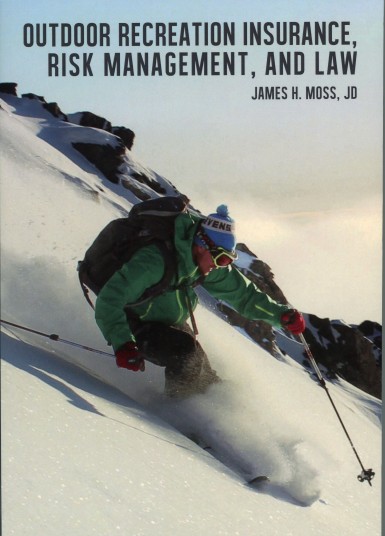
Outdoor Recreation Insurance, Risk Management, and Law
To see Jim’s complete bio go here and to see his CV you can find it here. To find out the purpose of this website go here.
G-YQ06K3L262
What do you think? Leave a comment.
If you like this let your friends know or post it on FB, Twitter or LinkedIn
 |
 |
 Threads |
 X (formerly known as Twitter) logo |
 Stimulus |
 Blue Sky |
Author: Outdoor Recreation Insurance, Risk Management and Law
Facebook Page: Outdoor Recreation & Adventure Travel Law
Email: Jim@Rec-Law.US
By Recreation Law Rec-law@recreation-law.com James H. Moss
@2024 Summit Magic Publishing, LLC
<rel=”author” link=” https://plus.google.com/u/0/b/112453188060350225356/” />
#AdventureTourism, #AdventureTravelLaw, #AdventureTravelLawyer, #AttorneyatLaw, #Backpacking, #BicyclingLaw, #Camps, #ChallengeCourse, #ChallengeCourseLaw, #ChallengeCourseLawyer, #CyclingLaw, #FitnessLaw, #FitnessLawyer, #Hiking, #HumanPowered, #HumanPoweredRecreation, #IceClimbing, #JamesHMoss, #JimMoss, #Law, #Mountaineering, #Negligence, #OutdoorLaw, #OutdoorRecreationLaw, #OutsideLaw, #OutsideLawyer, #RecLaw, #Rec-Law, #RecLawBlog, #Rec-LawBlog, #RecLawyer, #RecreationalLawyer, #RecreationLaw, #RecreationLawBlog, #RecreationLawcom, #Recreation-Lawcom, #Recreation-Law.com, #RiskManagement, #RockClimbing, #RockClimbingLawyer, #RopesCourse, #RopesCourseLawyer, #SkiAreas, #Skiing, #SkiLaw, #Snowboarding, #SummerCamp, #Tourism, #TravelLaw, #YouthCamps, #ZipLineLawyer, Quest Expeditions, Inc., Nathan & Brandy Henderson, Whitewater Rafting, Tennessee, Rafting Bus, Negligence, Public Policy, Statute, Whitewater Rafting, Rafting, Release, Bus, Transportation,
WordPress Tags: Release,whitewater,Tennessee,items,Henderson,Quest,Expeditions,Tenn,LEXIS,Plaintiff,Nathan,Brandy,Defendant,Claims,negligence,Defenses,office,injuries,Motion,Summary,Judgment,policy,scope,arguments,Some,theories,employee,patron,waiver,money,argument,Atkins,Swimwest,Center,Wisc,Supreme,Court,State,incident,Further,clause,freedom,statement,requirements,Tunkl,Regents,California,Rptr,regulation,exculpation,importance,member,transaction,advantage,strength,adhesion,provision,purchaser,protection,person,seller,agents,factors,professionals,agreement,profession,marketplace,legislature,Acts,statute,Written,waivers,agreements,injury,complaint,Seems,transportation,Moreover,Contract,plaintiffs,dangers,equipment,employees,tract,signature,lawsuit,precedence,clients,insurance,letter,cost,worth,competitor,Whether,Here,Leave,FaceBook,Twitter,LinkedIn,Recreation,Edit,Email,Google,RecreationLaw,Page,Outdoor,Adventure,Travel,Blog,Mobile,Site,James,Moss,Authorrank,author,AdventureTourism,AdventureTravelLaw,AdventureTravelLawyer,AttorneyatLaw,BicyclingLaw,Camps,ChallengeCourse,ChallengeCourseLaw,ChallengeCourseLawyer,CyclingLaw,FitnessLaw,FitnessLawyer,HumanPoweredRecreation,JamesHMoss,JimMoss,OutdoorLaw,OutdoorRecreationLaw,OutsideLaw,OutsideLawyer,RecLaw,RecLawBlog,LawBlog,RecLawyer,RecreationalLawyer,RecreationLawBlog,RecreationLawcom,Lawcom,RiskManagement,RockClimbingLawyer,RopesCourse,RopesCourseLawyer,SkiAreas,SkiLaw,SummerCamp,Tourism,TravelLaw,YouthCamps,ZipLineLawyer,Public,exculpatory,tradesmen
Henderson v. Quest Expeditions, Inc. 174 S.W.3d 730; 2005 Tenn. App. LEXIS 334
Posted: March 10, 2014 Filed under: Legal Case, Paddlesports, Release (pre-injury contract not to sue), Tennessee | Tags: Bus, California Supreme Court, Release, Supreme Court, Tenn, Tennessee, TN, Transportation, Whitewater Rafting Leave a commentTo Read an Analysis of this decision see: Release signed for whitewater rafting also works to stop claim for tripping getting out of raft bus. Tennessee release law broad enough to protect items enumerated in the release
Henderson v. Quest Expeditions, Inc. 174 S.W.3d 730; 2005 Tenn. App. LEXIS 334
Nathan & Brandy Henderson v. Quest Expeditions, Inc.
No. E2004-02585-COA-R3-CV
COURT OF APPEALS OF TENNESSEE, AT KNOXVILLE
174 S.W.3d 730; 2005 Tenn. App. LEXIS 334
April 4, 2005, Session
June 8, 2005, Filed
SUBSEQUENT HISTORY: Appeal denied by Henderson v. Quest Expeditions, Inc., 2005 Tenn. LEXIS 962 (Tenn., Oct. 24, 2005)
PRIOR HISTORY: [**1] Tenn. R. App. P.3 Appeal as of Right; Judgment of the Circuit Court Affirmed. Direct Appeal from the Circuit Court for Polk County. No. CV-03-130. Hon. John B. Hagler, Circuit Judge.
DISPOSITION: Judgment of the Circuit Court Affirmed.
COUNSEL: H. Franklin Chancey, Cleveland, Tennessee, for appellants.
Gary A. Cooper, Chattanooga, Tennessee, for appellee.
JUDGES: HERSCHEL PICKENS FRANKS, P.J., delivered the opinion of the court, in which CHARLES D. SUSANO, JR., J., and D. MICHAEL SWINEY, J., joined.
OPINION BY: HERSCHEL PICKENS FRANKS
OPINION
[*731] In this action for personal injuries allegedly due to defendant’s negligence, the Trial Court granted defendant summary judgment on the grounds that plaintiffs had executed a Waiver and Release of Liability which was required by defendant prior to plaintiffs’ participation in white water rafting. Plaintiffs have appealed, insisting the Release is void as against the public policy of this State. We affirm.
Plaintiffs’ Complaint alleged that Henderson was injured while on a white water rafting expedition operated by defendant. The Complaint alleged that defendant “ferries rafters to and from the Ocoee River by means of a series of dilapidated school buses.”, and that [**2] after Henderson had completed his rafting trip, he and other rafters were put on a bus, and then told to get on another bus, and when disembarking from the first bus he slipped and fell, sustaining severe personal injuries. Plaintiffs further alleged that defendant’s negligence was the proximate cause of his injuries.
Defendant in its Answer admitted that Henderson had participated in a rafting trip sponsored by defendant, and among its defenses raised was waiver, because plaintiff had signed a “Waiver and Release of Liability”, which defendant attached to its Answer.
In their Answers to Requests for Admissions, plaintiffs admitted that the waiver in question had been signed by Henderson. Defendant then filed a Motion for Summary Judgment, which plaintiffs opposed and Henderson filed his Affidavit which stated that Henderson had no previous white-water rafting experience, and was given a pre-printed document to sign prior to the excursion which was not reviewed with him by an employee of defendant. He further stated that he was not advised whether there were any other rafting companies who would allow him to go rafting without having to sign a waiver, or whether he could pay additional [**3] money to not have to sign the waiver.
The Trial Court determined that the waiver in this case did not affect the public interest, and thus the waiver was not void as against public policy. The court noted that Olson v. Molzen, 558 S.W.2d 429 (Tenn. 1977) did not apply to this situation and he was guided by the rule adopted in California, which states that “exculpatory agreements in the recreational sports context do not implicate the public interest.” Citing Allan v. Snow Summit, Inc., 51 Cal. App. 4th 1358, 59 Cal.Rptr.2d 813, 823 (Ca. App. 1996).
Plaintiffs on appeal insist the Waiver is void against public policy, and in the alternative, that the Waiver was void on the grounds it was too excessive in scope.
Plaintiffs concede that if the Waiver is enforceable then this action is barred, but argue the waiver violates the public policy of this State.
[*732] As our Supreme Court has explained:
[HN1] It is well settled in this State that parties may contract that one shall not be liable for his negligence to another but that such other shall assume the risk incident to such negligence. . . . Further, it is not necessary that the word ‘negligence’ appear [**4] in the exculpatory clause and the public policy of Tennessee favors freedom to contract against liability for negligence.
Empress Health and Beauty Spa, Inc. v. Turner, 503 S.W.2d 188 (Tenn. 1973).
An exception to this rule was recognized by the Supreme Court in Olson v. Molzen, wherein the Court held that certain relationships required greater responsibility which would render such a release “obnoxious”. Olson, at p. 430. The Court adopted the opinion of the California Supreme Court in Tunkl v. Regents of University of California, 60 Cal. 2d 92, 383 P.2d 441, 32 Cal. Rptr. 33 (Ca. 1963), which held that where the public interest would be affected by an exculpatory provision, such provision could be held invalid. Olson, at p. 431.
[HN2] Our Supreme Court adopted the six criteria set forth in Tunkl as useful in determining when an exculpatory provision should be held invalid as contrary to public policy. See Olson. These criteria are:
(a.) It concerns a business of a type generally thought suitable for public regulation.
(b.) The party seeking exculpation is engaged in performing a service of great importance to [**5] the public, which is often a matter of practical necessity for some members of the public.
(c.) The party holds himself out as willing to perform this service for any member of the public who seeks it, or at least for any member coming within certain established standards.
(d.) As a result of the essential nature of the service, in the economic setting of the transaction, the party invoking exculpation possesses a decisive advantage of bargaining strength against any member of the public who seeks his services.
(e.) In exercising a superior bargaining power the party confronts the public with a standardized adhesion contract of exculpation, and makes no provision whereby a purchaser may pay additional reasonable fees and obtain protection against negligence.
(f.) Finally, as a result of the transaction, the person or property of the purchaser is placed under the control of the seller, subject to the risk of carelessness by the seller or his agents.
Olson, at p. 431.
In Olson, the Supreme Court invalidated a contract between a doctor and patient which attempted to release the doctor from liability for his negligence in the performance of medical [**6] services. Also see Carey v. Merritt, 148 S.W.3d 912 (Tenn. Ct. App. 2004) and Russell v. Bray, 116 S.W.3d 1 (Tenn. Ct. App. 2003). In Russell, this Court refused to enforce an exculpatory contract between home buyers and the home inspectors who were hired by the buyers, because the Court found that the home inspectors were professionals whose services affected the public interest, and thus the contracts were offensive to public policy, based on the factors enumerated in Olson. In Carey, this Court made clear that [HN3] not all of the factors had to be present in order to invalidate an exculpatory agreement, but generally, the factors were limited to circumstances involving “a contract with a profession, as opposed to ‘tradesmen in the marketplace’.” Carey, at p. 916; cf. Parton v. Mark Pirtle Oldsmobile-Cadillac-Isuzu, Inc., 730 S.W.2d 634 [*733] (Tenn. Ct. App. 1987) (auto repair shop is not “professional” as would qualify it as service affecting public interest in order to invalidate exculpatory contract).
This case is factually different from Olson, Carey, and Parton because the white-water rafting service offered [**7] by defendant is not a “professional” trade, which affects the public interest. As discussed in factor number two quoted above, this is not a service of “great importance to the public, which is often a matter of practical necessity for some members of the public.” See Olson. There is no necessity that one go white-water rafting. In fact, [HN4] many jurisdictions have recognized that such recreational sporting activities are not activities of an essential nature which would render exculpatory clauses contrary to the public interest. See Seigneur v. National Fitness Institute, Inc., 132 Md. App. 271, 752 A.2d 631 (Md. Ct. Spec. App. 2000) (health club services not essential for purposes of holding exculpatory clause unenforceable as offensive to public interest); Allan v. Snow Summit, Inc., 51 Cal. App. 4th 1358, 59 Cal.Rptr.2d 813 (Cal. Ct. App. 1996) (“voluntary participation in recreational and sports activities [skiing] does not implicate the public interest”); Schutkowski v. Carey, 725 P.2d 1057 (Wyo. 1986) (sky diving and other private recreational businesses generally do not involve services which are necessary to the public such [**8] that exculpatory contract would be invalidated).
Plaintiffs argue that the Release in this case does affect the public interest because the business involved, i.e. commercial white-water rafting, is subject to regulation. While this is true, the presence of this factor does not render this Release offensive to the public interest. In fact, [HN5] recent legislation passed by the Tennessee Legislature “recognizes that the State has a legitimate interest in maintaining the economic viability of commercial white water rafting operations” because the State and its citizens benefit thereby. 2005 Tenn. Pub. Acts 169. This act states the legislative intent is to “encourage white water rafting by discouraging claims based on injury, death or damages resulting from risks inherent in white water rafting.” Id. Thus, the Tennessee legislature has evidenced that the public policy of this State is that commercial white water rafting companies be protected from claims for injuries to patrons.
Accordingly we affirm the Trial Court’s determination that the exculpatory contract in this case does not affect the public interest such that it should be invalidated pursuant to the Olson criteria.
Finally, [**9] appellants argue that the Release in this case should not operate as a bar to their claims because the injury suffered by Henderson was not within the “inherent risks” of the sport of white water rafting, and thus was not within the contemplation of the parties when the release was signed.
In the cases relied on by the plaintiffs regarding the scope of exculpatory provisions in the context of a sport, there are no provisions in those agreements which purport to release the defendant from its own negligence. For example, in Johnson v. Thruway Speedways, Inc., 63 A.D.2d 204, 407 N.Y.S.2d 81 (N.Y. App. Div. 1978), the Court refused to uphold a grant of summary judgment based on a release signed by the plaintiff prior to the sporting event. The Court stated that language of the release (which was not quoted in the opinion) “could lead to the conclusion that it only applied to injuries sustained by a spectator which were associated with the risks inherent in the activity of automobile racing”. The plaintiff in that case was injured when he was hit by a maintenance vehicle not involved in the race. Id. at 205. Thus, the Court [*734] held that this created a triable issue of fact [**10] as to whether the incident was of the type contemplated by the parties when the release was signed. Id.
Similarly, in the case of Larsen v. Vic Tanny International, 130 Ill. App. 3d 574, 474 N.E.2d 729, 85 Ill. Dec. 769 (Ill. App. Ct. 1984), the plaintiff was injured when he inhaled dangerous vapors created by the negligent mixing of cleaning compounds by the defendant health club’s employee. Plaintiff had signed a membership contract which contained exculpatory language regarding plaintiff’s use of the facilities (but did not mention any negligence by defendant). Id. The Court stated this type of injury was arguably not foreseeable to plaintiff when he signed the release, and thus a fact question existed regarding the parties’ intent behind the exculpation clause, which precluded summary judgment. Id. 1
1 The Court noted the result would have been different if plaintiff’s injuries stemmed from a slip and fall in an area adjacent to a swimming pool, citing its previous decision in Owen v. Vic Tanny Enterprises, 48 Ill. App. 2d 344, 199 N.E.2d 280 (Ill. App. Ct. 1964).
[**11] In another case where “negligence” is included in the release, Sweat v. Big Time Auto Racing, Inc., 117 Cal. App. 4th 1301, 12 Cal.Rptr. 3d 678 (Cal. Ct. App. 2004), the plaintiff was injured when the pit-area bleachers collapsed. Plaintiff had signed a release before entering the pit area, which stated that he released the defendant from all liability “whether caused by the negligence of the releasees or otherwise while the undersigned is in or upon the restricted area and/or . . . observing . . . the event.” Id. at 680. The Court found that the release was ambiguous due to the “and/or” language used, and thus relied on extrinsic evidence in interpreting the release, such as the fact that anyone could enter the pit area without signing the release once the race was over. The Court concluded that the release was only intended to apply to the risks inherent in being in close proximity to a race, and was not intended to cover the type of incident which occurred when the bleachers collapsed due to defective construction/maintenance. Id.
[HN6] The majority view from sister states is that an exculpatory provision which specifically and expressly releases a defendant from [**12] its own negligence will be upheld, without regard to whether the injury sustained is one typically thought to be “inherent in the sport”. In fact, there seems to be a split of authority among the states regarding whether the word “negligence” is even required to be present in the exculpation clause for the provision to be construed as releasing the defendant from its own negligence. Cases from Connecticut, for example, have held that in order for an exculpatory provision to be construed as releasing a defendant from its own negligence, the provision must expressly mention negligence . The cases are equally clear, however, that if the provision does expressly release the defendant from its own negligence, then it will be upheld as written. See Hyson v. White Water Mtn. Resorts, 265 Conn. 636, 829 A.2d 827 (Conn. 2003) (snowtubing); Brown v. Sol, 2004 Conn. Super. LEXIS 2430, 2004 WL 2165638 (Conn. Super. Ct. Aug. 31, 2004) (racing school); DiMaggio v. LaBreque, 2003 Conn. Super. LEXIS 2823, 2003 WL 22480968 (Conn. Super. Ct. Oct. 9, 2003) (parachuting).
[HN7] Most jurisdictions, including Tennessee, have held that if the exculpation contract sufficiently demonstrates the parties’ intent to eliminate [**13] liability for negligence, the absence of the word “negligence” is not fatal. See Krazek v. Mountain River Tours, Inc., 884 F.2d 163 (4th Cir. 1989) (white water rafting); Saenz v. Whitewater Voyages, Inc., 226 Cal. App. 3d 758, 276 Cal.Rptr. 672 (Cal. Ct. App. 1991) (white water rafting); Heil Valley Ranch, Inc. v. Simkin, 784 P.2d 781 (Colo. 1989) (horseback [*735] riding); Seigneur v. National Fitness Institute, Inc., 132 Md. App. 271, 752 A.2d 631 (Md. Ct. Spec. App. 2000) (health club); Petry v. Cosmopolitan Spa Intern., Inc., 641 S.W.2d 202 (Tenn. Ct. App. 1982) (health club); Murphy v. North American River Runners, Inc., 186 W. Va. 310, 412 S.E.2d 504 (W. Va. 1991) (white water rafting); Schutkowski v. Carey, 725 P.2d 1057 (Wyo. 1986) (skydiving). In these cases, the fact that the injury occurred during an activity that was not foreseeable or not associated with a risk “inherent in the sport” did not matter. See, e.g., Benedek (health club member injured when adjusting a television set above exercise machines which fell); Murphy (white water rafter injured [**14] when her raft tried to engage in rescue of another raft), and Petry (patron of health club injured when exercise machine she was sitting on collapsed).
In this case, the Release in question does specifically and expressly release defendant from any liability for its negligence or that of any employees, owners, agents, etc. In the matter of contract interpretation, this Court has previously explained:
[HN8] The cardinal rule in the construction of contracts is to ascertain the intent of the parties. West v. Laminite Plastics Mfg. Co., 674 S.W.2d 310 (Tenn. App. 1984). If the contract is plain and unambiguous, the meaning thereof is a question of law, and it is the Court’s function to interpret the contract as written according to its plain terms. Petty v. Sloan, 197 Tenn. 630, 277 S.W.2d 355 (1955). The language used in a contract must be taken and understood in its plain, ordinary, and popular sense. Bob Pearsall Motors, Inc. v. Regal Chrysler-Plymouth, Inc., 521 S.W.2d 578 (Tenn. 1975). In construing contracts, the words expressing the parties’ intentions should be given the usual, natural, and ordinary meaning. Ballard v. North American Life & Cas. Co., 667 S.W.2d 79 (Tenn. App. 1983). [**15] If the language of a written instrument is unambiguous, the Court must interpret it as written rather than according to the unexpressed intention of one of the parties. Sutton v. First Nat. Bank of Crossville, 620 S.W.2d 526 (Tenn. App. 1981). Courts cannot make contracts for parties but can only enforce the contract which the parties themselves have made. McKee v. Continental Ins. Co., 191 Tenn. 413, 234 S.W.2d 830, 22 A.L.R.2d 980 (1951).
Bradson Mercantile, Inc. v. Crabtree, 1 S.W.3d 648, 652 (Tenn. Ct. App. 1999).
The Contract under consideration is clear and unambiguous, and states that plaintiffs agreed to release defendant from any and all liability, including defendant’s own negligence. Moreover, the Contract specifically mentions that plaintiffs are being furnished and participating in white water rafting and “bus or van transportation” provided by the defendant. The Contract states that plaintiffs realize that they could be injured due to dangers from the rafting as well as the use of white water equipment, forces of nature, or even due to the negligence of defendant’s employees and other rafters. The Contract states [**16] that defendant is being relieved of any liability caused by its own negligence in no less than four places, the last of which is in bold print above the signature line. This Contract is plain, and enforceable as written. We conclude the Trial Court properly granted summary judgment to defendant on plaintiffs’ negligence claims.
The Trial Court’s Judgment is affirmed, and the cost of the appeal is assessed to plaintiffs Nathan and Brandy Henderson.
HERSCHEL PICKENS FRANKS, P.J.
G-YQ06K3L262
WordPress Tags: Henderson,Quest,Expeditions,Tenn,LEXIS,Nathan,Brandy,COURT,APPEALS,TENNESSEE,KNOXVILLE,April,Session,June,SUBSEQUENT,HISTORY,Appeal,PRIOR,Judgment,Circuit,Direct,Polk,John,Hagler,Judge,DISPOSITION,COUNSEL,Franklin,Chancey,Cleveland,appellants,Gary,Cooper,Chattanooga,JUDGES,HERSCHEL,PICKENS,FRANKS,opinion,CHARLES,SUSANO,MICHAEL,SWINEY,action,injuries,defendant,negligence,Trial,plaintiffs,Waiver,Release,participation,policy,State,Complaint,expedition,Ocoee,River,series,Answer,plaintiff,Answers,Requests,Admissions,Motion,Summary,Affidavit,employee,money,Olson,Molzen,situation,California,agreements,context,Allan,Summit,Rptr,scope,Supreme,incident,Further,clause,freedom,Health,Turner,exception,relationships,Tunkl,Regents,provision,criteria,regulation,exculpation,importance,member,transaction,advantage,strength,adhesion,purchaser,protection,person,seller,agents,performance,Also,Carey,Merritt,Russell,Bray,buyers,inspectors,professionals,factors,agreement,profession,marketplace,Parton,Mark,Pirtle,Oldsmobile,Cadillac,Isuzu,auto,factor,fact,jurisdictions,clauses,Seigneur,National,Institute,Spec,purposes,Schutkowski,presence,legislation,Legislature,citizens,Acts,injury,death,Thus,patrons,determination,contemplation,example,Johnson,Thruway,Speedways,event,conclusion,spectator,automobile,maintenance,vehicle,Larsen,Tanny,International,compounds,membership,facilities,area,decision,Owen,Enterprises,Sweat,Time,bleachers,construction,Cases,Connecticut,Hyson,White,Water,Resorts,Conn,Brown,Super,DiMaggio,LaBreque,Most,absence,Krazek,Mountain,Tours,Saenz,Whitewater,Voyages,Heil,Valley,Ranch,Simkin,Colo,Petry,Cosmopolitan,Intern,Murphy,North,American,Runners,Benedek,television,patron,machine,employees,owners,interpretation,West,Laminite,Plastics,Sloan,Pearsall,Motors,Regal,Chrysler,Plymouth,intentions,Ballard,Life,instrument,intention,Sutton,Bank,Crossville,Courts,McKee,Continental,Bradson,Mercantile,Crabtree,Contract,Moreover,transportation,dangers,equipment,signature,cost,whether,exculpatory,enforceable
Liability for Activities Whitewater Rafting Professionals
Posted: March 10, 2014 Filed under: Paddlesports, Tennessee, Whitewater Rafting | Tags: Paddling, Raft, Recreation, Release, statute, Tenn, Tennessee, Whitewater Rafting Leave a commentTennessee Whitewater Rafting Statute
TENNESSEE CODE ANNOTATED
Title 70 Wildlife Resources
Chapter 7 Liability for Activities
Part 2 Whitewater Rafting Professionals
GO TO THE TENNESSEE ANNOTATED STATUTES ARCHIVE DIRECTORY
Tenn. Code Ann. § 70-7-204 (2013)
70-7-201. Part definitions.
As used in this part, unless the context otherwise requires:
(1) “Engages in whitewater activity” means whitewater rafting;
(2) “Inherent risks of whitewater activities” means those dangers or conditions that are an integral part of whitewater activities, including, but not limited to:
(A) Water;
(B) Rocks and obstructions;
(C) Cold water and weather; and
(D) The potential of a participant to act in a negligent manner that may contribute to injury to the participant or other, such as failing to follow instructions or not acting within the participant’s ability;
(3) “Participant” means any person who engages in a whitewater activity;
(4) “Whitewater” means rapidly moving water;
(5) “Whitewater activity” means navigation on rapidly moving water in a watercraft; and
(6) “Whitewater professional” means a person, corporation, LLC, partnership, natural person or any other en-tity engaged for compensation in whitewater activity.
HISTORY: Acts 2012, ch. 862, § 1.
NOTES: Compiler’s Notes.
For the Preamble to the act concerning the limitation of liability of those involved in whitewater activities, please refer to Acts 2012, ch. 862.
Former part 2, §§ 70-7-201 — 70-7-204 (Acts 2004, ch. 952, § 1), concerning white water rafting, was repealed ef-fective May 17, 2005, by Acts 2005, ch. 169, § 1, which also enacted present part 2, §§ 70-7-201 — 70-7-207, in its place.
Former Part 2, §§ 70-7-201 — 70-7-208 (Acts 2005, ch. 169, § 1), concerning the Tennessee White Water Rafting Responsibility Act, was repealed by Acts 2005, ch. 169, § 2, as amended by Acts 2007, ch. 85, § 1, effective July 1, 2010.
Effective Dates.
Acts 2012, ch. 862, § 2. May 1, 2012.
70-7-202. Limitations on liability of whitewater professional.
Except as provided in § 70-7-203:
(1) A whitewater professional shall not be liable for an injury to or the death of a participant resulting from the inherent risks of whitewater activities; and
(2) No participant or participant’s representative shall make any claim against, maintain an action against, or re-cover from a whitewater professional, or any other participant for injury, loss, damages, or death of the participant resulting from any of the inherent risks of whitewater activities.
HISTORY: Acts 2012, ch. 862, § 1.
NOTES: Compiler’s Notes.
For the Preamble to the act concerning the limitation of liability of those involved in whitewater activities, please refer to Acts 2012, ch. 862.
Former part 2, §§ 70-7-201 — 70-7-204 (Acts 2004, ch. 952, § 1), concerning white water rafting, was repealed ef-fective May 17, 2005, by Acts 2005, ch. 169, § 1, which also enacted present part 2, §§ 70-7-201 — 70-7-207, in its place.
Former Part 2, §§ 70-7-201 — 70-7-208 (Acts 2005, ch. 169, § 1), concerning the Tennessee White Water Rafting Responsibility Act, was repealed by Acts 2005, ch. 169, § 2, as amended by Acts 2007, ch. 85, § 1, effective July 1, 2010.
Effective Dates.
Acts 2012, ch. 862, § 2. May 1, 2012.
Section to Section References.
This section is referred to in § 70-7-203.
70-7-203. When liability of whitewater professional imposed.
Nothing in § 70-7-202 shall be construed to prevent or limit the liability of a whitewater professional, or any other person if the whitewater professional:
(1) Provided the equipment and knew or should have known that the equipment was faulty, and the equipment was faulty to the extent that it caused the injury;
(2) Owns, leases, rents, or otherwise is in the lawful possession and control of the land or facilities upon which the participant sustained injuries because of a dangerous latent condition that was known to the whitewater professional, or person and for which warning signs have not been conspicuously posted;
(3) Commits an act or omission that constitutes gross negligence or willful or wanton disregard for the safety of the participant, and the act or omission caused the injury; or
(4) Intentionally injures the participant.
HISTORY: Acts 2012, ch. 862, § 1.
NOTES: Compiler’s Notes.
For the Preamble to the act concerning the limitation of liability of those involved in whitewater activities, please refer to Acts 2012, ch. 862.
Former part 2, §§ 70-7-201 — 70-7-204 (Acts 2004, ch. 952, § 1), concerning white water rafting, was repealed ef-fective May 17, 2005, by Acts 2005, ch. 169, § 1, which also enacted present part 2, §§ 70-7-201 — 70-7-207, in its place.
Former Part 2, §§ 70-7-201 — 70-7-208 (Acts 2005, ch. 169, § 1), concerning the Tennessee White Water Rafting Responsibility Act, was repealed by Acts 2005, ch. 169, § 2, as amended by Acts 2007, ch. 85, § 1, effective July 1, 2010.
Effective Dates.
Acts 2012, ch. 862, § 2. May 1, 2012.
Section to Section References.
This section is referred to in § 70-7-202.
70-7-204. Warning notice.
(a) Every whitewater professional shall either post and maintain signs that contain the warning notice prescribed in subsection (d) or give the warning in writing to participants. The signs shall be placed in clearly visible locations on or near places where the whitewater professional conducts whitewater activities, if the places are owned, managed, or controlled by the professional.
(b) The warning notice specified in subsection (d) shall appear on the sign in black letters, with each letter to be a minimum of one inch (1”) in height.
(c) Every written contract entered into by a whitewater professional for the purpose of providing professional services, instruction, or the rental of equipment to a participant, whether or not the contract involves activities on or off the location or site of the whitewater professional’s business, shall contain in clearly readable print the warning notice specified in subsection (d).
(d) The signs and contracts described in subsection (a) shall contain the following warning notice:
WARNING
Pursuant to Tenn. Code Annotated title 70, chapter 7, part 2, a whitewater professional is not liable for an injury to or the death of a participant in whitewater activities resulting from the inherent risks of whitewater activities.
HISTORY: Acts 2012, ch. 862, § 1.
NOTES: Compiler’s Notes.
For the Preamble to the act concerning the limitation of liability of those involved in whitewater activities, please refer to Acts 2012, ch. 862.
Former part 2, §§ 70-7-201 — 70-7-204 (Acts 2004, ch. 952, § 1), concerning white water rafting, was repealed effective May 17, 2005, by Acts 2005, ch. 169, § 1, which also enacted present part 2, §§ 70-7-201 — 70-7-207, in its place.
Former Part 2, §§ 70-7-201 — 70-7-208 (Acts 2005, ch. 169, § 1), concerning the Tennessee White Water Rafting Responsibility Act, was repealed by Acts 2005, ch. 169, § 2, as amended by Acts 2007, ch. 85, § 1, effective July 1, 2010.
Effective Dates.
Acts 2012, ch. 862, § 2. May 1, 2012.
70-7-205. Written waivers, exculpatory agreements and releases.
Nothing in this part shall modify, constrict or prohibit the use of written waivers, exculpatory agreements or releases. This part is intended to provide additional limitations of liability for whitewater professionals, whether or not such agreements are used.
HISTORY: Acts 2012, ch. 862, § 1.
NOTES: Compiler’s Notes.
For the Preamble to the act concerning the limitation of liability of those involved in whitewater activities, please refer to Acts 2012, ch. 862.
Former part 2, §§ 70-7-201 — 70-7-204 (Acts 2004, ch. 952, § 1), concerning white water rafting, was repealed ef-fective May 17, 2005, by Acts 2005, ch. 169, § 1, which also enacted present part 2, §§ 70-7-201 — 70-7-207, in its place.
Former Part 2, §§ 70-7-201 — 70-7-208 (Acts 2005, ch. 169, § 1), concerning the Tennessee White Water Rafting Responsibility Act, was repealed by Acts 2005, ch. 169, § 2, as amended by Acts 2007, ch. 85, § 1, effective July 1, 2010.
Effective Dates.
Acts 2012, ch. 862, § 2. May 1, 2012.
WordPress Tags: Activities,Whitewater,Professionals,Chapter,Part,Tenn,Code,Written,waivers,agreements,limitations,HISTORY,Acts,NOTES,Compiler,Preamble,limitation,Former,Tennessee,White,Water,Effective,Dates,exculpatory
Bill before congress to open the Yellowstone River and Grand Teton National Parks to paddling has an interesting side
Posted: March 8, 2014 Filed under: Paddlesports, Wyoming | Tags: Code of Federal Regulations, Congress, Grand Teton National Park, National Elk Refuge, National Park Service, Paddlesports, Paddling, Rafting, rivers, United States House Committee on Natural Resources, Yellowstone, Yellowstone National Park, Yellowstone River 1 CommentThe bill is sponsored by, let’s say, a very non environmental supporter in Congress. The bill is part of several other bills which are not so innocuous and the bill opens vast areas to paddling that the NPS will not be able to control.
You can find the bill here:
113th CONGRESS
1st Session
H. R. 3492
IN THE HOUSE OF REPRESENTATIVES
November 14, 2013
Mrs. Lummis (for herself and Mr. Bishop of Utah) introduced the following bill; which was referred to the Committee on Natural Resources
A BILL
To provide for the use of hand-propelled vessels in Yellowstone National Park, Grand Teton National Park, and the National Elk Refuge, and for other purposes.
1.
Short Title
This Act may be cited as the ” River Paddling Protection Act “.
2.
Regulations Superseded
(a)
In general
The following regulations shall have no force or effect with regard to hand-propelled vessels and the Secretary of the Interior may not issue substantially similar regulations that apply to hand-propelled vessels:
(1)
Section 7.13(d)(4)(ii) of title 36, Code of Federal Regulations, regarding vessels on streams and rivers in Yellowstone National Park.
(2)
Section 7.22(e)(3) of title 36, Code of Federal Regulations, regarding vessels on lakes and rivers in Grand Teton National Park.
(b)
Wildlife-Dependent recreational use
Notwithstanding section 25.21(a) of title 50, Code of Federal Regulations, regarding National Elk Refuge, the use of hand-propelled vessels on rivers and streams in the National Elk Refuge shall be considered a “wildlife-dependent recreational use” as that term is defined in section 5(2) of Public Law 89–669 ( 16 U.S.C. 668ee(2) ).
On the surface it looks great. We can paddle on a couple of rivers that have been closed forever. However, does it open up too much? It does not stop on the Yellowstone River but all rivers in Yellowstone National park. The same with Grand Teton National Park, everything will be fair paddling game.
Honestly, I don’t know if that is good, great or bad. You need to read and investigate for yourself.
Here are some comments: Protection of parks requires self restraint and Lummis Boating Legislation for Yellowstone and Grand Teton Parks Misguided.
Do Something
Read, educate yourself and get involved.
What do you think? Leave a comment.
If you like this let your friends know or post it on FB, Twitter or LinkedIn
Copyright 2014 Recreation Law (720) Edit Law
Email: Rec-law@recreation-law.com
Google+: +Recreation
Twitter: RecreationLaw
Facebook: Rec.Law.Now
Facebook Page: Outdoor Recreation & Adventure Travel Law
Mobile Site: http://m.recreation-law.com
By Recreation Law Rec-law@recreation-law.com James H. Moss #Authorrank
<rel=”author” link=” https://plus.google.com/u/0/b/112453188060350225356/” />
#RecreationLaw, #Recreation-Law.com, #OutdoorLaw, #OutdoorRecreationLaw, #AdventureTravelLaw, #law, #TravelLaw, #JimMoss, #JamesHMoss, #Tourism, #AdventureTourism, #Rec-Law, #RiskManagement, #CyclingLaw, #BicyclingLaw, #FitnessLaw, #Recreation-Law.com, #Backpacking, #Hiking, #Mountaineering, #IceClimbing, #RockClimbing, #RopesCourse, #ChallengeCourse, #SummerCamp, #Camps, #YouthCamps, #Skiing, #Ski Areas, #Negligence, #Snowboarding, #RecreationLaw, #@RecreationLaw, #Cycling.Law, #SkiLaw, #Outside.Law, #Recreation.Law, #RecreationLaw.com, #OutdoorLaw, #RecreationLaw, #OutdoorRecreationLaw, #AdventureTravelLaw, #Law, #TravelLaw, #JimMoss, #JamesHMoss, #AttorneyatLaw, #Tourism, #AdventureTourism, #RecLaw, #RecLawBlog, #RecreationLawBlog, #RiskManagement, #HumanPowered, #HumanPoweredRecreation,# CyclingLaw, #BicyclingLaw, #FitnessLaw, #RecreationLaw.com, #Backpacking, #Hiking, #Mountaineering, #IceClimbing, #RockClimbing, #RopesCourse, #ChallengeCourse, #SummerCamp, #Camps, #YouthCamps, #Skiing, #Ski Areas, #Negligence, #Snowboarding, sport and recreation laws, ski law, cycling law, Colorado law, law for recreation and sport managers, bicycling and the law, cycling and the law, ski helmet law, skiers code, skiing accidents, Recreation Lawyer, Ski Lawyer, Paddlesports Lawyer, Cycling Lawyer, Recreational Lawyer, Fitness Lawyer, Rec Lawyer, Challenge Course Lawyer, Ropes Course Lawyer, Zip Line Lawyer, Rock Climbing Lawyer, Adventure Travel Lawyer, Outside Lawyer, Recreation Lawyer, Ski Lawyer, Paddlesports Lawyer, Cycling Lawyer, #RecreationalLawyer, #FitnessLawyer, #RecLawyer, #ChallengeCourseLawyer, #RopesCourseLawyer, #ZipLineLawyer, #RockClimbingLawyer, #AdventureTravelLawyer, #OutsideLawyer, Good Samaritan, Samaritan, First Aid, Grand Teton National Park, Yellowstone, Yellowstone National Park, National Park Service, Paddlesports, Paddling, rafting, rivers, Congress,
WordPress Tags: Bill,River,Grand,Teton,National,Parks,supporter,areas,Session,HOUSE,November,Lummis,Bishop,Utah,Committee,Natural,Resources,vessels,Park,Refuge,purposes,Short,Title,Protection,Regulations,Secretary,Interior,Section,Code,Federal,rivers,lakes,Wildlife,Dependent,Public,Here,self,Legislation,Read,Leave,Twitter,LinkedIn,Recreation,Edit,Email,Google,RecreationLaw,Facebook,Page,Outdoor,Adventure,Travel,Blog,Mobile,Site,James,Moss,Authorrank,author,OutdoorLaw,OutdoorRecreationLaw,AdventureTravelLaw,TravelLaw,JimMoss,JamesHMoss,Tourism,AdventureTourism,RiskManagement,CyclingLaw,BicyclingLaw,FitnessLaw,RopesCourse,ChallengeCourse,SummerCamp,Camps,YouthCamps,Negligence,SkiLaw,Outside,AttorneyatLaw,RecLaw,RecLawBlog,RecreationLawBlog,HumanPoweredRecreation,Colorado,managers,helmet,accidents,Lawyer,Paddlesports,Recreational,Challenge,Course,Ropes,Line,Rock,RecreationalLawyer,FitnessLawyer,RecLawyer,ChallengeCourseLawyer,RopesCourseLawyer,ZipLineLawyer,RockClimbingLawyer,AdventureTravelLawyer,OutsideLawyer,Samaritan,Service

Friends of CAIC Launches $150,000 fundraising campaign
Posted: March 7, 2014 Filed under: Avalanche, Colorado | Tags: avalanche, CAIC, Colorado, Colorado Avalanche, Colorado Avalanche Information Center Leave a commentHi There,
We have had 7 fatalities thus far this season including the most recent, which happened yesterday in Southern Colorado. Our sincerest condolences go out to the family and friends of the victim. Numerous accidents have happened throughout Colorado and we recently saw an avalanche cycle that was one of the largest in 30 years. It has been and continues to be a very busy season.
The Colorado Avalanche Information Center’s Backcountry Avalanche Forecasting program is small but mighty. The CAIC operates on limited funding and they do incredible work with what they have. Colorado is a very big place and there are more and more people enjoying the State’s spectacular winter backcountry each year. We deserve the best avalanche center in the country. To achieve this goal we need everyone’s support. The State of Colorado is incredibly supportive and has increased the CAIC’s funding. But to really grow, we need you involved. This private public partnership is the best way we can expand the CAIC’s backcountry forecast program and I am personally asking you to support avalanche forecasting and education throughout the State of Colorado. In fact, to show how strongly I feel about the CAIC’s backcountry forecasting program, I will kick off the campaign with my own $200 donation.
Starting today and for the next 7 weeks the Friends of CAIC will be offering prizes, challenges, and incentives, to anyone who donates $25 or more. Click here for more information or to DONATE NOW!
We will be accepting donations in the following ways:
Donate on Crowdrise.com.http://www.crowdrise.com/stayinformedstayalive/
(Remember you don’t have to pay the “Optional Processing Fee”. Click on the text and select 0%.)
Mail us a check: PO BOX 140817 Denver, CO 80214
Donate ONLINE on our website: http://friendsofcaic.org
Hand us cash!
We are looking forward to your help in this campaign.
Sincerely,
Aaron Carlson
Executive Director
Friends of CAIC
Ethan Greene
Director
Colorado Avalanche Information Center
=
New York judge uses NY law to throw out claim for gross negligence because the facts did not support the claim. The release stopped the claims the plaintiff suffered running in a half marathon.
Posted: March 3, 2014 Filed under: New York, Racing, Release (pre-injury contract not to sue) | Tags: #race, Gross negligence, Half Marathon, Inc. Road Runners Club Of America, Jogging, Negligence, New York, New York City, New York City Department of Parks and Recreation, New York Road Runners, Plaintiff, Road Runners Club of America, Runner, running, Running Race, The City of New York 1 CommentThe plaintiff slipped and fell on ice while trying to leave the course to tie his shoe. He sued the City of New York, NYC Department of Parks, New York Road Runners, Inc. and Road Runners Club of America for his injuries. He alleged gross negligence for having him leave the course if he had a problem where he fell on ice.
Zuckerman v. The City of New York, 2011 N.Y. Misc. LEXIS 465; 2011 NY Slip Op 30410(U)
Plaintiff: Jonathan Zuckerman
Defendant: The City of New York, New York City Department of Parks and Recreation, New York Road Runners, Inc. and Road Runners Club Of America
Plaintiff Claims: negligence and gross negligence
Defendant Defenses: release
Holding: for the defendants
At the beginning of this half marathon that ran through Central Park in New York City, the plaintiff was instructed with other runners to leave the course if they had a problem. This was done so runners would not run into each other.
The plaintiff was an experienced runner who had participated in 100 events. During the race, he left the course to tie his shoe. He slipped on ice next to the course suffering this injury.
The release in this case was short; however, it was long enough to cover the important points according to the court. The release specifically mentioned “falls” as a risk of the activity and had the plaintiff agree to release claims due to negligence.
The release was signed by the plaintiff electronically. The signors had to elect to accept the terms or reject the terms. If they runner rejected the terms of the release, they could not register for the race.
Summary of the case
The court started by looking at the legal requirements in New York that affect the validity of a release.
Contractual agreements to waive liability for a party’s negligence, although frowned upon, are generally enforceable were not expressly prohibited by law.
Language relieving one from liability must be unmistakable and easily understood.
Agreements to indemnify for gross negligence or willful behavior, however, are void.
The court also defined the requirements to support a claim for gross negligence in an effort to overcome a release. “Gross negligence, when invoked to pierce an agreed-upon limitation of liability . . . must smack of intentional wrongdoing . . . that evinces a reckless indifference to the rights of others.”
It is refreshing to see the court recognize the claim as one trying to evade the release as a defense. The court stated, “I need only address whether there exist factual issues as to whether NYRR was grossly negligent and whether the accident was outside the scope of the waiver.”
The court reviewed the release and found the risk the plaintiff undertook was specifically identified in the release, a fall. The court also found the instructions the race official gave to the participants to leave the race course were reasonable. There was no greater liability attributed to the race promoter for having runners leave the course because to fail to do so would have runners running into each other on the course.
Having looked at the facts and the release, the court found that gross negligence could not reasonably be drawn from those facts.
City of New York’s Motions
The City of New York moved to amend its complaint to include the defense of Release. The city was named in the release as an entity to be protected by the release but had not pled the defense of release. As such the court had to grant the cities motion to amend its answer so it could plead the additional defense.
In another action that is rarely done in courts, the court reviewed the law on granting motions to amend and then granted the motion. The court then said since it had already ruled that a release stopped the plaintiff’s claims against the sponsor, it would also stop the plaintiff’s claims against the city and dismissed the city from the case.
So Now What?
It is rare to see a court take the initiative to do undertake these two actions. The first to throw out the gross negligence claims and the second to throw out the negligence claims of the city without a motion for summary judgment. Courts are reluctant to take such acts or the rules of civil procedure will not allow a court to do so.
The decision is also valuable because it defines what gross negligence is in New York.
Here an electronic release that was well written stopped the plaintiff’s claims against the race promoter and the entities the release also protected.
What do you think? Leave a comment.
If you like this let your friends know or post it on FaceBook, Twitter or LinkedIn
Copyright 2013 Recreation Law (720) Edit Law
Email: Rec-law@recreation-law.com
Google+: +Recreation
Twitter: RecreationLaw
Facebook: Rec.Law.Now
Facebook Page: Outdoor Recreation & Adventure Travel Law
Blog: www.recreation-law.com
Mobile Site: http://m.recreation-law.com
By Recreation Law Rec-law@recreation-law.com James H. Moss #Authorrank
<rel=”author” link=” https://plus.google.com/u/0/b/112453188060350225356/” />
#AdventureTourism, #AdventureTravelLaw, #AdventureTravelLawyer, #AttorneyatLaw, #Backpacking, #BicyclingLaw, #Camps, #ChallengeCourse, #ChallengeCourseLaw, #ChallengeCourseLawyer, #CyclingLaw, #FitnessLaw, #FitnessLawyer, #Hiking, #HumanPowered, #HumanPoweredRecreation, #IceClimbing, #JamesHMoss, #JimMoss, #Law, #Mountaineering, #Negligence, #OutdoorLaw, #OutdoorRecreationLaw, #OutsideLaw, #OutsideLawyer, #RecLaw, #Rec-Law, #RecLawBlog, #Rec-LawBlog, #RecLawyer, #RecreationalLawyer, #RecreationLaw, #RecreationLawBlog, #RecreationLawcom, #Recreation-Lawcom, #Recreation-Law.com, #RiskManagement, #RockClimbing, #RockClimbingLawyer, #RopesCourse, #RopesCourseLawyer, #SkiAreas, #Skiing, #SkiLaw, #Snowboarding, #SummerCamp, #Tourism, #TravelLaw, #YouthCamps, #ZipLineLawyer, The City of New York, New York City Department of Parks and Recreation, New York Road Runners, Inc. Road Runners Club Of America, Half Marathon, Running, Running Race, Race, Jogging, Runner, Gross Negligence,
WordPress Tags: York,negligence,plaintiff,Department,Parks,Road,Runners,Club,America,injuries,Zuckerman,Misc,LEXIS,Slip,Jonathan,Defendant,Recreation,Claims,Defenses,defendants,Central,Park,runner,events,injury,Summary,requirements,Contractual,agreements,Language,behavior,effort,Gross,limitation,indifference,NYRR,accident,scope,waiver,instructions,participants,promoter,Motions,complaint,Release,cities,action,initiative,judgment,Courts,procedure,decision,Here,entities,Leave,FaceBook,Twitter,LinkedIn,Edit,Email,Google,RecreationLaw,Page,Outdoor,Adventure,Travel,Blog,Mobile,Site,James,Moss,Authorrank,author,AdventureTourism,AdventureTravelLaw,AdventureTravelLawyer,AttorneyatLaw,BicyclingLaw,Camps,ChallengeCourse,ChallengeCourseLaw,ChallengeCourseLawyer,CyclingLaw,FitnessLaw,FitnessLawyer,HumanPoweredRecreation,JamesHMoss,JimMoss,OutdoorLaw,OutdoorRecreationLaw,OutsideLaw,OutsideLawyer,RecLaw,RecLawBlog,LawBlog,RecLawyer,RecreationalLawyer,RecreationLawBlog,RecreationLawcom,Lawcom,RiskManagement,RockClimbingLawyer,RopesCourse,RopesCourseLawyer,SkiAreas,SkiLaw,SummerCamp,Tourism,TravelLaw,YouthCamps,ZipLineLawyer,Half,Marathon,Race,shoe,upon,whether
Zuckerman v. The City of New York, 2011 N.Y. Misc. LEXIS 465; 2011 NY Slip Op 30410(U)
Posted: March 3, 2014 Filed under: Legal Case, New York, Racing, Racing, Release (pre-injury contract not to sue) | Tags: #race, Gross negligence, Half Marathon, Inc. Road Runners Club Of America, Jogging, New York, New York City, New York City Department of Parks and Recreation, New York Road Runners, Plaintiff, Road Runners Club of America, Runner, running, Running Race, The City of New York Leave a commentZuckerman v. The City of New York, 2011 N.Y. Misc. LEXIS 465; 2011 NY Slip Op 30410(U)
[**2] Jonathan Zuckerman, Plaintiff, -against- The City of New York, New York City Department of Parks and Recreation, New York Road Runners, Inc. and Road Road Runners Club Of America, Defendants.
105044/2010
SUPREME COURT OF NEW YORK, NEW YORK COUNTY
2011 N.Y. Misc. LEXIS 465; 2011 NY Slip Op 30410(U)
February 18, 2011, Decided
February 23, 2011, Filed
NOTICE: THIS OPINION IS UNCORRECTED AND WILL NOT BE PUBLISHED IN THE PRINTED OFFICIAL REPORTS.
CORE TERMS: runner, marathon, gross negligence, affirmative defense, amend, enforceable, reply, factual issues, participating, oppose, ice, exit, nunc pro tunc, risks associated, reckless indifference, grossly negligent, collectively, spectators, humidity, website, weather, traffic, invoked, waive, heat, void, registration, disbursements, encompassed, registrant
COUNSEL: [*1] For Plaintiff: Frank Taubner, Esq., Jasne & Florio, LLP, White Plains, NY.
For defendant NYRR: Deborah Peters Jordan, Esq., Havkins, Rosenfeld et al, New York, NY.
For defendant City: Anthony Bila, ACC, Michael A. Cardozo, Corporation Counse, New York, NY.
JUDGES: Barbara Jaffe, JSC.
OPINION BY: Barbara Jaffe
OPINION
DECISION & ORDER
By notice of motion dated August 20, 2010, defendants New York Road Runners, Inc. and Road Runners Club of America (collectively, NYRR) move pursuant to CPLR 3212 for an order summarily dismissing the complaint, and defendant Road Runners Club of America, Inc. (RRCA) moves pursuant to CPLR 3211(c) for an order dismissing the complaint. Plaintiff opposes as to NYRR, and does not oppose as to RRCA. Defendants City and New York City Department of Recreation (collectively, City) move separately pursuant to CPLR 3025(c) for an order granting leave to amend their answer nunc pro tunc to add an affirmative defense, and pursuant to CPLR 3211(a)(5) and (a)(7) for an order dismissing the complaint. Plaintiff opposes City’s motion.
[**3] I. FACTS
NYRR conducts more than 100 events a year, including the Manhattan Half Marathon (Half Marathon). (Affirmation of Kenneth L. Winell, Esq., dated Aug. 20, 2010 [Winell [*2] Aff.], Exh. D). Participants in the Half Marathon register through NYRR’s website which contains the following provision:
I know that participating in NYRR events is a potentially hazardous activity. I agree not to enter and participate unless I am medically able and properly trained. I agree to abide by any decision of an event official relative to my ability to safely complete the event. I am voluntarily entering and assume all risks associated with participating in the event, including, but not limited to, falls, contact with other participants, spectators or others, the effect of the weather, including heat and/or humidity, traffic and the conditions of the course, all such risks being known and appreciated by me. I grant to the Medical Director of this event and his designee access to my medical records and physicians, as well as other information, relating to medical care that may be administered to me as a result of my participation in this event. Having read this Waiver and knowing these facts, and in consideration of your acceptance of this application, I, for myself and anyone entitled to act of my behalf, waive and release New York Road Runners Club, Inc., Road Runners Club [*3] of America, USA Track & Field, the City of New York and its agencies and departments, the Metropolitan Athletics Congress, and all sponsors, and their representatives and successors, from present and future claims and liabilities of any kind, known or unknown, arising out of my participation in this event or related activities, even though such claim or liability may arise out of negligence or fault on the part of the foregoing persons or entities. I grant permission to the foregoing persons and entities to use or authorize others to use any photographs, motions pictures, recordings, or any other record of my participation in this event or related activities for any legitimate purpose without remuneration.
(Id., Exhs. C.F. [emphases added]). The registrant must then either select “I accept and agree to the above waiver,” or “I do not accept and do not agree to the above waiver.” (Id.) If the registrant selects the latter, he cannot register. (Id., Exh. C).
Plaintiff, a member of NYRR, is an experienced runner, having participated in over 100 NYRR events. (Affirmation of Frank Taubner, Esq., dated Oct. 11, 2010 [Taubner Aff.]). He registered for the 2009 Half Marathon online approximately [*4] one week earlier, and recalls seeing [**4] a waiver as part of the registration procedure. (Id.).
At approximately 8:00 a.m. on January 25, 2009, plaintiff arrived at the starting area of the Half Marathon in Central Park. (Id.). Snow banks flanked the course’s pathways. (Id.). An NYRR official orally instructed the participants that if they had to stop for any reason, they were to exit the course and proceed to the shoulder of the roadway so as not to block other participants. (Id.). While running, plaintiffs shoe became untied and seeing no designated exit areas, he stepped off the path as instructed and proceeded to what he believed to be a patch of dirt. (Id.). There, he slipped on ice that he had not seen, and fell backward, seriously injuring himself. (Id.).
II. NYRR’S MOTION
A. Contentions
NYRR contends that it is entitled to summary dismissal as plaintiff executed a valid and enforceable waiver of liability, and because it did not organize, supervise or control the half marathon. (Memorandum of Law in Support of Defendants’ Motion to Dismiss, dated Aug. 2010 [NYRR Mem.]). In support, it annexes the affidavits of three of its employees, (id., Exhs. C, D, E), a copy of the waiver (id, [*5] Exh. F), and proof of plaintiffs registration (id., Exh. F).
Plaintiff argues that in light of defendants’ gross negligence and his compliance with the instructions given at the commencement of the half marathon that he exit the course if he needed to stop, the waiver is unenforceable. He also denies having assumed the risk of slipping on ice when exiting the course. (Taubner Aff.).
In reply, NYRR asserts that plaintiff’s injury is encompassed by the waiver and that plaintiff has failed to establish that NYRR’s conduct rises to the level of gross negligence. (Reply [**5] Affirmation of Deborah Peters Jordan, Esq., dated Nov. 18, 2010).
B. Analysis
Contractual agreements to waive liability for a party’s negligence, although frowned upon, are generally enforceable where not expressly prohibited by law. (Gross v Sweet, 49 NY2d 102, 105, 400 N.E.2d 306, 424 N.Y.S.2d 365 [1979]). Language relieving one from liability must be unmistakable and easily understood. (Id. at 107). Agreements to indemnify for gross negligence or willful behavior, however, are void. (Id. at 106). “Gross negligence, when invoked to pierce an agreed-upon limitation of liability . . . must smack of intentional wrongdoing . . . that evinces a reckless indifference [*6] to the rights of others.” (Sommer v Fed. Signal Corp., 79 NY2d 540, 554, 593 N.E.2d 1365, 583 N.Y.S.2d 957 [1992]; Abacus Fed. Sav. Bank v ADT Sec. Servs., Inc., 77 A.D.3d 431, 433, 908 N.Y.S.2d 654 [1st Dept 2010]).
As plaintiff does not deny that he agreed to the waiver or that it is generally enforceable and not void as a matter of law or public policy, I need only address whether there exist factual issues as to whether NYRR was grossly negligent and whether the accident was outside the scope of the waiver. That the waiver references the “conditions of the course” does not remove plaintiff’s accident from its scope as the waiver extends to “all risks associated with participating in the event, including, but not limited to, falls, contact with other participants, spectators or others, the effect of the weather, including heat and/or humidity, traffic and the conditions of the course.” The breadth of the provision permits the inference that plaintiff was aware that by executing the waiver, he assumed the risks of running through Central Park in the winter, where the presence of ice is reasonably anticipated, which risks are reasonably deemed part of the activity, and not just of the course. (See Bufano v Nat. Inline Roller Hockey Assn., 272 A.D.2d 359, 707 N.Y.S.2d 223 [**6] [2d Dept 2000] [*7] [plaintiff assumed risk of injury during fight while playing inline roller hockey]), Nothing in the provision precludes its application to accidents incurred by a participant who momentarily steps off the course.
And, although plaintiff acted in compliance with defendants’ instruction to leave the race course if he needed to stop, such an instruction constitutes a sensible means of protecting participants from colliding with one another, and neither invites nor would naturally lead to an accident sufficient to constitute reckless indifference. Consequently, an inference of gross negligence is not reasonably drawn therefrom. (See Lemoine v Cornell Univ., 2 AD3d 1017, 769 N.Y.S.2d 313 [3d Dept 2003], lv denied 2 N.Y.3d 701, 810 N.E.2d 912, 778 N.Y.S.2d 459 [2005] [plaintiff fell from wall after rock-climbing instructor told her where to place her hands and feet; waiver of liability enforced; not gross negligence]). And, assuming that NYRR had a duty to keep the park free of slippery substances, the failure to do so constitutes ordinary negligence at best.
Given this result, I need not address RRCA’s alternative argument that it did not organize, supervise, or control the half marathon.
III. CITY’S MOTION
A. Contentions
City argues that it should [*8] be granted leave to amend its answer to add an affirmative defense that the action is barred by plaintiffs execution of a written release. It observes that leave is freely granted, that plaintiff will no suffer no prejudice, and that, although this motion was served after joinder of issue, it is procedurally proper as City moves pursuant to CPLR 3211(a)(7) as well as (a)(5). (Affirmation of Anthony Bila, ACC, dated Sept. 29, 2010).
Plaintiff asserts that City is not entitled to dismissal given the factual issues as to City’s [**7] gross negligence and whether plaintiff’s accident is encompassed by the waiver, and that the motion to amend should be denied because the affirmative defense is meritless and prejudicial. (Taubner Aff.).
In reply, City maintains that as it moves only pursuant to CPLR 3211, the existence of factual issues is immaterial. It contends that the amendment is meritorious and will not prejudice plaintiff, and that plaintiffs accident falls squarely within the scope of the waiver and that there is no evidence of gross negligence. (Reply Affirmation of Anthony Bila, ACC, dated Nov. 18, 2010).
B. Analysis
Although objections pursuant to CPLR 3211(a)(5) are waived if not invoked [*9] in the movant’s answer (CPLR 3211 [e]), a motion to amend an answer may be granted in order that the affirmative defense be addressed on the merits. (Siegel, NY Prac § 274, at 435 [3d ed]; Marks v Macchiarola, 221 AD2d 217, 634 N.Y.S.2d 56 [1st Dept 1995]). Thus, and absent any discernible prejudice given plaintiffs having addressed the substance of the motion above (II. A.), leave is granted. (Cf Young v GSL Enter., Inc., 170 AD2d 401, 566 N.Y.S.2d 618 [1st Dept 1991] [Supreme Court properly addressed merits of proposed affirmative defense in motion to amend]; Scheff v St. John’s Episcopal Hosp., 115 AD2d 532, 534, 496 N.Y.S.2d 58 [2d Dept 1985] [same]).
Although plaintiff executed the waiver on NYRR’s website, City was expressly included therein. (See Brookner v New York Roadrunners Club, Inc., 51 AD3d 841, 858 N.Y.S.2d 348 [2d Dept 2008], lv denied 11 N.Y.3d 704, 894 N.E.2d 1198, 864 N.Y.S.2d 807 [upholding waiver against NYRR and City]; cf Tedesco v Triborough Bridge and Tunnel Auth, 250 AD2d 758, 673 N.Y.S.2d 181 [2d Dept 1998] [bicycle tour waiver included party not specifically named in release]). Moreover, the waiver of liability is a release within the meaning [**8] of CPLR 3211(a)(5). (See Brookner, 51 AD3d 841, 858 N.Y.S.2d 348).
Having already determined that the waiver is enforceable as against plaintiff, and as NYRR’s [*10] conduct was not grossly negligent, the same result is reached as to City.
IV. CONCLUSION
Accordingly, it is hereby
ORDERED, that the motion for summary judgment by New York Road Runners, Inc. and Road Runners Club of America is granted, and the complaint dismissed against them with costs and disbursements to defendants as taxed by the Clerk upon the submission of an appropriate bill of costs; it is further
ORDERED, that the motion by City of New York and New York City Department of Parks and Recreation for leave to serve an amended answer is granted, and the annexed answer is deemed timely served, nunc pro tunc; and it is further
ORDERED, that the motion for dismissal as against City of New York and New York City Department of Parks and Recreation is granted, and the complaint dismissed against them with costs and disbursements to defendants as taxed by the Clerk upon the submission of an appropriate bill of costs.
This constitutes the decision and order of the court.
/s/ Barbara Jaffe
Barbara Jaffe, JSC
DATED: February 18, 2011
New York, New York
WordPress Tags: Zuckerman,York,Misc,LEXIS,Slip,Jonathan,Plaintiff,Department,Parks,Recreation,Road,Runners,Club,America,Defendants,SUPREME,COURT,February,NOTICE,OPINION,OFFICIAL,REPORTS,TERMS,runner,negligence,indifference,spectators,registration,disbursements,COUNSEL,Frank,Taubner,Jasne,Florio,White,Plains,defendant,NYRR,Deborah,Peters,Jordan,Havkins,Rosenfeld,Anthony,Bila,Michael,Cardozo,Corporation,Counse,JUDGES,Barbara,Jaffe,DECISION,ORDER,August,CPLR,complaint,RRCA,FACTS,events,Manhattan,Half,Marathon,Affirmation,Kenneth,Winell,Participants,provision,event,Medical,Director,physicians,information,participation,Waiver,acceptance,Track,Field,agencies,departments,Metropolitan,Athletics,successors,liabilities,entities,permission,recordings,purpose,remuneration,Exhs,emphases,member,procedure,January,area,Central,Park,pathways,roadway,plaintiffs,areas,path,dirt,MOTION,Contentions,dismissal,Memorandum,Support,Dismiss,affidavits,employees,compliance,instructions,commencement,injury,Analysis,Contractual,agreements,Gross,Sweet,Language,behavior,limitation,Sommer,Signal,Corp,Abacus,Bank,Servs,Dept,policy,accident,scope,references,breadth,inference,winter,presence,Bufano,Inline,Roller,Hockey,Assn,accidents,participant,instruction,Lemoine,Cornell,Univ,instructor,feet,substances,failure,Given,argument,action,execution,Sept,existence,amendment,Although,objections,Siegel,Prac,Marks,Macchiarola,Thus,substance,Young,Enter,Scheff,John,Episcopal,Hosp,Brookner,Roadrunners,Tedesco,Triborough,Bridge,Tunnel,Auth,bicycle,Moreover,CONCLUSION,judgment,Clerk,submission,enforceable,nunc,tunc,website,registrant,pursuant,upon,whether
Dive Buddy (co-participant) not liable for death of the diver because the cause of death was too distant from the acts of the plaintiff
Posted: February 24, 2014 Filed under: Assumption of the Risk, Scuba Diving, Washington | Tags: BC, Dive Buddy, Diving, duty, Night diving, Open Water Diver, Outdoors, Recreation, scuba diving, Sudden Emergency Doctrine, Washington 2 CommentsThis case was brought to my attention because of the suit for the ski buddy fatality in Canada in the news recently. (See Canadian suit would hold you liable for your ski buddy’s death.)Are you liable for your buddy’s death if you are participating in a sport together. The issue pivots on whether or not there is an expected responsibility (duty) on behalf of the buddies.
Rasmussen, et al., v. Bendotti, 107 Wn. App. 947; 29 P.3d 56; 2001 Wash. App. LEXIS 1962
Plaintiff: Cully, Adam, and Brandy Jo Rasmussen, children of the deceased and the estate of the deceased
Defendant: Eugene L. Bendotti, husband of the deceased
Plaintiff Claims: negligence
Defendant Defenses: there was no negligence
Holding: for the defendant
This is one of a few cases where a co-participant or in this case dive buddy is held liable for the injuries or deaths of the other participant. In this case, a husband and wife were diving together to recover a snowmobile 100’ deep in a lake. On the fourth dive of the day, the husband realized he had not attached his power inflator to his buoyance compensator. He dropped his weight belt and ascended, leaving his spouse, dive buddy, below.
The wife was found drowned after becoming entangled in a rope.
The buoyance compensator is a PFD (personal floatation device) designed for diving. It is inflated and deflated as you dive to keep your body at the level or depth in the water you want. Many divers will deflate and inflate the buoyance compensator (BC) several times during a dive as they descend, stay at a level and descend or ascend again.
A trial was held to the court which held that the husband did owe a duty to the spouse. However, that duty was terminated once the husband’s emergency occurred. The court also found that the husband’s failure to act as a proper dive buddy was too distant from the cause of death of the spouse to be the proximate cause of her death.
The plaintiff’s appealed.
In this case, the plaintiff’s appealed the errors; they felt the court made in its decision. Those are called “assignment of error(s).” The plaintiff argued that the court came to the incorrect conclusion in the determination of the facts and the application of the law.
Summary of the case
The court accepted several conclusions of fact and law from the trial court that are necessary to understand its analysis and, which are critical legal issues. The first was a dive buddy owes a duty of care to his or her dive buddy. Consequently, a failure to exercise this duty, which results in an injury to the dive buddy, can be negligent.
The existence of a duty is a question of law. Whether the defendant owed the plaintiff a duty, however, turns on the foreseeability of injury; that is, whether the risk embraced by the conduct exposes the plaintiff to injury. “The hazard that brought about or assisted in bringing about the result must be among the hazards to be perceived reasonably and with respect to which defendant’s conduct was negligent.”
The trial court found the defendant had not breached his duty because his personnel emergency ended any duty he owed to his dive buddy. The trial court labeled this as the emergency doctrine. However, the appellate court defined the emergency doctrine as:
The emergency doctrine was developed at common law and states the commonsense proposition that a person faced with an emergency should not be held to the same standards as someone given time for reflection and deliberation.
A defendant is entitled to the benefit of the emergency doctrine when he or she undertakes the best course of action given an emergency not of his or her own making.
The appellate court did not hold the emergency doctrine did not apply; however, its statements indicate such because it went on to discuss proximate cause.
Proximate cause is the term defined to relate the breach of the duty to the injury.
Proximate cause has two discreet elements. The first, cause in fact, requires some physical connection between the act (the failure to connect the power inflator) and the injury (Bonny’s death). The second element of proximate cause involves legal causation. Id. And that is a policy consideration for the court. The consideration is whether the ultimate result and the defendant’s acts are substantially connected, and not too remote to impose liability. Id. It is a legal question involving logic, common sense, justice, policy, and precedent.
The court ruled that the cause of the plaintiff’s death was the plaintiff’s own acts, not caused by the defendant. The court questioned, “…if Gene had properly connected his power inflator, would Bonny be alive today?” The trial court stated, and the appellate court accepted that the act of the defendant descending was not the cause of the plaintiff’s death.
An expert witness opined that the cause of the plaintiff’s death was her failure to have a dive knife with her.
There was too much between the ascension of the defendant and the entanglement which caused the drowning to be linked. The ascension was not the proximate cause of the plaintiff’s death.
So Now What?
The decision in the Canadian court on whether a ski buddy owes a duty of care to another skier will probably not end with the jury’s decision. See Canadian suit would hold you liable for your ski buddy’s death. Ski buddy meaning the guy you don’t know skiing next to you. However, here we have a definitive decision that a dive buddy in a scuba diving owes a duty to their dive buddy.
This is a very different legal relationship than found in competitive sports where someone may be injured due to another participant and the nature of the game. See Indiana adopts the higher standard of care between participants in sporting events in this Triathlon case. Here one participant in the sport is legal responsible, as defined by the sport or activity or sometimes the two people, for the other person.
If you agree to watch or take care of someone in a sport, you may be accepting liability for that person. Be aware.
What do you think? Leave a comment.
If you like this let your friends know or post it on FaceBook, Twitter or LinkedIn
Copyright 2013 Recreation Law (720) Edit Law
Email: Rec-law@recreation-law.com
Google+: +Recreation
Twitter: RecreationLaw
Facebook: Rec.Law.Now
Facebook Page: Outdoor Recreation & Adventure Travel Law
Blog: www.recreation-law.com
Mobile Site: http://m.recreation-law.com
By Recreation Law Rec-law@recreation-law.com James H. Moss #Authorrank
<rel=”author” link=” https://plus.google.com/u/0/b/112453188060350225356/” />
#AdventureTourism, #AdventureTravelLaw, #AdventureTravelLawyer, #AttorneyatLaw, #Backpacking, #BicyclingLaw, #Camps, #ChallengeCourse, #ChallengeCourseLaw, #ChallengeCourseLawyer, #CyclingLaw, #FitnessLaw, #FitnessLawyer, #Hiking, #HumanPowered, #HumanPoweredRecreation, #IceClimbing, #JamesHMoss, #JimMoss, #Law, #Mountaineering, #Negligence, #OutdoorLaw, #OutdoorRecreationLaw, #OutsideLaw, #OutsideLawyer, #RecLaw, #Rec-Law, #RecLawBlog, #Rec-LawBlog, #RecLawyer, #RecreationalLawyer, #RecreationLaw, #RecreationLawBlog, #RecreationLawcom, #Recreation-Lawcom, #Recreation-Law.com, #RiskManagement, #RockClimbing, #RockClimbingLawyer, #RopesCourse, #RopesCourseLawyer, #SkiAreas, #Skiing, #SkiLaw, #Snowboarding, #SummerCamp, #Tourism, #TravelLaw, #YouthCamps, #ZipLineLawyer,
WordPress Tags: Dive,Buddy,participant,death,diver,attention,Canada,news,Canadian,buddies,Rasmussen,Bendotti,Wash,LEXIS,Plaintiff,Adam,Brandy,estate,Defendant,Eugene,husband,Claims,negligence,Defenses,injuries,deaths,wife,fourth,spouse,floatation,device,depth,Many,failure,errors,decision,assignment,error,conclusion,determination,Summary,conclusions,fact,analysis,injury,existence,Whether,personnel,doctrine,proposition,person,reflection,deliberation,action,statements,Proximate,connection,Bonny,causation,policy,logic,justice,precedent,Gene,ascension,entanglement,jury,relationship,Indiana,participants,events,Triathlon,Here,Leave,FaceBook,Twitter,LinkedIn,Recreation,Edit,Email,Google,RecreationLaw,Page,Outdoor,Adventure,Travel,Blog,Mobile,Site,James,Moss,Authorrank,author,AdventureTourism,AdventureTravelLaw,AdventureTravelLawyer,AttorneyatLaw,BicyclingLaw,Camps,ChallengeCourse,ChallengeCourseLaw,ChallengeCourseLawyer,CyclingLaw,FitnessLaw,FitnessLawyer,HumanPoweredRecreation,JamesHMoss,JimMoss,OutdoorLaw,OutdoorRecreationLaw,OutsideLaw,OutsideLawyer,RecLaw,RecLawBlog,LawBlog,RecLawyer,RecreationalLawyer,RecreationLawBlog,RecreationLawcom,Lawcom,RiskManagement,RockClimbingLawyer,RopesCourse,RopesCourseLawyer,SkiAreas,SkiLaw,SummerCamp,Tourism,TravelLaw,YouthCamps,ZipLineLawyer,inflator,buoyance,compensator,appellate
Rasmussen, et al., v. Bendotti, 107 Wn. App. 947; 29 P.3d 56; 2001 Wash. App. LEXIS 1962
Posted: February 24, 2014 Filed under: Legal Case, Scuba Diving, Washington | Tags: Dive Buddy, Diving, Duty of care, Outdoors, Proximate Cause, Recreation, scuba diving, Summary judgment Leave a commentRasmussen, et al., v. Bendotti, 107 Wn. App. 947; 29 P.3d 56; 2001 Wash. App. LEXIS 1962
Cully C. Rasmussen, as Personal Representative, ET AL., Appellants, v. Eugene L. Bendotti, Respondent.
No. 19464-7-III
COURT OF APPEALS OF WASHINGTON, DIVISION THREE, PANEL ONE
107 Wn. App. 947; 29 P.3d 56; 2001 Wash. App. LEXIS 1962
August 21, 2001, Filed
SUBSEQUENT HISTORY: [***1] Order Denying Motion and Reconsideration September 26, 2001, Reported at: 2001 Wash. App. LEXIS 2165.
SUMMARY: Nature of Action: The children and the estate of a diver who drowned during a scuba diving excursion sought damages from the diver’s diving partner based on the diving partner’s failure to perform a self-equipment check prior to commencing the dive. The failure to perform the equipment check caused the diving partner to make an emergency ascent during the dive. While the diving partner was ascending to the water’s surface, the diver’s equipment became entangled in a rope which led to the diver’s drowning.
Superior Court: After denying the defendant’s motion for a summary judgment, the Superior Court for Chelan County, No. 98-2-00754-5, Lesley A. Allan, J., on June 30, 2000, entered a judgment in favor of the defendant.
Court of Appeals: Holding that there was sufficient evidence to support the trial court’s conclusion that the defendant’s failure to perform an equipment check prior to the dive was not a proximate cause of the decedent’s death, the court affirms the judgment.
HEADNOTES WASHINGTON OFFICIAL REPORTS HEADNOTES
[1] Appeal — Findings of Fact — Failure To Assign Error — Effect Unchallenged findings of fact are verities before a reviewing court.
[2] Appeal — Conclusions of Law — Review — Standard of Review An appellate court reviews a trial court’s conclusions of law in a civil action by first determining whether the trial court applied the correct legal standard to the facts under consideration. The trial court’s legal conclusions flowing from its findings, or the ultimate facts of the case, are reviewed de novo.
[3] Negligence — Duty — Question of Law or Fact — Review The existence of a duty of care is a question of law that an appellate court reviews de novo.
[4] Negligence — Duty — Breach — Resulting Emergency — Termination of Duty — Question of Law or Fact — Review Whether an emergency created by the breach of a duty of care terminates the duty is a question of law that an appellate court reviews de novo.
[5] Negligence — Duty — Determination — Scope A cause of action for negligence is grounded on the existence of a duty owed specifically to the plaintiff or to a class or group of people to which the plaintiff belongs.
[6] Negligence — Elements — In General A negligence action is comprised of four elements: (1) duty, (2) breach, (3) proximate cause, and (4) injury.
[7] Negligence — Duty — Scope — Foreseeability — In General The scope of a duty of care turns on the foreseeability of injury; i.e., it turns on whether the risk embraced by the conduct exposes the claimant to injury.
[8] Negligence — Duty — Scope — Foreseeability — Test An injury is foreseeable if it is among the dangers to be perceived reasonably and with respect to which the defendant’s conduct is negligent.
[9] Sports — Scuba Diving — Duty to Diving Partner — Reasonable Prudence A scuba diver owes a duty to a diving partner to act in the manner of a reasonably prudent diver.
[10] Negligence — Duty — Breach — Question of Law or Fact — In General Whether a legal duty of care has been breached is a question of fact.
[11] Sports — Scuba Diving — Duty to Diving Partner — Breach — Failure To Perform Equipment Check A scuba diver breaches the duty of reasonable prudence in relation to a diving partner by failing to perform a self or buddy equipment check prior to commencing a dive.
[12] Negligence — Emergency Doctrine — In General The emergency doctrine is a common law rule by which a person faced with an emergency is not held to the same standards as a person who has time for reflection and deliberation.
[13] Negligence — Emergency Doctrine — One’s Own Making — Effect The emergency doctrine does not apply to excuse a party’s negligence if that negligence contributed to the emergency.
[14] Negligence — Emergency Doctrine — One’s Own Making — Evaluation of Conduct For purposes determining whether an actor’s own negligence prevents application of the emergency doctrine, the actor’s conduct is evaluated as of the time of the negligent act or omission, not when the actor later discovers the negligent act or omission and reacts to it.
[15] Negligence — Proximate Cause — Elements Proximate cause is divided into two elements: cause-in-fact and legal causation. A cause-in-fact is based on the physical connection between an act and an injury. Legal causation is grounded in a policy determination made by the court. The focus in the legal causation analysis is whether, as a matter of policy, the connection between the defendant’s act and the ultimate result is too remote to impose liability. A determination of legal causation depends on mixed considerations of logic, common sense, justice, policy, and precedent.
[16] Negligence — Proximate Cause — Question of Law or Fact — Deference to Trial Court The issue of proximate cause in a negligence action presents a mixed question of law and fact. Insofar as a trial court’s determination of proximate cause necessarily entails factual considerations of “but-for” causation, it is accorded deference by a reviewing court.
[17] Negligence — Proximate Cause — Proof — Speculation Speculation is insufficient to establish proximate cause in a negligence action.
COUNSEL: Douglas J. Takasugi (of Jeffers, Danielson, Sonn & Aylward, P.S.), for appellants.
Thomas F. O’Connell (of Davis, Arneil, Dorsey, Kight), for respondent.
JUDGES: Author: DENNIS J. SWEENEY. Concurring: STEPHEN M. BROWN & KENNETH H. KATO.
OPINION BY: DENNIS J. SWEENEY
OPINION
[**58] [*950] Sweeney, J. [HN1] — To hold a defendant liable for negligence, the plaintiff must show that the defendant proximately caused the plaintiff’s injury. Crowe v. Gaston, 134 Wn.2d 509, 514, 951 P.2d 1118 (1998). [HN2] Proximate cause is generally a question of fact. Hertog v. City of Seattle, 138 Wn.2d 265, 275, 979 P.2d 400 (1999). Here, the trial court, sitting as the fact finder, found that any negligence on the part of Eugene Bendotti (Gene) was “too attenuated” from Bonny Jo Bendotti’s death to hold Gene legally liable. Gene was Bonny’s scuba diving buddy. He failed to properly attach a power inflator to his buoyancy compensator. This required an emergency ascent. Bonny then drowned after her equipment became [***2] entangled in a rope. We conclude that the trial court’s finding is adequately supported by the evidence, and affirm the judgment dismissing Cully, Adam, and Brandy Jo Rasmussen’s wrongful death suit.
FACTS
Our factual summary here follows the trial court’s unchallenged findings of fact, including those denominated as conclusions of law. Hagemann v. Worth, 56 Wn. App. 85, 89, 782 P.2d 1072 (1989). We refer to Mr. and Mrs. Bendotti as Gene and Bonny. We intend no disrespect by doing so. We use their first names simply for clarity and ease of reference.
Bonny and Gene were married in 1990. They got interested in scuba diving and completed [**59] the necessary scuba certification in April 1996. Their training included an open water dive course and an advanced open water dive course.
In the fall of 1996, the Bendottis were asked to help recover a snowmobile from Lake Wenatchee. They agreed to [*951] help. On October 4, they made one or two dives, located the snowmobile in approximately 100 feet of water, and marked it with a 50-foot line.
The Bendottis returned to Lake Wenatchee on November 2. At first they were unable to locate the snowmobile or marker line. They located [***3] the snowmobile during the second dive and marked it with a longer line and buoy. They then broke for lunch and refilled their air tanks. After the third dive, the Bendottis and others with them decided to try to attach a line to the snowmobile to drag it from the lake. Both descended for their fourth dive.
Gene had, however, inadvertently failed to reconnect his power inflator to his buoyancy compensator. A power inflator inflates a buoyancy compensator which then allows the diver to rise to the surface. And “[b]ecause he and Bonny did not adequately perform buddy and self-equipment checks, it was not discovered.” Clerk’s Papers (CP) at 561. Once in the water, Gene discovered the equipment problem and immediately surfaced. Bonny, however, became entangled in a rope at the 40-foot level “perhaps while ascending herself.” CP at 561. She was unable to disentangle herself and drowned.
Cully, Adam, and Brandy Jo Rasmussen are Bonny’s children. They sued Gene on behalf of themselves and Bonny’s estate. The court denied Gene’s motion for summary judgment and heard the matter without a jury.
The court concluded that Gene owed a duty to Bonny as her scuba [***4] diving “buddy.” Left unstated, but easily inferable given the court’s other conclusions, is the finding that Gene breached that duty by failing to reconnect his power inflator. The court then goes on to conclude that because Gene’s failure to reconnect his power inflator was an emergency, he acted as a reasonably prudent diver when he ditched his weight belt and ascended. It also concluded that Gene’s duty to Bonny terminated because of this emergency. The court then held that the Rasmussens “failed to prove by a preponderance of the evidence any breach of duty by Gene to Bonny occurring prior to Gene facing his own personal [*952] emergency.” CP at 562. The court dismissed the Rasmussens’ claims with prejudice.
The Rasmussens moved for reconsideration. The court denied the motion, but supplemented its original conclusions of law. It concluded that both Gene and Bonny should have checked Gene’s scuba equipment prior to their fourth dive. But their failure to do so placed only Gene at risk. In its supplemental conclusions, the court further reiterated that a diver’s primary duty is to himself, or herself, and that Bonny became entangled only after Gene faced his own emergency. And Gene’s [***5] duty to Bonny terminated once he faced his own emergency.
Finally, the court concluded that Gene’s failure to attach his power inflator was “too attenuated” from Bonny’s subsequent entanglement in the rope to hold him legally responsible for her death. CP at 435.
The Rasmussens appeal the judgment dismissing their claims. Gene appeals the denial of his pretrial motion for summary judgment.
ASSIGNMENTS OF ERROR
The Rasmussens assign error to a number of the court’s conclusions of law. And those assignments of error delineate the issues before us.
The Rasmussens assign error to the following original conclusions of law, which we paraphrase:
. That Gene’s legal duty to Bonny terminated when he was faced with his own emergency during the fourth dive. Conclusion of Law 4.
. The Rasmussens did not prove any breach of duty by Gene to Bonny prior to Gene’s facing his own personal emergency. Conclusion of Law 5.
[**60] The Rasmussens assign error to the following supplemental conclusions of law, which we also paraphrase:
[*953] Failure to perform equipment checks, their own and their buddy’s, put Gene solely at risk. Supplemental Conclusion of Law 3.
. If Gene had improperly loaded a spear gun [***6] which discharged and struck Bonny, his conduct at the surface would have increased the risk to Bonny. But that did not occur. Supplemental Conclusion of Law 4.
. Gene’s failure to check his equipment did not put Bonny at an increased risk of harm. Supplemental Conclusion of Law 5.
. When Gene surfaced, he acted reasonably and his duty to his dive buddy terminated. Supplemental Conclusion of Law 7.
. The connection between Gene’s failure to attach his power inflator on the surface and Bonny’s subsequent entanglement (and death) is too attenuated to hold Gene legally responsible. Supplemental Conclusion of Law 9.
. To hold Gene responsible would make him a guarantor of Bonny’s safety. Supplemental Conclusion of Law 10.
From these assignments of error, the Rasmussens make four basic arguments:
(1) After concluding that Gene owed a duty of care to Bonny (a duty owed by all dive buddies), the court then inconsistently goes on to conclude that Gene did not breach that duty–despite the fact that Gene negligently failed to reconnect his power inflator and perform adequate equipment checks before the fourth dive, contrary to standard diving practices.
(2) After concluding that Gene owed a duty [***7] to Bonny, the court then goes on to conclude that that duty terminated when Gene was faced with his own emergency. The Rasmussens argue that the duty should not have terminated because the emergency Gene was responding to was one of his own making. Brown v. Spokane County Fire Prot. Dist. No. 1100 Wn.2d 188, 197, 668 P.2d 571 (1983); Pryor [*954] v. Safeway Stores, Inc., 196 Wash. 382, 387-88, 83 P.2d 241 (1938), overruled on other grounds by Blaak v. Davidson, 84 Wn.2d 882, 529 P.2d 1048 (1975).
(3) The court concluded that Gene’s failure to perform a self-equipment check did not put Bonny at any increased risk of harm. The Rasmussens urge that if Gene had a duty, as the court found, then Bonny was certainly within the class of people that the duty was intended to protect.
(4) Finally, the court concluded that the connection between Gene’s negligence and Bonny’s death was too attenuated for the death to proximately flow from the breach of duty. Again, the Rasmussens argue that the very purpose of diving with a buddy, a standard obligatory diving practice, is so one diver is available to assist another who encounters difficulty underwater.
[***8] STANDARD OF REVIEW
[1] The Rasmussens challenge only the court’s conclusions of law. The findings of fact are therefore verities on appeal. Nordstrom Credit, Inc. v. Dep’t of Revenue, 120 Wn.2d 935, 941, 845 P.2d 1331 (1993).
[2] [HN3] We review the court’s conclusions of law by first determining whether the court applied the correct legal standard to the facts under consideration. Our review is de novo. See State v. Williams, 96 Wn.2d 215, 220, 634 P.2d 868 (1981) (appellate court determines questions of law). Every conclusion of law, however, necessarily incorporates the factual determinations made by the court in arriving at the legal conclusion (or ultimate fact). See Universal Minerals, Inc. v. C.A. Hughes & Co., 669 F.2d 98, 101-02 (3d Cir. 1981) (the logical flow is evidence to basic facts to ultimate facts). For example, the fact that a driver ran a red light is clearly a finding of fact and, therefore, a decision which would demand our deference. But the court’s conclusion of law from that finding that the defendant ran the light and was therefore negligent would be a conclusion (running a red light is negligent), which we [***9] would review de novo.
[**61] [*955] [3] [4] To be more specific, and address the questions raised here, the question of whether Gene had a duty to Bonny as her diving buddy is a question of law which we review de novo. Hertog v. City of Seattle, 138 Wn.2d 265, 275, 979 P.2d 400 (1999). Likewise, [HN4] the question of whether an emergency created by a breach of that duty (failure to check his equipment) terminated that duty to his buddy (Bonny) is also a question of law, which we review de novo. Mains Farm Homeowners Ass’n v. Worthington, 121 Wn.2d 810, 813, 854 P.2d 1072 (1993).
But [HN5] the question of the proximal relationship between any breach of Gene’s duty and Bonny’s subsequent death is a mixed question of law and fact, and so requires our deference. See Bell v. McMurray, 5 Wn. App. 207, 213, 486 P.2d 1105 (1971) [HN6] (proximate cause is a mixed question of law and fact, and “is usually for the trier of facts”).
NEGLIGENCE
[5] [6] We begin with the hornbook statement of elements for a cause of action in negligence. [HN7] Negligence requires a duty specifically to the plaintiff or to the class or group of people which includes the plaintiff. See Rodriguez v. Perez, 99 Wn. App. 439, 444, 994 P.2d 874, [***10] [HN8] (“When a duty is owed to a specific individual or class of individuals, that person or persons may bring an action in negligence for breach of that duty.”), review denied, 141 Wn.2d 1020 (2000); Torres v. City of Anacortes, 97 Wn. App. 64, 73, 981 P.2d 891 (1999), review denied, 140 Wn.2d 1007, 999 P.2d 1261 (2000). The plaintiff must then prove that a breach of the duty proximately caused the injury complained of. Hertog, 138 Wn.2d at 275; Crowe v. Gaston, 134 Wn.2d 509, 514, 951 P.2d 1118 (1998); Schooley v. Pinch’s Deli Mkt., Inc., 134 Wn.2d 468, 474, 951 P.2d 749 (1998). Finally, of course, there must be some injury. Hertog, 138 Wn.2d at 275. But injury is not at issue here.
DUTY
[7] [8] [HN9] The existence of a duty is a question of law. Hertog, [*956] 138 Wn.2d at 275. Whether the defendant owed the plaintiff a duty, however, turns on the foreseeability of injury; that is, whether the risk embraced by the conduct exposes the plaintiff to injury. Rikstad v. Holmberg, 76 Wn.2d 265, 268, 456 P.2d 355 (1969). “The hazard [***11] that brought about or assisted in bringing about the result must be among the hazards to be perceived reasonably and with respect to which defendant’s conduct was negligent.” Id.
[9] And on this question, the trial judge’s conclusions of law, while a bit inconsistent, are nonetheless reconcilable.
First, and foremost, the court concluded unequivocally that:
. “[A] scuba diver owes a duty to his buddy . . . .” Conclusion of Law 2, CP at 562.
. “Because Gene and Bonny were dive buddies on November 2, 1996, Gene owed a duty to Bonny to act in the manner of a reasonably prudent diver.” Conclusion of Law 3, CP at 562.
The court’s conclusions are based on its unchallenged factual finding that: “Bonny and Gene received instruction to always dive with a buddy. One reason for this was safety, as a buddy can assist a diver who encounters difficulties underwater.” Finding of Fact 8, CP at 546.
BREACH OF A DUTY OF CARE
[10] [11] [HN10] Whether a duty of care has been breached is a question of fact. Hertog, 138 Wn.2d at 275. And the court’s findings of fact on this question are instructive. The court found that “[s]tandard diving practices [***12] include performing a buddy check and self equipment check prior to each dive. If these checks had been performed, any problem with Gene’s power inflator would likely have been discovered.” Finding of Fact 25, CP at 555. The court also found that Gene and Bonny did not perform a buddy check before the fourth and fatal dive. Findings of Fact 26 and 47.
Given the duty owed by one diver to his or her buddy and the court’s unchallenged finding of fact that those duties were not performed, the legal conclusion that Gene [*957] breached his duty to Bonny is inescapable. [**62] See Williams, 96 Wn.2d at 221 [HN11] (“Where findings necessarily imply one conclusion of law the question still remains whether the evidence justified that conclusion.” (emphasis omitted)). [HN12] Duties are not owed in the abstract. Nor are duties owed to oneself. Here, the duty owed was to that population intended to be protected by the buddy checks. And that population obviously includes a diver’s buddy–here, Bonny.
Emergency Doctrine
Having concluded that Gene owed a duty to Bonny as her dive buddy, the court then went on to conclude that that duty terminated with Gene’s [***13] own personal emergency. Conclusion of Law 4. The issue raised by the Rasmussens’ assignment of error to this conclusion is whether a duty of care ends with an emergency when the emergency is the result of the defendant’s breach of a duty?
[12] [HN13] The emergency doctrine was developed at common law and states the commonsense proposition that a person faced with an emergency should not be held to the same standards as someone given time for reflection and deliberation. Sandberg v. Spoelstra, 46 Wn.2d 776, 782, 285 P.2d 564 (1955).
The trial judge here concluded that “when Gene was required to so act [because of his personal emergency], his legal duty to Bonny was terminated.” Conclusion of Law 4, CP at 562.
[13] [14] The emergency here was Gene’s discovery of the results of his earlier omission. That is, he discovered that he had failed to properly connect his power inflator to his buoyancy compensator. But that emergency was of his own making. And because of that, he is not entitled to the benefit of the emergency doctrine. McCluskey v. Handorff-Sherman, 68 Wn. App. 96, 111, 841 P.2d 1300 (1992) [HN14] (“It is a well-established principle that the emergency doctrine [***14] does not apply where a person’s own negligence put him in the emergency situation.”), aff’d, 125 Wn.2d 1, 882 P.2d 157 (1994).
[HN15] [*958] A defendant is entitled to the benefit of the emergency doctrine when he or she undertakes the best course of action given an emergency not of his or her own making. Brown, 100 Wn.2d at 197. So, for example, if Gene, or for that matter Bonny, had inadvertently disconnected Gene’s power inflator while diving and Gene reacted to the emergency by immediately ascending, his conduct could be judged based on the emergency. But here, the court had already found that he had inadvertently, i.e., negligently, failed to perform his self and buddy checks. His conduct must then be evaluated at that time (when he was obligated to check his equipment) and not when he later discovered his negligent omission and reacted to it.
The court then erred by concluding that Gene’s emergency cut off any duty he owed to Bonny. Brown v. Yamaha Motor Corp., 38 Wn. App. 914, 920, 691 P.2d 577 (1984) (emergency doctrine is applicable only if the defendant’s negligence did not contribute to the emergency).
PROXIMATE CAUSE [***15]
The court concluded that “the connection between Gene Bendotti’s failure to attach his power inflator on the surface and Bonny Bendotti’s subsequent entanglement is too attenuated a connection to hold Gene Bendotti legally responsible for Bonny Bendotti’s death[.]” Suppl. Conclusion of Law 9, CP at 435.
[15] [16] [HN16] Proximate cause has two discreet elements. The first, cause in fact, requires some physical connection between the act (the failure to connect the power inflator) and the injury (Bonny’s death). Meneely v. S.R. Smith, Inc., 101 Wn. App. 845, 862-63, 5 P.3d 49 (2000). The second element of proximate cause involves legal causation. Id. And that is a policy consideration for the court. Id. at 863. The consideration is whether the ultimate result and the defendant’s acts are substantially connected, and not too remote to impose liability. Id. It is a legal question involving logic, common sense, justice, policy, and precedent. Id.
[HN17] The question of proximate cause then is a mixed question [*959] of law and fact. Bell, 5 Wn. App. at 213. We must then defer to the trial judge’s determination [***16] of proximate cause because it necessarily [**63] entails factual considerations of “but-for” causation. Here, the question simply put is, if Gene had properly connected his power inflator, would Bonny be alive today? The court held that the connection between Gene’s breach and Bonny’s death was too attenuated to say that had he connected his power inflator she would still be alive. The evidence amply supports this fact.
Jon Hardy, a scuba diving expert, testified that there was no connection between Gene’s failure to attach his power inflator and Bonny’s subsequent entanglement. Nor did he believe there was a connection between the loss of buddy contact and Bonny’s death. He further stated that he believed the proximate cause of Bonny’s death was her failure to carry a dive knife.
[17] How Bonny became entangled and why she was not able to free herself is not known. Also unknown is whether Gene could have saved her in any event. So, whether Gene could have saved her is speculation. And [HN18] speculation is not sufficient to establish proximate cause. Jankelson v. Sisters of Charity, 17 Wn.2d 631, 643, 136 P.2d 720 (1943) [HN19] (“‘The cause of an accident may be said to be speculative when, [***17] from a consideration of all the facts, it is as likely that it happened from one cause as another.'”) (quoting Frescoln v. Puget Sound Traction, Light & Power Co., 90 Wash. 59, 63, 155 P. 395 (1916)).
CONCLUSION
We affirm the trial court’s judgment in favor of Gene because its conclusion that the result (Bonny’s death) was too attenuated from Gene’s breach of his duty (failure to properly attach his power inflator) is amply supported by the evidence.
Brown, A.C.J., and Kato, J., concur.
Recinsideration denied September 26, 2001.
WordPress Tags: Rasmussen,Bendotti,Wash,LEXIS,Personal,Representative,Appellants,Eugene,Respondent,COURT,APPEALS,WASHINGTON,DIVISION,THREE,PANEL,August,SUBSEQUENT,HISTORY,Order,Motion,Reconsideration,September,SUMMARY,Nature,Action,estate,diver,failure,self,equipment,ascent,Superior,defendant,judgment,Chelan,Lesley,Allan,June,conclusion,death,HEADNOTES,OFFICIAL,REPORTS,Appeal,Findings,Fact,Assign,Error,Effect,verities,Conclusions,Review,Standard,Negligence,Question,existence,Breach,Emergency,Termination,Whether,Determination,Scope,plaintiff,Elements,General,injury,claimant,Test,dangers,Sports,Scuba,Partner,Reasonable,Prudence,manner,Perform,Check,relation,buddy,Doctrine,person,reflection,deliberation,Evaluation,Conduct,purposes,actor,omission,Proximate,Cause,causation,connection,Legal,policy,analysis,logic,justice,precedent,Deference,Trial,Insofar,Proof,Speculation,COUNSEL,Douglas,Takasugi,Jeffers,Danielson,Sonn,Aylward,Thomas,Connell,Davis,Arneil,Dorsey,JUDGES,Author,DENNIS,SWEENEY,STEPHEN,BROWN,KENNETH,KATO,OPINION,Crowe,Gaston,Hertog,Seattle,Here,finder,Gene,Bonny,buoyancy,Adam,Brandy,FACTS,Hagemann,Worth,reference,certification,April,Bendottis,Lake,Wenatchee,October,feet,foot,November,marker,tanks,Both,fourth,Clerk,Papers,Once,jury,Left,Rasmussens,preponderance,entanglement,denial,ASSIGNMENTS,Supplemental,guarantor,From,arguments,buddies,Spokane,Fire,Prot,Dist,Pryor,Safeway,Stores,Blaak,Davidson,Again,purpose,Nordstrom,Credit,Revenue,State,Williams,determinations,Universal,Minerals,Hughes,example,driver,decision,Likewise,Mains,Farm,Homeowners,Worthington,relationship,Bell,McMurray,trier,statement,Rodriguez,Perez,individuals,Torres,Anacortes,Schooley,Pinch,Deli,Rikstad,Holmberg,instruction,CARE,Given,duties,Where,emphasis,population,assignment,proposition,Sandberg,Spoelstra,discovery,McCluskey,Handorff,Sherman,principle,situation,Yamaha,Motor,Corp,Suppl,Smith,Hardy,Also,event,Jankelson,Sisters,accident,Frescoln,Puget,Sound,Traction,Power,Recinsideration,appellate,novo,four,inflator,compensator,snowmobile
Colorado State Comprehensive Outdoor Recreation Plan Executive Summary
Posted: February 20, 2014 Filed under: Colorado | Tags: #EE, CAEE, Colorado Association of Environmental Educators, Colorado Environmental Education Leadership Council, Environmental Education, SCORP, State Comprehensive Outdoor Recreation Plan Leave a comment












Colorado’s SCORP includes Environmental Education in its plan. Thanks to the CAEE for moving EE into the forefront of education for Colorado’s Youth.
Executive Summary and the whole SCORP document are available on the public website. Check this out!
• Objective 3: Enhance knowledge and appreciation of the outdoors and outdoor skills.
Supporting Action 1: Collaborate with the Colorado Environmental Education Leadership Council and implementation of the Colorado
Environmental Education Plan to enlist the support of schools to educate children about outdoor recreation and conservation ethics.
Provide resources for teachers on how to better integrate into their curriculum and resources for programs on how to work with schools.
What do you think? Leave a comment.
If you like this let your friends know or post it on FB, Twitter or LinkedIn
Copyright 2014 Recreation Law (720) Edit Law
Email: Rec-law@recreation-law.com
Google+: +Recreation
Twitter: RecreationLaw
Facebook: Rec.Law.Now
Facebook Page: Outdoor Recreation & Adventure Travel Law
Mobile Site: http://m.recreation-law.com
By Recreation Law Rec-law@recreation-law.com James H. Moss #Authorrank
<rel=”author” link=” https://plus.google.com/u/0/b/112453188060350225356/” />
#RecreationLaw, #Recreation-Law.com, #OutdoorLaw, #OutdoorRecreationLaw, #AdventureTravelLaw, #law, #TravelLaw, #JimMoss, #JamesHMoss, #Tourism, #AdventureTourism, #Rec-Law, #RiskManagement, #CyclingLaw, #BicyclingLaw, #FitnessLaw, #Recreation-Law.com, #Backpacking, #Hiking, #Mountaineering, #IceClimbing, #RockClimbing, #RopesCourse, #ChallengeCourse, #SummerCamp, #Camps, #YouthCamps, #Skiing, #Ski Areas, #Negligence, #Snowboarding, #RecreationLaw, #@RecreationLaw, #Cycling.Law, #SkiLaw, #Outside.Law, #Recreation.Law, #RecreationLaw.com, #OutdoorLaw, #RecreationLaw, #OutdoorRecreationLaw, #AdventureTravelLaw, #Law, #TravelLaw, #JimMoss, #JamesHMoss, #AttorneyatLaw, #Tourism, #AdventureTourism, #RecLaw, #RecLawBlog, #RecreationLawBlog, #RiskManagement, #HumanPowered, #HumanPoweredRecreation,# CyclingLaw, #BicyclingLaw, #FitnessLaw, #RecreationLaw.com, #Backpacking, #Hiking, #Mountaineering, #IceClimbing, #RockClimbing, #RopesCourse, #ChallengeCourse, #SummerCamp, #Camps, #YouthCamps, #Skiing, #Ski Areas, #Negligence, #Snowboarding, sport and recreation laws, ski law, cycling law, Colorado law, law for recreation and sport managers, bicycling and the law, cycling and the law, ski helmet law, skiers code, skiing accidents, Recreation Lawyer, Ski Lawyer, Paddlesports Lawyer, Cycling Lawyer, Recreational Lawyer, Fitness Lawyer, Rec Lawyer, Challenge Course Lawyer, Ropes Course Lawyer, Zip Line Lawyer, Rock Climbing Lawyer, Adventure Travel Lawyer, Outside Lawyer, Recreation Lawyer, Ski Lawyer, Paddlesports Lawyer, Cycling Lawyer, #RecreationalLawyer, #FitnessLawyer, #RecLawyer, #ChallengeCourseLawyer, #RopesCourseLawyer, #ZipLineLawyer, #RockClimbingLawyer, #AdventureTravelLawyer, #OutsideLawyer, Good Samaritan, Samaritan, First Aid, Environmental Education, EE, SCORP, CAEE, Colorado Association of Environmental Educators, Colorado Environmental Education Leadership Council, State Comprehensive Outdoor Recreation Plan,
WordPress Tags: Colorado,State,Comprehensive,Outdoor,Recreation,Plan,Executive,Summary,SCORP,Environmental,Education,Thanks,CAEE,forefront,Youth,Check,Objective,Enhance,knowledge,skills,Action,Collaborate,Leadership,Council,implementation,conservation,ethics,Provide,resources,teachers,curriculum,Leave,Twitter,LinkedIn,Edit,Email,Google,RecreationLaw,Facebook,Page,Adventure,Travel,Blog,Mobile,Site,James,Moss,Authorrank,author,OutdoorLaw,OutdoorRecreationLaw,AdventureTravelLaw,TravelLaw,JimMoss,JamesHMoss,Tourism,AdventureTourism,RiskManagement,CyclingLaw,BicyclingLaw,FitnessLaw,RopesCourse,ChallengeCourse,SummerCamp,Camps,YouthCamps,Areas,Negligence,SkiLaw,Outside,AttorneyatLaw,RecLaw,RecLawBlog,RecreationLawBlog,HumanPoweredRecreation,managers,helmet,accidents,Lawyer,Paddlesports,Recreational,Challenge,Course,Ropes,Line,Rock,RecreationalLawyer,FitnessLawyer,RecLawyer,ChallengeCourseLawyer,RopesCourseLawyer,ZipLineLawyer,RockClimbingLawyer,AdventureTravelLawyer,OutsideLawyer,Samaritan,Association,Educators
BJ’s Wholesale Club, Inc. v. Rosen, 435 Md. 714; 80 A.3d 345; 2013 Md. LEXIS 897
Posted: February 20, 2014 Filed under: Legal Case, Maryland, Minors, Youth, Children, Release (pre-injury contract not to sue) | Tags: Amicus Curiae, Baltimore, BJ's Wholesale Club, Incredible Kids Club, MARYLAND, Maryland Court of Appeals, MD, Minor, Release, Release / Waiver, Waiver, Wholesale Club Leave a commentBJ’s Wholesale Club, Inc. v. Rosen, 435 Md. 714; 80 A.3d 345; 2013 Md. LEXIS 897
BJ’s Wholesale Club, Inc. v. Russell Rosen, Individually, etc., et al.
No. 99, September Term, 2012
COURT OF APPEALS OF MARYLAND
435 Md. 714; 80 A.3d 345; 2013 Md. LEXIS 897
November 27, 2013, Filed
PRIOR HISTORY: Certiorari to the Court of Special Appeals (Circuit Court for Baltimore County), Thomas). Bollinger JUDGE.
Rosen v. BJ’s Wholesale Club, Inc, 206 Md. App. 708, 51 A.3d 100, 2012 Md. App. LEXIS 100 (2012)
DISPOSITION: [***1] JUDGMENT OF THE COURT OF SPECIAL APPEALS REVERSED AND CASE REMANDED TO THAT COURT WITH INSTRUCTIONS TO AFFIRM THE JUDGMENT OF THE CIRCUIT COURT FOR BALTIMORE COUNTY. RESPONDENT TO PAY COSTS.
COUNSEL: ARGUED BY Christopher R. Dunn (Jeffrey T. Brown, DeCaro, Doran, Siciliano Gallagher & DeBlasis, LLP of Bowie, MD) on brief FOR PETITIONER.
ARGUED BY Ari S. Casper (Denis C. Mitchell, Stein. Mitchell, Muse & Cipollone, LLP of Washington, DC) on brief FOR RESPONDENT.
Amicus Curiae brief of the Maryland Association for Justice, H. David Leibensperger, Esquire, Berman, Sobin, Gross, Feldman & Darby, LLP, Towson, MD 21204.
JUDGES: ARGUED BEFORE Barbera, C.J., Harrell, Battaglia, Greene, Adkins, McDonald, and *Raker, Irma S. (Retired, Specially Assigned), JJ. Opinion by Battaglia, J. Adkins and McDonald, JJ., dissent.
OPINION BY: Battaglia
OPINION
[**346] [*716] Opinion by Battaglia, J.
This case requires us to consider the enforceability of a clause, which contained both an exculpatory provision and indemnification language, in an agreement executed by a parent on behalf of his minor son permitting his son’s use of a free supervised play area called the “Incredible Kids’ Club” (Kids’ Club) offered by BJ’s Wholesale Club, Inc. (BJ’s), a commercial wholesale retail center at its location in Owings Mills, Maryland. The Kids’ Club contained a number of different amusement items, including, for instance, a plastic apparatus called “Harry the Hippo” for children to use while their parents shopped.
To use the Kids’ Club, BJ’s requires parents to sign an agreement, entitled “BJ’s Incredible Kids’ Club Rules” mandating usage restrictions1 and, more pertinent to this matter, also contains an exculpatory [***2] clause that provides that:
I hereby acknowledge that the participation in BJ’s Incredible Kids Club (the “Play Center”) is a benefit offered to me [*717] as a part of my BJ’s Wholesale Club membership. I further acknowledge that I have read, understood and I voluntarily agree to abide by all of the rules appearing above and/or rules as posted in the Play Center and registration area. In consideration for this service, I, individually and on behalf of my child, do hereby waive, release and forever discharge BJ’s Wholesale Club, Inc.; its subsidiaries and affiliates and their respective agents, employees, officers, directors, shareholders, successors and assigns from any and all claims and causes of action of any kind or nature which are in any way related, directly or [**347] indirectly, to the use of Play Center which I may have or that hereafter may accrue including any such claims or causes of action caused in whole or in part by the negligence of BJ’s Wholesale Club, Inc., its subsidiaries and affiliates, and their respective agents, employees, officers, directors, successors and assigns. I understand that my child is here at my own risk and expense and agree that neither I nor my child will bring [***3] any claim or cause of action of any kind or nature against BJ’s Wholesale Club, Inc., its subsidiaries and affiliates and their respective agents, employees, officers, directors, successors and assigns.
Immediately below in the same paragraph is found an indemnification clause:
I further agree to indemnify, defend and hold harmless BJ’s Wholesale Club, Inc., its subsidiaries and affiliates and their respective agents, employees, officers, directors, successors and assigns from any claims or causes of action of any kind arising from my or my child’s use of the Play Center. By placing my signature below, I acknowledge and agree that I have read this agreement, understood all of the terms and conditions contained herein, and that this agreement will be in full force and effect during each of my or my child’s visit to the Play Center. This agreement shall remain in full force and effect at all times whether my child is dropped off at the Play Center by me or any one else.
[*718] This language appears in smaller font than the remaining agreement, but is printed in bold letters just above the line for the parent or guardian’s signature.2
1 These rules included, inter alia, that the Kids’ Club was to [***4] be used only by toilet trained children, it was to be used for a maximum of ninety minutes, and that BJ’s reserved the right to exclude children from the Kids’ Club if it determined that the child had a contagious or communicable disease.
2 The Rosens have not argued that the Incredible Kids’ Club Rules agreement was unconscionable as was discussed in Walther v. Sovereign Bank, 386 Md. 412, 430, 872 A.2d 735, 746 (2005).
On July 17, 2005, Russell Rosen executed the “BJ’s Incredible Kids’ Club Rules,” inclusive of both the exculpation and indemnification clauses, on behalf of his three minor children, including his son, Ephraim Rosen. Approximately fifteen months later, Beily Rosen, his wife, went shopping at the BJ’s’ Owings Mills location and dropped off then five-year old Ephraim at the Kids’ Club where, according to the Rosens’ Complaint filed in the Circuit Court for Baltimore County, Ephraim was injured:
7. [T]he play area was under the control and supervision of BJ’s and its agents and employees, and BJ’s had actual or apparent control of the play area.
8. The play area consisted of a number of different amusement items for children. The entire play area is covered by carpet. In most [***5] of the play area, the carpet covers a thick layer of resilient foam padding. In other areas, the carpet was adhered directly to a concrete floor. There were no markings to delineate where the floor was padded and where it was not.
9. On October 22, 2006, Beily Rosen went shopping at BJ’s with Ephraim. She left Ephraim in the play area.
10. While in the play area, Ephraim was playing on an elevated plastic play apparatus known as Harry the Hippo.
11. The Hippo was approximately 38″ high at its peak and varied in height along the rest of the structure.
12. The Hippo was placed in such a manner that a child who fell forward would land directly on top of the concrete floor covered by only a thin layer of carpet.
[*719] 13. Ephraim fell off the front of the structure landing head first directly on [**348] the concrete floor covered only by a thin layer of carpet.
14. Ephraim was crying profusely after the fall. His mother was notified to retrieve Ephraim from the play area.
15. That day Ephraim was taken to Sinai Hospital in Baltimore, Maryland. A CT scan of his head revealed that Ephraim had suffered a large acute epidural hematoma in the right temporal, and parietal convexity with extensive mass effect.3
16. [***6] Ephraim was transferred to Johns Hopkins in Baltimore, Maryland. There he underwent an emergent, right frontal temporal parietal craniectomy for evacuation of the epidural hematoma. The surgery saved4 Ephraim’s life.
The Complaint plead a cause of action in negligence, asserting that:
17. BJ’s had a duty to exercise reasonable care to protect its patrons in the play area from injury.
18. BJ’s agents and employees knew or should have known that placing an elevated play structure directly over carpet adhered to a concrete floor would pose a danger to children playing there.
19. BJ’s breached its duty of care by placing The Hippo in an area without sufficient padding.
BJ’s filed an Answer containing a general denial; after the parties began discovery, BJ’s filed a counterclaim against the [*720] Rosens, alleging breach of contract for failing to indemnify, defend, and hold BJ’s harmless pursuant to the indemnification clause.
3 According to Stedman’s Medical Dictionary, a hematoma refers to a “localized mass of extravasated blood that is relatively or completely confined within an organ or tissue, a space, or a potential space; the blood is usually clotted (or partly clotted), and, depending on its [***7] duration, may manifest various degrees of organization and decolorization.” Stedman’s Medical Dictionary 863 (28th ed. 2006). The location of the hematoma, the “temporal” region, is defined as the “surface [region] of the head corresponding approximately to the outlines of the temporal bone.” Id. at 1667.
4 According to Stedman’s Medical Dictionary, a craniectomy is an “[e]xcission of a portion of the skull, without replacement of the bone.” Stedman’s Medical Dictionary 454 (28th ed. 2006).
Thereafter, BJ’s filed a motion for summary judgment under Rule 2-5015 alleging [**349] that no factual matters were in dispute and that, pursuant to our decision in Wolf v. Ford, 335 Md. 525, 644 A.2d 522 (1994), the exculpatory clause was valid and barred the Rosens’ claims as a matter of law.6 The Rosens filed an opposition, contending that, among other things, the exculpatory and indemnification clauses were unenforceable, [*721] because they violated Maryland’s public policy interest of protecting children.
5 Rule 2-501 provides in relevant part:
[HN1] a) Motion. Any party may make a motion for summary judgment on all or part of an action on the ground that there is no genuine dispute as to any material fact and that [***8] the party is entitled to judgment as a matter of law. The motion shall be supported by affidavit if it is (1) filed before the day on which the adverse party’s initial pleading or motion is filed or (2) based on facts not contained in the record.
(b) Response. A response to a written motion for summary judgment shall be in writing and shall (1) identify with particularity each material fact as to which it is contended that there is a genuine dispute and (2) as to each such fact, identify and attach the relevant portion of the specific document, discovery response, transcript of testimony (by page and line), or other statement under oath that demonstrates the dispute. A response asserting the existence of a material fact or controverting any fact contained in the record shall be supported by an affidavit or other written statement under oath.
* * *
(f) Entry of Judgment. The court shall enter judgment in favor of or against the moving party if the motion and response show that there is no genuine dispute as to any material fact and that the party in whose favor judgment is entered is entitled to judgment as a matter of law. By order pursuant to Rule 2-602 (b), the court may direct entry [***9] of judgment (1) for or against one or more but less than all of the parties to the action, (2) upon one or more but less than all of the claims presented by a party to the action, or (3) for some but less than all of the amount requested when the claim for relief is for money only and the court reserves disposition of the balance of the amount requested. If the judgment is entered against a party in default for failure to appear in the action, the clerk promptly shall send a copy of the judgment to that party at the party’s last known address appearing in the court file.
6 The parties agreed to stay discovery pending resolution of the enforceability of the exculpatory and indemnification provisions, which was ratified in a court order.
After holding a hearing, Judge Thomas J. Bollinger, Sr., of the Circuit Court for Baltimore County granted summary judgment for BJ’s:
The issue before the Court is one of first impression in Maryland. The question is the enforceability of an exculpatory clause signed by one or more of the parents on behalf of their minor child. The Plaintiffs argue that enforcement of such agreements should be void for being against public policy.
Since Maryland has yet to [***10] establish any alternative law for adults who sign exculpatory clauses for their children [the trial court] must use the general rule in determining the validity of [the] agreement. Generally, Maryland Courts will uphold exculpatory clauses that are executed by adults on their own behalf. Wolf v. Ford, 335 Md. 525, 535, 644 A.2d 522 (1994). “There are circumstances, however, under which the public interest will not permit an exculpatory clause in a contract[].” Id. at 531. “Public policy will not permit exculpatory agreements in transactions affecting the public interest.” Id. at 532. “The ultimate determination of what constitutes the public interest must be made considering the totality of the circumstances of any given case against the backdrop of current societal expectations.” Id. at 535.
While this Court recognizes that the Maryland Court of Appeals has intended to create a public interest exception, without further guidance, this Court is not capable of evaluating “the totality of the circumstances” against a “backdrop of current societal expectations.” Id. Consequently, this Court lacks any ability to pronounce public policy grounds to invalidate the clause that Mr. Rosen signed on behalf [***11] of his minor child.
(alteration in original).7 The Rosens filed a timely notice of [*722] appeal in the Court of Special Appeals, and in a reported opinion, the Court of Special Appeals reversed. Rosen v. BJ’s Wholesale Club, Inc., 206 Md. App. 708, 716, 51 A.3d 100 (2012).
7 The Rosens, thereafter, filed a motion to alter or amend judgment pursuant to Rule 2-534, which was denied.
In so doing, the Court of Special Appeals struck down the exculpation and indemnification clauses, acknowledging that while our decision in Wolf validated exculpatory clauses, “[t]here are circumstances . . . under which the public interest will not permit an exculpatory clause in a contract[.]” Id. at 716, 51 A.3d at 105, quoting Wolf, 335 Md. at 531, 644 A.2d 522 (alterations in original). Our intermediate appellate court explored authority from our sister states such as that from New Jersey, Hojnowski v. Vans Skate Park, 187 N.J. 323, 901 A.2d 381 (N.J. 2006), and Florida, Kirton v. Fields, 997 So.2d 349 [**350] (Fla. 2008), to bolster its conclusion that an agreement entered into by a parent barring a future negligence claim asserted by a child against a commercial enterprise is unenforceable. Rosen, 206 Md. App. at 719-22, 51 A.3d at 107-10. [***12] The court further opined that the State has a “parens patrie interest in caring for those, such as minors, who cannot care for themselves [that] tilts the scales in favor of invalidating a parent’s agreement to release his or her child’s future tort claims against ‘commercial enterprise[s],'” id. at 727, 51 A.3d at 112, quoting In re Najasha B., 409 Md. 20, 33, 972 A.2d 845 (2009), which “‘derive economic benefit from’ the provision of their services, [so that] ‘they are better able to bear the costs associated with injuries than the children or their families,’ as they can ‘spread the costs of insurance among [their] customers.'” Id. at 728, 51 A.3d at 112, quoting Hojnowski, 901 A.2d at 388.
BJ’s petitioned this Court for a writ of certiorari, which we granted, to consider:
1. In limiting its analysis and holding to “commercial enterprises,” did the Court of Special Appeals incorrectly create a distinction not previously recognized in determining the validity of exculpatory agreements in Maryland?
[*723] 2. Did the Court of Special Appeals err in both disregarding and misinterpreting Maryland public policy in adopting what it described as the “majority view”?
3. Did the Court of Special Appeals [***13] err in applying the same flawed public policy rationale in holding the indemnification clause invalid?8
BJ’s Wholesale Club v. Rosen, 429 Md. 528, 56 A.3d 1241 (2012). All of these questions essentially ask us to review the trial court’s decision de novo, as only matters of law present themselves. See, e.g., Uninsured Employers’ Fund v. Danner, 388 Md. 649, 658, 882 A.2d 271, 277 (2005); Johnson v. Mayor & City Council of Baltimore City, 387 Md. 1, 6, 874 A.2d 439, 442 (2005). These questions, moreover, require us to consider the contours of our decision in Wolf, which held that [HN2] an exculpatory agreement will be permitted except in certain circumstances, including “in transactions affecting the public interest.” Wolf, 335 Md. at 531-32, 644 A.2d at 525-26.
8 Because we conclude that the exculpatory provision is enforceable, thereby precluding the Rosens’ claim as a matter of law, we do not reach BJ’s third question.
Initially, BJ’s argues that we should refrain from opining on the enforcement of an exculpatory clause against a minor child in the absence of any legislation prohibiting such clauses, arguing that “declaration of public policy [is] best left to the Legislature.” For this proposition, [***14] BJ’s counsel relied at oral argument on our recent decision in Warr v. JMGM Group, LLC, 433 Md. 170, 70 A.3d 347(2013), in which we declined to adopt dram shop liability.9 That case, however, is inapposite; in Warr the Legislature had previously considered, and declined [*724] to adopt on a number of occasions, the policy the Petitioners in Warr sought, while in the present case, as conceded by counsel at oral argument, the validity or lack thereof of exculpatory [**351] agreements executed by a parent on behalf of a minor child, has not been considered by the Legislature.
9 “The term ‘dram shop liability’ refers to ‘[c]ivil liability of a commercial seller of alcoholic beverages for personal injury caused by an intoxicated customer.’ Blacks Law Dictionary 568 (9th ed. 2009). ‘Dram shop’ is an archaic term for a bar or tavern. Black’s Law Dictionary 567. The term ‘dram’ is an antiquated unit of fluid measurement, equivalent to one eighth of a liquid ounce, used by apothecaries; its use in the phrase ‘dram shop’ was a result of the fact that taverns often sold hard alcohol by the dram.” Warr v. JMGM Group, LLC, 433 Md. 170, 173 n.1, 70 A.3d 347, 349 n.1 (2013) (alteration in original).
[HN3] An exculpatory [***15] clause is a “contractual provision relieving a party from liability resulting from a negligent or wrongful act.” Black’s Law Dictionary (9th ed. 2009). By entering into an exculpatory agreement, “the parties expressly . . . agree in advance that the defendant is under no obligation of care for the benefit of the plaintiff, and shall not be liable for the consequences of conduct which would otherwise be negligent.” Wolf, 335 Md. at 531, 644 A.2d at 525, quoting W. Page Keeton, et al., Prosser and Keeton on the Law of Torts, § 68, at 482 (5th ed. 1984) and citing Restatement (Second) of Contracts § 195 (1981). We have had occasion to address the validity of exculpatory clauses most recently in Wolf,10 determining that “[i]n the absence of legislation to the contrary, exculpatory clauses are generally valid, and the public policy of freedom of contract is best served by enforcing the provisions of the clause.” Id. at 531, 644 A.2d at 525. We also have opined that exculpatory clauses are to be construed [*725] strictly, requiring that the language of any such clause “clearly and specifically indicates the intent to release the defendant from liability for personal injury caused by the defendant’s [***16] negligence.” Adloo v. H.T. Brown Real Estate, Inc., 344 Md. 254, 266, 686 A.2d 298, 304 (1996), quoting Barnes v. New Hampshire Karting Ass’n, 509 A.2d 151, 154, 128 N.H. 102 (N.H. 1986).
10 We first considered the enforceability of an exculpation agreement when executed by an adult on her own behalf in Eastern Avenue Corp. v. Hughes, 228 Md. 477, 180 A.2d 486 (1962), in which a tenant sued her landlord for injuries she sustained after tripping over a raised area in the parking lot adjacent to her building. Bertha Hughes had previously executed a lease agreement containing an exculpatory clause, which stated that the landlord would not be held liable for injuries arising from “failure to keep the demised premises in repair.” Id. at 480, 180 A.2d at 488. After suit was filed, the jury awarded the tenant damages and the trial court denied the landlord’s motion notwithstanding the verdict. We reversed, and in so doing, we noted that “[a]lmost all of the courts that have passed on the question have held exculpatory clauses valid,” and we were, therefore, “constrained to follow the great weight of authority.” Id. at 479, 180 A.2d at 488. The General Assembly has subsequently declared that, in the context [***17] of landlord-tenant agreements, such exculpatory clauses in leases as void as against public policy. Md. Code (1974, 2010 Repl. Vol.), § 8-105 of the Real Property Article.
In Wolf, after articulating the general acceptance of exculpatory clauses, we elucidated various exceptions to their validity. Persuaded by the rigor of Winterstein v. Wilcom, 16 Md. App. 130, 293 A.2d 821(1972), we recognized that [HN4] there were circumstances in which enforcement of an exculpatory clause could be precluded, the first two being:
First, a party will not be permitted to excuse its liability for intentional harms or for the more extreme forms of negligence, i.e., reckless, wanton, or gross. Winterstein, 16 Md.App. at 136, 293 A.2d at 824; Restatement, Second, Contracts § 195(1); Keeton, supra. Second, the contract cannot be the product of grossly unequal bargaining power. “When one party is at such an obvious disadvantage in bargaining power that the effect of the contract is to put him at the mercy of the other’s negligence, the agreement is void as against public policy.” Winterstein, 16 Md.App. at 135-36, 293 A.2d at 824; Keeton, supra.
Wolf, 335 Md. at 531, 644 A.2d at 526. The third circumstance precluding [***18] enforceability was when a transaction affects the public interest:
Third, [HN5] public policy will not permit exculpatory agreements in transactions affecting [**352] the public interest. Winterstein, 16 Md.App. at 136, 293 A.2d at 824. This last category includes the performance of a public service obligation, e.g., public utilities, common carriers, innkeepers, and public warehousemen. It also includes those transactions, not readily susceptible to definition or broad categorization, that are so important to the public good that an exculpatory clause would be “patently offensive,” such that “‘the common sense of the entire community would . . . pronounce it’ [*726] invalid.” Md. Nat’l Cap. P. & P. v. Wash. Nat’l Arena, 282 Md. 588, 606, 386 A.2d 1216, 1228 (1978), quoting Estate of Woods, Weeks & Co., 52 Md. 520, 536 (1879).
Id. at 531-32, 644 A.2d at 525-26.
“Transactions affecting public interest,” under Wolf encompasses three distinct categories, two of which are not relevant here, because they were not relied upon by Judge Bollinger in reaching his decision in this matter, those being: public service obligations, see, e.g., Collins v. Virginia Power & Elec. Co., 204 N.C. 320, 168 S.E. 500, 504 (N.C. 1933) (invalidating [***19] an exculpatory agreement between a customer and a telegraph company); Bowman & Bull Co. v. Postal Tel.-Cable Co., 290 Ill. 155, 124 N.E. 851, 852 (Ill. 1919) (invalidating an exculpatory clause between a customer and a telegraph-service provider); Reeder v. W. Gas & Power Co., 42 Wn.2d 542, 256 P.2d 825 (Wash. 1953) (invalidating an exculpatory clause between a customer and gas-service provider); and other transactions “so important to the public good that an exculpatory clause would be patently offensive.” Wolf, 335 Md. at 532, 644 A.2d at 526 (citation and quotations omitted); e.g., Wartsila NSD N. Am., Inc. v. Hill Int’l, Inc., 530 F.3d 269 (3d Cir. 2008) (applying Maryland law and holding that an exculpatory clause in an agreement between a construction consulting firm and an engineering firm was enforceable because construction consulting is not essential to the public good); Seigneur v. Nat’l Fitness Inst., Inc., 132 Md. App. 271, 284, 752 A.2d 631, 637 (2000) (holding that an exculpatory agreement between a customer and a health club was enforceable because services provided by a health club are “not . . . of great public importance nor of practical necessity”).
Judge Bollinger, rather, relied upon a final [***20] catch-all category of the public interest exception to the validity of exculpatory clause, which he recognized was not easily defined, opining that: “While . . . the Maryland Court of Appeals has intended to create a public interest exception, without further guidance, [I am] not capable of evaluating ‘the totality of the circumstances’ against ‘a backdrop of current societal expectations.'” In Wolf, we attempted to define the contours of this category [*727] of the public interest exception by dissecting Winterstein, in which the Court of Special Appeals had adopted a six-factor test established by the Supreme Court of California in the case of Tunkl v. Regents of University of California, 60 Cal. 2d 92, 32 Cal. Rptr. 33, 383 P.2d 441, 444-46 (Cal. 1963), which held that a transaction affects the public interest when:
[HN6] [T]he attempted but invalid exemption involves a transaction which exhibits some or all of the following characteristics. It concerns a business of a type generally thought suitable for public regulation. The party seeking exculpation is engaged in performing a service of great importance to the public, which is often a matter of practical necessity for some members of the public. The party holds himself out [***21] as willing to perform this service for any member of the public who seeks it, or at least for any member coming within certain established standards. As a result of the [**353] essential nature of the service, in the economic setting of the transaction, the party invoking exculpation possesses a decisive advantage of bargaining strength against any member of the public who seeks his services. In exercising a superior bargaining power the party confronts the public with a standardized adhesion contract of exculpation,\ and makes no provision whereby a purchaser may pay additional reasonable fees and obtain protection against negligence. Finally, as a result of the transaction, the person or property of the purchaser is placed under the control of the seller, subject to the risk of carelessness by the seller or his agents.
Id. at 445-46 (footnotes omitted). We declined, however, to adopt the Tunkl factors, determining that [HN7] the “fluid nature of the public interest” renders strict reliance on “the presence or absence of six fixed factors” arbitrary and inappropriate. We recognized, instead, that while the factors may be persuasive to evaluate the public interest, “[t]he ultimate determination of [***22] what constitutes the public interest must be made considering the totality of the circumstances of any given case against the backdrop of [*728] current societal expectations.” Wolf, 335 Md. at 535, 644 A.2d at 527.
The concept of “societal expectations,” then, was undefined in Wolf, as Judge Bollinger noted, as he grappled with its application in this case. Our decision in declining to offer a precise definition, however, was based on our recognition that [HN8] the “public interest” is an amorphous concept not easily defined. Nevertheless, we agree with the parties and the Court of Special Appeals that, in discerning societal expectations, we should look to relevant statutory and common law. See Porterfield v. Mascari II, Inc., 374 Md. 402, 427, 823 A.2d 590, 605 (2003); Maryland Nat. Bank v. Comptroller of Treasury, 264 Md. 536, 549, 287 A.2d 291, 298 (1972).
[HN9] Section 5-203(b) of the Family Law Article, Maryland Code (1974, 2012 Repl. Vol.) defines globally the role of a parent, providing that “the parents of a minor child . . . are . . . responsible for the child’s support, care, nurture, welfare, and education[.]” Closely associated with these obligations and duties is our long-standing recognition [***23] that “parents are presumed to act in their children’s best interests,” Boswell v. Boswell, 352 Md. 204, 240, 721 A.2d 662, 679 (1998), which is evinced throughout our cases, including those involving custody, visitation, and adoption disputes. There are, thus, clear societal expectations set forth in the law that parents should make decisions pertaining to their children’s welfare, and that those decisions are generally in the child’s best interest.
[HN10] The societal expectation that parents should make significant decisions pertaining to a child’s welfare is manifest in statutes that enable parents to exercise their authority on behalf of their minor child in the most important aspects of a child’s life, including significant physical and mental health decisions. Parents are empowered, on behalf of their children to: consent to medical treatment, see Section 20-102 of the Health-General Article, Maryland Code (2000, 2009 Repl. Vol., 2013 Supp.); consent to having their children give blood, Section 20-101(b) of the Health-General Article, Maryland Code (2000, 2009 Repl. Vol.); consent to the use of a tanning [*729] device by their child,11 Section 20-106(b) of the Health-General Article, Maryland [***24] Code (2000, 2009 Repl. Vol.); and to authorize [**354] another family member to consent to the immunization of a minor child, Section 18-4A-02(a) of the Health-General Article, Maryland Code (2000, 2009 Repl. Vol.). Parents are also empowered to commit a child, under certain conditions, to: a public or private service that provides treatment for individuals with mental disorders, see Section 10-610 of the Health-General Article, Maryland Code (2000, 2009 Repl. Vol.), as well as a private therapeutic group home that provides access to a range of diagnostic and therapeutic mental health services. See Section 10-923 of the Heath-General Article, Maryland Code (2000, 2009 Repl. Vol.).
11 A tanning device is defined by the statute as “any equipment that emits radiation used for tanning of the skin, including sunlamps, tanning booths, or tanning beds.” Md. Code (2000, 2009 Repl. Vol.), § 20-106 of the Health-General Article.
[HN11] In addition to empowering parents to make significant health decisions, the General Assembly also has directly enabled parents on behalf of a child to make the most significant decisions pertaining to a child’s education and employment. With respect to education, parents may: choose [***25] to home school their children, Section 7-301(a)(1) of the Education Article, Maryland Code (1978, 2008 Repl. Vol., 2013 Supp.); and choose to defer compulsory schooling for one year if a parent determines that the child is not mature enough to begin schooling. Section 7-301(a)(2) of the Education Article, Maryland Code (1978, 2008 Repl. Vol., 2013 Supp.). Additionally, Section 7-305(c) of the Education Article, Maryland Code (1978, 2008 Repl. Vol., 2013 Supp.) mandates that a parent meet with a school superintendent in the event that a child is suspended for more than ten days or expelled from school. With respect to a child’s employment, a child may not work more than is statutorily permitted without a parent giving written consent, Section 3-211(b)(1) of the Labor and Employment Article, Maryland Code (1999, 2008 Repl. Vol.); and if the minor child is working for the parent, the wage and hour restrictions are not applicable, thereby leaving it to the parent’s [*730] discretion as to how much the child should work. Maryland Code (1999, 2008 Repl. Vol.), Section 3-403(a)(7) of the Labor and Employment Article.
[HN12] Parents also are empowered to permit a fifteen to seventeen-year old child to marry, [***26] see Section 2-301 of the Family Law Article, Maryland Code (1999, 2012 Repl. Vol., 2013 Supp.); to use corporal punishment to discipline their children, Section 4-501(b)(2) of the Family Law Article, Maryland Code (1999, 2012 Repl. Vol.); to apply on behalf of a minor child to the “Address Confidentiality Program,” a program designed to ensure that domestic violence victims addresses are kept confidential and from their perpetrators, Section 4-522(a)(2) of the Family Law Article, Maryland Code (1999, 2012 Repl. Vol.); to bring an action on behalf of their minor child parent for unpaid support payments under the Maryland Uniform Interstate Support Act, Section 10-314 of the Family Law Article, Maryland Code (1999, 2012 Repl. Vol.); and to consent to a child obtaining a hunting license. Section 10-301(h) of the Natural Resources Article, Maryland Code (2000, 2012 Repl. Vol.).
From this brief survey of various pieces of legislation, it is clear that parents are empowered to make significant decisions on behalf of their children. The Rosens, though, have asserted that there are significant limitations on parental decision-making apparent in legislation, including [HN13] Section 5-502(b)(1) of the Family Law Article, [***27] Maryland Code (1999, 2012 Repl. Vol.), containing a statement that it is the State’s policy “to protect minor children whose care has been relinquished to others,” which appears as part of a large regulatory scheme applicable to child and foster care facilities. The policy statement, however, merely recognizes the obvious, that children are vulnerable and are entitled to protection. It does not suggest [**355] in any manner, however, that parents are incapable of or limited in contracting on their behalf.
The Rosens also have advanced a number of cases that they assert reflect limitations on parental decision-making, all of which, however, are inapposite to define societal expectations [*731] with respect to a parent’s role in contracting on behalf of her minor child. To support their argument, the Rosens assert first the ability of a minor to disaffirm a contract entered into with an adult, as determined in Schmidt v. Prince George’s Hospital, 366 Md. 535, 553, 784 A.2d 1112, 1122 (2001); the inability to defend on the basis of contributory negligence against children as young as five, as opined on in Taylor v. Armiger, 277 Md. 638, 648-49, 358 A.2d 883, 888 (1976); and the prohibition against a [***28] parent abdicating her parental responsibilities by contracting away her obligation to support her minor child, as discussed in Geramifar v. Geramifar, 113 Md. App. 495, 503, 688 A.2d 475, 478 (1997). None of these cases, however, involve a parent acting on behalf of a minor child, and we, therefore, glean no limitations on parental authority from these decisions.
The Rosens, likewise, posit McCormack v. Board of Education of Baltimore County, 158 Md. App. 292, 310, 857 A.2d 159, 169 (2004), as a limitation on parental exculpation, in which the Court of Special Appeals opined that a parent is permitted to assert or waive the psychologist-patient privilege on behalf of her child absent a substantial conflict of interest with the child. McCormack, too, has no bearing on this matter; it does not address a parent’s right to contract on behalf of her child. The Rosens also rely upon Grimes v. Kennedy Krieger Institute, Inc., 366 Md. 29, 782 A.2d 807 (2001), a case in which we considered whether it was appropriate for children to be used in a potentially hazardous nontherapuetic research study; as we made clear in Grimes, though, “[t]he issue in these specific contested cases does not relate [***29] primarily to the authority of the parent, but to the procedures of [the researchers] and similar entities that may be involved in such health-related studies.” Id. at 104, 782 A.2d at 852. The Court of Special Appeals did not rely on these decisions in reaching its decision, nor de we find them persuasive; these decisions do not impose any limitations on a parent’s right to contract on behalf of her child.
With specific reference to a child’s cause of action and parental authority, [HN14] Section 6-405 of the Courts and Judicial Proceedings Article, [*732] Maryland Code (1974, 2013 Repl. Vol.),12 empowers parents to terminate litigation on behalf of their minor children; it provides that “[a]ny action . . . brought by a next friend for the benefit of a minor [**356] may be settled by the next friend,”13 which unequivocally affords parents the authority to settle or release negligence claims on behalf of their minor children. See, e.g., Clark v. Southern Can Co., 116 Md. 85, 81 A. 271, 273-74 (1911); Bernstein v. Kapneck, 290 Md. 452, 454, 430 A.2d 602, 603 (1981). Section 6-405(b) of the Courts and Judicial Proceedings Article, moreover, provides that “[i]f the next friend is not a parent or person in loco [***30] parentis of the child, the settlement is not effective unless approved by the parent or other person responsible for the child,” thereby empowering parents with the authority to prevent a settlement.
12 Section 6-405 of the Courts and Judicial Proceedings Article provides in full:
[HN15] (a) In general. — Any action, including one in the name of the State, brought by a next friend for the benefit of a minor may be settled by the next friend.
(b) Limitation. — If the next friend is not a parent or person in loco parentis of the child, the settlement is not effective unless approved by the parent or other person responsible for the child.
(c) Where no parent or other person responsible. — If both parents are dead, and there is no person responsible for the care and custody of the child, the settlement is not effective unless approved by the court in which the suit was brought. Approval may be granted only on the written application by the next friend, under oath, stating the facts of the case, and why the settlement is in the best interest of the child.
Md. Code (1974, 2013 Repl. Vol), § 6-405 of the Courts & Judicial Proceedings Article. All references to Section 6-405 of the Courts and Judicial Proceedings Article [***31] (“Section 6-405”) throughout are to Maryland Code (1974, 2013 Repl. Vol), unless otherwise noted.
13 The language of Section 6-405 originated in the Laws of 1898 and has remained the same over the years: “The next friend . . . who shall have brought any suit at law for the benefit of any infant or infants, shall have authority to compromise and settle said suit and the cause of action[.]” 1898 Md. Laws, Chap. 241.
[HN16] The language of Section 6-405(a) of the Courts and Judicial Proceedings Article, which permits a parent to settle a child’s existing claims without judicial interference, notably, is in stark contrast to other states’ statutes and rules that require [*733] judicial oversight to settle a child’s claim, which form the foundation for cases upon which the cases posited by the Rosens rely. See, e.g., Cooper v. Aspen Skiing Co., 48 P.3d 1229, 1233 (Col. 2002) (noting that pursuant to Colorado statutory law a child’s claim can be settled only by court approval or by a conservator,14 and concluding, therefore, because a parent generally could not release a minor child’s existing claim it “makes little, if any, sense to conclude a parent has the authority to release a child’s cause of action [***32] prior to an injury”);15 Meyer v. Naperville Manner, Inc., 262 Ill. App. 3d 141, 634 N.E.2d 411, 414, 199 Ill. Dec. 572 (Ill. App. 1994) (opining that pursuant to its statutory and common law a parent may not settle a minor child’s cause of action without court approval,16 [*734] and concluding, therefore, that ” [s]ince a parent generally may not release a minor child’s cause of action after an injury, there is no compelling reason to conclude [**357] that a parent has the authority to release a child’s cause of action prior to the injury”); Hojnowski, 901 A.2d at 387 (noting that pursuant to N.J. R. Super. Tax Surr. Cts. Civ. R. 4:44 a parent could not settle a minor child’s tort claim without court approval, and opining that the purposes underlying the prohibition against a parent settling a minor child’s tort claim after a cause of action accrues apply equally to a prospective waiver of negligence); Hawkins v. Peart, 2001 UT 94, 37 P.3d 1062, 1066 (Utah 2001) (noting that pursuant to Utah statutory law a child’s cause of action could only be settled if approved by the court or settled by a conservator,17 and concluding, therefore, that because a parent could not “unilaterally release a child’s claims after a child’s injury . . . a parent does not [***33] have the authority to release a child’s claims before an injury” (emphasis in original)); Scott v. Pac. W. Mountain Resort, 119 Wn.2d 484, 834 P.2d 6, 11-12 (Wash. 1992) (noting that a parent could not settle a minor child’s cause of action pursuant to Wash. Sup. Ct. Spec. P. R. 98.16W without court approval, and concluding that “[s]ince a parent generally may not release a child’s cause of action after injury, it makes little, if any, sense to conclude a parent has the authority to release a child’s cause of action prior to an injury”). Thus, the cases upon which the Rosens rely are inapposite, because parents in Maryland, rather than the courts, are authorized to make decisions to terminate tort claims on behalf of their children pursuant to Section 6-405.18
14 The Colorado Supreme Court in Cooper v. Aspen Skiing Co., 48 P.3d 1229, 1234 (Col. 2002) observed that a court could ratify a settlement pursuant to Section 15-14-412(1)(b) of the Colorado Revised Statutes Annotated (2001). A Colorado court could also appoint a conservator pursuant to Section 15-14-412(1)(b) of the Colorado Revised Statutes Annotated (2001), and pursuant to Section 15-14-413 of the Colorado Revised Statutes Annotated (2001) [***34] a parent was not a minor child’s conservator as a matter of right, but rather, only by appointment by the court.
15 Significantly, even though a parent’s right to terminate an existing claim on behalf of a child is limited in Colorado, its legislature has abrogated the holding in Cooper, 48 P.3d 1229 by providing that, “a parent of a child may, on behalf of the child, release or waive the child’s prospective claim for negligence.” Col. Rev. Stat. Ann. (2010), § 13-22-107. In so doing, the Legislature emphasized the significant role of the parent, declaring “[t]hese are proper parental choices on behalf of children that should not be ignored. So long as the decision is voluntary and informed, the decision should be given the same dignity as decisions regarding schooling, medical treatment, and religious education . . . .” Col. Rev. Stat. Ann. (2010), § 13-22-107(1)(a)(v).
16 The Illinois court in Meyer v. Naperville Manner, Inc., 262 Ill. App. 3d 141, 634 N.E.2d 411, 414, 199 Ill. Dec. 572 (Ill. App. 1994), cited its prior decision in Mastroianni v. Curtis, 78 Ill. App. 3d 97, 397 N.E.2d 56, 33 Ill. Dec. 723 (Ill. App. 1979), for the proposition that a parent may not settle a claim without court approval. The Mastrioianni court interpreted Ill. Rev. Stat. 1963, ch. [***35] 3, par. 215, now codified at 755 Ill. Comp. Stat. 5/19-8 (1992), which provided: “By leave of court * * * [a] guardian * * * may compound or compromise any claim or any interest of the ward * * * in any personal estate * * * upon such terms as the court directs.” Mastroianni, 397 N.E.2d at 58 (alterations in original).
17 The Utah Supreme Court observed in Hawkins v. Peart, 2001 UT 94, 37 P.3d 1062, 1066 (Utah 2001) that a settlement must be approved by the court pursuant to Section 75-5-408 of the Utah Code Annotated (1993), or by a conservator pursuant to Section 75-5-410 of the Utah Code Annotated (1993), and that a parent may only be a conservator if appointed by the court pursuant to Section 75-5-410(1) of the Utah Code Annotated (1993).
18 This societal expectation is further elucidated in our cases applying Section 6-405, in which we have affirmed a parent’s decision to terminate a claim on behalf of her minor child, even when, as in the matter before the Court, the benefit of hindsight illustrates that the decision to release the child’s claim was not in the child’s best interest. In Bernstein v. Kapneck, 290 Md. 452, 430 A.2d 602 (1981), for example, a five-year-old child was injured in a [***36] two-car accident in Bethesda, Maryland and, acting under the authority of Section 6-405, the child’s mother settled a tort claim on behalf of the child arising out of the accident for $7,500. It was discovered, thereafter, that the child developed a seizure disorder resulting from a brain injury she had sustained in the accident, and accordingly, the mother sought to set aside the settlement, which had been enrolled as a consent judgment. We declined to set aside the judgment, opining that “society will be best served by adherence to the traditional methodology for interpreting contracts in general,” id. at 458, 430 A.2d at 606, and interpreted the release to conclude that it clearly and unambiguously released the parties from all injuries known and unknown, and therefore, barred the child’s claim. And, although we did not discuss specifically parental rights in Bernstein, our adherence to our societal expectation that parents should be able to make decisions to terminate their children’s litigation is implicit in our holding.
[*735] The Rosens contend, alternatively, that Section 6-405 is without relevance, arguing that a prospective waiver of a negligence claim as exculpation is “fundamentally [***37] different” from a release of an existing claim; our intermediate appellate court similarly opined that unlike a release of an existing claim, an exculpatory clause that prospectively releases a party from liability for negligence “may remove an important incentive to act with reasonable care.” Rosen, 206 Md. App. at 724, 51 A.3d at 110-11, quoting Hawkins, 37 P.3d at 1066. The intermediate appellate court also noted other differences between the two types of releases that, ostensibly, justified their limiting parental authority to prospectively waive a claim for negligence:
[**358] [Prospective exculpatory] clauses are “routinely imposed in a unilateral manner without any genuine bargaining or opportunity to pay a fee for insurance,” unlike post-injury releases of liability, which “involve actual negotiations concerning ascertained rights and liabilities,” and that, “if anything, the policies relating to restrictions on a parent’s right to compromise an existing claim apply with even greater force in the preinjury, exculpatory clause scenario.”
[*736] Id. at 724-25, 51 A.3d at 110-11, quoting Hawkins, 37 P.3d at 1066.
The policy dichotomy proscribed, however, by the Rosens and the Court of Special Appeals [***38] has at its core stereotypes that warrant further exploration by the Legislature, rather than that which should be relied upon in judicial decision-making. The preconceptions utilized are pro hac differentiation19 not in conformity with any of the schemata delineated empowering a parent to act on behalf of a minor child. Section 6-405 reveals a societal expectation that parents, and not courts, should determine whether to release a child’s claim for negligence; superimposing a legislative purpose to exclude prospective exculpation is without foundation.
19 In fact, there are arguments counter to those proffered by the Rosens and the Court of Special Appeals, as identified in Judge LaVecchia’s dissenting opinion in Hojnowski v. Vans Skate Park:
There is an important difference between the present pre-injury waiver and [post-injury waivers] . . . . Because the pre-injury setting does not involve the specter of a potential monetary settlement that looms over post-injury settlements, conflicts are of little concern in the pre-injury setting.
Hojnowski v. Vans Skate Park, 187 N.J. 323, 901 A.2d 381, 396 (N.J. 2006) (LaVecchia, J., dissenting). These differences, among others, may justify a more protective [***39] rule when a parent settles an existing claim, rather than when she executes a prospective waiver of negligence:
A parent dealing with an existing claim is simultaneously coping with an injured child; such a situation creates a potential for parental action contrary to that child’s ultimate best interests.
>A parent who signs a release before her child participates in recreational activity, however, faces an entirely different situation. First, such a parent has no financial motivation to sign the release. To the contrary, because a parent must pay for medical care, she risks her financial interests by signing away the right to recover damages. Thus, the parent would better serve her financial interests by refusing to sign the release.
A parent who dishonestly or maliciously signs a preinjury release in deliberate derogation of his child’s best interest . . . seems unlikely . . . .
Moreover, parents are less vulnerable to coercion and fraud in a preinjury setting . . . . A parent signing a future release is thus more able to reasonably assess the possible consequences of waiving the right to sue.
Angeline Purdy, Note, Scott v. Pacific West Mountain Resort: Erroneously Invalidating Parental [***40] Releases of A Minor’s Future Claim, 68 Wash. L. Rev. 457, 474 (1993) (footnotes omitted).
[*737] The Rosens assert, however, that parental decision-making with respect to a minor child’s tort claim is limited by [HN17] Sections 13-401 et seq. of the Estates and Trusts Article, Maryland Code (2001, 2011 Repl. Vol.), requiring, inter alia, that tort awards recovered by a minor exceeding $5,000 be placed in trust, and moreover, limits access to those funds for limited reasons, such as educational or medical needs. Section 13-402 of the Estates and Trusts Article clearly states, in reference to Sections 13-401 et seq., that “judgment in tort should be preserved for the benefit of the minor,” limiting the parent’s use of the settlement or judgment money, but not the authority to terminate a claim.
The Rosens similarly advance Section 5-201 of the Courts and Judicial Proceedings Article, [**359] Maryland Code (1974, 2013 Repl. Vol.), as a limitation on parental decision-making with respect to a child’s tort claim. [HN18] Section 5-201 tolls the statute of limitations when a minor has been injured, providing that that a cause of action “accrues . . . within the lesser of three years or the applicable period of limitations [***41] after the date the disability is removed.” The statute serves to provide a child with an opportunity to pursue a claim upon attaining the age of majority only if the child’s parent did not pursue the claim on the child’s behalf during her minority. A parent continues to have the power to initiate and terminate a suit during infancy.20 We, therefore, glean no limitations on a parent’s right to terminate a minor child’s tort claim from these statutes.
20 The Rosens have similarly asserted [HN19] Section 10-910 of the Courts and Judicial Proceedings Article, Maryland Code (1974, 2013 Repl. Vol.), prohibiting the imputation of the negligence of a parent or a custodian to a minor child and argue that it acts to prevent parental decision-making from barring a minor child’s tort claim. This statute acts only to prevent the doctrine of contributory negligence from being asserted against a minor. See Caroline v. Reicher, 269 Md. 125, 130, 304 A.2d 831, 834 (1973). It does not, however, limit a parent’s decision to terminate a child’s claim, as authorized in Section 6-405.
Now that we have explored societal expectations as discerned by statutory and common law, we turn to the juxtaposition of the instant [***42] facts against those expectations. [*738] This case involves the decision made by Mr. Rosen to sign an exculpatory agreement on his behalf and that of his children. Our review of our statutes and cases reflect a societal expectation that a parent’s decision-making is not limited. The Court of Special Appeals, likewise, did not assert any limitation on a parent’s right to prospectively waive a minor child’s tort claim. We conclude, therefore, that Mr. Rosen’s execution of an exculpatory agreement on behalf of Ephraim to allow him to use the Kids’ Club was not a transaction affecting the public interest within the meaning of Wolf, which otherwise would have impugned the effect of the agreement.
The Court of Special Appeals’s decision, however, rested upon two other considerations aside from the Wolf decision. The intermediate appellate court rooted its opinion on a perceived distinction between commercial and non-commercial enterprises, opining that “because commercial enterprises ‘derive economic benefit from’ the provision of their services, ‘they are better able to bear the costs associated with injures than the children or their families,'” because they could better afford to insure against [***43] a risk of loss than a non-commercial entity. Rosen, 206 Md. App. at 728, 51 A.3d at 112, quoting Hojnowski, 901 A.2d at 381. The Rosens have likewise posited this argument, contending that “BJ’s, a profitable company, can insure against injuries at its Play Center.” The distinction between commercial and non-commercial entities, however, is without support in our jurisprudence; we have upheld the legitimacy of exculpatory agreements in commercial settings against adults and the policy arguments upon which we have validated or invalidated exculpatory clauses know no such distinction. The Court of Special Appeals opined, however, that “a minor child is far less capable of looking out for his own safety and welfare than an adult, a difference which, in [its] view, justifies a more protective rule for children.” Rosen, 206 Md. App. at 728, citing Kirton v. Fields, 997 So.2d 349, 359-60 (Fla. 2008) (Anstead, J., concurring).21 [**360] Whether a [*739] child’s judgment renders him less capable of looking out for his own welfare heeds true whether or not he or she is playing on a school playground or in a commercial setting. As we have explained, parents are charged with protecting the welfare of their [***44] children, and we will defer to a parent’s determination that the potential risks of an activity are outweighed by the perceived benefit to the child when she executes an exculpation agreement.
21 Subsequent to the Supreme Court of Florida’s decision in Kirton v. Fields, 997 So.2d 349 (Fla. 2008), the Florida legislature “limit[ed] [Kirton’s] holding by permitting parents to release a commercial activity provider for a child’s injuries occurring as a result of the inherent risk of the activity under certain circumstances.” Claire’s Boutiques, Inc. v. Locastro, 85 So. 3d 1192, 1199 (Fla. Dist. Ct. App. 2012), citing Fla. Stat. Ann. (2010), § 744.301.
Whether an agreement prospectively waiving a claim for negligence executed by a parent on behalf of a child should be invalidated because a commercial entity may better be able to bear the risk of loss than a non-commercial entity by purchasing insurance, moreover, is for a matter of legislative fact-finding as well as discussion of the relative balance sheets of a commercial entity and of a self-insurer, such as the State, or a religious organization, such as the Catholic Church, for example. The inherent difficultly of this line drawing was [***45] elucidated by Justice Charles Wells of the Supreme Court of Florida in his dissent in Kirton v. Fields:
For example, is a Boy Scout or Girl Scout, YMCA, or church camp a commercial establishment or a community-based activity? Is a band trip to participate in the Macy’s Thanksgiving Day parade a school or commercial activity? What definition of commercial is to be applied?
The importance of this issue cannot be overstated because it affects so many youth activities and involves so much monetary exposure. Bands, cheerleading squads, sports teams, church choirs, and other groups that often charge for their activities and performances will not know whether they are a commercial activity because of the fees and ticket sales. How can these groups carry on their activities that are so needed by youth if the groups face exposure to large damage claims either by paying defense costs or damages? [*740] Insuring against such claims is not a realistic answer for many activity providers because insurance costs deplete already very scarce resources.
Kirton, 997 So. 2d at 363 [***46] (Wells, J., dissenting). As a result, we do not adopt the commercial, non-commercial dichotomy posited by the Court of Special Appeals.22
22 The Rosens and the Court of Special Appeals place significant emphasis on decisions of our sister courts that have determined that a parentally-executed exculpatory agreement is unenforceable in the commercial setting. Rosen, 206 Md. App. at 719, 51 A.3d at 107. As we explained, supra, many of these decisions rely on a legal basis not present in Maryland, that being the inability of a parent to unilaterally settle a child’s tort claim. See, e.g., Meyer v. Naperville Manner, Inc., 262 Ill. App. 3d 141, 634 N.E.2d 411, 414, 199 Ill. Dec. 572 (Ill. App. 1994). We have, moreover, explained that the commercial, non-commercial dichotomy also has no basis in Maryland law, and to the extent any policy basis may exist, it is more properly explored by the Legislature. We, therefore, find unpersuasive the decisions of our sister courts that have supported their conclusions based on the commercial nature of the contracting party. See, e.g., Hojnowski, 901 A.2d at 388-89. We note, finally, that some of them have enforced a parentally-executed exculpatory agreement in the non-commercial setting, and [***47] have supported their holdings on bases other than the non-commercial nature of the activity. See, e.g., Zivich v. Mentor Soccer Club, Inc., 82 Ohio St. 3d 367, 1998 Ohio 389, 696 N.E.2d 201, 207 (Ohio 1998) (enforcing a parentally-signed exculpatory agreement against a minor child in favor of a non-profit soccer club, opining that the parent “did her best to protect [the injured child’s] interests and [the court] will not disturb her judgment”).
[**361] The decision of the Court of Special Appeals also rested on the exercise of the State’s parens patrie authority:
“The State of Maryland has a parens patriae interest in caring for those, such as minors, who cannot care for themselves and the child’s welfare is a consideration that is of transcendent importance when the child might . . . be in jeopardy.” In re Najasha B., 409 Md. 20, 33, 972 A.2d 845 (2009) (quotation omitted). Although this quote is drawn from a child-access case, the important public policy it proclaims is broad and certainly applies here, where adults may be jeopardizing the future welfare of their children by signing releases like the one at issue. It is this parens patriae interest which tilts the scales in favor of invalidating a parent’s agreement to release [***48] his or her child’s future tort [*741] claims against a “commercial enterprise,” even though such an agreement, if executed by the parent on his or her own behalf, may be enforceable.
Rosen, 206 Md. App. at 727, 51 A.3d at 112, citing Wolf, 335 Md. at 531, 644 A.2d 522. [HN20] The application of the parens patriae doctrine has generally been invoked only in proceedings where parental rights have been abrogated, pursuant to a statutory scheme, as in CINA cases.23 E.g., In re Najasha B., 409 Md. 20, 972 A.2d 845 (2009). The State only interjects itself in CINA cases, however, because it is alleged that the parents are unfit or incapable of performing the parenting function. Section 3-801(f) of the Courts and Judicial Proceedings Article, Maryland Code (1974, 2013 Repl. Vol.) (defining a CINA as a “child who requires court intervention because . . . [t]he child’s parents . . . are unable or unwilling to give proper care and attention to the child and the child’s needs”); Section 5-323(d) of the Family Law Article, Maryland Code (1999, 2012 Repl. Vol.) (providing that factors to be considered when terminating parental rights include, among others, parental abuse, parental contact with the child, parental [***49] support of the child, and parental disability making her unable to care for the child’s needs); Section 5-323(b) of the Family Law Article, Maryland Code (1999, 2012 Repl. Vol.) (declaring that a guardianship petition may not be granted without parental consent unless the Juvenile Court “finds by clear and convincing evidence that a parent is unfit to remain in a parental relationship with the child or that exceptional circumstances exist that would make a continuation of the parental relationship detrimental to the best interests of the child such that terminating the rights of the parent is in a child’s best interests . . .”). By invoking the State’s parens patriae authority in the present [*742] matter, the Court of Special Appeals relied on our decision in In re Najasha B., 409 Md. 20, 972 A.2d 845. In re Najasha, however, only reflects the State’s intervention when a parent is unfit or incapable of performing the parenting function, which has not been alleged in the present case.
23 [HN21] “A ‘CINA’ means a child in need of assistance’ who requires court intervention because: “(1) The child has been abused, has been neglected, has a developmental disability, or has a mental disorder; and (2) The [***50] child’s parents, guardian, or custodian are unable or unwilling to give proper care and attention to the child and the child’s needs.’ [Md. Code (1974, 2006 Repl. Vol., 2008 Supp.)], § 3-801(f) and (g) [of the Courts and Judicial Proceedings Article].'” In re Najasha B., 409 Md. 20, 21-22 n.1, 972 A.2d 845, 846 n.1 (2009).
We have also applied the parens patriae doctrine in cases in which we have observed that the juvenile delinquency systems [**362] is an “extension of the doctrine of parens patriae, [which] viewed juvenile offenders to be in need of protection and rehabilitation rather than punishment.” In re Victor B., 336 Md. 85, 90, 646 A.2d 1012, 1014 (1994); see also In re Johnson, 254 Md. 517, 529, 255 A.2d 419, 425 (1969); Ex Parte Cromwell, 232 Md. 305, 308 192 A.2d 775, 777 (1963). The application of parens patriae in the juvenile delinquency context has no relevance to the matter sub judice, because the child is not an offender.
We have, thus, never applied parens patriae to invalidate, undermine, or restrict a decision, such as the instant one, made by a parent on behalf of her child in the course of the parenting role. We conclude, therefore, that the Court of Special Appeals erred [***51] by invoking the State’s parens patriae authority to invalidate the exculpatory clause in the Kids’ Club Rules agreement.
JUDGMENT OF THE COURT OF SPECIAL APPEALS REVERSED AND CASE REMANDED TO THAT COURT WITH INSTRUCTIONS TO AFFIRM THE JUDGMENT OF THE CIRCUIT COURT FOR BALTIMORE COUNTY. RESPONDENT TO PAY COSTS.
DISSENT BY: Adkins
DISSENT
The Majority holds that exculpatory agreements in which parents prospectively waive their child’s legal claims arising from a commercial entity’s negligence are valid. Relying on Wolf v. Ford, 335 Md. 525, 535, 644 A.2d 522, 527 (1994), the Majority bases its decision on a societal expectation, enunciated by Maryland statutes and common law, that parents have the authority to make decisions concerning their child’s welfare. [*743] In adopting a position held by a minority of states, the Majority has ignored the significant public policy interests in invalidating these prospective exculpatory agreements when a commercial entity contracts with a consumer. Such exculpatory agreements are directly adverse to the interests of minors, and ultimately shift the costs of commercial entities’ negligence to families and the State. For these reasons, I respectfully dissent.
In Wolf v. Ford, [***52] this Court hoped to promote freedom of contract by announcing that we would generally enforce exculpatory clauses. 335 Md. at 535, 644 A.2d at 527. Nevertheless, we recognized three exceptions to enforcement when exculpatory agreements: (1) covered extreme forms of negligence; (2) were a result of unequal bargaining power; or, (3) covered transactions that affected the public interest. Wolf, 335 Md. at 531-32, 644 A.2d at 525-26. Concerning the third exception, we declined to adopt the test followed by other states and the federal circuit for when a transaction involves the public interest. Wolf, 335 Md. at 535, 644 A.2d at 527. Instead, we announced a totality of the circumstances test based on societal expectations. Id. (“The ultimate determination of what constitutes the public interest must be made considering the totality of the circumstances of any given case against the backdrop of current societal expectations.”).
We did not take the opportunity to define “societal expectations” in Wolf. Although the appropriate method for defining the legal concept of “societal expectations” is debatable, I do not quarrel with the Majority’s conclusion that “parents are empowered to make significant [***53] decisions on behalf of their children.” Maj. Slip Op. at 16.
Yet when dealing with children, we must keep in mind that circuit courts act as parens patriae, and parental authority is [**363] subject to judicial determinations of public policy affecting the welfare of minor children.1 In applying Wolf to decide whether [*744] the exculpatory and indemnification clauses required by BJ’s Wholesale Club, Inc. adversely affect the public interest, we bear in mind our parens patriae role with respect to minor children.
1 As this Court has explained,
The parens patriae jurisdiction of circuit courts in this State is well established. The words parens patriae, meaning, “father of the country,” refer to the State’s sovereign power of guardianship over minors and other persons under disability. It is a fundamental common law concept that the jurisdiction of courts of equity over such persons is plenary so as to afford whatever relief may be necessary to protect the individual’s best interests.
Wentzel v. Montgomery Gen. Hosp., Inc., 293 Md. 685, 702, 447 A.2d 1244, 1253 (1982) (citations omitted); see also In re Adoption/Guardianship of Victor A., 386 Md. 288, 300-01, 872 A.2d 662, 669 (2005) (“A parent’s right [***54] to raise his or her children, however, is not beyond limitation, and there may be countervailing considerations that the State, pursuant to its parens patriae authority, must protect.”).
Although Maryland has not considered the enforceability of exculpatory agreements such as these, many other jurisdictions have done so, and the majority have held them unenforceable. See Galloway v. State, 790 N.W.2d 252, 258 (Iowa 2010) (“Like a clear majority of other courts deciding such releases are unenforceable, we believe the strong policy in favor of protecting children must trump any competing interest of parents and tortfeasors in their freedom to contractually nullify a minor child’s personal injury claim before an injury occurs.”); see also Kirton v. Fields, 997 So.2d 349, 356 (Fla. 2008) (“In holding that pre-injury releases executed by parents on behalf of minor children are unenforceable for participation in commercial activities, we are in agreement with the majority of other jurisdictions.”), superseded by statute, Fla. Stat. Ann. § 744.301 (West); Woodman v. Kera, LLC, 486 Mich. 228, 785 N.W.2d 1 (Mich. 2010) (pre-injury waiver of liability of commercial children’s play facility unenforceable); Doyle v. Bowdoin College, 403 A.2d 1206, 1208 n.3 (Me. 1979) [***55] (parent or guardian cannot release college and directors of summer hockey clinic); Hawkins v. Peart, 2001 UT 94, 37 P.3d 1062 (Utah 2001) (parent’s release and indemnification of commercial trail guide service violates public policy), superseded by statute Utah Code Ann. 1953 § 78B-4-203 as recognized in Penunuri v. [*745] Sundance Partners, Ltd., 2013 UT 22, 301 P.3d 984, 990 n.43 (Utah 2013); see also 75 A.L.R. 6th 1 (originally published in 2012) (“The general rule has been stated throughout the years as follows: generally, a parent cannot compromise or release a minor child’s cause of action absent statutory authority.”). The Court of Special Appeals aptly describes such exculpatory clauses as promoting a “misalignment of incentives,” and points out that commercial enterprises are in a better position not only to control their premises and employees, but also to carry insurance against liability for negligence. Rosen v. BJ’s Wholesale Club, Inc., 206 Md. App. 708, 725-28, 51 A.3d 100, 111-12 (2012).
In rejecting this majority rule, the Majority places heavy weight on a Maryland statute that authorizes a parent to terminate litigation on behalf of their minor children. Section 6-405(a) of the Courts and Judicial Proceedings Article (“CJP”), [***56] provides: “[a]ny action . . . brought by a next friend for the benefit of a minor may be settled by the next friend.” Md. Code (1973, 2013 Repl. Vol.). The majority reasons that because Maryland legislation has given parents the power to settle lawsuits [**364] for their children, they should also be able to release their children’s claims of negligence before any injury occurs.2 But it fails to grapple with Petitioner’s claim that a pre-injury waiver of a negligence claim is “fundamentally different” from a release of a claim post-injury. I agree with Petitioner, and submit that the differences between a pre-injury and post-injury release cannot be overstated. With a preinjury release, the business that secures the release is immunized from the effects of future negligent conduct. This [*746] immunization has a natural tendency to foster negligent practices which are injurious to children. On the other hand, a post-injury release, or settlement of a litigation under CJP § 6-405(b) does not foster negligent practices because the negligent act has already occurred. Moreover, with a post-injury release, the parent is informed of the nature of the negligence, the extent of the child’s injury, and is [***57] in a position to negotiate. This pre-injury versus post-injury distinction is vitally important, and the Majority, in my view, glosses over it.
2 To be sure, some out-of-state cases rely on the absence of a right to settle pending litigation as one of the factors supporting their conclusion that such exculpatory clauses are not enforceable. See, e.g., Scott v. Pacific West Mountain Resort, 119 Wn.2d 484, 834 P.2d 6 (Wash. 1992); Hawkins v. Peart, 2001 UT 94, 37 P.3d 1062 (Utah 2001). Maryland by statute has granted parents the right to settle litigation on behalf of their children. See CJP § 6-405. But, as I explain in the text, I do not view this statutory authorization for parents to settle litigation on behalf of their children, as support for a decision to enforce a pre-injury exculpatory clause.
I would not extrapolate from CJP § 6-405, as the Majority does, that the General Assembly created a policy that means that a parent can release from all liability a business that promises to care for their children in return for their shopping dollars. Section 6-405 is legislation that promotes the settlement of lawsuits, a longstanding public policy goal. See Chertkof v. Harry C. Weiskittel Co., 251 Md. 544, 550, 248 A.2d 373, 377 (1968) [***58] (“Courts look with favor upon the compromise or settlement of law suits in the interest of efficient and economical administration of justice and the lessening of friction and acrimony.”). But unlike pre-injury exculpatory clauses, settlement of lawsuits resolves only past conduct, and has little to no impact on an organization’s incentive to maintain safe practices and safe premises. In objectively examining the terms of CJP § 6-405, we have no reason to think that the legislature also considered and rejected as unimportant the negative ramifications of parents handing over the care of their children, and giving the caretaker immunity from negligence. In deciding whether businesses who take responsibility for children can immunize themselves from liability for negligence, we should not rest on CJP § 6-405 to delineate policy. Rather, we should note the absence of any legislation authorizing parents to sign pre-injury releases for their children. In addition to their fundamental rights to raise their children, parents have been given various rights by statute, but never has the legislature authorized them to execute this type of release.
When the Wolf test is properly applied, we look [***59] to the totality of the public interests touched by exculpatory clauses. [*747] Wolf, 335 Md. at 535, 644 A.2d at 527. Parents are signing away their child’s legal right without knowing what injury will befall their child, without equal bargaining strength and without the opportunity to negotiate. Id. In cases like this, where the exculpatory clause is signed as part of a membership agreement at a shopping center, parents may not even be fully cognizant of the decision they are making. Hojnowski [**365] v. Vans Skate Park, 187 N.J. 323, 334, 901 A.2d 381 (N.J. 2006) (“[A]t the time a parent decides to release the potential tort claims of his or her child, the parent may not fully understand the consequences of that action[.]”) Indeed, at the time that this agreement was signed, one of the Petitioners’ children had not yet been born.
If the business entity’s negligence leads to injury of a child, the burden of dealing with the aftermath shifts from the responsible tortfeasor to the backs of young families in Maryland, and potentially, the State itself. The Majority does not address this concern, or identify it as a policy interest that should factor into its totality of the circumstances test. In this case, five-year-old [***60] Ephraim Rosen allegedly suffered serious injury when he fell off the “Hippo” play apparatus, onto a concrete floor covered only by thin carpet, without the thick foam padding located in most of the play area. As a result, he required emergency transportation and a craniectomy. Assuming the truth of the allegations, the burden for paying for this medical care has shifted from the negligent party, who is in the best position to insure against its negligence, to the victim, or perhaps the hospital, or a governmental entity.
The Majority worries that holding this exculpatory clause unenforceable would negatively impact non-profit entities who provide services for children, and that recognizing an exception for commercial entities would lead to inscrutable line-drawing issues. Maj. Slip Op. at 26-28. Relying on a dissenting opinion in Kirton, 997 So.2d at 363, the Majority posits that the line between commercial and non-commercial entities will be difficult to draw. Maj. Slip Op. at 27-28. I do not share these misgivings, [*748] because I believe we sit to draw such lines. I am confident that we could do so in a principled manner.
Finally, although the question is a closer one, I agree with the [***61] Court of Special Appeals that the same public policy interests that render such exculpatory clauses unenforceable apply with equal force to the indemnification clause. Undoubtedly, the same public policy interests concerning cost-shifting apply. Moreover, the parens patriae interest is meant to afford “protection in the law to the rights of those who are unable effectively to protect those rights themselves.” Childress v. Madison County, 777 S.W.2d 1, 7 (Tenn. Ct. App. 1989). And the same issues that prevent a parent from adequately protecting their children in signing the exculpatory clause–namely, the unequal bargaining position and inability to negotiate–are at play when signing the indemnification clause. I agree with our intermediate court that to hold otherwise “would be contradictory [and] . . . effectively undercut a minor’s rights to sue by allowing indemnity clauses that make such suits for all realistic purposes unlikely.” Rosen v. BJ’s Wholesale Club, Inc., 206 Md. App. 708, 732, 51 A.3d 100, 115 (citing Cooper v. Aspen Skiing Co., 48 P.3d 1229, 1237 (Colo. 2002)).
Judge McDonald authorizes me to state that he shares the views set forth in this dissenting opinion.
WordPress Tags: Wholesale,Club,Rosen,LEXIS,Russell,September,Term,COURT,APPEALS,MARYLAND,November,PRIOR,HISTORY,Certiorari,Special,Circuit,Thomas,Bollinger,JUDGE,DISPOSITION,JUDGMENT,CASE,INSTRUCTIONS,AFFIRM,RESPONDENT,COSTS,COUNSEL,Christopher,Dunn,Jeffrey,Brown,DeCaro,Doran,Siciliano,Gallagher,DeBlasis,Bowie,PETITIONER,Casper,Denis,Mitchell,Stein,Muse,Washington,Amicus,Curiae,Association,Justice,David,Leibensperger,Esquire,Berman,Sobin,Gross,Feldman,Darby,Towson,JUDGES,Barbera,Harrell,Battaglia,Greene,Adkins,McDonald,Raker,Irma,Opinion,clause,provision,agreement,area,Incredible,Kids,location,Owings,Mills,amusement,items,instance,apparatus,Harry,Hippo,parents,Rules,usage,restrictions,participation,Play,Center,membership,registration,subsidiaries,agents,employees,officers,directors,shareholders,successors,action,negligence,expense,paragraph,signature,guardian,toilet,disease,Rosens,Walther,Sovereign,Bank,exculpation,clauses,Ephraim,wife,Complaint,supervision,carpet,layer,areas,markings,October,manner,Sinai,Hospital,Johns,Hopkins,evacuation,surgery,life,patrons,injury,danger,Answer,denial,discovery,Stedman,Medical,Dictionary,blood,organ,tissue,duration,degrees,region,skull,Thereafter,Rule,decision,Wolf,Ford,opposition,policy,Motion,fact,affidavit,Response,transcript,testimony,statement,oath,existence,Entry,relief,money,failure,clerk,Plaintiffs,enforcement,agreements,adults,Courts,Public,transactions,determination,backdrop,expectations,exception,guidance,alteration,alterations,Jersey,Hojnowski,Vans,Skate,Park,Florida,Kirton,Fields,conclusion,enterprise,State,minors,tort,Najasha,injuries,families,insurance,customers,writ,analysis,enterprises,distinction,rationale,Employers,Fund,Danner,Johnson,Mayor,Council,contours,absence,legislation,declaration,Legislature,proposition,argument,Warr,JMGM,Group,dram,Petitioners,seller,beverages,customer,Blacks,tavern,Black,unit,measurement,ounce,taverns,alcohol,defendant,obligation,plaintiff,consequences,Page,Keeton,Prosser,Torts,Restatement,Second,Contracts,freedom,Adloo,Real,Estate,Barnes,Hampshire,Eastern,Avenue,Corp,Hughes,tenant,landlord,Bertha,premises,jury,verdict,General,context,Code,Repl,Article,acceptance,exceptions,Winterstein,Wilcom,product,disadvantage,mercy,circumstance,transaction,Third,category,performance,utilities,carriers,innkeepers,definition,categorization,Wash,Arena,Woods,Weeks,categories,obligations,Collins,Virginia,Power,Elec,Bowman,Bull,Postal,Cable,provider,Reeder,citation,quotations,Wartsila,Hill,construction,Seigneur,Inst,health,importance,factor,Supreme,California,Tunkl,Regents,Rptr,exemption,characteristics,regulation,member,advantage,strength,adhesion,purchaser,protection,person,footnotes,factors,reliance,presence,concept,recognition,Porterfield,Mascari,Comptroller,Treasury,Section,role,welfare,education,duties,Boswell,custody,visitation,adoption,decisions,expectation,statutes,aspects,treatment,Supp,device,immunization,individuals,Heath,statute,equipment,radiation,booths,beds,addition,employment,superintendent,event,Labor,hour,discretion,punishment,Program,violence,victims,perpetrators,payments,Uniform,Interstate,Support,Natural,Resources,From,limitations,facilities,Schmidt,Prince,George,basis,Taylor,Armiger,prohibition,Geramifar,McCormack,Board,limitation,Grimes,Kennedy,Krieger,Institute,procedures,researchers,entities,reference,Judicial,Proceedings,litigation,friend,Clark,Southern,Bernstein,Kapneck,settlement,Where,Approval,references,Laws,infant,infants,Chap,interference,foundation,Cooper,Aspen,Colorado,Meyer,Naperville,Super,Surr,purposes,waiver,Hawkins,Peart,Utah,emphasis,Scott,Mountain,Resort,Spec,Thus,appointment,Stat,Illinois,Mastroianni,Curtis,Mastrioianni,Comp,ward,example,accident,Bethesda,seizure,brain,adherence,methodology,relevance,incentive,differences,Prospective,negotiations,liabilities,policies,scenario,dichotomy,exploration,preconceptions,differentiation,schemata,purpose,arguments,LaVecchia,difference,waivers,specter,settlements,situation,motivation,Moreover,coercion,fraud,Angeline,Purdy,Note,Pacific,West,Parental,Releases,Minor,Future,Claim,Sections,Estates,Trusts,infancy,imputation,custodian,doctrine,Caroline,Reicher,juxtaposition,execution,settings,Anstead,Whether,playground,Subsequent,Claire,Boutiques,Locastro,Dist,discussion,sheets,self,insurer,Catholic,Church,Charles,Wells,Scout,Girl,YMCA,establishment,band,Macy,youth,exposure,Bands,squads,teams,choirs,performances,ticket,sales,providers,extent,conclusions,holdings,Zivich,Mentor,Soccer,Ohio,jeopardy,quotation,Although,CINA,intervention,attention,guardianship,Juvenile,relationship,continuation,assistance,delinquency,systems,extension,offenders,rehabilitation,Victor,Parte,Cromwell,offender,DISSENT,consumer,Instead,method,Slip,determinations,jurisdiction,Wentzel,Montgomery,Hosp,citations,jurisdictions,Galloway,Iowa,Woodman,Kera,Mich,Doyle,Bowdoin,College,clinic,Penunuri,Sundance,Partners,lawsuits,tendency,text,authorization,dollars,goal,Chertkof,Weiskittel,administration,friction,acrimony,impact,ramifications,caretaker,Rather,aftermath,transportation,truth,allegations,victim,misgivings,cost,Madison,Tenn,Colo,exculpatory,indemnification,behalf,hereby,alia,three,five,epidural,hematoma,parietal,craniectomy,pursuant,unenforceable,upon,appellate,parens,patrie,enforceable,supra,loco,parentis,conservator,ince,preinjury,patriae
Moore v. Minnesota Baseball Instructional School, 2009 Minn. App. Unpub. LEXIS 299
Posted: February 20, 2014 Filed under: Legal Case, Minnesota, Minors, Youth, Children, Release (pre-injury contract not to sue), Sports | Tags: Baseball, Minneapolis, Minnesota, Minnesota Baseball Instructional School, Minor, parent, Release Leave a commentMoore v. Minnesota Baseball Instructional School, 2009 Minn. App. Unpub. LEXIS 299
Terry Moore, as father and natural guardian for minor, Thaddeus J. Moore, Appellant, vs. Minnesota Baseball Instructional School, Respondent.
A08-0845
2009 Minn. App. Unpub. LEXIS 299
March 31, 2009, Filed
NOTICE: THIS OPINION WILL BE UNPUBLISHED AND MAY NOT BE CITED EXCEPT AS PROVIDED BY MINNESOTA STATUTES.
PRIOR HISTORY: [*1]
Hennepin County District Court File No. 27-CV-07-11022.
DISPOSITION: Affirmed.
COUNSEL: For Appellant: Wilbur W. Fluegel, Fluegel Law Office, Minneapolis, MN; and Stuart L. Goldenberg, Goldenberg & Johnson, Minneapolis, MN.
For Respondent: Marianne Settano, Theresa Bofferding, Law Office of Settano & Van Cleave, Bloomington, MN.
JUDGES: Considered and decided by Worke, Presiding Judge; Hudson, Judge; and Connolly, Judge.
OPINION BY: CONNOLLY
OPINION
UNPUBLISHED OPINION
CONNOLLY, Judge
Appellant Terry Moore initiated this negligence action in district court on behalf of his minor son, T.J., following an incident in which T.J.’s eye was permanently injured while T.J. was participating in a baseball camp operated by respondent Minnesota Baseball Instructional School. The district court granted summary judgment to respondent. Because appellant had signed a valid agreement releasing respondent from liability for T.J.’s injury prior to enrolling in the camp, we affirm.
FACTS
Respondent operates summer baseball-instructional camps for students of varying ages. T.J. participated in one of respondent’s camps during June 2005. The camp was located on the grounds of the University of Minnesota. On the camp’s final day, students walked from Siebert baseball [*2] stadium to Sanford residence hall to have lunch. When the students were done eating lunch, they were given the option of going to a television lounge in the residence hall or going to the residence hall’s courtyard. T.J. and a number of other students went to the courtyard to play. While in the courtyard, students began throwing woodchips at each other. T.J. sustained a permanent eye injury when he was struck by a woodchip thrown by another student.
After T.J.’s father initiated suit, respondent moved the district court for summary judgment, arguing that an exculpatory clause contained in the camp’s registration materials insulated it from liability. The district court agreed with respondent and granted summary judgment. Appellant contends that the district court erred because there are material facts in dispute. Specifically, appellant argues that there are fact issues as to whether T.J.’s mother signed the emergency medical information form in question and whether the form contained the exculpatory clause as it is described by respondent. Appellant also contends that, if it does exist, then the district court erred in interpreting and upholding the exculpatory clause in the release. [*3] This appeal follows.
DECISION
[HN1] “On an appeal from summary judgment, we ask two questions: (1) whether there are any genuine issues of material fact and (2) whether the [district] court[] erred in [its] application of the law.” State by Cooper v. French, 460 N.W.2d 2, 4 (Minn. 1990). “[T]here is no genuine issue of material fact for trial when the nonmoving party presents evidence which merely creates a metaphysical doubt as to a factual issue and which is not sufficiently probative with respect to an essential element of the nonmoving party’s case to permit reasonable persons to draw different conclusions.” DLH, Inc. v. Russ, 566 N.W.2d 60, 71 (Minn. 1997).
I. It is not in dispute that T.J.’s mother signed the assumption-of-risk-and-release agreement.
Respondent was unable to produce the assumption-of-risk agreement and release signed by T.J.’s mother. Appellant contends that, because of this, there is a material factual dispute about whether T.J.’s mother signed the agreement.
Lee Swanson is respondent’s director. In his deposition, Swanson was asked about the method through which participants sign up for respondent’s camp. He explained that parents have the option of enrolling their children [*4] online, and that T.J.’s mother used this process to enroll her son. In order to enroll her son, T.J.’s mother first went to the camp’s website and filled out the enrollment form online. After filling out the form online, T.J.’s mother clicked on a link that submitted the enrollment form. Respondent has been able to produce a document generated from the camp’s archives as confirmation that T.J.’s mother filled out the enrollment form. Swanson testified that this document was based on information that is sent to the camp electronically upon the completion of a student’s enrollment form. Swanson testified that the camp does not receive the actual completed enrollment form.
Respondent has also produced a spreadsheet containing the roster of students who participated in the June 2005 camp that lists T.J. as a camp participant. Respondents were unable to produce a copy of the online enrollment form that T.J.’s mother filled out; however, they were able to produce a 2007 version of the enrollment form, and Swanson testified it was the same as the 2005 version that T.J.’s mother would have filled out:
ATTORNEY: I’m showing you what has been purported to in your interrogatory answers to be the [*5] summer camp enrollment [form] of ’07 which was the same — there’s a little note that says same as ’05; is that correct?
SWANSON: That’s correct.
ATTORNEY: That’s Exhibit Number 5? 1
SWANSON: Correct.
ATTORNEY: Do you recall anything different about this particular enrollment form from the one that existed in ’05?
SWANSON: That is the same.
1 Exhibit 5 is a copy of the 2007 summer enrollment form.
Swanson was next questioned about an emergency medical form that a student’s parent must sign before that student is allowed to participate in the camp:
ATTORNEY: This is Exhibit Number 7, can you identify what that is for us, please?
SWANSON: This is our emergency medical information form that a parent or guardian has to fill out, it gives specific information about primary contacts, about medical histories, about emergency contacts, it also gives information provided for policy numbers, insurance in case we have to ship the kid to the emergency room for some problem. Also it has a Recognition and Assumption of Risk Agreement that the parent or guardian has to sign along with the camper’s signature.
ATTORNEY: Is this something that’s on-line or is this sent to the parents to sign?
SWANSON: It is available [*6] on-line, but every kid that registers gets an e-mail sent, an attachment with this.
ATTORNEY: Do you have a specific copy of this that the Moores actually signed?
SWANSON: We were not able to retrieve it. Generally I have to destroy these because of valuable information or personal information on these.
ATTORNEY: Okay.
. . . .
ATTORNEY: Do you know for certain that this form was in place as of June of ’05?
SWANSON: Yes.
ATTORNEY: What happens if you don’t get a copy of this form
SWANSON: Kid cannot participate in camp.
ATTORNEY: So it is fair to say that your testimony is going to be that even though you couldn’t find a copy of this if he showed up to camp without his parents signing it he would not be allowed to participant
SWANSON: Correct.
ATTORNEY: So is it fair to say that you can make that assumption then that they did sign this agreement?
SWANSON: Yes.
ATTORNEY Okay. That’s Exhibit Number Seven?
SWANSON: Yes.
(Emphasis added.)
Exhibit seven contains the assumption-of-risk agreement that is at the heart of this appeal. It, under the headline “RECOGNITION & ASSUMPTION OF RISK AGREEMENT,” reads:
I, the undersigned parent/legal guardian of , authorize said child’s participation in the Minnesota [*7] Baseball Instructional School (MBIS) camp. It is my understanding that participation in the activities that make up MBIS is not without some inherent risk of injury. As such, in consideration of my child’s participation in the MBIS camp, I hereby release, waive, discharge, and covenant not to sue the MBIS and any and all Directors, Officers, and Instructors and the Regents of the University of Minnesota and its Directors, Officers, or Employee from any and all liability, claims, demands, action, and causes of action whatsoever arising out of or related to any loss, damage, or injury including death, that may be sustained by my child, whether caused by the negligence of the releases, or otherwise while participating in such activity, or while in, or upon the premises where the activity is being conducted.
The following colloquy occurred when respondent’s attorney questioned T.J.’s mother about the assumption-of-risk agreement:
QUESTION: Okay. I’m showing you what’s been marked Deposition Exhibit No. 2. Do you recognize that document?
ANSWER: I don’t recall it specifically.
QUESTION: Do you recall that that is an emergency medical information — or should I say — let me rephrase that. Do [*8] you recall filling out a health information form and emergency medical form for T.J. to attend the Minnesota Baseball Instructional School in either 2004 or 2005?
ANSWER: I don’t recall.
QUESTION: Okay. Do you deny having filled out an emergency form for T.J.?
ANSWER: I must have.
QUESTION: Okay. I’m going to ask you to look at both pages of that form and see if you recognize that form.
ANSWER: I don’t recall the form.
QUESTION: Okay. I’d like you specifically to read the second page of the form, recognition and assumption of risk agreement, and I’d like you to read that to yourself and tell me if you recognize that.
ANSWER: I don’t recall the form.
QUESTION: Do you deny having filled it out
ANSWER: I do not deny it, I just don’t recall.
(Emphasis added.)
Based on the above deposition testimony, there is no material fact in dispute that T.J.’s mother signed the emergency medical form containing the assumption of risk agreement. Swanson testified that the 2007 enrollment form he produced was the same as the 2005 version that T.J.’s mother would have used. He was able to produce a document generated from archived enrollment data that indicates T.J. enrolled in the camp. He was also able to produce [*9] a roster, containing T.J.’s name, of children who participated in the 2005 camp. Finally, he produced a copy of an emergency medical form that is e-mailed to parents upon completion of the enrollment form. He testified that this was the same version of the emergency medical form that was in place in 2005. He testified that a student would not be allowed to participate in the camp unless the emergency medical form was signed and returned to respondent. The emergency medical form contained the assumption-of-risk agreement with the release language.
T.J.’s mother does not deny filling out the emergency medical form containing the assumption-of-risk agreement. She only states that she does not recall filling it out but admits that she must have filled it out. Because she does not claim that she did not fill out the emergency medical form, and because Swanson testified that she did fill out the form, it is simply not in dispute that T.J.’s mother filled out the form. Appellant argues, in essence, that the district court made a credibility determination in giving greater weight to Swanson’s testimony than to T.J.’s mother. This is not the case because Swanson’s testimony and T.J.’s mother’s [*10] testimony are not in conflict. Swanson testified that T.J.’s mother filled out the emergency medical form. T.J.’s mother’s testimony does not contradict Swanson’s testimony; she only states that she does not remember filling it out, but that she must have filled it out, and that she does not deny doing so.
Finally, the text of the assumption-of-risk agreement is not in dispute. Swanson produced the 2007 version of the agreement and testified that the 2007 version is the same as the 2005 version. Appellant disputes this in his brief, but points to no evidence that contradicts this testimony. T.J.’s father did not present any evidence that the emergency medical form produced by respondent was different from the 2005 agreement that she “must have” filled out. In sum, there are no material facts in dispute. The district court did not make any credibility determinations and did not weigh the evidence. It simply applied the law to undisputed facts.
II. The exculpatory clause releases respondent from liability for any damage resulting from T.J.’s injury.
[HN2] “The interpretation of a contract is a question of law if no ambiguity exists, but if ambiguous, it is a question of fact . . . .” City of Va. v. Northland Office Props. Ltd. P’ship, 465 N.W.2d 424, 427 (Minn. App. 1991), [*11] review denied (Minn. Apr. 18, 1991).
[HN3] It is settled Minnesota law that, under certain circumstances, “parties to a contract may, without violation of public policy, protect themselves against liability resulting from their own negligence.” Schlobohm v. Spa Petite, Inc., 326 N.W.2d 920, 922-23 (Minn. 1982). The “public interest in freedom of contract is preserved by recognizing [release and exculpatory] clauses as valid.” Id. at 923. (citing N. Pac. Ry. v. Thornton Bros., 206 Minn. 193, 196, 288 N.W. 226, 227 (1939)). But releases of liability are not favored by the law and are strictly construed against the benefited party. Id. “If the clause is either ambiguous in scope or purports to release the benefited party from liability for intentional, willful or wanton acts, it will not be enforced.” Id.
Appellant contends the district court erred in interpreting the exculpatory clause contained in the assumption-of-risk-and-release agreement because the events leading to T.J.’s injury were not covered by the exculpatory clause, and because T.J.’s injuries occurred on premises not covered by the exculpatory clause.
Regarding appellant’s first contention, the district court did not err in concluding [*12] that the events that resulted in T.J.’s injuries were covered by the exculpatory clause. Appellant’s argument on this point is that woodchip throwing is not an inherent risk of playing baseball. While this may be true, it is not dispositive in this case. As respondent noted, the “inherent risk” language found in the assumption-of-risk-and-release agreement is extraneous to the exculpatory clause because the sentence containing the “inherent risk” language precedes the exculpatory language. However, more important to the resolution of this appeal is determining what actions are covered by the term “activities” as it is used in the exculpatory clause. Appellant attempts to define the term “activities” narrowly, to mean only activities directly related to the game of baseball. This is contrary to a plain reading of the assumption-of-risk-and-release agreement. The first time “activities” occurs in the agreement, it is used to describe “the activities that make up the MBIS.” It is not limited to the activity of playing baseball; instead, it covers all of the activities encompassed by the respondent’s camp. Lunch-break activities were part of respondent’s camp. T.J. was injured during the [*13] lunch break. As such, the exculpatory clause, under a plain reading, does cover T.J.’s injury.
Regarding appellant’s second contention, the district court did not err in concluding that T.J.’s injuries occurred on premises covered by the exculpatory clause. Appellant argues that the residence hall courtyard, in which the injury occurred, is not part of the “premises” used for specific baseball instructional activities. As explained above, appellant’s definition is too narrow. As used in the assumption-of-risk-and-release agreement, “activities” refers to all of the activities that are part of the camp, rather than just activities directly related to baseball. Because lunch-break activities are part of the camp, those activities are covered by the assumption-of-risk-and-release agreement. As a result, the premises where lunch-break activities occurred are covered by the exculpatory clause.
III. The exculpatory clause does not violate public policy.
Finally, the district court was correct in concluding that the exculpatory clause did not violate public policy. 2
2 Appellant does not contend that T.J. was injured as a result of respondent’s intentional conduct.
[HN4] Even if a release clause is [*14] unambiguous in scope and is limited only to negligence, courts must still ascertain whether its enforcement will contravene public policy. On this issue, a two-prong test is applied:
Before enforcing an exculpatory clause, both prongs of the test are examined, to-wit: (1) whether there was a disparity of bargaining power between the parties (in terms of a compulsion to sign a contract containing an unacceptable provision and the lack of ability to negotiate elimination of the unacceptable provision) . . . and (2) the types of services being offered or provided (taking into consideration whether it is a public or essential service).
Id. (citations omitted).
The two-prong test describes what is generally known as a “contract of adhesion.” Anderson v. McOskar Enters., 712 N.W.2d 796, 800 (Minn. App. 2006). As explained in Schlobohm, [HN5] a contract of adhesion is
a contract generally not bargained for, but which is imposed on the public for necessary service on a ‘take it or leave it’ basis. Even though a contract is on a printed form and offered on a ‘take it or leave it’ basis, those facts alone do not cause it to be an adhesion contract. There must be a showing that the parties were greatly [*15] disparate in bargaining power, that there was no opportunity for negotiation and that the services could not be obtained elsewhere.
326 N.W.2d at 924-25.
Here, it is not in dispute that the exculpatory clause was part of a take-it-or-leave-it agreement. Neither appellant nor respondent argues that T.J.’s mother had the ability to negotiate the agreement. What the parties do dispute is the nature of the services being offered by respondent. Appellant argues that instructional baseball training is an educational activity and, thus, an essential public service. We disagree. Instructional baseball training is not a service that is either of great importance to the public, or a practical necessity for some members of the public. Furthermore, the services provided by respondent are not essential because there are other avenues to obtain instructional baseball training for children. See id. at 926 ( [HN6] “[I]n the determination of whether the enforcement of an exculpatory clause would be against public policy, the courts consider whether the party seeking exoneration offered services of great importance to the public, which were a practical necessity for some members of the public.”).
Because the [*16] district court did not err (1) in concluding that there was no material fact in dispute; (2) in interpreting the exculpatory clause; and (3) determining that the exculpatory clause did not violate public policy, we affirm.
Affirmed.
WordPress Tags: Minnesota,Baseball,Instructional,School,Minn,Unpub,LEXIS,Terry,guardian,Thaddeus,Appellant,Respondent,COURT,APPEALS,March,NOTICE,OPINION,EXCEPT,STATUTES,PRIOR,HISTORY,Hennepin,District,File,DISPOSITION,COUNSEL,Wilbur,Fluegel,Office,Minneapolis,Stuart,Goldenberg,Johnson,Marianne,Settano,Theresa,Cleave,Bloomington,JUDGES,Worke,Judge,Hudson,negligence,action,incident,judgment,agreement,injury,FACTS,students,June,Siebert,stadium,Sanford,residence,hall,option,television,courtyard,student,clause,registration,fact,information,DECISION,State,Cooper,French,conclusions,Russ,assumption,Swanson,director,method,participants,parents,enrollment,confirmation,completion,spreadsheet,roster,participant,Respondents,version,ATTORNEY,Exhibit,Number,Correct,histories,policy,insurance,room,Also,Recognition,Risk,camper,signature,attachment,Moores,Okay,testimony,Seven,Emphasis,participation,MBIS,covenant,Directors,Officers,Instructors,Regents,Employee,death,premises,colloquy,QUESTION,Deposition,ANSWER,health,data,essence,determination,text,determinations,interpretation,Northland,Props,Phip,violation,Schlobohm,Petite,freedom,clauses,Thornton,Bros,scope,events,injuries,contention,argument,Lunch,definition,enforcement,prong,prongs,compulsion,provision,elimination,citations,adhesion,Anderson,McOskar,Enters,basis,negotiation,Here,Neither,importance,avenues,exoneration,woodchip,exculpatory,whether,upon
McPhail v. Bismarck Park District, 2003 ND 4; 655 N.W.2d 411; 2003 N.D. LEXIS 3
Posted: February 20, 2014 Filed under: Cycling, Legal Case, Minors, Youth, Children, North Dakota, Release (pre-injury contract not to sue) | Tags: bicycle, Bismarck Park District, Cycling, Minor, ND, North Dakota, parent, Park District, Release Leave a commentMcPhail v. Bismarck Park District, 2003 ND 4; 655 N.W.2d 411; 2003 N.D. LEXIS 3
Scott Kondrad, a minor, by and through Shari McPhail as next friend, Plaintiff and Appellant v. Bismarck Park District, Defendant and Appellee
No. 20020196
2003 ND 4; 655 N.W.2d 411; 2003 N.D. LEXIS 3
January 17, 2003, Filed
Prior History: [***1] Appeal from the District Court of Burleigh County, South Central Judicial District, the Honorable Bruce A. Romanick, Judge.
Disposition: AFFIRMED.
Counsel: Michael Ray Hoffman, Bismarck, N.D., for plaintiff and appellant.
Randall J. Bakke, Smith Bakke Oppegard Porsborg Wolf, Bismarck, N.D., for defendant and appellee.
Judges: Opinion of the Court by Maring, Justice. Mary Muehlen Maring, William A.
Neumann, Dale V. Sandstrom, Carol Ronning Kapsner, Gerald W. VandeWalle, C.J.
Opinion By: Mary Muehlen Maring
Opinion
[**412] Maring, Justice.
[*P1] Scott Kondrad, a minor, by and through his mother, Shari McPhail, as next friend, appealed from a summary judgment dismissing his action for damages against the Bismarck Park District for injuries suffered in a bicycle accident.
We hold a waiver and release signed by McPhail exonerates the Park District for its alleged negligence in this case, and we affirm.
I
[*P2] The bicycle accident occurred on September 9, 1999, at the Pioneer Elementary School while Kondrad was [***2] participating in BLAST, an after-school care program operated by the Park District. Kondrad fell on the school grounds while riding a bicycle owned by a child who was not part of the BLAST program. Kondrad injured his arm in the fall, and McPhail subsequently sued the Park District for damages on Kondrad’s behalf, asserting Kondrad’s injuries were the result of the Park District’s negligent supervision of the children in the BLAST program. The Park District moved for a summary judgment, claiming McPhail had released the Park District from liability for the accident.
The district court construed the waiver and release signed by McPhail, determined it exonerated the Park District from liability, and granted the Park District’s motion for dismissal of the case.
II
[*P3] On appeal, Kondrad asserts the district court erred in granting the summary judgment dismissal and in concluding that the waiver and release signed by McPhail exonerated the Park District from liability for its alleged negligence.
[*P4] Summary judgment under N.D.R.Civ.P. 56 is a procedural device for properly disposing of a lawsuit without trial if, after viewing the evidence in the light most favorable to [***3] the nonmoving party, there are no genuine issues of material fact or conflicting inferences which can reasonably be drawn from undisputed facts, or if the only issues to be resolved are questions of law. Jose v. Norwest Bank, 1999 ND 175, P7, 599 N.W.2d 293. Whether the district court properly granted summary judgment is a question of law and is reviewed de novo. Garofalo v. St. Joseph’s Hosp., 2000 ND 149, P6, 615 N.W.2d 160. On appeal, we review the evidence in the light most favorable to the party opposing the motion for summary judgment, giving that party the benefit of all favorable inferences that reasonably can be drawn from the evidence. Olander [**413] Contracting Co. v. Gail Wachter Invs., 2002 ND 65, P9, 643 N.W.2d 29.
[*P5] Resolution of this appeal requires us to interpret the “Parent Agreement” signed by McPhail when she enrolled Kondrad in the BLAST program, which included the following waiver and release language:
I recognize and acknowledge that there are certain risks of physical injury to participant in this program and I agree to assume the full risk of any such injuries, damages or loss regardless of [***4] severity which I or my child/ward may sustain as a result of participating in any activities associated with this program. I waive and relinquish all claims that I, my insurer, or my child/ward may have against the Park District and its officers, servants, and employees from any and all claims from injuries, damages or loss which I or my child/ward may have or which may accrue to me or my child/ward on account of my participation of my child/ward in this program.
Kondrad argues this language must be interpreted as exonerating the Park District from liability for damages only as to injuries sustained during “activities associated with” the BLAST program. The Park District has conceded that riding a bicycle was not an activity associated with the program. Kondrad asserts the release does not, therefore, exonerate the Park District from liability if its negligence resulted in Kondrad incurring injuries while riding the bicycle. The Park District asserts the waiver is unambiguous and released the Park District from liability for any and all injuries sustained by Kondrad while participating in the BLAST program. The Park District argues the waiver and release exonerated it from [***5] liability for negligence resulting in injury or damages to Kondrad while participating in the program irrespective of whether, at the time of the injury, Kondrad was involved in a planned activity associated with the program.
[*P6] Generally, the law does not favor contracts exonerating parties from liability for their conduct. Reed v. Univ. of North Dakota, 1999 ND 25, P22, 589 N.W.2d 880. However, the parties are bound by clear and unambiguous language evidencing an intent to extinguish liability, even though exculpatory clauses are construed against the benefitted party. Id. When a contract is reduced to writing, the intention of the parties is to be ascertained from the writing alone, if possible. N.D.C.C. § 9-07-04; Meide v. Stenehjem ex rel. State, 2002 ND 128, P7, 649 N.W.2d 532. The construction of a written contract to determine its legal effect is a question of law for the court to decide, and, on appeal, this Court will independently examine and construe the contract to determine if the trial court erred in its interpretation of it. Egeland v. Continental Res., Inc., 2000 ND 169, P10, 616 N.W.2d 861. [***6] The issue whether a contract is ambiguous is a question of law. Lenthe Invs., Inc. v. Serv. Oil, Inc., 2001 ND 187, P14, 636 N.W.2d 189. An unambiguous contract is particularly amenable to summary judgment. Meide, 2002 ND 128, P7, 649 N.W.2d 532.
[*P7] We conclude the language of waiver and release under the agreement signed by McPhail is clear and unambiguous. We construe all provisions of a contract together to give meaning to every sentence, phrase, and word. U.S. Bank Nat’l Ass’n v. Koenig, 2002 ND 137, P9, 650 N.W.2d 820. The assumption of risk and waiver clauses are separate and distinct. Each contains a clearly expressed meaning and consequence. Under the assumption of risk clause, McPhail agreed to assume the full risk of injury and damages resulting from Kondrad participating in [**414] any activities associated with the BLAST program. In addition, under the waiver and release clause, McPhail waived and relinquished all claims against the Park District for injuries or damages incurred on account of Kondrad’s participation in the BLAST program. The language of waiver and release is not limited to only those injuries incurred [***7] while participating in activities associated with the program, but to all injuries incurred by the child on account of his participation in the program.
[*P8] It is undisputed that Kondrad’s bicycle accident occurred on the school grounds while Kondrad was participating in the BLAST program. This is the very type of situation for which the Park District, under the release language, insulated itself from liability for alleged negligence while operating the after-school care program. Under the unambiguous language of the agreement, McPhail exonerated the Park District from liability for injury and damages incurred by Kondrad while participating in the program and caused by the alleged negligence of the Park District. 1
– – – – – – – – – – – – – – Footnotes – – – – – – – – – – – – – – -1
Under N.D.C.C. § 9-08-02 a party is precluded from contractually exonerating itself from liability for willful acts. See Reed v. Univ. of North Dakota, 1999 ND 25, P22 n.4, 589 N.W.2d 880. The release in this case is not specifically limited to exonerating the Park District from liability for only negligent conduct.
However, Kondrad’s claim against the Park District is based on negligence, and he has not argued the release is invalid because it purports to exonerate the Park District from liability for intentional or willful acts. We do not, therefore, address that issue in this opinion.
– – – – – – – – – – – – End Footnotes- – – – – – – – – – – – – –
[***8] III
[*P9] We hold the Parent Agreement signed by McPhail clearly and unambiguously exonerates the Park District for injuries sustained by Kondrad while participating in the BLAST program and which were allegedly caused by the negligent conduct of the Park District. We further hold, therefore, the district court did not err in granting summary judgment dismissing Kondrad’s action against the Park District, and we affirm.
[*P10] Mary Muehlen Maring
William A. Neumann
Dale V. Sandstrom
Carol Ronning Kapsner
Gerald W. VandeWalle, C.J.
WordPress Tags: McPhail,Bismarck,Park,District,LEXIS,Scott,Kondrad,Shari,friend,Plaintiff,Appellant,Defendant,Appellee,Supreme,Court,North,Dakota,January,Prior,History,Appeal,Burleigh,South,Central,Judicial,Honorable,Bruce,Romanick,Judge,Disposition,Counsel,Michael,Hoffman,Randall,Bakke,Smith,Oppegard,Porsborg,Wolf,Judges,Opinion,Justice,Mary,Muehlen,William,Neumann,Dale,Sandstrom,Carol,Kapsner,Gerald,VandeWalle,judgment,action,injuries,bicycle,accident,waiver,negligence,September,Pioneer,Elementary,School,BLAST,supervision,dismissal,Summary,device,lawsuit,fact,inferences,Jose,Norwest,Bank,Whether,Garofalo,Joseph,Hosp,Olander,Gail,Wachter,Invs,Resolution,Parent,Agreement,injury,participant,ward,insurer,officers,servants,employees,account,participation,Univ,clauses,intention,Meide,Stenehjem,State,construction,interpretation,Egeland,Continental,Lenthe,Serv,Koenig,assumption,consequence,Under,clause,addition,situation,Footnotes
Knight v. Jewett, 3 Cal. 4th 296; 834 P.2d 696; 11 Cal. Rptr. 2d 2; 1992 Cal. LEXIS 3969; 92 Cal. Daily Op. Service 7261; 92 Daily Journal DAR 11765; 92 Daily Journal DAR 11870
Posted: February 17, 2014 Filed under: Assumption of the Risk, California, Legal Case, Sports | Tags: Assumption of risk, assumption of the risk, California, California Supreme Court, Football, Primary Assumption of the Risk, Secondary Assumption of the Risk, Superior court, Tort, Touch Football Leave a commentKnight v. Jewett, 3 Cal. 4th 296; 834 P.2d 696; 11 Cal. Rptr. 2d 2; 1992 Cal. LEXIS 3969; 92 Cal. Daily Op. Service 7261; 92 Daily Journal DAR 11765; 92 Daily Journal DAR 11870
Kendra Knight, Plaintiff and Appellant, v. Michael Jewett, Defendant and Respondent.
No. S019021
3 Cal. 4th 296; 834 P.2d 696; 11 Cal. Rptr. 2d 2; 1992 Cal. LEXIS 3969; 92 Cal. Daily Op. Service 7261; 92 Daily Journal DAR 11765; 92 Daily Journal DAR 11870
August 24, 1992, Decided
PRIOR HISTORY: Superior Court of San Diego County, No. N39325, Don Martinson, Judge.
DISPOSITION: The judgment of the Court of Appeal, upholding the summary judgment entered by the trial court, is affirmed.
CASE SUMMARY:
CALIFORNIA OFFICIAL REPORTS SUMMARY Plaintiff brought an action for negligence and assault and battery for injuries she sustained when defendant knocked her over and stepped on her finger during an informal touch football game. The trial court granted summary judgment for defendant. (Superior Court of San Diego County, No. N39325, Don Martinson, Judge.) The Court of Appeal, Fourth Dist., Div. One, No. D010463, affirmed.
Plaintiff brought an action for negligence and assault and battery for injuries she sustained when defendant knocked her over and stepped on her finger during an informal touch football game. The trial court granted summary judgment for defendant. (Superior Court of San Diego County, No. N39325, Don Martinson, Judge.) The Court of Appeal, Fourth Dist., Div. One, No. D010463, affirmed.
The Supreme Court affirmed. Addressing the continued viability of the doctrine of implied assumption of risk in light of the adoption of comparative negligence principles, the court held that in cases involving primary assumption of the risk, where, by virtue of the nature of the activity and the parties’ relationship to the activity, the defendant owes no legal duty to protect the plaintiff from the particular risk of harm that caused the injury, the plaintiff’s recovery is completely barred. By contrast, the court held, in cases involving secondary assumption of the risk, where the defendant does owe a duty of care to the plaintiff but the plaintiff proceeds to encounter a known risk imposed by the defendant’s breach of duty, the doctrine has been merged into the comparative fault scheme, and the trier of fact, in apportioning the loss resulting from the injury, may consider the relative responsibility of the parties. The court held that the trial court properly granted summary judgment for defendant, since he did not breach a legal duty of care owed to plaintiff when he engaged in the conduct that injured her and, therefore, her action was barred by the primary assumption of the risk doctrine. At most, the court held, the declarations established that defendant was careless or negligent, and his conduct was not even closely comparable to the type of conduct that is so reckless as to be totally outside of the range of the ordinary activity involved in the sport, which type of conduct is a prerequisite to the imposition of legal liability upon a participant in such a sport. (Opinion by George, J., with Lucas, C. J., and Arabian, J., concurring. Separate concurring and dissenting opinion by Mosk, J. Separate concurring and dissenting opinion by Panelli, J., with Baxter, J., concurring. Separate dissenting opinion by Kennard, J.)
HEADNOTES
CALIFORNIA OFFICIAL REPORTS HEADNOTES
Classified to California Digest of Official Reports
(1a) (1b) (1c) (1d) (1e) Negligence § 37–Exercise of Care by Plaintiff–Assumption of Risk–Viability in Light of Comparative Negligence Doctrine–Primary Versus Secondary Assumption of Risk: Words, Phrases, and Maxims–Primary Assumption of Risk; Secondary Assumption of Risk. –Primary assumption of the risk, which involves conduct of a defendant that does not breach a legal duty of care to the plaintiff, has not been merged into the comparative negligence system, but continues to operate as a complete bar to a plaintiff’s recovery. This is so because by engaging in such conduct, the defendant has not breached a legal duty of care to the plaintiff, and thus there is no reason to invoke comparative fault principles. By contrast, secondary assumption of risk, which involves a breach of a duty owed to a plaintiff who knowingly encounters a risk of injury caused by that breach, has been merged into the comparative fault system, and a defendant’s liability in such a case is assessed in terms of the percentage of his or her fault. In such a case, the injury may have been caused by the combined effect of the defendant’s and the plaintiff’s culpable conduct, and to retain assumption of risk as a complete defense in such a case would be contrary to the basic principle that when both parties are partially at fault, placing all of the loss on one of the parties is inherently inequitable.
[See 6 Witkin, Summary of Cal. Law (9th ed. 1988) Torts, § 1104 et seq.]
(2) Negligence § 48.5–Exercise of Care Toward Particular Persons–Fireman’s Rule. –Under the firefighter’s rule, a person who starts a fire is not liable for an injury sustained by a firefighter who is summoned to fight the fire. The most persuasive explanation for this rule is that the party who negligently started the fire had no legal duty to protect the firefighter from the very danger that he or she is employed to confront. (Per George, J., Lucas, C. J., and Arabian, J.)
(3) Negligence § 9–Elements of Actionable Negligence–Duty of Care–Sports Activities–Question for Court. –In cases involving personal injury sustained during sports activities, the question of the existence and scope of a defendant’s duty of care is a legal question that depends on the nature of the sport or activity in question and on the parties’ general relationship to the activity, and is an issue to be decided by the court rather than the jury. (Per George, J., Lucas, C. J., and Arabian, J.)
(4) Negligence § 36–Exercise of Care by Plaintiff–Comparative Negligence. –The comparative fault doctrine is a flexible, commonsense concept, under which a jury properly may consider and evaluate the relative responsibility of various parties for an injury, whether their responsibility rests on negligence, strict liability, or other theories of responsibility, in order to arrive at an equitable apportionment or allocation of loss. (Per George, J., Lucas, C. J., and Arabian, J.)
(5) Premises Liability § 6–Owner’s Duty of Care–Dangerous Conditions. –A property owner ordinarily is required to use due care to eliminate dangerous conditions on his or her property. (Per George, J., Lucas, C. J., and Arabian, J.)
(6a) (6b) Premises Liability § 6–Owner’s Duty of Care–Dangerous Conditions–Ski Resorts. –Although moguls on a ski run pose a risk of harm to skiers that might not exist if those configurations were removed, the challenge and risks posed by the moguls are part of the sport of skiing, and a ski resort has no duty to eliminate them. A ski resort does, however, have a duty to use due care to maintain its towropes in a safe, working condition so as not to expose skiers to an increased risk of harm. The latter type of risk, posed by a ski resort’s negligence, clearly is not an inherent risk of the sport assumed by a participant. (Per George, J., Lucas, C. J., and Arabian, J.)
(7a) (7b) Negligence § 10–Elements of Actionable Negligence–Standard of Care–Lower Standard for Sports Activities. –Although a defendant generally has no legal duty to eliminate, or to protect a plaintiff against, the risks inherent in a sport, a defendant generally does have a duty to use due care not to increase the risks to a participant over and above those inherent in the sport. In some situations, the careless conduct of others is considered an inherent risk of a sport for which recovery is barred. (Per George, J., Lucas, C. J., and Arabian, J.)
(8a) (8b) Negligence § 9–Elements of Actionable Negligence–Duty of Care–Sports Activities–Participant’s Duty of Care. –A sporting event participant is not liable for ordinary careless conduct engaged in during the sport, but only for intentionally injuring another player or engaging in reckless conduct that is totally outside the range of ordinary activity involved in the sport. This is so because in the heat of an active sporting event, a participant’s normal energetic conduct often includes accidentally careless behavior, and vigorous participation in sporting events might be chilled if legal liability were to be imposed on a participant on the basis of his or her ordinary careless conduct. In such a sport, even when a participant’s conduct violates a rule of the game and may subject the violator to internal sanctions prescribed by the sport itself, imposition of legal liability for such conduct might well alter fundamentally the nature of the sport by deterring participants from vigorously engaging in activity that falls close to, but on the permissible side of, a prescribed rule.
(9a) (9b) Negligence § 37–Exercise of Care by Plaintiff–Assumption of Risk–Player Injured in Touch Football Game. –In a touch football player’s action against an opposing player for negligence and assault and battery arising from an injury sustained during a touch football game, the trial court properly granted summary judgment for defendant. Defendant, in engaging in the conduct that injured plaintiff, did not breach a legal duty of care owed to plaintiff and, therefore, plaintiff’s recovery was barred by the primary assumption of risk doctrine. The declarations filed in support of and in opposition to the motion established that defendant was, at most, careless or negligent in knocking over plaintiff, stepping on her hand, and injuring her finger. Although plaintiff maintained that defendant’s rough play was reckless, the conduct alleged was not even closely comparable to the type of conduct that is so reckless as to be totally outside of the range of the ordinary activity involved in the sport, which type of conduct is a prerequisite to the imposition of legal liability upon a participant in such a sport.
COUNSEL: Steven H. Wilhelm for Plaintiff and Appellant.
Daley & Heft, Sarah H. Mason, Dennis W. Daley, Joseph M. Hnylka and Patricia A. Shaffer for Defendant and Respondent.
JUDGES: Opinion by George, J., with Lucas, C. J., and Arabian, J., concurring. Separate concurring and dissenting opinion by Mosk, J. Separate concurring and dissenting opinion by Panelli, J., with Baxter, J., concurring. Separate dissenting opinion by Kennard, J.
OPINION BY: GEORGE, J.
OPINION
[*299] [**697] [***3] In this case, and in the companion case of Ford v. Gouin, post, page 339 [11 Cal.Rptr.2d 30, 834 P.2d 724], we face the question of the [*300] proper application of the “assumption of risk” doctrine in light of this court’s adoption of comparative fault principles in Li v. Yellow Cab Co. (1975) 13 Cal.3d 804 [119 Cal.Rptr. 858, 532 P.2d 1226, 78 A.L.R.3d 393]. Although the Li decision itself addressed this issue, subsequent Court of Appeal decisions have differed in their interpretation of Li‘s discussion of this point. We granted review to resolve the conflict among the Courts of Appeal.
I
We begin with a summary of the facts of this case, as set forth in the declarations and deposition transcripts submitted in support of and in opposition to defendant’s motion for summary judgment.
On January 25, 1987, the day of the 1987 Super Bowl football game, plaintiff Kendra Knight and defendant Michael Jewett, together with a number of other social acquaintances, attended a Super Bowl party at the home of a mutual friend. During half time of the Super Bowl, several guests decided to play an informal game of touch football on an adjoining dirt lot, using a “peewee” football. Each team had four or five players and included both women and men; plaintiff and defendant were on opposing teams. No rules were explicitly discussed before the game.
Five to ten minutes into the game, defendant ran into plaintiff during a play. According to plaintiff, at that point she told defendant “not to play so rough or I was going to have to stop playing.” Her declaration stated that “[defendant] seemed to acknowledge my statement and left me with the impression that he would play less rough prospectively.” In his deposition, defendant recalled that plaintiff had asked him to “be careful,” but did not remember plaintiff saying that she would stop playing.
On the very next play, plaintiff sustained the injuries that gave rise to the present lawsuit. As defendant recalled the incident, his team was on defense on that play, and he jumped up in an attempt to intercept a pass. He touched the ball but did not catch it, and in coming down he collided with plaintiff, knocking her over. When he landed, he stepped backward onto plaintiff’s right hand, injuring her hand and little finger.
Both plaintiff and Andrea Starr, another participant in the game who was on the [**698] [***4] same team as plaintiff, recalled the incident differently from defendant. According to their declarations, at the time plaintiff was injured, Starr already had caught the pass. Defendant was running toward Starr, when he ran into plaintiff from behind, knocked her down, and stepped on her hand. Starr also stated that, after knocking plaintiff down, defendant continued [*301] running until he tagged Starr, “which tag was hard enough to cause me to lose my balance, resulting in a twisting or spraining of my ankle.”
The game ended with plaintiff’s injury, and plaintiff sought treatment shortly thereafter. After three operations failed to restore the movement in her little finger or to relieve the ongoing pain of the injury, plaintiff’s finger was amputated. Plaintiff then instituted the present proceeding, seeking damages from defendant on theories of negligence and assault and battery.
After filing an answer, defendant moved for summary judgment. Relying on the Court of Appeal decision in Ordway v. Superior Court (1988) 198 Cal.App.3d 98 [243 Cal.Rptr. 536], defendant maintained that “reasonable implied assumption of risk” continues to operate as a complete defense after Li v. Yellow Cab Co., supra, 13 Cal.3d 804 (hereafter Li), and that plaintiff’s action was barred under that doctrine. In this regard, defendant asserted that “[b]y participating in [the touch football game that resulted in her injury], plaintiff … impliedly agreed to reduce the duty of care owed to her by defendant … to only a duty to avoid reckless or intentionally harmful conduct,” and that the undisputed facts established both that he did not intend to injure plaintiff and that the acts of defendant which resulted in plaintiff’s injury were not reckless. In support of his motion, defendant submitted his own declaration setting forth his version of the incident, as summarized above, and specifically stating that he did not intend to step on plaintiff’s hand or to injure her. Defendant also attached a copy of plaintiff’s deposition in which plaintiff acknowledged that she frequently watched professional football on television and thus was generally familiar with the risks associated with the sport of football, and in which she conceded that she had no reason to believe defendant had any intention of stepping on her hand or injuring her.
In opposing the summary judgment motion, plaintiff first noted that, in contrast to the Ordway decision, the Court of Appeal decision in Segoviano v. Housing Authority (1983) 143 Cal.App.3d 162 [191 Cal.Rptr. 578] specifically held that the doctrine of “reasonable implied assumption of risk” had been eliminated by the adoption of comparative fault principles, and thus under Segoviano the basic premise of defendant’s summary judgment motion was untenable and plaintiff was entitled to have the lawsuit proceed under comparative fault principles.
Furthermore, plaintiff maintained that even were the trial court inclined to follow the Ordway decision, there were numerous disputed material facts that precluded the granting of summary judgment in favor of defendant. First, plaintiff noted there was a clear dispute between defendant’s and [*302] plaintiff’s recollection of the specific facts of the play in which plaintiff was injured, and, in particular, of the details of defendant’s conduct that caused plaintiff’s injury. She claimed that under the facts as described by plaintiff and Starr, defendant’s conduct was at least reckless.
Second, plaintiff vigorously disputed defendant’s claim that, by participating in the game in question, she impliedly had agreed to reduce the duty of care, owed to her by defendant, to only a duty to avoid reckless or intentionally harmful conduct. Plaintiff maintained in her declaration that in view of the casual, social setting, the circumstance that women and men were joint participants in the game, and the rough dirt surface on which the game was played, she anticipated from the outset that it was the kind of “mock” football game in which there would be no forceful pushing or hard hitting or shoving. Plaintiff also asserted that the declarations and depositions of other players in the game, included in her opposition papers, demonstrated that the other participants, including defendant, [**699] [***5] shared her expectations and assumptions that the game was to be a “mellow” one and not a serious, competitive athletic event. 1 Plaintiff claimed that there had been no injuries during touch football games in which she had participated on previous occasions, and that in view of the circumstances under which the game was played, “[t]he only type of injury which I reasonably anticipated would have been something in the nature of a bruise or bump.”
1 The portion of defendant’s deposition attached to plaintiff’s opposition included the following passage:
“Q: …. [F]rom your perspective–and I asked this same question of both of your friends yesterday–is the standard of care in which you were going to be dealing with people out there in the play field different, in your opinion, when you’re playing in that kind of a game, that is, the one that happened on that day versus if you’re out there playing in the exact same place and with a bunch of guys and no girls.
“A: Yeah, it would be different. Yes.
“Q: So, theoretically, you should be much more careful when the women are out there than if it was a bunch of guys?
“A: Right.”
In addition, in further support of her claim that there was at least a factual dispute as to whether she impliedly had agreed to assume the risk of injury from the type of rough play defendant assertedly engaged in, plaintiff relied on the portion of her declaration in which she stated that (1) she specifically had told defendant, immediately prior to the play in question, that defendant was playing too rough and that she would not continue to play in the game if he was going to continue such conduct, and (2) defendant had given plaintiff the impression he would refrain from such conduct. Plaintiff maintained that her statement during the game established that a disputed factual issue existed as to whether she voluntarily had chosen to assume the risks of the type of conduct allegedly engaged in by defendant.
[*303] In his reply to plaintiff’s opposition, defendant acknowledged there were some factual details–“who ran where, when and how”–that were in dispute. He contended, however, that the material facts were not in dispute, stating those facts were “that plaintiff was injured in the context of playing touch football.”
After considering the parties’ submissions, the trial court granted defendant’s motion for summary judgment. On appeal, the Court of Appeal, recognizing the existing conflict in appellate court decisions with regard to the so-called “reasonable implied assumption of risk” doctrine, concluded that Ordway v. Superior Court, supra, 198 Cal.App.3d 98, rather than Segoviano v. Housing Authority, supra, 143 Cal.App.3d 162, should be followed, and further concluded that under the Ordway decision there were no disputed material facts to be determined. The Court of Appeal, holding that the trial court properly had granted summary judgment in favor of defendant, affirmed the judgment.
As noted, we granted review to resolve the conflict among Court of Appeal decisions as to the proper application of the assumption of risk doctrine in light of the adoption of comparative fault principles in Li, supra, 13 Cal.3d 804.
II
As every leading tort treatise has explained, the assumption of risk doctrine long has caused confusion both in definition and application, because the phrase “assumption of risk” traditionally has been used in a number of very different factual settings involving analytically distinct legal concepts. (See, e.g., Prosser & Keeton on Torts (5th ed. 1984) § 68, pp. 480-481; 4 Harper et al., The Law of Torts (2d ed. 1986) § 21.0, pp. 187-189; Schwartz, Comparative Negligence (2d ed. 1986) § 9.1, p. 154; 3 Speiser et al., The American Law of Torts (1986) § 12:46- 12:47, pp. 636-640.) Indeed, almost a half-century ago, Justice Frankfurter described the term “assumption of risk” as a classic example of a felicitous phrase, “undiscriminatingly used to express different and sometimes contradictory ideas,” and whose uncritical use “bedevils the law.” ( Tiller v. Atlantic Coast Line R. Co. (1943) 318 U.S. 54, 68 [87 L.Ed. 610, 618, 63 [***6] S. [**700] Ct. 444, 143 A.L.R. 967] (conc. opn. of Frankfurter, J.).)
In some settings–for example, most cases involving sports-related injuries–past assumption of risk decisions largely have been concerned with defining the contours of the legal duty that a given class of defendants–for example, owners of baseball stadiums or ice hockey rinks–owed to an [*304] injured plaintiff. (See, e.g., Quinn v. Recreation Park Assn. (1935) 3 Cal.2d 725, 729 [46 P.2d 144] [baseball stadium owner]; [***16] Shurman v. Fresno Ice Rink (1949) 91 Cal.App.2d 469, 474-477 [205 P.2d 77] [hockey rink owner].) In other settings, the assumption of risk terminology historically was applied to situations in which it was clear that the defendant had breached a legal duty of care to the plaintiff, and the inquiry focused on whether the plaintiff knowingly and voluntarily had chosen to encounter the specific risk of harm posed by the defendant’s breach of duty. (See, e.g., Vierra v. Fifth Avenue Rental Service (1963) 60 Cal.2d 266, 271 [32 Cal.Rptr. 193, 383 P.2d 777] [plaintiff hit in eye by flying piece of metal in area adjacent to drilling]; Prescott v. Ralphs Grocery Co. (1954) 42 Cal.2d 158, 161-162 [265 P.2d 904] [plaintiff injured on wet sidewalk on store premises].)
Prior to the adoption of comparative fault principles of liability, there often was no need to distinguish between the different categories of assumption of risk cases, because if a case fell into either category, the plaintiff’s recovery was totally barred. With the adoption of comparative fault, however, it became essential to differentiate between the distinct categories of cases that traditionally had been lumped together under the rubric of assumption of risk. This court’s seminal comparative fault decision in Li, supra, 13 Cal.3d 804, explicitly recognized the need for such differentiation, and attempted to explain which category of assumption of risk cases should be merged into the comparative fault system and which category should not. Accordingly, in considering the current viability of the assumption of risk doctrine in California, our analysis necessarily begins with the Li decision.
In Li, our court undertook a basic reexamination of the common law doctrine of contributory negligence. As Li noted, contributory negligence generally has been defined as ” ‘conduct on the part of the plaintiff which falls below the standard to which he should conform for his own protection, and which is a legally contributing cause cooperating with the negligence of the defendant in bringing about the plaintiff’s harm.’ ” ( Li, supra, 13 Cal.3d at p. 809, quoting Rest.2d Torts, § 463.) Prior to Li, the common law rule was that ” ‘[e]xcept where the defendant has the last clear chance, the plaintiff’s contributory negligence bars recovery against a defendant whose negligent conduct would otherwise make him liable to the plaintiff for the harm sustained by him.’ ” ( Li, supra, at pp. 809-810, italics added, quoting Rest.2d Torts, § 467.)
In Li, supra, 13 Cal.3d 804, we observed that “[i]t is unnecessary for us to catalogue the enormous amount of critical comment that has been directed over the years against the ‘all-or-nothing’ approach of the doctrine of contributory negligence. The essence of that criticism has been constant and [*305] clear: the doctrine is inequitable in its operation because it fails to distribute responsibility in proportion to fault …. The basic objection to the doctrine–grounded in the primal concept that in a system in which liability is based on fault, the extent of fault should govern the extent of liability–remains irresistible to reason and all intelligent notions of fairness.” (Id. at pp. 810-811, italics added.) After taking additional note of the untoward practical consequences of the doctrine in the litigation of cases and the increasing rejection of the doctrine in other jurisdictions, the Li court concluded that “[w]e are likewise persuaded that logic, practical experience, and fundamental justice counsel against the retention of the doctrine rendering contributory negligence a complete bar to recovery–and that it should be replaced in this [**701] state by a [***7] system under which liability for damage will be borne by those whose negligence caused it in direct proportion to their respective fault.” (Id. at pp. 812-813.)
After determining that the “all-or-nothing” contributory negligence doctrine should be replaced by a system of comparative negligence, the Li court went on to undertake a rather extensive discussion of the effect that the adoption of comparative negligence would have on a number of related tort doctrines, including the doctrines of last clear chance and assumption of risk. ( Li, supra, 13 Cal.3d at pp. 823-826.)
Under the last clear chance doctrine, a defendant was rendered totally liable for an injury, even though the plaintiff’s contributory negligence had played a role in the accident, when the defendant had the “last clear chance” to avoid the accident. With regard to that doctrine, the Li decision, supra, 13 Cal.3d 804, observed: “Although several states which apply comparative negligence concepts retain the last clear chance doctrine [citation], the better reasoned position seems to be that when true comparative negligence is adopted, the need for last clear chance as a palliative of the hardships of the ‘all-or-nothing’ rule disappears and its retention results only in a windfall to the plaintiff in direct contravention of the principle of liability in proportion to fault. [Citations.]” (Id. at p. 824.) Accordingly, the court concluded that the doctrine should be “subsumed under the general process of assessing liability in proportion to fault.” (Id. at p. 826.)
(1a) With respect to the effect of the adoption of comparative negligence on the assumption of risk doctrine–the issue before us today–the Li decision, supra, 13 Cal.3d 804, stated as follows: “As for assumption of risk, we have recognized in this state that this defense overlaps that of contributory negligence to some extent and in fact is made up of at least two distinct defenses. ‘To simplify greatly, it has been observed … that in one kind of situation, to wit, where a plaintiff unreasonably undertakes to encounter a [*306] specific known risk imposed by a defendant’s negligence, plaintiff’s conduct, although he may encounter that risk in a prudent manner, is in reality a form of contributory negligence …. Other kinds of situations within the doctrine of assumption of risk are those, for example, where plaintiff is held to agree to relieve defendant of an obligation of reasonable conduct toward him. Such a situation would not involve contributory negligence, but rather a reduction of defendant’s duty of care.’ ( Grey v. Fibreboard Paper Products Co. (1966) 65 Cal.2d 240, 245-246 [53 Cal.Rptr. 545, 418 P.2d 153]; see also Fonseca v. County of Orange (1972) 28 Cal.App.3d 361, 368-369 [104 Cal.Rptr. 566]; see generally, 4 Witkin, Summary of Cal. Law [(8th ed. 1974)], Torts, § 723, pp. 3013-3014; 2 Harper & James, The Law of Torts [(1st ed. 1956)] § 21.1, pp. 1162-1168; cf. Prosser, Torts [(4th ed. 1971)] § 68, pp. 439-441.) We think it clear that the adoption of a system of comparative negligence should entail the merger of the defense of assumption of risk into the general scheme of assessment of liability in proportion to fault in those particular cases in which the form of assumption of risk involved is no more than a variant of contributory negligence. (See generally, Schwartz, [Comparative Negligence (1st ed. 1974)] ch. 9, pp. 153-175.)” ( Li. supra, 13 Cal.3d at pp. 824-825, original italics.)
As this passage indicates, the Li decision, supra, 13 Cal.3d 804, clearly contemplated that the assumption of risk doctrine was to be partially merged or subsumed into the comparative negligence scheme. Subsequent Court of Appeal decisions have disagreed, however, in interpreting Li, as to what category of assumption of risk cases would be merged into the comparative negligence scheme.
A number of appellate decisions, focusing on the language in Li indicating that assumption of risk is in reality a form [**702] [***8] of contributory negligence “where a plaintiff unreasonably undertakes to encounter a specific known risk imposed by a defendant’s negligence” (13 Cal.3d at p. 824), have concluded that Li properly should be interpreted as drawing a distinction between those assumption of risk cases in which a plaintiff “unreasonably” encounters a known risk imposed by a defendant’s negligence and those assumption of risk cases in which a plaintiff “reasonably” encounters a known risk imposed by a defendant’s negligence. (See, e.g., Ordway v. Superior Court, supra, 198 Cal.App.3d 98, 103-105.) These decisions interpret Li as subsuming into the comparative fault scheme those cases in which the plaintiff acts unreasonably in encountering a specific known risk, but retaining the assumption of risk doctrine as a complete bar to recovery in those cases in which the plaintiff acts reasonably in encountering such a risk. Although aware of the apparent anomaly of a rule under which a plaintiff who acts reasonably is completely barred from recovery while a plaintiff who acts unreasonably [*307] only has his or her recovery reduced, these decisions nonetheless have concluded that this distinction and consequence were intended by the Li court. 2
2 In Ordway v. Superior Court, supra, 198 Cal.App.3d 98, the court suggested that the differentiation in the treatment accorded reasonable and unreasonable plaintiffs under an approach viewing “reasonable implied assumption of risk” as a complete bar to recovery was only “superficially anomalous” (Id. at p. 104), and could be explained by reference to “the expectation of the defendant. He or she is permitted to ignore reasonably assumed risks and is not required to take extraordinary precautions with respect to them. The defendant must, however, anticipate that some risks will be unreasonably undertaken, and a failure to guard against these may result in liability.” (Id. at p. 105.)
Even when the matter is viewed from the defendant’s perspective, however, this suggested dichotomy is illogical and untenable. From the standpoint of a potential defendant, it is far more logical to require that the defendant take precautions with respect to risks that the defendant reasonably can foresee being undertaken, than it would be to impose liability only for risks that the defendant is less likely to anticipate will be encountered.
Ordway also attempted to explain the anomaly by reformulating the distinction between reasonable and unreasonable assumption of risk as one between plaintiffs who make a “knowing and intelligent” choice and those who act “negligent[ly] or careless[ly]” ( Ordway v. Superior Court, supra, 198 Cal.App.3d 98, 105), and the dissenting opinion cites this reformulated terminology with approval. (See dis. opn. by Kennard, J., post, p. 332.) The Li decision, however, specifically subsumed within comparative fault those assumption of risk cases in which a defendant ” ‘unreasonably undertakes to encounter a specific known risk’ ” ( Li, supra, 13 Cal.3d 804, 824, italics omitted and added), i.e., cases in which a defendant makes a knowing, but unreasonable, choice to undertake a risk. Indeed, in recasting the “unreasonable” assumption of risk category to include only those cases in which the plaintiff merely was careless and did not act with actual knowledge of the risk, Ordway inadvertently redefined the unreasonable assumption of risk category out of existence. The pre-Li decisions clearly held that where a plaintiff was injured as the result of a defendant’s breach of duty, the assumption of risk doctrine applied only to those instances in which the plaintiff actually knew of and appreciated the specific risk and nonetheless chose to encounter the risk. (See, e.g., Vierra v. Fifth Avenue Rental Service, supra, 60 Cal.2d 266, 271 [“Actual, and not merely constructive, knowledge of the danger is required.”].)
In our view, these decisions–regardless whether they reached the correct result on the facts at issue–have misinterpreted Li by suggesting that our decision contemplated less favorable legal treatment for a plaintiff who reasonably encounters a known risk than for a plaintiff who unreasonably encounters such a risk. Although the relevant passage in Li indicates that the assumption of risk doctrine would be merged into the comparative fault scheme in instances in which a plaintiff ” ‘unreasonably undertakes to encounter a specific known risk imposed by a defendant’s negligence’ ” (13 Cal.3d at p. 824), nothing in this passage suggests that the assumption of risk doctrine should survive as a total bar to the plaintiff’s recovery whenever a plaintiff acts reasonably in encountering such a risk. Instead, this portion of our opinion expressly contrasts the category of assumption of risk cases which ” ‘involve contributory negligence’ ” (and which therefore [**703] [***9] should be merged into the comparative fault scheme) with those assumption of risk [*308] cases which involve ” ‘a reduction of defendant’s duty of care.’ ” (Id. at p. 825.)
Indeed, particularly when the relevant passage in Li, supra, 13 Cal.3d at pages 824-825, is read as a whole and in conjunction with the authorities it cites, we believe it becomes clear that the distinction in assumption of risk cases to which the Li court referred in this passage was not a distinction between instances in which a plaintiff unreasonably encounters a known risk imposed by a defendant’s negligence and instances in which a plaintiff reasonably encounters such a risk. Rather, the distinction to which the Li court referred was between (1) those instances in which the assumption of risk doctrine embodies a legal conclusion that there is “no duty” on the part of the defendant to protect the plaintiff from a particular risk–the category of assumption of risk that the legal commentators generally refer to as “primary assumption of risk”–and (2) those instances in which the defendant does owe a duty of care to the plaintiff but the plaintiff knowingly encounters a risk of injury caused by the defendant’s breach of that duty–what most commentators have termed “secondary assumption of risk.” 3 Properly interpreted, the relevant passage in Li provides that the category of assumption of risk cases that is not merged into the comparative negligence system and in which the plaintiff’s recovery continues to be completely barred involves those cases in which the defendant’s conduct did not breach a legal duty of care to the plaintiff, i.e., “primary assumption of risk” cases, whereas cases involving “secondary assumption of risk” properly are merged into the comprehensive comparative fault system adopted in Li. 4
3 The introductory passage from the Harper and James treatise on The Law of Torts, that was cited with approval in Li, stated in this regard: “The term assumption of risk has led to no little confusion because it is used to refer to at least two different concepts, which largely overlap, have a common cultural background, and often produce the same legal result. But these concepts are nevertheless quite distinct rules involving slightly different policies and different conditions for their application. (1) In its primary sense the plaintiff’s assumption of a risk is only the counterpart of the defendant’s lack of duty to protect the plaintiff from that risk. In such a case plaintiff may not recover for his injury even though he was quite reasonable in encountering the risk that caused it. Volenti non fit injuria. (2) A plaintiff may also be said to assume a risk created by defendant’s breach of duty towards him, when he deliberately chooses to encounter that risk. In such a case, except possibly in master and servant cases, plaintiff will be barred from recovery only if he was unreasonable in encountering the risk under the circumstances. This is a form of contributory negligence. Hereafter we shall call this ‘assumption of risk in a secondary sense.’ ” (2 Harper & James, The Law of Torts (1st ed. 1956) § 21.1, p. 1162, fns. omitted, cited in Li, supra, 13 Cal.3d 804, 825.)
4 Although in the academic literature “express assumption of risk” often has been designated as a separate, contract-based species of assumption of risk distinct from both primary and secondary assumption of risk (see, e.g., Prosser & Keeton on Torts (5th ed. 1984) § 68, p. 496), cases involving express assumption of risk are concerned with instances in which, as the result of an express agreement, the defendant owes no duty to protect the plaintiff from an injury-causing risk. Thus in this respect express assumption of risk properly can be viewed as analogous to primary assumption of risk. One leading treatise describes express assumption of risk in the following terms: “In its most basic sense, assumption of risk means that the plaintiff, in advance, has given his express consent to relieve the defendant of an obligation of conduct toward him, and to take his chances of injury from a known risk arising from what the defendant is to do or leave undone …. The result is that the defendant is relieved of legal duty to the plaintiff; and being under no duty, he cannot be charged with negligence.” (Prosser & Keeton on Torts, supra, § 68, pp. 480-481, fn. omitted, second italics added.)
Since Li, California cases uniformly have recognized that so long as an express assumption of risk agreement does not violate public policy (see, e.g., Tunkl v. Regents of University of California (1963) 60 Cal.2d 92, 95-101 [32 Cal.Rptr. 33, 383 P.2d 441, 6 A.L.R.3d 693]), such an agreement operates to relieve the defendant of a legal duty to the plaintiff with respect to the risks encompassed by the agreement and, where applicable, to bar completely the plaintiff’s cause of action. (See, e.g., Madison v. Superior Court (1988) 203 Cal.App.3d 589, 597-602 [250 Cal.Rptr. 299], and cases cited.)
[*309] Although the difference between the “primary assumption of risk”/”secondary [**704] [***10] assumption of risk” nomenclature and the “reasonable implied assumption of risk”/”unreasonable implied assumption of risk” terminology embraced in many of the recent Court of Appeal decisions may appear at first blush to be only semantic, the significance extends beyond mere rhetoric. First, in “primary assumption of risk” cases–where the defendant owes no duty to protect the plaintiff from a particular risk of harm–a plaintiff who has suffered such harm is not entitled to recover from the defendant, whether the plaintiff’s conduct in undertaking the activity was reasonable or unreasonable. Second, in “secondary assumption of risk” cases–involving instances in which the defendant has breached the duty of care owed to the plaintiff–the defendant is not entitled to be entirely relieved of liability for an injury proximately caused by such breach, simply because the plaintiff’s conduct in encountering the risk of such an injury was reasonable rather than unreasonable. Third and finally, the question whether the defendant owed a legal duty to protect the plaintiff from a particular risk of harm does not turn on the reasonableness or unreasonableness of the plaintiff’s conduct, but rather on the nature of the activity or sport in which the defendant is engaged and the relationship of the defendant and the plaintiff to that activity or sport. (2) (See fn. 5) For these reasons, use of the “reasonable implied assumption of risk”/”unreasonable implied assumption of risk” terminology, as a means of differentiating between the cases in which a plaintiff is barred from bringing an action and those in which he or she is not barred, is more misleading than helpful. 5
5 In addition to the sports setting, the primary assumption of risk doctrine also comes into play in the category of cases often described as involving the “firefighter’s rule.” (See Terhell v. American Commonwealth Associates (1985) 172 Cal.App.3d 434, 437 [218 Cal.Rptr. 256].) In its most classic form, the firefighter’s rule involves the question whether a person who negligently has started a fire is liable for an injury sustained by a firefighter who is summoned to fight the fire; the rule provides that the person who started the fire is not liable under such circumstances. (See, e.g., Walters v. Sloan (1977) 20 Cal.3d 199, 202 [142 Cal.Rptr. 152, 571 P.2d 609].) Although a number of theories have been cited to support this conclusion, the most persuasive explanation is that the party who negligently started the fire had no legal duty to protect the firefighter from the very danger that the firefighter is employed to confront. (See, e.g., Baker v. Superior Court (1982) 129 Cal.App.3d 710, 719-721 [181 Cal.Rptr. 311]; Nelson v. Hall (1985) 165 Cal.App.3d 709, 714 [211 Cal.Rptr. 668]. See generally 6 Witkin, Summary of Cal. Law (9th ed. 1988) Torts, § 739, pp. 69-70 [discussing rule as one illustration of duty approach]; Anicet v. Gant (Fla.Dist.Ct.App. 1991) 580 So.2d 273, 276 [“a person specifically hired to encounter and combat particular dangers is owed no independent tort duty by those who have created those dangers ….”].) Because the defendant in such a case owes no duty to protect the firefighter from such risks, the firefighter has no cause of action even if the risk created by the fire was so great that a trier of fact could find it was unreasonable for the firefighter to choose to encounter the risk. This example again demonstrates that primary assumption of risk is not the same as “reasonable implied assumption of risk.”
[*310] (1b) Our reading of Li, supra, 13 Cal.3d 804, insofar as it draws a distinction between assumption of risk cases in which the defendant has not breached any legal duty to the plaintiff and those in which the defendant has breached a legal duty, is supported not only by the language of Li itself and the authorities it cites, but also, and perhaps most significantly, by the fundamental principle that led the Li court to replace the all-or-nothing contributory negligence defense with a comparative fault scheme. In “primary assumption of risk” cases, it is consistent with comparative fault principles totally to bar a plaintiff from pursuing a cause of action, because when the defendant has not breached a legal duty of care to the plaintiff, the defendant has not committed any conduct which would warrant the imposition of any liability whatsoever, and thus there is no occasion at all for invoking comparative fault principles. (See Prosser & Keeton on Torts, supra, § 68, at pp. 496-497.) By contrast, in the “secondary assumption of risk” context, the defendant has breached a duty of care owed to the plaintiff. When a risk of harm is created or imposed by a defendant’s breach of duty, and a plaintiff who chose to encounter the risk is injured, comparative fault principles preclude automatically placing [**705] [***11] all of the loss on the plaintiff, because the injury in such a case may have been caused by the combined effect of the defendant’s and the plaintiff’s culpable conduct. To retain assumption of risk as a complete defense in such a case would fly in the face of Li‘s basic holding that when both parties are partially at fault for an injury, a rule which places all of the loss on one of the parties is inherently inequitable. (See id. at pp. 497-498.)
Thus, just as the court in Li reasoned it would be improper to retain the last clear chance doctrine as a means of imposing all liability on a defendant in cases in which the defendant is aware of the risk of harm created by the plaintiff’s negligence but fails to take the “last clear chance” to avoid the injury ( Li, supra, 13 Cal.3d at p. 824), we believe the Li court similarly recognized that, in the assumption of risk context, it would be improper to [*311] impose all responsibility on a plaintiff who is aware of a risk of harm created by the defendant’s breach of duty but fails to avert the harm. In both instances, comparative fault principles call for a sharing of the burden of liability.
The dissenting opinion suggests, however, that, even when a defendant has breached its duty of care to the plaintiff, a plaintiff who reasonably has chosen to encounter a known risk of harm imposed by such a breach may be totally precluded from recovering any damages, without doing violence to comparative fault principles, on the theory that the plaintiff, by proceeding in the face of a known risk, has “impliedly consented” to any harm. (See dis. opn. by Kennard, J., post, pp. 331-333.) For a number of reasons, we conclude this contention does not withstand analysis.
First, the argument that a plaintiff who proceeds to encounter a known risk has “impliedly consented” to absolve a negligent defendant of liability for any ensuing harm logically would apply as much to a plaintiff who unreasonably has chosen to encounter a known risk, as to a plaintiff who reasonably has chosen to encounter such a risk. As we have seen, however, Li explicitly held that a plaintiff who ” ‘unreasonably undertakes to encounter a specific known risk imposed by a defendant’s negligence’ ” ( Li, supra, 13 Cal.3d at p. 824) is not completely barred from recovery; instead, the recovery of such a plaintiff simply is reduced under comparative fault principles. Thus, the dissenting opinion’s implied consent argument is irreconcilable with Li itself.
Second, the implied consent rationale rests on a legal fiction that is untenable, at least as applied to conduct that represents a breach of the defendant’s duty of care to the plaintiff. It may be accurate to suggest that an individual who voluntarily engages in a potentially dangerous activity or sport “consents to” or “agrees to assume” the risks inherent in the activity or sport itself, such as the risks posed to a snow skier by moguls on a ski slope or the risks posed to a water skier by wind-whipped waves on a lake. But it is thoroughly unrealistic to suggest that, by engaging in a potentially dangerous activity or sport, an individual consents to (or agrees to excuse) a breach of duty by others that increases the risks inevitably posed by the activity or sport itself, even where the participating individual is aware of the possibility that such misconduct may occur.
A familiar example may help demonstrate this point. Although every driver of an automobile is aware that driving is a potentially hazardous activity and that inherent in the act of driving is the risk that he or she will be injured by the negligent driving of another, a person who voluntarily [*312] chooses to drive does not thereby “impliedly consent” to being injured by the negligence of another, nor has such a person “impliedly excused” others from performing their duty to use due care for the driver’s safety. Instead, the driver reasonably expects that if he or she is injured by another’s negligence, i.e., by the breach of the other person’s duty to use due care, the driver will be entitled to compensation for his or her injuries. Similarly, although a patient who undergoes elective surgery is aware that inherent in such an operation is the risk of injury in the event the surgeon [**706] [***12] is negligent, the patient, by voluntarily encountering such a risk, does not “impliedly consent” to negligently inflicted injury or “impliedly agree” to excuse the surgeon from a normal duty of care, but rather justifiably expects that the surgeon will be liable in the event of medical malpractice.
Thus, there is no merit to the dissenting opinion’s general claim that simply because a person is aware an activity involves a risk of harm that may arise from another’s negligence and voluntarily proceeds to participate in that activity despite such knowledge, that person should be barred from obtaining any recovery on the theory that he or she impliedly consented to the risk of harm. As we shall discuss in part III, legal liability for an injury which occurs during a sporting event is significantly affected by the assumption of risk doctrine, but only because the doctrine has been utilized in framing the duty of care owed by a defendant in the context of a sporting event, and not because the plaintiff in such a case has, in any realistic sense of the term, “consented” to relieve the defendant of liability.
Third, the dissenting opinion’s claim that the category of cases in which the assumption of risk doctrine operates to bar a plaintiff’s cause of action after Li properly should be gauged on the basis of an implied consent analysis, rather than on the duty analysis we have described above, is, in our view, untenable for another reason. In support of its implied consent theory, the dissenting opinion relies on a number of pre-Li cases, which arose in the “secondary assumption of risk” context, and which held that, in such a context, application of the assumption of risk doctrine was dependent on proof that the particular plaintiff subjectively knew, rather than simply should have known, of both the existence and magnitude of the specific risk of harm imposed by the defendant’s negligence. (See Vierra v. Fifth Avenue Rental Service, supra, 60 Cal.2d 266, 271- 275; Prescott v. Ralphs Grocery Co., supra, 42 Cal.2d 158, 161-162.) Consequently, as the dissenting opinion acknowledges, were its implied consent theory to govern application of the assumption of risk doctrine in the sports setting, the basic liability of a defendant who engages in a sport would depend on variable factors that the defendant frequently would have no way of ascertaining (for example, the particular plaintiff’s subjective knowledge and expectations), rather than on [*313] the nature of the sport itself. As a result, there would be drastic disparities in the manner in which the law would treat defendants who engaged in precisely the same conduct, based on the often unknown, subjective expectations of the particular plaintiff who happened to be injured by the defendant’s conduct.
Such an approach not only would be inconsistent with the principles of fairness underlying the Li decision, but also would be inimical to the fair and efficient administration of justice. If the application of the assumption of risk doctrine in a sports setting turned on the particular plaintiff’s subjective knowledge and awareness, summary judgment rarely would be available in such cases, for, as the present case reveals, it frequently will be easy to raise factual questions with regard to a particular plaintiff’s subjective expectations as to the existence and magnitude of the risks the plaintiff voluntarily chose to encounter. (3) By contrast, [HN1] the question of the existence and scope of a defendant’s duty of care is a legal question which depends on the nature of the sport or activity in question and on the parties’ general relationship to the activity, and is an issue to be decided by the court, rather than the jury. (See, e.g., 6 Witkin, Summary of Cal. Law, supra, Torts, § 748, pp. 83-86 and cases cited.) Thus, the question of assumption of risk is much more amenable to resolution by summary judgment under a duty analysis than under the dissenting opinion’s suggested implied consent approach.
(1c) An amicus curiae in the companion case has questioned, on a separate ground, the duty approach to the post-Li assumption of risk doctrine, suggesting that if a plaintiff’s action may go forward whenever a defendant’s breach of duty has played some role, however minor, in a plaintiff’s [**707] [***13] injury, a plaintiff who voluntarily engages in a highly dangerous sport–for example, skydiving or mountain climbing–will escape any responsibility for the injury so long as a jury finds that the plaintiff was not “unreasonable” in engaging in the sport. This argument rests on the premise that, under comparative fault principles, a jury may assign some portion of the responsibility for an injury to a plaintiff only if the jury finds that the plaintiff acted unreasonably, but not if the jury finds that the plaintiff knowingly and voluntarily, but reasonably, chose to engage in a dangerous activity. Amicus curiae contends that such a rule frequently would permit voluntary risk takers to avoid all responsibility for their own actions, and would impose an improper and undue burden on other participants.
Although we agree with the general thesis of amicus curiae’s argument that persons generally should bear personal responsibility for their own actions, the suggestion that a duty approach to the doctrine of assumption of risk is inconsistent with this thesis rests on a mistaken premise. (4) Past [*314] California cases have made it clear that [HN2] the “comparative fault” doctrine is a flexible, commonsense concept, under which a jury properly may consider and evaluate the relative responsibility of various parties for an injury (whether their responsibility for the injury rests on negligence, strict liability, or other theories of responsibility), in order to arrive at an “equitable apportionment or allocation of loss.” (See Daly v. General Motors Corp. (1978) 20 Cal.3d 725, 734-742 [144 Cal.Rptr. 380, 575 P.2d 1162]; Safeway Stores, Inc. v. Nest-Kart (1978) 21 Cal.3d 322, 328-332 [146 Cal.Rptr. 550, 579 P.2d 441]; Far West Financial Corp. v. D & S Co. (1988) 46 Cal.3d 796, 804, fn. 7 [251 Cal.Rptr. 202, 760 P.2d 399].)
(1d) Accordingly, contrary to amicus curiae’s assumption, we believe that under California’s comparative fault doctrine, a jury in a “secondary assumption of risk” case would be entitled to take into consideration a plaintiff’s voluntary action in choosing to engage in an unusually risky sport, whether or not the plaintiff’s decision to encounter the risk should be characterized as unreasonable, in determining whether the plaintiff properly should bear some share of responsibility for the injuries he or she suffered. (See, e.g., Kirk v. Washington State University (1987) 109 Wn.2d 448 [746 P.2d 285, 290-291]. See generally Schwartz, Comparative Negligence, supra, § 9.5, p. 180; Diamond, Assumption of Risk After Comparative Negligence: Integrating Contract Theory into Tort Doctrine (1991) 52 Ohio St. L.J. 717, 748-749.) Thus, [HN3] in a case in which an injury has been caused by both a defendant’s breach of a legal duty to the plaintiff and the plaintiff’s voluntary decision to engage in an unusually risky sport, application of comparative fault principles will not operate to relieve either individual of responsibility for his or her actions, but rather will ensure that neither party will escape such responsibility.
It may be helpful at this point to summarize our general conclusions as to the current state of the doctrine of assumption of risk in light of the adoption of comparative fault principles in Li, supra, 13 Cal.3d 804, general conclusions that reflect the view of a majority of the justices of the court (i.e., the three justices who have signed this opinion and Justice Mosk (see conc. and dis. opn. by Mosk, J., post, p. 321)). 6 [HN4] In cases involving “primary assumption of [**708] [***14] risk”–where, by virtue of the nature of the activity and the parties’ [*315] relationship to the activity, the defendant owes no legal duty to protect the plaintiff from the particular risk of harm that caused the injury–the doctrine continues to operate as a complete bar to the plaintiff’s recovery. [HN5] In cases involving “secondary assumption of risk”–where the defendant does owe a duty of care to the plaintiff, but the plaintiff proceeds to encounter a known risk imposed by the defendant’s breach of duty–the doctrine is merged into the comparative fault scheme, and the trier of fact, in apportioning the loss resulting from the injury, may consider the relative responsibility of the parties.
6 Although Justice Mosk agrees that, in this context, a defendant’s liability should be analyzed under a duty analysis, he is of the view that the “primary” and “secondary” assumption of risk terminology is potentially confusing and would prefer entirely to eliminate the doctrine of implied assumption of risk as a bar to recovery and simply to apply comparative fault principles to determine liability. (See conc. and dis. opn. by Mosk, J., post, pp. 321-322.) Because the Li decision, supra, 13 Cal.3d 804, 824-825, indicated that the preexisting assumption of risk doctrine was to be only partially merged into the comparative fault system, the analysis set forth in the present opinion (distinguishing between primary and secondary assumption of risk) in our view more closely reflects the Li holding than does Justice Mosk’s proposal.
Accordingly, in determining the propriety of the trial court’s grant of summary judgment in favor of the defendant in this case, our inquiry does not turn on the reasonableness or unreasonableness of plaintiff’s conduct in choosing to subject herself to the risks of touch football or in continuing to participate in the game after she became aware of defendant’s allegedly rough play. Nor do we focus upon whether there is a factual dispute with regard to whether plaintiff subjectively knew of, and voluntarily chose to encounter, the risk of defendant’s conduct, or impliedly consented to relieve or excuse defendant from any duty of care to her. Instead, our resolution of this issue turns on whether, in light of the nature of the sporting activity in which defendant and plaintiff were engaged, defendant’s conduct breached a legal duty of care to plaintiff. We now turn to that question.
III
[HN6] As a general rule, persons have a duty to use due care to avoid injury to others, and may be held liable if their careless conduct injures another person. (See Civ. Code, § 1714 .) (5) Thus, for example, a property owner ordinarily is required to use due care to eliminate dangerous conditions on his or her property. (See, e.g., Rowland v. Christian (1968) 69 Cal.2d 108 [70 Cal.Rptr. 97, 443 P.2d 561, 32 A.L.R.3d 496].) In the sports setting, however, conditions or conduct that otherwise might be viewed as dangerous often are an integral part of the sport itself. (6a) Thus, although moguls on a ski run pose a risk of harm to skiers that might not exist were these configurations removed, the challenge and risks posed by the moguls are part of the sport of skiing, and a ski resort has no duty to eliminate them. (See generally Annot. (1987) 55 A.L.R.4th 632.) In this respect, the nature of a sport is highly relevant in defining the duty of care owed by the particular defendant.
(7a) [HN7] Although defendants generally have no legal duty to eliminate (or protect a plaintiff against) risks inherent in the sport itself, it is well [*316] established that defendants generally do have a duty to use due care not to increase the risks to a participant over and above those inherent in the sport. (6b) Thus, although a ski resort has no duty to remove moguls from a ski run, it clearly does have a duty to use due care to maintain its towropes in a safe, working condition so as not to expose skiers to an increased risk of harm. The cases establish that the latter type of risk, posed by a ski resort’s negligence, clearly is not a risk (inherent in the sport) that is assumed by a participant. (See generally Annot. (1979) 95 A.L.R.3d 203.)
(7b) In some situations, however, the careless conduct of others is treated as an “inherent risk” of a sport, thus barring recovery by the plaintiff. For example, numerous cases recognize that in a game of baseball, a player generally cannot recover if he or she is hit and injured by a carelessly thrown ball (see, e.g., Mann v. Nutrilite, Inc. (1955) 136 Cal.App.2d 729, 734-735 [289 P.2d 282]), and that in a game of basketball, recovery is not permitted for an injury caused by a carelessly extended elbow (see, e.g., Thomas v. Barlow (1927) 5 N.J. Misc. 764 [138 A. 208]). The divergent results of the foregoing cases lead naturally to the question how courts are to determine when careless conduct of another properly should [***15] be considered an “inherent [**709] risk” of the sport that (as a matter of law) is assumed by the injured participant.
Contrary to the implied consent approach to the doctrine of assumption of risk, discussed above, the duty approach provides an answer which does not depend on the particular plaintiff’s subjective knowledge or appreciation of the potential risk. Even where the plaintiff, who falls while skiing over a mogul, is a total novice and lacks any knowledge of skiing whatsoever, the ski resort would not be liable for his or her injuries. (See Brown v. San Francisco Baseball Club (1950) 99 Cal.App.2d 484, 488- 492 [222 P.2d 19] [baseball spectator’s alleged ignorance of the game did not warrant imposing liability on stadium owner for injury caused by a carelessly thrown ball].) And, on the other hand, even where the plaintiff actually is aware that a particular ski resort on occasion has been negligent in maintaining its towropes, that knowledge would not preclude the skier from recovering if he or she were injured as a result of the resort’s repetition of such deficient conduct. In the latter context, although the plaintiff may have acted with knowledge of the potential negligence, he or she did not consent to such negligent conduct or agree to excuse the resort from liability in the event of such negligence.
Rather than being dependent on the knowledge or consent of the particular plaintiff, resolution of the question of the defendant’s liability in such cases turns on whether the defendant had a legal duty to avoid such conduct or to [*317] protect the plaintiff against a particular risk of harm. As already noted, the nature of a defendant’s duty in the sports context depends heavily on the nature of the sport itself. Additionally, the scope of the legal duty owed by a defendant frequently will also depend on the defendant’s role in, or relationship to, the sport.
The latter point is demonstrated by a review of one of the numerous cases involving an injury sustained by a spectator at a baseball game. In Ratcliff v. San Diego Baseball Club (1938) 27 Cal.App.2d 733 [81 P.2d 625], a baseball spectator was injured when, walking in the stands between home plate and first base during a game, she was hit by an accidentally thrown bat. She sued both the player who threw the bat and the baseball stadium owner. The jury returned a verdict in favor of the player, but found the stadium owner liable. On appeal, the Court of Appeal affirmed.
Had the Ratcliff court utilized an implied consent analysis, the court would have looked only to the knowledge of the particular plaintiff (the spectator) to determine whether the risk of being hit by an accidentally thrown bat was an inherent risk of the sport of baseball assumed by the plaintiff, and would have treated the plaintiff’s action against both defendants similarly with regard to such risk. The Ratcliff court did not analyze the case in that manner, however. Instead, the court implicitly recognized that two different potential duties were at issue–(1) the duty of the ballplayer to play the game without carelessly throwing his bat, and (2) the duty of the stadium owner to provide a reasonably safe stadium with regard to the relatively common (but particularly dangerous) hazard of a thrown bat. Because each defendant’s liability rested on a separate duty, there was no inconsistency in the jury verdict absolving the batter of liability but imposing liability on the stadium owner for its failure to provide the patron “protection from flying bats, at least in the area where the greatest danger exists and where such an occurrence is reasonably to be expected.” ( Ratcliff v. San Diego Baseball Club, supra, 27 Cal.App.2d at p. 736.)
Other cases also have analyzed in a similar fashion the duty of the owner of a ballpark or ski resort, in the process defining the risks inherent in the sport not only by virtue of the nature of the sport itself, but also by reference to the steps the sponsoring business entity reasonably should be obligated to take in order to minimize the risks without altering the nature of the sport. (See, e.g., Quinn v. Recreation Park Assn., supra, 3 Cal.2d 725, 728-729 [discussing separately the potential liability of a player and a baseball stadium owner for injury to a spectator]; [**710] Shurman v. Fresno Ice Rink, supra, 91 Cal.App.2d 469, 474-477 [discussing duty owed by owner of ice hockey rink to spectators].) [*318]
Even a cursory review of the numerous sports injury cases reveals the diverse categories of defendants whose alleged misconduct may be at issue in such cases. Thus, for example, suits have been brought against owners of sports facilities such as baseball stadiums and ski resorts (see, e.g., Quinn v. Recreation Park Assn., supra, 3 Cal.2d 725; Danieley v. Goldmine Ski Associates, Inc. (1990) 218 Cal.App.3d 111 [266 Cal.Rptr. 749]), against manufacturers and reconditioners of sporting equipment (see, e.g., Holdsworth v. Nash Mfg., Inc. (1987) 161 Mich.App. 139 [409 N.W.2d 764]; Gentile v. MacGregor Mfg. Co. (1985) 201 N.J.Super. 612 [493 A.2d 647]), against sports instructors and coaches (see, e.g., Scroggs v. Coast Community College Dist. (1987) 193 Cal.App.3d 1399 [239 Cal.Rptr. 916]; Morris v. Union High School Dist. A (1931) 160 Wash. 121 [294 P. 998]), and against coparticipants (see, e.g., [**716] Tavernier v. Maes (1966) 242 Cal.App.2d 532 [51 Cal.Rptr. 575]), alleging that such persons, either by affirmative misconduct or by a failure to act, caused or contributed to the plaintiff’s injuries. These cases demonstrate that in the sports setting, as elsewhere, the nature of the applicable duty or standard of care frequently varies with the role of the defendant whose conduct is at issue in a given case.
In the present case, defendant was a participant in the touch football game in which plaintiff was engaged at the time of her injury, and thus the question before us involves the circumstances under which a participant in such a sport may be held liable for an injury sustained by another participant.
(8a) The overwhelming majority of the cases, both within and outside California, that have addressed the issue of coparticipant liability in such a sport, have concluded that [HN8] it is improper to hold a sports participant liable to a coparticipant for ordinary careless conduct committed during the sport–for example, for an injury resulting from a carelessly thrown ball or bat during a baseball game–and that liability properly may be imposed on a participant only when he or she intentionally injures another player or engages in reckless conduct that is totally outside the range of the ordinary activity involved in the sport. (See, e.g., Gauvin v. Clark (1989) 404 Mass. 450 [537 N.E.2d 94, 96-97] and cases cited.)
In reaching the conclusion that a coparticipant’s duty of care should be limited in this fashion, the cases have explained that, in the heat of an active sporting event like baseball or football, a participant’s normal energetic conduct often includes accidentally careless behavior. The courts have concluded that vigorous participation in such sporting events likely would be chilled if legal liability were to be imposed on a participant on the basis of his or her ordinary careless conduct. The cases have recognized that, in such a sport, even when a participant’s conduct violates a rule of the game and [*319] may subject the violator to internal sanctions prescribed by the sport itself, imposition of legal liability for such conduct might well alter fundamentally the nature of the sport by deterring participants from vigorously engaging in activity that falls close to, but on the permissible side of, a prescribed rule.
A sampling of the cases that have dealt with the question of the potential tort liability of such sports participants is instructive. In Tavernier v. Maes, supra, 242 Cal.App.2d 532, for example, the Court of Appeal upheld a verdict denying recovery for an injury sustained by the plaintiff second baseman as an unintended consequence of the defendant baserunner’s hard slide into second base during a family picnic softball game. Similarly, in Gaspard v. Grain Dealers Mutual Insurance Company (La.Ct.App. 1961) 131 So.2d 831, the plaintiff baseball player was denied recovery when he was struck on the head by a bat which accidentally flew out of the hands of the defendant batter during a school game. (See also Gauvin v. Clark, supra, 404 Mass. 450 [537 N.E.2d 94, 96-97] [plaintiff hockey player injured when hit [**711] [***17] with hockey stick by opposing player; court held that defendant’s liability should be determined by whether he acted “with reckless disregard of safety”]; Marchetti v. Kalish (1990) 53 Ohio.St.3d 95 [559 N.E.2d 699, 703] [child injured while playing “kick the can”; “we join the weight of authority … and require that before a party may proceed with a cause of action involving injury resulting from recreational or sports activity, reckless or intentional conduct must exist”]; Kabella v. Bouschelle (1983) 100 N.M. 461 [672 P.2d 290, 294] [plaintiff injured in informal tackle football game; court held that “a cause of action for personal injuries between participants incurred during athletic competition must be predicated upon recklessness or intentional conduct, ‘not mere negligence’ “]; Ross v. Clouser (Mo. 1982) 637 S.W.2d 11, 13-14 [plaintiff third baseman injured in collision with baserunner; court held that “a cause of action for personal injuries incurred during athletic competition must be predicated on recklessness, not mere negligence”]; Moe v. Steenberg (1966) 275 Minn. 448 [147 N.W.2d 587, 33 A.L.R.3d 311] [plaintiff ice skater denied recovery for injury incurred when another skater, who was skating backwards, accidentally tripped over her after she had fallen on the ice]; Thomas v. Barlow, supra, 5 N.J. Misc. 764 [138 A. 208] [recovery denied when appellate court concluded that plaintiff’s injury, incurred during a basketball game, resulted from an accidental contact with a member of the opposing team].)
By contrast, in Griggas v. Clauson (1955) 6 Ill.App.2d 412 [128 N.E.2d 363], the court upheld liability imposed on the defendant basketball player who, during a game, wantonly assaulted a player on the opposing team, apparently out of frustration with the progress of the game. And, in Bourque v. Duplechin (La.Ct.App. 1976) 331 So.2d 40, the court affirmed a judgment [*320] imposing liability for an injury incurred during a baseball game when the defendant baserunner, in an ostensible attempt to break up a double play, ran into the plaintiff second baseman at full speed, without sliding, after the second baseman had thrown the ball to first base and was standing four to five feet away from second base toward the pitcher’s mound; in upholding the judgment, the court stated that defendant “was under a duty to play softball in the ordinary fashion without unsportsmanlike conduct or wanton injury to his fellow players.” (Id. at p. 42.) (See also Averill v. Luttrell (1957) 44 Tenn.App. 56 [311 S.W.2d 812] [defendant baseball catcher properly held liable when, deliberately and without warning, he hit a batter in the head with his fist]; Hackbart v. Cincinnati Bengals, Inc. (10th Cir. 1979) 601 F.2d 516 [trial court erred in absolving defendant football player of liability when, acting out of anger and frustration, he struck a blow with his forearm to the back of the head of an opposing player, who was kneeling on the ground watching the end of a pass interception play]; Overall v. Kadella (1984) 138 Mich.App. 351 [361 N.W.2d 352] [hockey player permitted to recover when defendant player intentionally punched him in the face at the conclusion of the game].)
In our view, the reasoning of the foregoing cases is sound. Accordingly, we conclude that a participant in an active sport breaches a legal duty of care to other participants–i.e., engages in conduct that properly may subject him or her to financial liability–only if the participant intentionally injures another player or engages in conduct that is so reckless as to be totally outside the range of the ordinary activity involved in the sport. 7
7 As suggested by the cases described in the text, the limited duty of care applicable to coparticipants has been applied in situations involving a wide variety of active sports, ranging from baseball to ice hockey and skating. Because the touch football game at issue in this case clearly falls within the rationale of this rule, we have no occasion to decide whether a comparable limited duty of care appropriately should be applied to other less active sports, such as archery or golf. We note that because of the special danger to others posed by the sport of hunting, past cases generally have found the ordinary duty of care to be applicable to hunting accidents. (See, e.g., Summers v. Tice (1948) 33 Cal.2d 80, 83 [199 P.2d 1, 5 A.L.R.2d 91].)
(9a) As applied to the present case, the foregoing legal principle clearly supports [**712] [***18] the trial court’s entry of summary judgment in favor of defendant. The declarations filed in support of and in opposition to the summary judgment motion establish that defendant was, at most, careless or negligent in knocking over plaintiff, stepping on her hand, and injuring her finger. Although plaintiff maintains that defendant’s rough play as described in her declaration and the declaration of Andrea Starr properly can be characterized as “reckless,” the conduct alleged in those declarations is not even closely comparable to the kind of conduct–conduct so reckless as to be totally [*321] outside the range of the ordinary activity involved in the sport–that is a prerequisite to the imposition of legal liability upon a participant in such a sport.
Therefore, we conclude that defendant’s conduct in the course of the touch football game did not breach any legal duty of care owed to plaintiff. Accordingly, this case falls within the primary assumption of risk doctrine, and thus the trial court properly granted summary judgment in favor of defendant. Because plaintiff’s action is barred under the primary assumption of risk doctrine, comparative fault principles do not come into play.
The judgment of the Court of Appeal, upholding the summary judgment entered by the trial court, is affirmed.
Lucas, C. J., and Arabian, J., concurred.
DISSENT BY: MOSK, J., PANELLI, J.,
DISSENT
Concurring and Dissenting.
(1e)
(8b)
(9b)
Because I agreed with the substance of the majority opinion in Li v. Yellow Cab Co. (1975) 13 Cal.3d 804 [119 Cal.Rptr. 858, 532 P.2d 1226, 78 A.L.R.3d 393] (see id. at p. 830), I concur generally with Justice George’s analysis as set forth in part II of the lead opinion. And like the lead opinion, I conclude that the liability of sports participants should be limited to those cases in which their misconduct falls outside the range of the ordinary activity involved the sport. As part I of the lead opinion explains, the kind of overexuberant conduct that is alleged here was not of that nature. I therefore agree that defendant was entitled to summary judgment, for the reasons set forth in part III of the lead opinion.
But I would go farther than does the lead opinion. Though the opinion’s interpretation of Li v. Yellow Cab Co. (supra, 13 Cal.3d 804) is reasonable, I believe the time has come to eliminate implied assumption of risk entirely. The all-or- nothing aspect of assumption of risk is as anachronistic as the all-or- nothing aspect of contributory negligence. As commentators have pointed out, the elements of assumption of risk “are accounted for already in the negligence prima facie case and existing comparative fault defense.” (Wildman & Barker, Time to Abolish Implied Assumption of a Reasonable Risk in California (1991) 25 U.S.F. L.Rev. 647, 679.) Plaintiffs’ behavior can be analyzed under comparative fault principles; no separate defense is needed. (See ) Wildman and Barker explain cogently that numerous California cases invoke both a duty analysis–which I prefer–and an unnecessary implied assumption of risk analysis in deciding a defendant’s liability. (See id. at p. 657 & fn. 58.) In the case before us, too, the invocation of assumption of risk is superfluous: far better to limit the [*322] analysis to concluding that a participant owes no duty to avoid conduct of the type ordinarily involved in the sport.
Were we to eliminate the doctrine of assumption of risk, we would put an end to the doctrinal confusion that now surrounds apportionment of fault in such cases. Assumption of risk now stands for so many different legal concepts that its utility has diminished. A great deal of the confusion surrounding the concept “stems from the fact that the term ‘assumption of risk’ has several different meanings and is often applied without recognizing these different meanings.” ( Rini v. Oaklawn Jockey Club (8th Cir. 1988) 861 F.2d 502, 504-505.) Courts vainly attempt to analyze conduct in such esoteric terms as primary assumption of risk, secondary assumption of risk, reasonable implied assumption of risk, unreasonable implied assumption of risk, etc. Since courts have difficulty in assessing [**713] [***19] facts under the rubric of such abstruse distinctions, it is unlikely that juries can comprehend such distinctions.
Justice Frankfurter explained in a slightly different context, “The phrase ‘assumption of risk’ is an excellent illustration of the extent to which uncritical use of words bedevils the law. A phrase begins life as a literary expression; its felicity leads to its lazy repetition; and repetition soon establishes it as a legal formula, undiscriminatingly used to express different and sometimes contradictory ideas.” ( Tiller v. Atlantic Coast Line R. Co. (1943) 318 U.S. 54, 68 [87 L.Ed. 610, 618, 63 S.Ct. 444, 143 A.L.R. 967] (conc. opn. of Frankfurter, J.).) Thus the Rini court, in attempting to determine the viability of assumption of risk in light of the Arkansas comparative fault law, was forced to identify “four types of assumption of risk ….” ( Rini v. Oaklawn Jockey Club, supra, 861 F.2d at p. 505.) These included “implied secondary reasonable assumption of risk” and “implied secondary unreasonable assumption of risk.” (Id. at p. 506.)
I would eliminate the confusion that continued reliance on implied assumption of risk appears to cause, and would simply apply comparative fault principles to determine liability.
Concurring and Dissenting.
I concur in the majority opinion solely with respect to the result reached. The majority correctly affirms the judgment of the Court of Appeal, which upheld the summary judgment entered by the trial court. I dissent, however, from the reasoning of the majority opinion. Instead, I reach a like result by adopting and applying the “consent-based” analysis set forth in the dissenting opinion by Justice Kennard. While I subscribe to the analysis of the dissenting opinion with respect to the doctrine of implied assumption of the risk, I am not in accord [*323] with how it would dispose of this case. I believe that defendant met the burden of demonstrating that plaintiff assumed the risk of injury by her participation in the touch football game.
As the dissenting opinion explains: “To establish the defense [of implied assumption of the risk], a defendant must prove that the plaintiff voluntarily accepted a risk with knowledge and appreciation of that risk. (Prescott v. Ralphs Grocery Co. [(1954)] 42 Cal.2d 158, 161 [265 P.2d 904].)” (Dis. opn., post, p. 326.) As the dissenting opinion further explains: “A defendant need not prove, however, that the plaintiff ‘had the prescience to foresee the exact accident and injury which in fact occurred.’ ( Sperling v. Hatch (1970) 10 Cal.App.3d 54, 61 [88 Cal.Rptr. 704].)” (Ibid.)
There is no question that plaintiff voluntarily chose to play touch football. 1 The undisputed facts in this case also show that plaintiff knew of and accepted the risks associated with the game. Plaintiff was an avid football fan. She had participated in games of touch football in the past. She was aware of the fact that in touch football players try to deflect the ball from receiving players. Plaintiff admitted that the players in the game in question could expect to receive “bumps” and “bruises.” These facts indicate that plaintiff knew and appreciated that physical injury resulting from contact, such as being knocked to the ground, was possible when playing touch football. Defendant was not required to prove more, such as that plaintiff knew or appreciated that a “serious injury” or her particular injury could result from the expected physical contact.
1 Plaintiff points to her request to the defendant during the game to temper his roughness to demonstrate that she did not assume the risk of being injured. She claims that defendant “seemed to acknowledge [her] statement” and “left [her] with the impression that he would play less rough.” Plaintiff’s reported request to defendant does not defeat summary judgment. She continued to play the game. As demonstrated below, she knew that physical contact and resulting injury could occur during a touch football game.
To support the conclusion that summary judgment be reversed under the consent-based approach, the dissenting opinion stresses the broad range of activities that [**714] [***20] can be part of a “touch football game” and that few rules were delineated for the particular game in which plaintiff was injured. I find these facts to be irrelevant to the question at hand. The risk of physical contact and the possibility of resulting injury is inherent in the game of football, no matter who is playing the game or how it is played. While the players who participated in the game in question may have wanted a “mellow” and “noncompetitive” game, such expectations do not alter the fact that anyone who has observed or played any form of football understands that it is a contact sport and that physical injury can result from such physical contact.
[*324] The undisputed facts of this case amply support awarding defendant summary judgment based upon plaintiff’s implied assumption of the risk. I, therefore, concur in affirming the judgment of the Court of Appeal.
Baxter, J., concurred.
KENNARD, J.
I disagree with the plurality opinion both in its decision to affirm summary judgment for defendant and in its analytic approach to the defense of assumption of risk.
We granted review in this case and its companion, Ford v. Gouin (post, p. 339 [11 Cal.Rptr.2d 30, 834 P.2d 724]), to resolve a lopsided conflict in the Courts of Appeal on whether our adoption 17 years ago of a system of comparative fault in Li v. Yellow Cab Co. (1975) 13 Cal.3d 804 [119 Cal.Rptr. 858, 532 P.2d 1226, 78 A.L.R.3d 393] (hereafter Li) necessarily abolished the affirmative defense of implied assumption of risk. 1 When confronted with this issue, the overwhelming majority of appellate courts in this state have held that, except to the extent it was subsumed within the former doctrine of contributory negligence this court abolished in Li, implied assumption of risk continues as a complete defense. I would so hold in this case, adhering to the traditional analysis of implied assumption of risk established by a long line of California cases, both before and after Li.
1 Of the several Court of Appeal decisions that considered this issue, only one concluded that our adoption in Li of a system of comparative fault necessarily abolished the traditional defense of assumption of risk.
Not content with deciding the straightforward issue before us–whether the defense of implied assumption of risk survived Li–the plurality opinion uses this case as a forum to advocate a radical transformation of tort law. The plurality proposes to recast the analysis of implied assumption of risk from a subjective evaluation of what a particular plaintiff knew and appreciated about the encountered risk into a determination of the presence or absence of duty legally imposed on the defendant. By thus transforming an affirmative defense into an element of the plaintiff’s negligence action, the plurality would abolish the defense without acknowledging that it is doing so.
The plurality opinion also announces a rule that those who engage in active sports do not owe coparticipants the usual duty of care–as measured by the standard of a reasonable person in like or similar circumstances–to avoid inflicting physical injury. According to the plurality, a sports participant has no duty to avoid conduct inherent in a particular sport. Although I agree that in organized sports contests played under well-established rules participants have no duty to avoid the very conduct that constitutes the sport, [*325] I cannot accept the plurality’s nearly boundless expansion of this general principle to eliminate altogether the “reasonable person” standard as the measure of duty actually owed between sports participants.
The ultimate question posed by this case is whether the trial court properly granted summary judgment for defendant. Deriving the facts from the evidence that the parties presented to the trial court on defendant’s motion for summary judgment, and relying on well-established summary judgment principles, I conclude that defendant is not entitled to summary judgment. In reaching a contrary conclusion, the plurality mischaracterizes the nature of the athletic contest during which plaintiff incurred [**715] [***21] her injury. The evidence reveals that rather than an organized match with well-defined rules, it was an impromptu and informal game among casual acquaintances who entertained divergent views about how it would be played. This inconclusive record simply does not permit a pretrial determination that plaintiff knew and appreciated the risks she faced or that her injury resulted from a risk inherent in the game.
I
To explain my conclusion that implied assumption of risk survives as an affirmative defense under the system of comparative fault this court adopted in Li in 1975, I first summarize the main features of the defense as established by decisions published before Li.
In California, the affirmative defense of assumption of risk has traditionally been defined as the voluntary acceptance of a specific, known and appreciated risk that is or may have been caused or contributed to by the negligence of another. ( Prescott v. Ralphs Grocery Co. (1954) 42 Cal.2d 158, 162 [265 P.2d 904]; see Hayes v. Richfield Oil Corp. (1952) 38 Cal.2d 375, 384-385 [240 P.2d 580].) Assumption of risk may be proved either by the plaintiff’s spoken or written words (express assumption of risk), or by inference from the plaintiff’s conduct (implied assumption of risk). Whether the plaintiff knew and appreciated the specific risk, and voluntarily chose to encounter it, has generally been a jury question. (See 6 Witkin, Summary of Cal. Law (9th ed. 1988) Torts, § 1110, p. 523.)
The defense of assumption of risk, whether the risk is assumed expressly or by implication, is based on consent. ( Vierra v. Fifth Avenue Rental Service (1963) 60 Cal.2d 266, 271 [32 Cal.Rptr. 193, 383 P.2d 777]; see Prosser & Keeton, Torts (5th ed. 1984) § 68, p. 484.) Thus, in both the express and implied forms, the defense is a specific application of the maxim that one “who consents to an act is not wronged by it.” ( Civ. Code, § 3515.) This [*326] consent, we have explained, “will negative liability” ( Prescott v. Ralphs Grocery Co., supra, 42 Cal.2d 158, 161; see also Gyerman v. United States Lines Co. (1972) 7 Cal.3d 488, 498, fn. 10 [102 Cal.Rptr. 795, 498 P.2d 1043] [“In assumption of the risk the negligent party’s liability is negated ….”]), and thus provides a complete defense to an action for negligence.
The elements of implied assumption of risk deserve some explanation. To establish the defense, a defendant must prove that the plaintiff voluntarily accepted a risk with knowledge and appreciation of that risk. ( Prescott v. Ralphs Grocery Co., supra, 42 Cal.2d 158, 161.) The normal risks inherent in everyday life, such as the chance that one who uses a public highway will be injured by the negligence of another motorist, are not subject to the defense, however, because they are general rather than specific risks. (See Hook v. Point Montara Fire Protection Dist. (1963) 213 Cal.App.2d 96, 101 [28 Cal.Rptr. 560].)
The defense of implied assumption of risk depends on the plaintiff’s “actual knowledge of the specific danger involved.” ( Vierra v. Fifth Avenue Rental Service, supra, 60 Cal.2d 266, 274.) Thus, one who “knew of the general danger in riding in a bucket of the mine owner’s aerial tramway, did not assume the risk, of which he had no specific knowledge, that the traction cable was improperly spliced.” (Id. at p. 272, italics added, referring to Bee v. Tungstar Corp. (1944) 65 Cal.App.2d 729, 733 [151 P.2d 537]; see also Carr v. Pacific Tel. Co. (1972) 26 Cal.App.3d 537, 542-543 [103 Cal.Rptr. 120].) A defendant need not prove, however, that the plaintiff “had the clairvoyance to foresee the exact accident and injury which in fact occurred.” ( Sperling v. Hatch (1970) 10 Cal.App.3d 54, 61 [88 Cal.Rptr. 704].) “Where the facts are such that the plaintiff must have had knowledge of the hazard, the situation is equivalent to actual knowledge and there may be an assumption of the risk ….” ( Prescott v. Ralphs Grocery Co., supra, 42 Cal.2d at 162.) Indeed, certain well-known risks of harm may be within the general “common knowledge. [***22] ” ( Tavernier v. Maes (1966) 242 Cal.App.2d 532, 546 [51 Cal.Rptr. 575].)
As set forth earlier, a person’s assumption of risk must be voluntary. “The plaintiff’s acceptance of a risk is not voluntary if the defendant’s tortious conduct has left him [or her] no reasonable alternative course of conduct in order to [P] (a) avert harm to himself [or herself] or another, or [P] (b) exercise or protect a right or privilege of which the defendant has no right to deprive him [or her].” ( Rest.2d Torts, § 496E, subd. (2); see also Curran v. Green Hills Country Club (1972) 24 Cal.App.3d 501, 505-506 [101 Cal.Rptr. 158].) [*327]
This requirement of voluntariness precludes assertion of the defense of assumption of risk by a defendant who has negligently caused injury to another through conduct that violates certain safety statutes or ordinances such as those designed to protect a class of persons unable to provide for their own safety for reasons of inequality of bargaining power or lack of knowledge. (See Finnegan v. Royal Realty Co. (1950) 35 Cal.2d 409, 430-431 [218 P.2d 17] [violation of fire- safety ordinance]; Fonseca v. County of Orange (1972) 28 Cal.App.3d 361, 366, 368 [104 Cal.Rptr. 566] [violation of safety order requiring scaffolding and railings at bridge construction site]; see also Mason v. Case (1963) 220 Cal.App.2d 170, 177 [33 Cal.Rptr. 710].) Thus, a worker who, to avoid loss of livelihood, continues to work in the face of safety violations does not thereby assume the risk of injury as a result of those violations. (See, e.g., Lab. Code, § 2801; Fonseca v. County of Orange, supra, 28 Cal.App.3d 361.) In such cases, the implied agreement upon which the defense is based is contrary to public policy and therefore unenforceable.
Our 1975 decision in Li, supra, 13 Cal.3d 804, marked a fundamental change in California law governing tort liability based on negligence. Before Li, a person’s own lack of due care for his or her safety, known as contributory negligence, completely barred that person from recovering damages for injuries inflicted by the negligent conduct of another. In Li, we held that a lack of care for one’s own safety would no longer entirely bar recovery, and that juries thereafter should compare the fault or negligence of the plaintiff with that of the defendant to apportion loss between the two. (Id. at pp. 828-829.)
Before it was abolished by Li, supra, 13 Cal.3d 804, the defense of contributory negligence was sometimes confused with the defense of implied assumption of risk. Although this court had acknowledged that the two defenses may “arise from the same set of facts and frequently overlap” ( Vierra v. Fifth Avenue Rental Service, supra, 60 Cal.2d 266, 271), we had emphasized that they were nonetheless “essentially different” (Ibid.) because they were “based on different theories” ( Prescott v. Ralphs Grocery Co., supra, 42 Cal.2d 158, 161). Contributory negligence was premised on a lack of due care or, stated another way, a departure from the reasonable person standard, whereas implied assumption of risk has always depended on a voluntary acceptance of a risk with knowledge and appreciation of that risk. (Id. at pp. 161-162; Gonzalez v. Garcia (1977) 75 Cal.App.3d 874, 878 [142 Cal.Rptr. 503].)
The standards for evaluating a plaintiff’s conduct under the two defenses were entirely different. Under contributory negligence, the plaintiff’s conduct was measured against the objective standard of a hypothetical reasonable person. ( Gonzalez v. Garcia, supra, 75 Cal.App.3d 874, 879.) Implied [*328] assumption of risk, in contrast, has always depended upon the plaintiff’s subjective mental state; the relevant inquiry is whether the plaintiff actually knew, appreciated, and voluntarily consented to assume a specific risk of injury. ( Grey v. Fibreboard Paper Products Co. (1966) 65 Cal.2d 240, 243-245 [53 Cal.Rptr. 545, 418 P.2d 153].)
We said in Li, albeit in dictum, that our adoption of a system of comparative fault would to some extent necessarily impact [**717] [***23] the defense of implied assumption of risk. ( Li, supra, 13 Cal.3d 804, 826.) We explained: “As for assumption of risk, we have recognized in this state that this defense overlaps that of contributory negligence to some extent and in fact is made up of at least two distinct defenses. ‘To simplify greatly, it has been observed … that in one kind of situation, to wit, where a plaintiff unreasonably undertakes to encounter a specific known risk imposed by a defendant’s negligence, plaintiff’s conduct, although he [or she] may encounter that risk in a prudent manner, is in reality a form of contributory negligence …. Other kinds of situations within the doctrine of assumption of risk are those, for example, where plaintiff is held to agree to relieve defendant of an obligation of reasonable conduct toward him [or her]. Such a situation would not involve contributory negligence, but rather a reduction of defendant’s duty of care.’ [Citations.] We think it clear that the adoption of a system of comparative negligence should entail the merger of the defense of assumption of risk into the general scheme of assessment of liability in proportion to fault in those particular cases in which the form of assumption of risk involved is no more than a variant of contributory negligence.” ( Li, supra, 13 Cal.3d 804, 824-825, original italics.)
Although our adoption in Li of a system of comparative fault eliminated contributory negligence as a separate defense, it did not alter the basic attributes of the implied assumption of risk defense or call into question its theoretical foundations, as we affirmed in several cases decided after Li. For example, in Walters v. Sloan (1977) 20 Cal.3d 199 [142 Cal.Rptr. 152, 571 P.2d 609], we said that “one who has knowingly and voluntarily confronted a hazard cannot recover for injuries sustained thereby.” (At p. 204; see also Ewing v. Cloverleaf Bowl (1978) 20 Cal.3d 389, 406 [143 Cal.Rptr. 13, 572 P.2d 1155] [acknowledging the continued viability of the assumption of risk defense after the adoption of comparative fault].) Thereafter, in Lipson v. Superior Court (1982) 31 Cal.3d 362 [182 Cal.Rptr. 629, 644 P.2d 822], we reiterated that “the defense of assumption of risk arises when the plaintiff voluntarily undertakes to encounter a specific known risk imposed by defendant’s conduct.” (At p. 375, fn. 8.)
The Courts of Appeal directly addressed this issue in several cases, which were decided after Li, supra, 13 Cal.3d 804, and which considered whether, [*329] and to what extent, implied assumption of risk as a complete defense survived our adoption in Li of a system of comparative fault. The first of these cases was Segoviano v. Housing Authority (1983) 143 Cal.App.3d 162 [191 Cal.Rptr. 578] (hereafter Segoviano).
In Segoviano, the plaintiff was injured during a flag football game when an opposing player pushed him to the ground as the plaintiff was running along the sidelines trying to score a touchdown. Although the jury found that the opposing player was negligent, and that this negligence was a legal cause of the plaintiff’s injury, it also found that the plaintiff’s participation in the game was a negligent act that contributed to the injury. Applying the instructions it had been given on comparative negligence, the jury apportioned fault for the injury between the two players and reduced the plaintiff’s award in accord with that apportionment. (143 Cal.App.3d at p. 166.)
To determine whether the jury had acted properly in making a comparative fault apportionment, the Segoviano court began its analysis by distinguishing those cases in which the plaintiff’s decision to encounter a known risk was “unreasonable” from those in which it was “reasonable.” ( Segoviano, supra, 143 Cal.App.3d 162, 164.) In so doing, Segoviano relied on this court’s language in Li, which I have quoted on page 328, ante, that a plaintiff’s conduct in “unreasonably” undertaking to encounter a specific known risk was “a form of contributory negligence” that would be merged “into the general scheme of assessment of liability in proportion to [***24] [**718] fault.” ( Li, supra, 13 Cal.3d 804, 824-825.)
The Segoviano court defined an “unreasonable” decision to encounter a known risk as one that “falls below the standard of care which a person of ordinary prudence would exercise to avoid injury to himself or herself under the circumstances.” ( Segoviano, supra, 143 Cal.App.3d 162, 175, citing Rest.2d Torts, § 463.) The Segoviano court cited a person’s voluntary choice to ride with a drunk driver as an example of an “unreasonable” decision. (Id. at p. 175; see Gonzalez v. Garcia, supra, 75 Cal.App.3d 874, 881; Paula v. Gagnon (1978) 81 Cal.App.3d 680, 685 [146 Cal.Rptr. 702].) Because an “unreasonable” decision to risk injury is neglect for one’s own safety, the Segoviano court observed, a jury can appropriately compare the negligent plaintiff’s fault with that of the negligent defendant and apportion responsibility for the injury, applying comparative fault principles to determine the extent of the defendant’s liability. ( Segoviano, supra, at pp. 164, 170.)
By contrast, the plaintiff’s decision to play flag football was, in the Segoviano court’s view, an example of a “reasonable” decision to encounter a known risk of injury. Although the risk of being injured during a flag [*330] football game could be avoided altogether by choosing not to play, this did not render the plaintiff’s decision to play “unreasonable.” ( Segoviano, supra, 143 Cal.App.3d 162, 175.) Rather, the court said, a person who participates in a game of flag football is not negligent in doing so, because the choice does not fall below the standard of care that a person of ordinary prudence would exercise to avoid being injured. The Segoviano court concluded that such cases, in which there is no negligence of the plaintiff to compare with the negligence of the defendant, cannot be resolved by comparative fault apportionment of the plaintiff’s damages. (Id. at pp. 174-175.)
The Segoviano court next considered whether the defense of implied assumption of risk, to the extent it had not merged into comparative fault, continued to provide a complete defense to an action for negligence following our decision in Li (supra, 13 Cal.3d 804). The court asked, in other words, whether a plaintiff’s voluntary and nonnegligent decision to encounter a specific known risk was still a complete bar to recovery, or no bar at all.
In resolving this issue, the court found persuasive a commentator’s suggestion that ” ‘it would be whimsical to treat one who has unreasonably assumed the risk more favorably … than one who reasonably assumed the risk ….’ ” ( Segoviano, supra, 143 Cal.App.3d 162, 169, quoting Fleming, The Supreme Court of California 1974-1975, Forward: Comparative Negligence at Last–By Judicial Choice (1976) 64 Cal.L.Rev. 239, 262.) To avoid this “whimsical” result, in which “unreasonable” plaintiffs were allowed partial recovery by way of a comparative fault apportionment while “reasonable” plaintiffs were entirely barred from recovery of damages, the Segoviano court concluded that our decision in Li, supra, 13 Cal.3d 804, must mean that the defense of implied assumption of risk had been abolished in all those instances in which it had not merged into the system of comparative fault, and that only express assumption of risk survived as a complete defense to an action for negligence. ( Segoviano, supra, 143 Cal.App.3d 162, 169-170.) The Segoviano court thus held that the defense of implied assumption of risk “plays no part in the comparative negligence system of California.” (Id. at p. 164.) Various Court of Appeal decisions soon challenged this holding of Segoviano.
One decision characterized Segoviano‘s analysis as “suspect.” ( Rudnick v. Golden West Broadcasters (1984) 156 Cal.App.3d 793, 800, fn. 4 [202 Cal.Rptr. 900].) Another case disregarded it entirely in reaching a contrary result ( Nelson v. Hall (1985) 165 Cal.App.3d 709, 714 [211 Cal.Rptr. [***25] 668] [**719] [“Where assumption of the risk is not merely a form of contributory negligence,” it remains “a complete defense.”]; accord, Neinstein v. Los Angeles Dodgers, Inc. (1986) 185 Cal.App.3d 176, 183 [229 Cal.Rptr. 612]; Willenberg v. Superior Court (1986) 185 Cal.App.3d 185, 186-187 [229 Cal.Rptr. [*331] 625]). And in Ordway v. Superior Court (1988) 198 Cal.App.3d 98, 104 [243 Cal.Rptr. 536] (hereafter Ordway), the court rejected Segoviano outright, holding instead that “reasonable” implied assumption of risk continued as a complete defense under the newly adopted system of comparative fault.
The Court of Appeal that decided Ordway, supra, interpreted Li‘s reference to a form of assumption of risk under which ” ‘plaintiff is held to agree to relieve defendant of an obligation of reasonable conduct toward him [or her]’ ” ( Li, supra, 13 Cal.3d at p. 824) as describing a doctrine that the Ordway court termed “reasonable” implied assumption of risk. This doctrine, the Ordway court concluded, was unaffected by Li‘s adoption of a system of comparative negligence and remained a complete defense after Li. ( Ordway, supra, 198 Cal.App.3d 98, 103-104.) According to Ordway, a plaintiff who voluntarily and reasonably assumes a risk, “whether for recreational enjoyment, economic reward, or some similar purpose,” is deemed thereby to have agreed to reduce the defendant’s duty of care and “cannot prevail.” (Id. at p. 104.)
After concluding that the defense of implied assumption of risk remained viable after this court’s decision in Li, supra, 13 Cal.3d 804, the Ordway court discussed the preclusive impact of the defense on the facts of the case before it. Ordway involved a negligence action brought by a professional jockey who had been injured in a horse race when another jockey, violating a rule of the California Horse Racing Board, crossed into the plaintiff’s lane. The court first noted that professional jockeys must be aware that injury-causing accidents are both possible and common in horse racing, as in other sports activities. ( Ordway, supra, 198 Cal.App.3d 98, 111.) The court observed that although the degree of risk to be anticipated would vary with the particular sport involved, a plaintiff may not recover from a coparticipant for a sports injury if the coparticipant’s injury-causing actions fell within the ordinary expectations of those engaged in the sport. (Id. at pp. 111-112.) On this basis, the Ordway court held that the plaintiff jockey’s action was barred.
Other decisions by the Courts of Appeal that have addressed implied assumption of risk have followed Ordway, supra, 198 Cal.App.3d 98. ( Nunez v. R’Bibo (1989) 211 Cal.App.3d 559, 562- 563 [260 Cal.Rptr. 1]; Von Beltz v. Stuntman, Inc. (1989) 207 Cal.App.3d 1467, 1477-1478 [255 Cal.Rptr. 755]; King v. Magnolia Homeowners Assn. (1988) 205 Cal.App.3d 1312, 1316 [253 Cal.Rptr. 140].) In my view, Ordway was correct in its conclusions that the defense of implied assumption of risk survived this court’s adoption in Li (supra, 13 Cal.3d 804) of a system of comparative fault, and that the defense remains a complete bar to recovery in negligence cases in which the plaintiff has knowingly and voluntarily consented to encounter a specific risk. [*332]
Ordway was also correct in its observation that the terms “unreasonable” and “reasonable” are confusing when used to distinguish the form of implied assumption of risk that has merged into the system of comparative fault from the form that has not so merged. As Ordway suggested, the reasonable/unreasonable labels would be more easily understood by substituting the terms “knowing and intelligent,” for “reasonable,” and “negligent or careless” for “unreasonable.” ( Ordway, supra, 198 Cal.App.3d 98, 105.)
The defense of implied assumption of risk is never based on the “reasonableness” of the plaintiff’s conduct, as such, but rather on a recognition that a person generally should be required to accept responsibility for the normal consequences of a freely chosen course of conduct. (See Simons, [**720] [***26] Assumption of Risk and Consent in the Law of Torts: A Theory of Full Preference (1987) 67 B.U. L.Rev. 213, 258 [“consent is neither reasonable nor unreasonable[;] [i]t simply expresses what plaintiff wants or prefers”].) In implied assumption of risk situations, the plaintiff’s conduct often defies legal characterization as either reasonable or unreasonable. Even when this is not so, and a court or jury could appropriately determine whether the plaintiff’s conduct was reasonable, the distinction to be drawn is not so much between reasonable and unreasonable conduct. Rather, the essential distinction is between conduct that is deliberate and conduct that is merely careless. Referring to “reasonable” implied assumption of risk lends unwarranted credence to the charge that the law is “whimsical” in treating unreasonable behavior more favorably than behavior that is reasonable. There is nothing arbitrary or whimsical in requiring plaintiffs to accept responsibility for the consequences of their considered and deliberate choices, while at the same time apportioning liability between a plaintiff and a defendant who have both exhibited carelessness.
In those cases that have merged into comparative fault, partial recovery is permitted, not because the plaintiff has acted unreasonably, but because the unreasonableness of the plaintiff’s apparent choice provides compelling evidence that the plaintiff was merely careless and could not have truly appreciated and voluntarily consented to the risk, or because enforcement of the implied agreement on which the defense is based would be contrary to sound public policy. In these cases, implied assumption of risk is simply not available as a defense, although comparative negligence may be.
In those cases in which a plaintiff’s decision to encounter a specific known risk was not the result of carelessness (that is, when the plaintiff’s conduct is not merely a form of contributory negligence), nothing in this court’s adoption in Li (supra, 13 Cal.3d 804) of a system of comparative fault suggests that implied assumption of risk must or should be eliminated [*333] as a complete defense to an action for negligence. I would hold, therefore, that the defense continues to exist in such situations unaffected by this court’s adoption in Li of a comparative fault system.
II
The plurality opinion approaches the viability of implied assumption of risk after Li, supra, 13 Cal.3d 804, in a fashion altogether different from the traditional consent analysis I have described. It begins by conceding that Li effected only a partial merger of the assumption of risk defense into the system of comparative fault. It then concludes, with no foundational support in California law, that the actual effect of this partial merger was to bifurcate implied assumption of risk into two subcategories that the plurality calls “primary” and “secondary” assumption of risk.
The plurality’s “secondary assumption of risk” category includes those situations in which assumption of risk is merely a variant of contributory negligence. In those situations, under the plurality approach, implied assumption of risk merges into comparative fault; a trial court presented with a “secondary” case would therefore instruct the jury only on the principles of damage apportionment based on comparative fault, but not on implied assumption of risk as a separate and complete defense. Thus, implied assumption of risk does not survive as a separate and complete defense in these “secondary” cases.
Under the plurality’s approach, implied assumption of risk fares no better in the “primary assumption of risk” cases. That category includes only those cases in which the defendant owes no duty to the plaintiff. Without duty, of course, there is no basis for a negligence action and thus no need for an affirmative defense to negligence. Consequently, implied assumption of risk ceases to operate as an affirmative defense in these “primary” cases.
The plurality purports to interpret Li, supra, 13 Cal.3d 804, but instead works a sleight-of-hand switch on the assumption of risk defense. [**721] [***27] In those situations in which implied assumption of risk does not merge into comparative fault, the plurality recasts what has always been a question of the plaintiff’s implied consent into a question of the defendant’s duty. This fundamental alteration of well-established tort principles was not preordained by Li nor was it a logical evolution of California law either before or after this court’s decision in Li. Seizing on Li‘s statement that a plaintiff who assumes the risk thereby reduces a defendant’s duty of care, the plurality concludes that defendants had no duty of care in the first place. The plurality presents its analysis as merely an integration of the defense of implied [*334] assumption of risk into the system of comparative fault, but this “integration” is in truth a complete abolition of a defense that California courts have adhered to for more than 50 years. I see no need or justification for this drastic revision of California law.
III
On a motion for summary judgment, a defendant can establish implied assumption of risk as a complete defense to negligence by submitting uncontroverted evidence that the plaintiff sustained the injury while engaged in voluntarily chosen activity under circumstances showing that the plaintiff knew or must have known that the specific risks of the chosen activity included the injury suffered. (See Code Civ. Proc., § 437c, subds. (a), (c), (f); Garcia v. Rockwell Internat. Corp. (1986) 187 Cal.App.3d 1556, 1560 [142 Cal.Rptr. 503]; Fireman’s Fund Ins. Co. v. City of Turlock (1985) 170 Cal.App.3d 988, 994 [216 Cal.Rptr. 796].) In this case, the trial court entered summary judgment for defendant, ruling that the evidence supporting the motion established assumption of risk under the traditional consent analysis.
The undisputed, material facts are as follows: Plaintiff, defendant, and six or eight other guests gathered at the home of a mutual friend to watch a television broadcast of the 1987 Super Bowl football game. During the game’s half time, the group went to an adjacent dirt lot for an informal game of touch football. The participants divided into two teams, each including men as well as women. They used a child’s soft, “peewee-size” football for the game. The players expected the game to be “mellow” and “noncompetitive,” without any “forceful pushing, hard hitting or hard shoving.”
Plaintiff and defendant were on opposing teams. Plaintiff was an avid fan of televised professional football, but she had played touch football only rarely and never with this particular group. When defendant ran into her early in the game, plaintiff objected, stating that he was playing too roughly and if he continued, she would not play. Plaintiff stated in her declaration that defendant “seemed to acknowledge [her] statement” and “left [her] with the impression that he would play less rough.” On the very next play, defendant knocked plaintiff down and inflicted the injury for which she seeks recovery.
We have held that summary judgment “is a drastic measure” that should “be used with caution.” ( Molko v. Holy Spirit Assn. (1988) 46 Cal.3d 1092, 1107 [252 Cal.Rptr. 122, 762 P.2d 46].) On appeal from a summary judgment, well-settled rules dictate that the moving party’s evidence supporting the motion be strictly construed and that doubts about granting the motion be [*335] resolved in favor of the party that opposed the motion. (Ibid.) Applying those rules here, I conclude that defendant has not established implied assumption of risk as a complete defense to plaintiff’s action for negligence.
Notably missing from the undisputed facts is any evidence that plaintiff either knew or must have known that by participating in this particular game she would be engaging in a sport that would subject players to being knocked to the ground. She had played touch football only rarely, never with these players, and just before her injury had expressly told defendant that her participation in the touch football game was conditioned on him not being so rough. Moreover, the game was not even a regular game of touch football. When deposed, defendant conceded that this [**722] [***28] touch football game was highly unusual because the teams consisted of both men and women and the players used a child’s peewee ball. He agreed that the game was not “regulation football,” but was more of a “mock” football game.
“Touch football” is less the name of a game than it is a generic description that encompasses a broad spectrum of activity. At one end of the spectrum is the “traditional” aggressive sandlot game, in which the risk of being knocked down and injured should be immediately apparent to even the most casual observer. At the other end is the game that a parent gently plays with young children, really little more than a game of catch. Here, defendant may prevail on his summary judgment motion only if the undisputed facts show that plaintiff knew this to be the type of game that involved a risk of being knocked to the ground. As explained above, such knowledge by the plaintiff was not established. Accordingly, the trial court erred in granting summary judgment for defendant on the ground that plaintiff had assumed the risk of injury.
IV
To uphold the grant of summary judgment for defendant, the plurality relies on a form of analysis virtually without precedent in this state. As an offshoot of its advocacy of the primary/secondary approach to implied assumption of risk, the plurality endorses a categorical rule under which coparticipants in active sports have no duty to avoid conduct “inherent” in the sport, and thus no liability for injuries resulting from such conduct. Applying the rule to the facts shown here, the plurality concludes that plaintiff’s injury resulted from a risk “inherent” in the sport she played and that defendant owed her no duty to avoid the conduct that caused this injury.
Generally, a person is under a legal duty to use ordinary care, measured by the conduct of a hypothetical reasonable person in like or similar circumstances, to avoid injury to others. ( Civ. Code, § 1714, subd. (a).) Judicially [*336] fashioned exceptions to this general duty rule must be clearly supported by public policy. ( Burgess v. Superior Court (1992) 2 Cal.4th 1064, 1079 [9 Cal.Rptr.2d 615, 831 P.2d 1197].) The plurality’s no-duty-for-sports rule is such a judicially fashioned exception to the general duty rule. Under the plurality’s rule, a sports participant’s conduct is not evaluated by the “reasonable person” standard. Rather, the player is exempted from negligence liability for all injuries resulting from conduct that is “inherent” in the sport.
The plurality’s no-duty-for-sports rule derives from cases in a few jurisdictions concluding that a participant’s liability for injuries to a coparticipant during competitive sports must be based on reckless or intentional conduct. (See Gauvin v. Clark (1989) 404 Mass. 450 [537 N.E.2d 94]; Kabella v. Bouschelle (1983) 100 N.M. 461 [672 P.2d 290]; Ross v. Clouser (Mo. 1982) 637 S.W.2d 11; Nabozny v. Barnhill (1975) 31 Ill.App.3d 212 [334 N.E.2d 258, 77 A.L.R.3d 1294].) Although these courts have chosen to explain the rule in terms of the absence of duty, the consent analysis of implied assumption of risk would provide an equally satisfactory explanation. (See Ordway, supra, 198 Cal.App.3d 98, 110-112.) The reason no duty exists in these competitive sports situations is that, as the Massachusetts Supreme Court has explained in Gauvin, each participant has a right to infer that the others have agreed to undergo a type of physical contact that would otherwise constitute assault and battery. 2 ( Gauvin v. Clark, supra, 537 N.E.2d at p. 96.) Without some reference to mutual consent or implied agreement among coparticipants, the no-duty-for-sports rule would be difficult to explain and justify. Thus, the rationale of the rule, even in no-duty garb, is harmonious with the traditional logic of implied assumption of risk.
2 In adopting a rule of no duty for organized competitive sports, the Massachusetts court candidly acknowledged that legislative abolition of the assumption of risk defense had forced it to shift the focus of analysis from the plaintiff’s knowing confrontation of risk to the scope of the defendant’s duty of care. ( Gauvin v. Clark, supra, 537 N.E.2d at p. 97, fn. 5.)
[**723] [***29] Although there is nothing inherently wrong with the plurality’s no-duty rule as applied to organized, competitive, contact sports with well- established modes of play, it should not be extended to other, more casual sports activities, such as the informal “mock” football game shown by the evidence in this case. Outside the context of organized and well-defined sports, the policy basis for the duty limitation–that the law should permit and encourage vigorous athletic competition ( Gauvin v. Clark, supra, 537 N.E.2d at p. 96)–is considerably weakened or entirely absent. Thus, the no-duty-for-sports rule logically applies only to organized sports contests played under well-settled, official rules ( Gauvin v. Clark, supra, 537 N.E.2d 94 [college varsity hockey game]; Ross v. Clouser, supra, 637 S.W.2d 11 [church league softball game]; Nabozny v. Barnhill, supra, 334 N.E.2d 258 [organized, [*337] amateur soccer game]), or on unequivocal evidence that the sport as played involved the kind of physical contact that generally could be expected to result in injury ( Kabella v. Bouschelle, supra, 670 P.2d 290).
The plurality may believe that its no-duty rule for sports participants will facilitate early resolution of personal injury actions by demurrer or motions for summary judgment and thus provide relief to overburdened trial courts by eliminating the need for jury trials in many of these cases. But the plurality fails to explain just how trial courts will be able to discern, at an early stage in the proceedings, which risks are inherent in a given sport.
Under the plurality’s no-duty-for-sports rule, a sports participant is exempted from negligence liability for all injuries resulting from conduct that is within “the range of ordinary activity involved in the sport.” (Plur. opn., ante, at p. 320.) Under this approach, as the plurality acknowledges, “the nature of a defendant’s duty in the sports context depends heavily on the nature of the sport itself.” (Id., ante, at p. 317.)
The issue framed by the plurality’s no-duty approach can be decided on demurrer only if the plaintiff has alleged in the complaint that the injury resulted from a risk inherent in an injury-causing sport, something careful pleaders are unlikely to do. And because summary judgment depends on uncontroverted material facts, early adjudication of the duty issue by summary judgment is equally doubtful. In cases involving all but the most well-known professional sports, plaintiffs will usually be able to counter defense evidence seeking to establish what risks are inherent in the sport. Cases that cannot be resolved by demurrer or summary judgment will, under the plurality’s approach, proceed to trial solely under comparative fault, leaving the jury no opportunity to decide whether the plaintiff made a knowing and voluntary decision to assume the risk.
The plurality’s resolution of this case amply illustrates the difficulty of attempting to decide the question of duty by motion for summary judgment. To sustain summary judgment under the plurality’s approach, the defendant must have conclusively negated the element of duty necessary to the plaintiff’s negligence case. ( Molko v. Holy Spirit Assn., supra, 46 Cal.3d 1092, 1107.) Therefore, under the plurality approach, defendant here is entitled to summary judgment only if he negated the element of duty by presenting undisputed evidence showing that his injury-causing conduct was within the range of activity ordinarily involved in the sport he was then playing.
But what is “the range of the ordinary activity” involved in touch football? As I have previously explained, the generic term “touch football” encompasses such a broad range of activity that it is difficult to conceive of an [*338] “ordinary” game. Even if such a game could be identified, defendant offered no evidence in support of his motion for summary judgment to show that players are knocked to the ground in the “ordinary” game. In the absence of uncontroverted evidence on this material fact, defendant was not entitled to summary judgment.
[**724] [***30] As mentioned earlier, defendant admitted at his deposition that this was not a “regulation football” game, and that it was more of a “mock” game because it was played by both men and women using a child’s peewee ball. Given the spontaneous and irregular form of the game, it is not surprising that the participants demonstrated uncertainty about the bounds of appropriate conduct. One participant, asked at deposition whether defendant had done anything “out of the normal,” touched the nub of the problem by replying with this query: “Who’s [sic; whose] normal? My normal?”
Defendant did not present uncontroverted evidence that his own rough level of play was “inherent” in or normal to the particular game being played. In the view of one of the players, defendant was playing “considerably rougher than was necessary.” Other players described defendant as a fast runner and thought he might have been playing too hard. Absent uncontroverted evidence that defendant’s aggressive style of play was appropriate, there is no basis for the plurality’s conclusion that his injury-causing conduct in knocking plaintiff to the ground was within the range of ordinary and acceptable behavior for the ill-defined sports activity in which plaintiff was injured.
Defendant did not meet his burden to establish by undisputed evidence a legal entitlement to summary judgment. The record fails to support summary judgment under either the traditional consent approach to the defense of assumption of risk or the plurality’s no-duty approach. Thus, the trial court erred in granting defendant’s motion for summary judgment, and the Court of Appeal erred in affirming that judgment. I would reverse.
Have you read your health and life policy to see if your activities are excluded. This travel insurance policy excluded mountaineering and skiing
Posted: February 17, 2014 Filed under: Contract, Insurance, Mountaineering, Skiing / Snow Boarding, Wisconsin | Tags: Ambiguous, Exclusion, Grand Teton, Grand Teton National Park, Grand Teton National Policy, Health insurance, Health Insurance Policy, Insurance, Insurance policy, Mountaineering, Policy Exclusion, Ski, Ski Area Boundary, Ski Mountaineering, Ski Resort, skiing, Travel insurance Leave a commentFirst this case defines mountaineering, legally! The court carefully picked its way through the language of the policy to keep the injured plaintiff in the lawsuit a little longer. That probably means the insurance company settled the case rather than spend more money fighting, but that is only speculation.
Redmond v. Sirius International Insurance Corporation, 2014 U.S. Dist. LEXIS 5089
Date of the Decision: January 15, 2014
Plaintiff: Ryan M. Redmond
Defendant: Sirius International Insurance Corporation
Plaintiff Claims: breach of contract and insurance bad faith
Defendant Defenses: the contract
Holding: Cross motions for summary judgment denied, case headed for trial
The plaintiff in this case when ski mountaineering in Grand Teton National Park. Half way up Ellingwood Couloir, the plaintiff and a friend stopped climbing and started to ski down. Two other friends proceeded up the couloir. The plaintiff fell, tumbling down the mountain. He was eventually airlifted from the park.
The plaintiff had purchased a travel policy. The insurance company that issued the travel policy, relying upon the exclusions in the policy, denied coverage for the plaintiff’s injuries. The plaintiff and the defendant insurance company filed motions for summary judgment covering multiple issues, including a dismissal of the case due to the policy exclusions.
Summary of the case
The policy exclusions stated:
All charges, costs, expenses and/or claims (collectively “Charges”) incurred by the Insured Person and directly or indirectly relating to or arising from or in connection with any of the following acts …:
* * *
(11) Charges incurred for any surgery, Treatment or supplies relating to, arising from or in connection with, for, or as a result of:
* * *
(d) any Injury or Illness sustained while taking part in mountaineering activities where specialized climbing equipment, ropes or guides are normally or reasonably should have been used, Amateur Athletics, Professional Athletics, aviation (except when traveling solely as a passenger in a commercial aircraft), hang gliding and parachuting, snow skiing except for recreational downhill and/or cross country snow skiing (no cover provided whilst skiing in violation of applicable laws, rules or regulations; away from prepared and marked in-bound territories; and/or against the advice of the local ski school or local authoritative body), racing of any kind including by horse, motor vehicle (of any type) or motorcycle, spelunking, and subaqua pursuits involving underwater breathing apparatus (except as otherwise expressly set forth in Section Q. Recreational Underwater Activities). Practice or training in preparation for any excluded activity which results in injury will be considered as activity while taking part in such activity; and/or
(e) any Illness or Injury sustained while participating in any sporting, recreational or ad-venture activity where such activity is undertaken against the advice or direction of any local authority or any qualified instructor or contrary to the rules, recommendations and procedures of a recognized governing body for the sport or activity….
Basically the policy attempted to exclude recreational activities except skiing at a ski area.
The court first looked at the requirements for either party to win a motion for summary judgment. Similar in most courts in most cases.
“The court shall grant summary judgment if the movant shows that there is no genuine dispute as to any material fact and the movant is entitled to judgment as a matter of law.” A material fact is one that might affect the outcome of the case, and a nonmoving party’s dispute is “genuine” only if a reasonable finder of fact could find in the nonmoving party’s favor at trial. The court views the facts in the light most favorable to the non-moving party, and likewise it draws all inferences in the non-movant’s favor. The court may not weigh the evidence or make credibility determinations. Thus, the nonmoving party will defeat a motion for summary judgment if it is able to produce admissible evidence that, when viewed in the most favorable light, would be sufficient to enable the finder of fact to return a verdict in its favor.
The court then looked at the requirements on interpreting an insurance policy. Insurance policies are contracts and must meet all contract requirements. Insurance policies in many states also have to meet specific requirements and have different ways of interpreting some specific insurance issues. In Wisconsin policies are interpreted as a contract first.
“An insurance policy is a contract, and as such is subject to the same rules of construction as other contracts.” Because contract interpretation is primarily a question of law, it is a matter that is generally well-suited for summary judgment. “When interpreting an insurance contract courts must look at the contract as a whole.” In construing an insurance contract, the court should do “so as not to render any words, phrases, or terms ineffective or meaningless.” Terms should be given their plain and ordinary meaning. In determining the “plain and ordinary meaning” of a term, courts will frequently turn to dictionaries.
However, if a provision of an insurance contract is ambiguous, it is to be construed strictly against the insurer. An insurance contract is not ambiguous simply because parties each have their own interpretation of a provision. Rather, “[a]n insurance contract is ambiguous when it is susceptible to more than one interpretation and reasonably intelligent persons would honestly differ as to its meaning.”
Construction against the author of a contract is a common occurrence in the law. The party that drafts the contract is the party that loses if the court is faced with a situation where the exact intention of the language is not clear. Instead of tossing a coin, the writer of the contract loses.
The court looked at the exclusion language above to determine if the activity of climbing up a couloir and skiing down is mountain climbing.
First the court determined that mountaineering did not encompass the action of skiing down the mountain. When in doubt in defining words courts use dictionaries.
The Oxford English Dictionary defines “mountaineering” as, “The action or sport of climbing mountains.” Oxford English Dictionary, (January 15, 2014), http://www.oed.com/view/Entry/239554.
Merriam-Webster similarly defines it as “the sport or technique of scaling mountains.” Merriam-Webster, (January 15, 2014), http://www.merriam-webster.com/dictionary/mountaineering.
The definition within the American Heritage Dictionary states, “The climbing of mountains, especially using special equipment and techniques on rock, ice, or snow.
Also called mountain climbing.” American Heritage Dictionary, (January 15, 2014), http://www.ahdictionary.com/word/search.html?q=mountaineering.
The definitions all defined mountaineering as climbing and climbing means going up. However, the court also found that:
Thus, if “mountaineering” is defined by reference to “climbing” and climbing can denote either ascent or descent, then necessarily, “mountaineering” must include both ascent and descent. The court finds this understanding of mountaineering to be the only logical definition. After all, in the context of mountaineering, the proverb “What goes up, must come down,” is generally literally true.
The next issue then if skiing down was not mountaineering and excluded, was the issue, whether the activity which injured the plaintiff violated the ski terms of the policy. The court then had to consider if skiing in a couloir in a national park is skiing out of bounds. The defendant argued that ski mountaineering was encompassed by the term mountaineering. However, the court did not agree. “The court also rejects the defendant’s contention that the mountaineering exclusion encompasses “ski mountaineering,” which the defendant characterizes as a subset of mountaineering.”
The plaintiff argued that ski mountaineering required the use of ropes and other specialized equipment. The court found that the term mountaineering did not encompass ski mountaineering.
Thank heavens for us; the court did not accept either of these definitions.
The next issue was whether or not the acts of the plaintiff fell within the exclusions in the policy concerning skiing. The court reviewed the policy and the skiing exclusion and defined the exclusion this way.
This provision, moving back and forth between coverage and exclusions, is far from a model of clarity. It first excludes coverage for injuries sustained while snow skiing but then immediately excludes from the exclusion (and thus covers) injuries sustained while “recreational downhill and/or cross country snow skiing,” and then adds a parenthetical to now exclude from the exclusion to the exclusion (and thus deny coverage for) injuries sustained while “skiing in violation of applicable laws, rules or regulations; away from prepared and marked in-bound territories; and/or against the advice of the local ski school or local authoritative body.” The net effect of this provision is that injuries sustained as a result of recreational snow skiing are covered provided the skiing was not unlawful, against the advice of certain entities, or “away from prepared and marked in-bound territories.”
(You always wondered what someone learns in law school. You learn to read policy exclusions and then interpret them as explained above. The court found the language in the policy: “This provision, moving back and forth between coverage and exclusions, is far from a model of clarity.”)
The plaintiff argued that he was skiing in an area allowed by the insurance policy because anywhere within Grand Teton National Park was allowed to be skied, and he did not leave the park boundary. Inbounds meaning in the National Park. The court then looked at other aspects of the policy to determine what was meant.
“Recreational” is not ambiguous. It is readily understood as, “An activity or pastime which is pursued for the pleasure or interest it provides.” Oxford English Dictionary, (January 15, 2014), http://www.oed.com/view/Entry/159954.
There is no evidence that Redmond was skiing for any purpose other than the pure pleasure or interest the sport provides, and thus the court concludes that Redmond’s skiing on the day of his injury was recreational.
Thus, competitive or commercial skiing likely would not be covered under the policy.
The net effect of the review was the court could not determine if the actions of the plaintiff were excluded by the policy. The definitions the court used and defined in making this determination do have value.
…Redmond [plaintiff] was skiing away from prepared and marked in-bound territories, this plainly encompasses more than simply skiing in an area where skiing is not barred. Thus, having concluded that “away from” means roughly “outside of,” restating this exclusion as a positive question, the issue before the court becomes, “Was Redmond skiing in a prepared and marked in-bound territory when he was injured?” Only if he was would the policy possibly afford coverage for his injures.
The court then looking at the overview of skiing could not determine what the terms in the skiing exclusion meant.
The court presumes that if a ski area is bordered on the sides by signs and ropes demarcating the boundaries of the permissible skiing area, it is likely “marked” within the scope of the policy. But is this the only kind of identification that will render an area “marked?” What if the area is depicted on a map that includes boundary lines indicating the recommended areas for skiing? If markings on a map are sufficient, who must prepare such a map to render the area marked? Must the map be prepared by the entity in charge of the area, e.g. the National Park Service, or would a map prepared by a person with special knowledge of the area suffice? Or must the markings even relate to the in-bound territories? Would a sign in the vicinity of the mountain stating “Ski at your own risk,” suffice as a marking? Perhaps there are many other plausible understandings of this term.
The court finally determined that the terms “prepared” and “marked” were not defined adequately in the policy. Therefore, the policy was ambiguous. The court could not grant the defendant’s motion for summary judgment. That issue was left for a jury to decide.
The case went on for multiple pages discussing all the motions filed by each side. This issue was the only one of importance.
So Now What?
The Health Insurance Portability and Accountability Act of 1996 (HIPAA) created this exclusion in health insurance policies. The exclusion is legal, but up to an insurance company to enact and place its policies. Several attempts have been made since HIPAA was enacted to correct this issue; however, all have died in committee.
Simply put the court worked hard to determine a way the plaintiff would have insurance. The simple term “ski area,” added to the definition of skiing would have made the purpose of the lawsuit irrelevant. Obviously, the ski area description was solely for skiing inbounds not in a park.
If you enjoy recreating in the outdoors, make sure that you have the insurance coverage you believe you are paying for. Read your policy or find someone who can read it for you. An insurance policy is more than something to read when you can’t get to sleep at night.
What do you think? Leave a comment.
If you like this let your friends know or post it on FaceBook, Twitter or LinkedIn
Copyright 2014 Recreation Law (720) Edit Law
Email: Rec-law@recreation-law.com
Google+: +Recreation
Twitter: RecreationLaw
Facebook: Rec.Law.Now
Facebook Page: Outdoor Recreation & Adventure Travel Law
Blog: www.recreation-law.com
Mobile Site: http://m.recreation-law.com
By Recreation Law Rec-law@recreation-law.com James H. Moss #Authorrank
<rel=”author” link=” https://plus.google.com/u/0/b/112453188060350225356/” />
#AdventureTourism, #AdventureTravelLaw, #AdventureTravelLawyer, #AttorneyatLaw, #Backpacking, #BicyclingLaw, #Camps, #ChallengeCourse, #ChallengeCourseLaw, #ChallengeCourseLawyer, #CyclingLaw, #FitnessLaw, #FitnessLawyer, #Hiking, #HumanPowered, #HumanPoweredRecreation, #IceClimbing, #JamesHMoss, #JimMoss, #Law, #Mountaineering, #Negligence, #OutdoorLaw, #OutdoorRecreationLaw, #OutsideLaw, #OutsideLawyer, #RecLaw, #Rec-Law, #RecLawBlog, #Rec-LawBlog, #RecLawyer, #RecreationalLawyer, #RecreationLaw, #RecreationLawBlog, #RecreationLawcom, #Recreation-Lawcom, #Recreation-Law.com, #RiskManagement, #RockClimbing, #RockClimbingLawyer, #RopesCourse, #RopesCourseLawyer, #SkiAreas, #Skiing, #SkiLaw, #Snowboarding, #SummerCamp, #Tourism, #TravelLaw, #YouthCamps, #ZipLineLawyer, Grand Teton, Grand Teton National Policy, Travel Insurance, Health Insurance, Health Insurance Policy, Skiing, Mountaineering, Ski Mountaineering, Insurance Policy, Ambiguous, Exclusion, Policy Exclusion, Ski Area Boundary,
WordPress Tags: health,life,policy,insurance,plaintiff,lawsuit,money,speculation,Redmond,Sirius,International,Corporation,Dist,LEXIS,Date,Decision,January,Ryan,Defendant,Claims,faith,Defenses,Cross,judgment,Grand,Teton,National,Park,Half,Ellingwood,Couloir,friend,mountain,exclusions,coverage,injuries,dismissal,Summary,Charges,Person,connection,surgery,Treatment,Injury,equipment,Amateur,Athletics,Professional,aviation,aircraft,violation,laws,advice,horse,vehicle,motorcycle,pursuits,apparatus,Section,Recreational,Underwater,Activities,Practice,preparation,direction,instructor,recommendations,procedures,area,requirements,Similar,fact,outcome,finder,inferences,determinations,Thus,verdict,policies,Wisconsin,construction,interpretation,Terms,dictionaries,provision,insurer,Rather,author,occurrence,situation,intention,Instead,writer,exclusion,action,Oxford,English,Dictionary,mountains,Entry,Merriam,Webster,technique,definition,American,Heritage,techniques,Also,definitions,reference,ascent,descent,context,proverb,contention,subset,Thank,heavens,entities,boundary,Inbounds,aspects,pastime,purpose,determination,overview,boundaries,scope,identification,areas,markings,Service,knowledge,jury,importance,HIPAA,Several,committee,description,Read,Leave,FaceBook,Twitter,LinkedIn,Recreation,Edit,Email,Google,RecreationLaw,Page,Outdoor,Adventure,Travel,Blog,Mobile,Site,James,Moss,Authorrank,AdventureTourism,AdventureTravelLaw,AdventureTravelLawyer,AttorneyatLaw,BicyclingLaw,Camps,ChallengeCourse,ChallengeCourseLaw,ChallengeCourseLawyer,CyclingLaw,FitnessLaw,FitnessLawyer,HumanPoweredRecreation,JamesHMoss,JimMoss,Negligence,OutdoorLaw,OutdoorRecreationLaw,OutsideLaw,OutsideLawyer,RecLaw,RecLawBlog,LawBlog,RecLawyer,RecreationalLawyer,RecreationLawBlog,RecreationLawcom,Lawcom,RiskManagement,RockClimbingLawyer,RopesCourse,RopesCourseLawyer,SkiAreas,SkiLaw,SummerCamp,Tourism,TravelLaw,YouthCamps,ZipLineLawyer,Ambiguous,movant,whether
Redmond v. Sirius International Insurance Corporation, 2014 U.S. Dist. LEXIS 5089
Posted: February 17, 2014 Filed under: Contract, Insurance, Legal Case, Mountaineering, Skiing / Snow Boarding, Wisconsin | Tags: Grand Teton, Grand Teton National Park, Grand Teton National Policy, Health insurance, Health Insurance Policy, Mountaineering, Sirius International Insurance Corporation, Ski Mountaineering, skiing, Travel insurance Leave a commentRedmond v. Sirius International Insurance Corporation, 2014 U.S. Dist. LEXIS 5089
Ryan M. Redmond, Plaintiff, v. Sirius International Insurance Corporation, Defendant.
Case No. 12-CV-587
UNITED STATES DISTRICT COURT FOR THE EASTERN DISTRICT OF WISCONSIN
2014 U.S. Dist. LEXIS 5089
January 15, 2014, Decided
January 15, 2014, Filed
PRIOR HISTORY: Redmond v. Sirius Int’l Ins. Corp., 2012 U.S. Dist. LEXIS 110594 (E.D. Wis., Aug. 7, 2012)
CORE TERMS: skiing, bad faith claim, coverage, mountaineering, summary judgment, marked, choice of law, ski, territory, in-bound, mountain, insurer, dictionary, insurance contracts, insurance policies, recreational, insured, climbing, ambiguous, snow, forum selection clause, jury trial, deposition, moot, climb, descent, http, www, com, interest of justice
COUNSEL: [*1] For Ryan M Redmond, Plaintiff: Dean P Laing, Douglas P Dehler, LEAD ATTORNEYS, O’Neil Cannon Hollman DeJong & Laing SC, Milwaukee, WI.
For Sirius International Insurance Corporation, Defendant: Barry A Chasnoff, Mary M Pena, LEAD ATTORNEYS, Akin Gump Strauss Hauer & Feld LLP, San Antonio, TX; Jeffrey A Evans, von Briesen & Roper SC, Milwaukee, WI.
JUDGES: AARON E. GOODSTEIN, U.S. Magistrate Judge.
OPINION BY: AARON E. GOODSTEIN
OPINION
DECISION AND ORDER
I. PROCEDURAL HISTORY
Ryan M. Redmond (“Redmond”) was seriously injured while skiing at Grand Teton National Park on July 2, 2011. When his health insurer, Sirius International Insurance Corporation (“Sirius”), [*2] denied coverage for his injuries, Redmond filed the present action, initially in Waukesha County Circuit Court. Sirius removed the action to federal court on June 8, 2012 based upon the diversity of the parties. On June 14, 2012, Sirius filed its answer and a counterclaim along with a motion to transfer the case to the Southern District of Indiana. Redmond responded to the motion and also filed motions asking that the court strike the defendant’s answer and counterclaim and asking the court to require the defendant to post bond in accordance with Wisconsin law.
On August 7, 2012, the court denied the plaintiff’s motions. With respect to Sirius’ motion to transfer the action to the Southern District of Indiana, the court found that the record was insufficient to permit the court to resolve the motion and therefore held the motion in abeyance as the parties engaged in discovery. On March 20, 2013, the court denied without prejudice the motion to transfer.
On September 9, 2013, the parties filed a total of eight separate motions. (Docket Nos. 54, 56, 58, 60, 63, 66, 70, 75.) The plaintiff subsequently filed two additional motions. (Docket Nos. 84, 107.) Of these 10 motions, the court must [*3] first address the defendant’s renewed motion to transfer the case to Southern District of Indiana, (Docket No. 54), and thus decide whether this court or the Southern District of Indiana should resolve the 9 other motions.
II. MOTION TO TRANSFER
The relevant policy contains a forum selection clause providing that venue for any action related to the policy shall be in “the Circuit and/or Superior Courts of Marion County [Indiana] and in the United States District Court for the Southern District of Indiana, Indianapolis Division (assuming that federal jurisdiction is otherwise appropriate and lawful).” (Docket No. 7 at 3-4.) If the forum selection clause is valid, pursuant to 28 U.S.C. § 1404(a), the “court should transfer the case unless extraordinary circumstances unrelated to the convenience of the parties clearly disfavor a transfer.” Atl. Marine Constr. Co. v. United States Dist. Court, 517 U.S. , , 187 L. Ed. 2d 487, 494, 134 S. Ct. 568 (2013).
Wisconsin law bars such forum selection clauses in insurance policies. Wis. Stat. § 631.83(3)(b). But Wisconsin’s prohibition applies to only “insurance policies and group certificates delivered or issued for delivery in this state, on property ordinarily [*4] located in this state, on persons residing in this state when the policy or group certificate is issued, or on business operations in this state.” Wis. Stat. § 631.01(1). The defendant’s argument against the application of this provision is limited to its view that Redmond was not “residing in” Wisconsin at the time the policy was issued. Sirius does not present, and therefore the court shall not consider any other arguments that may be raised as to why this statutory proscription may be inapplicable to the present dispute.
As the court discussed at length in its prior order, Redmond v. Sirius Int’l Ins. Corp., 2012 U.S. Dist. LEXIS 110594 (E.D. Wis. Aug. 7, 2012), there is a dispute as to whether Redmond was “residing in” Wisconsin when the policy was issued. The court concluded that “residing in” “include[s] [*5] not only those who dwell within the state for a long-term or extended period of time, but also, to the extent that the categories are not redundant, those who have Wisconsin as their domicile, i.e. ‘an individual’s true, fixed, and permanent home where the individual intends to remain permanently and indefinitely and to which, whenever absent, the individual intends to return.'” 2012 U.S. Dist. LEXIS 110594 at *21 (quoting Wis. Stat. §§ 71.01(1n), 71.22(1t)).
Redmond traveled frequently. In fact, the insurance policy that is at issue here was designed specifically to serve the needs of such travelers. He lived in his mother’s home in Delafield, Wisconsin until November 5, 2006 when he left for about six months of missionary work in Peru. He returned to Wisconsin and lived in Wisconsin until August 29, 2010, aside from a total of 30 days of missionary work in Peru and a month working on a Canadian dude ranch.
On August 25, 2010, from his home in Wisconsin, Redmond electronically submitted an application for renewal of his health insurance for the period of October 20, 2010 to October 20, 2011. (Docket No. 88, ¶8.) In doing so, he requested that the policy documents be sent to him in Vermont where he would be attending [*6] school. The application was approved the following day and the declaration and certificate were issued. (Docket No. 88, ¶9.) On August 29, 2010, Redmond left Wisconsin to travel to Vermont where he leased an apartment and attended school from August 30, 2010 through May 20, 2011, returning to Wisconsin in the interim for holidays. (Docket No. 88, ¶¶11-12.) Following May 20, 2011, Redmond returned to Wisconsin. (Docket No. 88, ¶13.)
The court finds that notwithstanding his travels and attendance at school in Vermont, Wisconsin remained Redmond’s domicile, and thus he was “residing in” Wisconsin when the policy was issued. This conclusion is further supported by the facts that Redmond filed taxes, had bank accounts, voted, and registered a vehicle in only Wisconsin. (Docket No. 88, ¶¶16-19.) Consequently, the policy’s forum selection clause is unenforceable under Wis. Stat. § 631.83(3)(b).
Having concluded that the forum selection clause is invalid, the court must turn to Sirius’ alternative argument and consider whether, after balancing all relevant factors, transfer to the Southern District of Indiana remains appropriate pursuant to 28 U.S.C. § 1404(a). “For the convenience of parties [*7] and witnesses, in the interest of justice, a district court may transfer any civil action to any other district or division where it might have been brought.” 28 U.S.C. § 1404(a).
Section 1404 (a) reflects an increased desire to have federal civil suits tried in the federal system at the place called for in the particular case by considerations of convenience and justice. Thus, as the Court recognized in Continental Grain Co. v. Barge FBL-585, 364 U.S. 19, 26, 27, 80 S. Ct. 1470, 4 L. Ed. 2d 1540, [(1960)], the purpose of the section is to prevent the waste “of time, energy and money” and “to protect litigants, witnesses and the public against unnecessary inconvenience and expense….”
Van Dusen v. Barrack, 376 U.S. 612, 616, 84 S. Ct. 805, 11 L. Ed. 2d 945 (1964) (footnotes omitted). There is no dispute that this action could have been filed in the Southern District of Indiana. Thus, the court’s analysis is limited to consideration of the convenience of the parties and witnesses and the interest of justice. The movant “has the burden of establishing, by reference to particular circumstances, that the transferee forum is clearly more convenient.” Coffey v. Van Dorn Iron Works, 796 F.2d 217, 219-20 (7th Cir. 1986).
“With respect to the convenience evaluation, [*8] courts generally consider the availability of and access to witnesses, and each party’s access to and distance from resources in each forum. Other related factors include the location of material events and the relative ease of access to sources of proof.” Research Automation, Inc. v. Schrader-Bridgeport Int’l, Inc., 626 F.3d 973, 978 (7th Cir. 2010) (citations omitted). “The ‘interest of justice’ is a separate element of the transfer analysis that relates to the efficient administration of the court system.” Id.
For this element, courts look to factors including docket congestion and likely speed to trial in the transferor and potential transferee forums; each court’s relative familiarity with the relevant law; the respective desirability of resolving controversies in each locale; and the relationship of each community to the controversy. The interest of justice may be determinative, warranting transfer or its denial even where the convenience of the parties and witnesses points toward the opposite result.
Id. (citations omitted).
Neither forum is especially more convenient for the parties or witnesses. Of the witnesses identified by the parties as likely to testify at trial, four live [*9] in Wyoming, one lives in Colorado, two (or three using the defendant’s count of potential witnesses) live in Indiana, one (the plaintiff) lives in Wisconsin (not Vermont as the defendant states), and one lives in Florida but maintains an apartment and office in Wisconsin. (Docket Nos. 87 at 15; 55 at 10.) The plaintiff’s attorneys have offices in Milwaukee, Wisconsin; the defendant’s attorneys are located in San Antonio, Texas, and are assisted by local counsel. Thus, a number of people are going to have to travel for trial. When traveling from Wyoming, Colorado, or Texas, it makes little difference whether the destination is Indianapolis or Milwaukee. The convenience of a trial in Indianapolis for the witnesses in Indiana would be countered by the inconvenience to the plaintiff, his attorneys, as well as his expert.
The defendant also notes that evidence, such as the plaintiff’s insurance documents, is more likely to be found at offices in Indiana. (Docket No. 55 at 10.) The court finds that in the usual case, the location of documentary evidence is generally an inconsequential consideration. Routine discovery in any case will involve digitizing documents and thus whether parties are [*10] separated by city blocks or time zones, the means and ease of exchange will be the same. The court has no reason to believe this would not be the case here. And after all, discovery is complete so this truly is a non-issue.
The court also recognizes that, although it is unenforceable under Wisconsin law, the fact that the parties agreed to a forum selection may be given some weight in the analysis under § 1404(a). See IFC Credit Corp. v. Aliano Bros. Gen. Contrs., Inc., 437 F.3d 606, 608 (7th Cir. 2006) (citing Stewart Org., Inc. v. Ricoh Corp., 487 U.S. 22, 31, 108 S. Ct. 2239, 101 L. Ed. 2d 22 (1988). However, the fact of the parties’ agreement is counterbalanced by Wisconsin’s strong public policy against forum selection clauses in insurance contracts; thus, the interests of justice lead to the conclusion that this fact merits negligible weight. Cf. id.
With further respect to the interests of justice factor, the defendant points to the fact that the policy states, “Indiana law shall govern all rights and claims raised under this Certificate of Insurance.” (Docket No. 55-1 at ¶6.) Whether Indiana law actually governs this case is the subject of a separate motion. (Docket No. 58.) As discussed below, the court finds [*11] that Indiana law does govern the interpretation of the present contract. Nonetheless, the court does not find that this factor is sufficient to overcome the presumption of preference for the plaintiff’s chosen forum. Although a federal court in Indiana will naturally be more familiar with Indiana law, applying laws from other states is a routine task for federal courts. The defendant has not identified any reason for the court to believe that the legal questions in this action will involve especially novel or complex interpretations of Indiana law such that there is a strong reason to have this matter overseen by a court with more intimate familiarity with Indiana law.
Therefore, having concluded that the forum selection clause is not enforceable and consideration of all the § 1404(a) factors fails to show that the Southern District of Indiana is clearly more convenient and/or favored as a result of a consideration of the interests of justice, the defendant’s motion to transfer this action, (Docket No. 54), shall be denied.
III. CHOICE OF LAW
The relevant insurance policy states, “Indiana law shall govern all rights and claims raised under this Certificate of Insurance.” (Docket No. 55-1 [*12] at ¶6.) Relying upon this provision, the defendant asks the court to conclude that Indiana law applies to the claims raised in this case. (Docket Nos. 58, 59.) The plaintiff responds that Wisconsin law should apply because: (1) the defendant waived its opportunity to make a choice of law argument; (2) the choice of law provision is unconscionable; (3) the choice of law provision is contrary to Wisconsin public policy; (4) the choice of law provision would not apply to the plaintiff’s bad faith claim; (5) a common law choice of law analysis indicates that Wisconsin law should govern. (Docket No. 86.) The defendant replies that a common law choice of law analysis would actually favor Indiana, but in any event, the choice of law provision remains enforceable, is applicable to all the plaintiff’s claims, and the defendant did not waive the choice of law argument.
The court finds that Indiana law governs the present action. The court does not find that the defendant waived the choice of law argument. Choice of substantive law was not relevant to the court’s prior decisions and concluding now that Indiana law applies does not require the court to reassess any prior conclusion.
Nor does the [*13] court find the relevant provision unconscionable. Even accepting the plaintiff’s arguments that a reasonable person would not read the entire policy to recognize that it contained this choice of law provision, much less recognize its implications if he did, the court does not find the provision satisfies the high standard of unconscionability. The plaintiff does not point out what is supposedly so unfavorable about Indiana law that it would make it extremely unfair or oppressive to apply it in this case. If a reasonable person in the plaintiff’s position had been fully aware of the presence and consequences of the choice of law clause, the court has no reason to believe he would not have still agreed to the insurance policy he was offered.
The court finds the plaintiff’s argument that the choice of law provision violates Wisconsin public policy, (Docket No. 86 at 7-8), to be novel but misguided. In the plaintiff’s view, only Wisconsin law could ever govern an insurance dispute involving a Wisconsin resident because Wisconsin’s laws embody the public policy of the state and an insurance contract cannot ever be interpreted in a manner that offends the public policy of the state of Wisconsin. [*14] This argument is founded upon an overly-expansive reading of a quote of Couch on Insurance contained in Appleton Papers, Inc. v. Home Indem. Co., 2000 WI App 104, ¶44, 235 Wis. 2d 39, 612 N.W.2d 760:
A provision that a contract of insurance shall be governed by the law of a given state is void where such an express provision violates a statute of the state of the contract or would, if given force, evade statutory provisions declaring a rule of public policy with reference to contracts made within the jurisdiction, or where the contract stipulation would violate the interests and public policy of the state, since these cannot be changed by the contract of the parties.
What the Wisconsin Court of Appeals was actually saying in this quoted passage is that Wisconsin will not enforce a provision of an insurance contract that offends Wisconsin law simply because the contract contained a choice of law provision stating that the law of another state shall govern. It is for this reason that, notwithstanding the presence of the forum selection clause, it is appropriate to apply Wisconsin law to conclude that the forum selection clause was invalid. The plaintiff does not point to any Wisconsin law or public policy similarly barring [*15] choice of law provisions in insurance contracts. The court rejects the plaintiff’s argument that the court of appeals in Appleton Papers effectively found any choice of law provision unlawful.
Thus, the court turns to the plaintiff’s remaining argument that Wisconsin law would still apply to his bad faith claim. (Docket No. 86 at 8-9.) In support of this argument, the plaintiff begins with the terms of the choice of law provision: “Indiana law shall govern all rights and claims raised under this Certificate of Insurance,” (Docket No. 55-1 at ¶6). Redmond reads this provision as being limited to claims for insurance coverage. (Docket No. 86 at 8.) In Redmond’s view, a claim of bad faith is not “raised under” the policy but rather is a wholly distinct claim.
The court disagrees. Although bad faith is a tort and is distinct from breach of contract, in this case, it is the existence of the contract that creates the relationship necessary for a bad faith claim. Anderson v. Cont’l Ins. Co., 85 Wis. 2d 675, 687, 271 N.W.2d 368, 374 (1978) (the court looks to Wisconsin law here because that is the basis for the plaintiff’s argument). If there was no contract, there could be no claim of bad faith. [*16] Any bad faith claim will depend upon the scope and provisions of the contract. Because a bad faith claim is inextricably linked to the contract, in the court’s view, it is appropriately regarded as a “claim raised under this Certificate of Insurance.”
Accordingly, the court concludes that the choice of law provision contained within the policy is enforceable and applies to all of the plaintiff’s claims. Therefore, the defendant’s motion, (Docket No. 58), shall be granted, and Indiana substantive law shall govern this matter. Consequently, the court shall not consider arguments presented by the plaintiff that are founded solely in Wisconsin law or otherwise unsupported by reference to Indiana law.
IV. MOTIONS FOR SUMMARY JUDGMENT
Having concluded that Indiana law applies and this court must decide the present motions, the court turns to the parties’ motions for summary judgment. Sirius seeks summary judgment in its favor on both Redmond’s breach of contract, (Docket No. 70), and bad faith, (Docket No. 75), claims, as well as its cross-claim for breach of contract, (Docket No. 70), and with respect to the issue of future medical expenses, (Docket No. 66). Redmond seeks summary judgment [*17] on the question of coverage. (Docket No. 63.) The issues raised in all of the motions are largely inter-related and therefore the court shall address them together. At the core of the present dispute is the question of whether the relevant insurance policy afforded coverage for the injuries Redmond suffered and thus the court begins there.
A. Facts
On July 2, 2011, 32-year-old Redmond joined three acquaintances on a trip to ski the Ellingwood Couloir, located in Grand Teton National Park in Wyoming. (Docket No. 83, ¶1.) All were experienced skiers and Redmond considered himself an “expert,” having skied since age two and having skied competitively in high school. (Docket No. 83, ¶¶7-8.) Setting out at 1:00 or 2:00 AM, the group hiked up the mountain using crampons and ice axes to assist their assent. (Docket No. 83, ¶17-18.) Photographs of the group’s ascent have been included in the record. (See Docket No. 68-5.) By about 10:00 AM, the group was about two-thirds of the way up the Ellingwood Couloir when they stopped to rest. (Docket No. 83, ¶19.) Two of the group, including Redmond, rested about 30 minutes, removed their climbing gear, and prepared for their descent; two others continued [*18] climbing, intending to reach the top of the couloir before skiing down. (Docket No. 83, ¶¶25-26.) Redmond was first to ski down the mountain but after skiing only a short distance, he lost his balance and fell. (Docket No. 83, ¶28.) When he ceased tumbling down the mountain, he remained motionless, unconscious, and unresponsive. (Docket No. 83, ¶29.) He was eventually airlifted from the park for medical treatment. (Docket No. 83, ¶29.)
The relevant insurance policy that provided coverage for Redmond for the period of October 20, 2010 to October 20, 2011, contains the following exclusions:
All charges, costs, expenses and/or claims (collectively “Charges”) incurred by the Insured Person and directly or indirectly relating to or arising from or in connection with any of the following acts …:
* * *
(11) Charges incurred for any surgery, Treatment or supplies relating to, arising from or in connection with, for, or as a result of:
* * *
(d) any Injury or Illness sustained while taking part in mountaineering activities where specialized climbing equipment, ropes or guides are normally or reasonably should have been used, Amateur Athletics, Professional Athletics, aviation (except when traveling [*19] solely as a passenger in a commercial aircraft), hang gliding and parachuting, snow skiing except for recreational downhill and/or cross country snow skiing (no cover provided whilst skiing in violation of applicable laws, rules or regulations; away from prepared and marked in-bound territories; and/or against the advice of the local ski school or local authoritative body), racing of any kind including by horse, motor vehicle (of any type) or motorcycle, spelunking, and subaqua pursuits involving underwater breathing apparatus (except as otherwise expressly set forth in Section Q. Recreational Underwater Activities). Practice or training in preparation for any excluded activity which results in injury will be considered as activity while taking part in such activity; and/or
(e) any Illness or Injury sustained while participating in any sporting, recreational or adventure activity where such activity is undertaken against the advice or direction of any local authority or any qualified instructor or contrary to the rules, recommendations and procedures of a recognized governing body for the sport or activity….
(Docket No. 83, ¶33 (emphasis added).) Relying upon section (d) quoted above, [*20] Sirius denied Redmond’s claim. (Docket No. 83, ¶¶36, 38.)
B. Summary Judgment Standard
“The court shall grant summary judgment if the movant shows that there is no genuine dispute as to any material fact and the movant is entitled to judgment as a matter of law.” Fed. R. Civ. P. 56(a); see also Anderson v. Liberty Lobby, Inc., 477 U.S. 242, 248, 106 S. Ct. 2505, 91 L. Ed. 2d 202 (1986); Celotex Corp. v. Catrett, 477 U.S. 317, 324, 106 S. Ct. 2548, 91 L. Ed. 2d 265 (1986). A material fact is one that might affect the outcome of the case, and a nonmoving party’s dispute is “genuine” only if a reasonable finder of fact could find in the nonmoving party’s favor at trial. Anderson, 477 U.S. at 248-49. The court views the facts in the light most favorable to the non-moving party, and likewise it draws all inferences in the non-movant’s favor. Ault v. Speicher, 634 F.3d 942, 945 (7th Cir. 2011). The court may not weigh the evidence or make credibility determinations. Payne v. Pauley, 337 F.3d 767, 770 (7th Cir. 2003). Thus, the nonmoving party will defeat a motion for summary judgment if it is able to produce admissible evidence that, when viewed in the most favorable light, would be sufficient to enable the finder of fact to return a verdict in its favor. Fleishman v. Cont’l Cas. Co., 698 F.3d 598, 603 (7th Cir. 2012).
C. [*21] Analysis
“An insurance policy is a contract, and as such is subject to the same rules of construction as other contracts.” Dunn v. Meridian Mut. Ins. Co., 836 N.E.2d 249, 251 (Ind. 2005) (citing Allstate Ins. Co. v. Dana Corp., 759 N.E.2d 1049, 1054 (Ind. 2001)). Because contract interpretation is primarily a question of law, it is a matter that is generally well-suited for summary judgment. FLM, LLC v. Cincinnati Ins. Co., 973 N.E.2d 1167, 1174 (Ind. Ct. App. 2012) (citing Mahan v. Am. Std. Ins. Co., 862 N.E.2d 669, 676 (Ind. Ct. App. 2007)). “When interpreting an insurance contract courts must look at the contract as a whole.” Dunn, 836 N.E.2d at 252 (citing Meridian Mut. Ins. Co. v. Richie, 540 N.E.2d 27, 29 (Ind. 1989)). In construing an insurance contract, the court should do “so as not to render any words, phrases, or terms ineffective or meaningless.” FLM, 973 N.E.2d at 1174 (citing Mahan, 862 N.E.2d at 676). Terms should be given their plain and ordinary meaning. Id. (citing Mahan, 862 N.E.2d at 676). In determining the “plain and ordinary meaning” of a term, courts will frequently turn to dictionaries. See, e.g., Allgood v. Meridian Sec. Ins. Co., 836 N.E.2d 243, 247 (Ind. 2005); [*22] State Farm Mut. Auto. Ins. Co. v. D’Angelo, 875 N.E.2d 789, 797-98 (Ind. Ct. App. 2007).
However, if a provision of an insurance contract is ambiguous, it is to be construed strictly against the insurer. FLM, 973 N.E.2d at 1174 (quoting Lake States Ins. Co. v. Tech Tools, Inc., 743 N.E.2d 314, 318 (Ind. Ct. App. 2001)). An insurance contract is not ambiguous simply because parties each have their own interpretation of a provision. Id. (citing Mahan, 862 N.E.2d at 676). Rather, “[a]n insurance contract is ambiguous when it is susceptible to more than one interpretation and reasonably intelligent persons would honestly differ as to its meaning.” Id. (quoting Allstate Ins. Co. v. Bradtmueller, 715 N.E.2d 993, 997 (Ind. Ct. App. 1999)).
1. Mountaineering Exclusion
In its motion for summary judgment, the defendant begins with the contention that the plaintiff’s injuries directly or indirectly related to or arose from or were in connection with mountaineering activities “where specialized climbing equipment, ropes or guides are normally or reasonably should have been used.” Mountaineering is not defined in the policy.
There is no dispute between the parties that when he was ascending the mountain, [*23] Redmond was mountaineering. But Redmond was not injured on his ascent, and the parties disagree as to whether his descent on skis constituted mountaineering.
The Oxford English Dictionary defines “mountaineering” as, “The action or sport of climbing mountains.” Oxford English Dictionary, (January 15, 2014), http://www.oed.com/view/Entry/239554. Merriam-Webster similarly defines it as “the sport or technique of scaling mountains.” Merriam-Webster, (January 15, 2014), http://www.merriam-webster.com/dictionary/mountaineering. The definition within the American Heritage Dictionary states, “The climbing of mountains, especially using special equipment and techniques on rock, ice, or snow. Also called mountain climbing.” American Heritage Dictionary, (January 15, 2014), http://www.ahdictionary.com/word/search.html?q=mountaineering.
If a person uses the word “climb” or “climbing” in common conversation, the connotation will generally be of an action involving ascent, e.g. climb a ladder, climbing stairs, or climb a tree. This understanding is reflected in the Oxford English Dictionary’s first definition of “climb,” which states, “To raise oneself by grasping or clinging, or by the aid of hands [*24] and feet; ‘to mount by means of some hold or footing’ (Johnson); to creep up; to ascend, come, or go up, a perpendicular or steep place. Often with up.” Oxford English Dictionary, (December 2, 2013), http://www.oed.com/view/Entry/34342 (emphasis in original).
But as any parent knows from having to frequently call after a rambunctious child, the word “climb” is often used alongside “down,” to denote descent, as in, “Climb down from there before you get hurt!” The Oxford English Dictionary recognizes this usage of “climb” as its second definition of the word “climb” stating, “to descend by the same means.” Oxford English Dictionary, (January 15, 2014), http://www.oed.com/view/Entry/34342.
Thus, if “mountaineering” is defined by reference to “climbing” and climbing can denote either ascent or descent, then necessarily, “mountaineering” must include both ascent and descent. The court finds this understanding of mountaineering to be the only logical definition. After all, in the context of mountaineering, the proverb “What goes up, must come down,” is generally literally true.
But a person is not necessarily “mountaineering” when he is descending a mountain simply because he ascended through [*25] mountaineering. A person who has helicopter waiting for him at a peak or who chooses to parasail off a mountain could not be appropriately regarding as “mountaineering” on his descent, notwithstanding the means of his ascent. Rather, as the Oxford English Dictionary notes in its second definition of “climb,” when used in the context of descent, the action must be “by the same means.” The court understands the “same means” to be referring to the means stated in the first definition of “climb,” i.e. “grasping or clinging, or by the aid of hands and feet.” Thus, whether ascending or descending a mountain by means of “grasping or clinging, or by the aid of hands and feet,” the person is “mountaineering.”
Here, Redmond generally hiked and climbed up and attempted to ski down. Obviously, skiing involves “the aid of hands and feet” but so do countless other obviously distinct activities. Common sense and common usage would not equate skiing with mountaineering; the actions are distinct in both connotation and denotation. Redmond engaged in mountaineering in order to go skiing but that predicate or the fact that the skiing occurred on a mountain (as skiing obviously often will) did not transform [*26] his skiing into mountaineering.
Nor does the court find persuasive the defendant’s argument that the policy’s expansive language barring coverage for injuries “arising from or in connection with, for, or as a result of … mountaineering” operates to bar coverage. Obviously, this provision serves a valuable purpose. Without it, perhaps a person who fell while mountaineering could argue that the mountaineering exclusion should not bar coverage because he was injured when he fell, not when he was mountaineering, which, by definition, would not include an uncontrolled fall. But the defendant’s argument stretches this provision too far. In the view of the defendant, because the causal chain the resulted in Redmond’s injury included a mountaineering link, coverage must be barred. The court disagrees.
The court also rejects the defendant’s contention that the mountaineering exclusion encompasses “ski mountaineering,” which the defendant characterizes as a subset of mountaineering. The plaintiff contends that ski mountaineering requires ropes and other specialized equipment that he was not using on the descent, (Docket No. 64 at 23-24), but even accepting for present discussion that Redmond’s [*27] acts fell within a broad definition of “ski mountaineering,” the court finds that the mountaineering exclusion does not encompass the distinct activity of ski mountaineering. In describing the mountaineering exclusion, the policy states that mountaineering involves activities “where specialized climbing equipment, ropes or guides are normally or reasonably should have been used.” Here, Redmond’s downhill skiing would not have called for specialized climbing equipment, ropes, or guides, and thus, even if it came within a broad general definition of “ski mountaineering,” the activity would not come within the policy’s description of “mountaineering.”
Therefore, the court concludes that the mountaineering exclusion does not apply in this case. Thus, the court turns to whether any of the policy’s skiing exclusions apply.
2. Skiing Exclusions
In the portion of the insurance policy listing its exclusions, it also states:
“any Injury or Illness sustained while taking part in … snow skiing except for recreational downhill and/or cross country snow skiing (no cover provided whilst skiing in violation of applicable laws, rules or regulations; away from prepared and marked in-bound territories; [*28] and/or against the advice of the local ski school or local authoritative body)….”
This provision, moving back and forth between coverage and exclusions, is far from a model of clarity. It first excludes coverage for injuries sustained while snow skiing but then immediately excludes from the exclusion (and thus covers) injuries sustained while “recreational downhill and/or cross country snow skiing,” and then adds a parenthetical to now exclude from the exclusion to the exclusion (and thus deny coverage for) injuries sustained while “skiing in violation of applicable laws, rules or regulations; away from prepared and marked in-bound territories; and/or against the advice of the local ski school or local authoritative body.” The net effect of this provision is that injuries sustained as a result of recreational snow skiing are covered provided the skiing was not unlawful, against the advice of certain entities, or “away from prepared and marked in-bound territories.”
The defendant argues that the plaintiff’s skiing was not “recreational” and points to a case where a court found that a life insurance policy did not provide coverage for an insured who was killed in an avalanche while heli-skiing [*29] (traveling via helicopter to a remote location on a mountain and then skiing down the mountain) because, although the insured listed skiing as one of his “recreational activities” he did not disclose that he engaged in backcountry heli-skiing. (Docket No. 81 at 8-12 (discussing W. Coast Life Ins. Co. v. Hoar, 505 F. Supp. 2d 734 (D. Colo. 2007)).) However, Hoar is distinguishable in that the issue before that court was not whether a policy exclusion applied but rather whether the insurer had adequate notice of the risk it was undertaking when it relied upon his application to issue the policy. Moreover, the court’s conclusion that the insurer was not adequately informed of its risk was not based solely upon the fact that the insured identified simply skiing, as opposed to heli-skiing, as a recreational activity, but also the fact that the insured did not disclose heli-skiing when asked if he engaged in “any hazardous activities.” Id. at 744-49.
“Recreational” is not ambiguous. It is readily understood as, “An activity or pastime which is pursued for the pleasure or interest it provides.” Oxford English Dictionary, (January 15, 2014), http://www.oed.com/view/Entry/159954. Thus, competitive [*30] or commercial skiing likely would not be covered under the policy. There is no evidence that Redmond was skiing for any purpose other than the pure pleasure or interest the sport provides, and thus the court concludes that Redmond’s skiing on the day of his injury was recreational.
Nor is there reason to conclude that his skiing was unlawful or against the advice of any relevant entity. The next question is whether he was skiing “away from prepared and marked in-bound territories” when he was injured.
In Redmond’s view, this phrase, when read alongside the other exclusions, means simply that there is no coverage if he is skiing in an area where he has been told not to ski. (Docket No. 64 at 27.) Thus, the exclusion would not apply here because he was skiing in an area where skiing was permitted; in effect, because skiing was permitted anywhere within Grand Teton National Park, the whole park was a prepared and in-bound territory. (Docket No. 64 at 27.)
Moreover, the term “away from” is ambiguous in the view of the plaintiff. It may be interpreted strictly to suggest the skier’s direction. Thus, there would be no coverage if a skier started on a marked and prepared in-bound area but then [*31] left that area. Or, perhaps, there might be coverage for out-of-bounds skiing provided the skier’s path, at some point, would intersect a marked and prepared in-bound territory and thus he was going towards, rather than away from, the in-bound territory. Therefore, a skier taking a shortcut through an out-of-bounds area would still be covered because he was going towards in-bound territory. Alternatively “away from” might be much broader, meaning generally, “outside,” as in how one might say she is “away from home.”
The court does not find the phrase “away from” to be ambiguous. Simply because a term has more than one denotation does not make it ambiguous; otherwise, the majority of words would probably be ambiguous. The differing understandings must also be reasonable given the context before the court will find a term ambiguous. The latter understanding, i.e. that “away from” means, roughly, “outside,” is the only reasonable understanding of the term given the context in which it is used. There may be some arguable ambiguity as to how far from the prepared and in-bound territory a person must be to be “away from” such territory, e.g. whether the term should be read like the NFL rulebook [*32] where one foot on the line is out of bounds or if there might be a sort of “bubble” around a covered territory so that coverage does not necessarily end at a strict boundary line, see York v. Sterling Ins. Co., 114 A.D.2d 665, 666-67, 494 N.Y.S.2d 243 (N.Y. App. Div. 3d Dep’t 1985) (holding that policy provision excluding coverage for injuries “away from” the insured’s property did not bar coverage for injuries sustained when a person riding a dirt bike on insured’s property lost control, traveled over the insured’s property line, and was injured). The follow-up question as to precisely how far one must be to be “away from” is not an issue presently before this court, although it may be relevant for trial. Thus, the court turns its focus to what is meant by “prepared and marked in-bound territories.”
The court rejects the plaintiff’s contention that the court must lump all the exclusions together and conclude that they mean simply that there is coverage so long as he was not skiing in an area where skiing was not banned. Such an interpretation offends the maxim of contract interpretation that, to the extent possible, every term and provision must be given meaning. In saying that there is no coverage [*33] if Redmond was skiing away from prepared and marked in-bound territories, this plainly encompasses more than simply skiing in an area where skiing is not barred. Thus, having concluded that “away from” means roughly “outside of,” restating this exclusion as a positive question, the issue before the court becomes, “Was Redmond skiing in a prepared and marked in-bound territory when he was injured?” Only if he was would the policy possibly afford coverage for his injures.
The plaintiff’s focus upon “in-bound” overlooks two other essential components to the exclusion–“prepared” and “marked.” The plaintiff refers to these terms in only a single inconsequential footnote, (Docket No. 64 at 31, n. 14).) If the plaintiff does not regard his argument on this point worthy of inclusion of the text of his brief, the court hardly regards it as worthy of much consideration; in fact, the court previously expressed its disapproval of the plaintiff’s efforts to raise arguments in footnotes, (Docket No. 80 at 4).
The court agrees with the defendant that “prepared” and “marked” are words of ordinary use. However, this fact does not necessarily mean that the terms are unambiguous as used in the policy. [*34] The only argument offered by either party that approaches a definition of the term “prepared” is the defendant’s suggestion that it means “groomed.” (Docket Nos. 71 at 23; 103 at 3, 9.) As for “marked” there is only the defendant’s footnote where it notes that Redmond testified he did not observe ropes, signs, fences, or other defined physical boundaries on the mountain that day. (Docket No. 71 at 21-22, fn.78.)
The court finds that both “prepared” and “marked” are subject to different interpretations. Again, simply because there are differing interpretations does not mean that the terms are ambiguous or that the policy affords coverage. Rather, for the term to be ambiguous, the differing interpretations must both be reasonable such that “intelligent persons would honestly differ as to its meaning.” Stevenson by Freeman v. Hamilton Mut. Ins. Co., 672 N.E.2d 467, 471 (Ind. Ct. App. 1996) (citing Harden v. Monroe Guaranty Ins. Co., 626 N.E.2d 814, 817 (Ind. Ct. App. 1993)). There is coverage only if one of those reasonable understandings is consistent with coverage. Thus, the court looks to the various meanings of these terms.
While “marked” is readily understood as having some sort of [*35] visible identification, see Oxford English Dictionary, (January 15, 2014), http://www.oed.com/view/Entry/114174, what is unclear is what sort of mark must be utilized or what these marks must indicate. The court presumes that if a ski area is bordered on the sides by signs and ropes demarcating the boundaries of the permissible skiing area, it is likely “marked” within the scope of the policy. But is this the only kind of identification that will render an area “marked?” What if the area is depicted on a map that includes boundary lines indicating the recommended areas for skiing? If markings on a map are sufficient, who must prepare such a map to render the area marked? Must the map be prepared by the entity in charge of the area, e.g. the National Park Service, or would a map prepared by a person with special knowledge of the area suffice? Or must the markings even relate to the in-bound territories? Would a sign in the vicinity of the mountain stating “Ski at your own risk,” suffice as a marking? Perhaps there are many other plausible understandings of this term.
As for “prepared,” again this term has a readily understandable common meaning, e.g. “To bring into a suitable condition [*36] for some future action or purpose; to make ready in advance; to fit out, equip.” Oxford English Dictionary, (January 15, 2014), http://www.oed.com/view/Entry/150447. This definition is exceptionally broad and thus its application to the context of skiing is unclear. Even the defendant’s own expert testified that he was not familiar with what this might mean in the context of skiing. (Docket No. 68-15 at 32.)
If ground has snow on it, to many persons, it is “prepared” for skiing in that it has been brought into a suitable condition for skiing, and thus the policy may be simply excluding coverage when persons attempt to ski on surfaces not suitable for skiing. Or must there be some sort of human intervention? (See Docket No. 68-12 at 12.) If so, what sort of intervention? In the context of backcountry skiing, would inspection for or the mitigation of avalanche dangers be adequate preparation of the territory? If so, who must do this? Or must there be, as the defendant seems to suggest, formal grooming of the area, using, for example, a snow grooming machine? If the latter definition is appropriate, then would there be coverage under the policy if an insured was making a run after a fresh [*37] snowfall, or must he wait for the snow grooming machine to make a pass over the slopes?
The court finds that neither party has adequately articulated, much less supported, an appropriate conclusive meaning for these terms. While the defendant’s understanding of the terms “prepared” and “marked” is, as discussed below in conjunction with the plaintiff’s bad faith claim, reasonable, this understanding is not necessarily the only reasonable understanding. Therefore, because the court is not satisfied that the terms are unambiguous and support the conclusion that there is no coverage under the policy, the court cannot grant the defendant’s motion for summary judgment. However, nor can the court grant the plaintiff’s motion for summary judgment because the plaintiff has not adequately demonstrated that the terms are, in fact, ambiguous and/or support a finding of coverage. The plaintiff largely asks the court to read the terms out of the policy rather than presenting an alternative reasonable understanding of these terms that is consistent with coverage. Although the court offers here hypothetical interpretations of these terms to demonstrate how they terms are not necessarily un-ambiguous, [*38] absent the defendant’s opportunity to respond to these interpretations, the court is not prepared to conclude that any of these proffered interpretations is reasonable. And in any event, even if reasonable, the court could not conclude that the proffered interpretation would be consistent with coverage because the plaintiff has not presented any such factual support to the court.
Consequently, neither party has succeeded in establishing that summary judgment is warranted on their respective motions relating to coverage. Because the understanding of “in-bound” appears to be at least partially dependent upon the definitions of both “prepared” and “marked,” the court finds itself similarly unable to fix a definition of this term at this time. Therefore, the parties’ motions for summary judgment regarding coverage, (Docket Nos. 63, 70), shall be denied.
3. Future Medical Expenses
Based upon its reading of the plaintiff’s complaint, the defendant understood that the plaintiff was seeking payment for medical expenses related to the accident but not incurred prior to the time the policy terminated. Thus, the defendant filed a motion seeking to foreclose this perceived request for damages. (Docket [*39] No. 66.) In response, the plaintiff states that he is seeking coverage only for medical expenses incurred between the date of the accident, July 2, 2011, and the date his coverage expired, October 19, 2012. The reference in the complaint to “costs of the medical care he will continue to receive in the future,” (Docket No. 1-1 at ¶40), was not a demand for coverage beyond the policy period but rather was necessitated by the fact that the complaint was filed within the policy period. In reply, the defendant asks the court to strike the pertinent portion of the complaint and declare that future medical expenses are not available to the plaintiff.
The court finds that the defendant’s motion, (Docket No. 66), is moot and therefore shall be denied as such. Further, the court finds no reason to strike any portion of the plaintiff’s complaint. The parties agree that the plaintiff is not entitled to payment for medical expenses incurred outside the policy period and the court does not read the complaint as seeking such damages. Thus, there is no controversy on this point that requires action by this court.
4. Bad Faith
It is well-established that insurers have a duty to deal in good faith with [*40] their insureds. Monroe Guar. Ins. Co. v. Magwerks Corp., 829 N.E.2d 968, 975 (Ind. 2005) (citing Freidline v. Shelby Ins. Co., 774 N.E.2d 37, 40 (Ind. 2002). “As a general proposition, ‘[a] finding of bad faith requires evidence of a state of mind reflecting dishonest purpose, moral obliquity, furtive design, or ill will.'” Magwerks, 829 N.E.2d 968, 977 (Ind. 2005) (quoting Colley v. Indiana Farmers Mut. Ins. Group, 691 N.E.2d 1259, 1261 (Ind. Ct. App. 1998)). This may be proven if the plaintiff can establish by clear and convincing evidence “that the insurer had knowledge that there was no legitimate basis for denying liability.” Id. at 976 (quoting Freidline, 774 N.E.2d at 40). “Poor judgment or negligence do not amount to bad faith.” Lumbermens Mut. Cas. Co. v. Combs, 873 N.E.2d 692, 714 (Ind. Ct. App. 2007) (quoting State Farm Mut. Auto Ins. Co. v. Gutierrez, 844 N.E.2d 572, 580 (Ind. Ct. App. 2006). Nor is the lack of a diligent investigation sufficient to support a finding of bad faith. Id. (quoting Gutierrez, 844 N.E.2d at 580). Thus, bad faith is not synonymous with a breach of contract. Even if a denial of coverage was improper, it was not necessarily done in bad faith. Id. [*41] (quoting Erie Ins. Co. v. Hickman, 622 N.E.2d 515 (Ind. 1993)).
Redmond’s claim of bad faith is two-pronged. The first prong is Sirius’ conduct before the suit was filed; the second is Sirius’ conduct in defending this suit and pursuing a counterclaim against Redmond.
With respect to Sirius’ pre-litigation conduct, Redmond contends that Sirius acted in bad faith when it failed to conduct an adequate investigation into his claim and denied his claim. Sirius contends that its investigation was appropriate and its decision reasonable. In support, it points primarily to its “claim log,” which it provided to the court, (Docket No. 73-24). However, absent appropriate foundation to establish that this document is a business record under Fed. R. Evid. 803(6), this document is inadmissible hearsay. The defendant fails to support this document by an affidavit or declaration, nor has the defendant directed the court to any relevant deposition testimony that could provide the necessary foundation.
The defendant also relies upon the deposition testimony of Tammie Peters (“Peters”), the person ultimately responsible for denying Redmond’s claim. However, the defendant has provided the court with only [*42] nine pages of her 154 page deposition (three of the provided pages comprise the cover and certification pages), and not always the pages relied upon by the defendant, (see, e.g., Docket No. 73 at ¶130 (citing “Ex. W, Peters Dep. 10:7-9” which is not included in Docket No. 73-23).) In her deposition, Peters is asked to review Exhibit 11, (see Docket No. 68-10), which the questioner posits consists of articles found on the internet and placed in the claims file of Sirius’ underwriter. (Docket No. 73-23 at 6.) At no point in the deposition excerpts provided to the court by the defendant does Peters authenticate these documents or testify that she relied solely upon them to make her coverage decision. Other documents attached to the defendant’s proposed findings of fact and cited by defendant in its proposed findings of fact and in its briefs are similarly un-authenticated. The only other testimony in the portion of Peters’ deposition provided to the court by the defendant that indicates the basis for Peters’ decision to deny Redmond’s claim is her statement that another employee offered his opinion that the claim was not covered because he reviewed an ambulance report and had done some [*43] internet research regarding where Redmond was skiing. (Docket No. 73-23 at 5.)
In contrast to the defendant’s submissions, the plaintiff has provided the court with the entirety of Peters’ deposition and thus the court turns to this document. (Docket No. 68-12.) Having reviewed this document, the court is able to fill in many of the gaps left by the defendant. In her deposition, Peters discusses Exhibit 7, which she describes as “insured notes” comprised of “notes that were put under the insured, Ryan Redmond.” (Docket No. 68-12 at 15.) Exhibit 7, which was provided to the court by the plaintiff as Docket No. 68-7, is largely the same as the “claim log,” (Docket No. 73-24), provided by the defendant, although the formatting of these documents differs and Docket No. 68-7 includes pages and entries beyond those included in the defendant’s excerpt. Based upon this more complete review, the court concludes that Peters’ testimony regarding this document is sufficient to bring the document within Fed. R. Evid. 803(6), and thus it may be appropriately considered by the court in deciding the present motion.
This document indicates that the decision to deny coverage was made by at least July [*44] 29, 2011. (Docket Nos. 73-24 at 3; 68-12 at 20.) The notes indicate that on July 5, 2011, the underwriter was informed that Redmond was in a “skiing accident with a head injury.” (Docket No. 73-24 at 6.) An hour later, another employer of the underwriter spoke with personnel at the hospital and noted, “Admitted through ER / head trauma / fall from cliff.” (Docket No. 73-24 at 5.) Ten days later, following a conversation with the helicopter ambulance service that assisted in Redmond’s rescue, the notes state, “Appeared scene was Lupine Meadows, but was unsure if that is a ski resort or park.” (Docket No. 73-24 at 4.) Later that day, a follow-up call confirmed that Lupine Meadows was in Grand Teton National Park. (Docket No. 73-24 at 4.) Four days thereafter, the underwriter communicated to the hospital that there might not be coverage because preliminary investigation indicated Redmond’s “injuries were as a result of backcountry skiing.” (Docket No. 73-24 at 4.)
The court is not able to find that the information contained in this document was necessarily sufficient to deny Redmond’s claim. Thus, the court looks to what other information was available to the underwriter. Peters testified [*45] that she also relied upon a report from the helicopter ambulance service that transported Redmond. (Docket No. 68-12 at 20.) This report is included in Exhibit AA to Sirius’ statement of proposed facts, (Docket No. 73-27 at 12-16), and, like many of the defendant’s exhibits, is not authenticated by way of a declaration, affidavit, or deposition testimony. Nonetheless, the court shall consider it because the plaintiff does not dispute that this document is the Omniflight Helicopters-Idaho medical records received by the underwriter. (Docket No. 96, ¶107.) The portion of this report captioned “History of Present Illness” states, in part, “Pt had been backcountry skiing when he fell down steep slope approx. 800 ft. Took approx. 2 hrs before pt could be reached.” (Docket No. 73-27 at 12.)
Taken together, all of this information provided a reasonable basis to deny Redmond’s claim pursuant to the skiing exclusion in the policy. As discussed above, the terms “prepared” and “marked,” as used within the skiing exclusion, can be reasonably understood in different ways. One such reasonable understanding would be the understanding that Peters testified she held, which there is no coverage for skiing [*46] outside of the boundaries of a ski run at a traditional ski resort. One could reasonably understand “backcountry skiing” to mean that Redmond was necessarily not skiing at a traditional ski resort. Subsequent information further corroborated the conclusion that Redmond was skiing in a remote wilderness area. (See Docket No. 73-14 (National Park Service Search & Rescue Report received by the underwriter on Sept. 15, 2011).) Thus, based upon the information provided, the decision to deny coverage was reasonable. This decision might prove incorrect, but it was not done in bad faith. There is simply no evidence that could permit a reasonable finder of fact to conclude by clear and convincing evidence that Peters’ decision to deny the claim was the result of a “dishonest purpose, moral obliquity, furtive design, or ill will.”
Thus, the court turns to the question of whether Sirius’ conduct in this litigation might form the basis for a claim of bad faith. Redmond argues that Sirius acted in bad faith by using tactics to try to get Redmond to concede Sirius’ counterclaim, which Sirius eventually withdrew, and by failing to reconsider the denial of coverage after certain deposition testimony. [*47] (Docket No. 89 at 9.)
On the issue of post-litigation conduct vis-à-vis bad faith, courts across the country have been dealing with two distinct issues. The first is evidentiary: whether an insurer’s conduct in litigation following the filing of a claim alleging bad faith might be used as evidence to support that claim of bad faith. The second is substantive: whether an insurer’s conduct in litigation might itself form the basis for a claim of bad faith. The Court of Appeals of Indiana addressed these issues in Gooch v. State Farm Mut. Auto. Ins. Co., 712 N.E.2d 38 (Ind. Ct. App. 1999), and noted the general reluctance of courts to permit post-litigation conduct as evidence to support a prior claim of bad faith. Id. at 42 (discussing Howard v. State Farm Mut. Auto. Ins. Co., 316 S.C. 445, 450 S.E.2d 582 (1994); Palmer v. Farmers Ins. Exch., 261 Mont. 91, 861 P.2d 895 (1993); Nationwide Mut. Ins. Co. v. Clay, 525 So. 2d 1339 (Ala.1987)). With respect to the second question, however, the Court of Appeals of Indiana concluded that when an insurer is sued, under certain circumstances, its post-litigation conduct might form an independent basis for a new bad faith claim.
In Gooch, the plaintiff [*48] sued her insurer seeking coverage under the uninsured motorist provision of her policy. After the action was filed, the defendant insurer insisted that she also pursue an action against another individual in a foreign jurisdiction, an action the plaintiff believed would be frivolous. Believing that the insurance company was making these demands to frustrate her suit and thus pressure her to settle, the plaintiff amended her complaint to also allege bad faith. The court of appeals concluded that such litigation conduct by an insurer might present a cognizable claim of bad faith, and in doing so the court emphasized that the plaintiff was relying upon conduct that occurred only before she filed her bad faith claim.
What Redmond is attempting to allege here are two distinct bad faith claims. The first related to the denial of his claim; the second related to Sirius’ conduct in the litigation. But as the court addressed in a prior order, (Docket No. 80), Redmond’s complaint raises bad faith only with respect to Sirius’ denial of his claim. Although Gooch involved a case initiated on a wholly distinct coverage claim, an insurer is likely not absolved of its duty of good faith simply because [*49] a plaintiff, like Redmond, initiates a suit alleging bad faith. If a suit is commenced containing a claim of bad faith and an insurer subsequently engages in litigation conduct that itself constitutes a distinct claim of bad faith, in accordance with Gooch, that plaintiff may amend her complaint to state a second distinct claim of bad faith.
Here, Redmond did not seek to amend his complaint to add a claim of post-litigation bad faith. Instead, he has attempted to expand the bad faith claim in his complaint by supplementing his discovery responses. The defendant objected and, as is fully discussed in this court’s prior order, (Docket No. 80), the court rejected this means of constructively amending his complaint. There was no amended complaint and therefore no such claim of post-litigation bad faith is properly before the court. Thus, Redmond necessarily cannot obtain the relief he seeks. Accordingly, the court shall grant the defendant’s motion for summary judgment as to the entirety of Redmond’s bad faith claim.
V. MOTION TO STRIKE PLAINTIFF’S DEMAND FOR A JURY TRIAL
Alongside its choice of law and venue provisions, the insurance policy also states, “All trials regarding disputes under [*50] this insurance shall be exclusively presented to and determined solely by the court as the trier of fact, without a jury.”
The plaintiff contends that this waiver of his right to a jury trial is unenforceable because it was not knowingly and intelligently made and the jury waiver provision is unconscionable. (Docket No. 95.) In reply, the defendant cites IFC Credit Corp. v. United Bus. & Indus. Fed. Credit Un., 512 F.3d 989, 993-94 (7th Cir. 2008), for the proposition that a jury waiver provision need not be knowing, voluntary, or intentional to be enforceable. (Docket No. 102 at 2-3.) However, the contract at issue in IFC was a traditional commercial contract under the Uniform Commercial Code. Although insurance policies are a form of contract and traditional rules of contract interpretation are applied, there is a vast difference between a UCC agreement for the sale of goods and a consumer insurance policy.
In deciding whether a contract provision waiving the right to a jury trial is enforceable, the court looks to the state substantive law that governs the contract. IFC, 512 F.3d at 994. Thus, the court looks to Indiana law. The plaintiff cites only Wisconsin law; the defendant, although [*51] citing Indiana law, does not identify any Indiana case explicitly addressing the question of a jury trial waiver in an insurance contract. The court’s own research has failed to identify any court that has applied Indiana law to directly answer this question.
Notwithstanding, the Court of Appeals for the Seventh Circuit noted that when it comes to the waiver of the right to a jury trial, an agreement to arbitrate a claim (and thus give up not only a jury trial but a judicial forum altogether) is arguably more onerous than an agreement to simply have a claim heard by a court instead of a jury, yet arbitration agreements are regularly enforced in all sorts of contracts without any special requirements. Id. Thus, in the absence of any case law addressing the validity of an insurance contract provision waiving simply the right to a jury trial, the court looks to how Indiana would regard a similar provision waiving the right to present a claim in any judicial forum.
Indiana law does not prohibit the use of arbitration provisions in insurance contracts, see Ind. Code sec. 34-57-2-1; rather, Indiana has a strong policy in favor of enforcing arbitration provisions in all contracts, including [*52] insurance contracts, see, e.g., Pekin Ins. Co. v. Hanquier, 984 N.E.2d 227, 228 (Ind. Ct. App. 2013); HemoCleanse, Inc. v. Phila. Indem. Ins. Co., 831 N.E.2d 259, 262 (Ind. Ct. App. 2005).
If an insurer can include in a standard insurance contract a provision whereby an insured will give up his right to not only a trial by jury but also the right to bring his action in any court, the court has little reason to conclude that a provision waiving the right to a jury trial is inherently unenforceable or any extraordinary means are necessary to render it effective. Thus, the court shall enforce the contract as written.
The plaintiff also raises separate arguments limited to the applicability of the waiver of the right to a jury trial to his bad faith claim. These arguments are basically a restatement of the arguments the plaintiff offered to support his contention that the choice of law provision did not apply to the bad faith claim. For the same reasons set forth above in the discussion of that motion, the court would reject these arguments. But more importantly, having concluded that the defendant is entitled to summary judgment on the plaintiff’s bad faith claim, this aspect of the plaintiff’s [*53] argument is moot.
Finally, the court rejects the plaintiff’s argument that the defendant waived the opportunity to object to the plaintiff’s demand for a jury trial. Under the circumstances of this case, the court finds the present stage of litigation to be an appropriate time for the defendant to raise its objection. Therefore, the defendant’s motion to strike the plaintiff’s demand for a trial by jury, (Docket No. 50), shall be granted.
VI. DEFENDANT’S MOTION TO STRIKE PLAINTIFF’S EXPERT REPORT
The defendant objects to opinions offered by the plaintiff’s expert, Daniel Doucette (“Doucette”), many of which are now moot in light of the court’s decisions on other motions. Thus, having concluded that the defendant is entitled to summary judgment on the plaintiff’s bad faith claim, Doucette’s opinions on this topic are no longer relevant. The only topic on which Doucette opined that remains to be resolved is the question of what the phrase “away from prepared and marked in-bound territories” means.
On this topic, Doucette’s conclusions read more like a legal brief than the opinions of an expert. (See Docket No. 61-1 at 19.) He does not opine as to how this phrase is commonly understood in [*54] the insurance industry, but rather offers general conclusions as to what this phrase might mean in the context of skiing. Although Redmond argues that Doucette is qualified to testify also as a ski expert, (Docket No. 91 at 9-10), the court is not persuaded. Doucette may be an experienced skier, but absent additional knowledge, skill, training, or education, the court finds that Doucette is not qualified to testify as an expert on skiing. The court is not going to open the witness stand to a parade of recreational skiers, each of whom would opine as to the meaning of the relevant phrase. An expert is supposed to assist the trier of fact and Doucette’s opinion on these phrases is not at all helpful.
Therefore, to the extent that his opinions are not moot, the court shall grant the defendant’s motion to exclude Doucette from testifying and strike his expert report, (Docket No. 60).
VII. MOTIONS TO STRIKE
Redmond moved to strike portions of the Sirius’ brief in support of its motion for summary judgment on the plaintiff’s bad faith claim, (Docket No. 84), and to strike Sirius’s reply to its proposed findings of fact, (Docket No. 107.)
The first motion to strike, (Docket No. 84), relates to [*55] the fact that in its brief in support of its motion for summary judgment, Sirius relied upon an email exchange it had not previously disclosed in discovery on the grounds that it was privileged, (see Docket No. 76 at 9-10). In response, Sirius apparently does not oppose the motion to strike, (Docket No. 97 at 4 (“Sirius will withdraw the previously withheld document at issue…”); its opposition is limited to the request for sanctions. Having considered the parties’ briefs on the matter, the court does not find that sanctions are appropriate. Therefore, the motion to strike shall be granted; the request for sanctions shall be denied.
The second motion to strike relates to the fact that Sirius replied to Redmond’s response to Sirius’ proposed findings of fact. Responding to this motion, Sirius’ counsel acknowledges that he misread what was permissible under the relevant local rule, Civ. L.R. 56(b)(3)(B), and agrees to withdraw the pleading. (Docket No. 109.) Therefore, the defendant having withdrawn the relevant pleading, (Docket No. 106), the motion to strike, (Docket No. 107), is moot.
VIII. CONCLUSION
Notwithstanding his travels, Redmond was “residing in” Wisconsin when he renewed his [*56] travel insurance policy with Sirius. Therefore, under Wis. Stat. § 631.83(3)(b), the policy’s forum selection clause is unenforceable. Balancing all other relevant factors, the court does not find that transfer to the Southern District of Indiana pursuant to 28 U.S.C. § 1404(a) is appropriate. Therefore, Sirius’ motion to transfer will be denied.
However, the choice of law provision within the contract shall be given its effect, and therefore Sirius’ motion for an order holding that Indiana law applies to the present case will be granted.
As for the parties’ motions for summary judgment, the court concludes that the mountaineering exclusion is unambiguous and does not exclude coverage for Redmond’s injuries. As for the skiing exclusion, Redmond was engaged in recreational skiing, and there is no evidence that Redmond was skiing “in violation of applicable laws, rules or regulations … and/or against the advice of the local ski school or local authoritative body.” However, the provision excluding coverage for skiing “away from prepared and marked in-bound territories” is subject to varying interpretations and the evidence before the court is insufficient to enable the court to conclude [*57] that either party is entitled to summary judgment on the question of whether the policy provides coverage for Redmond’s injuries.
The court shall grant the defendant’s motion for summary judgment with respect to the plaintiff’s bad faith claim. The evidence is insufficient to permit a reasonable finder of fact to conclude that Sirius acted in bad faith in denying Redmond’s claim. Moreover, Sirius’ litigation conduct cannot form the basis for a bad faith claim because Redmond never amended his complaint to state such a claim.
The defendant’s motion to strike the plaintiff’s demand for a jury trial is granted in accordance with the plain language of the policy, and therefore in any trial in this matter, the court shall serve as the finder of fact.
The report of plaintiff’s expert Daniel Doucette is largely moot in light of other conclusions by the court, but to the extent it is not moot, the defendant’s motion to strike is granted. The plaintiff lacks the qualifications to testify as an expert on skiing and his opinions regarding the meaning of the phrase “away from prepared and marked in-bound territories” are insufficiently supported to come within the appropriate ambit of an expert.
Finally, [*58] with respect to the plaintiff’s motions to strike, the defendant concedes both. Therefore, the plaintiff’s motion to strike portions of the defendant’s brief in support of its motion for summary judgment is granted and its reply to the plaintiff’s response to the defendant’s proposed findings of fact is deemed withdrawn. The court declines to impose sanctions.
IT IS THEREFORE ORDERED that the defendant’s motion to transfer this case to the United States District Court for the Southern District of Indiana, (Docket No. 54), is denied.
IT IS FURTHER ORDERED that the defendant’s motion to strike the plaintiff’s demand for a jury trial, (Docket No. 56), is granted.
IT IS FURTHER ORDERED that the defendant’s motion for an order that Indiana law governs the plaintiff’s claims, (Docket No. 58), is granted.
IT IS FURTHER ORDERED that the defendant’s motion to exclude and strike the expert report of Daniel Doucette, (Docket No. 60), is granted to the extent that the motion is not moot.
IT IS FURTHER ORDERED that the plaintiff’s motion for summary judgment on coverage, (Docket No. 63), is denied.
IT IS FURTHER ORDERED that the defendant’s motion for summary judgment on future medical expenses, (Docket [*59] No. 66), is denied as moot.
IT IS FURTHER ORDERED that the defendant’s motion for summary judgment on the plaintiff’s breach of contract claim and the defendant’s breach of contract counterclaim, (Docket No. 70), is denied
IT IS FURTHER ORDERED that the defendant’s motion for summary judgment on the plaintiff’s bad faith claim, (Docket No. 75), is granted.
IT IS FURTHER ORDERED that the plaintiff’s expedited non-dispositive motion to strike, (Docket No. 84), is granted. The request for sanctions is denied.
IT IS FURTHER ORDERED that the plaintiff’s expedited non-dispositive motion to strike, (Docket No. 107), is denied as moot. The defendant’s reply, (Docket No. 106), is considered withdrawn.
IT IS FURTHER ORDERED that the court shall hold a telephonic conference on January 28, 2014 at 9:00 AM (CST) to discuss scheduling this matter for trial. The court will initiate the call. Not less than 48 hours before the call, counsel participating in the call shall provide to the court via email to GoodsteinPO@wied.uscourts.gov a direct telephone number where counsel may be reached for the call. The court strongly discourages the use of mobile phones for conference calls.
Dated at Milwaukee, Wisconsin [*60] this 15th day of January, 2014.
/s/ Aaron E. Goodstein
AARON E. GOODSTEIN
U.S. Magistrate Judge
WordPress Tags: Redmond,Sirius,International,Insurance,Corporation,Dist,LEXIS,Ryan,Plaintiff,Defendant,Case,STATES,DISTRICT,COURT,EASTERN,WISCONSIN,January,PRIOR,HISTORY,Corp,TERMS,faith,coverage,judgment,mountain,insurer,dictionary,policies,forum,selection,clause,jury,descent,justice,COUNSEL,Dean,Douglas,Dehler,LEAD,ATTORNEYS,Neil,Cannon,Hollman,DeJong,Milwaukee,Barry,Chasnoff,Mary,Pena,Akin,Gump,Strauss,Hauer,Feld,Antonio,Jeffrey,Evans,Briesen,Roper,JUDGES,AARON,GOODSTEIN,Magistrate,Judge,OPINION,DECISION,ORDER,PROCEDURAL,Grand,Teton,National,Park,health,injuries,action,Waukesha,Circuit,June,Southern,Indiana,accordance,August,discovery,March,September,Docket,MOTION,TRANSFER,policy,venue,Superior,Courts,Marion,Indianapolis,Division,jurisdiction,convenience,Marine,Constr,clauses,Stat,prohibition,certificates,certificate,argument,provision,arguments,proscription,length,extent,categories,domicile,fact,Delafield,November,missionary,Peru,Canadian,dude,ranch,renewal,October,Vermont,declaration,apartment,attendance,conclusion,vehicle,factors,Section,system,Thus,Continental,Grain,Barge,purpose,energy,money,litigants,expense,Dusen,Barrack,footnotes,analysis,reference,Coffey,Dorn,Iron,Works,evaluation,resources,location,events,Research,Automation,Schrader,Bridgeport,citations,administration,congestion,forums,controversies,locale,relationship,controversy,denial,Neither,Colorado,Florida,office,offices,Texas,difference,destination,Routine,zones,Credit,Aliano,Bros,Contrs,Stewart,Ricoh,agreement,factor,Whether,interpretation,presumption,preference,Although,laws,task,interpretations,CHOICE,event,decisions,person,implications,presence,consequences,manner,Appleton,Papers,Home,Indem,statute,stipulation,Appeals,tort,existence,Anderson,Cont,basis,scope,MOTIONS,SUMMARY,Facts,Ellingwood,Couloir,Photographs,ascent,gear,treatment,exclusions,Charges,connection,surgery,Injury,equipment,Amateur,Athletics,Professional,aviation,aircraft,violation,advice,horse,motorcycle,pursuits,apparatus,Recreational,Underwater,Activities,Practice,preparation,adventure,direction,instructor,recommendations,procedures,emphasis,Standard,Lobby,Celotex,Catrett,outcome,finder,inferences,Ault,Speicher,determinations,Payne,Pauley,verdict,Fleishman,construction,Dunn,Meridian,Allstate,Dana,Cincinnati,Mahan,Richie,dictionaries,Allgood,State,Farm,Auto,Angelo,Lake,Tech,Tools,Rather,Bradtmueller,Exclusion,contention,Oxford,English,mountains,Entry,Merriam,Webster,technique,definition,American,Heritage,techniques,Also,conversation,connotation,stairs,tree,feet,Johnson,Often,December,Climb,usage,context,proverb,helicopter,Here,Common,denotation,subset,discussion,description,entities,life,avalanche,Coast,Hoar,Supp,Colo,Moreover,pastime,area,path,rulebook,foot,boundary,York,dirt,bike,maxim,components,footnote,inclusion,text,disapproval,efforts,suggestion,boundaries,Again,Stevenson,Freeman,Hamilton,Harden,Monroe,meanings,identification,areas,markings,Service,knowledge,intervention,inspection,mitigation,dangers,example,machine,snowfall,conjunction,definitions,Future,Medical,Expenses,complaint,payment,accident,response,Further,insurers,Guar,Magwerks,Freidline,Shelby,proposition,Colley,Farmers,Group,Poor,negligence,Lumbermens,Combs,Gutierrez,investigation,Erie,Hickman,prong,litigation,foundation,Evid,hearsay,affidavit,testimony,Tammie,Peters,certification,Exhibit,questioner,underwriter,excerpts,findings,statement,employee,submissions,excerpt,hour,employer,personnel,hospital,trauma,cliff,Lupine,Meadows,resort,Later,Four,information,Helicopters,Idaho,Present,Took,Taken,Subsequent,Search,Rescue,Report,Sept,tactics,Gooch,reluctance,Howard,Palmer,Exch,Mont,Nationwide,Clay,motorist,Instead,responses,relief,STRIKE,DEMAND,TRIAL,Alongside,trials,trier,waiver,Indus,Uniform,Commercial,Code,sale,goods,consumer,Seventh,arbitration,agreements,requirements,absence,Pekin,Hanquier,HemoCleanse,Phila,restatement,aspect,Under,objection,EXPERT,opinions,Daniel,Doucette,topic,conclusions,industry,skill,education,opposition,VIII,qualifications,ambit,conference,hours,GoodsteinPO,upon,counterclaim,pursuant,unenforceable,movant,transferee,three,enforceable,skiers,heli,backcountry,skier,internet,ambulance,approx,dispositive
What is the basis for the snowboarder’s lawsuit against ALTA & the USFS? Number 1 question I’ve been asked the last 2 weeks, so I asked
Posted: February 13, 2014 Filed under: Ski Area, Skiing / Snow Boarding, Utah | Tags: Alta, Alta Ski Area, Attorney, Equal Protection Clause, Federal Civil Rights, Forest Service, Jonathan R. Schofield, Parr Brown Gee & Loveless, Ski Resort, Snowboard, Snowboarders, United States Forest Service, USFS, Wasatch Equity Leave a commentI met the attorney representing the four snowboarders and two of the plaintiff’s in their suit to open ALTA to snowboarding. They are committed and not just 20 something losers in Colorado to check out the lawns…..
Here was the statement on how and why I got from their attorney Jonathan R. Schofield.
Although Alta was one of the first resorts to allow snowboarding, Alta began banning snowboarders from its public land in the 1980s with the approval of the U.S. Forest Service. Meanwhile, Alta invites “skiers” of all ages and ability levels on this same land regardless of, among other things, the size, shape, or type of “ski” actually used. For instance, a variety of skis, mono-skis, and even tele-boards are all allowed at Alta, even though they are nearly identical to snowboards in many respects. On its face, Alta’s no-snowboarding policy treats snowboarders differently than skiers by excluding snowboarders from equal access to public land.
The Constitution guarantees fairness of the laws, and the Equal Protection Clause of the Fourteenth Amendment guarantees that similarly-situated persons will be treated alike unless governmental discrimination is, at a minimum, rationally related to a legitimate interest. Because Alta operates under a government permit on public land and the Forest Service approves Alta’s actions, Alta and the Forest Service are government actors and their conduct must be lawful under the Equal Protection Clause. Arguably, Alta has a legitimate interest in safely and effectively operating a ski resort under its permit. However, as alleged in the lawsuit, there is no rational relationship between Alta’s snowboarding ban and Alta’s interest in operating its resort. The lawsuit further alleges that the reasons offered to justify the snowboarding ban are mere pretext for animus (dislike) of the type of people believed to be “snowboarders.” Animus is inherently irrational and can never justify governmental discrimination.
The lawsuit is available in its entirety by clicking here.
If you want to stay on top of the suit, the group has a non-profit called Wasatch Equality, with a website here.
I don’t know if they are going to win, but I bought a t-shirt. J
What do you think? Leave a comment.
If you like this let your friends know or post it on FB, Twitter or LinkedIn
Copyright 2014 Recreation Law (720) Edit Law
Email: Rec-law@recreation-law.com
Google+: +Recreation
Twitter: RecreationLaw
Facebook: Rec.Law.Now
Facebook Page: Outdoor Recreation & Adventure Travel Law
Mobile Site: http://m.recreation-law.com
By Recreation Law Rec-law@recreation-law.com James H. Moss #Authorrank
<rel=”author” link=” https://plus.google.com/u/0/b/112453188060350225356/” />
#RecreationLaw, #Recreation-Law.com, #OutdoorLaw, #OutdoorRecreationLaw, #AdventureTravelLaw, #law, #TravelLaw, #JimMoss, #JamesHMoss, #Tourism, #AdventureTourism, #Rec-Law, #RiskManagement, #CyclingLaw, #BicyclingLaw, #FitnessLaw, #Recreation-Law.com, #Backpacking, #Hiking, #Mountaineering, #IceClimbing, #RockClimbing, #RopesCourse, #ChallengeCourse, #SummerCamp, #Camps, #YouthCamps, #Skiing, #Ski Areas, #Negligence, #Snowboarding, #RecreationLaw, #@RecreationLaw, #Cycling.Law, #SkiLaw, #Outside.Law, #Recreation.Law, #RecreationLaw.com, #OutdoorLaw, #RecreationLaw, #OutdoorRecreationLaw, #AdventureTravelLaw, #Law, #TravelLaw, #JimMoss, #JamesHMoss, #AttorneyatLaw, #Tourism, #AdventureTourism, #RecLaw, #RecLawBlog, #RecreationLawBlog, #RiskManagement, #HumanPowered, #HumanPoweredRecreation,# CyclingLaw, #BicyclingLaw, #FitnessLaw, #RecreationLaw.com, #Backpacking, #Hiking, #Mountaineering, #IceClimbing, #RockClimbing, #RopesCourse, #ChallengeCourse, #SummerCamp, #Camps, #YouthCamps, #Skiing, #Ski Areas, #Negligence, #Snowboarding, sport and recreation laws, ski law, cycling law, Colorado law, law for recreation and sport managers, bicycling and the law, cycling and the law, ski helmet law, skiers code, skiing accidents, Recreation Lawyer, Ski Lawyer, Paddlesports Lawyer, Cycling Lawyer, Recreational Lawyer, Fitness Lawyer, Rec Lawyer, Challenge Course Lawyer, Ropes Course Lawyer, Zip Line Lawyer, Rock Climbing Lawyer, Adventure Travel Lawyer, Outside Lawyer, Recreation Lawyer, Ski Lawyer, Paddlesports Lawyer, Cycling Lawyer, #RecreationalLawyer, #FitnessLawyer, #RecLawyer, #ChallengeCourseLawyer, #RopesCourseLawyer, #ZipLineLawyer, #RockClimbingLawyer, #AdventureTravelLawyer, #OutsideLawyer, Good Samaritan, Samaritan, First Aid, Alta, Snowboarders, Wasatch Equity, Federal Civil Rights, USFS, Forest Service, Equal Protection Clause, Jonathan R. Schofield, Attorney, Parr Brown Gee & Loveless,
WordPress Tags: basis,lawsuit,ALTA,USFS,Number,attorney,plaintiff,losers,Colorado,lawns,Here,statement,Jonathan,Schofield,Although,resorts,approval,Forest,Service,size,instance,policy,Constitution,laws,Equal,Protection,Clause,Fourteenth,Amendment,discrimination,government,actors,resort,relationship,pretext,animus,Wasatch,shirt,Leave,Twitter,LinkedIn,Recreation,Edit,Email,Google,RecreationLaw,Facebook,Page,Outdoor,Adventure,Travel,Blog,Mobile,Site,James,Moss,Authorrank,author,OutdoorLaw,OutdoorRecreationLaw,AdventureTravelLaw,TravelLaw,JimMoss,JamesHMoss,Tourism,AdventureTourism,RiskManagement,CyclingLaw,BicyclingLaw,FitnessLaw,RopesCourse,ChallengeCourse,SummerCamp,Camps,YouthCamps,Areas,Negligence,SkiLaw,Outside,AttorneyatLaw,RecLaw,RecLawBlog,RecreationLawBlog,HumanPoweredRecreation,managers,helmet,accidents,Lawyer,Paddlesports,Recreational,Challenge,Course,Ropes,Line,Rock,RecreationalLawyer,FitnessLawyer,RecLawyer,ChallengeCourseLawyer,RopesCourseLawyer,ZipLineLawyer,RockClimbingLawyer,AdventureTravelLawyer,OutsideLawyer,Samaritan,Snowboarders,Federal,Civil,Rights,Parr,Brown,skiers,skis


 Recreation Law