
New Book Aids Both CEOs and Students
Posted: August 1, 2019 Filed under: Adventure Travel, Assumption of the Risk, Camping, Challenge or Ropes Course, Climbing, Climbing Wall, Contract, Cycling, Equine Activities (Horses, Donkeys, Mules) & Animals, First Aid, Insurance, Jurisdiction and Venue (Forum Selection), Legal Case, Medical, Mountain Biking, Mountaineering, Paddlesports, Release (pre-injury contract not to sue), Risk Management, Rivers and Waterways, Rock Climbing, Sea Kayaking, Ski Area, Skiing / Snow Boarding, Skydiving, Paragliding, Hang gliding, Swimming, Whitewater Rafting, Zip Line | Tags: Adventure travel, and Law, assumption of the risk, camping, Case Analysis, Challenge or Ropes Course, Climbing, Climbing Wall, Contract, Cycling, Desk Reference, Donkeys, Equine Activities (Horses, first aid, Good Samaritan Statutes, Hang gliding, Insurance, James H. Moss, Jurisdiction and Venue (Forum Selection), Law, Legal Case, Medical, Mountain biking, Mountaineering, Mules) & Animals, Negligence, Outdoor Industry, Outdoor recreation, Outdoor Recreation Insurance, Outdoor Recreation Risk Management, Paddlesports, Paragliding, Recreational Use Statute, Reference Book, Release (pre-injury contract not to sue), Reward, Risk, Risk Management, Rivers and Waterways, Rock climbing, Sea Kayaking, ski area, Ski Area Statutes, Skiing / Snow Boarding, Skydiving, swimming, Textbook, Whitewater Rafting, zip line Leave a comment“Outdoor Recreation Insurance, Risk Management, and Law” is a definitive guide to preventing and overcoming legal issues in the outdoor recreation industry
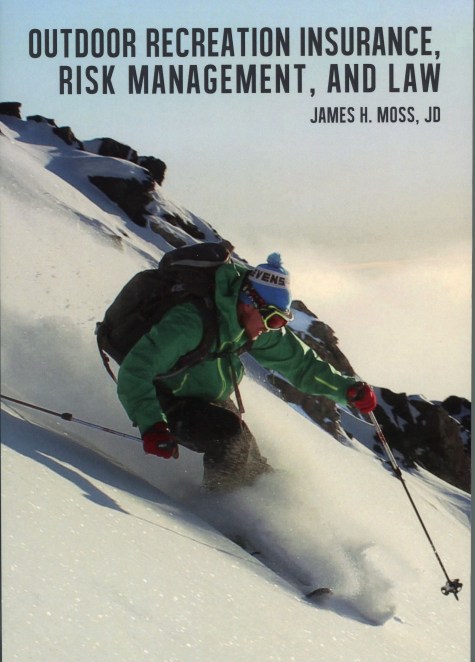
Outdoor Recreation Insurance, Risk Management, and Law
Denver based James H. Moss, JD, an attorney who specializes in the legal issues of outdoor recreation and adventure travel companies, guides, outfitters, and manufacturers, has written a comprehensive legal guidebook titled, “Outdoor Recreation Insurance, Risk Management, and Law”. Sagamore Publishing, a well-known Illinois-based educational publisher, distributes the book.
Mr. Moss, who applied his 30 years of experience with the legal, insurance, and risk management issues of the outdoor industry, wrote the book in order to fill a void.
“There was nothing out there that looked at case law and applied it to legal problems in outdoor recreation,” Moss explained. “The goal of this book is to provide sound advice based on past law and experience.”
The Reference book is sold via the Summit Magic Publishing, LLC.
While written as a college-level textbook, the guide also serves as a legal primer for executives, managers, and business owners in the field of outdoor recreation. It discusses how to tackle, prevent, and overcome legal issues in all areas of the industry.
The book is organized into 14 chapters that are easily accessed as standalone topics, or read through comprehensively. Specific topics include rental programs, statues that affect outdoor recreation, skiing and ski areas, and defenses to claims. Mr. Moss also incorporated listings of legal definitions, cases, and statutes, making the book easy for laypeople to understand.
PURCHASE
TABLE OF CONTENTS
Table of Cases
Introduction
Outdoor Recreation Law and Insurance: Overview
Risk
Risk
Perception versus Actual Risk
Risk v. Reward
Risk Evaluation
Risk Management Strategies
Humans & Risk
Risk = Accidents
Accidents may/may not lead to litigation
How Do You Deal with Risk?
How Does Acceptance of Risk Convert to Litigation?
Negative Feelings against the Business
Risk, Accidents & Litigation
No Real Acceptance of the Risk
No Money to Pay Injury Bills
No Health Insurance
Insurance Company Subrogation
Negative Feelings
Litigation
Dealing with Different People
Dealing with Victims
Develop a Friend & Eliminate a Lawsuit
Don’t Compound Minor Problems into Major Lawsuits
Emergency Medical Services
Additional Causes of Lawsuits in Outdoor Recreation
Employees
How Do You Handle A Victim?
Dealing with Different People
Dealing with Victims
Legal System in the United States
Courts
State Court System
Federal Court System
Other Court Systems
Laws
Statutes
Parties to a Lawsuit
Attorneys
Trials
Law
Torts
Negligence
Duty
Breach of the Duty
Injury
Proximate Causation
Damages
Determination of Duty Owed
Duty of an Outfitter
Duty of a Guide
Duty of Livery Owner
Duty of Rental Agent
Duty of Volunteer Youth Leader
In Loco Parentis
Intentional Torts
Gross Negligence
Willful & Wanton Negligence
Intentional Negligence
Negligence Per Se
Strict Liability
Attractive Nuisance
Results of Acts That Are More than Ordinary Negligence
Product Liability
Contracts
Breach of Contract
Breach of Warranty
Express Warranty
Implied Warranty
Warranty of Fitness for a Particular Purpose
Warranty of Merchantability
Warranty of Statute
Detrimental Reliance
Unjust Enrichment
Liquor Liability
Food Service Liability
Damages
Compensatory Damages
Special Damages
Punitive Damages
Statutory Defenses
Skier Safety Acts
Whitewater Guides & Outfitters
Equine Liability Acts
Legal Defenses
Assumption of Risk
Express Assumption of Risk
Implied Assumption of Risk
Primary Assumption of Risk
Secondary Assumption of Risk
Contributory Negligence
Assumption of Risk & Minors
Inherent Dangers
Assumption of Risk Documents.
Assumption of Risk as a Defense.
Statutory Assumption of Risk
Express Assumption of Risk
Contributory Negligence
Joint and Several Liability
Release, Waivers & Contracts Not to Sue
Why do you need them
Exculpatory Agreements
Releases
Waivers
Covenants Not to sue
Who should be covered
What should be included
Negligence Clause
Jurisdiction & Venue Clause
Assumption of Risk
Other Clauses
Indemnification
Hold Harmless Agreement
Liquidated Damages
Previous Experience
Misc
Photography release
Video Disclaimer
Drug and/or Alcohol clause
Medical Transportation & Release
HIPAA
Problem Areas
What the Courts do not want to see
Statute of Limitations
Minors
Adults
Defenses Myths
Agreements to Participate
Parental Consent Agreements
Informed Consent Agreements
Certification
Accreditation
Standards, Guidelines & Protocols
License
Specific Occupational Risks
Personal Liability of Instructors, Teachers & Educators
College & University Issues
Animal Operations, Packers
Equine Activities
Canoe Livery Operations
Tube rentals
Downhill Skiing
Ski Rental Programs
Indoor Climbing Walls
Instructional Programs
Mountaineering
Retail Rental Programs
Rock Climbing
Tubing Hills
Whitewater Rafting
Risk Management Plan
Introduction for Risk Management Plans
What Is A Risk Management Plan?
What should be in a Risk Management Plan
Risk Management Plan Template
Ideas on Developing a Risk Management Plan
Preparing your Business for Unknown Disasters
Building Fire & Evacuation
Dealing with an Emergency
Insurance
Theory of Insurance
Insurance Companies
Deductibles
Self-Insured Retention
Personal v. Commercial Policies
Types of Policies
Automobile
Comprehension
Collision
Bodily Injury
Property Damage
Uninsured Motorist
Personal Injury Protection
Non-Owned Automobile
Hired Car
Fire Policy
Coverage
Liability
Named Peril v. All Risk
Commercial Policies
Underwriting
Exclusions
Special Endorsements
Rescue Reimbursement
Policy Procedures
Coverage’s
Agents
Brokers
General Agents
Captive Agents
Types of Policies
Claims Made
Occurrence
Claims
Federal and State Government Insurance Requirements
Bibliography
Index
The 427-page volume is sold via Summit Magic Publishing, LLC.
What is a Risk Management Plan and What do You Need in Yours?
Posted: July 25, 2019 Filed under: Activity / Sport / Recreation, Adventure Travel, Assumption of the Risk, Avalanche, Camping, Challenge or Ropes Course, Climbing, Climbing Wall, Contract, Cycling, Equine Activities (Horses, Donkeys, Mules) & Animals, First Aid, Health Club, Indoor Recreation Center, Jurisdiction and Venue (Forum Selection), Legal Case, Medical, Minors, Youth, Children, Mountain Biking, Mountaineering, Paddlesports, Playground, Racing, Racing, Release (pre-injury contract not to sue), Risk Management, Rivers and Waterways, Rock Climbing, Scuba Diving, Sea Kayaking, Search and Rescue (SAR), Ski Area, Skier v. Skier, Skiing / Snow Boarding, Skydiving, Paragliding, Hang gliding, Snow Tubing, Sports, Summer Camp, Swimming, Triathlon, Whitewater Rafting, Youth Camps, Zip Line | Tags: #ORLawTextbook, #ORRiskManagment, #OutdoorRecreationRiskManagementInsurance&Law, #OutdoorRecreationTextbook, @SagamorePub, Adventure travel, and Law, assumption of the risk, camping, Case Analysis, Challenge or Ropes Course, Climbing, Climbing Wall, Contract, Cycling, Donkeys, Equine Activities (Horses, first aid, General Liability Insurance, Good Samaritan Statutes, Guide, Hang gliding, http://www.rec-law.us/ORLawTextbook, Insurance, Insurance policy, James H. Moss, James H. Moss J.D., Jim Moss, Jurisdiction and Venue (Forum Selection), Legal Case, Liability insurance, Medical, Mountain biking, Mountaineering, Mules) & Animals, Negligence, OR Textbook, Outdoor Recreation Insurance, Outdoor Recreation Law, Outdoor Recreation Risk Management, Outfitter, Paddlesports, Paragliding, Recreational Use Statute, Release (pre-injury contract not to sue), Risk Management, risk management plan, Rivers and Waterways, Rock climbing, Sea Kayaking, ski area, Ski Area Statutes, Skiing / Snow Boarding, Skydiving, swimming, Textbook, Understanding, Understanding Insurance, Understanding Risk Management, Whitewater Rafting, zip line Leave a commentEveryone has told you, that you need a risk management plan. A plan to follow if you have
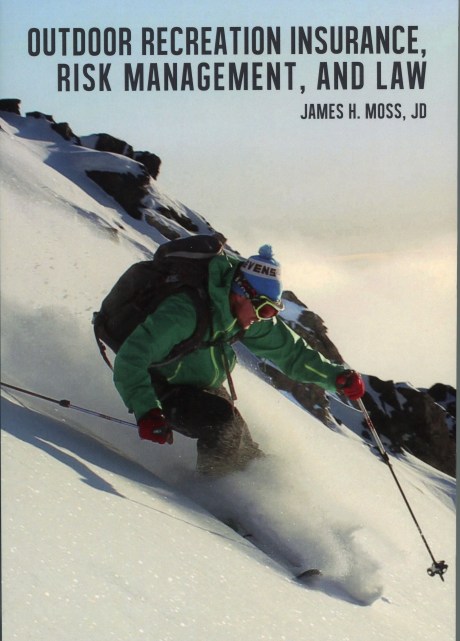
Outdoor Recreation Insurance, Risk Management, and Law
a crisis. You‘ve seen several and they look burdensome and difficult to write. Need help writing a risk management plan? Need to know what should be in your risk management plan? Need Help?
This book can help you understand and write your plan. This book is designed to help you rest easy about what you need to do and how to do it. More importantly, this book will make sure your plan is a workable plan, not one that will create liability for you.

Table of Contents
Chapter 1 Outdoor Recreation Risk Management, Law, and Insurance: An Overview
Chapter 2 U.S. Legal System and Legal Research
Chapter 3 Risk 25
Chapter 4 Risk, Accidents, and Litigation: Why People Sue
Chapter 5 Law 57
Chapter 6 Statutes that Affect Outdoor Recreation
Chapter 7 PreInjury Contracts to Prevent Litigation: Releases
Chapter 8 Defenses to Claims
Chapter 9 Minors
Chapter 10 Skiing and Ski Areas
Chapter 11 Other Commercial Recreational Activities
Chapter 12 Water Sports, Paddlesports, and water-based activities
Chapter 13 Rental Programs
Chapter 14 Insurance
$130.00 plus shipping

Need a Handy Reference Guide to Understand your Insurance Policy?
Posted: July 18, 2019 Filed under: Adventure Travel, Assumption of the Risk, Avalanche, Challenge or Ropes Course, Climbing, Contract, Cycling, Equine Activities (Horses, Donkeys, Mules) & Animals, Health Club, Indoor Recreation Center, Insurance, Jurisdiction and Venue (Forum Selection), Minors, Youth, Children, Mountain Biking, Mountaineering, Paddlesports, Racing, Release (pre-injury contract not to sue), Risk Management, Rivers and Waterways, Rock Climbing, Scuba Diving, Sea Kayaking, Ski Area, Skier v. Skier, Skiing / Snow Boarding, Skydiving, Paragliding, Hang gliding, Snow Tubing, Sports, Summer Camp, Swimming, Whitewater Rafting, Youth Camps, Zip Line | Tags: #ORLawTextbook, #ORRiskManagment, #OutdoorRecreationRiskManagementInsurance&Law, #OutdoorRecreationTextbook, @SagamorePub, Adventure travel, and Law, assumption of the risk, camping, Case Analysis, Challenge or Ropes Course, Climbing, Climbing Wall, Contract, Cycling, Donkeys, Equine Activities (Horses, first aid, General Liability Insurance, Good Samaritan Statutes, Guide, Hang gliding, http://www.rec-law.us/ORLawTextbook, Insurance, Insurance policy, James H. Moss, James H. Moss J.D., Jim Moss, Jurisdiction and Venue (Forum Selection), Legal Case, Liability insurance, Medical, Mountain biking, Mountaineering, Mules) & Animals, Negligence, Outdoor Recreation Insurance, Outdoor Recreation Law, Outdoor Recreation Risk Management, Outfitter, Paddlesports, Paragliding, Recreational Use Statute, Release (pre-injury contract not to sue), Risk Management, Rivers and Waterways, Rock climbing, Sea Kayaking, ski area, Ski Area Statutes, Skiing / Snow Boarding, Skydiving, swimming, Whitewater Rafting, zip line Leave a commentThis book should be on every outfitter and guide’s desk. It will answer your questions, help you sleep at night, help you answer your guests’ questions and allow you to run your business with less worry.

Table of Contents
Chapter 1 Outdoor Recreation Risk Management, Law, and Insurance: An Overview
Chapter 2 U.S. Legal System and Legal Research
Chapter 3 Risk 25
Chapter 4 Risk, Accidents, and Litigation: Why People Sue
Chapter 5 Law 57
Chapter 6 Statutes that Affect Outdoor Recreation
Chapter 7 PreInjury Contracts to Prevent Litigation: Releases
Chapter 8 Defenses to Claims
Chapter 9 Minors
Chapter 10 Skiing and Ski Areas
Chapter 11 Other Commercial Recreational Activities
Chapter 12 Water Sports, Paddlesports, and water-based activities
Chapter 13 Rental Programs
Chapter 14 Insurance
$99.00 plus shipping

What is a Risk Management Plan and What do You Need in Yours?
Posted: April 11, 2019 Filed under: Activity / Sport / Recreation, Adventure Travel, Assumption of the Risk, Avalanche, Camping, Challenge or Ropes Course, Climbing, Climbing Wall, Contract, Cycling, Equine Activities (Horses, Donkeys, Mules) & Animals, First Aid, Health Club, Indoor Recreation Center, Jurisdiction and Venue (Forum Selection), Legal Case, Medical, Minors, Youth, Children, Mountain Biking, Mountaineering, Paddlesports, Playground, Racing, Racing, Release (pre-injury contract not to sue), Risk Management, Rivers and Waterways, Rock Climbing, Scuba Diving, Sea Kayaking, Search and Rescue (SAR), Ski Area, Skier v. Skier, Skiing / Snow Boarding, Skydiving, Paragliding, Hang gliding, Snow Tubing, Sports, Summer Camp, Swimming, Triathlon, Whitewater Rafting, Youth Camps, Zip Line | Tags: #ORLawTextbook, #ORRiskManagment, #OutdoorRecreationRiskManagementInsurance&Law, #OutdoorRecreationTextbook, @SagamorePub, Adventure travel, and Law, assumption of the risk, camping, Case Analysis, Challenge or Ropes Course, Climbing, Climbing Wall, Contract, Cycling, Donkeys, Equine Activities (Horses, first aid, General Liability Insurance, Good Samaritan Statutes, Guide, Hang gliding, http://www.rec-law.us/ORLawTextbook, Insurance, Insurance policy, James H. Moss, James H. Moss J.D., Jim Moss, Jurisdiction and Venue (Forum Selection), Legal Case, Liability insurance, Medical, Mountain biking, Mountaineering, Mules) & Animals, Negligence, OR Textbook, Outdoor Recreation Insurance, Outdoor Recreation Law, Outdoor Recreation Risk Management, Outfitter, Paddlesports, Paragliding, Recreational Use Statute, Release (pre-injury contract not to sue), Risk Management, risk management plan, Rivers and Waterways, Rock climbing, Sea Kayaking, ski area, Ski Area Statutes, Skiing / Snow Boarding, Skydiving, swimming, Textbook, Understanding, Understanding Insurance, Understanding Risk Management, Whitewater Rafting, zip line Leave a commentEveryone has told you, you need a risk management plan. A plan to follow if you have  a crisis. You‘ve seen several and they look burdensome and difficult to write. Need help writing a risk management plan? Need to know what should be in your risk management plan? Need Help?
This book can help you understand and write your plan. This book is designed to help you rest easy about what you need to do and how to do it. More importantly, this book will make sure you plan is a workable plan, not one that will create liability for you.
Table of Contents
Chapter 1 Outdoor Recreation Risk Management, Law, and Insurance: An Overview
Chapter 2 U.S. Legal System and Legal Research
Chapter 3 Risk 25
Chapter 4 Risk, Accidents, and Litigation: Why People Sue
Chapter 5 Law 57
Chapter 6 Statutes that Affect Outdoor Recreation
Chapter 7 PreInjury Contracts to Prevent Litigation: Releases
Chapter 8 Defenses to Claims
Chapter 9 Minors
Chapter 10 Skiing and Ski Areas
Chapter 11 Other Commercial Recreational Activities
Chapter 12 Water Sports, Paddlesports, and water-based activities
Chapter 13 Rental Programs
Chapter 14 Insurance
$99.00 plus shipping
Need a Handy Reference Guide to Understand your Insurance Policy?
Posted: April 2, 2019 Filed under: Adventure Travel, Assumption of the Risk, Avalanche, Challenge or Ropes Course, Climbing, Contract, Cycling, Equine Activities (Horses, Donkeys, Mules) & Animals, Health Club, Indoor Recreation Center, Insurance, Jurisdiction and Venue (Forum Selection), Minors, Youth, Children, Mountain Biking, Mountaineering, Paddlesports, Racing, Release (pre-injury contract not to sue), Risk Management, Rivers and Waterways, Rock Climbing, Scuba Diving, Sea Kayaking, Ski Area, Skier v. Skier, Skiing / Snow Boarding, Skydiving, Paragliding, Hang gliding, Snow Tubing, Sports, Summer Camp, Swimming, Whitewater Rafting, Youth Camps, Zip Line | Tags: #ORLawTextbook, #ORRiskManagment, #OutdoorRecreationRiskManagementInsurance&Law, #OutdoorRecreationTextbook, @SagamorePub, Adventure travel, and Law, assumption of the risk, camping, Case Analysis, Challenge or Ropes Course, Climbing, Climbing Wall, Contract, Cycling, Donkeys, Equine Activities (Horses, first aid, General Liability Insurance, Good Samaritan Statutes, Guide, Hang gliding, http://www.rec-law.us/ORLawTextbook, Insurance, Insurance policy, James H. Moss, James H. Moss J.D., Jim Moss, Jurisdiction and Venue (Forum Selection), Legal Case, Liability insurance, Medical, Mountain biking, Mountaineering, Mules) & Animals, Negligence, Outdoor Recreation Insurance, Outdoor Recreation Law, Outdoor Recreation Risk Management, Outfitter, Paddlesports, Paragliding, Recreational Use Statute, Release (pre-injury contract not to sue), Risk Management, Rivers and Waterways, Rock climbing, Sea Kayaking, ski area, Ski Area Statutes, Skiing / Snow Boarding, Skydiving, swimming, Whitewater Rafting, zip line Leave a commentThis book should be on every outfitter and guide’s desk. It will answer your questions, help you sleep at night, help you answer your guests’ questions and allow you to run your business with less worry.
Table of Contents
Chapter 1 Outdoor Recreation Risk Management, Law, and Insurance: An Overview
Chapter 2 U.S. Legal System and Legal Research
Chapter 3 Risk 25
Chapter 4 Risk, Accidents, and Litigation: Why People Sue
Chapter 5 Law 57
Chapter 6 Statutes that Affect Outdoor Recreation
Chapter 7 PreInjury Contracts to Prevent Litigation: Releases
Chapter 8 Defenses to Claims
Chapter 9 Minors
Chapter 10 Skiing and Ski Areas
Chapter 11 Other Commercial Recreational Activities
Chapter 12 Water Sports, Paddlesports, and water-based activities
Chapter 13 Rental Programs
Chapter 14 Insurance
$99.00 plus shipping
Death is something we should have the freedom to choose as part of our life, something we expect to have as a basic freedom.
Posted: May 19, 2015 Filed under: Skydiving, Paragliding, Hang gliding | Tags: Dean Potter, Paragliding, Yosemite Leave a commentThe opportunity to live life as you want includes the opportunity to die attempting to life.
Dean Potter was living life to the absolute when he died. Dean was exercising his freedom to live. He was violating park rules on paragliding and for that and for the fact he died he will be condemned.
But no one will ever be able to say Dean did not live.
Whether you liked Dean or not, you have to support the fact he died free, living life has he wanted.
What do you think? Leave a comment.
If you like this let your friends know or post it on FB, Twitter or LinkedIn
Copyright 2015 Recreation Law (720) Edit Law
Email: Rec-law@recreation-law.com
Google+: +Recreation
Twitter: RecreationLaw
Facebook: Rec.Law.Now
Facebook Page: Outdoor Recreation & Adventure Travel Law
Blog: www.recreation-law.com
Mobile Site: http://m.recreation-law.com
By Recreation Law Rec-law@recreation-law.com James H. Moss
#AdventureTourism, #AdventureTravelLaw, #AdventureTravelLawyer, #AttorneyatLaw, #Backpacking, #BicyclingLaw, #Camps, #ChallengeCourse, #ChallengeCourseLaw, #ChallengeCourseLawyer, #CyclingLaw, #FitnessLaw, #FitnessLawyer, #Hiking, #HumanPowered, #HumanPoweredRecreation, #IceClimbing, #JamesHMoss, #JimMoss, #Law, #Mountaineering, #Negligence, #OutdoorLaw, #OutdoorRecreationLaw, #OutsideLaw, #OutsideLawyer, #RecLaw, #Rec-Law, #RecLawBlog, #Rec-LawBlog, #RecLawyer, #RecreationalLawyer, #RecreationLaw, #RecreationLawBlog, #RecreationLawcom, #Recreation-Lawcom, #Recreation-Law.com, #RiskManagement, #RockClimbing, #RockClimbingLawyer, #RopesCourse, #RopesCourseLawyer, #SkiAreas, #Skiing, #SkiLaw, #Snowboarding, #SummerCamp, #Tourism, #TravelLaw, #YouthCamps, #ZipLineLawyer, Dean Potter, Yosemite, Paragliding,
ASTM standard I abstained on is a guaranteed lawsuit starter
Posted: October 15, 2014 Filed under: Uncategorized | Tags: American Society of Testing & Material, ASTM, Hangliding, Paragliding, Parasailing, Weather Leave a commentI’m hurt because you did not check the weather correctly!
So this is the new standard that I was asked to vote on recently.
Withdraw With Replacement to F2993-2013 Guide for Monitoring Weather Conditions for Safe Parasail Operation WK47376 PDF (8.0K)
(SEE VOLUME 15.7)(CONCURRENT WITH .6500)
TECHNICAL CONTACT: Matt Dvorak
daytonaparasailing@hotmail.com
(386) 547-6067
When I don’t fully understand the issues or have not seen the actual standard (yes it is a little crazy trying to read what you are voting on sometimes) I abstain. I did so on this standard also.
Besides voting against a standard requires you to articulate the reasons why you are voting no on the standard. “This is stupid,” is not a good reason according to the ASTM. Nor is “this is going to help plaintiff’s win lawsuits” a valid reason for voting no.
However, can’t you see this doing nothing but creating legal nightmares.
“You said you checked the weather, and you said to launch, but the wind changed because a front moved/truck came by/that is what the wind does, and I crashed. You owed me a duty to check the weather; that duty is in writing, and you agreed to it by becoming a member of the ASTM and agreeing to the standard (or not agreeing to the standard; you are still held to the standard), and my injuries are a result of you not following the standard.”
Duh
Somewhere, the ASTM, there is an idea that the creation of standards stops lawsuits, but even the ASTM can’t show any proof of that.
What do you think? Leave a comment.
If you like this let your friends know or post it on FB, Twitter or LinkedIn
Copyright 2013 Recreation Law (720) Edit Law
Email: Rec-law@recreation-law.com
Google+: +Recreation
Twitter: RecreationLaw
Facebook: Rec.Law.Now
Facebook Page: Outdoor Recreation & Adventure Travel Law
Blog: www.recreation-law.com
Mobile Site: http://m.recreation-law.com
#AdventureTourism, #AdventureTravelLaw, #AdventureTravelLawyer, #AttorneyatLaw, #Backpacking, #BicyclingLaw, #Camps, #ChallengeCourse, #ChallengeCourseLaw, #ChallengeCourseLawyer, #CyclingLaw, #FitnessLaw, #FitnessLawyer, #Hiking, #HumanPowered, #HumanPoweredRecreation, #IceClimbing, #JamesHMoss, #JimMoss, #Law, #Mountaineering, #Negligence, #OutdoorLaw, #OutdoorRecreationLaw, #OutsideLaw, #OutsideLawyer, #RecLaw, #Rec-Law, #RecLawBlog, #Rec-LawBlog, #RecLawyer, #RecreationalLawyer, #RecreationLaw, #RecreationLawBlog, #RecreationLawcom, #Recreation-Lawcom, #Recreation-Law.com, #RiskManagement, #RockClimbing, #RockClimbingLawyer, #RopesCourse, #RopesCourseLawyer, #SkiAreas, #Skiing, #SkiLaw, #Snowboarding, #SummerCamp, #Tourism, #TravelLaw, #YouthCamps, #ZipLineLawyer, ASTM, American Society of Testing & Material, Parasailing, Paragliding, Hangliding, weather,
Will New York entertain counterclaims for attorney fees and costs to a prevailing defendant?
Posted: July 29, 2013 Filed under: New York, Release (pre-injury contract not to sue), Skydiving, Paragliding, Hang gliding | Tags: assumption of the risk, Hang gliding, Negligence, New York, New York City, Paragliding, Plaintiff, Public Policy, Recreation, Release, Skydiving, Summary judgment, Tandem, Tandem Skydiving 3 CommentsUnderlying claim is dismissed for assumption of the risk. Falling out of the sky is obviously dangerous.
Plaintiff: Lisa Nutley
Defendant: SkyDive the Ranch
Plaintiff Claims: Negligence
Defendant Defenses: Release and Assumption of the risk, counterclaim for attorney fees based on the release
Holding: for the defendant on the claims based on assumption of the risk
This is an interesting case. To understand the case, I’ve also posted the trial court opinion leading to the appeal of this case.
The spouse of the plaintiff bought her a tandem sky dive as a gift. During the jump, the main shoot did not open. The reserve shoot did open. During the jump, the plaintiff broke her third and fourth fingers on her right hand. She sued for negligence.
The defendant filed a motion for summary judgment to dismiss the plaintiff’s claims based on the three releases she had signed and the video and instruction she had watched.
The trial court denied the motion for summary judgment (Nutley v. Skydive The Ranch, 22 Misc. 3d 1122(A); 881 N.Y.S.2d 365; 2009 N.Y. Misc. LEXIS 274; 2009 NY Slip Op 50223(U); 241 N.Y.L.J. 23) and the defendant appealed.
Summary of the case
The basis of the denial of the motion for summary judgment is a New York statute which prohibited the use of a release for recreational activities. New York General Obligations Law (“GOL”) §5-326. The lawsuit was dismissed because the trial court found the defendant operated a sky-diving facility as a recreational business. The Defendant had argued that it was an educational business which does not fall under §5-326.
The appellate court found the releases were void under the New York statute.
The appellate court found that the risks of the activity were fairly obvious, and the plaintiff had assumed the risk of her injuries.
Here, the risk of the main parachute failing to open during a tandem sky dive was perfectly obvious. Indeed, plaintiff was given a reserve parachute. Plaintiff failed to raise a triable issue of fact as to whether the injury-causing event resulted from defendant’s negligence, creating unique and dangerous conditions beyond those inherent in the sport
The court then went back to its decision on releases and found the language attempting to release the defendant for negligence was void; however, the rest of the release was still valid.
So much of the waiver and release signed by plaintiff as purports to exempt defendant from its own negligence is void under General Obligations Law § 5-326. Severance of that provision leaves the rest of the contract intact…
Part of one of the releases had included a clause that any suit required the plaintiff to pay the defendant’s damages of attorney fees and costs. The defendant filed a counterclaim against the plaintiff based upon this clause. The court did not rule on this issue finding that the trial court needed to look into whether this clause violated public policy as advanced by the statute that voids releases.
As to defendant’s counterclaims, however, we note that whether agreements not to sue a defendant and to pay its attorney’s fees and litigation costs might transgress the public policy of promoting recreational activities advanced by § 5-326 does not appear to have been considered by the courts.
The matter was sent back to the trial court to determine if the counterclaim for attorney fees and costs of the defendant violated New York Public policy and for any defenses the plaintiff may have to the defendant’s counterclaims.
So Now What?
The defendant lost on the defense of release, but won on the defense of assumption of the risk. The defendant might win on the opportunity to sue the plaintiff for attorney fees and costs in the assumption of risk agreements (since the releases are void).
This case appears to be fairly clear in its approach and decision. You can get hurt if you fall out of the sky. That is pretty obvious. Therefore, you assume the risk.
The argument about the sky-diving facility being an educational business rather than recreation is discussed in the trial court decision. That argument made by the defendant was based on Lemoine v Cornell University, 2 A.D.3d 1017; 769 N.Y.S.2d 313; 2003 N.Y. App. Div. LEXIS 13209 (NY 2003). In Lemoine, the university was subject to the statute which voids releases in New York, but because it was an educational organization and not one for recreation, the statute did not apply.
What is different is the issue that the court held out the possibility that a demand for attorney fees and costs to a prevailing defendant may be viable in New York.
Four years has passed since this decision, and no other cases have been reported. Consequently, as of this time we do not have a decision to rely upon for this issue.
Even if there is not a valid claim because it violates public policy, there are several other theories on how a defendant can recover attorney fees in situations like this that may survive.
What do you think? Leave a comment.
If you like this let your friends know or post it on FaceBook, Twitter or LinkedIn
Copyright 2013 Recreation Law (720) Edit Law
Email: Rec-law@recreation-law.com
Google+: +Recreation
Twitter: RecreationLaw
Facebook: Rec.Law.Now
Facebook Page: Outdoor Recreation & Adventure Travel Law
Blog: www.recreation-law.com
Mobile Site: http://m.recreation-law.com
By Recreation Law Rec-law@recreation-law.com James H. Moss #Authorrank
<rel=”author” link=” https://plus.google.com/u/0/b/112453188060350225356/” />
#RecreationLaw, #@RecreationLaw, #Cycling.Law #Fitness.Law, #Ski.Law, #Outside.Law, #Recreation.Law, #Recreation-Law.com, #Outdoor Law, #Recreation Law, #Outdoor Recreation Law, #Adventure Travel Law, #law, #Travel Law, #Jim Moss, #James H. Moss, #Attorney at Law, #Tourism, #Adventure Tourism, #Rec-Law, #Rec-Law Blog, #Recreation Law, #Recreation Law Blog, #Risk Management, #Human Powered, #Human Powered Recreation,# Cycling Law, #Bicycling Law, #Fitness Law, #Recreation-Law.com, #Backpacking, #Hiking, #Mountaineering, #Ice Climbing, #Rock Climbing, #Ropes Course, #Challenge Course, #Summer Camp, #Camps, #Youth Camps, #Skiing, #Ski Areas, #Negligence, #Snowboarding, #RecreationLaw, #@RecreationLaw, #Cycling.Law #Fitness.Law, #SkiLaw, #Outside.Law, #Recreation.Law, #RecreationLaw.com, #OutdoorLaw, #RecreationLaw, #OutdoorRecreationLaw, #AdventureTravelLaw, #Law, #TravelLaw, #JimMoss, #JamesHMoss, #AttorneyatLaw, #Tourism, #AdventureTourism, #RecLaw, #RecLawBlog, #RecreationLawBlog, #RiskManagement, #HumanPowered, #HumanPoweredRecreation,# CyclingLaw, #BicyclingLaw, #FitnessLaw, #RecreationLaw.com, #Backpacking, #Hiking, #Mountaineering, #IceClimbing, #RockClimbing, #RopesCourse, #ChallengeCourse, #SummerCamp, #Camps, #YouthCamps, #Skiing, #Ski Areas, #Negligence, #Snowboarding, sport and recreation laws, ski law, cycling law, Colorado law, law for recreation and sport managers, bicycling and the law, cycling and the law, ski helmet law, skiers code, skiing accidents, Recreation Lawyer, Ski Lawyer, Paddlesports Lawyer, Cycling Lawyer, Recreational Lawyer, Fitness Lawyer, Rec Lawyer, Challenge Course Lawyer, Ropes Course Lawyer, Zip Line Lawyer, Rock Climbing Lawyer, Adventure Travel Lawyer, Outside Lawyer, Recreation Lawyer, Ski Lawyer, Paddlesports Lawyer, Cycling Lawyer, #RecreationalLawyer, #FitnessLawyer, #RecLawyer, #ChallengeCourseLawyer, #RopesCourseLawyer, #ZipLineLawyer, #RockClimbingLawyer, #AdventureTravelLawyer, #OutsideLawyer, Skydiving, Release, Public Policy, Assumption of the Risk, Tandem, Tandem Skydiving,
WordPress Tags: York,attorney,defendant,assumption,Nutley,SkyDive,Ranch,Slip,LEXIS,Appel,Plaintiff,Lisa,Claims,Negligence,Defenses,Release,opinion,spouse,tandem,gift,fourth,judgment,instruction,Misc,Summary,basis,denial,statute,General,Obligations,lawsuit,injuries,Here,fact,injury,event,decision,waiver,Severance,provision,Part,clause,policy,agreements,litigation,Public,argument,recreation,Lemoine,Cornell,Four,theories,situations,Leave,FaceBook,Twitter,LinkedIn,Edit,Email,Google,RecreationLaw,Page,Outdoor,Adventure,Travel,Blog,Mobile,Site,James,Moss,Authorrank,author,Outside,Tourism,Risk,Management,Human,Rock,Ropes,Course,Challenge,Summer,Camp,Camps,Youth,Areas,SkiLaw,OutdoorLaw,OutdoorRecreationLaw,AdventureTravelLaw,TravelLaw,JimMoss,JamesHMoss,AttorneyatLaw,AdventureTourism,RecLaw,RecLawBlog,RecreationLawBlog,RiskManagement,HumanPoweredRecreation,CyclingLaw,BicyclingLaw,FitnessLaw,RopesCourse,ChallengeCourse,SummerCamp,YouthCamps,Colorado,managers,helmet,accidents,Lawyer,Paddlesports,Recreational,Line,RecreationalLawyer,FitnessLawyer,RecLawyer,ChallengeCourseLawyer,RopesCourseLawyer,ZipLineLawyer,RockClimbingLawyer,AdventureTravelLawyer,OutsideLawyer,counterclaims,counterclaim,appellate,whether,upon
Boucher v. Riner, et al. 68 Md. App. 539; 514 A.2d 485; 1986 Md. App. LEXIS 391
Posted: October 10, 2010 Filed under: Maryland, Release (pre-injury contract not to sue), Skydiving, Paragliding, Hang gliding | Tags: Gross negligence, Hang gliding, Parachuting, Paragliding, Release, Skydiving, Skydiving Club, US Naval Academy, Waiver Leave a commentFor an Analysis of the case see: Sky Diving Release defeats claim by Naval Academy student
Daniel M. Boucher v. Gordon E. Riner, et al.
No. 1470, September Term, 1985
Court of Special Appeals of Maryland
68 Md. App. 539; 514 A.2d 485; 1986 Md. App. LEXIS 391
September 8, 1986
Prior History: [***1] Appeal from the Circuit Court for Caroline County, George B. Rasin, Jr., Judge.
Disposition: Judgment Affirmed; Costs to be Paid by the Appellant.
Counsel: Argued by David R. Thompson (Kurt D. Karsten and Franch, Earnest & Cowdrey, P.A. on the brief), Easton for appellant.
Argued by W. Michael Jacobs (Charles E. Iliff, Jr. and Semmes, Bowen & Semmes on the brief), Baltimore for appellees.
Judges: Weant, Karwacki and Wenner, JJ.
Opinion By: Karwacki
OPINION
[*540] [**486] Daniel M. Boucher, the appellant, wishing to learn how to parachute, joined the Naval Academy Parachuting Club (the Club) in September 1982. The Club is a voluntary extracurricular activity for students at the Naval Academy. The Academy, where Boucher was a midshipman, provided equipment, paid various fees, and made arrangements for the use of a drop zone for the club members. Although the Club was organized and operated by upperclass midshipmen, it had a faculty advisor, and the Club members were accompanied on field trips by naval officers.
The Club had an agreement with Parachutes Are Fun, Inc. (Parachutes), for the use of Parachutes’ drop zone as a training ground for Club members. That agreement provided that the [***2] Club would provide its own equipment and be able to use the drop zone at a reduced rate. Parachutes agreed to conform to all regulations as specified by the Academy.
Prior to Boucher’s first parachute jump, he received instructions in sport parachuting at the Academy from [*541] Midshipmen Byrne and Lastar, who were among the upper-classmen who ran the Club. The two were qualified by the U.S. Parachute Association (USPA), a civilian organization engaged in the promotion and self-regulation of the sport. Boucher’s training consisted of instruction in the hazards normally associated with parachuting, including the hazard posed by jumping in the vicinity of uninsulated electric power lines. Attention was given to the methods which should be employed by the parachutist to avoid or minimize contact with obstacles on the ground by controlling the direction of descent.
The appellees, in addition to Parachutes, are: the Pelicanland Corporation (Pelicanland), the owner of the airport where the drop area was located; Gordon E. Riner, the co-owner and vice-president of Parachutes, who is a certified jumpmaster, instructor, and parachutist; and Kenneth Dunker, a certified jumpmaster, [***3] instructor, and parachutist who worked at Parachutes.
On September 18, 1982, Boucher along with other midshipmen went to Pelicanland to make his first jump. Prior to Boucher’s boarding the airplane that day, he signed an exculpatory agreement with Parachutes, the relevant portion of which stated:
2 A. EXEMPTION FROM LIABILITY
The Participant exempts and releases the Corporation, its owners, officers, agents, servants, employees, and lessors and the County of Sussex, its officers, agents, servants and employees from any and all liability, claims, demands or [**487] actions or causes of action whatsoever arising out of any damage, loss or injury to the Participant or the Participant’s property while upon the premises or aircraft of the Corporation or while participating in any of the activities contemplated by this Agreement, whether such loss, damage, or injury results from the negligence of the Corporation, its officers, agents, servants, employees or lessors or from some other cause.
[*542] At about 5:30 p.m., a decision was made that wind conditions were such that the jump could be made. Boucher went up in the plane with two other midshipmen and with Riner, [***4] who was there to act as coach and jumpmaster. Dunker was on the ground, near the target area, and was manning the public address system to “talk down” the jumpers. Boucher was the last of the three to jump. After Boucher’s parachute opened, Dunker began calling out his instructions, telling Boucher to change from a “running” position where his back was to the wind, to a “holding” position, facing the wind. As Boucher neared the ground, Dunker instructed him to execute a 360o turn. At this point, Dunker realized that there was a danger that Boucher would fly right into nearby power lines. He gave no indication of that danger to Boucher, who continued his descent with his back to the lines. Seconds later, Boucher collided with the lines, sending 12,500 volts of electricity through his body.
Boucher filed a two count declaration against the appellees alleging (1) negligence on the part of the appellees as owners or occupiers of the drop zone, because of the location of the electric lines in relation to the drop zone, and (2) gross negligence on the part of the appellees in the performance of their duties. The appellees jointly moved for summary judgments. On July 24, 1985, [***5] following a hearing, the Circuit Court for Caroline County (Rasin, J.), in a well reasoned memorandum opinion, granted the appellees’ motion. Boucher, in his appeal from those judgments, presents the broad question of “whether the trial court improperly granted summary judgment to the defendants?”
Specifically, he raises the following issues:
I. Whether the evidence presented a genuine issue of fact as to the defendants’ gross negligence?
II. Whether the exculpatory agreement signed by the plaintiff shortly before the accident precluded all recovery against the defendants based on negligence?
[*543] III. Whether there exists a genuine issue of fact as to the defendant Dunker’s status as an independent contractor?
Preliminarily, since the hearing court resolved this controversy in favor of the appellees by summary judgment, we will review the evidence, including all permissible inferences therefrom, in the light most favorable to the appellant. Natural Design, Inc. v. Rouse Co., 302 Md. 47, 62, 485 A.2d 663 (1984); Washington Homes v. Inter. Land Dev., 281 Md. 712, 716-18, 382 A.2d 555 (1978).
Summary judgment should be granted only upon a showing that there [***6] is no genuine issue as to any material fact. Fireman’s Fund Ins. Co. v. Rairigh, 59 Md.App. 305, 313, 475 A.2d 509, cert. denied, 301 Md. 176, 482 A.2d 502 (1984). If there is a conflict between the inferences which may be drawn from the evidence before the court, summary judgment is not proper. Coffey v. Derby Steel Co., 291 Md. 241, 246-47, 434 A.2d 564 (1981). Our review of all of the evidence in the light most favorable to the appellant convinces us that the hearing court was correct in finding, that there was no genuine dispute as to any material fact and that the appellees were entitled to judgments as a matter of law.
I.
Boucher contends that the appellees were guilty of gross negligence and that even if the exculpatory clause is held to be valid it does not shield the appellees from liability for gross negligence. As to the latter part of Boucher’s assertion—that the [**488] appellees are not shielded from liability for gross negligence—he is correct. A waiver of a right to sue, such as the one executed between Boucher and Parachutes, is ineffective to shift the risk of a party’s own willful, wanton, reckless, or gross conduct. Winterstein v. [***7] Wilcom, 16 Md.App. 130, 134-36, 293 A.2d 821, cert. denied, 266 Md. 744 (1972). Dean Prosser explains such a result on the alternative bases of common experience as to what is intended by the contracting parties or of public [*544] policy to discourage aggravated wrongs. Prosser and Keeton, The Law of Torts § 68 (5th ed. 1984).
Returning to the first part of Boucher’s contention—that the appellees were guilty of gross negligence—we find ourselves in agreement with the hearing court that Boucher fails in his reliance on essentially three facts to raise an inference of gross negligence. Boucher alleges that the appellee Dunker was on the ground giving instructions to Boucher as he was descending; that Boucher was unaware of the electric lines prior to colliding with them because, as Dunker had instructed, his back was to the lines; and that Dunker did not warn Boucher of the presence of the power lines. Boucher argues that an inference of gross negligence can be drawn from the above circumstances because Dunker was “controlling” Boucher’s movements and thus guided Boucher into the electric lines.
Gross negligence has been examined in a number of Maryland cases [***8] dealing with a variety of issues. These cases have addressed issues which include the circumstances under which gross negligence can support an award of exemplary damages, 1 civil liability for injuries to trespassers, 2 and criminal liability for manslaughter by automobile. 3 Our appellate courts have also dealt with the issue of gross negligence in the context of the type of conduct that would support an inference sufficient to overcome the bar of an [*545] automobile guest statute, 4 contributory negligence, 5 and, as in this case, a pre-injury release. 6
– – – – – – – – – – – – – – Footnotes – – – – – – – – – – – – – – –
1. Smith v. Gray Concrete Pipe Co., 267 Md. 149, 297 A.2d 721 (1972); Bannon v. B. & O. R.R. Co., 24 Md. 108 (1866).
2. Murphy v. Baltimore Gas & Elec., 290 Md. 186, 428 A.2d 459 (1981); Mondshour v. Moore, 261 A.2d 482, 256 Md. 617 (1970); Mech v. Hearst Corp., 64 Md.App. 422, 496 A.2d 1099 (1985), cert. denied, 305 Md. 175 501 A.2d 1323 (1986); Medina v. Meilhammer, 62 Md.App. 239, 489 A.2d 35, cert. denied, 303 Md. 683, 496 A.2d 683 (1985).
3. Johnson v. State, 213 Md. 527, 132 A.2d 853 (1957). [***9]
4. Romanesk v. Rose, 248 Md. 420, 237 A.2d 12 (1968).
5. Liscombe v. Potomac Edison Co., 303 Md. 619, 495 A.2d 838 (1985).
6. Winterstein v. Wilcom, 16 Md.App. 130, 293 A.2d 831, cert. denied, 266 Md. 744 (1972).
– – – – – – – – – – – – End Footnotes- – – – – – – – – – – – – –
In Smith v. Gray Concrete Pipe Co., 267 Md. 149, 297 A.2d 721 (1972), the Court of Appeals addressed the issue of gross negligence in the context of punitive damages. In that case, a boy was killed after he was struck by a truck owned by the defendant concrete company and driven by an inexperienced 18 year-old. In an action seeking compensatory and exemplary damages, the executor of the decedent’s estate sued Gray Concrete for negligent entrustment of the vehicle and the driver for negligent operation of the truck. The complaint stated that the corporate defendant had entrusted the truck to the driver knowing that the truck’s hood was improperly secured and that it could pop open at any time, that the driver was only 18 when the law required its drivers to be over 21 years of age, that the driver had no chauffeur’s license, and that the driver was [***10] untrained, unqualified, and incompetent to drive the truck on the highway. Id. at 169, 297 A.2d 721. The count against the driver alleged that he did not check the condition of the truck prior to operating it on the highway, that he did not respond properly when the hood flew up and blocked his vision—he stopped his truck in the center lane of the highway rather than pulling it off to the side—and that he knew or should have [**489] known that the truck was in violation of many requirements of the law. Id. at 170-71, 297 A.2d 721.
The Court concluded that punitive damages were recoverable in actions arising out of motor vehicle torts where there was a “’wanton or reckless disregard for human life’ in the operation of a motor vehicle, with all the known dangers and risks attendant to such conduct.” Id. at 168, 297 A.2d 721. The Court stated that the standard contemplated conduct which was of an “extraordinary or outrageous [*546] character,” but which stopped short of “wilful or intentional injury.” Id.
In Smith, the Court held that punitive damages were not recoverable against the driver of the truck because his conduct, “although constituting [***11] sufficient negligence to support a claim for compensatory damages, does not mount up to ‘a wanton or reckless disregard for human life.’” Id. at 171, 297 A.2d 721. In other words, although the driver may have exercised extremely poor judgment in his operation of the truck, his conduct was not of an extraordinary or outrageous character so as to constitute gross negligence.
On the other hand, the corporate defendant was found to be subject to possible exemplary damages. The conduct of Gray Concrete “did not occur under the pressures of a highway crisis, where what might superficially appear to be caused by ‘extraordinary or outrageous conduct’ could be merely the result of poor judgment exercised under such circumstances.” Id. at 172, 297 A.2d 721. The Court noted that Gray’s conduct reflected a premeditated decision by an employer in possession of facts which should have indicated almost certain harm to others. Id.
In another instructive case, Liscombe v. Potomac Edison Co., 303 Md. 619, 495 A.2d 838 (1985), the Court of Appeals had to determine whether there had been a showing of legally sufficient evidence of gross negligence to defeat the defendants’ motions [***12] for summary judgment. Liscombe involved the driver of a dump truck who was injured when the raised bed of his truck came into contact with high voltage lines that passed over the site. The driver alleged that the gross negligence of both the power company and the occupier of the premises led to his being injured. Id. The Court quoted from Bannon v. B. & O. R.R. Co., 24 Md. 108, 124 (1866), where it was said: “Gross negligence is a technical term, it is the omission of that care ‘which even inattentive and thoughtless men never fail to take of their own property,’ it is a violation of good faith.” Id., 303 Md. at 634-35, 495 A.2d 838. The Court then noted its decision in Romanesk v. Rose, 248 Md. 420, 237 A.2d 12 (1968) [*547] (applying Virginia law), in which it quoted with approval the definition of gross negligence from 4 Blashfield, Cyclopedia of Automobile Law and Practice § 2771 (1946 ed.) as:
an intentional failure to perform a manifest duty in reckless disregard of the consequences as affecting the life or property of another, and also implies a thoughtless disregard of the consequences without the exertion of any effort to avoid them. [***13] Stated conversely, a wrongdoer is guilty of gross negligence or acts wantonly and willfully only when he inflicts injury intentionally or is so utterly indifferent to the rights of others that he acts as if such rights did not exist.
Id. at 423, 237 A.2d 12.
In concluding that the evidence of gross negligence before the hearing court was insufficient, the Court assumed without deciding that the “lesser standard” of Smith v. Gray Concrete Pipe Co., supra, was the appropriate test for determining whether legally sufficient evidence of gross negligence by either defendant had been shown. The Liscombe Court noted the defendants’ efforts to minimize exposure to the danger, that there was no evidence of indifference by the defendants to the safety of others, and that there was no indication to either that almost certain harm to others would result from the defendants’ action or their failure to act. The Court stated that, [**490] “[t]here was, in short, no showing of facts establishing extraordinary or outrageous conduct mounting up to a wanton or reckless disregard for human life on the part of either defendant.” Id.
We rely on the guidance of Liscombe [***14] and Smith in deciding whether the conduct of the appellee Dunker in this case amounted to gross negligence. In Smith, the Court of Appeals noted that “the conduct alleged here reflects a premeditated decision, deliberately arrived at, by an indifferent employer in possession of facts which should have indicated almost certain harm to others.” 267 Md. at 172, 297 A.2d 721. In the case sub judice, viewing all of the evidence in the light most favorable to the appellant, we [*548] cannot say that Dunker’s conduct amounted to a wanton or reckless disregard for Boucher’s life. The undisputed material facts of this case show that Dunker was attentive to Boucher’s descent, that he was stationed in the proper location, and that he was calling out instructions to Boucher as was expected of him. There was no showing of indifference on the part of Dunker. Rather, the conduct alleged here reflects, at worst, poor judgment on the part of Dunker that, while perhaps amounting to ordinary negligence, does not rise to the level of gross negligence. We see no evidence of a premeditated decision, deliberately arrived at, by an indifferent jumpmaster that should have indicated almost [***15] certain harm to others.
II.
The appellant next argues that the exculpatory agreement which he signed shortly before his jump is unenforceable. 7 We disagree.
– – – – – – – – – – – – – – Footnotes – – – – – – – – – – – – – – -7.
Whether this issue is even preserved for our review is questionable since it was not explicitly raised below. On the assumption that it was implicitly preserved for our review, however, we will address the issue.
– – – – – – – – – – – – End Footnotes- – – – – – – – – – – – – –
The Maryland law regarding exculpatory clauses can be stated quite succinctly. In the absence of legislation to the contrary, there is ordinarily no public policy which prevents the parties from contracting as they see fit. Winterstein v. Wilcom, 16 Md.App. at 135, 293 A.2d 821. “It is quite possible for the parties expressly to agree in advance that the defendant is under no obligation of care for the benefit of the plaintiff, and shall not be liable for the consequences of conduct which would otherwise be negligent.” Id., quoting Prosser, The Law of Torts § 67 (3d ed. 1964). There are, of course, exceptions to the general [***16] rule, and the appellant would have us here find either of two exceptions applicable. The first is that such an agreement will be invalid if the relationship of the parties is such that one [*549] party is at an obvious disadvantage in bargaining at the time the contract is entered so that the effect of the contract is to put him at the mercy of the other’s negligence. Winterstein, 16 Md.App. at 135-36, 293 A.2d 821. The second exception invalidates exculpatory agreements if they are part of a transaction affected with a public interest. Id. at 136-37, 293 A.2d 821. We will examine the exculpatory agreement sub judice, in light of the evidence before the hearing court to determine the applicability of either exception.
Boucher joined the Club of his own volition sometime prior to September 18, 1982. His participation in the Club was not required by the Academy. Further, Boucher was not compelled by Parachutes to agree to the waiver of his right to sue. Had Boucher so wished, he could have chosen the option provided by Parachutes under Paragraph 2B 8 of the Agreement to pay an additional fee of $ 300 to nullify the [**491] waiver of paragraph 2A. Boucher [***17] chose not to pay the additional fee thereby waiving his right to sue in the event of an accident involving the negligence of the defendants.
– – – – – – – – – – – – – – Footnotes – – – – – – – – – – – – – – –
8. 2B ALTERNATIVE PROVISION:
In consideration of the deletion of the provisions, 2A, 3, 4 and 6 herein regarding EXEMPTION FROM LIABILITY COVENANT NOT TO SUE, INDEMNITY AGAINST THIRD PARTY CLAIMS, and CONTINUATION OF OBLIGATION the Participant has paid the additional sum of $ 300.00 upon execution of this agreement, receipt of which is hereby acknowledged by the Corporation.
– – – – – – – – – – – – End Footnotes- – – – – – – – – – – – – –
The case of Winterstein v. Wilcom, supra, involved an exculpatory contract with language similar to the instant Agreement. In Winterstein, the appellant had signed an exculpatory agreement in connection with his use of a drag strip operated by the defendant. The plaintiff was injured when his car struck an automobile cylinder head which had not been cleared from the track prior to the plaintiff’s use of the drag strip. Winterstein, 16 Md.App. at 133, 293 A.2d 821 . This Court held that [***18] the exculpatory agreement [*550] was not void as against public policy. We noted there that there was “not the slightest disadvantage in bargaining power between the parties.” Id. at 138, 293 A.2d 821.
We stated that the plaintiff “was under no compulsion, economic or otherwise, to race his car. He obviously participated . . . simply because he wanted to do so . . . . This put him in no bargaining disadvantage.” Id. We make a similar determination in the instant case. Boucher was under no compulsion to make a parachute jump, and he did so merely because he wanted to do so. He was not at a bargaining disadvantage.
This Court in Winterstein identified six factors to be considered in determining whether a transaction is so affected by public interest as to invalidate exculpatory provisions. Quoting from a decision by the Supreme Court of California, sitting en banc, we stated:
[T]he attempted but invalid exemption involves a transaction which exhibits some or all of the following characteristics. It concerns a business of a type generally thought suitable for public regulation. The party seeking exculpation is engaged in performing a service of [***19] great importance to the public, which is often a matter of practical necessity for some members of the public. The party holds himself out as willing to perform this service for any member of the public who seeks it, or at least for any member coming within certain established standards. As a result of the essential nature of the service, in the economic setting of the transaction, the party invoking exculpation possesses a decisive advantage of bargaining strength against any member of the public who seeks his services. In exercising a superior bargaining power the party confronts the public with a standardized adhesion contract of exculpation, and makes no provision whereby a purchaser may pay additional reasonable fees and obtain protection against negligence. Finally, as a result of the transaction, the person or property of the purchaser [*551] is placed under the control of the seller, subject to the risk of carelessness by the seller or his agents.
Winterstein, 16 Md.App. at 137, 293 A.2d 821.
Clearly, the transaction in which the appellant engaged on September 18, 1982, exhibited none of these characteristics. Parachutes is not performing a service of [***20] great importance or a matter of practical necessity for any member of the public. The Legislature has not thought sport parachuting suitable for public regulation. As the service is not of an essential nature, Parachutes had no decisive advantage of bargaining strength against any member of the public seeking to participate. Boucher was not “under the control” of Parachutes or its employees in such a way that he was subject to the risk of carelessness by Parachutes—Boucher had received training in obstacle avoidance. Finally, Boucher was under no obligation to make the jump. Cf. Winterstein, 16 Md.App. at 138, 293 A.2d 821. We therefore hold that the exculpatory clause signed by Boucher was not void as against public policy.
III.
Lastly, the appellant argues that summary judgment should not have been granted because “[t]here exists a genuine issue of [**492] fact as to whether defendant Dunker’s status at Parachutes Are Fun, Inc. was that of servant or independent contractor.” The short answer is that the appellant has not preserved this issue for our review. Rule 1085. In the summary judgment proceedings before the hearing court, the appellant did not attempt [***21] to contradict any of the affidavits, admissions, deposition excerpts, or any evidence presented by the appellees in support of their summary judgment motion.
Furthermore, the appellant did not argue at the hearing on the motion that Dunker was an independent contractor. By failing to make this argument before the hearing judge, the appellant did not show that court, with some precision, a genuine and material dispute. [*552] Sherman v. Am. Bankers Life Assur., 264 Md. 239, 242, 285 A.2d 652 (1972).
The appellant himself conceded in his brief to this Court that the only time that the status of the appellee Dunker was raised by the appellant, up to and including the summary judgment hearing, was in the complaint he filed in the Circuit Court. In paragraph six of the complaint, the appellant alleged:
Defendant Kenneth Dunker, on September 18, 1982, acted as an agent of both Parachutes Are Fun, Inc., and Pelicanland Corporation. He also acted independently in his capacity as a licensed parachute jump master. (Emphasis supplied).
To us, the above quoted paragraph appears to be an acknowledgement that the appellant recognized Dunker as an agent of Parachutes [***22] and of Pelicanland. Given that the exculpatory clause released from liability “the Corporation, its owners, officers, agents, servants, employees, and lessors . ..” (emphasis added), the appellant’s argument, without more, does not appear to have any merit. Surely the phrase “[h]e also acted independently,” read in the context of the rest of paragraph six of the appellant’s complaint, cannot be taken to mean that the appellant asserts that Dunker was an independent contractor. But therein lies the danger behind an appellate court attempting to review an issue that was not passed upon by the court below. In order to prevent such a situation, this Court ordinarily will not decide a question that has not been raised and decided by the lower court. Rule 1085; Washington Homes v. Baggett, 23 Md.App. 167, 326 A.2d 206 (1974), cert. denied, 273 Md. 723 (1975). The requirements of Rule 1085 are matters of basic fairness to the hearing court, and to opposing counsel, as well as being fundamental to the proper administration of justice. Medley v. State, 52 Md.App. 225, 448 A.2d 363 , [***23] cert. denied, 294 Md. 544 (1982).
JUDGMENT AFFIRMED; COSTS TO BE PAID BY THE APPELLANT.


 Recreation Law