
New Book Aids Both CEOs and Students
Posted: August 1, 2019 Filed under: Adventure Travel, Assumption of the Risk, Camping, Challenge or Ropes Course, Climbing, Climbing Wall, Contract, Cycling, Equine Activities (Horses, Donkeys, Mules) & Animals, First Aid, Insurance, Jurisdiction and Venue (Forum Selection), Legal Case, Medical, Mountain Biking, Mountaineering, Paddlesports, Release (pre-injury contract not to sue), Risk Management, Rivers and Waterways, Rock Climbing, Sea Kayaking, Ski Area, Skiing / Snow Boarding, Skydiving, Paragliding, Hang gliding, Swimming, Whitewater Rafting, Zip Line | Tags: Adventure travel, and Law, assumption of the risk, camping, Case Analysis, Challenge or Ropes Course, Climbing, Climbing Wall, Contract, Cycling, Desk Reference, Donkeys, Equine Activities (Horses, first aid, Good Samaritan Statutes, Hang gliding, Insurance, James H. Moss, Jurisdiction and Venue (Forum Selection), Law, Legal Case, Medical, Mountain biking, Mountaineering, Mules) & Animals, Negligence, Outdoor Industry, Outdoor recreation, Outdoor Recreation Insurance, Outdoor Recreation Risk Management, Paddlesports, Paragliding, Recreational Use Statute, Reference Book, Release (pre-injury contract not to sue), Reward, Risk, Risk Management, Rivers and Waterways, Rock climbing, Sea Kayaking, ski area, Ski Area Statutes, Skiing / Snow Boarding, Skydiving, swimming, Textbook, Whitewater Rafting, zip line Leave a comment“Outdoor Recreation Insurance, Risk Management, and Law” is a definitive guide to preventing and overcoming legal issues in the outdoor recreation industry
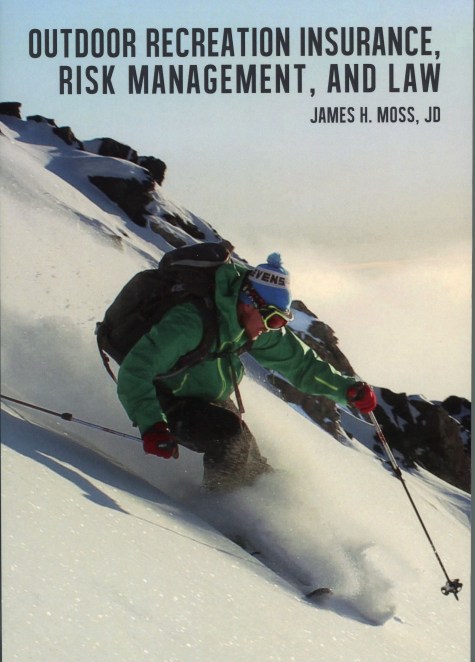
Outdoor Recreation Insurance, Risk Management, and Law
Denver based James H. Moss, JD, an attorney who specializes in the legal issues of outdoor recreation and adventure travel companies, guides, outfitters, and manufacturers, has written a comprehensive legal guidebook titled, “Outdoor Recreation Insurance, Risk Management, and Law”. Sagamore Publishing, a well-known Illinois-based educational publisher, distributes the book.
Mr. Moss, who applied his 30 years of experience with the legal, insurance, and risk management issues of the outdoor industry, wrote the book in order to fill a void.
“There was nothing out there that looked at case law and applied it to legal problems in outdoor recreation,” Moss explained. “The goal of this book is to provide sound advice based on past law and experience.”
The Reference book is sold via the Summit Magic Publishing, LLC.
While written as a college-level textbook, the guide also serves as a legal primer for executives, managers, and business owners in the field of outdoor recreation. It discusses how to tackle, prevent, and overcome legal issues in all areas of the industry.
The book is organized into 14 chapters that are easily accessed as standalone topics, or read through comprehensively. Specific topics include rental programs, statues that affect outdoor recreation, skiing and ski areas, and defenses to claims. Mr. Moss also incorporated listings of legal definitions, cases, and statutes, making the book easy for laypeople to understand.
PURCHASE
TABLE OF CONTENTS
Table of Cases
Introduction
Outdoor Recreation Law and Insurance: Overview
Risk
Risk
Perception versus Actual Risk
Risk v. Reward
Risk Evaluation
Risk Management Strategies
Humans & Risk
Risk = Accidents
Accidents may/may not lead to litigation
How Do You Deal with Risk?
How Does Acceptance of Risk Convert to Litigation?
Negative Feelings against the Business
Risk, Accidents & Litigation
No Real Acceptance of the Risk
No Money to Pay Injury Bills
No Health Insurance
Insurance Company Subrogation
Negative Feelings
Litigation
Dealing with Different People
Dealing with Victims
Develop a Friend & Eliminate a Lawsuit
Don’t Compound Minor Problems into Major Lawsuits
Emergency Medical Services
Additional Causes of Lawsuits in Outdoor Recreation
Employees
How Do You Handle A Victim?
Dealing with Different People
Dealing with Victims
Legal System in the United States
Courts
State Court System
Federal Court System
Other Court Systems
Laws
Statutes
Parties to a Lawsuit
Attorneys
Trials
Law
Torts
Negligence
Duty
Breach of the Duty
Injury
Proximate Causation
Damages
Determination of Duty Owed
Duty of an Outfitter
Duty of a Guide
Duty of Livery Owner
Duty of Rental Agent
Duty of Volunteer Youth Leader
In Loco Parentis
Intentional Torts
Gross Negligence
Willful & Wanton Negligence
Intentional Negligence
Negligence Per Se
Strict Liability
Attractive Nuisance
Results of Acts That Are More than Ordinary Negligence
Product Liability
Contracts
Breach of Contract
Breach of Warranty
Express Warranty
Implied Warranty
Warranty of Fitness for a Particular Purpose
Warranty of Merchantability
Warranty of Statute
Detrimental Reliance
Unjust Enrichment
Liquor Liability
Food Service Liability
Damages
Compensatory Damages
Special Damages
Punitive Damages
Statutory Defenses
Skier Safety Acts
Whitewater Guides & Outfitters
Equine Liability Acts
Legal Defenses
Assumption of Risk
Express Assumption of Risk
Implied Assumption of Risk
Primary Assumption of Risk
Secondary Assumption of Risk
Contributory Negligence
Assumption of Risk & Minors
Inherent Dangers
Assumption of Risk Documents.
Assumption of Risk as a Defense.
Statutory Assumption of Risk
Express Assumption of Risk
Contributory Negligence
Joint and Several Liability
Release, Waivers & Contracts Not to Sue
Why do you need them
Exculpatory Agreements
Releases
Waivers
Covenants Not to sue
Who should be covered
What should be included
Negligence Clause
Jurisdiction & Venue Clause
Assumption of Risk
Other Clauses
Indemnification
Hold Harmless Agreement
Liquidated Damages
Previous Experience
Misc
Photography release
Video Disclaimer
Drug and/or Alcohol clause
Medical Transportation & Release
HIPAA
Problem Areas
What the Courts do not want to see
Statute of Limitations
Minors
Adults
Defenses Myths
Agreements to Participate
Parental Consent Agreements
Informed Consent Agreements
Certification
Accreditation
Standards, Guidelines & Protocols
License
Specific Occupational Risks
Personal Liability of Instructors, Teachers & Educators
College & University Issues
Animal Operations, Packers
Equine Activities
Canoe Livery Operations
Tube rentals
Downhill Skiing
Ski Rental Programs
Indoor Climbing Walls
Instructional Programs
Mountaineering
Retail Rental Programs
Rock Climbing
Tubing Hills
Whitewater Rafting
Risk Management Plan
Introduction for Risk Management Plans
What Is A Risk Management Plan?
What should be in a Risk Management Plan
Risk Management Plan Template
Ideas on Developing a Risk Management Plan
Preparing your Business for Unknown Disasters
Building Fire & Evacuation
Dealing with an Emergency
Insurance
Theory of Insurance
Insurance Companies
Deductibles
Self-Insured Retention
Personal v. Commercial Policies
Types of Policies
Automobile
Comprehension
Collision
Bodily Injury
Property Damage
Uninsured Motorist
Personal Injury Protection
Non-Owned Automobile
Hired Car
Fire Policy
Coverage
Liability
Named Peril v. All Risk
Commercial Policies
Underwriting
Exclusions
Special Endorsements
Rescue Reimbursement
Policy Procedures
Coverage’s
Agents
Brokers
General Agents
Captive Agents
Types of Policies
Claims Made
Occurrence
Claims
Federal and State Government Insurance Requirements
Bibliography
Index
The 427-page volume is sold via Summit Magic Publishing, LLC.
What is a Risk Management Plan and What do You Need in Yours?
Posted: July 25, 2019 Filed under: Activity / Sport / Recreation, Adventure Travel, Assumption of the Risk, Avalanche, Camping, Challenge or Ropes Course, Climbing, Climbing Wall, Contract, Cycling, Equine Activities (Horses, Donkeys, Mules) & Animals, First Aid, Health Club, Indoor Recreation Center, Jurisdiction and Venue (Forum Selection), Legal Case, Medical, Minors, Youth, Children, Mountain Biking, Mountaineering, Paddlesports, Playground, Racing, Racing, Release (pre-injury contract not to sue), Risk Management, Rivers and Waterways, Rock Climbing, Scuba Diving, Sea Kayaking, Search and Rescue (SAR), Ski Area, Skier v. Skier, Skiing / Snow Boarding, Skydiving, Paragliding, Hang gliding, Snow Tubing, Sports, Summer Camp, Swimming, Triathlon, Whitewater Rafting, Youth Camps, Zip Line | Tags: #ORLawTextbook, #ORRiskManagment, #OutdoorRecreationRiskManagementInsurance&Law, #OutdoorRecreationTextbook, @SagamorePub, Adventure travel, and Law, assumption of the risk, camping, Case Analysis, Challenge or Ropes Course, Climbing, Climbing Wall, Contract, Cycling, Donkeys, Equine Activities (Horses, first aid, General Liability Insurance, Good Samaritan Statutes, Guide, Hang gliding, http://www.rec-law.us/ORLawTextbook, Insurance, Insurance policy, James H. Moss, James H. Moss J.D., Jim Moss, Jurisdiction and Venue (Forum Selection), Legal Case, Liability insurance, Medical, Mountain biking, Mountaineering, Mules) & Animals, Negligence, OR Textbook, Outdoor Recreation Insurance, Outdoor Recreation Law, Outdoor Recreation Risk Management, Outfitter, Paddlesports, Paragliding, Recreational Use Statute, Release (pre-injury contract not to sue), Risk Management, risk management plan, Rivers and Waterways, Rock climbing, Sea Kayaking, ski area, Ski Area Statutes, Skiing / Snow Boarding, Skydiving, swimming, Textbook, Understanding, Understanding Insurance, Understanding Risk Management, Whitewater Rafting, zip line Leave a commentEveryone has told you, that you need a risk management plan. A plan to follow if you have
Outdoor Recreation Insurance, Risk Management, and Law
a crisis. You‘ve seen several and they look burdensome and difficult to write. Need help writing a risk management plan? Need to know what should be in your risk management plan? Need Help?
This book can help you understand and write your plan. This book is designed to help you rest easy about what you need to do and how to do it. More importantly, this book will make sure your plan is a workable plan, not one that will create liability for you.

Table of Contents
Chapter 1 Outdoor Recreation Risk Management, Law, and Insurance: An Overview
Chapter 2 U.S. Legal System and Legal Research
Chapter 3 Risk 25
Chapter 4 Risk, Accidents, and Litigation: Why People Sue
Chapter 5 Law 57
Chapter 6 Statutes that Affect Outdoor Recreation
Chapter 7 PreInjury Contracts to Prevent Litigation: Releases
Chapter 8 Defenses to Claims
Chapter 9 Minors
Chapter 10 Skiing and Ski Areas
Chapter 11 Other Commercial Recreational Activities
Chapter 12 Water Sports, Paddlesports, and water-based activities
Chapter 13 Rental Programs
Chapter 14 Insurance
$130.00 plus shipping

Need a Handy Reference Guide to Understand your Insurance Policy?
Posted: July 18, 2019 Filed under: Adventure Travel, Assumption of the Risk, Avalanche, Challenge or Ropes Course, Climbing, Contract, Cycling, Equine Activities (Horses, Donkeys, Mules) & Animals, Health Club, Indoor Recreation Center, Insurance, Jurisdiction and Venue (Forum Selection), Minors, Youth, Children, Mountain Biking, Mountaineering, Paddlesports, Racing, Release (pre-injury contract not to sue), Risk Management, Rivers and Waterways, Rock Climbing, Scuba Diving, Sea Kayaking, Ski Area, Skier v. Skier, Skiing / Snow Boarding, Skydiving, Paragliding, Hang gliding, Snow Tubing, Sports, Summer Camp, Swimming, Whitewater Rafting, Youth Camps, Zip Line | Tags: #ORLawTextbook, #ORRiskManagment, #OutdoorRecreationRiskManagementInsurance&Law, #OutdoorRecreationTextbook, @SagamorePub, Adventure travel, and Law, assumption of the risk, camping, Case Analysis, Challenge or Ropes Course, Climbing, Climbing Wall, Contract, Cycling, Donkeys, Equine Activities (Horses, first aid, General Liability Insurance, Good Samaritan Statutes, Guide, Hang gliding, http://www.rec-law.us/ORLawTextbook, Insurance, Insurance policy, James H. Moss, James H. Moss J.D., Jim Moss, Jurisdiction and Venue (Forum Selection), Legal Case, Liability insurance, Medical, Mountain biking, Mountaineering, Mules) & Animals, Negligence, Outdoor Recreation Insurance, Outdoor Recreation Law, Outdoor Recreation Risk Management, Outfitter, Paddlesports, Paragliding, Recreational Use Statute, Release (pre-injury contract not to sue), Risk Management, Rivers and Waterways, Rock climbing, Sea Kayaking, ski area, Ski Area Statutes, Skiing / Snow Boarding, Skydiving, swimming, Whitewater Rafting, zip line Leave a commentThis book should be on every outfitter and guide’s desk. It will answer your questions, help you sleep at night, help you answer your guests’ questions and allow you to run your business with less worry.

Table of Contents
Chapter 1 Outdoor Recreation Risk Management, Law, and Insurance: An Overview
Chapter 2 U.S. Legal System and Legal Research
Chapter 3 Risk 25
Chapter 4 Risk, Accidents, and Litigation: Why People Sue
Chapter 5 Law 57
Chapter 6 Statutes that Affect Outdoor Recreation
Chapter 7 PreInjury Contracts to Prevent Litigation: Releases
Chapter 8 Defenses to Claims
Chapter 9 Minors
Chapter 10 Skiing and Ski Areas
Chapter 11 Other Commercial Recreational Activities
Chapter 12 Water Sports, Paddlesports, and water-based activities
Chapter 13 Rental Programs
Chapter 14 Insurance
$99.00 plus shipping

What is a Risk Management Plan and What do You Need in Yours?
Posted: April 11, 2019 Filed under: Activity / Sport / Recreation, Adventure Travel, Assumption of the Risk, Avalanche, Camping, Challenge or Ropes Course, Climbing, Climbing Wall, Contract, Cycling, Equine Activities (Horses, Donkeys, Mules) & Animals, First Aid, Health Club, Indoor Recreation Center, Jurisdiction and Venue (Forum Selection), Legal Case, Medical, Minors, Youth, Children, Mountain Biking, Mountaineering, Paddlesports, Playground, Racing, Racing, Release (pre-injury contract not to sue), Risk Management, Rivers and Waterways, Rock Climbing, Scuba Diving, Sea Kayaking, Search and Rescue (SAR), Ski Area, Skier v. Skier, Skiing / Snow Boarding, Skydiving, Paragliding, Hang gliding, Snow Tubing, Sports, Summer Camp, Swimming, Triathlon, Whitewater Rafting, Youth Camps, Zip Line | Tags: #ORLawTextbook, #ORRiskManagment, #OutdoorRecreationRiskManagementInsurance&Law, #OutdoorRecreationTextbook, @SagamorePub, Adventure travel, and Law, assumption of the risk, camping, Case Analysis, Challenge or Ropes Course, Climbing, Climbing Wall, Contract, Cycling, Donkeys, Equine Activities (Horses, first aid, General Liability Insurance, Good Samaritan Statutes, Guide, Hang gliding, http://www.rec-law.us/ORLawTextbook, Insurance, Insurance policy, James H. Moss, James H. Moss J.D., Jim Moss, Jurisdiction and Venue (Forum Selection), Legal Case, Liability insurance, Medical, Mountain biking, Mountaineering, Mules) & Animals, Negligence, OR Textbook, Outdoor Recreation Insurance, Outdoor Recreation Law, Outdoor Recreation Risk Management, Outfitter, Paddlesports, Paragliding, Recreational Use Statute, Release (pre-injury contract not to sue), Risk Management, risk management plan, Rivers and Waterways, Rock climbing, Sea Kayaking, ski area, Ski Area Statutes, Skiing / Snow Boarding, Skydiving, swimming, Textbook, Understanding, Understanding Insurance, Understanding Risk Management, Whitewater Rafting, zip line Leave a commentEveryone has told you, you need a risk management plan. A plan to follow if you have  a crisis. You‘ve seen several and they look burdensome and difficult to write. Need help writing a risk management plan? Need to know what should be in your risk management plan? Need Help?
This book can help you understand and write your plan. This book is designed to help you rest easy about what you need to do and how to do it. More importantly, this book will make sure you plan is a workable plan, not one that will create liability for you.
Table of Contents
Chapter 1 Outdoor Recreation Risk Management, Law, and Insurance: An Overview
Chapter 2 U.S. Legal System and Legal Research
Chapter 3 Risk 25
Chapter 4 Risk, Accidents, and Litigation: Why People Sue
Chapter 5 Law 57
Chapter 6 Statutes that Affect Outdoor Recreation
Chapter 7 PreInjury Contracts to Prevent Litigation: Releases
Chapter 8 Defenses to Claims
Chapter 9 Minors
Chapter 10 Skiing and Ski Areas
Chapter 11 Other Commercial Recreational Activities
Chapter 12 Water Sports, Paddlesports, and water-based activities
Chapter 13 Rental Programs
Chapter 14 Insurance
$99.00 plus shipping
Need a Handy Reference Guide to Understand your Insurance Policy?
Posted: April 2, 2019 Filed under: Adventure Travel, Assumption of the Risk, Avalanche, Challenge or Ropes Course, Climbing, Contract, Cycling, Equine Activities (Horses, Donkeys, Mules) & Animals, Health Club, Indoor Recreation Center, Insurance, Jurisdiction and Venue (Forum Selection), Minors, Youth, Children, Mountain Biking, Mountaineering, Paddlesports, Racing, Release (pre-injury contract not to sue), Risk Management, Rivers and Waterways, Rock Climbing, Scuba Diving, Sea Kayaking, Ski Area, Skier v. Skier, Skiing / Snow Boarding, Skydiving, Paragliding, Hang gliding, Snow Tubing, Sports, Summer Camp, Swimming, Whitewater Rafting, Youth Camps, Zip Line | Tags: #ORLawTextbook, #ORRiskManagment, #OutdoorRecreationRiskManagementInsurance&Law, #OutdoorRecreationTextbook, @SagamorePub, Adventure travel, and Law, assumption of the risk, camping, Case Analysis, Challenge or Ropes Course, Climbing, Climbing Wall, Contract, Cycling, Donkeys, Equine Activities (Horses, first aid, General Liability Insurance, Good Samaritan Statutes, Guide, Hang gliding, http://www.rec-law.us/ORLawTextbook, Insurance, Insurance policy, James H. Moss, James H. Moss J.D., Jim Moss, Jurisdiction and Venue (Forum Selection), Legal Case, Liability insurance, Medical, Mountain biking, Mountaineering, Mules) & Animals, Negligence, Outdoor Recreation Insurance, Outdoor Recreation Law, Outdoor Recreation Risk Management, Outfitter, Paddlesports, Paragliding, Recreational Use Statute, Release (pre-injury contract not to sue), Risk Management, Rivers and Waterways, Rock climbing, Sea Kayaking, ski area, Ski Area Statutes, Skiing / Snow Boarding, Skydiving, swimming, Whitewater Rafting, zip line Leave a commentThis book should be on every outfitter and guide’s desk. It will answer your questions, help you sleep at night, help you answer your guests’ questions and allow you to run your business with less worry.
Table of Contents
Chapter 1 Outdoor Recreation Risk Management, Law, and Insurance: An Overview
Chapter 2 U.S. Legal System and Legal Research
Chapter 3 Risk 25
Chapter 4 Risk, Accidents, and Litigation: Why People Sue
Chapter 5 Law 57
Chapter 6 Statutes that Affect Outdoor Recreation
Chapter 7 PreInjury Contracts to Prevent Litigation: Releases
Chapter 8 Defenses to Claims
Chapter 9 Minors
Chapter 10 Skiing and Ski Areas
Chapter 11 Other Commercial Recreational Activities
Chapter 12 Water Sports, Paddlesports, and water-based activities
Chapter 13 Rental Programs
Chapter 14 Insurance
$99.00 plus shipping
Wethington v. Swainson, d/b/a/ Pegasus Airsport Center, 2015 U.S. Dist. LEXIS 169145
Posted: March 29, 2016 Filed under: Legal Case, Oklahoma, Release (pre-injury contract not to sue), Skydiving, Paragliding, Hang gliding | Tags: Exculpatory Agreement, Exculpatory clause, Minor, OK, Oklahoma, Release, Skydiving Leave a commentWethington v. Swainson, d/b/a/ Pegasus Airsport Center, 2015 U.S. Dist. LEXIS 169145
Holly Wethington and Makenzie Wethington, Plaintiffs, v. Robert Swainson, d/b/a/ Pegasus Airsport Center, Defendant.
Case No. CIV-14-899-D
UNITED STATES DISTRICT COURT FOR THE WESTERN DISTRICT OF OKLAHOMA
2015 U.S. Dist. LEXIS 169145
December 18, 2015, Decided
December 18, 2015, Filed
SUBSEQUENT HISTORY: Sanctions allowed by, in part, Sanctions disallowed by, in part Wethington v. Swainson, 2015 U.S. Dist. LEXIS 171126 (W.D. Okla., Dec. 23, 2015)
Motion granted by Wethington v. Swainson, 2016 U.S. Dist. LEXIS 7421 (W.D. Okla., Jan. 22, 2016)
COUNSEL: [*1] For Holly Wethington, individually, Mackenzie Wethington, Plaintiffs: James E Weger, LEAD ATTORNEY, Jones Gotcher & Bogan, Tulsa, OK; Robert E Haslam, Haslam & Gallagher, Fort Worth, TX.
Robert Swainson, doing business as Pegasus Airsport Center, Defendant, Pro se.
Robert Swainson, Third Party Plaintiff, Pro se.
Joseph Wethington, Third Party Defendant, Pro se.
Robert Swainson, Counter Claimant, Pro se.
For Holly Wethington, individually, Counter Defendant: James E Weger, LEAD ATTORNEY, Jones Gotcher & Bogan, Tulsa, OK; Robert E Haslam, Haslam & Gallagher, Fort Worth, TX.
JUDGES: TIMOTHY D. DEGIUSTI, UNITED STATES DISTRICT JUDGE.
OPINION BY: TIMOTHY D. DEGIUSTI
OPINION
ORDER
The determinative issue before the Court concerns the authority of a parent to bind their minor child to an exculpatory agreement, which functions to preclude a defendant’s liability for negligence, before an injury has even occurred. Holly and Makenzie Wethington, mother and daughter (“Plaintiffs”), bring this action against Defendant Robert Swainson, d/b/a/ Pegasus Airsport Center, for injuries suffered by Makenzie while skydiving.1 Under theories of negligence and breach of contract, Plaintiffs contend Defendant (1) provided inadequate training to [*2] Makenzie in preparation for the parachute jump, (2) selected a person to provide radio assistance who had no prior experience, (3) provided old equipment that malfunctioned during Makenzie’s jump, and (4) permitted Makenzie to use a parachute she was ill-prepared to use and which was inappropriate for her skill level. Before the Court is Defendant’s Motion for Summary Judgment [Doc. No. 24], to which Plaintiffs have filed their response in opposition [Doc. No. 30]. The matter is fully briefed and at issue.
1 At the time this action was brought, Makenzie was a minor. She has since become eighteen and will thus be referenced by name.
BACKGROUND
The following facts are undisputed. On January 24, 2014, Makenzie, who was then sixteen years old and accompanied by her parents, went to Defendant to learn how to skydive. As part of the registration process, Makenzie executed a Registration Form and Medical Statement. Near the bottom of the document, Makenzie initialed a disclaimer which read:
I FURTHER UNDERSTAND THAT SKYDIVING AND GLIDING ARE VERY SERIOUS AND HAZARDOUS SPORTS IN WHICH I COULD SUSTAIN SERIOUS AND PERMANENT INJURIES OR EVEN DEATH
Makenzie underwent an instruction course that included [*3] determining the condition of the parachute after deployment, gaining control and resolving any deployment problems and, if necessary, activating her emergency parachute. In connection with her registration and training, Makenzie and her parents both signed and/or initialed an accompanying document entitled “Agreement, Release of Liability and Acknowledgment of Risk” (the Release). The Release contained numerous exculpatory provisions, which stated in pertinent part:
1. RELEASE FROM LIABILITY. I hereby RELEASE AND DISCHARGE [Defendant] from any and all liability claims, demands or causes of action that I may hereafter have for injuries and damages arising out of my participation in parachuting and other aviation activities, including but not limited to LOSSES CAUSED BY THE NEGLIGENCE OR OTHER FAULT OF THE RELEASED PARTIES.
2. COVENANT NOT TO SUE. I further agree that I WILL NOT SUE OR MAKE A CLAIM AGAINST [Defendant] for damages or other losses sustained as a result of my participation in parachuting and other aviation activities.
* * *
5. ACKNOWLEDGMENT OF RISK. I understand and acknowledge that parachuting activities have inherent dangers that no amount of care, caution, instruction or [*4] expertise can eliminate and I EXPRESSLY AND VOLUNTARILY ACKNOWLEDGE ALL RISK OF DEATH OR PERSONAL INJURY SUSTAINED WHILE PARTICIPATING IN PARACHUTING AND OTHER AVIATION ACTIVITIES WHETHER OR NOT CAUSED BY THE NEGLIGENCE OR OTHER FAULT OF THE RELEASED PARTIES, including but not limited to equipment malfunction from whatever cause or inadequate training.
* * *
9. ENFORCEABILITY. I agree that if any portion of this Agreement, Release of Liability and Acknowledgment of risk is found to be unenforceable or against public policy, that only that portion shall fall and all other portions shall remain in full force and effect. . . . I also specifically waive any unenforceability or any public policy argument that I may make or that may be made on behalf of my estate or by anyone who would sue because of injury, damage or death as a result of my participation in parachuting and other aviation activities.
10. LEGAL RIGHTS. It has been explained to me, and I expressly recognize that this Agreement, Release of Liability and Acknowledgment of Risk is a contract pursuant to which I am giving up important legal rights, and it is my intention to do so.
(Emphasis added).
Near the bottom of the form, Makenzie [*5] read and rewrote the following statement: “I hereby certify that I have read this Agreement, Release of Liability and Acknowledgment of Risk, that I fully understand the contents of this contract, that I wish to be bound by its terms, and that I have signed this contract of my own free will.” This statement was signed and dated by Makenzie and initialed by her mother. At the bottom of the Release, under the heading, “RATIFICATION BY PARENT/GUARDIAN if participant is under 18-years-of-age,” both parents attested that they had read the agreement, understood its terms, and agreed to be bound thereby.
Makenzie received four hours of training and instruction. She was assigned a used parachute based on her size and weight. Defendant employed the assistance of Jacob Martinez to act as radio controller. Mr. Martinez’s duty was to help guide the jumpers onto the landing area and it was his first time to assist with the radio. Upon Makenzie’s jump, her chute malfunctioned, causing her to spin with increasing rapidity towards the ground. Makenzie landed at a high speed and impact, causing her to sustain serious injuries.
STANDARD OF DECISION
“Summary judgment is proper if, viewing the evidence in [*6] the light most favorable to the non-moving party, there is no genuine dispute as to any material fact and the movant is entitled to judgment as a matter of law.” Bonidy v. U.S. Postal Service, 790 F.3d 1121, 1124 (10th Cir. 2015) (citing Peterson v. Martinez, 707 F.3d 1197, 1207 (10th Cir. 2013)). The Court’s function at the summary judgment stage is not to weigh the evidence and determine the truth of the matter asserted, but to determine whether there is a genuine issue for trial. Tolan v. Cotton, U.S. , 134 S.Ct. 1861, 1866, 188 L.Ed.2d 895 (2014). An issue is “genuine” if there is sufficient evidence on each side so that a rational trier of fact could resolve the issue either way. Adler v. Wal-Mart Stores, Inc., 144 F.3d 664, 670 (10th Cir. 1998). An issue of fact is “material” if under the substantive law it is essential to the proper disposition of the claim. Id. Once the moving party has met its burden, the burden shifts to the nonmoving party to present sufficient evidence in specific, factual form to establish a genuine factual dispute. Bacchus Indus., Inc. v. Arvin Indus., Inc., 939 F.2d 887, 891 (10th Cir. 1991).
The nonmoving party may not rest upon the mere allegations or denials of its pleadings. Rather, it must go beyond the pleadings and establish, through admissible evidence, there is a genuine issue of material fact that must be resolved by the trier of fact. Salehpoor v. Shahinpoor, 358 F.3d 782, 786 (10th Cir. 2004). Unsupported conclusory allegations do not create an issue of fact. Finstuen v. Crutcher, 496 F.3d 1139, 1144 (10th Cir. 2007).
DISCUSSION
Defendant contends the Release absolves him from all liability [*7] for any injury suffered by Makenzie. Plaintiffs respond that Defendant’s motion should be denied because (1) Makenzie was a minor when she signed the Release, rendering it invalid under Oklahoma law,2 (2) Defendant is clearly liable under the theories asserted, and (3) this Court had a duty to protect Makenzie as a minor.
2 In Oklahoma, a minor is any person under eighteen (18) years of age. 15 Okla. Stat. § 13.
“An exculpatory clause releases in advance the second party for any harm the second party might cause the first party after the contract is entered.” Arnold Oil Properties LLC v. Schlumberger Tech. Corp., 672 F.3d 1202, 1206-07 (10th Cir. 2012) (citation omitted). While generally enforceable, such clauses are considered “distasteful to the law.” Schmidt v. United States, 1996 OK 29, P 8, 912 P.2d 871, 874 (emphasis in original).3 Exculpatory clauses are enforceable only if they meet the three following criteria:
(1) Their language must evidence a clear and unambiguous intent to exonerate the would-be defendant from liability for the sought-to-be-recovered damages;
(2) At the time the contract was executed, there must have been no vast difference in bargaining power between parties; and
(3) Enforcement of the clause would not (a) be injurious to public health, public morals or confidence in administration of the law or (b) so undermine the security of individual [*8] rights vis-a-vis personal safety or private property as to violate public policy.
Schmidt, 912 P.2d at 874. “The clause will never avail to relieve a party from liability for intentional, willful or fraudulent acts or gross, wanton negligence.” Id. at 874 (citations omitted, emphasis in original); Satellite System, Inc. v. Birch Telecom of Okla., Inc., 2002 OK 61, P 11, 51 P.3d 585, 589 (“Oklahoma has a strong legislative public policy against contracts which attempt ‘to exempt anyone from responsibility for his own fraud, or willful injury to the person or property of another.'”) (citing 15 Okla. Stat. § 212).
3 Notwithstanding this admonition, courts should void contract clauses on public-policy grounds “rarely, with great caution and in cases that are free from doubt.” Union Pacific R. Co. v. U.S. ex rel. U.S. Army Corps of Engineers, 591 F.3d 1311, 1321 (10th Cir. 2010) (quoting Shepard v. Farmers Ins. Co., 1983 OK 103, P 3, 678 P.2d 250, 251).
Oklahoma courts, and others, have upheld exculpatory contracts similar to the present Release, i.e., contracts that exculpate the defendant from injuries suffered by plaintiffs while skydiving. See Manning v. Brannon, 1998 OK CIV APP 17, PP 15-17, 956 P.2d 156, 158-59 (exculpatory contract relieving defendant from any liability for injuries to plaintiff from parachuting activities was valid and enforceable); see also Scrivener v. Sky’s the Limit, Inc., 68 F. Supp. 2d 277, 280 (S.D.N.Y. 1999); Paralift, Inc. v. Superior Court, 23 Cal.App.4th 748, 756, 29 Cal.Rptr.2d 177, 181 (1993); Jones v. Dressel, 623 P.2d 370, 376 (Colo. 1981). This Court, likewise, finds the Release is generally valid on its face.
First, the Release states in clear and unequivocal terms the intention of the parties to excuse Defendant from liability caused [*9] by Defendant’s negligence, equipment failure, or inadequate instruction. Plaintiffs signed and initialed several clauses containing the headings, RELEASE FROM LIABILITY, COVENANT NOT TO SUE, and ACKNOWLEDGMENT OF RISK. Mrs. Wethington and her husband signed a ratification stating they had read the Release, understood its terms, and agreed to be bound thereby. Second, there is no evidence of unequal bargaining power. “Oklahoma courts consider two factors in determining parties’ relative bargaining power: ‘(1) the importance of the subject matter to the physical or economic wellbeing of the party agreeing to the release, and (2) the amount of free choice that party could have exercised when seeking alternate services.'” Arnold Oil, 672 F.3d at 1208 (quoting Schmidt, 912 P.2d at 874). There is no evidence that skydiving was necessary or important to Plaintiffs’ wellbeing. In fact, when asked why she wanted to skydive, Makenzie answered, “It’s on my bucket list.” Moreover, Plaintiffs do not contend Makenzie had no choice but to agree to be trained by and jump with Defendant as opposed to going elsewhere. Third, as noted, Oklahoma courts have upheld such releases as not against public policy. See Manning, 956 P.2d at 159 (“we find a exculpatory contract in the [*10] context of a high-risk sport such as sky diving not against the public policy of this state.”).
Plaintiffs nevertheless maintain the Release is voidable because Makenzie was a minor when she signed it and her subsequent suit disaffirmed the agreement. It is also true that as a matter of public policy, courts have protected minors from improvident and imprudent contractual commitments by declaring the contract of a minor is voidable at the election of the minor after she attains majority. See 15 Okla. Stat. § 19. “A release is a contract.” Corbett v. Combined Communications Corp., 1982 OK 135, P 5, 654 P.2d 616, 617. Under Oklahoma law, a minor’s right to rescind a contract is unaffected by the approval or consent of a parent. Gomes v. Hameed, 2008 OK 3, P 26, 184 P.3d 479, 489 (citing Gage v. Moore, 1948 OK 214, P 8, 200 Okla. 623, 198 P.2d 395, 396).
In this case, however, Makenzie’s parents also knowingly signed the Release on her behalf, ratifying and affirming its exculpatory content, and agreeing to be bound thereby. Nevertheless, Defendant refers this Court to no controlling authority that permits the parent of a minor to, on the minor’s behalf, release or waive the minor’s prospective claim for negligence. The Court is unaware of any such authority, and therefore must predict how the Oklahoma Supreme Court would rule on the question. Ortiz v. Cooper Tire & Rubber Co., No. CIV-13-32-D, 2015 U.S. Dist. LEXIS 41544, 2015 WL 1498713, at *5 (W.D. Okla. Mar. 31, 2015) (“A [*11] federal court sitting in diversity must apply state law as propounded by the forum’s highest court. Absent controlling precedent, the federal court must attempt to predict how the state’s highest court would resolve the issue.”) (quoting Royal Maccabees Life Ins. Co. v. Choren, 393 F.3d 1175, 1180 (10th Cir. 2005)).
Although the cases are split on the issue, it is well-recognized that the majority of state courts considering the issue have held a parent may not release a minor’s prospective claim for negligence. See Fedor v. Mauwehu Council, Boy Scouts of Am., 21 Conn. Supp. 38, 143 A.2d 466, 467-68 (Conn. 1958); Kirton v. Fields, 997 So.2d 349, 356 (Fla. 2008) (pre-injury release executed by parent on behalf of minor is unenforceable against minor or the minor’s estate in a tort action arising from injuries resulting from participation in a commercial activity); Hojnowski v. Vans Skate Park, 187 N.J. 323, 901 A.2d 381, 386 (N.J. 2006) (New Jersey public policy prohibits parents of a minor child from releasing a minor child’s potential tort claim arising out of the use of a commercial recreational facility); Meyer v. Naperville Manner, Inc., 262 Ill. App. 3d 141, 634 N.E.2d 411, 414, 199 Ill. Dec. 572 (Ill. App. Ct. 1994) (“[I]n the absence of statutory or judicial authorization, a parent cannot waive, compromise, or release a minor child’s cause of action merely because of the parental relationship . . . . This rule has also been extended to render ineffective releases or exculpatory agreements for future tortious conduct by other persons where such releases had been signed by parents on [*12] behalf of their minor children.”); Galloway v. State, 790 N.W.2d 252, 256 (Iowa 2010) (public policy precluded enforcement of parent’s pre-injury waiver of her child’s cause of action for injuries caused by negligence); Doyle v. Bowdoin College, 403 A.2d 1206, 1208 n. 3 (Me. 1979) (“a parent, or guardian, cannot release the child’s or ward’s, cause of action.”); Childress v. Madison County, 777 S.W.2d 1, 6-7 (Tenn. Ct. App. 1989); Woodman v. Kera, LLC, 280 Mich. App. 125, 760 N.W.2d 641, 655-56 (Mich. Ct. App. 2008) (pre-injury waivers effectuated by parents on behalf of their minor children are not presumptively enforceable); Apicella v. Valley Forge Military Acad. & Junior Coll., 630 F.Supp. 20, 24 (E.D. Penn. 1985) (“Under Pennsylvania law, parents do not possess the authority to release the claims or potential claims of a minor child merely because of the parental relationship.”); Munoz v. II Jaz Inc., 863 S.W.2d 207, 209-10 (Tex. App. 1993) (statute which empowered parents to make legal decisions concerning their child did not give parents power to waive child’s cause of action for personal injuries); Scott v. Pacific West Mountain Resort, 119 Wn.2d 484, 834 P.2d 6, 11-12 (Wash. 1992) (“A parent does not have legal authority to waive a child’s own future cause of action for personal injuries resulting from a third party’s negligence”).4
4 Of the cases enforcing pre-injury releases executed by parents on behalf of minor children, most involve state-enacted legislation permitting such waiver or the minor’s participation in school-run or community-sponsored activities. See, e.g., Squires v. Breckenridge Outdoor Educ. Ctr., 715 F.3d 867, 874 (10th Cir. 2013); Hohe v. San Diego Unified Sch. Dist., 224 Cal. App. 3d 1559, 1564, 274 Cal. Rptr. 647, 649-50 (1990); BJ’s Wholesale Club, Inc. v. Rosen, 435 Md. 714, 80 A.3d 345, 362 (Md. 2013); Sharon v. City of Newton, 437 Mass. 99, 769 N.E.2d 738, 746-47 (Mass. 2002); Zivich v. Mentor Soccer Club, Inc., 82 Ohio St. 3d 367, 1998 Ohio 389, 696 N.E.2d 201, 205 (Ohio 1998).
These decisions have invalidated such agreements on the grounds that (1) parents have no [*13] such power, or (2) the agreements violate public policy. The underlying rationale employed by many is that courts, acting in the role as parens patriae, have a duty to protect minors. Oklahoma recognizes its duty to protect minor children. Baby F. v. Oklahoma County District Court, 2015 OK 24, P 23, 348 P.3d 1080, 1088. In Oklahoma, a parent or guardian may not settle a child’s claim without prior court approval. See 30 Okla. Stat. § 4-702 (“A guardian, with the approval of the court exercising jurisdiction in the suit or proceeding, may compromise and settle any claim made by, on behalf of or against the ward in such suit or proceeding.”). As aptly summarized by the Washington Supreme Court in Scott:
Since a parent generally may not release a child’s cause of action after injury, it makes little, if any, sense to conclude a parent has the authority to release a child’s cause of action prior to an injury. In situations where parents are unwilling or unable to provide for a seriously injured child, the child would have no recourse against a negligent party to acquire resources needed for care and this is true regardless of when relinquishment of the child’s rights might occur.
Scott, 834 P.2d at 11-12 (emphasis added).
Based on the case law in Oklahoma and other jurisdictions, the Court is led to the conclusion [*14] that (1) Makenzie’s acknowledgment and execution of the Release is of no consequence and does not preclude her claims against Defendant, and (2) the Oklahoma Supreme Court would find that an exculpatory agreement regarding future tortious conduct, signed by parents on behalf of their minor children, is unenforceable. Accordingly, to the extent the Release purports to bar Makenzie’s own cause of action against Defendant, it is voidable. Plaintiffs correctly argue that commencement of this lawsuit constitutes a disaffirmance of the Release (see, e.g., Gage, supra; Ryan v. Morrison, 1913 OK 598, 40 Okla. 49, 135 P. 1049), and the contract is void ab initio. Grissom v. Beidleman, 1912 OK 847, P 8, 35 Okla. 343, 129 P. 853, 857 (“The disaffirmance of a contract made by an infant nullifies it and renders it void ab initio; and the parties are returned to the same condition as if the contract had never been made.”). The ratification signed by Makenzie’s parents is likewise unenforceable as a bar to Makenzie’s claims. The Release, however, is otherwise conspicuous and clear so as to bar the parents’ cause of action based upon injury to their child. Therefore, Mrs. Wethington’s causes of action, individually, are barred.5
5 As noted, exculpatory clauses cannot excuse one for, inter alia, gross negligence. The statutory definition [*15] of gross negligence is “want of slight care and diligence.” 25 Okla. Stat. § 6. Under Oklahoma law, “gross negligence” requires the intentional failure to perform a manifest duty in reckless disregard of consequences or in callous indifference to life, liberty, or property of another. Palace Exploration Co. v. Petroleum Dev. Co., 374 F.3d 951, 954 (10th Cir. 2004). Plaintiffs expressly plead in their Complaint only causes of action for negligence and breach of contract. Moreover, although Plaintiffs’ Complaint seeks punitive damages based on Defendant’s alleged “gross, willful, and intentional acts,” Compl., P 8, Plaintiffs neither argue nor present any evidence indicating Defendant’s actions constituted anything beyond ordinary negligence.
CONCLUSION
Defendant’s Motion for Summary Judgment [Doc. No. 24] is GRANTED IN PART and DENIED IN PART. Defendant’s motion is granted as to Plaintiff Holly Wethington’s claims and denied as to Plaintiff Makenzie Wethington’s claim for negligence. Since the skydiving contract is rendered void ab initio by means of Makenzie’s lawsuit, her breach of contract claim cannot proceed as a matter of law.
IT IS SO ORDERED this 18th day of December, 2015.
/s/ Timothy D. DeGiusti
TIMOTHY D. DeGIUSTI
UNITED STATES DISTRICT JUDGE
New Jersey does not support fee shifting provisions (indemnification clauses) in releases in a sky diving case.
Posted: June 1, 2015 Filed under: New Jersey, Skydiving, Paragliding, Hang gliding | Tags: Fee Shifting Provisions, Freefall, Freefall Adventures, Inc., Indemnification, Prima facie, Release, sky diving, Skydiving Leave a commentThe plaintiff’s claims were dismissed because the plaintiff failed to present enough evidence to support any elements of his claim for his injuries from skydiving.
Dare v. Freefall Adventures, Inc., 349 N.J. Super. 205; 793 A.2d 125; 2002 N.J. Super. LEXIS 155
State: New Jersey, Superior Court of New Jersey, Appellate Division
Plaintiff: Joseph Dare and Patricia Dare
Defendant: Freefall Adventures, Inc., John Ed-Dowes, Warren Acron, and Eric Keith Johnson, Defendants-Respondents.
Plaintiff Claims:
Defendant Defenses:
Holding:
Year: 2002
The plaintiff was injured when he attempted to avoid colliding with another skydiver. The co-participant had left the airplane first and was lower than the plaintiff; therefore, the co-participant had the right of way.
The plaintiff had been jumping from this site with the defendant for two years, which totaled 137 jumps, including every week the six months before the accident.
Prior to jumping the plaintiff signed a release. The release was five pages long and included an indemnity agreement. The plaintiff also signed a release for Cross Keys Airport, Inc.
The plaintiff sued his co-participant skydiver, as well as the jump facility for his injuries.
The plaintiff denied that it was the cause of his injury; however, he had made arrangements to have his wife photograph him during the jump. In order to allow his wife the opportunity to photograph him, he had to steer through buildings towards the concession trailer where his wife was located.
The defendants filed a motion for summary judgment, which was granted because the plaintiff failed to establish a prima facie case of negligence.
Prima facie, Latin for first look, which legally means the plaintiff, could not establish any facts or sufficient facts to support its claims. A plaintiff must show enough to the court to establish the very basics supporting the elements in its claim.
The defendant had argued that based on the release it should be awarded its attorney fees and costs; however, the trial court did not grant this motion.
Analysis: making sense of the law based on these facts.
The court first looked at the standard of care between participants in a sporting event.
…the duty of care applicable to participants in informal recreational sports is to avoid the infliction of injury caused by reckless or intentional conduct.” The Court’s determination was grounded on two policy considerations; the promotion of vigorous participation in athletic activities, and the avoidance of a flood of litigation generated by voluntary participation in games and sports.
The reckless standard is a greater standard than the negligence standard. That means the acts of the co-participant to be liable for the injuries of another participant must be beyond negligent acts.
The applicability of the heightened standard of care for causes of action for personal injuries occurring in recreational sports should not depend on which sport is involved and whether it is commonly perceived as a “contact” or “noncontact” sport. The recklessness or intentional conduct standard of care articulated in Crawn was not meant to be applied in a crabbed fashion. That standard represented the enunciation of a more modern approach to our common law in actions for personal injuries that generally occur during recreational sporting activities.
Another reason for the application of the reckless standard rather than the negligence standard is the concern that the lower standard would create a flood of lawsuits for any sporting injury.
Recklessness under New Jersey law “entails highly unreasonable conduct, involving “an extreme departure from ordinary care, in a situation where a high degree of danger is apparent.”
“The standard is objective and may be proven by showing that a defendant ‘proceeded in disregard of a high and excessive degree of danger either known to him [or her] or apparent to a reasonable person in his [or her] position.'”. “Recklessness, unlike negligence, requires a conscious choice of a course of action, with knowledge or a reason to know that it will create serious danger to others.”
The court also felt that a failure on the part of the plaintiff to provide expert testimony as to what standard of care was for skydiving doomed the plaintiff’s claims.
skydiving requires the training and licensing of participants. According to the record, it involves knowledge and conduct peculiar to the activity, including an understanding of wind direction and velocity, proper diver spacing, control of descent, and avoidance of ground hazards.
The appellate court upheld the trial court’s dismissal of the plaintiff’s claims against the other co-participant skydiver. The court then looked at the plaintiffs’ claims against the defendant sky diving operation. The court found that the recklessness standard did not apply to the facility.
Consequently, the question here was whether, under the ordinary duty owed to business invitees, considering the nature of the risks associated with skydiving and the foreseeability of injury, plaintiff’s risk of injury was materially increased beyond those reasonably anticipated by skydiving participants as a result of the manner by which Freefall operated its facility. Plaintiffs failed to demonstrate such a material increase in risk.
For the plaintiff to make a claim against the defendant facility, he would have to prove that the facility materially increased the risks over that of a normal sky-diving facility. Again, the plaintiff failed to prove that or provide enough evidence to proceed with his claims.
There was absolutely no evidence presented that Freefall failed to supervise the divers on the day of plaintiff’s accident. The record established that the loading of the aircraft, its operation, and the jumps themselves, were uneventful. Nothing suggests that Freefall personnel knew or should have known that plaintiff, or any other diver, was in peril because of the conduct of other participants. Moreover, Freefall had no way of controlling plaintiff’s, Johnson’s, or any other jumper’s maneuvering of their parachute canopies during the descent. Both plaintiff and Johnson were trained and licensed sky-divers. It is undisputed that once airborne, it was their duty alone to proceed with due care.
The plaintiff also claimed the landing zone of the defendant facility was not in accordance with regulatory minimums; however, he never stated what those minimums were or how the defendant’s facility failed to meet those minimums.
The appellate court upheld the dismissal of the plaintiff’s claims.
We conclude that the recklessness standard applied to Johnson and the ordinary negligence standard applied to Freefall, and, based on the evidentiary material submitted, summary judgment was properly granted to all defendants.
The court then looked at the indemnification provisions in the release which the court called “fee shifting provisions.”
The court looked at how other states had handled fee-shifting provisions in sky-diving cases. New Jersey had not looked at the issue in skydiving but had examined the issue in other cases, which had found the provisions were void.
The court reiterated that the plaintiff’s claim had been dismissed based on the plaintiff’s failure to present a prima facie case, not based on the release. The fee-shifting provisions were part of the release. Under New Jersey law, “that sound judicial administration is best advanced if litigants bear their own counsel fees.” Even when fee-shifting provisions are allowed, they will be strictly construed.
Essentially, the fee-shifting clause in Freefall’s release/waiver may be construed as an indemnification agreement, whereby plaintiff has agreed to pay counsel fees incurred by Freefall in defending plaintiffs’ suit, even if the cause of plaintiff’s injuries was Freefall’s own negligence. Such agreements, of course, must also be strictly construed against the indemnitee.
Reviewing construction law and finding no recreational case law where a fee-shifting provision had been upheld the court determined the provisions were void as a violation of public policy.
Against this backdrop, we conclude that the fee-shifting provision in Freefall’s agreement is void as against public policy. It obviously runs counter to our strong policy disfavoring fee shifting of attorneys’ fees.
The deterrent effect of enforcing such a fee-shifting agreement offends our strong policy favoring an injured party’s right to seek compensation when it is alleged that the injury was caused by the tortious conduct of another.
The court also justified its decision by saying that because skydiving was regulated boy by the FAA and the New Jersey Department of Transportation it would be wrong to allow recovery of attorney fees by the defendant when the plaintiff argued the regulations had been violated, Even though the plaintiff’s arguments had no proof.
The defendant also attempted to argue the plaintiff’s complaint was frivolous which under a New Jersey statute would have allowed the defendant to recover their attorney fees defending a frivolous claim. However, the court found there were enough bases in the plaintiff’s complaint that it did not meet the frivolous claim threshold.
So Now What?
As stated in several other cases, indemnification clauses, even when well written, as you might assume from a five-page release, rarely result in recovery of attorney fees.
This also shows that the length of the release is not a deterrent, whether the release is effective in some courts. Some people balk at a release over one page. However, when stopping a multi-million dollar claim a few pieces of paper are not a big issue.
Have your release written so that it protects you and all possible co-defendants and maybe includes a well-written indemnification clause.
What do you think? Leave a comment.
 Jim Moss |
Jim Moss is an attorney specializing in the legal issues of the outdoor recreation community. He represents guides, guide services, and outfitters both as businesses and individuals and the products they use for their business. He has defended Mt. Everest guide services, summer camps, climbing rope manufacturers; avalanche beacon manufacturers, and many more manufacturers and outdoor industries. Contact Jim at Jim@Rec-Law.us |
Jim is the author or co-author of eight books about legal issues in the outdoor recreation world; the latest is Outdoor Recreation Insurance, Risk Management,
Outdoor Recreation Insurance, Risk Management, and Law
To see Jim’s complete bio go here and to see his CV you can find it here. To find out the purpose of this website go here.
If you are interested in having me write your release, download the form and return it to me.
Connect
If you like this let your friends know or post it on FB, Twitter, or LinkedIn
Facebook Page: Outdoor Recreation & Adventure Travel Law
LinkedIn https://www.linkedin.com/in/recreationlaw/
Threads https://www.threads.net/@recreation_law
X https://twitter.com/RecreationLaw
Email: Jim@Rec-Law.US
By Recreation Law Rec-law@recreation-law.com James H. Moss
@2015-2023 Summit Magic Publishing, LLC
G-YQ06K3L262
#AdventureTourism, #AdventureTravelLaw, #AdventureTravelLawyer, #AttorneyatLaw, #Backpacking, #BicyclingLaw, #Camps, #ChallengeCourse, #ChallengeCourseLaw, #ChallengeCourseLawyer, #CyclingLaw, #FitnessLaw, #FitnessLawyer, #Hiking, #HumanPowered, #HumanPoweredRecreation, #IceClimbing, #JamesHMoss, #JimMoss, #Law, #Mountaineering, #Negligence, #OutdoorLaw, #OutdoorRecreationLaw, #OutsideLaw, #OutsideLawyer, #RecLaw, #Rec-Law, #RecLawBlog, #Rec-LawBlog, #RecLawyer, #RecreationalLawyer, #RecreationLaw, #RecreationLawBlog, #RecreationLawcom, #Recreation-Lawcom, #Recreation-Law.com, #RiskManagement, #RockClimbing, #RockClimbingLawyer, #RopesCourse, #RopesCourseLawyer, #SkiAreas, #Skiing, #SkiLaw, #Snowboarding, #SummerCamp, #Tourism, #TravelLaw, #YouthCamps, #ZipLineLawyer, Freefall Adventures, Inc., Skydiving, Sky Diving, Freefall, Fee Shifting Provisions, Indemnification, Prima facie, Release,
Dare v. Freefall Adventures, Inc., 349 N.J. Super. 205; 793 A.2d 125; 2002 N.J. Super. LEXIS 155
Posted: May 29, 2015 Filed under: Legal Case, New Jersey, Release (pre-injury contract not to sue), Skydiving, Paragliding, Hang gliding | Tags: Fee Shifting Provisions, Freegall Adventures, Release, sky diving, Skydiving, Waiver Leave a commentTo Read an Analysis of this decision see
New Jersey does not support fee-shifting provisions (indemnification clauses) in releases in a skydiving case.
Dare v. Freefall Adventures, Inc., 349 N.J. Super. 205; 793 A.2d 125; 2002 N.J. Super. LEXIS 155
Joseph Dare and Patricia Dare, his Wife, Plaintiffs-Appellants, v. Freefall Adventures, Inc., John Ed-Dowes, Warren Acron and Eric Keith Johnson, Defendants-Respondents. Joseph Dare and Patricia Dare, his Wife, Plaintiffs-Respondents, v. Freefall Adventures, Inc., and John Eddowes, Defendants-Appellants, Warren Acorn and eric Keith Johnson, Defendants.
A-2629-00T1, A-2789-00T1
SUPERIOR COURT OF NEW JERSEY, APPELLATE DIVISION
349 N.J. Super. 205; 793 A.2d 125; 2002 N.J. Super. LEXIS 155
February 4, 2002, Argued
March 21, 2002, Decided
COUNSEL: Stephen Cristal, argued the cause for Joseph and Patricia Dare, appellants in A-2629-00T1 and respondents in A-2789-00T1 (Mark J. Molz, attorney; Mr. Cristal, on the brief).
Kelly Johnson, argued the cause for Freefall Adventures, Inc. and John Eddowes, respondents in A-2629-00T1 and appellants in A-2789-00T1 (Ms. Johnson, on the brief).
Vincent J. Pancari, argued the cause for respondent Eric K. Johnson in A-2629-00T1 (Kavesh, Pancari, Tedesco & Pancari, attorneys; Robert Pancari, on the brief).
JUDGES: Before Judges HAVEY, COBURN and WEISSBARD. The opinion of the court was delivered by HAVEY, P.J.A.D.
OPINION BY: HAVEY
OPINION
[**127] [*209] The opinion of the court was delivered by
[**128] HAVEY, P.J.A.D.
Plaintiff Joseph Dare was injured in a skydiving accident when he attempted to avoid colliding with defendant Eric Keith Johnson, a co-participant in the jump. 1 Prior to the jump, the plaintiff signed a release/waiver agreement with the operator of the skydiving facility, defendant Freefall Adventures, Inc. (Freefall), under [*210] hich the plaintiff released [***2] Freefall from any claims for injuries arising from Freefall’s negligence. The agreement further provided that, in the event plaintiff instituted a suit against Freefall, the plaintiff agreed to pay Freefall’s counsel fees incurred in defending the suit. The trial court granted summary judgment in favor of all defendants dismissing the plaintiffs’ personal injury action. The court concluded that plaintiffs failed to establish a prima facie case of negligence. 2 It also dismissed Freefall’s counterclaim in which it demanded counsel fees in accordance with the release/waiver agreement, as well as the Frivolous Claims Statute, N.J.S.A. 2A:15-59.1, and Rule 1:4-8.
1 Two appeals, A-2629-00T1, filed by plaintiffs, and A-2789-00T1, filed by defendants Freefall and John Eddowes, have been consolidated for purpose of this opinion.
2 Plaintiff Patricia Dare, Joseph’s wife, filed a per quod claim.
We conclude that the recklessness standard applied to Johnson and the ordinary negligence standard [***3] applied to Freefall, and, based on the evidentiary material submitted, see Brill v. Guardian Life Ins. Co. of Am., 142 N.J. 520, 666 A.2d 146 (1995), summary judgment was properly granted to all defendants. We further hold that the fee-shifting provision under the release/waiver agreement signed by plaintiff is void as against public policy, and that Freefall is not entitled to counsel fees under the Frivolous Claims Statute. We therefore affirm dismissal of Freefall’s counterclaim.
Considering the evidentiary material in a light most favorable to plaintiffs, id. at 523, 666 A.2d 146, these are the facts. On July 9, 1995, plaintiff Joseph Dare, a licensed and experienced skydiver, having jumped on 137 prior occasions, utilized the skydiving facilities operated by Freefall 3 in Williamstown, Gloucester County. Plaintiff had been using the Freefall facility for over two years and nearly every week for the six months preceding his accident.
3 Freefall refers also to defendant John Eddowes, part owner of Freefall, and defendant Warren Acorn who, according to plaintiffs’ complaint, was a Freefall employee.
[***4] Prior to his jump on July 9, 1995, plaintiff executed a five-page “Waiver of Rights, Release and Indemnity Agreement” which [*211] defined the risks of injury or death associated with skydiving.
Page 3 of the waiver provided:
1. I hereby RELEASE AND DISCHARGE . . . FREEFALL . . . from any and all liability, claims, demands or causes of action that I may hereinafter have for injuries and damages arising out of my participation in parachuting activities.
2. I further agree that I WILL NOT SUE OR MAKE CLAIM against [Freefall] for damages or other losses sustained as a result of my participation in parachuting activities. . . . I also agree to INDEMNIFY AND HOLD [Freefall] HARMLESS from all claims, judgments and costs, including attorneys’ fees, incurred in connection with any action brought as a result of my participation in parachuting activities. . . .
Page 4 provided:
2. EXEMPTION FROM LIABILITY. [Plaintiff] . . . releases [Freefall] [**129] . . . from any and all liability . . . arising out of any . . . injury to [plaintiff] . . . while participating in any of the activities contemplated by this AGREEMENT . . . whether such . . . injury results [***5] from the negligence of [Freefall] . . . .
3. COVENANT NOT TO SUE. [Plaintiff] agrees never to institute any suit or action at law or otherwise against [Freefall], its owners, officers, agents, employees, servants, or lessors . . . by reason of injury to [plaintiff] . . . arising from the activities contemplated by this AGREEMENT. . . .
[Emphasis added.]
A second “Agreement and Release,” signed by plaintiff, in favor of Cross Keys Airport, Inc. and Freefall stated:
5. REIMBURSEMENT FOR LEGAL FEES AND EXPENSES. The [plaintiff] expressly agrees and covenants to fully reimburse [Freefall] for all legal costs and reasonable counsel fees . . . paid by [Freefall], for the . . . defense of any and all actions or cause of action or claim or demand for damages whatsoever, which may hereafter arise or be instituted or recovered against [Freefall], by the [plaintiff] . . . regardless of any negligence on the part of [Freefall] . . . .
[Emphasis added.]
On the day of the jump, plaintiff was accompanied by defendant Eric Johnson, another licensed and experienced skydiver, in the airplane transporting the divers to the drop [***6] zone. Johnson jumped first, followed by plaintiff. Plaintiff claims that he was injured because he was required to make an emergency turn during his descent in order to avoid colliding with Johnson. In his certification, plaintiff states:
Defendant Johnson [was] skydiving in a reckless manner; he was far outside the [landing] pattern, he was too low to the ground over the airplane runway. It was reckless of him to be that close to the runway at that altitude. It is one of the [*212] most basic rules of skydiving that you cannot land on or near a runway. Defendant Johnson was essentially being a “hot-dog,” which is inappropriate.
Because Defendant Johnson was so far outside the [landing] pattern, he had to recklessly cut across wind back toward the drop zone, and in doing so was heading right into [plaintiff’s] path of travel. Had [plaintiff] not maneuvered, [they] would have collided. In trying to avoid the collision, [plaintiff] maneuvered quickly, which caused [plaintiff] to fall down to the ground.
In his deposition plaintiff stated that during his descent the closest he came to Johnson was between 150 and 175 feet. He further acknowledged that since Johnson jumped first, [***7] Johnson had the right of way. 4 Plaintiff also admitted that prior to the jump he had arranged with his wife to have her photograph him during his jump. According to defendants, this plan required plaintiff to steer his flight toward a concession trailer operated by his wife, which was surrounded by buildings and other dangerous obstacles. Defendants argue that plaintiff’s sudden diversion from this path was necessary to avoid striking the buildings near his wife’s trailer.
4 [HN1] The United States Parachute Association, Skydiver’s Information Manual § 4.19F (1995), provides:
Right-of-way: The lower person has the right of way, both in freefall and under canopy. The higher person should always yield to anyone below. It is important to avoid collisions at all costs.
[**130] [HN2] The New Jersey Department of Transportation regulates parachuting centers in order “to foster, control, supervise and regulate sport parachuting. . . .” N.J.A.C. 16:58-1.2. The pertinent rules require participants to meet various training and licensing [***8] standards before parachuting, and define the manner and place where a jumper should exit the aircraft. However, the regulations do not impose any express duties upon the operator of the skydiving facility or define the standard controlling a skydiver’s conduct during his descent. See N.J.A.C. 16:58-1.1 to -3.1. Also, the Federal Aviation Administration (FAA) has appointed the United States Parachuting Association (USPA) to oversee the sport of parachuting. The USPA promulgates rules which: (1) require licensing; (2) prohibit jumps into hazardous areas and the use of [*213] alcoholic beverages and drugs; and (3) establish standards regarding canopy control, maneuvering and landing. See Skydiver’s Information Manual, supra, at § 4.06C(1); § 4.19; § 4.20D and § 4.23. Otherwise, skydiving is a self-regulated industry.
I
In granting summary judgment in favor of Johnson, the trial court concluded that even under the negligence, rather than the recklessness, standard, see Crawn v. Campo, 136 N.J. 494, 643 A.2d 600 (1994), plaintiffs had failed to demonstrate a prima facie case. The court stated:
The facts basically are that this defendant, Johnson, exited the [***9] airplane prior to [plaintiff] exiting the airplane. At the time . . . just before the accident, the plaintiff indicates that the closest he got to Mr. Johnson was between 150 and 175 feet which is half a football field away. Everyone concedes that the person lowest–closest to the ground has the right-of-way. Clearly, [plaintiff] was altering his drop pattern to some extent. His observation was that he thought Johnson was closer to the runway than he should have been, but that does not appear to me to be any proximate cause at all.
I frankly don’t see how reasonable men could differ on this even giving all of the necessary inferences to the plaintiff for this particular motion. I think I am compelled to grant the summary judgment in favor of this defendant. Given the fact that there is no expert to give us any guidance with respect to any other standard of care, even applying a basic standard of care in a negligence matter, I just can’t see how [Johnson] could have contributed to this accident at all.
We are satisfied that plaintiffs had the burden of proving that Johnson’s conduct was reckless, rather than negligent. In Crawn, a case involving an injury during an informal [***10] softball game, the Court held that [HN3] “the duty of care applicable to participants in informal recreational sports is to avoid the infliction of injury caused by reckless or intentional conduct.” Id. at 497, 643 A.2d 600. The Court’s determination was grounded on two policy considerations; the promotion of vigorous participation in athletic activities, and the avoidance of a flood of litigation generated by voluntary participation in games and sports. Id. at 501, 643 A.2d 600. The Court added:
[HN4] Our conclusion that a recklessness standard is the appropriate one to apply in the sports context is founded on more than a concern for a court’s ability to discern [*214] adequately what constitutes reasonable conduct under the highly varied circumstances of informal sports activity. The heightened standard will more likely result in affixing liability for conduct that is clearly unreasonable and [**131] unacceptable from the perspective of those engaged in the sport yet leaving free from the supervision of the law the risk-laden conduct that is inherent in sports and more often than not assumed to be “part of the game.”
[Id. at 508, 643 A.2d 600 (emphasis added).]
Since Crawn, the recklessness [***11] standard of care has been applied to other informal sports activities. See, e.g., Obert v. Baratta, 321 N.J. Super. 356, 729 A.2d 50 (App.Div.1999) (applying recklessness standard when softball player sued teammate for injuries sustained as a result of teammate’s pursuit of fly ball during informal intra-office game); Calhanas v. South Amboy Roller Rink, 292 N.J. Super. 513, 679 A.2d 185 (App.Div.1996) (applying recklessness standard where roller skater suffered broken leg from collision with another skater). In Schick v. Ferolito, 167 N.J. 7, 767 A.2d 962 (2001), where a golfer was struck by an errant tee-shot, the Court expanded the Crawn holding to “all recreational sports,” whether perceived as “contact” or “noncontact” activities. Id. at 18, 767 A.2d 962. The Court observed that:
The applicability of the heightened standard of care for causes of action for personal injuries occurring in recreational sports should not depend on which sport is involved and whether it is commonly perceived as a “contact” or “noncontact” sport. The recklessness or intentional conduct standard of care articulated in Crawn was [***12] not meant to be applied in a crabbed fashion. That standard represented the enunciation of a more modern approach to our common law in actions for personal injuries that generally occur during recreational sporting activities.
[Id. at 18-19, 767 A.2d 962]
[HN5] Skydiving is a popular, “risk-laden” recreational sport. Crawn, supra, 136 N.J. at 508, 643 A.2d 600. Therefore, there is no basis in fact or law to conclude that the recklessness standard under Crawn is inapplicable. Moreover, Crawn’s policy underpinnings clearly apply. As in recreational softball games or golf, it would hardly promote “vigorous participation” in the activity if skydivers were exposed to lawsuits when their mere negligence during descent caused an injury to a co-participant. Further, application of the simple negligence standard may invite a floodgate of [*215] litigation generated by voluntary participation in the activity. Id.136 N.J. at 501, 643 A.2d 600.
Even considering plaintiffs’ proofs most indulgently, we conclude that plaintiffs fail to meet the recklessness standard. [HN6] Reckless behavior entails highly unreasonable conduct, involving “an extreme departure from ordinary care, in a situation where a high degree of danger [***13] is apparent.” Schick, supra, 167 N.J. at 19, 767 A.2d 962 (citing Prosser & Keeton on Torts § 34, at 214 (5th Ed.1984)). “The standard is objective and may be proven by showing that a defendant ‘proceeded in disregard of a high and excessive degree of danger either known to him [or her] or apparent to a reasonable person in his [or her] position.'” Ibid. “Recklessness, unlike negligence, requires a conscious choice of a course of action, with knowledge or a reason to know that it will create serious danger to others.” Schick, supra, 167 N.J. at 20, 767 A.2d 962.
It is undisputed that Johnson, who jumped first, had the right-of-way during the descent and, according to skydiving standards, plaintiff had a duty to yield if, as plaintiff claims, Johnson altered his course. In addition, plaintiff was never closer than 150 to 175 feet to Johnson during the descent. Plaintiffs fail to demonstrate how, considering such a distance, Johnson “‘proceeded in disregard of a [**132] high and excessive degree of danger'” to plaintiff. Id. 167 N.J. at 19, 767 A.2d 962.
Moreover, unlike the applicable standard of care governing an informal softball game, where expert testimony is not required, [***14] Crawn, supra, 136 N.J. at 508-09, 643 A.2d 600, skydiving requires the training and licensing of participants. According to the record, it involves knowledge and conduct peculiar to the activity, including an understanding of wind direction and velocity, proper diver spacing, control of descent, and avoidance of ground hazards. The trial court correctly determined that because of the complexities and variables involved in applying pertinent skydiving guidelines, expert testimony was necessary to establish what standard of care applied to Johnson, and how he deviated from that [*216] standard. See Butler v. Acme Markets, Inc., 89 N.J. 270, 283, 445 A.2d 1141 (1982) [HN7] (expert testimony is necessary when the subject matter “is so esoteric that jurors . . . cannot form a valid judgment as to whether the conduct of the party was reasonable”); see also Giantonnio v. Taccard, 291 N.J. Super. 31, 43-44, 676 A.2d 1110 (App.Div.1996) (holding that expert testimony was required to establish the standard of care in the safe conduct of a funeral procession). Plaintiffs presented no such expert testimony, despite the opportunity to do so. In the circumstances, summary judgment was properly granted in [***15] favor of Johnson.
II
Plaintiffs next argue that the trial court erred in granting summary judgment to Freefall, contending that fact issues exist as to whether Freefall maintained and operated a reasonably safe skydiving facility. Freefall contends that Crawn’s recklessness standard applies.
Plaintiffs submitted certifications stating that Freefall: (1) exercised no control over the “reckless” behavior of skydivers using the facility; (2) permitted the consumption of drugs and alcohol by skydivers; (3) did not conform to applicable skydiving standards of care; and (4) established a drop zone that was not in conformance with industry standards.
We first reject Freefall’s argument that the recklessness standard applies. The Crawn/Schick recklessness standard was imposed in the context of claims arising out of injuries caused by a co-participant in the sports activity. Here, the question is what duty of care is owed by the operator of a facility where the injury occurred. Since Crawn, we have addressed this distinction.
For example, in Underwood v. Atlantic City Racing Ass’n, 295 N.J. Super. 335, 685 A.2d 40 (App.Div.1996), certif. denied, [***16] 149 N.J. 140, 693 A.2d 110 (1997), we held that the Crawn standard did not apply where a jockey was injured during a race because plaintiff’s theory was that the accident occurred as a result of the [*217] negligent installation of lighting by the racetrack, a condition that was not “inherent in sports and . . . not assumed to be ‘part of the game.'” Id. at 343, 685 A.2d 40 (quoting Crawn, supra, 136 N.J. at 508, 643 A.2d 600).
Similarly, in Rosania v. Carmona, 308 N.J. Super. 365, 367, 706 A.2d 191 (App.Div.), certif. denied, 154 N.J. 609, 713 A.2d 500 (1998), we concluded that the recklessness standard did not apply where a karate (dojo) student was injured by an instructor, holding that:
in this commercial setting, the jury should have been charged that defendants owed a duty to patrons of the dojo not to increase the risks inherent in the sport of karate under the rules a reasonable student would have expected to be in effect at that dojo . . . . the jury [**133] should have been charged that the correct scope of duty owed by the expert instructor and the academy was one of due care . . . .
[Id. at 368, 706 A.2d 191 (emphasis added).]
Thus, the [***17] question for the jury was whether the risks inherent in the karate match between plaintiff and his instructor “were materially increased beyond those reasonably anticipated,” applying “the ordinary duty owed to business invitees. . . .” Id. at 374, 706 A.2d 191.
Finally, in Schneider v. Am. Hockey & Ice Skating Ctr., Inc., 342 N.J. Super. 527, 777 A.2d 380 (App.Div.), certif. denied, 170 N.J. 387, 788 A.2d 722 (2001), we held that the owner of a sports facility owed a “limited” duty to protect spectators from flying hockey pucks by providing secure seats for those spectators who request them, and also to screen any seats “that pose an unduly high risk of injury. . . .” Id. 342 N.J. Super. at 534, 777 A.2d 380. We concluded that imposition of this limited duty was “indirectly” supported by Crawn’s observation that [HN8] “‘the risk of injury is a common and inherent aspect of informal sports activity'” and “‘participants . . . assume the ordinary risks of those activities.'” Id. at 535, 777 A.2d 380 (quoting Crawn, supra, 136 N.J. at 500-01, 643 A.2d 600). We added:
[HN9] Although the operator of a sports facility is subject to a standard of care based on negligence rather than the recklessness [***18] standard applicable to participants in recreational sporting activities, McLaughlin [v. Rova Farms, Inc.], supra, 56 N.J. [288] at 303-04, 266 A.2d 284, it is appropriate in defining a sports facility [*218] operator’s duty of care to consider that any spectators choose to “assume the ordinary risks” of being struck by a flying ball or puck in order to obtain an unobstructed view of the playing field and that these are “common and inherent” risks of attending a baseball or hockey game. Crawn, supra, 136 N.J. at 500-01, 643 A.2d 600.
[Schneider, supra, 342 N.J. Super. at 535, 777 A.2d 380 (emphasis added).]
Consequently, the question here was whether, under the ordinary duty owed to business invitees, considering the nature of the risks associated with skydiving and the foreseeability of injury, Kuzmicz v. Ivy Hill Park Apartments, Inc., 147 N.J. 510, 515, 688 A.2d 1018 (1997), plaintiff’s risk of injury was materially increased beyond those reasonably anticipated by skydiving participants as a result of the manner by which Freefall operated its facility. Rosania, supra, 308 N.J. Super. at 374, 706 A.2d 191. Plaintiffs failed to demonstrate such a material increase [***19] in risk.
There was absolutely no evidence presented that Freefall failed to supervise the divers on the day of plaintiff’s accident. The record established that the loading of the aircraft, its operation, and the jumps themselves, were uneventful. Nothing suggests that Freefall personnel knew or should have known that plaintiff, or any other diver, was in peril because of the conduct of other participants. Moreover, Freefall had no way of controlling plaintiff’s, Johnson’s, or any other jumper’s maneuvering of their parachute canopies during the descent. Both plaintiff and Johnson were trained and licensed skydivers. It is undisputed that [HN10] once airborne, it was their duty alone to proceed with due care.
Further, no competent proof of drug abuse was presented; plaintiff conceded that he knew of no incident of drug use on the day in question. Also, John Eddowes, owner of Freefall, testified that his facility adhered to the industry’s “eight hour rule,” prohibiting consumption of alcohol within eight hours of a jump. Johnson [**134] testified that he complied with this rule, and there was no other evidence presented that Freefall personnel knew or should have known that Johnson or other jumpers [***20] had not complied with it. Although plaintiff stated that he smelled alcohol while on the aircraft, he was unable to say from whom the odor emanated. [*219] Moreover, there was no showing of how, even if alcohol had been consumed, that fact contributed to plaintiff’s accident. Tellingly, plaintiff opted to jump notwithstanding his alleged awareness of alcohol consumption.
Finally, plaintiffs claimed that Freefall’s drop zone was not in accordance with regulatory minimum size requirements. But no evidence, expert or otherwise, was presented to establish: (1) how, and to what degree, Freefall’s drop zone was not in compliance with industry standards; and (2) if the drop zone was substandard, how this deficiency was a proximate cause of plaintiff’s injury. Indeed, it is undisputed that Freefall’s facility was licensed and inspected by the Department of Transportation, and the facility was never cited for the size or condition of the drop zone. We conclude that summary judgment was properly granted in Freefall’s favor.
III
In its separate appeal, Freefall argues that the trial court erred in dismissing its counterclaim demanding counsel fees due it under the release/waiver signed by plaintiff. [***21] Alternatively, Freefall claims that counsel fees should have been awarded to it pursuant to the Frivolous Claims Statute, N.J.S.A. 2A:15-59.1, and the court rule governing frivolous actions. R. 1:4-8.
As noted, prior to his jump plaintiff signed an agreement releasing Freefall from any liability in the event plaintiff is injured, even if the injury was a result of Freefall’s own negligence. Moreover, the agreement had a fee-shifting provision, requiring plaintiff to pay Freefall’s counsel fees in the event plaintiff instituted suit seeking damages. The trial court found it unnecessary to address the enforceability of the release/waiver agreement, since, as it observed during Freefall’s motion for reconsideration, the sole “issue was whether or not [plaintiffs’] claim was frivolous.” In concluding that Freefall failed to make a viable claim under the Frivolous Claims Statute, the court underscored [*220] New Jersey’s public policy “to afford litigants an opportunity to have access to the courts.”
[HN11] In New Jersey, disclaimers or limitations of liability are not favored. Henningsen v. Bloomfield Motors, Inc., 32 N.J. 358, 373, 161 A.2d 69 (1960). [***22] Nevertheless, courts in other jurisdictions have upheld exculpatory contracts signed by participants in skydiving or parachuting. See e.g., Allan v. Snow Summit, Inc., 51 Cal.App.4th 1358, 59 Cal. Rptr.2d 813 (Cal.App.1996); Paralift, Inc. v. Superior Court, 23 Cal.App.4th 748, 29 Cal. Rptr.2d 177 (Cal.App.1993); Hulsey v. Elsinore Parachute Ctr., 168 Cal. App. 3d 333, 214 Cal. Rptr. 194 (Cal.App.1985); Heil Valley Ranch, Inc. v. Simkin, 784 P.2d 781 (Colo.1989); Jones v. Dressel, 623 P.2d 370 (Colo.1981). Other cases hold that such releases are void as to a claim of gross negligence or willful or wanton conduct. See e.g., In re Pacific Adventures, Inc., 27 F. Supp. 2d 1223 (D.Haw.1998); Wheelock v. Sport Kites, Inc., 839 F. Supp. 730 (D.Haw.1993); Falkner v. Hinckley Parachute Ctr., Inc., 178 Ill. App. 3d 597, 533 N.E.2d 941, 127 Ill. Dec. 859 (1989).
Although New Jersey courts have not addressed release/waiver agreements in the context of skydiving, we have considered the effect of such agreements in other sporting activities. For example, we have observed [***23] that a release from liability for injuries arising from ski injuries in an application to become a member of a condominium [**135] association, may be void as against public policy because of its adhesive nature, and further because the release cannot relieve the owner of the ski resort from its statutory duty of care under N.J.S.A. 5:13-3a. Brough v. Hidden Valley, Inc., 312 N.J. Super. 139, 155, 711 A.2d 382 (App.Div.1998). But see McBride v. Minstar Inc., 283 N.J. Super. 471, 486, 662 A.2d 592 (LawDiv.1994), aff’d 283 N.J. Super. 422, 662 A.2d 567 (App.Div.) , certif. denied, 143 N.J. 319, 670 A.2d 1061 (1995) (upholding an exculpatory clause as part of an agreement to purchase ski equipment, because, in part, the release does not undermine a statutory duty of care or contravene public policy).
[*221] In McCarthy v. Nat. Ass’n for Stock Car Auto Racing, Inc., 87 N.J. Super. 442, 449-50, 209 A.2d 668 (LawDiv.1965), aff’d, 90 N.J. Super. 574, 218 A.2d 871 (App.Div.) , certif. granted, 47 N.J. 421, 221 A.2d 221 (1966), aff’d, 48 N.J. 539, 226 A.2d 713 (1967), the Law Division determined that [***24] a release in NASCAR’s favor was void because NASCAR’s obligation to inspect plaintiff’s vehicle was a “positive duty” imposed by New Jersey’s statutory law. See also Chemical Bank of New Jersey Nat. Ass’n v. Bailey, 296 N.J. Super. 515, 527, 687 A.2d 316 (App.Div.), certif. denied, 150 N.J. 28, 695 A.2d 671 (1997) (holding that while an exculpatory clause in a private contract may limit liability, courts will not enforce such a clause “if the party benefitting from exculpation is subject to a positive duty imposed by law or . . . if exculpation of the party would adversely affect the public interest”).
In this case, we need not decide whether, under the agreement signed by plaintiff, he waived his right to sue Freefall, since we have affirmed the summary judgment dismissing plaintiffs’ suit on substantive grounds. However, we must determine whether the contractual fee-shifting provision under the agreement is enforceable.
[HN12] “New Jersey has a strong policy disfavoring shifting of attorneys’ fees.” North Bergen Rex Transp., Inc. v. Trailer Leasing Co., 158 N.J. 561, 569, 730 A.2d 843 (1999). We adhere to the “American rule” that “‘the prevailing [***25] litigant is ordinarily not entitled to collect a reasonable attorneys’ fee from the loser.'” Rendine v. Pantzer, 141 N.J. 292, 322, 661 A.2d 1202 (1995) (quoting Alyeska Pipeline Serv. Co. v. Wilderness Soc’y, 421 U.S. 240, 247, 95 S.Ct. 1612, 1616, 44 L. Ed. 2d 141, 147 (1975)). Thus, our Supreme Court’s basic approach has been “‘that sound judicial administration is best advanced if litigants bear their own counsel fees.'” Satellite Gateway Communications, Inc. v. Musi Dining Car Co., Inc., 110 N.J. 280, 285, 540 A.2d 1267 (1988) (quoting State of New Jersey, Dep’t of Envtl. Prot. v. Ventron Corp., 94 N.J. 473, 504, 468 A.2d 150 (1983)).
[*222] Nevertheless, New Jersey law permits parties to a contract to shift liability for attorneys’ fees. See Cohen v. Fair Lawn Dairies, Inc., 86 N.J. Super. 206, 214-16, 206 A.2d 585 (App.Div.), certif. granted, 44 N.J. 412, 209 A.2d 145 aff’d, 44 N.J. 450, 210 A.2d 73 (1965). “However, even where attorney-fee shifting is controlled by contractual provisions, courts will strictly construe that provision in light of the general policy disfavoring the award of attorneys’ [***26] fees.” North Bergen Rex Transp., Inc., supra, 158 N.J. at 570, 730 A.2d 843. Notably, New Jersey cases which uphold enforcement of such fee-shifting provisions generally involve breach of agreements entered into in the commercial setting, such as leases, sale of goods, construction contracts and promissory notes. See Hatch v. T & L Assocs., 319 N.J. Super. 644, 648, 726 A.2d 308 (App.Div.1999) (promissory note); [**136] McGuire v. City of Jersey City, 125 N.J. 310, 327, 593 A.2d 309 (1991) (lease); Glenfed Fin. Corp. v. Penick Corp., 276 N.J. Super. 163, 182-83, 647 A.2d 852 (App.Div.1994) (loan agreement), certif. denied, 139 N.J. 442, 655 A.2d 444 (1995); Specialized Med. Sys., Inc. v. Lemmerling, 252 N.J. Super. 180, 185-86, 599 A.2d 578 (App.Div.1991) (sale of goods), certif. granted, 127 N.J. 565, 606 A.2d 375, app. dism. 142 N.J. 443, 663 A.2d 1352 (1992). Freefall has cited no New Jersey case holding that a fee-shifting provision as part of a waiver or release given in a sports activity is enforceable.
Essentially, the fee-shifting clause in Freefall’s release/waiver may be construed as an indemnification agreement, [***27] whereby plaintiff has agreed to pay counsel fees incurred by Freefall in defending plaintiffs’ suit, even if the cause of plaintiff’s injuries was Freefall’s own negligence. Such agreements, of course, must also be strictly construed against the indemnitee. Ramos v. Browning Ferris Indus. of So. Jersey, Inc., 103 N.J. 177, 191, 510 A.2d 1152 (1986). Nevertheless, we have held “that [HN13] ‘there is no essential public policy impediment to an indemnitor undertaking to indemnify the indemnitee in respect of the indemnitee’s own negligence.'” Leitao v. Damon G. Douglas Co., 301 N.J. Super. 187, 192, 693 A.2d 1209 (App.Div.), certif. denied, 151 N.J. 466, [*223] 700 A.2d 879 (1997) (quoting Doloughty v. Blanchard Constr. Co., 139 N.J. Super. 110, 116, 352 A.2d 613 (Law Div. 1976)). However, this public policy statement has generally been applied in the context of indemnification clauses under construction contracts. See Leitao, supra, 301 N.J. Super. at 192-93, 693 A.2d 1209, and cases cited therein. That principle is derived “from the judicial recognition that ordinarily the financial responsibility for the risk of injury during the course of a construction [***28] project is shifted in any event by the primary parties to their insurance carriers. . . .” Doloughty, supra, 139 N.J. Super. at 116, 352 A.2d 613.
Against this backdrop, we conclude that the fee-shifting provision in Freefall’s agreement is void as against public policy. It obviously runs counter to our strong policy disfavoring fee shifting of attorneys’ fees. Clearly, it discourages the average recreational participant from seeking the refuge of our courts for fear that he may face the retribution of a substantial legal fee if he does so. [HN14] It is one thing to hold a party to a fee-shifting provision in a contract negotiated in a commercial setting; it is another when an amateur sports participant is asked to agree to such a provision shortly before he engages in the activity. The deterrent effect of enforcing such a fee-shifting agreement offends our strong policy favoring an injured party’s right to seek compensation when it is alleged that the injury was caused by the tortious conduct of another.
Also significant is the fact that both the FAA and New Jersey’s Department of Transportation have recognized that skydiving is a high-risk sport. By regulating the activity, the agencies have [***29] made it a matter of public interest that skydiving facilities be licensed and that agency oversight is necessary to assure that the facilities be operated in a safe and compliant manner. To allow an operator to recoup its counsel fees when, as here, the injured party claims that the operator deviated from those regulations, obviously runs counter to that sound policy. See McCarthy, supra, 87 N.J. Super. at 448-49, 209 A.2d 668 [HN15] (although an immunity [*224] clause may be enforceable if it does not contravene public policy, “[t]he situation becomes entirely different in the eyes of the law when the legislation in question is, as here, [**137] legislation obviously intended for the protection of human life. In such event, public policy does not permit an individual to waive the protection which the statute is designed to afford him”).
IV
We reject Freefall’s argument that the trial court erred in denying its application for counsel fees under the Frivolous Claims Statute, N.J.S.A. 2A:15-59.1, and Rule 1:4-8. We cannot say that plaintiffs’ complaint was filed in bad faith or that plaintiffs knew or should have known that their complaint was without reasonable basis in law or [***30] equity, and could not be supported by a good faith argument under existing law. N.J.S.A. 2A:15-59.1b(1) and 59.1b(2). See also McKeown-Brand v. Trump Castle Hotel & Casino, 132 N.J. 546, 548-49, 626 A.2d 425 (1993). In our view, the validity of the release/waiver agreement signed by plaintiff was at least debatable. See McCarthy, supra, 87 N.J. Super. at 446-47, 209 A.2d 668. Furthermore, because the negligence, rather than recklessness, standard applied to Freefall, plaintiffs’ theory based on purported violations of industry standards, though not factually supported, cannot be deemed frivolous. Finally, although we agree with the trial court that ultimately expert testimony was necessary to establish a case against Freefall, that question was at least open to debate when plaintiffs filed their complaint. See Crawn, supra, 136 N.J. at 508-10, 643 A.2d 600 (holding that plaintiff was not required to produce expert testimony to establish tortious conduct of a co-participant in an informal softball game).
Affirmed.
G-YQ06K3L262
http://www.recreation-law.com
Will New York entertain counterclaims for attorney fees and costs to a prevailing defendant?
Posted: July 29, 2013 Filed under: New York, Release (pre-injury contract not to sue), Skydiving, Paragliding, Hang gliding | Tags: assumption of the risk, Hang gliding, Negligence, New York, New York City, Paragliding, Plaintiff, Public Policy, Recreation, Release, Skydiving, Summary judgment, Tandem, Tandem Skydiving 3 CommentsUnderlying claim is dismissed for assumption of the risk. Falling out of the sky is obviously dangerous.
Plaintiff: Lisa Nutley
Defendant: SkyDive the Ranch
Plaintiff Claims: Negligence
Defendant Defenses: Release and Assumption of the risk, counterclaim for attorney fees based on the release
Holding: for the defendant on the claims based on assumption of the risk
This is an interesting case. To understand the case, I’ve also posted the trial court opinion leading to the appeal of this case.
The spouse of the plaintiff bought her a tandem sky dive as a gift. During the jump, the main shoot did not open. The reserve shoot did open. During the jump, the plaintiff broke her third and fourth fingers on her right hand. She sued for negligence.
The defendant filed a motion for summary judgment to dismiss the plaintiff’s claims based on the three releases she had signed and the video and instruction she had watched.
The trial court denied the motion for summary judgment (Nutley v. Skydive The Ranch, 22 Misc. 3d 1122(A); 881 N.Y.S.2d 365; 2009 N.Y. Misc. LEXIS 274; 2009 NY Slip Op 50223(U); 241 N.Y.L.J. 23) and the defendant appealed.
Summary of the case
The basis of the denial of the motion for summary judgment is a New York statute which prohibited the use of a release for recreational activities. New York General Obligations Law (“GOL”) §5-326. The lawsuit was dismissed because the trial court found the defendant operated a sky-diving facility as a recreational business. The Defendant had argued that it was an educational business which does not fall under §5-326.
The appellate court found the releases were void under the New York statute.
The appellate court found that the risks of the activity were fairly obvious, and the plaintiff had assumed the risk of her injuries.
Here, the risk of the main parachute failing to open during a tandem sky dive was perfectly obvious. Indeed, plaintiff was given a reserve parachute. Plaintiff failed to raise a triable issue of fact as to whether the injury-causing event resulted from defendant’s negligence, creating unique and dangerous conditions beyond those inherent in the sport
The court then went back to its decision on releases and found the language attempting to release the defendant for negligence was void; however, the rest of the release was still valid.
So much of the waiver and release signed by plaintiff as purports to exempt defendant from its own negligence is void under General Obligations Law § 5-326. Severance of that provision leaves the rest of the contract intact…
Part of one of the releases had included a clause that any suit required the plaintiff to pay the defendant’s damages of attorney fees and costs. The defendant filed a counterclaim against the plaintiff based upon this clause. The court did not rule on this issue finding that the trial court needed to look into whether this clause violated public policy as advanced by the statute that voids releases.
As to defendant’s counterclaims, however, we note that whether agreements not to sue a defendant and to pay its attorney’s fees and litigation costs might transgress the public policy of promoting recreational activities advanced by § 5-326 does not appear to have been considered by the courts.
The matter was sent back to the trial court to determine if the counterclaim for attorney fees and costs of the defendant violated New York Public policy and for any defenses the plaintiff may have to the defendant’s counterclaims.
So Now What?
The defendant lost on the defense of release, but won on the defense of assumption of the risk. The defendant might win on the opportunity to sue the plaintiff for attorney fees and costs in the assumption of risk agreements (since the releases are void).
This case appears to be fairly clear in its approach and decision. You can get hurt if you fall out of the sky. That is pretty obvious. Therefore, you assume the risk.
The argument about the sky-diving facility being an educational business rather than recreation is discussed in the trial court decision. That argument made by the defendant was based on Lemoine v Cornell University, 2 A.D.3d 1017; 769 N.Y.S.2d 313; 2003 N.Y. App. Div. LEXIS 13209 (NY 2003). In Lemoine, the university was subject to the statute which voids releases in New York, but because it was an educational organization and not one for recreation, the statute did not apply.
What is different is the issue that the court held out the possibility that a demand for attorney fees and costs to a prevailing defendant may be viable in New York.
Four years has passed since this decision, and no other cases have been reported. Consequently, as of this time we do not have a decision to rely upon for this issue.
Even if there is not a valid claim because it violates public policy, there are several other theories on how a defendant can recover attorney fees in situations like this that may survive.
What do you think? Leave a comment.
If you like this let your friends know or post it on FaceBook, Twitter or LinkedIn
Copyright 2013 Recreation Law (720) Edit Law
Email: Rec-law@recreation-law.com
Google+: +Recreation
Twitter: RecreationLaw
Facebook: Rec.Law.Now
Facebook Page: Outdoor Recreation & Adventure Travel Law
Blog: www.recreation-law.com
Mobile Site: http://m.recreation-law.com
By Recreation Law Rec-law@recreation-law.com James H. Moss #Authorrank
<rel=”author” link=” https://plus.google.com/u/0/b/112453188060350225356/” />
#RecreationLaw, #@RecreationLaw, #Cycling.Law #Fitness.Law, #Ski.Law, #Outside.Law, #Recreation.Law, #Recreation-Law.com, #Outdoor Law, #Recreation Law, #Outdoor Recreation Law, #Adventure Travel Law, #law, #Travel Law, #Jim Moss, #James H. Moss, #Attorney at Law, #Tourism, #Adventure Tourism, #Rec-Law, #Rec-Law Blog, #Recreation Law, #Recreation Law Blog, #Risk Management, #Human Powered, #Human Powered Recreation,# Cycling Law, #Bicycling Law, #Fitness Law, #Recreation-Law.com, #Backpacking, #Hiking, #Mountaineering, #Ice Climbing, #Rock Climbing, #Ropes Course, #Challenge Course, #Summer Camp, #Camps, #Youth Camps, #Skiing, #Ski Areas, #Negligence, #Snowboarding, #RecreationLaw, #@RecreationLaw, #Cycling.Law #Fitness.Law, #SkiLaw, #Outside.Law, #Recreation.Law, #RecreationLaw.com, #OutdoorLaw, #RecreationLaw, #OutdoorRecreationLaw, #AdventureTravelLaw, #Law, #TravelLaw, #JimMoss, #JamesHMoss, #AttorneyatLaw, #Tourism, #AdventureTourism, #RecLaw, #RecLawBlog, #RecreationLawBlog, #RiskManagement, #HumanPowered, #HumanPoweredRecreation,# CyclingLaw, #BicyclingLaw, #FitnessLaw, #RecreationLaw.com, #Backpacking, #Hiking, #Mountaineering, #IceClimbing, #RockClimbing, #RopesCourse, #ChallengeCourse, #SummerCamp, #Camps, #YouthCamps, #Skiing, #Ski Areas, #Negligence, #Snowboarding, sport and recreation laws, ski law, cycling law, Colorado law, law for recreation and sport managers, bicycling and the law, cycling and the law, ski helmet law, skiers code, skiing accidents, Recreation Lawyer, Ski Lawyer, Paddlesports Lawyer, Cycling Lawyer, Recreational Lawyer, Fitness Lawyer, Rec Lawyer, Challenge Course Lawyer, Ropes Course Lawyer, Zip Line Lawyer, Rock Climbing Lawyer, Adventure Travel Lawyer, Outside Lawyer, Recreation Lawyer, Ski Lawyer, Paddlesports Lawyer, Cycling Lawyer, #RecreationalLawyer, #FitnessLawyer, #RecLawyer, #ChallengeCourseLawyer, #RopesCourseLawyer, #ZipLineLawyer, #RockClimbingLawyer, #AdventureTravelLawyer, #OutsideLawyer, Skydiving, Release, Public Policy, Assumption of the Risk, Tandem, Tandem Skydiving,
WordPress Tags: York,attorney,defendant,assumption,Nutley,SkyDive,Ranch,Slip,LEXIS,Appel,Plaintiff,Lisa,Claims,Negligence,Defenses,Release,opinion,spouse,tandem,gift,fourth,judgment,instruction,Misc,Summary,basis,denial,statute,General,Obligations,lawsuit,injuries,Here,fact,injury,event,decision,waiver,Severance,provision,Part,clause,policy,agreements,litigation,Public,argument,recreation,Lemoine,Cornell,Four,theories,situations,Leave,FaceBook,Twitter,LinkedIn,Edit,Email,Google,RecreationLaw,Page,Outdoor,Adventure,Travel,Blog,Mobile,Site,James,Moss,Authorrank,author,Outside,Tourism,Risk,Management,Human,Rock,Ropes,Course,Challenge,Summer,Camp,Camps,Youth,Areas,SkiLaw,OutdoorLaw,OutdoorRecreationLaw,AdventureTravelLaw,TravelLaw,JimMoss,JamesHMoss,AttorneyatLaw,AdventureTourism,RecLaw,RecLawBlog,RecreationLawBlog,RiskManagement,HumanPoweredRecreation,CyclingLaw,BicyclingLaw,FitnessLaw,RopesCourse,ChallengeCourse,SummerCamp,YouthCamps,Colorado,managers,helmet,accidents,Lawyer,Paddlesports,Recreational,Line,RecreationalLawyer,FitnessLawyer,RecLawyer,ChallengeCourseLawyer,RopesCourseLawyer,ZipLineLawyer,RockClimbingLawyer,AdventureTravelLawyer,OutsideLawyer,counterclaims,counterclaim,appellate,whether,upon
Boucher v. Riner, et al. 68 Md. App. 539; 514 A.2d 485; 1986 Md. App. LEXIS 391
Posted: October 10, 2010 Filed under: Maryland, Release (pre-injury contract not to sue), Skydiving, Paragliding, Hang gliding | Tags: Gross negligence, Hang gliding, Parachuting, Paragliding, Release, Skydiving, Skydiving Club, US Naval Academy, Waiver Leave a commentFor an Analysis of the case see: Sky Diving Release defeats claim by Naval Academy student
Daniel M. Boucher v. Gordon E. Riner, et al.
No. 1470, September Term, 1985
Court of Special Appeals of Maryland
68 Md. App. 539; 514 A.2d 485; 1986 Md. App. LEXIS 391
September 8, 1986
Prior History: [***1] Appeal from the Circuit Court for Caroline County, George B. Rasin, Jr., Judge.
Disposition: Judgment Affirmed; Costs to be Paid by the Appellant.
Counsel: Argued by David R. Thompson (Kurt D. Karsten and Franch, Earnest & Cowdrey, P.A. on the brief), Easton for appellant.
Argued by W. Michael Jacobs (Charles E. Iliff, Jr. and Semmes, Bowen & Semmes on the brief), Baltimore for appellees.
Judges: Weant, Karwacki and Wenner, JJ.
Opinion By: Karwacki
OPINION
[*540] [**486] Daniel M. Boucher, the appellant, wishing to learn how to parachute, joined the Naval Academy Parachuting Club (the Club) in September 1982. The Club is a voluntary extracurricular activity for students at the Naval Academy. The Academy, where Boucher was a midshipman, provided equipment, paid various fees, and made arrangements for the use of a drop zone for the club members. Although the Club was organized and operated by upperclass midshipmen, it had a faculty advisor, and the Club members were accompanied on field trips by naval officers.
The Club had an agreement with Parachutes Are Fun, Inc. (Parachutes), for the use of Parachutes’ drop zone as a training ground for Club members. That agreement provided that the [***2] Club would provide its own equipment and be able to use the drop zone at a reduced rate. Parachutes agreed to conform to all regulations as specified by the Academy.
Prior to Boucher’s first parachute jump, he received instructions in sport parachuting at the Academy from [*541] Midshipmen Byrne and Lastar, who were among the upper-classmen who ran the Club. The two were qualified by the U.S. Parachute Association (USPA), a civilian organization engaged in the promotion and self-regulation of the sport. Boucher’s training consisted of instruction in the hazards normally associated with parachuting, including the hazard posed by jumping in the vicinity of uninsulated electric power lines. Attention was given to the methods which should be employed by the parachutist to avoid or minimize contact with obstacles on the ground by controlling the direction of descent.
The appellees, in addition to Parachutes, are: the Pelicanland Corporation (Pelicanland), the owner of the airport where the drop area was located; Gordon E. Riner, the co-owner and vice-president of Parachutes, who is a certified jumpmaster, instructor, and parachutist; and Kenneth Dunker, a certified jumpmaster, [***3] instructor, and parachutist who worked at Parachutes.
On September 18, 1982, Boucher along with other midshipmen went to Pelicanland to make his first jump. Prior to Boucher’s boarding the airplane that day, he signed an exculpatory agreement with Parachutes, the relevant portion of which stated:
2 A. EXEMPTION FROM LIABILITY
The Participant exempts and releases the Corporation, its owners, officers, agents, servants, employees, and lessors and the County of Sussex, its officers, agents, servants and employees from any and all liability, claims, demands or [**487] actions or causes of action whatsoever arising out of any damage, loss or injury to the Participant or the Participant’s property while upon the premises or aircraft of the Corporation or while participating in any of the activities contemplated by this Agreement, whether such loss, damage, or injury results from the negligence of the Corporation, its officers, agents, servants, employees or lessors or from some other cause.
[*542] At about 5:30 p.m., a decision was made that wind conditions were such that the jump could be made. Boucher went up in the plane with two other midshipmen and with Riner, [***4] who was there to act as coach and jumpmaster. Dunker was on the ground, near the target area, and was manning the public address system to “talk down” the jumpers. Boucher was the last of the three to jump. After Boucher’s parachute opened, Dunker began calling out his instructions, telling Boucher to change from a “running” position where his back was to the wind, to a “holding” position, facing the wind. As Boucher neared the ground, Dunker instructed him to execute a 360o turn. At this point, Dunker realized that there was a danger that Boucher would fly right into nearby power lines. He gave no indication of that danger to Boucher, who continued his descent with his back to the lines. Seconds later, Boucher collided with the lines, sending 12,500 volts of electricity through his body.
Boucher filed a two count declaration against the appellees alleging (1) negligence on the part of the appellees as owners or occupiers of the drop zone, because of the location of the electric lines in relation to the drop zone, and (2) gross negligence on the part of the appellees in the performance of their duties. The appellees jointly moved for summary judgments. On July 24, 1985, [***5] following a hearing, the Circuit Court for Caroline County (Rasin, J.), in a well reasoned memorandum opinion, granted the appellees’ motion. Boucher, in his appeal from those judgments, presents the broad question of “whether the trial court improperly granted summary judgment to the defendants?”
Specifically, he raises the following issues:
I. Whether the evidence presented a genuine issue of fact as to the defendants’ gross negligence?
II. Whether the exculpatory agreement signed by the plaintiff shortly before the accident precluded all recovery against the defendants based on negligence?
[*543] III. Whether there exists a genuine issue of fact as to the defendant Dunker’s status as an independent contractor?
Preliminarily, since the hearing court resolved this controversy in favor of the appellees by summary judgment, we will review the evidence, including all permissible inferences therefrom, in the light most favorable to the appellant. Natural Design, Inc. v. Rouse Co., 302 Md. 47, 62, 485 A.2d 663 (1984); Washington Homes v. Inter. Land Dev., 281 Md. 712, 716-18, 382 A.2d 555 (1978).
Summary judgment should be granted only upon a showing that there [***6] is no genuine issue as to any material fact. Fireman’s Fund Ins. Co. v. Rairigh, 59 Md.App. 305, 313, 475 A.2d 509, cert. denied, 301 Md. 176, 482 A.2d 502 (1984). If there is a conflict between the inferences which may be drawn from the evidence before the court, summary judgment is not proper. Coffey v. Derby Steel Co., 291 Md. 241, 246-47, 434 A.2d 564 (1981). Our review of all of the evidence in the light most favorable to the appellant convinces us that the hearing court was correct in finding, that there was no genuine dispute as to any material fact and that the appellees were entitled to judgments as a matter of law.
I.
Boucher contends that the appellees were guilty of gross negligence and that even if the exculpatory clause is held to be valid it does not shield the appellees from liability for gross negligence. As to the latter part of Boucher’s assertion—that the [**488] appellees are not shielded from liability for gross negligence—he is correct. A waiver of a right to sue, such as the one executed between Boucher and Parachutes, is ineffective to shift the risk of a party’s own willful, wanton, reckless, or gross conduct. Winterstein v. [***7] Wilcom, 16 Md.App. 130, 134-36, 293 A.2d 821, cert. denied, 266 Md. 744 (1972). Dean Prosser explains such a result on the alternative bases of common experience as to what is intended by the contracting parties or of public [*544] policy to discourage aggravated wrongs. Prosser and Keeton, The Law of Torts § 68 (5th ed. 1984).
Returning to the first part of Boucher’s contention—that the appellees were guilty of gross negligence—we find ourselves in agreement with the hearing court that Boucher fails in his reliance on essentially three facts to raise an inference of gross negligence. Boucher alleges that the appellee Dunker was on the ground giving instructions to Boucher as he was descending; that Boucher was unaware of the electric lines prior to colliding with them because, as Dunker had instructed, his back was to the lines; and that Dunker did not warn Boucher of the presence of the power lines. Boucher argues that an inference of gross negligence can be drawn from the above circumstances because Dunker was “controlling” Boucher’s movements and thus guided Boucher into the electric lines.
Gross negligence has been examined in a number of Maryland cases [***8] dealing with a variety of issues. These cases have addressed issues which include the circumstances under which gross negligence can support an award of exemplary damages, 1 civil liability for injuries to trespassers, 2 and criminal liability for manslaughter by automobile. 3 Our appellate courts have also dealt with the issue of gross negligence in the context of the type of conduct that would support an inference sufficient to overcome the bar of an [*545] automobile guest statute, 4 contributory negligence, 5 and, as in this case, a pre-injury release. 6
– – – – – – – – – – – – – – Footnotes – – – – – – – – – – – – – – –
1. Smith v. Gray Concrete Pipe Co., 267 Md. 149, 297 A.2d 721 (1972); Bannon v. B. & O. R.R. Co., 24 Md. 108 (1866).
2. Murphy v. Baltimore Gas & Elec., 290 Md. 186, 428 A.2d 459 (1981); Mondshour v. Moore, 261 A.2d 482, 256 Md. 617 (1970); Mech v. Hearst Corp., 64 Md.App. 422, 496 A.2d 1099 (1985), cert. denied, 305 Md. 175 501 A.2d 1323 (1986); Medina v. Meilhammer, 62 Md.App. 239, 489 A.2d 35, cert. denied, 303 Md. 683, 496 A.2d 683 (1985).
3. Johnson v. State, 213 Md. 527, 132 A.2d 853 (1957). [***9]
4. Romanesk v. Rose, 248 Md. 420, 237 A.2d 12 (1968).
5. Liscombe v. Potomac Edison Co., 303 Md. 619, 495 A.2d 838 (1985).
6. Winterstein v. Wilcom, 16 Md.App. 130, 293 A.2d 831, cert. denied, 266 Md. 744 (1972).
– – – – – – – – – – – – End Footnotes- – – – – – – – – – – – – –
In Smith v. Gray Concrete Pipe Co., 267 Md. 149, 297 A.2d 721 (1972), the Court of Appeals addressed the issue of gross negligence in the context of punitive damages. In that case, a boy was killed after he was struck by a truck owned by the defendant concrete company and driven by an inexperienced 18 year-old. In an action seeking compensatory and exemplary damages, the executor of the decedent’s estate sued Gray Concrete for negligent entrustment of the vehicle and the driver for negligent operation of the truck. The complaint stated that the corporate defendant had entrusted the truck to the driver knowing that the truck’s hood was improperly secured and that it could pop open at any time, that the driver was only 18 when the law required its drivers to be over 21 years of age, that the driver had no chauffeur’s license, and that the driver was [***10] untrained, unqualified, and incompetent to drive the truck on the highway. Id. at 169, 297 A.2d 721. The count against the driver alleged that he did not check the condition of the truck prior to operating it on the highway, that he did not respond properly when the hood flew up and blocked his vision—he stopped his truck in the center lane of the highway rather than pulling it off to the side—and that he knew or should have [**489] known that the truck was in violation of many requirements of the law. Id. at 170-71, 297 A.2d 721.
The Court concluded that punitive damages were recoverable in actions arising out of motor vehicle torts where there was a “’wanton or reckless disregard for human life’ in the operation of a motor vehicle, with all the known dangers and risks attendant to such conduct.” Id. at 168, 297 A.2d 721. The Court stated that the standard contemplated conduct which was of an “extraordinary or outrageous [*546] character,” but which stopped short of “wilful or intentional injury.” Id.
In Smith, the Court held that punitive damages were not recoverable against the driver of the truck because his conduct, “although constituting [***11] sufficient negligence to support a claim for compensatory damages, does not mount up to ‘a wanton or reckless disregard for human life.’” Id. at 171, 297 A.2d 721. In other words, although the driver may have exercised extremely poor judgment in his operation of the truck, his conduct was not of an extraordinary or outrageous character so as to constitute gross negligence.
On the other hand, the corporate defendant was found to be subject to possible exemplary damages. The conduct of Gray Concrete “did not occur under the pressures of a highway crisis, where what might superficially appear to be caused by ‘extraordinary or outrageous conduct’ could be merely the result of poor judgment exercised under such circumstances.” Id. at 172, 297 A.2d 721. The Court noted that Gray’s conduct reflected a premeditated decision by an employer in possession of facts which should have indicated almost certain harm to others. Id.
In another instructive case, Liscombe v. Potomac Edison Co., 303 Md. 619, 495 A.2d 838 (1985), the Court of Appeals had to determine whether there had been a showing of legally sufficient evidence of gross negligence to defeat the defendants’ motions [***12] for summary judgment. Liscombe involved the driver of a dump truck who was injured when the raised bed of his truck came into contact with high voltage lines that passed over the site. The driver alleged that the gross negligence of both the power company and the occupier of the premises led to his being injured. Id. The Court quoted from Bannon v. B. & O. R.R. Co., 24 Md. 108, 124 (1866), where it was said: “Gross negligence is a technical term, it is the omission of that care ‘which even inattentive and thoughtless men never fail to take of their own property,’ it is a violation of good faith.” Id., 303 Md. at 634-35, 495 A.2d 838. The Court then noted its decision in Romanesk v. Rose, 248 Md. 420, 237 A.2d 12 (1968) [*547] (applying Virginia law), in which it quoted with approval the definition of gross negligence from 4 Blashfield, Cyclopedia of Automobile Law and Practice § 2771 (1946 ed.) as:
an intentional failure to perform a manifest duty in reckless disregard of the consequences as affecting the life or property of another, and also implies a thoughtless disregard of the consequences without the exertion of any effort to avoid them. [***13] Stated conversely, a wrongdoer is guilty of gross negligence or acts wantonly and willfully only when he inflicts injury intentionally or is so utterly indifferent to the rights of others that he acts as if such rights did not exist.
Id. at 423, 237 A.2d 12.
In concluding that the evidence of gross negligence before the hearing court was insufficient, the Court assumed without deciding that the “lesser standard” of Smith v. Gray Concrete Pipe Co., supra, was the appropriate test for determining whether legally sufficient evidence of gross negligence by either defendant had been shown. The Liscombe Court noted the defendants’ efforts to minimize exposure to the danger, that there was no evidence of indifference by the defendants to the safety of others, and that there was no indication to either that almost certain harm to others would result from the defendants’ action or their failure to act. The Court stated that, [**490] “[t]here was, in short, no showing of facts establishing extraordinary or outrageous conduct mounting up to a wanton or reckless disregard for human life on the part of either defendant.” Id.
We rely on the guidance of Liscombe [***14] and Smith in deciding whether the conduct of the appellee Dunker in this case amounted to gross negligence. In Smith, the Court of Appeals noted that “the conduct alleged here reflects a premeditated decision, deliberately arrived at, by an indifferent employer in possession of facts which should have indicated almost certain harm to others.” 267 Md. at 172, 297 A.2d 721. In the case sub judice, viewing all of the evidence in the light most favorable to the appellant, we [*548] cannot say that Dunker’s conduct amounted to a wanton or reckless disregard for Boucher’s life. The undisputed material facts of this case show that Dunker was attentive to Boucher’s descent, that he was stationed in the proper location, and that he was calling out instructions to Boucher as was expected of him. There was no showing of indifference on the part of Dunker. Rather, the conduct alleged here reflects, at worst, poor judgment on the part of Dunker that, while perhaps amounting to ordinary negligence, does not rise to the level of gross negligence. We see no evidence of a premeditated decision, deliberately arrived at, by an indifferent jumpmaster that should have indicated almost [***15] certain harm to others.
II.
The appellant next argues that the exculpatory agreement which he signed shortly before his jump is unenforceable. 7 We disagree.
– – – – – – – – – – – – – – Footnotes – – – – – – – – – – – – – – -7.
Whether this issue is even preserved for our review is questionable since it was not explicitly raised below. On the assumption that it was implicitly preserved for our review, however, we will address the issue.
– – – – – – – – – – – – End Footnotes- – – – – – – – – – – – – –
The Maryland law regarding exculpatory clauses can be stated quite succinctly. In the absence of legislation to the contrary, there is ordinarily no public policy which prevents the parties from contracting as they see fit. Winterstein v. Wilcom, 16 Md.App. at 135, 293 A.2d 821. “It is quite possible for the parties expressly to agree in advance that the defendant is under no obligation of care for the benefit of the plaintiff, and shall not be liable for the consequences of conduct which would otherwise be negligent.” Id., quoting Prosser, The Law of Torts § 67 (3d ed. 1964). There are, of course, exceptions to the general [***16] rule, and the appellant would have us here find either of two exceptions applicable. The first is that such an agreement will be invalid if the relationship of the parties is such that one [*549] party is at an obvious disadvantage in bargaining at the time the contract is entered so that the effect of the contract is to put him at the mercy of the other’s negligence. Winterstein, 16 Md.App. at 135-36, 293 A.2d 821. The second exception invalidates exculpatory agreements if they are part of a transaction affected with a public interest. Id. at 136-37, 293 A.2d 821. We will examine the exculpatory agreement sub judice, in light of the evidence before the hearing court to determine the applicability of either exception.
Boucher joined the Club of his own volition sometime prior to September 18, 1982. His participation in the Club was not required by the Academy. Further, Boucher was not compelled by Parachutes to agree to the waiver of his right to sue. Had Boucher so wished, he could have chosen the option provided by Parachutes under Paragraph 2B 8 of the Agreement to pay an additional fee of $ 300 to nullify the [**491] waiver of paragraph 2A. Boucher [***17] chose not to pay the additional fee thereby waiving his right to sue in the event of an accident involving the negligence of the defendants.
– – – – – – – – – – – – – – Footnotes – – – – – – – – – – – – – – –
8. 2B ALTERNATIVE PROVISION:
In consideration of the deletion of the provisions, 2A, 3, 4 and 6 herein regarding EXEMPTION FROM LIABILITY COVENANT NOT TO SUE, INDEMNITY AGAINST THIRD PARTY CLAIMS, and CONTINUATION OF OBLIGATION the Participant has paid the additional sum of $ 300.00 upon execution of this agreement, receipt of which is hereby acknowledged by the Corporation.
– – – – – – – – – – – – End Footnotes- – – – – – – – – – – – – –
The case of Winterstein v. Wilcom, supra, involved an exculpatory contract with language similar to the instant Agreement. In Winterstein, the appellant had signed an exculpatory agreement in connection with his use of a drag strip operated by the defendant. The plaintiff was injured when his car struck an automobile cylinder head which had not been cleared from the track prior to the plaintiff’s use of the drag strip. Winterstein, 16 Md.App. at 133, 293 A.2d 821 . This Court held that [***18] the exculpatory agreement [*550] was not void as against public policy. We noted there that there was “not the slightest disadvantage in bargaining power between the parties.” Id. at 138, 293 A.2d 821.
We stated that the plaintiff “was under no compulsion, economic or otherwise, to race his car. He obviously participated . . . simply because he wanted to do so . . . . This put him in no bargaining disadvantage.” Id. We make a similar determination in the instant case. Boucher was under no compulsion to make a parachute jump, and he did so merely because he wanted to do so. He was not at a bargaining disadvantage.
This Court in Winterstein identified six factors to be considered in determining whether a transaction is so affected by public interest as to invalidate exculpatory provisions. Quoting from a decision by the Supreme Court of California, sitting en banc, we stated:
[T]he attempted but invalid exemption involves a transaction which exhibits some or all of the following characteristics. It concerns a business of a type generally thought suitable for public regulation. The party seeking exculpation is engaged in performing a service of [***19] great importance to the public, which is often a matter of practical necessity for some members of the public. The party holds himself out as willing to perform this service for any member of the public who seeks it, or at least for any member coming within certain established standards. As a result of the essential nature of the service, in the economic setting of the transaction, the party invoking exculpation possesses a decisive advantage of bargaining strength against any member of the public who seeks his services. In exercising a superior bargaining power the party confronts the public with a standardized adhesion contract of exculpation, and makes no provision whereby a purchaser may pay additional reasonable fees and obtain protection against negligence. Finally, as a result of the transaction, the person or property of the purchaser [*551] is placed under the control of the seller, subject to the risk of carelessness by the seller or his agents.
Winterstein, 16 Md.App. at 137, 293 A.2d 821.
Clearly, the transaction in which the appellant engaged on September 18, 1982, exhibited none of these characteristics. Parachutes is not performing a service of [***20] great importance or a matter of practical necessity for any member of the public. The Legislature has not thought sport parachuting suitable for public regulation. As the service is not of an essential nature, Parachutes had no decisive advantage of bargaining strength against any member of the public seeking to participate. Boucher was not “under the control” of Parachutes or its employees in such a way that he was subject to the risk of carelessness by Parachutes—Boucher had received training in obstacle avoidance. Finally, Boucher was under no obligation to make the jump. Cf. Winterstein, 16 Md.App. at 138, 293 A.2d 821. We therefore hold that the exculpatory clause signed by Boucher was not void as against public policy.
III.
Lastly, the appellant argues that summary judgment should not have been granted because “[t]here exists a genuine issue of [**492] fact as to whether defendant Dunker’s status at Parachutes Are Fun, Inc. was that of servant or independent contractor.” The short answer is that the appellant has not preserved this issue for our review. Rule 1085. In the summary judgment proceedings before the hearing court, the appellant did not attempt [***21] to contradict any of the affidavits, admissions, deposition excerpts, or any evidence presented by the appellees in support of their summary judgment motion.
Furthermore, the appellant did not argue at the hearing on the motion that Dunker was an independent contractor. By failing to make this argument before the hearing judge, the appellant did not show that court, with some precision, a genuine and material dispute. [*552] Sherman v. Am. Bankers Life Assur., 264 Md. 239, 242, 285 A.2d 652 (1972).
The appellant himself conceded in his brief to this Court that the only time that the status of the appellee Dunker was raised by the appellant, up to and including the summary judgment hearing, was in the complaint he filed in the Circuit Court. In paragraph six of the complaint, the appellant alleged:
Defendant Kenneth Dunker, on September 18, 1982, acted as an agent of both Parachutes Are Fun, Inc., and Pelicanland Corporation. He also acted independently in his capacity as a licensed parachute jump master. (Emphasis supplied).
To us, the above quoted paragraph appears to be an acknowledgement that the appellant recognized Dunker as an agent of Parachutes [***22] and of Pelicanland. Given that the exculpatory clause released from liability “the Corporation, its owners, officers, agents, servants, employees, and lessors . ..” (emphasis added), the appellant’s argument, without more, does not appear to have any merit. Surely the phrase “[h]e also acted independently,” read in the context of the rest of paragraph six of the appellant’s complaint, cannot be taken to mean that the appellant asserts that Dunker was an independent contractor. But therein lies the danger behind an appellate court attempting to review an issue that was not passed upon by the court below. In order to prevent such a situation, this Court ordinarily will not decide a question that has not been raised and decided by the lower court. Rule 1085; Washington Homes v. Baggett, 23 Md.App. 167, 326 A.2d 206 (1974), cert. denied, 273 Md. 723 (1975). The requirements of Rule 1085 are matters of basic fairness to the hearing court, and to opposing counsel, as well as being fundamental to the proper administration of justice. Medley v. State, 52 Md.App. 225, 448 A.2d 363 , [***23] cert. denied, 294 Md. 544 (1982).
JUDGMENT AFFIRMED; COSTS TO BE PAID BY THE APPELLANT.


 Recreation Law