
16 Professional Cycling Teams To Take on Colorado including BMC & Tejay Van Garderen
Posted: August 5, 2014 Filed under: Cycling | Tags: Colorado, Garderen, Peter Sagan, Tejay Van Garderen, USA Pro Challenge Leave a comment
|
||||||||||||||||||||||||||||||||||||||||||||||||||||||||||||||||||||||||||||


Suit against a city for construction retaining wall in City Park identifies defenses to be employed to protect park patrons.
Posted: August 4, 2014 Filed under: Playground, Texas | Tags: City of Dallas, City Park, Civil law (common law), Licensee, Open Space, Park, Recreational Use, Retaining Wall, Texas, Texas Tort Claims Act, Tort Claims Act 2 CommentsRemember each state (and sometimes city) has different state immunity acts. This analysis only applies to Dallas Texas. What is interesting is city could be held liable for gross negligence.
Mitchell v. City of Dallas, 855 S.W.2d 741; 1993 Tex. App. LEXIS 1714
State: Texas
Plaintiff: Saundra Harris Mitchell and Jan P. Mitchell, Individually and as Next Friends of Ashley J. Harris
Defendant: City of Dallas
Plaintiff Claims: City failed to warn park users of the steep drop-off and failed to construct a fence or other barrier around this dangerous area
Defendant Defenses: Texas Tort Claims Act
Holding: Reversed and remanded for trial
Year: 1993
State tort claims acts very greatly from state to state. In many states, it is impossible to sue the state and in others, it is quite easy. Some states limit the amount of recovery and the type of claims, in others not so much. If you work for a city, county or state as part of the parks, recreation or open space program, it will be beneficial to learn your state’s tort claim act and your requirements under it.
In this case, the City of Dallas, Texas, the defendant constructed a 15’ to 25’ retaining wall to stop erosion next to a creek. The top of the wall was next to a sidewalk and a restroom. The plaintiff minor was riding his bicycle on the sidewalk when he fell off and over the wall.
The plaintiff through his mother and father sued the city for his injuries. At the trial court level the city filed a motion for summary judgment and won. The plaintiff’s appealed.
Several issues in the decision dealing with the intricacies of the Texas Tort Claims Act will be skipped in this review because it applies solely to Texas.
Summary of the case
The first interesting issue was whether the claims of the plaintiff were governed by common law or statute. Meaning did the Texas law on land owners apply or did the law that existed prior to the statute concerning landowners apply. Said another way, did the ability to establish and create city parks occur because it was a proprietary function of a city. State statutes state that “operation of parks and zoos is a governmental function.”
The difference between a proprietary function and a governmental function will define the different claims and possible recoveries that are available. In this case, the appellate court held that the park was covered by the statute and the creation, care; maintenance of the park was governmental. As such, claims had to come under the Texas Tort Claims Act.
The next issue was the standard of care owed by the city to park users. The plaintiff claimed they were invitees, and as such, owed a higher standard of care than a trespasser. An invitee is a person the landowner invites to the land and receives a benefit from the invites’ presence on the land. The plaintiff argued that because they paid taxes, they were invitees.
There are three definitions of people coming upon the land; Trespassers, Licensees and Invitees. A landowner owes little duty to a trespasser, only owes a licensee a duty to refrain from wilful, wanton or gross negligence, and owes an invite the highest degree of care.
However, the payment of taxes argument did not fly with the court. Under the statute, the standard of care owed by a city to park users was that of a licensee.
The duty owed by the City to park users under the Texas Tort Claims Act is the duty that a private person owes to a licensee. An owner or occupier of land must refrain from injuring a licensee by willful, wanton, or gross negligence. An owner or occupant must also warn a licensee of any dangerous condition, or make the condition reasonably safe, if the land owner has actual knowledge of the dangerous condition, and the licensee does not.
Under the law of Texas the city, to be liable, must be grossly negligent.
Gross negligence is defined as “such an entire want of care as to establish that the act or omission was the result of actual conscious indifference to the rights, safety, or welfare of the person affected.
In a motion for summary judgment, the party opposing the motion must only create a question about how the law applies to the facts to have the motion denied rather than prove any issues. The city to win on a motion for summary judgment must conclusively negate at least one of the essential elements of the plaintiff’s case to win. Here, the plaintiff’s created a question as to whether the construction of the wall was done in a wilful, wanton or grossly negligent manner.
The next issue was whether the city had notice of the defective condition. The city presented three affidavits from officials saying they had never heard of problems with the wall. However, the court found that knowledge was more than affirmatively not knowing about problems.
The City relies on affidavits from three park officials to show that it lacked actual knowledge of any dangerous condition. The affidavits state that the City had no prior notice of a defect, dangerous condition, or similar accident. However, lack of notice from third parties does not conclusively negate actual knowledge. The fact that the owner or occupier of premises created a condition that posed an unreasonable risk of harm may support an inference of knowledge.
Knowledge can be anyone in the employee of the city.
In conclusion, the court stated:
The establishment and maintenance of municipal parks are governmental functions under the Texas Tort Claims Act. The City is immune from liability for any claims involving the design of the gabion wall at Hamilton Park. However, the City is not immune from liability for claims based on the construction or maintenance of the wall. The duty owed by the City to park users is the same duty owed by a private person to a licensee.
We hold that the trial court erred in granting summary judgment. There are genuine fact issues concerning (1) gross negligence 5 in the construction and maintenance of the gabion wall, and (2) the failure to warn of or correct a dangerous condition. 6 We sustain the Mitchell’s second and third points of error.
5 The duty owed to a licensees being a duty to refrain from injuring by willful, wanton, or gross negligence.
6 The licensor must also warn of a dangerous condition, or make it reasonably safe, if the licensor has actual knowledge of the condition and the licensee does not have such knowledge.
So Now What?
The most important thing to take away from this decision is the vast differences between state tort claims act. In some states, this same fact situation would not create liability and in some states very few of the state tort claims defenses would work.
Of interest was the issue that the city to be found liable had to be found wilful, wanton or grossly negligent. The decision does not state whether if a jury finds the city was wilful, wanton or grossly negligent if increased damages are available to the plaintiff. Most state tort claims acts specifically deny additional damages.
Also not discussed whether the Texas Recreational Use Statute applied to parks. Since parks are free, many states include state, county and city land in the definition of land protected by recreational use statutes. In most states, this is the first and best defense to claims arising from parks and open space.
What do you think? Leave a comment.
If you like this let your friends know or post it on FaceBook, Twitter or LinkedIn
Copyright 2014 Recreation Law (720) Edit Law
Email: Rec-law@recreation-law.com
Google+: +Recreation
Twitter: RecreationLaw
Facebook: Rec.Law.Now
Facebook Page: Outdoor Recreation & Adventure Travel Law
Blog: www.recreation-law.com
Mobile Site: http://m.recreation-law.com
By Recreation Law Rec-law@recreation-law.com James H. Moss #Authorrank
<rel=”author” link=” https://plus.google.com/u/0/b/112453188060350225356/” />
#AdventureTourism, #AdventureTravelLaw, #AdventureTravelLawyer, #AttorneyatLaw, #Backpacking, #BicyclingLaw, #Camps, #ChallengeCourse, #ChallengeCourseLaw, #ChallengeCourseLawyer, #CyclingLaw, #FitnessLaw, #FitnessLawyer, #Hiking, #HumanPowered, #HumanPoweredRecreation, #IceClimbing, #JamesHMoss, #JimMoss, #Law, #Mountaineering, #Negligence, #OutdoorLaw, #OutdoorRecreationLaw, #OutsideLaw, #OutsideLawyer, #RecLaw, #Rec-Law, #RecLawBlog, #Rec-LawBlog, #RecLawyer, #RecreationalLawyer, #RecreationLaw, #RecreationLawBlog, #RecreationLawcom, #Recreation-Lawcom, #Recreation-Law.com, #RiskManagement, #RockClimbing, #RockClimbingLawyer, #RopesCourse, #RopesCourseLawyer, #SkiAreas, #Skiing, #SkiLaw, #Snowboarding, #SummerCamp, #Tourism, #TravelLaw, #YouthCamps, #ZipLineLawyer, City of Dallas, Texas, Recreational Use, Texas, Tort Claims Act, Texas Tort Claims Act, Park, City Park, Open Space, Retaining Wall,
WordPress Tags: Suit,construction,Park,patrons,Remember,analysis,Dallas,Texas,negligence,Mitchell,LEXIS,State,Plaintiff,Saundra,Harris,Friends,Ashley,Defendant,Claims,users,barrier,area,Defenses,Tort,Some,recovery,parks,recreation,requirements,erosion,creek,sidewalk,restroom,bicycle,injuries,judgment,Several,decision,intricacies,Summary,statute,owners,landowners,Said,statutes,zoos,difference,recoveries,creation,maintenance,trespasser,person,landowner,presence,definitions,Trespassers,Licensees,Invitees,licensee,degree,payment,argument,Under,owner,occupier,occupant,knowledge,Gross,omission,indifference,welfare,Here,manner,affidavits,officials,accident,fact,premises,inference,employee,conclusion,establishment,Hamilton,failure,error,differences,situation,jury,Most,Also,Recreational,definition,Leave,FaceBook,Twitter,LinkedIn,Edit,Email,Google,RecreationLaw,Page,Outdoor,Adventure,Travel,Blog,Mobile,Site,James,Moss,Authorrank,author,AdventureTourism,AdventureTravelLaw,AdventureTravelLawyer,AttorneyatLaw,BicyclingLaw,Camps,ChallengeCourse,ChallengeCourseLaw,ChallengeCourseLawyer,CyclingLaw,FitnessLaw,FitnessLawyer,HumanPoweredRecreation,JamesHMoss,JimMoss,OutdoorLaw,OutdoorRecreationLaw,OutsideLaw,OutsideLawyer,RecLaw,RecLawBlog,LawBlog,RecLawyer,RecreationalLawyer,RecreationLawBlog,RecreationLawcom,Lawcom,RiskManagement,RockClimbingLawyer,RopesCourse,RopesCourseLawyer,SkiAreas,SkiLaw,SummerCamp,Tourism,TravelLaw,YouthCamps,ZipLineLawyer,Open,Space,Wall,whether,three,third,gabion,licensor
Sa v. Red Frog Events, LlC, 979 F. Supp. 2d 767; 2013 U.S. Dist. LEXIS 151355
Posted: August 4, 2014 Filed under: Legal Case, Michigan, Racing, Release (pre-injury contract not to sue) | Tags: #race, Gross negligence, Michigan, Obstacle Course, Release, Spartan Race, Tough Mudder, Warrior Dash, Wilful and Wanton Misconduct Leave a commentSa v. Red Frog Events, LlC, 979 F. Supp. 2d 767; 2013 U.S. Dist. LEXIS 151355
James Sa, Plaintiff, vs. Red Frog Events, LlC, an Illinois corporation, Defendant.
No. 2:13-cv-10294
UNITED STATES DISTRICT COURT FOR THE EASTERN DISTRICT OF MICHIGAN, SOUTHERN DIVISION
979 F. Supp. 2d 767; 2013 U.S. Dist. LEXIS 151355
October 22, 2013, Decided
October 22, 2013, Filed
CORE TERMS: mud, dive, pit, own negligence, willful, wanton misconduct, obstacle, gross negligence, diving, indemnity, negligence claim, indemnitee, indemnify, negligent acts, indemnification, disclaim, pit head, risk of injury, citation omitted, unambiguous, encouraged, summary judgment, claim arising, recreational activities, reasonable care, encouraging, disclaimer, hazardous, choosing, ladder
COUNSEL: [**1] For James Sa, Plaintiff: Michael J. Behm, Behm and Behm, Flint, MI.
For Red Frog Events, LLC, Defendant: Brian T. McGorisk, Plunkett & Cooney, Flint, MI.
JUDGES: Hon. GERALD E. ROSEN, CHIEF UNITED STATES DISTRICT JUDGE.
OPINION BY: GERALD E. ROSEN
OPINION
[*769] OPINION AND ORDER PARTIALLY GRANTING DEFENDANT’S MOTION FOR SUMMARY JUDGMENT
I. INTRODUCTION
This action arises out of an unfortunate and tragic accident during a running race organized by Defendant Red Frog Events, resulting in Plaintiff James Sa’s paralysis from his chest down. On January 23, 2013, Plaintiff filed a three-count Complaint, asserting negligence, gross negligence, and willful and wanton misconduct. 1 Defendant has now moved to dismiss Plaintiff’s Complaint on the grounds that Plaintiff waived his negligence claim and that his two other claims fail to state a claim upon which relief may be granted. 2 Having reviewed and considered the parties’ briefs and supporting documents and the entire record of this matter, the Court has determined that the pertinent allegations and legal arguments are sufficiently addressed in these materials and that oral [*770] argument would not assist in the resolution of these motions. Accordingly, the Court will decide Defendant’s [**2] motion “on the briefs.” See L.R. 7.1(f)(2). This Opinion and Order sets forth the Court’s ruling.
1 Michigan courts use “willful” and “wilful” interchangeably. For consistency, this Court uses the former, unless in the context of a direct quote.
2 Though captioned as a “Motion for Summary Judgment,” Defendant’s Motion makes clear that it seeks dismissal pursuant to Federal Rule of Civil Procedure 12(b)(6), or alternatively, pursuant to Rule 56. As discussed in more detail in footnotes 3 and 4, this Court applies Rule 12(b)(6) to this Motion.
II. PERTIENT FACTS
In July 2011, Plaintiff participated in a two-day event known as the “Warrior Dash” in Mt. Morris, Michigan. (Plf’s Compl., Dkt. # 1, at ¶¶ 5, 8). The Warrior Dash is a 5k running race with obstacles, including jumping over fire, wall climbing, and a mud pit. (Id. at ¶ 7). Plaintiff was injured as a result of diving head first into the mud pit. (Id. at ¶¶ 21-22).
Positioned directly across from bleachers and right before the finish line, the mud pit was the last obstacle of the race. (Id. at ¶¶ 13-14). One of Defendant’s employees or agents was stationed near the mud pit with a microphone and loudspeaker, acting as an emcee for the [**3] event. (Id. at ¶ 15). Over the course of the event, this individual continually enticed, encouraged, and specifically told participants to dive into the mud pit. (Id. at ¶¶ 16, 26, 27). It was common knowledge among participants that diving into the mud pit was not only permitted, but encouraged. (Id. at ¶ 17). As an example of this “common knowledge,” bloggers commented about mud diving online. (Id. at ¶ 18). One noted the following:
When I arrived at the Warrior Dash on Saturday morning I found out rather quickly that “mud diving” was rather popular on the last obstacle before the finish line. . . . A good mud dive at this point makes perfect sense since runners are tired from the grueling course yet rejuvenated as they see the last obstacle. I’m sure the spectator attention also gives a little more motivation for participants to bring their best mud dive as well. . . . Hopefully this joy is worth the pain they may have endured to make this happen since my brother-in-law had to go to the hospital after attempting a cannon ball.
(Id.). This same person also posted “sweet pictures of an assortment of some of the best mud dives” and requested that readers “vote” for their favorite. (Id.).
Before [**4] Plaintiff’s race wave began, he witnessed many participants dive into the mud pit, heard the emcee encourage others to dive into the mud pit, and never saw anyone tell participants not to dive into the mud pit. (Id. at ¶¶ 19, 27). Defendant also did not post any signs instructing individuals not to dive into the mud pit. (Id. at ¶ 20). Accordingly, Plaintiff followed the emcee’s encouragement and the lead of other participants and dove into the mud pit, resulting in paralysis from the chest down. (Id. at ¶ 22).
Prior to participating in the Warrior Dash, Plaintiff — as well as all other participants — signed a “Waiver and Release of Claims” (Waiver). (Id. at ¶ 9). The Waiver provides, in no uncertain terms, that Plaintiff “agree[s] not to dive into or enter the mud pit head first.” (Ex. A. to Def’s Br., Dkt. # 4-1, at ¶ 17). 3 Other pertinent language includes:
1. I understand that entering Warrior Dash is a hazardous activity.
2. I understand that Warrior Dash presents extreme obstacles including, but not limited to: fire, mud [*771] pits with barbed wire, cargo climbs, junk cars, and steep hills.
* * *
7. I assume all risks associated with competing in Warrior Dash, including, but not limited [**5] to: falls, contact with other participants, negligent or wanton acts of other participants, completing all obstacles, any defects or conditions of premises, and the effects of weather including high heat and/or humidity, all such risks being known and appreciated by me.
* * *
DISCLAIMER
I understand that Red Frog Events, LLC is committed to conducting its race and activities in a safe manner and holds the safety of participants in high regard. I understand that Red Frog Events, LLC continually strives to reduce such risks and insists that all participants follow safety rules and instructions that are designed to protect the participants’ safety. I also understand, however, that participants . . . registering for the race, programs, and activities must recognize that there is an inherent risk of injury when choosing to participate in recreational activities and programs.
* * *
WAIVER & RELEASE OF ALL CLAIMS; ASSUMPTION OF RISK
I recognize and acknowledge that there are certain risks of physical injury to participants in Warrior Dash, and voluntarily assume the full risk of any and all injuries, damages, or loss, regardless of severity, that I . . . may sustain as a result of said participation. [**6] . . . I assume all risks and hazards incidental to such participation in Warrior Dash, and I hereby waive, release, absolve, indemnify, and agree to hold harmless . . . Red Frog Events, LLC . . . for any claim arising out of an injury to me . . . and from any and all claims, causes of action, obligations, lawsuits, charges, complaints, contracts, controversies, covenants, agreements, promises, damages, costs, expenses, responsibilities, of whatsoever kind, nature, or description, whether direct or indirect, in law or in equity, in contract or tort, or otherwise, whether known or unknown, arising out of or connected with my . . . participation in Warrior Dash.
(Id.) In accepting these terms, Plaintiff checked that he had read and fully understood the Waiver and signed with his own free act and deed. (Id.).
3 Defendant attached a signed copy of the Waiver in support of its Motion. This Court may consider this document without treating Defendant’s Motion as one for summary judgment because it is referred to in Plaintiff’s Complaint and is central to his claim. Weiner v. Klais and Co., Inc., 108 F.3d 86, 89 (6th Cir. 1997).
III. DISCUSSION
A. Applicable Standards
1. Rule 12(b)(6) Standard
In [**7] deciding a motion brought under Rule 12(b)(6), the Court must construe the complaint in the light most favorable to Plaintiffs and accept all well-pled factual allegations as true. League of United Latin Am. Citizens v. Bredesen, 500 F.3d 523, 527 (6th Cir. 2007). To withstand a motion to dismiss, however, a complaint “requires more than labels and conclusions, and a formulaic recitation of the elements of a cause of action will not do.” Bell Atl. Corp. v. Twombly, 550 U.S. 544, 555, 127 S. Ct. 1955, 167 L. Ed. 2d 929 (2007). The factual allegations in the complaint, accepted as true, “must be enough to raise a right to relief above the speculative level,” and must “state a claim to relief that is plausible on its face.” Id. at 570. “A claim has facial plausibility when the plaintiff pleads factual content that allows the court to draw the reasonable inference that the defendant is liable for the misconduct alleged.” Ashcroft v. Iqbal, 556 U.S. 662, 678, 129 S. Ct. 1937, 173 L. Ed. 2d 868 (2009). “The plausibility of [*772] an inference depends on a host of considerations, including common sense and the strength of competing explanations for defendant’s conduct.” 16630 Southfield Limited P’ship v. Flagstar Bank, F.S.B., 727 F.3d 502, 504 (6th Cir. 2013).
The Sixth [**8] Circuit has emphasized that the “combined effect of Twombly and Iqbal [is to] require [a] plaintiff to have a greater knowledge . . . of factual details in order to draft a ‘plausible complaint.'” New Albany Tractor, Inc. v. Louisville Tractor, Inc., 650 F.3d 1046, 1051 (6th Cir. 2011) (citation omitted). Put another way, complaints must contain “plausible statements as to when, where, in what or by whom,” Center for Bio-Ethical Reform, Inc. v. Napolitano, 648 F.3d 365, 373 (6th Cir. 2011), in order to avoid merely pleading “unadorned, the-defendant-unlawfully-harmed-me accusation.” Iqbal, 556 U.S. at 678.
2. Application of Michigan law
This Court applies Michigan law as enunciated by the Michigan Supreme Court because subject matter jurisdiction in the matter is premised solely on diversity jurisdiction. See, e.g., Corrigan v. U.S. Steel Corp., 478 F.3d 718, 723 (6th Cir. 2007); Garden City Osteopathic Hosp. v. HBE Corp., 55 F.3d 1126, 1130 (6th Cir. 1995). “Where the Michigan Supreme Court has not addressed an issue, [courts] may look to opinions issued by the Michigan appellate courts and should follow their reasoning unless [they] are ‘convinced by other persuasive data that the [**9] highest court of the state would decide otherwise.'” Tooling, Mfg. & Technologies Ass’n v. Hartford Fire Ins. Co., 693 F.3d 665, 670 (6th Cir. 2012) (quoting Ziegler v. IBP Hog Market, Inc., 249 F.3d 509, 517 (6th Cir. 2001)).
B. The Waiver bars Plaintiff’s negligence claim (Count I)
In Michigan, “the validity of a release turns on the intent of the parties. A release must be fairly and knowingly made to be valid. If the language of a release is clear and unambiguous, the intent of the parties is ascertained from the plain and ordinary meaning of the language.” Batshon v. Mar-Que Gen. Contractors, Inc., 463 Mich. 646, 650 n.4, 624 N.W.2d 903 (2001). “The interpretation of [a] release [is] a question of law.” Cole v. Ladbroke Racing Michigan, Inc., 241 Mich. App. 1, 13, 614 N.W.2d 169 (2000).
Michigan law expressly permits “a party to contract against liability or damages caused by its own ordinary negligence.” Skotak v. Vic Tanny Intern., Inc., 203 Mich. App. 616, 617-18, 513 N.W.2d 428 (1994). Plaintiff does not dispute that he signed the Waiver and provides no factual support to avoid the consequences of the Waiver. He does not argue, for example, that (1) he “was “dazed, in shock, or under the influence” when he signed the Waiver; [**10] (2) “the nature of the instrument was misrepresented, or (3) there was other fraudulent or overreaching conduct.” Xu v. Gay, 257 Mich. App. 263, 273, 668 N.W.2d 166 (2003). 4 Rather, Plaintiff asserts [*773] that “Red Frog fails to indemnify itself from its own negligent acts” because it “did not use the term ‘negligent’ and/or ‘negligence’ anywhere within the four corners of it’s (sic) Waiver & Release Agreement.” (Plf’s Resp., Dkt. # 8, at 6). For this proposition, Plaintiff begins with a citation to an Eastern District of Michigan case, Buffa v. General Motors Corporation, 131 F. Supp. 478 (E.D. Mich. 1955), finding that “a contract of indemnity which purportedly indemnifies against the consequences of one’s own negligence is subject to strict construction and will not be so construed unless it clearly appears from the language used that it was intended to have that effect.” Id. at 482.
4 In response to Defendant’s Motion, Plaintiff submitted various materials outside the pleadings, including an unsigned and different version of the Waiver, an affidavit from Plaintiff, affidavits from two participants, a press release from Defendant regarding the Warrior Dash, and an excerpt from the above quoted blog picturing [**11] participants’ dives and requesting that readers vote for the best dive. To the unsigned Waiver, the Court notes that while slightly different, the material language at issue is the same — including that Plaintiff agreed to “not dive into or enter the mud pit head first,” that the Warrior Dash is a “hazardous activity,” that he “assum[ed] the full risk of any and all injuries,” and that he agreed to release Defendant from “any and all” claims. Plaintiff’s affidavit also fails to raise any issues challenging the factual circumstances of his signing of the Waiver. Finally, the remaining materials just supplement his Complaint assertions — namely, that Defendant’s agent encouraged participants to dive into the mud pit. Such materials “simply fill[] in the contours and details of the [P]laintiff’s complaint, and add[] nothing new.” Yeary v. Goodwill Indus.-Knoxville, Inc., 107 F.3d 443, 445 (6th Cir. 1997). In short, nothing in these materials provides the Court with any basis for finding that there would be any facts that could be developed through discovery that would provide a factual predicate to support Plaintiff’s negligence cause of action. Accordingly, the Court declines to consider [**12] these materials and therefore evaluates the sufficiency of Plaintiff’s Complaint under Federal Rule of Civil Procedure 12(b)(6).
There is no doubt that Michigan courts have adopted this general proposition, but not in the manner in which Plaintiff suggests. See, e.g., Skinner v. D-M-E Corp., 124 Mich. App. 580, 586, 335 N.W.2d 90 (1983) (“It is universally recognized that a contract which purports to confer an express right to indemnification against the consequences of one’s own negligence is subject to strict construction and will not be so construed unless the contract language clearly evidences that such was the intended effect.”). Instead, Michigan courts hold that “indemnity clauses need not expressly mention the indemnitee’s own acts to provide coverage for them.” Badiee v. Brighton Area Sch., 265 Mich. App. 343, 353, 695 N.W.2d 521 (2005) (citing Sherman v. DeMaria Bldg. Co., Inc., 203 Mich. App. 593, 513 N.W.2d 187 (1994)). As the Sherman court explained:
Michigan courts have discarded the additional rule of construction that indemnity contracts will not be construed to provide indemnification for the indemnitee’s own negligence unless such an intent is expressed clearly and unequivocally in the contract. Instead, broad indemnity [**13] language may be interpreted to protect the indemnitee against its own negligence if this intent can be ascertained from “other language in the contract, surrounding circumstances, or from the purpose sought to be accomplished by the parties.”
Sherman, 203 Mich. App. at 596-97 (citation omitted); see also Chrysler Corp. v. Brencal Contractors, Inc., 146 Mich. App. 766, 771, 381 N.W.2d 814 (1985) (“Earlier cases imposed the additional rule of construction that indemnification contracts will not be construed to indemnify the indemnitee against losses from his own negligent acts unless such an intent is expressed in unequivocal terms. That rule of construction no longer applies.”) (internal citations omitted). Put another way, “although an indemnity provision does not expressly state that the indemnitee will be shielded from its own negligence, such language is not mandatory to provide such indemnification.” Fischbach-Natkin Co. v. Power Process Piping, Inc., 157 Mich. App. 448, 452-53, 403 N.W.2d 569 (1987); Harbenski v. Upper Peninsula Power Co., 118 Mich. App. 440, 454, 325 N.W.2d 785 (1982) (“The [*774] contention that the intent to indemnify an indemnitee against his own negligence must be expressly stated has been rejected.”) (citing Vanden Bosch v. Consumers Power Co., 394 Mich. 428, 230 N.W.2d 271 (1975)).
Plaintiff [**14] contends that Sherman does not so hold, and rather only stands for the narrow proposition that “if there is no unequivocal language in the agreement indemnifying defendant for its own negligent acts then the indemnity language may be interpreted to protect the indemnitee against its own negligence if this intent can be ascertained from other language in the contract, surrounding circumstances, or from the purpose sought to be accomplished by the parties.” (Plf’s Resp., Dkt. # 8, at 8) (citation and internal quotations omitted). For support, Plaintiff argues that the presence of an exclusionary clause in Sherman — excluding indemnification for claims based on the defendant’s sole negligence — “evince[d the] . . . intent to indemnify [defendant] against losses from its own negligence but not from loses caused solely by [defendant].” (Id.) (quoting Sherman, 203 Mich. App. at 598-99). 5 Though the Waiver here contains no such clause, Sherman cannot be read as requiring such juxtaposing language to either read in or read out coverage for a party’s own negligence. Instead, Sherman counsels that courts must examine, among other things, the contract’s “other language” in the absence of an [**15] unequivocal statement regarding a party’s own negligence.
5 Sherman also notes that the waiver referenced the “owner’s continuing operations, which indicated that the parties realized their employees would be on the job site at the same time . . . [t]hus, the possibility that an injury or damage could result from [the defendant]’s negligence was apparent at the time the parties entered the contract.” Sherman, 203 Mich. App. at 599. The Court addresses this language below.
Here, the Waiver’s “other language” “clearly expresses [D]efendant’s intention to disclaim liability for all negligence, including its own.” Skotak, 203 Mich. App. at 619. Michigan law plainly holds that the phrases “‘any’ and ‘all’ and of the phrase ‘any and all’ . . . include[s] one’s own negligence.” Paquin v. Harnischfeger Corp., 113 Mich. App. 43, 50, 317 N.W.2d 279 (1982). This is because “there cannot be any broader classification than the word ‘all.’ In ‘its ordinary and natural meaning, the word “all” leaves no room for exceptions.'” Id. (citation omitted).
In personal injury cases interpreting language nearly identical to the Waiver’s language, Michigan courts find that such phrases disclaim one’s own negligence. Take Skotak [**16] for example. There, the Michigan Court of Appeals addressed the scope of a waiver in a matter alleging negligence — failing to train staff to respond to a heart attack — against a health club after a club member suffered a fatal heart attack while sitting in a steam room. 203 Mich. App. at 617. In construing the waiver to include the defendant’s own negligence, the Skotak court noted that the waiver’s “inclusive language, ‘any and all claims, demands, damages, rights of action, or causes of action, . . . arising out of the Member’s . . . use of the . . . facilities,’ clearly expresses defendant’s intention to disclaim liability for all negligence, including its own.” Id. at 619 (alterations in original). The Skotak court also emphasized the breadth of the word “all,” rejecting the plaintiff’s argument that it covered certain kinds of negligence (slip and fall injuries resulting from use of exercise equipment), but not others (like negligent training and supervision):
[*775] We fail to see how such a line can be drawn. We do not believe that the risk that medical assistance might not be available is somehow less foreseeable than the danger of a slip and fall injury. In any event, there is no [**17] broader classification than the word “all.” In its ordinary and natural meaning, the word “all” leaves no room for exceptions. Therefore, assuming that defendant was negligent in failing adequately to train and supervise its employees, any claim arising out of that negligence would be barred by the release clause the decedent signed.
Id. (internal citation omitted).
Other personal injury cases — of which Defendant features prominently and Plaintiff avoids all together — also interpret similar waiver language to include one’s own negligence. 6 See Cole, 241 Mich. App. at 14 (release covering “all risks of any injury that the undersigned may sustain while on the premises . . . clearly expressed defendant’s intention to disclaim liability for all injuries, including those attributable to its own negligence”); Gara v. Woodbridge Tavern, 224 Mich. App. 63, 67, 568 N.W.2d 138 (1997) (“The language whereby the participant agreed to assume ‘any risks inherent in any other activities connected with this event in which I may voluntarily participate’ and to take responsibility for ‘any and all injuries (including death) and accidents which may occur as a result of my participation in this event . . . ‘ clearly [**18] expressed defendants’ intention to disclaim liability for all negligence, including their own.”).
6 None of the cases cited by Plaintiff discuss this line of cases. Instead, he relies upon older cases that do not hold that releases must include the magic words of “negligence” or “negligent acts” and do not substantively analyze whether “any” or “all” language covers negligence claims. See, e.g., Gen. Acc. Fire & Life Assur. Corp., Ltd. v. Finegan & Burgess, Inc., 351 F.2d 168 (6th Cir. 1965); Tope v. Waterford Hills Racing Corp., 81 Mich. App. 591, 265 N.W.2d 761 (1978). He also distinguishes this matter from a recent unpublished Sixth Circuit case, Fish v. Home Depot USA, Inc. 455 F. App’x 575 (6th Cir. 2012). There, the Sixth Circuit found that a ladder rental contract favored indemnification for several reasons: (1) the waiver included a rental “as is” provision; (2) the waiver had an acknowledgment that the plaintiff inspected the ladder; (3) the plaintiff had rented other equipment from the defendant before; and (4) because the plaintiff was renting and not purchasing the ladder, he was “undoubtedly aware” that others had used the ladder before him, and was therefore aware that there was a possibility [**19] that “latent equipment problems can be caused by ordinary wear and tear.” Id. at 580. Plaintiff distinguishes Fish, asserting that he did not agree to an “as is” provision,” had not dealt with Red Frog or the Warrior Dash before, did not inspect the course beforehand, and was not aware that the course would “become dangerous though the ‘wear and tear’ of other participants.” (Plf’s Resp., Dkt. # 8, at 10). Fish is not binding authority, and even if it was, it is not applicable to the instant matter because it still does not address the core issue of whether the Waiver’s “any” or “all” language covered Defendant’s own negligent conduct.
More recently, the Michigan Court of Appeals distinguished this line of cases in Xu v. Gay. In that matter, a man using a treadmill at a fitness center fell, hit his head, and died. 257 Mich. App. at 265. Distinguishing Skotak and Cole, the Michigan Court of Appeals rejected the notion that the parties intended to release the fitness center from liability stemming from its own negligence:
We find that the language in the alleged release is unambiguous, and clearly states that defendant would not assume responsibility for “any injuries and/or sicknesses [**20] incurred to [sic] me or any accompanying minor person as a result of entering the premises and/or using any of the facilities.” However, this provision does not inform the reader that he is solely responsible for injuries [*776] incurred or that he waives defendant’s liability by relinquishing his right to sue, nor does it contain the words “waiver,” “disclaim,” or similar language that would clearly indicate to the reader that by accepting its terms he is giving up the right to assert a negligence claim.
Id. at 275.
Here, as with Skotak, Cole, and Gara, the Waiver unambiguously covered Defendant’s own negligence. The Waiver warned Plaintiff that “enter[ing] Warrior Dash [was] a hazardous activity” and that it presented “extreme obstacles.” Plaintiff agreed to “assume all risks associated with competing in Warrior Dash” and acknowledged that there was “an inherent risk of injury when choosing to participate in recreational activities and programs.” Most critically, Plaintiff “voluntarily assume[d] the full risk of any and all injuries, damages or loss, regardless of severity, that [he] . . . may sustain as a result of . . . participation [in the Warrior Dash].” Likewise, he also agreed to “waive, [**21] release, absolve, indemnify, and agree to hold harmless . . . Red Frog Events, LLC . . . for any claim arising out of an injury to me and from any and all claims . . . [including] tort . . . arising out of or connected with [his] participation in Warrior Dash.” 7 The Waiver therefore unambiguously covered Defendant’s own negligence. Finally and unlike Xu, the Waiver, titled as a “Waiver and Release of Claims, Assumption of Risk and Warning of Risk,” informed Plaintiff that he was relinquishing his right to sue Defendant for claims resulting from his participation in the Warrior Dash.
7 Plaintiff’s argument that “[t]here was nothing in Red Frog’s indemnity provision that warned participants that Red Frog’s agents would be interfering with the actual race or to notify James that there was potential that the risks of the race would be or could be heightened by the presence of Red Frog’s agents, or that injury could result from the negligence of Red Frog or its agents” misses the mark. (Plf’s Resp., Dkt. # 8, at 9) (contrasting with Sherman, see footnote 5). Whether the indemnity provision warned of certain negligent acts or not, just as in Skotak, any claim arising out of negligence is [**22] barred given the Waiver’s express and unambiguous language.
Notwithstanding this clear language, Plaintiff claims other language contained in the Waiver “gave James the false impression that Red Frog would not be negligent in the operation and performance of this racing event.” (Plf’s Resp., Dkt. # 8, at 10). For support, Plaintiff points to the disclaimer portion of the Waiver stating that Red Frog: (1) “is committed to conducting its race and activities in a safe manner and holds the safety of participants in high regard;” and (2) “continually strives to reduce such risks and insists that all participants follow safety rules and instructions that are designed to protect the participants’ safety.” Plaintiff omits, however, the remainder of the disclaimer, which provides that “participants . . . registering for the race, programs, and activities must recognize that there is an inherent risk of injury when choosing to participate in recreational activities and programs.”
This argument is without merit. In Cole, the Michigan Court of Appeals rejected a similar argument in a personal injury case arising out of an accident at a horse-racing facility. There, the plaintiff “acknowledge[d] [**23] that due to the unique combination of dangerous factors in the restricted area associated with the stabling, exercising and training of a large number of horses, and the presence of tradespeople, jockeys, owner and other personnel in the area, there are inherent dangers in the restricted area which [the defendant] cannot eliminate after exercising [*777] reasonable care.” 241 Mich. App. at 14. In rejecting the argument that the “which [the defendant] cannot eliminate after exercising reasonable care” language limited the scope of the release (to not cover negligent acts), the court reasoned that the language “specifically addressed the dangerous conditions and inherent dangers in the restricted area of the racetrack.” Id. The “reasonable care” language was, therefore, “an unambiguous emphasis of the fact that being in the restricted area entails dangers that cannot be eliminated by exercising reasonable care.” Id.
Just as in Cole, the Waiver’s language here regarding Defendant’s commitment to conducting the Warrior Dash in a safe manner and to reducing risks cannot be read to carve out Defendant’s negligence from the Waiver’s scope. The very next sentence expressly warns participants of the [**24] “inherent risk of injury when choosing to participate in recreational activities and programs.” The disclaimer language, read in toto, and pursuant to Cole, serves only as “an unambiguous emphasis” that participating in the Warrior Dash carries a risk of injury. This is especially true when, as discussed above, read in conjunction with the fact that the Waiver releases liability with respect to “any and all injuries” sustained as a result of participation in the Warrior Dash. Id. at 14-15.
In the alternative, Plaintiff presents an interesting theory with respect to the Waiver’s enforceability: Defendant’s conduct — the emcee’s statements encouraging participants to dive head first into the mud pit — “constituted a waiver and modification of the release of liability.” (Plf’s Resp., Dkt. # 8, at 14). In sum, Plaintiff argues, “[t]his conduct led James to believe a waiver had occurred and it was okay and safe to dive into the mud pit. Red Frog failed to correct the actions of participants who dove into the mud pit or further instruct through the speaker system that this type of behavior was not permitted.” (Id.)
To find an implied waiver, the conduct of the party against whom waiver is [**25] asserted must be inconsistent with strict compliance with the terms of the contract. H J Tucker & Associates, Inc. v Allied Chucker & Eng’g Co., 234 Mich. App 550, 564-65, 595 N.W.2d 176 (1999). Though Plaintiff does not articulate this theory as such, Plaintiff essentially argues a waiver by estoppel theory. “[A] waiver by estoppel implied from conduct focuses not on the intent or purpose of the waiving party but on the effect of its conduct on the other party.” 13 Williston on Contracts § 39:29 (4th ed). “To prove waiver by estoppel, a party need only show that it was misled to its prejudice by the conduct of the other party into the honest and reasonable belief that the latter was not insisting on, and was therefore giving up, some right.” Id.
Plaintiff’s argument, however, is untenable. Even assuming that Michigan law permits parties to orally modify a waiver and release, 8 the most Plaintiff has alleged is that Defendant’s actions modified the provision prohibiting Plaintiff from diving into the mud pit head first. Defendant’s actions cannot be interpreted, as pled by Plaintiff, as an agreement to modify the Waiver such that Plaintiff could hold Defendant liable for negligence due to injuries [**26] arising out of his participation in the Warrior Dash. Therefore, the Waiver bars Plaintiff’s negligence claim.
8 Neither Plaintiff nor Defendant briefed this issue. The Court also notes that the Waiver does not include an integration clause.
[*778] C. Plaintiff’s gross negligence (Count II) and willful and wanton misconduct (Count III) claims9
9 These claims are not within the Waiver’s scope as “a party may not insulate himself against liability for gross negligence or wilful and wanton misconduct.” Lamp v. Reynolds, 249 Mich. App. 591, 594, 645 N.W.2d 311 (2002).
1. Plaintiff has stated a claim for gross negligence
Gross negligence is “conduct so reckless as to demonstrate a substantial lack of concern for whether injury results.” M.C.L. § 600.2945(d); Xu, 257 Mich. App. at 269. “Evidence of ordinary negligence does not create a question of fact regarding gross negligence.” Xu, 257 Mich. App. at 271. Taking Plaintiff’s allegations as true, Plaintiff’s gross negligence count states a claim for relief. As Plaintiff emphasizes, Defendant not only made participants acknowledge that the Warrior Dash is a “hazardous” activity and that it presents “extreme obstacles,” it expressly enumerated rules regarding how participants [**27] were to enter the mud pit without doing so for other obstacles. Simply, Plaintiff has adequately alleged that Defendant was aware of the dangers presented by the obstacles throughout the Warrior Dash and especially those presented by diving headfirst into the mud pit. Despite this awareness, it is plausible that the act of encouraging Plaintiff — and other participants — to dive into the mud pit head first was so reckless to demonstrate a substantial lack of concern for whether injury would result. Cf. Kahn v. East Side Union High Sch. Dist., 31 Cal. 4th 990, 1012-13, 4 Cal. Rptr. 3d 103, 75 P.3d 30 (2003) (finding issue of fact regarding swimming coach’s recklessness where a student broke her neck after diving into shallow water after the coach, among other things, allegedly “ignored her overwhelming fears and made a last-minute demand that she dive during competition, in breach of a previous promise that she would not be required to dive”); Falgoust v. Richardson Indus., Inc., 552 So. 2d 1348 (La. Ct. App. 1989) (affirming apportionment of fault to pool owner who “not only failed to warn or reprimand plaintiff [for diving into a non-diving pool], but [who also] encouraged diving by doing it himself”).
This is therefore [**28] distinguishable from the case relied upon by Defendant where the plaintiff just alleged that the defendant “acted in a grossly negligent manner.” See Thomas v. Rijos, 780 F. Supp. 2d 376, 380 (D.V.I. 2011). Moreover, that “there are no specific allegations that [Defendant] knew when Plaintiff approached the mud pit that he would dive into it or that he would be injured,” as Defendant asserts (Def’s Br., Dkt. # 4, at 19), is irrelevant to the present inquiry. Defendant’s knowledge of Plaintiff’s intent before he dove into the mud pit is immaterial as to whether the act of encouraging Plaintiff to dive head first demonstrated a substantial lack of concern for whether injury would result. 10
10 Defendant urges this Court to “take into account the undisputed fact that Plaintiff expressly acknowledged the danger prior to encountering it when he signed the Waiver . . . and was specifically instructed not to ‘dive or enter the mud pit head first.'” (Def’s Br., Dkt. # 4, at 19). Such an argument has no bearing on whether Defendant demonstrated a substantial lack of concern for whether an injury results with respect to Plaintiff’s claim that Defendant encouraged Plaintiff to dive head first into [**29] the mud pit. This is not to say that Defendant’s argument might not have some merit down the road as, for example, Michigan law requires the allocation of damages “in direct proportion to the person’s percentage of fault.” M.C.L. § 600.2957(1).
[*779] In sum, Plaintiff has stated a claim for gross negligence.
2. Plaintiff has stated a claim for willful and wanton misconduct
Willful and wanton misconduct is separate and distinct from gross negligence. Xu, 257 Mich. App. at 269 n.3 (citing Jennings v. Southwood, 446 Mich. 125, 138, 521 N.W.2d 230 (1994)); Burnett v. City of Adrian, 414 Mich. 448, 462, 326 N.W.2d 810 (1982) (Moody, J., concurring) (“[W]ilful and wanton misconduct . . . [is] qualitatively different from and more blameworthy than ordinary, or even gross, negligence.”). The elements of a willful and wanton misconduct claim are: “(1) knowledge of a situation requiring the exercise of ordinary care and diligence to avert injury to another, (2) ability to avoid the resulting harm by ordinary care and diligence in the use of the means at hand, and (3) the omission to use such care and diligence to avert the threatened danger, when to the ordinary mind it must be apparent that the result is likely to prove disastrous [**30] to another.” Miller v. Bock, 223 Mich. App. 159, 166, 567 N.W.2d 253 (1997) (citing Jennings, 446 Mich. at 137). Michigan’s Supreme Court has clarified that “willful and wanton misconduct is made out only if the conduct alleged shows an intent to harm or, if not that, such indifference to whether harm will result as to be the equivalent of a willingness that it does. Willful and wanton misconduct is not . . . a high degree of carelessness.” Jennings, 446 Mich. at 138 (1994) (emphasis omitted). It is, therefore, “in the same class as intentional wrongdoing.” Boumelhem v. Bic Corp., 211 Mich. App. 175, 185, 535 N.W.2d 574 (1995).
The seminal Michigan case on point with respect to willful and wanton misconduct is Burnett v. City of Adrian. In that case, the City of Adrian created Lake Adrian to use as a reservoir for its water treatment facilities. 414 Mich. at 458. According to the plaintiffs’ complaint, a 14-year old boy drowned after walking off the edge of a submerged structure that the City of Adrian failed to destroy or level when it created the lake. Id. The boy drowned after being swept away by “an unnatural current” created by the submerged structure. Id. Finally, the complaint alleged that “that the city [**31] knew that the structure existed from maps at the time of flooding and from the fact that the structure is visible when the water level is low; that the city knew or had reason to know of the potential harm created for swimmers, including children, who used the area; and that it failed to avert the danger by destroying the structure, fencing the lake, or posting warnings.” Id. at 458-59. Taking these allegations as true, the Michigan Supreme Court found that the plaintiffs “barely” asserted enough facts to make out the claim that the City of Adrian “was indifferent to the likelihood that catastrophe would come to a member of the public using the lake, an indifference essentially equivalent to a willingness that it occur.” Id. at 456.
Applying this standard, it is plausible — though barely — that Defendant’s actions amounted to willful and wanton misconduct. The Michigan Supreme Court has often noted that “[i]t is most difficult to determine, in a particular case, where negligence ends and wilful and wanton begins.” Id. at 477 (Moody, J, concurring) (citing Goss v. Overton, 266 Mich. 62, 253 N.W. 217 (1934) and Finkler v. Zimmer, 258 Mich. 336, 241 N.W. 851 (1932)). “This caution is appropriate in the case at hand, [**32] because the [gross] negligence claim stands.” Bondie v. BIC Corp., 739 F. Supp. 346, 352 [*780] (E.D. Mich. 1990). Here, a reasonable jury might conclude that the act of encouraging participants to jump head first into the mud pit despite knowing the risks to the contrary — at the end of a grueling physical endurance challenge when participants are likely to be physically and mentally exhausted — could be interpreted as such “indifferen[ce] to the likelihood that catastrophe would come to a [race participant.]” Burnett, 414 Mich. at 456. The Court reaches this conclusion with some significant reservation as to whether discovery will produce such facts. However, giving Plaintiff the benefit of every doubt and knowing that he need only “nudge[ his] claims across the line from conceivable to plausible” in order to survive a motion to dismiss under Rule 12(b)(6), Twombly, 550 U.S. at 570, it seems appropriate here to allow Plaintiff the opportunity to try to develop his case. This is particularly so given that the facts set forth in Burnett also “barely” stated a claim and that Plaintiff’s gross negligence claim also survives. Accordingly, Plaintiff has pled enough facts sufficient to plausibly [**33] state a claim for willful and wanton misconduct.
IV. CONCLUSION
For all of the foregoing reasons,
IT IS HEREBY ORDERED that Defendant’s Motion for Summary Judgment (Dkt. # 4) is partially granted. Accordingly, the Court dismisses Plaintiff’s Count I (negligence) with prejudice.
IT IS SO ORDERED.
Dated: October 22, 2013
/s/ Gerald E. Rosen
GERALD E. ROSEN
CHIEF, U.S. DISTRICT COURT
A victim is:
Posted: August 1, 2014 Filed under: Uncategorized | Tags: Guest, Participant, Victim Leave a comment
Anyone who was bleeding, unconscious or in pain
Anyone related to the above
Anyone who was with the above
Anyone who saw any blood or pain
Any guest who heard about the incident
All Employees
Outside sources who responded to the incident
Remember: A Victim was originally a Guest of your Business.
An Automobile Club that is concerned about the Environment: You should join!
Posted: July 31, 2014 Filed under: Youth Camps, Zip Line | Tags: Better World Club, bicycle, Electric bicycle, Home insurance, Umbrella insurance, Vehicle insurance, x, y, z Leave a commentI’ve posted about the Better World Club several times because they provide bicycle as well as automobile breakdown insurance. Car needs a jump call the Better World Club. Bike breaks a wheel, call the Better World Club.
The Better World Club started because its competitor supported the petroleum industry (and pollution). That is another important message that gets lost. Check them out, read the email below.
|


 In reaction to EPA’s increasingly rigid environmental regulations and Obama’s squeeze on carbon emissions, diesel truck drivers are using a technique that originated in truck-pull competitions to deliberately emit clouds of black soot onto individuals and, their favorite target, Prius drivers.
 And that’s exactly what one does to “roll coal.”
 Recently, those who subscribe to this subculture have been getting bold by using social media to promote and parade these ignorant stunts.


Commercial Summer Fatalities: 2014
Posted: July 30, 2014 Filed under: Mountaineering, Paddlesports | Tags: Chattooga River, Commercial, Commercial Raft Company, Mountaineering, Raft, Rafting, Rock climbing, Whitewater, Whitewater Rafting Leave a commentOur condolences to the families of the deceased.
This list is not guaranteed to be accurate. The information is found from web searches and news dispatches. If you have a source for information on any fatality please leave a comment.
Whitewater fatalities are light blue
Medical fatalities are light red
This is up to date as of July 27, 2014
If this information is incorrect or incomplete please let me know. Thank You.
|
Date |
State |
Activity |
Where |
How |
Outfitter or Guide Service |
Sex |
Home |
Age |
Source |
Source |
|
5/28 |
AZ |
Whitewater Kayaking |
Colorado River, Grand Canyon, Badger Rapid |
Did not right his kayak |
|
M |
|
43 |
|
|
|
6/3 |
AZ |
Whitewater Rafting |
Colorado River, Grand Canyon |
Allergic reaction |
|
F |
Seattle, WA |
54 |
|
|
|
6/7 |
CO |
Whitewater Rafting |
Clear Creek |
Fell out of raft, possible respirator problems |
|
M |
Brighton, CO |
41 |
||
|
6/10 |
CO |
Whitewater Rafting |
Arkansas River, Salt Lick |
boat flipped or dump trucked |
Royal Gorge Rafting |
M |
Enid, OK |
48 |
||
|
6/14 |
CO |
Whitewater Rafting |
Arkansas River, Royal Gorge |
respiratory problems before he and five other rafters were tossed out |
|
M |
Colorado Springs, CO |
44 |
||
|
6/16 |
CO |
Whitewater Rafting |
Roaring Fork river |
Fell out of raft |
Blazing Adventures |
M |
Denver, CO |
44 |
|
|
|
6/27 |
ID |
Whitewater Rafting |
Salmon River, The Slide |
Ejected from raft |
Epley’s Whitewater Adventure |
M |
Poulsbo, WA |
50 |
||
|
7/15 |
WY |
Mountaineering |
Grand Teton |
Fell |
Jackson Hole Mountain Guides |
F |
Edmond, OK |
43 |
||
|
7/24 |
CO |
Whitewater Rafting |
Fell out of raft |
Timberline Tours |
F |
Dallas, TX |
57 |
Several of the water fatalities can be medical. A sudden full body cold water immersion can cause vasoconstriction in the hear resulting in death. See the Wikipedia listing Cold shock response.
If you are unable to see this graph, please email me at Rec-law@recreation-law.com and I will send you a PDF of the page.
What do you think? Leave a comment.
If you like this let your friends know or post it on FB, Twitter or LinkedIn
Copyright 2014 Recreation Law (720) 334 8529
Email: Rec-law@recreation-law.com
Google+: +Recreation
Twitter: RecreationLaw
Facebook: Rec.Law.Now
Facebook Page: Outdoor Recreation & Adventure Travel Law
Blog: www.recreation-law.com
Mobile Site: http://m.recreation-law.com
By Recreation Law Rec-law@recreation-law.com James H. Moss #Authorrank
<rel=”author” link=” https://plus.google.com/u/0/b/112453188060350225356/” />
#RecreationLaw, #Recreation-Law.com, #OutdoorLaw, #OutdoorRecreationLaw, #AdventureTravelLaw, #law, #TravelLaw, #JimMoss, #JamesHMoss, #Tourism, #AdventureTourism, #Rec-Law, #RiskManagement, #CyclingLaw, #BicyclingLaw, #FitnessLaw, #Recreation-Law.com, #Backpacking, #Hiking, #Mountaineering, #IceClimbing, #RockClimbing, #RopesCourse, #ChallengeCourse, #SummerCamp, #Camps, #YouthCamps, #Skiing, #Ski Areas, #Negligence, #Snowboarding, #RecreationLaw, #@RecreationLaw, #Cycling.Law, #SkiLaw, #Outside.Law, #Recreation.Law, #RecreationLaw.com, #OutdoorLaw, #RecreationLaw, #OutdoorRecreationLaw, #AdventureTravelLaw, #Law, #TravelLaw, #JimMoss, #JamesHMoss, #AttorneyatLaw, #Tourism, #AdventureTourism, #RecLaw, #RecLawBlog, #RecreationLawBlog, #RiskManagement, #HumanPowered, #HumanPoweredRecreation,# CyclingLaw, #BicyclingLaw, #FitnessLaw, #RecreationLaw.com, #Backpacking, #Hiking, #Mountaineering, #IceClimbing, #RockClimbing, #RopesCourse, #ChallengeCourse, #SummerCamp, #Camps, #YouthCamps, #Skiing, #Ski Areas, #Negligence, #Snowboarding, sport and recreation laws, ski law, cycling law, Colorado law, law for recreation and sport managers, bicycling and the law, cycling and the law, ski helmet law, skiers code, skiing accidents, Recreation Lawyer, Ski Lawyer, Paddlesports Lawyer, Cycling Lawyer, Recreational Lawyer, Fitness Lawyer, Rec Lawyer, Challenge Course Lawyer, Ropes Course Lawyer, Zip Line Lawyer, Rock Climbing Lawyer, Adventure Travel Lawyer, Outside Lawyer, Recreation Lawyer, Ski Lawyer, Paddlesports Lawyer, Cycling Lawyer, #RecreationalLawyer, #FitnessLawyer, #RecLawyer, #ChallengeCourseLawyer, #RopesCourseLawyer, #ZipLineLawyer, #RockClimbingLawyer, #AdventureTravelLawyer, #OutsideLawyer, Good Samaritan, Samaritan, First Aid, Whitewater Rafting, Rafting, Commercial, Commercial Raft Company, Commercial Guide Service,
WordPress Tags: Commercial,Summer,Fatalities,condolences,families,information,news,Whitewater,Medical,Thank,Date,State,Where,Outfitter,Guide,Service,Home,Source,Colorado,River,Grand,Canyon,Badger,Rapid,SVpdfb,Allergic,reaction,Seattle,Clear,Creek,Fell,respirator,Brighton,Arkansas,Salt,Lick,boat,Royal,Gorge,Enid,Springs,Fork,Adventures,Denver,Salmon,Slide,Epley,Adventure,Poulsbo,Teton,Jackson,Hole,Mountain,Guides,Edmond,Numbers,Timberline,Tours,Dallas,Several,immersion,death,Wikipedia,Cold,response,graph,recreation,Leave,Twitter,LinkedIn,Edit,Email,Google,RecreationLaw,Facebook,Page,Outdoor,Travel,Blog,Mobile,Site,James,Moss,Authorrank,author,OutdoorLaw,OutdoorRecreationLaw,AdventureTravelLaw,TravelLaw,JimMoss,JamesHMoss,Tourism,AdventureTourism,RiskManagement,CyclingLaw,BicyclingLaw,FitnessLaw,RopesCourse,ChallengeCourse,SummerCamp,Camps,YouthCamps,Areas,Negligence,SkiLaw,Outside,AttorneyatLaw,RecLaw,RecLawBlog,RecreationLawBlog,HumanPoweredRecreation,managers,helmet,accidents,Lawyer,Paddlesports,Recreational,Challenge,Course,Ropes,Line,Rock,RecreationalLawyer,FitnessLawyer,RecLawyer,ChallengeCourseLawyer,RopesCourseLawyer,ZipLineLawyer,RockClimbingLawyer,AdventureTravelLawyer,OutsideLawyer,Samaritan,Raft,Company
Enjoy Bicycle Racing? Enjoy photos of races from the 20’s & 30’s? Want to see new bicycle racing photographs from 100 years ago?
Posted: July 29, 2014 Filed under: Cycling | Tags: bicycle, Cycling, France, Goggles, Goggles & Dust, Googles & Dust: Images from Cycling’s Glory Days, Lance Armstrong, Tour de France, Velo Press, Vincenzo Nibali Leave a commentGoggles & Dust: Images from Cycling’s Glory Days, Velo Press
Velo Press will publish early this fall a new book for photographs of cycle racing from the early 1900’s that you have not seen before. Goggles & Dust: Images from Cycling’s Glory Days, has 101 photographs from the turn of the century of bicycle racing in France.
We’ve seen the suffering photos before; these cover all aspects of the race from the start to the finish, crashes and repairs to victories. The photographs bring back those great days in ways you’ve never seen before.
The greatest kick I got was seeing what has not changed in 100 years of racing the Tour de France. Cars still follow the riders, and based on the 2014 tour; riding conditions still suck, spectators still run alongside races as they struggle up hill.
At the same time, the photographs show you bicycle racing has come a long way. No longer do riders carry spare tires; water bottles are plastic and on the seat and down tubes and bikes are more than a single speed.
If you enjoy old cycling or new racing, you’ll love this book.
Goggles & Dust: Images from Cycling’s Glory Days, Velo Press, Hardcover September 2014, ISBN 978-1-937715-29-8
What do you think? Leave a comment.
If you like this let your friends know or post it on FB, Twitter or LinkedIn
Copyright 2014 Recreation Law (720) 334-8529
Call or Email me if you need legal services around these issues.
Email: Rec-law@recreation-law.com
Google+: +Recreation
Twitter: RecreationLaw
Facebook: Rec.Law.Now
Facebook Page: Outdoor Recreation & Adventure Travel Law
Blog: www.recreation-law.com
Mobile Site: http://m.recreation-law.com
By Recreation Law Rec-law@recreation-law.com James H. Moss #Authorrank
<rel=”author” link=” https://plus.google.com/u/0/b/112453188060350225356/” />
#AdventureTourism, #AdventureTravelLaw, #AdventureTravelLawyer, #AttorneyatLaw, #Backpacking, #BicyclingLaw, #Camps, #ChallengeCourse, #ChallengeCourseLaw, #ChallengeCourseLawyer, #CyclingLaw, #FitnessLaw, #FitnessLawyer, #Hiking, #HumanPowered, #HumanPoweredRecreation, #IceClimbing, #JamesHMoss, #JimMoss, #Law, #Mountaineering, #Negligence, #OutdoorLaw, #OutdoorRecreationLaw, #OutsideLaw, #OutsideLawyer, #RecLaw, #Rec-Law, #RecLawBlog, #Rec-LawBlog, #RecLawyer, #RecreationalLawyer, #RecreationLaw, #RecreationLawBlog, #RecreationLawcom, #Recreation-Lawcom, #Recreation-Law.com, #RiskManagement, #RockClimbing, #RockClimbingLawyer, #RopesCourse, #RopesCourseLawyer, #SkiAreas, #Skiing, #SkiLaw, #Snowboarding, #SummerCamp, #Tourism, #TravelLaw, #YouthCamps, #ZipLineLawyer, Velo Press, Tour de France, Goggles & Dust, Googles & Dust: Images from Cycling’s Glory Days, cycling, Bicycle Racing,
WordPress Tags: Enjoy,Bicycle,photos,Want,Goggles,Dust,Images,Glory,Velo,century,France,aspects,victories,Tour,Cars,riders,spectators,hill,bottles,tubes,bikes,Hardcover,September,ISBN,Leave,Twitter,LinkedIn,Recreation,Call,Email,Google,RecreationLaw,Facebook,Page,Outdoor,Adventure,Travel,Blog,Mobile,Site,James,Moss,Authorrank,author,AdventureTourism,AdventureTravelLaw,AdventureTravelLawyer,AttorneyatLaw,BicyclingLaw,Camps,ChallengeCourse,ChallengeCourseLaw,ChallengeCourseLawyer,CyclingLaw,FitnessLaw,FitnessLawyer,HumanPoweredRecreation,JamesHMoss,JimMoss,Negligence,OutdoorLaw,OutdoorRecreationLaw,OutsideLaw,OutsideLawyer,RecLaw,RecLawBlog,LawBlog,RecLawyer,RecreationalLawyer,RecreationLawBlog,RecreationLawcom,Lawcom,RiskManagement,RockClimbingLawyer,RopesCourse,RopesCourseLawyer,SkiAreas,SkiLaw,SummerCamp,Tourism,TravelLaw,YouthCamps,ZipLineLawyer,Googles
Simple Florida camp case with final sentences that provide insight into how courts look at what influenced their decision.
Posted: July 28, 2014 Filed under: Florida, Release (pre-injury contract not to sue), Summer Camp | Tags: Cause of action, Florida, Give Kids The World, Give Kids the World Village, GKTW, Inc., lift, Make a Wish, Negligence, Release, Summary judgment, wheelchair Leave a commentThis decision was recently upheld by the Florida Supreme Court in Sanislo, et al., v. Give Kids The World, Inc., 157 So. 3d 256; 2015 Fla. LEXIS 214; 40 Fla. L. Weekly S 79
A camp for ill children can be sued by injured parents just as any summer camp. That was not the issue here. The language of the release was the only issue.
Give Kids The World, Inc., v. Sanislo, 2012 Fla. App. LEXIS 7403; 37 Fla. L. Weekly D 1143
State: Florida Court of Appeal, Fifth District
Plaintiff: Stacy Sanislo and Eric Sanislo, in the trial court, defendants on appeal
Defendant: Give Kids The World, Inc., plaintiff on appeal, defendant at the trial court level
Plaintiff Claims: negligence
Defendant Defenses: Release
Holding: for the defendant
Year: 2012
This case is fairly mundane from the standpoint of release law. However, the concurring opinion at the end makes a great point that has relevance.
The defendant GKTW (I’ll refer to the parties as they were at the trial court) grants wishes to seriously ill children. The plaintiffs’ applied and were granted the opportunity for their ill child to attend the camp.
While at the camp, a lift on the back of a horse-drawn wagon broke because the weight limit of the lift had been exceeded. The wife, Stacy was injured. She and her husband sued the camp.
The trial court denied the defendants motion for summary judgment on the release signed by the parties. The motion was denied because the trial court found the language in the release did not rise to the level necessary to inform the plaintiff’s they were giving up legal rights. The matter went to, and the plaintiff prevailed in their claims.
The defendant appealed.
Summary of the case
The issue was the same as in many prior cases. First, the plaintiff argued the release language did not meet Florida’s law. The court’s response was quite simple.
Exculpatory clauses are disfavored under the law, but unambiguous exculpatory contracts are enforceable, unless they contravene public policy. The wording of the exculpatory clause must be clear and understandable so that an ordinary and knowledgeable person will know what he or she is contracting away.
The next issue was the release did not contain the word negligence. “This Court has expressly “rejected the need for express language referring to release of the defendant for ‘negligence’ or ‘negligent acts’ in order to render a release effective to bar a negligence action.”
Language such as “any and all liability, claims, demands, actions, and causes of action whatsoever” was sufficient to stop a claim. A release also must not list each way a party can be injured to be effective.
The court then looked at the unequal bargaining position argument: “this Court must consider the parties’ relative bargaining power in determining the enforceability of a release.”
Enforcement of an exculpatory clause has been denied where the relative bargaining power of the contracting parties is unequal and the clause seeks to exempt from liability for negligence the party who occupies a superior bargaining position. However, Florida courts have held that the bargaining power of the parties will not be considered unequal in settings outside of the public utility or public function context.
However athletic contests and recreational activities are public utility nature or a public function.
The final argument was the release was offered as a “take it or leave it” basis. To have their daughters wish fulfilled the plaintiff’s had to sign a release. However parental desire to fulfill a child’s wish is not unequal bargaining power.
The court then made this final statement. They [the plaintiff’s] were provided a copy of the release at the time they applied to the Make-A-Wish Foundation and made a decision to waive certain rights. GKTW is entitled to enforcement of that release.
Of interest was the concurring opinion. A concurring opinion is one where a judge on the appeal panel agrees with the outcome, but his agreement is based on a different legal issue or the judge wants to make a point. It does not change the opinion, and it does not add additional weight to the opinion. However, it is usually quite educational and provides an opportunity to understand the court.
In this case, the concurring opinion looked at the issue of the language of the release.
…a release should be readily understandable so that an ordinary and knowledgeable person would know what is being contracted away. I would suggest that the average ordinary and knowledgeable person would not understand from such language that they were absolving an entity from a duty to use reasonable care. Conversely, a clause which provides a waiver of liability for one’s own negligence is easily understood.
The great statement was the last. “The other district courts of appeal have recognized how simple it is to add such a clause in a release. I suggest we do the same.”
So Now What?
This is a simple summer camp case, except the injured party was the parent rather than the child. If you run a summer camp, you may want to make sure your release covers all family members, not just the campers. Parents picking up their children can be hurt as well as siblings who are investigating the outdoors while there.
However, the great take away points are the last sentences in the opinion and the concurring opinion.
1. Get the release to the parties in advance
2. Use the word negligence in your release.
What do you think? Leave a comment.
 James H. “Jim” Moss |
Jim Moss is an attorney specializing in the legal issues of the outdoor recreation community. He represents guides, guide services, and outfitters both as businesses and individuals and the products they use for their business. He has defended Mt. Everest guide services, summer camps, climbing rope manufacturers; avalanche beacon manufacturers, and many more manufacturers and outdoor industries. Contact Jim at Jim@Rec-Law.us |
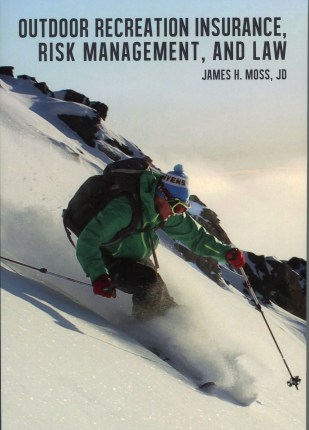
Outdoor Recreation Insurance, Risk Management, and Law
Jim is the author or co-author of eight books about legal issues in the outdoor recreation world; the latest is Outdoor Recreation Insurance, Risk Management, and Law. To Purchase Go Here:
To see Jim’s complete bio go here and to see his CV you can find it here. To find out the purpose of this website go here.
If you are interested in having me write your release, download the form and return it to me.
If you like this let your friends know or post it on FB, Twitter, or LinkedIn
By Recreation Law Rec-law@recreation-law.com James H. Moss
@2023 Summit Magic Publishing, LLC
G-YQ06K3L262
 Blue Sky Logo |
 |
 Mastodon |
 |
 Stimulus |
 Recreation Law logo |
 X (formerly known as Twitter) logo |
 Threads |
<rel=”author” link=” https://plus.google.com/u/0/b/112453188060350225356/” />
#AdventureTourism, #AdventureTravelLaw, #AdventureTravelLawyer, #AttorneyatLaw, #Backpacking, #BicyclingLaw, #Camps, #ChallengeCourse, #ChallengeCourseLaw, #ChallengeCourseLawyer, #CyclingLaw, #FitnessLaw, #FitnessLawyer, #Hiking, #HumanPowered, #HumanPoweredRecreation, #IceClimbing, #JamesHMoss, #JimMoss, #Law, #Mountaineering, #Negligence, #OutdoorLaw, #OutdoorRecreationLaw, #OutsideLaw, #OutsideLawyer, #RecLaw, #Rec-Law, #RecLawBlog, #Rec-LawBlog, #RecLawyer, #RecreationalLawyer, #RecreationLaw, #RecreationLawBlog, #RecreationLawcom, #Recreation-Lawcom, #Recreation-Law.com, #RiskManagement, #RockClimbing, #RockClimbingLawyer, #RopesCourse, #RopesCourseLawyer, #SkiAreas, #Skiing, #SkiLaw, #Snowboarding, #SummerCamp, #Tourism, #TravelLaw, #YouthCamps, #ZipLineLawyer, GKTW, Give Kids The World, Inc., Make a Wish, wheelchair, lift, release, negligence,
WordPress Tags: Simple,Florida,decision,parents,Give,Kids,World,Sanislo,LEXIS,State,Court,Appeal,Fifth,District,Plaintiff,Stacy,Eric,defendants,Defendant,Claims,negligence,Defenses,Release,standpoint,opinion,relevance,GKTW,plaintiffs,horse,wagon,wife,husband,judgment,Summary,response,Exculpatory,clauses,policy,clause,person,action,Language,argument,Enforcement,settings,context,basis,daughters,statement,Make,Wish,Foundation,panel,outcome,agreement,waiver,campers,siblings,Leave,FaceBook,Twitter,LinkedIn,Recreation,Edit,Email,Google,RecreationLaw,Page,Outdoor,Adventure,Travel,Blog,Mobile,Site,James,Moss,Authorrank,author,AdventureTourism,AdventureTravelLaw,AdventureTravelLawyer,AttorneyatLaw,BicyclingLaw,Camps,ChallengeCourse,ChallengeCourseLaw,ChallengeCourseLawyer,CyclingLaw,FitnessLaw,FitnessLawyer,HumanPoweredRecreation,JamesHMoss,JimMoss,OutdoorLaw,OutdoorRecreationLaw,OutsideLaw,OutsideLawyer,RecLaw,RecLawBlog,LawBlog,RecLawyer,RecreationalLawyer,RecreationLawBlog,RecreationLawcom,Lawcom,RiskManagement,RockClimbingLawyer,RopesCourse,RopesCourseLawyer,SkiAreas,SkiLaw,SummerCamp,Tourism,TravelLaw,YouthCamps,ZipLineLawyer
Mitchell v. City of Dallas, 855 S.W.2d 741; 1993 Tex. App. LEXIS 1714
Posted: July 27, 2014 Filed under: Legal Case, Texas | Tags: bicycle, City Park, Dallas, Retaining Wall, Texas, Tort Claims Act Leave a commentMitchell v. City of Dallas, 855 S.W.2d 741; 1993 Tex. App. LEXIS 1714
Saundra Harris Mitchell and Jan P. Mitchell, Individually and as Next Friends of Ashley J. Harris, Appellants v. City of Dallas, Appellee
No. 05-91-01416-CV
COURT OF APPEALS OF TEXAS, FIFTH DISTRICT, DALLAS
855 S.W.2d 741; 1993 Tex. App. LEXIS 1714
March 31, 1993, Filed
PRIOR HISTORY: [**1] On Appeal from the 68th District Court. Dallas County, Texas. Trial Court Cause No. 89-13400-C
COUNSEL: For Appellants: KRISTINA BLINE DIAL.
For Appellee: PATRCIA MEDRANO.
JUDGES: Before Justices Lagarde, Kinkeade, and Barber 1
1 Justice Will Barber succeeds Justice Jeff Kaplan, a member of the original panel. Justice Barber has reviewed the briefs and record in this case.
OPINION BY: WILL BARBER
OPINION
[*743] OPINION
Opinion By Justice Barber
This is a premises liability case. Saundra Harris Mitchell and Jan P. Mitchell sued the City of Dallas for damages sustained by their minor son when he fell from his bicycle at a municipal park. The City moved for summary judgment. The trial court rendered judgment in favor of the City. We reverse and remand.
FACTUAL BACKGROUND
Ashley Harris suffered serious injuries when he fell from his bicycle into a creek bed at Hamilton Park. The park is owned [*744] and maintained by the City of Dallas. The accident occurred at a part of the creek where there is a fifteen to twenty-five foot drop-off. This condition was created by a gabion wall constructed by the City for erosion control. [**2] The wall consists of rocks wired together. Ashley fell over the edge of the drop-off onto the rocks below.
The Mitchells allege that the City was negligent and grossly negligent in the construction and maintenance of the gabion wall. They also allege that the City failed to warn park users of the steep drop-off and failed to construct a fence or other barrier around this dangerous area.
ISSUES ON APPEAL
The Mitchells attack the trial court’s summary judgment on two broad grounds. First, they contend that this case is governed by common-law principles because the establishment and maintenance of public parks are proprietary functions. Alternatively, the Mitchells argue that their claims against the City are within the waiver provisions of governmental immunity under the Texas Tort Claims Act. They assert that fact issues exist concerning gross negligence in the construction and maintenance of the gabion wall and the City’s negligent failure to warn of or correct this dangerous condition.
LIABILITY UNDER COMMON LAW
In their fourth point of error, the Mitchells contend that the Texas Tort Claims Act does not apply to this case. Rather, the Mitchells argue that the City [**3] is liable under common-law principles because the establishment and maintenance of public parks are proprietary functions.
Under common law, the establishment and maintenance of public parks were deemed proprietary functions. See Dancer v. City of Houston, 384 S.W.2d 340, 342 (Tex. 1964); City of Waco v. Branch, 117 Tex. 394, 5 S.W.2d 498, 499 (1928). These common-law classifications have been redefined under the Texas Tort Claims Act. [HN1] Section 101.0215 of the Act now provides that the operation of parks and zoos is a governmental function. See TEX. CIV. PRAC. & REM. CODE ANN. § 101.0215(a)(13) (Vernon Supp. 1993).
The Mitchells argue that section 101.0215(a) does not reclassify all actions taken by a city regarding public parks. We refuse to adopt such a restrictive interpretation of the statute. To the contrary, the legislature specifically provided that [HN2] the proprietary functions of a municipality do not include those governmental activities listed in section 101.0215(a). See TEX. CIV. PRAC. & REM. CODE ANN. § 101.0215(c) (Vernon Supp. 1993).
We conclude that the claims against the City made the basis of this suit involve governmental functions. [**4] The Mitchells do not have any common-law cause of action against the City. We overrule the fourth point of error.
LIABILITY UNDER THE TEXAS TORT CLAIMS ACT
The Mitchells next contend that the trial court erred in granting summary Judgment because they stated a cause of action within the waiver provisions of governmental immunity under the Texas Tort Claims Act. They allege that the City is not immune from liability for negligent construction and maintenance of the gabion wall along the creek bank. See, e.g., City of Watauga v. Taylor, 752 S.W.2d 199, 202 (Tex. App.–Fort Worth 1988, no writ); Stanford v. State Dep’t of Highways & Pub. Transp., 635 S.W.2d 581, 582 (Tex. App.–Dallas 1982, writ ref’d n.r.e.).
The City argues that these allegations involve the design, upgrading, and placement of an erosion control deuce. The City contends that it is immune from liability because these activities involve discretionary functions. See, e.g., City of El Paso v. Ayoub, 787 S.W.2d 553, 554 (Tex. App.–El Paso 1990, writ denied); Tarrant County Water Control & Improvement Dist. No. 1 v. Crossland, 781 S.W.2d 427, 433 (Tex. App.–Fort Worth 1989, writ denied). [**5]
1. Governmental Immunity
[HN3] A municipality performing a governmental function is afforded sovereign immunity [*745] unless immunity has been waived under the Texas Tort Claims Act. See TEX. CIV. PRAC. & REM. CODE ANN. §§ 101.001-.109 (Vernon 1986 & Supp. 1993). A governmental unit is liable for personal injuries proximately caused “by a condition or use of tangible personal or real property if the governmental unit would, were it a private person, be liable to the claimant according to Texas law.” TEX. CIV. PRAC. & REM. CODE ANN. § 101.021 (Vernon 1986).
2. Discretionary Functions
The Texas Tort Claims Act creates certain exceptions to the waiver of governmental immunity. [HN4] Section 101.056 provides that the waiver provisions of the Act do not apply to claims based on:
(1) the failure of a governmental unit to perform an act that the unit is not required by law to perform; or
(2) a governmental unit’s decision not to perform an act or on its failure to make a decision on the performance or nonperformance of an act if the law leaves the performance or nonperformance of the act to the discretion of the governmental unit.
TEX. CIV. PRAC. & REM. CODE [**6] ANN. § 101.056 (Vernon 1986); see generally Lee M. Larkin, Comment, The “Policy Decision” Exemption of the Texas Tort Claims Act: State v. Terrell, 32 BAYLOR L. REV. 403 (1980) [hereinafter Larkin]. 2
2 The Larkin comment and several cases cited in this opinion involve the interpretation of the original Tort Claims Act contained in the Revised Civil Statutes. See TEX. REV. CIV. STAT. ANN. art. 6252-19 (Vernon 1970) (repealed 1985). The codification of the prior statute in the Civil Practice and Remedies Code did not effect any substantive change, and the language of the current version of the Texas Tort Claims Act is virtually identical to the prior statute. See TEX. CIV. PRAC. & REM. CODE ANN. § 1.001 (Vernon Supp. 1993).
[HN5] The discretionary function exception to the waiver of sovereign immunity is designed to avoid judicial review of governmental policy decisions. State v. Terrell, 588 S.W.2d 784, 787 (Tex. 1979); McKinney v. City of Gainesville, 814 S.W.2d 862, 866 (Tex. [**7] App.–Fort Worth 1991, no writ). Thus, a governmental entity is immune from liability if an injury results from the formulation of policy. However, a governmental unit is not immune if an injury is caused by the negligent implementation of that policy. See Terrell, 588 S.W.2d at 787-88; Christilles v. Southwest Tex. State Univ., 639 S.W.2d 38, 42 (Tex. App.–Austin 1982, writ ref’d n.r.e.); Larkin at 409. This distinction is often stated in terms of actions taken at the planning or policy-making level, which are immune, and actions taken at the subordinate or operational level, which are not immune. See McKinney, 814 S.W.2d at 866; Crossland, 781 S.W.2d at 433; Larkin at 410.
Design decisions made by the City are discretionary and therefore immune from liability. See Crossland, 781 S.W.2d at 433; Taylor, 752 S.W.2d at 202; Stanford, 635 S.W.2d at 582. Maintenance activities undertaken at the operational level are not discretionary functions and are not immune from liability. See City of Round Rock v. Smith, 687 S.W.2d 300, 303 (Tex. 1985); Taylor, 752 S.W.2d at 202; Hamric v. Kansas City S. Ry., 718 S.W.2d 916, 919 (Tex. App.–Beaumont [**8] 1986, writ ref’d n.r.e.). There is some conflict in the case law regarding the characterization of construction activities. Compare Smith, 687 S.W.2d at 303, and Ayoub, 787 S.W.2d at 554 (indicating that city is not immune from liability for construction and maintenance activities), with Taylor, 752 S.W.2d at 202 (indicating that planning and construction are immune activities).
We hold that construction activities are not discretionary functions. These activities involve the implementation of planning or policy-making decisions at the operational level. Therefore, the City is not immune from liability for claims based on the negligent construction and maintenance of the gabion wall.
STANDARD OF CARE
We next determine the standard of care owed by the City to park users. The City argues that it only owes the duty owed to a trespasser. The Mitchells contend that the City owes the same duty as [*746] owed to an invitee because they paid for use of the premises through the payment of taxes and because of the nature of the premises defect.
1. Statutes
[HN6] Section 101.022 of the Texas Tort Claims Act provides:
(a) If a claim arises from a premises [**9] defect, the governmental unit owes to the claimant only the duty that a private person owes to a licensee on private property, unless the claimant pays for the use of the premises.
(b) The limitation of duty in this section does not apply to the duty to warn of special defects such as excavations or obstructions on highways, roads, or streets.
TEX. CIV. PRAC. & REM. CODE ANN. § 101.022 (Vernon 1986) (emphasis added).
Section 75.002 of the Civil Practice and Remedies Code provides:
If an owner, lessee, or occupant of real property other than agricultural land gives permission to another to enter the premises for recreation, the owner, lessee, or occupant, by giving the permission, does not:
. . . .
(2) owe to the person to whom permission is granted a greater degree of care than is owed to a trespasser on the premises.
TEX. CIV PRAC. & REM. CODE ANN. § 75.002 (Vernon 1986) (emphasis added).
These two statutes are in apparent conflict in cases where the owner or occupier of the premises is a governmental unit that gives implied permission to persons to enter the property for recreational purposes. We must resolve this conflict by examining the [**10] case law and implementing well-settled rules of statutory construction.
2. Case Law
One court has held that the statutory predecessor to section 75.002, article 1b of the Revised Civil Statutes, should apply only if the injured party was a trespasser. It held the statute did not apply in a governmental tort liability context by simply stating that the persons who used the premises were not trespassers. Trinity River Auth. v. Williams, 659 S.W.2d 714, 720 (Tex. App.–Beaumont 1983), aff’d in part a rev’d in part on other grounds, 689 S.W.2d 883 (Tex. 1985); see TEX. REV. CIV. STAT. ANN. art. 1b, § l (Vernon 1969). It should be noted that the statute did not declare that recreational users are trespassers but merely provided that the duty owed to such users is the same as that owed to trespassers. Another court has held that section 75.002 did apply to governmental units. Noting that section 101.022(a) provides that the governmental entity owes “only the duty that a private person owes to a licensee on private property,” the court held that the section 75.002 duty standard applied to the State. Crossland, 781 S.W.2d at 547. Although the Crossland court [**11] purported to rely on section 101.022(a) in reaching its result, it ignored the fact that such provision states the governmental unit owes the duty that a private person owes to a licensee.
3. Statutory Analysis
We are not persuaded by the reasoning of either Williams or Crossland. Instead, we look to the legislative history of sections 75.002 and 101.022(a).
Article 1b of the Texas Revised Civil Statutes preceded section 75.002. See Act of May 29, 1965, 59th Leg., R.S., ch. 677, 1965 Tex. Gen. Laws 1551, 1551-52. Until this statute was codified in the Texas Civil Practice and Remedies Code, it was contained in the “General Provisions” of Title 1. See TEX. REV. CIV. STAT. ANN. art. 1b, § 1 (Vernon 1969). The statutory predecessor to section 101.022(a) of the Texas Tort Claims Act was article 6252-19, section 18(b) of the Texas Revised Civil Statutes. Article 6252-19 was first enacted in 1969, four years after the enactment of article 1b. See Texas Tort Claims Act, 61st Leg., R.S., ch. 292, 1969 Tex. Gen. Laws 874, 878-79; TEX. REV. CIV. STAT. ANN. art. 6252-19, § 18(b) (Vernon 1970).
We conclude that section 75.002 and its predecessor, article [**12] 1b, were intended [*747] to be laws of general application. Section 101.022(a) and its predecessor, section 18(b) of article 6252-19, were specific laws applicable to governmental owners and occupiers of real property. [HN7] When two statutes conflict, the specific controls over the general. Sam Bassett Lumber Co. v. City of Houston, 145 Tex. 492, 496, 198 S.W.2d 879, 881 (1947); see also TEX. GOV’T CODE ANN. § 311.026(b) (Vernon 1988); Carr v. Hunt, 651 S.W.2d 875, 882 (Tex. App.–Dallas 1983, writ ref’d n.r.e). Further, a more recent statutory enactment prevails over an earlier one. TEX. GOV’T CODE ANN. § 311.025(a) (Vernon 1988); State v. McKinney, 803 S.W.2d 374, 376 (Tex. App.–Houston [14th Dist.] 1990, no pet.); Commercial Standard Fire & Marine Co. v. Commissioner of Ins., 429 S.W.2d 930, 933 (Tex. Civ. App.–Austin 1968, no writ).
4. Conclusion
We hold that section 101.022(a) controls over section 75.002. The duty owed by the City to park users under the Texas Tort Claims Act is the duty that a private person owes to a licensee. [HN8] An owner or occupier of land must refrain from injuring a licensee by willful, wanton, or gross negligence. An [**13] owner or occupant must also warn a licensee of any dangerous condition, or make the condition reasonably safe, if the land owner has actual knowledge of the dangerous condition and the licensee does not. State v. Tennison, 509 S.W.2d 560, 562 (Tex. 1974).
EXCEPTIONS TO THE STANDARD OF CARE UNDER THE TORT CLAIMS ACT
The Mitchells argue that the duty owed by the City in this case is the same duty owed to an invitee. The Mitchells contend that the Texas Tort Claims Act creates a higher standard of care because: (1) they paid for use of the park through the payment of taxes; and (2) the steep drop-off created by the gabion wall constituted a special defect.
1. Taxpayer Status
The Mitchells first contend that their son was an invitee because they paid for use of the park through the payment of city taxes.
A similar argument was recently rejected by the San Antonio Court of Appeals in Garcia v. State, 817 S.W.2d 741 (Tex. App.–San Antonio 1991, writ denied). The plaintiff in Garcia sued the State of Texas under the Texas Tort Claims Act for damages sustained in a highway accident. He claimed invitee status because he paid for use of the highway through [**14] driver’s license fees and fuel taxes. The court held that the payment of fees and taxes does not confer invitee status for several reasons: (1) invitee status requires payment of a specific fee for entry onto and use of public premises; (2) the plaintiff’s contention would result in a lesser duty owed to nonresident users who did not pay taxes; and (3) the legislature did not intend such a broad grant of invitee status under section 101.022(a) of the Tort Claims Act. See Garcia, 817 S.W.2d at 743.
We adopt the reasoning of Garcia. We hold that [HN9] section 101.022(a) of the Tort Claims Act does not confer invitee status on park users based on the payment of taxes alone.
2. Special Defect
The Mitchells next contend that the City owed a higher standard of care because the steep drop-off created by the gabion wall constituted a special defect.
[HN10] A governmental unit has a duty to warn of or protect against special defects. TEX. CIV. PRAC. & REM. CODE ANN. § 101.022(b) (Vernon 1986); see City of Houston v. Jean, 517 S.W.2d 596, 599 (Tex. Civ. App.–Houston [1st Dist.] 1974, writ ref’d n.r.e.). The duty to warn of a special defect is the same duty owed to an invitee. [**15] County of Harris v. Eaton, 573 S.W.2d 177, 180 (Tex. 1978). A special defect must be distinguished by some unusual quality outside the ordinary course of events. Crossland, 781 S.W.2d at 433; Sutton v. State Highway Dep’t, 549 S.W.2d 59, 61 (Tex. Civ. App.–Waco 1977, writ ref’d [*748] n.r.e.). A condition is a special defect only if it presents an unexpected and unusual danger to ordinary users of a roadway. State Dep’t of Highways & Pub. Transp. v. Kitchen, 1993 Tex. LEXIS 26, 36 Tex. Sup. Ct. J. 678, 679 (March 24, 1993); State Dep’t of Highways & Pub. Transp. v. Payne, 838 S.W.2d 235, 238-39 n.3 (Tex. 1992) (op. on mot. for reh’g). A longstanding, routine, or permanent condition is not a special defect. Crossland, 781 S.W.2d at 433.
The Mitchells do not argue that the condition created by the gabion wall was unusual or outside the ordinary course of events. The summary judgment evidence establishes that the drop-off near the creek bank was longstanding and permanent. We hold that the premises defect made the basis of this claim was not a special defect.
MOTION FOR SUMMARY JUDGMENT
We now consider the summary judgment rendered in favor [**16] of the City in light of our holding that (1) construction and maintenance activities are not discretionary functions, and (2) the duty owed to park users is the same duty owed to a licensee.
1. Standard of Review
[HN11] Summary judgment may be rendered only if the record shows that there is no genuine issue of material fact and that the movant is entitled to judgment as a matter of law. TEX. R. Civ. P 166a(c); Rodriguez v. Naylor Indus., Inc., 763 S.W.2d 411, 413 (Tex. 1989). A summary judgment seeks to eliminate patently unmeritorious claims and defenses, not to deny a party its right to a full hearing on the merits of any real fact issue. Gulbenkian v. Penn, 151 Tex. 412, 416, 252 S.W.2d 929, 931 (1952).
[HN12] A defendant who moves for summary judgment must show that the plaintiff has no cause of action. Citizens First Nat’l Bank v. Cinco Exploration Co., 540 S.W.2d 292, 294 (Tex. 1976). A defendant may meet this burden by either (1) disproving at least one essential element of each theory of recovery, Anderson v. Snider, 808 S.W.2d 54, 55 (Tex. 1991), or (2) conclusively proving all elements of an affirmative defense. Swilley v. Hughes, 488 S.W.2d 64, 67 (Tex. [**17] 1972).
[HN13] In reviewing a summary judgment, we must take all evidence favorable to the nonmovant as true in deciding whether a fact issue exists. Nixon v. Mr. Property Management Co., 690 S.W.2d 546, 548-49 (Tex. 1985). We must indulge every reasonable inference and resolve any doubt in favor of the nonmovant. Id.
2. Application of Law to the Facts
a. Negligent Construction and Maintenance
The Mitchells allege that the City was negligent and grossly negligent in the construction and maintenance of the gabion wall. They specifically pleaded that the City was negligent in constructing the wall for erosion control “in such a manner so as to result in a dangerous condition by creating a 15 to 25 foot steep cliff drop-off . . . when the City should have built the creek bank in a non-cliff manner.” The Mitchells also alleged that “construction and maintenance of a 15 to 25 foot drop-off behind a public restroom in a public park without a fence and Warning signs demonstrates a lack of due care and conscious indifference to the health, safety, and welfare of those affected by it.” 3
3 Gross negligence is defined as “such an entire want of care as to establish that the act or omission was the result of actual conscious indifference to the rights, safety, or welfare of the person affected.” TEX. CIV. PRAC. & REM. CODE ANN. § 41.001(5) (Vernon Supp. 1993). Absent a special exception, the allegation of “lack of due care and conscious indifference” contained in the Mitchell’s petition is sufficient to plead the duty owed by the City to park users.
[**18] The City characterizes these allegations as defective design claims. It correctly notes that design claims are discretionary functions for which governmental entities are immune from liability. However, the City has failed to conclusively demonstrate that design defect is the sole basis for the Mitchells’ claim.
[*749] The City argues it is entitled to judgment as a matter of law because there is no specific pleading or proof that the premises were unreasonably dangerous or that it breached any duty owed to park users. The City misconstrues the burden of proof in a summary judgment proceeding. It is incumbent upon a defendant as movant to conclusively negate at least one essential element of the plaintiff’s case. Citizens First Nat’l Bank, 540 S.W.2d at 294. [HN14] A plaintiff as nonmovant is not required to establish his right to prevail. Ramirez v. Bagley Produce Co., 614 S.W.2d 582, 584 (Tex. Civ. App.–Corpus Christi 1981, no writ). A nonmovant has no duty or burden whatsoever in a summary judgment case until the movant establishes its right to a judgment as a matter of law. Bankers Commercial Life Ins. Co. v. Scott, 631 S.W.2d 228, 232 (Tex. App.–Tyler 1982, [**19] writ ref’d n.r.e.).
The City presented no evidence of the original design of the gabion wall. The City did not show that the gabion wall was constructed and maintained pursuant to its original design and that the design of the wall was not otherwise modified. The City, therefore, failed to show that the Mitchells’ allegations were defective design claims and, thereby, failed to meet its burden of negating an essential element of the Mitchells’ case.
The Mitchells alleged that Ashley was injured when he fell from his bicycle down a steep cliff drop-off. The area was unfenced and located adjacent to the sidewalk. The Mitchells contend that this constitutes a dangerous condition. Ashley’s deposition testimony reflects that there was erosion of the ground underneath the sidewalk where he fell. 4 The City did not conclusively negate these allegations. The pleadings and deposition testimony are sufficient to create a fact issue regarding negligent and grossly negligent maintenance and construction.
4 Ashley’s testimony on this point is not very clear, but it is susceptible to the interpretation advanced by the Mitchells. In a summary judgment case, all inferences and doubts must he resolved in favor of the nonmovant. See Nixon, 690 S.W.2d at 548-49.
[**20] b. Failure to Warn or Make Safe
The Mitchells alleged that the City failed to warn of a dangerous condition in the area of the restrooms and sidewalk adjacent to the creek. They also claimed that the City failed to construct a fence or other barrier in the area or otherwise correct the dangerous condition.
The City relies on affidavits from three park officials to show that it lacked actual knowledge of any dangerous condition. The affidavits state that the City had no prior notice of a defect, dangerous condition, or similar accident. However, lack of notice from third parties does not conclusively negate actual knowledge. The fact that the owner or occupier of a premises created a condition that posed an unreasonable risk of harm may support an inference of knowledge. The question of knowledge is a fact issue. See Keetch v. Kroger Co., 845 S.W.2d 262, 36 Tex. Sup. Ct. J. 273, 275 (December 2, 1992). An affidavit from a civil engineer states the drop-off should have been fenced off from the public area of the park. The engineer’s affidavit concludes that in failing to fence off or otherwise obstruct public movement into the area, “the City has failed to protect the [**21] public or give adequate warning to the public of a defect which created a dangerous condition.”
The City argues that Ashley must be charged with knowledge of any dangerous condition because the alleged premises defect was open and obvious. [HN15] The duty to warn or make safe applies when the licensee lacks actual knowledge. Payne v. State, 838 S.W.2d at 237; Tennison, 509 S.W.2d at 562. The City contends that the Mitchells have conceded that Ashley had actual knowledge of the condition of the premises. The response to the summary judgment motion recites that Ashley was aware of the existence of the creek. The response recites that Ashley, “being unaware . . . that the ground had eroded under the sidewalk next to this drop-off . . . fell over the edge and onto the rocks below.” [*750] The Mitchells never stated that Ashley was aware of the drop-off next to the sidewalk. The record does not conclusively establish that Ashley had actual knowledge of a dangerous condition. The lack of knowledge is an element of appellant’s claim that when disputed should be submitted to the fact finder. See Payne, 838 S.W.2d at 241.
SUMMARY
The establishment and maintenance [**22] of municipal parks are governmental functions under the Texas Tort Claims Act. The City is immune from liability for any claims involving the design of the gabion wall at Hamilton Park. However, the City is not immune from liability for claims based on the construction or maintenance of the wall. The duty owed by the City to park users is the same duty owed by a private person to a licensee.
We hold that the trial court erred in granting summary judgment. There are genuine fact issues concerning (1) gross negligence 5 in the construction and maintenance of the gabion wall, and (2) the failure to warn of or correct a dangerous condition. 6 We sustain the Mitchell’s second and third points of error.
5 The duty owed to a licensees being a duty to refrain from injuring by willful, wanton, or gross negligence.
6 The licensor must also warn of a dangerous condition, or make it reasonably safe, if the licensor has actual knowledge of the condition and the licensee does not have such knowledge.
We reverse [**23] the trial court’s judgment and remand this case for further proceedings consistent with this opinion.
WILL BARBER
JUSTICE
Perfect example of a flaw in our system hiring a lifeguard increases your chance of a lawsuit in Florida; No lifeguard no liability.
Posted: July 23, 2014 Filed under: Florida, Risk Management, Rivers and Waterways | Tags: Florida, Lawsuit, Legal liability, liability, Lifeguard, Lifeguards, Newport Beach Fire Department, Ocean, Panama City, Recreation, Sea Leave a commentDon’t take this as a condemnation of the entire system unless you understand it
This article looks at a major hole created by lawsuits in our system. Once a city in Florida hires a lifeguard it accepts responsibility for the people swimming in the waters around the guard. If the guard does not act responsible, i.e. someone drowns, then the city can be sued.
However if no guard is there then there is no liability for the city.
Because it is impossible to prove that a lifeguard did their job right when a jury is looking at the loss of a loved one, hiring a lifeguard brings on lawsuits.
The solution is simple. It requires an acceptance of reality. People are going to drown no matter how many lifeguards maybe on the beach. Pass a law saying that cities are not liable unless the actions of the lifeguards are gross or wilful and wanton. Immunity for the city will put lifeguards on the beaches.
See Are lifeguards a liability? However be cognizant that some of the legal opinions are not from attorneys. The legal basis for those statements is suspect.
What do you think? Leave a comment.
If you like this let your friends know or post it on FB, Twitter or LinkedIn
Copyright 2014 Recreation Law (720) 334-8529
Call or Email me if you need legal services around these issues.
Email: Rec-law@recreation-law.com
Google+: +Recreation
Twitter: RecreationLaw
Facebook: Rec.Law.Now
Facebook Page: Outdoor Recreation & Adventure Travel Law
Mobile Site: http://m.recreation-law.com
By Recreation Law Rec-law@recreation-law.com James H. Moss #Authorrank
<rel=”author” link=” https://plus.google.com/u/0/b/112453188060350225356/” />
#AdventureTourism, #AdventureTravelLaw, #AdventureTravelLawyer, #AttorneyatLaw, #Backpacking, #BicyclingLaw, #Camps, #ChallengeCourse, #ChallengeCourseLaw, #ChallengeCourseLawyer, #CyclingLaw, #FitnessLaw, #FitnessLawyer, #Hiking, #HumanPowered, #HumanPoweredRecreation, #IceClimbing, #JamesHMoss, #JimMoss, #Law, #Mountaineering, #Negligence, #OutdoorLaw, #OutdoorRecreationLaw, #OutsideLaw, #OutsideLawyer, #RecLaw, #Rec-Law, #RecLawBlog, #Rec-LawBlog, #RecLawyer, #RecreationalLawyer, #RecreationLaw, #RecreationLawBlog, #RecreationLawcom, #Recreation-Lawcom, #Recreation-Law.com, #RiskManagement, #RockClimbing, #RockClimbingLawyer, #RopesCourse, #RopesCourseLawyer, #SkiAreas, #Skiing, #SkiLaw, #Snowboarding, #SummerCamp, #Tourism, #TravelLaw, #YouthCamps, #ZipLineLawyer, Panama City, Florida, Lifeguards, Ocean, Sea, Liability.
WordPress Tags: Perfect,example,flaw,system,lifeguard,lawsuit,Florida,condemnation,article,lawsuits,Once,jury,solution,acceptance,People,lifeguards,beach,Pass,cities,beaches,opinions,attorneys,basis,statements,Leave,Twitter,LinkedIn,Recreation,Call,Email,Google,RecreationLaw,Facebook,Page,Outdoor,Adventure,Travel,Blog,Mobile,Site,James,Moss,Authorrank,author,AdventureTourism,AdventureTravelLaw,AdventureTravelLawyer,AttorneyatLaw,BicyclingLaw,Camps,ChallengeCourse,ChallengeCourseLaw,ChallengeCourseLawyer,CyclingLaw,FitnessLaw,FitnessLawyer,HumanPoweredRecreation,JamesHMoss,JimMoss,Negligence,OutdoorLaw,OutdoorRecreationLaw,OutsideLaw,OutsideLawyer,RecLaw,RecLawBlog,LawBlog,RecLawyer,RecreationalLawyer,RecreationLawBlog,RecreationLawcom,Lawcom,RiskManagement,RockClimbingLawyer,RopesCourse,RopesCourseLawyer,SkiAreas,SkiLaw,SummerCamp,Tourism,TravelLaw,YouthCamps,ZipLineLawyer,Panama,Ocean
The Iowa Supreme Court reaffirms a Permission Slip is not a release, but leaves open the argument that releases may stop a minor’s claim for negligence.
Posted: July 21, 2014 Filed under: Assumption of the Risk, Iowa, Legal Case, Sports | Tags: assumption of the risk, Baseball, Baseball Game, Bat, Bettendorf Parks and Recreation, City of Bettendorf, Code of Iowa, Duty of care, Inherent Risk Doctrine, Iowa, Iowa Supreme Court, Minor, negligent supervision, Plaintiff, Recreation Department, Spectator Leave a commentCity Parks Department sued for injuries of an eight-year-old girl hit by a flying bat at a baseball game field trip.
Sweeney v. City of Bettendorf, 762 N.W.2d 873; 2009 Iowa Sup. LEXIS 26
State: Supreme Court of Iowa
Plaintiff: Tara Sweeney, Individually, and by Cynthia Sweeney, Her Mother and Next Friend
Defendant: City of Bettendorf and Bettendorf Parks and Recreation
Plaintiff Claims: Negligence
Defendant Defenses: Release (Permission Slip), No duty owed,
Holding: Split, the permission slip was not a release however there triable issues to the defense of duty owed
Year: 2009
The city recreation department would take kids on field trips to see minor-league baseball games in other cities. The plaintiff was an eight-year-old girl who loved baseball and her mother. The minor went on several of these field trips in the past. Her mother signed the permission slip and she went off on the trip.
In the past, the participants had sat behind home plate which was protected by netting from flying objects. This time the kids were taken to bleachers along the third baseline. They were told they had to sit there and could not move.
During the game, a player lost his grip on the bat which sailed down the third baseline hitting the girl. The minor had turned to talk to her friend when she was struck. No adults were around at the time.
The plaintiffs sued for negligent. The defendant filed a motion for summary judgment citing a permission slip the mother had signed as a release and that the plaintiff had not shown a breach of duty owed to the injured minor.
The plaintiff’s opposed the motion for summary judgment arguing:
The plaintiffs further argued that even if the permission slip amounted to a valid release, it was fatally flawed because it purported to release only the Department and not the City. Finally, plaintiffs asserted even if the permission slip amounted to an anticipatory release of future claims based on acts or omissions of negligence, statutory and common law public policy prevents a parent from waiving such claims on behalf of a minor child.
The trial court granted the motion for summary judgment based on the permission slip no evidence of a breach of duty. The plaintiff’s appealed.
Summary of the case
The court reviewed several procedural issues and then looked into releases under Iowa law. The court found the permission slip was deficient in many ways.
…the permission slip contains no clear and unequivocal language that would notify a casual reader that by signing the document, a parent would be waiving all claims relating to future acts or omissions of negligence by the City. The language at issue here refers only to “accidents” generally and contains nothing specifically indicating that a parent would be waiving potential claims for the City’s negligence.
Based on the language in the permission slip the court found it could not enforce the release because it was not a release.
Next the court looked at whether being hit by a bat at a baseball game was an inherent risk of being a spectator at a baseball game. In Iowa this is called the inherent risk doctrine. (This doctrine is very similar to a secondary assumption of risk argument.) What created a difference in this issue, is the issue of whether a flying bat is an inherent risk, is a defense of the baseball team/promoter/owner or field rather than a city recreation department field trip.
In the majority of cases, spectators sitting outside protective netting at baseball stadiums have been unable to recover from owners or operators for injuries related to errant bats and balls on the ground that such injuries were an “inherent risk” of attending the game.
Regardless of whether the approach is characterized as involving inherent risk or a limited duty, courts applying the doctrine have held that the owner or operator of a baseball stadium is not liable for injury to spectators from flying bats and balls if the owner or operator provided screened seating sufficient for spectators who may be reasonably anticipated to desire such protection and if the most dangerous areas of the stands, ordinarily the area behind home plate, were so protected.
Because the inherent risk was not one of a field trip, the court found differently than if the defense was argued by the owner of the field. The issue was not one of attending a sporting event invited by the event, but supervision of a minor child by a recreation department.
A negligent supervision case is fundamentally different than a case involving premises liability. The eight-year-old child in this case made no choice, but instead sat where she was told by the Department. The plaintiffs further claim that there was inadequate adult supervision where the child was seated. The alleged negligence in this case does not relate to the instrumentality of the injury, but instead focuses on the proper care and supervision of children in an admittedly risky environment.
As a negligent supervision case, the recreation department owed a different type and a higher degree of care to the minor.
Viewed as a negligent supervision case, the City had a duty to act reasonably, under all the facts and circumstances, to protect the children’s safety at the ball park. The gist of the plaintiffs’ claim is that a substantial cause of the injury was the supervisors’ decision to allow the children, who cannot be expected to be vigilant at all times during a baseball game, to be seated in what a jury could conclude was an unreasonably hazardous location behind third base instead of behind the safety of protective netting.
Add to this the change in sitting and the restrictions the adults placed on where the minors could sit and the court found there was a clear issue as to liability.
The third issue reviewed by the court was whether the recreation department failed to provide an adequate level of care to the minor. Here the court agreed with the recreation department. Not because the level of care was sufficient, but because the plaintiff could not prove the level of care was inadequate.
There was a dissent in this case, which argued that the risk of being hit by a bat was an inherent risk of attending a baseball game and that the permission slip was a valid release.
The case was then sent back for trial on the negligence claims of the plaintiff.
So Now What?
What is of interest is the single sentence that argues a release signed by an adult stops the claims of a minor. It was argued by the plaintiff’s as one of the ways the permission slip was invalid. However, the court did not look at the issue in its review and decision in the case.
The court’s review was quite clear on releases. If you do not have the proper language in your release, you are only killing trees. It was a stretch, and a good one, by the recreation department to argue that a document intended to prove the minor could be on a field trip was also a release of claims.
Releases are different legal documents and require specific language.
You also need to remember that defenses that are available to a lawsuit are not just based on the activity, like baseball, but the relationship of the parties to the activity. If the minor child had attended the baseball game on her own or with her parents, the Iowa Inherent Risk Doctrine would have probably prevented a recovery. However, because the duty owed was not from a baseball game to a spectator, but from a recreation department to a minor in its care, the inherent risk defense was not available.
What do you think? Leave a comment.
If you like this let your friends know or post it on FaceBook, Twitter or LinkedIn
Copyright 2014 Recreation Law (720) Edit Law
Email: Rec-law@recreation-law.com
Google+: +Recreation
Twitter: RecreationLaw
Facebook: Rec.Law.Now
Facebook Page: Outdoor Recreation & Adventure Travel Law
Blog: www.recreation-law.com
Mobile Site: http://m.recreation-law.com
By Recreation Law Rec-law@recreation-law.com James H. Moss #Authorrank
<rel=”author” link=” https://plus.google.com/u/0/b/112453188060350225356/” />
#AdventureTourism, #AdventureTravelLaw, #AdventureTravelLawyer, #AttorneyatLaw, #Backpacking, #BicyclingLaw, #Camps, #ChallengeCourse, #ChallengeCourseLaw, #ChallengeCourseLawyer, #CyclingLaw, #FitnessLaw, #FitnessLawyer, #Hiking, #HumanPowered, #HumanPoweredRecreation, #IceClimbing, #JamesHMoss, #JimMoss, #Law, #Mountaineering, #Negligence, #OutdoorLaw, #OutdoorRecreationLaw, #OutsideLaw, #OutsideLawyer, #RecLaw, #Rec-Law, #RecLawBlog, #Rec-LawBlog, #RecLawyer, #RecreationalLawyer, #RecreationLaw, #RecreationLawBlog, #RecreationLawcom, #Recreation-Lawcom, #Recreation-Law.com, #RiskManagement, #RockClimbing, #RockClimbingLawyer, #RopesCourse, #RopesCourseLawyer, #SkiAreas, #Skiing, #SkiLaw, #Snowboarding, #SummerCamp, #Tourism, #TravelLaw, #YouthCamps, #ZipLineLawyer, City of Bettendorf, Bettendorf Parks and Recreation, Recreation Department, Baseball, Baseball Game, Spectator, Bat, Negligent Supervision, Inherent Risk Doctrine, Assumption of the Risk, Minor,
WordPress Tags: Iowa,Supreme,Court,Permission,Slip,argument,negligence,Parks,Department,injuries,girl,Sweeney,Bettendorf,LEXIS,State,Plaintiff,Tara,Cynthia,Mother,Friend,Defendant,Recreation,Claims,Defenses,Release,Split,league,cities,participants,bleachers,player,adults,plaintiffs,judgment,omissions,policy,Summary,reader,accidents,spectator,doctrine,assumption,difference,team,promoter,owner,spectators,stadiums,owners,operators,balls,operator,stadium,injury,protection,areas,area,event,supervision,premises,environment,degree,ball,park,gist,supervisors,decision,jury,location,restrictions,minors,Here,trees,Releases,lawsuit,relationship,parents,Inherent,Risk,recovery,Leave,FaceBook,Twitter,LinkedIn,Edit,Email,Google,RecreationLaw,Page,Outdoor,Adventure,Travel,Blog,Mobile,Site,James,Moss,Authorrank,author,AdventureTourism,AdventureTravelLaw,AdventureTravelLawyer,AttorneyatLaw,BicyclingLaw,Camps,ChallengeCourse,ChallengeCourseLaw,ChallengeCourseLawyer,CyclingLaw,FitnessLaw,FitnessLawyer,HumanPoweredRecreation,JamesHMoss,JimMoss,OutdoorLaw,OutdoorRecreationLaw,OutsideLaw,OutsideLawyer,RecLaw,RecLawBlog,LawBlog,RecLawyer,RecreationalLawyer,RecreationLawBlog,RecreationLawcom,Lawcom,RiskManagement,RockClimbingLawyer,RopesCourse,RopesCourseLawyer,SkiAreas,SkiLaw,SummerCamp,Tourism,TravelLaw,YouthCamps,ZipLineLawyer,Baseball,Game,Negligent,Minor,third,whether
Morgan v. State of Tennessee, 2004 Tenn. App. LEXIS 62
Posted: July 21, 2014 Filed under: Legal Case, Tennessee | Tags: Colditz Cove State Natural Area, Gross negligence, Landowner, Nashville, Recreational Use, Recreational Use Statute, Tenn, Tennessee 1 CommentMorgan v. State of Tennessee, 2004 Tenn. App. LEXIS 62
Evelean Morgan v. State of Tennessee
No. M2002-02496-COA-R3-CV
COURT OF APPEALS OF TENNESSEE, AT NASHVILLE
2004 Tenn. App. LEXIS 62
November 3, 2003, Session
January 27, 2004, Filed
PRIOR HISTORY: [*1] Tenn. R. App. P. 3 Appeal as of Right; Judgment of the Claims Commission Affirmed. Appeal from the Tennessee Claims Commission No. 99000125 W. R. Baker, Commissioner.
DISPOSITION: Affirmed and remanded.
COUNSEL: David H. Dunaway, LaFollette, Tennessee, for the appellant, Evelean Morgan.
Paul G. Summers, Attorney General and Reporter; Michael E. Moore, Solicitor General; and Christopher Michael Fancher, Assistant Attorney General, for the appellee, State of Tennessee.
JUDGES: WILLIAM C. KOCH, JR., P.J., M.S., delivered the opinion of the court, in which WILLIAM B. CAIN and PATRICIA J. COTTRELL, JJ., joined.
OPINION BY: WILLIAM C. KOCH, JR., P.J., M.S.
OPINION
This appeal involves a fatal accident at the Colditz Cove State Natural Area in Fentress County. The mother of a woman who fell to her death from the bluff surrounding Northrup Falls filed a claim with the Tennessee Claims Commission. The State of Tennessee denied liability based on (1) the recreational use defense in Tenn. Code Ann. § 70-7-102 (1995), (2) its lack of actual or constructive notice of a dangerous condition, and (3) its assertion that the decedent’s fault exceeded its own. The commissioner granted the State’s motion for summary judgment. [*2] While he did not rely on the statutory recreational use defense, the commissioner determined that the State had no notice of a dangerous condition at the natural area, it was not reasonably foreseeable that intoxicated persons who were unfamiliar with the natural area would hike into the area of the falls in the middle of the night, and the decedent’s actions were the sole proximate cause of her death. The decedent’s mother has appealed. We have determined that the commissioner properly granted the summary judgment because, as a matter of law, (1) the State established a defense under Tenn. Code Ann. § 70-7-102, (2) the decedent’s estate presented no evidence that the State had actual or constructive notice of an allegedly dangerous condition on the trail in the natural area, and (3) the decedent’s fault far exceeded whatever fault could be attributed to the State.
I.
Rochelle Copeland Zegilla and her two small children were living with her mother in mid-1997 following a separation from her husband. On Saturday evening, July 26, 1997, she told her mother that she was “going to go out for awhile,” and then she drove to the Top of the Mountain Lounge in [*3] Jamestown, Tennessee. After the lounge closed at midnight, Ms. Zegilla and four companions 1 decided to drive to a nearby VFW club. When they arrived at the club, however, they discovered that it had closed earlier than usual. After a brief discussion in the club parking lot, the group decided to continue their drinking and talking in the parking lot of the Colditz Cove State Natural Area.
1 Ms. Zegilla’s companions at the Top of the Mountain Lounge were Chris Smith, Loretta Johnson, Edward Raines, and Larry King.
The Colditz Cove State Natural Area is a 165-acre Class II natural-scientific area in Fentress County owned by the State of Tennessee. It is heavily wooded and contains the 75-foot Northrup Falls and a scenic gorge with interesting rock formations. 2 The area has been designated by statute as “worthy of perpetual preservation,” 3 and accordingly, improvements to the area are limited to foot trails, foot bridges, and primitive campgrounds 4 and “facilities as may be reasonably necessary . . .for [*4] the safe and proper management and protection of the area.” 5 In addition to a parking lot, the State had erected several signs and a gate and had constructed a 1.5 mile foot trail along the bluff overlooking Northrup Falls, as well as a scenic overlook. The State had not installed lights in the parking lot or along the foot trail.
2 Tenn. Code Ann. § 11-14-108(b)(2)(F) (Supp. 2003).
3 Tenn. Code Ann. § 11-14-105(2) (1999).
4 Tenn. Code Ann. § 11-14-106(a)(1)(B) (1999).
5 Tenn. Code Ann. § 11-14-106(a)(2).
All of the group except Mr. Raines had been drinking throughout the evening, and they continued drinking in the parking lot because Messrs. Smith and King had brought along a cooler of beer purchased earlier in the evening at Midway Qwick Stop. After talking for several minutes, the group decided to walk down the foot trail toward Northrup Falls in the pitch dark even though [*5] three of them, including Ms. Zegilla, had never been to Colditz Cove before. The only illumination they had was Mr. King’s flashlight.
When the group reached a fork in the trail, Mr. Raines and Ms. Johnson decided to walk no further and sat near a trash container to talk and drink. Ms. Zegilla and Messrs. Smith and King kept walking along the trail toward Northrup Falls. After they stopped to drink and talk, Mr. King asked Mr. Smith to shine the flashlight into the bushes to enable him to find a place to urinate. Mr. King walked into the bushes and, on his return, he fell over the bluff into the gorge below.
Mr. Smith yelled, “Larry has fallen off,” and called to Mr. Raines for assistance. Mr. Raines made his way down the trail to Mr. Smith and Ms. Zegilla. After they all called out to Mr. King to no avail, Mr. Raines decided to go for help and took the flashlight to help make his way back up the foot path to the parking lot. Ms. Zegilla and Mr. Smith, now joined by Ms. Johnson, continued to call for Mr. King. Mr. Smith decided to start a fire with his shirt to make some light. After his shirt went out, Ms. Zegilla somehow fell over the bluff. The rescue workers who arrived at the [*6] scene at approximately 1:30 a.m. on Sunday, July 27, 1997, found the lifeless bodies of both Mr. King and Ms. Zegilla in the water at the bottom of the falls. An autopsy revealed that Ms. Zegilla’s blood alcohol level was .18%.
On July 23, 1998, Evelean Morgan, Ms. Zegilla’s mother and her personal representative, filed a claim for $ 500,000 with the Tennessee Claims Commission asserting that the State had violated Tenn. Code Ann. § 9-8-307(a)(1)(C) (Supp. 2003) by negligently creating or maintaining a dangerous condition at Colditz Cove State Natural Area. 6 The State moved to dismiss the claim on the ground that it was shielded from liability by the recreational use statute [Tenn. Code Ann. §§ 70-7-101, -105 (1995)]. After the claims commissioner denied its motion, the State filed an answer denying Ms. Morgan’s negligence claims. The State asserted, as affirmative defenses, (1) that Tenn. Code Ann. § 70-7-102 shielded it from liability, (2) that it had no actual or constructive notice of a dangerous condition at Colditz Cove State Natural Area and that it was not reasonably foreseeable that intoxicated [*7] persons who were unfamiliar with the natural area would hike into the area of the falls in the middle of the night, and (3) that Ms. Zegilla’s own negligence “contributed in excess of 50% to the cause of her death.”
6 Ms. Morgan also filed a civil damage action in the Circuit Court for Fentress County against Ms. Johnson, Messrs. Smith and Raines, and the estate of Mr. King.
In February 2002, following lengthy and somewhat contentious discovery, the State moved for a summary judgment on two grounds – Tenn. Code Ann. § 70-7-102 and its assertion that Ms. Zegilla’s “negligence was equal to or greater than [the] negligence of the State, if any.” 7 In April 2002, Ms. Morgan responded by asserting that the State was not entitled to a judgment on either ground because the State was grossly negligent and because its negligence was greater than Ms. Zegilla’s. The claims commissioner held a hearing on the State’s motion for summary judgment after conducting his own personal inspection of [*8] the Colditz Cove State Natural Area without the lawyers or parties present. On June 5, 2002, the commissioner filed an order granting the State’s motion for summary judgment. While the commissioner declined to base his decision on Tenn. Code Ann. § 70-7-102, he determined that the undisputed evidence demonstrated as a matter of law that Ms. Morgan had not shown that she could prove notice and foreseeability as required by Tenn. Code Ann. § 9-8-307(a)(1)(C) and that Ms. Zegilla was “preponderantly negligent in her own death.” 8 The commissioner later denied Ms. Morgan’s request for a hearing before the entire claims commission. Ms. Morgan has appealed.
7 The State based the latter assertion on what it called the “step in the dark” rule, i.e., that stepping into an unfamiliar dark area constitutes the proximate cause of injuries sustained by falling down stairs hidden in the darkness. Eaton v. McLain, 891 S.W.2d 587, 594 (Tenn. 1994); Goodman v. Memphis Park Comm’n, 851 S.W.2d 165, 171 (Tenn. Ct. App. 1992).
[*9]
8 We construe this finding to be that Ms. Zegilla’s fault exceeded the fault of the State, if any. The claims commissioner stated later in its order that “the sole proximate cause of Ms. Zegilla’s death was her own actions.”
II.
THE STANDARD OF REVIEW
The standards for reviewing summary judgments on appeal are well-settled. [HN1] Summary judgments are proper in virtually any civil case that can be resolved on the basis of legal issues alone. Fruge v. Doe, 952 S.W.2d 408, 410 (Tenn. 1997); Byrd v. Hall, 847 S.W.2d 208, 210 (Tenn. 1993); Pendleton v. Mills, 73 S.W.3d 115, 121 (Tenn. Ct. App. 2001). They are not, however, appropriate when genuine disputes regarding material facts exist. Tenn. R. Civ. P. 56.04. Thus, a summary judgment should be granted only when the undisputed facts, and the inferences reasonably drawn from the undisputed facts, support one conclusion – that the party seeking the summary judgment is entitled to a judgment as a matter of law. Pero’s Steak & Spaghetti House v. Lee, 90 S.W.3d 614, 620 (Tenn. 2002); [*10] Webber v. State Farm Mut. Auto. Ins. Co., 49 S.W.3d 265, 269 (Tenn. 2001).
[HN2] The party seeking a summary judgment bears the burden of demonstrating that no genuine dispute of material fact exists and that it is entitled to a judgment as a matter of law. Godfrey v. Ruiz, 90 S.W.3d 692, 695 (Tenn. 2002); Shadrick v. Coker, 963 S.W.2d 726, 731 (Tenn. 1998). To be entitled to a judgment as a matter of law, the moving party must either affirmatively negate an essential element of the non-moving party’s claim or establish an affirmative defense that conclusively defeats the non-moving party’s claim. Byrd v. Hall, 847 S.W.2d at 215 n. 5; Cherry v. Williams, 36 S.W.3d 78, 82-83 (Tenn. Ct. App. 2000).
[HN3] Once the moving party demonstrates that it has satisfied Tenn. R. Civ. P. 56’s requirements, the non-moving party must demonstrate how these requirements have not been satisfied. Bain v. Wells, 936 S.W.2d 618, 622 (Tenn. 1997). Mere conclusory generalizations will not suffice. Cawood v. Davis, 680 S.W.2d 795, 796-97 (Tenn. Ct. App. 1984). The non-moving party must convince the [*11] trial court that there are sufficient factual disputes to warrant a trial (1) by pointing to evidence either overlooked or ignored by the moving party that creates a factual dispute, (2) by rehabilitating evidence challenged by the moving party, (3) by producing additional evidence that creates a material factual dispute, or (4) by submitting an affidavit in accordance with Tenn. R. Civ. P. 56.07 requesting additional time for discovery. McCarley v. West Quality Food Serv., 960 S.W.2d 585, 588 (Tenn. 1998); Byrd v. Hall, 847 S.W.2d at 215 n. 6. A non-moving party who fails to carry its burden faces summary dismissal of the challenged claim because, as our courts have repeatedly observed, the “failure of proof concerning an essential element of the cause of action necessarily renders all other facts immaterial.” Alexander v. Memphis Individual Practice Ass’n, 870 S.W.2d 278, 280 (Tenn. 1993).
[HN4] A summary judgment is not appropriate when a case’s determinative facts are in dispute. However, for a question of fact to exist, reasonable minds must be able to differ over whether some alleged occurrence or event did or did not happen. Conatser v. Clarksville Coca-Cola Bottling Co., 920 S.W.2d 646, 647 (Tenn. 1995); [*12] Harrison v. Southern Ry. Co., 31 Tenn. App. 377, 387, 215 S.W.2d 31, 35 (1948). If reasonable minds could justifiably reach different conclusions based on the evidence at hand, then a genuine question of fact exists. Louis Dreyfus Corp. v. Austin Co., 868 S.W.2d 649, 656 (Tenn. Ct. App. 1993). If, on the other hand, the evidence and the inferences to be reasonably drawn from the evidence would permit a reasonable person to reach only one conclusion, then there are no material factual disputes and the question can be disposed of as a matter of law. Godfrey v. Ruiz, 90 S.W.3d at 695; Seavers v. Methodist Med. Ctr., 9 S.W.3d 86, 91 (Tenn. 1999); Beaudreau v. General Motors Acceptance Corp., 118 S.W.3d 700, 703 (Tenn. Ct. App. 2003).
[HN5] Summary judgments enjoy no presumption of correctness on appeal. BellSouth Advertising & Publ’g Co. v. Johnson, 100 S.W.3d 202, 205 (Tenn. 2003); Scott v. Ashland Healthcare Ctr., Inc., 49 S.W.3d 281, 285 (Tenn. 2001). Accordingly, appellate courts must make a fresh determination that the requirements of Tenn. R. Civ. P. 56 have been satisfied. [*13] Hunter v. Brown, 955 S.W.2d 49, 50-51 (Tenn. 1997). We must consider the evidence in the light most favorable to the non-moving party, and we must resolve all inferences in the non-moving party’s favor. Godfrey v. Ruiz, 90 S.W.3d at 695; Doe v. HCA Health Servs., Inc., 46 S.W.3d 191, 196 (Tenn. 2001). When reviewing the evidence, we must determine first whether factual disputes exist. If a factual dispute exists, we must then determine whether the fact is material to the claim or defense upon which the summary judgment is predicated and whether the disputed fact creates a genuine issue for trial. Byrd v. Hall, 847 S.W.2d at 214; Rutherford v. Polar Tank Trailer, Inc., 978 S.W.2d 102, 104 (Tenn. Ct. App. 1998).
III.
THE APPLICATION OF TENN. CODE ANN. § 70-7-102
The State’s defense predicated on Tenn. Code Ann. § 70-7-102 figures prominently in this appeal even though the claims commissioner expressly declined to base his decision on this defense. 9 For her part, Ms. Morgan asserts that the commissioner erred by “failing and refusing” [*14] to rule on this defense. While the State does not specifically assert that the commissioner erred by not addressing this defense, 10 it asserts that it did not owe a duty to Ms. Zegilla by virtue of Tenn. Code Ann. § 70- 7-102. Accordingly, we have decided to address the applicability of Tenn. Code Ann. § 70-7-102 to this case head on.
9 The commissioner’s cryptic rulings regarding Tenn. Code Ann. § 70-7-102 are not easy to reconcile. He stated:
The Commission renders its ruling without considering the applicability of the state Recreational Use Immunity Statute. The individuals involved in this incident were using the State property for recreation, thus the Recreational Use Statute applies.
As for gross negligence, if the facts involved the Recreational Use statute alone, in absence of the other three factors discussed heretofore, then this claim should probably proceed to trial. Although the Commission believes there was not any gross negligence, it does not base its conclusion on the Recreational Use Immunity statute.
Because the commissioner stated twice that he was not basing his decision on Tenn. Code Ann. § 70-7-102, we will take him at his word.
[*15]
10 The State could have raised this issue pursuant to Tenn. R. App. P. 13(a).
A.
At common law, property owners could be held liable for injuries to persons who were using their property, with or without their permission, for recreational purposes. Beginning in the 1950s, state legislatures began to enact statutes to limit property owners’ liability when persons were using their property for recreational purposes. 11 The Tennessee General Assembly enacted one of these statutes in 1963. 12 As originally enacted, the statute was applicable only to private landowners and excluded from its coverage the “willful or malicious failure to guard or warn against a dangerous condition, use, structure or activity.”
11 James C. Becker, Landowner or Occupier Liability for Personal Injuries and Recreational Use Statutes: How Effective Is the Protection?, 24 Ind. L. Rev. 1587, 1587-88 (1991).
12 Act of Mar. 15, 1963, ch. 177, 1963 Tenn. Pub. Acts 784, codified at Tenn. Code Ann. §§ 70-7-101, -105 (1995).
[*16] In 1987, the Tennessee General Assembly amended the recreational use statute in two significant ways that are directly applicable to this case. First, it amended the statute to explicitly apply to real property owned by governmental entities. 13 Second, it broadened the exemption to cover “gross negligence, willful or wanton conduct.” 14
13 Act of May 7, 1987, ch. 448, § 8, 1987 Tenn. Pub. Acts 897, 899, codified at Tenn. Code Ann. § 70-7-101(2)(B).
14 Act of May 7, 1987, ch. 448, § 5, 1987 Tenn. Pub. Acts 897, 898, codified at Tenn. Code Ann. § 70-7-104(1).
The operation of the recreational use statutes is straightforward. Tenn. Code Ann. § 70-7-102 [HN6] is an affirmative defense available to persons who fit within the definition of “landowner” in Tenn. Code Ann. § 70-7-101(2). Parent v. State, 991 S.W.2d 240, 242 (Tenn. 1999); Bishop v. Beckner, 109 S.W.3d 725, 728 (Tenn. Ct. App. 2002). [*17] Landowners may assert a Tenn. Code Ann. § 70-7-102 defense if they prove that the injured person was engaged in a recreational activity 15 at the time of the injury. Plaintiffs may defeat this affirmative defense in essentially three ways: (1) prove that the defendant is not a “landowner,” (2) prove that the injured party was not engaged in a recreational activity, or (3) prove that the landowner’s conduct fits within one of the three exceptions in Tenn. Code Ann. § 70-7-104. The exceptions in Tenn. Code Ann. § 70-7-104 do not create new independent causes of action against the landowner. Rather, they enable a plaintiff to pursue its negligence claim by negating a landowner’s Tenn. Code Ann. § 70-7-102 defense. Parent v. State, 991 S.W.2d at 242-43.
15 The applicable recreational activities are identified in Tenn. Code Ann. §§ 70-7-102, -103.
[HN7] Applying Tenn. Code Ann. §§ 70-7-101 [*18] , -105 to a particular case requires a three-step analysis. First, the court must determine whether the party asserting the Tenn. Code Ann. § 70-7-102 defense is a landowner. Second, the court must determine whether the activity in which the injured party was engaged at the time of the injury is a recreational activity. Third, the court must determine whether any of the exceptions in Tenn. Code Ann. § 70-7-104 are applicable to the case. See Parent v. State, 991 S.W.2d at 243. If the activity is recreational and no Tenn. Code Ann. § 70-7-104 exceptions apply, the landowner is shielded from liability by Tenn. Code Ann. § 70-7-102. If, however, the activity is recreational, but one of the exceptions applies, the landowner may be liable.
B.
Based on the undisputed facts, there can be no dispute (1) that the State, as a governmental entity, is a “landowner” under Tenn. Code Ann. § 70-7-101(2)(B), (2) that Ms. Zegilla was engaged in a recreational activity because she was “hiking” or “sightseeing” when she fell to her death, [*19] and (3) that the land on which Ms. Zegilla was killed was not exempt from coverage of the statute. 16 Thus, the only remaining question with regard to the application of the recreational use statute is whether one of Tenn. Code Ann. § 70-7-104’s exceptions applies to this case. Ms. Morgan insists that the exception for gross negligence in Tenn. Code Ann. § 70-7-104(1) applies.
16 Ms. Morgan argued before the claims commissioner that improvements in state natural areas and parks were somehow exempt from Tenn. Code Ann. §§ 70-7-101, -105. However, both the Tennessee Supreme Court and this court have recognized that [HN8] the recreational use statute may apply to state parks and wildlife management areas. Parent v. State, 991 S.W.2d at 241; Rewcastle v. State, 2002 Tenn. App. LEXIS 943, No. E2002-00506-COA-R3-CV, 2002 WL 31926848, at *1 (Tenn. Ct. App. Dec. 31, 2002) (No Tenn. R. App. P. 11 application filed).
[HN9] Gross negligence [*20] is negligent conduct reflecting a reckless disregard for the safety of others. Davidson v. Power Bd., 686 S.W.2d 581, 586 (Tenn. Ct. App. 1984); Odum v. Haynes, 494 S.W.2d 795, 807 (Tenn. Ct. App. 1972). It does not require a particular state of mind as long as it creates an extremely unjustified risk to others. 1 DAN B. DOBBS, THE LAW OF TORTS § 147, at 351 (2001). It differs from ordinary negligence only in degree, not in kind. W. PAGE KEETON, PROSSER & KEETON ON THE LAW OF TORTS § 34, at 212 (5th ed. 1984). Thus, gross negligence is a negligent act or failure to act that reflects more than lack of ordinary care (simple negligence) but less than intentional misconduct. Inter-City Trucking Co. v. Daniels, 181 Tenn. 126, 129-30, 178 S.W.2d 756, 757 (1944); Bennett v. Woodard, 60 Tenn. App. 20, 31-32, 444 S.W.2d 89, 94 (1969).
[HN10] Determining whether particular conduct rises to the level of gross negligence is ordinarily a question of fact. 3 STUART M. SPEISER ET AL., THE AMERICAN LAW OF TORTS § 10:05, at 368 (1986) (“SPEISER”); see also Adams v. Roark, 686 S.W.2d 73, 76 (Tenn. 1985) (gross negligence [*21] determined from the facts alleged in the complaint). However, it may be decided as a matter of law when the material facts are not in dispute and when these facts, and the conclusions reasonably drawn from them, would permit a reasonable person to reach only one conclusion. Leatherwood v. Wadley, 121 S.W.3d 682, ___, 2003 WL 327517, at *8-9 (Tenn. Ct. App. 2003) (affirming summary judgment dismissing gross negligence claim); Buckner v. Varner, 793 S.W.2d 939, 941 (Tenn. Ct. App. 1990) (affirming summary judgment dismissing gross negligence claim); Fellows v. Sexton, 46 Tenn. App. 274, 282, 327 S.W.2d 391, 394 (1959) (granting a judgment notwithstanding the verdict on a gross negligence claim).
We find no evidence in this record upon which a reasonable person would conclude that the State was grossly negligent with regard to the construction or maintenance of the Colditz Cove State Natural Area. The State had a statutory obligation to maintain this area in a pristine, natural condition. Erecting warning signs, installing lighting along the trails, fencing the entire area, or installing guard rails, barriers, or other sorts of buffers, [*22] while perhaps appropriate at Dollywood, would have been entirely unwarranted and unnecessary at a natural area such as Colditz Cove. Accordingly, we have determined that the record, as a matter of law, supports the claims commissioner’s conclusion that “there was not any gross negligence.” 17 The State was simply not acting recklessly with disregard of the safety of persons entering the natural area.
17 Ms. Morgan asserts in her brief that “the State of Tennessee knew that at Northrop [sic] Falls . . . there was a cliff that eroded into a commonly used path which suddenly dropped at a ninety degree angle approximately one hundred feet and that it posed a deadly, dangerous condition.” This is the only assertion in her papers that approaches an allegation of gross negligence. We have searched the record for substantiation of this claim and have found none. There is no evidence that any of the trails in Colditz Cove had dangerously eroded on July 26, 1997. There is no evidence that the State had actual or constructive notice of any dangerous erosion along any of the trails in the natural area. There is likewise no evidence that either Ms. Zegilla or Mr. King fell to their deaths at a spot on the trail that had eroded.
[*23] Because the State was not grossly negligent, it was entitled to assert a defense predicated on Tenn. Code Ann. § 70-7-102. Therefore, we have concluded, based on the undisputed facts, that the recreational use statute shields the State from liability for Ms. Zegilla’s death and that the State was entitled to a summary judgment dismissing her claims on this ground alone.
IV.
THE STATE’S LIABILITY UNDER TENN. CODE ANN. § 9-8-307(a)(1)(C)
Despite our conclusion that the State has established an affirmative defense under Tenn. Code Ann. § 70-7-102 as a matter of law, we will also address Ms. Morgan’s assertion that the claims commissioner erred by concluding that she had failed to demonstrate that she would be able to prove that the State was liable for her daughter’s death under Tenn. Code Ann. § 9-8-307(a)(1)(C). We have concluded that the undisputed facts also support the commissioner’s conclusion that the State was entitled to a judgment as a matter of law because Ms. Morgan had not demonstrated that she would be able to prove the essential elements of her claim.
[*24] [HN11] The State is not the insurer of the safety of persons on its property. Byrd v. State, 905 S.W.2d 195, 197 (Tenn. Ct. App. 1995). It is, however, liable to these persons to the same extent that private owners and occupiers of land are liable, Sanders v. State, 783 S.W.2d 948, 951 (Tenn. Ct. App. 1989), because Tenn. Code Ann. § 9-8-307(a)(1)(C) has imposed this common-law duty on the State. Parent v. State, 991 S.W.2d at 242. Tenn. Code Ann. § 9-8-307(a)(1)(C) provides that the State may be held monetarily liable for
Negligently created or maintained dangerous conditions on state controlled real property. The claimant under this subsection must establish the foreseeability of the risks and notice given to the proper state officials at a time sufficiently prior to the injury for the state to have taken appropriate measures.
Based on this statute, the State, like a private landowner, has a duty to exercise reasonable care under the circumstances to prevent foreseeable injuries to persons on the premises. Eaton v. McLain, 891 S.W.2d at 593-94. This duty is [*25] grounded on the foreseeability of the risk involved. To recover, a claimant must prove that the injury was a reasonably foreseeable probability. Dobson v. State, 23 S.W.3d 324, 331 (Tenn. Ct. App. 1999).
Tenn. Code Ann. § 9-8-307(a)(1)(C) required Ms. Morgan to prove that Ms. Zegilla was injured in a manner that was reasonably foreseeable and that the State had actual or constructive notice of the dangerous condition that caused Ms. Zegilla’s death in time to take “appropriate measures.” The claims commissioner properly concluded that she failed on both counts.
The record contains no factual, legal, or policy basis for concluding that the State should have foreseen that intoxicated persons who were unfamiliar with the Colditz Cove State Natural Area would hike down the trail to Northrup Falls in the middle of the night without adequate illumination.
Likewise, the record contains no evidence meeting the standards in Tenn. R. Civ. P. 56.04 and Tenn. R. Civ. P. 56.06 that the improvements to Colditz Cove are either inherently dangerous 18 or, as we have already pointed out, that the State had actual or constructive notice of any particular [*26] dangerous condition in the natural area that caused Ms. Zegilla’s death.
18 Ms. Morgan’s lawyer asserted in the proceeding below that he had consulted an architect who “felt” that the Colditz Cove State Natural Area was “unduly dangerous” and that “the majority of the defects were certainly foreseeable and could have been rectified at a relatively modest capital investment.” While the record contains an unauthenticated letter from this architect summarizing his impressions of the improvements in the natural area, it does not contain the architect’s affidavit or deposition stating these conclusions. The architect’s letter does not meet the requirements in Tenn. R. Civ. P. 56.04 and Tenn. R. Civ. P. 56.06 for evidentiary materials that may be used to support or oppose a motion for summary judgment.
V.
COMPARISON OF MS. ZEGILLA’S FAULT WITH THE STATE’S FAULT
As a final issue, Ms. Morgan asserts that the claims commissioner erred by determining that Ms. Zegilla’s fault exceeded the State’s fault. [*27] She bases her argument on the assertion that the State’s “gross negligence” should somehow count for more in a comparative fault analysis. We have determined that this argument has no merit for two reasons. First, we have already concluded that the undisputed facts demonstrate, as a matter of law, that the State was not grossly negligent. Second, even if the States could somehow be considered grossly negligent, its fault would still be compared with Ms. Zegilla’s fault. Conroy v. City of Dickson, 49 S.W.3d 868, 873 (Tenn. Ct. App. 2001). A majority of the courts in comparative fault jurisdictions permit gross negligence to be compared to ordinary negligence. 3 SPEISER, § 13:25, at 764; 1 ARTHUR BEST, COMPARATIVE NEGLIGENCE LAW & PRACTICE § 4.40[3] (1999); Restatement (Third) of Torts: Apportionment of Fault § 7 cmt. b (1999).
[HN12] The allocation of fault is ordinarily a question of fact for the jury or the trial court sitting without a jury. Brown v. Wal-Mart Discount Cities, 12 S.W.3d 785, 789 (Tenn. 2000). The task of allocating fault should be taken from the fact-finder only when it can be determined beyond question (or alternatively, when reasonable [*28] minds cannot differ) that the plaintiff’s fault is equal to or greater than the defendant’s. Staples v. CBL & Assocs., Inc., 15 S.W.3d 83, 91-92 (Tenn. 2000); Eaton v. McLain, 891 S.W.2d at 589; Kim v. Boucher, 55 S.W.3d 551, 556-57 (Tenn. Ct. App. 2001). The procedural avenues for obtaining a decision that the plaintiff’s fault exceeds the defendant’s as a matter of law are governed by the Tennessee Rules of Civil Procedure. The question may be raised using (1) a motion for summary judgment under Tenn. R. Civ. P. 56, (2) a motion for directed verdict governed by Tenn. R. Civ. P. 50.01, and (3) a post-trial motion for a judgment as a matter of law governed by Tenn. R. Civ. P. 50.02. Henley v. Amacher, 2002 Tenn. App. LEXIS 72, No. M1999-02799-COA-R3-CV, 2002 WL 100402, at *6 (Tenn. Ct. App. Jan. 28, 2002) (No Tenn. R. App. P. 11 application filed).
Ms. Zegilla’s voluntary intoxication on the evening of July 26, 1997 does not relieve her from the responsibility of her own negligence. Kirksey v. Overton Pub, Inc., 739 S.W.2d 230, 235 (Tenn. 1987); Schwartz v. Johnson, 152 Tenn. 586, 592, 280 S.W. 32, 33 (1926). [*29] She was required to use reasonable care under the circumstances, and her conduct must be measured against the conduct of an ordinary, reasonable person rather than an ordinary and reasonable intoxicated person. Louisville & Nashville R.R. v. Hall, 5 Tenn. Civ. App. 491, 502 (1915). Accordingly, if her conduct while intoxicated was a proximate cause of her death, it may be compared with the fault of the other parties whose fault was also a proximate cause. Worley v. State, 1995 Tenn. App. LEXIS 755, No. 02A01-9312-BC-00267, 1995 WL 702792, at *6 (Tenn. Ct. App. Nov. 28, 1995) (No Tenn. R. App. P. 11 application filed).
It cannot be reasonably disputed that Ms. Zegilla was intoxicated when she arrived at Colditz Cove State Natural Area after midnight on July 26, 1997. Even though she had never visited the natural area before, she decided to venture into a wooded area down an unfamiliar, rough foot path in the dark. After one of her companions fell to his death, she continued to walk around in the darkness even though she must have known that danger was close at hand. As tragic as her death is, the only conclusion that reasonable persons can draw from these facts is that her fault [*30] far exceeded any fault that may reasonably be attributed to the State. Accordingly, the claims commissioner properly concluded the State was not liable to Ms. Zegilla’s estate because her fault exceeded any fault that could be attributed to the State.
VI.
We affirm the order dismissing the Tenn. Code Ann. § 9-8-307(a)(1)(C) claim of Ms. Zegilla’s estate against the State and remand the case to the Tennessee Claims Commission for whatever further proceedings may be required. We tax the costs of this appeal to Evelean Morgan for which execution, if necessary, may issue.
Dolores River Boating Advocates needs some volunteers next week
Posted: July 19, 2014 Filed under: Rivers and Waterways | Tags: Boat, Colorado, Dolores, Dolores River, McPhee Reservoir, x, y, z Leave a comment
|

Give Kids The World, Inc., v. Sanislo, 2012 Fla. App. LEXIS 7403; 37 Fla. L. Weekly D 1143
Posted: July 19, 2014 Filed under: Florida, Legal Case, Release (pre-injury contract not to sue), Summer Camp | Tags: Give Kids The World, Give Kids the World Village, GKTW, Inc., lift, Make a Wish, Negligence, Release, wheelchair Leave a commentTo Read an Analysis of this decision see
Simple Florida camp case with final sentences that provide insight into how courts look at what influenced their decision.
Give Kids The World, Inc., v. Sanislo, 2012 Fla. App. LEXIS 7403; 37 Fla. L. Weekly D 1143
This case was upheld by the Florida Supreme Court in Sanislo, et al., v. Give Kids The World, Inc., 157 So. 3d 256; 2015 Fla. LEXIS 214; 40 Fla. L. Weekly S 79
Give Kids The World, Inc., Appellant, v. Stacy Sanislo and Eric Sanislo, Appellees.
Case No. 5D11-748
COURT OF APPEAL OF FLORIDA, FIFTH DISTRICT
2012 Fla. App. LEXIS 7403; 37 Fla. L. Weekly D 1143
May 11, 2012, Opinion Filed
PRIOR HISTORY: [*1]
Appeal from the Circuit Court for Osceola County, Jeffrey Fleming, Judge.
COUNSEL: Wm. Jere Tolton, lll, of Ogden & Sullivan, P.A., Tampa, and Matthew J. Haftel of O’Connor & O’Connor, LLC, Orlando, for Appellant.
Michael J. Damaso, ll, of Wooten, Kimbrough and Normand, P.A., Orlando, and Jack W. Shaw, Jr., of Jack W. Shaw, Jr., P.A., Winter Park, for Appellees.
JUDGES: ORFINGER, C.J., and PALMER, J., concur. COHEN, J., concurs and concurs specially with opinion.
OPINION
PER CURIAM.
Give Kids the World, Inc. (“GKTW”), the defendant below, appeals a final judgment entered against it in a negligence action. GKTW argues that the lower court erred by denying its pretrial motion for summary judgment on its affirmative defense of release. We agree and reverse.
GKTW is a non-profit organization that provides free “storybook” vacations to seriously ill children and their families at its resort village, the Give Kids the World Village (“the Village”). Stacy and Eric Sanislo (“the Sanislos”) are the parents of a young girl with a serious illness. In November 2004, the Sanislos executed a liability release to GKTW in connection with a “wish request” that benefitted their daughter.1 The release, in pertinent part, provided:
By [*2] my/our signature(s) set forth below, and in consideration of Give Kids the World, Inc. granting said wish, I/we hereby release Give Kids the World, Inc. and all of its agents, officers, directors, servants and employees from any liability whatsoever in connection with the preparation, execution, and fulfillment of said wish, on behalf of ourselves, the above named wish child and all other participants. The scope of the release shall include, but not be limited to, damages or losses or injuries encountered in connection with transportation, food, lodging, medical concerns (physical and emotional), entertainment, photographs and physical injury of any kind.
. . . .
I/we further agree to hold harmless and to release Give Kids the World, Inc. from any and all claims and causes of action of every kind arising from any and all physical or emotional injuries and/or damages which may happen to me/us, or damage to or theft of our personal belongings, jewelry or other personal property which may occur while staying at the Give Kids the World Village.
The wish request was approved and, upon their arrival at the Village from the state of Washington, the Sanislos executed another liability release [*3] with identical language.
1 Fulfillment of a child’s wish is accomplished in conjunction with the Make-AWish Foundation, a separate entity from GKTW.
During the course of her stay at the Village, Stacy Sanislo was injured when she, along with her husband, posed for a picture on a pneumatic wheelchair lift that was attached to the back of a horse-drawn wagon. The lift collapsed because the weight limit had been exceeded, injuring Ms. Sanislo. The Sanislos brought suit against GKTW, alleging that Ms. Sanislo’s injuries were caused by GKTW’s negligence. In its answer, GKTW asserted the affirmative defense of release. Subsequently, GKTW filed a motion for summary judgment, arguing that the signed liability releases precluded a finding of liability. The Sanislos filed a motion for partial summary judgment on the issue of release as well. The trial court denied GKTW’s motion, but granted that of the Sanislos.2 Following a jury verdict, judgment was entered in the Sanislos’ favor.
2 The parties stipulated that if the trial court granted one of the motions for summary judgment, then the other should be denied.
On appeal, GKTW correctly asserts that it was entitled to summary judgment based on the [*4] release. [HN1] Exculpatory clauses are disfavored under the law, but unambiguous exculpatory contracts are enforceable unless they contravene public policy. Applegate v. Cable Water Ski, L.C., 974 So. 2d 1112, 1114 (Fla. 5th DCA 2008) (citing Cain v. Banka, 932 So. 2d 575, 578 (Fla. 5th DCA 2006)). The wording of the exculpatory clause must be clear and understandable so that an ordinary and knowledgeable person will know what he or she is contracting away. Raveson v. Walt Disney World Co., 793 So. 2d 1171, 1173 (Fla. 5th DCA 2001). This Court has expressly “rejected the need for express language referring to release of the defendant for ‘negligence’ or ‘negligent acts’ in order to render a release effective to bar a negligence action.” Cain, 932 So. 2d at 578. In Cain, this Court noted that an exculpatory clause absolving a defendant of “any and all liability, claims, demands, actions, and causes of action whatsoever” was sufficient to encompass the plaintiff’s negligence action filed against a defendant track owner in connection with motocross bike riding. Id. at 579; see also Hardage Enters., Inc. v. Fidesys Corp., N.V., 570 So. 2d 436, 437 (Fla. 5th DCA 1990) (determining that “any and [*5] all claims, demands, damages, actions, causes of action, or suits in equity, of whatsoever kind or nature” encompassed negligent action). A release need not list each possible manner in which the releasor could be injured in order to be effective. Cf. DeBoer v. Fla. Offroaders Driver’s Ass’n, Inc., 622 So. 2d 1134, 1136 (Fla. 5th DCA 1993).
The instant release contains two separate provisions releasing GKTW from liability. One provision releases GKTW from “any and all claims and causes of action of every kind arising from any and all physical or emotional injuries and/or damages which may happen to me/us . . . which may occur while staying at the Give Kids the World Village.” This language is markedly similar to the language in the release signed by the plaintiff in Cain, which encompassed the release of a negligence action. 932 So. 2d at 577. A second provision releases GKTW from “any liability whatsoever in connection with the preparation, execution, and fulfillment of said wish . . . .” This language is broad enough to encompass negligence claims arising from the injuries suffered by Ms. Sanislo due to the collapse of the wheelchair lift.
The Sanislos argue that the release is not [*6] clear and unambiguous because it applies to liability arising “in connection with the preparation, execution and fulfillment of said wish.” They suggest the nature and scope of the wish is not clear or defined and thus renders the release unenforceable. However, the wish, which was requested by the Sanislos, clearly encompassed events at the Village related to their stay and attendance at Orlando area theme parks. The Sanislos’ interpretation is not likely the interpretation that an “ordinary and knowledgeable person” would give to the clause. See Raveson, 793 So. 2d at 1173. The language used clearly and unambiguously releases GKTW from liability for the physical injuries Ms. Sanislo sustained during her stay at the Village, and was sufficiently clear to make the Sanislos aware of the breadth of the scope of the release and what rights they were contracting away. [HN2] The ability to predict each and every potential injury is unattainable and is not required to uphold an exculpatory provision within a release.
[HN3] In addition to assessing the clarity of the language used in releases, this Court must consider the parties’ relative bargaining power in determining the enforceability of a release. [*7] Ivey Plants, Inc. v. FMC Corp., 282 So. 2d 205, 208 (Fla. 4th DCA 1973). Enforcement of an exculpatory clause has been denied where the relative bargaining power of the contracting parties is unequal and the clause seeks to exempt from liability for negligence the party who occupies a superior bargaining position. Id. However, Florida courts have held that the bargaining power of the parties will not be considered unequal in settings outside of the public utility or public function context. For instance, in Banfield v. Louis, 589 So. 2d 441, 443-44 (Fla. 4th DCA 1991), the court upheld the enforcement of a release executed by a participant in a triathlon and the trial court’s ruling that a disparity in bargaining power was “not applicable to entry of athletic contests of this nature, where a party is not required to enter it and not entitled to participate unless they want to.” The Banfield court emphasized that the application of Ivey Plants was limited to circumstances in which a release was executed on behalf of a public utility or a company serving some public function. Id. at 444-45. Consistent with this analysis, Florida courts have refused to find an inequality of bargaining [*8] power in recreational settings. Id.; DeBoer, 622 So. 2d at 1136. Similarly, in Hardage Enterprises, this Court found that an exculpatory clause in an agreement entered into by the owner of a hotel complex and a construction manager of the complex was enforceable because its language was unambiguous and the parties were not in a position of unequal bargaining power. 570 So. 2d at 438. This Court explained that the case did not present “a situation where public policy mandates the protection of consumers who are offered a contract in a ‘take it or leave it’ form.” Id. at 439.
GKTW argues that the bargaining power of the parties cannot be viewed as unequal, because the Sanislos voluntarily participated in the GKTW program. The Sanislos, for their part, argue that the parties are of unequal bargaining power because they were offered a contract in a “take it or leave it” form, and GKTW gave them no choice but to sign the release in order to have their daughter’s wish fulfilled. Unfortunately for the Sanislos, however, the instant case is more akin to Banfield and DeBoer than it is to Ivey Plants. The Sanislos’ desire to fulfill their ill daughter’s wish is certainly understandable, but the [*9] parents’ desire to fulfill the wish and take advantage of the GKTW program does not equate to unequal bargaining power. The Sanislos were not consumers as contemplated in Hardage Enterprises. They were provided a copy of the release at the time they applied to the Make-A-Wish Foundation and made a decision to waive certain rights. GKTW is entitled to enforcement of that release.
REVERSED.
ORFINGER, C.J., and PALMER, J., concur.
COHEN, J., concurs and concurs specially with opinion.
CONCUR BY: COHEN
CONCUR
COHEN, J., concurring specially.
If I were writing on a clean slate, I would affirm the trial court’s denial of GKTW’s summary judgment. I am bound, however, to follow this Court’s prior decisions that do not require an express reference to negligence in a release in order to render the release effective to such actions. This District stands alone on this position. See Levine v. A. Madley Corp., 516 So. 2d 1101 (Fla. 1st DCA 1987); Van Tuyn v. Zurich Am. Ins. Co., 447 So. 2d 318 (Fla. 4th DCA 1984); Goyings v. Jack & Ruth Eckerd Found., 403 So. 2d 1144 (Fla. 2d DCA 1981); Tout v. Hartford Accident & Indem. Co., 390 So. 2d 155 (Fla. 3rd DCA 1980).
The better view is to require an explicit provision to that [*10] effect. Exculpatory clauses are “by public policy disfavored in the law because they relieve one party of the obligation to use due care, and shift the risk of injury to the party who is probably least equipped to take the necessary precautions to avoid injury and bear the risk of loss.” Tatman v. Space Coast Kennel Club, Inc., 27 So. 3d 108, 110 (Fla. 5th DCA 2009). While those trained in the law might understand and appreciate that the general language releasing a party from any and all liability could encompass the injuries suffered by Ms. Sanislo, a release should be readily understandable so that an ordinary and knowledgeable person would know what is being contracted away. I would suggest that the average ordinary and knowledgeable person would not understand from such language that they were absolving an entity from a duty to use reasonable care. Conversely, a clause which provides a waiver of liability for one’s own negligence is easily understood. The other district courts of appeal have recognized how simple it is to add such a clause in a release. I suggest we do the same.
G-YQ06K3L262
http://www.recreation-law.com
WordPress Tags: Give,Kids,World,Sanislo,LEXIS,Appellant,Stacy,Eric,Appellees,Case,COURT,APPEAL,FLORIDA,FIFTH,DISTRICT,Opinion,PRIOR,HISTORY,Circuit,Osceola,Jeffrey,Judge,COUNSEL,Jere,Tolton,Ogden,Sullivan,Tampa,Matthew,Haftel,Connor,Orlando,Michael,Damaso,Wooten,Kimbrough,Normand,Jack,Shaw,Winter,Park,JUDGES,ORFINGER,PALMER,COHEN,CURIAM,GKTW,defendant,judgment,negligence,action,vacations,families,resort,village,Sanislos,parents,girl,November,connection,daughter,signature,agents,officers,directors,servants,employees,preparation,execution,participants,scope,injuries,transportation,food,injury,theft,belongings,jewelry,arrival,Washington,Fulfillment,conjunction,Make,AWish,Foundation,husband,horse,wagon,jury,verdict,Exculpatory,clauses,policy,Applegate,Cable,Water,Cain,Banka,clause,person,Raveson,Walt,Disney,plaintiff,owner,motocross,bike,Hardage,Enters,Fidesys,Corp,manner,DeBoer,Offroaders,Driver,provision,events,attendance,area,theme,parks,interpretation,breadth,addition,Ivey,Plants,Enforcement,settings,context,instance,Banfield,Louis,participant,Consistent,analysis,Enterprises,agreement,hotel,construction,manager,situation,protection,consumers,advantage,Wish,decision,CONCUR,denial,decisions,reference,Levine,Madley,Tuyn,Zurich,Goyings,Ruth,Eckerd,Found,Tout,Hartford,Accident,Indem,obligation,precautions,Tatman,Space,Coast,Kennel,Club,waiver,behalf,wheelchair,enforceable
Tennessee Recreational Use Statute
Posted: July 19, 2014 Filed under: Tennessee | Tags: Duty of care, Immunity, Land tenure, Premises, Recreation, Recreational Use, Recreational Use Statute, Tennessee Leave a commentTennessee Recreational Use Statute
Title 70 Wildlife Resources
Chapter 7 Liability for Activities
Part 1 Liability of Landowner to Persons Using Land
GO TO THE TENNESSEE ANNOTATED STATUTES ARCHIVE DIRECTORY
Tenn. Code Ann. § 70-7-102 (2014)
70-7-101. Part definitions.
As used in this part, unless the context otherwise requires:
(1) (A) “Land” or “premises” means and includes all real property, waters, private ways, trees and any building or structure that might be located on real property, waters and private ways;
(B) “Land” or “premises” includes real property, waters, private ways, trees and any building or structure located on the land or premises, owned by any governmental entity, including, but not limited to, the Tennessee valley authority; and
(C) “Land” or “premises” does not include the landowner’s principal place of residence and any improvements erected for recreational purposes that immediately surround such residence, including, but not limited to, swimming pools, tennis or badminton courts, barbecue or horse shoe pits, jacuzzis, hot tubs or saunas;
(2) (A) “Landowner” means the legal title holder or owner of such land or premises, or the person entitled to immediate possession of the land or premises, and includes any lessee, occupant or any other person in control of the land or premises; and
(B) “Landowner” includes any governmental entity.
70-7-102. Landowner’s duty of care.
(a) The landowner, lessee, occupant, or any person in control of land or premises owes no duty of care to keep such land or premises safe for entry or use by others for such recreational activities as hunting, fishing, trapping, camping, water sports, white water rafting, canoeing, hiking, sightseeing, animal riding, bird watching, dog training, boating, caving, fruit and vegetable picking for the participant’s own use, nature and historical studies and research, rock climbing, skeet and trap shooting, skiing, off-road vehicle riding, and cutting or removing wood for the participant’s own use, nor shall such landowner be required to give any warning of hazardous conditions, uses of, structures, or activities on such land or premises to any person entering on such land or premises for such purposes, except as provided in § 70-7-104.
(b) The landowner, lessee, occupant, or any person in control of land or premises owes no duty of care to keep such land or premises safe for entry or use by others for recreational noncommercial aircraft operations or recreational noncommercial ultra light vehicle operations on private airstrips except as to known hazards or defects and except as provided in § 70-7-104.
70-7-103. Effect of landowner’s permission.
Any landowner, lessee, occupant, or any person in control of the land or premises or such person’s agent who gives permission to another person to hunt, fish, trap, camp, engage in water sports, participate in white water rafting or canoeing, hike, sightsee, ride animals, bird watch, train dogs, boat, cave, pick fruit and vegetables for the participant’s own benefit, engage in nature and historical studies and research, climb rocks, shoot skeet and trap, ski, ride off-road vehicles, recreational noncommercial aircraft operations or recreational noncommercial ultra light vehicle operations on private airstrips, and cut and remove wood for the participant’s own use upon such land or premises does not by giving such permission:
(1) Extend any assurance that the premises are safe for such purpose;
(2) Constitute the person to whom permission has been granted to legal status of an invitee to whom a duty of care is owed; or
(3) Assume responsibility for or incur liability for any injury to such person or purposely caused by any act of such person to whom permission has been granted except as provided in § 70-7-104.
70-7-104. Conditions under which liability unaffected.
(a) This part does not limit the liability that otherwise exists for:
(1) Gross negligence, willful or wanton conduct that results in a failure to guard or warn against a dangerous condition, use, structure or activity; or
(2) Injury caused by acts of persons to whom permission to hunt, fish, trap, camp, hike, sightsee, cave, recreational noncommercial aircraft operations or recreational noncommercial ultra light vehicle operations on private airstrips, or any other legal purpose was granted, to third persons or to persons to whom the person granting permission, or the landowner, lessee, occupant, or any person in control of the land or premises, owed a duty to keep the land or premises safe or to warn of danger.
(b) Subdivision (a)(1) shall not be construed to impose liability or remove the immunity conferred by § 70-7-102 for failure to guard or warn of a dangerous condition created by forces of nature.
70-7-105. Waiver of landowner’s duty of care.
Any person eighteen (18) years of age or older entering the land of another for the purpose of camping, fishing, hunting, hiking, dog training, cutting or removing firewood, recreational noncommercial aircraft operations or recreational noncommercial ultra light vehicle operations on private airstrips, for such person’s use for a consideration may waive, in writing, the landowner’s duty of care to such person for injuries that arise from camping, fishing, hunting, hiking, dog training, cutting or removing firewood, recreational noncommercial aircraft operations or recreational noncommercial ultra light vehicle operations on private airstrips for such person’s use, if such waiver does not limit liability for gross negligence, or willful or wanton conduct, or for a failure to guard or warn against a dangerous condition, use, structure or activity.
WordPress Tags: Tennessee,Recreational,Statute,Title,Wildlife,Resources,Chapter,Activities,Part,Landowner,Persons,Land,STATUTES,ARCHIVE,DIRECTORY,Tenn,Code,definitions,context,premises,trees,valley,residence,improvements,purposes,horse,tubs,saunas,holder,owner,person,possession,lessee,occupant,bird,participant,road,vehicle,wood,aircraft,airstrips,Effect,permission,agent,boat,vegetables,vehicles,Extend,assurance,purpose,Constitute,status,Assume,injury,Conditions,Gross,negligence,failure,danger,Subdivision,Waiver,firewood,injuries,skeet,noncommercial,hike,whom
New Oral Re-Hydration Mix from Skratch Labs: Rescue Hydration Mix
Posted: July 18, 2014 Filed under: Uncategorized | Tags: Boulder Colorado, Dehydration, Nutrition, running, Skratch Labs, Sports drink, swimming, x, y, z Leave a comment
|


Point 65 Sweden acquires Boblbee: A line of backpacks developed to protect your gear
Posted: July 17, 2014 Filed under: Paddlesports, Sea Kayaking | Tags: Boblbee, Canoes and Kayaks, Kayak, Northern Europe, Sweden, x, y, z Leave a comment
|


Lawsuit filed against a scuba diving center for failing to properly rescue distressed diver and failing to follow rescue procedures.
Posted: July 16, 2014 Filed under: Scuba Diving, Virginia | Tags: #scuba, Dive Center, Diving, Failing to Rescue, Lynnhaven Dive Center, Outdoors, Recreation, Recreational diving, scuba diving Leave a commentIssue is going to be whose procedures. Dive shops own procedures or association? This is going to be interesting.
You need to read the entire article and remember these facts probably came from the plaintiff’s position. How do you know this; the plaintiff’s attorney is quoted in the article saying the dive center’s attorneys declined to comment. Now that is investigative journalism. Woodward and Bernstein would be proud.
The deceased died on a recreational scuba diving trip. Allegedly, the deceased surfaced in distress and was not rescued properly: “…dive instructors of negligence and failing to throw Kevin Jerome Kraemer a flotation device and follow emergency procedures.”
Allegedly, the dive staff “…the dive crew tried to rescue and later resuscitate him; they made key errors in the heat of the moment.”
Failing to rescue has never been successful and is very rare. Failing to follow procedures is common. The biggest question from our point of view is whose procedures. If the procedures are the associations, ASTM, etc., nothing like your own group sinking your ship.
See Va. Beach dive center faces lawsuit for failed rescue
What do you think? Leave a comment.
If you like this let your friends know or post it on FB, Twitter or LinkedIn
Copyright 2014 Recreation Law (720) 334-8529
Call or Email me if you need legal services around these issues.
Email: Rec-law@recreation-law.com
Google+: +Recreation
Twitter: RecreationLaw
Facebook: Rec.Law.Now
Facebook Page: Outdoor Recreation & Adventure Travel Law
Mobile Site: http://m.recreation-law.com
By Recreation Law Rec-law@recreation-law.com James H. Moss #Authorrank
<rel=”author” link=” https://plus.google.com/u/0/b/112453188060350225356/” />
#AdventureTourism, #AdventureTravelLaw, #AdventureTravelLawyer, #AttorneyatLaw, #Backpacking, #BicyclingLaw, #Camps, #ChallengeCourse, #ChallengeCourseLaw, #ChallengeCourseLawyer, #CyclingLaw, #FitnessLaw, #FitnessLawyer, #Hiking, #HumanPowered, #HumanPoweredRecreation, #IceClimbing, #JamesHMoss, #JimMoss, #Law, #Mountaineering, #Negligence, #OutdoorLaw, #OutdoorRecreationLaw, #OutsideLaw, #OutsideLawyer, #RecLaw, #Rec-Law, #RecLawBlog, #Rec-LawBlog, #RecLawyer, #RecreationalLawyer, #RecreationLaw, #RecreationLawBlog, #RecreationLawcom, #Recreation-Lawcom, #Recreation-Law.com, #RiskManagement, #RockClimbing, #RockClimbingLawyer, #RopesCourse, #RopesCourseLawyer, #SkiAreas, #Skiing, #SkiLaw, #Snowboarding, #SummerCamp, #Tourism, #TravelLaw, #YouthCamps, #ZipLineLawyer, Scuba, Scuba Diving, Dive Center, Failing to Rescue, Lynnhaven Dive Center,
Genesis Quest: New way to investigate our world, join, contribute or become a member
Posted: July 15, 2014 Filed under: Uncategorized | Tags: x, y, z Leave a comment
|


Proof of negligence requires more than an accident and injuries. A Spectator at a rodeo needed proof of an improperly maintained gate.
Posted: July 14, 2014 Filed under: Arkansas | Tags: Arkansas, assumption of the risk, bucking horse, Defendant, Duty of care, Hall, Keith Hall, Keith Hall Rodeo, Negligence, Plaintiff, Rodeo, Spectator, Sports Leave a commentSpectators are business invitees, which are owed a high degree of care and never sign a release. Any event, sport, race or contest, the greatest chance of a lawsuit winning comes from those watching.
State: Arkansas Supreme Court
Plaintiff: Melonie Mahan as Next and Best Friend of Shawn Mahan
Defendant: Keith Hall, d/b/a Keith Hall Rodeo
Plaintiff Claims: negligence
Defendant Defenses: no negligence
Holding: for the defendant
Year: 1995
The injured minor paid to attend a rodeo put on by the defendant at the local fairgrounds. After finding their seat, the minor and a friend went to get a drink. They then walked around looking at the event. A horse bucked it’s rider off, circled the inside of the arena then broke through the gate where the two youth were standing injuring them. The plaintiff also argued that their view of the horse coming at them was blocked by the rodeo announcer.
The mother of the injured youth sued on behalf of herself and her son. The fairground was sued and settled out of court. The rodeo was put on by the defendant Keith Hall Rodeo. The court directed a verdict for the defendant finding the plaintiff had not proven their case. No evidence was presented that the defendant Rodeo was negligent.
A directed verdict is a decision by the court that one party has completely failed to prove their case, and the other party must win. Directed verdicts can be granted at any time during a trial or after the jury has rendered its verdict. “A motion for directed verdict may only be granted if there is no substantial evidence to support a jury verdict.” Directed verdicts are rare.
Summary of the case
The injured youth was a business invitee which the defendant owed a “duty to use reasonable care to prevent injuries” to him. The plaintiff argued that the fact the horse got through the gate was proof the gate was not secure. However, proof of an injury is not proof of negligence.
The trial court agreed, finding that while Ms. Mahan had proven an accident and had shown where it had occurred, she had not shown any breach of duty on the part of Mr. Hall. It is from the trial court’s granting of Mr. Hall’s motion for a directed verdict that Shawn appeals.
The court defined negligence as:
…the failure to do something which a reasonably careful person would do; a negligent act arises from a situation where an ordinarily prudent person in the same situation would foresee such an appreciable risk of harm to others that he would not act or at least would act in a more careful manner.
However, the plaintiff was not able to present any testimony or proof that the gate was not maintained in a reasonably safe condition. “…the fact that a[n] injury, collision or accident occurred is not of itself evidence of negligence or fault on the part of anyone.”
The Supreme Court upheld the directed verdict of the trial court.
So Now What?
Two important points can be found in this decision. The first is just because there is an injury does not mean there is a lawsuit. The defendant must have done something or not done something to create liability.
The second is the identification of a very large group of potential plaintiffs. If you host/put on/conduct events/contests/races or other activities were spectators are present, anything goes wrong injuring a spectator you might be liable. Spectators are owed a high degree of care, based on the state, and you are probably required to keep them safe. Spectators don’t sign releases and if they are viewing the activity in an area where you have allowed them to stand, then assumption of the risk is probably not available as a defense.
What do you think? Leave a comment.
If you like this let your friends know or post it on FaceBook, Twitter or LinkedIn
Copyright 2014 Recreation Law (720) Edit Law
Email: Rec-law@recreation-law.com
Google+: +Recreation
Twitter: RecreationLaw
Facebook: Rec.Law.Now
Facebook Page: Outdoor Recreation & Adventure Travel Law
Blog: www.recreation-law.com
Mobile Site: http://m.recreation-law.com
By Recreation Law Rec-law@recreation-law.com James H. Moss #Authorrank
<rel=”author” link=” https://plus.google.com/u/0/b/112453188060350225356/” />
#AdventureTourism, #AdventureTravelLaw, #AdventureTravelLawyer, #AttorneyatLaw, #Backpacking, #BicyclingLaw, #Camps, #ChallengeCourse, #ChallengeCourseLaw, #ChallengeCourseLawyer, #CyclingLaw, #FitnessLaw, #FitnessLawyer, #Hiking, #HumanPowered, #HumanPoweredRecreation, #IceClimbing, #JamesHMoss, #JimMoss, #Law, #Mountaineering, #Negligence, #OutdoorLaw, #OutdoorRecreationLaw, #OutsideLaw, #OutsideLawyer, #RecLaw, #Rec-Law, #RecLawBlog, #Rec-LawBlog, #RecLawyer, #RecreationalLawyer, #RecreationLaw, #RecreationLawBlog, #RecreationLawcom, #Recreation-Lawcom, #Recreation-Law.com, #RiskManagement, #RockClimbing, #RockClimbingLawyer, #RopesCourse, #RopesCourseLawyer, #SkiAreas, #Skiing, #SkiLaw, #Snowboarding, #SummerCamp, #Tourism, #TravelLaw, #YouthCamps, #ZipLineLawyer, Keith Hall, Keith Hall Rodeo, Rodeo, Spectator, Assumption of the Risk, Arkansas, bucking horse,
WordPress Tags: Proof,negligence,accident,injuries,Spectator,rodeo,gate,Spectators,degree,event,lawsuit,Mahan,Keith,Hall,LEXIS,State,Arkansas,Supreme,Court,Plaintiff,Melonie,Best,Friend,Shawn,Defendant,Claims,Defenses,horse,rider,arena,youth,announcer,verdict,decision,verdicts,jury,Summary,fact,injury,failure,person,situation,manner,testimony,collision,identification,plaintiffs,events,area,assumption,Leave,FaceBook,Twitter,LinkedIn,Recreation,Edit,Email,Google,RecreationLaw,Page,Outdoor,Adventure,Travel,Blog,Mobile,Site,James,Moss,Authorrank,author,AdventureTourism,AdventureTravelLaw,AdventureTravelLawyer,AttorneyatLaw,BicyclingLaw,Camps,ChallengeCourse,ChallengeCourseLaw,ChallengeCourseLawyer,CyclingLaw,FitnessLaw,FitnessLawyer,HumanPoweredRecreation,JamesHMoss,JimMoss,OutdoorLaw,OutdoorRecreationLaw,OutsideLaw,OutsideLawyer,RecLaw,RecLawBlog,LawBlog,RecLawyer,RecreationalLawyer,RecreationLawBlog,RecreationLawcom,Lawcom,RiskManagement,RockClimbingLawyer,RopesCourse,RopesCourseLawyer,SkiAreas,SkiLaw,SummerCamp,Tourism,TravelLaw,YouthCamps,ZipLineLawyer,Risk
Loki is giving away a Mountain Hoodie Jacket
Posted: July 11, 2014 Filed under: Uncategorized | Tags: Hoodie, Loki Leave a comment
|
|||||||||||||||



Alliance for a Better UTAH: great group fighting to protect Utah from Utahans
Posted: July 10, 2014 Filed under: Uncategorized | Tags: #BLM, Bureau of Land Management, Recapture Canyon, San Juan County Utah, Utah, x, y, z Leave a comment
|
 You did it. On Monday we delivered nearly 3,000 signatures to BLM Director Juan Palma, asking the BLM to hold accountable Phil Lyman and his friends for breaking the law by riding roughshod through Recapture Canyon.Director Palma assured us that he is working to hold the protesters accountable. The BLM is preparing to release a report they will then deliver to the US Attorney’s Office in Utah. We anticipated this would happen by directing our petition not only to the BLM, but to US Attorney David Barlow as well. We will follow this every step of the way.
Commercial Summer Fatalities: 2014
Posted: July 9, 2014 Filed under: Arizona, Colorado, Idaho, Paddlesports, Whitewater Rafting | Tags: Chattooga River, Colorado, Commercial, Commercial Guide Service, Commercial Raft Company, Mountaineering, Rafting, Rock climbing, Whitewater, Whitewater Rafting Leave a commentOur condolences to the families of the deceased.
This list is not guaranteed to be accurate. The information is found from web searches and news dispatches. If you have a source for information on any fatality please leave a comment.
Whitewater fatalities are light blue
Medical fatalities are light red
This is up to date as of July 1, 2014
If this information is incorrect or incomplete please let me know. Thank You.
|
Date |
State |
Activity |
Where |
How |
Outfitter or Guide Service |
Sex |
Home |
Age |
Source |
Source |
|
5/28 |
AZ |
Whitewater Kayaking |
Colorado River, Grand Canyon, Badger Rapid |
Did not right his kayak |
|
M |
|
43 |
|
|
|
6/3 |
AZ |
Whitewater Rafting |
Colorado River, Grand Canyon |
Allergic reaction |
|
F |
Seattle, WA |
54 |
|
|
|
6/7 |
CO |
Whitewater Rafting |
Clear Creek |
Fell out of raft, possible respirator problems |
|
M |
Brighton, CO |
41 |
||
|
6/10 |
CO |
Whitewater Rafting |
Arkansas River, Salt Lick |
boat flipped or dump trucked |
Royal Gorge Rafting |
M |
Enid, OK |
48 |
||
|
6/14 |
CO |
Whitewater Rafting |
Arkansas River, Royal Gorge |
respiratory problems before he and five other rafters were tossed out |
|
M |
Colorado Springs, CO |
44 |
||
|
6/16 |
CO |
Whitewater Rafting |
Roaring Fork river |
Fell out of raft |
Blazing Adventures |
M |
Denver, CO |
44 |
|
|
|
6/27 |
ID |
Whitewater Rafting |
Salmon River, The Slide |
Ejected from raft |
Epley’s Whitewater Adventure |
M |
Poulsbo, WA |
50 |
Several of the water fatalities can be medical. A sudden full body cold water immersion can cause vasoconstriction in the hear resulting in death. See the Wikipedia listing Cold shock response.
If you are unable to see this graph, please email me at Rec-law@recreation-law.com and I will send you a PDF of the page.
What do you think? Leave a comment.
If you like this let your friends know or post it on FB, Twitter or LinkedIn
Copyright 2013 Recreation Law (720) Edit Law
Email: Rec-law@recreation-law.com
Google+: +Recreation
Twitter: RecreationLaw
Facebook: Rec.Law.Now
Facebook Page: Outdoor Recreation & Adventure Travel Law
Mobile Site: http://m.recreation-law.com
By Recreation Law Rec-law@recreation-law.com James H. Moss #Authorrank
<rel=”author” link=” https://plus.google.com/u/0/b/112453188060350225356/” />
#RecreationLaw, #Recreation-Law.com, #OutdoorLaw, #OutdoorRecreationLaw, #AdventureTravelLaw, #law, #TravelLaw, #JimMoss, #JamesHMoss, #Tourism, #AdventureTourism, #Rec-Law, #RiskManagement, #CyclingLaw, #BicyclingLaw, #FitnessLaw, #Recreation-Law.com, #Backpacking, #Hiking, #Mountaineering, #IceClimbing, #RockClimbing, #RopesCourse, #ChallengeCourse, #SummerCamp, #Camps, #YouthCamps, #Skiing, #Ski Areas, #Negligence, #Snowboarding, #RecreationLaw, #@RecreationLaw, #Cycling.Law, #SkiLaw, #Outside.Law, #Recreation.Law, #RecreationLaw.com, #OutdoorLaw, #RecreationLaw, #OutdoorRecreationLaw, #AdventureTravelLaw, #Law, #TravelLaw, #JimMoss, #JamesHMoss, #AttorneyatLaw, #Tourism, #AdventureTourism, #RecLaw, #RecLawBlog, #RecreationLawBlog, #RiskManagement, #HumanPowered, #HumanPoweredRecreation,# CyclingLaw, #BicyclingLaw, #FitnessLaw, #RecreationLaw.com, #Backpacking, #Hiking, #Mountaineering, #IceClimbing, #RockClimbing, #RopesCourse, #ChallengeCourse, #SummerCamp, #Camps, #YouthCamps, #Skiing, #Ski Areas, #Negligence, #Snowboarding, sport and recreation laws, ski law, cycling law, Colorado law, law for recreation and sport managers, bicycling and the law, cycling and the law, ski helmet law, skiers code, skiing accidents, Recreation Lawyer, Ski Lawyer, Paddlesports Lawyer, Cycling Lawyer, Recreational Lawyer, Fitness Lawyer, Rec Lawyer, Challenge Course Lawyer, Ropes Course Lawyer, Zip Line Lawyer, Rock Climbing Lawyer, Adventure Travel Lawyer, Outside Lawyer, Recreation Lawyer, Ski Lawyer, Paddlesports Lawyer, Cycling Lawyer, #RecreationalLawyer, #FitnessLawyer, #RecLawyer, #ChallengeCourseLawyer, #RopesCourseLawyer, #ZipLineLawyer, #RockClimbingLawyer, #AdventureTravelLawyer, #OutsideLawyer, Good Samaritan, Samaritan, First Aid, Whitewater Rafting, Rafting, Commercial, Commercial Raft Company, Commercial Guide Service,


 Recreation Law