
Why
Posted: April 23, 2014 Filed under: Uncategorized | Tags: Date to Disagree, Why, Why Not Leave a commentWhy Not?
Some say I just like making people uncomfortable. Some think that I enjoy pissing people off.
Try this: Margaret Heffernan: Dare to disagree
If you are not moving forward you are gathering dust and honestly, this industry is going to be buried real soon by a dust bowl! J
What do you think? Leave a comment.
If you like this let your friends know or post it on FB, Twitter or LinkedIn
Copyright 2013 Recreation Law (720) Edit Law
Email: Rec-law@recreation-law.com
Google+: +Recreation
Twitter: RecreationLaw
Facebook: Rec.Law.Now
Facebook Page: Outdoor Recreation & Adventure Travel Law
Mobile Site: http://m.recreation-law.com
By Recreation Law Rec-law@recreation-law.com James H. Moss #Authorrank
<rel=”author” link=” https://plus.google.com/u/0/b/112453188060350225356/” />
#RecreationLaw, #@RecreationLaw, #Cycling.Law #Fitness.Law, #Ski.Law, #Outside.Law, #Recreation.Law, #Recreation-Law.com, #Outdoor Law, #Recreation Law, #Outdoor Recreation Law, #Adventure Travel Law, #law, #Travel Law, #Jim Moss, #James H. Moss, #Attorney at Law, #Tourism, #Adventure Tourism, #Rec-Law, #Rec-Law Blog, #Recreation Law, #Recreation Law Blog, #Risk Management, #Human Powered, #Human Powered Recreation,# Cycling Law, #Bicycling Law, #Fitness Law, #Recreation-Law.com, #Backpacking, #Hiking, #Mountaineering, #Ice Climbing, #Rock Climbing, #Ropes Course, #Challenge Course, #Summer Camp, #Camps, #Youth Camps, #Skiing, #Ski Areas, #Negligence, #Snowboarding, #RecreationLaw, #@RecreationLaw, #Cycling.Law #Fitness.Law, #SkiLaw, #Outside.Law, #Recreation.Law, #RecreationLaw.com, #OutdoorLaw, #RecreationLaw, #OutdoorRecreationLaw, #AdventureTravelLaw, #Law, #TravelLaw, #JimMoss, #JamesHMoss, #AttorneyatLaw, #Tourism, #AdventureTourism, #RecLaw, #RecLawBlog, #RecreationLawBlog, #RiskManagement, #HumanPowered, #HumanPoweredRecreation,# CyclingLaw, #BicyclingLaw, #FitnessLaw, #RecreationLaw.com, #Backpacking, #Hiking, #Mountaineering, #IceClimbing, #RockClimbing, #RopesCourse, #ChallengeCourse, #SummerCamp, #Camps, #YouthCamps, #Skiing, #Ski Areas, #Negligence, #Snowboarding, sport and recreation laws, ski law, cycling law, Colorado law, law for recreation and sport managers, bicycling and the law, cycling and the law, ski helmet law, skiers code, skiing accidents, Recreation Lawyer, Ski Lawyer, Paddlesports Lawyer, Cycling Lawyer, Recreational Lawyer, Fitness Lawyer, Rec Lawyer, Challenge Course Lawyer, Ropes Course Lawyer, Zip Line Lawyer, Rock Climbing Lawyer, Adventure Travel Lawyer, Outside Lawyer, Recreation Lawyer, Ski Lawyer, Paddlesports Lawyer, Cycling Lawyer, #RecreationalLawyer, #FitnessLawyer, #RecLawyer, #ChallengeCourseLawyer, #RopesCourseLawyer, #ZipLineLawyer, #RockClimbingLawyer, #AdventureTravelLawyer, #OutsideLawyer, Good Samaritan, Samaritan, First Aid, EMS, Emergency Medical Systems,
WordPress Tags: Some,Margaret,Heffernan,Dare,industry,Leave,Twitter,LinkedIn,Recreation,Edit,Email,Google,RecreationLaw,Facebook,Page,Outdoor,Adventure,Travel,Blog,Mobile,Site,James,Moss,Authorrank,author,Outside,Attorney,Tourism,Risk,Management,Human,Rock,Ropes,Course,Challenge,Summer,Camp,Camps,Youth,Areas,Negligence,SkiLaw,OutdoorLaw,OutdoorRecreationLaw,AdventureTravelLaw,TravelLaw,JimMoss,JamesHMoss,AttorneyatLaw,AdventureTourism,RecLaw,RecLawBlog,RecreationLawBlog,RiskManagement,HumanPoweredRecreation,CyclingLaw,BicyclingLaw,FitnessLaw,RopesCourse,ChallengeCourse,SummerCamp,YouthCamps,Colorado,managers,helmet,accidents,Lawyer,Paddlesports,Recreational,Line,RecreationalLawyer,FitnessLawyer,RecLawyer,ChallengeCourseLawyer,RopesCourseLawyer,ZipLineLawyer,RockClimbingLawyer,AdventureTravelLawyer,OutsideLawyer,Samaritan,Emergency,Medical,Systems
Release is used to prove an activity is hazardous and deny a claim for life insurance. Heli-skiing should have been disclosed as a risk activity or hobby according to the court when buying life insurance.
Posted: April 21, 2014 Filed under: Avalanche, Colorado, Insurance, Skiing / Snow Boarding | Tags: Alaska, Assumption of risk, Buy Sell Agreement, Colorado, Disability Insurance, Health insurance, Heli-skiing, Heliski, Life Insurance, Policy, Premium, Rescission, scuba diving, skiing 4 Comments“Rating up” is a term used to say an insured is a higher than normal risk, and the insurance rate will increase. The amount of the increase is dependent upon the risk. Heli-skiing would have tripled the cost of a life insurance policy. However, not telling the insurance company denied the claim.
West Coast Life Insurance Company. Hoar, 558 F.3d 1151; 2009 U.S. App. LEXIS 5266
Date of the Decision: 2009
Plaintiff: West Coast Life Insurance Company
Defendants: Martha Hoar, as the personal representative of the other Estate of Stephen M. Butts; Telluride Properties, Llc., a Colorado Limited Liability Company; Telluride Properties, Inc., a Colorado corporation; Albert D. Roer, an individual; Polly Lychee, an individual
Plaintiff Claims: (1) breach of contract, (2) bad faith, and (3) violation of the Colorado Consumer Protection Act
Defendant Defenses: Rescission
Holding: for the plaintiff life insurance company
Owners in a business want to make sure the business will survive if one of the owners is disabled or dies. There is also a desire to take care of the family of the deceased. Finally, immediately purchasing the deceased share of the business keeps the business running smoothly without the worry or probate or someone with no business experience from running the business. This usually takes the form of a buy-sell agreement. The agreement sets out the terms on when the contract kicks in, how to value the business and how to pay the estate of the deceased or the disabled owner.
Many times the owners will want to make the purchase of the deceased estate immediate, so the business purchases life insurance on the owners. Upon the death of an insured, the insurance proceeds are used to keep the business going to pay for the ownership of the business from the estate of the deceased.
In this case, the parties created a business and purchased a $3 million-dollar policy on the owners. For large life insurance policies more underwriting, questions are asked and sometimes physicals are required. In this case, the insured owner was asked if he “”[e]ngaged in auto, motorcycle or boat racing, parachuting, skin or scuba diving, skydiving, or hang gliding or other hazardous avocation or hobby.” The insured said he was a scuba diver and skier. At the end of the form the insured had to affirm that all of his answers were full, complete, and true to the best of his knowledge and belief.
The insured was then interviewed by a third party hired to investigate the insured. The insured was asked what he did in his spare time. The insured answered he skied and golfed. He also stated he was into private aviation and scuba diving. At no time did the insured ask any clarifying questions as to what hazardous activities meant.
The insured regularly participated in heli-ski trips in Canada. He had been heli-skiing for at least six years. He purchased a Black Diamond Avalung for his ski trips. The heli-ski operation required the insured to sign a “Release of Liability, Waiver of Claims, Assumption of Risk and Indemnity Agreement.” The heli-ski operation also required avalanche rescue training, helicopter safety training and required the use of avalanche beacons.
During a heli-ski trip, the insured was killed in an avalanche.
The insurance company refused to pay the life insurance benefit because the insured had not been truthful on his application for insurance. The life insurance company sued for rescission. The trial court granted the life insurance company’s motion for summary judgment, and the case was appealed.
Summary of the case
Rescission is the term applied when a contract is unwound, and both parties are placed back in their original position. There must be a legally recognized cause for a court to require rescission. Material breach, or as in this case fraud, can be a cause for a court to rescind a contract.
To win a claim of rescission under Colorado law the insurance company had to prove:
(1) the applicant made a false statement of fact or concealed a fact in his application for insurance; (2) the applicant knowingly made the false statement or knowingly concealed the fact; (3) the false statement of fact or the concealed fact materially affected either the acceptance of the risk or the hazard assumed by the insurer; (4) the insurer was ignorant of the false statement of fact or concealment of fact and is not chargeable with knowledge of the fact; (5) the insurer relied, to its detriment, on the false statement of fact or concealment of fact in issuing the policy.
The court focused on the first and second claims that the deceased made a false statement or concealed a fact and did so knowingly.
The court did a thorough review of all the facts the life insurance company presented, which stated that heli-skiing was a high-risk operation. These facts included the acts of the insured/deceased as outlined above and statements made by the expert witness of the insurance company. One statement which the court found particularly informative was that heli-skier was “… approximately 18,702 times more likely to be killed in an avalanche than an individual skiing inbounds at a ski area.” This statement was then supported by this footnote the court included. “The probability of an avalanche fatality occurring while heli-skiing or snowcat skiing is approximately 1 per 29,000 visits.”
The risk of heli-skiing was then supported in the court’s argument by the fact the deceased had signed a release. “This is especially true where heli-skiers such as Butts were required to sign a waiver explicitly acknowledging heli-skiing was far more dangerous than resort skiing.”
The fact that the deceased had signed the release, purchased a Black Diamond Avalung, and took avalanche and helicopter training showed the activity was dangerous. That was proof of knowledge and intent that heli-skiing was a high-risk activity which his involvement in should have been disclosed to the insurance company.
The next argument was over the fourth element. The court found for this argument the insurance company had to have knowledge that the life insurance policy applicant was not truthful in answer questions.
Consequently, the beneficiary of the insurance policy, the defendants were not able to argue the contract should not be rescinded. The insurance company was granted rescission and did not have to pay the $3 million-dollar policy benefit.
So Now What?
The increase due to heli-skiing would have increased the yearly premium from $4,800 to $12,380. For most people making a living in the outdoor recreation, the basic premium is too much, the increased premium out of reach. Disability insurance can cost more.
Health insurance is probably no longer subject to such rating changes to do the Patient Protection and Affordable Care Act, which is one blessing for those of us making a living in the outdoors.
If you are just starting out, make sure you have good health, life and disability policies. Lying or misrepresenting the risks you take will subject your family to a similar situation. Purchasing the policies before you have gone too far…outdoors, may save you some money.
If you die mowing the lawn or in a car accident, the chances of this occurring are low. The investigation is triggered when you die doing a high-risk activity, and the insurance company finds out you regularly participated in the activity and did not tell them at the time you applied for the policy.
You’ll probably not have to worry about this issue. You’ll be dead.
What do you think? Leave a comment.
If you like this let your friends know or post it on FaceBook, Twitter or LinkedIn
Copyright 2014 Recreation Law (720) Edit Law
Email: Rec-law@recreation-law.com
Google+: +Recreation
Twitter: RecreationLaw
Facebook: Rec.Law.Now
Facebook Page: Outdoor Recreation & Adventure Travel Law
Blog: www.recreation-law.com
Mobile Site: http://m.recreation-law.com
By Recreation Law Rec-law@recreation-law.com James H. Moss #Authorrank
<rel=”author” link=” https://plus.google.com/u/0/b/112453188060350225356/” />
#AdventureTourism, #AdventureTravelLaw, #AdventureTravelLawyer, #AttorneyatLaw, #Backpacking, #BicyclingLaw, #Camps, #ChallengeCourse, #ChallengeCourseLaw, #ChallengeCourseLawyer, #CyclingLaw, #FitnessLaw, #FitnessLawyer, #Hiking, #HumanPowered, #HumanPoweredRecreation, #IceClimbing, #JamesHMoss, #JimMoss, #Law, #Mountaineering, #Negligence, #OutdoorLaw, #OutdoorRecreationLaw, #OutsideLaw, #OutsideLawyer, #RecLaw, #Rec-Law, #RecLawBlog, #Rec-LawBlog, #RecLawyer, #RecreationalLawyer, #RecreationLaw, #RecreationLawBlog, #RecreationLawcom, #Recreation-Lawcom, #Recreation-Law.com, #RiskManagement, #RockClimbing, #RockClimbingLawyer, #RopesCourse, #RopesCourseLawyer, #SkiAreas, #Skiing, #SkiLaw, #Snowboarding, #SummerCamp, #Tourism, #TravelLaw, #YouthCamps, #ZipLineLawyer, Life Insurance, Rescission, Policy, Premium, Health Insurance, Disability Insurance, Heli-Skiing, Skiing, Scuba Diving, Life Insurance, Buy Sell Agreement, Buy-Sell Agreement,
WordPress Tags: Release,life,insurance,Heli,hobby,cost,policy,West,Coast,Company,Hoar,LEXIS,Date,Decision,Plaintiff,Defendants,Martha,Estate,Stephen,Butts,Telluride,Properties,Colorado,corporation,Albert,Roer,Lychee,Claims,faith,violation,Consumer,Protection,Defendant,Defenses,Rescission,Owners,probate,agreement,owner,Many,Upon,death,ownership,million,dollar,policies,auto,motorcycle,boat,avocation,diver,knowledge,belief,aviation,Canada,Black,Diamond,Avalung,Waiver,Assumption,Risk,avalanche,helicopter,beacons,judgment,Summary,Material,fraud,applicant,statement,fact,acceptance,insurer,concealment,detriment,statements,area,footnote,argument,resort,involvement,fourth,beneficiary,recreation,Health,Patient,Affordable,Care,situation,money,lawn,accident,investigation,Leave,FaceBook,Twitter,LinkedIn,Edit,Email,Google,RecreationLaw,Page,Outdoor,Adventure,Travel,Blog,Mobile,Site,James,Moss,Authorrank,author,AdventureTourism,AdventureTravelLaw,AdventureTravelLawyer,AttorneyatLaw,BicyclingLaw,Camps,ChallengeCourse,ChallengeCourseLaw,ChallengeCourseLawyer,CyclingLaw,FitnessLaw,FitnessLawyer,HumanPoweredRecreation,JamesHMoss,JimMoss,Negligence,OutdoorLaw,OutdoorRecreationLaw,OutsideLaw,OutsideLawyer,RecLaw,RecLawBlog,LawBlog,RecLawyer,RecreationalLawyer,RecreationLawBlog,RecreationLawcom,Lawcom,RiskManagement,RockClimbingLawyer,RopesCourse,RopesCourseLawyer,SkiAreas,SkiLaw,SummerCamp,Tourism,TravelLaw,YouthCamps,ZipLineLawyer,Premium,Scuba,Sell,skier

West Coast Life Insurance Company. Hoar, 558 F.3d 1151; 2009 U.S. App. LEXIS 5266
Posted: April 21, 2014 Filed under: Colorado, Insurance, Legal Case, Skiing / Snow Boarding | Tags: Colorado, Disability Insurance, Health insurance, Heli-skiing, Insurance, Life Insurance, Policy, Premium, Rescission, scuba diving, Selkirk-Tangiers, skiing Leave a commentWest Coast Life Insurance Company. Hoar, 558 F.3d 1151; 2009 U.S. App. LEXIS 5266
West Coast Life Insurance Company, a Nebraska corporation, Plaintiff – Appellee, v. Martha Hoar, as the personal representative of the other Estate of Stephen M. Butts; Telluride Properties, Llc., a Colorado Limited Liability Company; Telluride Properties, Inc., a Colorado corporation; Albert D. Roer, an individual; Polly Lychee, an individual, Defendants – Appellants.
No. 07-1080
UNITED STATES COURT OF APPEALS FOR THE TENTH CIRCUIT
558 F.3d 1151; 2009 U.S. App. LEXIS 5266
March 6, 2009, Filed
PRIOR HISTORY: [**1]
APPEAL FROM THE UNITED STATES DISTRICT COURT FOR THE DISTRICT OF COLORADO. (D.C. NO. 05-CV-01765-EWN-BNB).
W. Coast Life Ins. Co. v. Hoar, 505 F. Supp. 2d 734, 2007 U.S. Dist. LEXIS 5442 (D. Colo., 2007)
COUNSEL: Blain D. Myhre (Stuart Pack with him on the briefs), Isaacson Rosenbaum P.C., Denver, Colorado, for Defendants-Appellants.
Stephen G. Masciocchi (Lee F. Johnston with him on the briefs), Holland & Hart LLP, Denver, Colorado, for Plaintiff-Appellee.
JUDGES: Before BRISCOE, EBEL, and MURPHY, Circuit Judges.
OPINION BY: MURPHY
OPINION
[*1153] MURPHY, Circuit Judge.
I. INTRODUCTION
West Coast Life Insurance Company (“WCLI”) brought suit in federal district court seeking rescission of an insurance policy based upon an alleged misrepresentation by Stephen Butts. Butts, who participated in heli-skiing on numerous occasions, stated in his insurance application that he did not engage in any hazardous activities. Butts’s estate and intended beneficiaries asserted counterclaims against WCLI alleging: (1) breach of contract, (2) bad faith, and (3) violation of the Colorado Consumer Protection Act. The district court dismissed Defendants’ Consumer Protection Act counterclaim with prejudice. It then granted WCLI’s motion for summary judgment, concluding Butts had knowingly made a false statement of material fact on which WCLI relied [**2] in issuing him the life insurance policy. On appeal, Defendants contend the district court erred in granting summary judgment to WCLI on its rescission claim because genuine issues of material fact exist as to whether: (1) there was a false statement or concealed fact in the Butts application, (2) Butts knowingly made the false statement or concealed the facts, and (3) WCLI was chargeable with the knowledge Butts engaged in heli-skiing. Defendants also appeal the district court’s grant of summary judgment with respect to their bad faith claim. Exercising jurisdiction pursuant to 28 U.S.C. § 1291, we affirm.
II. BACKGROUND
1. Factual Background
In August 2004, Butts (through his company, Defendant Telluride Properties, Inc.), Defendant Albert Roer, and Defendant Polly Lynchee formed a new company, Defendant Telluride Properties, LLC. 1 The three principals entered into a buy-sell agreement requiring each principal to sell his or her interest in the business to the remaining principals in the event of his or her death. The agreement was financed by insurance policies on the lives of each of the three principals. On September 21, 2004, Butts contacted WCLI agent Sharon Evanson by phone to [**3] complete an application for a three million dollar life insurance policy (the “Butts Application”). Evanson read the questions on the application and transcribed Butts’s responses.
1 The other Defendant is Martha Hoar, the personal representative of Butts’s estate.
The fifth question of the Butts Application (“Question 5”) asked if Butts “[e]ngaged in auto, motorcycle or boat racing, parachuting, skin or scuba diving, skydiving, or hang gliding or other hazardous avocation or hobby.” Butts answered the question in the negative. The Butts Application contained a declaration that all statements and answers were full, complete, and true to the best of Butts’s “knowledge and belief.” Butts did not at any point during the call mention he participated in “heli-skiing.” Heli-skiing involves flying by helicopter to the top of a backcountry mountain and skiing down the mountain, usually with the escort of guides.
Alex Chu, a senior life insurance reporter at First Financial Underwriting Services, Inc. (“First Financial”), conducted a telephonic interview with Butts on October 12, 2004. First Financial is an independent, third-party company that, at the request of its insurance company clients, [**4] [*1154] gathers information about the lifestyles and finances of life insurance applicants, typically through telephone interviews. Chu asked Butts what he did for recreation and exercise in his spare time, to which Butts answered he skied and golfed. Chu also asked Butts if he engaged in “any hazardous activities.” Butts stated he was involved only in scuba diving and private aviation as a pilot. Butts did not seek any clarification of this question or voice concerns or confusion as to the meaning of “hazardous activities.” During Chu’s tenure at First Financial, applicants had identified heli-skiing in response to the hazardous activity question.
Under a heading titled “Aviation-Recreation-Driving Record,” Chu’s report to WCLI (the “First Financial Report”) detailed Butts’s piloting experience, briefly noted his scuba diving activities, and stated: Butts “also enjoys skiing and golfing in his spare time. He reported no other recreational or hazardous pastimes in which he is active on a regular basis.”
In October 2004, Mark Youngquist, an underwriter for WCLI, underwrote a three million dollar policy (the “Butts Policy”) insuring Butts’s life. In so doing, Youngquist reviewed the Butts Application, [**5] Butts’s medical records, the First Financial Report, and a questionnaire completed by Butts regarding his aviation activities. Youngquist, who worked as an underwriter since 1995 for other insurance companies, had worked for WCLI for less than a month when he approved the Butts Application. The WCLI underwriting manual, published by reinsurer Swiss Re, does not rate resort skiing as an activity to be factored into the underwriting process. “Heli-skiing,” however, is a rated activity requiring the insured to pay a higher premium. Youngquist never referred to this rating table during the process of underwriting the Butts Policy.
Based on the information before him, Youngquist believed Butts engaged only in non-rated resort skiing. Youngquist made no inquiry into the nature of the “skiing” activity mentioned in the First Financial Report. Youngquist determined the Butts Policy should be issued on a “Standard, Non-Tobacco” rating. 2 On November 5, 2004, WCLI issued the Butts Policy, which expressly incorporated the Butts Application.
2 Neither party addresses the significance, if any, of the disclosure by Butts of his scuba diving activities. We therefore deem it irrelevant.
On January 15, [**6] 2005, Butts traveled to British Columbia with a group of friends for a week of heli-skiing. The group hired heli-skiing operator Selkirk-Tangiers Helicopter Skiing LLP (“Selkirk-Tangiers”). On January 18, 2005, Butts was heli-skiing with his friends when an avalanche broke above them. The avalanche caught Butts, and swept him into some trees. Within minutes, Butts was found dead. He suffered a broken neck as a result of the avalanche.
During her deposition, Butts’s ex-wife testified he took approximately ten to fifteen heli-skiing trips with Selkirk-Tangiers and additional trips to Canada with another heli-skiing operator. Butts took heli-skiing trips to British Columbia with Selkirk-Tangiers every year for at least six consecutive years prior to his application. Each year, Butts had signed a Selkirk-Tangiers “Release of Liability, Waiver of Claims, Assumption of Risk and Indemnity Agreement,” each of which included the following language:
I am aware that wilderness skiing involves risks, dangers and hazards in addition to those normally associated with downhill skiing. Avalanches occur frequently in the alpine terrain used for [*1155] wilderness skiing and may be caused by natural forces or [**7] by skiers. I acknowledge and accept that the [o]perators and their staff may fail to predict whether the alpine terrain is safe for skiing or whether an avalanche may occur. The alpine terrain used for wilderness skiing is uncontrolled, unmarked, not inspected and involves many risks, dangers and hazards in addition to that of avalanche.
* * *
I AM AWARE OF THE RISKS, DANGERS AND HAZARDS ASSOCIATED WITH WILDERNESS SKIING AND I FREELY ACCEPT AND FULLY ASSUME ALL SUCH RISKS, DANGERS AND HAZARDS AND THE POSSIBILITY OF PERSONAL INJURY, DEATH, PROPERTY DAMAGE OR LOSS RESULTING THEREFROM.
Selkirk-Tangiers provides its guests with: (1) avalanche rescue and survival training; (2) helicopter safety training; and (3) specialized equipment such as “avalanche beacons,” which signal to rescuers the location of skiers buried in avalanches. Prior to each of his heli-skiing trips with Selkirk-Tangiers, Butts participated in mock avalanche drills and other onsite, hands-on training on helicopter safety protocols and avalanche rescue and survival. Although not required by Selkirk-Tangiers, Butts also had purchased and used an “Avalung” on heli-skiing trips in 2004 and 2005. An Avalung is a product designed [**8] to provide a few minutes of air should its user become buried in an avalanche.
After receiving notification of Butts’s death, WCLI initiated an investigation. WCLI received evidence indicating Butts had previously participated in heli-skiing trips. In March 2005, WCLI’s chief underwriter, Steven Hetherington, composed an opinion as to the impact of heli-skiing on the risk assumptions for the Butts Policy. Hetherington determined that had Butts disclosed his heli-skiing activities, the Butts Policy would have been rated in the amount of an extra $ 2.50 per $ 1000 of coverage. Marilyn Reed, WCLI’s Vice President of Underwriting, adopted Hetherington’s underwriting opinion.
According to WCLI underwriters, had Butts disclosed his heli-skiing avocation, his annual premium would have almost tripled, rising from $ 4880 to $ 12,380. WCLI’s independent agent, Stuart Bachman, contacted other life insurance companies to determine if they applied an additional rating for heli-skiing. Every carrier Bachman contacted indicated heli-skiing would result in an additional rating of at least $ 2.50 per $ 1000 dollars of coverage.
WCLI’s contestable claims committee met on July 26, 2006, to discuss and evaluate [**9] the Butts Policy claim. The committee considered whether “a reasonable objective person’s interpretation” of Question 5 would have led such a person to disclose a heli-skiing avocation such as that of Butts. The committee did not consider whether Butts was an expert skier, whether he believed heli-skiing was hazardous, or if he had heli-skied previously without incident because it felt such information was irrelevant to its decision. The committee voted unanimously to deny payment under the Butts Policy based upon Butts’s failure to disclose he regularly engaged in heli-skiing.
2. Procedural History
WCLI filed its complaint in the district court seeking: (1) rescission of the Butts Policy pursuant to Colorado law, and (2) a declaration that the Butts Policy was void ab initio and WCLI was thus not liable to Defendants thereunder. In their answer, Defendants asserted state law counterclaims for: (1) breach of contract, (2) bad faith, and (3) violation of the Colorado Consumer Protection Act, Colo. Rev. Stat. §§ 6-1-101 to -115. The district court [*1156] dismissed Defendants’ Consumer Protection Act counterclaim with prejudice.
Both parties moved for summary judgment. The district court granted [**10] WCLI’s motion for summary judgment, concluding: (1) Butts had made a false statement of fact or concealed a fact in his application for insurance because a reasonable person would have understood heli-skiing was a hazardous activity for purposes of Question 5, (2) Butts knew heli-skiing was a hazardous activity and knowingly concealed the fact he engaged in it, (3) the concealment materially affected the risk assumed by WCLI, (4) WCLI was ignorant of the false statement of fact or concealment of fact and was not chargeable with knowledge of the fact, and (5) WCLI relied on Butts’s false statement in issuing the Butts Policy.
On appeal, Defendants contend the district court erred in granting summary judgment to WCLI on its rescission claim because genuine issues of material fact exist as to whether: (1) there was a false statement or concealed fact in the Butts application, (2) Butts knowingly made the false statement or concealed the facts, and (3) WCLI was chargeable with the knowledge Butts heli-skied. Defendants also appeal the district court’s grant of summary judgment with respect to their bad faith claim.
III. DISCUSSION
1. Motion to Strike
In its motion to strike, WCLI contends [**11] this court should not consider certain arguments and evidence raised by Defendants for the first time on appeal. Specifically, in their reply brief, Defendants for the first time offer statistical evidence regarding auto accident fatalities and discuss the Colorado Ski Safety Act requirement that ski resort lift tickets warn of the risk of resort skiing as support for their argument that reasonable minds could differ on whether heli-skiing is a hazardous activity. Defendants ask the court to take judicial notice of the accident statistics. In addition, Defendants argue the Colorado Ski Safety Act cite was properly included in their reply brief in order to rebut an argument raised in WCLI’s answer brief.
[HN1] “Whether an appellate court will for the first time take judicial notice of a judicially notable fact rests largely in its own discretion.” Mills v. Denver Tramway Corp., 155 F.2d 808, 812 (10th Cir. 1946). Defendants offer no explanation for why they did not seek to introduce the auto accident fatality statistics before the district court. In addition, consideration of this evidence for the first time in Defendants’ reply brief denies WCLI the opportunity to contest or rebut the evidence. [**12] Stump v. Gates, 211 F.3d 527, 533 (10th Cir. 2000). We therefore decline to take judicial notice of the auto accident fatality statistics and grant WCLI’s motion to strike these statistics. See Am. Stores Co. v. Comm’r of Internal Revenue, 170 F.3d 1267, 1270 (10th Cir. 1999) ( [HN2] “Judicial notice is not a talisman by which gaps in a litigant’s evidentiary presentation . . . may be repaired on appeal.” (quotation omitted)).
As to the introduction of Colorado’s statutory requirement that ski resort lift tickets warn of the risk of resort skiing, Defendants maintain this evidence was properly introduced for the first time in their reply brief in response to an argument in WCLI’s answer brief. Specifically, it rebuts WCLI’s contention that the requirement that individuals sign a release before engaging in heli-skiing supports the proposition a reasonable person would view heli-skiing as hazardous. While WCLI’s precise argument regarding the release requirement was raised before the district court, the evidence Defendants now seek to introduce to rebut the argument [*1157] was never brought to the attention of the district court. This court has stated [HN3] “[i]n reviewing a grant of summary judgment, our [**13] inquiry is limited to the summary judgment record before the district court when the motion was decided.” Feichko v. Denver & Rio Grande W. R.R., 213 F.3d 586, 593 n.5 (10th Cir. 2000). In addition, as discussed above, [HN4] this court is reluctant to consider evidence raised only in a reply brief, leaving the opposing party no opportunity to challenge its validity or relevance. See Am. Stores Co., 170 F.3d at 1270. We therefore grant WCLI’s motion to strike this evidence.
2. Rescission of the Life Insurance Policy
[HN5] “We review de novo a district court’s grant of summary judgment, viewing the evidence in the light most favorable to the nonprevailing party.” Mullin v. Travelers Indem. Co. of Conn., 541 F.3d 1219, 1222 (10th Cir. 2008). [HN6] “Summary judgment is appropriate if there is no genuine dispute over any material fact, and a party is entitled to prevail as a matter of law.” Id. (quotation omitted). [HN7] Under Colorado law, to avoid a life insurance policy due to misrepresentations in the application, an insurer must prove:
(1) the applicant made a false statement of fact or concealed a fact in his application for insurance; (2) the applicant knowingly made the false statement or knowingly concealed [**14] the fact; (3) the false statement of fact or the concealed fact materially affected either the acceptance of the risk or the hazard assumed by the insurer; (4) the insurer was ignorant of the false statement of fact or concealment of fact and is not chargeable with knowledge of the fact; (5) the insurer relied, to its detriment, on the false statement of fact or concealment of fact in issuing the policy.
Hollinger v. Mut. Benefit Life Ins. Co., 192 Colo. 377, 560 P.2d 824, 827 (Colo. 1977) (footnote omitted). Defendants contend the district court erred in concluding no genuine issue of material fact existed as to the first, second, and fourth elements of the Hollinger standard.
i. The First and Second Hollinger Elements
The first element, “the applicant made a false statement,” is encompassed in the second element, “the applicant knowingly made a false statement.” Id. Because there is significant overlap in the parties’ arguments regarding the first and second elements, we consider the two elements together. Wade v. Olinger Life Insurance Co. holds that [HN8] in determining whether an applicant knowingly made a false statement, a court must look beyond the applicant’s mere knowledge she engaged in the activity [**15] which was allegedly required to be disclosed by the open-ended insurance question. 192 Colo. 401, 560 P.2d 446, 452 (Colo. 1977). Namely, “to protect innocent insurance applicants, an applicant must be reasonably chargeable with knowledge that the facts omitted or misrepresented were within the scope of questions asked on the application.” Id. The court further explained that in the context of answering an insurance application question which calls for a value judgment, “[a] particular misrepresentation . . . must be such that a [r]easonable person would, under the circumstances, have understood that the question calls for disclosure of specific information.” Id. The court elaborated on this standard in Hollinger, a companion case to Wade. Hollinger, 560 P.2d at 827. In Hollinger, the court explained the standard applied in Wade was “whether a reasonable person, with the applicant’s physical or mental characteristics, under all the circumstances, would understand that the question calls for disclosure of specific information.” Id.
[*1158] Question 5 asked Butts if he “[e]ngaged in auto, motorcycle or boat racing, parachuting, skin or scuba diving, skydiving, or hang gliding or other hazardous avocation or [**16] hobby.” WCLI contends Butts’s negative response to Question 5 was unreasonable in light of his yearly heli-skiing vacations. Defendants argue reasonable minds could differ as to whether heli-skiing constitutes a hazardous activity, and thus the question should have been submitted to the jury. Defendants further contend because Butts believed heli-skiing was not a hazardous activity, his response to Question 5 could not have constituted a misrepresentation.
This court must thus decide whether a reasonable person in Butts’s position would know heli-skiing constituted a hazardous activity for purposes of the insurance policy. We agree with the district court that reasonable purchasers of life insurance understand they are agreeing to pay a premium in exchange for the insurer’s promise to pay benefits in the event of death, and thus an insurer would be interested in learning of activities that increase the chance of premature death. Question 5 asks applicants whether they engage in hazardous activities and provides as examples of hazardous activities, skydiving, motorized racing, and scuba diving. A reasonable applicant understands these examples are provided to have the applicant determine [**17] if she engages in activities that might pose risks similar to those posed by the enumerated activities.
WCLI presented evidence indicating a heli-skier is approximately 18,702 times more likely to be killed in an avalanche than an individual skiing inbounds at a ski area. 3 In addition, the heli-skiing operator Butts skied with required its clients to: (1) demonstrate proficiency in avalanche rescue techniques and equipment, (2) undergo training on safety protocols associated with helicopter loading, flight, offloading, and landing, and (3) carry an avalanche beacon while skiing. Such training took place prior to the execution of a waiver and release agreement in which Butts recognized: (1) wilderness skiing involves “risks, dangers and hazards in addition to those normally associated with downhill skiing,” (2) avalanches occur frequently in the alpine terrain used for wilderness skiing, (3) the ski outfitter’s “staff may fail to predict whether the alpine terrain is safe for skiing or whether an avalanche may occur,” and (4) the “alpine [**18] terrain used for wilderness skiing is uncontrolled, unmarked, not inspected and involves many risks, dangers and hazards in addition to that of avalanche.” Additionally, Butts chose to purchase and carry an “Avalung” avalanche emergency air supply while heli-skiing.
3 The probability of an avalanche fatality occurring while heli-skiing or snowcat skiing is approximately 1 per 29,000 visits.
Based on these facts, a reasonable person in Butts’s position would understand Question 5 calls for an applicant to report heli-skiing. As the district court explained, “a reasonable, ordinary person would understand that a sport whose participants equip themselves with ‘avalanche beacons’ and ‘Avalungs’ and then ride in helicopters to the summits of isolated backcountry mountains in order to ski down ungroomed alpine terrain . . . falls along with sky diving, hang gliding, and scuba diving into the commonsense category of ‘hazardous’ activities.” Butts’s status as an experienced heli-skier who engaged in the activity in the past without incident does not change the conclusion it was unreasonable for an individual in his position to answer “no” to Question 5. Butts knew of the great risks of heli-skiing. [**19] Notably, [*1159] Defendants’ expert declined to refute the Utah Avalanche Center’s statement that “[a]lmost all avalanche accidents occur to recreationists who are very skilled at their sport.”
Defendants contend this court should rely on the expert opinion of Vincent Anderson, a certified alpine and ski mountaineering guide who, without citing any statistical evidence, states in a report that, in his opinion, the risks involved in heli-skiing are not unreasonably high and are not greater than those involved in skiing at a resort. This opinion, however, does little to rebut the statistical evidence presented by WCLI demonstrating a heli-skier is approximately 19,000 times more likely to die in an avalanche than someone skiing within bounds at a ski resort. Moreover, it is difficult to see how the subjective opinion testimony of this one individual, lacking any statistical support, does much to support the proposition a reasonable person with Butts’s characteristics would not understand heli-skiing to be a hazardous activity. This is especially true where heli-skiers such as Butts were required to sign a waiver explicitly acknowledging heli-skiing was far more dangerous than resort skiing.
Finally, [**20] Defendants argue that because of the language at the end of the Butts Application, wherein Butts affirmed all answers in the “application [were] full, complete and true to the best of [his] knowledge and belief,” Question 5 solicited a subjective answer and thus could not be a false statement of fact. In support of this argument Defendants cite to Hauser v. Life General Security Insurance Co., 56 F.3d 1330, 1335 (11th Cir. 1995), in which the Eleventh Circuit stated, “[w]here an insurer only requests the disclosure of information to the best of the insured’s ‘knowledge and belief,’ and where the applicant so complies, we will decline to protect the insurer from a risk it assumed by virtue of the contractual language it drafted.” Id. at 1335 (quotation omitted). The court went on to state, however:
[w]hat the applicant in fact believed to be true is the determining factor in judging the truth or falsity of his answer, but only so far as that belief is not clearly contradicted by the factual knowledge on which it is based. In any event, [HN9] a court may properly find a statement false as a matter of law, however sincerely it may be believed. To conclude otherwise would be to place insurance [**21] companies at the mercy of those capable of the most invincible self deception . . . .
Id. (quotation omitted). Here, even assuming Colorado courts would follow the reasoning of Hauser, any belief Butts may have had in the non-hazardous nature of heli-skiing is contradicted by his underlying knowledge of the significant risks inherent in heli-skiing as indicated by the training he was required to undertake, waivers he signed, and equipment he used. We therefore affirm the district court’s conclusion that as a matter of law Butts knowingly made a false statement of fact.
ii. The Fourth Element
In order to satisfy the fourth element of the Hollinger standard, WCLI must demonstrate it was “not chargeable” with the knowledge Butts heli-skied. 560 P.2d at 827. [HN10] Colorado has yet to adopt a test for determining when an insurer is “chargeable with knowledge” of an undisclosed material fact. The parties agree, however, and the district court concluded, the Colorado Supreme Court would endorse the following standard: an insurer is chargeable with knowledge of undisclosed information only where it “had sufficient information that would have put a prudent man on notice and would have caused him to [**22] start an inquiry” which would have uncovered the truth. Major Oil Corp. v. [*1160] Equitable Life Assurance Soc’y, 457 F.2d 596, 604-05 (10th Cir. 1972).
Butts gave a negative response to Question 5, indicating he did not engage in any hazardous activities. Later, however, in response to the question of what he did for recreation and exercise in his spare time during his phone interview with Chu, Butts stated he enjoyed skiing and golfing. In response to Chu’s question about hazardous activities, Butts stated only that he was involved in scuba diving and private aviation as a pilot. WCLI’s underwriter, Youngquist, interpreted Butts’s response that he participated in skiing in his spare time, to mean he engaged in resort skiing. Youngquist had only worked for WCLI for about a month, and was unaware the underwriting manual treated the various kinds of skiing differently, with heli-skiing, but not resort skiing, meriting an increase in the insured’s premium. He did not consult the manual during the course of underwriting Butts’s Policy. Defendants contend that based on Butts’s disclosure that he skied, WCLI had a duty to conduct an investigation into the nature of Butts’s skiing precisely because [**23] of the six classes of skiing identified for differing treatment in the underwriting manual. A reasonably prudent insurer, they argue, would have been put on notice to conduct further investigation into the type of skiing in which Butts engaged.
In deciding to insure Butts, Youngquist had before him: (1) Butts’s negative response to Question 5, (2) Butts’s report to Chu stating the only hazardous activities in which he engaged were scuba diving and private aviation, and (3) Butts’s report to Chu stating he “also enjoy[ed] skiing and golfing in his spare time.” Thus, even if Youngquist had been aware of the classifications in the underwriting manual, such awareness would not have sufficed to put a prudent underwriter on notice he should further investigate a situation where an applicant reports recreational skiing and denies engaging in any hazardous activities. As the district court explained, “[i]f such were the burden of a prudent insurance company, then it would seem that any report of a generally lowhazard recreational activity — e.g., wrestling, juggling, or fishing — would require the insurer to investigate the myriad possible ‘extreme’ variants thereof.” Cf. Am. Eagle Fire Ins. Co. of N.Y. v. Peoples Compress Co., 156 F.2d 663, 667 (10th Cir. 1946) [**24] (stating “honesty, good faith, and fair dealings require [an insured] to communicate [facts material to the risk] to his insurer.”).
Accordingly, [HN11] courts have generally found insurance companies chargeable with knowledge of an undisclosed fact only where it has knowledge of evidence indicating the applicant was not truthful in answering the particular application question at issue. See Major Oil Corp., 457 F.2d at 598-604 (concluding insurer was chargeable with knowledge of applicant’s alcohol problem where another insurance company considering the applicant informed the insurer of the applicant’s ongoing alcohol problem and a report by the Medical Information Bureau received by the insurer prior to issuance of the policy revealed the insured had a drinking habit); Columbian Nat. Life Ins. Co. v. Rodgers, 116 F.2d 705, 708 (10th Cir. 1940) (concluding insurer was chargeable with knowledge that applicant had previously been declined insurance despite applicant’s answer to the contrary where it had in its possession documentation indicating “that the applicant had either been declined or had been rated differently from the established rates, or that some other unusual circumstances were [**25] involved.”). Here, WCLI had no such evidence. Butts twice informed WCLI he did not engage in hazardous activities. Contrary to Defendants’ assertions, Butts’s statement he engaged in the recreational activities of skiing and [*1161] golfing does not constitute evidence or raise a red flag as to his lack of truthfulness in answering the hazardous activities question, as recreational resort skiing is not considered a hazardous activity. See Barciak v. United of Omaha Life Ins. Co., 777 F. Supp. 839, 843 (D. Colo. 1991) (concluding insurer was not chargeable with knowledge of applicant’s heart condition where applicant did not disclose he received medical care for chest pain, extensive medical tests, and had been referred to a cardiologist, but in a subsequent phone interview stated he had seen a doctor for a headache and received a variety of tests, including a chest x-ray and EKG, and the doctor’s diagnosis was unknown.).
We therefore affirm the district court’s conclusion that WCLI has met the Hollinger elements as a matter of law entitling it to summary judgment on its claim for rescission of the Butts Policy.
3. Defendants’ Counterclaim
Defendants’ bad faith counterclaim depends on the existence [**26] of a valid and enforceable insurance policy. Because we affirm the district court’s ruling that Butts’s nondisclosure voided the Butts Policy entitling WCLI to rescission, Defendants’ counterclaim fails.
IV. CONCLUSION
Because WCLI was entitled to rescission of the Butts Policy, the district court’s decision is affirmed.
WordPress Tags: West,Coast,Life,Insurance,Company,Hoar,LEXIS,Nebraska,corporation,Plaintiff,Appellee,Martha,Estate,Stephen,Butts,Telluride,Properties,Colorado,Albert,Roer,Lychee,Defendants,Appellants,STATES,COURT,APPEALS,TENTH,CIRCUIT,March,PRIOR,HISTORY,APPEAL,FROM,DISTRICT,Supp,Dist,Colo,COUNSEL,Blain,Myhre,Stuart,Pack,Isaacson,Rosenbaum,Denver,Masciocchi,Johnston,Holland,Hart,JUDGES,BRISCOE,EBEL,MURPHY,OPINION,Judge,INTRODUCTION,WCLI,policy,misrepresentation,beneficiaries,faith,violation,Consumer,Protection,judgment,statement,fact,knowledge,jurisdiction,BACKGROUND,Factual,August,Defendant,Lynchee,principals,agreement,event,death,policies,September,agent,Sharon,Evanson,million,dollar,Application,responses,Question,auto,motorcycle,boat,avocation,hobby,declaration,statements,belief,Heli,helicopter,mountain,Alex,reporter,Financial,Services,October,clients,information,lifestyles,applicants,recreation,aviation,clarification,tenure,response,Under,Record,Report,pastimes,basis,Mark,Youngquist,underwriter,questionnaire,Swiss,resort,Standard,Tobacco,November,Neither,significance,disclosure,January,British,Columbia,operator,Selkirk,Tangiers,avalanche,trees,Within,neck,wife,Canada,Release,Waiver,Claims,Assumption,Risk,dangers,addition,Avalanches,terrain,AWARE,RISKS,HAZARDS,ACCEPT,ASSUME,PERSONAL,INJURY,DAMAGE,LOSS,THEREFROM,guests,survival,equipment,beacons,rescuers,location,protocols,Although,Avalung,product,user,notification,investigation,Steven,Hetherington,impact,assumptions,coverage,Marilyn,Vice,President,underwriters,Bachman,carrier,dollars,committee,person,interpretation,incident,decision,payment,failure,Procedural,complaint,Stat,Both,purposes,concealment,DISCUSSION,Motion,Strike,arguments,accident,requirement,tickets,argument,statistics,Whether,discretion,Mills,Tramway,Corp,explanation,Stump,Gates,Stores,Comm,Internal,Revenue,Judicial,talisman,litigant,presentation,quotation,contention,individuals,proposition,attention,Feichko,Grande,relevance,Rescission,Mullin,Travelers,Indem,Conn,Summary,misrepresentations,insurer,applicant,acceptance,detriment,Hollinger,Benefit,footnote,fourth,Second,Elements,Wade,Olinger,scope,context,companion,characteristics,vacations,jury,purchasers,examples,area,proficiency,techniques,beacon,execution,participants,Avalungs,helicopters,summits,mountains,category,status,conclusion,Utah,Center,accidents,Vincent,Anderson,Moreover,testimony,Hauser,General,Eleventh,virtue,factor,truth,mercy,self,deception,Here,waivers,Element,Supreme,Major,Equitable,Assurance,Later,kinds,treatment,Thus,classifications,situation,variants,Eagle,Fire,Peoples,dealings,alcohol,Medical,Bureau,Columbian,Rodgers,possession,documentation,Contrary,assertions,Barciak,Omaha,chest,headache,diagnosis,Counterclaim,existence,upon,counterclaims,pursuant,three,scuba,backcountry,month,skiers,skier
Tennessee Whitewater Rafting Professionals
Posted: April 21, 2014 Filed under: Tennessee, Whitewater Rafting | Tags: statute, Tennessee, Tennessee Whitewater Rafting Professionals, Whitewater Rafting Leave a commentTennessee Whitewater Rafting Professionals
Title 70 Wildlife Resources
Chapter 7 Liability for Activities
Part 2 Whitewater Rafting Professionals
GO TO THE TENNESSEE ANNOTATED STATUTES ARCHIVE DIRECTORY
Tenn. Code Ann. § 70-7-201 (2013)
70-7-201. Part definitions.
As used in this part, unless the context otherwise requires:
(1) “Engages in whitewater activity” means whitewater rafting;
(2) “Inherent risks of whitewater activities” means those dangers or conditions that are an integral part of whitewater activities, including, but not limited to:
(A) Water;
(B) Rocks and obstructions;
(C) Cold water and weather; and
(D) The potential of a participant to act in a negligent manner that may contribute to injury to the participant or other, such as failing to follow instructions or not acting within the participant’s ability;
(3) “Participant” means any person who engages in a whitewater activity;
(4) “Whitewater” means rapidly moving water;
(5) “Whitewater activity” means navigation on rapidly moving water in a watercraft; and
(6) “Whitewater professional” means a person, corporation, LLC, partnership, natural person or any other entity engaged for compensation in whitewater activity.
HISTORY: Acts 2012, ch. 862, § 1.
NOTES: Compiler’s Notes.
For the Preamble to the act concerning the limitation of liability of those involved in whitewater activities, please refer to Acts 2012, ch. 862.
Former part 2, §§ 70-7-201 — 70-7-204 (Acts 2004, ch. 952, § 1), concerning white water rafting, was repealed effective May 17, 2005, by Acts 2005, ch. 169, § 1, which also enacted present part 2, §§ 70-7-201 — 70-7-207, in its place.
Former Part 2, §§ 70-7-201 — 70-7-208 (Acts 2005, ch. 169, § 1), concerning the Tennessee White Water Rafting Responsibility Act, was repealed by Acts 2005, ch. 169, § 2, as amended by Acts 2007, ch. 85, § 1, effective July 1, 2010.
Effective Dates.
Acts 2012, ch. 862, § 2. May 1, 2012.
70-7-202. Limitations on liability of whitewater professional.
Except as provided in § 70-7-203:
(1) A whitewater professional shall not be liable for an injury to or the death of a participant resulting from the inherent risks of whitewater activities; and
(2) No participant or participant’s representative shall make any claim against, maintain an action against, or re-cover from a whitewater professional, or any other participant for injury, loss, damages, or death of the participant resulting from any of the inherent risks of whitewater activities.
HISTORY: Acts 2012, ch. 862, § 1.
NOTES: Compiler’s Notes.
For the Preamble to the act concerning the limitation of liability of those involved in whitewater activities, please refer to Acts 2012, ch. 862.
Former part 2, §§ 70-7-201 — 70-7-204 (Acts 2004, ch. 952, § 1), concerning white water rafting, was repealed ef-fective May 17, 2005, by Acts 2005, ch. 169, § 1, which also enacted present part 2, §§ 70-7-201 — 70-7-207, in its place.
Former Part 2, §§ 70-7-201 — 70-7-208 (Acts 2005, ch. 169, § 1), concerning the Tennessee White Water Rafting Responsibility Act, was repealed by Acts 2005, ch. 169, § 2, as amended by Acts 2007, ch. 85, § 1, effective July 1, 2010.
Effective Dates.
Acts 2012, ch. 862, § 2. May 1, 2012.
Section to Section References.
This section is referred to in § 70-7-203.
70-7-204. Warning notice.
(a) Every whitewater professional shall either post and maintain signs that contain the warning notice prescribed in subsection (d) or give the warning in writing to participants. The signs shall be placed in clearly visible locations on or near places where the whitewater professional conducts whitewater activities, if the places are owned, managed, or controlled by the professional.
(b) The warning notice specified in subsection (d) shall appear on the sign in black letters, with each letter to be a minimum of one inch (1”) in height.
(c) Every written contract entered into by a whitewater professional for the purpose of providing professional services, instruction, or the rental of equipment to a participant, whether or not the contract involves activities on or off the location or site of the whitewater professional’s business, shall contain in clearly readable print the warning notice specified in subsection (d).
(d) The signs and contracts described in subsection (a) shall contain the following warning notice:
WARNING
Pursuant to Tenn. Code Annotated title 70, chapter 7, part 2, a whitewater professional is not liable for an injury to or the death of a participant in whitewater activities resulting from the inherent risks of whitewater activities.
HISTORY: Acts 2012, ch. 862, § 1.
NOTES: Compiler’s Notes.
For the Preamble to the act concerning the limitation of liability of those involved in whitewater activities, please refer to Acts 2012, ch. 862.
Former part 2, §§ 70-7-201 — 70-7-204 (Acts 2004, ch. 952, § 1), concerning white water rafting, was repealed ef-fective May 17, 2005, by Acts 2005, ch. 169, § 1, which also enacted present part 2, §§ 70-7-201 — 70-7-207, in its place.
Former Part 2, §§ 70-7-201 — 70-7-208 (Acts 2005, ch. 169, § 1), concerning the Tennessee White Water Rafting Responsibility Act, was repealed by Acts 2005, ch. 169, § 2, as amended by Acts 2007, ch. 85, § 1, effective July 1, 2010.
Effective Dates.
Acts 2012, ch. 862, § 2. May 1, 2012.
70-7-203. When liability of whitewater professional imposed.
Nothing in § 70-7-202 shall be construed to prevent or limit the liability of a whitewater professional, or any other person if the whitewater professional:
(1) Provided the equipment and knew or should have known that the equipment was faulty, and the equipment was faulty to the extent that it caused the injury;
(2) Owns, leases, rents, or otherwise is in the lawful possession and control of the land or facilities upon which the participant sustained injuries because of a dangerous latent condition that was known to the whitewater professional, or person and for which warning signs have not been conspicuously posted;
(3) Commits an act or omission that constitutes gross negligence or willful or wanton disregard for the safety of the participant, and the act or omission caused the injury; or
(4) Intentionally injures the participant.
HISTORY: Acts 2012, ch. 862, § 1.
NOTES: Compiler’s Notes.
For the Preamble to the act concerning the limitation of liability of those involved in whitewater activities, please refer to Acts 2012, ch. 862.
Former part 2, §§ 70-7-201 — 70-7-204 (Acts 2004, ch. 952, § 1), concerning white water rafting, was repealed effective May 17, 2005, by Acts 2005, ch. 169, § 1, which also enacted present part 2, §§ 70-7-201 — 70-7-207, in its place.
Former Part 2, §§ 70-7-201 — 70-7-208 (Acts 2005, ch. 169, § 1), concerning the Tennessee White Water Rafting Responsibility Act, was repealed by Acts 2005, ch. 169, § 2, as amended by Acts 2007, ch. 85, § 1, effective July 1, 2010.
Effective Dates.
Acts 2012, ch. 862, § 2. May 1, 2012.
Section to Section References.
This section is referred to in § 70-7-202.
70-7-205. Written waivers, exculpatory agreements and releases.
Nothing in this part shall modify, constrict or prohibit the use of written waivers, exculpatory agreements or releases. This part is intended to provide additional limitations of liability for whitewater professionals, whether or not such agreements are used.
HISTORY: Acts 2012, ch. 862, § 1.
NOTES: Compiler’s Notes.
For the Preamble to the act concerning the limitation of liability of those involved in whitewater activities, please refer to Acts 2012, ch. 862.
Former part 2, §§ 70-7-201 — 70-7-204 (Acts 2004, ch. 952, § 1), concerning white water rafting, was repealed ef-fective May 17, 2005, by Acts 2005, ch. 169, § 1, which also enacted present part 2, §§ 70-7-201 — 70-7-207, in its place.
Former Part 2, §§ 70-7-201 — 70-7-208 (Acts 2005, ch. 169, § 1), concerning the Tennessee White Water Rafting Responsibility Act, was repealed by Acts 2005, ch. 169, § 2, as amended by Acts 2007, ch. 85, § 1, effective July 1, 2010.
Effective Dates.
Acts 2012, ch. 862, § 2. May 1, 2012.
Win Four Tickets to the Pro Challenge Stage of Your Choice: Enter the National Poster Contest by April 18th
Posted: April 20, 2014 Filed under: Cycling | Tags: Bike Race, Bike Racing, Cycling, Peter Sagan, Tejay Van Garderen, USA Pro Challenge Leave a comment
|
|||||||||||||||||||||||||||||||||||||||||||||||||||||||||||||||||||||||||||||||||||||||


Celebrate National Park Week
Posted: April 19, 2014 Filed under: Uncategorized | Tags: x, y, z Leave a comment
|
||||||||||||||||||||||||||||||||||||


Society of Outdoor Recreation Professionals is proud to present the 2014 National Outdoor Recreation Conference
Posted: April 19, 2014 Filed under: Uncategorized | Tags: Current River State Park, East Bay Regional Park District, Outdoor recreation, Ozark, Ozark National Scenic Riverways, San Francisco, Three Rivers Park District, x, y, z Leave a comment
“Thriving in a New Economic Reality”
The early bird deadline is April 18 – register now and save
The Society of Outdoor Recreation Professionals is proud to present the 2014 National Outdoor Recreation Conference. This year we are featuring presentations that demonstrate how you are adapting and thriving in our new economic reality. You will learn about innovative partnerships, diversifying funding sources, use of technology to streamline, entrepreneurial solutions, adaptive reuse of aging facilities, cultivating political and community support, and other case studies that present new ideas and tools to succeed in today’s economic reality.
Session Spotlight
Communicating with our many stakeholders is an important but sometimes challenging task of a successful outdoor recreation project. Learn from several SORP members and their colleagues about the different approaches they’ve taken in listening and learning from their stakeholders.
Benchmarking: The Art of Talking to People on Benches in an Effort to Keep Them Happy
Intercept surveys are an incredibly useful tool for gaining a solid understanding of existing park user’s perspectives and desires as well as understanding who your agency is currently serving. Intercept surveys generate the type of information professionals crave when developing system plans, master plans, and project plans.
However, this level of outreach can be awkward (walking up to strangers and asking for all kinds of personal information – yikes!!!) and intimidating (resources, bias, data entry/analysis…where do you start???). And what do you do with the information once you have it?
This presentation will walk you through parallel studies conducted in 2008 and 2013 across a system of 19 park units encompassing 27,000+ acres whose annual visitation exceeds 5 million and discuss how to share and use the survey findings to guide thoughtful decisions and long-term plans. Join SORP members Thomas Mercier, Research & Evaluation Coordinator and Kelly Grissman, Director of Planning, Three Rivers Park District to hear about examples that will provide insight on the realistic expectations of the resources required and project outcomes.
A Road Runs Through It
Park planning can be greatly affected by past history. Strong and independent pioneers settled the Ozarks in the mid-1800s. A hardscrabble existence fraught with peril refined the Ozark character. Today, some descendants are thriving and others continue to get by in a beautiful and unforgiving landscape. For all, their ties to the land remain strong and independent, helping further shape today’s Ozark culture. At Current River State Park, local perspectives have been shaped by experiences with the Ozark National Scenic Riverways. Not all of the experiences have been regarded as positive by the populace. The long-festering cultural clash came to a head when local authorities unilaterally pushed a road into the new state park. Join SORP member Bill Bryan, Director of Missouri State Parks, and learn how Missouri reconciled with park neighbors to move forward with the new park even though A Road Runs Through It.
Building Your Plan for Community Engagement and Outreach
The East Bay Regional Park District is comprised of over 113,000 acres in 65 parks and over 1,200 miles of trails within Alameda and Contra Costa County in California. The district, serving the Bay Area for 80 years, is dedicated to improving access to and use of the parks by members of groups that are underrepresented, such as persons with disabilities, the economically disadvantaged and elderly park visitors.
In early 2011, the district opened the Tidewater Boating Center which was funded by State Prop 40 monies to provide outdoor recreational opportunities to under-resourced populations. Through successful partnerships with low-income schools, cities and local non-profit organizations, the district has been able to increase access and awareness of outdoor recreation programs and services in the regional parks. Join SORP member Anne Kassebaum, and her colleagues from the East Bay Regional Park District as you learn how to develop strategies to successfully engage under-resourced populations, develop deep engagement experiences for youth and families in the outdoors and how to utilize community mapping to develop strategic partnerships for engagement and outreach.
Seeking public input through online surveys for resource management planning
Public input is an important factor when preparing a state park Resource Management Plan (RMP), the purpose of which is to document management responsibilities for balancing the use of water and land resources related to recreation. With the growing public demand for outdoor recreation, it is critical to take the public’s interests into consideration. Survey participants were obtained from various sources including Facebook, cabin and campground reservation, golf course membership, and state park friend groups. The SERVQUAL (Service quality survey) was modified to assess park visitors’ desired and perceived service quality for the Oklahoma State Park system. The results provide managers and decision-makers valuable long-term direction and guidelines for effective and efficient management of natural resources. The presentation focuses on the process of obtaining survey participants and developing the survey instrument. You won’t want to miss this session from SORP members Stella Liu and Nicky Wu from Oklahoma State University.
Join the Society of Outdoor Recreation Professionals for their 2014 National Outdoor Recreation Conference May 13-16 in San Francisco, California. Outdoor recreation professionals from local, special district, state, and federal agencies; private sector firms and consultants; university faculty and students; and non-profit organizations gather annually to share success stories, collaborate on challenging situations, and strategize new solutions.
Visit www.recpro.org/2014-conference to learn more, download a preliminary program and register for the 2014 National Outdoor Recreation Conference.
Early bird rates are available through April 18. Register now to save $100 or more on your registration.
~~~~~~~~~~~~~~~~~~~~~~~~~~
Brenda Adams-Weyant
Association Manager
Society of Outdoor Recreation Professionals
PO Box 221
Marienville, PA 16239
(814) 927-8212 (814) 927-8212
(814) 927-6659 FAX
Brenda
Life is a sexually transmitted disease that is always fatal.
Posted: April 18, 2014 Filed under: Uncategorized Leave a commentLife is what happens while you are waiting to get organized.
There was a very cautious man
Who never laughed or played.
He never risked, he never tried,
He never sang or prayed.
And when he one day passed away
His insurance was denied.
For since he never really lived,
They claimed he never died!
Anonymous
From The Risk Homeostasis and Risk Compensation Resource Centre
What do you think? Leave a comment.
If you like this let your friends know or post it on FB, Twitter or LinkedIn
Copyright 2014 Recreation Law (720) Edit Law
Email: Rec-law@recreation-law.com
Google+: +Recreation
Twitter: RecreationLaw
Facebook: Rec.Law.Now
Facebook Page: Outdoor Recreation & Adventure Travel Law
Mobile Site: http://m.recreation-law.com
By Recreation Law Rec-law@recreation-law.com James H. Moss #Authorrank
<rel=”author” link=” https://plus.google.com/u/0/b/112453188060350225356/” />
#AdventureTourism, #AdventureTravelLaw, #AdventureTravelLawyer, #AttorneyatLaw, #Backpacking, #BicyclingLaw, #Camps, #ChallengeCourse, #ChallengeCourseLaw, #ChallengeCourseLawyer, #CyclingLaw, #FitnessLaw, #FitnessLawyer, #Hiking, #HumanPowered, #HumanPoweredRecreation, #IceClimbing, #JamesHMoss, #JimMoss, #Law, #Mountaineering, #Negligence, #OutdoorLaw, #OutdoorRecreationLaw, #OutsideLaw, #OutsideLawyer, #RecLaw, #Rec-Law, #RecLawBlog, #Rec-LawBlog, #RecLawyer, #RecreationalLawyer, #RecreationLaw, #RecreationLawBlog, #RecreationLawcom, #Recreation-Lawcom, #Recreation-Law.com, #RiskManagement, #RockClimbing, #RockClimbingLawyer, #RopesCourse, #RopesCourseLawyer, #SkiAreas, #Skiing, #SkiLaw, #Snowboarding, #SummerCamp, #Tourism, #TravelLaw, #YouthCamps, #ZipLineLawyer, Risk Homeostais, Life,
WordPress Tags: Life,disease,insurance,Anonymous,From,Risk,Homeostasis,Compensation,Resource,Centre,Leave,Twitter,LinkedIn,Recreation,Edit,Email,Google,RecreationLaw,Facebook,Page,Outdoor,Adventure,Travel,Blog,Mobile,Site,James,Moss,Authorrank,author,AdventureTourism,AdventureTravelLaw,AdventureTravelLawyer,AttorneyatLaw,BicyclingLaw,Camps,ChallengeCourse,ChallengeCourseLaw,ChallengeCourseLawyer,CyclingLaw,FitnessLaw,FitnessLawyer,HumanPoweredRecreation,JamesHMoss,JimMoss,Negligence,OutdoorLaw,OutdoorRecreationLaw,OutsideLaw,OutsideLawyer,RecLaw,RecLawBlog,LawBlog,RecLawyer,RecreationalLawyer,RecreationLawBlog,RecreationLawcom,Lawcom,RiskManagement,RockClimbingLawyer,RopesCourse,RopesCourseLawyer,SkiAreas,SkiLaw,SummerCamp,Tourism,TravelLaw,YouthCamps,ZipLineLawyer,Homeostais
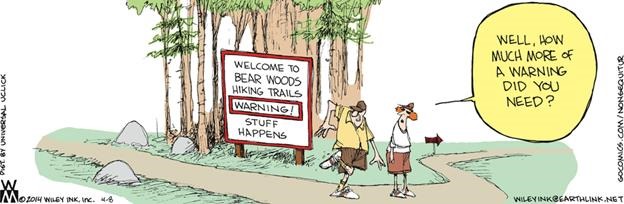
Stuff Happens People need to know that!
Posted: April 17, 2014 Filed under: Assumption of the Risk | Tags: assumption of the risk, Stuff Happens, Warnings Leave a commentWhat more do you have to say?
What do you think? Leave a comment.
If you like this let your friends know or post it on FB, Twitter or LinkedIn
Copyright 2014 Recreation Law (720) Edit Law
Email: Rec-law@recreation-law.com
Google+: +Recreation
Twitter: RecreationLaw
Facebook: Rec.Law.Now
Facebook Page: Outdoor Recreation & Adventure Travel Law
Mobile Site: http://m.recreation-law.com
By Recreation Law Rec-law@recreation-law.com James H. Moss #Authorrank
<rel=”author” link=” https://plus.google.com/u/0/b/112453188060350225356/” />
#AdventureTourism, #AdventureTravelLaw, #AdventureTravelLawyer, #AttorneyatLaw, #Backpacking, #BicyclingLaw, #Camps, #ChallengeCourse, #ChallengeCourseLaw, #ChallengeCourseLawyer, #CyclingLaw, #FitnessLaw, #FitnessLawyer, #Hiking, #HumanPowered, #HumanPoweredRecreation, #IceClimbing, #JamesHMoss, #JimMoss, #Law, #Mountaineering, #Negligence, #OutdoorLaw, #OutdoorRecreationLaw, #OutsideLaw, #OutsideLawyer, #RecLaw, #Rec-Law, #RecLawBlog, #Rec-LawBlog, #RecLawyer, #RecreationalLawyer, #RecreationLaw, #RecreationLawBlog, #RecreationLawcom, #Recreation-Lawcom, #Recreation-Law.com, #RiskManagement, #RockClimbing, #RockClimbingLawyer, #RopesCourse, #RopesCourseLawyer, #SkiAreas, #Skiing, #SkiLaw, #Snowboarding, #SummerCamp, #Tourism, #TravelLaw, #YouthCamps, #ZipLineLawyer, Stuff Happens, Warnings, Assumption of the Risk,
WordPress Tags: Stuff,Happens,People,Leave,Twitter,LinkedIn,Recreation,Edit,Email,Google,RecreationLaw,Facebook,Page,Outdoor,Adventure,Travel,Blog,Mobile,Site,James,Moss,Authorrank,author,AdventureTourism,AdventureTravelLaw,AdventureTravelLawyer,AttorneyatLaw,BicyclingLaw,Camps,ChallengeCourse,ChallengeCourseLaw,ChallengeCourseLawyer,CyclingLaw,FitnessLaw,FitnessLawyer,HumanPoweredRecreation,JamesHMoss,JimMoss,Negligence,OutdoorLaw,OutdoorRecreationLaw,OutsideLaw,OutsideLawyer,RecLaw,RecLawBlog,LawBlog,RecLawyer,RecreationalLawyer,RecreationLawBlog,RecreationLawcom,Lawcom,RiskManagement,RockClimbingLawyer,RopesCourse,RopesCourseLawyer,SkiAreas,SkiLaw,SummerCamp,Tourism,TravelLaw,YouthCamps,ZipLineLawyer,Warnings,Assumption,Risk
If you throw a throwbag incorrectly (yes there is now a right way and wrong way) that can be used to sue you. It used to be the correct way was the swimmer got the rope; incorrect way swimmer missed the rope.
Posted: April 16, 2014 Filed under: Paddlesports | Tags: American Society of Testing & Material, ASTM, Guide, Paddlesports, Personal Flotation Device, Raft guide, Rescuer, Search and Rescue, Swiftwater rescue, Throw bag, Throw Rope, Throwbag, Water Rescue, Water Rescuer, Whitewater Guide 1 CommentYo! Raft guides, ever been sued? New ASTM standard will now make that possible!
Well meaning, hardworking volunteers have no idea how they are helping to create lawsuits but here is the perfect example.
ASTM F1730 – 96(2014)
Standard Guide for Throwing a Water Rescue Throwbag
Active Standard ASTM F1730 | Developed by Subcommittee: F32.02
Book of Standards Volume:13.02
Here is how this standard is explained.
Significance and Use
3.1 This guide establishes a recommended procedure for a throwing rescue to ensure the safety of all water rescuers who may be involved in rescue techniques at a water rescue emergency.
3.2 This water rescue technique can be utilized from land, boat, or any stable platform.
3.3 All persons who are identified as water rescuers shall meet the requirements of this guide.
3.4 This guide is intended to assist government agencies, state, local, and regional organizations; fire departments; rescue teams and others who are responsible for establishing a minimum performance for personnel who respond to water emergencies.
3.5 The procedure outlined in the document may vary with the number and type of victims, and water conditions.
1. Scope
1.1 This guide covers the recommended procedures for throwing a water rescue throwbag.
1.2 This guide is one in a series of water rescue techniques for the water rescuer.
1.3 This standard does not purport to address all of the safety concerns, if any, associated with its use. It is the responsibility of the user of this standard to establish appropriate safety and health practices and determine the applicability of regulatory limitations prior to use.
Does this apply to raft guides? I would say yes.
Is a raft guide a “water rescuer” who may be involved in rescue techniques at a water rescue emergency.” If so you have to meet the requirements of this guide.
Do you know the name of a group of people who meet this definition? “…others who are responsible for establishing a minimum performance for personnel….” They are called a jury.
Let’s see how this is a messed up idea.
You were a high school quarterback with a good arm. You can throw a throwbag just like a football with great accuracy.
You are right-handed and standing on shore next to a rock wall. There is not room to throw the throwbag underhanded.
You are on a 12’ raft in the Royal Gorge on the Arkansas River. Does the definition of 3.2, which describes a boat as stable apply to you? Since your boat is not stable should you knot use your throwbag? Are you allowed to throw any way you can, if you are not stable?
Seriously, why is someone writing these things? Can’t they see how broadly this is written and how much damage it will do?
Look, someone is in the river it doesn’t matter if you are throwing the bag backwards, blindfolded standing on one leg in a pink tutu. If you get the rope to the swimmer, that was the correct way!!!
What do you think? Leave a comment.
If you like this let your friends know or post it on FB, Twitter or LinkedIn
Copyright 2014 Recreation Law (720) Edit Law
Email: Rec-law@recreation-law.com
Google+: +Recreation
Twitter: RecreationLaw
Facebook: Rec.Law.Now
Facebook Page: Outdoor Recreation & Adventure Travel Law
Mobile Site: http://m.recreation-law.com
By Recreation Law Rec-law@recreation-law.com James H. Moss #Authorrank
<rel=”author” link=” https://plus.google.com/u/0/b/112453188060350225356/” />
#AdventureTourism, #AdventureTravelLaw, #AdventureTravelLawyer, #AttorneyatLaw, #Backpacking, #BicyclingLaw, #Camps, #ChallengeCourse, #ChallengeCourseLaw, #ChallengeCourseLawyer, #CyclingLaw, #FitnessLaw, #FitnessLawyer, #Hiking, #HumanPowered, #HumanPoweredRecreation, #IceClimbing, #JamesHMoss, #JimMoss, #Law, #Mountaineering, #Negligence, #OutdoorLaw, #OutdoorRecreationLaw, #OutsideLaw, #OutsideLawyer, #RecLaw, #Rec-Law, #RecLawBlog, #Rec-LawBlog, #RecLawyer, #RecreationalLawyer, #RecreationLaw, #RecreationLawBlog, #RecreationLawcom, #Recreation-Lawcom, #Recreation-Law.com, #RiskManagement, #RockClimbing, #RockClimbingLawyer, #RopesCourse, #RopesCourseLawyer, #SkiAreas, #Skiing, #SkiLaw, #Snowboarding, #SummerCamp, #Tourism, #TravelLaw, #YouthCamps, #ZipLineLawyer, ASTM, Throwbag, Throw Rope, Guide, Paddlesports, Whitewater Guide, Raft Guide, Rescuer, Water Rescue, Water Rescuer, American Society of Testing & Material,
WordPress Tags: swimmer,Raft,ASTM,lawsuits,example,Standard,Guide,Water,Rescue,Throwbag,Active,Subcommittee,Book,Standards,Volume,Here,Significance,procedure,rescuers,techniques,technique,boat,platform,requirements,government,agencies,departments,teams,performance,personnel,emergencies,victims,Scope,procedures,series,rescuer,user,health,limitations,Does,definition,jury,football,accuracy,room,Royal,Gorge,Arkansas,River,Look,Leave,Twitter,LinkedIn,Recreation,Edit,Email,Google,RecreationLaw,Facebook,Page,Outdoor,Adventure,Travel,Blog,Mobile,Site,James,Moss,Authorrank,author,AdventureTourism,AdventureTravelLaw,AdventureTravelLawyer,AttorneyatLaw,BicyclingLaw,Camps,ChallengeCourse,ChallengeCourseLaw,ChallengeCourseLawyer,CyclingLaw,FitnessLaw,FitnessLawyer,HumanPoweredRecreation,JamesHMoss,JimMoss,Negligence,OutdoorLaw,OutdoorRecreationLaw,OutsideLaw,OutsideLawyer,RecLaw,RecLawBlog,LawBlog,RecLawyer,RecreationalLawyer,RecreationLawBlog,RecreationLawcom,Lawcom,RiskManagement,RockClimbingLawyer,RopesCourse,RopesCourseLawyer,SkiAreas,SkiLaw,SummerCamp,Tourism,TravelLaw,YouthCamps,ZipLineLawyer,Rope,Paddlesports,Whitewater,American,Material
A climbing wall or a rope’s course are structures. The components already have ASTM standards the sole issue is whether or not they were put together properly.
Posted: April 15, 2014 Filed under: Challenge or Ropes Course, Climbing Wall, Zip Line | Tags: ASTM, ASTM International, Building, challenge course, Climbing, Climbing Wall, Contractor, Engineer, Inspections, Recreation, Ropes course Leave a commentOperations need special reviews, but the structure is nothing that different from the building it is in or close too.
I’m always asked to recommend a person to check out a ropes course or a climbing wall. These people are looking for someone who may be self-appointed, maybe knowledgeable, (or maybe not) a person who makes a living check these.
I rarely refer them to someone with that title in the industry. I first ask them if a local contractor or engineer as ever looked at their course.
The structures have a different purpose than the carpenter or engineers are used to, but the construction should not be.
We keep forgetting that climbing walls and rope’s courses are just structures no different from a building. Each of the components has an ASTM standard. An Engineer or contractor can check to see if it was constructed properly and what needs to be done to get it up to speed.
We forget that the foundation of any building or anything attacked to the building is engineering.
By whom and how often should you have your course inspected?
Any time you feel insecure about your course or wall or your insurance company requires it.
Who should inspect your course or wall?
An engineer or contract should inspect your course at least every couple of years or as the engineer or contractor tells you. You can bring in someone with the industry credentials in the other years or with them. You can have someone come in and look at your operation anytime.
I tell my clients to find another operator and trade days. Go check out their course on one day and have them check out your course on another day. That will spot issues you may have, and you probably will learn some new ideas. No use having “inspectors” only who knows new ways of doing things.
I would suspect that if you are part of a larger organization, a college, university or camp that the company or college engineer will tell you when and how often they want the structure inspected.
A bolt is a bolt, whether it holds up a wall or a climbing wall.
What do you think? Leave a comment.
If you like this let your friends know or post it on FB, Twitter or LinkedIn
Copyright 2014 Recreation Law (720) Edit Law
Email: Rec-law@recreation-law.com
Google+: +Recreation
Twitter: RecreationLaw
Facebook: Rec.Law.Now
Facebook Page: Outdoor Recreation & Adventure Travel Law
Mobile Site: http://m.recreation-law.com
By Recreation Law Rec-law@recreation-law.com James H. Moss #Authorrank
<rel=”author” link=” https://plus.google.com/u/0/b/112453188060350225356/” />
#RecreationLaw, #Recreation-Law.com, #OutdoorLaw, #OutdoorRecreationLaw, #AdventureTravelLaw, #law, #TravelLaw, #JimMoss, #JamesHMoss, #Tourism, #AdventureTourism, #Rec-Law, #RiskManagement, #CyclingLaw, #BicyclingLaw, #FitnessLaw, #Recreation-Law.com, #Backpacking, #Hiking, #Mountaineering, #IceClimbing, #RockClimbing, #RopesCourse, #ChallengeCourse, #SummerCamp, #Camps, #YouthCamps, #Skiing, #Ski Areas, #Negligence, #Snowboarding, #RecreationLaw, #@RecreationLaw, #Cycling.Law, #SkiLaw, #Outside.Law, #Recreation.Law, #RecreationLaw.com, #OutdoorLaw, #RecreationLaw, #OutdoorRecreationLaw, #AdventureTravelLaw, #Law, #TravelLaw, #JimMoss, #JamesHMoss, #AttorneyatLaw, #Tourism, #AdventureTourism, #RecLaw, #RecLawBlog, #RecreationLawBlog, #RiskManagement, #HumanPowered, #HumanPoweredRecreation,# CyclingLaw, #BicyclingLaw, #FitnessLaw, #RecreationLaw.com, #Backpacking, #Hiking, #Mountaineering, #IceClimbing, #RockClimbing, #RopesCourse, #ChallengeCourse, #SummerCamp, #Camps, #YouthCamps, #Skiing, #Ski Areas, #Negligence, #Snowboarding, sport and recreation laws, ski law, cycling law, Colorado law, law for recreation and sport managers, bicycling and the law, cycling and the law, ski helmet law, skiers code, skiing accidents, Recreation Lawyer, Ski Lawyer, Paddlesports Lawyer, Cycling Lawyer, Recreational Lawyer, Fitness Lawyer, Rec Lawyer, Challenge Course Lawyer, Ropes Course Lawyer, Zip Line Lawyer, Rock Climbing Lawyer, Adventure Travel Lawyer, Outside Lawyer, Recreation Lawyer, Ski Lawyer, Paddlesports Lawyer, Cycling Lawyer, #RecreationalLawyer, #FitnessLawyer, #RecLawyer, #ChallengeCourseLawyer, #RopesCourseLawyer, #ZipLineLawyer, #RockClimbingLawyer, #AdventureTravelLawyer, #OutsideLawyer, Good Samaritan, Samaritan, First Aid, Climbing Wall, Ropes Course, Challenge Course, Inspections, Engineer, Contractor,
WordPress Tags: components,ASTM,Operations,person,self,industry,contractor,purpose,construction,Engineer,foundation,insurance,credentials,clients,operator,inspectors,college,Leave,Twitter,LinkedIn,Recreation,Edit,Email,Google,RecreationLaw,Facebook,Page,Outdoor,Adventure,Travel,Blog,Mobile,Site,James,Moss,Authorrank,author,OutdoorLaw,OutdoorRecreationLaw,AdventureTravelLaw,TravelLaw,JimMoss,JamesHMoss,Tourism,AdventureTourism,RiskManagement,CyclingLaw,BicyclingLaw,FitnessLaw,RopesCourse,ChallengeCourse,SummerCamp,Camps,YouthCamps,Areas,Negligence,SkiLaw,Outside,AttorneyatLaw,RecLaw,RecLawBlog,RecreationLawBlog,HumanPoweredRecreation,Colorado,managers,helmet,accidents,Lawyer,Paddlesports,Recreational,Challenge,Course,Ropes,Line,Rock,RecreationalLawyer,FitnessLawyer,RecLawyer,ChallengeCourseLawyer,RopesCourseLawyer,ZipLineLawyer,RockClimbingLawyer,AdventureTravelLawyer,OutsideLawyer,Samaritan,Wall,Inspections,whether
The Boy Scouts of America are not liable because they owed no duty, they did not own the camp. Negligence requires a duty, and no duty exists if you are not the owners, manager, supervisor or someone who is liable.
Posted: April 14, 2014 Filed under: New York, Summer Camp | Tags: Boy Scout, Boy Scouts of America, BSA, Northern New Jersey Council, Path, Scout, Scout Leader, Scout Troop, Showers, United Methodist Church 4 CommentsThe BSA was dismissed because the plaintiff was unable to prove the BSA supervised, owned or managed the camp where he was injured. The BSA had no custody or control of the camp. The plaintiff also failed to argue that a rule, policy, regulation or procedure of the camp had been violated.
Gomes v. Boy Scouts of America, et al., 2013 N.Y. Misc. LEXIS 4622; 2013 NY Slip Op 32453(U)
Date of the Decision: October 9, 2013
Plaintiff: Davide E. Gomes
Defendant: Boy Scouts of America, et al.,
Plaintiff Claims: failure to keep the area safe, in good repair, well-lit and free from obstruction or defect and supervise him and the other scouts
Defendant Defenses:
Holding: For the defendant Boy Scouts of America
The plaintiff, a 13-year-old Boy Scout fell leaving the shower area at a BSA council camp. He sustained injuries and sued the Boy Scouts of America and other parties.
The Boy Scouts of America moved for a dismissal claiming they were not the owners, in control of, or supervisors of the camp. The camp was owned by the Northern New Jersey Council, BSA. The Northern New Jersey Council is a separate legal entity from the Boy Scouts of America.
There was disputed testimony, whether the plaintiff was running (from witnesses) or walking along the path where he fell. It was lit inside the shower area but not lit outside. The plaintiff had a headlamp with him. During discovery, the plaintiff admitted he did not remember what happened that caused him to fall.
The BSA moved for summary judgment, which was granted by the trial court leading to this appeal.
Summary of the case
The arguments in the case are simple. Did the Boy Scouts of America own, manage, supervise or run the camp or was the camp owned by a third party. The court referred to the legal phrase, did the BSA have “custody and control” of the camp. A Boy Scout Council is a separate and distinct entity from the Boy Scouts of America. The Boy Scouts of America grants a charter (sort of like a license) to promote and use the Boy Scout program to the youth in the council’s geographic area. Boy Scout councils own camps like this one where the plaintiff was injured. The title on the deed is Northern New Jersey Council, Boy Scouts of America, not Boy Scouts of America.
The court looked at several other cases, which found the same way.
…BSA not liable for alleged negligence of charter BSA Council as there was no agency relationship between it and Council, and it lacked requisite supervision, direction, or control over adult leader who had custody of Scouts during trip at issue….
…where plaintiff died while on Scout trip, BSA granted summary judgment as it exercised no supervisory control over troop or adult leaders who accompanied scouts on trip….
The court also quoted a decision where a Council was not liable for the acts of a volunteer because the Council did not have control over the Scoutmaster. “…absent evidence that Council had supervision or control over day-to-day activities of Scout troop or scoutmaster, it could not be held liable for scoutmaster’s alleged negligent supervision…”
What caught my eye in this decision was this statement by the court.
Here, there is no issue of very young campers being unsupervised or placed in risky circumstances as plaintiff and his fellow scouts were all teenagers and there is no evidence that any camp policy was violated or that BSA had any control over the camp’s operation.
Here the court might have ruled differently if it had found that the policy of the camp had been violated.
So Now What?
The first issue is agency or ownership. The Boy Scouts of America were not liable to the camper because the BSA did not own, supervise or manage the particular piece of property where the scout was hurt. You can’t sue someone for negligence, unless they owed a duty to you. If you don’t own, manager or supervise the place where the plaintiff was injured you can’t be negligent because you owe no duty to that person.
Of greater interest is the fact the camp had no policies that were violated, which lead to the injury of the plaintiff. As a camp director of a BSA, GSA or any other camp or operation, you need to understand that the rules, regulations, policies and procedures that you write for your camp are going to be used as the rule, the standard, against which you will be judged at trial.
Don’t write rules, policies, regulations, or policies you can’t live up to.
What do you think? Leave a comment.
If you like this let your friends know or post it on FaceBook, Twitter or LinkedIn
Copyright 2014 Recreation Law (720) Edit Law
Email: Rec-law@recreation-law.com
Google+: +Recreation
Twitter: RecreationLaw
Facebook: Rec.Law.Now
Facebook Page: Outdoor Recreation & Adventure Travel Law
Blog: www.recreation-law.com
Mobile Site: http://m.recreation-law.com
By Recreation Law Rec-law@recreation-law.com James H. Moss #Authorrank
<rel=”author” link=” https://plus.google.com/u/0/b/112453188060350225356/” />
#AdventureTourism, #AdventureTravelLaw, #AdventureTravelLawyer, #AttorneyatLaw, #Backpacking, #BicyclingLaw, #Camps, #ChallengeCourse, #ChallengeCourseLaw, #ChallengeCourseLawyer, #CyclingLaw, #FitnessLaw, #FitnessLawyer, #Hiking, #HumanPowered, #HumanPoweredRecreation, #IceClimbing, #JamesHMoss, #JimMoss, #Law, #Mountaineering, #Negligence, #OutdoorLaw, #OutdoorRecreationLaw, #OutsideLaw, #OutsideLawyer, #RecLaw, #Rec-Law, #RecLawBlog, #Rec-LawBlog, #RecLawyer, #RecreationalLawyer, #RecreationLaw, #RecreationLawBlog, #RecreationLawcom, #Recreation-Lawcom, #Recreation-Law.com, #RiskManagement, #RockClimbing, #RockClimbingLawyer, #RopesCourse, #RopesCourseLawyer, #SkiAreas, #Skiing, #SkiLaw, #Snowboarding, #SummerCamp, #Tourism, #TravelLaw, #YouthCamps, #ZipLineLawyer, BSA, Boy Scouts of America, Northern New Jersey Council, Showers, Path,
Yauger v. Skiing Enterprises, Inc., 196 Wis. 2d 485; 538 N.W.2d 834; 1995 Wisc. App. LEXIS 1022
Posted: April 14, 2014 Filed under: Legal Case, Minors, Youth, Children, Release (pre-injury contract not to sue), Ski Area, Skiing / Snow Boarding, Wisconsin | Tags: fatality, Minor, parent, Season Pass, ski area, Summary judgment, Yauger 1 CommentYauger v. Skiing Enterprises, Inc., 196 Wis. 2d 485; 538 N.W.2d 834; 1995 Wisc. App. LEXIS 1022
Michael Yauger and Brenda Yauger, Plaintiffs-Appellants, v. Skiing Enterprises, Inc., d/b/a Hidden Valley Ski Area, a Wisconsin corporation, and Investors Insurance Company of America, a foreign corporation, Defendants-Respondents.
No. 94-2683
COURT OF APPEALS OF WISCONSIN
196 Wis. 2d 485; 538 N.W.2d 834; 1995 Wisc. App. LEXIS 1022
July 12, 1995, Oral Argument
August 23, 1995, Opinion Released
August 23, 1995, Opinion Filed
PRIOR HISTORY: [***1] APPEAL from a judgment of the circuit court for Manitowoc County: ALLAN J. DEEHR, Judge.
DISPOSITION: Affirmed.
COUNSEL: On behalf of the plaintiffs-appellants, the cause was submitted on the briefs of Gary L. Bendix and John M. Bruce of Savage, Gregorski, Webster, Stangel & Bendix, S.C. of Manitowoc. There was oral argument by John M. Bruce.
On behalf of the defendants-respondents, there was a brief and oral argument by Thomas B. Hartley of Guttormsen, Hartley & Guttormsen of Kenosha.
JUDGES: Before Anderson, P.J., Brown and Snyder, JJ.
OPINION BY: BROWN
OPINION
[**836] [*490] BROWN, J. We are asked to gauge whether the exculpatory contract in this case is void as against public policy. Here, Brenda and Michael Yauger brought a wrongful death action against Hidden Valley Ski Area after their eleven-year-old daughter, Tara, was killed when she struck the concrete base of a ski lift tower. The trial court dismissed the claim finding that the [*491] Yaugers’ contract with Hidden Valley for a season pass contained a valid exculpatory clause. The Yaugers now reassert their challenge that [***2] it is void.
The following facts were taken from the appellate record consisting of the pleadings, affidavits and depositions. On October 8, 1992, Michael Yauger submitted an application for a family season pass at Hidden Valley. This form is reproduced at the end of the opinion. The pass cost roughly $ 720. Although only Michael signed the application, his wife and two daughters (then ages ten and eight) were named on the form. Depositions reveal that Michael submitted the application in person at the Hidden Valley Ski Shop.
The Yauger family was familiar with Hidden Valley. Michael had skied there approximately sixty times in the three seasons prior to the accident, and Tara had skied there about fifty times prior to her accident. The record also shows that the Yauger family had a season pass at the resort the prior year.
On March 7, 1993, Tara suffered her fatal accident. The exact facts surrounding her death are unsettled, but the record currently suggests that she struck the side of a concrete base of a ski lift tower. The Yaugers sued Hidden Valley that October, claiming that this support was not adequately padded.
After limited discovery, Hidden Valley and its insurer [***3] sought summary judgment on grounds that the exculpatory release within the Yaugers’ contract for a season pass barred them from bringing this claim since it arose out of the “certain inherent risks in skiing.” The Yaugers responded that the clause was invalid as against public policy because it was not knowingly entered into by each of the Yaugers, was ambiguous and overbroad and also attempted to encompass protections provided under Wisconsin’s safe-place law.
[*492] The trial court granted Hidden Valley’s motion. It focused its analysis on the phrase “certain inherent risks in skiing” and reasoned that it covered the type of injury that killed Tara, namely, the risk that a skier will collide with a stationary object. It also rejected the Yaugers’ argument that Brenda Yauger was not bound by the exculpatory clause, finding that her express endorsement was not necessary since she received the benefit of the season pass.
We are reviewing a grant of summary judgment; thus, § 802.08(2), STATS., governs [**837] the analysis. See Decade’s Monthly Income and Appreciation Fund v. Whyte & Hirschboeck, S.C., 164 Wis. 2d 227, 230, 474 N.W.2d 766, 767 (Ct. App. 1991), aff’d, 173 Wis.2d 665, [***4] 495 N.W.2d 335 (1993). [HN1] Summary judgment is appropriate when there are no material issues of fact and the moving party is entitled to judgment as a matter of law. Id. Moreover, this appeal concerns the interpretation of a contract which appellate courts address de novo. Id. at 230-31, 474 N.W.2d at 767. Therefore, to defeat Hidden Valley’s motion for summary judgment the Yaugers must show that material facts are in dispute, or that the trial court erred in its analysis of the exculpatory clause. See id. at 230-31, 474 N.W.2d at 767.
We first turn to the analysis of the season pass and its exculpatory clause. Wisconsin law does not favor these agreements and courts therefore examine with care the facts of each case to ascertain whether enforcement will contravene public policy. See Merten v. Nathan, 108 Wis. 2d 205, 210-11, 321 N.W.2d 173, 176 (1982). The goal is to strike a balance between conflicting principles of contract and tort law. See id. at 211, 321 N.W.2d at 177. [HN2] Freedom of contract suggests that [*493] courts should abstain from interfering in people’s relationships and personal affairs. See id. On [***5] the other hand, tort law recognizes that those responsible for causing harm through negligence should bear the cost of the harm and should not be allowed to circumvent this duty through contract. See id. at 211-12, 321 N.W.2d at 177.
A review of the recent supreme court cases on this issue indicates that there are two aspects to the question of whether an exculpatory contract violates public policy. In Dobratz v. Thomson, 161 Wis. 2d 502, 468 N.W.2d 654 (1991), the court cited with approval § 195 of the RESTATEMENT (SECOND) OF CONTRACTS (1979), which sets out a series of situations in which an exculpatory contract would violate public policy. Id. at 515-16, 468 N.W.2d at 658-59 (citing Arnold v. Shawano County Agric. Soc’y, 111 Wis. 2d 203, 210-11, 330 N.W.2d 773, 777 (1983)). The first element tests the effect of the exculpatory clause, e.g., does it exempt an employer from suits by an employee. See id. 1
1 This two-prong analysis was also discussed in Discount Fabric House v. Wisconsin Telephone Co., 117 Wis. 2d 587, 602, 345 N.W.2d 417, 424-25 (1984), where the court faced a challenge to an exculpatory release that served to cover any errors in telephone directory advertising. The court explained that the analysis of such contracts involves an assessment of the “commercial reasonableness” of the terms (substantive) and the relationship between the parties during negotiations (procedural). Id.
[***6] The Yaugers’ assertion that the exculpatory clause in Hidden Valley’s season pass application contravenes the safe-place statute, § 101.11, STATS., fits this line of analysis. In further support of this argument they cite Meyer v. Val-Lo-Will Farms, Inc., 14 Wis. 2d 616, 111 [*494] N.W.2d 500 (1961), for the proposition that a for-profit winter sports park was subject to the safe-place law. In substance, they argue that the exculpatory clause violates public policy because it seeks to relieve Hidden Valley of the duty imposed by the statute. See RESTATEMENT (SECOND) OF CONTRACTS § 195(2)(c). 2 The trial court rejected this argument, reasoning that the safe-place statute did not create a special cause of action, but established a higher duty of care for what would ordinarily be addressed through common law negligence.
2 The applicability of the safe-place statute, § 101.11, STATS., in situations where frequenters challenge exculpatory contracts was raised, but left unanswered, in Kellar v. Lloyd, 180 Wis. 2d 162, 178-81, 509 N.W.2d 87, 93-94 (Ct. App. 1993).
[***7] While we agree with the trial court’s result, a different analysis is appropriate. Moreover, we need not decide the issue of whether the safe-place law imposed a special statutory duty on Hidden Valley. We hold that even if the statute does apply, a potential defendant may still bargain for an exclusion.
As noted above, the supreme court has endorsed § 195 of the RESTATEMENT (SECOND) OF CONTRACTS. See Merten, 108 Wis. 2d at 212-13, 321 N.W.2d at 177-78. 3 [*495] The [**838] official comment to this section, however, suggests that the enumerated standards are not a litmus test for these agreements; it states: “the rigor of this rule may, however, be mitigated by a fairly bargained for agreement to limit liability to a reasonable agreed value in return for a lower rate.” RESTATEMENT (SECOND) OF CONTRACTS § 195 cmt. a.
3 We recognize that the exact status of RESTATEMENT (SECOND) OF CONTRACTS § 195 (1979), is somewhat clouded. In Dobratz v. Thomson, 161 Wis. 2d 502, 515-16, 468 N.W.2d 654, 658-59 (1991), the court expressly quoted all the subsections after noting that it had originally “referred with approval” to them in Arnold v. Shawano County Agric. Soc’y, 111 Wis. 2d 203, 210-11, 330 N.W.2d 773, 777 (1983). When one examines the Arnold opinion, however, it includes only a general reference to the RESTATEMENT. Indeed, the rule in § 195(2)(c), which provides the basis for the Yaugers’ argument, was not referred to in the discussion. See Arnold, 111 Wis. 2d at 210-11, 330 N.W.2d at 777. Moreover, in the supreme court’s most recent exploration of these issues, the majority opinion made no reference to § 195, although it did reaffirm its confidence in the Dobratz decision. Richards v. Richards, 181 Wis. 2d 1007, 1014, 513 N.W.2d 118, 121 (1994). We have located a federal district court case in which the various subsections of § 195 were found to be a component of Wisconsin law and formed the basis for voiding an exculpatory contract. See RepublicBank Dallas, N.A. v. First Wisconsin Nat’l Bank, 636 F. Supp. 1470, 1473 (E.D. Wis. 1986) (voiding clause exempting liability for harm arising out of reckless or intentional acts). We thus find that § 195 continues to be a valid component of Wisconsin common law.
[***8] The process envisioned by the drafters of this comment aptly describes the transaction between the Yaugers and Hidden Valley. The Yaugers wanted a discount on their skiing. The resort was a willing supplier, but recognized that the increase in days skied would directly increase the risk of an accident and the potential for a damages claim. Hidden Valley therefore sought a release from liability. Gauging the deal at the time when the parties entered into the contract, we cannot say that the exchange was totally unreasonable. The Yaugers obtained their discount, but lost the right to bring a claim arising out of an accident which may never have occurred. Here, freedom of contract requires that we not delve deeper into the merits of this agreement. [*496] See Merten, 108 Wis. 2d at 211, 321 N.W.2d at 177. 4
4 Of course the above analysis certainly does not summarize all the concerns of the bargaining parties. The Yaugers and Hidden Valley were also making allowances for the risk that there would be no snow that season. The key to understanding our analysis, however, is to recognize that courts rarely are able to do a better job of writing contracts than the parties themselves.
[***9] The second prong of the public policy question entails examining the circumstances surrounding the bargaining process. See Dobratz, 161 Wis. 2d at 516 n.2, 468 N.W.2d at 659. For example, in Richards v. Richards, 181 Wis. 2d 1007, 1010, 513 N.W.2d 118, 119 (1994), 5 the supreme court was asked to review an exculpatory contract signed by a passenger in a commercial, long-haul truck. The plaintiff was married to a driver employed by the defendant and was asked to sign a “passenger authorization” before joining her husband on the road. Id. at 1012, 513 N.W.2d at 119. Within the form was a clause releasing the defendant from liability for any harm that might occur during her travels. Id. Still, the wife brought suit after she and her husband were involved in an accident. The lower courts found that the release was valid and granted summary [*497] judgment for the defendant. Id. at 1010, 513 N.W.2d at 119.
5 We discuss Richards in detail because it represents the supreme court’s most recent analysis of how flaws in the specific terms of an agreement, or the circumstances of the bargaining process, may serve as grounds for voiding an exculpatory agreement. For other examples, see Merten v. Nathan, 108 Wis. 2d 205, 214-15, 321 N.W.2d 173, 178 (1982) (release invalidated because defendant misrepresented a fact during the negotiation process), and Eder v. Lake Geneva Raceway, 187 Wis. 2d 596, 610-11, 523 N.W.2d 429, 434 (Ct. App. 1994) (release clause found to be ambiguous).
[***10] After its review of the contract, however, the supreme court found it to be void as contrary to public policy. Id. at 1011, 513 N.W.2d at 119. The majority pointed to three aspects of the agreement, which together led to this conclusion. First, the contract served two purposes. The court emphasized that the exculpatory clause was not distinguishable from other components of the document. It reasoned that highlighting the release provision would have provided greater protection for the signing party. See id. at 1017, 513 N.W.2d at 122.
Next, the court found that the contract was over-inclusive. It applied not only to the [**839] defendant, but also to all of its affiliates. Moreover, it did not delineate the nature of claims that would be excluded, such as those arising from negligence but not from intentional acts. Also, the time period through which the exclusion would apply was not limited. The majority found that the contract was lopsided in favor of the defendant and should therefore be construed against the company. See id. at 1017-18, 513 N.W.2d at 122.
Finally, the court noted that the release was embodied in a standard form contract, and the defendant [***11] did not inform the plaintiff of the purpose and effect of the authorization. This suggested that there was little or no opportunity to dicker about the terms. Id. at 1019, 513 N.W.2d at 123.
The Yaugers cite Richards and raise a number of arguments, each suggesting that they and Hidden Valley were not on equal footing when they entered into this agreement. The many issues they raise can be distilled into three central points. First, the Yaugers contend that the release clause, which was a single [*498] term in the season pass application, was never pointed out to Michael before he completed and signed the form. See Richards, 181 Wis. 2d at 1019, 513 N.W.2d at 123. They further assert that summary judgment was inappropriate because Hidden Valley presented no evidence on this issue.
We are not persuaded. This agreement was signed in October, at least one month prior to the skiing season. There was no sense of urgency. Michael could have taken the form home for further consideration. In addition, the Yaugers had purchased a season pass for the prior year. Therefore, Michael had a source of knowledge from which to draw comparisons. Compare Eder v. Lake [***12] Geneva Raceway, 187 Wis. 2d 596, 609, 523 N.W.2d 429, 433 (Ct. App. 1994)(noting that parties signing the release were not allowed onto the racetrack grounds until they signed the release form).
Next, the Yaugers assert that the language within the exculpatory clause is ambiguous. It specifically addressed “certain inherent risks in skiing.” They question what constitutes these “inherent risks” and whether the clause only applies to a “certain” number of these dangers. In addition, they note that Hidden Valley did not provide any evidence which would identify these risks. The Yaugers also raise concerns that the clause (which is composed of a single sentence) reads to limit Hidden Valley’s liability for any injury occurring on the premises. They stress that this could be reasonably interpreted as an attempt to limit the resort’s liability for any accident on the premises, such as a slip and fall in the restaurant. See Richards, 181 Wis. 2d at 1017-18, 513 N.W.2d at 122.
The trial court concluded that the terminology covered the obvious dangers in skiing, viz, falling down or [*499] colliding with another skier or a fixed object, and that the “any injury” language was limited [***13] to those harms arising out of these risks. We agree.
[HN3] Whether a contract is ambiguous is a question of law. Borchardt v. Wilk, 156 Wis. 2d 420, 427, 456 N.W.2d 653, 656 (Ct. App. 1990). We test whether the term is reasonable or fairly susceptible of more than one construction. Id. [HN4] A clause is not ambiguous, however, merely because its language is general or broad. See Wilke v. First Federal Savs. & Loan Ass’n, 108 Wis. 2d 650, 654, 323 N.W.2d 179, 181 (Ct. App. 1982).
This was a contract between Hidden Valley and a season pass holder. The contracting skier, therefore, could reasonably be expected to have some knowledge about the sport. The Yaugers’ interest in skiing is further demonstrated by their willingness to commit over seven hundred dollars to skiing that season. 6 The record also reveals that the Yaugers had a similar pass at the resort the prior year. We are thus hesitant to accept their arguments that such language would lead to confusion among parties executing these agreements. The language is plain and simple. It aptly describes the risks that [**840] arise whenever one’s skis are in contact with the slope. 7
6 The season pass was not refundable.
[***14]
7 Very similar language can be found in Wisconsin’s recreational responsibility law. See § 895.525(3), STATS. (“A participant in a recreational activity … accepts the risks inherent in the recreational activity ….”) (emphasis added). Moreover, several states have adopted specific skier responsibility laws which codify these terms. For example, Colorado law provides, in part:
“Inherent dangers and risks of skiing” means those dangers or conditions which are an integral part of the sport of skiing, including changing weather conditions; snow conditions as they exist or may change, such as ice, hard pack, powder, packed powder, wind pack, corn, crust, slush, cut-up snow, and machine-made snow; surface or subsurface conditions such as bare spots, forest growth, rocks, stumps, streambeds, and trees, or other natural objects, and collisions with such natural objects; impact with lift towers, signs, posts, fences or enclosures, hydrants, water pipes, other man-made structures and their components; variations in steepness or terrain, whether natural or as a result of slope design, snowmaking or grooming operations, including but not limited to roads and catwalks or other terrain modifications; collisions with other skiers; and the failure of skiers to ski within their own abilities.
COLO. REV. STAT. ANN. § 33-44-103(10) (West Supp. 1994) (emphasis added).
Further discussion of these laws, and judicial efforts in providing interpretation, are set forth in Arthur N. Frakt and Janna S. Rankin, Surveying the Slippery Slope: The Questionable Value of Legislation to Limit Ski Area Liability, 28 IDAHO L. REV. 227 (1991-92).
[***15] [*500] Finally, the Yaugers argue that the exculpatory clause should be held void because it was “not clearly identified or distinguished.” See Richards, 181 Wis. 2d at 1017, 513 N.W.2d at 122.
The trial court noted that although the exculpatory language was not highlighted, there was no indication that it was disguised and therefore did not provide grounds for rendering the agreement void. Indeed, the clause is set out in a separate paragraph.
Any break in text requires the reader to pause and thus provides a moment for reflection.
The face of the application does not otherwise suggest that Hidden Valley was trying to trick season pass holders into signing away their rights. It was an application form. Not only did the applicants have to sign the agreement, but they had to furnish information [*501] such as their address, age, other family member names, etc. In sum, the form and application process provided ample opportunity for Michael to consider the terms of the agreement.
We have addressed a variety of concerns about the exculpatory clause of the season pass contract. Although no single point is troublesome enough to render the clause void, Richards suggests that [***16] courts may consider all these aspects together when making a determination about the effects of public policy. See id. at 1011, 513 N.W.2d at 119. But even the totality of the circumstances presented here does not warrant that this contract be set aside. The contracting process simply does not raise any concern of overreaching by the party seeking to be released from liability. 8
8 The Yaugers raised one other challenge to the exculpatory clause relating to the contract language. They assert that under Hortman v. Otis Erecting Co., 108 Wis. 2d 456, 463, 322 N.W.2d 482, 485-86 (Ct. App. 1982), an agreement which indemnifies a party for its own negligence must specifically include the term “negligence.” As the defendants contend, however, this specific argument was not presented to the trial court and is therefore waived on appeal. See, e.g., Bank One, Appleton, N.A. v. Reynolds, 176 Wis. 2d 218, 222, 500 N.W.2d 337, 339 (Ct. App. 1993).
We now turn to the second issue presented. [***17] Although we have found that the exculpatory clause serves as a bar to the Yaugers’ claim, Brenda nonetheless asserts that it should not run against her individually since she did not expressly acknowledge these terms, nor did she authorize her husband to execute a contract releasing these claims. In support of her argument, she draws an analogy to Arnold v. Shawano County Agri. Soc’y, 111 Wis. 2d 203, 214-15, 330 N.W.2d 773, 779 (1983), where the court held that a [*502] spouse’s claim for consortium rights is not defeated by a valid exculpatory contract running against the deceased.
In dismissing this claim the trial court distinguished Arnold, stating:
In this case the plaintiff Brenda Yauger did not sign the application, but the application was made on her behalf and for her [**841] benefit, which is not the factual situation in Arnold. And she is specifically identified and money is specifically paid for her membership, for her use, and the use of her daughter ….
Although we agree in substance with the trial court’s analysis, we feel it necessary to elaborate further. We add that Brenda’s claim is barred by the exculpatory clause because it is so intertwined [***18] with that of her husband, and thus it was reasonable for Hidden Valley to assume that Michael was acting on her behalf when he executed the agreement.
The Yaugers’ claim has three components: loss of consortium, Tara’s medical expenses and the cost of her funeral. See § 895.04(4), STATS. The right to pursue a claim for these losses accrues to Michael and Brenda as the “parents of the deceased.” See id. This is not a situation in which one parent’s recovery is limited or barred by his or her negligence. See § 895.04(7). This distinction recently was addressed in Chang v. State Farm Mut. Auto. Ins. Co., 182 Wis. 2d 549, 561, 514 N.W.2d 399, 403 (1994), where the court noted: “the right to sue and recover damages under the wrongful death statute must be distinguished from the ownership and allocation of the recovery itself.”
Brenda alleges that she never authorized her husband to enter into this exculpatory clause (and bargain [*503] away her right to pursue a potential claim), nor was she aware of its effects. Nevertheless, she shared equally in the benefits that arose to her family, and the face of the application form would suggest that all [***19] named parties are bound by its terms.
Although there is little case law applying the principles of agency in transactions between married persons and third parties, Smart v. Estate of Ford, 23 Wis. 2d 60, 65-66, 126 N.W.2d 573, 576 (1964), summarized the Wisconsin rule that third parties may reasonably believe that one spouse had authority to act on behalf of the other. Here, we are dealing with the Yaugers’ joint interest in the companionship of their beloved daughter. Michael completed the season pass application on behalf of his whole family and paid the appropriate sum. Absent any evidence that Brenda informed Hidden Valley that she was not bound by this agreement, the Yaugers should both be held by the terms of the application.
By the Court.–Judgment affirmed.
WordPress Tags: Yauger,Enterprises,Wisc,LEXIS,Michael,Brenda,Plaintiffs,Appellants,Hidden,Valley,Area,Wisconsin,corporation,Investors,Insurance,Company,America,Defendants,Respondents,COURT,APPEALS,Oral,Argument,August,Opinion,PRIOR,HISTORY,APPEAL,judgment,circuit,Manitowoc,ALLAN,DEEHR,Judge,DISPOSITION,COUNSEL,Gary,Bendix,John,Bruce,Savage,Gregorski,Webster,Stangel,Thomas,Hartley,Guttormsen,Kenosha,JUDGES,Anderson,Brown,Snyder,policy,Here,death,action,daughter,Tara,Yaugers,clause,affidavits,October,cost,Although,wife,daughters,Depositions,person,Shop,accident,resort,March,discovery,insurer,protections,analysis,injury,endorsement,STATS,Decade,Income,Appreciation,Fund,Whyte,Hirschboeck,Summary,fact,Moreover,interpretation,agreements,enforcement,Merten,Nathan,goal,tort,Freedom,relationships,affairs,negligence,aspects,Dobratz,Thomson,approval,RESTATEMENT,SECOND,CONTRACTS,series,situations,Arnold,Shawano,Agric,employer,employee,prong,Discount,Fabric,House,errors,relationship,negotiations,assertion,statute,Meyer,Farms,proposition,winter,park,substance,Kellar,Lloyd,defendant,exclusion,agreement,status,subsections,reference,basis,discussion,exploration,confidence,decision,Richards,district,component,RepublicBank,Dallas,Bank,Supp,transaction,supplier,allowances,example,truck,plaintiff,driver,authorization,husband,road,Within,Still,flaws,examples,negotiation,Eder,Lake,Geneva,Raceway,conclusion,purposes,components,provision,protection,Also,purpose,arguments,urgency,addition,knowledge,comparisons,Compare,racetrack,dangers,premises,restaurant,terminology,Whether,Borchardt,Wilk,construction,Wilke,Federal,Savs,Loan,holder,dollars,Very,participant,emphasis,laws,Colorado,Inherent,corn,crust,slush,machine,growth,trees,collisions,impact,enclosures,variations,terrain,roads,catwalks,modifications,failure,abilities,COLO,STAT,West,Further,efforts,Arthur,Frakt,Janna,Rankin,Slippery,Slope,Questionable,Value,Legislation,Limit,IDAHO,indication,paragraph,text,reader,moment,reflection,holders,applicants,information,member,determination,Hortman,Otis,Appleton,Reynolds,analogy,Agri,spouse,consortium,situation,money,membership,funeral,parents,recovery,distinction,Chang,State,Farm,Auto,ownership,allocation,agency,transactions,Smart,Estate,Ford,companionship,Absent,behalf,exculpatory,appellate,three,skier,skiers,third
Virginia Chapter 62. Equine Activity Liability
Posted: April 14, 2014 Filed under: Equine Activities (Horses, Donkeys, Mules) & Animals, Release (pre-injury contract not to sue), Virginia | Tags: Equine, Equine Activities, Equus (genus), Horse, Mammals, minors, Release, Risk, Virginia Leave a commentCODE OF VIRGINIA
TITLE 3.2. AGRICULTURE, ANIMAL CARE, AND FOOD
SUBTITLE V. DOMESTIC ANIMALS
CHAPTER 62. EQUINE ACTIVITY LIABILITY
GO TO CODE OF VIRGINIA ARCHIVE DIRECTORY
Va. Code Ann. § 3.2-6202 (2014)
§ 3.2-6202. Liability limited; liability actions prohibited
A. Except as provided in § 3.2-6203, an equine activity sponsor, an equine professional, or any other person, which shall include a corporation, partnership, or limited liability company, shall not be liable for an injury to or death of a participant resulting from the intrinsic dangers of equine activities and, except as provided in § 3.2-6203, no participant nor any participant’s parent, guardian, or representative shall have or make any claim against or recover from any equine activity sponsor, equine professional, or any other person for injury, loss, damage, or death of the participant resulting from any of the intrinsic dangers of equine activities.
B. Except as provided in § 3.2-6203, no participant or parent or guardian of a participant who has knowingly executed a waiver of his rights to sue or agrees to assume all risks specifically enumerated under this subsection may maintain an action against or recover from an equine activity sponsor or an equine professional for an injury to or the death of a participant engaged in an equine activity. The waiver shall give notice to the participant of the intrinsic dangers of equine activities. The waiver shall remain valid unless expressly revoked in writing by the participant or parent or guardian of a minor.
HISTORY: 1991, c. 358, § 3.1-796.132; 2003, c. 876; 2008, c. 860.
NOTES: LAW REVIEW. –For article, “Virginia’s Rule of Non-waiver of Liability for Negligent Acts: Hiett v. Lake Barcroft Community Association, Inc.,” see 2 Geo. Mason L. Rev. 27 (1994).
WordPress Tags: CODE,VIRGINIA,Matthew,Bender,Company,member,LexisNexis,Group,Current,Sessions,General,Acts,Annotations,January,TITLE,AGRICULTURE,ANIMAL,CARE,FOOD,SUBTITLE,DOMESTIC,ANIMALS,CHAPTER,EQUINE,ARCHIVE,DIRECTORY,Except,person,corporation,partnership,injury,death,participant,dangers,guardian,waiver,subsection,action,HISTORY,NOTES,REVIEW,article,Rule,Negligent,Hiett,Lake,Barcroft,Association,Mason
Eric’s Big Day Is a Whimsical Bicycle Ride for Children
Posted: April 12, 2014 Filed under: Uncategorized | Tags: Bicycle Racing, Competitor Group, Cycling, Eric’s Big Day, Velo Press Leave a comment VeloPress is pleased to announce the release of a new children’s book, Eric’s Big Day: A Bicycle Race Unlike Any Other, by award-winning author and illustrator Rod Waters. The book is now available in bookstores, bike shops, and online. Preview a flipbook of Eric’s Big Day at http://www.velopress.com/eric.
It’s a big day for Eric, the day of the bike race. His knapsack packed, Eric rides his bicycle to his friend Emily’s for a picnic near the finish.
Pedaling from his house, Eric is slowed as he aids wayward bike racers, using helpful items from his backpack. The faster he rides to meet Emily, the more delays he encounters, until he tears off in a burst of speed. The cheers of a crowd surprise Eric, but where is Emily?
Eric’s Big Day is a colorful adventure on wheels, full of fun and authentic cycling flavor. Children 4-8 will love this lighthearted tale of a boy who helps others and finds himself a winner.
Eric’s Big Day: A Bicycle Race Unlike Any Other Rod Waters Hardcover with color illustrations.
10″ x 7 ¾”, 28 pp., $14.95, 978-1-937715-23-6 For children ages 4-8.
Rod Waters is a writer and an award-winning illustrator based in London. He has worked with The Folio Society, The Spectator, The Independent, Nelson Thornes, The N.H.S., The Tower of London, Virgin Atlantic, Clifton Nurseries, The Surveyor, and MJ Magazine. His illustrations have won the Winning Hand competition and have been shortlisted for the Picture This and the London Cartoon competitions. Waters is a level 2 British Cycling coach and holds a Guinness World Record for cycling between Paris and London in just over 14 hours.
VeloPress is the leading publisher of books about the endurance sports of cycling, triathlon, running, and swimming. VeloPress books help beginners and committed athletes build fitness and achieve their goals. VeloPress celebrates the icons of endurance sports through history books, biographies, memoirs, and photography books. For more information, please visit http://www.velopress.com.
What do you think? Leave a comment.
If you like this let your friends know or post it on FB, Twitter or LinkedIn
Copyright 2014 Recreation Law (720) Edit Law
Email: Rec-law@recreation-law.com
Google+: +Recreation
Twitter: RecreationLaw
Facebook: Rec.Law.Now
Facebook Page: Outdoor Recreation & Adventure Travel Law
Mobile Site: http://m.recreation-law.com
By Recreation Law Rec-law@recreation-law.com James H. Moss #Authorrank
<rel=”author” link=” https://plus.google.com/u/0/b/112453188060350225356/” />
#AdventureTourism, #AdventureTravelLaw, #AdventureTravelLawyer, #AttorneyatLaw, #Backpacking, #BicyclingLaw, #Camps, #ChallengeCourse, #ChallengeCourseLaw, #ChallengeCourseLawyer, #CyclingLaw, #FitnessLaw, #FitnessLawyer, #Hiking, #HumanPowered, #HumanPoweredRecreation, #IceClimbing, #JamesHMoss, #JimMoss, #Law, #Mountaineering, #Negligence, #OutdoorLaw, #OutdoorRecreationLaw, #OutsideLaw, #OutsideLawyer, #RecLaw, #Rec-Law, #RecLawBlog, #Rec-LawBlog, #RecLawyer, #RecreationalLawyer, #RecreationLaw, #RecreationLawBlog, #RecreationLawcom, #Recreation-Lawcom, #Recreation-Law.com, #RiskManagement, #RockClimbing, #RockClimbingLawyer, #RopesCourse, #RopesCourseLawyer, #SkiAreas, #Skiing, #SkiLaw, #Snowboarding, #SummerCamp, #Tourism, #TravelLaw, #YouthCamps, #ZipLineLawyer, Velo Press, Competitor Group, Cycling, Bicycle Racing, Eric’s Big Day,
Navajo Nation Council to Vote on Grand Canyon Escalade Project
Posted: April 11, 2014 Filed under: Uncategorized | Tags: Arizona, Grand Canyon, Hopi, Hopi people, Navajo Nation, Navajo Nation Council, z Leave a commentRaging Rivers: Navajo Nation Council to Vote on Grand Canyon Escalade Project
4/4/14
The Navajo Nation‘s proposal to build a multi-million-dollar resort at the confluence of the Little Colorado and Colorado rivers in northern Arizona has raised environmental and cultural concerns. The 420-acre tourist attraction would include a hotel, restaurants, and a gondola tramway from the rim of the Grand Canyon to an elevated river walk on the canyon floor.
Proponents of the project say it will create jobs, monitor and protect sacred sites and generate revenues for rehabilitation of the Bennett Freeze area. Opponents, which include the Hopi Tribe and Grand Canyon Trust, cite the sacred nature of the confluence, the threat to specific sacred sites and the appropriate conditions for religious activities and the fact that this is not an economic development plan that was created by or would necessarily benefit local residents.
RELATED: LeRoy Shingoitewa: Hopi Tribe Against Grand Canyon Project
Save the Confluence Releases Video on the Grand Canyon Escalade Project
Opposition Continues for the Grand Canyon Escalade
Tony Skrelunas, Grand Canyon Trust Native America program director, says the organization supports economic development and diversification, but the potential mechanized development in the Grand Canyon is not in keeping with its principles of environmental preservation and would set a precedent for the future. “We’re working with the [Navajo] chapters in the area to develop a community-based economic development plan that is culturally and environmentally appropriate,” he says.
The agreement between the Navajo Nation and Confluence Partners LLC, the developers of the project, expired July 1. A new agreement has been signed, but requires approval from the Navajo Tribal Council before it can go into effect. That vote could come at any time.
The Arizona Corporation Commission lists R. Lamar Whitmer, who was instrumental in the development of the Hualapai Tribe’s Grand Canyon Skywalk, as the corporation’s only member. The Grand Canyon Escalade website named other partners in the project as former Navajo Nation President and current Arizona State Sen. Albert Hale; retired Judge Michael C. Nelson, legal counsel to former Navajo Nation President Peterson Zah; Eunice L. Tso, a project management and permitting consultant; Keith A. Lamparter, a design and construction manager; Bernie Propst, former CFO for the Hualapai Tribe’s Grand Canyon Resort Corp.; Michele Crank, a community and government relations consultant; and financial advisor James J. Maguire, Jr.
So far, according to Rick Abasta, communications director for the Navajo Nation’s Office of the President and the Vice President, Confluence Partners has not identified any investors for the project. The Navajo Nation is considering investing several tens of millions of dollars upfront to build the infrastructure for the project. Whitmer has stated that at buildout the project could cost as much as copy billion.
On February 6, Hopi Tribal Chairman Herman G. Honanie wrote to Navajo Nation President Ben Shelly requesting a meeting to discuss the proposed project. The two met on February 10 and discussed, according to Abasta, a right-of-way issue related to a fiber optics cable and the taking of eaglets. The Grand Canyon Escalade proposal was, says Hopi Cultural Preservation Office Director Leigh Kuwanwisiwma, given short shrift, with Shelly telling Honanie that the project was just in the planning stages.
Kuwanwisiwma maintains that the project would violate an intergovernmental compact signed by the Navajo Nation and the Hopi Tribe in 2006. The compact ended a decades-long land dispute between the two tribes. Under its terms, both tribes agreed to end all litigation arising from the dispute, a step that eventually led to the opening the Bennett Freeze area to development. The Bennett Freeze, imposed in 1966 by the federal government, prohibited any new construction or repairs or improvements to existing structures or infrastructure on 1.5-million acres of land in the disputed territory, resulting in grossly substandard and unsafe living conditions for the 8,000 Navajos living there. President Obama signed the legislation that was the final step in lifting the Bennett Freeze in 2009.
The compact gives the Hopi Tribe a permanent, irrevocable permit to enter and use Navajo lands for religious practices (and gives Navajos the same right in regard to religious activities on Hopi lands). It further states that the “landowner tribe shall respect the privacy of persons engaging in religious practices and shall not observe or intrude upon religious activities.”
Kuwanwisiwma says the proposed resort, the tramway and the platforms overlooking the confluence could reveal the location of sacred sites to non-Hopis and would interfere with religious activities. “The most important thing in the compact is that both tribes committed to protect each other’s religious use areas from disturbance.” The proposed project would be built in “a very significant Hopi use area … where the Hopi people still go as part of their pilgrimages,” he says.
The very existence of the development would interfere with Hopi religious observance, says Kuwanwisiwma. “Privacy is so important [for our religious activities]. Tranquility is so important. The solace and relationship with the environment as you’re doing these religious ceremonies requires a lot of emotional well-being to feel good about it. I feel that that is what is going to be taken away if this resort. And quite frankly I think if the resort goes where it’s proposed to be, we will be prevented from getting access, period.”
The Hopi Tribe would like Navajo Nation President Ben Shelly and former President Albert Hale to accept an invitation to come to the reservation and talk to the tribal council and villages about the proposal. But whether they come or not, “it’s clear that the area that they have chosen is just totally not acceptable to the Hopi Tribe,” says Kuwanwisiwma. “We feel that if the Navajo Nation Council supports this project at the confluence, they’re going to violate the provisions of the intergovernmental compact.”
Should the Navajo Nation Tribal Council approve the new agreement and should investors for the project materialize, the proposed Grand Canyon Escalade project has the potential to become yet another cause for conflict on the Colorado Plateau.
April is an awesome month for skiing and also an fantastic time to PARTY FOR A PURPOSE and support the CAIC!
Posted: April 10, 2014 Filed under: Avalanche, Colorado | Tags: avalanche, CAIC, Colorado, Colorado Avalanche Information Center, Fund Raiser, Loveland Ski Area Leave a commentJoin the Friends of CAIC at the below events and say “Thank You” to our avalanche forecasters for a season for hard work.
April 11th: Après in the Boat – Steamboat, CO
Featuring: Steamboat’s own – Missed the Boat
Where: Bear River Bar and Grill, Steamboat Ski Area
Tickets: $25 in advance; $30 at the door.
Ticket price includes: Bowl of Chili, 2 drink tickets, 1 door prize tickets, access to great music! Advance tickets available until April 10, 2014.
April 17th: Thank you CAIC! – Edwards, CO
E-Town: 5:30pm – 9:00pm
Hug and thank a forecaster for all their hard work this season. Join us in Edwards, Colorado for a benefit party for the CAIC. We will have a ton of gear to give away, some great food, and fantastic beer. All the money raised will go toward the Friends of CAIC Stay Informed, Stay Alive $150,000 challenge. Jump on board today!
Requested donation: $20 at the door.
April 26th: Loveland Corn Harvest – Loveland Ski Area

Join your friends for a fun day of spring skiing, lunch, music, prizes, and refreshments at this year’s Corn Harvest.
Where: Loveland Ski Area
When: April 26, 2014
Tickets: $60 (includes: Lunch, Beer, Lift Ticket, door prize ticket)
$30 – With Season Pass
More information can be found here: http://cornharvest.org/
Also, don’t forget. We are in the middle of our Stay Informed, Stay Alive $150,000 Challenge campaign. We have had tremendous support over the past few weeks. Do your part and donate now! http://www.crowdrise.com/stayinformedstayalive/fundraiser/FriendsofCAIC
What do you think? Leave a comment.
If you like this let your friends know or post it on FB, Twitter or LinkedIn
Copyright 2014 Recreation Law (720) Edit Law
Email: Rec-law@recreation-law.com
Google+: +Recreation
Twitter: RecreationLaw
Facebook: Rec.Law.Now
Facebook Page: Outdoor Recreation & Adventure Travel Law
Mobile Site: http://m.recreation-law.com
By Recreation Law Rec-law@recreation-law.com James H. Moss #Authorrank
<rel=”author” link=” https://plus.google.com/u/0/b/112453188060350225356/” />
#AdventureTourism, #AdventureTravelLaw, #AdventureTravelLawyer, #AttorneyatLaw, #Backpacking, #BicyclingLaw, #Camps, #ChallengeCourse, #ChallengeCourseLaw, #ChallengeCourseLawyer, #CyclingLaw, #FitnessLaw, #FitnessLawyer, #Hiking, #HumanPowered, #HumanPoweredRecreation, #IceClimbing, #JamesHMoss, #JimMoss, #Law, #Mountaineering, #Negligence, #OutdoorLaw, #OutdoorRecreationLaw, #OutsideLaw, #OutsideLawyer, #RecLaw, #Rec-Law, #RecLawBlog, #Rec-LawBlog, #RecLawyer, #RecreationalLawyer, #RecreationLaw, #RecreationLawBlog, #RecreationLawcom, #Recreation-Lawcom, #Recreation-Law.com, #RiskManagement, #RockClimbing, #RockClimbingLawyer, #RopesCourse, #RopesCourseLawyer, #SkiAreas, #Skiing, #SkiLaw, #Snowboarding, #SummerCamp, #Tourism, #TravelLaw, #YouthCamps, #ZipLineLawyer, CAIC, Colorado Avalanche Information Center, Colorado, Avalanche, Fund Raiser,
WordPress Tags: April,PURPOSE,CAIC,Join,Friends,events,Thank,avalanche,forecasters,Après,Boat,Steamboat,Where,Bear,River,Grill,Area,Tickets,door,Ticket,Bowl,Chili,music,Advance,Edwards,Town,forecaster,Colorado,gear,food,beer,money,Stay,Alive,Jump,donation,Loveland,Corn,Harvest,refreshments,Lunch,Lift,Season,Pass,information,Also,Challenge,fundraiser,FriendsofCAIC,Leave,Twitter,LinkedIn,Recreation,Edit,Email,Google,RecreationLaw,Facebook,Page,Outdoor,Adventure,Travel,Blog,Mobile,Site,James,Moss,Authorrank,author,AdventureTourism,AdventureTravelLaw,AdventureTravelLawyer,AttorneyatLaw,BicyclingLaw,Camps,ChallengeCourse,ChallengeCourseLaw,ChallengeCourseLawyer,CyclingLaw,FitnessLaw,FitnessLawyer,HumanPoweredRecreation,JamesHMoss,JimMoss,Negligence,OutdoorLaw,OutdoorRecreationLaw,OutsideLaw,OutsideLawyer,RecLaw,RecLawBlog,LawBlog,RecLawyer,RecreationalLawyer,RecreationLawBlog,RecreationLawcom,Lawcom,RiskManagement,RockClimbingLawyer,RopesCourse,RopesCourseLawyer,SkiAreas,SkiLaw,SummerCamp,Tourism,TravelLaw,YouthCamps,ZipLineLawyer,Center,Fund,Raiser
States that allow a parent to sign away a minor’s right to sue
Posted: April 10, 2014 Filed under: Minors, Youth, Children, Release (pre-injury contract not to sue) | Tags: Alaska, Arizona, Colorado, Florida, Minor, minors, Right to Sue, Ski Resort, Virginia Leave a commentIf your state is not listed here, you should assume a parent cannot waive a minor’s right to sue in your state.
|
State |
By Statute |
Restrictions |
|
Alaska |
Alaska: Sec. 09.65.292 |
Sec. 05.45.120 does not allow using a release by ski areas for ski injuries |
|
Arizona |
ARS § 12-553 |
Limited to Equine Activities |
|
Colorado |
C.R.S. §§13-22-107 |
|
|
Florida Statute § 744.301 (3) |
|
|
|
Virginia |
Chapter 62. Equine Activity Liability § 3.2-6202. Liability limited; liability actions prohibited |
Allows a parent to sign a release for a minor for equine activities |
|
|
By Case Law |
|
|
California |
Hohe v. San Diego Unified Sch. Dist., 224 Cal.App.3d 1559, 274 Cal.Rptr. 647 (1990) |
|
|
Florida |
Allows a release signed by a parent to require arbitration of the minor’s claims |
|
|
Florida |
Gonzalez v. City of Coral Gables, 871 So.2d 1067, 29 Fla. L. Weekly D1147 |
Release can be used for volunteer activities and by government entities |
|
Massachusetts |
Sharon v. City of Newton, 437 Mass. 99; 769 N.E.2d 738; 2002 Mass. LEXIS 384 |
|
|
Minnesota |
Moore vs. Minnesota Baseball Instructional School, 2009 Minn. App. Unpub. LEXIS 299 |
|
|
North Dakota |
McPhail v. Bismarck Park District, 2003 ND 4; 655 N.W.2d 411; 2003 N.D. LEXIS 3 |
|
|
Ohio |
Zivich v. Mentor Soccer Club, Inc., 696 N.E.2d 201, 82 Ohio St.3d 367 (1998) |
|
|
Wisconsin |
Osborn v. Cascade Mountain, Inc., 655 N.W.2d 546, 259 Wis. 2d 481, 2002 Wisc. App. LEXIS 1216, 2003 WI App 1 |
However the decision in Atkins v. Swimwest Family Fitness Center, 2005 WI 4; 2005 Wisc. LEXIS 2 may void all releases in the state |
|
|
On the Edge, but not enough to really rely on |
|
|
North Carolina |
Kelly v. United States of America, 2011 U.S. Dist. LEXIS 89741 |
Ruling is by the Federal District Court and only a preliminary motion |
What do you think? Leave a comment.
Copyright 2011 Recreation Law (720) Edit Law, Recreation.Law@Gmail.com
Twitter: RecreationLaw
Facebook: Rec.Law.Now
Facebook Page: Outdoor Recreation & Adventure Travel Law
Mobile Site: http://m.recreation-law.com
#AdventureTourism, #AdventureTravelLaw, #AdventureTravelLawyer, #AttorneyatLaw, #Backpacking, #BicyclingLaw, #Camps, #ChallengeCourse, #ChallengeCourseLaw, #ChallengeCourseLawyer, #CyclingLaw, #FitnessLaw, #FitnessLawyer, #Hiking, #HumanPowered, #HumanPoweredRecreation, #IceClimbing, #JamesHMoss, #JimMoss, #Law, #Mountaineering, #Negligence, #OutdoorLaw, #OutdoorRecreationLaw, #OutsideLaw, #OutsideLawyer, #RecLaw, #Rec-Law, #RecLawBlog, #Rec-LawBlog, #RecLawyer, #RecreationalLawyer, #RecreationLaw, #RecreationLawBlog, #RecreationLawcom, #Recreation-Lawcom, #Recreation-Law.com, #RiskManagement, #RockClimbing, #RockClimbingLawyer, #RopesCourse, #RopesCourseLawyer, #SkiAreas, #Skiing, #SkiLaw, #Snowboarding, #SummerCamp, #Tourism, #TravelLaw, #YouthCamps, #ZipLineLawyer, #minor, #release, #ParentSignature, #NC, #NorthCarolina, #Alaska, #AK, #AZ, #Arizona, #CO, #Colorado, #Florida, #FL, #CA, #California, #MA, #Massachusetts, #Minnesota, #MN, #ND, #NorthDakota, #OH, #Ohio, #WI, #Wisconsin, #Hohe, #SanDiego, #SanDiegoUnifiedSchoolDistrict, #GlobalTravelMarketing, #Shea, #Gonzalez, #CityOfCoralGables, #Sharon, #CityofNewton, #Moore, #MinnesotaBaseballInstructionalSchool, #McPhail, #BismarkParkDistrict, #Zivich, #MentorSoccerClub, #Osborn, #CascadeMountain, #Atkins, #SwimwestFamilyFitnessCenter, Minor, Minors, Right to Sue,
WordPress Tags: States,State,Statute,Restrictions,Alaska,areas,injuries,Arizona,Equine,Activities,Colorado,Florida,Virginia,Chapter,Allows,Case,California,Hohe,Diego,Dist,Rptr,Global,Travel,Shea,LEXIS,arbitration,Gonzalez,Coral,Gables,Release,government,entities,Massachusetts,Sharon,Newton,Mass,Minnesota,Baseball,Instructional,School,Minn,Unpub,North,Dakota,McPhail,Bismarck,Park,District,Ohio,Zivich,Mentor,Soccer,Club,Wisconsin,Osborn,Cascade,Mountain,Wisc,decision,Atkins,Swimwest,Center,Edge,Carolina,America,Federal,Court,Leave,Recreation,Edit,Gmail,Twitter,RecreationLaw,Facebook,Page,Outdoor,Adventure,Blog,Mobile,Site,AdventureTourism,AdventureTravelLaw,AdventureTravelLawyer,AttorneyatLaw,BicyclingLaw,Camps,ChallengeCourse,ChallengeCourseLaw,ChallengeCourseLawyer,CyclingLaw,FitnessLaw,FitnessLawyer,HumanPoweredRecreation,JamesHMoss,JimMoss,Negligence,OutdoorLaw,OutdoorRecreationLaw,OutsideLaw,OutsideLawyer,RecLaw,RecLawBlog,LawBlog,RecLawyer,RecreationalLawyer,RecreationLawBlog,RecreationLawcom,Lawcom,RiskManagement,RockClimbingLawyer,RopesCourse,RopesCourseLawyer,SkiAreas,SkiLaw,SummerCamp,Tourism,TravelLaw,YouthCamps,ZipLineLawyer,ParentSignature,NorthCarolina,NorthDakota,SanDiego,SanDiegoUnifiedSchoolDistrict,CityOfCoralGables,CityofNewton,MinnesotaBaseballInstructionalSchool,BismarkParkDistrict,MentorSoccerClub,CascadeMountain,SwimwestFamilyFitnessCenter,Minor,Minors
Keep a kid safe for a minute or help them learn to be safe for a lifetime!
Posted: April 8, 2014 Filed under: Minors, Youth, Children | Tags: Children, education, Kids, Mothers, Risks Leave a commentResearch shows that just saying don’t do that doesn’t work. You have to give kids the knowledge to learn how to evaluate the risks of life.
A study published in the Journal of Pediatric Psychology shows that taking the time to explain the risks to a child is better than saying don’t do that. This allows the child to understand why and even better it provides the child with the tools to learn to evaluate all of the risks he or she will face in life.
Kids take risks not to take risks, but because they don’t know what the dangers are. More importantly children have no ability to evaluate the risks. You don’t know something is going to hurt unless you learn. There are two ways to learn.
1. Get hurt
2. Have someone explain the reasons and risks to you.
However the study did say there are still children who are prone to get hurt. When they grow up they are called guides! J
See Explain the Present Danger to Children So They Stay Safe
What do you think? Leave a comment.
If you like this let your friends know or post it on FB, Twitter or LinkedIn
Copyright 2014 Recreation Law (720) Edit Law
Email: Rec-law@recreation-law.com
Google+: +Recreation
Twitter: RecreationLaw
Facebook: Rec.Law.Now
Facebook Page: Outdoor Recreation & Adventure Travel Law
Mobile Site: http://m.recreation-law.com
By Recreation Law Rec-law@recreation-law.com James H. Moss #Authorrank
<rel=”author” link=” https://plus.google.com/u/0/b/112453188060350225356/” />
#RecreationLaw, #Recreation-Law.com, #OutdoorLaw, #OutdoorRecreationLaw, #AdventureTravelLaw, #law, #TravelLaw, #JimMoss, #JamesHMoss, #Tourism, #AdventureTourism, #Rec-Law, #RiskManagement, #CyclingLaw, #BicyclingLaw, #FitnessLaw, #Recreation-Law.com, #Backpacking, #Hiking, #Mountaineering, #IceClimbing, #RockClimbing, #RopesCourse, #ChallengeCourse, #SummerCamp, #Camps, #YouthCamps, #Skiing, #Ski Areas, #Negligence, #Snowboarding, #RecreationLaw, #@RecreationLaw, #Cycling.Law, #SkiLaw, #Outside.Law, #Recreation.Law, #RecreationLaw.com, #OutdoorLaw, #RecreationLaw, #OutdoorRecreationLaw, #AdventureTravelLaw, #Law, #TravelLaw, #JimMoss, #JamesHMoss, #AttorneyatLaw, #Tourism, #AdventureTourism, #RecLaw, #RecLawBlog, #RecreationLawBlog, #RiskManagement, #HumanPowered, #HumanPoweredRecreation,# CyclingLaw, #BicyclingLaw, #FitnessLaw, #RecreationLaw.com, #Backpacking, #Hiking, #Mountaineering, #IceClimbing, #RockClimbing, #RopesCourse, #ChallengeCourse, #SummerCamp, #Camps, #YouthCamps, #Skiing, #Ski Areas, #Negligence, #Snowboarding, sport and recreation laws, ski law, cycling law, Colorado law, law for recreation and sport managers, bicycling and the law, cycling and the law, ski helmet law, skiers code, skiing accidents, Recreation Lawyer, Ski Lawyer, Paddlesports Lawyer, Cycling Lawyer, Recreational Lawyer, Fitness Lawyer, Rec Lawyer, Challenge Course Lawyer, Ropes Course Lawyer, Zip Line Lawyer, Rock Climbing Lawyer, Adventure Travel Lawyer, Outside Lawyer, Recreation Lawyer, Ski Lawyer, Paddlesports Lawyer, Cycling Lawyer, #RecreationalLawyer, #FitnessLawyer, #RecLawyer, #ChallengeCourseLawyer, #RopesCourseLawyer, #ZipLineLawyer, #RockClimbingLawyer, #AdventureTravelLawyer, #OutsideLawyer, Good Samaritan, Samaritan, First Aid, Children, Kids, Risks, Mothers, Education,
WordPress Tags: Keep,lifetime,Research,knowledge,life,Journal,Pediatric,Psychology,tools,Kids,dangers,Explain,Present,Danger,Children,Stay,Safe,Leave,Twitter,LinkedIn,Recreation,Edit,Email,Google,RecreationLaw,Facebook,Page,Outdoor,Adventure,Travel,Blog,Mobile,Site,James,Moss,Authorrank,author,OutdoorLaw,OutdoorRecreationLaw,AdventureTravelLaw,TravelLaw,JimMoss,JamesHMoss,Tourism,AdventureTourism,RiskManagement,CyclingLaw,BicyclingLaw,FitnessLaw,RopesCourse,ChallengeCourse,SummerCamp,Camps,YouthCamps,Areas,Negligence,SkiLaw,Outside,AttorneyatLaw,RecLaw,RecLawBlog,RecreationLawBlog,HumanPoweredRecreation,Colorado,managers,helmet,accidents,Lawyer,Paddlesports,Recreational,Challenge,Course,Ropes,Line,Rock,RecreationalLawyer,FitnessLawyer,RecLawyer,ChallengeCourseLawyer,RopesCourseLawyer,ZipLineLawyer,RockClimbingLawyer,AdventureTravelLawyer,OutsideLawyer,Samaritan,Risks,Mothers,Education
Morgan et al., v. Ohio Conference of the United Church of Christ et al., 2012-Ohio-453; 2012 Ohio App. LEXIS 385
Posted: April 7, 2014 Filed under: Assumption of the Risk, Legal Case, Ohio, Summer Camp | Tags: assumption of the risk, Chaperone, Hike, Night Hike, Ohio, Primary Assumption of the Risk, Stream Crossing Leave a commentBrian Morgan et al., Plaintiffs-Appellants, v. Ohio Conference of the United Church of Christ et al., Defendants-Appellees.
No. 11AP-405
COURT OF APPEALS OF OHIO, TENTH APPELLATE DISTRICT, FRANKLIN COUNTY
2012-Ohio-453; 2012 Ohio App. LEXIS 385
February 7, 2012, Rendered
PRIOR HISTORY: [**1]
APPEAL from the Franklin County Court of Common Pleas. (C.P.C. No. 10CVC-03-4516).
DISPOSITION: Judgment affirmed.
COUNSEL: Rourke & Blumenthal, LLP, Kenneth S. Blumenthal and Jonathan R. Stoudt; Cloppert, Latanick, Sauter & Washburn, and Robert L. Washburn, for appellants.
Philipp & Gregory, Ronald D. Gregory and Jeffrey T. Peters, for appellees.
JUDGES: DORRIAN, J. KLATT and SADLER, JJ., concur.
OPINION BY: DORRIAN
OPINION
(ACCELERATED CALENDAR)
DECISION
DORRIAN, J.
[*P1] Plaintiffs-appellants, Brian Morgan (“Morgan”) and his wife Amie Morgan (collectively “appellants”), appeal from the April 4, 2011 judgment of the Franklin County Court of Common Pleas in favor of defendants-appellees, Ohio Conference of the United Church of Christ (“OCUCC”) and Templed Hills Camp and Conference Center (“Templed Hills”) (collectively “appellees”). For the following reasons, we affirm.
[*P2] On November 12, 13, and 14, 2007, Morgan was scheduled to attend the Nature’s Classroom program at Templed Hills as a teacher chaperone for sixth grade students of Worthington City Schools. The school district contracted with the owner of the site, OCUCC, to send the students. The contract set forth a fee of $7,565 for the group’s participation. (Affidavit of Mark Glassbrenner, [**2] ¶4; Exhibit A-A to Affidavit.) On the evening of November 13, Morgan volunteered to act as a chaperone on one of the group’s night hikes. Morgan had chaperoned students annually from approximately 2002 to 2007 and attended the night hike every year. The night hike had originally been scheduled for the evening of November 12, but was postponed to the second evening due to rain. (Affidavit of Kristi Patrick, ¶6; Affidavit of Kathy Mikkelson, ¶6.)
[*P3] The night hike was led by Matthew Marsh (“Marsh”), a Nature’s Classroom instructor. Marsh testified that the purpose of the night hike was to use your other senses when your eyes were not as heightened as during the daylight. Marsh picked the trail and had been using that same trail for the night hikes he had been leading twice a week for the last seven months. It was an established trail and wider than shoulder length. Other trails on the property were harder to traverse. Marsh stated that the evening was a clear night, not cloudy, and the moon was out so the trail could be seen. The adults were also told to bring flashlights.
[*P4] The group met at approximately 7:30 p.m. and started with a game called “Bat & Moth,” where one child is blindfolded [**3] and the children attempt to escape. It is similar to the game Marco Polo. The game lasted approximately 20 to 25 minutes, after which the group entered the woods. After several minutes of hiking, they had to cross a creek bed, but it was a receding creek so there was not much water in it. Marsh stood in the middle of the creek bed on a rock with his flashlight and helped every child cross by holding their hand, and then he helped Morgan cross. While Marsh was counting the kids on the other side of the creek, he saw Morgan shift his weight and fall on his stomach. Marsh tried to call his supervisor on his radio and his cell phone but could not reach her. Then he called 911. When the EMTs arrived, Marsh took the students to an area away from Morgan.
[*P5] Morgan testified to a slightly different version of facts. He had never been on that particular trail and thought it was very overgrown. He was not advised to take a flashlight on the hike and remembered the night being cloudy. Morgan testified that as he approached the creek Marsh was there to help him cross and had a flashlight. Morgan did not remember specifically, but thinks he used Marsh’s shoulder to step on a tree stump or rock as [**4] he took a long stride to cross the creek. After a few seconds, Marsh gave some directions for the next activity and Morgan took a step with his right foot, lost traction and fell. He knew immediately that he was seriously injured. Morgan suffered severe injuries to his left arm and shoulder. Morgan testified he had to ask Marsh to call 911 several times before Marsh called them.
[*P6] Morgan and his wife filed a complaint against OCUCC and Templed Hills as the owners and operators of the site and the employers of Marsh for damages Morgan suffered resulting from Marsh’s negligence, as well as for Amie Morgan’s loss of consortium. A stipulation of dismissal pursuant to Civ.R. 41 was filed.
[*P7] The claim was refiled on March 22, 2010. Appellees filed a motion for summary judgment, contending that appellants’ claims were barred by the affirmative defense of primary assumption of the risk and by the Ohio recreational user statute, R.C. 1533.181. Appellees argued that Morgan assumed the risk of his injury by voluntarily participating in the night hike and that, under the circumstances, appellees owed no duty to protect Morgan from injury. Appellees also argued that Ohio’s recreational statute, R.C. 1533.181, [**5] barred his claims because Morgan was a recreational user and, as such, appellees owed no duty to Morgan as a hiker pursuant to the statute.
[*P8] In opposition to appellees’ motion, Morgan argued that the doctrine of primary assumption of the risk does not bar his cause of action, as the dangers presented by Marsh’s negligence were not inherent to hiking. Also, Morgan argued that the recreational user statute was inapplicable to these facts because the negligence alleged was based on the negligence of an employee, not a theory of premises liability. Additionally, Morgan claimed he was not a recreational user because he was a business invitee.
[*P9] By decision and entry filed April 4, 2011, the trial court granted appellees’ motion for summary judgment finding that the doctrine of primary assumption of the risk barred appellants’ claims. The doctrine removed any duty on appellees’ part to protect Morgan from risks inherent to the activity of night hiking.
[*P10] Appellants assert one assignment of error on appeal:
The trial court erred in granting the motion for summary judgment filed by the Appellees Ohio Conference United Church of Christ and Templed Hills holding that the doctrine of primary assumption [**6] of the risk bars Plaintiffs from recovering on their claims for negligence and loss of consortium.
[*P11] In their assignment of error, appellants challenge the granting of the motion for summary judgment, contending that the doctrine of primary assumption of the risk is inapplicable to these facts. [HN1] By asserting a negligence action, appellants were required to prove by a preponderance of the evidence that appellees owed them a duty of care, that the duty was breached and that the breach proximately caused Morgan’s injuries. Strother v. Hutchinson, 67 Ohio St.2d 282, 285, 423 N.E.2d 467 (1981). Under the law of negligence, a defendant’s duty to a plaintiff depends on the relationship between the parties and the foreseeability of injury to someone in the plaintiff’s position. Simmers v. Bentley Constr. Co., 64 Ohio St.3d 642, 645, 1992 Ohio 42, 597 N.E.2d 504 (1992).
[*P12] [HN2] The doctrine of primary assumption of the risk has often been applied to cases involving sporting events and recreational activities. Crace v. Kent State Univ., 185 Ohio App. 3d 534, 2009 Ohio 6898, ¶12, 924 N.E.2d 906, citing Ballinger v. Leaniz Roofing, Ltd., 10th Dist. No. 07AP-696, 2008 Ohio 1421, ¶8, 2008 WL 802722, citing Anderson v. Ceccardi, 6 Ohio St.3d 110, 114, 6 Ohio B. 170, 451 N.E.2d 780 (1983). Whether to [**7] apply the affirmative defense of primary assumption of the risk presents an issue of law for the court to determine. Crace at ¶12, citing Gallagher v. Cleveland Browns Football Co., 74 Ohio St.3d 427, 435, 1996 Ohio 320, 659 N.E.2d 1232 (1996). We therefore review the trial court’s decision de novo. Crace at ¶12, citing Cleveland Elec. Illum. Co. v. Pub. Util. Comm., 76 Ohio St. 3d 521, 523, 1996 Ohio 298, 668 N.E.2d 889 (1996), citing Indus. Energy Consumers of Ohio Power Co. v. Pub. Utils. Comm., 68 Ohio St. 3d 559, 563, 1994 Ohio 435, 629 N.E.2d 423 (1994).
[*P13] [HN3] Under the doctrine of primary assumption of the risk, a plaintiff who voluntarily engages in a recreational activity or sporting event assumes the inherent risks of that activity and cannot recover for injuries sustained in engaging in the activity unless the defendant acted recklessly or intentionally in causing the injuries. Crace at ¶13, citing Santho v. Boy Scouts of Am., 168 Ohio App. 3d 27, 2006 Ohio 3656, ¶12, 857 N.E.2d 1255. The doctrine is based on the fiction that the plaintiff has “tacitly consented” to the risk of injury inherent in the activity. Collier v. Northland Swim Club, 35 Ohio App.3d 35, 37, 518 N.E.2d 1226 (10th Dist.1987). The rationale behind the doctrine is that certain risks are so intrinsic in some activities that the risk of injury [**8] is unavoidable. Crace at ¶13, citing Collier. The test for applying the doctrine of primary assumption of the risk to recreational activities and sporting events requires that “(1) the danger is ordinary to the game, (2) it is common knowledge that the danger exists, and (3) the injury occurs as a result of the danger during the course of the game.” Santho at ¶12.
[*P14] [HN4] The affirmative defense of primary assumption of the risk completely negates a negligence claim because the defendant owes no duty to protect the plaintiff against the inherent risks of the recreational activity in which the plaintiff engages. Crace at ¶15, citing Gentry v. Craycraft, 101 Ohio St.3d 141, 144, 2004 Ohio 379, 802 N.E.2d 1116, citing Prosser & Keeton, Law of Torts (5th Ed.1984) 496, Section 68; see also Gallagher at 431, citing Prosser & Keeton, 496-97, Section 28 (“Primary assumption of risk ‘is really a principle of no duty, or no negligence, and so denies the existence of any underlying cause of action.'”). Primary assumption of the risk serves to negate the duty of care owed by the defendant to the plaintiff. Wolfe v. Bison Baseball, Inc., 10th Dist. No. 09AP-905, 2010 Ohio 1390, ¶18, 2010 WL 254597. “Because a successful [**9] primary assumption of risk defense means that the duty element of negligence is not established as a matter of law, the defense prevents the plaintiff from even making a prima facie case.” Id. at ¶21, citing Gallagher at 431-32.
[*P15] [HN5] With the doctrine of primary assumption of the risk, the injured plaintiff’s subjective consent to and appreciation for the inherent risks of the recreational activity are immaterial to the analysis. Crace, 185 Ohio App. 3d 534, ¶16, citing Gentry at 144. The types of risks inherent to an activity are those risks that are foreseeable and customary risks of the sport or recreational activity. Deutsch v. Birk, 189 Ohio App. 3d 129, 2010 Ohio 3564, ¶12 (937 N.E.2d 638, 12th Dist.), citing Thompson v. McNeill, 53 Ohio St.3d 102, 104-106, 559 N.E.2d 705 (1990). In accordance with these principles, this court held in Gehri v. Capital Racing Club, Inc., 10th Dist. No. 96APE10-1307, 1997 Ohio App. LEXIS 2527, 1997 WL 324175 (June 12, 1997), that “primary assumption of [the] risk requires an examination of the activity itself and not plaintiff’s conduct. If the activity is one that is inherently dangerous and from which the risks cannot be eliminated, then a finding of primary assumption of [the] risk is appropriate.” 1997 Ohio App. LEXIS 2527, [WL] at *4. [**10] “The law simply deems certain risks as accepted by the plaintiff regardless of actual knowledge or consent.” Crace at ¶16. The focus in primary assumption of the risk is on the defendant’s conduct, whether such conduct was reckless or intentional. Gentry at ¶9.
[*P16] In the instant case, the trial court noted that hiking is a recreational activity to which the doctrine applies, and hiking contains an inherent risk of slipping, tripping or falling that cannot be eliminated, even more so with hiking at night. (Apr. 4, 2011 Decision, 2.) Appellants argue that primary assumption of the risk does not apply to these facts because the risks which led to the injury in this case could have been eliminated if Marsh had chosen a different trail. However, this is essentially a claim that Marsh’s conduct was reckless. In Marchetti v. Kalish, 53 Ohio St.3d 95, 100, 559 N.E.2d 699 (1990), fn. 3, the Supreme Court of Ohio cited the comments f and g to Section 500 of the Restatement of Torts 2d, 590, which defined the three mental states of tortious conduct, as follows:
f. Intentional misconduct and recklessness contrasted. [HN6] Reckless misconduct differs from intentional wrongdoing in a very important particular. While an act [**11] to be reckless must be intended by the actor, the actor does not intend to cause the harm which results from it. It is enough that he realizes or, from facts which he knows, should realize that there is a strong probability that harm may result, even though he hopes or even expects that his conduct will prove harmless. However, a strong probability is a different thing from the substantial certainty without which he cannot be said to intend the harm in which his act results.
g. Negligence and recklessness contrasted. [HN7] Reckless mis-conduct differs from negligence in several important particulars. It differs from that form of negligence which consists in mere inadvertence, incompetence, unskillfulness, or a failure to take precautions to enable the actor adequately to cope with a possible or probable future emergency, in that reckless misconduct requires a conscious choice of a course of action, either with knowledge of the serious danger to others involved in it or with knowledge of facts which would disclose this danger to any reasonable man. It differs not only from the above-mentioned form of negligence, but also from that negligence which consists in intentionally doing an act with [**12] knowledge that it contains a risk of harm to others, in that the actor to be reckless must recognize that his conduct involves a risk substantially greater in amount than that which is necessary to make his conduct negligent. The difference between reckless misconduct and conduct involving only such a quantum of risk as is necessary to make it negligent is a difference in the degree of the risk, but this difference of degree is so marked as to amount substantially to a difference in kind.
[*P17] Appellants argue that Marsh should have chosen a different path for the hikers that evening. However, appellants did not allege that Marsh was reckless in choosing that path. The trial court specifically found that [HN8] hiking, especially night hiking, involves the risk of tripping, slipping and falling. Hiking does involve these risks. Morgan volunteered to participate in the night hike and assumed these risks. The court in Shaner v. Smoot, 7th Dist. No. 712, 2001 Ohio 3429, 2001 WL 1243920, found that persons involved in recreational activities assume the ordinary risks of the activity and the failure to warn of the ordinary risks does not subject one to liability. In Shaner, the plaintiff was injured [**13] while riding a motorcycle in tall grass with tree stumps scattered throughout the area. The plaintiff was aware that there were tree stumps in the area where he was riding. However, the court found that the risk of hitting a tree stump was an ordinary risk of riding a motorcycle in such a location, and the defendants could not be liable for failure to warn of an ordinary risk assumed by the plaintiff.
[*P18] Appellants concede that there are risks inherent in hiking that cannot be avoided. However, appellants contend that the risks which led to Morgan’s particular injury could have been avoided if Marsh had picked a trail which was better maintained with less-demanding obstacles. Thus, appellants argue, implied assumption of the risk is more appropriate to these facts, which has been merged into Ohio’s comparative negligence statute, R.C. 2315.19. However, these risks were not risks out of the ordinary for night hiking.
[*P19] In California, the courts have addressed similar issues and applied primary assumption of the risk, finding that a defendant is only liable for a plaintiff’s injuries if the defendant’s conduct is reckless or totally outside the range of the ordinary activity involved in the [**14] sport or activity. In Andia v. Full Service Travel, S.D.Cal. No. 06cv0437 WQH (JMA), 2007 U.S. Dist. LEXIS 88247, 2007 WL 4258634 (Nov. 29, 2007), the plaintiff was a passenger on the defendant’s cruise ship and participated in a shore expedition known as the HL 15, the Kilauea Lava Viewing Hike. The plaintiff slipped on one of the rocks and fell, fracturing her foot. She filed a negligence action, and the court found that the doctrine of primary assumption of the risk applied, negating the defendant’s duty to prevent the plaintiff from slipping and falling on lava rock, an inherent risk of the activity of lava hiking.
[*P20] In Kane v. Natl. Ski Patrol Sys., Inc., 88 Cal.App.4th 204, 209, 105 Cal.Rptr.2d 600 (2001), a ski instructor led participants in a skills clinic for a voluntary ski patrol. The participants were reluctant to proceed to the most difficult portion of the trail, which was icy and contained trees, rocks, and stumps, but the instructor encouraged them to go. The two plaintiffs were injured, one fell to his death and the other one suffered a broken leg. The court granted summary judgment in favor of the defendant, holding that the doctrine of primary assumption of the risk applied, negating the defendant’s [**15] duty of care. The court held that [HN9] “an instructor’s assessment errors–either in making the necessarily subjective judgment of skill level or the equally subjective judgment about the difficulty of the conditions–are in no way ‘outside the range of the ordinary activity involved in the sport.'” Id. at 214.
[*P21] Similarly, here, any assessment error in the subjective judgment of the path chosen by the Nature’s Classroom instructor, if any, is not outside the range of the ordinary activity involved in night hiking. As we have said, tripping, slipping, and falling are inherent risks of night hikes, regardless of the trail chosen.
[*P22] In Kalter v. Grand Circle Travel, 631 F.Supp.2d 1253 (C.D.Cal.2009), the plaintiff suffered serious injuries when she fell while hiking at Inca ruins at Machu Picchu. The plaintiff filed a negligence action against the vacation tour operator, but the court applied the primary assumption of the risk doctrine, finding that hiking across uneven and challenging terrain is an inherent risk when hiking in ancient ruins, and inherent in this activity is the risk that one will fall and become injured.
[*P23] This case law from California is similar to our Ohio law. Morgan attempts [**16] to argue that the conditions which led to his injury, attempting to cross a creek up a slippery embankment in dark, wet conditions, were not inherent to hiking. However, Morgan had already crossed the creek when he fell, and the dark is inherent in night hiking regardless of the trail chosen, and the ground was wet because it had been raining the day before. That was the reason the hike had been postponed. Despite Morgan’s attempt to argue that the risks were heightened, we find, under these facts, that these risks were inherent risks to night hiking.
[*P24] Appellants rely on Byer v. Lucas, 7th Dist. No. 08AP-351, 2009 Ohio 1022, 2009 WL 581710, to argue that the risks involved here outweigh the ordinary risks involved in the recreational activity that the plaintiff was engaged. In Byer, the plaintiff filed a negligence action against the owner and driver of a tractor pulling a hay wagon as part of party festivities. The defendant was drinking alcohol at the party. The plaintiff was riding in the wagon. The defendant stopped the wagon at the top of a steep hill and advised the passengers that they could get out of the wagon and either walk down the hill or wait to be picked up by a truck [**17] to return to the party. Apparently, the plaintiff did not hear the warning and remained on the wagon. The defendant lost control of the wagon, and plaintiff was ejected and treated for severe injuries. Plaintiff filed suit alleging negligence and intentional and reckless conduct. On appeal, the court found there were risks that were not ordinary, customary, or foreseeable to a hayride.
[*P25] Ordinary risks for a hayride include “getting scratched by tree braches [sic], being bounced around on a wagon, and even losing one’s balance and falling off the wagon.” Id. at ¶30. In Byer, however, the court found risks that were out of the ordinary for a hayride, including the choice of route, the driver control and severe injuries. The driver chose to drive down the steep hill while another driver took a safer route. The tractor and wagon careened down the hill out of control. Many passengers were thrown from the wagon. Finally, the plaintiff suffered severe injuries including cuts to her head, requiring stitches, and two segments of her tailbone were fractured.
[*P26] The choice of route, down a steep hill, the out-of-control nature of the ride and the injuries the plaintiff received were not risks that [**18] would be expected from a hayride. The court found that “a farm tractor and its wagon cascading down a steep hill out of control and jackknifing to a stop throwing passengers from it is not an inherent risk of a hayride.” Id. at ¶39. Thus, the court found primary assumption of the risk inapplicable. But Byer is distinguishable from the case at hand. The court in Byer found the risks were not inherent to the recreational activity, whereas here, we find the risks were inherent to night hiking. Also in Byer, the plaintiff alleged that the defendant’s conduct was intentional or reckless. Here, the only allegation is that Marsh’s conduct was negligent. Thus, the facts of Byer distinguish it from the facts at hand.
[*P27] Under the doctrine of primary assumption of the risk, appellees owed no duty to protect appellants from the inherent risks of injury related to the night hike. Since the primary assumption of the risk negates the duty element of appellants’ negligence claim, appellants are precluded from making a prima facie case of negligence, and the trial court did not err in granting appellees’ motion for summary judgment. Amie Morgan’s claim also fails because it is dependent upon her husband’s [**19] successful claim. Appellants’ assignment of error is overruled.
[*P28] For the foregoing reasons, appellants’ assignment of error is overruled, and we affirm the judgment of the Franklin County Court of Common Pleas.
Judgment affirmed.
KLATT and SADLER, JJ., concur.
WordPress Tags: Morgan,Ohio,Conference,Church,Christ,LEXIS,Brian,Plaintiffs,Appellants,Defendants,Appellees,COURT,APPEALS,TENTH,APPELLATE,DISTRICT,FRANKLIN,February,PRIOR,HISTORY,APPEAL,Common,Pleas,DISPOSITION,Judgment,COUNSEL,Rourke,Blumenthal,Kenneth,Jonathan,Stoudt,Cloppert,Latanick,Sauter,Washburn,Robert,Philipp,Gregory,Ronald,Jeffrey,Peters,JUDGES,DORRIAN,KLATT,SADLER,OPINION,CALENDAR,DECISION,wife,Amie,April,OCUCC,Hills,Camp,Center,November,Nature,Classroom,teacher,students,Worthington,Schools,owner,participation,Affidavit,Mark,Glassbrenner,Exhibit,Kristi,Patrick,Kathy,Mikkelson,Matthew,Marsh,instructor,purpose,length,adults,flashlights,Moth,Marco,Polo,woods,creek,supervisor,radio,cell,EMTs,area,version,tree,foot,traction,injuries,complaint,owners,operators,employers,negligence,consortium,stipulation,dismissal,March,assumption,user,statute,injury,hiker,opposition,doctrine,action,dangers,Also,employee,theory,premises,assignment,error,preponderance,Strother,Hutchinson,Under,defendant,plaintiff,relationship,Simmers,Bentley,Constr,events,Crace,Kent,State,Univ,Ballinger,Leaniz,Dist,Anderson,Ceccardi,Whether,Gallagher,Cleveland,Browns,Football,Elec,Illum,Util,Comm,Indus,Energy,Consumers,Power,Utils,event,Santho,Scouts,Collier,Northland,Swim,Club,rationale,danger,knowledge,Gentry,Craycraft,Prosser,Keeton,Torts,Section,Primary,principle,existence,Wolfe,Bison,Baseball,analysis,Deutsch,Birk,Thompson,McNeill,accordance,Gehri,Capital,June,examination,Marchetti,Kalish,Supreme,Restatement,Intentional,misconduct,actor,particulars,inadvertence,incompetence,failure,precautions,difference,degree,path,hikers,Shaner,Smoot,motorcycle,location,obstacles,Thus,California,Andia,Full,Service,Travel,expedition,Kilauea,Lava,Hike,Kane,Natl,Patrol,Rptr,participants,skills,clinic,trees,death,errors,skill,Kalter,Grand,Circle,Supp,Inca,Machu,Picchu,vacation,operator,terrain,embankment,Despite,Byer,Lucas,driver,wagon,festivities,alcohol,hill,passengers,truck,Ordinary,Many,segments,Here,allegation,husband,hikes,pursuant,prima,facie,tractor,hayride
In Ohio, Primary Assumption of the Risk is a complete bar to claims for injuries from hiking at night.
Posted: April 7, 2014 Filed under: Assumption of the Risk, Ohio, Summer Camp | Tags: Assumption of risk, assumption of the risk, Chaperone, Hike, Night Hike, Ohio, Primary Assumption of the Risk, Recreation, Stream Crossing 1 CommentThis decision held that falling down while hiking at night was an inherent risk of hiking, especially at night.
Morgan et al., v. Ohio Conference of the United Church of Christ et al., 2012-Ohio-453; 2012 Ohio App. LEXIS 385
Date of the Decision: February 7, 2012
Plaintiff: Brian Morgan and his wife Amie Morgan
Defendant: Ohio Conference of the United Church of Christ (“OCUCC”) and Templed Hills Camp and Conference Center
Plaintiff Claims: negligence
Defendant Defenses: defendant assumed the risks of hiking at night, falling was an inherent risk of hiking
Holding: for the defendants
Ohio has a statute that requires kids to receive some of their education about the outdoors in the outdoors. This law was passed in the early 70’s. I know I was a camp counselor for one of these trips as a senior in high school.
This case comes from a school group going to a camp for outdoor classroom. The plaintiff had done this for five consecutive years, and for five years had participated as a chaperone on the “night hike.” During the night hike, after crossing a stream the plaintiff fell injuring his shoulder.
The plaintiff sued. The defendant camp filed a motion to dismiss claiming the plaintiff assumed the risk, which was granted by the court and this appeal followed. Due to the evidence presented the appellate court viewed the motion as a motion for summary judgment.
Summary of the case
The Ohio Appellate court extensively reviewed Primary Assumption of the Risk under Ohio Law.
Under the doctrine of primary assumption of the risk, a plaintiff who voluntarily engages in a recreational activity or sporting event assumes the inherent risks of that activity and cannot recover for injuries sustained in engaging in the activity unless the defendant acted recklessly or intentionally in causing the injuries. The doctrine is based on the fiction that the plaintiff has “tacitly consented” to the risk of injury inherent in the activity. The rationale behind the doctrine is that certain risks are so intrinsic in some activities that the risk of injury is unavoidable. The test for applying the doctrine of primary assumption of the risk to recreational activities and sporting events requires that “(1) the danger is ordinary to the game, (2) it is common knowledge that the danger exists, and (3) the injury occurs as a result of the danger during the course of the game.”
The effect of a court finding that the plaintiff assumed the risk as defined, by Primary Assumption of the Risk, is a complete bar to the plaintiff’s claims.
The affirmative defense of primary assumption of the risk completely negates a negligence claim because the defendant owes no duty to protect the plaintiff against the inherent risks of the recreational activity in which the plaintiff engages.
The court then explained how Primary Assumption of the Risk worked to stop a claim by the plaintiff.
Primary assumption of risk ‘is really a principle of no duty, or no negligence, and so denies the existence of any underlying cause of action. Primary assumption of the risk serves to negate the duty of care owed by the defendant to the plaintiff. “Because a successful primary assumption of risk defense means that the duty element of negligence is not established as a matter of law, the defense prevents the plaintiff from even making a prima facie case.”
To prevail at trial, the plaintiff has to make a prima facie case. That means the plaintiff has to plead and prove enough facts to prove their case. If the defendant or the court can show the risks of the activity which caused the injury to the plaintiff were inherent to the activity, then the plaintiff is prevented from even making his or her case.
The risks of the activity that are sufficient to prove Primary Assumption of the Risk are “…types of risks inherent to an activity are those risks that are foreseeable and customary risks of the sport or recreational activity.”
The telling issue, as the court explained, is not of the actions of the parties but of the risk. “If the activity is one that is inherently dangerous and from which the risks cannot be eliminated, then a finding of primary assumption of [the] risk is appropriate.”
The court also looked at the defendant’s side of the facts. “The focus in primary assumption of the risk is on the defendant’s conduct, whether such conduct was reckless or intentional.” If the conduct of the defendant was not reckless or intentional, if the defendant did not do anything that increased the risk to the injured plaintiff in a reckless or intentional way than the defense stands.
In the instant case, the trial court noted that hiking was a recreational activity to which the doctrine applies, and hiking contains an inherent risk of slipping, tripping or falling that cannot be eliminated, even more so with hiking at night.
The court then looked at how Ohio defines tortious conduct. It came from the plaintiff’s argument that the defendant increased the risk by reckless choosing the trail that the plaintiff fell on.
Intentional misconduct and recklessness contrasted. Reckless misconduct differs from intentional wrongdoing in a very important particular. While an act to be reckless must be intended by the actor, the actor does not intend to cause the harm which results from it. It is enough that he realizes or, from facts which he knows, should realize that there is a strong probability that harm may result, even though he hopes or even expects that his conduct will prove harmless. However, a strong probability is a different thing from the substantial certainty without which he cannot be said to intend the harm in which his act results.
Negligence and recklessness contrasted. Reckless mis-conduct differs from negligence in several important particulars. It differs from that form of negligence which consists in mere inadvertence, incompetence, unskillfulness, or a failure to take precautions to enable the actor adequately to cope with a possible or probable future emergency, in that reckless misconduct requires a conscious choice of a course of action, either with knowledge of the serious danger to others involved in it or with knowledge of facts which would disclose this danger to any reasonable man. It differs not only from the above-mentioned form of negligence, but also from that negligence which consists in intentionally doing an act with knowledge that it contains a risk of harm to others, in that the actor to be reckless must recognize that his conduct involves a risk substantially greater in amount than that which is necessary to make his conduct negligent. The difference between reckless misconduct and conduct involving only such a quantum of risk as is necessary to make it negligent is a difference in the degree of the risk, but this difference of degree is so marked as to amount substantially to a difference in kind.
Because the conduct of the employee, the guide of the night hike, was not intentional or reckless, the plaintiff was prevented from brining his claims because of the defense of Primary Assumption of the Risk.
So Now What?
The issues you need to understand when looking at the risks of outdoor or recreational activities are which risks are of what type. Those risks that are not inherent in the activity are the ones that you are at the greatest risk of losing a lawsuit over unless you can prove the guest knew and assumed the risks or released you from their injury prior to the activity.
This does not mean you should not inform your guests of all the risks. On the contrary, knowledgeable guests are happier guests and usually injury-free guests. Any injury is a problem for you no matter how small and a problem for the entire group all the time.
What this means is when you list the risks of the activity you need to make sure you know which ones may need special attention for your guests. Those they do not recognize or understand which may include some inherent risks, and those that are obvious.
What do you think? Leave a comment.
If you like this let your friends know or post it on FaceBook, Twitter or LinkedIn
Copyright 2014 Recreation Law (720) Edit Law
Email: Rec-law@recreation-law.com
Google+: +Recreation
Twitter: RecreationLaw
Facebook: Rec.Law.Now
Facebook Page: Outdoor Recreation & Adventure Travel Law
Blog: www.recreation-law.com
Mobile Site: http://m.recreation-law.com
By Recreation Law Rec-law@recreation-law.com James H. Moss #Authorrank
<rel=”author” link=” https://plus.google.com/u/0/b/112453188060350225356/” />
#AdventureTourism, #AdventureTravelLaw, #AdventureTravelLawyer, #AttorneyatLaw, #Backpacking, #BicyclingLaw, #Camps, #ChallengeCourse, #ChallengeCourseLaw, #ChallengeCourseLawyer, #CyclingLaw, #FitnessLaw, #FitnessLawyer, #Hiking, #HumanPowered, #HumanPoweredRecreation, #IceClimbing, #JamesHMoss, #JimMoss, #Law, #Mountaineering, #Negligence, #OutdoorLaw, #OutdoorRecreationLaw, #OutsideLaw, #OutsideLawyer, #RecLaw, #Rec-Law, #RecLawBlog, #Rec-LawBlog, #RecLawyer, #RecreationalLawyer, #RecreationLaw, #RecreationLawBlog, #RecreationLawcom, #Recreation-Lawcom, #Recreation-Law.com, #RiskManagement, #RockClimbing, #RockClimbingLawyer, #RopesCourse, #RopesCourseLawyer, #SkiAreas, #Skiing, #SkiLaw, #Snowboarding, #SummerCamp, #Tourism, #TravelLaw, #YouthCamps, #ZipLineLawyer, Ohio, Primary Assumption of the Risk, Assumption of the Risk, Night Hike, Hike, Chaperone, Stream Crossing,
WordPress Tags: Ohio,Primary,Assumption,Risk,injuries,decision,Morgan,Conference,Church,Christ,LEXIS,Date,February,Plaintiff,Brian,wife,Amie,Defendant,OCUCC,Hills,Camp,Center,Claims,negligence,Defenses,defendants,statute,education,counselor,classroom,judgment,Summary,Appellate,Under,doctrine,event,injury,rationale,events,danger,knowledge,principle,existence,action,argument,Intentional,misconduct,actor,particulars,inadvertence,incompetence,failure,precautions,difference,degree,employee,lawsuit,guest,guests,attention,Leave,FaceBook,Twitter,LinkedIn,Recreation,Edit,Email,Google,RecreationLaw,Page,Outdoor,Adventure,Travel,Blog,Mobile,Site,James,Moss,Authorrank,author,AdventureTourism,AdventureTravelLaw,AdventureTravelLawyer,AttorneyatLaw,BicyclingLaw,Camps,ChallengeCourse,ChallengeCourseLaw,ChallengeCourseLawyer,CyclingLaw,FitnessLaw,FitnessLawyer,HumanPoweredRecreation,JamesHMoss,JimMoss,OutdoorLaw,OutdoorRecreationLaw,OutsideLaw,OutsideLawyer,RecLaw,RecLawBlog,LawBlog,RecLawyer,RecreationalLawyer,RecreationLawBlog,RecreationLawcom,Lawcom,RiskManagement,RockClimbingLawyer,RopesCourse,RopesCourseLawyer,SkiAreas,SkiLaw,SummerCamp,Tourism,TravelLaw,YouthCamps,ZipLineLawyer,Hike,Stream,five,prima,facie,ones
Environmental Education Giving Week April 16-22
Posted: April 6, 2014 Filed under: Uncategorized | Tags: education, Environment, Organizations, Sustainable living, x, y, z Leave a comment
|
||||||||||||||||||||


Ohio Zip Line Association meeting to deal with Ohio Department of Agriculture wanting to control Zip Lines in the State
Posted: April 5, 2014 Filed under: Ohio, Zip Line | Tags: Canopy Tour, Columbus Ohio, Insurance, Ohio, Ohio Zip Line Association, zip line, Zip Lines Leave a commentJoin now and fight or forever hold your piece
Some of you may know that in the state of Ohio the Department of Agriculture has been discussing creating legislation for zip

lines. Some of the owners of Zip Line and Canopy Tours in the state have gotten together and formed the Ohio Zip Line Association. As a group we have been working with the state to figure out where zip lines may or may not fit with their legislation.
We wanted to send an email notifying all interested parties that we will be holding an open meeting of the Ohio Zip Line Association for anyone who may want an update of what is going on in Ohio, or anyone who may want to become members of our group.
The next Ohio Zip Line Association meeting, it will be held on:
April 18, 2014 at 1:00 pm
Location:
3347 McDowell Rd.
Grove City, OH 43123
If you would like to be a part of the meeting, but cannot attend, you can use the following call in number:
Dial +1 (312) 757-3131+1 (312) 757-3131
Access Code: 130-237-621
Audio PIN: Shown after joining the meeting
Meeting ID: 130-237-621
Feel free to email me off-list if you have any questions.
Lori Pingle
Owner
ZipZone Canopy Tours
Board President
Ohio Zip Line Association
Direct: 614-906-5674614-906-5674
What do you think? Leave a comment.
If you like this let your friends know or post it on FB, Twitter or LinkedIn
Copyright 2014 Recreation Law (720) Edit Law
Email: Rec-law@recreation-law.com
Google+: +Recreation
Twitter: RecreationLaw
Facebook: Rec.Law.Now
Facebook Page: Outdoor Recreation & Adventure Travel Law
Mobile Site: http://m.recreation-law.com
By Recreation Law Rec-law@recreation-law.com James H. Moss #Authorrank
<rel=”author” link=” https://plus.google.com/u/0/b/112453188060350225356/” />
#AdventureTourism, #AdventureTravelLaw, #AdventureTravelLawyer, #AttorneyatLaw, #Backpacking, #BicyclingLaw, #Camps, #ChallengeCourse, #ChallengeCourseLaw, #ChallengeCourseLawyer, #CyclingLaw, #FitnessLaw, #FitnessLawyer, #Hiking, #HumanPowered, #HumanPoweredRecreation, #IceClimbing, #JamesHMoss, #JimMoss, #Law, #Mountaineering, #Negligence, #OutdoorLaw, #OutdoorRecreationLaw, #OutsideLaw, #OutsideLawyer, #RecLaw, #Rec-Law, #RecLawBlog, #Rec-LawBlog, #RecLawyer, #RecreationalLawyer, #RecreationLaw, #RecreationLawBlog, #RecreationLawcom, #Recreation-Lawcom, #Recreation-Law.com, #RiskManagement, #RockClimbing, #RockClimbingLawyer, #RopesCourse, #RopesCourseLawyer, #SkiAreas, #Skiing, #SkiLaw, #Snowboarding, #SummerCamp, #Tourism, #TravelLaw, #YouthCamps, #ZipLineLawyer, Ohio, Ohio Zip Line Association, Zip Lines,
WordPress Tags: Ohio,Line,Association,Department,Agriculture,Lines,State,Join,Some,legislation,owners,Canopy,Tours,April,Location,McDowell,Grove,Dial,Code,Audio,Shown,Feel,Lori,Pingle,Owner,Board,President,Direct,Leave,Twitter,LinkedIn,Recreation,Edit,Email,Google,RecreationLaw,Facebook,Page,Outdoor,Adventure,Travel,Blog,Mobile,Site,James,Moss,Authorrank,author,AdventureTourism,AdventureTravelLaw,Adven,AttorneyatLaw,BicyclingLaw,Camps,ChallengeCourse,ChallengeCourseLaw,ChallengeCourseLawyer,CyclingLaw,FitnessLaw,FitnessLawyer,HumanPoweredRecreation,JamesHMoss,JimMoss,Negligence,OutdoorLaw,OutdoorRecreationLaw,OutsideLaw,OutsideLawyer,RecLaw,RecLawBlog,LawBlog,RecLawyer,RecreationalLawyer,RecreationLawBlog,RecreationLawcom,Lawcom,RiskManagement,RockClimbingLawyer,RopesCourse,RopesCourseLawyer,SkiAreas,SkiLaw,SummerCamp,Tourism,TravelLaw,YouthCamps,ZipLineLawyer
Rules (and laws) don’t control behavior. This school district it does the exact opposite, the more rules the more bad behavior
Posted: April 3, 2014 Filed under: Minors, Youth, Children | Tags: Kids, Laws, playground, Principal, Regulations, Rules, Schools Leave a commentNo rules also increased student attentiveness, increased their creative side and stopped bullying. Kids were too busy having fun to be a problem.
This is an amazing article. Here are some quotes from the article and the principle which in this day and age in the US is sort of mind blowing.
Fewer children were getting hurt on the playground. Students focused better in class. There was also less bullying, less tattling. Incidents of vandalism had dropped off.
The parent continued: “I just wanted to make sure you don’t change this play environment, because kids break their arms.”
This is my favorite quote!
“I’ve been the principal who’s stood there and said ‘Oy, kid! Get off your bike! You’ve got to walk your bike!’ Then I’d go away and think ‘Why the hell did I say that?’”
Don’t ride your bike you may get hurt! Why did the kids’ parents buy the child a bike? We know it was not to get hurt, so why can’t the kid ride a bike.
But the results spoke for themselves, he said. The students weren’t hurting themselves — in fact, they were so busy and physically active at recess that they returned to the classroom ready to learn. They came back vibrant and motivated, not agitated or annoyed.
Children don’t hurt themselves because they’re testing their boundaries, Mr. McLachlan said. They don’t set out to recklessly self-injure, though it may happen in the process of finding their footing.
Who are the rules for? Adults! Kids’ don’t want rules; kids don’t remember rules and kids work hard to ignore rules. Obviously the only reason to have rules is because adults like rules. Wait that does not make sense. It must be because adults believe that rules work. Wait, our prisons are full and overcrowded. Why do we have rules?
So many of the rules, he said, are “ridiculous,” and designed to soothe adults. That said, there are still limitations to the two, 40-minute long free play breaks each day.
If a kid is hurt breaking a rule then the adults have an excuse.
· It’s not my fault
· The kid deserved it he broke the rule
This principal is amazing. Read this quote!
Mr. McLachlan said. “One of the rules I said facetiously is kids aren’t allowed to hurt other people. But in fact they are. … If you hurt somebody in a game where you are playing hard, or a boxing match or a stone-throwing competition, for me it’s absolutely fine — as long as the other person was willing to get hurt.”
The results from the principals thinking?
He knew children might get hurt, and that was exactly the point — perhaps if they were freed from the “cotton-wool” in which their 21st century parents had them swaddled, his students may develop some resilience, use their imaginations, solve problems on their own.
This is my favorite statement from a different perspective. People don’t sue for money, they sue because they have bills to pay.
Kiwi parents are much less likely to sue a school if a child is injured anyway, he said, partly because a litigious culture just doesn’t exist and also because New Zealanders’ health care is fully paid for by the state if they’re victims of an accident.
It gets pretty absurd when we make playgrounds safe and then build climbing walls and ropes courses for adults to go have fun!
Read this article!When one New Zealand school tossed its playground rules and let students risk injury, the results were surprising
Here are some more articles exploring these concepts.
Year in Ideas: The risks of overprotective school policies
Return of risk: The growing movement to let kids play like kids
Some articles I’ve written about the subject:
An example of adults and money getting in the way of kids has fun
Is being overprotective putting our kids at risk
This article takes a real look at the risks parents allow their children to face
What do you think? Leave a comment.
If you like this let your friends know or post it on FB, Twitter or LinkedIn
Copyright 2014 Recreation Law (720) Edit Law
Email: Rec-law@recreation-law.com
Google+: +Recreation
Twitter: RecreationLaw
Facebook: Rec.Law.Now
Facebook Page: Outdoor Recreation & Adventure Travel Law
Mobile Site: http://m.recreation-law.com
#RecreationLaw, #Recreation-Law.com, #OutdoorLaw, #OutdoorRecreationLaw, #AdventureTravelLaw, #law, #TravelLaw, #JimMoss, #JamesHMoss, #Tourism, #AdventureTourism, #Rec-Law, #RiskManagement, #CyclingLaw, #BicyclingLaw, #FitnessLaw, #Recreation-Law.com, #Backpacking, #Hiking, #Mountaineering, #IceClimbing, #RockClimbing, #RopesCourse, #ChallengeCourse, #SummerCamp, #Camps, #YouthCamps, #Skiing, #Ski Areas, #Negligence, #Snowboarding, #RecreationLaw, #@RecreationLaw, #Cycling.Law, #SkiLaw, #Outside.Law, #Recreation.Law, #RecreationLaw.com, #OutdoorLaw, #RecreationLaw, #OutdoorRecreationLaw, #AdventureTravelLaw, #Law, #TravelLaw, #JimMoss, #JamesHMoss, #AttorneyatLaw, #Tourism, #AdventureTourism, #RecLaw, #RecLawBlog, #RecreationLawBlog, #RiskManagement, #HumanPowered, #HumanPoweredRecreation,# CyclingLaw, #BicyclingLaw, #FitnessLaw, #RecreationLaw.com, #Backpacking, #Hiking, #Mountaineering, #IceClimbing, #RockClimbing, #RopesCourse, #ChallengeCourse, #SummerCamp, #Camps, #YouthCamps, #Skiing, #Ski Areas, #Negligence, #Snowboarding, sport and recreation laws, ski law, cycling law, Colorado law, law for recreation and sport managers, bicycling and the law, cycling and the law, ski helmet law, skiers code, skiing accidents, Recreation Lawyer, Ski Lawyer, Paddlesports Lawyer, Cycling Lawyer, Recreational Lawyer, Fitness Lawyer, Rec Lawyer, Challenge Course Lawyer, Ropes Course Lawyer, Zip Line Lawyer, Rock Climbing Lawyer, Adventure Travel Lawyer, Outside Lawyer, Recreation Lawyer, Ski Lawyer, Paddlesports Lawyer, Cycling Lawyer, #RecreationalLawyer, #FitnessLawyer, #RecLawyer, #ChallengeCourseLawyer, #RopesCourseLawyer, #ZipLineLawyer, #RockClimbingLawyer, #AdventureTravelLawyer, #OutsideLawyer, Good Samaritan, Samaritan, First Aid, Playground, Kids, Principal, Schools, Rules, Regulations, Laws,
WordPress Tags: Rules,laws,behavior,district,student,Kids,article,Here,principle,Fewer,playground,Students,Incidents,vandalism,environment,bike,hell,parents,fact,classroom,Children,boundaries,McLachlan,self,Adults,Wait,prisons,limitations,Read,competition,person,pals,cotton,wool,century,resilience,imaginations,statement,perspective,People,money,Kiwi,Zealanders,health,victims,accident,Zealand,injury,concepts,Ideas,policies,Return,Some,example,Leave,Twitter,LinkedIn,Recreation,Edit,Email,Google,RecreationLaw,Facebook,Page,Outdoor,Adventure,Travel,Blog,Mobile,Site,James,Moss,Authorrank,author,OutdoorLaw,OutdoorRecreationLaw,AdventureTravelLaw,TravelLaw,JimMoss,JamesHMoss,Tourism,AdventureTourism,RiskManagement,CyclingLaw,BicyclingLaw,FitnessLaw,RopesCourse,ChallengeCourse,SummerCamp,Camps,YouthCamps,Areas,Negligence,SkiLaw,Outside,AttorneyatLaw,RecLaw,RecLawBlog,RecreationLawBlog,HumanPoweredRecreation,Colorado,managers,helmet,accidents,Lawyer,Paddlesports,Recreational,Challenge,Course,Ropes,Line,Rock,RecreationalLawyer,FitnessLawyer,RecLawyer,ChallengeCourseLawyer,RopesCourseLawyer,ZipLineLawyer,RockClimbingLawyer,AdventureTravelLawyer,OutsideLawyer,Samaritan,Principal,Schools,Regulations
Really neat assumption of the risk agreement. But will it work? Should it be a release?
Posted: April 2, 2014 Filed under: Assumption of the Risk, Paddlesports | Tags: Acknowledgement of Risk, assumption of the risk, Florida, Release, WaterTribe Leave a commentWithout the word negligence or giving up your right to sue it is not a release.
A friend sent me this assumption of the risk form. You can find it here. It is on the WaterTribe website. It is fun to read and well written. Three long pages of warnings about the risks of boating.
However there is no place to sign. So there is no way to prove that anyone signed the form.
There is also no use of the magic word negligence or language where the party is giving up the right to sue.
The document says you have to sign a release, however searching the site did not turn one up. However it might be a member’s only location on the site. Does the release tie into or relate back to this form. That would provide great assumption of risk proof.
Do Something
However this is nothing wrong with this document. It tells the truth that if you don’t read and pay attention to what it says you can get hurt or die.
Maybe we need more documents that drive home the risk, rather than legally dance around it.
What do you think? Leave a comment.
If you like this let your friends know or post it on FB, Twitter or LinkedIn
Copyright 2013 Recreation Law (720) Edit Law
Email: Rec-law@recreation-law.com
Google+: +Recreation
Twitter: RecreationLaw
Facebook: Rec.Law.Now
Facebook Page: Outdoor Recreation & Adventure Travel Law
Mobile Site: http://m.recreation-law.com
By Recreation Law Rec-law@recreation-law.com James H. Moss #Authorrank
<rel=”author” link=” https://plus.google.com/u/0/b/112453188060350225356/” />
#RecreationLaw, #Recreation-Law.com, #OutdoorLaw, #OutdoorRecreationLaw, #AdventureTravelLaw, #law, #TravelLaw, #JimMoss, #JamesHMoss, #Tourism, #AdventureTourism, #Rec-Law, #RiskManagement, #CyclingLaw, #BicyclingLaw, #FitnessLaw, #Recreation-Law.com, #Backpacking, #Hiking, #Mountaineering, #IceClimbing, #RockClimbing, #RopesCourse, #ChallengeCourse, #SummerCamp, #Camps, #YouthCamps, #Skiing, #Ski Areas, #Negligence, #Snowboarding, #RecreationLaw, #@RecreationLaw, #Cycling.Law, #SkiLaw, #Outside.Law, #Recreation.Law, #RecreationLaw.com, #OutdoorLaw, #RecreationLaw, #OutdoorRecreationLaw, #AdventureTravelLaw, #Law, #TravelLaw, #JimMoss, #JamesHMoss, #AttorneyatLaw, #Tourism, #AdventureTourism, #RecLaw, #RecLawBlog, #RecreationLawBlog, #RiskManagement, #HumanPowered, #HumanPoweredRecreation,# CyclingLaw, #BicyclingLaw, #FitnessLaw, #RecreationLaw.com, #Backpacking, #Hiking, #Mountaineering, #IceClimbing, #RockClimbing, #RopesCourse, #ChallengeCourse, #SummerCamp, #Camps, #YouthCamps, #Skiing, #Ski Areas, #Negligence, #Snowboarding, sport and recreation laws, ski law, cycling law, Colorado law, law for recreation and sport managers, bicycling and the law, cycling and the law, ski helmet law, skiers code, skiing accidents, Recreation Lawyer, Ski Lawyer, Paddlesports Lawyer, Cycling Lawyer, Recreational Lawyer, Fitness Lawyer, Rec Lawyer, Challenge Course Lawyer, Ropes Course Lawyer, Zip Line Lawyer, Rock Climbing Lawyer, Adventure Travel Lawyer, Outside Lawyer, Recreation Lawyer, Ski Lawyer, Paddlesports Lawyer, Cycling Lawyer, #RecreationalLawyer, #FitnessLawyer, #RecLawyer, #ChallengeCourseLawyer, #RopesCourseLawyer, #ZipLineLawyer, #RockClimbingLawyer, #AdventureTravelLawyer, #OutsideLawyer, Good Samaritan, Samaritan, First Aid, Assumption of the Risk, Acknowledgement of Risk, Release, WaterTribe, Florida,
WordPress Tags: assumption,agreement,Should,negligence,friend,WaterTribe,Three,warnings,member,location,Does,truth,attention,Maybe,Leave,Twitter,LinkedIn,Recreation,Edit,Email,Google,RecreationLaw,Facebook,Page,Outdoor,Adventure,Travel,Blog,Mobile,Site,James,Moss,Authorrank,author,OutdoorLaw,OutdoorRecreationLaw,AdventureTravelLaw,TravelLaw,JimMoss,JamesHMoss,Tourism,AdventureTourism,RiskManagement,CyclingLaw,BicyclingLaw,FitnessLaw,RopesCourse,ChallengeCourse,SummerCamp,Camps,YouthCamps,Areas,SkiLaw,Outside,AttorneyatLaw,RecLaw,RecLawBlog,RecreationLawBlog,HumanPoweredRecreation,Colorado,managers,helmet,accidents,Lawyer,Paddlesports,Recreational,Challenge,Course,Ropes,Line,Rock,RecreationalLawyer,FitnessLawyer,RecLawyer,ChallengeCourseLawyer,RopesCourseLawyer,ZipLineLawyer,RockClimbingLawyer,AdventureTravelLawyer,OutsideLawyer,Samaritan,Risk,Acknowledgement,Release,Florida


 Recreation Law