
Squires v. Breckenridge Outdoor Education Center, 715 F.3d 867; 2013 U.S. App. LEXIS 9249 (Co Dist 2013)
Posted: August 12, 2013 Filed under: Colorado, Legal Case, Skiing / Snow Boarding | Tags: Accredited, AEE, BOEC, Breckenridge Outdoor Education Center, Colorado, Denver, Fraud, Magistrate, Misrepresentation, Release, Sit-Ski, Ski, skiing, Standards, Tether, United States district court Leave a commentSquires v. Breckenridge Outdoor Education Center, 715 F.3d 867; 2013 U.S. App. LEXIS 9249 (Co Dist 2013)
KIMBERLY N. SQUIRES, Plaintiff – Appellant, v. BRECKENRIDGE OUTDOOR EDUCATION CENTER, Defendant – Appellee.
No. 12-1199
UNITED STATES COURT OF APPEALS FOR THE TENTH CIRCUIT
715 F.3d 867; 2013 U.S. App. LEXIS 9249
May 7, 2013, Filed
PRIOR HISTORY: [**1]
APPEAL FROM THE UNITED STATES DISTRICT COURT FOR THE DISTRICT OF COLORADO. (D.C. No.1:10-CV-00309-CBS-BNB).
Squires v. Goodwin, 829 F. Supp. 2d 1062, 2011 U.S. Dist. LEXIS 129234 (D. Colo., 2011)
COUNSEL: Michael A. Sink of Perkins Coie LLP, Denver, Colorado (Robert N. Miller and Stephanie E. Dunn of Perkins Coie LLP, Denver, Colorado; Gregory A. Gold of The Gold Law Firm, LLC, Greenwood Village, Colorado; and T. Thomas Metier of Metier Law Firm, LLC, Fort Collins, Colorado, with him on the brief), for Plaintiff – Appellant.
David Werber (John W. Grund, Deana R. Dagner, and Joan S. Allgaier on the brief) of Grund ” Dagner, P.C., Denver, Colorado, for Defendant – Appellee.
JUDGES: Before HARTZ, McKAY, and O’BRIEN, Circuit Judges.
OPINION BY: McKAY
OPINION
Plaintiff Kimberly Squires filed this diversity action against Defendant Breckenridge Outdoor Education Center asserting claims for negligence and gross negligence following a ski accident in which she was injured. The magistrate judge granted Defendant’s motion for summary judgment in part, concluding Plaintiff’s mother, Sara Squires, had validly released any claim for negligence against Defendant by signing an acknowledgment of risk and release of liability. Plaintiff now appeals, arguing summary judgment was inappropriate because the Release [**2] is unenforceable for three reasons: (1) the Release is as an invalid exculpatory agreement; (2) Mrs. Squires’s decision to sign the Release was not voluntary and informed, as required by [*870] Colorado Revised Statute Section 13-22-107; and (3) to the extent the Release is otherwise enforceable, it is nevertheless voidable because it was procured through fraud.
Background
In 2008, Plaintiff, a legally blind child with cerebral palsy and cognitive delays, was severely injured while skiing at Breckenridge Ski Resort in Colorado. Plaintiff was in Breckenridge on a ski trip with the group Camp Fire USA, a non-profit organization dedicated to providing children, including children with disabilities, with opportunities and experiences for growth. Camp Fire USA had contracted with Defendant for a five-day wilderness program that included skiing, a ropes course, and snow tubing.
Before the trip, Defendant sent documents regarding the trip to Camp Fire USA, which in turn circulated them to the participants’ parents, including Mrs. Squires. The documents included a “Letter to Students, Parents and Guardians” (App. at 209 (capitalization omitted)) with an accompanying “Acknowledg[]ment of Risk & Release [**3] of Liability” (App. at 210 (capitalization omitted)).1 The Letter states, in pertinent part:
LETTER TO STUDENTS, PARENTS AND GUARDIANS
Greetings from Breckenridge! The BOEC staff looks forward to having you, your child or your family member join us on a course and would like to share the following information about who we are, what we do and the risks involved.
The Breckenridge Outdoor Education Center (BOEC), a non-profit organization in operation since 1976, provides outdoor adventure programs for people of all abilities. We offer programs for groups and individuals. All courses are tailored to the specific goals and abilities of our students.
. . . .
All of our activities are conducted in a manner consistent with the highest standards, as defined by the Association for Experiential Education (AEE). The BOEC is accredited by AEE, who independently reviews the policies, practices and educational components of applicant organizations and accredits those that meet their high standards. All activities offered are designed to pose appropriate challenges for students. These challenges provide a medium for adventure, learning and personal growth. Your ski lesson or course will involve risk, [**4] which may be greater than most people encounter in their daily lives. Providing high quality programs in a risk-managed environment is a priority at the BOEC. It is, however, impossible to eliminate all [*871] risks. It is very important that you follow all directions given by staff and that you ask questions whenever a procedure or activity is unclear to you.
While the BOEC maintains rigorous standards, it is in everyone’s best interest that risks are disclosed, understood, and assumed prior to participation. After you have reviewed the acknowledg[]ment of risk and waiver of liability on the reverse side of this letter and if you understand and agree with its contents, please sign in the appropriate places. If you are the parent or legal guardian of a student, please read both sides of this document to the student, and if you both agree and understand their content, place YOUR signature in the three appropriate places.
If you have any questions or comments, please do not hesitate to contact us. We welcome your suggestions and feedback.
(App. at 209.)
– – – – – – – – – – – – – – Footnotes – – – – – – – – – – – – – – –
1 It is somewhat unclear whether the Release signed by Mrs. Squires was presented to her as a separate document from the Letter or as a single document [**5] with the Letter printed on one side and the Release printed on the reverse. The Letter itself refers to the Release “on the reverse side of this letter.” (App. at 209.) Plaintiff likewise initially represented the Release appeared on the reverse of the Letter. (Appellant’s Opening Br. at 6 (“On the back of the form cover letter, is a standardized “Acknowledg[]ment of Risk & Release of Liability” . . . .).) However, during oral argument, Plaintiff’s counsel maintained this was a disputed issue. (Oral Argument at 4:03-18 (“Some copies of the Release are standalone copies, and one copy happens to have a bleed-over language from the cover letter. It’s not clear . . . that that’s how that actually occurred when the Release was given to [Mrs. Squires] for signature.”) It is undisputed, however, that the Release the director of Camp Fire USA sent to the participants “included the cover letter that explained the waiver” (App. at 207), and that the two documents were sent as a single attachment (App. at 404, 407, 408).
– – – – – – – – – – – – End Footnotes- – – – – – – – – – – – – –
The accompanying Release provides:
ACKNOWLEDGMENT OF RISK AND RELEASE OF LIABILITY (REQUIRED)
In consideration of being allowed to participate in any way in Breckenridge Outdoor [**6] Education Center (BOEC) programs, and related events and activities . . . I, and/or the minor student, . . . the undersigned:
1. Understand that although the BOEC has taken precautions to provide proper organization, supervision, instruction and equipment for each course, it is impossible for the BOEC to guarantee absolute safety. Also, I understand that I share the responsibility for safety during all activities, and I assume that responsibility. I will make my instructors aware to the best of my ability of any questions or concerns regarding my understanding of safety standards, guidelines, procedures and my ability to participate at any point during any activity.
2. Understand that risks during outdoor programs include but are not limited to loss or damage to personal property, injury, permanent disability, fatality, exposure to inclement weather, slipping, falling, insect or animal bites, being struck by falling objects, immersion in cold water, hypothermia (cold exposure), hyperthermia (heat exposure), and severe social or economic losses that may result from any such incident. I also understand that such accidents or illnesses may occur in remote areas without easy access to medical [**7] facilities or while traveling to and from the activity sites. Further, there may be other risks not known to me or not reasonably foreseeable at this time.
3. Agree that prior to participation, I will inspect, to the best of my ability, the facilities and equipment to be used. If I believe anything is unsafe, I will immediately advise the BOEC staff present of such condition and refuse to participate.
4. Assume all the foregoing risks and accept personal responsibility for the damages due to such injury, permanent disability or death resulting from participating in any BOEC activity.I hereby release the BOEC, its successors, representatives, assigns, and employees from any and all claims, demands, and causes of action, whether resulting from negligence or otherwise, of every nature and in conjunction with a BOEC activity.
(App. at 210.)
Plaintiff and her mother signed the Release on January 13, 2008. On that date, Mrs. Squires was admittedly aware that her daughter’s trip to Breckenridge and participation in Defendant’s program [*872] would include skiing, although she claims she was unaware of the precise equipment and methods her daughter would be using. Once in Breckenridge, Plaintiff was [**8] paired with a BOEC instructor and equipped with a bi-ski. On the second run of the first day of skiing, Plaintiff was injured when another, unrelated, skier lost control and skied into the tethers connecting Plaintiff and her instructor. The force of the collision caused the instructor to lose control of the tethers, and Plaintiff continued unrestrained down the trail and into a group of trees. She was injured when her bi-ski collided with a tree.
Following the accident, Plaintiff filed this action claiming Defendant’s negligence and gross negligence caused her injuries. Defendant moved for summary judgment, arguing the Release barred Plaintiff’s negligence claim and there was no evidence to support her gross negligence claim. The magistrate judge granted summary judgment in favor of Defendant on Plaintiff’s negligence claim, concluding Plaintiff’s mother had executed an enforceable exculpatory agreement that clearly and unambiguously expressed the parties’ intent to extinguish Defendant’s liability, and her decision to do so was voluntary and informed. The magistrate judge, however, denied Defendant’s motion on Plaintiff’s gross negligence claim. This claim proceeded to a jury, which [**9] found Defendant not liable. Plaintiff now appeals the grant of summary judgment on her negligence claim.
Discussion
HN1 “We review a district court’s decision to grant summary judgment de novo, applying the same standard as the district court.” Lundstrom v. Romero, 616 F.3d 1108, 1118 (10th Cir. 2010) (internal quotation marks omitted). Summary judgment is appropriate if “there is no genuine dispute as to any material fact and the movant is entitled to judgment as a matter of law.” Fed. R. Civ. P. 56(a). Colorado law applies in this diversity case.
I. Enforceability of the Release
Plaintiff argues the Release is unenforceable and, therefore, does not bar her negligence claim. She reasons that the Release is invalid under the four-part test articulated in Jones v. Dressel, 623 P.2d 370 (Colo. 1981), and that her mother did not make an informed decision, as required by Colorado Revised Statute Section 13-22-107.
A. Validity Under Jones
HN2In Colorado, “[a]greements attempting to exculpate a party from that party’s own negligence have long been disfavored.” Heil Valley Ranch, Inc. v. Simkin, 784 P.2d 781, 783 (Colo. 1989). However, “[e]xculpatory agreements are not necessarily void.” Id. at 784. In [**10] determining whether an exculpatory agreement is valid, Colorado courts consider four factors: “(1) the existence of a duty to the public; (2) the nature of the service performed; (3) whether the contract was fairly entered into; and (4) whether the intention of the parties is expressed in clear and unambiguous language.” Jones, 623 P.2d at 376. Plaintiff challenges only the magistrate judge’s conclusion on the fourth factor.
Under the fourth factor, “use of the specific terms ‘negligence’ and ‘breach of warranty’ are not invariably required for an exculpatory agreement to shield a party from claims based on negligence and breach of warranty.” Heil Valley, 784 P.2d at 785. Rather, “[t]he inquiry should be whether the intent of the parties was to extinguish liability and whether this intent was clearly and unambiguously expressed.” Id. In making this determination, [*873] Colorado courts examine “the actual language of the agreement for legal jargon, length and complication, and any likelihood of confusion or failure of a party to recognize the full extent of the release provisions.” Chadwick v. Colt Ross Outfitters, Inc., 100 P.3d 465, 467 (Colo. 2004).
The Release signed by Plaintiff and her [**11] mother clearly and unambiguously waives any negligence claims Plaintiff might have brought against Defendant. The Release begins by indicating it is signed “[i]n consideration of being allowed to participate in any way in Breckenridge Outdoor Education Center (BOEC) programs, and related events and activities.” (App. at 104.) It then warns that “it is impossible for the BOEC to guarantee absolute safety,” and identifies the potential risk of “loss or damage to personal property, injury, permanent disability, [and] fatality.” (Id.) The Release concludes, after only five short paragraphs, by stating in plain terms that the signor “hereby release[s] the BOEC, its successors, representatives, assigns, and employees from any and all claims, demands and causes of action, whether resulting from negligence or otherwise, of every nature and in conjunction with a BOEC activity.” (Id. (emphasis added).) We perceive no ambiguity in this language. See Mincin v. Vail Holdings, Inc., 308 F.3d 1105, 1113 (10th Cir. 2002) (“The agreement covers ‘any and all claims I might state . . . including those claims based on negligence or breach of warranty.’ . . . There is nothing ambiguous about this portion [**12] of the agreement.” (first alteration in original)).
Plaintiff, however, contends the Release does not satisfy the fourth Jones factor because it failed to include that Plaintiff would be skiing using a bi-ski and failed to disclose specific risks associated with this form of adaptive skiing. She argues that Colorado law requires the Release to identify the specific activity being engaged in and describe specific associated risks. In support of this position, Plaintiff quotes from several other releases that have been upheld and claims it was their adequate detailing of risks that led the courts to conclude they were valid under the fourth Jones factor. However, even though the releases quoted by Plaintiff contain more detailed descriptions of the associated risks, their validity did not turn on this fact. Notably, none of the cases Plaintiff relies on evaluated the sufficiency of the description of the risks.
Contrary to Plaintiff’s argument, HN3Colorado law does not require that exculpatory agreements refer to the specific activity in which the plaintiff participated and was injured. See Forman v. Brown, 944 P.2d 559, 563-64 (Colo. App. 1996) (concluding a release that did not mention [**13] the specific activity in which the plaintiff was injured was nevertheless valid because it “unambiguously released defendants from liability for injuries occurring during associated scheduled or unscheduled activities”); Brooks v. Timberline Tours, Inc., 127 F.3d 1273, 1274-75 (10th Cir. 1997) (concluding a release that did not include the specific activity and referred only to “the activity I am about to voluntarily engage in” was valid under Jones). Nor does it require “that an exculpatory agreement describe in detail each specific risk that the signor might encounter. Rather, an exculpatory agreement bars a claim if the agreement clearly reflects the parties’ intent to extinguish liability for that type of claim.” Lahey v. Covington, 964 F. Supp. 1440, 1445 (D. Colo. 1996), aff’d sub nom. Lahey v. Twin Lakes Expeditions, Inc., No. 96-1438, 1997 U.S. App. LEXIS 11807, 1997 WL 265093 (10th Cir. May 20, 1997) (unpublished) (citation omitted). The Release clearly reflects precisely such an intent—Plaintiff and her mother agreed, “[i]n consideration of being [*874] allowed to participate in . . . [Defendant’s] programs, and related events and activities” to “release [Defendant] from any and all claims . . . and causes [**14] of action, whether resulting from negligence or otherwise, of every nature and in conjunction with a [BOEC] activity.” (App. at 104.)
Plaintiff additionally argues the Release is ambiguous because it does not specifically release claims resulting from the negligence of third parties, such as the skier who collided with Plaintiff, and because it inconsistently allocates risks between herself and Defendant. Plaintiff raises her first theory of ambiguity for the first time on appeal. Because this argument was not properly preserved, we do not consider it. Lyons v. Jefferson Bank & Trust, 994 F.2d 716, 721 (10th Cir. 1993) (HN4“[A] party may not lose in the district court on one theory of the case, and then prevail on appeal on a different theory.”). Turning then to Plaintiff’s second theory of ambiguity, we agree with the magistrate judge’s conclusion that the Release is not reasonably susceptible to her interpretation, which strains logic. Plaintiff specifically argues the portion of the Release that releases Defendant from liability is rendered ambiguous by the following sentence: “I [**15] understand that I share the responsibility for safety during all activities, and I assume that responsibility.” (App. at 104.) She contends that by “discussing two alternate allocations of risk in the same document, the Release does not clearly and unambiguously express the intent of the parties, and thus, is unenforceable.” (Appellant’s Opening Br. at 23.) However, these two provisions create no such ambiguity. The sentence on which Plaintiff relies clearly expresses the participant’s agreement to share in the responsibility of participating in a safe manner, whereas the release provision clearly expresses the participant’s intent to release Defendant from liability. As the magistrate judge concluded, the two are not mutually exclusive, and the first provision makes it no less clear that Plaintiff’s mother intended to release Defendant from liability for any negligence claim.
Because the Release contains clear and unambiguous language demonstrating Plaintiff’s mother intended to release any negligence claims Plaintiff might have against Defendant, it is valid and enforceable under Jones.
B. Informed Decision Under Colorado Revised Statute Section 13-22-107
We turn then to whether Mrs. [**16] Squires’s consent to the Release was voluntary and informed, as required by Section 13-22-107. Plaintiff argues it was not because her mother did not understand the risks involved with adaptive skiing and, specifically, the use of bi-skis.
In 2002, the Colorado Supreme Court held “that Colorado’s public policy disallows a parent or guardian to execute exculpatory provisions on behalf of his minor child for a prospective claim based on negligence.” Cooper v. Aspen Skiing Co., 48 P.3d 1229, 1237 (Colo. 2002), superseded by statute, Colo. Rev. Stat. § 13-22-107(3). The following year, the General Assembly superseded Cooper through enactment of Section 13-22-107(3). Under this section,HN5 “[a] parent of a child may, on behalf of the child, release or waive the child’s prospective claim for negligence.” Colo. Rev. Stat. § 13-22-107(3). The statute “declare[s] that parents have a fundamental right to make decisions on behalf of their children, including deciding whether the children should participate in risky activities.” Wycoff v. Grace Cmty. Church of the Assemblies of God, 251 P.3d 1260, 1264 (Colo. App. 2010). “So long as the decision is voluntary and informed, the decision should be given [**17] the same dignity as decisions [*875] regarding schooling, medical treatment, and religious education . . . .” Colo. Rev. Stat. § 13-22-107(1)(a)(V).
The Colorado Court of Appeals has “assume[d] that the General Assembly was aware of the Jones test when it enacted section 13-22-107(1)(a)(V), but required something more for the waiver of a minor’s prospective negligence claims.” Hamill v. Cheley Colo. Camps, Inc., 262 P.3d 945, 952 (Colo. App. 2011) (citation omitted). In addition to the Jones factors, “[t]he General Assembly required that the consent to waiver by a parent be ‘voluntary and informed.'” Id. “A parent’s decision is informed when the parent has sufficient [*876] information to assess the potential degree of risks involved, and the extent of possible injury.” Id.
Since the enactment of Section 13-22-107, the Colorado Supreme Court has not addressed whether a release satisfies the voluntary and informed requirement of Section 13-22-107(1)(a)(V). We must therefore attempt to predict how Colorado’s highest court would interpret this Section. See FDIC v. Schuchmann, 235 F.3d 1217, 1225 (10th Cir. 2000). In doing so, we “consider . . . cases from the Colorado Court of Appeals only as they may [**18] aid our ability to predict how the Colorado Supreme Court might decide.” Browning v. Am. Family Mut. Ins. Co., 396 F. App’x 496, 502 n.14 (10th Cir. 2010).
The Colorado Court of Appeals has twice considered whether a parent’s consent to release prospective negligence claims on behalf of a minor child was voluntary and informed, as required by Section 13-22-107(1)(a)(V). On the first occasion, the Colorado Court of Appeals determined it “need not set forth . . . precisely how much information is required for a parental release to satisfy the statute” because “[t]here is no information in [the] one-page registration form describing the event activities, much less their associated risks.” Wycoff, 251 P.3d at 1264. There, the plaintiff was injured while being towed in an innertube behind an ATV on a frozen lake as part of her participation in a three-day event called “Winterama 2005.” Id. at 1263. Before attending the event, the plaintiff’s mother signed a one-page registration and information form, which contained a purported release in the following paragraph:
I give permission for my child to participate in . . . Winterama 2005 and all activities associated with it. I further give consent [**19] for any medical treatment necessary to be given to my child in case of injury or sickness. I will not hold Grace Community Church or it’s [sic] participants responsible for any liability which may result from participation. I also agree to come and pick up my child should they not obey camp rules.
Id. (emphasis and correction in original). Although the plaintiff knew the Winterama activities would include riding on an ATV-towed innertube, her mother did not. The court concluded that the mother’s waiver was not informed because the registration and information form did “not indicate what the activities would involve and certainly d[id] not suggest they would include ATV-towed inner-tube excursions around a frozen lake.” Id. at 1264. As a result, there was no information from which the plaintiff’s parents could “assess the degree of risk and the extent of possible injuries” from her participation in Winterama. Id. at 1265.
Shortly after the Wycoff decision, the Colorado Court of Appeals again addressed whether a parent’s consent to release prospective negligence claims on behalf of her child was informed. Borrowing from the language used in Wycoff, the court began by stating, HN6“A parent’s [**20] decision is informed when the parent has sufficient information to assess the potential degree of risks involved, and the extent of possible injury.” Hamill, 262 P.3d at 952 (citing Wycoff, 251 P.3d at 1265). In addressing the degree of risk, the court concluded the plaintiff’s mother was sufficiently informed about the risks involved in horseback riding, the activity in which the plaintiff was injured, because she “knew her daughter would be riding horses and she was advised that there were risks, known and unknown, associated with the activity.” Id. at 953. In reaching this conclusion, the court first relied on the undisputed fact that the plaintiff’s mother “knew the activities [the camp] offered,” because her daughter “had attended [the camp] and ridden the camp horses for two years before the accident.” Id. at 952. In addition, “[t]he agreement clearly indicated that horseback riding was an activity available to campers.” Id. The agreement further identified some of the “risks associated with participation in any camping activities,” and emphasized that “a complete listing of inherent and other risks is not possible” and there are even “risks which cannot be anticipated.” Id. at 949 [**21] (emphasis omitted). The court finally considered the fact that the plaintiff’s mother “never contacted [the camp] to discuss the release form, and had no questions about the language of the release form when she signed it.” Id. at 953. In light of all of this evidence, the court concluded the plaintiff’s mother was adequately informed of the risks involved with horseback riding. The fact that she “may not have contemplated the precise mechanics of her daughter’s fall d[id] not invalidate the release and d[id] not create a genuine issue of material fact.” Id. The relevant inquiry was whether the plaintiff’s mother was aware the plaintiff would be riding horses and was advised there were risks associated with that activity, which she was.
The court then turned to whether the plaintiff’s mother was provided with sufficient information “to assess the extent of possible injuries to [her daughter].” Id. In making this determination, the court again considered both the language of the release and the plaintiff’s mother’s independent knowledge and experience. The release contained broad language waiving “any claims of liability, for any injury, even death.” Id. (internal quotation marks omitted). [**22] The plaintiff’s mother was further aware that Christopher Reeve, whom she knew personally, had been injured falling off a horse, and was therefore “aware that there were significant risks associated with horseback riding.” Id. The court thus concluded that the agreement adequately disclosed the extent of potential injuries; it “did not need to include an exhaustive list of particularized injury scenarios to be effective.” Id.
Before turning to whether Plaintiff’s mother’s consent to release prospective negligence claims against Defendant was informed, we must first address the scope of the evidence we may consider in making this determination. The Colorado courts have yet to specifically address this issue. In Wycoff, the court “assume[d] for purposes of th[e] case that a facially deficient exculpatory contract could be cured by extrinsic evidence.” 251 P.3d at 1264. Relying on this statement, Plaintiff contends our evaluation under Section 13-22-107(1)(a)(V) must be limited to the four corners of the Release unless we first determine that the Release itself is facially deficient, in which case the Release would be invalid under Jones. Defendant, on the other hand, maintains we may [**23] properly consider the Letter that accompanied the Release as well as Mrs. Squires’s actual knowledge on the day she signed the Release.
[*877] We predict the Colorado Supreme Court would likely follow the approach advocated by Defendant and adopted by the Colorado Court of Appeals in Hamill—in determining whether a parent’s consent to release prospective negligence claims is voluntary and informed, the parent’s actual knowledge and the information provided in connection with the release should be considered in addition to the language of the release itself. Unlike the fourth factor of the common-law Jones test, which focuses on whether the agreement itself expressed the parties’ intention in clear and unambiguous terms, the focus of the voluntary and informed requirement of Section 13-22-107(1)(a)(V) is on the parent’s decision. If we were to limit our review to the language of the Release itself, we would not be in a position to adequately evaluate whether the parent’s decision was informed. HN7To “give[] effect to the General Assembly’s intent in enacting” Section 13-22-107, Carlson v. Ferris, 85 P.3d 504, 508 (Colo. 2003)—that a parent’s decision to release his or her child’s prospective negligence [**24] claims be honored “[s]o long as the decision is voluntary and informed,” Colo. Rev. Stat. § 13-22-107(1)(a)(V)—we must be able to consider the relevant information the parent had and was provided in order to make that decision. Indeed, were we to limit our review to the language of the Release itself, it would put the General Assembly’s enactment of § 13-22-107 at odds with Jones. Providers of recreational activities would be required to incorporate all relevant information they supplied to parents within the release itself while simultaneously ensuring the release is not “inordinately long or complicated,” Heil Valley, 784 P.2d at 785. To avoid such a result and give the fullest effect to the General Assembly’s intent, we consider not only the language of the Release, but also the information Defendant provided to Plaintiff and Mrs. Squires in connection with the Release as well as Mrs. Squire’s actual knowledge on the date she signed the Release.
Considering this evidence, we conclude Mrs. Squires’s decision to release Plaintiff’s prospective negligence claims against Defendant was informed. Mrs. Squires had sufficient information from which to evaluate the degree of risk Plaintiff [**25] faced. She admittedly knew “when she signed the document . . . that her daughter was going on a ski trip.” (App. at 139.) The Letter addressed to the students and their parents specifically referred to “[y]our ski lesson” (App. at 209), and the accompanying participant application identified “Sit-Down” and “Bi-ski” as among the “Adaptive Ski Method[s]” (App. at 410) offered by Defendant. The Letter further informed Mrs. Squires that Plaintiff’s “ski lesson . . . will involve risk, which may be greater than most people encounter in their daily lives.” (App. at 209.) The Release reaffirmed that “it is impossible for BOEC to guarantee absolute safety,” and warned that in addition to the “risks during outdoor programs,” including “falling,” “there may be other risks not known . . . or not reasonable foreseeable at this time.” (App. at 210.) After receiving this information, Mrs. Squires did not contact Defendant to discuss the Release and did not inquire as to the risks that were going to be involved with the ski trip. Although Mrs. Squires “may not have contemplated the precise mechanics of her daughter’s fall,” including the precise mechanics of skiing with a bi-ski, this fact “does [**26] not invalidate the release.” Hamill, 262 P.3d at 953. Like the mother in Hamill, Mrs. Squires “knew her daughter would be [skiing] and she was advised that there were risks, known and unknown, associated with the activity.” Id.
Mrs. Squires likewise had sufficient information from which to assess the extent [*878] of possible injuries to Plaintiff. The Release contained broad language releasing “any and all claims,” “of every nature,” “whether resulting from negligence or otherwise.” (App. at 210.) The Release additionally specifically warned of the possibility of “injury, permanent disability, fatality . . . and severe social or economic losses that may result from any such incident.” (Id.) Contrary to Plaintiff’s argument, the Release “did not need to include an exhaustive list of particularized injury scenarios,” such as the possibility of colliding with a tree after the instructor lost control of the tethers, “to be effective.” Hamill, 262 P.3d at 953.
We conclude the Release satisfies both the Jones test and the voluntary and informed requirement of Section 13-22-107 and is, therefore, enforceable.
II. Fraudulent Inducement
Plaintiff argues in the alternative that even if the Release is [**27] enforceable, it should nevertheless be set aside because it was procured through fraud.2 HN8“A release is an agreement to which the general contract rules of interpretation and construction apply. Like any contract, a release procured through fraud can be set aside.” Chase v. Dow Chem. Co., 875 F.2d 278, 281 (10th Cir. 1989) (internal quotation marks and citation omitted). To establish fraud, a plaintiff must prove
(1) a fraudulent misrepresentation of material fact was made by the defendant; (2) at the time the representation was made, the defendant knew the representation was false or was aware that he did not know whether the representation was true or false; (3) the plaintiff relied on the misrepresentation; (4) the plaintiff had the right to rely on, or was justified in relying on, the misrepresentation; and (5) the reliance resulted in damages.
Barfield v. Hall Realty, Inc., 232 P.3d 286, 290 (Colo. App. 2010). Furthermore, “[t]he misrepresentation must be made with the intent to deceive.” Club Valencia Homeowners Ass’n, Inc. v. Valencia Assocs., 712 P.2d 1024, 1026 (Colo. App. 1985).
– – – – – – – – – – – – – – Footnotes – – – – – – – – – – – – – – –
2 Plaintiff first alluded to this argument in the hearing on Defendant’s motion for summary judgment. [**28] The magistrate judge then allowed supplemental briefing on the issue. In its response to Plaintiff’s supplemental brief, Defendant argued Plaintiff’s late reliance on the fraud defense “is neither proper nor excusable.” (App. at 378.) In its order, the magistrate judge considered Plaintiff’s fraud defense without discussing its timeliness or procedural propriety. Defendant has not argued on appeal that the magistrate judge erred in considering Plaintiff’s argument. We therefore have no occasion to address whether Plaintiff’s belated fraud defense was properly considered in the first instance.
– – – – – – – – – – – – End Footnotes- – – – – – – – – – – – – –
Plaintiff contends the Letter, which accompanied the Release, contained three fraudulent misrepresentations: (1) “All of [Defendant’s] activities are conducted in a manner consistent with the highest standards, as defined by the Association for Experiential Education (AEE)”; (2) “The BOEC is accredited by AEE”; and (3) AEE “independently reviews the policies, practices and educational components of applicant organizations and accredits those that meet their high standards.” (App. at 209.) However, Plaintiff has offered no evidence that statements two and three were false; that is, Plaintiff has [**29] pointed to no evidence that Defendant, generally, was not accredited by AEE or that AEE does not perform the functions described in statement three. Plaintiff’s argument then, hinges on the allegedly fraudulent misrepresentation in the first statement.
Plaintiff maintains the first statement constitutes a fraudulent misrepresentation because AEE does not have standards for [*879] adaptive skiing, and Defendant’s adaptive ski program is therefore at least one activity that is not “conducted in a manner consistent with the highest standards, as defined by [AEE].” (Id.) Accepting, without deciding, that this statement constitutes a fraudulent material misrepresentation, Plaintiff has failed to provide any evidence that Mrs. Squires relied on this misrepresentation in deciding to sign the Release. Plaintiff points to no evidence that Mrs. Squires relied on the representation that Defendant’s adaptive ski program was conducted in a manner consistent with AEE standards. Rather, she relies on her mother’s statements that she “believed that BOEC was an accredited program” (App. at 354), and “that they had an [sic] accredited certified instructors that would manage a safe program” (App. at 357). (See [**30] also App. at 353 (“[T]hey were, you know, accredited and certified and they’d been doing it for a number of years.”), 356 (“That she would be with certified accredited people in a safe program that they could supervise appropriately.”).) These statements, even when viewed in the light most favorable to Plaintiff, do not support her position that Mrs. Squires relied on the representation that Defendant’s adaptive ski program was conducted in a manner consistent with AEE’s standards.3 Notably, Mrs. Squires made no mention of AEE or its standards when discussing her beliefs about Defendant’s program. Because Plaintiff has failed to provide any evidence that Mrs. Squires relied on a material misrepresentation made by Defendant in the Letter, the magistrate judge properly concluded Plaintiff failed to establish Mrs. Squires was fraudulently induced to sign the Release.
– – – – – – – – – – – – – – Footnotes – – – – – – – – – – – – – – –
3 While Mrs. Squires’s testimony may suggest she believed that Defendant’s adaptive ski program was accredited by AEE, the Letter made no such representation. Rather, this purported representation was inferred by Mrs. Squires from the three statements listed above in connection with the representation that “all courses are [**31] tailored to the specific goals and abilities of [the] students, all activities offered are designed to pose appropriate challenges for students, and the BOEC maintains rigorous standards.” (Appellant’s Opening Br. at 31 (internal quotation marks and brackets omitted).) Mrs. Squires’s misunderstanding of Defendant’s Letter does not excuse her from the consequences of signing the Release. See Shoels v. Klebold, 375 F.3d 1054, 1070 (10th Cir. 2004) (“Misunderstanding, not misrepresentation, was the basis for Appellants’ acceptance, and so they cannot evade the normal limitations on relief from the consequences of their mistake.”).
– – – – – – – – – – – – End Footnotes- – – – – – – – – – – – – –
Conclusion
For the foregoing reasons, we AFFIRM the magistrate judge’s order granting summary judgment to Defendant on Plaintiff’s negligence claim.

WordPress Tags: Squires,Breckenridge,Outdoor,Education,Center,LEXIS,Dist,Plaintiff,Appellant,Defendant,Appellee,STATES,COURT,APPEALS,TENTH,CIRCUIT,PRIOR,HISTORY,APPEAL,FROM,DISTRICT,COLORADO,Goodwin,Supp,Colo,CASE,SUMMARY,PROCEDURAL,POSTURE,negligence,accident,judgment,OVERVIEW,agreement,decision,Stat,extent,fraud,agreements,information,degree,misrepresentation,letter,OUTCOME,TERMS,daughter,instructor,manner,quotation,guardian,horse,action,LexisNexis,Headnotes,Civil,Procedure,Appellate,Review,Standards,General,fact,Torts,Defenses,Exculpatory,Clauses,factors,existence,intention,Under,fourth,factor,Rather,determination,jargon,length,complication,failure,theory,Interpretation,statute,parents,decisions,treatment,addition,Jones,waiver,injury,Contracts,Contract,Conditions,Provisions,Waivers,construction,representation,reliance,COUNSEL,Michael,Sink,Perkins,Coie,Denver,Robert,Miller,Stephanie,Dunn,Gregory,Gold,Firm,Greenwood,Village,Thomas,Metier,Fort,Collins,David,Werber,John,Grund,Deana,Dagner,Joan,Allgaier,JUDGES,HARTZ,McKAY,BRIEN,OPINION,Judge,magistrate,Sara,Release,Section,Background,Resort,Camp,Fire,disabilities,opportunities,growth,participants,Students,Guardians,Acknowledg,Risk,Greetings,BOEC,member,adventure,abilities,individuals,goals,Association,Experiential,policies,components,applicant,lesson,environment,participation,student,signature,suggestions,feedback,Footnotes,argument,Oral,Some,director,attachment,ACKNOWLEDGMENT,events,Understand,precautions,supervision,instruction,equipment,Also,instructors,guidelines,procedures,exposure,insect,immersion,incident,accidents,illnesses,areas,facilities,Further,Agree,Assume,death,successors,employees,conjunction,January,Once,collision,trees,tree,injuries,jury,Discussion,Lundstrom,Romero,Dressel,Heil,Valley,Ranch,Simkin,conclusion,Chadwick,Colt,Ross,Outfitters,paragraphs,emphasis,Mincin,Vail,Holdings,alteration,descriptions,sufficiency,description,Contrary,Forman,Brown,defendants,Brooks,Timberline,Tours,Lahey,Covington,Twin,Lakes,Expeditions,citation,Lyons,Jefferson,Bank,Trust,logic,allocations,participant,provision,Supreme,policy,Cooper,Aspen,enactment,Wycoff,Grace,Church,Assemblies,Hamill,Cheley,Camps,requirement,FDIC,Schuchmann,registration,event,Winterama,paragraph,permission,correction,Although,tube,horses,campers,mechanics,knowledge,Christopher,Reeve,scenarios,scope,purposes,statement,evaluation,connection,Carlson,Ferris,odds,Providers,Squire,Down,Adaptive,Method,Fraudulent,Inducement,Chase,Chem,Barfield,Hall,Club,Valencia,Homeowners,Assocs,response,instance,misrepresentations,statements,hinges,testimony,consequences,Shoels,Klebold,basis,Appellants,acceptance,limitations,relief,AFFIRM,unenforceable,three,enforceable,voidable,horseback,novo,movant,whether,four,signor,behalf,five,capitalization,hereby,skier,innertube
Liability of race organizer for State Park Employees?
Posted: August 5, 2013 Filed under: Ohio, Triathlon | Tags: #race, Alum State Park, Division of Parks and Recreation, Inc., Lightning, ODNR, Ohio Department of Natural Resources, Triathlon, Ultrafit Usa, Volunteer Leave a commentLegally a complicated issue with no clear answer on how to prevent this issue in the future
Plaintiff: Roger Chapple & Joyce Chapple
Defendant: Appellee Ultrafit, Inc., Jeffrey Sheard
Plaintiff Claims: negligence, loss of consortium
Defendant Defenses: No duty
Holding: for the defendant
I would guess this is a subrogation case. A subrogation claim is based upon the subrogation clause in an insurance policy. This clause gives your insurance company that pays a claim on your behalf to sue someone in your name to recover what the insurance company paid. If you were hurt at work, and worker’s compensation paid a claim on your behalf, worker’s compensation could sue to recover for the damages WC paid.
However, that is just a guess in this case.
This is an interesting fact situation. The plaintiff was an employee of the Ohio Department of Natural Resources, Division of Parks and Recreation, (ODNR). The defendant was running a triathlon in one of Ohio’s state parks. The plaintiff signed up to work the triathlon through normal procedures with ODNR and the park.
The plaintiff had no interaction with the defendant prior to the accident. The triathlon was delayed for a while because of weather issues. Eventually, the triathlon started after a delay. The plaintiff was in the park, rolling a hose in an area where a leg of the race had been when he was struck by lightning. The plaintiff and his spouse sued for their injuries.
The issues are whether appellees owed a duty to Roger Chapple, was he an employee of O.D.N.R. or other status, and if a duty of care existed, did it require a postponement or cancellation of the event.
Summary of the case
The court first looked at many factual issues that were pled at the appellate level that were in conflict with the deposition of the plaintiff. (Plaintiff on appeal said one thing and during his deposition said something else.) Although the court made note of those issues to deny the arguments of the plaintiff, no other action was taken.
The issue was whether the defendant was negligent. The negligence argument was centered on whether the defendant owed a duty to the plaintiff. The first part of that argument was whether the injury was foreseeable.
The existence of a duty is an essential element of negligence action. The foreseeability of injury is obviously a factor to consider under appropriate circumstances. An injury is foreseeable if a reasonably prudent person, under like or similar circumstance knew or should have known that an act or nonperformance of an act was likely to result in harm. Here, appellants assert that, because appellee had authority to postpone or cancel the race, that a duty to appellant existed. The defect in this argument is that the weather had cleared considerably at starting time. Lightning flashes were to the north. Appellant did not believe that danger was present.
However, there were a few issues with that argument. The plaintiff knew that during lightning, ODNR had a policy that he was to return to his vehicle. The argument made by the defendant was, that there was no obvious lightning around the plaintiff, the lightning had all moved to the north. The final issue was who had control to cancel the event. The plaintiff argued that it was solely under the control of the defendant.
The control asserted is that appellant was included with the use of the facilities, and appellees retained the exclusive ability to cancel or postpone the triathlon. However, no direction occurred. It can only be argued that appellee possessed a general authority to cancel or postpone.
None of those arguments were persuasive with the court.
The facts in the case sub judice indicate that Roger Chapple [plaintiff] chose to work outside and felt that no danger existed. Roger Chapple believed that park rules provided that he waits in a vehicle if a weather danger existed, even though Mr. Hart [unknown person] disputes the existence of such a policy in his deposition. As stated before, Roger Chapple had no contact with appellees and nothing in any deposition supports direction by appellees.
Because the plaintiff was an employee of ODNR and not of the race organization, it was clear that the liability for the injury had to be ODNRs. Control of the event was vested with several groups, and the plaintiff was still under the control of ODNR. “We must disagree with the Assignment of Error and conclude, as the trial court did, that there is insufficient support for the existence of a duty, control of the activities of appellant, nor negligence of appellee.”
So Now What?
If you are organizing events, you should always clarify who is responsible for what and who will ensure what. Here, clarification that ODNR is responsible for ODNR’s employees might have eliminated this issue.
However, who else would ever be in control of someone else’s employee is interesting. If someone is wearing a uniform, that person is the responsibility of the person issuing the uniform.
Another option is to always have volunteers sign a release. All volunteers should sign a release just so volunteers do not sue other volunteers.
This is an interesting case and possible ODNR procedures, and paperwork would not allow you to clarify the liability issues further. Government paperwork is difficult to modify. Sometimes, you just have to rely on insurance.
What do you think? Leave a comment.
 Jim Moss |
Jim Moss is an attorney specializing in the legal issues of the outdoor recreation community. He represents guides, guide services, and outfitters both as businesses and individuals and the products they use for their business. He has defended Mt. Everest guide services, summer camps, climbing rope manufacturers; avalanche beacon manufacturers, and many more manufacturers and outdoor industries. Contact Jim at Jim@Rec-Law.us |
Jim is the author or co-author of eight books about the legal issues in the outdoor recreation world; the latest is Outdoor Recreation Insurance, Risk
Outdoor Recreation Insurance, Risk Management and Law
Management, and Law. To Purchase Go Here:
To see Jim’s complete bio go here and to see his CV you can find it here. To find out the purpose of this website go here.
If you are interested in having me write your release, download the form and return it to me.
Connect
If you like this let your friends know or post it on FB, Twitter, or LinkedIn
Facebook Page: Outdoor Recreation & Adventure Travel Law
LinkedIn https://www.linkedin.com/in/recreationlaw/
Threads https://www.threads.net/@recreation_law
X https://twitter.com/RecreationLaw
Email: Jim@Rec-Law.US
By Recreation Law Rec-law@recreation-law.com James H. Moss
@2013-2023 Summit Magic Publishing, LLC
G-YQ06K3L262
#RecreationLaw, #@RecreationLaw, #Cycling.Law #Fitness.Law, #Ski.Law, #Outside.Law, #Recreation.Law, #Recreation-Law.com, #Outdoor Law, #Recreation Law, #Outdoor Recreation Law, #Adventure Travel Law, #law, #Travel Law, #Jim Moss, #James H. Moss, #Attorney at Law, #Tourism, #Adventure Tourism, #Rec-Law, #Rec-Law Blog, #Recreation Law, #Recreation Law Blog, #Risk Management, #Human Powered, #Human Powered Recreation,# Cycling Law, #Bicycling Law, #Fitness Law, #Recreation-Law.com, #Backpacking, #Hiking, #Mountaineering, #Ice Climbing, #Rock Climbing, #Ropes Course, #Challenge Course, #Summer Camp, #Camps, #Youth Camps, #Skiing, #Ski Areas, #Negligence, #Snowboarding, #RecreationLaw, #@RecreationLaw, #Cycling.Law #Fitness.Law, #SkiLaw, #Outside.Law, #Recreation.Law, #RecreationLaw.com, #OutdoorLaw, #RecreationLaw, #OutdoorRecreationLaw, #AdventureTravelLaw, #Law, #TravelLaw, #JimMoss, #JamesHMoss, #AttorneyatLaw, #Tourism, #AdventureTourism, #RecLaw, #RecLawBlog, #RecreationLawBlog, #RiskManagement, #HumanPowered, #HumanPoweredRecreation,# CyclingLaw, #BicyclingLaw, #FitnessLaw, #RecreationLaw.com, #Backpacking, #Hiking, #Mountaineering, #IceClimbing, #RockClimbing, #RopesCourse, #ChallengeCourse, #SummerCamp, #Camps, #YouthCamps, #Skiing, #Ski Areas, #Negligence, #Snowboarding, sport and recreation laws, ski law, cycling law, Colorado law, law for recreation and sport managers, bicycling and the law, cycling and the law, ski helmet law, skiers code, skiing accidents, Recreation Lawyer, Ski Lawyer, Paddlesports Lawyer, Cycling Lawyer, Recreational Lawyer, Fitness Lawyer, Rec Lawyer, Challenge Course Lawyer, Ropes Course Lawyer, Zip Line Lawyer, Rock Climbing Lawyer, Adventure Travel Lawyer, Outside Lawyer, Recreation Lawyer, Ski Lawyer, Paddlesports Lawyer, Cycling Lawyer, #RecreationalLawyer, #FitnessLawyer, #RecLawyer, #ChallengeCourseLawyer, #RopesCourseLawyer, #ZipLineLawyer, #RockClimbingLawyer, #AdventureTravelLawyer, #OutsideLawyer, Ohio Department of Natural Resources, Division of Parks and Recreation, ODNR, Alum State Park, Triathlon, Ultrafit Usa, Inc., Volunteer, Race, Lightning,
WordPress Tags: organizer,State,Park,Employees,Chapple,Ultrafit,Ohio,LEXIS,Plaintiff,Roger,Joyce,Defendant,Appellee,Jeffrey,Sheard,Claims,negligence,consortium,Defenses,clause,insurance,policy,worker,compensation,fact,situation,employee,Department,Natural,Resources,Division,Parks,Recreation,ODNR,procedures,interaction,accident,area,spouse,injuries,status,postponement,cancellation,event,Summary,Although,arguments,action,argument,injury,existence,factor,person,circumstance,nonperformance,Here,appellants,appellant,danger,vehicle,facilities,direction,Hart,ODNRs,Control,Assignment,Error,events,clarification,Another,option,paperwork,Government,Sometimes,Leave,FaceBook,Twitter,LinkedIn,Edit,Email,Google,RecreationLaw,Page,Outdoor,Adventure,Travel,Blog,Mobile,Site,James,Moss,Authorrank,author,Outside,Attorney,Tourism,Risk,Management,Human,Rock,Ropes,Course,Challenge,Summer,Camp,Camps,Youth,Areas,SkiLaw,OutdoorLaw,OutdoorRecreationLaw,AdventureTravelLaw,TravelLaw,JimMoss,JamesHMoss,AttorneyatLaw,AdventureTourism,RecLaw,RecLawBlog,RecreationLawBlog,RiskManagement,HumanPoweredRecreation,CyclingLaw,BicyclingLaw,FitnessLaw,RopesCourse,ChallengeCourse,SummerCamp,YouthCamps,Colorado,managers,helmet,accidents,Lawyer,Paddlesports,Recreational,Line,RecreationalLawyer,FitnessLawyer,RecLawyer,ChallengeCourseLawyer,RopesCourseLawyer,ZipLineLawyer,RockClimbingLawyer,AdventureTravelLawyer,OutsideLawyer,Alum,Triathlon,Volunteer,Race,subrogation,behalf,whether,appellees
Paranoia can only get you so far, and then you get into the absurd.
Posted: July 31, 2013 Filed under: Minors, Youth, Children, Playground | Tags: Barefoot, Climbing, Handrail, playground, Rules, Sign, Signs, Slide, Whirl, Whirls 3 CommentsIs this sign designed to keep kids safe or protect someone from litigation?
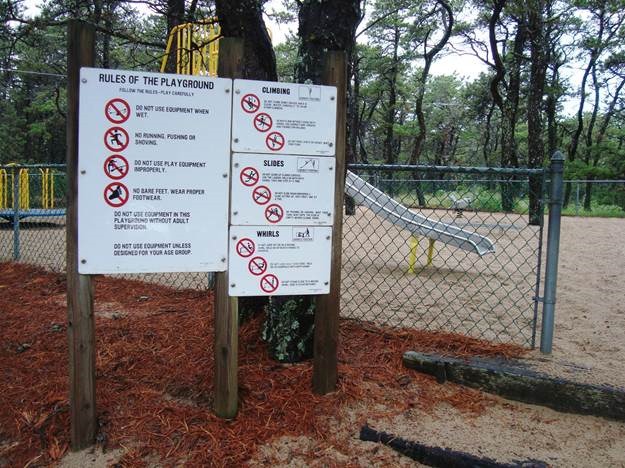
If you can’t read this, here are the rules that are posted on this sign.
Rules of the Playground
Follow the Rules – Play Carefully
Do not use equipment when wet
No running, Pushing or shoving
Do not use play equipment improperly
No bare feet, wear proper footwear
Do not use equipment in this playground without adult supervision
Do not use equipment unless designed for your age group
Climbing
Do not climb down unless area is clear. Watch Carefully to Avoid other climbers
Do not climb without using both hands. Use correct grip, fingers and thumbs for holding
Do not push, shove or crowd. Wait your turn
Slides
Do not climb up sliding surface
Do not slide down improperly. Slide sitting up, feet first one at a time
No pushing or shoving. Wait your turn. Wait until the slide is empty before sliding down
Whirls
Do not jump off or on a moving whirl. Hold on with both hands to handrail
Do not lean back over edge. Hold on to handrails with both hands
Do not stand close to a moving whirl. Keep a clear distance.
First of all, lets looks look at the individual rules.
Do not use play equipment improperly. What is improperly? What is improperly to a five-year-old?
No bare feet, wear proper footwear. No bare feet is easy. However, what is proper footwear? Wingtips, are Nike’s ok or do they have to be a specific brand?
Do not use equipment unless designed for your age group. What is my age group? Is the age group listed on the equipment? There is none listed on the sign.
Use correct grip, fingers and thumbs for holding. What is the correct grip? Am I allowed to wedge my hand into a crack? Should I be taped up before climbing? What if I don’t have some fingers or a thumb?
So some of these rules are absurd, even for adults. If an adult cannot understand the rules, how is a kid?
Rules as a hole?
Slides appeal to kids of all age groups. So unless you have reached the second or third grade (age 7-8?) you can’t read. You are walking along the street, see a playground and go running to the slide. Do you stop and stare at something you can’t understand?
Do you stare at something built at a height way above your head? Do you even slow down as you pass the sign? Do you really think that this is going to prevent a kid from getting hurt?
Seriously
Maybe a sign like this has some legal value, but I would think that anyone would blow that issue out of the water. How can you expect someone who cannot read to obey the rules.
If you really want to stop injuries, you better design your playground so that on one can get hurt. Or better, you figure that kids are going to figure a way to get hurt, no matter how low to the ground and how padded.
What do you think? Leave a comment.
If you like this let your friends know or post it on FB, Twitter or LinkedIn
Copyright 2013 Recreation Law (720) Edit Law
Email: Rec-law@recreation-law.com
Google+: +Recreation
Twitter: RecreationLaw
Facebook: Rec.Law.Now
Facebook Page: Outdoor Recreation & Adventure Travel Law
Mobile Site: http://m.recreation-law.com
By Recreation Law Rec-law@recreation-law.com James H. Moss #Authorrank
<rel=”author” link=” https://plus.google.com/u/0/b/112453188060350225356/” />
#RecreationLaw, #@RecreationLaw, #Cycling.Law #Fitness.Law, #Ski.Law, #Outside.Law, #Recreation.Law, #Recreation-Law.com, #Outdoor Law, #Recreation Law, #Outdoor Recreation Law, #Adventure Travel Law, #law, #Travel Law, #Jim Moss, #James H. Moss, #Attorney at Law, #Tourism, #Adventure Tourism, #Rec-Law, #Rec-Law Blog, #Recreation Law, #Recreation Law Blog, #Risk Management, #Human Powered, #Human Powered Recreation,# Cycling Law, #Bicycling Law, #Fitness Law, #Recreation-Law.com, #Backpacking, #Hiking, #Mountaineering, #Ice Climbing, #Rock Climbing, #Ropes Course, #Challenge Course, #Summer Camp, #Camps, #Youth Camps, #Skiing, #Ski Areas, #Negligence, #Snowboarding, #RecreationLaw, #@RecreationLaw, #Cycling.Law #Fitness.Law, #SkiLaw, #Outside.Law, #Recreation.Law, #RecreationLaw.com, #OutdoorLaw, #RecreationLaw, #OutdoorRecreationLaw, #AdventureTravelLaw, #Law, #TravelLaw, #JimMoss, #JamesHMoss, #AttorneyatLaw, #Tourism, #AdventureTourism, #RecLaw, #RecLawBlog, #RecreationLawBlog, #RiskManagement, #HumanPowered, #HumanPoweredRecreation,# CyclingLaw, #BicyclingLaw, #FitnessLaw, #RecreationLaw.com, #Backpacking, #Hiking, #Mountaineering, #IceClimbing, #RockClimbing, #RopesCourse, #ChallengeCourse, #SummerCamp, #Camps, #YouthCamps, #Skiing, #Ski Areas, #Negligence, #Snowboarding, sport and recreation laws, ski law, cycling law, Colorado law, law for recreation and sport managers, bicycling and the law, cycling and the law, ski helmet law, skiers code, skiing accidents, Recreation Lawyer, Ski Lawyer, Paddlesports Lawyer, Cycling Lawyer, Recreational Lawyer, Fitness Lawyer, Rec Lawyer, Challenge Course Lawyer, Ropes Course Lawyer, Zip Line Lawyer, Rock Climbing Lawyer, Adventure Travel Lawyer, Outside Lawyer, Recreation Lawyer, Ski Lawyer, Paddlesports Lawyer, Cycling Lawyer, #RecreationalLawyer, #FitnessLawyer, #RecLawyer, #ChallengeCourseLawyer, #RopesCourseLawyer, #ZipLineLawyer, #RockClimbingLawyer, #AdventureTravelLawyer, #OutsideLawyer, Playground, Sign, Signs, Rules, Slide, Whirl, Whirls
Parental control: should you, are you accepting responsibility for kids and when you should or can you not.
Posted: July 30, 2013 Filed under: Equine Activities (Horses, Donkeys, Mules) & Animals, Minors, Youth, Children | Tags: Acceptance of responsibility, Child, Children Youth and Family, Family, Minor, parent, Philanthropy, Volunteer, Westernaires, Youth Program 1 CommentOnce you accept responsibility, you are opening yourself up for any problem the minor may encounter.
This scenario came to me, and my reaction was the exact opposite of the person telling me about it.
Child is enrolled in a program. One parent enrolled the child. The other parent is making rules for how the child will act and what the child will wear (safety gear) while attending the program.
It is a community program, not away from home; it is something you drop your child off should participate in.
The one parent sends a letter to the program stating they expect the program to make sure the child wears the specific equipment. It is optional for all other participants to wear the specific equipment.
How the program responds will determine who is going to pay the child’s medical bills. Basically, the parent created a standard that if accepted by the program creates a duty upon the program.
My response.
I would have sent a letter to both parents that states:
It is your kid; we are not a babysitting service. If you want to make sure your child wears the gear, then you need to be here making sure your child is wearing the gear. You are allowed, in fact, encouraged to attend all practices, programs and meetings. If your child is here, you better be here too.
The other person’s response.
They’d better made sure the kid wears the gear.
The legal issue and concern?
The program is run by volunteers. One parent is saying to volunteers if you do not do what I say I am going to sue you if my child is hurt. The program has hundreds of kids, seriously hundreds of kids some nights, and a few volunteers, (when were there ever enough volunteers.)
The parent is making a duty that the program can either accept or not accept and if they do nothing they are accepting the standard created by the program. “I am not responsible for your child.”
Will this create a duty on the part of every other child in the program?
We are not legally responsible for your child; you are. (See A Parent (or Guardian) is still in control of a child, no matter what the volunteer may want, http://rec-law.us/zN0jcl). The program has no responsibility if the parent is present. Why accept the possibility that you cannot control a teenager and therefore, will get sued because of it?
Why Volunteer and Put Up with Crap like This!
What type of parent are you that you can’t take the time to spend time with your child but threaten litigation if your child gets hurt. “Here you take your time to take care of my kid and I’m going to sue you over it.”
Actually, I just would have thrown the kid out of the program. No program, run by volunteers for other people’s kids need this.
Kid programs are not where parents drop off kids and go on with their lives. Kid programs are where families work to help the community, and the kid to grow, learn and expand their horizons. Kids programs are not so parents get a break from their kids. Youth programs are for youth and that does not mean that those adults who take time away from their family should be subject to suit by parents who won’t take the time.
If you volunteer your time and someone who does not volunteer puts a burden on you to watch their kid how would you feel?
If you are volunteering your time, and some parent comes to you and says you have to do things this way, hand them the clipboard and whistle and walk away. It is not worth it.
Other articles about the legal issues of Volunteers:
Adult volunteer responsibility ends when the minor is delivered back to his parents. http://rec-law.us/yVBckK
A Parent (or Guardian) is still in control of a child, no matter what the volunteer may want. http://rec-law.us/zN0jcl
Adult volunteer responsibility ends when the minor is delivered back to his parents. http://rec-law.us/wynrnO
What do you think? Leave a comment.
If you like this let your friends know or post it on FB, Twitter or LinkedIn
Copyright 2013 Recreation Law (720) Edit Law
Email: Rec-law@recreation-law.com
Google+: +Recreation
Twitter: RecreationLaw
Facebook: Rec.Law.Now
Facebook Page: Outdoor Recreation & Adventure Travel Law
Mobile Site: http://m.recreation-law.com
By Recreation Law Rec-law@recreation-law.com James H. Moss #Authorrank
<rel=”author” link=” https://plus.google.com/u/0/b/112453188060350225356/” />
#RecreationLaw, #@RecreationLaw, #Cycling.Law #Fitness.Law, #Ski.Law, #Outside.Law, #Recreation.Law, #Recreation-Law.com, #Outdoor Law, #Recreation Law, #Outdoor Recreation Law, #Adventure Travel Law, #law, #Travel Law, #Jim Moss, #James H. Moss, #Attorney at Law, #Tourism, #Adventure Tourism, #Rec-Law, #Rec-Law Blog, #Recreation Law, #Recreation Law Blog, #Risk Management, #Human Powered, #Human Powered Recreation,# Cycling Law, #Bicycling Law, #Fitness Law, #Recreation-Law.com, #Backpacking, #Hiking, #Mountaineering, #Ice Climbing, #Rock Climbing, #Ropes Course, #Challenge Course, #Summer Camp, #Camps, #Youth Camps, #Skiing, #Ski Areas, #Negligence, #Snowboarding, #RecreationLaw, #@RecreationLaw, #Cycling.Law #Fitness.Law, #SkiLaw, #Outside.Law, #Recreation.Law, #RecreationLaw.com, #OutdoorLaw, #RecreationLaw, #OutdoorRecreationLaw, #AdventureTravelLaw, #Law, #TravelLaw, #JimMoss, #JamesHMoss, #AttorneyatLaw, #Tourism, #AdventureTourism, #RecLaw, #RecLawBlog, #RecreationLawBlog, #RiskManagement, #HumanPowered, #HumanPoweredRecreation,# CyclingLaw, #BicyclingLaw, #FitnessLaw, #RecreationLaw.com, #Backpacking, #Hiking, #Mountaineering, #IceClimbing, #RockClimbing, #RopesCourse, #ChallengeCourse, #SummerCamp, #Camps, #YouthCamps, #Skiing, #Ski Areas, #Negligence, #Snowboarding, sport and recreation laws, ski law, cycling law, Colorado law, law for recreation and sport managers, bicycling and the law, cycling and the law, ski helmet law, skiers code, skiing accidents, Recreation Lawyer, Ski Lawyer, Paddlesports Lawyer, Cycling Lawyer, Recreational Lawyer, Fitness Lawyer, Rec Lawyer, Challenge Course Lawyer, Ropes Course Lawyer, Zip Line Lawyer, Rock Climbing Lawyer, Adventure Travel Lawyer, Outside Lawyer, Recreation Lawyer, Ski Lawyer, Paddlesports Lawyer, Cycling Lawyer, #RecreationalLawyer, #FitnessLawyer, #RecLawyer, #ChallengeCourseLawyer, #RopesCourseLawyer, #ZipLineLawyer, #RockClimbingLawyer, #AdventureTravelLawyer, #OutsideLawyer, Westernaires, Youth Program, Volunteer, Parent, Minor,
WordPress Tags: Parental,Once,scenario,reaction,person,Child,gear,letter,equipment,participants,response,parents,fact,meetings,nights,Parent,Guardian,teenager,Volunteer,Crap,litigation,Here,families,horizons,Kids,Youth,adults,worth,Volunteers,Adult,Leave,Twitter,LinkedIn,Recreation,Edit,Email,Google,RecreationLaw,Facebook,Page,Outdoor,Adventure,Travel,Blog,Mobile,Site,James,Moss,Authorrank,author,Outside,Attorney,Tourism,Risk,Management,Human,Rock,Ropes,Course,Challenge,Summer,Camp,Camps,Areas,Negligence,SkiLaw,OutdoorLaw,OutdoorRecreationLaw,AdventureTravelLaw,TravelLaw,JimMoss,JamesHMoss,AttorneyatLaw,AdventureTourism,RecLaw,RecLawBlog,RecreationLawBlog,RiskManagement,HumanPoweredRecreation,CyclingLaw,BicyclingLaw,FitnessLaw,RopesCourse,ChallengeCourse,SummerCamp,YouthCamps,Colorado,managers,helmet,accidents,Lawyer,Paddlesports,Recreational,Line,RecreationalLawyer,FitnessLawyer,RecLawyer,ChallengeCourseLawyer,RopesCourseLawyer,ZipLineLawyer,RockClimbingLawyer,AdventureTravelLawyer,OutsideLawyer,Westernaires,Program,Minor,hundreds
Will New York entertain counterclaims for attorney fees and costs to a prevailing defendant?
Posted: July 29, 2013 Filed under: New York, Release (pre-injury contract not to sue), Skydiving, Paragliding, Hang gliding | Tags: assumption of the risk, Hang gliding, Negligence, New York, New York City, Paragliding, Plaintiff, Public Policy, Recreation, Release, Skydiving, Summary judgment, Tandem, Tandem Skydiving 3 CommentsUnderlying claim is dismissed for assumption of the risk. Falling out of the sky is obviously dangerous.
Plaintiff: Lisa Nutley
Defendant: SkyDive the Ranch
Plaintiff Claims: Negligence
Defendant Defenses: Release and Assumption of the risk, counterclaim for attorney fees based on the release
Holding: for the defendant on the claims based on assumption of the risk
This is an interesting case. To understand the case, I’ve also posted the trial court opinion leading to the appeal of this case.
The spouse of the plaintiff bought her a tandem sky dive as a gift. During the jump, the main shoot did not open. The reserve shoot did open. During the jump, the plaintiff broke her third and fourth fingers on her right hand. She sued for negligence.
The defendant filed a motion for summary judgment to dismiss the plaintiff’s claims based on the three releases she had signed and the video and instruction she had watched.
The trial court denied the motion for summary judgment (Nutley v. Skydive The Ranch, 22 Misc. 3d 1122(A); 881 N.Y.S.2d 365; 2009 N.Y. Misc. LEXIS 274; 2009 NY Slip Op 50223(U); 241 N.Y.L.J. 23) and the defendant appealed.
Summary of the case
The basis of the denial of the motion for summary judgment is a New York statute which prohibited the use of a release for recreational activities. New York General Obligations Law (“GOL”) §5-326. The lawsuit was dismissed because the trial court found the defendant operated a sky-diving facility as a recreational business. The Defendant had argued that it was an educational business which does not fall under §5-326.
The appellate court found the releases were void under the New York statute.
The appellate court found that the risks of the activity were fairly obvious, and the plaintiff had assumed the risk of her injuries.
Here, the risk of the main parachute failing to open during a tandem sky dive was perfectly obvious. Indeed, plaintiff was given a reserve parachute. Plaintiff failed to raise a triable issue of fact as to whether the injury-causing event resulted from defendant’s negligence, creating unique and dangerous conditions beyond those inherent in the sport
The court then went back to its decision on releases and found the language attempting to release the defendant for negligence was void; however, the rest of the release was still valid.
So much of the waiver and release signed by plaintiff as purports to exempt defendant from its own negligence is void under General Obligations Law § 5-326. Severance of that provision leaves the rest of the contract intact…
Part of one of the releases had included a clause that any suit required the plaintiff to pay the defendant’s damages of attorney fees and costs. The defendant filed a counterclaim against the plaintiff based upon this clause. The court did not rule on this issue finding that the trial court needed to look into whether this clause violated public policy as advanced by the statute that voids releases.
As to defendant’s counterclaims, however, we note that whether agreements not to sue a defendant and to pay its attorney’s fees and litigation costs might transgress the public policy of promoting recreational activities advanced by § 5-326 does not appear to have been considered by the courts.
The matter was sent back to the trial court to determine if the counterclaim for attorney fees and costs of the defendant violated New York Public policy and for any defenses the plaintiff may have to the defendant’s counterclaims.
So Now What?
The defendant lost on the defense of release, but won on the defense of assumption of the risk. The defendant might win on the opportunity to sue the plaintiff for attorney fees and costs in the assumption of risk agreements (since the releases are void).
This case appears to be fairly clear in its approach and decision. You can get hurt if you fall out of the sky. That is pretty obvious. Therefore, you assume the risk.
The argument about the sky-diving facility being an educational business rather than recreation is discussed in the trial court decision. That argument made by the defendant was based on Lemoine v Cornell University, 2 A.D.3d 1017; 769 N.Y.S.2d 313; 2003 N.Y. App. Div. LEXIS 13209 (NY 2003). In Lemoine, the university was subject to the statute which voids releases in New York, but because it was an educational organization and not one for recreation, the statute did not apply.
What is different is the issue that the court held out the possibility that a demand for attorney fees and costs to a prevailing defendant may be viable in New York.
Four years has passed since this decision, and no other cases have been reported. Consequently, as of this time we do not have a decision to rely upon for this issue.
Even if there is not a valid claim because it violates public policy, there are several other theories on how a defendant can recover attorney fees in situations like this that may survive.
What do you think? Leave a comment.
If you like this let your friends know or post it on FaceBook, Twitter or LinkedIn
Copyright 2013 Recreation Law (720) Edit Law
Email: Rec-law@recreation-law.com
Google+: +Recreation
Twitter: RecreationLaw
Facebook: Rec.Law.Now
Facebook Page: Outdoor Recreation & Adventure Travel Law
Blog: www.recreation-law.com
Mobile Site: http://m.recreation-law.com
By Recreation Law Rec-law@recreation-law.com James H. Moss #Authorrank
<rel=”author” link=” https://plus.google.com/u/0/b/112453188060350225356/” />
#RecreationLaw, #@RecreationLaw, #Cycling.Law #Fitness.Law, #Ski.Law, #Outside.Law, #Recreation.Law, #Recreation-Law.com, #Outdoor Law, #Recreation Law, #Outdoor Recreation Law, #Adventure Travel Law, #law, #Travel Law, #Jim Moss, #James H. Moss, #Attorney at Law, #Tourism, #Adventure Tourism, #Rec-Law, #Rec-Law Blog, #Recreation Law, #Recreation Law Blog, #Risk Management, #Human Powered, #Human Powered Recreation,# Cycling Law, #Bicycling Law, #Fitness Law, #Recreation-Law.com, #Backpacking, #Hiking, #Mountaineering, #Ice Climbing, #Rock Climbing, #Ropes Course, #Challenge Course, #Summer Camp, #Camps, #Youth Camps, #Skiing, #Ski Areas, #Negligence, #Snowboarding, #RecreationLaw, #@RecreationLaw, #Cycling.Law #Fitness.Law, #SkiLaw, #Outside.Law, #Recreation.Law, #RecreationLaw.com, #OutdoorLaw, #RecreationLaw, #OutdoorRecreationLaw, #AdventureTravelLaw, #Law, #TravelLaw, #JimMoss, #JamesHMoss, #AttorneyatLaw, #Tourism, #AdventureTourism, #RecLaw, #RecLawBlog, #RecreationLawBlog, #RiskManagement, #HumanPowered, #HumanPoweredRecreation,# CyclingLaw, #BicyclingLaw, #FitnessLaw, #RecreationLaw.com, #Backpacking, #Hiking, #Mountaineering, #IceClimbing, #RockClimbing, #RopesCourse, #ChallengeCourse, #SummerCamp, #Camps, #YouthCamps, #Skiing, #Ski Areas, #Negligence, #Snowboarding, sport and recreation laws, ski law, cycling law, Colorado law, law for recreation and sport managers, bicycling and the law, cycling and the law, ski helmet law, skiers code, skiing accidents, Recreation Lawyer, Ski Lawyer, Paddlesports Lawyer, Cycling Lawyer, Recreational Lawyer, Fitness Lawyer, Rec Lawyer, Challenge Course Lawyer, Ropes Course Lawyer, Zip Line Lawyer, Rock Climbing Lawyer, Adventure Travel Lawyer, Outside Lawyer, Recreation Lawyer, Ski Lawyer, Paddlesports Lawyer, Cycling Lawyer, #RecreationalLawyer, #FitnessLawyer, #RecLawyer, #ChallengeCourseLawyer, #RopesCourseLawyer, #ZipLineLawyer, #RockClimbingLawyer, #AdventureTravelLawyer, #OutsideLawyer, Skydiving, Release, Public Policy, Assumption of the Risk, Tandem, Tandem Skydiving,
WordPress Tags: York,attorney,defendant,assumption,Nutley,SkyDive,Ranch,Slip,LEXIS,Appel,Plaintiff,Lisa,Claims,Negligence,Defenses,Release,opinion,spouse,tandem,gift,fourth,judgment,instruction,Misc,Summary,basis,denial,statute,General,Obligations,lawsuit,injuries,Here,fact,injury,event,decision,waiver,Severance,provision,Part,clause,policy,agreements,litigation,Public,argument,recreation,Lemoine,Cornell,Four,theories,situations,Leave,FaceBook,Twitter,LinkedIn,Edit,Email,Google,RecreationLaw,Page,Outdoor,Adventure,Travel,Blog,Mobile,Site,James,Moss,Authorrank,author,Outside,Tourism,Risk,Management,Human,Rock,Ropes,Course,Challenge,Summer,Camp,Camps,Youth,Areas,SkiLaw,OutdoorLaw,OutdoorRecreationLaw,AdventureTravelLaw,TravelLaw,JimMoss,JamesHMoss,AttorneyatLaw,AdventureTourism,RecLaw,RecLawBlog,RecreationLawBlog,RiskManagement,HumanPoweredRecreation,CyclingLaw,BicyclingLaw,FitnessLaw,RopesCourse,ChallengeCourse,SummerCamp,YouthCamps,Colorado,managers,helmet,accidents,Lawyer,Paddlesports,Recreational,Line,RecreationalLawyer,FitnessLawyer,RecLawyer,ChallengeCourseLawyer,RopesCourseLawyer,ZipLineLawyer,RockClimbingLawyer,AdventureTravelLawyer,OutsideLawyer,counterclaims,counterclaim,appellate,whether,upon
Nutley v SkyDive the Ranch, 2009 NY Slip Op 6153; 883 N.Y.S.2d 530; 2009 N.Y. App. Div. LEXIS 5999 (N.Y. Appel. First 2009)
Posted: July 29, 2013 Filed under: Assumption of the Risk, Legal Case, New York, Release (pre-injury contract not to sue), Skydiving, Paragliding, Hang gliding | Tags: assumption of the risk, Public Policy, Release, Skydiving, Paragliding, Hang gliding, Tandem, Tandem Skydiving Leave a commentNutley v SkyDive the Ranch, 2009 NY Slip Op 6153; 883 N.Y.S.2d 530; 2009 N.Y. App. Div. LEXIS 5999 (N.Y. Appel. First 2009)
[*1] Lisa Nutley, Plaintiff-Respondent, v SkyDive the Ranch, Defendant-Appellant.
862, 108665/06
SUPREME COURT OF NEW YORK, APPELLATE DIVISION, FIRST DEPARTMENT
2009 NY Slip Op 6153; 883 N.Y.S.2d 530; 2009 N.Y. App. Div. LEXIS 5999
August 11, 2009, Decided
August 11, 2009, Entered
PRIOR HISTORY: Nutley v. Skydive The Ranch, 22 Misc. 3d 1122A, 881 N.Y.S.2d 365, 2009 N.Y. Misc. LEXIS 274 (2009)
CORE TERMS: counterclaim, summary judgment, sport, attorney’s fees, enter judgment, recreational activity, parachute, default
COUNSEL: [***1] The Law Offices of David M. Schreier, New York (Steven E. Kurtz of counsel), for appellant.
McMahon, Martine & Gallagher, LLP Brooklyn (Patrick W. Brody of counsel), for respondent.
JUDGES: Tom, J.P., Friedman, Catterson, Moskowitz, Richter, JJ.
OPINION
[**530] Order, Supreme Court, New York County (Martin Shulman, J.), entered January 28, 2009, which denied defendant’s motion for summary judgment dismissing the complaint and for a default judgment on its counterclaim for attorney’s fees and [**531] costs, unanimously modified, on the law, the motion granted to the extent of awarding defendant summary judgment, the complaint dismissed, and otherwise affirmed, without costs. The Clerk is directed to enter judgment accordingly. Plaintiff is directed to respond to defendant’s counterclaims within 60 days of the date of this order.
Defendant demonstrated prima facie entitlement to summary judgment on the doctrine of assumption of risk. Plaintiff was engaged in a sport or recreational activity, the commonly appreciated risks of which are inherent in, and arise out of, the nature of the sport generally and are consequent upon such participation (see e.g. Morgan v State of New York, 90 NY2d 471, 484, 685 N.E.2d 202, 662 N.Y.S.2d 421 [1997]). Here, the risk [***2] of the main parachute failing to open during a tandem sky dive was perfectly obvious. Indeed, plaintiff was given a reserve parachute. Plaintiff failed to raise a triable issue of fact as to whether the injury-causing event resulted from defendant’s negligence, creating unique and dangerous conditions beyond those inherent in the sport (id. at 485).
So much of the waiver and release signed by plaintiff as purports to exempt defendant from its own negligence is void under General Obligations Law § 5-326. Severance of that provision leaves the rest of the contract intact (see Caruso v Allnet Communication Servs., 242 AD2d 484, 485, 662 N.Y.S.2d 468 [1997]). As to defendant’s counterclaims, however, we note that whether agreements not to sue a defendant and to pay its attorney’s fees and litigation costs might transgress the public policy of promoting recreational activities advanced by § 5-326 does not appear to have been considered by the courts (cf. Ciofalo v Vic Tanney Gyms, 10 NY2d 294, 297, 177 N.E.2d 925, 220 N.Y.S.2d 962 [1961] [exculpatory clause not barred by “overriding public interest”]), the parties have not briefed the issue, and we do not reach it (see Brown v Christopher St. Owners Corp., 87 NY2d 938, 939, 663 N.E.2d 1251, 641 N.Y.S.2d 221 [1996]; Bacchiocchi v Ranch Parachute Club, 273 AD2d 173, 176, 710 N.Y.S.2d 54 [2000]). [***3] Defendant’s motion to enter judgment by default (CPLR 3215[c]) was appropriately denied in the exercise of discretion (cf. Charles F. Winsom Gems v D. Gumbiner, Inc., 85 A.D.2d 69, 71, 448 N.Y.S.2d 471 [1982], [*2] affd 57 NY2d 813, 441 N.E.2d 1118, 455 N.Y.S.2d 600 [1982]), and plaintiff should be afforded the opportunity to assert any defenses she might have to defendant’s counterclaims.
THIS CONSTITUTES THE DECISION AND ORDER OF THE SUPREME COURT, APPELLATE DIVISION, FIRST DEPARTMENT.
ENTERED: AUGUST 11, 2009
WordPress Tags: Nutley,SkyDive,Ranch,Slip,LEXIS,Appel,Lisa,Plaintiff,Respondent,Defendant,Appellant,SUPREME,COURT,YORK,APPELLATE,DIVISION,DEPARTMENT,August,PRIOR,HISTORY,Misc,TERMS,judgment,attorney,COUNSEL,Offices,David,Schreier,Steven,Kurtz,McMahon,Martine,Gallagher,Brooklyn,Patrick,Brody,JUDGES,Friedman,Catterson,Moskowitz,Richter,OPINION,Order,Martin,Shulman,January,complaint,extent,Clerk,entitlement,doctrine,assumption,participation,Morgan,State,Here,tandem,fact,injury,event,negligence,waiver,General,Obligations,Severance,provision,Caruso,Allnet,Communication,Servs,agreements,litigation,policy,Ciofalo,Tanney,Gyms,clause,Brown,Christopher,Owners,Corp,Bacchiocchi,Parachute,Club,CPLR,discretion,Charles,Winsom,Gems,Gumbiner,CONSTITUTES,DECISION,counterclaim,counterclaims,whether
Lawsuit over drowning of summer camper
Posted: July 26, 2013 Filed under: Summer Camp | Tags: Attorney at law, Bethel Community Church of Washougal, Camper, Experience the Valley Summer Camp, Harvest Community Church, Laurelwood Baptist Church of Vancouver, Lawsuit, Life Jacket, PFD, Recreation, Summer Camp, The Gateway Community Church of Washougal and Grace and Glory Community Church, Trinity Fellowship of Portland, Warehouse Christian Church Leave a commentLawsuit asking for $13 million for death of 15 year old boy.
I don’t know any more about this than what the article says and the articles are limited in their facts (and probably wrong.) The article states the teen drowned when he was encouraged to walk behind a waterfall and fell in.
A counselor also drowned who tried to save the camper. The issue is camper did not have a PFD (life jacket) on.
Along with the camp four churches are being sued.
The amount seems a little excessive. This is going to be an interesting lawsuit to follow.
See http://rec-law.us/17FVwkx and http://rec-law.us/1385oUH
What do you think? Leave a comment.
If you like this let your friends know or post it on FB, Twitter or LinkedIn
Copyright 2013 Recreation Law (720) Edit Law
Email: Rec-law@recreation-law.com
Google+: +Recreation
Twitter: RecreationLaw
Facebook: Rec.Law.Now
Facebook Page: Outdoor Recreation & Adventure Travel Law
Mobile Site: http://m.recreation-law.com
By Recreation Law Rec-law@recreation-law.com James H. Moss #Authorrank
<rel=”author” link=” https://plus.google.com/u/0/b/112453188060350225356/” />
#RecreationLaw, #@RecreationLaw, #Cycling.Law #Fitness.Law, #Ski.Law, #Outside.Law, #Recreation.Law, #Recreation-Law.com, #Outdoor Law, #Recreation Law, #Outdoor Recreation Law, #Adventure Travel Law, #law, #Travel Law, #Jim Moss, #James H. Moss, #Attorney at Law, #Tourism, #Adventure Tourism, #Rec-Law, #Rec-Law Blog, #Recreation Law, #Recreation Law Blog, #Risk Management, #Human Powered, #Human Powered Recreation,# Cycling Law, #Bicycling Law, #Fitness Law, #Recreation-Law.com, #Backpacking, #Hiking, #Mountaineering, #Ice Climbing, #Rock Climbing, #Ropes Course, #Challenge Course, #Summer Camp, #Camps, #Youth Camps, #Skiing, #Ski Areas, #Negligence, #Snowboarding, #RecreationLaw, #@RecreationLaw, #Cycling.Law #Fitness.Law, #SkiLaw, #Outside.Law, #Recreation.Law, #RecreationLaw.com, #OutdoorLaw, #RecreationLaw, #OutdoorRecreationLaw, #AdventureTravelLaw, #Law, #TravelLaw, #JimMoss, #JamesHMoss, #AttorneyatLaw, #Tourism, #AdventureTourism, #RecLaw, #RecLawBlog, #RecreationLawBlog, #RiskManagement, #HumanPowered, #HumanPoweredRecreation,# CyclingLaw, #BicyclingLaw, #FitnessLaw, #RecreationLaw.com, #Backpacking, #Hiking, #Mountaineering, #IceClimbing, #RockClimbing, #RopesCourse, #ChallengeCourse, #SummerCamp, #Camps, #YouthCamps, #Skiing, #Ski Areas, #Negligence, #Snowboarding, sport and recreation laws, ski law, cycling law, Colorado law, law for recreation and sport managers, bicycling and the law, cycling and the law, ski helmet law, skiers code, skiing accidents, Recreation Lawyer, Ski Lawyer, Paddlesports Lawyer, Cycling Lawyer, Recreational Lawyer, Fitness Lawyer, Rec Lawyer, Challenge Course Lawyer, Ropes Course Lawyer, Zip Line Lawyer, Rock Climbing Lawyer, Adventure Travel Lawyer, Outside Lawyer, Recreation Lawyer, Ski Lawyer, Paddlesports Lawyer, Cycling Lawyer, #RecreationalLawyer, #FitnessLawyer, #RecLawyer, #ChallengeCourseLawyer, #RopesCourseLawyer, #ZipLineLawyer, #RockClimbingLawyer, #AdventureTravelLawyer, #OutsideLawyer, Good Samaritan, Samaritan, First Aid, EMS, Emergency Medical Systems, Experience the Valley Summer Camp, Bethel Community Church of Washougal, Warehouse Christian Church, Harvest Community Church, Laurelwood Baptist Church of Vancouver, Trinity Fellowship of Portland, The Gateway Community Church of Washougal and Grace and Glory Community Church, Summer Camp, Camper, PFD, Life Jacket,
WordPress Tags: Lawsuit,camper,million,death,article,waterfall,counselor,life,jacket,Along,churches,Leave,Twitter,LinkedIn,Recreation,Edit,Email,Google,RecreationLaw,Facebook,Page,Outdoor,Adventure,Travel,Blog,Mobile,Site,James,Moss,Authorrank,author,Outside,Attorney,Tourism,Risk,Management,Human,Rock,Ropes,Course,Challenge,Summer,Camp,Camps,Youth,Areas,Negligence,SkiLaw,OutdoorLaw,OutdoorRecreationLaw,AdventureTravelLaw,TravelLaw,JimMoss,JamesHMoss,AttorneyatLaw,AdventureTourism,RecLaw,RecLawBlog,RecreationLawBlog,RiskManagement,HumanPoweredRecreation,CyclingLaw,BicyclingLaw,FitnessLaw,RopesCourse,ChallengeCourse,SummerCamp,YouthCamps,Colorado,managers,helmet,accidents,Lawyer,Paddlesports,Recreational,Line,RecreationalLawyer,FitnessLawyer,RecLawyer,ChallengeCourseLawyer,RopesCourseLawyer,ZipLineLawyer,RockClimbingLawyer,AdventureTravelLawyer,OutsideLawyer,Samaritan,Emergency,Medical,Systems,Experience,Valley,Bethel,Church,Washougal,Warehouse,Christian,Harvest,Laurelwood,Baptist,Vancouver,Fellowship,Portland,Gateway,Grace,Glory
Connecticut statute allows Camp Director to be personal liable for injuries of camper
Posted: July 22, 2013 Filed under: Connecticut, Minors, Youth, Children, Summer Camp | Tags: Camp, Camp Kenwood, Camp Moshava, Connecticut, Inc. dba Camp Kenwood, MAINE, Open and Obvious, Personal Liability, Recreation, Summerland Leave a commentConnecticut has been moving towards the defendant is liable no matter what attitude.
Wynne, Jr., v. Summerland, Inc., 2012 Conn. Super. LEXIS 2684 (Conn Super 2012)
Plaintiff: John F. Wynne, Jr., Administrator of the Estate of Hunter E. Brothers
Defendant: Summerland, Inc. dba Camp Kenwood, David B. Miskit and Sharon B. Miskit, Camp Directors
Plaintiff Claims: negligence
Defendant Defenses: individuals not personally liable and dangers were open and obvious to the plaintiff.
Holding: For the plaintiff, Connecticut statute creates personal liability for the camp directors and the open and obvious argument is a genuine issue of material fact to be determined by the jury.
Another case with good information, however, the case is probably not decided yet and the basis for the decision could be different than first reported.
The facts are spotty in this decision. The deceased was a thirteen-year-old girl attending the defendant Camp Kenwood. As part of the camp, the plaintiff was mountain biking on Bald Hill Road. The road gets steeper as it descends.
The camper was biking on the road and seems to have run off the road which caused her fatality. The administrator of her estate sued the camp and the camp directors individually.
Summary of the case
This appeal was of a denial of a motion for summary judgment. The motion looked at two issues. The first was the individual camp directors should not be personally liable for the plaintiff’s claims. The second was the case should be dismissed because the risks of the riding a bike on that road is open and obvious.
The individual liability issue was the first examined by the court. Connecticut has several statutes regulating summer camps for minors. One of those statutes C.G.S. §19a-422(c) states:
[T]here shall be adequate and competent staff, which includes the camp director or assistant director, one of whom shall be on site at all times the camp is in operation, activities specialists, counselors and maintenance personnel, of good character and reputation.
Another statute C.G.S. §19a-428(a) states:
“The Commissioner of Public Health shall adopt regulations, in accordance with the provisions of chapter 54, relating to the safe operation of youth camps, including, but not limited to, personnel qualifications for director and staff….
The regulations adopted by the Commissioner of Public Health, included Regs., Connecticut State Agencies §19-13-B27a which states:
(1) No person shall establish, conduct or maintain a youth camp without adequate and competent staff. (2) The camp director shall be over the age of twenty-one and of good character, shall not have been convicted of any offense involving moral turpitude, shall be certified as mentally competent by a physician, shall not use improperly any narcotic or controlled drug, and shall uphold and maintain the standards required under the Youth Camping Act. Except for those persons who have already served at least one summer as a camp director, a camp director shall have at least sixteen weeks administrative or supervisory experience, in an organized camp or in lieu thereof equivalent training or experience in camping satisfactory to the commissioner.
Responsibility of management. The camp director shall be responsible at all times for the health, comfort and safety of campers and staff and shall have responsibility for maintaining in good repair all sanitary appliances on the camp ground. He shall promptly prosecute or cause to be ejected from such ground any person who willfully or maliciously damages such appliances.
The plaintiffs argued that because the statutes and regulations created a duty on the part of the directors to care for the “health, comfort and safety of camps” any injury to a camper created personal liability on the part of the camp director.
The defendant argued that liability for actions of a corporation, which owned the camp, could not be imputed to an individual, which is the law in most jurisdictions. That is the argument normally made in this situation where the employee is only acting on behalf of the employer or corporation and as such the corporation has the liability. However, the statutory scheme of Connecticut eliminated that defense.
Consequently, the court easily found that the statutory and regulatory framework in Connecticut created personal liability on the camp director.
The Open and Obvious argument was easier for the court to decide. Even though two camp counselors had warned the deceased of the risks of the road, and the road’s risks were discernible to any rider, the court found that whether or not a thirteen-year-old camper recognized and understood the risks was a decision for a jury.
So Now What?
Part of any plan to develop a business must look at any statutes that apply to the business. At the same time, when the legislature is making laws that may apply to your business you need to become involved and make sure the laws will not make your business life miserable or create liability.
If the statutes or regulations create liability either for the organization, business or program which you do not want to deal with or personal liability, make sure you want to deal with that state. In the alternative make sure can afford the insurance you will need.
Here what could probably appear to be a harmless statute created personal liability for the camp director. Normally, this is a “play” made by the plaintiff to try to increase the value of the case.
However, one issue that should be explored by any camp or outfitter is if the insurance coverage of the corporation provides a defense to individuals for actions of the individual who create statutory liability.
Absent that protection, the individual defendants could be personally liable for any damages. Their homeowner’s insurance would not provide coverage for the liability that occurs because of work. Whether or not their corporate documents, articles and bylaws, provide for indemnification of employees or the board of directors is willing to pay for the damages, the employees could be stuck with the bill personally. Dependent upon how the damages are paid; this could also create a tax liability for the individuals. The final issue is whether the insurance policy provides coverage for employees liable individually.
Whenever you are dealing with kids 12-14 years of age and younger, it is fairly impossible to prove assumption of the risk or the sub-set defense of open and obvious. Unless you have a record of prior experience, a video proving the training, you are going to have a difficult time with this defense.
What do you think? Leave a comment.
If you like this let your friends know or post it on FaceBook, Twitter or LinkedIn
Copyright 2013 Recreation Law (720) Edit Law
Email: Rec-law@recreation-law.com
Google+: +Recreation
Twitter: RecreationLaw
Facebook: Rec.Law.Now
Facebook Page: Outdoor Recreation & Adventure Travel Law
Blog: www.recreation-law.com
Mobile Site: http://m.recreation-law.com
By Recreation Law Rec-law@recreation-law.com James H. Moss #Authorrank
<rel=”author” link=” https://plus.google.com/u/0/b/112453188060350225356/” />
#RecreationLaw, #@RecreationLaw, #Cycling.Law #Fitness.Law, #Ski.Law, #Outside.Law, #Recreation.Law, #Recreation-Law.com, #Outdoor Law, #Recreation Law, #Outdoor Recreation Law, #Adventure Travel Law, #law, #Travel Law, #Jim Moss, #James H. Moss, #Attorney at Law, #Tourism, #Adventure Tourism, #Rec-Law, #Rec-Law Blog, #Recreation Law, #Recreation Law Blog, #Risk Management, #Human Powered, #Human Powered Recreation,# Cycling Law, #Bicycling Law, #Fitness Law, #Recreation-Law.com, #Backpacking, #Hiking, #Mountaineering, #Ice Climbing, #Rock Climbing, #Ropes Course, #Challenge Course, #Summer Camp, #Camps, #Youth Camps, #Skiing, #Ski Areas, #Negligence, #Snowboarding, #RecreationLaw, #@RecreationLaw, #Cycling.Law #Fitness.Law, #SkiLaw, #Outside.Law, #Recreation.Law, #RecreationLaw.com, #OutdoorLaw, #RecreationLaw, #OutdoorRecreationLaw, #AdventureTravelLaw, #Law, #TravelLaw, #JimMoss, #JamesHMoss, #AttorneyatLaw, #Tourism, #AdventureTourism, #RecLaw, #RecLawBlog, #RecreationLawBlog, #RiskManagement, #HumanPowered, #HumanPoweredRecreation,# CyclingLaw, #BicyclingLaw, #FitnessLaw, #RecreationLaw.com, #Backpacking, #Hiking, #Mountaineering, #IceClimbing, #RockClimbing, #RopesCourse, #ChallengeCourse, #SummerCamp, #Camps, #YouthCamps, #Skiing, #Ski Areas, #Negligence, #Snowboarding, sport and recreation laws, ski law, cycling law, Colorado law, law for recreation and sport managers, bicycling and the law, cycling and the law, ski helmet law, skiers code, skiing accidents, Recreation Lawyer, Ski Lawyer, Paddlesports Lawyer, Cycling Lawyer, Recreational Lawyer, Fitness Lawyer, Rec Lawyer, Challenge Course Lawyer, Ropes Course Lawyer, Zip Line Lawyer, Rock Climbing Lawyer, Adventure Travel Lawyer, Outside Lawyer, Recreation Lawyer, Ski Lawyer, Paddlesports Lawyer, Cycling Lawyer, #RecreationalLawyer, #FitnessLawyer, #RecLawyer, #ChallengeCourseLawyer, #RopesCourseLawyer, #ZipLineLawyer, #RockClimbingLawyer, #AdventureTravelLawyer, #OutsideLawyer, Summerland, Inc. dba Camp Kenwood, Camp Kenwood, Summerland, Connecticut, Open and Obvious, Personal Liability,
WordPress Tags: Connecticut,statute,Camp,Director,injuries,camper,defendant,attitude,Wynne,Summerland,Conn,Super,LEXIS,Plaintiff,John,Administrator,Estate,Hunter,Brothers,Kenwood,David,Miskit,Sharon,Directors,Claims,negligence,Defenses,individuals,dangers,argument,fact,jury,Another,information,basis,decision,girl,mountain,Bald,Hill,Road,Summary,denial,judgment,bike,statutes,minors,specialists,counselors,maintenance,personnel,reputation,Commissioner,Public,Health,accordance,chapter,youth,qualifications,Regs,State,Agencies,person,turpitude,physician,narcotic,drug,Except,management,campers,appliances,plaintiffs,injury,corporation,jurisdictions,situation,employee,employer,framework,Open,Obvious,rider,Part,legislature,laws,life,insurance,Here,coverage,Absent,protection,defendants,homeowner,Whether,bylaws,employees,Dependent,policy,assumption,Leave,FaceBook,Twitter,LinkedIn,Recreation,Edit,Email,Google,RecreationLaw,Page,Outdoor,Adventure,Travel,Blog,Mobile,Site,James,Moss,Authorrank,author,Outside,Attorney,Tourism,Risk,Human,Rock,Ropes,Course,Challenge,Summer,Camps,Areas,SkiLaw,OutdoorLaw,OutdoorRecreationLaw,AdventureTravelLaw,TravelLaw,JimMoss,JamesHMoss,AttorneyatLaw,AdventureTourism,RecLaw,RecLawBlog,RecreationLawBlog,RiskManagement,HumanPoweredRecreation,CyclingLaw,BicyclingLaw,FitnessLaw,RopesCourse,ChallengeCourse,SummerCamp,YouthCamps,Colorado,managers,helmet,accidents,Lawyer,Paddlesports,Recreational,Line,RecreationalLawyer,FitnessLawyer,RecLawyer,ChallengeCourseLawyer,RopesCourseLawyer,ZipLineLawyer,RockClimbingLawyer,AdventureTravelLawyer,OutsideLawyer,Personal
Wynne, Jr., v. Summerland, Inc., 2012 Conn. Super. LEXIS 2684 (Conn Super 2012)
Posted: July 22, 2013 Filed under: Connecticut, Legal Case, Minors, Youth, Children, Summer Camp | Tags: Bicycling, Camp Director, Camp Kenwood, Connecticut, Cycling, Minor, statute, Summary judgment, Summer Camp, Summerland Leave a commentWynne, Jr., v. Summerland, Inc., 2012 Conn. Super. LEXIS 2684 (Conn Super 2012)
John F. Wynne, Jr., Administrator of the Estate of Hunter E. Brothers v. Summerland, Inc. dba Camp Kenwood et al.
LLICV095006358S
SUPERIOR COURT OF CONNECTICUT, JUDICIAL DISTRICT OF LITCHFIELD AT LITCHFIELD
2012 Conn. Super. LEXIS 2684
November 1, 2012, Decided
November 2, 2012, Filed
NOTICE: THIS DECISION IS UNREPORTED AND MAY BE SUBJECT TO FURTHER APPELLATE REVIEW. COUNSEL IS CAUTIONED TO MAKE AN INDEPENDENT DETERMINATION OF THE STATUS OF THIS CASE.
JUDGES: [*1] John W. Pickard, J.
OPINION BY: John W. Pickard
OPINION
MEMORANDUM OF DECISION
This is a wrongful death action arising out of the death of Hunter E. Brothers (“Brothers”), a thirteen-year-old camper at Camp KenWood, a summer youth camp in Kent, Connecticut. Brothers died while engaged in a mountain biking activity supervised by two counselors from the camp. The defendant, Summerland, Inc. d/b/a Camp KenWood operated the camp. The defendants, David B. Miskit and Sharon B. Miskit (“the Miskits”), are directors of Camp KenWood. All defendants have moved for summary judgment (#152). The plaintiff, John F. Wynne, Jr., Administrator of the Estate of Hunter E. Brothers, objects (#158). The court heard oral argument on September 17, 2012.
I. Personal Liability of David and Sharon Miskit
The first basis of the motion for summary judgment is stated by the defendants as follows: “There is no genuine issue of material fact that David Miskit and Sharon Miskit, as officers of a corporation, do not incur personal liability for the corporation’s torts merely because of their official position. There is no evidence of any independently tortious conduct on the part of either David or Sharon Miskit, nor is there any evidence [*2] that Summerland served merely as their alter ego. Thus, summary judgment should enter in favor of David Miskit and Sharon Miskit.”
Paragraph 30 of the third count of the plaintiff’s complaint is based on negligence and is directed against the Miskits as follows: “David Miskit, as President of Summerland, and David and Sharon Miskit, as Directors of Camp KenWood, owed a duty of care to Brothers, because Brothers was a minor child who was entrusted to the care of David and Sharon Miskit, and under Section 19-13-B27a(s) of the Regulations of Connecticut State Agencies, which provides as follows: ‘The camp director shall be responsible at all times for the health, comfort and safety of campers.'” Thus, David Miskit is sued as President of Summerland, Inc. and as a director of Camp Kenwood. Sharon Miskit is sued only as a director of Camp Kenwood.
The Miskits claim that there is no genuine issue of material fact that they do not incur personal liability for the corporations’ torts merely because of their official position. The plaintiff argues that the Miskits, as directors of Camp KenWood, owed Hunter a duty of care imposed by the statutes and regulations of the State of Connecticut. The [*3] plaintiff did not present a serious argument that David Miskit owed a duty of care to Brothers merely because he was the President of Summerland, Inc.
Before discussing the Miskits’ basis for summary judgment, it is necessary to distinguish between directors of corporations and directors of youth camps. [HN1] The position of director of a youth camp is one which is provided for in the statutes which regulate youth camps. C.G.S. §19a-422(c) provides: “[T]here shall be adequate and competent staff, which includes the camp director or assistant director, one of whom shall be on site at all times the camp is in operation, activities specialists, counselors and maintenance personnel, of good character and reputation.” C.G.S. §19a-428(a) provides that: “The Commissioner of Public Health shall adopt regulations, in accordance with the provisions of chapter 54, relating to the safe operation of youth camps, including, but not limited to, personnel qualifications for director and staff . . .”
The regulations adopted by the Commissioner of Public Health pertaining to youth camps are found in Regs., Connecticut State Agencies §19-13-B27a. Subsection (n) of that regulation provides, in part: [HN2] “(1) No person [*4] shall establish, conduct or maintain a youth camp without adequate and competent staff. (2) The camp director shall be over the age of twenty-one and of good character, shall not have been convicted of any offense involving moral turpitude, shall be certified as mentally competent by a physician, shall not use improperly any narcotic or controlled drug, and shall uphold and maintain the standards required under the Youth Camping Act. Except for those persons who have already served at least one summer as a camp director, a camp director shall have at least sixteen weeks administrative or supervisory experience, in an organized camp or in lieu thereof equivalent training or experience in camping satisfactory to the commissioner.” Subsection (s) of that regulation provides [HN3] “Responsibility of management. The camp director shall be responsible at all times for the health, comfort and safety of campers and staff and shall have responsibility for maintaining in good repair all sanitary appliances on the camp ground. He shall promptly prosecute or cause to be ejected from such ground any person who willfully or maliciously damages such appliances.”
[HN4] The statutory and regulatory scheme with [*5] respect to youth camps is clear that the director of a youth camp must be an individual, not a corporation. Also, the position of director of a youth camp is distinct from the position of director of the corporation which owns and operates the summer camp. A youth camp director is an employee and/or an agent of the camp when performing his or her duties. In summary, the director of a youth camp functions as the chief on-site official of the camp and is charged with certain responsibilities including to the safety of campers. Therefore, the statutes and regulations create a duty which the director owes to campers who attend the camp.
Turning to the first basis for summary judgment, the defendants are correct that David Miskit, as President of Summerland, Inc., cannot be liable for the negligence of the corporation absent evidence that he used the corporation as his alter ego. The plaintiff has not made the allegations which would be necessary to pierce the corporate veil. The real ground for the liability of the Miskits rests not on their status as directors or officers of Summerland, Inc., or on piercing the corporate veil, but upon their liability as directors of Camp KenWood.
The motion [*6] for summary judgment and the supporting brief never address the real ground of liability alleged by the plaintiff against the Miskits that as directors of Camp Kenwood they breached their statutory and regulatory duty to be responsible for the health, comfort and safety of the campers including Brothers. Instead, the defendants focus on whether the Miskits can be liable based upon their official capacities at Summerland, Inc. The last two sentences of the defendants’ brief on this point reads: “In short, David and Sharon Miskit have been named as party defendants merely because they are officers of Summerland, Inc. Officers of a corporation, however, do not incur personal liability for its torts merely because of their official position. Inasmuch as there is no evidence of any independently tortious conduct on the part of either David or Sharon Miskit, nor any evidence that Summerland served as their alter ego, they are entitled to summary judgment on all of the plaintiff’s claims.”
[HN5] The statutes and regulations of the State of Connecticut create a duty on the part of camp directors to care for the “health, comfort and safety of campers.” As co-directors of Camp KenWood, the Miskits [*7] are alleged to have breached this duty.1 The documentary evidence submitted by the plaintiff creates a genuine issue of material fact about whether, in fact, the Miskits breached their duty. ” [HN6] Practice Book §17-49 provides that summary judgment shall be rendered forthwith if the pleadings, affidavits and any other proof submitted show that there is no genuine issue as to any material fact and that the moving party is entitled to judgment as a matter of law. In deciding a motion for summary judgment, the trial court must view the evidence in the light most favorable to the nonmoving party.” (Internal quotation marks omitted.) Sherman v. Ronco, 294 Conn. 548, 553-54, 985 A.2d 1042 (2010).
1 In paragraph thirty-one of the third count the plaintiffs allege that David and Sharon Miskit breached their duty of care to Hunter through their negligence, in that:
a. They failed to adequately supervise and train Summerland employees with respect to the use of mountain bicycles by campers, CPR techniques and emergency first aid skills:
b. They failed to provide adequate instruction to Camp KenWood’s campers, including Brothers, in the safety precautions necessary for mountain bicycle trips over steep [*8] and uneven terrain, including but not limited to the negotiation or avoidance of dangerous hills and curves and the adequate securing of a helmet:
c. they failed to have a policy which pre-screened and approved appropriate areas for mountain bicycle riding for campers of various ages;
d. They failed to have a policy that prohibited Camp KenWood’s employees from taking young campers on off-camp premises mountain bicycle trips that were not safe for young children.”
II. Open and Obvious
The defendants’ second basis for summary judgment is that, because the geography of Bald Hill Road was an open and obvious condition, the defendants had no duty to warn Brothers about it. The defendants argue that, as a matter of law, the court should determine that there is clear and undisputed evidence that the risk of riding a bicycle down Bald Hill Road was so open and obvious to thirteen-year-old Brothers that it would negate any duty to warn on the part of the two counselors who were supervising her. In support of that proposition the defendants have presented the court with portions of deposition transcripts and other documents. They argue that the grade and contours of Bald Hill Road were easily observable [*9] by Brothers. Also, the two counselors testified that they stopped with Brothers at the top of Bald Hill Road and told her that the hill got steeper near the bottom and that she would need to control her speed with her brakes. Based upon this discussion, the defendants argue that Brothers was actually aware of the condition of the road. The defendants have cited the court to various cases in which courts have held that dangerous conditions were open and obvious as a matter of law.
The plaintiff argues that the issue of whether the condition of Bald Hill Road is open and obvious is a genuine question of fact which cannot be decided on a motion for summary judgment. I agree. The documentary evidence about Bald Hill Road presents a genuine issue of fact as to whether the steep part of Bald Hill Road can be seen from the top of the hill. Brothers had never been on Bald Hill Road. Whether the discussion she had with the counselors at the top of the hill was sufficient to alert her to the danger is a question of fact as well.
Furthermore, unlike most of the cases cited by the defendants, this is not a premises liability case. There are nine separate allegations of negligence directed against [*10] Summerland, Inc., only one of which relates to a failure to warn. The defendants have not addressed these other allegations of negligence in the motion for summary judgment.
III. Conclusion
For the reasons given above, the motion for summary judgment is denied.
BY THE COURT,
John W. Pickard
New Hampshire Skiers, Ski Area and Passenger Tramway Safety Act
Posted: July 22, 2013 Filed under: New Hampshire, Ski Area, Skiing / Snow Boarding, State | Tags: New Hampshire, New Hampshire Ski Area Safety Act, ski area, Ski Resort, Ski Safety Act, Skier, Snowboarder 2 CommentsNew Hampshire Skiers, Ski Area and Passenger Tramway Safety Act
NEW HAMPSHIRE REVISED STATUTES ANNOTATED
TITLE XIX Public Recreation
CHAPTER 225-A Skiers, Ski Area and Passenger Tramway Safety
Go To New Hampshire Statutes Archive Directory
225-A:1 Declaration of Policy. 3
225-A:1-a Administratively Attached. 5
225-A:3 Passenger Tramway Safety Board. 8
225-A:3-a Passenger Tramway Safety Board. 8
225-A:9 Declaratory Judgment. 12
225-A:9-a Declaratory Judgment. 12
225-A:10-a Review of Plans and Specifications. 13
225-A:11 Operator to Pay Certain Costs. 13
225-A:12 Inspection Reports. 13
225-A:14 Registration Required. 14
225-A:15 Application for Registration. 15
225-A:18-a Emergency Shut-Down. 17
225-A:19-a Operation Forbidden. 19
225-A:23 Responsibilities of the Ski Area Operator. 21
225-A:24 Responsibilities of Skiers and Passengers. 24
225-A:25 Insurance; Limitations. 29
225-A:1 Declaration of Policy.
The state of New Hampshire finds that the sports of skiing, snowboarding, snow tubing, and snowshoeing are practiced by a large number of citizens of the state of New Hampshire, and also that skiing, snowboarding, snow tubing, and snowshoeing attract to the state of New Hampshire large numbers of nonresidents significantly contributing to the economy of New Hampshire. Therefore, it shall be the policy of the state of New Hampshire to protect its citizens and visitors from unnecessary mechanical hazards in the operation of ski tows, lifts, nordic ski jumps and passenger tramways, to ensure that proper design and construction are used, that board accepted safety devices and sufficient personnel are provided for, and that periodic inspections and adjustments are made which are deemed essential to the safe operation of ski tows, ski lifts, nordic ski jumps and passenger tramways. The primary responsibility for operation, construction, maintenance and inspection rests with the operators of such passenger tramway devices. The state, through its passenger tramway safety board, as hereinafter provided, shall register all ski lift devices and nordic ski jumps, establish reasonable standards of design and operational practices, and make such independent inspections as may be necessary in carrying out this policy. Further, it shall be the policy of the state of New Hampshire to define the primary areas of responsibility of skiers and other users of alpine (downhill) and nordic (cross country and nordic ski jumps) areas, recognizing that the sport of skiing and other ski area activities involve risks and hazards which must be assumed as a matter of law by those engaging in such activities, regardless of all safety measures taken by the ski area operators.
225-A:1-a Administratively Attached.
The passenger tramway safety board shall be an administratively attached agency, under RSA 21-G:10, to the department of safety.
225-A:2 Definitions.
In this chapter:
“Board” means the passenger tramway safety board.
“Department” means the department of safety.
“Industry” means the activities of all those persons in the state who own or control the operation of ski areas.
“Nordic ski jump” means a facility constructed for the purpose of nordic ski jumping and built in accordance with appropriate standards and guidelines, and any facilities that are associated with the use or viewing of such a facility.
“Passenger” means any person, including skiers, while being transported or conveyed by a passenger tramway, or while waiting in the immediate vicinity for such transportation or conveyance, or while moving away from the disembarkation or unloading point of a passenger tramway to clear the way for the following passengers, or while in the act of boarding or embarking upon or disembarking from a passenger tramway.
“Passenger tramway” means a device used to transport passengers uphill on skis or other winter sports devices, or in cars on tracks or suspended in the air, by the use of steel cables, chains or belts or by ropes, and usually supported by trestles or towers with one or more spans. The term passenger tramway shall include the following:
Two-car aerial passenger tramway, a device used to transport passengers in 2 open or enclosed cars attached to, and suspended from, a moving wire rope, or attached to a moving wire rope and supported on a standing wire rope, or similar devices.
Multi-car aerial passenger tramway, a device used to transport passengers in open or enclosed cars attached to, and suspended from, a moving wire rope, or attached to a moving wire rope and supported on a standing wire rope, or similar devices.
“Conveyor” means a class of outdoor transportation wherein skiers or passengers are transported uphill on a flexible moving element such as a conveyor belt.
Chair lift, a type of transportation on which passengers are carried on chairs suspended in the air and attached to a moving cable, chain or link belt supported by trestles or towers with one or more spans, or similar devices.
J bar, T bar or platter pull, so-called, and similar types of devices are means of transportation which pull skiers riding on skis by means of an attachment to a main overhead cable supported by trestles or towers with one or more spans.
Rope tow, a type of transportation which pulls the skier riding on skis as the skier grasps the rope manually, or similar devices.
Wire rope tow means a type of transportation by which skiers are pulled on skis while manually gripping a handle attached to a wire hauling cable. The hauling cable is maintained at a constant height range between the loading and unloading points, and there is only one span with no intermediate towers.
“Ski area operator” means a person who owns or controls the operation of a ski area. The word “operator” shall include the state or any political subdivision. An operator of a passenger tramway shall be deemed not to be operating a common carrier. Ski area operator is included in the term “operator” as used in this chapter.
“Ski areas” means all passenger tramways and all designated alpine and nordic trails, slopes, freestyle terrain, tubing terrain, and nordic ski jumps under the control of the alpine and nordic ski area operator and any other areas under the operator’s control open to the public for winter sports recreation or competition.
“Skier” means a person utilizing the ski area under the control of a ski area operator for ski, snowboard, and snow tube recreation and competition.
“Tubing terrain” means areas designated for sliding on inflatable tubes or other similar devices down a prepared course or lanes at a ski area.
“Winter sports” means the use of skis, snowboards, snow tubes, snowshoes, and any device being utilized by a disabled or adaptive participant for winter recreation or competition.
225-A:3 Passenger Tramway Safety Board.
[Repealed 1987, 124:26, IV, eff. July 1, 1987.]
225-A:3-a Passenger Tramway Safety Board.
There shall be a passenger tramway safety board of 4 appointive members. The appointive members shall be appointed by the governor, with the advice and consent of the council, from persons representing the following interests: one member who operates a “surface lift” as described in RSA 225-A:2, I(e)-(g) only and one member from the cable and other passenger carrying devices industry, and in making such appointments consideration shall be given to recommendations made by members of the industry, so that both the devices which pull skiers riding on skis and the devices which transport passengers in cars or chairs shall have proper representation; one member to represent the public at large; and one member to represent insurance companies which engage in insuring passenger tramway operations, and in appointing such member consideration shall be given to recommendations made by such insurance companies. The authority of such board shall not extend to any other matter relative to the operation of a ski area.
225-A:4 Term of Office.
[Repealed 1987, 124:26, IV, eff. July 1, 1987.]
225-A:4-a Term of Office.
Of the first appointments under this section one member shall be appointed for a term of one year, one for a term of 2 years, one for a term of 3 years and one for a term of 4 years, and until their successors are appointed and qualified, and thereafter each of the appointed members shall be appointed for a term of 4 years and until his successor is appointed and qualified. Vacancies in the board shall be filled for the unexpired term.
225-A:5 Removal.
[Repealed 1987, 124:26, IV, eff. July 1, 1987.]
225-A:5-a Removal.
The appointive members of the board may only be removed from office as provided in RSA 4:1.
225-A:6 Compensation.
[Repealed 1987, 124:26, IV, eff. July 1, 1987.]
225-A:6-a Compensation.
The appointive members of the board shall serve without compensation, but shall be reimbursed for their reasonable expenses incurred in official duties.
225-A:7 Records.
[Repealed 1987, 124:26, IV, eff. July 1, 1987.]
225-A:7-a Records.
The department shall provide the board with such office and clerical assistance as may be necessary to carry on the work of the board, in accordance with RSA 225-A:1-a. The department shall also preserve the records, codes, inspection reports, and business records of the board.
225-A:8 Rulemaking.
The board with the approval of the commissioner of safety shall adopt, under RSA 541-A, rules after public hearing, relating to public safety in the construction, operation and maintenance of passenger tramways. The rules shall be in accordance with established standards, if any, and shall not be discriminatory in their application to operators of passenger tramways. The board shall also give notice of any public hearing under RSA 541-A for such rules by first class mail to each registered operator at least 14 days before the hearing.
225-A:9 Declaratory Judgment.
[Repealed 1987, 124:26, IV, eff. July 1, 1987.]
225-A:9-a Declaratory Judgment.
The validity or reasonableness of any rule adopted by the board may be judicially determined upon a petition to the superior court for declaratory judgment, brought within 30 days after the effective date of such rule. The court shall hear the petition and render a declaratory judgment only when it appears that the rule, or its threatened application, interferes with or impairs or threatens to interfere with or impair the legal rights and privileges of the petitioner. In rendering judgment the court shall give effect to any pertinent constitutional limitations upon the powers of the board, the limits of the authority and jurisdiction of the board as conferred under this chapter, and the procedural requirements of this chapter.
225-A:10 Inspections.
The department may make such inspection of the construction, operation and maintenance of passenger tramways as the board may reasonably require. The department may, at its own expense, employ other qualified engineers to make such inspections.
225-A:10-a Review of Plans and Specifications.
Prior to the construction of a new, or the alteration of an existing, passenger tramway, the operator or prospective operator shall submit plans and specifications to the department. The department may make recommendations relative to safety of the layout and equipment, but such recommendation shall not relieve the operator or prospective operator of his primary responsibility as set forth in RSA 225-A:1.
225-A:11 Operator to Pay Certain Costs.
[Repealed 1973, 52:5, eff. May 23, 1973.]
225-A:12 Inspection Reports.
If, as the result of an inspection, it is found that a violation of the board’s rules, regulations or code exists, or a condition in passenger tramway construction, operation or maintenance exists endangering the safety of the public, an immediate report shall be made to the board for appropriate investigation and order.
225-A:13 Complaints.
Any person may make written complaint to the board setting forth any thing or act claimed to be done or omitted to be done by any registered operator which is alleged to be in violation of any rule, regulation or code adopted by the board, or setting forth any condition in passenger tramway construction, operation or maintenance which is alleged to endanger the safety of the public. Thereupon the board shall cause a copy of said complaint to be forwarded to the registered operator complained of, which may be accompanied by an order requiring that the matters complained of be answered in writing within a time to be specified by the board. The board may investigate the matter complained of if it shall appear to the board that there are reasonable grounds therefor.
225-A:14 Registration Required.
No passenger tramway shall be operated in this state unless the operator thereof was registered by the board.
225-A:15 Application for Registration.
On or before November 1 of each year every operator of a passenger tramway shall apply to the board, on forms prepared by it, for registration hereunder. The application shall contain such information as the board may reasonably require.
225-A:16 Fees.
The application for registration shall be accompanied by the applicable annual fees to cover the costs of administering this chapter. The fees for registration shall be set by the board by rule adopted pursuant to RSA 541-A.
225-A:17 Registration.
The board, if satisfied with the facts stated in the application, shall issue a registration certificate to the operator. Each registration shall expire on October 31 next following the day of its issue.
225-A:18 Fees.
All fees collected by the board hereunder shall be credited to the special appropriation for the department to be expended for purposes of this chapter.
225-A:18-a Emergency Shut-Down.
When facts are presented to the board, or to any member thereof, tending to show that an unreasonable hazard exists in the continued operation of a tramway, the board or member, after such verification of said facts as is practical under the circumstances and consistent with the public safety, may, by an emergency order require the operator of said tramway forthwith to cease using the same for the transportation of passengers. Such emergency order shall be in writing and notice thereof may be served by any person upon the operator or his agent immediately in control of said tramway by a true and attested copy of such order, the return of such service to be shown by an affidavit on the back thereof. Such emergency order shall be effective for a period not to exceed 48 hours from the time of service. Immediately after the issuance of an emergency order hereunder, the board shall conduct an investigation into the facts of the case as contemplated in RSA 225-A:19, and shall take such action under said RSA 225-A:19 as may be appropriate.
225-A:19 Orders.
If, after investigation, the commissioner of safety or the board finds that a violation of any of the rules exists, or that there is a condition in passenger tramway construction, operation or maintenance endangering the safety of the public, either the commissioner of safety or the board shall forthwith issue a written order setting forth his or its findings, the corrective action to be taken, and fixing a reasonable time for compliance therewith. Such order shall be served upon the operator involved by registered mail, and shall become final, unless the operator shall apply to the board for a hearing in the manner hereinafter provided.
225-A:19-a Operation Forbidden.
If in any such case the commissioner of safety or the board is of the opinion that the public safety would be endangered by the use of the tramway for the transportation of passengers prior to the taking of some or all of such corrective action, he or it shall so state in said order, and shall require in said order that the tramway shall not be so used until specified corrective action shall have been taken. From and after receipt of the order by the operator said tramway shall not be used for the transportation of passengers without the approval of the commissioner of safety or the board. Application for a hearing before the board shall not have the effect of suspending said order. Operation of the tramway following receipt of such order may be enjoined by the superior court.
225-A:20 Hearing.
Any such operator, who is aggrieved by any such order, may, within 10 days after the service of such order upon him as hereinbefore provided, apply to the board for a review of such order. It shall be the duty of the board to hear the same at the earliest convenient day. At such hearing the operator shall have the right to be heard personally or by counsel, to cross-examine witnesses appearing against him, and to produce evidence in his own behalf. After such hearing, the board shall report its findings in writing to the commissioner of safety and make such order as the facts may require.
225-A:21 Appeal.
Any such operator, who is aggrieved by any such post-hearing order of the board, may, within 14 days after the entry thereof, appeal therefrom to the superior court. No such appeal shall suspend the operation of the order made by the board; provided that the superior court may suspend the order of the board pending the determination of such appeal whenever, in the opinion of the court, justice may require such suspension. The superior court shall hear such appeal at the earliest convenient day and shall make such decree as justice may require.
225-A:23 Responsibilities of the Ski Area Operator.
It shall be the responsibility of the operator to maintain the following signs and designations:
General Designations. The following color code is hereby established:
Green circle: On area’s easiest trails and slopes.
Black diamond: On area’s most difficult trails and slopes.
Blue square: On area’s trails and slopes that fall between the green circle and black diamond designation.
Yellow triangle with red exclamation point inside with a red band around the triangle: Extrahazardous.
Border around a black figure in the shape of a skier inside with a band running diagonally across the sign with the word “closed” beneath the emblem: Trail or slope closed.
Orange oval: On area’s designated freestyle terrain without respect to its degree of difficulty.
Base Area; Information to Skiers and Passengers. (a) A trail board shall be maintained at a prominent location listing the ski area’s network of ski trails, slopes, tubing terrain, and designated freestyle terrain in accordance with the aforementioned color code and containing a key to the code in accordance with the above designations; said trail board shall further designate which trails, slopes, and snow tube terrain are open or closed.
(b) The ski area operator shall warn skiers and passengers by use of the trail board, if applicable, that snow grooming or snow making operations are routinely in progress on the slopes and trails serviced by each tramway.
(c) A map shall be available at all ski areas to all skiers and passengers indicating the system of ski trails, slopes, tubing terrain, and designated freestyle terrain in accordance with the color code in paragraph I.
Ski Trails and Slopes; Information and Warning to Skiers and Other Persons. (a) The operator shall mark the beginning of each alpine and nordic ski trail or slope with the appropriate symbol for that particular trail’s or slope’s degree of difficulty in accordance with RSA 225-A:23, I.
(b) The beginning of each alpine ski trail or slope is defined as the highest point of the trail or slope. Lower trail junctions and intersections may be marked with a degree of difficulty symbol.
(c) The operator shall mark the beginning of, and designated access points to, each alpine trail or slope that is closed with a sign in accordance with RSA 225-A:23, I(e). For purposes of this subparagraph, “designated access points” means the beginning of a trail, slope, or any point where an open trail crosses or intersects the closed trail as shown on the ski area’s trail board and trail map.
(d) The operator shall mark the beginning of and designated access points to terrain with the appropriate symbol in accordance with RSA 225-A:23, I(f), which sign shall warn the skier that the use of the terrain is at the skier’s own risk. Further, a sign shall be placed at each lift depicting the symbols in RSA 225-A:23, I(a)-(f) describing the trail or slope that the skier may encounter by utilizing such lift.
Nordic Ski Jumps. The operator shall provide a sign in a prominent location at or near the nordic ski jump facility, which sign shall warn the ski jumper that the use of the nordic ski jump is entirely at the ski jumper’s own risk. Further, the ski area operator shall be responsible for the design, construction, and structural maintenance of all nordic ski jumps.
225-A:24 Responsibilities of Skiers and Passengers.
It is hereby recognized that, regardless of all safety measures which may be taken by the ski area operator, skiing, snowboarding, snow tubing, and snowshoeing as sports, and the use of passenger tramways associated therewith may be hazardous to the skiers or passengers. Therefore:
Each person who participates in the sport of skiing, snowboarding, snow tubing, and snowshoeing accepts as a matter of law, the dangers inherent in the sport, and to that extent may not maintain an action against the operator for any injuries which result from such inherent risks, dangers, or hazards. The categories of such risks, hazards, or dangers which the skier or passenger assumes as a matter of law include but are not limited to the following: variations in terrain, surface or subsurface snow or ice conditions; bare spots; rocks, trees, stumps and other forms of forest growth or debris; terrain, lift towers, and components thereof (all of the foregoing whether above or below snow surface); pole lines and plainly marked or visible snow making equipment; collisions with other skiers or other persons or with any of the categories included in this paragraph.
Each skier and passenger shall have the sole responsibility for knowing the range of his or her own ability to negotiate any slope, trail, terrain, or passenger tramway. Any passenger who boards such tramway shall be presumed to have sufficient knowledge, abilities, and physical dexterity to negotiate the lift, and no liability shall attach to any operator or attendant for failure to instruct persons on the use thereof.
Each skier or passenger shall conduct himself or herself, within the limits of his or her own ability, maintain control of his or her speed and course at all times both on the ground and in the air, while skiing, snowboarding, snow tubing, and snowshoeing heed all posted warnings, and refrain from acting in a manner which may cause or contribute to the injury of himself, herself, or others.
Each passenger shall be the sole judge of his ability to negotiate any uphill track, and no action shall be maintained against any operator by reason of the condition of said track unless the board, upon appropriate evidence furnished to it, makes a finding that the condition of the track, at the time and place of an accident, did not meet the board’s requirements, provided however, that the ski area operator shall have had notice, prior to the accident, of the board’s requirements the violation of which is claimed to be the basis for any action by the passenger.
No skier, passenger or other person shall:
Embark or disembark upon a passenger tramway except at designated areas.
Throw or drop any object while riding on a passenger tramway nor do any act or thing which shall interfere with the running of said tramway.
Engage in any type of conduct which will contribute to cause injury to any other person nor shall he willfully place any object in the uphill ski track which may cause another to fall, while riding in a passenger tramway.
Ski or otherwise use a slope or trail which has been designated “closed” by the operator without written permission of said operator or designee.
Remove, alter, deface or destroy any sign or notice placed in the ski area or on the trail board by the operator.
Cross the uphill track of a J bar, T bar, rope tow, wire rope, or similar device except at locations approved by the board.
Ski or otherwise access terrain outside open and designated ski trails and slopes or beyond ski area boundaries without written permission of said operator or designee.
225-A:25 Insurance; Limitations.
Unless an operator of a passenger tramway is in violation of this chapter or the rules of the board, which violation is causal of the injury complained of, no action shall lie against any operator by any passenger or his or her representative; this prohibition shall not, however, prevent the maintenance of an action against an operator for negligent operation, construction, or maintenance of the passenger tramway itself.
Except as limited by paragraph III, each operator of a passenger tramway shall maintain liability insurance with limits of not less than $300,000 per accident.
The requirements of paragraph II shall not apply to an operator of a passenger tramway which is not open to the general public and operated without charge to users. Nonprofit ski clubs, outing clubs, or other similar organizations, which are operators of rope or wire rope tows shall also be excepted from the requirements of paragraph II if the organization’s bylaws so provide, each member of the organization is provided with a copy of such bylaws, and use of the rope or wire rope tows operated by the organization is restricted to members of that organization. This paragraph shall not relieve the state or any political subdivision operating a rope or wire rope tow from the requirement of maintaining liability insurance in accordance with paragraph II.
No action shall be maintained against any operator for injuries to any skier or passenger unless the same is commenced within 2 years from the time of injury provided, however, that as a condition precedent thereof the operator shall be notified by certified return receipt mail within 90 days of said injury. The venue of any action against an operator shall be in the county where the ski area is located and not otherwise.
No ski area operator shall be held responsible for ensuring the safety of, or for damages including injury or death resulting to, skiers or other persons who utilize the facilities of a ski area to access terrain outside open and designated ski trails. Ski areas shall not be liable for damages, including injury or death, to persons who venture beyond such open and designated ski trails.
A ski area operator owes no duty to anyone who trespasses on the ski area property.
225-A:26 Penalty.
Any person convicted of operating a passenger tramway without having been registered by the board, or violating this chapter or rules of the board shall be guilty of a violation if a natural person, or guilty of a misdemeanor if any other person. Any operator who operates after his registration has been suspended by the board, shall be guilty of a violation for each day of illegal operation.
227:14 Reduced Rates.
All season passes, including those for different age groups or military service, established by the department for the specific use of the winter facilities at Cannon Mountain aerial tramway and ski area shall be made available to any resident of this state at a 25 percent discount. For the purposes of this section, “resident of this state” means a person whose domicile is in this state. To qualify for the discount, a resident shall provide proof of residency and purchase the pass prior to December 15 of the year in which the pass becomes effective. Proof of residency shall include a state issued driver’s license; a state issued I.D. card with a photograph or information including name, sex, date of birth, height, weight and color of eyes; a United States passport; an affidavit certifying residency from the municipal clerk of the purchasers’ town or city of residence; or, for a person less than 18 years of age, proof of a parent’s or guardian’s residency provided by the resident parent or guardian. The commissioner of the department of resources and economic development shall make quarterly reports on season passes issued under this section to the senate president, the speaker of the house of representatives, and the governor and council.
Nevada Skier Safety Act
Posted: July 22, 2013 Filed under: Nevada, Ski Area, Skiing / Snow Boarding | Tags: Law, Nevada, Nevada Skier Safety Act, Recreation and Sports, Ski, ski area, Ski Area Safety Act, Ski Resort, Skier, Snow, Snowboard, Snowboarder Leave a commentNevada Skier Safety Act
1.1 NEVADA REVISED STATUTES ANNOTATED
TITLE 40. Public Health And Safety.
CHAPTER 455A. Safety of Participants in Outdoor Sports.
Skiers and Snowboarders
GO TO NEVADA STATUTES ARCHIVE DIRECTORY
Nev. Rev. Stat. Ann. § 455A.023 (2012)
Table of Contents
455A.023. “Chair lift” defined. 3
455A.027. “Operator” defined. 3
455A.030. “Passenger” defined. 3
455A.083. “Snow recreation area” defined. 4
455A.085. “Snowboarder” defined. 5
455A.087. “Snowboarding” defined. 5
455A.090. “Surface lift” defined. 5
455A.110. Duties of skiers and snowboarders. 6
455A.130. Signs at chair lifts: Requirements; inspection. 7
455A.150. Illumination of signs at night. 8
455A.180. Revocation of license or privilege to engage in skiing or snowboarding. 10
455A.190. County, city or unincorporated town may enact ordinance not in conflict with chapter. 10
455A.010. Short title.
NRS 455A.010 to 455A.190, inclusive, may be cited as the Skier and Snowboarder Safety Act.
455A.020. Definitions.
As used in NRS 455A.010 to 455A.190, inclusive, unless the context otherwise requires, the words and terms defined in NRS 455A.023 to 455A.090, inclusive, have the meanings ascribed to them in those sections.
455A.023. “Chair lift” defined.
“Chair lift” means a device, except for an elevator, that carries, pulls or pushes a person along a level or inclined path to, from or within a snow recreation area by means of a rope, cable or other flexible element that is driven by an essentially stationary source of power.
455A.027. “Operator” defined.
“Operator” means a person, or a governmental agency or political subdivision of this State, who controls or operates an area where persons engage in skiing or snowboarding.
455A.030. “Passenger” defined.
“Passenger” means a person who utilizes a chair lift for transportation.
455A.035. “Patrol” defined.
“Patrol” means agents or employees of an operator who patrol the snow recreation area.
455A.040. Transferred.
NOTES: Editor’s note. This section is now compiled as 455A.083.
455A.050. Transferred.
NOTES: Editor’s note. This section is now compiled as 455A.023.
455A.060. Transferred.
NOTES: Editor’s note. This section is now compiled as 455A.035.
455A.070. “Skier” defined.
“Skier” means a person who engages in skiing in a snow recreation area.
455A.075. “Skiing” defined.
“Skiing” means the act of using skis to move across snow-covered ground.
455A.080. Transferred.
NOTES: Editor’s note. This section is now compiled as 455A.027.
455A.083. “Snow recreation area” defined.
“Snow recreation area” means the slopes, trails, runs and other areas under the control of an operator that are intended to be used for skiing, snowboarding or for the observation of the sports.
455A.085. “Snowboarder” defined.
“Snowboarder” means a person who engages in snowboarding in a snow recreation area.
455A.087. “Snowboarding” defined.
“Snowboarding” means the act of using a snowboard to move across snow-covered ground.
455A.090. “Surface lift” defined.
“Surface lift” means a chair lift designed for skiers or snowboarders to remain in contact with the ground or snowy surface during transportation.
455A.100. Prohibited acts while on chair lift; skiing or snowboarding in area posted as closed prohibited.
A skier or snowboarder shall not:
1. Embark upon a chair lift:
(a) When the skier or snowboarder knows that he or she has insufficient knowledge or physical ability to use the chair lift safely; or
(b) That is posted as closed or not in operation;
2. Purposefully embark upon or disembark from a chair lift except at an area designated for such a purpose or at the direction and under the direct supervision of an authorized agent or employee of an operator;
3. Toss, throw or cast or intentionally drop, expel or eject an object from a chair lift;
4. Toss, throw or cast an object in the direction of a chair lift;
5. Fail or refuse to comply with:
(a) Reasonable instructions given to the skier or snowboarder by an authorized agent or employee of an operator regarding the use of a chair lift; or
(b) A sign posted pursuant to NRS 455A.130 or 455A.140;
6. Place any object in the uphill path of a surface lift;
7. Conduct himself or herself in a manner that interferes with the safe operation of a chair lift or with the safety of a passenger, skier or snowboarder; or
8. Engage in skiing or snowboarding in an area within the snow recreation area which is posted, as provided in NRS 207.200, as closed.
455A.110. Duties of skiers and snowboarders.
A skier or snowboarder shall, to the extent that the matter is within his or her control:
1. Locate and ascertain the meaning of signs in the vicinity of the skier or snowboarder posted pursuant to NRS 455A.130 and 455A.140;
2. Heed warnings and other information posted by an operator;
3. Remain a safe distance from vehicles, signs and equipment for grooming snow or for transportation;
4. Avoid skiers or snowboarders in motion when entering a slope, run or trail, and when commencing to engage in skiing or snowboarding from a stationary position;
5. Maintain a proper lookout and control of his or her speed to avoid downhill objects, skiers and snowboarders to the best of his or her ability; and
6. Conduct himself or herself in such a manner as to avoid injury to persons and property in a snow recreation area.
455A.120. Prohibited acts.
A skier or snowboarder shall not:
1. Use a ski or snowboard unless it is attached to the skier or snowboarder by a strap or equipped with a device capable of stopping the movement of the ski or snowboard when not attached to the skier or snowboarder;
2. Cross the uphill path of a surface lift except at locations designated by an operator; or
3. Willfully stop where the skier or snowboarder obstructs a slope, run or trail, or where he or she is not safely visible to uphill skiers or snowboarders.
455A.130. Signs at chair lifts: Requirements; inspection.
1. An operator shall prominently post and maintain signs in simple and concise language:
(a) By each chair lift, with information for the protection and instruction of passengers; and
(b) At or near the points where passengers are loaded on a chair lift, directing persons who are not familiar with the operation of the chair lift to ask an authorized agent or employee of the operator for assistance and instruction.
2. An operator shall prominently post and maintain signs with the following inscriptions at all chair lifts in the locations indicated:
(a) “Remove pole straps from wrists” at an area for loading skiers;
(b) “Safety gate” where applicable;
(c) “Stay on tracks” where applicable;
(d) “Keep ski tips or snowboard up” ahead of any point where a ski or snowboard can regain contact with the ground or snowy surface after a passenger departs from an area for loading skiers or snowboarders;
(e) “Prepare to unload” and “check for loose clothing and equipment” not less than 50 feet from an area for unloading skiers or snowboarders; and
(f) “Unload here” at an area for unloading skiers or snowboarders.
3. An operator shall inspect a snow recreation area for the presence and visibility of the signs required to be posted by this section each day before opening the snow recreation area for business.
455A.140. Slopes, runs and trails: System of signs required; vehicles used by operator to be equipped with light.
1. An operator shall post and maintain a system of signs:
(a) At the entrances to an established slope, run or trail to indicate:
(1) Whether any portion of the slope, run or trail is closed; and
(2) The relative degree of difficulty of the slope, run or trail;
(b) To indicate the boundary of the snow recreation area, except in heavily wooded areas or other terrain that cannot be skied or snowboarded readily; and
(c) To warn of each area within the boundary of the snow recreation area where there is a danger of avalanche by posting signs stating “Warning: Avalanche Danger Area.”
2. An operator shall equip vehicles it uses on or in the vicinity of a slope, run or trail with a light visible to skiers or snowboarders when the vehicle is in motion.
455A.150. Illumination of signs at night.
A sign required to be posted pursuant to NRS 455A.130; and 455A.140 must be adequately illuminated at night, if the snow recreation area is open to the public at night, and be readable and recognizable under ordinary conditions of visibility.
455A.160. Skiers and snowboarders to notify operator or patrol of injury; limitation on liability of operator; duty of operator to minimize dangers.
1. A skier or snowboarder who sustains a personal injury shall notify the operator or a member of the patrol of the injury as soon as reasonably possible after discovery of the injury.
2. An operator is not liable for the death or injury of a person or damages to property caused or sustained by a skier or snowboarder who knowingly enters an area which is not designated for skiing or snowboarding or which is outside the boundary of a snow recreation area.
3. An operator shall take reasonable steps to minimize dangers and conditions within the operator’s control.
455A.170. Prohibition against intoxication and use of controlled substances; duty to provide name and address to person injured in collision; penalty.
1. A skier or snowboarder shall not engage in skiing or snowboarding, or embark on a chair lift that is proceeding predominantly uphill, while intoxicated or under the influence of a controlled substance as defined in chapter 453 of NRS unless in accordance with a lawfully issued prescription.
2. A skier or snowboarder who is involved in a collision in which another person is injured shall provide his or her name and current address to the injured person, the operator or a member of the patrol:
(a) Before the skier or snowboarder leaves the vicinity of the collision; or
(b) As soon as reasonably possible after leaving the vicinity of the collision to secure aid for the injured person.
3. A person who violates a provision of this section is guilty of a misdemeanor.
455A.180. Revocation of license or privilege to engage in skiing or snowboarding.
An operator may revoke the license or privilege of a person to engage in skiing or snowboarding in a snow recreation area if the person violates any provision of NRS 455A.100, 455A.110, 455A.120 or 455A.170.
455A.190. County, city or unincorporated town may enact ordinance not in conflict with chapter.
The provisions of NRS 455A.010 to 455A.190, inclusive, do not prohibit a county, city or unincorporated town from enacting an ordinance, not in conflict with the provisions of NRS 455A.010 to 455A.190, inclusive, regulating skiers, snowboarders or operators.
Idaho Ski Safety Act
Posted: July 22, 2013 Filed under: Idaho, Skiing / Snow Boarding | Tags: Alpine skiing, Idaho, Idaho Ski Safety Act, Outdoors, Recreation, Ski, ski area, Ski Resort, Ski Safety Act, Skier, Snowboarder Leave a commentIdaho Ski Safety Act
IDAHO CODE
CODE OF CIVIL PROCEDURE
TITLE 6. ACTIONS IN PARTICULAR CASES
CHAPTER 11. RESPONSIBILITIES AND LIABILITIES OF SKIERS AND SKI AREA OPERATORS
Go to the Idaho Code Archive Directory
Idaho Code § 6-1101 (2012)
§ 6-1101. Legislative purpose
The legislature finds that the sport of skiing is practiced by a large number of citizens of this state and also attracts a large number of nonresidents, significantly contributing to the economy of Idaho. Since it is recognized that there are inherent risks in the sport of skiing which should be understood by each skier and which are essentially impossible to eliminate by the ski area operation, it is the purpose of this chapter to define those areas of responsibility and affirmative acts for which ski area operators shall be liable for loss, damage or injury, and to define those risks which the skier expressly assumes and for which there can be no recovery.
HISTORY: I.C., § 6-1101, as added by 1979, ch. 270, § 1, p. 701.
NOTES:
ANALYSIS
When the legislature stated the legislative purpose of this chapter, it included the statement that “the sport of skiing is practiced by a large number of citizens of this state and also attracts a large number of nonresidents, significantly contributing to the economy of Idaho,” and since this was a legitimate legislative goal and satisfies the rational basis test, this chapter does not violate the equal protection clause of the constitution. Northcutt v. Sun Valley Co., 117 Idaho 351, 787 P.2d 1159 (1990).
In enacting this chapter, the legislature intended to limit rather than expand the liability of ski area operators. Northcutt v. Sun Valley Co., 117 Idaho 351, 787 P.2d 1159 (1990).
The government of Idaho clearly has a legitimate interest in promoting the sport of skiing, because the sport “significantly contribut[es] to the economy of Idaho.” This chapter bears a rational relationship to this interest because it clarifies the allocation of risks and responsibilities between ski area operators and skiers. Collins v. Schweitzer, Inc., 21 F.3d 1491 (9th Cir.), cert. denied, 513 U.S. 962, 115 S. Ct. 422, 130 L. Ed. 2d 337 (1994).
This chapter immunizes ski area operators only from liability arising from risks inherent in the sport of skiing. Northcutt v. Sun Valley Co., 117 Idaho 351, 787 P.2d 1159 (1990).
CITED IN: Kirkland ex rel. Kirkland v. Blain County Med. Ctr., 134 Idaho 464, 4 P.3d 1115 (2000).
§ 6-1102. Definitions
The following words and phrases when used in this chapter shall have, unless the context clearly indicates otherwise, the meanings given to them in this section.
(1) “Aerial passenger tramway” means any device operated by a ski area operator used to transport passengers, by single or double reversible tramway; chair lift or gondola lift; T-bar lift, J-bar lift, platter lift or similar device; or a fiber rope tow, which is subject to regulations adopted by the proper authority.
(2) “Passenger” means any person who is lawfully using an aerial passenger tramway, or is waiting to embark or has recently disembarked from an aerial passenger tramway and is in its immediate vicinity.
(3) “Ski area” means the property owned or leased and under the control of the ski area operator within the state of Idaho.
(4) “Ski area operator” means any person, partnership, corporation or other commercial entity and their agents, officers, employees or representatives, who has operational responsibility for any ski area or aerial passenger tramway.
(5) “Skiing area” means all designated slopes and trails but excludes any aerial passenger tramway.
(6) “Skier” means any person present at a skiing area under the control of a ski area operator for the purpose of engaging in the sport of skiing by utilizing the ski slopes and trails and does not include the use of an aerial passenger tramway.
(7) “Ski slopes and trails” mean those areas designated by the ski area operator to be used by skiers for the purpose of participating in the sport of skiing.
HISTORY: I.C., § 6-1102, as added by 1979, ch. 270, § 1, p. 701.
NOTES:
§ 6-1103. Duties of ski area operators with respect to ski areas
Every ski area operator shall have the following duties with respect to their operation of a skiing area:
(1) To mark all trail maintenance vehicles and to furnish such vehicles with flashing or rotating lights which shall be in operation whenever the vehicles are working or are in movement in the skiing area;
(2) To mark with a visible sign or other warning implement the location of any hydrant or similar equipment used in snowmaking operations and located on ski slopes and trails;
(3) To mark conspicuously the top or entrance to each slope or trail or area, with an appropriate symbol for its relative degree of difficulty; and those slopes, trails, or areas which are closed, shall be so marked at the top or entrance;
(4) To maintain one or more trail boards at prominent locations at each ski area displaying that area’s network of ski trails and slopes with each trail and slope rated thereon as to it [its] relative degree of difficulty;
(5) To designate by trail board or otherwise which trails or slopes are open or closed;
(6) To place, or cause to be placed, whenever snowgrooming or snowmaking operations are being undertaken upon any trail or slope while such trail or slope is open to the public, a conspicuous notice to that effect at or near the top of such trail or slope;
(7) To post notice of the requirements of this chapter concerning the use of ski retention devices. This obligation shall be the sole requirement imposed upon the ski area operator regarding the requirement for or use of ski retention devices;
(8) To provide a ski patrol with qualifications meeting the standards of the national ski patrol system;
(9) To post a sign at the bottom of all aerial passenger tramways which advises the passengers to seek advice if not familiar with riding the aerial passenger tramway; and
(10) Not to intentionally or negligently cause injury to any person; provided, that except for the duties of the operator set forth in subsections (1) through (9) of this section and in section 6-1104, Idaho Code, the operator shall have no duty to eliminate, alter, control or lessen the risks inherent in the sport of skiing, which risks include but are not limited to those described in section 6-1106, Idaho Code; and, that no activities undertaken by the operator in an attempt to eliminate, alter, control or lessen such risks shall be deemed to impose on the operator any duty to accomplish such activities to any standard of care.
HISTORY: I.C., § 6-1103, as added by 1979, ch. 270, § 1, p. 701.
NOTES: COMPILER’S NOTES. The national ski patrol provides training and education programs for emergency rescuers serving the outdoor recreation community. See http://www.nsp.org.
The bracketed word “its” in subsection (4) was inserted by the compiler.
When a skier ignores the ski area’s instructions to ski only on designated trails and embarks on an enterprise too difficult for someone of his ability, the ski area is not liable for his mishaps. Long v. Bogus Basin Recreational Ass’n, 125 Idaho 230, 869 P.2d 230 (1994).
Under this chapter, a ski area operator is not liable for the improper placement of a sign erected to eliminate, alter, control or lessen the inherent risks in skiing or for the improper design, construction or padding of a signpost that supported the sign. Northcutt v. Sun Valley Co., 117 Idaho 351, 787 P.2d 1159 (1990).
In personal injury action by skier injured when she tripped over a rope intended to guide people away from the exit ramp of a chair lift, summary judgment was properly granted to ski resort, as the rope was intended to eliminate, alter, control, or lessen the inherent risk of skiing. The accident was not caused by the construction, operation, maintenance or repair of the chairlift. Withers v. Bogus Basin Rec. Ass’n, 144 Idaho 78, 156 P.3d 579 (2007).
Setting up a NASTAR race course is a normal part of running a ski area, and thus, anything a ski area does to eliminate or lessen the inherent risks of skiing in connection with setting up the race course or protecting skiers from hazardous obstacles cannot be the basis of liability for negligence. Collins v. Schweitzer, Inc., 774 F. Supp. 1253 (D. Idaho 1991), aff’d, 21 F.3d 1491 (9th Cir.), cert. denied, 513 U.S. 962, 115 S. Ct. 422, 130 L. Ed. 2d 337 (1994).
Under § 6-1106, anyone who strikes a ski lift tower while skiing is considered to have expressly assumed the risk and legal responsibility for any injury which results, and in addition, under subsection (10) of this section, anything a ski area operator does to eliminate, alter, control or lessen the risks associated with lift towers — such as placing a fence around a tower or padding it — could not result in the operator being held liable for negligence. Collins v. Schweitzer, Inc., 774 F. Supp. 1253 (D. Idaho 1991), aff’d, 21 F.3d 1491 (9th Cir.), cert. denied, 513 U.S. 962, 115 S. Ct. 422, 130 L. Ed. 2d 337 (1994).
Ski area operator owed amateur race skier no duty to reduce the risk of his striking and injuring himself on a lift tower. Collins v. Schweitzer, Inc., 21 F.3d 1491 (9th Cir.), cert. denied, 513 U.S. 962, 115 S. Ct. 422, 130 L. Ed. 2d 337 (1994).
If a ski area operator has no duty to accomplish any activity undertaken in an attempt to eliminate, alter, control or lessen the inherent risks of skiing and if the duties described in this section and § 6-1104 are the only duties an operator has with regard to the inherent risks of skiing, then it necessarily follows that any activity of an operator to fulfill those duties may not be held to be negligence, since the operator had no duty to accomplish the activity to any standard of care. Northcutt v. Sun Valley Co., 117 Idaho 351, 787 P.2d 1159 (1990).
A ski area operator’s duty not to negligently cause injury refers to the failure to follow (1) any of the duties set forth in this section and § 6-1104 or (2) any duty that does not relate to eliminating, altering, controlling or lessening the inherent risks of skiing. Northcutt v. Sun Valley Co., 117 Idaho 351, 787 P.2d 1159 (1990).
While one of the duties imposed on ski area operators by this section is to mark conspicuously the top or entrance to each slope or trail or area, with an appropriate symbol for its relative degree of difficulty, even assuming that a ski area operator may not have properly located a sign or properly designed, constructed or padded the signpost, this chapter excludes any liability of ski area operator to the plaintiffs as a result of these activities; while subdivision (3) of this section did require ski area operator to mark the entrance to each of its slopes, trails or areas, subsection (10) of this section negates any duty to accomplish this marking to any standard of care. Northcutt v. Sun Valley Co., 117 Idaho 351, 787 P.2d 1159 (1990).
The duties described in this section and § 6-1104 are the only duties a ski area operator has with respect to the inherent risks of skiing and even anything an operator does to fulfill those duties cannot be held to be negligence because the operator had no duty to accomplish the activity to any standard of care, and in addition, anything else a ski area operator does to attempt to lessen the inherent risks of skiing cannot result in liability for negligence for that action. Collins v. Schweitzer, Inc., 774 F. Supp. 1253 (D. Idaho 1991), aff’d, 21 F.3d 1491 (9th Cir.), cert. denied, 513 U.S. 962, 115 S. Ct. 422, 130 L. Ed. 2d 337 (1994).
In conducting training sessions, the defendant foundation did not have the responsibility to fulfill the duties under this section; the mere fact that the defendant foundation set up the course within the ski area did not make them a “ski operator.” By setting up the course the defendant foundation was not engaged in any duties or activities of a “ski area operator.” By making use of the ski area for training, defendant foundation did not exercise “operational responsibility” for the ski area, and the court correctly denied defendant’s summary judgment on that basis. Davis v. Sun Valley Ski Educ. Found., Inc., 130 Idaho 400, 941 P.2d 1301 (1997).
A ski area operator does not have the duty to provide a ski patrol that will determine the identity of a skier who was involved in a ski accident with another skier. Northcutt v. Sun Valley Co., 117 Idaho 351, 787 P.2d 1159 (1990).
An injury to the body caused by falling while skiing in an unmarked, ungroomed area is an inherent risk of skiing and a ski resort had no duty to take some kind of affirmative steps to have prevented skier from being injured. Long v. Bogus Basin Recreational Ass’n, 125 Idaho 230, 869 P.2d 230 (1994).
§ 6-1104. Duties of ski area operators with respect to aerial passenger tramways
Every ski area operator shall have the duty to construct, operate, maintain and repair any aerial passenger tramway in accordance with the American national standards safety requirements for aerial passenger tramways.
HISTORY: I.C., § 6-1104, as added by 1979, ch. 270, § 1, p. 701.
NOTES: COMPILER’S NOTES. The American national standards institute’s current publication covering tramway safety is ANSI B77.1-2006, “Passenger Ropeway & Aerial Tramways, Aerial Lifts, Surface Lifts, Tows and Conveyors — Safety Requirement.”
ANALYSIS
In personal injury action by skier injured when she tripped over a rope intended to guide people away from the exit ramp of a chair lift, summary judgment was properly granted to ski resort, as the rope was intended to eliminate, alter, control, or lessen the inherent risk of skiing. The accident was not caused by the construction, operation, maintenance or repair of the chairlift. Withers v. Bogus Basin Rec. Ass’n, 144 Idaho 78, 156 P.3d 579 (2007).
If a ski area operator has no duty to accomplish any activity undertaken in an attempt to eliminate, alter, control or lessen the inherent risks of skiing and if the duties described in § 6-1103 and this section are the only duties an operator has with regard to the inherent risks of skiing, then it necessarily follows that any activity of an operator to fulfill those duties may not be held to be negligence, since the operator had no duty to accomplish the activity to any standard of care. Northcutt v. Sun Valley Co., 117 Idaho 351, 787 P.2d 1159 (1990).
A ski area operator’s duty not to negligently cause injury refers to the failure to follow (1) any of the duties set forth in § 6-1103 and this section or (2) any duty that does not relate to eliminating, altering, controlling or lessening the inherent risks of skiing. Northcutt v. Sun Valley Co., 117 Idaho 351, 787 P.2d 1159 (1990).
The duties described in § 6-1103 and this section are the only duties a ski area operator has with respect to the inherent risks of skiing and even anything an operator does to fulfill those duties cannot be held to be negligence because the operator had no duty to accomplish the activity to any standard of care; in addition, anything else a ski area operator does to attempt to lessen the inherent risks of skiing cannot result in liability for negligence for that action. Collins v. Schweitzer, Inc., 774 F. Supp. 1253 (D. Idaho 1991), aff’d, 21 F.3d 1491 (9th Cir.), cert. denied, 513 U.S. 962, 115 S. Ct. 422, 130 L. Ed. 2d 337 (1994).
§ 6-1104. Duties of ski area operators with respect to aerial passenger tramways
Every ski area operator shall have the duty to construct, operate, maintain and repair any aerial passenger tramway in accordance with the American national standards safety requirements for aerial passenger tramways.
HISTORY: I.C., § 6-1104, as added by 1979, ch. 270, § 1, p. 701.
NOTES: COMPILER’S NOTES. The American national standards institute’s current publication covering tramway safety is ANSI B77.1-2006, “Passenger Ropeway & Aerial Tramways, Aerial Lifts, Surface Lifts, Tows and Conveyors — Safety Requirement.”
In personal injury action by skier injured when she tripped over a rope intended to guide people away from the exit ramp of a chair lift, summary judgment was properly granted to ski resort, as the rope was intended to eliminate, alter, control, or lessen the inherent risk of skiing. The accident was not caused by the construction, operation, maintenance or repair of the chairlift. Withers v. Bogus Basin Rec. Ass’n, 144 Idaho 78, 156 P.3d 579 (2007).
If a ski area operator has no duty to accomplish any activity undertaken in an attempt to eliminate, alter, control or lessen the inherent risks of skiing and if the duties described in § 6-1103 and this section are the only duties an operator has with regard to the inherent risks of skiing, then it necessarily follows that any activity of an operator to fulfill those duties may not be held to be negligence, since the operator had no duty to accomplish the activity to any standard of care. Northcutt v. Sun Valley Co., 117 Idaho 351, 787 P.2d 1159 (1990).
A ski area operator’s duty not to negligently cause injury refers to the failure to follow (1) any of the duties set forth in § 6-1103 and this section or (2) any duty that does not relate to eliminating, altering, controlling or lessening the inherent risks of skiing. Northcutt v. Sun Valley Co., 117 Idaho 351, 787 P.2d 1159 (1990).
The duties described in § 6-1103 and this section are the only duties a ski area operator has with respect to the inherent risks of skiing and even anything an operator does to fulfill those duties cannot be held to be negligence because the operator had no duty to accomplish the activity to any standard of care; in addition, anything else a ski area operator does to attempt to lessen the inherent risks of skiing cannot result in liability for negligence for that action. Collins v. Schweitzer, Inc., 774 F. Supp. 1253 (D. Idaho 1991), aff’d, 21 F.3d 1491 (9th Cir.), cert. denied, 513 U.S. 962, 115 S. Ct. 422, 130 L. Ed. 2d 337 (1994).
§ 6-1105. Duties of passengers
Every passenger shall have the duty not to:
(1) Board or embark upon or disembark from an aerial passenger tramway except at an area designated for such purpose;
(2) Drop, throw or expel any object from an aerial passenger tramway;
(3) Do any act which shall interfere with the running or operation of an aerial passenger tramway;
(4) Use any aerial passenger tramway if the passenger does not have the ability to use it safely without instruction until the passenger has requested and received sufficient instruction to permit safe usage;
(5) Embark on an aerial passenger tramway without the authority of the ski area operator;
(6) Use any aerial passenger tramway without engaging such safety or restraining devices as may be provided.
HISTORY: I.C., § 6-1105, as added by 1979, ch. 270, § 1, p. 701.
NOTES:
§ 6-1106. Duties of skiers
It is recognized that skiing as a recreational sport is hazardous to skiers, regardless of all feasible safety measures which can be taken.
Each skier expressly assumes the risk of and legal responsibility for any injury to person or property which results from participation in the sport of skiing including any injury caused by the following, all whether above or below snow surface: variations in terrain; surface or subsurface snow or ice conditions; bare spots, rocks, trees, other forms of forest growth or debris, lift towers and components thereof; utility poles, and snowmaking and snowgrooming equipment which is plainly visible or plainly marked in accordance with the provisions of section 6-1103, Idaho Code. Therefore, each skier shall have the sole individual responsibility for knowing the range of his own ability to negotiate any slope or trail, and it shall be the duty of each skier to ski within the limits of the skier’s own ability, to maintain reasonable control of speed and course at all times while skiing, to heed all posted warnings, to ski only on a skiing area designated by the ski area operator and to refrain from acting in a manner which may cause or contribute to the injury of anyone. The responsibility for collisions by any skier while actually skiing, with any person, shall be solely that of the individual or individuals involved in such collision and not that of the ski area operator.
No person shall place any object in the skiing area or on the uphill track of any aerial passenger tramway which may cause a passenger or skier to fall; cross the track of any T-bar lift, J-bar lift, platter lift or similar device, or a fiber rope tow, except at a designated location; or depart when involved in a skiing accident, from the scene of the accident without leaving personal identification, including name and address, before notifying the proper authorities or obtaining assistance when that person knows that any other person involved in the accident is in need of medical or other assistance.
No skier shall fail to wear retention straps or other devices to help prevent runaway skis.
HISTORY: I.C., § 6-1106, as added by 1979, ch. 270, § 1, p. 701.
NOTES:
§ 6-1107. Liability of ski area operators
Any ski area operator shall be liable for loss or damages caused by its failure to follow the duties set forth in sections 6-1103 and 6-1104, Idaho Code, where the violation of duty is causally related to the loss or damage suffered. The ski area operators shall not be liable to any passenger or skier acting in violation of their duties as set forth in sections 6-1105 and 6-1106, Idaho Code, where the violation of duty is causally related to the loss or damage suffered; nor shall a ski area operator be liable for any injury or damage to a person who is not legally entitled to be in the ski area; or for any loss or damages caused by any object dropped, thrown or expelled by a passenger from an aerial passenger tramway.
HISTORY: I.C., § 6-1107, as added by 1979, ch. 270, § 1, p. 701.
NOTES:
When a skier ignores the ski area’s instructions to ski only on designated trails and embarks on an enterprise too difficult for someone of his ability, the ski area is not liable for his mishaps. Long v. Bogus Basin Recreational Ass’n, 125 Idaho 230, 869 P.2d 230 (1994).
This chapter immunizes ski area operators only from liability arising from risks inherent in the sport of skiing. Northcutt v. Sun Valley Co., 117 Idaho 351, 787 P.2d 1159 (1990).
In enacting this chapter, the legislature intended to limit rather than expand the liability of ski area operators. Northcutt v. Sun Valley Co., 117 Idaho 351, 787 P.2d 1159 (1990).
If a ski area operator has no duty to accomplish any activity undertaken in an attempt to eliminate, alter, control or lessen the inherent risks of skiing and if the duties described in §§ 6-1103 and 6-1104 are the only duties an operator has with regard to the inherent risks of skiing, then it necessarily follows that any activity of an operator to fulfill those duties may not be held to be negligence, since the operator had no duty to accomplish the activity to any standard of care. Northcutt v. Sun Valley Co., 117 Idaho 351, 787 P.2d 1159 (1990).
An injury to the body caused by falling while skiing in an unmarked, ungroomed area is an inherent risk of skiing and a ski resort had no duty to take some kind of affirmative steps to have prevented skier from being injured. Long v. Bogus Basin Recreational Ass’n, 125 Idaho 230, 869 P.2d 230 (1994).
§ 6-1108. Liability of passengers
Any passenger shall be liable for loss or damages resulting from violations of the duties set forth in section 6-1105, Idaho Code, and shall not be able to recover from the ski area operator for any losses or damages where the violation of duty is causally related to the loss or damage suffered.
HISTORY: I.C., § 6-1108, as added by 1979, ch. 270, § 1, p. 701.
NOTES:
§ 6-1109. Liability of skiers
Any skier shall be liable for loss or damages resulting from violations of the duties set forth in section 6-1106, Idaho Code, and shall not be able to recover from the ski area operator for any losses or damages where the violation of duty is causally related to the loss or damage suffered.
HISTORY: I.C., § 6-1109, as added by 1979, ch. 270, § 1, p. 701.
NOTES:
A.L.R.
Skier’s liability for injuries to or death of another person. 75 A.L.R.5th 583.
Maine Ski Area Safety Act
Posted: July 22, 2013 Filed under: Maine, Ski Area, Skiing / Snow Boarding | Tags: MAINE, Maine Ski Area Safety Act, ski area, Ski Safety Act, Skier Snowboarder Leave a commentMaine Ski Area Safety Act
TITLE 14. COURT PROCEDURE–CIVIL
PART 2. PROCEEDINGS BEFORE TRIAL
CHAPTER 205. LIMITATION OF ACTIONS
SUBCHAPTER 1. GENERAL PROVISIONS
GO TO MAINE REVISED STATUTES ARCHIVE DIRECTORY
14 M.R.S. § 752-B (2012)
§ 752-B. Ski areas
All civil actions for property damage, bodily injury or death against a ski area owner or operator or tramway owner or operator or its employees, as defined under Title 32, chapter 133, whether based on tort or breach of contract or otherwise, arising out of participation in skiing or hang gliding or the use of a tramway associated with skiing or hang gliding must be commenced within 2 years after the cause of action accrues.
TITLE 32. PROFESSIONS AND OCCUPATIONS
CHAPTER 133. BOARD OF ELEVATOR AND TRAMWAY SAFETY
GO TO MAINE REVISED STATUTES ARCHIVE DIRECTORY
§ 15201. Declaration of policy
It is the policy of the State to protect its citizens and visitors from unnecessary mechanical hazards in the operation of elevators and tramways and to ensure that reasonable design and construction are used, that accepted safety devices and sufficient personnel are provided and that periodic maintenance, inspections and adjustments considered essential for the safe operation of elevators and tramways are made. The responsibility for design, construction, maintenance and inspection rests with the firm, person, partnership, association, corporation or company that owns elevators or tramways.
32 M.R.S. § 15202 (2012)
§ 15202. Definitions.
As used in this chapter, unless the context otherwise indicates, the following terms have the following meanings.
1. APPROVED. “Approved” means as approved by the Board of Elevator and Tramway Safety.
2. BOARD. “Board” means the Board of Elevator and Tramway Safety.
2-A. CHIEF INSPECTOR. “Chief inspector” means an individual in the employ of the State whose duties include the examination and inspection of elevators and tramways and who has been designated as chief inspector by the Commissioner of Professional and Financial Regulation.
3. COMMISSIONER. “Commissioner” means the Commissioner of Professional and Financial Regulation.
4. DEPARTMENT. “Department” means the Department of Professional and Financial Regulation.
4-A. DEPUTY INSPECTOR. “Deputy inspector” means an individual in the employ of the State whose duties include the examination and inspection of elevators and tramways under the direction of the chief inspector.
4-B. DIRECT SUPERVISION. “Direct supervision” means that a helper is working in the presence of a licensed elevator or lift mechanic at all times.
4-C. DIRECTOR. “Director” means the Director of the Office of Licensing and Registration.
5. ELEVATOR. “Elevator” includes an escalator or a manlift and means a guided hoisting and lowering mechanism equipped with a car, platform or load-carrying unit, including doors, well, enclosures, means and appurtenances. “Elevator” does not include an inclined stairway chairlift, a conveyor, chain or bucket hoist or a tiering, piling or feeding device. For the purposes of this subsection, “inclined stairway chairlift” means a mechanized chair apparatus running on a track or rail along the side of a staircase.
5-A. ELEVATOR CONTRACTOR. “Elevator contractor” means any person, firm, partnership, association, corporation or company engaged in the installation, sale, service, maintenance or inspection of elevators in this State.
6. ESCALATOR. “Escalator” means a power-driven, inclined and continuous stairway used for raising or lowering passengers.
7. REPEALED. Laws 2001, c. 573, § B-3.
7-A. HELPER. “Helper” means a person who is not licensed under this chapter as an elevator mechanic or lift mechanic and who assists in the installation, service or maintenance of elevators located in this State while working under the direct supervision of a licensed elevator mechanic or licensed lift mechanic.
7-B. LICENSED PRIVATE ELEVATOR INSPECTOR. “Licensed private elevator inspector” or “licensed private elevator and lift inspector” means an individual who has been licensed by the board to inspect elevators pursuant to this chapter and who is not a state employee whose duty is to inspect elevators.
8. LICENSED PRIVATE TRAMWAY INSPECTOR. “Licensed private tramway inspector” means an individual who has been licensed by the Board of Elevator and Tramway Safety to inspect tramways pursuant to this chapter and who is not a state employee whose duty is to inspect tramways.
9. MANLIFT. “Manlift” means a device, consisting of a power-driven, endless belt or chains, provided with steps or platforms and handholds attached to it for the transportation of personnel from floor to floor.
10. OPERATOR. “Operator” means the person or persons who physically operate an elevator or tramway.
11. OWNER. “Owner” means a firm, person, partnership, association, corporation or state or political subdivision that owns an elevator or tramway.
12. REPEALED. Laws 2001, c. 573, § B-6.
13. PHYSICALLY HANDICAPPED PERSON. “Physically handicapped person” means a person who has a physiological disability, infirmity, malformation, disfigurement or condition that eliminates or severely limits the person’s ability to have access to the person’s environment by normal ambulatory function, necessitating the use of crutches, a wheelchair or other similar device for locomotion.
14. SKIER. “Skier” means any person who engages in any of the activities described in section 15217, subsection 1, paragraph B.
15. SKI AREA. “Ski area” means the ski slopes and trails, adjoining skiable terrain, areas designated by the ski area operator to be used for skiing as defined by section 15217, subsection 1, paragraph B and passenger tramways administered or operated as a single enterprise within this State.
16. SKI INDUSTRY. “Ski industry” means the activities of all ski area operators.
17. SKI AREA OPERATOR. “Ski area operator” means a person or organization having operational responsibility for a ski area, including an agency or a political subdivision of this State.
18. REPEALED. Laws 2001, c. 573, § B-8.
19. TRAMWAY. “Tramway” means a device used to transport passengers uphill on skis or in cars on tracks or suspended in the air by the use of steel cables, chains or belts or by ropes usually supported by trestles or towers with one or more spans. “Tramway” includes the following:
A. Reversible aerial tramways, which are that class of aerial passenger tramways and lifts by which passengers are transported in carriers and are not in contact with the ground or snow surface, and in which the carriers reciprocate between terminals. This class includes:
1) Single-reversible tramways, which are a type of reversible lift or aerial tramway having a single carrier, or single group of carriers, that moves back and forth between terminals on a single path of travel, sometimes called “to-and-fro” aerial tramways; and
2) Double-reversible tramways, which are a type of reversible lift or aerial tramway having 2 carriers, or 2 groups of carriers, that oscillate back and forth between terminals on 2 separate paths of travel, sometimes called “jig-back” aerial tramways;
B. Aerial lifts and skimobiles, which are that class of aerial passenger tramways and lifts by which passengers are transported in carriers and are not in contact with the ground or snow surface, and in which the carriers circulate around a closed system and are activated by a wire rope or chain. The carriers usually make U-turns in the terminals and move along parallel and opposing paths of travel. The carriers may be open or enclosed cabins, chairs, cars or platforms. The carriers may be fixed or detachable. This class includes:
1) Gondola lifts, which are a type of lift or aerial tramway by which passengers are transported in open or enclosed cabins. The passengers embark and disembark while the carriers are stationary or moving slowly under a controlled arrangement;
2) Chair lifts, which are a type of lift or aerial tramway by which passengers are transported in chairs, either open or partially enclosed; and
3) Skimobiles, which are a type of lift or aerial tramway by which passengers are transported in open or enclosed cars that ride on a rigid structural system and are propelled by a wire rope or chain;
C. Surface lifts, which are that class of conveyance by which passengers are propelled by means of a circulating overhead wire rope while remaining in contact with the ground or snow surface. Transportation is limited to one direction. Connection between the passengers and the wire rope is by means of a device attached to and circulating with the haul rope known as a “towing outfit.” This class includes:
1) T-bar lifts, which are a type of lift in which the device between the haul rope and passengers forms the shape of an inverted “T,” propelling passengers located on both sides of the stem of the “T”;
2) J-bar lifts, which are a type of lift in which the device between the haul rope and passenger is in the general form of a “J,” propelling a single passenger located on the one side of the stem of the “J”; and
3) Platter lifts, which are a type of lift in which the device between the haul rope and passenger is a single stem with a platter or disk, attached to the lower end of the stem, propelling the passenger astride the stem of the platter or disk;
D. Tows, which are that class of conveyance in which passengers grasp a circulating haul rope, which may be natural or synthetic fiber or metallic, or a handle or gripping device attached to the circulating haul rope, and are propelled by the circulating haul rope. The passengers remain in contact with the ground or snow surface. The upward-traveling haul rope remains adjacent to the uphill track at an elevation that permits the passengers to maintain their grasp on the haul rope, handle or gripping device throughout the portion of the tow length that is designed to be traveled; and
E. Similar equipment not specified in this subsection, but conforming to at least one of the general descriptions in this subsection.
20. TRAMWAY PASSENGER. “Tramway passenger” means a person being transported or conveyed by a tramway, waiting in the immediate vicinity for transportation or conveyance by a tramway, moving away from the disembarkation or unloading point of a tramway to clear the way for the following passengers or boarding, embarking upon or disembarking from a tramway.
§ 15203. Retroactive effect; exception
This chapter may not be construed to prevent the use or sale of elevators in this State that were being used or installed prior to January 1, 1950 and that have been made to conform to the rules of the board covering existing installations and must be inspected as provided for in this chapter.
This chapter does not apply to elevators or tramways on reservations of the Federal Government, to elevators used for agricultural purposes on farms or to elevators located or maintained in private residences, as long as they are exclusively for private use.
§ 15204. Appeals; variances
A person aggrieved by an order or act of the chief inspector or a deputy inspector under this chapter may, within 15 days after notice of the order or act, appeal from the order or act to the board, which shall hold a hearing pursuant to Title 5, chapter 375, subchapter IV. After the hearing, the board shall issue an appropriate order either approving or disapproving the order or act.
Any person who is or will be aggrieved by the application of any law, code or rule relating to the installation or alteration of elevators or tramways may file a petition for a variance, whether compliance with that provision is required at the time of filing or at the time that provision becomes effective. The filing fee for a petition for a variance must be set by the director under section 15225-A. The chief inspector may grant a variance if, owing to conditions especially affecting the particular building or installation involved, the enforcement of any law, code or rule relating to elevators or tramways would do manifest injustice or cause substantial hardship, financial or otherwise, to the petitioner or any occupant of the petitioner’s building or would be unreasonable under the circumstances or condition of the property, provided that desirable relief may be granted without substantial detriment to the public good and without nullifying or substantially derogating from the intent or purpose of that law, code or rule. In granting a variance under this section, the chief inspector may impose limitations both of time and of use, and a continuation of the use permitted may be conditioned upon compliance with rules made and amended from time to time. A copy of the decision must be sent to all interested parties.
§ 15205. Board of Elevator and Tramway Safety
The Board of Elevator and Tramway Safety, as established by Title 5, section 12004-A, subsection 14, consists of 9 members, of whom 7 are appointed by the Governor. Of the 7 members of the board appointed by the Governor, one must be an owner or lessee of an elevator in the State; one must be a manufacturer of elevators; one must be a manufacturer or installer of accessibility lifts; one must be a licensed elevator mechanic; one must be a ski area operator presently operating tramways in the State; one must be a qualified licensed professional engineer who is familiar with tramway design, inspection and operation; and one must be a public member as defined in Title 5, section 12004-A. The 8th member of the board must be a physically handicapped person appointed by the Director of the Bureau of Rehabilitation Services, subject to the approval of the Governor. The 9th member of the board must be a member of the Division of Fire Prevention appointed by the Commissioner of Public Safety. Appointments are for 3-year terms. Appointments of members must comply with Title 10, section 8009. A member may be removed by the Governor for cause.
1. DELETED. Laws 2007, c. 402, § NN-1.
2. MEETINGS; CHAIR; QUORUM. The board shall meet at least once a year to conduct its business and to elect a chair. Additional meetings must be held as necessary to conduct the business of the board and may be convened at the call of the chair or a majority of the board members. Five members of the board constitute a quorum.
3. DELETED. Laws 2007, c. 402, § NN-1.
§ 15205. Board of Elevator and Tramway Safety
The Board of Elevator and Tramway Safety, as established by Title 5, section 12004-A, subsection 14, consists of 9 members, of whom 7 are appointed by the Governor. Of the 7 members of the board appointed by the Governor, one must be an owner or lessee of an elevator in the State; one must be a manufacturer of elevators; one must be a manufacturer or installer of accessibility lifts; one must be a licensed elevator mechanic; one must be a ski area operator presently operating tramways in the State; one must be a qualified licensed professional engineer who is familiar with tramway design, inspection and operation; and one must be a public member as defined in Title 5, section 12004-A. The 8th member of the board must be a physically handicapped person appointed by the Director of the Bureau of Rehabilitation Services, subject to the approval of the Governor. The 9th member of the board must be a member of the Division of Fire Prevention appointed by the Commissioner of Public Safety. Appointments are for 3-year terms. Appointments of members must comply with Title 10, section 8009. A member may be removed by the Governor for cause.
1. DELETED. Laws 2007, c. 402, § NN-1.
2. MEETINGS; CHAIR; QUORUM. The board shall meet at least once a year to conduct its business and to elect a chair. Additional meetings must be held as necessary to conduct the business of the board and may be convened at the call of the chair or a majority of the board members. Five members of the board constitute a quorum.
3. DELETED. Laws 2007, c. 402, § NN-1.
§ 15206. Powers and duties of board
The board shall administer, coordinate and enforce this chapter and has the following powers and duties in addition to those otherwise set forth in this chapter.
1. RULES. The board shall, in accordance with Title 5, chapter 375, adopt rules to implement the purposes of this chapter, including rules for the safe and proper construction, installation, alteration, repair, use, operation and inspection of elevators and tramways in the State. The rules must include standards for the review and audit of inspections performed by licensed private elevator inspectors not employed by the State. The rules must conform as nearly as practicable to the established standards as approved by the American National Standards Institute or its successor or other organization approved by the board. Rules adopted by the board under this section are routine technical rules as defined in Title 5, chapter 375, subchapter 2-A.
Board rules that are standards of the American National Standards Institute or its successor or other organization approved by the board must be obtained from the publisher.
2, 3. DELETED. Laws 2007, c. 402, § NN-2.
§ 15206-A. Denial or refusal to renew license; disciplinary action
The board may deny a license, refuse to renew a license or impose the disciplinary sanctions authorized by Title 10, section 8003, subsection 5-A for any of the reasons enumerated in Title 10, section 8003, subsection 5-A, paragraph A.
§ 15207. Repealed. Laws 1999, c. 687, § F-11
§ 15208. Examination of private elevator and lift inspectors; licenses and renewals
The board shall set standards necessary for the licensure and renewal of private elevator and lift inspectors. The board may adopt rules relating to the qualifications for licensure and renewal of private elevator and lift inspectors, including requirements for examination and continuing education. Rules adopted pursuant to this section are routine technical rules as defined in Title 5, chapter 375, subchapter II-A. The fee for applications, examinations, licenses and renewals must be established by the director pursuant to section 15225-A and Title 10, section 8003, subsection 2-A, paragraph D. Licenses are issued for a period of one year.
An elevator contractor or a person who is licensed as a private elevator and lift inspector who services an elevator or lift equipment may not inspect that elevator or lift equipment within 12 months from the date of servicing that elevator or lift equipment.
§ 15208-A. Registration of elevator contractors
Any person, firm, partnership, association, corporation or company engaged in the installation, sale, service, maintenance or inspection of elevators in this State shall register with the board annually. The registration must be submitted on a form provided by the board and must include the names and addresses of all licensed private inspectors, licensed mechanics and all helpers employed by the elevator contractor. An elevator contractor shall notify the board of any change in the information required under this section within 30 days of the change. The required fee for registration must be set by the director under section 15225-A.
§ 15209. Examination of private tramway inspectors; licenses
The board shall license an applicant as a private tramway inspector, who may perform the inspections required on tramways, if that applicant:
1. REGISTRATION. Is a professional engineer with a current valid registration in some state. If an applicant for a private tramway inspector’s license demonstrates to the board that the applicant possesses more than 6 years’ experience in the construction, design, inspection and operation of tramways, this registration requirement may be waived by the board;
2. EXPERIENCE. Has considerable experience in the construction, design or maintenance of tramways;
3. EXPERIENCE IN INSPECTING. Has 4 years’ experience inspecting tramways while working for an insurance company, a government agency or a company performing tramway or similar equipment inspections;
4. CAPABILITY AND APTITUDE. Has the physical capability and aptitude to perform the duties of a private tramway inspector in a safe and thorough manner; and
5. EXAMINATION. Has sufficient experience and knowledge to achieve a satisfactory rating in an examination designed to test the applicant’s knowledge of orders and principles of tramway safety. When an applicant for a private tramway inspector’s license demonstrates more than 6 years’ experience in the construction, design, inspection and operation of tramways, the provisions for examination must be waived.
A. The examination for a licensed private tramway inspector must be given by the chief inspector or by 2 or more examiners appointed by the chief inspector. The examination must be written, in whole or in part, and must be confined to questions the answers to which will aid in determining the fitness and competency of the applicant for the intended service and must be of uniform standard throughout the State.
B. Deleted. Laws 2001, c. 573, § B-15.
C. A private tramway inspector’s license is issued for a period of one year. The license fee must be set by the director under section 15225-A.
D. Applications for examination and license must be on forms furnished by the board. The examination fee for a private tramway inspector’s license must be set by the director under section 15225-A.
§ 15209-A. Private wire rope inspectors; licenses
The board shall license an applicant as a private wire rope inspector, who may perform the inspections required for each tramway equipped with wire rope, if that applicant has a total of 5 years’ experience in wire rope manufacture, installation, maintenance or inspection. A private wire rope inspector’s license is issued for a period of one year. The license fee must be set by the director under section 15225-A.
§ 15210. Revocation of private tramway or elevator inspector’s license
The board may revoke a private tramway, elevator or lift inspection license or remove inspection endorsements from an elevator or lift mechanic’s license for the following causes:
1. FAILURE TO SUBMIT TRUE REPORTS. For failure to submit true reports concerning the conditions of a tramway or elevator or for conduct determined by the board to be contrary to the best interests of tramway or elevator safety or the board;
2. PHYSICAL INFIRMITIES. For physical infirmities that develop to a point at which it appears that an inspector or mechanic is no longer able to perform the required duties in a thorough and safe manner; or
3. REPEALED. Laws 2007, c. 402, § NN-4.
§ 15211. Notice of accidents
1. REPORTING ACCIDENTS. Each elevator or tramway accident that is caused by equipment failure or results in significant injury to a person or results in substantial damage to equipment must be reported by the owner or lessee to the chief inspector in accordance with the board’s rules.
2. REVOCATION OF CERTIFICATE. When an elevator or tramway accident as described in subsection 1 occurs, the inspection certificate for the involved elevator or tramway may be summarily revoked in accordance with and subject to the standards and limitations of Title 5, section 10004, pending decision on any application with the District Court for a further suspension.
§ 15212. Examination of accidents
The chief inspector may examine or cause to be examined the cause, circumstances and origin of all elevator or tramway accidents within the State. Upon request, the chief inspector shall furnish to the proper district attorney the names of witnesses and all information obtained.
§ 15213. Elevator or lift mechanics; license; definition
A person may not service, repair, alter or install any elevator unless that person is licensed as an elevator or lift mechanic under this chapter. Elevator work in industrial plants and manufacturing plants may be performed by plant personnel who are not licensed under this chapter if the work is supervised by the plant engineer and performed in compliance with rules adopted by the board.
The word “elevator,” as used in this chapter, includes all electrical equipment, wiring, steelwork and piping in the elevator machine room, hoistway and pit pertaining to the operation and control of an elevator, except power feeders and required power equipment up to the control panel, heating, lighting, ventilation and drainage equipment.
CASE NOTES
1. Term “industrial plant” would be understood by an ordinary man to apply to any factory, business, or concern that is engaged primarily in the manufacture or assembly of goods or the processing of raw materials or both. Union Mut. Life Ins. Co. v. Emerson, 345 A.2d 504, 1975 Me. LEXIS 300 (Me. 1975).
2. By no stretch of the imagination could a bank building, a hotel, a theater, an office building, or a restaurant be considered an industrial plant; while one sometimes speaks of “the movie industry,” the “hotel industry,” or “the banking industry,” that is merely a loose use of language to convey that idea that the particular business is a sizeable one; in spite of that colloquialism, we do not speak of the buildings housing such businesses as “industrial plants.” Union Mut. Life Ins. Co. v. Emerson, 345 A.2d 504, 1975 Me. LEXIS 300 (Me. 1975).
3. Insurance company’s home office, which consisted of office facilities at which its employees worked, was not an “industrial plant” as that term is used in former Me. Rev. Stat. Ann. tit. 26, § 439 (now Me. Rev. Stat. Ann. tit. 32, § 15213). Union Mut. Life Ins. Co. v. Emerson, 345 A.2d 504, 1975 Me. LEXIS 300 (Me. 1975).
§ 15214. Issuance; qualifications
The board shall issue an elevator or lift mechanic’s license to any applicant who has at least 2 years’ experience in the service, repair, alteration or installation of elevators and lifts while employed by an elevator company, or has equivalent experience as defined by rules of the board, and meets the requirements established pursuant to section 15216.
A licensed elevator or lift mechanic may not have more than 2 helpers under direct supervision. These helpers need not be licensed.
A licensed elevator or lift mechanic shall comply with the provisions of this chapter and the rules adopted by the board. Rules adopted pursuant to this section are routine technical rules as defined in Title 5, chapter 375, subchapter II-A.
§ 15215. Repealed. Laws 2001, c. 573, § B-22
§ 15216. Examination of elevator or lift mechanics; applications; licenses; renewals
The board shall set standards necessary for the licensure and renewal of elevator or lift mechanics. The board may adopt rules relating to the qualifications for licensure and renewal of elevator or lift mechanics, including requirements for examination and continuing education. Rules adopted pursuant to this section are routine technical rules as defined in Title 5, chapter 375, subchapter II-A. The fee for applications, examinations, licenses and renewals must be established by the director pursuant to section 15225-A and Title 10, section 8003, subsection 2-A, paragraph D. Licenses are issued for a period of one year.
§§ 15216-A, 15216-B. Repealed. Laws 2001, c. 573, § B-24
§§ 15216-A, 15216-B. Repealed. Laws 2001, c. 573, § B-24
§ 15216-C. License renewal
Any license issued under this chapter is renewable upon satisfaction of the applicable requirements for renewal and payment of the renewal fee as set by the director under section 15225-A. The expiration dates for licenses issued under this chapter may be established at such other times as the commissioner may designate.
A license may be renewed up to 90 days after the date of its expiration upon payment of a late fee in addition to the renewal fee as set under section 15225-A. Any person who submits an application for renewal more than 90 days after the license expiration date must pay an additional late fee as set under section 15225-A and is subject to all requirements governing new applicants under this chapter, except that the board may in its discretion waive the examination and other requirements. Notwithstanding any other provision of this chapter, the board shall waive the examination if a renewal application is made within 90 days after separation from the United States Armed Forces, under conditions other than dishonorable, by a person who failed to renew that person’s license because that person was on active duty in the Armed Forces; except that the waiver of examination may not be granted if the person served a period of more than 4 years in the Armed Forces, unless that person is required by some mandatory provision to serve a longer period and that person submits satisfactory evidence of this mandatory provision to the board.
§ 15217. Skiers’ and tramway passengers’ responsibilities
1. DEFINITIONS. As used in this section, unless the context otherwise indicates, the following terms have the following meanings.
A. “Inherent risks of skiing” means those dangers or conditions that are an integral part of the sport of skiing, including, but not limited to: existing and changing weather conditions; existing and changing snow conditions, such as ice, hardpack, powder, packed powder, slush and granular, corn, crust, cut-up and machine-made snow; surface or subsurface conditions, such as dirt, grass, bare spots, forest growth, rocks, stumps, trees and other natural objects and collisions with or falls resulting from such natural objects; lift towers, lights, signs, posts, fences, mazes or enclosures, hydrants, water or air pipes, snowmaking and snow-grooming equipment, marked or lit trail maintenance vehicles and snowmobiles, and other man-made structures or objects and their components, and collisions with or falls resulting from such man-made objects; variations in steepness or terrain, whether natural or as a result of slope design; snowmaking or snow-grooming operations, including, but not limited to, freestyle terrain, jumps, roads and catwalks or other terrain modifications; the presence of and collisions with other skiers; and the failure of skiers to ski safely, in control or within their own abilities.
B. “Skiing” means the use of a ski area for snowboarding or downhill, telemark or cross-country skiing; for sliding downhill or jumping on snow or ice on skis, a toboggan, sled, tube, snowboard, snowbike or any other device; or for similar uses of any of the facilities of the ski area, including, but not limited to, ski slopes, trails and adjoining terrain.
C. “Skier” means any person at a ski area who participates in any of the activities described in paragraph B.
D. “Competitor” means a skier actually engaged in competition or a special event or training or practicing for competition or a special event on any portion of the ski area made available by the ski area operator.
E. “Freestyle terrain” includes, but is not limited to, terrain parks and terrain park features such as jumps, rails, fun boxes and all other constructed or natural features, halfpipes, quarterpipes and freestyle-bump terrain.
2. ACCEPTANCE OF INHERENT RISKS. Because skiing as a recreational sport and the use of passenger tramways associated with skiing may be hazardous to skiers or passengers, regardless of all feasible safety measures that may be taken, each person who participates in the sport of skiing accepts, as a matter of law, the risks inherent in the sport and, to that extent, may not maintain an action against or recover from the ski area operator, or its agents, representatives or employees, for any losses, injuries, damages or death that result from the inherent risks of skiing.
3. WARNING NOTICE. A ski area operator shall post and maintain at the ski area where the lift tickets and ski school lessons are sold and at the loading point of each passenger tramway signs that contain the following warning notice:
WARNING:
Under Maine law, a skier assumes the risk of any injury to person or property resulting from any of the inherent dangers and risks of skiing and may not recover from any ski area operator for any injury resulting from any of the inherent dangers and risks of skiing, including, but not limited to: existing and changing weather conditions; existing and changing snow conditions, such as ice, hardpack, powder, packed powder, corn, crust and slush and cut-up, granular and machine-made snow; surface or subsurface conditions, such as dirt, grass, bare spots, rocks, stumps, trees, forest growth or other natural objects and collisions with such natural objects; lift towers, lights, signs, posts, fences, mazes or enclosures, hydrants, water or air pipes, snowmaking and snow-grooming equipment, marked or lit trail maintenance vehicles and snowmobiles, and other man-made structures or objects; variations in steepness or terrain, whether natural or as a result of slope design, snowmaking or grooming operations, including, but not limited to, freestyle terrain, jumps, roads and catwalks or other terrain modifications; the presence of and collisions with other skiers; and the failure of skiers to ski safely, in control or within their own abilities.
4. DUTY TO SKI WITHIN LIMITS OF ABILITY. A skier has the sole responsibility for knowing the range of the skier’s own ability to negotiate any slope or ski trail, and it is the duty of the skier to ski within the limits of the skier’s own ability, to maintain control of the rate of speed and the course at all times while skiing, to heed all posted and oral warnings and instructions by the ski area operator and to refrain from acting in a manner that may cause or contribute to the injury of the skier or others.
4-A. COMPETITION AND FREESTYLE TERRAIN. A competitor accepts all inherent risks of skiing and all risks of course, venue and area conditions, including, but not limited to: weather and snow conditions; obstacles; course or feature location, construction and layout; freestyle terrain configuration and condition; collision with other competitors; and other courses, layouts and configurations of the area to be used.
5. RESPONSIBILITY FOR COLLISIONS. The responsibility for a collision between any skier while skiing and any person or object is solely that of the skier or skiers involved in the collision and not the responsibility of the ski area operator or its agents, representatives or employees.
6. LIABILITY. A ski area operator or its agents, representatives or employees are not liable for any loss, injury, damage or death resulting from the design of the ski area.
7. PROVISION OF NAME AND CURRENT ADDRESS REQUIRED. A skier involved in, causing or contributing to a collision or other accident at a ski area that results in a fall or injury may not leave the vicinity of the collision or accident before giving that skier’s name and current address to an employee or representative of the ski area operator or a member of the ski patrol, except for the purpose of securing aid for a person injured in the collision, in which case the person leaving the scene of the collision shall give that skier’s name and current address after securing such aid. A ski area operator, or its agents, representatives or employees, is not liable for a skier’s failure to provide that skier’s name and address or for leaving the vicinity of an accident or collision.
8. ACTIONS NOT PROHIBITED. This section does not prevent the maintenance of an action against a ski area operator for:
A. The negligent operation or maintenance of the ski area; or
B. The negligent design, construction, operation or maintenance of a passenger tramway.
CASE NOTES
1. In a negligence action arising from the collision of two skiers, plaintiff and defendant, the clear intent under Maine law to confine the responsibility for skiing accidents to those skiers involved, coupled with the lack of an agreement of any sort between plaintiff and defendant as to any allocation of responsibility for any such accident, defendant failed to prove by a preponderance of the evidence that he should prevail as a matter of law on his defense of assumption of risk. Bresnahan v. Bowen, 263 F. Supp. 2d 131, 2003 U.S. Dist. LEXIS 8623 (D. Me. 2003).
2. Proposed instruction by an injury claimant in a skiing accident case that a ski slope operator had a duty to protect the public from a recurring dangerous condition and to protect skiers from unseen hazards by adequately warning of or removing the hazard was not given by the trial court, which was an exercise of its proper discretion because the instruction might have been inconsistent with the intended immunity from liability for inherent risks provided by former Me. Rev. Stat. Ann. tit. 26, § 488 (now Me. Rev. Stat. Ann. tit. 32, § 15217), and the trial court’s instructions adequately charged the issues raised. Merrill v. Sugarloaf Mt. Corp., 2000 ME 16, 745 A.2d 378, 2000 Me. LEXIS 22 (2000).
3. Former Me. Rev. Stat. Ann. tit. 26, § 488 (now Me. Rev. Stat. Ann. tit. 32, § 15217) did not support the application of a primary assumption of the risk defense, and the statute also lacked any language that added proof of the nonexistence of an inherent risk to the elements of a skier’s negligence claim. Former § 488 established a relatively simple and straightforward process, which, first, protected ski area operators from strict liability claims that otherwise might arise from allegations that ski area operation is an inherently dangerous activity, and second, stated that establishing liability required an injured skier to prove that the skier’s damages were caused by the negligent operation or maintenance of the ski area. Merrill v. Sugarloaf Mt. Corp., 2000 ME 16, 745 A.2d 378, 2000 Me. LEXIS 22 (2000).
4. In a personal injury action that arose from a skiing accident, the trial court erred in its application of former Me. Rev. Stat. Ann. tit. 26, § 488 (now Me. Rev. Stat. Ann. tit. 32, § 15217) where it required the injured skier to assume a double burden of proof: first, to prove the negative of inherent risk and, second, to prove the affirmative of negligence in order to demonstrate causation. The trial court’s instruction that the skier had the burden to disprove causation by the dangers inherent in the sport of skiing improperly shifted the burden of proof to the skier and constituted prejudicial error. Merrill v. Sugarloaf Mt. Corp., 2000 ME 16, 745 A.2d 378, 2000 Me. LEXIS 22 (2000).
5. Under former Me. Rev. Stat. Ann. tit. 26, § 488 (now Me. Rev. Stat. Ann. tit. 32, § 15217), a defending ski slope operator could rely on an injury claimant’s burden to prove negligence and causation by a preponderance of the evidence and could assert that the injury claimant failed to meet that burden, or if a ski slope operator went beyond relying on the injury claimant’s burden of proof to assert affirmatively that the injury claimant’s damages were caused not by the ski slope operator’s negligence, but by some other causative factor, be that inherent risk, independent intervening event, comparative fault, or any other theory, the burden shifted to the ski slope operator to prove by a preponderance of the evidence that the other condition or factor caused the injury claimant’s damages in whole or in part. Whether to assume such a burden or rely on the injury claimant’s burden of proof on causation was a matter of the defending ski slope operator’s choice and trial strategy, but a ski slope operator who chose to affirmatively claim causation by inherent risk had to prove it by a preponderance of the evidence. Merrill v. Sugarloaf Mt. Corp., 2000 ME 16, 745 A.2d 378, 2000 Me. LEXIS 22 (2000).
6. Under Me. Rev. Stat. Ann. tit. 32, § 15217(1)(A) and (2), a ski area was immune from an injured skier’s tort suit arising out of a collision with a snow-making hydrant; thus, summary judgment for the ski area was proper. The skier’s contention that his claim was cognizable under § 15217(8) if the ski area had been negligent in the operation and maintenance of the snow-making hydrant was without merit because such a suit must not arise out of an inherent risk of skiing, of which a collision with snow-making equipment is such a risk. Green v. Sunday River Skiway Corp., 81 F. Supp. 2d 122, 1999 U.S. Dist. LEXIS 19890 (D. Me. 1999).
7. Former Me. Rev. Stat. Ann. tit. 26, § 488 (now Me. Rev. Stat. Ann. tit. 32, § 15217) does not specify what risks are inherent in skiing, and in the absence of such statutory specification, whether a skier’s injury results from an inherent risk depends on the factual circumstances of each case. Merrill v. Sugarloaf Mt. Corp., 1997 ME 180, 698 A.2d 1042, 1997 Me. LEXIS 186 (1997), remanded by 2000 ME 16, 745 A.2d 378, 2000 Me. LEXIS 22 (2000).
8. Whether a ski area is protected from liability by former Me. Rev. Stat. Ann. tit. 26, § 488 (now Me. Rev. Stat. Ann. tit. 32, § 15217) depends on whether the skier’s injuries resulted from an inherent risk; if the skier’s injuries result from a risk that is inherent in the sport, the ski area is not liable for those injuries because the ski area has no duty to protect or warn the skier of such dangers, but if the skier’s injuries are not caused by an inherent risk, the trier of fact must determine whether the injuries are actually caused by the negligent operation or maintenance of the ski area. Merrill v. Sugarloaf Mt. Corp., 1997 ME 180, 698 A.2d 1042, 1997 Me. LEXIS 186 (1997), remanded by 2000 ME 16, 745 A.2d 378, 2000 Me. LEXIS 22 (2000).
9. Trial court did not err in granting the ski area operator’s motion for summary judgment because no negligence was demonstrated where Me. Rev. Stat. Ann. tit. 32, § 15217 did not impose any duty on ski area operators to instruct skiers or snow tubers on safety measures; the only affirmative duty placed on ski area operators was the posting of a warning pursuant to Me. Rev. Stat. Ann. tit. 32, § 15217(3), a duty with which the ski area operator complied. Maddocks v. Whitcomb, 2006 ME 47, 896 A.2d 265, 2006 Me. LEXIS 47 (2006).
10. Proposed instruction by an injury claimant in a skiing accident case that a ski slope operator had a duty to protect the public from a recurring dangerous condition and to protect skiers from unseen hazards by adequately warning of or removing the hazard was not given by the trial court, which was an exercise of its proper discretion because the instruction might have been inconsistent with the intended immunity from liability for inherent risks provided by former Me. Rev. Stat. Ann. tit. 26, § 488 (now Me. Rev. Stat. Ann. tit. 32, § 15217), and the trial court’s instructions adequately charged the issues raised. Merrill v. Sugarloaf Mt. Corp., 2000 ME 16, 745 A.2d 378, 2000 Me. LEXIS 22 (2000).
11. Whether a ski area is protected from liability by former Me. Rev. Stat. Ann. tit. 26, § 488 (now Me. Rev. Stat. Ann. tit. 32, § 15217) depends on whether the skier’s injuries resulted from an inherent risk; if the skier’s injuries result from a risk that is inherent in the sport, the ski area is not liable for those injuries because the ski area has no duty to protect or warn the skier of such dangers, but if the skier’s injuries are not caused by an inherent risk, the trier of fact must determine whether the injuries are actually caused by the negligent operation or maintenance of the ski area. Merrill v. Sugarloaf Mt. Corp., 1997 ME 180, 698 A.2d 1042, 1997 Me. LEXIS 186 (1997), remanded by 2000 ME 16, 745 A.2d 378, 2000 Me. LEXIS 22 (2000).
12. In a personal injury action that arose from a skiing accident, the trial court erred in its application of former Me. Rev. Stat. Ann. tit. 26, § 488 (now Me. Rev. Stat. Ann. tit. 32, § 15217) where it required the injured skier to assume a double burden of proof: first, to prove the negative of inherent risk and, second, to prove the affirmative of negligence in order to demonstrate causation. The trial court’s instruction that the skier had the burden to disprove causation by the dangers inherent in the sport of skiing improperly shifted the burden of proof to the skier and constituted prejudicial error. Merrill v. Sugarloaf Mt. Corp., 2000 ME 16, 745 A.2d 378, 2000 Me. LEXIS 22 (2000).
13. Under former Me. Rev. Stat. Ann. tit. 26, § 488 (now Me. Rev. Stat. Ann. tit. 32, § 15217), a defending ski slope operator could rely on an injury claimant’s burden to prove negligence and causation by a preponderance of the evidence and could assert that the injury claimant failed to meet that burden, or if a ski slope operator went beyond relying on the injury claimant’s burden of proof to assert affirmatively that the injury claimant’s damages were caused not by the ski slope operator’s negligence, but by some other causative factor, be that inherent risk, independent intervening event, comparative fault, or any other theory, the burden shifted to the ski slope operator to prove by a preponderance of the evidence that the other condition or factor caused the injury claimant’s damages in whole or in part. Whether to assume such a burden or rely on the injury claimant’s burden of proof on causation was a matter of the defending ski slope operator’s choice and trial strategy, but a ski slope operator who chose to affirmatively claim causation by inherent risk had to prove it by a preponderance of the evidence. Merrill v. Sugarloaf Mt. Corp., 2000 ME 16, 745 A.2d 378, 2000 Me. LEXIS 22 (2000).
14. Trial court did not err in granting the ski area operator’s motion for summary judgment because the injured patron was barred from recovery pursuant to Me. Rev. Stat. Ann. tit. 32, § 15217 where the patron’s injury resulted from a collision with a hillock, and collisions with or falls resulting from natural and manmade objects were included within the inherent risks of skiing. Maddocks v. Whitcomb, 2006 ME 47, 896 A.2d 265, 2006 Me. LEXIS 47 (2006).
15. Trial court did not err in granting the ski area operator’s motion for summary judgment because no negligence was demonstrated where Me. Rev. Stat. Ann. tit. 32, § 15217 did not impose any duty on ski area operators to instruct skiers or snow tubers on safety measures; the only affirmative duty placed on ski area operators was the posting of a warning pursuant to Me. Rev. Stat. Ann. tit. 32, § 15217(3), a duty with which the ski area operator complied. Maddocks v. Whitcomb, 2006 ME 47, 896 A.2d 265, 2006 Me. LEXIS 47 (2006).
§ 15218. Duties of skiers and tramway passengers; acts prohibited
A person engaged in skiing or riding on a tramway may not:
1. EMBARK OR DISEMBARK FROM TRAMWAY EXCEPT AS DESIGNATED. Embark or disembark from any tramway, except at a designated area;
2. THROW OR EXPEL OBJECTS FROM TRAMWAY. While riding on any tramway or similar device, throw or expel any object or do any act or thing that interferes with the running of that tramway;
3. ENGAGE IN HARMFUL CONDUCT. While riding on any tramway, willfully engage in any type of conduct that will contribute to or cause injury to any person, or to the tramway, or willfully place any object in the uphill ski track that will cause injury to any person or cause damage to or derailment of the tramway;
4. CLOSED TRAILS. Ski or otherwise use a slope or trail that has been designated “closed” by the operator without written permission of the operator or the operator’s designee;
5. REMOVAL OR DESTRUCTION OF SIGNS. Remove, alter, deface or destroy any sign or notice placed in the ski area or on the trail by the operator; or
6. OUT-OF-BOUNDS AREAS. Ski or otherwise use any portion of the ski area that is not a part of a regular network of trails or areas open to the public, including wooded areas between trails, undeveloped areas and all other portions not open to the public, if the operator has properly posted these areas as being closed to public access.
§ 15219. Hang gliding
Hang gliding is also recognized as a hazardous sport. Therefore, a person who is hang gliding is deemed to have assumed the risk and legal responsibility for any injury to the hang glider’s person or property in the same manner and to the same extent as skiers under this chapter.
§ 15220. Penalties
1. VERBAL WARNING; FORFEITURE OF LIFT TICKET. Any owner, manager or employee of any ski area, who finds a person in violation of section 15218, may first issue a verbal warning to that individual or suspend the individual’s lift use privileges. Any person who fails to heed the warning issued by the ski area owner, manager or employee shall forfeit the ski lift ticket and ski lift use privileges and must be refused issuance of another lift ticket and is liable for any damages to the tramway and its incidental equipment that have been caused by the individual’s misconduct.
2. COST OF RESCUE OPERATION. When it is necessary to commence a rescue operation as a result of a violation of section 15218, subsection 6, any person who has committed the violation is liable for the cost of that rescue operation.
§ 15221. Inspection of elevators and tramways
1. FEES; INSPECTION CERTIFICATE. Each elevator or tramway proposed to be used within this State must be thoroughly inspected by either the chief inspector, a deputy inspector or a licensed private elevator or tramway inspector and, if found to conform to the rules of the board, the board shall issue to the owner an inspection certificate. Fees for inspection and certification of elevators and tramways must be set by the director under section 15225-A and must be paid by the owner of the elevator or tramway. The certificate must specify the maximum load to which the elevator or tramway may be subjected, the date of its issuance and the date of its expiration. The elevator certificate must be posted in the elevator and the tramway certificate at a conspicuous place in the machine area.
2. SCHEDULED INSPECTIONS. The owner of an elevator shall have the elevator inspected annually by a licensed private elevator inspector, the chief inspector or a deputy inspector. The owner of a tramway shall have the tramway inspected by a licensed private tramway inspector, the chief inspector or a deputy inspector twice each year. One tramway inspection must be made when weather conditions permit a complete inspection of all stationary and moving parts. The 2nd tramway inspection must be made while the tramway is in operation.
3. TEMPORARY SUSPENSION OF INSPECTION CERTIFICATE; CONDEMNATION CARD. When, in the inspector’s opinion, the elevator or tramway can not continue to be operated without menace to the public safety, the chief inspector or deputy inspector may temporarily suspend an inspection certificate in accordance with Title 5, section 10004 and post or direct the posting of a red card of condemnation at every entrance to the elevator or tramway. The condemnation card is a warning to the public and must be of such type and dimensions as the board determines. The suspension continues, pending decision on any application with the District Court for a further suspension. The condemnation card may be removed only by the inspector posting it or by the chief inspector.
4. SPECIAL CERTIFICATE; SPECIAL CONDITIONS. When, upon inspection, an elevator or tramway is found by the inspector to be in reasonably safe condition but not in full compliance with the rules of the board, the inspector shall certify to the chief inspector the inspector’s findings and the chief inspector may issue a special certificate, to be posted as required in this section. This certificate must set forth any special conditions under which the elevator or tramway may be operated.
5. INSPECTION REPORTS. Licensed private tramway and elevator inspectors shall submit inspection reports to the owner on a form provided by the board within 15 working days from the date of the inspection.
6. FOLLOW-UP INSPECTIONS. All follow-up inspections necessary to enforce compliance must be performed by either the chief inspector or a deputy inspector. A fee set by the director under section 15225-A must be charged for those follow-up inspections.
7. CERTIFICATE NOT TRANSFERABLE. An inspection certificate may not be transferred to any other person, firm, corporation or association. If ownership of an elevator or tramway is transferred, the new owner must apply for a new inspection certificate as required by section 15229, subsection 7.
§ 15222. Condemned elevators and tramways not to be operated
An elevator or tramway that has been condemned under section 15221 may not be operated in this State. Any person who owns or operates or causes to be operated for other than repair or corrective purposes an elevator or tramway in violation of this section commits a Class E crime and must be punished by a fine of not more than $ 500 or by imprisonment for not more than 6 months, or by both.
§ 15223. Criminal operation of elevator or tramway
1. PROHIBITION. An owner of an elevator or tramway is guilty of criminal operation of an elevator or tramway if that owner operates that elevator or tramway without a current and valid inspection certificate.
2. STRICT LIABILITY. Criminal operation of an elevator or tramway is a strict liability crime as defined in Title 17-A, section 34, subsection 4-A.
3. SPECIFIC NUMBER OF DAYS OF CRIMINAL OPERATION. Each day of criminal operation does not constitute a separate crime.
4. CLASS OF CRIME; ENHANCED FINE. Criminal operation of an elevator or tramway is a Class E crime. However, notwithstanding Title 17-A, section 1301, subsection 1-A, paragraph E or Title 17-A, section 1301, subsection 3, paragraph E, the court may impose an enhanced fine. The fine amount above that authorized under Title 17-A, section 1301 is based solely on the number of days of criminal operation pleaded and proved by the State. For each day of criminal operation pleaded and proved, the court may increase the fine amount by up to $ 100 for each of those days.
5. IMPOSITION OF SENTENCE WITHOUT ENHANCED FINE. Nothing in subsection 3 or 4 may be construed to restrict a court, in imposing any authorized sentencing alternative, including a fine in an amount authorized under Title 17-A, section 1301, subsection 1-A, paragraph E or Title 17-A, section 1301, subsection 3, paragraph E, from considering the number of days of illegal operation, along with any other relevant sentencing factor, which need not be pleaded or proved by the State.
§ 15224. Installation of new elevators and tramways; fees
Detailed plans or specifications of each new or altered elevator or tramway must be submitted to and approved by the chief inspector before the construction may be started. Fees for examination of the plans or specifications must be set by the director under section 15225-A.
§ 15225. Repealed. Laws 2001, c. 573, § B-29
§ 15225-A. Fees
The Director of the Office of Licensing and Registration within the Department of Professional and Financial Regulation may establish by rule fees for purposes authorized under this chapter in amounts that are reasonable and necessary for their respective purposes, except that the fee for any one purpose other than permit and inspection fees may not exceed $ 500. Rules adopted pursuant to this section are routine technical rules as defined in Title 5, chapter 375, subchapter 2-A.
§ 15226. Reports by inspectors
A deputy inspector or licensed private inspector shall make a full report to the chief inspector, giving all data required by the rules adopted by the board and shall report to the chief inspector and to the owner all defects found and all noncompliances with the rules. When any serious infraction of the rules is found by a deputy inspector or licensed private inspector and that infraction is, in the opinion of the inspector, dangerous to life, limb or property, the inspector shall report that infraction immediately to the chief inspector.
§ 15227. Powers of chief inspector
The board is authorized to investigate all elevator and tramway accidents that result in injury to a person or in damage to the installation.
The chief inspector is authorized:
1. ENFORCE LAWS AND RULES. To enforce the laws of the State governing the use of elevators and tramways and to enforce adopted rules of the board;
2. FREE ACCESS TO PREMISES OR LOCATION. To provide free access for deputy inspectors, including the chief inspector, at all reasonable times to any premises in the State where an elevator or tramway is installed or is under construction for the purpose of ascertaining whether that elevator or tramway is installed, operated, repaired or constructed in accordance with this chapter;
3. SUPERVISE INSPECTORS. To allocate and supervise the work of deputy inspectors;
4. CERTIFICATES. To issue and temporarily suspend certificates allowing elevators and tramways to be operated pursuant to Title 5, chapter 375;
5. EXAMINATIONS. To hold examinations and establish the fitness of applicants to become licensed private elevator or tramway inspectors or elevator mechanics, and to issue certificates or licenses to those persons who have successfully passed required examinations and been approved by the board as licensed private elevator or tramway inspectors or elevator mechanics; and
6. TAKE UNINSPECTED OR UNREPAIRED ELEVATORS AND TRAMWAYS OUT OF SERVICE. To take an elevator or tramway out of service in accordance with Title 5, section 10004 if an inspection report has not been submitted to the board within 60 days of the expiration of the most recent certificate or if the owner has failed to make repairs as required by the board. This power is in addition to the chief inspector’s powers under section 15221, subsection 3.
§ 15228. Elevator size
1. REQUIREMENTS. Notwithstanding section 15206, whenever a passenger elevator is installed in a building being newly constructed or in a new addition that extends beyond the exterior walls of an existing building, the passenger elevator must reach all levels within the building and be of sufficient size to allow the transport of a person on an ambulance stretcher in the fully supine position, without having to raise, lower or bend the stretcher in any way. This requirement applies to all plans approved by the board after January 1, 2002. The board shall adopt rules necessary to carry out the provisions of this section. Rules adopted pursuant to this section are routine technical rules as defined in Title 5, chapter 375, subchapter II-A.
2. APPLICABILITY. This section applies only to multi-story buildings that house private entities or nonprofit organizations that serve the public or are places of public accommodation. Notwithstanding Title 5, section 4553, subsection 8, places of public accommodation include restaurants, cafes, hotels, inns, banks, theaters, motion picture houses, bars, taverns, night clubs, country clubs, convention centers, retail stores, shopping centers, hospitals, private schools, day care centers, senior citizen centers, doctor offices, professional offices, manufacturing facilities, apartment buildings, condominiums, state facilities or any private establishment that in fact caters to, or offers its goods, facilities or services to, or solicits or accepts patronage from, the general public. This section does not apply to any building owned by a local unit of government.
§ 15229. Duties of owners of elevators or tramways
1. OWNER RESPONSIBILITY. The responsibility for design, construction, maintenance and inspection of an elevator or tramway rests with the person, firm, partnership, association, corporation or company that owns the elevator or tramway.
2. OBTAIN INSPECTION CERTIFICATE. The owner of an elevator or tramway shall submit an annual application for an annual inspection certificate together with the inspection report within 30 business days of the inspection and prior to the expiration of the current certificate. The application must be on a form provided by the board and must be accompanied by the required fee set by the director under section 15225-A. A late fee set by the director under section 15225-A may be assessed for failure to submit the application and inspection report in a timely manner.
3. FAILURE TO QUALIFY FOR INSPECTION CERTIFICATE. The owner of an elevator or tramway that does not qualify for an inspection certificate shall take the elevator or tramway out of operation until the required repairs have been made and a new inspection certificate has been issued.
4. NOTIFY BOARD WHEN REQUIRED REPAIRS MADE. The owner of an elevator or tramway shall notify the board when required repairs have been made and provide the board with satisfactory evidence of completion.
5. ELEVATOR OR TRAMWAY DECLARED IDLE OR PLACED OUT OF SERVICE. The owner of an elevator or tramway that has been declare d idle or placed out of service in accordance with rules adopted by the board shall notify the board within 30 days of declaring the elevator or tramway idle.
6. REMOVAL. The owner of an elevator or tramway shall notify the board within 30 days of the removal of the elevator or tramway.
7. CHANGE OF OWNERSHIP. The owner of record of an elevator or tramway shall notify the board of a transfer of ownership of an elevator within 30 days of such transfer. The new owner shall apply, on a form provided by the board, for a new inspection certificate that will be issued without the need for an additional inspection for the remainder of the term of the current certificate. A fee for issuance of a new inspection certificate may be set by the director under section 15225-A.
8. FAILURE TO COMPLY. In addition to the remedies available under this chapter, an owner who fails to comply with the provisions of this chapter or rules adopted by the board is subject to the provisions of Title 10, section 8003, subsection 5 whether or not the elevator or tramway has a current inspection certificate, except that, notwithstanding Title 10, section 8003, subsection 5, paragraph A-1, subparagraph 3, a civil penalty of up to $ 3,000 may be imposed for each violation.
Massachusetts Ski Safety Act
Posted: July 22, 2013 Filed under: Massachusetts, Ski Area, Skiing / Snow Boarding | Tags: Alpine skiing, Massachusetts, Massachusetts Ski Safety Act, ski area, Ski Resort, Ski Safety Act, Skier, skiing, Snowboarder, winter sports 1 CommentMassachusetts Ski Safety Act
ANNOTATED LAWS OF MASSACHUSETTS
PART I ADMINISTRATION OF THE GOVERNMENT
TITLE XX PUBLIC SAFETY AND GOOD ORDER
Chapter 143 Inspection and Regulation of, and Licenses for, Buildings, Elevators and Cinematographs
GO TO MASSACHUSETTS CODE ARCHIVE DIRECTORY
ALM GL ch. 143, § 71I (2012)
§ 71I. Recreational Tramways — Definitions.
As used in sections seventy-one H to seventy-one S, inclusive, the following words shall, unless the context otherwise requires, have the following meanings:
“Recreational tramway”, a device used to transport passengers uphill on skis, or in cars on tracks or suspended in the air, by the use of steel cables, chains or belts or by ropes, and usually supported by trestles or towers with one or more spans. The term recreational tramway shall include the following:
(1) Two-car aerial passenger tramway, a device used to transport passengers in two open or enclosed cars attached to, and suspended from, a moving wire rope, or attached to a moving wire rope and supported on a standing wire rope, or similar devices.
(2) Multi-car aerial passenger tramway, a device used to transport passengers in several open or enclosed cars attached to, and suspended from, a moving wire rope, or attached to a moving wire rope and supported on a standing wire rope, or similar devices.
(3) Skimobile, a device in which a passenger car running on steel or wooden tracks is attached to and pulled by a steel cable, or similar devices.
(4) Chair lift, a type of transportation on which passengers are carried on chairs suspended in the air and attached to a moving cable, chain or link belt supported by trestles or towers with one or more spans, or similar devices.
(5) J bar, T bar or platter pull, so-called, and similar types of devices, means of transportation which pull skiers riding on skis by means of an attachment to a main overhead cable supported by trestles or towers with one or more spans.
(6) Rope tow, a type of transportation which pulls the skiers riding on skis as the skiers grasp the rope manually, or similar devices.
“Operator”, a person, including the commonwealth or any political subdivision thereof, who owns or controls the operation of a recreational tramway.
“Board”, the recreational tramway board.
“Skier”, any person utilizing the ski area under control of a ski area operator for the purpose of skiing, whether or not that person is a passenger on a recreational tramway, including riders during a non-skiing season.
“Ski area”, all of the slopes and trails under the control of the ski area operator, including cross-country ski areas, slopes and trails, and any recreational tramway in operation on any such slopes or trails administered or operated as a single enterprise but shall not include base lodges, motor vehicle parking lots and other portions of ski areas used by skiers when not actually engaged in the sport of skiing.
“Ski area operator”, the owner or operator of a ski area, including an agency of the commonwealth or a political subdivision thereof, or the employees, agents, officers or delegated representatives of such owner or operator, including the owner or operator of a cross-country ski area, slope or trail, and of any recreational tramway in operation on any such slope or trail administered or operated as a single enterprise.
“Ski slope or trail”, an area designed by the person or organization having operational responsibility for the ski area as herein defined, including a cross-country ski area, for use by the public in furtherance of the sport of skiing, meaning such designation as is set forth on a trail map or as otherwise designated by a sign indicating to the skiing public the intent that the area be used by skiers for purpose of participating in the sport.
HISTORY: 1968, 565, § 1; 1978, 455, §§ 1, 2; 1996, 58, § 28; 1996, 151, § 528.
NOTES: Editorial Note
The 1978 amendment, in the first sentence, extended the applicability of definitions through § 71S, and added the definitions of “Skier,” “Ski area,” “Ski area operator,” and “Ski slope or trail.”
The first 1996 amendment, (ch 58), effective July 1, 1996, repealed this section.
The second 1996 amendment, (ch 151), effective July 1, 1996, repealed the provisions of Acts 1996, Ch. 58, § 28, that repealed this section, thereby restoring this section.
Code of Massachusetts Regulations
Recreational tramway board; adopting administrative regulations. 526 CMR 2.01 et seq.
Ski safety signs for downhill and cross-country skiing. 526 CMR 8.01 et seq.
Law Reviews
Centner, Equestrian Immunity and Sport Responsibility Statutes: Altering Obligations and Placing Them on Participants. 13 Vill. Sports & Ent. L.J. 37 (2006).
CASE NOTES
Language of ALM GL c 143, § 71I limits the definition of skier to any person utilizing a ski area for the purpose of skiing, and shows that the Massachusetts Ski Safety Act (Act), ALM GL c 143, §§ 71N, 71O, was not intended to include a non-skiing sport like snow tubing; the Act did not relieve a ski operator from a claim for injuries from a snow tubing accident, and the ski operator’s summary judgment motion was denied. Burden v. Amesbury Sports Park, Inc. (2003, Super Ct) 16 Mass L Rep 744, 2003 Mass Super LEXIS 276.
Snowboarders falls within the definition of skiers. Rich v. Tamarack Ski Corp. (2008) 24 Mass L Rep 448, 2008 Mass. Super. LEXIS 324.
Because snowboarders were included within the definition of “skiers” found in ALM GL c 143, § 71I, under ALM GL c 143, § 71O, a ski area operator and an instructor were not liable to a snowboarder who was injured when she ran into the instructor who was standing at the side of a ski hill. Rich v. Tamarack Ski Corp. (2008) 24 Mass L Rep 448, 2008 Mass. Super. LEXIS 324.
Because a racing skier’s collision with a lift tower stanchion was off the race course and off the trail–as defined in ALM GL c 143, § 71I– ALM GL c 143, § 71O, placed the duty to avoid collisions on the skier alone. Brush v. Jiminy Peak Mt. Resort, Inc. (2009) 2009 U.S. Dist. LEXIS 52204.
§ 71J. Recreational Tramways — Board to Adopt Rules and Regulations for Construction, Maintenance; Licensing of Inspectors.
After a hearing, the board shall adopt, and may from time to time amend or revoke, rules and regulations for the construction, operation and maintenance of recreational tramways and for the inspection, licensing and certification of inspectors thereof. The board shall in like manner adopt, and from time to time amend or revoke, rules and regulations for a system of signs to be used by a ski area operator in order to promote the safety of skiers. Such system shall incorporate standards in general use in the skiing industry to evaluate the difficulty of slopes and trails and to adequately alert skiers to the known danger of any slope or trail or the ski area. The attorney general shall assist the board in framing such rules and regulations.
HISTORY: 1968, 565, § 1; 1978, 455, § 3; 1996, 58, § 28; 1996, 151, § 528.
NOTES: Editorial Note
The 1978 amendment, added the second and third sentences, relative to sign systems.
The first 1996 amendment, (ch 58), effective July 1, 1996, repealed this section.
The second 1996 amendment, (ch 151), effective July 1, 1996, repealed the provisions of Acts 1996, Ch. 58, § 28, that repealed this section, thereby restoring this section.
Code of Massachusetts Regulations
Recreational tramway board. 526 CMR 1.01 through 3.04; , 4.00 (1.1-1.8), 5.00 (2.1-2.6), 6.00 (3.1-3.6), 7.00 (4.1, 4.2), 8.01, 8.02.
Law Review References
Centner, Equestrian Immunity and Sport Responsibility Statutes: Altering Obligations and Placing Them on Participants. 13 Vill. Sports & Ent. L.J. 37 (2006).
§ 71K. Recreational Tramways — to Be Licensed.
No recreational tramway shall be operated unless a license for such operation has been issued by the board. Such license shall be issued for a term of not longer than one year, upon application therefor on a form furnished by the board, and upon a determination by the board that the recreational tramway conforms to the rules and regulations of the board. In making such determination the board may rely upon the report of an inspector certified by it in accordance with its rules and regulations.
HISTORY: 1968, 565, § 1; 1996, 58, § 28; 1996, 151, § 528.
NOTES: Editorial Note
The first 1996 amendment, (ch 58), effective July 1, 1996, repealed this section.
The second 1996 amendment, (ch 151), effective July 1, 1996, repealed the provisions of Acts 1996, Ch. 58, § 28, that repealed this section, thereby restoring this section.
Code of Massachusetts Regulations
Recreational tramway board; adopting administrative regulations. 526 CMR 2.01 et seq.
Ski safety signs for downhill and cross-country skiing. 526 CMR 8.01 et seq.
Jurisprudence
51 Am Jur 2d, Licenses and Permits §§ 10, 11, 64-68, 74, 76.
Law Review References
Centner, Equestrian Immunity and Sport Responsibility Statutes: Altering Obligations and Placing Them on Participants. 13 Vill. Sports & Ent. L.J. 37 (2006).
§ 71M. Recreational Tramways — Appeals to Superior Court from Orders of Board.
Any operator who is aggrieved by any order of the board may appeal therefrom to the superior court. No such appeal shall suspend the operation of the order made by the board; provided that the superior court may suspend the order of the board pending the determination of such appeal whenever, in the opinion of the court, justice may require such suspension. The superior court shall hear such appeal at the earliest convenient day and shall enter such decree as justice may require.
HISTORY: 1968, 565, § 1; 1996, 58, § 28; 1996, 151, § 528.
NOTES: Editorial Note
The first 1996 amendment, (ch 58), effective July 1, 1996, repealed this section.
The second 1996 amendment, (ch 151), effective July 1, 1996, repealed the provisions of Acts 1996, Ch. 58, § 28, that repealed this section, thereby restoring this section.
Code of Massachusetts Regulations
Recreational tramway board; adopting administrative regulations. 526 CMR 2.01 et seq.
Ski safety signs for downhill and cross-country skiing. 526 CMR 8.01 et seq.
Jurisprudence
18C Am Jur Pl & Pr Forms (Rev), Occupations, Trades, and Professions, Forms 20, 21.
Law Review References
Centner, Equestrian Immunity and Sport Responsibility Statutes: Altering Obligations and Placing Them on Participants. 13 Vill. Sports & Ent. L.J. 37 (2006).
§ 71N. Recreational Tramways — Posting of Signs and Notices by Ski Area Operator.
A ski area operator shall:
(1) whenever maintenance or snow-making equipment is being employed on any ski slope or trail open to the public, conspicuously place or cause to be placed, notice at or near the top of any ski slope or trail being maintained that such equipment is being so employed, and shall conspicuously indicate the location of any such equipment in a manner to afford skiers reasonable notice of the proximity of such equipment;
(2) mark and identify all trail maintenance and emergency vehicles, including snowmobiles, and furnish such vehicles with flashing or rotating lights, which shall be operated during the time that said vehicles are in operation within the ski area;
(3) with respect to the emergency use of vehicles within the ski area, including but not limited to uses for purposes of removing injured or stranded skiers, or performing emergency maintenance or repair work to slopes, trails or tramway equipment, not be required to post such signs as is required by clause (1), but shall be required to maintain such lighting equipment required by clause (2);
(4) mark the location of any hydrants used in snow-making operations and located within or upon a slope or trail;
(5) conspicuously place within the ski area, in such form, size and location as the board may require, and on the back of any lift ticket issued notice, in plain language, of the statute of limitations and notice period established in section seventy-one P; and
(6) maintain a sign system on all buildings, recreational tramways, ski trails and slopes in accordance with rules and regulations promulgated by the board and shall be responsible for the maintenance and operation of ski areas under its control in a reasonably safe condition or manner; provided, however, that ski area operators shall not be liable for damages to persons or property, while skiing, which arise out of the risks inherent in the sport of skiing.
HISTORY: 1978, 455, § 4; 1996, 58, § 28; 1996, 151, § 528.
NOTES: Editorial Note
Acts 1978, Ch. 455, § 4, replaced former §§ 71N and 71O with sections 71N through 71S; the former provisions of §§ 71N and 71O are now contained in §§ 71R and 71S, respectively. Section 5 of the inserting act provides as follows:
Section 5. The provisions of clause (5) of section seventy-one N of chapter one hundred and forty-three of the General Laws, inserted by section three of this act, relative to the printing on lift tickets of a notice of the statute of limitations, shall not apply to a ski area operator who has a supply of such tickets already printed for the nineteen hundred and seventy-eight and nineteen hundred and seventy-nine skiing season, insofar as he may exhaust such supply. Such ski area operator shall, however, comply with said notice requirements beginning with the nineteen hundred and seventy-nine and nineteen hundred and eighty skiing season.
The first 1996 amendment, (ch 58), effective July 1, 1996, repealed this section.
The second 1996 amendment, (ch 151), effective July 1, 1996, repealed the provisions of Acts 1996, Ch. 58, § 28, that repealed this section, thereby restoring this section.
Code of Massachusetts Regulations
Recreational tramway board; adopting administrative regulations. 526 CMR 2.01 et seq.
Ski safety signs for downhill and cross-country skiing. 526 CMR 8.01 et seq.
Jurisprudence
57A Am Jur 2d, Negligence § 32.
15 Am Jur Trials 147, Skiing Accident Litigation.
20 Am Jur Proof of Facts 2d 1, Liability for Skiing Accident.
Law Reviews
Centner, Equestrian Immunity and Sport Responsibility Statutes: Altering Obligations and Placing Them on Participants. 13 Vill. Sports & Ent. L.J. 37 (2006).
CASE NOTES
One year limitation period in GL c 143 § 71P is not applicable only to action for violation of duty prescribed by GL c 143 § 71N but applies to all personal injury actions brought by skiers against ski area operator arising out of skiing injuries. Atkins v. Jiminy Peak, Inc. (1987) 401 Mass 81, 514 NE2d 850, 1987 Mass LEXIS 1497.
ALM GL c 143 § 71O does not exempt ski area operator from liability for injuries caused by its agent. Tilley v. Brodie Mountain Ski Area, Inc. (1992) 412 Mass 1009, 591 NE2d 202, 1992 Mass LEXIS 273.
Summary judgment in favor of ski area operator was appropriate where plaintiff was skier, who slipped while approaching ski lift, since ALM GL c 143 § 71N specifically excludes liability for injury to skier arising out of risks inherent in sport of skiing, and a skier accepts, as a matter of law, risk that he or she might be injured in manner that falls within statutorily specified risks as well as risks contemplated by statutory scheme. Fetzner v. Jiminy Peak, The Mountain Resort (1995) 1995 Mass App Div 55, 1995 Mass App Div LEXIS 30.
Ski area operator was not liable for injuries sustained by skier who, after skiing over clumps of ice on trail, lost control and skied off trail edge into woods, since injuries arose out of risks inherent in skiing, and skier failed to control speed and direction. Spinale v. Pam F., Inc. (1995) 1995 Mass App Div 140, 1995 Mass App Div LEXIS 66.
Massachusetts Ski Safety Act (Act), ALM GL c 143, §§ 71N, 71O, was not intended to include a non-skiing sport like snow tubing; the Act did not relieve a ski operator from a claim for injuries from a snow tubing accident, and the ski operator’s summary judgment motion was denied. Burden v. Amesbury Sports Park, Inc. (2003, Super Ct) 16 Mass L Rep 744, 2003 Mass Super LEXIS 276.
Although a ski area operator had a general duty to operate the ski areas under its control in a reasonably safe manner, pursuant to ALM GL c 143, § 71N(6), because a racing skier’s collision with a lift tower stanchion was off the race course and off the trail, ALM GL c 143, § 71O, placed the duty to avoid collisions on the skier alone. Brush v. Jiminy Peak Mt. Resort, Inc. (2009) 2009 U.S. Dist. LEXIS 52204.
In a negligence action brought by an inexperienced skier who was seriously injured when she struck a snow gun while skiing on a low intermediate trail, even though the ski area operator’s trail markings did not violate the Massachusetts Ski Safety Act, ALM GL c 143, § 71N, or contribute to the accident and even though the skier had an obligation under ALM GL c 143, § 71O to avoid collisions with an object so long as the object was not improperly marked, the ski area operator was not entitled to summary judgment on all the negligence claims because there were factual disputes remaining as to whether the snow gun was adequately marked and padded. Peresypa v. Jiminy Peak Mt. Resort, Inc. (2009) 2009 U.S. Dist. LEXIS 84417.
Reasonable jury could find that ski area operator breached its general duty under ALM GL c 143 § 71N(6), even though statute provides exception protecting operators from “damages…which arise out of risks inherent in sport of skiing,” where examples of inherent risks enumerated by statute include “variations in terrain, surface or subsurface snow, ice conditions or bare spots,” because presence of snow gun in middle of ski trail does not appear to fall into category of inherent risk. Eipp v. Jiminy Peak, Inc. (2001) 154 F Supp 2d 110, 2001 US Dist LEXIS 11229.
§ 71O. Recreational Tramways — Conduct, Responsibilities, and Duties of Skiers.
No skier shall embark or disembark upon a recreational tramway except at a designated location and during designated hours of operation, throw or expel any object from any recreational tramway while riding thereon, act in any manner while riding on a recreational tramway that may interfere with its proper or safe operation, engage in any type of conduct which may injure any person, or place any object in the uphill ski track which may cause another to fall while traveling uphill on a ski lift, or cross the uphill track of a recreational tramway except at designated locations. A skier shall maintain control of his speed and course at all times, and shall stay clear of any snow-grooming equipment, any vehicle, towers, poles, or other equipment.
A skier who boards a recreational tramway shall be presumed to have sufficient abilities to use the same, and shall follow any written or oral instruction given regarding its use and no skier shall embark on a recreational tramway without authority of the operator. A skier skiing down hill shall have the duty to avoid any collision with any other skier, person or object on the hill below him, and, except as otherwise provided in this chapter, the responsibility for collisions by any skier with any other skier or person shall be solely that of the skier or person involved and not that of the operator, and the responsibility for the collision with any obstruction, man-made or otherwise, shall be solely that of the skier and not that of the operator, provided that such obstruction is properly marked pursuant to the regulations promulgated by the board. No skier shall ski on any ski slope or trail or portion thereof which has been designated closed, nor ski on other than an identified trail, slope or ski area. Any person skiing on other than an open slope or trail within the ski area shall be responsible for any injuries resulting from his action. A skier shall be presumed to know the range of his own ability to ski on any slope, trail or area. A skier shall be presumed to know of the existence of certain unavoidable risks inherent in the sport of skiing, which shall include, but not be limited to, variations in terrain, surface or subsurface snow, ice conditions or bare spots, and shall assume the risk of injury or loss caused by such inherent risks. A skier shall, prior to his entrance onto the slope or trail, other than one designated for cross-country skiing, or embarking on any recreational tramway, have attached on his skis, a strap or other device for the purpose of restraining or preventing a runaway ski. A ski area operator who finds a person in violation of this section, may issue an oral warning to that individual. A person who fails to heed the warning issued by such ski area operator shall forfeit his recreational tramway ticket and recreational tramway use privileges and may be refused issuance of another such ticket to the recreational tramway.
HISTORY: 1978, 455, § 4; 1987, 287.
NOTES: Editorial Note
Acts 1978, Ch. 455, § 4, replaced former §§ 71N and 71Owith §§ 71N through 71S; the former provisions of §§ 71N and 71Oare now contained in §§ 71R and 71S, respectively.
The 1987 amendment, added the fifth and sixth sentences of the second paragraph, relating to the areas of knowledge presumed to be possessed by skiers.
Code of Massachusetts Regulations
Recreational tramway board; adopting administrative regulations, 526 CMR 2.01 et seq.
Ski safety signs for downhill and cross-country skiing, 526 CMR 8.01 et seq.
Jurisprudence
57A Am Jur 2d, Negligence §§ 258 et seq., 272 et seq.
15 Am Jur Trials 147, Skiing Accident Litigation.
Law Reviews
Dahlstrom, From Recreational Skiing to Criminally Negligent Homicide: A Comparison of United States’ Ski Laws in the Wake of People v. Hall.30 NE J on Crim & Civ Con 209 (Summer, 2004)
Centner, Equestrian Immunity and Sport Responsibility Statutes: Altering Obligations and Placing Them on Participants. 13 Vill. Sports & Ent. L.J. 37 (2006).
CASE NOTES
ALM GL c 71O, insulating ski area operator from liability for collisions between skiers, did not apply where plaintiff/skier was struck from behind by ski patrol member. Tilley v. Brodie Mountain Ski Area, Inc. (1992) 412 Mass 1009, 591 NE2d 202, 1992 Mass LEXIS 273.
ALM GL c 143 § 71O does not exempt ski area operator from liability for injuries caused by its agent. Tilley v. Brodie Mountain Ski Area, Inc. (1992) 412 Mass 1009, 591 NE2d 202, 1992 Mass LEXIS 273.
Summary judgment in favor of ski area operator was appropriate where plaintiff was skier, who slipped while approaching ski lift, since ALM GL c 143 § 71N specifically excludes liability for injury to skier arising out of risks inherent in sport of skiing, and a skier accepts, as a matter of law, risk that he or she might be injured in manner that falls within statutorily specified risks as well as risks contemplated by statutory scheme. Fetzner v. Jiminy Peak, The Mountain Resort (1995) 1995 Mass App Div 55, 1995 Mass App Div LEXIS 30.
Ski area operator was not liable for injuries sustained by skier who, after skiing over clumps of ice on trail, lost control and skied off trail edge into woods, since injuries arose out of risks inherent in skiing, and skier failed to control speed and direction. Spinale v. Pam F., Inc. (1995) 1995 Mass App Div 140, 1995 Mass App Div LEXIS 66.
Massachusetts Ski Safety Act (Act), ALM GL c 143, §§ 71N, 71O, was not intended to include a non-skiing sport like snow tubing; the Act did not relieve a ski operator from a claim for injuries from a snow tubing accident, and the ski operator’s summary judgment motion was denied. Burden v. Amesbury Sports Park, Inc. (2003, Super Ct) 16 Mass L Rep 744, 2003 Mass Super LEXIS 276.
Because snowboarders were included within the definition of “skiers” found in ALM GL c 143, § 71I, under ALM GL c 143, § 71O, a ski area operator and an instructor were not liable to a snowboarder who was injured when she ran into the instructor who was standing at the side of a ski hill. Rich v. Tamarack Ski Corp. (2008) 24 Mass L Rep 448, 2008 Mass. Super. LEXIS 324.
Although a ski area operator had a general duty to operate the ski areas under its control in a reasonably safe manner, pursuant to ALM GL c 143, § 71N(6), because a racing skier’s collision with a lift tower stanchion was off the race course and off the trail, ALM GL c 143, § 71O, placed the duty to avoid collisions on the skier alone. Brush v. Jiminy Peak Mt. Resort, Inc. (2009) 2009 U.S. Dist. LEXIS 52204.
In applying ALM GL c 143, § 71O, while it may be unreasonable to presume that a child learning to ski knows the range of his own ability to ski on any slope, trail or area, a similar presumption cannot be applied to collegiate competitive skiers. Brush v. Jiminy Peak Mt. Resort, Inc. (2009) 2009 U.S. Dist. LEXIS 52204.
In a negligence action brought by an inexperienced skier who was seriously injured when she struck a snow gun while skiing on a low intermediate trail, even though the ski area operator’s trail markings did not violate the Massachusetts Ski Safety Act, ALM GL c 143, § 71N, or contribute to the accident and even though the skier had an obligation under ALM GL c 143, § 71O to avoid collisions with an object so long as the object was not improperly marked, the ski area operator was not entitled to summary judgment on all the negligence claims because there were factual disputes remaining as to whether the snow gun was adequately marked and padded. Peresypa v. Jiminy Peak Mt. Resort, Inc. (2009) 2009 U.S. Dist. LEXIS 84417.
§ 71P. Recreational Tramways — Actions Against Ski Area Operators.
For the purpose of sections seventy-one I to seventy-one R, inclusive, in any action brought against a ski area operator based on negligence, it shall be evidence of due care where the conduct of an operator has conformed with the provisions of this chapter or rules or regulations of the board made pursuant to section seventy-one J.
No action shall be maintained against a ski area operator for injury to a skier unless as a condition precedent thereof the person so injured shall, within ninety days of the incident, give to such ski area operator notice, by registered mail, of the name and address of the person injured, the time, place and cause of the injury. Failure to give the foregoing notice shall bar recovery, unless the court finds under the circumstances of the particular case that such ski area operator had actual knowledge of said injury or had reasonable opportunity to learn of said injury within said ninety-day period, or was otherwise not substantially prejudiced by reason of not having been given actual written notice of said injury within said period. In a case where lack of written notice, actual knowledge, or a reasonable opportunity to obtain knowledge of any injury within said ninety-day period is alleged by such ski area operator, the burden of proving substantial prejudice shall be on the operator.
An action to recover for such injury shall be brought within one year of the date of such injury.
HISTORY: 1978, 455, § 4.
NOTES: Cross References
Limitation of actions, generally, ALM GL c 260 § 1 et seq.
Code of Massachusetts Regulations
Ski safety signs for downhill and cross-country skiing, 526 CMR 8.01 et seq.
Jurisprudence
57A Am Jur 2d, Negligence § 9.
58 Am Jur 2d, Notice §§ 1-4, 27.
15 Am Jur Trials 177, Skiing Accident Litigation.
20 Am Jur Proof of Facts 2d 1, Liability for Skiing Accident.
46 Am Jur Proof of Facts 3d 1, Liability of Skier for Collision with Another Skier.
Law Review References
Centner, Equestrian Immunity and Sport Responsibility Statutes: Altering Obligations and Placing Them on Participants. 13 Vill. Sports & Ent. L.J. 37 (2006).
CASE NOTES
Word “injury” as used in section does not include death. Grass v. Catamount Dev. Corp. (1983) 390 Mass 551, 457 NE2d 627, 1983 Mass LEXIS 1783.
Legislature did not intend to give ski industry same degree of protection from wrongful death claims as from claims of personal injury. Grass v. Catamount Dev. Corp. (1983) 390 Mass 551, 457 NE2d 627, 1983 Mass LEXIS 1783.
Statute of limitations for action for wrongful death arising out of injury to skier and brought against operator of ski area is GL c 229 § 2, the wrongful death statute, not GL c 143 § 71P. Grass v. Catamount Dev. Corp. (1983) 390 Mass 551, 457 NE2d 627, 1983 Mass LEXIS 1783.
Action by injured skier against ski area operator is governed by one-year limitations of action provision of GL c 143 § 71P, where plaintiff’s theories of recovery were negligence and breach of warranty as well as breach of contract, in renting defective ski equipment. Atkins v. Jiminy Peak, Inc. (1987) 401 Mass 81, 514 NE2d 850, 1987 Mass LEXIS 1497.
One-year limitation period in GL c 143 § 71P is not applicable only to action for violation of duty prescribed by GL c 143 § 71N but applies to all personal injury actions brought by skiers against ski area operator arising out of skiing injuries. Atkins v. Jiminy Peak, Inc. (1987) 401 Mass 81, 514 NE2d 850, 1987 Mass LEXIS 1497.
Legislature concluded that short period for commencement of action against ski area operator was in public interest, because of threat to economic stability of owners and operators of ski areas from personal injury claims. Atkins v. Jiminy Peak, Inc. (1987) 401 Mass 81, 514 NE2d 850, 1987 Mass LEXIS 1497.
One-year limitation period applies to actions brought against ski area operators seeking compensation for injuries sustained while skiing. Atkins v. Jiminy Peak, Inc. (1987) 401 Mass 81, 514 NE2d 850, 1987 Mass LEXIS 1497.
Personal injury action against ski area operators is barred by ALM GL c 143 § 71P, where Massachusetts resident on March 1, 1991 sued New Hampshire ski resort corporation in Massachusetts federal district court for injury suffered at resort on March 2, 1989, because Massachusetts conflict rules call for application of one-year Massachusetts limitations period for actions against ski area operators, instead of New Hampshire’s 2-year statute of limitations. Tidgewell v. Loon Mountain Recreation Corp. (1993, DC Mass) 820 F Supp 630, 1993 US Dist LEXIS 6457.
§ 71Q. Recreational Tramways — Leaving Scene of Skiing Accident.
Any person who is knowingly involved in a skiing accident and who departs from the scene of such accident without leaving personal identification or otherwise clearly identifying himself and obtaining assistance knowing that any other person involved in the accident is in need of medical or other assistance shall be punished by a fine of not less than one hundred dollars.
HISTORY: 1978, 455, § 4.
NOTES: Cross References
Fine and or imprisonment for leaving scene of accident involving automobiles, ALM GL c 90 § 24.
Code of Massachusetts Regulations
Ski safety signs for downhill and cross-country skiing, 526 CMR 8.01 et seq.
Law Review References
Centner, Equestrian Immunity and Sport Responsibility Statutes: Altering Obligations and Placing Them on Participants. 13 Vill. Sports & Ent. L.J. 37 (2006).
§ 71R. Recreational Tramways — Penalties for Violations of §§ 71K and 71N or of Regulations Promulgated Under § 71J.
Whoever violates any provision of section 71K, 71N, or any rule or regulation made under the provisions of section 71J, shall be punished by a fine of not more than two hundred dollars; provided, however, that any person who operates a recreational tramway, after the license therefor has been suspended or revoked, shall be punished by a fine of one hundred dollars for each day of such operation.
HISTORY: 1968, 565, § 1; 1978, 455, § 4.
NOTES: Editorial Note
This section incorporates the provisions of former § 71N, 25 renumbered and amended by the 1978 act, to include the reference to violations of new § 71N and to increase the fine from $100 to $200 for violations other than operating on a suspended or revoked license, for which the daily fine was increased from $50 to $100.
Code of Massachusetts Regulations
Ski safety signs for downhill and cross-country skiing, 526 CMR 8.01 et seq.
Law Review References
§ 71S. Recreational Tramways — Applicability of Other Chapters; Jurisdiction of Public Utilities Department.
Recreational tramways shall not be subject to the provisions of chapters one hundred and fifty-nine, one hundred and sixty, one hundred and sixty-one, and one hundred and sixty-two, and shall not be subject to the jurisdiction or control of the department of telecommunications and energy.
HISTORY: 1968, 565, § 1; 1978, 455, § 4; 1997, 164, § 114.
NOTES: Editorial Note
This section contains the provisions of former § 71O, as renumbered by the 1978 act without amendment, except for 2 minor corrective changes.
The 1997 amendment, effective Nov 25, 1997, substituted “telecommunications and energy” for “public utilities”. Section 1 of the amending act provides as follows:
Section 1. It is hereby found and declared that:
(a) electricity service is essential to the health and well-being of all residents of the commonwealth, to public safety, and to orderly and sustainable economic development;
(b) affordable electric service should he available to all consumers on reasonable terms and conditions;
(c) ratepayers and the commonwealth will be best served by moving from (i) the regulatory framework extant on July 1, 1997, in which retail electricity service is provided principally by public utility corporations obligated to provide ultimate consumers in exclusive service territories with reliable electric service at regulated rates, to (ii) a framework under which competitive producers will supply electric power and customers will gain the right to choose their electric power supplier;
(d) the existing regulatory system results in among the highest, residential and commercial electricity rates paid by customers throughout the United States;
(e) such extraordinary high electricity rates have created significant adverse effects on consumers and on the ability of businesses located in the commonwealth to compete in regional, national, and international markets;
(f) the introduction of competition in the electric generation market will encourage innovation, efficiency, and improved service from all market participants, and will enable reductions in the cost of regulatory oversight;
(g) competitive markets in generation should (i) provide electricity suppliers with the incentive to operate efficiently, (ii) open markets for new and improved technologies, (iii) provide electricity buyers and sellers with appropriate price signals, and (iv) improve public confidence in the electric utility industry;
(h) since reliable electric service is of utmost importance to the safety, health, and welfare of the commonwealth’s citizens and economy, electric industry restructuring should enhance the reliability of the interconnected regional transmission systems, and provide strong coordination and enforceable protocols for all users of the power grid;
(i) it is vital that sufficient supplies of electric generation will be available to maintain the reliable service to the citizens and businesses of the commonwealth; and that.
(j) the commonwealth should ensure that universal service are energy conservation policies, activities, and services are appropriately funded and available throughout the commonwealth, and should guard against the exercise of vertical market power and the accumulation of horizontal market power;
(k) long-term rate reductions can be achieved most effectively by increasing competition and enabling broad consumer choice in generation service, thereby allowing market forces to play the principal role in determining the suppliers of generation for all customers;
(l) the primary elements of a more competitive electricity market will be customer choice, preservation and augmentation of consumer protections, full and fair competition in generation, and enhanced environmental protection goals;
(m) the interests of consumers can best be served by an expedient and orderly transition from regulation to competition in the generation sector consisting of the unbundling of prices and services and the functional separation of generation services from transmission and distribution services;
(n) the restructuring of the existing electricity system should not undermine the policy of the commonwealth that electricity bills for low income residents should remain as affordable as possible;
(o) the commonwealth should enter into a compact with the other New England states and New York State, that provides incentives for the public and investor owned electricity utilities located in such states to sell energy to retail customers in Massachusetts which adheres to enforceable standards and protocols and protects the reliability of interconnected regional transmission and distribution systems;
(p) since reliable electricity service depends on conscientious inspection and maintenance of transmission and distribution systems, to continue and enhance the reliability of the delivery of electricity, the regional network and the commonwealth, the department of telecommunications and energy should set stringent and comprehensive inspection, maintenance, repair, replacement, and system service standards;
(q) the transition to expanded customer choice and competitive markets may produce hardships for employees whose working lives were dedicated to their employment;
(r) it is preferable that possible reductions in the workforce directly caused by electricity restructuring be accomplished through collective bargaining negotiations and offers of voluntary severance, retraining, early retirement, outplacement, and related benefits;
(s) the transition to a competitive generation market should be orderly and be completed as expeditiously as possible, should protect electric system reliability, and should provide electricity corporation investors with a reasonable opportunity to recover prudently incurred costs associated with generation-related assets and obligations, within a reasonable and fair deregulation framework consistent with the provisions of this act;
(t) the recovery of such prudently incurred costs shall occur only after such electric companies take all practicable measures to mitigate stranded investments during the transition to a competitive market;
(u) such charges associated with the transition should be collected over a specific period of time on a non-bypassable basis and in a manner that does not result in an increase in rates to customers of electricity corporations;
(v) financial mechanisms should be available that allow electricity corporations to securitize that portion of their transition costs which cannot be divested in the marketplace and which concurrently minimize transition charges to consumers;
(w) the initial benefit of this transition to a competitive market shall result in consumer electricity rate reductions of at least 10 per cent beginning on March 1, 1998, as part of an aggregate rate reduction totaling at least 15 per cent upon the subsequent approval of divestiture and securitization; and.
(x) the general court seeks, through the enactment of this legislation, to establish the parameters upon which a restructuring of the electricity industry shall be based and which reflects the public policy decisions for the commonwealth designed to balance the needs of all participants in the existing and future systems;
Therefore, it is found that it is in the public interest of the commonwealth to promote the property and general welfare of its citizens, a public purpose for which public money may be expended, by restructuring the electricity industry in the commonwealth to foster competition and promote reduced electricity rates through the enactment of the following statutory changes.
Code of Massachusetts Regulations
Ski safety signs for downhill and cross-country skiing, 526 CMR 8.01 et seq.
Law Review References
Georgia Ski Safety Act
Posted: July 22, 2013 Filed under: Georgia, Ski Area, Skiing / Snow Boarding | Tags: Alpine skiing, Georgia, Georgia Ski Safety Act, Recreation, Ski, Ski Resort, Skier, Skier Safety Act, Snowboarder Leave a commentGeorgia Ski Safety Act
OFFICIAL CODE OF GEORGIA ANNOTATED
Copyright 2012 by The State of Georgia
TITLE 43. PROFESSIONS AND BUSINESSES
CHAPTER 43A. SNOW SKIING SAFETY
GO TO GEORGIA STATUTES ARCHIVE DIRECTORY
O.C.G.A. § 43-43A-1 (2012)
§ 43-43A-1. Definitions
As used in this chapter, the term:
(1) “Base area lift” means a passenger tramway to gain access to some other part of the ski area.
(2) “Competitor” means a skier engaging in competition or preparing for competition on a slope or trail designated by the ski area or used by the skier for the purpose of competition or training for competition.
(3) “Conditions of ordinary visibility” means all periods of daylight, and, when visibility is not restricted by weather or other atmospheric conditions, nighttime.
(4) “Inherent dangers and risks of skiing” means categories of danger or risks of skiing, or conditions of the sport of skiing that cause or can cause any injury, death, or property damage, including:
(A) Changing weather conditions;
(B) Surface and subsurface snow or ice conditions as they may exist or change from time to time, including variable conditions such as hard packed powder, packed powder, wind-blown snow, wind-packed snow, corn snow, crust slush, snow modified by skier use, or cut up snow; surface or subsurface snow or ice conditions as they exist or may change as the result of weather changes or skier use; snow created by or resulting from snow making or snow grooming operations; or collisions or falls resulting from such conditions;
(C) Surface or subsurface conditions other than those specified in subparagraph (B) of this paragraph, including dirt, grass, rocks, trees, stumps, other forms of forest or vegetative growth, stream beds, or other natural objects or debris; or collisions or falls resulting from such conditions;
(D) Collisions with: lift towers; components of lift towers; signs, posts, fences, mazes, or other enclosure devices; hydrants, pipes, or any other portions of snow making or snow delivery systems; snow grooming equipment or other over-snow vehicles marked or lighted as required by this chapter; or collisions with or falls resulting from any such structures or any other manmade structures or their components;
(E) Variations in surface, contour, or steepness of terrain, including, but not limited to, moguls, ski jumps, roads, depressions, water bars, and cat walks; other terrain changes or modifications which occur naturally or result from slope design or construction, snow making, snow grooming, maintenance operations, or skier use; or collisions with or falls resulting from such variations; and
(F) Collisions with other skiers unless such collisions are caused by the failure on the part of other skiers to conduct themselves in accordance with the provisions of this chapter.
(5) “Passenger” means a person who is lawfully being transported by a passenger tramway.
(6) “Passenger tramway” means any mechanical device used to transport passengers uphill, but such term does not include over-snow vehicles.
(7) “Ski area” means all snow ski slopes or trails and other places under the control of a ski area operator at a defined business location within this state.
(8) “Ski area operator” means an individual, partnership, corporation, or other commercial entity who owns, manages, or otherwise directs or has operational responsibility for any ski area.
(9) “Ski slopes or trails” means those areas open to the skiing public and designated by the ski area operator to be used by a skier. The designation may be generally set forth on trail maps and further designated by signage posted to indicate to the skiing public the intent that the areas be used by the skier for the purpose of skiing. Nothing in this paragraph implies that ski slopes or trails may not be restricted for use at the discretion of the ski area operator.
(10) “Skier” means any person who uses any part of a ski area for the purpose of skiing, snowboard skiing, or sliding or moving on any device other than a motorized device or any person except a passenger who uses any of the facilities of the ski area, including the ski slopes and trails.
(11) “Surface lift” means any passenger tramway that allows the skier’s sliding equipment to stay in contact with the skier and the snow during all of the uphill transportation.
§ 43-43A-2. Use of passenger tramway; passenger rules
(a) No passenger shall use a passenger tramway if the passenger does not have sufficient knowledge, ability, or physical dexterity to negotiate or use the facility safely unless and until the passenger has asked for and received information sufficient to enable the passenger to use the equipment safely. A passenger is required to follow any written, verbal, or other instructions that are given by ski area personnel regarding the use of the passenger tramway.
(b) No passenger shall:
(1) Attempt to enter, use, exit, or leave a passenger tramway except at a location designated by ski area signage for that purpose, except that, in the event of a stoppage of the passenger tramway, a passenger may exit under the supervision and direction of the operator or its representatives, or, in the event of an emergency, a passenger may exit in order to prevent an injury to the passenger or others;
(2) Throw, drop, or release any object from a passenger tramway except as directed by the operator or its representatives;
(3) Act in any manner that may interfere with the proper or safe operation of the passenger tramway or cause any risk, harm, or injury to any person;
(4) Place in an uphill track of any surface lift any object that may cause damage to property or injury to any person;
(5) Use or attempt to use any passenger tramway marked as closed; or
(6) Disobey any instructions posted in accordance with this chapter or any verbal or other instructions of the ski area operator or its lawful designee regarding the use of passenger tramways.
§ 43-43A-3. Sign system; inspection; explanation of signs and symbols; warning signs; degree of difficulty signs
(a) Each ski area operator shall maintain a sign system with information for the instruction of passengers and skiers. Signs must be in English and visible in conditions of ordinary visibility and, where applicable, lighted for nighttime passengers. Without limitation, the signs shall be posted:
(1) At or near the loading point of each passenger tramway, regardless of the type, advising all persons that if they are not familiar with the operation of the device, they must ask the operator of the device for assistance and instructions and that they must understand such instructions before they attempt to use the passenger tramway; and
(2) At or near the boarding area of each lift, setting forth the warning regarding inherent dangers and risks and duties as provided in this chapter.
(b) The ski area operator, before opening a passenger tramway to the public each day, shall inspect the passenger tramway for the presence and visibility of all required signs.
(c) The ski area operator shall post a sign visible to skiers who are proceeding to the uphill loading point of each base area lift which shall depict and explain the following signs and symbols that a skier may encounter at the ski area:
(1) A green circle and the word “easier” designating the ski area’s least difficult trails and slopes;
(2) A blue square and the words “more difficult” designating the ski area’s trails and slopes that have a degree of difficulty that lies between the least difficult and most difficult trails and slopes;
(3) A black diamond and the words “most difficult” designating the ski area’s most difficult trails and slopes;
(4) Two black diamonds and the words “most difficult” designating a slope or trail which meets the description of “most difficult” but which is particularly challenging; and
(5) Crossed poles or other images clearly indicating that a trail or slope is closed and may not be used by skiers.
(d) If applicable, a warning sign shall be placed at or near the loading point of a passenger tramway indicating that it provides access to only “most difficult” or “more difficult” slopes or trails.
(e) The ski area operator shall place a sign at or near the beginning of each trail or slope indicating the relative degree of difficulty of that particular trail or slope.
§ 43-43A-4. Warning notice
(a) The ski area operator shall post and maintain signs that contain the following warning notice:
“WARNING: Under Georgia law, every skier accepts the risk of any injury or death and damage to property resulting from any of the inherent dangers or risks of skiing. The inherent dangers or risks of skiing, or conditions of the sport of skiing that cause or can cause injury, death, or property damage, include:
(1) Changing weather conditions;
(2) Surface and subsurface snow or ice conditions as they may exist or change from time to time, including variable conditions such as hard packed powder, packed powder, wind-blown snow, wind-packed snow, corn snow, crust slush, snow modified by skier use, or cut up snow; surface or subsurface snow or ice conditions as they exist or may change as the result of weather changes or skier use; snow created by or resulting from snow making or snow grooming operations; or collisions or falls resulting from such conditions;
(3) Surface or subsurface conditions other than those specified in paragraph (2), including dirt, grass, rocks, trees, stumps, other forms of forest or vegetative growth, stream beds, or other natural objects or debris; or collisions or falls resulting from such conditions;
(4) Collisions with: lift towers; components of lift towers; signs, posts, fences, mazes, or other enclosure devices; hydrants, pipes, or any other portions of snow making or snow delivery systems; snow grooming equipment or other over-snow vehicles marked or lighted as required by this chapter; or collisions with or falls resulting from any such structures or any other manmade structures or their components;
(5) Variations in surface, contour, or steepness of terrain, including, but not limited to, moguls, ski jumps, roads, depressions, water bars, and cat walks; other terrain changes or modifications which occur naturally or result from slope design or construction, snow making, snow grooming, maintenance operations, or skier use; or collisions with or falls resulting from such variations; and
(6) Collisions with other skiers.”
(b) A warning sign as described in subsection (a) of this Code section shall be placed:
(1) At the ski area in the location where lift tickets or ski school lessons are sold;
(2) In the vicinity of the uphill loading point of each base area lift; and
(3) At such other places as the ski area operator may select.
(c) Each sign required by subsection (a) of this Code section shall be no smaller than 3 feet by 3 feet and shall be white or yellow with black and red letters as specified in this subsection. The word “WARNING” shall appear on the sign in red letters. The warning notice specified in subsection (a) of this Code section shall appear on the sign in black letters with each letter being a minimum of one inch in height.
(d) Every passenger tramway ticket sold may contain the warning notice specified in subsection (a) of this Code section.
§ 43-43A-6. Revocation of skiing privileges
Each ski area operator, upon finding a person skiing in violation of any posted regulations governing skiing conduct, may revoke that person’s skiing privileges. This Code section shall not in any way be construed to create an affirmative duty on the part of the ski area operator to protect skiers from their own or other skiers’ careless or reckless behavior, including any skier’s violation of any duties set forth in this chapter.
§ 43-43A-7. Duties and responsibilities of each skier; assumption of risk
Any other provision of law to the contrary notwithstanding:
(1) Each individual skier has the responsibility for knowing the range of his or her own ability to negotiate any ski slope or trail or any portion thereof and must ski within the limits of his or her ability. Each skier expressly accepts and assumes the risk of any injury or death or damage to property resulting from any of the inherent dangers and risks of skiing, as set forth in this chapter; provided, however, that injuries sustained in a collision with another skier are not an inherent risk of the sport for purposes of this Code section;
(2) Each skier has the duty to maintain control of his or her speed and course at all times and to maintain a proper lookout so as to be able to avoid other skiers and objects, natural or manmade. The skier shall have the primary duty to avoid colliding with any persons or objects below him or her on the trail;
(3) No skier shall ski on a ski slope or trail that has been posted as closed in accordance with the provisions of this chapter;
(4) Each skier shall stay clear of all snow grooming or snow making equipment, vehicles, lift towers, signs, and any other equipment at the ski area;
(5) Each skier shall obey all posted information, warnings, and requirements and shall refrain from acting in any manner that might cause or contribute to the injury of the skier or any other person. Each skier shall be charged with having seen and understood all information posted as required or permitted in this chapter. Each skier shall locate and ascertain the meaning of all signs posted in accordance with this chapter;
(6) Each sliding device used by a skier shall be equipped with a strap or other device designed to help reduce the risk of any runaway equipment should it become unattached from the skier;
(7) No skier shall cross the uphill track of any surface lift device except at locations designated by the operator, nor shall any person place any object in the uphill track of such a device;
(8) Before beginning to ski from a stationary position, or before entering a ski slope or trail, the skier shall have the duty of yielding to moving skiers already using the slope or trail;
(9) No skier shall stop where he or she obstructs a trail or is not visible from higher on the slope or trail; and
(10) No skier shall board or use or attempt to board or use any passenger tramway of any type or use any ski slope or trail while that skier’s ability to do so is impaired by alcohol, drugs, or any controlled substance.
Connecticut Ski Safety Act
Posted: July 22, 2013 Filed under: Connecticut, Ski Area | Tags: Connecticut, Connecticut Ski Safety Act, ski area, Ski lift, Ski Resort, Ski Safety Act, Skier, skiing, Snowboarder Leave a commentConnecticut Skier Safety Act
Sec. 29-201. (Formerly Sec. 19-418a). Definitions. 1
Sec. 29-202. (Formerly Sec. 19-418b). Requirements for passenger tramways in use. 3
Sec. 29-203. (Formerly Sec. 19-418c). Regulations, standards. 4
Sec. 29-204. (Formerly Sec. 19-418d). Plans and specifications, submission, fee. Approval. Final inspection. 4
Sec. 29-205. (Formerly Sec. 19-418e). Registration of each passenger tramway required. 5
Sec. 29-206. (Formerly Sec. 19-418f). Operating certificate, inspections, fees. 5
Sec. 29-207. (Formerly Sec. 19-418g). Order to discontinue operation. Permission for resumption. 6
Sec. 29-208. (Formerly Sec. 19-418h). Complaints. 6
Sec. 29-209. (Formerly Sec. 19-418i). Judicial review of commissioner’s decisions. 7
Sec. 29-210. (Formerly Sec. 19-418j). Penalties. 7
Sec. 29-211. (Formerly Sec. 19-418k). Duties of operator of passenger tramway or ski area. 8
Sec. 29-212. (Formerly Sec. 19-418l). Assumption of risk of injury caused by hazards inherent in the sport of skiing. 10
Sec. 29-213. (Formerly Sec. 19-418m). Prohibited conduct by skiers. 18
Sec. 29-214. (Formerly Sec. 19-418n). Special defense to civil action against operator by skier. (Repealed) 19
Secs. 29-215 to 29-220. [Reserved] 19
Title 29 Public Safety and State Police
Chapter 538a Passenger Tramways
Conn. Gen. Stat. § 29-201 (2014)
Sec. 29-201. (Formerly Sec. 19-418a). Definitions.
As used in this chapter, unless the context clearly indicates otherwise:
(1) “Passenger tramway” means a device used to transport passengers in cars on tracks or suspended in the air, or uphill on skis, by the use of steel cables, chains or belts or by ropes, and usually supported by trestles or towers with one or more spans, but shall not include any such device not available for public use and not subject to a fee for use of same. The term “passenger tramway” includes the following: (A) Two-car aerial passenger tramways, which are devices used to transport passengers in two open or enclosed cars attached to, and suspended from, a moving wire rope, or attached to a moving wire rope and supported on a standing wire rope, or similar devices; (B) multicar aerial passenger tramways, which are devices used to transport passengers in several open or enclosed cars attached to, and suspended from, a moving wire rope, or attached to a moving wire rope and supported on a standing wire rope, or similar devices; (C) skimobiles, which are devices in which a passenger car running on steel or wooden tracks is attached to and pulled by a steel cable, or similar devices; (D) chair lifts, which are devices which carry passengers on chairs suspended in the air and attached to a moving cable, chain or link belt supported by trestles or towers with one or more spans, or similar devices; (E) J bars, T bars, platter pulls and similar types of devices, which are means of transportation that pull skiers riding on skis by means of an attachment to a main overhead cable supported by trestles or towers with one or more spans; and (F) rope tows, which are devices that pull the skiers riding on skis as the skier grasps the rope manually, or similar devices.
(2) “Operator” means a person who owns or controls the operation of a passenger tramway or ski area. An operator of a passenger tramway shall be deemed not to be operating a common carrier.
(3) “Department” means the Department of Administrative Services.
(4) “Commissioner” means the Commissioner of Administrative Services.
(5) “Skier” includes the following: (A) A person utilizing the ski area under control of the operator for the purpose of skiing, whether or not he or she is utilizing a passenger tramway; and (B) a person utilizing the passenger tramway whether or not such person is a skier, including riders on a passenger tramway operating during the nonskiing season.
(6) “Restraint device” means a restraining bar on a passenger tramway, as defined in subparagraph (D) of subdivision (1) of this section, that does not yield to forward pressure by a skier.
Sec. 19-418c transferred to Sec. 29-203 in 1983.
Sec. 29-204. (Formerly Sec. 19-418d). Plans and specifications, submission, fee. Approval. Final inspection.
No new passenger tramway shall be erected or installed and no passenger tramway shall be relocated or altered until detailed plans and specifications of the proposed construction or other work have been submitted in duplicate to the department for approval. A fee of two hundred dollars payable to the Department of Administrative Services shall accompany each such proposal. Notice that such plans are approved or disapproved shall be given within a reasonable time, and final inspection of the passenger tramway, when installed, relocated or altered, shall be made before final approval for operating is given by the department.
Sec. 29-206. (Formerly Sec. 19-418f). Operating certificate, inspections, fees.
The department shall enforce the regulations adopted pursuant to section 29-203, and shall inspect the construction, operation and maintenance of passenger tramways to determine whether such regulations have been complied with by the operators. Each passenger tramway shall be thoroughly inspected by a qualified inspector approved by the department at least once every twelve months. More frequent inspections of any passenger tramway may be made if the condition thereof indicates that additional inspections are necessary or desirable. As soon as the department inspects and approves any passenger tramway as being fit for operation, it shall issue to the operator, upon receipt of a fee of two hundred dollars, a certificate of operation with such conditions and limitations as the commissioner shall prescribe. Such certificate shall be valid for twelve months and shall be renewed yearly, if the department approves the passenger tramway, upon payment of a renewal fee of one hundred dollars. No passenger tramway may be operated without such operating certificate.
Sec. 29-207. (Formerly Sec. 19-418g). Order to discontinue operation. Permission for resumption.
If any passenger tramway is found to be, in the judgment of the department, dangerous to public safety or is being operated without the operating certificate required in section 29-204 or is being operated in violation of any regulation adopted under this chapter, the department may require the operator of such passenger tramway to discontinue its operation forthwith. When a passenger tramway has been placed out of service pursuant to this section, the operator of such tramway shall not again operate such tramway until repairs have been made, an operating certificate has been obtained, or the violation is discontinued and permission given by the commissioner or his authorized agent to resume operation of such tramway.
Sec. 29-208. (Formerly Sec. 19-418h). Complaints.
Any person may make a written complaint to the commissioner setting forth any alleged violation of this chapter or of any regulation promulgated under the authority of this chapter, or setting forth any condition in a passenger tramway which is alleged to endanger the safety of the public.
Sec. 29-209. (Formerly Sec. 19-418i). Judicial review of commissioner’s decisions.
Any person aggrieved by any decision or order of the commissioner or department under the provisions of this chapter may appeal therefrom in accordance with the provisions of section 4-183, except venue for such appeal shall be in the judicial district wherein such passenger tramway is situated.
Sec. 29-210. (Formerly Sec. 19-418j). Penalties.
Any person who violates any of the provisions of this chapter or any of the regulations adopted hereunder shall, for the first offense, be fined not less than twenty-five dollars or more than one hundred dollars, and for each subsequent offense, shall be guilty of a class C misdemeanor.
Sec. 29-211. (Formerly Sec. 19-418k). Duties of operator of passenger tramway or ski area.
In the operation of a passenger tramway or ski area, each operator shall have the obligation to perform certain duties including, but not limited to: (1) Conspicuously marking all trail maintenance vehicles and furnishing the vehicles with flashing or rotating lights which shall be operated whenever the vehicles are working or moving within the skiing area; (2) conspicuously marking the entrance to each trail or slope with a symbol, adopted or approved by the National Ski Areas Association, which identifies the relative degree of difficulty of such trail or slope or warns that such trail or slope is closed; (3) ensuring that any lift tower that is located on a trail or slope is padded or otherwise protected; (4) maintaining one or more trail boards, at prominent locations within the ski area, displaying such area’s network of ski trails and slopes, designating each trail or slope in the same manner as provided in subdivision (2) of this section and notifying each skier that the wearing of ski retention straps or other devices used to prevent runaway skis is required by section 29-213, as amended by this act; (5) in the event maintenance personnel or equipment are being employed on any trail or slope during the hours at which such trail or slope is open to the public, conspicuously posting notice thereof at the entrance to such trail or slope; (6) conspicuously marking trail or slope intersections; (7) ensuring that passenger tramways, as defined in subparagraph (D) of subdivision (1) of section 29-201, as amended by this act, are equipped with restraint devices; (8) at the entrance of a passenger tramway, as defined in subparagraph (D) of subdivision (1) of section 29-201, as amended by this act, conspicuously posting instructions regarding the proper use of a restraint device on such passenger tramway and notice that the use of a restraint device on such passenger tramway is required by section 29-213, as amended by this act; and (9) ensuring that any hydrant, snow-making equipment and pipes that are located within the borders of a designated slope, trail or area that is approved and open for skiing by the operator and regularly groomed as part of the operator’s normal maintenance activities are padded or marked by portable fencing or a similar device.
Sec. 29-212. (Formerly Sec. 19-418l). Assumption of risk of injury caused by hazards inherent in the sport of skiing.
(a) For the purposes of this section:
(1) “Skier” includes any person who is using a ski area for the purpose of skiing or who is on the skiable terrain of a ski area as a spectator or otherwise, but does not include (A) any person using a snow tube provided by a ski area operator, and (B) any person who is a spectator while in a designated spectator area during any event;
(2) “Skiing” means sliding downhill or jumping on snow or ice using skis, a snowboard, snow blades, a snowbike, a sit-ski or any other device that is controllable by its edges on snow or ice or is for the purpose of utilizing any skiable terrain, but does not include snow tubing operations provided by a ski area operator; and
(3) “Ski area operator” means a person who owns or controls the operation of a ski area and such person’s agents and employees.
(b) Each skier shall assume the risk of and legal responsibility for any injury to his or her person or property caused by the hazards inherent in the sport of skiing. Such hazards include, but are not limited to: (1) Variations in the terrain of the trail or slope which is marked in accordance with subdivision (2) of section 29-211, as amended by this act, or variations in surface or subsurface snow or ice conditions, except that no skier assumes the risk of variations which are caused by the ski area operator unless such variations are caused by snow making, snow grooming or rescue operations; (2) bare spots which do not require the closing of the trail or slope; (3) conspicuously placed or, if not so placed, conspicuously marked lift towers; (4) trees or other objects not within the confines of the trail or slope; (5) loading, unloading or otherwise using a passenger tramway without prior knowledge of proper loading and unloading procedures or without reading instructions concerning loading and unloading posted at the base of such passenger tramway or without asking for such instructions; and (6) collisions with any other person by any skier while skiing, except that collisions with on-duty employees of the ski area operator who are skiing and are within the scope of their employment at the time of the collision shall not be a hazard inherent in the sport of skiing.
(c) The provisions of this section shall not apply in any case in which it is determined that a claimant’s injury was not caused by a hazard inherent in the sport of skiing.
Sec. 29-213. (Formerly Sec. 19-418m). Prohibited conduct by skiers.
No skier shall: (1) Intentionally drop, throw or expel any object from a passenger tramway; (2) do any act which shall interfere with the running or operation of a passenger tramway; (3) use a passenger tramway without the permission of the operator; (4) place any object in the skiing area or on the uphill track of a passenger tramway which may cause a skier to fall; (5) cross the track of a J bar lift, T bar lift, platter pull or similar device or a rope tow, except at a designated location; (6) depart from the scene of a skiing accident when involved in the accident without leaving personal identification, including name and address, or before notifying the proper authorities and obtaining assistance when such skier knows that any other skier involved in the accident is in need of medical or other assistance; (7) fail to wear retention straps or other devices used to prevent runaway skis; or (8) fail to close the restraint device except when embarking and disembarking the passenger tramway, as defined in subparagraph (D) of subdivision (1) of section 29-201, as amended by this act.
Sec. 29-214. (Formerly Sec. 19-418n). Special defense to civil action against operator by skier. (Repealed)
Section 29-214 is repealed, effective October 1, 2005.
Arizona Ski Safety Statutes
Posted: July 22, 2013 Filed under: Arizona, Ski Area, Skiing / Snow Boarding | Tags: Arizona, Outdoors, Recreation, Resorts, ski area, Skier, Skier Safety Act, skiing, Snowboarder Leave a commentArizona Ski Safety Statutes
ARIZONA REVISED STATUTES
TITLE 5. Amusements and Sports
Chapter 7. Skiing
Article 1. General Provisions
Go to the Arizona Code Archive Directory
A.R.S. § 5-701 (2012)
§ 5-701. Definitions
In this chapter, unless the context otherwise requires:
1. “Base area lift” means a passenger tramway that skiers ordinarily use without first using another passenger tramway.
2. “Chair lift” means a type of transportation on which passengers are carried on chairs suspended in the air and attached to a moving cable, chain or link belt supported by trestles or towers with one or more spans.
3. “Competitor” means a skier actually engaged in competition or in practice for competition with the permission of a ski area operator on any slope or trail or portion of any slope or trail designated for competition by the ski area operator.
4. “Conditions of ordinary visibility” means daylight and, if applicable, nighttime in nonprecipitating weather.
5. “Inherent dangers and risks of skiing” means those dangers or conditions that are an integral part of the sport of skiing, excluding acts of ordinary or gross negligence, or reckless or intentional conduct on the part of the ski area operator. Inherent dangers and risks of skiing include:
(a) Changing weather conditions.
(b) Existing and changing snow surface conditions, such as ice, hard pack, powder, packed powder, wind pack, corn, crust, slush, cut-up and machine-made snow.
(c) Surface or subsurface conditions, whether marked or unmarked, such as bare spots, forest growth, rocks, stumps, streambeds, trees or other natural objects.
(d) Impacts with lift towers, signs, posts, fences or other enclosures, hydrants, water pipes or other man-made structures and their components, whether marked or unmarked.
(e) Variations in steepness or terrain, including roads, catwalks and other terrain modifications, whether natural or as a result of slope design, snowmaking or grooming operations.
(f) Collisions with other skiers.
(g) The failure of skiers to ski within their own abilities.
6. “Passenger tramway” means a device used to transport passengers uphill on skis or in cars on tracks or suspended in the air by the use of steel cables, chains, belts or ropes, usually supported by trestles or towers with one or more spans.
7. “Rope tow” means a mode of transportation that pulls a skier riding on skis as the skier grasps the rope with the skier’s hands.
8. “Ski area” means all ski slopes and trails or other places within the boundary of a ski area operator’s property, administered as a single enterprise in this state.
9. “Ski area operator” means any corporation, company, partnership, firm, association or other commercial entity, including a natural person, and its employees, agents, members, successors in interest, affiliates and assigns that have responsibility for the operations of a ski area.
10. “Ski Slopes and Trails” means those areas designated by a ski area operator for use by skiers for any of the purposes listed in paragraph 11.
11. “Skier” means a person using a ski area for the purpose of skiing or sliding downhill on snow or ice on skis, a toboggan, sled, tube, skibob or snowboard or any other device, using any of the facilities of a ski area, including ski slopes and trails, or observing any activities in a ski area as a sightseer or visitor.
12. “Surface lift” means a mode of transportation that pulls skiers riding on skis by means of attachment to an overhead cable supported by trestles or towers. Surface lift includes a J-bar, a T-bar, a platter pull and any similar device.
History: Last year in which legislation affected this section: 1997
§ 5-702. Posting passenger information signs
A. A ski area operator shall maintain a sign system with concise, simple and pertinent information for the protection and instruction of people on a passenger tramway.
B. A ski area operator shall prominently display signs that are readable in conditions of ordinary visibility and, if applicable, that are adequately lighted for nighttime passengers, as follows:
1. At or near the loading point of each passenger tramway, rope tow and surface lift advising that any person not familiar with the operation of the tramway, rope tow or surface lift should ask ski area personnel for assistance and instruction.
2. In a conspicuous place at the loading area of each two-car or multicar passenger tramway that states the maximum capacity in pounds of the car and the maximum number of persons allowed in the car.
3. In the interior of each car in a two-car or multicar passenger tramway that states the maximum capacity in pounds of the car and the maximum number of persons allowed in the car and that gives instructions for procedures in the case of emergencies.
4. At all chair lifts stating the following:
(a) “Check for loose clothing and equipment”, which shall be posted ahead of the “prepare to unload” sign described in subdivision (c) of this paragraph.
(b) “Keep ski tips up” or “keep tips up”, which shall be posted ahead of any point where skis may come in contact with a platform or the snow surface while a skier is seated in the chair lift.
(c) “Prepare to unload”, which shall be posted at least fifty feet ahead of the unloading area.
(d) “Remove pole straps from wrists”, which shall be posted where applicable.
(e) “Stop gate”, which shall be posted where applicable.
(f) “Unload here”, which shall be posted at the point designated for unloading.
5. At all rope tows and surface lifts stating the following:
(a) “Check for loose clothing and equipment”, which shall be posted ahead of the “prepare to unload” sign described in subdivision (b) of this paragraph.
(b) “Prepare to unload”, which shall be posted at least fifty feet ahead of each unloading area.
(c) “Remove pole straps from wrists”, which shall be posted where applicable.
(d) “Safety gate”, “stay in tracks” or “stop gate”, which shall be posted where applicable.
(e) “Unload here”, which shall be posted at the point designated for unloading or where applicable.
C. At the operator’s discretion a ski area operator may post additional signs not required by subsection B.
D. Before opening a passenger tramway to the public each day, a ski area operator shall inspect the tramway for the presence of the signs required by subsection B or that are posted pursuant to subsection C.
E. The extent of the responsibility of a ski area operator under this section is to post and maintain the signs required by subsection B and to maintain any signs posted pursuant to subsection C. It is a rebuttable presumption that all passengers and skiers saw and understood the signs if evidence exists that the signs required by subsection B or that are posted pursuant to subsection C were posted and the signs were maintained.
History: Last year in which legislation affected this section: 1997
§ 5-703. Posting ski information signs
A. A ski area operator shall maintain a sign and marking system with concise, simple and pertinent information for the protection and instruction of skiers. The signs required by this section shall be readable in conditions of ordinary visibility and, if applicable, that are adequately lighted for nighttime skiers.
B. A ski area operator shall place a sign that depicts and explains signs and symbols that skiers may encounter in the ski area in a position where all skiers who are proceeding to the uphill loading point of each base area lift will see the sign. The sign shall depict and explain at least the following signs and symbols:
1. A green circle and the word “easier”, which designates the least difficult ski slopes and trails of the ski area.
2. A blue square and the words “more difficult”, which designates the ski slopes and trails of the ski area that have a degree of difficulty between the least difficult and most difficult slopes and trails.
3. A black diamond and the words “most difficult”, which designates the most difficult ski slopes and trails of the ski area.
4. A figure in the shape of a skier with a band running diagonally from corner to corner of the sign with the word “closed” printed beneath the emblem.
C. If applicable, a ski area operator shall place a sign at or near the loading point of a passenger tramway that states one of the following:
1. If the tramway transports passengers only to the more difficult or most difficult ski slopes and trails in the ski area, the sign shall state: “WARNING: This lift services ‘more difficult’ (blue square emblem) and ‘most difficult’ (black diamond emblem) slopes and trails only.”.
2. If the tramway transports passengers only to the most difficult ski slopes and trails in the ski area, the sign shall state: “WARNING: This lift services ‘most difficult’ (black diamond emblem) slopes and trails only.”.
D. If a ski area operator closes a ski slope or trail or a portion of a ski slope or trail to the public, the operator shall place a sign notifying skiers that the slope or trail or portion of the slope or trail is closed at each identified entrance to the slope or trail or closed portion of the slope or trail. In lieu of placing a sign at each identified entrance, the ski area operator may close off the entrance with rope or fences.
E. A ski area operator shall place a sign at or near the beginning of each ski slope or trail that contains the appropriate symbol of the relative degree of difficulty of that slope or trail as set forth in subsection B. The requirements of this subsection do not apply to a ski slope or trail that is designated “easier” if a skier may substantially view the slope or trail in its entirety before beginning to ski the slope or trail.
F. A ski area operator shall mark the ski area boundaries that are designated on the trail map.
G. A ski area operator shall mark all ski lift tickets and season passes that the operator sells or makes available to skiers with the following in clearly readable print:
WARNING: Under Arizona law, a skier accepts the risk of any injury to person or property resulting from any of the inherent dangers and risks of skiing, including changing weather conditions, existing and changing snow surface conditions, surface or subsurface conditions, whether marked or unmarked, collisions with natural or man-made objects, whether marked or unmarked and the failure of skiers to ski within their own abilities.
H. A ski area operator shall post and maintain signs where ski lift tickets and ski school lessons are sold and in a location that is clearly visible to skiers who are proceeding to the uphill loading point of each base area lift that state the following in clearly readable print:
WARNING—IMPORTANT: Under Arizona law, a skier accepts the risk of any injury to person or property resulting from any of the inherent dangers and risks of skiing. Some of these risks are listed on your lift ticket or season pass. Please review your ticket or pass and ask the ski area personnel for more information.
History: Last year in which legislation affected this section: 1997
§ 5-704. Additional duties of ski area operators
A. If maintenance equipment is being used to maintain or groom any ski slope or trail that a ski area operator has not designated as closed pursuant to section 5-703, subsection D, the ski area operator shall place a conspicuous notice at or near the beginning of the slope or trail and at any entrance points to the slope or trail that notifies skiers about the presence of the equipment.
B. All snowmobiles operated on the ski slopes or trails of a ski area shall be equipped with at least the following:
1. One lighted head lamp.
2. One lighted red tail lamp.
3. A red or orange flag that is at least forty square inches in size and that is mounted at least five feet above the bottom of the tracks.
C. A ski area operator has no duties to any skier who skis beyond the designated boundaries of the ski area.
History: Last year in which legislation affected this section: 1997
§ 5-705. Duties of skiers in any action against the ski area operator
In any civil action brought by a skier against a ski area operator, the duties of a skier shall be as follows:
1. At all times a skier has the sole responsibility to know the range of the skier’s own ability to negotiate a ski slope or trail and to ski within the limits of that ability. A skier expressly accepts the total risk of and all legal responsibility for injury to person or property resulting from any of the inherent dangers and risks of skiing.
2. Before using a chair lift, passenger tramway, rope tow or surface lift, a skier shall have the knowledge and ability to safely load, ride and unload from the device.
3. A skier shall maintain control of the skier’s speed and course at all times when skiing and shall maintain a proper lookout to enable the skier to avoid collisions with other skiers and with natural and man-made objects, whether marked or unmarked.
4. A skier shall avoid snow maintenance and grooming equipment, vehicles, lift towers, signs and other equipment located on ski slopes and trails.
5. A skier shall heed all posted information, signs and other warnings and shall refrain from acting in a manner that may cause or contribute to the injury of the skier or other persons or property. A skier is presumed to have seen and understood all signs and notices posted pursuant to sections 5-702, 5-703 and 5-704. Under conditions of decreased visibility, the duty rests on the skier to locate and ascertain the meaning of all the signs and notices.
6. A skier shall only use skis, snowboards and other equipment that have been equipped with a functional strap or other device designed to reduce the risk of runaway equipment.
7. A skier shall not ski on a ski slope or trail or a portion of a ski slope or trail that a ski area operator has designated as closed pursuant to section 5-703, subsection D.
8. A skier shall not begin to ski from a stationary position or enter a ski slope or trail from the side unless the skier is able to avoid colliding with moving skiers already on the ski slope or trail.
9. A skier shall not cross the uphill track or place any object in the uphill track of a rope tow or surface lift except at locations that have been designated for crossing by a ski area operator.
10. A skier shall not move uphill on any passenger tramway or use any ski slope or trail while the skier’s ability to do so is impaired by the consumption of alcohol or by the use of any narcotic or other drug.
11. A skier involved in a collision with another skier that results in an injury shall not leave the vicinity of the collision before giving the skier’s name and current address to an employee of the ski area operator or a member of a paid or voluntary ski patrol. This paragraph does not prohibit a skier from leaving the scene of a collision to secure first aid for a person who is injured in the collision. If a skier leaves the scene of a collision to secure first aid, the skier shall leave the skier’s name and current address as required by this paragraph after securing the first aid.
12. A skier shall not knowingly enter the public or private lands of an adjoining ski area if the owner of that land has closed that land to skiers and the landowner or the ski area operator has designated the adjoining land as closed.
History: Last year in which legislation affected this section: 1997
§ 5-706. Release of liability
In any action brought by a skier against a ski area operator, if the ski area operator proves that the skier signed a valid release, the ski area operator’s liability shall be determined by the terms of the release.
History: Last year in which legislation affected this section: 1997
§ 5-707. Competition
A. Before the beginning of any competition, a ski area operator shall allow any competitor a reasonable visual inspection of the course or area where the competition is to be held.
B. A competitor accepts the risk of all course conditions, including weather and snow conditions, course construction or layout and obstacles that a visual inspection immediately before the run could have revealed.
C. In any action brought by a competitor against any ski area operator, if the ski area operator proves that the participant in the competition signed a valid release, the ski area operator’s liability shall be determined by the terms of the release.
HISTORY: Last year in which legislation affected this section: 1997
Alaska Ski Safety Statute
Posted: July 22, 2013 Filed under: Alaska, Skiing / Snow Boarding | Tags: Alaska, ski area, Skier, Skier Safety Act, skiing, Snow, Snowboarder 4 CommentsAlaska Ski Safety Statute
TITLE 5. AMUSEMENTS AND SPORTS
CHAPTER 45. SKI LIABILITY, SAFETY, AND RESPONSIBILITY
Go to the Alaska Code Archive Directory
Alaska Stat. § 05.45.010 (2013)
Sec. 05.45.010. Limitation on actions arising from skiing
Notwithstanding any other provision of law, a person may not bring an action against a ski area operator for an injury resulting from an inherent danger and risk of skiing.
History: (§ 2 ch 63 SLA 1994)
Notes Applicable To Entire Title
Revisor’s Notes.—The provisions of this title were redrafted in 1985 to remove personal pronouns pursuant to § 4, ch. 58, SLA 1982, and in 1981, 1985, 1989, 1994, and 2004 to make other minor word changes.
Notes Applicable To Entire Chapter
Cross References.—For safety, inspection and regulation of recreational devices, see AS 05.20; for legislative findings and purpose in connection with the enactment of this chapter, see § 1, ch. 63, SLA 1994 in the Temporary and Special Acts.
Sec. 05.45.020. Effect of violations
(a) A ski area operator or other person who violates a requirement of this chapter, a provision of a plan of operation prepared under AS 05.45.040, or a regulation adopted by the Department of Labor and Workforce Development under AS 05.20.070 is negligent and civilly liable to the extent the violation causes injury to a person or damage to property.
(b) Notwithstanding the provisions of AS 09.17.080,
(1) the limitation of liability described under AS 05.45.010 is a complete defense in an action against a ski area operator for an injury if an inherent danger or risk of skiing is determined to be a contributory factor in the resulting injury, unless the ski area operator has violated a requirement of this chapter, a provision of a plan of operation prepared under AS 05.45.040, or a regulation adopted by the Department of Labor and Workforce Development under AS 05.20.070;
(2) a violation of the passenger duties imposed under AS 05.45.030 or skier duties imposed under AS 05.45.100 is a complete defense in an action against a ski area operator if the violation is determined to be a contributory factor in the resulting injury, unless the ski area operator has violated a requirement of this chapter, a provision of a plan of operation prepared under AS 05.45.040, or a regulation adopted by the Department of Labor and Workforce Development under AS 05.20.070.
(c) If the ski area operator is determined to have violated a requirement of this chapter, a provision of a plan of operation prepared under AS 05.45.040, or a regulation adopted by the Department of Labor and Workforce Development under AS 05.20.070, the provisions of AS 09.17.080 apply in an action against a ski area operator for an injury resulting from the violation.
History: (§ 2 ch 63 SLA 1994)
Notes: Revisor’s Notes.—In 1999, “Department of Labor” was changed to “Department of Labor and Workforce Development” in each subsection in accordance with § 90, ch. 58, SLA 1999.
User Note: For more generally applicable notes, see notes under the first section of this article, chapter or title.
Sec. 05.45.030. Duties of passengers
(a) A passenger may not board a tramway if the passenger does not have
(1) sufficient physical dexterity or ability and knowledge to negotiate or use the facility safely; or
(2) the assistance of a person authorized by the ski area operator to assist a skier.
(b) A passenger may not
(1) embark upon or disembark from a tramway except at a designated area unless reasonably necessary to prevent injury to the passenger or others; this paragraph does not apply if the tramway stops and the operator assists the passengers to disembark from the tramway;
(2) intentionally throw or expel an object from a tramway while riding on the tramway, except as permitted by the operator;
(3) act while riding on a tramway in a manner that may interfere with proper or safe operation of the tramway;
(4) engage in conduct that may contribute to or cause injury to a person;
(5) intentionally place in an uphill track of a J-bar, T-bar, platter pull, rope tow, or another surface lift an object that could cause another skier to fall;
(6) embark upon a tramway marked as closed;
(7) disobey instructions posted in accordance with this chapter or oral instructions by the ski area operator regarding the proper or safe use of a tramway unless the oral instructions are contrary to this chapter or contrary to posted instructions.
History: (§ 2 ch 63 SLA 1994)
User Note: For more generally applicable notes, see notes under the first section of this article, chapter or title.
Sec. 05.45.040. Required plan and patrol by ski area operators
(a) A ski area operator shall prepare a plan of operation for each ski season and shall implement the plan throughout the ski season. A plan of operation must include written provisions for ski patrol, avalanche control, avalanche rescue, grooming procedures, tramway evacuation, hazard marking, missing person procedures, and first aid. Before the operation of the ski area for that season, the plan shall be reviewed and approved by the commissioner of natural resources except that if an agency of the United States manages the land on which the ski area operates, the plan shall be reviewed and approved by that agency. The commissioner of natural resources may require a ski area operator to pay a fee not to exceed the department’s cost of reviewing the plan, and may adopt regulations to implement this subsection.
(b) A ski area operator shall provide a ski patrol whose members meet or exceed the training standards of the National Ski Patrol System, Inc. This subsection does not apply to a ski area if the operator transports skiers using only a single tramway consisting of a rope tow, the rope tow does not transport skiers more than 500 vertical feet, and the ski area is operated by a nonprofit corporation or a municipality. In this subsection, “nonprofit corporation” means a corporation that qualifies for exemption from taxation under 26 U.S.C. 501(c)(3) or (4) (Internal Revenue Code).
(c) Notwithstanding any other law, the state and the commissioner of natural resources are not civilly liable for damages resulting from an act or omission in reviewing, approving, or disapproving a plan of operation under (a) of this section.
History: (§ 2 ch 63 SLA 1994)
User Note: For more generally applicable notes, see notes under the first section of this article, chapter or title.
Sec. 05.45.050. Required signs for tramways; duties of operators
(a) A ski area operator who operates a tramway shall maintain a sign system with concise, simple, and pertinent information for the protection and instruction of passengers. Signs shall be prominently placed on each tramway, readable in conditions of ordinary visibility, and where applicable adequately lighted for nighttime passengers. Signs shall be posted
(1) at or near the loading point of each tramway, regardless of the type, advising that a person not familiar with the operation of the device must ask the operator of the device for assistance and instruction;
(2) in the interior of each two-car and multicar tramway showing
(A) the maximum capacity in pounds of the car and the maximum number of passengers allowed;
(B) instructions for procedures in emergencies;
(3) in a conspicuous place at each loading area of two-car and multicar tramways stating the maximum capacity in pounds of the car and the maximum number of passengers allowed;
(4) at all chair lifts stating the following:
(A) “Prepare to Unload,” which shall be located not less than 50 feet ahead of the unloading area;
(B) “Keep Ski Tips Up,” which shall be located ahead of any point where the skis may come in contact with a platform or the snow surface;
(C) “Unload Here,” which shall be located at the point designated for unloading;
(D) “Stop Gate,” which shall be located where applicable;
(E) “Remove Pole Straps from Wrists,” which shall be located prominently at each loading area;
(F) “Check for Loose Clothing and Equipment,” which shall be located before the “Prepare to Unload” sign;
(5) at all J-bars, T-bars, platter pulls, rope tows, and any other surface lift, stating the following:
(A) “Remove Pole Straps from Wrists,” which shall be placed at or near the loading area;
(B) “Stay in Tracks,” “Unload Here,” and “Safety Gate,” which shall be located where applicable;
(C) “Prepare to Unload,” which shall be located not less than 50 feet ahead of each unloading area;
(6) near the boarding area of all J-bars, T-bars, platter pulls, rope tows, and any other surface lift, advising passengers to check to be certain that clothing, scarves, and hair will not become entangled with the lift;
(7) at or near the boarding area of all lifts, stating the skier’s duty set out in AS 05.45.100(c)(2).
(b) Signs not specified by (a) of this section may be posted at the discretion of the ski area operator.
(c) A ski area operator, before opening the tramway to the public each day, shall inspect the tramway for the presence and visibility of the signs required by (a) of this section.
(d) A ski area operator shall post and maintain signs that are required by (a) of this section in a manner that they may be viewed during conditions of ordinary visibility.
HISTORY: (§ 2 ch 63 SLA 1994)JHMoss
USER NOTE: For more generally applicable notes, see notes under the first section of this article, chapter or title.
Sec. 05.45.060. Required signs for trails and slopes; duties of operators
(a) A ski area operator shall maintain a sign and marking system as required in this section in addition to that required by AS 05.45.050. All signs required by this section shall be maintained so as to be readable and recognizable under conditions of ordinary visibility.
(b) A ski area operator shall post a sign recognizable to skiers proceeding to the uphill loading point of each base area lift that depicts and explains signs and symbols that the skier may encounter at the ski area. The sign must include the following:
(1) the least difficult trails and slopes, designated by a green circle and the word “easier”;
(2) the most difficult trails and slopes, designated by a black diamond and the words “most difficult”; trails intended for expert skiers may be marked with a double black diamond and the words “expert only”;
(3) the trails and slopes that have a degree of difficulty that falls between the green circle and the black diamond designation, designated by a blue square and the words “more difficult”;
(4) danger areas designated by a red exclamation point inside a yellow triangle with a red band around the triangle and the word “danger” printed beneath the emblem;
(5) closed trails or slopes designated by a sign with a circle or octagon around a figure in the shape of a skier with a band running diagonally across the sign from the upper right-hand side to the lower left-hand side and with the word “closed” printed beneath the emblem.
(c) If applicable, a sign shall be placed at or near the loading point of each tramway as follows:
WARNING: This lift services (most difficult) or (most difficult and more difficult) or (more difficult) slopes only.
(d) If a particular trail or slope or portion of a trail or slope is closed to the public by a ski area operator, the operator shall place a sign notifying the public of that fact at each identified entrance of each portion of the trail or slope involved. A slope without an entrance defined by terrain or forest growth may be closed with a line of signs in a manner readily visible to skiers under conditions of ordinary visibility. This subsection does not apply if the trail or slope is closed with ropes or fences.
(e) A ski area operator shall
(1) place a sign at or near the beginning of each trail or slope, which must contain the appropriate symbol of the relative degree of difficulty of that particular trail or slope as described in (b) of this section; this paragraph does not apply to a slope or trail designated “easier” that to a skier is substantially visible in its entirety under conditions of ordinary visibility before beginning to ski the slope or trail;
(2) mark the ski area boundaries in a fashion readily visible to skiers under conditions of ordinary visibility;
(3) mark that portion of the boundary with signs as required by (b)(5) of this section if the owner of land adjoining a ski area closes all or part of the land and notifies the ski area operator of the closure;
(4) mark hydrants, water pipes, and all other man-made structures on slopes and trails that are not readily visible to skiers under conditions of ordinary visibility from a distance of at least 100 feet and adequately and appropriately cover man-made structures that create obstructions with a shock absorbent material that will lessen injuries; any type of marker is sufficient, including wooden poles, flags, or signs, if the marker is visible from a distance of 100 feet and if the marker itself does not constitute a serious hazard to skiers; in this paragraph, “man-made structures” does not include variations in steepness or terrain, whether natural or as a result of slope design, snow making, grooming operations, roads and catwalks, or other terrain modifications;
(5) mark exposed forest growth, rocks, stumps, streambeds, trees, or other natural objects that are located on a slope or trail that is regularly used by skiers or that is regularly packed and prepared by a ski area operator using a snow vehicle and attached implements and that are not readily visible to skiers under conditions of ordinary visibility from a distance of at least 100 feet;
(6) mark roads, catwalks, cliffs, or other terrain modifications that are not readily visible to skiers under conditions of ordinary visibility from a distance of at least 100 feet;
(7) post and maintain signs that contain the warning notice specified in (g) of this section; the notice shall be placed in a clearly visible location at the ski area where lift tickets and ski school lessons are sold and in a position to be recognizable as a sign to skiers proceeding to the uphill loading point of each base area lift; the signs may not be smaller than three feet by three feet and must be white with black and red letters as specified in this paragraph; the word “WARNING” must appear on the sign in red letters; the warning notice specified in this paragraph must appear on the sign in black letters with each letter to be a minimum of one inch in height.
(f) A ski lift ticket sold or made available for sale to skiers by a ski area operator must contain in clearly readable print the warning notice specified in (g) of this section.
(g) The signs described in (e)(7) of this section and the lift tickets described in (f) of this section must contain the following warning notice:
WARNING
Under Alaska law, the risk of an injury to person or property resulting from any of the inherent dangers and risks of skiing rests with the skier. Inherent dangers and risks of skiing include changing weather conditions; existing and changing snow conditions; bare spots, rocks, stumps and trees; collisions with natural objects, man-made objects, or other skiers; variations in terrain; and the failure of skiers to ski within their own abilities.
HISTORY: (§ 2 ch 63 SLA 1994)
USER NOTE: For more generally applicable notes, see notes under the first section of this article, chapter or title.
Sec. 05.45.070. Other duties of ski area operators
(a) A ski area operator shall equip a motorized snow-grooming vehicle with a light visible at any time the vehicle is moving on or in the vicinity of a ski slope or trail.
(b) When maintenance equipment is being employed to maintain or groom a ski slope or trail while the ski slope or trail is open to the public, the ski area operator shall place a conspicuous notice regarding the maintenance or grooming at or near the top of that ski slope or trail.
(c) A motor vehicle operated on the ski slope or trails of a ski area shall be equipped with at least
(1) one lighted head lamp;
(2) one lighted red tail lamp;
(3) a brake system maintained in operable condition; and
(4) a fluorescent flag at least 40 square inches mounted at least six feet above the bottom of the tracks.
(d) A ski area operator shall make available at reasonable fees, instruction and education regarding the inherent danger and risk of skiing and the duties imposed on skiers under this chapter. Notice of the availability of the instruction and education required under this subsection shall be placed in a clearly visible location at the ski area where lift tickets and ski school lessons are sold, in a position to be recognizable as a sign to skiers proceeding to the uphill loading point of each base area lift, and printed on equipment rental agreements.
HISTORY: (§ 2 ch 63 SLA 1994)
USER NOTE: For more generally applicable notes, see notes under the first section of this article, chapter or title.
Sec. 05.45.080. Skiers outside marked boundaries
A ski area operator does not have a duty arising out of the operator’s status as a ski area operator to a skier skiing beyond the area boundaries if the boundaries are marked as required by AS 05.45.060(e)(2).
HISTORY: (§ 2 ch 63 SLA 1994)
USER NOTE: For more generally applicable notes, see notes under the first section of this article, chapter or title.
Sec. 05.45.090. Reckless skiers; revocation of skiing privileges
(a) A ski area operator shall develop and maintain a written policy covering situations involving reckless skiers, including a definition of reckless skiing, procedures for approaching and warning skiers regarding reckless conduct, and procedures for taking action against reckless skiers, including revocation of ski privileges. A ski area operator shall designate ski patrol personnel responsible for implementing the ski area operator’s policy regarding reckless skiers.
(b) A ski area operator, upon finding a person skiing in a careless and reckless manner, may revoke that person’s skiing privileges. This section may not be construed to create an affirmative duty on the part of the ski area operator to protect skiers from their own or from another skier’s carelessness or recklessness.
HISTORY: (§ 2 ch 63 SLA 1994)
USER NOTE: For more generally applicable notes, see notes under the first section of this article, chapter or title.
Sec. 05.45.100. Duties and responsibilities of skiers
(a) A skier is responsible for knowing the range of the skier’s own ability to negotiate a ski slope or trail and to ski within the limits of the skier’s ability. A skier is responsible for an injury to a person or property resulting from an inherent danger and risk of skiing, except that a skier is not precluded under this chapter from suing another skier for an injury to person or property resulting from the other skier’s acts or omissions. Notwithstanding any other provision of law, the risk of a skier’s collision with another skier is not an inherent danger or risk of skiing in an action by one skier against another.
(b) A skier has the duty to maintain control of the skier’s speed and course at all times when skiing and to maintain a proper lookout so as to be able to avoid other skiers and objects. However, a person skiing downhill has the primary duty to avoid collision with a person or object below the skier.
(c) A skier may not
(1) ski on a ski slope or trail that has been posted as “closed” under AS 05.45.060(b)(5) and (d);
(2) use a ski unless the ski is equipped with a strap or other device capable of stopping the ski should the ski become unattached from the skier;
(3) cross the uphill track of a J-bar, T-bar, platter pull, or rope tow except at locations designated by the operator, or place an object in an uphill track;
(4) move uphill on a tramway or use a ski slope or trail while the skier’s ability is impaired by the influence of alcohol or a controlled substance as defined in AS 11.71.900 or other drug;
(5) knowingly enter upon public or private land from an adjoining ski area when the land has been closed by an owner and is posted by the owner or by the ski area operator under AS 05.45.060(e)(3).
(d) A skier shall stay clear of snow grooming equipment, vehicles, lift towers, signs, and other equipment on the ski slopes and trails.
(e) A skier has the duty to heed all posted information and other warnings and to refrain from acting in a manner that may cause or contribute to the injury of the skier or others. Evidence that the signs required by AS 05.45.050 and 05.45.060 were present, visible, and readable at the beginning of a given day creates a presumption that all skiers using the ski area on that day have seen and understood the signs.
(f) Before beginning to ski from a stationary position or before entering a ski slope or trail from the side, a skier has the duty to avoid moving skiers already on the ski slope or trail.
(g) Except for the purpose of securing aid for a person injured in the collision, a skier involved in a collision with another skier or person that results in an injury may not leave the vicinity of the collision before giving the skier’s name and current address to the other person involved in the collision and to an employee of the ski area operator or a member of the voluntary ski patrol. A person who leaves the scene of a collision to obtain aid shall give the person’s name and current address as required by this subsection after obtaining aid.
(h) A person who violates a provision of (c) or (g) of this section is guilty of a violation as defined in AS 11.81.900. The commissioner of natural resources, a person designated by the ski area operator who is authorized by the commissioner, or an employee of the Department of Natural Resources authorized by the commissioner may issue a citation in accordance with the provisions of AS 41.21.960 to a person who violates (c) or (g) of this section within a ski area.
(i) The supreme court shall establish by rule or order a schedule of bail amounts that may be forfeited without a court appearance for a violation of (c) or (g) of this section.
HISTORY: (§ 2 ch 63 SLA 1994; am §§ 1, 2 ch 64 SLA 2004)
NOTES: EFFECT OF AMENDMENTS.—The 2004 amendment, effective September 14, 2004, deleted “over which the state has jurisdiction” at the end of subsection (h), and added subsection (i).
USER NOTE: For more generally applicable notes, see notes under the first section of this article, chapter or title.
Sec. 05.45.110. Competition; immunity for ski area operator
(a) The ski area operator shall, before the beginning of a ski competition, allow an athlete who will ski in the competition a reasonable visual inspection of the course or area where the competition is to be held.
(b) An athlete skiing in competition assumes the risk of all course or area conditions, including weather and snow conditions, course construction or layout, and obstacles that a visual inspection would have revealed. A ski area operator is not liable for injury to an athlete who skis in competition and who is injured as a result of a risk described in this subsection.
HISTORY: (§ 2 ch 63 SLA 1994)
USER NOTE: For more generally applicable notes, see notes under the first section of this article, chapter or title.
Sec. 05.45.120. Use of liability releases
(a) A ski area operator may not require a skier to sign an agreement releasing the ski area operator from liability in exchange for the right to ride a ski area tramway and ski in the ski area. A release that violates this subsection is void and may not be enforced.
(b) Notwithstanding (a) of this section, a ski area operator may
(1) require a special event coach, participant, helper, spectator, or rental customer to sign an agreement releasing the ski area operator from liability in exchange for the right to coach, participate, assist in, or observe the special event; or
(2) use a release agreement required by a third party as a condition of operating a rental program or special event at the ski area.
(c) In this section, “special event” means an event, pass, race, program, rental program, or service that offers competition or other benefits in addition to a ticket representing the right to ride a ski area tramway and ski on the ski slopes or trails, whether or not additional consideration is paid.
HISTORY: (§ 2 ch 63 SLA 1994)
USER NOTE: For more generally applicable notes, see notes under the first section of this article, chapter or title.
Sec. 05.45.200. Definitions
In this chapter,
(1) “base area lift” means a tramway that skiers ordinarily use without first using some other tramway;
(2) “conditions of ordinary visibility” means daylight or, where applicable, nighttime, in nonprecipitating weather;
(3) “inherent danger and risk of skiing” means a danger or condition that is an integral part of the sport of skiing, including changing weather conditions; snow conditions as they exist or may change, including ice, hard pack, powder, packed powder, wind pack, corn, crust, slush, cut-up snow, and machine-made snow; surface or subsurface conditions including bare spots, forest growth, rocks, stumps, streams, streambeds, and trees, or other natural objects, and collisions with natural objects; impact with lift towers, signs, posts, fences or enclosures, hydrants, water pipes, other man-made structures, and their components; variations in steepness or terrain, whether natural or as a result of slope design, snowmaking or grooming operations, including roads and catwalks or other terrain modifications; collision with other skiers; and the failure of skiers to ski within their own abilities; the term “inherent danger and risk of skiing” does not include the negligence of a ski area operator under AS 05.45.020, or acts or omissions of a ski area operator involving the use or operation of ski lifts;
(4) “injury” means property damage, personal injury, or death;
(5) “passenger” means a person who is lawfully using a tramway;
(6) “ski area” means all downhill ski slopes or trails and other places under the control of a downhill ski area operator; “ski area” does not include a cross-country ski trail;
(7) “ski area operator” means a person having operational responsibility for a downhill ski area, and includes an agency of the state or a political subdivision of the state;
(8) “skier” means an individual using a downhill ski area for the purpose of
(A) skiing;
(B) sliding downhill on snow or ice on skis, a toboggan, a sled, a tube, a ski-bob, a snowboard, or another skiing or sliding device; or
(C) using any of the facilities of a ski area, including ski slopes and trails;
(9) “ski slopes or trails” means those areas designated by a ski area operator to be used by a skier;
(10) “tramway” means a device that is a passenger tramway, aerial or surface lift, ski lift, or rope tow regulated under AS 05.20.
HISTORY: (§ 2 ch 63 SLA 1994)
USER NOTE: For more generally applicable notes, see notes under the first section of this article, chapter or title.
Atkins v. Swimwest Family Fitness Center, 2005 WI 4; 2005 Wisc. LEXIS 2
Posted: July 22, 2013 Filed under: Health Club, Legal Case, Release (pre-injury contract not to sue), Wisconsin | Tags: Wisconsin, Wisconsin Supreme Court 2 CommentsTo Read an Analysis of this decision see: Wisconsin decision has left the status of release law in Wisconsin in jeopardy. Decision also brought in new defenses to releases in the state
Atkins v. Swimwest Family Fitness Center, 2005 WI 4; 2005 Wisc. LEXIS 2
Benjamin Atkins, a minor, as the only surviving child of Charis Wilson, deceased, by Alexander Kammer, guardian ad litem, Plaintiff-Appellant, v. Swimwest Family Fitness Center a/k/a Swimwest School of Instruction, Inc., Karen Kittelson, and West Bend Mutual Insurance Company, Defendants-Respondents.
No. 03-2487-FT
Supreme Court of Wisconsin
2005 WI 4; 2005 Wisc. LEXIS 2
October 26, 2004, Submitted on Briefs
January 19, 2005, Opinion Filed
Prior History: [**1] Appeal from an order of the Circuit court for Dane County, Michael N. Nowakowski, Judge. L.C. No. 02 CV 3149.
Disposition: Reversed and remanded.
Counsel: For the plaintiff-appellant there were briefs by J. Michael Riley and Axley Brynelson, LLP, Madison, and oral argument by John M. Riley.
For the defendants-respondents there was a brief by Bradway A. Liddle, Sarah A. Zylstra and Boardman, Suhr, Curry & Field, LLP, Madison, and oral argument by Sarah A. Zylstra.
An amicus curiae brief was filed by Patricia Sommer and Otjen, Van Ert, Lieb & Weir, S.C., Madison, on behalf of Wisconsin Insurance Alliance.
Judges: N. Patrick Crooks, J. Patience Drake Roggensack, J. (concurring). Jon P.
Wilcox, J. (dissenting).
Opinion By: N. Patrick Crooks
Opinion:
[*P1] N. Patrick Crooks, J. This case is before the court on certification from the court of appeals, pursuant to Wis. Stat. § (Rule) 809.61 (2001-2002). n1 Benjamin Atkins (Atkins) appealed from an order of the circuit court, which granted summary judgment in favor of Swimwest Family Fitness Center a/k/a Swimwest School of Instruction, Inc., Karen Kittelson, and West Bend Mutual Insurance Company (Swimwest). Atkins filed suit for [**2] the wrongful death of his mother, Dr. Charis Wilson (Wilson), who drowned n2 while using Swimwest’s lap pool. The circuit court held that the guest registration and waiver form signed by Wilson constituted a valid exculpatory provision, releasing Swimwest from liability.
– – – – – – – – – – – – – – Footnotes – – – – – – – – – – – – – – –
n1 Unless otherwise indicated all references to Wisconsin Statutes are to the 2001-02 edition. Wisconsin Stat. § (Rule) 809.61 states, in relevant part: “The supreme court may take jurisdiction of an appeal or other proceeding in the court of appeals upon certification by the court of appeals or upon the supreme court’s own motion.”
n2 Wilson was found unconscious at the bottom of Swimwest’s lap pool. Swimwest employees pulled her from the pool and immediately administered CPR. Wilson was then transported by ambulance to University Hospital, where she died the next day, May 4, 2001. An autopsy revealed that death was caused by an Anoxic Brain Injury, the result of drowning.
– – – – – – – – – – – – End Footnotes- – – – – – – – – – – – – –
[*P2] We conclude that the exculpatory [**3] language in Swimwest’s form is unenforceable, since it is contrary to public policy. The waiver of liability language is, first, overly broad and all-inclusive. The use of the word “fault” on the form did not make clear to Wilson that she was releasing others from intentional, as well as negligent, acts. Second, the form served two purposes, guest registration and waiver of liability for “fault,” and thus failed to highlight the waiver, making it uncertain whether Wilson was fully notified about the nature and significance of the document she signed. Finally, Wilson did not have any opportunity to bargain. If she had decided not to sign the guest registration and waiver form, she would not have been allowed to swim. The lack of such opportunity is also contrary to public policy. Accordingly, we reverse and remand, concluding also that Atkins is entitled to pursue his wrongful death claim.
I
[*P3] Swimwest is mainly an instructional swimming facility located in Madison, Wisconsin. It is equipped with a lap pool that is open to both members and visitors. On May 3, 2001, n3 Wilson, a local physician, visited Swimwest as part of a physical therapy and rehabilitation program. Upon [**4] entering the facility, Wilson was assisted at the front desk by Swimwest employee Arika Kleinert (Kleinert). Kleinert informed Wilson that because she was not a member of Swimwest, she was required to fill out a guest registration card and pay a fee before swimming.
– – – – – – – – – – – – – – Footnotes – – – – – – – – – – – – – – –
n3 The actual form signed by Wilson is dated May 2, 2001. The complaint, coroner’s report, and Arika Kleinert’s affidavit all indicate, however, that Wilson signed the form and was found unconscious in the pool on May 3, 2001. The parties have presumed that the date on the form was incorrect.
– – – – – – – – – – – – End Footnotes- – – – – – – – – – – – – –
[*P4] Kleinert presented Wilson with the guest registration card. The form was preprinted on a five and one-half inch by five and one-half inch card that also contained a standardized “Waiver Release Statement.” This statement appeared below the “Guest Registration,” which requested the visitor’s name, address, phone, reason for visit, and interest in membership. The entire card was printed in capital letters with the same size, font, and color. The waiver [**5] language printed on the card, following the registration information requested, is reproduced below:
WAIVER RELEASE STATEMENT
I AGREE TO ASSUME ALL LIABILITY FOR MYSELF WITHOUT REGARD TO FAULT, WHILE AT SWIMWEST FAMILY FITNESS CENTER. I FURTHER AGREE TO HOLD HARMLESS SWIMWEST FITNESS CENTER, OR ANY OF ITS EMPLOYEES FOR ANY CONDITIONS OR INJURY THAT MAY RESULT TO MYSELF WHILE AT THE SWIMWEST FITNESS CENTER. I HAVE READ THE FOREGOING AND UNDERSTAND ITS CONTENTS.
[*P5] The guest registration and waiver card had just one signature and date line that appeared at the end of the “Guest Registration” and the “Waiver Release Statement.” Wilson completed the requested “Guest Registration” portion and signed at the bottom of the “Waiver Release Statement” without asking Kleinert any questions.
[*P6] Before entering the pool, Wilson told Dan Kittelson, Aquatic Director of Swimwest, that she did not require assistance getting into the water. n4 She was observed entering the pool by Karen Kittelson, part owner of Swimwest, and the lifeguard on duty. Karen Kittelson testified that she saw Wilson swimming the sidestroke up and down the length of the pool.
– – – – – – – – – – – – – – Footnotes – – – – – – – – – – – – – – –
n4 It was established in Atkins’ affidavit that Wilson knew how to swim prior to May 3, 2001.
– – – – – – – – – – – – End Footnotes- – – – – – – – – – – – – – [**6]
[*P7] Soon after Wilson began swimming, another Swimwest employee, Elizabeth Proepper (Proepper), spotted Wilson lying motionless underwater near the bottom of the pool. Proepper alerted Karen Kittelson, who pulled Wilson from the pool and administered CPR. Wilson died at the hospital on May 4, 2001. An autopsy was performed, and drowning was listed as the official cause of death on the coroner’s report.
[*P8] Atkins, a minor and Wilson’s only child, filed a wrongful death action against Swimwest through his guardian ad litem. Atkins’ complaint alleged that Swimwest was negligent in the operation of the pool facility, particularly in the management and observation of the pool area, that procedures to safeguard against the risk of drowning were not followed, and that negligence of its employees caused Wilson’s death.
[*P9] The Dane County Circuit Court, the Honorable Michael N. Nowakowski presiding, granted Swimwest’s summary judgment motion and dismissed Atkins’ wrongful death action. The circuit court concluded that the form Wilson signed was sufficient to absolve Swimwest of any liability for Wilson’s death. The court reached its conclusion after considering whether [**7] the exculpatory clause was in contravention of public policy.
[*P10] Atkins appealed the circuit court decision. The court of appeals, Judges Charles P. Dykman, Margaret J. Vergeront, and Paul B. Higginbotham, certified the appeal to this court to clarify Wisconsin law concerning the enforceability of exculpatory clauses in standard liability release forms.
II
[*P11] This case involves review of whether the circuit court appropriately granted Swimwest’s motion for summary judgment. In reviewing the grant of summary judgment, we apply the same methodology used by the circuit court in deciding the motion. Yauger v. Skiing Enters., Inc., 206 Wis. 2d 76, 80, 557 N.W.2d 60 (1996); see Richards v. Richards, 181 Wis. 2d 1007, 1011, 513 N.W.2d 118 (1994). Although the standard for our review is de novo, we benefit from the analysis of the circuit court.Yahnke v. Carson, 2000 WI 74, P10, 236 Wis. 2d 257, 613 N.W.2d 102. Wisconsin Stat. § 802.08(2) states, in relevant part, that the circuit court may appropriately grant summary judgment if evidence shows “that there is no genuine issue as to any material [**8] fact and that the moving party is entitled to a judgment as a matter of law.”
[*P12] This case turns on the interpretation of Swimwest’s guest registration and waiver form, and whether it relieves Swimwest of liability for harm caused by its negligence. Merten v. Nathan, 108 Wis. 2d 205, 210, 321 N.W.2d 173 (1982). Wisconsin case law does not favor such agreements. Richards, 181 Wis. 2d at 1015; Dobratz v. Thomson, 161 Wis. 2d 502, 468 N.W.2d 654 (1991). While this court has not held that an exculpatory clause is invalid per se, we have held that such a provision must be construed strictly against the party seeking to rely on it. Yauger, 206 Wis. 2d at 81; Merten, 108 Wis. 2d at 210-11.
[*P13] Generally, exculpatory clauses have been analyzed on principles of contract law, see Dobratz, 161 Wis. 2d 502; Arnold v. Shawano County Agr. Soc’y, 111 Wis. 2d 203, 330 N.W.2d 773 (1983), overruled on other grounds, Green Spring Farms v. Kersten, 136 Wis. 2d 304, 317, 401 N.W.2d 816 (1987), and on public policy grounds. See Yauger, 206 Wis. 2d 76; [**9] Richards, 181 Wis. 2d 1007; Merten, 108 Wis. 2d 205; see generally, Restatement (Second) of Contracts, § 195 (1981). n5 However, lately the contractual analysis has not been emphasized, as many of the factors previously reviewed on a contractual basis were reached in the more recent cases, like Richards and Yauger, on public policy grounds. Yauger, 206 Wis. 2d at 86. For a contractual inquiry, we need only “look to the contract itself to consider its validity. Specifically, we examine the facts and circumstances of [the] agreement . . .” Arnold, 111 Wis. 2d at 211, to determine if it was broad enough to cover the activity at issue. If not, the analysis ends and the contract should be determined to be unenforceable in regard to such activity. If the language of the contract does cover the activity, as it does here, we then proceed to an analysis on public policy, which remains the “germane analysis” for exculpatory clauses. Yauger, 206 Wis. 2d at 86.
– – – – – – – – – – – – – – Footnotes – – – – – – – – – – – – – – –
n5 Restatement (Second) of Contracts § 195 states, in relevant part:
(1) A term exempting a party from tort liability for harm caused intentionally or recklessly is unenforceable on grounds of public policy.
(2) A term exempting a party from tort liability for harm caused negligently is unenforceable on grounds of public policy if:
(a) the term exempts an employer from liability to an employee for injury in the course of his employment;
(b) the term exempts one charged with a duty of public service from liability to one to whom that duty is owed for compensation for breach of that duty, or
(c) the other party is similarly a member of a class protected against the class to which the first party belongs.
(3) A term exempting a seller of a product from his special tort liability for physical harm to a user or consumer is unenforceable on grounds of public policy unless the term is fairly bargained for and is consistent with the policy underlying that liability.
– – – – – – – – – – – – End Footnotes- – – – – – – – – – – – – – [**10]
[*P14] We generally define public policy as “’that principle of law under which freedom of contract or private dealings is restricted by law for the good of the community.’” Merten, 108 Wis. 2d at 213 (quoting Higgins v. McFarland, 196 Va. 889, 86 S.E.2d 168, 172 (1955)). In such a review of exculpatory clauses, this court “attempts to accommodate the tension between the principles of contract and tort law that are inherent in such an agreement.” Richards, 181 Wis. 2d at 1016. n6 For guidance on the application of these public policy principles, we examine our two most recent cases considering exculpatory contracts in Wisconsin.
– – – – – – – – – – – – – – Footnotes – – – – – – – – – – – – – – –
n6 The basic principles of contract and tort law as applied to exculpatory provisions were made clear in Richards v. Richards, 181 Wis. 2d 1007, 1016, 513 N.W.2d 118 (1994):
The law of contract is based on the principle of freedom of contract; people should be able to manage their own affairs without government interference. Freedom of contract is premised on a bargain freely and voluntarily made through a bargaining process that has integrity. Contract law protects justifiable expectations and the security of transactions. The law of torts is directed toward compensation of individuals for injuries resulting from the unreasonable conduct of another. Tort law also serves the “prophylactic” purpose of preventing future harm; tort law seeks to deter certain conduct by imposing liability for conduct below the acceptable standard of care. Id. (citing Merten v. Nathan, 108 Wis. 2d 205, 211-12, 321 N.W.2d 173).
– – – – – – – – – – – – End Footnotes- – – – – – – – – – – – – – [**11]
[*P15] In Yauger, this court based its determination of the enforceability of an exculpatory clause on two grounds: “First, the waiver must clearly, unambiguously, and unmistakably inform the signer of what is being waived. Second, the form, looked at in its entirety, must alert the signer to the nature and significance of what is being signed.” Yauger, 206 Wis. 2d at 84. Yauger involved a wrongful death action against the owner of a ski hill area. The claim, brought by the parents of a girl who fatally collided with the concrete base of a chair lift tower while skiing, alleged that the defendant negligently failed to pad the lift tower. The defendant filed for summary judgment, relying on the exculpatory provision contained in the family ski pass signed by the girl ‘s father. The waiver read, in part: “’There are certain inherent risks in skiing and that we agree to hold Hidden Valley Ski Area/Skiing Enterprises Inc. harmless on account of any injury incurred by me or my Family member on the Hidden Valley Ski Area premises.’” Id. at 79.
[*P16] In applying the two factors, the court in Yauger held that the release was void as [**12] against public policy. First, this court held that the release was not clear because it failed to include language “expressly indicating Michael Yauger’s intent to release Hidden Valley from its own negligence.” Id. at 84. Without any mention of the word “negligence,” and the ambiguity of the phrase “inherent risks of skiing,” the court held that Yauger was not adequately informed of the rights he was waiving. In regard to the second factor, this court held that the form, in its entirety, did not fully communicate to Yauger its nature and significance, because it served the dual purposes of an application for a season pass and a release of liability. Id. at 87. Furthermore, the waiver was not conspicuous. It was one of five paragraphs on the form and did not require a separate signature. Id.
[*P17] In Richards, the court adopted a slightly different approach to determining the enforceability of exculpatory contracts. Richards involved the wife of a truck driver signing a “Passenger Authorization” release form issued by her husband’s employer. The form claimed to waive liability for “intentional, reckless, and negligent conduct.” She [**13] brought suit to recover for injuries she suffered while riding in her husband’s truck as a passenger. We used a combination of factors to determine that the exculpatory language was contrary to public policy. Richards, 181 Wis. 2d at 1017. The first factor was that the contract served two purposes, neither of which was clearly identified or distinguished. Second, the court held that the release was broad and all-inclusive. Finally, there was little or no opportunity to negotiate or bargain over the contract. Id.at 1011.
[*P18] Applying the factors from Yauger and Richards, we hold that Swimwest ‘s exculpatory clause is in violation of public policy. n7 First, this exculpatory waiver, which uses the word “fault,” is overly broad and all-inclusive. Yauger, 206 Wis. 2d at 85-86; Richards, 181 Wis. 2d at 1017-18. Second, the form, serving two functions and not requiring a separate signature for the exculpatory clause, thus not sufficiently highlighting that clause, does not provide the signer adequate notification of the waiver’s nature and significance. Yauger, 206 Wis. 2d at 86-87. Third, [**14] there was little or no opportunity to bargain or negotiate in regard to the exculpatory language in question. Richards, 181 Wis. 2d at 1019. n8 Under this framework, the waiver in question is unenforceable as against public policy.
– – – – – – – – – – – – – – Footnotes – – – – – – – – – – – – – – –
n7 We acknowledge that Yauger v. Skiing Enters., Inc., 206 Wis. 2d 76, 557 N.W.2d 60 (1996) and Richards place different weight on the public policy factors used to invalidate exculpatory clauses. See Rose v. Nat’l Tractor Pullers Ass’n, Inc., 33 F. Supp. 2d 757, 765 (1998). In Yauger, for example, “the presence of a single objectionable characteristic (was) sufficient to justify invalidating an exculpatory agreement.” Id. On the other hand, in Richards, the court stated that “none of these factors alone would necessarily have warranted invalidation of the exculpatory contract.” Richards, 181 Wis. 2d at 1020; see Rose, 33 F. Supp. at 765. Because all of the factors listed in those cases are present here, we do not address whether a single objectionable factor is sufficient to invalidate an exculpatory clause. [**15]
n8 According to the court in Yauger, it did not address this factor from Richards because both of the factors it had already addressed were sufficient to void the exculpatory clause in question. Yauger, 206 Wis. 2d 76, 86 n.1.
– – – – – – – – – – – – End Footnotes- – – – – – – – – – – – – –
[*P19] In addressing the first factor, we find the waiver’s broadness raises questions about its meaning and demonstrates its one-sidedness. Id. At 1018. The language chosen by Swimwest is not clear and could potentially bar any claim arising under any scenario. The waiver begins: “I AGREE TO ASSUME ALL LIABILITY FOR MYSELF WITHOUT REGARD TO FAULT. . . .” This language never makes clear what type of acts the word “fault” encompasses. Although Swimwest alleges that negligence is synonymous with fault, we find that fault is susceptible to a broader interpretation. Fault is currently defined as “an error or defect of judgment or of conduct; any deviation from prudence or duty resulting from inattention, incapacity, perversity, bad faith, or mismanagement.” Black’s Law Dictionary 623 (7th ed. 1999). This definition is broad enough to cover [**16] a reckless or an intentional act. A waiver of liability for an intentional act would clearly place the exculpatory clause in violation of public policy. Merten, 108 Wis. 2d at 212; Restatement (Second) of Contracts § 195(1) (1981). We again emphasize that exculpatory language must be strictly construed against the party seeking to rely on it. Yauger, 206 Wis. 2d at 81.
[*P20] If Swimwest wanted to make clear that the signer is releasing it from negligent acts, it could have included the word “negligence” in the waiver. While this court has never specifically required exculpatory clauses to include the word “negligence,” we have stated that “we consider that it would be very helpful for such contracts to set forth in clear and express terms that the party signing it is releasing others for their negligent acts. . . .” Dobratz, 161 Wis. 2d at 525.
[*P21] Likewise, the broadness of the exculpatory language makes it difficult to ascertain exactly what was within Wilson’s or Swimwest’s contemplation. We have consistently held that “only if it is apparent that the parties, in light of all [**17] the circumstances, knowingly agreed to excuse the defendants from liability will the contract be enforceable.” Id. at 520 (citing Arnold, 111 Wis. 2d at 213). For example, in Arnold, we voided an exculpatory clause, because the accident that occurred was not within the contemplation of the parties when they signed the agreement. The case involved a waiver signed by a racecar driver, whereby he agreed not to hold liable the race promoter, the racing association, the track operator, the landowner, and any other driver in the race for injuries arising from the race. The plaintiff was severely injured after he crashed his car, and the rescue personnel sprayed chemicals into his burning car. The fumes that the spray created were toxic and caused the driver severe brain damage. In rendering the exculpatory language unenforceable, we held that “an issue of material fact exists as to whether the risk of negligent rescue operations was within the contemplation of the parties at the time the exculpatory contract was executed.” Arnold, 111 Wis. 2d at 212.
[*P22] Like the plaintiff in Arnold, Wilson likely would not have contemplated [**18] drowning in a four-foot deep pool with a lifeguard on duty, when she signed the guest registration and waiver form. The question is not whether swimming carries with it the risk of drowning, but rather whether Wilson, herself, likely contemplated that risk.
[*P23] Here, the guest registration and waiver form does not provide adequate notice of the waiver’s nature and significance. See Yauger, 206 Wis. 2d at 84. In this case, the form provided by Swimwest served two purposes. It was both a “Guest Registration” application and a “Waiver Release Statement.” Just as in Richards and Yauger, the exculpatory language appeared to be part of, or a requirement for, a larger registration form. In Yauger, for example, the plaintiff signed a one-page document that served as an application for a season ski pass and also contained a release of liability. Yauger, 206 Wis. 2d at 87. The waiver in this case could have been a separate document, providing Wilson with more adequate notice of what she was signing. Also, a separate signature line could have been provided, but was not. “Identifying and distinguishing clearly between those two contractual [**19] arrangements could have provided important protection against a signatory’s inadvertent agreement to the release. “ Richards, 181 Wis. 2d at 1017.
[*P24] Another problem with the form was that there was nothing conspicuous about the paragraph containing the “Waiver Release Statement.” See Yauger, 206 Wis. 2d at 87. “The form, looked at in its entirety, must be such that a reviewing court can say with certainty that the signer was fully aware of the nature and the significance of the document being signed.” Id. at 88. Here, the entire form was printed on one card, with the same size, font, and color. The fact that the release statement is in capital letters is irrelevant since all of the words on the guest registration were also in capital letters. Furthermore, the only place to sign the form was at the very end. This supports the conclusion that the waiver was not distinguishable enough.
[*P25] We also conclude that there was no opportunity for Wilson to bargain over the exculpatory language in the guest registration and waiver form. According to the deposition testimony of Swimwest employee Kleinert, Wilson had an opportunity [**20] to read the form and ask questions. She was told that the form included a waiver, and allegedly took her time reading the card. This information alone, however, is not sufficient to demonstrate a bargaining opportunity. The form itself must provide an opportunity to bargain. See Richards, 181 Wis. 2d at 1019.
[*P26] We were faced with an analogous situation in Richards. In that case, the plaintiff was forced to choose between signing a standardized waiver or not riding with her husband in his employer’s truck. The court invalidated the contract, in part, because she “simply had to adhere to the terms of the written form.” Id. We held that an exculpatory clause would not be enforced when it is part of a standardized agreement that offers little or no opportunity to bargain. Id. Similarly, Wilson was without an opportunity to negotiate in regard to the standard exculpatory language used in the form. She was forced to either sign the form or not swim at Swimwest. n9 We hold, therefore, that such an exculpatory clause, where there is no opportunity to bargain in regard to its terms, presents another significant factor in the analysis of public policy. [**21]
– – – – – – – – – – – – – – Footnotes – – – – – – – – – – – – – – –
n9 In Karen Kittelson’s deposition, she states: “You have to pay the fee and sign the waiver. You are not allowed to use the facility unless you sign the waiver.”
– – – – – – – – – – – – End Footnotes- – – – – – – – – – – – – –
[*P27] All of the factors discussed lead us to conclude that the exculpatory clause in the Swimwest form violates public policy, and, therefore, is unenforceable.
III
[*P28] The final issue we address is whether Atkins is permitted to bring a wrongful death claim against Swimwest. Under Wisconsin law, a wrongful death action may be brought under such circumstances “as would, if death had not ensued, have entitled the party injured to maintain an action and recover damages. . . .” Wis. Stat. § 895.03. n10
– – – – – – – – – – – – – – Footnotes – – – – – – – – – – – – – – –
n10 Wisconsin Stat. § 895.03 states, in relevant part:
Whenever the death of a person shall be caused by a wrongful act, neglect or default and the act, neglect or default is such as would, if death had not ensued, have entitled the party injured to maintain an action and recover damages in respect thereof, then and in every such case the person who would have been liable, if death had not ensued, shall be liable to an action for damages notwithstanding the death of the person injured; provided, that such action shall be brought for a death caused in this state.
– – – – – – – – – – – – End Footnotes- – – – – – – – – – – – – – [**22]
[*P29] As the son of Wilson, Atkins was a proper claimant for a wrongful death claim against Swimwest, pursuant to Wis. Stat. § 895.04. n11 However, because the circuit court determined that Wilson would have been barred from bringing suit, the court consequently determined that Atkins was also barred. While caselaw does establish that wrongful death claims are derivative to any claim Wilson could have maintained, see Ruppa v. Am. States Ins. Co., 91 Wis. 2d 628, 646, 284 N.W.2d 318 (1979), having found the exculpatory clause unenforceable as against public policy, Swimwest is no longer shielded from liability, since Wilson could have brought a claim against it. Accordingly, Swimwest must now face the derivative wrongful death claim filed by her son, Benjamin Atkins.
– – – – – – – – – – – – – – Footnotes – – – – – – – – – – – – – – –
n11 Wisconsin Stat. § 895.04(1) states, in relevant part: “An action for wrongful death may be brought by the personal representative of the deceased person or by the person to whom the amount recovered belongs.”
– – – – – – – – – – – – End Footnotes- – – – – – – – – – – – – – [**23]
IV
[*P30] In summary, we conclude that the exculpatory language in Swimwest’s form is unenforceable, since it is contrary to public policy. The waiver of liability language is, first, overly broad and all-inclusive. The use of the word “fault” on the form did not make clear to Wilson that she was releasing others from intentional, as well as negligent, acts. Second, the form served two purposes, guest registration and waiver of liability for “fault,” and thus failed to highlight the waiver, making it uncertain whether Wilson was fully notified about the nature and significance of the document she signed. Finally, Wilson did not have any opportunity to bargain. If she had decided not to sign the guest registration and waiver form, she would not have been allowed to swim. The lack of such opportunity is also contrary to public policy. Accordingly, we reverse and remand, concluding also that Atkins is entitled to pursue his wrongful death claim.
By the Court.-The decision of the circuit court is reversed and the cause is remanded for further proceedings consistent with this opinion.
Concur by: Patience Drake Roggensack
Concur:
[*P31] Patience Drake Roggensack, J. (concurring). [**24] While I agree with the mandate to reverse and remand this matter, I write separately for two reasons: (1) because the court paints with too broad a brush when it strikes down the waiver due to its conclusion that Swimwest Family Fitness Center did not give Charis Wilson the opportunity to bargain on the terms of the release, without explaining that while the opportunity to bargain is desirable, it is not a separate component that may be dispositive of a waiver’s validity, and (2) because whether Wilson contemplated the possibility of her own death when she signed the waiver of liability is a question of fact that we should not decide on appeal.
[*P32] In the absence of legislation that prohibits them, waivers of liability, also known as exculpatory contracts, generally have been upheld. Arnold v. Shawano County Agric. Soc’y, 111 Wis. 2d 203, 209, 330 N.W.2d 773 (1983). However, exculpatory contracts, such as the one Wilson signed to obtain the opportunity to swim in the Swimwest pool, are not favored in the law. Id.
[*P33] When an exculpatory contract is reviewed by a court upon a claim that the contract violates public policy, there is a tension [**25] that is always present. On one hand, the court must consider the right to contract freely in the management of one’s affairs without government interference, and on the other hand, the court must consider that the shifting of responsibility for a tortfeasor’s negligent acts may tend to permit more negligent conduct. Id. at 209, n.2. We have balanced this tension by consistently requiring that exculpatory contracts contain two components in order to survive a public policy challenge: (1) a description that “clearly, unambiguously, and unmistakably inform[s the signer] of the rights he [or she is] waiving,” Yauger v. Skiing Enters., Inc., 206 Wis. 2d 76, 86, 557 N.W.2d 60 (1996), and (2) a description that “clearly and unequivocally communicates to the signer the nature and significance of the document being signed.” Id. at 86-87. In regard to these components, releases that serve two purposes and those that are not conspicuously labeled have been held to be insufficient to draw the signer’s attention to the fact that he is waiving liability for other parties’ negligence, as well as his own. Richards v. Richards, 181 Wis. 2d 1007, 1017, 513 N.W.2d 118 (1994). [**26] And a release that is so broad as to be interpreted to shift liability for a tortfeasor’s conduct under all possible circumstances, including reckless and intentional conduct, and for all possible injuries, catastrophic as well as minor, will not be upheld. Id. at 1017-18.
[*P34] In Richards, we also identified a third consideration that may be examined when exculpatory contracts are reviewed: Whether the injured party has had an opportunity to bargain in regard to the breadth of the release. Id. At 1019. However, contrary to our discussion of the two components set out above, which previous cases had evaluated, we offered no citation to precedent that would establish that the lack of an opportunity to bargain is a component necessary to a valid exculpatory contract. Instead, we linked the lack of an opportunity to bargain to the component requiring releases to clearly state the circumstances and scope of injuries contemplated in order to inform the signer of the rights that he or she is waiving. Id. at 1019-20.
[*P35] In a more recent decision where we invalidated a waiver because it “failed to clearly, unambiguously, [**27] and unmistakably inform [the signer] of the rights he was waiving,” Yauger, 206 Wis. 2d at 86, and failed to “clearly and unequivocally communicate to the signer the nature and significance of the document being signed,” id. at 86-87, we also explained:
We need not address the third ground articulated in Richards, i.e., standardized agreement which offers little or no opportunity for negotiation or free and voluntary bargaining, inasmuch as either of the above principles was sufficient to void this contract.
Id. at 87 n.1. In so explaining that a lack of either of the two necessary components set out at pages 86-87 of our decision was sufficient to set aside an exculpatory contract, we chose not to establish as a third and necessary component of a public policy analysis a requirement that there be an opportunity to bargain on the terms of the release. Rather, the lack of an opportunity to bargain was a fact that a court could consider in evaluating the totality of the circumstances surrounding the execution of a waiver.
[*P36] It is against this background that the majority opinion strikes down the contract [**28] between Wilson and Swimwest, while concluding that one of the infirmities leading to invalidation is that Wilson was not given an opportunity to bargain about the terms of the release. Majority op., P18. It also opines that, “because all of the factors listed in [earlier] cases are present here, we do not address whether a single objectionable factor is sufficient to invalidate an exculpatory clause.” Id., P18 n.7. In so doing, it adds the lack of an opportunity to bargain as a component of the public policy analysis, rather as reasoning used to determine whether the release was overly broad, as we employed it in Richards. It also implies that the lack of an opportunity to bargain could be sufficient to invalidate a release when it asserts, “The form itself must provide an opportunity to bargain.” Majority op., P25. This is an unnecessary broadening of the law that heretofore has set the framework for the analysis of an exculpatory contract on public policy grounds.
[*P37] My concern may seem like a minor matter, but it is very important in a practical sense. For example, the reception desk of a recreational facility is not always staffed by the owner of the facility, [**29] but rather, it may be staffed by an employee, as was the case here. It would be unrealistic to require that an employee be authorized to “bargain” about the terms of a release of liability, and it would be unrealistic that an owner always be present at the facility. Additionally, what give and take has to occur in order that there be an actual opportunity to bargain? What if a potential swimmer does not want to waive any potential claims for liability, but the owner is able to afford insurance only for catastrophic injuries, does the owner have the right to say that the person cannot swim in his pool? Those are only a few of the questions that could arise. Accordingly, I would not employ the opportunity to bargain in any way other than in an attempt to determine if the language in the release described the circumstances for which potential liability claims were being waived.
[*P38] Additionally, in holding that the opportunity to bargain is a component of a contractual waiver, the court has effectively removed the ability of most businesses that operate paid recreational facilities to limit any type of liability by contract. In my view, this will result in an increase in lawsuits [**30] and in fewer swimming and other paid recreational facilities for Wisconsin citizens to enjoy, a result that does not further the public good.
[*P39] Exculpatory contracts may be invalidated on a contractual basis, as well as on a public policy basis, if the injury that occurred was not within the contemplation of the parties when the agreement was signed. Arnold, 111 Wis. 2d at 211. As we have explained, “Exculpatory agreements that are broad and general in terms will bar only those claims that are within the contemplation of the parties when the contract was executed.” Id. We have also explained that the determination of what risks the parties to the contract intended to include in the release are questions of fact for the jury. Id. at 212.
[*P40] An overly broad and generally stated release that may prevent the formation of a valid contract because there was no meeting of the minds by the contracting parties presents a question similar to that presented by a failure to establish the components necessary to a public policy analysis. However, under a contract analysis, the question presents as a fact question, unless the facts are undisputed [**31] and capable of only one interpretation, see Energy Complexes, Inc. v. Eau Claire County, 152 Wis. 2d 453, 466-67, 449 N.W.2d 35 (1989), and in a public policy analysis the question presents as a question of law, Richards, 181 Wis. 2d at 1011. The foundations are so similar that we have cited to cases that were decided under a contract-type analysis as support for a decision based on public policy. See, e.g., id. at 1015-16 (a policy-based decision, citing Dobratz v. Thomson, 161 Wis. 2d 502, 520, 468 N.W.2d 654 (1991), a contract-based decision).
[*P41] Here, the contract-formation question presented is whether Wilson contemplated the possibility of her own death when she signed the release. The record provides that she was a swimmer and that the part of the pool in which she was swimming was only about four feet deep. Therefore, if she tired of swimming, all she had to do to keep from sinking below the water’s surface was to stand up. Additionally, statements in the coroner’s report included in the record, which repeated findings from the autopsy, relate that although Wilson’s cause of death is listed [**32] as “drowning,” she did not die from the aspiration of water into her lungs, as one would expect when breathing continues after a person is submerged under water. The physician who conducted the autopsy labeled this phenomenon a “dry drowning.” Although he did not assign any specific finding, such as a heart attack, as the cause of Wilson’s failing to breathe, several possibilities were mentioned. Accordingly, there may have been medical circumstances that contributed to Wilson’s death that had nothing to do with her being submerged in a swimming pool when she was found unconscious. This presents the court with material factual questions about what risks Wilson contemplated when she signed the release. In my view, there must first be a finding of what caused Wilson’s death before a court can evaluate whether she could have agreed to waive that cause. This cannot be decided on summary judgment.
[*P42] Furthermore, the majority opinion does not decide that as a matter of law Wilson could not have contemplated the possibility of her own death when she signed the release. Therefore, I would send the case back to the circuit court for determinations of what caused Wilson to stop breathing [**33] and whether Wilson and Swimwest intended the release to cover that catastrophic event. In my view, until it is known why Wilson stopped breathing, it will not be possible to determine whether she contemplated that event when she signed the waiver of liability. If the injury-causing event is found to be one that Wilson did not contemplate, the waiver she signed will have no effect on liability for her death.
[*P43] For the reasons set forth above, I respectfully concur.
DISSENTBY: JON P. WILCOX
DISSENT:
[*P44] JON P. WILCOX, J. (dissenting). I dissent. While I certainly do not believe that all exculpatory agreements should be upheld, the majority opinion will render it virtually impossible to enforce any exculpatory agreement in Wisconsin. The majority concludes that the agreement in this case is unenforceable as against public policy for three reasons: 1) the agreement is overly broad; 2) the agreement serves two purposes; and 3) there was no opportunity for the signer to bargain or negotiate over the exculpatory language. Majority op., P18. These factors originate from this court’s decision in Richards v. Richards, 181 Wis. 2d 1007, 1017-19, 513 N.W.2d 118 (1994). [**34] I disagree with the majority’s application of factors one and two and while I am bound to accept the legitimacy of the third factor, I question the manner in which the third factor is applied in this case. Further, the majority fails to articulate a clear test as to what types of exculpatory agreements are enforceable in this state. The majority applies the above three factors in such a fashion so as to leave little possibility that any exculpatory agreement could be enforceable in this state.
[*P45] The law governing the enforceability of exculpatory agreements in Wisconsin has been anything but consistent and this court has, through its various articulations of standards applicable to such agreements, failed to ever adhere to a consistent test for determining their validity. While parties wishing to execute such agreements certainly have a plethora of cases explaining when such agreements are not enforceable, our jurisprudence has not provided a beacon for litigants to successfully navigate the rocky waters of this area of the law.
[*P46] The last time this court had the opportunity to examine the validity of exculpatory agreements in Wisconsin, we noted that our previous [**35] cases had used a variety of tests to evaluate the legitimacy of such agreements. Yauger v. Skiing Enters., Inc., 206 Wis. 2d 76, 81-83, 557 N.W.2d 60 (1996). We explained that although our past cases had not adhered to a single test, they all had a single common thread tying them together: “these cases, in different ways, involved an exculpatory clause that failed to disclose to the signers exactly what rights they were waiving.” Id. at 81. After analyzing our prior jurisprudence, including Richards, this court distilled a two-part test governing the legitimacy of exculpatory agreements:
While the law grudgingly accepts the proposition that people may contract away their liability right to recovery for negligently caused injuries, the document must clearly, unambiguously, and unmistakably express this intention. Furthermore, the document when looked at in its entirety must clearly and unequivocally communicate the nature and significance of the waiver.
Id. at 88-89. The majority in this case reverts back to the test used in Richards while ignoring the lessons of Yauger.
[*P47] Before analyzing [**36] the exculpatory agreement, it is important to set forth precisely the nature and contents of the agreement and consider the form on which it appears as a whole. n12 The agreement in question is contained on an index card that is five and one-half inches by five and one-half inches.
The card reads:
GUEST REGISTRATION
NAME__________________________________________________
ADDRESS_______________________________________________
CITY____________________________STATE_________________
ZIP______________________HOME PHONE___________________
REASON FOR VISIT______________________________________
HOW DID YOU HEAR OF SWIMWEST?_________________________
I WOULD LIKE MEMBERSHIP INFORMATION?
YES NO DATE_________________________
WAIVER RELEASE STATEMENT
I AGREE TO ASSUME ALL LIABILITY FOR MYSELF WITHOUT REGARD TO FAULT, WHILE AT SWIMWEST FAMILIY FITNESS CENTER. I FURTHER AGREE TO HOLD HARMLESS SWIMWEST FITNESS CENTER, OR ANY OF ITS EMPLOYEES FOR ANY CONDITIONS OR INJURY THAT MAY RESULT TO MYSELF WHILE AT THE SWIMWEST FITNESS CENTER. I HAVE READ THE FOREGOING AND UNDERSTAND ITS CONTENTS. SIGNED DATE
That is the entirety of the agreement at question in this case.
– – – – – – – – – – – – – – Footnotes – – – – – – – – – – – – – – –
n12 A copy of the agreement is attached as an exhibit at the end of this dissent.
– – – – – – – – – – – – End Footnotes- – – – – – – – – – – – – – [**37]
[*P48] The first reason the majority provides for striking down the exculpatory agreement contained on this card is: “this exculpatory waiver, which uses the word ‘fault,’ is overly broad and all-inclusive.” Majority op., P18. The majority reasons that the language is ambiguous, could potentially cover a variety of claims, does not include the word “negligence,” and states that it is unclear whether the risk of drowning was within the signer’s contemplation. Majority op., PP19-22.
[*P49] “Fault,” as understood by a layperson, is defined as “[a] mistake; an error” or “responsibility for a mistake or an offense; culpability.” The American Heritage Dictionary of the English Language 665 (3d ed. 1992). Thus, the clear meaning of the first clause in the waiver is that the signer agrees to assume all liability for herself, without regard to who is responsible for any mistake leading to an injury. This language plainly covers negligent conduct. The fact that the legal definition of “fault” covers reckless and intentional acts, majority op., P19, is not dispositive. As the majority correctly indicates, waivers may not be enforced to prevent liability for reckless or intentional [**38] conduct. Id. However, neither reckless nor intentional conduct is at issue in this case. The fact that the waiver may be unenforceable as to other tortious acts is not germane; the relevant inquiry is whether “the exculpatory clause . . . fails to disclose to the signers exactly what rights they were waiving[,]” and whether the agreement unambiguously and unmistakably covers the tortious act at issue. Yauger, 206 Wis. 2d at 81, 86.
[*P50] When read in context of the remaining language of the waiver release statement, the meaning of the first sentence, containing the word “fault,” becomes even clearer. See Folkman v. Quamme, 2003 WI 116, P28 n.11, P29, 264 Wis. 2d 617, 665 N.W.2d 857 (words and phrases of a contract are to be read in context of the contract’s other language in determining ambiguity). The second sentence of the waiver provides: “I FURTHER AGREE TO HOLD HARMLESS SWIMWEST FITNESS CENTER, OR ANY OF ITS EMPLOYEES FOR ANY CONDITIONS OR INJURY THAT MAY RESULT TO MYSELF WHILE AT THE SWIMWEST FITNESS CENTER.” Thus, when the first two sentences of the waiver are read together in context, an ordinary reader would understand that she [**39] is agreeing to hold Swimwest harmless for any injuries she suffers while at Swimwest that are due to mistakes or errors for which Swimwest is responsible. In other words, a layperson would understand that the waiver applies to any negligent acts of Swimwest or its employees.
[*P51] However, the majority argues that the decedent would not have contemplated the injury that occurred, majority op., P22, and focuses on the fact that the agreement does not contain the word “negligence.” Majority op., P20. The decedent in this case went to a facility called “Swimwest” in order to swim laps as part of her physical therapy. Majority op., P3. She took her time to read the waiver and then signed it. Id., PP5, 25. Yet, the majority somehow concludes that the decedent did not contemplate the risk of drowning. Regardless of whatever other activities the waiver may or may not cover, it is almost inconceivable that a reasonable person would not understand that, at a minimum, a waiver at an aquatic facility would cover the risk of drowning. What else would such a waiver cover if not the risk of drowning?
[*P52] Must a business list in the waiver each and every conceivable form [**40] of negligence that may result in injury to a patron? The majority opinion would seem to so indicate. Majority op., P22 (“Wilson likely would not have contemplated drowning in a four-foot deep pool with a lifeguard on duty.”). Listing the myriad of ways in which the proprietor or its agents could be negligent would be unduly burdensome to a business and would necessitate a waiver that is much more than one page in length. Such a waiver, in addition to being quite lengthy, would certainly not be easy to read or understand.
[*P53] In Yauger, this court cited with approval guidelines originally developed for the Uniform Commercial Code that govern warranty disclaimers. Yauger, 206 Wis. 2d at 87 n.2. One of the guidelines is that “the language of the negligence waiver should be readable. . . . and should not be written in legal jargon.” Id. (quoting Stephanie J. Greer & Hurlie H. Collier, The Conspicuousness Requirement: Litigating and Drafting Contractual Indemnity Provisions in Texas After Dresser Industries, Inc. v. Page Petroleum, Inc., 35 S. Tex. L. Rev. 243, 265-70, Apr. 1994). By focusing on the absence of a legal term of art in the [**41] waiver—“negligence”—and the fact that the waiver did not precisely mention the exact negligent act leading to injury in this case, the majority’s rationale runs afoul of the principle that waivers should be easy to read and should not contain legal jargon.
[*P54] Next, the majority concludes that the waiver does not provide “adequate notice of the waiver’s nature and significance” because it serves two purposes. Majority op., P23. The majority states that as in Richards and Yauger, the exculpatory language here is part of a larger registration form. Majority op., P23. However, the waiver in this case is part of a simple five and one-half inch by five and one-half inch index card. The only part of the card containing contiguous complete sentences is the waiver. The remainder of the form is comprised of mere blank lines for the reader to fill in his or her contact information.
[*P55] Thus, the waiver is the only part of the form for a patron to read. The form of the waiver in this case stands in stark contrast to the waiver in Yauger, which was “one paragraph in a form containing five separate paragraphs” that did not stand out from the other language. [**42] Yauger, 206 Wis. 2d at 87. Here, the exculpatory language is the only language on the form to be read. This is not a case where the exculpatory language is located in fine print at the end of a multi-page document or even a case where the waiver is located in the midst of several paragraphs on a single page form. Aside from the blanks for contact information, the waiver is the form.
[*P56] While the top portion of the card does contain blanks for the signer to supply his or her contact information, such information would seem to be a necessary part of the waiver itself, as if injury did occur, it seems logical that the facility would be in need of the injured patron’s contact information. The fact that the top portion of the card is entitled “GUEST REGISTRATION” does not somehow alter the inherent nature of the form. Indeed, one of the guidelines cited in Yauger is that the waiver should be separately labeled to distinguish it from other parts of the agreement. Yauger, 206 Wis. 2d at 87 n.2.
[*P57] The majority also stresses that there is not a separate signature line for the waiver. Majority op., P23. However, the signature [**43] line on the form is located directly under the exculpatory language, unlike the waiver in Richards, 181 Wis. 2d at 1013. One has to wonder why there would need to be a separate signature line under the blank lines in the top portion of the form.
[*P58] The exculpatory language in this case satisfies the guidelines cited in Yauger, 206 Wis. 2d at 87 n.2. The waiver is conspicuous, as it is the only “paragraph” on the form. The waiver is set off from the remainder of the form in a separately titled section. The waiver is easy to locate. The waiver appears directly above a signature line and the waiver is the only portion of the document requiring a signature. The heading before the waiver is not misleading. The waiver itself is written in plain, easy to read language and does not contain an abundance of legal jargon. The waiver is written in large print. In other words, there is no doubt that the waiver is conspicuous and informs the signer of its nature and significance.
[*P59] Yet, the majority concludes that the waiver “was not distinguishable enough.” Majority op., P24. Apparently, the waiver would have been distinguishable if it appeared [**44] on a separate card, or if the form was multicolored and had but one more signature line, or if Swimwest had not utilized capital letters when asking for contact information. Id., PP23-24. This type of analysis elevates form over substance and fails to consider the form on which the exculpatory clause appears as whole.
[*P60] The majority states that it is clarifying the law in Wisconsin concerning exculpatory clauses. Majority op., P10. However, its application of these first two factors has done just the opposite. In Yauger we stated that a waiver appearing on a form with other language should be conspicuously labeled, set apart, and should stand out from the rest of the form. Yauger, 206 Wis. 2d at 87 & n.2. Here, this was done. Yet, the majority uses the very fact that the “Waiver Release Statement” is labeled separately from the “Guest Registration” portion to conclude that the form serves two purposes and thus does not provide adequate notice of the significance and nature of the waiver. Majority op., P23. In Yauger, we suggested that a waiver should be easy to read and should not be written in legalese. Yauger, 206 Wis. 2d at 87 & n.2. [**45] Yet, the majority faults Swimwest for not utilizing a legal term of art—“negligence”—in its waiver, and for not listing the precise act of negligence that allegedly occurred in this case. Majority op., PP20, 22.
[*P61] Further, as close reading of Yauger indicates, a document “serving two purposes” is not in and of itself questionable. Rather, the concern arises that the signer may not be aware of the nature and significance of the waiver when a document serves two purposes and the waiver is not conspicuous. Yauger, 206 Wis. 2d at 86-88. This concern is not present here because the waiver is conspicuous and, read in context, clearly indicates what is being waived. Thus, the fact that the form on which it appears arguably serves two purposes should not be dispositive.
[*P62] Finally, the majority concludes that the waiver is not valid because “there was no opportunity for Wilson to bargain over the exculpatory language[.] “ Majority op., P25. This “bargaining” requirement originated in Richards, 181 Wis. 2d at 1019-20, and was not based on any existing case law. The “bargaining” requirement was not utilized in Yauger. The dissent [**46] in Richards, which I joined, indicated that this requirement was not based on existing law and discussed the inherent problems with such a requirement. Richards, 181 Wis. 2d at 1035-43 (Day, J., dissenting). In particular, the dissent in Richards queried:
What does it mean to “negotiate” in this context, and how would [a] company ensure that the negotiations were “equal”? Are we to assess the competency of [the plaintiff] to negotiate and assume that any deficiencies must somehow be compensated for in substance by the company? . . . Or is it suggested that the company must appoint someone to help [the plaintiff] draft a counter-proposal? Must the company then negotiate—in good faith, of course—about which terms of its own release it might be willing to drop in “negotiations”? And what if, despite very skilled and fair negotiations on both sides, [the plaintiff] nevertheless agrees to accept the full release.
Richards, 181 Wis. 2d at 1041 (Day, J., dissenting).
[*P63] It is entirely impractical to require “bargaining” in this context. Almost all releases are printed on standardized forms and are a condition [**47] precedent to the use of recreational facilities. Such releases are utilized by aquatic facilities, athletic clubs, ski resorts, canoeing and rafting outfits, and other high-risk ventures such as skydiving and bungee jumping. Many of these businesses are small firms whose continued existence is based on high customer volume. Must the owner of such business, or other person with the authority to negotiate, be present at the desk of such facility during all hours of operation? Must the proprietor employ a full-time attorney whose duties include negotiating with every person in the long line of skiers waiting to brave the slopes? These businesses would grind to a halt under such practices or, at the very least, face long lines of angry customers.
[*P64] The reality is that there is almost never an opportunity to “bargain “ over exculpatory clauses, as the majority describes it. Rarely do ordinary consumers in today’s fast-paced global economy have an “opportunity” to bargain over any of the terms of a contract (other than perhaps the price), as the majority describes “bargaining.” The only meaningful “bargaining” tool that an ordinary consumer possesses is his or her choice to frequent [**48] another business.
[*P65] While Richards has not been overruled and I am bound to accept the lack of the “opportunity to bargain” as a legitimate factor in the analysis of exculpatory agreements, the use of the “bargaining” factor in this case is particularly troublesome in light of the majority’s refusal to set forth a workable standard describing what would satisfy the “opportunity to bargain” requirement and its failure to decide whether a single objectionable factor is sufficient to render an exculpatory clause invalid. Majority op., P18 n. 7. Richards, which utilized the “bargaining” test, noted that no one factor alone was sufficient to invalidate an exculpatory agreement. Richards, 181 Wis. 2d at 1011. Yauger, which did not discuss the bargaining factor, came to the opposite conclusion and held the presence of one factor was sufficient to invalidate an exculpatory clause. Yauger, 206 Wis. 2d at 87 n.1.
[*P66] The majority fails to resolve this dispute and leaves open the possibility that even an exculpatory clause that is expertly drafted, conspicuous, and appears on a separate document may be invalidated merely because [**49] the signer had no “opportunity to bargain.” As such, the majority places the legitimacy of all exculpatory agreements in doubt. If this court wishes to invalidate all exculpatory clauses, then it should so hold, rather than burdening businesses with confusing requirements that are impossible or unlikely to be met in any case.
[*P67] Individuals have a right to know what the law is so that they may conduct their affairs in an orderly fashion. The majority has failed to articulate a clear, useable test that will provide meaningful guidance to those wishing to execute exculpatory agreements. Because the majority fails to articulate such a test, fails to apply the first two factors in accordance with the guidelines set forth in Yauger, and leaves open the possibility that the lack of an “opportunity to bargain” alone is sufficient to invalidate an exculpatory agreement, I respectfully dissent.
Sharon v. City of Newton, 437 Mass. 99; 769 N.E.2d 738; 2002 Mass. LEXIS 384
Posted: July 22, 2013 Filed under: Legal Case, Massachusetts, Minors, Youth, Children | Tags: Massachusetts, Massachusetts Appeals Court, Massachusetts Supreme Judicial Court, Summary judgment, Supreme Judicial Court Leave a commentSharon v. City of Newton, 437 Mass. 99; 769 N.E.2d 738; 2002 Mass. LEXIS 384
Merav Sharon vs. City of Newton.
SJC-08671
Supreme Judicial Court of Massachusetts
437 Mass. 99; 769 N.E.2d 738; 2002 Mass. LEXIS 384
April 2, 2002, Argued
June 10, 2002, Decided
Prior History: [***1] Middlesex. Civil action commenced in the Superior Court Department on November 5, 1998. A motion to amend answer was heard by Martha B.
Sosman, J., and the case was heard by Leila R. Kern, J., on a motion for summary judgment. The Supreme Judicial Court on its own initiative transferred the case from the Appeals Court.
Disposition: Affirmed.
Headnotes: Practice, Civil, Answer, Amendment, Motion to amend. Parent and Child, Education. Release. School and School Committee, Liability for tort.
Public Policy. Contract, Minor, Release from liability, Consideration.
Negligence, Contractual limitation of liability, School. Massachusetts Tort Claims Act. Governmental Immunity.
Counsel: Jeffrey Petrucelly for the plaintiff.
Richard G. Chmielinski, Assistant City Solicitor, for the defendant.
The following submitted briefs for amici curiae: Thomas J. Urbelis for Massachusetts City Solicitors and Town Counsel Association.
Michael K. Gillis & John J. St. Andre for The Massachusetts Academy of Trial Attorneys.
Leonard H. Kesten & Patricia M. Malone for Massachusetts Municipal Association.
Judges: Present (Sitting at Barnstable): Marshall, C.J., Greaney, Ireland, Spina, & Cordy, JJ.
Opinion by: Cordy
Opinion: [**741]
[*100] CORDY, J. In this case, we consider the question of the validity of a release signed by the parent of a minor child for the purpose of permitting her to engage in public school extra-curricular sports activities. The question is one of first impression in the Commonwealth.
A. Background.
On November 8, 1995, sixteen year old Merav Sharon [***2] was injured while participating in a cheerleading practice at Newton North High School. Merav fell from a teammate’s shoulders while rehearsing a pyramid formation cheer and sustained a serious compound fracture to her left arm that required surgery. n1 At the time of her injury, Merav had had four seasons of cheerleading experience at the high school level.
– – – – – – – – – – – – – – Footnotes – – – – – – – – – – – – – – –
n1 Merav Sharon’s injury occurred during a cheerleading squad practice in the school’s dance studio that was equipped with one-inch thick mats on the floor.
The team used members of the squad as spotters while performing difficult stunts or cheers. While such spotters were in place at the time of Merav’s injury, her spotter was not able to catch her or break her fall from the top of the pyramid.
– – – – – – – – – – – – End Footnotes- – – – – – – – – – – – – –
On November 5, 1998, having reached the age of majority, Merav filed suit against the city of Newton, alleging negligence (Count I) and the negligent hiring and retention of the cheerleading coach (Count II). n2 The city filed its answer on December 24, 1998. In late [***3] October, 1999, during the course of discovery, the city came across a document entitled “Parental Consent, Release from Liability and Indemnity Agreement” signed by Merav and her father in August, 1995, approximately three months prior to the injury. The relevant part of the release reads as follows:
“[I] the undersigned [father] . . . of Merav Sharon, a [*101] minor, do hereby consent to [her] participation in voluntary athletic programs and do forever RELEASE, acquit, discharge, and covenant to hold harmless the City of Newton . . . from any and all actions, causes of action, [and] claims . . . on account of, or in any way growing out of, directly or indirectly, all known and unknown personal injuries or property damage which [I] may now or hereafter have as the parent . . . of said minor, and also all claims or right of action for damages which said minor has or hereafter may acquire, either before or after [she] has reached [her] majority resulting . . . from [her] participation in the Newton Public Schools Physical Education Department’s athletic programs . . . .”
The city filed a motion for summary judgment raising the signed release as a defense.
– – – – – – – – – – – – – – Footnotes – – – – – – – – – – – – – – –
n2 The negligence claims were brought against the city of Newton pursuant to the Massachusetts Tort Claims Act, G. L. c. 258.
– – – – – – – – – – – – End Footnotes- – – – – – – – – – – – – – [***4]
Merav filed an opposition to the city’s motion for summary judgment in which she argued that, because the release had not been raised as an affirmative defense in the city’s answer, it should be deemed waived. Shortly thereafter, the city filed a motion to amend its answer in order to add the release as an affirmative defense. One judge in the Superior Court allowed the city’s motion to amend on June 30, 2000, and a second judge subsequently allowed the city’s motion for summary judgment based on the validity of the release. n3 [**742] In her ruling, the judge concluded that “[a] contrary ruling would detrimentally chill a school’s ability to offer voluntary athletic and other extra -curricular programs.”
– – – – – – – – – – – – – – Footnotes – – – – – – – – – – – – – – –
n3 The city also filed a motion to implead Merav’s father as a third-party defendant based on the release. This motion was granted but the third-party complaint was subsequently dismissed as moot.
– – – – – – – – – – – – End Footnotes- – – – – – – – – – – – – –
Merav filed a timely appeal claiming that (1) the motion judge abused her discretion by allowing the city to amend its [***5] answer late; (2) the grant of summary judgment was inappropriate because genuine issues of material fact remained in dispute; and (3) the release signed by Merav and her father was invalid because (a) she disavowed it on attaining her majority n4; (b) the release violates public policy; (c) the release is contrary to the [*102] Massachusetts Tort Claims Act, G. L. c. 258, § 2; and (d) the release is invalid for lack of consideration. We transferred the case here on our own motion and now affirm the grant of summary judgment in favor of the city. n5
– – – – – – – – – – – – – – Footnotes – – – – – – – – – – – – – – –
n4 The city concedes that minors may ratify or disaffirm their own contracts on reaching the age of majority. It prevailed below on the theory that Merav’s father could effectively waive her claim by signing the release.
n5 We acknowledge amicus briefs of the Massachusetts City Solicitors and Town Counsel Association, the Massachusetts Municipal Association, and The Massachusetts Academy of Trial Attorneys.
– – – – – – – – – – – – End Footnotes- – – – – – – – – – – – – –
B. Discussion.
1. Amendment [***6] of the city’s answer. Merav claims that the allowance of the city’s untimely motion to amend its answer was prejudicial error and that, because the city failed to raise the release as an affirmative defense in its original answer, the defense should be deemed waived.
It is well established that the defense of a release must be raised as an affirmative defense and that the omission of an affirmative defense from an answer generally constitutes a waiver of that defense. See Mass. R. Civ. P. 8 (c), 365 Mass. 749 (1974); Leahy v. Local 1526, Am. Fed’n of State, County & Mun. Employees, 399 Mass. 341, 351, 504 N.E.2d 602-352 (1987), citing J.W. Smith & H.B. Zobel, Rules Practice § 8.6, at 797-798 (1974 & Supp. 1986); Coastal Oil New England, Inc. v. Citizens Fuels Corp., 38 Mass. App. Ct. 26, 29 n.3, 644 N.E.2d 258 (1995). It is equally well settled that a party may amend its pleading by leave of court and that such leave “shall be freely given when justice so requires.” Mass. R. Civ. P. 15 (a), 365 Mass. 761 (1974). See Foman v. Davis, 371 U.S. 178, 182, 9 L. Ed. 2d 222, 83 S. Ct. 227 (1962) (interpreting identical language [***7] in Federal rule and stating mandate that leave to amend “shall be freely given when justice so requires” is to be heeded).
Merav contends that the combination of undue delay and prejudice to her case should have led the judge to deny the city’s motion to amend. While we have often upheld a judge’s discretion to deny leave to amend based in part on undue delay, such denials have generally been coupled with consideration of other factors such as imminence of trial and futility of the claim sought to be added. See, e.g., Leonard v. Brimfield, 423 Mass. 152, 157, 666 N.E.2d 1300 (1996); Mathis v. Massachusetts Elec. Co., 409 Mass. 256, 264, 565 N.E.2d 1180 (1991); Castellucci v. United States Fid. & Guar. Co., 372 Mass. 288, 292, 361 N.E.2d 1264 (1977). Given that the amendment in this [*103] case did not raise a new issue on the eve of trial and could not be considered futile or irrelevant to the city’s defense, the judge did not abuse her discretion in granting the motion to amend the city’s answer.
2.
Summary Judgment.
By proffering the release signed by Merav and her father releasing the city [**743] from any claims that Merav [***8] might acquire from her participation in the city’s athletic program, the city has met its initial burden of demonstrating that Merav’s negligence claim is likely to be precluded at trial.
n6 In response, Merav contends both that there are issues of material fact in dispute regarding the validity of the release, and that it is unenforceable as a matter of law and public policy. We conclude that the facts Merav contends are in dispute are not material, enforcement of the release is consistent with our law and public policy, and Newton is entitled to judgment as a matter of law.
– – – – – – – – – – – – – – Footnotes – – – – – – – – – – – – – – –
n6 When a release is raised in defense of such a claim, the plaintiff bears the burden of proving that it is not a valid bar to her suit. See Gannett v. Lowell, 16 Mass. App. Ct. 325, 327, 450 N.E.2d 1121 (1983).
– – – – – – – – – – – – End Footnotes- – – – – – – – – – – – – –
a. Merav’s factual contentions. Merav first argues that there are disputed issues of material fact regarding her understanding of the release and its voluntariness. She contends that neither she nor her father [***9] realized that by signing the release they were waiving their future claims against the school, and that their understanding of what they signed is a matter of fact to be decided by a jury. As the motion judge properly noted, “it is a rule in this Commonwealth that the failure to read or to understand the contents of a release, in the absence of fraud or duress, does not avoid its effects.” Lee v. Allied Sports Assocs., Inc., 349 Mass. 544, 550, 209 N.E.2d 329-551 (1965). The undisputed evidence supports the conclusion that both Merav and her father had ample opportunity to read and understand the release before signing it, and they are therefore deemed to have understood it. Cormier v. Central Mass. Chapter of the Nat’l Safety Council, 416 Mass. 286, 289, 620 N.E.2d 784 (1993).
The release is a clearly labeled, two-sided document, which Merav brought home from school for her parents to review. Merav and her father both signed the front of the release, which they indicated was for the sport of “cheerleading.”
In addition, [*104] they filled out the back of the release that called for information regarding Merav’s address, date of birth, health insurance provider, and emergency [***10] contacts, and which provided for the purchase of optional student accident insurance through the school (an option which they explicitly declined on the form). Her father also signed the back of the release giving parental consent to a physical examination of Merav prior to her participation in the cheerleading program. In these respects, the circumstances differ substantially from the so-called “baggage check” or “ticket” cases relied on by Merav in which a customer merely purchases a ticket or receives a receipt that contains release language. See Lee v. Allied Sports Assocs., Inc., supra; O’Brien v. Freeman, 299 Mass. 20, 11 N.E.2d 582 (1937); Kushner v. McGinnis, 289 Mass. 326, 194 N.E. 106 (1935).
In these “baggage check” and “ticket” cases, we have ruled that the “type of document which the patron receives and the circumstances under which he receives it are not such that a person of ordinary intelligence would assume that the ticket limits the proprietor’s liability unless the patron becomes actually aware of that limitation.” Lee v. Allied Sports Assocs., Inc., supra at 549-550.
Therefore, we have [***11] held in those cases that actual notice of the limitation of liability may be a question of fact properly submitted to the jury. This is not such a case. The release at issue here was clearly labeled as such and was filled out and signed by Merav and her father for the purpose of ensuring that she would be permitted to [**744] participate in an ongoing extracurricular activity. These are not circumstances likely to mislead a person of ordinary intelligence as to whether a limitation of liability might be included in the type of document being executed. There is no dispute that Merav and her father had ample opportunity to review and understand the release. Their failure to do so does not avoid its effects as a matter of law. Id. Cormier v. Central Mass. Chapter of the Nat’l Safety Council, supra. Merav further argues that a jury should consider whether the release was signed under duress because, had she refused to sign it, she would not have been allowed to participate in cheerleading. This argument was not made to the motion judge, and is waived. But see Minassian v. Ogden Suffolk Downs, Inc., [*105] 400 Mass. 490, 492, 509 N.E.2d 1190 (1987) (“take it [***12] or leave it” release as condition of voluntary participation enforceable).
b. Public policy. Merav next contends that enforcement of the release against her claims would constitute a gross violation of public policy. This argument encompasses at least three separate public policy contentions: first, that it is contrary to public policy to permit schools to require students to sign exculpatory agreements as a prerequisite to participation in extracurricular school sports; second, that public policy prohibits a parent from contracting away a minor child’s right to sue for a future harm; and third, that the enforcement of this release would undermine the duty of care that public schools owe their students.
In weighing and analyzing Merav’s public policy arguments, we must also consider other important public policies of the Commonwealth implicated in the resolution of this issue, including policies favoring the enforcement of releases, and the encouragement of extracurricular athletic programs for school-aged children.
(1) Releases. Massachusetts law favors the enforcement of releases. Lee v. Allied Sports Assocs., Inc., 349 Mass. 544, 550 (1965), citing MacFarlane’s Case, 330 Mass. 573, 576, 115 N.E.2d 925 (1953); [***13] Clarke v. Ames, 267 Mass. 44, 47, 165 N.E. 696 (1929). A party may, by agreement, allocate risk and exempt itself from liability that it might subsequently incur as a result of its own negligence. See, e.g., Lee v. Allied Sports Assocs., Inc., supra at 550; Barrett v. Conragan, 302 Mass. 33, 18 N.E.2d 369 (1938); Ortolano v. U-Dryvit Auto Rental Co., 296 Mass. 439, 6 N.E.2d 346 (1937). See also J.W. Smith & H.B. Zobel, Rules Practice § 8.18 (1974). “There can be no doubt . . . that under the law of Massachusetts . . . in the absence of fraud a person may make a valid contract exempting himself from any liability to another which he may in the future incur as a result of his negligence or that of his agents or employees acting on his behalf.” Schell v. Ford, 270 F.2d 384, 386 (1st Cir. 1959).
Whether such contracts be called releases, covenants not to sue, or indemnification agreements, they represent “a practice our courts have long found acceptable.” Minassian v. Ogden Suffolk Downs, Inc., supra at 493. See Shea v. Bay State Gas Co., 383 Mass. 218, 223-224, 418 N.E.2d 597 (1981); [***14] Clarke v. Ames, supra at 47.
[*106] The context in which such agreements have been upheld range beyond the purely commercial. In Lee v. Allied Sports Assocs., Inc., supra, we upheld a release signed as a prerequisite to a spectator entering the pit area of an automobile race, and in Cormier v. Central Mass. Chapter of the Nat’l Safety Council, 416 Mass. 286, 620 N.E.2d 784 (1993), we similarly [**745] upheld a release signed by a beginner rider as a condition of her enrollment in a motorcycle safety class. In both cases, the plaintiffs were subsequently injured by the allegedly negligent acts of the other party to the release. In the Lee case, supra, we concluded that the denial of the defendant’s motion for a directed verdict was error on the basis of the validity of the release. In the Cormier case, supra, we upheld the granting of summary judgment on the same basis, holding that “placing the risk of negligently caused injury on a person as a condition of that person’s voluntary choice to engage in a potentially dangerous activity ordinarily contravenes no public policy of the Commonwealth.” Id. at 289. [***15] There is little that distinguishes the activity in the present case from those in the Lee and the Cormier cases.
Although Merav has suggested that, if the release at issue here is valid, there is nothing to prevent cities or towns from requiring releases for “simply allowing a child to attend school,” such a conclusion does not necessarily follow. We have not had occasion to rule on the validity of releases required in the context of a compelled activity or as a condition for the receipt of essential services (e.g., public education, medical attention, housing, public utilities), and the enforceability of mandatory releases in such circumstances might well offend public policy. See Cormier v. Central Mass. Chapter of the Nat’l Safety Council, supra at 289 n.1, citing Gonsalves v. Commonwealth, 27 Mass. App. Ct. 606, 608, 541 N.E.2d 366 (1989) (exacting release of liability for negligence from public employee who was under compulsion to enroll in training course might offend public policy). See also Recent Case, 102 Harv. L. Rev. 729, 734 (1989) (importance of service to public should be paramount factor in deciding whether [***16] to invalidate exculpatory release on public policy grounds). In this case, Merav’s participation in the city’s extracurricular activity of cheerleading was neither compelled nor essential, and we conclude that [*107] the public policy of the Commonwealth is not offended by requiring a release as a prerequisite to that participation.
(2) Parent’s waiver of a minor’s claim. Merav contends that a parent cannot waive, compromise, or release a minor child’s cause of action, and that enforcement of such a release against the child would violate public policy. She relies on a series of decisions from other jurisdictions. n7 The city on the other hand relies on a series of cases holding to the contrary. n8 While these cases are instructive and emblematic of the difficulty in balancing [**746] the important interests and policies at stake, we first look to our own law.
– – – – – – – – – – – – – – Footnotes – – – – – – – – – – – – – – –
n7 See Fedor v. Mauwehu Council, Boy Scouts of Am., Inc., 21 Conn. Supp. 38, 143 A.2d 466 (1958) (release signed by parent waiving child’s future claims violates public policy); Meyer v. Naperville Manner, Inc., 262 Ill. App. 3d 141, 146, 199 Ill. Dec. 572, 634 N.E.2d 411 (1994) (parent cannot waive, compromise, or release minor child’s cause of action); Doyle v. Bowdoin College, 403 A.2d 1206, 1208 n.3 (Me. 1979) (release signed by parent before son’s hockey injury void as to child’s cause of action); Childress v. Madison County, 777 S.W.2d 1, 7 (Tenn. Ct. App. 1989) (release signed by mother void as to son’s rights but valid as to mother’s); Scott v. Pacific W. Mountain Resort, 119 Wn. 2d 484, 494, 834 P.2d 6 (1992) (en banc) (preinjury release signed by parent does not bar child’s cause of action). [***17] n8 See Hohe v. San Diego Unified Sch. Dist., 224 Cal. App. 3d 1559, 274 Cal. Rptr. 647 (1990) (parent may execute release on behalf of minor child); Cooper v. United States Ski Ass’n, 32 P.3d 502, 29 Colo. Law. No. 10 166 (Colo. Ct. App. 2000) (mother’s release of minor child’s claims for negligence valid and enforceable); Zivich v. Mentor Soccer Club, Inc., 82 Ohio St. 3d 367, 696 N.E.2d 201 (1998) (mother had authority to bind minor child to exculpatory agreement).
– – – – – – – – – – – – End Footnotes- – – – – – – – – – – – – –
Under our common law, “any contract, except one for necessaries, entered into by an unemancipated minor could be disaffirmed by him before he reached the age of [eighteen] or within a reasonable time thereafter.” Slaney v. Westwood Auto, Inc., 366 Mass. 688, 692, 322 N.E.2d 768 (1975). This long-standing principle has been applied to releases executed by a minor as far back as 1292. See 5 S. Williston, Contracts § 9.2, at 5 (4th ed. 1993), citing Y.B. 20 and 21 Edw. At 318 (1292) (release by minor “would not bar him from suing when he came of age”). While the common-law rule [***18] has been narrowed somewhat by statute, n9 it remains our law that the contract of a minor is generally [*108] voidable when she reaches the age of majority. Merav unequivocally repudiated the release (to the extent it might be deemed a contract executed by her) by filing suit against the city. See G.E.B. v. S.R.W., 422 Mass. 158, 164, 661 N.E.2d 646 (1996) (minor’s filing of suit is direct repudiation of contract not to sue signed by minor). The city concedes that Merav effectively disaffirmed the release, but contends that insofar as the release is signed by the parent and purports to release the school from any claim that might accrue to the minor, it remains valid because the parent can do what the minor cannot.
– – – – – – – – – – – – – – Footnotes – – – – – – – – – – – – – – –
n9 See, e.g., G. L. c. 167E, § 10 (student under eighteen years of age admitted to institution of higher learning has full legal capacity to act on her own behalf in contracts and other transactions regarding financing of education); G. L. c. 175, § 128 (certain contracts for life or endowment insurance may not be voided by minor over fifteen years of age); G. L. c. 175, § 113K (minor over sixteen years of age permitted to contract for motor vehicle liability insurance); G. L. c. 112, § 12E (minor over twelve years of age found to be drug dependent may consent to treatment for dependency); G. L. c. 112, § 12F (minor may consent to medical or dental treatment if she meets criteria outlined in statute).
– – – – – – – – – – – – End Footnotes- – – – – – – – – – – – – – [***19]
The purpose of the policy permitting minors to void their contracts is “to afford protection to minors from their own improvidence and want of sound judgment.” Frye v. Yasi, 327 Mass. 724, 728, 101 N.E.2d 128 (1951). This purpose comports with common sense and experience and is not defeated by permitting parents to exercise their own providence and sound judgment on behalf of their minor children. Parham v. J.R., 442 U.S. 584, 602, 61 L. Ed. 2d 101, 99 S. Ct. 2493 (1979) (“The law’s concept of the family rests on a presumption that parents possess what a child lacks in maturity, experience, and capacity for judgment required for making life’s difficult decisions”). See 1 W. Blackstone Commentaries 452 (9th ed. 1783) (minor’s consent to marriage void unless accompanied by parental consent; one of many means by which parents can protect children “from the snares of artful and designing persons”). Moreover, our law presumes that fit parents act in furtherance of the welfare and best interests of their children, Petition of the Dep’t of Pub. Welfare to Dispense with Consent to Adoption, 383 Mass. 573, 587-589, 421 N.E.2d 28 (1981); Sayre v. Aisner, 51 Mass. App. Ct. 794, 799 n.8, 748 N.E.2d 1013 (2001), [***20] and with respect to matters relating to their care, custody, and upbringing have a fundamental right to make those decisions for them. See Parham v. J.R., supra at 603 (parents can and must make judgments and decisions regarding risks to their children).
In the instant case, Merav’s father signed the release in his [*109] capacity as parent because he wanted his child to benefit from participating in cheerleading, as she had done for four previous seasons. He made an important family decision cognizant of the risk of physical injury to his [**747] child and the financial risk to the family as a whole. In the circumstance of a voluntary, nonessential activity, we will not disturb this parental judgment.
This comports with the fundamental liberty interest of parents in the rearing of their children, and is not inconsistent with the purpose behind our public policy permitting minors to void their contracts. n10
– – – – – – – – – – – – – – Footnotes – – – – – – – – – – – – – – –
n10 Our conclusion that parents may execute an enforceable preinjury release on behalf of their minor children is not inconsistent with our policy regarding discretionary court approval of settlement releases signed by minors. See ½ G. L. c. 231, § 140C ½ (allowing judge to approve settlement for damages stemming from personal injury to minor where parties have petitioned for such approval).
This statute applies only to postinjury releases, and the policy considerations underlying it are distinct from those at issue in the preinjury context. A parent asked to sign a preinjury release has no financial motivation to comply and is not subject to the types of conflicts and financial pressures that may arise in the postinjury settlement context, when simultaneously coping with an injured child. Such pressure can create the potential for parental action contrary to the child’s ultimate best interests. In short, in the preinjury context, there is little risk that a parent will mismanage or misappropriate his child’s property. See Zivich v. Mentor Soccer Club, Inc., 82 Ohio St. 3d 367, 373, 696 N.E.2d 201 (1998).
– – – – – – – – – – – – End Footnotes- – – – – – – – – – – – – – [***21]
c. The encouragement of athletic activities for minors. Our views with respect to the permissibility of requiring releases as a condition of voluntary participation in extracurricular sports activities, and the enforceability of releases signed by parents on behalf of their children for those purposes, are also consistent with and further the public policy of encouraging athletic programs for the Commonwealth’s youth. This policy is most clearly embodied in statutes that exempt from liability for negligence: nonprofit organizations and volunteer managers and coaches who offer and run sports programs for children under eighteen years of age ( G. L. c. 231, § 85V), and owners of land (including municipalities) who permit the public to use their land for recreational purposes without imposing a fee ( G. L. c. 21, § 17C). See Anderson v. Springfield, 406 Mass. 632, 549 N.E.2d 1127 (1990) (city not liable for injuries to softball player resulting from negligently caused defect in city-owned baseball field).
To hold that releases of the type in question here are [*110] unenforceable would expose public schools, who offer [***22] many of the extracurricular sports opportunities available to children, to financial costs and risks that will inevitably lead to the reduction of those programs. n11 It would also create the anomaly of a minor who participates in a program sponsored and managed by a nonprofit organization not having a cause of action for negligence that she would have had had she participated in the same program sponsored as an extracurricular activity by the local public school. This distinction seems unwarranted, inevitably destructive to school-sponsored programs, and contrary to public interest.
– – – – – – – – – – – – – – Footnotes – – – – – – – – – – – – – – –
n11 The fact that G. L. c. 258, § 2, limits the financial exposure of municipalities to $ 100,000 an occurrence (plus defense costs) does not insulate them from the deleterious impact of inherently unquantifiable financial risk.
Public schools are not required by State law to offer voluntary extracurricular sports programs. Compare G. L. c. 71, § 3 (“physical education shall be taught as a required subject in all grades for all students in the public schools . ..” [emphasis added]) with G. L. c. 71, § 47 (cities and towns “may appropriate” money for employment of coaches and for support of extracurricular activities).
Consequently, in times of fiscal constraint, those programs are often the targets of budget reductions. A decision exposing school systems to further financial costs and risk for undertaking such programs cannot help but accelerate their curtailment.
– – – – – – – – – – – – End Footnotes- – – – – – – – – – – – – – [***23] [**748]
Merav contends that to enforce the release would convey the message that public school programs can be run negligently, in contravention of the well-established responsibility of schools to protect their students. We disagree. There are many reasons aside from potential tort liability why public schools will continue to take steps to ensure well-run and safe extracurricular programs—not the least of which is their ownership by, and accountability to, the citizens of the cities and towns they serve. Moreover, the Legislature has already made the judgment that the elimination of liability for negligence in nonprofit sports programs is necessary to the encouragement and survival of such programs. It can hardly be contended that the enactment of G. L. c. 231, § 85V, was an endorsement by the Legislature of the negligent operation of nonprofit programs or an act likely to encourage the proliferation of negligence. School extracurricular programs are similarly situated. n12 The enforcement of the release is consistent with the Commonwealth’s policy of [*111] encouraging athletic programs for youth and does not contravene the responsibility that schools have to protect [***24] their students.
– – – – – – – – – – – – – – Footnotes – – – – – – – – – – – – – – –
n12 Our holding is not intended to abrogate or qualify the special relationship that exists between a school and its students recognized in prior decisions, but not involving the validity of an exculpatory release required for participation in an extracurricular activity. See, e.g., Whitney v. Worcester, 373 Mass. 208, 366 N.E.2d 1210 (1977) (sight-impaired student injured by defective door during school hours); Alter v. Newton, 35 Mass. App. Ct. 142, 617 N.E.2d 656 (1993) (student hit in eye by lacrosse ball while waiting in school yard for parent).
It is also limited to the claims before us—and those claims concern ordinary negligence. The city specifically disavows any contention that the release here would relieve it from liability for gross negligence or reckless or intentional conduct. See Zavras v. Capeway Rovers Motorcycle Club, Inc., 44 Mass. App. Ct. 17, 18-19, 687 N.E.2d 1263 (1997), citing Gillespie v. Papale, 541 F. Supp. 1042, 1046 (D. Mass. 1982) (releases effective against liability for ordinary negligence but substantial outside authority holds same not true for gross negligence). Commentators have readily distinguished the public policy implications of exculpatory releases whose only effect is relief from ordinary negligence from those intended to relieve a party from gross negligence, or reckless or intentional conduct. See Restatement (Second) of Contracts § 195(1) (1981) (“A term exempting a party from tort liability for harm caused intentionally or recklessly is unenforceable on grounds of public policy”); 6A A. Corbin, Contracts § 1472, at 596-597 (1962) (“such an exemption [from liability] is always invalid if it applies to harm wilfully inflicted or caused by gross or wanton negligence”); W.L. Prosser & W.P. Keeton, Torts § 68, at 484 (5th ed. 1984) (“such agreements generally are not construed to cover the more extreme forms of negligence, described as willful, wanton, reckless or gross”).
– – – – – – – – – – – – End Footnotes- – – – – – – – – – – – – – [***25]
d. Massachusetts Tort Claims Act. Merav’s reliance on G. L. c. 258, § 2, to support her claim that cities and towns should not be permitted to require or enforce releases regarding their negligent conduct, is misplaced. While the purpose of the Act may be to provide a remedy for persons injured as a result of the negligence of government entities, see Vasys v. Metropolitan Dist. Comm’n, 387 Mass. 51, 55, 438 N.E.2d 836 (1982), it does so by abrogating sovereign immunity only within a narrow statutory framework. The Act does “not create any new theory of liability for a municipality,” Dinsky v. Framingham, 386 Mass. 801, 804, 438 N.E.2d 51 (1982), but rather, specifically provides that they are liable “in the same manner and to the same extent as a private individual under like circumstances.” G. L. c. 258, § 2. Outside of the procedural limitations and exceptions contained within the Act, cities and towns are afforded the same defenses as private parties in tort claims. See Dinsky v. Framingham, supra.
[**749] Because releases of liability for ordinary negligence involving private [***26] parties are valid as a general proposition in the Commonwealth, [*112] it is not contrary to the purposes of the Act to allow municipalities to use releases as a precondition for the participation in voluntary, nonessential activities they may sponsor.
e. Consideration. Merav last argues that the release she signed is void because it was not supported by proper consideration. The motion judge properly concluded that the benefit bargained for, in this case Merav’s participation in the cheerleading program, was adequate consideration for the release. See Restatement (Second) of Torts § 496B (1965) (not essential that agreements to assume risk of negligence be for consideration. Consent by participation in activity may be sufficient).
C. Conclusion.
For the reasons set forth above, we conclude that Merav’s father had the authority to bind his minor child to an exculpatory release that was a proper condition of her voluntary participation in extracurricular sports activities offered by the city. Summary judgment for the city that was entered on the basis of the validity of that release is therefore affirmed.
So ordered.
WordPress Tags: Sharon,Newton,Mass,LEXIS,Merav,Supreme,Judicial,Court,Massachusetts,April,June,Prior,History,Middlesex,Civil,action,Superior,Department,November,Martha,Sosman,Leila,Kern,judgment,initiative,Appeals,Disposition,Headnotes,Practice,Answer,Amendment,Motion,Parent,Child,Education,Release,School,Committee,tort,Public,Policy,Contract,Minor,Consideration,Negligence,Contractual,limitation,Claims,Governmental,Counsel,Jeffrey,plaintiff,Richard,Chmielinski,Assistant,Solicitor,defendant,Thomas,Urbelis,Solicitors,Town,Association,Michael,Gillis,John,Andre,Academy,Trial,Attorneys,Leonard,Kesten,Patricia,Municipal,Judges,Present,Barnstable,Marshall,Greaney,Ireland,Spina,Cordy,Opinion,purpose,Commonwealth,Background,North,High,teammate,formation,surgery,injury,Footnotes,squad,studio,team,Count,retention,December,October,discovery,Parental,Consent,Agreement,August,participation,covenant,account,injuries,Schools,Physical,opposition,complaint,discretion,fact,minors,theory,Discussion,allowance,error,omission,waiver,Leahy,Local,State,Employees,Smith,Zobel,Rules,Supp,Coastal,England,Citizens,Fuels,Corp,justice,Foman,Davis,Federal,combination,denials,factors,imminence,Brimfield,Mathis,Elec,Castellucci,States,Guar,Given,Summary,response,enforcement,Gannett,Lowell,contentions,jury,failure,absence,fraud,Sports,Assocs,conclusion,Cormier,Central,Chapter,Council,parents,addition,information,health,insurance,provider,student,accident,option,examination,baggage,ticket,customer,receipt,Brien,Freeman,Kushner,McGinnis,patron,person,intelligence,proprietor,argument,Minassian,Ogden,Suffolk,Downs,violation,students,agreements,prerequisite,arguments,policies,encouragement,Releases,MacFarlane,Case,Clarke,Ames,Barrett,Conragan,Ortolano,Dryvit,Auto,Rental,agents,Schell,Ford,Whether,covenants,Shea,context,spectator,area,automobile,beginner,rider,enrollment,motorcycle,plaintiffs,denial,verdict,basis,Although,cities,towns,attention,utilities,employee,compulsion,Recent,Harv,importance,factor,series,decisions,jurisdictions,Fedor,Mauwehu,Scouts,Conn,Meyer,Naperville,Manner,Doyle,Bowdoin,College,Madison,Tenn,Scott,Pacific,Mountain,Resort,Hohe,Diego,Dist,Rptr,Cooper,Colo,Zivich,Mentor,Soccer,Club,Ohio,Under,Slaney,Westwood,principle,Williston,Contracts,statute,extent,repudiation,institution,transactions,life,endowment,vehicle,drug,treatment,dependency,criteria,protection,improvidence,Frye,Yasi,providence,Parham,concept,presumption,Commentaries,Moreover,furtherance,welfare,Petition,Dispense,Adoption,Sayre,Aisner,custody,judgments,decision,circumstance,approval,settlement,motivation,purposes,youth,statutes,managers,owners,municipalities,Anderson,Springfield,player,opportunities,reduction,distinction,exposure,occurrence,impact,Compare,emphasis,money,employment,constraint,reductions,systems,curtailment,message,contravention,ownership,Legislature,elimination,survival,enactment,endorsement,proliferation,relationship,Whitney,Worcester,door,hours,Alter,ball,yard,contention,Zavras,Capeway,Rovers,Gillespie,Papale,Commentators,implications,relief,Restatement,Second,Corbin,exemption,Prosser,Keeton,Torts,reliance,government,entities,Vasys,Metropolitan,Comm,framework,Dinsky,Framingham,Outside,limitations,exceptions,proposition,precondition,curricular,pyramid,four,spotters,three,third,unenforceable,neither,supra,enforceable,exculpatory,behalf,preinjury,comports,postinjury

Hohe v. San Diego Unified Sch. Dist., 224 Cal.App.3d 1559, 274 Cal.Rptr. 647 (1990)
Posted: July 22, 2013 Filed under: California, Legal Case, Minors, Youth, Children | Tags: Appellant, California Courts of Appeal, San Diego, San Diego Unified School District, Sports Car Club of America Leave a commentHohe v. San Diego Unified Sch. Dist., 224 Cal.App.3d 1559, 274 Cal.Rptr. 647 (1990)
Sara Hohe, a Minor, etc., Plaintiff and Appellant, v. San Diego Unified School District, Defendant and Respondent; Mission Bay High School Parent, Teacher and Student Association, Defendant and Appellant.
Docket No. D010796.
Court of Appeal of California, Fourth District, Division One.
November 8, 1990.
Appeal from Superior Court of San Diego County, No. 598500,
Kevin W. Midlam, Judge.
Page 1560
[Editors’ Note: This Page Contained Headnotes And Headnotes Are Not An Official Product Of The Court, Therefore They Are Not Displayed.]
Page 1561
[Editors’ Note: This Page Contained Headnotes And Headnotes Are Not An Official Product Of The Court, Therefore They Are Not Displayed.]
Page 1562
Counsel
Robert P. Irwin for Plaintiff and Appellant.
Lewis, D’Amato, Brisbois & Bisgaard, Peter L. Garchie and Philip
A. Book for Defendant and Appellant.
McInnis, Fitzgerald, Rees, Sharkey & McIntyre and Steven J.
Cologne for Defendant and Respondent.
Opinion
Lim, J.[fn*]
[fn*] Assigned by the Chairperson of the Judicial Council.
Plaintiff Sara Hohe (Hohe), a minor, by her guardian ad litem, Steven Hohe, appeals after the court granted summary judgment in favor of defendants San Diego Unified School District (School District) and Mission Bay High School Parent, Teacher and Student Association (PTSA). The court found the releases signed by Hohe and Steven Hohe on his daughter’s behalf barred her personal injury lawsuit. Hohe contends the court erred because the releases are contrary to public policy, unenforceable because of her minority and unenforceable because of fraud in the inducement. She also argues the written release did not clearly notify her or her parent of its effect. We conclude a triable issue of fact exists regarding the releases’ scope and effect. We therefore reverse the judgment. Accordingly, PTSA is not entitled to attorney fees or costs.
FACTS
Hohe, a 15-year-old junior at Mission Bay High School in San Diego, was injured during a campus hypnotism show sponsored by the PTSA as a fund-raiser
Page 1563
for the senior class. Hypnotism shows had been held annually since 1980.
Hohe was one of 18 or 20 subjects selected at random from a group of many volunteers. Her participation in the “Magic of the Mind Show” was conditioned on signing two release forms. Hohe’s father signed a form entitled “Mission Bay High School PTSA Presents Dr. Karl Santo.”[fn1] Hohe and her father both signed a form entitled “KARL SANTO HYPNOTIST.”[fn2]
Hohe saw the prior year’s hypnotism show. She explained to her father that it would be fun, the show was popular and discussed at least one previous stunt where a subject was suspended between two objects while another person stood on the subject’s stomach.
She also said people sang.
During the course of the show, Hohe slid from her chair and also fell to the floor about six times.
DISCUSSION
I
(1) Hohe argues the releases she and her father signed are contrary to public policy. We disagree. “[N]o public policy opposes private, voluntary transactions in which one party, for a consideration, agrees to shoulder a risk which the law would otherwise have placed upon the other party. . . .” (Tunkl v. Regents of University of California (1963) 60 Cal.2d 92, 101 [32 Cal.Rptr. 33, 383 P.2d 441, 6 A.L.R.3d 693]; Madison v. Superior Court (1988) 203 Cal.App.3d 589, 598 [250 Cal.Rptr. 299] ; see Hulsey v. Elsinore Parachute Center (1985) 168 Cal.App.3d 333, 343 [214 Cal.Rptr. 194] [parachuting]; Kurashige v. Indian Dunes, Inc. (1988) 200 Cal.App.3d 606, 612 [246 Cal.Rptr. 310] [dirt biking].)
Page 1564
An attempted but invalid exemption from liability “involves a transaction which exhibits some or all of the following characteristics. It concerns a business of a type generally thought suitable for public regulation. The party seeking exculpation is engaged in performing a service of great importance to the public, which is often a matter of practical necessity for some members of the public. The party holds himself out as willing to perform this service for any member of the public who seeks it, or at least for any member coming within certain established standards. As a result of the essential nature of the service, in the economic setting of the transaction, the party invoking exculpation possesses a decisive advantage of bargaining strength against any member of the public who seeks his services.” (Tunkl v. Regents of University of California, supra, 60 Cal.2d at pp. 98-100, fns. omitted.)
The circumstances here present an entirely different situation.
Hohe volunteered to be part of a PTSA activity because it would be “fun.” There was no essential service or good being withheld by PTSA. Hohe, like thousands of children participating in recreational activities sponsored by groups of volunteers and parents, was asked to give up her right to sue. The public as a whole receives the benefit of such waivers so that groups such as Boy and Girl Scouts, Little League, and parent-teacher associations are able to continue without the risks and sometimes overwhelming costs of litigation. Thousands of children benefit from the availability of recreational and sports activities.
Those options are steadily decreasing — victims of decreasing financial and tax support for other than the bare essentials of an education. Every learning experience involves risk. In this instance Hohe agreed to shoulder the risk. No public policy forbids the shifting of that burden.
II
(2) Hohe also argues the release from liability cannot be enforced against her because she is a minor. The permission and waiver forms were signed on her behalf by her parent. Hohe also signed one of the release documents.
It is true, with certain limited exceptions, a minor can disaffirm his or her contract. Civil Code section 35 Civ. provides, in relevant part, “the contract of a minor may be disaffirmed by the minor himself, either before his majority or within a reasonable time afterwards. . . .” (Doyle v. Giuliucci (1965) 62 Cal.2d 606,
609 [43 Cal.Rptr. 697, 401 P.2d 1].) The purpose of Civil Code section 35 Civ. is to protect the minor from his own improvidence. It is often said, “he who affirmatively deals with a minor, does so at his peril.” (Holland v. Universal Underwriters Ins. Co. (1969) 270 Cal.App.2d 417, 422 [75 Cal.Rptr. 669].) However, the releases signed here were signed on
Page 1565
Hohe’s behalf by her parent. A parent may contract on behalf of his or her children. Civil Code section 35 Civ. was not intended to affect contracts entered into by adults on behalf of their children. (Doyle v. Giuliucci, supra, 62 Cal.2d at p. 609.)
The court in Celli v. Sports Car Club of America, Inc. (1972) 29 Cal.App.3d 511, 517 [105 Cal.Rptr. 904], found a release signed by a nine-year-old invalid because, among other reasons, the minor’s signature was the only signature on the release. We therefore hold Hohe cannot disaffirm the release based on her minority.
III
(3a) Hohe also attacks the release based on fraud because the permission form bore the heading “Mission Bay High School PTSA Presents Dr. Karl Santo.” It was undisputed the hypnotist was not a medical doctor. Hohe and her father signed a second release form which was simply captioned “KARL SANTO HYPNOTIST.” The question facing the court was whether a material and triable factual issue existed based on the alleged fraudulent content of the release. We think not.
A motion for summary judgment shall be granted if all the papers submitted show there is no triable issue as to any material fact. (Code Civ. Proc., § 437c Civ. Proc., subd. (c); Slivinsky v. Watkins-Johnson Co. (1990) 221 Cal.App.3d 799, 804 [270 Cal.Rptr. 585].) (4) The necessary elements of fraud are (1) misrepresentation; (2) knowledge of falsity; (3) intent to defraud, i.e., induce reliance; (4) justifiable reliance; and (5) resulting damage. (Seeger v. Odell (1941) 18 Cal.2d 409, 414 [115 P.2d 977, 136 A.L.R. 1291]; Molko v. Holy Spirit Assn. (1988) 46 Cal.3d 1092, 1108 [252 Cal.Rptr. 122, 762 P.2d 46].)
(3b) The record before us does not disclose evidence which creates a triable and material issue of fact. Use of the title “Dr.” did not falsely represent the hypnotist as a medical doctor or show PTSA intended such a representation. There is also no evidence PTSA intended to induce reliance or Hohe justifiably relied in any way. Hohe has not presented a triable issue of fact on the question of fraud to defeat the summary judgment.
IV
(5a) The more troublesome issue before us is the scope and effect of the release forms. (6a) Hohe contends the executed forms do not clearly and unequivocally release School District and PTSA from liability for negligence.
“[T]o be effective, an agreement which purports to release, indemnify or exculpate the party who prepared it from liability for that party’s own
Page 1566
negligence or tortious conduct must be clear, explicit and comprehensible in each of its essential details. Such an agreement, read as a whole, must clearly notify the prospective releasor or indemnitor of the effect of signing the agreement.”
(Ferrell v. Southern Nevada Off-Road Enthusiasts, Ltd. (1983) 147 Cal.App.3d 309, 318 [195 Cal.Rptr. 90]; Madison v. Superior Court, supra, 203 Cal.App.3d at p. 598; Celli v. Sports Car Club of America, Inc., supra, 29 Cal.App.3d at pp. 518-519.)
(5b) The permission form signed by Steven Hohe “waive[d] all liability against PTSA, its members, Mission Bay High School, and the San Diego Unified School District.” The form began with precautionary language stating children with mental disorders or of a nervous disposition were not allowed to participate. The parent was advised to exercise parental discretion because the anticipated program might contain an adult theme. The additional form signed by both Hohe and her father stated “I agree to indemnify and hold you and any third parties harmless from any and all liability, loss or damage (including reasonable attorney fees) caused by or arising in any manner from my participation in the Magic of the Mind Show. . . .” This second document signed at the same time as the permission form granted Karl Santo the authority to broadcast and record Hohe’s performance and to use her name and likeness for promotional purposes. It also specifically indemnified Santo from any liability due to Hohe’s utterances while participating in the show.
(6b) A valid release must be simple enough for a layperson to understand and additionally give notice of its import. A drafter of such a release faces two difficult choices. His Scylla is the sin of oversimplification and his Charybdis a whirlpool of convoluted language which purports to give notice of everything but as a practical matter buries its message in minutiae.
In Celli v. Sports Car Club of America, Inc., supra,
29 Cal.App.3d at page 525, appendix, a release printed on the back of a race car pit pass in six point type attempted to “[release, remise and forever discharge] from any and every claim, demand, action or right of action whatsoever kind or nature, in law or in equity, arising from or by reason of any injury to or death of any person, . . . resulting or alleged to result from or arise out of any accident or other occurrence during or in connection with the foregoing event and/or any practice session in connection therewith, and/or any use of the course and/or facilities provided for such event.” The Celli court found the release invalid.
In Ferrell v. Southern Nevada Off-Road Enthusiasts, Ltd., supra, 147 Cal.App.3d at page 319, a release consisting of a convoluted 147-word
Page 1567
sentence contained no releasing words such as “‘release,’ ‘remise,’ ‘discharge,’ ‘waive’ or the like.” The Ferrell court found the release invalid.
(5c) The question here is whether the release and waiver language in the documents signed by Hohe and her father exculpates PTSA and School District from the consequences of its own breach of duty.
A line of cases exists suggesting a release to be effective against “active” negligence must specifically refer to “negligence” in the language of the contract. In other words, a general release will not protect a party from liability unless the negligent acts are ones of nonfeasance or “passive” negligence. (Vinnell Co. v. Pacific Elec. Ry. Co. (1959) 52 Cal.2d 411, 415 [340 P.2d 604]; Markley v. Beagle (1967) 66 Cal.2d 951, 962 [59 Cal.Rptr. 809, 429 P.2d 129]; MacDonald & Kruse, Inc. v. San Jose Steel Co. (1972) 29 Cal.App.3d 413, 422 [105 Cal.Rptr. 725].)
However, an analysis based on the “active-passive dichotomy” or on the absence or presence of a specific reference to “negligence” is not dispositive. (See Rossmoor Sanitation, Inc. v. Pylon, Inc. (1975) 13 Cal.3d 622, 632 [119 Cal.Rptr. 449, 532 P.2d 97].) (7) “[I]t is manifest that it is the intent of the parties which the court seeks to ascertain and make effective. Where . . . the circumstances of the claimed wrongful conduct dictate that damages resulting therefrom were intended to be dealt with in the agreement, there is no room for construction of the agreement. It speaks for itself.” (Harvey Mach. Co. v. Hatzel & Buehler, Inc. (1960) 54 Cal.2d 445, 449 [6 Cal.Rptr. 284, 353 P.2d 924] distinguishing Vinnell Co. v. Pacific Elec. Ry. Co., supra, at p. 415.) Whether a release bars recovery against a negligent party “turns primarily on contractual interpretation, and it is the intent of the parties as expressed in the agreement that should control.” (Rossmoor Sanitation, Inc. v. Pylon, Inc., supra, 13 Cal.3d at p. 633.)
(5d) The permission form signed by Hohe’s father and the additional indemnification and “hold harmless” form signed by both Hohe and her father are general releases. There is no language which specifically speaks to a release from liability for negligence. Nor is there any language which specifically alerts the parent his child is barred from a recovery based on her bodily injury. It is true, “[t]o require that an express indemnity clause be cast in (a) rote form . . . is to compel contracting parties to lie upon a [P]rocrustean bed of linguistic formalism that inhibits the clear meaning of plain English.”
(C.I. Engineers & Constructors, Inc. v. Johnson & Turner Painting Co. (1983) 140 Cal.App.3d 1011, 1018 [189 Cal.Rptr. 824] .) Our analysis is not based on the mechanical application of some formula. The presence or absence of the words “negligence” or “bodily injury” is not dispositive. We look instead to the intention of the parties as it appears in
Page 1568
the release forms before the court. In this instance, the intention as expressed in the releases signed by the parent for his child is not clear. Although the parent waived all liability it was in the context of two documents which focused on mental and nervous disorders, defamation and broadcast rights. The scope of the waiver is ambiguous. Where the intention of the parties on the face of the releases is ambiguous, a triable factual issue is presented. (8) Any doubts as to the propriety of granting the motion for summary judgment should be resolved in favor of the party opposing the motion. (Stationers Corp. v. Dun & Bradstreet, Inc. (1965) 62 Cal.2d 412, 417 [42 Cal.Rptr. 449, 398 P.2d 785]; Slivinsky v. Watkins-Johnson Co., supra, 221 Cal.App.3d at p. 804.) We are mindful of the salutary purposes sometimes served by releases in diminishing the risk of litigation to groups and entities sponsoring student and recreational activities. However we cannot say the release documents signed by Hohe and her parent bar recovery for her personal injuries as a matter of law. Accordingly, we must reverse the summary judgment.
V
Finally, Hohe contends hypnotism is an ultrahazardous activity.
It is unnecessary to reach this issue in deciding whether or not the court properly granted summary judgment. We decline Hohe’s invitation to direct the court on how it should receive evidence on that issue.
VI
We similarly need not decide whether or not the attorney fees provision found in the release forms would entitle PTSA to attorney fees. The court denied PTSA its attorney fees and costs on its motion for summary judgment. Since we have decided the court erred in granting judgment to PTSA, it follows PTSA is not entitled to attorney fees or costs.
DISPOSITION
The judgment is reversed. The order denying attorney fees and costs is affirmed. All parties to bear their own costs on appeal.
Huffman, Acting P.J., concurred.
[fn1] The release form read as follows: “CAUTION [¶] Children with any mental disorder or of a nervous disposition are not allowed to participate. A portion of the program occasionally contains adult theme; parental discretion is advised.
“SUBJECTS ARE REQUIRED TO ARRIVE AT 6:30 p.m.
“My son/daughter Sarah Hohe, grade 11 has my permission to be hypnotized by Dr. Karl Santo during his program at Mission Bay High School. I waive all liability against the PTSA, its members, Mission Bay High School, and the San Diego Unified School District.”
[fn2] The form read in part: “I agree to indemnify and hold you and any third parties harmless from any and all liability, loss or damage (including reasonable attorney fees) caused by or arising in any manner from my participation in the Magic of the Mind Show including any utterances made by me during the above named show or material furnished by me in connection with my participation in the show. I am solely responsible for my appearance in the show and for any loss to any party arising therefrom. [¶] I acknowledge that I am not receiving any compensation from my participation or the above authorization; and that you are relying on the above understandings in your use and broadcasting of my participation and in the production and promotion of the Magic of the Mind Show.”
NARES, J., Dissenting.
Although I agree completely with sections I through III of the majority opinion, I dissent from the conclusion[fn1] reached Page 1569 in section IV. The release signed here clearly, plainly, and unambiguously informs a signer it is a release of “all liability, loss or damage . . . caused by or arising in any manner from my participation in the Magic of the Mind Show.”
(Italics added.) In all fairness, it is difficult to imagine what more any drafter could do to advise a layperson the release covers all types of liability than to say so.
Of course, I acknowledge the series of cases stating the word “negligence” must be used if negligence is to be released. (See, e.g., Ferrell v. Southern Nevada Off-Road Enthusiasts, Ltd. (1983) 147 Cal.App.3d 309, 319 [195 Cal.Rptr. 90].)
However, as the majority correctly notes, the validity of a release should not turn on “magic” words. Instead, the issue is whether a layperson such as Hohe understood, from whatever language used, that she was releasing persons from negligence liability.
With this in mind, I turn (as does the majority) to the question of the parties’ intention when these release forms were signed. In resolving this question, the following facts are undisputed: (1) Sara had seen the hypnotism show before; (2) part of the show involved hypnotized persons falling down; (3) Sara solicited the opportunity to be hypnotized; and (4) prior to the show she (and her father) released the hypnotist and any third parties “from any and all liability.” (Italics added.)
I am unable to discern, as does the majority, the existence of any ambiguity in the phrase “any and all liability.”[fn2] Sara had seen the show, was aware that participants would fall down, and elected to be among them. She now seeks compensation for injuries allegedly incurred when she fell down. The alleged harm is precisely that for which she released all others from liability. (Cf. Madison v. Superior Court (1988) 203 Cal.App.3d 589 [250 Cal.Rptr. 299]; Kurashige v. Indian Dunes, Inc. (1988) 200 Cal.App.3d 606 [246 Cal.Rptr. 310]; Coates v. Newhall Land & Farming, Inc. (1987) 191 Cal.App.3d 1 [236 Cal.Rptr. 181]; Hulsey v. Elsinore Parachute Center (1985) 168 Cal.App.3d 333 [214 Cal.Rptr. 194] .) Based upon the foregoing, I would hold the release effective and affirm the judgment.
[fn1] I agree with the majority’s statements in section IV regarding the social value of releases and the difficulties which face the successful drafter of a release.
[fn2] The release, quoted in footnote 2 of the majority opinion, ante, page 1563, is not written in legalese or insurance company double-talk.
Page 1570
WordPress Tags: Hohe,Diego,Dist,Rptr,Sara,Minor,Plaintiff,Appellant,School,District,Defendant,Respondent,Mission,High,Parent,Teacher,Student,Association,Docket,Court,Appeal,California,Fourth,Division,November,Superior,Kevin,Midlam,Judge,Page,Editors,Note,Headnotes,Official,Product,Counsel,Robert,Irwin,Lewis,Amato,Brisbois,Bisgaard,Peter,Garchie,Philip,Book,McInnis,Fitzgerald,Rees,Sharkey,McIntyre,Steven,Cologne,Opinion,Chairperson,Judicial,Council,guardian,judgment,defendants,PTSA,daughter,injury,lawsuit,policy,fraud,inducement,fact,scope,attorney,FACTS,campus,Hypnotism,participation,Magic,Mind,Presents,Karl,Santo,HYPNOTIST,person,DISCUSSION,transactions,Tunkl,Regents,Madison,Hulsey,Parachute,Center,Kurashige,Indian,Dunes,dirt,exemption,transaction,characteristics,regulation,exculpation,importance,member,advantage,strength,situation,parents,waivers,Girl,Scouts,Little,League,litigation,Thousands,options,victims,essentials,education,instance,permission,waiver,exceptions,Civil,Code,Doyle,Giuliucci,purpose,improvidence,peril,Holland,Universal,Underwriters,adults,Celli,Sports,Club,America,signature,papers,Proc,Slivinsky,Watkins,Johnson,misrepresentation,knowledge,reliance,Seeger,Odell,Molko,Spirit,Assn,representation,negligence,agreement,Ferrell,Southern,Nevada,Road,Enthusiasts,disposition,discretion,theme,manner,performance,purposes,utterances,layperson,Scylla,oversimplification,Charybdis,whirlpool,message,minutiae,appendix,action,death,accident,occurrence,connection,event,session,facilities,consequences,Vinnell,Pacific,Elec,Markley,Beagle,MacDonald,Kruse,Jose,Steel,analysis,dichotomy,absence,presence,reference,Rossmoor,Sanitation,Pylon,Where,room,construction,Harvey,Mach,Hatzel,Buehler,Whether,recovery,interpretation,clause,rote,English,Engineers,Constructors,Turner,formula,intention,Although,context,defamation,Stationers,Corp,Bradstreet,entities,injuries,invitation,provision,Huffman,CAUTION,Children,SUBJECTS,ARRIVE,Sarah,appearance,compensation,authorization,production,promotion,NARES,conclusion,Italics,series,Instead,existence,participants,Coates,Newhall,Land,statements,footnote,ante,legalese,insurance,behalf,unenforceable,triable,upon,himself,supra,disaffirm,third,drafter,remise,dispositive,therefrom
Global Travel Marketing, Inc v. Shea, 2005 Fla. LEXIS 1454
Posted: July 22, 2013 Filed under: Florida, Legal Case, Minors, Youth, Children | Tags: American Arbitration Association, Florida, Florida Supreme Court Leave a commentGlobal Travel Marketing, Inc v. Shea, 2005 Fla. LEXIS 1454
Global Travel Marketing, Inc., Petitioner, vs. Mark R. Shea, etc., Respondent.
No. SC03-1704
2005 Fla. LEXIS 1454
July 7, 2005, Decided
Notice: [*1] not final until time expires to file rehearing motion, and if filed, determined. prior history: Application for Review of the Decision of the District Court of Appeal – Certified Direct Conflict of Decisions Fourth District – Case No. 4D02-910 (Broward County).
COUNSEL: Greg Gaebe of Gaebe, Mullen, Antonelli, Esco and Dimatteo, Coral Gables, Florida, Edward S. Polk of Conroy, Simberg, Gannon, Krevans and Abel, P.A., Hollywood, Florida and Rodney E. Gould and Brad A. Compston of Rubin, Hay and Gould, P.C., Framingham, Massachusetts, for Petitioner.
Philip M. Burlington of Caruso and Burlington, P.A., West Palm Beach, Florida, Edward M. Ricci and Scott C. Murry of Ricci-Leopold, West Palm Beach, Florida for Respondent.
Louise H. McMurray and Douglas M. McIntosh of McIntosh, Sawran, Peltz. Cartaya and Petruccelli, P.A., Miami, Florida, on behalf of the Florida Defense Lawyers Association and The United States Tour Operators Association as Amici Curiae.
Louise McMurray of Mc McIntosh, Sawran, Peltz. Cartaya and Petruccelli, P.A., Miami, Florida, and Alexander Anolik of San Francisco, California, on behalf of the Association of Retail Travel Agents’ and the Outside Sales Support Network as [*2] Amici Curiae.
Michelle Hankey, William Booth, Maxine Williams and Barbara B. Briggs, West Palm Beach, Florida, on behalf of Legal Aid Society of Palm Beach County as Amicus Curiae.
Steven M. Goldsmith, Boca Raton, Florida and Paul D. Jess, General Counsel, Tallahassee, Florida, On behalf of The Academy of Florida Trail Lawyers as Amicus Curiae.
JUDGES: PARIENTE, C.J. WELLS, ANSTEAD, QUINCE, CANTERO, and BELL, JJ., concur.
LEWIS, J., dissents.
OPINION BY: PARIENTE
OPINION: PARIENTE, C.J.
We have for review a decision of the Fourth District Court of Appeal in which the court certified a question of great public importance:
Whether a parent’s agreement in a commercial travel contract to binding arbitration on behalf of a minor child with respect to prospective tort claims arising in the course of such travel is enforceable as to the minor. Shea v. Global Travel Mktg., Inc., 870 So. 2d 20, 26 (Fla. 4th DCA 2003). We have jurisdiction. See art. V, § 3(b)(4), Fla. Const. As phrased by the Fourth District, the issue is narrow, touching only upon binding arbitration and not on any broader contractual waiver of a tort claim brought on behalf of a minor.
[*3] For the reasons that follow, we determine that the arbitration provision in this commercial travel contract is not unconscionable, in violation of any statutory prohibition, or void as against public policy. Because the mother in this case had authority to enter into this contract on behalf of her minor child, the arbitration provision is valid and enforceable. Accordingly, we answer this narrow question in the affirmative and quash the decision below.
I. FACTS AND PROCEDURAL HISTORY
This case arises from a lawsuit brought by Mark R. Shea (the father) over the tragic death of his eleven-year-old son, Mark Garrity Shea (Garrit), during an African safari that Garrit took with his mother, Molly Bruce Jacobs. n1 Before the trip, Garrit’s mother signed a travel contract for the African safari on behalf of herself and her son with Global Travel Marketing. n2 The contract called for Global Travel to provide Jacobs and Garrit a twenty-five-day safari in Zimbabwe and Botswana at a cost of approximately $ 39,000. The travel contract contained provisions concerning travel documents, medical contingencies, and the travel company’s refund and cancellation policy. The contract included [*4] an arbitration clause:
Any controversy or claim arising out of or relating to this Agreement, or the making, performance or interpretation thereof, shall be settled by binding arbitration in Fort Lauderdale, FL, in accordance with the rules of the American Arbitration Association . . . .
Regarding Garrit, the contract specifically provided:
I, as parent or legal guardian of the below named minor, hereby give my permission for this child or legal ward to participate in the trip and further agree, individually and on behalf of my child or ward, to the terms of the above.
– – – – – – – – – – – – – – Footnotes – – – – – – – – – – – – – – –
n1 The complaint alleges that during the course of the safari, one or more hyenas dragged Garrit from the tent where he was sleeping alone and mauled him to death.
n2 Garrit’s parents are divorced. Although the record does not reveal which parent had primary custody of Garrit, the father does not contend that the mother lacked authority to sign the arbitration agreement on her son’s behalf.
– – – – – – – – – – – – End Footnotes- – – – – – – – – – – – – –
After Garrit’s death, [*5] the father, who was named personal representative of his son’s estate, brought suit on behalf of the estate and for both parents as survivors under Florida’s wrongful death statute. The complaint alleged that Global Travel’s failure to fulfill its duty to use reasonable care in operating the safari and warning of dangerous conditions caused his son’s death. A jury trial was requested. Global Travel moved to stay the proceedings and compel arbitration of the father’s claim. In response, the father argued that Jacobs, the mother, did not have legal authority to contract away Garrit’s substantive rights through a release of liability and arbitration clauses.
However, in a hearing on Global Travel’s motion, counsel for the father acknowledged that the validity of the clause releasing Global Travel from liability was not then before the court, and would likely be an issue in the future. The trial court granted Global Travel’s motion to stay the proceedings and compel arbitration, concluding that the arbitration provision bound Garrit’s estate. The court did not determine whether the release of liability was enforceable. n3
– – – – – – – – – – – – – – Footnotes – – – – – – – – – – – – – – –
n3 The issue of the pre-injury waiver of liability and whether that issue should be determined in a court of law or in arbitration is not before us. The release of liability reads as follows:
I have been informed and am aware that ADVENTURE TRAVEL CAN BE DANGEROUS and includes certain risks and dangers, including but not limited to . . . dangers of wild animals . . . . I HEREBY RELEASE, WAIVE, INDEMNIFY, and AGREE NOT TO SUE THE AFRICA ADVENTURE COMPANY . . . for any and all losses, damages, or injuries or any claim or demand on account of injury or emotional trauma . . . or on account of death resulting from any cause . . . while the undersigned is participating in a tour or any travel or other arrangements by THE AFRICA ADVENTURE COMPANY . . . .
– – – – – – – – – – – – End Footnotes- – – – – – – – – – – – – – [*6]
The Fourth District reversed. Although it acknowledged that doubt as to the scope of an agreement to arbitrate should be resolved in favor of arbitration, the court determined that “the issue, here, is not one of scope, but of formation—who may be bound by an agreement to arbitrate.” Shea, 870 So. 2d at 23. The court held:
Although we recognize that it is impractical for a parent to obtain a court order before entering into pre-injury contracts, we cannot accept the notion that parents may, carte blanche, waive the litigation rights of their children in the absence of circumstances supported by public policy. Circumstances in which a waiver would be supported by a recognized public policy include waivers in cases of obtaining medical care or insurance or for participation in commonplace child oriented community or school supported activities. We need not decide, here, what additional circumstances might support such a waiver; it is sufficient to state that commercial travel opportunities are not in that category.
Id. at 25. The Fourth District concluded that because the arbitration agreement was unenforceable as to the child on public [*7] policy grounds, the child’s estate could not be bound to arbitrate tort claims arising from the safari. See id. at 26.
II. ANALYSIS
The issue in this case is the enforceability of an agreement by a parent on behalf of a minor child to arbitrate claims arising out of a commercial travel contract. Because the validity of the arbitration agreement is a question of law arising from undisputed facts, the standard of review is de novo. See D’Angelo v. Fitzmaurice, 863 So. 2d 311, 314 (Fla. 2003) (stating that standard of review for pure questions of law is de novo, and no deference is given to the judgment of the lower courts).
Global Travel and the amici curiae supporting its position n4 assert that the Fourth District decision contravenes the requirement in the Federal Arbitration Act (FAA) that questions as to the enforcement of an arbitration agreement be resolved in favor of arbitration, and misapplies public policy by ignoring parents’ authority to enter into contracts on behalf of their children. The father and the amici curiae supporting his position n5 assert that the issue is one of state law not governed by the FAA, that the Fourth [*8] District correctly applied state law in holding that the mother’s agreement to binding arbitration on behalf of her son is unenforceable, and that the public policy of protecting children’s interests overcomes parents’ right to raise their minor children and authority to enter into contracts on behalf of their minor children.
– – – – – – – – – – – – – – Footnotes – – – – – – – – – – – – – – –
n4 The Florida Defense Lawyers Association, the United States Tour Operators Association, and the Association of Retail Travel Agents and Outside Sales Support Network.
n5 The Academy of Florida Trial Lawyers and the Legal Aid Society of Palm Beach County.
– – – – – – – – – – – – End Footnotes- – – – – – – – – – – – – –
A. EFFECT OF FEDERAL LAW
Initially, we reject Global Travel’s assertion that enforcement of the arbitration agreement is mandated by federal law. Although the Federal Arbitration Act, which applies to both federal and state court proceedings, reflects a strong federal policy in favor of enforcement of agreements to arbitrate, the FAA also provides that an arbitration agreement may be ruled unenforceable “upon such grounds [*9] as exist at law or in equity for the revocation of any contract.” 9 U.S.C. § 2 (2000). The United States Supreme Court has held that under this provision, state law, whether of legislative or judicial origin, is applicable if that law arose to govern issues concerning the validity, revocability, and enforceability of contracts generally. A state-law principle that takes its meaning precisely from the fact that a contract to arbitrate is at issue does not comport with this requirement of § 2. A court may not, then, in assessing the rights of litigants to enforce an arbitration agreement, construe that agreement in a manner different from that in which it otherwise construes nonarbitration agreements under state law. Nor may a court rely on the uniqueness of an agreement to arbitrate as a basis for a state-law holding that enforcement would be unconscionable . . . . Perry v. Thomas, 482 U.S. 483, 492 n.9, 96 L. Ed. 2d 426 (1987) (citations omitted). In Doctor’s Associates, Inc. v. Casarotto, 517 U.S. 681, 687 (1996), the Court noted that generally applicable contract defenses under state law, such as fraud, duress, [*10] or unconscionability, may be applied to invalidate arbitration agreements without contravening section 2 of the FAA. Accord Orkin Exterminating Co. v. Petsch, 872 So. 2d 259, 264 (Fla. 2d DCA), review denied, 884 So. 2d 23 (Fla. 2004); Powertel, Inc. v. Bexley, 743 So. 2d 570, 573-74 (Fla. 1st DCA 1999).
The public policy of protecting children from waiver of their litigation rights, on which the Fourth District decision rests, is a generally applicable contract principle and is not peculiar to arbitration agreements. We have previously held that contract provisions unrelated to arbitration may be ruled unenforceable on public policy grounds. See Mazzoni Farms, Inc. v. E.I. DuPont Nemours & Co., 761 So. 2d 306, 311 (Fla. 2000) (holding that a choice-of-law provision in a contract is enforceable “unless the law of the chosen forum contravenes strong public policy”). As the Fourth District observed, the issue of whether a parent may validly enter into an agreement on behalf of a minor child to waive the child’s rights is a question not of the scope of the arbitration agreement but rather of contract formation—“who [*11] may be bound by an agreement to arbitrate.” Shea, 870 So. 2d at 23; see also EEOC v. Waffle House, Inc., 534 U.S. 279, 293, 151 L. Ed. 2d 755 (2002) (“The FAA directs courts to place arbitration agreements on equal footing with other contracts, but it does not require parties to arbitrate when they have not agreed to do so.“) (internal quotation marks omitted). Thus, we are not foreclosed by the FAA from determining the enforceability of the arbitration agreement solely on public policy grounds under state law.
B. ENFORCEMENT OF ARBITRATION AGREEMENTS IN GENERAL
In Florida as well as under federal law, the use of arbitration agreements is generally favored by the courts. See Seifert v. U.S. Home Corp., 750 So. 2d 633, 636 (Fla. 1999). However, this Court has cautioned that “neither the statutes validating arbitration clauses nor the policy favoring such provisions should be used as a shield to block a party’s access to a judicial forum in every case.” Id. at 642. Accordingly, we have held that a statute requiring that every automobile insurance policy for personal injury protection coverage mandate arbitration [*12] of claims disputes involving an assignee of benefits violated medical providers’ access to courts under article I, section 21 of the Florida Constitution. See Nationwide Mut. Fire Ins. Co. v. Pinnacle Medical, Inc., 753 So. 2d 55, 57 (Fla. 2000). We concluded that, unlike cases in which we have upheld mandatory arbitration legislation, the medical providers’ ability to pursue a remedy in court was not replaced with rights of equal or greater value. See id. at 59.
Agreements to arbitrate are treated differently from statutes compelling arbitration. The difference arises because the rights of access to courts and trial by jury may be contractually relinquished, subject to defenses to contract enforcement including voidness for violation of the law or public policy, unconscionability, or lack of consideration. See generally Mazzoni Farms, 761 So. 2d at 311 (recognizing public policy limitation on choice of law provision in contract); Powertel, Inc., 743 So. 2d at 577 (holding arbitration clause in service contract unconscionable); Vichaikul v. S.C.A.C. Enters., Inc., 616 So. 2d 100, 100 (Fla. 2d DCA 1993) [*13] (“Failure of consideration is a defense to the contract.”). In determining whether to compel arbitration pursuant to the parties’ agreement, a court must consider three elements: (1) whether a valid written agreement to arbitrate exists; (2) whether an arbitrable issue exists; and (3) whether the right to arbitration was waived. See Seifert, 750 So. 2d at 636.
As stated above, the question of whether a minor child or minor child’s estate may be bound by an agreement to arbitrate made by a parent or guardian on the child’s behalf is a question of contract formation—whether a valid agreement to arbitrate exists. No valid agreement exists if the arbitration clause is unenforceable on public policy grounds. Thus, the issue in this case concerns competing interests: that of the state to protect children and that of parents in raising their children. Where these interests clash on a concrete issue such as the enforceability of a contract entered into on behalf of a minor child, the issue becomes one for the courts.
C. PARENTS AND THE STATE AS GUARDIANS OF MINORS’ LITIGATION RIGHTS
In this case, the trial court based its enforcement of the arbitration agreement [*14] on the “well established principle that parents have a fundamental liberty interest in the care, custody and management of their offspring.” The Fourth District, while acknowledging that Florida law recognizes parental authority to contract for their children to obtain medical care, nonetheless rejected “the notion that parents may, carte blanche, waive the litigation rights of their children in the absence of circumstances supported by public policy.” Shea, 870 So. 2d at 25. Thus, the issue as framed by the decisions in the circuit and district courts is whether the state, through the courts and for reasons of public policy, can override a parent’s right to make this decision by refusing to enforce its consequences.
1. PARENTAL AUTHORITY
Parental authority over decisions involving their minor children derives from the liberty interest contained in the Fourteenth Amendment to the United States Constitution and the guarantee of privacy in article I, section 23 of the Florida Constitution. The United States Supreme Court, in ruling unconstitutional a grandparent visitation statute enacted in Washington, stated that “it cannot now be doubted that the Due Process [*15] Clause of the Fourteenth Amendment protects the fundamental right of parents to make decisions concerning the care, custody, and control of their children.” Troxel v. Granville, 530 U.S. 57, 66, 147 L. Ed. 2d 49 (2000) (plurality opinion). The Court concluded that “the Due Process Clause does not permit a State to infringe on the fundamental right of parents to make child rearing decisions simply because a state judge believes a ‘better’ decision could be made.” Id. at 72-73 (plurality opinion).
In several cases beginning with Beagle v. Beagle, 678 So. 2d 1271, 1272 (Fla. 1996), this Court has held that laws mandating grandparent visitation violate article I, section 23. In addition, this Court has “on numerous occasions recognized that decisions relating to child rearing and education are clearly established as fundamental rights within the Fourteenth Amendment of the United States Constitution.” Von Eiff v. Azicri, 720 So. 2d 510, 513 (Fla. 1998). Thus, in general, “neither the legislature nor the courts may properly intervene in parental decisionmaking absent significant harm to the child threatened by or resulting [*16] from those decisions.” Id. at 514.
2. THE STATE AS PARENS PATRIAE
The father, relying on the Fourth District decision, recognizes parents’ broad authority over their children but asserts that the State has greater authority as “parens patriae” to rule the arbitration agreement in this case unenforceable because it is contrary to public policy.
“Parens patriae,” which is Latin for “parent of his or her country,” describes “the state in its capacity as provider of protection to those unable to care for themselves.” Black’s Law Dictionary 1144 (8th ed. 2004). The doctrine derives from the common-law concept of royal prerogative, recognized by American courts in the form of legislative prerogative. See Alfred L. Snapp & Son, Inc. v. Puerto Rico ex rel. Barez, 458 U.S. 592, 600, 73 L. Ed. 2d 995 (1982). The United States Supreme Court, upholding a state child labor law in Prince v. Massachusetts, 321 U.S. 158, 88 L. Ed. 645 (1944), recognized the parens patriae power when it stated that although the “custody, care, and nurture of the child reside first in the parents, . . . the state as parens patriae may restrict [*17] the parent’s control by requiring school attendance, regulating or prohibiting the child’s labor and in many other ways.” Id. at 166 (footnotes omitted).
In decisions over the past three decades, this Court has expressly relied on the state’s parens patriae authority to protect children in two areas: (1) juvenile delinquency and dependency, see P.W.G. v. State, 702 So. 2d 488, 491 (Fla. 1997); State v. D.H., 340 So. 2d 1163, 1166 (Fla. 1976); In re Camm, 294 So. 2d 318, 320 (Fla. 1974); and (2) child custody and support. See Schutz v. Schutz, 581 So. 2d 1290, 1293 (Fla. 1991); Lamm v. Chapman, 413 So. 2d 749, 753 (Fla. 1982); Kern v. Kern, 333 So. 2d 17, 19 (Fla. 1976). Pervasive statutory schemes cover each of these areas. See generally ch. 39, Fla. Stat. (2004) (“Proceedings Relating to Children”); ch. 61, Fla. Stat. (2004) (“Dissolution of Marriage; Support; Custody”); ch. 984, Fla. Stat. (2004) (“Children and Families in Need of Services”); ch. 985, Fla. Stat. (2004) (“Delinquency; Interstate Compact on Juveniles”).
Although there is no statutory prohibition [*18] on agreements to arbitrate minors’ tort claims, the Fourth District deemed statutes governing settlement of minors’ civil claims to be analogous to a pre-injury arbitration agreement.
Under section 744.301(2), Florida Statutes (2004), parents, acting as the natural guardians of their minor children, n6 may settle their children’s claims for amounts up to $ 15,000. A net settlement greater than $ 15,000 on behalf of a minor requires establishment of a legal guardianship. See § 744.387(2), Fla. Stat. (2004). If a legal guardian and a minor have potentially adverse interests, or if otherwise necessary, the trial court may, for a settlement greater than $ 15,000, and must, for a settlement greater than $ 25,000, appoint a guardian ad litem to represent the minor’s interests. See § 744.301(4)(a); Fla. Stat. (2004). A presuit settlement on behalf of a minor requires court authorization, which may be given if the court determines that the settlement is in the minor’s best interest. See § 744.387(1), Fla. Stat. (2004). Settlement of a pending claim also requires court approval. See § 744.387(3)(a), Fla. Stat. [*19] (2004).
– – – – – – – – – – – – – – Footnotes – – – – – – – – – – – – – – –
n6 For children of divorced parents, “the natural guardianship shall belong to the parent to whom the custody of the child is awarded.” § 744.301(1), Fla. Stat. (2004).
– – – – – – – – – – – – End Footnotes- – – – – – – – – – – – – –
There is no comparable statutory scheme governing pre-injury liability releases and arbitration agreements—those executed before any cause of action accrues—and no statute requiring a parent to obtain court approval before agreeing to arbitrate a claim once it has been filed. Thus, with the exception of disputes involving child custody, visitation, or child support, See § 44.104(14), Fla. Stat. (2004), the Legislature has not precluded voluntary binding arbitration of claims involving children.
D. OUT-OF-STATE PRECEDENT
The Fourth District cited precedent from supreme courts of other states invalidating, on public policy grounds, pre-injury releases of liability signed by parents on behalf of their children. See Shea, 870 So. 2d at 23-24. In the first [*20] of these decisions, the Washington Supreme Court held that enforcement of an exculpatory agreement that released a ski school from any liability for injury, signed by a parent on behalf of a minor child participating in the school, was contrary to public policy. Scott v. Pac. W. Mountain Resort, 119 Wn.2d 484, 834 P.2d 6, 11-12 (Wash. 1992). The court relied on precedent in other jurisdictions and on a state law, similar to section 744.387, Florida Statutes, that required court approval for parents to settle or release a child’s post-injury claim. See id. at 11. In Hawkins v. Peart, 2001 UT 94, 37 P.3d 1062, 1066 (Utah 2001), the Utah Supreme Court relied on similar statutory protections of minors’ post-injury claims, as well as the statutory right to disaffirm contracts entered into during minority, to hold unenforceable a pre-injury release signed by an eleven-year-old child subsequently injured when she was thrown from a horse. The court stated that “as in Scott, we see little reason to base the validity of a parent’s contractual release of a minor ‘s claim on the timing of an injury.” Id. Most recently, the [*21] Colorado Supreme Court, relying on that state’s laws concerning oversight of the settlement of minors’ legal claims, held that a release and indemnity agreement signed by the parent of a minor who was a competitive skier was unenforceable in a negligence action against a ski club after an accident in which the minor was rendered blind. See Cooper v. Aspen Skiing Co., 48 P.3d 1229, 1232-34 (Colo. 2002). All three decisions rest on public policy grounds, and each court cited precedent to support its conclusion that it was siding with the clear majority of jurisdictions that had considered the issue. See id. at 1234-36; Hawkins, 37 P.3d at 1065-66; Scott, 834 P.2d at 12.
Significantly, the court in Cooper opined that its decision was not inconsistent with the due process right of parental decisionmaking recognized in Troxel and other United States Supreme Court precedent. The court concluded that a parental release of a child’s right to sue for negligence is “not of the same character and quality as those rights recognized as implicating parents’ fundamental liberty interest in the ‘care, custody and control’ [*22] of their children.” Cooper, 48 P.3d at 1235 n.11. The court also pointed to the United States Supreme Court’s recognition in Prince, 321 U.S. at 166, of the state’s parens patriae authority to guard the “general interest in youth’s well being,” in some circumstances contrary to parental control. Id.
The Massachusetts Supreme Court has reached a contrary conclusion, holding that because a child’s “participation in the city’s extracurricular activity of cheerleading was neither compelled nor essential, . . . the public policy of the Commonwealth is not offended by requiring a release as a prerequisite to that participation.” Sharon v. City of Newton, 437 Mass. 99, 769 N.E.2d 738, 745 (Mass. 2002). Similarly, the Ohio Supreme Court has held that a parent may bind his or her child to a provision releasing volunteers and sponsors of a nonprofit sports activity from liability for negligence. See Zivich v. Mentor Soccer Club, Inc., 82 Ohio St. 3d 367, 696 N.E.2d 201, 205 (Ohio 1998). n7
– – – – – – – – – – – – – – Footnotes – – – – – – – – – – – – – – –
n7 Persuaded by the reasoning in Zivich, the Fourth District in this case crafted an exception for “non-profit entities, their employees, and volunteers” to its holding that arbitration provisions agreed to by parents on behalf of their children in commercial travel contracts are not enforceable. Shea, 870 So. 2d at 25.
– – – – – – – – – – – – End Footnotes- – – – – – – – – – – – – – [*23]
Thus, the courts in Cooper, Hawkins, and Scott ruled invalid, on public policy grounds, pre-injury releases of liability entered into by a parent on behalf of a minor child participating in activities with a for-profit business outside a school or community setting, while the courts in Sharon and Zivich upheld such releases in connection with school, community, and volunteer-run activities. One court has justified the distinction represented by these cases on grounds that the potential liability “is a risk against which a for-profit business may insure itself.” Rice v. Am. Skiing Co., No. Civ.A.CV-99-06, 2000 WL 33677027, at *3 (Me. Super. Ct. May 8, 2000). These decisions are instructive on the issue we decide today, but only to a point, because none of them concerned arbitration agreements. Whether a parent may waive his or her child’s substantive rights is a different question from whether a parent may agree that any dispute arising from the contract may be arbitrated rather than decided in a court of law.
More pertinent to the issue in this case are the out-of-state cases dealing with an advance agreement by parents to arbitrate any legal [*24] claims of minors or their estates. n8 One line of precedent centers on contracts for medical services. For example, in Doyle v. Giuliucci, 62 Cal. 2d 606, 401 P.2d 1, 3, 43 Cal. Rptr. 697 (Cal. 1965), the California Supreme Court held that a minor could be bound to an arbitration clause in a medical service contract signed by a parent on the child’s behalf. The court concluded that because minors can be assured of group medical service only if parents can contract on their behalf, in fulfilling their duty to provide care for their children parents should have the authority to agree to arbitrate disputes that arise under the contract. See id.; accord Leong v. Kaiser Found. Hosp., 71 Haw. 240, 788 P.2d 164, 169 (Haw. 1990) (relying on Doyle to hold that a minor could not disaffirm an arbitration provision in a contract for medical care signed by his father).
– – – – – – – – – – – – – – Footnotes – – – – – – – – – – – – – – –
n8 Because the mother signed the contract on her own behalf and on her son’s behalf, this case is distinguishable from precedent holding that arbitration of minor’s claims cannot be compelled where there was no advance agreement to arbitrate the minor’s claim and the minor was not a third-party beneficiary of the contract. See, e.g., Fleetwood Enters., Inc. v. Gaskamp, 280 F.3d 1069, 1077 (5th Cir. 2002) (ruling that children who were not signatories to contract, not third-party beneficiaries, and not suing on the basis of the contract were not bound by arbitration agreement signed by their parents), modified, 303 F.3d 570 (5th Cir. 2002); Costanza v. Allstate Insurance Co., No. CIV.A.02-1492, 2002 WL 31528447, at *7 (E.D. La. Nov. 12, 2002) (determining that because children in bringing personal injury claims did not seek to enforce provisions of contract and were not third-party beneficiaries of contract, claims were not subject to arbitration clause); see also Accomazzo v. CEDU Educ. Servs., Inc., 135 Idaho 145, 15 P.3d 1153, 1156 (Idaho 2000) (concluding that trial court did not err in ruling that a child who was a third-party beneficiary of an education contract signed by his father was not bound to an arbitration clause which did not mention the child).
– – – – – – – – – – – – End Footnotes- – – – – – – – – – – – – – [*25]
In this case, the Fourth District distinguished Doyle on grounds that a commercial travel contract evokes different policy concerns than a contract for medical care. See Shea, 870 So. 2d at 24-25. This determination is consistent with the law of necessaries (or necessities), under which children, who normally are incompetent to contract, may be bound to the terms of contracts for necessary services such as medical treatment. See Lee v. Thompson, 124 Fla. 494, 168 So. 848, 850 (Fla. 1936) (“Except as to a very limited class of contracts considered binding, as for necessities, etc., the modern rule is that the contract of an infant is voidable . . . .”). Thus, Doyle was correctly distinguished below.
In Troshak v. Terminix International Co., No. CIV.A.98-1727, 1998 WL 401693, at *5 (E.D. Pa. July 2, 1998), a federal district court held that a pre-injury arbitration agreement by a parent on behalf of a minor child was unenforceable in a personal injury suit subsequently brought by the minor. Attempting to discern Pennsylvania law in a case of first impression, the federal court relied on two previous federal district court decisions [*26] holding that there is no authority for parents to execute a pre-injury release of liability on behalf of a minor child. See id. at *4-5. Extrapolating from these cases, the court concluded that “if a parent cannot prospectively release the potential claims of a minor child, then a parent does not have authority to bind a minor child to an arbitration provision that requires the minor to waive their right to have potential claims for personal injury filed in a court of law.” Id. at *5.
Troshak appears to rest on the same public policy rationale relied upon by the Fourth District in this case.
An intermediate Ohio appellate court reached the opposite conclusion in Cross v. Carnes, 132 Ohio App. 3d 157, 724 N.E.2d 828 (Ohio Ct. App. 1998). The court extended Zivich, in which the Ohio Supreme Court held an exculpatory agreement enforceable against a minor participating in a nonprofit activity run by volunteers, to require arbitration of the claim of a minor who filed suit against the producers of a commercial television talk show on which she was portrayed as a bully. See id. at 836. The court also distinguished arbitration clauses from releases [*27] of liability:
We note that the parent’s consent and release to arbitration only specifies the forum for resolution of the child’s claim; it does not extinguish the claim. Logically, if a parent has the authority to bring and conduct a lawsuit on behalf of the child, he or she has the same authority to choose arbitration as the litigation forum.
Id.
E. THIS CASE
The trial court in this case relied on the passage from Cross quoted above to compel arbitration, but the Fourth District, in reversing, relied instead on the limits placed on parental waiver in other areas: “We can discern no common sense reason to depart from the public policy favoring the protection of children from waiver of their basic rights by a parent.” Shea, 870 So. 2d at 25. The Fourth District did not distinguish between releases of liability and arbitration clauses for purposes of its public policy analysis. Nor, apart from categorizing the African safari as a commercial travel opportunity, did the Fourth District relate the safari to other experiences and activities that parents might choose to make available to their minor children. See id. The Fourth District [*28] decision thus implicitly rests on two conclusions:
the opportunity to present a claim in court is so basic a right that its waiver is tantamount to a forfeiture of the claim, and the benefits to children of commercial travel opportunities do not justify enforcement of a parent’s decision to agree to arbitrate a child’s claims arising out of the travel contract. We disagree.
As to the first conclusion, the nature of the waiver agreed to by a parent on behalf of a child—whether it concerns waiver of a legal claim or right, or waiver of the forum in which the claim is presented—is a crucial consideration in determining whether the state’s interest in protecting children renders the waiver unenforceable. While the rights of access to the courts and trial by jury are valuable constitutional rights, we cannot equate a pre-injury release of liability with a pre-injury agreement to arbitrate. As noted by the Ohio court in Cross, such an agreement “does not extinguish the claim.” 724 N.E.2d at 836.
Instead, an arbitration agreement constitutes a prospective choice of forum which “trades the procedures and opportunity for review of the courtroom for the simplicity, informality, [*29] and expedition of arbitration.” Mitsubishi Motors Corp. v. Soler Chrysler-Plymouth Inc., 473 U.S. 614, 628, 87 L. Ed. 2d 444 (1985). The relative advantages and disadvantages of arbitration and litigation may make one path or another preferable to a party, but nothing in the opinion below, the arguments of the parties, or our precedent suggests that an arbitration clause alone is tantamount to waiver or forfeiture of a wrongful death or personal injury claim. In recognizing this distinction, we emphasize that we are assessing only the enforceability of the arbitration clause in this case, and not the release clause.
Further, the lack of a statutory requirement for court involvement in pre-injury arbitration agreements provides a basis for treating these agreements differently from settlements of lawsuits involving minors’ claims, for which appointment of a guardian ad litem and court approval are necessary under certain circumstances pursuant to sections 744.301 and 744.387, Florida Statutes (2004). The Legislature has chosen to authorize court protection of children’s interests as to extant causes of action, but [*30] has not exercised its prerogative as parens patriae to prohibit arbitration of those claims. Instead, the Legislature has specifically authorized enforcement of agreements to arbitrate pending civil disputes while specifically exempting only disputes involving custody, support, and visitation. See § 44.104(14), Fla. Stat. (2004).
The Fourth District decision also reflects an arbitrary distinction between those activities for which an agreement to arbitrate is supported by public policy, and “commercial travel opportunities,” where a parental agreement to arbitrate may be overridden by the state. The court acknowledged the legitimacy of waivers for purposes of obtaining medical care and insurance—which involve the health and security of the child with no educational component—and for “commonplace child oriented community or school supported activities.” Shea, 870 So. 2d at 25.
The distinction drawn by the Fourth District notwithstanding, the line dividing commonplace activities from commercial travel opportunities is far from clear, given that some commonplace school or community activities might also involve commercial travel. The [*31] Fourth District decision might prevent arbitration of claims of minors arising from their parents’ decisions in individually authorizing activities that involve commercial travel, but not from the decisions of school authorities in arranging for the same activity.
We see no basis in fact or law for this distinction, nor a reliable standard by which to apply it without making value judgments as to the underlying activity that the parent has deemed appropriate for the child to engage in. n9 Moreover, the alternative of requiring parents to seek court approval before entering into commercial travel contracts that include arbitration agreements would place courts in a position of second guessing the decisionmaking of a fit parent. As the United States Supreme Court observed in Troxel, there is a presumption that fit parents act in the best interests of their children. . . . Accordingly, so long as a parent adequately cares for his or her children (i.e., is fit), there will normally be no reason for the State to inject itself into the private realm of the family to further question the ability of that parent to make the best decisions concerning the rearing of that parent’s [*32] children. 530 U.S. at 68-69 (plurality opinion). There is no indication in this case that the mother was unfit or that the African safari was so inherently dangerous that she failed to act in her child’s best interests in allowing him to participate in this adventure.
– – – – – – – – – – – – – – Footnotes – – – – – – – – – – – – – – –
n9 The Third District, citing Shea, has held that a city’s fire rescue explorer program is an activity for which public policy supports a pre-injury release of liability executed by a parent in authorizing the child’s participation. See Gonzalez v. City of Coral Gables, 871 So. 2d 1067, 1067 (Fla. 3d DCA 2004). Because the issue of a pre-injury waiver of all liability is not before us, we do not address the Third District’s decision in Gonzalez.
– – – – – – – – – – – – End Footnotes- – – – – – – – – – – – – –
Travel’s beneficial effects on the young are well known. Sir Francis Bacon wrote that “travel, in the younger sort, is a part of education; in the elder, a part of experience.” The Oxford Dictionary of Quotations 27 (3d ed. 1979). Had Garrit survived, the [*33] safari (his second) could have significantly broadened his horizons, possibly leading him to pursue a career in zoology or wildlife conservation, or it might have enhanced and sustained a lifelong interest in the people, cultures, wildlife, and geography of the African continent. n10
– – – – – – – – – – – – – – Footnotes – – – – – – – – – – – – – – –
n10 Global Travel states in its initial brief that Garrit “had, by all accounts, become enthralled with Africa and with the animals he saw in the bush during a similar safari the year before his tragic death, returning from that safari to read up on those animals and study the matter exhaustively.” The father does not dispute these representations.
– – – – – – – – – – – – End Footnotes- – – – – – – – – – – – – –
Parents’ authority under the Fourteenth Amendment and article I, section 23 encompasses decisions on the activities appropriate for their children—whether they be academically or socially focused pursuits, physically rigorous activities such as football, adventure sports such as skiing, horseback riding, or mountain climbing, or, as in this case, an adventure vacation in a game reserve. [*34] Parents who choose to allow their children to engage in these activities may also legitimately elect on their children’s behalf to agree in advance to arbitrate a resulting tort claim if the risks of these activities are realized.
Just as the mother in this case had the authority to enter into a contract for herself and her minor child to travel to Africa for a safari, she also had the authority to agree to arbitrate claims on his behalf arising from that contract. In the absence of legislation restricting agreements to arbitrate the potential claims of minors, enforcement of these agreements in commercial travel contracts is not contrary to the public policy of protecting children.
III. CONCLUSION
For the reasons set forth above, we hold that an arbitration agreement incorporated into a commercial travel contract is enforceable against the minor or minor’s estate in a tort action arising from the contract. We emphasize that we decide only the narrow issue presented by the certified question. Because the validity of the release of liability in the travel contract in this case is not before us, we express no opinion whether the release is enforceable or whether its enforceability [*35] should be decided by the trial court or by arbitration. Accordingly, we answer the certified question in the affirmative, quash the decision of the Fourth District, and remand for proceedings not inconsistent with this opinion.
It is so ordered.
WELLS, ANSTEAD, QUINCE, CANTERO, and BELL, JJ., concur.
LEWIS, J., dissents.
G-YQ06K3L262
http://www.recreation-law.com
WordPress Tags: Global,Travel,Shea,LEXIS,Petitioner,Mark,Respondent,Supreme,Court,Florida,Notice,history,Application,Review,Decision,District,Appeal,Direct,Conflict,Decisions,Fourth,Case,Broward,COUNSEL,Greg,Gaebe,Mullen,Antonelli,Esco,Dimatteo,Coral,Gables,Edward,Polk,Conroy,Simberg,Gannon,Krevans,Abel,Hollywood,Rodney,Gould,Brad,Compston,Rubin,Framingham,Massachusetts,Philip,Burlington,Caruso,West,Palm,Beach,Ricci,Scott,Murry,Leopold,Louise,McMurray,Douglas,McIntosh,Sawran,Peltz,Cartaya,Petruccelli,Miami,Defense,Lawyers,Association,States,Tour,Operators,Amici,Curiae,Alexander,Anolik,Francisco,California,Retail,Agents,Outside,Sales,Support,Network,Michelle,Hankey,William,Booth,Maxine,Williams,Barbara,Briggs,Legal,Amicus,Steven,Goldsmith,Boca,Raton,Paul,General,Tallahassee,Academy,Trail,JUDGES,PARIENTE,WELLS,ANSTEAD,QUINCE,CANTERO,BELL,LEWIS,OPINION,importance,Whether,agreement,arbitration,tort,Mktg,jurisdiction,Const,waiver,provision,violation,prohibition,policy,FACTS,PROCEDURAL,lawsuit,death,Garrit,African,safari,Bruce,Jacobs,Zimbabwe,Botswana,cost,contingencies,cancellation,clause,controversy,performance,interpretation,Fort,Lauderdale,accordance,American,guardian,permission,ward,Footnotes,complaint,tent,parents,Although,custody,estate,survivors,statute,failure,jury,proceedings,response,clauses,injury,ADVENTURE,DANGEROUS,dangers,HEREBY,RELEASE,WAIVE,INDEMNIFY,AGREE,AFRICA,COMPANY,injuries,account,trauma,scope,formation,notion,litigation,absence,Circumstances,waivers,insurance,participation,opportunities,category,ANALYSIS,Angelo,Fitzmaurice,deference,judgment,requirement,Federal,enforcement,Trial,EFFECT,assertion,agreements,revocation,origin,principle,fact,litigants,manner,basis,Perry,Thomas,citations,Doctor,Associates,Casarotto,fraud,Accord,Orkin,Petsch,Powertel,Bexley,Mazzoni,Farms,DuPont,Nemours,forum,EEOC,Waffle,House,quotation,Thus,Seifert,Home,Corp,statutes,automobile,protection,coverage,providers,article,Constitution,Nationwide,Fire,Pinnacle,Medical,legislation,difference,limitation,Vichaikul,Enters,Where,STATE,GUARDIANS,MINORS,RIGHTS,management,circuit,consequences,PARENTAL,Fourteenth,Amendment,privacy,grandparent,visitation,Washington,Troxel,Granville,Beagle,laws,addition,education,Eiff,Azicri,legislature,PARENS,PATRIAE,Latin,provider,Black,Dictionary,doctrine,concept,prerogative,Snapp,Puerto,Rico,Barez,Prince,attendance,decades,areas,delinquency,dependency,Camm,Schutz,Lamm,Chapman,Kern,Pervasive,Stat,Children,Dissolution,Marriage,Families,Services,Interstate,Compact,Juveniles,settlement,Under,amounts,establishment,guardianship,authorization,approval,action,exception,PRECEDENT,Mountain,Resort,Wash,jurisdictions,Hawkins,Peart,Utah,protections,horse,Most,Colorado,negligence,accident,Cooper,Aspen,Colo,conclusion,recognition,youth,Commonwealth,prerequisite,Sharon,Newton,Mass,Ohio,Zivich,Mentor,Soccer,Club,entities,employees,connection,distinction,Rice,Super,estates,example,Doyle,Giuliucci,Rptr,Leong,Kaiser,Found,Hosp,beneficiary,Fleetwood,Gaskamp,signatories,beneficiaries,Costanza,Allstate,Accomazzo,CEDU,Educ,Servs,Idaho,determination,necessities,treatment,Thompson,Except,infant,Troshak,Terminix,International,Pennsylvania,rationale,Cross,Carnes,producers,television,purposes,conclusions,forfeiture,Instead,procedures,expedition,Mitsubishi,Motors,Soler,Chrysler,Plymouth,advantages,disadvantages,path,arguments,Further,involvement,settlements,lawsuits,appointment,health,component,judgments,Moreover,presumption,realm,indication,Third,explorer,Gonzalez,Francis,Bacon,Oxford,Quotations,horizons,wildlife,conservation,geography,continent,bush,representations,pursuits,football,vacation,Just,behalf,enforceable,upon,eleven,carte,blanche,unenforceable,novo,neither,pursuant,three,litem,exculpatory,disaffirm
Based on the article yes there was going to be a lawsuit
Posted: July 17, 2013 Filed under: Zip Line | Tags: Customer, Customer service, Daytona Beach, Jim Moss, Lawsuit, Rock climbing, Ropes Cours, Tendon, Tuscawilla Park, Volusia County, William Farrell, zip line, Zoom Air 11 CommentsYou can’t make a customer happy when they hurt and you yell at them
Here are the facts as put forth in the article. A man riding a zip line hit a tree. The tree was padded. The man was supposedly stuck in a tree, injured while an employee yelled at him. The injured man supposedly tore a tendon in his right knee and required surgery.
The article says, the lawsuit says a “worker or manager accused [plaintiff] of not following park rules and injuring himself on purpose…”
I’ve torn tendons; they hurt. I would have gone for a sprained ankle if I needed an injury. But again, that is hard to do on a zip line.
“Said employee argued with Plaintiff and his wife over whose fault the accident was until several minutes had elapsed while Plaintiff was still in the tree in agony,” the lawsuit states.
The lawsuit states that the Zoom Air Daytona employee argued about whether Farrell should call an ambulance. The lawsuit said the employee did not help obtain any medical treatment for Farrell. It was Farrell’s wife who got ice for her husband from their vehicle, he said.
Do Something
Or in this case don’t do something. If you believe you have a fraudulent accident occurring on your property your response is no different from any other injured person, legitimate or not. Your investigation should be immediate, thorough and include every witness statement or comment you can find.
The suit claims the man is suing because the defendant did not “”adequately” train its customers or “adequately” supervise its zip lines.”
Customer training is the nightmare of all outdoor companies. Are they listening to you? What do you have to get across to them? What do they need to know? What do you feel you legally need to tell them?
However, I have NEVER seen a claim that you were negligent in not training a customer properly.
See Man claims injury on Daytona Beach park zip line
What do you think? Leave a comment.
If you like this let your friends know or post it on FaceBook, Twitter or LinkedIn
Copyright 2013 Recreation Law (720) Edit Law
Email: Rec-law@recreation-law.com
Google+: +Recreation
Twitter: RecreationLaw
Facebook: Rec.Law.Now
Facebook Page: Outdoor Recreation & Adventure Travel Law
Blog: www.recreation-law.com
Mobile Site: http://m.recreation-law.com
By Recreation Law Rec-law@recreation-law.com James H. Moss Jim Moss
#RecreationLaw, #@RecreationLaw, #Cycling.Law #Fitness.Law, #Ski.Law, #Outside.Law, #Recreation.Law, #Recreation-Law.com, #Outdoor Law, #Recreation Law, #Outdoor Recreation Law, #Adventure Travel Law, #law, #Travel Law, #Jim Moss, #James H. Moss, #Attorney at Law, #Tourism, #Adventure Tourism, #Rec-Law, #Rec-Law Blog, #Recreation Law, #Recreation Law Blog, #Risk Management, #Human Powered, #Human Powered Recreation,# Cycling Law, #Bicycling Law, #Fitness Law, #Recreation-Law.com, #Backpacking, #Hiking, #Mountaineering, #Ice Climbing, #Rock Climbing, #Ropes Course, #Challenge Course, #Summer Camp, #Camps, #Youth Camps, #Skiing, #Ski Areas, #Negligence, #Snowboarding, #RecreationLaw, #@RecreationLaw, #Cycling.Law #Fitness.Law, #SkiLaw, #Outside.Law, #Recreation.Law, #RecreationLaw.com, #OutdoorLaw, #RecreationLaw, #OutdoorRecreationLaw, #AdventureTravelLaw, #Law, #TravelLaw, #JimMoss, #JamesHMoss, #AttorneyatLaw, #Tourism, #AdventureTourism, #RecLaw, #RecLawBlog, #RecreationLawBlog, #RiskManagement, #HumanPowered, #HumanPoweredRecreation,# CyclingLaw, #BicyclingLaw, #FitnessLaw, #RecreationLaw.com, #Backpacking, #Hiking, #Mountaineering, #IceClimbing, #RockClimbing, #RopesCourse, #ChallengeCourse, #SummerCamp, #Camps, #YouthCamps, #Skiing, #Ski Areas, #Negligence, #Snowboarding, sport and recreation laws, ski law, cycling law, Colorado law, law for recreation and sport managers, bicycling and the law, cycling and the law, ski helmet law, skiers code, skiing accidents, Recreation Lawyer, Ski Lawyer, Paddlesports Lawyer, Cycling Lawyer, Recreational Lawyer, Fitness Lawyer, Rec Lawyer, Challenge Course Lawyer, Ropes Course Lawyer, Zip Line Lawyer, Rock Climbing Lawyer, Adventure Travel Lawyer, Outside Lawyer, Recreation Lawyer, Ski Lawyer, Paddlesports Lawyer, Cycling Lawyer, #RecreationalLawyer, #FitnessLawyer, #RecLawyer, #ChallengeCourseLawyer, #RopesCourseLawyer, #ZipLineLawyer, #RockClimbingLawyer, #AdventureTravelLawyer, #OutsideLawyer, Zip Line, Daytona Beach, Tuscawilla Park, Zoom Air, Volusia County, William Farrell, Customer Service, Zip Line, Tendon, Ropes Cours,
WordPress Tags: article,lawsuit,customer,Here,tree,employee,tendon,knee,surgery,worker,manager,plaintiff,park,purpose,tendons,injury,Said,wife,accident,agony,Zoom,Daytona,Farrell,treatment,husband,vehicle,response,person,investigation,statement,defendant,customers,Beach,Leave,FaceBook,Twitter,LinkedIn,Recreation,Edit,Email,Google,RecreationLaw,Page,Outdoor,Adventure,Travel,Blog,Mobile,Site,James,Moss,Outside,Attorney,Tourism,Risk,Management,Human,Rock,Ropes,Course,Challenge,Summer,Camp,Camps,Youth,Areas,Negligence,SkiLaw,OutdoorLaw,OutdoorRecreationLaw,AdventureTravelLaw,TravelLaw,JimMoss,JamesHMoss,AttorneyatLaw,AdventureTourism,RecLaw,RecLawBlog,RecreationLawBlog,RiskManagement,HumanPoweredRecreation,CyclingLaw,BicyclingLaw,FitnessLaw,RopesCourse,ChallengeCourse,SummerCamp,YouthCamps,Colorado,managers,helmet,accidents,Lawyer,Paddlesports,Recreational,Line,RecreationalLawyer,FitnessLawyer,RecLawyer,ChallengeCourseLawyer,RopesCourseLawyer,ZipLineLawyer,RockClimbingLawyer,AdventureTravelLawyer,OutsideLawyer,Tuscawilla,Volusia,William,Service
What is happening as the USA ProChallenge Gets Ready
Posted: July 16, 2013 Filed under: Cycling | Tags: Bike Racing, Colorado, Cycling, Fort Collins, Fort Collins Colorado, Mark Cavendish, Northern Colorado, Peter Sagan, Tour de France, USA ProChallenge Leave a comment
|
|||||||||||||||||||||||||||||||||||||||||||||||||||||||||||||||||||||||||||||||||||||||||||||||||||||||||


Is a Photo Release valid when it is in a Release?
Posted: July 15, 2013 Filed under: New York, Racing, Release (pre-injury contract not to sue) | Tags: 10 Kilometer Run, Contract, Inc., Maureen S. Bateman, Model Release, New York, New York Marathon, New York Roadrunners Club, Perrier, Photo Release, Photograph Release, Release, Sport Photo and EMS, Summary judgment 1 CommentNew York court said maybe not.
Bateman v. Sport Photo and EMS, Inc., 1983 U.S. Dist. LEXIS 15461 (S.D. New York 1983)
Plaintiff: Maureen S. Bateman
Defendant: Sport Photo and EMS, Inc.
Plaintiff Claims: Violation of New York Civil rights law §§ 50, 51 (misrepresentation of release signed to enter a road race)
Defendant Defenses: release and contract
Holding: for the plaintiff
This case is about a little clause found in numerous releases in the outdoor recreation industry. The clause is the photography release in the release.
In this case, the plaintiff signed the release to enter the New York Roadrunners Club (NYRRC) 10K road race. The plaintiffs photograph was assigned to the defendant who used it to advertise another race. The defendant was in the business of soliciting contestants to buy photographs when they ran a race.
The plaintiff found out about the use of her photograph when the defendant used it to attempt to market the New York Marathon.
Defendants’ employees take photographs of runners as they participate in a race. Thereafter, defendants obtain the names and addresses of the participants from the sponsor of the race, and mail the participants “proof cards” of the photograph along with an offer to sell them a color copy of the photograph. During the course of the Perrier 10K defendants took plaintiff’s photograph, which was subsequently purchased by plaintiff’s husband. Plaintiff does not object to the sending of the proof card or the sale of her photograph to her husband. Rather, plaintiff objects to the use of her photograph as part of an advertisement of defendants’ Special Poster Offer”. Almost 6,000 copies of the Special Poster Offer, including plaintiff’s photograph, were printed and mailed to participants in the 1981 New York Marathon.
The plaintiff sued over the issue. The defendant filed a motion for summary judgment which this court denied.
Summary of the case
The plaintiff argued there were two legal issues at stake:
…“whether plaintiff, by signing the so-called “release”, consented to the use of her photograph for advertising purposes unrelated to the event in which she was running; and second, whether there was a valid assignment by NYRRC to Sportphoto.”
Normally contracts are only interpreted by the language of the contract. No other evidence can be brought into to interpret the contract. Specific words in a contract are given the definition found in the contract, if not defined there, then as used in the industry or as defined by courts in other cases.
At issue was the interpretation of the word in the photo release, legitimate. In this case, however, the court found a different interpretation for the word “legitimate.” The defendants argued the word should be defined as found in a dictionary, which would be the definition that would normally be used.
Plaintiff responds, and the Court agrees, that the phrase should not be construed without reference to the “circumstances under which the entry blank was signed, and the purpose for which it was required – getting a number to run a race.
Releases under New York law are interpreted according to New York contract law.
The law is clear with respect to the interpretation of releases generally that their “meaning and coverage necessarily depend as in the case of contracts generally, upon the controversy being settled and upon the purpose for which the release was actually given. Certainly, a release may not be read to cover matters which the parties did not desire or intend to dispose of.”
The reason why the court stretched was based upon the plaintiff signed a release to race and also gave up her photographic rights.
The ultimate question in this case is whether, in light of all of the surrounding circumstances, the parties could reasonably have intended plaintiff’s signature on her entry blank to signify her consent to the use of her photograph for commercial purposes in connection with a different race a year and a half later; or whether, as plaintiff contends, the only use contemplated was promotional activity in connection with the race plaintiff was then entering.
The plaintiff raised valid issues, bordering on misrepresentation, about how her legal agreement was reached. “…the plaintiff here is an amateur athlete who signed a release for the sole purpose of entering a footrace.”
The court could find that whether the plaintiff intended to run a road race or give up her photo rights. “Thus, the present case raises factual questions concerning the intent of the parties and the proper interpretation to be given the release.”
The plaintiff also argued that the assignment between the NYRRC, and the defendant was invalid.
In both cases, the court stated that there was a genuine issue of fact that had to be reviewed by a jury.
So Now What
Like any clause in a contract or release, make sure if your guests want to read the release they have the opportunity to read the release.
You may want to identify the photo release with a bold heading so people cannot argue you tried to hide it.
I would also suggest that when you are going to use someone’s photograph you contact them and offer an incentive for using their release; a free trip, a discount, a T-shirt even. Most people if given the opportunity would love to have their photograph used. By providing your guests with some type of consideration (money) post contract you are at least going to find out how they feel and arguing you “paid” for the right to sue their photos.
This case has me wondering.
 |
Jim Moss is an attorney specializing in the legal issues of the outdoor recreation community. He represents guides, guide services, outfitters both as businesses and individuals and the products they use for their business. He has defended Mt. Everest guide services, summer camps, climbing rope manufacturers; avalanche beacon manufactures and many more manufacturers and outdoor industries. Contact Jim at Jim@Rec-Law.us |
Jim is the author or co-author of six books about the legal issues in the outdoor recreation world; the latest is Outdoor Recreation Insurance, Risk Management and Law.
To see Jim’s complete bio go here and to see his CV you can find it here. To find out the purpose of this website go here.
G-YQ06K3L262
What do you think? Leave a comment.
If you like this let your friends know or post it on FB, Twitter or LinkedIn
Author: Outdoor Recreation Insurance, Risk Management and Law

Outdoor Recreation Insurance, Risk Management and Law
Facebook Page: Outdoor Recreation & Adventure Travel Law
Email: Jim@Rec-Law.US
By Recreation Law Rec-law@recreation-law.com James H. Moss
@2013-2023 Summit Magic Publishing, LLC
<rel=”author” link=” https://plus.google.com/u/0/b/112453188060350225356/” />
#RecreationLaw, #@RecreationLaw, #Cycling.Law #Fitness.Law, #Ski.Law, #Outside.Law, #Recreation.Law, #Recreation-Law.com, #Outdoor Law, #Recreation Law, #Outdoor Recreation Law, #Adventure Travel Law, #law, #Travel Law, #Jim Moss, #James H. Moss, #Attorney at Law, #Tourism, #Adventure Tourism, #Rec-Law, #Rec-Law Blog, #Recreation Law, #Recreation Law Blog, #Risk Management, #Human Powered, #Human Powered Recreation,# Cycling Law, #Bicycling Law, #Fitness Law, #Recreation-Law.com, #Backpacking, #Hiking, #Mountaineering, #Ice Climbing, #Rock Climbing, #Ropes Course, #Challenge Course, #Summer Camp, #Camps, #Youth Camps, #Skiing, #Ski Areas, #Negligence, #Snowboarding, #RecreationLaw, #@RecreationLaw, #Cycling.Law #Fitness.Law, #SkiLaw, #Outside.Law, #Recreation.Law, #RecreationLaw.com, #OutdoorLaw, #RecreationLaw, #OutdoorRecreationLaw, #AdventureTravelLaw, #Law, #TravelLaw, #JimMoss, #JamesHMoss, #AttorneyatLaw, #Tourism, #AdventureTourism, #RecLaw, #RecLawBlog, #RecreationLawBlog, #RiskManagement, #HumanPowered, #HumanPoweredRecreation,# CyclingLaw, #BicyclingLaw, #FitnessLaw, #RecreationLaw.com, #Backpacking, #Hiking, #Mountaineering, #IceClimbing, #RockClimbing, #RopesCourse, #ChallengeCourse, #SummerCamp, #Camps, #YouthCamps, #Skiing, #Ski Areas, #Negligence, #Snowboarding, sport and recreation laws, ski law, cycling law, Colorado law, law for recreation and sport managers, bicycling and the law, cycling and the law, ski helmet law, skiers code, skiing accidents, Recreation Lawyer, Ski Lawyer, Paddlesports Lawyer, Cycling Lawyer, Recreational Lawyer, Fitness Lawyer, Rec Lawyer, Challenge Course Lawyer, Ropes Course Lawyer, Zip Line Lawyer, Rock Climbing Lawyer, Adventure Travel Lawyer, Outside Lawyer, Recreation Lawyer, Ski Lawyer, Paddlesports Lawyer, Cycling Lawyer, #RecreationalLawyer, #FitnessLawyer, #RecLawyer, #ChallengeCourseLawyer, #RopesCourseLawyer, #ZipLineLawyer, #RockClimbingLawyer, #AdventureTravelLawyer, #OutsideLawyer, Maureen S. Bateman, Sport Photo and EMS, Inc., 10 Kilometer Run, New York Roadrunners Club, New York Marathon, Release, Photo Release, Photograph Release, Model Release, Perrier,
WordPress Tags: Photo,Release,York,Bateman,Sport,Dist,LEXIS,Plaintiff,Defendant,Claims,Violation,Civil,misrepresentation,road,Defenses,clause,recreation,industry,photography,Roadrunners,Club,NYRRC,plaintiffs,contestants,Marathon,Defendants,employees,runners,Thereafter,participants,cards,Perrier,husband,card,sale,Rather,advertisement,Special,Poster,Offer,Almost,judgment,Summary,purposes,event,assignment,Sportphoto,Specific,definition,interpretation,dictionary,Court,reference,purpose,Releases,coverage,controversy,signature,connection,agreement,athlete,Thus,fact,jury,guests,incentive,shirt,Most,money,photos,Leave,FaceBook,Twitter,LinkedIn,Edit,Email,Google,RecreationLaw,Page,Outdoor,Adventure,Travel,Blog,Mobile,Site,James,Moss,Authorrank,author,Outside,Attorney,Tourism,Risk,Management,Human,Rock,Ropes,Course,Challenge,Summer,Camp,Camps,Youth,Areas,Negligence,SkiLaw,OutdoorLaw,OutdoorRecreationLaw,AdventureTravelLaw,TravelLaw,JimMoss,JamesHMoss,AttorneyatLaw,AdventureTourism,RecLaw,RecLawBlog,RecreationLawBlog,RiskManagement,HumanPoweredRecreation,CyclingLaw,BicyclingLaw,FitnessLaw,RopesCourse,ChallengeCourse,SummerCamp,YouthCamps,Colorado,managers,helmet,accidents,Lawyer,Paddlesports,Recreational,Line,RecreationalLawyer,FitnessLawyer,RecLawyer,ChallengeCourseLawyer,RopesCourseLawyer,ZipLineLawyer,RockClimbingLawyer,AdventureTravelLawyer,OutsideLawyer,Kilometer,Photograph,Model,whether,upon


 Recreation Law