
Kabogoza v. Blue Water Boating, Inc., et al.,
Posted: October 9, 2019 Filed under: Assumption of the Risk, California, Legal Case, Paddlesports, Release (pre-injury contract not to sue) | Tags: assumption of the risk, Gross negligence, Leash, Negligence, PFD, Release, Rental, Stand Up Paddleboard, SUP, Surivors, Wrongful Death Leave a commentTo Read an Analysis of this decision see: Stand Up Paddleboard case. Rental company was not liable for the death of renter who could not swim.
Kabogoza v. Blue Water Boating, Inc., et al.,
Mary Bacia Kabogoza, on behalf of herself and the Estate of Davies Khallit Kabogoza, Plaintiff,
v.
Blue Water Boating, Inc., et al., Defendants.
No. 2:18-cv-02722-JAM-KJN
United States District Court, E.D. California
April 5, 2019
ORDER GRANTING DEFENDANTS’ MOTION TO DISMISS AND DECLARING PLAINTIFFS’ CROSS-MOTION FOR SUMMARY JUDGMENT MOOT
JOHN A. MENDEZ, UNITED STATES DISTRICT JUDGE.
On October 9, 2018, Mary Kabogoza (“Plaintiff”) filed a complaint against Blue Water Boating, Inc., Skip Abed, and ten “Roe” defendants (“Defendants”). Compl., ECF No. 1. Plaintiff brought a wrongful death claim on her own behalf, and a survival action for negligence on behalf of her deceased husband, Davies Kabogoza. Compl. ¶¶ 8-17. She amended the complaint a month later to replace the negligence claim with a claim for gross negligence. See First Am. Compl. (“FAC”) ¶ 22-29, ECF No. 4. Plaintiff properly invokes the Court’s diversity jurisdiction and admiralty jurisdiction. FAC ¶ 1 (citing 28 U.S.C. §§ 1332, 1333).[1]
Defendants filed a motion to dismiss both of Plaintiff’s claims. Mot. to Dismiss (“Mot.”), ECF No. 6. Plaintiff opposed Defendants’ motion, and filed a Motion for Partial Summary Judgment. Opp’n to Mot. to Dismiss and Cross-Mot. for Partial Summ. J. (“Cross-Mot.”), ECF No. 8. Defendants opposed Plaintiff’s motion. Opp’n to Cross-Mot. and Reply (“Opp’n”), ECF No. 9. Plaintiff, however, never filed a reply to Defendants’ opposition.
For the reasons discussed below, the Court grants in part and denies in part Defendants’ Motion to Dismiss. The Court denies Plaintiff’s Motion for Summary Judgment.
I. FACTUAL ALLEGATIONS
In April 2017, Davies Kabogoza and his friend, Laura Tandy, rented stand-up paddleboards from Defendant Blue Water Boating. FAC ¶ 6. Kabogoza had rented paddleboards from this rental company before. FAC ¶ 7. He was familiar with the staff, but had never told them that he could not swim. FAC ¶ 14.
Kabogoza and Tandy signed a rental agreement before taking out the paddleboards. FAC ¶ 18. The one-page agreement included several general and SUP-specific safety rules, along with a release of liability. FAC, Ex. A. Upon signing the agreement, the rental company-per Kabogoza’s request-gave him and Tandy intermediate-level paddleboards and belt-pack flotation devices. FAC ¶¶ 7, 10, 15. Regular life vests were also available, but Defendants allow their customers to choose between the two options. FAC ¶ 14. Belt-pack flotation devices are “very popular” among paddle boarders, but customers often wear them incorrectly, with the flotation portion of the device facing backwards. Id. Plaintiff alleges that Kabogoza was wearing his incorrectly at the time of the accident. FAC. ¶ 13.
Defendants also gave its customers the option of using a paddleboard leash. FAC ¶ 16. Defendant Skip Abed, the owner of Blue Water Boating, told an investigator that 9 out of 10 times, customers do not want a leash. Id. Neither Kabogoza nor Tandy used a leash while paddleboarding. FAC ¶ 19.
Shortly after Kabogoza and Tandy began using their paddleboards in the Santa Barbara Harbor, the wind increased, and the water became choppy. FAC ¶ 9. Tandy was in front of Kabogoza when she heard a splash behind her. Id. When she turned around, she saw that Kabogoza had fallen off his board, and was struggling to keep his head above water. Id. Tandy was unable to reach Kabogoza and prevent him from drowning. Id. A dive team later found his body at the bottom of the ocean in about 30 feet of water. Id. When the divers found him, Kabogoza’s flotation device was attached to his waist, but in the backwards position. FAC ¶ 12. An inspection revealed that the device was in “good working order.” Id.
II. OPINION
A. Defendants’ Motion to Dismiss
1. Legal Standard
Federal Rule of Civil Procedure 8(a)(2) requires a “short and plain statement of the claim showing that the pleader is entitled to relief.” A court will dismiss a suit if the plaintiff fails to “state a claim upon which relief can be granted.” Fed.R.Civ.P. 12(b)(6). When considering a motion to dismiss, the Court “must accept as true all of the allegations contained in a complaint.” Ashcroft v. Iqbal, 556 U.S. 662, 678 (2009). It is not, however, “bound to accept as true a legal conclusion couched as a factual allegation.” Id. A court may consider documents whose contents are alleged in or attached to the complaint if no party questions the documents’ authenticity. Knievel v. ESPN, 393 F.3d 1068, 1076 (9th Cir. 2005).
2. Analysis
a. Choice of Law
Plaintiff’s claims arise out of this Court’s admiralty jurisdiction as well as its diversity jurisdiction. A claim arising in admiralty is governed by federal admiralty law. Yamaha Motor Corp., U.S.A. v. Calhoun, 516 U.S. 199, 206 (1996). Ordinarily, a court may not supplement maritime law with state law when the state’s law “will not work material prejudice to the characteristic features of the general maritime law, nor interfere with the proper harmony and uniformity of that law.” Id. at 207 (quoting Western Fuel Co. v. Garcia, 257 U.S. 233, 242 (1921)). However, admiralty law does not provide a cause of action for wrongful death or survival suits independent of the remedies provided by state law. Id. at 206. Thus, in admiralty, “state statutes provide the standard of liability as well as the remedial regime” for wrongful death and survival actions. Id. To the extent that Plaintiff’s claims arise under the Court’s admiralty jurisdiction, California law applies.
When a claim arises out of the court’s diversity jurisdiction, the court applies the substantive law of the forum state. Erie R. Co. v. Tompkins, 304 U.S. 64, 78 (1938). But if the dispute is covered by a valid choice-of-law clause, the laws of the contractually-designated state applies. PAE Government Services, Inc. v. MPRI, Inc., 514 F.3d 856, 860 (9th Cir. 2007). Here, the law of the forum and the law designated by the rental agreement’s choice-of-law clause are the same. See FAC, Ex. A. California law applies to the claims arising out of this Court’s diversity jurisdiction.
b. Gross Negligence
Plaintiff has not stated a claim for gross negligence. Gross negligence is defined as “the want of even scant care or an extreme departure from the ordinary standard of conduct.” Id. (quoting Kearl v. Board of Med. Quality Assurance, Cal.App.3d 1040, 1052-53 (1986). The California Supreme Court has emphasized “the importance of maintaining a distinction between ordinary and gross negligence, ” and disposing of cases on that bases “in appropriate circumstances.” City of Santa Barbara, 41 Cal.4th at 766.
Defendants first argue that Plaintiff’s claim should be dismissed because it is barred by the assumption-of-risk doctrine. Mot. at 9-11. The Court disagrees. To the extent that the claim is arising out of the Court’s admiralty jurisdiction, maritime tort law does not adopt California’s approach to this doctrine. Barber v. Marina Sailing, Inc., 36 Cal.App.4th 558, 568-69 (1995). Assumption of risk, be it express or implied, may not serve as a bar to claims that arise under admiralty law. Id. at 568 (“Numerous federal cases have held in a variety of contexts that assumption of [] risk is not permitted as an affirmative defense in admiralty law.”). While true that California law governs the standard of liability and the remedial regime for survival actions, Defendants do not identify any cases to suggest that Yamaha likewise intended state law to modify the defenses available in admiralty. To the extent that Plaintiff’s gross negligence claim arises under the Court’s admiralty jurisdiction, assumption of risk does not bar the action.
Assumption of risk likewise does not preclude Plaintiff’s gross negligence claim arising under the Court’s diversity jurisdiction. Although California law recognizes assumption of risk as a bar to recovery under some circumstances, it does not allow a party to release itself from liability for gross negligence. City of Santa Barbara v. Super. Ct., 41 Cal.4th 747, 779 (2007). To the extent that Plaintiff’s gross negligence claim arises under the Court’s diversity jurisdiction, assumption of risk, again, does not bar the action. For the same reason, the exculpatory clause in Defendants’ rental agreement does not bar Plaintiff’s survival action for gross negligence. So long as the allegations in the complaint support a plausible claim for relief, Plaintiff’s claim must survive Defendant’s motion to dismiss.
But even when accepted as true, Plaintiff’s allegations do not state a plausible gross negligence claim. Plaintiff alleges that Defendants’ gross negligence is reflected in the following omissions:
• Failing to ask Kabogoza about his swimming abilities before renting him a paddleboard;
• Failing to warn Kabogoza of the danger of using and/or misusing the paddleboard and belt-pack flotation device;
• Failing to ensure that Kabogoza was leashed to the paddleboard while using it; and
• Failing to ensure that Kabogoza knew how to use the paddleboard and belt-pack flotation device.
FAC ¶ 25.[2]
These omissions, when viewed in light of the circumstances surrounding this incident, might give rise to a colorable negligence claim had Kabogoza not released Defendants of liability. But they do not rise to the level of culpability found in the cases Plaintiff cites where gross negligence claims survived motions to dismiss. See Cross-Mot. at 10-11. In City of Santa Barbara, the court found that the plaintiff’s claim for gross negligence properly fell outside the defendant’s exculpatory clause when a young girl with epilepsy drowned at defendant’s camp for developmentally-disabled children. 41 Cal.4th at 751-52. The girl’s parents had told the city that their daughter was prone to seizures while in the water and required constant supervision. Id. at 752. Even so, a camp supervisor- knowing the girl had suffered from a seizure less than an hour earlier-diverted her attention while the child was swimming. Id. The girl had a seizure and drowned. Id.Mayall v. USA Water Polo,Inc., 909 F.3d 1055 (9th Cir. 2018) and Lewis v. Mammoth Mountain Ski Area, No. 1:07-cv-00497-OWW-GSA, 2009 WL 426595 (E.D. Cal. Feb. 20, 2009) involved similarly culpable omissions.
The defendants here differ from the defendants in City of Santa Barbara, Mayall, and Lewis in several important respects. First, Defendants knew that Kabogoza had safely engaged in paddleboarding before. FAC ¶ 9. Unlike in City of Santa Barbara, where defendant knew the decedent had a history of having seizures in the water; Mayall, where defendant knew water-polo players were dangerously returning to play after suffering concussions; and Lewis, where the employee knew he was leading beginner snowmobilers, Defendants had no reason to know that Kabogoza was at an increased risk of harm. In fact, Defendants knew that he had a history of safely participating in this activity. FAC ¶ 9. Kabogoza rented paddleboards from Blue Water Boating on up to three previous occasions. Id.
Furthermore, Defendants equipped all of their customers with safety information and safety equipment regardless of their skill level. FAC ¶¶ 6, 16. Defendants made sure that each renter signed a rental agreement that included clear safety instructions about the products it rented. FAC, Ex. A. Defendants gave each of their customers flotation devices to protect against the inherent and inevitable risk of falling into the ocean. FAC ¶ 6. They also made paddleboard leashes available to all their customers even though nine out of ten renters opted not to use them. FAC ¶ 16.
Plaintiff makes much of the fact that Defendants did not ask about each customer’s swimming abilities or require each customer to have use a leash. FAC ¶ 25; Cross-Mot. at 11. Nor did Defendants specifically work with its customers to ensure they were correctly using the flotation devices. FAC ¶ 25; Cross-Mot. at 11. Rental companies can, of course, always do more to ensure that their customers have the safest possible experience. And when those companies’ rentals involve the level of risk that gives way to this sort of tragedy, they likely should. But the law does not task the Court with answering that question today. Here, the question is whether Defendants acted with “a ‘want of even scant care’ or ‘an extreme departure from the ordinary standard of conduct.’ ” Based on Plaintiff’s pleadings, the Court cannot find that they did.
The Court dismisses Plaintiff’s gross negligence claim without prejudice.
c. Wrongful Death
Plaintiff has not stated a wrongful death claim. Nor did she meaningfully oppose Defendants’ motion to dismiss this claim. California law governs wrongful death claims regardless of whether the claim arises under the court’s diversity or admiralty jurisdiction. Yamaha Motor Corp., 516 U.S. At 206-07. To support a claim of negligent wrongful death under California law, “a plaintiff must establish the standard elements of negligence: defendants owed a duty of care; defendants breached their duty; and defendants’ breach caused plaintiff’s injury.” Hayes v. Cnty.of San Diego, 736 F.3d 1223, 1231 (9th Cir. 2013) (citing Wright v. City of Los Angeles, 219 Cal.App.3d 318, 344 (1990)).
A wrongful death action-unlike claims brought under the state’s survival statute-belong to the decedent’s heirs, not to the decedent. Madison v. Super. Ct., 203 Cal.App.3d 589, 596 (1988). All the same, “a plaintiff in a wrongful death action is subject to any defenses which could have been asserted against the decedent.” Id. at 597. These defenses include a decedent’s decision “to waive the defendant’s negligence and assume all risks.” Id.
Here, Kabogoza signed a rental agreement where he expressly assumed the risks of paddleboarding and released Defendants of liability. FAC, Ex. A. To the extent that the assumption-of-risk and exculpatory clauses purport to release Defendants from liability for ordinary negligence, they are valid. See FAC, Ex. A. See also City of Santa Barbara, 41 Cal.4th at 755-58; Knight v. Jewett, 3 Cal.4th 296, 319-21 (1992). And as already discussed, Plaintiff does not make a showing of gross negligence that would bring her wrongful death action outside the rental agreement’s scope.
The rental agreement precludes Plaintiff from making out a claim of ordinary negligence. To the extent that her wrongful death claim is predicated on Defendants’ ordinary negligence, the Court dismisses it with prejudice.
B. Plaintiff’s Cross-Motion for Summary Judgment
The Court has dismissed the gross negligence claim covered by Plaintiff’s Motion for Partial Summary Judgment. The arguments raised in Plaintiff’s motion are, therefore, moot.
III. ORDER
For the reasons set forth above, the Court GRANTS Defendants’ Motion to Dismiss. Plaintiff’s gross negligence claim is DISMISSED WITHOUT PREJUDICE. If Plaintiffs elect to amend their complaint with respect to these claims, they shall file a Second Amended Complaint within twenty (20) days of this Order. Defendants’ responsive pleading is due twenty (20) days thereafter. Plaintiff’s wrongful death claim is DISMISSED WITH PREJUDICE to the extent that it is based on Defendants’ ordinary negligence.
The Court DENIES AS MOOT Plaintiff’s Motion for Summary Judgment on her gross negligence claim.
IT IS SO ORDERED.
———
Notes:
[1] This motion was determined to be suitable for decision without oral argument. E.D. Cal. L.R. 230(g). The hearing was scheduled for February 19, 2019.
[2] Plaintiff also alleges that Defendants breached a duty to Kabogoza by failing to safely manufacture the paddleboard and flotation device, and by failing to timely issue recalls of the defective products. FAC ¶ 25. But to date, Plaintiff has not joined any manufacturers or distributors as defendants.
G-YQ06K3L262
Hawaii Supreme Court agrees that finding out a release is required to be signed upon arrival at the activity and after the activity has been paid for may be a deceptive trade practice.
Posted: September 30, 2019 Filed under: Equine Activities (Horses, Donkeys, Mules) & Animals, Hawaii, Release (pre-injury contract not to sue) | Tags: Dahana Ranch, deceptive trade practice, Deceptive Trade Practices, Deceptive Trade Practices Act, Equine, Hawaii, Hawaii Equine Liability Act, Horseback Ride, Inc., Release Leave a commentHowever, the court does uphold the use of a release as a defense to a horseback riding claim.
Citation: Courbat v. Dahana Ranch, Inc., 141 P.3d 427 (Hawai’i 2006
State: Hawaii, Supreme Court of Hawai’i
Plaintiff: Lisa Courbat and Steven Courbat
Defendant: Dahana Ranch, Inc.
Plaintiff Claims: negligence, gross negligence, and the actions of the defendant were a deceptive trade practice
Defendant Defenses: Release
Holding: For the plaintiffs on the deceptive trade practices claim and sent back for review. However, if not a deceptive trade practice then for the defendant because of the signed release.
Year: 2006
Summary
The plaintiffs signed up with a third-party booking agent to take a horseback ride while in Hawaii. Upon arrival, they were presented with a release to sign which they were not told about when they booked the ride. Both the plaintiff and her husband signed the release.
During the ride, the plaintiff rode her horse too close to another hose that kicked her in the leg.
Facts
The present matter arises out of personal injuries sustained by Lisa on February 1, 1999, while she and Steven were on a horseback riding tour on the Dahana Ranch on the Big Island of Hawai’i. The Courbats had booked the tour and prepaid the fee several months earlier through Island Incentives, Inc., an internet-based tour organizer. When they checked in at the Ranch, the Courbats were presented with a document to review and to sign which laid out the rules for the horseback tour and included a waiver “releas[ing] and hold[ing] harmless . . . [the] Ranch . . . from . . . injury to myself . . . resulting from my . . . being a spectator or participant or while engaged in any such activity in the event[-]related facilities” and stating that the undersigned “acknowledge[s] that there are significant elements of risk in any adventure, sport, or activity associated with horses.” [3] According to admissions by the Courbats in subsequent depositions, Lisa read over the waiver and, having no questions regarding the rules and regulations it contained, signed it before passing it to her husband to sign. Steven evidently did not read it, but recognized that it was “some kind of release of some sort” and signed it. In fact, no guest of the Ranch had ever refused to sign a waiver. Steven was familiar with the concept of such waivers, having participated with his wife in a snorkeling activity earlier during the vacation, at which time they both signed similar forms.
The Ranch’s guide, Daniel Nakoa, briefed the Courbats on how to handle a horse and general rules of the trail, including the importance of not riding single-file or allowing the horses to bunch up end to end. Out on the ride, Lisa was injured when she rode up behind Nakoa’s horse while Nakoa was speaking with another guest who had approached Nakoa with a question. According to later statements by both Nakoa and Lisa, Lisa approached Nakoa’s horse from the rear while the three horses were in motion, and, when her horse neared Nakoa’s horse, Nakoa’s horse struck out at her horse, hitting Lisa in the left shin.
It was interesting the court went on for 2 more pages, including the deposition testimony of the plaintiff and the wrangler on how this occurred. It seems like the defendant missed the defense of assumption of the risk, and the court was pointing it out to them.
Analysis: making sense of the law based on these facts.
The first argument of the plaintiffs the court reviewed was whether the practice of booking a ride and having the release signed after the people arrive for the ride was a deceptive trade practice. The Plaintiffs argued.
… that the Ranch’s practice of booking ride reservations through an activity company, receiving payment prior to the arrival of the guest, and then, upon the guest’s arrival at the Ranch, requiring the guest to sign a liability waiver as a precondition to horseback riding is an unfair and deceptive business practice to which the remedies of HRS ch. 480 apply.
Hawaii Revised Statute ch. 480 is the Hawaiian Deceptive Trade Practices Act.
The plaintiffs argued that not telling guests that they had to sign a release until after they arrived was misleading, and the release should be thrown out for that reason. A prior court of appeal’s decision held that the act was not available to plaintiffs for personal injury claims. The plaintiffs argued the act did apply because they were injured economically because of the cost of the ride.
The court held that a three-prong test must be applied to the facts to determine if the actions of the defendant violated the statute. The court also held that a determination that the actions violated the statute must be determined by the trier of fact, (the jury) and could not be determined by a motion for summary judgment.
This set up two possible outcomes. First, the non-disclosure of the waiver was a deceptive trade practice, then the release would be void. Also, the court held that the protections and rebuttable presumption the Hawaii Equine Liability Act provided would be void.
If the trier of fact determines that the failure to inform the Courbats of the waiver requirement was a deceptive trade practice, then the negligence waiver, along with the underlying contract, will be rendered void, and the Courbats’ negligence claims will be revived.
If the trier of fact held that the non-disclosure of the release was not deceptive, then the release is valid, and the defendant win.
“The general rule of contract law is that one who assents to a contract is bound by it and cannot complain that he has not read it or did not know what it contained. “Furthermore, ” ‘[p]arties are permitted to make exculpatory contracts so long as they are knowingly and willingly made and free from fraud. No public policy exists to prevent such contracts.’
“[S]uch bargains are not favored, however, and, if possible, bargains are construed not to confer this immunity.” Therefore, as a general rule, ” ‘[e]xculpatory clauses will be held void if the agreement is (1) violative of a statute, (2) contrary to a substantial public interest, or (3) gained through inequality of bargaining power.’ ”
The Courbats have not alleged that any of the terms of the waiver, or the use of a waiver by the Ranch, violates a statute; on the contrary, the Courbats concede that waivers are an acceptable method by which tour operators may seek to limit their liability in response to rising insurance and litigation costs.
The court never really specified the reasoning for its conclusion that the Hawaii Equine Liability Act did not apply except the one statement.
…. we hold that HRS ch. 663B, entitled “Equine activities,” see supra note 2, setting forth a rebuttable presumption of non-negligence on the part of the tour operator, does not apply to the present matter.
The plaintiff argued the release was void because of public policy grounds which the court denied.
….we determine that the public interest here is not at stake: recreational activity tours are not generally suitable to public regulation, in the manner of common carriers, nor of great importance to the public, nor of an essential nature, in the manner of medical care, such that the provider’s bargaining power is greatly enhanced over any member of the public seeking their services.
….in considering negligence waivers in the context of recreational activity, while such waivers may be contracts of adhesion, in that they are presented on a “take-it-or-leave-it” basis, they are not unconscionable, but “are of a sort commonly used in recreational settings” and “are generally held to be valid.” “[C]ontracts [of adhesion] are ‘unenforceable if two conditions are present: (1) the contract is the result of coercive bargaining between parties of unequal bargaining strength; and (2) the contract unfairly limits the obligations and liabilities of, or otherwise unfairly advantages, the stronger party.’ (“[A]dhesion contracts are fully enforceable provided that they are not unconscionable and do not fall outside the reasonable expectations of the weaker or adhering party.”). Unequal bargaining strength “involves the absence of alternatives; specifically whether the plaintiffs were ‘free to use or not to use’ [the] defendant’s . . . services.”
The court tied up any loose ends by reiterating the plaintiff’s deposition testimony concerning the release.
In the present matter, Lisa read through and responded to queries contained in the waiver form and had no further questions or concerns regarding the contents before she signed it. Steven conceded that he routinely relied on his wife to review documents before signing them and that he knew he was waiving rights when he signed the form. The record demonstrates that the Courbats were given adequate time and opportunity to fully review the waiver presented to them before they signed it and that both knew that by signing it, they were waiving legal rights in return for being allowed to participate in the ride.
The final issue was the gross negligence claim the plaintiffs pleaded. The court stated the release did not protect against gross negligence or willful misconduct.
So Now What?
The good news is, that if properly written and presented in advance of the arrival of the guests, a release in Hawaii is valid. If the release is void, big check. If the release is valid, the issue of gross negligence is to be determined.
What do you think? Leave a comment.
 Jim Moss |
Jim Moss is an attorney specializing in the legal issues of the outdoor recreation community. He represents guides, guide services, and outfitters both as businesses and individuals and the products they use for their business. He has defended Mt. Everest guide services, summer camps, climbing rope manufacturers; avalanche beacon manufacturers, and many more manufacturers and outdoor industries. Contact Jim at Jim@Rec-Law.us |
Jim is the author or co-author of eight books about legal issues in the outdoor recreation world; the latest is Outdoor Recreation Insurance, Risk Management,
Outdoor Recreation Insurance, Risk Management, and Law
To see Jim’s complete bio go here and to see his CV you can find it here. To find out the purpose of this website go here.
If you are interested in having me write your release, download the form and return it to me.
Connect
If you like this let your friends know or post it on FB, Twitter, or LinkedIn
Facebook Page: Outdoor Recreation & Adventure Travel Law
LinkedIn https://www.linkedin.com/in/recreationlaw/
Threads https://www.threads.net/@recreation_law
X https://twitter.com/RecreationLaw
Email: Jim@Rec-Law.US
By Recreation Law Rec-law@recreation-law.com James H. Moss
@2019-2023 Summit Magic Publishing, LLC
G-YQ06K3L262
#AdventureTourism, #AdventureTravelLaw, #AdventureTravelLawyer, #AttorneyatLaw, #Backpacking, #BicyclingLaw, #Camps, #ChallengeCourse, #ChallengeCourseLaw, #ChallengeCourseLawyer, #CyclingLaw, #FitnessLaw, #FitnessLawyer, #Hiking, #HumanPowered, #HumanPoweredRecreation, #IceClimbing, #JamesHMoss, #JimMoss, #Law, #Mountaineering, #Negligence, #OutdoorLaw, #OutdoorRecreationLaw, #OutsideLaw, #OutsideLawyer, #RecLaw, #Rec-Law, #RecLawBlog, #Rec-LawBlog, #RecLawyer, #RecreationalLawyer, #RecreationLaw, #RecreationLawBlog, #RecreationLawcom, #Recreation-Lawcom, #Recreation-Law.com, #RiskManagement, #RockClimbing, #RockClimbingLawyer, #RopesCourse, #RopesCourseLawyer, #SkiAreas, #Skiing, #SkiLaw, #Snowboarding, #SummerCamp, #Tourism, #TravelLaw, #YouthCamps, #ZipLineLawyer, #RecreationLaw, #OutdoorLaw, #OutdoorRecreationLaw, #SkiLaw,
West Virginia Supreme Court upholds a release signed to obtain a season pass at a ski area
Posted: September 23, 2019 Filed under: Release (pre-injury contract not to sue), Ski Area, Skiing / Snow Boarding, West Virginia | Tags: Double Black Diamond, Icy Conditions, Lower Shay's Revenge, Ski Area Snowshoe Mountain Resort, Ski Law, skiing, snowboarding, Snowshoe Mountain, West Virginia, West Virginia Skiing Responsibility Act Leave a commentThe plaintiff’s inability to produce any evidence to support his allegations also went a long way in defeating his claims.
Addis v. Snowshoe Mountain, Inc., a West Virginia corporation, 2013 W. Va. LEXIS 1353 (W. Va. 2013)
State: West Virginia, Supreme Court of West Virginia
Plaintiff: Glen Addis and Pamela Addis
Defendant: Snowshoe Mountain, Inc., a West Virginia corporation
Plaintiff Claims: Negligence
Defendant Defenses: West Virginia Skiing Responsibility Act and Release
Holding: For the Defendants
Year: 2013
Summary
Injury received by experienced season pass holder and former ski instructor was barred by the West Virginia Skiing Responsibility Act and a release he had signed when he bought his season pass.
Facts
Plaintiff was a former ski instructor and a season pass holder at Snowshoe Mountain ski area in Southern West Virginia. On the second run on Lower Shay’s revenge, a double black diamond, he fell, slid into some trees and was severely injured. His argument was based on the idea that the snow making equipment was shooting water rather than snow because of the temperature creating extremely icy conditions.
On the first run down Lower Shay’s Revenge, he noticed the icy conditions, but he did not notify anyone of the conditions.
The plaintiff lost at the trial court level after the defendant Snowshoe Mountain filed a motion for summary judgment, and the plaintiff appealed.
Analysis: making sense of the law based on these facts.
The court first looked at the application of the West Virginia Skiing Responsibility Act to this incident. The plaintiff argued:
…respondent lost the protection of the Act by failing to monitor weather information, failing to stop malfunctioning snowmaking equipment, failing to train ski patrol, and failing to mark hazards.
(Respondent meaning the ski area.) This argument was predicated on the temperatures that day being above freezing. The snow making equipment was shooting water rather than snow according to the plaintiff.
Central to each of petitioners’ assertions is their supposition that the air temperature was warmer than 32 degrees Fahrenheit at key times on the days around the petitioner’s accident, causing respondents snowmaking equipment to blow water, rather than snow, which created ice on the trail.
The court throughout the weather argument because the plaintiff did not produce any exhibits or evidence that proved the weather that day caused the issues or that the ski area’s snow making equipment malfunctioned because of the temperatures.
The only evidence of the temperature, however, is a three-page climate data report of the National Weather Service setting out the minimum and maximum daily area temperatures for the month of January of 2009. While that report shows that the maximum temperature reached 42 degrees Fahrenheit on the day of petitioner’s accident, there is no evidence that respondent’s equipment malfunctioned as a result of that temperature, or that the equipment was improvidently used.
The court found the West Virginia Skiing Responsibility Act protected the defendant ski area, because the plaintiff could not prove the resort’s equipment malfunctioned.
The second argument was the release should fail. West Virginia has a history of finding releases void for narrow reasons. In fact, I’ve listed West Virginia as a state where releases are suspect. See States that do not Support the Use of a Release.
Here the plaintiff argued because the West Virginia Skiing Responsibility Act had been violated, the release was void. A negligence per se argument that a release cannot protect against violation of a rule, regulations or statute designed to protect someone. Since the court found the statute had not been violated, the Supreme Court upheld the release.
Their sole argument before this Court is that the circuit court failed to recognize, based on Murphy v. North American River Runners, Inc, that exculpatory clauses do not provide immunity to operators who violate a statutory safety standard. Inasmuch as we have determined herein that there is no evidence of respondents acting contrary to its duty set forth in the West Virginia Skiing Responsibility Act, petitioners cannot prevail on this ground.
So Now What?
What makes this case so interesting is the decision by the WV Supreme Court to uphold a release. In numerous release cases that have come before the court over the past decades, the court has uniformly found the releases void.
Of course, it helps if the plaintiff fails to place into evidence any information or facts that can support his or her case.
 |
Jim Moss is an attorney specializing in the legal issues of the outdoor recreation community. He represents guides, guide services, outfitters both as businesses and individuals and the products they use for their business. He has defended Mt. Everest guide services, summer camps, climbing rope manufacturers; avalanche beacon manufactures and many more manufacturers and outdoor industries. Contact Jim at Jim@Rec-Law.us |
Jim is the author or co-author of six books about the legal issues in the outdoor recreation world; the latest is Outdoor Recreation Insurance, Risk Management and Law.
To see Jim’s complete bio go here and to see his CV you can find it here. To find out the purpose of this website go here.
G-YQ06K3L262
What do you think? Leave a comment.
If you like this let your friends know or post it on FB, Twitter or LinkedIn
Author: Outdoor Recreation Insurance, Risk Management and Law
Facebook Page: Outdoor Recreation & Adventure Travel Law
Email: Jim@Rec-Law.US
By Recreation Law Rec-law@recreation-law.com James H. Moss
@2023 Summit Magic Publishing, LLC
#AdventureTourism, #AdventureTravelLaw, #AdventureTravelLawyer, #AttorneyatLaw, #Backpacking, #BicyclingLaw, #Camps, #ChallengeCourse, #ChallengeCourseLaw, #ChallengeCourseLawyer, #CyclingLaw, #FitnessLaw, #FitnessLawyer, #Hiking, #HumanPowered, #HumanPoweredRecreation, #IceClimbing, #JamesHMoss, #JimMoss, #Law, #Mountaineering, #Negligence, #OutdoorLaw, #OutdoorRecreationLaw, #OutsideLaw, #OutsideLawyer, #RecLaw, #Rec-Law, #RecLawBlog, #Rec-LawBlog, #RecLawyer, #RecreationalLawyer, #RecreationLaw, #RecreationLawBlog, #RecreationLawcom, #Recreation-Lawcom, #Recreation-Law.com, #RiskManagement, #RockClimbing, #RockClimbingLawyer, #RopesCourse, #RopesCourseLawyer, #SkiAreas, #Skiing, #SkiLaw, #Snowboarding, #SummerCamp, #Tourism, #TravelLaw, #YouthCamps, #ZipLineLawyer, #RecreationLaw, #OutdoorLaw, #OutdoorRecreationLaw, #SkiLaw,
Addis v. Snowshoe Mountain, Inc., a West Virginia corporation, 2013 W. Va. LEXIS 1353 (W. Va. 2013)
Posted: September 16, 2019 Filed under: Release (pre-injury contract not to sue), Ski Area, Skiing / Snow Boarding, West Virginia | Tags: Double Black Diamond, Release, Showshoe Mountain, ski area, Skier Responsibility Act, skiing, snowboarding, Snowshoe Corporation, Snowshoe Mountain Resort, West Virginia, West Virginia Skiing Responsibility Act Leave a commentTo read an Analysis of the case see West Virginia Supreme Court upholds a release signed to obtain a season pass at a ski area
Addis v. Snowshoe Mountain, Inc., a West Virginia corporation, 2013 W. Va. LEXIS 1353 (W. Va. 2013)
Glen Addis and Pamela Addis, Plaintiffs Below, Petitioners
v.
Snowshoe Mountain, Inc., a West Virginia corporation, Defendant Below, Respondent
No. 12-1537
Supreme Court of West Virginia
November 22, 2013
(Pocahontas County 10-C-69)
MEMORANDUM DECISION
Petitioners Glen and Pamela Addis, by counsel John F. McCuskey, Roberta F. Green, and Heather B. Osborn, appeal the order of the Circuit Court of Pocahontas County, entered November 28, 2012, granting summary judgment in favor of Respondent Snowshoe Mountain, Inc. Respondent appears by counsel Robert M. Steptoe, Amy M. Smith, and Matthew B. Hansberry.
This Court has considered the parties’ briefs and the record on appeal. The facts and legal arguments are adequately presented, and the decisional process would not be significantly aided by oral argument. Upon consideration of the standard of review, the briefs, and the record presented, the Court finds no substantial question of law and no prejudicial error. For these reasons, a memorandum decision is appropriate under Rule 21 of the Rules of Appellate Procedure.
Petitioners filed a complaint and amended complaint in the Circuit Court of Kanawha County based on injuries Petitioner Glen Addis received after skiing over and slipping on ice on a double black diamond trail called Lower Shay’s Revenge at respondent’s ski resort.[1] The civil action was transferred to the Circuit Court of Pocahontas County upon the court’s grant of respondent’s motion to dismiss for improper venue, or in the alternative, transfer. Respondent filed a motion for summary judgment after the close of discovery, and the circuit court granted the motion by order entered November 28, 2012, on the grounds that petitioners’ claims are barred by the West Virginia Skiing Responsibility Act and by release and waiver language contained in an agreement signed by petitioner.[2] Petitioners appealed the grant of summary judgment to this Court.
The material facts are not in dispute. Petitioner Glen Addis entered respondent’s resort the day of his accident using a season pass. In obtaining that pass, petitioner signed the following agreement:
I understand and accept the fact that skiing, snowboarding, bicycling, and golf in their various forms are INHERENTLY DANGEROUS AND HAZARDOUS sports that have many dangers and risks. I realize that injuries are a common and ordinary occurrence of these sports. I agree, as a condition of being allowed to use the resort’s facilities and premises, that I freely accept and voluntarily assume all risks of personal injury or death or property damage, and release Snowshoe Mountain, Inc. and its agents, employees, directors, officers, and shareholders from any and all liability for personal injury or property damage which results in any way from negligence, conditions on or about the premises and facilities, the operations of the resort including, but not limited to, grooming, snowmaking, ski lift operations, trail maintenance, golf operations, the actions or omissions of employees or agents of Snowshoe or my participation in skiing or other activities in the area, accepting myself the full responsibility for any and all such damage or injury of any kind which may result.
I further understand and accept that there may be exposure to other dangers or hazards including, but not limited to, the following: riding and disembarking the ski lifts, changing weather conditions, loss of balance or control, rocks, roots, stumps, trees, forest debris, creeks and streams, natural and manmade objects, bare spots, blind spots, reduced visibility (for any reason), and the actions of other guests or employees.
I, the undersigned, have read, understood, and agree to accept the terms of this RELEASE AND AGREEMENT NOT TO SUE. I am signing it freely and of my own accord realizing it is binding upon my heirs, my assigns, and myself. . . .
I shall support the Responsibility Code and understand that skiing, snowboarding, bicycling and golf are inherently dangerous sports and I freely and voluntarily accept all of the inherent risks and responsibilities associated with these sports.
Petitioner is an experienced skier and former ski instructor, and he had skied Lower Shay’s Revenge many times prior to the accident that is the subject of this claim. His fall occurred on his second run on that trail on the morning of January 24, 2009. On his earlier run, petitioner observed that the trail was not well-groomed, was icy, and had large mounds of snow.[3]He did not, however, report the condition of the trail to ski patrol. Petitioner approached an icy mound on his second run, and his right ski became dislodged. He then stopped on a “very steep slope” and, while attempting to put his ski back on, he slipped on ice, over a drop-off, and into the nearby wooded area. Petitioner struck a tree, fracturing both femurs and his pelvis.
On appeal, petitioners assert two assignments of error. First, they argue that the circuit court improperly construed the West Virginia Skiing Responsibility Act. Second, they argue that the circuit court misapplied West Virginia law on pre-injury exculpatory clauses and thereby violated their constitutional rights in granting summary judgment. “A circuit court’s entry of summary judgment is reviewed de novo.” Syl. Pt. 1, Painter v. Peavy, 192, W.Va. 189, 451 S.E.2d 755 (1994). The non-moving party may only defeat a motion for summary judgment by offering some concrete evidence from which a reasonable fact finder could return a verdict in his favor. See Williams v. Precision Coil, Inc., 194 W.Va. 52, 459 S.E.2d 329 (1995). Mindful of this standard, we consider petitioners’ arguments.
The West Virginia Skiing Responsibility Act provides in part:
§20-3 A-3. Duties of ski area operators with respect to ski areas. Every ski area operator shall:
(8) Maintain the ski areas in a reasonably safe condition, except that such operator shall not be responsible for any injury, loss or damage caused by the following: variations in terrain; surface or subsurface snow or ice conditions; bare spots, rocks, trees, other forms of forest growth or debris; collisions with pole lines, lift towers or any components thereof; or, collisions with snowmaking equipment which is marked by a visible sign or other warning implement in compliance with subdivision (2) of this section.
§20-3 A-5. Duties of skiers.
(a) It is recognized that skiing as a recreational sport is hazardous to skiers, regardless of all feasible safety measures which can be taken. Each skier expressly assumes the risk of and legal responsibility for any injury, loss or damage to person or property which results from participation in the sport of skiing including, but not limited to, any injury, loss or damage caused by the following: Variations in terrain including freestyle terrain; surface or subsurface snow or ice conditions; bare spots, rocks, trees, other forms of forest growth or debris; collisions with pole lines, lift towers or any component thereof; or, collisions with snowmaking equipment which is marked by a visible sign or other warning implement in compliance with section three of this article. Each skier shall have the sole individual responsibility for knowing the range of his or her own ability to negotiate any ski slope or trail, and it shall be the duty of each skier to ski within the limits of the skier’s own ability, to maintain reasonable control of speed and course at all times while skiing, to heed all posted warnings, to ski only on a skiing area designated by the ski area operator and to refrain from acting in a manner which may cause or contribute to the injury of anyone. If while actually skiing, any skier collides with any object or person, except an obviously intoxicated person of whom the ski area operator is aware, the responsibility for such collision shall be solely that of the skier or skiers involved and not that of the ski area operator.
Petitioners argue that respondent lost the protection of the Act by failing to monitor weather information, failing to stop malfunctioning snowmaking equipment, failing to train ski patrol, and failing to mark hazards. We find no evidence in the record to support any such asserted failure, and petitioners direct our attention to none.[4] Central to each of petitioners’ assertions is their supposition that the air temperature was warmer than 32 degrees Fahrenheit at key times on the days around petitioner’s accident, causing respondent’s snowmaking equipment to blow water, rather than snow, which created ice on the trail. The only evidence of the temperature, however, is a three-page climate data report of the National Weather Service setting out the minimum and maximum daily area temperatures for the month of January of 2009. While that report shows that the maximum temperature reached 42 degrees Fahrenheit on the day of petitioner’s accident, there is no evidence that respondent’s equipment malfunctioned as a result of that temperature, or that the equipment was improvidently used.
Petitioners liken their situation to Hardin v. Ski Venture, Inc., 848 F.Supp. 58 (N.D. W.Va. 1994), a case in which a defendant ski resort was denied summary judgment because there was evidence that defendant’s malfunctioning snowmaking equipment blew “excessively wet snow” into plaintiff’s goggles, obstructing his vision and ultimately causing the collision that rendered him quadriplegic.[5] But here, where petitioners have made only broad accusations of “failure, ” and offered unsupported conjecture, petitioners have presented no facts to significantly distinguish this case from Pinson v. Canaan Valley Resorts, Inc., 196 W.Va. 436, 473 S.E.2d 151 (1996), wherein a plaintiff sued a ski resort for injuries she received while skiing on ungroomed, natural snow. In that case, we ultimately determined that “skiers, rather than ski area operators, are responsible for injuries caused by ‘variations in terrain; surface or subsurface snow or ice conditions’ and that such variations or conditions . . . caused the injury to” that plaintiff. Similarly, we find that petitioner is responsible for his injury, inasmuch as the evidence shows only that it was caused by conditions of the terrain.
Petitioners’ second assignment of error is that the circuit court misapplied our law on pre-injury exculpatory clauses. Their sole argument before this Court is that the circuit court failed to recognize, based on Murphy v. North American River Runners, Inc., 186 W.Va. 310, 412 S.E.2d 504 (1991), that exculpatory clauses do not provide immunity to operators who violate a statutory safety standard. Inasmuch as we have determined herein that there is no evidence of respondent’s acting contrary to its duty set forth in the West Virginia Skiing Responsibility Act, petitioners cannot prevail on this ground.
For the foregoing reasons, we affirm.
Affirmed.
CONCURRED IN BY:
Chief Justice Brent D. Benjamin Justice Robin Jean Davis Justice Margaret L. Workman Justice Menis E. Ketchum Justice Allen H. Loughry II
Notes:
[1]The “double black diamond” designation indicates that the trail is “extremely difficult” and is intended for “advanced” skiers.
[2]The sole claim of Petitioner Pamela Addis was loss of consortium. The circuit court correctly noted that it was entirely derivative of her husband’s claims.
[3]Petitioner was also aware, however, that other nearby trails were groomed, inasmuch as he had skied several earlier that morning.
[4]Petitioners’ citations to their own pleadings or arguments below, rather than specific testimony or evidence, to establish the events giving rise to this action is insufficient.
[5]In their reply brief, petitioners state that they, like the Hardin plaintiffs, “had retained an expert who was prepared to identify the operator’s failures that led to the injuries alleged.” They further explain that it was that expert testimony in Hardin that created a factual dispute concerning the cause of the accident. The Court has been unable to find such expert testimony in the appendix record for this case.
New Book Aids Both CEOs and Students
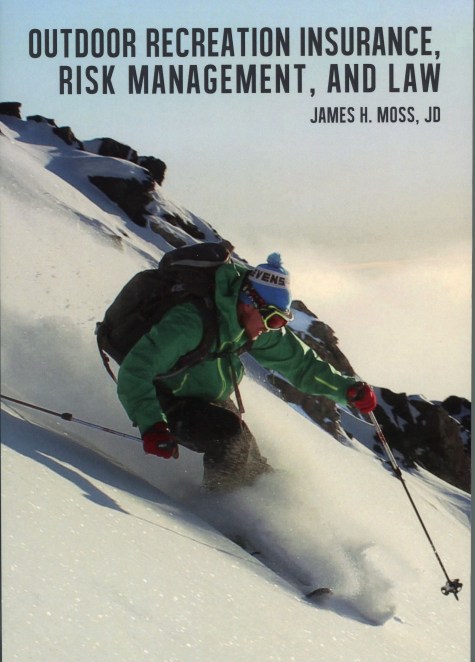
Posted: August 1, 2019 Filed under: Adventure Travel, Assumption of the Risk, Camping, Challenge or Ropes Course, Climbing, Climbing Wall, Contract, Cycling, Equine Activities (Horses, Donkeys, Mules) & Animals, First Aid, Insurance, Jurisdiction and Venue (Forum Selection), Legal Case, Medical, Mountain Biking, Mountaineering, Paddlesports, Release (pre-injury contract not to sue), Risk Management, Rivers and Waterways, Rock Climbing, Sea Kayaking, Ski Area, Skiing / Snow Boarding, Skydiving, Paragliding, Hang gliding, Swimming, Whitewater Rafting, Zip Line | Tags: Adventure travel, and Law, assumption of the risk, camping, Case Analysis, Challenge or Ropes Course, Climbing, Climbing Wall, Contract, Cycling, Desk Reference, Donkeys, Equine Activities (Horses, first aid, Good Samaritan Statutes, Hang gliding, Insurance, James H. Moss, Jurisdiction and Venue (Forum Selection), Law, Legal Case, Medical, Mountain biking, Mountaineering, Mules) & Animals, Negligence, Outdoor Industry, Outdoor recreation, Outdoor Recreation Insurance, Outdoor Recreation Risk Management, Paddlesports, Paragliding, Recreational Use Statute, Reference Book, Release (pre-injury contract not to sue), Reward, Risk, Risk Management, Rivers and Waterways, Rock climbing, Sea Kayaking, ski area, Ski Area Statutes, Skiing / Snow Boarding, Skydiving, swimming, Textbook, Whitewater Rafting, zip line Leave a comment“Outdoor Recreation Insurance, Risk Management, and Law” is a definitive guide to preventing and overcoming legal issues in the outdoor recreation industry
Outdoor Recreation Insurance, Risk Management, and Law
Denver based James H. Moss, JD, an attorney who specializes in the legal issues of outdoor recreation and adventure travel companies, guides, outfitters, and manufacturers, has written a comprehensive legal guidebook titled, “Outdoor Recreation Insurance, Risk Management, and Law”. Sagamore Publishing, a well-known Illinois-based educational publisher, distributes the book.
Mr. Moss, who applied his 30 years of experience with the legal, insurance, and risk management issues of the outdoor industry, wrote the book in order to fill a void.
“There was nothing out there that looked at case law and applied it to legal problems in outdoor recreation,” Moss explained. “The goal of this book is to provide sound advice based on past law and experience.”
The Reference book is sold via the Summit Magic Publishing, LLC.
While written as a college-level textbook, the guide also serves as a legal primer for executives, managers, and business owners in the field of outdoor recreation. It discusses how to tackle, prevent, and overcome legal issues in all areas of the industry.
The book is organized into 14 chapters that are easily accessed as standalone topics, or read through comprehensively. Specific topics include rental programs, statues that affect outdoor recreation, skiing and ski areas, and defenses to claims. Mr. Moss also incorporated listings of legal definitions, cases, and statutes, making the book easy for laypeople to understand.
PURCHASE
TABLE OF CONTENTS
Table of Cases
Introduction
Outdoor Recreation Law and Insurance: Overview
Risk
Risk
Perception versus Actual Risk
Risk v. Reward
Risk Evaluation
Risk Management Strategies
Humans & Risk
Risk = Accidents
Accidents may/may not lead to litigation
How Do You Deal with Risk?
How Does Acceptance of Risk Convert to Litigation?
Negative Feelings against the Business
Risk, Accidents & Litigation
No Real Acceptance of the Risk
No Money to Pay Injury Bills
No Health Insurance
Insurance Company Subrogation
Negative Feelings
Litigation
Dealing with Different People
Dealing with Victims
Develop a Friend & Eliminate a Lawsuit
Don’t Compound Minor Problems into Major Lawsuits
Emergency Medical Services
Additional Causes of Lawsuits in Outdoor Recreation
Employees
How Do You Handle A Victim?
Dealing with Different People
Dealing with Victims
Legal System in the United States
Courts
State Court System
Federal Court System
Other Court Systems
Laws
Statutes
Parties to a Lawsuit
Attorneys
Trials
Law
Torts
Negligence
Duty
Breach of the Duty
Injury
Proximate Causation
Damages
Determination of Duty Owed
Duty of an Outfitter
Duty of a Guide
Duty of Livery Owner
Duty of Rental Agent
Duty of Volunteer Youth Leader
In Loco Parentis
Intentional Torts
Gross Negligence
Willful & Wanton Negligence
Intentional Negligence
Negligence Per Se
Strict Liability
Attractive Nuisance
Results of Acts That Are More than Ordinary Negligence
Product Liability
Contracts
Breach of Contract
Breach of Warranty
Express Warranty
Implied Warranty
Warranty of Fitness for a Particular Purpose
Warranty of Merchantability
Warranty of Statute
Detrimental Reliance
Unjust Enrichment
Liquor Liability
Food Service Liability
Damages
Compensatory Damages
Special Damages
Punitive Damages
Statutory Defenses
Skier Safety Acts
Whitewater Guides & Outfitters
Equine Liability Acts
Legal Defenses
Assumption of Risk
Express Assumption of Risk
Implied Assumption of Risk
Primary Assumption of Risk
Secondary Assumption of Risk
Contributory Negligence
Assumption of Risk & Minors
Inherent Dangers
Assumption of Risk Documents.
Assumption of Risk as a Defense.
Statutory Assumption of Risk
Express Assumption of Risk
Contributory Negligence
Joint and Several Liability
Release, Waivers & Contracts Not to Sue
Why do you need them
Exculpatory Agreements
Releases
Waivers
Covenants Not to sue
Who should be covered
What should be included
Negligence Clause
Jurisdiction & Venue Clause
Assumption of Risk
Other Clauses
Indemnification
Hold Harmless Agreement
Liquidated Damages
Previous Experience
Misc
Photography release
Video Disclaimer
Drug and/or Alcohol clause
Medical Transportation & Release
HIPAA
Problem Areas
What the Courts do not want to see
Statute of Limitations
Minors
Adults
Defenses Myths
Agreements to Participate
Parental Consent Agreements
Informed Consent Agreements
Certification
Accreditation
Standards, Guidelines & Protocols
License
Specific Occupational Risks
Personal Liability of Instructors, Teachers & Educators
College & University Issues
Animal Operations, Packers
Equine Activities
Canoe Livery Operations
Tube rentals
Downhill Skiing
Ski Rental Programs
Indoor Climbing Walls
Instructional Programs
Mountaineering
Retail Rental Programs
Rock Climbing
Tubing Hills
Whitewater Rafting
Risk Management Plan
Introduction for Risk Management Plans
What Is A Risk Management Plan?
What should be in a Risk Management Plan
Risk Management Plan Template
Ideas on Developing a Risk Management Plan
Preparing your Business for Unknown Disasters
Building Fire & Evacuation
Dealing with an Emergency
Insurance
Theory of Insurance
Insurance Companies
Deductibles
Self-Insured Retention
Personal v. Commercial Policies
Types of Policies
Automobile
Comprehension
Collision
Bodily Injury
Property Damage
Uninsured Motorist
Personal Injury Protection
Non-Owned Automobile
Hired Car
Fire Policy
Coverage
Liability
Named Peril v. All Risk
Commercial Policies
Underwriting
Exclusions
Special Endorsements
Rescue Reimbursement
Policy Procedures
Coverage’s
Agents
Brokers
General Agents
Captive Agents
Types of Policies
Claims Made
Occurrence
Claims
Federal and State Government Insurance Requirements
Bibliography
Index
The 427-page volume is sold via Summit Magic Publishing, LLC.
What is a Risk Management Plan and What do You Need in Yours?
Posted: July 25, 2019 Filed under: Activity / Sport / Recreation, Adventure Travel, Assumption of the Risk, Avalanche, Camping, Challenge or Ropes Course, Climbing, Climbing Wall, Contract, Cycling, Equine Activities (Horses, Donkeys, Mules) & Animals, First Aid, Health Club, Indoor Recreation Center, Jurisdiction and Venue (Forum Selection), Legal Case, Medical, Minors, Youth, Children, Mountain Biking, Mountaineering, Paddlesports, Playground, Racing, Racing, Release (pre-injury contract not to sue), Risk Management, Rivers and Waterways, Rock Climbing, Scuba Diving, Sea Kayaking, Search and Rescue (SAR), Ski Area, Skier v. Skier, Skiing / Snow Boarding, Skydiving, Paragliding, Hang gliding, Snow Tubing, Sports, Summer Camp, Swimming, Triathlon, Whitewater Rafting, Youth Camps, Zip Line | Tags: #ORLawTextbook, #ORRiskManagment, #OutdoorRecreationRiskManagementInsurance&Law, #OutdoorRecreationTextbook, @SagamorePub, Adventure travel, and Law, assumption of the risk, camping, Case Analysis, Challenge or Ropes Course, Climbing, Climbing Wall, Contract, Cycling, Donkeys, Equine Activities (Horses, first aid, General Liability Insurance, Good Samaritan Statutes, Guide, Hang gliding, http://www.rec-law.us/ORLawTextbook, Insurance, Insurance policy, James H. Moss, James H. Moss J.D., Jim Moss, Jurisdiction and Venue (Forum Selection), Legal Case, Liability insurance, Medical, Mountain biking, Mountaineering, Mules) & Animals, Negligence, OR Textbook, Outdoor Recreation Insurance, Outdoor Recreation Law, Outdoor Recreation Risk Management, Outfitter, Paddlesports, Paragliding, Recreational Use Statute, Release (pre-injury contract not to sue), Risk Management, risk management plan, Rivers and Waterways, Rock climbing, Sea Kayaking, ski area, Ski Area Statutes, Skiing / Snow Boarding, Skydiving, swimming, Textbook, Understanding, Understanding Insurance, Understanding Risk Management, Whitewater Rafting, zip line Leave a commentEveryone has told you, that you need a risk management plan. A plan to follow if you have
Outdoor Recreation Insurance, Risk Management, and Law
a crisis. You‘ve seen several and they look burdensome and difficult to write. Need help writing a risk management plan? Need to know what should be in your risk management plan? Need Help?
This book can help you understand and write your plan. This book is designed to help you rest easy about what you need to do and how to do it. More importantly, this book will make sure your plan is a workable plan, not one that will create liability for you.

Table of Contents
Chapter 1 Outdoor Recreation Risk Management, Law, and Insurance: An Overview
Chapter 2 U.S. Legal System and Legal Research
Chapter 3 Risk 25
Chapter 4 Risk, Accidents, and Litigation: Why People Sue
Chapter 5 Law 57
Chapter 6 Statutes that Affect Outdoor Recreation
Chapter 7 PreInjury Contracts to Prevent Litigation: Releases
Chapter 8 Defenses to Claims
Chapter 9 Minors
Chapter 10 Skiing and Ski Areas
Chapter 11 Other Commercial Recreational Activities
Chapter 12 Water Sports, Paddlesports, and water-based activities
Chapter 13 Rental Programs
Chapter 14 Insurance
$130.00 plus shipping

How Long Should I hold onto Releases/Assumption of the risk Forms
Posted: July 24, 2019 Filed under: Release (pre-injury contract not to sue) | Tags: Contract, Minor, Paranoia, Release, statute of limitations, Tort Leave a commentThere are several factors you need to find out before you can identify the exact number of years to hold on to contracts, assumption of the risk forms and releases. However, with modern technology, it does not matter anymore, hold onto them forever.
The old method
When boxes of releases were common, we used to calculate how long you should hold onto documents. The calculation relied on two major factors: The statute of limitations for a tort in your state and the age of the participant or person signing the document.
In most states, the statute of limitations for torts is two or three years. For an adult, you would hold on to a release for the statute of limitations plus one year. That plus one year is ” in case” (also translated meaning lawyer paranoia). That means in Colorado three years after an event, trip or whatever had ended you can shred the documents.
If the person was a minor, no matter if the minor signed it or their parent, you hold onto the document for the number of years until the minor turns eighteen (19 in Mississippi and 21 in Nebraska). (See The age that minors become adults.) You add those years to the statute of limitations.
As an example
Statute of Limitations in Colorado is two years for a tort. 2
Minor was 14 at the time of his injury: 18-14 = 4
One year just in case. 1
You would hold onto that release for seven years. 7
The reason for this is the minor can sue once he reaches the age of 18, until the statute of limitations runs. 99% of lawsuits for minors are started immediately, but you never know when a minor might decide that mom, and dad missed the boat when college tuition is needed.
However, sorting releases and assumption of the risk agreements signed by minors from those signed by adults was time consuming so the length of time to hold onto a release became forever. It was easier to collect and store the files then it was to sort them.
New Method = Forever, but a lot faster and easier
Scan the releases into a PDF file and store them on several hard drivers, thumb drives or in the cloud forever. You DO NOT need to sort them by name or separate them out into individual files. Just store them by date.
So, everyone who went Whitewater rafting on June 2, 2019 would be in the PDF dated 6.2.19. If you needed the release, you can just pull up the file and search or do a manual scan for the right release. Since a copy of the original is as good as the original, you do not need to keep the original. Colorado Rules of Evidence 1002; Federal Rules of Evidence 1002.
The exception to this rule would be if you know that someone was injured. You then need to go through a multi-step process.
- Scan the releases, including the one signed by the injured party and store them like all other releases. You do this with all the participants on the trip or program. You may need to contact the other parties as witnesses and having them in the same group as the injured party makes the other people at the event or on the boat easy to find.
-
Collect all other necessary data that may be important years later. Examples of this might include:
- A roster of participants at the event
- A roster of staff attending the event
- All witness lists.
- All information and marketing material used to promote the event.
- Copy of the Weather report, water level, snow report, etc. for the day
- Program, Handouts, Agenda’s etc.
- Maintenance logs for equipment used in the event.
- Training, certifications, etc., of all staff for the activity
-
Any photographs/videos of the activity
- Any photographs/videos from before the activity
- Any photographs/videos from after the activity
- Any photographs/videos from before the activity
- Map of the area, as current as possible
- Etc.
- A roster of participants at the event
-
Take this information you have collected and scan it all into an electronic format.
- Send copies to your attorney(s)
-
Send copies to your insurance company
Tell them it is for safe keeping.
- Send copies to your attorney(s)
-
Make paper copies of all paper and send a complete set of copies to your insurance company and attorney. Ask both what to do with the originals.
- Keep one good set of copies for yourself if you are told to send the originals to the insurance company or attorney, if not keep the originals.
- Keep one good set of copies for yourself if you are told to send the originals to the insurance company or attorney, if not keep the originals.
For paper files, I suggest using a file or folder color that will attract attention, so they are not thrown out by accident. Red, Orange or Yellow good colors of files or folder colors to use. Keep the paperwork in a closed folder or envelope. Put everything in and seal it shut so nothing can fall out and the store this file somewhere so everyone knows where it is and why. If you find more information after you have sealed the first envelope or folder, create a second one, and write 1 of 2 and 2 of 2 on them. Put a large rubber band around both or secure them some way, so they do not get separated. Always right the last name of the injured party and the date on the outside so they don’t have to be opened to determine what files they contain.
After 10 years, you can shred these files.
Instead of having a warehouse full of releases or a back wall of your office with an additional 12 inches of insulation, you can have a hard drive of all the necessary documents needed in case of litigation.
What do you think? Leave a comment.
Copyright 2018 Recreation Law (720) 334 8529
If you like this let your friends know or post it on FB, Twitter or LinkedIn


Author: Outdoor Recreation Insurance, Risk Management and Law
Facebook Page: Outdoor Recreation & Adventure Travel Law
Email: Rec-law@recreation-law.com
Google+: +Recreation
Twitter: RecreationLaw
Facebook: Rec.Law.Now
Facebook Page: Outdoor Recreation & Adventure Travel Law
Blog:
www.recreation-law.com
Mobile Site: http://m.recreation-law.com
By Recreation Law Rec-law@recreation-law.com James H. Moss
#AdventureTourism, #AdventureTravelLaw, #AdventureTravelLawyer, #AttorneyatLaw, #Backpacking, #BicyclingLaw, #Camps, #ChallengeCourse, #ChallengeCourseLaw, #ChallengeCourseLawyer, #CyclingLaw, #FitnessLaw, #FitnessLawyer, #Hiking, #HumanPowered, #HumanPoweredRecreation, #IceClimbing, #JamesHMoss, #JimMoss, #Law, #Mountaineering, #Negligence, #OutdoorLaw, #OutdoorRecreationLaw, #OutsideLaw, #OutsideLawyer, #RecLaw, #Rec-Law, #RecLawBlog, #Rec-LawBlog, #RecLawyer, #RecreationalLawyer, #RecreationLaw, #RecreationLawBlog, #RecreationLawcom, #Recreation-Lawcom, #Recreation-Law.com, #RiskManagement, #RockClimbing, #RockClimbingLawyer, #RopesCourse, #RopesCourseLawyer, #SkiAreas, #Skiing, #SkiLaw, #Snowboarding, #SummerCamp, #Tourism, #TravelLaw, #YouthCamps, #ZipLineLawyer,
Can’t Sleep? Guest was injured, and you don’t know what to do? This book can answer those questions for you.
Posted: July 23, 2019 Filed under: Adventure Travel, Assumption of the Risk, Avalanche, Camping, Climbing, Climbing Wall, Contract, Criminal Liability, Cycling, Equine Activities (Horses, Donkeys, Mules) & Animals, First Aid, Health Club, How, Indoor Recreation Center, Insurance, Jurisdiction and Venue (Forum Selection), Medical, Minors, Youth, Children, Mountain Biking, Mountaineering, Paddlesports, Playground, Racing, Racing, Release (pre-injury contract not to sue), Risk Management, Rivers and Waterways, Rock Climbing, Scuba Diving, Sea Kayaking, Search and Rescue (SAR), Ski Area, Skier v. Skier, Skiing / Snow Boarding, Skydiving, Paragliding, Hang gliding, Snow Tubing, Sports, Summer Camp, Swimming, Triathlon, Whitewater Rafting, Youth Camps, Zip Line | Tags: #ORLawTextbook, #ORRiskManagment, #OutdoorRecreationRiskManagementInsurance&Law, #OutdoorRecreationTextbook, @SagamorePub, Accidents, Angry Guest, Dealing with Claims, General Liability Insurance, Guide, http://www.rec-law.us/ORLawTextbook, Injured Guest, Insurance policy, James H. Moss J.D., Jim Moss, Liability insurance, OR Textbook, Outdoor Recreation Insurance, Outdoor Recreation Law, Outdoor Recreation Risk Management, Outfitter, RecreationLaw, Risk Management, risk management plan, Textbook, Understanding, Understanding Insurance, Understanding Risk Management, Upset Guest Leave a comment An injured guest is everyone’s business owner’s nightmare. What happened, how do you make sure it does not happen again, what can you do to help the guest, can you help the guests are just some of the questions that might be keeping you up at night.
This book can help you understand why people sue and how you can and should deal with injured, angry or upset guests of your business.
This book is designed to help you rest easy about what you need to do and how to do it. More importantly, this book will make sure you keep your business afloat and moving forward.
You did not get into the outdoor recreation business to worry or spend nights staying awake. Get prepared and learn how and why so you can sleep and quit worrying.

Table of Contents
Chapter 1 Outdoor Recreation Risk Management, Law, and Insurance: An Overview
Chapter 2 U.S. Legal System and Legal Research
Chapter 3 Risk 25
Chapter 4 Risk, Accidents, and Litigation: Why People Sue
Chapter 5 Law 57
Chapter 6 Statutes that Affect Outdoor Recreation
Chapter 7 Pre-injury Contracts to Prevent Litigation: Releases
Chapter 8 Defenses to Claims
Chapter 9 Minors
Chapter 10 Skiing and Ski Areas
Chapter 11 Other Commercial Recreational Activities
Chapter 12 Water Sports, Paddlesports, and water-based activities
Chapter 13 Rental Programs
Chapter 14 Insurance
$130.00 plus shipping

Kentucky determines that a parent cannot sign away a child’s right to sue.
Posted: July 22, 2019 Filed under: Indoor Recreation Center, Kentucky, Release (pre-injury contract not to sue) | Tags: House of Boom, Indoor Trampoline Park, Kentucky, Kentucky Supreme Court, Minor's right to sue, parent, Parents right to waive minor's right to sue, Release, Trampoline, Trampoline Park, Waiver, \ 2 CommentsCourts are allowed to pick and choose the case law they relied upon and to distinguish or ignore the case law the court does not like. In this case, the Kentucky Supreme Court ignored law it did not like or simply found a way around the case law it did not want to agree with.
Citation: E.M. v. House of Boom Ky., LLC (In re Miller), 2019 Ky. LEXIS 211, 2019 WL 2462697
State: Kentucky, Supreme Court of Kentucky
Plaintiff: Kathy Miller, as Next Friend of Her Minor Child, E.M.
Defendant: House of Boom Kentucky, LLC
Plaintiff Claims: negligence
Defendant Defenses: release
Holding: for the plaintiff
Year: 2019
Summary
Kentucky Supreme Court rules that a parent cannot sign away a minor’s right to sue.
Facts
House of Boom, LLC (“House of Boom”) is a for-profit trampoline park located in Louisville, Kentucky. The park is a collection of trampoline and acrobatic stunt attractions. On August 6, 2015, Kathy Miller purchased tickets for her 11-year-old daughter, E.M., and her daughter’s friends to go play at House of Boom. Before purchasing the tickets, House of Boom required the purchaser to check a box indicating that the purchaser had read the waiver of liability.
Once Miller checked the box, E.M. participated in activities at House of Boom. She was injured when another girl jumped off a three-foot ledge and landed on E.M’s ankle, causing it to break. Miller, as next friend of her daughter, sued House of Boom for the injury. House of Boom, relying on Miller’s legal power to waive the rights of her daughter via the release, moved for summary judgment. The Western District of Kentucky concluded that House of Boom’s motion for summary judgment involved a novel issue of state law and requested Certification from this Court which we granted. Both parties have briefed the issue and the matter is now ripe for Certification.
So, the plaintiff sued in Federal District Court. Because the issue of whether or not a parent could sign away a minor’s right to sue had not been reviewed by the Kentucky Supreme Court, the federal district court asked the Kentucky Supreme Court to review the case. The Kentucky Supreme court did with this decision.
Analysis: making sense of the law based on these facts.
The sole question before the court was whether a parent could sign away a minor’s right to sue.
The question before this Court is whether a parent has the authority to sign a pre-injury exculpatory agreement on behalf of her child, thus terminating the child’s potential right to compensation for an injury occurring while participating in activities sponsored by a for-profit company.
The court in reviewing the case law from other states on this issue decided the cases had been determined in one of four categories.
House of Boom categorizes these decisions in as those that enforced the waiver and those that did not, but the decisions of those jurisdictions more accurately fall into four distinct categories: (1) jurisdictions that have enforced a waiver between a parent and a for-profit entity; (2) jurisdictions that have enforced waivers between a parent and a non-profit entity; (3) jurisdictions that have declared a waiver between a parent and a for-profit entity unenforceable; and (4) jurisdictions that have declared a waiver between a parent and a non-profit entity unenforceable.
By making this distinction in the cases to start, the court immediately eliminated much of the case law supporting the defendants. In most states, a non-profit has no different legal duty to patrons then a for profit, and none that I can find in Kentucky. However, by using these categories the court was able to place this case in the category with only one other decision that could support the defendant.
House of Boom is a for-profit trampoline park, and eleven out of twelve jurisdictions that have analyzed similar waivers between parents and for-profit entities have adhered to the common law and held such waivers to be unenforceable.
The court then justified it classifications and reasoning by stating a commercial entity had more ways to deal with the cost of the liability than a non-profit.
A commercial entity has the ability to purchase insurance and spread the cost between its customers. It also has the ability to train its employees and inspect the business for unsafe conditions.
However, none of the factors listed above are any different from the situations or requirements to do business for a non-profit operation.
The court then fell back on a legal fallacy that plaintiffs have been arguing for years.
A child has no similar ability to protect himself from the negligence of others within the confines of a commercial establishment. “If pre-injury releases were permitted for commercial establishments, the incentive to take reasonable precautions to protect the safety of minor children would be removed.
However, no cases I’ve read have ever stated that the injury was caused because the defendant did not have to deal with liability issues. Any breach of a duty of care that has occurred were not across the board, just spotty.
The court concluded:
Under the common law of this Commonwealth, absent special circumstances, a parent has no authority to enter into contracts on a child’s behalf.
So Now What?
The plaintiff’s mother purchased tickets for several kids. So, for the majority of the children, the release was void to begin with. One release was signed for multiple possible plaintiffs by someone who did not have the legal authority to sign on their behalf anyway.
The category’s trick was interesting. By restricting the cases it reviewed to artificial categories the Kentucky Supreme Court eliminated several cases that supported the defendant’s position. On top of that, it also then ignored cases after the initial cases it reviewed that supported the use of a release signed by a parent for a child in for-profit or commercial situations.
The Ohio Supreme Court found that a parent could sign away a minor’s right to sue in a non-profit case: Zivich v. Mentor Soccer Club, Inc., 696 N.E.2d 201, 82 Ohio St.3d 367 (1998). Subsequent decisions in Ohio by the appellate courts have also upheld a release signed by the parent of the injured child: Ohio Appellate decision upholds the use of a release for a minor for a commercial activity.
By placing blinders on the case law it was looking at, it is a lot easier to ignore decisions you do not want to deal with.
It is disturbing when a court, weaves its way through case law to reach a conclusion it could have easily reached without circular path. Either the court works its way around lots of decisions or the court realized this decision was going against the general flow of law in the US on this issue and wanted to justify its decision.
Statutes and prior law in Kentucky say a parent’s rights are not absolute in controlling their child and thus a parent cannot sign away their minor child’s right to sue.
#AdventureT
What do you think? Leave a comment.
 Jim Moss |
Jim Moss is an attorney specializing in the legal issues of the outdoor recreation community. He represents guides, guide services, and outfitters both as businesses and individuals and the products they use for their business. He has defended Mt. Everest guide services, summer camps, climbing rope manufacturers; avalanche beacon manufacturers, and many more manufacturers and outdoor industries. Contact Jim at Jim@Rec-Law.us |
Jim is the author or co-author of eight books about legal issues in the outdoor recreation world; the latest is Outdoor Recreation Insurance, Risk Management,
Outdoor Recreation Insurance, Risk Management, and Law
To see Jim’s complete bio go here and to see his CV you can find it here. To find out the purpose of this website go here.
If you are interested in having me write your release, download the form and return it to me.
Connect
If you like this let your friends know or post it on FB, Twitter, or LinkedIn
 Facebook Logo |
 X, Formerly Twitter |
 Threads |
 Recreation Law |
By Recreation Law Rec-law@recreation-law.com James H. Moss
@2023 Summit Magic Publishing, LLC
G-YQ06K3L262
ourism, #AdventureTravelLaw, #AdventureTravelLawyer, #AttorneyatLaw, #Backpacking, #BicyclingLaw, #Camps, #ChallengeCourse, #ChallengeCourseLaw, #ChallengeCourseLawyer, #CyclingLaw, #FitnessLaw, #FitnessLawyer, #Hiking, #HumanPowered, #HumanPoweredRecreation, #IceClimbing, #JamesHMoss, #JimMoss, #Law, #Mountaineering, #Negligence, #OutdoorLaw, #OutdoorRecreationLaw, #OutsideLaw, #OutsideLawyer, #RecLaw, #Rec-Law, #RecLawBlog, #Rec-LawBlog, #RecLawyer, #RecreationalLawyer, #RecreationLaw, #RecreationLawBlog, #RecreationLawcom, #Recreation-Lawcom, #Recreation-Law.com, #RiskManagement, #RockClimbing, #RockClimbingLawyer, #RopesCourse, #RopesCourseLawyer, #SkiAreas, #Skiing, #SkiLaw, #Snowboarding, #SummerCamp, #Tourism, #TravelLaw, #YouthCamps, #ZipLineLawyer, #RecreationLaw, #OutdoorLaw, #OutdoorRecreationLaw, #SkiLaw,
Need a Handy Reference Guide to Understand your Insurance Policy?
Posted: July 18, 2019 Filed under: Adventure Travel, Assumption of the Risk, Avalanche, Challenge or Ropes Course, Climbing, Contract, Cycling, Equine Activities (Horses, Donkeys, Mules) & Animals, Health Club, Indoor Recreation Center, Insurance, Jurisdiction and Venue (Forum Selection), Minors, Youth, Children, Mountain Biking, Mountaineering, Paddlesports, Racing, Release (pre-injury contract not to sue), Risk Management, Rivers and Waterways, Rock Climbing, Scuba Diving, Sea Kayaking, Ski Area, Skier v. Skier, Skiing / Snow Boarding, Skydiving, Paragliding, Hang gliding, Snow Tubing, Sports, Summer Camp, Swimming, Whitewater Rafting, Youth Camps, Zip Line | Tags: #ORLawTextbook, #ORRiskManagment, #OutdoorRecreationRiskManagementInsurance&Law, #OutdoorRecreationTextbook, @SagamorePub, Adventure travel, and Law, assumption of the risk, camping, Case Analysis, Challenge or Ropes Course, Climbing, Climbing Wall, Contract, Cycling, Donkeys, Equine Activities (Horses, first aid, General Liability Insurance, Good Samaritan Statutes, Guide, Hang gliding, http://www.rec-law.us/ORLawTextbook, Insurance, Insurance policy, James H. Moss, James H. Moss J.D., Jim Moss, Jurisdiction and Venue (Forum Selection), Legal Case, Liability insurance, Medical, Mountain biking, Mountaineering, Mules) & Animals, Negligence, Outdoor Recreation Insurance, Outdoor Recreation Law, Outdoor Recreation Risk Management, Outfitter, Paddlesports, Paragliding, Recreational Use Statute, Release (pre-injury contract not to sue), Risk Management, Rivers and Waterways, Rock climbing, Sea Kayaking, ski area, Ski Area Statutes, Skiing / Snow Boarding, Skydiving, swimming, Whitewater Rafting, zip line Leave a commentThis book should be on every outfitter and guide’s desk. It will answer your questions, help you sleep at night, help you answer your guests’ questions and allow you to run your business with less worry.

Table of Contents
Chapter 1 Outdoor Recreation Risk Management, Law, and Insurance: An Overview
Chapter 2 U.S. Legal System and Legal Research
Chapter 3 Risk 25
Chapter 4 Risk, Accidents, and Litigation: Why People Sue
Chapter 5 Law 57
Chapter 6 Statutes that Affect Outdoor Recreation
Chapter 7 PreInjury Contracts to Prevent Litigation: Releases
Chapter 8 Defenses to Claims
Chapter 9 Minors
Chapter 10 Skiing and Ski Areas
Chapter 11 Other Commercial Recreational Activities
Chapter 12 Water Sports, Paddlesports, and water-based activities
Chapter 13 Rental Programs
Chapter 14 Insurance
$99.00 plus shipping

Morgan, et al., v. Water Toy Shop, Inc., et al., 2018 U.S. Dist. LEXIS 61546
Posted: July 15, 2019 Filed under: Legal Case, Release (pre-injury contract not to sue), Rivers and Waterways | Tags: Admiralty Jurisdiction, Inc., Jet Skis, Maritime Law, Negligence, Negligence per se, Personal Watercraft, Puerto Rican Law, Puerto Rico, Release, vicarious liability, Waiver, Water Toy Shop Leave a commentMorgan, et al., v. Water Toy Shop, Inc., et al., 2018 U.S. Dist. LEXIS 61546
Jasmine Nicole Morgan, et al., Plaintiffs,
v.
Water Toy Shop, Inc., et al., Defendants.
Civil No. 16-2540 (PAD)
United States District Court, D. Puerto Rico
March 30, 2018
OPINION AND ORDER
PEDRO A. DELGADO HERNÁNDEZ, United States District Judge
This case arises out of a tragic accident, a collision between two jet skis -one ridden by plaintiffs Jasmin Nicole Morgan and Jarita Kennedy, and the other by Mark A. Castro- in the territorial waters of Puerto Rico (Docket No. 1).[1] In essence, the complaint alleges that: (1) Castro was grossly negligent in operating the jet ski, seriously injuring plaintiffs (id. at ¶ 51); and (2) Water Toy Shop, Inc., Acosta Water Sports, Inc., and Axel Acosta, who rented the jet skis, did not adequately train Castro to operate the jet ski, and as owners of the jet ski that Castro was riding are liable for the damages claimed. Id.
Before the court is defendants Water Toy Shop’s, Axel Acosta’s and Ironshore Indemnity, Inc.’s “Motion for Summary Judgment and Memorandum of Law in Support Thereof” (Docket No. 52), which plaintiffs opposed (Docket No. 61). Defendants replied (Docket Nos. 69), and plaintiffs surreplied (Docket No. 73). For the reasons explained below, the motion is GRANTED and plaintiffs’ claims against the appearing defendants DISMISSED.[2]
I. SUMMARY JUDGMENT STANDARD
Pursuant to Fed.R.Civ.P. 56, summary judgment is appropriate when the record shows no genuine dispute as to any material fact and the movant is entitled to judgment as a matter of law. A dispute is genuine if the evidence about the fact is such that a reasonable jury could resolve the point in the favor of the non-moving party. A fact is material if it has the potential of determining the outcome of the litigation. Farmers Ins. Exchange v. RNK, Inc., 632 F.3d 777, 782 (1st Cir. 2011)(quoting Rodríguez-Rivera v. Federico Trilla Regional Hosp. of Carolina, 532 F.3d 28, 30 (1st Cir. 2008)).
In assessing a motion for summary judgment, the court must view the entire record in the light most hospitable to the party opposing summary judgment, indulging all reasonable inferences in that party’s favor. Griggs-Ryan, 904 F.2d at 115 (citations omitted). There is no room for credibility determinations, no room for the measured weighing of conflicting evidence such as the trial process entails, and no room for the judge to superimpose his own ideas of probability and likelihood . Greenburg v. Puerto Rico Maritime Shipping Authority, 835 F.2d 932, 936 (1st Cir. 1987). The court may, however, safely ignore conclusory allegations, improbable inferences, and unsupported speculation. Medina-Muñoz v. R.J. Reynolds Tobacco Co., 896 F.2d 5, 8 (1st Cir. 1990) (citations omitted).
II. UNCONTESTED FACTS[3]
Plaintiffs are residents of Washington, D.C. See, Docket No. 52-1, “Statement of Uncontested Material Facts in Support of Motion for Summary Judgment” (“SUMF” at ¶ 1). While vacationing in Puerto Rico, they rented a jet ski from Archie Jet Ski Rental (SUMF ¶ 4), the name used to advertise Water Toy Shop and Acosta Water Sports, two separate corporations that operate different jet ski rental stands in the Isla Verde beach area in Carolina, Puerto Rico. See, PSUMF at ¶ 6 and defendants’ response at Docket No. 69-1 pp. 26-27.[4] Water Toy owned the jet skis involved in the accident, and operated the stand where the jet skis were rented. SUMF ¶ 5; PSUMF ¶¶ 14, 6, 36.
In order to rent the jet ski, both plaintiffs signed a “Personal Watercraft Rental Operations Release of Liability, Waiver of Claims, Express Assumption of Risk and Indemnity Agreement” (“Rental Agreement”) and a “Declaration of Fitness to Operate Personal Watercraft” (“Declaration of Fitness”). SUMF ¶ 7, ¶10.[5] The Rental Agreements read as follows:
PERSONAL WATERCRAFT RENTAL OPERATIONS RELEASE OF LIABILITY, WAIVER OF CLAIMS, EXPRESS ASSUMPTION OF RISK AND INDEMNITY AGREEMENT
Please and be certain you understand the implications of signing. Express Assumption of Risk Associated with use of rental of Personal Watercraft and Related Activities I,, do hereby affirm and acknowledge that I have been fully informed of the inherent hazards and risks associated with motorized (e.g., jet ski) or non-motorized (e.g., kayak) and related water sport activities to which I am about to engage, including but not limited to:
1) changing water flow, tides, currents, wave action, and ship’s wakes;
2) collision with any of the following:
a) other participants,
b) the watercraft,
c) other watercraft,
d) man made or natural objects,
e) shuttle boat;
3) wind shear, inclement weather, lightning, variances and extremes of wind, weather and temperature;
4) my sense of balance, physical condition, ability to operate equipment, swim and/or follow directions;
5) collision, capsizing, sinking, or other hazard that may result in wetness, injury, exposure to the elements, hypothermia, impact of the body upon the water, injection of water into my body orifices, and/or drowning;
6) the presence of insects and marine life forms;
7) equipment failure or operator error;
8) heat or sun related injuries or illnesses, including sunburn, sun stroke or dehydration;
9) fatigue, chill and/or reaction time and increased risk of accident.
I specifically acknowledge that I read, understand and agree to abide by the Personal Watercraft Operational instructions at all times and that I have been trained in the safe use of watersport equipment to my complete satisfaction, and I am physically/mentally able to participate in the water sport activities to which I am about to engage.
I specifically waive any defense insofar as this contract is concerned that may arise as a result of any state or local law and/or regulation or policy that may impact its enforceability.
RELEASE OF LIABILITY, WAIVER OF CLAIMS AND INDEMNITY AGREEMENT.
In consideration of being allowed to participate in the above-described activities, as well as the use of any of the facilities and the use of the equipment of the below listed releases, I hereby agree as follows:
1) To waive and release any and all claims based upon negligence, active or passive, with the exception of intentional, wanton, or willful misconduct that I may have in the future against all of the following named persons or entities herein referred to as releasees.
Water Toy Shop, Inc. Owner (Company and/ or Individual)
___ (Scheduled Personal Watercraft)
___ (Scheduled Shuttle Boat (if applicable)
2) To release the releasees, their officers, directors, employees, representatives, agents, and volunteers, and vessels from any liability and responsibility whatsoever and for any claims or causes of action that I, my estate, heirs, executors, or assigns may have for personal injury, property damage, or wrongful death arising from the above activities, whether caused by active or passive negligence of the releassees or otherwise, with the exception of gross negligence. By executing this document, I agree to hold the releases harmless and indemnify them in conjunction with any injury or loss of life that may occur as a result of engaging in the above activities.
3) By entering into this agreement, I am not relying on any oral or written representation or statements made by the releasees, other than what is set forth in this Agreement.
I hereby declare that I am of legal age and am competent to sign this Agreement or, if not, that my parent or legal guardian shall sign on my behalf and that my parent or legal guardian is in complete understanding and concurrence with this Agreement.
I have read this Agreement, understand it, and I agree to be bound by it. SUMF at ¶¶ 8, 20 (bold emphasis in the original, underlined emphasis added).[6] The Declarations of Fitness state: “by signing this form I still choose to participate in the activity with the rental property and agree to waive all responsibilities to all the above mentioned parties concerning any consequences that would result from my actions.” SUMF at ¶ 9.[7] Morgan did not read the contents of the Rental Agreement and Declaration of Fitness before signing them, or at any time before boarding the rented jet ski, despite having around one hour to spare between the time she signed the documents and when she boarded the jet ski.[8] Neither did she ask Water Toy personnel anything about the document. SUMF at ¶ 11.
Before Castro was allowed to rent the jet ski, he was asked for his I.D. in order to verify that he was old enough to rent a jet ski, which he was; he signed a Rental Agreement and Declaration of Fitness; and was informed of the boundaries within which he could ride, the applicable speed limit and to stay clear of other people. SUMF at ¶ 13, 15.[9] To that end, Mr. Héctor Peralta informed Castro the price for the jet ski ride; explained that he could only ride between the ESJ Tower and the Water Club Hotel; warned him stay away from the swimming area; told him to go slow until he passed the buoys; cautioned him not to get close to a nearby natural reserve and to stay away from other objects or persons because jet skis don’t have breaks; described how the jet skis worked; let him know that when his time was up an employee would let him know; and provided him copy of a Rental Agreement and Declaration of Fitness, explaining their contents and having him sign them. SUMF at ¶ 16.[10]
Additionally, Mr. Jonathan Pérez informed Castro of the boundaries he had to observe whilst riding, by pointing out the ESJ Tower, the Water Club Hotel and the buoys; told him not to ride too far away so that help could get to him straight away in case something happened; warned him not to go over five miles per hour as he left the buoys area in front of the Water Toy stand and when he rode back to it to return his jet ski; and asked him to stay far away from people to avoid any accident. SUMF at ¶ 17.[11] Plaintiffs were taking a break in their jet ski, drifting next to the buoys in front of the Water Toy stand, when Castro’s jet ski collided with theirs at high speed, without warning. SUMF at ¶ 19.
III. DISCUSSION
A. General Principles
Plaintiffs claim defendants are liable to them under Puerto Rico law (Docket No. 61, pp. 2-3), which defendants deny (Docket No. 51, p. 1), stating that general principles of maritime law rather than local law apply in this case, and under those principles they are not liable. Id. at p. 2. Because this case “involves a watercraft collision on navigable waters, it falls within admiralty’s domain.” Yamaha Motor Corp., U.S.A. v. Calhoun, 516 U.S. 199, 206 (1996). With admiralty jurisdiction comes the application of substantive admiralty law. Id. Federal maritime law may be supplemented by state law to the extent that it “would not disturb the uniformity of maritime law.” Kossick v. United Fruit Co., 365 U.S. 731, 738 (1961).
In maritime law, “the owner of a ship in navigable waters owes to all who are on board for purposes not inimical to his legitimate interests [e.g., passengers] the duty of exercising reasonable care under the circumstances of each case.” Kermarec v. Compagnie Generale Transatlantique, 358 U.S. 625, 632 (1959); Muratore v. M/S Scotia Prince, 845 F.2d 347, 353 (1st Cir. 1988)(under maritime law, “a carrier owes a duty of exercising reasonable care towards its passengers under the circumstances”). The degree of required care must be in proportion to the apparent risk. See, Muratone, 845 F.3d at 353 (discussing concept)(citing Prosser, Law of Torts, Section 34, at 180 (4th ed. 1971)).
Plaintiffs contend that defendants are directly and vicariously liable under Puerto Rico law because Congress allowed Puerto Rico to adopt liability standards inconsistent with maritime law (Docket No. 61 at pp. 12-20). Congress can alter, qualify, or supplement admiralty law as it sees fit, provided it neither excludes a thing that falls clearly within the admiralty and maritime law nor includes a thing that clearly falls without, as long as the statute is coextensive with and operates uniformly in the whole of the United States. See, Zych v. Unidentified Wrecked and Abandoned Vessel, Believed to be the Seabird, 19 F.3d 1136, 1140 (7th Cir. 1994)(examining congressional power to revise and supplement maritime law).
However, Puerto Rico is an unincorporated territory of the United States. See, Maysonet-Robles v. Cabrero, 323 F.3d 43, 53 (1st Cir. 2003)(so describing Puerto Rico). It belongs to, but is not part of the United States, a category considered “foreign … in a domestic sense.” See, United States v. Lebrón-Cáceres, 157 F.Supp.3d 80, 88 & n.11 (D.P.R. 2016)(discussing Puerto Rico’s territorial status)(quoting Downes v. Bidwell, 182 U.S. 244, 287, 341-342, 346-347 (1901)). Accordingly, “… Congress can, pursuant to the plenary powers conferred by the Territorial Clause [U.S. Const. art. IV, § 3, cl. 2], legislate as to Puerto Rico in a manner different from the rest of the United States.” U.S. v. Rivera-Torres, 826 F.2d 151, 154 (1st Cir. 1987).[12]
In 1917, Congress enacted Puerto Rico’s second organic act, commonly known as the Jones Act, 39 Stat. 951, Act of March 2, 1919.[13] Under Section 37 of the Jones Act, the legislative authority of Puerto Rico extended “to all matters of a legislative character not locally inapplicable.” In turn, Section Eight read:
The harbor areas and navigable streams and bodies of water and submerged lands underlying the same in and around the island of Puerto Rico and the adjacent islands and waters, owned by the United States on March 2, 1917, and not reserved by the United States for public purposes, are placed under the control of the government of Puerto Rico … All laws of the United States for the protection and improvement of the navigable waters of the united States and the preservation of the interests of navigation and commerce, except so far as the same may be locally inapplicable, shall apply to said island and waters to its adjacent islands and waters.
Both provisions were reenacted as part of the Federal Relations Act. See, 48 U.S.C. §§ 749 and 821.[14] Interpreting and applying them in the context of admiralty and maritime law, the First Circuit held in Guerrido v. Alcoa Steamship Co., 234 F.2d 349 (1956), that the rules of admiralty and maritime law of the United States “are presently in force in the navigable waters of the United States in and around the island of Puerto Rico to the extent that they are not locally inapplicable either because they were not designed to apply to Puerto Rican waters or because they have been rendered inapplicable to these waters by inconsistent Puerto Rican legislation, ” provided that legislation does not “supplant a rule of maritime law which Congress in the exercise of its constitutional power has made applicable to Puerto Rican waters.” Id. at p. 355 (Emphasis added).[15] In line with Garrido, plaintiffs argue that defendants authorized Castro to operate the jet ski, and as a result, are liable for the resulting damages under Articles 1802 and 1803 of the Puerto Rico Civil Code, P.R. Laws Ann. tit. 31 §§ 5141-5142, and Puerto Rico Law 430 of December 21, 2000, P.R. Laws Ann. tit. 12 §§ 1401-1411 (Docket No. 61, pp. 4-7, 15-20). Because it is undisputed that Water Toy owned and rented the jet skis, unless otherwise stated the court circumscribes the discussion of potential liability to that entity.
B. Puerto Rico Law
Article 1802 imposes liability for personal acts, not for acts of others, providing in part that “a person who by an act or omission causes damage to another through fault or negligence shall be obliged to repair the damage so done.” P.R. Laws Ann. tit. 31 § 5141. See, Burgos-Oquendo v. Caribbean Gulf Refining Corp., 741 F.Supp. 330, 332 (D.P.R. 1990)(discussing concept). To establish liability, the plaintiff must show: (i) a duty of care requiring defendant to conform to a certain standard of conduct; (ii) breach of that duty; (iii) damages; and (iv) a causal connection between the breach and the damages. See, De-Jesús-Adorno v. Browning Ferris Industries of Puerto Rico, Inc., 160 F.3d 839, 842 (1st Cir. 1995)(so explaining).
In general, the duty of care is defined by the tenet that one must act as would a prudent and reasonable person under the same circumstances. See, Vázquez-Filippetti v. Banco Popular de Puerto Rico, 504 F.3d 43, 49 (1st Cir. 2007)(so observing). This includes complying with statutes, regulations, and ordinances relevant to the action. See, Sánchez v. Seguros Triple S, Inc., 687 F.Supp.2d 6, 9 (D.P.R. 2010)(setting forth and applying formulation). The standard applies to those who operate businesses for profit, commanding them to exercise reasonable care toward business invitees. See, Calderón-Ortega v. U.S., 753 F.3d 250, 252 (2014)(recognizing obligation).
In turn, Article 1803 codifies a special type of vicarious liability, a type of liability based in part on the acts or omissions of others. See, P.R. Laws Ann. tit. 31 § 5142. To that end, it states that the obligation imposed by Article 1802 “is demandable not only for personal acts and omissions, but also for those of the persons for whom …[the defendant is] responsible, ” including under that rubric the liability of the father or mother for damages caused by minor children; of guardians for the damage cause by the person under their authority who live with them; of employers for the damage caused by an employee acting in the course of his employment; of masters or directors of arts and trades for damage caused by their pupils or apprentices; and of the Government of Puerto Rico under certain pre-established circumstances. Id. The enumeration is taxative, not of an exemplary nature. See, Burgos-Oquendo, 741 F.Supp. at 333 (so acknowledging). Imposition of vicarious liability in other instances must be anchored in alternate precepts or legislation, like Law 430. See, id. (dismissing complaint brought against lessor under Article 1803 in absence of provision establishing responsibility in the lessor for actions of the lessee).
At common law, vicarious liability implies that by reason of some preexisting relation between two parties, one of them may be held automatically liable to a third party for the negligence of the other even if he is free from fault. See, Prosser and Keeton, The Law of Torts, West Publishing Co., 1984, p. 499 (explaining concept). The doctrine applies in admiralty unless excluded by statute. See, Thomas J. Schoenbaum, supra at p. 188 (so noting). In that context, the negligence of employees is imputed to the owner of the vessel upon a finding of master-servant relationship, but in absence of that relationship, the shipowner is not liable in personam for the negligence of persons to whom the vessel is entrusted. Id. Under Article 1803, however, liability does not attach if the defendant shows that he employed the diligence expected of a good father of family, the bonus pater familias, to prevent the damage. Id. Diligence is predicated on how a prudent and reasonable man would have acted in connection with the obligations arising from the situations enumerated in Article 1803. See, Pueblo v. Rivera Rivera, 23 P.R. Offic. Trans. 641, 1989 WK 607294, *§ V (Rebollo López, J., concurring)(analyzing standard).
By contrast, Law 430 operates much like vicarious liability does at common law, providing in part that “[t]he owner of any ship or navigation vessel shall be responsible for damages caused when operating any of these, with fault or negligence, and when it is operated or under control of any person who, with the main purpose of operating or allowing it to be operated by a third party, obtains possession of it through express or tacit authorization of the owner.” P.R. Laws Ann. tit. 12 § 1406(6)(h). By extension, it imposes liability on the principal -the vessel’s owner- for the damages caused by the wrongful operation of the vessel when that vessel has been operated with the owner’s express or tacit authorization, irrespective of whether the owner has acted -in the words of Article 1803 of the Civil Code- with the diligence of a good father of family to avoid the damage.
As enacted, the provision is preempted by the Limitation of Liability Act of 1851, as amended, 46 U.S.C. § 30501 et seq., because it conflicts with the negligence standard set in the federal statute. See, In the Matter of Rockaway Jet Ski, LLC, 2016 WL 8861617, *603-*604, (holding New York’s Navigation Act § 48 preempted by Limitation Act, as it imposes vicarious liability on the owners of personal watercrafts if the watercraft is operated by a person who used it with the owner’s permission, irrespective of the owner’s wrongdoing)(quoting In re Hartman, 2020 WL 1529488, *4 n.10 (D.N.J. Apr. 15, 2010)(to the extent the claimant argues that the jet ski owner is strictly liable under state law, the claim is preempted because the state’s strict liability standard directly conflicts with the negligence standard of the Limitation Act)). For the same reason, so too here. And given that the Limitation Act applies in Puerto Rico, [16] its preemptive effect comports with Garrido, banning reliance on Law 430 to impose vicarious liability on the vessel owner in the absence of the owner’s negligence.
Against this background, plaintiffs argue that Water Toy Shop violated Law 430 in: (1) operating an illegal additional kiosk a quarter of a mile east of the area specified in the permit issued by the Puerto Rico Department of Natural Resources (“DNR”); (2) renting a jet ski that was not expressly identified in the permit; (3) using a rental ski as a patrol boat operated by a licensed individual who nevertheless had not received the required first aid training; (4) operating a rental stand without a valid navigation license; (5) keeping defective records lacking customers’ identification, addresses, tag of the jet ski used and date and time it was returned; and (6) renting skis without informing customers of navigation rules, safety briefing and prohibited activities (Docket No. 61 at pp. 5-7), making it liable for the collision and resulting damages. But merely violating a statute or regulation is not a synonym for liability in Puerto Rico, since in order for liability to attach, there must be a causal relationship – adequate cause – between the violation and the damages. See, González v. Puerto Rico Elec. Power Authority, 1993 WL 525644, *8 (D.P.R. Nov. 23, 1993)(so holding)(citing Pacheco v. A.F.F., 12 P.R. Offic. Trans. 367 (1982)).[17]
Adequate cause is not an event in the absence of which the damage would not have occurred, but that which in general experience causes it. See, Cárdenas Mazán v. Rodríguez Rodríguez, 125 D.P.R. 702, 710 (1990) (so stating); Ganapolsky v. Boston Mut. Life Ins. Co., 138 F.3d 446, 447-448 (1st Cir. 1998)(accidental injury to plaintiff’s left foot resulting from tripping on a two-inch step at entrance to men’s room in a theater not adequate cause of gangrene requiring foot’s amputation, as the infection that lead to the gangrene normally does not arise from tripping on a step). As such, causation is a function of foreseeability, requiring plaintiff to show that the injury was reasonably foreseeable. See, Marshall v. Pérez Arzuaga, 828 F.2d 845, 847 (1st Cir. 1987)(discussing foreseeability as part of the “causal nexus” element of tort action); Vázquez-Filipetti, 504 F.3d at 49 (highlighting centrality of foreseeability to a successful tort claim).[18]
Within this framework, that violations may have occurred in connection with items (1) to (5)-an unsubstantiated assumption at best- is not causally linked to Castro’s crashing of his jet ski onto plaintiffs’, for there is no evidence in the record showing it was foreseeable for a reasonable person to anticipate that a jet-ski collision would result from those violations.[19] Foreseeability cannot be established through the simple fact that an accident occurred. Id. (so recognizing).[20]The situation is no different in admiralty. See, Poulis-Minott v. Smith, 388 F.3d 354, 363 (1st Cir. 2004)(dismissing claim in admiralty for lack of proof that under the circumstances, there was a reasonable possibility that compliance with the regulatory standard would have prevented the accident).[21]
Water Toy’s obligation to provide Castro with an oral or written orientation on the navigation rules the Commissioner of Navigation of Puerto Rico prepared in accordance with Law 430 stands on a different footing, as it directly implicates the provision of information necessary to safely operate the jet ski. See, Wills v. Amerada Hess Corp., 379 F.3d 32, 42-45 (2d Cir. 2004)(distinguishing between statutory or regulatory provisions naturally and logically linked to maritime safety and those not so linked). The uncontested facts, however, show that Water Toy did provide adequate training to Castro in connection with the operation of the jet ski as well as of the applicable navigation rules. See, SUMF at ¶ 15-17. And the Rental Agreement Castro executed additionally confirms that he: (1) was fully informed of the inherent risks associated with jet skis; (2) understood and agreed to abide by the personal watercraft operational instructions he was given; and (3) was trained in the safe use of water sport equipment to his complete satisfaction. All in all, the record does not sustain a finding of liability against Water Toy deriving from a negligent act causally connected to the damages claimed.
C. Waivers
Beyond the issue of liability, plaintiffs executed a waiver precluding liability as to Water Toy and Axel Acosta – Water Toy’s sole owner and president, representative and agent – except for gross negligence, which the complaint only imputed to Castro. Plaintiffs attack the waiver, essentially characterizing it as unenforceable (Docket No. 61, at pp. 20-31). Voluntary waivers of liability for negligence in maritime activities are enforceable provided they: (1) are consistent with public policy; (2) do not configure a contract of adhesion; and (3) are drafted in clear and unambiguous language. See, Olmo v. Atlantic City Parasail, 2016 WL 1704365, *9 (D.N.J. April 28, 2016)(articulating and applying test)(citing Olivelli v. Sappo Corp., Inc., 225 F.Supp.2d 109, 116 (D.P.R. 2002)). By these standards, the waivers that plaintiffs signed are valid and enforceable.
First, exculpatory clauses waiving liability for negligence in maritime recreational activities are consistent with public policy. See, Cobb v. Aramark Sports and Entertainment Services, LLC, 933 F.Supp.2d 1295, 1299 (D. Nevada 2013)(so acknowledging); Olmo, 2016 WL 1704365, at *10 (same).[22] Thus, parties may enter into agreements to allocate risks inherent in those activities, allowing operators to contractually disclaim liability for their own negligence. See, Brozyna v. Niagara Gorge Jetboarding, Ltd., 2011 WL 4553100, *4-*5 (W.D. N.Y. Sept. 29, 2011)(explaining exculpatory waivers).[23] Relying on In the Matter of Rockaway Jet Ski LLC, 2016 WL 8861617, however, plaintiffs argue the waiver violates public policy because it has been invoked to prevent them from asserting negligence claims based on the violation of Law 430, a safety statute which, at bottom, does not contain a waiver authorization clause (Docket No. 61, at pp. 23, 27).
In Rockaway, the court evaluated whether an exculpatory clause can release negligence claims premised on the violation of a state safety statute, New York Navigation Law 73(a)(2), which (1) required businesses renting personal watercraft to provide a video or in-water demonstration of how to safely operate watercraft; and (2) prohibited those businesses from renting a personal watercraft to an individual unless that individual demonstrated ability to (i) operate the personal watercraft, and (ii) use applicable safety equipment. Id. at *595-*596. The court surveyed relevant caselaw, finding that some jurisdictions considering the same question did not permit parties to waive negligence claims premised on the violation of safety statutes, whereas other jurisdictions permitted the waivers. Id. at *598-*599. It sided with the former, noting “the apparent absence of an established admiralty rule on this question, ” (id. at *601); that statutory violations amount to negligence per se; and that waivers of a negligence per se claim violate public policy. Id. at *602.
Applying the reasoning to Law 430, the only statutory item involving safety is the one requiring information to safely operate the jet ski. But renting out a jet ski without taking steps to provide for its safety operation falls within the realm of negligence regardless of whether it is statutorily required. See, In re Hartman, 2010 WL 1529488, *4 (D.N.J. Apr. 15, 2010)(no need to resort to state safety statute to establish negligence in case originating in jet ski accident, because irrespective of statute, ski owner owed plaintiff a duty of care). And as pointed out above, those actions may be waived. See, Waggoner, 141 F.3d at *8-*9 (rejecting argument that exculpatory clause in recreational boat rental contract violated public policy based in part on Restatement (Second) of Contracts’ explanation that “a party to a contract can ordinarily exempt himself from liability for harm caused by his failure to observe the standards of reasonable care imposed by the law of negligence”). Moreover, although Law 430 imposes vicarious liability, that type of liability is less about boat safety and more about ensuring compensation for injured parties. See, Rockaway, 2016 WL 8861617 at *604 (so observing in validating waiver to protect vessel owner from vicarious liability imposed by state navigation law). In the end, Law 430 does not prohibit waivers, and neither does public policy.
Second, adhesion contracts are “take it or leave it” contracts with no opportunity for negotiation between parties with unequal bargaining power. Id. at *6 (delineating elements of adhesion). The definition does not fit waivers used in connection with voluntary recreational pursuits rather than rendition of essential services such as medical care, where courts would be more likely to find that a contract of adhesion exists. See, Olmo, 2016 WL 1704365 at *10 (so recognizing). For the same reason, liability waivers for voluntary recreational activities in navigable waters are not considered adhesion contracts, as the plaintiff has the option of signing or turning around and declining to do business with the defendant. Id. (waiver in case involving parasailing and related activities). So too here, for plaintiffs were free to choose another jet ski rental company or leave the beach without ridding a jet ski at all. See Olivelli, 225 F.Supp.2d at 110-11, 118-120 (waiver of liability not considered adhesion contract in part because scuba diving is a strictly voluntary recreational pursuit and deceased was free to decline defendant’s services if she did not wish to assent to the terms of the waiver); Brozyna, 2011 WL 4553100 at *6 (same with respect to jetboating excursion, as plaintiff had to option to decline to participate in the excursion); Murley ex rel. Estate of Murley v. Deep Explorers, Inc., 281 F.Supp.2d 580, 589-590 (E.D.N.Y. 2003)(if scuba diver did not agree to or understand any of the clauses of the release, he was free to write “VOID” or decline defendant’s services).[24]
Third, the waivers are clear and unambiguous. Their language (1) identified the specific risks inherent to and associated with riding a jet ski;[25] (2) explained and highlighted the fact that, by executing the Agreement, plaintiffs waived and released any and all claims based upon negligence against Water Toy, its officers, directors, employees, representatives, agents, and volunteers and vessels; and (3) stated that plaintiffs accepted responsibility for the consequences of riding the rented jet skis. The language should have put plaintiffs on notice of its legal significance and effect. Murley, 281 F.Supp.2d at 580-581, 591 (validating liability release with similar characteristics in dismissing action arising out of scuba diving accident that resulted in diver’s death). Even more, both plaintiffs and Castro signed the Agreements before boarding their respective jet skis, acknowledging that they (1) were fully informed of the hazards and risks associated with the jet ski and related water sports activities, including collision with other participants or watercrafts; (2) read, understood, and agreed to abide by the “Personal Watercraft Operational” instructions at all times; (3) were trained in the safe use of watersports equipment to their complete satisfaction; and (4) were physically and mentally able to participate in the water sports activities.
Fourth, plaintiffs are college-educated U.S. citizens, who were interested in participating in a recreational, hazardous maritime activity, one conditioned upon the jet ski’s owner and renter being released from liability as set forth in the waivers, a condition plaintiffs voluntarily agreed to.[26] Plaintiffs state that Ms. Morgan signed the documents without reading them (Docket No. 61-1 at ¶ 11). Nonetheless, the defendant is entitled to rely in good faith upon the reasonable appearance of consent that plaintiff created. See, Chieco v. Paramarketing, Inc., 228 A.D.2d 462, 643 N.Y.S.2d 668 (2d Dept. 1996)(holding release and waiver for paragliding lesson valid despite plaintiff’s allegation that he did not read or understand the document), cited in Murley, 281 F.Supp.2d at 591; Dan B. Dobbs, The Law of Torts, 217-218 (West 2000) (discussing defendant’s reasonable reliance on plaintiff’s acts and words to infer binding consent). Private and uncommunicated reservations to a waiver does not subject defendant to liability. See, Dan B. Dobbs, supra (so noting). Therefore, plaintiffs cannot escape the consequences of their voluntary decisions, bypassing the contracts they signed to avoid the legal consequences of their free choice, for there is no evidence of deceit, violence or intimidation exerted on plaintiffs to coerce or wrongfully induce them to sign the waivers, or that they did so by mistake, thinking they were signing something else. See, P.R. Laws Ann. tit. 31 § 3404 (codifying elements voiding consent under Puerto Rico law, to include violence, intimidation, deceit and error); Cutchin v. Habitat Curacao-Maduro Dive Fanta-Seas, Inc., 1999 WL 33232277, *3 (S.D. Fla. Feb. 8, 1999)(applying pre-accident waiver to dismiss action arising from diving accident, as there was no evidence showing that plaintiff was coerced to sign the document); Murley, 281 F.Supp.2d at 590 (dismissing suit based on scuba diver’s death in part because there was no evidence that defendants procured release by fraud or that deceased signed release under duress); .
Plaintiffs posit the waivers mention negligence but not fault, and cannot bar their action because the complaint alleges that their damages result from defendants’ “fault” or “negligence” (Docket No. 61 at p. 25). These terms have specific meanings in the civil code context of Puerto Rico law. See, CMI Capital Market Investment, LLC v. González-Toro, 520 F.3d 58, 64 (1st Cir. 2008)(so recognizing). Fault consists in the failure to exercise due diligence, the use of which would have prevented the wrongful result, and requires the execution of a positive act causing a damage to another person different from the one who executed it. Id. Negligence supposes an omission producing the same effect as fault (id.), predicated as with fault, on the failure to exercise due diligence. See, Sánchez v. Esso Standard Oil de Puerto Rico, Inc., 2010 WL 3069551, *4 (D.P.R. Aug. 2, 2010)(discussing terms). Both concepts “have in common that the act be executed or the omission incurred without an injurious intent, ” González-Toro, 520 F.3d at 64, and for the same reason, have been described as “faces of the same coin.” Sánchez, 2010 WL 3069551 a *4 (quoting Gierbolini v. Employers Fire Ins. Co., 4 P.R. Offic. Trans. 1197, 1201 (1976).
On this reading, it is apparent that to the extent the waiver mentions negligence it necessarily contemplates the failure to exercise due diligence, the same operative feature underlying fault, reflecting the waiver’s reference to both active and passive negligence. See, Malave-Felix v. Volvo Car Corp., 946 F.2d 967, 971 (1st Cir. 1991)(“An actor is at fault, or negligent, when he fails to exercise due diligence to prevent foreseeable injury”)(emphasis added). Even more, plaintiffs’ factual allegations are couched in negligence, not fault. See, Complaint, ¶ 30 (“As a consequence of the accident caused by the negligence of all defendants, … [Ms. Morgan] has suffered mental anguish, physical injuries and scars;” ¶ 43 (“As a consequence of the accident caused by the negligence of all defendants,, , [Ms. Kennedy] has suffered mental anguish, and physical injuries”).
Plaintiffs allege the waiver does not mention Axel Acosta, the insurance company, or Acosta Water Sports (Docket No. 61, pp. 27-28). Nonetheless, the waiver expressly releases Water Toy Shop’s officers, directors, and agents, and Axel Acosta is Water Sports’ president and resident agent (Docket No. 61-1 at ¶ 23). In addition, the insurance company’s exposure is linked to that of its insured. If the action fails as to Water Toy Shop and Axel Acosta, there is no viable claim against their insurer. Acosta Water Sports would not benefit from the waiver, though, as it is not one of the releases. Only one conclusion follows: the waivers and releases are valid, and must be enforced except as to Acosta Water Sports.
IV. CONCLUSION
For the reasons stated, the motion for summary judgment (Docket No. 52) is GRANTED and the claims against Water Toy, Axel Acosta and Ironshore Indemnity DISMISSED WITH PREJUDICE. Since it is uncontested that Acosta Water Sports is not the owner of the jet skis at issue, and did not seem to have incurred in any wrongdoing related to the accident, plaintiffs shall show cause, by April 20, 2018 as to why their claims against Acosta Water Sports should not be dismissed as well. In their motion, plaintiffs shall include relevant caselaw arising out of analogous facts and procedural settings in support of their position.
SO ORDERED.
———
Notes:
[1] Collisions have been described as “the most feared catastrophe of every mariner.” Thomas J. Schoenbaum, Admiralty and Maritime Law, Vol. 2, 103 (West 5th ed. 2011).
[2] Castro was sued and served with process, but failed to appear and the Clerk entered default against him (Docket No. 77).
[3] Except otherwise noted, the facts included in this section are drawn from the parties’ Local Rule 56 submissions (Docket No. 52-1, Docket No. 61-1, Docket No. 69-1). Local Rule 56 is designed to “relieve the district court of any responsibility to ferret through the record to discern whether any material fact is genuinely in dispute.” CMI Capital Market Investment, LLC v. Gonzalez-Toro, 520 F.3d 58, 62 (1st Cir. 2008). It requires a party moving for summary judgment to accompany its motion with a brief statement of facts, set forth in numbered paragraphs and supported by citations to the record, that the movant contends are uncontested and material. Local Rule 56(b) and (e). The opposing party must admit, deny, or qualify those facts, with record support, paragraph by paragraph. Id. 56(c), (e). The opposing party may also present, in a separate section, additional facts, set forth in separate numbered paragraphs. Id. 56(c). While the district court may “forgive” a violation of Local Rule 56, litigants who ignore the rule do it “at their peril.” Mariani-Colón v. Department of Homeland Sec. ex rel. Chertoff, 511 F.3d 216, 219 (1st Cir. 2007).
[4] At his deposition, Axel Acosta explained that these corporations operate separately, with their own permit and insurance. Their personnel, however, is interchangeably used. See, Plaintiffs’ Exhibit 3 at p. 84, lines: 6-20. Water Toy Shop owns the stand adjacent to the San Juan Hotel, whereas Acosta Water Sports owns the stand adjacent to the Intercontinental Hotel. See, PSUMF ¶¶ 6, 36.
[5] Plaintiffs stated they were rushed into signing the documents. However, that do not contest the fact that both of them signed the documents. Moreover, the deposition testimony submitted in support of their contention does not prove that they were rushed to sign documents, but that they “were rushing” (Defendants’ Exh. 2 at p. 94). At any rate, in their opposition to the motion for summary judgment, plaintiffs seem to have abandoned the “rushing” characterization of the events, focusing instead on the alleged invalidity of the releases (Docket No. 61 at pp. 20-29).
[6] Plaintiffs’ explanation as to who gave them the documents does not controvert the language of the Rental Agreements that each plaintiff signed. Their undeveloped and unsupported contention as to the “content and admissibility of the documents” – without any analysis, case law or support whatsoever – does not contest the statement either.
[7] The “disputed” and generalized statement made by plaintiffs “as to the content and admissibility of the documents” does not contest the language of the Rental Agreement and Declaration of Fitness.
[8] Plaintiff testified during her deposition that “thirty to forty five maybe an hour” elapsed (Docket No. 52-3 at p. 100, lines 14-17).
[9] Plaintiffs “disputed” this statement as follows: “Disputed as to hearsay and admissibility of the documents. With the exception of the witness testimonies, Defendants have not yet produced a single piece of evidence that can confirm the identity, address or telephone number of the person who caused the collision, someone allegedly named Mark Castro.” See, Docket No. 61-1. But in addition to the general language disputing this statement, plaintiffs provided no discussion or authority in support of the argument. As such, the statement is deemed admitted. See, U.S. v. Zannino, 895 F.2d 1, 17 (1st Cir. 1990)(“It is not enough merely to mention a possible argument in the most skeletal way, leaving the court to do counsel’s work, create the ossature for the argument, and put flesh on its bones”). Moreover, their “dispute” language does not comply with Local Rule 56 either. See also, Natal-Pérez v. Oriental Bank & Trust, —F.3d.—-, 2018 WL 618598, *1-*2 (D.P.R. January 30, 2018)(explaining what constitutes a proper denial or qualification under Local Rule 56).
[10] Plaintiffs’ denial does not comply with Local Rule 56. This time, they refer the court’s attention to certain portions of plaintiffs’ Exhibit 6. But nothing in those pages serve to properly controvert defendants’ SUMF ¶ 16. Therefore, the statement is deemed admitted.
[11] Plaintiffs did not admit, deny or qualify this statement as required by Local Rule 56. Moreover, their explanation does not contest this statement.
[12] The Territorial Clause gives Congress authority to “make all needful Rules and Regulations respecting the Territory or other Property belonging to the United States.” As a territorial entity subject to congressional authority under the Territorial Clause, Puerto Rico nevertheless boasts “a relationship to the United States that has no parallel in … [United States’] history.” Puerto Rico v. Sánchez-Valle, —U.S.—-, 136 S.Ct. 1863, 1876 (2016). In a well-documented and comprehensive commentary, “Why Puerto Rico Does Not Need Further Experimentation With Its Future: A Reply To The Notion of ‘Territorial Federalism’, ” 131-3 Harvard Law Review Forum (January 2018), Juan R. Torruella examines the different phases of Puerto Rico’s territorial relationship with the United States, divided into what the author has labeled “the four ‘experiments’ in the colonial governance of Puerto Rico by the United States.” Id. at pp. 65-66.
[13] For a description of the main features of the Jones Act, see, Lebrón-Cáceres, 157 F.Supp.3d at 92. Juan R. Torruella, supra, focuses on the historical context of the statutory enactment. The first organic act, known as the Foraker Act, 31 Stat. 77-86, had been enacted in 1900, two years after the United States invaded Puerto Rico during the Hispanic American War. It established a civilian government in the territory, replacing the military government that had exerted control over Puerto Rico from October 1898. See, Lebrón-Cáceres, 157 F.Supp.3d at 91-92 & n.17 (sketching statute); Juan R. Torruella, supra (surveying historical setting).
[14] Lebrón-Cáceres, 157 F.Supp.2d at 92-93, 99-101, and Juan R. Torruella, supra, provide useful information about this statute.
[15] Gustavo A. Gelpí, “Maritime Law in Puerto Rico, An Anomaly in a Sea of Federal Uniformity, ” published as part of The Constitutional Evolution of Puerto Rico and Other U.S. Territories (1898-Present), Interamerican University of Puerto Rico, Metropolitan Campus (2017), p. 57, discusses Garrido and other judicial decisions in light of the interplay between Federal maritime law and Puerto Rico.
[16] See, Aponte v. Caribbean Petroleum, 141 F.Supp.3d 166, 171 (D.P.R. 2015)(applying Limitation Act in Puerto Rico).
[17] The term “adequate cause” is similar to “proximate cause.” See, Rodríguez v. Puerto Rico, 825 F.Supp.2d 341, 347 (D.P.R. 2011)(so noting)(citing Tokyo Marine and Fire Ins. Co., Ltd. v. Pérez &Cia. de Puerto Rico, Inc., 142 F.3d 1, 7 &n. 5 (1st Cir. 1998)(referring to Puerto Rico decisions explaining adequate cause)).
[18] Foreseeability allows courts to reconcile physical or natural cause and effect relationships with the causation necessary to establish civil liability. See, González, 1993 WL 525644 at *4 (so explaining). If that were not so, “damages following a breach … [would] be linked to each other in an endless chain of events.” Federal Deposit Insurance Corporation v. Arrillaga-Torrens, 212 F.Supp.3d 312, 353 (D.P.R. 2016).
[19] At the most, those alleged violations would warrant administrative sanctions under Section 1407 of Law 430. Yet there is no evidence that the DRN sanctioned, fined, suspended or revoked Water Toy’s permit for those reasons.
[20] See also, Marshall, 828 F.2d at 848 (comparing Negrón v. Orozco, 113 D.P.R. 921 (1983)(finding Puerto Rico Police liable for a shooting death in a police station because intervening act, though criminal and intentional, was reasonably foreseeable) with Rivera v. Cruz, 87 J.T.S. 51(1987)(no liability since defendant had no reason to anticipate the criminal act)).
[21] Poulis-Minott measured liability against the so-called Pennsylvania Rule, pursuant to which if a plaintiff in admiralty establishes both that the defendant breached a statutory duty and the breach is relevant to the causal question, the defendant assumes the burden of proving that its breach could not have caused plaintiff’s damages. See, Poulis-Minott, 388 F.3d at 363 (describing Pennsylvania Rule). The Rule aims to enforce strict compliance with maritime regulations pertaining to the safe operation of ships. Id. So to invoke it, the plaintiff must show a relationship between the regulatory violation and the injury. Id. Plaintiffs never invoked the Pennsylvania Rule, but assuming they had done so, there is no evidence linking a safety-related statutory violation with the accident.
[22] Public policy does prohibit a party to a maritime contract to shield itself contractually from liability for gross negligence. See, Royal Ins. Co. of America v. Southwest Marine, 194 F.3d 1009, 1016 (9th Cir. 1999)(discussing issue). The prohibition does not apply here, because as pointed out in the text, the complaint only raised gross negligence allegations as to Castro.
[23] Congress could block the enforceability of these waivers like it did in 46 U.S.C. § 183(c), which prohibits a vessel owner from limiting its liability for its own negligence when carrying passengers between ports of the United States or from a port of the United States to a foreign port. But that provision applies only to common carriers. See, Waggoner v. Nags Head Water Sports, Inc., 141 F.3d 1162, *5-*6 (4th Cir. 1998)(unpublished)(so holding). No common carrier was involved in the case sub judice.
[24] Still and all, “adhesion does not imply nullity of contract” in Puerto Rico. Nieves v. Intercontinental Life Ins. Co. of Puerto Rico, 964 F.2d 60, 63 (1st Cir. 1992). If the wording of the contract is explicit and its language clear, its terms and conditions are binding on the parties. Id. As will be discussed, the waivers here satisfy this requirement.
[25] Those risks included (1) changing water flow, tides, currents, wave action, and ship’s wakes; (2) collision with any of the following: a) other participants, b) the watercraft, c) other watercraft, d) man made or natural objects, e) shuttle boat; (3) wind shear, inclement weather, lightning, variances and extremes of wind, weather and temperature; (4) my sense of balance, physical condition, ability to operate equipment, swim and/or follow directions; (5) collision, capsizing, sinking, or other hazard that may result in wetness, injury, exposure to the elements, hypothermia, impact of the body upon the water, injection of water into my body orifices, and/or drowning; (6) the presence of insects and marine life forms; (7) equipment failure or operator error; (8) heat or sun related injuries or illnesses, including sunburn, sun stroke or dehydration; (9) fatigue, chill and/or reaction time and increased risk of accident.
[26] Morgan had signed similar documents in order to rent jet skis before the accident. At the time of the accident, she had a Bachelor’s degree in Biology, and Kennedy had a High School diploma with one year of nursing school. SUMF at ¶ 2.
———
Marino v. Morrison, 2008 N.Y. Misc. LEXIS 10971, 2008 N.Y. Misc. LEXIS 10971, 2016 NY Slip Op 31876(U
Posted: July 15, 2019 Filed under: Assumption of the Risk, Legal Case, New York | Tags: All Terrain Vehicle, assumption of the risk, ATV, Doctrine of Primary Assumption of the Risk, Infant, Minor, Negligence, New York, Primary Assumption of the Risk Leave a commentMarino v. Morrison, 2008 N.Y. Misc. LEXIS 10971, 2008 N.Y. Misc. LEXIS 10971, 2016 NY Slip Op 31876(U
Michael Marino, an infant under the age of 18, by his Mother and Natural Guardian, Elena Marino, and Elena Marino, Individually, Plaintiffs,
v.
Richard Morrison, Jr, Carmela Morrison and Richard Bedrosian, Defendants.
No. 2016-31876
Index No. 10-11831
CAL. No. 15-00738OT
Supreme Court, Suffolk County
September 8, 2016
Unpublished Opinion
MOTION DATE 9-15-15
ADJ. DATE 3-1-16
SURIS & ASSOCIATES, P.C. Attorney for Plaintiffs.
JOHN T. McCARRON, PC Attorney for Defendant C. Morrison.
PENINO & MOYNIHAN, LLP Attorney for Defendant Bedrosian.
PRESENT: Hon. PETER H. MAYER, Justice
PETER H. MAYER, J.S.C.
Upon the reading and filing of the following papers in this matter: (1) Notice of Motion/Order to Show Cause by defendant Carmela Morrison, dated August 19, 2015, and supporting papers; (2) Notice of Cross Motion by defendant Richard Bedrosian, dated August 19, 2015, and supporting papers; (3) Affirmation in Opposition by plaintiffs, dated December 1, 2015, and supporting papers; (4) Reply Affirmations by defendants, dated February 28, 2016 and January 4, 2016, and supporting papers; (and after hearing counsels’ oral arguments in support of and opposed to the motion); and now
UPON DUE DELIBERATION AND CONSIDERATION BY THE COURT of the foregoing papers, the motion is decided as follows: it is
ORDERED that the motion (seq. 001) by defendant Carmela Morrison and the motion (seq, 002) by defendant Richard Bedrosian are consolidated for purposes of this determination; and it is
ORDERED that the motion by defendant Carmela Morrison for summary judgment dismissing the complaint against her is granted; and it is further
ORDERED that the motion by defendant Richard Bedrosian for summary judgment dismissing the complaint against him is granted.
This action was commenced by plaintiff to recover damages for injuries infant plaintiff Michael Marino allegedly sustained as a result of an accident involving an all-terrain vehicle (ATV) on July 28. 2009. The complaint alleges that Mr. Marino was a passenger on the rear seat of the ATV, that he was caused to be ejected from the ATV, and that the accident took place on property located behind the address known as 29 Buckingham Drive, Dix Hills, New York. Elena Marino individually asserts a derivative claim for loss of love, services, companionship, and household support. Defendant Richard Bedrosian asserts cross claims against defendant Richard Morrison, Jr., who has tailed to appear in this action.
Defendant Carmela Morrison now moves for summary judgment in her favor on the grounds that she is exempt from liability pursuant to General Obligations Law §9-103. that Mr. Marino assumed the risk inherent in the activity, and that plaintiffs lack knowledge as to the location of the alleged accident or the manner in which it occurred. In support of her motion, Ms. Morrison submits copies of the pleadings and transcripts of the deposition testimony of Michael Marino, Richard Bedrosian, and herself.
Defendant Richard Bedrosian also moves for summary judgment in his favor on the grounds that he is exempt from liability pursuant to General Obligations Law § 9-103, plaintiffs lack knowledge as to the location of the alleged accident or die maimer in which it occurred, and he had no knowledge that Mr. Marino was present on his property, and Mr. Marino assumed the risk inherent in the activity. In support of his motion, he submits copies of the pleadings and transcripts of the deposition testimony of himself and Michael Marino.
At his deposition, infant plaintiff Michael Marino testified that, on the date in question, he was 15 years old and was spending time at the house of his school friend, Richie Morrison. Mr. Marino indicated that Mr. Morrison’s father purchased an ATV for Mr. Morrison “a few years” prior, which was parked on the premises next to a shed. Mr. Marino explained that he, Mr. Morrison, and Mr. Morrison’s cousin were waiting for a few friends to arrive at Morrison’s house. Mr. Marino testified that at some point, after it had gotten dark outside and when Mr. Morrison’s parents were not home, Mr. Morrison and his cousin began drinking liquor they had stolen from Mr. Morrison’s parents’ liquor cabinet, Mr. Marino explained that the young men had been playing video games in Mr. Morrison’s basement for a number of hours, but eventually went into the backyard, at which time Mr. Morrison and Mr. Morrison’s cousin began driving the ATV in question around the backyard of the premises. Mr. Marino, upon being offered a ride on the ATV, stated that he climbed aboard and sat behind Mr. Morrison and that neither one of them wore a helmet. Mr. Marino testified that after he sat down on the ATV, Mr. Morrison began driving it on the premises and the next thing he remembers is waking up in a basement with people “picking branches out of [his] head.” He stated that although they started out riding the ATV in Mr. Morrison’s backyard, due to his losing consciousness he is unable to identify exactly where the accident took place. Mr. Marino testified that he later came to learn from “mutual friends” that the accident occurred due to the ATV’s brakes failing, the ATV hitting something, and he and Mr. Morrison being thrown off the ATV. Mr. Marino further testified that he was later informed by his friend, Peter Frisina, that he, too, was injured in a similar way on that same ATV.
Regarding his experience with ATVs. Mr. Marino testified that his father owned one and he had both driven it and been a passenger on it “since [he] was young, ” Mr. Marino stated that neither Carmela Morrison nor Richard Bedrosian ever gave him permission to ride on Mr. Morrison’s ATV, and that neither parent was aware of any alcohol consumption by the young men.
At her deposition, Carmela Morrison testified that her partner, Richard Bedrosian, owns the subject premises. She further testified that she was not home at the time of the alleged ATV accident, but was told by various parties that, contrary to plaintiffs’ allegations, Mr. Marino had been the driver of the ATV and that her son was the rear passenger. Ms. Morrison indicated that she had taken her son and Mr. Marino to the beach earlier in the day with Mr. Marino’s mother’s permission. She stated that at approximately 6:00 p.m., after they all had returned to the subject premises, she left the house in order to attend a networking event. She explained that she asked Mr, Marino if his mother was coming to pick him up and he said “yes.” She informed him that he was welcome to stay to eat some pizza that she had recently ordered. She testified that she then left the young men at the premises with Mr. Morrison’s 20-year-old sister, Kristina, who was preparing to go out and was not present at the time of the accident. Carmela Morrison indicated that at approximately 8:00 p.m. she received a call saying that there had been an accident at the premises and she went home immediately. When asked whether her son obtained permission from her to use the ATV on the date in question, she replied “[a]bsolutely not.” Regarding prior accidents involving the ATV, Ms. Morrison testified that a few months prior to the date in question, Mr. Morrison’s friend, Peter, was driving it, fell off of it, and sustained scratch to his face. She further testified that after Peter’s fall, she “took the key and gave it to Bedrosian and said T don’t want this ATV used at alt.'”
At his deposition, Richard Bedrosian testified that he is the owner of the subject premises, but does not know exactly where the accident in question occurred, although he was told by his girlfriend, Carmela Morrison, that it happened “off property, ” on state land behind his backyard. He stated that his property is approximately 1.9 acres in size, completely fenced, with the backyard consuming % of that land. Of that backyard, he explained, Vi of it is ungroomed woods. Regarding the ATV in question, Mr. Bedrosian testified that it was a Christmas gift from Mr. Morrison’s biological father, defendant Richard Morrison, Jr., to Mr. Morrison, which he received approximately seven months before the accident. Mr. Bedrosian testified that he strongly disapproved of the ATV being on his property, but was told by Mr. Morrison’s father that he had no place to store it. Mr. Bedrosian indicated that Mr. Morrison would occasionally drive it around the backyard in circles or into the wooded area, but that Mr. Morrison’s father promised Mr. Bedrosian that he would take Mr. Morrison to off-premises locations to ride it and, based on that proviso, Mr. Bedrosian allowed the ATV to be stored on his property. Mr. Bedrosian testified that Mr. Morrison was forbidden from operating it if he or Carmela Morrison were not home.
Regarding the date in question, Mr. Bedrosian testified that he was told by Carmela Morrison, Mr. Morrison, and Tony Yacende that Mr. Marino was the driver of the ATV at the time and that Mr. Morrison was the passenger. Also, Mr. Bedrosian explained that no one was permitted to operate the ATV on the date in question because he had taken its only key and put it in a desk in his home office- a location that was “off limits to everybody.”
A party moving for summary judgment must make a prima facie showing of entitlement to judgment as a matter of law, tendering sufficient evidence to demonstrate the absence of any material issues of fact (Nomura Asset Capital Corp. v Cadwalader, Wickersham & Taft LLP, 26 NY3d 40, 19 N.Y.S.3d 488 [2015]; Alvarez v Prospect Hosp., 68 N.Y.2d 320, 508 N.Y.S.2d 923 [1986]). If the moving party produces the requisite evidence, the burden then shifts to the nonmoving party to establish the existence of material issues of fact which require a trial of the action (Nomura, supra; see also Vega v Restani Constr. Corp., 18 N.Y.3d 499, 942 N.Y.S.2d 13 [2012]). Mere conclusions or unsubstantiated allegations are insufficient to raise a triable issue (Daliendo v Johnson, 147 A.D.2d 312, 543 N.Y.S.2d 987 [2d Dept 1989]). In deciding the motion, the Court must view all evidence in the light most favorable to the nonmoving party (Nomura, supra; see also Ortiz v. Varsity Holdings, LLC, 18 N.Y.3d 335, 339, 937 N.Y.S.2d 157 [2011]).
It is axiomatic that for a plaintiff to recover against a defendant in a negligence action, plaintiff must prove defendant owed plaintiff a duty and that the breach of that duty resulted in the injuries sustained by plaintiff (see Lugo v Brentwood Union Free School Dist, 212 A.D.2d 582, 622 N.Y.S.2d 553 [2d Dept 1995]; Kimbar v.Estis, 1 N.Y.2d 399, 153 N.Y.S.2d 197 [1956]).
“The doctrine of primary assumption of risk provides that a voluntary participant in a sporting or recreational activity consents to those commonly appreciated risks which are inherent in and arise out of the nature of die sport generally and flow from such participation” (Shivers v Elwood Union Free Sch. Dist, 109 A.D.3d 977, 978 [2d Dept 2013] [internal quotation omitted]; see Trupia v Lake George Cent. School Dist, 14 N.Y.3d 392, 901 N.Y.S.2d 127 [2010]; Morgan v State of New York, 90 N.Y.2d 471, 662 N.Y.S.2d 421 [1997]). “A plaintiff is barred from recovery for injuries which occur during voluntary sporting or recreational activities if it is determined that he or she assumed the risk as a matter of law” (id at 978; see Leslie v. Splish Splash at Adventureland, 1 A.D.3d 320, 766 N.Y.S.2d 599 [2d Dept 2003]; Morgan v State of New York, supra). “It is not necessary to the application of the doctrine that the injured plaintiff should have foreseen the exact manner in which the injury occurred so long as he or she is aware of the potential for injury of the mechanism from which the injury results” (Cruz v Longwood Cent Sch. Dist., 110 A.D.3d 757, 758, 973 N.Y.S.2d 260 [2d Dept 2013] [internal quotation omitted]).
“There is … a duty by a parent to protect third parties from harm resulting from [his or her] infant child’s improvident use of a dangerous instrument, at least, and perhaps especially, when the parent is aware of and capable of controlling its use” (Nolechek vGesuale, 46 N.Y.2d 332, 336, 413 N.Y.S.2d 340 [1978]), “Parents are permitted to delegate to their children the decision to participate in dangerous activities, but they are not absolved from liability for harm incurred by third parties when the parents as adults unreasonably, with respect to such third parties, permit their children to use dangerous instruments” (id. at 339). “In order for a third-party claim of this kind against a parent or guardian . . . negligence must be alleged and pleaded with some reasonable specificity, beyond mere generalities” (LaTorre v Genesee Mgmt, 90 N.Y.2d 576, 584, 665 N.Y.S.2d 1 [1997]).
Defendants Carmela Morrison and Richard Bedrosian, both relying on nearly identical arguments in support of their motions, have established a prima facie case of entitlement to summary judgment by offering sufficient proof that Mr. Marino voluntarily assumed die risks inherent in riding an ATV (see Shivers v Elwood Union Free Sch. Dist., supra; see generally Alvarez v Prospect Hosp., supra). Moving defendants proved that Mr. Marino voluntarily boarded the ATV, either as a driver or a passenger, having possessed significant prior experience with such machines. Further, there is nothing in the record indicating that Mr. Marino did not have full awareness of Mr. Morrison’s consumption of alcohol, if true, the weather and lighting conditions, and the landscaping of the backyard prior to riding on the ATV. Even if the Court were to assume, for the purposes of this decision, that Mr. Morrison’s consumption of alcohol, or some other factor, exceeded the level of risk Mr. Marino can be said to have assumed, plaintiffs have not proven the manner in which Mr. Marino allegedly sustained his injuries or even that Mr. Marino’s injuries were sustained on Mr. Bedrosian’s property. Accordingly, moving defendants, having established their entitlement to summary judgment on the ground of Mr. Marino’s primary assumption of the risk, the Court need not reach defendants’ other arguments.
Defendant having established a prima facie case entitlement to summary judgment, the burden shifted to plaintiff to raise an issue of fact necessitating a trial (see Alvarez v Prospect Hosp., supra). Plaintiffs argue that: (1) General Obligations Law § 9-103 does not apply to the facts of this case; (2) that enhanced risks were present at the time of Mr. Marino’s alleged injury, which he cannot be expected to assume; and (3) defendants owed a duty of care to Mr. Marino and failed to supervise him properly. In opposition, plaintiffs submit a copy of the Bill of Particulars and Michael Marino’s own affidavit.
Generally, “a plaintiff who suffers from amnesia as the result of the defendant’s conduct is not held to as high a degree of proof in establishing [his or her] right to recover for [his or her] injuries as a plaintiff who can describe the events in question” (Menekou v Crean, 222 A.D.2d 418, 419, 634 N.Y.S.2d 532 [2d Dept 1995]; Sawyer v Dreis & Krump Mfg. Co., 67 N.Y.2d 328, 502 N.Y.S.2d 696 [1986]; Santiago v Quattrociocchi, 91 A.D.3d 747, 937 N.Y.S.2d 119 [2d Dept 2012]). However, in order to invoke that lower burden of proof, plaintiff must not only make a prima facie case, but must also submit an expert’s affidavit demonstrating the amnesia through clear and convincing evidence (Menekou v Crean, supra). Plaintiffs have failed to meet that burden here. Therefore, plaintiffs’ attempts to raise triable issues will be evaluated in the usual manner (see Alvarez v Prospect Hosp., supra).
As Richie Morrison, Tony Yacende, and Peter Frisina have not been deposed, the Court must decide this matter solely on the three deposition transcripts and single affidavit submitted by the parties herein. The undisputed facts can be summarized as follows: (I) Mr. Bedrosian owned the subject premises, but was unaware of Mr. Marino’s presence there at the time of the incident; (2) Mr. Marino, Mr. Morrison, and Mr. Yacende were unsupervised for a period of time on the evening in question; (3) Mr. Marino voluntarily rode on an ATV while not wearing protective equipment; (4) Mr. Marino was knocked unconscious at some point in the evening and awoke in a basement surrounded by friends and his father; (5) Mr. Marino was transported to the hospital via ambulance; (6) Peter Frisina sustained an injury while riding the subject ATV on an occasion prior to plaintiffs alleged injuries; and (7) Ms. Morrison and Mr. Bedrosian took the keys for the ATV away from Mr. Morrison and forbade Mr, Morrison using the ATV after Peter Frisina’s injury.
Here, plaintiffs rely almost entirely on hearsay not subject to any exception, in an attempt to raise triable issues. Any reference by plaintiffs’ counsel to “defective” brakes is unfounded and speculative (see Daliendo v Johnson, supra). Further, plaintiffs have failed to provide any proof as to the mechanism of Mr. Marino’s alleged injury (see Passaro v Bouquio, 79 A.D.3d 1114, 914 N.Y.S.2d 905 [2d Dept 2010]}. Based upon the admissible, non-hearsay evidence submitted, it is just as likely that Mr. Marino jumped from the moving ATV; took an uneventful ride on the ATV, then attempted to climb a tree and fell to the ground; or was hit in the head by some unknown object, causing him to become unconscious, as it is that the ATV crashed and he was thrown from it. Furthermore, the “dangerous instrument” exception is inapplicable here, as plaintiffs have not submitted evidence that movants gave Mr. Morrison permission to use the ATV or supplied him with access to it (see Nolechek v Gesuale, supra). Instead, uncontroverted evidence has been submitted that movants took affirmative steps to deny use of the ATV to Richie Morrison.
Accordingly, the motions by defendants Carmela Morrison and Richard Bedrosian for summary judgment in their favor dismissing the complaint against them is granted.
If you can see that you can get hurt and you admit that you saw and knew that you assume the risk of your injuries.
Posted: July 8, 2019 Filed under: Assumption of the Risk, New York, Racing | Tags: activities, assumes, assumption of the risk, consented, Damages, defendants', deposition testimony, designated, doctrine of assumption of risk, injured plaintiff, marks, Mats, obstacle, participants, permanent, personal injury, quotation, Risks, sponsored, Sport, Summary judgment, summary judgment motion, triable issue of fact, unreasonably Leave a commentIn this obstacle course race the plaintiff could see if she fell off the apparatus she would land on a road and could get hurt. She also admitted she undertook the climb of the apparatus voluntarily, so she lost her lawsuit.
State: New York, Supreme Court of New York, Second Department
Plaintiff: Monica Ramos, et al.
Defendant: Michael Epstein Sports Productions, Inc., et al.
Plaintiff Claims: Negligence
Defendant Defenses: Assumption of the Risk
Holding: For the Defendant
Year: 2019
Facts
The plaintiffs commenced this action, inter alia, to recover damages for personal injuries allegedly sustained by the plaintiff Monica Ramos (hereinafter the injured plaintiff) while participating in an obstacle course race held at a public park in the Bronx. The event was organized and operated by the defendant Michael Epstein Sports Productions, Inc., and sponsored by the defendant Wolverine World Wide, Inc. The injured plaintiff allegedly fell when she was attempting to navigate the final portion of a rope obstacle called the “Monster Climb,” sustaining serious injuries.
The defendants moved for summary judgment dismissing the complaint on the basis that the action was barred by the doctrine of assumption of risk. In opposition, the plaintiffs argued that the assumption of risk doctrine cannot apply unless the sport or recreational activity takes place at a permanent, designated facility. They also argued that there were triable issues of fact as to whether the defendants unreasonably increased the risk of the Monster Climb obstacle by erecting it on a roadway without protective mats underneath it, by allowing an unlimited number of participants on the obstacle’s cargo nets at the same time, and by having staffers shout at the injured plaintiff to turn her body and hurry up.
Analysis: making sense of the law based on these facts.
The court started by explaining the Doctrine of Assumption of the Risk as applied in New York.
The “assumption of risk doctrine applies where a consenting participant in sporting and amusement activities ‘is aware of the risks; has an appreciation of the nature of the risks; and voluntarily assumes the risks'”. “If the risks of the activity are fully comprehended or perfectly obvious, plaintiff has consented to them and defendant has performed its duty”. Risks which are “commonly encountered” or “inherent” in a sport, as well as risks “involving less than optimal conditions,” are risks which participants have accepted and are encompassed by the assumption of risk doctrine. “It is not necessary . . . that the injured plaintiff have foreseen the exact manner in which his or her injury occurred, so long as he or she is aware of the potential for injury of the mechanism from which the injury results”. A participant’s awareness of risk is “to be assessed against the background of the skill and experience of the particular plaintiff”
Then the court reviewed the plaintiff’s deposition where she stated.
She testified that she saw that there were no mats under the Monster Climb, knew that she could fall and be hurt, and knew that she did not have to attempt the obstacle, but decided to anyway.
The plaintiff argued the Doctrine of Assumption of the Risk only applied to permanent designated venues. The court quickly threw out this argument. The plaintiff also did not submit any evidence showing the defendant had concealed or increased the risk of the activity.
The plaintiff lost.
So Now What?
So why write about this case? Because it shows how you can win if you just don’t try and hide the risks of the activity. In most states Assumption of the Risk is a defense to a negligence claim second to that of a release. In 7-8 states it is the only difference to an outdoor recreation negligence claim. Meaning Assumption of the risk is a defense that is good in all 50 states.
In the majority of states, it is the only defense to a claim by a minor.
Consequently, you should always create a situation where your customers can see the risk in advance, understand the danger presented by the risk and as in this case, opt out of the risk if they want.
If you do that, you create a simply effective defense that results in a simply easy to defend case and a short-written decision from the court in your favor.
What do you think? Leave a comment.
Copyright 2019 Recreation Law (720) 334 8529
If you like this let your friends know or post it on FB, Twitter or LinkedIn


Author: Outdoor Recreation Insurance, Risk Management and Law
Facebook Page: Outdoor Recreation & Adventure Travel Law
Email: Jim@Rec-Law.US
By Recreation Law Rec-law@recreation-law.com James H. Moss
#AdventureTourism, #AdventureTravelLaw, #AdventureTravelLawyer, #AttorneyatLaw, #Backpacking, #BicyclingLaw, #Camps, #ChallengeCourse, #ChallengeCourseLaw, #ChallengeCourseLawyer, #CyclingLaw, #FitnessLaw, #FitnessLawyer, #Hiking, #HumanPowered, #HumanPoweredRecreation, #IceClimbing, #JamesHMoss, #JimMoss, #Law, #Mountaineering, #Negligence, #OutdoorLaw, #OutdoorRecreationLaw, #OutsideLaw, #OutsideLawyer, #RecLaw, #Rec-Law, #RecLawBlog, #Rec-LawBlog, #RecLawyer, #RecreationalLawyer, #RecreationLaw, #RecreationLawBlog, #RecreationLawcom, #Recreation-Lawcom, #Recreation-Law.com, #RiskManagement, #RockClimbing, #RockClimbingLawyer, #RopesCourse, #RopesCourseLawyer, #SkiAreas, #Skiing, #SkiLaw, #Snowboarding, #SummerCamp, #Tourism, #TravelLaw, #YouthCamps, #ZipLineLawyer, #RecreationLaw, #OutdoorLaw, #OutdoorRecreationLaw, #SkiLaw,
A well-written release is not enough; you have to present it to the participant in a way that the participant knows what they are signing.
Posted: July 1, 2019 Filed under: New York, Racing, Release (pre-injury contract not to sue) | Tags: Agreement to Arbitrate, Arbitration clause, Clickwrap, Motion to Compel Arbitration, Negligence, Release, Salmon Ladder, Tough Mudder, Wavier 1 CommentThen you have to present the information to the court, so the court clearly sees what the participant saw, same size, same way, same color.
Citation: Scotti and Russo v. Tough Mudder Incorporated and Tough Mudder Event Production Incorporated, 97 N.Y.S.3d 825, 63 Misc.3d 843
State: New York; Supreme Court of New York, Kings
Plaintiff: Richard E. Scotti and Joseph Russo
Defendant: Tough Mudder Incorporated and Tough Mudder Event Production Incorporated
Plaintiff Claims: Negligence
Defendant Defenses: Arbitration Agreement and Release
Holding: For the Plaintiff
Year: 2019
Summary
A release is not a piece of paper to be written on a whim and thrown on line. Here the court blasted the defendant because the release was presented on-line in a bad way, and it was presented in court in a worse way.
Releases, Indemnification Agreements, Arbitration Agreements, etc., must be noticed to the consumer. Meaning the consumer MUST understand they are signing a legal agreement, they have to them be used online in a way that the consumer or guest has no doubt that they are signing one, and you must be able to prove that.
Besides, New York does not allow the use of a release!
Facts
The plaintiffs were both injured in a Tough Mudder event on the salmon ladder. The plaintiff’s sued and the defendant Tough Mudder answered and filed this motion to compel arbitration. The release contained an arbitration clause.
The release signed by the participants was signed online. The participants went through a registration page, part of which was a window where the release was contained. To read the release, you had to scroll through the window separately from the rest of the page. The release was in a window in the page.
The defendant attempted to prove the release was valid by presenting an affidavit of the Manager of Customer relations and black-and-white copies of the page and a separate copy of the release. The court did not have a copy of the page as it was seen by the participants.
Below the box containing the scrollable PWCR was another box next to the statement: “I agree to the above waiver.” Best avers that it was necessary for the plaintiffs, or any other registrant, to click on the box to indicate his or her consent to the PWCR in order for the registrant to complete his or her registration for the TM Event. According to Best, the internet registration form cannot proceed to the payment page, and registration cannot be completed, until the registrant checks the box indicating his or her consent to the PWCR. She further avers that both plaintiffs did in fact click on the box indicating their consent to the PWCR, as otherwise they would not have been able to participate in the TM Event. Based upon the foregoing, Tough Mudder contends that the plaintiffs agreed to the terms of the on-line waiver, which included the arbitration clause and, therefore, are barred from pursuing the instant action
The box that held the release did not show the entire document unless the reader scrolled through the center window. What the court received in its copy of the page, obviously only showed the small part of the release that was visible when the page was printed.
The agreement was labeled:
ASSUMPTION OF RISK, WAIVER OF LIABILITY, AND INDEMNITY AGREEMENT PARTICIPANTS: READ THIS DOCUMENT CAREFULLY BEFORE ACCEPTING. THIS DOCUMENT HAS LEGAL CONSEQUENCES AND WILL AFFECT YOUR LEGAL RIGHTS AND WILL ELIMINATE YOUR ABILITY TO BRING FUTURE LEGAL ACTIONS
Not identified in the heading and located several pages into the release was an arbitration provision.
Analysis: making sense of the law based on these facts.
The judge shredded the defense in an efficient point by point denial of the defendant’s defenses for two reasons. They did a lousy job of setting up the documents to be signed online, and they did a worse job of presenting that information to the court.
The court first looked at the motion to compel arbitration. To compel arbitration the party wanting arbitration must:
It is well settled that “[a] party to an agreement may not be compelled to arbitrate its dispute with another unless the evidence establishes the parties’ clear, explicit and unequivocal agreement to arbitrate”. When one party seeks to compel the other to arbitrate any disputes between them, the court must first determine whether the parties made a valid arbitration agreement. The party seeking arbitration bears the burden of establishing that an agreement to arbitrate exists
Whether or not the online agreement was valid is based on the specific facts of the situation.
The question of whether there is agreement to accept the terms of an on-line contract turns on the particular facts and circumstances. Courts generally look for evidence that a website user had actual or constructive notice of the terms by using the website. Where the person’s alleged consent is solely online, courts seek to determine whether a reasonably prudent person would be put on notice of the provision in the contract, and whether the terms of the agreement were reasonably communicated to the user
The court then went into an analysis of the four types of online consumer contracts: “(a) browsewrap; (b) clickwrap; (c) scrollwrap; and (d) sign-in-wrap.” Each type of agreement has different requirements to be valid.
Browsewrap exists where the online host dictates that assent is given merely by using the site. Clickwrap refers to the assent process by which a user must click “I agree,” but not necessarily view the contract to which she is assenting. Scrollwrap requires users to physically scroll through an internet agreement and click on a separate “I agree” button in order to assent to the terms and conditions of the host website. Sign-in-wrap couples assent to the terms of a website with signing up for use of the site’s services….
The court then found, because the defendants’ document was so bad, that this agreement was a clickwrap agreement. Since the printed copy of the webpage only showed a small part of the release, the court found it could only be a clickwrap agreement.
Here, the PWCR at issue appears to be a click-wrap agreement as identified in Berkson in that the clickable box is located directly below the scrollable text box that allegedly contained the full text of the agreement. Only by scrolling down in the text box would the user see all of the terms of the PWCR, including the arbitration clause at issue. However, the user could proceed to complete the registration process without necessarily scrolling down through the text box to view the full document, thereby rendering it a click-wrap agreement. At oral argument, counsel for defendants claimed that it was a scrollwrap agreement, as it was not possible to click “I agree” without scrolling through the agreement, but there is nothing in the record to support this claim.
For clickwrap agreements to be valid:
A party may be bound to a click wrap agreement by clicking a button declaring assent, so long as the party is given a “sufficient opportunity to read the … agreement, and assents thereto after being provided with an unambiguous method of accepting or declining the offer.”
“[a] court cannot presume that a person who clicks on a box that appears on a … screen has notice of all contents not only of that page but of other content that requires further action (scrolling, following a link, etc.) … The presentation of the online agreement matters: Whether there was notice of the existence of additional contract terms presented on a webpage depends heavily on whether the design and content of that webpage rendered the existence of terms reasonably conspicuous…. Clarity and conspicuousness of arbitration terms are important in securing informed assent.”
Thus, on a motion to compel arbitration, a valid agreement to arbitrate exists where the notice of the arbitration provision was reasonably conspicuous, and manifestation
The court simply found the “plaintiffs did not have actual notice of the arbitration provision at issue in this case.”
As cited in a recent decision, Corwin v. NYC Bike Share, LLC, 238 F.Supp.3d 475 (S.D.N.Y. 2017) “a user’s clicking of a box is not, without more, sufficient to signal their assent to any contract term. The touchstone in most courts’ analysis of the enforceability of clickwrap contracts turns on whether the website provided ‘reasonably conspicuous notice that [users] are about to bind themselves to contract terms’ ”
For the online agreement to be valid, the agreement must:
First, terms of use should not be enforced if a reasonably prudent user would not have had at the very least inquiry notice of the terms of the agreement. Second, terms should be enforced when a user is encouraged by the design and content of the website and the agreement’s webpage to examine the terms, such as when they are clearly available through a hyperlink. Third terms should not be enforced when they are “buried at the bottom of a webpage or tucked away in obscure corners.”
The courts review of what was presented to the court was simple and a slam against the defendants.
Here, the court finds that Tough Mudder has failed to establish that the webpage, as it existed in 2016 when the plaintiffs registered for the TM Event, provided reasonable notice of the relevant term (the arbitration provision) of the PWCR. In fact, Tough Mudder has failed to set forth sufficiently detailed evidence as to how its on-line registration webpage appeared to the plaintiffs, or other users/registrants, during the relevant time period.
And then the court piled on the defense for doing a lousy job of presenting the information to the court.
In addition, the court notes that the purported copies of the plaintiffs’ respective on-line registration forms (screen shots) submitted by Tough Mudder (Exhibit D) are black and white copies of poor quality, the text of which is in an extremely small font size and is barely legible. Tough Mudder has not proffered any color copies of any screen shots depicting its on-line registration process.
The court stated the important sections of the agreement needed to be identified so anyone reading the agreement would understand the importance of those sections. The court pointed out the heading identified the agreement as a release, but did not identify the agreement as containing an arbitration clause.
The court then slammed the door shut on the release itself because it violated GOL § 5-326.
§ 5-326. Agreements exempting pools, gymnasiums, places of public amusement or recreation and similar establishments from liability for negligence void and unenforceable
The court threw out both the release, and the arbitration clause within the release. In a footnote, the court stated it’s holding was in line with other decisions.
[1] It seems defendants conduct similar events all over the United States. There are two other actions pending in Kings County Supreme Court against defendants, and in both actions, defendants motions to compel arbitration were denied, albeit on different grounds.
So Now What?
This was not a case where the court wanted to make sure the defendant lost. This was a case where the defendant did a lousy job.
Microsoft gets away with this type of release and online crap because they are offering contracts where damages are the contract value; what you are paying for the software.
When you are dealing with torts, where thousands or hundreds of thousands of dollars are on then a simple click or shrink wrap agreement will not suffice.
Create this page in such a way you can show it to the court.
Then have a click at the bottom that states the participant understands they are giving up certain legal rights. Then have the participant click to go to the payment page. The credit card information verifies the participant is who they say they are because of the credit card agreements.
Finally, when you send the person their receipt for signing up for the event, include a paragraph stating they also signed a release and possible a link to the release.
Quit hiding legal documents and put them out there and in front of your participants, guests and customers.
What do you think? Leave a comment.
Copyright 2019 Recreation Law (720) 334 8529
If you like this let your friends know or post it on FB, Twitter or LinkedIn


Author: Outdoor Recreation Insurance, Risk Management and Law
Facebook Page: Outdoor Recreation & Adventure Travel Law
Email: Jim@Rec-Law.US
By Recreation Law Rec-law@recreation-law.com James H. Moss
#AdventureTourism, #AdventureTravelLaw, #AdventureTravelLawyer, #AttorneyatLaw, #Backpacking, #BicyclingLaw, #Camps, #ChallengeCourse, #ChallengeCourseLaw, #ChallengeCourseLawyer, #CyclingLaw, #FitnessLaw, #FitnessLawyer, #Hiking, #HumanPowered, #HumanPoweredRecreation, #IceClimbing, #JamesHMoss, #JimMoss, #Law, #Mountaineering, #Negligence, #OutdoorLaw, #OutdoorRecreationLaw, #OutsideLaw, #OutsideLawyer, #RecLaw, #Rec-Law, #RecLawBlog, #Rec-LawBlog, #RecLawyer, #RecreationalLawyer, #RecreationLaw, #RecreationLawBlog, #RecreationLawcom, #Recreation-Lawcom, #Recreation-Law.com, #RiskManagement, #RockClimbing, #RockClimbingLawyer, #RopesCourse, #RopesCourseLawyer, #SkiAreas, #Skiing, #SkiLaw, #Snowboarding, #SummerCamp, #Tourism, #TravelLaw, #YouthCamps, #ZipLineLawyer, #RecreationLaw, #OutdoorLaw, #OutdoorRecreationLaw, #SkiLaw,
Scotti and Russo v. Tough Mudder Incorporated and Tough Mudder Event Production Incorporated, 97 N.Y.S.3d 825, 63 Misc.3d 843
Posted: June 30, 2019 Filed under: Legal Case, New York, Racing, Release (pre-injury contract not to sue) | Tags: Agreement to Arbitrate, Arbitration clause, Clickwrap, Negligence, online, Release, Salmon Ladder, Tough Mudder, Waiver Leave a commentScotti and Russo v. Tough Mudder Incorporated and Tough Mudder Event Production Incorporated, 97 N.Y.S.3d 825, 63 Misc.3d 843
97 N.Y.S.3d 825
63 Misc.3d 843
Richard E. Scotti and Joseph Russo, Plaintiffs,
v.
Tough Mudder Incorporated and Tough Mudder Event Production Incorporated, Defendants.
No. 2019-29098
522905/17
Supreme Court of New York, Kings
March 29, 2019
[97 N.Y.S.3d 828] Plaintiffs were represented by Brandon Michael Cruz THE BONGIORNO LAW FIRM, PLLC. Address
Defendants were represented by Joshua Cash WILSON ELSER MOSKOWITZ EDELMAN & DICKER LLP Address
Opinion
Debra Silber, J.
Defendants Tough Mudder Incorporated and Tough Mudder Event Production Incorporated move for an order, pursuant to CPLR 7501 and 7503(a), to compel arbitration and to stay this action pending resolution of the arbitration proceeding. For the reasons which follow, the motion is denied.
Background and Procedural History
This personal injury action stems from an accident which occurred on July 23, 2016, when the plaintiffs Richard E. Scotti (Scotti) and Joseph Russo (Russo) (collectively, plaintiffs) participated in the “Tough Mudder,” a physically challenging obstacle course event (hereinafter, the TM Event), which took place at 1303 Round Swamp Road, Old Bethpage, New York. Defendants Tough Mudder Incorporated and Tough Mudder Event Production Incorporated (collectively, “Tough Mudder”) are the business entities that organized the TM Event. Plaintiffs commenced the within action on or about November 17, 2017 against Tough Mudder alleging that they each sustained injuries as a result of defendants’ negligent operation of an activity at the event, referred to as the “salmon ladder.” Tough Mudder joined issue on or about December 20, 2017, with the service of a Verified Answer. In their answer, Tough Mudder denied all material allegations and asserted various affirmative defenses, including that the plaintiffs’ action is barred by the participation/registration agreement, which included an arbitration clause.
Tough Mudder now moves, pursuant to CPLR 7501 and 7503, to compel arbitration, arguing that the plaintiffs are barred from pursuing the instant action in this Court because they each waived the right to sue by virtue of agreeing to arbitrate any “disputes, controversies, or claims” arising out of their participation in the TM event. Tough Mudder claims that the plaintiffs each entered into an agreement to arbitrate all claims related to their participation in the TM Event when they completed an on-line internet registration form. In support of this contention, Tough Mudder has submitted the sworn affidavit of Jenna Best, the Manager of Customer Relations for Tough Mudder Incorporated (Affirmation of Joshua Cash, Exhibit C). Best avers that she is fully familiar with the TM Event on-line registration process as it existed in 2016 when the plaintiffs registered for the TM Event at issue.[1] Tough Mudder has submitted copies of the on-line registration forms that the plaintiffs allegedly completed for the TM Event (Cash Affirmation, Exhibit D). Best states that, during the on-line registration process, the plaintiffs were required to scroll down to a section containing the “Participant Waiver and Course Rules” (hereinafter, PWCR), a document version of which has been submitted herein (Cash Affirmation, Exhibit F). She contends that the full text of the PWCR was contained in a box on the screen, which could be read by scrolling down in the text box. Best contends that the initial visible content of the scrollable box, which preceded the full PWCR document, which could be read in its entirety by scrolling down, read as follows:
“Participant Waiver: Tough Mudder Incorporated
ASSUMPTION OF RISK, WAIVER OF LIABILITY, AND INDEMNITY AGREEMENT PARTICIPANTS: READ THIS DOCUMENT CAREFULLY BEFORE ACCEPTING. THIS DOCUMENT HAS LEGAL CONSEQUENCES AND WILL AFFECT YOUR LEGAL RIGHTS AND WILL ELIMINATE YOUR ABILITY TO BRING FUTURE LEGAL ACTIONS. (Cash Affirmation, Exhibit E).
Best claims the PWCR contained the following “Mediation and Arbitration” provision:
Mediation and Arbitration: In the event of a legal issue, I agree to engage in good faith efforts to mediate any dispute that might arise. Any agreement reached will be formalized by a written contractual agreement at that time. Should the issue not be resolved by mediation, I agree that all disputes, controversies, or claims arising out of my participation in the TM event shall be submitted to binding arbitration in accordance with the applicable rules of the American Arbitration Association then in effect. The costs of such action shall be shared equally by the parties.
I further acknowledge and agree that any question, issue or dispute as to the arbitrability of any dispute, controversy, or claim arising out of my participation in the TM event, will be submitted to an arbitrator in accordance with the applicable rules of the American Arbitration Association then in effect. The Arbitration Rules of the American Arbitration Association are available on-line at http://www.adr.org (Cash Affirmation, Exhibit F).
Below the box containing the scrollable PWCR was another box next to the statement: “I agree to the above waiver.” Best avers that it was necessary for the plaintiffs, or any other registrant, to click on the box to indicate his or her consent to the PWCR in order for the registrant to complete his or her registration for the TM Event. According to Best, the internet registration form cannot proceed to the payment page, and registration cannot be completed, until the registrant checks the box indicating his or her consent to the PWCR (Cash Affirmation, Exhibit D at ¶ 5). She further avers that both plaintiffs did in fact click on the box indicating their consent to the PWCR, as otherwise they would not have been able to participate in the TM Event (id at ¶ 6). Based upon the foregoing, Tough Mudder contends that the plaintiffs agreed to the terms of the on-line waiver, which included the arbitration clause and, therefore, are barred from pursuing the instant action. In opposition, plaintiffs argue that the arbitration provision at issue is unenforceable because Tough Mudder has failed to establish that they actually agreed to it. In this regard, plaintiffs point out that the web page where the PWCR was located contained a text box that did not show the entire document. In order to read the full PWCR, including the arbitration provision, plaintiffs contend it would have been necessary to scroll down through many screens of text using the arrows on the right-hand side of the text box. The PWCR fills seven single-spaced pages of text (Exhibit F to Cash Affirmation). Plaintiffs further argue that Tough Mudder has failed to proffer any evidence that either plaintiff actually signed/checked the consent box, or any evidence identifying the computers or electronic devices from which their respective registrations were completed.
Plaintiffs additionally argue that the arbitration clause in the PWCR is unenforceable because it contains a conflicting provision regarding disputes. Plaintiffs point out that the PWCR contains a clause entitled “Venue and Jurisdiction” located several paragraphs before the “Mediation and Arbitration” clause, which states [Exhibit F, Page 3]:
I understand that if legal action is brought, the appropriate state or federal trial court for the state in which the TM Event is held has the sole and exclusive jurisdiction and that only the substantive laws of the State in which the TM Event is held shall apply.
Plaintiffs argue that this provision clearly conflicts with the arbitration clause located many lines of type below it, thereby rendering it void and unenforceable.
Finally, plaintiffs argue that the entire PWCR agreement, including the purported arbitration provision, is unenforceable because the “Waiver of Liability for Ordinary Negligence” clause (on page three of the PWCR as Exhibit F) violates General Obligations Law (GOL) § 5-326, which prohibits contracts between the owner or operator of any “place of amusement or recreation” from exempting such owner or operator from “liability for damages caused by or resulting from the negligence of the owner, operator or person in charge of such establishment.” In this regard, plaintiffs contend that Tough Mudder’s operation of the TM Event obstacle course was clearly operated as “a place of amusement or recreation” within the meaning of GOL § 5-326. Since the plaintiffs paid a fee to use the obstacle course and were injured while engaged in that activity, they argue that GOL § 5-326 renders the entire waiver of liability clause, and all remaining provisions of the PWCR, including the arbitration clause, void and unenforceable.
In reply, Tough Mudder points out that the plaintiffs do not dispute that they each did in fact register for the TM Event. In addition, Tough Mudder argues that GOL § 5-326 is not applicable herein and, therefore, does not invalidate the waiver or any other PWCR provision. In this regard, Tough Mudder maintains that the TM Event is distinguishable from the “recreational” activities intended to be covered under the statute, such as horseback riding, auto racing, cycling and skiing, which Tough Mudder characterizes as being “relaxed and undemanding” activities, which “do not necessitate any research or physical preparation.” Tough Mudder argues that the TM Event is distinguishable from the foregoing activities in that it is “a rigorous and grueling athletic competition that requires proper training and dedication” (Cash Reply Affirmation, at ¶ 8). Tough Mudder further argues that TM Events are “unique to their participants,” and pose risks and challenges exclusive to obstacle courses, thereby rendering such events completely distinct from the recreational activities engaged in by the “general public” as contemplated by GOL § 5-326.
In addition, Tough Mudder points out that the PWCR contains a “Severability” provision which states, in relevant part, as follows:
“I understand and agree that this … Waiver of Liability … is intended to be as broad and inclusive as is permitted by the state in which the TM Event is held and that if any provision shall be found to be … void, or for any reason unenforceable, then that provision shall be severed from this Agreement and does not affect the validity and enforceability of any remaining provisions.”
[97 N.Y.S.3d 831] In light of the foregoing provision, Tough Mudder argues that, in the event a clause is deemed unenforceable, it does not invalidate any of the remaining provisions of the PWCR, including the arbitration clause at issue.
Tough Mudder also argues that the “Venue and Jurisdiction” clause is not contradicted by the “Mediation and Arbitration” clause, as the latter clause only mandates arbitration regarding disputes “arising out of [one’s] participation in the TM event …” Therefore, Tough Mudder contends that there are clearly certain circumstances when a state or federal trial court would be the appropriate venue for claims that do not arise out of one’s participation in the TM Event. However, since plaintiffs’ claims do arise out of their participation, Tough Mudder maintains that arbitration of this matter is required.
Discussion
It is well settled that “[a] party to an agreement may not be compelled to arbitrate its dispute with another unless the evidence establishes the parties’ clear, explicit and unequivocal agreement to arbitrate” (God’s Battalion of Prayer Pentecostal Church, Inc. v. Miele Assocs., LLP, 6 N.Y.3d 371, 812 N.Y.S.2d 435, 845 N.E.2d 1265 [2006] [internal quotation marks omitted]; seeMatter of Robert Stigwood Org. [Atlantic Recording Corp.], 83 A.D.2d 123, 126, 443 N.Y.S.2d 726 [1981] ). When one party seeks to compel the other to arbitrate any disputes between them, the court must first determine whether the parties made a valid arbitration agreement (seeHarriman Group v. Napolitano, 213 A.D.2d 159, 162, 623 N.Y.S.2d 224 [1995] ). The party seeking arbitration bears the burden of establishing that an agreement to arbitrate exists (seeSeneca Ins. Co. v. Secure— Southwest Brokerage, 294 A.D.2d 211, 212, 741 N.Y.S.2d 690 [2002]; Matter of Allstate Ins. Co. v. Roseboro, 247 A.D.2d 379, 380, 667 N.Y.S.2d 914 [1998] ). The court must draw all inferences in favor of the non-moving party. (Nicosia v. Amazon.com Inc., 834 F.3d 220, 229 [2d Cir. 2016] ).
“The creation of online contracts ‘has not fundamentally changed the principles of contract’ ” (Resorb Networks, Inc. v. YouNow.com, 51 Misc.3d 975, 981, 30 N.Y.S.3d 506 [Sup.Ct. N.Y. County 2016] quoting Register.com, Inc. v. Verio, Inc., 356 F.3d 393, 403 [2d Cir. 2004] ). The question of whether there is agreement to accept the terms of an on-line contract turns on the particular facts and circumstances. Courts generally look for evidence that a website user had actual or constructive notice of the terms by using the website (seeSchnabel v. Trilegiant Corp., 697 F.3d 110, 120 [2d Cir. 2012] ). Where the person’s alleged consent is solely online, courts seek to determine whether a reasonably prudent person would be put on notice of the provision in the contract, and whether the terms of the agreement were reasonably communicated to the user (id. at 120; see Fteja v. Facebook, Inc., 841 F.Supp.2d 829, 833, 835 [S.D.N.Y. 2012]; Starke v. Gilt Groupe, Inc., 2014 WL 1652225, *2, *3, 2014 U.S. Dist. LEXIS 58006, *6-7 [S.D.N.Y. 2014]; Jerez v. JD Closeouts, LLC, 36 Misc.3d 161, 168, 943 N.Y.S.2d 392 [Nassau Dist. Ct. 2012] ). In Specht v. Netscape Commc’ns Corp., 306 F.3d 17 (2d Cir. 2002), the court emphasized that “[r]easonably conspicuous notice of the existence of contract terms and unambiguous manifestation of assent to those terms by consumers are essential if electronic bargaining is to have integrity and credibility” (id. at 35; seeStarke v. Squaretrade, Inc., No. 16-CV-7036 [NGG], 2017 WL 3328236, at *5 [E.D.N.Y. Aug. 3, 2017], affd 913 F.3d 279 [2d Cir. 2019] ).
In Berkson v. Gogo LLC, 97 F.Supp.3d 359, 394-403 (E.D.N.Y. 2015), the four “general types of online consumer contracts
are identified as (a) browsewrap; (b) clickwrap; (c) scrollwrap; and (d) sign-in-wrap.” As explained by Judge Weinstein in Berkson:
Browsewrap exists where the online host dictates that assent is given merely by using the site. Clickwrap refers to the assent process by which a user must click “I agree,” but not necessarily view the contract to which she is assenting. Scrollwrap requires users to physically scroll through an internet agreement and click on a separate “I agree” button in order to assent to the terms and conditions of the host website. Sign-in-wrap couples assent to the terms of a website with signing up for use of the site’s services…. (Id. at 394-95). (seeApplebaum v. Lyft, Inc., 263 F.Supp.3d 454, 465 [S.D.N.Y. 2017] [applying New York law and denying motion to compel arbitration where notice of contract terms was insufficient to bind plaintiff] ).
Here, the PWCR at issue appears to be a click-wrap agreement as identified in Berkson in that the clickable box is located directly below the scrollable text box that allegedly contained the full text of the agreement. Only by scrolling down in the text box would the user see all of the terms of the PWCR, including the arbitration clause at issue. However, the user could proceed to complete the registration process without necessarily scrolling down through the text box to view the full document, thereby rendering it a click-wrap agreement. At oral argument, counsel for defendants claimed that it was a scrollwrap agreement, as it was not possible to click “I agree” without scrolling through the agreement, but there is nothing in the record to support this claim.[2]
A party may be bound to a click wrap agreement by clicking a button declaring assent, so long as the party is given a “sufficient opportunity to read the … agreement, and assents thereto after being provided with an unambiguous method of accepting or declining the offer.” (Serrano v. Cablevision Sys. Corp., 863 F.Supp.2d 157, 164 [E.D.N.Y. 2012]; see alsoWhitt v. Prosper Funding LLC, 15— CV— 136, 2015 WL 4254062, at *4 [S.D.N.Y. July 14, 2015]; Kai Peng v. Uber Techs., Inc., 237 F.Supp.3d 36, 47-48 [E.D.N.Y. 2017]; Berkson, 97 F.Supp.3d at 397). However, as stated by Judge Koeltl in Applebaum v. Lyft, Inc., 263 F.Supp.3d at 466,
“[a] court cannot presume that a person who clicks on a box that appears on a … screen has notice of all contents not only of that page but of other content that requires further action (scrolling, following a link, etc.) … The presentation of the online agreement matters: Whether there was notice of the existence of additional contract terms presented on a webpage depends heavily on whether the design and content of that webpage rendered the existence of terms reasonably conspicuous…. Clarity and conspicuousness of arbitration terms are important in securing informed assent.” (internal citations omitted)
Thus, on a motion to compel arbitration, a valid agreement to arbitrate exists where the notice of the arbitration provision was reasonably conspicuous, and manifestation [97 N.Y.S.3d 833] of assent is unambiguous as a matter of law (seeSpecht v. Netscape Commc’ns Corp., 306 F.3d 17, 28 [2d Cir. 2002] ). Therefore, issue herein is whether Tough Mudder’s website registration screen put a reasonably prudent user on inquiry notice of the relevant terms of the PWCR, particularly the arbitration clause at issue (seeApplebaum, 263 F.Supp.3d at 465). Insofar as it turns on the reasonableness of notice, the enforceability of a web-based agreement is clearly a fact-intensive inquiry (id. ; seeMeyer v. Uber Techs., Inc., 868 F.3d 66, 76 [2d Cir. 2017], citing Schnabel v. Trilegiant Corp., 697 F.3d 110, 124 [2d Cir. 2012] ).
Here, plaintiffs did not have actual notice of the arbitration provision at issue in this case. However, plaintiffs can still be bound by the contractual terms if there is inquiry notice of the terms and plaintiffs “assent[ed] to [the terms] through the conduct that a reasonable person would understand to constitute assent” (Plazza v. Airbnb, Inc., 289 F.Supp.3d 537, 548 [S.D.N.Y. 2018]; see alsoNicosia, 834 F.3d at 233). A person is on inquiry notice if a “reasonably prudent offeree would be on notice of the terms at issue” (Schnabel, 697 F.3d at 120 [” ‘[I]nquiry notice’ is ‘actual notice of circumstances sufficient to put a prudent man upon inquiry’ “] quoting Specht v. Netscape Commc’ns Corp., 306 F.3d 17, 27 n.14 [2d Cir. 2002] ).
As cited in a recent decision, Corwin v. NYC Bike Share, LLC, 238 F.Supp.3d 475 (S.D.N.Y. 2017) “a user’s clicking of a box is not, without more, sufficient to signal their assent to any contract term. The touchstone in most courts’ analysis of the enforceability of clickwrap contracts turns on whether the website provided ‘reasonably conspicuous notice that [users] are about to bind themselves to contract terms’ ” (Specht v. Netscape Communications Corp., 306 F.3d 17, 32 [2d Cir. 2002] [Sotomayor, J.] ). In many cases, this becomes a fact-intensive inquiry because “electronic agreements fall along a spectrum in the degree to which they provide notice, and it is difficult to draw bright-line rules because each user interface differs from others in distinctive ways (Meyer v. Kalanick, 200 F.Supp.3d 408, 420 [S.D.N.Y. 2016] ). In Meyer, a putative class action claiming price-fixing, the district court found that adequate notice was not given to plaintiff of mandatory arbitration when he registered to use Uber. The screen had a hyperlink to the agreement, but plaintiff did not need to click on it to register as a user. Then, after clicking on it, you needed to click further to read the Terms of Service and the arbitration provision was at the bottom of page seven. This was determined to be a “browsewrap” agreement. The Second Circuit, on appeal,[3] determined that the issue was whether the plaintiff was on inquiry notice of the arbitration provision by virtue of the hyperlink on the screen, under California Law, and determined that adequate notice was given. The panel reversed the district court, finding the motion to compel arbitration should have been granted.
The court further notes that on-line agreements may be revised from time to time, so not only must the court determine whether the party seeking to enforce such an agreement has provided the version seen by the other party at the time the contract was made, but whether the court in any seemingly on point case cited actually rendered its decision based on the same version of the agreement (seePlazza v. Airbnb, 289 F.Supp.3d 537 [S.D.N.Y. 2018] [archived computer code for 2009 sign-up screen provided to court, along with screen shots of Terms of Service] ).
In Berkson, supra, Judge Weinstein of the Eastern District of New York, surveying cases from federal courts nationwide, provided a useful set of parameters to guide a court’s inquiry. First, terms of use should not be enforced if a reasonably prudent user would not have had at the very least inquiry notice of the terms of the agreement (Berkson, 97 F.Supp.3d at 401 [citingNguyen v. Barnes & Noble Inc., 763 F.3d 1171, 1177 [9th Cir. 2014] ). Second, terms should be enforced when a user is encouraged by the design and content of the website and the agreement’s webpage to examine the terms, such as when they are clearly available through a hyperlink. Third terms should not be enforced when they are “buried at the bottom of a webpage or tucked away in obscure corners.” Special attention should be paid to whether the site design brings the consumer’s attention to “material terms that would alter what a reasonable consumer would understand to be her default rights when initiating an online [transaction],” and, in appropriate cases, such terms should not be enforced even when the contract is otherwise enforceable. “When contractual terms as significant as … the right to sue in court are accessible only via a small and distant hyperlink … with text about agreement thereto presented even more obscurely, there is a genuine risk that a fundamental principle of contract formation will be left in the dust: the requirement for a manifestation of mutual assent” (Meyer v. Kalanick, 200 F.Supp.3d at 421-22 [internal quotation marks and citation omitted] ). A broad exculpatory clause waiving liability for negligence would also certainly qualify as a material term and one that alters a contracting party’s commonly-understood rights.
Here, the court finds that Tough Mudder has failed to establish that the webpage, as it existed in 2016 when the plaintiffs registered for the TM Event, provided reasonable notice of the relevant term (the arbitration provision) of the PWCR. In fact, Tough Mudder has failed to set forth sufficiently detailed evidence as to how its on-line registration webpage appeared to the plaintiffs, or other users/registrants, during the relevant time period. In this regard, the court finds that the affidavit by Ms. Best holds little evidentiary value, as she does not set forth the basis of her personal knowledge of Tough Mudder’s on-line registration process at the time the plaintiffs registered, or of her familiarity with the applicable computer generated documents (seeGogos v. Modell’s Sporting Goods, Inc., 87 A.D.3d 248, 253-254, 926 N.Y.S.2d 53 [2011] ). Additionally, absent from her affidavit is any indication that she was even employed by Tough Mudder at the relevant time period.
In addition, the court notes that the purported copies of the plaintiffs’ respective on-line registration forms (screen shots) submitted by Tough Mudder (Exhibit D) are black and white copies of poor quality, the text of which is in an extremely small font size and is barely legible. Tough Mudder has not proffered any color copies of any screen shots depicting its on-line registration process. In addition, the full text of the PWCR, as provided by Tough Mudder, is not a screen shot but a black and white document, consisting of seven pages of single-spaced language, all in the same font and size, with no underlined, hyperlinked or bolded terms. In order to view the “Mediation and Arbitration” clause, the plaintiffs, by using the arrows inside the text box, needed to scroll down significantly beyond what is initially visible, to page four of the seven-page single-spaced PWCR document. The court additionally notes that, as with the entire document, the arbitration provision is neither underlined, bolded nor hyperlinked. Further, since this court has only been provided with a black and white document, not screen shots, it is unable to discern how the subject arbitration clause actually appeared to the user. Indeed, “[i]n the context of web-based contracts, [courts] look to the design and content of the relevant interface to determine if the contract terms were presented to the offeree in a way that would put her [or him] on inquiry notice of such terms” (Starke v. Squaretrade, Inc., 913 F.3d 279, 289-90 [2d Cir. 2019] citing Nguyen v. Barnes & Noble Inc., 763 F.3d 1171, 1177 [9th Cir. 2014] and Specht v. Netscape Commc’ns Corp., 306 F.3d 17, 23 [2d Cir. 2002] [where court refused to enforce terms of use that “would have become visible to plaintiffs only if they had scrolled to the next screen”] ). Here, Tough Mudder’s submissions with respect to the “design and content” of its website and the relevant terms of the PWCR, especially the arbitration clause, are woefully inadequate.
The court further notes that the initially visible portion of the on-line text box containing the scrollable PWCR has an all-caps header stating: “ASSUMPTION OF RISK, WAIVER OF LIABILITY, AND INDEMNITY AGREEMENT PARTICIPANTS: READ THIS DOCUMENT CAREFULLY BEFORE ACCEPTING. THIS DOCUMENT HAS LEGAL CONSEQUENCES AND WILL AFFECT YOUR LEGAL RIGHTS AND WILL ELIMINATE YOUR ABILITY TO BRING FUTURE LEGAL ACTIONS.” However, while this header specifically draws the user’s attention to certain specified provisions (i.e., Assumption of Risk, Waiver of Liability and Indemnity) which appear at the beginning of the document (on pages one and three), it makes no reference to the arbitration provision, which appears on page four of the seven-page PWCR document.
Additionally, the court notes that the “Venue and Jurisdiction” clause, which appears on page three of the PWCR states that if “legal action is brought, the appropriate state or federal trial court for the state in which the TM Event is held has the sole and exclusive jurisdiction….” This provision clearly conflicts with the arbitration clause at issue, which mandates that all claims “arising out of [one’s] participation in the TM Event shall be submitted to binding arbitration….” Given that the plaintiffs would have viewed (in the scrollable text box) the “Venue and Jurisdiction” provision first, the court finds it highly unlikely that they would have been placed on inquiry notice of the arbitration provision, which appeared on a subsequent page in the agreement. As noted above, the party seeking to compel arbitration bears the burden of establishing that an agreement to arbitrate exists (see Seneca Ins. Co. v. Secure— Southwest Brokerage, 294 A.D.2d at 212, 741 N.Y.S.2d 690), which Tough Mudder has failed to do. Under the circumstances presented here, the court finds that the arbitration provision was not sufficiently conspicuous to place the plaintiffs on inquiry or constructive notice and, therefore, is not enforceable (seeSpecht v. Netscape Commc’ns Corp., 306 F.3d at 32; Applebaum, 263 F.Supp.3d at 465). Further, due to the conflicting provisions regarding litigation and arbitration, the arbitration provision is void due to ambiguity. Accordingly, Tough Mudder’s motion to stay the action and compel arbitration is denied.
General Obligations Law § 5-326
As to plaintiffs’ argument that the waiver and release provision set forth in the PWCR [Exhibit F Page 3] is invalid pursuant to GOL § 5-326, the court agrees. That statute protects consumers from the effect of form releases printed on membership applications and similar documents when such releases are offered in connection with the use of a “place of amusement or recreation” for which a fee is paid (GOL § 5-326; seeRogowicki v. Troser Mgt., 212 A.D.2d 1035, 623 N.Y.S.2d 47 [1995]; Blanc v. Windham Mtn. Club, 115 Misc.2d 404, 454 N.Y.S.2d 383 [1982], affd 92 A.D.2d 529, 459 N.Y.S.2d 447 [1983] ). The terms of this statute apply to the plaintiffs herein, who paid a fee to use Tough Mudder’s obstacle course, which, contrary to Tough Mudder’s assertion, is a place of recreation (seeLeftow v. Kutsher’s Country Club Corp., 270 A.D.2d 233, 234, 705 N.Y.S.2d 380 [2000] ). Indeed, the nature of the TM Event as described by Tough Mudder — a rigorous, athletic competition requiring proper training — is comparable to the other activities, such as horseback riding, auto racing, cycling and skiing, which have been held to be covered by GOL § 5-326. Furthermore, Tough Mudder’s assertion that, unlike the TM Event, such activities are “relaxed and undemanding” and “do not necessitate any research or physical preparation” is an inaccurate and absurd distinction. Thus, the PWCR’s waiver provision, waiving defendants’ liability for “ordinary negligence” violates GOL § 5-236 and is therefore void (seeGarnett v. Strike Holdings LLC, 64 A.D.3d 419, 882 N.Y.S.2d 115 [2009] [applying § 5— 326 where plaintiff paid a fee to use the recreational facility]; Alibey v. Tough Mudder Inc., 2018 WL 5298473, at *2 [Sup.Ct., Kings County, Oct. 24, 2018]; Hansen v. Tough Mudder, Inc., [Sup Ct Kings Co. 2018, Ind. 515072/15] ).
However, as Tough Mudder correctly argues, the unenforceable provisions of the PWCR do not nullify the entire agreement. Where an agreement consists partially of an unlawful objective, “the court may sever the illegal aspect and enforce the legal one, so long as the illegal aspects are incidental to the legal aspects and are not the main objective of the agreement.” (Mark Hotel LLC v. Madison Seventy-Seventh LLC, 61 A.D.3d 140, 143, 872 N.Y.S.2d 111 [2009] ). “[W]hether the provisions of a contract are severable depends largely upon the intent of the parties as reflected in the language they employ and the particular circumstantial milieu in which the agreement came into being.” (Matter of Wilson’s Estate, 50 N.Y.2d 59, 65, 427 N.Y.S.2d 977, 405 N.E.2d 220 [1980] ).
Here, the waiver of liability provision in the PWCR releasing Tough Mudder from liability, as well as the arbitration clause, are severable from the remainder of the PWCR agreement on the ground that the unenforceable provisions are incidental to the legal aspects and not the main objective of the agreement. Further, the severability provision in the PWCR reflects the intent of the parties that the legal provisions of the agreement be severed from any provisions determined to be void and unenforceable.
Conclusion
For the reasons state above, Tough Mudder’s motion to compel arbitration and stay the action is denied.
The parties are directed to appear on May 1, 2019 in the Intake Part for a Preliminary Conference.
The foregoing constitutes the decision and order of the court.
Notes:
[1] It seems defendants conduct similar events all over the United States. There are two other actions pending in Kings County Supreme Court against defendants, and in both actions, defendants motions to compel arbitration were denied, albeit on different grounds.
[2] In any event, as the court states in Meyer v. Uber Tech., Inc., 868 F.3d 66, 76 (2d Cir. 2017).: Classification of web-based contracts alone, however, does not resolve the notice inquiry. See Juliet M. Moringiello and William L. Reynolds, From Lord Coke to Internet Privacy: The Past, Present, and Future of the Law of Electronic Contracting, 72 Md. L.Rev. 452, 466 (2013) (“Whether terms are classified as clickwrap says little about whether the offeree had notice of them.”). Insofar as it turns on the reasonableness of notice, the enforceability of a web based agreement is clearly a fact-intensive inquiry. SeeSchnabel, 697 F.3d at 124.
[3] Meyer v. Uber Techs., Inc., 868 F.3d 66 (2017)
Stay away from Grooming Machines when you are skiing and boarding. They are dangerous!
Posted: June 10, 2019 Filed under: Assumption of the Risk, Michigan, Ski Area, Skiing / Snow Boarding | Tags: Assumption of risk, assumption of the risk, Blue Slope, bunny slope, Genuine Issue of Material Fact, Green Slope, Groomer, grooming, Grooming Machine, Inherent Risk, Michigan SASA, Michigan's Ski Area Safety Act, Motion for Summary Judgment, Motion to Strike, Mt. Brighton, Pump House, Ski Area Safety Act, ski lesson, Ski Slope, Ski Trip, Snow Groomer, Summary judgment Leave a commentSki area safety acts were written, no matter what anyone says, to protect ski areas. However, if the ski area does not follow the statutes, then they cannot use the statute as a defense.
Dawson et al., v. Mt. Brighton, Inc. et al., 2013 U.S. Dist. LEXIS 43730, 2013 WL 1276555
State: Michigan, United States District Court, E.D. Michigan, Southern Division
Plaintiff: Corinne Dawson et al.
Defendant: Mt. Brighton, Inc. et al.
Plaintiff Claims: Negligence
Defendant Defenses: Michigan Ski Safety Act
Holding: for the plaintiff
Year: 2013
Summary
Michigan Ski Safety Act lists grooming machines as an inherent risk of skiing. The act also requires signs to be posted on slopes where groomers are operating. Failure to have the proper sign creates an issue as to whether the inherent risk applies defeating the ski areas’ motion for summary judgment.
Facts
A.M., a 12 year old minor and a beginner skier, was at Mt. Brighton participating in a school sponsored ski trip on January 30, 2008. The temperature the day before and early morning hours was over 40 degrees, but by 8:00 a.m. the temperature was less than 10 degrees, with strong winds. Mt. Brighton began grooming the grounds later than normal on January 30, 2008, because of the poor conditions the day before. Only two ski slopes were open, the two rope beginner ski slopes.
An employee of Mt. Brighton for about 8 years, Sturgis operated the grooming machine that day. (Sturgis Dep. at 19) Sturgis indicated that his main concern when operating the machine was the safety of skiers around the grooming machine while in operation. (Sturgis Dep. at 52) Sturgis was grooming with another operator, Mike Bergen. (Sturgis Dep. at 83) Bergen led the grooming, followed by Sturgis. They began by grooming the bunny slopes and intermediate slopes which were groomed prior to the opening of the resort that day. (Sturgis Dep. at 66-67, 83, 86)
Sturgis and Bergen also groomed the area described as the “black and red” slopes, which were closed. (Sturgis Dep. at 86) Sturgis and Bergen then went to groom the area called the “blue” slope, which was closed. (Sturgis Dep. at 87) The resort had opened by this time. The route to the blue slope from the black and red slopes took them along the Main Lodge. Sturgis testified that his groomer passed well below the bunny hill slope, located to his left. (Sturgis Dep. at 96-98) Sturgis saw two individuals on top of the bunny hill and two girls next to a pump house to his right. Sturgis maintained eye contact with the girls because they were closer to the grooming machine than the individuals on top of the bunny hill. (Sturgis Dep. at 98) As Sturgis was going around the pump house, a boy alongside the groomer was saying something about the tiller. Sturgis jumped out and saw A.M. under the tiller. Sturgis lifted up the tiller, shut the machine off and sought first-aid. Sturgis had no idea from whence A.M. had come. (Sturgis Dep. at 104-05)
A.M. testified that he received a lesson that day on how to start and stop on skis and had skied down the bunny slope several times with his friends. (A.M. Dep. at 30-31, 33-34). This was A.M.’s second time skiing. A.M. had been skiing in the beginner area and had seen the snow groomers. (A.M. Dep. at 32-33) A.M. indicated he was racing with another boy down the hill. When he reached the bottom, he turned around to say “I won” and that was the last thing he remembered. A.M. testified that as he was going down the hill, he was trying to stop, “was slipping and trying to grab something.” (A.M. Dep. at 32-33) A.M. struck the groomer and was entrapped in the tiller. A.M. was dragged over 200 feet by the groomer.
Analysis: making sense of the law based on these facts.
The only real defense the defendant ski area had was the Michigan Ski Safety Act. The plaintiffs argue that because the defendants had violated the act, they could not use the act to protect them from a lawsuit.
The court then went through the act looking at the purpose for its creation and the protections it affords ski areas. One specific part of the act’s states that snow-grooming equipment is a risk.
MCL § 408.342. Duties of skier; acceptance of inherent dangers.
(2) Each person who participates in the sport of skiing accepts the dangers that inhere in that sport insofar as the dangers are obvious and necessary. Those dangers include, but are not limited to, injuries which can result from variations in terrain; surface or subsurface snow or ice conditions; bare spots; rocks, trees, and other forms of natural growth or debris; collisions with ski lift towers and their components, with other skiers, or with properly marked or plainly visible snow-making or snow-grooming equipment.
However, the act also requires that when snow grooming equipment is on the slope. there must be a sign posted.
MCL § 408.326a. Duties of ski area operators.
(f) Place or cause to be placed, if snow-grooming or snowmaking operations are being performed on a ski run, slope, or trail while the run, slope, or trail is open to the public, a conspicuous notice at or near the top of or entrance to the run, slope, or trail indicating that those operations are being performed.
The plaintiff argued the signs were not posted on the run.
The issue for the court was, did the violation of the duty created by the statute remove the defense the Michigan Ski Safety Act provides.
The assumption of the risk provision as to groomers specifically, is “broad” and “clear” and “contains no reservation or limitation of its scope.” However, “[t]he actions or inactions of a defendant cannot always be irrelevant, for if they were, the duties and liabilities placed on individual skiers would have no meaning.”
However, the court found that the issue presented by the plaintiff, that no sign was present created a genuine issue of material fact, which denies a motion for summary judgment.
In this case, it is clear A.M. assumed the risk of skiing. However, A.M. has created a genuine issue of material fact as to whether there was a notice at or near the top of or entrance to the ski run, slope, or trail indicating that snow grooming operations were being performed as set forth in M.C.L. § 408.236a(f). There remains a genuine issue of material fact as to whether the incident occurred falls within the phrase, “ski run, slope, or trail.”
The case went on to discuss other motions filed that did not relate to the facts or legal issues of interest.
So Now What?
A Colorado ski area had a multi-year nasty battle over that same issue eleven years earlier. Now signs are permanently posted at all lift loading areas and the at the tops of unloading areas so you know you can realize that groomers may be on the slopes.
At the same time, most ski areas have worked hard to remove snow groomers from the slopes when skiers are present.
For another case, colliding with a snow cat see: The actual risk causing the injury to the plaintiff was explicitly identified in the release and used by the court as proof it was a risk of skiing and snowboarding. If it was in the release, then it was a risk.
What do you think? Leave a comment.
|
Jim Moss |
Jim Moss is an attorney specializing in the legal issues of the outdoor recreation community. He represents guides, guide services, and outfitters both as businesses and individuals and the products they use for their business. He has defended Mt. Everest guide services, summer camps, climbing rope manufacturers; avalanche beacon manufacturers, and many more manufacturers and outdoor industries. Contact Jim at Jim@Rec-Law.us |
Jim is the author or co-author of eight books about legal issues in the outdoor recreation world; the latest is Outdoor Recreation Insurance, Risk Management, and Law. To Purchase Go Here:
To see Jim’s complete bio go here and to see his CV you can find it here. To find out the purpose of this website go here.
Outdoor Recreation Insurance, Risk Management, and Law
If you are interested in having me write your release, download the form and return it to me.
Connect
If you like this let your friends know or post it on FB, Twitter, or LinkedIn
|
X, Formerly Twitter |
 Facebook Logo |
|
 Threads |
By Recreation Law Rec-law@recreation-law.com James H. Moss
@2023 Summit Magic Publishing, LLC
G-YQ06K3L262
#AdventureTourism, #AdventureTravelLaw, #AdventureTravelLawyer, #AttorneyatLaw, #Backpacking, #BicyclingLaw, #Camps, #ChallengeCourse, #ChallengeCourseLaw, #ChallengeCourseLawyer, #CyclingLaw, #FitnessLaw, #FitnessLawyer, #Hiking, #HumanPowered, #HumanPoweredRecreation, #IceClimbing, #JamesHMoss, #JimMoss, #Law, #Mountaineering, #Negligence, #OutdoorLaw, #OutdoorRecreationLaw, #OutsideLaw, #OutsideLawyer, #RecLaw, #Rec-Law, #RecLawBlog, #Rec-LawBlog, #RecLawyer, #RecreationalLawyer, #RecreationLaw, #RecreationLawBlog, #RecreationLawcom, #Recreation-Lawcom, #Recreation-Law.com, #RiskManagement, #RockClimbing, #RockClimbingLawyer, #RopesCourse, #RopesCourseLawyer, #SkiAreas, #Skiing, #SkiLaw, #Snowboarding, #SummerCamp, #Tourism, #TravelLaw, #YouthCamps, #ZipLineLawyer, #RecreationLaw, #OutdoorLaw, #OutdoorRecreationLaw, #SkiLaw,
New Jersey holds that if you signed the release, you are held to its terms even if you cannot read English.
Posted: June 3, 2019 Filed under: Health Club, New Jersey, Release (pre-injury contract not to sue) | Tags: Common Carrier, Duty to Perform, English, Equal Bargaining Power, Exculpatory clause, Fitness International, font, Font Size, Gym, Health club, Korean, LA Fitness, Legal Duty to Perform, Membership, Mutual Assent, ordinary meaning, Plain Language Act, Public Interest, Pull Up Machine, Release, Release and Waiver, Small Type, Type Size, Unconscionability, Understand English, Unequal Bargaining Power, Waiver Leave a commentThere were a ton of issues that in many states might have voided the release, 8 pt font, missing initials and the plaintiff not understanding English were just a few of them.
Citation: Kang v. LA Fitness, 2016 U.S. Dist. LEXIS 179934, 2016 WL 7476354
State: New Jersey, United States District Court, D. New Jersey
Plaintiff: Soon Ja Kang
Defendant: LA Fitness, LA Fitness of South Plainfield, John Does 1-5, et al.
Plaintiff Claims: Negligence
Defendant Defenses: Release
Holding: for the Defendant
Year: 2016
Summary
If you sign the membership agreement containing a release in New Jersey, you are held to the terms of the release, even if you can’t speak or read English. The plaintiff could not read or speak English, signed the LA Fitness membership agreement, and could not sue after she was injured on a piece of equipment.
Facts
Fitness International, LLC d/b/a LA Fitness (incorrectly designated as LA Fitness of South Plainfield) (“LA Fitness”) operates a fitness facility located in Piscataway, NJ. See Final Pretrial Order Stipulation of Facts. On December 30, 2013, plaintiff Soon Ja Kang went to LA Fitness with her husband to sign up for membership.
On December 31, 2013, Kang was injured while working out on a chin/dip assist pull up machine at LA Fitness’s Piscataway location. She filed the instant action on September 29, 2014 in state court, and LA Fitness filed a notice of removal in this Court on November 14, 2014 on the basis of diversity jurisdiction. The complaint alleges that Kang was injured as a result of negligence on the part of LA Fitness. Id. Prior to completion of expert discovery, LA Fitness moved for summary judgment on the issue of whether the waiver and liability provision bars the instant action.
Analysis: making sense of the law based on these facts.
The court started its analysis by looking at the release and the injury the plaintiff suffered. The court found the injury fell within the confines of the release.
As her negligence claim for an injury allegedly sustained while using a piece of workout equipment at an LA Fitness facility clearly falls within the ambit of the liability waiver, the issue becomes whether the waiver itself is enforceable against Kang on the facts of this case.
The issue then became whether or not the release applied to someone who did not speak or read English. Releases in New Jersey are enforceable if:
…(1) it does not adversely affect the public interest; (2) the exculpated party is not under a legal duty to perform; (3) it does not involve a public utility or common carrier; or (4) the contract does not grow out of unequal bargaining power or is otherwise unconscionable.
The court throughout the third factor because the defendant was not a public utility or common carrier. The court then reviewed whether the exculpatory clause affected the public interest. The court found it did not.
[W]e are satisfied that, at least with respect to equipment being used at the club in the course of an exercise class or other athletic activity, the exculpatory agreement’s disclaimer of liability for ordinary negligence is reasonable and not offensive to public policy.
There seemed to be somewhat of a limit to the release based on the court’s next comment about the reach of the release.
The Court agrees with the analysis in Stelluti and finds that the exculpatory clause here does not adversely affect the public interest, at least to the extent that it purports to exculpate LA Fitness with respect to acts or omissions amounting to ordinary negligence.
The plaintiff then argued the release violates the New Jersey Plain Language Act. N.J. Stat. Ann. § 56:12-2. The act requires a consumer contract to be “written in a simple, clear, understandable and easily readable way.”
The plaintiff then argued the act was violated because the print size (font) was 8 points, and the margins of the paper were .5″ “reflecting the intentions of the drafter to squeeze in additional words.”
Reviewing examples of bad language found in the act, the court determined the release did not violate the Plain Language Act.
Reviewing Kang’s membership agreement in light of the above guidelines, the Court finds that the waiver provision does not violate the New Jersey Plain Language Act. The waiver provision does not contain any cross references, nor does it contain any double negatives or exceptions to exceptions. It does not contain words with obsolete meanings, nor is it clouded by the use of Old English, Middle English, Latin or French phrases. And Kang does not argue-nor does the Court find-that the sentences of the waiver provision are set forth in a confusing or illogical order.
The next issue was whether there was any legal duty to perform on the part of the defendant part 2 of the four requirements.
There were no state statutes or regulations setting standards for fitness facilities. The plaintiff argued that National Associations had created standards that applied to fitness facilities. However, the court could not find that to be valid. “However, there is no indication that these national standards apply with the force of law in New Jersey so as to constitute public policy of the state.”
The final argument was the release was unconscionable because of unequal bargaining power between the plaintiff and defendant.
Kang argues that the waiver was invalid for lack of mutual assent, based upon the following assertions: (1) Neither Kang nor her husband speaks English; (2) LA Fitness knew as much, as the Kangs’ daughter was present to translate; (3) an LA Fitness employee explained the contract duration and payment terms to the Kangs’ daughter, but did not explain the liability waiver to her; (4) only Kang’s husband was asked to initial next to the waiver provision in his membership agreement, but no one explained to him what he was initialing; and (5) no employee went over the waiver provision with Kang or her daughter.
The court did not agree with any of the plaintiffs’ arguments. And stated in clear language that the plaintiff’s inability to speak English did not stop her from becoming bound to the terms of the release.
As an initial matter, Kang’s inability to speak English does not bar her from becoming contractually bound. Notwithstanding the fact that her daughter was present to translate, New Jersey courts have unequivocally held that in the absence of fraud, one who signs an agreement is conclusively presumed to understand and assent to its terms and legal effect:
The court went on to explain that if you sign the agreement, you are bound to the terms of the agreement, whether or not you understood the agreement.
In the absence of fraud or imposition, when one fails to read a contract before signing it, the provisions are nevertheless binding, and the party is conclusively presumed to understand and assent to its terms and legal effect . . . . Even illiterate individuals have been held bound by a signed contract in the absence of misrepresentation. One who signs a document in those circumstances should know its contents or have it read (or otherwise have the contents made known) to him or her.
The final issue was the missing initials in the document. Because she had signed the agreement, the signature at the bottom of the agreement was all that was needed for the release to be valid.
Finally, the Court is not aware of, nor has Kang cited, any requirement that she must have initialed the waiver provision for that clause to be enforceable against her. While she did not initial the waiver provision, she did sign the membership agreement containing it. In the absence of fraud, that is enough to bind her to its terms.
The plaintiff then argued the release and fitness contract containing the release were unconscionable. The court summed up the plaintiffs’ unconscionable argument as an amalgamation of all of her other arguments. The court found the exculpatory clause did not offend public policy, and the other arguments for unconscionability did not change the release validity.
Kang was a layperson without any specialized knowledge of exculpatory contracts, and the Court gives her the benefit of the inference that LA Fitness did not explain the legal effect of the waiver provision to her. However, also like the defendant in Stelluti, Kang was not under any undue pressure to execute the agreement and she could have sought advice before signing. Indeed, her daughter was present to translate. As noted above, the fact that Kang does not speak English does have any legal effect on the contract’s enforceability. Thus, in accordance with Stelluti, the Court finds that although the LA Fitness membership agreement may have been offered on a “take-it-or-leave-it” basis, it is not void on the basis of unconscionability.
The motion for summary judgment of the defendant was granted the plaintiff’s claims were dismissed.
So Now What?
New Jersey is another state that upholds the idea that if you sign a release, you are bound to the terms of the release no matter if you could understand the release, the type was too small; you did not read or speak English, or you just want out of the release.
At the same time, this list from my studies has only two states on it, California being the other state. See Balloon ride in California is not a common carrier, and the release signed by the plaintiff bars the plaintiff’s claims even though she did not read or speak English.
 Jim Moss |
Jim Moss is an attorney specializing in the legal issues of the outdoor recreation community. He represents guides, guide services, and outfitters both as businesses and individuals and the products they use for their business. He has defended Mt. Everest guide services, summer camps, climbing rope manufacturers, avalanche beacon manufacturers, and many more manufacturers and outdoor industries. Contact Jim at Jim@Rec-Law.us |
Outdoor Recreation Insurance, Risk Management, and Law
Jim is the author or co-author of six books about legal issues in the outdoor recreation world; the latest is Outdoor Recreation Insurance, Risk Management, and Law.
To see Jim’s complete bio go here and to see his CV you can find it here. To find out the purpose of this website go here.
G-YQ06K3L262
What do you think? Leave a comment.
If you like this let your friends know or post it on FB, Twitter or LinkedIn
 |
 |
 Blue Sky |
 X (formerly known as Twitter) |
 Threads Logo |
 Mastodon |
Author: Outdoor Recreation Insurance, Risk Management, and Law To Purchase Go Here:
Facebook Page: Outdoor Recreation & Adventure Travel Law
Email: Jim@Rec-Law.US
By Recreation Law Rec-law@recreation-law.com James H. Moss
@2008-2024 Summit Magic Publishing, LLC
#AdventureTourism, #AdventureTravelLaw, #AdventureTravelLawyer, #AttorneyatLaw, #Backpacking, #BicyclingLaw, #Camps, #ChallengeCourse, #ChallengeCourseLaw, #ChallengeCourseLawyer, #CyclingLaw, #FitnessLaw, #FitnessLawyer, #Hiking, #HumanPowered, #HumanPoweredRecreation, #IceClimbing, #JamesHMoss, #JimMoss, #Law, #Mountaineering, #Negligence, #OutdoorLaw, #OutdoorRecreationLaw, #OutsideLaw, #OutsideLawyer, #RecLaw, #Rec-Law, #RecLawBlog, #Rec-LawBlog, #RecLawyer, #RecreationalLawyer, #RecreationLaw, #RecreationLawBlog, #RecreationLawcom, #Recreation-Lawcom, #Recreation-Law.com, #RiskManagement, #RockClimbing, #RockClimbingLawyer, #RopesCourse, #RopesCourseLawyer, #SkiAreas, #Skiing, #SkiLaw, #Snowboarding, #SummerCamp, #Tourism, #TravelLaw, #YouthCamps, #ZipLineLawyer, #RecreationLaw, #OutdoorLaw, #OutdoorRecreationLaw, #SkiLaw,
Appellate court slams climbing gym, all climbing gyms in New York with decision saying no climbing gym can use a release.
Posted: May 20, 2019 Filed under: Assumption of the Risk, Climbing Wall, New York, Release (pre-injury contract not to sue) | Tags: action to recover, appeals, appreciated, Climbing, consented, cross-appeal, cross-motion, engaging, gap, Inherent Risk, Inherent Risks, injured plaintiff, inter alia, leave to amend, Mats, personal injuries, personal injury damages, plaintiffs', Prima facie, Punitive damages, recover damages, recreational, Risks, rock, Rock climbing, Sport, Summary judgment 2 CommentsA climbing gym is a recreational facility. As such, under New York law, the court found all releases fail at climbing gyms. Short, simple and broad statement leaves little room to defend using a release in New York.
Citation: Lee, et al., v Brooklyn Boulders, LLC, 156 A.D.3d 689; 67 N.Y.S.3d 67; 2017 N.Y. App. Div. LEXIS 8723; 2017 NY Slip Op 08660
State: New York; Supreme Court of New York, Appellate Division, Second Department
Plaintiff: Jennifer Lee, et al.
Defendant: Brooklyn Boulders, LLC
Plaintiff Claims: Negligence
Defendant Defenses: Release and Assumption of the Risk
Holding: For the Plaintiff
Year: 2017
Summary
A climber fell between the mats at a climbing gym injuring her ankle. The release was thrown out because a climbing gym is a recreational facility and assumption of the risk did not prevail because the Velcro holding the mats together hid the risk.
Facts
The plaintiff Jennifer Lee (hereinafter the injured plaintiff) allegedly was injured at the defendant’s rock climbing facility when she dropped down from a climbing wall and her foot landed in a gap between two mats. According to the injured plaintiff, the gap was covered by a piece of Velcro.
Analysis: making sense of the law based on these facts.
The trial court dismissed the defendant’s motion for summary judgment, and the defendant appealed. There were two issues the defendant argued on appeal: Release and Assumption of the Risk.
The court threw out the release in a way that makes using a release in New York at a climbing gym difficult if not impossible.
Contrary to the defendant’s contention, the release of liability that the injured plaintiff signed is void under General Obligations Law § 5-326 because the defendant’s facility is recreational in nature. Therefore, the release does not bar the plaintiffs’ claims.
The court threw out the release with a very far-reaching statement. “the defendant’s facility is recreational in nature.” It is unknown if the defendant tried to argue educational issues such as in Lemoine v Cornell University, 2 A.D.3d 1017; 769 N.Y.S.2d 313; 2003 N.Y. App. Div. LEXIS 13209 (NY 2003)
The court then looked at the defense of assumption of the risk.
Relieving an owner or operator of a sporting venue from liability for inherent risks of engaging in a sport is justified when a consenting participant is aware of the risks; has an appreciation of the nature of the risks; and voluntarily assumes the risks. If the risks of the activity are fully comprehended or perfectly obvious, plaintiff has consented to them and defendant has performed its duty. Moreover, “by engaging in a sport or recreational activity, a participant consents to those commonly appreciated risks which are inherent in and arise out of the nature of the sport generally and flow from such participation
This court would seem to agree with an assumption of the risk defense based on statements made in case law set out above.
However, the facts in this case do not lead to such a clear decision. Because the gap between the mats was covered by Velcro, the court thought the Velcro concealed the risk.
Here, the defendant failed to establish, prima facie, that the doctrine of primary assumption of risk applies. The defendant submitted the injured plaintiff’s deposition testimony, which reveals triable issues of fact as to whether the gap in the mats constituted a concealed risk and whether the injured plaintiff’s accident involved an inherent risk of rock climbing.
The Velcro, which was designed to keep the mats from separating, concealed the gap, which injured the plaintiff’s foot, when she landed between the mats. The defense of assumption of the risk was not clear enough for the court to decided the issue. Therefore assumption of the risk must be decided by a jury.
Since the defendant failed to establish its prima facie entitlement to judgment as a matter of law, its motion was properly denied, regardless of the sufficiency of the opposition papers
So Now What?
It is getting tough to defend against claims and injuries in New York, specifically in climbing gyms. For an almost identical case factually see: Employee of one New York climbing wall sues another NYC climbing wall for injuries when she fell and her foot went between the mats.
Obviously, the facts in the prior New York climbing gym case, where the plaintiff fell between the mats provided the “track” used by this plaintiff in this lawsuit.
If your climbing gym has mats held together with Velcro or some other material, paint the material yellow or orange and identify that risk in your release or assumption of the risk agreement.
Assumption of the risk may still be a valid defense see NY determines that falling off a wall is a risk that is inherent in the sport. Unless you are teaching a class or some other way to differentiate your gym or that activity from a recreational activity, you are going to have to beef up your assumption of the risk paperwork and information to stay out of court.
What do you think? Leave a comment.
Copyright 2019 Recreation Law (720) 334 8529
If you like this let your friends know or post it on FB, Twitter or LinkedIn


Author: Outdoor Recreation Insurance, Risk Management and Law
Facebook Page: Outdoor Recreation & Adventure Travel Law
Email: Jim@Rec-Law.US
By Recreation Law Rec-law@recreation-law.com James H. Moss
#AdventureTourism, #AdventureTravelLaw, #AdventureTravelLawyer, #AttorneyatLaw, #Backpacking, #BicyclingLaw, #Camps, #ChallengeCourse, #ChallengeCourseLaw, #ChallengeCourseLawyer, #CyclingLaw, #FitnessLaw, #FitnessLawyer, #Hiking, #HumanPowered, #HumanPoweredRecreation, #IceClimbing, #JamesHMoss, #JimMoss, #Law, #Mountaineering, #Negligence, #OutdoorLaw, #OutdoorRecreationLaw, #OutsideLaw, #OutsideLawyer, #RecLaw, #Rec-Law, #RecLawBlog, #Rec-LawBlog, #RecLawyer, #RecreationalLawyer, #RecreationLaw, #RecreationLawBlog, #RecreationLawcom, #Recreation-Lawcom, #Recreation-Law.com, #RiskManagement, #RockClimbing, #RockClimbingLawyer, #RopesCourse, #RopesCourseLawyer, #SkiAreas, #Skiing, #SkiLaw, #Snowboarding, #SummerCamp, #Tourism, #TravelLaw, #YouthCamps, #ZipLineLawyer, #RecreationLaw, #OutdoorLaw, #OutdoorRecreationLaw, #SkiLaw,
leave to amend, punitive damages, sport, gap, recover damages, personal injuries, summary judgment, rock climbing, inherent risks, prima facie, cross-appeal, recreational, engaging, mats, inter alia
risks, sport, injured plaintiff, punitive damages, leave to amend, cross motion, cross-appeal, consented, climbing, gap, personal injury damages, action to recover, summary judgment, inherent risk, prima facie, inter alia, recreational, appreciated, plaintiffs’, engaging, appeals, mats, rock
You can collect for damaged gear you rented to customers if your agreements are correct. This snowmobile outfitter recovered $27,000 for $220.11 in damages.
Posted: May 13, 2019 Filed under: Colorado, Contract, Release (pre-injury contract not to sue) | Tags: admissible, attorneys' fees, cases, collection, collector, credit card, debt collection, debt collector, demand letter, demand letters, discovery, disputed, documents, Email, engaging, entity, genuine, law firm, letters, machine, matters, missing, Mountain Law Group, nonmoving, nonmoving party, opposing, owed, parties, practice of law, preface, principal purpose, regularity, regularly, Rental, Rental Agreement, ride, signature, Snowmobile, Summary judgment, summary judgment motion 1 CommentIt helps to get that much money if the customer is a jerk and tries to get out of what they owe you. It makes the final judgment even better when one of the plaintiffs is an attorney.
Citation: Hightower-Henne v. Gelman, 2012 U.S. Dist. LEXIS 4514, 2012 WL 95208
State: Colorado; United States District Court for the District of Colorado
Plaintiff: Tracy L. Hightower-Henne, and Thomas Henne
Defendant: Leonard M. Gelman
Plaintiff Claims: Violation of the Fair Debt Collections Act
Defendant Defenses: They did not violate the act
Holding: For the Defendant
Year: 2012
Summary
The plaintiff’s in this case rented snowmobiles and brought one back damaged. The release they signed to rent the snowmobiles stated if they damaged the snowmobiles they would have to pay for the damage and any lost time the snowmobiles could not be rented (like a car rental agreement).
The plaintiffs damaged a snowmobile and agreed to pay for the damages. The Snowmobile outfitter agreed not to charge them for the lost rental income.
When the plaintiff’s got home, they denied the claim on their credit card bill. The Snowmobile outfitter sued them for the $220.11 in damages and received a judgment of $27,000.
The plaintiff then sued the attorney representing the snowmobile outfitter for violation of the federal Fair Debt Collection’s act, which is the subject of this lawsuit. The plaintiff lost that lawsuit also.
This case shows how agreements in advance to pay for damages from rented equipment are viable and can be upheld if used.
Facts
Although this is described as a debt collection case, it is a case where an outfitter can recover for the damages done to the equipment that he rented to the plaintiffs. The facts are from this case, which took them from an underlying County Court decision in Summit County Colorado.
Mrs. Hightower-Henne, a Nebraska attorney, rented two snowmobiles from Colorado Backcountry Rentals (“CBR”) for herself and her husband, signing the rental agreement for the two machines and declining the offered insurance to cover loss or damage to the machines while in their possession. While at the CBR’s office, the Hennes were shown a video depicting proper operation of snowmobiles in general and were also verbally advised on snowmobile use by an employee of CBR. Plaintiffs, a short while thereafter, met another employee of CBR, Mr. Weber, at Vail Pass and were given possession of the snowmobiles after an opportunity to inspect the machines. Plaintiffs utilized their entire allotted time on the snowmobiles and brought them back to Mr. Weber as planned. Mr. Weber immediately noticed that the snowmobile ridden by Mr. Henne was missing its air box cover and faring, described as a large blue shield on the front of the snowmobile, entirely visible to any driver. At the he returned the snowmobile, Mr. Henne told Mr. Weber that the parts had fallen off approximately two hours into the ride and that he had tried to carry the faring back, but, as he was unable to do so, he left the part on the trail.3 Mr. Henne signed a form acknowledging the missing part(s) and produced his driver’s license and a credit card with full intent that charges to fix the snowmobile would be levied against that card. Mr. Henne signed a blank credit card slip, which the parties all understood would be filled-in once the damage could be definitively ascertained.4 Although CBR, pursuant to the rental agreement signed by Mrs. Hightower-Henne, was entitled to charge the Hennes for loss of rentals for the snowmobile while it was being repaired, CBR waived that fee and charged Mr. Henne a total of only $220.11.
…one of the rented snowmobiles suffered damage while in the possession of Mr. Henne. Although agreeing to pay for the damage initially, Mr. Henne later disputed the charges levied by CBR against his credit card, resulting in a collection lawsuit brought by CBR against Mr. and Mrs. Henne in Summit County Court. This court takes the underlying facts from the Judgment Order of Hon. Wayne Patton in the Summit County Case as Judge Patton presided over a trial and therefore had the best opportunity to assess the witnesses, including their credibility and analyze the exhibits. The defendant in this case, Leonard M. Gelman, was the attorney for CBR in the Summit County case.
This story changed at trial in the Summit County case, where Mr. Henne reported that the parts fell off the machine about 5-10 minutes into the ride. Mr. Henne also testified that he did not know he was missing a part – he claimed a group of strangers told him that his snowmobile was missing a part and he thereafter retraced his route to try to find the piece but could not find it. Judge Patton found that “Mr. Henne’s testimony does not make sense to the court.” The court found that the evidence indicated the parts came off during the ride and that since the clips that held the part on were broken and the “intake silencer” was cracked, Judge Patton indicated, “The court does not believe that the fairing just fell off.”
Mr. Henne’s proffered credit card was for a different account that Mrs. Hightower-Henne had used to rent the snowmobiles.
CBR’s notation on the Estimated Damages form states, “Will not charge customer for the 2 days loss rents as good will.”
At trial in the Summit County case, Mr. and Mrs. Henne maintained that Mr. Henne’s sig-nature on the damage estimate and the credit card slip were forgeries. The court found that Mr. Weber, CBR’s employee who witnessed Mr. Henne sign the documents, was a credible witness and found Mr. Henne’s claim that he had not signed the documents was not credible. The court also found that there was no incentive whatsoever for anyone to have forged Mr. Henne’s signature on anything since “[CBR] already had Ms. Hightower-Henne’s credit card information and authorization so even if Mr. Henne had refused to sign the disputed documents it had recourse without having to resort to subterfuge.”
After deciding in favor of CBR on the liability of Mr. and Mrs. Henne for the damage to the snowmobile in the total amount of $653.60, Judge Patton considered the issue of attorney’s fees and costs incurred in that proceeding. Finding that the original rental documents signed by Mrs. Hightower-Henne contained a prevailing party award of attorney fees pro-vision, the court awarded CBR $25,052.50 in attorney’s fees against Mrs. Hightower-Henne plus $1,737.92 in costs.6 The court stated that even though the attorney fee award was substantial considering the amount of the original debt, the time expended by CBR’s counsel was greatly exacerbated by Mrs. Hightower-Henne’s “motions and threats” and that it was the Hennes who “created the need for [considerable] hours by their actions in filing baseless criminal complaints, filing motions to continue the trial and by seeking to have phone testimony of several witnesses who had no knowledge of what took place while Defendant’s (sic) had possession of the snowmobiles.”
As a result of groundless criminal claims, baseless counterclaims, perjured testimony and over-zealous defense, instead of owing $220.11 for the snowmobile’s missing part, after the dust settled on the Summit County case, the Hennes became responsible for a judgment in excess of $27,000.00.
Analysis: making sense of the law based on these facts.
The facts set forth in the underlying damage recovery case, are the important part. In this case, the attorney for the snowmobile outfitter was found not to have violated the federal Fair Debt Collections Act.
In awarding judgment to the defendant in this case, the judge also awarded him costs.
Defendant Leonard M. Gelman’s Motion for Summary Judgment is GRANTED and this case is dismissed with prejudice. Defendant may have his cost by filing a bill of costs pursuant to D.C.COLO.LCivR 54.1 and the Clerk of Court shall enter final judgment in favor of Defendant Gelman in accordance with this Order.
Adding insult to injury. Sometimes it be better to quit while you are behind.
|
Jim Moss |
Jim Moss is an attorney specializing in the legal issues of the outdoor recreation community. He represents guides, guide services, outfitters both as businesses and individuals and the products they use for their business. He has defended Mt. Everest guide services, summer camps, climbing rope manufacturers, avalanche beacon manufacturers, and many more manufacturers and outdoor industries. Contact Jim at Jim@Rec-Law.us |
Jim is the author or co-author of six books about the legal issues in the outdoor recreation world; the latest is Outdoor Recreation Insurance, Risk Management
Outdoor Recreation Insurance, Risk Management, and Law
To see Jim’s complete bio go here and to see his CV you can find it here. To find out the purpose of this website go here.
G-YQ06K3L262
What do you think? Leave a comment.
If you like this let your friends know or post it on FB, Twitter or LinkedIn
 |
 |
 Threads |
 X (formerly known as Twitter) logo |
 Stimulus |
 Blue Sky |
Author: Outdoor Recreation Insurance, Risk Management and Law
Facebook Page: Outdoor Recreation & Adventure Travel Law
Email: Jim@Rec-Law.US
By Recreation Law Rec-law@recreation-law.com James H. Moss
@2024 Summit Magic Publishing, LLC
#AdventureTourism, #AdventureTravelLaw, #AdventureTravelLawyer, #AttorneyatLaw, #Backpacking, #BicyclingLaw, #Camps, #ChallengeCourse, #ChallengeCourseLaw, #ChallengeCourseLawyer, #CyclingLaw, #FitnessLaw, #FitnessLawyer, #Hiking, #HumanPowered, #HumanPoweredRecreation, #IceClimbing, #JamesHMoss, #JimMoss, #Law, #Mountaineering, #Negligence, #OutdoorLaw, #OutdoorRecreationLaw, #OutsideLaw, #OutsideLawyer, #RecLaw, #Rec-Law, #RecLawBlog, #Rec-LawBlog, #RecLawyer, #RecreationalLawyer, #RecreationLaw, #RecreationLawBlog, #RecreationLawcom, #Recreation-Lawcom, #Recreation-Law.com, #RiskManagement, #RockClimbing, #RockClimbingLawyer, #RopesCourse, #RopesCourseLawyer, #SkiAreas, #Skiing, #SkiLaw, #Snowboarding, #SummerCamp, #Tourism, #TravelLaw, #YouthCamps, #ZipLineLawyer, #RecreationLaw, #OutdoorLaw, #OutdoorRecreationLaw, #SkiLaw,
Dawson et al., v. Mt. Brighton, Inc. et al., 2013 U.S. Dist. LEXIS 43730, 2013 WL 1276555
Posted: May 6, 2019 Filed under: Assumption of the Risk, Legal Case, Michigan, Ski Area, Skiing / Snow Boarding | Tags: Assumption of risk, assumption of the risk, Blue Slope, bunny slope, Genuine Issue of Material Fact, Green Slope, Groomer, grooming, Grooming Machine, Inherent Risk, Michigan SASA, Michigan's Ski Area Safety Act, Motion for Summary Judgment, Motion to Strike, Mt. Brighton, Pump House, Ski Area Safety Act, ski lesson, Ski Slope, Ski Trip, Snow Groomer, Summary judgment Leave a commentTo Read an Analysis of this decision see
Stay away from Grooming Machines when you are skiing and boarding. They are dangerous!
Dawson et al., v. Mt. Brighton, Inc. et al., 2013 U.S. Dist. LEXIS 43730, 2013 WL 1276555
Corinne Dawson et al., Plaintiffs, v. Mt. Brighton, inc. et al., Defendants.
Civil Action No. 11-10233
United States District Court, E.D. Michigan, Southern Division.
March 27, 2013
ORDER DENYING MOTION FOR SUMMARY JUDGMENT, ORDER GRANTING IN PART AND DENYING IN PART MOTION FOR SANCTIONS AND ORDER SETTING FINAL PRETRIAL CONFERENCE AND TRIAL DATES
DENISE PAGE HOOD, District Judge.
I. BACKGROUND
On August 10, 2011, a First Amended Complaint was filed by Plaintiffs Corinne Dawson, individually and as co-Next Friend of A.M., a minor, Peter Miles, co-Next Friend of A.M., a minor, Justine Miles and Dwaine Dawson against Defendants Mt. Brighton, Inc. and Robert Sturgis alleging: By A.M., by and through his Co-Next Friends, Statute Violations against All Defendants under the Michigan Ski Area Safety Act, M.C.L. § 408.326a (Count I); By Corinne Dawson, Dwaine Dawson and Justine Miles, Statute Violations by All Defendants under the Michigan Ski Area Safety Act, M.C.L. § 408.326a (Count II); By A.M., by and through his Co-Next Friends, Common Law Premises Liability against All Defendants (Count III); and, By Corinne Dawson, Dwaine Dawson and Justine Miles, Common Law Premises Liability against All Defendants (Count IV).
A.M., a 12 year old minor and a beginner skier, was at Mt. Brighton participating in a school sponsored ski trip on January 30, 2008. The temperature the day before and early morning hours was over 40 degrees, but by 8:00 a.m. the temperature was less than 10 degrees, with strong winds. Mt. Brighton began grooming the grounds later than normal on January 30, 2008, because of the poor conditions the day before. Only two ski slopes were open, the two rope beginner ski slopes.
An employee of Mt. Brighton for about 8 years, Sturgis operated the grooming machine that day. (Sturgis Dep. at 19) Sturgis indicated that his main concern when operating the machine was the safety of skiers around the grooming machine while in operation. (Sturgis Dep. at 52) Sturgis was grooming with another operator, Mike Bergen. (Sturgis Dep. at 83) Bergen led the grooming, followed by Sturgis. They began by grooming the bunny slopes and intermediate slopes which were groomed prior to the opening of the resort that day. (Sturgis Dep. at 66-67, 83, 86)
Sturgis and Bergen also groomed the area described as the “black and red” slopes, which were closed. (Sturgis Dep. at 86) Sturgis and Bergen then went to groom the area called the “blue” slope, which was closed. (Sturgis Dep. at 87) The resort had opened by this time. The route to the blue slope from the black and red slopes took them along the Main Lodge. Sturgis testified that his groomer passed well below the bunny hill slope, located to his left. (Sturgis Dep. at 96-98) Sturgis saw two individuals on top of the bunny hill and two girls next to a pump house to his right. Sturgis maintained eye contact with the girls because they were closer to the grooming machine than the individuals on top of the bunny hill. (Sturgis Dep. at 98) As Sturgis was going around the pump house, a boy alongside the groomer was saying something about the tiller. Sturgis jumped out and saw A.M. under the tiller. Sturgis lifted up the tiller, shut the machine off and sought first-aid. Sturgis had no idea from whence A.M. had come. (Sturgis Dep. at 104-05)
A.M. testified that he received a lesson that day on how to start and stop on skis and had skied down the bunny slope several times with his friends. (A.M. Dep. at 30-31, 33-34). This was A.M.’s second time skiing. A.M. had been skiing in the beginner area and had seen the snow groomers. (A.M. Dep. at 32-33) A.M. indicated he was racing with another boy down the hill. When he reached the bottom, he turned around to say “I won” and that was the last thing he remembered. A.M. testified that as he was going down the hill, he was trying to stop, “was slipping and trying to grab something.” (A.M. Dep. at 32-33) A.M. struck the groomer and was entrapped in the tiller. A.M. was dragged over 200 feet by the groomer.
This matter is now before the Court on Defendants’ Motion for Summary Judgment. Plaintiffs filed a response, along with various documents, including “Plaintiffs’ Separate Statement of Facts”, Declaration of Larry Heywood, and Declaration of Timothy A. Loranger. Defendants filed a reply. Plaintiffs also filed a document titled “Plaintiffs’ Evidentiary Objections and Motion to Strike” portions of Defendants’ summary judgment motion. Defendants replied to this motion. Defendants filed a Motion to Adjourn Scheduling Order Dates seeking adjournment of the December 4, 2012 trial date, to which Plaintiffs submitted a response that they did not object to the motion.
II. MOTION FOR SUMMARY JUDGMENT
A. Standard of Review
Rule 56(a) of the Rules of Civil Procedures provides that the court “shall grant summary judgment if the movant shows that there is no genuine dispute as to any material fact and the movant is entitled to judgment as a matter of law.” Fed.R.Civ.P. 56(a). The presence of factual disputes will preclude granting of summary judgment only if the disputes are genuine and concern material facts. Anderson v. Liberty Lobby, Inc., 477 U.S. 242, 248 (1986). A dispute about a material fact is “genuine” only if “the evidence is such that a reasonable jury could return a verdict for the nonmoving party.” Id. Although the Court must view the motion in the light most favorable to the nonmoving party, where “the moving party has carried its burden under Rule 56(c), its opponent must do more than simply show that there is some metaphysical doubt as to the material facts.” Matsushita Electric Industrial Co. v. Zenith Radio Corp., 475 U.S. 574, 586 (1986); Celotex Corp. v. Catrett, 477 U.S. 317, 323-24 (1986). Summary judgment must be entered against a party who fails to make a showing sufficient to establish the existence of an element essential to that party’s case, and on which that party will bear the burden of proof at trial. In such a situation, there can be “no genuine issue as to any material fact, ” since a complete failure of proof concerning an essential element of the nonmoving party’s case necessarily renders all other facts immaterial. Celotex Corp., 477 U.S. at 322-23. A court must look to the substantive law to identify which facts are material. Anderson, 477 U.S. at 248.
B. Michigan’s Ski Area Safety Act
Defendants argue they are entitled to summary judgment under Michigan’s Ski Area Safety Act (“SASA”) which bars recovery for any injuries under common law premises liability or negligence claims. Plaintiffs respond that because of Defendants’ violation of SASA, specifically failing to post any signs that grooming was taking place, Defendants are not immune from liability under SASA. Plaintiffs also argue that SASA does not apply since the place where the incident occurred was not a ski run, slope or trail.
SASA was enacted in 1962. The purposes of SASA include, inter alia, safety, reduced litigation, and economic stabilization of an industry which contributes substantially to Michigan’s economy. Shukoski v. Indianhead Mountain Resort, Inc., 166 F.3d 848, 850 (6th Cir. 1999). The Michigan legislature perceived a problem with respect to the inherent dangers of skiing and the need to promote safety, coupled with the uncertain and potentially enormous ski area operators’ liability. Id. (citation omitted) Given the competing interests between safety and liability, the legislature decided to establish rules regulating ski operators and the ski operators’ and skiers’ responsibilities in the area of safety. Id. The Legislature decided that all skiers assume the obvious and necessary dangers of skiing, limiting ski area operators’ liability and promoting safety. Id. The statute states:
(1) While in a ski area, each skier shall do all of the following:
(a) Maintain reasonable control of his or her speed and course at all times.
(b) Stay clear of snow-grooming vehicles and equipment in the ski area.
(c) Heed all posted signs and warnings.
(d) Ski only in areas which are marked as open for skiing on the trial board…
(2) Each person who participates in the sport of skiing accepts the dangers that inhere in that sport insofar as the dangers are obvious and necessary. Those dangers include, but are not limited to, injuries which can result from variations in terrain; surface or subsurface snow or ice conditions; bare spots; rocks, trees and other forms of natural growth or debris; collisions with ski lift towers and their components, with other skiers, or with properly marked or plainly visible snow-making or snow-grooming equipment.
M.C.L. § 408.342. This subjection identifies two types of dangers inherent in the sport. Anderson v. Pine Knob Ski Resort, Inc., 469 Mich. 20, 24 (2003). The first is described as natural hazards and the second as unnatural hazards. Id. Both types of examples are only examples because the Legislature used the term “dangers include, but are not limited to.” Id. at 25.
A.M. was injured by snow-grooming equipment, which is expressly noted in SASA. Plaintiffs argue that there was no sign posted regarding the use of snow-grooming equipment, as required in the statute, M.C.L. § 408.326(a), which states,
Each Ski Area operator shall, with respect to operation of a ski area, do all of the following:
* * *
(f) Place or case to be placed, if snow grooming or snow making operations are being performed on a ski run, slope, or trial while the run, slope, or trial is open to the public, a conspicuous notice at or near the top of the entrance to the run, slope, or trail indicating that those operations are being performed.
M.C.L. § 408.326(a).
The Michigan courts have held that even if there are allegations that provisions of SASA were violated which may have caused injury, there is no limitation in SASA as to the risks assumed. Rusnak v. Walker, 273 Mich.App. 299, 307 (2006). Rusnak was a suit under SASA involving a collision between two skiers. In Rusnak, the Michigan Court of Appeals noted that, “the Legislature did not start off the subsection by stating except for violations of other sections of this act, ‘ the skier assumes the obvious and necessary dangers inherent in the sport.” Id . (italics added). The assumption of the risk provision in M.C.L. § 408.342 is “clear and unambiguous, providing that a skier assumes the risk of obvious and necessary dangers that inhere in the sport, and [t]hose dangers’ specifically include collisions” with snow groomers. Id.
The Michigan Supreme Court has made clear that the Legislature created a certainty concerning a ski area operator’s liability risks. Anderson, 469 Mich. at 26. In a case where a skier collided at the end of a ski run with a shack that housed race timing equipment, the Michigan Supreme Court noted:
To adopt the standard plaintiff urges would deprive the statute of the certainty the Legislature wished to create concerning liability risks. Under plaintiff’s standard, after any accident, rather than immunity should suit be brought, the ski-area operator would be engaged in the same inquiry that would have been undertaken if there had been no statute ever enacted. This would mean that, in a given case, decisions regarding the reasonableness of the place of lift towers or snow groomers, for example, would be placed before a jury or judicial fact-finder. Yet it is just this process that the grant of immunity was designed to obviate. In short, the Legislature has indicated that matters of this sort are to be removed from the common-law arena, and it simply falls to us to enforce the statute as written. This we have done.
Id. There is no need to consider whether the ski operator retains a duty under common-law premises liability. Id. at 26-27. Plaintiffs’ argument that Defendants violated SASA by failing to post the appropriate sign that snow grooming was taking place does not override the express assumption of the risk by the skier enacted by the Legislature.
The assumption of the risk provision as to groomers specifically, is “broad” and “clear” and “contains no reservation or limitation of its scope.” Rusnak, 273 Mich.App. at 309. However, “[t]he actions or inactions of a defendant cannot always be irrelevant, for if they were, the duties and liabilities placed on individual skiers would have no meaning.” Id. “Indeed, we cannot favor one section, such as the assumption-of-risk provision, over other equally applicable sections, such as the duty and liability provisions.” Id. The Rusnak panel held that a plaintiff does assume the risks set forth in the statute. Id. The provisions must be read together while giving them full force and effect. Id. However, a plaintiff can still recover limited damages against a defendant if the plaintiff can prove that a defendant violated SASA, causing the injuries suffered by the plaintiff. Id. In such a situation, the defendant’s acts would be relevant for a “comparative negligence” evaluation. Id. at 311. Depending on the facts, the actions of a defendant may be relevant for purposes of determining the allocation of fault and, perhaps damages. Id. at 313. Reading the provisions together is consistent with the plain language of the two provisions at issue, which conform to the legislative purpose of SASA – to reduce the liability of ski operators, while at the same time placing many, but not all, risks of skiing on the individual skiers. Id. at 314.
In this case, it is clear A.M. assumed the risk of skiing. However, A.M. has created a genuine issue of material fact as to whether there was a notice at or near the top of or entrance to the ski run, slope, or trail indicating that snow grooming operations were being performed as set forth in M.C.L. § 408.236a(f). There remains a genuine issue of material fact as to whether the incident occurred falls within the phrase, “ski run, slope, or trail.” The State of Michigan Investigator and Defendants’ expert, Mark Doman, stated at his deposition that the area where the incident occurred could be described as a “ski run, slope, or trail” even though Defendants argue that this area is a “transition area.” (Doman Dep., p. 74) Summary judgment on the issue of notice under M.C.L. § 408.236a(f) is denied. Although there is no genuine issue of material fact that A.M. assumed the risk as to snow groomers under SASA, Defendants’ actions as to their duties under M.C.L. § 408.236a(f) as to notice is relevant for purposes of determining the allocation of fault and damages under a comparative negligence analysis.
III. SANCTIONS
Defendants seek sanctions against Plaintiffs under the Court’s inherent power. Defendants argue that Plaintiffs have no intention to follow applicable well established court and ethical rules, including: page limit; entering onto Mt. Brighton for inspection in violation of Fed.R.Civ.P. 34 without notice to Defendants; and having contact with the owner of Mt. Brighton without counsel in violation of the Michigan Rules of Professional Conduct 4.1 and 4.2. Defendants seek dismissal based on Plaintiffs’ alleged pattern of discovery abuse. Defendants claim that Plaintiffs’ counsel took an oath in this Circuit to follow the rules and practice with integrity, yet counsel had no plans to follow the oath and this Court must sanction Plaintiffs’ counsel to deter any further continued conduct. Plaintiffs respond that they did not violate the court or ethical rules.
A. Page Limit
As to the page limit claim, Defendants argue that Plaintiffs violated Local Rule 7.1 regarding page limits since Plaintiffs submitted separate documents setting forth their version of “material facts” separate from Plaintiffs’ response brief, in addition to other documents including “objection” to the summary judgment motion and “declarations” by Plaintiffs’ experts.
Plaintiffs respond that as to the page limit issue, this matter was argued at the time the Court heard the summary judgment motion. In any event, Plaintiffs claim they did not exceed the page limit since Local Rule 7.1(d)(3) states that the text of a brief may not exceed 20 pages and that Plaintiffs’ response brief was only 19 pages. Plaintiffs agree that the accompanying documents in support of their brief included declaration of expert witness, list of material facts, a motion to Defendants’ report and objections to Defendants’ purported “evidence.” These documents are not part of their response “brief” but other documents supporting Plaintiffs’ arguments. Plaintiffs argue that while there is nothing in the rules which requires the filing of a separate document of undisputed facts, there is nothing prohibiting such a filing.
Local Rule 7.1(d)(3) provides, “[t]he text of a brief supporting a motion or response, including footnotes and signatures, may not exceed 20 pages. A person seeking to file a longer brief may apply ex parte in writing setting forth the reasons.” E.D. Mich. LR 7.1(d)(3). A review of Plaintiffs’ “Response” to the Motion for Summary Judgment (Doc. #28) shows that the brief is only 19 pages, which does not violate Local Rule 7.1(d)(3). However, Plaintiffs did file other documents supporting their opposition including a separate document entitled “Plaintiffs’ Separate Statement of Material Facts” (Doc. #29) which consists of 14 pages. This document highlights facts and source of the facts, including declarations and deposition page numbers. Plaintiffs also filed a separate document entitled “Plaintiffs’ Evidentiary Objections and Motion to Strike” (Doc. #30) which consists of 9 pages. Plaintiffs also filed two documents entitled “Declaration of Larry Heywood” (Doc. #31) and “Declaration of Timothy A. Loranger, Esq.” (Doc. #32).
Defendants did not cite to any authority, other than the Court’s inherent power, that violation of a Local Rule must result in dismissal of a case. It is noted that at the time of the filing of the response and other documents in September 2012, Defendants did not object to these filings by a separate motion until the instant motion which was filed on November 26, 2012. Defendants addressed the documents Plaintiffs filed in Defendants’ reply brief and so argued at oral arguments. Generally, exhibits and declarations supporting motions or response briefs are “attached” as exhibits to the main brief. As to Plaintiffs’ Separate Statement of Material Facts and Evidentiary Objections and Motion to Strike, these arguments should have been made in Plaintiffs’ main brief.[1] These documents may have been filed to circumvent the page limit requirement. However, the Court has the discretion to allow filings separate from the parties’ main brief. A violation of the page limit local rule does not support dismissal of the case as sanctions.
B. Rule 34
Defendants argue that Plaintiffs violated Fed.R.Civ.P. Rule 34 regarding inspection of land when Plaintiffs’ counsel went to Mt. Brighton, without notice to Defendants and their counsel on two occasions.
Plaintiffs admit that counsel visited Mt. Brighton property without providing any notice to the defense because Plaintiffs believed no such notice was necessary since Mt. Brighton was open to the public for business when they visited. Plaintiffs argue that Rule 34 only states that a party “may” serve a request to permit entry and that the rule does not state “must.” Plaintiffs admit photographs were taken at that time, but that taking photographs was not prohibited by Mt. Brighton. Plaintiffs claim that admissions of these photographs at trial should be brought as motions in limine.
Rule 34 of the Rules of Civil Procedure provides:
(a) In General. A party may serve on any other party a request within the scope of Rule 26(b):
* * *
(2) to permit entry onto designated land or other property possessed or controlled by the responding party, so that the requesting party may inspect, measure, survey, photograph, test, or sample the property or any designated object or operation on it.
Fed. R. Civ. P. 34(a)(2).
Generally, if a party seeks protection from certain discovery matters, that party usually files a Motion for protective order under Fed.R.Civ.P. Rule 26(c). Here, Defendants did not seek such protection, nor did Defendants object to Plaintiffs’ entry of the land once they learned of the first instance in June 29, 2012 during the deposition of David Mark Doman wherein Plaintiffs’ counsel admitted he had sent an agent to take pictures of Defendant’s premises without notice to defense counsel. The instant Motion as filed in November 2012. Discovery rule violations are usually addressed under Rule 37. Defendants did not file a motion under Rule 37 to prohibit Plaintiffs from using any photographs they took in connection with any pre-trial proceedings at that time.
The second incident occurred on November 14, 2012, the same day oral argument was heard on the summary judgment motion. Joseph Bruhn, owner of Mt. Brighton, indicated he met three gentlemen who did not identify themselves but indicated they were there for “breakfast” even though it was 11:00 a.m. (Bruhn Aff., ¶ 5) Mr. Bruhn indicated the restaurant was not open and later noticed the gentlemen were taking pictures from the deck. (Bruhn Aff., ¶ 8) Mr. Bruhn learned the gentlemen were lawyers from Los Angeles in town to attend facilitation of this matter to be held the next day, November 15, 2012. (Bruhn, Aff., ¶9) This second incident is troublesome. Although Mr. Bruhn did not identify himself as the owner of Mt. Brighton, Plaintiffs’ counsel themselves knew the purpose of their visit – to inspect the property and take pictures.
In general, Rule 37(b)(2)(B) of the Rules of Civil Procedure provides for sanctions where a party fails to comply with a court order requiring the party to produce another person for examination, including prohibiting the disobedient party from introducing matters in evidence, striking pleadings, rendering default judgment against the disobedient party, treating as contempt of court the failure to obey an order or any further “just orders.” Fed.R.Civ.P. 37(b)(2)(B); 37(b)(2)(A). Here, no order has been entered by the Court striking the photographs or finding that Plaintiffs violated Rule 34. The “spirit” of Rule 34 was violated in that Plaintiffs did not notify the defense they were inspecting the premises for discovery purposes, even if the property is open to the public. The property is private property, but open to the public. The lay of the land is at the core of these proceedings. Plaintiffs should have notified the defense they sought to inspect the land as required under Rule 34. “Trial by surprise” is not a tactic in civil actions and related discovery proceedings. However, dismissal of the case is not warranted at this time, but the Court will consider this matter at trial by way of a motion in limine or objection if any testimony or exhibit is sought to be introduced relating to Plaintiffs’ first visit to Mt. Brighton. The second visit is addressed below.
C. Violation of Michigan Rules of Professional Responsibility
Defendants seek dismissal as sanctions because they allege that Plaintiffs’ counsel violated the Michigan Rules of Professional Responsibility (“MRPC”) by contacting Mt. Brighton’s owner without counsel. Plaintiffs respond that when counsel visited Mt. Brighton unannounced, counsel did not know that the gentleman greeting him at the Mt. Brighton restaurant was Mr. Bruhn, the owner of Mt. Brighton. Mr. Bruhn informed counsel that the kitchen was not open but he never indicated that Mt. Brighton was closed. Plaintiffs’ counsel then went out onto the patio to take a few photographs of the ski/golf area. Plaintiffs claim that Defendants admit in their moving papers that Plaintiffs did not violate MRPC 4.2 since there was no discussion of any aspect of the “subject of the representation” but that because counsel did not identify himself to Mr. Bruhn. Mr. Bruhn indicated in an affidavit that he did not learn of Plaintiffs’ counsel identity until the facilitation in this matter the day after.
MRPC 4.2 provides, “In representing a client, a lawyer shall not communicate about the subject of the representation with a party whom the lawyer knows to be represented in the matter by another lawyer, unless the lawyer has the consent of the other lawyer or is authorized by law to do so.” Although Defendants admit that “arguably” Plaintiffs did not directly speak with Mr. Bruhn as to the “subject of the representation, ” Plaintiffs’ counsel knew the reason they were on the premises was to take photographs of the property. Defendants seek an order from this Court finding that Defendants violated Rule 4.2 and that the proper sanction is to dismiss the case.
Although Plaintiffs’ counsel, as noted by the defense, did not “arguably” violate Rule 4.2, the Court cannot expressly so find. Violations of the professional responsibility code must be brought under E.D. Mich. LR 83.22. Defendants have not sought such a formal request. The Court, however, under Fed.R.Civ.P. 37(b)(2), will not allow Plaintiffs to offer any photographs taken of the property during the second visit to Mt. Brighton on November 14, 2012 since they knew the purpose of their visit was to take photographs and could have so indicated to opposing counsel, Mr. Bruhn or to any of Defendants’ agents. Plaintiffs had notice since June 2012 and under the discovery rules that they were required to notify Defendants of any access to Defendants’ property.
D. Rule 11 Sanctions
In Plaintiffs’ response, they indicate they may seek sanctions under Rule 11 themselves. Generally, Rule 11 provides that prior to requesting/filing a Motion for sanctions under this rule, the party must serve notice to the opposing party under the safe harbor provision of Rule 11. Fed.R.Civ.P. 11(c)(1)(A). Rule 11(c) states that the Motion shall not be filed if not submitted to the opposing party. Pursuant to the “safe harbor” provision in Rule 11, a party seeking sanctions under the rule must first serve notice to the opposing party that such a Motion will be filed. If either party seeks to file such Rule 11 sanctions, they must do so with the “safe harbor” provision in mind.
IV. CONCLUSION
For the reasons set forth above,
IT IS ORDERED that Defendants’ Motion for Summary Judgment (Doc. No. 21) is DENIED as more fully set forth above.
IT IS FURTHER ORDERED that the Motion to Adjourn Scheduling Order Dates (Doc. No. 23) is MOOT.
IT IS FURTHER ORDERED that the Motion to Strike Portions of Defendants’ Summary Judgment Motion or Submit Evidence (Doc. No. 30) is DENIED.
IT IS FURTHER ORDERED that the Motion for Sanctions (Doc. No. 39) is GRANTED IN PART and DENIED IN PART. The second set of photographs is disallowed to be used as evidence in this case. The request for dismissal as sanctions is denied.
IT IS FURTHER ORDERED that a Final Pretrial Conference date is scheduled for Monday, June 10, 2013, 2:30 p.m. The parties must submit a proposed Joint Final Pretrial Order by June 3, 2013 in the form set forth in Local Rule 16.2. All parties with authority to settle must appear at the conference. The Magistrate Judge may reschedule the cancelled facilitation and submit a notice to the Court by June 3, 2013 once facilitation is complete.
IT IS FURTHER ORDERED that Trial is scheduled for Tuesday, July 9, 2013, 9:00 a.m.
Notes:
[1] The parties are referred to E.D. Mich. LR 7.1 and CM/ECF Pol. & Proc. R5 and R18 governing filing of motions, briefs and exhibits. See, http://www.mied.usourts.gov.
G-YQ06K3L262
http://www.recreation-law.com
It sucks when you lose a case and in a separate case, the decision in the first case you lost is used against you in the second case.
Posted: May 6, 2019 Filed under: Assumption of the Risk, Delaware, Mountain Biking, Release (pre-injury contract not to sue) | Tags: activities, allegations, applies, Assumption of risk, Bike Race, Business Invitee, courts, defendants', Dirt Bike, Dirt Bike Race, doctrine of primary assumption, Doctrine of Primary Assumption of the Risk, Genuine Issue of Material Fact, Gross negligence, Inherent Risk, inspect, Mountain Bike Race, Off Road, Off Road Dirt Bike, Off Road Dirt Bike Race, participants, permission, Primary Assumption of Risk, recklessness, Release, release of liability, relieve, restricted area, secondary assumption, Secondary Assumption of Risk, Sport, sporting event, sports-related, Summary judgment, waiver form Leave a commentBlue Diamond MX Park was sued by a participant in a race for the injuries he received during a race. The release he signed and assumption of the risk did not stop his claim for recklessness.
Citation: Barth v. Blue Diamond, LLC (d/b/a Blue Diamond MX Park), 2017 Del. Super. LEXIS 615, 2017 WL 5900949
State: Delaware, Superior Court of Delaware
Plaintiff: Scott Barth
Defendant: Blue Diamond, LLC (d/b/a Blue Diamond MX Park), a Delaware corporation, The East Coast Enduro Association, Inc., a New Jersey corporation, and Delaware Enduro Riders, Inc., a Delaware corporation
Plaintiff Claims: negligent and reckless failure to properly mark the race’s course caused his injuries
Defendant Defenses: Release and Primary Assumption of the Risk
Holding: for the Plaintiff
Year: 2017
Summary
This case is another mountain-bike race case with the same defendant as an earlier case in Delaware. Delaware allows a release to be used; however, in both of these cases, the appellate court worked hard to find a way around the release.
Facts
The only facts in the case are: “The plaintiff, Scott Barth, suffered serious injuries during an off-road dirt-bike race.”
Analysis: making sense of the law based on these facts.
The court started its analysis looking at Primary Assumption of the Risk.
In Delaware, “primary assumption of the risk is implicated when the plaintiff expressly consents ‘to relieve the defendant of an obligation of conduct toward him, and to take his chances of injury from a known risk arising from what the defendant is to do or leave undone.'”[7] When primary assumption of risk exists, “the defendant is relieved of legal duty to the plaintiff; and being under no legal duty, he or she cannot be charged with negligence.”
The court then looked at the release.
The plaintiff argued the release was not valid because it lacked consideration, and the release does not release the defendant from liability for recklessness.
To be enforceable under Delaware law, releases of liability “must be crystal clear and unequivocal” and “unambiguous, not unconscionable, and not against public policy.” Barth does not (and cannot) argue that the waiver form at issue does not meet this standard. In Lynam v. Blue Diamond LLC, this Court found a virtually identical release form valid.
The plaintiff argued the release was not valid based on lack of consideration. The lack of consideration was based on the fact he did not walk or ride the course in advance. Another case in Delaware had held the release was invalid because the riders were required to walk the course and never given the opportunity to do so.
In this case the riders were told, they could walk or ride the course. The plaintiff never did. Not taking advantage of the offer is not a case for claiming the release is invalid.
Barth cannot claim he was denied permission if he never asked for it. Additionally, the “failure to apprise himself of, or otherwise understand the language of a release that he is asked to sign is insufficient as a matter of law to invalidate the release.” The Court finds that Barth’s own failure to perform a permissive part of the agreement does not make the waiver invalid.
The court then switched back to the issue of recklessness and held the release could not preclude a claim for recklessness. “The Court finds that the waiver form releases the defendants from their liability for negligence, but not for recklessness.”
The court then went back to primary assumption of the risk and found that primary assumption of the risk does not bar a claim for recklessness.
Primary assumption of the risk in Delaware applies to sports-related activities that involve physical skill and pose a significant risk of injury to participants. Primary assumption of the risk in can be only with specific activities.
Delaware cases have noted that primary assumption of risk commonly applies to “sports-related activities that ‘involv[e] physical skill and challenges posing significant risk of injury to participants in such activities, and as to which the absence of such a defense would chill vigorous participation in the sporting activity and have a deleterious effect on the nature of the sport as a whole.'”
So far, Delaware has found that primary assumption of the risk applies to:
(1) being a spectator at a sporting event such as a baseball or hockey game or tennis match where projectiles may be launched into the audience; (2) participating in a contact sporting event; (3) bungee jumping or bungee bouncing; (4) operating a jet-ski, or engaging in other noncompetitive water sports such as water-skiing, tubing, or white-water rafting; (5) drag racing; and (6) skydiving.[
Relying on a California case, the court looked at the requirements for an activity. That analysis must cover the nature of the activity and the relationship between the parties.
An analysis of the nature of the activities the courts must consider:
what conditions, conduct or risks that might be viewed as dangerous in other contexts are so integral to or inherent in the activity itself that imposing a duty of care would either require that an essential aspect of the sport be abandoned, or else discourage vigorous participation therein. In such cases, defendants generally do not have a duty to protect a plaintiff from the inherent risks of the sport, or to eliminate all risk from the sport.
In reviewing the relationship of the parties, the court must look at:
the general duty of due care to avoid injury to others does not apply to coparticipants in sporting activities with respect to conditions and conduct that might otherwise be viewed as dangerous but upon examination are seen to be an integral part of the sport itself.
In Delaware, secondary assumption of the risk was incorporated into Delaware’s contributory negligence statute and is no longer available as a complete defense. Secondary Assumption of the Risk occurs when “the plaintiffs conduct in encountering a known risk may itself be unreasonable, because the danger is out of proportion to the advantage which he is seeking to obtain.”
The court then found that primary assumption of the risk is still a valid defense to negligence. The court then found that the release the plaintiff signed was the same as primary assumption of the risk.
The Court finds that implied primary assumption of risk is a valid affirmative defense to negligence. Because Barth signed a valid release of liability for Defendants’ negligence, the remaining issue in this case is whether implied primary assumption of risk is a valid affirmative defense to allegations of recklessness as well.
As in other states, the defense provided by primary assumption of the risk is based on the duty of the defendants not to increase the harm beyond what is inherent in the sport.
Though defendants do not owe a duty to protect a plaintiff from the risks inherent in an activity to which the doctrine of implied primary assumption of risk applies, “defendants do have a duty not to increase the risk of harm beyond what is inherent in the sport through intentional or reckless behavior that is completely outside the range of the ordinary activity in the sport.”
The issue of recklessness came back, and the court seemed to combine that issue as one where the defendant increased the risks to the plaintiff.
Here, the Court has ruled as a matter of law that a genuine issue of material fact exists as to whether Defendants recklessly marked the course with inadequate signage. The Court finds there is a genuine issue of material fact as to whether the Defendants committed reckless conduct, which increased the race’s risk of harm. Further, the Court holds that the doctrine of implied primary assumption of risk does not insulate a tortfeasor from liability for intentional or reckless conduct.
The case continued with an unknown final outcome.
So Now What?
Because of these two cases, I think first I would require all participants in the race to ride or walk the course. This would reinforce the assumption of risk argument. I would then write the release to point out the fact the rider had seen the course and had no problems with it.
The analysis of primary assumption of risk in this and many other cases creates a gap in the defenses of many activities that can only be covered by a release, even in Delaware. Primary Assumption of the risk covers the inherent risks of the activity. Defendants are liable for any increase in the risk to the plaintiffs. There is an ocean of risks that a court can find that are not inherent in the activities that are not really under the control or something the defendant can do to decrease and/or is something the defendant has not done that increased the risks.
|
Jim Moss is an attorney specializing in the legal issues of the outdoor recreation community. He represents guides, guide services, outfitters both as businesses and individuals and the products they use for their business. He has defended Mt. Everest guide services, summer camps, climbing rope manufacturers; avalanche beacon manufactures and many more manufacturers and outdoor industries. Contact Jim at Jim@Rec-Law.us |
Jim is the author or co-author of six books about the legal issues in the outdoor recreation world; the latest is Outdoor Recreation Insurance, Risk Management and Law.
To see Jim’s complete bio go here and to see his CV you can find it here. To find out the purpose of this website go here.
G-YQ06K3L262
What do you think? Leave a comment.
If you like this let your friends know or post it on FB, Twitter or LinkedIn
Author: Outdoor Recreation Insurance, Risk Management and Law

Outdoor Recreation Insurance, Risk Management and Law
Facebook Page: Outdoor Recreation & Adventure Travel Law
Email: Jim@Rec-Law.US
By Recreation Law Rec-law@recreation-law.com James H. Moss
@2019-2023 Summit Magic Publishing, LLC
#AdventureTourism, #AdventureTravelLaw, #AdventureTravelLawyer, #AttorneyatLaw, #Backpacking, #BicyclingLaw, #Camps, #ChallengeCourse, #ChallengeCourseLaw, #ChallengeCourseLawyer, #CyclingLaw, #FitnessLaw, #FitnessLawyer, #Hiking, #HumanPowered, #HumanPoweredRecreation, #IceClimbing, #JamesHMoss, #JimMoss, #Law, #Mountaineering, #Negligence, #OutdoorLaw, #OutdoorRecreationLaw, #OutsideLaw, #OutsideLawyer, #RecLaw, #Rec-Law, #RecLawBlog, #Rec-LawBlog, #RecLawyer, #RecreationalLawyer, #RecreationLaw, #RecreationLawBlog, #RecreationLawcom, #Recreation-Lawcom, #Recreation-Law.com, #RiskManagement, #RockClimbing, #RockClimbingLawyer, #RopesCourse, #RopesCourseLawyer, #SkiAreas, #Skiing, #SkiLaw, #Snowboarding, #SummerCamp, #Tourism, #TravelLaw, #YouthCamps, #ZipLineLawyer, #RecreationLaw, #OutdoorLaw, #OutdoorRecreationLaw, #SkiLaw,
Lee, et al., v Brooklyn Boulders, LLC, 156 A.D.3d 689; 67 N.Y.S.3d 67; 2017 N.Y. App. Div. LEXIS 8723; 2017 NY Slip Op 08660
Posted: May 1, 2019 Filed under: Assumption of the Risk, Climbing Wall, Legal Case, New York, Release (pre-injury contract not to sue) | Tags: assumption of the risk, Climbing Gym, Climbing Wall, cross-appeal, gap, Inherent Risks, inter alia, leave to amend, Mats, personal injuries, Prima facie, Punitive damages, recover damages, recreational, Release, Rock climbing, Sport, Summary judgment, Velcro Leave a commentLee, et al., v Brooklyn Boulders, LLC, 156 A.D.3d 689; 67 N.Y.S.3d 67; 2017 N.Y. App. Div. LEXIS 8723; 2017 NY Slip Op 08660
Jennifer Lee, et al., respondents-appellants, v Brooklyn Boulders, LLC, appellant-respondent. (Index No. 503080/13)
2016-04353
SUPREME COURT OF NEW YORK, APPELLATE DIVISION, SECOND DEPARTMENT
156 A.D.3d 689; 67 N.Y.S.3d 67; 2017 N.Y. App. Div. LEXIS 8723; 2017 NY Slip Op 08660
December 13, 2017, Decided
NOTICE:
THE LEXIS PAGINATION OF THIS DOCUMENT IS SUBJECT TO CHANGE PENDING RELEASE OF THE FINAL PUBLISHED VERSION. THIS OPINION IS UNCORRECTED AND SUBJECT TO REVISION BEFORE PUBLICATION IN THE OFFICIAL REPORTS.
CORE TERMS: leave to amend, punitive damages, sport, gap, recover damages, personal injuries, summary judgment, rock climbing, inherent risks, prima facie, cross-appeal, recreational, engaging, mats, inter alia
COUNSEL: [***1] Lewis Brisbois Bisgaard & Smith, LLP, New York, NY (Nicholas P. Hurzeler of counsel), for appellant-respondent.
Carman, Callahan & Ingham, LLP, Farmingdale, NY (James M. Carman and Anne P. O’Brien of counsel), for respondents-appellants.
JUDGES: WILLIAM F. MASTRO, J.P., CHERYL E. CHAMBERS, HECTOR D. LASALLE, VALERIE BRATHWAITE NELSON, JJ. MASTRO, J.P., CHAMBERS, LASALLE and BRATHWAITE NELSON, JJ., concur.
OPINION
[**68] [*689] DECISION & ORDER
In an action to recover damages for personal injuries, etc., the defendant appeals, as limited by its brief, from so much of an order of the Supreme Court, Kings County (Toussaint, J.), dated April 20, 2016, as denied its motion for summary judgment dismissing the complaint, and the plaintiffs cross-appeal, as limited by their brief, from so much of the same order as denied their cross motion pursuant to CPLR 3025(b) for leave to amend the complaint to add a demand for punitive damages.
ORDERED that the order is affirmed insofar as appealed and cross-appealed from, without costs or disbursements.
The plaintiff Jennifer Lee (hereinafter the injured plaintiff) allegedly was injured at the defendant’s rock climbing facility when she dropped down from a climbing wall and her foot landed in a gap [***2] between two mats. According to the injured plaintiff, the gap was covered by a piece of velcro.
[**69] [*690] The plaintiffs commenced this action to recover damages for personal injuries, etc. The defendant moved for summary judgment dismissing the complaint, and the plaintiffs, inter alia, cross-moved for leave to amend the complaint to add a demand for punitive damages. The Supreme Court, inter alia, denied the motion and the cross motion. The defendant appeals and the plaintiffs cross-appeal.
Contrary to the defendant’s contention, the release of liability that the injured plaintiff signed is void under General Obligations Law § 5-326 because the defendant’s facility is recreational in nature (see Serin v Soulcycle Holdings, LLC, 145 AD3d 468, 469, 41 N.Y.S.3d 714; Vanderbrook v Emerald Springs Ranch, 109 AD3d 1113, 1115, 971 N.Y.S.2d 754; Debell v Wellbridge Club Mgt., Inc., 40 AD3d 248, 249, 835 N.Y.S.2d 170; Miranda v Hampton Auto Raceway, 130 AD2d 558, 558, 515 N.Y.S.2d 291). Therefore, the release does not bar the plaintiffs’ claims.
“Relieving an owner or operator of a sporting venue from liability for inherent risks of engaging in a sport is justified when a consenting participant is aware of the risks; has an appreciation of the nature of the risks; and voluntarily assumes the risks” (Morgan v State of New York, 90 NY2d 471, 484, 685 N.E.2d 202, 662 N.Y.S.2d 421; see Koubek v Denis, 21 AD3d 453, 799 N.Y.S.2d 746). “If the risks of the activity are fully comprehended or perfectly obvious, plaintiff has consented to them and defendant has performed its duty” (Turcotte v Fell, 68 NY2d 432, 439, 502 N.E.2d 964, 510 N.Y.S.2d 49; see Morgan v State of New York, 90 NY2d at 484; Joseph v New York Racing Assn., 28 AD3d 105, 108, 809 N.Y.S.2d 526). Moreover, “by engaging in a sport or recreational [***3] activity, a participant consents to those commonly appreciated risks which are inherent in and arise out of the nature of the sport generally and flow from such participation” (Morgan v State of New York, 90 NY2d at 484; see Simone v Doscas, 142 AD3d 494, 494, 35 N.Y.S.3d 720).
Here, the defendant failed to establish, prima facie, that the doctrine of primary assumption of risk applies. The defendant submitted the injured plaintiff’s deposition testimony, which reveals triable issues of fact as to whether the gap in the mats constituted a concealed risk and whether the injured plaintiff’s accident involved an inherent risk of rock climbing (see Siegel v City of New York, 90 N.Y.2d 471, 488, 685 N.E.2d 202, 662 N.Y.S.2d 421; Georgiades v Nassau Equestrian Ctr. at Old Mill, Inc., 134 AD3d 887, 889, 22 N.Y.S.3d 467; Dann v Family Sports Complex, Inc., 123 AD3d 1177, 1178, 997 N.Y.S.2d 836; Segal v St. John’s Univ., 69 AD3d 702, 704, 893 N.Y.S.2d 221; Demelio v Playmakers, Inc., 63 AD3d 777, 778, 880 N.Y.S.2d 710). Since the defendant failed to establish its prima facie entitlement to judgment as a matter of law, its motion was properly denied, [*691] regardless of the sufficiency of the opposition papers (see Winegrad v New York Univ. Med. Ctr., 64 NY2d 851, 853, 476 N.E.2d 642, 487 N.Y.S.2d 316).
The Supreme Court providently exercised its discretion in denying the plaintiffs’ cross motion for leave to amend the complaint to add a demand for punitive damages (see Jones v LeFrance Leasing Ltd. Partnership, 127 AD3d 819, 7 N.Y.S.3d 352; Hylan Elec. Contr., Inc. v MasTec N. Am., Inc., 74 AD3d 1148, 903 N.Y.S.2d 528; Kinzer v Bederman, 59 AD3d 496, 873 N.Y.S.2d 692).
[**70] MASTRO, J.P., CHAMBERS, LASALLE and BRATHWAITE NELSON, JJ., concur.


 Recreation Law