
Own a Bicycle Retailer, enter to win a Free trip to Interbike
Posted: July 21, 2017 Filed under: Uncategorized | Tags: 2017 Interbike Inovation Award, Bicycle Retailer, Free Trip, Inovation, Inovation Award, Interbike, Interbike 2017, Las Vegas Leave a comment |
|
| Win a trip to Interbike! Nominate your store for the Interbike Innovation AwardsHave you grown your business with omnichannel implementation strategies? Used bike trade-in initiatives? Done an in-store remodel? If you have implemented these or any other innovative ideas and strategies to your business with positive results over the past 12 months, you are eligible for the 2017 Interbike Retailer Innovation Awards. Retailers self-nominate using the form below, then ten winners will be chosen from individual retailer submissions by a group made up of executive staff from Bicycle Retailer and Industry News, The Mann Group and Interbike. See full details here » The ten winners will receive numerous prizes and valuable exposure tools including: Round-trip domestic flight to Interbike 2017 2-night hotel stay in Las Vegas for Interbike 2017 (room & tax) Official IB Award, manufactured by Ashworth Awards PR Toolkit to help promote the accomplishment in your local market including:
The deadline for retailer nominations is this Saturday, July 15.
|
| © 2017 Emerald Expositions 31910 Del Obispo, Ste. 200 San Juan Capistrano, CA 92675 All Rights Reserved. |
Veloswap Exhibitor Registration is Now Open
Posted: July 19, 2017 Filed under: Cycling, Mountain Biking | Tags: Exhibitor, Veloswap, Veloswap Exhibitor Leave a comment
|


T.K., a minor, v. Boys & Girls Clubs of America, et. al. 2017 U.S. Dist. LEXIS 87005
Posted: July 18, 2017 Filed under: Illinois, Minors, Youth, Children, Youth Camps | Tags: ACA, American Camping Association, Boys & Girls Clubs, Boys & Girls Clubs of America, Child Care, Child Care Facility, cognizable, conscious disregard, exclusive control, factual allegations, farm, GSS, Guide to Safe Scouting, Guidelines, Hay Ride, Hayride, indifference, legal conclusions, Licensed Child Care, Licensed Child Care Facility, medical expenses, National Organization, negligence claims, Negligence per se, Notice, owed, pleaded, Policies, public highway, public road, pulled, pulling, Reckless, Regulations, res ipsa loquitur, right to relief, Rules, seat, speculative, Standards, supervise, Supervision, Tractor, trailer, Transport, Wanton, wanton misconduct, willful Leave a commentT.K., a minor, v. Boys & Girls Clubs of America, et. al. 2017 U.S. Dist. LEXIS 87005
T.K., a minor, by and through his natural Father and Next Friend, Timothy Killings, and Timothy Killings, individually, Plaintiffs, v. Boys & Girls Clubs of America, Boys and Girls Club of Decatur, Inc., and Mary K. Paulin, Defendants.
Case No. 16-cv-03056
UNITED STATES DISTRICT COURT FOR THE CENTRAL DISTRICT OF ILLINOIS, SPRINGFIELD DIVISION
2017 U.S. Dist. LEXIS 87005
June 6, 2017, Decided
June 7, 2017, E-Filed
CORE TERMS: trailer, willful, farm, wanton misconduct, res ipsa loquitur, negligence claims, pleaded, cognizable, exclusive control, wanton, medical expenses, supervision, pulled, negligence per se, public road, legal conclusions, pulling, seat, factual allegations, right to relief, conscious disregard, indifference, speculative, supervise, reckless, notice, owed, public highway, guidelines, transport
COUNSEL: [*1] For T.K., a Minor, By And Through His Natural Father and Next Friend, Timothy Killings, Timothy Killings, Plaintiffs: Christopher Ryan Dixon, THE DIXON INJURY FIRM, St Louis, MO.
For Boys & Girls Club of America, Boys and Girls Club of Decatur, Inc., Defendants: Randall A Mead, LEAD ATTORNEY, DRAKE NARUP & MEAD PC, Springfield, IL.
For Mary K Paulin, Defendant: Daniel R Price, LEAD ATTORNEY, WHAM & WHAM, Centralia, IL.
JUDGES: SUE E. MYERSCOUGH, UNITED STATES DISTRICT JUDGE.
OPINION BY: SUE E. MYERSCOUGH
OPINION
SUE E. MYERSCOUGH, U.S. District Judge:
Before the Court are Defendants Boys & Girls Clubs of America and Boys & Girls Club of Decatur, Inc.’s Combined Rule 12(b)(6) Motion to Dismiss Complaint and Alternative Rule 12(f) Motion to Strike Portions of Count I of the Second Amended Complaint (d/e 32) and Defendant Mary K. Paulin’s Combined Rule 12(b)(6) Motion to Dismiss Complaint and Alternative Rule 12(f) Motion to Strike Portions of Count IV of the Second Amended Complaint (d/e 33). The motion filed by Defendants Boys and Girls Club of Decatur, Inc. (Decatur Boys & Girls Club) and Boys & Girls Clubs of America (America Boys & Girls Club) is GRANTED IN PART and DENIED IN PART. Defendant Paulin’s motion is DENIED. In the Second Amended Complaint, T.K., a [*2] minor, through his father, Timothy Killings, sufficiently pleads negligence and willful and wanton misconduct causes of action against all Defendants. In addition, Mr. Killings pleads cognizable claims for T.K.’s past and future medical expenses against all Defendants. However, the allegations of the Second Amended Complaint are not sufficient to render the doctrine of res ipsa loquitur applicable against Decatur Boys & Girls Club or America Boys & Girls Club.
I. BACKGROUND
The following facts come from Plaintiffs’ Second Amended Complaint. The Court accepts them as true at the motion to dismiss stage. Tamayo v. Blagojevich, 526 F.3d 1074, 1081 (7th Cir. 2008).
On July 17, 2015, T.K., a then-eight-year-old resident of California, was a member of Decatur Boys & Girls Club, a corporate citizen of Illinois and a licensed child-care facility. On that same date, Decatur Boys & Girls Club was operating a summer camp through its agents and employees, and T.K. was under the paid care and supervision of Decatur Boys & Girls Club and America Boys & Girls Club. America Boys & Girls Club, a corporate citizen of Georgia, provides operating policies, procedures, rules, guidelines, and instructions regarding how Decatur Boys & Girls Club is to operate. Decatur [*3] Boys & Girls Club is required to follow these operating policies, procedures, rules, guidelines, and instructions.
On July 17, 2015, T.K. was taken from the premises of Decatur Boys & Girls Club in Decatur, Illinois, to property in Clinton, Illinois, owned by Defendant Paulin, an Illinois citizen. Neither Decatur Boys & Girls Club nor America Boys & Girls Club had permission to transport T.K. from Decatur to Defendant Paulin’s property in Clinton. Defendants,1 again without permission, put T.K. on a farm trailer owned by Defendant Paulin and located on Defendant Paulin’s property. The farm trailer was not designed or intended to transport people, and the trailer lacked guardrails, seats, seatbelts, and other equipment that might prevent people from falling off it. Defendant Paulin pulled the trailer, with T.K. and 15 to 20 additional children riding on it, onto a public highway with a tractor Defendant Paulin owned. The trailer was not being used in connection with a parade or a farm-related activity.
1 The use of “Defendants” in this Opinion will refer collectively to Decatur Boys & Girls Club, America Boys & Girls Club, and Mary K. Paulin.
While riding on the trailer, T.K. fell or jumped off the trailer or was pushed off. As a result, T.K. sustained injuries to his head, face, eyes, chest, neck, back, arms, lungs, hands, legs, [*4] and feet. T.K. underwent medical treatment for his injuries and will have to undergo additional treatment in the future. T.K’s father, Timothy Killings, a citizen of California, has incurred expenses related to his son’s medical care and will incur additional expenses in the future for his son’s future medical care.
On March 3, 2016, Plaintiffs filed their Complaint (d/e 1) against Defendants. Plaintiffs subsequently filed their First Amended Complaint (d/e 26) on May 23, 2016, and their Second Amended Complaint (d/e 31) on June 17, 2016. The Second Amended Complaint contains five counts. Counts 1 through 3 allege claims against Decatur Boys & Girls Club and America Boys & Girls Club for, respectively, negligence, negligence based on the doctrine of res ipsa loquitur, and willful and wanton misconduct. Counts 4 and 5 allege negligence and willful and wanton misconduct claims, respectively, against Defendant Paulin.
On June 27, 2016, Decatur Boys & Girls Club and America Boys & Girls Club filed their Combined Rule 12(b)(6) Motion to Dismiss Complaint and Alternative Rule 12(f) Motion to Strike Portions of Count I of the Second Amended Complaint, asking the Court to dismiss Counts 1 through 3 for failing to [*5] state cognizable claims or, in the alternative, to strike certain paragraphs of the Second Amended Complaint. On June 30, 2017, Defendant Paulin filed her Combined Rule 12(b)(6) Motion to Dismiss Complaint and Alternative Rule 12(f) Motion to Strike Portions of Count IV of the Second Amended Complaint, asking the Court to dismiss Counts 4 and 5 for failing to state cognizable claims or, in the alternative, to strike certain paragraphs of the Second Amended Complaint.
II. JURISDICTION
This Court has original jurisdiction over Plaintiffs’ claims because no Plaintiff is a citizen of the same state as any Defendant and Plaintiffs are seeking damages in excess of $75,000. See 28 U.S.C. § 1332(a)(1); McMillian v. Sheraton Chi. Hotel & Towers, 567 F.3d 839, 844 (7th Cir. 2009) (“When the jurisdictional threshold is uncontested, we generally will accept the plaintiff’s good faith allegation of the amount in controversy unless it appear[s] to a legal certainty that the claim is really for less than the jurisdictional amount.”) (internal quotation marks omitted).
III. LEGAL STANDARD
“To survive a motion to dismiss, a complaint must contain sufficient factual matter, accepted as true, to state a claim to relief that is plausible on its face.” Ashcroft v. Iqbal, 556 U.S. 662, 678, 129 S. Ct. 1937, 173 L. Ed. 2d 868 (2009). Plausibility means alleging factual content that allows a court to reasonably infer [*6] that the defendant is liable for the alleged misconduct. See Bell Atlantic Corp. v. Twombly, 550 U.S. 544, 547, 127 S. Ct. 1955, 167 L. Ed. 2d 929 (2007). A plaintiff’s complaint must suggest a right to relief, “raising that possibility above a speculative level.” Kubiak v. City of Chicago, 810 F.3d 476, 480 (7th Cir. 2016). “The required level of factual specificity rises with the complexity of the claim.” McCauley v. City of Chicago, 671 F.3d 611, 616-17 (7th Cir. 2011).
When faced with a Rule 12(b)(6) motion to dismiss, the Court “accept[s] as true all of the well-pleaded facts in the complaint and draw[s] all reasonable inferences in favor of the plaintiff.” Roberts v. City of Chicago, 817 F.3d 561, 564 (7th Cir. 2016). “[L]egal conclusions and conclusory allegations merely reciting the elements of the claim are not entitled to this presumption of truth.” McCauley, 671 F.3d at 616. Further, the Court is “not obliged to ignore any facts set forth in the complaint that undermine the plaintiff’s claim.” R.J.R. Servs., Inc. v. Aetna Cas. & Sur. Co., 895 F.2d 279, 281 (7th Cir. 1989). The Court may “strike from a pleading . . . any redundant, immaterial, impertinent, or scandalous matter.” Fed. R. Civ. Pro. 12(f).
IV. ANALYSIS
A. Count I and Count IV Sufficiently Plead Negligence and Medical Expense Claims Against All Defendants.
1. T.K. has pleaded cognizable negligence claims against all Defendants.
In a case where federal jurisdiction is based on diversity of citizenship under 28 U.S.C. § 1332, “[s]tate substantive law applies, but federal procedural rules govern.” Doermer v. Callen, 847 F.3d 522, 529 (7th Cir. 2017). “To state a claim for negligence under Illinois law, a plaintiff must plead [*7] that the defendant owed plaintiff a duty, it breached that duty, and the breach proximately caused plaintiff’s injury.” Allstate Indem. Co. v. ADT LLC, 110 F. Supp. 3d 856, 862-63 (N.D. Ill. 2015) (citing Simpkins v. CSX Transp., Inc., 2012 IL 110662, 965 N.E.2d 1092, 1097, 358 Ill. Dec. 613 (Ill. 2012). In Illinois, “every person owes to all other persons a duty to exercise ordinary care to guard against injury which naturally flows as a reasonably probable and foreseeable consequence of his act.” Jane Doe-3 v. McLean Cnty. Unit Dist. No. 5 Bd. of Dirs., 2012 IL 112479, 973 N.E.2d 880, 890, 362 Ill. Dec. 484 (Ill. 2012). Whether this duty arises in a particular context depends on “the reasonable foreseeability of the injury, the likelihood of the injury, the magnitude of the burden of guarding against the injury, and the consequences of placing the burden on defendants.” Id. A child’s caretaker has a duty to protect the child from harm. Ryan v. Yarbrough, 355 Ill. App. 3d 342, 823 N.E.2d 259, 262, 291 Ill. Dec. 249 (Ill. App. Ct. 2005). Whether a duty exists is a question of law to be decided by the Court. Simpkins, 965 N.E.2d at 1096.
In support of his negligence claims against America Boys & Girls Club and Decatur Boys & Girls Club, T.K.2 alleges that he was a member of Decatur Boys & Girls Club and was entrusted to the care of both organizations on July 17, 2015. Sec. Am. Complaint, ¶¶ 15-16. America Boys & Girls Club and Decatur Boys & Girls Club agreed to accept the “care, custody, and control” of T.K. for the purpose of providing child care. Id. ¶ 16. T.K. also alleges [*8] that on July 17, 2015, the relationship between him and America Boys & Girls Club and Decatur Boys & Girls Club imposed on the two organizations a duty of care to adequately supervise him and protect him from harm, any unreasonable risk of harm, dangerous instrumentalities, and dangerous conditions. Id. ¶¶ 42-43.
2 Plaintiffs do not separate T.K’s claims from Mr. Killings’ claims in the Second Amended Complaint. To avoid confusion, the Court will address the allegations of the Second Amended Complaint as those of T.K. when analyzing T.K’s claims and as those of Mr. Killings when analyzing Mr. Killings’ claims.
Further, according to T.K., America Boys & Girls Club and Decatur Boys & Girls Club breached the duty of care they owed him in several ways, including by (1) negligently supervising him, (2) allowing and causing him to be placed on a farm trailer that was not designed for transporting children and was therefore dangerous and not reasonably safe for him, (3) failing to warn or failing to adequately warn him of the potential for injury before putting him on the trailer, (4) failing to properly supervise the minors they placed on the trailer, and (5) failing to provide enough staff members to monitor the children they placed on the trailer. Id. ¶ 45. With respect to America Boys & Girls Club, T.K. further alleges that it failed to properly train Decatur Boys & Girls Club on the operating policies, procedures, rules, guidelines, and instructions of America Boys & Girls Club and [*9] that it failed to supervise Decatur Boys & Girls Club to ensure that the operating policies, procedures, rules, guidelines, and instructions were followed. Id. ¶¶ 46-47. In addition, T.K. claims that the actions of America Boys & Girls Club and Decatur Boys & Girls Club proximately caused his injuries. Id. ¶¶ 33-39, 49.
In support of his negligence claim against Defendant Paulin, T.K. alleges that on July 17, 2015, Defendant Paulin put him on the farm trailer even though Defendant Paulin did not have the requisite permission to give him a ride on the trailer. Sec. Am. Complaint, ¶¶ 21, 23. Defendant Paulin towed the trailer, while T.K. and 15 to 20 additional children were on board, with a tractor onto a public highway. Id. ¶¶ 28-29. According to T.K., Defendant Paulin owed him a duty of care to protect him from any unreasonable risk of harm and breached that duty by (1) allowing and causing him to be placed on a farm trailer that was not designed for transporting children and was therefore dangerous and not reasonably safe for him; (2) failing to warn him of the potential for injury before putting him on the trailer and pulling the trailer onto a public highway; (3) failing to warn [*10] him that the trailer was dangerous and not reasonably safe given that the trailer had no railings, barriers, walls, or seats; and (4) creating a dangerous condition by placing him on the trailer and pulling it onto a public highway. Id. ¶¶ 72-73. In addition, T.K. alleges that the actions of Defendant Paulin proximately caused his injuries. Id. ¶¶ 33-39, 75.
Based on these allegations, T.K. has sufficiently pleaded negligence claims against Decatur Boys & Girls Club, America Boys & Girls Club, and Defendant Paulin. The allegations in Count I and Count IV of the Second Amended Complaint give Defendants notice of the basis for T.K.’s negligence claims against them and are sufficient to establish that T.K. has a plausible, as opposed to speculative, right to relief against Defendants. This is all that is required of a plaintiff under the federal notice pleading regime. See Iqbal, 556 U.S. at 678; Twombly, 550 U.S. at 547.
Defendants do not seem to dispute such a finding. Indeed, their arguments for the dismissal of Count I and Count IV focus on the allegations in the Second Amended Complaint relating to an alleged violation of 625 Ill. Comp. Stat. 5/11-1408, a provision of the Illinois Vehicle Code, and claims that their alleged statutory violations constitute [*11] negligence per se. See Mot. to Dismiss (d/e 32), at 1-2; Memorandum of Law (d/e 21), at 4-6; Mot. to Dismiss (d/e 33), at 1-2; Memorandum of Law (d/e 34), at 1-2. Defendants are correct that Illinois does not recognize statutory violations as negligence per se. See Kalata v. Anheuser-Busch Companies, Inc., 144 Ill. 2d 425, 581 N.E.2d 656, 661, 163 Ill. Dec. 502 (Ill. 1991) (“A violation of a statute or ordinance designed to protect human life or property is prima facie evidence of negligence. . . . The violation does not constitute negligence per se, however, and therefore the defendant may prevail by showing that he acted reasonably under the circumstances.”). But the inclusion of allegations regarding violations of 625 Ill. Comp. Stat. 5/11-1408 and negligence per se do not require the dismissal of Count I or Count IV. As the Court has explained above, T.K. has sufficiently pleaded negligence claims against Defendants without the allegations relating to statutory violations. Cf. Bartholet v. Reishauer A.G. (Zurich), 953 F.2d 1073, 1078 (7th Cir. 1992) (“[T]he complaint need not identify a legal theory, and specifying an incorrect theory is not fatal.”).
2. Timothy Killings has pleaded cognizable medical expense claims against all Defendants.
Just because T.K. has cognizable negligence claims against Defendants does not mean that Timothy Killings, T.K.’s father, also has such claims. To state a [*12] negligence cause of action, Mr. Killings must plead enough facts to make it plausible that he was harmed as a proximate result of Defendants’ breach of a duty they owed to him. Allstate, 110 F. Supp. 3d at 862-63. Mr. Killings has failed to meet his burden. The fact that Defendants were responsible for T.K.’s well-being on July 17, 2015, does not mean that Defendants had any duty to Mr. Killings. See Bruntjen v. Bethalto Pizza, LLC, 2014 IL App (5th) 120245, 385 Ill. Dec. 215, 18 N.E.3d 215, 231 (Ill. App. Ct. 2014) (“The criterion in a duty analysis is whether a plaintiff and a defendant stood in such a relationship to each other that the law imposed an obligation upon the defendant to act for the protection of the plaintiff.”). It was T.K., not Mr. Killings, who was placed on an unsafe farm trailer and pulled onto a public road. Defendants therefore had a duty to exercise ordinary care to prevent injury to T.K., not Mr. Killings. Further, Mr. Killings does not claim that he was physically injured as a result of Defendants’ negligence; his only claimed injury is the money he has spent and the money he will spend in the future for T.K.’s past and future medical treatment. See Sec. Am. Complaint, ¶¶ 38-39. In short, Mr. Killings has not met the pleading requirements for a negligence claim against any Defendant.
But just because Mr. [*13] Killings has not pleaded cognizable negligence claims against Defendants does not mean that he has pleaded no cognizable claims against them. In Illinois, parents have a cause of action against a tortfeasor who injures their child and causes them to incur medical expenses. Pirrello v. Maryville Acad., Inc., 2014 IL App (1st) 133964, 386 Ill. Dec. 108, 19 N.E.3d 1261, 1264 (Ill. App. Ct. 2014). The claim is not one for damages stemming from the child’s physical injury, but one founded on the parents’ liability for the minor’s medical expenses under the Illinois Family Expense Act. Id.; see also 750 Ill. Comp. Stat. 65/15(a)(1) (obligating parents to pay for the “expenses of the family”). T.K. has pleaded cognizable negligence claims against Defendants. Mr. Killings alleges that he has been saddled with bills stemming from T.K.’s medical care, some of which he has paid, and that he will incur additional medical bills in the future as a result of the injuries T.K. suffered on account of Defendants’ negligence. Sec. Am. Complaint, ¶¶ 38-39. Mr. Killings is the father of T.K., a minor, and is required by law to pay for T.K.’s medical expenses, Mr. Killings has adequately pleaded claims against Defendants for the recovery of the amounts paid or to be paid for T.K.’s past and future medical expenses stemming from Defendants’ negligence.
One [*14] final point merits a brief discussion. In the Second Amended Complaint, Mr. Killings alleges that he has suffered, as a result of T.K.’s injuries, “loss of aid, comfort, society, companionship, pleasure, and the family relationship.” Sec. Am. Complaint, ¶ 40. However, in Illinois, a parent may not “recover for loss of the society and companionship of a child who is nonfatally injured.” Vitro v. Mihelcic, 209 Ill. 2d 76, 806 N.E.2d 632, 633, 282 Ill. Dec. 335 (Ill. 2004). Therefore, Mr. Killings has no valid claim for loss of society and companionship in this case.
3. The Court strikes paragraph 27 from Plaintiffs’ Second Amended Complaint.
As an alternative to the dismissal of Count I of the Second Amended Complaint, Defendants Decatur Boys & Girls Club and America Boys & Girls Club ask the Court to strike paragraphs 50 through 55 of the Complaint. Mot. to Dismiss (d/e 32), at 2. Similarly, Defendant Paulin asks the Court, as an alternative to the dismissal of Count IV, to strike paragraphs 76 through 81 of the Second Amended Complaint. Mot. to Dismiss (d/e 33), at 1-2. According to Defendants, the Court should strike these paragraphs because they are ultimately used to claim that Defendants’ alleged statutory violations constitute negligence per se.
Additionally, Defendants [*15] Decatur Boys & Girls Club and America Boys & Girls Club request that the Court strike paragraph 27 from the Second Amended Complaint for being duplicative of paragraph 25 and strike paragraphs 42, 43, 44, 48, 68, 69, and 70 because those paragraphs are legal conclusions. Mot. to Dismiss (d/e 32), at 4. But even assuming that the aforementioned paragraphs are legal conclusions, as opposed to factual allegations, that is no reason to strike them from the Second Amended Complaint. Although Plaintiffs are required to plead facts that indicate they have a plausible, as opposed to a speculative, right to relief, see Iqbal, 556 U.S. at 678, they are not prohibited from also pleading legal conclusions that might help to provide Defendants with notice of the claims brought against them or provide context for the factual allegations. See State Farm Mut. Auto. Ins. Co. v. Riley, 199 F.R.D. 276, 278 (N.D. Ill. 2001) (citing Neitzke v. Williams, 490 U.S. 319, 325, 109 S. Ct. 1827, 104 L. Ed. 2d 338 (1989)) (noting that “legal conclusions are an integral part of the federal notice pleading regime” and that Rule 8(b) of the Federal Rules of Civil Procedure requires parties to respond to all allegations contained within a pleading, including legal conclusions). Therefore, the Court strikes only paragraph 27 of the Second Amended Complaint, as it is duplicative of paragraph 25.
B. The Allegations of Plaintiffs’ Second Amended [*16] Complaint Are Insufficient to Render the Doctrine of Res Ipsa Loquitur Applicable Against Decatur Boys & Girls Club and America Boys & Girls Club.
Res ipsa loquitur is a rule of evidence applicable to a negligence claim, not a distinct theory of recovery. Rice v. Burnley, 230 Ill. App. 3d 987, 596 N.E.2d 105, 108, 172 Ill. Dec. 826 (Ill. App. Ct. 1992). Res ipsa loquitur allows “proof of negligence by circumstantial evidence when the direct evidence concerning cause of injury is primarily within the knowledge and control of the defendant.” Metz v. Cent. Ill. Elec. & Gas Co., 32 Ill. 2d 446, 207 N.E.2d 305, 307 (Ill. 1965). The doctrine “is meant to bridge an evidentiary gap when an injury could not have happened but for the defendant’s negligence.” Buechel v. United States, 746 F.3d 753, 765 (7th Cir. 2014). Accordingly, res ipsa loquitur applies only when the facts “admit of the single inference that the accident would not have happened unless the defendant had been negligent.” Britton v. Univ. of Chi. Hosps., 382 Ill. App. 3d 1009, 889 N.E.2d 706, 709, 321 Ill. Dec. 441 (Ill. App. Ct. 2008). Whether the doctrine of res ipsa loquitur applies is a question of law to be determined by the Court. Imig v. Beck, 115 Ill. 2d 18, 503 N.E.2d 324, 329, 104 Ill. Dec. 767 (Ill. 1986).
Under Illinois law, a plaintiff bringing a negligence claim based on the doctrine of res ipsa loquitur must plead that he was injured “in an occurrence that ordinarily does not happen in the absence of negligence” and that it was caused “by an agency or instrumentality within the defendant’s exclusive control.” Avalos-Landeros v. United States, 50 F. Supp. 3d 921, 927 (N.D. Ill. 2014) (citing Heastie v. Roberts, 226 Ill. 2d 515, 877 N.E.2d 1064, 1076, 315 Ill. Dec. 735 (Ill. 2007)). Although, in the past, [*17] a plaintiff had to allege that the “the injury occurred under circumstances indicating that it was not due to any voluntary act or neglect on the part of the plaintiff,” this requirement was removed due to the adoption of comparative fault principles in Illinois. Heastie, 877 N.E.2d at 1076. With respect to the requirement of “exclusive control,” a defendant’s control over the instrumentality “at the time of the alleged negligence is not defeated by lack of control at the time of the injury.” Darrough v. Glendale Heights Cmty. Hosp., 234 Ill. App. 3d 1055, 600 N.E.2d 1248, 1252-53, 175 Ill. Dec. 790 (Ill. App. Ct. 1992). Indeed, the doctrine of res ipsa loquitur can be appropriate if the instrument that caused the injury was in the defendant’s exclusive control “at a time prior to the injury and there is no change in conditions or intervening act that could reasonably have caused the event resulting in the injury.” Id. at 1253.
T.K. alleges that “a minor child under the care and supervision of a registered, licensed professional child care facility does not ordinarily sustain serious injuries when properly supervised in the absence of negligence.” Sec. Am. Complaint, ¶ 60. Further, T.K. claims that at the time he sustained his injuries, the farm trailer that injured him was under the exclusive control of Decatur Boys & Girls Club and America Boys [*18] & Girls Club. Id. ¶ 61. These allegations are not sufficient to render the doctrine of res ipsa loquitur applicable here. See Twombly, 550 U.S. at 545 (noting that “a formulaic recitation of a cause of action’s elements” will not withstand a Rule 12(b)(6) motion to dismiss). And although the Second Amended Complaint contains numerous factual allegations regarding the incident in which T.K. was injured, those allegations do not indicate a plausible right to relief for T.K. under the doctrine of res ipsa loquitur.
Because the facts pleaded in Plaintiffs’ Second Amended Complaint provide no support for the second prong in the res ipsa loquitur analysis–whether an injury was caused by an object within the defendant’s exclusive control–the Court’s res ipsa loquitur analysis will begin and end with that prong. Even assuming that the incident in which T.K. was injured was one that does not ordinarily occur in the absence of negligence, T.K.’s account of the circumstances surrounding the accident indicate that it was Defendant Paulin, not Decatur Boys & Girls Club or America Boys & Girls Club, who had exclusive control of the farm trailer. According to the Second Amended Complaint, the farm trailer that injured T.K. was owned [*19] by Defendant Paulin and located on Defendant Paulin’s property. Defendant Paulin was the one who pulled the trailer onto a public road with T.K. and several other minor children on board. Defendant Paulin owned the tractor with which the trailer was pulled. Although T.K. claims that Decatur Boys & Girls Club and America Boys & Girls Club were responsible for placing him on the farm trailer, he makes the same allegation with respect to Defendant Paulin. See Sec. Am. Complaint, ¶¶ 22-23. In short, there is nothing in the Second Amended Complaint to support T.K.’s allegation that Decatur Boys & Girls Club and America Boys & Girls Club were in exclusive control of the farm trailer at any time.
Based on this analysis, the Court has determined that the factual allegations of the Second Amended Complaint are not sufficient to render the doctrine of res ipsa loquitur applicable. In doing so, the Court again notes that res ipsa loquitur is an evidentiary rule, not a distinct theory of recovery. If facts uncovered through the discovery process sufficiently support the application of res ipsa loquitur against any Defendant, the Court will allow T.K. to rely on the doctrine at the summary judgment [*20] stage and will allow the trier of fact to consider and apply the doctrine as to that Defendant.
C. Count III and Count V Sufficiently Plead Willful and Wanton Misconduct Claims Against the Defendants.
To state a claim under Illinois law for willful and wanton misconduct, a plaintiff must plead facts establishing the elements of a negligence claim–duty, breach, proximate causation, and harm–and “either a deliberate intention to harm or an utter indifference to or conscious disregard for the welfare of the plaintiff.” Kirwan v. Lincolnshire-Riverwoods Fire Protections Dist., 349 Ill. App. 3d 150, 811 N.E.2d 1259, 1263, 285 Ill. Dec. 380 (Ill. App. Ct. 2004) (quoting Adkins v. Sarah Bush Lincoln Health Ctr., 129 Ill. 2d 497, 544 N.E.2d 733, 743, 136 Ill. Dec. 47 (Ill. 1989)). As noted above, T.K. has sufficiently pleaded negligence causes of action against all Defendants. T.K. has incorporated the allegations comprising his negligence claims into his willful and wanton misconduct claims against Defendants. Therefore, to state claims for willful and wanton misconduct against Defendants, T.K. need only additionally allege either intentional or reckless willful and wanton misconduct committed by Defendants. Reckless willful and wanton misconduct is conduct committed with an utter indifference of or a conscious disregard for the safety of others. Kirwan, 811 N.E.2d at 1263. To meet this standard, the defendant “must be conscious of his conduct, [*21] and, though having no intent to injure, must be conscious, from his knowledge of the surrounding circumstances and existing conditions, that his conduct will naturally and probably result in injury.” Id.
In the Second Amended Complaint, T.K. alleges that on July 17, 2015, Decatur Boys & Girls Club and America Boys & Girls Club placed him and 15 to 20 other minors on an unsafe farm trailer with no guardrails, sidewalls, barriers, or seats while providing inadequate supervision. Sec. Am. Complaint, ¶¶ 22, 65. T.K. further alleges that the trailer was not designed to transport people. Id. ¶ 24. T.K claims that Decatur Boys & Girls Club and America Boys & Girls Club failed to take necessary safety precautions and operated their summer camp recklessly or with gross negligence. Id. ¶¶ 64, 68. According to T.K., the actions and inaction of Decatur Boys & Girls Club and America Boys & Girls Club were “willful, wanton, grossly negligent, careless, [and] reckless” and “showed an utter indifference to or conscious disregard for the safety of [T.K.].” Id. ¶ 70.
T.K. also includes several allegations in Count III about what Decatur Boys & Girls Club and America Boys & Girls Club “knew or should have [*22] known.” Specifically, according to T.K., Decatur Boys & Girls Club and America Boys & Girls Club knew or should have known that the farm trailer was unreasonably dangerous, that additional supervision was required for the 15 to 20 children riding on the farm trailer, and that there was no way for the children to be properly seated on the farm trailer. Id. ¶¶ 66-68. Decatur Boys & Girls Club and America Boys & Girls Club also knew or should have known that placing children on the farm trailer and pulling it with a tractor without proper supervision posed a high probability of serious physical harm to T.K. Id. ¶ 69.
With respect to Defendant Paulin, T.K. alleges that Defendant Paulin placed T.K. on a farm trailer that was not designed or intended to transport people and had no guardrails, seats, or seat belts to prevent people from falling off it. Id. ¶¶ 23, 25-26. Further, T.K. claims that Defendant Paulin had no intention of making sure that T.K. was safe when she placed him on the farm trailer and pulled it onto a public road. Id. ¶ 83. T.K. also claims that Defendant Paulin failed to take necessary safety precautions. Id. ¶ 85. Defendant Paulin’s conduct, according to T.K., was “willful, [*23] wanton, grossly negligent, careless, [and] reckless” and showed a “conscious disregard for the safety of [T.K.].” Id. ¶ 87.
As with Decatur Boys & Girls Club and America Boys & Girls Club, T.K. includes allegations in the Second Amended Complaint regarding what Defendant Paulin “knew or should have known.” Specifically, T.K. alleges that Defendant Paulin knew or should have known that the farm trailer was unreasonably dangerous, that pulling children onto a public road while on the trailer was unreasonably dangerous, and that placing children on the farm trailer and pulling the trailer onto a public roadway without proper supervision posed a high probability of serious physical harm or death. Id. ¶¶ 83-84, 86.
T.K.’s allegations are sufficient to plead willful and wanton misconduct claims against Defendants. The Federal Rules of Civil Procedure require that a pleading include “a short and plain statement of the claim showing that the pleader is entitled to relief.” Fed. R. Civ. Pro. 8(a)(2). A plaintiff need not plead enough facts to show that he is likely to prevail on his claim; rather, he is required only to include enough facts to raise his claim from speculative to plausible. See Iqbal, 556 U.S. at 678. The allegations set forth [*24] above are sufficient to make it plausible that Defendants committed willful and wanton misconduct when they put T.K. on an unsafe farm trailer not designed for transporting people, failed to take necessary safety precautions, and either failed to properly supervise T.K. or pulled the trailer, with T.K. on it, onto a public road. See Worthem v. Gillette Co., 774 F. Supp. 514, 517 (N.D. Ill. 1991) (holding that the plaintiff had sufficiently pleaded willful and wanton misconduct claims where she alleged that “willful and wanton acts or omissions [were] committed or omitted with conscious indifference to existing circumstances and conditions” and went on to “enumerate specific instances of willful and wanton conduct”).
Although T.K.’s “knew or should have known” allegations against Defendants may have been insufficient to meet his pleading burden with respect to willful and wanton misconduct claims, see id. (admitting that the court “might agree” with the defendant’s arguments that “knew or should have known” allegations are mere negligence allegations insufficient to merit punitive damages), T.K. does not rely solely on these allegations in his willful and wanton misconduct claims against Defendants. Indeed, as the Court has noted above, Count III [*25] and Count V of the Second Amended Complaint, which incorporate the allegations from the counts preceding them, contain specific factual allegations regarding the actions Defendants took. Further, the Court does not view T.K.’s “knew or should have known” allegations as completely irrelevant to a willful and wanton misconduct claim under Illinois law, which holds that willful and wanton misconduct can be found where there is a failure to discover a danger through carelessness when it could have been discovered through the exercise of ordinary care. Ziarko v. Soo Line R.R. Co., 161 Ill. 2d 267, 641 N.E.2d 402, 406, 204 Ill. Dec. 178 (Ill. 1994).
The fact that T.K. bases his willful and wanton claims on the same facts as his negligence claims is of no concern. Under Illinois law, “[t]he same acts by a defendant, if sufficiently egregious, can constitute both negligence and willful and wanton conduct.” Bastian v. TPI Corp., 663 F. Supp. 474, 476 (N.D. Ill. 1987) (citing Smith v. Seiber, 127 Ill. App. 3d 950, 469 N.E.2d 231, 235, 82 Ill. Dec. 697 (Ill. App. Ct. 1984). Therefore, “one can plead the same facts in two counts, one characterizing them as negligence and the other as willful and wanton conduct, if the same facts could support both theories.” Bastian, 663 F. Supp. at 476 (citing O’Brien v. Twp. High Sch. Dist. 214, 83 Ill. 2d 462, 415 N.E.2d 1015, 1018, 47 Ill. Dec. 702 (Ill. 1980).
V. CONCLUSION
For the foregoing reasons, Defendants Boys & Girls Club of America and Boys & Girls Club of Decatur, Inc.’s Combined Rule 12(b)(6) Motion to Dismiss Complaint and Alternative Rule 12(f) Motion [*26] to Strike Portions of Count I of the Second Amended Complaint (d/e 32) is GRANTED IN PART and DENIED IN PART. Count II of Plaintiffs’ Second Amended Complaint is DISMISSED WITHOUT PREJUDICE. Further, the Court STRIKES paragraph 27 of Plaintiffs’ Second Amended Complaint as duplicative. Defendant Mary K. Paulin’s Combined Rule 12(b)(6) Motion to Dismiss Complaint and Alternative Rule 12(f) Motion to Strike Portions of Count IV of the Second Amended Complaint (d/e 33) is DENIED. Pursuant to Rule 12(a)(4)(A) of the Federal Rules of Civil Procedure, Defendants have 14 days from the date they receive a copy of this Order to file an answer to Plaintiffs’ Second Amended Complaint.
ENTER: June 6, 2017.
/s/ Sue E. Myerscough
SUE E. MYERSCOUGH
UNITED STATES DISTRICT JUDGE
What happens if you fail to follow the requirements of your insurance policy and do not get a release signed? In New Hampshire, you have no coverage.
Posted: July 17, 2017 Filed under: Climbing Wall, Insurance, New Hampshire, Release (pre-injury contract not to sue) | Tags: absurd, Ambiguity, Ambiguous, burden of proving, clear meaning, Climbing, Climbing Gym, construe, contracting parties, contractually, coverage, endorsement, Gym, Gymnastics, insurance coverage, Insurance policy, insured, insurer, linguistic, matter of law, objectively, ordinary meaning, policy language, policyholder, purported, question of law, reasonable expectations of coverage, Reasonable person, Release, Summary judgment, unambiguous, words used 1 CommentYou either have to create an absolutely fool proof system or take your release
online. If they don’t sign they don’t climb!
State: New Hampshire, Supreme Court of New Hampshire
Plaintiff: Colony Insurance Company
Defendant: Dover Indoor Climbing Gym& a.
Plaintiff Claims: There was no insurance coverage because the insured did not get a release signed by the injured claimant
Defendant Defenses: The insurance policy endorsement requiring a release to be signed was ambiguous
Holding: For the Plaintiff Insurance Company
Year: 2009
This is a scary case, yet the outcome is correct. The plaintiff insurance company issued a policy to the defendant climbing gym. An endorsement (an added amendment to the contract) to the policy said there would only be coverage if the gym all customers sign a release.
An endorsement to the policy stated: “All ‘participants’ shall be required to sign a waiver or release of liability in
your favor prior to engaging in any ‘climbing activity.’ “It further stated: “Failure to conform to this warranty will render this policy null and void as [sic] those claims brought against you.”
A climber came to the gym with a group of friends. The gym asked everyone if they had a release on file, and no one said no. (Yes really stupid procedures!) Bigelow was part of the group and did not have a release on file and had not signed a release. While climbing Bigelow fell and was injured.
Bigelow accompanied friends to the climbing gym, but did not sign a waiver. He testified that he was never asked to sign a waiver; the gym owner’s affidavit stated that the owner asked the group of climbers if they had waivers on file and received no negative answers. It is undisputed; however, that Bigelow did not sign a waiver or release. While climbing, Bigelow fell and sustained serious injuries.
The defendant climbing gym put the plaintiff insurance company on notice of the claim. When the insurance company found out no release was signed, the insurance company filed a declaratory judgment motion. A declaratory judgment is a way to go into a court and say there is no coverage under this policy because there was no release. It is an attempt to be a quick interpretation of the contract so the bigger issue can be resolved quickly.
The gym then put Colony on notice to defend and pay any verdict obtained by Bigelow. In response, Colony filed a petition for declaratory judgment, arguing that the gym’s failure to obtain a release from Bigelow absolved Colony of any duty to defend or indemnify the gym.
Both parties filed motions for summary judgment. The trial court granted the climbing gym’s motion for summary judgment saying the endorsement requiring the signed release was ambiguous. The ambiguity was created because the insurance company had not provided the gym with a sample waiver to use.
The trial court found that Colony’s failure to provide the gym with a sample waiver rendered the endorsement provision ambiguous. The trial court therefore denied Colony’s motion for summary judgment, and granted the defendants’ cross-motion for summary judgment.
This analysis by the court was absurd. Releases need to be written for the gym, for the gym’s clients and for the state law of the state where it is to be used. A “sample” release is a guaranteed loser in most cases. However, I suspect the court was looking for anyway it could find to provide coverage for the gym.
The trial court’s ruling meant the plaintiff insurance company had to provide coverage to the defendant for any claims made by the injured climber Bigelow.
The insurance company appealed the decision. New Hampshire does not have an intermediary appellate court system so the appeal went to the New Hampshire Supreme Court.
Analysis: making sense of the law based on these facts.
Insurance policies are contracts and are interpreted as such. However, because have been written in a specific way and are always offered on a take it or leave it basis, as well as the fact the insurance company has all the cards (money) insurance policies have additional legal interpretations in addition to contract law.
The New Hampshire Supreme Court started its analysis by looking at how insurance policies are interpreted. That means the policy is read as a whole objectively. Terms are given their natural meaning, meaning there is no special interpretation of any term, and if the policy is clear and unambiguous is it enforced. No special reading of the policy is allowed based on any party to the policy’s expectations.
We construe the language of an insurance policy as would a reasonable person in the position of the insured based upon a more than casual reading of the policy as a whole. Policy terms are construed objectively, and where the terms of a policy are clear and unambiguous, we accord the language its natural and ordinary meaning. We need not examine the parties’ reasonable expectations of coverage when a policy is clear and unambiguous; absent ambiguity, our search for the parties’ intent is limited to the words of the policy.
The burden of proving that no insurance coverage exists as defined by the policy rests on the insurance company. That means coverage exists under the policy unless the insurance company can prove no coverage was written.
If an insurance company wants to limit its coverage, it is allowed to do so. However, that limitation must be clear and unambiguous. An ambiguity exists if a reasonable disagreement exists between the insurance company and the policyholder and that disagreement could lead to two or more, interpretations.
Although an insurer has a right to contractually limit the extent of its liability, it must do so “through clear and unambiguous policy language. Ambiguity exists if “reasonable disagreement between contracting parties” leads to at least two interpretations of the language.
Ambiguities will be examined in the appropriate context and the words construed in their plain, ordinary and popular meaning. If the interpretation of the ambiguity favors the policyholder, then the coverage will favor the insured.
In determining whether an ambiguity exists, we will look to the claimed ambiguity, consider it in its appropriate context, and construe the words used according to their plain, ordinary, and popular definitions. If one of the reasonable meanings of the language favors the policyholder, the ambiguity will be construed against the insurer.
If, however, the language in the policy is clear, the court will not bend over backward or as written in this case “perform amazing feats of linguistic gymnastics” to find an ambiguity and create coverage.
Where, however, the policy language is clear, this court “will not perform amazing feats of linguistic gymnastics to find a purported ambiguity” simply to construe the policy against the insurer and create coverage where it is clear that none was intended.
The court then looked at the determination of the trial court which found an ambiguity because the insurance company did not provide a sample insurance policy. The Supreme Court found that was an incorrect interpretation of the policy. Even the defendant climbing gym agreed with the court on this
issue.
Even the gym, however, contends that the trial court “reached the correct result for the wrong reasons.” Thus, the gym does not argue that the endorsement creates an ambiguity by its failure to provide the insured with a sample waiver form, but, rather, that the exclusionary language is ambiguous because it states that participants shall “be required” to sign waivers as opposed to mandating that the gym obtain signed waivers.
The court then applied to the law of New Hampshire in interpreting insurance policies to the facts of this case. The court found the language requiring a release was clear and that a reasonable person could only read it.
The clear meaning of the policy language is that the gym is required to actually obtain waivers from climbing participants. The gym’s interpretation would lead to the absurd result of requiring coverage even if the gym never actually enforced its waiver policy. A reasonable person reading the policy would not understand that coverage existed in such circumstances. The gym’s interpretation is unreasonably narrow, and is therefore not the type of alternative interpretation that renders policy language ambiguous.
Simply put the policy requires the defendant climbing gym to have everyone sign a release. If no release is signed, there was no coverage for the gym. The trial court was overturned, and the climbing gym faced the claims of the injured climber without insurance coverage.
So Now What?
One of the first cases I was involved with was very similar. A Montana stable was insured by an insurance company with an endorsement just as this one; all riders were required to sign a release. In Montana all guides, including horseback guides had to be licensed by the state. A state employee was checking out the
stable and found the releases. In Montana, you cannot use a release. (See States that do not Support the Use of a Release andMontana Statute Prohibits Use of a Release)
The state employee had the stable quit using the release, or they would lose their license to operate in Montana. A rider was injured and sued the stable, and the insurance company denied coverage. I was contacted by the law firm representing the insurance company and was floored by the facts and how the insurance company could deny coverage when it violated state regulations.
However, in that situation as well as this one, there is not much you can do to get around the situation if the policy clearly states you must have a release signed. In the Montana case, the stable owner should have immediately contacted his insurance company when he was told he could not use a release and pay to have the endorsement removed or found another insurance company to write him a policy.
In this case, a proper procedure should have been put in place to confirm signed releases rather than relying on the honesty of someone walking through the doors to the gym.
When you purchase insurance make sure you and your insurance agent are speaking clearly to each other, and you both understand what you are looking for. When the policy arrives, read the policy or pay a professional to read the policy for you looking for the coverage’s you need as well as looking for problems with the coverage.
If you ask the agent or broker to clarify the coverage you are wanting, to make sure you get that clarification in writing (or an email), so you can take that to court if necessary.
Most importantly create a system to make sure that everyone who comes to your facility, activity or business when you use a release, signs a release.
What do you think? Leave a comment.
If you like this let your friends know or post it on FB, Twitter or LinkedIn
Author: Outdoor Recreation Insurance, Risk Management and Law
Copyright 2017 Recreation Law (720) Edit Law
Email: Rec-law@recreation-law.com
Google+: +Recreation
Twitter: RecreationLaw
Facebook: Rec.Law.Now
Facebook Page: Outdoor Recreation & Adventure Travel Law
Mobile Site: http://m.recreation-law.com
By Recreation Law Rec-law@recreation-law.com James H. Moss
#AdventureTourism, #AdventureTravelLaw,
#AdventureTravelLawyer, #AttorneyatLaw, #Backpacking, #BicyclingLaw, #Camps,
#ChallengeCourse, #ChallengeCourseLaw, #ChallengeCourseLawyer, #CyclingLaw,
#FitnessLaw, #FitnessLawyer, #Hiking, #HumanPowered, #HumanPoweredRecreation,
#IceClimbing, #JamesHMoss, #JimMoss, #Law, #Mountaineering, #Negligence,
#OutdoorLaw, #OutdoorRecreationLaw, #OutsideLaw, #OutsideLawyer, #RecLaw,
#Rec-Law, #RecLawBlog, #Rec-LawBlog, #RecLawyer, #RecreationalLawyer,
#RecreationLaw, #RecreationLawBlog, #RecreationLawcom, #Recreation-Lawcom,
#Recreation-Law.com, #RiskManagement, #RockClimbing, #RockClimbingLawyer,
#RopesCourse, #RopesCourseLawyer, #SkiAreas, #Skiing, #SkiLaw, #Snowboarding,
#SummerCamp, #Tourism, #TravelLaw, #YouthCamps, #ZipLineLawyer, gym, ambiguity,
coverage, policy language, climbing, insurer, summary judgment, unambiguous,
insurance policy, ambiguous, construe, endorsement, reasonable person, insured,
absurd, question of law, matter of law, insurance coverage, reasonable
expectations of coverage, clear meaning, ordinary meaning, words used, burden of
proving, contracting parties, contractually, policyholder, objectively,
linguistic, gymnastics, purported, Climbing Gym, Release,
Teton Valley’s Tin Cup Challenge and support the American Avalanche
Posted: July 13, 2017 Filed under: Uncategorized | Tags: AAA, American Avalanche Association, Tetons Leave a comment
|

 This summer the AAA is participating in Teton Valley’s Tin Cup Challenge. This innovative philanthropic program hosted by the Community Foundation of Teton Valley (CFTV) supports nonprofit organizations in Teton Valley, Idaho. As a nonprofit organization based in Victor, Idaho, we are excited to join our local community in participating for the first time ever this summer!
 |
Virus-free. www.avast.com |
Milne v. USA Cycling Inc., et. al., 575 F.3d 1120; 2009 U.S. App. LEXIS 17822
Posted: July 12, 2017 Filed under: Assumption of the Risk, Legal Case, Mountain Biking, Racing, Release (pre-injury contract not to sue), Utah | Tags: affirming, Bicycle Race, Bike, bikers, burden of proof, center line, encounter, expert testimony, expert's opinion, Federal Law, Gross negligence, grossly negligent, mile, Mountain, negligence cases, negligence claims, organizer, organizing, precaution, quotation, racer, Racing, rider, safety precautions, Standard of Care, state law, Summary judgment, Traffic, warn Leave a commentMilne v. USA Cycling Inc., et. al., 575 F.3d 1120; 2009 U.S. App. LEXIS 17822
Robert J. Milne, an individual; Timothy K. Sorrow, individually and as personal representative on behalf of his deceased son, Samuel B. Hall, Plaintiffs-Appellants, v. USA Cycling Inc., a Colorado corporation, d/b/a National Off-road Bicycle Association; Cycle Cyndicate Inc., a Colorado Corporation; Eric Jean, an individual, Defendants-Appellees.
No. 07-4247
UNITED STATES COURT OF APPEALS FOR THE TENTH CIRCUIT
575 F.3d 1120; 2009 U.S. App. LEXIS 17822
August 10, 2009, Filed
PRIOR HISTORY: [**1]
Appeal from the United States District Court for the District of Utah. (D.C. No. 2:05-CV-00675-TS).
Milne v. USA Cycling, Inc., 489 F. Supp. 2d 1283, 2007 U.S. Dist. LEXIS 42579 (D. Utah, 2007)
COUNSEL: Steve Russell (Jordan Kendall with him on the briefs) of Eisenberg & Gilchrist, Salt Lake City, Utah, for Plaintiffs-Appellants.
Allan L. Larson (Richard A. Vazquez with him on the briefs) of Snow, Christensen, & Martineau, Salt Lake City, Utah, for Defendants-Appellees.
JUDGES: Before McCONNELL, EBEL, and GORSUCH, Circuit Judges. GORSUCH, Circuit Judge, concurring in part and concurring in the judgment.
OPINION BY: EBEL
OPINION
[*1122] EBEL, Circuit Judge.
This diversity jurisdiction case involves Utah state law claims of negligence, gross negligence, and wrongful death based on a tragic accident that occurred during a bicycle race called the “Tour of Canyonlands” near Moab, Utah. During the race, one or more of the racers collided with an SUV and trailer driving in the opposite direction. One racer was killed, and another was badly injured. The injured rider and the decedent’s mother–in her own capacity and on behalf of her son’s estate–filed suit against the race’s organizers and the entities responsible for promoting and overseeing the race.
The district court granted defendants’ motion to strike plaintiffs’ expert’s second [**2] affidavit, and granted summary judgment for the defendants on all claims. On appeal, the plaintiffs only challenge the district court’s decision to exclude their expert’s opinion and to grant summary judgment for the defendants on the plaintiffs’ claims of gross negligence.
Exercising jurisdiction pursuant to 28 U.S.C. § 1291, we AFFIRM.
I. BACKGROUND 1
1 Because this case comes to us on defendants’ motion for summary judgment, we construe all facts in plaintiffs’ favor. See Beardsley v. Farmland Co-Op, Inc., 530 F.3d 1309, 1313 (10th Cir. 2008) ( [HN1] “This court reviews the district court’s summary judgment decision de novo, viewing the evidence in the light most favorable to the non-moving party . . . .” (quoting Herrera v. Lufkin Indus., Inc., 474 F.3d 675, 679-80 (10th Cir. 2007)) (ellipses in original).
The “Tour of the Canyonlands” (“TOC”) is a cross-country mountain bike race [*1123] through the canyons outside Moab, Utah. The race begins on six miles of an “open course” dirt road, where racers share the road with automobile traffic, and continues for another nineteen miles on rugged off-road paths. On April 25, 2005, two racers–Samuel B. Hall and Robert J. Milne–were racing the TOC when they [**3] struck a Ford Excursion SUV, and the trailer it was pulling, on the six-mile open course portion of the race. Mr. Hall died at the scene from severe head trauma. Mr. Milne was seriously injured, but survived the accident.
Following the accident, Plaintiff-Appellant Timothy Sorrow brought negligence, gross negligence, and wrongful deaths claims personally and on behalf of the estate of her deceased son, Mr. Hall, against the people and entities responsible for organizing the race. Plaintiff-Appellant Robert J. Milne brought claims of negligence and gross negligence on his own behalf against the same defendants.
The three Defendants-Appellees were responsible for organizing, promoting, and overseeing the TOC race on April 25, 2005. U.S.A. Cycling Inc., d/b/a the National Off-Road Bicycle Association (“NORBA”), oversaw the race and drafted the rules governing the race, Cycle Cyndicate organized and promoted the race, and Eric Jean–the president and CEO of Cycle Cyndicate–played a large role in administering and supervising the race.
A. Open Course Mountain Bike Racing
Although a portion of this race took place on an open road, the race was governed exclusively by the mountain bike racing [**4] rules developed by NORBA. These rules differ significantly from road racing rules. For example, road racers must obey a “center-line rule,” and may be disqualified if they cross over the line painted in the middle of the road. Mountain bike racers, on the other hand, will not be disqualified for crossing the center-line. This distinction is based at least in part on the fact that, unlike the roads used for road racing, open-course mountain bike races often take place on dirt roads that do not have a clearly marked center line. Thus, a center-line rule would be difficult, if not impossible, to enforce.
Despite the fact that a mountain bike racer may not be disqualified for crossing the center line, there was evidence that the race organizers told the racers to obey a center-line rule. Even where no center-line rule is in effect, however, racers are expected to be aware of their surroundings, and to veer right if they see oncoming traffic.
Open-course bicycle races are apparently not uncommon in the mountain bike racing world and are especially common in Utah. Mr. Milne testified that about 25% of the mountain bike races he participated in were “open course” races. The TOC itself has taken [**5] place in part on an open course since at least 1998.
Automobile-bicycle accidents are very uncommon at TOC. Mr. Jean stated that throughout the more than ten-year history of the race, with races in many of those years having nearly 500 participants, he is aware of only one accident involving a bicyclist and an automobile–the accident that led to this case. Perhaps because of the low frequency of vehicular accidents, NORBA has no rules dictating that race organizers must regulate traffic on open-course trails to avoid automobile-bicycle [*1124] collisions. There was some evidence that, despite the fact that NORBA has no such requirement, Mr. Jean requested permission to close the road to traffic on the day of the race. Whether or not he made those efforts, it is clear that the permit obtained for the race stated that the race could not stop traffic for more than 15 minutes at a time. 2
2 The race organizers obtained a permit from the Bureau of Land Management (“BLM”) for [**6] the race. However, the record indicates that there was a conflict at the time between the BLM and some of the County governments regarding who had control over the roads in the area. This court expresses no opinion on that conflict.
B. The Racers
Both Mr. Hall and Mr. Milne were classified as “expert” racers, and had extensive mountain bike racing experience. They had raced the TOC before, and were familiar with the course. Before each of these races, they knowingly signed liability release forms, which provided that the parties had waived all claims against the race organizers, including claims premised on the organizers’ negligence. The releases also specifically mentioned that racers were assuming the risk of collision with vehicles. Those warnings, in combination with the race organizers’ pre-race announcements that the first six miles would be on an open course shared with other vehicles, make it clear that Mr. Hall and Mr. Milne knew they could encounter vehicles during their race.
C. Safety Precautions Taken by the Race Organizers
The race organizers took a number of safety precautions both before and during the race. For example, the race organizers posted a sign warning people [**7] in the area of the upcoming race, although that sign had been knocked down at least once during the week the leading up to the race.
On the day of the race, the organizers posted, about a mile and half from the starting line, some attendants whose job it was to warn drivers that a race was taking place, that they might encounter some temporary road closures, and that they would be sharing the road with hundreds of cyclists. Some race organizers also testified that they approached people camped in the area to warn them that a race would be taking place that day. Mr. Konitshek, the driver of the SUV involved in the accident, testified that no one ever came to his campground to warn of the race that morning, despite the fact that his campground was clearly visible from the road. However, the other members of his party testified that the race organizers warned them about the race as they drove away from their campground.
The race organizers also arranged for 25 “course marshals” to help supervise the race. Some of those marshals were posted near intersections or sharp turns in order to mitigate some of the risks associated with the automobile traffic the racers might encounter. However, [**8] no one was assigned to the area right near the accident site, which was relatively straight and wide. Further, even though some course marshals had been assigned to areas between the starting line and the place of the accident, some witnesses testified that they did not notice anyone directing traffic in that area. In addition to the course marshals, Mr. Jean had a few people available to administer first aid to injured riders. Mr. Jean himself also carried a backpack with some medical equipment.
Finally, the race organizers made significant efforts to inform the racers that they might encounter vehicles during the race. In order to ride, race participants had to sign a liability release waiver that specifically mentioned the potential for vehicular [*1125] accidents. Further, before the race began, the race organizers announced that the TOC was an open course race, and that racers might encounter automobile traffic.
D. The Accident
Mr. Konitshek was driving a 2001 Ford Excursion with a 30-foot trailer about five miles from the starting line when he noticed that a group of bikers were approaching his car from the opposite direction. The bikers were spread out too wide for their lane of travel. [**9] That portion of the road was relatively wide, open, and fast. The visibility there was also relatively good. Although the view was partially blocked by some rocks, Mr. Konitshek’s SUV and trailer were visible to racers from at least 150 feet away. Mr. Konitshek testified that, when he saw the oncoming bikers, he veered as far right in his lane of travel as possible, and remained on the right side of the road the entire time. 3 He was going about 5 miles per hour when one of the bikers hit his left sideview mirror, causing it to bang into his window and shatter.
3 There was conflicting evidence on whether Mr. Konitshek or the racers had crossed the center line of the road. Mr. Konitshek was adamant that he had remained on his side. However, one of the riders witnessing the accident testified that the riders remained on their side of the road, although he then recanted his testimony to some extent, stating that it was hard to tell whether the riders and/or the truck had remained on their respective sides of the road. Another rider testified at his deposition that he was certain that Mr. Konitshek’s SUV extended beyond the center line. Still another testified that the SUV certainly remained [**10] on its side of the road the entire time. For purposes of this appeal, we will assume the facts most favorable to Plaintiffs’ argument.
Casey Byrd, a rider who was just behind Mr. Hall and Mr. Milne when the accident occurred, testified that right before the accident, Mr. Hall had attempted to pass both himself and Mr. Milne. Mr. Byrd was immediately behind Mr. Milne, so Mr. Hall passed him first. Mr. Byrd testified that Mr. Hall passed very closely and, because of his proximity and his speed–Mr. Hall was riding about 25 miles per hour at that time–Mr. Casey could feel the wind coming off him as he passed. Then, as Mr. Hall began to pass Mr. Milne, their handlebars locked together, causing them to veer left and strike Mr. Konitshek’s camper. It is not entirely clear what happened next, but at least one racer testified that he saw the trailer run over Mr. Hall.
E. The District Court’s Decision
The district court granted summary judgment for the defendants on all claims. On the plaintiff’s gross negligence claims, the court determined that the undisputed facts showed that defendants had taken a number of steps to protect the racers’ safety, and even if those steps were taken negligently, [**11] they were not grossly negligent. The district court also struck plaintiffs’ expert’s second affidavit, finding that plaintiffs’ witness was not qualified to testify as an expert on mountain bike races. This appeal, challenging the district court’s grant of summary judgment on plaintiffs’ gross negligence claims and the court’s decision to strike plaintiffs’ expert, timely followed.
II. Discussion
A. Federal Law Dictates Summary Judgment Standard
Before turning to the facts of this case, this court must address whether Utah’s summary judgment rules preclude this court from upholding the district court’s grant of summary judgment. [HN2] Under federal law, a defendant may be granted summary judgment whenever plaintiffs fail adequately to “support one of the elements of [*1126] their claim upon which they ha[ve] the burden of proof.” Jensen v. Kimble, 1 F.3d 1073, 1079 (10th Cir. 1993).
[HN3] Utah’s approach to summary judgment is generally parallel to the federal courts’ approach. See, e.g., Burns v. Cannondale Bicycle Co., 876 P.2d 415, 418-20 (Utah Ct. App. 1994) (affirming summary judgment for defendants because plaintiff failed to bring evidence supporting one of the elements regarding which it had the burden [**12] of proof). However, Utah has a special rule for summary judgment in negligence cases that differs significantly from federal law. Under Utah law, “[s]ummary judgment in negligence cases, including gross negligence cases, is inappropriate unless the applicable standard of care is fixed by law.” Pearce v. Utah Athletic Foundation, 2008 UT 13, 179 P.3d 760, 767 (Utah 2008) (emphasis added) (internal quotation omitted). In other words, Utah courts would prevent either party to a negligence dispute from obtaining summary judgment where the standard of care applicable to that dispute has not been “fixed by law.” See Berry v. Greater Park City Co., 2007 UT 87, 171 P.3d 442, 449 (Utah 2007) (explaining that Utah courts will not grant summary judgment in a gross negligence case where the applicable standard of care has not been fixed by law because “[i]dentification of the proper standard of care is a necessary precondition to assessing the degree to which conduct deviates, if at all, from the standard of care–the core test in any claim of gross negligence”); but see RJW Media, Inc. v. CIT Group/Consumer Finance, Inc., 202 P.3d 291, 296, 2008 UT App 476 (Utah Ct. App. 2008) (affirming grant of summary judgment for defendant in a [**13] negligence case where the standard of care had not been “fixed by law” but the defendant had presented uncontested evidence of the appropriate standard of care).
In Pearce, 2008 UT 13, 179 P.3d 760, the most recent Utah Supreme Court case to consider this issue, the plaintiff brought gross negligence claims arising out of injuries that occurred during a bobsled ride. The Utah court reversed the lower court’s grant of summary judgment for the defendants, concluding that summary judgment was inappropriate because the applicable standard of care had not been “fixed by law.” The court held that the generally applicable “reasonably prudent person” standard was insufficiently specific to constitute a standard of care “fixed by law.” Id. at 768 n.2. Rather, for the standard of care in that case to be “fixed by law,” a statute or judicial precedent must articulate “specific standards for designing, constructing, and testing a bobsled run for the public or for operating a public bobsled ride.” Id.; see also Berry, 171 P.3d at 449 (denying motion for summary judgment in negligence case involving a skiercross course because the applicable standard of care was not “fixed by law”); Wycalis v. Guardian Title of Utah, 780 P.2d 821, 825 (Utah. Ct. App. 1989) [**14] (stating that “the applicable standard of care in a given case may be established, as a matter of law, by legislative enactment or prior judicial decision”). Since no statute or precedent provided a standard of care for bobsled rides, the Utah court denied the defendants’ motion for summary judgment. Pearce, 179 P.3d at 768.
Applying Utah law to this case would probably require that we reverse the district court’s grant of summary judgment. It is undisputed that no Utah precedent or legislative enactment specifically establishes the standard of care for running mixed-course bicycle races. Thus, under Utah law, the standard of care in this case is not “fixed by law,” and summary judgment would be inappropriate.
[HN4] Under federal law, on the other hand, a defendant need not establish that the standard of care specific to the factual [*1127] context of the case has been “fixed by law” in order to be granted summary judgment. See Gans v. Mundy, 762 F.2d 338, 342 (3rd Cir. 1985) (holding that defendant moving for summary judgment in a legal malpractice claim need not present expert testimony establishing a standard of care even though a plaintiff in that position would need to do so, because the case [**15] law establishing the plaintiff’s duty to provide expert testimony “cannot fairly be characterized as applying to a defendant’s motion under Rule 56″) (emphasis in original); see also id. at 343 (“[T]he party moving for summary judgment has the ultimate burden of showing the absence of a genuine issue as to any material fact. But once the appellees averred facts and alleged that their conduct was not negligent, a burden of production shifted to the appellant to proffer evidence that would create a genuine issue of material fact as to the standard of care.”) (citations omitted); see generally Young v. United Auto. Workers Labor Employment and Training Corp., 95 F.3d 992, 996 (10th Cir. 1996) (“A party who moves for summary judgment under Rule 56 is not required to provide evidence negating an opponent’s claim. Rather, the burden is on the nonmovant, who must present affirmative evidence in order to defeat a properly supported motion for summary judgment.”) (citations and quotations omitted).
On the contrary, [HN5] federal courts will sometimes grant summary judgment to defendants on negligence claims precisely because of the plaintiff’s failure to present evidence establishing a standard of [**16] care as part of its burden of proof on an element of plaintiff’s case. See, e.g., Briggs v. Washington Metro. Area Transit Auth., 481 F.3d 839, 841, 375 U.S. App. D.C. 343 (D.C. Cir. 2007) (affirming grant of summary judgment for defendants on a negligence claim where plaintiff, who under state law had the burden to provide expert testimony on the standard of care, failed to “offer creditable evidence sufficient to establish a controlling standard of care”); Keller v. Albright, 1 F. Supp. 2d 1279, 1281-82 (D. Utah 1997) (granting defendant’s motion for summary judgment on plaintiff’s legal malpractice claim asserted under Utah law because the plaintiff failed to provide expert testimony regarding the standard of care, and the case did not involve circumstances “within the common knowledge and experience of lay jurors”) (citation and quotation omitted), aff’d, No. 97-4205, 1998 U.S. App. LEXIS 7134, 1998 WL 163363 (10th Cir. Apr. 8, 1998) (unpublished) (affirming “for substantially those reasons set out in the district court’s [opinion]”). Thus, even when Utah substantive law was involved, the federal district court of Utah and the Tenth Circuit have held that the federal courts may grant a defendant summary judgment on a negligence [**17] claim even if the parameters of the standard of care in the relevant industry have not been previously established by precedent or statute. 4 See also Noel v. Martin, No. 00-1532, 21 Fed. Appx. 828, 836 *7 (10th Cir. Oct. 19, 2001) (unpublished) (upholding summary judgment for defendants in a legal malpractice case where the district court properly dismissed plaintiff’s only expert on the issue of the standard of care).
4 Admittedly, there is no indication in Keller v. Albright, 1 F. Supp. 2d 1279, that the plaintiff there argued that the Utah standard for granting summary judgment in a negligence claim should apply.
In Foster v. Alliedsignal, Inc., 293 F.3d 1187 (10th Cir. 2002), this court addressed a closely analogous set of facts involving a conflict between federal and state law standards for granting summary judgment. Foster involved a retaliatory discharge case brought pursuant to Kansas law. Id. at 1190-91. Under Kansas law, a plaintiff can prevail at trial if she establishes [*1128] her case with “clear and convincing evidence.” Id. at 1194 (internal quotation omitted). However, Kansas law provides that “a plaintiff in a retaliation case . . . . can successfully oppose a motion for summary [**18] judgment by a preponderance of the evidence.” Id. at 1194 (internal quotation and citation omitted). In Foster, this court rejected the plaintiff’s efforts to have that lower evidentiary standard apply at the summary judgment stage in federal court. Id. at 1194-95. Instead, this court held that the Supreme Court’s opinion in Anderson v. Liberty Lobby, Inc., 477 U.S. 242, 106 S. Ct. 2505, 91 L. Ed. 2d 202 (1986), [HN6] required that courts “view the evidence through the prism of the substantive evidentiary burden.” Id. at 254; see also Silkwood v. Kerr-McGee Corp., 769 F.2d 1451, 1454-55 (10th Cir. 1985) (stating, in the context of a motion for judgment notwithstanding the verdict, that “the question of the sufficiency of the evidence needed to go to the jury in a diversity case is a matter of federal law”); Bank of Cali., N.A. v. Opie, 663 F.2d 977, 979 (9th Cir. 1981) (“[F]ederal law alone governs whether evidence is sufficient to raise a question for the trier-of-fact.”). Applying that standard to the case before it, this court in Foster held that, at summary judgment, the plaintiff “must set forth evidence of a clear and convincing nature that, if believed by the ultimate factfinder, would establish that plaintiff was [**19] more likely than not the victim of illegal retaliation by her employer.” Foster, 293 F.3d at 1195. See also Conrad v. Bd. of Johnson County Comm’rs, 237 F. Supp. 2d 1204, 1266-67 (D. Kan. 2002) (holding that, for state law retaliatory discharge claims, the “clear and convincing standard is applied at the summary judgment stage–at least when the claim is brought in a federal court sitting in diversity”). Thus, although the state law dictated that a plaintiff alleging retaliatory discharge could avoid summary judgment under a preponderance of the evidence standard, [HN7] federal law required that the substantive standard applied at trial (i.e., clear and convincing evidence) governs summary judgment determinations. See Hanna v. Plumer, 380 U.S. 460, 85 S. Ct. 1136, 14 L. Ed. 2d 8 (1965); McEwen v. Delta Air Lines, Inc., 919 F.2d 58, 60 (7th Cir. 1990) (“Federal courts may grant summary judgment under Rule 56 on concluding that no reasonable jury could return a verdict for the party opposing the motion, even if the state would require the judge to submit an identical case to the jury.”); 10A Charles Alan Wright, Arthur R. Miller, and Mary Kay Kane, Federal Practice and Procedure § 2712 (3d ed. 1998) (“[I]n diversity-of-citizenship [**20] actions questions relating to the availability of summary judgment, such as whether there is a disputed issue of fact that is sufficient to defeat the motion, are procedural and therefore governed by Rule 56, rather than by state law.”).
The circumstances of this case are very similar to what we addressed in Foster. Like the evidentiary rule in Foster, [HN8] Utah’s rule foreclosing summary judgment in cases where the standard of care has not been fixed by law applies exclusively at summary judgment. This is clear because Utah law provides that, at trial, the plaintiff has the burden of demonstrating the appropriate standard of care. See Webb v. Univ. of Utah, 2005 UT 80, 125 P.3d 906, 909 (Utah 2005) (“To establish a claim of negligence, the plaintiff must establish . . . that the defendant owed the plaintiff a duty [and] that the defendant breached that duty . . . .”) (citations and quotations omitted); Sohm v. Dixie Eye Ctr., 166 P.3d 614, 619, 2007 UT App 235 (Utah Ct. App. 2007) (“To sustain a medical malpractice action, a plaintiff must demonstrate . . . the standard of care by which the [physician’s] conduct is to be measured . . . .” (quoting Jensen v. IHC Hosps., Inc., [*1129] 2003 UT 51, 82 P.3d 1076, 1095-96 (Utah 2003)) (alteration [**21] in original)); see also Model Utah Jury Instructions, Second Edition, CV301B (2009), http://www.utcourts.gov/resources/muji/ (stating that “to establish medical malpractice” a plaintiff “has the burden of proving,” inter alia, “what the standard of care is”); id. at CV302 (putting the same burden of proof on a plaintiff attempting to prove nursing negligence). By allowing the plaintiff to avoid summary judgment in cases where the standard of care has not been fixed by law, Utah has created a rule very similar to Kansas’s rule allowing plaintiffs to avoid summary judgment under a lesser standard of proof than they would carry at trial. We are, therefore, bound to treat Utah’s unique summary judgment rule in the same way that we treated the rule in Foster, and conclude that, although we will look to Utah law to determine what elements the plaintiffs must prove at trial to prevail on their claims, see Oja v. Howmedica, Inc., 111 F.3d 782, 792 (10th Cir. 1997) (stating that “in a diversity action we examine the evidence in terms of the underlying burden of proof as dictated by state law”), we will look exclusively to federal law to determine whether plaintiffs have provided enough evidence [**22] on each of those elements to withstand summary judgment. 5 As we discuss in the following section, this approach leads us to concur with the district court’s decision granting summary judgment for the defendants.
5 Even if the defendants have some burden to establish that the race was run in accordance with the standard of care in order to be granted summary judgment, they have met that burden controlling. The defendants put on evidence from a number of experienced biking participants that this race was carefully run in accordance with the standard of care they have come to expect in mountain-bike races. Once the testimony of plaintiffs’ expert Sean Collinsworth is excluded, as we hold later was appropriate, plaintiffs put on no conflicting evidence from any witness qualified to articulate a proper standard of care for a mountain bike race. Further, under Utah law, it would probably be unnecessary for defendants to present expert testimony to establish compliance with the standard of care in this case. Compare Collins v. Utah State Dev. Ctr., 992 P.2d 492, 494-95, 1999 UT App 336 (Utah Ct. App. 1999) (holding that expert testimony was not necessary in case involving claim that a center working with the [**23] developmentally disabled was negligent for allowing a resident to ride a swing without any safety devices designed to ensure that she would not fall off), and Schreiter v. Wasatch Manor, Inc., 871 P.2d 570, 574-75 (Utah Ct. App. 1994) (holding that expert testimony was not necessary in a case involving allegations that a senior living center was negligent for failing to install a fire sprinkler system), with Macintosh v. Staker Paving and Const. Co., 2009 UT App 96, 2009 WL 953712, *1 (Utah Ct. App. 2009) (unpublished) (holding that expert testimony was needed to establish the standard of care in a case involving traffic control at a construction site because of the complex rules governing traffic control in that context); see generally Preston & Chambers, P.C. v. Koller, 943 P.2d 260, 263 (Utah Ct. App. 1997) (“Expert testimony is required where the average person has little understanding of the duties owed by particular trades or professions, as in cases involving medical doctors, architects, and engineers.”) (citations and quotations omitted). In any event, plaintiffs have cited no law establishing that Utah would require an expert in this case, and have not addressed this question in their [**24] briefs, so this issue is not before us on appeal. Thus, even if the defendants have the burden at summary judgment to establish that there is no genuine dispute of fact that their conduct satisfied the applicable standard of care, we hold that on this summary judgment record, defendants satisfied that burden.
B. Plaintiffs Failed to Provide Evidence of Gross Negligence
1. Standard of Review
[HN9] “This court reviews the district court’s summary judgment decision de novo, viewing the evidence in the light most favorable to the non-moving party . . . .” Beardsley v. Farmland Co-Op, Inc., 530 F.3d 1309, 1313 (10th Cir. 2008) (quoting Herrera v. Lufkin Indus., Inc., 474 F.3d 675, 679-80 [*1130] (10th Cir. 2007)) (ellipses in original). “Summary judgment is appropriate if the record evidence shows there is no genuine issue as to any material fact and that the moving party is entitled to judgment as a matter of law.” Praseuth v. Rubbermaid, Inc., 406 F.3d 1245, 1255 (10th Cir. 2005) (citing Fed. R. Civ. P. 56(c)). This court will grant summary judgment for a defendant if the plaintiff fails adequately “to support one of the elements of their claim upon which they ha[ve] the burden of proof.” Jensen, 1 F.3d at 1079. [**25] A plaintiff “cannot avoid summary judgment merely by presenting a scintilla of evidence to support her claim; she must proffer facts such that a reasonable jury could find in her favor.” Turner v. Public Serv. Co. of Colo., 563 F.3d 1136, 1142 (10th Cir. 2009) (citation omitted).
2. Analysis
The parties agree that, under Utah law, the liability releases signed by Mr. Milne and Mr. Hall preclude the plaintiffs from bringing ordinary negligence claims against the defendants. See Pearce, 179 P.3d at 765 (stating that [HN10] “people may contract away their rights to recover in tort for damages caused by the ordinary negligence of others”); see also id. at 766 (holding that “recreational activities do not constitute a public interest and that, therefore, preinjury releases for recreational activities cannot be invalidated under the public interest exception”). However, the plaintiffs argue–and, on appeal, the defendants do not contest–that, under Utah law, a liability release will not prevent a plaintiff from bringing claims of gross negligence. Cf. Hawkins ex rel. Hawkins v. Peart, 2001 UT 94, 37 P.3d 1062, 1065 (Utah 2001) (stating in dicta that a liability release “is always invalid if it applies to harm [**26] wilfully inflicted or caused by gross or wanton negligence”) (quoting 6A Arthur L. Corbin, Corbin on Contracts, § 1472, at 596-97 (1962)). Thus, the only merits issue raised on appeal is whether plaintiffs have offered enough evidence in support of their claims of gross negligence to withstand a motion for summary judgment. 6
6 Aside from her negligence and gross negligence claims, Plaintiff Sorrow also brought wrongful death claims relating to Mr. Hall’s death. However, the appellants have not adequately addressed those claims on appeal, so they will be deemed to have been waived. See United States v. Abdenbi, 361 F.3d 1282, 1289 (10th Cir. 2004) ( [HN11] “The failure to raise an issue in an opening brief waives that issue.”).
[HN12] Under Utah law, “[g]ross negligence is the failure to observe even slight care; it is carelessness or recklessness to a degree that shows utter indifference to the consequences that may result.” Moon Lake Elec. Ass’n, Inc. v. Ultrasystems W. Constructors, Inc., 767 P.2d 125, 129 (Utah Ct. App. 1988) (quoting Atkin Wright & Miles v. Mountain States Tel. & Tel. Co., 709 P.2d 330, 335 (Utah 1985)) (emphasis added); see also Pearce, 179 P.3d at 767 (same). Thus, “the task [**27] confronting a plaintiff who claims injury due to a defendant’s gross negligence is markedly greater than that of a plaintiff who traces his injury to ordinary negligence. Gross negligence requires proof of conduct substantially more distant from the appropriate standard of care than does ordinary negligence.” Berry, 171 P.3d at 449.
[HN13] “Whether an actor’s conduct constitutes negligence is generally a factual question left to a jury. The question should only be answered by the court in rare cases where the evidence is susceptible to only one possible inference.” Roberts v. Printup, 422 F.3d 1211, 1218 (10th Cir. 2005) (citations and quotations omitted). However, appeals courts have affirmed grants of summary judgment on gross negligence claims where the undisputed evidence showed that the defendants [*1131] took precautionary measures and did not ignore known and obvious risks. Cf. Milligan v. Big Valley Corp., 754 P.2d 1063, 1069 (Wyo. 1988) (affirming summary judgment for defendants on “willful and wanton misconduct” claim, holding that the defendants “did not act in utter disregard of” plaintiffs’ safety in organizing a ski race where the race organizers had taken a number of safety precautions, [**28] plaintiffs presented no evidence that there was a preexisting requirement to take additional precautions, and the racers had been notified in advance of the dangers of the race); Santho v. Boy Scouts of Am., 168 Ohio App. 3d 27, 2006 Ohio 3656, 857 N.E.2d 1255, 1262-63 (Ohio Ct. App. 2006) (affirming directed verdict on claim of recklessness arising from an ice skating race in part because race organizers took some safety precautions and there was no evidence that organizer had knowingly disregarded any specific dangers or contravened any industry standards).
Moon Lake Elec. Ass’n, Inc., 767 P.2d at 129. In this case, the plaintiffs have fallen short of producing evidence upon which a jury could conclude that the defendants failed to exercise “even slight care” in organizing and administering this race.
Mountain bike racing is an inherently dangerous sport, so the defendants cannot be considered grossly negligent merely because they organized a race that placed the racers at risk of injury and even death. Rather, the court must look at the specific steps the defendants took to ensure the racers’ safety in order to determine whether a jury could decide that they were grossly negligent.
As discussed above, the undisputed evidence [**29] shows that the race organizers took a number of steps to warn of, and protect against, the risk of an automobile accident during the race. The race organizers posted a sign warning people in the area of the upcoming race, posted attendants near the starting line to warn drivers about the race taking place that day, and approached people camped in the area to warn them that the road would be clogged with bikers that morning.
The race organizers also provided 25 course marshals, some of which were assigned to areas like intersections and sharp turns specifically because of the unique risks of automobile traffic in those areas. No one was assigned to the area right near the accident, but that choice was not grossly negligent in light of the fact that the stretch of road where the accident occurred was relatively straight and wide. The race organizers also had some first aid personnel standing by, in addition to Mr. Jean, who carried a backpack with some medical supplies.
Finally, the racers were warned–both in writing and verbally–that they might encounter traffic during the race. The racers’ decision to compete on a course that they knew they would be sharing with automobiles strongly [**30] undercuts their ability to claim after the fact that it was grossly negligent for the race organizers to conduct an open course race. Cf. Walton v. Oz Bicycle Club of Wichita, No. 90-1597-K, 1991 U.S. Dist. LEXIS 17655, 1991 WL 257088, *4 (D. Kan. Nov. 22, 1991) (granting defendants summary judgment on negligence claim arising from plaintiff striking an automobile during a bicycle race organized by the defendants in part because “the fact that the course was open to normal traffic was explicitly made known to the participants”).
Mr. Konitshek claimed that the organizers’ efforts to warn people in the area of the upcoming race were ineffective, because he did not know about the race until moments before the accident. Mr. Konitshek’s complaints about the sufficiency of the race organizers’ warnings do not rise to the level of creating a material issue of [*1132] fact with regard to gross negligence for two reasons. First, even if the race organizers’ warnings were imperfect, that does not negate the fact that they made rather substantial efforts to warn people, and their failure to reach every person in the area is insufficient to show gross negligence. Second, although Mr. Konitshek testified that he would have changed [**31] his plans if he had known about the race in advance, the plaintiffs presented no reason for this court to think that most drivers would change their plans to avoid a bicycle race on a 6-mile stretch of open road.
[HN14] Utah requires a very high level of disregard for safety in order to constitute gross negligence. See Pearce, 179 P.3d at 767; Atkin Wright & Miles, 709 P.2d at 335; Moon Lake Elec. Ass’n, Inc., 767 P.2d at 129. The undisputed steps that defendants took to enhance the safety of the TOC would prevent any reasonable juror from finding gross negligence under Utah substantive law. Many of the precautions discussed above were specifically designed to prevent accidents with automobiles. Further, there was no evidence that automobile accidents posed a particularly serious risk in this case. On the contrary, the race had been conducted on an open course for over a decade, and this is the first instance of an accident involving a racer and a vehicle. Thus, the organizers’ failure to shut down the road, mark and enforce a center line on the road, more closely monitor vehicular traffic, or more thoroughly warn other area drivers of the upcoming race cannot, as a matter of law, amount to [**32] gross negligence in light of the other safety steps taken by the organizers of this race. Cf. Holzer v. Dakota Speedway, Inc., 2000 SD 65, 610 N.W.2d 787, 793-94 (S.D. 2000) (affirming summary judgment for defendants on reckless conduct claim relating to harm caused to a pit crew member during an automobile race in part because the allegedly reckless conduct that led to the harm in that case had been present during races for three years prior to this accident, and had never before caused anyone any harm).
An examination of cases in other jurisdictions shows that [HN15] courts have been reluctant to find that race organizers have been grossly negligent for failing to take every precaution that 20/20 hindsight might counsel. See Milligan, 754 P.2d at 1069 (affirming summary judgment for defendants on “willful and wanton misconduct” claim arising out of a ski race where the race organizers had taken a number of safety precautions, plaintiffs presented no evidence that there was a preexisting requirement to take additional precautions, and the racers had been notified in advance of the dangers of the race); Santho, 857 N.E.2d at 1262-63 (affirming directed verdict on claim of recklessness arising from an [**33] ice skating race in part because race organizers took some safety precautions and there was no evidence that organizer had knowingly disregarded any specific dangers or contravened any industry standards); Holzer, 610 N.W.2d at 793-94 (affirming summary judgment for defendants on reckless conduct claim relating to harm caused to a pit crew member during an automobile race in part because plaintiff failed to show that, at the time of the accident, the defendants “knew or had reason to know of an unreasonable risk of harm” to the defendant); Walton, 1991 U.S. Dist. LEXIS 17655, 1991 WL 257088 at *4 (granting defendants summary judgment on negligence claim arising from plaintiff striking an automobile during a bicycle race organized by the defendants in part because “the fact that the course was open to normal traffic was explicitly made known to the participants”).
We therefore agree with the district court’s determination that the plaintiffs in this case have failed to provide evidence upon which a reasonable jury could conclude [*1133] that the race organizers were grossly negligent. 7 See Turner, 563 F.3d at 1142 (stating that, [HN16] to avoid summary judgment, a plaintiff “must proffer facts such that a reasonable jury could [**34] find in her favor”).
7 Because we decide this case on the grounds that plaintiffs have failed to present evidence of gross negligence, we do not reach the defendants’ separate argument that, even if they were grossly negligent, their negligence could not have proximately caused the harms complained of in this case.
C. District Court did not Abuse its Discretion by Excluding Plaintiffs’ Expert
1. Standard of Review
[HN17] “Like other evidentiary rulings, [the court] review[s] a district court’s decision to exclude evidence at the summary judgment stage for abuse of discretion.” Sports Racing Servs. v. Sports Car Club of Am.., 131 F.3d 874, 894 (10th Cir. 1997) (citations omitted). “[A] district court abuses its discretion when it renders an arbitrary, capricious, whimsical, or manifestly unreasonable judgment.” Atlantic Richfield Co. v. Farm Credit Bank of Wichita, 226 F.3d 1138, 1163 (10th Cir. 2000) (citations and quotations omitted).
[HN18] When testing the admissibility of expert testimony, courts must first determine whether an expert is “qualified by ‘knowledge, skill, experience, training, or education’ to render an opinion.” Ralston v. Smith & Nephew Richards, Inc., 275 F.3d 965, 969 (10th Cir. 2001) [**35] (quoting Fed. R. Evid. 702). Second, if the court determines that a witness is qualified, it must then “determine whether her opinions [a]re ‘reliable.'” Id.
The district court struck the second affidavit of plaintiffs’ expert Sean Collinsworth, concluding that he was “not sufficiently qualified to render expert testimony on the applicable standards of care for mountain bike racing, particularly regarding the TOC[, and] that any such testimony would be speculative and not sufficiently reliable . . . .” (Appx. at 9.)
2. Analysis
Plaintiffs rely heavily on their expert’s testimony to support their claim that the race organizers were grossly negligent. However, plaintiffs’ expert, Sean Collinsworth, admittedly had no experience in organizing, supervising, or studying mountain bike races and, therefore, was not qualified to offer expert testimony on the standard of care for mountain bike races. At his deposition, Mr. Collinsworth was asked, “As a matter of fact–just so we’re clear, you’re not an expert on mountain bike racing . . . Is that a fair statement?” (Appx. at 641.) He answered, “Yes, it is.” (Id.) Nor was he even an experienced mountain bike rider. He had only participated in one [**36] or two mountain bike races, and those were more than 15 years ago. He had never published any articles about bicycle racing of any sort, let alone mountain bike racing. He testified that, as a police officer, he investigated hundreds of vehicle-bicycle collisions, but there was no indication that any of those took place on a dirt road or in the course of a race.
Although Mr. Collinsworth had experience organizing and supervising paved road bike races, the district court reasonably concluded that his experience was insufficient to qualify him to testify about mountain bike races. The facts of this case make it clear that the rules and practices that prevail at mountain bike races–even the on-the-road portion of mountain bike races–are different from the rules and practices that prevail at traditional road races. Most importantly, road racers are always required to obey a center-line [*1134] rule, while mountain bikers racing on dirt roads will generally cross the center-line when there is no oncoming traffic, but are expected to veer right if they see any traffic approaching. Furthermore, the conditions of a road race on paved streets with clearly marked center lines differ significantly from [**37] the conditions of the open-course portion of the TOC, which took place on a dirt road with no clearly marked center line. Given the differences between road races and mountain bike races, we conclude that the district court’s finding that Mr. Collinsworth was unqualified to offer expert testimony on the standard of care for mountain bike races was not “arbitrary, capricious, whimsical, or manifestly unreasonable.” Atlantic Richfield Co., 226 F.3d at 1163; cf. Ralston, 275 F.3d at 970-71 (upholding district court’s determination that a board certified orthopaedic surgeon was not qualified to testify about an orthopaedic device that she had never worked with or studied); Bertotti v. Charlotte Motor Speedway, Inc., 893 F. Supp. 565, 569-70 (W.D.N.C. 1995) (striking expert testimony regarding design of go-kart track where expert had experience in automobile racing, but not go-kart racing).
Even if Mr. Collinsworth was qualified to offer an expert opinion on the standard of care for mountain bike races, the district court correctly determined that his testimony in this case was unreliable. [HN19] “To determine whether an expert opinion is admissible, the district court performs a two-step analysis. [**38] First, the court must determine whether the expert is qualified by ‘knowledge, skill, experience, training, or education’ to render an opinion. See Fed. R. Evid. 702. Second, if the expert is sufficiently qualified, the court must determine whether the expert’s opinion is reliable . . . .” 103 Investors I, L.P. v. Square D Co., 470 F.3d 985, 990 (10th Cir. 2006). “In reviewing whether an expert’s testimony is reliable, the trial court must assess the reasoning and methodology underlying the expert’s opinion.” United States v. Rodriguez-Felix, 450 F.3d 1117, 1123 (10th Cir. 2006) (citations and quotations omitted). Mr. Collinsworth’s opinions in this case were not based on a study of other similar races, an analysis of precautionary measures used in mountain bike races and the risks and benefits of such measures, or any other empirical or quantitative studies. Instead, he relied almost exclusively on his experience in paved road racing–experience that the district court reasonably determined was inapplicable to the context of mountain bike racing–to form his conclusions about the standard of care that should have been used in this case. Mr. Collinsworth’s conclusions about the safety [**39] precautions that should have been taken in this case are, therefore, mere speculation, and [HN20] “[i]t is axiomatic that an expert, no matter how good his credentials, is not permitted to speculate.” Goebel v. Denver and Rio Grande Western R.R. Co., 215 F.3d 1083, 1088 (10th Cir. 2000). Without their expert’s testimony, the plaintiffs’ claims fall apart. See Bertotti, 893 F. Supp. at 570 (granting summary judgment for defendants on plaintiffs’ claim that defendants were grossly negligent in designing and maintaining a go-kart track where the only evidence plaintiffs provided in support of their claims of gross negligence was inadmissible expert testimony). 8
8 The district court’s holding on this matter was limited to Mr. Collinsworth’s second affidavit because the defendants did not also move to strike plaintiffs’ expert’s initial report or his deposition testimony. However, the district court’s ruling clearly indicated that it would not allow this expert to testify as an expert on any of the issues in this case. Therefore, we do not consider either of Mr. Collinsworth’s affidavits or his deposition testimony in deciding the merits of plaintiffs’ claims.
[*1135] III. Conclusion
For the foregoing reasons, [**40] we AFFIRM the district court’s decisions to strike the plaintiff’s expert’s second affidavit and to grant summary judgment for the defendants.
CONCUR BY: GORSUCH (In Part)
CONCUR
GORSUCH, Circuit Judge, concurring in part and concurring in the judgment.
I join all but Section II.C of Judge Ebel’s fine opinion. That section concerns the admissibility of testimony by the plaintiffs’ expert, Sean Collinsworth. The majority upholds the district court’s decision to exclude Mr. Collinsworth’s testimony on the ground that he wasn’t an expert in the relevant field. I have my doubts. Mr. Collinsworth may not be a professional mountain bike racer, but he does have substantial experience in organizing and conducting traffic control operations for bicycle racing and similar events — and the adequacy of the defendants’ traffic control operations lie at the heart of this case.
Still, I would affirm the district court’s exclusion of Mr. Collinsworth for a different reason. The only question in this case is gross negligence — namely, whether defendants took any precautions against the accident that took place. See, e.g., Pearce v. Utah Athletic Found., 2008 UT 13, 179 P.3d 760, 767 (Utah 2008) (Gross negligence is “the failure to [**41] observe even slight care; it is carelessness or recklessness to a degree that shows utter indifference to the consequences that may result.”) (emphasis added); cf. Berry v. Greater Park City Co., 2007 UT 87, 171 P.3d 442, 449 (Utah 2007) (“Gross negligence requires proof of conduct substantially more distant from the appropriate standard of care than does ordinary negligence.”). Mr. Collinsworth’s proffered testimony faults the sufficiency of the defendants’ precautions, but doesn’t dispute that the defendants did exercise some degree of care, however slight, in preparing for and managing this race. His testimony, thus, might well have been relevant to a negligence claim, but it doesn’t illuminate the plaintiffs’ gross negligence claim. And a district court is not obliged to entertain evidence, expert or otherwise, irrelevant to the claims before it. See Fed. R. Evid. 402 (“Evidence which is not relevant is not admissible.”). With this minor caveat, I am pleased to join.
These signs will allow regulators and politicians to say we told you so, but they will not help save lives. South Platte River Safety Signs was a good idea until the politicians/regulators thought they knew more.
Posted: July 12, 2017 Filed under: Paddlesports, Rivers and Waterways | Tags: Carson Nature Center, PFD, River Safety, Safe Boating, South Platte, South Platte River, South Platte River Safety Signage, South Platte River Safety Signage Committee, South Platte River Signage Leave a comment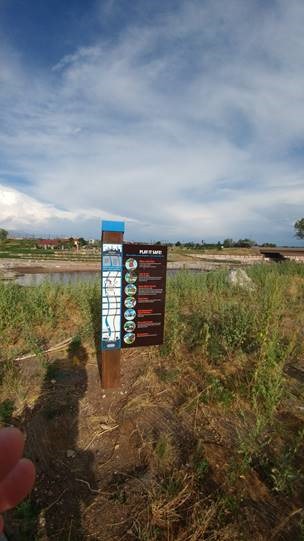 They are way too busy; they are grouped together and have too much wording on them, and you have to be up close to understand the message. As designed, they can easily be ignored.
A warning sign must pop, tell you one maybe two important things. You are moving on, and you are not going to stop to read more than that. The information has to enter the brain of the person who sees it, without having to be studied. If you want more information, it should be there, but you have to get the point across the first time.
These signs don’t do that. Unless someone is lost and looking at the trail map, these signs will never be noticed by anyone.
These signs were designed to be located along the South Platte River as it leaves the Chatfield Reservoir and heads north through Arapahoe County, Littleton and eventually Denver. From the dam to the confluence with Cherry Creek (where the down town REI is located) is around 15 miles. A beautiful path follows the trail from the reservoir past the confluence connecting with more than a dozen other trails. Some sections are a little industrial, but overall it is a fun place to ride, run, walk your dog, watch birds and during hot summer, days float down the river.
The river has been designed over the decades to allow for access and use. Dams all have spillways and can be easily navigated by hard-shell kayak or inflatable tube. Three more river side parks have been added, one with two surfing holes just in the past year. On a cool day, you can see stand up paddleboarders, surfers in wetsuits and kayakers playing in the holes at the river. On a hot day, the river is wall to wall people in a short 5-mile section. On the Fourth of July, I counted 300 people surfing, kayaking, inflatable kayaking and 90% of the tubing. Of the tubers, 50% had a cooler  floating down the river also. On that day, I counted 18 PFDs.
The original intent of the signs was to give information and warning to the people recreating on the river. I was part of the
South Platte Signage group that created a group of signs to be ready to go early in 2017. The sign above was posted sometime after the Fourth of July and more than 20 days above 90 degrees.
When the South Platte Signage committee was done the designs were handed over to the governing body for this section of the South Platte. That was seven months ago. Someone did not like the original signs and had them done. What they ended up with is busy artwork that you can’t comprehend unless you concentrate. That is not a sign that gets your attention or makes you think.
The original signs were made to stand out. You can understand their purpose from a distance. They work as a standalone product, each little sign meaning one thing or as a grouping as needed. This one was placed below the access point for the biggest wave on the river. Not really great planning, it needed to be above, or it needs to be where people leave the parking lot wherever they intend to get on the river.
The “Float Sober” sign completely misses the mark. There are other items legal in Colorado besides alcohol and a lot of thing’s people on the river use that are not. Sober refers to alcohol. “Be Smart” covers everything.
I’m I complaining because they changed the work I helped produce. Probably there are some hurt feelings. More importantly as an attorney in the outdoor recreation industry that has litigated sign issues; I see another set of signs that will only be seen by a jury.
As you well know, signs are hard to create, other than to produce a CYA in a courtroom. Although there were a lot of discussion and research into those issues, the most important thing, the signs were developed for was to keep people safe. To make them take 2 seconds to think.
The original design was intended to be a national model and still is. Anyone can get permission to use the system. The South Platte signs might cost you, no one is sure.
The color in the original system was used to make the warning part of the sign jump, not make the design cute. Cute is for puppies, warning signs have to get someone’s 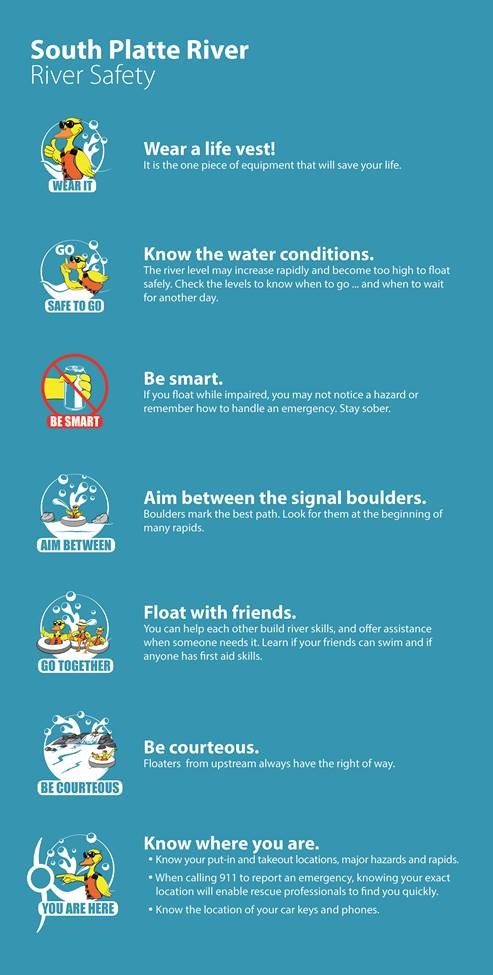 attention.
The design can even be used as a two-color system if money becomes an issue.
The original work is available to anyone who wants to use it free of charge. If you are interested contact Risa Shimoda, Executive Director of the River Management Society. executivedirector@river-management.org (301) 585-4677 http://www.river-management.org/
The otter in the new signs is not wearing a PFD in three of the pictures. In the duck ones, the duck is wearing a PFD. The most important point to get across on any body of water is to wear a PFD.
I was riding my bike when I saw the sign, in fact I had ridden past the sign before I realized what it was and I was constantly looking for the signs. Rangers were probably getting tired of me asking when the river safety signs were going up. When I turned around to go back to read the signs I could not read them or recognize what they were saying standing on the bike path. I walked to the path leading down to the river, (not a put in, just closer to the river.), which was closer to the signs and how people might try to access the river. I finally ended up standing on the grass in front of the sign to see the designs and read the sign.
 Why am I writing this? Because a lot of people in the parks and recreation industry face this every day. Professionals are hired to do a job, which always includes the park employees and some politician or bureaucrat mess’s things up. They might think the sign is prettier; they think an otter is better than a duck. (Ducks which are found up and down the South Platte and most rivers in North America.)
Worse, their changes add months to the final project which put people at risk.
Is the otter that much better of a symbol to save lives that a lot of people got to miss it, and based on where this sign is, continue to miss it?
Show this to the politician/manager/bureaucrat getting on your way, or send me their contact info, and I’ll send it to them so you don’t have to put your head on the chopping block. (Remember an attorney-client privilege.
Let the experts, the employees you employ to run our parks, our open spaces, our state parks, our national forests, and our national monuments and parks do what they have been educated in and trained to do. Run the parks, you run the country…..or at least your little fiefdom and stay out of the parks, unless you are there to enjoy the day.
What do you think? Leave a comment.
If you like this
let your friends know or post it on FB, Twitter or LinkedIn
Author: Outdoor Recreation Insurance, Risk Management and
Law
Copyright 2017 Recreation Law (720) Edit Law
Email: Rec-law@recreation-law.com
Google+: +Recreation
Twitter: RecreationLaw
Facebook: Rec.Law.Now
Facebook Page: Outdoor Recreation & Adventure Travel Law
Mobile Site: http://m.recreation-law.com
By Recreation
Law Rec-law@recreation-law.com James H. Moss
#AdventureTourism, #AdventureTravelLaw,
#AdventureTravelLawyer, #AttorneyatLaw, #Backpacking, #BicyclingLaw, #Camps,
#ChallengeCourse, #ChallengeCourseLaw, #ChallengeCourseLawyer, #CyclingLaw,
#FitnessLaw, #FitnessLawyer, #Hiking, #HumanPowered, #HumanPoweredRecreation,
#IceClimbing, #JamesHMoss, #JimMoss, #Law, #Mountaineering, #Negligence,
#OutdoorLaw, #OutdoorRecreationLaw, #OutsideLaw, #OutsideLawyer, #RecLaw,
#Rec-Law, #RecLawBlog, #Rec-LawBlog, #RecLawyer, #RecreationalLawyer,
#RecreationLaw, #RecreationLawBlog, #RecreationLawcom, #Recreation-Lawcom,
#Recreation-Law.com, #RiskManagement, #RockClimbing, #RockClimbingLawyer,
#RopesCourse, #RopesCourseLawyer, #SkiAreas, #Skiing, #SkiLaw, #Snowboarding,
#SummerCamp, #Tourism, #TravelLaw, #YouthCamps, #ZipLineLawyer, South Platte, South Platte River, Carson Nature Center, South Platte River Signage, South Platte River Safety Signage, South Platte River Safety Signage Committee, River Safety, PFD, Safe Boating,
Tired of TSA messing with your stuff or leaving bike cases open?
Posted: July 11, 2017 Filed under: Uncategorized | Tags: NSSRA, Ship Skis, Shipping, Skis 1 CommentNSSRA Offers Ship Skis as Newest Member Benefit
Program Is Designed To Increase Store Traffic While Offering Customers an Easy Way To Ship Their Gear
MOUNT PROSPECT, IL — The National Ski & Snowboard Retailers Association (NSSRA) Board of Directors is pleased to announce an agreement with Ship Skis to provide ski and board gear shipping services to NSSRA members. Ship Skis provides similar services to the golf industry under the Ship Sticks brand.
NSSRA members who participate in the program will be able to ship their customers’ gear to and from any home, business, or ski resort in the United States or abroad. Retailers will be provided with an easy to complete Ship Skis web page for their websites, which quickly calculates shipping charges. Through Ship Skis, shipping fees are offered at discount rates. This allows NSSRA retailers to earn a margin on their customers shipping charges for facilitating the shipment. Shipments are insured against loss or damage, and Ship Skis will cover up to $200 should the customer have to rent gear for any shipments that are delayed in-transit.
“This is such a natural service to provide our members that we didn’t want to wait until next season to get started,” said NSSRA Chairman of the Board Wilbur Rice. “Many retailers provide similar services for their customers, but the Ship Skis program will save significantly on the cost of shipping skis, boards or other gear to ski resorts.
“I want to thank NSSRA Past Chairman Brad Nelson and Chairman-Elect Teddy Schiavoni for their work in putting this together,” Rice said. “As busy as they have been in their shops, they understood the importance of making Ship Skis available to our members now rather than waiting until next season.”
“We are ecstatic about the new partnership with the NSSRA and proud to join the existing partners in the endeavor to advocate for Ski/Snowboard retailers across the country,” says Nicholas Coleman, CEO. “We believe Ship Skis will extend a unique opportunity to assist every member of the NSSRA with increased foot traffic and revenue at each of its specialty retailers and vendors. This partnership will provide ski/snowboard business vendors and down slope retailers with a way to ensure their customer base has a full-service experience from the counter at the store to the slopes anywhere in the world.”
For more information on Ship Skis, please visit wsmith
For more information on NSSRA, contact NSSRA President Larry Weindruch, lweindruch, or stop by Booth #3628 during the SIA Snow Show.
About NSSRA: The National Ski & Snowboard Retailers Association is a volunteer-led organization dedicated to growing snow sports participation and to support and educate specialty snow sports retailers. Since its founding in 1989, NSSRA has served as the voice of specialty retailers, representing their interest on issues that affect the specialty retail channel. NSSRA publishes research reports for specialty snow sports retailers, offers cost-saving services, and compiles and distributes the Combined Indemnified Bindings List. For more information, please contact NSSRA President Larry Weindruch, (847) 391-9825, or email: lweindruch.
About Ship Skis: Ship Skis provides a door-to-door shipping solution for the traveler who desires a hassle-free traveling experience. As the most reliable and cost effective shipping service available, Ship Skis has partnered with the world’s finest Ski Resorts, Ski Shops and Hotels to allow for an effortless shipping experience. Shipping skis, snowboards, and luggage with Ship Skis allows you to save time and money at the airport by avoiding the long check-in lines, crowded baggage terminals, and expensive baggage fees. Whether your skis, snowboards or luggage are being picked up from your home or office, Ship Skis guarantees an on-time delivery to wherever you’re staying or skiing. For additional information with regards to these convenient services, please visit www.shipskis.com.

So you are moving to a new town. You are worried about wither or not you will fit in and what the other kids are going to say about you when you get there?
Posted: July 6, 2017 Filed under: Uncategorized | Tags: Deme Day, OR, Outdoor Demo, Outdoor Retailer, SIA, Ski Show, Summer Outdoor Retailer, Winter Outdoor Retailer Leave a commentHave no fear, Denver is a pretty easy place to fit in, especially if you are wearing climbing, skiing or any outdoor gear. You look out in street clothes in a lot of cases.
First thing you need to know, Marijuana, nothing else I really need to say.
Lot of more information after that sinks in.
Downtown streets do not run north or south. The streets run NW – SE and NE – SW. So North and South directions down town will be confusing, but only in the downtown.
If you get lost, the mountains are to the west. At night, the big dark areas (or a big cross) are to the west.
Free Mall Shuttle: Go 2 blocks east out the front door of the convention center and you can catch a free shuttle that runs
up and down the 16th street mall. On the shuttle you can access about all the rest of downtown quite easily. (You are not allowed to skateboard or rollerblade on the mall. If you get caught you get a ticket unless you are in your 40’s or above where the cop just looks at you like you are an idiot and that says something about your age, IQ and don’t let him catch you doing this again.) The shuttle goes all the way to the RTD Light Rail station at Union Station where you can catch the A-Line to the airport.
BEER it’s real in Colorado and it has alcohol in it. Not only that you can order two at a time!!!!
Mixed Drinks, they are poured by a person and you can have two at a time. You can even have 10 at a time if you want. A nice tip and a smile can do wonders for your drink. Meaning if the bartender does not move the bottle after the ounce has poured, you get to drink it the extra that comes out. No magic state government finger stops the flow of Wild Turkey! (I try and drink what I am!)
Colorado does not track the waiters or waitresses who serve liquor either so you don’t have to feel like you are being watched when you have a drink.
MarijuanaYup! thought I would repeat it just for the fun of it. 
Cowboy hats can still be seen around town, but they are fading. Big belt buckles, (or as a friend of mine calls them
tombstone for a dead d@$k) are harder to find, thank heavens.
Vehicles & Denver: The city of Denver sees vehicles as another way to make money. They have traffic camera’s
everywhere and will issue tickets for anything, such as being in the crosswalk ($75.00). Even parking in the convention center parking garage with a tire on the yellow parking line is $75.00. Don’t drive in Denver, if you have to move around, walk or take a Pedicab or light rail. There are two pedicab companies I think Denver Pedicabs LLC and Mile High Pedicabs.
I’ve driven to Downtown Denver twice in 12 years and gotten a ticket each time. I don’t drive downtown. In fact I avoid downtown Denver. The most over the past five years I’ve been downtown is for the SIA show. If I do have to go I take RTD
Light rail. See the map below.
B-Cycle: The easiest way to get more than a block from anywhere downtown is to rent a bike at a Denver B-Cycle Station. The easiest way is to go to the website and download the app. The app can tell you where the stations are and how many bikes are there. Using the kiosks is easy. Find the bike you want to ride and with your cell phone number and credit card you’ll be riding in 90 seconds. There is a station right next to the light rail station at the convention center. You can buy a 24 hour ticket which allows you to ride in multiple 30 minute increments. Check the bike back in after 30 minutes, eat dinner, get another bike and ride home.
If you get in a jam, etc., call the B-cycle number (303)825-3325. The staff is awesome and will solve your problem.
Lodging: Lodging should not be a problem in Denver. The best deals might be away from downtown. If that is the case find a hotel that is on RTD light rail. Walkout of the convention center at night, turn left and there is a light rail station and you can go anywhere. (Well not Boulder yet.). The W line has a stop behind the Sheraton which is a great hotel with a dozen bars within walking distance. (My favorite is Chad’s across the street. Use my name, it will make the staff laugh…….) There are five or more nice hotels on the E & F lines going south. Also a couple on the H & R lines, but those would be long rides.
Also south on the C or D line at the Osage Station is the Buckhorn Exchange. It serves a lot of local wildlife as food and has Colorado Liquor license #1 (this is not the place for vegetarians.)
Cycling & lodging or just cycling: If you want to ride a bike the convention center is one block to an entrance to the Cherry
Creek Bike Path. That bike trail goes South East to Aurora and Northwest to REI. At REI, or Confluence Park, you hop on the South Platte River Trail you can ride south to Littleton or North to almost Thornton. From the North part of the South Platter River Trail you can intersect with the Clear Creek Trail and ride to Golden. By the next year you’ll be able to ride to Utah if you really want to.
Airport (DIA): It’s big and confusing. The best way to get downtown is on the light rail. Come off the airport train, up
the escalators and if you turn right to the end of the hall and follow the signs to the train.
Cabs are about $35, the airport is a long way from downtown. Shuttles are much cheaper. Rental cars are on the airport and still a long way away. There is no walking across the street to pick up your care. This is a big city with a big city airport. At the same time, it will be easy to get here with Five big runways.
If you have a hotel downtown, get off the A Train to the airport and walk to the free 16street mall shuttle to get to your
hotel.
Sports: Denver has every professional sports team. During the summer show you can walk to a Rockies game and in the winter to a Nuggets game. You can see indoor and outdoor Lacrosse, Soccer, Ice Hockey at different levels of play, etc., etc., etc.
COPS: You are going to see more, especially along the 16th street mall. They’re there for you. They’ll be friendly and help you out. Do something stupid or take a swing at one and you’ll find concrete is the safest part of the street! And don’t call me. Don’t be dumb and the Denver Police Department has great employees.
Costs: Hotels downtown are the same price as hotels at SLC during the show. But you’ll be paying rack rates not some you’re here so we raised the price cost. You can’t smoke in any hotel room, marijuana or other products. If you do, you’ll find a monster charge on your cleaning bill when you get home. Just like trying to steal stuff from the mini-bar. You’ll probably be
able to use your hotel points and booking rewards, hopefully.
Strip joints. There are several down town and you get to see things, just not use your imagination. If you want to see
everything, you can’t drink.
Jail: got me, I don’t do criminal work and using my name won’t get you anything except a higher bond or my jail time.
Other Activities: You already know about them because this is your industry and your sport.
There are no dress codes in any restaurant in Denver. So you can fit in whatever you are wearing at the show. Here are some notes that will make your first day of school or Outdoor Retailer easier.
I am curious where the outdoor demo is going to be held. There are three big lakes on the outskirts of Denver and several small ones in Denver. Winter I’d guess Echo Mountain just outside of Evergreen, Loveland or Eldora ski areas.
More coming. Stay Tuned or send me your questions.
Denver Light Rail Map
What do you think? Leave a comment.
If you like this
let your friends know or post it on FB, Twitter or LinkedIn
Author: Outdoor Recreation Insurance, Risk Management and Law
Copyright 2017 Recreation Law (720) Edit Law
Email: Rec-law@recreation-law.com
Google+: +Recreation
Twitter: RecreationLaw
Facebook: Rec.Law.Now
Facebook Page: Outdoor Recreation & Adventure Travel Law
Mobile Site: http://m.recreation-law.com
By Recreation
Law Rec-law@recreation-law.com James H. Moss
#AdventureTourism, #AdventureTravelLaw,
#AdventureTravelLawyer, #AttorneyatLaw, #Backpacking, #BicyclingLaw, #Camps,
#ChallengeCourse, #ChallengeCourseLaw, #ChallengeCourseLawyer, #CyclingLaw,
#FitnessLaw, #FitnessLawyer, #Hiking, #HumanPowered, #HumanPoweredRecreation,
#IceClimbing, #JamesHMoss, #JimMoss, #Law, #Mountaineering, #Negligence,
#OutdoorLaw, #OutdoorRecreationLaw, #OutsideLaw, #OutsideLawyer, #RecLaw,
#Rec-Law, #RecLawBlog, #Rec-LawBlog, #RecLawyer, #RecreationalLawyer,
#RecreationLaw, #RecreationLawBlog, #RecreationLawcom, #Recreation-Lawcom,
#Recreation-Law.com, #RiskManagement, #RockClimbing, #RockClimbingLawyer,
#RopesCourse, #RopesCourseLawyer, #SkiAreas, #Skiing, #SkiLaw, #Snowboarding,
#SummerCamp, #Tourism, #TravelLaw, #YouthCamps, #ZipLineLawyer, Outdoor
Retailer, Summer Outdoor Retailer, Winter Outdoor Retailer, Deme Day, Ski Show,
Outdoor Demo, SIA, OR,
Ohio Appellate decision defines assumption of the risk under Ohio law and looks at whether spectators assume the risk.
Posted: July 3, 2017 Filed under: Assumption of the Risk, Ohio, Racing | Tags: assignments of error, Assumption of risk, curve, customary, driver's, Driving, eliminated, Express Assumption of the Risk, finish line, foreseeable, genuine, Go Kart, Go Karting, Guest, headband, host, Implied Assumption of the Risk, inform, Inherent Risks, intentionally, kart, paved, Primary Assumption of the Risk, Reckless, recreational activity, risk of injury, risks inherent, safe, Secondary Assumption of the Risk, Spectator, speed, Sport, Summary judgment, track 1 CommentSpectators are always the biggest risk of many outdoor recreational activities. Even if they are behind fences or lines, the creep closer to the event and if a competitor leaves the track or run, it is the event host who might pay for the damages to the spectators.
Ochall et al., v. McNamer et al., 2016-Ohio-8493; 2016 Ohio App. LEXIS 5337
State: Ohio, Court of Appeals of Ohio, Tenth Appellate District, Franklin County
Plaintiff: Andrea Ochall et al.,
Defendant: William M. McNamer et al.,
Plaintiff Claims: negligence, recklessness, negligent and/or reckless design, construction, operation and maintenance, failure to warn or instruct, negligent infliction of emotional distress, negligent entrustment, negligent supervision, vicarious liability, and loss of consortium
Defendant Defenses: Assumption of the Risk
Holding: for the Defendants
Year: 2016
This court was almost tedious in its review of the facts and the application of the law to the facts in this case. This case is another one outside of the normal scope of this review; however, it covers assumption of the risk in infinite detail under Ohio’s law and deals with claims of spectators. Spectators are present at most sporting events and in some cases assume the risk, like the baseball rule at baseball games and sometimes do not.
The defendant land owner’s kids built a go-kart track. The decision involves a go-kart track in a homeowner’s back yard. The track was just a simple asphalt track. There were no barriers, no bleachers, nothing else except one bench. The land owner worked for a paving company so the track was paved. There was also a paved driveway from the barn where the go-karts were kept to the track. The track was built for no other purpose than for the use and enjoyment of the landowners and people they might invite over.
The track owner’s next-door neighbors used the track a lot and owned a go-kart that was stored with the landowner’s go-karts. However, the neighbors never used the track without asking permission before hand.
One day, the neighbors wanted to invite their friends to the track. Those friends became the plaintiffs.
Everyone took turns driving go-karts around the track, including the plaintiff. When not driving the go-karts, most of the people seemed to congregate on the asphalt drive between the track and the barn. The plaintiff argued this was a safe environment and the place to stand. There were no barriers between this or any place around the track and the track.
Various times during the day, different people drove off the track. After going off the track people simply drove back on the track and kept racing.
When not racing, the plaintiff was taking pictures. Taking pictures obscured the plaintiff’s view of what was going on sometimes.
During one race, the headband of one of the go-kart drivers slid down over her eyes. She grabbed the headband and through it off. While doing so she drove off the track striking the plaintiff.
The last picture the plaintiff took was the driver throwing her headband off.
The plaintiff’s sued the paving company the landowner worked for, as well as the landowner. The paving company was dismissed earlier on its motion and was not part of this discussion.
The plaintiff’s sued the landowner and the neighbors who invited them. The trial court dismissed the plaintiff’s claims based on various motions filed by the different defendants. The plaintiff appealed. The arguments presented in the various motions were boiled down to two and discussed without regard to the plaintiffs and all defendants even though they filed separate motions.
Analysis: making sense of the law based on these facts.
The appellate court first looked at assumption of the risk and whether it applied to this case. Assumption of the risk means the defendant owes the plaintiff no duty. Therefore, there is no negligence. Ohio recognizes three types of assumption of the risk: express, primary and secondary (implied).
Ohio law recognizes three categories of assumption of the risk as defenses to a negligence claim: express, primary, and implied or secondary.” “Express assumption of the risk applies when parties expressly agree to release liability.” “Implied assumption of risk is defined as plaintiff’s consent to or acquiescence in an appreciated, known or obvious risk to plaintiff’s safety.” “Under this approach to assumption of risk, defendant owes to plaintiff some duty, but it is plaintiff’s acquiescence in or appreciation of a known risk that acts as a defense to plaintiff’s action.”
Primary assumption of the risk is the defense that is applied to people who voluntarily engage in sports or recreational activities.
Under the doctrine of primary assumption of the risk, a plaintiff who voluntarily engages in a recreational activity or sporting event assumes the inherent risks of that activity and cannot recover for injuries sustained in engaging in the activity unless the defendant acted recklessly or intentionally in causing the injuries.”
The argument for this is some sports or recreational activities cannot be played without risk. If the risk is removed from the sport, then the value in playing or the sport disappears. Another baseball example is the batter assumes the risk of being hit by a badly thrown pitch. If you remove that risk, the batter has nothing to swing at and there is no game of baseball.
By participating in an activity, the plaintiff “tacitly consent[s]” to the risk of injury inherent in the activity. Id. The test requires that: “(1) the danger is ordinary to the game, (2) it is common knowledge that the danger exists; and (3) the injury occurs as a result of the danger during the course of the game.”
Ohio law applies the doctrine of primary assumption of the risk to participants and spectators alike [emphasize added].
Thus, courts apply the doctrine of primary assumption of the risk to cases involving sporting events and recreational activities, and generally extend the doctrine to relieve liability of owners, operators, and sponsors of recreational activities. The doctrine applies regardless of whether the activity was engaged in by children or adults, or was organized, unorganized, supervised, or unsupervised. The doctrine also applies to spectators and participants alike.
Assumption of the risk when applied to a sport or recreational activity is not dependent upon the plaintiff’s knowledge and appreciation of the risks of the sport or activity. Normally to assume the risk a person must know and understand the risk as required in primary assumption of the risk. In sporting or recreational activities, knowledge of the risk is immaterial. Whether a participant assumes the risk is solely based on the risks of the sport, not what the participant knows.
Furthermore, when considering primary assumption of the risk, “the injured plaintiff’s subjective consent to and appreciation for the inherent risks are immaterial to the analysis.” (Noting that the plaintiff’s subjective consent to the inherent risks of an activity are immaterial, because “[t]hose entirely ignorant of the risks of the activity, still assume the risk by participating in the activity”). Indeed, “primary assumption of risk requires an examination of the activity itself and not plaintiff’s conduct.”
Those risks that apply are the ones directly associated with the activity. Consequently, a court must proceed with caution when examining the activity and the risks because assumption of the risk is a complete bar because no negligence can be proved. Was the risk that injured the plaintiff a risk of the sport and if so, was that risk increased by the activity of the defendant. If the risks are part and parcel of the sport, then the defendant does not owe a duty to the plaintiff.
[O]nly those risks directly associated with the activity in question are within the scope of primary assumption of risk.'” “The affirmative defense of primary assumption of the risk completely negates a negligence claim because the defendant owes no duty to protect the plaintiff against the inherent risks of the recreational activity in which the plaintiff engages.”
The doctrine of applying primary assumption of the risk to sports and recreational activities was created to ensure the sport was played vigorously and freely without fear of reprisal.
The “goal” of the primary assumption of the risk doctrine “is to strike a balance between encouraging vigorous and free participation in recreational or sports activities, while ensuring the safety of the players.” that the “overriding consideration in the application of primary assumption of risk is to avoid imposing a duty which might chill vigorous participation in the implicated activity and thereby alter its fundamental nature”);…
That doctrine then defines primary assumption of the risk when applied to a sport as:
…where injuries stem from ‘conduct that is a foreseeable, customary’ part of the activity, the defendant ‘cannot be held liable for negligence because no duty is owed to protect the victim from that conduct.’
The test is then applied with a three-part test.
Under the three-part test, a danger ordinary to a game is a danger which is customary to the game. (observing that “[f]alling is an ordinary danger of ice-skating,” and that “[c]olliding with the perimeter boards is an ordinary danger of ice rink skating”). When a danger is a foreseeable part of a game, there will be common knowledge that the danger exists.
Risks that are “foreseeable, common, and customary risks of the activity” are therefore assumed by participants whether they knew of the risks or not. The Ohio Supreme Court further defined the definition to mean “‘[t]o be covered under the doctrine, the risk must be one that is so inherent to the sport or activity that it cannot be eliminated.’”
Looking at the risks of go-karting the court found that it was an inherent risk of the sport for a go-kart to leave the track. (Since go-karts had been leaving the track all day, this seems pretty implicit and also gives the plaintiff notice of the risk, although not required by the definition of primary assumption of the risk.)
Pursuant to our de novo review, we have determined that an inherent risk of go-karting is the risk that a go-kart will deviate from its intended course upon the track and strike any object, which may be present around the track. As such, absent evidence of reckless or intentional conduct, primary assumption of the risk applies to the facts of this case and defeats appellants’ negligence claims. Accordingly, we have reached the same result as the trial court, albeit for different reasons.
Primary assumption of the risk barred the claims of the plaintiffs.
The court then looked at whether the actions of the driver who left the track and struck the plaintiff where reckless which would defeat the defense of assumption of the risk. The court looked at the definition of recklessness under Ohio’s law.
An actor’s conduct is reckless when the actor “‘does an act or intentionally fails to do an act which it is his duty to the other to do, knowing or having reason to know of facts which would lead a reasonable man to realize, not only that his conduct creates an unreasonable risk of physical harm to another,'” but also “‘that such risk is substantially greater than that which is necessary to make his conduct negligent.
That conduct must be measured against how the sport is played.
What constitutes an unreasonable risk under the circumstances of a sporting event must be delineated with reference to the way the particular game is played, i.e., the rules and customs that shape the participants’ ideas of foreseeable conduct in the course of a game.”
Thus, “[i]f the rules of a sport allow conduct intended to harm another player, as they do in boxing or football, for example, it follows that those same rules allow behavior that would otherwise give rise to liability for recklessness.”
The plaintiff argued the defendants were reckless in failing to inform the plaintiff of the rules of the track. The court found there were no rules and there was no obligation to create them. The track was a backyard track built by the songs of the landowner for their enjoyment. There were no rules nor was there a requirement for the landowner to create rules for the use of the track.
Additionally, there is no duty to reduce or eliminate the risks of a recreational activity. The only duty is to not increase the risk of the activity. Consequently, the land owners did not owe a duty to create rules for the track or to inform the spectators of any rules if they were created.
Courts from other jurisdictions, however, have held that “operators, sponsors and instructors in recreational activities posing inherent risks of injury have no duty to eliminate those risks, but do owe participants the duty not to unreasonably increase the risks of injury beyond those inherent in the activity
The son of the landowner who built the track stated he had a ruled that spectators should stay in the barn. However, he had never enforced the rule. The court found that rule of no real value and no duty to create, enforce it or tell the plaintiff about it.
Accordingly, as the organizer of the go-karting event that day, the McNamers owed appellants the duty to not increase the risk of harm beyond the risks inherent in the activity. Failing to inform appellants about Brian McMillen’s rule did not increase the risks inherent in the activity of go-karting, as it did not increase the risk that go-karts would crash into one another, or that a driver would lose control of their go-kart and deviate from the track. Accordingly, the McNamers did not have a duty to inform the Ochalls about Brian McMillen’s rule. Construing the evidence in appellants favor, we find no evidence demonstrating that the McNamers intentionally failed to inform the Ochalls about Brian’s rule when they had a duty to do so. Accordingly, appellants have failed to demonstrate that the McNamers were reckless by failing to inform the Ochalls about Brian McMillen’s rule.
There was a bench located near the track. The defendant land owner’s son argued it was for racers to sit on between races to rest. The plaintiff argued it was there for spectators and built to entice the plaintiff to stand near it where she was injured. However, the court did not agree with this argument either.
However, there is no evidence indicating that the McMillens placed the bench there to “entice” people to congregate in that area. More importantly, the bench did not conceal any danger from appellants. The bench did not obscure appellants’ ability to see the barrier-less nature of the track or the go-karts driving off the track. There also was no evidence indicating that Mrs. Ochall ever sat on the bench; rather, the evidence indicated that Mrs. Ochall “moved around quite a bit to take photographs.”
The plaintiff’s then argued it was reckless of the defendants to conceal the dangers of the track by failing to warn them of the risks or educating them of the dangers. However, they could not tie these arguments, failing to warn, to the injury received by the plaintiff. The court found even if they had been informed of the risks, it would not have changed anything; the plaintiff would still have probably been injured.
Another recklessness claim was directed at the adults in charge of the minor driver who injured the plaintiff when she drove off the track. However, again, they could not relate those claims to the cause of the accident.
Indeed, appellants fail to make any connection between Doe’s allegedly aggressive driving and the accident. The record indicates only that it was an unfortunate slip of Doe’s headband, and Doe’s attendant need to remove her hand from the wheel in order to remove the headband from her face, which caused the accident. There is nothing in the record indicating that Doe’s alleged aggressive driving caused the accident.
Finally, the plaintiff claimed the minor driver was reckless in how she drove.
Finally, Doe’s act of removing her headband from her line of vision did not amount to reckless conduct. Doe did not remove the headband with any conscious choice of action, or with knowledge that doing so would cause her go-kart to jerk, veer off the track, and strike Mrs. Ochall.
This argument failed because reckless conduct is a conscious act. There was no conscious decision to drive off the track. The decision was to remove the headband when it was blinding her.
…reckless misconduct requires a conscious choice of a course of action, either with knowledge of the serious danger to others involved in it or with knowledge of facts which would disclose this danger to any reasonable man
The court could not find in the plaintiff’s recklessness arguments, a proximate cause or a relationship in the arguments that might have or would have changed the way things happened.
However, every tragic accident does not result in tort liability. Because Mrs. Ochall primarily assumed the risk of injury when she stood 10 to 12 feet away from the McMillens’ go-kart track, and no defendant engaged in reckless or intentional misconduct, the trial court properly granted the defendants’ motions for summary judgment. Having overruled appellants’ first and second assignments of error, we affirm the judgment of the Franklin County Court of Common Pleas. As we have overruled the appellants’ assignments of error, the McMillens withdraw their assignment of error on cross-appeal.
The appellate court agreed with the trial court, and the case was dismissed.
So Now What?
The first issue is assumption of the risk applies to spectators. Spectators have always been the unknown possible lawsuit at events. Spectators usually pay to see the event so recreational use statutes provide no protection. They do not sign releases because they are not participating. However, based on this definition of assumption of the risk and the idea that a spectator should assume the risk because they watch the sport, a spectator is prevented from sung when injured under Ohio Law.
The second issue is the clear definitions of assumption of the risk defined in this.
On a side note, the plaintiff hired an expert witness who opined that the landowner should have built a small elevated wooden platform for spectators to stand on next to the track.
Hawn stated that a “reasonable solution to the safety issue for persons afoot” was to construct “a small elevated wooden platform (~7-8 inches in height) on the infield side of the start/finish/staging area.” Hawn concluded that the “failure to either provide a safe observation location or to otherwise dictate, communicate and enforce safety rules to protect guests from the potential hazard associated with spectating was unreasonable and made this an unsafe environment for persons afoot.”
The expert also opined that the spectator’s area should have been relocated to the inside of the track and elevated. (So you have a group of people above the track level all turning around together to watch the race……)
Can you see what would happen at backyard playgrounds, sandboxes and every other play or recreational device in backyards? Sand boxes would have to come with sneeze guards you see on salad bars so sand could not accidentally be thrown in a grandparent’s face.
What do you think? Leave a comment.
If you like this let your friends know or post it on FB, Twitter or LinkedIn
Author: Outdoor Recreation Insurance, Risk Management and Law
Copyright 2017 Recreation Law (720) Edit Law
Email: Rec-law@recreation-law.com
Google+: +Recreation
Twitter: RecreationLaw
Facebook: Rec.Law.Now
Facebook Page: Outdoor Recreation & Adventure Travel Law
Blog: http://www.recreation-law.com
Mobile Site: http://m.recreation-law.com
By Recreation Law Rec-law@recreation-law.com James H. Moss
#AdventureTourism, #AdventureTravelLaw, #AdventureTravelLawyer, #AttorneyatLaw, #Backpacking, #BicyclingLaw, #Camps, #ChallengeCourse, #ChallengeCourseLaw, #ChallengeCourseLawyer, #CyclingLaw, #FitnessLaw, #FitnessLawyer, #Hiking, #HumanPowered, #HumanPoweredRecreation, #IceClimbing, #JamesHMoss, #JimMoss, #Law, #Mountaineering, #Negligence, #OutdoorLaw, #OutdoorRecreationLaw, #OutsideLaw, #OutsideLawyer, #RecLaw, #Rec-Law, #RecLawBlog, #Rec-LawBlog, #RecLawyer, #RecreationalLawyer, #RecreationLaw, #RecreationLawBlog, #RecreationLawcom, #Recreation-Lawcom, #Recreation-Law.com, #RiskManagement, #RockClimbing, #RockClimbingLawyer, #RopesCourse, #RopesCourseLawyer, #SkiAreas, #Skiing, #SkiLaw, #Snowboarding, #SummerCamp, #Tourism, #TravelLaw, #YouthCamps, #ZipLineLawyer, track, go-kart, spectator, driving, reckless, driver’s, guest, eliminated, summary judgment, inherent risks, foreseeable, go-karting, paved, finish line, recreational activity, sport, assignments of error, safe, curve, speed, kart, customary, host, risks inherent, assumption of risk, intentionally, inform, risk of injury, headband, genuine, Express Assumption of the Risk, Implied Assumption of the Risk, Secondary Assumption of the Risk, Primary Assumption of the Risk,
Oregon Governor signs bill amending the Oregon Recreational Use statute, providing protection for volunteers and agents of the landowner for liability on land
Posted: June 28, 2017 Filed under: Oregon | Tags: Immunity, Oregon, Oregon Public Use of Lands Act, Recreational Use, Recreational Use Act, Recreational Use Statute 1 CommentThe Oregon Supreme Court has interpreted the Oregon Recreational Use Statute to only apply to the landowner, not anyone else on the land. See Oregon Supreme Court decision says protection afforded by the OR Recreational Use Statute only applies to landowner, not volunteers or others on the land.
This decision will allow Boy Scouts, IMBA volunteers and others to go back onto the land and provide services to landowners and the public to make the land better for recreation.
The bill was written so it went into effect upon signing so the protection of the act was effective June 23, 2017. The issue still remains about the gap in protection from the decision of the Oregon Supreme Court on November 13, 2015 till June 23, 2017. Injured possible plaintiffs will be checking dates….
Bold sections in the Act below are the amended language.
79th OREGON LEGISLATIVE ASSEMBLY–2017 Regular Session
Enrolled
Senate Bill 327
Printed pursuant to Senate Interim Rule 213.28 by order of the President of the Senate in conformance with presession filing rules, indicating neither advocacy nor opposition on the part of the President (at the request of Senate Interim Committee on Business and Transportation)
CHAPTER ………………………………………….
AN ACT
Relating to recreational immunity from claims of persons entering land for certain purposes; amending ORS 105.672; and declaring an emergency.
Be It Enacted by the People of the State of Oregon:
SECTION 1. ORS 105.672 is amended to read:
105.672. As used in ORS 105.672 to 105.696:
(1) “Charge”:
(a) Means the admission price or fee requested or expected by an owner in return for granting permission for a person to enter or go upon the owner’s land.
(b) Does not mean any amount received from a public body in return for granting permission for the public to enter or go upon the owner’s land.
(c) Does not include the fee for a winter recreation parking permit or any other parking fee of $15 or less per day.
(2) “Harvest” has that meaning given in ORS 164.813.
(3) “Land” includes all real property, whether publicly or privately owned.
(4) “Owner” means:
(a) The possessor of any interest in any land, [such as] including but not limited to the holder of [a fee] any legal or equitable title, a tenant, a lessee, an occupant, the holder of an easement, the holder of a right of way or a person in possession of the land;
(b) An officer, employee, volunteer or agent of a person described in paragraph (a) of this subsection, while acting within the scope of assigned duties; and
(c) A director, partner, general partner, shareholder, limited liability company member, limited liability partner or limited partner of a person described in paragraph (a) of this subsection.
(5) “Recreational purposes” includes, but is not limited to, outdoor activities such as hunting, fishing, swimming, boating, camping, picnicking, hiking, nature study, outdoor educational activities, waterskiing, winter sports, viewing or enjoying historical, archaeological, scenic or scientific sites or volunteering for any public purpose project.
(6) “Special forest products” has that meaning given in ORS 164.813.
(7) “Woodcutting” means the cutting or removal of wood from land by an individual who has obtained permission from the owner of the land to cut or remove wood.
Enrolled Senate Bill 327 (SB 327-A) Page 1
SECTION 2. This 2017 Act being necessary for the immediate preservation of the public peace, health and safety, an emergency is declared to exist, and this 2017 Act takes effect on its passage.
Do Something: Thank the Governor and the legislature for the quick actions
What do you think? Leave a comment.
If you like this let your friends know or post it on FB, Twitter or LinkedIn
Author: Outdoor Recreation Insurance, Risk Management and Law
Copyright 2017 Recreation Law (720) Edit Law
Email: Rec-law@recreation-law.com
Google+: +Recreation
Twitter: RecreationLaw
Facebook: Rec.Law.Now
Facebook Page: Outdoor Recreation & Adventure Travel Law
Blog: http://www.recreation-law.com
Mobile Site: http://m.recreation-law.com
By Recreation Law Rec-law@recreation-law.com James H. Moss
#AdventureTourism, #AdventureTravelLaw, #AdventureTravelLawyer, #AttorneyatLaw, #Backpacking, #BicyclingLaw, #Camps, #ChallengeCourse, #ChallengeCourseLaw, #ChallengeCourseLawyer, #CyclingLaw, #FitnessLaw, #FitnessLawyer, #Hiking, #HumanPowered, #HumanPoweredRecreation, #IceClimbing, #JamesHMoss, #JimMoss, #Law, #Mountaineering, #Negligence, #OutdoorLaw, #OutdoorRecreationLaw, #OutsideLaw, #OutsideLawyer, #RecLaw, #Rec-Law, #RecLawBlog, #Rec-LawBlog, #RecLawyer, #RecreationalLawyer, #RecreationLaw, #RecreationLawBlog, #RecreationLawcom, #Recreation-Lawcom, #Recreation-Law.com, #RiskManagement, #RockClimbing, #RockClimbingLawyer, #RopesCourse, #RopesCourseLawyer, #SkiAreas, #Skiing, #SkiLaw, #Snowboarding, #SummerCamp, #Tourism, #TravelLaw, #YouthCamps, #ZipLineLawyer, Recreational Use Statute, Oregon, Recreational Use, Immunity,
Colony Insurance Company v. Dover Indoor Climbing Gym, 158 N.H. 628; 974 A.2d 399; 2009 N.H. LEXIS 51
Posted: June 23, 2017 Filed under: Climbing Wall, Legal Case, New Hampshire, Release (pre-injury contract not to sue) | Tags: absurd, Ambiguity, Ambiguous, burden of proving, clear meaning, Climbing, Climbing Gym, construe, contracting parties, contractually, coverage, endorsement, Gym, Gymnastics, insurance coverage, Insurance policy, insured, insurer, linguistic, matter of law, objectively, ordinary meaning, policy language, policyholder, purported, question of law, reasonable expectations of coverage, Reasonable person, Release, Summary judgment, unambiguous, words used Leave a commentColony Insurance Company v. Dover Indoor Climbing Gym & a., 158 N.H. 628; 974 A.2d 399; 2009 N.H. LEXIS 51
Colony Insurance Company v. Dover Indoor Climbing Gym & a.
No. 2008-759
SUPREME COURT OF NEW HAMPSHIRE
158 N.H. 628; 974 A.2d 399; 2009 N.H. LEXIS 51
March 18, 2009, Argued
April 24, 2009, Opinion Issued
HEADNOTES NEW HAMPSHIRE OFFICIAL REPORTS HEADNOTES
1. Insurance–Policies–Construction The interpretation of insurance policy language is a question of law for the court to decide. The court construes the language of an insurance policy as would a reasonable person in the position of the insured based upon a more than casual reading of the policy as a whole. Policy terms are construed objectively, and where the terms of a policy are clear and unambiguous, the court accords the language its natural and ordinary meaning. The court need not examine the parties’ reasonable expectations of coverage when a policy is clear and unambiguous; absent ambiguity, the court’s search for the parties’ intent is limited to the words of the policy.
2. Insurance–Proceedings–Burden of Proof The burden of proving that no insurance coverage exists rests squarely with the insurer.
3. Insurance–Policies–Ambiguities Although an insurer has a right to contractually limit the extent of its liability, it must do so through clear and unambiguous policy language. Ambiguity exists if reasonable disagreement between contracting parties leads to at least two interpretations of the language. In determining whether an ambiguity exists, the court will look to the claimed ambiguity, consider it in its appropriate context, and construe the words used according to their plain, ordinary, and popular definitions. If one of the reasonable meanings of the language favors the policyholder, the ambiguity will be construed against the insurer. Where, however, the policy language is clear, the court will not perform amazing feats of linguistic gymnastics to find a purported ambiguity simply to construe the policy against the insurer and create coverage where it is clear that none was intended.
4. Insurance–Policies–Construction When a climbing gym’s insurance policy stated, “All participants shall be required to sign a waiver or release of liability in your favor prior to engaging in any climbing activity,” the clear meaning of the policy language was that the gym was required to actually obtain waivers from climbing participants. The gym’s interpretation that a reasonable person would believe that coverage existed so long as the gym had a policy of requiring waivers regardless of whether it actually obtained waivers would lead to the absurd result of requiring coverage even if the gym never actually enforced its waiver policy. A reasonable person reading the policy would not understand that coverage existed in such circumstances. Because the policy required the gym to obtain waivers from all participants, the failure to do so in the case of an injured climber rendered coverage under the policy inapplicable to his claims.
COUNSEL: Wiggin & Nourie, P.A., of Manchester (Doreen F. Connor on the brief and orally), for the plaintiff.
Mallory & Friedman, PLLC, of Concord (Mark L. Mallory on the brief and orally), for defendant, Dover Indoor Climbing Gym.
Shaheen & Gordon, P.A., of Dover, for defendant, Richard Bigelow, filed no brief.
JUDGES: DUGGAN, J. BRODERICK, C.J., and DALIANIS, J., concurred.
OPINION BY: DUGGAN
OPINION
[**400] [*629] Duggan, J. The plaintiff, Colony Insurance Company (Colony), appeals an order of the Superior Court (McHugh, J.) denying its motion for summary judgment and granting that of the defendants, Dover Indoor Climbing Gym (the gym) and Richard Bigelow. We reverse and remand.
The trial court found, or the record supports, the following facts. Colony issued a commercial general liability insurance policy to the gym, which was in effect from January 5, 2007, to January 5, 2008. An endorsement to the policy stated: “All ‘participants’ shall be required to sign a waiver or release of liability in your favor prior to engaging in any ‘climbing activity.’ ” It further stated: “Failure to conform to this warranty will render this policy null and void as [sic] those claims brought against you.”
On August 14, 2007, [***2] Bigelow accompanied friends to the climbing gym, but did not sign a waiver. He testified that he was never asked to sign a waiver; the gym owner’s affidavit stated that the owner asked the group of climbers if they had waivers on file and received no negative answers. It is undisputed, however, that Bigelow did not sign a waiver or release. While climbing, Bigelow fell and sustained serious injuries. The gym then put Colony on notice to defend and pay any verdict obtained by Bigelow. In response, Colony filed a petition for declaratory judgment, arguing that the gym’s failure to obtain a release from Bigelow absolved Colony of any duty to defend or indemnify the gym.
Both Colony and the defendants filed motions for summary judgment, which the trial court addressed in a written order. The trial court found that Colony’s failure to provide the gym with a sample waiver rendered the endorsement provision ambiguous. The trial court therefore denied Colony’s motion for summary judgment, and granted the defendants’ cross-motion [**401] for summary judgment. This appeal followed.
[*630] On appeal, Colony argues that the trial court erred in finding that the endorsement was ambiguous, and contends that the [***3] gym’s failure to obtain a waiver from Bigelow renders the policy inapplicable as to his claims. Alternatively, Colony argues that even if the endorsement is ambiguous, the gym is not entitled to coverage because it had actual knowledge of the policy’s waiver requirement.
[HN1] In reviewing the trial court’s grant or denial of summary judgment, we consider the evidence, and all inferences properly drawn from it, in the light most favorable to the non-moving party. Everitt v. Gen. Elec. Co., 156 N.H. 202, 208, 932 A.2d 831 (2007); Sintros v. Hamon, 148 N.H. 478, 480, 810 A.2d 553 (2002). If there is no genuine issue of material fact, and if the moving party is entitled to judgment as a matter of law, the grant of summary judgment is proper. Everitt, 156 N.H. at 209; Sintros, 148 N.H. at 480. We review the trial court’s application of the law to the facts de novo. Everitt, 156 N.H. at 209; Sintros, 148 N.H. at 480.
[1] [HN2] The interpretation of insurance policy language is a question of law for this court to decide. Godbout v. Lloyd’s Ins. Syndicates, 150 N.H. 103, 105, 834 A.2d 360 (2003). We construe the language of an insurance policy as would a reasonable person in the position of the insured based upon a more than casual reading [***4] of the policy as a whole. Id. Policy terms are construed objectively, and where the terms of a policy are clear and unambiguous, we accord the language its natural and ordinary meaning. Id. We need not examine the parties’ reasonable expectations of coverage when a policy is clear and unambiguous; absent ambiguity, our search for the parties’ intent is limited to the words of the policy. Id.
[2, 3] In this case, the gym argues that the policy is ambiguous and Colony maintains that it is not. [HN3] The burden of proving that no insurance coverage exists rests squarely with the insurer. Curtis v. Guaranty Trust Life Ins. Co., 132 N.H. 337, 340, 566 A.2d 176 (1989); see RSA 491:22-a (1997). [HN4] Although an insurer has a right to contractually limit the extent of its liability, it must do so “through clear and unambiguous policy language.” Id. (quotation omitted). Ambiguity exists if “reasonable disagreement between contracting parties” leads to at least two interpretations of the language. Int’l Surplus Lines Ins. Co. v. Mfgs. & Merchants Mut. Ins. Co., 140 N.H. 15, 20, 661 A.2d 1192 (1995); Trombly v. Blue Cross/Blue Shield, 120 N.H. 764, 771, 423 A.2d 980 (1980). In determining whether an ambiguity exists, we will look to the claimed ambiguity, [***5] consider it in its appropriate context, and construe the words used according to their plain, ordinary, and popular definitions. Int’l Surplus, 140 N.H. at 20. If one of the reasonable meanings of the language favors the policyholder, the ambiguity will be construed against the insurer. Id. Where, however, the policy language is clear, this court “will not [*631] perform amazing feats of linguistic gymnastics to find a purported ambiguity” simply to construe the policy against the insurer and create coverage where it is clear that none was intended. Hudson v. Farm Family Mut. Ins. Co., 142 N.H. 144, 147, 697 A.2d 501 (1997); Curtis, 132 N.H. at 342.
The trial court found that the endorsement requiring waivers is ambiguous because Colony did not provide the gym with a sample waiver. Even the gym, however, contends that the trial court “reached the [**402] correct result for the wrong reasons.” Thus, the gym does not argue that the endorsement creates an ambiguity by its failure to provide the insured with a sample waiver form, but, rather, that the exclusionary language is ambiguous because it states that participants shall “be required” to sign waivers as opposed to mandating that the gym obtain signed waivers. [***6] Under this interpretation, the gym argues, a reasonable person would believe that coverage exists so long as the gym has a policy of requiring waivers regardless of whether it actually obtained waivers from climbing participants. Colony argues that the policy language is unambiguous. We agree with Colony.
[4] The clear meaning of the policy language is that the gym is required to actually obtain waivers from climbing participants. The gym’s interpretation would lead to the absurd result of requiring coverage even if the gym never actually enforced its waiver policy. A reasonable person reading the policy would not understand that coverage existed in such circumstances. The gym’s interpretation is unreasonably narrow, and is therefore not the type of alternative interpretation that renders policy language ambiguous. See Curtis, 132 N.H. at 342 ( [HN5] refusing to find ambiguity when alternate interpretations would “inevitably lead to absurd results”). To construe the exclusion against the insurer here would create coverage where it is clear that none was intended. We therefore conclude that the policy language is unambiguous and that a reasonable insured would understand that the exclusion would [***7] apply in this case.
Because the policy requires the gym to obtain waivers from all participants, the failure to do so in the case of Bigelow renders coverage under the policy inapplicable to his claims. In light of our holding, we need not address Colony’s remaining argument. We therefore reverse the order of the trial court granting the defendants’ motion for summary judgment, and hold that Colony is entitled to summary judgment as a matter of law.
Reversed and remanded.
Broderick, C.J., and Dalianis, J., concurred.
Ochall et al., v. McNamer et al., 2016-Ohio-8493; 2016 Ohio App. LEXIS 5337
Posted: June 23, 2017 Filed under: Assumption of the Risk, Legal Case, Ohio | Tags: assignments of error, Assumption of risk, curve, customary, driver's, Driving, eliminated, Express Assumption of the Risk, finish line, foreseeable, genuine, Go Kart, Go Karting, Guest, headband, host, Implied Assumption of the Risk, inform, Inherent Risks, intentionally, kart, paved, Primary Assumption of the Risk, Reckless, recreational activity, risk of injury, risks inherent, safe, Secondary Assumption of the Risk, Spectator, speed, Sport, Summary judgment, track Leave a commentOchall et al., v. McNamer et al., 2016-Ohio-8493; 2016 Ohio App. LEXIS 5337
Andrea Ochall et al., Plaintiffs-Appellants/Cross-Appellees, v. William M. McNamer et al., Defendants-Appellees, Mark McMillen et al., Defendants-Appellees/Cross-Appellants.
No. 15AP-772
COURT OF APPEALS OF OHIO, TENTH APPELLATE DISTRICT, FRANKLIN COUNTY
2016-Ohio-8493; 2016 Ohio App. LEXIS 5337
December 29, 2016, Rendered
PRIOR HISTORY: [**1] APPEAL from the Franklin County Court of Common Pleas. (C.P.C. No. 14CV-5498).
DISPOSITION: Judgment affirmed.
COUNSEL: On brief: Kitrick, Lewis & Harris, Co. LPA, Mark Lewis, Mark Kitrick, and Elizabeth Mote, for appellants. Argued: Mark Lewis.
On brief: The Carr Law Office, LLC, Adam E. Carr, and Eric K. Grinnell, for appellees William M. and Elizabeth McNamer. Argued: Adam E. Carr.
On brief: Lane Alton, Joseph A. Gerling, and Monica L. Waller, for appellees/cross-appellants Sharon and Mark McMillen. Argued: Monica L. Waller.
On brief: Hollern & Associates, and Edwin J. Hollern, for appellees James Porter and Jane Doe # 1. Argued: Edwin J. Hollern.
JUDGES: KLATT, J. SADLER, J., concurs. DORRIAN, P.J., concurs in and part dissents in part.
OPINION BY: KLATT
OPINION
(REGULAR CALENDAR)
DECISION
KLATT, J.
[*P1] Plaintiffs-appellants, Andrea Ochall, her husband Robert Ochall, and their two minor children, appeal from a judgment of the Franklin County Court of Common Pleas, granting the motions for summary judgment of defendants-appellees, Sharon and Mark McMillen, James Porter and his minor daughter, Jane Doe, and William and Elizabeth McNamer (“Liz”). For the reasons which follow, we affirm.
I. FACTS AND PROCEDURAL HISTORY
[*P2] On May 23, 2014, appellants [**2] filed a complaint against the McNamers, the McMillens, Porter, Doe, McMillen Paving and Sealing, Inc. (“MP&S”), and McMillen Paving, Inc. The complaint asserted claims for negligence, recklessness, negligent and/or reckless design, construction, operation and maintenance, failure to warn or instruct, negligent infliction of emotional distress, negligent entrustment, negligent supervision, vicarious liability, and loss of consortium. The events giving rise to the complaint occurred on September 20, 2013, when Mrs. Ochall was seriously injured while watching a go-kart race on the McMillens’ property.
[*P3] On the day of the incident, the McNamers had invited the Ochalls to their home in Hilliard, Ohio, for the purpose of using the go-kart track located on the McMillens’ property. The McNamers and the McMillens are next-door neighbors and very good friends. Liz McNamer and Robert Ochall are co-workers, and Liz McNamer had previously invited the Ochalls over to use the McMillens go-kart track in 2011. The Ochall family, both the adults and their two children, drove go-karts on the McMillens’ track during their visit in 2011. The Ochalls, however, had never met the McMillens before filing the [**3] present lawsuit.
[*P4] The McMillens’ son, Brian McMillen, with assistance from his younger brother Scott, constructed the go-kart track in the McMillens’ backyard between 1994-1995, when Brian was between the ages of 18 and 19-years-old. The McMillens own and operate a paving and sealing company, MP&S. Brian is now the vice president of MP&S, but was not when he originally constructed the track.
[*P5] Brian and his brother built the track in their spare time, and used some company equipment to build it. The McMillens routinely used company equipment on their home projects. Brian explained that the track “basically is a twisted up driveway.” (Jan. 5, 2015 Brian McMillen Dep. at 62.) The McMillens have never charged anyone money to use the track and they do not operate the track commercially, it is something they simply use “to [their] liking.” Id. at 88.
[*P6] Although the McNamers and the McMillens are close frends, the McNamers would always ask the McMillens for permission before bringing guests over to use the track. Thus, prior to the Ochalls’ 2013 visit, Liz McNamer asked the McMillens if they could bring the Ochalls over to use the track. The McMillens said yes, and Mark McMillen opened the McMillens’ [**4] barn and prepared the go-karts for the group’s use.
[*P7] The McMillens own five go-karts and the McNamers own one go-kart, but the go-karts are all the same make and model. Brian McMillen purchased all the go-karts from the same vendor shortly after he constructed the track, and the McNamers paid the McMillens directly for their one go-kart. Brian explained that he selected these specific go-karts because he “didn’t want to go so fast out there” so that people would “need helmets.” Id. at 109. Brian noted that the go-karts have “a bumper, * * * a full harness and had a roll cage,” and could reach a maximum speed of 28 miles per hour. Id. Brian also noted that he could not “recall whether or not we actually got a manual for the karts,” noting that he did not “remember even seeing a manual.” Id. at 115. The go-karts all have stickers on the back which advise the drivers that there is no bumping.
[*P8] The McMillens store their go-karts in their barn, and there is a paved driveway which connects the barn to the track. The driveway connects with the track at the track’s start/finish line. Porter explained that people would generally congregate on the paved area next to the start/finish line in order “to trade positions [**5] with the drivers or to watch people driving by.” (Dec. 30, 2014 James J. Porter Dep. at 41.) Liz McNamer stated that she “always stood” on the paved area near the start/finish line when she was at the track. (Feb. 10, 2015 Elizabeth G. McNamer Dep. at 56-57.) Mrs. Ochall stated that, during her visit in 2011, she was “instructed to stand in that — that particular area” by Liz McNamer. (Dec. 4, 2014 Andrea L. Ochall Dep. at 29.) No one told Mrs. Ochall where to stand during the 2013 visit. Id. at 135-36.
[*P9] Brian McMillen testified that he designed the track “not to have any spectators.” (B. McMillen Dep. at 168.) Brian explained that, when he took “people out there, that’s part of my deal: Stay up in the barn until you come up and get in a kart.” Id. at 175. He also noted that anyone at the track had to “be aware. You’ve got cars going around the track. You have to be aware that that’s an issue.” Id. Mark McMillen had placed a bench at the back edge of that paved area next to the start/finish line. Brian explained that the bench was “by no means a bleacher,” as it was there simply for drivers to rest on between and after races. Id. at 170-71.
[*P10] There are no barriers around the McMillens’ go-kart track, only painted edge lines. [**6] Brian McMillen explained that he purposely did not construct barriers because barriers “would just be something for a kart to hit,” and would “give a much greater probability of making a car go airborn and possible flipping.” Id. at 168, 232. Accordingly, when driving on the McMillens’ go-kart track, “there are times you go off the track on a turn or you veer off for some reason or another. * * * And that happens regularly.” (J. Porter Dep. at 38.) Liz McNamer noted that she “went off into the grass” the first time she drove on the track. (L. McNamer Dep. at 40, 42.) She explained that it was “safe” for a driver to “go off the track and come back on.” Id. at 108-09. Porter noted that he had seen go-karts go off the track on the “big turns, * * * on the little turns, * * * on the straightaways,” and specifically stated that he had seen go-karts go off the track “coming out that final turn into the start/stop” area. (J. Porter Dep. at 38-39; 45-46.)
[*P11] On the day of the incident, the Ochalls arrived with their two minor children, and two of their children’s friends. The McNamers’ son-in-law, Porter, was also present with his daughter, and the McNamers’ granddaughter, Doe. Doe was 11 years old; the Ochall children [**7] and their friends were all 13 years old. The group met at the McNamers’ house, and walked through the adjoining backyards to the McMillens’ go-kart track. The McMillens were not present at the track; Sharon McMillen was at the grocery store and Mark McMillen was inside his home watching a football game.
[*P12] Liz McNamer gave the group instructions regarding how to operate the go-karts, telling them, “the gas was on one side, the brake was on the other, the steering wheel.” (L. McNamer Dep. at 103.) Liz McNamer observed the children as they drove, noting that “[t]hey seemed to be doing pretty well. They seemed like they were able to manage going around the track.” Id. at 106. Liz McNamer noted that she watched the children driving to make sure that no one was “at risk,” and noted that she “didn’t see that.” Id. at 117.
[*P13] There were more people than go-karts during the 2013 event, so both the adults and the children rotated using the go-karts throughout the day. As was typical at the McMillens’ track, multiple drivers drove off the track that day. Doe’s go-kart came all the way off the track and went into the grass, and Porter’s go-kart came partially off the track. One of the Ochall children drove off the track, “[a]ll [**8] four wheels were off the track,” and Porter “had to push him out.” (J. Porter Dep. at 93, 95-96.) Liz McNamer stated that she “observed that day each child went off the track at some capacity.” (L. McNamer Dep. at 109.) Liz McNamer testified that, when Doe’s go-kart left the track earlier in the day, she spoke to her granddaughter and “cautioned her and advised her just to be careful. The ground was pretty saturated. * * * There was water standing, so I just wanted her to be aware and, you know, just cautioned her.” (L. McNamer Dep. at 129.)
[*P14] Mrs. Ochall was aware that there were “no barriers, there’s no safety barriers” around the track. (A. Ochall Dep. at 137.) Mrs. Ochall also witnessed go-karts driving off the track on the day of the incident, and admitted that she knew “that [a go-kart] could come off the track.” Id. at 139. Indeed, two photographs Mrs. Ochall took that day depict go-karts which had driven partially and completely off the track. (See A. Ochall Dep; Defs.’ Exs. 3 and 4.) However, Mrs. Ochall believed that the paved area next to the start/finish line was “a safe environment. That is a safe zone.” (A. Ochall Dep. at 137.) No one ever told Mrs. Ochall that the paved area was [**9] a safe zone. (See Dec. 4, 2014 Robert W. Ochall Dep. at 13; A. Ochall Dep. at 191.)
[*P15] Mrs. Ochall drove a go-kart on the day of the incident. After driving, she stood around the track taking pictures. Mrs. Ochall’s camera had a telephoto lens, and there was a cup she had to put her eye up to in order to use the camera. Because she was taking pictures “one right after the other,” Mrs. Ochall admitted that she was “[n]ot always” able to see what was going on around her. Id. at 139-40. She admitted that her vision was “[p]robably” obstructed by her camera. Id. at 140.
[*P16] After one to two hours at the track, the group decided they would hold one last race. Porter, Mr. and Mrs. Ochall, Mr. and Mrs. McNamer, and an Ochall child were all standing in the paved area adjoining the track near the start/finish line; the others participated in the race. During the second lap of the race, as Doe came into the turn which approached the start/finish area, “her hair band went over her eyes. She had grabbed it and thrown it off to get better vision. So as she grabbed it and thrown it off, * * * she went straight through” the paved area next to the track and struck Mrs. Ochall. (J. Porter Dep. at 117.) Mrs. Ochall was standing “10-12 feet to [**10] the south of the painted edge line which delineated the marked boundary of the track surface” when the accident occurred. (Pls.’ Ex. C., Apr. 9, 2013 Choya R. Hawn Acc. Reconstruction Report at 8.) Porter noted that, the cars are “hard to steer with one hand,” so when Doe threw her headband “she kind of jerked as well,” which caused her to veer off the track. (J. Porter Dep. at 117.) Doe confirmed these events and told her father immediately after the incident that her “headband slipped over her eyes, and she threw it out and lost control.” Id. at 130.
[*P17] Doe’s go-kart struck Mrs. Ochall directly and flung her into the air. When Mrs. Ochall landed, she suffered a serious spinal cord injury. The last photograph Mrs. Ochall took that day depicts Doe throwing her headband. (See A. Ochall Dep.; Defs.’ Ex. 5.) Prior to Mrs. Ochall’s injury, no one had ever been injured at the McMillens’ go-kart track. (L. McNamer Dep. at 44-45.)
[*P18] Although each defendant filed separate motions for summary judgment, all defendants alleged that the doctrine of primary assumption of risk barred appellants’ negligence claims, and that there was no evidence of reckless or intentional misconduct. The McMillens further asserted [**11] that, as they did not invite the Ochalls to their property, they could not be considered the social hosts of the Ochalls. The McNamers asserted that, as they were not the property owners, they could not be held liable for any condition on the McMillens property. MP&S and McMillen Paving, Inc. argued that McMillen Paving, Inc. was a shell corporation with no assets, and that MP&S did not design or construct the track.
[*P19] Appellants filed a memorandum contra the defendants’ motions for summary judgment, asserting that “[n]othing occurred to alert [Mrs. Ochall] to any danger of go-karts driving into spectators in the seating area.” (Apr. 14, 2015 Pls.’ Memo. Contra at 8.) Appellants argued that primary assumption of the risk did not apply to the facts of this case, because the track was designed defectively and because all of the defendants had acted recklessly.
[*P20] Appellants supported their memorandum contra with the report of their accident reconstruction expert, Choya Hawn. Hawn observed that, “[i]n the absence of any persons afoot the original track design was in [his] opinion reasonably safe for the ‘go-kart operators.'” (Emphasis sic.) (Acc. Reconstruction Report at 13.) Hawn stated that a “reasonable [**12] solution to the safety issue for persons afoot” was to construct “a small elevated wooden platform (~7-8 inches in height) on the infield side of the start/finish/staging area.” Id. at 16. Hawn concluded that the “failure to either provide a safe observation location or to otherwise dictate, communicate and enforce safety rules to protect guests from the potential hazard associated with spectating was unreasonable and made this an unsafe environment for persons afoot.” Id. at 16, 18.
[*P21] On May 6, 2015, the court issued a decision and entry denying the McMillens’ motion for summary judgment, in part, and granting the business entities’ motion for summary judgment. The court concluded that, as the McNamers had asked the McMillens if they could bring the Ochalls to the McMillens property, and the McMillens had granted the McNamers permission to do so, “an implied invitation between the McMillens and Plaintiffs occurred.” (May 6, 2015 Decision & Entry at 4.) As such, the court concluded that the Ochalls were the social guests of the McMillens. Regarding the entities, the court determined that McMillen Paving, Inc. had “never performed any business nor held assets, and never acted in the creation of the go-kart [**13] track,” such that the company was an “inappropriate party to the suit.” Id. at 5. Regarding MP&S, the court concluded that the company “was not employed to create or maintain the go-kart track,” and that Brian McMillen was not acting in his capacity as an employee of the company when he constructed the track. Id.
[*P22] On July 31, 2015, the trial court issued a decision and entry granting the McMillens’, the McNamers’, and Porter’s and Doe’s motions for summary judgment. The court observed that go-karting is a recreational activity, and concluded that, “[s]ince the risk of being injured by a go-kart leaving the track [was] a foreseeable risk of go-kart racing on the McMillen track,” the risk was “inherent to go-kart racing on a private, barrier-less backyard track.” (July 31, 2015 Decision & Entry at 7-8.) As such, the court concluded that primary assumption of the risk applied to bar appellants’ negligence claims, and that appellants could only recover if the defendants acted intentionally or recklessly to cause Mrs. Ochall’s injuries.
[*P23] The “parties agree[d] that no one acted intentionally to injure Andrea Ochall on that day.” Id. at 8. Accordingly, the court addressed whether any of the defendants engaged in reckless [**14] misconduct. Appellants argued that the defendants were reckless because they failed to enforce Brian McMillen’s no-spectator rule. The court observed that, while Brian McMillen had a no-spectator rule when he was at the track, Brian was not the property owner, and neither the McMillens nor Brian McMillen acknowledged Brian’s personal rule as a track rule. As such, the court concluded that “not allowing adult spectators at or near the track for races [was] not a rule, regulation, custom, or common practice of the track or races conducted at the McMillen track.” Id. at 11. The court also addressed appellants’ argument that the defendants were reckless because they had not read or implemented safety guidelines from the go-kart manufacturer’s or owner’s manuals. The court concluded that no defendant had a duty to inform appellants about those safety guidelines.
[*P24] Regarding the McMillens, the court noted that, as the property owners, the McMillens had no duty to improve their track, as they only had a duty to “exercise ordinary care to prepare the property for social guests.” Id. at 12. Accordingly, the McMillens did not have “a duty to instruct guests on how to go-kart race or to implement any rules other [**15] than those which the family uses on their land.” Id. at 14. The court observed that the McMillens merely allowed their neighbors and their neighbor’s guests to use their go-kart track. As such, the court did not find any evidence of reckless conduct by the McMillens.
[*P25] Regarding the McNamers, the court noted that the McNamers similarly “did not have a duty to instruct guests on how to drive a go-kart.” Id. at 16. Regarding the McNamers supervision of Doe, the court noted that Liz McNamer told her granddaughter once to slow down. The court observed that “[a] single admonishment by a grandparent in the presence of the child’s parent” was “not sufficient evidence of recklessness.” Id. at 19. As there was no evidence indicating that the McNamers told appellants “they ‘had to’ stand on the adjacent asphalt area,” and as Liz McNamer also stood on the adjacent asphalt area, the court could not find that the “McNamer’s action of standing on the adjacent area rose to the level of reckless required by the theory of primary assumption of the risk.” Id. at 20.
[*P26] Regarding Doe, the court concluded that Doe was not reckless, “because removing a hand from the steering wheel to clear one’s vision is the lesser of two evils. * * * [Doe] [**16] did not intentionally drive into the spectator area, but was unable to correct her kart’s path in time to not strike Plaintiff.” Id. at 21. Regarding appellants claim that Porter was reckless by not removing Doe from the track earlier in the day, the court concluded that, as there was no evidence demonstrating that Doe was driving recklessly throughout the day, there was no reason why Porter should have removed Doe from the track.
[*P27] Accordingly, the court concluded that primary assumption of the risk applied to the case, and that there was no evidence of reckless or intentional misconduct. As such, the court found the defendants entitled to summary judgment as a matter of law.
II. ASSIGNMENTS OF ERROR
[*P28] Appellants appeal, assigning the following two assignments of error for our review:
1. THE TRIAL COURT ERRED APPLYING PRIMARY ASSUMPTION OF THE RISK TO HOLD THAT DEFENDANTS-APPELLEES WERE ENTITLED TO JUDGMENT AS A MATTER OF LAW.
2. THE TRIAL COURT ERRED IN HOLDING THAT THERE EXISTED NO GENUINE ISSUES OF MATERIAL FACT CONCERNING DEFENDANTS-APPELLEES’ RECKLESS-NESS, THUS ENTITLING THEM TO JUDGMENT AS A MATTER OF LAW.
The McMillens have also filed a contingent cross-appeal, asserting the following sole, [**17] assignment of error:
The Trial Court erred in denying in part the Motion for Summary Judgment of Appellees/Cross-Appellants Sharon McMillen and Mark McMillen and concluding that Appellants were social guests of the McMillens rather than licensees. The McMillens’ assignment of error is conditional upon the Courts’ ruling on the assignment of error of Appellants. If the Court overrules Appellants’ assignment of error, the McMillens will withdraw the cross-appeal.
III. STANDARD OF REVIEW
[*P29] [HN1] Appellate review of summary judgment motions is de novo. Helton v. Scioto County Bd. of Comm’rs, 123 Ohio App. 3d 158, 162, 703 N.E.2d 841 (4th Dist.1997). “When reviewing a trial court’s ruling on summary judgment, the court of appeals conducts an independent review of the record and stands in the shoes of the trial court.” Mergenthal v. Star Banc Corp., 122 Ohio App. 3d 100, 103, 701 N.E.2d 383 (12th Dist.1997). We must affirm the trial court’s judgment if any of the grounds raised by the movant at the trial court are found to support it, even if the trial court failed to consider those grounds. Coventry Twp. v. Ecker, 101 Ohio App.3d 38, 41-42, 654 N.E.2d 1327 (9th Dist.1995).
[*P30] [HN2] Summary judgment is proper only when the party moving for summary judgment demonstrates that: (1) no genuine issue of material fact exists, (2) the moving party is entitled to judgment as a matter of law, and (3) reasonable minds could come to but one conclusion and that conclusion is adverse [**18] to the party against whom the motion for summary judgment is made, that party being entitled to have the evidence most strongly construed in that party’s favor. Civ.R. 56(C); State ex rel. Grady v. State Emp. Rels. Bd., 78 Ohio St. 3d 181, 183, 1997 Ohio 221, 677 N.E.2d 343 (1997).
[*P31] [HN3] When seeking summary judgment on the ground that the nonmoving party cannot prove its case, the moving party bears the initial burden of informing the trial court of the basis for the motion, and identifying those portions of the record that demonstrate the absence of a genuine issue of material fact on an essential element of the nonmoving party’s claims. Dresher v. Burt, 75 Ohio St.3d 280, 293, 1996 Ohio 107, 662 N.E.2d 264 (1996). A moving party does not discharge this initial burden under Civ.R. 56 by simply making a conclusory allegation that the nonmoving party has no evidence to prove its case. Id. Rather, the moving party must affirmatively demonstrate by affidavit or other evidence allowed by Civ.R. 56(C) that the nonmoving party has no evidence to support its claims. Id. If the moving party meets this initial burden, then the nonmoving party has a reciprocal burden outlined in Civ.R. 56(E) to set forth specific facts showing that there is a genuine issue for trial and, if the nonmoving party does not so respond, summary judgment, if appropriate, shall be entered against the nonmoving party. Id.
IV. FIRST ASSIGNMENT OF [**19] ERROR — PRIMARY ASSUMPTION OF RISK
[*P32] Appellants’ first assignment of error asserts that the trial court erred by applying the doctrine of primary assumption of the risk to the instant dispute. Appellants asserted various negligence claims against the defendants, and [HN4] “in order to establish actionable negligence, one seeking recovery must show the existence of a duty, the breach of the duty, and injury resulting proximately therefrom.” Strother v. Hutchinson, 67 Ohio St.2d 282, 285, 423 N.E.2d 467 (1981), citing Feldman v. Howard, 10 Ohio St.2d 189, 193, 226 N.E.2d 564 (1967). “[A] successful primary assumption of risk defense means that the duty element of negligence is not established as a matter of law.” Wolfe v. Bison Baseball, Inc., 10th Dist. No. 09AP-905, 2010-Ohio-1390, ¶ 21, quoting Gallagher v. Cleveland Browns Football Co., 74 Ohio St.3d 427, 432, 1996 Ohio 320, 659 N.E.2d 1232 (1996).
[*P33] [HN5] “Ohio law recognizes three categories of assumption of the risk as defenses to a negligence claim: express, primary, and implied or secondary.” Schnetz v. Ohio Dep’t of Rehab. & Corr., 195 Ohio App. 3d 207, 959 N.E.2d 554, 2011-Ohio-3927, ¶ 21 (10th Dist.), citing Crace v. Kent State Univ., 185 Ohio App.3d 534, 2009-Ohio-6898, ¶ 10, 924 N.E.2d 906 (10th Dist.). “Express assumption of the risk applies when parties expressly agree to release liability.” Crace at ¶ 11. “Implied assumption of risk is defined as plaintiff’s consent to or acquiescence in an appreciated, known or obvious risk to plaintiff’s safety.” Collier v. Northland Swim Club, 35 Ohio App.3d 35, 37, 518 N.E.2d 1226 (10th Dist.1987). “Under this approach to assumption of risk, defendant owes to plaintiff some duty, but it is plaintiff’s acquiescence in or appreciation of a [**20] known risk that acts as a defense to plaintiff’s action.” Id.
[*P34] [HN6] “Under the doctrine of primary assumption of the risk, a plaintiff who voluntarily engages in a recreational activity or sporting event assumes the inherent risks of that activity and cannot recover for injuries sustained in engaging in the activity unless the defendant acted recklessly or intentionally in causing the injuries.” Morgan v. Ohio Conference of the United Church of Christ, 10th Dist. No. 11AP-405, 2012-Ohio-453, ¶ 13, citing Crace at ¶ 13, citing Santho v. Boy Scouts of Am., 168 Ohio App.3d 27, 2006-Ohio-3656, ¶ 12, 857 N.E.2d 1255 (10th Dist.). See also Marchetti v. Kalish, 53 Ohio St.3d 95, 559 N.E.2d 699 (1990), paragraph one of the syllabus. “The rationale is that certain risks are so inherent in some activities that the risk of injury is unavoidable.” Crace at ¶ 13, citing Collier at 37. By participating in an activity, the plaintiff “tacitly consent[s]” to the risk of injury inherent in the activity. Id. The test requires that: “(1) the danger is ordinary to the game, (2) it is common knowledge that the danger exists; and (3) the injury occurs as a result of the danger during the course of the game.” Santho at ¶ 12.
[*P35] Thus, [HN7] courts apply the doctrine of primary assumption of the risk to cases involving sporting events and recreational activities, and generally extend the doctrine to relieve liability of [**21] owners, operators, and sponsors of recreational activities. Crace at ¶ 12, 20. The doctrine applies regardless of whether the activity was engaged in by children or adults, or was organized, unorganized, supervised, or unsupervised. Gentry v. Craycraft, 101 Ohio St.3d 141, 2004-Ohio-379, ¶ 8, 802 N.E.2d 1116. The doctrine also applies to spectators and participants alike. Id. at ¶ 10.
[*P36] Furthermore, [HN8] when considering primary assumption of the risk, “the injured plaintiff’s subjective consent to and appreciation for the inherent risks are immaterial to the analysis.” Crace at ¶ 16, citing Gentry at ¶ 9. See also Foggin v. Fire Protection Specialists, Inc., 10th Dist. No. 12AP-1078, 2013-Ohio-5541, ¶ 10 (noting that the plaintiff’s subjective consent to the inherent risks of an activity are immaterial, because “[t]hose entirely ignorant of the risks of the activity, still assume the risk by participating in the activity”). Indeed, “primary assumption of risk requires an examination of the activity itself and not plaintiff’s conduct.” Gehri v. Capital Racing Club, Inc., 10th Dist. No. 96APE10-1307, 1997 Ohio App. LEXIS 2527 (June 12, 1997). See Rees v. Cleveland Indians Baseball Co., 8th Dist. No. 84183, 2004-Ohio-6112, ¶ 20, quoting Gum v. Cleveland Elec. Illuminating Co., 8th Dist. No. 70833, 1997 Ohio App. LEXIS 503 (Feb. 13, 1997) (explaining that “‘the baseball fan assumes the risk of being hit by a foul ball when [**22] he takes his place in the stands, not at the moment the foul ball comes flying his way'”). Accordingly, Mrs. Ochall’s personal belief that the paved area next to the track was a safe zone is irrelevant to the primary assumption of the risk analysis.
[*P37] [HN9] “‘[O]nly those risks directly associated with the activity in question are within the scope of primary assumption of risk.'” Horvath v. Ish, 134 Ohio St.3d 48, 2012-Ohio-5333, ¶ 19, 979 N.E.2d 1246, quoting Gallagher at 432. “The affirmative defense of primary assumption of the risk completely negates a negligence claim because the defendant owes no duty to protect the plaintiff against the inherent risks of the recreational activity in which the plaintiff engages.” Morgan at ¶ 14, citing Crace at ¶ 15. See also Pope v. Willey, 12th Dist. No. CA2004-10-077, 2005-Ohio-4744, ¶ 11. “Because of the great impact a ruling in favor of a defendant on primary assumption of risk grounds carries, a trial court must proceed with caution when contemplating whether primary assumption of risk completely bars a plaintiff’s recovery.” Gallagher at 432.
[*P38] [HN10] The “goal” of the primary assumption of the risk doctrine “is to strike a balance between encouraging vigorous and free participation in recreational or sports activities, while ensuring the safety of the players.” Marchetti at 99. See also Ferrari v. Grand Canyon Dories, 38 Cal. Rptr. 2d 65, 32 Cal. App. 4th 248, 253 (observing [**23] that the “overriding consideration in the application of primary assumption of risk is to avoid imposing a duty which might chill vigorous participation in the implicated activity and thereby alter its fundamental nature”); Yancey v. Superior Court, 33 Cal. Rptr. 2d 777, 28 Cal. App. 4th 558, 565 (noting that “[d]uty is constricted in such settings because the activity involves inherent risks which cannot be eliminated without destroying the sport itself”).
[*P39] [HN11] Whether to apply the affirmative defense of primary assumption of the risk presents an issue of law for the court to determine. Crace at ¶ 12, citing Gallagher at 435. We therefore review the trial court’s application of the doctrine de novo. Id.
[*P40] Appellants contend that the trial court disregarded relevant authority when it “looked only to ‘foreseeable’ and ‘common’ risks to invoke the doctrine.” (Appellant’s brief, at 16.) Appellants assert that the trial court “misunderstood and misapplied Ohio law” when it held that the risks which are foreseeable and common in the course of a sport or activity are the inherent risks of the activity. Id. at 16-17. The trial court observed that “[a] risk is found to be ordinary or inherent to the recreational activity when it arises from conduct that is ‘a foreseeable, customary part of the activity.'” [**24] (Decision & Entry at 4, quoting Gentry at 144.)
[*P41] In Gentry the Supreme Court of Ohio held that [HN12] “where injuries stem from ‘conduct that is a foreseeable, customary’ part of the activity, the defendant ‘cannot be held liable for negligence because no duty is owed to protect the victim from that conduct.'” Id. at ¶ 10, quoting Thompson v. McNeill, 53 Ohio St.3d 102, 104, 559 N.E.2d 705 (1990), modified on other grounds by Anderson v. Massillon, 134 Ohio St.3d 380, 2012-Ohio-5711, 983 N.E.2d 266. The court in Gentry noted that, “[o]bviously,” in Thompson, the court had “applied ‘primary’ assumption-of-risk principles in limiting the defendant’s liability.” Id. at ¶ 11. See Thompson at 106 (noting that, because “[s]hanking the ball is a foreseeable and not uncommon occurrence in the game of golf,” the plaintiff primarily assumed the risk of being hit by a golf ball by playing the game of golf).
[*P42] [HN13] Under the three-part test, a danger ordinary to a game is a danger which is customary to the game. See Santho at ¶ 13 (observing that “[f]alling is an ordinary danger of ice-skating,” and that “[c]olliding with the perimeter boards is an ordinary danger of ice rink skating”). When a danger is a foreseeable part of a game, there will be common knowledge that the danger exists. See id. (noting that it is “foreseeable that any time an individual, regardless of skill, steps onto ice, they risk falling or coming into contact with [**25] the barriers that set the perimeter of the skating surface”); Cincinnati Base Ball Club Co. v. Eno, 112 Ohio St. 175, 180-81, 3 Ohio Law Abs. 164, 147 N.E. 86 (1925) (noting that it is “common knowledge that in baseball games hard balls are thrown and batted with great swiftness, that they are liable to be thrown or batted outside the lines of the diamond, and that spectators in positions which may be reached by such balls assume the risk thereof”).
[*P43] Thus, [HN14] for primary assumption of the risk purposes, the risks inherent in an activity are the foreseeable, common, and customary risks of the activity. See also Foggin v. Fire Protection Specialists, Inc., 10th Dist. No. 12AP-1078, 2013-Ohio-5541, ¶ 9 (noting that the “types of risks associated with the activity are those that are foreseeable and customary risks of the activity”); Deutsch v. Birk, 189 Ohio App.3d 129, 2010-Ohio-3564, ¶ 13, 937 N.E.2d 638 (12th Dist.). Accordingly, the trial court did not err by concluding that the foreseeable and cutomary risks of an activity are the inherent risks of the activity. See Gentry at ¶ 10, quoting Thompson at 104 (primary assumption of the risk applies to “‘conduct that is a foreseeable, customary part’ of the activity”).
[*P44] Appellants further contend that the the “trial court improperly applied the doctrine when it failed to analyze whether the risks that injured Plaintiff-Appellant were inherent, necessary or unavoidable, [**26] i.e., whether they could be eliminated.” (Appellant’s brief, at 17.) Appellants assert that the trial court “ignored” the “various ways” the danger to spectators “could have been eliminated.” Id. at 23. Relying on the accident reconstruction report, appellants assert that “the ‘potential’ danger to spectators could have been easily eliminated by (1) moving the spectator area, (2) elevating the spectator area by wooden deck, (3) installing simple barriers between the track and spectators, or (4) warning guests about the no-spectator rule.” Id. Appellants, however, misconstrue the meaning of risks which “cannot be eliminated.”
[*P45] [HN15] The Supreme Court of Ohio has held that “‘[t]o be covered under the doctrine, the risk must be one that is so inherent to the sport or activity that it cannot be eliminated.'” Horvath at ¶ 19, quoting Konesky v. Wood Cty. Agricultural Soc., 164 Ohio App.3d 839, 2005-Ohio-7009, ¶ 19, 844 N.E.2d 408 (6th Dist.). In Horvath, the court observed that “collisions between skiers are an inherent risk of skiing,” as “‘other skiers are as much a part of the risk in downhill skiing, if not more so than the snow and ice, elevation, contour, speed and weather conditions.'” Id. at ¶ 20, quoting Hughes v. Seven Springs Farm, Inc., 563 Pa. 501, 511, 762 A.2d 339 (2000). See also Morgan v. Kent State Univ., 2016-Ohio-3303, 54 N.E.3d 1284, ¶ 25 (noting that, “by its very nature, karate, [**27] as a martial art, is an inherently dangerous activity from which the risk of harm cannot be eliminated”). To determine the risks which are so inherent in an activity that they cannot be eliminated, a court must “focus[] exclusively upon the activity itself.” Schnetz at ¶ 28. See also Crace at ¶ 25.
[*P46] For example, in Brumage v. Green, 2d Dist. No. 2014-CA-7, 2014-Ohio-2552, the court observed that “‘[l]osing control and flipping an ATV is a foreseeable and customary risk associated with the activity of driving or riding on an ATV.'” Id. at ¶ 14, quoting Curtis v. Schmid, 5th Dist. No. 07 CAE 11 0065, 2008-Ohio-5239, ¶ 56. The plaintiff argued that certain factors specific to the incident, including that he was driving the ATV on a public roadway, made the risks he faced “greater than are customary in the recreational activity of riding ATVs.” Id. at ¶ 15. The court refused to address the plaintiff’s incident specific arguments, because “flipping off an ATV and getting injured is a risk that is inherent in the recreational activity of riding an ATV.” Id. at ¶ 16. The Brumage court observed that, “‘[w]hat causes the driver to lose control is better addressed when determining whether the driver acted intentionally, [or] recklessly.'” Id. at ¶ 16, quoting West v. Devendra, 7th [**28] Dist. No. 11 BE 35, 2012-Ohio-6092, ¶ 26, 985 N.E.2d 558. See also Morgan v. Kent State Univ. at ¶ 22, 25.
[*P47] Accordingly, in analyzing the risks inherent to go-karting, we must focus exclusively on the activity of go-karting, and not on the actions or omissions of the defendants in this case. See Crace at ¶ 25 (observing that, if the law treated participants differently from nonparticipants, the primary assumption of the risk analysis would shift “away from the activity and its inherent risks,” and would “unnecessarily focus upon the extent of the defendant’s involvement and the defendant’s classification as a participant, non-participant, * * * sponsor, provider, or otherwise,* * * with no regard for the inherent risks of the activity”). Appellants’ contentions regarding the things the defendants could have done to alter the McMillens’ track for the benefit of spectators essentially amount to claims that the various defendants were reckless. See Morgan v. Church of Christ at ¶ 16.
[*P48] Additionally, appellants’ arguments regarding the “risks to spectators” at the McMillens’ track improperly attempts to shift the focus of the analysis away from the risks inherent in the activity. (Appellant’s brief, at 20.) [HN16] Because the primary assumption [**29] of the risk analysis focuses on the risks inherent in the activity at issue, spectators and participants are treated the same. Indeed, “spectators as well as participants ‘must accept from a participant conduct associated with that sport’ or activity.” Gentry at ¶ 10, quoting Thompson at 104. See also Taylor v. Mathys, 3rd Dist. No. 14-04-32, 2005-Ohio-150, ¶ 10, citing Gentry at ¶ 6 (noting that primary assumption of the risk’s “limitation on liability extends to the spectators of a recreational activity as well as the participants”); Crace at ¶ 25. “‘[T]hose entirely ignorant of the risks of a sport, still assume the risk * * * by participating in a sport or simply by attending the game.'” Gentry at ¶ 12, quoting Gilles, From Baseball Parks to the Public Arena: Assumption of the Risk in Tort Law and Constitutional Libel Law, 75 Temple L.Rev. 231, 236 (2002).
[*P49] Focusing on the activity at issue herein, we observe that go-karting is a recreational activity involving motorized go-karts which are propelled forward around a racetrack by a driver. During a race, a go-kart driver will attempt to drive their go-kart past the other go-karts in the race in order to be the first go-kart to cross the finish line. The joy of go-karting derives from attempting to maintain control over one’s go-kart while maneuvering, [**30] at speed, around the go-kart track and the other go-karts present on the track. Accordingly, [HN17] the inherent risks of go-karting include running into other go-karts on the track, or deviating from the track and running into any object present around the track. See Loewenthal v. Catskill Funland, 237 A.D.2d 262, 263, 654 N.Y.S.2d 169 (1997) (where the plaintiff’s “go-kart veered off its intended course, striking the wall in the pit area head on,” the court observed that, “[i]n riding the go-cart, the plaintiff * * * assumed the risks inherent in the activity,” which included that the “go-cart would bump into objects”); Garnett v. Strike Holdings LLC, 131 A.D.3d 817, 820, 15 N.Y.S.3d 786 (2015) (noting that “the operator of the track does not have a duty to protect the go-kart rider from the inherent and foreseeable risk of being bumped by another go-kart”). Compare Jussila v. United States Snowmobile Ass’n, 556 N.W.2d 234, 237 (Minn.App.1996) (noting that “a snowmobile takes on a more dangerous character when operated on a racetrack by competitors attempting to win races”).
[*P50] Accordingly, [HN18] the risk that a go-kart may veer off the track and strike any object present nearby is a risk inherent to go-karting. As such, Mrs. Ochall assumed that risk in the primary sense when she stood 10 to 12 feet away from the McMillens’ go-kart track while a go-kart race was in process.
[*P51] Appellants [**31] assert that the trial court erred “by conflating the duty analysis under primary assumption of the risk with the social host duty of care in premises liability cases.” (Appellant’s brief, at 27.) The trial court noted appellants’ argument that “a risk is not inherent if it can be eliminated with due care,” but concluded that, because “[d]efendants, as social hosts, did not have an additional duty to make adjustments to the private, residential track, * * * the risk in question [was] a risk inherent to go-kart racing on a private, barrier-less backyard track.” (Decision & Entry at 5, 7-8.) Appellants contend that the trial court’s analysis improperly mixed “duty with breach.” (Appellant’s brief, at 27.) We agree.
[*P52] The trial court erred in its primary assumption of the risk analysis because it failed to ascertain the risks inherent in the activity of go-karting. Instead, the trial court wrongly focused on the defendants, and the duty they owed to appellants, rather than focusing on the activity at issue. See Schnetz at ¶ 30 (finding that the trial court erred by concluding that primary assumption of the risk did not apply “to inmate claims against a prison because a prison owes a duty of care to inmates in its custody and [**32] control,” as such a “holding shift[ed] the focus of the analysis away from the activity and its inherent risks and improperly focuse[d] upon the extent of the defendant’s involvement and the defendant’s classification”).
[*P53] Although the trial court erred by considering the defendants’ duty under the primary assumption of the risk analysis, this error does not amount to reversible error. Pursuant to our de novo review, we have determined that an inherent risk of go-karting is the risk that a go-kart will deviate from its intended course upon the track and strike any object which may be present around the track. As such, absent evidence of reckless or intentional conduct, primary assumption of the risk applies to the facts of this case and defeats appellants’ negligence claims. Accordingly, we have reached the same result as the trial court, albeit for different reasons. See Phillips v. Dayton Power & Light Co., 93 Ohio App.3d 111, 115, 637 N.E.2d 963 (2d Dist.1994) (noting that, since the reviewing court must independently determine, as a matter of law, whether summary judgment was properly granted, “[a] summary judgment based on a legally erroneous analysis of the issues must be affirmed if the appellate court independently determines that upon the record summary judgment should have been rendered [**33] as a matter of law, albeit for different reasons”).
[*P54] Appellants assert that the trial court disregarded the two Ohio go-karting cases, Goffe v. Mower, 2d Dist. No. 98-CA-49, 1999 Ohio App. LEXIS 308 (Feb. 5, 1999) and Reed v. Cassidy, 3d Dist. No. 2-01-36, 2002-Ohio-1672 (Apr. 10, 2002), in reaching its summary judgment decision. The trial court noted the cases, but correctly found the cases inapplicable to the present dispute. (See Decision & Entry at 5-6.)
[*P55] In Reed the plaintiff was injured at a charity go-kart race being held on city streets. The race organizers had placed a four-foot high fence and bales of hay around the race perimeter to separate the sidewalk from the racetrack. The plaintiff was “initially watching the race from a spectator area,” but had moved to another area to watch the race, which was still “protected by the orange fencing” but had “fewer hay bales.” Id. Two go-kart drivers collided during the race, causing one go-kart to veer off the track and strike the plaintiff. The court stated that it was “not convinced that injury to a spectator [was] the kind of risk so inherent to the sport of go-kart racing that the appellant could be deemed to have consented to it.” Id. The court noted that the plaintiff “testified that she observed [**34] other accidents during go-kart races and that there had, in fact, been several other accidents on the day she was hit.” Id. The court concluded that simply observing other go-karts run into each other did “not mean that injury to spectators as a result of karts leaving the track [was] inherent to racing,” but stated that it “raise[d] a question of fact as to whether such risk was obvious to appellant.” Id.
[*P56] As Reed is a decision from the Third District Court of Appeals, it holds no precedential value in this district. Furthermore, as the Reed court failed to engage in a proper primary assumption of the risk analysis, we do not find the decision persuasive. Reed did not attempt to ascertain the risks inherent to the activity of go-karting. Instead, the court simply concluded that injury to spectators was not an inherent risk of go-karting. In so concluding, the court treated spectators differently from participants, in violation of Gentry. The Reed court also inappropriately considered the plaintiff’s subjective understanding of the risk, in further violation of Gentry.
[*P57] Unlike the present case which concerns a private, free, backyard go-kart track, in Goffe the plaintiff was a business invitee [**35] at a commercial go-kart track. The plaintiff was injured exiting her go-kart at the end of the ride when another driver accidently accelerated and “struck a parked go-cart in the off-loading area of the track,” which then “struck Ms. Goffe in the leg.” Id. The plaintiff alleged defective design had caused her injury because, at the end of the ride, a gate would funnel the go-karts “into a confined pit area so that a runaway go-cart had no option but to strike go-carts in the unloading area.” Id. The court observed that “[o]ne who rides an amusement device assumes the ordinary risks inherent in the ride, insofar as those risks are obvious and necessary, but only so long as the device is properly designed and the operator has used proper care in its construction and operation.” Id., citing Pierce v. Gooding Amusement Co., 55 Ohio Law Abs. 556, 90 N.E.2d 585 (1949). The court concluded that the business had breached its “duty of ordinary care to Ms. Goffe by desiging an amusement ride which created an unreasonable danger that the rider would be injured while exiting the ride but before reaching a place of safety.” Id.
[*P58] Relying on Goffe, appellants contend that primary assumption of the risk cannot apply in this matter, because defendants “enhanced the unusual risk [**36] to spectators by operating a defective track.” (Appellant’s brief, at 23.) Appellants assert that defendants “failed to design, build and operate the track to account for spectator safety by, among other steps, moving the spectator area inside the track and elevating it.” Id. at 24. Appellants argue that the track was defective because defendants “built and maintained a ‘short chute’ at the final high-banked turn to create faster go-kart speeds approaching the spectator area.” Id. However, there is no evidence in the record indicating that either the short-chute or the high-banked turn created faster go-kart speeds, or that these aspects of the track caused the accident.
[*P59] Brian McMillen explained that, in 2010-11, he “raised the elevation” on the curve approaching that start/finish area in order to “control flooding from the pond and the ground water.” (B. McMillen Dep. at 135.) The alteration resulted in the track “dropping three or four inches over that 30-40 feet” as a kart approached the straightaway into the start/finish line. Id. at 149. Brian referred to the straightaway as a “short chute,” explaining that a “short chute” is just a “small piece of straightaway between two turns.” Id. at 150. Notably, Brian [**37] confirmed that this alteration did not affect a driver’s “ability to change speed or how they had to maneuver that part of the track.” Id. at 149.
[*P60] Hawn concluded that “it was mathematically possible for a kart to be driven successfully through the high-banked curve at the south end of the track” approaching the start/finish area “at full (maximum) speed,” and explained that “[t]he laws of Newtonian physics dictate that if a kart were to exceed the critical speed of the high-banked curve or fail to maintain a traversable line through the curve, the kart will break tracation and likely slide towards the outside of the curve beyond the apex.” (Acc. Reconstruction Report at 10, 13. ) Hawn stated that Doe’s go-kart was travelling between 18 to 25 miles per hour when it struck Mrs. Ochall, “which was consistent with the critical speed calculations for the kart traversing the high-banked curve.” Id. at 11. Thus, Doe did not exceed the critical speed of the high-banked curve. Although Hawn referred to the high-banked curve as the “fastest curve of the track,” he did not find that the curve created unreasonably fast go-kart speeds or that the curve would cause a driver to lose control of their go-kart. Id. at 13.
[*P61] Indeed, Hawn [**38] concluded that the “design, layout, construction and overall environment of the track facility (with the generous clear zone) was reasonably safe for the ‘operators of the karts.'” Id. at 17. Hawn also stated that the “the original track design was in [his] opinion reasonably safe for the ‘go-kart operators.'” (Emphasis sic.) Id. at 15. Thus, appellants own expert concluded that the design of the track was safe. Appellants have failed to demonstrate a genuine issue of material fact regarding whether the track was designed defectively.
[*P62] Appellants’ contention that the McMillens’ track was defectively designed because there was no infield, elevated, spectator platform, does not amount to an argument that the track was designed defectively. An elevated viewing platform would not be part of the track itself; rather, it would be a separate structure near the track. Appellants’ contention that defendants should have constructed a viewing platform for spectators, or taken other actions for spectators, do not allege that the track itself was designed defectively, but are essentially claims that the defendants were reckless by failing to build a spectator platform.
[*P63] Based on the foregoing, we find that Mrs. Ochall [**39] primarily assumed the risk of injury when she stood 10 to 12 feet away from the McMillens’ go-kart track. Appellants’ first assignment of error is overruled.
V. SECOND ASSIGNMENT OF ERROR – RECKLESSNESS
[*P64] Appellants’ second assignment of error asserts that the trial court erred in finding no genuine issues of material fact regarding defendants’ recklessness.
[*P65] [HN19] An actor’s conduct is reckless when the actor “‘does an act or intentionally fails to do an act which it is his duty to the other to do, knowing or having reason to know of facts which would lead a reasonable man to realize, not only that his conduct creates an unreasonable risk of physical harm to another,'” but also “‘that such risk is substantially greater than that which is necessary to make his conduct negligent.'” Marchetti at 96, fn. 2, quoting 2 Restatement of the Law 2d, Torts, Section 500, at 587 (1965). “What constitutes an unreasonable risk under the circumstances of a sporting event must be delineated with reference to the way the particular game is played, i.e., the rules and customs that shape the participants’ ideas of foreseeable conduct in the course of a game.” Thompson at 105.
[*P66] Thus, “[i]f the rules of a sport allow conduct intended to harm another player, as they do in boxing or football, for example, [**40] it follows that those same rules allow behavior that would otherwise give rise to liability for recklessness.” Id. Conversley, “any conduct which is characterized by the strong probability of harm that recklessness entails, and which occurs outside the normal conduct and customs of the sport, may give rise to liability.” Id. In assessing recklessness, courts must recognize the “inverse relationship between duty and dangerousness,” as the “‘quid pro quo of an “assumed greater risk” is a diminished duty.'” Id., quoting Hanson v. Kynast, 38 Ohio App. 3d 58, 64, 526 N.E.2d 327 (5th Dist.1987).
[*P67] Appellants assert that the trial court “wrongly construed evidence regarding Defendants’ failure to warn Andrea Ochall about the track builder Brian McMillen’s design and rule prohibiting spectators in a light most favorable to [plaintiffs].” (Appellant’s brief, at 34.) Appellants assert that, construing the evidence in their favor, there are genuine issues of material fact regarding whether McMillens and/or McNamers disregarded Brian McMillen’s rule and “knowingly failed to warn or inform Andrea Ochall about the Brian McMillen’s design and policy.” Id. at 38.
[*P68] As noted above, Brian McMillen testified that he did not design the track to account for spectators. (B. McMillen Dep. [**41] 169.) Brian explained that he “rarely” had spectators at the track, but that when he did, he told them to “[s]tay up in the barn.” Id. at 172, 175. However, Brian also did not enforce his no-spectator rule when he was at the track. Brian noted that when the track was first built his “dad may come out or one of [his] friends may come out and stand somewhere in that vicinity,” of the paved area next to the start/finish line, “and watch us turn a couple laps.” Id. at 172. Brian stated that he had never kicked any spectator of the paved area next to the start/finish line. Id. at 182-83.
[*P69] Sharon McMillen noted that Brian told her “[a] couple of years ago” that he had a no-spectator rule when he was at the track, but she clarified that he never told her that the track wasn’t designed for spectators. (Feb. 10, 2015 Sharon McMillen Dep. at 104-05. Sharon noted that, when she was out at the track, she would stand “[u]sually in the grass out by the corner where the bench sits,” explaining that’s “just where we stand.” Id. at 100, 102. Sharon stated that she previously stood on the paved area next to the start/finish line when Brian was also present at the track, and that he never told her to move from that location. Id. at 130.
[*P70] Indeed, for adult spectators at the McMillens’ [**42] go-kart track, there “was no rule” regarding where they had to stand. Id. at 108-09. Sharon McMillen noted, “[t]here’s seven acres they can stand on. They can stand anywhere.” (S. McMillen Depo. 108.) Sharon believed it was safe for people to stand on the paved area next to the start/finish line at the track, “[a]s long as they’re watching what’s going on.” Id. at 102, 108.
[*P71] The McMillens, as the property owners who granted the McNamers permission to bring the Ochalls upon their land, were the implied social hosts of the Ochalls. See Estill v. Waltz, 10th Dist. No. 02AP-83, 2002-Ohio-5004, ¶ 32 (noting that, [HN20] to be classified as a social guest, “the evidence must show the host extended to the guest an actual invitation, express or implied”). As social hosts, the McMillens owed their guests the following duties: (1) to exercise ordinary care not to cause injury to their guests by any act of the host or by any activities carried on by the host while the guest is on the premises, and (2) to warn the guest of any condition of the premises which is known to the host and which one of ordinary prudence and foresight in the position of the host should reasonably consider dangerous, if the host has reason to believe that the guest does not know and will [**43] not discover such dangerous condition. Scheibel v. Lipton, 156 Ohio St. 308, 102 N.E.2d 453 (1951), paragraph three of the syllabus. Accordingly, the McMillens had a duty to warn the Ochalls of any dangerous condition on their premises which the McMillens had reason to believe the Ochalls did not know about and could not discover.
[*P72] As the lack of barriers around the McMillens’ track was readily apparent, there was no dangerous condition about the track which the McMillens should have had any reason to believe the Ochalls did not know about or could not discover. Indeed, Mrs. Ochall saw go-karts driving off the track throughout the day, and admitted that she knew that there “was no barrier in front of [her] * * * to protect [her] from getting hit by a car if it left the track.” (A. Ochall Dep. at 172-73.) Accordingly, the McMillens had no duty to warn appellants about Brian McMillen’s personal track rule. As such, viewing the evidence in a light most favorable to the Ochalls, we are unable to find a genuine issue of material fact regarding whether the McMillens intentionally failed to inform the Ochalls about Brian’s rule when they had a duty to do so. Marchetti at 96, fn. 2, quoting 2 Restatement of the Law 2d, Section 500, at 587 (1965). As such, the McMillens were not reckless by failing to inform [**44] appellants about Brian’s rule.
[*P73] Regarding the McNamers, appellants assert that the McNamers were reckless because they “knew of [Brian McMillen’s] prohibition and failed to inform guests.” (Appellant’s brief, at 36.) Liz McNamer stated that she could not recall if Brian McMillen ever told her about his no-spectator rule, noting that “[h]e could have told [her] husband, but * * * [she didn’t] recall.” (L. McNamer Dep. at 66.)
[*P74] During Brian McMillen’s deposition, counsel asked him if he ever told “people, including the McNamers or anybody, that if you’re not driving a go-kart, then you better not be standing anywhere on this track, whether it’s the access road, sitting on that bench, anywhere on this asphalt period?” (B. McMillen Dep. at 175.) Brian responded, stating:
Absolutely. Absolutely we’ve talked about that with the McNamers, with Michael, their son, with my brother, myself, my dad, we’ve all discussed the common sense rules of the road that we’re going to follow out here on this go-kart track. Absolutely.
* * *
And, again, you know, it’s not like we sat down and said, hey, let’s write a rule book for the track. I’m talking about general guys hanging out in the garage, garage talk, hey, [**45] these are the rules of the road we’re going to follow. Again, we’re not putting together a commercial facility here. We’re going — we’re putting together a little backyard toy here.
Id. at 175-76.
[*P75] When asked if he told the McNamers that he “didn’t build this track for there to be any bystanders. And that if you’re not racing, no one is allowed to be standing around watching people racing or in go-karts going around the track on any part of this asphalt,” Brian stated “[t]hat’s just generally speaking what we have always gone with.” Id. at 177.
[*P76] Liz explained that everytime she had ever been to the track people would be standing in the paved area adjacent to the start/finish line. (L. McNamer Dep. at 67.) Liz also always stood in that area and believed it was safe to stand there as long as “you’re observing and — and paying attention and watching what’s occurring.” Id. at 56-57. Porter similarly testified that whenever he had been to the track, people always stood on the asphalt near the start/finish line. (J. Porter Dep. at 44.)
[*P77] To determine whether the McNamewrs were reckless in failing to inform the Ochalls about Brian McMillen’s personal track rule, we ask whether the McNamers intentionally failed to inform the Ochalls about [**46] Brian’s rule when they had a duty to do so. Marchetti at 96, fn. 2, quoting 2 Restatement of the Law 2d, Torts, Section 500, at 587 (1965). As noted, [HN21] primary assumption of the risk “‘relieves a recreation provider from any duty to eliminate the risks that are inherent in the activity.'” Lykins v. Fun Spot Trampolines, 172 Ohio App.3d 226, 2007-Ohio-1800, ¶ 34, 874 N.E.2d 811 (10th Dist.), quoting Whisman v. Gator Invest. Properties, Inc., 149 Ohio App.3d 225, 236, 2002 Ohio 1850, 776 N.E.2d 1126 (1st Dist.2002).
[*P78] The parties do not direct us, and our independent research has failed to produce, an Ohio case delineating the duty which a non-landowner, sponsor or organizer of a free activity owes to the participants of the activity. [HN22] Courts from other jurisdictions, however, have held that “operators, sponsors and instructors in recereational activities posing inherent risks of injury have no duty to eliminate those risks, but do owe participants the duty not to unreasonably increase the risks of injury beyond those inherent in the activity.” Nalwa v. Cedar Fair, L.P., 55 Cal. 4th 1148, 1162, 150 Cal. Rptr. 3d 551, 290 P.3d 1158 (2012).1 See also Saville v. Sierra College, 36 Cal. Rptr. 3d 515, 133 Cal. App. 4th 857 (2005) (noting that an “organizer of an activity is under a duty not to increase the risk of injury inherent in the activity”); Estate of McNeil v. FreestyleMX.com, Inc., 177 F.Supp.3d 1260 (S.D.Cal. 2016) (noting that the “organizer and promoter of the freestyle motocross event” owed the plaintiff a limited duty of care, “breached only if they increased the risk beyond that which is inherent to the activity itself”); Amezcua v. Los Angeles Harley-Davidson, Inc., 132 Cal. Rptr. 3d 567, 200 Cal. App. 4th 217 (2011) (concluding that the sponsor of the activity, had not “increased the inherent danger [**47] of riding in an organized motorcycle ride,” because “traffic slowing and other drivers not paying attention are inherent risks of riding in an organized motorcycle ride on public highways,” and to close down the freeway in order to eliminate these risks “would alter the parade-like nature of riding in a motorcycle procession on a public highway”).
1 In Nalwa the plaintiff argued that sponsors of recreational activities should owe a greater duty to participants. The court disagreed, holding as follows:
[HN23] A rule imposing negligence duties on sponsors, organizers and operators of recreational activities would encompass not only commercial companies like defendant but also noncommercial organizations without extensive budgets or paid staff. Such groups might not easily afford insurance to cover injuries that are inherent risks of the activity; nor could they readily collect large fees from participants to cover that cost. The primary assumption of risk doctrine helps ensure that the threat of litigation and liability does not cause such recreational activities to be abandoned or fundamentally altered in an effort to eliminate or minimize inherent risks of injury.
Nalwa at 1162.
[*P79] Accordingly, as the organizer of the go-karting event that day, the McNamers owed appellants the duty to not increase the risk of harm beyond the risks inherent in the activity. [**48] Failing to inform appellants about Brian McMillen’s rule did not increase the risks inherent in the activity of go-karting, as it did not increase the risk that go-karts would crash into one another, or that a driver would lose control of their go-kart and deviate from the track. Accordingly, the McNamers did not have a duty to inform the Ochalls about Brian McMillen’s rule. Construing the evidence in appellants favor, we find no evidence demonstrating that the McNamers intentionally failed to inform the Ochalls about Brian’s rule when they had a duty to do so. Accordingly, appellants have failed to demonstrate that the McNamers were reckless by failing to inform the Ochalls about Brian McMillen’s rule.
[*P80] Appellants next assert that the trial court “ignored factual issues regarding Defendants’ concealing the danger from Andrea Ochall by installing a bench to entice her to congregate on the paved area next to the track not designed for spectators.” (Appellants’ brief, at 38-39.) Mr. McMillen had placed a light, moveable, park style bench on the back of the paved area adjoining the start/finish line. (S. McMillen dep. at 106.) Brian McMillen explained that the bench was for drivers to [**49] sit on following a race, noting that, after a race, “you’re tired, your back hurts, your legs are sore, you’re sweating. * * * A guy will sit on that bench and relax for a minute.” (B. McMillen Dep. at 170.)
[*P81] Sharon McMillen agreed with counsel that someone might think “if there’s a bench around, that that may be a safe place to be because there’s a bench where you could sit.” (S. McMillen Dep. at 106.) However, there is no evidence indicating that the McMillens placed the bench there to “entice” people to congregate in that area. More importantly, the bench did not conceal any danger from appellants. The bench did not obscure appellants’ ability to see the barrier-less nature of the track or the go-karts driving off the track. There also was no evidence indicating that Mrs. Ochall ever sat on the bench; rather, the evidence indicated that Mrs. Ochall “moved around quite a bit to take photographs.” (J. Porter Dep. at 107.) Compare Kacsmarik v. Lakefront Lines Arena, 8th Dist. No. 95981, 2011-Ohio-2553, ¶ 10, 13 (concluding that the “bench was not the proximate cause of [plaintiff’s] injuries,” as the plaintiff was not “sitting on the bench when she was injured” as she had “left the bench, [and] opened the ice rink door”).
[*P82] Construing the evidence in appellants’ favor, [**50] we cannot find that the McMillens knew or had reason to know of facts which would have lead them to realize that placing a bench near their go-kart track created an unreasonable risk of physical harm to another, or amounted to conduct substantially greater than negligent conduct. Simply placing a bench by the track did not create an unreasonable risk of physical harm to others, as the bench did not obsecure anyone’s ability to appreciate the barrier-less nature of the go-kart track.
[*P83] Appellants also state that Hawn concluded that Brian McMillen’s 2010-11 alteration to the track, “enhanced the danger to spectators by creating greater risk go-karts would lose control.” (Acc. Reconstruction Report at 13-14.) (Appellant’s brief, at 41.) Appellants assert that “[t]his remodeling and the enhanced risk were not known to Andrea Ochall, whereas McMillens knew that they had made the track faster for go-karts approaching the spectator area where they had placed the bench.” (Appellant’s brief, at 41.) Although appellants do not directly argue that the McMillens acted recklessly by altering their track, we observe that the McMillens were not reckless in this regard, as there is no evidence linking the [**51] 2010-11 alteration to an increased risk that a driver would lose control of their go-kart.
[*P84] Hawn stated that the paved area next to the start/finish line, and “just beyond the exit to the fastest curve of the track,” would be a danger zone to persons afoot, but only “if a driver should experience such a loss of control and deviate from the track.” (Acc. Reconstruction Report at 13.) Similarly, Hawn stated that the paved area next to the track was dangerous for spectators, but only in the event that “a kart deviated from the track, at speed, due to driver loss of control in the curve.” Id. at 14. Thus, Hawn’s opinion that the paved area next to the start/finish line was unsafe for spectators was based on if a driver should lose control of their go-kart. Hawn did not find that the elevation of the curve, or that the straightaway itself, would cause a driver to lose control of their go-kart. Brian confirmed that the 2010-11 alteration did not affect a driver’s “ability to change speed or how they had to maneuver that part of the track.” (B. McMillen Dep. at 149.)
[*P85] Furthermore, Hawn opined, and the record supports, that it was Doe’s act of “discarding an unwanted headband” which caused her to fail [**52] to “maintain steering control [which] was a significant causative factor” of the accident. (Acc. Reconstruction Report, 14-15.) Thus, it was Doe’s act of removing her hand from the steering wheel to remove her headband from her face, and not the elevation of the high-banked curve, which caused the accident.
[*P86] Appellants also state that “an easy, inexpensive precaution” for the McMillens was to “relocate the spectator area to the inside of the track and raise the elevation where their guests stood.” (Appellant’s brief, at 41.) Appellants do not directly assert that the McMillens acted recklessly by failing to construct an elevated spectator platform. Regardless, the McMillens were not reckless by failing to construct a spectator platform, because they had no duty to do so. [HN24] “‘There is no duty on the part of the host to reconstruct or improve the premises for the purpose of making his house more convenient or more safe for those accepting his hospitality, gratuitously extended. The guest assumes the ordinary risks which attach to the premises.'” Scheibel at 315, quoting 38 American Jurisprudence 778, Section 117.
[*P87] Appellants next assert that defendants concealed the “danger by failing to educate themselves about [**53] safety or warn guests of known danger.” (Appellant’s brief, at 43.) Appellants observe that Sharon McMillen instructed drivers, “don’t be bumping into anybody,” but assert that she was reckless because she did not know how fast the go-karts traveled, wasn’t aware of the go-kart’s maintenance schedule, and did not follow the go-kart manufacturer’s height or age restrictions. Id. at 44-45. Appellants similarly assert that Liz McNamer was reckless because she did not know the make or model of the go-karts, did not know the go-kart manufacturer’s age or height restrictions, and did not know how fast the go-karts traveled. Id. at 45-46.
[*P88] Appellants, however, fail to explain what any of these facts have to do with the accident. The accident did not result from unsafe go-kart operation; it occurred because Doe’s headband slipped into her eyes. See Thompson v. Park River Corp., 161 Ohio App.3d 502, 2005-Ohio-2855 (1st Dist.), ¶ 43, 830 N.E.2d 1252 (observing that, although the plaintiffs “presented evidence that the handrail was deteriorating and that a 1 to 50 instructor-to-student ratio was too high to be considered safe, they presented no evidence that either of these factors played even the slightest role in causing Eric’s injury”). Appellants fail to establish a genuine issue of material fact regarding whether [**54] the defendants intentionally failed to educate themselves about go-kart safety when they had a duty to do so, or that they intentionally failed to warn appellants about the dangers of go-karting when they had a duty to do so. Marchetti at 96, fn. 2, quoting 2 Restatement of the Law 2d, Torts, Section 500, at 587 (1965). Accordingly, the record fails to demonstrate that any of the defendants acted recklessly by failing to educate themselves about safe go-kart operation or by failing to warn guests of the dangers of go-karting.
[*P89] Appellants lastly assert that the trial court “construed evidence regarding [Doe’s] driving and supervision of her by Liz McNamer and James Porter in a light most favorable to Defendants.” (Appellant’s brief, at 48.) Appellants note that, earlier in the day before the accident, Doe drove off the track, and that “[o]ther children came partially off the track as well.” Id. at 48. McNamer went and spoke to Doe after she drove off the track, and “cautioned her and advised her to be careful.” (L. McNamer Dep. at 129.) McNamer explained that “all the children had went off” the track that day, but that she only spoke to Doe because she was Doe’s “grandparent.” Id. at 131. McNamer noted that, “[n]o one else said anything to me that anyone was driving reckless or [**55] that [Doe] wasn’t in control.” Id. Porter testified that Doe’s driving that day was “[t]ypical for past driving and typical of the driving of all of the other children who were racing that day.” (J. Porter Dep. at 105.) Porter stated that he never told his daughter, or anyone, to slow down. Id. at 152.
[*P90] Mrs. Ochall testified that Doe “had been asked numerous times to slow down and watch her speed. * * * She was warned by her father, by Liz.” (A. Ochall Dep. at 27.) Mrs. Ochall characterized Doe’s driving as “out of control,” because she had “gotten off the track” and “was just driving aggressively.” Id. at 45-46. Mr. Ochall stated that Doe was “driving aggressively,” by “[p]assing other cars.” (R. Ochall Dep. at 53.) However, Mrs. Ochall explained that she took no precautions for her own personal safety in light of Doe’s allegedly aggressive driving, because she “felt that [Doe’s] grandmother and father addressed the behavior with [Doe].” (A. Ochall Dep. at 48.)
[*P91] Accordingly, construing the evidence in appellants’ favor, Porter and McNamer watched the children driving, all the children drove off the track that day, and McNamer and Porter cautioned Doe about her driving. Although Mrs. Ochall characterized Doe’s driving as aggressive, [**56] she felt that McNamer and Porter adequately addressed Doe’s behavior by speaking to her. Appellants fail to demonstrate how Porter or McNamer engaged in conduct which was substantially greater than negligent conduct by keeping an eye on Doe and cautioning her.
[*P92] Appellants assert that the trial court “ignored the Ochalls’ testimony that [Doe] was driving aggressively.” (Appellant’s brief, at 50.) The trial court, however, did not ignore this evidence. The court noted appellants’ contention that Doe was driving aggressively by “passing other karts and veering off the track.” (Decision & Entry at 20.) The trial court observed that Mr. Ochall admitted that “he passed other karts while driving on the track that day,” and that Doe “was not the only child to veer off the track that day, as one of [apppellants’] children also veered off the track while driving.” Id. at 21. The court concluded that there was no evidence that Doe’s “actions prior to the accident amounted to aggressive driving.” Id.
[*P93] Indeed, appellants fail to make any connection between Doe’s allegedly aggressive driving and the accident. The record indicates only that it was an unfortunate slip of Doe’s headband, and Doe’s attendant need to remove her hand [**57] from the wheel in order to remove the headband from her face, which caused the accident. There is nothing in the record indicating that Doe’s alleged aggressive driving caused the accident. See Thompson v. Park River Corp., 161 Ohio App.3d 502, 2005-Ohio-2855, ¶ 43, 830 N.E.2d 1252 (1st Dist.).
[*P94] Finally, Doe’s act of removing her headband from her line of vision did not amount to reckless conduct. Doe did not remove the headband with any conscious choice of action, or with knowledge that doing so would cause her go-kart to jerk, veer off the track, and strike Mrs. Ochall. See West v. Devendra, 7th Dist. No. 11 BE 35, 2012-Ohio-6092, ¶ 37, 985 N.E.2d 558, quoting 2 Restatement of the Law 2d, Torts, Section 500, Comment g (1965) (noting that [HN25] “reckless misconduct requires a conscious choice of a course of action, either with knowledge of the serious danger to others involved in it or with knowledge of facts which would disclose this danger to any reasonable man”).
[*P95] Because appellants fail to establish any genuine issues of material fact regarding whether the defendants engaged in reckless misconduct, appellants’ second assignment of error is overruled.
VI. CONCLUSION
[*P96] The incident at the McMillens’ go-kart track which caused Mrs. Ochall’s injury was, unquestionably, a terrible and tragic accident. However, every tragic accident does not result in tort liability. Because Mrs. Ochall [**58] primarily assumed the risk of injury when she stood 10 to 12 feet away from the McMillens’ go-kart track, and no defendant engaged in reckless or intentional misconduct, the trial court properly granted the defendants’ motions for summary judgment. Having overruled appellants’ first and second assignments of error, we affirm the judgment of the Franklin County Court of Common Pleas. As we have overruled the appellants’ assignments of error, the McMillens withdraw their assignment of error on cross-appeal.
Judgment affirmed.
SADLER, J., concurs.
DORRIAN, P.J., concurs in and part dissents in part.
CONCUR BY: DORRIAN (In Part)
DISSENT BY: DORRIAN (In Part)
DISSENT
DORRIAN, P.J., concurring in part and dissenting in part
[*P97] I respectfully concur in part and dissent in part.
[*P98] I concur with the majority that primary assumption of the risk requires an examination of the recreational activity or sport itself. For this reason, and pursuant to Gentry v. Craycraft, 101 Ohio St.3d 141, 2004-Ohio-379, ¶ 10, 802 N.E.2d 1116, I also agree with the majority that spectators and participants are to be treated the same and appellants’ arguments regarding the “risks to spectators” improperly attempt to shift the focus of the analysis away from the risks inherent in the activity. (Lead opinion at ¶ 48.) Consistent with [**59] this, I concur with the majority and am not persuaded by the Third District Court of Appeals’ decision in Reed v. Cassidy, 3d Dist. No. 2-01-36, 2002-Ohio-1672 (Apr. 10, 2002).
[*P99] I concur with the majority that the trial court erred when it conflated the duty analysis under primary assumption of the risk with the social host duty of care under premises liability.
[*P100] I concur with the majority that the trial court did not err when it observed that “[a] risk is found to be ordinary or inherent to the recreational activity when it arises from conduct that is ‘a foreseeable, customary part[‘] of the activity.” (Emphasis added.) (July 31, 2015 Decision at 4, quoting Gentry at ¶ 10.) (Lead opinion at ¶ 43.) However, I would find further, notwithstanding the trial court’s correct legal statement, that the trial court erred by concluding that “foreseeable risks are inherent risks of recreational activities” and in not conducting the additional analysis of whether the risk is ordinary or customary to the game. (July 31, 2015 Decision at 7.) Given this court’s three part test in Santho v. Boy Scouts of Am., 168 Ohio App.3d 27, 2006-Ohio-3656, 857 N.E.2d 1255 (10th Dist.), which requires that in order to be considered inherent, a risk be both ordinary and foreseeable, I would interpret the term “customary” [**60] in this context as “ordinary.” To interpret “customary” as “common” or “foreseeable” would merge the doctrines of primary and implied assumption of the risk.
[*P101] I concur with the majority that the Supreme Court of Ohio has held that “‘[t]o be covered under the * * * doctrine, the risk must be one that is so inherent to the sport or activity that it cannot be eliminated.'” Horvath v. Ish, 134 Ohio St.3d 48, 2012-Ohio-5333, ¶ 19, 979 N.E.2d 1246, quoting Knoesky v. Wood Cty. Agricultural Soc., 164 Ohio App.3d 839, 2005-Ohio-7009, ¶ 19, 844 N.E.2d 408 (6th Dist.). (Lead opinion at ¶ 45.) I would note further that contrary to appellees’ suggestion that courts do not typically conduct a detailed analysis of whether a risk cannot be eliminated, a survey of Tenth District case law reveals that this court adheres to this requirement. “If the activity is one that is inherently dangerous and from which the risks cannot be eliminated, then a finding of primary assumption of risk is appropriate.” Gehri v. Capital Racing Club, Inc., 10th Dist. No. 96APE10-1307, 1997 Ohio App. LEXIS 2527 (June 12, 1997) (finding the plaintiff’s “injuries occurred as a result of a commonly known danger ordinary to the sport of thoroughbred horse racing”). See also Morgan v. Kent State Univ., 2016-Ohio-3303, 54 N.E.3d 1284, ¶ 13, 15, 25 (noting that, “by its very nature, karate, as a martial art, is an inherently dangerous activity from which [**61] the risk of harm cannot be eliminated”); Crace v. Kent State Univ., 185 Ohio App.3d 534, 2009-Ohio-6898, ¶ 35, 924 N.E.2d 906 (10th Dist.) (noting that in cheerleading, “the risk [of injury] is forever present and may only be reduced to manageable levels. Manageable risks are nevertheless risks. It necessarily follows that the risk of injury is incapable of being completely eliminated”); Morgan v. Ohio Conference of the United Church of Christ, 10th Dist. No. 11AP-405, 2012-Ohio-453, ¶ 16 (affirming the trial court’s finding “that hiking is a recreational activity to which the doctrine [of primary assumption of the risk] applies, and hiking contains an inherent risk of slipping, tripping or falling that cannot be eliminated, even more so with hiking at night”); Main v. Gym X-Treme, 10th Dist. No. 11AP-643, 2012-Ohio-1315, ¶ 9, 12-13 (noting “[t]he rationale behind the doctrine [of primary assumption of the risk] is that certain risks are so intrinsic in some activities that the risk of injury is unavoidable,” and finding that “tripping, slipping, and falling are all normal inherent risks” with “‘play time and gymnastic activities'”); Schnetz v. Ohio Dep’t of Rehab. & Corr., 195 Ohio App. 3d 207, 959 N.E.2d 554, 2011-Ohio-3927, ¶ 30, 49 (10th Dist.) (noting that “[i]f that activity is one that is inherently dangerous and from which the risks cannot be eliminated, a finding of primary assumption of the risk is appropriate” and finding that “[i]njury resulting [**62] from colliding with another player on the field of play, even accidentally, is an ordinary danger of the sport of football”).
[*P102] I concur with the majority that to determine the risks that are so inherent in an activity that they cannot be eliminated, a court must “‘focus[] exclusively upon the activity itself.'” (Lead opinion at ¶ 45, quoting Schnetz at ¶ 28.) I would clarify further that the contention that a risk must be one that is so inherent to the sport or activity that it cannot be eliminated is appropriately considered in the context of the ordinary or customary analysis. I would also suggest that in determining the same, a court should consider the goal of the primary assumption of the risk doctrine as discussed by the majority: “‘to strike a balance between encouraging vigorous and free participation in recreational or sports activities, while ensuring the safety of the players.'” (Lead opinion at ¶ 38, quoting Marchetti v. Kalish, 53 Ohio St.3d 95, 99, 559 N.E.2d 699 (1990), and Ferrari v. Grand Canyon Dories, 32 Cal.App.4th 248, 253, 38 Cal. Rptr. 2d 65 (3d Dist.1995) (observing that the “overriding consideration in the application of primary assumption of the risk is to avoid imposing a duty which might chill vigorous participation in the implicated activity and thereby alter its fundamental nature”); Yancey v. Superior Court, 28 Cal.App.4th 558, 565, 33 Cal. Rptr. 2d 777 (5th Dist.1994) (noting that “[d]uty is constricted [**63] in such settings because the activity involves inherent risks which cannot be eliminated without destroying the sport itself”).)
[*P103] Finally, I concur with the majority’s ultimate conclusion that the trial court erred in its primary assumption of the risk analysis because it failed to ascertain the risks inherent in the activity of go-karting. I dissent, however, with the majority’s consideration and determination, in the first instance, of the same.
[*P104] Because the Supreme Court in Gallagher v. Cleveland Browns Football Co., 74 Ohio St.3d 427, 432, 1996 Ohio 320, 659 N.E.2d 1232 (1996), instructs that courts must proceed with caution when contemplating whether primary assumption of the risk completely bars a plaintiff’s recovery and because of the great impact a ruling in favor of a defendant would have, I would not determine the issue in the first instance on appeal. Rather, I would remand this case to the trial court with instructions to consider whether the risk of a go-kart veering off the track and striking objects/persons in its path meets the criteria that “(1) the danger is ordinary to the game; (2) it is common knowledge that the danger exists; and (3) the injury occurs as a result of the danger during the course of the game.” (Emphasis added.) Santho at ¶ 12. In considering whether [**64] such risk is ordinary to the game, I would instruct the court to (1) focus on the activity of go-karting itself; and (2) consider whether such risk can be eliminated without inhibiting vigorous and free participation, fundamentally changing or destroying the activity of go-karting. Such consideration necessarily involves an examination of the nature of the activity, the purpose or goals of the activity, and the rules or customs of the activity, where applicable.
[*P105] Finally, I dissent from the majority’s consideration of the second assignment of error. Because I would reverse and remand this case for the trial court to determine, in the first instance, whether primary assumption of the risk applies, I would find to be moot the second assignment of error regarding whether the trial court erred in holding appellees did not act recklessly.2
2 I would note that appellants’ argument, pursuant to Goffe v. Mower, 2d Dist. No. 98-CA-49, 1999 Ohio App. LEXIS 308 (Feb. 5, 1999), that primary assumption of the risk cannot apply because appellees “enhanced” the risk by defective design or operation, would be appropriately addressed when considering whether the exception of recklessness or willfull or wanton conduct applies to application of primary assumption of the risk.
Neither a release nor the Pennsylvania Equine Liability Act protects a stable for injuries when the stirrup broke.
Posted: June 19, 2017 Filed under: Uncategorized | Tags: Animal, Assumption of risk, broken, counter, entity, enumerate, Equine, Equine Liability Act, exculpatory, Exculpatory clause, faulty, genuine, Happy Trails and Riding Center, Horse, horseback riding, Immunity, Inc., Inherent Risk, material fact, recklessness, recreational, Rental, ride, rider, riding, Ski, Skier, skiing, Sport, stable, stirrup, Summary judgment, Trail 1 CommentBetween a poorly written release, an Equine statute that requires proof the rider assumed the risk and the “cavalier” attitude of the defendant; the plaintiff will proceed to trial.
Melendez v. Happy Trails and Riding Center, Inc., 2016 U.S. Dist. LEXIS 131576
State: Pennsylvania, United States District Court for the Middle District of Pennsylvania
Plaintiff: Wilberto Melendez
Defendant: Happy Trails and Riding Center, Inc.
Plaintiff Claims: Negligence and Recklessness
Defendant Defenses: Release and Pennsylvania Equine Liability Protection Act
Holding: For the plaintiff
Year: 2016
The plaintiff was part of a group ride. Upon arrival he was told, he had to sign a release which he did. At the office where the plaintiff signed, the release signs were posed as required by the Pennsylvania Equine Activities Immunity Act. During the ride, the plaintiff asked the guides if he could gallop the horse and was told no several times. Eventually at the end of the ride, the plaintiff was allowed to gallop his horse.
Plaintiff then mounted the horse and participated in a guided group horseback ride for the next forty-five minutes without incident. On several occasions during the ride, Plaintiff requested permission from the guide to gallop the horse. Plaintiff was told it was too dangerous to do on the trail. At the end of the ride, one of the guides brought Plaintiff away from the group so that Plaintiff could canter the horse. Plaintiff then put the horse into a gallop and, while rounding a turn, a stirrup broke and Plaintiff fell from the animal.
While galloping the horse, the stirrup broke causing the plaintiff to fall incurring injuries.
The defendant filed a motion for summary judgment based on the release signed by the plaintiff and the Pennsylvania Equine Activities Immunity Act. The court denied the motion because the issue of the stirrup breaking could be considered reckless under Pennsylvania law.
Analysis: making sense of the law based on these facts.
The decision first looks at releases or exculpatory agreements under Pennsylvania law.
An exculpatory clause is valid if (1) the clause does “not contravene public policy”; (2) the contract is “between persons relating entirely to their own private affairs”; and (3) each party is “a free bargaining agent to the agreement so that the contract is not one of adhesion.
Under Pennsylvania, the language of the release must be clear in relieving notifying the possible plaintiff, he or she is releasing the defendant of negligence. “However, a valid exculpatory clause will nevertheless, be unenforceable “unless the language of the parties is clear that a person is being relieved of liability for his own acts of negligence.”
As in most states, releases are not favored and must conform to contract law. However, the term “not favored” is a term of art rather than a term used to determine if the release will be valid.
Contracts immunizing a party against liability for negligence are not favored by law and therefore established standards must be “met before an exculpatory provision will be interpreted and construed to relieve a person of liability for his own or his servants’ acts of negligence.”
In that regard Pennsylvania, courts have set up standards on how releases will be governed.
1) the contract language must be construed strictly, since exculpatory language is not favored by the law; 2) the contract must state the intention of the parties with the greatest particularity, beyond doubt by ex-press stipulation, and no inference from words of general import can establish the intent of the parties; 3) the language of the contract must be construed, in cases of ambiguity, against the party seeking immunity from liability; and 4) the burden of establishing immunity is upon the party invoking protection under the clause.
As in most other states, Pennsylvania does not allow a release to relieve a defendant for intentional or reckless acts. “Further, exculpatory clauses may not immunize a party for intentional or reckless behavior.”
The plaintiff did not argue that the release was not valid. The court reviewed the release on its own and find it valid.
First, the agreement does not violate any public policy of Pennsylvania. In light of the Equine Activities Immunity Act–discussed in the next section–and similar statutes addressing other recreational activities, it is the policy of the state to encourage participation in those activities, despite their inherent danger, and assign the risk of loss to those who choose to participate in them.
Second, the agreement was between two private parties, Happy Trails and Mr. Melendez, concerning the purely private matter of renting a horse for recreational purposes. Finally, this is not a contract of adhesion. (“The signer I is under no compulsion, economic or otherwise, to participate, much less to sign the exculpatory agreement, because it does not relate to essential services, but merely governs a voluntary recreational activity.”). Thus, the agreement is facially valid.
The court also found Pennsylvania law allowed the use of releases for inherently dangerous activities. Horseback riding in Pennsylvania is an inherently dangerous activity.
The plaintiff’s argument centered on the inherent risks of horseback riding. Inherent, a limiting word, defines the risks that are part of horseback riding no matter what. Inherent risks are part of horseback riding and can rarely be reduced or modified by someone because of the horse. However, there are more than just inherent risks in any activity and the plaintiff argued that a stirrup breaking was not an inherent risk and not covered by the release or the statute.
How the bridle or saddle is attached to the horse is under the control of the stable, thus not an inherent risk of horseback riding in must states. How the horse responds; maneuvers or acts is an inherent risk of riding a horse.
Plaintiff contends that Defendant has failed to meet its burden to show either that defective equipment is an inherent risk of horseback riding, or that the language of the agreement shows that Plaintiff expressly assumed the risk of defective equipment.
Plaintiff points out that the agreement does not enumerate defective equipment as a risk. (Id.). Further, Plaintiff argues that a broken stirrup is not an inherent risk of horseback riding as demonstrated by the testimony of both Happy Trails’ owner and a Happy Trails’ employee who both stated they had never seen a stirrup break before. Thus, Plaintiff argues, because the risk was not foreseeable and was not expressly in the agreement, Plaintiff could not appreciate the risk and could therefore not assume it.
(For other articles on the use of “inherent” in a release see: Here is another reason to write releases carefully. Release used the term inherent to describe the risks which the court concluded made the risk inherently dangerous and voids the release and 2015 SLRA – Inherent Risk: Should the Phrase be in your Release?)
The court looked at the issue and rephrased it to a contract analogy. A contract must state the intention of the parties. A release is a contract.
…the contract must state the intention of the parties with the greatest particularity, beyond doubt by express stipulation, and no inference from words of general import can establish the intent of the parties”–is not met in this case because the agreement did not specifically enumerate the risk of defective equipment. Pennsylvania courts, however, have rejected this argument before.
The court then looked at the issue and found that defective equipment was not an inherent risk of horseback riding. This means if you use the term “inherent risk” in your release to describe all of the risks, claims based defective equipment would not be covered by your release in Pennsylvania. However, the release in this case was written broadly so it was not an issue.
Concerning the case at hand, while this Court agrees with Plaintiff that the provision of defective equipment is not an inherent risk in the sport of horseback riding, this point is not dispositive. As one Pennsylvania court explained, “the assumption of the risk doctrine bars a plaintiff from recovering in tort for risks inherent to a certain activity. In contrast, the explicit, broad, and valid language of the exculpatory clause bars all claims, regardless of whether they arise from an inherent risk.”
Pennsylvania courts have held that a release protects against claims for inherent as well as non-inherent risks if written to include those risks, and this release was written broadly.
The plaintiff argued the release should be read narrowly because the release did not identify defective equipment as a risk to be covered. However, the court found that every risk needs not be reviewed or identified in a release.
Plaintiff advances a more narrow reading of the agreement and argues that because the agreement does not enumerate defective equipment as a risk, he did not expressly assume it. The Chepkevich Court, however, was clear that no illustrations or examples are required to give common terms effect in an exculpatory agreement. “All claims” and “negligence” are commonly used terms and Pennsylvania law does not require drafters of exculpatory clauses to enumerate every possible contingency that is included in broader language they choose to use.
The next point the plaintiff argued was the actions of the defendant amounted to recklessness and as such voided the release. The court defined recklessness under Pennsylvania law as:
Recklessness is distinguishable from negligence on the basis that recklessness requires conscious action or inaction which creates a substantial risk of harm to others, whereas negligence suggests unconscious inadvertence.”
Pennsylvania uses the term recklessness to define acts of the defendant that exceed the scope of a release. The majority but not all states use the term gross negligence.
This argument the court did accept. The court found that it was the defendant’s responsibility to inspect the equipment, and the defendant could not provide any evidence of any inspection.
Defendant’s bare assertion that its actions do not rise to the level of recklessness does not satisfy its burden to show that there is no genuine dispute as to a material fact. The record shows that Happy Trails provided a saddle for Plaintiffs ride, that a stirrup on that saddle broke during the ride, and that Plaintiff fell from a horse when the stirrup broke. It was the responsibility of Happy Trails, not the customer, to inspect the equipment, but no records of inspections or repairs were kept, nor was the Happy Trails’ owner able to say if any inspection of the specific stirrup occurred on the day of the accident.
The court on this same topic went on looking at the facts to determine other reckless acts of the defendant. In that review, the court added a comment about the attitude of the defendant/owner of Happy Trails and described his attitude as “cavalier.”
He was unable to say where he procured the saddle in question, how long he had had it, or how old it was. Additionally, Happy Trails’ owner displayed a somewhat cavalier attitude towards safety, asserting that customers assume all risks associated with the activity, including equipment breaking, staff failing to put equipment on the horses correctly, and even staff failing to provide basic equipment like stirrups or a bridal. Viewing the record in a light most favorable to Plaintiff, a question of fact therefore remains as to whether Defendant’s action rose to the level of recklessness
Finding a lack of knowledge about the age or condition of the defendant’s equipment, no record of inspecting or maintaining the equipment and the attitude of the defendant allowed the court to reach a conclusion that the actions of the defendant would be found by a jury to be reckless. As such, a motion for summary judgment could not be granted if there were “genuine dispute as to any material fact.”
The next issue was the application of the Pennsylvania Equine Activities Immunity Act to the case. The court could find no other case law in Pennsylvania that looked at the application of the Pennsylvania Equine Activities Immunity Act to defective equipment. Consequently, the court had to interpret the statute to see if the language of the statute covered defective equipment.
The Pennsylvania Equine Activities Immunity Act like most equine liability protection acts provides immunity to horse owners, stables, etc., for the actions of the animals. (Since Equine Acts have been created, they have been 100% effective. No horses have been sued. Lawsuits against horse owners have increased.) However, the Pennsylvania statute places a burden on the stable or horse owner to prove knowledge of the risk for the immunity to apply.
Most equine protection acts are written to say that when on a horse, or at places where horses, llamas, mules, etc., are, you assume the risk of the actions of the animal. By assuming the risk, the defendant owner is immune from liability for the plaintiff’s injuries. The Pennsylvania statute is different. The Pennsylvania statute states “liability for negligence shall only be barred where the doctrine of knowing voluntary assumption of risk is proven.”
This requirement puts a burden upon the horse owner to provide additional education to the rider.
The court looked at the definition of assumption of risk as defined in the Restatement of Torts, which found four different definitions or as the Restatement defines them doctrines of assumption of the risk.
The Restatement outlines four varieties of the doctrine, the first two of which are of interest in this case. The first, express assumption of risk occurs when lithe plaintiff has given his express consent to relieve the defendant of an obligation to exercise care for his protection, and agrees to take his chances as to injury from a known or possible risk.” Id. (emphasis added). This is the type of assumption of risk examined above in respect to the agreement signed by Plaintiff. The second, implied assumption of risk, occurs when lithe plaintiff has entered voluntarily into some relation with the defendant which he knows to involve the risk, and so is regarded as tacitly or impliedly agreeing to relieve the defendant of responsibility, and to take his own chances.”
The first type of assumption of risk the court found that applied here was express assumption of risk. Express assumption of risk occurs when the plaintiff has consented to the risk. Usually, this consent is given by writing, if written property as part of a release.
The second type applicable in this case was implied assumption of the risk. Implied assumption of the risk has no exactness to the risk assumed. The plaintiff knows there is risk, and the defendant hopes the plaintiff knows of the explicit risk that may injure the plaintiff or that caused the plaintiff’s injuries. If the plaintiff had no knowledge of the risk, then the plaintiff cannot assume the risk.
It is self-evident that a person “cannot be found to have implicitly assumed a risk of which he had no knowledge.” (plurality opinion). As such, lithe defense of assumption of the risk requires that the defendant show that the plaintiff was subjectively aware of the facts which created the danger and…must have appreciated the danger itself and the nature, character and extent which made it unreasonable.”
In this case, there was no evidence that the plaintiff knew of the risk. That risk was of equipment failure that the stirrup would break. Consequently, the plaintiff could not assume the risk.
Thus, for a defendant to prevail on a summary judgment motion based on the assumption of risk defense, it must be “beyond question that the plaintiff voluntarily and knowingly proceeded in the face of an obvious and dangerous condition.”
In short, to preclude Plaintiffs negligence action under the EAIA, Defendant must show that Plaintiff knew that the equipment he was provided with might break and voluntarily continued with the horseback ride in spite of that knowledge.
Because the risk that injured the plaintiff was outside of the risks assumed by the plaintiff, the defense of assumption of the risk did not apply. As such, the Pennsylvania Equine Activities Immunity Act did not provide the defendant with any protection.
With the release not valid and the Pennsylvania Equine Activities Immunity Act not providing any protection both defenses of the defendant failed. The defendant’s motion for summary judgment was denied.
So Now What?
This case would not have meant anything if the plaintiff had simply fallen off the horse. Both the release and the Pennsylvania Equine Activities Immunity Act would have prevented recovery if a claim had even been made.
But broken equipment always creates a different issue. Here it created an issue of whether the actions of the defendant were reckless and proved the plaintiff did not assume the risk.
Another important issue is courts put into their decision the facts they find persuasive or at least interesting. There were several facts in the decision that did not alter or affect the decision on its face, but important enough for the court to identify them anyway. I always find these facts as instructional and a good indication of something that was not enough for the judge to argue but important anyway.
I also believe that they may not have any legal value, but if written into the decision by the judge, they had to have an impact on the judge’s thinking, and consequently, those issues did affect the outcome of the case.
In this decision those facts included:
After his group arrived, Plaintiff went into the stable’s office to register. Plaintiff was presented with a form (the “agreement”), which stated, in pertinent part….
Combined with the next sentence:
An employee of Happy Trails informed Plaintiff that Plaintiff must sign the agreement in order to go horseback riding. Plaintiff signed the agreement.
Meaning, the plaintiff was not told in advance he was going to be required to sign a release.
Another one was the plaintiff being told galloping was too dangerous yet he was eventually allowed to gallop his horse.
On several occasions during the ride, Plaintiff requested permission from the guide to gallop the horse. Plaintiff was told it was too dangerous to do on the trail.
Plaintiff then put the horse into a gallop and, while rounding a turn, a stirrup broke and Plaintiff fell from the animal.
If galloping the horse was too dangerous earlier, what changed? More importantly, galloping the horse led to the broken stirrup which led to the injury.
And then there are the straight out in your face statements a court rarely makes.
Additionally, Happy Trails’ owner displayed a somewhat cavalier attitude towards safety, asserting that customers assume all risks associated with the activity, including equipment breaking, staff failing to put equipment on the horses correctly, and even staff failing to provide basic equipment like stirrups or a bridal.
If this statement or something like it has been at the beginning, you would have known immediately that the defendant was going to lose. Never walk into a courtroom looking like the bad guy and never give the court proof, such as this, that you are.
For other Equine Liability Act articles see:
$1.2 M award in horseback riding fatality in Wyoming http://rec-law.us/1fE4ncB
$2.36 M awarded to boy kicked by horse during inner-city youth program http://rec-law.us/1lk7cTP
A specific statute, a badly written release and an equine liability statute sink instructors and business in horse riding accident. http://rec-law.us/SJZCkU
Decisive Supreme Court Decision on the Validity of Releases in Oklahoma http://rec-law.us/19gxvkT
Equine laws stop suit against horse, outfitter still sued http://rec-law.us/XjgJvw
Good News ASI was dismissed from the lawsuit http://rec-law.us/131HKWH
Hawaii attempts to limit liability increases the amount of money every injured party will recover. Legislation to limit liability lost recreation business the opportunity to use a release http://rec-law.us/1nvfCV5
Hawaii’s deceptive trade practices act sends this case and release back to the trial court http://rec-law.us/Z3HdQj
Indiana Equine Liability Statute used to stop litigation http://rec-law.us/12UFp1N
Lying in a release can get your release thrown out by the court. http://rec-law.us/11ysy4w
Michigan Equine helped the plaintiff more than the stable and helped prove there may be gross negligence on the part of the defendant http://rec-law.us/1ZicaQs
Parental control: should you, are you accepting responsibility for kids and when you should or can you not. http://rec-law.us/1fteMth
Release saves riding school, even after defendant tried to show plaintiff how to win the case. http://rec-law.us/14DC7Ad
What do you think? Leave a comment.
If you like this let your friends know or post it on FB, Twitter or LinkedIn
Author: Outdoor Recreation Insurance, Risk Management and Law
Copyright 2017 Recreation Law (720) Edit Law
Email: Rec-law@recreation-law.com
Google+: +Recreation
Twitter: RecreationLaw
Facebook: Rec.Law.Now
Facebook Page: Outdoor Recreation & Adventure Travel Law
Blog: www.recreation-law.com
Mobile Site: http://m.recreation-law.com
By Recreation Law Rec-law@recreation-law.com James H. Moss
#AdventureTourism, #AdventureTravelLaw, #AdventureTravelLawyer, #AttorneyatLaw, #Backpacking, #BicyclingLaw, #Camps, #ChallengeCourse, #ChallengeCourseLaw, #ChallengeCourseLawyer, #CyclingLaw, #FitnessLaw, #FitnessLawyer, #Hiking, #HumanPowered, #HumanPoweredRecreation, #IceClimbing, #JamesHMoss, #JimMoss, #Law, #Mountaineering, #Negligence, #OutdoorLaw, #OutdoorRecreationLaw, #OutsideLaw, #OutsideLawyer, #RecLaw, #Rec-Law, #RecLawBlog, #Rec-LawBlog, #RecLawyer, #RecreationalLawyer, #RecreationLaw, #RecreationLawBlog, #RecreationLawcom, #Recreation-Lawcom, #Recreation-Law.com, #RiskManagement, #RockClimbing, #RockClimbingLawyer, #RopesCourse, #RopesCourseLawyer, #SkiAreas, #Skiing, #SkiLaw, #Snowboarding, #SummerCamp, #Tourism, #TravelLaw, #YouthCamps, #ZipLineLawyer, Happy Trails and Riding Center, Inc., trail, summary judgment, exculpatory, recklessness, equine, stirrup, stable, immunity, genuine, horse, horseback riding, recreational, animal, material fact, skiing, ride, assumption of risk, faulty, broken, ski, rider, inherent risk, exculpatory clause, riding, sport, skier, enumerate, counter, rental, entity, Equine Liability Act,
GTHI (TRANGO) Recalls Climbing Belay Devices Due to Fall and Injury Hazards
Posted: June 16, 2017 Filed under: Uncategorized | Tags: belay, Belay device, Climbing, Consumer Product Safety Council, CPSC, Recall, Rock climbing, Trango, Vergo Leave a commentVergo belay devices (climbing tool)
Hazard: The handle on the Vergo belay device can loosen and cause the device’s assisted braking capacity to malfunction, posing fall and injury hazards to climbers.
Consumer Contact: Trango email at vergorecall@trango.com, or call 800-860-3653 from 8 a.m. to 4 p.m. MT, Monday through Friday, or online at http://www.trango.com and click on “Product Alerts” for more information.
Units: About 2,600 (in addition, about 100 were sold in Canada)
Description: This recall involves Trango Vergo belay devices with batch numbers 16159 and 16195 printed on the side of the unit. The devices were sold in blue, gold, or purple and feature the word “VERGO” on the front plate of the unit. Belay devices are used with climbing ropes to protect the climber while climbing, to arrest a fall or while being lowered on the rope.
Incidents/Injuries: The firm has received three reports of the belay device’s handle over-rotating and braking malfunction. No injuries have been reported.
Sold at: Authorized GTHI dealers and outdoor specialty stores nationwide and online at http://www.trango.com from October 2016 through April 2017 for about $90.
Distributor(s):Great Trango Holdings Inc. (GTHI), of Lafayette, Colo.
Manufactured In: United States
Retailers: If you are a retailer of a recalled product you have a duty to notify your customers of a recall. If you can, email your clients or include the recall information in your next marketing communication to your clients. Post any Recall Poster at your stores and contact the manufacturer to determine how you will handle any recalls.
For Retailers
Recalls Call for Retailer Action
A recall leads to lawsuits because injuries are connected to the product being recalled thus a lawsuit. Plaintiff’s hope the three can be connected
Combination of a Products Liability statute, an Expert Witness Report that was just not direct enough and odd facts holds a retailer liable as manufacture for product defect.
Product Liability takes a different turn. You must pay attention, just not rely on the CPSC.
Retailer has no duty to fit or instruct on fitting bicycle helmet
Summary Judgment granted for bicycle manufacturer and retailer on a breach of warranty and product liability claim.
For Manufacturers
The legal relationship created between manufactures and US consumers
A recall leads to lawsuits because injuries are connected to the product being recalled thus a lawsuit. Plaintiff’s hope the three can be connected
Combination of a Products Liability statute, an Expert Witness Report that was just not direct enough and odd facts holds a retailer liable as manufacture for product defect.
What do you think? Leave a comment.
Copyright 2017 Recreation Law (720) Edit Law
Email: Rec-law@recreation-law.com
Google+: +Recreation
Twitter: RecreationLaw
Facebook: Rec.Law.Now
Facebook Page: Outdoor Recreation & Adventure Travel Law
Blog: http://www.recreation-law.com
Mobile Site: http://m.recreation-law.com
By Recreation Law Rec-law@recreation-law.com James H. Moss
#AdventureTourism, #AdventureTravelLaw, #AdventureTravelLawyer, #AttorneyatLaw, #Backpacking, #BicyclingLaw, #Camps, #ChallengeCourse, #ChallengeCourseLaw, #ChallengeCourseLawyer, #CyclingLaw, #FitnessLaw, #FitnessLawyer, #Hiking, #HumanPowered, #HumanPoweredRecreation, #IceClimbing, #JamesHMoss, #JimMoss, #Law, #Mountaineering, #Negligence, #OutdoorLaw, #OutdoorRecreationLaw, #OutsideLaw, #OutsideLawyer, #RecLaw, #Rec-Law, #RecLawBlog, #Rec-LawBlog, #RecLawyer, #RecreationalLawyer, #RecreationLaw, #RecreationLawBlog, #RecreationLawcom, #Recreation-Lawcom, #Recreation-Law.com, #RiskManagement, #RockClimbing, #RockClimbingLawyer, #RopesCourse, #RopesCourseLawyer, #SkiAreas, #Skiing, #SkiLaw, #Snowboarding, #SummerCamp, #Tourism, #TravelLaw, #YouthCamps, #ZipLineLawyer, Recall, CPSC, Consumer Product Safety Council, Trango, Vergo, Belay, Belay Device, Climbing, Rock Climbing,
Hiett v. Lake Barcroft Community Association, Inc., et al., 244 Va. 191; 418 S.E.2d 894; 1992 Va. LEXIS 69; 8 Va. Law Rep. 3381
Posted: June 13, 2017 Filed under: Legal Case, Release (pre-injury contract not to sue), Triathlon, Virginia | Tags: altered, bottom, by-law, common carrier's, condominium, constructive fraud, Dangerous Condition, Duty to Warn, implicated, Indemnification, Lake, matter of law, Misrepresentation, ownership interest, personal injury, pre-injury, property damage, Public Policy, railroad, railway, release agreement, subcontractor's, swimming, telephone, train, Triathlon, universally, valid contract, Void Leave a commentHiett v. Lake Barcroft Community Association, Inc., et al., 244 Va. 191; 418 S.E.2d 894; 1992 Va. LEXIS 69; 8 Va. Law Rep. 3381
Robert David Hiett v. Lake Barcroft Community Association, Inc., et al.
Record No. 911395
Supreme Court of Virginia
244 Va. 191; 418 S.E.2d 894; 1992 Va. LEXIS 69; 8 Va. Law Rep. 3381
June 5, 1992
COUNSEL: Bernard S. Cohen (Sandra M. Rohrstaff; Cohen, Dunn & Sinclair, on brief), for appellant.
Joseph D. Roberts (Slenker, Brandt, Jennings & Johnson, on brief), for appellees.
JUDGES: Justice Keenan delivered the opinion of the Court.
OPINION BY: KEENAN
OPINION
[*192] [**894] The primary issue in this appeal is whether a pre-injury release from liability for negligence is void as being against public policy.
Robert D. Hiett sustained an injury which rendered him a quadriplegic while participating in the “Teflon Man Triathlon” (the triathlon) sponsored by the Lake Barcroft [**895] Community Association, Inc. (LABARCA). The injury occurred at the start of the swimming event when Hiett waded into Lake Barcroft to a point where the water reachedhis [***2] thighs, dove into the water, and struck his head on either the lake bottom or an object beneath the water surface.
Thomas M. Penland, Jr., a resident of Lake Barcroft, organized and directed the triathlon. He drafted the entry form which all participants were required to sign. The first sentence of the form provided:
In consideration of this entry being accept[ed] to participate in the Lake Barcroft Teflon Man Triathlon I hereby, for myself, my heirs, and executors waive, release and forever discharge any and all rights and claims for damages which I may have or [*193] m[a]y hereafter accrue to me against the organizers and sponsors and their representatives, successors, and assigns, for any and all injuries suffered by me in said event.
Evelyn Novins, a homeowner in the Lake Barcroft subdivision, asked Hiett to participate in the swimming portion of the triathlon. She and Hiett were both teachers at a school for learning-disabled children. Novins invited Hiett to participate as a member of one of two teams of fellow teachers she was organizing. During a break between classes, Novins presented Hiett with the entry form and he signed it.
Hiett alleged inhis [***3] third amended motion for judgment that LABARCA, Penland, and Novins had failed to ensure that the lake was reasonably safe, properly supervise the swimming event, advise the participants of the risk of injury, and train them how to avoid such injuries. Hiett also alleged that Penland and Novins were agents of LABARCA and that Novins’s failure to direct his attention to the release clause in the entry form constituted constructive fraud and misrepresentation.
In a preliminary ruling, the trial court held that, absent fraud, misrepresentation, duress, illiteracy, or the denial of an opportunity to read the form, the entry form was a valid contract and that the pre-injury release language in the contract released the defendants from liability for negligence. The trial court also ruled that such a release was prohibited as a matter of public policy only when it was included: (1) in a common carrier’s contract of carriage; (2) in the contract of a public utility under a duty to furnish telephone service; or (3) as a condition of employment set forth in an employment contract.
Pursuant to an agreement between the parties, the trial court conducted an evidentiary hearing in whichit determined [***4] that there was sufficient evidence to present to a jury on the issue of constructive fraud and misrepresentation. Additionally, the trial court ruled that as a matter of law Novins was not an agent of LABARCA, and it dismissed her from the case.
The remaining parties proceeded to trial solely on the issue whether there was constructive fraud and misrepresentation by the defendants such as would invalidate the waiver-release language in the entry form. After Hiett had rested his case, the trial court granted the defendants’ motion to strike the evidence. This appeal followed.
[*194] Hiett first argues that the trial court erred in ruling that the pre-injury release provision in the entry form did not violate public policy. He contends that since the decision of this Court in Johnson’s Adm’x v. Richmond and Danville R.R. Co., 86 Va. 975, 11 S.E. 829 (1890), the law in Virginia has been settled that an agreement entered into prior to any injury, releasing a tortfeasor from liability for negligence resulting in personal injury, is void because it violates public policy. Hiett asserts that the later cases of this Court have addressed only therelease of liability [***5] from property damage or indemnification against liability to third parties. Thus, he contends that the holding in Johnson remains unchanged. In response, LABARCA and Novins argue that the decisions of this Court since Johnson have established [**896] that pre-injury release agreements such as the one before us do not violate public policy. We disagree with LABARCA and Novins.
The case law in this Commonwealth over the past one hundred years has not altered the holding in Johnson. In Johnson, this Court addressed the validity of a pre-injury release of liability for future negligent acts. There, the decedent was a member of a firm of quarry workers which had entered into an agreement with a railroad company to remove a granite bluff located on the company’s right of way. The agreement specified that the railroad would not be liable for any injuries or death sustained by any members of the firm, or its employees, occurring from any cause whatsoever.
The decedent was killed while attempting to warn one of his employees of a fast-approaching train. The evidence showed that the train was moving at a speed of not less than 25 miles per hour, notwithstanding the [***6] railroad company’s agreement that all trains would pass by the work site at speeds not exceeding six miles per hour.
[1] In holding that the release language was invalid because it violated public policy, this Court stated:
[T]o hold that it was competent for one party to put the other parties to the contract at the mercy of its own misconduct . . . can never be lawfully done where an enlightened system of jurisprudence prevails. Public policy forbids it, and contracts against public policy are void.
[*195] 86 Va. at 978, 11 S.E. at 829. This Court emphasized that its holding was not based on the fact that the railroad company was a common carrier. Rather, this Court found that such [HN1] provisions for release from liability for personal injury which may be caused by future acts of negligence are prohibited “universally.” 86 Va. at 978, 11 S.E. at 830.
[2] As noted by Hiett, the cases following Johnson have not eroded this principle. Instead, this Court’s decisions after Johnson have been limited to upholding theright to contract for the release of liability for property damage, as well as indemnification from liability to [***7] third parties for such damage.
[3] In C. & O. Ry. Co. v. Telephone Co., 216 Va. 858, 224 S.E.2d 317 (1976), this Court upheld a provision in an agreement entered into by the parties to allow the telephone company to place underground cables under a certain railway overpass. In the agreement, the telephone company agreed to release the C & O Railway Company from any damage to the wire line crossing and appurtenances. In upholding this property damage stipulation, this Court found that public policy considerations were not implicated. 216 Va. at 865-66, 224 S.E. at 322.
This Court upheld another property damage release provision in Nido v. Ocean Owners’ Council, 237 Va. 664, 378 S.E.2d 837 (1989). There, a condominium unit owner filed suit against the owners’ council of the condominium for property damage to his unit resulting from a defect in the common area of the condominium. This Court held that, under the applicable condominium by-laws, each unit owner had voluntarily waived his right to bring an action againstthe owners’ council for such property damage. 237 Va. at 667, 378 S.E.2d at 838. 1
1 Although the by-law at issue attempted to release the owners’ council for injury to both persons and property, the issue before the Court involved only the property damage portion of the clause.
[***8] [4] Other cases decided by this Court since Johnson have upheld provisions for indemnification against future property damage claims. In none of these cases, however, did the Court address the issue whether an indemnification provision would be valid against a claim for personal injury.
In Richardson – Wayland v. VEPCO, 219 Va. 198, 247 S.E.2d 465 (1978), the disputed claim involved property damage only, although [**897] the contract provided that VEPCO would be indemnified against both property damage and personal injury claims. This [*196] Court held that the provision for indemnification against property damage did not violate public policy. In so holding, this Court emphasizedthe fact that the contract was not between VEPCO and a consumer but, rather, that it was a contract made by VEPCO with a private company for certain repairs to its premises. 219 Va. at 202-03, 247 S.E.2d at 468.
This Court also addressed an indemnification clause covering liability for both personal injury and property damage in Appalachian Power Co. v. Sanders, 232 Va. 189, 349 S.E.2d 101 (1986). However, this Court was not required [***9] to rule on the validity of the clause with respect to a claim for personal injury, based on its holding that the party asserting indemnification was not guilty of actionable negligence. 232 Va. at 196, 349 S.E. at 106.
Finally, in Kitchin v. Gary Steel Corp., 196 Va. 259, 83 S.E.2d 348 (1954), this Court found that an indemnification agreement between a prime contractor and its subcontractor was not predicated on negligence. For this reason, this Court held that there was no merit in the subcontractor’s claim that the agreement violated public policy as set forth in Johnson. 196 Va. at 265, 83 S.E.2d at 351.
[5] We agree with Hiett that the above cases have notmodified or altered the holding in Johnson. Therefore, we conclude here, based on Johnson, that the pre-injury release provision signed by Hiett is prohibited by public policy and, thus, it is void. Johnson, 86 Va. at 978, 11 S.E. at 829.
[6] Since we have held that the pre-injury release agreement signed by Hiett is void, the issue whether Novins acted as LABARCA’s agent in procuring Hiett’s signature will not be before the trial court in [***10] the retrial of this case. Nevertheless, Hiett argues that, irrespective of any agency relationship, Novins had a common law duty to warn Hiett of the dangerous condition of the uneven lake bottom. We disagree.
[7] The record before us shows that Lake Barcroft is owned by Barcroft Beach, Incorporated, and it is operated and controlled by Barcroft Lake Management Association, Incorporated. Further, it is undisputed that the individual landowners in the Lake Barcroft subdivision have no ownership interest in the Lake. Since Novins had no ownership interest in or control over the operation of Lake Barcroft, she had no duty to warn Hiett of any dangerous condition therein. See Busch v. Gaglio, 207 Va. 343, 348, 150 S.E.2d 110, 114 (1966).Therefore, Hiett’s assertion that Novins had a duty to warn him of the condition of the lake bottom, fails as a matter of [*197] law, and we conclude that the trial court did not err in dismissing Novins from the case.
Accordingly, we will affirm in part and reverse in part the judgment of the trial court, and we will remand this case for further proceedings consistent with the principles expressed in this opinion. 2
2 Based on our decision here, we do not reach the questions raised by the remaining assignments of error.
[***11] Affirmed in part, reversed in part, and remanded.
Skier assumes the risk on a run he had never skied before because his prior experience.
Posted: June 12, 2017 Filed under: Assumption of the Risk, New York, Ski Area, Skiing / Snow Boarding | Tags: assumption of the risk, Black Diamond, depression, Downhill, Oak Mountain, risk of injury, Ski, ski area, skied, skiing, skill, Skis, Sport, Summary judgment, Trail Leave a commentAssumption of the risk is a bar to claims of negligence in New York for injuries a skier receives at the ski area because of his experience as an expert skier.
Schorpp et al., Respondents, v Oak Mountain, LLC, et al., 143 A.D.3d 1136; 39 N.Y.S.3d 296; 2016 N.Y. App. Div. LEXIS 6784; 2016 NY Slip Op 06932
State: New York, Supreme Court of New York, Appellate Division, Third Department
Plaintiff: Ron W. Schorpp and his wife
Defendant: Oak Mountain, LLC, et al.
Plaintiff Claims: Negligence
Defendant Defenses: Assumption of the Risk
Holding: For the Defendant ski area
Year: 2016
The plaintiff was a self-described expert skier who had been skiing at the defendant resort weekly and had been skiing for decades. This was the plaintiff’s first time on the particular black diamond run however. The ski run had been recommended to the plaintiff ha by an employee of the defendant.
While skiing the recommended run the plaintiff skied into a depression causing him to flip over and out of his skis suffering injury.
The defendant filed a motion for summary judgment based on assumption of the risk, which the trial court denied. The defendant appealed that ruling resulting in this decision.
Analysis: making sense of the law based on these facts.
The appellate court reviewed the definition of assumption of the risk under New York law.
Under the assumption of risk doctrine, a person who elects to engage in a sport or recreational activity “consents to those commonly appreciated risks which are inherent in and arise out of the nature of the sport generally and flow from such participation
That assumption of the risk definition when applied to skiing had been defined by another court to include the risk “caused by ruts, bumps or variations in the conditions of the skiing terrain.” Further, assumption of risk is measured against the skill and experience of the particular plaintiff. In this case the plaintiff had decades of experience.
Although this was his first time on the particular black-diamond trail, Schorpp had “decades of skiing experience” and had skied at Oak Mountain on a weekly basis prior to his accident. Taking into account his experience and skill level, Schorpp was aware of the risk of injury that could be caused by the depression on the ski slope
As such the plaintiff assumed the risk of his injuries. The appellate court granted the defendant’s motion for summary judgment based on assumption of the risk.
So Now What?
Assumption of the risk is making a comeback. Once gone when it was merged into contributory negligence, courts are bringing it back to eliminate claims prior to trial. If you assume the risk of your injuries you should not have the opportunity to go to trial.
One argument that was not raised was negligent information or detrimental reliance on the statement or recommendation of the particular run by the ski area employee. The plaintiff did not argue he was injured because he followed the negligent advice of the employee of the defendant
What do you think? Leave a comment.
If you like this let your friends know or post it on FB, Twitter or LinkedIn
Author: Outdoor Recreation Insurance, Risk Management and Law
Copyright 2017 Recreation Law (720) Edit Law
Email: Rec-law@recreation-law.com
Google+: +Recreation
Twitter: RecreationLaw
Facebook: Rec.Law.Now
Facebook Page: Outdoor Recreation & Adventure Travel Law
Blog: www.recreation-law.com
Mobile Site: http://m.recreation-law.com
By Recreation Law Rec-law@recreation-law.com James H. Moss
#AdventureTourism, #AdventureTravelLaw, #AdventureTravelLawyer, #AttorneyatLaw, #Backpacking, #BicyclingLaw, #Camps, #ChallengeCourse, #ChallengeCourseLaw, #ChallengeCourseLawyer, #CyclingLaw, #FitnessLaw, #FitnessLawyer, #Hiking, #HumanPowered, #HumanPoweredRecreation, #IceClimbing, #JamesHMoss, #JimMoss, #Law, #Mountaineering, #Negligence, #OutdoorLaw, #OutdoorRecreationLaw, #OutsideLaw, #OutsideLawyer, #RecLaw, #Rec-Law, #RecLawBlog, #Rec-LawBlog, #RecLawyer, #RecreationalLawyer, #RecreationLaw, #RecreationLawBlog, #RecreationLawcom, #Recreation-Lawcom, #Recreation-Law.com, #RiskManagement, #RockClimbing, #RockClimbingLawyer, #RopesCourse, #RopesCourseLawyer, #SkiAreas, #Skiing, #SkiLaw, #Snowboarding, #SummerCamp, #Tourism, #TravelLaw, #YouthCamps, #ZipLineLawyer, Ski Area, Skiing, Black Diamond, Oak Mountain, Assumption of the Risk, trail, skiing, summary judgment, depression, ski, risk of injury, black-diamond, downhill, skied, sport, skill, skis,
States that allow a parent to sign away a minor’s right to sue
Posted: June 7, 2017 Filed under: Alaska, California, Colorado, Florida, Maryland, Massachusetts, Minnesota, Minors, Youth, Children, North Dakota, Release (pre-injury contract not to sue) | Tags: #AZ, #FL, #OH, #Zivich, AK, Alaska, Arizona, Atkins, Bismark Park District, CA, California, Cascade Mountain, City Of Coral Gables, City of Newton, CO, Colorado, Equine, Equine Safety Act, Florida, Global Travel Marketing, Gonzalez, Hohe, MA, Massachusetts, McPhail, Mentor Soccer Club, Minnesota, Minnesota Baseball Instructional School, Minor, minors, MN, Moore, NC, ND, New York, North Carolina, North Dakota, Ohio, Osborn, Parent Signature, Release, Right to Sue, San Diego, San Diego Unified School District, Sharon, Shea, Swimwest Family Fitness Center, UT, Utah, WI, Wisconsin Leave a commentIf your state is not listed here, you should assume a parent cannot waive a minor’s right to sue in your state.
What do you think? Leave a comment.
Copyright 2017 Recreation Law (720) Edit Law, Recreation.Law@Gmail.com
Twitter: RecreationLaw
Facebook: Rec.Law.Now
Facebook Page: Outdoor Recreation & Adventure Travel Law
Blog: http://www.recreation-law.com
Mobile Site: http://m.recreation-law.com
#AdventureTourism, #AdventureTravelLaw, #AdventureTravelLawyer, #AttorneyatLaw, #Backpacking, #BicyclingLaw, #Camps, #ChallengeCourse, #ChallengeCourseLaw, #ChallengeCourseLawyer, #CyclingLaw, #FitnessLaw, #FitnessLawyer, #Hiking, #HumanPowered, #HumanPoweredRecreation, #IceClimbing, #JamesHMoss, #JimMoss, #Law, #Mountaineering, #Negligence, #OutdoorLaw, #OutdoorRecreationLaw, #OutsideLaw, #OutsideLawyer, #RecLaw, #Rec-Law, #RecLawBlog, #Rec-LawBlog, #RecLawyer, #RecreationalLawyer, #RecreationLaw, #RecreationLawBlog, #RecreationLawcom, #Recreation-Lawcom, #Recreation-Law.com, #RiskManagement, #RockClimbing, #RockClimbingLawyer, #RopesCourse, #RopesCourseLawyer, #SkiAreas, #Skiing, #SkiLaw, #Snowboarding, #SummerCamp, #Tourism, #TravelLaw, #YouthCamps, #ZipLineLawyer, minor, release, Parent Signature, NC, North Carolina, Alaska, AK, AZ, Arizona, CO, Colorado, Florida, FL, CA, California, MA, Massachusetts, Minnesota, MN, ND, North Dakota, OH, Ohio, WI, Wisconsin, Hohe, San Diego, San Diego Unified School District, Global Travel Marketing, Shea, Gonzalez, City Of Coral Gables, Sharon, City of Newton, Moore, Minnesota Baseball Instructional School, McPhail, Bismark Park District, Zivich, Mentor Soccer Club, Osborn, Cascade Mountain, Atkins, Swimwest Family Fitness Center, Minor, Minors, Right to Sue, Utah, UT, Equine, Equine Safety Act, North Carolina, New York,
Melendez v. Happy Trails and Riding Center, Inc., 2016 U.S. Dist. LEXIS 131576
Posted: June 6, 2017 Filed under: Assumption of the Risk, Equine Activities (Horses, Donkeys, Mules) & Animals, Legal Case, Pennsylvania, Release (pre-injury contract not to sue) | Tags: Animal, Assumption of risk, broken, counter, entity, enumerate, Equine, Equine Liability Act, exculpatory, Exculpatory clause, faulty, genuine, Happy Trails and Riding Center, Horse, horseback riding, Immunity, Inc., Inherent Risk, material fact, recklessness, recreational, Rental, ride, rider, riding, Ski, Skier, skiing, Sport, stable, stirrup, Summary judgment, Trail Leave a commentMelendez v. Happy Trails and Riding Center, Inc., 2016 U.S. Dist. LEXIS 131576
Wilberto Melendez, Plaintiff, v. Happy Trails and Riding Center, Inc., Defendant.
3:14-CV-1894
UNITED STATES DISTRICT COURT FOR THE MIDDLE DISTRICT OF PENNSYLVANIA
2016 U.S. Dist. LEXIS 131576
September 26, 2016, Decided
September 26, 2016, Filed
CORE TERMS: trail, summary judgment, exculpatory, recklessness, equine, stirrup, stable, immunity, genuine, horse, horseback riding, recreational, animal, material fact, skiing, ride, assumption of risk, faulty, broken, ski, rider, inherent risk, exculpatory clause, riding, sport, skier, enumerate, counter, rental, entity
COUNSEL: [*1] For Wilberto Melendez, Plaintiff, Counterclaim Defendant: Robin A. Feeney, LEAD ATTORNEY, FINE & STAUD LLP, PHILADELPHIA, PA.
For Happy Trails and Riding Center, Incorporated, Defendant, Counterclaim Plaintiff: Dennis M. Marconi, Barnaba & Marconi, LLP, Trenton, NJ.
JUDGES: Robert D. Mariani, United States District Judge.
OPINION BY: Robert D. Mariani
OPINION
MEMORANDUM OPINION
I. Introduction and Procedural History
On September 30, 2014, Plaintiff, Wilberto Melendez, filled a one count Complaint with this Court against Defendant, Happy Trails and Riding Center, lnc.1 (Doc. 1). The Complaint alleges that Plaintiff suffered injury as a result of Defendant’s negligence in its operation of a business which rented horses and equipment to the public for recreational horseback riding. After the conclusion of fact discovery, Defendant filed a Motion for Summary Judgment (Doc. 19) and supporting brief (Doc. 20) on October 29, 2015. Plaintiff filed a Brief in Opposition (Doc. 22) and Defendant filed a Reply. (Doc. 23). Oral argument on the matter was held on April 4, 2016.
1 Defendant points out that the business is owned and operated by Randolph Bennett, d/b/a Happy Trails Stables, and was incorrectly pleaded as Happy Trails Riding [*2] Center, Inc. For the purposes of this motion, the error, if any, is immaterial and the opinion will refer to Defendant as “Defendant” or “Happy Trails.”
The motion is now ripe for decision. For the reasons set forth below the Court will deny Defendant’s motion in its entirety.
II. Statement of Undisputed Facts
In accordance with Local Rule 56.1, Defendant submitted a Statement of Material Facts in Support of its Motion for Summary Judgment, (Doc. 20), as to which it contends that there is no genuine dispute for trial. Plaintiff submitted a response, a Counter Statement of Facts, (Doc. 22), with the result being that the following facts have been admitted, except as specifically noted:
Plaintiff, Wilberto Melendez, went to Defendant’s stable on May 31, 2014, for the purpose of going horseback riding. (Doc. 20, ¶¶ 1, 2). After his group arrived, Plaintiff went into the stable’s office to register. (Id. at ¶ 5). Plaintiff was presented with a form (the “agreement”), which stated, in pertinent part:
AGREEMENT FOR PARTICIPATION AND\OR VOLUNTEERS [sic] I RELEASE AND DISCHARGE, ACCEPTANCE OF RESPONSIBILITY AND ACKNOWLEDGE [sic] OF RISK:
IN CONDERATION [sic] FOR BEING PERMITTED TO UTILIZE THE FACILITIES AND EQUIPMENT [*3] OF HAPPY TRAILS RIDING STABLES AND TO ENGAGE IN HORSEBACK RIDING, AND ALL RELATED ACTIVITIES.
….
1. I understand and acknowledge that the activity I am voluntarily engage [sic] in as a participant and/or [sic] bears certain know [sic] risk [sic] and unanticipated risks which could result in jury, [sic] death, illness, or disease, physical or mental, or damage to myself, to my property, or to spectators or other third parties. I understand and acknowledge those risk [sic] may result in personal claims against “HAPPY TRAILS STABLES” or claims against me by spectators or other third parties.
1. [sic] The nature of the activity itself, including the possible risks to you the rider.
A. The animal may be startled by unforeseen or unexpected noises from other animals, people, vehicles, activities and as a result you the rider may be hurt or injured should the animal react to said noises or activity, by running, bucking, rolling, or kicking, etc.
B. That you as the rider realizes [sic] that the animal is reacting to your physical instructions, conduct, and verbal instructions and commands, and therefore, the animal will respond in accordance with your reactions or commands. However, there are [*4] times when the animal may be confused or distracted during course [sic] of your instructions and/or commands.
C. You the rider understands [sic] that an animal may kick or bite you the rider, or you the pedestrian, and that other animals which may be on tour, could kick or bite you the rider and/or pedestrian.
D. You the rider are aware that physical conditions of the trails may cause injury or risk to you, should these physical conditions such as low tree limbs, bushes, or other type of natural growth come in contact with animal [sic] or yourself.
2. I hereby release and discharge Happy Trails Stables, instructors, trail guides, stable managers, employees, owners of the horses and related equipment and land utilized for Happy Trails Stables activities, hereinafter referred to as the “Released Parties,” from any and all claims, demands, or cause of action that I, or any of my heirs, successors or assigns, [sic] may hereafter have for injuries and/or damages arising out of my participation in Happy Trails activities, including but not limited to, loses caused by negligence of the released parties.
3. I further agree that I, my heirs, successors, or assigns, [sic] will not sue or make claim [*5] against the Released Parties for damage or other loses sustained as a result of my participation in Happy Trails activities.
….
4. I understand and acknowledge that Happy Trails activities have inherent dangers that no amount of cares, [sic] caution, instruction, or expertise can eliminate and I expressly and voluntarily assume all risk of personal injury or death sustained while participating in “Happy Trails Stables” activities weather [sic] or not caused by negligence of the Released Parties ….
….
6. I hereby expressly recognize that this Agreement and Release of Liability is a contract pursuant to which I have released any and all claims against the Released Parties resulting from my participation in Happy Trails activities including any claims caused by negligence of the Released Parties. I also assume the risk of the equine activities pursuant to the [sic] Pennsylvania law.
(Id. at ¶¶ 5, 11; Doc. 20-7) (emphasis original). An employee of Happy Trails informed Plaintiff that Plaintiff must sign the agreement in order to go horseback riding. (Doc. 20, 5). Plaintiff signed the agreement. (Id. at ¶ 8). In addition to the agreement, there were signs posted inside the office, outside [*6] the office, and by the stable which read “You assume the risk of equine activities pursuant to Pennsylvania Law.” (See id. at ¶¶ 12-15; Doc. 20-8).
After completing the agreement, Plaintiff waited while a Happy Trails employee saddled up a horse. (Doc. 20, ¶ 17). Plaintiff then mounted the horse and participated in a guided group horseback ride for the next forty-five minutes without incident. (Id. at ¶¶ 19, 21). On several occasions during the ride, Plaintiff requested permission from the guide to gallop the horse. (Id. at ¶¶ 22, 23). Plaintiff was told it was too dangerous to do on the trail. (Id.). At the end of the ride, one of the guides brought Plaintiff away from the group so that Plaintiff could canter the horse. (Id. at ¶ 26). Plaintiff then put the horse into a gallop and, while rounding a turn, a stirrup broke and Plaintiff fell from the animal. (id. at ¶¶ 27-29).
Plaintiff maintains that the stirrup Defendant provided him was faulty or defective and that this was the cause of his fall. (Doc. 22 at 1). Plaintiff further maintains that this fall resulted in fractured ribs and pneumothorax. (Id. at 3).
III. Standard of Review
Through summary adjudication, the court may dispose of those [*7] claims that do not present a “genuine dispute as to any material fact.” Fed. R. Civ. P. 56(a). “As to materiality, ….[o]nly disputes over facts that might affect the outcome of the suit under the governing law will properly preclude the entry of summary judgment.” Anderson v. Liberty Lobby, Inc., 477 U.S. 242, 248, 106 S. Ct. 2505, 91 L. Ed. 2d 202 (1986).
The party moving for summary judgment bears the burden of showing the absence of a genuine issue as to any material fact. Celotex Corp. v. Catrett, 477 U.S. 317, 323, 106 S. Ct. 2548, 91 L. Ed. 2d 265 (1986). Once such a showing has been made, the non-moving party must offer specific facts contradicting those averred by the movant to establish a genuine issue of material fact. Lujan v. Nat’l Wildlife Fed’n, 497 U.S. 871, 888, 110 S. Ct. 3177, 111 L. Ed. 2d 695 (1990). Therefore, the non-moving party may not oppose summary judgment simply on the basis of the pleadings, or on conclusory statements that a factual issue exists. Anderson, 477 U.S. at 248. “A party asserting that a fact cannot be or is genuinely disputed must support the assertion by citing to particular parts of materials in the record…or showing that the materials cited do not establish the absence or presence of a genuine dispute, or that an adverse party cannot produce admissible evidence to support the fact.” Fed. R. Civ. P. 56(c)(1)(A)-(B). In evaluating whether summary judgment should be granted, “[t]he court need consider only the cited materials, but it may consider other materials in the record.” Fed. R. Civ. P. 56(c)(3). “Inferences [*8] should be drawn in the light most favorable to the non-moving party, and where the non-moving party’s evidence contradicts the movant’s, then the non-movant’s must be taken as true.” Big Apple BMW, Inc. v. BMW of N. Am., Inc., 974 F.2d 1358, 1363 (3d Cir. 1992), cert. denied 507 U.S. 912, 113 S. Ct. 1262, 122 L. Ed. 2d 659 (1993).
However, “facts must be viewed in the light most favorable to the nonmoving party only if there is a ‘genuine’ dispute as to those facts.” Scott v. Harris, 550 U.S. 372, 380, 127 S. Ct. 1769, 167 L. Ed. 2d 686 (2007). If a party has carried its burden under the summary judgment rule,
its opponent must do more than simply show that there is some metaphysical doubt as to the material facts. Where the record taken as a whole could not lead a rational trier of fact to find for the nonmoving party, there is no genuine issue for trial. The mere existence of some alleged factual dispute between the parties will not defeat an otherwise properly supported motion for summary judgment; the requirement is that there be no genuine issue of material fact. When opposing parties tell two different stories, one of which is blatantly contradicted by the record, so that no reasonable jury could believe it, a court should not adopt that version of the facts for purposes of ruling on a motion for summary judgment.
Id. (internal quotations, citations, and alterations omitted).
IV. Analysis [*9]
Plaintiffs complaint alleges that Defendant was negligent in providing broken or defective equipment–the stirrup–to Plaintiff, which directly resulted in his injury. (Doc. 1, ¶ 20). Defendant puts forth two arguments that it maintains are separate and independent grounds for summary judgment. First, Defendant argues that the agreement that Plaintiff signed prior to the horseback ride insulates Defendant from liability under these facts. (Doc. 20 at 9). Second, Defendant argues that, pursuant to 4 P.S. §§ 601-606 (hereinafter “Equine Activities Immunity Act,” “EAIA,” or “the Act”), Happy Trails is immune from liability as a provider of equine activities. (Id.).
A. Exculpatory Agreement
An exculpatory clause is valid if (1) the clause does “not contravene public policy”; (2) the contract is “between persons relating entirely to their own private affairs”; and (3) each party is “a free bargaining agent to the agreement so that the contract is not one of adhesion.” Chepkevich v. Hidden Valley Resort, L.P., 607 Pa. 1, 2 A.3d 1174, 1189 (Pa. 2010) (quoting Topp Copy Prods., Inc. v. Singletary, 533 Pa. 468, 626 A.2d 98, 99 (Pa. 1993)). However, a valid exculpatory clause will nevertheless be unenforceable “unless the language of the parties is clear that a person is being relieved of liability for his own acts of negligence.” Id. (quoting Topp Copy Prods., 626 A.2d at 99). Contracts immunizing a [*10] party against liability for negligence are not favored by law and therefore established standards must be “met before an exculpatory provision will be interpreted and construed to relieve a person of liability for his own or his servants’ acts of negligence.” Dilks v. Flohr Chevrolet, Inc., 411 Pa. 425, 192 A.2d 682, 687 (Pa. 1963). Thus, Pennsylvania courts have established several standards governing the enforceability of exculpatory clauses:
1) the contract language must be construed strictly, since exculpatory language is not favored by the law; 2) the contract must state the intention of the parties with the greatest particularity, beyond doubt by express stipulation, and no inference from words of general import can establish the intent of the parties; 3) the language of the contract must be construed, in cases of ambiguity, against the party seeking immunity from liability; and 4) the burden of establishing immunity is upon the party invoking protection under the clause.
Tayar v. Camelback Ski Corp., 616 Pa. 385, 47 A.3d 1190, 1196 (Pa. 2012) (quoting Topp Copy Prods., 626 A.2d at 99). Further, exculpatory clauses may not immunize a party for intentional or reckless behavior. Id. at 1202-03.
Defendant contends that the agreement Plaintiff signed is valid, enforceable, and encompasses broken equipment. (Doc. 20 at 13-16). Therefore, Defendant argues, Plaintiffs negligence [*11] claim is barred and Happy Trails is entitled to summary judgment. (Id. at 16).
Plaintiff does not appear to argue that the agreement is not valid on its face. Nor should he, considering that the agreement easily satisfies the validity requirements under Chepkevich. First, the agreement does not violate any public policy of Pennsylvania. In light of the Equine Activities Immunity Act–discussed in the next section–and similar statutes addressing other recreational activities, it is the policy of the state to encourage participation in those activities, despite their inherent danger, and assign the risk of loss to those who choose to participate in them. Cf. Chepkevich, 2 A.3d at 1191 (finding that, in light of a statute that preserves the assumption of risk defense in the context of downhill skiing, it is “the clear policy of this Commonwealth . . .to encourage the sport and to place the risks of skiing squarely on the skier.”). Further, Pennsylvania courts have held as valid similar exculpatory agreements in the context of a variety of other inherently dangerous recreational activities. See, e.g., id. (downhill skiing); Wang v. Whitetail Mountain Resort, 2007 PA Super 283, 933 A.2d 110, 113-14 (Pa. Super. Ct. 2007) (snow tubing); Valeo v. Pocono Int’l Raceway, Inc., 347 Pa. Super. 230, 500 A.2d 492, 492-93 (Pa. Super. Ct. 1985) (auto racing); Nissley v. Candytown Motorcycle Club, Inc., 2006 PA Super 349, 913 A.2d 887, 889-91(Pa. Super. Ct. 2006) (motorcycle riding).
Second, the agreement was between two private [*12] parties, Happy Trails and Mr. Melendez, concerning the purely private matter of renting a horse for recreational purposes. Finally, this is not a contract of adhesion. See Chepkevich, 2 A.3d at 1190-91 (“The signer I is under no compulsion, economic or otherwise, to participate, much less to sign the exculpatory agreement, because it does not relate to essential services, but merely governs a voluntary recreational activity.”). Thus, the agreement is facially valid.
Turning to enforceability, Plaintiff contends that Defendant has failed to meet its burden to show either that defective equipment is an inherent risk of horseback riding, or that the language of the agreement shows that Plaintiff expressly assumed the risk of defective equipment. (Doc. 22 at 11). Plaintiff points out that the agreement does not enumerate defective equipment as a risk. (Id.). Further, Plaintiff argues that a broken stirrup is not an inherent risk of horseback riding as demonstrated by the testimony of both Happy Trails’ owner and a Happy Trails’ employee who both stated they had never seen a stirrup break before. (Id. at 12-13). Thus, Plaintiff argues, because the risk was not foreseeable and was not expressly in the agreement, Plaintiff could [*13] not appreciate the risk and could therefore not assume it. (Id. at 13).
Plaintiffs argument essentially states that the second element from Tayar –that “the contract must state the intention of the parties with the greatest particularity, beyond doubt by express stipulation, and no inference from words of general import can establish the intent of the parties”–is not met in this case because the agreement did not specifically enumerate the risk of defective equipment. Pennsylvania courts, however, have rejected this argument before. See Chepkevich, 2 A.3d at 1193-94.
In Chepkevich, a skier, Lori Chepkevich, sued a ski resort after she fell from a ski lift and was injured. Id. at 1175-76. She claimed her injury occurred because an employee promised to stop the ski lift briefly to allow Chepkevich to help a child board the lift and then the employee failed to do so. Id. Prior to the accident, Chepkevich had signed a document titled “RELEASE FROM LIABILITY” which stated, in pertinent part,
Skiing, Snowboarding, and Snowblading, including the use of lifts, is a dangerous sport with inherent and other risks which include but are not limited to [certain enumerated risks]…. I agree to accept all these risks and agree not to sue Hidden Valley [*14] Resort or their employees if injured while using their facilities regardless of any negligence on their part.
Id. at 1176. The Pennsylvania Supreme Court first rejected Chepkevich’s argument that she did not assume the specific risk that caused her injury and instead found that a fall from a ski lift was an inherent risk in the sport of skiing. Id. at 1188. Therefore, the Court found that the suit was barred by the Skier’s Responsibility Act, 42 PA. Cons. Stat. Ann. § 7102(c), which preserves the common law assumption of the risk defense in the context of downhill skiing. Chepkevich, 2 A.3d at 1187-88.
Turning to an alternative ground for summary judgment–the release–the Chepkevich Court held that the term “negligence” did not require any definition or illustration to be given effect. Id. at 1193. Indeed, reversing the court below on that point, the Court found “no reason to require the drafters of exculpatory releases to provide definitions and context for commonly used terms such as ‘negligence.”‘ Id. The Court then found that the plain language of the release encompassed Chepkevich’s claim for negligence and therefore barred the claim. Id. at 1194-95. Because the Court had already found that the risk involved was inherent, the Court found it unnecessary to address the merits of Chepkevich’s [*15] final argument “that the Release exempted Hidden Valley from liability only when its negligence gave rise to a risk otherwise inherent to the sport of skiing.” Id. at 1193-94.
Concerning the case at hand, while this Court agrees with Plaintiff that the provision of defective equipment is not an inherent risk in the sport of horseback riding, this point is not dispositive. As one Pennsylvania court explained, “the assumption of the risk doctrine bars a plaintiff from recovering in tort for risks inherent to a certain activity. In contrast, the explicit, broad, and valid language of the exculpatory clause bars all claims, regardless of whether they arise from an inherent risk.” Nissley, 913 A.2d at 892 (footnote and internal citations omitted). Thus, as long as the language of the exculpatory agreement applies, any inherent risk analysis is superfluous. The fact that the court in Chepkevich found it unnecessary to its holding to address the plaintiffs argument that non-inherent risks cannot be released in exculpatory agreements does not affect this analysis. As that court saw no need to overturn the language in Nissley, this Court sees no reason not to follow it.
As for enforceability of the agreement, in the realm of recreational [*16] activities, Pennsylvania has upheld expansive language in exculpatory agreements. See, e.g., Nissley, 913 A.2d at 890-91 (upholding motor cycle club’s exculpatory agreement in a negligence action when the release stated that plaintiff “hereby give[s] up all my rights to sue or make claim”); Zimmer v. Mitchell & Ness, 385 A.2d 437, 440 (Pa. Super. Ct. 1978), aff’d per curiam, 416 A.2d 1010 (1980) (upholding ski rental shop’s exculpatory agreement in a negligence action when the release stated that skier released defendant from “any liability”); Valeo, 500 A.2d at 492-93 (upholding race track’s exculpatory agreement in a negligence action where race car driver signed an agreement releasing “defendants ‘from all liability …for all loss or damage'”).
Here, Plaintiff signed an agreement that he knew to be a waiver. (Doc. 20-2 at 51-53; Doc. 20-7). Paragraph two of the agreement stated that Plaintiff released Happy Trails “from any and all claims, demands, or cause of action that I…may hereafter have for injuries and/or damages arising out of my participation in Happy Trails activities, including but not limited to, loses caused by negligence.” Further, paragraph six states that Plaintiff “hereby expressly recognize[s] that this Agreement and Release of Liability is a contract pursuant to which I have released any and all claims against the [*17] Released Parties resulting from my participation in Happy Trails activities including any claims caused by negligence.” Plaintiff has alleged that Defendant was negligent in providing him defective equipment during his trail ride. The plain language of the agreement signed by Plaintiff releases Defendant from “all claims” including those “caused by negligence.” Thus, Plaintiffs claim, in as much as it is alleging that Defendant acted negligently, is encompassed by the exculpatory language of the agreement and therefore barred.2
2 This Court notes that there is some language in Chepkevich that seems to support Plaintiffs argument. As an aside, the Chepkevich Court states that “the risk [in this case] was not so unexpected, or brought about in so strange a manner, as to justify placing this injury beyond the reach of the plain language of the Release.” Chepkevich, 2 A.3d at 1194. Plaintiff has pointed out that a broken stirrup is a very uncommon, and therefore unexpected, occurrence. (Doc. 22 at 12-13). Nevertheless, because Chepkevich does not give any standards for what type of risks fall beyond the realm of the plain language of an exculpatory agreement, this Court must turn to other cases. This Court finds [*18] Zimmer v. Mitchell and Ness instructive.
In Zimmer, a skier, Joseph Zimmer, sued a ski rental company after the bindings on the skis he rented failed to release as they were supposed to during a fall, causing him substantial injury. Zimmer, 385 A.2d at 438. Zimmer argued that the rental company was negligent in renting him skis without testing and fitting the bindings. Id. at 440. The court granted the ski rental company’s motion for summary judgment based on an exculpatory agreement that Zimmer signed when he rented the skis that released the rental company “from any liability for damage and injury to myself or to any person or property resulting from the use of this equipment.” Id.
Thus, while the specific issue of a broken stirrup may be very uncommon, Pennsylvania courts have enforced exculpatory agreements in the case of a released party negligently providing the releasing party with defective or broken equipment.
Plaintiff advances a more narrow reading of the agreement and argues that because the agreement does not enumerate defective equipment as a risk, he did not expressly assume it. The Chepkevich Court, however, was clear that no illustrations or examples are required to give common terms effect in an exculpatory [*19] agreement. See Chepkevich, 2 A.3d at 1193. “All claims” and “negligence” are commonly used terms and Pennsylvania law does not require drafters of exculpatory clauses to enumerate every possible contingency that is included in broader language they choose to use. Plaintiff agreed to release Defendant from “all claims” including those that arose from Defendant’s negligence. Plaintiff cannot now protest that he did not know what “all claims” included.3
3 At oral argument, Plaintiff advanced a slightly different argument. Plaintiff argued, in effect, that because paragraph one of the agreement enumerates risks associated with horseback riding, the rest of the agreement is limited to those enumerated lists. This argument was also advanced in Chepkevich. See Chepkevich, 2 A.3d at 1194. There, the court rejected the plaintiff’s argument that “by enumerating risks inherent to downhill skiing and then requiring the skier to accept those risks, the Release only bars suits that arise out of the listed risks.” Id. The court found that the release, which stated that skiing “is a dangerous sport with inherent and other risks,” was not limited to the enumerated the risks, but clearly included “other risks.” Here, as in Chepkevich, Plaintiff’s argument [*20] fails on textual grounds. It is true that the agreement, in paragraph one, lists some risks inherent to horseback riding. However, in paragraph two and six, the agreement states that Plaintiff relinquishes “any and all claims.” There is no limiting language in paragraph two or six that would indicate that Plaintiff was only relinquishing claims arising out of the enumerated risks in paragraph one.
Plaintiff finally argues that Defendant’s conduct amounts to recklessness and exculpatory agreements cannot immunize reckless conduct. (Doc. 22 at 14); see Tayar, 47 A.3d at 1202-03. Defendant concedes that the agreement only releases it from suits for negligence, not recklessness, and counters that its “conduct at most amounts to ordinary negligence.” (Doc. 23 at 10). “Recklessness is distinguishable from negligence on the basis that recklessness requires conscious action or inaction which creates a substantial risk of harm to others, whereas negligence suggests unconscious inadvertence.” Tayar, 47 A.3d at 1200.
The actor’s conduct is in reckless disregard of the safety of another if he does an act or intentionally fails to do an act which it is his duty to the other to do, knowing or having reason to know of facts which would lead a reasonable [*21] man to realize, not only that his conduct creates an unreasonable risk of physical harm to another, but also that such risk is substantially greater than that which is necessary to make his conduct negligent.
Id. at 1200-01 (quoting Restatement (Second) of Torts § 500).
Defendant’s bare assertion that its actions do not rise to the level of recklessness does not satisfy its burden to show that there is no genuine dispute as to a material fact. The record shows that Happy Trails provided a saddle for Plaintiffs ride, that a stirrup on that saddle broke during the ride, and that Plaintiff fell from a horse when the stirrup broke. (Doc. 22-5 at 35-36, 39-40). It was the responsibility of Happy Trails, not the customer, to inspect the equipment, but no records of inspections or repairs were kept, nor was the Happy Trails’ owner able to say if any inspection of the specific stirrup occurred on the day of the accident. (Id. at 13, 53-55, 58, 60). Happy Trails’ owner testified that he bought used saddles on the internet and also from individuals who walk into his business. (Id. at 18). He was unable to say where he procured the saddle in question, how long he had had it, or how old it was. (Id. at 18-19, 58, 60). Additionally, Happy Trails’ owner displayed a somewhat cavalier attitude towards [*22] safety, asserting that customers assume all risks associated with the activity, including equipment breaking, staff failing to put equipment on the horses correctly, and even staff failing to provide basic equipment like stirrups or a bridal. (Id. at 32-33). Viewing the record in a light most favorable to Plaintiff, a question of fact therefore remains as to whether Defendant’s action rose to the level of recklessness.
Defendant goes on to argue that Plaintiff failed to plead recklessness and that if “recklessness is the standard to apply in this case, plaintiffs compliant must be dismissed with prejudice.” (Doc. 23 at 10). This argument, however, runs counter to the holding in Archibald v. Kemble, 2009 PA Super 79, 971 A.2d 513 (Pa. Super. Ct. 2009).
Archibald involved a lawsuit stemming from Robert Archibald’s participation in a “no-check” adult hockey league. Id. at 515. In his complaint, Archibald alleged that another player, Cody Kemble, checked him into the boards of the ice hockey rink. Id. The complaint went on to say that
Cody Kemble’s negligence consisted of the following:
a. failing to assure that Robert Archibald was aware and/or warned that the check was going to be attempted before checking him into the boards;
b. failing to assure that Robert Archibald was willing [*23] to be checked;
c. checking Robert Archibald when not safe to do so;
d. failing to understand and learn the rules, prohibition and limitation on any checking prior to participating in the non-checking league and game.
Id. at 516. First determining that Archibald would only be able to recover if he showed that Kemble acted recklessly, the Court went on to hold that recklessness “may be averred generally.” Id. at 517, 519. Thus, “merely determining the degree of care is recklessness does not give rise to a separate tort that must have been pled within the applicable statute of limitations.” Id. at 519. Instead, “Archibalds’ cause of action was…subsumed within the negligence count pled in their Complaint.” Id.; see also M.U. v. Downingtown High Sch. E., 103 F. Supp. 3d 612, 629 (E.D. Pa. 2015) (construing a separately pleaded recklessness claim “simply as a mechanism to recover punitive damages under [the] negligence claim” because “[t]here is no cause of action for recklessness under Pennsylvania law” and “recklessness is a heightened standard of care required to potentially recover punitive damages”).
Consequently, under Archibald, the fact that Plaintiff did not specifically plead recklessness in his Complaint is not fatal to his claim. In his Complaint, Plaintiff alleged that, among other things, [*24] Defendant “provid[ed] equipment or tack that defendant knew or should have known was faulty.” This statement encompasses the allegation that Defendant recklessly provided Plaintiff with defective or faulty equipment. The fact that Plaintiffs Complaint does not contain the word “reckless” is immaterial.
In sum, because the agreement that Plaintiff signed is only enforceable to immunize Defendant for its negligence, and not for its recklessness, and because there is a genuine dispute as to the material fact of whether Defendant acted recklessly in this case, the Court finds that the agreement is not a sufficient basis for summary judgment.
B. Equine Activities Immunity Act
Defendant next points to the Equine Activities Immunity Act, 4 P.S. §§ 601-606, as an alternative, independent basis for summary judgment. The EAIA limits the liability of certain providers of equine activities if specific requirements are met. Defendant argues that, as a provider of a qualifying equine activity who has complied with the EAIA’s statutory requirements, it is entitled to immunity from suit. (Doc. 20 at 10-11). Plaintiff counters that Defendant’s negligent provision of defective or faulty equipment puts the suit outside of the EAIA’s [*25] protections. (Doc. 22 at 4).
The issue of whether a covered entity is immunized from liability under the EAIA for providing defective or faulty equipment is a question of first impression. As such, this Court must engage in statutory interpretation. For this Court to interpret state law, it “must determine how the highest court of the State would decide an issue.” Baker ex rel. Thomas v. Gen. Motors Corp., 522 U.S. 222, 249, 118 S. Ct. 657, 139 L. Ed. 2d 580 (1998). Pennsylvania interprets statutes according to the Statutory Construction Act of 1972, 1 Pa.Cons. Stat. Ann. §§ 1501-1991. “When interpreting statutory language, the Pennsylvania Supreme Court is guided by the ‘plain meaning’ rule of construction.” Hofkin v. Provident Life & Accident Ins. Co., 81 F.3d 365, 371 (3d Cir. 1996) (citing Commonwealth v. Stanley, 498 Pa. 326, 446 A.2d 583, 587 (Pa. 1982)). “The object of all interpretation and construction of statutes is to ascertain and effectuate the intention of the General Assembly. Every statute shall be construed, if possible, to give effect to all its provisions.” 1 Pa. Cons. Stat. Ann. § 1921(a). “When the words of a statute are clear and free from all ambiguity, the letter of it is not to be disregarded under the pretext of pursuing its spirit.” Id. at § 1921(b).
The EAIA provides immunity for “an individual, group, club or business entity that sponsors, organizes, conducts or provides the facilities for an equine activity” including “[r]ecreational rides or drives which involve riding or other activity [*26] involving the use of an equine.” 4 P.S. §§ 601, 602(b)(6). The EAIA, however, only provides immunity where signs of at least a certain size are “conspicuously posted on the premises…in two or more locations, which states the following: You assume the risk of equine activities pursuant to Pennsylvania law.” Id. at § 603. For covered entities in compliance with the signs requirement, “liability for negligence shall only be barred where the doctrine of knowing voluntary assumption of risk is proven with respect to damages due to injuries or death to an adult participant resulting from equine activities.” Id. at § 602(a). Finally, the Act is clear that “[t]he immunity provided for by this act shall be narrowly construed.” Id. at § 606.
Plaintiff does not argue that Defendant, as a provider of recreational horseback riding activities, is not a covered entity under the statute. Additionally, Plaintiff does not argue that Defendant did not have the appropriate signs as prescribed under the EAIA. Plaintiffs sole argument is that the Act does not bar actions for the negligent provision of faulty or defective equipment. (Doc. 22 at 6). Stated otherwise, Plaintiff argues that because he did not know he might be given defective or faulty [*27] equipment, he could not knowingly assume the risk of such. Defendant counters that “[o]nce plaintiff entered the stables property and took part in recreational horse riding, he assumed the risk of harm associated with such activities.” (Doc. 20 at 11).
The EAIA states that “liability for negligence shall only be barred where the doctrine of knowing voluntary assumption of risk is proven.” 4 P.S. § 602(a). The Act, therefore, appears to preserve the common law assumption of risk doctrine in the context of equine activities. In delineating the contours of this doctrine, the Pennsylvania Supreme Court has looked to the Restatement Second of Torts. See Hughes v. Seven Springs Farm, Inc., 563 Pa. 501, 762 A.2d 339, 341-42 (Pa. 2000). The Restatement outlines four varieties of the doctrine, the first two of which are of interest in this case. See Restatement (second) of Torts § 496A cmt. c. The first, express assumption of risk occurs when lithe plaintiff has given his express consent to relieve the defendant of an obligation to exercise care for his protection, and agrees to take his chances as to injury from a known or possible risk.” Id. (emphasis added). This is the type of assumption of risk examined above in respect to the agreement signed by Plaintiff. The second, implied assumption of risk, occurs when lithe plaintiff has [*28] entered voluntarily into some relation with the defendant which he knows to involve the risk, and so is regarded as tacitly or impliedly agreeing to relieve the defendant of responsibility, and to take his own chances.” Id. (emphasis added).
It is self-evident that a person “cannot be found to have implicitly assumed a risk of which he had no knowledge.” Rutter v. Ne. Beaver Cty. Sch. Dist., 496 Pa. 590, 437 A.2d 1198, 1204 (Pa. 1981) (plurality opinion). As such, lithe defense of assumption of the risk requires that the defendant show that the plaintiff was subjectively aware of the facts which created the danger and…must have appreciated the danger itself and the nature, character and extent which made it unreasonable.”‘ Berman v. Radnor Rolls, Inc., 374 Pa. Super. 118, 542 A.2d 525, 532 (Pa. Super. Ct. 1988) (alteration in original) (quoting Crance v. Sohanic, 344 Pa. Super. 526, 496 A.2d 1230, 1232 (Pa. Super. Ct. 1985)); See also Restatement (second) of Torts § 496D.4 Thus, for a defendant to prevail on a summary judgment motion based on the assumption of risk defense, it must be “beyond question that the plaintiff voluntarily and knowingly proceeded in the face of an obvious and dangerous condition.” Barrett v. Fredavid Builders, Inc., 454 Pa. Super. 162, 685 A.2d 129, 131 (Pa. Super. Ct. 1996) (citing Struble v. Valley Forge Military Acad., 445 Pa. Super. 224, 665 A.2d 4 (Pa. Super. Ct. 1995)). Finally, “[t]he mere fact one engages in activity that has some inherent danger does not mean that one cannot recover from a negligent party when injury is subsequently sustained.” Bullman v. Giuntoli, 2000 PA Super 284, 761 A.2d 566, 572 (Pa. Super. Ct. 2000).
4 Of course, a plaintiff’s own assertion about whether he knew of and understood [*29] the risk is not conclusive.
There are some risks as to which no adult will be believed if he says that he did not know or understand them. Thus an adult who knowingly comes in contact with a fire will not be believed if he says that he was unaware of the risk that he might be burned by it; and the same is true of such risks as those of drowning in water or falling from a height, in the absence of any special circumstances which may conceal or appear to minimize the danger.
Restatement (Second) of Torts §496D cmt. d.
In short, to preclude Plaintiffs negligence action under the EAIA, Defendant must show that Plaintiff knew that the equipment he was provided with might break and voluntarily continued with the horseback ride in spite of that knowledge. Only then can Plaintiff be said to knowingly assume the risk. Defendant, however, has made no such showing. Defendant has failed to point to anything in the record to show that Plaintiff decided to use the equipment with the knowledge that the stirrup or any other equipment Plaintiff was provided with might break. Nor is this a case where the risk is so obvious that the knowledge could be inferred. The owner of Happy Trails testified that, in the approximately ten years he operated [*30] the stable, he never remembered a single stirrup breaking. (Doc. 20-3 at 20-21). Given that it is not a common occurrence, it strains credibility to argue that a recreational participant would know that being provided broken equipment was likely.
Therefore, because there has been no showing that Plaintiff knew of the risk and voluntarily disregarded it, the EAIA provides no relief for Defendant.5
5 At oral argument, counsel for the Defendant conceded that, even under the broad interpretation of the Act that Defendant argued for, the Act would not immunize a covered entity for acts of recklessness or gross negligence. As this Court has already found that there is a genuine dispute as to the material fact of whether the Defendant acted recklessly, this provides an alternative ground for the finding that the Act does not provide immunity under these facts.
V. Conclusion
For the reasons stated above, the Court will deny Defendant’s Motion for Summary Judgment (Doc. 19). A separate Order follows.
/s/ Robert D. Mariani
Robert D. Mariani
United States District Judge
ORDER
AND NOW, THIS 26th DAY OF SEPTEMBER, 2016, upon consideration of Defendant’s Motion for Summary Judgment (Doc. 19), IT IS HEREBY ORDERED [*31] THAT:
1. Defendant’s Motion for Summary Judgment (Doc. 19) is DENIED.
2. A telephone scheduling conference will be held on Wednesday, October 5, 2016, at 4:00 p.m. Counsel for Plaintiff is responsible for arranging the call to (570) 207-5750, and all parties should be ready to proceed before the undersigned is contacted.
/s/ Robert D. Mariani
Robert D. Mariani
United States District Judge
Pennsylvania Equine Activities Immunity Act
Posted: June 6, 2017 Filed under: Pennsylvania | Tags: Equine, Equine Liability Act, Equine Liability Protection Act, Equine Liability Statute, Horse, Immunity, Pennsylvania Equine Activities Immunity Act, stable Leave a commentPennsylvania Equine Activities Immunity Act
Pennsylvania Statutes
Title 4. Amusements
Chapter 13. Equine Activity
§ 601. Scope. 1
§ 602. Immunity. 1
§ 603. Signing. 2
§ 604. Equine propensity. 3
§ 605. Effect on other laws. 3
§ 606. Construction.. 3
§ 601. Scope
This act shall apply to an individual, group, club or business entity that sponsors, organizes, conducts or provides the facilities for an equine activity as defined in this act.
HISTORY: Act 2005-93 (S.B. 618), P.L. 472, § 1, approved Nov. 22, 2005, eff. in 60 days.
§ 602. Immunity
(a) ASSUMPTION OF RISK.–
As to those within the scope of this act, liability for negligence shall only be barred where the doctrine of knowing voluntary assumption of risk is proven with respect to damages due to injuries or death to an adult participant resulting from equine activities.
(b) EQUINE ACTIVITIES.–
For the purposes of this act, immunity shall apply where an equine is utilized in the following manner:
(1) Equine training, teaching, riding instruction, shows, fairs, parades, competitions or performances which involve breeds of equine participating in an activity. This paragraph shall include, but not be limited to, dressage, hunter and jumper shows, Grand Prix jumping, three-day eventing, combined training, rodeos, reining, cutting, team penning and sorting, driving, pulling, barrel racing, steeplechasing, English and Western performance riding and endurance and nonendurance trail riding. This paragraph shall also include Western games, gymkhana, hunting, packing, therapeutic riding and driving and recreational riding.
(2) Equine or rider and driver training, teaching, instruction or evaluation. This paragraph includes clinics, seminars and demonstrations.
(3) Boarding equines, including normal daily care.
(4) Breeding equines, whether by live cover or artificial insemination.
(5) Inspecting, riding or evaluating an equine belonging to another by a purchaser or agent, whether or not the owner of the equine has received anything of value for the use of the equine or is permitting a prospective purchaser or a purchaser’s agent to ride, drive, inspect or evaluate the equine.
(6) Recreational rides or drives which involve riding or other activity involving the use of an equine.
(7) Placing, removing or replacing of horseshoes or the trimming of an equine’s hooves.
(8) Leading, handling or grooming of an equine.
HISTORY: Act 2005-93 (S.B. 618), P.L. 472, § 2, approved Nov. 22, 2005, eff. in 60 days.
1. In support of an affirmance on appeal, judgment was properly entered for a decedent’s estate administratrix on her claims of negligence, wrongful death, and survival against a race track entity that arose when the thoroughbred race horse that decedent was exercising reacted to chickens that were roaming freely on the track, as the Pennsylvania Equine Activities Act was inapplicable to the decedent’s activity. Calderon v. Phila. Park Casino & Racetrack, 2014 Phila. Ct. Com. Pl. LEXIS 394 (Pa. C.P. Nov. 24, 2014).
2. In support of an affirmance on appeal, judgment was properly entered for a decedent’s estate administratrix on her claims of negligence, wrongful death, and survival against a race track entity that arose when the thoroughbred race horse that decedent was exercising reacted to chickens that were roaming freely on the track, as the Pennsylvania Equine Activities Act was inapplicable to the decedent’s activity. Calderon v. Phila. Park Casino & Racetrack, 2014 Phila. Ct. Com. Pl. LEXIS 394 (Pa. C.P. Nov. 24, 2014).
§ 603. Signing
% This act shall provide immunity only where signing is conspicuously posted on the premises on a sign at least three feet by two feet, in two or more locations, which states the following: You assume the risk of equine activities pursuant to Pennsylvania law.
HISTORY: Act 2005-93 (S.B. 618), P.L. 472, § 3, approved Nov. 22, 2005, eff. in 60 days.
§ 604. Equine propensity
Evidence of viciousness of the equine shall not be required before a possessor of an equine shall be subject to liability for harm.
HISTORY: Act 2005-93 (S.B. 618), P.L. 472, § 4, approved Nov. 22, 2005, eff. in 60 days.
§ 605. Effect on other laws
This act shall not affect common law or any statute for the protection of the user of the equine. In no event shall this act apply to any matter involving a motor vehicle covered by 75 Pa.C.S. Ch. 17 (relating to financial responsibility) or a successor act or to any non-equine-related activity or entity.
HISTORY: Act 2005-93 (S.B. 618), P.L. 472, § 5, approved Nov. 22, 2005, eff. in 60 days.
§ 606. Construction
The immunity provided for by this act shall be narrowly construed.
HISTORY: Act 2005-93 (S.B. 618), P.L. 472, § 6, approved Nov. 22, 2005, eff. in 60 days.
LexisNexis (R) Notes: Go to CASE NOTESCASE NOTESGo back to the top of LexisNexis (R) NotesCASE NOTES
1. In support of an affirmance on appeal, judgment was properly entered for a decedent’s estate administratrix on her claims of negligence, wrongful death, and survival against a race track entity that arose when the thoroughbred race horse that decedent was exercising reacted to chickens that were roaming freely on the track, as the Pennsylvania Equine Activities Act was inapplicable to the decedent’s activity. Calderon v. Phila. Park Casino & Racetrack, 2014 Phila. Ct. Com. Pl. LEXIS 394 (Pa. C.P. Nov. 24, 2014).
2. In support of an affirmance on appeal, judgment was properly entered for a decedent’s estate administratrix on her claims of negligence, wrongful death, and survival against a race track entity that arose when the thoroughbred race horse that decedent was exercising reacted to chickens that were roaming freely on the track, as the Pennsylvania Equine Activities Act was inapplicable to the decedent’s activity. Calderon v. Phila. Park Casino & Racetrack, 2014 Phila. Ct. Com. Pl. LEXIS 394 (Pa. C.P. Nov. 24, 2014).


 Recreation Law