
BikeDenver Looking for an Executive Director
Posted: April 20, 2013 Filed under: Cycling | Tags: Bicycle sharing system, BikeDenver, Colorado, Cycling, Denver, Executive Director Leave a comment
|







Win a Climbing Trip to Hueco Tanks courtesy of the American Alpine Club
Posted: April 20, 2013 Filed under: Uncategorized | Tags: #AAC, American Alpine Club, Contests and Sweepstakes, Hueco Tanks, x, y, z Leave a comment |
||
|

2 Weeks left in G3 Long Live Winter Giveaway
Posted: April 19, 2013 Filed under: Uncategorized | Tags: backcountry, G3, Genuine Guide Gear, List of Solar System probes, Rutschblock Cords Leave a comment
|
||||||||||||||||||||||||||||||||||||||||||||||||||||


CDOT to offer Bicycle Facilities Design and Pedestrian Facilities Design Courses
Posted: April 18, 2013 Filed under: Cycling | Tags: x, y, z 1 CommentBicycle Facilities Design and Pedestrian Facilities Design Courses
CDOT’s Bicycle and Pedestrian Program is once again sponsoring its popular Bicycle Facilities Design and Pedestrian Facilities Design courses to be held in multiple locations around the state. These courses are highly interactive and include hands-on design training exercises. Based upon CDOT’s recently adopted Bicycle and Pedestrian Facility Design chapter of the CDOT Roadway Design Guide, AASHTO’s new Guide for the Development of Bicycle Facilities, National Highway Institute, and incorporating discussions of new and innovative design practices, these courses will provide the tools you need to develop effective active transportation networks.
The schedule for these courses is provided below:

· Wednesday – April 24 Denver metro area – Pedestrian Facilities Design Course
· Thursday – April 25th Denver metro area – Bicycle Facilities Design Course
· Friday – April 26th Pueblo – Bicycle Facilities Design Course
· Monday – April 29th Durango – Bicycle Facilities Design Course
· Wednesday – May 1st Grand Junction – Pedestrian Design Course
· Thursday – May 2nd Dillon-Sliverthorne – Bicycle Facilities Design Course
More info to come. Class size is limited. First priority will be given to CDOT and local agency staff. On-line registration will be open next Wednesday, March 27.
Betsy Jacobsen
CDOT Bicycle/Pedestrian/Byways Section Manager

4201 E. Arkansas Avenue
Denver, CO 80222
Have you seen or heard of these in the US?
Posted: April 17, 2013 Filed under: Skiing / Snow Boarding | Tags: Federation International de Ski, FIS, FIS Rules, International Ski Federation, National Ski Area Association, National Ski Patrol, NSAA, NSP, Piste, Ski, Ski Resort, Snowboard, SnowSports Industries America, Winter sport, Your Responsibility Code Leave a comment10 FIS Rules for skiing and snowboarding
Here in the US we know Your Responsibility Code (or one of the million variations.) The FIS Rules are similar but different. FIS or International Ski Federation, Federation International de Ski is mostly own for making the rules for ski races. However, outside of the US FIS is the ski association.
1. Respect for others
A skier or snowboarder must behave in such a way that he does not endanger or prejudice others.
2. Control of speed and skiing or snowboarding
A skier or snowboarder must move in control. He must adapt his speed and manner of skiing or snowboarding to his personal ability and to the prevailing conditions of terrain, snow and weather as well as to the density of traffic.
3. Choice of route
A skier or snowboarder coming from behind must choose his route in such a way that he does not endanger skiers or snowboarders ahead.
4. Overtaking
A skier or snowboarder may overtake another skier or snowboarder above or below and to the right or to the left provided that he leaves enough space for the overtaken skier or snowboarder to make any voluntary or involuntary movement.
5. Entering, starting and moving upwards
A skier or snowboarder entering a marked run, starting again after stopping or moving upwards on the slopes must look up and down the slopes that he can do so without endangering himself or others.
6. Stopping on the piste
Unless absolutely necessary, a skier or snowboarder must avoid stopping on the piste in narrow places or where visibility is restricted. After a fall in such a place, a skier or snowboarder must move clear of the piste as soon as possible.
7. Climbing and descending on foot
A skier or snowboarder either climbing or descending on foot must keep to the side of the piste.
8. Respect for signs and markings
A skier or snowboarder must respect all signs and markings.
9. Assistance
At accidents, every skier or snowboarder is duty bound to assist.
10. Identification
Every skier or snowboarder and witness, whether a responsible party or not, must exchange names and addresses following an accident.
However, the rules are a lot clearer and forceful in several areas.
First, there are more FIS Rules. Ten rather than the average of seven. (Remember Your Responsibility Code is not adopted by anyone but supported by NSAA and NSP. Resorts, or anyone, can alter, add or change the code.)
Second the FIS Rules cover additional things such as stopping at accidents and ascending up hill.
Finally, the FIS Rules are more specific on several areas. The Your Responsibility Code is interpreted daily in courts about what has more significance or importance. Mostly, which is more important, where you stop, how you start or whether the overtaking skier has issues. Any collision on the slopes is a battle between these issues with the injured party arguing that no matter the uphill skier is at fault. The FIS Rules eliminate a lot of that argument.
10-fis-rules-for-conduct-1.pdf
What do you think? Leave a comment.
If you like this let your friends know or post it on FaceBook, Twitter or LinkedIn
Copyright 2013 Recreation Law (720) Edit Law
Email: blog@rec-law.us
Twitter: RecreationLaw
Facebook: Rec.Law.Now
Facebook Page: Outdoor Recreation & Adventure Travel Law
Blog: www.recreation-law.com
Mobile Site: http://m.recreation-law.com
#RecreationLaw, #@RecreationLaw, #Cycling.Law #Fitness.Law, #Ski.Law, #Outside.Law, #Recreation.Law, #Recreation-Law.com, #Outdoor Law, #Recreation Law, #Outdoor Recreation Law, #Adventure Travel Law, #law, #Travel Law, #Jim Moss, #James H. Moss, #Attorney at Law, #Tourism, #Adventure Tourism, #Rec-Law, #Rec-Law Blog, #Recreation Law, #Recreation Law Blog, #Risk Management, #Human Powered, #Human Powered Recreation,# Cycling Law, #Bicycling Law, #Fitness Law, #Recreation-Law.com, #Backpacking, #Hiking, #Mountaineering, #Ice Climbing, #Rock Climbing, #Ropes Course, #Challenge Course, #Summer Camp, #Camps, #Youth Camps, #Skiing, #Ski Areas, #Negligence, #Snowboarding, #RecreationLaw, #@RecreationLaw, #Cycling.Law #Fitness.Law, #SkiLaw, #Outside.Law, #Recreation.Law, #RecreationLaw.com, #OutdoorLaw, #RecreationLaw, #OutdoorRecreationLaw, #AdventureTravelLaw, #Law, #TravelLaw, #JimMoss, #JamesHMoss, #AttorneyatLaw, #Tourism, #AdventureTourism, #RecLaw, #RecLawBlog, #RecreationLawBlog, #RiskManagement, #HumanPowered, #HumanPoweredRecreation,# CyclingLaw, #BicyclingLaw, #FitnessLaw, #RecreationLaw.com, #Backpacking, #Hiking, #Mountaineering, #IceClimbing, #RockClimbing, #RopesCourse, #ChallengeCourse, #SummerCamp, #Camps, #YouthCamps, #Skiing, #Ski Areas, #Negligence, #Snowboarding, sport and recreation laws, ski law, cycling law, Colorado law, law for recreation and sport managers, bicycling and the law, cycling and the law, ski helmet law, skiers code, skiing accidents, Recreation Lawyer, Ski Lawyer, Paddlesports Lawyer, Cycling Lawyer, Recreational Lawyer, Fitness Lawyer, Rec Lawyer, Challenge Course Lawyer, Ropes Course Lawyer, Zip Line Lawyer, Rock Climbing Lawyer, Adventure Travel Lawyer, Outside Lawyer, Recreation Lawyer, Ski Lawyer, Paddlesports Lawyer, Cycling Lawyer, #RecreationalLawyer, #FitnessLawyer, #RecLawyer, #ChallengeCourseLawyer, #RopesCourseLawyer, #ZipLineLawyer, #RockClimbingLawyer, #AdventureTravelLawyer, #OutsideLawyer, FIS, FIS Rules, Your Responsibility Code, NSAA, NSP, International Ski Federation, Federation International de Ski, National Ski Area Association, National Ski Patrol,
WordPress Tags: Rules,Here,Code,million,variations,International,Federation,association,Respect,Control,manner,terrain,Choice,foot,markings,Assistance,accidents,Identification,accident,areas,Remember,NSAA,Resorts,Second,hill,significance,importance,collision,argument,Leave,FaceBook,Twitter,LinkedIn,Recreation,Edit,Email,RecreationLaw,Page,Outdoor,Adventure,Travel,Blog,Mobile,Site,Outside,Moss,James,Attorney,Tourism,Risk,Management,Human,Rock,Ropes,Course,Challenge,Summer,Camp,Camps,Youth,Negligence,SkiLaw,OutdoorLaw,OutdoorRecreationLaw,AdventureTravelLaw,TravelLaw,JimMoss,JamesHMoss,AttorneyatLaw,AdventureTourism,RecLaw,RecLawBlog,RecreationLawBlog,RiskManagement,HumanPoweredRecreation,CyclingLaw,BicyclingLaw,FitnessLaw,RopesCourse,ChallengeCourse,SummerCamp,YouthCamps,Colorado,managers,helmet,Lawyer,Paddlesports,Recreational,Line,RecreationalLawyer,FitnessLawyer,RecLawyer,ChallengeCourseLawyer,RopesCourseLawyer,ZipLineLawyer,RockClimbingLawyer,AdventureTravelLawyer,OutsideLawyer,National,Area,Patrol,skier,snowboarder,skiers,piste,whether
Wilderness Medical Society 2013 CME Conferences
Posted: April 16, 2013 Filed under: Uncategorized | Tags: CME, Continuing education, Continuing medical education, education, first aid, health, Medical Specialties, Medicine, University Courses, Wilderness Medicine, WMS 2 Comments
|
|||||
 Continuing Medical Education Conferences


Sawyer Day Crew Leader Position Description 2013 Summer Season
Posted: April 13, 2013 Filed under: Uncategorized | Tags: AmeriCorps, Corpsmember, Denver, education, Leadership, Management, Organization Leave a comment|
|

Sawyer Day Crew Leader Position Description 2013 Summer Season

Mile High Youth Corps is a regional, non-profit, AmeriCorps (http://www.americorps.gov) affiliated organization that engages youth in jobs that help the planet and provide pathways to a promising future. Corpsmembers work on conservation and environmental stewardship projects throughout the Denver metro area while engaging in meaningful education activities.
Position Description:
The Mile High Youth Corps Crew Leader positions require individuals who are skilled problem-solvers, experienced leaders and positive role models. A crew is comprised of ten Corpsmembers (18-24 years old) all working together to complete conservation work projects on public lands and in communities. Crew Leaders manage a demanding work schedule and are responsible for creating a valuable experience for the Corpsmembers. Crew Leaders are responsible for ensuring the facilitation of environmental education, healthy lifestyle, job readiness training, leadership development, civic engagement, independent living and positive group living skills to their crew. Crew Leaders must possess a strong work ethic, promote high quality work performance in their crew, and have a desire to devote themselves to field-based work and youth development for an entire summer. The position requires both supervisory and technical aptitude, in addition to a high level of comfort in the outdoors.
Crew Leader Duties and Responsibilities: Supervision and Management
• Provides daily supervision of the members of his/her crew, including assigning, leading and instructing work tasks and training Corpsmembers in the development of job skills.
• Monitors, manages, and promote crew’s physical and emotional safety on and off the work site.
• Teaches Corpsmembers a variety of work skills in conjunction with technical assistance providers.
• Maintains and promotes positive group morale.
• Enforces the code of conduct, discipline policies and program procedures outlined in the employee handbooks at all times.
• Provides consistent, ongoing informal feedback, as well as performs a minimum of one formal evaluation per Corpsmember each season.
• Acts as a positive role model to all Corpsmembers and promotes a positive corps culture.
• Responsible for on-site risk management of the crew and work site.
Work Project Implementation
• Assists MHYC staff with the set-up of work projects including the estimation of time and materials needed for work projects.
• Proactively assesses, identifies, and mitigates safety related hazards on the job site.
• Trains Corpsmembers in and maintains a safe work environment.
• Oversees and implements a variety of conservation, service learning and community service projects for his/her team.
• Distributes work among Corpsmembers and maintains even work flow.
• Serves as a liaison and on-site contact with project sponsors.
• Ensures timely, accurate, and quality completion of work projects.
• Completes all project completion reports and project evaluations in a timely manner.
Corpsmember Development and Education
• Promotes individual learning, leadership and personal growth among Corpsmembers.
• Collaborates with the AmeriCorps Leadership and Conservation Corpsmembers in developing and implementing educational components for projects.
• Plans and facilitates field trips, community meetings, and team-building activities at work site.
• May be required to participate in Colorado Cares Day, July 29th, 2013.
• Ensures consistent leadership development and service learning opportunities are integrated into trainings.
• Implements and monitors Corpsmembers participation and progress in life skills and job readiness training programs at work site.
• Provides consistent feedback and support to AmeriCorps Leadership and Conservation Corpsmembers on their leadership roles.
Administrative Duties
• Supports Corpmembers post-program placement.
• Monitors, documents, and evaluates the participant progress in the program using individual written evaluations, case notes, and 1:1 meetings.
• Maintains thorough and complete records on each of his/her Corpsmembers throughout the length of the program, including timesheets, rosters and daily accountability forms.
• Maintains complete and accurate files, including project data and records, and employment paperwork for each of his/her Corpsmembers.
• Assists other staff with the reporting required for funders and board members.
• Ensures project photographs and required data are collected for seasonal projects.
• Ensures timely completion of Corpsmember awards, incentives and recognitions.
• Other duties as assigned.
• High School diploma or GED required. At least two years of college or vocational training is preferred. Significant professional experience may be substituted for post-secondary education.
• At least one year experience of working with a diverse population of youth and staff in a team atmosphere.
• Advanced experience and skills in conservation, construction, or landscaping preferred.
• Must attend Wilderness First Aid training class. Crew Leader is responsible of one-half of the cost of this training through payroll deductions. Full or partial scholarships may be available to help defer the Crew Leader cost for this training.
• Communication Skills: ability to motivate and discipline others, organize and direct a crew of young people on work projects, communicate effectively with a diverse group of young people, co-workers and supervisors and explain and demonstrate safe work practices.
• Keep accurate records; perform case management, evaluations, and prepare reports.
• Previous Conservation or Youth Corps experience preferred.
• Chainsaw experience highly preferred
• Must be able to lift 75 lbs., spend 8-10 hours a day in the sun and hike 5 miles with a day-pack.
• Ability to use hand and power tools.
• Wilderness First Responder or higher preferred.
• Valid driver’s license with insurable driving record and ability to drive a 12-passenger van to and from work sites.
• Ability to complete tasks in a detailed and timely manner.
• Ability to work independently.
• Pre-employment background check will be required. May be subject to FBI Background Check, which includes fingerprinting.
• Pre-employment drug screen required. May implement drug testing throughout employment.
• Must be able to legally work in the United States, which will be verified via the federal E-Verify program.
General Qualifications:
To Apply:
Email: Send resume and cover letter to christyg@mhyc.net (include position title in subject line) Fax: 303-433-5997 Mail: Send resume and cover letter to: Attn. Christy Gallese, 1801 Federal Blvd. Denver, CO 80204
Mile High Youth Corps Land Conservation Programs are Tobacco Free
Mile High Youth Corps is an Equal Opportunity Employer. Mile High Youth Corps is committed to the inclusion of members with all levels of ability. Reasonable accommodations are available upon request. This program is available to all, without regard to race, color, national origin, disability, age, sex, political affiliation, or, in most instances, religion
WordPress Tags: Sawyer,Crew,Leader,Position,Description,Summer,Season,Mile,High,Youth,Corps,AmeriCorps,jobs,planet,pathways,Corpsmembers,conservation,Denver,area,education,individuals,leaders,role,facilitation,lifestyle,leadership,development,engagement,skills,ethic,performance,aptitude,addition,Duties,Responsibilities,Supervision,Management,Provides,tasks,Monitors,Teaches,conjunction,assistance,providers,Maintains,morale,Enforces,policies,procedures,employee,handbooks,feedback,evaluation,Corpsmember,Acts,Responsible,Work,Project,Implementation,Assists,MHYC,estimation,Trains,environment,Oversees,team,Distributes,liaison,Ensures,completion,Completes,evaluations,manner,Promotes,growth,Collaborates,components,Plans,meetings,Colorado,Cares,opportunities,trainings,Implements,participation,life,roles,Administrative,Supports,Corpmembers,placement,participant,length,rosters,data,employment,paperwork,recognitions,School,diploma,college,Significant,population,atmosphere,construction,cost,payroll,deductions,Full,scholarships,Communication,workers,supervisors,Keep,Previous,Chainsaw,hours,tools,Responder,Valid,driver,Background,Check,drug,States,Verify,General,Qualifications,Email,Send,letter,Mail,Attn,Gallese,Federal,Blvd,Land,Programs,Tobacco,Free,Equal,Employer,inclusion,Reasonable,accommodations,origin,affiliation,instances,religion
NRPA Looking for a Co-Chair for the Leisure Research Symposium
Posted: April 12, 2013 Filed under: Uncategorized | Tags: LRS Co-Chair, National Recreation and Park Association, North Carolina State University, NRPA, Poster session, Professor, University of Utah, x, y, z Leave a commentOn behalf of the NRPA Education Network (group formerly known as SPRE), I’m pleased to announce this “Call for Co-Chair” for the NRPA Leisure Research Symposium. The LRS is one of the largest annual leisure research symposiums in North America. We seek a junior Co-Chair to work with the incoming (this fall) senior Co-Chair Jim Sibthorp (University of Utah).
Also, we seek a LRS Poster Session Coordinator who will work with the LRS Co-Chairs (both position descriptions/announcements are below and attached).
Please feel free to contact me by email at lpayne or phone at 217-244-7038 with any questions about this important volunteer position.
************************************************************************************
CALL FOR NATIONAL RECREATION & PARK ASSOCIATION (NRPA)
LEISURE RESEARCH SYMPOSIUM (LRS)
CO-CHAIR for 2013 – 2015
The Education Network (formerly known as SPRE) of the National Recreation and Park Association (NRPA) is pleased to announce the availability of the junior LRS Co-Chair Position for a 2-year term (beginning in October 2013 for the 2014 and 2015 Leisure Research Symposiums). This is a volunteer position appointed by the Education Network Leadership in collaboration with the current senior LRS Co-Chair (Jason Bocarro, Associate Professor at North Carolina State University) and current junior LRS Co-Chair (Jim Sibthorp, Associate Professor at University of Utah). The junior LRS Co-Chair will learn the LRS process during the 1st year and assume the role of senior LRS Co-Chair during the second year of the position. Details of this important position are provided below.
Responsibilities of LRS Co-Chairs:
• Organize and distribute the “Call for Abstracts” to the field through a variety of communication channels including Sprenet and other listserves
• Coordinate the submission and review process for all submitted abstracts
• Recruit and appoint review coordinators for topical/themed sessions for the LRS
• Oversee and coordinate the entire review process working with review coordinators
• Organize the George Butler Lecture
• Coordinate with NRPA Congress staff the development and organization of the final LRS program (i.e., scheduling of LRS paper presentation sessions, organization of the LRS Poster session, organization of the George Butler Lecture)
• Work with the ALS appointed members to judge the Best Student Abstract Award
• Work with the JLR Editor to recommend abstracts for full paper submissions to the JLR special issue
Qualifications of LRS Co-Chairs:
• Experience as a reviewer and/or review coordinator for the LRS
• Involvement as a presenter at the LRS in past year(s)
• Active research program in the field with a record of scholarship
• Research focus area that complements (rather than overlaps) the content/specialty area of the incoming senior LRS Co-Chair (will be Jim Sibthorp as of October, 2013)
• Institutional diversity (i.e., person works at a different college/university than the senior Co-Chair)
• Well-organized, detail oriented, and excellent time management skills
• Available throughout the year (including Summer) to meet program deadlines
• Attend the NRPA Conference each year during the 2-year term (2013, 2014, 2015)
*******************************************************************************
CALL FOR NATIONAL RECREATION & PARK ASSOCIATION (NRPA)
LEISURE RESEARCH SYMPOSIUM (LRS)
POSTER COORDINATOR for 2013 – 2014
The Education Network (formerly known as SPRE) of the National Recreation and Park Association (NRPA) is pleased to announce the availability of the Poster Coordinator Volunteer Position for a 1-year term (beginning in October 2013 for the 2014 Leisure Research Symposium). This is a volunteer position appointed by the Education Network Leadership in collaboration with the current senior LRS Co-Chair (Jason Bocarro, Associate Professor at North Carolina State University) and current junior LRS Co-Chair (Jim Sibthorp, Associate Professor at University of Utah). Details of this important position are provided below.
Responsibilities of LRS Poster Coordinator:
• In conjunction with LRS Co-chairs make recommendations on which abstracts should be included in the Leisure Research Symposium
• Review and assist with judging the Best Student Abstract Award
• Coordinate logistics of set-up and break-down of the poster session with NRPA Staff
• Communicate logistics of the poster session with the poster presenters
Qualifications of Poster Coordinator:
• Experience as a reviewer and/or review coordinator for the LRS is desired
• Involvement as a presenter at the LRS in past year(s)
• Active research program in the field with a record of scholarship
• Well-organized, detail oriented, and excellent time management skills
• Available throughout the year (including Summer) to meet program deadlines
• Attend the NRPA Conference each year during the 1-year term (2014)
If you are interested in either the LRS Co-Chair position or LRS Poster Coordinator Position, please submit by email or fax your current Curriculum Vita (CV) and a one page letter of application by Friday, May 3rd, 2013 to:
Laura Payne, Chair
NRPA Education Network
University of Illinois at Urbana-Champaign
Email: lpayne
Phone: 217-244-7038 Fax: 217-244-1935
LRS Co Chair Position Announcement 2014-2015.pdf
LRS Poster Coordinator Position Announcement.pdf
NYC cop threatens cyclists with ticket for being distracting: Cycling in a skirt
Posted: April 11, 2013 Filed under: Cycling | Tags: Cycling, Jasmijn Rijcken, New York City, New York City Police Department, NYC, NYPD, skirt, Streetsblog.org, World Naked Bike Ride Leave a commentWorld Naked Bike Ride in NYC must be a field day for cops.

Photo from Streetsblog.org
Yes, Suzy, riding a bicycle as a woman is dangerous. You can ride into an opening car door; you can crash hitting a pothole; you can be run over by a truck, or you can get a ticket for riding dressed as a woman?
Wouldn’t a guy riding a bike in a skirt be more of a distraction?
The next thing you know, women who are victims of sexual assault will be blamed for the assault because of how they looked.
Wait, it is 2013……
See Does cycling in a skirt make you a motoring hazard? The original article is Saudi Arabia on the Hudson: NYPD Officer Stopped Cyclist For Wearing Skirt
What do you think? Leave a comment.
If you like this let your friends know or post it on FaceBook, Twitter or LinkedIn
Copyright 2013 Recreation Law (720) Edit Law
Email: blog@rec-law.us
Twitter: RecreationLaw
Facebook: Rec.Law.Now
Facebook Page: Outdoor Recreation & Adventure Travel Law
Blog: www.recreation-law.com
Mobile Site: http://m.recreation-law.com
#RecreationLaw, #@RecreationLaw, #Cycling.Law #Fitness.Law, #Ski.Law, #Outside.Law, #Recreation.Law, #Recreation-Law.com, #Outdoor Law, #Recreation Law, #Outdoor Recreation Law, #Adventure Travel Law, #law, #Travel Law, #Jim Moss, #James H. Moss, #Attorney at Law, #Tourism, #Adventure Tourism, #Rec-Law, #Rec-Law Blog, #Recreation Law, #Recreation Law Blog, #Risk Management, #Human Powered, #Human Powered Recreation,# Cycling Law, #Bicycling Law, #Fitness Law, #Recreation-Law.com, #Backpacking, #Hiking, #Mountaineering, #Ice Climbing, #Rock Climbing, #Ropes Course, #Challenge Course, #Summer Camp, #Camps, #Youth Camps, #Skiing, #Ski Areas, #Negligence, #Snowboarding, #RecreationLaw, #@RecreationLaw, #Cycling.Law #Fitness.Law, #SkiLaw, #Outside.Law, #Recreation.Law, #RecreationLaw.com, #OutdoorLaw, #RecreationLaw, #OutdoorRecreationLaw, #AdventureTravelLaw, #Law, #TravelLaw, #JimMoss, #JamesHMoss, #AttorneyatLaw, #Tourism, #AdventureTourism, #RecLaw, #RecLawBlog, #RecreationLawBlog, #RiskManagement, #HumanPowered, #HumanPoweredRecreation,# CyclingLaw, #BicyclingLaw, #FitnessLaw, #RecreationLaw.com, #Backpacking, #Hiking, #Mountaineering, #IceClimbing, #RockClimbing, #RopesCourse, #ChallengeCourse, #SummerCamp, #Camps, #YouthCamps, #Skiing, #Ski Areas, #Negligence, #Snowboarding, sport and recreation laws, ski law, cycling law, Colorado law, law for recreation and sport managers, bicycling and the law, cycling and the law, ski helmet law, skiers code, skiing accidents, Recreation Lawyer, Ski Lawyer, Paddlesports Lawyer, Cycling Lawyer, Recreational Lawyer, Fitness Lawyer, Rec Lawyer, Challenge Course Lawyer, Ropes Course Lawyer, Zip Line Lawyer, Rock Climbing Lawyer, Adventure Travel Lawyer, Outside Lawyer, Recreation Lawyer, Ski Lawyer, Paddlesports Lawyer, Cycling Lawyer, #RecreationalLawyer, #FitnessLawyer, #RecLawyer, #ChallengeCourseLawyer, #RopesCourseLawyer, #ZipLineLawyer, #RockClimbingLawyer, #AdventureTravelLawyer, #OutsideLawyer, NYC, NYPD, Jasmijn Rijcken, Streetsblog.org, skirt,
WordPress Tags: ticket,World,Bike,Ride,Photo,Streetsblog,Suzy,bicycle,woman,door,pothole,truck,Wouldn,distraction,women,victims,Wait,Does,article,Saudi,Arabia,Hudson,NYPD,Officer,Cyclist,Skirt,Leave,FaceBook,Twitter,LinkedIn,Recreation,Edit,Email,RecreationLaw,Page,Outdoor,Adventure,Travel,Blog,Mobile,Site,Outside,Moss,James,Attorney,Tourism,Risk,Management,Human,Rock,Ropes,Course,Challenge,Summer,Camp,Camps,Youth,Areas,Negligence,SkiLaw,OutdoorLaw,OutdoorRecreationLaw,AdventureTravelLaw,TravelLaw,JimMoss,JamesHMoss,AttorneyatLaw,AdventureTourism,RecLaw,RecLawBlog,RecreationLawBlog,RiskManagement,HumanPoweredRecreation,CyclingLaw,BicyclingLaw,FitnessLaw,RopesCourse,ChallengeCourse,SummerCamp,YouthCamps,Colorado,managers,helmet,accidents,Lawyer,Paddlesports,Recreational,Line,RecreationalLawyer,FitnessLawyer,RecLawyer,ChallengeCourseLawyer,RopesCourseLawyer,ZipLineLawyer,RockClimbingLawyer,AdventureTravelLawyer,OutsideLawyer,Jasmijn,Rijcken
This article takes a real look at the risks parents allow their children to face
Posted: April 10, 2013 Filed under: Minors, Youth, Children | Tags: Canoeing, Child, High Country News, Parenting, Risks, Taking Risks Leave a commentA parent and a child together, anywhere, are safer than a child alone at home.
This is a great essay on parenting, and the risks that a parent chooses to allow a child to face. The article looks at traveling with children or even unborn fetus in the backcountry by canoe and backpack.
It is a great article.
The article compares those risks to driving in a car with kids or the toxins found in every home.
I love this quote from the article: “Because here’s the other thing. Playing it safe is a matter of perspective.”
What is “The author does a great job of explaining it.
Routinely, we pile our children into cars and drive around at lethal speeds. We litter our homes with toxic substances, spray our yards with pesticides, keep firearms, eat food full of chemicals, breathe polluted air, let our kids drive, and put them in social contexts where bad things happen all the time.
We think little of these dangers because they are routine. Everyone does it. Nobody questions it.
I found the article had a simpler statement. Any kid is safer when the child’s parents are with the child. Canoeing across a lake in Northern Canada parent and child is safer than any child alone in a household. If the canoe tips, there is the child’s PFD, the canoe and the parent to assist the child. Alone at home, there is nothing but dangerous, under the kitchen sink, in the closet, high on a shelf.
We spend millions on keeping kids safe. We litigate millions when kids get hurt. Maybe we need to take a look at parenting as the major reason why kids get hurt.
Actually, it is a lack of parenting.
See Does Taking Risks Make You a Dangerous Parent?
What do you think? Leave a comment.
If you like this let your friends know or post it on FB, Twitter or LinkedIn
Copyright 2012 Recreation Law (720) Edit Law
Twitter: RecreationLaw
Facebook: Rec.Law.Now
Facebook Page: Outdoor Recreation & Adventure Travel Law
Mobile Site: http://m.recreation-law.com
#RecreationLaw, #@RecreationLaw, #Cycling.Law #Fitness.Law, #Ski.Law, #Outside.Law, #Recreation.Law, #Recreation-Law.com, #Outdoor Law, #Recreation Law, #Outdoor Recreation Law, #Adventure Travel Law, #law, #Travel Law, #Jim Moss, #James H. Moss, #Attorney at Law, #Tourism, #Adventure Tourism, #Rec-Law, #Rec-Law Blog, #Recreation Law, #Recreation Law Blog, #Risk Management, #Human Powered, #Human Powered Recreation,# Cycling Law, #Bicycling Law, #Fitness Law, #Recreation-Law.com, #Backpacking, #Hiking, #Mountaineering, #Ice Climbing, #Rock Climbing, #Ropes Course, #Challenge Course, #Summer Camp, #Camps, #Youth Camps, #Skiing, #Ski Areas, #Negligence, #Snowboarding, #RecreationLaw, #@RecreationLaw, #Cycling.Law #Fitness.Law, #SkiLaw, #Outside.Law, #Recreation.Law, #RecreationLaw.com, #OutdoorLaw, #RecreationLaw, #OutdoorRecreationLaw, #AdventureTravelLaw, #Law, #TravelLaw, #JimMoss, #JamesHMoss, #AttorneyatLaw, #Tourism, #AdventureTourism, #RecLaw, #RecLawBlog, #RecreationLawBlog, #RiskManagement, #HumanPowered, #HumanPoweredRecreation,# CyclingLaw, #BicyclingLaw, #FitnessLaw, #RecreationLaw.com, #Backpacking, #Hiking, #Mountaineering, #IceClimbing, #RockClimbing, #RopesCourse, #ChallengeCourse, #SummerCamp, #Camps, #YouthCamps, #Skiing, #Ski Areas, #Negligence, #Snowboarding, sport and recreation laws, ski law, cycling law, Colorado law, law for recreation and sport managers, bicycling and the law, cycling and the law, ski helmet law, skiers code, skiing accidents, Recreation Lawyer, Ski Lawyer, Paddlesports Lawyer, Cycling Lawyer, Recreational Lawyer, Fitness Lawyer, Rec Lawyer, Challenge Course Lawyer, Ropes Course Lawyer, Zip Line Lawyer, Rock Climbing Lawyer, Adventure Travel Lawyer, Outside Lawyer, Recreation Lawyer, Ski Lawyer, Paddlesports Lawyer, Cycling Lawyer, #RecreationalLawyer, #FitnessLawyer, #RecLawyer, #ChallengeCourseLawyer, #RopesCourseLawyer, #ZipLineLawyer, #RockClimbingLawyer, #AdventureTravelLawyer, #OutsideLawyer, High Country News, Risks, Taking Risks, Parenting, Canoeing,
WordPress Tags: article,parents,essay,backpack,toxins,perspective,author,cars,substances,yards,pesticides,firearms,food,chemicals,contexts,dangers,Nobody,statement,Northern,Canada,kitchen,shelf,millions,Maybe,Does,Risks,Make,Dangerous,Parent,Leave,Twitter,LinkedIn,Recreation,Edit,RecreationLaw,Facebook,Page,Outdoor,Adventure,Travel,Blog,Mobile,Site,Outside,Moss,James,Attorney,Tourism,Risk,Management,Human,Rock,Ropes,Course,Challenge,Summer,Camp,Camps,Youth,Areas,Negligence,SkiLaw,OutdoorLaw,OutdoorRecreationLaw,AdventureTravelLaw,TravelLaw,JimMoss,JamesHMoss,AttorneyatLaw,AdventureTourism,RecLaw,RecLawBlog,RecreationLawBlog,RiskManagement,HumanPoweredRecreation,CyclingLaw,BicyclingLaw,FitnessLaw,RopesCourse,ChallengeCourse,SummerCamp,YouthCamps,Colorado,managers,helmet,accidents,Lawyer,Paddlesports,Recreational,Line,RecreationalLawyer,FitnessLawyer,RecLawyer,ChallengeCourseLawyer,RopesCourseLawyer,ZipLineLawyer,RockClimbingLawyer,AdventureTravelLawyer,OutsideLawyer,High,Country,News,canoe
Easy way to check the safe passing distances laws when passing cyclists
Posted: April 9, 2013 Filed under: Cycling | Tags: 3’ Passing Law, Cycling, Law, League of American Cyclists, New Hampshire, Oregon, Passing Laws Leave a commentDrivers and Cyclists should know this!
One of the authors of Velo Reviews has put together this handy reference map for determining how close it to close when a vehicle is passing a bike.
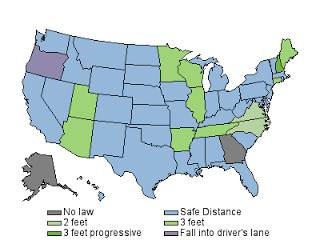
My favorite is Oregon whose law says you have to stay far enough away to avoid cyclists if he/she falls into the path of the vehicle.
Another great one is New Hampshire which requires a minimum of 3’. The distance increases from 3’ as the speed of the vehicle increases.
I intend to avoid Alaska, Georgia and DC for cycling; those states have no minimum passing laws. But then none of those states were high on my list to travel to, to ride!
Click on the link to see the laws and understand your rights as a cyclist and your responsibilities as a driver.
The League of American Cyclists has all bike laws listed on their website at Legal Program & Bike Laws has the passing information in chart form. See State Safe Passing Laws.
What do you think? Leave a comment.
If you like this let your friends know or post it on FaceBook, Twitter or LinkedIn
Copyright 2013 Recreation Law (720) Edit Law
Email: blog@rec-law.us
Twitter: RecreationLaw
Facebook: Rec.Law.Now
Facebook Page: Outdoor Recreation & Adventure Travel Law
Blog: www.recreation-law.com
Mobile Site: http://m.recreation-law.com
#RecreationLaw, #@RecreationLaw, #Cycling.Law #Fitness.Law, #Ski.Law, #Outside.Law, #Recreation.Law, #Recreation-Law.com, #Outdoor Law, #Recreation Law, #Outdoor Recreation Law, #Adventure Travel Law, #law, #Travel Law, #Jim Moss, #James H. Moss, #Attorney at Law, #Tourism, #Adventure Tourism, #Rec-Law, #Rec-Law Blog, #Recreation Law, #Recreation Law Blog, #Risk Management, #Human Powered, #Human Powered Recreation,# Cycling Law, #Bicycling Law, #Fitness Law, #Recreation-Law.com, #Backpacking, #Hiking, #Mountaineering, #Ice Climbing, #Rock Climbing, #Ropes Course, #Challenge Course, #Summer Camp, #Camps, #Youth Camps, #Skiing, #Ski Areas, #Negligence, #Snowboarding, #RecreationLaw, #@RecreationLaw, #Cycling.Law #Fitness.Law, #SkiLaw, #Outside.Law, #Recreation.Law, #RecreationLaw.com, #OutdoorLaw, #RecreationLaw, #OutdoorRecreationLaw, #AdventureTravelLaw, #Law, #TravelLaw, #JimMoss, #JamesHMoss, #AttorneyatLaw, #Tourism, #AdventureTourism, #RecLaw, #RecLawBlog, #RecreationLawBlog, #RiskManagement, #HumanPowered, #HumanPoweredRecreation,# CyclingLaw, #BicyclingLaw, #FitnessLaw, #RecreationLaw.com, #Backpacking, #Hiking, #Mountaineering, #IceClimbing, #RockClimbing, #RopesCourse, #ChallengeCourse, #SummerCamp, #Camps, #YouthCamps, #Skiing, #Ski Areas, #Negligence, #Snowboarding, sport and recreation laws, ski law, cycling law, Colorado law, law for recreation and sport managers, bicycling and the law, cycling and the law, ski helmet law, skiers code, skiing accidents, Recreation Lawyer, Ski Lawyer, Paddlesports Lawyer, Cycling Lawyer, Recreational Lawyer, Fitness Lawyer, Rec Lawyer, Challenge Course Lawyer, Ropes Course Lawyer, Zip Line Lawyer, Rock Climbing Lawyer, Adventure Travel Lawyer, Outside Lawyer, Recreation Lawyer, Ski Lawyer, Paddlesports Lawyer, Cycling Lawyer, #RecreationalLawyer, #FitnessLawyer, #RecLawyer, #ChallengeCourseLawyer, #RopesCourseLawyer, #ZipLineLawyer, #RockClimbingLawyer, #AdventureTravelLawyer, #OutsideLawyer, Cycling, Passing Laws, 3’ Passing Law, League of American Cyclists,
WordPress Tags: Easy,laws,Drivers,Cyclists,authors,Velo,Reviews,reference,vehicle,bike,Oregon,path,Another,Hampshire,Alaska,Georgia,Click,driver,Close,League,American,Legal,Program,information,State,Safe,Leave,FaceBook,Twitter,LinkedIn,Recreation,Edit,Email,RecreationLaw,Page,Outdoor,Adventure,Travel,Blog,Mobile,Site,Outside,Moss,James,Attorney,Tourism,Risk,Management,Human,Rock,Ropes,Course,Challenge,Summer,Camp,Camps,Youth,Areas,Negligence,SkiLaw,OutdoorLaw,OutdoorRecreationLaw,AdventureTravelLaw,TravelLaw,JimMoss,JamesHMoss,AttorneyatLaw,AdventureTourism,RecLaw,RecLawBlog,RecreationLawBlog,RiskManagement,HumanPoweredRecreation,CyclingLaw,BicyclingLaw,FitnessLaw,RopesCourse,ChallengeCourse,SummerCamp,YouthCamps,Colorado,managers,helmet,accidents,Lawyer,Paddlesports,Recreational,Line,RecreationalLawyer,FitnessLawyer,RecLawyer,ChallengeCourseLawyer,RopesCourseLawyer,ZipLineLawyer,RockClimbingLawyer,AdventureTravelLawyer,OutsideLawyer
In Nebraska a release can defeat claims for gross negligence for health club injury
Posted: April 8, 2013 Filed under: Health Club, Nebraska, Release (pre-injury contract not to sue) | Tags: Alegent Health, Defendant, Fitness Center, Gross negligence, Health club, Inc., Lakeside Wellness Center, Negligence, Plaintiff, Precor, Precor USA, Release, Treadmill Leave a commentPalmer v. Lakeside Wellness Center, 281 Neb. 780; 798 N.W.2d 845; 2011 Neb. LEXIS 62
Manufacturer of the health club equipment was able to squeak out a win by making sure the equipment met the applicable standards when the treadmill was manufactured.
This case is a health club fitness which is interesting because it covers several legal issues in ways that most courts will not. It also points out some simple things you can do to keep yourself out of court or losing in court.
A husband and wife, plaintiffs, joined a health club. After five weeks at the club the wife, went to get on a treadmill. She did not notice it was running and upon stepping on the treadmill she was thrown backwards into an elliptical trainer. The plaintiff had an injured hand and chest from the accident.
The area around the treadmill was allegedly, not well lit, however the plaintiff had not complained about the lighting. When she stepped on the treadmill she looked at the control panel but did not look at the belt. The treadmill was in a row of treadmills and the treadmills on either side of the treadmill in question were running. The plaintiff also said the treadmill area was loud.
The plaintiff had been using treadmills for 21 years. She had been using treadmills at the defendants approximately five times a week for five weeks and had used the treadmill in question 10 to 15 times. When she joined the defendant health club she received instructions from a trainer, but she stated she did not need instructions on how to operate a treadmill. The plaintiff also had a treadmill at home.
When the plaintiff and her husband joined the defendant health club she signed two documents which contained releases. The first was titled Membership agreement what had a release that included the word negligence in the language of the contract. The second form was a health history questionnaire which was signed by the plaintiff and also included release language.
The plaintiff and her husband sued the manufacturer of the treadmill, Precor, and the health club, Lakeside Wellness Center for her injuries. She claimed both defendants were negligent and were grossly negligent. Precor was allegedly negligent in making a treadmill without proper safety features and the health club was liable for not providing adequate lighting around the treadmill. There was also a claim that the health club had modified the treadmill belt so that it was unsafe.
The trial court granted both of the defendant’s motions for summary judgment. The plaintiff appealed saying the trial court erred in:
(1) granting summary judgment in favor of Lakeside and Precor;
(2) holding that the waiver and release contained in the membership agreement and health history questionnaire signed by Palmer were clear, understandable, and unambiguous; and
(3) holding that Palmer assumed the risk of using the treadmill.
Summary of the case
The court first looked at the issue of the release. The court ignored the issues of whether the release worked against negligence and reviewed the issues of releases and claims of gross negligence. However before starting its analysis, it dismissed Precor’s argument that it was a third party beneficiary of the release.
A third party beneficiary of a contract is usually identified as someone who is not named in the agreement, but obvious to all parties that they are to receive benefits of the agreement. An example would be a contract between a health club and a supplier of fitness equipment. The third party beneficiaries of that agreement would be the membership of the health club. When the third party beneficiary is not obvious in the agreement then the third parties as usually not construed as beneficiaries and do not have an interest in the contract.
In order for those not named as parties to recover under a contract as third-party beneficiaries, it must appear by express stipulation or by reasonable intendment that the rights and interest of such unnamed parties were contemplated and that provision was being made for them. The right of a third party benefited by a contract to sue thereon must affirmatively appear from the language of the instrument when properly interpreted or construed.
Here the court found that the agreement between a member and the health club did not identify the defendant manufacture by name or by any other identification. Because of that, the manufacturer could not be a third party beneficiary of the release.
Court then went back to the issue of the claim of gross negligence. Under Nebraska law gross negligence is defined as
Gross negligence is great or excessive negligence, which indicates the absence of even slight care in the performance of a duty. 5 Whether gross negligence exists must be ascertained from the facts and circumstances of each particular case and not from any fixed definition or rule.
Under Nebraska law the court could rule on whether the allegations of the complaint give rise to gross negligence. Here the court found the allegations did not. Inadequate lighting and the installation of a new belt on the treadmill did not meet the level needed to prove gross negligence.
Precor, the making of the treadmill in its motion to the trial court presented an affidavit stating that at the time the treadmill was made the treadmill “met or exceeded the voluntary guidelines set by the American Society for Testing and Materials” The affidavit included photographs of the treadmill to show what handrails existed and the fact that treadmill came with a clip that could be attached to the user’s clothing. If the clip was pulled it would disconnect and stop the treadmill. The treadmill was also made 7 years prior to the accident.
The plaintiff hired an expert who stated that the treadmill “should” have various safety features that were not on the treadmill. The court took note that the plaintiff’s expert did not say the treadmill had to have, did not speak in absolutes with regard to the safety features. Because the plaintiff’s expert was hesitant or could not be explicit on what was missing the court held that Precor was not negligent.
A third defense was raised on appeal, assumption of the risk, by the defendants. Because the court had dismissed the claims raised by the plaintiff already, the court did not get into that defense.
So Now What?
Obviously the better your release the greater your chances of winning. However there are several other issues here that you should pay attention too.
The plaintiff claimed that her injury was due to the fact the new belt on the treadmill did not contain markings that would indicate the treadmill was moving. If you replace or repair something, make sure you use equipment that meets the manufactures specs when you bought the machine or better. If the manufacturer had markings on the treadmill belt that indicated that the belt was moving you need to install a replacement belt that has similar markings.
Moreover, if you have the opportunity, whether or not the original belt was marked, to install a belt with markings, why not.
The assumption of the risk defense was not discussed by the court in its analysis, but was definitely part of the facts. In this case the defense team was able to elicit a lot of treadmill experience from the plaintiff. Many times, after an accident, the plaintiff will change their story. Getting experience or history up front is always safer.
And why not!
Why not include in your release language that protects everyone you can from litigation. There was a claim by the husband that one of the people running on the treadmill next to the one at issue had left that treadmill on. In some states, that would be enough to bring that other gym member into the suit. Write your release to keep you out of a lawsuit, also write it to keep everyone associated with your or that you benefit from out of the lawsuit. Just because you might not be named as the negligent party, you can still be brought in by the person who is named as the defendant. Protect you, your employees, other guests, visitors, volunteers, sponsors, and manufacturers dependent on what you do.
How many new customers are going to sign up as members if the word gets out you allowed one of them to be sued for an accident to another member.
If you do hear of problems from your guests or members, you need to respond. One issue that would have made the outcome different in this case would be a stack of “accident forms” or complaints about the lighting. If the plaintiff could prove that the lighting was bad because other people had complained about it or blamed it for their injuries, then I believe this would have had a different outcome. Don’t collect paperwork, solve problems.
Plaintiff: April Palmer
Defendant: Lakeside Wellness Center, Doing Business as Alegent Health, and Precor, Inc.
Plaintiff Claims: Negligence and Gross Negligence
Defendant Defenses: Release, Assumption of the Risk
Holding: for the defendants
What do you think? Leave a comment.
If you like this let your friends know or post it on FaceBook, Twitter or LinkedIn
Copyright 2013 Recreation Law (720) Edit Law
Email: Rec-law@recreation-law.com
Google+: +Recreation
Twitter: RecreationLaw
Facebook: Rec.Law.Now
Facebook Page: Outdoor Recreation & Adventure Travel Law
Blog: www.recreation-law.com
Mobile Site: http://m.recreation-law.com
By Recreation Law Rec-law@recreation-law.com James H. Moss Jim Moss
#RecreationLaw, #@RecreationLaw, #Cycling.Law #Fitness.Law, #Ski.Law, #Outside.Law, #Recreation.Law, #Recreation-Law.com, #Outdoor Law, #Recreation Law, #Outdoor Recreation Law, #Adventure Travel Law, #law, #Travel Law, #Jim Moss, #James H. Moss, #Attorney at Law, #Tourism, #Adventure Tourism, #Rec-Law, #Rec-Law Blog, #Recreation Law, #Recreation Law Blog, #Risk Management, #Human Powered, #Human Powered Recreation,# Cycling Law, #Bicycling Law, #Fitness Law, #Recreation-Law.com, #Backpacking, #Hiking, #Mountaineering, #Ice Climbing, #Rock Climbing, #Ropes Course, #Challenge Course, #Summer Camp, #Camps, #Youth Camps, #Skiing, #Ski Areas, #Negligence, #Snowboarding, #RecreationLaw, #@RecreationLaw, #Cycling.Law #Fitness.Law, #SkiLaw, #Outside.Law, #Recreation.Law, #RecreationLaw.com, #OutdoorLaw, #RecreationLaw, #OutdoorRecreationLaw, #AdventureTravelLaw, #Law, #TravelLaw, #JimMoss, #JamesHMoss, #AttorneyatLaw, #Tourism, #AdventureTourism, #RecLaw, #RecLawBlog, #RecreationLawBlog, #RiskManagement, #HumanPowered, #HumanPoweredRecreation,# CyclingLaw, #BicyclingLaw, #FitnessLaw, #RecreationLaw.com, #Backpacking, #Hiking, #Mountaineering, #IceClimbing, #RockClimbing, #RopesCourse, #ChallengeCourse, #SummerCamp, #Camps, #YouthCamps, #Skiing, #Ski Areas, #Negligence, #Snowboarding, sport and recreation laws, ski law, cycling law, Colorado law, law for recreation and sport managers, bicycling and the law, cycling and the law, ski helmet law, skiers code, skiing accidents, Recreation Lawyer, Ski Lawyer, Paddlesports Lawyer, Cycling Lawyer, Recreational Lawyer, Fitness Lawyer, Rec Lawyer, Challenge Course Lawyer, Ropes Course Lawyer, Zip Line Lawyer, Rock Climbing Lawyer, Adventure Travel Lawyer, Outside Lawyer, Recreation Lawyer, Ski Lawyer, Paddlesports Lawyer, Cycling Lawyer, #RecreationalLawyer, #FitnessLawyer, #RecLawyer, #ChallengeCourseLawyer, #RopesCourseLawyer, #ZipLineLawyer, #RockClimbingLawyer, #AdventureTravelLawyer, #OutsideLawyer, Lakeside Wellness Center, Alegent Health, Precor, Inc., Negligence, Gross Negligence, Health Club, Release, Fitness Center, Treadmill,
WordPress Tags: Nebraska,negligence,health,injury,Palmer,Lakeside,Center,LEXIS,Manufacturer,equipment,treadmill,husband,wife,plaintiffs,trainer,plaintiff,chest,accident,area,panel,treadmills,defendants,defendant,instructions,Membership,agreement,history,questionnaire,Precor,injuries,judgment,waiver,Summary,analysis,argument,beneficiary,example,supplier,beneficiaries,stipulation,provision,instrument,Here,member,identification,Court,Under,Gross,absence,performance,Whether,definition,allegations,complaint,Inadequate,installation,affidavit,guidelines,American,Materials,handrails,fact,user,absolutes,assumption,attention,markings,specs,machine,Moreover,team,Many,litigation,Write,lawsuit,Just,person,Protect,employees,guests,visitors,manufacturers,customers,outcome,complaints,paperwork,April,Alegent,Claims,Defenses,Release,Risk,Leave,FaceBook,Twitter,LinkedIn,Recreation,Edit,Email,Google,RecreationLaw,Page,Outdoor,Adventure,Travel,Blog,Mobile,Site,James,Moss,Outside,Attorney,Tourism,Management,Human,Rock,Ropes,Course,Challenge,Summer,Camp,Camps,Youth,Areas,SkiLaw,OutdoorLaw,OutdoorRecreationLaw,AdventureTravelLaw,TravelLaw,JimMoss,JamesHMoss,AttorneyatLaw,AdventureTourism,RecLaw,RecLawBlog,RecreationLawBlog,RiskManagement,HumanPoweredRecreation,CyclingLaw,BicyclingLaw,FitnessLaw,RopesCourse,ChallengeCourse,SummerCamp,YouthCamps,Colorado,managers,helmet,accidents,Lawyer,Paddlesports,Recreational,Line,RecreationalLawyer,FitnessLawyer,RecLawyer,ChallengeCourseLawyer,RopesCourseLawyer,ZipLineLawyer,RockClimbingLawyer,AdventureTravelLawyer,OutsideLawyer,Club,five,weeks,third
Palmer v. Lakeside Wellness Center, 281 Neb. 780; 798 N.W.2d 845; 2011 Neb. LEXIS 62
Posted: April 8, 2013 Filed under: Assumption of the Risk, Health Club, Legal Case, Nebraska, Release (pre-injury contract not to sue) | Tags: Alegent Health, Appeal, Appellant, Fitness Center, Gross negligence, Health club, Inc., Lakeside Wellness Center, Negligence, Precor, Release, Summary judgment, Treadmill, Waiver Leave a commentPalmer v. Lakeside Wellness Center, 281 Neb. 780; 798 N.W.2d 845; 2011 Neb. LEXIS 62
April Palmer, Appellant, v. Lakeside Wellness Center, Doing Business as Alegent Health, and Precor, Inc., Appellees.
No. S-10-974.
281 Neb. 780; 798 N.W.2d 845; 2011 Neb. LEXIS 62
June 24, 2011, Filed
PRIOR HISTORY: [***1]
Appeal from the District Court for Douglas County: JOSEPH S. TROIA, Judge.
DISPOSITION: AFFIRMED.
HEADNOTES
1. Summary Judgment: Appeal and Error. An appellate court will affirm a lower court’s granting of summary judgment if the pleadings and admitted evidence show that there is no genuine issue as to any material facts or as to the ultimate inferences that may be drawn from those facts and that the moving party is entitled to judgment as a matter of law.
2. Summary Judgment: Appeal and Error. In reviewing a summary judgment, the court views the evidence in the light most favorable to the party against whom the judgment was granted, and gives that party the benefit of all reasonable inferences deducible from the evidence.
3. Contracts: Parties: Intent. In order for those not named as parties to recover under a contract as third-party beneficiaries, it must appear by express stipulation or by reasonable intendment that the rights and interest of such unnamed parties were contemplated and that provision was being made for them.
4. Contracts: Parties. The right of a third party benefited by a contract to sue must affirmatively appear from the language of the instrument when properly inter preted or construed.
5. Negligence: Words and Phrases. Gross negligence is great or excessive negligence, which indicates the absence of even slight care in the performance of a duty.
6. Negligence. Whether gross negligence exists must be ascertained from the facts and circumstances of each particular case and not from any fixed definition or rule.
7. Negligence: Summary Judgment. The issue of gross negligence is susceptible to resolution in a motion for summary judgment.
COUNSEL: Heather Voegele-Andersen and Brenda K. George, of Koley Jessen, P.C., L.L.O., for appellant.
David L. Welch and Ashley E. Dieckman, of Pansing, Hogan, Ernst & Bachman, L.L.P., for appellee Lakeside Wellness Center.
Albert M. Engles and Cory J. Kerger, of Engles, Ketcham, Olson & Keith, P.C., for appellee Precor, Inc.
JUDGES: HEAVICAN, C.J., CONNOLLY, GERRARD, STEPHAN, and MCCORMACK, JJ. WRIGHT and MILLER-LERMAN, JJ., not participating.
OPINION BY: HEAVICAN
OPINION
[**847] [*781] Heavican, C.J.
INTRODUCTION
The appellant, April Palmer, was injured while on a treadmill at Lakeside Wellness Center (Lakeside). The district court granted summary judgment in favor of Lakeside, doing business as Alegent Health, and Precor, Inc. Palmer appeals. We affirm.
FACTUAL BACKGROUND
Palmer’s Accident.
Palmer and her husband joined Lakeside in November 2006. The accident occurred several months later, on March 7, 2007. On that date, Palmer approached the treadmill in question to begin her workout. Unaware that the treadmill belt was running, Palmer stepped onto the treadmill from the back and was thrown off the belt and into an elliptical training [**848] machine located behind [***2] her. During her deposition, Palmer stated that she looked at the treadmill’s control panel before getting on, but did not look at the belt of the treadmill. Palmer indicated that had she looked at the belt, she probably would have been able to see that it was operating, but that since she assumed the treadmill was off, she did not look further. According to Palmer, she thought the area was poorly lit, though she had never complained about it to any Lakeside staff members. And Palmer indicated that the facility was loud and that she was unable to hear whether the machine was operating.
This treadmill was located in a row of treadmills, and the treadmills to the right and left of the machine in question were [*782] being used at the time of the accident. In Palmer’s husband’s deposition, he testified that the woman on a neighboring treadmill told him she had been on that treadmill briefly before switching to the neighboring machine and had mistakenly thought she had turned it off.
Palmer’s Familiarity With Treadmills.
During her deposition, Palmer was asked about her exercise history and her familiarity with treadmills. Palmer testified that she and her husband had been members of other gyms prior [***3] to joining Lakeside. Palmer testified that she received instruction from a trainer after joining Lakeside, though she stated that she did not need specific instruction on how to operate a treadmill. According to Palmer’s testimony, she had been using treadmills for approximately 21 years. At the time of the accident, Palmer had been using the Lakeside facility at least 5 times a week and had used that actual treadmill 10 to 15 times total prior to the accident. Palmer also testified that she had a treadmill in her home.
Palmer’s Membership Agreement and Health History Questionnaire.
At the time Palmer and her husband became members at Lakeside, Palmer filled out and signed a membership agreement and a health history questionnaire. The membership agreement provided:
WAIVER AND RELEASE–You acknowledge that your attendance or use of [Lakeside] including without limitation to your participation in any of [Lakeside’s] programs or activities and your use of [Lakeside’s] equipment and facilities, and transportation provided by [Lakeside] could cause injury to you. In consideration of your membership in [Lakeside], you hereby assume all risks of injury which may result from or arise out of your [***4] attendance at or use of [Lakeside] or its equipment, activities, facilities, or transportation; and you agree, on behalf of yourself and your heirs, executors, administrators, and assigns to fully and forever release and discharge [Lakeside] and affiliates and their respective officers, directors, employees, agents, [*783] successors and assigns, and each of them (collectively the “Releasees”) from any and all claims, damages, rights of action or causes of action, present or future, known or unknown, anticipated or unanticipated, resulting from or arising out of your attendance at or use of [Lakeside] or its equipment, activities, facilities or transportation, including without limitation any claims, damages, demands, rights of action or causes of action resulting from or arising out of the negligence of the Releasees. Further, you hereby agree to waive any and all such claims, damages, demands, rights of action or causes of action. Further you hereby agree to release and discharge the Releasees from any and all liability for any loss or theft of, or damage to, personal property. You acknowledge that you have [**849] carefully read this waiver and release and fully understand that it is a waiver [***5] and release of liability.
The health history questionnaire signed by Palmer stated in relevant part as follows:
1. In consideration of being allowed to participate in the activities and programs of [Lakeside] and to use its facilities, equipment and machinery in addition to the payment of any fee or charge, I do hereby waive, release and forever discharge [Lakeside] and its directors, officers, agents, employees, representatives, successors and assigns, administrators, executors and all other [sic] from any and all responsibilities or liability from injuries or damages resulting from my participation in any activities or my use of equipment or machinery in the above mentioned activities. I do also hereby release all of those mentioned and any others acting upon their behalf from any responsibility or liability for any injury or damage to myself, including those caused by the negligent act or omission of any way arising out of or connected with my participation in any activities of [Lakeside] or the use of any equipment at [Lakeside]. . . .
2. I understand and am aware that strength, flexibility and aerobic exercise, including the use of equipment are a potentially hazardous activity. [***6] I also understand that fitness activities involve the risk of injury and even death, [*784] and that I am voluntarily participating in these activities and using equipment and machinery with knowledge of the dangers involved. I hereby agree to expressly assume and accept any and all risks of injury or death. . . .
Palmer sued Lakeside and Precor for her injuries, which generally consisted of an injured hand and chest. Both Lakeside and Precor filed motions for summary judgment, which were granted. Palmer appeals.
ASSIGNMENTS OF ERROR
Palmer assigns that the district court erred in (1) granting summary judgment in favor of Lakeside and Precor; (2) holding that the waiver and release contained in the membership agreement and health history questionnaire signed by Palmer were clear, understandable, and unambiguous; and (3) holding that Palmer assumed the risk of using the treadmill.
STANDARD OF REVIEW
[1] [HN1] An appellate court will affirm a lower court’s granting of summary judgment if the pleadings and admitted evidence show that there is no genuine issue as to any material facts or as to the ultimate inferences that may be drawn from those facts and that the moving party is entitled to judgment as [***7] a matter of law. 1
1 Wilson v. Fieldgrove, 280 Neb. 548, 787 N.W.2d 707 (2010).
[2] [HN2] In reviewing a summary judgment, the court views the evidence in the light most favorable to the party against whom the judgment was granted, and gives that party the benefit of all reasonable inferences deducible from the evidence. 2
2 Id.
ANALYSIS
Waiver and Release.
Palmer first argues that the district court erred in finding that the waiver and release contained in the membership agreement and health history questionnaire she completed and signed when joining Lakeside were clear, understandable, and unambiguous. We read Palmer’s argument as contending that the waivers, [**850] while perhaps applicable to instances of ordinary negligence, [*785] could not operate to relieve Lakeside or Precor from gross negligence or willful and wanton misconduct. We further understand Palmer to argue that both Lakeside and Precor committed gross negligence or willful and wanton misconduct–Precor by delivering a treadmill without proper safety features, and Lakeside by not providing adequate space or lighting around the treadmill and by modifying the treadmill’s belt such that the treadmill became unsafe.
[3,4] Before reaching the merits [***8] of Palmer’s argument, we note that contrary to Precor’s argument, Precor is not protected from liability as a result of the waivers signed by Palmer. Precor contends in its brief that it is a third-party beneficiary of these waivers. This court recently addressed a similar issue in Podraza v. New Century Physicians of Neb. 3 In Podraza, we noted that we have traditionally strictly construed who has the right to enforce a contract as a third-party beneficiary.
[HN3] In order for those not named as parties to recover under a contract as third-party beneficiaries, it must appear by express stipulation or by reasonable intendment that the rights and interest of such unnamed parties were contemplated and that provision was being made for them. The right of a third party benefited by a contract to sue thereon must affirmatively appear from the language of the instrument when properly interpreted or construed.
Authorities are in accord that one suing as a third-party beneficiary has the burden of showing that the provision was for his or her direct benefit. Unless one can sustain this burden, a purported third-party beneficiary will be deemed merely incidentally benefited and will not be permitted [***9] to recover on or enforce the agreement. 4
3 Podraza v. New Century Physicians of Neb., 280 Neb. 678, 789 N.W.2d 260 (2010).
4 Id. at 686, 789 N.W.2d at 267.
A review of the record shows that Precor was not explicitly mentioned in the language of the waiver. Nor is there any other evidence that Precor was an intended third-party beneficiary. Precor has the burden to show its status as a third-party beneficiary, and it has failed to meet that burden. As such, Precor [*786] is not shielded from liability as a result of the waivers signed by Palmer.
Lakeside’s Gross Negligence or Willful and Wanton Conduct.
At oral argument, Palmer conceded that by virtue of these waivers, Lakeside was not liable to Palmer for damages caused by ordinary negligence. But, as noted above, Palmer contends that Lakeside is nevertheless liable, because its actions were grossly negligent or were willful and wanton.
Having examined the record in this case, we find that as a matter of law, Palmer’s allegations against Lakeside do not rise to the level of gross negligence. Palmer alleges that the Lakeside facility had inadequate lighting and inadequate spacing between equipment and that Lakeside’s employees modified the treadmill [***10] in question by installing a treadmill belt that did not contain markings.
[5-7] [HN4] Gross negligence is great or excessive negligence, which indicates the absence of even slight care in the performance of a duty. 5 Whether gross negligence exists must be ascertained from the facts and circumstances of each particular case and not from any fixed definition or rule. 6 [**851] The issue of gross negligence is susceptible to resolution in a motion for summary judgment. 7 We simply cannot conclude that the allegations against Lakeside–inadequate lighting and spacing and the installation of a new treadmill belt–rise to such a level. We therefore conclude that as a matter of law, any negligence by Lakeside was not gross negligence or willful or wanton conduct. As such, the district court did not err in granting Lakeside’s motion for summary judgment.
5 Bennett v. Labenz, 265 Neb. 750, 659 N.W.2d 339 (2003).
6 Id.
7 Id.
Precor’s Negligence.
We next turn to the question of whether the district court erred in granting summary judgment in favor of Precor. Because we concluded above that the waiver signed by Palmer did not [*787] act to relieve Precor from liability, we address whether there was a genuine issue of material [***11] fact on the issue of whether Precor breached any duty it had to Palmer.
In arguing that Precor was liable, Palmer alleges that Precor breached its duty by not equipping the treadmill with (1) a safety feature that would prevent the treadmill from operating when no one was on it and (2) handrails extending down the sides toward the back of the treadmill. Palmer originally argued that Precor was also liable because the belt on its treadmill failed to contain adequate markings, but it is this court’s understanding that Palmer no longer makes such allegations with regard to Precor because the belt on the treadmill at the time of the incident was not original to the treadmill and had been installed by Lakeside.
In response to Palmer’s allegations, Precor introduced evidence in the form of an affidavit from its director of product development, Greg May. May averred that at the time of manufacture and delivery, the treadmill met or exceeded the voluntary guidelines set by the American Society for Testing and Materials in that group’s international standard specifications for motorized treadmills in all ways, including handrails. Though there was no specific feature on this treadmill designed [***12] to stop the treadmill from running when no one was operating it, the machine was manufactured with a clip to be attached to the user’s clothing. The manual for this treadmill noted that “by taking this precaution, a tug on the safety switch cord trips the safety switch and slows the running speed to a safe stop.” May also averred that the treadmill in question left Precor’s control on July 29, 1999, or over 7 years prior to the date of the incident.
In addition to May’s affidavit, Precor also introduced photographs of the treadmill at issue, which photographs showed that the treadmill did have front handrails, though not side handrails.
In an attempt to rebut May’s affidavit and show a genuine issue of material fact, Palmer introduced the affidavit of a fitness consultant. That affidavit noted in part that
based on [the consultant’s] experience, in order for treadmills to meet appropriate safety standards from the late [*788] 1990s forward, treadmills should contain adequate safety features, emergency/safety stop mechanisms, warning labels, and markings on a treadmill belt. A treadmill should contain a safety stop mechanism such that the treadmill will turn off if no one is currently on the [***13] treadmill, adequate handrails extending towards the back of the treadmill and warning labels at the rear of the treadmill.
Even after drawing all reasonable inferences in favor of Palmer, we conclude that there is no genuine issue of material fact as to Precor’s alleged breach of duty. While the fitness consultant’s affidavit indicates that treadmills “should” contain [**852] various safety features, he does not speak in absolutes and does not refer specifically to this treadmill. On the other hand, May’s affidavit references the treadmill at issue in this case and details the safety features this treadmill possessed, as well as Precor’s compliance with all applicable, though voluntary, safety standards when manufacturing the treadmill. Because the record affirmatively shows that Precor did not breach any duty it owed to Palmer, we conclude that the district court did not err in granting Precor’s motion for summary judgment.
Assumption of Risk.
Palmer also argues that the district court erred in finding that she assumed the risk of injury when she used the treadmill. Because we conclude that the district court did not err in granting Lakeside’s and Precor’s motions for summary judgment for the [***14] foregoing reasons, we need not address Palmer’s assignment of error regarding the assumption of the risk.
CONCLUSION
The district court’s order granting summary judgment in favor of Lakeside and Precor is affirmed.
AFFIRMED.
Wright and Miller-Lerman, JJ., not participating.
WordPress Tags: Palmer,Lakeside,Center,LEXIS,April,Appellant,Alegent,Health,Precor,Appellees,SUPREME,COURT,NEBRASKA,June,PRIOR,HISTORY,Appeal,District,Douglas,JOSEPH,TROIA,Judge,DISPOSITION,HEADNOTES,Summary,Judgment,Error,inferences,Contracts,Parties,Intent,beneficiaries,stipulation,provision,instrument,Negligence,Words,Phrases,Gross,absence,performance,Whether,definition,COUNSEL,Heather,Voegele,Andersen,Brenda,George,Koley,Jessen,David,Welch,Ashley,Dieckman,Hogan,Ernst,Bachman,Albert,Engles,Cory,Kerger,Ketcham,Olson,Keith,JUDGES,HEAVICAN,GERRARD,STEPHAN,MCCORMACK,MILLER,LERMAN,OPINION,INTRODUCTION,treadmill,FACTUAL,BACKGROUND,Accident,husband,November,March,workout,Unaware,machine,panel,area,treadmills,woman,gyms,instruction,trainer,testimony,Membership,Agreement,Questionnaire,WAIVER,RELEASE,attendance,limitation,participation,equipment,facilities,transportation,injury,heirs,executors,administrators,officers,directors,employees,agents,successors,Releasees,action,Further,theft,machinery,addition,payment,injuries,omission,strength,death,knowledge,dangers,chest,Both,ASSIGNMENTS,STANDARD,REVIEW,Wilson,Fieldgrove,ANALYSIS,argument,waivers,instances,misconduct,beneficiary,Podraza,Century,Physicians,Authorities,status,Willful,Wanton,Conduct,virtue,allegations,markings,installation,Bennett,Labenz,fact,handrails,incident,response,affidavit,director,product,development,Greg,guidelines,American,Materials,specifications,Though,user,precaution,cord,consultant,mechanisms,mechanism,absolutes,references,compliance,Assumption,Risk,assignment,CONCLUSION,appellate,pleadings,whom,deducible,third,appellee,hereby,behalf
Discover Maine in a whole new way!
Posted: April 6, 2013 Filed under: Cycling, Maine | Tags: Bicycling, Bike, BikeMaine, Cycling, MAINE Leave a comment
Discover Maine by Bike
The Bicycle Coalition of Maine has launched a week-long bicycle ride, BikeMaine, that will run from September 7-14, 2013.
The 400 mile loop ride travels on mostly rural, low traffic roads offering magnificent scenery and allows riders to explore six host communities, each providing a unique Maine experience: college town, mill town, arts community, historic maritime village, summer colony, and traditional Maine camp.
Riders will enjoy meals featuring locally sourced, in season food, tours and nightly entertainment. The $875 registration fee includes a fully supported route, 18 meals, ample beverages and snacks during each day’s ride, baggage transport, camping facilities, hot showers, and other rider amenities.
Visit BikeMaine for more detailed information. This year’s ride is limited to 350 riders, so sign up today to ensure your place in the inaugural BikeMaine ride.
What do you think? Leave a comment.
If you like this let your friends know or post it on FB, Twitter or LinkedIn
Copyright 2013 Recreation Law (720) Edit Law
Email: Rec-law@recreation-law.com
Google+: +Recreation
Twitter: RecreationLaw
Facebook: Rec.Law.Now
Facebook Page: Outdoor Recreation & Adventure Travel Law
Mobile Site: http://m.recreation-law.com
By Recreation Law Rec-law@recreation-law.com James H. Moss #Authorrank
<rel=”author” link=” https://plus.google.com/u/0/b/112453188060350225356/” />
#RecreationLaw, #@RecreationLaw, #Cycling.Law #Fitness.Law, #Ski.Law, #Outside.Law, #Recreation.Law, #Recreation-Law.com, #Outdoor Law, #Recreation Law, #Outdoor Recreation Law, #Adventure Travel Law, #law, #Travel Law, #Jim Moss, #James H. Moss, #Attorney at Law, #Tourism, #Adventure Tourism, #Rec-Law, #Rec-Law Blog, #Recreation Law, #Recreation Law Blog, #Risk Management, #Human Powered, #Human Powered Recreation,# Cycling Law, #Bicycling Law, #Fitness Law, #Recreation-Law.com, #Backpacking, #Hiking, #Mountaineering, #Ice Climbing, #Rock Climbing, #Ropes Course, #Challenge Course, #Summer Camp, #Camps, #Youth Camps, #Skiing, #Ski Areas, #Negligence, #Snowboarding, #RecreationLaw, #@RecreationLaw, #Cycling.Law #Fitness.Law, #SkiLaw, #Outside.Law, #Recreation.Law, #RecreationLaw.com, #OutdoorLaw, #RecreationLaw, #OutdoorRecreationLaw, #AdventureTravelLaw, #Law, #TravelLaw, #JimMoss, #JamesHMoss, #AttorneyatLaw, #Tourism, #AdventureTourism, #RecLaw, #RecLawBlog, #RecreationLawBlog, #RiskManagement, #HumanPowered, #HumanPoweredRecreation,# CyclingLaw, #BicyclingLaw, #FitnessLaw, #RecreationLaw.com, #Backpacking, #Hiking, #Mountaineering, #IceClimbing, #RockClimbing, #RopesCourse, #ChallengeCourse, #SummerCamp, #Camps, #YouthCamps, #Skiing, #Ski Areas, #Negligence, #Snowboarding, sport and recreation laws, ski law, cycling law, Colorado law, law for recreation and sport managers, bicycling and the law, cycling and the law, ski helmet law, skiers code, skiing accidents, Recreation Lawyer, Ski Lawyer, Paddlesports Lawyer, Cycling Lawyer, Recreational Lawyer, Fitness Lawyer, Rec Lawyer, Challenge Course Lawyer, Ropes Course Lawyer, Zip Line Lawyer, Rock Climbing Lawyer, Adventure Travel Lawyer, Outside Lawyer, Recreation Lawyer, Ski Lawyer, Paddlesports Lawyer, Cycling Lawyer, #RecreationalLawyer, #FitnessLawyer, #RecLawyer, #ChallengeCourseLawyer, #RopesCourseLawyer, #ZipLineLawyer, #RockClimbingLawyer, #AdventureTravelLawyer, #OutsideLawyer, BikeMaine, Discover Maine, Maine, Bicycle Coalition of Maine,
WordPress Tags: Discover,Maine,Bike,Bicycle,Coalition,BikeMaine,September,roads,scenery,riders,college,arts,village,colony,food,registration,beverages,baggage,facilities,rider,amenities,Visit,information,Leave,Twitter,LinkedIn,Recreation,Edit,Email,Google,RecreationLaw,Facebook,Page,Outdoor,Adventure,Travel,Blog,Mobile,Site,James,Moss,Authorrank,author,Outside,Attorney,Tourism,Risk,Management,Human,Rock,Ropes,Course,Challenge,Summer,Camp,Camps,Youth,Areas,Negligence,SkiLaw,OutdoorLaw,OutdoorRecreationLaw,AdventureTravelLaw,TravelLaw,JimMoss,JamesHMoss,AttorneyatLaw,AdventureTourism,RecLaw,RecLawBlog,RecreationLawBlog,RiskManagement,HumanPoweredRecreation,CyclingLaw,BicyclingLaw,FitnessLaw,RopesCourse,ChallengeCourse,SummerCamp,YouthCamps,Colorado,managers,helmet,accidents,Lawyer,Paddlesports,Recreational,Line,RecreationalLawyer,FitnessLawyer,RecLawyer,ChallengeCourseLawyer,RopesCourseLawyer,ZipLineLawyer,RockClimbingLawyer,AdventureTravelLawyer,OutsideLawyer
Association of Independent Camps is moving forward
Posted: April 5, 2013 Filed under: Uncategorized | Tags: American Camp Association, Camps, summer camp, x, y, z Leave a comment
|

Teaching OUTSIDE the Box 2013
Posted: April 4, 2013 Filed under: Uncategorized | Tags: CAEE, Colorado, Environment, Environmental Education, x, y, z Leave a comment
|
||||||||||||||||||||||


 Jonathan WuerthCo-Founder and Teacher


Hassel Map: identifies ways to get consumers to buy, but also ways guests sued.
Posted: April 3, 2013 Filed under: Uncategorized | Tags: Adrian Slywotzky, Consumer, Guest, Hassle Map, Preventing Litigation Leave a commentIf you remove the hassles before the problem arises, do you eliminate the lawsuit possibilities?
I’ve always argued that lawsuits are a product of a series of events either prior to the injury or probably post injury that leads a guest or consumer to a lawyer and litigation.

Picture of consultant AJ Slywotzki
Adrian Slywotzky is a consultant and author that developed the Hassel Map. It is a look at all the problems a consumer faces to make a purchase. The consumer is going to buy from the seller with the least amount of hassles. He uses examples such as Blockbuster and Netflix. It was a hassle to drive to the store, guess at what the family wanted to watch, rent extra movies in case you guess wrong, drive home, watch the movie then pay more money when you take it back late. Netflix eliminated the hassle.
I think this same argument can be made to look at how consumers or guests end up litigating. A lot of times you hear threats of litigation right after the accident happened. The injured guest has had a horrible day, and the day is capped with an injury. An example I use in the ski industry is:
· Boots still wet
· Long Underwear not totally dry
· Breakfast was overpriced for what the family got.
· Lift line was forever because the lift operator could not get lift functioning.

So by the time the skier is on a run he feels ripped off, cold, wet, already tired and like his morning has been wasted. A fall and injury at this point just lead to more anger. This accumulating anger, hassle, leads to threats of and maybe real litigation.
However post-accident hassle is probably an even bigger course that leads to lawsuits.
After in injury the skier deals with:
· The ER is busy, so he waits for 20 minutes in pain.
· He is transported to a distant city and can’t figure out how he is going to get back to his family.
· He left his cell phone in the room and has no way to contact his family.
· He is listening to a physician explains things that sound scary, but that he really does not understand much of what is being said.
· All he really understands is wheel chair and crutches.
· He has a $2500 deductible on his health insurance.
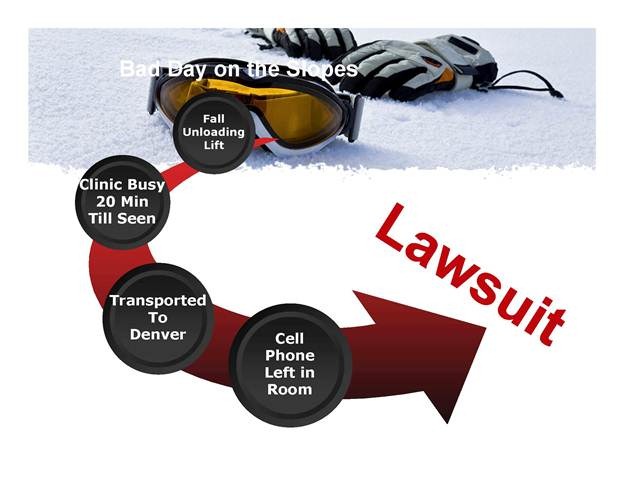
How can you eliminate or at least cut the hassle for this skier? Or maybe better stated how you can head off the lawsuit before it gets started?
Do Something
You don’t want to come up with money, but you can find ways to make a customer or a guest’s life better, before and after an injury. Sticking your head in the sand is not a solution.
Relying on your insurance company or your attorney may eliminate your hassle. However, it has just escalated the hassle factor or your former customer or guest.
In the above scenario, one easy step was giving all ERs that guests were sent to an 800 number, so they could call the resort. When a call came in from a hospital, it was assigned to a team to track down the family and make arrangements to get them together. Either transport them to the ER or transport the injured skier back to the resort.
Sure a bit of hassle and cost on the part of the resort, but look at the elimination of problems for the guest and the opportunity for the resort to look good in the eyes of the hassled guest.
How can you eliminate the hassle for your consumers and guests?
See Adrian Slywotzky Interview: What Is a Hassle Map?
What do you think? Leave a comment.
If you like this let your friends know or post it on FaceBook, Twitter or LinkedIn
Copyright 2013 Recreation Law (720) Edit Law
Email: blog@rec-law.us
Twitter: RecreationLaw
Facebook: Rec.Law.Now
Facebook Page: Outdoor Recreation & Adventure Travel Law
Blog: www.recreation-law.com
Mobile Site: http://m.recreation-law.com
#RecreationLaw, #@RecreationLaw, #Cycling.Law #Fitness.Law, #Ski.Law, #Outside.Law, #Recreation.Law, #Recreation-Law.com, #Outdoor Law, #Recreation Law, #Outdoor Recreation Law, #Adventure Travel Law, #law, #Travel Law, #Jim Moss, #James H. Moss, #Attorney at Law, #Tourism, #Adventure Tourism, #Rec-Law, #Rec-Law Blog, #Recreation Law, #Recreation Law Blog, #Risk Management, #Human Powered, #Human Powered Recreation,# Cycling Law, #Bicycling Law, #Fitness Law, #Recreation-Law.com, #Backpacking, #Hiking, #Mountaineering, #Ice Climbing, #Rock Climbing, #Ropes Course, #Challenge Course, #Summer Camp, #Camps, #Youth Camps, #Skiing, #Ski Areas, #Negligence, #Snowboarding, #RecreationLaw, #@RecreationLaw, #Cycling.Law #Fitness.Law, #SkiLaw, #Outside.Law, #Recreation.Law, #RecreationLaw.com, #OutdoorLaw, #RecreationLaw, #OutdoorRecreationLaw, #AdventureTravelLaw, #Law, #TravelLaw, #JimMoss, #JamesHMoss, #AttorneyatLaw, #Tourism, #AdventureTourism, #RecLaw, #RecLawBlog, #RecreationLawBlog, #RiskManagement, #HumanPowered, #HumanPoweredRecreation,# CyclingLaw, #BicyclingLaw, #FitnessLaw, #RecreationLaw.com, #Backpacking, #Hiking, #Mountaineering, #IceClimbing, #RockClimbing, #RopesCourse, #ChallengeCourse, #SummerCamp, #Camps, #YouthCamps, #Skiing, #Ski Areas, #Negligence, #Snowboarding, sport and recreation laws, ski law, cycling law, Colorado law, law for recreation and sport managers, bicycling and the law, cycling and the law, ski helmet law, skiers code, skiing accidents, Recreation Lawyer, Ski Lawyer, Paddlesports Lawyer, Cycling Lawyer, Recreational Lawyer, Fitness Lawyer, Rec Lawyer, Challenge Course Lawyer, Ropes Course Lawyer, Zip Line Lawyer, Rock Climbing Lawyer, Adventure Travel Lawyer, Outside Lawyer, Recreation Lawyer, Ski Lawyer, Paddlesports Lawyer, Cycling Lawyer, #RecreationalLawyer, #FitnessLawyer, #RecLawyer, #ChallengeCourseLawyer, #RopesCourseLawyer, #ZipLineLawyer, #RockClimbingLawyer, #AdventureTravelLawyer, #OutsideLawyer, Adrian Slywotzky, Hassle Map,
WordPress Tags: Hassel,consumers,guests,lawsuit,possibilities,lawsuits,product,series,events,injury,guest,consumer,lawyer,litigation,Adrian,Slywotzky,consultant,author,seller,examples,Blockbuster,Netflix,movies,movie,money,argument,threats,accident,example,industry,Boots,Long,Underwear,Breakfast,Lift,operator,cell,room,physician,crutches,health,insurance,customer,life,solution,attorney,factor,scenario,resort,hospital,team,Either,Sure,cost,elimination,Interview,Hassle,Leave,FaceBook,Twitter,LinkedIn,Recreation,Edit,Email,RecreationLaw,Page,Outdoor,Adventure,Travel,Blog,Mobile,Site,Outside,Moss,James,Tourism,Risk,Management,Human,Rock,Ropes,Course,Challenge,Summer,Camp,Camps,Youth,Areas,Negligence,SkiLaw,OutdoorLaw,OutdoorRecreationLaw,AdventureTravelLaw,TravelLaw,JimMoss,JamesHMoss,AttorneyatLaw,AdventureTourism,RecLaw,RecLawBlog,RecreationLawBlog,RiskManagement,HumanPoweredRecreation,CyclingLaw,BicyclingLaw,FitnessLaw,RopesCourse,ChallengeCourse,SummerCamp,YouthCamps,Colorado,managers,helmet,accidents,Paddlesports,Recreational,Line,RecreationalLawyer,FitnessLawyer,RecLawyer,ChallengeCourseLawyer,RopesCourseLawyer,ZipLineLawyer,RockClimbingLawyer,AdventureTravelLawyer,OutsideLawyer,skier
SPRENET FW: ISSRM 2013: Discount Registration Closing
Posted: April 1, 2013 Filed under: Uncategorized Leave a commentTwo Weeks Left – Early Bird Registration Deadline
International Symposium on Society & Resource Management
Estes Park, Colorado, USA
June 4-8, 2013
A Time for Integration
The International Symposium on Society and Resource Management (ISSRM) is the premier scientific meeting for academic and government researchers, students, agency scientists, land managers, NGO representatives, and other individuals who are broadly interested in the human dimensions of natural resource management issues. We welcome participation from around the world.
In addition to a diverse array of paper, panel, and poster sessions, the program includes the 6th Annual Student Forum on June 4th and fantastic keynote and featured speakers though out the week. We hope you will join us in the spectacular Estes Valley surrounded by the majestic peaks of Rocky Mountain National Park for what promises to be a wonderful conference!
Early bird registration deadline is April 16th 2013
Register here: http://www.issrm2013.iasnr.org/?page_id=311
More information about the symposium can be found at conference.
If you have received this message in error, or wish to be removed from this email list, please respond to this email with "Unsubscribe" in the subject line.
Esther Duke, MSc.
2013 ISSRM Conference Coordinator
19th International Symposium on Society & Resource Management
Estes Park, Colorado, USA
conference
Hawaii’s deceptive trade practices act sends this case and release back to the trial court
Posted: April 1, 2013 Filed under: Assumption of the Risk, Equine Activities (Horses, Donkeys, Mules) & Animals, Hawaii, Release (pre-injury contract not to sue) | Tags: Contract, Dahana Ranch, Deceptive Trade Practices, Defendant, equestrian, HI, Horse, horseback riding, Inc., Law, Plaintiff, stable, Summary judgment, Trial court, Waiver Leave a commentCourbat v. Dahana Ranch, Inc., 111 Haw. 254; 141 P.3d 427; 2006 Haw. LEXIS 386
The court agrees that the issue of not finding out that you had to sign a waiver until the time of the activity might be a deceptive practice.
This is a very interesting case. A couple booked several activities through a third-party booking agency. The activity in question was a horseback ride. The plaintiffs had booked the ride several months in advance of the ride and upon showing up, were handed a release.
Upon arriving at the defendant, the plaintiff read the waiver signed it, and passed it on to her husband. The husband signed it, testifying in his deposition that he relied on his wife to read such documents.
The record demonstrates that the Courbats were given adequate time and opportunity to fully review the waiver presented to them before they signed it and that both knew that by signing it; they were waiving legal rights in return for being allowed to participate in the ride.
Of note was a statement made by the court that no guest of the defendant had ever refused to sign the waiver.
During the ride, one horse kicked the plaintiff in the shin causing her an injury. She and her husband sued for negligence, gross negligence, and for unfair and deceptive practices.
The defendant responded that the plaintiff assumed the risk, the release barred the plaintiff’s claims and the ranch had done nothing to bring it into the purview of the Hawaiian Deceptive Trade Practices Act. (HRS §§ 480-2 and 480-13)
The trial court granted the defendant’s motion for summary judgment, and the decision was appealed.
Summary of the case
The court spent the most time on the issue that booking a ride several months in advance and not finding out that a waiver had to be signed on arrival was a deceptive practice.
…they assert that the Ranch’s practice of booking ride reservations through an activity company, receiving payment prior to the arrival of the guest, and then, upon the guest’s arrival at the Ranch, requiring the guest to sign a liability waiver as a precondition to horseback riding is an unfair and deceptive business practice to which the remedies of HRS ch. 480 apply.
The plaintiffs did not argue that the waiver was deceptive, only the fact that they were not informed that a waiver had to be signed. If the practice was found to be deceptive, then the waiver would be void.
The Courbats do not allege that the waiver itself is deceptive; rather, they urge that the deceptive practice at issue was the booking agent’s failure to inform them of the waiver requirement during the negotiation and execution of the underlying contract. Nevertheless, if any deceptive omission occurred with respect to the negotiation and execution of the original contract, the operation of HRS § 480-12, see supra note 1, would render both the original contract and the waiver, signed afterward, void.
After analyzing the fact the court found that there was an issue: “…whether a waiver requirement would be materially important in booking a horseback tour remains one for the trier of fact.”
However, if the trier of fact (jury) finds that a failure to warn the plaintiff was not deceptive, then the waiver would be valid.
The court then looked at the waiver to determine if met Hawaiian law. The court found that if the plaintiff signed the wavier, then the plaintiff was bound by its terms. Waivers, exculpatory contracts, are valid if they are “knowingly and willingly made and free from fraud.”
Waivers can be voided for three reasons in Hawaii.
“‘exculpatory clauses will be held void if the agreement is
(1) violative of a statute,
(2) contrary to a substantial public interest, or
(3) gained through inequality of bargaining power.'”
The court then looked at what was a public interest and found a public interest had the following characteristics:
[1] It concerns a business of a type generally thought suitable for public regulation.
[2] The party seeking exculpation is engaged in performing a service of great importance to the public, which is often [***30] a matter of practical necessity for some members of the public.
[3] The party holds himself out as willing to perform this service for any member of the public who seeks it, or at least for any member coming within certain established standards.
[4] As a result of the essential nature of the service, in the economic setting of the transaction, the party invoking exculpation possesses a decisive advantage of bargaining strength against any member of the public who seeks his services.
[5] In exercising a superior bargaining power the party confronts the public with a standardized adhesion contract of exculpation and makes no provision whereby a purchaser may pay additional reasonable fees and obtain protection against negligence.
[6] Finally, as a result of the transaction, the person or property of the purchaser is placed under the control of the seller of the service, subject to the risk of carelessness by the seller or his agents.
Recreational activities are unsuitable for public regulation; therefore, they do not violate the Hawaiian public interest definition that would void a release.
…while such waivers may be contracts of adhesion, in that they are presented on a “take-it-or-leave-it” basis, they are not unconscionable, but “are of a sort commonly used in recreational settings” and “are generally held to be valid.
Contracts of adhesion are ‘unenforceable if two conditions are present: (1) the contract is the result of coercive bargaining between parties of unequal bargaining strength; and (2) the contract unfairly limits the obligations and liabilities of, or otherwise unfairly advantages, the stronger party.
Because the plaintiffs had time to read and review the waiver, there was no coercion.
The court reviewed one final issue, waivers under Hawaiian law, like most other states do not stop claims for gross negligence or willful misconduct.
Consequently, the case was sent back for a jury to determine if the acts of the defendant, by and through its booking agency, acted deceptively or if the acts of the defendant were grossly negligent. If so the plaintiff would win the suit. If the acts of the defendant were not deceptive or the defendant was not grossly negligent the defendant would win at trial.
There was a dissent which found that the acts were not deceptive by law.
So Now What?
It is so easy to avoid most of the issues that were part of this appeal. Once some signs up for a trip or activity, whether through you or a third party, they must be informed that they are going to sign a release.
It is that easy. Put it on the receipt, put it on the website, put it on the paperwork, in the brochure; put it everywhere. If you are in a state where the release is valid you will not go through the time, cost, and expense of this type of litigation.
Every state has a deceptive trade practice statute. The statutes are enacted to protect consumers from dishonest businesses. The court did not examine the facts in light of an intentional act; just the practice alone was deceptive.
Don’t learn the act, just inform your guests.
Plaintiff: Lisa Courbat and Steven Courbat
Defendant: Dahana Ranch, Inc.
Plaintiff Claims: negligence, gross negligence, violation of the Hawaiian Deceptive Trade Practices statute.
Defendant Defenses: assumption of the risk, release, did not violate the deceptive practices act
Holding: reversed and sent back for trial
What do you think? Leave a comment.
 James H. “Jim” Moss |
Jim Moss is an attorney specializing in the legal issues of the outdoor recreation community. He represents guides, guide services, and outfitters both as businesses and individuals and the products they use for their business. He has defended Mt. Everest guide services, summer camps, climbing rope manufacturers; avalanche beacon manufacturers, and many more manufacturers and outdoor industries. Contact Jim at Jim@Rec-Law.us |
Jim is the author or co-author of eight books about legal issues in the outdoor recreation world; the latest is Outdoor Recreation Insurance, Risk Management,
Outdoor Recreation Insurance, Risk Management, and Law
To see Jim’s complete bio go here and to see his CV you can find it here. To find out the purpose of this website go here.
If you are interested in having me write your release, download the form and return it to me.
Connect
If you like this let your friends know or post it on FB, Twitter, or LinkedIn
Facebook Page: Outdoor Recreation & Adventure Travel Law
LinkedIn https://www.linkedin.com/in/recreationlaw/
Threads https://www.threads.net/@recreation_law
X https://twitter.com/RecreationLaw
Email: Jim@Rec-Law.US
By Recreation Law Rec-law@recreation-law.com James H. Moss
@2013-2023 Summit Magic Publishing, LLC
G-YQ06K3L262
<rel=”author” link=” https://plus.google.com/u/0/b/112453188060350225356/” />
#RecreationLaw, #@RecreationLaw, #Cycling.Law #Fitness.Law, #Ski.Law, #Outside.Law, #Recreation.Law, #Recreation-Law.com, #Outdoor Law, #Recreation Law, #Outdoor Recreation Law, #Adventure Travel Law, #law, #Travel Law, #Jim Moss, #James H. Moss, #Attorney at Law, #Tourism, #Adventure Tourism, #Rec-Law, #Rec-Law Blog, #Recreation Law, #Recreation Law Blog, #Risk Management, #Human Powered, #Human Powered Recreation,# Cycling Law, #Bicycling Law, #Fitness Law, #Recreation-Law.com, #Backpacking, #Hiking, #Mountaineering, #Ice Climbing, #Rock Climbing, #Ropes Course, #Challenge Course, #Summer Camp, #Camps, #Youth Camps, #Skiing, #Ski Areas, #Negligence, #Snowboarding, #RecreationLaw, #@RecreationLaw, #Cycling.Law #Fitness.Law, #SkiLaw, #Outside.Law, #Recreation.Law, #RecreationLaw.com, #OutdoorLaw, #RecreationLaw, #OutdoorRecreationLaw, #AdventureTravelLaw, #Law, #TravelLaw, #JimMoss, #JamesHMoss, #AttorneyatLaw, #Tourism, #AdventureTourism, #RecLaw, #RecLawBlog, #RecreationLawBlog, #RiskManagement, #HumanPowered, #HumanPoweredRecreation,# CyclingLaw, #BicyclingLaw, #FitnessLaw, #RecreationLaw.com, #Backpacking, #Hiking, #Mountaineering, #IceClimbing, #RockClimbing, #RopesCourse, #ChallengeCourse, #SummerCamp, #Camps, #YouthCamps, #Skiing, #Ski Areas, #Negligence, #Snowboarding, sport and recreation laws, ski law, cycling law, Colorado law, law for recreation and sport managers, bicycling and the law, cycling and the law, ski helmet law, skiers code, skiing accidents, Recreation Lawyer, Ski Lawyer, Paddlesports Lawyer, Cycling Lawyer, Recreational Lawyer, Fitness Lawyer, Rec Lawyer, Challenge Course Lawyer, Ropes Course Lawyer, Zip Line Lawyer, Rock Climbing Lawyer, Adventure Travel Lawyer, Outside Lawyer, Recreation Lawyer, Ski Lawyer, Paddlesports Lawyer, Cycling Lawyer, #RecreationalLawyer, #FitnessLawyer, #RecLawyer, #ChallengeCourseLawyer, #RopesCourseLawyer, #ZipLineLawyer, #RockClimbingLawyer, #AdventureTravelLawyer, #OutsideLawyer, Lisa Courbat, Steven Courbat, Dahana Ranch, Inc., Hawaii, Deceptive Trade Practices, HI, stable, horseback riding, horse, stable, equestrian.
WordPress Tags: Hawaii,Courbat,Dahana,Ranch,LEXIS,Court,waiver,agency,plaintiffs,Upon,defendants,plaintiff,husband,wife,Courbats,statement,guest,defendant,horse,injury,negligence,Hawaiian,Deceptive,Trade,Practices,judgment,decision,Summary,arrival,payment,precondition,fact,agent,failure,requirement,negotiation,execution,omission,trier,jury,Waivers,fraud,clauses,agreement,statute,characteristics,regulation,exculpation,importance,member,transaction,strength,adhesion,provision,purchaser,protection,person,seller,agents,Recreational,definition,basis,settings,Contracts,obligations,liabilities,advantages,coercion,misconduct,receipt,paperwork,brochure,cost,expense,litigation,statutes,consumers,guests,Lisa,Steven,Claims,violation,Defenses,assumption,Leave,FaceBook,Twitter,LinkedIn,Recreation,Edit,Email,Google,RecreationLaw,Page,Outdoor,Adventure,Travel,Blog,Mobile,Site,James,Moss,Authorrank,author,Outside,Attorney,Tourism,Risk,Management,Human,Rock,Ropes,Course,Challenge,Summer,Camp,Camps,Youth,Areas,SkiLaw,OutdoorLaw,OutdoorRecreationLaw,AdventureTravelLaw,TravelLaw,JimMoss,JamesHMoss,AttorneyatLaw,AdventureTourism,RecLaw,RecLawBlog,RecreationLawBlog,RiskManagement,HumanPoweredRecreation,CyclingLaw,BicyclingLaw,FitnessLaw,RopesCourse,ChallengeCourse,SummerCamp,YouthCamps,Colorado,managers,helmet,accidents,Lawyer,Paddlesports,Line,RecreationalLawyer,FitnessLawyer,RecLawyer,ChallengeCourseLawyer,RopesCourseLawyer,ZipLineLawyer,RockClimbingLawyer,AdventureTravelLawyer,OutsideLawyer,third,horseback,months,whether,exculpatory
Courbat v. Dahana Ranch, Inc., 111 Haw. 254; 141 P.3d 427; 2006 Haw. LEXIS 386
Posted: April 1, 2013 Filed under: Assumption of the Risk, Equine Activities (Horses, Donkeys, Mules) & Animals, Hawaii, Legal Case, Release (pre-injury contract not to sue) | Tags: Deceptive Trade Practices, equestrian, Equine, Hawaii, HI, Horse, horseback riding, Release, Releases / Waivers, stable, Waiver Leave a commentTo Read an Analysis of this decision see
Hawaii Supreme Court agrees that finding out a release is required to be signed upon arrival at the activity and after the activity has been paid for may be a deceptive trade practice.
Hawaii’s deceptive trade practices act sends this case and release back to the trial court
Courbat v. Dahana Ranch, Inc., 111 Haw. 254; 141 P.3d 427; 2006 Haw. LEXIS 386
Lisa Courbat and Steven Courbat, Plaintiffs-Appellants, vs. Dahana Ranch, Inc., Defendant-Appellee, and John Does 1-10, Jane Does 1-10, Doe Associations 1-10, Doe Partnerships 1-10, Doe Corporations 1-10, Doe Entities 1-10, and Doe Governmental Units 1-5, Defendants.
NO. 25151
SUPREME COURT OF HAWAI’I
111 Haw. 254; 141 P.3d 427; 2006 Haw. LEXIS 386
July 10, 2006, Decided
SUBSEQUENT HISTORY: Amended by, Reconsideration granted by, in part, Reconsideration denied by, in part Courbat v. Dahana Ranch, 2006 Haw. LEXIS 417 (Haw., Aug. 3, 2006)
PRIOR HISTORY: [***1] APPEAL FROM THE THIRD CIRCUIT COURT. CIV. NO. 01-1-0049.
COUNSEL: On the briefs:
Andrew S. Iwashita, for the plaintiffs-appellants Lisa Courbat and Steven Courbat.
Zale T. Okazaki, of Ayabe, Chong, Nishimoto, Sia and Nakamura, for the defendant-appellee Dahana Ranch, Inc.
JUDGES: MOON, C.J., LEVINSON AND NAKAYAMA, JJ., AND DUFFY, J., DISSENTING, WITH WHOM ACOBA, J. JOINS.
OPINION BY: LEVINSON
OPINION
[**429] [*256] OPINION OF THE COURT BY LEVINSON, J.
The plaintiffs-appellants Lisa Courbat and Steven Courbat [hereinafter, collectively, “the Courbats”] appeal from the May 13, 2002 judgment of the circuit court of the third circuit, the Honorable Riki May Amano presiding, entered pursuant to the circuit [*257] [**430] court’s April 26, 2002 grant of summary judgment in favor of the defendant-appellee Dahana Ranch, Inc. (the Ranch).
On appeal, the Courbats contend that the circuit court erred: (1) in concluding that Hawai’i Revised Statutes (HRS) § 480-2 et seq. (Supp. 1998) 1 do not apply to the Ranch’s business practices of booking prepaid tours and subsequently requiring liability waivers upon check-in; (2) by applying the rebuttable presumption set forth in HRS § 663B-2(a) [***2] (Supp. 1994) 2 in finding that [*258] [**431] Lisa’s injuries were not due to the negligence of the tour operator; (3) in finding that the Courbats sufficiently read over the waiver before signing it; and (4) in concluding that the waiver was valid as to their negligence claims.
1 HRS ch. 480 provided in relevant part:
§ 480-2 . . . . (a) [HN1] Unfair methods of competition and unfair or deceptive acts or practices in the conduct of any trade or commerce are unlawful.
(b) In construing this section, the courts and the office of consumer protection shall give due consideration to the rules, regulations, and decisions of the Federal Trade Commission and the federal courts interpreting section 5(a)(1) of the Federal Trade Commission Act (15 U.S.C. 45(a)(1)), as from time to time amended.
. . . .
§ 480-3 . . . . [HN2] This chapter shall be construed in accordance with judicial interpretations of similar federal antitrust statutes . . . .
. . . .
§ 480-12 . . . . [HN3] Any contract or agreement in violation of this chapter is void and is not enforceable at law or in equity.
§ 480-13 . . . . (b) [HN4] Any consumer who is injured by any unfair or deceptive act or practice forbidden or declared unlawful by section 480-2:
(1) May sue for damages sustained by the consumer, and, if the judgment is for the plaintiff, the plaintiff shall be awarded a sum not less than $ 1,000 or threefold damages by the plaintiff sustained, whichever sum is the greater, and reasonable attorneys’ fees together with the costs of suit; . . . and
(2) May bring proceedings to enjoin the unlawful practices, and if the decree is for the plaintiff, the plaintiff shall be awarded reasonable attorneys’ fees together with the cost of suit.
Effective June 28, 2002, HRS § 480-2 was amended in respects immaterial to the present matter. See 2002 Haw. Sess. L. Act 229, §§ 2 and 6 at 916-18. Effective May 2, 2001, June 28, 2002, and June 7, 2005, HRS § 480-13 was amended in respects immaterial to the present matter. See 2005 Haw. Sess. L. Act 108, §§ 3 and 5 at 265-66, 267; 2002 Haw. Sess. L. Act 229, §§ 3 and 6 at 917-18; 2001 Haw. Sess. L. Act 79, §§ 1 and 5 at 127-28.
[***3]
2 HRS ch. 663B, entitled “Equine activities” and enacted in 1994, see 1994 Haw. Sess. L. Act 229, §§ 1 and 2 at 591-92, provides in relevant part:
§ 663B-1 . . . . [HN5] As used in this [chapter], unless the context otherwise requires:
“Engages in an equine activity” means riding . . . or being a passenger upon an equine . . . .
. . . .
“Equine activity” means:
. . . .
(5) Rides, trips, hunts, or other equine activities of any type however informal or impromptu that are sponsored by an equine activity sponsor; and
. . . .
“Equine activity sponsor” means an individual, group, club, partnership, or corporation . . . which sponsors, organizes, or provides the facilities for, an equine activity. . . .
“Equine professional” means a person engaged for compensation in instructing a participant or renting to a participant an equine for the purpose of riding, driving, or being a passenger upon the equine, or in renting equipment or tack to a participant.
“Inherent risks of equine activities” means those dangers or conditions which are an integral part of equine activities, including, but not limited to:
(1) The propensity of an equine to behave in ways that may result in injury, harm, or death to persons on or around them;
(2) The unpredictability of an equine’s reaction to such things as sounds, sudden movement, and unfamiliar objects, persons, or other animals;
(3) Certain hazards such as surface and subsurface conditions;
(4) Collisions with other equines or objects; and
(5) The potential of a participant to act in a negligent manner that may contribute to injury to the participant or others, such as failing to maintain control over the animal or not acting within the participant’s ability.
“Participant” means any person, whether amateur or professional, who engages in an equine activity, whether or not a fee is paid to participate in the equine activity.
§ 663B-2 . . . . (a) [HN6] In any civil action for injury, loss, damage, or death of a participant, there shall be a presumption that the injury, loss, damage, or death was not caused by the negligence of an equine activity sponsor, equine professional, or their employees or agents, if the injury, loss, damage, or death was caused solely by the inherent risk and unpredictable nature of the equine. An injured person or their legal representative may rebut the presumption of no negligence by a preponderance of the evidence.
(b) Nothing in this section shall prevent or limit the liability of an equine activity sponsor, an equine professional, or their employees or agents if the equine activity sponsor, equine professional, or person:
. . . .
(2) Provided the equine and . . . failed to reasonably supervise the equine activities and such failure is a proximate cause of the injury
. . . . (Some brackets in original and some omitted.)
[***4] For the reasons discussed infra in section III.A, we vacate the circuit court’s May 13, 2002 judgment and remand for further proceedings consistent with this opinion.
I. BACKGROUND
The present matter arises out of personal injuries sustained by Lisa on February 1, 1999, while she and Steven were on a horseback riding tour on the Dahana Ranch on the Big Island of Hawai’i. The Courbats had booked the tour and prepaid the fee several months earlier through Island Incentives, Inc., an internet-based tour organizer. When they checked in at the Ranch, the Courbats were presented with a document to review and to sign which laid out the rules for the horseback tour and included a waiver “releas[ing] and hold[ing] harmless . . . [the] Ranch . . . from . . . injury to myself . . . resulting from my . . . being a spectator or participant or while engaged in any such activity in the event[-]related facilities” and stating that the undersigned “acknowledge[s] that there are significant elements of risk in any adventure, sport, or activity associated with horses.” 3 According to admissions by the Courbats in subsequent depositions, Lisa read over the waiver and, having [***5] no questions regarding the rules and regulations it contained, signed it before passing it to her husband to sign. Steven evidently did not read it, but recognized that it was “some kind of release of some sort” and signed it. In fact, no guest of the Ranch had ever refused to sign a waiver. Steven was familiar with the concept of such waivers, having participated with his wife in a snorkeling activity earlier during the vacation, at which time they both signed similar forms.
3 The rules and waiver stated in pertinent part:
In order for us to keep our ride from being a “Nose To Tail Trail Ride[,”] there are certain rules which must be followed for your safety and the horses’ mental well being. FAILURE TO FOLLOW THESE RULES WILL RESULT IN FORFEITURE OF YOUR RIDE WITH NO REFUND.
RULES AND REGULATIONS
FOLLOW RIDING INSTRUCTIONS & DIRECTIONS THROUGHOUT THE RIDE
. . . .
. PLEASE DO NOT RIDE AHEAD OF YOUR GUIDE UNLESS TOLD TO DO SO
. . . .
. DO NOT FOLLOW ONE ANOTHER
. . . .
WAIVER
I/We, the undersigned, hereby release and hold harmless the land owners, managers, operators (William P. Kalawaianui, Daniel H. Nakoa, Dahana Ranch and Nakoa Ranch), [t]he State of Hawai[]i and the Department of Hawaiian Home Lands and all other persons directly related to those listed above for the event listed herein[,] their successors, assigns and affiliates from loss or damage to property or injury to myself or any person . . . resulting from my . . . being a spectator or participant or while engaged in any such activity in the event[-] related facilities. I/We acknowledge that there are significant elements of risk in any adventure, sport or activity associated with horses.
I/WE HAVE READ AND UNDERSTOOD THE FOREGOING RULES, REGULATIONS AND WAIVER.
(Emphasis in original.)
[***6] The Ranch’s guide, Daniel Nakoa, briefed the Courbats on how to handle a horse and general rules of the trail, including the importance of not riding single-file or allowing the horses to bunch up end to end. Out on the ride, Lisa was injured when she rode up behind Nakoa’s horse while Nakoa was speaking with another guest who had approached Nakoa with a question. According to later statements by both Nakoa and Lisa, Lisa approached Nakoa’s horse from the rear while the three horses were in motion, and, when her horse neared Nakoa’s horse, Nakoa’s horse struck out at her horse, hitting Lisa in the left shin. Lisa described the incident in a deposition taken on November 3, 2001:
Q: At what point did you believe that you needed to pull the reins back as you were approaching the guide . . . ? . . .
[*259] [**432] [Lisa]: When I felt that the horse[] was getting too close to the horses above me.
Q: So it appeared to you that the nose end of the horse was getting too close to the butt end of the horse in front?
[Lisa]: To the horse in general. We were coming in. I was just trying to keep a certain space between myself and the horse.
Q: [T]hose two horses, the guide’s [***7] horse and the guest’s horse, they were to the left of your horse, is that correct, to the front left of you?
[Lisa]: Yes.
Q: You recall which hind leg of the horse kicked you? Was it the right or the left?
[Lisa]: It would be the right one.
Q: And that was a horse which was ridden by the guide or the guest?
[Lisa]: The guide.
Q: Just before the horse in front of you kicked you, were all of the horses still in motion? When I say “all the horses,” yours, the guide’s, and the guest that was riding parallel to the guide?
[Lisa]: Just before?
Q: Yes.
[Lisa]: Yes.
Q: Was there any conversation between you and the guide or the guest just before this kicking incident occurred?
[Lisa]: No.
Q: At the time this kicking incident occurred, w[ere] the guide and the guest still talking to each other?
[Lisa]: Yes.
Nakoa described the same incident in a January 9, 2002 deposition:
[Nakoa]: . . . Everybody was facing the gate, the second gate. . . . And I was in the back. And because I lots of times don’t want to be a part of the ride, I started riding to the right. And then a man came to talk to me and [***8] ask me about the horse.
. . . .
Q: On which side of your horse was he at the time?
[Nakoa]: He was on the left side of me.
Q: And were you still moving or were you stopped?
[Nakoa]: We were walking.
. . . .
Q: . . .[H]ad you passed Lisa along the way? . . . .
[Nakoa]: Because of the angle, she was off to my left.
Q: Still in front of you?
[Nakoa]: No. About the same.
. . . .
Q: And when is the next time you notice[] Lisa’s horse before the injury takes place?
. . . .
[Nakoa]: She was still on the left side of me.
Q: . . . [A]bout how far away do you estimate she was from your horse?
[Nakoa]: You know, 30 feet maybe. . . .
Q: And from that point on, . . . were you able to continually observe Lisa riding her horse until the time the injury occurred?
[Nakoa]: Yes. The man was on my left and I was talking to him.
. . . .
Q: . . . [W]hile [the guest is] asking you this question and you can see [Lisa], what is her horse doing as it’s approaching your horse?
[Nakoa]: No, I didn’t see her approaching my horse. That’s what I’m trying to tell you. She was on the [***9] left side of this man and me and we’re all going in that direction (indicating). She was trotting, and I was walking with this man. And I saw her. And then this man asked me something. And the next thing I knew, she was right in back of my horse telling me that my horse kicked her.
Nakoa later acknowledged in the deposition that, if he or his horse had been aware that Lisa’s horse was approaching from behind, his horse would not have been surprised and would not have struck out at her horse. As a result of the impact, Lisa suffered severe pain and swelling, but no broken bones, and [*260] [**433] since the incident has complained of ongoing pain and injury to her leg.
The Courbats filed suit on January 31, 2001, asserting claims of negligence and gross negligence that resulted in physical injury to Lisa and loss of consortium injuries to Steven. On November 21, 2001, they filed a first amended complaint, adding a claim of unfair and deceptive trade practices regarding the waiver they had signed the day of the ride.
On January 16, 2002, the Ranch filed a motion for summary judgment on the grounds: (1) that the Courbats had assumed the risk of the activity; (2) that the Courbats [***10] had waived their rights to sue the Ranch for negligence; and (3) that the Ranch had not committed any acts that brought it under the purview of HRS §§ 480-2 and 480-13, see supra note 1.
The Courbats filed a memorandum in opposition to the Ranch’s motion and a motion for partial summary judgment, urging the circuit court to rule, inter alia: (1) that the Ranch owed Lisa a duty to protect her from injury by Nakoa’s horse; and (2) that the rebuttable presumption of no negligence on a defendant’s part set forth in HRS § 663B-2, see supra note 2, was inapplicable.
The circuit court conducted a hearing on both motions on February 13, 2002 and, on April 26, 2002, entered an order granting the Ranch’s motion and denying the Courbats’ motion. On May 13, 2002, the circuit court entered a final judgment in favor of the Ranch and against the Courbats. On August 8, 2002, the Courbats filed a timely notice of appeal. 4
4 On May 10, 2002, the Ranch filed a notice of taxation of costs which, pursuant to Hawai’i Rules of Appellate Procedure (HRAP) Rule 4(a)(3), tolled the time for filing an appeal. An order as to taxation of costs was never entered, and so, pursuant to HRAP Rule 4(a)(3), the request was deemed denied 90 days later, on August 8, 2002. The Courbats’ appeal, filed prematurely on June 7, 2002, was therefore timely filed as of August 8, 2002, pursuant to HRAP Rule 4(a)(2) and (3).
[***11] II. STANDARDS OF REVIEW
A. Summary Judgment
We [HN7] review the circuit court’s grant or denial of summary judgment de novo . . . .
[S]ummary judgment is appropriate if the pleadings, depositions, answers to interrogatories, and admissions on file, together with the affidavits, if any, show that there is no genuine issue as to any material fact and that the moving party is entitled to judgment as a matter of law. A fact is material if proof of that fact would have the effect of establishing or refuting one of the essential elements of a cause of action or defense asserted by the parties. The evidence must be viewed in the light most favorable to the non-moving party. In other words, we must view all of the evidence and the inferences drawn therefrom in the light most favorable to the party opposing the motion.
[Hawai’i Cmty. Fed. Credit Union v. Keka, 94 Hawai’i 213, 221, 11 P.3d 1, 9 (2000)] (citations and internal quotation marks omitted).
Querubin v. Thronas, 107 Hawai’i 48, 56, 109 P.3d 689, 697 (2005) (quoting Durette v. Aloha Plastic Recycling, Inc., 105 Hawai’i 490, 501, 100 P.3d 60, 71 (2004)) [***12] (internal citation omitted) (some brackets in original).
B. Interpretation Of Statutes
[HN8] The interpretation of a statute is a question of law reviewable de novo. State v. Arceo, 84 Hawai’i 1, 10, 928 P.2d 843, 852 (1996).
Furthermore, our statutory construction is guided by established rules:
[HN9] When construing a statute, our foremost obligation is to ascertain and give effect to the intention of the legislature, which is to be obtained primarily from the language contained in the statute itself. And we must read statutory language in the context of the entire statute and construe it in a manner consistent with its purpose.
When there is doubt, doubleness of meaning, or indistinctiveness or uncertainty [*261] [**434] of an expression used in a statute, an ambiguity exists. . . .
In construing an ambiguous statute, “[t]he meaning of the ambiguous words may be sought by examining the context, with which the ambiguous words, phrases, and sentences may be compared, in order to ascertain their true meaning.” HRS § 1-15(1) [(1993)]. Moreover, the courts may resort to extrinsic aids in determining legislative intent. [***13] One avenue is the use of legislative history as an interpretive tool.
Gray [v. Admin. Dir. of the Court], 84 Hawai’i [138,] 148, 931 P.2d [580,] 590 [(1997)] (footnote omitted).
State v. Koch, 107 Hawai’i 215, 220, 112 P.3d 69, 74 (2005) (quoting State v. Kaua, 102 Hawai’i 1, 7-8, 72 P.3d 473, 479-480 (2003)). [HN10] Absent an absurd or unjust result, see State v. Haugen, 104 Hawai’i 71, 77, 85 P.3d 178, 184 (2004), this court is bound to give effect to the plain meaning of unambiguous statutory language; we may only resort to the use of legislative history when interpreting an ambiguous statute. State v. Valdivia, 95 Hawai’i 465, 472, 24 P.3d 661, 668 (2001).
III. DISCUSSION
A. Inasmuch As The Presence Or Absence Of An Unfair Or Deceptive Trade Practice Is For The Trier Of Fact To Determine, The Circuit Court Erroneously Granted Summary Judgment In Favor Of The Ranch And Against The Courbats.
The Courbats do not dispute that they both signed the Ranch’s waiver form, see supra note 3, prior to their ride. Nor do they dispute that waivers are an accepted [***14] method by which businesses may limit their liability. Rather, they assert that the Ranch’s practice of booking ride reservations through an activity company, receiving payment prior to the arrival of the guest, and then, upon the guest’s arrival at the Ranch, requiring the guest to sign a liability waiver as a precondition to horseback riding is an unfair and deceptive business practice to which the remedies of HRS ch. 480 apply. The Courbats maintain that the practice of withholding the waiver had “the capacity or tendency to mislead” customers, thereby satisfying this court’s test for a deceptive trade practice as articulated in State ex rel. Bronster v. United States Steel Corp., 82 Hawai’i 32, 50, 919 P.2d 294, 312 (1996).
The Intermediate Court of Appeals held in Beerman v. Toro, 1 Haw. App. 111, 118, 615 P.2d 749, 754-55 (1980), that [HN11] the remedies afforded by HRS ch. 480 are not available for personal injury claims. See also Blowers v. Eli Lilly & Co., 100 F. Supp. 2d 1265, 1269-70 (D. Haw. 2000). The Courbats, however, assert that they are not invoking HRS ch. 480 for the purpose of establishing personal injury damages, [***15] but rather because the lack of notice as to the waiver requirement injured them economically, by way of the $ 116 cost of the tour, giving rise to a valid claim under HRS § 480-13, see supra note 1. As a deceptive trade practice, the Courbats maintain, the waiver is void under HRS § 480-12, see supra note 1.
1. The elements of a deceptive trade practice claim for recision of a contract
[HN12] To render the waiver void, the Courbats must establish that it is an unseverable part of a “contract or agreement in violation of [HRS ch. 480].” See HRS § 480-12, supra note 1. Furthermore, any “unfair or deceptive act[] or practice[] in the conduct of any trade or commerce” violates HRS § 480-2.
[HN13] “Deceptive” acts or practices violate HRS § 480-2, but HRS ch. 480 contains no statutory definition of “deceptive.” This court has described a deceptive practice as having “the capacity or tendency to mislead or deceive,” United States Steel Corp., 82 Hawaii at 50, 919 P.2d at 312, 313, but, beyond noting that federal [***16] cases have also defined deception “as an act causing, as a natural and probable result, a person to do that which he [or she] would not do otherwise,” Keka, 94 Hawai’i at 228, 11 P.3d at 16 (brackets in original) (quoting United States Steel Corp., 82 Hawaii at 51, 919 P.2d at 313 (citing Bockenstette v. Federal Trade Comm’n, 134 F.2d 369, 36 F.T.C. 1106 (10th Cir. 1943))), we have not articulated a more refined test.
[HN14] HRS § 480-3, see supra note 1, provides that HRS ch. 480 “shall be construed in accordance with judicial interpretations of similar federal antitrust statutes,” [*262] [**435] and HRS § 480-2(b) provides that “[i]n construing this section, the courts . . . shall give due consideration to the . . . decisions of . . . the federal courts interpreting . . . 15 U.S.C. [§ ] 45(a)(1)[(2000)],” 5 in recognition of the fact that HRS § 480-2 is “a virtual counterpart.” 6 Keka, 94 Hawai’i at 228, 11 P.3d at 16. The Federal Trade Commission (FTC), in In re Cliffdale Assocs., Inc., 103 F.T.C. 110, Trade Cas. (CCH) P22137 (1984), developed [***17] a three-part analytical test for “deception,” 7 which the federal courts have thereafter extensively adopted, see FTC v. Verity Int’l, Ltd., 443 F.3d 48, 63 (2d. Cir. 2006); FTC v. Tashman, 318 F.3d 1273, 1277 (11th Cir. 2003); FTC v. Pantron I Corp., 33 F.3d 1088, 1095 (9th Cir. 1994); FTC v. World Travel Vacation Brokers, Inc., 861 F.2d 1020, 1029 (7th Cir. 1988). Under the Cliffdale Assocs. test, a deceptive act or practice is “(1) a representation, omission, or practice[] that (2) is likely to mislead consumers acting reasonably under the circumstances [where] (3)[] the representation, omission, or practice is material.” Verity Int’l, 443 F.3d at 63. A representation, omission, or practice is considered “material” if it involves “‘information that is important to consumers and, hence, likely to affect their choice of, or conduct regarding, a product.'” Novartis Corp. v. FTC, 343 U.S. App. D.C. 111, 223 F.3d 783, 786 (D.C. Cir. 2000) (quoting Cliffdale Assocs., 103 F.T.C. at 165); see also Kraft, Inc. v. FTC, 970 F.2d 311, 322 (7th Cir. 1992); [***18] FTC v. Crescent Publ’g Group, Inc., 129 F. Supp. 2d 311, 321 (S.D.N.Y. 2001); FTC v. Five-Star Auto Club, Inc., 97 F. Supp. 2d 502, 529 (S.D.N.Y. 2000); FTC v. Sabal, 32 F. Supp. 2d 1004, 1007 (N.D. Ill. 1998). Moreover, the Cliffdale Assocs. test is an objective one, turning on whether the act or omission “is likely to mislead consumers,” Verity Int’l, 443 F.3d at 63, as to information “important to consumers,” Novartis Corp., 223 F.3d at 786, in making a decision regarding the product or service. 8
5 15 U.S.C. § 45(a)(1) provides that ” [HN15] [u]nfair methods of competition in or affecting commerce, and unfair or deceptive acts or practices in or affecting commerce, are hereby declared unlawful.”
6 Hawai’i courts have long recognized, therefore, that federal interpretations of 15 U.S.C. § 45(a)(1) guide us in construing HRS § 480-2 “in light of conditions in Hawai’i.” Ai v. Frank Huff Agency, 61 Haw. 607, 613 n.11, 607 P.2d 1304, 1309 n.11 (1980); see also Island Tobacco Co. v. R.J. Reynolds Tobacco Co., 63 Haw. 289, 299, 627 P.2d 260, 268 (1981) overruled on other grounds by Robert’s Hawaii School Bus, Inc. v. Laupahoehoe Transp. Co., Inc., 91 Hawai’i 224, 982 P.2d 853 (1999); Rosa v. Johnston, 3 Haw. App. 420, 426, 651 P.2d 1228, 1233-34 (1982).
[***19]
7 See Cliffdale Assocs., 103 F.T.C. at 164-65 (characterizing the new standard as a refinement of the “tendency or capacity to deceive” test used by the FTC to that point and pronouncing the old test “circular and therefore inadequate to provide guidance”).
8 [HN16] While federal courts have not expressly categorized the test as objective, the FTC, in Cliffdale Assocs., commented that “[t]he requirement that an act or practice be considered from the perspective of a consumer acting reasonably in the circumstances is not new. . . . [The FTC] has long recognized that the law should not be applied in such a way as to find that honest representations are deceptive simply because they are misunderstood by a few. . . . [A]n advertisement would not be considered deceptive merely because it could be unreasonably misunderstood by an insignificant and unrepresentative segment of the class of persons [to] whom the representation is addressed.” 103 F.T.C. at 165 (footnotes and internal quotation signals omitted).
[HN17] Given our obligation under HRS §§ 480-3 [***20] and 480-2(b) to apply federal authority as a guide in interpreting HRS ch. 480, we hereby adopt the three-prong Cliffdale Assocs. test in determining when a trade practice is deceptive. 9
9 Other states have already adopted the Cliffdale Assocs. test. See, e.g., Luskin’s, Inc. v. Consumer Prot. Div., 353 Md. 335, 726 A.2d 702, 713 (Md. 1999); Carter v. Gugliuzzi, 168 Vt. 48, 716 A.2d 17, 23 (Vt. 1998). Our adoption of the Cliffdale Assocs. test does not change the existing rule that, in order to establish a violation of HRS § 480-2, the plaintiff need not establish an intent to deceive on the part of the defendant, World Travel Vacation Brokers, 861 F.2d at 1029; Five-Star Auto Club, 97 F. Supp. at 526, nor any actual deceit, United States Steel Corp., 82 Hawai’i at 51, 919 P.2d at 313.
2. Under The Cliffdale Assocs. Objective Consumer Test, The Determination [***21] Of A Deceptive Omission Is One For The Trier Of Fact, Thereby Rendering Summary Judgment Inappropriate.
The Courbats do not allege that the waiver itself is deceptive; rather, they urge [*263] [**436] that the deceptive practice at issue was the booking agent’s failure to inform them of the waiver requirement during the negotiation and execution of the underlying contract. 10 Nevertheless, if any deceptive omission occurred with respect to the negotiation and execution of the original contract, the operation of HRS § 480-12, see supra note 1, would render both the original contract and the waiver, signed afterward, void. 11 Thus, the waiver’s survival depends on the trier of fact’s determination as to whether the omission of the waiver requirement during Island Incentives, Inc.’s booking process was deceptive and therefore in violation of HRS § 480-2.
10 It is undisputed that Island Incentives, Inc. was acting as the Ranch’s agent in this matter, and “we note that [HN18] an owner is responsible for the representations of his agent made within the scope of his agent’s selling authority.” Au v. Au, 63 Haw. 210, 215, 626 P.2d 173, 178 (1981) (citing Negyessy v. Strong, 136 Vt. 193, 388 A.2d 383, 385 (Vt. 1978)).
[***22]
11 If the waiver were severable from the underlying contract, it could survive despite a determination that the original contract was void. See Ai v. Frank Huff Agency, 61 Haw. 607, 619, 607 P.2d 1304, 1312 (1980) [HN19] (“The wording on HRS § 480-12 might . . . appear to suggest that any contract containing an illegal provision . . . should be held unenforceable in its entirety. . . . [U]nder ordinary contract law, however, . . . a partially legal contract may be upheld if the illegal portion is severable from the part which is legal.”). However, “the general rule is that severance of an illegal provision is warranted and the lawful portion . . . enforceable when the illegal provision is not central to the parties’ agreement.” Beneficial Hawaii, Inc. v. Kida, 96 Hawai’i 289, 311, 30 P.3d 895, 917 (2001). The underlying contract at issue is the sum of the parties’ agreement; the waiver would be considered an addendum to it. Therefore, the waiver is not severable and must stand or fall with the underlying contract.
[HN20] The application [***23] of an objective “reasonable person” standard, of which the Cliffdale Assocs. test is an example, is ordinarily for the trier of fact, rendering summary judgment “often inappropriate.” Amfac, Inc. v. Waikiki Beachcomber Inv. Co., 74 Haw. 85, 107, 839 P.2d 10, 24 (1992), cited in Casumpang v. ILWU Local 142, 108 Hawai’i 411, 425, 121 P.3d 391, 405 (2005); Arquero v. Hilton Hawaiian Village LLC, 104 Hawai’i 423, 433, 91 P.3d 505, 515 (2004). “Inasmuch as the term ‘reasonableness’ is subject to differing interpretations . . ., it is inherently ambiguous. Where ambiguity exists, summary judgment is usually inappropriate because ‘the determination of someone’s state of mind usually entails the drawing of factual inferences as to which reasonable [minds] might differ.'” Amfac, Inc., 74 Haw. at 107, 839 P.2d at 24 (quoting Bishop Trust Co. v. Cent. Union Church, 3 Haw. App. 624, 628-29, 656 P.2d 1353, 1356 (1983)). Reasonableness can only constitute a question of law suitable for summary judgment “‘when the facts are undisputed and not fairly susceptible of divergent inferences’ because ‘[w]here, upon [***24] all the evidence, but one inference may reasonably be drawn, there is no issue for the jury.'” Id. at 108, 839 P.2d at 24 (quoting Broad & Branford Place Corp. v. J.J. Hockenjos Co., 132 N.J.L. 229, 39 A.2d 80, 82 (N.J. 1944) (brackets in original)). “‘[A] question of interpretation is not left to the trier of fact where evidence is so clear that no reasonable person would determine the issue in any way but one.'” Id. (quoting Restatement (Second) of Contracts § 212 cmt. e (1981) (brackets in original)). See also Restatement (Second) of Contracts § 212(2) (1981 and Supp. 2005) (“A question of interpretation of an integrated agreement is to be determined by the trier of fact if it depends on the credibility of extrinsic evidence or on a choice among reasonable inferences to be drawn from extrinsic evidence .”) (Emphasis added). There is no genuine issue of material fact regarding the failure to disclose the waiver requirement during negotiation of the original tour contract, but we cannot say that, applying the Cliffdale Assocs. test, reasonable minds could draw [***25] only one inference as to the materiality of that omission to reasonable consumers contemplating the transaction. Therefore, the question whether a waiver requirement would be materially important in booking a horseback tour remains one for the trier of fact.
Because a genuine issue of material fact, resolvable only by the trier of fact, remains in dispute, the grant of summary judgment on the HRS ch. 480 claim was erroneous. We therefore vacate the circuit court’s May [*264] [**437] 13, 2002 judgment and remand for further proceedings consistent with this opinion.
B. The Consequences, On Remand, Of The Determination By The Trier Of Fact As To Whether Nondisclosure Of The Waiver Requirement Was A Deceptive Trade Practice
If, on remand, the trier of fact determines that the nondisclosure of the waiver was a deceptive trade practice, rendering the waiver void, then the Courbats’ negligence claims proceed free of the waiver defense. Nevertheless, for the reasons set forth below and for purposes of any subsequent trial on the Courbats’ negligence claims, we hold that HRS ch. 663B, entitled “Equine activities,” see supra note 2, setting forth a rebuttable presumption of non-negligence [***26] on the part of the tour operator, does not apply to the present matter.
Conversely, if, on remand, the trier of fact determines that the nondisclosure of the waiver was not deceptive, then the Courbats validly waived their negligence claims.
1. The Statutory Presumption Of Non-Negligence For Equine-Related Injuries Set Forth In HRS Ch. 663B Does Not Apply To The Courbats’ Claims.
If the trier of fact determines that the failure to inform the Courbats of the waiver requirement was a deceptive trade practice, then the negligence waiver, along with the underlying contract, will be rendered void, and the Courbats’ negligence claims will be revived. In order to provide guidance on remand, therefore, we hold that it was error for the circuit court in the present matter to apply HRS § 663B-2(a), see supra note 2, which establishes a rebuttable presumption in favor of horseback tour operators that any injury “caused solely by the inherent risk and unpredictable nature of the equine” is not due to the negligence of the tour operator.
HRS § 663B-2(b) provides in relevant part that “[n]othing in [***27] this section shall prevent or limit the liability of an equine activity sponsor . . . if the equine activity sponsor, equine professional, or person: . . . (2) [p]rovided the equine and . . . failed to reasonably supervise the equine activities and such failure is a proximate cause of the injury.” The substance of Lisa’s claim revolves around her assertion that Nakoa failed to monitor her approach toward his horse while he was engaged in conversation with another guest; in other words, Lisa claims that Nakoa “failed to reasonably supervise the equine activities” that were the “proximate cause of [her] injury.” Therefore, we hold that, if Lisa is correct, the presumption of non-negligence set forth in HRS § 663B-2(a) would not apply to the Courbats’ claims.
2. If The Trier Of Fact Determines That The Nondisclosure Of The Waiver Was Not A Deceptive Trade Practice, Then The Courbats Validly Waived Their Negligence Claims.
a. The waiver was validly executed.
Citing Krohnert v. Yacht Sys. of Hawai’i, 4 Haw. App. 190, 201, 664 P.2d 738, 745 (1983), the Courbats assert that, because they manifested no clear [***28] and unequivocal acceptance of the terms of the waiver, the waiver cannot be enforced against them. However, pursuant to the following analysis, we hold that, if the trier of fact finds that the failure to inform the Courbats of the waiver requirement was not a deceptive trade practice, then the waiver, in all other respects, was valid.
[HN21] “The general rule of contract law is that one who assents to a contract is bound by it and cannot complain that he has not read it or did not know what it contained.” Leong v. Kaiser Found. Hosp., 71 Haw. 240, 245, 788 P.2d 164, 168 (1990); see also Joaquin v. Joaquin, 5 Haw. App. 435, 443, 698 P.2d 298, 304 (1985); In re Chung, 43 B.R. 368, 369 (Bankr. D. Haw. 1984); In re Kealoha, 2 B.R. 201, 209 (Bankr. D. Haw. 1980). Furthermore, “‘[p]arties are permitted to make exculpatory contracts so long as they are knowingly and willingly made and free from fraud. No public policy exists to prevent such contracts.'” Fujimoto v. Au, 95 Hawai’i 116, 156, 19 P.3d 699, 739 (2001) (some brackets omitted) (quoting Gen. Bargain Ctr. v. Am. Alarm Co., Inc., 430 N.E.2d 407, 411-12 [*265] [**438] (Ind. Ct. App. 1982)). [***29] “[S]uch bargains are not favored, however, and, if possible, bargains are construed not to confer this immunity.” Fujimoto, 95 Hawai’i at 155, 19 P.3d at 738. Therefore, as a general rule, “‘[e]xculpatory clauses will be held void if the agreement is (1) violative of a statute, (2) contrary to a substantial public interest, or (3) gained through inequality of bargaining power.'” 95 Hawaii at 156, 19 P.3d at 739 (quoting Andrews v. Fitzgerald, 823 F. Supp. 356, 378 (M.D.N.C. 1993)).
The Courbats have not alleged that any of the terms of the waiver, or the use of a waiver by the Ranch, violates a statute; on the contrary, the Courbats concede that waivers are an acceptable method by which tour operators may seek to limit their liability in response to rising insurance and litigation costs.
In Krohnert, the ICA defined the public interest
as involving some or all of the following characteristics:
[1] It concerns a business of a type generally thought suitable for public regulation.
[2] The party seeking exculpation is engaged in performing a service of great importance to the public, which is often [***30] a matter of practical necessity for some members of the public.
[3] The party holds himself out as willing to perform this service for any member of the public who seeks it, or at least for any member coming within certain established standards.
[4] As a result of the essential nature of the service, in the economic setting of the transaction, the party invoking exculpation possesses a decisive advantage of bargaining strength against any member of the public who seeks his services.
[5] In exercising a superior bargaining power the party confronts the public with a standardized adhesion contract of exculpation and makes no provision whereby a purchaser may pay additional reasonable fees and obtain protection against negligence.
[6] Finally, as a result of the transaction, the person or property of the purchaser is placed under the control of the seller of the service, subject to the risk of carelessness by the seller or his agents.
4 Haw. App at 199, 664 P.2d at 744 (finding under this test that the exculpatory clause contained in a contract for marine surveying was permissible) (brackets omitted) (quoting Lynch v. Santa Fe Nat’l Bank, 97 N.M. 554, 627 P.2d 1247, 1251-52 (N.M. Ct. App. 1981) [***31] (holding that services of escrow agents in New Mexico were not in the nature of a public service so as to render an exculpatory clause unenforceable) (quoting Tunkl v. Regents of Univ. of Cal., 60 Cal. 2d 92, 383 P.2d 441, 445-46, 32 Cal. Rptr. 33 (Cal. Ct. App. 1963) (declaring invalid as against the public interest an exculpatory clause for future negligence required for admission to a public research hospital))); see also 15 Corbin on Contracts § 85.18 (2003 & Supp. 2005) (summarizing a similar test commonly used by courts and noting that courts tend to enforce exculpatory clauses for recreational activities under the test). 12 Entities that have been found to fall under the public interest doctrine, rendering exculpatory clauses void, include common carriers, see Adams Express Co. v. Croninger, 226 U.S. 491, 509, 33 S. Ct. 148, 57 L. Ed. 314 (1913); Shippers Nat’l Freight Claim Council, Inc. v. Interstate Commerce Comm’n, 712 F.2d 740, 746 (2d Cir. 1983); Clairol, Inc. v. Moore-McCormack Lines, Inc., 79 A.D.2d 297, 309-10, 436 N.Y.S.2d 279 (N.Y. App. Div. 1981), and hospitals, see Tunkl, 383 P.2d at 447; Smith v. Hosp. Auth. of Walker, Dade & Catoosa Counties, 160 Ga. App. 387, 287 S.E.2d 99, [*266] [**439] 101 (Ga. Ct. App. 1981); [***32] Belshaw v. Feinstein, 258 Cal. App. 2d 711, 65 Cal. Rptr. 788, 798 (Cal. Ct. App. 1968).
12 Courts have upheld exculpatory clauses relating to car racing, see Cadek v. Great Lakes Dragaway, Inc., 843 F. Supp. 420 (N.D. Ill. 1994); Barbazza v. Int’l Motor Sports Ass’n, 245 Ga. App. 790, 538 S.E.2d 859 (Ga. Ct. App. 2000), snow skiing, see Chauvlier v. Booth Creek Ski Holdings, Inc., 109 Wn. App. 334, 35 P.3d 383 (Wash. Ct. App. 2001), skydiving, see Scrivener v. Sky’s The Limit, Inc., 68 F. Supp. 2d 277 (S.D.N.Y. 1999), and horseback riding, see Street v. Darwin Ranch, Inc., 75 F. Supp. 2d 1296, 1299 (D. Wyo. 1999) (finding that “recreational trail rides are neither of great importance to the public, nor a practical necessity to any member of the public”).
Applying these factors to the present matter, we determine that the public interest here is not at stake: recreational activity tours are not generally [***33] suitable to public regulation, in the manner of common carriers, nor of great importance to the public, nor of an essential nature, in the manner of medical care, such that the provider’s bargaining power is greatly enhanced over any member of the public seeking their services.
Finally, as the United States District Court for the District of Hawai’i noted, in considering negligence waivers in the context of recreational activity, while such waivers may be contracts of adhesion, in that they are presented on a “take-it-or-leave-it” basis, they are not unconscionable, but “are of a sort commonly used in recreational settings” and “are generally held to be valid.” Wheelock v. Sport Kites, Inc., 839 F. Supp. 730, 736 (D. Haw. 1993). [HN22] “[C]ontracts [of adhesion] are ‘unenforceable if two conditions are present: (1) the contract is the result of coercive bargaining between parties of unequal bargaining strength; and (2) the contract unfairly limits the obligations and liabilities of, or otherwise unfairly advantages, the stronger party.'” Fujimoto, 95 Hawai’i at 156, 19 P.3d at 739 (quoting Brown v. KFC Nat’l Mgmt. Co., 82 Hawai’i 226, 247, 921 P.2d 146, 167 (1996)); [***34] see also Wheelock, 839 F. Supp. at 735 (“[A]dhesion contracts are fully enforceable provided that they are not unconscionable and do not fall outside the reasonable expectations of the weaker or adhering party.”). Unequal bargaining strength “involves the absence of alternatives; specifically whether the plaintiffs were ‘free to use or not to use’ [the] defendant’s . . . services.” Krohnert, 4 Haw. App at 199, 664 P.2d at 744 (quoting Lynch, 627 P.2d at 1250). These conditions are generally not germane in the recreational waiver context. In the context of a recreational sport or adventure activity, freely undertaken for pleasure, “coercive bargaining” and “an absence of alternatives” are terms that hold little meaning.
In the present matter, Lisa read through and responded to queries contained in the waiver form and had no further questions or concerns regarding the contents before she signed it. Steven conceded that he routinely relied on his wife to review documents before signing them and that he knew he was waiving rights when he signed the form. The record demonstrates that the Courbats were given adequate time and opportunity [***35] to fully review the waiver presented to them before they signed it and that both knew that by signing it they were waiving legal rights in return for being allowed to participate in the ride. In short, there is no evidence of coercion. By signing the waiver form, they demonstrated that they agreed to its terms, and by reading it, or, in Steven’s case, in relying on the advice of his wife, demonstrated knowledge of its contents. Moreover, they had signed similar waivers that week for another activity and were familiar with what they represented. Accordingly, we hold that, if the trier of fact determines that the nondisclosure of the waiver was not a deceptive trade practice, the Courbats’ waiver was valid.
b. The scope of the Courbats’ waiver does not extend beyond negligence claims.
The language of the waiver, see supra note 3, releases the Ranch and its agents and holds it harmless “from loss or damage to property or injury to [the undersigned] . . . resulting from [the undersigned] . . . being a spectator or participant or while engaged in any such activity in the event[-]related facilities.” However, because [HN23] “‘[e]xculpatory provisions are not [***36] favored by the law and are strictly construed against parties relying on them,'” the effect of the broad exculpatory language contained in the Ranch’s waiver should be construed to limit the waiver’s scope to simple negligence claims; it does not protect the Ranch against its own gross negligence or willful misconduct. Fujimoto, 95 Hawai’i at 156, 19 P.3d at 739 (quoting Andrews, 823 F. Supp. at 378); see also Wheelock, 839 F. Supp. at 736 (interpreting the reasoning in Krohnert to conclude that to allow an exculpatory clause to extend to gross negligence would violate [*267] [**440] the public interest, rendering the clause void).
IV. CONCLUSION
In light of the foregoing analysis, we vacate the circuit court’s May 13, 2002 judgment in favor of the Ranch and against the Courbats and remand for further proceedings consistent with this opinion.
DISSENT BY: DUFFY
DISSENT
DISSENTING OPINION BY DUFFY, J., IN WHICH ACOBA, J., JOINS
I respectfully dissent. In my view, no reasonable person would find that the recreational tour operator’s failure to disclose the waiver requirement of Dahana Ranch, Inc. during negotiation of the horseback riding [***37] activity was a deceptive trade practice under HRS § 480-2. The Courbats concede that waivers are an acceptable method by which recreational tour operators and sponsors may seek to limit their liability in response to rising insurance and litigation costs, and admit that they were required to sign such a waiver before participating in a snorkeling activity earlier during the same Hawai’i vacation. Applying the Cliffdale Assoc. test to the undisputed facts in this case involving the inherently dangerous activity of horseback riding, I respectfully submit that the tour operator’s failure to disclose the waiver requirement of Dahana Ranch, Inc. during negotiation of the horseback riding activity with the Courbats was not a material omission implicating a deceptive trade practice under HRS § 480-2. I would thus affirm the circuit court’s grant of summary judgment in favor of Dahana Ranch, Inc.
G-YQ06K3L262
http://www.recreation-law.com
Members of the US House of Representatives urge Secretary of Treasure for a long term plan to decrease cycling fatalities
Posted: March 28, 2013 Filed under: Cycling | Tags: Earl Blumenauer, House of Representatives, Howard Coble, Ray LaHood, United States Department of Transportation, United States House Committee on Transportation and Infrastructure, United States House of Representatives, United States Secretary of Transportation, x, y, z Leave a comment
|
||||||
 Seal of the United States Department of Transportation. (Photo credit: Wikipedia) |
||||||


Sweet Gig! Northern Arizona Unviersity River Coordinator Position
Posted: March 26, 2013 Filed under: Uncategorized | Tags: Arizona, Northern Arizona University, x, y, z Leave a commentOutdoor Recreation River Program Coordinator Northern Arizona University Campus Recreation Services

Northern Arizona University (Photo credit: Wikipedia)
You can always go to nau.jobs and click on Careers@nau and it should be listed under Campus Recreation Services down the list.
You can view and apply for this job at HERE.

English: View of the snow caped San Francisco Peaks from the Northern Arizona University campus close to Aspen Hall.
Colleges, Officials, and a Ski Area are all defendants in this case.
Posted: March 25, 2013 Filed under: Massachusetts, Release (pre-injury contract not to sue), Ski Area, Skiing / Snow Boarding | Tags: Colorado, Duty of care, Edward Grees, Federation Internationale de Ski, FIS, Giant Slalom, Inc., Jeffrey Pier, Jiminy Peak, Jimmy Peak, Jimmy Peak Mountain Resort, Kelly Brush, Massachusetts, Massachusetts Ski Safety Act, Middlebury College, MSSA, NCAA, Negligence, Oyestein Bakken, Ski, Ski Resort, St. Lawrence University, United States Ski and Snowboard Association, USSA, Williams College, Williams College Outing Club, Williams Winter Carnival Leave a commentBrush, v. Jiminy Peak Mountain Resort, Inc., Et Al, 626 F. Supp. 2d 139; 2009 U.S. Dist. LEXIS 52204
MA Ski Safety Act and a release prevent the plaintiff’s suit.
As the court said, this is a sad case; the plaintiff was a student ski racer. She hit a lift tower during a race and became a paraplegic. She sued the ski area, Jimmy Peak Mountain Resort, Williams College, its coaches and several other officials of the race.
The race was part of a weekend Williams Winter Carnival. The carnival was at Jimmy Peak and included ski races. The plaintiff examined the Giant Slalom course. She exited the course during a run and struck an unprotected lift tower. The factual issues resolved around whether the tower was supposed to be protected by B-Netting (the red netting you see on the sides of ski races) or padding.
The race was on a homologated hill (a slope that met FIS regulations). The race organizers prepared a plan for the netting on the course which showed the netting in the area where the plaintiff left the course. When the plaintiff left the course, there was no netting to slow her down or stop her.
The plaintiff argued the “plan” was a requirement to run the race as required by FIS. The defendants argued the plan was where safety equipment might need to be necessary. The B-netting was not set up according to the plan.
Summary of the case
The plaintiff claimed the defendant ski area was liable for “…negligent operation of a ski area in violation of the MSSA (Count I); negligent failure to undertake duties assumed under a contract with Williams (Count II); and negligent inspection (Count III).”
The court fist looked at the definition of Negligence and what the plaintiff must prove under Massachusetts law:
To prevail in a negligence action under Massachusetts law, a plaintiff must prove that (1) the defendant owed the plaintiff a duty of reasonable care; (2) the defendant breached this duty; (3) damage to the plaintiff resulted; and (4) the breach of the duty caused this damage.
The court reading the MSSA found the act served two “somewhat contradictory purposes “(1), to limit the liability of ski operators in order to ensure their economic survival and (2) to ensure skier safety.”
Reading the act the court found the duty that caused the plaintiff’s injuries was on the plaintiff, not the ski area. The lift tower was off the ski trail and therefore, under the MSSA the ski area had no duty to set up netting or pad it. If the netting had been set up voluntarily, then the court found there would still be no liability because negligence in a voluntary act does not create liability under the MSSA.
Indeed, this court has previously noted that “imposing liability on ski area operators for duties voluntarily assumed but negligently performed would undercut a key goal of the MSSA,” because it would discourage ski area operators from adding safety features.
The court then looked at the plaintiff’s claims that the agreements of the college to use the ski area which was enveloped in two contracts created contractual duties that the defendant ski area breached. Under Massachusetts law, a tort can be created from a contractual relationship. (This is a minority view in most states.) However, the court could not find language in the contracts that created a duty to undertake steps to keep the competition safe as possible.
The court found that the defendant ski area had not been negligent and had not violated a duty to the plaintiff and dismissed the defendant Jimmy Peak Ski Area.
The court then looked at the remaining defendants, the colleges and the race officials, most of whom were employees of the colleges. These defendants relied upon the release as their defense. The release was required by the USSA (United States Ski and Snowboard Association) to race in USSA events, which this race was. The release had a venue clause that required Colorado law be applied to interpret the release. Choice of law provisions (jurisdiction and venue clauses) absent substantial Massachusetts public policy reasons are upheld in Massachusetts.
The court then examined the release under Colorado law and found the release to be enforceable. The plaintiff argued the release was ambiguous. The waiver was clear to the signor that signing the release waived all claims against the USSA. The USSA waiver listed every possible person to be protected by the release.
United States Ski and Snowboard Association and “its subsidiaries, affiliates, officers, directors, volunteers, employees, coaches, contractors and representatives, local ski clubs, competition organizers and sponsors, and ski and snowboard facility operators.”
Consequently, the waiver protected the remaining defendants. The third party defendants were also released by the waiver because their liability was contingent on the liability of the first party defendants. If the first party defendants were not liable, the third party defendants could not be liable.
The final argument the court reviewed was the claim the actions of the defendants amounted to gross negligence. Under Colorado law a waiver does not protect against gross negligence.
…under Colorado law an exculpatory agreement cannot “provide a shield against a claim for willful and wanton negligence.” In Colorado an individual who “purposefully committed an affirmative act which he knew was dangerous to another’s person and which he performed heedlessly, without regard to the consequences or rights and safety of another’s person” can be found to have acted with willful and wanton negligence.
The court defined gross negligence as “Gross negligence involves “materially more want of care than constitutes simple inadvertence,” though “it is something less than willful, wanton and reckless conduct.”
The court found the defendants had not acted in a way that was gross negligence, and no jury could find gross negligence on the part of any defendants.
There is no evidence in the record, and indeed, no allegation, that any of the Defendants, or anyone at the competition, became aware that there was an area of the trail without netting where netting was normally placed and declined to remedy the situation. At most, there was a collective failure to take a step that might have lessened the injuries suffered by Plaintiff. No reasonable jury could find that this simple inadvertence, no matter how tragic its consequences, constituted gross negligence.
So Now What?
The first issue was what was the plan? Actually, a point that was not addressed in the decision which should be addressed here was why was there a plan?
How can you create a plan, call it a safety plan and not execute it 100%? If it just a draft, or if it is just ideas, you better label it that way. You cannot create documents like that, that are not going to come back and fry you.
Paperwork is the easiest way for a plaintiff to find something to prove you did something wrong. If your paperwork says you will do something that you did not do, or not do something that you did, the plaintiff will work hard to connect it to the injury. You set your own standards, defined your duty to the customers and/or guests (future plaintiffs) and then violated, breached those duties you created.
The choice of laws clause, jurisdiction and venue clause, did not work as it normally would have in this case. The case was brought in federal court because there were parties to the suit from two different states (called diversity jurisdiction cases). No one seemed to want to argue the jurisdiction and venue clause in the release should be enforced. That is difficult to do in some diversity jurisdiction cases in federal court; however, it is not impossible. The case would have had the same outcome under Colorado law, whether or not it would have been filed at all in Colorado after being dismissed in Massachusetts is the question.
Another flaw in how the defendants could have provided more protection is there was not a separate release for the event or the race. Between the Williams College Outing Club, the ski area and the college, someone should have required the participants to sign a release for the event. It could have been based on the course, not all possible courses in the US. It could have named the colleges and their employees to provide better protection. It could have been based on the facts and law of Massachusetts.
It is sad when a young woman has her life upended and changed. However, the law is the law. As the court stated:
It would, however, be false compassion now to ignore the undisputed facts and the unavoidable law. The Massachusetts Ski Safety Act, in the case of Jiminy Peak, and the USSA waiver, in the case of the other Defendants, forecloses any possibility of liability for payment of damages to Plaintiff in these circumstances. To encourage pursuit of a lawsuit lacking a legal basis would only serve to compound the tragedy.
Plaintiff: Kelly Brush
Defendant: Jiminy Peak, Inc., the operator of the ski area where the accident occurred; Williams College and two of its ski coaches, Edward Grees and Oyestein Bakken, who organized the competition; St. Lawrence University and its ski coach, Jeffrey Pier, who was the referee of the race during which Brush was injured; and Barry Bryant, who served as the competition’s Technical Delegate from the Federation Internationale de Ski (“FIS”). Pier and St. Lawrence University have also filed a third-party complaint seeking contribution from Brush’s school, Middlebury College, and its ski coach Forest Carey, who was a race referee for a race
Plaintiff Claims: negligence or gross negligence, negligent operation of a ski area in violation of the MSSA (Count I); negligent failure to undertake duties assumed under a contract with Williams (Count II); and negligent inspection (Count III).
Defendant Defenses: Massachusetts Ski Safety Act and Release
Holding: For all Defendants
|
Jim Moss is an attorney specializing in the legal issues of the outdoor recreation community. He represents guides, guide services, and outfitters both as businesses and individuals and the products they use for their business. He has defended Mt. Everest guide services, summer camps, climbing rope manufacturers; avalanche beacon manufacturers, and many more manufacturers and outdoor industries. Contact Jim at Jim@Rec-Law.us |
Jim is the author or co-author of six books about the legal issues in the outdoor recreation world; the latest is Outdoor Recreation Insurance, Risk Management
Outdoor Recreation Insurance, Risk Management and Law
To see Jim’s complete bio go here and to see his CV you can find it here. To find out the purpose of this website go here.
G-YQ06K3L262
What do you think? Leave a comment.
If you like this let your friends know or post it on FB, Twitter or LinkedIn
Author: Outdoor Recreation Insurance, Risk Management and Law
Facebook Page: Outdoor Recreation & Adventure Travel Law
Email: Jim@Rec-Law.US
By Recreation Law Rec-law@recreation-law.com James H. Moss
@2013-2023 Summit Magic Publishing, LLC
#RecreationLaw, #@RecreationLaw, #Cycling.Law #Fitness.Law, #Ski.Law, #Outside.Law, #Recreation.Law, #Recreation-Law.com, #Outdoor Law, #Recreation Law, #Outdoor Recreation Law, #Adventure Travel Law, #law, #Travel Law, #Jim Moss, #James H. Moss, #Attorney at Law, #Tourism, #Adventure Tourism, #Rec-Law, #Rec-Law Blog, #Recreation Law, #Recreation Law Blog, #Risk Management, #Human Powered, #Human Powered Recreation,# Cycling Law, #Bicycling Law, #Fitness Law, #Recreation-Law.com, #Backpacking, #Hiking, #Mountaineering, #Ice Climbing, #Rock Climbing, #Ropes Course, #Challenge Course, #Summer Camp, #Camps, #Youth Camps, #Skiing, #Ski Areas, #Negligence, #Snowboarding, #RecreationLaw, #@RecreationLaw, #Cycling.Law #Fitness.Law, #SkiLaw, #Outside.Law, #Recreation.Law, #RecreationLaw.com, #OutdoorLaw, #RecreationLaw, #OutdoorRecreationLaw, #AdventureTravelLaw, #Law, #TravelLaw, #JimMoss, #JamesHMoss, #AttorneyatLaw, #Tourism, #AdventureTourism, #RecLaw, #RecLawBlog, #RecreationLawBlog, #RiskManagement, #HumanPowered, #HumanPoweredRecreation,# CyclingLaw, #BicyclingLaw, #FitnessLaw, #RecreationLaw.com, #Backpacking, #Hiking, #Mountaineering, #IceClimbing, #RockClimbing, #RopesCourse, #ChallengeCourse, #SummerCamp, #Camps, #YouthCamps, #Skiing, #Ski Areas, #Negligence, #Snowboarding, sport and recreation laws, ski law, cycling law, Colorado law, law for recreation and sport managers, bicycling and the law, cycling and the law, ski helmet law, skiers code, skiing accidents, Recreation Lawyer, Ski Lawyer, Paddlesports Lawyer, Cycling Lawyer, Recreational Lawyer, Fitness Lawyer, Rec Lawyer, Challenge Course Lawyer, Ropes Course Lawyer, Zip Line Lawyer, Rock Climbing Lawyer, Adventure Travel Lawyer, Outside Lawyer, Recreation Lawyer, Ski Lawyer, Paddlesports Lawyer, Cycling Lawyer, #RecreationalLawyer, #FitnessLawyer, #RecLawyer, #ChallengeCourseLawyer, #RopesCourseLawyer, #ZipLineLawyer, #RockClimbingLawyer, #AdventureTravelLawyer, #OutsideLawyer, Jimmy Peak, Jimmy Peak Mountain Resort, Inc., USSA, FIS, Massachusetts Ski Safety Act, MSSA, United States Ski and Snowboard Association, Kelly Brush, Jiminy Peak, Inc., Williams College, Edward Grees, Oyestein Bakken, St. Lawrence University, Federation Internationale de Ski, Jeffrey Pier, St. Lawrence University, Middlebury College, Williams Winter Carnival, Williams College Outing Club, Giant Slalom, NCAA,
WordPress Tags: Colleges,Officials,Area,defendants,Brush,Jiminy,Peak,Mountain,Resort,Supp,Dist,LEXIS,plaintiff,student,racer,Jimmy,Williams,College,Winter,Carnival,Giant,Slalom,hill,organizers,requirement,equipment,Summary,defendant,violation,MSSA,Count,failure,duties,inspection,fist,definition,Negligence,Massachusetts,action,purposes,operators,survival,injuries,goal,agreements,Under,tort,relationship,competition,employees,USSA,States,Snowboard,Association,events,venue,clause,Colorado,Choice,jurisdiction,clauses,policy,waiver,person,subsidiaries,officers,directors,contractors,argument,agreement,consequences,Gross,inadvertence,jury,allegation,situation,decision,Paperwork,injury,customers,guests,plaintiffs,laws,outcome,Another,flaw,protection,event,Club,participants,woman,life,compassion,payment,pursuit,lawsuit,basis,tragedy,operator,accident,Edward,Grees,Oyestein,Bakken,Lawrence,Jeffrey,Pier,Barry,Bryant,Technical,Delegate,Federation,Internationale,complaint,contribution,Middlebury,Forest,Carey,Claims,Defenses,Release,Leave,FaceBook,Twitter,LinkedIn,Recreation,Edit,Email,Google,RecreationLaw,Page,Outdoor,Adventure,Travel,Blog,Mobile,Site,James,Moss,Outside,Attorney,Tourism,Risk,Management,Human,Rock,Ropes,Course,Challenge,Summer,Camp,Camps,Youth,Areas,SkiLaw,OutdoorLaw,OutdoorRecreationLaw,AdventureTravelLaw,TravelLaw,JimMoss,JamesHMoss,AttorneyatLaw,AdventureTourism,RecLaw,RecLawBlog,RecreationLawBlog,RiskManagement,HumanPoweredRecreation,CyclingLaw,BicyclingLaw,FitnessLaw,RopesCourse,ChallengeCourse,SummerCamp,YouthCamps,managers,helmet,accidents,Lawyer,Paddlesports,Recreational,Line,RecreationalLawyer,FitnessLawyer,RecLawyer,ChallengeCourseLawyer,RopesCourseLawyer,ZipLineLawyer,RockClimbingLawyer,AdventureTravelLawyer,OutsideLawyer,NCAA,whether,third


 Recreation Law