
WORKING PARTNERSHIP: 9th Annual Legislative Briefing
Posted: January 31, 2013 Filed under: Uncategorized | Tags: Colorado, Legislative Briefing Leave a commentOur goal with your partnership is to increase your exposure, engage and grow your network and make an impact on

Los Pinos River, Colorado July 1994 (Photo credit: Mike Schaffner)
sustainability in Colorado. Working Partners are critical to the success of the event and are actively working directly with the Alliance to ensure the Legislative Briefing is impactful, educational and well attended.
Serving as a Working Partner entails:
· Endorsing the event to others in your network by sending out the event invitation via email, and personally calling at least 5 key people asking them to attend the event.
· Providing input and helping to secure keynote and legislative speakers.
· Assisting with the procurement of cash sponsors, as well as donated food and beverages. Any cash sponsorship secured by a Working Partner will be divided between the Alliance and the Working Partner’s organization.
|
Benefits |
Working Partners |
|
Logo on Event page of Alliance website |
þ |
|
Name and/or logo on all Event Communications |
þ |
|
Logo displayed in registration area |
þ |
|
50/50 split of cash sponsorships secured by Working Partner |
þ |
|
Shared display table in registration area |
þ |
EVENT DETAILS:
Where: The Old Supreme Court Chambers at the Denver Capitol, 200 East Colfax, Denver
When: February 22nd, 2013
Theme: Energy Efficiency: The Next Generation
Purpose: To hear from policy makers and community leaders about their 2013 legislative priorities regarding sustainability and energy efficiency measures and how people in business, nonprofits, education and government can get involved and work together to advance sustainability across Colorado.
Attendees: Between 150 and 200 representatives from business, nonprofits, education, and government.
WordPress Tags: PARTNERSHIP,Annual,Legislative,goal,exposure,impact,Colorado,Partners,event,Alliance,Partner,invitation,speakers,procurement,cash,food,beverages,sponsorship,Benefits,Logo,Name,Communications,registration,area,sponsorships,DETAILS,Where,Supreme,Court,Chambers,Denver,Capitol,East,Colfax,February,Theme,Energy,Efficiency,Generation,Purpose,policy,makers,leaders,priorities,education,government,Attendees,nonprofits
Skier Fatalities by Month
Posted: January 30, 2013 Filed under: Ski Area, Skiing / Snow Boarding | Tags: fatality, National Ski Area Association, NSAA, Ski, ski area, ski Area Fatality, Ski Resort, Sports, Winter sport Leave a commentThese are fatalities at ski resorts, in-bounds and not labeled by the NSAA as a medical issue. These are from my reports and not from the NSAA.
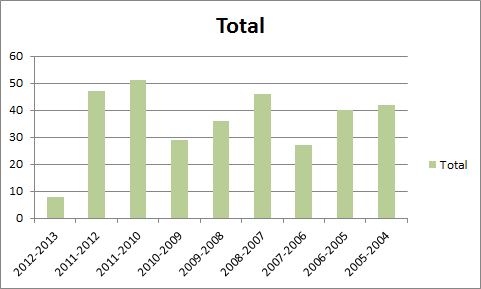
The first chart is the skier and boarder fatalities by year.
This chart is the skier and boarder fatalities graphed by month for each year.
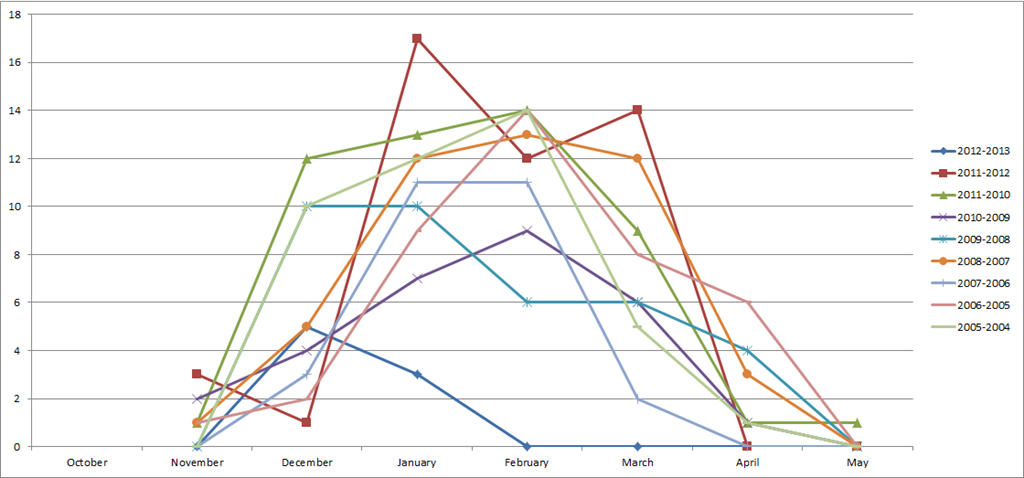
Here are the numbers:
| 12-13 | 12-11 | 11-10 | 10-09 | 09-08 | 08-07 | 07-06 | 06-05 | 05-04 | |
| Nov | 0 | 3 | 1 | 2 | 0 | 2 | 0 | 2 | 0 |
| Dec | 5 | 1 | 12 | 4 | 10 | 5 | 3 | 2 | 10 |
| Jan | 3 | 17 | 13 | 7 | 10 | 12 | 11 | 9 | 12 |
| Feb | 12 | 14 | 9 | 6 | 13 | 11 | 14 | 14 | |
| Mar | 14 | 9 | 6 | 6 | 23 | 3 | 8 | 5 | |
| Apr | 0 | 1 | 1 | 4 | 3 | 0 | 6 | 1 | |
| May | 0 | 1 | 0 | 0 | 0 | 0 | 0 | 0 | |
| Total | 8 | 47 | 51 | 29 | 36 | 46 | 27 | 40 | 42 |
I cannot make any discernible connection just by looking at the month when a skier or boarder has a fatality at a ski area in bounds.
What do you think? Leave a comment.
If you like this let your friends know or post it on FaceBook, Twitter or LinkedIn
Copyright 2013 Recreation Law (720) Edit Law
Email: blog@rec-law.us
Twitter: RecreationLaw
Facebook: Rec.Law.Now
Facebook Page: Outdoor Recreation & Adventure Travel Law
Blog: www.recreation-law.com
Mobile Site: http://m.recreation-law.com
By Recreation Law Rec-law@recreation-law.com James H. Moss Jim Moss
#RecreationLaw, #@RecreationLaw, #Cycling.Law #Fitness.Law, #Ski.Law, #Outside.Law, #Recreation.Law, #Recreation-Law.com, #Outdoor Law, #Recreation Law, #Outdoor Recreation Law, #Adventure Travel Law, #law, #Travel Law, #Jim Moss, #James H. Moss, #Attorney at Law, #Tourism, #Adventure Tourism, #Rec-Law, #Rec-Law Blog, #Recreation Law, #Recreation Law Blog, #Risk Management, #Human Powered, #Human Powered Recreation,# Cycling Law, #Bicycling Law, #Fitness Law, #Recreation-Law.com, #Backpacking, #Hiking, #Mountaineering, #Ice Climbing, #Rock Climbing, #Ropes Course, #Challenge Course, #Summer Camp, #Camps, #Youth Camps, #Skiing, #Ski Areas, #Negligence, #Snowboarding, #RecreationLaw, #@RecreationLaw, #Cycling.Law #Fitness.Law, #SkiLaw, #Outside.Law, #Recreation.Law, #RecreationLaw.com, #OutdoorLaw, #RecreationLaw, #OutdoorRecreationLaw, #AdventureTravelLaw, #Law, #TravelLaw, #JimMoss, #JamesHMoss, #AttorneyatLaw, #Tourism, #AdventureTourism, #RecLaw, #RecLawBlog, #RecreationLawBlog, #RiskManagement, #HumanPowered, #HumanPoweredRecreation,# CyclingLaw, #BicyclingLaw, #FitnessLaw, #RecreationLaw.com, #Backpacking, #Hiking, #Mountaineering, #IceClimbing, #RockClimbing, #RopesCourse, #ChallengeCourse, #SummerCamp, #Camps, #YouthCamps, #Skiing, #Ski Areas, #Negligence, #Snowboarding, sport and recreation laws, ski law, cycling law, Colorado law, law for recreation and sport managers, bicycling and the law, cycling and the law, ski helmet law, skiers code, skiing accidents, Recreation Lawyer, Ski Lawyer, Paddlesports Lawyer, Cycling Lawyer, Recreational Lawyer, Fitness Lawyer, Rec Lawyer, Challenge Course Lawyer, Ropes Course Lawyer, Zip Line Lawyer, Rock Climbing Lawyer, Adventure Travel Lawyer, Outside Lawyer, Recreation Lawyer, Ski Lawyer, Paddlesports Lawyer, Cycling Lawyer, #RecreationalLawyer, #FitnessLawyer, #RecLawyer, #ChallengeCourseLawyer, #RopesCourseLawyer, #ZipLineLawyer, #RockClimbingLawyer, #AdventureTravelLawyer, #OutsideLawyer, ski area, ski area fatality, NSAA, National Ski Area Association, fatality
WordPress Tags: Skier,Fatalities,Month,resorts,NSAA,boarder,Here,Total,connection,area,Leave,FaceBook,Twitter,LinkedIn,Recreation,Edit,Email,RecreationLaw,Page,Outdoor,Adventure,Travel,Blog,Mobile,Site,Outside,Moss,James,Attorney,Tourism,Risk,Management,Human,Rock,Ropes,Course,Challenge,Summer,Camp,Camps,Youth,Areas,Negligence,SkiLaw,OutdoorLaw,OutdoorRecreationLaw,AdventureTravelLaw,TravelLaw,JimMoss,JamesHMoss,AttorneyatLaw,AdventureTourism,RecLaw,RecLawBlog,RecreationLawBlog,RiskManagement,HumanPoweredRecreation,CyclingLaw,BicyclingLaw,FitnessLaw,RopesCourse,ChallengeCourse,SummerCamp,YouthCamps,Colorado,managers,helmet,accidents,Lawyer,Paddlesports,Recreational,Line,RecreationalLawyer,FitnessLawyer,RecLawyer,ChallengeCourseLawyer,RopesCourseLawyer,ZipLineLawyer,RockClimbingLawyer,AdventureTravelLawyer,OutsideLawyer,National,Association
Ski Binding Failure to Release under Indiana Law
Posted: January 28, 2013 Filed under: Assumption of the Risk, Indiana, Release (pre-injury contract not to sue), Skiing / Snow Boarding | Tags: Indiana, Plaintiff, Product liability, Salomon North America, Sitzmark Corporation, Ski, Ski binding, Summary judgment Leave a commentIndiana, like most states’, product liability law is controlled by statute which severely limits the defenses available to a defendant. Here the retailer and manufacture were sued for injuries when a ski binding failed to release, both being in the chain of the sale of the product. The plaintiff had signed a “sales slip” which contained release language when she picked up the skis; however the sales slip (release) was only effective against one of the three claims of the plaintiff.
The defendants had filed a motion for summary judgment at the trial court which was granted on all counts. The plaintiff appealed and the appellate court reversed on two of the three product liability claims.
The plaintiff had purchased new skis and bindings from the retailer Sitzmark Corporation which included bindings manufactured by Salomon North America. On the plaintiff’s third run while skiing and her first fall on her new equipment she fell suffering a compound fracture.
The plaintiff sued claiming negligence and strict liability. The negligence claim included two sub-claims negligent design of the bindings and negligent adjustment of the bindings by the retailer. The defenses were “incurred risk” and the release contained in the sales slip. Indiana uses the term incurred risk instead of the term assumption of the risk.
Summary of the case
The language in the sales slip that constituted the release language, excerpted below, did not contain the magic word release. It only talked about assumption of the risk issues. The plaintiff did acknowledge understanding the language.
I have been instructed in the use of my equipment, I have read the manufacturer’s instruction pamphlet (new bindings only), I have made no misrepresentation in regard to my height, weight, age, or skiing ability . . . . I understand that there are inherent and other risks involved in the sport for which this equipment is to be used, snow skiing, that injuries are a common and ordinary occurrence of the sport and I freely assume those risks. I understand that the ski boot binding system will not release at all times or under all circumstances, nor is it possible to predict every situation in which it will release and is therefore no guarantee for my safety. I therefore release the ski shop and its owners, agents and employees from any and all liability for damage and from the selection, adjustment and use of this equipment, accepting myself the full responsibility for any and all such damage or injury which may result.
The court reversed the lower court and reinstated the plaintiff’s strict liability claim. Strict liability is set out by statute in Indiana, Ind. Code 33-1-1.5-1 et seq. The court stated the statute had a three part test for the manufacture and retailer to use as a defense in a strict liability claim.
First, a plaintiff’s knowledge of the defect.
Second, a plaintiff’s unreasonable use of the product despite knowledge of the defect.
Third, a plaintiff’s injuries caused by the product.
The court analyzed the arguments and decided that neither defendant could prove that the plaintiff new of any defect in the binding. This was different from the argument they could prove, through the release language that “Moore knew her bindings would not release under all circumstances.” Because neither defendant could win on step one the case was sent back.
The first negligence claim was a common law negligence claim. Common law meaning the law that evolved over time (and not based on statute), usually from the law carried over from Great Britain. The common law was developed in England during the 1500’s from the King’s decrees and the church’s equity decisions. As time progressed these laws became more streamline and eventually codified, or written down. The common law still exists in all states and is the basis for the law in every state (Louisiana being the sole exception). Only when a statute has been created will a section of the common law for that state disappear or cease to exist. Ninety-nine percent of all negligence claims are common law. A state may have a void in its common law, an area that has never been decided in the state before, however this is getting rare now days.
A common law product liability action in Indiana can be defeated by the defense of incurred or assumption of the risk. However assumption of the risk as a defense had been merged into comparative negligence in Indiana at this time.
The defendants argued that by signing the sales slip the plaintiff assumed the risk of the defect in the product. The court however found the sales slip was proof of assumption of the risk, but not of assumption of negligence the difference is the greater requirement of knowledge required by the statute. Because the first time she fell was also the time she was injured the plaintiff had no direct knowledge of the defect of the product. In this case defect would mean failure of the binding to release. As such, the defense failed because there was no proof of assumption of the risk of negligence. Because the binding has not failed to release prior to the injury, the plaintiff had no knowledge of the binding failing to release that she could assume. This claim was also sent back to the lower court.
The third and final claim was based on negligently “setting, adjusting or checking the bindings.” Here the sales slip with its release language was effective. The court stated “These alleged acts of negligence are exactly those for which Moore granted Sitzmark a release of liability when she read and signed the sales slip.” This final claim was dismissed by the appellate court.
This case is a little confusing because of two issues. Indiana law on product liability is different from many states and the release language in the sales slip was very poorly written. There is not much that can be done about Indiana’s product liability law and the limitation on the defenses available manufacture’s and retailers. However a well written release might have prevented one of the product liability claims.
So Now What?
The release is not clearly identified, other than in a sales slip in this opinion. However during this period, these releases were fairly uniform and used by shops across the US. These preprinted forms are written in a way as to not cause a problem with any state laws rather than to effectively stop a claim.
Having a release in this case that specifically used the word the negligence and identified the defendants as the shop, by name and all manufactures would be the first start. The court spent a lot of space finding a way to bring the manufacture into the defense provided by the release language when the language did not specifically mention the manufacture. The language of the release should incorporate the necessary defenses of the Indiana Strict Liability Act so that the defense in the act is available. The negligence claims should be identified both for negligent acts, negligent mounting and setting and negligent in the design, manufacture or construction of the product. The language should also include more specific assumption of the risk language so the purchaser or customer who is having repairs done understands the risks are not that the binding may not work, but that the risk is the binding will not work and that the user should ski knowing that and in a safe way.
A well written release, based on Indiana law may be difficult to do. However, a well written release will still be better than the one at issue here. Each claim that survives the motions and appeal increases the cost of litigating and the cost of a possible settlement. If the release had eliminated one more of the claims a lower settlement would be easier to achieve, maybe even a complete win at trial.
Plaintiff: Eldonna Moore
Defendant: Sitzmark Corporation and Salomon North America, Inc.,
Plaintiff Claims: negligence (product liability) and strict liability
Defendant Defenses: Assumption of the Risk (Incurred Risk) and Release
Holding: One claim dismissed based on the release and the two remaining claims sent back to the trial court.
What do you think? Leave a comment.
If you like this let your friends know or post it on FaceBook, Twitter or LinkedIn
Copyright 2013 Recreation Law (720) Edit Law
Email: blog@rec-law.us
Twitter: RecreationLaw
Facebook: Rec.Law.Now
Facebook Page: Outdoor Recreation & Adventure Travel Law
Blog: www.recreation-law.com
Mobile Site: http://m.recreation-law.com
By Recreation Law Rec-law@recreation-law.com James H. Moss Jim Moss
#RecreationLaw, #@RecreationLaw, #Cycling.Law #Fitness.Law, #Ski.Law, #Outside.Law, #Recreation.Law, #Recreation-Law.com, #Outdoor Law, #Recreation Law, #Outdoor Recreation Law, #Adventure Travel Law, #law, #Travel Law, #Jim Moss, #James H. Moss, #Attorney at Law, #Tourism, #Adventure Tourism, #Rec-Law, #Rec-Law Blog, #Recreation Law, #Recreation Law Blog, #Risk Management, #Human Powered, #Human Powered Recreation,# Cycling Law, #Bicycling Law, #Fitness Law, #Recreation-Law.com, #Backpacking, #Hiking, #Mountaineering, #Ice Climbing, #Rock Climbing, #Ropes Course, #Challenge Course, #Summer Camp, #Camps, #Youth Camps, #Skiing, #Ski Areas, #Negligence, #Snowboarding, #RecreationLaw, #@RecreationLaw, #Cycling.Law #Fitness.Law, #SkiLaw, #Outside.Law, #Recreation.Law, #RecreationLaw.com, #OutdoorLaw, #RecreationLaw, #OutdoorRecreationLaw, #AdventureTravelLaw, #Law, #TravelLaw, #JimMoss, #JamesHMoss, #AttorneyatLaw, #Tourism, #AdventureTourism, #RecLaw, #RecLawBlog, #RecreationLawBlog, #RiskManagement, #HumanPowered, #HumanPoweredRecreation,# CyclingLaw, #BicyclingLaw, #FitnessLaw, #RecreationLaw.com, #Backpacking, #Hiking, #Mountaineering, #IceClimbing, #RockClimbing, #RopesCourse, #ChallengeCourse, #SummerCamp, #Camps, #YouthCamps, #Skiing, #Ski Areas, #Negligence, #Snowboarding, sport and recreation laws, ski law, cycling law, Colorado law, law for recreation and sport managers, bicycling and the law, cycling and the law, ski helmet law, skiers code, skiing accidents, Recreation Lawyer, Ski Lawyer, Paddlesports Lawyer, Cycling Lawyer, Recreational Lawyer, Fitness Lawyer, Rec Lawyer, Challenge Course Lawyer, Ropes Course Lawyer, Zip Line Lawyer, Rock Climbing Lawyer, Adventure Travel Lawyer, Outside Lawyer, Recreation Lawyer, Ski Lawyer, Paddlesports Lawyer, Cycling Lawyer, #RecreationalLawyer, #FitnessLawyer, #RecLawyer, #ChallengeCourseLawyer, #RopesCourseLawyer, #ZipLineLawyer, #RockClimbingLawyer, #AdventureTravelLawyer, #OutsideLawyer, Sitzmark Corporation, Salomon North America, Inc., Product Liability, Ski, Ski Binding,
WordPress Tags: Failure,Release,Indiana,Sitzmark,Corporation,Salomon,North,America,LEXIS,Prod,Liab,product,statute,defendant,Here,retailer,injuries,sale,plaintiff,sales,defendants,judgment,bindings,equipment,negligence,adjustment,assumption,Summary,manufacturer,instruction,pamphlet,misrepresentation,occurrence,system,situation,owners,agents,employees,selection,injury,Strict,Code,knowledge,Second,Third,arguments,argument,Common,Great,Britain,England,decisions,laws,basis,Louisiana,exception,area,action,difference,requirement,limitation,retailers,opinion,construction,purchaser,customer,user,cost,settlement,Eldonna,Claims,Defenses,Risk,Leave,FaceBook,Twitter,LinkedIn,Recreation,Edit,Email,RecreationLaw,Page,Outdoor,Adventure,Travel,Blog,Mobile,Site,Outside,Moss,James,Attorney,Tourism,Management,Human,Rock,Ropes,Course,Challenge,Summer,Camp,Camps,Youth,Areas,SkiLaw,OutdoorLaw,OutdoorRecreationLaw,AdventureTravelLaw,TravelLaw,JimMoss,JamesHMoss,AttorneyatLaw,AdventureTourism,RecLaw,RecLawBlog,RecreationLawBlog,RiskManagement,HumanPoweredRecreation,CyclingLaw,BicyclingLaw,FitnessLaw,RopesCourse,ChallengeCourse,SummerCamp,YouthCamps,Colorado,managers,helmet,accidents,Lawyer,Paddlesports,Recreational,Line,RecreationalLawyer,FitnessLawyer,RecLawyer,ChallengeCourseLawyer,RopesCourseLawyer,ZipLineLawyer,RockClimbingLawyer,AdventureTravelLawyer,OutsideLawyer,skis,three,appellate,neither
Moore v. Sitzmark Corporation and Salomon North America, Inc., 555 N.E.2d 1305; 1990 Ind. App. LEXIS 769; CCH Prod. Liab. Rep. P12,523
Posted: January 27, 2013 Filed under: Assumption of the Risk, Indiana, Legal Case, Release (pre-injury contract not to sue), Skiing / Snow Boarding Leave a commentMoore v. Sitzmark Corporation and Salomon North America, Inc., 555 N.E.2d 1305; 1990 Ind. App. LEXIS 769; CCH Prod. Liab. Rep. P12,523
Eldonna Moore, Plaintiff-Appellant, v. Sitzmark Corporation and Salomon North America, Inc., Defendants-Appellees
No. 73A01-8908-CV-332
Court of Appeals of Indiana, First District
555 N.E.2d 1305; 1990 Ind. App. LEXIS 769; CCH Prod. Liab. Rep. P12,523
June 27, 1990, Filed
PRIOR HISTORY: [**1] Appeal from the Shelby Superior Court No. 1; The Honorable Jonathan E. Palmer, Judge; Cause No. 20C01-8806-CP-095.
COUNSEL: Attorneys for Appellant: C. Warren Holland, Michael W. Holland, William J. Rumely, Holland & Holland, Indianapolis, Indiana.
Attorneys for Appellees: C. Wendell Martin, Amy L. Rankin, Martin, Wade, Hartley & Hollingsworth, Indianapolis, Indiana.
JUDGES: Baker, J. Ratliff, C.J., and Hoffman, P.J., concur.
OPINION BY: BAKER
OPINION
[*1306] Plaintiff-appellant Eldonna Moore (Moore) broke her leg in a snow skiing accident. She subsequently brought this suit against defendant-appellees Salomon North America, Inc. (Salomon) and Sitzmark Corporation (Sitzmark), the manufacturer and seller, respectively, of the ski bindings she was using when she broke her leg The trial court granted summary judgment to Salomon and Sitzmark, and Moore now appeals. We affirm in part and reverse in part.
On February 18, 1986, Moore, an experienced skier, purchased a pair of new downhill skis and new bindings from Sitzmark. Sitzmark installed the bindings, known as Salomon 747 bindings, on the skis, and adjusted them to release based on Moore’s weight. At the time of purchase, Moore signed a sales slip which contained the following [**2] language.
I have been instructed in the use of my equipment, I have read the manufacturer’s instruction pamphlet (new bindings only), I have made no misrepresentation in regard to my height, weight, age, or skiing ability . . . . I understand that there are inherent and other risks involved in the sport for which this equipment is to be used, snow skiing, that injuries are a common and ordinary occurrence of the sport and I freely assume those risks. I understand that the ski boot binding system will not release at all times or under all circumstances, nor is it possible to predict every situation in which it will release and is therefore no guarantee for my safety. I therefore release the ski shop and its owners, agents and employees from any and all liability for damage and from the selection, adjustment and use of this equipment, accepting myself the full responsibility for any and all such damage or injury which may result.
Moore admits to having read and understood the sales slip.
On March 1, 1986, Moore went to Sugarloaf Mountain in Michigan and used her new skis and bindings for the first time. She made two uneventful “runs” down the most difficult slope. On her third trip [**3] down the slope, however, she took a severe fall, during which the binding on her right ski did not release. As a result of the fall, she suffered a compound fracture of her right femur.
Moore brought suit against Salomon and Sitzmark, alleging theories of negligence and strict liability. The negligence claim against Salomon was premised on negligent design, and the negligence claim against Sitzmark was premised on negligent adjustment of the bindings. In their motions for summary judgment, Salomon and Sitzmark argued that Moore had incurred the risk, and the trial court granted the motions on that basis. On appeal, Moore raises two restated issues for our review. First, whether the trial court erred in finding she had incurred the risk. Second, whether the release of liability Moore signed was effective.
[HN1] When reviewing a grant of summary judgment, we apply the same standards as the trial court, and examine the pleadings, depositions, answers to interrogatories, [*1307] admissions, and affidavits filed with the court in the light most favorable to the party opposing summary judgment. Hatton v. Fraternal Order of Eagles (1990), Ind. App., 551 N.E.2d 479. Summary judgment is appropriate [**4] only when no genuine issues of material fact exist and the moving party is entitled to judgment as a matter of law. Id. When a defendant is the moving party, it is entitled to judgment as a matter of law when it demonstrates one of two things. First, that the undisputed material facts negate at least one element of the plaintiff’s claim. Second, the defendant may raise an affirmative defense which bars the plaintiff’s claim. 3 W. HARVEY, INDIANA PRACTICE § 56.9 at 629 (1988). If a defendant cannot make one of these showings, summary judgment is improper.
I. INCURRED RISK
A. Strict Liability
Moore argues she incurred only the ordinary risk of falling while skiing. Based on the language in the sales slip’s release of liability, Salomon and Sitzmark argue Moore incurred the risk that her bindings could fail to release and that she might suffer harm as a result. Salomon and Sitzmark are correct, but that is not dispositive of the case.
Moore’s strict liability theory, based on her allegation that the bindings were defective, is a statutory cause of action controlled by the Indiana Product Liability Act, IND. CODE 33-1-1.5-1 et seq. [HN2] The Act has preempted the Indiana common [**5] law of strict liability and “governs all actions in which the theory of liability is strict liability in tort.” IND. CODE 33-1-1.5-1. See Koske v. Townsend Engineering Co. (1990), Ind., 551 N.E.2d 437. Under the Act,
(a) One who sells, leases, or otherwise puts into the stream of commerce any product in a defective condition unreasonably dangerous to any user or consumer or to his property is subject to liability for physical harm caused by that product to the user or consumer or his property if that user or consumer is in the class of persons that the seller should reasonably foresee as being subject to the harm caused by the defective condition, and if:
(1) the seller is engaged in the business of selling such a product; and
(2) the product is expected to and does reach the user or consumer without substantial alteration in the condition in which it is sold by the person sought to be held liable under this chapter.
IND. CODE 33-1-1.5-3(a). IND. CODE 33-1-1.5-2 defines a seller as “a person engaged in business as a manufacturer, a wholesaler, a retailer, a lessor, or a distributor.” Accordingly, if Moore can prove the bindings were in a defective condition unreasonably dangerous, [**6] Salomon as manufacturer, and Sitzmark as retail seller, will be subject to liability under the Act.
The Act provides that defendants may raise the affirmative defense of incurred risk, as Salomon and Sitzmark did here. [HN3] “It is a defense that the user or consumer bringing the action knew of the defect and was aware of the danger and nevertheless proceeded unreasonably to make use of the product and was injured by it.” IND. CODE 33-1-1.5-4(b)(1) (emphasis added). The party asserting incurred risk bears the burden of proving the defense by a preponderance of the evidence, Get-N-Go, Inc. v. Markins (1989), Ind., 544 N.E.2d 484, reh’g granted on other grounds, 550 N.E.2d 748, and this requires three showings under IND. CODE 33-1-1.5-4(b)(1). First, a plaintiff’s knowledge of the defect. See, e.g., Corbin v. Coleco Industries, Inc. (7th Cir. 1984) 748 F.2d 411. Second, a plaintiff’s unreasonable use of the product despite knowledge of the defect. Third, a plaintiff’s injuries caused by the product. 1
1 In reality, of course, the third element will generally be shown by the plaintiff, requiring the party raising incurred risk to prove only the first two elements.
[**7] This is where Salomon and Sitzmark fail. Neither of them asserts that Moore knew of any defect in the bindings, they merely argue Moore knew her bindings would not release under all circumstances. [*1308] Absent the threshold showing that Moore knew of a defect in the bindings, neither Salomon nor Sitzmark is entitled to summary judgment on the grounds of incurred risk. The trial court’s grant of summary judgment on Moore’s strict liability theory was improper. 2
2 If, upon remand, Salomon and Sitzmark are able to prove Moore incurred the risk of a defect in the bindings, this will act as a complete bar to Moore’s strict liability claim. [HN4] The Comparative Fault Act, IND. CODE 34-4-33-1 et seq., does not include strict liability theory actions, but only those actions based on fault. See IND. CODE 34-4-33-1.
B. Negligence
A similar analysis applies to Moore’s negligent design theory against Salomon. [HN5] A plaintiff may, of course, bring a negligence action against the manufacturer of a product. See, e.g., Jarrell [**8] v. Monsanto Co. (1988), Ind. App., 528 N.E.2d 1158; Pfisterer v. Grisham (1965), 137 Ind. App. 565, 210 N.E.2d 75; MacPherson v. Buick Motor Co. (1916), 217 N.Y. 382, 111 N.E. 1050. Such an action is not subject to the terms of the Indiana Product Liability Act; rather, it is a common law action. Koske, supra, 551 N.E.2d at 443. In turn, the manufacturer may raise the defense of incurred risk. See Pfisterer, supra. In a negligence action, the defense of incurred risk is specifically subject to the terms of the Comparative Fault Act. See IND. CODE 34-4-33-2(a).
As all the parties to this dispute correctly point out, incurred risk involves a mental state of venturousness on the part of the actor against whom it is asserted, and requires a subjective analysis of the actor’s actual knowledge and voluntary acceptance of the risk. Get-N-Go, supra; Power v. Brodie (1984), Ind. App., 460 N.E.2d 1241; Kroger Co. v. Haun (1978), 177 Ind. App. 403, 379 N.E.2d 1004. As with the parties’ dispute over incurred risk in the context of a strict liability theory, the question here revolves around the proper definition of the risk that may or may not have been incurred.
[**9] As we have already discussed, by signing the release in the sales slip, Moore incurred the risk that her bindings would not release under all circumstances and that she might suffer injuries in the event of a failure to release. This was merely an acknowledgement of the laws of physics, however. There is no evidence Moore knew of any alleged negligent design of the bindings. Salomon argues vigorously that Indiana case law defines the risk as solely the risk of injury, not the risk of negligence. 3 Salomon is mistaken.
3 Salomon and Sitzmark make much of the voluntariness of Moore’s actions (i.e., purchasing the bindings, signing the release, and skiing for pleasure) in incurring the risk of her bindings failing to release. It is hornbook law that [HN6] actions which are not truly voluntary do not amount to an incurrence of risk. See, e.g., Get-N-Go, supra; Richarson v. Marrell’s (1989), Ind. App., 539 N.E.2d 485, trans. denied; St. Mary’s Byzantine Church v. Mantich (1987), Ind. App., 505 N.E.2d 811, trans. denied. Moore’s actions were indeed voluntary, but this is immaterial; the proper definition of the risk is the dispositive issue in this case.
[**10] In Pfisterer, supra, the plaintiff lost part of her finger while using a slide at the defendants’ resort park. The plaintiff had used slides before, but had never used the slide which injured her prior to the time of injury. In discussing the defense of incurred or assumed risk, the court held the plaintiff “assumed or incurred the risks inherent and incident to the use of this slide, but she did not assume or incur the risk that the slide might be defectively constructed. [She] could not assume or incur the risk of a latent defect of which she had neither notice nor knowledge, either express or implied.” 4 Pfisterer, supra, 137 Ind. App. at 572, 210 N.E.2d at 78-79.
4 The plaintiff was 13 years old at the time of the accident. The court, however, did not in any way rely on the plaintiff’s youth as a basis for its decision.
In a similar case, the Missouri Court of Appeals held a high school pole vaulter assumed the inherent risks of pole vaulting, but not the risks of the manufacturer’s negligence. McCormick v. Lowe & Campbell Athletic Goods Co. (1940), 235 Mo. App. 612, 144 S.W.2d 866.
[**11] Similarly, the evidence most favorable to Moore reveals she had no knowledge [*1309] of any negligent design flaws in the bindings. Moreover, she had not fallen while using the new bindings prior to the fall which injured her. Even if she had, assuming any defect was latent, she could not incur the risk of the defect without notice of the defect. 5 Moore did not incur the risk of negligent design by Salomon. The trial court’s grant of summary judgment to Salomon on Moore’s negligence theory was improper.
5 [HN7] If any defect was open and obvious under the rule enunciated in Bemis Co. v. Rubush (1981), Ind., 427 N.E.2d 1058, 1061, cert. denied (1982), 459 U.S. 825, 103 S. Ct. 57, 74 L. Ed. 2d 61, Moore may not recover on her negligence theory. Koske, supra, did not abrogate the open and obvious rule, but rather held it inapplicable to actions under the Indiana Product Liability Act. The rule is still applicable in product negligence liability cases. Koske, supra, 551 N.E.2d at 443. See Also Bridgewater v. Economy Eng’g Co. (1985), Ind., 486 N.E.2d 484, modified on other grounds in Get-N-Go, Inc. v. Markins (1990), 550 N.E.2d 748.
[**12] II. EFFECT OF RELEASE
Moore’s negligence complaint against Sitzmark alleged Sitzmark had been negligent in setting, adjusting, or checking the bindings. These alleged acts of negligence are exactly those for which Moore granted Sitzmark a release of liability when she read and signed the sales slip. This release was valid under Indiana law, LaFrenz v. Lake Cty. Fair Bd. (1977), 172 Ind. App. 389, 360 N.E.2d 605, and the trial court properly granted summary judgment to Sitzmark on Moore’s negligence theory.
The trial court’s summary judgment in favor of Sitzmark on Moore’s negligence theory is affirmed. The trial court’s summary judgment in favor of Sitzmark on Moore’s strict liability theory, and in favor of Salomon on both Moore’s strict liability and negligence theories is reversed. The cause is remanded to the trial court for further proceedings consistent with this opinion.
Ratliff, C.J., and Hoffman, P.J., concur.
WordPress Tags: Sitzmark,Corporation,Salomon,North,America,LEXIS,Prod,Liab,Eldonna,Plaintiff,Appellant,Defendants,Appellees,Court,Appeals,Indiana,District,June,PRIOR,HISTORY,Appeal,Shelby,Superior,Honorable,Jonathan,Palmer,Judge,Cause,CASE,SUMMARY,PROCEDURAL,POSTURE,decision,judgment,manufacturer,seller,product,negligence,action,OVERVIEW,bindings,Code,knowledge,OUTCOME,proceedings,TERMS,theory,consumer,user,LexisNexis,Headnotes,Civil,Procedure,Appellate,Review,General,Opposition,Standards,admissions,affidavits,fact,defendant,Second,showings,Contracts,Types,Lease,Agreements,Torts,Premises,Lessees,Lessors,Liabilities,Preemption,tort,Under,commerce,alteration,person,chapter,wholesaler,retailer,distributor,Defenses,Assumption,Risk,Products,Conduct,Strict,danger,preponderance,Third,injuries,Comparative,Intentional,Fault,actor,analysis,acceptance,Actions,COUNSEL,Attorneys,Warren,Holland,Michael,William,Indianapolis,Wendell,Martin,Rankin,Wade,Hartley,Hollingsworth,JUDGES,Baker,Ratliff,Hoffman,OPINION,accident,February,sales,equipment,instruction,pamphlet,misrepresentation,occurrence,system,situation,owners,agents,employees,selection,adjustment,injury,March,Sugarloaf,Mountain,Michigan,theories,basis,Hatton,Fraternal,Order,Eagles,HARVEY,PRACTICE,allegation,Koske,Townsend,emphasis,Markins,Corbin,Coleco,Industries,Neither,Absent,threshold,Jarrell,Monsanto,Pfisterer,Grisham,MacPherson,Buick,Motor,Power,Brodie,Kroger,Haun,context,definition,event,failure,laws,physics,Richarson,Marrell,Mary,Byzantine,Church,Mantich,resort,park,incident,youth,Missouri,McCormick,Lowe,Campbell,Athletic,Goods,flaws,Moreover,Bemis,Rubush,cert,Also,Bridgewater,Economy,EFFECT,RELEASE,complaint,LaFrenz,Lake,Fair,skis,dispositive,pleadings,interrogatories,lessor,three,whom,incurrence,whether,supra,trans
NPS now on NYC landmark boat tours
Posted: January 24, 2013 Filed under: New York | Tags: Battery Park, Brooklyn Bridge, Ellis Island, Governors Island, National Park Service, National Park Tours, New York City, NPS, South Street Seaport, Statue of Liberty, Statute Cruises, Statute of Liberty Leave a comment| Statue Cruises Tour NowFeatures National Park Service Rangers
New York, NY – January 17, 2013 – Statue Cruises announces that National Park Service Rangers are now on board their daily harbor tours. As a new initiative, that started on January 13, 2013, the well-trained rangers will be on-deck and on-hand to lend their valuable expertise to passengers. Designed to enhance the educational aspect of the experience, the rangers will personally engage with passengers by assisting with inquiries and sharing their expert knowledge. The daily Statue of Liberty Harbor Tours grant up-close views of famed New York City landmarks from the unique perspective of the city’s waterways. Iconic landmarks viewed during the tour include the Statue of Liberty, Ellis Island, the 9-11 Memorial, the South Street Seaport, Governors Island and the Brooklyn Bridge, among others. Departing every 30 minutes daily from 10:00am to 4:45pm, passengers can now expect to interact with uniformed rangers during their hour-long tour. Statue Cruises COO, Mike Burke, believes the addition of the National Park Service Rangers will make the cruise more memorable for passengers. Burke states, “Visitors will not only enjoy the closest views of the Statue of Liberty but they will be able to learn about the National Monument from the experts themselves.” Tickets for the narrated sightseeing tours are $24.00 (adults); $17.00 (seniors) and $12.00 (children). Tours depart daily from Battery Park at the foot of Manhattan. Prior to embarking, passengers can purchase tickets online at www.statuecruises.com, by phone at 201-604-2800, or at the seawall in Battery Park. For more information, please visit www.statuecruises.com. About Statue Cruises Statue Cruises, the official concessioner to the National Park Service, is the premier harbor cruise operator in New York Harbor, sharing the sights of New York with over 4.0 million annual visitors from around the world. For more information visit: www.statuecruises.com/pressroom. |
|
||||||||||||||||||||


Regulations, checklist for having fun!
Posted: January 23, 2013 Filed under: Risk Management | Tags: Common Sense.Paddlesports, Death, fatality, New Zealand, Russian, Zorb Leave a commentTell me what I can’t do so I know what to do?
Charlie Wallbridge and I were at a water park along dozens of other paddlesports people. Charlie, if you don’t know him, is the guru, the expert, the man, on paddlesports safety. As a group of us climbed the stairs to a ride, there was a long list of things you could not do. Each time we climbed we checked off the list so that by the last time we had done everything we weren’t supposed to do.
I remember the time well. At the bottom in the pool after another disastrous and fantastic time I yelled “help someone save me; I’m drowning”. Charlie, I think yelled back “save yourself; I’m drowning too!” Things got worse because I was laughing so hard, with my head underwater and people, floats and who knows what else pushing me down again.
As soon as I got to the surface and got out, we all went back up and did it again.
The regulations were great; they insured we almost died and had a great time. Several of the things on the list I would have never thought of doing but with the help of a risk manager we had a new way of getting hurt!
This memory flashed back after I read this article and watched a video. See ‘Zorbing’ Death Brings Call For

Zorb 14 (Photo credit: Wikipedia)
Safety Rules; Fatal Ride Captured On Video. Two Russians were at a ski area. They climbed into a Zorb and rolled down the hill. One man died by the end of the ride.
A Zorb is a great big plastic ball that you climb into. It rolls on snow or water or whatever, and you bounce around on the inside.
The article stated that because of the one death, there was a new call for a “global code of safe operations to try to stamp out cowboy operators.”
Those regulations will just become a “to do” list.
Think
1. Why is it your job to tell me how to have fun? Warn me that having fun or doing stupid things will hurt me (tobacco and beer) but be real. Tobacco leads to impotency, yet people start to smoke to look cool and get laid. Go figure?
2. Create a list of what not to do, and you have a list of things to do. Be smart when you create a list. Think about who actually reads them. (Teenagers looking for rules to break and risk managers.) Why write something and post it if no one is going to read it anyway. Purely for the liability protection?
3. If rules worked traffic tickets would be in a museum rather than a source of income all cities in the US.
4. No amount of writing, rules, regulations or laws are going to overcome a lack of common sense (from some perspectives) or a desire to have a good time (from other perspectives.)
Besides, I believe Darwin was right, and maybe we can learn something from every death……
What do you think? Leave a comment.
If you like this let your friends know or post it on FB, Twitter or LinkedIn
Copyright 2013 Recreation Law (720) Edit Law
Twitter: RecreationLaw
Facebook: Rec.Law.Now
Facebook Page: Outdoor Recreation & Adventure Travel Law
Mobile Site: http://m.recreation-law.com
By Recreation Law Rec-law@recreation-law.com James H. Moss Jim Moss
#RecreationLaw, #@RecreationLaw, #Cycling.Law #Fitness.Law, #Ski.Law, #Outside.Law, #Recreation.Law, #Recreation-Law.com, #Outdoor Law, #Recreation Law, #Outdoor Recreation Law, #Adventure Travel Law, #law, #Travel Law, #Jim Moss, #James H. Moss, #Attorney at Law, #Tourism, #Adventure Tourism, #Rec-Law, #Rec-Law Blog, #Recreation Law, #Recreation Law Blog, #Risk Management, #Human Powered, #Human Powered Recreation,# Cycling Law, #Bicycling Law, #Fitness Law, #Recreation-Law.com, #Backpacking, #Hiking, #Mountaineering, #Ice Climbing, #Rock Climbing, #Ropes Course, #Challenge Course, #Summer Camp, #Camps, #Youth Camps, #Skiing, #Ski Areas, #Negligence, #Snowboarding, #RecreationLaw, #@RecreationLaw, #Cycling.Law #Fitness.Law, #SkiLaw, #Outside.Law, #Recreation.Law, #RecreationLaw.com, #OutdoorLaw, #RecreationLaw, #OutdoorRecreationLaw, #AdventureTravelLaw, #Law, #TravelLaw, #JimMoss, #JamesHMoss, #AttorneyatLaw, #Tourism, #AdventureTourism, #RecLaw, #RecLawBlog, #RecreationLawBlog, #RiskManagement, #HumanPowered, #HumanPoweredRecreation,# CyclingLaw, #BicyclingLaw, #FitnessLaw, #RecreationLaw.com, #Backpacking, #Hiking, #Mountaineering, #IceClimbing, #RockClimbing, #RopesCourse, #ChallengeCourse, #SummerCamp, #Camps, #YouthCamps, #Skiing, #Ski Areas, #Negligence, #Snowboarding, sport and recreation laws, ski law, cycling law, Colorado law, law for recreation and sport managers, bicycling and the law, cycling and the law, ski helmet law, skiers code, skiing accidents, Recreation Lawyer, Ski Lawyer, Paddlesports Lawyer, Cycling Lawyer, Recreational Lawyer, Fitness Lawyer, Rec Lawyer, Challenge Course Lawyer, Ropes Course Lawyer, Zip Line Lawyer, Rock Climbing Lawyer, Adventure Travel Lawyer, Outside Lawyer, Recreation Lawyer, Ski Lawyer, Paddlesports Lawyer, Cycling Lawyer, #RecreationalLawyer, #FitnessLawyer, #RecLawyer, #ChallengeCourseLawyer, #RopesCourseLawyer, #ZipLineLawyer, #RockClimbingLawyer, #AdventureTravelLawyer, #OutsideLawyer, Russian, Zorb, Death, Fatality, Common Sense.Paddlesports,
WordPress Tags: Regulations,checklist,Tell,Charlie,Wallbridge,park,dozens,guru,stairs,Several,manager,memory,article,Death,Brings,Call,Rules,Fatal,Ride,Video,Russians,area,Zorb,hill,ball,operators,Think,Warn,beer,Tobacco,Create,Teenagers,managers,protection,tickets,museum,income,cities,laws,Besides,Darwin,Leave,Twitter,LinkedIn,Recreation,Edit,RecreationLaw,Facebook,Page,Outdoor,Adventure,Travel,Blog,Mobile,Site,Outside,Moss,James,Attorney,Tourism,Risk,Management,Human,Rock,Ropes,Course,Challenge,Summer,Camp,Camps,Youth,Areas,Negligence,SkiLaw,OutdoorLaw,OutdoorRecreationLaw,AdventureTravelLaw,TravelLaw,JimMoss,JamesHMoss,AttorneyatLaw,AdventureTourism,RecLaw,RecLawBlog,RecreationLawBlog,RiskManagement,HumanPoweredRecreation,CyclingLaw,BicyclingLaw,FitnessLaw,RopesCourse,ChallengeCourse,SummerCamp,YouthCamps,Colorado,helmet,accidents,Lawyer,Paddlesports,Recreational,Line,RecreationalLawyer,FitnessLawyer,RecLawyer,ChallengeCourseLawyer,RopesCourseLawyer,ZipLineLawyer,RockClimbingLawyer,AdventureTravelLawyer,OutsideLawyer,Russian,Common,Sense
Celebration of the Colorado Adoption of an Environmental Education Plan
Posted: January 22, 2013 Filed under: Uncategorized | Tags: CAEE, Celebration, Colorado, education, Environment, Environmental Education, Environmental Education Plan Leave a commentColorado Environmental
Education Plan Celebration

Date: Wednesday, January 23
Time: 5:00-7:00 p.m.
Location: The Garden Restaurant
3435 Albion St. Denver, CO, 80207
Join us for this FREE event at The Garden Restaurant to celebrate this incredible milestone!
Appetizers will be provided and additional food
and beverage will be available for purchase.
Please let us know if you’ll be in attendance:

About the Garden:
The Garden is dedicated to improving the quality of life by connecting people with delicious, healthy, local, affordable, and sustainable food. Find out more about The Garden.
If you wish to continue your support for Environmental Education consider joining the Colorado Alliance for Environmental Educators.

What do you think? Leave a comment.
If you like this let your friends know or post it on FB, Twitter or LinkedIn
Copyright 2013 Recreation Law (720) Edit Law
Twitter: RecreationLaw
Facebook: Rec.Law.Now
Facebook Page: Outdoor Recreation & Adventure Travel Law
Mobile Site: http://m.recreation-law.com
#RecreationLaw, #@RecreationLaw, #Cycling.Law #Fitness.Law, #Ski.Law, #Outside.Law, #Recreation.Law, #Recreation-Law.com, #Outdoor Law, #Recreation Law, #Outdoor Recreation Law, #Adventure Travel Law, #law, #Travel Law, #Jim Moss, #James H. Moss, #Attorney at Law, #Tourism, #Adventure Tourism, #Rec-Law, #Rec-Law Blog, #Recreation Law, #Recreation Law Blog, #Risk Management, #Human Powered, #Human Powered Recreation,# Cycling Law, #Bicycling Law, #Fitness Law, #Recreation-Law.com, #Backpacking, #Hiking, #Mountaineering, #Ice Climbing, #Rock Climbing, #Ropes Course, #Challenge Course, #Summer Camp, #Camps, #Youth Camps, #Skiing, #Ski Areas, #Negligence, #Snowboarding, #RecreationLaw, #@RecreationLaw, #Cycling.Law #Fitness.Law, #SkiLaw, #Outside.Law, #Recreation.Law, #RecreationLaw.com, #OutdoorLaw, #RecreationLaw, #OutdoorRecreationLaw, #AdventureTravelLaw, #Law, #TravelLaw, #JimMoss, #JamesHMoss, #AttorneyatLaw, #Tourism, #AdventureTourism, #RecLaw, #RecLawBlog, #RecreationLawBlog, #RiskManagement, #HumanPowered, #HumanPoweredRecreation,# CyclingLaw, #BicyclingLaw, #FitnessLaw, #RecreationLaw.com, #Backpacking, #Hiking, #Mountaineering, #IceClimbing, #RockClimbing, #RopesCourse, #ChallengeCourse, #SummerCamp, #Camps, #YouthCamps, #Skiing, #Ski Areas, #Negligence, #Snowboarding, sport and recreation laws, ski law, cycling law, Colorado law, law for recreation and sport managers, bicycling and the law, cycling and the law, ski helmet law, skiers code, skiing accidents, Recreation Lawyer, Ski Lawyer, Paddlesports Lawyer, Cycling Lawyer, Recreational Lawyer, Fitness Lawyer, Rec Lawyer, Challenge Course Lawyer, Ropes Course Lawyer, Zip Line Lawyer, Rock Climbing Lawyer, Adventure Travel Lawyer, Outside Lawyer, Recreation Lawyer, Ski Lawyer, Paddlesports Lawyer, Cycling Lawyer, #RecreationalLawyer, #FitnessLawyer, #RecLawyer, #ChallengeCourseLawyer, #RopesCourseLawyer, #ZipLineLawyer, #RockClimbingLawyer, #AdventureTravelLawyer, #OutsideLawyer, CAEE, Environmental Education, Environmental Education Plan, Celebration,
WordPress Tags: Celebration,Colorado,Adoption,Environmental,Education,Plan,Date,January,Time,Location,Garden,Restaurant,Albion,Denver,Join,FREE,event,Appetizers,food,beverage,attendance,Click,RSVP,About,life,Find,Leave,Twitter,LinkedIn,Recreation,Edit,RecreationLaw,Facebook,Page,Outdoor,Adventure,Travel,Blog,Mobile,Site,Outside,Moss,James,Attorney,Tourism,Risk,Management,Human,Rock,Ropes,Course,Challenge,Summer,Camp,Camps,Youth,Areas,Negligence,SkiLaw,OutdoorLaw,OutdoorRecreationLaw,AdventureTravelLaw,TravelLaw,JimMoss,JamesHMoss,AttorneyatLaw,AdventureTourism,RecLaw,RecLawBlog,RecreationLawBlog,RiskManagement,HumanPoweredRecreation,CyclingLaw,BicyclingLaw,FitnessLaw,RopesCourse,ChallengeCourse,SummerCamp,YouthCamps,managers,helmet,accidents,Lawyer,Paddlesports,Recreational,Line,RecreationalLawyer,FitnessLawyer,RecLawyer,ChallengeCourseLawyer,RopesCourseLawyer,ZipLineLawyer,RockClimbingLawyer,AdventureTravelLawyer,OutsideLawyer,CAEE

You cannot be liable for what you do not control or what volunteers do
Posted: January 21, 2013 Filed under: California, Camping | Tags: Boy Scout, Boy Scouts, Boy Scouts of America, BSA, Eagle Scout, Guy Lines, Inc., Los Angeles, Los Angeles Area Council, Premises Liability, Recreation, Scout, Tent Lines, Volunteer 4 CommentsMoore v. Boy Scouts of America Los Angeles Area Council, Inc., 2004 Cal. App. Unpub. LEXIS 11180
It is also hard to be liable for not watching where you are walking
This case stems from injuries received when a volunteer was setting up a tent and fell over one of the guy lines for the tent.
The plaintiff was a volunteer and with other volunteers was setting up a large tent at a Scout Camp. The camp was owned by the Los Angeles Area Council, Inc. which was granted a charter by the Boy Scouts of America to offer the Scouting program to local youth. The tent was a large military wall tent, similar to what you would see on reruns of M*A*S*H.
While setting up the tent, another volunteer asked the plaintiff to get more tent stakes. She walked around the tent, picked up more stakes and while walking back tripped over one of the guy lines holding up the tent. None of the guy lines had been marked with flags or markers to indicate there was a line there and the accident occurred around 7:00 Pm in July. (None are marked in the M*A*S*H reruns either.) The factual issue became whether or not markers or flags should have been used to identify the guy-lines on the tents.
The court went through and clearly identified factual issues the court felt were important.
Moore had not set up the specific pole, rope or stake upon which she tripped.
The ropes coming off the tent were at varying angles and pitches. The ropes varied in length, de-pending upon location. There were no flags or markers on the ropes.
Before this date, Moore had never been involved in setting up or taking down this tent or this type of tent. However, in years past, Moore had used rope or flags to mark the guy ropes on this tent to make the ropes more visible.
Before Moore fell, neither Moore nor any of the other adult volunteers saw anything they considered unsafe or dangerous.
In the past, some of the adult volunteers had used markers (e.g., cloth or fluorescent plastic tape) to make ropes more visible in scout camps and in non-scout camping situations. In prior years, this tent had been used in the Boy Scout camp, and flags had been used to mark the ropes. It is unclear if markers were used each time the tent was used.
The plaintiff argued the BSA did not have a policy of marking guy lines with markers or flags.
The plaintiff sued for premises liability and negligence. The premises liability claim was based on negligently setting up a tent without guy lines and the negligence claim for not using reasonable care when setting up tents by not using markers on guy-lines.
The Boy Scouts filed a motion for summary judgment based on the fact there was no triable issues, no real legal claims, which was granted and the plaintiff appealed.
So?
The plaintiff’s main arguments were supported by its expert an ergonomist who was a human factors and safety consultant. (This has me confused too, as to why an ergonomist (whatever) has any knowledge of setting up a tent.) The ergonomist said that that groups in Virginia, Australia and Louisiana has policies on markers on tent lines.
The court first looked at the premises liability claim. A premises liability claim is based on a dangerous condition on land. The owner of land is liable for “only for hazardous conditions of which the possessor had actual or constructive knowledge.” The tent was not part of the land so there was no legal basis for a premises liability claim.
The negligence claim was also dismissed by the court. Since the tent was being set up by volunteers, there was no proof that the BSA created the dangerous condition or was aware that a dangerous condition existed. The BSA could not breach a duty of care when the actions which created a dangerous condition were not those of the BSA. Nor does the lack of a policy create a dangerous condition on land. The plaintiff’s argument the court reasoned, where closer to tent issues not land issues.
So Now What?
The legal issues are as stretched in this case as you can get in my opinion. You are setting up a tent by setting up guy lines; you can’t sue when you trip over a guy line.
The claims were incorrect for the facts. The court looked at the issues and could not find any legal connection between the facts, the claims and the law.
However, that does not mean that not watching where you walk might not lead to litigation at some future date that does hold some water.
You can write policies till there are no more trees. In doing so, you’ll probably sink some other group who is trying to save trees. Better to educate than kill a tree. Train your volunteers, prove you trained them, and then explain how the organization they are volunteering for cannot afford lawsuits, stupid ones or regular ones. By that I mean include litigation training; you can’t sue us, in the training you provide.
Explain how it is their job to protect each other as well as to protect the organization. Tell them and prove you told them that you cannot identify all of the risks they may encounter.
You might even have them sign a release.
Plaintiff: Josephine Moore
Defendant: Boy Scouts of America Los Angeles Area Council, Inc.
Plaintiff Claims: Premises Liability and Negligence
Defendant Defenses: not triable issues of fact, no negligence
Holding: Trial court dismissal was affirmed
What do you think? Leave a comment.
If you like this let your friends know or post it on FB, Twitter or LinkedIn
Copyright 2012 Recreation Law (720) Edit Law
Twitter: RecreationLaw
Facebook: Rec.Law.Now
Facebook Page: Outdoor Recreation & Adventure Travel Law
Mobile Site: http://m.recreation-law.com
By Recreation Law Rec-law@recreation-law.com James H. Moss Jim Moss
#RecreationLaw, #@RecreationLaw, #Cycling.Law #Fitness.Law, #Ski.Law, #Outside.Law, #Recreation.Law, #Recreation-Law.com, #Outdoor Law, #Recreation Law, #Outdoor Recreation Law, #Adventure Travel Law, #law, #Travel Law, #Jim Moss, #James H. Moss, #Attorney at Law, #Tourism, #Adventure Tourism, #Rec-Law, #Rec-Law Blog, #Recreation Law, #Recreation Law Blog, #Risk Management, #Human Powered, #Human Powered Recreation,# Cycling Law, #Bicycling Law, #Fitness Law, #Recreation-Law.com, #Backpacking, #Hiking, #Mountaineering, #Ice Climbing, #Rock Climbing, #Ropes Course, #Challenge Course, #Summer Camp, #Camps, #Youth Camps, #Skiing, #Ski Areas, #Negligence, #Snowboarding, #RecreationLaw, #@RecreationLaw, #Cycling.Law #Fitness.Law, #SkiLaw, #Outside.Law, #Recreation.Law, #RecreationLaw.com, #OutdoorLaw, #RecreationLaw, #OutdoorRecreationLaw, #AdventureTravelLaw, #Law, #TravelLaw, #JimMoss, #JamesHMoss, #AttorneyatLaw, #Tourism, #AdventureTourism, #RecLaw, #RecLawBlog, #RecreationLawBlog, #RiskManagement, #HumanPowered, #HumanPoweredRecreation,# CyclingLaw, #BicyclingLaw, #FitnessLaw, #RecreationLaw.com, #Backpacking, #Hiking, #Mountaineering, #IceClimbing, #RockClimbing, #RopesCourse, #ChallengeCourse, #SummerCamp, #Camps, #YouthCamps, #Skiing, #Ski Areas, #Negligence, #Snowboarding, sport and recreation laws, ski law, cycling law, Colorado law, law for recreation and sport managers, bicycling and the law, cycling and the law, ski helmet law, skiers code, skiing accidents, Recreation Lawyer, Ski Lawyer, Paddlesports Lawyer, Cycling Lawyer, Recreational Lawyer, Fitness Lawyer, Rec Lawyer, Challenge Course Lawyer, Ropes Course Lawyer, Zip Line Lawyer, Rock Climbing Lawyer, Adventure Travel Lawyer, Outside Lawyer, Recreation Lawyer, Ski Lawyer, Paddlesports Lawyer, Cycling Lawyer, #RecreationalLawyer, #FitnessLawyer, #RecLawyer, #ChallengeCourseLawyer, #RopesCourseLawyer, #ZipLineLawyer, #RockClimbingLawyer, #AdventureTravelLawyer, #OutsideLawyer, Los Angeles Area Council, Inc., #BSA, Boy Scouts, Boy Scouts of America, Guy Lines, Tent Lines, #Volunteer, Premises Liability,
Moore v. Boy Scouts of America Los Angeles Area Council, Inc., 2004 Cal. App. Unpub. LEXIS 11180
Posted: January 21, 2013 Filed under: California, Camping, Legal Case | Tags: Boy Scout, Boy Scouts, Boy Scouts of America, BSA, Eagle Scout, Guy Lines, Inc., Los Angeles Area Council, Premises Liability, Recreation, Scout, Tent Lines, Volunteer 4 CommentsMoore v. Boy Scouts of America Los Angeles Area Council, Inc., 2004 Cal. App. Unpub. LEXIS 11180
Josephine Moore, Plaintiff and Appellant, v. Boy Scouts of America Los Angeles Area Council, Inc., Defendant and Respondent.
B170389
COURT OF APPEAL OF CALIFORNIA, SECOND APPELLATE DISTRICT, DIVISION THREE
2004 Cal. App. Unpub. LEXIS 11180
December 10, 2004, Filed
NOTICE: [*1] NOT TO BE PUBLISHED IN OFFICIAL REPORTS. CALIFORNIA RULES OF COURT, RULE 977(a), PROHIBIT COURTS AND PARTIES FROM CITING OR RELYING ON OPINIONS NOT CERTIFIED FOR PUBLICATION OR ORDERED PUBLISHED, EXCEPT AS SPECIFIED BY RULE 977(B). THIS OPINION HAS NOT BEEN CERTIFIED FOR PUBLICATION OR ORDERED PUBLISHED FOR THE PURPOSES OF RULE 977.
PRIOR HISTORY: APPEAL from a judgment of the Superior Court of Los Angeles County, No. NC040331. Elizabeth Allen White, Judge.
DISPOSITION: Affirmed.
CORE TERMS: scout, tent, rope, volunteer, flag, summary judgment, scout camp, causes of action, hazard, marker, adult, guy ropes, feet, dangerous condition, declaration, triable, conspicuity, warning, premises liability, issues of fact, negligently, military, donated, wall tent, lighting, tripped, visible, manual, pole, trip
COUNSEL: Sedgwick, Detert, Moran & Arnold, Thomas A. Delaney and Steven S. Streger, for Defendant and Respondent.
Desjardins Kelly and Warren D. Kelly, for Plaintiff and Appellant.
JUDGES: ALDRICH, J.; CROSKEY, Acting P. J., KITCHING, J. concurred.
OPINION BY: ALDRICH
OPINION
INTRODUCTION
Plaintiff and appellant Josephine Moore (Moore) was setting up a tent for a scout camp site when she tripped over a rope that was securing the tent. Moore appeals from a summary judgment entered in favor of defendant and respondent Boy Scouts of America Los Angeles Area Council. Inc. (the Boy Scouts). We affirm.
FACTUAL AND PROCEDURAL BACKGROUND
1. Facts.
Following the usual rules on appeal, we construe the facts in the light most favorable [*2] to Moore, the party who opposed the motion for summary judgment. (Jackson v. Ryder Truck Rental, Inc. (1993) 16 Cal.App.4th 1830, 1836.)
On July 8, 2001, Moore was setting up a scout camp site. She and other adult volunteers were erecting a wall tent that was secured by poles and ropes. No employee of the Boy Scouts was involved in setting up the tent. The Boy Scouts did not own the tent. The rectangular tent was oblong, about 24 feet long by 16 feet wide. The poles used to hold up the tent were 6 feet long. Beige ropes were used to secure the tent to the ground and to keep the tent upright.
At about 7:00 p.m., the volunteers had been setting up the tent for 30 to 60 minutes. The tent was about four or five feet from a picnic table. One of the other adults asked Moore to retrieve additional stakes from the opposite side of the tent. Moore walked around the tent and picked-up six or seven stakes. Moore walked near the tent, toward the adult who had requested the stakes. In doing so, Moore tripped over one of the ropes that had already been staked into the ground. The stake holding the rope was two to five feet from the tent and two to five feet from the picnic table.
[*3] Moore had not set up the specific pole, rope or stake upon which she tripped.
The ropes coming off the tent were at varying angles and pitches. The ropes varied in length, depending upon location. There were no flags or markers on the ropes.
Before this date, Moore had never been involved in setting up or taking down this tent or this type of tent. However, in years past, Moore had used rope or flags to mark the guy ropes on this tent to make the ropes more visible.
During the time the tent was being set up, Moore was aware that some guy ropes were already in place, extending out from corners of the tent.
Before Moore fell, neither Moore nor any of the other adult volunteers saw anything they considered unsafe or dangerous.
In the past, some of the adult volunteers had used markers (e.g., cloth or fluorescent plastic tape) to make ropes more visible in scout camps and in non-scout camping situations. In prior years, this tent had been used in the Boy Scout camp, and flags had been used to mark the ropes. It is unclear if markers were used each time the tent was used.
The Boy Scout’s manual did not address rope safety and did not instruct that markers were to be used, although [*4] some believed marking the ropes made good sense. The photograph of a wall tent in the manual appeared to have markers on the ropes.
At one Boy Scout volunteer training session held a few years prior to this accident, volunteers were told to flag tent ropes so no one would trip. The Boy Scouts had no documents relating to the use of warnings on ropes.
The scout camp is planned by volunteers. The Boy Scout district executive, Jim McCarthy, attends the planning meetings.
2. Procedure.
Moore sued the Boy Scouts. The complaint stated two causes of action.
In the first cause of action for premises liability, Moore alleged that the Boy Scouts “negligently maintained, managed, controlled, and operated the Scout Camp, in that the guy ropes attached to a certain tent in the Scout Camp were unmarked with flags, or with anything, and were obscured from view without some kind of flag, marker, or other warning, owing to their color, size and geometry, location, time of day, and other factors, which [the Boy Scouts] knew, or in the exercise of reasonable care should have known, constituted a dangerous condition and unreasonable risk of harm of which [Moore] was at all times . . . [*5] unaware. [The Boy Scouts] negligently failed to take steps to either make the condition safe or warn [Moore] of the dangerous condition, all of which caused [Moore] to trip and fall on one of the guy ropes, and to suffer the injuries and damages hereinafter described.”
In the second cause of action for negligence, Moore alleged that the Boy Scouts failed to “use reasonable care in the construction, maintenance, management, and control of the Scout Camp, including but not limited to placing flags or some other kind of marker or warning to identify and call attention to the presence and location of the guy ropes surrounding the tent tarp. [P] . . . [The Boy Scouts] knew or should have known that the construction of the Scout Camp was likely to create during the construction a risk of harm to those who were working on and around the Scout Camp unless special precautions were taken, in that, among other things, guy ropes, which were obscured from view . . . would be emanating from the tent, unmarked and unguarded, in a fashion that constituted a hazard to persons, including [Moore].”
The Boys Scouts brought a motion for summary judgment.
In opposing the motion, Moore submitted [*6] the declaration of psychologist Ilene B. Zackowitz, Ph.D. Dr. Zackowitz declared the following. She was a human factors and safety consultant and a certified professional ergonomist. 1 She had reviewed the discovery in this case. “When wall tents that are secured with ropes and stakes are used, it is foreseeable that the low conspicuity of the ropes may present a tripping hazard. Despite this foreseeable hazard, [the Boy Scouts have] no stated policy or procedure that addresses the hazard, namely using flags to increase the conspicuity of guy ropes, in the [Scout] Camping merit badge book or the Scouts ‘Guide to Safe Scouting.’ ” “Other Scout Councils recognize the hazard and have policies in place to address the hazard[, such as a troop in Georgetown, Virginia, the Scout Association of Australia, and the Southeast Louisiana Council].” “A stated policy of securing conspicuous flags to the ropes as they are secured to the ground (as opposed to waiting until the entire tent is erected) would greatly increase the conspicuity of the anchoring ropes.” “The incident occurred at dusk such that lighting conditions and contrast were reduced. Under ideal lighting conditions, a rope and [*7] stake would have low contrast with the dirt covered ground surface. . . . There were no visual cues that the hazard was present. . . . A flag on the rope would have provided contrast and would have called attention to the hazard.”
1 Dr. Zackowitz’s curriculum vitae includes information that she serves as a forensic consultant for personal injury accidents, including slips, trips, missteps, and falls, the effectiveness of warnings, visibility, conspicuity, and lighting.
The trial court granted the summary judgment motion. In the order granting summary judgment, the trial court found there were no triable issues of fact because: (1) there was no evidence of a dangerous condition and Dr. Zackowitz’s declaration was not admissible on the issue; (2) the Boy Scouts had no notice of the condition as the only ones present were volunteers, who were not agents of the Boy Scouts; and (3) the condition was open and notorious.
Judgment was entered against Moore, from which she appealed.
DISCUSSION
1. Standard [*8] of review upon a motion for summary judgment.
Following the granting of a summary judgment, we review the moving papers independently to determine whether there is a triable issue as to any material fact and whether the moving party is entitled to judgment as a matter of law. (Jackson v. Ryder Truck Rental, Inc., supra, 16 Cal.App.4th at p. 1837.)
A defendant who brings a motion for summary judgment asserting that the plaintiff cannot state a cause of action need only address the theories advanced in the complaint, as the complaint frames the issues. (United States Golf Assn. v. Arroyo Software Corp. (1999) 69 Cal.App.4th 607, 623; Varni Bros. Corp. v. Wine World, Inc. (1995) 35 Cal.App.4th 880, 886-887; FPI Development, Inc. v. Nakashima (1991) 231 Cal. App. 3d 367, 381, 282 Cal. Rptr. 508.) “A party cannot successfully resist summary judgment on a theory not pleaded. [Citation.]” (Roth v. Rhodes (1994) 25 Cal.App.4th 530, 541.)
2. Moore has not demonstrated a triable issue of fact with regard to the two theories presented.
Moore stated two causes of action – premises [*9] liability and negligence. She contends there are triable issues of fact with regard to these causes of action. This contention is unpersuasive.
A cause of action for premises liability generally is based upon a dangerous condition on land. (Delgado v. American Multi-Cinema, Inc. (1999) 72 Cal.App.4th 1403, 1406, fn. 1.) The possessor of land is liable only for hazardous conditions of which the possessor had actual or constructive knowledge. (Ortega v. Kmart Corp. (2001) 26 Cal.4th 1200, 1203.) Here, the tent was set up by volunteers, who were not the agents of the Boy Scouts. (Young v. Boy Scouts of America (1935) 9 Cal. App. 2d 760, 765 [adult volunteers are not agents of local councils].) There is no evidence the Boy Scouts knew the tent was being set up. Thus, the Boy Scouts neither created the “dangerous” condition nor were aware that it existed.
With regard to the negligence cause of action, Moore alleged that the Boy Scouts negligently constructed, maintained, managed, and controlled the camp. However, the undisputed facts were that the volunteers undertook all of these activities. Thus, Moore failed to establish that the [*10] Boy Scouts breached its duty to her. (Cf. Ortega v. Kmart Corp., supra, 26 Cal.4th at p. 1205 [negligence requires duty, breach, causation, damages].)
Moore argues that notice of the condition is irrelevant as liability “is not based on acts of the volunteers who erected the tent, but on the policy (or lack thereof) of the [Boy Scouts] relating to tent safety, as well as the fact that [the Boy Scouts] provided a tent with inconspicuous ropes and no flags.” These arguments are based primarily upon (1) statements made by some of the volunteers who said that the past they had marked the ropes to make them more visible, (2) comments by Moore’s expert (Dr. Zackowitz), and (3) Dr. Zackowitz’s reference to other scout manuals.
However, Moore’s complaint, which framed the issues, did not alleged that the Boy Scouts lacked a policy with regard to rope safety, nor did it allege that the Boy Scouts were negligent in supplying a defective tent. (Cf. FNS Mortgage Service Corp. v. Pacific General Group, Inc. (1994) 24 Cal.App.4th 1564, 1572 [discussing negligent undertaking].)
Further, there is an evidentiary problem with Moore’s argument [*11] relating to the Boy Scouts supplying the tent. In Moore’s appellate brief, she does not provide a citation to the record to support the statement that the tent had been supplied by the Boy Scouts or that it had been donated to the Boy Scouts by the military. (Grant-Burton v. Covenant Care, Inc. (2002) 99 Cal.App.4th 1361, 1378-1379 [parties have obligation to provide proper citations to record].) 2 In Moore’s separate statement of disputed and undisputed material facts, Moore also fails to establish that the tent had been supplied by the Boy Scouts, or that it had been donated to the Boy Scouts by the military. Additionally, Moore testified in her deposition that she did not believe that the Boy Scouts owned the tent. Dr. Zackowitz did state in her declaration that the tent had been donated to the Boy Scouts by the military. However, Dr. Zackowitz does not identify the source of this information and therefore this testimony lacks foundation.
2 In the introduction to her brief, Moore points to the Clerk’s Transcript, pages 226 to 264 for this factual assertion. This is an insufficient citation. (Grant-Burton v. Covenant Care, Inc., supra, 99 Cal.App.4th at p. 1379 [appropriate reference to records must include exact page citations].)
[*12] Summary judgment was properly granted in favor of the Boy Scouts. 3
3 In light of our conclusion, we need not address whether the trial court made evidentiary errors with regard to Dr. Zackowitz’s declaration.
DISPOSITION
The judgment is affirmed. Moore is to pay all costs on appeal.
ALDRICH, J.
We concur:
CROSKEY, Acting P. J.
KITCHING, J.
SPRENET Leisure conference in South Africa in Sept 2013 Call for Papers
Posted: January 20, 2013 Filed under: Uncategorized Leave a commentDUE DATE FOR SUBMISSION OF ABSTRACTS – 28 MARCH 2013
CALL FOR PAPERS/ ABSTRACTS
Leisure and Recreation Association of South Africa (LARASA) is now accepting abstracts for the 2013 LARASA Congress. Each abstract will be subjected to a double-blind peer review by the Scientific Committee and will be assessed according to its thematic relevance, and quality of the research. . The program will include education sessions and workshops. Presenters accepted for the education sessions will have
45 minutes to present their findings and respond to questions. Workshops will be allocated 2 hours.
SUB THEMES :
. Health and Wellbeing – promoting Physical Activity, alternative therapies, healthy / active living, non-communicable diseases, employee wellbeing, HIV/Aids, obesity
. Built Environment / Environmental awareness / Environmental justice – includes landscaping, trails, transportation, planning for a leisure city, sustainable cities, preservation of open spaces, natural resource management.
. Special Populations – disabilities, Therapeutic Recreation / Recreation Therapy, inclusion, mainstreaming, women, children, gender equity, play, families, culture, race, resiliency, boosting self esteem and confidence, correctional services, campus recreation, human development . Social advocacy – systems change, social networks, social justice, developing social capital, human dignity, equity and freedom, human rights, psychological wellbeing.
. Parks and playgrounds – Outdoor adventure, playground audits, playground design / inclusive playgrounds, playground safety inspectors . Tourism – contribution of leisure services to economic growth . Technology – Promoting physical activity through
technological advances, ecosystems.
. Leisure Education – Theories, experiential learning, curriculum development, skills development.
. Leisure and Sport Management – Organizational development, policy and strategic planning, implementation of services. risk management, municipal best practice, good governance.
Criteria for Acceptance of Abstracts :
1. Only original papers of studies, which have not been published or presented, will be accepted.
2. Studies that are completed or near completion should be submitted. Reviews will be accepted.
3. All authors of accepted proposals must register for the Congress by the early registration deadline (1 July 2013). Failure to do so will result in the paper being removed from the Congress program.
Submission guidelines: Please use the table below
1. Abstracts should be no more than 200-250 words using Times New Roman 12 point font, one inch margins (top, bottom, and sides), and single spacing.
2. Abstracts should be written and formatted according to the guidelines of the APA Publication Manual (6th Edition).
3. The following information should be included in a table format : abstract title, names and affiliations of all authors, and contact information (including phone and email) of the principal author 4. Documents should be saved in Microsoft Word format. 5. Abstracts which do not adhere to these guidelines will be rejected without further review.
6. Abstracts should be submitted by email to The Congress Chair, larasa777@gmail.com with “2013 LARASA Congress – Abstract Submission” in the subject heading.
For further information, you may contact Maliga Naidoo at
recreation@iafrica.com or Unathi Henama at HenamaUS@tut.ac.za
TIMELINE FOR SUBMISSION OF ABSTRACTS
ITEM
DUE DATE
Abstract submission- 200-250 words
28 March 2013
Notification of acceptance to authors
15 April h : 28 FEBRUARY2013
Revisions
22 April 2013
Full manuscripts
30 May 2013
Registration of authors of accepted papers
15 July 2013
SUBMISSION FORMAT – ONE PAGE ONLY AS A WORD DOCUMENT. INFORMATION MUST BE SUBMITTED USING THIS TEMPLATE
INCLUDE A CLEAR HEAD AND SHOULDERS PICTURE
BRIEF BIO OF NOT MORE THAN 50 WORDS OF CORRESPONDING AUTHOR
AFFILIATION
CONTACT DETAILS
PAPER / WORSHOP :
SUB THEME :
EDUCATION SESSION : 45 MINUTES
Workshop : 2 HOURS
ABSTRACT TITLE :
AUTHORS :
PARAGRAPH OF NOT MORE THAN 200-250 WORDS
U.S. National Park Service Conservation Study Institute Doctoral Fellowship at the University of Vermont
Posted: January 17, 2013 Filed under: Vermont | Tags: National park, National Parks and Monuments, NationalParkService, Travel and Tourism, University of Vermont 1 Comment
University of Vermont (Photo credit: Wikipedia)
U.S. National Park Service Conservation Study Institute Doctoral Fellowship at the University of Vermont
The Rubenstein School of Environment and Natural Resources at the University of Vermont is pleased to offer the Conservation Study Institute
Doctoral Fellowship. The fellowship supports doctoral study in the Rubenstein School and is jointly sponsored by the Conservation Study Institute and the Rubenstein School. The Conservation Study Institute is an entity of the National Park Service that advances innovation in the stewardship of the national park system. The Rubenstein School of Environment and Natural Resources offers degrees in higher e

English: Jon Jarvis, Director of the National Park Service (Photo credit: Wikipedia)
ducation at the BS, MS, and Ph.D. levels. In preparation for the 2016 centennial of the National Park Service, the doctoral fellowship will address “Parks in Their Second Century” and is designed to help inform the National Park Service in ways that will help it meet the opportunities and challenges of its second century. The doctoral student will be housed in the Rubenstein School’s Park Studies Laboratory and will participate in the Lab’s long-term program of research in the national parks. For more information on the fellowship, please contact Professor Robert Manning:
Robert.Manning
(802) 656-3096
CSI Doctoral Fellowship Announcement.pdf
Issue of whether avalanches are an inherent risk of skiing in Colorado headed for appeal.
Posted: January 16, 2013 Filed under: Assumption of the Risk, Avalanche, Colorado, Ski Area | Tags: avalanche, Colorado, Lawsuit, Outdoor recreation, Vail, Vail Resort, Winter Park Leave a commentCourt in Vail case holds they are not, and court in Winter Park case holds they are an inherent risk.
A classic issue is going to be working itself up the appeal ladder in Colorado. In the two lawsuits over deaths in

English: A person cutting a sample from a snow pit in order to evaluate the risk of avalanches (Photo credit: Wikipedia)
avalanches, one court has ruled that avalanches are an inherent risk of skiing and therefore under the Co Skier Safety Act you cannot sue. The other court has ruled that avalanches are not covered under the act, and the lawsuit can continue.
The court in Winter Park held that avalanches are an inherent risk. The case against Vail ruled that avalanches are not an inherent risk.
The Vail case is about a 13-year-old boy who was killed in an Avalanche in January of 2012. See Judge: Vail Resorts can be sued for avalanche death. The Intrawest/Winter Park lawsuit is over a death of a man last year also. See Family of avalanche victim sues Winter Park
Probably, because of the different ruling, if the parties do not settle the suit, the Winter Park lawsuit will appeal the case which will affect the Vail litigation eventually.
One effect of the suit is Winter Park changed its release for season passes this year to include a risk that the release covers, and the signor assumes.
Attached is the order in the Winter Park case from the trial court.
What do you think? Leave a comment.
If you like this let your friends know or post it on FB, Twitter or LinkedIn
Copyright 2013 Recreation Law (720) Edit Law
Twitter: RecreationLaw
Facebook: Rec.Law.Now
Facebook Page: Outdoor Recreation & Adventure Travel Law
Mobile Site: http://m.recreation-law.com
#RecreationLaw, #@RecreationLaw, #Cycling.Law #Fitness.Law, #Ski.Law, #Outside.Law, #Recreation.Law, #Recreation-Law.com, #Outdoor Law, #Recreation Law, #Outdoor Recreation Law, #Adventure Travel Law, #law, #Travel Law, #Jim Moss, #James H. Moss, #Attorney at Law, #Tourism, #Adventure Tourism, #Rec-Law, #Rec-Law Blog, #Recreation Law, #Recreation Law Blog, #Risk Management, #Human Powered, #Human Powered Recreation,# Cycling Law, #Bicycling Law, #Fitness Law, #Recreation-Law.com, #Backpacking, #Hiking, #Mountaineering, #Ice Climbing, #Rock Climbing, #Ropes Course, #Challenge Course, #Summer Camp, #Camps, #Youth Camps, #Skiing, #Ski Areas, #Negligence, #Snowboarding, #RecreationLaw, #@RecreationLaw, #Cycling.Law #Fitness.Law, #SkiLaw, #Outside.Law, #Recreation.Law, #RecreationLaw.com, #OutdoorLaw, #RecreationLaw, #OutdoorRecreationLaw, #AdventureTravelLaw, #Law, #TravelLaw, #JimMoss, #JamesHMoss, #AttorneyatLaw, #Tourism, #AdventureTourism, #RecLaw, #RecLawBlog, #RecreationLawBlog, #RiskManagement, #HumanPowered, #HumanPoweredRecreation,# CyclingLaw, #BicyclingLaw, #FitnessLaw, #RecreationLaw.com, #Backpacking, #Hiking, #Mountaineering, #IceClimbing, #RockClimbing, #RopesCourse, #ChallengeCourse, #SummerCamp, #Camps, #YouthCamps, #Skiing, #Ski Areas, #Negligence, #Snowboarding, sport and recreation laws, ski law, cycling law, Colorado law, law for recreation and sport managers, bicycling and the law, cycling and the law, ski helmet law, skiers code, skiing accidents, Recreation Lawyer, Ski Lawyer, Paddlesports Lawyer, Cycling Lawyer, Recreational Lawyer, Fitness Lawyer, Rec Lawyer, Challenge Course Lawyer, Ropes Course Lawyer, Zip Line Lawyer, Rock Climbing Lawyer, Adventure Travel Lawyer, Outside Lawyer, Recreation Lawyer, Ski Lawyer, Paddlesports Lawyer, Cycling Lawyer, #RecreationalLawyer, #FitnessLawyer, #RecLawyer, #ChallengeCourseLawyer, #RopesCourseLawyer, #ZipLineLawyer, #RockClimbingLawyer, #AdventureTravelLawyer, #OutsideLawyer, Winter Park, Vail, Avalanche, Lawsuit,
WordPress Tags: Issue,avalanches,Colorado,Court,Vail,Winter,Park,lawsuits,deaths,Skier,lawsuit,Avalanche,January,Judge,Resorts,death,Intrawest,victim,litigation,Leave,Twitter,LinkedIn,Recreation,Edit,RecreationLaw,Facebook,Page,Outdoor,Adventure,Travel,Blog,Mobile,Site,Outside,Moss,James,Attorney,Tourism,Risk,Management,Human,Rock,Ropes,Course,Challenge,Summer,Camp,Camps,Youth,Areas,Negligence,SkiLaw,OutdoorLaw,OutdoorRecreationLaw,AdventureTravelLaw,TravelLaw,JimMoss,JamesHMoss,AttorneyatLaw,AdventureTourism,RecLaw,RecLawBlog,RecreationLawBlog,RiskManagement,HumanPoweredRecreation,CyclingLaw,BicyclingLaw,FitnessLaw,RopesCourse,ChallengeCourse,SummerCamp,YouthCamps,managers,helmet,accidents,Lawyer,Paddlesports,Recreational,Line,RecreationalLawyer,FitnessLawyer,RecLawyer,ChallengeCourseLawyer,RopesCourseLawyer,ZipLineLawyer,RockClimbingLawyer,AdventureTravelLawyer,OutsideLawyer
Pennsylvania case reviews the requirements for a valid release in ski accident claim.
Posted: January 14, 2013 Filed under: Assumption of the Risk, Pennsylvania, Release (pre-injury contract not to sue), Ski Area, Skiing / Snow Boarding | Tags: Assumption of risk, assumption of the risk, Inc., Liberty Mountain Resort, Pennsylvania, Pennsylvania Supreme Court, Release, Season Pass, Ski, Ski Liberty, Ski Liberty Operating Corp, Snow Time Leave a commentCahill v. Ski Liberty Operating Corp., 2006 Pa. Dist. & Cnty. Dec. LEXIS 444; 81 Pa. D. & C.4th 344
Release barred claims for injuries from falling on icy slopes
The plaintiff was a season pass holder at the defendant’s resort and an expert skier. While skiing one day he fell on an icy spot created when a snowmaking hydrant malfunctioned and spread water around the area which froze.
Ski Liberty requires season pass holders to sign a release. To get a season pass, skiers first sign up on-line. The online sign up required the plaintiff to click through an acknowledgement of the terms of the season pass which included the release.
A skier then had to sign a written release at the time the season pass was picked up or at the resort. The court specifically set forth the following issues it found important in determining the validity of the release. The release stated the parties intended to be legally bound. That information was conspicuous location above the signature line.
The plaintiff sued because “Ski Liberty was negligent for failing to maintain the ski slopes in a safe manner and/or failing to adequately warn concerning the icy area.” The plaintiff’s injuries were to his face, back, ribs and left hand. The plaintiff’s wife sued for loss of consortium.
What I found interesting was the plaintiff claimed that he did not know there was ice on the slope. I’ve skied through the east and a lot in Pennsylvania. The slopes are all ice, finding snow is the rare occasion.
Summary of the case
The decision starts with the court quoting the Pennsylvania Supreme Court requirements for a valid release.
The contract must not contravene any policy of the law. It must be a contract between individuals relating to their private affairs. Each party must be a free bargaining agent, not simply one drawn into an adhesion contract, with no recourse but to reject the entire transaction…[T]o be enforceable, several additional standards must be met. First, we must construe the agreement strictly and against the party asserting it. Finally, the agreement must spell out the intent of the parties with the utmost particularity.
The court then found the requirements were met by the release at issue. The plaintiff was not forced to enter the contract but did so voluntarily. There was no evidence of coercion or inducement. The activity, skiing, is recreational and not essential to the plaintiff’s personal or economic well-being. The release does not contravene public policy because the issues were private in nature and did not affect the rights of the public.
The court then reviewed the Pennsylvania ski statute and found the statute pointed out that skiing had risks. The court also found the statute suggested it was the policy of the state of Pennsylvania to enforce the doctrine of assumption of risk who engages in skiing.
The language of the release spelled out with particularity the intent of the parties. The captions clearly advise the signor of the content and purpose of the release and worked as a notice of the risk as well as a release of liability. The release then in bold letters released the defendant of any liability.
The application of the releases to use of Ski Liberty facilities is not only spelled out specifically in the document but is reinforced by other references to the releases throughout the body of the document.
The court then looked at the plaintiff’s argument that a hazardous condition created by the defendant and known by the defendant is not an inherent risk to the sport of skiing. If the risk was not inherent, then the plaintiff argued the release was void and assumption of risk did not apply.
The court did not agree and dismissed the plaintiff’s argument with a great statement.
His [plaintiff’s] experience undoubtedly has taught him that the sport of skiing is not conducted in the pristine and controlled atmosphere of a laboratory but rather occurs in the often hostile and fickle atmosphere of a south central Pennsylvania winter. Those familiar with skiing, such as Cahill, are aware that nature’s snow is regularly supplemented with a man-made variety utilizing water and a complex system of sprayers, hydrants, and pipes. Human experience also teaches us that water equipment frequently leaves puddles which, in freezing temperatures, will rapidly turn to ice. The risks caused by this variety of ever-changing factors are not only inherent in downhill skiing but, perhaps, are the very nature of the sport.
So Now What?
The decision outlines quite plainly. What is needed to write a release in Pennsylvania. More importantly it points out several points that courts look for to determine if the defendant as acting in a way as to not hide the release and to make sure the defendant truly understood what they were signing.
Those items include:
· Conspicuous notice of the legal purpose of the document
· Plenty of time to review the release before signing
· Captions that point out the legal ramifications rather than hiding them
· Important language in the release in bold print
· A release written in plain English that is understandable by the signor
· A section that explains the possible risks of the activity
· References in the document to outside sources to assist the signor in understanding the document
Courts hate to uphold releases where there is nothing but the pure letter of the contract to rely upon. If the release clearly informed the signor of the risks and the signor had to have known they were signing a release, then the court can easily decide for the defendant.
Plaintiffs: Timothy Joseph Cahill and Anne Leslie Cahill
Defendants: Ski Liberty Operating Corp. t/d/b/a Ski Liberty and t/d/b/a Liberty Mountain Resort and Snow Time, Inc.,
Plaintiff Claims: Ski Liberty was negligent for failing to properly maintain the ski slopes in a safe manner and/or failing to adequately warn concerning the icy area.
Defendant Defenses: Release and Assumption of the Risk
Holding: Release was valid and barred the claims of the plaintiffs
 |
Jim Moss is an attorney specializing in the legal issues of the outdoor recreation community. He represents guides, guide services, and outfitters both as businesses and individuals and the products they use for their business. He has defended Mt. Everest guide services, summer camps, climbing rope manufacturers; avalanche beacon manufacturers, and many more manufacturers and outdoor industries. Contact Jim at Jim@Rec-Law.us |
Jim is the author or co-author of six books about the legal issues in the outdoor recreation world; the latest is Outdoor Recreation Insurance, Risk Management and Law.
Outdoor Recreation Insurance, Risk Management and Law
To see Jim’s complete bio go here and to see his CV you can find it here. To find out the purpose of this website go here.
G-YQ06K3L262
What do you think? Leave a comment.
If you like this let your friends know or post it on FB, Twitter or LinkedIn
Author: Outdoor Recreation Insurance, Risk Management and Law
Facebook Page: Outdoor Recreation & Adventure Travel Law
Email: Jim@Rec-Law.US
By Recreation Law Rec-law@recreation-law.com James H. Moss
@2023 Summit Magic Publishing, LLC
#RecreationLaw, #@RecreationLaw, #Cycling.Law #Fitness.Law, #Ski.Law, #Outside.Law, #Recreation.Law, #Recreation-Law.com, #Outdoor Law, #Recreation Law, #Outdoor Recreation Law, #Adventure Travel Law, #law, #Travel Law, #Jim Moss, #James H. Moss, #Attorney at Law, #Tourism, #Adventure Tourism, #Rec-Law, #Rec-Law Blog, #Recreation Law, #Recreation Law Blog, #Risk Management, #Human Powered, #Human Powered Recreation,# Cycling Law, #Bicycling Law, #Fitness Law, #Recreation-Law.com, #Backpacking, #Hiking, #Mountaineering, #Ice Climbing, #Rock Climbing, #Ropes Course, #Challenge Course, #Summer Camp, #Camps, #Youth Camps, #Skiing, #Ski Areas, #Negligence, #Snowboarding, #RecreationLaw, #@RecreationLaw, #Cycling.Law #Fitness.Law, #SkiLaw, #Outside.Law, #Recreation.Law, #RecreationLaw.com, #OutdoorLaw, #RecreationLaw, #OutdoorRecreationLaw, #AdventureTravelLaw, #Law, #TravelLaw, #JimMoss, #JamesHMoss, #AttorneyatLaw, #Tourism, #AdventureTourism, #RecLaw, #RecLawBlog, #RecreationLawBlog, #RiskManagement, #HumanPowered, #HumanPoweredRecreation,# CyclingLaw, #BicyclingLaw, #FitnessLaw, #RecreationLaw.com, #Backpacking, #Hiking, #Mountaineering, #IceClimbing, #RockClimbing, #RopesCourse, #ChallengeCourse, #SummerCamp, #Camps, #YouthCamps, #Skiing, #Ski Areas, #Negligence, #Snowboarding, sport and recreation laws, ski law, cycling law, Colorado law, law for recreation and sport managers, bicycling and the law, cycling and the law, ski helmet law, skiers code, skiing accidents, Recreation Lawyer, Ski Lawyer, Paddlesports Lawyer, Cycling Lawyer, Recreational Lawyer, Fitness Lawyer, Rec Lawyer, Challenge Course Lawyer, Ropes Course Lawyer, Zip Line Lawyer, Rock Climbing Lawyer, Adventure Travel Lawyer, Outside Lawyer, Recreation Lawyer, Ski Lawyer, Paddlesports Lawyer, Cycling Lawyer, #RecreationalLawyer, #FitnessLawyer, #RecLawyer, #ChallengeCourseLawyer, #RopesCourseLawyer, #ZipLineLawyer, #RockClimbingLawyer, #AdventureTravelLawyer, #OutsideLawyer, Ski Liberty, Liberty Mountain Resort, Snow Time, Inc., Release, Assumption of the Risk,
WordPress Tags: Pennsylvania,requirements,Cahill,Corp,Dist,LEXIS,Release,injuries,plaintiff,holder,defendant,resort,area,holders,information,location,signature,manner,wife,consortium,Summary,decision,Supreme,Court,policy,individuals,affairs,agent,adhesion,recourse,transaction,agreement,coercion,inducement,statute,doctrine,assumption,captions,purpose,facilities,references,argument,statement,atmosphere,laboratory,winter,system,sprayers,Human,equipment,temperatures,factors,items,Conspicuous,ramifications,Important,English,Courts,letter,Plaintiffs,Timothy,Joseph,Anne,Leslie,Defendants,Mountain,Time,Claims,Defenses,Risk,Leave,FaceBook,Twitter,LinkedIn,Recreation,Edit,Email,RecreationLaw,Page,Outdoor,Adventure,Travel,Blog,Mobile,Site,Outside,Moss,James,Attorney,Tourism,Management,Rock,Ropes,Course,Challenge,Summer,Camp,Camps,Youth,Areas,Negligence,SkiLaw,OutdoorLaw,OutdoorRecreationLaw,AdventureTravelLaw,TravelLaw,JimMoss,JamesHMoss,AttorneyatLaw,AdventureTourism,RecLaw,RecLawBlog,RecreationLawBlog,RiskManagement,HumanPoweredRecreation,CyclingLaw,BicyclingLaw,FitnessLaw,RopesCourse,ChallengeCourse,SummerCamp,YouthCamps,Colorado,managers,helmet,accidents,Lawyer,Paddlesports,Recreational,Line,RecreationalLawyer,FitnessLawyer,RecLawyer,ChallengeCourseLawyer,RopesCourseLawyer,ZipLineLawyer,RockClimbingLawyer,AdventureTravelLawyer,OutsideLawyer,skier,skiers,signor
Cahill v. Ski Liberty Operating Corp., 2006 Pa. Dist. & Cnty. Dec. LEXIS 444; 81 Pa. D. & C.4th 344
Posted: January 14, 2013 Filed under: Legal Case, Pennsylvania, Release (pre-injury contract not to sue), Ski Area, Skiing / Snow Boarding | Tags: Assumption of risk, LexisNexis, Pennsylvania, Ski Liberty Operating Corp Leave a commentTo Read an Analysis of this decision see: A season pass release for a Pennsylvania ski area was limited to the inherent risks of skiing. Consequently, the plaintiff was able to argue his injury was not due to an inherent risk and Pennsylvania case reviews the requirements for a valid release in ski accident claim.
Cahill v. Ski Liberty Operating Corp., 2006 Pa. Dist. & Cnty. Dec. LEXIS 444; 81 Pa. D. & C.4th 344
Timothy Joseph Cahill and Anne Leslie Cahill, Plaintiffs v. Ski Liberty Operating Corp. t/d/b/a Ski Liberty and t/d/b/a Liberty Mountain Resort and Snow Time, Inc., Defendants
06-8-29 1
1 The parties consistently used the incorrect caption throughout their pleadings. Apparently, the Defendants misread the caption number on the Writ of Summons issued in this matter to read 06-8-29 rather than the proper caption number of 06-S-29. When the Defendants praeciped for a rule to file a complaint, their Praecipe carried the wrong number. All subsequent pleadings have duplicated that initial error. Accordingly, all are advised that the correct caption number, 06-S-29, should be used on all pleadings henceforth.
COMMON PLEAS COURT OF ADAMS COUNTY, PENNSYLVANIA
2006 Pa. Dist. & Cnty. Dec. LEXIS 444; 81 Pa. D. & C.4th 344
November 14, 2006, Decided
JUDGES: [*1] MICHAEL A. GEORGE, Judge.
OPINION BY: MICHAEL A. GEORGE
OPINION
CIVIL
OPINION
[**345] On January 17, 2004, Timothy Joseph Cahill 2 was skiing at the Liberty Mountain Ski Resort located in Carroll Valley, Adams County, Pennsylvania. 3 Cahill, an experienced skier, enjoyed skiing privileges at Ski Liberty through his purchase of a season pass. Cahill applied for the 2003-2004 season pass through a website operated by Ski Liberty. In order to complete the application, the website required Cahill to acknowledge that he agreed to the terms of a “season pass and advantage card release agreement” by clicking the “okay” box on the web page. The web page included an explanation of the terms which included a release and assumption of risk clause. Cahill’s application on the website was followed up with a written [**346] application which Cahill signed on January 11, 2004. In a conspicuous location immediately above his signature, the written application provides that he agreed to be legally bound by the “Notice of Risk”, “Assumption of Risk”, “Release from Liability”, and “Acknowledgement” provided to him by Ski Liberty. 4
2 Timothy Joseph Cahill will be referred to throughout this pleading as “Cahill.” Plaintiff, Anne Leslie Cahill, [*2] is the wife of Timothy Joseph Cahill and has filed a derivative claim for loss of consortium.
3 Liberty Mountain Ski Resort is owned and operated by Snow Time, Inc., which is a Delaware corporation operating in Adams County. Collectively, the parties will be referred to as “Ski Liberty.”
4 Both the website and the written documents accompanying the application provide as follows:
NOTICE OF RISK
I understand and accept the fact that snowsports (skiing…) in their various forms, including the use of lifts are dangerous with inherent and other risks. These risks include but are not limited to… ice and icy conditions… All of the inherent and other risks of snowsports present the risk of permanent catastrophic injury or death.
ASSUMPTION OF RISK
Understanding and agreeing that snowsports are hazardous, I voluntarily and expressly assume for myself the risk of injury while participating in these sports.
RELEASE FROM LIABILITY
In consideration of the use of the ski area’s facilities, I AGREE NOT TO SUE Ski Liberty Operating Corp., Whitetail Mountain Operating Corp., and/or Ski Roundtop Operating Corp., their owners, agents and employees, if injured while using the facilities, regardless of any negligence [*3] on the part of the Ski Area or its employees.
…
ACKNOWLEDGEMENT
In consideration of being permitted to use the facilities at Liberty Mountain Resort, Whitetail Mountain Resort and Ski Roundtop, I expressly acknowledge:
1. I have read and understand the “Notice of Risk.” “Assumption of Risk,” “Release from Liability,” “Be Aware, Ski with Care,” and “Your Responsibility Code.”
…
3. I voluntarily assume for myself all the risks involved in snowsports.
(emphasis in original)
On the date in question, Cahill fell on an icy area while skiing near the bottom of Eastwind and Strata slopes. He claims that although he was unaware of ice in this area, Ski Liberty knew of the danger since, during the previous [**347] evening, a snow-making water hydrant broke releasing water that ultimately froze into ice because of the cold conditions. As a result of his fall, Cahill claims to have severely injured his face, back, ribs and left hand. A Complaint was filed on March 17, 2006, claiming that Ski Liberty was negligent for failing to properly maintain the ski slopes in a safe manner and/or failing to adequately warn concerning the icy area. Ski Liberty has filed an Answer with New Matter alleging Cahill assumed the [*4] risk of his injuries and released Ski Liberty from all liability. Ski Liberty currently moves for judgment on the pleadings.
[HN1] A motion for judgment on the pleadings is in the nature of a demurrer as it provides the means to test the legal sufficiency of the pleadings. All of the [P]laintiffs’ allegations must be taken as true for the purposes of judgment on the pleadings. Bata v. Central Penn National Bank of Philadelphia, 423 Pa. 373, 224 A.2d 174, 178 (Pa. 1966). Unlike a motion for summary judgment, the power of the court to enter a judgment on the pleadings is limited by the requirement that the court consider only the pleadings themselves and any documents properly attached thereto. Nederostek v. Endicott-Johnson Shoe Co., 415 Pa. 136, 202 A.2d 72, 73 (Pa. 1964). A motion for judgment on the pleadings should be granted only where the pleadings demonstrate that no genuine issue of fact exists and the moving party is entitled to judgment as a matter of law. Dunn v. Board of Property Assessment, Appeals & Review of Allegheny County, 877 A.2d 504 510 n. 12 (Pa. Cmwlth. 2005). Since I find that the release entitles Ski Liberty to judgment as a matter of law, the Complaint will be dismissed.
[HN2] [**348] Although disfavored [*5] under Pennsylvania law, exculpatory agreements, or releases, are valid provided they comply with the safeguards enunciated by our Superior Court in Zimmer v. Mitchell and Ness, 253 Pa. Super. 474, 385 A.2d 437 (Pa. Super. 1978), aff’d, 490 Pa. 428, 416 A.2d 1010 (Pa. 1980) as follows:
The contract must not contravene any policy of the law. It must be a contract between individuals relating to their private affairs. Each party must be a free bargaining agent, not simply one drawn into an adhesion contract, with no recourse but to reject the entire transaction…[T]o be enforceable, several additional standards must be met. First, we must construe the agreement strictly and against the party asserting it. Finally, the agreement must spell out the intent of the parties with the utmost particularity.
Id. at 439. Applying this criteria, I find the releases executed by Cahill to be valid.
The pleadings support the conclusion that the present agreement is not one of adhesion. Cahill was not forced to enter into the contract but did so voluntarily in order to ski at Liberty Mountain. The agreement between the parties related to Cahill’s engaging in a matter of personal choice without any evidence of coercion or inducement negating [*6] the volitional nature of his act. Clearly, this activity is not essential to Cahill’s personal or economic well-being but, rather, was a purely recreational activity. See Kotovsky v. Ski Liberty Operating Corporation, 412 Pa. Super. 442, 603 A.2d 663 (Pa. Super. 1992) (holding that exculpatory agreement signed by skier injured in downhill race was valid).
[**349] The releases also do not contravene public policy. The clauses were purely private in nature and in no way affected the rights of the public. In fact, [HN3] releases such as that before the Court are actually in furtherance of public policy. Our state legislature, in enacting 42 Pa.C.S.A. § 7102(c) (relating to comparative negligence), specifically recognized that there are inherent risks in the sport of downhill skiing and specifically preserved the doctrine of assumption of risk as it applied to downhill skiing injuries and damages. 42 Pa.C.S.A. § 7102(c). This suggests that it is the policy in this Commonwealth to enforce the doctrine of assumption of risk for persons knowingly engaging in downhill skiing. Kotovsky, 603 A.2d at 666.
The releases executed by Cahill are unambiguous in both their language and intent. The language spells out with particularity [*7] the intent of the parties. The captions clearly advise patrons of the contents and purpose of the document as both a notice of risk and a release of liability. The waiver uses plain language informing the skier that downhill skiing is a dangerous sport with inherent risks including ice and icy conditions as well as other forms of natural or man-made obstacles, the condition of which vary constantly due to weather changes and use. Importantly, after advising a patron of these dangers, the documents unequivocally, in both bold and capital letters, releases Ski Liberty from liability for any injuries suffered while using the ski facilities regardless of any negligence on the part of Ski Liberty, its employees, or agents. The application of the releases to use of Ski Liberty facilities is not only spelled out specifically in the document but is reinforced by other references to the releases throughout the body of the document.
[**350] Cahill received, and acknowledged receipt, of the release from liability on two separate occasions. Notably, the first occasion appears to have been well in advance of the sale thereby allowing him ample opportunity to read it before using the facilities. 5 This factual [*8] background reveals that the intent of the parties was imminently clear and spelled out with the utmost particularity in plain language. Therefore, under the criteria set forth in Zimmer, the releases are valid.
5 The written application reveals an order date for the season pass of October 31, 2003 which circumstantially establishes the date application was submitted by Cahill over the internet.
Perhaps in recognition of the viability of the releases at issue, Cahill does not challenge their validity but, rather, disputes their application to the current facts. In this regard, Cahill suggests that a hazardous condition created by Ski Liberty, and known to exist by the resort, is not an inherent risk to the sport of skiing thereby making the exculpatory agreements and assumption of risk doctrine inapplicable. In support of this argument, Cahill cites Crews v. Seven Springs Mountain Resort, 2005 PA Super 138, 874 A.2d 100 (Pa. Super. 2005). In Crews, the Superior Court reviewed the trial court’s dismissal of a complaint wherein the plaintiff sought damages for injuries received when the plaintiff was involved in a collision with another snowboarder who was a minor under the influence of alcohol. In reversing [*9] the trial court, the Superior Court concluded that the plaintiff did not assume the risk of a collision with an underage drinker on a snowboard since the same is not an inherent risk of the sport of skiing.
Cahill’s reliance on Crews is misplaced. Primarily, Crews specifically limited the issue before the court to an [**351] analysis of the application of the assumption of risk doctrine. Instantly, this Court addresses a separate and distinct issue concerning the validity of an exculpatory agreement. Although these different issues are dealt with simultaneously in a number of court opinions, they are indeed distinguishable and require separate analysis. Compare Zimmer v. Mitchell and Ness, supra with Crews v. Seven Springs Mountain Resort, supra. Accordingly, I find Crews to be inapplicable to the issue of whether the release agreement entered by Cahill is valid.
Since I have found that Cahill knowingly and voluntarily entered into an exculpatory agreement releasing Ski Liberty from both the inherent dangers of downhill skiing and any negligence on the part of Ski Liberty or its employees, it is not necessary to undertake a detailed analysis of application of the assumption of risk doctrine [*10] to the current matter. Nevertheless, as noted, our legislature has expressly preserved assumption of risk as a defense to actions for downhill skiing injuries. 42 Pa.C.S.A. § 7102(c). Moreover, Ski Liberty provided Cahill prior and detailed notice of the dangerous and inherent risks of skiing. The notice is both thorough and exhaustive. Cahill is an experienced skier who obviously has personal knowledge of the inherent dangers involved in the sport. His experience undoubtedly has taught him that the sport of skiing is not conducted in the pristine and controlled atmosphere of a laboratory but rather occurs in the often hostile and fickle atmosphere of a south central Pennsylvania winter. Those familiar with skiing, such as Cahill, are aware that nature’s snow is regularly supplemented with a man- [**352] made variety utilizing water and a complex system of sprayers, hydrants, and pipes. Human experience also teaches us that water equipment frequently leaves puddles which, in freezing temperatures, will rapidly turn to ice. The risks caused by this variety of ever-changing factors are not only inherent in downhill skiing but, perhaps, are the very nature of the sport. The self-apparent risks [*11] were accepted by Cahill when he voluntarily entered into a business relationship with Ski Liberty. He chose to purchase a ski ticket in exchange for the opportunity to experience the thrill of downhill skiing. In doing so, he voluntarily assumed the risks that not only accompany the sport but may very well add to its attractiveness.
Since I find the exculpatory agreement valid, Cahill’s claim cannot be sustained. Similarly, Mrs. Cahill’s derivative claim for loss of consortium must also automatically fail as a matter of law. See Kiers by Kiers v. Weber National Stores, Inc., 352 Pa. Super. 111, 507 A.2d 406 (Pa. Super. 1986); Scattaregia v. Shin Shen Wu, 343 Pa. Super. 452, 495 A.2d 552 (Pa. Super. 1985); and Little v. Jarvis, 219 Pa. Super. 156, 280 A.2d 617 (Pa. Super. 1971).
For the foregoing reasons, Defendants’ Motion for Judgment on the Pleadings is granted.
BY THE COURT:
MICHAEL A. GEORGE
Judge
Date filed: November 14, 2006
ORDER
AND NOW, this 14<th> day of November, 2006, for the reasons set forth in the attached Opinion, Defendants’ Motion for Judgment on the Pleadings is granted. The Prothonotary is directed to enter judgment in favor of the Defendants, Ski Liberty Operating Corp. and Snow Time, Inc.
BY THE COURT:
MICHAEL A. GEORGE
Judge

Volunteers Needed to Help the Premier of “Climb to Glory”
Posted: January 12, 2013 Filed under: Youth Camps, Zip Line | Tags: x, y, z Leave a comment
|



Fish and Wildlife Service in Vernal – Looking For Whitewater Boatmen
Posted: January 12, 2013 Filed under: Whitewater Rafting | Tags: Boat, Employment, Fish, Rafting, Recreation, United States, United States Fish and Wildlife Service, Vernal, Vernal Utah, Whitewater Rafting Leave a commentFish & Wildlife Service – Vernal – Looking For Boatmen
The FWS offices in Vernal and Grand Junction are recruiting people for seasonal work operating boats for fish work. In particular, we are looking for folks with solid whitewater rafting skills who can operate heavy oar rafts. This job is not the same as our seasonal fish tech job, so it focuses on boat operation, although all staff will eventually be proficient on the fish end of things. The link for the announcement is below. The announcement will be open for 2 weeks, starting today.
If you know any boaters looking to have a long season, are maybe a little burned out on taking care of guests, or want to see what’s been living under their boat all these years, please pass this along. There may also be an opportunity for guides looking for early season work before they go to their guiding job for the summer. We really need people in April and May.
From: FWS HR Sent: Friday, January 04, 2013 10:00 AM Subject: Seasonal Small Craft Operator link to USA Jobs
Good morning, below is a link to the Small Craft Operator announcement, which opened today on USA Jobs:
R6-13-813050-D https://www.usajobs.gov/GetJob/ViewDetails/334857400

Job Announcement: Director of Land Protection, Pee Dee Land Trust
Posted: January 11, 2013 Filed under: Uncategorized | Tags: Conservation easement, Environment, Environmental, Executive Director, Land trust, Land Trust Alliance, Pee Dee Land Trust Leave a commentJob Announcement: Director of Land Protection, Pee Dee Land Trust
Employer: Pee Dee Land Trust (PDLT) is a fast-growing nonprofit land conservation organization accredited by the national Land Trust Alliance. PDLT operates in a nine-county region of northeastern South Carolina; each county is represented on the Board of Directors.
The mission of PDLT is to protect, and to promote an appreciation of, the natural, agricultural, and historical resources of the Pee Dee Region in SC. The organization has traditionally used educational activities and voluntary conservation easements as its primary tools to pursue its mission. PDLT has worked with landowners on 39 easement projects and has protected more than 15,000 acres in the past 7 years. Read more about the organization at www.peedeelandtrust.org
Overview: The Director of Land Protection works with landowners, conservation partners (e.g. local, state and federal governments and other nonprofits) and volunteers to protect significant land and water resources in the nine-county Pee Dee region of northeastern South Carolina. This position reports directly to the Executive Director, and works closely with the PDLT Land Protection Committee and the Land Stewardship Committee.
The Director of Land Protection is responsible for overseeing and managing all aspects of conservation easements, property donations and property transactions. This involves developing strategies for landowner contacts, negotiating easements and land acquisition projects, and long-term monitoring of easements.
Time Commitment: This is a full time (40+ hr/wk) position with occasional evening and weekend work required.
Location: Pee Dee Region, office located in downtown Florence, SC. Travel required, within a 120-mile radius.
Responsibilities
Land Transactions (Conservation Easement, Land Donation and Acquisition)
• Coordinate all aspects of the donation and purchase of easements and land for approved projects, including development of conservation easements and review by appropriate parties.
• Work with Land Protection Committee (LPC) to prioritize land projects and provide background reports to Executive Director and Board.
• Work with Land Protection Committee to customize easement language to PDLT policies, landowner needs, and IRS requirements.
• Review and prepare reports, documents and forms related to easement and land transactions according to PDLT policies and Land Trust Alliance standards and practices.
• Project Management
• Develop and manage projects and budgets based on organization, board and committee goals.
• Work with staff to assist in the preparation and writing of grants associated with land projects.
• Maintain complete and current transaction files and reports on all PDLT conservation easements and land acquisitions.
• Deliver land protection outcomes, results and reports required by Executive Director, funders and government agencies.
• Provide support to Executive Director and LPC, including: preparing project reports on all property under consideration, set meeting agendas, take minutes, distribute meeting materials, and follow up on assigned tasks.
• Continually document and improve PDLT policies and procedures and apply Land Trust Alliance Standards and Practices.
Outreach, Planning and Project Evaluation
• Develop and continually improve land selection criteria and landowner contact process and materials.
• Develop landowner contact training materials and recruit and train volunteers to assist with landowner contacts.
• Develop strategies for landowner contacts, respond to landowners who have expressed an interest in conservation easements and property donations, establish close working relationships leading to high levels of trust with landowners and partners.
• Assess land according to PDLT criteria, present options to the landowner and Executive Director, and develop proposals for review by Executive Director, committees, and board of directors.
• Discuss and meet with individuals, companies, local governments and others looking to PDLT for assistance with land protection.
• Develop and manage land protection and project area plans to meet PDLT strategic goals.
• Build a strong land protection program for a small organization, including policy-writing, strategic thinking, and assistance in fundraising to meet the region’s needs;
• Educate the public about land conservation purposes and opportunities.
• Work with other staff to enact and uphold record keeping policies and procedures required to meet Land Trust Alliance Standards and Practices.
Conservation Easement Management and Coordination
• Maintain relationships with landowners of easement-protected land through periodic monitoring, ongoing coordination about permitted uses and approvals, and communication about potential violations.
• Continually improve easement monitoring procedures, volunteer training and tools.
• Recruit, train and work with volunteers as needed.
• Maintain land protection files according to PDLT’s record keeping policies and procedures.
This position may include use of GIS software and GPS devices, days in the field during all seasons, time spent at a computer or filing cabinet. Other tasks as needed.
Required Qualifications:
• Education: bachelor’s degree or greater. Preferred: Master’s or other graduate degree in relevant field.
• Experience: 3+ years of experience in similar or closely related field such as planning, law, real estate transaction, sales related to agriculture/forestry. Preferred: Experience working with land trusts; Experience managing staff for sustainable productivity and mutual job satisfaction.
• Technological Skills: Proficiency in internet research, all standard office productivity software (Word, Excel, Powerpoint, Outlook/email software). Strong familiarity with mapping software/hardware (e.g. GPS units & GIS software, ArcGIS) and willingness to expand capabilities.
• Subject matter skills: Understand concepts related to ecology and ecosystems, ecosystem restoration and ability to describe conservation value of property; familiarity with farming or forestry in the southeast. Experience with and knowledge of land protection concepts and legal, financial and real estate issues involved in land protection.
• Interpersonal Skills: Ability to relate to, negotiate with and build trust with landowners and partners. Ability to meet deadlines and work within budget constraints. Entrepreneurial spirit and ability to effectively manage multiple projects with often-changing circumstances and deadlines. Ability to concentrate in busy office setting. Willingness to work alone or as a collaborator as circumstances dictate. Ability to communicate through small group or large audience settings.
Other: Personal vehicle, driver’s license & insurance. Physical strength to meet job description requirements. This office is on 2nd floor of a walk-up-only building.
Salary/Benefits: Salary range $40k-$50k, depending on qualifications. Benefits include paid holidays; generous paid time off; travel reimbursement; stipend for health care; stipend for cell phone.
Application Instructions & Process: Send substantive letter of interest (1-2 pages), resumé or c.v., and 3 references to David Harper, Executive Director, Pee Dee Land Trust, PO Box 2134, Florence, SC 29503 or dharper. Direct questions to 843.667.3229 x302.
Applications will be received until February 7th, 2013; in-person interviews required for finalists in late-February. Start date March 2013. Applicants with complete application packages will be notified by email of decision.
David Harper
Executive Director * Pee Dee Land Trust
2nd floor, 154 W. Evans Street * PO Box 2134 * Florence, SC 29503
843.667.3229 x302 * www.peedeelandtrust.org
I am speaking at the Outdoor Retailer Outdoor University, Winter Outdoor Retailer, Salt Lake City, UT
Posted: January 10, 2013 Filed under: Uncategorized | Tags: Boy Scouts of America, BSA, CPSC, Eagle Scout, Outdoor Retailer, Outdoor University, Scout, Scout Leader, Winter Outdoor Retailer Leave a commentWednesday January 23 at 10:30 AM
How to Bring Scouts Into Your Store: There’s Even an App for That!
You need to know how to work with scouts, how to get scouts into your store. There are 4 million Scouts camping 30 days a year. At present, their options are the BSA Supply and big-box stores. I have 40 years of scouting experience, as an employee & volunteer, and I can show you how to bring those kids into your store. The key is understanding the BSA program & its volunteers. Each week an adult volunteer working develops a program for the kids. If you develop programs that kids enjoy, a volunteer will gladly them to your store. The second issue is advancement. You have experts in your store in the areas that the youth of Scouting need to meet. For $5.00 a year you can be listed as a resource for all the scouts in your area. There’s even an app for it.
Wednesday January 23, at 1:30
The Outdoor Recreation Retail Store: Liability Issues
Retailers are faced with a myriad of problems today. Liability should not be one of them. When looking at a new product at OR the retailer needs to understand whether or not that product can be brought into a store and the issues. Once in a store the retailer needs to understand the disclaimer language on the product and how that needs to be dealt with. Next the retailer must understand any issues in selling the product. A new issue that retailers are going to face is a continuing duty to warn of issues after the sale. Between this new liability issue and recalls either mandated by the CPSC or voluntary, the retailer can be stuck between a rock and hard place or left holding the bag. At the same time, understanding the new duty can create an opportunity to collecting additional information from customers and market to them post sale. Renting outdoor product is always an issue. What information must go with the product when it is rented? What cannot be rented? (Nothing, as long as there is Hertz, we can rent stoves.) What should you do if you are named in a lawsuit?
See you there!
What do you think? Leave a comment.
If you like this let your friends know or post it on FB, Twitter or LinkedIn
Copyright 2013 Recreation Law (720) Edit Law
Twitter: RecreationLaw
Facebook: Rec.Law.Now
Facebook Page: Outdoor Recreation & Adventure Travel Law
Mobile Site: http://m.recreation-law.com
#RecreationLaw, #@RecreationLaw, #Cycling.Law #Fitness.Law, #Ski.Law, #Outside.Law, #Recreation.Law, #Recreation-Law.com, #Outdoor Law, #Recreation Law, #Outdoor Recreation Law, #Adventure Travel Law, #law, #Travel Law, #Jim Moss, #James H. Moss, #Attorney at Law, #Tourism, #Adventure Tourism, #Rec-Law, #Rec-Law Blog, #Recreation Law, #Recreation Law Blog, #Risk Management, #Human Powered, #Human Powered Recreation,# Cycling Law, #Bicycling Law, #Fitness Law, #Recreation-Law.com, #Backpacking, #Hiking, #Mountaineering, #Ice Climbing, #Rock Climbing, #Ropes Course, #Challenge Course, #Summer Camp, #Camps, #Youth Camps, #Skiing, #Ski Areas, #Negligence, #Snowboarding, #RecreationLaw, #@RecreationLaw, #Cycling.Law #Fitness.Law, #SkiLaw, #Outside.Law, #Recreation.Law, #RecreationLaw.com, #OutdoorLaw, #RecreationLaw, #OutdoorRecreationLaw, #AdventureTravelLaw, #Law, #TravelLaw, #JimMoss, #JamesHMoss, #AttorneyatLaw, #Tourism, #AdventureTourism, #RecLaw, #RecLawBlog, #RecreationLawBlog, #RiskManagement, #HumanPowered, #HumanPoweredRecreation,# CyclingLaw, #BicyclingLaw, #FitnessLaw, #RecreationLaw.com, #Backpacking, #Hiking, #Mountaineering, #IceClimbing, #RockClimbing, #RopesCourse, #ChallengeCourse, #SummerCamp, #Camps, #YouthCamps, #Skiing, #Ski Areas, #Negligence, #Snowboarding, sport and recreation laws, ski law, cycling law, Colorado law, law for recreation and sport managers, bicycling and the law, cycling and the law, ski helmet law, skiers code, skiing accidents, Recreation Lawyer, Ski Lawyer, Paddlesports Lawyer, Cycling Lawyer, Recreational Lawyer, Fitness Lawyer, Rec Lawyer, Challenge Course Lawyer, Ropes Course Lawyer, Zip Line Lawyer, Rock Climbing Lawyer, Adventure Travel Lawyer, Outside Lawyer, Recreation Lawyer, Ski Lawyer, Paddlesports Lawyer, Cycling Lawyer, #RecreationalLawyer, #FitnessLawyer, #RecLawyer, #ChallengeCourseLawyer, #RopesCourseLawyer, #ZipLineLawyer, #RockClimbingLawyer, #AdventureTravelLawyer, #OutsideLawyer, Winter Outdoor Retailer, Outdoor Retailer, Outdoor University,
WordPress Tags: Outdoor,Retailer,January,Scouts,Into,million,options,employee,advancement,experts,areas,youth,resource,area,Recreation,Retail,Issues,Retailers,product,Once,disclaimer,sale,CPSC,information,customers,Hertz,lawsuit,Leave,Twitter,LinkedIn,Edit,RecreationLaw,Facebook,Page,Adventure,Travel,Blog,Mobile,Site,Outside,Moss,James,Attorney,Tourism,Risk,Management,Human,Rock,Ropes,Course,Challenge,Summer,Camp,Camps,Negligence,SkiLaw,OutdoorLaw,OutdoorRecreationLaw,AdventureTravelLaw,TravelLaw,JimMoss,JamesHMoss,AttorneyatLaw,AdventureTourism,RecLaw,RecLawBlog,RecreationLawBlog,RiskManagement,HumanPoweredRecreation,CyclingLaw,BicyclingLaw,FitnessLaw,RopesCourse,ChallengeCourse,SummerCamp,YouthCamps,Colorado,managers,helmet,accidents,Lawyer,Paddlesports,Recreational,Line,RecreationalLawyer,FitnessLawyer,RecLawyer,ChallengeCourseLawyer,RopesCourseLawyer,ZipLineLawyer,RockClimbingLawyer,AdventureTravelLawyer,OutsideLawyer,Winter
2012-2013 In bound ski/board fatalities
Posted: January 9, 2013 Filed under: Avalanche, California, Colorado, Idaho, Michigan, Ski Area, Skiing / Snow Boarding | Tags: alpine Meadwos, Boyne Highlands Resort, Copper Mountain, Donner Ski Ranch, helmet, Keystone Resort, Keystone Ski Resort, SEATTLE, Ski, ski season, Snowboard, Snowmass, Squaw Valley Ski Resort, Sun Valley, Sun Valley Idaho, Sun Valley ski resort, Vail, Vail Colorado Leave a commentThis list is not guaranteed to be accurate. The information is found from web searches and news dispatches. Those references are part of the chart. If you have a source for information on any fatality please leave a comment or contact me. Thank you.
Several Corrections have been made to items reported earlier.
If this information is incorrect or incomplete please let me know. This is up to date as of January 8, 2013. Thanks.
Skiing and Snowboarding are still safer than your kitchen or bathroom. This information is not to scare you away from skiing but to help you understand the risks and to study.
2012 – 2013 Ski Season Deaths
Red is a probable death due to medical issues unrelated to skiing
Dark blue is a death of an employee while working
Tab through the Table to See the Entire Table
| # | Date | State | Resort | Where | How | Cause | Ski/Board | Age | Sex | Name | Home town | Helmet | Reference | ||
| 1 | 11/29/12 | ID | Sun Valley ski resort | Bald Mountain Chairlift | Fell off (Medical?) | 56 | M | Dana Mower | Sun Valley, ID & Seattle, WA | http://rec-law.us/Vi4ims | http://rec-law.us/TyVnKu | ||||
| 2 | 12/1/12 | CO | Keystone Resort | River Run Gondola Maze | Standing in Maze (Medical) | Skier | 66 | M | Rex Brian Burton | Castle Rock, CO | http://rec-law.us/SCZHXJ | http://rec-law.us/YkDioj | http://rec-law.us/UjBMfK | ||
| 3 | 12/2/12 | MI | Boyne Highlands Resort | Camelot, (Beginner) | fell within the slope boundaries and did not collide with any type of obstacle | . | Boarder | 17 | F | Kasandra Knapp | Alanson, MI | http://rec-law.us/11JFVOo | |||
| 4 | 12/9 | CO | Vail | Born Free trail | Hiking before resort opened (Medical) | 61 | M | Denver | http://rec-law.us/Zg0OC1 | ||||||
| 5 | 12/9 | CO | Vail | Eagle Bahn Gondola (Medical) | 63 | M | Douglas Voisard | Vail | http://rec-law.us/Zg0OC1 | ||||||
| 6 | 12/21 | CA | Squaw Valley | KT-22 | strike the tree, hitting the left side of his head | Skier | 71 | M | Theodore Stanley Sorensen | Auburn, CA | Yes | http://rec-law.us/10ctrSt | |||
| 7 | 12/24 | CA | Donner Ski Ranch | Avalanche | Boarder | 49 | M | Steven Mark Anderson | Hirschdale | http://rec-law.us/UCaHJz | http://rec-law.us/Sgjsbi | ||||
| 8 | 12/24 | CA | Alpine Meadows | Sherwood Bowl | Avalanche | Skier | 53 | M | Bill Foster | http://rec-law.us/13eiU72 | http://rec-law.us/VGsqh5 | ||||
| 9 | 12/30 | CO | Snowmass | Hanging Valley Headwall | Avalanche | Swept over cliff | Skier | 49 | F | Patricia “Patsy” Hileman | http://rec-law.us/RCv6fd | http://rec-law.us/VOCr8H | |||
| 10 | 1/4 | CO | Copper Mountain | Vein Glory | Hit tree | M | Tristan Bartlett | Houston, TX | No | http://rec-law.us/RCy03u | http://rec-law.us/VyzVnU | http://rec-law.us/WoJEf5 |
Our condolences go to the families of the deceased. Our thoughts extend to the families and staff at the areas who have to deal with these tragedies.
What do you think? Leave a comment.
If you like this let your friends know or post it on FB, Twitter or LinkedIn
Copyright 2013 Recreation Law (720) Edit Law
Twitter: RecreationLaw
Facebook: Rec.Law.Now
Facebook Page: Outdoor Recreation & Adventure Travel Law
Mobile Site: http://m.recreation-law.com
#RecreationLaw, #@RecreationLaw, #Cycling.Law #Fitness.Law, #Ski.Law, #Outside.Law, #Recreation.Law, #Recreation-Law.com, #Outdoor Law, #Recreation Law, #Outdoor Recreation Law, #Adventure Travel Law, #law, #Travel Law, #Jim Moss, #James H. Moss, #Attorney at Law, #Tourism, #Adventure Tourism, #Rec-Law, #Rec-Law Blog, #Recreation Law, #Recreation Law Blog, #Risk Management, #Human Powered, #Human Powered Recreation,# Cycling Law, #Bicycling Law, #Fitness Law, #Recreation-Law.com, #Backpacking, #Hiking, #Mountaineering, #Ice Climbing, #Rock Climbing, #Ropes Course, #Challenge Course, #Summer Camp, #Camps, #Youth Camps, #Skiing, #Ski Areas, #Negligence, #Snowboarding, #RecreationLaw, #@RecreationLaw, #Cycling.Law #Fitness.Law, #SkiLaw, #Outside.Law, #Recreation.Law, #RecreationLaw.com, #OutdoorLaw, #RecreationLaw, #OutdoorRecreationLaw, #AdventureTravelLaw, #Law, #TravelLaw, #JimMoss, #JamesHMoss, #AttorneyatLaw, #Tourism, #AdventureTourism, #RecLaw, #RecLawBlog, #RecreationLawBlog, #RiskManagement, #HumanPowered, #HumanPoweredRecreation,# CyclingLaw, #BicyclingLaw, #FitnessLaw, #RecreationLaw.com, #Backpacking, #Hiking, #Mountaineering, #IceClimbing, #RockClimbing, #RopesCourse, #ChallengeCourse, #SummerCamp, #Camps, #YouthCamps, #Skiing, #Ski Areas, #Negligence, #Snowboarding, sport and recreation laws, ski law, cycling law, Colorado law, law for recreation and sport managers, bicycling and the law, cycling and the law, ski helmet law, skiers code, skiing accidents, Recreation Lawyer, Ski Lawyer, Paddlesports Lawyer, Cycling Lawyer, Recreational Lawyer, Fitness Lawyer, Rec Lawyer, Challenge Course Lawyer, Ropes Course Lawyer, Zip Line Lawyer, Rock Climbing Lawyer, Adventure Travel Lawyer, Outside Lawyer, Recreation Lawyer, Ski Lawyer, Paddlesports Lawyer, Cycling Lawyer, #RecreationalLawyer, #FitnessLawyer, #RecLawyer, #ChallengeCourseLawyer, #RopesCourseLawyer, #ZipLineLawyer, #RockClimbingLawyer, #AdventureTravelLawyer, #OutsideLawyer, Copper Mountain, Snowmass, alpine Meadwos, Donner Ski Ranch, Donner Ski Ranch, Helmet, Vail, Boyne Highlands Resort, Sun Valley ski resort, Keystone Ski Resort,
WordPress Tags: information,news,references,Thank,Several,Corrections,items,January,Thanks,kitchen,bathroom,Season,Deaths,death,Dark,employee,Date,State,Resort,Where,Cause,Board,Name,Home,Helmet,Reference,Valley,Bald,Mountain,Chairlift,Fell,Medical,Dana,Mower,Seattle,TyVnKu,River,Gondola,Maze,Skier,Brian,Burton,Castle,Rock,SCZHXJ,YkDioj,UjBMfK,Boyne,Highlands,Camelot,Beginner,boundaries,obstacle,Boarder,Kasandra,Knapp,Alanson,Vail,Born,Free,Denver,Eagle,Bahn,Douglas,Voisard,Squaw,tree,Stanley,Sorensen,Auburn,Donner,Ranch,Avalanche,Steven,Mark,Anderson,Hirschdale,UCaHJz,Sgjsbi,Alpine,Meadows,Sherwood,Bowl,Bill,Foster,Snowmass,Headwall,Swept,cliff,Patricia,Patsy,Hileman,Copper,Vein,Glory,Tristan,Bartlett,Houston,VyzVnU,condolences,families,areas,tragedies,Leave,Twitter,LinkedIn,Recreation,Edit,RecreationLaw,Facebook,Page,Outdoor,Adventure,Travel,Blog,Mobile,Site,Outside,Moss,James,Attorney,Tourism,Risk,Management,Human,Ropes,Course,Challenge,Summer,Camp,Camps,Youth,Negligence,SkiLaw,OutdoorLaw,OutdoorRecreationLaw,AdventureTravelLaw,TravelLaw,JimMoss,JamesHMoss,AttorneyatLaw,AdventureTourism,RecLaw,RecLawBlog,RecreationLawBlog,RiskManagement,HumanPoweredRecreation,CyclingLaw,BicyclingLaw,FitnessLaw,RopesCourse,ChallengeCourse,SummerCamp,YouthCamps,Colorado,managers,accidents,Lawyer,Paddlesports,Recreational,Line,RecreationalLawyer,FitnessLawyer,RecLawyer,ChallengeCourseLawyer,RopesCourseLawyer,ZipLineLawyer,RockClimbingLawyer,AdventureTravelLawyer,OutsideLawyer,Meadwos
USA Pro Challenge Announces 2013 Route. 8 Colorado Cities get picked
Posted: January 8, 2013 Filed under: Cycling | Tags: Aspen, Bike Racing, Christian Vandevelde, Colorado, Cycling, Denver, Fort Collins Colorado, Levi Leipheimer, Racing, United States, USA Pro Challenge Leave a comment
|
|||||||||||||

Ohio adopts the requirement that a skier assumes the risk of a collision with another skier.
Posted: January 7, 2013 Filed under: Assumption of the Risk, Ohio, Skier v. Skier | Tags: Ohio, Ohio Supreme Court, Risk, Ski, Ski Resort, Sports, Supreme Court, Winter sport Leave a commentHorvath Et Al., v. Ish Et Al., 2012 Ohio 5333; 2012 Ohio LEXIS 2872
In order to recover in a collision on the ski slope the plaintiff must prove the defendant’s actions were reckless or intentional.
This case is between an injured adult and a young snowboarder. The snowboarder and his friends were on the same slope as the adult and his friends. The snowboarders went through the terrain park and upon exiting collided with the plaintiff.
The plaintiff sued for his injuries. The trial court dismissed the complaint based on the assumption of the risk. The plaintiff appealed, and the appellate court reversed the trial court agreeing with the plaintiffs that the Ohio statute created liability on the part of skiers and boarders for any collision.
The Ohio Supreme Court also sent the case back to the trial court but only to determine if the actions of the defendant snowboarder were reckless or intentional. The Supreme Court found that the statute in question, Ohio R.C. 4169.08 or 4169.09 only applied to the ski areas and did not apply to skiers and boarders.
So?
Once the Supreme court held that the statute did not apply, the legal issue was easily decided. The statute in question stated that skiing was a hazardous sport regardless of the safety measures that could be taken.
Under Ohio’s law on sports had held that:
[w]here individuals engage in recreational or sports activities, they assume the ordinary risks of the activity and cannot recover for any injury unless it can be shown that the other participant’s actions were either reckless or intentional
In Ohio, primary assumption of the risk means that a “defendant owes no duty whatsoever to the plaintiff.” The assumption is limited to those risks directly associated with the activity. “To be covered under the [primary-assumption-of-the-risk] doctrine, the risk must be one that is so inherent to the sport or activity that it cannot be eliminated.”
The court then held:
Accordingly, we hold that skiers assume the ordinary risks of skiing, which include collisions with other skiers, and cannot recover for an injury unless it can be shown that the other skier’s actions were reckless or intentional.
So Now What?
Ohio joins most other states with ski areas that require more than simple negligence on the part of the defendant for the plaintiff to recover for a collision on the slopes.
Without this standard of care, the risk of the sport would be totally removed, and skiers and boarders would enter a turnstile before they could enter the slope.
All sports have risk and if you are not willing to accept the risk of the sport then you should search for a sport that has risks that are what you can deal with. Checkers or chess are what I would suggest, although you could be hit by an angry knight if your opponent loses their temper.
Ski Area: Boston Mills Ski Area
Plaintiffs: Angel Horvath and Eugene Horvath
Defendants: David Ish, Tyler Ish and their cousins
Plaintiff Claims: Plaintiff had acted negligently, carelessly, recklessly, willfully, and wantonly in causing the collision with Defendant
Defendant Defenses: Assumption of the Risk
Holding: Reversed and sent back to determine if the defendant acted intentionally or recklessly when he collided with the plaintiff.
| Jim Moss is an attorney specializing in the legal issues of the outdoor recreation community. He represents guides, guide services, outfitters both as businesses and individuals and the products they use for their business. He has defended Mt. Everest guide services, summer camps, climbing rope manufacturers, avalanche beacon manufacturers, and many more manufacturers and outdoor industries. Contact Jim at Jim@Rec-Law.us |
Outdoor Recreation Insurance, Risk Management, and Law
Jim is the author or co-author of six books about the legal issues in the outdoor recreation world; the latest is Outdoor Recreation Insurance, Risk Management and Law.
To see Jim’s complete bio go here and to see his CV you can find it here. To find out the purpose of this website go here.
G-YQ06K3L262
What do you think? Leave a comment.
If you like this let your friends know or post it on FB, Twitter or LinkedIn
 Blue Sky |
 Threads |
 |
 |
 Stimulus |
 X (formerly known as Twitter) logo |
Author: Outdoor Recreation Insurance, Risk Management and Law
Facebook Page: Outdoor Recreation & Adventure Travel Law
Email: Jim@Rec-Law.US
By Recreation Law Rec-law@recreation-law.com James H. Moss
@2024 Summit Magic Publishing, LLC
#RecreationLaw, #@RecreationLaw, #Cycling.Law #Fitness.Law, #Ski.Law, #Outside.Law, #Recreation.Law, #Recreation-Law.com, #Outdoor Law, #Recreation Law, #Outdoor Recreation Law, #Adventure Travel Law, #law, #Travel Law, #Jim Moss, #James H. Moss, #Attorney at Law, #Tourism, #Adventure Tourism, #Rec-Law, #Rec-Law Blog, #Recreation Law, #Recreation Law Blog, #Risk Management, #Human Powered, #Human Powered Recreation,# Cycling Law, #Bicycling Law, #Fitness Law, #Recreation-Law.com, #Backpacking, #Hiking, #Mountaineering, #Ice Climbing, #Rock Climbing, #Ropes Course, #Challenge Course, #Summer Camp, #Camps, #Youth Camps, #Skiing, #Ski Areas, #Negligence, #Snowboarding, #RecreationLaw, #@RecreationLaw, #Cycling.Law #Fitness.Law, #SkiLaw, #Outside.Law, #Recreation.Law, #RecreationLaw.com, #OutdoorLaw, #RecreationLaw, #OutdoorRecreationLaw, #AdventureTravelLaw, #Law, #TravelLaw, #JimMoss, #JamesHMoss, #AttorneyatLaw, #Tourism, #AdventureTourism, #RecLaw, #RecLawBlog, #RecreationLawBlog, #RiskManagement, #HumanPowered, #HumanPoweredRecreation,# CyclingLaw, #BicyclingLaw, #FitnessLaw, #RecreationLaw.com, #Backpacking, #Hiking, #Mountaineering, #IceClimbing, #RockClimbing, #RopesCourse, #ChallengeCourse, #SummerCamp, #Camps, #YouthCamps, #Skiing, #Ski Areas, #Negligence, #Snowboarding, sport and recreation laws, ski law, cycling law, Colorado law, law for recreation and sport managers, bicycling and the law, cycling and the law, ski helmet law, skiers code, skiing accidents, Recreation Lawyer, Ski Lawyer, Paddlesports Lawyer, Cycling Lawyer, Recreational Lawyer, Fitness Lawyer, Rec Lawyer, Challenge Course Lawyer, Ropes Course Lawyer, Zip Line Lawyer, Rock Climbing Lawyer, Adventure Travel Lawyer, Outside Lawyer, Recreation Lawyer, Ski Lawyer, Paddlesports Lawyer, Cycling Lawyer, #RecreationalLawyer, #FitnessLawyer, #RecLawyer, #ChallengeCourseLawyer, #RopesCourseLawyer, #ZipLineLawyer, #RockClimbingLawyer, #AdventureTravelLawyer, #OutsideLawyer,
Horvath Et Al., v. Ish Et Al., 2012 Ohio 5333; 2012 Ohio LEXIS 2872
Posted: January 7, 2013 Filed under: Assumption of the Risk, Legal Case, Ohio, Skier v. Skier | Tags: David, Horvaths, Ohio, Ohio Supreme Court, Ski, Ski Resort, Summary judgment Leave a commentTo Read an Analysis of this decision see: Ohio adopts the requirement that a skier assumes the risk of a collision with another skier.
Horvath Et Al., v. Ish Et Al., 2012 Ohio 5333; 2012 Ohio LEXIS 2872
Horvath Et Al., Appellees, v. Ish Et Al., Appellants.
No. 2011-1089
2012 Ohio 5333; 2012 Ohio LEXIS 2872
April 25, 2012, Submitted
November 20, 2012, Decided
NOTICE:
THIS SLIP OPINION IS SUBJECT TO FORMAL REVISION BEFORE IT IS PUBLISHED IN AN ADVANCE SHEET OF THE OHIO OFFICIAL REPORTS.
PRIOR HISTORY: [**1]
APPEAL from the Court of Appeals for Summit County, No. 25442, 194 Ohio App. 3d 8, 2011 Ohio 2239, 954 N.E.2d 196.
Horvath v. Ish, 194 Ohio App. 3d 8, 2011 Ohio 2239, 954 N.E.2d 196, 2011 Ohio App. LEXIS 1907 (Ohio Ct. App., Summit County, 2011)
DISPOSITION: Judgment affirmed.
CORE TERMS: skier, skiing, sport, ski-area, collision, ski, inherent risks, tramway, negligence per se, slope, ski area, passenger, reckless, standard of care, statutory duties, statutory schemes, owe, common law, summary judgment, owed, duty of care, personal injury, refrain, trail, ordinary care, general assembly, reasonable care, recreational, enumerated, sentence
HEADNOTES
Torts–Sport or recreational activity–Skiers assume the ordinary risks of skiing, which include collisions with other skiers, and cannot recover for an injury unless it can be shown that the other skier’s actions were reckless or intentional.
SYLLABUS
OF THE COURT
Skiers assume the ordinary risks of skiing, which include collisions with other skiers and cannot recover for an injury unless it can be shown that the other skier’s actions were reckless or intentional.
COUNSEL: Paul W. Flowers Co. and Paul W. Flowers; and Sennett Fischer, L.L.C., and James A. Sennett, for appellees.
Gallagher Sharp, Timothy J. Fitzgerald, and Jeremy V. Farrell, for appellants.
JUDGES: LUNDBERG STRATTON, J. O’CONNOR, C.J., and O’DONNELL, LANZINGER, CUPP, and MCGEE BROWN, JJ., concur. PFEIFER, J., concurs in part and dissents in part.
OPINION BY: LUNDBERG STRATTON
OPINION
Lundberg Stratton, J.
I. Introduction
[*P1] The issue before the court is what duty or standard of care is owed by one skier to another for purposes of determining tort liability. We hold that skiers assume the ordinary risks of skiing, which include collisions with other skiers, and cannot recover for an injury unless it can be shown that the other skier’s actions were reckless or intentional.
[*P2] The court of appeals reversed the trial court’s grant of summary judgment in favor of Ish and remanded the case to the trial court [**2] to determine whether Ish had violated any duties under R.C. 4169.08 or 4169.09 and if he did, whether negligence per se applied. The court of appeals also held that a genuine issue of material fact existed whether Ish was reckless. Horvath v. Ish, 194 Ohio App.3d 8, 2011 Ohio 2239, 954 N.E.2d 196, ¶ 18 (9th Dist). We agree that there is a genuine issue of material fact, but only whether Ish’s actions were more than negligent, that is, whether his actions were reckless or intentional under the common law. Therefore, we affirm the judgment of the court of appeals, albeit on somewhat different grounds, and remand the case to the trial court for proceedings consistent with our opinion.
II. Facts and Procedural History
[*P3] On March 6, 2007, Angel Horvath and Eugene Horvath (the couple were married after the accident but before the complaint was filed) were skiing at Boston Mills ski resort. David Ish was snowboarding at Boston Mills on that same date, with his brother, Tyler, and their cousins. In the early evening, Angel and Eugene were skiing down Buttermilk Hill. David, Tyler, and their cousins were snowboarding on the same hill. David and his relatives proceeded through a terrain park 1 [**3] and then reentered Buttermilk Hill, where David and Angel collided. Angel was injured in the accident.
1 A terrain park is an area where snowboarders and skiers can do tricks or stunts using various features including jumps, rails, and half-pipes. See R.C. 4169.01(I).
[*P4] The Horvaths filed a complaint against David Ish and his parents, alleging that David had acted negligently, carelessly, recklessly, willfully, and wantonly in causing the collision with Angel.
[*P5] The Ishes filed a motion for summary judgment, arguing that skiers are subject to primary assumption of the risk, which means that a defendant owes no duty of ordinary care to plaintiff. Thus, the Ishes argued that in order to recover, the Horvaths were required to prove that David had acted recklessly or intentionally in causing the collision. The Ishes further asserted that there was no evidence that David’s actions were reckless or intentional.
[*P6] In opposing the Ishes’ motion for summary judgment, the Horvaths argued that R.C. 4169.08(C) imposes specific duties on skiers and that breaching those duties is negligence per se. The trial court granted the Ishes’ motion for summary judgment.
[*P7] In a two-to-one decision, the court of appeals [**4] reversed the judgment of the trial court, stating that “[b]y reading R.C. 4169.08(C) in context with 4169.09, we find that it is evident that the legislature intended that skiers would be liable for injuries caused to others while skiing.” Horvath, 194 Ohio App.3d 8, 2011 Ohio 2239, 954 N.E.2d 196, ¶ 13. The court of appeals remanded the cause to the trial court to determine whether David Ish’s actions violated any of the responsibilities described in R.C. 4169.08(C) and, if so, whether any such violation invoked the doctrine of negligence per se. Id. at ¶ 14.
[*P8] This case is before this court pursuant to the acceptance of the Ishes’ discretionary appeal. 129 Ohio St. 3d 1503, 2011 Ohio 5358, 955 N.E.2d 386.
III. Analysis
R.C. Chapter 4169
[*P9] We begin our analysis by determining whether R.C. 4169.08 and 4169.09 apply to personal-injury litigation between skiers.
[*P10] When interpreting a statute, a court’s paramount concern is legislative intent. State ex rel. United States Steel Corp. v. Zaleski, 98 Ohio St.3d 395, 2003 Ohio 1630, 786 N.E.2d 39, ¶ 12. “[T]he intent of the law-makers is to be sought first of all in the language employed, and if the words be free from ambiguity and doubt, and express [**5] plainly, clearly and distinctly, the sense of the law-making body, there is no occasion to resort to other means of interpretation ” Slingluff v. Weaver, 66 Ohio St. 621, 64 N.E. 574 (1902), paragraph two of the syllabus. However, “[i]n reviewing a statute, a court cannot pick out one sentence and disassociate it from the context, but must look to the four corners of the enactment to determine the intent of the enacting body.” State v. Wilson, 77 Ohio St.3d 334, 336, 1997 Ohio 35, 673 N.E.2d 1347 (1997). “A court must examine a statute in its entirety rather than focus on an isolated phrase to determine legislative intent.” Massillon City School Dist. Bd. of Edn. v. Massillon, 104 Ohio St.3d 518, 2004 Ohio 6775, 820 N.E.2d 874, ¶ 37.
[*P11] See also R.C. 1.42. With this guidance in mind, we examine R.C. Chapter 4169 in its entirety to determine whether R.C. 4169.08 and 4169.09 apply to personal-injury litigation between skiers.
[*P12] R.C. 4169.02 established a ski-tramway board that is authorized to create rules under R.C. Chapter 119 relating to “public safety in the construction, maintenance, mechanical operation, and inspection of passenger tramways.” 2 R.C. 4169.03 requires that a tramway must be registered [**6] with the board before it can be operated. R.C. 4169.04 provides that tramways must be inspected. R.C. 4169.05 authorizes the board to hear complaints that the construction, maintenance, or mechanical operation of a tramway endangers public safety. R.C. 4169.06 permits a board member to suspend the operation of a tramway if the board determines that an “immediate danger exists.” R.C. 4169.07 provides that ski-area operators are responsible for any tramway they construct and for the maintenance and operation of a passenger tramway in the operator’s ski area. R.C. 4169.07 also states that passengers have certain enumerated responsibilities regarding their use of tramways. R.C. 4169.99 provides that ski-area operators are subject to a monetary fine if they fail to register their tramway with the board, fail to comply with an order from the board, or fail to comply with a rule issued by the board.
2 A “passenger tramway” is “a device used to transport passengers uphill, whether on skis or other devices or without skis or other devices, or in cars on tracks or suspended in the air, by the use of steel cables, chains, or belts or by ropes, and that is usually supported by trestles or towers [**7] with one or two spans.” R.C. 4169.01(F). Chair lifts, rope tows, and conveyors are passenger tramways. R.C. 4169.01(F)(3), (5), and (7).
[*P13] R.C. 4169.08 insulates ski-area operators from liability for injuries that arise from the inherent risks of skiing and otherwise defines certain responsibilities applicable to ski-area operators and ski-area visitors. R.C. 4169.09 addresses the liability of ski-area operators and ski-area visitors for failing to comply with the responsibilities enumerated in R.C. 4169.08(C).
[*P14] And, finally, R.C. 4169.10 immunizes ski-area operators for damages suffered by a person who was committing a theft at the time the person suffered the loss.
[*P15] It is evident that R.C. Chapter 4169, when viewed in its entirety, addresses certain obligations and limitations on liability pertaining to ski-area operators, as well as the relationship between ski-area operators and ski-area visitors. Consequently, neither R.C. 4169.08 nor 4169.09 apply to personal-injury litigation between skiers.
[*P16] Our conclusion is confirmed when we examine R.C. 4169.08 and 4169.09 in greater detail. R.C. 4169.08(A)(1) provides that “the general assembly recognizes that skiing as a recreational sport [**8] is hazardous to skiers regardless of all feasible safety measures that can be taken. It further recognizes that a skier expressly assumes the risk of and legal responsibility for injury, death, or loss to person or property that results from the inherent risks of skiing.” R.C. 4169.08(A)(1) then provides a nonexhaustive list of conditions (e.g., slush) or objects (e.g., out-of-bounds barriers) that are inherent risks of skiing. R.C. 4169.08(A)(2) and (3) provide that ski-area operators are not liable for the death of or injury to ski-area visitors that occur in a freestyle terrain or tubing park, subject to certain qualifications. Thus, R.C. 4169.08(A) effectively insulates ski-area operators from personal-injury lawsuits that arise from the inherent risks of skiing. See Stone v. Alpine Valley Ski Area, 135 Ohio App.3d 540, 545, 734 N.E.2d 888 (11th Dist.1999); Otterbacher v. Brandywine Ski Ctr., Inc., 9th Dist. No. 14269, 1990 Ohio App. LEXIS 4582, 1990 WL 72327, *4 (May 23, 1990).
[*P17] R.C. 4169.08(B) and (C) also state that ski-area operators and skiers have certain enumerated responsibilities. For example, ski-area operators must mark certain snowmaking equipment, and skiers must ski within the limits of their [**9] ability. R.C. 4169.08(B)(1) and (C)(1). And R.C. 4169.09 states that a “ski area operator * * * or skier is liable for injury, death, or loss to person or property * * * caused by the operator’s * * * or skier’s failure to fulfill any of the responsibilities required by this chapter.” Therefore, reading R.C. 4169.08(B) and (C) in context with R.C. Chapter 4169, we find that the responsibilities of ski-area operators and ski-area visitors are reciprocal. In other words, the General Assembly intended that ski-area operators owe skiers certain enumerated responsibilities, and in return skiers owe ski-area operators certain enumerated responsibilities. Thus, we hold that R.C. 4169.08(C) does not create a duty of care that applies between skiers.
[*P18] Accordingly, we hold that R.C. Chapter 4169, and in particular, R.C. 4169.08 and 4169.09, do not apply to personal-injury litigation between skiers.
Common Law
[*P19] Having determined that R.C. Chapter 4169 does not apply to personal-injury litigation between skiers, we turn to the common law to determine the proper standard of care applicable between skiers. This court has held that “[w]here individuals engage in recreational or sports activities, they [**10] assume the ordinary risks of the activity and cannot recover for any injury unless it can be shown that the other participant’s actions were either reckless or intentional as defined in [2 Restatement of the Law 2d, Torts, Section 500, and 1 Restatement of the Law 2d, Torts, Section 8A (1965)].” Marchetti v. Kalish, 53 Ohio St.3d 95, 559 N.E.2d 699, syllabus; see also Thompson v. McNeill 53 Ohio St.3d 102, 559 N.E.2d 705. “Obviously, without our stating so, in Marchetti and Thompson we applied ‘primary’ assumption-of-risk principles in limiting the defendant’s liability.” Gentry v. Craycraft, 101 Ohio St.3d 141, 2004 Ohio 379, 802 N.E.2d 1116, ¶ 11. Primary assumption of the risk means that a defendant owes no duty whatsoever to the plaintiff. Gallagher v. Cleveland Browns Football Co., 74 Ohio St.3d 427, 431-432, 1996 Ohio 320, 659 N.E.2d 1232 (1996).
[*P20] Clearly, skiing is a sport or recreational activity. However, “only those risks directly associated with the activity in question are within the scope of primary assumption of risk.” Id. at 432, citing Cincinnati Baseball Club Co. v. Eno, 112 Ohio St. 175, 3 Ohio Law Abs. 164, 147 N.E. 86 (1925). “To be covered under the [primary-assumption-of-the-risk] doctrine, the risk [**11] must be one that is so inherent to the sport or activity that it cannot be eliminated.” Konesky v. Wood Cty. Agricultural Soc., 164 Ohio App.3d 839, 2005 Ohio 7009, 844 N.E.2d 408, ¶ 19 (6th Dist), citing Westray v. Imperial Pools & Supplies, Inc., 133 Ohio App. 3d 426, 432, 728 N.E.2d 431 (6th Dist.1999). Where the risk at issue is not inherent, then a negligence standard applies. See Gallagher at 432; see also Pope v. Willey, 12th Dist. No. CA2004-10-077, 2005 Ohio 4744, 2005 WL 2179317 (colliding with a truck on a road is not an inherent risk of riding an all-terrain vehicle); Goffe v. Mowell, 2d Dist. No. 98-CA-49, 1999 Ohio App. LEXIS 308, 1999 WL 55693 (Feb. 5, 1999) (faulty racetrack design is not an inherent risk of go-cart racing).
[*P21] The Supreme Court of Pennsylvania has recognized that “other skiers are as much a part of the risk in downhill skiing, if not more so, than the snow and ice, elevation, contour, speed and weather conditions. As anyone who has ever undertaken the sport of skiing is painfully aware, it is a sport in which it is common for the participants to lose control.” Hughes v. Seven Springs Farm, Inc., 563 Pa. 501, 511, 762 A.2d 339 (2000). Other courts have also recognized that collisions [**12] between skiers are an inherent risk in the sport of skiing. See Peterson ex rel. Peterson v. Donahue, 733 N.W.2d 790, 793 (Minn.App.2007); Cheong v. Antablin, 16 Cal.4th 1063, 1069, 68 Cal. Rptr. 2d 859, 946 P.2d 817 (1997); Gern v. Basta, 809 N.Y.S.2d 724, 725, 26 A.D.3d 807 (2006). We agree that collisions between skiers are an inherent risk of skiing.
[*P22] Accordingly, we hold that skiers assume the ordinary risks of skiing, which include collisions with other skiers, and cannot recover for an injury unless it can be shown that the other skier’s actions were reckless or intentional.
IV. Conclusion
[*P23] The judgment of the court of appeals is affirmed, albeit on somewhat different grounds. We agree that there is a genuine issue of material fact to be considered, but only with regard to whether Ish’s actions were more than negligent, that is, whether he acted recklessly or intentionally. Because a genuine issue of fact remains, the court of appeals was correct in holding that the trial court erred in granting summary judgment. Therefore, we affirm the appellate court’s judgment, and we remand this cause to the trial court for further proceedings in accordance with this opinion.
Judgment affirmed.
O’Connor, C.J., and [**13] O’Donnell, Lanzinger, Cupp, and McGee Brown, JJ., concur.
Pfeifer, J., concurs in part and dissents in part.
CONCUR BY: PFEIFER (In Part)
DISSENT BY: PFEIFER (In Part)
DISSENT
Pfeifer, J., concurring in part and dissenting in part.
[*P24] I concur in the majority’s judgment affirming the appellate court’s decision to reverse the trial court’s granting of summary judgment. However, I do not agree with the majority’s baffling interpretation of R.C. 4169.08 and 4169.09. I also do not agree that there is no common-law duty of care between skiers. If legal issues were ski slopes, the one raised in this case would be a bunny hill. Somehow, the majority has careened down the hill and wound up smashed through the wall of the lodge.
A Skier’s Statutory Duties
[*P25] The fact that R.C. Chapter 4169 tends to limit the liability of ski-area operators from liability for injuries suffered by skiers does not mean that it leaves skiers without protection from other skiers. It makes perfect sense that a piece of legislation that shields ski-area operators from liability would also set forth a duty of care between skiers that would leave skiers, not ski facilities, liable for injuries they cause other skiers. Other states-Colorado (Colo.Rev.Stat.Ann. 33-44-109), [**14] Idaho (Idaho Code 6-1106), Maine (32 Maine Rev.Stat.Ann. 15217), Michigan (Mich.Comp.Laws Ann. 408.344), New Mexico (N.M.Stat.Ann. 24-15-10), and West Virginia (W.Va. Code Ann. 20-3A-8), for instance, manage to achieve that balance in their ski-safety statutory schemes. That balance is part of the prevailing view in states with ski statutes:
In a skier collision case, the laws differ from state to state on the duty of care one skier owes to another. The jurisdictions can be divided into two classifications. The prevailing view holds skiers to a standard of reasonable care to avoid injury to another skier. The standard of care is usually founded on a statutory principle obliging a skier to exercise reasonable care and to yield the right of way to the skier below. One skier does not assume the risk of another’s negligence; a skier collision is not a risk “inherent” in the sport as skiing is not a contact sport.
46 American Jurisprudence Proof of Facts 3d 1, Liability of Skier for Collision with Another Skier, Section 2 (1998).
[*P26] The duties between skiers, understood since Norwegians first strapped planks to their feet 4,500 years ago–ski under control and do not run into another skier, among [**15] others–are now part of Ohio statutory law. Those duties are set forth in R.C. 4169.08:
(C) A skier shall have the following responsibilities:
(1) To know the range of the skier’s ability to negotiate any slope or trail or to use any passenger tramway that is associated with a slope or trail, to ski within the limits of the skier’s ability, to ski only on designated slopes and trails, to maintain control of speed and course at all times while skiing, to heed all posted warnings, and to not cross the track of a passenger tramway except at a designated area;
(2) To refrain from acting in a manner that may cause or contribute to the injury of another person, to refrain from causing collision with any person or object while skiing, and to not place any object in a ski area that may cause another skier or a passenger to fall.
[*P27] Contrary to the majority’s assertion, it is possible for the General Assembly in one statutory chapter to protect ski-area operators from liability while at the same time providing some protection for skiers. R.C. 4169.08(C)(2) specifically states that skiers have responsibilities to avoid causing injuries to or colliding with another person, but the majority states that [**16] those responsibilities are owed to ski-area operators, not other persons. R.C. 4169.08(C)(3) requires a person who is involved in a ski accident that injures another to identify himself before leaving the scene, presumably so that the person causing the collision can live up to his responsibilities.
[*P28] But it is R.C. 4169.09 that makes it crystal clear that a skier is liable for injuries he causes to other skiers by failing to meet the duties set forth in R.C. 4169.08(C): “A * * * skier is liable for injury, death, or loss to person or property caused by the * * * skier’s failure to fulfill any of the responsibilities required by this chapter.” How can the majority ignore this simple statutory statement? How can this mean anything other than that a skier is liable for injuries suffered by another person as a result of the skier’s failure to meet his statutory responsibilities? Why does this sentence appear in the statute if it does not establish responsibilities between skiers?
[*P29] If R.C. 4169.08 sets forth only duties between skiers and ski-area operators, the second sentence in R.C. 4169.09 would be sufficient to shield the ski area from liability. The second sentence of R.C. 4169.09 makes [**17] it clear that the ski-area operator is not liable for a skier’s injuries caused by another skier: “A ski area operator * * * is not liable for injury * * * caused by another’s failure to fulfill any of the responsibilities required of another by this chapter.” In blunt terms, an injured person’s only recourse is against the person who caused the injury.
[*P30] Finally, R.C. 4169.09 states that “[a] * * * skier is not entitled to recover for injury * * * caused by the * * * skier’s failure to fulfill any of the responsibilities required by this chapter.” That is, if a skier’s injuries are caused by his own failure to meet his statutory responsibilities, he has recourse against no one.
[*P31] Read as a whole, R.C. 4169.09 states that if a skier violates his responsibilities, he is liable for injuries caused to another, that the ski-area operator is not liable for those injuries, and that a skier who causes his own injuries is not entitled to recover from another, including a ski-area operator, for his injuries. The statute provides protection from liability for ski-area operators from something they cannot control–the behavior of individual skiers–while at the same time making skiers responsible for [**18] injuries they cause for failing to abide by the basic rules of skiing. Only this interpretation provides meaning to all three of the sentences that make up R.C. 4169.09.
Liability for Breach of Skier’s Statutory Duty in Michigan
[*P32] In Rusnak v. Walker, 273 Mich.App. 299, 729 N.W.2d 542 (2006), the court–a special panel called pursuant to Michigan law to resolve an appellate conflict–addressed whether a skier could sue another skier pursuant to Michigan’s Ski Area Safety Act (“SASA”). The statutory scheme in Michigan is substantially similar to Ohio’s. The Michigan law places duties on skiers to ski safely and not injure other skiers, Mich.Comp.Laws Ann. 408.341 and 408.342, and assigns liability for injuries caused by skiers who violate those duties. (“A skier * * * who violates this act * * * shall be liable for that portion of the loss or damage resulting from that violation”). Mich.Comp.Laws Ann. 408.344.
[*P33] But Michigan’s statutory scheme contains an important provision missing from Ohio’s: it lists “collisions * * * with other skiers” as one of the inherent risks of skiing. Mich.Comp.Laws Ann. 408.342. Such a provision is absent from Ohio’s statutory declaration of the inherent risks [**19] of skiing. R.C. 4169.08(A).
[*P34] Even so, the Michigan court held that despite a statutory recognition that colliding with other skiers is an inherent danger of skiing, a skier could recover for injuries caused by another skier’s failure to live up to the responsibilities set forth in the SASA:
As we have already noted, we hold that the SASA assumption-of-risk provision contains clear and unambiguous language, providing in no uncertain terms that a collision between skiers is an obvious and necessary danger that inheres in the sport of skiing. However, in those cases in which a plaintiff can establish that a defendant violated one of the specific duties imposed by the SASA, the plaintiff can still recover damages to the extent that the defendant’s violations caused the plaintiffs injuries. To state it differently, it is possible, and therefore skiers assume the risk, that a collision can occur between skiers when neither skier is violating his or her duties under the SASA. That is, it is an obvious and necessary danger of skiing that sometimes accidents simply happen. But, again, if it can be shown that the collision resulted from a violation of the act, then the violator is to be held liable [**20] for the damage caused, as provided under [Mich.Comp.Laws Ann.] 408.344.
Rusnak, 273 Mich.App. at 305, 729 N.W.2d 542.
[*P35] The court noted in Rusnak that if it were to hold that there is no liability for injuries to a skier caused by another skier’s failure to meet his or her statutory duties, “the duties and liabilities placed on individual skiers would have no meaning.” Id. at 309. But the majority does in this case what Rusnak warns against, finding that the statutory provision–“A * * * skier is liable for injury, death, or loss to person or property caused by the * * * skier’s failure to fulfill any of the responsibilities required by this chapter”–is meaningless.
Ordinary Care
[*P36] In its remand to the trial court, the court of appeals suggested that the trial court should consider whether David Ish violated any of the duties outlined in R.C. 4169.08(C) and, if so, whether the violation would constitute negligence per se. Horvath v. Ish, 194 Ohio App.3d 8, 2011 Ohio 2239, 954 N.E.2d 196, ¶ 14. Violation of a statutory duty is not necessarily negligence per se, and it is not in this case.
[*P37] To successfully prosecute a claim for negligence, a plaintiff must prove that the defendant owed the plaintiff [**21] a duty, that the defendant breached that duty, and that the breach of the duty proximately caused the plaintiffs injury. Wellman v. E. Ohio Gas Co., 160 Ohio St. 103, 108-109, 113 N.E.2d 629 (1953). “[A] duty may be established by common law, legislative enactment, or by the particular facts and circumstances of the case.” Chambers v. St. Mary’s School, 82 Ohio St.3d 563, 565, 1998 Ohio 184, 697 N.E.2d 198 (1998). In certain instances, the failure to perform a statutory duty is negligence per se, meaning that “the plaintiff has conclusively established that the defendant breached the duty that he or she owed to the plaintiff.” Id.
[*P38] But negligence per se does not follow from every violation of a statutory duty; violation of a statute may simply constitute evidence of negligence. “[T]he distinction between the two depends upon the degree of specificity with which the particular duty is stated in the statute.” Sikora v. Wenzel, 88 Ohio St.3d 493, 496, 2000 Ohio 406, 727 N.E.2d 1277 (2000). As this court put it in Swoboda v. Brown, 129 Ohio St. 512, 196 N.E. 274 (1935), paragraph four of the syllabus:
The distinction between negligence and “negligence per se” is the means and method of ascertainment. The former must [**22] be found by the jury from the facts, the conditions, and circumstances disclosed by the evidence; the latter is a violation of a specific requirement of law or ordinance, the only fact for determination by the jury being the commission or omission of the specific act inhibited or required.
That is, when a statute requires performance of specific acts, a jury need only determine whether the specific acts were performed, and if it determines that they were not performed, the defendant is negligent per se; but when the statute instead sets forth general rules of conduct that must be followed, a jury must use its judgment in evaluating the circumstances to determine whether the defendant was negligent. In the latter instance, the typical duty of care for negligence applies:
Where there exists a legislative enactment commanding or prohibiting for the safety of others the doing of a specific act and there is a violation of such enactment solely by one whose duty it is to obey it, such violation constitutes negligence per se; but where there exists a legislative enactment expressing for the safety of others, in general or abstract terms, a rule of conduct, negligence per se has no application [**23] and liability must be determined by the application of the test of due care as exercised by a reasonably prudent person under the circumstances of the case.
Eisenhuth v. Moneyhon, 161 Ohio St. 367, 119 N.E.2d 440 (1954), paragraph one of the syllabus.
[*P39] In this case, the defendant may have violated several of the responsibilities of R.C. 4169.08(C)(1) and (2): failing to ski “within the limits of [his] ability,” failing to “maintain control of [his] speed and course,” failing to “refrain from acting in a manner that may cause or contribute to the injury of another person,” and failing “to refrain from causing collision with any person or object while skiing.” None of the defendant’s violations could be established from the determination of one fact by a trier of fact; the trier of fact would need to consider “the facts, the conditions, and circumstances disclosed by the evidence.” Swoboda at paragraph four of the syllabus. The responsibilities set forth in R.C. 4169.08(C)(1) and (2) are akin to the “rule of conduct” discussed in Eisenhuth; in those instances, negligence per se does not apply, and liability is “determined by the application of the test of due care as exercised by a reasonably [**24] prudent person under the circumstances of the case.” Eisenhuth at paragraph three of the syllabus.
[*P40] Thus, the General Assembly has set forth a statutory duty of ordinary care for skiers. Ingrained in that ordinary-care standard is the recognition that skiers are on skis, are on a slippery surface, and are engaged in a somewhat dangerous activity. R.C. 4169.08(C)(1) and (2) do not require expert ability by all skiers; they require common sense and an appreciation of very basic safety rules of skiing. When a skier fails to use ordinary care to meet the responsibilities set forth in R.C. 4169.08(C), he is liable for any injuries caused by his failure to live up to those rules of conduct, pursuant to R.C. 4169.09.
Common Law
[*P41] As stated above, I dissent from the majority’s holding that R.C. 4169.09 does not recognize a cause of action between skiers. I also dissent from the majority’s holding that a skier must prove that another skier was reckless to successfully assert a common-law claim against another skier. The crux of the majority’s holding regarding the common law is that skiers owe no duty to each other because collisions between skiers are one of the inherent risks of skiing. I disagree [**25] and instead would follow the reasoned approach adopted by the Supreme Court of Connecticut in Jagger v. Mohawk Mountain Ski Area, Inc., 269 Conn. 672, 849 A.2d 813 (2004), in which the court held that “the standard of care implicated in the context of the sport of skiing is that of a duty to refrain from unreasonable conduct and that liability may attach for negligent behavior.” Id. at 698.
[*P42] Like many other states, Connecticut has a ski-safety statutory scheme; such statutory schemes are like snowflakes-no two are exactly alike. See, e.g., Frakt & Rankin, Surveying the Slippery Slope: The Questionable Value of Legislation to Limit Ski Area Liability, 28 Idaho L.Rev. 227, 230 (1992), fn.12. The Connecticut statute at issue in Jagger did not contain the declaration found in the Ohio and Michigan statutes that a skier is liable to another skier for injuries caused by the skier’s failure to meet his or her statutory responsibilities. The Connecticut statute did state that collisions with other skiers are an inherent risk of skiing, Conn.Gen.Stat. 29-212; the court in Jagger found that that provision did not apply to lawsuits between skiers. Jagger, 269 Conn. at 697, 849 A.2d 813, fn. 21.
[*P43] [**26] In Jagger, the court applied a four-part test “to evaluate the various policy considerations relevant to the determination of the extent of the defendant’s duty.” Id. at 700. The court had developed the test in Jaworski v. Kiernan, 241 Conn. 399, 696 A.2d 332 (1997), to determine the standard of care applicable to participants in a soccer game. The elements of the test include
“(1) the normal expectations of participants in the sport in which the plaintiff and the defendant were engaged; (2) the public policy of encouraging continued vigorous participation in recreational sporting activities while weighing the safety of the participants; (3) the avoidance of increased litigation; and (4) the decisions of other jurisdictions.”
Jagger at 700, quoting Jaworski at 407.
[*P44] As for the first factor, the normal expectations of the participants in the sport, I agree with the Jagger court that although ski collisions can be frequent, skiers expect their fellow skiers to abide by the commonly accepted, fundamental rules of skiing:
While collisions with other skiers are fairly common, frequency of occurrence is not the ultimate touchstone in evaluating the expectations of participants in the sport. [**27] Rather, we perceive the expectations of skiers to be that fellow participants in the sport will conduct themselves in a manner befitting the dangerous potentialities attendant with the sport. Thus, skiers will expect that other skiers will follow the rules and generally accepted practices of the sport of skiing. Indeed, our statutory scheme regarding ski liability confirms that skiers should possess such expectations as they take part in the sport. * * * The normal expectations of skiers will be that fellow skiers will ski in a reasonable and appropriate manner.
Id. at 701-702.
[*P45] Like Connecticut’s, our state’s statutory scheme sets forth responsibilities for skiers that should create in the minds of other skiers the expectation that collisions are not an acceptable part of the sport.
[*P46] Further, skiers are reminded by signs throughout ski areas of appropriate behavior. The Skier’s Responsibility Code, promulgated by the National Ski Areas Association, reminds skiers of common safety rules:
Always stay in control, and be able to stop or avoid other people or objects.
People ahead of you have the right of way. It is your responsibility to avoid them.
You must not stop where you obstruct a trail [**28] or are not visible from above.
Whenever starting downhill or merging into a trail, look uphill and yield to others.
Always use devices to help prevent runaway equipment.
Observe all posted signs and warnings. Keep off closed trails and out of closed areas.
Prior to using any lift, you must have the knowledge and ability to load, ride and unload safely.
http://www.nsaa.org/nsaa/safety/responsibilitycode (accessed Nov. 1, 2012)
[*P47] Unlike in sports like football, basketball, or soccer, in which contact with other participants is part of the very nature of the sport, contact with another individual in skiing is outside the nature of the sport; any contact at all between skiers transforms skiing into an unacceptably dangerous proposition. The expectation among skiers is that their fellow skiers appreciate that safety is essential for everyone’s enjoyment of the sport.
[*P48] As for the second factor-balancing the encouragement of participation in the sport against concern for the safety of participants-I agree with the court in Jagger that encouraging responsible behavior by skiers tends to encourage participation:
As for the second Jaworski factor, we conclude that the balancing of the public policy of [**29] the encouragement of vigorous participation in the sport of skiing and the protection of the safety of its participants weighs in favor of a negligence standard. We believe that requiring skiers to participate in the reasonable manner prescribed by the rules of the sport actually will promote participation in the sport of skiing. Should the threshold for liability be placed at a level that only reckless or intentional misconduct can serve as grounds for liability, many of the potential harms caused by coparticipants in the sport will go unremedied and, therefore, dissuade potential participants from taking part in the sport. Additionally, a standard of reasonableness also operates to protect the safety of participants in the sport of skiing.
Jagger, 269 Conn. at 702-703, 849 A.2d 813.
[*P49] I agree that there is a minimal price to pay, if any, for increased safety on ski slopes. That skiers could feel safer when skiing would tend to inure to the benefit of participation rates. Colorado, whose economy is much more dependent on skiing than Ohio’s, statutorily recognizes the right of skiers to recover damages from other skiers who cause injuries. Colo.Rev.Stat.Ann. 33-44-109 (“a skier is not [**30] precluded under this article from suing another skier for any injury to person or property resulting from such other skier’s acts or omissions. Notwithstanding any provision of law or statute to the contrary, the risk of a skier/skier collision is neither an inherent risk nor a risk assumed by a skier in an action by one skier against another”).
[*P50] The third factor, the potential increase in litigation, is a minimal factor in the analysis. Contact with other skiers is not a regular part of skiing; collisions are rare enough that our courts would not be clogged by claims. As the court recognized in Jagger, this situation might be different in other sports:
For instance, in Jaworski we recognized quite correctly that the imposition of a negligence standard in contact sports would result undesirably in the potentiality of a civil action arising out of any foul, any hit batsman, or any clipping penalty. The same potential for undesirable numbers of civil actions is not present in the context of skiing. As discussed previously, abiding by the rules of the sport of skiing will eliminate the overwhelming majority of contact between skiers.
Id. at 703.
[*P51] The fourth element of the Jaworski test is [**31] a consideration of the law in other jurisdictions. We have the benefit of relying on the court’s well-reasoned decision in Jagger. Jagger relied on Novak v. Virene, 224 Ill.App.3d 317, 321, 586 N.E.2d 578, 166 Ill. Dec. 620 (1991), in which the court stated:
As in the individual sports of running and bicycling, there is the possibility of collisions in downhill skiing. But by one’s participation in the sport, one does not voluntarily submit to bodily contact with other skiers, and such contact is not inevitable. Therefore, the concern that the possibility of a negligence lawsuit would damper vigorous participation is inapplicable to downhill skiing. There is no reason to expand the limited contact sports exception to exempt downhill skiers from negligence liability if they negligently collide with other skiers. Many activities in life are fraught with danger, and absent a specific assumption of risk, one may obtain damages when injured by another’s negligence. Defendant’s conduct should be governed by ordinary negligence standards.
Id. at 321.
[*P52] In a Utah case, Ricci v. Schoultz, 963 P.2d 784, 786 (Utah App.1998), the court held that “a skier does have a duty to other skiers to ski reasonably and within [**32] control. However, an inadvertent fall on a ski slope, alone, does not constitute a breach of this duty.” Even though there was no negligence in the Ricci case, the case did hold that negligence was the proper legal standard to apply.
[*P53] Interpreting Vermont law in Dillworth v. Gambardella, 970 F.2d 1113, 1123 (2d Cir.1992), the court held that a skier can be liable to another skier for injuries caused by the skier’s negligence, but made clear that not every collision is caused by negligence:
The law is clear. “[T]he standard of conduct needed to discharge a duty of care in any given situation [is] measured in terms of the avoidance of reasonably foreseeable risks to the person to whom such duty is owed.” Green v. Sherburne Corp., 137 Vt. 310, 403 A.2d 278, 280 (1979). Like all others, skiers owe that degree of care an ordinary prudent person would exercise under like or similar circumstances. See La Faso v. La Faso, 126 Vt. 90, 223 A.2d 814, 817-18 (1966). One skier is not the insurer of another skier’s safety nor, absent negligence, is one skier liable to another for inadvertent or accidental contact. See, e.g., LaVine v. Clear Creek Skiing Corp., 557 F.2d 730, 734-35 (10th Cir.1977).
Thus, [**33] a jury might conclude that skiers who lose control even while exercising due care-that is, have breached no duty owed to other skiers-may pose a danger which is inherent, obvious and necessary to participants in the sport of skiing. * * * “If the fall is due to no breach of duty on the part of the defendant, its risk is assumed in the primary sense, and there can be no recovery.” Sunday [v. Stratton Corp], [136 Vt. 293, 302], 390 A.2d 398 [(1978)]. Where the facts on assumption and breach of duty are in dispute and more than one reasonable inference may be drawn from them, the question of negligence is for the jury. See La Faso, 223 A.2d at 819.
Id. at 1122. Although a skier does assume some risks of skiing, as for the behavior of other skiers, “the only risks [a] plaintiff * * * could be said to have assumed are those which defendant in the exercise of reasonable care under the circumstances could have avoided.” Id. at 1123.
[*P54] Further, in Peterson v. Chichester, 157 Vt. 548, 600 A.2d 1326 (1991), the Vermont Supreme Court upheld a jury verdict in a collision-between-skiers case in which the negligence of the defendant and comparative negligence of the plaintiff were at issue. Similarly, [**34] in Stewart v. Rice, 120 Idaho 504, 817 P.2d 170 (1991), the Supreme Court of Idaho decided a case involving the negligence of a skier in a collision between skiers.
[*P55] Applying the four Jaworski factors to the sport of skiing leads to the conclusion reached by the court in Jagger: “the proper standard of care owed by coparticipants in the sport of skiing is that of reasonable care.” Jagger, 269 Conn. at 704, 849 A.2d 813. Even assuming that the majority correctly found that no statutory duty exists between skiers in Ohio, it should have found a common-law duty of reasonable care between skiers, as courts in Connecticut, Illinois, Utah, Vermont, and Idaho have done.
Recklessness
[*P56] I dissent from the majority’s holdings that neither Ohio’s ski statutes nor the common law creates a duty between skiers. An accident like the one in this case is not one that a person would assume would take place when undertaking the pleasant family activity of skiing. Children, seniors, beginners, and handicapped people use ski slopes; to require, as the majority does, no greater standard of care than to refrain from recklessness will make Ohio’s ski areas more dangerous for everyone. “[Contact between skiers [**35] is neither a part of the sport that skiers agree to confront by their participation, nor is it an inevitable byproduct of the sport of skiing.” Jagger at 704.
[*P57] However, the majority admits that the defendant is liable for the plaintiffs injuries if he was acting recklessly on the slopes on the day in question. I agree that if recklessness is the standard of care in this case that there is a genuine issue of fact for a trier of fact to determine. There is testimony establishing that the defendant was uphill of Angel Horvath and merging onto the slope in question, looking backward, and making a sudden change of course when he struck her. Evidence supports the plaintiffs’ contention that the defendant violated numerous statutory responsibilities contained in R.C. 4169.08(C), a statute that sets forth fundamental safety rules for skiers. Those rules are basic and essential for skier safety. The flouting of those rules should be considered by a trier of fact in determining recklessness.
Conclusion
[*P58] The trial judge erred by granting summary judgment in a case that presents factual issues for trial. The case has now snowballed into a case that eviscerates a statutory scheme that has well served [**36] the sport and industry of skiing for a long time. The General Assembly ensured that we owe a greater duty, a duty of ordinary care, to each other. The majority has removed that duty and today has made skiing in Ohio appreciably more dangerous. I trust that Ohio’s skiers will not look to this court, but instead to their common sense, their peers, and information provided by ski areas to determine what is acceptable behavior on Ohio’s ski slopes.
G-YQ06K3L262
2012 in Review — Thanks For Reading
Posted: January 4, 2013 Filed under: Uncategorized | Tags: Annual report, WordPress.com 1 CommentThe WordPress.com stats helper monkeys prepared a 2012 annual report for this blog.

Here’s an excerpt:
4,329 films were submitted to the 2012 Cannes Film Festival. This blog had 26,000 views in 2012. If each view were a film, this blog would power 6 Film Festivals
Click here to see the complete report.
Training Peaks is leading the pack in creating a website that works for training
Posted: January 3, 2013 Filed under: Cycling, Racing | Tags: AdventureTravel, Cycling, Jim Moss, Law, Recreation-Law.com, running, Threshold, training, Training Peaks Leave a commentDon’t pay to just record what you have done, that you can do on a piece of paper
Until recently, all software and web based performance programs just recorded what you did. Although it supplies some ego gratification, it does nothing to provide information on how to get better. To do that you need to compare days, weeks and sometimes months of  training.
Normally that required downloading the info to a spreadsheet and writing your own formula’s to figure out what you had been doing and needed to do. Most coaches worked that way. Once you downloaded your results from your bike or running computer (or phone now days) you sent it in a spreadsheet to your coach.
Training Peaks has been working that direction and announced the next stage in that evolution. Once you upload information to the Training  Peaks site it will compare your heart rate and power readings to previous uploads and let you know if your training is working.
This is still not what is needed to effectively train; however there is at least one program that understands that graphics online do nothing to help you get better. At present, a spreadsheet can do more to increase your performance than any software or web program.
See Coming Soon: Threshold Improvement Notifications and More
What do you think? Leave a comment.
If you like this let your friends know or post it on FaceBook, Twitter or LinkedIn
Copyright 2012 Recreation Law (720) Edit Law
Email: blog@rec-law.us
Twitter: RecreationLaw
Facebook: Rec.Law.Now
Facebook Page: Outdoor Recreation & Adventure Travel Law
Blog: www.recreation-law.com
Mobile Site: http://m.recreation-law.com
#RecreationLaw, #@RecreationLaw, #Cycling.Law #Fitness.Law, #Ski.Law, #Outside.Law, #Recreation.Law, #Recreation-Law.com, #Outdoor Law, #Recreation Law, #Outdoor Recreation Law, #Adventure Travel Law, #law, #Travel Law, #Jim Moss, #James H. Moss, #Attorney at Law, #Tourism, #Adventure Tourism, #Rec-Law, #Rec-Law Blog, #Recreation Law, #Recreation Law Blog, #Risk Management, #Human Powered, #Human Powered Recreation,# Cycling Law, #Bicycling Law, #Fitness Law, #Recreation-Law.com, #Backpacking, #Hiking, #Mountaineering, #Ice Climbing, #Rock Climbing, #Ropes Course, #Challenge Course, #Summer Camp, #Camps, #Youth Camps, #Skiing, #Ski Areas, #Negligence, #Snowboarding, #RecreationLaw, #@RecreationLaw, #Cycling.Law #Fitness.Law, #SkiLaw, #Outside.Law, #Recreation.Law, #RecreationLaw.com, #OutdoorLaw, #RecreationLaw, #OutdoorRecreationLaw, #AdventureTravelLaw, #Law, #TravelLaw, #JimMoss, #JamesHMoss, #AttorneyatLaw, #Tourism, #AdventureTourism, #RecLaw, #RecLawBlog, #RecreationLawBlog, #RiskManagement, #HumanPowered, #HumanPoweredRecreation,# CyclingLaw, #BicyclingLaw, #FitnessLaw, #RecreationLaw.com, #Backpacking, #Hiking, #Mountaineering, #IceClimbing, #RockClimbing, #RopesCourse, #ChallengeCourse, #SummerCamp, #Camps, #YouthCamps, #Skiing, #Ski Areas, #Negligence, #Snowboarding, sport and recreation laws, ski law, cycling law, Colorado law, law for recreation and sport managers, bicycling and the law, cycling and the law, ski helmet law, skiers code, skiing accidents, Recreation Lawyer, Ski Lawyer, Paddlesports Lawyer, Cycling Lawyer, Recreational Lawyer, Fitness Lawyer, Rec Lawyer, Challenge Course Lawyer, Ropes Course Lawyer, Zip Line Lawyer, Rock Climbing Lawyer, Adventure Travel Lawyer, Outside Lawyer, Recreation Lawyer, Ski Lawyer, Paddlesports Lawyer, Cycling Lawyer, #RecreationalLawyer, #FitnessLawyer, #RecLawyer, #ChallengeCourseLawyer, #RopesCourseLawyer, #ZipLineLawyer, #RockClimbingLawyer, #AdventureTravelLawyer, #OutsideLawyer, Training Peaks, Training, Cycling, Running, Threshold,
WordPress Tags: Peaks,paper,performance,Although,gratification,information,info,spreadsheet,formula,Most,Once,bike,computer,direction,evolution,readings,graphics,Soon,Threshold,Improvement,Notifications,Leave,FaceBook,Twitter,LinkedIn,Recreation,Edit,Email,RecreationLaw,Page,Outdoor,Adventure,Travel,Blog,Mobile,Site,Outside,Moss,James,Attorney,Tourism,Risk,Management,Human,Rock,Ropes,Course,Challenge,Summer,Camp,Camps,Youth,Areas,Negligence,SkiLaw,OutdoorLaw,OutdoorRecreationLaw,AdventureTravelLaw,TravelLaw,JimMoss,JamesHMoss,AttorneyatLaw,AdventureTourism,RecLaw,RecLawBlog,RecreationLawBlog,RiskManagement,HumanPoweredRecreation,CyclingLaw,BicyclingLaw,FitnessLaw,RopesCourse,ChallengeCourse,SummerCamp,YouthCamps,Colorado,managers,helmet,accidents,Lawyer,Paddlesports,Recreational,Line,RecreationalLawyer,FitnessLawyer,RecLawyer,ChallengeCourseLawyer,RopesCourseLawyer,ZipLineLawyer,RockClimbingLawyer,AdventureTravelLawyer,OutsideLawyer,software
New Year’s Day
Posted: January 1, 2013 Filed under: Uncategorized Leave a comment



 Recreation Law