
Montreat College Virtuoso Series 2 Day Outdoor Recreation Management, Insurance & Law Program
Posted: February 12, 2017 Filed under: Assumption of the Risk, Avalanche, Challenge or Ropes Course, Climbing, Climbing Wall, Cycling, Medical, Minors, Youth, Children, Mountain Biking, Mountaineering, Paddlesports, Racing, Risk Management, Rock Climbing, Scuba Diving, Search and Rescue (SAR), Ski Area, Skier v. Skier, Skiing / Snow Boarding, Sports, Swimming, Whitewater Rafting, Zip Line | Tags: assumption of the risk, Certificate of Insurance, Insurance & Law, Montreat College, Outdoor Recreation Risk Management, releases, Risk Management, Risk Management Plans, Seminar, Virtuosos Series Leave a comment2 packed Days with information you can put to use immediately. Information compiled from 30 years in court and 45 years in the field.
Whatever type of Program you have, you’ll find information and answers to your risk management, insurance and legal questions.
 You’ll also receive a copy of my new book Outdoor Recreation Insurance, Risk Management, and Law
Get these Questions Answered
What has changed in the law Concerning Releases? What states still allow releases and which ones do not. What changes have been made in how releases are written? How can you make sure your release is not as affected by these changes?
Everyone is excited about Certificates of Insurance. Why this excitement is not valid and why most of them don’t work. What must you do to make a certificate of insurance work for your program?
What is an assumption of risk document and why are they important. How can your website be used to prove assumption of the risk.
How should you write a risk management plan that does not end up being used against you in court?
How do you handle an accident so it does not become a claim or a lawsuit.
Put February 24 & 25th on your Calendar Now.
Course Curriculum
1. Assumption of the Risk
1.1. Still a valid defense in all states
1.2. Defense for claims by minors in all states
1.3. Proof of your guests assuming the risk is the tough part.
1.3.1. Paperwork proves what they know
1.3.1.1. Applications
1.3.1.2. Releases
1.3.1.3. Brochures
1.3.2. The best education is from your website
1.3.2.1. Words
1.3.2.2. Pictures
1.3.2.3. Videos
2. Releases
2.1. Where they work
2.1.1. Where they work for kids
2.2. Why they work
2.2.1. Contract
2.2.2. Exculpatory Clause
2.2.3. Necessary Language
2.2.4. What kills Releases
2.2.4.1. Jurisdiction & Venue
2.2.4.2. Assumption of the Risk
2.2.4.3. Negligence Per Se
2.2.4.4.
3. Risk Management Plans
3.1. Why yours won’t work
3.2. Why they come back and prove your negligence in court
3.2.1. Or at least make you look incompetent
3.3. What is needed in a risk management plan
3.3.1. How do you structure and create a plan
3.3.2. Top down writing or bottom up.
3.3.2.1. Goal is what the front line employee knows and can do
4. Dealing with an Incident
4.1. Why people sue
4.2. What you can do to control this
4.2.1. Integration of pre-trip education
4.2.2. Post Incident help
4.2.3. Post Incident communication
You can decided how your program is going to run!

Put the date on your calendar now: February 24 and 25th 2017 at Montreat College, Montreat, NC 28757
$399 for both days and the book!
For more information contact Jim Moss rec.law@recreation.law.com
To register contact John Rogers , Montreat College Team and Leadership Center Director, jrogers@montreat.edu (828) 669- 8012 ext. 2761
Defendant loses an interesting product liability case. Usually, the replacement of a component by the owner of the product after the sale is an intervening act which releases the manufacture from harm. In this case, the change was not enough to overcome the initial negligent design.
Posted: August 29, 2016 Filed under: Challenge or Ropes Course, New York, Zip Line | Tags: challenge course, negligent design, Product liability, Project Adventure, Ropes course, zip line Leave a commentThe Zip Line was designed with bungee cord that was used to break the ride. The owner of the zip line replaced the bungee cord with another bungee cord that was allegedly shorter than the initial cord in the design by the plaintiff.
Sanchez v. Project Adventure, Inc., 12 A.D.3d 208; 785 N.Y.S.2d 46; 2004 N.Y. App. Div. LEXIS 13184
State: New York, Supreme Court of New York, Appellate Division, First Department
Plaintiff: Benjamin Sanchez, Also Known as Gerard Sanchez
Defendant: Project Adventure, Inc., Appellant-Respondent and Third-Party Plain-tiff-Appellant. Bedford Central School District, Third-Party Defend-ant-Respondent, et al., Third-Party Defendant
Plaintiff Claims: Product Liability Claim
Defendant Defenses: Intervening change in the product
Holding: For the Defendant
Year: 2004
The facts are simple. The plaintiff, a 15-year-old, was on a school trip to a challenge course. A bungee cord was used on the “zip wire” as a braking system. The bungee failed, hitting the plaintiff in the eye blinding him.
The then-15-year-old plaintiff, while on a school field trip to a challenge course located at a facility operated by third-party defendant Bedford Central School District (Bedford), was standing in line for an elevated “zip wire” ride, when the bungee cord used as a braking device on the “zip wire” snapped and hit his right eye. The injury produced by the impact of the bungee cord caused plaintiff to go blind in that eye.
Analysis: making sense of the law based on these facts.
The course was designed by the defendant Project Adventure. The design incorporated a bungee cord to break the zip line. The owner of the zip line replaced the original bungee cord with another bungee cord, which was shorter.
The defendant admitted liability for the accident. However, they argued the owner of the zip line who had replaced it was the party with principal liability for the injuries.
The “zip wire” had been designed and inspected by defendant, which conceded liability for the accident, but, citing evidence that the bungee cord used on the “zip wire” had been replaced before the accident by a Bedford employee, contended that Bedford was principally responsible for plaintiff’s harm.
Normally, an intervening, act, such as replacing the cord, in many types of negligence claims is enough to shift the liability of the defendant to a third party.
Here the appellate court agreed with the jury and found that the design was negligent, and the shortness of the replacement bungee was not the cause of the accident. The use of a bungee as a breaking device was the cause of the accident, no matter the length.
Defendant urges that this finding was contrary to the weight of the evidence. We disagree. The evidence fairly interpreted permitted the jury to conclude that while Bedford had been negligent in utilizing a replacement bungee cord that was too short, this negligence merely echoed a design defect for which defendant was responsible, and thus did not appreciably augment the injury-producing risk.
The appellate court agreed with the jury and held the designer of the course liability for the injuries of the plaintiff.
So Now What?
As stated above, this is an odd case because of the intervening act. However, a bad or negligent design, no matter what the intervening act, will not release the defendant from liability.
Product liability cases are hard to win if the design is found to be negligent.
Retailers need to be aware that any act that modifies or changes a product in any way, other than how it arrived from the manufacturer may place them in the same position as a manufacture.
Examples of this are bindings that are mounted on skis or scuba tanks that are filled. In both cases, the general liability policies of ski shops and scuba shops usually understand and have coverage for this. Make sure if you are modifying a product other than how the manufacturer suggested that you understand the risks and have the coverage you need.
 What do you think? Leave a comment.
If you like this let your friends know or post it on FB, Twitter or LinkedIn
Author: Outdoor Recreation Insurance, Risk Management and Law
Copyright 2016 Recreation Law (720) Edit Law
Email: Rec-law@recreation-law.com
Google+: +Recreation
Twitter: RecreationLaw
Facebook: Rec.Law.Now
Facebook Page: Outdoor Recreation & Adventure Travel Law
Blog: www.recreation-law.com
Mobile Site: http://m.recreation-law.com
By Recreation Law Rec-law@recreation-law.com James H. Moss
#AdventureTourism, #AdventureTravelLaw, #AdventureTravelLawyer, #AttorneyatLaw, #Backpacking, #BicyclingLaw, #Camps, #ChallengeCourse, #ChallengeCourseLaw, #ChallengeCourseLawyer, #CyclingLaw, #FitnessLaw, #FitnessLawyer, #Hiking, #HumanPowered, #HumanPoweredRecreation, #IceClimbing, #JamesHMoss, #JimMoss, #Law, #Mountaineering, #Negligence, #OutdoorLaw, #OutdoorRecreationLaw, #OutsideLaw, #OutsideLawyer, #RecLaw, #Rec-Law, #RecLawBlog, #Rec-LawBlog, #RecLawyer, #RecreationalLawyer, #RecreationLaw, #RecreationLawBlog, #RecreationLawcom, #Recreation-Lawcom, #Recreation-Law.com, #RiskManagement, #RockClimbing, #RockClimbingLawyer, #RopesCourse, #RopesCourseLawyer, #SkiAreas, #Skiing, #SkiLaw, #Snowboarding, #SummerCamp, #Tourism, #TravelLaw, #YouthCamps, #ZipLineLawyer, Ropes Course, Zip Line, Challenge Course, Project Adventure, Product Liability, Negligent Design,
Sanchez v. Project Adventure, Inc., 12 A.D.3d 208; 785 N.Y.S.2d 46; 2004 N.Y. App. Div. LEXIS 13184
Posted: August 27, 2016 Filed under: Challenge or Ropes Course, New York, Zip Line | Tags: challenge course, Project Adventure, Ropes course, zip line Leave a commentSanchez v. Project Adventure, Inc., 12 A.D.3d 208; 785 N.Y.S.2d 46; 2004 N.Y. App. Div. LEXIS 13184
Benjamin Sanchez, Also Known as Gerard Sanchez, Respondent-Appellant, v. Project Adventure, Inc., Appellant-Respondent and Third-Party Plaintiff-Appellant. Bedford Central School District, Third-Party Defendant-Respondent, et al., Third-Party Defendant.
4571
SUPREME COURT OF NEW YORK, APPELLATE DIVISION, FIRST DEPARTMENT
12 A.D.3d 208; 785 N.Y.S.2d 46; 2004 N.Y. App. Div. LEXIS 13184
November 9, 2004, Decided
November 9, 2004, Entered
PRIOR HISTORY: [***1]
Sanchez v. Project Adventure, Inc., 260 A.D.2d 151, 687 N.Y.S.2d 359, 1999 N.Y. App. Div. LEXIS 3258 (N.Y. App. Div. 1st Dep’t, 1999)
CORE TERMS: bungee, cord, wire, zip, school district, design defect, injury-producing, replacement, appreciably, augment, echoed
HEADNOTES
Contribution–Apportionment of Liability among Joint Tortfeasors.–Evidence permitted jury to conclude that while third-party defendant school district had been negligent in using replacement bungee cord that was too short, this negligence merely echoed design defect for which defendant was responsible, and thus did not appreciably augment injury-producing risk.
COUNSEL: Iona Preparatory School, Carol R. Finocchio, New York, for appellant-respondent/appellant.
Pollack, Pollack, Isaac & DeCicco, New York (Brian J. Isaac of counsel), for respondent-appellant.
O’Connor, McGuinness, Conte, Doyle & Oleson, White Plains (Montgomery L. Effinger of counsel), for respondent.
JUDGES: Concur–Nardelli, J.P., Mazzarelli, Lerner, Friedman and Marlow, JJ.
OPINION
[*208] [**47] Judgment, Supreme Court, Bronx County (Megan Tallmer, J.), entered on or about February 6, 2004, which, upon a jury verdict, as reduced, awarded plaintiff damages, unanimously affirmed, without costs.
The then-15-year-old plaintiff, while on a school field trip to a challenge course located at a facility operated by third-party defendant Bedford Central School District (Bedford), was standing [*209] in line for an elevated “zip wire” ride, when the bungee cord used as a braking device on the “zip wire” snapped and hit his right eye. The injury produced by the impact of the bungee cord caused plaintiff to go blind in that eye. The “zip wire” had been designed and inspected by defendant, which conceded liability [***2] for the accident, but, citing evidence that the bungee cord used on the “zip wire” had been replaced before the accident by a Bedford employee, contended that Bedford was principally responsible for plaintiff’s harm. The jury, however, found that although Bedford had been negligent, its negligence was not a substantial cause of plaintiff’s harm. Defendant urges that this finding was contrary to the weight of the evidence. We disagree. The evidence fairly interpreted (see Kennedy v New York City Health & Hosps. Corp., 300 A.D.2d 146, 147, 751 N.Y.S.2d 728 [2002]) permitted the jury to conclude that while Bedford had been negligent in utilizing a replacement bungee cord that was too short, this negligence merely echoed a design defect for which defendant was responsible, and thus did not appreciably augment the injury-producing risk.
The damage award, as reduced, did not deviate materially from what is reasonable compensation (see CPLR 5501 [c]) under the circumstances.
Concur–Nardelli, J.P., Mazzarelli, Lerner, Friedman and Marlow, JJ.
Association for Challenge Course Technology (ACCT), a DE corporation is being sued in Oregon for “promulgating deficient safety standards.” Issue is where the trial should be held, in Oregon where the plaintiff lives and was injured or in DE or IL where ACCT is located and does business
Posted: August 22, 2016 Filed under: Challenge or Ropes Course, Jurisdiction and Venue (Forum Selection), Oregon | Tags: ACCT, Association of Challenge Course Technology, challenge course, Giant Swing, Jurisdiction, Jurisdiction and Venue (Forum Selection), Professional Vendor Member, PVM, Ropes course, Vendor Leave a commentThis case is still ongoing so who knows where it will go and how it will end. However, the relevant Jurisdiction and Venue issues are pretty clear. If you sell yourself or services online and deliver product or services in a state, expecting your name to be used with the services, you are probably doing enough business to be sued in that state.
Almquist v. Synergo, LLC, 2016 U.S. Dist. LEXIS 79261
State: Oregon
Plaintiff: Cassidy Almquist
Defendant: Synergo, LLC, an Oregon limited liability company, Synergo, an Oregon corporation; Association for Challenge Course Technology, a Delaware non-profit corporation
Plaintiff Claims: (1) in promulgating standards for its certified inspectors, that allow them to certify challenge courses as safe when the inspector knows that untrained challenge course workers will operate the course, and (2) by failing to include in the inspection standards a provision directing an inspector to recommend that a course be closed until workers receive proper training
Defendant Defenses: Jurisdiction and Venue
Holding: for the Plaintiff
Year: 2016
This is not a final decision. The basis of this analysis may change or be changed at a later time by the trial court or an appellate court. This analysis is based on the facts and appellate opinion of this intermediate motion. However, the analysis and issues are relevant and important no matter the outcome.
Remember, any case where the plaintiff is rendered a paraplegic or quadriplegic by the accident is probably going to involve litigation because of the medical bills and future medical care. On top of that, worker’s compensation insurance companies are directed both by subrogation clauses and state law sometimes to recoup money paid out for injuries. The plaintiff in this case was working at the time of her injury so the likelihood of a lawsuit was probably absolute.
The decision is based on a motion to dismiss filed by the defendant Association for Challenge Course Technology (ACCT). The motion is based on the ACCT being sued in a state where they have no business presence so it is requesting a dismissal because it is the wrong jurisdiction and venue to sue ACCT under the law.
The plaintiff was working at the Bar-M-Ranch in Oregon as a camp counselor. Who she was working for was not really identified, and the Bar-M-Ranch is not identified as a defendant. Guessing, that means she was working for the Bar-M-Ranch, and they were not sued because they had worker’s compensation insurance, which protects them; actually prohibits an injured employee from suing the employer.
The plaintiff was injured when she fell from a “giant swing” and was paralyzed.
The Calvary Church Tri-Cities constructed the adventure course at the Bar-M-Ranch in Richmond Oregon. The camp director asked the plaintiff to demonstrate the Giant Swing. A camp employee, who was not trained to operate the Giant Swing, improperly connected the plaintiff to the swing. She fell 50’ to the ground.
Synergo, a defendant was an ACCT member and professional vendor member, PVM.
Synergo is in the business of, among other things, inspecting challenge courses. Synergo is located in Tigard, Oregon, and is a dues-paying member of ACCT. Synergo is the only accredited Professional Vendor Member (“PVM”) of ACCT in Oregon. Synergo’s founder and manager, Erik Marter, served on the Board of Directors of ACCT, and is the only certified ACCT professional inspector in Oregon. http://www.teamsynergo.com/our-story/ ; and http://www.acctinfo.org/?PVMList%20 (lasted visited May 20, 2016). Synergo conducts inspections of challenge courses according to ACCT standards. (Am. Compl. ¶ 28.)
Synergo was hired by Calvary Church Tri-Cities to inspect the challenge course, described by the court as an adventure course. Approximately a month before the accident defendant Synergo had sent an employee to inspect the course and giant swing. During the inspection, Synergo had discovered the Church, and the Bar-M-Ranch employees had not been trained in how to operate the giant swing. Synergo did not act on this information.
Synergo did not direct or recommend that Calvary close the Giant Swing until the operators of the swing were trained. If recommended by Synergo, Calvary would have closed the Giant Swing.
The lawsuit was filed against Synergo and ACCT. ACCT filed a motion to dismiss based on improper jurisdiction. The District Court’s denial of that motion is analyzed below.
Analysis: making sense of the law based on these facts.
In a jurisdiction fight, the plaintiff has to prove the court where the plaintiff chose to file the case has the legal right to hear the case. The term personal jurisdiction is used because the courts look at the defendants, even though a corporation, as an individual in who they deal with the state where the case is filed.
Jurisdiction is also a constitutional issue and controlled by US Supreme Court decisions and the States Long Arm Statute. Meaning the state passes a law, the long-arm statute that defines what is necessary to be bringing an out of state defendant into a local court within the state. The federal law is then applied to see if the state long arm statute violates federal law and as in this case.
The entire discussion is based on the constitutional right to due process. “Due process requires that defendants ‘have certain minimum contacts’ with the forum state ‘such that the maintenance of the suit does not offend traditional notions of fair play and substantial justice.'”
Oregon Federal Courts are part of the 9th circuit. The ninth circuit employs a three-prong test to determine if the defendant has had the minimum contacts to be subject to the jurisdiction of the court at issue.
(1) The non-resident defendant must purposefully direct his activities or consummate some transaction with the forum or resident thereof; or perform some act by which he purposefully avails himself of the privilege of conducting activities in the forum, thereby invoking the benefits and protections of its laws;
(2) the claim must be one which arises out of or relates to the defendant’s forum-related activities; and
(3) the exercise of jurisdiction must comport with fair play and substantial justice, i.e., it must be reasonable.
Plaintiff bears the burden of satisfying the first two prongs. The burden then shifts to the moving defendant to present “a ‘compelling case’ that the exercise of jurisdiction would not be reasonable.”
For tort claims the court applies a purposeful direction test when looking at the evidence.
For claims sounding in tort, courts in this circuit “instead apply a ‘purposeful direction’ test and look to evidence that the defendant has directed his actions at the forum state, even if those actions took place elsewhere
To prove the purposeful direction test the plaintiff must show the defendant purposefully directed his conduct toward residents in the state at issue. In the past that has meant the defendant placed his products in the stream of commerce with the expectation they would be purchased in the state at issue. That was easier to determine when catalogs were sent out from a warehouse, and products were mailed from the business warehouse to the state.
Now with services that are delivered over the Internet or based on webpages the test is complicated.
ACCT argued it did not direct its activities to Oregon.
By Declaration, Todd Domeck, Vice Chairman of the Board of Directors with ACCT, informed the Court that ACCT is a Delaware non-profit corporation with its principal place of business in Illinois. ACCT has no office or registered agent in Oregon, and no employees who reside in Oregon. Domeck also states that “ACCT was not consulted during the construction of the ‘Giant Swing,'” nor did ACCT provide training for “any employees of the Bar-M-Ranch who were to be operators of the ‘Giant Swing.'”
Based on the ACCT affidavit, the test then looks at other actions of the ACCT.
In light of those facts, the jurisdictional analysis here turns on the extent to which ACCT, as a non-profit trade association, acted by way of its website and its certification of Synergo to create a presence in Oregon. In aid of the Court’s analysis of ACCT’s purposeful direction in Oregon, the Court relies on the uncontroverted allegations of the Amended Complaint, the Micah Henderson Declaration, and the Internet websites of ACCT and Synergo.
The court then examined the ACCT website. The analysis is based on a sliding scale” “…likelihood that personal jurisdiction can be constitutionally exercised is directly proportionate to the nature and quality of the commercial activity that an entity conducts over the Internet.”
…that a state may assert jurisdiction over a nonresident defendant “when that person (1) directs electronic activity into the State, (2) with the manifested intent of engaging in business or other interactions within the State, and (3) that activity creates, in a person within the State, a potential cause of action cognizable to the State’s courts”.
ACCT described itself, as any company would. However, that description the court found stated that ACCT intended to sell its services in Oregon.
On its website, ACCT describes itself as “the world’s leading and largest American National Standards Institute (ANSI) Accredited Standards Developer focused specifically and solely on the challenge course industry.” http://www.acctinfo.org (last visited May 20, 2016). Through its website, ACCT represents that it “develops, refines, and publishes standards for installing, maintaining, and managing challenge courses; provides forums for education and professional development; and advocates for the challenge course and adventure industry.” ACCT’s website is an interactive commercial website, and ACCT uses it to advertise and sell its services and merchandise. Specifically, individuals and businesses may purchase memberships and ACCT’s standards book, apply and register for inspector certification courses and exams, and access challenge course related employment listings.
The court also found that 5% of ACCT membership was located in Oregon and 2.4% of its inspectors are based in Oregon, and over the past ten months 3.5% of its standards had been sold to Oregon residents.
Although the business ACCT conducts in Oregon is not overwhelming, the Court concludes that the nature and quality of ACCT’s contacts with Oregon via its website are sufficient to satisfy the purposeful direction test.
The court summed up its analysis this way.
In any event, even if ACCT’s reach into Oregon via its website was not sufficient, standing alone, to confer personal jurisdiction, the Court finds that ACCT’s reach into Oregon went beyond mere solicitation of members and sales through its website.
The court then looked at the relationship between the two defendants Synergo and ACCT.
The Court finds that ACCT directly targeted Oregon through the following actions: ACCT’s certification of Oregon-based Synergo as a PVM, advertising Oregon-based Synergo as a PVM (including recommending that consumers hire Synergo), and setting standards for the inspection of challenge courses, to which ACCT required Synergo to adhere. Specifically, ACCT established and promoted PVM designations for companies, including Synergo, that successfully complete the application and accreditation process, which can take up to 18 months to complete, and includes a site visit of one-to-three days in duration. http://www.acctinfo.org/page/PVMApplication (last visited May 20, 2016). ACCT describes the process as “a stringent review which determines an applicant’s adherence to ACCT Accreditation Policies and Procedures and its good faith commitment to ACCT Standards.”
ACCT even had a link on its website to the Synergo website. Synergo, in turn prominently displayed its membership in the ACCT on its website. The court found this relationship and promotion of Synergo established purposeful direction into Oregon. Thus the first prong of the test was met.
The second prong, the Relating to the Forum test was scrutinized next. This test looks at “the specific personal jurisdiction test requires a plaintiff to demonstrate that the claims arise out of, or are related to, defendant’s forum-related activities.” The courts analyze this prong with a “butt for test.”
This was a simple analysis in this case.
Almquist has alleged that “but for” ACCT promulgating deficient safety standards, she would not have fallen and sustained injuries in Oregon. Thus, the contacts ACCT had with Oregon–i.e., certifying Synergo and allegedly setting inadequate course inspection standards to which Synergo was required to adhere–are also the conduct that give rise to Almquist’s claims. Accordingly, the second prong of the specific personal jurisdiction test is satisfied here.
Courts and many long-arm statures give deference to the state where the accident occurred in tort claims. Consequently, this test is superfluous if the accident occurred in the state.
The final prong is a reasonableness test. This is a simple test that balances the needs of both parties and the costs, both in terms of time and money, in having the trial in one location or another. One way of looking at this was argued by the ACCT, that other forums are just as reasonable as Oregon to conduct the trial.
The court looked at the burden of litigating in Oregon to the ACCT. This test is very difficult to overcome if the court has found that the defendant has a relationship with the forum state. “…unless the inconvenience is so great as to constitute a deprivation of due process, it will not overcome clear justifications for the exercise of jurisdiction.” Consequently, the modern conveniences that allow companies to sell to the forum state are also such that allow litigation in the forum state to be easier.
The major hurdle that the ACCT could not overcome is the accident occurred in Oregon, and the injured plaintiff lived in Oregon.
The court then looked at Oregon’s (the people of the state of Oregon) in litigating in Oregon.
To make this determination, the Court focuses on the location of the evidence and witnesses. Caruth,. The evidence and potential witnesses reside in Oregon, Washington, California, and Illinois. As such, one party must litigate in a foreign venue. While ACCT argues that its witnesses are located in “other states,” it does not contend that its burden is greater than Almquist’s were she forced to litigate elsewhere. In addition, this factor is “no longer weighed heavily given the modern advances in communication and transportation.”
The next analysis is the convenience of litigating in Oregon. The fact that the plaintiff was a paraplegic would sufficiently increase the burden and cost of litigating in a foreign state. The court also must look at whether or not an alternative forum exists that would have a fair trial. Both Delaware and Illinois would meet this requirement.
However, looking at all the tests, the stronger requirements to litigate were in Oregon and the greatest burden would be placed on the plaintiff if she were forced to litigate out of Oregon.
Applying the seven-factor test, the Court concludes that exercising personal jurisdiction over ACCT is reasonable, and comports with fair play and substantial justice. The first, fourth, fifth, and sixth factors weigh in favor of Almquist, although the sixth factor is given little weight. The second and seventh factors weigh in favor of ACCT. The third factor is neutral. Although some factors weigh in favor of ACCT, it did not present a “compelling case” that exercising jurisdiction in this Court is unreasonable.
The ACCT motion was denied.
So Now What?
This case is far from over. Discovery is just starting and many more motions will be filed, and may be appealed before a settlement or trial. When faced with a paraplegic as a plaintiff, settlement is usually the preferred result because a jury can give unlimited an almost unlimited amount of money. On top of that the settlement can be structured to provide the best benefits to the plaintiff.
However, this case is another example of the cost of creating standards rather than best practices or something other forms of help. The idea would have also been a lot easier if ACCT had not “qualified” people to inspect courses. No one is “qualified” by anyone to inspect highways, buildings, ball parks, except by state law.
State law means an Engineer, etc., licensed by the state to inspect. This is the second case in three years where an inspector has been sued for allegedly missing something during an inspection. See Bad luck or about time; however, you look at this decision, you will change the way you work in the Outdoor Recreation Industry.
If you are inspecting, you better identify every issue and let the client know. You cannot say it’s not that important it because it will become important. After that it is up to the client to deal with your inspection. Which may the cost the client a lot. See Serious Disconnect: Why people sue.
This case was not an “if” case, but a when a case. You make standards not based upon a national organization such as ANSI or ASTM; you can expect to be sued for how you created the standards and what the standards say.
![clip_image002[4]](https://recreation-law.com/wp-content/uploads/2016/08/clip_image0024_thumb.jpg?w=172&h=244 "clip_image002[4]") What do you think? Leave a comment.
What do you think? Leave a comment.
If you like this let your friends know or post it on FB, Twitter or LinkedIn
Author: Outdoor Recreation Insurance, Risk Management and Law
Copyright 2016 Recreation Law (720) Edit Law
Email: Rec-law@recreation-law.com
Google+: +Recreation
Twitter: RecreationLaw
Facebook: Rec.Law.Now
Facebook Page: Outdoor Recreation & Adventure Travel Law
Blog: www.recreation-law.com
Mobile Site: http://m.recreation-law.com
By Recreation Law Rec-law@recreation-law.com James H. Moss
#AdventureTourism, #AdventureTravelLaw, #AdventureTravelLawyer, #AttorneyatLaw, #Backpacking, #BicyclingLaw, #Camps, #ChallengeCourse, #ChallengeCourseLaw, #ChallengeCourseLawyer, #CyclingLaw, #FitnessLaw, #FitnessLawyer, #Hiking, #HumanPowered, #HumanPoweredRecreation, #IceClimbing, #JamesHMoss, #JimMoss, #Law, #Mountaineering, #Negligence, #OutdoorLaw, #OutdoorRecreationLaw, #OutsideLaw, #OutsideLawyer, #RecLaw, #Rec-Law, #RecLawBlog, #Rec-LawBlog, #RecLawyer, #RecreationalLawyer, #RecreationLaw, #RecreationLawBlog, #RecreationLawcom, #Recreation-Lawcom, #Recreation-Law.com, #RiskManagement, #RockClimbing, #RockClimbingLawyer, #RopesCourse, #RopesCourseLawyer, #SkiAreas, #Skiing, #SkiLaw, #Snowboarding, #SummerCamp, #Tourism, #TravelLaw, #YouthCamps, #ZipLineLawyer, ACCT, PVM, Association of Challenge Course Technology, Ropes Course, Challenge Course, Giant Swing, Jurisdiction and Venue, Jurisdiction, Vendor, Professional Vendor Member,
Almquist v. Synergo, LLC, 2016 U.S. Dist. LEXIS 79261
Posted: August 20, 2016 Filed under: Challenge or Ropes Course, Jurisdiction and Venue (Forum Selection), Legal Case, Oregon | Tags: ACCT, Association for Challenge Course Technology, Giant Swing, Jurisdiction and Venue (Forum Selection), Oregon, paraplegic, Synergo Leave a commentAlmquist v. Synergo, LLC, 2016 U.S. Dist. LEXIS 79261
Cassidy Almquist, Plaintiff, v. Synergo, LLC, an Oregon limited liability company, Synergo, an Oregon corporation; Association For Challenge Course Technology, a Delaware non-profit corporation, Defendants.
Case No. 3:15-cv-01281-SB
UNITED STATES DISTRICT COURT FOR THE DISTRICT OF OREGON
2016 U.S. Dist. LEXIS 79261
May 20, 2016, Decided
May 20, 2016, Filed
SUBSEQUENT HISTORY: Adopted by, Motion denied by Almquist v. Synergo, LLC, 2016 U.S. Dist. LEXIS 79002 (D. Or., June 9, 2016)
CORE TERMS: website, personal jurisdiction, swing, purposeful, forum state, weigh, http, www, inspector, jurisdictional, purposefully, inspection, acctinfo, visited, org, exercise of jurisdiction, interactive, prong, resident, direction’ test, alternative forum, quotation, consumers, litigate, comport, accreditation, adhere–, prima facie, citation omitted, general jurisdiction
COUNSEL: [*1] For Cassidy Almquist, Plaintiff: James E. Horne, LEAD ATTORNEY, Gordon Thomas Honeywell, LLP, Seattle, WA; Mario Interiano, Norma Rodriguez, Scott E. Rodgers, LEAD ATTORNEYS, PRO HAC VICE, Rodriguez Interiano Hanson Rodgers PLLC, Kennewick, WA; Reuben Schutz, Salvador A. Mungia, LEAD ATTORNEYS, PRO HAC VICE, Gordon Thomas Honeywell LLP, Tacoma, WA.
For Synergo, LLC, an Oregon limited liability company, Synergo, an Oregon corporation, Defendants, ThirdParty Plaintiffs: Jennifer L. Crow, LEAD ATTORNEY, Scheer & Zehnder, Portland, OR; Mark P. Scheer, Robert P. Schulhof , Jr, Scheer & Zehnder LLP, Portland, OR.
For Association for Challenge Course Technology, a Delaware non-profit corporation, Defendant: Matthew C. Casey, Bullivant Houser Bailey, PC, Portland, OR.
JUDGES: STACIE F. BECKERMAN, United States Magistrate Judge.
OPINION BY: STACIE F. BECKERMAN
OPINION
FINDINGS AND RECOMMENDATION
BECKERMAN, Magistrate Judge.
Cassidy Almquist (“Almquist”) filed an Amended Complaint against Synergo, LLC, an Oregon limited liability company, Synergo, an Oregon corporation (collectively “Synergo”), and the Association for Challenge Course Technology, a Delaware non-profit corporation (“ACCT”), alleging claims for negligence. Almquist’s [*2] action arises from an accident at the Bar-M-Ranch, in which she fell from a Giant Swing and was paralyzed. With respect to ACCT, Almquist alleges that ACCT was negligent (1) in promulgating standards for its certified inspectors, that allow them to certify challenge courses as safe when the inspector knows that untrained challenge course workers will operate the course, and (2) by failing to include in the inspection standards a provision directing an inspector to recommend that a course be closed until workers receive proper training. (Am. Compl. ¶¶ 16, 17 and 26.)
Synergo filed an Answer to Almquist’s Amended Complaint, and ACCT filed a Motion to Dismiss for Lack of Personal Jurisdiction, pursuant to Rule 12(b)(2) of the Federal Rules of Civil Procedure. On April 5, 2016, this Court heard oral argument on ACCT’s request for dismissal. For the reasons set forth below, the district judge should deny ACCT’s Rule 12(b)(2) motion.
I. BACKGROUND
ACCT, a professional trade association for the challenge course industry, develops and publishes standards for installing, inspecting, and maintaining challenge courses. (Am. Compl. ¶¶ 24, 25.) ACCT trains and certifies professional challenge course inspectors. (Am. Compl. ¶ 25.) Synergo relied on ACCT’s standards [*3] in inspecting the Giant Swing at issue in this litigation. (Am. Compl. ¶ 28.)
Synergo is in the business of, among other things, inspecting challenge courses. (Am. Compl. ¶ 8.) Synergo is located in Tigard, Oregon, and is a dues-paying member of ACCT. Synergo is the only accredited Professional Vendor Member (“PVM”) of ACCT in Oregon.1 Synergo’s founder and manager, Erik Marter, served on the Board of Directors of ACCT, and is the only certified ACCT professional inspector in Oregon. http://www.teamsynergo.com/our-story/ ; and http://www.acctinfo.org/?PVMList%20 (lasted visited May 20, 2016). Synergo conducts inspections of challenge courses according to ACCT standards. (Am. Compl. ¶ 28.)
1 According to ACCT, “[a] PVM of ACCT is a company which has successfully completed the Professional Vendor Member Application, including the Accreditation, process. The process includes a stringent review which determines an applicant’s adherence to ACCT Accreditation Policies and Procedures and its good faith commitment to ACCT Standards. Successful completion of this process distinguishes a PVM from other vendors, identifying the PVM as having been found to be highly experienced and competent.” http://www.acctinfo.org/?PVMList (last visited May 20, 2016).
In February 2012, Cavalry Church Tri-Cities (“Cavalry”) [*4] constructed an “adventure course” on its Bar-M-Ranch property located in Richland, Oregon that included a Giant Swing. (Am. Compl. ¶ 6.) Calvary hired Synergo to inspect the Giant Swing after construction of the challenge course was complete. (Am. Compl. ¶ 11.) Synergo sent an employee to inspect the Giant Swing in June 2012. (Am. Compl.¶ 12.) During the inspection, Synergo discovered that the Cavalry and Bar-M-Ranch staffs were not trained to operate the swing. (Am. Compl. ¶ 16.) Synergo did not direct or recommend that Calvary close the Giant Swing until the operators of the swing were trained. (Am. Compl. ¶ 17.) If recommended by Synergo, Calvary would have closed the Giant Swing. (Am. Compl ¶ 19.)
During the week of July 15, 2013, Calvary hosted a summer camp at the Bar-M-Ranch. (Am. Compl. ¶ 20.) Almquist was a counselor at the summer camp. (Am. Compl. ¶ 22.) The camp director asked Almquist to demonstrate the use of the Giant Swing for the children attending the camp. (Am. Compl. ¶ 22.) Almquist agreed to do so and a camp employee, who was not trained to operate the Giant Swing, improperly connected her to the Giant Swing. Almquist fell 50 feet to the ground, paralyzing her from [*5] the waist down. (Am. Compl. ¶ 23.)
II. LEGAL STANDARD
“In opposing a defendant’s motion to dismiss for lack of personal jurisdiction, the plaintiff bears the burden of establishing that jurisdiction is proper.” CollegeSource, Inc. v. AcademyOne, Inc., 653 F.3d 1066, 1073 (9th Cir. 2011) (citing Boschetto v. Hansing, 539 F.3d 1011, 1015 (9th Cir. 2008)). “Where, as here, the defendant’s motion is based on written materials rather than an evidentiary hearing, ‘the plaintiff need only make a prima facie showing of jurisdictional facts to withstand the motion to dismiss.'” Id. (quoting Brayton Purcell LLP v. Recordon & Recordon, 606 F.3d 1124, 1127 (9th Cir. 2010)). “Although the plaintiff cannot simply rest on the bare allegations of its complaint, uncontroverted allegations in the complaint must be taken as true[,] [and] [c]onflicts between parties over statements contained in affidavits must be resolved in the plaintiff’s favor.” Schwarzenegger v. Fred Martin Motor Co., 374 F.3d 797, 800 (9th Cir. 2004) (internal citations and quotation marks omitted).
III. DISCUSSION
ACCT moves to dismiss Almquist’s Amended Complaint for lack of personal jurisdiction. ACCT argues that it lacks sufficient contacts with Oregon to permit the Court’s exercise of either general or specific jurisdiction. Almquist acknowledges that general jurisdiction is not present here, but contends that the extent and nature of ACCT’s contacts with Oregon permit the Court to exercise specific jurisdiction over ACCT. [*6]
A. Constitutional Personal Jurisdiction Standards
“Federal courts ordinarily follow state law in determining the bounds of their jurisdiction over [defendant].” Daimler AG v. Bauman, 134 S. Ct. 746, 753, 187 L. Ed. 2d 624 (2014). Oregon law authorizes personal jurisdiction over defendants to the full extent permitted by the United States Constitution. See Or. R. Civ. P. 4(L); Gray & Co. v. Firstenberg Mach. Co., Inc., 913 F.2d 758, 760 (9th Cir. 1990) (“Oregon’s long-arm statute confers jurisdiction to the extent permitted by due process.”). The Court must therefore inquire whether its exercise of jurisdiction over ACCT “comports with the limits imposed by federal due process.” Daimler, 134 S.Ct. at 753.
“Due process requires that defendants ‘have certain minimum contacts’ with the forum state ‘such that the maintenance of the suit does not offend traditional notions of fair play and substantial justice.'” Picot v. Weston, 780 F.3d 1206, 1211 (9th Cir. 2015) (quoting Int’l Shoe Co. v. Washington, 326 U.S. 310, 316, 66 S. Ct. 154, 90 L. Ed. 95 (1945)). “The strength of contacts required depends on which of the two categories of personal jurisdiction a litigant invokes: specific jurisdiction or general jurisdiction.” Ranza v. Nike, Inc., 793 F.3d 1059, 1068 (9th Cir. 2015). Specific jurisdiction is sometimes referred to as “case-specific” or “case-linked” jurisdiction, meaning it depends on an affiliation between the forum state and the underlying controversy, whereas general jurisdiction is sometimes referred to as “all-purpose” jurisdiction, [*7] meaning the court may assert jurisdiction over a defendant based on a forum connection unrelated to the underlying lawsuit (e.g., domicile, place of incorporation, or principal place of business). Walden v. Fiore, 134 S. Ct. 1115, 1121 n.6, 188 L. Ed. 2d 12 (2014). Almquist argues that specific jurisdiction exists over ACCT.
The Ninth Circuit employs the following three-prong test to determine if a defendant has sufficient minimum contacts to be subject to specific jurisdiction:
(1) The non-resident defendant must purposefully direct his activities or consummate some transaction with the forum or resident thereof; or perform some act by which he purposefully avails himself of the privilege of conducting activities in the forum, thereby invoking the benefits and protections of its laws;
(2) the claim must be one which arises out of or relates to the defendant’s forum-related activities; and
(3) the exercise of jurisdiction must comport with fair play and substantial justice, i.e., it must be reasonable.
Picot, 780 F.3d at 1211 (quotations and citation omitted). Plaintiff bears the burden of satisfying the first two prongs. CollegeSource, 653 F.3d at 1076. The burden then shifts to the moving defendant to present “a ‘compelling case’ that the exercise of jurisdiction would not be reasonable.” Id. (quoting Burger King Corp. v. Rudzewicz, 471 U.S. 462, 476-78, 105 S. Ct. 2174, 85 L. Ed. 2d 528 (1985)) [*8] .
“The exact form of [a court’s] jurisdictional inquiry depends on the nature of the claim at issue.” Picot, 780 F.3d at 1212. For claims sounding in contract, courts in this circuit “generally apply a ‘purposeful availment’ analysis and ask whether a defendant has ‘purposefully avail[ed] [himself] of the privilege of conducting activities within the forum State, thus invoking the benefits and protections of its laws.'” Id. (quoting Schwarzenegger, 374 F.3d at 802). For claims sounding in tort, courts in this circuit “instead apply a ‘purposeful direction’ test and look to evidence that the defendant has directed his actions at the forum state, even if those actions took place elsewhere.” Id. Almquist asserts a tort claim against ACCT. Accordingly, ACCT’s motion to dismiss implicates only the purposeful direction test.
B. Specific Jurisdiction over ACCT
1. Purposeful Direction Test2
2 Almquist alleges a state negligence action against ACCT. As such, the “effects” test of Calder v. Jones, 465 U.S. 783, 788-89, 104 S. Ct. 1482, 79 L. Ed. 2d 804 (1984), is inapplicable to the Court’s purposeful direction analysis in this case. See Holland America Line Inc. v. Wartsila North America, Inc., 485 F.3d 450, 460 (9th Cir. 2007) (holding that “it is well established that the Calder test applies only to intentional torts, not to the breach of contract and negligence claims presented here” (citing Calder, 465 U.S. at 789)); Bancroft & Masters, Inc. v. Augusta Nat’l Inc., 223 F.3d 1082, 1088 (9th Cir. 2000) (emphasizing that Calder requires [*9] the defendant to individually and wrongfully target the plaintiff).
“A showing that a defendant purposefully directed his conduct toward a forum state . . . usually consists of evidence of the defendant’s actions outside the forum state that are directed at the forum, such as the distribution in the forum state of goods originating elsewhere.” Schwarzenegger, 374 F.3d at 803; see also World-Wide Volkswagen Corp. v. Woodson, 444 U.S. 286, 297-98, 100 S. Ct. 559, 62 L. Ed. 2d 490 (1980) (“The forum State does not exceed its powers under the Due Process Clause if it asserts personal jurisdiction over a corporation that delivers its products into the stream of commerce with the expectation that they will be purchased by consumers in the forum State.”). Due process permits the exercise of personal jurisdiction over a defendant who “purposefully direct[s]” his activities at residents of a forum, even in the “absence of physical contacts” with the forum. Burger King, 471 U.S. at 476.
ACCT argues that it did not purposefully direct its activities toward Oregon.3 By Declaration, Todd Domeck, Vice Chairman of the Board of Directors with ACCT, informed the Court that ACCT is a Delaware non-profit corporation with its principal place of business in Illinois. (Todd Domeck Decl. ¶ 3, Oct. 4, 2015.) ACCT has no office or registered agent in Oregon, and no employees who reside in Oregon. [*10] (Domeck Decl. ¶¶ 4-6.) Domeck also states that “ACCT was not consulted during the construction of the ‘Giant Swing,'” nor did ACCT provide training for “any employees of the Bar-M-Ranch who were to be operators of the ‘Giant Swing.'” (Domeck Decl. ¶¶ 9-10.)
3 ACCT also argues that “there has been absolutely no evidence submitted that plaintiff, the camp, or the specific ride operator . . . ever had any interaction with ACCT . . . or that they in any way relied on any information promulgated by ACCT.” (Def.’s Reply 10.) With regard to ACCT’s claim that Almquist cannot show that ACCT directed activity toward the people involved in the accident, this argument is foreclosed by the Supreme Court’s decision in Walden. 134 S. Ct. at 1122 (“[O]ur “minimum contacts” analysis looks to the defendant’s contacts with the forum State itself, not the defendant’s contacts with persons who reside there.”) With regard to ACCT’s contention that Almquist has not shown reliance on the “information promulgated by ACCT,” that evidence is relevant to the merits of Almquist’s claim for negligence, and not to the jurisdictional question presently before the Court.
In light of those facts, the jurisdictional analysis here turns on the extent [*11] to which ACCT, as a non-profit trade association, acted by way of its website and its certification of Synergo to create a presence in Oregon. In aid of the Court’s analysis of ACCT’s purposeful direction in Oregon, the Court relies on the uncontroverted allegations of the Amended Complaint, the Micah Henderson Declaration, and the Internet websites of ACCT and Synergo.4 See Boschetto, 539 F.3d at 1015 (“plaintiff need only make a prima facie showing of jurisdictional facts” (quotations and citation omitted)).
4 ACCT argues that the websites are not authenticated and, thus, should not be considered by the Court. ACCT’s and Synergo’s websites were created and are maintained by Defendants in this case. Further, there is no challenge to the accuracy of the content presented on the websites. The parties dispute the sufficiency of ACCT’s contacts with Oregon, including contacts made through ACCT’s website. In the context of Almquist’s prima facie showing on a motion to dismiss for lack of personal jurisdiction, the Court may consider the information provided by ACCT and Synergo on their commercial websites. See, e.g., West Marine, Inc. v. Watercraft Superstore, Inc., No. C11-04459 HRL, 2012 U.S. Dist. LEXIS 18973, 2012 WL 479677, at *10 (Feb. 14, 2012) (“Courts have taken notice of defendants’ [*12] websites or characteristics thereof when determining personal jurisdiction.”); Coremetrics, Inc. v. Atomic Park.com, LLC, 370 F. Supp. 2d 1013, 1021 (N.D. Cal. 2005) (taking judicial notice of defendants’ website in personal jurisdiction analysis).
a. ACCT’s Website
The Ninth Circuit has established a sliding scale analysis to consider how interactive an Internet website is for the purpose of determining its jurisdictional effect. Cybersell, Inc. v. Cybersell, Inc., 130 F.3d 414, 419 (9th Cir. 1997) (“In sum, the common thread, well stated by the district court in Zippo, is that the ‘likelihood that personal jurisdiction can be constitutionally exercised is directly proportionate to the nature and quality of the commercial activity that an entity conducts over the Internet.'”) (quoting Zippo Mfg. Co. v. Zippo Dot Com, 952 F. Supp. 1119, 1124 (W.D. Pa. 1997)); see also ALS Scan, Inc. v. Digital Service Consultants, Inc., 293 F.3d 707, 714 (4th Cir. 2002) (holding that a state may assert jurisdiction over a nonresident defendant “when that person (1) directs electronic activity into the State, (2) with the manifested intent of engaging in business or other interactions within the State, and (3) that activity creates, in a person within the State, a potential cause of action cognizable to the State’s courts”).
On its website, ACCT describes itself as “the world’s leading and largest American National Standards Institute (ANSI) Accredited Standards Developer focused specifically and solely on the [*13] challenge course industry.” http://www.acctinfo.org (last visited May 20, 2016). Through its website, ACCT represents that it “develops, refines, and publishes standards for installing, maintaining, and managing challenge courses; provides forums for education and professional development; and advocates for the challenge course and adventure industry.” Id. ACCT’s website is an interactive commercial website, and ACCT uses it to advertise and sell its services and merchandise. Specifically, individuals and businesses may purchase memberships and ACCT’s standards book, apply and register for inspector certification courses and exams, and access challenge course related employment listings.
As of November 2015, ACCT had 2,524 total members, with 136 of those members located in Oregon. (Micah Henderson Decl. ¶ 7, Jan. 7, 2016.) As such, slightly over 5% of ACCT’s worldwide members are located in Oregon. In addition, three of ACCT’s 129 certified inspectors (2.3%) are located in Oregon. (Henderson Decl. ¶ 9.) During the period from June 1, 2014 through November 24, 2015, seven of the 200 standards (3.5%) sold by ACCT were delivered within Oregon. (Henderson Decl. ¶ 10.) ACCT attributes less than one percent of [*14] its 2015 annual dues to members located in Oregon. (Henderson Decl. ¶ 8.) Finally, as of November 12, 2015, two of the 100 job postings (2%) on ACCT’s website were related to jobs in Oregon. (Henderson Decl. ¶ 11.) ACCT solicited and transacted these sales and services through its website.
Although the business ACCT conducts in Oregon is not overwhelming, the Court concludes that the nature and quality of ACCT’s contacts with Oregon via its website are sufficient to satisfy the purposeful direction test. See Tech Heads, Inc. v. Desktop Serv. Cntr., Inc., 105 F. Supp. 2d 1142, 1150-51 (D. Or. 2000) (finding personal jurisdiction proper where plaintiff presented evidence of a transaction involving an Oregon resident made through the defendant’s interactive website); see also Neogen Corp. v. Neo Gen Screening, Inc., 282 F.3d 883, 891-892 (6th Cir. 2002) (holding that quantity and specifically a “‘percentage of business’ analysis” is not the proper test for personal jurisdiction; rather the proper test is “whether the absolute amount of business conducted . . . [in the forum state] represents something more than ‘random, fortuitous, or attenuated contacts’ with the state”) (quoting Burger King, 471 U.S. at 475); Zippo Mfg. Co., 952 F. Supp. at 1126-1127 (recognizing that 3,000 subscriptions, or 2 percent of total subscriptions, was a sufficient basis for jurisdiction because the Supreme Court emphasizes the nature and [*15] quality of contacts with the forum rather than the quantity of contacts); cf. Millennium Enterprises, Inc. v. Millennium Music, LP, 33 F. Supp. 2d 907, 923 (D. Or. 1999) (declining to find personal jurisdiction based on an interactive website when there was no evidence of transactions with forum residents or evidence that the forum was targeted).
In any event, even if ACCT’s reach into Oregon via its website was not sufficient, standing alone, to confer personal jurisdiction, the Court finds that ACCT’s reach into Oregon went beyond mere solicitation of members and sales through its website. See Brayton Purcell, 606 F.3d at 1129 (“operating even a passive website in conjunction with something more — conduct directly targeting the forum — is sufficient to confer personal jurisdiction” (quotations and citation omitted)).
b. ACCT’s Contacts Directed at Synergo
The Court finds that ACCT directly targeted Oregon through the following actions: ACCT’s certification of Oregon-based Synergo as a PVM, advertising Oregon-based Synergo as a PVM (including recommending that consumers hire Synergo), and setting standards for the inspection of challenge courses, to which ACCT required Synergo to adhere. Specifically, ACCT established and promoted PVM designations for companies, including Synergo, that successfully complete [*16] the application and accreditation process, which can take up to 18 months to complete, and includes a site visit of one-to-three days in duration. http://www.acctinfo.org/page/PVMApplication (last visited May 20, 2016). ACCT describes the process as “a stringent review which determines an applicant’s adherence to ACCT Accreditation Policies and Procedures and its good faith commitment to ACCT Standards.” Id. After the stringent review process and onsite visit, ACCT endorses the PVMs as ” highly experienced and competent . ” http://www.acctinfo.org/?page=PVMList (last visited May 20, 2016). ACCT’s website directs consumers to PVMs, including providing a link to Synergo’s website. In turn, Synergo prominently displays its ACCT membership on its website, and advertises its ACCT-certified services, including inspection services in Oregon. http://www.teamsynergo.com (last visited May 20, 2016). Finally, ACCT has utilized Oregon-based Synergo personnel in the ranks of its leadership, including Synergo’s owner, Marter (ACCT’s Board of Directors), and Lindsay Wiseman James (ACCT’s Chair of the Public Relations/Marketing Committee). http://www.acctinfo.org/?92; http://www.acctinfo.org/?page=140&hhSearchTerms=%22 synergo%22 (last visited May 20, 2016).
The Court finds that ACCT’s close relationship with and promotion of Oregon-based Synergo establishes purposeful direction [*17] into Oregon, especially when considered in conjunction with the reach of ACCT’s interactive website to Oregon members and consumers. Accordingly, the first prong of the specific jurisdiction test (purposeful direction), is satisfied here.
2. Arising out of or Relating to the Forum Activities
The second prong of the specific personal jurisdiction test requires a plaintiff to demonstrate that the claims arise out of, or are related to, defendant’s forum-related activities. Ziegler v. Indian River County, 64 F.3d 470, 474 (9th Cir. 1995). Courts apply a “but for” test — that is, a showing that the claims would not have arisen but for ACCT’s contacts with Oregon. Doe v. Unocal Corp., 248 F.3d 915, 924 (9th Cir. 2001); Ballard v. Savage, 65 F.3d 1495, 1500 (9th Cir. 1995) (“We rely on a ‘but for’ test to determine whether a particular claim arises out of forum-related activities and thereby satisfies the second requirement for specific jurisdiction.”).
Almquist contends that ACCT “sent Synergo its standards book in Oregon and understood that, as a certified ACCT professional inspector, Synergo would adhere to ACCT standards when it inspected challenge courses.” (Pl.’s Opp. 7.) Almquist alleges that Synergo did adhere to ACCT standards and, as a result, she was injured. (Pl.’s Opp. 7-8.) Conversely, ACCT argues that Almquist’s negligence claim is barred by Oregon [*18] statutes and administrative rules that regulate the duties owed, and by whom, when operating an amusement ride in this state. (Def.’s Reply 5-6.) ACCT contends that, under Oregon law, it does not owe a duty to Almquist. As such, her negligence claim cannot arise from ACCT’s activities in the forum as a matter of law.
Whether Almquist may prevail on the merits of her negligence claim against ACCT is not before the Court at this time. For the purpose of the Court’s jurisdictional analysis, Almquist’s claims, as alleged, arise from ACCT’s contacts with Oregon. Almquist has alleged that “but for” ACCT promulgating deficient safety standards, she would not have fallen and sustained injuries in Oregon. Thus, the contacts ACCT had with Oregon–i.e., certifying Synergo and allegedly setting inadequate course inspection standards to which Synergo was required to adhere–are also the conduct that give rise to Almquist’s claims. Accordingly, the second prong of the specific personal jurisdiction test is satisfied here.
3. Reasonableness
The third prong of the Ninth Circuit’s specific personal jurisdiction test “requires a finding that assertion of jurisdiction is reasonable,” meaning “the court must [*19] determine whether the assertion of personal jurisdiction would comport with traditional notions of ‘fair play and substantial justice.'” Unocal Corp., 248 F.3d at 925 (quoting Int’l Shoe Co., 326 U.S. at 326). To determine reasonableness, courts analyze seven fairness factors:
(1) the extent of a defendant’s purposeful interjection [into the forum]; (2) the burden on the defendant in defending in the forum; (3) the extent of conflict with the sovereignty of the defendant’s state; (4) the forum state’s interest in adjudicating the dispute; (5) the most efficient judicial resolution of the controversy; (6) the importance of the forum to the plaintiff’s interest in convenient and effective relief; and (7) the existence of an alternative forum.
Burger King, 471 U.S. at 476-77. No one factor is dispositive; a court must balance all seven. Core-Vent Corp. v. Nobel Industries AB, 11 F.3d 1482, 1486 (9th Cir. 1993).
ACCT argues that the exercise of jurisdiction would be unreasonable because it has not reached out to Oregon in any way, defending in Oregon would be a burden since it is based in Illinois, and Almquist cannot show that alternative forums are unavailable. (Mot. Dismiss 12-13.)
a. Purposeful Interjection
As discussed above, ACCT purposefully directed itself into Oregon by maintaining an interactive commercial website and by certifying and promoting [*20] Synergo. The Court finds the purposeful interjection factor weighs in favor of Almquist.
b. Burden on ACCT
Next, the court considers ACCT’s burden of litigating in Oregon. However, “unless the inconvenience is so great as to constitute a deprivation of due process, it will not overcome clear justifications for the exercise of jurisdiction.” Caruth v. Int’l Psychoanalytical Ass’n., 59 F.3d 126, 128-29 (9th Cir. 1995). This is a high standard to meet, as courts have consistently held that modern technological advances reduce the burden of litigating in remote jurisdictions. See, e.g., Panavision Intern., L.P. v. Toeppen, 141 F.3d 1316, 1323 (9th Cir. 1998); Autobidmaster, LLC. V. Alpine Auto Gallery, LLC, No. 3:14-cv-1083-AC, 2015 U.S. Dist. LEXIS 65202, 2015 WL 2381611, at * 11 (D. Or. May 19, 2015) (“modern technological advances greatly reduce the burden of litigating in remote jurisdictions”).
ACCT is located in Illinois and does not have offices in Oregon. As such, there is some burden on ACCT to litigate in Oregon. However, ACCT does not contend the burden is so significant as to violate Due Process. The Court finds this factor weighs only slightly in favor of ACCT.
c. Conflict with Illinois Law
The parties agree this factor is neutral.
d. Oregon’s Interest
Oregon has a significant interest in providing a forum for people who are tortiously injured while working in the state. See Keeton v. Hustler Magazine, Inc., 465 U.S. 770, 776, 104 S. Ct. 1473, 79 L. Ed. 2d 790 (1984) (“It is beyond dispute that [*21] New Hampshire has a significant interest in redressing injuries that actually occur within the State.”) This interest extends to actions brought by nonresidents. Id.
Almquist was working in Oregon at the time of her injury. This factor weighs in favor of Almquist.
e. Efficient Judicial Resolution
The Court must also consider which forum can most efficiently resolve the dispute. To make this determination, the Court focuses on the location of the evidence and witnesses. Caruth, 59 F.3d at 129. The evidence and potential witnesses reside in Oregon, Washington, California, and Illinois. As such, one party must litigate in a foreign venue. While ACCT argues that its witnesses are located in “other states,” it does not contend that its burden is greater than Almquist’s were she forced to litigate elsewhere. In addition, this factor is “no longer weighed heavily given the modern advances in communication and transportation.” Harris Rutsky & Co. Ins. Services, Inc. v. Bell & Clements Ltd., 328 F.3d 1122, 1133 (9th Cir. 2003).
Conversely, Almquist argues that almost all of the witnesses and evidence are located in Oregon or Washington. In addition, the accident occurred in Oregon, and the witnesses who ran the challenge course are likely residents of Oregon. Synergo is based in Oregon and performed its inspection [*22] of the Bar-M-Ranch in Oregon. The initial healthcare providers who treated Almquist are located in Oregon. Moreover, this action will go forward regardless of the outcome of the motion to dismiss because Synergo remains a defendant in this litigation. See Core-Vent Corp., 11 F.3d at 1489 (finding that efficiency factor tipped in plaintiff’s favor because the lawsuit would continue in the forum state with other parties); see also Washington State University Foundation v. Oswald, No. 3:99-cv-907-AS, 1999 U.S. Dist. LEXIS 21232, 2000 WL 251661, at *3 (D. Or. Jan. 3, 2000) (exercising personal jurisdiction where the forum state “appeare[d] to be the only jurisdiction in which the parties may totally resolve the action”).
This factor weighs in favor of Almquist.
f. Convenience and Effective Relief for Almquist
The Court next considers the importance of the forum to Almquist’s interests in convenient and effective relief. If Oregon is not a proper forum, Almquist will be forced to litigate its claim against ACCT in Illinois or Delaware, which presents inconvenience for Almquist in light of her medical condition and her claim against Synergo that will be litigated in this Court.
Traditionally, courts have not given a lot weight to this factor. See Ziegler, 64 F.3d at 476. However, the factor must be considered and it weighs in favor [*23] of Almquist.
g. Existence of an Alternative Forum
Finally, the Court must determine whether an adequate alternative forum exists. Almquist acknowledges that Illinois and Delaware are appropriate forums.5 This factor weighs in favor of ACCT.
5 At oral argument, counsel for Almquist informed the Court that the statute of limitations in both those forums likely foreclose the opportunity for Almquist to refile her negligence claim against ACCT in either Illinois or Delaware. The Court notes that savings statutes in both Illinois and Delaware may toll the statute of limitations, if this Court were to dismiss the claims against ACCT for lack of personal jurisdiction. See 10 Del. C. § 8118; 735 ILCS 5/13-217.
h. Balance of the Reasonableness Factors
Applying the seven-factor test, the Court concludes that exercising personal jurisdiction over ACCT is reasonable, and comports with fair play and substantial justice. The first, fourth, fifth, and sixth factors weigh in favor of Almquist, although the sixth factor is given little weight. The second and seventh factors weigh in favor of ACCT. The third factor is neutral. Although some factors weigh in favor of ACCT, it did not present a “compelling case” that exercising jurisdiction in [*24] this Court is unreasonable. See Boschetto, 539 F.3d at 1016 (“If the plaintiff establishes both prongs one and two, the defendant must come forward with a ‘compelling case’ that the exercise of jurisdiction would not be reasonable.”)
All of the requirements for specific jurisdiction are satisfied here. Accordingly, the district judge should deny ACCT’s Motion to Dismiss for Lack of Personal Jurisdiction.
IV. CONCLUSION
For the reasons set forth above, the district judge should DENY ACCT’s Motion to Dismiss for Lack of Personal Jurisdiction (ECF No. 31).
V. SCHEDULING ORDER
The Findings and Recommendation will be referred to a district judge. Objections, if any, are due fourteen (14) days from service of the Findings and Recommendation. If no objections are filed, then the Findings and Recommendation will go under advisement on that date. If objections are filed, then a response is due fourteen (14) days after being served with a copy of the objections. When the response is due or filed, whichever date is earlier, the Findings and Recommendation will go under advisement.
Dated this 20th day of May 2016.
/s/ Stacie F. Beckerman
STACIE F. BECKERMAN
United States Magistrate Judge
Registration is Open for the Colorado Environmental Film Festival
Posted: July 26, 2016 Filed under: Youth Camps, Zip Line | Tags: CEFF, Colorado Environmental Film Festival, Environmental Film Festival, Film Festival Leave a commentDear CEFF friends and filmmakers,
The Colorado Environmental Film Festival (CEFF) is an exciting, inspiring, and energizing event that includes world-class environmental films with representatives from local, national and international organizations. We are thrilled to announce our Call for Entries for our 11th annual CEFF is now OPEN for submission!
CEFF seeks unique and meaningful films that aim to inspire, educate, and call to action. The largest environmental film festival between the coasts, CEFF celebrates our 11th annual festival taking place February 23-25, 2017 in downtown Golden, Colorado. Filmmakers of all abilities and backgrounds are invited to submit their films in the categories of Short Films, Feature Length Films and Youth Films (Submission open to for filmmakers under 19 years of age). True to the spirit of Colorado, this event is supported and attended by people who value the natural world and share a passion for the power and beauty of film.
We welcome and encourage you to submit your films today! Early bird registration ends August 15, 2016 so submit your film early for the best value!
Colorado Environmental Film Festival prefers online entries submitted via Withoutabox.com, which provides cost-saving, paperless submission to film festivals around the world. Deadlines and entry fees:
● Early bird – August 15th, 2016 – Price: Regular $30.00 – Student/Youth/Colorado Filmmaker – $20.00
● Regular – September 15th, 2016 – Price: Regular $40.00 – Student/Youth/Colorado Filmmaker – $25.00
● Late – October 30th, 2016 – Price: Regular $50.00 – Student/Youth/Colorado Filmmaker – $30.00
● Extended – November 15th, 2016 – Price: Regular $60.00 – Student/Youth/Colorado Filmmaker – $45.00
Enter today!
https://www.withoutabox.com/03film/03t_fin/03t_fin_fest_01over.php?festival_id=5513
If you have questions please visit go to our website at www.ceff.net
or drop me a note dave.steinke
About CEFF
CEFF hosts local and national feature length and short films for all ages, thought-provoking dialogue, festival celebrations for both filmmakers and audience members, children’s films, a filmmaker forum, and information from a variety of environmental groups. The festival presents informative and entertaining films that explore interconnected ecological, social, and economic themes. Audiences have the opportunity to be more than passive viewers – they will leave inspired, surprised, motivated, entertained, and transformed.
2016 Climbing for Kids with Bigger Mountains to Climb
Posted: July 2, 2016 Filed under: Youth Camps, Zip Line | Tags: x, y, z Leave a comment2016 Climbing for Kids

What: Each year we climb 14,000 feet to the summit of Mt. Bierstadt to honor children with much bigger mountains to climb
When: August 12th, 2016
Where: Mt. Beirstadt
Beneficiaries:Children’s Hospital Colorado Learning Services and Pediatric Mental Health Institute
Registration:
Team Children’s
New Book on Ultrarunning and Training
Posted: April 26, 2016 Filed under: Youth Camps, Zip Line | Tags: Koop, Ultrarunning, VeloPress Leave a comment
JASON KOOP LEADS AN ULTRAMARATHON TRAINING REVOLUTION
Koop’s New Book, Training Essentials for Ultrarunning, Reveals His Unique Training Approach
When elite ultrarunners have a need for speed, they turn to coach Jason Koop. Now the sport’s leading coach makes his highly effective ultramarathon training methods available to ultrarunners of all abilities in his new book, Training Essentials for Ultrarunning. Koop’s book is now available in bookstores, running shops, and online. See a preview at velopress.com/koop.
Ultramarathoners have traditionally piled on the miles or tried an approach that worked for a friend. Yet ultramarathons are not just longer marathons; simply running more will not prepare you for the race experience you want. Ultramarathon requires a new and specific approach to training. Training Essentials for Ultrarunning will revolutionize training for those who want to race an ultramarathon instead of just gutting it out to the finish line.
Koop’s race-proven ultramarathon program is based on sound science, the most current research, and years of experience coaching the sport’s star runners to podium performances. Packed with practical advice and vetted training methods, Training Essentials for Ultrarunning is the new, must-have resource for first-timers and ultramarathon veterans.
Runners using Training Essentials for Ultrarunning will gain much more than Koop’s training approach:
* The science behind ultramarathon performance.
* Common ultramarathon failure points and how to solve them.
* How to use interval training to focus workouts, make gains, reduce injuries, and race faster.
* Simple, effective fueling and hydration strategies.
* Koop’s A.D.A.P.T. method for making the right decisions to solve a race-day crisis.
* How to plan your ultra season for better racing.
* Course-by-course coaching guides to iconic U.S. ultramarathons: American River 50, Badwater 135, Hardrock 100, Javelina 100, JFK 50, Lake Sonoma 50, Leadville 100, Vermont 100, Wasatch 100, and Western States 100.
* How to achieve your goal, whether it’s finishing or winning.
A revolution is coming to ultrarunning as ultramarathoners shed old habits and embrace the smarter methods that science and experience show are better. Featuring stories and advice from ultrarunning stars Dakota Jones, Kaci Lickteig, Dylan Bowman, Timothy Olson, and others who work with Koop, Training Essentials for Ultrarunning is the go-to guide for first-time ultrarunners and competitive ultramarathoners.
Call for Presentations—2016 NAAEE Conference and Research Symposium
Posted: March 4, 2016 Filed under: Youth Camps, Zip Line | Tags: Environmental Education, NAAEE, National American Association of Enviromental Education Leave a comment
NAAEE is seeking compelling proposals that inform environmental educators about proven practices; explore emerging issues in EE research; advance diversity, equity, and inclusion in the field; and motivate the pursuit of excellence.Please help us spread the word by sharing this announcement with your professional networks. Visit NAAEE.org/conference for information on submitting proposals or volunteering as a reviewer.
|

Experience Industry Management Conference and Research Retreat Updates
Posted: February 23, 2016 Filed under: Youth Camps, Zip Line | Tags: Conference, Experience Industry Management Leave a commentThe Annual Experience Industry Management (EIM) Conference hosted by the Department of Recreation Management at BYU will take place March 29-30, 2016 in Provo, UT.
This three-day event brings together academics and professionals from a variety of fields and industries to talk about the provision of meaningful experiences. The conference also provides excellent networking opportunities for current students interested in experience industry related careers.
This year’s conference will features an excellent selection of experience design related speakers, workshops, and networking events. Announced speakers include:
- Dan Farr, Founder of SLC Comic Con
- Fire Fly
- Tanner Bell, President of Ragnar Events
- Davis Smith, CEO of Cotopaxi
- Todd Manwaring, Director of BYU’s Ballard Center for Economic Self-Reliance and Peery Social Entrepreneurship Program
A research retreat on Monday, March 28 precedes the conference. The day will provide researchers the opportunity to: generate and share research ideas by leading a roundtable discussion, share work in progress, and/or present completed research. The intent is to provide a setting different than a traditional research symposium by creating time and space for discussion of ideas. The hope is to bring a group of academics together who have a shared interest in studying and understanding experiences from the participant and provider perspective and who are eager to discuss ideas. We define experiences quite broadly and hope to attract a diverse array of researchers, research topics, and discussion areas. It will be a collaborative and intimate experience with ample opportunities for interaction.
For more information and to register visit: http://marriottschool.byu.edu/event/eimconf2016/home
The abstract submission deadline for the EIM Research Retreat is February 16th. See the attachment for more information.
Mat Duerden, PhD
Assistant Professor
Department of Recreation Management
Marriott School of Management
Brigham Young University
801-422-3834
EIM CALL FOR ABSTRACTS (Research Retreat).docx
10th annual Colorado Environmental Film Festival: Attend, Volunteer, Spread the Word!
Posted: February 16, 2016 Filed under: Youth Camps, Zip Line | Tags: Colorado, Environmental Film Festival, Film Festival, Golden, Volunteer Leave a comment
Please join me!!!! You can buy tickets in advance at certain Whole Foods stores. Visit www.ceff.net for locations and details.
Or volunteer:
We’re using VolunteerSpot (the leading online Sign-up and reminder tool) to organize our upcoming Sign-ups for the 10th Annual Colorado Environmental Film Festival February 18-20, 2016.
Here’s how it works in 3 easy steps:
1) Click this link to see our Sign-up on VolunteerSpot: http://vols.pt/GaNPio
2) Review the options listed and choose the spot(s) you like.
3) Sign up! It’s Easy – you will NOT need to register an account or keep a password on VolunteerSpot.
Note: VolunteerSpot does not share your email address with anyone. If you prefer not to use your email address, please contact ceffchair and we can sign you up manually.
Internships
Posted: January 2, 2016 Filed under: Youth Camps, Zip Line Leave a commentEnvironmental Education Instructors:
1) Spring Season (March 1, 2016 – May 31, 2016): 15 hours/week, college credit potential, additional perks
Our Spring interns work closely with the Program Coordinator to lead Field Trips, After School Garden Club, and Classroom Visits in our Children’s Peace Garden. The right candidate should have a passion for teaching young students about environmental stewardship, nutrition, respect for diversity, plants, creative self-expression, etc. We utilize hands on activities to teach students about organic gardening, the garden as the source of food, how to prepare simple meals, and the ecology of an organic garden. We will train and orient you on the different curriculum’s we have in place to teach the classes as well as effective teaching strategies to engage the students during the lessons. This position is ideal for someone interested in gaining experience as an educator in the Environmental Education field.
For the full description of responsibilities, expectations, perks, etc. please check the website.
2) Summer Season (May 15, 2016 – August 15, 2016): 30 hours/week, $625 stipend at the completion of the internship, additional perks
Our Summer interns work closely with the Program Coordinator to lead Summer Camps and Field Trips for the Children’s Peace Garden during the summer. The ideal candidate will have a minimum of three months previous teaching experience with elementary aged children. This can range from working at summer camps, before/after school programs, coaching, etc. The candidate should have a passion for teaching and working with younger students. We utilize hands on activities to teach students about organic gardening, the garden as the source of food, how to prepare simple meals, and the ecology of an organic garden. Most of the classes and trips take place during the regular week in the mornings and early afternoons.
For the full description of responsibilities, expectations, perks, etc. please check the website.
3) Full Season (March 1, 2016 – October 31, 2016): 40 hours/week, monthly stipend of $800, 1 week paid vacation, additional perks
Our Full Season interns spend the majority of their time leading Field Trips, After School Garden Club, Summer Camps, and Classroom visits for the Children’s Peace Garden. In addition to teaching in the Peace Garden, Full Season interns will be responsible for teaching in the Horticulture Therapy Program twice a month. During the Summer they will assist the Program Coordinator in mentoring the teens participating in the Cultiva Youth Project. Interns help teach teenagers about sustainable agriculture, leadership skills, entrepreneurial and life skills while working alongside the youth in the fields. In addition to this, interns will have the opportunity to learn about vegetable production while they work in the greenhouse and fields approximately two hours per week.
For the full description of responsibilities, expectations, perks, etc. please check the website.
Growing Internships:
Spring Growing Internship: see website
Full Season Growing Internship: see website
You can also view the detailed descriptions that are attached!
To apply:
The official application can be found on our website at francisco
Applications are due by February 1, 2016 although our goal is to have all the positions filled before this date. We will be filling positions as applications come in.
Please direct any questions to Francisco Di Poi
Francisco Di Poi
Program Coordinator
Growing Gardens
Boulder, Colorado
303.443.9952
Cultivating community through sustainable urban agriculture

Environmental Education Instructor (Full Season) March – Oct 2016.pdf
Environmental Education Instructor (Spring) March – May 2016.pdf
Environmental Education Instructor (Summer) May-Aug 2016.pdf
Greenhouse and Garden Grower March – May 2016.pdf
Orchard and Farm Growing Intern March – Nov 2016.pdf
$250,000 to get kids into Parks! “Every Kid in a Park”
Posted: December 24, 2015 Filed under: Youth Camps, Zip Line | Tags: #OIA, Every Kid in a Park, Outdoor Foundation, Outdoor Industry Association, Parks, Parks & Recreation, Youth Leave a commentToday, it was announced that Outdoor Foundation and Outdoor Industry Association put $250,000 seed money into an online crowdsourcing funding opportunity. Please check it out and let your education and nonprofit partners know they can go to https://www.crowdrise.com/everykidinapark and upload their project proposal. This is a fantastic opportunity to find funds for transportation.
Good luck!!!
Here are the basics. There is more on the site:
Commitment:
Outdoor Industry Association and Outdoor Foundation and its partners will launch the Centennial Campaign with an initial investment of $250,000 – giving school and nonprofit partners a kick start to their fundraising efforts and challenging the outdoor industry and other sectors to join the campaign. As part of this commitment and to kick off the campaign, the Foundation will award $100 to the first 100 projects that sign up.How It Works:
1. School and nonprofit partners register and create their campaign profile that describes their project and fundraising need.
2. Working with Outdoor Industry Association and Outdoor Foundation, partners promote their project by sharing a unique URL with potential funders.
3. In preparation for the park visit, partners should go to the ‘Every Kid in a Park’ website https://everykidinapark.gov to learn more about the initiative and download free park passes.
4. Once the fundraising goal is met, the partner is prompted to submit a few verification documents (i.e. w-9 and letter from participating school) to the Outdoor Foundation.
5. The Foundation will release funds within 30 days of receiving the information.
6. Every Kid in a Park becomes a reality!Criteria:
1. Only schools and nonprofits are eligible.
2. The park experience must engage 4th graders.
3. The park experience must happen on participating federal lands and water in 2016. CLICK HERE to see all of the agencies and locations supporting Every Kid in a Park.
4. All funds should be used for direct park experience expenses.
Summer 2015 Commercial Fatalities
Posted: December 2, 2015 Filed under: Challenge or Ropes Course, Cycling, Whitewater Rafting, Zip Line | Tags: Cycling, Fatalities, fatality, Hiking, Ropes course, Whitewater Rafting, zip line Leave a commentThis list is not guaranteed to be accurate. The information is found from web searches and news dispatches. Those references are part of the chart. If you have a source for information on any fatality please leave a comment or contact me. Thank you.
If this information is incorrect or incomplete please let me know. This is up to date as of November 30, 2015. Thanks.
Rafting, Mountaineering and other summer sports are probably still safer than your kitchen or bathroom. This information is not to scare you away from any activity but to help you understand the risks and to study.
Red is a probable death due to medical issues unrelated to the activity
Dark blue is a death of an employee while working
|
Date |
Activity |
State |
Location |
What |
Age |
Sex |
Location 2 |
Reference |
|
3/2 |
Backcountry Skiing |
AK |
Chugach Mountains |
Calving Glacier |
28 |
M |
|
|
|
5/22 |
Whitewater Rafting |
CO |
Clear Creek |
Raft Flipped |
47 |
F |
M258.5 |
|
|
5/31 |
Whitewater Rafting |
MT |
Gallatin River |
Raft Flipped |
43 |
M |
House Rock |
|
|
6/5 |
Whitewater Rafting |
UT |
Colorado River, Westwater |
Raft Flipped |
50 |
M |
Funnel Falls |
|
|
6/10 |
Whitewater Rafting |
CO |
Arkansas River, Brown’s Canyon, |
Raft high sided |
11 |
M |
Big Drop |
|
|
6/11 |
Zip Line |
NC |
Camp Cheerio |
|
12 |
F |
|
|
|
|
Whitewater Rafting |
CO |
Arkansas River |
|
52 |
M |
Salt Lick |
|
|
|
Whitewater Rafting |
CO |
Animas |
|
|
M |
|
|
|
6/13 |
Whitewater Rafting |
CO |
Roaring Fork River |
|
44 |
F |
|
|
|
6/22 |
Hiking on Whitewater Rafting Trip |
AZ |
Colorado River |
Missing after hike |
22 |
M |
Pumpkin Springs, Swamper on trip |
|
|
6/23 |
Wakeboarding |
GA |
Carters Lake |
|
23 |
M |
|
|
|
|
Whitewater Rafting |
NM |
Rio Grande |
|
52 |
M |
|
|
|
7/4 |
Whitewater Rafting |
CO |
Clear Creek |
|
20 |
M |
|
|
|
7/6 |
Whitewater Rafting |
CO |
Poudre River |
Medical |
76 |
M |
|
|
|
7/13 |
Ropes Course |
SC |
Freebird |
|
16 |
F |
|
|
|
7/14 |
Zip Line |
UT |
Zip line |
Fell off platform |
54 |
M |
Grabbed guest who pulled him off |
|
|
7/18 |
Whitewater Rafting |
CO |
Dizzy Lizzy |
Fell out of raft |
35 |
M |
|
|
|
9/25/15 |
Zip Line |
MI |
Huron County |
Fell from zip line |
85 |
M |
|
|
|
9/27 |
Cycling Time Trial |
CA |
Yolo County |
Hit by car |
57 |
M |
County Road 19, west of Interstate 505 near Esparto |
If you are unable to read the chart, email me at jim@rec-law.us and I’ll send it to you as a PDF.
Our condolences go to the families of the deceased. Our thoughts extend to the families and staff at the areas who have to deal with these tragedies.
What do you think? Leave a comment.
If you like this let your friends know or post it on FB, Twitter or LinkedIn
Copyright 2015 Recreation Law (720) Edit Law
What do you think? Leave a comment.

If you like this let your friends know or post it on FB, Twitter or LinkedIn
Author: Outdoor Recreation Insurance, Risk Management and Law
Email: Rec-law@recreation-law.com
Google+: +Recreation
Twitter: RecreationLaw
Facebook: Rec.Law.Now
Facebook Page: Outdoor Recreation & Adventure Travel Law
Blog: www.recreation-law.com
Mobile Site: http://m.recreation-law.com
#AdventureTourism, #AdventureTravelLaw, #AdventureTravelLawyer, #AttorneyatLaw, #Backpacking, #BicyclingLaw, #Camps, #ChallengeCourse, #ChallengeCourseLaw, #ChallengeCourseLawyer, #CyclingLaw, #FitnessLaw, #FitnessLawyer, #Hiking, #HumanPowered, #HumanPoweredRecreation, #IceClimbing, #JamesHMoss, #JimMoss, #Law, #Mountaineering, #Negligence, #OutdoorLaw, #OutdoorRecreationLaw, #OutsideLaw, #OutsideLawyer, #RecLaw, #Rec-Law, #RecLawBlog, #Rec-LawBlog, #RecLawyer, #RecreationalLawyer, #RecreationLaw, #RecreationLawBlog, #RecreationLawcom, #Recreation-Lawcom, #Recreation-Law.com, #RiskManagement, #RockClimbing, #RockClimbingLawyer, #RopesCourse, #RopesCourseLawyer, #SkiAreas, #Skiing, #SkiLaw, #Snowboarding, #SummerCamp, #Tourism, #TravelLaw, #YouthCamps, #ZipLineLawyer, Fatality, Summer, 2015, Whitewater Rafting, Glacier, Calving, Flipped, Chugach Powder Guides, All American Adventures, Geyser Whitewater Expedition, Colorado River, Westwater Canyon, Funnel Falls, Bay Shore Camp
Zip line accused of being common carrier which makes releases unenforceable. Issue still not decided, however, in all states common carriers cannot use a release as a defense.
Posted: November 9, 2015 Filed under: Illinois, Release (pre-injury contract not to sue), Zip Line | Tags: Common Carrier, Exculpatory clause, Private Carrier, Release, zip line, Zipline Leave a commentMany ropes courses have determined that agreeing to be supervised by the state is the way to go. In Illinois, that supervision would have voided all defenses for a challenge course because they would have been classified as a common carrier. Common carriers’ have extremely limited defenses to claims.
State: Illinois, Appellate Court of Illinois, Fifth District
Plaintiff: April Dodge
Defendant: Grafton Zipline Adventures, LLC, and Michael Quinn
Plaintiff Claims: negligently designing and operating its course, intentionally or recklessly violated the safety regulations promulgated by the Illinois Department of Labor, and thereby engaged in willful and wanton misconduct. In count II, the plaintiff claimed that Quinn, a tour guide for Grafton Zipline, was negligent in instructing the plaintiff, in inspecting and maintaining the braking system, and in failing to prevent the plaintiff from colliding with the tree. The plaintiff also alleged willful and wanton misconduct against Quinn
Defendant Defenses: Release
Holding: Sent back to the trial court to determine if a zip line under Illinois law is a common carrier
Year: 2015
The facts are pretty normal for zip line lawsuits. The plaintiff while riding was unable to slow down or stop and hit the tree holding the platform. In this case it was the eighth line of multiple zip lines down the mountain.
The defendant filed a motion to dismiss based on a release signed by the plaintiff. The plaintiff argued that the release was barred because the zip line was a common carrier under Illinois law and as such “they cannot exempt themselves from liability for their own negligence.”
The trial court agreed with the plaintiff that a zip line was a common carrier. That analysis was based on the theory that:
…in that zip lines fell within the definition of amusement rides pursuant to the Illinois Carnival and Amusement Rides Safety Act (430 ILCS 85/2-2 (West 2012)) and were akin to merry-go-rounds or other amusement rides that had been held to be common carriers.
The defendants filed a motion for permissive interlocutory appeal which was denied by the appellate court. However the Illinois Supreme Court directed the appellate court to vacate (reverse) its order denying the appeal.
Analysis: making sense of the law based on these facts.
The court first looked at Illinois law on releases, calling them exculpatory clauses.
An exculpatory clause is a contractual provision that excuses the defaulting party’s liability. “Courts disfavor such agreements and construe them strictly against the benefitting party, particularly one who drafted the release.” “Nevertheless, contracting parties are free to ‘allocate the risk of negligence as they see fit, and exculpatory agreements do not violate public policy as a matter of law.'”
The analysis under Illinois law concerning releases is pretty standard. Although “disfavored” they are upheld.
Accordingly, if a valid exculpatory clause clearly applies, and in the absence of fraud or willful and wanton negligence, courts will enforce it unless “‘(1) it would be against a settled public policy of the State to do so, or (2) there is something in the social relationship of the parties militating against upholding the agreement.
Releases under Illinois law however are unenforceable when applied to common carriers as releases for common carriers create a violation of public policy.
Exculpatory agreements between the public and those charged with a duty of public service, such as those involving a common carrier, an innkeeper, a public warehouseman, or a public utility, have been held to be unenforceable as contrary to public policy.
The unenforceability of a release between a passenger and a common carrier is due to the relationship between the two.
Courts have alternatively recognized that exculpatory agreements between common carriers and passengers are unenforceable because of the special social relationship of a semipublic nature that permeates the transaction between the parties.
Arguments given for this are based on the fact the passenger pays for transportation from one location to another and during that transportation the passenger is totally at the control of the common carrier. The passenger cannot drive, inspect the track, road or path of travel, work on the engines or anything of that manner. The only thing the passenger can do is sit back and ride. The passenger has no control over their safety.
In this case, slowing or braking was under the control of the plaintiff.
A common carrier is held to the highest duty of care when transporting passengers.
Common carriers are charged with the highest duty of care when transporting passengers because passengers must wholly rely upon a common carrier’s proper maintenance and safe operation of its equipment during passage.
In Illinois common carriers have been identified as: “owners of buildings with elevators; a scenic railway at an amusement resort, where “steep inclines, sharp curves, and great speed necessarily are sources of peril”; a merry-go-round; a taxicab; and a Ferris wheel.” Here, as in most states, the safety of the passenger is totally under the control of the owner of the ride. What is different is normally a common carrier is taking people from once location to another, not around in circle or down a mountain you just ascended.
The court also examined and compared common carriers with private carriers.
Further, courts have distinguished between a common and a private carrier. “A common carrier, generally, is a carrier hired to carry any person who applies for passage as long as there is room available and there is no legal excuse for refusing.” “Ordinarily, a common carrier must accept as a passenger any person offering himself or herself for passage at the proper time and in the proper manner and who is able and willing to pay the fare.”
Here again, a common carrier is easily identified as a train, bus service or airline.
A common carrier holds himself out as such by advertising or by actually engaging in the business and pursuing the occupation as an employment. The test to distinguish a common carrier from a private carrier is whether the carrier serves all of the public alike.
The distinction between private carrier and a common carrier is gray in Illinois and the court spent time reviewing the issues. If the passenger actively can participate in the transportation and contributed to his or her own safety, the carrier is not a common carrier. In Illinois not being a common carrier does not necessarily mean a private person is a Private Carrier.
Private carriers as ordinarily defined are those who, without being engaged in such business as a public employment, undertake to deliver goods or passengers in a particular case for hire or reward.” A private carrier makes no public profession to carry all who apply for transport, transports only by special agreement, and is not bound to serve every person who may apply.
Normally the distinction is made by the courts based on whether or not the carrier is a business, in the business of moving people from one place to another for a fee. Trains, busses, airlines are common carriers. Here the definition is confused because of the existence in Illinois of a broad definition of private carrier that is to say the least confusing.
Whether a particular transportation service is undertaken in the capacity of a private or of a common carrier must be determined by reference to the character of the business actually carried on by the carrier, and also by the nature of the service to be performed in the particular instance.”
It is this distinction that the court found to be at issue in this case, whether a zip line is a common carrier or a private carrier.
The appellate court sent the case back to the trial court to determine if a zip line under Illinois law is a private carrier or a common carrier. If the trial court, which has ruled once already that a zip line, is a common carrier, rules the zip line is a common carrier, the sole issue at trial will be damages. How large will the check be that the zip line writes the plaintiff?
So Now What?
Readily accepting government regulation may provide a degree of relief in that you pass the safety inspection you are good for the season. However, once you are under that regulatory umbrella, you may also be classified by the regulations, statutes or the courts in a way you did not anticipate. You may lose defenses available to you prior to regulation.
This is similar to having a statute passed which provides liability protection for you. However this can be a two edge sword. Many state supreme courts have held that once a statute is enacted to provide protection, the only protection available is from the statute.
Many states create special categories for regulated industries. Here, falling under the regulation of the state classified the zip line as a common carrier.
The good news is the appellate court did not see the zip line as immediately qualifying as being controlled by the statute. Statutes usually define what they cover and the court did not even investigate the definition in this case.
However the court did look into whether or not a zip line was a common carrier. If the trial court finds that it is, there will be no end to the claims against zip lines in Illinois. Looked at another way, if the trial court determines a zip line is a common carrier, there will be an end to zip lines.
What do you think? Leave a comment.
 Jim Moss |
Jim Moss is an attorney specializing in the legal issues of the outdoor recreation community. He represents guides, guide services, and outfitters both as businesses and individuals and the products they use for their business. He has defended Mt. Everest guide services, summer camps, climbing rope manufacturers; avalanche beacon manufacturers, and many more manufacturers and outdoor industries. Contact Jim at Jim@Rec-Law.us |
Jim is the author or co-author of eight books about legal issues in the outdoor recreation world; the latest is Outdoor Recreation Insurance, Risk Management,
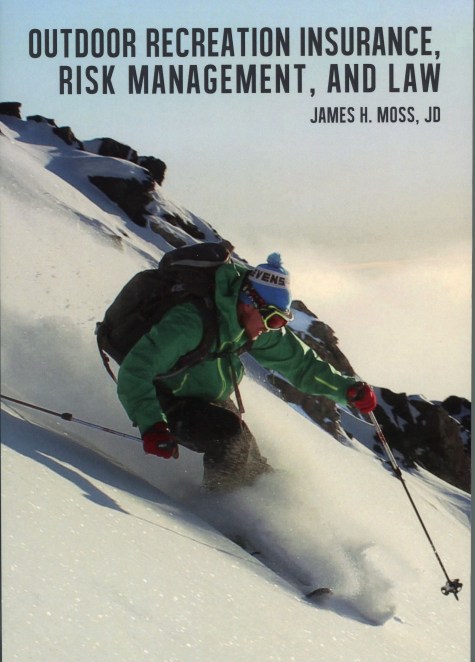
Outdoor Recreation Insurance, Risk Management, and Law
To see Jim’s complete bio go here and to see his CV you can find it here. To find out the purpose of this website go here.
If you are interested in having me write your release, download the form and return it to me.
Connect
If you like this let your friends know or post it on FB, Twitter, or LinkedIn
 X, Formerly Twitter |
 Threads |
 Recreation Law |
 Facebook Logo |
By Recreation Law Rec-law@recreation-law.com James H. Moss
@2015-2023 Summit Magic Publishing, LLC
G-YQ06K3L262
#AdventureTourism, #AdventureTravelLaw, #AdventureTravelLawyer, #AttorneyatLaw, #Backpacking, #BicyclingLaw, #Camps, #ChallengeCourse, #ChallengeCourseLaw, #ChallengeCourseLawyer, #CyclingLaw, #FitnessLaw, #FitnessLawyer, #Hiking, #HumanPowered, #HumanPoweredRecreation, #IceClimbing, #JamesHMoss, #JimMoss, #Law, #Mountaineering, #Negligence, #OutdoorLaw, #OutdoorRecreationLaw, #OutsideLaw, #OutsideLawyer, #RecLaw, #Rec-Law, #RecLawBlog, #Rec-LawBlog, #RecLawyer, #RecreationalLawyer, #RecreationLaw, #RecreationLawBlog, #RecreationLawcom, #Recreation-Lawcom, #Recreation-Law.com, #RiskManagement, #RockClimbing, #RockClimbingLawyer, #RopesCourse, #RopesCourseLawyer, #SkiAreas, #Skiing, #SkiLaw, #Snowboarding, #SummerCamp, #Tourism, #TravelLaw, #YouthCamps, #ZipLineLawyer, Zip Line, Zipline, Common Carrier, Private Carrier, Release, Exculpatory Clause,
Dodge v. Grafton Zipline Adventures, LLC, 2015 IL App (5th) 140124-U; 2015 Ill. App. Unpub. LEXIS 1584
Posted: November 8, 2015 Filed under: Illinois, Legal Case, Release (pre-injury contract not to sue), Zip Line | Tags: Common Carrier, Exculpatory clause, Private Carrier, Release, zip line, Zipline Leave a commentTo Read an Analysis of this decision see
Zip line accused of being common carrier which makes releases unenforceable. Issue still not decided, however, in all states common carriers cannot use a release as a defense.
April Dodge, Plaintiff-Respondent, v. Grafton Zipline Adventures, LLC, and Michael Quinn, Defendants-Petitioners.
NO. 5-14-0124
APPELLATE COURT OF ILLINOIS, FIFTH DISTRICT
2015 IL App (5th) 140124-U; 2015 Ill. App. Unpub. LEXIS 1584
July 14, 2015, Decision Filed
NOTICE: THIS ORDER WAS FILED UNDER SUPREME COURT RULE 23 AND MAY NOT BE CITED AS PRECEDENT BY ANY PARTY EXCEPT IN THE LIMITED CIRCUMSTANCES ALLOWED UNDER RULE 23(E)(1).
PRIOR HISTORY: [**1] Appeal from the Circuit Court of Madison County. No. 13-L-238. Honorable Barbara L. Crowder, Judge, Presiding.
Dodge v. Grafton Zipline Adventures, LLC, 2014 Ill. LEXIS 1270, 387 Ill. Dec. 513, 22 N.E.3d 1166 (Ill., 2014)
JUDGES: JUSTICE SCHWARM delivered the judgment of the court. Justices Welch and Moore concurred in the judgment.
OPINION BY: SCHWARM
OPINION
ORDER
[*P1] Held: Appellate court declines to answer the certified question and remands to the trial court to hear evidence to determine whether exculpatory agreement is between the public and one charged with a duty of public service, i.e., a common carrier, and therefore unenforceable.
[*P2] The plaintiff, April Dodge, filed the instant suit seeking recovery for injuries she sustained while riding on an aerial zip line course designed and operated by defendant Grafton Zipline Adventures, LLC (Grafton Zipline), by which defendant Michael Quinn is employed. The circuit court certified a question after denying the defendants’ motion to dismiss.
[*P3] BACKGROUND
[*P4] In her first amended complaint filed on May 3, 2013, the plaintiff alleged that Grafton Zipline operated an aerial zip line course in which paying guests, riding from one elevated platform to another, were guided over a series of suspended wire cable runs. The plaintiff alleged that [**2] “guests [we]re outfitted with a harness and pulley system which attache[d] to the suspended cables and which in theory allow[ed] them to control their speed by braking on descents.” The plaintiff alleged that on the eighth run of the zip line course, the plaintiff’s braking system failed to slow her descent, she approached the landing platform at a high rate of speed, and she violently struck the trunk of the tree on which the landing platform was mounted, fracturing her right heel bone.
[*P5] In count I, the plaintiff alleged that Grafton Zipline was a common carrier that breached its duty of care by negligently designing and operating its course, intentionally or recklessly violated the safety regulations promulgated by the Illinois Department of Labor (56 Ill. Adm. Code 6000.350 (2013)), and thereby engaged in willful and wanton misconduct. In count II, the plaintiff claimed that Quinn, a tour guide for Grafton Zipline, was negligent in instructing the plaintiff, in inspecting and maintaining the braking system, and in failing to prevent the plaintiff from colliding with the tree. The plaintiff also alleged willful and wanton misconduct against Quinn.
[*P6] On June 7, 2013, pursuant to section 2-619 of the Code of Civil Procedure (735 ILCS 5/2-619 (West 2012)), the defendants [**3] filed a motion to dismiss the plaintiff’s first amended complaint on the basis that the plaintiff’s claims were barred by an exculpatory agreement signed by the plaintiff prior to her participation in the zip line activity. In the agreement, the plaintiff agreed to release the defendants from liability for injury, disability, death, or loss or damage to persons or property, whether caused by negligence or otherwise.
[*P7] In the plaintiff’s memorandum of law in opposition to the defendants’ motion to dismiss, the plaintiff asserted that the defendants’ exculpatory agreement was unenforceable. The plaintiff asserted that zip line courses are common carriers under Illinois law, and as such, they cannot exempt themselves from liability for their own negligence.
[*P8] On November 1, 2013, the circuit court held that exculpatory clauses were unenforceable against plaintiffs injured by the ordinary negligence of a common carrier. The circuit court noted that when parties disagree as to whether a defendant is a common carrier, the question becomes a controverted question of fact to be determined after considering evidence. However, the circuit court found that the pleadings before it alleged sufficient [**4] facts to establish that the defendants were common carriers, in that zip lines fell within the definition of amusement rides pursuant to the Illinois Carnival and Amusement Rides Safety Act (430 ILCS 85/2-2 (West 2012)) and were akin to merry-gorounds or other amusement rides that had been held to be common carriers. The circuit court thereby denied the defendants’ section 2-619 motion to dismiss based on the exculpatory clause but also stated that “questions of fact remain as to whether [d]efendants *** are within the definition of common carriers.”
[*P9] On March 6, 2014, the circuit court, pursuant to Illinois Supreme Court Rule 308 (eff. Feb. 26, 2010), entered its order certifying the following question for appeal:
“Is an exculpatory agreement signed by a participant on a zip[ ]line course, that released the zip[ ]line operator and its employees from their own negligence, enforceable to bar the participant’s suit for negligence, or is the zip[ ]line course a common carrier such that the exculpatory agreement is unenforceable?”
[*P10] On March 20, 2014, the defendants filed an application for permissive interlocutory appeal, which we denied on April 21, 2014. On September 24, 2014, however, the Illinois Supreme Court directed this court to vacate its judgment denying [**5] the defendants’ application for leave to appeal and directed us to grant such application. Dodge v. Grafton Zipline Adventures, LLC, 387 Ill. Dec. 513, 22 N.E.3d 1166 (Ill. 2014). On November 5, 2014, per the supreme court’s supervisory order and pursuant to Illinois Supreme Court Rule 308, we thereafter allowed the defendants’ permissive interlocutory appeal.
[*P11] ANALYSIS
[*P12] On appeal, the defendants argue that the exculpatory agreement signed by the plaintiff bars her negligence claims and that the exculpatory agreement is enforceable because Grafton Zipline is not a common carrier. The plaintiff counters that the circuit court’s certified question is not ripe for determination because there are unresolved questions of fact regarding whether Grafton Zipline is a common carrier. We agree with the plaintiff.
[*P13] “The scope of review in an interlocutory appeal brought under [Illinois Supreme Court] Rule 308 is limited to the certified question.” Spears v. Association of Illinois Electric Cooperatives, 2013 IL App (4th) 120289, ¶ 15, 986 N.E.2d 216, 369 Ill. Dec. 267. “A reviewing court should only answer a certified question if it asks a question of law and [should] decline to answer where the ultimate disposition ‘will depend on the resolution of a host of factual predicates.’ [Citations.]” Id. “A certified question pursuant to Rule 308 is reviewed de novo.” Id.
[*P14] An exculpatory [**6] clause is a contractual provision that excuses the defaulting party’s liability. See Black’s Law Dictionary 648 (9th ed. 2009) (defining an exculpatory clause as “a contractual provision relieving a party from liability resulting from a negligent or wrongful act”); McKinney v. Castleman, 2012 IL App (4th) 110098, ¶ 14, 968 N.E.2d 185, 360 Ill. Dec. 106 (exculpatory agreement involves express assumption of risk wherein one party consents to relieve another of a particular obligation). “Courts disfavor such agreements and construe them strictly against the benefitting party, particularly one who drafted the release.” McKinney, 2012 IL App (4th) 110098, ¶ 14. “Nevertheless, contracting parties are free to ‘allocate the risk of negligence as they see fit, and exculpatory agreements do not violate public policy as a matter of law.'” Id. (quoting Evans v. Lima Lima Flight Team, Inc., 373 Ill. App. 3d 407, 412, 869 N.E.2d 195, 311 Ill. Dec. 521 (2007)).
[*P15] Accordingly, if a valid exculpatory clause clearly applies, and in the absence of fraud or willful and wanton negligence, courts will enforce it unless “‘(1) it would be against a settled public policy of the State to do so, or (2) there is something in the social relationship of the parties militating against upholding the agreement.'” McKinney, 2012 IL App (4th) 110098, ¶ 14 (quoting Harris v. Walker, 119 Ill. 2d 542, 548, 519 N.E.2d 917, 116 Ill. Dec. 702 (1988)). Exculpatory agreements between the public and those charged with a duty of public service, such as those involving a common [**7] carrier, an innkeeper, a public warehouseman, or a public utility, have been held to be unenforceable as contrary to public policy. McKinney, 2012 IL App (4th) 110098, ¶ 14; Johnson v. Salvation Army, 2011 IL App (1st) 103323, ¶ 19, 957 N.E.2d 485, 354 Ill. Dec. 169; White v. Village of Homewood, 256 Ill. App. 3d 354, 358-59, 628 N.E.2d 616, 195 Ill. Dec. 152 (1993). Courts have alternatively recognized that exculpatory agreements between common carriers and passengers are unenforceable because of the special social relationship of a semipublic nature that permeates the transaction between the parties. See McClure Engineering Associates, Inc. v. Reuben Donnelley Corp., 101 Ill. App. 3d 1109, 1111, 428 N.E.2d 1151, 57 Ill. Dec. 471 (1981); First Financial Insurance Co. v. Purolator Security, Inc., 69 Ill. App. 3d 413, 419, 388 N.E.2d 17, 26 Ill. Dec. 393 (1979) (“when an exculpatory provision is found invalid because of a special relationship between the parties, it is the semipublic nature of the party seeking to exculpate itself from liability that allows the court to invalidate the provision”).
[*P16] Thus, any contract by which a common carrier of goods or passengers undertakes to relieve itself from liability for loss or damage arising from its negligence or the negligence of its servants is void. Checkley v. Illinois Central R.R. Co., 257 Ill. 491, 494, 100 N.E. 942 (1913); Simmons v. Columbus Venetian Stevens Buildings, Inc., 20 Ill. App. 2d 1, 17, 155 N.E.2d 372 (1958); Restatement (Second) of Torts § 496B cmt. g (1965) (“Where the defendant is a common carrier ***, or is otherwise charged with a duty of public service, and the agreement to assume the risk relates to the defendant’s performance of any part of that duty, it is well settled that it will not be given effect.”). “Having undertaken the duty to the public, which includes the obligation of reasonable care, [**8] [common carriers] are not free to rid themselves of their public obligation by contract, or by any other agreement.” Restatement (Second) of Torts § 496B cmt. g (1965).
[*P17] An exculpatory contract, wherein a common carrier of goods or passengers undertakes to exempt itself from liability for negligence “if sustained, would relieve the carrier from its essential and important duties to the public growing out of the character of its employment, and tend to defeat the foundation principle on which the law of common carriers is based; that is, the securing of the highest care and diligence in the performance of the important duties due to the public.” Checkley, 257 Ill. at 494; see also Simmons, 20 Ill. App. 2d at 17. “The heightened status afforded to common carrier[ ] *** relationships is based on the protection of the public ***.” Zerjal v. Daech & Bauer Construction, Inc., 405 Ill. App. 3d 907, 912, 939 N.E.2d 1067, 345 Ill. Dec. 887 (2010); see also Simmons, 20 Ill. App. 2d at 17 (“It has been said if there is any general reason for the rule to be deduced from the passenger cases, it is that the public service consideration alone prevents contractual limitation of liability for negligence.”).
[*P18] In holding that a common carrier has a duty to exercise the highest degree of care consistent with the practical operation of its conveyances to protect its passengers (Rotheli v. Chicago Transit Authority, 7 Ill. 2d 172, 177-78, 130 N.E.2d 172 (1955); Browne v. Chicago Transit Authority, 19 Ill. App. 3d 914, 917, 312 N.E.2d 287 (1974)), courts have considered the “‘unique control [a common [**9] carrier] possesses over its passengers’ safety.'” Krywin v. Chicago Transit Authority, 391 Ill. App. 3d 663, 666, 909 N.E.2d 887, 330 Ill. Dec. 865 (2009) (quoting Sheffer v. Springfield Airport Authority, 261 Ill. App. 3d 151, 154, 632 N.E.2d 1069, 198 Ill. Dec. 458 (1994)); see also O’Callaghan v. Dellwood Park Co., 242 Ill. 336, 345, 89 N.E. 1005 (1909) (“If the injury of a passenger is caused by apparatus wholly under the control of a carrier and furnished and managed by it, and the accident is of such a character that it would not ordinarily occur if due care is used, the law raises a presumption of negligence.”). “Common carriers are charged with the highest duty of care when transporting passengers because passengers must wholly rely upon a common carrier’s proper maintenance and safe operation of its equipment during passage.” Sheffer, 261 Ill. App. 3d at 156. “[C]ommon carriers are responsible for their patrons’ physical safety for which there is no second chance if a mistake should occur.” Zerjal, 405 Ill. App. 3d at 912.
[*P19] In determining whether a defendant is a common carrier that owes the highest degree of care in transporting its passengers, the courts have characterized the following as common carriers: owners of buildings with elevators (Rotheli, 7 Ill. 2d at 177); a scenic railway at an amusement resort, where “steep inclines, sharp curves, and great speed necessarily are sources of peril” (O’Callaghan, 242 Ill. at 344); a merry-go-round (Arndt v. Riverview Park Co., 259 Ill. App. 210, 216-17 (1930)); a taxicab (Metz v. Yellow Cab Co., 248 Ill. App. 609, 612 (1928)); and a Ferris wheel (Pajak v. Mamsch, 338 Ill. App. 337, 341, 87 N.E.2d 147 (1949)).
[*P20] In finding that an escalator was not a common carrier, the Illinois Supreme Court in Tolman found [**10] it significant that a person on an escalator may actively participate in the transportation in a manner similar to the use of a stairway and may contribute to his own safety. Tolman v. Wieboldt Stores, Inc., 38 Ill. 2d 519, 526, 233 N.E.2d 33 (1967). The court noted that the role of a passenger on a train, bus, or elevator is a passive one, and ordinarily such a passenger cannot exercise any control over his own safety. Id. at 525. The court further held that the rule as to the higher duty one owning and operating an elevator owes to a passenger riding in same, who is injured through some defect in its operating mechanism, is predicated upon the fact that a person riding in an elevator cannot possibly know or show, if such elevator gets out of control, what caused it to do so. Id. at 524-25. The court noted that because the elevator owner was in sole control of the elevator and the machinery used in its operation, an inference of negligence on the part of said owner arose out of the circumstances. Id.; see also Lombardo v. Reliance Elevator Co., 315 Ill. App. 3d 111, 125, 733 N.E.2d 874, 248 Ill. Dec. 199 (2000) (because bank had full control of premises, it had the duties of common carrier owed to the plaintiff who suffered injuries when the lift he was riding suddenly fell); Carson v. Weston Hotel Corp., 351 Ill. App. 523, 532, 115 N.E.2d 800 (1953) (lessee in full control of the premises had the duties of a common carrier of elevator [**11] passengers).
[*P21] While proper solicitude for human safety requires a carrier of passengers not to diminish its liability to them, the relative bargaining power of the parties is also a factor. Simmons, 20 Ill. App. 2d at 17. In Hamer v. City Segway Tours of Chicago, LLC, 402 Ill. App. 3d 42, 43-44, 930 N.E.2d 578, 341 Ill. Dec. 368 (2010), the plaintiff sought to recover for injuries she suffered on a tour run where she rode a segway onto a small grassy hill, and it threw her off. The plaintiff signed a release before participating in the tour. Id. The plaintiff argued, however, that her social relationship with the defendant and its tour guide rendered the release unenforceable. Id. at 46. The court concluded, without analysis, that the defendant was not a common carrier. Id. Finding also that that there was no disparity of bargaining power because the plaintiff simply could have refused to join the tour if she had disagreed with the exculpatory clause, the court held that the exculpatory language of the release was enforceable. Id.
[*P22] Further, courts have distinguished between a common and a private carrier. “A common carrier, generally, is a carrier hired to carry any person who applies for passage as long as there is room available and there is no legal excuse for refusing.” Long v. Illinois Power Co., 187 Ill. App. 3d 614, 628, 543 N.E.2d 525, 135 Ill. Dec. 142 (1989). “Ordinarily, a common carrier must accept as a passenger [**12] any person offering himself or herself for passage at the proper time and in the proper manner and who is able and willing to pay the fare.” Id. “[A] common carrier may be liable for an unexcused refusal to carry all who apply.” Doe v. Rockdale School District No. 84, 287 Ill. App. 3d 791, 794, 679 N.E.2d 771, 223 Ill. Dec. 320 (1997). A common carrier is “obligated by law to undertake the charge of transportation, which none but a common carrier, without a special agreement, is.” Rathbun v. Ocean Accident & Guarantee Corp., 299 Ill. 562, 566, 132 N.E. 754 (1921).
[*P23] A common carrier holds himself out as such by advertising or by actually engaging in the business and pursuing the occupation as an employment. Id. at 567. The test to distinguish a common carrier from a private carrier is whether the carrier serves all of the public alike. Green v. Carlinville Community Unit School District No. 1, 381 Ill. App. 3d 207, 211, 887 N.E.2d 451, 320 Ill. Dec. 307 (2008); Illinois Highway Transportation Co. v. Hantel, 323 Ill. App. 364, 375, 55 N.E.2d 710 (1944). Again, common carriers necessarily have control and regulation of the passengers’ conduct and of the operation of the carriage before they can be held to the extraordinary liability of common carriers to such passengers. Rathbun, 299 Ill. at 567 (evidence that deceased contracted car by private contract and had control of car and driver revealed defendant was not common carrier but was liable only as private carrier for ordinary negligence).
[*P24] “Private carriers as ordinarily defined are those who, without being engaged in such business as a public employment, undertake [**13] to deliver goods or passengers in a particular case for hire or reward.” Rathbun, 299 Ill. at 566. A private carrier makes no public profession to carry all who apply for transport, transports only by special agreement, and is not bound to serve every person who may apply. Green, 381 Ill. App. 3d at 211; Rockdale School District No. 84, 287 Ill. App. 3d at 795.
[*P25] “Whether a particular transportation service is undertaken in the capacity of a private or of a common carrier must be determined by reference to the character of the business actually carried on by the carrier, and also by the nature of the service to be performed in the particular instance.” (Internal quotation marks omitted.) Long, 187 Ill. App. 3d at 630. When a plaintiff affirms and the defendant denies that the defendant is operating as a common carrier, the question becomes a controverted question of fact to be determined by a consideration of the evidence by the trial court. Rathbun, 299 Ill. at 566; Bare v. American Forwarding Co., 242 Ill. 298, 299, 89 N.E. 1021 (1909); Hantel, 323 Ill. App. at 374; Beatrice Creamery Co. v. Fisher, 291 Ill. App. 495, 497, 10 N.E.2d 220 (1937).
[*P26] Accordingly, we find that whether Grafton Zipline is a common carrier is a question of fact, “dependent upon the nature of the business in which [it is] engaged, and [is] to be determined from a consideration of all of the evidence.” Beatrice Creamery Co., 291 Ill. App. at 497. In its order, the circuit court noted that questions of fact remained regarding whether Grafton Zipline is a common carrier. [**14] We agree and find this so with regard to the certified question. To determine whether the exculpatory clause is unenforceable on the basis that Grafton Zipline is a common carrier “charged with a duty of public service” the court must necessarily determine disputed factual issues. The court must determine whether Grafton Zipline had control and regulation of the passengers’ conduct and of the operation of the carriage (see Rathbun, 299 Ill. at 567 (evidence that deceased contracted car by private contract and had control of car and driver revealed defendant was not common carrier but was liable only as private carrier for ordinary negligence)); whether the plaintiff actively participated in the transportation and contributed to her own safety (Tolman, 38 Ill. 2d at 525-26 (because escalator allowed the plaintiff to actively participate in the transportation and allowed control over safety, escalator not common carrier); whether there was a disparity of bargaining power between the parties (see Hamer, 402 Ill. App. 3d at 43-44 (exculpatory clause enforceable where plaintiff could simply have refused to join the segway tour)); and whether Grafton Zipline made a profession to carry all who applied for carriage (see Browne v. SCR Medical Transportation Services, Inc., 356 Ill. App. 3d 642, 647, 826 N.E.2d 1030, 292 Ill. Dec. 594 (2005) (because medical transport van served only those individuals [**15] who met its eligibility requirements, could decline to serve anyone based on numerous factors such as location and availability of medical transport vans, made no profession to carry all who apply for carriage, and was not bound to serve every person who may apply, medical transport van was not a common carrier)). To answer the certified question before the circuit court has heard evidence on these matters would be premature. Thus, we decline to answer the certified question, and we remand the cause for further proceedings consistent with this order. See Dowd & Dowd, Ltd. v. Gleason, 181 Ill. 2d 460, 477, 693 N.E.2d 358, 230 Ill. Dec. 229 (1998).
[*P27] CONCLUSION
[*P28] For the reasons stated, we decline to answer the certified question as its ultimate disposition depends on the resolution of multiple factual predicates. We remand the cause to the Madison County circuit court for further proceedings.
[*P29] Certified question not answered; cause remanded.
G-YQ06K3L262
http://www.recreation-law.com
Federal court voids release in Vermont based on Vermont’s unique view of release law
Posted: October 26, 2015 Filed under: Assumption of the Risk, Release (pre-injury contract not to sue), Vermont, Zip Line Leave a commentThe release is thrown out and the arbitration clause is deemed unconscionable and modified by the court. The defendant was left with a one-sentence assumption of the risk clause.
Littlejohn v. Timberquest Park at Magic, LLC, et. al., 2015 U.S. Dist. LEXIS 96443
State: Vermont, United States District Court for the District of Vermont
Plaintiff: Joseph P. Littlejohn
Defendant: Timberquest Park at Magic, LLC, and Corporate Challenge, Inc., d/b/a Adventure Más
Plaintiff Claims: negligently designed, constructed, and operated the course
Defendant Defenses: Release
Holding: For the Plaintiff
Year: 2015
This is an interesting group of facts about how something simple and easily overlooked in building and operating a challenge (ropes) course and a zip line can lead to an accident and then a lawsuit. Combine those facts with the Vermont Supreme Court’s decisions on releases and the defendants lose in this case.
The plaintiff was a 76-year-old man. A friend of the plaintiffs purchased tickets online to go to the defendant challenge course at the ski area. The park is a self-guided aerial adventure park where the guest is taught how to clip in and then ascends through the course to the top where they then descend through a series of zip lines.
This is a commercial course purchased for amusement rather than a normal challenge or ropes course which is built for team building or other goals for the benefit of the guests. Meaning the sole purpose of this course is entertainment.
The belay system is called a “smart belay” and is attached to the system and the guest at all times.
The trees and poles used to create the course are supported by guy cables or wires. While descending, the course the plaintiff clipped into a guy wire rather than a zip line. He rode the zip line down hitting a tree.
The first issue was the claim by the plaintiff that he was not notified until he arrived at the course that he would be required to sign a release. However it was later agreed that as you started to pay for the course tickets it notified you a release was required.
Upon arrival the plaintiff signed a release on a tablet. The release included a clause that stated any claim for more than $75,000 had to be arbitrated. The arbitration clause required the plaintiff and the defendant to choose one arbitrator who then chose the third arbitrator. The third arbitrator had to be “an officer or director of another company that operates a zip-line course.”
The plaintiff (or his insurance company) sued.
Analysis: making sense of the law based on these facts.
The first issue the court looked at was whether the release was valid under Vermont law. The court looked at four decisions from the Vermont Supreme Court concerning releases and determined the factors needed for a release to be valid in Vermont. In Vermont the factors are not only how the release is written but what the release is attempting to shield from liability.
In Vermont the question is, is “the business is open to the general public without regard to special training or ability and the premises owner is in the best position to assure the safety of visitors.” That means if the defendant is “in control of the location were the injury occurred and whether the premises were open to the general public.”
The court then examined the zip line course and compared it to a ski area. “As this discussion indicates, the court is satisfied that attending a zip-line program is more like visiting a ski area than like taking part in a specialized high-risk sport which requires skill and experience.”
The court found the course was not going to be protected by a release.
The course is designed and controlled by defendants. There is no indication in the record that anyone needs to learn to use the course beyond an initial training class offered at the park. It is even more open to the public than skiing, which typically involves beginner’s lessons and some degree of acquired skill. The zip-line course requires no such training or skill.
The release was void as a release. The court then looked at whether a document would survive as proof the plaintiff assumed the risk. The agreement contained the following clause:
“[t]he Participant … understand[s] that there are inherent risks of participating in the Programs and using the Equipment, which may be both foreseen and unforeseen and include serious physical injury and death.”
This clause survived the agreement and the court was going to allow the clause to be used at trial to show the plaintiff assumed the risk.
The arbitration clause was the next clause in the document, (since it is no longer a release).
As drafted, the clause works in the following way: a claimant seeking damages in excess of $75,000 is required to proceed to binding arbitration. Claims of $75,000 or less are not subject to arbitration. The arbitration panel is composed of three members. Each side chooses one member. The two members then select the third, who must be “an officer or director of any entity that operates an aerial adventure park with zip lines in the United States.” If the first two panel members cannot agree on a third, a judge within the District of Vermont shall appoint the third member “utilizing the selection criteria for the neutral as set forth above.”
The plaintiff argued the arbitration clause was unconscionable.
First, he argues that the provision is procedurally unconscionable because it is contained in small print in a contract of adhesion that was presented to him well after he paid for his tickets. Second, he maintains that the arbitration clause is substantively unconscionable because the third arbitrator is required to be an officer or director of another company that operates a zip-line course, thus tilting the arbitration panel in favor of TimberQuest. Finally, he argues that the arbitration clause lacks mutuality because it has no application to a claim by TimberQuest against a customer.
The first argument was small print. This argument is still raised if for no other purpose then to put in the judge and/or juries mind that the contract is a bad thing. However the court found the print size was the same as the rest of the document and had a “conspicuous header.”
The customer’s signature line is on the second page, giving him an opportunity to read the text before signing. Although the agreement was presented to Littlejohn as a preprinted contract with no real opportunity to negotiate the terms, he could have declined to participate in the course and requested his money back if he objected to the arbitration provision.
As the Vermont Supreme Court has repeatedly pointed out, “unequal bargaining power alone will not nullify a contract.”
The plaintiff then argued that because he was not notified he was required to sign a release until he arrived at the site the arbitration clause should be void. However his friend who purchased the tickets was informed of the requirement and because the plaintiff had not objected when presented with the release this argument failed.
The court looked at the arbitration provisions that the arbitrator had to be picked from the zip line industry was unfair. “Courts have long refused to enforce arbitration clauses which call for the appointment of panel members who are likely to harbor a bias in favor of one side or another.”
The agreement did contain a severability clause. This clause states that if one part of the agreement is void then the void section is thrown out but the rest of the agreement is still valid. Here the severability clause saved what defense was left for the defendant.
The contract between the parties includes a severability clause: “To the extent that any portion of this Agreement is deemed to be invalid under the law of the applicable jurisdiction, the remaining portions of the Agreement shall remain binding and available for use by the Host and its counsel in any proceeding.”
This gave the court the power to enforce the arbitration clause by reforming it altering it to fit the law. “The court will enforce the severability clause to strike the provision requiring the choice of a “neutral” arbitrator who is likely to hold a bias in favor of the zip-line industry. The remaining question is the issue of mutuality.”
The plaintiff then argued that the entire agreement was void because it lacked consideration. He paid for the tickets one day and three weeks later had to sign the release. However this failed. Consideration is does not have a time requirement.
Littlejohn argues that the agreement was unsupported by consideration because he was forced to sign it weeks after he had paid for the tickets. This argument is without merit. “[A]ny performance which is bargained for is consideration.” TimberQuest’s performance in this case was allowing Littlejohn to use its adventure zip-line course. In exchange, Littlejohn’s friend paid for their tickets. Upon arrival at the park, he promised that he would submit his claims to arbitration or agree to limit his recovery in court to $75,000.
The court then set the requirements for the parties to proceed.
As reformed by the court, the arbitration provision is valid. Under the agreement, there is no cap on damages if the participant chooses to go to arbitration. If the participant chooses to go to court, he or she agrees to seek $75,000 or less in damages. This court only has jurisdiction over a diversity case if the amount in controversy “exceeds the sum or value of $75,000.” This provision is strictly construed, and does not extend jurisdiction to a claim for an even $75,000. Thus, Littlejohn may not bring suit in this court. The court accordingly dismisses plaintiff’s negligence claims for lack of subject matter jurisdiction and without prejudice to plaintiff’s right to demand arbitration.
So Now What?
This case is similar to Geographic Expeditions, Inc., v. The Estate Of Jason Lhotka, 599 F.3d 1102; 2010 U.S. App. LEXIS 6606 discussed in Complicated serious of cases created to defend against a mountaineering death. There the release was thrown out because it was so onerous that the court could not stand it.
Under the rational the court determined from the Vermont Supreme Court cases any recreational based activities on land owned by the defendant that is open for business a release will not be valid. Whether nor not a guided operation on federal or state land be subject to this restriction is unknown, however the amount of federal land in Vermont is minimal and not used for recreation.
If the guest is taking the property as in a rental program then the release maybe valid. Renting a car, renting skis or renting a canoe is probably covered by a release in Vermont. However a ski rental shop that is owned by the ski area and incorporates into its release protection for the ski area will probably be void in Vermont.
The next issue is the assumption of risk clause that survived the release.
“[t]he Participant … understand[s] that there are inherent risks of participating in the Programs and using the Equipment, which may be both foreseen and unforeseen and include serious physical injury and death.”
If the courts in Vermont see the word “inherent” as a limiting term, the assumption of the risk clause may fail. Inherent has been defined to mean the risk associated with the sports that are part of the sport. Removal of the inherent risk removes the nature of the sport or activity. Risk would mean all aspects of the activity, not just the inherent ones.
This is a class example where a word has become associated to create a phrase because it “feels good.” However the word either has a different meaning when legally defined than its not legal definition or the definition of the word is not understood. If under Vermont law inherent is a limiting term the actual risks the plaintiff assumes could be very narrowly construed.
Small print is just stupid now days. Courts are still voiding releases if your release or release language is in small print. More importantly if the judge can’t read the document because the print is so small the court will always through the document out. Always make sure the print in any legal document is all the same size and no smaller than the font size required for pleadings in the court.
This case points out two major issues. The first is releases in Vermont as difficult if at all possible to use for outdoor recreation programs and businesses. The exception may be if you are someone not open to the public such as a college or university.
The second issue is whatever document you use, release or acknowledgement of risk agreement it has to be fair. If it is going to stop a lawsuit then it must inform your guests that is the purpose of the agreement. If you are going to assume the risk with the agreement the risks must be identified and the possible injuries must be pointed out. If you require arbitration the arbitration clause must conform to the laws controlling arbitration and the arbitration rules itself which is based on a neutral arbitrator.
Here arbitration was a good idea. However arbitration is not necessarily so. Arbitration has general come to mean you are deciding how much money to pay to the other side. Arbitration is usually quick and a lot less costly. Arbitration in many states limits the damages and in some states arbitrators cannot award punitive damages.
However a well written release in a state that supports release law is better than arbitration. It does not allow for any payment. A motion for summary judgment is fairly quick and easy to file after limited discovery and can be cheaper over all with a better long term effect than arbitration.
If you operate on a state listed here: States that do not Support the Use of a Release you may want to look or may only have the ability to use an assumption of the risk document and arbitration. If you are providing program to minors and your state does not support the use of a release to prevent minor’s claims, arbitration and assumption of the risk is probably best for you. See States that allow a parent to sign away a minor’s right to sue.
Either way you go the agreement must be clear, easily understood, written in English, with print large enough to read and an agreement that court will look at and determine is fair.
The final issue is the court itself. You MUST evaluate your business or program from your guest’s point of view. You know and understand how your course works. Your guest does not have that knowledge. Here a guest could not see the difference between the zip line and a guy line. It is easy enough to attach warning signs on the guy lines. Rap red tape around the guy lines and tell guest don’t touch anything red.
Look through your program from your guests inexperienced eyes, not your battle worn glasses.
What do you think? Leave a comment.
 James H. “Jim” Moss |
Jim Moss is an attorney specializing in the legal issues of the outdoor recreation community. He represents guides, guide services, and outfitters both as businesses and individuals and the products they use for their business. He has defended Mt. Everest guide services, summer camps, climbing rope manufacturers; avalanche beacon manufacturers, and many more manufacturers and outdoor industries. Contact Jim at Jim@Rec-Law.us |

Outdoor Recreation Insurance, Risk Management, and Law
Jim is the author or co-author of eight books about legal issues in the outdoor recreation world; the latest is Outdoor Recreation Insurance, Risk Management, and Law. To Purchase Go Here:
To see Jim’s complete bio go here and to see his CV you can find it here. To find out the purpose of this website go here.
If you are interested in having me write your release, download the form and return it to me.
If you like this let your friends know or post it on FB, Twitter, or LinkedIn
By Recreation Law Rec-law@recreation-law.com James H. Moss
@2023 Summit Magic Publishing, LLC
G-YQ06K3L262
 Blue Sky Logo |
 |
 Mastodon |
 |
 Stimulus |
 Recreation Law logo |
 X (formerly known as Twitter) logo |
 Threads |
#AdventureTourism, #AdventureTravelLaw, #AdventureTravelLawyer, #AttorneyatLaw, #Backpacking, #BicyclingLaw, #Camps, #ChallengeCourse, #ChallengeCourseLaw, #ChallengeCourseLawyer, #CyclingLaw, #FitnessLaw, #FitnessLawyer, #Hiking, #HumanPowered, #HumanPoweredRecreation, #IceClimbing, #JamesHMoss, #JimMoss, #Law, #Mountaineering, #Negligence, #OutdoorLaw, #OutdoorRecreationLaw, #OutsideLaw, #OutsideLawyer, #RecLaw, #Rec-Law, #RecLawBlog, #Rec-LawBlog, #RecLawyer, #RecreationalLawyer, #RecreationLaw, #RecreationLawBlog, #RecreationLawcom, #Recreation-Lawcom, #Recreation-Law.com, #RiskManagement, #RockClimbing, #RockClimbingLawyer, #RopesCourse, #RopesCourseLawyer, #SkiAreas, #Skiing, #SkiLaw, #Snowboarding, #SummerCamp, #Tourism, #TravelLaw, #YouthCamps, #ZipLineLawyer, Ski Area, Challenge Course, Zip Line, Adventure Course, Vermont, Release, Arbitration, Timberquest Park at Magic, Ropes Course,
Youth Internships Available with the National Park Service
Posted: October 23, 2015 Filed under: Youth Camps, Zip Line | Tags: Interns, Internship, National Park Service, NPS Leave a commentFour national internship programs now accepting project proposals – DUE October 30
Please help distribute to others in your park that might be interested in applying
InsideNPS Article
http://inside.nps.gov/index.cfm?handler=viewnpsnewsarticle&type=Announcements&id=17861
The WASO Youth Programs Division is pleased to announce that four national internship programs (See below) are now accepting project proposals for the 2016 summer work season. These professional development internship programs provide quality work experiences for diverse individuals ages 18-35 in various fields across the NPS system. Project proposal applications are due COB Wednesday, October 30thfor most programs listed below.
National Youth Employment Programs:
Historically Black Colleges and Universities Internship Program (HBCUI): This program is designed to link college students attending Historically Black Colleges and Universities (HBCUs) to appointments at NPS sites and program offices. This program is administered by our nation NPS partner Greening Youth Foundation (GYF) (alex_tremble or 202-513-7159.
Latino Heritage Internship Program (LHIP): LHIP aims to provide meaningful work experiences to Latino students in the fields of cultural resources, interpretation, and outreach. LHIP is administered in partnership with the Hispanic Access Foundation (HAF) and the Environment for the Americas (EFTA). In addition to working on substantive NPS assignments, LHIP interns receive additional mentoring and support through HAF and EFTA. See more at Paloma_bolasny or 202-354-2174.
Mosaics in Science (MIS): The MIS Program provides youth under-represented in natural resource science career fields with meaningful, on-the-ground, work experience in the NPS. The program is administered by the Geologic Resources Division in collaboration with other Natural Resource Stewardship and Science (NRSS) Divisions and the Youth Programs Division. MIS positions are fully funded by the WASO Youth Programs Division. Parks and programs interested in applying for a MIS position must submit a position description by COB Sunday, November 1stat lisa_norby or 303-969-2318.
NPS Academy (NPSA): NPS Academy is an innovative, experiential learning program designed to introduce undergraduate and graduate students, ages 18-35, from under-represented communities to career opportunities with the National Park Service. Many of the interns attend a week-long orientation over spring break and serve in 12-week summer internships tailored to various NPS career tracks. Summer internships are available in a variety of fields, including visitor services, education, resource management – and many more (epoore) or Dave Barak (dbarak) for more information on the application process.
Ben Baldwin
Office of Interpretation, Education & Youth Engagement
Intermountain Regional Office
National Park Service

Littlejohn v. Timberquest Park at Magic, LLC, et. al., 2015 U.S. Dist. LEXIS 96443
Posted: October 22, 2015 Filed under: Assumption of the Risk, Legal Case, Risk Management, Vermont, Zip Line | Tags: Arbitration, Release, Vermont, zip line Leave a commentLittlejohn v. Timberquest Park at Magic, LLC, et. al., 2015 U.S. Dist. LEXIS 96443
Joseph P. Littlejohn, Plaintiff, v. Timberquest Park at Magic, LLC, and Corporate Challenge, Inc., d/b/a Adventure Más, Defendants.
Case No. 5:14-cv-200
UNITED STATES DISTRICT COURT FOR THE DISTRICT OF VERMONT
July 20, 2015, Decided
July 21, 2015, Filed
SUBSEQUENT HISTORY: Amended by Littlejohn v. Timberquest Park at Magic, LLC, 2015 U.S. Dist. LEXIS 94592 (D. Vt., July 21, 2015)
CORE TERMS: arbitration, customer, ticket, adventure, arbitration clause, motorcycle, mutuality, summary judgment, exculpatory, zip-line, participating, wire, zip, guy, ski area–, arbitration provision, public policy, general public, ski, website, unconscionability, enforceability, unconscionable, recreational, arbitrate, sport, void, cable, enforceable, adhesion
COUNSEL: [*1] For Joseph P. Littlejohn, Plaintiff: Daniel L. Burchard, Esq., Thomas E. McCormick, McCormick, Fitzpatrick, Kasper & Burchard, P.C., Burlington, VT.
For Timberquest Park at Magic, LLC, Defendant: Andrew A. Beerworth, Esq., Robert G. Cain, Paul Frank Collins PC, Burlington, VT.
For Corporate Challenge, Inc., doing business as Adventure Mas, Defendant: Heather Z. Cooper, Rodney Edward McPhee, Kenlan, Schwiebert, Facey & Goss, P.C., Rutland, VT.
For ENE Evaluator, ENE Evaluator: Michael J. Marks, Esq., MarksPowers LLP, Middlebury, VT.
For Timberquest Park at Magic, LLC, Cross Claimant: Robert G. Cain, Paul Frank Collins PC, Burlington, VT.
For Corporate Challenge, Inc., Cross Defendant: Rodney Edward McPhee, Kenlan, Schwiebert, Facey & Goss, P.C., Rutland, VT.
JUDGES: Geoffrey W. Crawford, United States District Judge.
OPINION BY: Geoffrey W. Crawford
OPINION
OPINION AND ORDER RE: DEFENDANT’S AND PLAINTIFF’S MOTIONS FOR SUMMARY JUDGMENT (Docs. 44, 46 & 52)
Plaintiff Joseph Littlejohn was severely injured while participating in an adventure zip-line course at Magic Mountain Ski Area in Londondeffy, Vermont on October 5, 2013. He claims that defendants negligently designed, constructed, and operated the course, leading to the [*2] accident which caused his injuries. Both Littlejohn and defendant TimberQuest Park at Magic, LLC (TimberQuest) have filed motions for summary judgment, seeking a determination regarding the enforceability of a liability waiver and arbitration provision signed by Littlejohn prior to participating in the course.
I. Facts
The following facts are undisputed for the purposes of summary judgment, except where otherwise noted. On October 5, 2013, Littlejohn was injured while traversing a self-guided aerial adventure course at Magic Mountain. At the time of his injury, Littlejohn was seventy-six years old. He had never participated in an adventure course before. Defendant TimberQuest operated the adventure course at the time of the incident. Defendant Corporate Challenge, Inc. d/b/a Adventure Mas designed and constructed the course.
The adventure course consists of a series of rope bridges, ladders, cargo nets and zip lines placed between elevated platforms constructed around trees and poles. Participants gradually gain elevation by climbing and traversing a series of uphill course elements and then return to the bottom of the course by sliding down a series of zip lines. Participants wear a [*3] climbing harness equipped with a “smart belay” system that is meant to keep them attached at all times to both a safety cable and a zip line cable. The “smart belay” system is intended to ensure that the participant is always attached to at least one of the cables.
The trees and poles which support the course platforms are stabilized by guy wires. These guy wires are anchored at one end to the tree or pole where a course platform is located and at the other end to another nearby tree or the ground.
On the day he visited, Littlejohn was equipped with a climbing harness and was instructed how to use the smart belay system’s dual carabiners. According to Littlejohn, he was not warned that there were guy wires on the course in addition to safety cables and zip line cables or that he should avoid clipping onto the guy wires.
Littlejohn climbed through the uphill course elements and began to descend on the zip lines. As he was preparing to descend one of the sections of the course, he mistook a guy wire for the zip line cable. He attached his smart belay to the guy wire and slid down the guy wire. At the bottom he ran into the tree which anchored the other end of the guy wire. He suffered severe [*4] injuries.
Littlejohn’s friend Miki Conn had purchased their tickets for the adventure course through TimberQuest’s website on September 12, 2013.
According to Littlejohn, TimberQuest’s website does not alert customers that they will be required to sign a liability waiver prior to participating in the adventure course. Littlejohn alleges that neither Conn nor he was aware that they would have to sign a liability waiver until they arrived at TimberQuest three weeks later. At oral argument, counsel for both sides cleared up some confusion on this point: there is a notice on the website concerning the liability waiver, but it appears only at the point of purchase by the customer. A company other than TimberQuest provides the ticketing, reservation and credit card services. That company’s website includes a warning to customers that they will be required to sign a liability waiver before they enter the course. Since Littlejohn’s counsel did not actually buy a ticket, he did not encounter this information in preparing his motion for summary judgment.
When they arrived at TimberQuest on October 5, Littlejohn and Conn were each presented with a document entitled “Release of Liability, Waiver [*5] of Claims, Indemnification, and Arbitration Agreement.” The agreement was presented to them in digital format on an electronic device and they were instructed to read and sign it electronically.
The agreement stated that the participant agreed to “waive all claims” and “assume all risks” arising from participating in programs at the adventure course, including claims arising from negligent acts or conduct of TimberQuest, and further agreed to release and indemnify TimberQuest from liability for any injury suffered by the participant while using the course. (Doc. 44-3 at 2.) Under the heading “Arbitration,” the agreement stated that:
The Participant … hereby agrees to submit any dispute arising from participation in the Programs, for which Participant intends to seek damages in excess of $75,000.00, to binding arbitration. . . . In the event that Participant . . . files a lawsuit in any court relating to, and/or arising from, Participant’s participation in the Programs, Participant . . . by signing this document, stipulate[s] to a cap on Participant’s damages of $75,000.00, exclusive of interest and costs. As a threshold matter, the Panel, or the Court (if a lawsuit is filed), shall confirm whether [*6] the Waiver and Release contained in this Agreement are enforceable under applicable law. (Id.)
The agreement contains a severability clause stating that if any provision is invalidated, the remainder of the agreement will continue to be binding. Littlejohn signed the agreement prior to participating in the course.
II. Analysis
On March 27, 2015, TimberQuest filed a motion for partial summary judgment seeking a declaration that the $75,000 damages cap contained in the arbitration clause is enforceable against Littlejohn. (Doc. 44.) Littlejohn opposed the motion on the grounds that the damages cap violates public policy and is procedurally and substantively unconscionable. (Doc. 45.) Littlejohn filed a cross-motion for summary judgment seeking to have the waiver, assumption of risk, release and indemnity provisions of the agreement declared void and unenforceable as well. (Doc. 46.) In response, TimberQuest filed a cross-motion for summary judgment arguing that the agreement is enforceable and all of Littlejohn’s claims should be dismissed because he released TimberQuest from liability for negligence by signing the agreement. (Doc. 52.)
A. Standard of Review
Summary judgment is appropriate [*7] where “the movant shows that there is no genuine dispute as to any material fact and the movant is entitled to judgment as a matter of law.” Fed. R. Civ. P. 56(a). In considering a motion for summary judgment, “[t]he evidence of the non-movant is to be believed, and all justifiable inferences are to be drawn in his favor.” Anderson v. Liberty Lobby, Inc., 477 U.S. 242, 255, 106 S. Ct. 2505, 91 L. Ed. 2d 202 (1986).
B. Enforceability of Provisions Regarding Waiver of Claims, Release, Assumption of Risks from Negligence, and Indemnity
The enforceability of a contract provision providing for the waiver of a customer’s claims for negligence arising out of recreational activities is a matter of Vermont law. It is governed by four Vermont Supreme Court cases which seek to define the circumstances under which a business may contract out of liability for its own negligent conduct.
The leading case remains Dalury v. S-K-I, Ltd., 164 Vt. 329, 670 A.2d 795 (Vt. 1995), in which the Vermont Supreme Court rejected the exculpatory language in ski tickets issued by the Killington ski resort to its customers. The court reviewed the criteria announced by the California Supreme Court in Tunkl v. Regents of University of California, 60 Cal. 2d 92, 32 Cal. Rptr. 33, 383 P.2d 441 (Cal. 1963),1 and identified the longstanding rule that business owners are responsible for the safety of their premises as the basis on which to strike the exculpatory provisions in the ticket. Dalury, 670 A.2d at 799. The decision [*8] recognized that the ski area–and not the skiers–had the expertise and opportunity to foresee and control hazards and to reduce negligent conduct by its employees.
1 The Tunkl decision identified the following list of characteristics which may violate the public interest:
It concerns a business of a type generally thought suitable for public regulation. The party seeking exculpation is engaged in performing a service of great importance to the public, which is often a matter of practical necessity for some members of the public. The party holds himself out as willing to perform this service for any member of the public who seeks it, or at least for any member coming within certain established standards. As a result of the essential nature of the service, in the economic setting of the transaction, the party invoking exculpation possesses a decisive advantage of bargaining strength against any member of the public who seeks his services. In exercising a superior bargaining power the party confronts the public with a standardized adhesion contract of exculpation, and makes no provision whereby a purchaser may pay additional reasonable fees and obtain protection against negligence. Finally, [*9] as a result of the transaction, the person or property of the purchaser is placed under the control of the seller, subject to the risk of carelessness by the seller or his agents.
Tunkl, 383 P.2d at 445-46.
The Dalury decision did not depend upon a determination that skiing was an essential industry or service. “Whether or not [the ski resort] provide[s] an essential public service does not resolve the public policy question in the recreational sports context.” Id. Skiing is not like taking a cab or visiting the hospital–services for which there may be no substitute and which are necessary to everyday life. Rather, the decision rests upon two related principles: the business is open to the general public without regard to special training or ability and the premises owner is in the best position to assure the safety of visitors. These principles have remained unchanged in the cases which have followed Dalury.
The first was Spencer v. Killington, Ltd., 167 Vt. 137, 702 A.2d 35, 37 (Vt. 1997), in which the exculpatory language used as a condition for entering an amateur ski race was not enforced for the same reasons the court had expressed two years before in Dalury. The dissent identified the fault line in the doctrine:
There is a significant difference between the expectations of the general [*10] public, which has a right to assume reasonable care on the part of the ski area operator, and a ski racer who consciously undertakes risks that he or she knows may strain or exceed the tolerance of any safety system.
Id. at 38 (Allen, C.J., dissenting). Over time this distinction between members of the general public and people engaging in high-risk sports would become more marked.
In Thompson v. Hi Tech Motor Sports, Inc., 183 Vt. 218, 945 A.2d 368, 372 (Vt. 2008), the Vermont Supreme Court upheld the enforceability of a liability waiver on public policy grounds.2 The case concerned a customer at a motorcycle dealership who was injured on her test ride. The court distinguished the policy concerns at issue in Dalury, explaining that “whereas public policy places the burden of maintaining safe premises on a landowner, public policy concerning motorcycle safety places the burden of safe driving on the operator of the motorcycle.” Id. The court also determined that motorcycle dealerships do not provide a necessary service. Id. at 373. In this respect, the case followed Dalury. In contrast to skiers, however, the customer operated the motorcycle on the public road. There were no business premises relevant to the case. The decision also compared motorcyclists to customers of skydive [*11] companies, underwater diving schools, and mountain guiding services–high-risk sports for people with special skills. Id. Further, unlike the ski area in Dalury, the motorcycle dealership only allowed licensed motorcycle drivers with sufficient experience and training to take its motorcycles out for a ride. Id.
2 Although the waiver provision was held not to be void on public policy grounds, the court concluded that the provision failed release the defendant from liability for negligence because the language was ambiguous. Id. at 375.
Finally, in Provoncha v. Vermont Motorcross Association, 185 Vt. 473, 974 A.2d 1261, 1267 (Vt. 2009), the exculpatory language for an off-road motorcycle racing club was enforced because the activities were “neither of great importance to the public nor open to the public at large.” The majority distinguished the case from Dalury because the premises where the accident occurred was a private racetrack open only to members of a small club of 300 members. Id. The general public was not permitted to ride. The decision also drew a parallel to the enforcement of similar provisions in cases involving parachute jumping, stock car racing, scuba diving, and mountaineering–all sports which were said not to be matters of legitimate public interest. Id.
All four [*12] cases call for a flexible case-specific analysis of the factors originally identified in the Dalury decision. Of these, the least significant is whether a recreational activity is necessary to society. Few of them are. Not surprisingly, skiing and motorcycle riding–the two activities which generated the four decisions–were both found to be inessential to daily life. The factors which were most consistently applied were whether the defendant was in control of the location where the injury occurred and whether these premises were open to the general public. When these factors are present–as in Dalury and Spencer–the exculpatory clauses are not enforced. When these factors are absent–as in Thompson and Provoncha–the exculpatory clauses are likely to be enforced.
The court is not persuaded by TimberQuest’s argument that the Dalury case is on its last legs and will not survive much longer. Although the result was different in Thompson and Provoncha, neither case suggested that any member of the Vermont Supreme Court sought to discard the rule announced in Dalury. Instead, the debate from both sides concerned the differences between activities open to the general public and the more risky [*13] pursuits of riding motorcycles, skydiving, scuba diving and mountaineering, all of which generally take place in settings that are not under the control of the business operators.
The remaining factors set out in Tunkl had no particular application in Dalury and the subsequent cases and have little in this case either. These include whether the activity is suitable for public regulation, whether the business enjoys unequal bargaining strength as a result of its essential nature, and whether the contract is one of adhesion. Tunkl, 383 P.2d at 445-46. Although ski lifts are regulated, see 31 V.S.A. §§ 701-12, the downhill experience is not. Neither are rope courses or motorcycle races. Although a person who sought to negotiate the terms of his ski ticket or his adventure course ticket might not be admitted, in the absence of any necessity the customer can always walk away, which gives him or her some degree of economic strength. And all of the contracts involved in these cases–whether enforced or not–were preprinted contracts of adhesion which appeared on tickets and entrance forms.
Before leaving the Dalury factors, the court must consider one final factor which is heavily relied upon by the defendants. This factor arises from [*14] the language in Dalury that thousands of skiers visit Killington every day, 670 A.2d at 799, while only a few come to TimberQuest’s zip-line course. In the course of discovery, TimberQuest’s owner estimated that he has 1000 visitors a season–the number he put down on his worker’s compensation insurance application. (Doc. 52-6 at 3.) He does not actually have a real count. Assuming a 100-day season, this amounts to ten visitors each day or one or two visitors per hour. (The estimate may not be very reliable, but it is the only number in the record.) The defense argues that a small business which is open to the public should receive treatment which is different from a large business. Although the court has reviewed the language in the Dalury decision about the thousands of daily visitors, the court is not convinced that the size of the business alone plays a significant role in whether the exculpatory clause in the ticket should be enforced.
As this discussion indicates, the court is satisfied that attending a zip-line program is more like visiting a ski area than like taking part in a specialized high-risk sport which requires skill and experience. Like the ski area, the zip-line sells tickets to all [*15] comers (subject to age and weight restrictions not relevant here.) It requires no prior training. As an excerpt from the website furnished by defendant indicates, this is a recreational activity open to all without restriction:
TimberQuest is an exhilarating treetop adventure course for the entire family. We have over 20 zip lines and 75 challenges of varying difficulty. Challenges include rope bridges, ladders, cargo nets, and even a course for younger children. Customers are always clipped into a safety guide wire and friendly trained staff provide[] assistance from the ground. (Doc. 52-4 at 5.)
The course is designed and controlled by defendants. There is no indication in the record that anyone needs to learn to use the course beyond an initial training class offered at the park. (Doc. 52-4 at 14.) It is even more open to the public than skiing, which typically involves beginner’s lessons and some degree of acquired skill. The zip-line course requires no such training or skill.
This court’s decision to invalidate the exculpatory clause on public policy grounds falls within the principles laid down by the Vermont Supreme Court in Dalury and the later cases. It recognizes the longstanding [*16] rule that business owners are responsible for the safety of their premises. It also recognizes the expectation that a recreational activity which is open to the general public will be reasonably safe for use by all users. In other words, the business cannot contract out of liability for negligence in the design, maintenance and operation of its business premises.
For these reasons, the court will not enforce the exculpatory language on the public policy grounds first identified in Dalury.
C. Assumption of Risk and Indemnity
Littlejohn seeks to invalidate the assumption-of-risk provision in the agreement. The court has already concluded that the first sentence of this provision, which states that by signing the agreement the participant agrees to assume all risks of participating in the adventure course including those caused by TimberQuest’s negligence, is invalid.
However, Littlejohn’s argument does not specifically address the second sentence of this provision, which states that “[t]he Participant … understand[s] that there are inherent risks of participating in the Programs and using the Equipment, which may be both foreseen and unforeseen and include serious physical injury and death.” (Doc. 44-3 [*17] at 2.) Under Vermont law, “a person who takes part in any sport accepts as a matter of law the dangers that inhere therein insofar as they are obvious and necessary.” 12 V.S.A. § 1037. This defense remains viable even if the defendant’s exculpatory agreement is found to be void as contrary to public policy. Spencer, 702 A.2d at 38. This provision of the agreement remains valid and TimberQuest is free to assert assumption of risk as a defense.
There is no third-party claim against TimberQuest for indemnity. The court does not address this issue.
D. Enforceability of Arbitration Clause
After disposing of the exculpatory clause, the court considers the enforceability of the arbitration clause.
As drafted, the clause works in the following way: a claimant seeking damages in excess of $75,000 is required to proceed to binding arbitration. Claims of $75,000 or less are not subject to arbitration. The arbitration panel is composed of three members. Each side chooses one member. The two members then select the third, who must be “an officer or director of any entity that operates an aerial adventure park with zip lines in the United States.” (Doc. 52-4 at 31.) If the first two panel members cannot agree on a third, a judge within the District of Vermont shall appoint [*18] the third member “utilizing the selection criteria for the neutral as set forth above.” (Id.)
Littlejohn challenges this provision on the following grounds. First, he argues that the provision is procedurally unconscionable because it is contained in small print in a contract of adhesion that was presented to him well after he paid for his tickets. Second, he maintains that the arbitration clause is substantively unconscionable because the third arbitrator is required to be an officer or director of another company that operates a zip-line course, thus tilting the arbitration panel in favor of TimberQuest. Finally, he argues that the arbitration clause lacks mutuality because it has no application to a claim by TimberQuest against a customer.
The first issue is what law governs this dispute. Both the Federal Arbitration Act, 9 U.S.C. §§ 1-16, and the Vermont Arbitration Act, 12 V.S.A. §§ 5651-5681, apply to this arbitration agreement which was formed in Vermont and which the defendant seeks to enforce in Vermont. When the two statutes differ, the federal provision preempts state law. See David L. Threlkeld & Co., Inc. v. Metallgesellschaft Ltd. (London), 923 F.2d 245, 249-50 (2d Cir. 1991) (holding that FAA preempts VAA); Little v. Allstate Ins. Co., 167 Vt. 171, 705 A.2d 538, 540 (Vt. 1997) (same). The claims of unconscionability raised by Littlejohn, however, are matters arising under state [*19] substantive law and are enforced in the same way under either the federal or state arbitration acts. See 9 U.S.C. § 2 (stating agreements to arbitrate “shall be valid, in-evocable, and enforceable, save upon such grounds as exist at law or in equity for the revocation of any contract”); AT&T Mobility LLC v. Concepcion, 131 S. Ct. 1740, 1746, 179 L. Ed. 2d 742 (2011) (explaining that final phrase of § 2 provides that agreements to arbitrate may be invalidated by generally applicable state-law contract defenses such as fraud, duress, or unconscionability). In considering issues of both procedural unconscionability relating to the form of the contract to arbitrate and substantive unconscionability relating to its content, the court is guided by Vermont decisional law where it is available.
Littlejohn’s claim of procedural unconscionability is unconvincing. Unlike the provisions at issue in Glassford v. BrickKicker, 191 Vt. 1, 35 A.3d 1044, 1053 (Vt. 2011), the arbitration provision is on the middle of the page, directly under the waiver provisions and is prefaced with a conspicuous header stating “Arbitration.” The print is normal-sized. The customer’s signature line is on the second page, giving him an opportunity to read the text before signing. Although the agreement was presented to Littlejohn as a preprinted contract with no real opportunity [*20] to negotiate the terms, he could have declined to participate in the course and requested his money back if he objected to the arbitration provision. This was not a contract for a necessary service such as home inspection where the weaker party was “at the mercy” of the drafter. See id. at 1052. As the Vermont Supreme Court has repeatedly pointed out, “unequal bargaining power alone will not nullify a contract.” Maglin v. Tschannerl, 174 Vt. 39, 800 A.2d 486, 490 (Vt. 2002).
Littlejohn also argues that the arbitration agreement was procedurally unconscionable because he was presented with it upon arrival at TimberQuest, more than three weeks after his companion paid for the tickets, and was not warned in advance that he would have to sign it. This argument was based on his attorney’s mistaken belief that the TimberQuest website did not warn customers prior to payment that they would be required to sign the agreement. However, at oral argument the parties agreed that on the payment page, under Terms and Conditions/Liability Waiver, the website displayed the following message: “All participants MUST sign a release and waiver of claims/indemnification agreement at check-in.” Customers were required to check a box stating “I agree” in order to purchase their [*21] tickets. This provided sufficient constructive warning to Littlejohn through his friend who actually bought the tickets that he would have to sign the agreement prior to participating in the course. Further, this was not the first time that Littlejohn had encountered a recreational liability agreement. As he testified at his deposition, “[w]e did sign a release, but that’s standard to me” since he was often required to sign similar forms at ski areas. (Doc. 44-4 at 4.)
Turning to Littlejohn’s argument of substantive unconscionability, it is obvious that the requirement that the “neutral arbitrator” be drawn from the ranks of the zip-line industry is unfair. It is no more than a requirement that the arbitration be conducted among friends–or at least people who share the same concerns about defending against claims by injured customers. Courts have long refused to enforce arbitration clauses which call for the appointment of panel members who are likely to harbor a bias in favor of one side or another. See Halligan v. Piper Jaffray, Inc., 148 F.3d 197, 202 (2d. Cir. 1998) (discussing possibility of institutional bias due to industry influence over selection of arbitration panel); Rosenberg v. Merrill Lynch, Pierce, Fenner & Smith, Inc., 995 F. Supp. 190, 209 (D. Mass. 1998) (listing cases). TimberQuest’s suggestion that a member of the same industry [*22] will be biased against TimberQuest because he or she will be a competitor willing to do harm to a rival company demonstrates only that the arbitration clause requires the choice of someone likely to hold some form of bias or self-interest–maybe for TimberQuest and maybe against.
The contract between the parties includes a severability clause: “To the extent that any portion of this Agreement is deemed to be invalid under the law of the applicable jurisdiction, the remaining portions of the Agreement shall remain binding and available for use by the Host and its counsel in any proceeding.” (Doc. 52-4 at 32.) Setting aside for a moment the one-sided nature of this clause–“available for use by the Host and its counsel”–the severability clause authorizes the court to reform the arbitration provision by striking the requirement that the neutral be drawn from the zip-line industry and providing for the more conventional selection of a genuinely neutral arbitrator by the other two panel members with provision for selection of a third by the court in the event of a deadlock.
The court will enforce the severability clause to strike the provision requiring the choice of a “neutral” arbitrator [*23] who is likely to hold a bias in favor of the zip-line industry. The remaining question is the issue of mutuality.
Some courts have found arbitration clauses in contracts of adhesion that required one party to go to arbitration but imposed no similar obligation on the other party to be unconscionable. See, e.g., Iberia Credit Bureau, Inc. v. Cingular Wireless LLC, 379 F.3d 159, 170-71 (5th Cir. 2004) (holding arbitration clause in cellular telephone customer service agreement was unconscionable under Louisiana law because it required customer but not provider to arbitrate all claims); Abramson v. Juniper Networks, Inc., 115 Cal. App. 4th 638, 9 Cal. Rptr. 3d 422, 437 (Cal. Ct. App. 2004) (“When only the weaker party’s claims are subject to arbitration, and there is no reasonable justification for that lack of symmetry, the agreement lacks the requisite degree of mutuality.”).
However, this appears to be a minority position. The Second Circuit has rejected the argument that an arbitration clause is void for lack of mutuality where it only requires one party to submit all claims to arbitration. In Doctor’s Associates, Inc. v. Distajo, 66 F.3d 438 (2d Cir. 1995), the court held that an arbitration clause in a franchise agreement was not void for lack of mutuality under Connecticut law, even though the clause required the franchisees to submit all controversies to arbitration while reserving to the franchisor the right to seek summary eviction [*24] against the franchisees. The court explained that mutuality was “not an issue.” Id. at 451. Under modern contract law, the doctrine of “mutuality of obligation,” which requires that a contract be based on reciprocal promises, is no longer required so long as the agreement as a whole is supported by consideration. Id. (citing Restatement (Second) of Contracts § 79 (1979)). The court rejected the idea that the arbitration clause must be considered as a separate contract within a contract, supported by its own consideration. Id. at 452. Likewise, the court held that the doctrine of “mutuality of remedy,” which provides that a “plaintiff shall not get specific enforcement unless the defendant could also have obtained it,” is also defunct and did not support the franchisees’ argument. Id. at 453 (citing Restatement (Second) of Contracts § 363 cmt. c. (1979)). Because the agreement to arbitrate was part of a larger contract which was supported by consideration, it did not fail for lack of mutuality.
Other circuits have reached similar conclusions. See Soto v. State Indus. Prods., Inc., 642 F.3d 67, 77 (1st Cir. 2011) (applying Puerto Rico law); Harris v. Green Tree Fin. Corp., 183 F.3d 173, 181 (3d Cir. 1999) (applying Pennsylvania law); Barker v. Golf U.S.A., Inc., 154 F.3d 788, 791 (8th Cir. 1998) (applying Oklahoma law); see also Circuit City Stores, Inc. v. Najd, 294 F.3d 1104, 1108 (9th Cir. 2002) (applying California law and holding that employer’s promise to be bound by arbitration process was sufficient consideration for employee’s agreement [*25] to arbitrate); Michalski v. Circuit City Stores, Inc., 177 F.3d 634, 636 (7th Cir. 1999) (applying Wisconsin law and reaching same conclusion as Najd).
Vermont courts have not specifically addressed whether an arbitration clause may be void for lack of mutuality. Vermont contract law does not otherwise require parties to an agreement to have equivalent obligations for the agreement to be valid. See H.P. Hood & Sons v. Heins, 124 Vt. 331, 205 A.2d 561, 566 (Vt. 1964) (“[T]here is no requirement that the option of one promisor must be coextensive with the privilege of termination extended to the counter-promisor.”). “Even if one party has options not provided to the other party … the contract is not per se unsupported by consideration. Rather, a contract is incomplete only if one party’s obligations are so attenuated as to render consideration merely illusory.” Petition of Dep’t of Pub. Serv., 157 Vt. 120, 596 A.2d 1303, 1309 (Vt. 1991) (Morse, J., dissenting); Restatement (Second) of Contracts§ 79 (1981) (“If the requirement of consideration is met, there is no additional requirement of … ‘mutuality of obligation.'”). The FAA would preempt Vermont from imposing such a requirement only in the case of arbitration provisions. See AT&T Mobility LLC, 131 S. Ct. at 1741. Given that Vermont law strongly favors arbitration, Union Sch. Dist. No. 45 v. Wright & Morrissey, Inc., 183 Vt. 555, 945 A.2d 348, 354 (Vt. 2007), the court concludes that mutuality is not required in order for the arbitration provision to be enforceable.
Littlejohn argues that the agreement was unsupported [*26] by consideration because he was forced to sign it weeks after he had paid for the tickets. This argument is without merit. “[A]ny performance which is bargained for is consideration.” Restatement (Second) of Contracts § 72 (1981). TimberQuest’s performance in this case was allowing Littlejohn to use its adventure zip-line course. In exchange, Littlejohn’s friend paid for their tickets. Upon arrival at the park, he promised that he would submit his claims to arbitration or agree to limit his recovery in court to $75,000. As noted above, the payment page required Littlejohn to agree to sign the agreement prior to participating in the course. “In other words, defendant’s offer of services did not extend to anyone who did not sign the Agreement.” Mero v. City Segway Tours of Washington DC, LLC, 962 F. Supp. 2d 92, 103 (D.D.C. 2013) (holding that liability waiver signed by plaintiff who paid for Segway tour in advance was supported by consideration in form of defendant’s provision of Segway and guided tour where confirmation email warned that he would have to sign liability waiver prior to tour). Thus, Littlejohn’s promise was supported by consideration.
As reformed by the court, the arbitration provision is valid. Under the agreement, there is no cap on damages if the participant chooses to go to arbitration. If [*27] the participant chooses to go to court, he or she agrees to seek $75,000 or less in damages. This court only has jurisdiction over a diversity case if the amount in controversy “exceeds the sum or value of $75,000.” 28 U.S.C. § 1332(a). This provision is strictly construed, and does not extend jurisdiction to a claim for an even $75,000. Salis v. Am. Export Lines, 331 Fed. Appx. 811, 814 (2d Cir. 2009); Matherson v. Long Island State Park Comm’n, 442 F.2d 566, 568 (2d Cir. 1971). Thus, Littlejohn may not bring suit in this court. The court accordingly dismisses plaintiff’s negligence claims for lack of subject matter jurisdiction and without prejudice to plaintiff’s right to demand arbitration.
III. Conclusion
For the reasons stated above, defendant TimberQuest’s motion for partial summary judgment (Doc. 44) is GRANTED. TimberQuest’s cross-motion for summary judgment dismissing all claims (Doc. 52) is DENIED. Plaintiff’s cross-motion for summary judgment (Doc. 46) is GRANTED in part and DENIED in part. The case is dismissed for lack of subject matter jurisdiction without prejudice to plaintiff’s right to demand arbitration.
Dated at Rutland, in the District of Vermont, this 20th day of July, 2015.
/s/ Geoffrey W. Crawford
Geoffrey W. Crawford, Judge
United States District Court
Its Time to Get Up to Speed Donate a Little Money and start anticipating Avalanche Reports
Posted: October 6, 2015 Filed under: Youth Camps, Zip Line | Tags: x, y, z Leave a comment
|
||||||||||||||||||||||||||||||||||||||||||||||||||||


Summer 2015 Commercial Fatalities
Posted: September 30, 2015 Filed under: Challenge or Ropes Course, Whitewater Rafting, Zip Line | Tags: 2015, All American Adventures, Bay Shore Camp, Calving, Chugach Powder Guides, Colorado River, fatality, Flipped, Funnel Falls, Geyser Whitewater Expedition, Glacier, Summer, Westwater Canyon, Whitewater Rafting Leave a commentThis list is not guaranteed to be accurate. The information is found from web searches and news dispatches. Those references are part of the chart. If you have a source for information on any fatality please leave a comment or contact me. Thank you.
If this information is incorrect or incomplete please let me know. This is up to date as of September 25, 2015. Thanks.
Rafting, Mountaineering and other summer sports are probably still safer than your kitchen or bathroom. This information is not to scare you away from any activity but to help you understand the risks and to study.
Red is a probable death due to medical issues unrelated to the activity
Dark blue is a death of an employee while working
|
Date |
Activity |
State |
Location |
What |
Age |
Sex |
Location 2 |
Reference |
|
3/2 |
Backcountry Skiing |
AK |
Chugach Mountains |
Calving Glacier |
28 |
M |
|
|
|
5/22 |
Whitewater Rafting |
CO |
Clear Creek |
Raft Flipped |
47 |
F |
M258.5 |
|
|
5/31 |
Whitewater Rafting |
MT |
Gallatin River |
Raft Flipped |
43 |
M |
House Rock |
|
|
6/5 |
Whitewater Rafting |
UT |
Colorado River, Westwater |
Raft Flipped |
50 |
M |
Funnel Falls |
|
|
6/10 |
Whitewater Rafting |
CO |
Arkansas River, Brown’s Canyon, |
Raft high sided |
11 |
M |
Big Drop |
|
|
6/11 |
Zip Line |
NC |
Camp Cheerio |
|
12 |
F |
|
|
|
|
Whitewater Rafting |
CO |
Arkansas River |
|
52 |
M |
Salt Lick |
|
|
|
Whitewater Rafting |
CO |
Animas |
|
|
M |
|
|
|
6/13 |
Whitewater Rafting |
CO |
Roaring Fork River |
|
44 |
F |
|
|
|
6/22 |
Hiking on Whitewater Rafting Trip |
AZ |
Colorado River |
Missing after hike |
22 |
M |
Pumpkin Springs, Swamper on trip |
|
|
6/23 |
Wakeboarding |
GA |
Carters Lake |
|
23 |
M |
|
|
|
|
Whitewater Rafting |
NM |
Rio Grande |
|
52 |
M |
|
|
|
7/4 |
Whitewater Rafting |
CO |
Clear Creek |
|
20 |
M |
|
|
|
7/6 |
Whitewater Rafting |
CO |
Poudre River |
Medical |
76 |
M |
|
|
|
7/13 |
Ropes Course |
SC |
Freebird |
|
16 |
F |
|
|
|
7/14 |
Zip Line |
UT |
Zip line |
Fell off platform |
54 |
M |
Grabbed guest who pulled him off |
|
|
7/18 |
Whitewater Rafting |
CO |
Dizzy Lizzy |
Fell out of raft |
35 |
M |
|
|
|
9/25 |
Zip Line |
MI |
Huron County |
Fell from zip line |
85 |
M |
|
If you are unable to read the chart, email me at jim@rec-law.us and I’ll send it to you as a PDF.
Our condolences go to the families of the deceased. Our thoughts extend to the families and staff at the areas who have to deal with these tragedies.
What do you think? Leave a comment.
If you like this let your friends know or post it on FB, Twitter or LinkedIn
Copyright 2015 Recreation Law (720) Edit Law
What do you think? Leave a comment.

If you like this let your friends know or post it on FB, Twitter or LinkedIn
Author: Outdoor Recreation Insurance, Risk Management and Law
Email: Rec-law@recreation-law.com
Google+: +Recreation
Twitter: RecreationLaw
Facebook: Rec.Law.Now
Facebook Page: Outdoor Recreation & Adventure Travel Law
Blog: www.recreation-law.com
Mobile Site: http://m.recreation-law.com
#AdventureTourism, #AdventureTravelLaw, #AdventureTravelLawyer, #AttorneyatLaw, #Backpacking, #BicyclingLaw, #Camps, #ChallengeCourse, #ChallengeCourseLaw, #ChallengeCourseLawyer, #CyclingLaw, #FitnessLaw, #FitnessLawyer, #Hiking, #HumanPowered, #HumanPoweredRecreation, #IceClimbing, #JamesHMoss, #JimMoss, #Law, #Mountaineering, #Negligence, #OutdoorLaw, #OutdoorRecreationLaw, #OutsideLaw, #OutsideLawyer, #RecLaw, #Rec-Law, #RecLawBlog, #Rec-LawBlog, #RecLawyer, #RecreationalLawyer, #RecreationLaw, #RecreationLawBlog, #RecreationLawcom, #Recreation-Lawcom, #Recreation-Law.com, #RiskManagement, #RockClimbing, #RockClimbingLawyer, #RopesCourse, #RopesCourseLawyer, #SkiAreas, #Skiing, #SkiLaw, #Snowboarding, #SummerCamp, #Tourism, #TravelLaw, #YouthCamps, #ZipLineLawyer, Fatality, Summer, 2015, Whitewater Rafting, Glacier, Calving, Flipped, Chugach Powder Guides, All American Adventures, Geyser Whitewater Expedition, Colorado River, Westwater Canyon, Funnel Falls, Bay Shore Camp
A Year in the Wilderness: Couple plan to spend a Year Canoeing the Boundary Waters. I’m Jealous
Posted: August 5, 2015 Filed under: Youth Camps, Zip Line Leave a comment
|
 Dear friend,

Do not waste paper if you are not going to do it right. Use the magic words needed for a release.
Posted: July 20, 2015 Filed under: Challenge or Ropes Course, New York, Release (pre-injury contract not to sue) | Tags: challenge course, General Obligations Law, Negligence, New York, Release, Ropes course Leave a commentChallenge course in New York loses lawsuit because their release was poorly written. Besides New York General Obligations Law § 5-326 did not apply to a non-profit treatment facility.
Barone, v. St. Joseph’s Villa, 255 A.D.2d 973; 679 N.Y.S.2d 782; 1998 N.Y. App. Div. LEXIS 12242
State: New York, Supreme Court of New York, Appellate Division, Fourth Department
Plaintiff: Carol Barone
Defendant: St. Joseph’s Villa
Plaintiff Claims: Negligence
Defendant Defenses: Release
Holding: for the plaintiff
Year: 1998
All we know in this three paragraph decision is the plaintiff was injured when she fell while “participating in a “challenge’” course” owned by the defendant.
The trial court dismissed the plaintiff’s complaint because of the release she signed. The plaintiff appealed arguing that New York General Obligations Law § 5-326 prevented the defendant from using a release and appealed.
Analysis: making sense of the law based on these facts.
In the second paragraph, the court looked at New York General Obligations Law § 5-326 and held that it did not apply in this case because “defendant is not the owner or operator of a “pool, gymnasium, place of amusement or recreation, or similar establishment”
New York General Obligations Law § 5-326 states:
§ 5-326. Agreements exempting pools, gymnasiums, places of public amusement or recreation and similar establishments from liability for negligence void and unenforceable
Every covenant, agreement or understanding in or in connection with, or collateral to, any contract, membership application, ticket of admission or similar writing, entered into between the owner or operator of any pool, gymnasium, place of amusement or recreation, or similar establishment and the user of such facilities, pursuant to which such owner or operator receives a fee or other compensation for the use of such facilities, which exempts the said owner or operator from liability for damages caused by or resulting from the negligence of the owner, operator or person in charge of such establishment, or their agents, servants or employees, shall be deemed to be void as against public policy and wholly unenforceable.
[emphasize added]
The defendant was a non-profit residence for needy adolescents and provided mental health and community services. The challenge course was part of its therapeutic purpose.
The release was not voided because of the New York statute. The court on its own and not as part of the appeal, looked at the wording of the release at issue.
The release was void because under New York law, a release had to have clear and explicit language. The release used the language “plaintiff will hold defendant and its agents “harmless from all damages, losses and expenses” “arising out of [plaintiff’s] use of the premises, operations, or facilities of [defendant]”.
The court stated the release did not mention the word negligence. “Thus, the release may not be construed to bar the claim that plaintiff was injured as a result of defendant’s negligence.”
If you read the release, you can see how the court could interpret the release to mean you can’t sue if you fall down in the hallway. However, if you fall down in the hallway because we tripped you, then the release was void because that was a negligent act not covered by the release.
The appellate court reversed the lower court because the language of the release was insufficient to top a claim of negligence because it did not use the word negligence in the release.
So Now What?
Figure it took three years for the appeal to be heard from the date of the accident, conservatively. Figure legal fees are roughly $50,000 a year more or less to get to this point.
Figure the owners/managers/directors of the defendant spent 500 hours fighting the lawsuit by prepping for and attending depositions, answering discovery, spending time with the attorneys, and worrying at night.
Think it was worth using a badly written release or would they have been better off spending a couple of thousand dollars have a release written properly?
 |
Jim Moss is an attorney specializing in the legal issues of the outdoor recreation community. He represents guides, guide services, outfitters both as businesses and individuals and the products they use for their business. He has defended Mt. Everest guide services, summer camps, climbing rope manufacturers; avalanche beacon manufactures and many more manufacturers and outdoor industries. Contact Jim at Jim@Rec-Law.us |
Jim is the author or co-author of six books about the legal issues in the outdoor recreation world; the latest is Outdoor Recreation Insurance, Risk Management and Law.
To see Jim’s complete bio go here and to see his CV you can find it here. To find out the purpose of this website go here.
G-YQ06K3L262
What do you think? Leave a comment.
If you like this let your friends know or post it on FB, Twitter or LinkedIn
Author: Outdoor Recreation Insurance, Risk Management and Law

Outdoor Recreation Insurance, Risk Management and Law
Facebook Page: Outdoor Recreation & Adventure Travel Law
Email: Jim@Rec-Law.US
By Recreation Law Rec-law@recreation-law.com James H. Moss
@2015-2023 Summit Magic Publishing, LLC
#AdventureTourism, #AdventureTravelLaw, #AdventureTravelLawyer, #AttorneyatLaw, #Backpacking, #BicyclingLaw, #Camps, #ChallengeCourse, #ChallengeCourseLaw, #ChallengeCourseLawyer, #CyclingLaw, #FitnessLaw, #FitnessLawyer, #Hiking, #HumanPowered, #HumanPoweredRecreation, #IceClimbing, #JamesHMoss, #JimMoss, #Law, #Mountaineering, #Negligence, #OutdoorLaw, #OutdoorRecreationLaw, #OutsideLaw, #OutsideLawyer, #RecLaw, #Rec-Law, #RecLawBlog, #Rec-LawBlog, #RecLawyer, #RecreationalLawyer, #RecreationLaw, #RecreationLawBlog, #RecreationLawcom, #Recreation-Lawcom, #Recreation-Law.com, #RiskManagement, #RockClimbing, #RockClimbingLawyer, #RopesCourse, #RopesCourseLawyer, #SkiAreas, #Skiing, #SkiLaw, #Snowboarding, #SummerCamp, #Tourism, #TravelLaw, #YouthCamps, #ZipLineLawyer, Challenge Course, Ropes Course, New York, General Obligations Law, Release, Negligence,
Barone, v. St. Joseph’s Villa, 255 A.D.2d 973; 679 N.Y.S.2d 782; 1998 N.Y. App. Div. LEXIS 12242
Posted: July 15, 2015 Filed under: Challenge or Ropes Course, Legal Case, New York, Release (pre-injury contract not to sue) | Tags: challenge course, General Obligations Law, Negligence, New York, Release, Ropes course Leave a commentTo Read an Analysis of this decision see: Don’t waste paper if you are not going to do it right. Use the magic words needed for a release.
Barone, v. St. Joseph’s Villa, 255 A.D.2d 973; 679 N.Y.S.2d 782; 1998 N.Y. App. Div. LEXIS 12242
Carol Barone, Appellant, v. St. Joseph’s Villa, Respondent.
(Appeal No. 2.)
1430.
Supreme Court of New York, Appellate Division, Fourth Department
255 A.D.2d 973; 679 N.Y.S.2d 782; 1998 N.Y. App. Div. LEXIS 12242
November 13, 1998, Decided
November 13, 1998, Filed
Prior History: [***1] (Appeal No. 2.) (Appeal from Order of Supreme Court, Monroe County, Bergin, J. – Reargument.)
Judges: Present—Denman, P. J., Hayes, Pigott, Jr., and Fallon, JJ.
Opinion: [*973] [**783] Order unanimously reversed on the law with costs, motion for summary judgment denied and complaint reinstated.
Plaintiff commenced this action to recover for personal injuries that she sustained in a fall while participating in a “challenge” course owned by defendant. Supreme Court granted defendant’s motion for summary judgment dismissing the complaint based on a release signed by plaintiff before she was injured and, upon reargument, adhered to its determination. On appeal, plaintiff contends that the release is unenforceable under General Obligations Law § 5-326 and cannot be construed to bar a claim alleging defendant’s negligence.
General Obligations Law § 5-326 does not apply to this case because defendant is not the owner or operator of a “pool, gymnasium, place of amusement or recreation, or similar establishment” (General Obligations Law § 5-326; see, Lago v Krollage, 78 NY2d 95, 101; Gross v Sweet, 49 NY2d 102, 107; [***2] [*974] Tedesco v Triborough Bridge & Tunnel Auth., 250 AD2d 758; Chieco v Paramarketing, Inc., 228 AD2d 462, 463; Perelman v Snowbird Ski Shop, 215 AD2d 809, 810). Defendant is a not-for-profit entity that operates a residence for needy adolescents and provides mental health and other community services; it maintains the “challenge” course for therapeutic purposes as part of its mission to deliver mental health and other support services. Because the statute does not apply to this case, the release is not void thereunder.
We conclude, however, that the release may not be construed to exculpate defendant for its own negligence absent clear and explicit language to that effect (see, Gross v Sweet, supra, at 107-110; see also, Lago v Krollage, supra, at 99-100; Ciofalo v Tanney Gyms, 10 NY2d 294, 297). The release recites that plaintiff will hold defendant and its agents “harmless from all damages, losses and expenses” “arising out of [plaintiff’s] use of the premises, operations, or facilities of [defendant].” Defendant’s negligence is not mentioned. Thus, the release [***3] may not be construed to bar the claim that plaintiff was injured as a result of defendant’s negligence (see, Bennett v Genesee Marina, 237 AD2d 908, 908-909; Machowski v Gallant, 234 AD2d 933, 934). (Appeal from Order of Supreme Court, Monroe County, Bergin, J.—Reargument.)
Present—Denman, P. J., Hayes, Pigott, Jr., and Fallon, JJ.
Summer 2015 Commercial Fatalities
Posted: July 15, 2015 Filed under: Paddlesports, Skiing / Snow Boarding, Zip Line | Tags: 2015, All American Adventures, Calving, Chugach Powder Guides, Colorado River, fatality, Flipped, Funnel Falls, Geyser Whitewater Expedition, Glacier, Summer, Westwater Canyon, Whitewater Rafting Leave a commentThis list is not guaranteed to be accurate. The information is found from web searches and news dispatches. Those references are part of the chart. If you have a source for information on any fatality please leave a comment or contact me. Thank you.
If this information is incorrect or incomplete please let me know. This is up to date as of July1, 2015. However information on several of these fatalities is confusing or difficult to determine what is correct. Thanks.
Rafting, Mountaineering and other summer sports are probably still safer than your kitchen or bathroom. This information is not to scare you away from any activity but to help you understand the risks and to study.
Red is a probable death due to medical issues unrelated to the activity
|
Date |
Activity |
State |
Location |
What |
Age |
Sex |
Location 2 |
Reference |
|
3/2 |
Backcountry Skiing |
AK |
Chugach Mountains |
Calving Glacier |
28 |
M |
|
|
|
5/22 |
Whitewater Rafting |
CO |
Clear Creek |
Raft Flipped |
47 |
F |
M258.5 |
|
|
5/31 |
Whitewater Rafting |
MT |
Gallatin River |
Raft Flipped |
43 |
M |
House Rock |
|
|
6/5 |
Whitewater Rafting |
UT |
Colorado River, Westwater |
Raft Flipped |
50 |
M |
Funnel Falls |
|
|
6/10 |
Whitewater Rafting |
CO |
Arkansas River, Brown’s Canyon, |
Raft high sided |
11 |
M |
Big Drop |
|
|
6/11 |
Zip Line |
NC |
Camp Cheerio |
|
12 |
F |
|
|
|
|
Whitewater Rafting |
CO |
Arkansas River |
|
52 |
M |
Salt Lick |
|
|
|
Whitewater Rafting |
CO |
Animas |
|
|
M |
|
|
|
6/23 |
Wakeboarding |
GA |
Carters Lake |
|
23 |
M |
|
|
|
|
Whitewater Rafting |
NM |
Rio Grande |
|
52 |
M |
|
|
|
7/4 |
Whitewater Rafting |
CO |
Clear Creek |
|
20 |
M |
|
|
|
7/6 |
Whitewater Rafting |
CO |
Poudre River |
Medical |
76 |
M |
|
|
|
|
|
|
|
|
|
|
|
|
If you are unable to read the chart, email me at jim@rec-law.us and I’ll send it to you as a PDF.
Our condolences go to the families of the deceased. Our thoughts extend to the families and staff at the areas who have to deal with these tragedies.
What do you think? Leave a comment.
If you like this let your friends know or post it on FB, Twitter or LinkedIn
Copyright 2015 Recreation Law (720) Edit Law
Email: Rec-law@recreation-law.com
Google+: +Recreation
Twitter: RecreationLaw
Facebook: Rec.Law.Now
Facebook Page: Outdoor Recreation & Adventure Travel Law
Blog: www.recreation-law.com
Mobile Site: http://m.recreation-law.com
#AdventureTourism, #AdventureTravelLaw, #AdventureTravelLawyer, #AttorneyatLaw, #Backpacking, #BicyclingLaw, #Camps, #ChallengeCourse, #ChallengeCourseLaw, #ChallengeCourseLawyer, #CyclingLaw, #FitnessLaw, #FitnessLawyer, #Hiking, #HumanPowered, #HumanPoweredRecreation, #IceClimbing, #JamesHMoss, #JimMoss, #Law, #Mountaineering, #Negligence, #OutdoorLaw, #OutdoorRecreationLaw, #OutsideLaw, #OutsideLawyer, #RecLaw, #Rec-Law, #RecLawBlog, #Rec-LawBlog, #RecLawyer, #RecreationalLawyer, #RecreationLaw, #RecreationLawBlog, #RecreationLawcom, #Recreation-Lawcom, #Recreation-Law.com, #RiskManagement, #RockClimbing, #RockClimbingLawyer, #RopesCourse, #RopesCourseLawyer, #SkiAreas, #Skiing, #SkiLaw, #Snowboarding, #SummerCamp, #Tourism, #TravelLaw, #YouthCamps, #ZipLineLawyer, Fatality, Summer, 2015, Whitewater Rafting, Glacier, Calving, Flipped, Chugach Powder Guides, All American Adventures, Geyser Whitewater Expedition, Colorado River, Westwater Canyon, Funnel Falls,


 Recreation Law