
Glen Canyon Dam LTEMP EIS Upcoming Public Meeting to Discuss Alternatives
Posted: March 30, 2012 Filed under: Arizona | Tags: EIS, Environmental impact statement, Flagstaff Arizona, Glen Canyon, Glen Canyon Dam, Grand Canyon, Lake Powell, LTEMP, LTEMP EIS, NationalParkService, NPS, United States Bureau of Reclamation Leave a commentLTEMP EIS Upcoming Public Meeting to Discuss Alternatives
*********************************************************
The public is invited to participate in a two-day meeting on alternatives being considered for inclusion in the Glen Canyon DamLong Term

Glen Canyon Dam (Photo credit: Wikipedia)
Experimental and Management Plan Environmental Impact Statement (LTEMP EIS) being prepared by the Bureau of Reclamation (Reclamation) and the National Park Service (NPS). The meeting will be held on April 4 and 5 at the High Country Conference Center located at 201 West Butler Avenue, Flagstaff, AZ 86001. The meeting is tentatively scheduled for 8 a.m. to 5 p.m. both days.
The preliminary draft alternatives being considered for evaluation will be presented and discussed at this meeting hosted by Reclamation and the NPS. Stakeholders and other attendees who have alternatives to propose should bring those ideas to the meeting. PowerPoint slides and posters are welcome. To be added to the agenda, register for the meeting as explained below, provide your email address, and indicate that you will be presenting an alternative.
Those wishing to attend the meeting are encouraged to register through the LTEMP EIS Web site at http://ltempeis.anl.gov/involve/pubschedule/, but registration is not required.
Alternatives to be considered in the EIS must meet the purpose and need of the LTEMP. The EIS will document and evaluate the impacts of the alternatives carried forward for analysis.
For More Information
********************
To learn more about how you can participate in the EIS process, visit the “Getting Involved” page of the LTEMP EIS Web Site
(http://ltempeis.anl.gov/involve/index.cfm).
If you have questions or need more information, contact the LTEMP EIS Webmaster at ltempeiswebmaster@anl.gov
Please forward this message to any party you feel may be interested in the LTEMP EIS.
_________________CONTACTS/SUBSCRIPTIONS________________
FEEDBACK

Amgen Tour of California Slects 2012 teams
Posted: March 29, 2012 Filed under: California, Cycling, Racing | Tags: Amgen, Amgen Tour of California, Bicycle Racing, BMC Racing Team, California, Chris Horner, Cycling, Liquigas-Cannondale, Los Angeles, Robbie McEwen, Tour of California, USA Leave a comment
sixteen teams selected to compete in 2012 amgen tour of california
World Class Field Assembled for America’s Premier Cycling RaceSet for May

Image via Wikipedia
LOS ANGELES (March 13, 2012) – Race organizers have named the 16 teams, including some of the world’s best international and domestic squads, to compete in the 2012 Amgen Tour of California, which will take place May 13 to 20. Comprised of United Cycling International (UCI) Pro, Pro Continental and Continental squads, the 16 world class teams chosen to participate in the 2012 race will include Olympic hopefuls and Tour de France contenders representing more than 20 countries, giving fans around the world a preview of what is to come in July in both France and London.
Since the inaugural race in 2006, the Amgen Tour of California has consistently drawn the world’s best cycling talent while growing to become one of the most important races on the international calendar. In 2012, the race will play an even more significant role as it will be where top competitors test themselves in preparation for the Tour de France and the 2012 Summer Olympic Games taking place in London this summer.
As previously announced by race presenters AEG, the 2012 Amgen Tour of California will start in Santa Rosa on May 13 and travel more than 750 miles throughout some of California’s most majestic and iconic highways, roadways and coastlines before the final stage on May 20 when the race will start in Beverly Hills on Rodeo Drive and finish at L.A. LIVE in downtown Los Angeles.
The 16 elite teams include the newly restructured RadioShack-Nissan-Trek, whose roster includes Amgen Tour of California defending champion Chris Horner, Jens Voigt and current U.S. National Road Race Champion, Matthew Busche who will compete against a field that includes the No. 1-ranked team in the world, Omega Pharma – QuickStep, featuring three-time Amgen Tour of California winner Levi Leipheimer and Tom Boonen; Garmin-Barracuda, featuring Amgen Tour of California veterans Dave Zabriskie and Tom Danielson; and 2011 Tour de France champion BMC Racing including veteran cyclist and fan favorite George Hincapie and one of the fastest rising stars in cycling today, Tejay van Garderen. Also, competing in California for the seventh consecutive year will be the Rabobank Cycling Team, featuring Laurens Ten Dam and Luis Leon Sanchez. Liquigas-Cannondale is set to compete as well, featuring American cyclists, Ted King and Timothy Duggan, as well as Peter Sagan, who has taken multiple stages in previous editions of the Amgen Tour of California. Competing in California for the first time will be the Australian GreenEDGE Cycling Team, who plan to bring Luke Durbridge and Robbie McEwen. AG2R La Mondiale is also on the roster, featuring Nicolas Roche and Rinaldo Nocentini.
The 2012 Amgen Tour of California roster includes the following 16 teams:
UCI ProTeams
- BMC Racing Team (USA)
- Rabobank Cycling Team (NED)
- Garmin- Barracuda (USA)
- RadioShack-Nissan-Trek (LUX)
- Liquigas-Cannondale (ITA)
- Omega Pharma – QuickStep (BEL)
- AG2R La Mondiale (FRA)
- GreenEDGE Cycling Team (AUS)
UCI Professional Continental Teams
- Team Spidertech Powered By C10 (CAN)
- UnitedHealthcare Pro Cycling Team (USA)
- Project 1t4i (NED)
- Colombia-Coldeportes (COL)
UCI Continental Teams
- Team Optum Presented By Kelly Benefit Strategies (USA)
- Bissell Pro Cycling (USA)
- Team Exergy (USA)
- Bontrager Livestrong Team (USA)
“These 16 teams represent the most prestigious field of talent ever to compete in our race and we are honored to have them join us for the seventh edition of the Amgen Tour of California,” said Kristin Bachochin, executive director of the race and senior vice president of AEG Sports. “Cycling fans will see some favorite and familiar faces back in California this May, as well as a few new teams who will be racing with us for the first time. We look forward to presenting another impressive race for fans around the world.”
There are a total of 11 teams returning to the Amgen Tour of California for 2012, including AG2R La Mondiale (FRA); BMC Racing Team (USA); Rabobank Cycling Team (NED); Garmin- Barracuda (USA); RadioShack-Nissan-Trek (LUX); Omega Pharma – QuickStep (BEL); Liquigas-Cannondale (ITA); Team Spidertech Powered By C10 (CAN); UnitedHealthcare Pro Cycling Team (USA); Team Optum Presented By Kelly Benefit Strategies (USA) and Bissell Pro Cycling (USA).
“Amgen Tour of California has always been a first class event, with great courses, amazing organization, and incredible fans,” said Chris Horner, Amgen Tour of California’s defending champion.
“This year’s event looks to be the best ever, with an even more challenging route and a roster of 16 of the best teams in the world. I’m looking forward to coming back to defend my title – it promises to be a fantastic eight days in California!”
“The Amgen Tour of California is always a big goal for our team,” said Jonathan Vaughters, CEO, Slipstream Sports and Director Sportif, Team Garmin-Barracuda. “The Amgen Tour of California is one of the premier races in the U.S. and one we take a lot of pride in. Every year, the competition is intense, the crowds get even bigger, and this year will be no exception. We’re very excited to get back to California and we hope to give fans plenty of reasons to cheer.”
Teams new to the Amgen Tour of California roster include the newly formed GreenEDGE Cycling Team (AUS); Project 1t4i (NED); Colombia-Coldeportes (COL) Team Exergy (USA); and Bontrager Livestrong Team (USA).
“We are thrilled to ride the Amgen Tour of California in our debut season,” said Shayne Bannan, General Manager, GreenEDGE. “It’s a great race and a fantastic event. It’s real priority for us to bring a strong team to California and the riders really want to go there and make their mark for GreenEDGE. There are a lot of races that stand out on the calendar and the Amgen Tour of California is one of those we don’t want to miss. Having it as Robbie McEwen’s last race, will make it extra special for us as an Australian team.”
In addition to the pro cycling teams confirmed for the 2012 Amgen Tour of California, Amgen’s Breakaway from Cancer® team will also be returning, traveling with the race from start to finish to celebrate cancer survivors and raise awareness about the free support services available to people affected by cancer from the four non-profit Breakaway from Cancer partner organizations.
“At Amgen, we are excited for our seventh Amgen Tour and impressed by the caliber of the cycling teams joining the field this year,” said Stuart Arbuckle, vice president and general manager, Amgen Oncology. “We are even more excited about how Amgen’s Breakaway from Cancer initiative has taken off since we launched it in 2006, the inaugural year of the Tour. This year we will host Breakaway Mile events and recognize Breakaway from Cancer Champions in four host cities: Santa Rosa, Livermore, Clovis and Los Angeles, and our Breakaway from Cancer partner organizations will join Amgen to host our Breakaway from Cancer tent in the festival area in every finish city.”
For more information about the teams competing in the 2012 Amgen Tour of California, please visit the official race website, www.AmgenTourofCalifornia.com. For more information about Breakaway from Cancer, visit breakawayfromcancer.com.
About the Amgen Tour of California
The largest cycling event in America, the 2012 Amgen Tour of California is a Tour de France-style cycling road race, presented by AEG that challenges the world’s top professional cycling teams to compete along a demanding course from May 13-20, 2012. In a 2011 poll conducted by CyclingNews.com, the Amgen Tour of California was voted the fourth best race in the world, and the No. 1 race in America.
About AmgenAmgen discovers, develops, manufactures, and delivers innovative human therapeutics. A biotechnology pioneer since 1980, Amgen was one of the first companies to realize the new science’s promise by bringing safe, effective medicines from lab to manufacturing plant to patient. Amgen therapeutics have changed the practice of medicine, helping millions of people around the world in the fight against cancer, kidney disease, rheumatoid arthritis, bone disease and other serious illnesses.
With a deep and broad pipeline of potential new medicines, Amgen remains committed to advancing science to dramatically improve people’s lives. To learn more about our pioneering science and vital medicines, visit http://www.amgen.com. Follow us on www.twitter.com/amgen.
About AEG
AEG is one of the leading sports and entertainment presenters in the world. AEG, a wholly owned subsidiary of The Anschutz Company, owns or controls a collection of companies including facilities such as STAPLES Center, The Home Depot Center, Sprint Center, The O2, NOKIA Theatre L.A. LIVE and Best Buy Theater Times Square; sports franchises including the Los Angeles Kings (NHL), two Major League Soccer franchises, two hockey franchises operated in Europe, management of privately held shares of the Los Angeles Lakers, the ING Bay to Breakers foot race and the Amgen Tour of California cycling road race; AEG Live, the organization’s live-entertainment division, is a collection of companies dedicated to all aspects of live contemporary music performance, touring and a variety of programming and multi-media production. For more information, visit AEG today at www.aegworldwide.com.
About Breakaway from Cancer®
Founded in 2005 by Amgen, Breakaway from Cancer® is a national initiative to increase awareness of important resources available to people affected by cancer – from prevention through survivorship. Breakaway from Cancer is a collaboration between Amgen and four nonprofit partner organizations: Prevent Cancer Foundation, Cancer Support Community (formerly known as The Wellness Community), Patient Advocate Foundation, and National Coalition for Cancer Survivorship. These organizations offer a broad range of support services complementing those provided by a patient’s team of healthcare professionals. For more
information, please visit www.breakawayfromcancer.com or follow us @BreakawayCancer on Twitter.
# # #
Media Contacts: Michael Roth, AEG Steven Bram, GolinHarris
213-742-7155 213-438-8818
mroth sbram
Steven Gregory Bram
Associate, Consumer Marketing
GolinHarris
T. +1 213.438.8818
E. sbram
Grand Canyon LTEMP EIS Scoping Report Available and Web-Based Meetings
Posted: March 27, 2012 Filed under: Arizona | Tags: #AZ, Arizona, Colorado River, EIS, Environmental impact statement, Glen Canyon Dam, Grand Canyon, LTEMP, LTEMP EIS, NationalParkService, NPS, United States Bureau of Reclamation Leave a commentLTEMP EIS Scoping Report Available
**********************************
Image via Wikipedia
Public comments on the scope of the Long-Term Experimental and Management Plan (LTEMP) Environmental Impact Statement (EIS) for Glen Canyon Dam operations were gathered by the Bureau of Reclamation (Reclamation) and the National Park Service (NPS) during the Public Scoping Period, which closed on January 31, 2012. A series of public scoping meetings were held in November 2011. During these meetings, Reclamation and the NPS provided the public with information about the LTEMP EIS and opportunities to meet with and ask questions of technical experts.
Reclamation and the NPS have reviewed and evaluated the comments received and developed the “Summary of Public Scoping Comments on the Glen Canyon Dam Long-Term Experimental and Management Plan Environmental Impact Statement” (Scoping Report), which is now available on the Documents page of the LTEMP EIS Web site at http://ltempeis.anl.gov/documents/
Upcoming Web-Based Public Meetings
**********************************
Two Web-based public meetings will be held on March 27, 2012 at 1:00pm and 6:00pm Mountain Daylight Time. The public is invited to participate in these meetings, which will provide a summary of public comments on the scope of the LTEMP EIS. The public will be able to watch a live overview of the Scoping Report, and will have an opportunity to ask questions of technical experts and managers involved in the EIS.
Those wishing to participate are encouraged to register through the LTEMP EIS Web site at http://ltempeis.anl.gov/involve/pubschedule/, but registration is not required. Participants are encouraged to log on to the webcast about 15 minutes before the start of each meeting to ensure they are connected before the meeting begins. For instructions on how to join and how to ask questions during the meetings, see
http://ltempeis.anl.gov/involve/pubschedule/
For More Information
********************
To learn more about how you can participate in the EIS process, visit the “Getting Involved” page of the LTEMP EIS Web Site
(http://ltempeis.anl.gov/involve/index.cfm).
If you have questions or need more information, contact the LTEMP EIS Webmaster at ltempeiswebmaster@anl.gov
Please forward this message to any party you feel may be interested in the LTEMP EIS.
_________________CONTACTS/SUBSCRIPTIONS________________
FEEDBACK
LaFond v. Salomon North America, Inc. et al., 2011 Mass. Super. LEXIS 344
Posted: March 25, 2012 Filed under: Legal Case, Massachusetts, Skiing / Snow Boarding | Tags: Jurisdiction, Massachusetts, Personal jurisdiction, Salomon, Salomon SAS, Ski binding, skiing, United States, Venue Leave a commentGary LaFond v. Salomon North America, Inc. et al.1
1 Amer Sports Winter & Outdoor Company, and Salomon S.A.
Opinion No.: 118812, Docket Number: SUCV2008-01383
SUPERIOR COURT OF MASSACHUSETTS, AT SUFFOLK
2011 Mass. Super. LEXIS 344
December 19, 2011, Decided
December 20, 2011, File
JUDGES: [*1] Elizabeth M. Fahey, Justice of the Superior Court.
OPINION BY: Elizabeth M. Fahey
OPINION
MEMORANDUM OF DECISION AND ORDER ON DEFENDANT SALOMON S.A.’S MOTION TO DISMISS FOR LACK OF PERSONAL JURISDICTION
The plaintiff, Gary LaFond (“LaFond”), was injured when one of his ski bindings broke while he was skiing in Utah. LaFond brought this action against Salomon North America, Inc., Amer Sports Winter & Outdoor Company (“ASWO”), and Salomon S.A., asserting claims of negligence, breach of implied warranty of merchantability, and violation of G.L.c. 93A. The action is now before the court on Salomon, SA’s motion to dismiss for lack of personal jurisdiction. For the following reasons, the motion is DENIED.
BACKGROUND
The following relevant jurisdictional facts are taken from the materials before the court. LaFond is a resident of Massachusetts. Salomon S.A. is a French corporation with its principal place of business in Annecy, France.2 According to the declaration of the senior legal counsel for Salomon S.A.’s European legal department, Laurence Grollier (“Grollier”), Salomon S.A. does not maintain an office, employees, agents, or real property in Massachusetts. It distributes its Salomon-branded products in the [*2] United States through a single entity, ASWO, which submits orders to Salomon S.A. in France. Salomon S.A. then ships the products to AWSO in Ogden, Utah, but it has no further involvement or control over the resale and distribution of the shipped products. Salomon S.A. has not entered into any contracts to perform services in Massachusetts.
– – – – – – – – – – – – – – Footnotes – – – – – – – – – – – – – – –
2 The corporation states that LaFond has mistakenly referred to it as Salomon S.A., whereas its title should be Salomon S.A.S. Given that the corporation has been entered into the court’s docket as Salomon S.A., the court will use that title.
– – – – – – – – – – – – End Footnotes- – – – – – – – – – – – – –
Salomon S.A. has not visited Massachusetts to market, promote, or solicit sales of its products, including the binding that allegedly caused LaFond’s injury. Salomon S.A. does maintain a website, http://www.salomon.com (“Website”), which is accessible (presumably all the time) in Massachusetts. The Website includes information on Salomon products, but U.S. consumers may not purchase such products directly through the Website. If a consumer wishes to purchase a Salomon product, however, the Website includes a search function whereby said consumer can locate area retail stores that sell Salomon-branded products. Counsel [*3] for LaFond avers in an affidavit that she conducted such a search on the website and located fifty-six Massachusetts retailers that sell Salomon products.
In June 2004, LaFond accessed the Website and researched different Salomon alpine ski bindings. Based in part on the information the Website provided, LaFond decided to buy Salomon 912Ti alpine ski bindings. Knowing that Bob Smith’s Wilderness House (“Wilderness House”) sold Salomon products at its Boston location, he visited that store to buy the Salomon 912Ti bindings, doing so in June 2004.
LaFond alleges that he was skiing in Alta, Utah on January 20, 2007, when the heel plate of his left ski binding broke, causing him to fall and injure himself seriously. Upon returning to Massachusetts, LaFond brought the defective binding back to Wilderness House, reported his January 20, 2007 accident to the store, and requested that the defective binding be replaced with a new Salomon binding. The materials before the court indicate that a new binding was shipped to Wilderness House, but it is not clear who shipped the binding.
DISCUSSION
HN1Go to this Headnote in the case.In order for a Massachusetts court to exercise personal jurisdiction over a non-resident defendant, the [*4] defendant’s conduct must fall within the limits of the Massachusetts long-arm statute, G.L.c. 223A, §3(a)-(h). See Good Hope Indus., Inc. v. Ryder Scott Co., 378 Mass. 1, 5-6, 389 N.E.2d 76 (1979). In addition, the exercise of personal jurisdiction must comply with the due process requirements of the U.S. Constitution. See id. at 5-6. These two parts often converge into a single inquiry, because G.L.c. 223A “functions as ‘an assertion of jurisdiction over the person to the limits allowed by the Constitution of the United States.'” Id. at 6, quoting “Automatic” Sprinkler Corp. of Am. v. Seneca Foods Corp., 361 Mass. 441, 443, 280 N.E.2d 423 (1972).
HN2Go to this Headnote in the case.When confronted with a motion to dismiss under Mass.R.Civ.P. 12(b)(2), the plaintiff bears the burden of establishing facts sufficient to show that the Massachusetts’ court has personal jurisdiction over the defendant. See Droukas v. Divers Training Academy, Inc., 375 Mass. 149, 151, 376 N.E.2d 548 (1978). The court views the jurisdictional facts in the light most favorable to the plaintiff. See Cepeda v. Kass, 62 Mass.App.Ct. 732, 738, 819 N.E.2d 979 (2004). Nevertheless, the court does not have to “credit conclusory allegations or draw farfetched inferences.” Workgroup Tech. Corp. v. MGM Grand Hotel, LLC, 246 F.Sup.2d 102, 108 (D.Mass. 2003) [*5] (citations omitted).
I. Long-Arm Statute
LaFond argues that this court may exercise personal jurisdiction over Salomon S.A. based on three provisions of the long-arm statute, G.L.c. 223A, §3(a), (b), and (f). Because this court finds that jurisdiction is appropriate under G.L.c. 223A, §3(a), it will not address the other provisions.
A. G.L.c. 223A, §3(a
HN3Go to this Headnote in the case.”A court may exercise personal jurisdiction over a person, who acts directly or by an agent, as to a cause of action in law or equity arising from the person’s (a) transacting any business in this commonwealth . . .” G.L.c. 223A, §3(a). The “transacting any business” language is construed broadly. See Tatro v. Manor Care, Inc., 416 Mass. 763, 767, 625 N.E.2d 549 (1994). “Although an isolated (and minor) transaction with a Massachusetts resident may be insufficient, generally the purposeful and successful solicitation of business from residents of the Commonwealth, by a defendant or its agent, will suffice to satisfy this requirement.” Id.
This court concludes that Salomon S.A. has engaged in such purposeful and successful solicitation of business from Massachusetts residents via the Website.3 The Website is not merely a passive instrument that only presents [*6] information about Salomon products. See McBee v. Delica Co., 417 F.3d 107, 124 (1st Cir. 2005) (“[T]he mere existence of a website that is visible in a forum and that gives information about a company and its products is not enough, by itself, to subject a defendant to personal jurisdiction in that forum”); Zippo Mfg. Co. v. Zippo Dot Com, Inc., 952 F.Sup. 1119, 1124 (W.D.Pa. 1997) (“A passive Web site that does little more than make information available to those who are interested in it is not grounds for the exercise of personal jurisdiction”). Rather, it explicitly solicits business from Massachusetts residents by directing them to Massachusetts’ retailers that sell Salomon products.
– – – – – – – – – – – – – – Footnotes – – – – – – – – – – – – – – –
3 It appears that the question of whether a website may confer specific personal jurisdiction over a defendant pursuant to G.L.c. 223A, §3(a) is one of first impression in Massachusetts state courts. The parties did not cite, and this court could not find any Supreme Judicial Court or Appeals Court case addressing the question. This court considered reporting to the Appeals Court the correctness of its decision regarding personal jurisdiction over Salomon S.A., but, after thoroughly examining the relevant [*7] facts and law, ultimately decided not to do so
– – – – – – – – – – – – End Footnotes- – – – – – – – – – – – – –
By thus soliciting business, Salomon S.A. purposefully targets Massachusetts’ residents through the Website. Compare Comer v. Comer, 295 F. Supp. 2d 201, 209-10 (D.Mass. 2003) (no personal jurisdiction over defendant pursuant to G.L.c. 223A, §3(a) where “website is ‘passive’—i.e., it only posts information for those who are interested and, admittedly, makes no mention of any ties to Massachusetts”); Berry v. Cook, 2011 WL 5841768 at *4 (Mass.Super. 2011) [29 Mass. L. Rptr. 97] (advertisement of vacation home through website does not confer personal jurisdiction pursuant to G.L.c. 223A, §3(a) where no evidence that website specifically targeted Massachusetts residents). Cf. Roberts v. Legendary Marine Sales, 447 Mass. 860, 864-65, 857 N.E.2d 1089 (2006) (no personal jurisdiction over defendant pursuant to G.L.c. 223A, §3(d) where website only provided information and did not solicit business in Massachusetts). Accordingly, Salomon S.A. transacts business in Massachusetts.
Further, LaFond’s claims against Salomon S.A. arise out of this business where he stated in an affidavit that he purchased the binding at issue in part based on research he conducted on the [*8] Website. See Tatro, 416 Mass. at 771 (construing §3(a)’s “arising from” language as broadly as “transacting business” language, and holding that “a claim arises from a defendant’s transaction of business in the forum State if the claim was made possible by, or lies in the wake of, the transaction of business in the forum State” (citation omitted)).
The literal requirements of the long-arm statute have therefore been satisfied.
II. Due Process
HN4Go to this Headnote in the case.In addition to fulfilling the statutory requirement of G.L.c. 223A, §3, an assertion of personal jurisdiction over the defendant must also comply with the due process requirements of the United States Constitution. See Good Hope Indus., Inc., 378 Mass. at 5-6. Due process requires that the non-resident defendant have “some minimum contact with the Commonwealth which resulted from an affirmative, intentional act of the defendant, such that it is fair and reasonable to require the defendant to come into the State to defend the action.” Id. at 7. In determining whether the exercise of specific jurisdiction comports with due process, the court must first examine whether “the defendant purposely avails itself of the privilege of conducting activities [*9] in the forum State, thus invoking the benefits and protections of its laws.” Hanson v. Denckla, 357 U.S. 235, 253, 78 S. Ct. 1228, 2 L. Ed. 2d 1283 (1958). The lawsuit must also arise from or relate to the defendant’s specific conduct in the forum state. Burger King Corp. v. Rudzewicz, 471 U.S. 462, 472-73, 105 S. Ct. 2174, 85 L. Ed. 2d 528 (1985). Finally, the court may not exercise personal jurisdiction over the defendant under circumstances “that would offend ‘traditional notions of fair play and substantial justice.'” Asahi Metal Indus. Co. v. Superior Court, 480 U.S. 102, 113, 107 S. Ct. 1026, 94 L. Ed. 2d 92 (1987), quoting International Shoe Co. v. Washington, 326 U.S. 310, 316, 66 S. Ct. 154, 90 L. Ed. 95 (1945).
A. Purposeful Availment
As discussed above, via the website, Salomon specifically targets Massachusetts’ residents and solicits their business. The evidence before this court also indicates that Salomon S.A. fulfills orders it receives from ASWO, the sole distributor of Salomon products in the United States, which then distributes those products to retailers in various states, including Massachusetts. Salomon S.A. lists fifty-six Massachusetts retailers on the Website, and it has clearly not instructed ASWO to refrain from distributing Salomon products to Massachusetts. As such, viewing the facts [*10] in the light most favorable to LaFond, Salomon S.A. purposefully avails itself of the benefits of doing business in Massachusetts by placing its products in the stream of commerce with the intention of reaching consumers, including consumers in Massachusetts.
As the United States District Court in Massachusetts has stated, HN5Go to this Headnote in the case.the purposeful availment “requirement goes beyond simple ‘foreseeability’ to ensure that only those defendants that willingly and purposefully avail themselves of the benefits of a state will be brought to court there.” Hasbro, Inc. v. Clue Computing, Inc., 994 F.Sup. 34, 44-45 (D.Mass. 1997) (personal jurisdiction over defendant complied with due process where it directed its advertising website to all states, doing nothing to avoid Massachusetts); see also Gather, Inc. v. Gatheroo, LLC, 443 F.Sup.2d 108, 117-18 (D.Mass. 2006) (distinguishing case where defendant prohibited sales in forum state and noting that “[n]o such limitation is found in Gatheroo’s [web]site”). Compare Accutest Corp. v. Accu Test Sys., Inc., 532 F.Sup. 416, 420 (D.Mass. 1982) (no personal jurisdiction where, “by instructing its underwriters not to sell stock in Massachusetts, defendant seems [*11] to have purposefully sought to avoid activity in this forum”). Salomon S.A.’s contacts with Massachusetts comply with this requirement.
B. Relatedness
This court has already concluded that LaFond’s claims against Salomon S.A. arise from the latter’s contacts with Massachusetts, so this due process requirement is fulfilled. See Back Bay Farm, LLC v. Collucio, 230 F.Sup.2d 176, 186 (D.Mass. 2002) (“Here, as the court has already determined, Plaintiff’s claim arises from Defendant’s Massachusetts activity. The relatedness element has thus been met”).
C. Fair Play and Substantial Justice
HN6Go to this Headnote in the case.In determining whether its exercise of personal jurisdiction over a defendant constitutes fair play and substantial justice, a court examines the following factors: “(1) the burden on the defendant in appearing; (2) the interest of the forum state in adjudicating the dispute; (3) the interest of the plaintiff in obtaining convenient and effective relief: (4) the interest of the judicial system in obtaining the most effective resolution of the controversy; and (5) the interests common to all sovereigns in promoting substantive social policies.” Back Bay Farm, LLC, 230 F.Sup.2d at 187.
HN7Go to this Headnote in the case.As for the first factor, [*12] it “is only meaningful where a party can demonstrate some kind of special or unusual burden.” Hasbro, Inc., 994 F.Sup. at 45, quoting Pritzker v. Yari, 42 F.3d 53, 64 (1st Cir. 1994). While Salomon S.A. claims that because it is a French company with no office or personnel located in Massachusetts, having to defend itself in Massachusetts would put it at a severe disadvantage, it does not differentiate itself from any other alien corporation with no presence in the forum state.4 As such, Salomon S.A. has not shown any special or unusual burden, and the first factor holds no significance.
– – – – – – – – – – – – – – Footnotes – – – – – – – – – – – – – – –
4 Additionally, the case Salomon S.A. cites to support its assertion that its status as a French company with no Massachusetts presence provides a basis to deny personal jurisdiction is not a personal jurisdiction case. Rather, the case, The Bremen v. Zapata Off-Shore Co., 407 U.S. 1, 92 S. Ct. 1907, 32 L. Ed. 2d 513 (1972), deals with a forum selection clause in a contract between the parties.
– – – – – – – – – – – – End Footnotes- – – – – – – – – – – – – –
The court finds that the next four factors weigh in favor of this court asserting personal jurisdiction over Salomon S.A. First, Massachusetts clearly has an interest in adjudicating the claims of one of its residents injured by a product sold [*13] in Massachusetts and provided by a company that specifically solicits Massachusetts business. Second, as the United States District Court in Massachusetts has recognized, “[t]he average consumer who is injured by a defective product generally lacks the resources necessary to enable him to prosecute his claim effectively against the manufacturer who is situated in a distant jurisdiction.” Mark v. Obear & Sons, Inc., 313 F.Sup. 373, 376 (D.Mass. 1970). This is especially true here where Salomon S.A. is located in a distant foreign country. Third, because witnesses, medical records, documents, and other evidence in this case are likely scattered among Utah (where LaFond’s accident occurred), Massachusetts (where LaFond resides and where the binding was sold), and France (presumably where Salomon S.A. designed and manufactured the binding), Massachusetts is as effective a forum location as Utah or France. Similarly, while Massachusetts and France both have an interest in promoting substantive social policies, Massachusetts’ interest is stronger here given the facts of this case.
Finally, this court notes that failing to assert personal jurisdiction over Salomon S.A. in this case would in [*14] fact not comply with traditional notions of fair play and substantial justice. This court declines to permit “a manufacturer such as [Salomon S.A.] whose plant is a great distance from the State where it causes its products to be marketed . . . as a practical matter [to] insulate itself against suits by injured consumers by the simple expedient of [providing] its products through an independent distributor.” Mark, 313 F.Sup. at 376.
ORDER
Based on the foregoing, it is hereby ORDERED that Salomon S.A.’s motion to dismiss for lack of personal jurisdiction is DENIED.
Elizabeth M. Fahey
Justice of the Superior Court
Dated: December 19, 2011
Every time someone comes to your business or every time they sign up again they should sign a release. This time it got rid of a major problem.
Posted: March 19, 2012 Filed under: New Jersey, Release (pre-injury contract not to sue), Ski Area | Tags: Adhesion Contract, Exculpatory Agreement, Federal Rules of Civil Procedure, Injury, Mountain Creek, Plaintiff, Pre-injury Release, Release, ski area, skiing, Summary judgment, Unconscionability Leave a commentDearnley v. Mountain Creek, 2012 N.J. Super. Unpub. LEXIS 527
Releases work for future injuries and for injuries that may have all ready occurred.
This is a case where as part of the employment at a ski area, the family of the employee was able to get season passes. A requirement for the season pass was to sign a release.
In this case, the plaintiff was injured skiing on a season pass issued to the family member of an employee. The plaintiff sued the ski resort for his injuries. After the lawsuit had commenced but before trial, the plaintiff got another season pass and signed another release. The second release language was sufficient to stop the lawsuit.
The release was called a post injury release now because it stopped a lawsuit after the injury. Normally, I discuss pre-injury releases. Pre-Injury releases are releases that are signed in case someone is injured in a negligent manner.
Summary of the case
After it was discovered the plaintiff had signed a second release, the defense moved to amend their answer and filed a motion for summary judgment. The trial court granted the motion to amend and add the defense of release and accord and satisfaction. The plaintiff appealed.
“Release” is an affirmative defense. An affirmative defense is one that must be plead immediately in the answer of the defendant or the defense is waived. Release as a defense means that the parties have executed an agreement that releases the defendant from any claims.
“Accord and Satisfaction” are also an affirmative defense. Accord and Satisfaction means the party have come to an agreement, an accord and resolved their differences to the satisfaction of all parties.
The plaintiff argued that the post injury release was unconscionable. The contract should not be enforced because of:
“….inadequacies, such as age, literacy, lack of sophistication, hidden or unduly complex contract terms, bargaining tactics, and the particular setting existing during the contract formation process.”
An unconscionable contract or a contract of adhesion is one that the terms were offered on a take or leave it basis the terms are unjust to the point the court cannot allow the contract to stand. The contract must be so bad as to shock the conscience of the court. However, the contract cannot just be bad to one party.
Here, there are several factors that would not make the contract unconscionable. The contract is not for a necessary service. The services could be received from the same party in other ways. (Instead of signing a release and getting a season pass, the plaintiff could have purchased daily lift tickets and not signed a release.) The services were available from other providers.
The court found there were no coercion, duress, fraud or “sharp practices” by the defendant. The agreement did not change the duty of care nor did it “incentivize negligence.” Each of the contracting parties gained or gave away something of value.
So Now What?
Here the defendant was lucky. The plaintiff unknowingly signed a release to get his season pass that had the language necessary to stop a claim that had already occurred. There are two important points to bring up from this case.
1 Make sure your release has language to top future claims and past claims.
2. Every single time have every single-person sign a release. Get a new season pass, you sign the release again. Go rafting again, you sign the release. Buy another widget sign the release.
You just never know when a release from the future may stop a claim from the past.
What do you think? Leave a comment.
If you like this let your friends know or post it on FB, Twitter or LinkedIn
Copyright 2012 Recreation Law (720) Edit Law
Twitter: RecreationLaw
Facebook: Rec.Law.Now
Facebook Page: Outdoor Recreation & Adventure Travel Law
Mobile Site: http://m.recreation-law.com
#RecreationLaw, #@RecreationLaw, #Cycling.Law #Fitness.Law, #Ski.Law, #Outside.Law, #Recreation.Law, #Recreation-Law.com, #Outdoor Law, #Recreation Law, #Outdoor Recreation Law, #Adventure Travel Law, #law, #Travel Law, #Jim Moss, #James H. Moss, #Attorney at Law, #Tourism, #Adventure Tourism, #Rec-Law, #Rec-Law Blog, #Recreation Law, #Recreation Law Blog, #Risk Management, #Human Powered, #Human Powered Recreation,# Cycling Law, #Bicycling Law, #Fitness Law, #Recreation-Law.com, #Backpacking, #Hiking, #Mountaineering, #Ice Climbing, #Rock Climbing, #Ropes Course, #Challenge Course, #Summer Camp, #Camps, #Youth Camps, #Skiing, #Ski Areas, #Negligence, #Snowboarding, #RecreationLaw, #@RecreationLaw, #Cycling.Law #Fitness.Law, #SkiLaw, #Outside.Law, #Recreation.Law, #RecreationLaw.com, #OutdoorLaw, #RecreationLaw, #OutdoorRecreationLaw, #AdventureTravelLaw, #Law, #TravelLaw, #JimMoss, #JamesHMoss, #AttorneyatLaw, #Tourism, #AdventureTourism, #RecLaw, #RecLawBlog, #RecreationLawBlog, #RiskManagement, #HumanPowered, #HumanPoweredRecreation,# CyclingLaw, #BicyclingLaw, #FitnessLaw, #RecreationLaw.com, #Backpacking, #Hiking, #Mountaineering, #IceClimbing, #RockClimbing, #RopesCourse, #ChallengeCourse, #SummerCamp, #Camps, #YouthCamps, #Skiing, #Ski Areas, #Negligence, #Snowboarding, sport and recreation laws, ski law, cycling law, Colorado law, law for recreation and sport managers, bicycling and the law, cycling and the law, ski helmet law, skiers code, skiing accidents, Mountain Creek, Adhesion Contract, Pre-Injury, Post-Injury, Pre-Injury Release, Post Injury Release, Employee Benefit, #Unconscionable, #Exculpatory, Exculpatory Agreement, #Adhesion,
WordPress Tags: Dearnley,Mountain,Creek,Super,Unpub,LEXIS,Releases,injuries,employment,area,employee,requirement,plaintiff,member,resort,lawsuit,injury,manner,Summary,judgment,satisfaction,Release,defendant,agreement,Accord,differences,inadequacies,literacy,sophistication,tactics,formation,adhesion,basis,conscience,Here,factors,Instead,tickets,providers,coercion,fraud,negligence,Make,person,widget,Leave,Twitter,LinkedIn,Recreation,Edit,RecreationLaw,Facebook,Page,Outdoor,Adventure,Travel,Blog,Mobile,Site,Outside,Moss,James,Attorney,Tourism,Risk,Management,Human,Rock,Ropes,Course,Challenge,Summer,Camp,Camps,Youth,Areas,SkiLaw,OutdoorLaw,OutdoorRecreationLaw,AdventureTravelLaw,TravelLaw,JimMoss,JamesHMoss,AttorneyatLaw,AdventureTourism,RecLaw,RecLawBlog,RecreationLawBlog,RiskManagement,HumanPoweredRecreation,CyclingLaw,BicyclingLaw,FitnessLaw,RopesCourse,ChallengeCourse,SummerCamp,YouthCamps,Colorado,managers,helmet,accidents,Contract,Post,Benefit,Unconscionable,Exculpatory
CSCUSA PR reminds people to be safe
Posted: March 13, 2012 Filed under: Avalanche, Colorado, Ski Area | Tags: #Avalanche, #Safety, CAIC, Colorado, CSCUSA, Loveland Ski Area, Resort, Ski, ski area, skiing Leave a commentColorado Ski Country USA Reminds Skiers & Snowboarders to be Safe on the Slopes
Resorts Emphasize Safe Skiing, Prepare for Busy Holiday
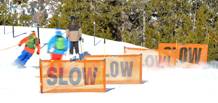
Aspen Highlands, Michael Neumann
DENVER, Colo. – February 17, 2012– Colorado Ski Country USA (CSCUSA) and its 22 member resorts remind skiers and snowboarders to practice safe skiing and riding, know and follow Your Responsibility Code, be aware of surroundings and obey terrain closures.
“Guest safety is always the number one priority of our members,” explained Melanie Mills, CSCUSA president and CEO. “President’s Day weekend is a popular time to go skiing, and our resorts are doing absolutely everything they can to make sure guests are safe and have an enjoyable time on the slopes during this busy weekend.”
Individual skier and snowboarder responsibility is the foundation for safe skiing. Loveland Ski Area assistant patrol director and CSCUSA Ski Patroller of the Year, Joey Riefenberg, stresses the importance of being aware of your surroundings, “Skiers and snowboarders need to be proactive about safety, pay attention to who is skiing around you and always look downhill. Go slow and give yourself time to stop. Know that little kids are out and about and need a wide berth, watch where the flows are.”
CSCUSA member resorts across the state are taking extra measures to provide safe skiing environments, including constantly reassessing conditions. “Resorts are working super hard to make sure it’s safe. Everyone is super conscientious of that, and the snowpack,” said Riefenberg. “It’s a funny snowpack this year, really odd, and resorts are on alert, busy knocking all the air out of the snowpack and making sure everything is safe.”
Skiers and snowboarders are also reminded to obey all signage and be especially alert to obeying terrain closures. As snow continues to fall in Ski Country, resorts will open more terrain as conditions safely allow. “We’d love to open everything but things are closed for a reason, because it’s unsafe for you and unsafe for those who have to rescue you,” Riefenberg explained. “Nothing is being saved, we want everyone to have fun, but be safe doing it.”
Ultimately, it is the responsible behavior of skiers and riders that make the slopes safe. Knowing the nationally recognized Your Responsibility Code is crucial to skier and rider responsibility. Referred to simply as The Code, it is comprised of seven principles that collectively outline on-mountain skier etiquette and safe skiing practices.
Responsibilities within The Code include:

Image via Wikipedia
- Always stay in control, and be able to stop or avoid other people or objects.
- People ahead of you have the right of way. It is your responsibility to avoid them.
- You must not stop where you obstruct a trail, or are not visible from above.
- Whenever starting downhill or merging into a trail, look uphill and yield to others.
- Always use devices to help prevent runaway equipment.
- Observe all posted signs and warnings. Keep off closed trails and out of closed areas.
- Prior to using any lift, you must have the knowledge and ability to load, ride and unload safely.
CSCUSA also reminds skiers, snowboarders and other snowsports enthusiasts heading into the backcountry to check with the Colorado Avalanche Information Center (CAIC) on the magnitude and nature of avalanche hazard they may encounter, do not venture out alone, and have proper equipment and education for the conditions. “Backcountry avalanche danger right now is considerable,” states Ethan Greene, director of CAIC. “With the holiday weekend there’s going to be powder snow and nice weather, but don’t be fooled that the hazard is anything less than very serious.”
More information on backcountry conditions can be found at the CAIC website, www.avalanche.state.co.us or by calling 303-499-9650.

Why accident reports can come back to haunt you.
Posted: March 12, 2012 Filed under: New Hampshire, Release (pre-injury contract not to sue) | Tags: Alpine Slide, Attitasha Ski Area, Court, Expert Witness, Federal Supplement, Medicaid, Motion in Limine, New Hampshire Department of Safety, Ski Resort 4 CommentsHerbst v. L.B.O. Holding, Inc., 2011 DNH 72; 783 F. Supp. 2d 262; 2011 U.S. Dist. LEXIS 46977; 85 Fed. R. Evid. Serv. (Callaghan) 285
Accident reports can be admitted, if the accident is substantially similar, which proves to the jury that you don’t mind injuring people.
In this case, the plaintiff as an adult, was using a ski area alpine slide when his sled left the track causing him injury. He sued for his injuries. The ski area,

Image via Wikipedia
Attitash Bear Peak Resort, in Bartlett, New Hampshire had filed a motion in limine with the court which gave rise to this decision.
A motion in limine is a motion where one party asks the court to exclude testimony or statements being proffered by the other party. Here the Ski area was attempting to have prior reports from accidents on the alpine slide kept out of the trial. The ski area and the plaintiff were also attempting to restrict or prohibit other testimony and exhibits also.
One of the first issues was the background and history of the plaintiff. The plaintiff was trying to prevent the defendant from brining in the issue that the plaintiff had been convicted of mail fraud. An issue like this is based on whether the felony conviction is a conviction for dishonesty or fraud. Here it was a felony conviction for dishonesty. A felony normally cannot be brought in, absent special circumstances if the conviction is greater than ten (10) years old. Although the plaintiff’s conviction was greater than ten years old, because of the type of conviction, the judge thought it was relevant and allowed the conviction to be used at trial.
The next issue was the amount of medical bills incurred by the plaintiff. The plaintiffs’ medical bills were paid by Medicaid. As such, those bills when paid were discounted substantially. The plaintiff wanted to claim the medical bills were the amount prior to the Medicaid discount. Here the judge found that the full value of the medical bills was to be admitted not the discounted amount paid by Medicaid.
The value of the medical bills is always an important point. The jury usually bases its damages as a function of the medical bills.
The defendant wanted to exclude expert testimony of the plaintiff’s expert witness about warning signs or the inadequacy thereof. The plaintiff’s expert had only mentioned the signs in one sentence of his report and included photographs of the signs in his report. An expert witness report must contain a complete statement of the opinions he or she will express and the basis or the reasons for those opinions. The defense argued the one sentence was not enough to be a complete statement of the opinion. However, the court found it to be enough and will allow the testimony of the expert about the inadequacy of the signage into the trial.
The final argument was the plaintiff wanted to admit into evidence the accident reports of the 22 similar prior accidents. Six of the reports came from the New Hampshire Department of Safety, and 15 were from Attitash itself. One of the reports was based on an observation of the plaintiff’s expert witness when he was at the site investigating the scene.
So?
For an accident report to be admitted into trial the report must be substantially similar to the accident at issue.
Evidence of prior accidents is admissible . . . only if the proponent of the evidence shows that the accidents occurred under circumstances substantially similar to those at issue in the case at bar
The court found that four of the reports would be admitted of the six filed with the state and the 15 kept by the defendant. Those six were substantially similar to the accident that injured the plaintiff. Here, that similarity was the sled leaving the track on a curve.
The court found the following four reports significant and similar.
· the accident on July 12, 2005 (where the rider “came through [the] dip, came to next set of banks, came out of track”);
· the accident on July 23, 2005 (where the “sled came off track” near a bank);
· the accident on August 3, 2005 (where the rider “hit the curve, jumped the track”); and
· the accident on July 16, 2006 (where the rider “came from a right turn into a left turn and his cart flew off”).
The court also agreed to allow the report of the plaintiff’s expert witness of the accident he observed.
The issue then becomes what does this prove?
I believe it proves that it proves to the jury that the defendant has a dangerous track. The jury will see four reports from injuries substantially similar to the one the plaintiff is complaining about. How else could you look at these reports, except as proof that the track was dangerous AND that the defendant had done nothing to correct the problems or make the track safe.
Here were accidents for five years prior to the plaintiff’s accident and one, the expert witness one, occurring after the injury that showed there was a problem.
No matter, how much your employees and expert witness argue that the track is not dangerous, the jury is going to be looking at reports, written documents, prepared by you the defendant, saying the exact opposite.
So Now What?
Do you not create accident reports. No, you must keep records of problems, until they are fixed or used in litigation. However the reason for the reports is critical. If you are keeping them to track accidents, you are doing it for the wrong reason. You use them to do two things and two things only.
· Provide information in case there is a need such as state or federal investigation or litigation.
· To solve problems.
1. Any accident report must be solely that, the basic facts, who, what, where, when; never ever, ever a why.
Accident reports should never have speculation or opinion in them.
2. You must do something with the information you gather on accident reports. You cannot just collect them. If you notice a trend or locations fix it.
If you can’t fix it, put up a sign, put it in the waiver, instruct the people about it and tell them they will get hurt if they don’t pay attention.
Below is the accident report used by a major ski area. If you look, the information collected is done so to gather information and prevent litigation.
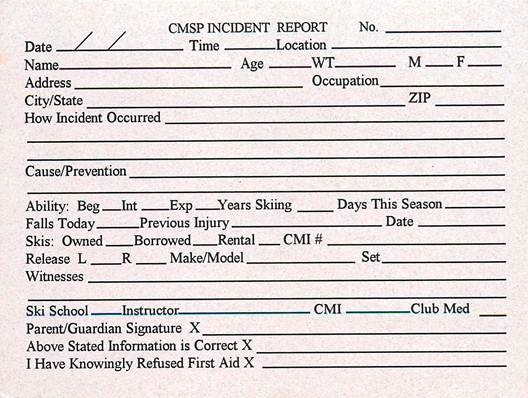
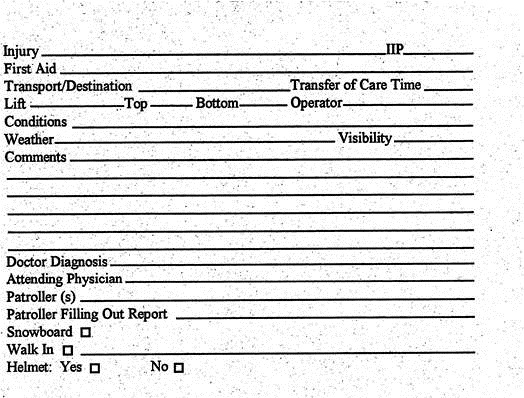
Nothing more than the absolute essentials is captured. These are 5 X 7 cards. The information on the form is 100% from the injured party. No information is put on the card by the patrollers unless it is direct information acquired by the patroller such as the release number setting on the skis, etc.
If there are witnesses then there are 5 X 7 cards for them to complete. There was also a form if a ski school student was injured. If the accident was a life changing incident, major trauma then there were more forms. But for 99% of the accidents, the entire report fit in a patroller’s pocket.
If the injured party cannot fill out the card, then the patroller asks the questions and writes down what the injured party says.
No opinion, no estimates, no guesses, just the facts. (Remember Dragnet the TV show from the 60s.)
Then, once you have the information it must be used. Where are the problems, can we fix the problems, should we warn people about the problems? What can we do to prevent injuries, and if we can’t can we warn people they don’t get injured?
If not, those reports will show up in trial, and probably not to help you.
For an article about bad accident reports see Be Afraid, be very afraid of pre-printed forms for your recreation business.
What do you think? Leave a comment.
If you like this let your friends know or post it on FB, Twitter or LinkedIn
Copyright 2012 Recreation Law (720) Edit Law
Twitter: RecreationLaw
Facebook: Rec.Law.Now
Facebook Page: Outdoor Recreation & Adventure Travel Law
Mobile Site: http://m.recreation-law.com
#RecreationLaw, #@RecreationLaw, #Cycling.Law #Fitness.Law, #Ski.Law, #Outside.Law, #Recreation.Law, #Recreation-Law.com, #Outdoor Law, #Recreation Law, #Outdoor Recreation Law, #Adventure Travel Law, #law, #Travel Law, #Jim Moss, #James H. Moss, #Attorney at Law, #Tourism, #Adventure Tourism, #Rec-Law, #Rec-Law Blog, #Recreation Law, #Recreation Law Blog, #Risk Management, #Human Powered, #Human Powered Recreation,# Cycling Law, #Bicycling Law, #Fitness Law, #Recreation-Law.com, #Backpacking, #Hiking, #Mountaineering, #Ice Climbing, #Rock Climbing, #Ropes Course, #Challenge Course, #Summer Camp, #Camps, #Youth Camps, #Skiing, #Ski Areas, #Negligence, #Snowboarding, #RecreationLaw, #@RecreationLaw, #Cycling.Law #Fitness.Law, #SkiLaw, #Outside.Law, #Recreation.Law, #RecreationLaw.com, #OutdoorLaw, #RecreationLaw, #OutdoorRecreationLaw, #AdventureTravelLaw, #Law, #TravelLaw, #JimMoss, #JamesHMoss, #AttorneyatLaw, #Tourism, #AdventureTourism, #RecLaw, #RecLawBlog, #RecreationLawBlog, #RiskManagement, #HumanPowered, #HumanPoweredRecreation,# CyclingLaw, #BicyclingLaw, #FitnessLaw, #RecreationLaw.com, #Backpacking, #Hiking, #Mountaineering, #IceClimbing, #RockClimbing, #RopesCourse, #ChallengeCourse, #SummerCamp, #Camps, #YouthCamps, #Skiing, #Ski Areas, #Negligence, #Snowboarding, sport and recreation laws, ski law, cycling law, Colorado law, law for recreation and sport managers, bicycling and the law, cycling and the law, ski helmet law, skiers code, skiing accidents, #Accident, Accident Report, Alpine Slide, #Slide, #Sled,
Herbst v. L.B.O. Holding, Inc., 2011 DNH 72; 783 F. Supp. 2d 262; 2011 U.S. Dist. LEXIS 46977; 85 Fed. R. Evid. Serv. (Callaghan) 285
Posted: March 12, 2012 Filed under: Legal Case, New Hampshire, Release (pre-injury contract not to sue) | Tags: Alpine Slide, Attitash, Attitash Ski Area, Federal Supplement, Motion in Limine, New Hampshire, United States, United States district court Leave a commentHerbst v. L.B.O. Holding, Inc., 2011 DNH 72; 783 F. Supp. 2d 262; 2011 U.S. Dist. LEXIS 46977; 85 Fed. R. Evid. Serv. (Callaghan) 285
Edward Herbst v. L.B.O. Holding, Inc., d/b/a Attitash Bear Peak Resort
Civil No. 09-cv-233-JL
UNITED STATES DISTRICT COURT FOR THE DISTRICT OF NEW HAMPSHIRE
2011 DNH 72; 783 F. Supp. 2d 262; 2011 U.S. Dist. LEXIS 46977; 85 Fed. R. Evid. Serv. (Callaghan) 285
May 2, 2011, Decided
May 2, 2011, Filed
COUNSEL: [**1] For Edward Herbst, Dina Herbst, Plaintiffs: R. Peter Taylor, McNeill Taylor & Gallo PA, Dover, NH.
For L.B.O. Holding, Inc., Defendant: Thomas B.S. Quarles, Jr., Devine Millimet & Branch PA (Manchester), Manchester, NH.
JUDGES: Joseph N. Laplante, United States District Judge.
OPINION BY: Joseph N. Laplante
OPINION
[*264] MEMORANDUM ORDER
This case arises from injuries, including a broken ankle, that plaintiff Edward Herbst suffered after falling off an alpine slide at Attitash Bear Peak Resort, a ski area in Bartlett, New Hampshire that offers the slide as a summer recreational activity. Herbst brought suit against the resort’s owner, L.B.O. Holding, Inc. (“Attitash”), asserting claims for strict products liability and negligence. Specifically, he alleges that the slide is unreasonably dangerous to its riders, that Attitash was negligent in operating it, and that Attitash failed to adequately instruct and warn Herbst on its proper use. Attitash denies those allegations and asserts that Herbst’s [*265] own negligence caused the accident. This court has subject-matter jurisdiction under 28 U.S.C. § 1332(a)(1) (diversity).
Both parties have moved in limine to admit or exclude various types of evidence at the upcoming jury trial, currently [**2] scheduled for May 2011. See L.R. 16.2(b)(3). Specifically, Attitash has moved to admit evidence of Herbst’s prior conviction for mail fraud, to exclude evidence of the face amount of Herbst’s medical bills, and to preclude Herbst’s expert witness from testifying about the adequacy of the slide’s warnings. Herbst, in turn, has moved to admit evidence of prior and subsequent accidents on Attitash’s alpine slide. Following oral argument, this court rules on the limine motions as set forth below.
I.Attitash’s motion to admit prior conviction1
1 Document no. 19.
Attitash has moved to admit evidence that Herbst was convicted of felony mail fraud, see 18 U.S.C. § 1341, in a New York federal court on July 30, 1999, when he was 46 years old. See United States v. Herbst, No. 98-cr-771-001 (S.D.N.Y. July 27, 1999). Specifically, Herbst pled guilty to using the mails in connection with bribing an employee of the New York City Department of Finance to reduce or eliminate his overdue property taxes and interest. He served a three-month prison sentence, ending on or before January 1, 2000, and then remained on supervised release for a period of three years.
As a general rule, [HN1] “evidence that any witness [**3] has been convicted of a crime shall be admitted” for impeachment purposes “if it readily can be determined that establishing the elements of the crime required proof or admission of an act of dishonesty or false statement by the witness.” Fed. R. Evid. 609(a)(2). Herbst concedes that his mail fraud conviction involved dishonesty or false statement and therefore falls within that rule. See, e.g., United States v. Orlando-Figueroa, 229 F.3d 33, 46 (1st Cir. 2000).
But evidence of such a conviction “is not admissible if a period of more than ten years has elapsed since the date of the conviction or of the release of the witness from the confinement imposed for that conviction, whichever is later, unless the court determines, in the interests of justice, that the probative value of the conviction supported by specific facts and circumstances substantially outweighs its prejudicial effect.” Fed. R. Evid. 609(b).2
2 Rule 609(b) also requires “sufficient advance written notice to provide the adverse party with a fair opportunity to contest the use” of the prior conviction, which Herbst concedes he has received.
More than ten years have passed since Herbst was released from the confinement imposed [**4] for his mail fraud conviction. Attitash argues that Herbst is to blame for that fact, because he waited nearly three years after his 2006 accident to bring this action, and then requested a trial continuance in 2010. But Attitash has not shown that Herbst acted improperly in either regard, or that he “manipulated either the calendar or the scheduling process in order to postpone the trial and allow the clock to run on [his] conviction.”3 United States v. Nguyen, 542 F.3d 275, 280 (1st Cir. 2008) (rejecting a similar argument that “had [the] trial started a few months earlier–as did the trial of [certain] codefendants–the ten-year window would have [*266] remained open”). So there is no reason not to apply Rule 609(b) here. Id. at 281.
3 Indeed, personal injury actions are routinely brought near the end of the limitations period, so as to allow the nature of the injury to become fully understood.
[HN2] “Given the tenor of Rule 609(b), common sense suggests that felony convictions more than ten years old should be admitted only sparingly and in especially compelling circumstances,” based on a “particularized showing” that their probative value substantially outweighs their prejudicial effect. Id. at 278 [**5] (citing 4 Jack B. Weinstein & Margaret A. Berger, Weinstein’s Federal Evidence § 609.06[1] (2d ed. 2007)). Factors to consider in making that determination “may include (i) the impeachment value of the particular convictions, (ii) their immediacy or remoteness . . .; (iii) the degree of potential prejudice that they portend; (iv) the importance of the defendant’s testimony; and (v) the salience of the credibility issue in the circumstances of the particular case.” United States v. Brito, 427 F.3d 53, 64 (1st Cir. 2005).
Here, Herbst’s mail fraud conviction has a direct bearing on his credibility and veracity, and thus a high degree of impeachment value. He demonstrated a willingness to defraud others to improve his own financial situation. Because Herbst is the primary, and in some respects only, witness to his accident and the ride(s) leading up to it (which allegedly affected his state of mind, making him feel the need to slide faster), and because Attitash contends that Herbst himself was at fault for the accident, his testimony is likely to be of great importance at trial, and his credibility is likely to be a particularly salient issue for the jury.
“Of course, [HN3] the mere fact that [**6] [a witness’s] credibility is in issue . . . cannot, by itself, justify admission of evidence of convictions over ten years old,” because that “would make the ten year limit in Rule 609(b) meaningless.” United States v. Brown, 603 F.2d 1022, 1028 (1st Cir. 1979). But the case for admitting evidence of Herbst’s mail fraud conviction is especially compelling here, given the fraudulent nature of his crime, the likely importance of his testimony and credibility with regard to events that only he (and, in some respects, his daughter) witnessed, and that his conviction, which occurred when he was 46 years old, is barely older than ten years.4
4 In fact, as noted supra, had this action been filed earlier, or trial not been continued, impeachment would have been permitted under Rule 609(a).
While the admission of a prior felony conviction always carries some risk of prejudice, that risk is much lower here than it would be, for example, in a criminal case brought against Herbst. See, e.g., Orlando-Figueroa, 229 F.3d at 46 (noting that “Rule 609 is primarily concerned with potential unfairness to a [criminal] defendant when his prior convictions are offered” and concluding that, even under the particular [**7] circumstances of that criminal case, the court could have admitted evidence of a witness’s mail fraud conviction under Rule 609(b), over the defendant’s objection).
The risk of prejudice is further reduced because Herbst suffered objectively verifiable injuries in the accident (including a broken ankle) and is not the only person who has done so in recent years. See Part IV, infra. Given that evidence, the jury is unlikely to regard the accident itself, or Herbst’s decision to bring this lawsuit, as fraudulent, or to reject his claims merely because he has a criminal history. Rather, it is likely to consider Herbst’s conviction for the limited, and proper, purpose of determining whether to believe his specific testimony regarding his conduct on the slide, the reasons for it (including his state of mind), and the pain and suffering it caused him.
[*267] Having considered the specific facts and circumstances of this case, the court concludes that the probative value of Herbst’s mail fraud conviction substantially outweighs its prejudicial effect, and that it is in the interests of justice to admit it into evidence. Attitash’s motion to admit that evidence is therefore granted. To further reduce [**8] any risk of prejudice, Herbst may request a limiting instruction to the jury, both when the evidence is admitted and in the final jury charge. See, e.g., United States v. Tracy, 36 F.3d 187, 194 (1st Cir. 1994).
II.Attitash’s motion to exclude medical bills5
5 Document no. 20.
Attitash has moved to preclude Herbst from introducing evidence of the face amounts of his medical bills, arguing that the reasonable value of medical services is the amount actually paid for them (here, by Medicaid), not the higher amount billed. [HN4] This court has repeatedly refused, however, “‘to exclude evidence of the billed cost of medical services’ in favor of ‘the amounts actually paid’ in satisfaction of those costs by the plaintiff’s health insurers.” Reed v. Nat’l Council of Boy Scouts of Am., Inc., 706 F. Supp. 2d 180, 190 (D.N.H. 2010) (quoting Aumand v. Dartmouth Hitchcock Med. Ctr., 611 F. Supp. 2d 78, 91 (D.N.H. 2009)); see also Bartlett v. Mut. Pharm. Co., 2010 U.S. Dist. LEXIS 142906, 2010 WL 3156555, at * 2; Williamson v. Odyssey House, Inc., 2000 DNH 238, 2000 WL 1745101, at *1 (DiClerico, D.J.).
As explained more fully in those decisions, Medicaid write-offs fall within the scope of New Hampshire’s collateral source [**9] rule, which “provides that ‘if a plaintiff is compensated in whole or part for his damages by some source independent of the tort-feasor, he is still permitted to make full recovery against the tort-feasor.'” Reed, 706 F. Supp. 2d at 190 (quoting Moulton v. Groveton Papers Co., 114 N.H. 505, 509, 323 A.2d 906 (1974)). Accordingly, this court has not only permitted plaintiffs to present evidence of the amounts billed, but has prohibited defendants from presenting evidence of the amounts actually paid, deeming such evidence unfairly prejudicial. See, e.g., Bartlett, 2010 U.S. Dist. LEXIS 142906, 2010 WL 3156555, at *2 (citing Fed. R. Evid. 403).
Attitash notes that a number of New Hampshire Superior Court judges have reached the opposite conclusion. But this court considered much, if not all, of that case law in Reed, which noted that there is Superior Court precedent in both directions and announced that “unless and until this state’s version of the collateral source rule is changed by the New Hampshire legislature or New Hampshire Supreme Court, this court will continue to apply it to billed amounts ‘written off’ by a plaintiff’s providers, in accordance with existing law here and in the vast majority of other jurisdictions.” [**10] 706 F. Supp. 2d at 190, 194.6
6 This is not to say, however, that the court finds the contrary Superior Court decisions wholly unpersuasive, at least as a policy matter, particularly in the context of private health insurance (as opposed to Medicaid or other public health insurance). But it is this state’s legislature–or, with respect to common-law rules, its Supreme Court–which decides such matters, not this court.
Attitash’s motion in limine is therefore denied. It is important to note, however, that Attitash may still challenge whether the billed amounts reflect the reasonable value of Herbst’s medical services, provided it does not use evidence of the Medicaid write-offs to do so, and otherwise complies with the rules of evidence. See [*268] Bartlett, 2010 U.S. Dist. LEXIS 142906, 2010 WL 3156555, at *2 (citing Reed, 706 F. Supp. 2d at 194).
III.Attitash’s motion to exclude expert testimony on warnings7
7 Document no. 34. The court discussed this issue with the parties at oral argument (before Attitash’s motion had been filed) and then gave both parties an opportunity to brief it before trial.
Attitash has also moved to preclude Herbst’s expert witness, engineer John Mroszczyk, from testifying that the slide’s warnings were [**11] inadequate, arguing that no such opinion was disclosed in his expert report. See [HN5] Fed. R. Civ. P. 26(a)(2)(B) (expert “report must contain . . . a complete statement of all opinions the witness will express and the basis and reasons for them“) and 37(c)(1) (where “a party fails to provide information . . . as required by Rule 26(a),” it “is not allowed to use that information . . . at a trial, unless the failure was substantially justified or is harmless“). The only warning-related opinion expressly set forth in Mroszczyk’s report was that the slide had “a number of instruction and warning signs at the slide loading area” (photos of which he attached to the report), but “no speed limit signs posted along the slide.”
Herbst concedes “that it would certainly have been preferable to ensure that Mroszczyk clearly expressed his opinion” about the warnings in his expert report, see document no. 33, at 4, but nevertheless argues that it is a reasonable inference from the report that he considers the warnings inadequate, and that he should therefore be allowed to offer that opinion at trial. See, e.g., Metavante Corp. v. Emigrant Sav. Bank, 619 F.3d 748, 762 (7th Cir. 2010) (expert report need [**12] not “replicate every word that the expert might say on the stand,” as long as it sufficiently “convey[s] the substance of the expert’s opinion . . . so that the opponent will be ready to rebut, to cross-examine, and to offer a competing expert, if necessary”) (quotation omitted).
Herbst has submitted an affidavit from Mroszczyk clarifying that he “do[es] not believe that any warning in a sign regarding the particular problems” that Herbst encountered on the alpine slide “would be adequate to make this ride safe,” i.e., he “do[es] not believe that this condition in the slide could be made safe by warnings.” Document no. 33-1, at 2. This court agrees that such an opinion can be reasonably inferred from his report, which, after noting the existing signs and the lack of speed limits, states that riders have no ability to gauge their speed anyway and that, even “at a reasonable speed,” they could still “leave the track.” The strong implication is that no warning would be adequate.
The problem with that opinion, at least for Herbst, is that it means that Attitash’s alleged failure to warn did not cause his accident and injuries, because, according to Mroszczyk, no warning would have been adequate [**13] to protect Herbst from the particular problems he encountered. See, e.g., Trull v. Volkswagen of Am., Inc., 145 N.H. 259, 264, 761 A.2d 477 (2000) (“failure to warn must be [a] proximate cause of plaintiff’s injuries”); LeBlanc v. Am. Honda Motor Co., 141 N.H. 579, 586, 688 A.2d 556 (1997) (“[t]he issue in [a] failure to warn claim . . . is whether the danger . . . was or could have been made reasonable by the issuance of adequate warnings”). In other words, the opinion supports Herbst’s unreasonable dangerousness theory, but at the expense of his failure-to-warn theory.
Nevertheless, if Herbst wishes to offer Mroszczyk’s opinion at trial that the slide’s warnings were inadequate because no warning regarding the particular problems [*269] that Herbst encountered would have made the ride safe, this court will allow him to do so. While not expressly disclosed in Mroszczyk’s report, that opinion can be reasonably inferred from the substance of the report, and Attitash has received sufficient notice to “be ready to rebut [it], to cross-examine, and to offer a competing expert, if necessary.” Metavante, 619 F.3d at 762. Attitash’s motion to exclude such testimony is denied.8
8 Mroszczyk should be careful, however, not to venture [**14] beyond the limited opinion set forth above, or to suggest (contrary to that opinion) that some other warning by Attitash would have been adequate to prevent Herbst’s accident.
IV.Herbst’s motion to admit evidence of other accidents9
9 Document no. 15.
Herbst, in turn, has moved to admit evidence of various other accidents on Attitash’s alpine slide, including 21 that occurred between 2004 and 2006 (either prior to or just after his accident), and also one that his expert witness, Mroszczyk, happened to observe in 2010 while conducting a site visit for purposes of inspecting the slide and preparing his expert report in this case.10 Attitash objects that those accidents were not substantially similar to Herbst’s accident and that, in any event, evidence of other accidents–particularly the one Mroszczyk witnessed in 2010–would be unfairly prejudicial, would confuse the jury, and would unduly delay the trial. See Fed. R. Evid. 403.
10 Herbst initially sought to admit evidence of even more accidents, including some involving collisions between two riders. At oral argument and in his subsequent briefing, however, he narrowed his request to those accidents that he considers most similar to his [**15] own.
[HN6] “Evidence of prior accidents is admissible . . . only if the proponent of the evidence shows that the accidents occurred under circumstances substantially similar to those at issue in the case at bar.” Moulton v. Rival Co., 116 F.3d 22, 26-27 (1st Cir. 1997) (quoting McKinnon v. Skil Corp., 638 F.2d 270, 277 (1st Cir. 1981)). Both parties agree that the same requirement applies to subsequent accidents, as other courts have held. See, e.g., Reddin v. Robinson Prop. Group, LP, 239 F.3d 756, 760 (5th Cir. 2001). “At bottom, the ‘substantially similar’ requirement is a more particularized approach to the requirement that evidence be probative.” Trull v. Volkswagen of Am., Inc., 187 F.3d 88, 98 n.9 (1st Cir. 1999).
“‘Substantial similarity’ is a function of the theory of the case.” Moulton, 116 F.3d at 27. Here, Herbst’s theory (supported by expert testimony) is that Attitash’s alpine slide causes riders to move side-to-side within the slide and sometimes to lose control, particularly through curves; and that if a rider reaches the end of a curve embankment in that state, there is a risk of falling off the slide, as allegedly happened in his accident. According to Herbst’s expert, many [**16] curves in the slide pose that risk. In light of that theory, this court construes “substantially similar” to mean, for purposes of this case, that the rider in the other accident must have lost control around a curve and fallen off the slide.
A.2004-2006 accidents
Herbst has made evidentiary proffers regarding each of the accidents at issue. For the 21 accidents occurring between 2004 and 2006, he has submitted accident reports (6 from the New Hampshire Department of Safety and 15 from Attitash itself). The reports, however, provide very little detail. Most of them [*270] indicate that the rider fell off the slide, but not how or where it happened. Mroszczyk believes that each accident “probably” involved loss of control and ejection around a curve, because riders ordinarily would not fall off the slide on a straightaway. But at least two of the accidents were described as occurring on a straightaway, and some had other causes (e.g., a squirrel in the track). So that assumption seems flawed.
This court has closely reviewed each of the accident reports and finds that Herbst has met his burden of showing substantial similarity only as to four accidents:
· the accident on July 12, 2005 (where the [**17] rider “came through [the] dip, came to next set of banks, came out of track”);
· the accident on July 23, 2005 (where the “sled came off track” near a bank);
· the accident on August 3, 2005 (where the rider “hit the curve, jumped the track”); and
· the accident on July 16, 2006 (where the rider “came from a right turn into a left turn and his cart flew off”).
All of the other accidents involved materially different circumstances, or at least were not sufficiently described for this court to deem them substantially similar. See, e.g., Downey v. Bob’s Disc. Furniture Holdings, Inc., 633 F.3d 1, 9 (1st Cir. 2011) (affirming the exclusion of such evidence where plaintiffs proffered only a “bare bones” printout containing a “cryptic description” of prior incidents, with “no details,” and “conducted no investigation into the underlying facts”).11
11 Herbst argues that Attitash admitted, in an interrogatory, that all 15 of the accident reports it produced involved “accidents similar to the plaintiff’s: where an operator left the track and was injured.” But, [HN7] for purposes of discovery, “a flexible treatment of relevance is required and the making of discovery . . . is not a concession or determination [**18] of relevance for purposes of trial,” or admissibility. Fed. R. Civ. P. 26(b)(1), advisory committee notes (1970). Attitash’s interrogatory answer was not an admission of substantial similarity within the meaning of Moulton.
Attitash argues that evidence of even the substantially similar accidents should be excluded as unfairly prejudicial, confusing to the jury, and likely to unduly delay the trial. See Fed. R. Evid. 403. But this court sees little to no risk in any of those respects. Because the accident reports provide so little detail, and appear to be the only available evidence of what happened, the use of such evidence will necessarily be limited in scope. Its main purpose is simply to show that riders occasionally lose control and fall off the track around a curve, as Herbst did, and that Attitash had notice of that risk. That is a proper and probative purpose, which outweighs any of the countervailing concerns listed in Rule 403.
This court therefore grants Herbst’s request to admit evidence of the four accidents noted above, but denies his request to admit evidence of the other accidents between 2004 and 2006. If Herbst believes that this court has overlooked any accident(s) [**19] with circumstances comparably similar to those four accidents, or has additional evidence of substantial similarity beyond that proffered to date, he may raise that issue and/or make a further evidentiary proffer at trial, outside the presence of the jury.
B.2010 accident
For the accident in 2010, Herbst has submitted an affidavit from Mroszczyk explaining what he observed. According to Mroszczyk, that accident, like Herbst’s, involved a rider’s loss of control, side-to-side movement within the slide, and then [*271] ejection from the slide around a curve (albeit a different curve, more than 100 feet down the slide from where Herbst fell). Mroszczyk claims that sequence of events “is precisely what I believe occurred to Mr. Herbst.” Based on that proffer, this court finds that Herbst has sufficiently shown that the 2010 accident was substantially similar to his own, clearing that hurdle for admissibility.12
12 Attitash argues that the 2010 accident resulted from the rider going airborne over a slide feature called “the dip” (not from being ejected around a curve), but that strikes the court as implausible, given the considerable distance between the dip and the place where the rider landed. Attitash [**20] has not proffered any evidence to support that version of events. In any event, if Attitash wishes to challenge Mroszczyk’s testimony regarding how that accident happened, it may do so at trial. An adjuster from Attitash’s insurance company also witnessed the accident and could be called as a witness.
Attitash argues that evidence of the 2010 accident should nevertheless be excluded as unfairly prejudicial, confusing to the jury, and likely to unduly delay the trial. See Fed. R. Evid. 403. It is true that such evidence may pose some risk of prejudice and juror confusion, since the accident happened, incidentally, on the day when Herbst’s expert was inspecting the slide, which might suggest to the jury that accidents happen on the alpine slide with greater frequency than they actually do. Attitash, though, has the ability to present evidence of how often accidents actually happen.13 The jury should not have any trouble understanding or accepting that the timing was just a coincidence.
13 The standard for defendants to introduce evidence of prior accidents is more lenient than for plaintiffs. See Trull, 187 F.3d at 98 n.9.
Conversely, evidence of the 2010 accident has very high probative [**21] value. Mroszczyk’s direct observation of an accident substantially similar to the one that Herbst suffered has the ability to inform, and even corroborate, his expert opinions about what happened to Herbst, and the reason(s) for it. That firsthand experience could make his testimony much more persuasive and helpful to the jury, whereas preventing him from discussing the accident could leave the jury with an incomplete, and potentially inaccurate, understanding of the basis for and reliability of his opinions.
On balance, this court concludes that the probative value of the 2010 accident outweighs the risk of prejudice and juror confusion, and therefore grants Herbst’s motion to admit evidence of that accident. As to Attitash’s argument that such evidence will cause undue delay, this court doubts that will happen, but will keep that concern in mind during trial and will be open to any proposals that Attitash may have (short of outright exclusion) for reasonably limiting the amount of such evidence, and the manner in which it is presented, so as to avoid undue delay and reduce the risk of prejudice.
V.Conclusion
For the reasons set forth above, Attitash’s motion to admit evidence of Herbst’s [**22] prior conviction14 is GRANTED, Attitash’s motion to exclude evidence of Herbst’s medical bills15 is DENIED, Attitash’s motion to preclude Mroszczyk from testifying about the slide’s warnings16 is DENIED, and Herbst’s motion to admit evidence of [*272] prior and subsequent accidents17 is GRANTED in part and DENIED in part.
14 Document no. 19.
15 Document no. 20.
16 Document no. 34.
17 Document no. 15.
SO ORDERED.
/s/ Joseph N. Laplante
Joseph N. Laplante
United States District Judge
Dated: May 2, 2011
AZ Republic – Congress must not derail anti-noise plan
Posted: March 6, 2012 Filed under: Arizona | Tags: Arizona, Federal Aviation Administration, Grand Canyon, NationalParkService Leave a commentCongress must not derail anti-noise plan
Mar. 1, 2012
The Republic | azcentral.com
After years of work, and decades of delay, the National Park Service is about to adopt a plan to manage aircraft noise at the Grand Canyon.

Bright Angel Point trail - Grand Canyon North Rim (Photo credit: Al_HikesAZ)
Congress must not derail it.
The 1987 National Park Overflights Act called for the substantial restoration of natural quiet at the Grand Canyon.
Now, with that goal in sight, a proposed amendment to the Senate surface transportation bill would throw the process off track. It would change the wording of the 1987 law — setting the stage for years of litigation and yet more delay.
Sen. John McCain is sponsoring this measure. And Sen. Jon Kyl has signed on as a co-sponsor. So have Nevada’s Dean Heller and, making this a bipartisan misconcieved idea, Senate Majority Leader Harry Reid. (Why such high interest in Nevada? Air tours to the Grand Canyon happen to be big business in Las Vegas.)
This is their second effort. In 2010, when since-resigned John Ensign was Reid’s Senate mate, the four Arizona and Nevada senators proposed an end-run around the planning process. That legislation was ultimately withdrawn. This one should be dropped, too.
The National Park Service released its draft environmental document last year. The “preferred alternative” strikes a well-calibrated balance between reduced noise and opportunities for air tours. It would allow up to 65,000 air tours a year, 8,000 more than the total when the plan was written. It includes changes in routes and altitudes, plus at least one hour of quiet time before sunset and after sunrise.
The park service received nearly 30,000 comments from individuals and organizations. The final plan, which will likely be tweaked in response to some of those concerns, will be out this spring. Then the Federal Aviation Administration will consider the plan for safety issues.
McCain’s office says the proposed amendment would incentivize quiet technology and address FAA safety concerns. The plan, however, includes incentives for quiet technology that don’t conflict with the goal of reducing noise. The FAA’s concerns can and should be worked out in the final stages of the plan.
The majesty of the Grand Canyon includes the chance to experience natural quiet. The swish of wind through pines and the rush of the Colorado River echoing up the trail are valuable resources that need protection, just as archaeological sites do. We are so close to achieving that protection. Congress should not change the rules of the game in the very last minutes of play.
Is there a duty to notify parents when an investigation is being conducted by the state to protect campers?
Posted: February 27, 2012 Filed under: Florida, Jurisdiction and Venue (Forum Selection), Minors, Youth, Children, Summer Camp | Tags: Florida, Jurisdiction, Long-Arm Jurisdiction, Motion (legal), North Carolina, Parental Responsibility, summer camp, Youth Camp Leave a commentCamp Illahee Investors, Inc., v. Blackman, 870 So. 2d 80; 2003 Fla. App. LEXIS 17549; 28 Fla. L. Weekly D 2672
Parents claim the camp was negligent in not informing them the state department of social services was going to or had interviewed their kids.
The problem is the case does not answer the question. This again, is a jurisdiction and venue motion that was appealed. The defendant camp was located in North Carolina. The plaintiffs were Florida’s residents. The only contact the camp had with Florida was 22% of its campers came from Florida, and one of the owners would spend a week in Florida every year drumming up business for the next summer.
The initial allegations giving rise to the litigation are very interesting. The plaintiff’s claim, the camp and the owners were negligent because the:
…Defendants had a duty, after being informed that the North Carolina County Department of Social Services desired to interview the Plaintiffs’ minor children, to notify the Plaintiffs of the fact that the minor children were to be interviewed by the North Carolina County Department of Social Services about possible child abuse….
There was a second allegation that a junior counselor had injured one of the plaintiff’s when he stepped on her feet. (Where they dancing?) This claim was not resolved in this appeal either.
Summary of the case
The plaintiff’s sued in Florida, and the defendants moved to dismiss. The trial court did not dismiss for lack of jurisdiction, and the defendants appealed. The defendants argued that they were:
…not subject to the jurisdiction of a Florida court and, even if jurisdiction existed in Florida, that North Carolina was an adequate alternative forum. Camp Illahee further argued that it was immune from suit under North Carolina law and that Florida’s impact rule required dismissal.
To support their argument the defendant must show the facts that prove their allegations. That is usually done by affidavits of the defendants and possibly others to prove the issue, or really, the lack of contact with the state.
Camp Illahee is a North Carolina corporation; the summer camp is located in North Carolina; Camp Illahee has no offices in Florida; it has no employees in Florida, although some of the employees who work at the camp during the summer are from Florida; Camp Illahee does no advertising in Florida by newspapers, radio, or television, but it has a one and one-half page posting on its internet website advising of “fall reunion and video shows.”
The court must then look at the State Long Arm Statute to determine if the facts make the defendant subject to the jurisdiction of the court. Under Florida’s law that analysis is:
…whether (1) there are sufficient jurisdictional facts to bring the action within the purview of the long-arm statute; and (2) the nonresident defendant involved has sufficient minimum contacts with Florida to satisfy constitutional due process requirements.
The Florida Long Arm Statute sets forth the minimum requirements to establish jurisdiction over out of state parties.
Section 48.193(1)(a)
(1) Any person, whether or not a citizen or resident of this state, who personally or through an agent does any of the acts enumerated in this subsection thereby submits himself or herself and, if he or she is a natural person, his or her personal representative to the jurisdiction of the courts of this state for any cause of action arising from the doing of any of the following acts:
(a) Operating, conducting, engaging in, or carrying on a business or business venture in this state or having an office or agency in this state.
Section 48.193(2):
A defendant who is engaged in substantial and not isolated activity within this state, whether such activity is wholly interstate, intrastate, or otherwise, is subject to the jurisdiction of the courts of this state, whether or not the claim arises from that activity.
The court then applies the information presented by the parties to the requirements of the statutes to see if the defendant has the necessary minimum contacts with the state to be sued in that state and subject to the laws of that state.
So Now What?
The trend from the courts is to allow you to be brought into distant states and their judicial system. This case is a rarity. This is another example of where the agreement between the camp and the parents or any parties to any outdoor recreation, should agree in advance to where any litigation will be developed.
As far as notifying parents of an interview by social services for possible child abuse, I think I would always lean towards notifying the parents. In fact, I think I would notify the parents immediately. A parent must believe that their child is safe. Whether the child is safe is put into question, if social services is investigating your camp.
This may be a PR nightmare or disaster for any camp or program dealing with minors. You will need to make sure you bring in PR professionals and probably your attorney if this situation arises.
You should also set up a program and working relationship where anyone can come and talk to you about problems. Hopefully, before social services had been called, you are on top of the issue and have dealt with it.
What do you think? Leave a comment.
If you like this let your friends know or post it on FB, Twitter or LinkedIn
Copyright 2012 Recreation Law (720) Edit Law
Twitter: RecreationLaw
Facebook: Rec.Law.Now
Facebook Page: Outdoor Recreation & Adventure Travel Law
Mobile Site: http://m.recreation-law.com
#RecreationLaw, #@RecreationLaw, #Cycling.Law #Fitness.Law, #Ski.Law, #Outside.Law, #Recreation.Law, #Recreation-Law.com, #Outdoor Law, #Recreation Law, #Outdoor Recreation Law, #Adventure Travel Law, #law, #Travel Law, #Jim Moss, #James H. Moss, #Attorney at Law, #Tourism, #Adventure Tourism, #Rec-Law, #Rec-Law Blog, #Recreation Law, #Recreation Law Blog, #Risk Management, #Human Powered, #Human Powered Recreation,# Cycling Law, #Bicycling Law, #Fitness Law, #Recreation-Law.com, #Backpacking, #Hiking, #Mountaineering, #Ice Climbing, #Rock Climbing, #Ropes Course, #Challenge Course, #Summer Camp, #Camps, #Youth Camps, #Skiing, #Ski Areas, #Negligence, #Snowboarding, #RecreationLaw, #@RecreationLaw, #Cycling.Law #Fitness.Law, #SkiLaw, #Outside.Law, #Recreation.Law, #RecreationLaw.com, #OutdoorLaw, #RecreationLaw, #OutdoorRecreationLaw, #AdventureTravelLaw, #Law, #TravelLaw, #JimMoss, #JamesHMoss, #AttorneyatLaw, #Tourism, #AdventureTourism, #RecLaw, #RecLawBlog, #RecreationLawBlog, #RiskManagement, #HumanPowered, #HumanPoweredRecreation,# CyclingLaw, #BicyclingLaw, #FitnessLaw, #RecreationLaw.com, #Backpacking, #Hiking, #Mountaineering, #IceClimbing, #RockClimbing, #RopesCourse, #ChallengeCourse, #SummerCamp, #Camps, #YouthCamps, #Skiing, #Ski Areas, #Negligence, #Snowboarding, sport and recreation laws, ski law, cycling law, Colorado law, law for recreation and sport managers, bicycling and the law, cycling and the law, ski helmet law, skiers code, skiing accidents, Camp Illahee, summer camp, camp, camper, social services, North Carolina, Florida, FL, NC,
WordPress Tags: parents,investigation,campers,Camp,Illahee,Investors,Blackman,LEXIS,department,jurisdiction,venue,defendant,North,Carolina,plaintiffs,Florida,residents,owners,allegations,litigation,plaintiff,Defendants,Social,Services,fact,allegation,counselor,feet,Where,Summary,forum,impact,dismissal,argument,affidavits,corporation,offices,employees,newspapers,radio,television,reunion,State,Long,Statute,Under,analysis,action,requirements,Section,person,citizen,agent,subsection,office,agency,information,statutes,laws,trend,system,example,agreement,recreation,Whether,disaster,minors,professionals,attorney,situation,relationship,Leave,Twitter,LinkedIn,Edit,RecreationLaw,Facebook,Page,Outdoor,Adventure,Travel,Blog,Mobile,Site,Outside,Moss,James,Tourism,Risk,Management,Human,Rock,Ropes,Course,Challenge,Summer,Camps,Youth,Areas,Negligence,SkiLaw,OutdoorLaw,OutdoorRecreationLaw,AdventureTravelLaw,TravelLaw,JimMoss,JamesHMoss,AttorneyatLaw,AdventureTourism,RecLaw,RecLawBlog,RecreationLawBlog,RiskManagement,HumanPoweredRecreation,CyclingLaw,BicyclingLaw,FitnessLaw,RopesCourse,ChallengeCourse,SummerCamp,YouthCamps,Colorado,managers,helmet,accidents,camper
Camp Illahee Investors, Inc., v. Blackman, 870 So. 2d 80; 2003 Fla. App. LEXIS 17549; 28 Fla. L. Weekly D 2672
Posted: February 27, 2012 Filed under: Florida, Jurisdiction and Venue (Forum Selection), Legal Case, Minors, Youth, Children, Summer Camp | Tags: Camp, Florida, Long-Arm Jurisdiction, Motion (legal), North Carolina, Recreation, summer camp Leave a commentCamp Illahee Investors, Inc., v. Blackman, 870 So. 2d 80; 2003 Fla. App. LEXIS 17549; 28 Fla. L. Weekly D 2672
Camp Illahee Investors, Inc., a North Carolina Corporation, Appellant, v. Michael Blackman and Patrice Blackman, Individually and as the Parents, Natural Guardians and next best friends of Olivia Blackman and Sophie Blackman, minor children, and Frank Tindall and Elizabeth Tindall, Appellees.
Case No. 2D02-4324
COURT OF APPEAL OF FLORIDA, SECOND DISTRICT
870 So. 2d 80; 2003 Fla. App. LEXIS 17549; 28 Fla. L. Weekly D 2672
November 19, 2003, Opinion Filed
PRIOR HISTORY: [**1] Appeal from nonfinal order of the Circuit Court for Hillsborough County; Daniel E. Gallagher, Senior Judge.
DISPOSITION: Reversed and remanded with directions.
COUNSEL: J. Gregory Giannuzzi of Rissman, Weisberg, Barrett, Hurt, Donahue & McLain, P.A., Tampa, for Appellant.
Jeffrey A. Blau, Tampa, for Appellees Michael Blackman and Patrice Blackman, Individually and as the Parents, Natural Guardians and next best friends of Olivia Blackman and Sophie Blackman, minor children.
No appearance for Appellees, Frank Tindall and Elizabeth Tindall.
JUDGES: SILBERMAN, Judge. STRINGER, J., and THREADGILL, EDWARD F., SENIOR JUDGE, Concur.
OPINION BY: SILBERMAN
OPINION
[*82] SILBERMAN, Judge.
Camp Illahee Investors, Inc., a North Carolina corporation, appeals a nonfinal [*83] order that denied its motion to dismiss for lack of personal jurisdiction. Because jurisdiction was not established under Florida’s long-arm statute, we reverse.
Appellees Michael and Patrice Blackman, individually and on behalf of their minor daughters, sued Camp Illahee and its owners, Frank and Elizabeth Tindall, for alleged torts committed in North Carolina while [**2] the Blackmans’ two daughters were attending summer camp in 2001. 1 In their first amended complaint, the Blackmans alleged that while their daughters were at the camp, someone placed an “anonymous child abuse call” to a county department of social services in North Carolina, whose representatives then interviewed the Blackmans’ daughters. The Blackmans alleged that the “Defendants had a duty, after being informed that the North Carolina County Department of Social Services desired to interview the Plaintiffs’ minor children, to notify the Plaintiffs of the fact that the minor children were to be interviewed by the North Carolina County Department of Social Services about possible child abuse.” The Blackmans also alleged that a junior counselor battered one of the daughters “by stepping on her feet and inflicting other physical injuries and mental abuse” on her.
1 The trial court dismissed the Tindalls from the litigation, and the Blackmans have not appealed that ruling.
Camp Illahee filed a motion to dismiss [**3] and asserted, among other grounds, that it was not subject to the jurisdiction of a Florida court and, even if jurisdiction existed in Florida, that North Carolina was an adequate alternative forum. Camp Illahee further argued that it was immune from suit under North Carolina law and that Florida’s impact rule required dismissal.
Camp Illahee submitted affidavits from the Tindalls, the owners and operators of the camp. The affidavits reflect that Camp Illahee is a North Carolina corporation; the summer camp is located in North Carolina; Camp Illahee has no offices in Florida; it has no employees in Florida, although some of the employees who work at the camp during the summer are from Florida; Camp Illahee does no advertising in Florida by newspapers, radio, or television, but it has a one and one-half page posting on its internet website advising of “fall reunion and video shows.”
Mrs. Tindall’s affidavit also reflects that she travels to various states to engage in the reunion and video shows, which are designed to have “the children get together to talk about Camp, and to become excited for camp the next summer.” The reunions take place in the homes of camp families, and the [**4] families receive a discount in the camp fee for hosting the reunions. The discounts amounted to .15% of Camp Illahee’s gross revenues in 2000 and .08% in 2001. In 2000 and 2001, 22% of the campers were from Florida.
Although Camp Illahee argues that its motion to dismiss could properly have been granted on any of the grounds raised in its motion, the key issue is whether the trial court had long-arm jurisdiction over Camp Illahee. [HN1] Our standard of review on the issue of personal jurisdiction over a foreign corporation is de novo. See Execu-Tech Bus. Sys., Inc. v. New Oji Paper Co., 752 So. 2d 582, 584 (Fla. 2000). [HN2] Additionally, we are required to strictly construe Florida’s long-arm statute. See Esberger v. First Fla. Bus. Consultants, Inc., 338 So. 2d 561, 562 (Fla. 2d DCA 1976).
The pertinent facts relating to jurisdiction are not in dispute. [HN3] The determination [*84] of whether the trial court has personal jurisdiction over Camp Illahee turns on “whether (1) there are sufficient jurisdictional facts to bring the action within the purview of the long-arm statute; and (2) the nonresident defendant involved has sufficient minimum contacts with Florida to [**5] satisfy constitutional due process requirements.” Kin Yong Lung Indus. Co. v. Temple, 816 So. 2d 663, 666 (Fla. 2d DCA 2002); see also Venetian Salami Co. v. Parthenais, 554 So. 2d 499, 502 (Fla. 1989).
In its order denying the motion to dismiss, the trial court did not discuss this two-prong test. Instead, it simply stated, “Jurisdiction as to Camp Illahee Investors, Inc. will remain in Florida pursuant to the doctrine of forum non conveniens, as set forth in Fla. R. Civ. P. 1.061.” However, [HN4] before reaching the issue of forum non conveniens under Florida Rule of Civil Procedure 1.061, the trial court was required to first determine whether it had in personam jurisdiction in accordance with the two-prong test. See La Reunion Francaise, S.A. v. La Costena, 818 So. 2d 657, 659 (Fla. 3d DCA 2002) (concluding that there was no personal jurisdiction over the foreign defendant and, therefore, no need to reach other issues raised in the motion to dismiss, including the issue of forum non conveniens).
After reviewing the record and the applicable statutory language in light of the required two-prong jurisdictional analysis, we conclude [**6] that the trial court should have dismissed the Blackmans’ first amended complaint for lack of in personam jurisdiction. The allegations of the first amended complaint establish that the only possible bases for jurisdiction are under sections 48.193(1)(a) or 48.193(2) of the long-arm statute. Section 48.193(1)(a) [HN5] provides as follows:
(1) Any person, whether or not a citizen or resident of this state, who personally or through an agent does any of the acts enumerated in this subsection thereby submits himself or herself and, if he or she is a natural person, his or her personal representative to the jurisdiction of the courts of this state for any cause of action arising from the doing of any of the following acts:
(a) Operating, conducting, engaging in, or carrying on a business or business venture in this state or having an office or agency in this state.
Section 48.193(2) [HN6] states as follows:
A defendant who is engaged in substantial and not isolated activity within this state, whether such activity is wholly interstate, intrastate, or otherwise, is subject to the jurisdiction of the courts of this state, whether or not the claim arises from that activity.
In the trial [**7] court, the Blackmans asserted that because Mrs. Tindall came to Florida one week a year for the reunion and video shows, Camp Illahee was conducting business in Florida. They also argued that the families that hosted the reunions were agents of Camp Illahee.
Concerning the agency argument, nothing in the record reflects that either an apparent or actual agency relationship existed between the host families and Camp Illahee. In particular, there was no showing that Camp Illahee made any representations that the host families were the agents of Camp Illahee, or that Camp Illahee, as principal, exercised control over the families, as agents. See Ilgen v. Henderson Props., Inc., 683 So. 2d 513, 514-15 (Fla. 2d DCA 1996) (discussing the elements necessary to establish apparent or actual agency); State v. Am. Tobacco Co., 707 So. 2d 851, 854 (Fla. 4th DCA 1998) (stating that control by the principal [*85] over the agent is a necessary element of agency).
The Blackmans’ second argument is premised on section 48.193(1), which confers jurisdiction for “any cause of action arising from the doing of” any of the enumerated items, such as conducting business in Florida. [**8] [HN7] By its terms, section 48.193(1) requires connexity between the defendant’s activities and the cause of action. Wendt v. Horowitz, 822 So. 2d 1252, 1260 (Fla. 2002). Here, the record reflects that the connexity requirement has not been met because the Blackmans’ claims did not arise from the reunions and video shows that took place in Florida during one week per year. Rather, the claims arose out of alleged torts that occurred in North Carolina while the Blackmans’ daughters attended the camp.
Even if the undisputed facts fell within the ambit of section 48.193(1), Camp Illahee must have sufficient minimum contacts with Florida to satisfy due process requirements. See Venetian Salami, 554 So. 2d at 500. [HN8] The test is whether Camp Illahee’s conduct is such that it “should reasonably anticipate being haled into court” in Florida. See Venetian Salami, 554 So. 2d at 500 (quoting World-Wide Volkswagen Corp. v. Woodson, 444 U.S. 286, 297, 62 L. Ed. 2d 490, 100 S. Ct. 559 (1980)); see also Emerson v. Cole, 847 So. 2d 606, 608 (Fla. 2d DCA 2003). We agree with Camp Illahee that the limited contact between it [**9] and Florida as a result of the yearly reunion and video shows is insufficient to establish that it could reasonably anticipate being haled into court in Florida for the allegedly tortious conduct occurring in North Carolina.
A second potential basis for jurisdiction is section 48.193(2), which provides that a defendant is subject to a Florida court’s jurisdiction when the defendant “is engaged in substantial and not isolated activity within this state . . . whether or not the claim arises from that activity.” [HN9] This section “does not require connexity between a defendant’s activities and the cause of action.” Woods v. Nova Cos. Belize Ltd., 739 So. 2d 617, 620 (Fla. 4th DCA 1999). Additionally, if the defendant’s activities meet the requirements of this section, the due process requirement of minimum contacts is fulfilled. Id. However, the record before us does not support a conclusion that Camp Ilahee’s conduct constitutes substantial activity in Florida. See deMco Techs., Inc. v. C.S. Engineered Castings, Inc., 769 So. 2d 1128, 1132 (Fla. 3d DCA 2000) (stating that sporadic sales in Florida could not provide jurisdiction for litigation regarding [**10] an unrelated promissory note); Price v. Point Marine, Inc., 610 So. 2d 1339, 1341 (Fla. 1st DCA 1992) (noting that sporadic activities or visits to Florida consisting of the occasional solicitation of business in Florida do not constitute “substantial and not isolated activity”).
Because the undisputed facts do not demonstrate a basis for jurisdiction under Florida’s long-arm statute, we reverse and remand with directions that the trial court dismiss the Blackmans’ claims without prejudice to their refiling the claims in the appropriate jurisdiction. In light of our conclusion regarding the lack of in personam jurisdiction, the other grounds asserted by Camp Illahee in support of reversal are moot.
Reversed and remanded with directions.
STRINGER, J., and THREADGILL, EDWARD F., SENIOR JUDGE, Concur.
Pagel v. Marcus Corporation, 2008 WI App 110; 313 Wis. 2d 78; 756 N.W.2d 447; 2008 Wisc. App. LEXIS 423
Posted: February 24, 2012 Filed under: Assumption of the Risk, Legal Case, Wisconsin | Tags: Appeal, Appellate Court, Milwaukee, Summary judgment, Trial court, Wisconsin Leave a commentPagel v. Marcus Corporation, 2008 WI App 110; 313 Wis. 2d 78; 756 N.W.2d 447; 2008 Wisc. App. LEXIS 423
Briane F. Pagel, Jr. and Joy Pagel, Plaintiffs-Appellants, v. Marcus Corporation d/b/a Hilton Milwaukee City Center, Defendant, Milwaukee City Center LLC, Defendant-Respondent.
Appeal No. 2007AP1369
COURT OF APPEALS OF WISCONSIN, DISTRICT ONE
2008 WI App 110; 313 Wis. 2d 78; 756 N.W.2d 447; 2008 Wisc. App. LEXIS 423
June 3, 2008, Decided
June 3, 2008, Filed
PRIOR HISTORY:
APPEAL from a judgment of the circuit court for Milwaukee County: RICHARD J. SANKOVITZ, Judge. Cir. Ct. No. 2006CV1145.
DISPOSITION: Affirmed.
COUNSEL: On behalf of the plaintiff-appellant, the cause was submitted on the briefs of J. David Krekeler and Anthony Baer of Krekeler Strother, S.C., of Madison.
On behalf of the defendant-respondent, the cause was submitted on the brief of Ronald G. Pezze, Jr. and Ahndrea R. Van Den Elzen of Peterson, Johnson & Murray, S.C., of Milwaukee.
JUDGES: Before Curley, P.J., Fine and Kessler, JJ.
OPINION BY: KESSLER
OPINION
[**81] [***448] [*P1] KESSLER, J. Briane F. Pagel, Jr., and Joy Pagel (individually and collectively, Pagel) appeal from an order granting summary judgment to Milwaukee City Center LLC (MCC), dismissing all claims by Pagel against it. Pagel asserts that the trial court erred when it applied § 388 of the RESTATEMENT (SECOND) OF TORTS to the [***449] facts here, and concluded that the hazard, which Pagel claims caused his injury, was open and obvious to Pagel, thus relieving MCC of a duty to provide signs warning of the open and obvious hazard. We affirm.
Background
[*P2] Pagel and his family visited an indoor water park owned by MCC in a hotel in Milwaukee. Among the water attractions used by Pagel and his family was a “Lily Pad Walk” which Pagel described as:
The lily pads were a couple of large floating cushions underneath a cargo-style net. Each pad was about [four feet] in diameter and had a vinyl-like coating on them.
….
You grabbed the cargo net and stepped onto the lily pads, holding yourself by your arms as you used the lily pads to try to go ahead. The lily pads were chained to the bottom but loosely so they could float around, and they didn’t float well enough to hold up even a little kid.
[*P3] Pagel testified that before he used the Lily Pad Walk, he “knew the lily pads could tip to cause you to fall into the water.” When he used the Lily Pad Walk the first time, Pagel said his hand slipped off the ropes, the lily pad moved away from his feet, and, as a result, he dropped into the water rather than hanging from the [**82] ropes. Pagel testified about his observation of the mechanics of the Lily Pad Walk during his first time across:
Q: When you used the Lily Pad attraction the first time, why didn’t you continue to hold on to the rope when the lily pad tipped?
A: Because I was going to drop into the water.
Q: Well, you did drop into the water. But my question was, why didn’t you continue holding on to the rope?
A: I didn’t want to be just be [sic] hanging from the rope. When I couldn’t get it by the foot, your only option at that point would be just to hang by the rope and try to go across just with your arms, I guess. And I – that didn’t seem like a smart move, so I just dropped.
Pagel acknowledged that before using the Lily Pad Walk he watched other people using it, saw people fall into the water using it, and saw people trying to traverse across the Lily Pad Walk while he was waiting in line to use it.
[*P4] Pagel alleged that he was injured when he used the Lily Pad Walk when his foot slipped from the lily pad, he lost his grip on the cargo net ropes above the water and lily pads, and fell into the water, injuring his back. The injury occurred the second time he used the Lily Pad Walk. His amended complaint alleged, as material to this appeal, negligence by MCC for failure “to provide a warning of the unsafe condition of the lily pad section of its water park.”
[*P5] Relying on Kessel ex rel. Swenson v. Stansfield Vending, Inc., 2006 WI App 68, 291 Wis. 2d 504, 714 N.W.2d 206, and § 388 of the RESTATEMENT (SECOND) [**83] OF TORTS, the trial court observed that [HN1] “where an injured person already knows what he or she needs to know to avoid a danger, the law does not impose a duty to warn on a person who provides a product for the use of another.” Based on the undisputed facts, the trial court then granted summary judgment dismissing Pagel’s negligence claim against MCC. Pagel appeals.
Standard of Review
[*P6] [HN2] In reviewing motions for summary judgment, we apply the standards set forth in WIS. STAT. § 802.08 (2005-06), 1 in [***450] the same manner as the trial court. Moua v. Northern States Power Co., 157 Wis. 2d 177, 184, 458 N.W.2d 836 (Ct. App. 1990). “Summary judgment is [properly] granted when there is no genuine issue of material fact and only a question of law is at issue.” Id. The historical facts here are not in dispute. “Whether facts fulfill a particular legal standard is a question of law to which we give de novo review.” Bantz v. Montgomery Estates, Inc., 163 Wis. 2d 973, 978, 473 N.W.2d 506 (Ct. App. 1991); see also DOR v. Exxon Corp., 90 Wis. 2d 700, 713, 281 N.W.2d 94 (1979), aff’d, 447 U.S. 207, 100 S. Ct. 2109, 65 L. Ed. 2d 66 (1980).
1 All references to the Wisconsin Statutes are to the 2005-06 version unless otherwise noted.
[*P7] [HN3] “Where the facts alleged to give rise to a duty are agreed upon, the question of the existence of a duty is one of law.” Rockweit v. Senecal, 197 Wis. 2d 409, 419, 541 N.W.2d 742 (1995) (quoting Olson v. Ratzel, 89 Wis. 2d 227, 251, 278 N.W.2d 238 (Ct. App. 1979)). Where the undisputed facts establish that a danger is open and obvious to the user of the product, as a matter [**84] of law there is no duty to warn the user of that danger and summary judgment is proper. Griebler v. Doughboy Recreational, Inc., 160 Wis. 2d 547, 561, 466 N.W.2d 897 (1991).
Analysis
[*P8] The role an open and obvious danger plays in our tort law has evolved over a long period of time. Describing the open and obvious nature of the danger as a “defense,” the trial court in Griebler granted summary judgment, dismissing a claim of injury in a shallow water diving accident. Id. at 551, 554. The court of appeals reversed, relying on § 343A(1) of the RESTATEMENT (SECOND) OF TORTS (1965) and a related comment which required not only that the reasonable person/user must recognize that an open and obvious danger exists, but that person must also appreciate the gravity of the harm threatened by that danger. Griebler, 160 Wis. 2d at 556-57. Our supreme court rejected § 343A(1), noting that, as in all of the earlier diving cases, the condition of the water is the obvious danger, the risk is that the person diving will hit bottom, and the type of injury that might result (or the person’s knowledge thereof) is irrelevant. Griebler, 160 Wis. 2d at 558. The supreme court reversed our decision and reinstated summary judgment dismissing Griebler’s complaint, stating:
We hold that the open and obvious danger defense applies whenever a plaintiff voluntarily 2 confronts an open and obvious condition and a reasonable person in [**85] the position of the plaintiff would recognize the condition and the risk the condition presents.
Id. at 551 (footnote modified). Relying on “nearly twenty years of Wisconsin law holding that diving into water of unknown depth is an open and obvious danger,” 3 id. at 557, where Griebler admitted that he dove headfirst [***451] into water, whose depth he did not know, id. at 557, the supreme court described such conduct as “unreasonable as a matter of law,” id. at 561.
2 By footnote, the court recognized two conditions which would preclude invoking the open and obvious danger defense, namely if the injured person was distracted or if the injured person could not avoid the condition. Griebler v. Doughboy Recreational, Inc., 160 Wis. 2d 547, 551, 466 N.W.2d 897 (1991) (citing Waters v. U.S. Fid. & Guar. Co., 124 Wis. 2d 275, 369 N.W.2d 755 (Ct. App. 1985), and Maci v. State Farm Fire & Cas. Co., 105 Wis. 2d 710, 314 N.W.2d 914 (Ct. App. 1981), overruled on other grounds by Rockweit v. Senecal, 197 Wis. 2d 409, 423, 541 N.W.2d 742 (1995)).
3 The Griebler court relied on Scheeler v. Bahr, 41 Wis. 2d 473, 164 N.W.2d 310 (1969), and Davenport v. Gillmore, 146 Wis. 2d 498, 431 N.W.2d 701 (Ct. App. 1988), for the duration of these holdings. Griebler, 160 Wis. 2d at 557.
[*P9] Four years later, in Rockweit, when a small child walking with his mother fell into a campground fire pit with smoldering embers, our supreme court noted that in previous cases it had
abrogated the common law immunity [for owners of premises] by subsuming the concept of open and obvious danger into the consideration of common law negligence. In the ordinary negligence case, if an open and obvious danger is confronted by the plaintiff, it is merely an element to be considered by the jury in apportioning negligence and will not operate to completely bar the plaintiff’s recovery.
Id., 197 Wis. 2d at 423. This holding placed the characterization of an open and obvious danger as a defense to negligence in the context of applying a comparative negligence analysis. Pagel relies on specific Rockweit [**86] language 4 [4] to argue that summary judgment was not proper here because the lack of warning is merely a fact to be considered in apportioning the negligence attributable to MCC. Pagel argues that a jury must decide whether MCC’s common law duty of care is overcome by the defense that there was an open and obvious danger which Pagel recognized before he was injured.
4 [HN4] “In the ordinary negligence case, if an open and obvious danger is confronted by the plaintiff, it is merely an element to be considered by the jury in apportioning negligence ….” Rockweit, 197 Wis. 2d at 423.
[*P10] Pagel’s reliance on this isolated language in Rockweit is misplaced. In Rockweit, a fire pit at a commercial campground was used in common by the large extended family of the child victim, who were camping together. Id. at 414. A family friend, who was staying at a different area of the campground, was invited to a social gathering with the extended family at a fire pit the night before the accident occurred. Id. at 415. The friend, who was also named as a defendant, did not select the fire pit site, took no part in setting, controlling or managing the fire, and did not use that fire pit while she was camping. Id. Her only connection with the fire pit was attending the social gathering to which she was invited. Id. at 415. When the friend and two members of the child’s extended family were the last to leave the social gathering, no one extinguished the embers. Id. at 415-16. The next morning the child was walking with his mother when he stumbled into the pit which still contained live embers. Id. at 416. The child alleged negligence by the friend and the others who were the last to leave and did not extinguish the embers. Id. The jury found the campground owner, the family members present, the child’s mother, and the friend were all negligent. Id.
[**87] [*P11] On appeal, our supreme court concluded that public policy considerations precluded imposing liability on the invited friend. Id. at 429. The court noted that fire is commonly known to be dangerous, id. at 427 (“The dangerous propensities akin to fire are commonplace to a campsite.”), and that the child’s mother, who was with the child when he fell into the pit, knew as much about the danger of the fire pit as the invited friend, id. at 428 (“[Mother] testified that she was fully aware that the fire pit constituted a hazard at the time of the accident and had not relied on a supposition that someone the [***452] night before might have doused the embers ….”). These considerations foreshadowed the court’s later decision to adopt § 388 of the RESTATEMENT (SECOND) OF TORTS in the context of the open and obvious danger of a chattel which is alleged to have caused injury.
[*P12] Five years after Rockweit, our supreme court in Strasser v. Transtech Mobile Fleet Service, Inc., 2000 WI 87, PP57-59, 236 Wis. 2d 435, 613 N.W.2d 142, adopted the RESTATEMENT (SECOND) OF TORTS § 388 (1965), which provides:
[HN5] One who supplies directly or through a third person a chattel for another to use is subject to liability to those whom the supplier should expect to use the chattel with the consent of the other or to be endangered by its probable use, for physical harm caused by the use of the chattel in the manner for which and by a person for whose use it is supplied, if the supplier
(a) knows or has reason to know that the chattel is or is likely to be dangerous for the use for which it is supplied, and
[**88] (b) has no reason to believe that those for whose use the chattel is supplied will realize its dangerous condition, and
(c) fails to exercise reasonable care to inform them of its dangerous condition or of the facts which make it likely to be dangerous.
Strasser involved personal property–a ladder fabricated without safety treads on the rungs–which Strasser used many times before he slipped on a rung and fell. Id., 236 Wis. 2d 435, P19. Our supreme court did not overrule Rockweit (which involved only real property–a fire pit in the ground). Strasser, 2000 WI 87, 236 Wis. 2d 435, P60, 613 N.W.2d 142. Rather, by adopting § 388, the supreme court adopted the law of a real property owner’s responsibility to invitees to codify the common law duty of due care owed by the provider of personal property to the user of personal property when the use for which the property is intended causes injury. Although somewhat awkwardly stated in the negative, § 388(1) establishes that when the danger is open and obvious to a reasonable person, warning of what the reasonable person already knows is unnecessary; thus, the failure to warn cannot be negligent. Strasser, 2000 WI 87, 236 Wis. 2d 435, PP59-60, 613 N.W.2d 142.
[*P13] The adoption of RESTATEMENT (SECOND) OF TORTS § 388 moved the open and obvious danger to the level of being not only a jury issue as a defense to negligence when the material facts of whether the danger is open and obvious are disputed, but also removed any duty to warn from the negligence calculus when the undisputed material facts establish that the danger is open and obvious and the user recognizes/observes/knows of the danger. Approximately four years after Strasser, in Mohr v. St. Paul Fire & Marine Insurance Co., 2004 WI App 5, 269 Wis. 2d 302, 674 N.W.2d 576 (Ct. App. 2003), we discussed § 388(b), noting that:
[**89] As the court explained in Strasser, one of the situations under § 388(b) in which a supplier or manufacturer has no duty to warn of a danger is when “‘a mere casual looking over will disclose [the dangerous condition] unless the circumstances under which the chattel is supplied are such as to make it likely that even so casual an inspection will not be made.'” … When danger is obvious from a mere casual looking over, the supplier or manufacturer has reason to believe that the user will realize the danger.
Mohr, 2004 WI App 5, 269 Wis. 2d 302, P23, 674 N.W.2d 576 (citing Strasser, 2000 WI 87, 236 Wis. 2d 435, PP58-59, 613 N.W.2d 142).
[***453] [*P14] Mohr presented a factual dispute as to whether a diving platform used by a high school for racing dives into 3.5 feet of water, rather than 5 feet of water, was something that a casual observation would disclose as dangerous. Id., P3 (discussing RESTATEMENT (SECOND) OF TORTS § 388 cmt. k). We concluded that summary judgment was inappropriate, not because a jury must always decide whether a danger is open and obvious, but because the facts material to that question were disputed–one high school swim coach had one view, and another swim coach at the same high school had a different view. Id., PP17-18, 25.
[*P15] Later, in Kessel, we held there was no duty to warn of danger from steaming water coming from a hot water dispenser (provided in a hospital waiting room to let patients’ families make hot chocolate) where the hot temperature was obvious from the steam, and both parents admitted they took precautions because they knew that hot water could injure their young child (who tipped the cup and was injured by the scalding water). Id., 291 Wis. 2d 504, PP3-4, 23, 32. We discussed whether Strasser held that RESTATEMENT (SECOND) OF TORTS § 388(1) inevitably required a warning to comply with the duty of care:
[**90] In essence, the court in Strasser concluded that RESTATEMENT (SECOND) OF TORTS § 388 and cmt. k defined the standard of ordinary care in that situation: “This exception in cmt. k recognizes that a warning is not necessary to satisfy the standard of ordinary care when the condition at issue is known to the user.”
Kessel, 2006 WI App 68, 291 Wis. 2d 504, P21, 714 N.W.2d 206 (citation and brackets omitted; emphasis added).
[*P16] As we explained in Kessel, where the supplier of the tangible property has reason to believe that casual inspection will disclose the danger, and the user is aware of the danger, RESTATEMENT (SECOND) OF TORTS § 388 does not require a warning. Kessel, 2006 WI App 68, 291 Wis. 2d 504, P21, 714 N.W.2d 206. Here, it is undisputed that Pagel used the Lily Pad Walk once without injury. It is also undisputed that before, or during, his first use, Pagel personally observed how the Lily Pad Walk worked, knew from observation and experience that the lily pads were not stable, knew that they could not hold up even a small child, and that because of their obvious instability, the only alternatives available to users of the Lily Pad Walk were to drop or fall into the water 5 or use their hands to hold on to the cargo net ropes above to cross the area hand over hand. On his first use of the Lily Pad Walk, Pagel chose to get wet rather than travel by hand on the cargo net ropes. Thus, he knew both from experience and from observation that when the pad moved, the only two choices were to drop or fall into the water or to use his hands to hold onto the cargo net ropes to cross the [**91] area. The danger–that the pads would move–was open and obvious. The only ways to avoid the danger while using the Lily Pad Walk–get wet or travel hand over hand on the cargo net ropes–were equally open and obvious.
5 It would seem that the primary purpose of a water park is to get into the water. One would expect that the possibility of getting wet, or even drenched, is the very attraction that brings visitors to these facilities.
[*P17] The terms of RESTATEMENT (SECOND) OF TORTS § 388 apply here. MCC supplied the Lily Pad Walk in the water park for use by visitors to the water park. Section 388(1) (“One who supplies … a chattel for another to use is subject to liability to those whom the supplier should expect to use the chattel” under certain conditions.). MCC is liable if it “has reason to know [***454] that the chattel is likely to be dangerous for the use for which it is supplied.” Id. The lily pads were obviously unstable, tending to cause (or allow) users to fall into the water, or to traverse the area using their hands on the cargo net ropes. The “danger” of falling into the water or the “danger” of crossing by hands on ropes is the very purpose of the Lily Pad Walk. These “dangers” are not hidden in any way. These properties were apparent to Pagel before and/or during his uneventful first use of the Lily Pad Walk. Section 388(b) imposes liability if the supplier of the product “has no reason to believe that those for whose use the chattel is supplied will realize its dangerous condition.” Id. (emphasis added). Here, the converse is the fact. Because the mechanics of the moving lily pads and cargo net ropes for hand use were open and obvious to anyone who looked, MCC had reason to believe these “dangers” would be immediately apparent to any reasonable person. Hence, as in Strasser, where the lack of safety treads on the ladder was obvious to anyone who looked, and specifically known to Strasser who used the treadless ladder multiple times before his injury, the liability imposed by § 388(b) is not applicable here, where MCC had no [**92] reason to believe these conditions would not be immediately apparent to users of the Lily Pad Walk, and these dangers were specifically known to Pagel, in part because he had used the Lily Pad Walk before the use during which he was injured.
[*P18] Pagel urges us to adopt RESTATEMENT (SECOND) OF TORTS § 343A(1) and apply it to his case. As we explained above, when we relied on the § 343A(1) analysis in Griebler, our supreme court rejected our analysis and overruled our conclusion. See P8, supra. [HN6] It is not our role to reject our supreme court’s policy conclusions. See Cook v. Cook, 208 Wis. 2d 166, 189, 560 N.W.2d 246 (1997):
[HN7] [T]he supreme court’s primary function is that of law defining and law development. The supreme court, unlike the court of appeals, has been designated by the constitution and the legislature as a law-declaring court. The purpose of the supreme court is to oversee and implement the statewide development of the law. The supreme court is the only state court with the power to overrule, modify or withdraw language from a previous supreme court case.
(Citations and internal quotation marks omitted.)
[*P19] Where, based on the undisputed facts, the dangerous condition of a chattel is open and obvious to the reasonable user, no warning is required under RESTATEMENT (SECOND) OF TORTS § 388(1), and summary judgment dismissing a negligence claim premised on failure to warn is proper.
By the Court.–Judgment affirmed.
Information, Education and knowledge prevent a mother from suing a camp and the Girl Scouts
Posted: February 20, 2012 Filed under: Minors, Youth, Children, Mississippi, Summer Camp, Youth Camps | Tags: Bedroom, Bunk bed, Cabin, Camp, Child, Girl Scouts, Girl Scouts of America, Recreation, Summer Camp Leave a commentBuck, v. Camp Wilkes, Inc. 906 So. 2d 778; 2004 Miss. App. LEXIS 1141
Besides top bunk of a bunk bed is just not a dangerous instrumentality.
The mother of a thirteen-year old girl sued the Girl Scouts of Gulf Pine Council, Inc., the troop leader of her daughter’s unit and the camp when the girl fell off the top bunk of a bunk bed injuring her. The basis of the suit was the defendant’s actions caused or contributed to the thirteen-year olds fall. After the defendants were dismissed on summary judgment by the trial court the mother appealed claiming the lower court failed to determine the following:
(1) in failing to follow existing standards in granting the defendants’ motions for summary judgment, (2) in finding no merit to Buck’s argument that a causal relationship existed between Boozer’s temporary absence at the time of the accident and Jamie’s falling from the bed, and in applying the wrong standard when considering Boozer and the Girl Scouts’s lack of supervision, and (3) in ruling as a matter of law that a bunk bed is not a dangerous instrumentality and that Appellees‘ use of bunk beds did not amount to a failure on their part to use reasonable care in providing Jamie a reasonably safe place to sleep.
The entire case revolved around what did the injured girl’s mother know?
The mother took her daughter to camp and helped set up her bed the first night. The second night the group moved to another cabin because the first cabin did not have a working refrigerator. The mother was not there for the move or the remaining nights. The girls decided to sleep on the top bunks, even though lower bunks were available.
The second night after the move the third night in total, the thirteen-year old rolled off the bunk and fell suffering injuries.
So?
The first argument was dismissed because there was no legal (causal) relationship between the defendant leader leaving for an errand and the girl falling out of the bunk. No supervision when the girl fell would have prevented her from falling.
The plaintiff then argued, as part of the first appeal argument that the girls should not have been allowed to sleep on the top bunk. However, the court found the plaintiff presented no evidence that bunk beds or sleeping on the top bunk by thirteen-year old girls were dangerous.
The court then looked at whether bunk beds were a dangerous instrumentality. This means that in and of themselves, bunk beds are dangerous. Guns are probably the best example of a dangerous instrumentality. However, the court found that there was no evidence the beds where dangerous on their face. The mother during her deposition testified that she knew her daughter might be sleeping on a bunk bed, expressed no concerns about that fact and did not inform anyone that she did not want her daughter sleeping on the bed.
The court referred to a New York decision that held that an innkeeper is not responsible for the beds, when the parent is the one who chooses whether or not their child can sleep in it.
Finally, the court looked at the failure to warn issue. A land owner owes a duty of care to someone on the land based on the relationship between the land owner and the person. Here, the thirteen-year old was an invitee. A landowner’s duty to an invitee is “exercising reasonable care to keep its premise’s safe, or to warn Jamie [the injured girl] of any hidden or concealed perils of which it knew, or should have known, in the exercise of reasonable care.”
Here again the court had no evidence in front of it showing that bunk beds were dangerous so that the landowner, the camp, needed to inform the mother of the dangers.
So Now What?
What stands out in this case is the fact the mother, and probably the daughter, knew what the daughter was going to do and did not stop those acts. If a parent and a child know and understand what the risk of the activity is, then it is difficult for them to prove that the risks were dangerous. If the risks were dangerous, then why didn’t the mother inform the daughter or the troop leader that she did not want her daughter participating in the particular risks?
Here, the proof came out in a deposition. However, I believe that is relying on luck to hope that discovery will save your case. Better to point out all the risks of the activity to the parents and children and be able to prove that you did point them out.
There are two ways of doing that. The first is to put the risks in a release and have the parents sign the release. This works for single day activities were the risks can be easily identified…..to some extent.
Better to put everything you can on your website. A movie of the cabins showing bunk beds would have also proven the points to the parents and the court. If each cabin is different have the parents look at the cabins that their child is staying in. Always point out that cabins are different and some have other features and numerate the risks.
Do the same with the dining hall, health club, paths and all buildings and activity areas. Give the parents every opportunity to experience the camp without leaving their computer. No matter what you show it will help sell the camp and keep parents informed of the risks.
Proving the parent watched the videos is easy. On all of your literature tell the parents to go to the website and look around. On the release, have the parents agree that they did go to the website and look around.
If you think, the videos are difficult to do, then don’t. Turn it into a project and have the kids make them!
What do you think? Leave a comment.
If you like this let your friends know or post it on FB, Twitter or LinkedIn
Copyright 2012 Recreation Law (720) Edit Law
Twitter: RecreationLaw
Facebook: Rec.Law.Now
Facebook Page: Outdoor Recreation & Adventure Travel Law
Mobile Site: http://m.recreation-law.com
#RecreationLaw, #@RecreationLaw, #Cycling.Law #Fitness.Law, #Ski.Law, #Outside.Law, #Recreation.Law, #Recreation-Law.com, #Outdoor Law, #Recreation Law, #Outdoor Recreation Law, #Adventure Travel Law, #law, #Travel Law, #Jim Moss, #James H. Moss, #Attorney at Law, #Tourism, #Adventure Tourism, #Rec-Law, #Rec-Law Blog, #Recreation Law, #Recreation Law Blog, #Risk Management, #Human Powered, #Human Powered Recreation,# Cycling Law, #Bicycling Law, #Fitness Law, #Recreation-Law.com, #Backpacking, #Hiking, #Mountaineering, #Ice Climbing, #Rock Climbing, #Ropes Course, #Challenge Course, #Summer Camp, #Camps, #Youth Camps, #Skiing, #Ski Areas, #Negligence, #Snowboarding, #RecreationLaw, #@RecreationLaw, #Cycling.Law #Fitness.Law, #SkiLaw, #Outside.Law, #Recreation.Law, #RecreationLaw.com, #OutdoorLaw, #RecreationLaw, #OutdoorRecreationLaw, #AdventureTravelLaw, #Law, #TravelLaw, #JimMoss, #JamesHMoss, #AttorneyatLaw, #Tourism, #AdventureTourism, #RecLaw, #RecLawBlog, #RecreationLawBlog, #RiskManagement, #HumanPowered, #HumanPoweredRecreation,# CyclingLaw, #BicyclingLaw, #FitnessLaw, #RecreationLaw.com, #Backpacking, #Hiking, #Mountaineering, #IceClimbing, #RockClimbing, #RopesCourse, #ChallengeCourse, #SummerCamp, #Camps, #YouthCamps, #Skiing, #Ski Areas, #Negligence, #Snowboarding, sport and recreation laws, ski law, cycling law, Colorado law, law for recreation and sport managers, bicycling and the law, cycling and the law, ski helmet law, skiers code, skiing accidents, camp, Girl Scouts, bunk beds, GSA,
WordPress Tags: Information,Education,knowledge,Girl,Scouts,Buck,Camp,Wilkes,Miss,LEXIS,Besides,bunk,Gulf,Pine,Council,leader,daughter,unit,basis,defendant,defendants,judgment,argument,relationship,Boozer,absence,accident,Jamie,supervision,Appellees,beds,failure,cabin,refrigerator,nights,girls,bunks,injuries,errand,plaintiff,Guns,example,fact,York,decision,innkeeper,owner,person,Here,landowner,premise,perils,dangers,luck,discovery,Better,parents,extent,movie,cabins,hall,health,paths,buildings,areas,Give,computer,literature,Turn,Leave,Twitter,LinkedIn,Recreation,Edit,RecreationLaw,Facebook,Page,Outdoor,Adventure,Travel,Blog,Mobile,Site,Outside,Moss,James,Attorney,Tourism,Risk,Management,Human,Rock,Ropes,Course,Challenge,Summer,Camps,Youth,Negligence,SkiLaw,OutdoorLaw,OutdoorRecreationLaw,AdventureTravelLaw,TravelLaw,JimMoss,JamesHMoss,AttorneyatLaw,AdventureTourism,RecLaw,RecLawBlog,RecreationLawBlog,RiskManagement,HumanPoweredRecreation,CyclingLaw,BicyclingLaw,FitnessLaw,RopesCourse,ChallengeCourse,SummerCamp,YouthCamps,Colorado,managers,helmet,accidents,whether,invitee,website
Help End the Hit and Run Loophole in Colorado. Support Bicycle Colorado!
Posted: February 17, 2012 Filed under: Colorado, Criminal Liability, Cycling | Tags: Bicycle Colorado, Colorado, Colorado State Patrol, Denver, Driving under the influence, Law Leave a commentBicycle Colorado is working hard to make Cycling Safer in Colorado

Image via Wikipedia
Bicycle Colorado announces support for the “End the Hit and Run Loophole” Act (HB12-1084) introduced in the Colorado House by Representatives Kathleen Conti (R) and Rhonda Fields (D). The act will increase the penalty for a hit-and-run crash causing serious bodily injury from a Class 5 felony to a more serious Class 4, removing a dangerous loophole in Colorado law by giving a hit-and-run offense the same penalty as drunk driving.
At present it is better to flee and avoid getting caught drunk than it is to stay at the scene.
Hit-and-run crashes disproportionately affect people who walk and ride bicycles. Bicycle and pedestrian fatalities are four times more likely to be the result of a hit and run than other roadway crashes. The difference between life and death may be the immediate help that is offered at the time of the crash.
The bill will soon be heard in the Judiciary Committee, and we will keep you updated on its progress. For more information, go to the legislative page on our website.
Do Something
To receive all the latest news from Bicycle Colorado, sign up for the free eNews or read archived eNews publications.

Image via Wikipedia
What do you think? Leave a comment.
If you like this let your friends know or post it on FB, Twitter or LinkedIn
Copyright 2012 Recreation Law (720) Edit Law
Twitter: RecreationLaw
Facebook: Rec.Law.Now
Facebook Page: Outdoor Recreation & Adventure Travel Law
Mobile Site: http://m.recreation-law.com
#RecreationLaw, #@RecreationLaw, #Cycling.Law #Fitness.Law, #Ski.Law, #Outside.Law, #Recreation.Law, #Recreation-Law.com, #Outdoor Law, #Recreation Law, #Outdoor Recreation Law, #Adventure Travel Law, #law, #Travel Law, #Jim Moss, #James H. Moss, #Attorney at Law, #Tourism, #Adventure Tourism, #Rec-Law, #Rec-Law Blog, #Recreation Law, #Recreation Law Blog, #Risk Management, #Human Powered, #Human Powered Recreation,# Cycling Law, #Bicycling Law, #Fitness Law, #Recreation-Law.com, #Backpacking, #Hiking, #Mountaineering, #Ice Climbing, #Rock Climbing, #Ropes Course, #Challenge Course, #Summer Camp, #Camps, #Youth Camps, #Skiing, #Ski Areas, #Negligence, #Snowboarding, #RecreationLaw, #@RecreationLaw, #Cycling.Law #Fitness.Law, #SkiLaw, #Outside.Law, #Recreation.Law, #RecreationLaw.com, #OutdoorLaw, #RecreationLaw, #OutdoorRecreationLaw, #AdventureTravelLaw, #Law, #TravelLaw, #JimMoss, #JamesHMoss, #AttorneyatLaw, #Tourism, #AdventureTourism, #RecLaw, #RecLawBlog, #RecreationLawBlog, #RiskManagement, #HumanPowered, #HumanPoweredRecreation,# CyclingLaw, #BicyclingLaw, #FitnessLaw, #RecreationLaw.com, #Backpacking, #Hiking, #Mountaineering, #IceClimbing, #RockClimbing, #RopesCourse, #ChallengeCourse, #SummerCamp, #Camps, #YouthCamps, #Skiing, #Ski Areas, #Negligence, #Snowboarding, sport and recreation laws, ski law, cycling law, Colorado law, law for recreation and sport managers, bicycling and the law, cycling and the law, ski helmet law, skiers code, skiing accidents, Bicycle Colorado, Colorado, CO, Judiciary Committee, Legislature, Colorado Legislature, Kathleen Conti, Rhonda Fields, Felony, Hit and Run,
WordPress Tags: Help,Loophole,Colorado,Support,Bicycle,Safer,House,Conti,Rhonda,Fields,injury,Class,felony,bicycles,roadway,difference,life,death,Judiciary,Committee,information,news,publications,Leave,Twitter,LinkedIn,Recreation,Edit,RecreationLaw,Facebook,Page,Outdoor,Adventure,Travel,Blog,Mobile,Site,Outside,Moss,James,Attorney,Tourism,Risk,Management,Human,Rock,Ropes,Course,Challenge,Summer,Camp,Camps,Youth,Areas,Negligence,SkiLaw,OutdoorLaw,OutdoorRecreationLaw,AdventureTravelLaw,TravelLaw,JimMoss,JamesHMoss,AttorneyatLaw,AdventureTourism,RecLaw,RecLawBlog,RecreationLawBlog,RiskManagement,HumanPoweredRecreation,CyclingLaw,BicyclingLaw,FitnessLaw,RopesCourse,ChallengeCourse,SummerCamp,YouthCamps,managers,helmet,accidents,Legislature,eNews
Florida statute that allows a parent to release a minor’s right to sue
Posted: February 17, 2012 Filed under: Florida, Minors, Youth, Children | Tags: Child, Children Youth and Family, Family, Florida law, Legal guardian, Minor, Minor (law), parent, Parental Rights, Release Leave a commentTITLE 43. DOMESTIC RELATIONS (Chs. 741-753)
CHAPTER 744. GUARDIANSHIP
PART III. TYPES OF GUARDIANSHIP
GO TO FLORIDA STATUTES ARCHIVE DIRECTORY
Fla. Stat. § 744.301 (2012)
§ 744.301. Natural guardians
(1) The mother and father jointly are natural guardians of their own children and of their adopted children, during minority. If one parent dies, the surviving parent remains the sole natural guardian even if he or she remarries. If the marriage between the parents is dissolved, the natural guardianship belongs to the parent to whom custody of the child is awarded. If the parents are given joint custody, then both continue as natural guardians. If the marriage is dissolved and neither the father nor the mother is given custody of the child, neither shall act as natural guardian of the child. The mother of a child born out of wedlock is the natural guardian of the child and is entitled to primary residential care and custody of the child unless a court of competent jurisdiction enters an order stating otherwise.
(2) Natural guardians are authorized, on behalf of any of their minor children, to:
(a) Settle and consummate a settlement of any claim or cause of action accruing to any of their minor children for damages to the person or property of any of said minor children;
(b) Collect, receive, manage, and dispose of the proceeds of any such settlement;
(c) Collect, receive, manage, and dispose of any real or personal property distributed from an estate or trust;
(d) Collect, receive, manage, and dispose of and make elections regarding the proceeds from a life insurance policy or annuity contract payable to, or otherwise accruing to the benefit of, the child; and
(e) Collect, receive, manage, dispose of, and make elections regarding the proceeds of any benefit plan as defined by s. 710.102, of which the minor is a beneficiary, participant, or owner, without appointment, authority, or bond, when the amounts received, in the aggregate, do not exceed $ 15,000.
(3) In addition to the authority granted in subsection (2), natural guardians are authorized, on behalf of any of their minor children, to waive and release, in advance, any claim or cause of action against a commercial activity provider, or its owners, affiliates, employees, or agents, which would accrue to a minor child for personal injury, including death, and property damage resulting from an inherent risk in the activity.
(a) As used in this subsection, the term “inherent risk” means those dangers or conditions, known or unknown, which are characteristic of, intrinsic to, or an integral part of the activity and which are not eliminated even if the activity provider acts with due care in a reasonably prudent manner. The term includes, but is not limited to:
1. The failure by the activity provider to warn the natural guardian or minor child of an inherent risk; and
2. The risk that the minor child or another participant in the activity may act in a negligent or intentional manner and contribute to the injury or death of the minor child. A participant does not include the activity provider or its owners, affiliates, employees, or agents.
(b) To be enforceable, a waiver or release executed under this subsection must, at a minimum, include the following statement in uppercase type that is at least 5 points larger than, and clearly distinguishable from, the rest of the text of the waiver or release:
NOTICE TO THE MINOR CHILD‘S NATURAL GUARDIAN
READ THIS FORM COMPLETELY AND CAREFULLY. YOU ARE
AGREEING TO LET YOUR MINOR CHILD ENGAGE IN A
POTENTIALLY DANGEROUS ACTIVITY. YOU ARE AGREEING THAT,
EVEN IF ( name of released party or parties ) USES
REASONABLE CARE IN PROVIDING THIS ACTIVITY, THERE IS A
CHANCE YOUR CHILD MAY BE SERIOUSLY INJURED OR KILLED
BY PARTICIPATING IN THIS ACTIVITY BECAUSE THERE ARE
CERTAIN DANGERS INHERENT IN THE ACTIVITY WHICH CANNOT
BE AVOIDED OR ELIMINATED. BY SIGNING THIS FORM YOU ARE
GIVING UP YOUR CHILD’S RIGHT AND YOUR RIGHT TO RECOVER
FROM ( name of released party or parties ) IN A
LAWSUIT FOR ANY PERSONAL INJURY, INCLUDING DEATH, TO
YOUR CHILD OR ANY PROPERTY DAMAGE THAT RESULTS FROM
THE RISKS THAT ARE A NATURAL PART OF THE ACTIVITY. YOU
HAVE THE RIGHT TO REFUSE TO SIGN THIS FORM, AND
( name of released party or parties ) HAS THE
RIGHT TO REFUSE TO LET YOUR CHILD PARTICIPATE IF YOU
DO NOT SIGN THIS FORM.
(c) If a waiver or release complies with paragraph (b) and waives no more than allowed under this subsection, there is a rebuttable presumption that the waiver or release is valid and that any injury or damage to the minor child arose from the inherent risk involved in the activity.
1. To rebut the presumption that the waiver or release is valid, a claimant must demonstrate by a preponderance of the evidence that the waiver or release does not comply with this subsection.
2. To rebut the presumption that the injury or damage to the minor child arose from an inherent risk involved in the activity, a claimant must demonstrate by clear and convincing evidence that the conduct, condition, or other cause resulting in the injury or damage was not an inherent risk of the activity.
3. If a presumption under this paragraph is rebutted, liability and compensatory damages must be established by a preponderance of the evidence.
(d) Nothing in this subsection limits the ability of natural guardians, on behalf of any of their minor children, to waive and release, in advance, any claim or cause of action against a noncommercial activity provider, or its owners, affiliates, employees, or agents, to the extent authorized by common law.
(4) All instruments executed by a natural guardian for the benefit of the ward under the powers specified in this section are binding on the ward. The natural guardian may not, without a court order, use the property of the ward for the guardian’s benefit or to satisfy the guardian’s support obligation to the ward.
HISTORY: S. 1, ch. 74-106; s. 8, ch. 75-166; s. 7, ch. 75-222; s. 1, ch. 77-190; s. 3, ch. 79-221; s. 17, ch. 89-96; s. 22, ch. 92-200; s. 66, ch. 95-211; s. 73, ch. 97-170; s. 11, ch. 2002-195; s. 8, ch. 2005-101; s. 3, ch. 2006-178, eff. July 1, 2006; s. 2, ch. 2010-27, eff. Apr. 27, 2010.
NOTES:
AMENDMENTS
The 2005 amendment by s. 8, ch. 2005-101, effective June 1, 2005, rewrote (2).
The 2006 amendment by s. 3, ch. 2006-178, effective July 1, 2006, in (1), substituted “the surviving parent remains the sole natural guardian even if he or she” for “the natural guardianship shall pass to the surviving parent, and the right shall continue even though the surviving parent” in the second sentence and made minor stylistic changes; substituted “Natural” for “The natural guardian or” at the beginning of (2); substituted “amounts received, in the aggregate, do” for “amount involved in any instance does” in the last undesignated paragraph in (2); in (3), inserted “for the benefit of the ward” and substituted “specified” for “provided for” in the first sentence and added the last sentence; and deleted former (4).
The 2010 amendment added (3); redesignated former (3) as (4); and substituted “this section are” for “subsection (2) shall be” in the first sentence of (4).
NOTE.–
Created from former s. 744.13.
FLORIDA STATUTES REFERENCES
Chapter 549. Automobile Race Meets, F.S. § 549.09. Motorsport nonspectator liability release.
Chapter 739. Florida Uniform Disclaimer of Property Interests Act, F.S. § 739.104. Power to disclaim; general requirements; when irrevocable.
Chapter 744. Guardianship, F.S. § 744.387. Settlement of claims.
FLORIDA ADMINISTRATIVE CODE REFERENCES
Chapter 19-11 Procedures for the Public Employee Optional Retirement Program, F.A.C. 19-11.003 Distributions from Frs Investment Plan Accounts.
1. Judgment against a mother in her daughter’s claim against a boutique alleging negligent ear piercing was improper; an indemnification agreement signed by the mother violated public policy. Fla. Stat. § 744.301(3) did not include releasing the commercial activity provider from liability for its own negligence. Claire’s Boutiques, Inc. v. Locastro, 2011 Fla. App. LEXIS 6662 (Fla. 4th DCA May 11, 2011).
2. Despite a father’s claim that Georgia was the home state of his child born out of wedlock for purposes of custody under Fla. Stat. § 61.514 of the Uniform Child Custody Jurisdiction Act, a Florida circuit court had jurisdiction to enter an emergency child pick-up order ex-parte because: (1) the child’s mother was a Florida resident when the child was born, the child was born in Florida, and the mother, after living in Georgia for a time, returned to live in Florida; (2) the order simply enforced the mother’s presumptive rights under Fla. Stat. § 744.301(1) until a court determined otherwise and was not a determination as to the father’s ultimate custody rights; and (3) the emergency order was not inconsistent with O.C.G.A. § 19-2-4(a), O.C.G.A. § 19-7-22(a) and (c), and O.C.G.A. § 19-7-25. Perez v. Giledes, 912 So. 2d 32, 2005 Fla. App. LEXIS 13310 (Fla. 4th DCA 2005).
3. When a parent is awarded custody of a child following a dissolution of marriage to the other parent, Fla. Stat. § 744.301(1) does not automatically extinguish the rights of a noncustodial parent as natural guardian of his child; guardianship is dependent on the custody of the child and if the custodial parent dies, the natural guardianship passes to the surviving parent. Lusker v. Guardianship of Lusker, 434 So. 2d 951, 1983 Fla. App. LEXIS 19487 (Fla. 2nd DCA 1983).
4. Trial court properly dismissed the information charging defendant with interference with custody in violation of Fla. Stat. § 787.03 where an order from another state had relinquished custody of the children to defendant and the mother. Furthermore, the court reversed the trial court’s declaration that Fla. Stat. § 744.301(1) was unconstitutional because resolution of the case did not require such a declaration. State v. Earl, 649 So. 2d 297, 1995 Fla. App. LEXIS 307 (Fla. 5th DCA 1995).
5. Pursuant to Fla. Stat. § 744.301(1) a mother, the non-custodial parent, had a right to custody of her child upon the death of the father, the custodial parent, where the father obtained custody of the 10 month old child when the parents divorced, the father moved with his child and new wife to another county three years after the divorce and actively thwarted the mother’s attempts to visit her child so that the mother was unable to see her child for seven years, and the father’s widow, who sought custody of the child upon the father’s death, was unable to prove by clear and convincing evidence that the mother was unfit. Webb v. Webb, 546 So. 2d 1062, 1989 Fla. App. LEXIS 2951 (Fla. 3rd DCA 1989), review denied by 553 So. 2d 1168, 1989 Fla. LEXIS 1234 (Fla. 1989).
6. Mere fact that a father had enforceable rights and obligations to his child born out of wedlock by virtue of his acknowledgement of paternity did not equate to his having a right to temporary custody superior to the mother’s prior to a court declaration to that effect. Perez v. Giledes, 912 So. 2d 32, 2005 Fla. App. LEXIS 13310 (Fla. 4th DCA 2005).
7. Trial court properly dismissed the information charging defendant with interference with custody in violation of Fla. Stat. § 787.03 where an order from another state had relinquished custody of the children to defendant and the mother. Furthermore, the court reversed the trial court’s declaration that Fla. Stat. § 744.301(1) was unconstitutional because resolution of the case did not require such a declaration. State v. Earl, 649 So. 2d 297, 1995 Fla. App. LEXIS 307 (Fla. 5th DCA 1995).
8. When a parent is awarded custody of a child following a dissolution of marriage to the other parent, Fla. Stat. § 744.301(1) does not automatically extinguish the rights of a noncustodial parent as natural guardian of his child; guardianship is dependent on the custody of the child and if the custodial parent dies, the natural guardianship passes to the surviving parent. Lusker v. Guardianship of Lusker, 434 So. 2d 951, 1983 Fla. App. LEXIS 19487 (Fla. 2nd DCA 1983).
9. Trial court properly dismissed the information charging defendant with interference with custody in violation of Fla. Stat. § 787.03 where an order from another state had relinquished custody of the children to defendant and the mother. Furthermore, the court reversed the trial court’s declaration that Fla. Stat. § 744.301(1) was unconstitutional because resolution of the case did not require such a declaration. State v. Earl, 649 So. 2d 297, 1995 Fla. App. LEXIS 307 (Fla. 5th DCA 1995).
10. Where child’s father had executed agreement to pay for child’s required medical care, the hospital was not foreclosed from seeking recovery against the mother under an implied in law contract predicated upon her duty to support her child under Fla. Stat. § 744.301. Variety Children’s Hospital, Inc. v. Vigliotti, 385 So. 2d 1052, 1980 Fla. App. LEXIS 17190 (Fla. 3rd DCA 1980).
11. Admitted father of premature infant girl was a natural guardian of the infant under Fla. Stat. § 744.301(1), despite infant’s illegitimate status; therefore, unwed father was responsible for infant’s necessary emergency medical services. De Costa v. North Broward Hosp. Dist., 497 So. 2d 1282, 1986 Fla. App. LEXIS 10561 (Fla. 4th DCA 1986).
12. Fla. Stat. § 744.301(1) provides that the mother of a child born out of wedlock is the natural guardian of the child and is entitled to primary residential care and custody of the child unless a court of competent jurisdiction entered an order stating otherwise. Muniz v. State, 764 So. 2d 729, 2000 Fla. App. LEXIS 8142 (Fla. 2nd DCA 2000).
13. Judgment against a mother in her daughter’s claim against a boutique alleging negligent ear piercing was improper; an indemnification agreement signed by the mother violated public policy. Fla. Stat. § 744.301(3) did not include releasing the commercial activity provider from liability for its own negligence. Claire’s Boutiques, Inc. v. Locastro, 2011 Fla. App. LEXIS 6662 (Fla. 4th DCA May 11, 2011).
1. Florida Civil Procedure, Chapter 9. Amended and Supplementary Pleadings; Pretrial Procedure, § 9-3. Settlements.
2. Florida Estates Practice Guide, Chapter 18 Beneficiaries’ Rights, Part I. Legal Background, § 18.11 Disclaimer of Interest in Property.
3. Florida Estates Practice Guide, Chapter 26 Guardians, Part I. Legal Background, § 26.04 Natural Guardians.
4. Florida Estates Practice Guide, Chapter 26 Guardians, Part I. Legal Background, § 26.43 Litigation Involving Ward.
5. Florida Estates Practice Guide, Chapter 36 Right to Property of an Intestate, Part III. Forms, § 36.204 Petition for Authorization to Execute Qualified Disclaimer.
6. Florida Estates Practice Guide, Appendix PRG Florida Probate and Guardianship Rules, Part I General, Rule 5.040. Notice.
7. Florida Family Law, Division I Marriage, Chapter 3 Cohabitation, B. Rights and Obligations of Cohabitating Partners and their Children, § 3.11 Rights and Obligations Concerning Children.
8. Florida Family Law, Division IV Dissolution of Marriage, Chapter 32 Parental Responsibility and Timesharing, Part I. Legal Background, C. Basis for Determinations of Parental Responsibility and Timesharing, § 32.20 Parents’ Rights and Duties.
9. Florida Family Law, Division IV Dissolution of Marriage, Chapter 32 Parental Responsibility and Timesharing, Part I. Legal Background, D. Effect of Shared Parental Responsibility and Timesharing Determinations, § 32.30 Rights and Duties of Parents.
10. Florida Family Law, Division IV Dissolution of Marriage, Chapter 32 Parental Responsibility and Timesharing, Part II. Practice Guide, B. Preliminary Determinations, § 32.111 Action for Shared Parental Responsibility.
11. Florida Family Law, Division IV Dissolution of Marriage, Chapter 33 Child Support, Part I. Legal Background, § 33.01 Parents’ Duty to Support Child.
12. Florida Family Law, Division IV Dissolution of Marriage, Chapter 33 Child Support, Part II. Practice Guide, B. Preliminary Determinations, § 33.110 Duty to Support Child.
13. Florida Family Law, Division IV Dissolution of Marriage, Chapter 33 Child Support, Part II. Practice Guide, B. Preliminary Determinations, § 33.116 Child Support Order in Paternity Action.
14. Florida Family Law, Division IV Dissolution of Marriage, Chapter 82 Modification of Child Support, Part I. Legal Background, § 82.03 Practice and Procedure.
15. Florida Family Law, Division V Parent-Child Relationships, Chapter 90 Paternity, Part I. Legal Background, A. Paternity and the Parent-Child Relationship, § 90.03 Interests and Status of Natural Father.
16. Florida Family Law, Division V Parent-Child Relationships, Chapter 90 Paternity, Part I. Legal Background, A. Paternity and the Parent-Child Relationship, § 90.06 Father’s Rights to Parental Responsibility and Timesharing.
17. Florida Family Law, Division V Parent-Child Relationships, Chapter 90 Paternity, Part I. Legal Background, B. Establishing Paternity in Paternity Proceeding, § 90.20 Overview of Paternity Proceeding.
18. Florida Family Law, Division V Parent-Child Relationships, Chapter 92 Nonparental Custody, B. Proceedings Involving Nonparental Custody, § 92.10 Type of Proceedings.
19. Florida Family Law, Division VI Other Procedures, Chapter 101 Disabilities of Minority, A. Disabilities of Minority, § 101.03 Other Aspects of Disabilities of Minority.
20. Florida Probate Code Manual, Chapter 1 Intestate Succession, § 1.12 Disclaimer.
21. Florida Probate Code Manual, Chapter 5 Rights of the Decedent’s Children, § 5.13 Disclaimer.
22. Florida Probate Code Manual, Chapter 19 Appointment and Removal of Guardians, § 19.03 Natural Guardians.
23. Florida Probate Code Manual, Chapter 19 Appointment and Removal of Guardians, § 19.09 Guardians Ad Litem.
24. Florida Probate Code Manual, Chapter 20 The Guardian as a Fiduciary, § 20.02 Powers of Natural Guardian.
25. Florida Probate Code Manual, Chapter 20 The Guardian as a Fiduciary, § 20.04 Powers and Duties of Guardian Ad Litem.
26. Florida Probate Code Manual, Chapter 20 The Guardian as a Fiduciary, § 20.11 Bringing and Defending Actions; Settling Claims.
27. Florida Probate Code Manual, Florida Probate Rules, Scope.
28. Florida Real Estate Transactions, Part II. The Deed, Chapter 10. Parties to the Deed, § 10.03 Deeds by Minors.
29. Florida Torts, VIII. Sources of Compensation, Chapter 141 Settlement and Release, I. Legal Background, A. Settlement, 1. Settlement Procedures and Techniques, § 141.06 Statutes Affecting Settlements.
30. Florida Torts, VIII. Sources of Compensation, Chapter 141 Settlement and Release, I. Legal Background, B. Releases, § 141.53 Enforcement and Avoidance.
31. Florida Torts, VIII. Sources of Compensation, Chapter 141 Settlement and Release, I. Legal Background, B. Releases, § 141.54 Release by Natural Guardian for Minor Participating in Activities with Inherent Risks.
32. LexisNexis Practice Guide: Florida Civil Motion Practice, Chapter 13 Settlement, IV. Entering Into a Settlement Agreement, § 13.19 Authority of Third Persons to Enter Settlement Agreements.
33. LexisNexis Practice Guide: Florida Estate & Probate Practice, Chapter 10 Wills: Administrative Provisions, II. Appointing Fiduciaries, § 10.06 Appoint a Guardian.
34. LexisNexis Practice Guide: Florida Personal Injury, What’s New, Scope.
35. LexisNexis Practice Guide: Florida Personal Injury, Chapter 9 General Liability, I. Overview, § 9.02 Master Checklist.
36. LexisNexis Practice Guide: Florida Personal Injury, Chapter 9 General Liability, VI. Determine Express Assumption of Risk, § 9.36 Checklist.
37. LexisNexis Practice Guide: Florida Personal Injury, Chapter 9 General Liability, VI. Determine Express Assumption of Risk, § 9.38 Determine Whether Parent Executed Enforceable Pre-Injury Release.
38. LexisNexis Practice Guide: Florida Personal Injury, Chapter 9 General Liability, VI. Determine Express Assumption of Risk, § 9.38B Establish Immunity for Motorsport Activities.
39. LexisNexis Practice Guide: Florida Pretrial Civil Procedure, Chapter 4 Parties, III. Party Must Have Standing in Action, § 4.08 Standing Generally Requires Party’s Interest in Action.
40. Planning for the Elderly in Florida, Chapter 17 Guardianship, § 17.06 Types of Guardianships.
41. Southeast Transaction Guide, Unit II. Estate Planning, Division 1. Estate Planning and Wills, § 85.03 Legal Background.
42. Southeast Transaction Guide, Unit II. Estate Planning, Division 1. Estate Planning and Wills, § 85.04 Preliminary Determinations.
43. Southeast Transaction Guide, Unit V. Personal Transactions, Division 2. Family Affairs, § 340.02 Research Guide.
44. Southeast Transaction Guide, Unit V. Personal Transactions, Division 2. Family Affairs, § 340.03 Legal Background.
45. Southeast Transaction Guide, Unit V. Personal Transactions, Division 2. Family Affairs, § 341.02 Research Guide.
46. Southeast Transaction Guide, Unit V. Personal Transactions, Division 2. Family Affairs, § 362.22 Right to Custody of Minor Children.
1. Case Comment: Constitutional Law: The Limits of a Patient’s Right to Refuse Medical Treatment, Troy Rillo, April 1994, 46 Fla. L. Rev. 347.
2. Comments: Lagging Behind The Times: Parenthood, Custody, and Gender Bias in the Family Court, Cynthia A. Mcneely, Summer 1998, 25 Fla. St. U.L. Rev. 891.
3. A Cry For Help: An Argument For Abrogation Of the Parent-Child Tort Immunity Doctrine in Child Abuse and Incest Casesa Cry For Help: An Argument For Abrogation Of the Parent-Child Tort Immunity Doctrine in Child Abuse and Incest Cases, Caroline E. Johnson, Fall 1993, 21 Fla. St. U.L. Rev. 617.
4. The Minefield of Liability for Minors: Running Afoul Of Corporate Risk Management in Florida, Jordan A. Dresnick, April 2010, 64 U. Miami L. Rev. 1031.
5. The Minefield of Liability for Minors: Running Afoul of Corporate Risk Management in Florida, Jordan A. Dresnick, April 2010, 64 U. Miami L. Rev. 1031.
6. Quasi-Marital Children: The Common Law’s Failure in Privette and Daniel Calls For Statutory Reform, The Honorable Chris W. Altenbernd, Winter 1999, 26 Fla. St. U.L. Rev. 219.
7. Student Work: Redefining Parenthood: Removing Nostalgia From Third-Party Child Custody and Visitation Decisions in Florida, Sarah E. Kay, Fall 2009, 39 Stetson L. Rev. 317.
8. The Validity of Binding Arbitration Agreements and Children’s Personal Injury Claims in Florida After Shea v. Global Travel Marketing, Inc., Douglas P. Gerber, Fall 2003, 28 Nova L. Rev. 167.
What do you think? Leave a comment.
If you like this let your friends know or post it on FB, Twitter or LinkedIn
Copyright 2012 Recreation Law (720) Edit Law
Twitter: RecreationLaw
Facebook: Rec.Law.Now
Facebook Page: Outdoor Recreation & Adventure Travel Law
Mobile Site: http://m.recreation-law.com
#RecreationLaw, #@RecreationLaw, #Cycling.Law #Fitness.Law, #Ski.Law, #Outside.Law, #Recreation.Law, #Recreation-Law.com, #Outdoor Law, #Recreation Law, #Outdoor Recreation Law, #Adventure Travel Law, #law, #Travel Law, #Jim Moss, #James H. Moss, #Attorney at Law, #Tourism, #Adventure Tourism, #Rec-Law, #Rec-Law Blog, #Recreation Law, #Recreation Law Blog, #Risk Management, #Human Powered, #Human Powered Recreation,# Cycling Law, #Bicycling Law, #Fitness Law, #Recreation-Law.com, #Backpacking, #Hiking, #Mountaineering, #Ice Climbing, #Rock Climbing, #Ropes Course, #Challenge Course, #Summer Camp, #Camps, #Youth Camps, #Skiing, #Ski Areas, #Negligence, #Snowboarding, #RecreationLaw, #@RecreationLaw, #Cycling.Law #Fitness.Law, #SkiLaw, #Outside.Law, #Recreation.Law, #RecreationLaw.com, #OutdoorLaw, #RecreationLaw, #OutdoorRecreationLaw, #AdventureTravelLaw, #Law, #TravelLaw, #JimMoss, #JamesHMoss, #AttorneyatLaw, #Tourism, #AdventureTourism, #RecLaw, #RecLawBlog, #RecreationLawBlog, #RiskManagement, #HumanPowered, #HumanPoweredRecreation,# CyclingLaw, #BicyclingLaw, #FitnessLaw, #RecreationLaw.com, #Backpacking, #Hiking, #Mountaineering, #IceClimbing, #RockClimbing, #RopesCourse, #ChallengeCourse, #SummerCamp, #Camps, #YouthCamps, #Skiing, #Ski Areas, #Negligence, #Snowboarding, sport and recreation laws, ski law, cycling law, Colorado law, law for recreation and sport managers, bicycling and the law, cycling and the law, ski helmet law, skiers code, skiing accidents, #Florida, #FL, Parental Rights,
WordPress Tags: Florida,statute,TITLE,DOMESTIC,RELATIONS,CHAPTER,GUARDIANSHIP,PART,TYPES,STATUTES,ARCHIVE,DIRECTORY,Stat,Natural,guardians,guardian,parents,custody,wedlock,jurisdiction,Settle,settlement,action,person,Collect,estate,elections,life,insurance,policy,beneficiary,participant,owner,appointment,amounts,addition,subsection,provider,owners,employees,agents,injury,death,dangers,manner,failure,waiver,statement,text,NOTICE,MINOR,CHILD,READ,FORM,ENGAGE,DANGEROUS,USES,REASONABLE,CARE,CHANCE,CERTAIN,INHERENT,RECOVER,FROM,LAWSUIT,PERSONAL,DAMAGE,RESULTS,RISKS,REFUSE,SIGN,PARTICIPATE,paragraph,presumption,claimant,preponderance,extent,instruments,ward,obligation,HISTORY,NOTES,AMENDMENTS,amendment,June,instance,NOTE,REFERENCES,Automobile,Race,Meets,Motorsport,Uniform,Disclaimer,Interests,Power,requirements,ADMINISTRATIVE,CODE,Procedures,Public,Employee,Optional,Retirement,Program,Distributions,Investment,Plan,Accounts,LexisNexis,Case,NotesCASE,Treatises,Analytical,MaterialsTREATISES,MATERIALS,ReviewsLAW,REVIEWS,Judgment,daughter,agreement,negligence,Claire,Boutiques,Locastro,LEXIS,Despite,Georgia,purposes,circuit,determination,Perez,Giledes,dissolution,Lusker,Trial,information,defendant,interference,violation,declaration,State,Earl,Pursuant,wife,Webb,Mere,fact,obligations,virtue,Where,hospital,recovery,Children,Vigliotti,infant,girl,status,Costa,North,Broward,Hosp,Dist,Muniz,Civil,Procedure,Supplementary,Pleadings,Pretrial,Settlements,Estates,Practice,Guide,Beneficiaries,Rights,Legal,Background,Interest,Litigation,Intestate,Forms,Petition,Authorization,Execute,Appendix,Probate,Rules,General,Rule,Division,Marriage,Cohabitation,Partners,Parental,Basis,Determinations,Duties,Effect,Preliminary,Support,Order,Modification,Parent,Relationships,Relationship,Father,Overview,Nonparental,Proceedings,Type,Disabilities,Aspects,Manual,Succession,Decedent,Removal,Litem,Fiduciary,Powers,Actions,Claims,Scope,Real,Transactions,Parties,Deeds,Minors,Torts,VIII,Sources,Compensation,Release,Techniques,Releases,Enforcement,Avoidance,Activities,Motion,Into,Third,Persons,Enter,Agreements,Wills,Provisions,Fiduciaries,Appoint,Master,Checklist,Determine,Assumption,Risk,Whether,Enforceable,Establish,Requires,Guardianships,Southeast,Transaction,Unit,Affairs,Research,NotesLAW,Comment,Constitutional,Limits,Patient,Medical,Treatment,Troy,Rillo,April,Comments,Behind,Times,Gender,Bias,Court,Cynthia,Summer,Help,Argument,Abrogation,Tort,Doctrine,Abuse,Incest,Casesa,Cases,Caroline,Johnson,Fall,Minefield,Afoul,Corporate,Management,Jordan,Dresnick,Miami,Quasi,Marital,Common,Privette,Daniel,Calls,Statutory,Reform,Honorable,Chris,Altenbernd,Winter,Student,Work,Nostalgia,Visitation,Decisions,Sarah,Stetson,Arbitration,Shea,Global,Travel,Douglas,Gerber,Nova,Leave,Twitter,LinkedIn,Recreation,Edit,RecreationLaw,Facebook,Page,Outdoor,Adventure,Blog,Mobile,Site,Outside,Moss,James,Attorney,Tourism,Human,Rock,Ropes,Course,Challenge,Camp,Camps,Youth,Areas,SkiLaw,OutdoorLaw,OutdoorRecreationLaw,AdventureTravelLaw,TravelLaw,JimMoss,JamesHMoss,AttorneyatLaw,AdventureTourism,RecLaw,RecLawBlog,RecreationLawBlog,RiskManagement,HumanPoweredRecreation,CyclingLaw,BicyclingLaw,FitnessLaw,RopesCourse,ChallengeCourse,SummerCamp,YouthCamps,Colorado,managers,helmet,accidents,neither,behalf,boutique,indemnification,noncustodial,upon
Arizona limited right for parent to waive child’s right to sue
Posted: February 17, 2012 Filed under: Arizona, Minors, Youth, Children | Tags: Animal, Arizona, Arizona State University, Equine, health, Horse, Minor, Parental Responsibility, Parental Rights, Release 1 Comment
Image via Wikipedia
TITLE 12. COURTS AND CIVIL PROCEEDINGS
CHAPTER 5. LIMITATIONS OF ACTIONS
ARTICLE 3. PERSONAL ACTIONS
Go to the Arizona Code Archive Directory
A.R.S. § 12-553 (2011)
§ 12-553. Limited liability of equine owners and owners of equine facilities; exception; definitions
A. An equine owner or an agent of an equine owner who regardless of consideration allows another person to take control of an equine is not liable for an injury to or the death of the person if:
1. The person has taken control of the equine from the owner or agent when the injury or death occurs.
2. The person or the parent or legal guardian of the person if the person is under eighteen years of age has signed a release before taking control of the equine.
3. The owner or agent has properly installed suitable tack or equipment or the person has personally tacked the equine with tack the person owned, leased or borrowed. If the person has personally tacked the equine, the person assumes full responsibility for the suitability, installation and condition of the tack.
4. The owner or agent assigns the person to a suitable equine based on a reasonable interpretation of the person’s representation of his skills, health and experience with and knowledge of equines.
B. Subsection A does not apply to an equine owner or agent of the equine owner who is grossly negligent or commits wilful, wanton or intentional acts or omissions.
C. An owner, lessor or agent of any riding stable, rodeo ground, training or boarding stable or other private property that is used by a rider or handler of an equine with or without the owner’s permission is not liable for injury to or death of the equine or the rider or handler.
D. Subsection C does not apply to an owner, lessor or agent of any riding stable, rodeo ground, training or boarding stable or other private property that is used by a rider or handler of an equine if either of the following applies:
1. The owner, lessor or agent knows or should know that a hazardous condition exists and the owner, lessor or agent fails to disclose the hazardous condition to a rider or handler of an equine.
2. The owner, lessor or agent is grossly negligent or commits wilful, wanton or intentional acts or omissions.
E. As used in this section:
1. “Equine” means a horse, pony, mule, donkey or ass.
2. “Release” means a document that a person signs before taking control of an equine from the owner or owner’s agent and that acknowledges that the person is aware of the inherent risks associated with equine activities, is willing and able to accept full responsibility for his own safety and welfare and releases the equine owner or agent from liability unless the equine owner or agent is grossly negligent or commits wilful, wanton or intentional acts or omissions.
HISTORY: Last year in which legislation affected this section: 1998
NOTES:
Premises Liability
SCOPE OF IMMUNITY.
This section does not shield stable owners from claims for negligent supervision, which do not involve horseback riding or activities directly relating thereto. Bothell v. Two Point Acres, Inc., 192 Ariz. 313, 965 P.2d 47 (Ct. App. 1998).
Grant of summary judgment in favor of the riding stable operator was proper where the document that the rider signed contained sufficient information to have been considered a release; further, this section does not completely deprive injured equine riders of a remedy and thus it does not violate the anti-abrogation clause, Ariz. Const. art. 18, § 6. Lindsay v. Cave Creek Outfitters, L.L.C., 207 Ariz. 487, 88 P.3d 557, 2003 Ariz. App. LEXIS 162 (Ct. App. 2003).
What do you think? Leave a comment.
If you like this let your friends know or post it on FB, Twitter or LinkedIn
Copyright 2012 Recreation Law (720) Edit Law
Twitter: RecreationLaw
Facebook: Rec.Law.Now
Facebook Page: Outdoor Recreation & Adventure Travel Law
Mobile Site: http://m.recreation-law.com
#RecreationLaw, #@RecreationLaw, #Cycling.Law #Fitness.Law, #Ski.Law, #Outside.Law, #Recreation.Law, #Recreation-Law.com, #Outdoor Law, #Recreation Law, #Outdoor Recreation Law, #Adventure Travel Law, #law, #Travel Law, #Jim Moss, #James H. Moss, #Attorney at Law, #Tourism, #Adventure Tourism, #Rec-Law, #Rec-Law Blog, #Recreation Law, #Recreation Law Blog, #Risk Management, #Human Powered, #Human Powered Recreation,# Cycling Law, #Bicycling Law, #Fitness Law, #Recreation-Law.com, #Backpacking, #Hiking, #Mountaineering, #Ice Climbing, #Rock Climbing, #Ropes Course, #Challenge Course, #Summer Camp, #Camps, #Youth Camps, #Skiing, #Ski Areas, #Negligence, #Snowboarding, #RecreationLaw, #@RecreationLaw, #Cycling.Law #Fitness.Law, #SkiLaw, #Outside.Law, #Recreation.Law, #RecreationLaw.com, #OutdoorLaw, #RecreationLaw, #OutdoorRecreationLaw, #AdventureTravelLaw, #Law, #TravelLaw, #JimMoss, #JamesHMoss, #AttorneyatLaw, #Tourism, #AdventureTourism, #RecLaw, #RecLawBlog, #RecreationLawBlog, #RiskManagement, #HumanPowered, #HumanPoweredRecreation,# CyclingLaw, #BicyclingLaw, #FitnessLaw, #RecreationLaw.com, #Backpacking, #Hiking, #Mountaineering, #IceClimbing, #RockClimbing, #RopesCourse, #ChallengeCourse, #SummerCamp, #Camps, #YouthCamps, #Skiing, #Ski Areas, #Negligence, #Snowboarding, sport and recreation laws, ski law, cycling law, Colorado law, law for recreation and sport managers, bicycling and the law, cycling and the law, ski helmet law, skiers code, skiing accidents, #Arizona, #AZ, Parental Rights,
WordPress Tags: Arizona,TITLE,COURTS,CIVIL,PROCEEDINGS,CHAPTER,LIMITATIONS,ACTIONS,ARTICLE,PERSONAL,Code,Archive,Directory,owners,facilities,exception,definitions,owner,agent,person,injury,death,guardian,equipment,installation,interpretation,representation,skills,health,knowledge,Subsection,omissions,rodeo,rider,handler,permission,Equine,horse,pony,Release,welfare,HISTORY,Last,legislation,NOTES,LexisNexis,State,Surveys,Regulations,Premises,SCOPE,supervision,Bothell,Point,Acres,Ariz,Grant,judgment,operator,information,riders,abrogation,clause,Const,Lindsay,Cave,Creek,Outfitters,LEXIS,Leave,Twitter,LinkedIn,Recreation,Edit,RecreationLaw,Facebook,Page,Outdoor,Adventure,Travel,Blog,Mobile,Site,Outside,Moss,James,Attorney,Tourism,Risk,Management,Human,Rock,Ropes,Course,Challenge,Summer,Camp,Camps,Youth,Areas,Negligence,SkiLaw,OutdoorLaw,OutdoorRecreationLaw,AdventureTravelLaw,TravelLaw,JimMoss,JamesHMoss,AttorneyatLaw,AdventureTourism,RecLaw,RecLawBlog,RecreationLawBlog,RiskManagement,HumanPoweredRecreation,CyclingLaw,BicyclingLaw,FitnessLaw,RopesCourse,ChallengeCourse,SummerCamp,YouthCamps,Colorado,managers,helmet,accidents,Parental,Rights,wilful,lessor
This case is a summer camp lawsuit and the decision looks at venue and jurisdiction; however the complaint alleges medical malpractice against a camp!
Posted: February 13, 2012 Filed under: Jurisdiction and Venue (Forum Selection), New York, Pennsylvania, Summer Camp | Tags: American Camp Association, Camp, Lawsuit, Medical Malpractice, New York, parent, Physician, summer camp, United States Leave a commentI really wish I could find out how this case resolved
This case covers a fact pattern that probably occurs weekly during the summer. The camper started suffering some illness. The camper was treated at camp by the camp physician and camp nurse then sent to a local hospital.
The parents sued the camp, camp physician, camp nurse and the treating physicians at the hospital for medical malpractice. The specific claim against the camp and its nurse and physician was a failure to “…timely recognize and properly care for and treat Jordan’s condition.”
In order to enroll the child in the camp, the parents were required to sign a camp contract. The contract covered many different details but was never identified by the court as a release.
The mother sued the camp in New York for the alleged injuries to her son.
So?
The second paragraph of the camp contract gave the camp permission to treat the child for any medical surgical or dental issues.
If it is necessary to obtain off-camp medical/surgical/dental services for the camper, such as expenses shall be paid by the parent except the portion supplied by the camp medical staff. Authority is granted without limitation to the camp/assigns in all medical matters to hospitalize/treat/order injections/anesthesia/surgery for the camper. The parent is responsible for all pre-existing medical conditions, out of camp medical/surgical/hospital/pharmaceutical/allergy expenses and for providing adequate quantities of necessary medications and allergy serums to camp in pharmacy containers with doctor’s instructions. The parent(s) or legal guardian(s) hereby states that the camper is in good, normal health and has no abnormal physical, emotional, or mental handicaps”.
(For other articles looking at the medical issues of camps and outdoor activities see Texas makes it easier to write a release because the law is clear, North Carolina may allow a parent to sign away a minor’s right to sue for injuries when the minor is engaged in non-profit activities sponsored by schools, volunteers, or community organizations, ACA Standards are used by Expert for the Plaintiff in a lawsuit against a Camp, Adult volunteer responsibility ends when the minor is delivered back to his parents.)
The basis of the legal arguments on appeal were the jurisdiction and venue of the lawsuit. (For more articles on venue and jurisdiction see Four releases signed and all of them thrown out because they lacked one simple sentence!, A Recent Colorado Supreme Court Decision lowers the requirements to be brought into the state to defend a lawsuit., Jurisdiction in Massachusetts allows a plaintiff to bring in Salomon France to the local court., The legal relationship created between manufactures and US consumers.). The camp was located in Pennsylvania and the jurisdiction and venue clause required any suit to be in Pennsylvania.
The venue of any dispute that may arise out of this agreement or otherwise between the parties to which the camp or its agents is a party shall be either the local District Justice Court or the Court of Common Pleas, Wayne County, Pennsylvania”
The camp operated out of an office in Pennsylvania in the summer where the camp was located, but it had an office in New York during the winter. When the child was ill, he was taken to a hospital which was located in New York.
The camp, camp nurse and camp physician filed motions to dismiss the complaint based on the jurisdiction and venue clause in the contract. The hospital and other physicians being sued also filed motions to dismiss based on the jurisdiction and venue clause in the contract. The contract stated, “the forum selection clause applies to “any dispute that may arise out of this agreement or otherwise between the parties to which the camp or its agents is a party”
To void a jurisdiction and/or venue clause the party opposing it must prove that the clause is:
…unreasonable, unjust, in contravention of public policy, invalid due to fraud or overreaching, or it is shown that a trial in the selected forum would be so gravely difficult that the challenging party would, for all practical purposes, be deprived of its day in court.
Without proof of such an issue, then jurisdiction and venue clause are valid and enforceable and will not be set aside. The plaintiff did not prove to the court any of the necessary elements to have the clause set aside.
Thus, the contract allowed the court to dismiss the camp, camp nurse and camp physician’s as defendant and force the plaintiff to re-file the lawsuit in the Wayne County Pennsylvania court. “Accordingly, since the forum selection clause addresses jurisdiction and contains mandatory venue language, the clause fixing venue is enforceable…”
Third Parties – non camp employees
The physicians and hospital argued the language in the contact and the relationship between themselves and the camp then extended the jurisdiction and venue of the contact to them. As such they should be sued in the Common Pleas court of Wayne County Pennsylvania. However, the court found the parties to the original contract, the camp and the parents did not foresee the contract extending that far to third parties.
To reach to third parties in such a case the contract must.
…there are three sets of circumstances under which a non-party may invoke a forum selection clause: First, it is well settled that an entity or individual that is a third-party beneficiary of the agreement may enforce a forum selection clause found within the agreement. Second, parties to a ‘global transaction’ who are not signatories to a specific agreement within that transaction may nonetheless benefit from a forum selection clause contained in such agreement if the agreements are executed at the same time, by the same parties or for the same purpose. Third, a nonparty that is ‘closely related’ to one of the signatories can enforce a forum selection clause. The relationship between the nonparty and the signatory in such cases must be sufficiently close so that enforcement of the clause is foreseeable by virtue of the relationship between them.
Because the parties to the original contract did not contemplate in their formation of the contract, that hospital and physicians would be part of the agreement, the court could not extend the agreement to them in the suit.
So Now What?
This is a good discussion and points out the importance of having a forum selection clause in your documents and especially your release.
The scary and still unanswered part of the decision is the claims of medical malpractice can still be raised against the camp in Pennsylvania.
Make sure you contact your insurance agent and verify that you would be covered if a medical-malpractice claim is brought against you in a case like this. If you have or employee physicians, nurses or other licensed health care providers, you will need to have specific medical-malpractice coverage to cover them if you are sued. However, coverage for a non-entity such as a camp is rarely written into a policy.
What do you think? Leave a comment.
If you like this let your friends know or post it on FB, Twitter or LinkedIn
Copyright 2012 Recreation Law (720) Edit Law
Twitter: RecreationLaw
Facebook: Rec.Law.Now
Facebook Page: Outdoor Recreation & Adventure Travel Law
Mobile Site: http://m.recreation-law.com
#RecreationLaw, #@RecreationLaw, #Cycling.Law #Fitness.Law, #Ski.Law, #Outside.Law, #Recreation.Law, #Recreation-Law.com, #Outdoor Law, #Recreation Law, #Outdoor Recreation Law, #Adventure Travel Law, #law, #Travel Law, #Jim Moss, #James H. Moss, #Attorney at Law, #Tourism, #Adventure Tourism, #Rec-Law, #Rec-Law Blog, #Recreation Law, #Recreation Law Blog, #Risk Management, #Human Powered, #Human Powered Recreation,# Cycling Law, #Bicycling Law, #Fitness Law, #Recreation-Law.com, #Backpacking, #Hiking, #Mountaineering, #Ice Climbing, #Rock Climbing, #Ropes Course, #Challenge Course, #Summer Camp, #Camps, #Youth Camps, #Skiing, #Ski Areas, #Negligence, #Snowboarding, #RecreationLaw, #@RecreationLaw, #Cycling.Law #Fitness.Law, #SkiLaw, #Outside.Law, #Recreation.Law, #RecreationLaw.com, #OutdoorLaw, #RecreationLaw, #OutdoorRecreationLaw, #AdventureTravelLaw, #Law, #TravelLaw, #JimMoss, #JamesHMoss, #AttorneyatLaw, #Tourism, #AdventureTourism, #RecLaw, #RecLawBlog, #RecreationLawBlog, #RiskManagement, #HumanPowered, #HumanPoweredRecreation,# CyclingLaw, #BicyclingLaw, #FitnessLaw, #RecreationLaw.com, #Backpacking, #Hiking, #Mountaineering, #IceClimbing, #RockClimbing, #RopesCourse, #ChallengeCourse, #SummerCamp, #Camps, #YouthCamps, #Skiing, #Ski Areas, #Negligence, #Snowboarding, sport and recreation laws, ski law, cycling law, Colorado law, law for recreation and sport managers, bicycling and the law, cycling and the law, ski helmet law, skiers code, skiing accidents, camp, summer camp, medical, first aid, medical malpractice, camp nurse, camp physician, camp doctor, jurisdiction, venue, Pennsylvania, New York, PA, NY,
WordPress Tags: lawsuit,decision,venue,jurisdiction,complaint,malpractice,Bernstein,Wysoki,LEXIS,Slip,fact,camper,physician,hospital,parents,physicians,failure,Jordan,York,injuries,paragraph,permission,limitation,injections,surgery,allergy,quantities,medications,pharmacy,instructions,guardian,health,Texas,North,Carolina,Standards,Expert,Plaintiff,Camp,Adult,basis,arguments,Four,Recent,Colorado,Supreme,Court,requirements,Massachusetts,Salomon,France,relationship,consumers,Pennsylvania,clause,agreement,agents,District,Justice,Common,Pleas,Wayne,office,winter,forum,selection,contravention,policy,fraud,purposes,Thus,defendant,Third,Parties,employees,beneficiary,Second,transaction,signatories,agreements,purpose,signatory,enforcement,virtue,formation,discussion,importance,Make,insurance,agent,employee,providers,coverage,Leave,Twitter,LinkedIn,Recreation,Edit,RecreationLaw,Facebook,Page,Outdoor,Adventure,Travel,Blog,Mobile,Site,Outside,Moss,James,Attorney,Tourism,Risk,Management,Human,Rock,Ropes,Course,Challenge,Summer,Camps,Youth,Areas,Negligence,SkiLaw,OutdoorLaw,OutdoorRecreationLaw,AdventureTravelLaw,TravelLaw,JimMoss,JamesHMoss,AttorneyatLaw,AdventureTourism,RecLaw,RecLawBlog,RecreationLawBlog,RiskManagement,HumanPoweredRecreation,CyclingLaw,BicyclingLaw,FitnessLaw,RopesCourse,ChallengeCourse,SummerCamp,YouthCamps,managers,helmet,accidents,dental,enforceable
Bernstein v Wysoki et al., 77 A.D.3d 241; 907 N.Y.S.2d 49; 2010 N.Y. App. Div. LEXIS 6579; 2010 NY Slip Op 6475; 244 N.Y.L.J. 43
Posted: February 13, 2012 Filed under: Legal Case, Minors, Youth, Children, New York, Summer Camp, Youth Camps | Tags: Camp, Contract, Forum selection clause, LexisNexis, Medical Malpractice, Motion (legal), New York, New York Supreme Court, New York Supreme Court Appellate Division, Summer Camp, Supreme Court 1 CommentBernstein v Wysoki et al., 77 A.D.3d 241; 907 N.Y.S.2d 49; 2010 N.Y. App. Div. LEXIS 6579; 2010 NY Slip Op 6475; 244 N.Y.L.J. 43
Jordan Bernstein, an Infant, by His Mother and Natural Guardian, Malka Bernstein, et al., Respondents, v Randee Wysoki et al., Appellants, et al., Defendants. (Index No. 20686/07)
2008-06606, 2008-09740
SUPREME COURT OF NEW YORK, APPELLATE DIVISION, SECOND DEPARTMENT
77 A.D.3d 241; 907 N.Y.S.2d 49; 2010 N.Y. App. Div. LEXIS 6579; 2010 NY Slip Op 6475; 244 N.Y.L.J. 43
August 24, 2010, Decided
PRIOR HISTORY: Appeals from orders of the Supreme Court, Nassau County (Thomas P. Phelan, J.), entered June 13, 2008 and September 30, 2008. The order entered June 13, 2008, insofar as appealed from, denied that branch of the cross motion of defendants Randee Wysoki, Dina Farrell, Michael Farrell and Gregory Scagnelli to dismiss the complaint insofar as asserted against them pursuant to CPLR 3211 (a) (1) and 501 based on a forum selection clause. The order entered September 30, 2008, insofar as appealed from, upon reargument, adhered to the original determination and denied that branch of the cross motion of defendant Julie Higgins which was to dismiss the complaint insofar as asserted against her pursuant to CPLR 3211 (a) (1) and 501 based on the forum selection clause.
Bernstein v. Wysoki, 2008 N.Y. Misc. LEXIS 10774 (N.Y. Sup. Ct., Sept. 26, 2008)
Bernstein v. Wysoki, 2008 N.Y. Misc. LEXIS 9483 (N.Y. Sup. Ct., June 10, 2008)
COUNSEL: [***1] Martin Clearwater & Bell, LLP, New York City (William P. Brady, Timothy M. Smith and Stewart G. Milch of counsel), for appellants.
Napoli Bern Ripka, LLP, New York City (Denise A. Rubin of counsel), for respondents.
JUDGES: REINALDO E. RIVERA, J.P., HOWARD MILLER, THOMAS A. DICKERSON, SHERI S. ROMAN, JJ. RIVERA, J.P., MILLER and ROMAN, JJ., concur.
OPINION BY: DICKERSON, J.
OPINION
[*243] [***2] [**51] Dickerson, J.
Factual Background and the Camp Contract
On or about June 25, 2007 the plaintiff Malka Bernstein (hereinafter Malka) entered into a contract (hereinafter the Camp Contract) with the defendant Camp Island Lake (hereinafter the Camp) for her then 13-year-old son, the plaintiff Jordan Bernstein (hereinafter Jordan), to attend the Camp during summer 2007. The Camp is located in Starrucca, Wayne County, Pennsylvania, where it also maintains a summer office. The Camp maintains a winter office in New York City.
The second paragraph of the Camp Contract provided:
“If it is necessary to obtain off-camp medical/surgical/dental services for the camper, such expenses shall be paid by the parent except the portion supplied by the camp medical staff. Authority is granted without limitation to the camp/assigns in all medical matters to hospitalize/treat/order injections/anesthesia/surgery for the camper. The parent is responsible for all pre-existing medical conditions, out of camp medical/surgical/hospital/pharmaceutical/allergy expenses and for providing [*244] adequate quantities [***3] of necessary medications and allergy serums to camp in pharmacy containers with doctor’s instructions. The parent(s) or legal guardian(s) hereby states that the camper is in good, normal health and has no abnormal physical, emotional, or mental handicaps” (emphasis added).
The Camp Contract also contained a forum selection clause. The sixth paragraph of the Camp Contract provided:
“Enclosed with this agreement is $ 1000 per child enrolled in program. Payments on account of tuition (less $ 100 registration fee) will be refunded if requested before January 1st. Cancellations of sessions will not be accepted after January 1st. Thereafter, no refunds will be made. All refunds will be made on or about May 1st. Installments on the balance will be due on January 1st, March 1st, & May 1st. A returned check fee of $ 25 will be applied to all returned checks. These rates are subject to change without notice. Any outstanding balance precludes admission to camp. The [***4] venue of any dispute that may arise out of this agreement or otherwise between the parties to which the camp or its agents is a party shall be either the local District Justice Court or the Court of Common Pleas, Wayne County, Pennsylvania” (emphasis added).
The eighth and final paragraph of the Camp Contract provided, in part, “[t]he parent represents that he/she has full authority [**52] to enroll the camper/to authorize participation in activities/medical care and to contract the aforesaid.”
On or about August 8, 2007, while enrolled at the Camp, Jordan developed a pain in his lower abdomen. The defendants Randee Wysoki and Jill Tschinkel, who were the doctor and registered nurse, respectively, working at the Camp at the time, allegedly cared for Jordan at the Camp before taking him to the defendant Wilson Memorial Regional Medical Center (hereinafter Wilson Memorial), in Johnson City, Broome County, New York, in the vicinity of the Camp. While at Wilson Memorial from August 8, 2007 through August 10, 2007, Jordan allegedly received care and treatment from the defendants Dina Farrell, M.D., Michael Farrell, M.D., Gregory Scagnelli, M.D., Julie Higgins, R.P.A., Patricia Grant, R.N., and [***5] William Kazalski, R.N. Allegedly due to the failure of the defendants to timely recognize and properly care for and treat Jordan’s condition, he sustained various injuries.
[*245] The Instant Action
In November 2007, Jordan and Malka, both as Jordan’s guardian and in her individual capacity, commenced the instant action, inter alia, to recover damages for medical malpractice in the Supreme Court, Nassau County, against, among others, the Camp, Wilson Memorial, “Randy ‘Doe,’ M.D.,” ” ‘Jane Doe’ R.N.,” Dina Farrell, and Michael Farrell. Thereafter, the plaintiffs amended their complaint to substitute Wysoki for the defendant Randy “Doe,” and to add Scagnelli as a defendant.
After joinder of issue, the Camp moved, inter alia, to dismiss the complaint insofar as asserted against it pursuant to CPLR 3211 (a) (1) and 501 based on the forum selection clause in the Camp Contract.
The plaintiffs moved for leave to serve an amended summons and complaint to add Higgins and Jill Tschinkel, R.N., as defendants.
The defendants Grant, Kazalski, and Wilson Memorial jointly cross-moved to change the venue of the action from Nassau County to Broome County pursuant to CPLR 510 and 511 (a) on the grounds that the defendants [***6] Grant, Kazalski, Dina Farrell, Michael Farrell, Scagnelli, and Higgins worked and/or resided in, or within approximately 10 minutes of, Broome County, and also because Wilson Memorial was located in Broome County.
The defendants Wysoki, Dina Farrell, Michael Farrell, and Scagnelli (hereinafter collectively the doctor defendants) jointly cross-moved, inter alia, to dismiss the complaint insofar as asserted against them pursuant to CPLR 3211 (a) (1) and 501 based on the forum selection clause in the Camp Contract. The doctor defendants observed that, pursuant to the last paragraph of the Camp Contract, Malka represented that she had the authority to bind Jordan to the Camp Contract. The doctor defendants further pointed out that the Camp Contract “outlined the terms and conditions of [Jordan’s] attendance at the Camp, including any necessary medical care and treatment or care and treatment decisions for [Jordan].” In that regard, according to the doctor defendants, “as all the parties to the instant action either provided care and treatment to [Jordan] at the Camp or at [Wilson Memorial] based on the Camp’s decision as to what care and treatment [Jordan] needed to receive, any litigation [***7] between the parties in this matter is subject to the terms and conditions of the [Camp Contract].”
[*246] Specifically, the doctor defendants argued that Wysoki was covered by the Camp Contract because she “was the physician working at the Camp who sent [Jordan] to [Wilson Memorial]” and thus “is part of this lawsuit through her work at [**53] the Camp.” The doctor defendants further argued that Dina Farrell, Michael Farrell, and Scagnelli were covered by the Camp Contract because they “treated [Jordan] at [Wilson Memorial] pursuant to the Camp’s decision as ‘in loco parentis’ and with the authority granted to the Camp . . . to have [Jordan] treated at a hospital” and thus “became involved in the care and treatment of [Jordan] based on the decision made of the Camp to take [Jordan] to [Wilson Memorial].”
The doctor defendants also argued that the Camp Contract contained a prima facie valid forum selection clause that should be enforced “absent a strong showing that it should be set aside.” The doctor defendants further argued that the forum selection clause, which by its terms applied to “any dispute that may arise out of this agreement or otherwise between the parties to which the camp or its agents [***8] is a party,” applied to the instant action, since the plaintiffs’ tort claims depended on the existence of the Camp Contract. In that regard, the doctor defendants noted that “there would be no [tort claims] had [Jordan] not been a camper at the Camp during the Summer of 2007,” and that Jordan “would not have been a camper at the Camp without the terms and conditions of the [Camp Contract] being accepted and agreed to by [Malka].” Finally, the doctor defendants “noted that the Courts have held that [HN1] non-parties to an agreement containing a forum selection clause may be entitled to enforce a forum selection clause where the relationship to the signatory is sufficiently close or where the liability of a corporation and an officer is based on the same alleged acts” (citations omitted).
In an order entered June 13, 2008, the Supreme Court, inter alia, denied that branch of the Camp’s motion which was to dismiss the complaint insofar as asserted against it based on the forum selection clause, denied that branch of the doctor defendants’ cross motion which was to dismiss the complaint insofar as asserted against them based on the forum selection clause, and granted the plaintiffs’ motion for [***9] leave to serve an amended summons and complaint (2008 N.Y. Misc. LEXIS, 9483, 2008 NY Slip Op 31711[U]).
The doctor defendants appeal, as limited by their brief, from so much of the foregoing order as denied that branch of their cross motion which was to dismiss the complaint based on the forum selection clause.
[*247] The Camp moved for leave to reargue that branch of its motion which was to dismiss the complaint insofar as asserted against it based on the forum selection clause. The Camp argued that the Supreme Court “blurred the distinctions between [a parent’s] legal ability to bind an infant plaintiff to the terms of a forum selection clause as opposed to a release of liability,” and that, “contrary to a release of liability, the law permits a parent of a minor child who signs a contract with a forum selection clause to bind the minor child to the terms and agreements set forth by the forum selection clause.”
The doctor defendants moved, inter alia, for leave to reargue that branch of their cross motion which was to dismiss the complaint insofar as asserted against them based on the forum selection clause. The doctor defendants argued that the Supreme Court erred in finding that Malka could not bind Jordan to the terms of the Camp Contract, [***10] including the forum selection clause, stating, “[t]he Courts have consistently held that non-signatory infants, who are the subject of and obtain benefit from an agreement signed by the parent, such as a camp enrollment contract, are considered to be third-party beneficiaries for the purpose of enforcing the terms of the contract.” Therefore, according to the doctor defendants, because Jordan “was a [**54] third-party beneficiary of the [Camp Contract] and as the forum selection clause in the [Camp Contract] is valid, the forum selection clause must be found to be applicable to [Jordan’s] claims as well as [Malka’s claims].”
The doctor defendants further argued that the Supreme Court erred in finding “that there was no factual predicate for the foreseeable enforcement [of the forum selection clause in the Camp Contract] by the non-signatory [doctor defendants].” Specifically, noting that the Camp Contract granted authority ” ‘without limitation to the camp/assigns in all medical matters to hospitalize/treat/order injections/anesthesia/surgery for the camper,’ ” the doctor defendants argued that the Camp “contract itself contemplated and provided the factual predicate for the medical treatment [***11] at issue.”
The doctor defendants argued that they “are exactly the ‘assigns’ that were contemplated by the [Camp Contract], as the same sentence in the contract states that the assigns may ‘hospitalize/treat’ [Jordan] and/or ‘order injections/anesthesia/surgery’ for [Jordan].” Thus, according to the doctor defendants, “the [Camp Contract] is the only mechanism by which [they as non-signatories] were able to ‘hospitalize/treat’ [Jordan] [*248] and, thus, the [Camp Contract] is the only mechanism by which there are claims for the non-signatory hospitalization and treatment at issue.”
The doctor defendants further argued that “there was a sufficiently ‘close relationship’ between the signatories to the [Camp Contract] and the non-signatory [doctor] defendants, to reasonably foresee that [the doctor defendants] or noted ‘assigns’ in the contract would seek to enforce the terms of the contract” (emphasis omitted).
Finally, regarding Wysoki in particular, the doctor defendants argued that the Supreme Court erred in finding “that the same acts are not alleged with regard to the claimed liability of the Camp and Dr. Wysoki.”
At some point in time, the plaintiffs served a supplemental summons and a second [***12] amended summons and complaint, inter alia, adding Higgins as a defendant. Higgins moved, inter alia, to dismiss the complaint insofar as asserted against her based on the forum selection clause.
In an order entered September 30, 2008, the Supreme Court, inter alia, granted leave to reargue to both the Camp and the doctor defendants, and, upon reargument, adhered to its original determination denying the respective branches of the Camp’s motion and the doctor defendants’ cross motion which were to dismiss the complaint insofar as asserted against them based on the forum selection clause (2008 N.Y. Misc. LEXIS,10774, 2008 NY Slip Op 33610[U]). The Supreme Court also denied that branch of Higgins’ motion which was to dismiss the complaint insofar as asserted against her based on the forum selection clause.
The doctor defendants appeal from so much of the second order as, upon reargument, adhered to the original determination denying that branch of their cross motion which was to dismiss the complaint based on the forum selection clause, and Higgins jointly appeals from so much of the same order as denied that branch of her motion which was to dismiss the complaint insofar as asserted against her based on the forum selection clause.
Discussion
[HN2] ” ‘A [***13] contractual forum selection clause is prima facie valid and enforceable unless it is shown by the challenging party to be unreasonable, unjust, in contravention of public policy, invalid due to fraud or overreaching, or it is shown that a trial in the [*249] selected forum would be so gravely difficult that the challenging party would, [**55] for all practical purposes, be deprived of its day in court’ ” (Stravalle v Land Cargo, Inc., 39 AD3d 735, 736, 835 NYS2d 606 [2007], quoting LSPA Enter., Inc. v Jani-King of N.Y., Inc., 31 AD3d 394, 395, 817 NYS2d 657 [2006]; see Harry Casper, Inc. v Pines Assoc., L.P., 53 AD3d 764, 765, 861 NYS2d 820 [2008]; Fleet Capital Leasing/Global Vendor Fin. v Angiuli Motors, Inc., 15 AD3d 535, 790 NYS2d 684 [2005]).
[HN3] ” ‘Absent a strong showing that it should be set aside, a forum selection agreement will control’ ” (Horton v Concerns of Police Survivors, Inc., 62 AD3d 836, 836, 878 NYS2d 793 [2009], quoting Di Ruocco v Flamingo Beach Hotel & Casino, 163 AD2d 270, 272, 557 NYS2d 140 [1990]).
The Forum Selection Clause Is Prima Facie Valid and Enforceable
In Horton v Concerns of Police Survivors, Inc. (62 AD3d 836-837, 878 NYS2d 793 [2009]), considering a forum selection clause under similar circumstances, we concluded,
“Here, the plaintiff failed to make the requisite ‘strong showing’ that the forum selection clause in her employment [***14] agreement, which requires disputes to be decided in the courts of the State of Missouri, should be set aside. Although the plaintiff averred that she is a single mother who resides with her teenaged daughter in Dutchess County, New York, this claim was insufficient, standing alone, to demonstrate that enforcement of the forum selection clause would be unjust. The plaintiff offered no evidence that the cost of commencing a wrongful discharge action in Missouri would be so financially prohibitive that, for all practical purposes, she would be deprived of her day in court. Moreover, the plaintiff did not allege that the inclusion of a forum selection clause in her employment contract was the product of overreaching, and she did not demonstrate that the clause is unconscionable.” (Citations omitted.)
[1] Similarly, here, the plaintiffs failed to demonstrate that the forum selection clause is unreasonable or unjust, or that a trial in Wayne County, Pennsylvania, would be so gravely difficult that, for all practical purposes, they would be deprived of their day in court. Moreover, the plaintiffs failed to allege, let [*250] alone demonstrate, that the forum selection clause was the [***15] result of fraud or overreaching. Under these circumstances, the plaintiffs failed to make any showing, let alone a strong showing, that the forum selection clause should be set aside on such bases (id.; see Trump v Deutsche Bank Trust Co. Ams., 65 AD3d 1329, 1331-1332, 887 NYS2d 121 [2009]; compare Yoshida v PC Tech U.S.A. & You-Ri, Inc., 22 AD3d 373, 803 NYS2d 48 [2005] [the Supreme Court properly declined to enforce a contractual forum selection clause fixing Tokyo as the forum for any litigation between the parties, since the plaintiff made “a strong showing that a trial in Tokyo would be so impracticable and inconvenient that she would be deprived of her day in court”]).
The Forum Selection Clause Applies to this Action
[2] Further, the forum selection clause applies to the instant tort action. Notwithstanding the placement of the forum selection clause in the sixth paragraph of the Camp Contract, which otherwise pertains to fees, tuition, and refund policies, the applicability of the forum selection clause does not turn on the type or nature of the dispute between the parties. Rather, by its express language, the forum selection clause applies to “any dispute that may arise out of this agreement or otherwise between the [***16] parties to which the camp or its agents is a party” (see [**56] Tourtellot v Harza Architects, Engrs. & Constr. Mgrs., 55 AD3d 1096, 1097-1098, 866 NYS2d 793 [2008] [rejecting the defendant’s claim that the subject forum selection clause in its agreement with the third-party defendant ” ‘was never intended to apply to third-party claims in personal injury and products liability actions such as . . . plaintiff’s action here,’ (since) under its broad and unequivocal terms, the applicability of the subject forum selection clause does not turn on the type or nature of the dispute between them; rather, it applies to ‘any dispute arising under or in connection with’ their agreement”]; see also Buhler v French Woods Festival of Performing Arts, 154 AD2d 303, 304, 546 NYS2d 591 [1989] [in a personal injury action to recover damages for negligence, the plaintiffs were bound by a forum selection clause in a camp enrollment contract which provided that “(t)he venue of any dispute that may arise out of this agreement or otherwise between the parties to which the camp or its agents is a party shall be either the Village of Hancock, N.Y. Justice Court or the County or State Supreme Court in Delaware County”]).
Jurisdiction and Venue
[3] Moreover, the forum [***17] selection clause is enforceable as a general matter even though it does not include any language [*251] expressly providing that the plaintiffs and the Camp intended to grant exclusive jurisdiction to Pennsylvania. The forum selection clause relates to both jurisdiction and venue, and employs mandatory venue language, providing that the venue of any dispute arising out of the agreement or otherwise between the parties “shall be either the local District Justice Court or the Court of Common Pleas, Wayne County, Pennsylvania.” Accordingly, since the forum selection clause addresses jurisdiction and contains mandatory venue language, the clause fixing venue is enforceable (see Fear & Fear, Inc. v N.I.I. Brokerage, L.L.C., 50 AD3d 185, 187, 851 NYS2d 311 [2008]; John Boutari & Son, Wines & Spirits, S.A. v Attiki Importers & Distribs. Inc., 22 F3d 51, 52 [1994]).
Enforceability of Forum Selection Clause by Nonsignatories
Notwithstanding the fact that the forum selection clause is prima facie valid and enforceable and applicable to the instant tort action as a general matter, this Court must further determine whether the defendant doctors and Higgins, who are not signatories to the Camp Contract, may enforce the forum selection clause.
[HN4] As [***18] a general rule, “only parties in privity of contract may enforce terms of the contract such as a forum selection clause found within the agreement” (Freeford Ltd. v Pendleton, 53 AD3d 32, 38, 857 NYS2d 62 [2008]; see ComJet Aviation Mgt. v Aviation Invs. Holdings, 303 AD2d 272, 758 NYS2d 607 [2003]). However,
[HN5] “there are three sets of circumstances under which a non-party may invoke a forum selection clause: First, it is well settled that an entity or individual that is a third-party beneficiary of the agreement may enforce a forum selection clause found within the agreement. Second, parties to a ‘global transaction’ who are not signatories to a specific agreement within that transaction may nonetheless benefit from a forum selection clause contained in such agreement if the agreements are executed at the same time, by the same parties or for the same purpose. Third, a nonparty that is ‘closely related’ to one of the signatories can enforce a forum selection clause. The relationship between the nonparty and the signatory in such cases must be sufficiently close so that enforcement of the clause is foreseeable by [**57] virtue of the relationship between them.” (Freeford Ltd. v Pendleton, 53 AD3d at 38-39 [citations [*252] omitted]; see Direct Mail Prod. Servs. v MBNA Corp., 2000 US Dist LEXIS 12945, *8, 2000 WL 1277597,*3 [SD NY 2000]; [***19] cf. EPIX Holding Corp. v Marsh & McLennan Cos., Inc., 410 NJ Super 453, 463, 982 A2d 1194, 1200 [2009] [“It is clear that in certain situations, a non-signatory to an arbitration agreement may compel a signatory to arbitrate. Since arbitration agreements are analyzed under traditional principles of state law, such principles allow a contract to be enforced by or against nonparties to the contract through assumption, piercing the corporate veil, alter ego, incorporation by reference, third-party beneficiary theories, waiver and estoppel” (citations and internal quotation marks omitted)].)
[4] Here, relying on the provision in the Camp Contract by which the plaintiffs granted authority to the Camp and to its “assigns” in all medical matters, inter alia, to hospitalize and treat Jordan, Dina Farrell, Michael Farrell, Scagnelli, and Higgins claim to have a sufficiently close relationship with the Camp such that enforcement of the forum selection clause by them was foreseeable to the plaintiffs by virtue of that relationship. Significantly, however, there is nothing in the Camp Contract indicating that the Camp intended to use Dina Farrell, Michael Farrell, Scagnelli, and Higgins in particular in [***20] the event Jordan required “off-camp” medical services. In fact, there is nothing in the Camp Contract indicating that the Camp intended to use Wilson Memorial–located in a different state from the Camp–and its physicians and physician assistants in the event Jordan required medical services.
Under these circumstances, Dina Farrell, Michael Farrell, Scagnelli, and Higgins do not have a sufficiently close relationship with the Camp such that enforcement of the forum selection clause by them was foreseeable to the plaintiffs by virtue of that relationship (cf. Freeford Ltd. v Pendleton, 53 AD3d at 40-41 [“Even a cursory examination of these two agreements makes clear that (defendants) Lane Pendleton and Cairnwood Management had every reason to foresee that (plaintiff) Freeford would seek to enforce the forum selection clause against them”]; Dogmoch Intl. Corp. v Dresdner Bank, 304 AD2d 396, 397, 757 NYS2d 557 [2003] [“(a)lthough defendant was a nonsignatory to the account agreements, it was reasonably foreseeable that it would seek to enforce the forum selection clause given the close relationship between itself and its (signatory) subsidiary”]; Direct [*253] Mail Prod. Servs. v MBNA Corp., 2000 US Dist LEXIS 12945, *10-14, 2000 WL 1277597, *4-5 [***21] [where “a number of . . . clauses in the Agreement between (plaintiff) Direct Mail and (nonparty) MBNA Direct indicate that the signatories intended the contract to benefit related (nonsignatory defendant) MBNA companies,” MBNA Corporation and MBNA America Bank, N.A., were sufficiently closely related to MBNA Direct such that it was foreseeable that they would seek to enforce a forum selection clause contained in the subject agreement]).
[5] Conversely, however, we conclude that Wysoki, as an employee of the Camp, is entitled to enforce the forum selection clause despite her status as a nonsignatory to the Camp Contract. The forum selection clause itself applies to “any dispute that may arise out of this agreement or otherwise between the parties to which the camp or its agents is a party” (emphasis added). Moreover, we find that the [**58] Camp’s relationship with Wysoki, its on-site medical employee, was “sufficiently close so that enforcement of the clause [was] foreseeable by virtue of the relationship between them” (Freeford Ltd. v Pendleton, 53 AD3d at 39). Thus, Wysoki, despite being a nonsignatory to the Camp Contract, was entitled to enforce the valid forum selection clause. Accordingly, [***22] the Supreme Court should have granted that branch of the doctor defendants’ cross motion which was to dismiss the complaint insofar as asserted against Wysoki based on the forum selection clause.
Conclusion
The Supreme Court properly denied that branch of Higgins’ motion which was to dismiss the complaint insofar as asserted against her pursuant to CPLR 3211 (a) (1) and 501 based on the forum selection clause. However, the Supreme Court improperly, upon reargument, adhered to its prior determination denying that branch of the doctor defendants’ cross motion which was to dismiss the complaint insofar as asserted against Wysoki pursuant to CPLR 3211 (a) (1) and 501 based on the forum selection clause.
Accordingly, the appeal from the order entered June 13, 2008 is dismissed, as that order was superseded by the order entered September 30, 2008, made upon reargument. The order entered September 30, 2008 is modified, on the law, by deleting the provision thereof, upon reargument, adhering to the determination in the order entered June 13, 2008, denying that branch of the doctor defendants’ cross motion which was to dismiss the complaint insofar as asserted against Wysoki pursuant to CPLR 3211 (a) (1) [***23] and 501 based on the forum selection clause and substituting therefor a provision, upon reargument, vacating the determination in the order entered June 13, 2008 denying that branch of the doctor defendants’ cross motion which was to dismiss the complaint [*254] insofar as asserted against Wysoki pursuant to CPLR 3211 (a) (1) and 501 based on the forum selection clause and thereupon granting that branch of the cross motion. As so modified, the order entered September 30, 2008 is affirmed insofar as appealed from.
Rivera, J.P., Miller and Roman, JJ., concur.
Ordered that the appeal from the order entered June 13, 2008 is dismissed, without costs or disbursements, as that order was superseded by the order entered September 30, 2008, made upon reargument; and it is further,
Ordered that the order entered September 30, 2008 is modified, on the law, by deleting the provision thereof, upon reargument, adhering to the determination in the order entered June 13, 2008, denying that branch of the cross motion of the defendants Randee Wysoki, Dina Farrell, Michael Farrell, and Gregory Scagnelli which was to dismiss the complaint insofar as asserted against Randee Wysoki pursuant to CPLR 3211 (a) (1) and [***24] 501 based on a forum selection clause and substituting therefor a provision, upon reargument, vacating the determination in the order entered June 13, 2008, denying that branch of the cross motion of the defendants Randee Wysoki, Dina Farrell, Michael Farrell, and Gregory Scagnelli which was to dismiss the complaint insofar as asserted against Randee Wysoki pursuant to CPLR 3211 (a) (1) and 501 based on a forum selection clause and thereupon granting that branch of the cross motion; as so modified, the order entered September 30, 2008, is affirmed insofar as appealed from, without costs or disbursements.
Tough fight on a case, release used to stop all but one claim for a CO ski accident
Posted: February 6, 2012 Filed under: Colorado, Release (pre-injury contract not to sue), Skiing / Snow Boarding | Tags: Adventure travel, AEE, Alpine skiing, BOEC, Breckenridge Outdoor Education Center, Breckenridge Ski Area, Camp Fire USA, Colorado, Lawsuit, Marketing, PSIA, Standards, Summary judgment Leave a commentSquires v. Goodwin, 2011 U.S. Dist. LEXIS 129234
But for an outrageous expert opinion, the release would have ended this lawsuit.
This case is a lawsuit against Breckenridge Outdoor Education Center (BOEC) and two of its employees by a disabled skier. Also sued was the manufacturer of the bi-ski, a device that allows people with no mobility to experience skiing. BOEC is a non-profit that provides tons of great services for people, most of whom are disabled. In this case, the plaintiff was a “legally blind, cognitively delayed, and physically limited by cerebral palsy” minor.
The plaintiff went to BOEC with a group people from Kansas, the Adventure Fitness Program at Camp Fire USA. Before going on the trip the plaintiff’s mother signed the necessary documents, including a release and reviewed the marketing and other information provided to her. Upon arrival, the plaintiff was taken to Breckenridge Ski Area with two BOEC employees. She was skiing in a bi-ski with the two defendant skiers. One was a lookout or later termed blocker in the case and one held tethers, which controlled the bi-ski.
On the second run, the three were skiing down a blue or intermediate ski run. A third party not part of the suit lost control and skied between the defendant employee and the bi-ski into the tethers. This separated the BOEC employee from the bi-ski. The bi-ski proceeded down the ski slope, out of control hitting a tree. The injuries to the plaintiff were not described.
The plaintiff through her mother sued the bi-ski manufacture, BOEC and the two BOEC employees. The plaintiff claimed four counts of negligence per se because of violations of the Colorado Skier Safety Act against the defendant employee who was holding the tethers. (To see a definition of Negligence Per Se under Colorado law see Instructional Colorado decision Negligence, Negligence Per Se and Premises Liability.) The plaintiff argued another claim sounding in “negligence, willful and wanton, reckless, and/or gross negligence” against BOEC. The remaining claims were against the manufacturer of the bi-ski which was dismissed in another action not the subject of this opinion.
This motion was a motion for Summary Judgment filed by BOEC to eliminate the fifth claim, the negligence, willful and wanton, reckless, and/or gross negligence of BOEC.
Validity of a Release for a minor signed by a parent under the CO Statute
The court first looked at the requirements for a release signed by a parent to be upheld under Colo. Rev. Stat. § 13-22-107, generally that the parent’s signature must be voluntary and informed. Prior to this decision, the only case that has taken a look at this issue was Wycoff v. Grace Community Church of the Assemblies of God, 251 P.3d 1260, 1277 (Colo. App. 2010) which I reviewed in Releases are legal documents and need to be written by an attorney that understands the law and the risks of your program/business/activity and your guests/members/clientele.
In Wycoff, the release signed by the mother for the child was not upheld. The Wycoff release only had one sentence referring to releasing any claims. Here, the BOEC release had a minimum of six paragraphs informing the plaintiff’s mother that she was waiving her daughter and her legal rights.
Colorado law does not require the specific use of the word negligence in a release. However, all Supreme Court decisions to date had some language referencing waiving personal injury claims based on the activity the release covered.
The court concluded that the plaintiff’s mother signed a document that was clearly identified as a release, and thus she signed it voluntarily.
The court then looked at the release to see if it informed the plaintiff’s mother of the risks of the activity. The release had one full page that explained in detail the degree of risk involved in the BOEC programs. On top of that, the plaintiff’s mother had called and talked to the staff at BOEC as well as the staff of Adventure Fitness Program at Camp Fire USA that was taking her daughter on the trip.
After all of this, the plaintiff’s mother the court concluded was informed of the risks of the trip and the activity.
Validity of the Release
The court started by reviewing the Colorado requirements on how a release will be reviewed under Colorado law. This is fairly standard in all legal decisions.
Exculpatory agreements are construed strictly against the party seeking to limit its liability.” Hamill v. Cheley Colorado Camps, Inc., P. 3d , 2011 Colo. App. LEXIS 495, 2011 WL 1168006, (Colo. App. March 31, 2011) (Reviewed here in Release stops suit for falling off horse at Colorado summer Camp.)
The determination of the sufficiency and validity of an exculpatory agreement is a question of law for the court to determine. B & B Livery, Inc. v. Riehl, 960 P.2d 134, 136 (Colo. 1998)
Although an exculpatory agreement that attempts to insulate a party from liability for his own simple negligence” is disfavored, “it is not necessarily void as against public policy . . . as long as one party is not at such obvious disadvantage in bargaining power that the effect of the contract is to put him at the mercy of the other’s negligence. Chadwick v. Colt Ross Outfitters, Inc., 100 P.3d 465, 467 (Colo. 2004)
To be effective, the release must meet four criteria: (i) there must not have been an obvious disparity in bargaining power between the releasor and releasee; (ii) the agreement must set forth the parties’ intentions in clear and unambiguous language; (iii) the circumstances and the nature of the service must indicate that the agreement was fairly entered into; and (iv) the agreement may not violate public policy. Robinette, 2009 U.S. Dist. LEXIS 34873, 2009 WL 1108093
BOEC bears the burden of proving each of these elements
The court then went through each of the four steps to make sure this release met the requirements.
(i) there must not have been an obvious disparity in bargaining power between the releasor and releasee;
(ii) the agreement must set forth the parties’ intentions in clear and unambiguous language;
(iii) the circumstances and the nature of the service must indicate that the agreement was fairly entered into; and
(iv) the agreement may not violate public policy
Other courts had found that recreation services are not essential services and there is no unfair bargaining advantage in these types of services. Those recreational services in Colorado where courts had made this decision included mountain biking, bicycle rental, skydiving, handicapped downhill ski racing, and rental of ski equipment.
The issue of whether the party’s intentions are clear and unambiguous requires a review of the document. To do that the court looked at the requirements for a contract in general. (A release is a contract, an agreement between two parties with consideration flowing between the parties.) “Interpretation of a written contract and the determination of whether a provision in the contract is ambiguous are questions of law.“
In determining whether a provision in a contract is ambiguous, the instrument’s language must be examined and construed in harmony with the plain and generally accepted meanings of the words used, and reference must be made to all the agreement’s provisions.
The meaning and effect of a contract is to be determined from a review of the entire instrument, not merely from isolated clauses or phrases.
Here, the release was written in simple and clear terms that were free from legal jargon, not inordinately long and/or complicated. Finally, the fact that the plaintiff’s mother indicated she understood the release satisfied this requirement.
The third requirement requires that the contract be fairly entered into. That means that one party is not so obviously disadvantaged that they are at the mercy of the other party. Because recreational activities are not essential services, and those services can be found through other parties who offer them this requirement is always met in the recreational setting. Essential services are those necessary for life. Examples are public transportation, utilities or food.
The last requirement is that the release does not violate public policy. This means that the release does not waive a duty of BOEC’s which cannot be waived. Again, recreational services do not make up a public policy or violate a public policy. In fact, under Colorado law, the public policy is to support recreational activities and thus have parent’s sign releases.
The expressed public policy in Colorado is “to encourage the affordability and availability of youth activities in this state by permitting a parent of a child to release a prospective negligence claim of the child against certain persons and entities involved in providing the opportunity to participate in the activities. Colo. Rev. Stat. § 13-22-107(1)(a)(VI)
Was there a Material Misrepresentation or Fraud in the Inducement in the relationship between the plaintiff and her mother and the defendant BOEC.
or
Marketing makes promises that Risk Management must pay for.
A release is voidable if it was secured based on a material misrepresentation or fraud in the inducement. Here, the plaintiff argued that BOEC claimed it met the highest standards of the Association of Experiential Education (AEE), which it did not. The plaintiff claimed that BOEC claimed that it was accredited by AEE when it was not, and it met the standards of AEE for adaptive ski programs when there was not any standard for that program.
BOEC stated that at the time of the accident, BOEC did not have any written ski lesson policies and procedures for the adaptive ski program. BOEC also admitted that at the time of the accident the accreditation was for other programs of BOEC, and that AEE did not accredit adaptive ski programs.
Based on these two representations, the plaintiff then argued that BOEC misrepresented itself to the plaintiff.
To establish fraud, a plaintiff has to prove that
(1) a fraudulent misrepresentation of material fact was made by the defendant;
(2) at the time the representation was made, the defendant knew the representation was false or was aware that he did not know whether the representation was true or false;
(3) the plaintiff relied on the misrepresentation;
(4) the plaintiff had the right to rely on, or was justified in relying on, the misrepresentation; and
(5) the reliance resulted in damages.
Here, the plaintiff could not prove that it relied on the misrepresentations of the BOEC and that the reliance was justified. The court did not find that BOEC had not misrepresented itself or its credentials. The court found the plaintiff had not proven reliance the final step needed to prove fraud.
The court also found that BOEC had not misrepresented the facts to the extent needed to be an intentional fraudulent misrepresentation.
At the time, BOEC followed the adaptive ski standards of the Professional Ski Instructors of America, (PSIA). BOEC was accredited by AEE for its other programs. The letter which had the critical information in it about standards, and accreditation was a letter used for all BOEC programs.
Was the conduct of the parties Willful and Wanton rising to the level of Gross Negligence?
This is always an issue when a release is signed because if the actions of the defendant rise to this level than the release cannot be used to stop claims for gross negligence or intentional acts.
“Gross negligence is willful and wanton conduct; that is, action committed recklessly, with conscious disregard for the safety of others.”
The court then reviewed the opinion of the plaintiff’s expert witness. His report labeled the BOEC program as inherently unsafe and went on from there. (See Come on! Expert’s will say anything sometimes.)
Based on the expert witness report, the court did not dismiss the last claim of the plaintiffs for gross negligence. The opinion of the expert raised enough facts to create an issue that could not be decided by the court.
All but this final claim was dismissed by the court.
A well-written release in this case almost won the day; it definitely took a lot of fight out of the plaintiff’s case. The only issue the release could not beat was an outrageous opinion by the plaintiff’s expert witness.
So Now What?
1. Don’t make the court look for a clause to support your release. Put in the release the magic word negligence and that the signor is giving up their legal rights for any injury or claims based on your negligence. Here, the court was able to find six paragraphs that did the same thing. You can eliminate a few paragraphs if you are up front and honest. You are giving up your right to sue me for any claim or loss based on my negligence.
2. Identify your document as a release. The court based its decision upholding the release based on the language in the release, and because it was labeled a release.
3. If you communicate with a client in advance of the activity about the risks or the release, make a note of it. This again was important to the court in proving the mother was not misled and knew what she was signing.
4. Besides specifically informing the signor of the fact they are giving up their right to sue, your release needs to point out the risks of your activity. Here, the court points out the page long list of risks as important in upholding the release. Too many releases do not include the risks.
5. Make it easy for your guests to contact you and ask questions about your release, your activity and the risks. Again, the court pointed this out as a specific issue that was important in the court finding for the defendant in this case.
6. The burden on proving that the release meets the requirements needed in a specific state is on the defendant. Consequently, it behooves the defendant recreation provider to place those requirements in the release so the plaintiff, upon signing, helps prove the document is valid.
7. Marketing sinks more ships in the outdoor recreation industry than injuries. Make sure your marketing matches who you are and what you do, and that you are not misrepresenting who you are and what you can do. In this case, BOEC escaped a disaster with its marketing of standards and accreditation that either did not exist, or that it did not have.
 |
Jim Moss is an attorney specializing in the legal issues of the outdoor recreation community. He represents guides, guide services, outfitters both as businesses and individuals and the products they use for their business. He has defended Mt. Everest guide services, summer camps, climbing rope manufacturers; avalanche beacon manufactures and many more manufacturers and outdoor industries. Contact Jim at Jim@Rec-Law.us |
Jim is the author or co-author of six books about the legal issues in the outdoor recreation world; the latest is Outdoor Recreation Insurance, Risk Management and Law.
To see Jim’s complete bio go here and to see his CV you can find it here. To find out the purpose of this website go here.
G-YQ06K3L262
What do you think? Leave a comment.
If you like this let your friends know or post it on FB, Twitter or LinkedIn
Author: Outdoor Recreation Insurance, Risk Management and Law
Facebook Page: Outdoor Recreation & Adventure Travel Law
Email: Jim@Rec-Law.US
By Recreation Law Rec-law@recreation-law.com James H. Moss
@2023 Summit Magic Publishing, LLC
WordPress Tags: Tough,accident,Squires,Goodwin,Dist,LEXIS,opinion,lawsuit,Breckenridge,Outdoor,Education,Center,BOEC,employees,Also,manufacturer,device,plaintiff,Kansas,Adventure,Program,Camp,Fire,information,Upon,arrival,Area,defendant,lookout,employee,tree,injuries,negligence,violations,Colorado,Skier,definition,Instructional,decision,Premises,action,Summary,Judgment,Release,Statute,requirements,Colo,Stat,signature,Prior,Wycoff,Grace,Church,Assemblies,Releases,attorney,guests,clientele,Here,paragraphs,daughter,Supreme,Court,decisions,injury,degree,Exculpatory,agreements,Hamill,Cheley,Camps,March,horse,determination,sufficiency,agreement,Livery,Riehl,Although,policy,disadvantage,mercy,Chadwick,Colt,Ross,Outfitters,criteria,intentions,Robinette,recreation,advantage,mountain,bicycle,rental,equipment,Interpretation,provision,instrument,harmony,meanings,reference,clauses,jargon,fact,requirement,Essential,life,Examples,transportation,utilities,food,Again,youth,entities,Material,Misrepresentation,Fraud,Inducement,relationship,Risk,Management,Association,Experiential,lesson,policies,procedures,accreditation,representations,representation,reliance,misrepresentations,credentials,extent,Professional,Instructors,America,PSIA,letter,Willful,Wanton,Gross,Come,Expert,plaintiffs,clause,Identify,client,Besides,Make,provider,industry,disaster,Leave,Twitter,LinkedIn,Edit,RecreationLaw,Facebook,Page,Travel,Blog,Mobile,Site,Outside,Moss,James,Tourism,Human,Rock,Ropes,Course,Challenge,Summer,Areas,SkiLaw,OutdoorLaw,OutdoorRecreationLaw,AdventureTravelLaw,TravelLaw,JimMoss,JamesHMoss,AttorneyatLaw,AdventureTourism,RecLaw,RecLawBlog,RecreationLawBlog,RiskManagement,HumanPoweredRecreation,CyclingLaw,BicyclingLaw,FitnessLaw,RopesCourse,ChallengeCourse,SummerCamp,YouthCamps,managers,helmet,accidents,skiers,third,four,releasor,releasee,whether,adaptive,signor
Squires v. Goodwin, 2011 U.S. Dist. LEXIS 129234
Posted: February 6, 2012 Filed under: Colorado, Legal Case, Release (pre-injury contract not to sue), Ski Area | Tags: AEE, BOEC, Breckenridge Outdoor Education Center, Breckenridge Ski Area, Breckenridge Ski Resort, Colorado, Colorado Ski Safety Act, Denver, Federal Rules of Civil Procedure, Minor, PSIA, Release, Summary judgment, United States Magistrate Judge Leave a commentSquires v. Goodwin, 2011 U.S. Dist. LEXIS 129234
To Read an Analysis of this case see Tough fight on a case, release used to stop all but one claim for a CO ski accident
Kimberly N. Squires, by and through her Guardian and Natural Parent, LYLE K. Squires, Plaintiff, v. James Michael Goodwin, an individual, Breckenridge Outdoor Education Center, a Colorado corporation, and Mountain Man, Inc., a Montana corporation, Defendants.
Civil Action No. 10-cv-00309-CBS-BNB
United States District Court For The District Of Colorado
2011 U.S. Dist. LEXIS 129234
November 8, 2011, Decided
November 8, 2011, Filed
Prior History: Squires v. Goodwin, 2011 U.S. Dist. LEXIS 128565 (D. Colo., Nov. 7, 2011)
CORE TERMS: ski, bi-ski, skiing, misrepresentation, willful, reckless, citations omitted, exculpatory, deposition, wanton, trip, instructor, adaptive, omission, outdoor, summary judgment, wilderness, public policy, bargaining, mountain, knot, recreational, disability, recklessly, daughter’s, sit-down, entity, lesson, negligence claim, precautions
COUNSEL: [*1] For Kimberly N. Squires, by and through her guardian and natural parent, Lyle K. Squires other, Lyle K. Squires, Plaintiff: Colleen M. Parsley, LEAD ATTORNEY, Gregory A. Gold, Gold Law Firm, L.L.C, Greenwood Village, CO; Richard Waldron Bryans, Jr., Bryans Law Office, Denver, CO.
For James Michael Goodwin, an individual, Defendant: Gary L. Palumbo, Bayer & Carey, P.C., Denver, CO.
For Breckenridge Outdoor Education Center, a Colorado corporation, Defendant: Deana R. Dagner, Joan S. Allgaier, John W. Grund, Grund Dagner, P.C., Denver, CO.
JUDGES: Craig B. Shaffer, United States Magistrate Judge.
OPINION BY: Craig B. Shaffer
OPINION
MEMORANDUM OPINION AND ORDER
This civil action comes before the court on Defendant Breckenridge Outdoor Education Center’s (BOEC’s) Motion for Summary Judgment (filed December 3, 2010) (Doc. # 52). On September 16, 2010, the above-captioned case was referred to Magistrate Judge Craig B. Shaffer to handle all dispositive matters including trial and entry of a final judgment in accordance with 28 U.S.C. 636(c), Fed. R. Civ. P. 73, and D.C. COLO. LCivR 72.2. (See Doc. # 42). The court has reviewed the Motion, Ms. Squires’ Response (filed January 6, 2011) (Doc. # 56), BOEC’s Reply (filed January [*2] 24, 2011) (Doc. # 61), BOEC’s Notice of Supplemental Authority (filed April 18, 2011) (Doc. # 76), Ms. Squires’ Response to BOEC’s Notice of Supplemental Authority (filed May 12, 2011) (Doc. # 81), Ms. Squires’ Reply Memorandum Brief Regarding Misrepresentation (filed May 30, 2011) (Doc. # 84), BOEC’s Surreply Brief regarding Misrepresentation (filed June 6, 20110) (Doc. # 89), the affidavit, the exhibits, the arguments presented at the hearing held on July 20, 2011, and the entire case file and is sufficiently advised in the premises.
I. Statement of the Case
Ms. Squires’ claim against BOEC arises out of a ski accident (“the Accident”) that occurred at Breckenridge Ski Resort, Colorado on February 13, 2008. BOEC is a nonprofit Colorado corporation that provides outdoor experiences for people with disabilities. (See SAC (Doc. # 13) at 2-3, ¶ 6; Scheduling Order (“SO”) (Doc. # 40) at 7 of 15 (Undisputed Facts)). At all relevant times, Ms. Squires was 17 years old, legally blind, cognitively delayed, and physically limited by cerebral palsy. (See SAC at 1-2, ¶ 2).
BOEC employed Jennifer Phillips as a para-ski instructor at the time of the Accident. (See SO at 7 of 15). On the morning of [*3] the Accident, Ms. Squires was paired with Ms. Phillips and placed in a bi-ski. (See id.). The bi-ski was manufactured by Defendant Mountain Man. (See id.). Ms. Phillips and Ms. Squires went to Peak 9 at Breckenridge Ski Resort. (See id.). Ms. Phillips utilized tethers as a means to control the bi-ski. (See SAC at 5 of 13, ¶ 16). On their second run, Ms. Squires and Ms. Phillips skied down Cashier trail. (See SO at 7 of 15). Defendant Goodwin was also skiing down Cashier trail. (See id.). Defendant Goodwin lost control and skied into the tethers between Ms. Squires and Ms. Phillips. (See Goodwin Deposition, Exhibit B to Motion (Doc. # 52-2), at 2, 3 of 3). Due to the force of the collision with Defendant Goodwin, Ms. Phillips lost control of the tethers and the bi-ski containing Ms. Squires continued down Cashier trail unrestrained until it collided with a tree. (See SAC at 5 of 13, ¶ 19; BOEC’s Answer to SAC (Doc. # 27) at 2-3 of 8, ¶ 12). Ms. Squires was injured when the bi-ski collided with a tree. (See SO at 7 of 15).
Ms. Squires filed her initial Complaint on February 12, 2010, alleging five claims for relief against Defendants Goodwin and BOEC based on diversity of citizenship [*4] jurisdiction. (See Doc. # 1). She filed her First Amended Complaint (“FAC”) on April 15, 2010, alleging nine claims for relief against Defendants Goodwin, BOEC, and Mountain Man, Inc. (“Mountain Man”). (See Doc. # 5). Ms. Squires refiled her First Amended Complaint on April 19, 2010 pursuant to a request from the Clerk of the Court. (See Doc. # 11). Ms. Squires filed her Second Amended Complaint (“SAC”), the current operative pleading, on June 2, 2011, alleging nine claims against Defendants Goodwin, BOEC, and Mountain Man. (See Doc. # 13). Ms. Squires’ First, Second, Third, and Fourth Claims for Relief allege negligence per se under the Ski Safety Act, Colo. Rev. Stat. § 33-44-109(2) and common law negligence against Defendant Goodwin. (See Doc. # 13 at 6-7 of 13). Ms. Squires’ Fifth Claim for Relief alleges negligence, willful and wanton, reckless, and/or gross negligence against Defendant BOEC. (See id. at 8-9 of 13). The court granted summary judgment in favor of Defendant Mountain Man on Ms. Squires’ Sixth, Seventh, Eighth, and Ninth Claims for Relief for strict products liability, breach of implied warranty of fitness and/or merchantability, common law negligence, and breach [*5] of express warranty. (See id. at 9-12 of 13; “Order on Pending Motions” (Doc. # 119)).
Defendant BOEC moves for summary judgment on the Fifth Claim for Relief in the SAC on the grounds that Ms. Squires is prevented from bringing the claim by a valid release of liability.
II. Standard of Review
“Pursuant to Rule 56(c) of the Federal Rules of Civil Procedure, the court may grant summary judgment where the pleadings, depositions, answers to interrogatories, and admissions on file, together with the affidavits, if any, show that there is no genuine issue as to any material fact and the . . . moving party is entitled to judgment as a matter of law.” Montgomery v. Board of County Commissioners of Douglas County, Colorado, 637 F. Supp. 2d 934, 939 (D. Colo. 2009) (internal quotation marks and citations omitted). “When applying this standard, the court must view the evidence and draw all reasonable inferences therefrom in the light most favorable to the party opposing summary judgment.” Id. “All doubts must be resolved in favor of the existence of triable issues of fact.” Id. However, if a party fails to properly support an assertion of fact or fails to properly address another party’s assertion [*6] of fact, “the court may . . . grant summary judgment if the motions and supporting materials — including the facts considered undisputed — show that the moving party is entitled to it.” Fed. R. Civ. P. 56(e).
III. Analysis
A. Release of Negligence Claim under Colo. Rev. Stat. § 13-22-107
Prior to the Accident, on January 13, 2008, Ms. Squires and her mother, Mrs. Squires, signed an “Acknowledgement [sic] of Risk and Release of Liability” (“Release”). In Colorado, the parent of a child may, on behalf of the child, release or waive the child’s prospective claim for negligence. Colo. Rev. Stat. § 13-22-107. The statute requires that such a decision be “voluntary and informed.” Colo. Rev. Stat. § 13-22-107(1)(a)(V).
(1)(a) The general assembly hereby finds, determines, and declares it is the public policy of this state that:
(I) Children of this state should have the maximum opportunity to participate in sporting, recreational, educational, and other activities where certain risks may exist;
(II) Public, private, and non-profit entities providing these essential activities to children in Colorado need a measure of protection against lawsuits, and without the measure of protection these entities [*7] may be unwilling or unable to provide the activities;
(III) Parents have a fundamental right and responsibility to make decisions concerning the care, custody, and control of their children. The law has long presumed that parents act in the best interest of their children.
(IV) Parents make conscious choices every day on behalf of their children concerning the risks and benefits of participation in activities that may involve risk;
(V) These are proper parental choices on behalf of children that should not be ignored. So long as the decision is voluntary and informed, the decision should be given the same dignity as decisions regarding schooling, medical treatment, and religious education; and
(VI) It is the intent of the general assembly to encourage the affordability and availability of youth activities in this state by permitting a parent of a child to release a prospective negligence claim of the child against certain persons and entities involved in providing the opportunity to participate in the activities.
. . .
(3) A parent of a child may, on behalf of the child, release or waive the child’s prospective claim for negligence.
(4) Nothing in this section shall be construed to permit [*8] a parent acting on behalf of his or her child to waive the child’s prospective claim against a person or entity for a willful and wanton act or omission, a reckless act or omission, or a grossly negligent act or omission.
Colo. Rev. Stat. § 13-22-107.
“Because waiver is an affirmative defense, the Defendant has the burden to prove waiver.” Wycoff v. Grace Community Church of the Assemblies of God, 251 P.3d 1260, 1277 (Colo. App. 2010) (Furman, J, dissenting) (citing C.R.C.P. 8(c)). Ms. Squires argues that BOEC is not entitled to summary judgment on the Fifth Claim for Relief based on the Release because her mother’s decision to sign the Release was not informed.1 Relying on Wycoff, 251 P.3d at 1260, Ms. Squires argues that the decision was not informed because the Release did not inform Mrs. Squires of the risks associated with BOEC’s winter program, failing to “mention skiing, skis, ski slopes, ski lifts, or anything at all specific to skiing.” (See Response (Doc. # 56) at 9 of 19).
1 Ms. Squires concedes that Mrs. Squires signed the Release voluntarily. (See, e.g., Doc. # 84-4 at 6 of 7).
In Wycoff, a 17-year old minor attending a church-sponsored event was injured when she was riding [*9] on an inner-tube towed by an ATV on a frozen lake. Wycoff, 251 P.3d at 1263. The minor and her mother had signed the registration and information form that contained a release. Id. While the minor was aware that riding on an inner-tube towed by an ATV on a frozen lake would be an activity at the event, her mother was not. Wycoff, 251 P.3d at 1263. The court in Wycoff interpreted § 13-22-107(3) to require that a parent’s decision to release a child’s prospective claims be “voluntary and informed.” Id. Although the court noted the standard for informed consent to a medical procedure, it did not adopt that standard for a parental release of claim. Wycoff, 251 P.3d at 1264. Without setting forth precisely how much information is required for a parental release to be “voluntary and informed,” the court held that a one-page “registration and information” form, which happened to contain one sentence in the last paragraph stating, “I will not hold Grace Community Church or it’s [sic] participants responsible for any liability which may result from participation,” was legally insufficient to release a child’s negligence claim. Id. at 1265. The court agreed that “[a] release need not contain [*10] any magic words to be valid,” but recognized that “in every Colorado Supreme Court case upholding an exculpatory clause, the clause contained some reference to waiving personal injury claims based on the activity being engaged in.” Wycoff, 251 P.3d at 1265. The “registration and information” form held inadequate in Wycoff made no reference to the subject activity or to waiving personal injury claims, nor did it provide parents with information allowing them to assess the degree of risk and the extent of possible injuries from any activity. Id.
The Release here provides in pertinent part:
In consideration of being allowed to participate in any way in Breckenridge Outdoor Education Center (BOEC) programs, and related events and activities. . . I, and/or the minor student, and/or the person for which I am legal guardian, the undersigned:
1. Understand that although the BOEC has taken precautions to provide proper organization, supervision, instruction and equipment for each course, it is impossible for the BOEC to guarantee absolute safety. Also, I understand that I share the responsibility for safety during all activities, and I assume that
2. Understand that risks during outdoor programs [*11] include but are not limited to loss or damage to personal property, injury, permanent disability, fatality, exposure to inclement weather, slipping, falling, insect or animal bites, being struck by falling objects, immersion in cold water, hypothermia (cold exposure), hyperthermia (heat exposure), and severe social or economic losses that may result from any such incident. I also understand that such accidents or illnesses may occur in remote areas without easy access to medical facilities or while traveling to and form the activity sites. Further, there may be other risks not known to me or not reasonably foreseeable at this time.
3. Agree that prior to participation, I will inspect, to the best of my ability, the facilities and equipment to be used. If I believe anything is unsafe, I will immediately advise the BOEC staff present of such condition and refuse to participate.
4. Assume all the foregoing risks and accept personal responsibility for the damages due to such injury, permanent disability or death resulting from participating in any BOEC activity.
I hereby release the BOEC, its successors, representatives, assigns, and employees from any and all claims, demands, and causes [*12] of action, whether resulting from negligence or otherwise, of every nature and in conjunction with a BOEC activity.
(See Exhibit A to Motion (Doc. # 52-1)). On the other side of the Release was a letter of explanation (“Greetings Letter”) that the court may consider as evidence of whether the decision to sign the Release was informed. (See id. at 4 of 5; Deposition of Sara Squires, Appendix 4 to Ms. Squires’ Reply (Doc. # 84-4) at 3 of 7). See Wycoff, 251 P.3d at 1264 (“We will assume for purposes of this case that a facially deficient exculpatory contract could be cured by extrinsic evidence.”); Glover v. Innis, 252 P.3d 1204, 1209 (Colo. App. 2011) (extrinsic evidence permitted not to contradict or vary terms of an agreement, but to show waiver of a provision of the agreement). The Greetings Letter stated in pertinent part:
Your ski lesson or course will involve risk, which may be greater than most people encounter in their daily lives. Providing high quality programs in a risk-managed environment is a priority at the BOEC. It is, however, impossible to eliminate all risks. It is very important that you follow all directions given by staff and that you ask questions whenever a procedure [*13] or activity is unclear to you.
While the BOEC maintains rigorous standards, it is in everyone’s best interest that risks are disclosed, understood, and assumed prior to participation. After you have reviewed the acknowledgement of risk and waiver of liability on the reverse side of this letter and if you understand and agree with its contents, please sign in the appropriate places. If you are the parent or legal guardian of a student, please read both sides of this document to the student, and if you both agree and understand their content, place YOUR signature in the three appropriate places[.]
(See Doc. # 61-1 at 4 of 5).
A finding that Mrs. Squires’ decision to sign the Release was informed is not inconsistent with the analysis in Wycoff, 251 P.3d at 1260. First, the release in Wycoff was one sentence that “state[d] only that plaintiff will not hold Grace ‘responsible for any liability which may result from participation,'” surrounded by sentences addressing different topics. Here, the Release was clearly entitled at the top “Acknowledgement [sic] of Risk and Release of Liability,” in large, italicized letters. (See Doc. # 52-1). The first sentence again states, “ACKNOWLEDGMENT OF [*14] RISK AND RELEASE OF LIABILITY (REQUIRED)” in capital letters and underlined. Id. The Release signed by Ms. Squires was clearly identified as a waiver and release of liability.
Second, the Release includes one full page that explains in detail the degree of risk involved with BOEC outdoor programs, events, activities, and/or courses; the extent of possible injuries from any activity, including injury, permanent disability, fatality, and other risks not known or not reasonably foreseeable; participation in activities and the use of equipment; and the release of BOEC from any all and claims, whether resulting from negligence or otherwise. (See Doc. # 52-1). Ms. Squires was a participant in a BOEC winter outdoor program that included skiing. The Release refers to outdoor programs and sets forth a detailed explanation of the possible risks of injury to property and person. (See id.).
It is conceded that when she signed the Release, Mrs. Squires knew that her daughter would be skiing during her trip to Colorado. (See Doc. # 56 at 10 of 19). Nevertheless, Ms. Squires argues that the Release did not provide any, much less adequate, information regarding the inherent risks of skiing or describe [*15] the particular risks of the sit-down ski that she used and that it would be controlled by her instructor with tethers. Ms. Squires provides an affidavit from Mrs. Squires stating that, in response to her telephone inquiry, a BOEC employee instructed her to mark “Sit-Down” and “Bi-Ski” on the “Wilderness/Ski Group Information” Form, and that no one from BOEC explained to her what a “Sit-Down” or “Bi-Ski” was. (See Affidavit of Sara A. Squires, Exhibit 1 to Response (Doc. # 56-1); Doc. # 84-4 at 5 of 7).
Mr. and Mrs. Squires were provided the BOEC forms and applications to be completed in advance of the trip, including the Release, by Andrea Breier, Director of the Adventure Fitness Program at Camp Fire USA at the time, the group that organized the ski trip that Ms. Squires attended. (See Affidavit of Andrea Breier, Exhibit D to Reply (Doc. # 61-1) at 1-2 of 5). Mrs. Squires had opportunities to ask questions about the ski trip and the forms before her daughter’s trip to Colorado. (See id. at 2 of 5). Ms. Breier specifically recalls explaining to Mrs. Squires that Ms. Squires would be seated when skiing, that BOEC uses sleeping bags to pad the bucket seat, that students in wheelchairs [*16] have two assistants helping them, and that the instructor uses guide ropes to steer the ski down the mountain. (See id.). Mrs. Squires knew that her daughter would be using some form of sit-down ski on this trip because her primary means of mobility was by wheelchair and she would not have been able to ski down the mountain standing up. (See id.). Mrs. Squires completed the BOEC application and Release and provided Ms. Breier a typewritten summary that explained Ms. Squires’ conditions, limitations, and medical needs. (See Doc. # 61-1 at 2 of 5, ¶ 11). Mrs. Squires also wrote a detailed letter to BOEC, stating in pertinent part:
Sometimes during activities such as skiing, kids who have an implanted baclofen pump can experience withdrawal.2 If she is in a “bucket”/”basket” type ski, where she might be more scrunched up, or her body is more compressed down, then the catheter line can become pinched or kinked up. If they use the bucket type, then her rehab doctor recommends that she ski for about 2 hrs and then be allowed to stand up to help “straighten” out the line. Then, go back to skiing again. If they use a “sit down ski” where she is more upright (like sitting in a wheelchair), then [*17] she shouldn’t have any problems. I am not familiar with the types of equipment they have, but am only saying what other families whose children also have pumps have told me about the equipment.
(Letter from Sara Squires dated February 12, 2008, Exhibit E to Reply (Doc. # 61-2)).
2 Ms. Squires had a surgically inserted baclofen pump, which dispenses medication for muscle spasms.
Despite that the Release does not specifically include the words, “skiing,” “sit-down,” or “bi-ski,” Mrs. Squires understood that her daughter would be seated in some type of sit-ski on the trip. While Mrs. Squires claims to have had no knowledge of what a sit-down bi-ski was at the time she signed the Release, the evidence demonstrates that she had sufficient notice and knowledge of the activities that her daughter would be participating in and the associated risks. Mrs. Squires conscientiously made inquiries to BOEC about the forms and the trip. (See Doc. # 84-4 at 5 of 7). Mrs. Squires was familiar with releases generally. (See Doc. # 84-4 at 4 of 7 (“Because . . . every single program on the face of the earth has a risk and release of liability and some verbiage to that effect.”); see also 6 of 7 (“It’s the [*18] same identical verbiage that is in every single risk and release of liability that I’ve signed for 20 years on Kimberley’s behalf for everything that she has ever participated in.”). Ms. Squires’ parents were informed that she would be skiing in Breckenridge, Colorado, in a type of sit-down ski, controlled by an instructor with tethers. The Release specifically refers to outdoor activities and associated risks and was accompanied by a cover letter that explained the risks involved with ski lessons, including the possibility of serious injury and even death. The Release provides that risks during outdoor programs include injury, permanent disability, fatality, severe social or economic losses, and other risks not known or reasonably foreseeable. See Hamill, 2011 Colo. App. LEXIS 495, 2011 WL 1168006 at * 8 (that “mother may not have contemplated the precise mechanics of her daughter’s fall does not invalidate the release and does not create a genuine issue of material fact”). When she signed the Release, Mrs. Squires had sufficient information “to assess the degree of risk and the extent of possible injuries from any activity,” Wycoff, 251 P.3d at 1265, and to make an informed decision to release any claims that [*19] Ms. Squires may have had against BOEC.
B. Validity of Release
The court having determined that the decision to release Ms. Squires’ prospective claims was informed pursuant to Colo. Rev. Stat. § 13-22-107(1)(a)(V), the court must next determine whether the Release was legally valid. “Exculpatory agreements are construed strictly against the party seeking to limit its liability.” Hamill v. Cheley Colorado Camps, Inc., P. 3d , 2011 Colo. App. LEXIS 495, 2011 WL 1168006, * 1 (Colo. App. March 31, 2011) (citation omitted). “The determination of the sufficiency and validity of an exculpatory agreement is a question of law for the court to determine.” B & B Livery, Inc. v. Riehl, 960 P.2d 134, 136 (Colo. 1998); see also Robinette v. Aspen Skiing Co., L.L.C., 2009 U.S. Dist. LEXIS 34873, 2009 WL 1108093 at *2 (D. Colo. Apr. 23, 2009), aff’d, 363 Fed. Appx. 547 (10th Cir. 2010) (citing B & B Livery, 960 P.2d at 136). “Although an exculpatory agreement that attempts to insulate a party from liability for his own simple negligence” is disfavored, “it is not necessarily void as against public policy . . . as long as one party is not at such obvious disadvantage in bargaining power that the effect of the contract is to put him at the mercy of the [*20] other’s negligence.” Chadwick v. Colt Ross Outfitters, Inc., 100 P.3d 465, 467 (Colo. 2004) (citation omitted). “To be effective, the release must meet four criteria: (i) there must not have been an obvious disparity in bargaining power between the releasor and releasee; (ii) the agreement must set forth the parties’ intentions in clear and unambiguous language; (iii) the circumstances and the nature of the service must indicate that the agreement was fairly entered into; and (iv) the agreement may not violate public policy.” Robinette, 2009 U.S. Dist. LEXIS 34873, 2009 WL 1108093 at *2 (citations omitted). BOEC bears the burden of proving each of these elements. See id.
Where, as here, the service provided is a recreational service and not an essential service, there is no unfair bargaining advantage. See Mincin v. Vail Holdings, Inc., 308 F.3d 1105, 1112 (10th Cir. 2002) (public need and disparity of bargaining power absent in context of mountain biking and bicycle rental); Jones v. Dressel, 623 P.2d 370, 377-78 (Colo. 1981) (because recreational skydiving service “was not a matter of practical necessity for even some members of the public” and thus “not an essential service,” Defendant did not possess a decisive [*21] advantage of bargaining strength over plaintiff); Potter v. Nat’l Handicapped Sports, 849 F. Supp. 1407, 1409-10 (D. Colo. 1994) (handicapped downhill ski racing was “a recreational activity, . . . neither a matter of great public importance nor a matter of practical necessity”) (citing Bauer v. Aspen Highlands Skiing Corp., 788 F. Supp. 472, 475 (D. Colo. 1992) (upholding an exculpatory clause in the context of ski equipment rental)). Ms. Squires does not challenge BOEC’s ability to prove this first element.
Second, the court evaluates whether the Release expresses the parties’ intent in clear and unambiguous language. “Interpretation of a written contract and the determination of whether a provision in the contract is ambiguous are questions of law.” Dorman v. Petrol Aspen, Inc., 914 P.2d 909, 912 (Colo. 1996) (citation omitted). Ms. Squires argues that the Release is ambiguous and, therefore, invalid, because the language, “[a]lso I understand that I share the responsibility for safety during all activities” expresses a “shared regime of risk,” contradicts the language “I hereby release the BOEC, its successors, representatives, assigns, and employees from any and all claims, demands, [*22] and causes of action, whether resulting from negligence or otherwise, of every nature and in conjunction with a BOEC activity,” and makes the participant/signer solely responsible for any injuries or bad outcomes. (See Doc. # 52-1; Doc. # 56 at 15-17 of 19).
“Terms used in a contract are ambiguous when they are susceptible to more than one reasonable interpretation.” Ad Two, Inc. v. City and County of Denver, 9 P.3d 373, 376 (Colo. 2000). “In determining whether a provision in a contract is ambiguous, the instrument’s language must be examined and construed in harmony with the plain and generally accepted meanings of the words used, and reference must be made to all the agreement’s provisions.” Ringquist v. Wall Custom Homes, LLC, 176 P.3d 846, 849 (Colo. App. 2007) (citations omitted). “The meaning and effect of a contract is to be determined from a review of the entire instrument, not merely from isolated clauses or phrases.” Moland v. Industrial Claim Appeals Office of State, 111 P.3d 507, 510 (Colo. App. 2004). Specific terms, such as “negligence,” are not required for an exculpatory agreement to shield a party from negligence claims. Potter, 849 F. Supp. at 1410 (citing Heil Valley Ranch, Inc. v. Simkin, 784 P.2d 781, 785 (Colo. 1989) [*23] (noting that the release was written in simple and clear terms that were free from legal jargon, the release was not inordinately long and complicated, the plaintiff indicated in her deposition that she understood the release, and the first sentence of the release specifically addressed a risk that described the circumstances of the plaintiff’s injury)). The inquiry is not whether specific terms are used, but “whether the intent of the parties was to extinguish liability and whether this intent was clearly and unambiguously expressed.” Id. See also Chadwick, 100 P.3d at 467 (Colorado Supreme Court has “previously examined the actual language of the agreement for legal jargon, length and complication, and any likelihood of confusion or failure of a party to recognize the full extent of the release provisions”). “If there is no ambiguity, a contract will be enforced according to the express provision of the agreement.” B & B Livery, 960 P.2d at 136.
Here, the Release is written in clear and simple terms, is free from legal jargon, is neither long nor complicated, and encompasses the risks encompassed by Ms. Squires’ Fifth Claim for Relief. The Release specifically includes claims for [*24] negligence. The specific risk of what occurred in the Accident is encompassed within the risks of BOEC’s outdoor winter program. See Robinette, 2009 U.S. Dist. LEXIS 34873, 2009 WL 1108093 at * 3 (“specific risk of colliding with a snowmobile being operated by a ski resort employee is necessarily within the risks of skiing/riding”) (internal quotation marks omitted). The court does not find the Release ambiguous.
Nor does the court find the Release is reasonably susceptible to Ms. Squires’ interpretation. Ms. Squires interprets two provisions in the Release in a way that strains logic to conclude that the Release as a whole is ambiguous. That Ms. Squires agrees to share the responsibility of safety during BOEC activities is not mutually exclusive from Ms. Squires agreeing to release claims arising out of BOEC activities.
Ms. Squires also notes the Release language that “BOEC has taken precautions to provide proper organization, supervision, instruction and equipment for each course,” claiming that BOEC failed to do this, and querying how BOEC could shift this responsibility to its participants. Ms. Squires claims that BOEC’s failures related to the equipment used, terrain selected, use of volunteers, control of [*25] the bi-ski, training and selection of instructors, assessment of plaintiff’s disabilities, provision of instructions and safety precautions, and prevention of accidents with other skiers. The Release specifically addresses that “although the BOEC has taken precautions to provide proper organization, supervision, instruction and equipment for each course, it is impossible for the BOEC to guarantee absolute safety.” (See Doc. # 52-1).
When the Release is read as a whole and the words are given their generally accepted meaning, it is susceptible to one reasonable interpretation: that although BOEC has taken precautions, it cannot guarantee absolute safety; that there are serious risks involved in BOEC activities; and that, to participate in BOEC activities, the releaser agrees to release BOEC from any and all claims related to a BOEC activity. The Release by its plain language expresses the parties’ intent to release BOEC from liability for all personal injuries resulting from negligence in conjunction with a BOEC activity.
Third, the court examines whether the Release was fairly entered into. “A contract is fairly entered into if one party is not so obviously disadvantaged with respect [*26] to bargaining power that the resulting contract essentially places him at the mercy of the other party’s negligence.” Hamill, 2011 Colo. App. LEXIS 495, 2011 WL 1168006 at *3 (citations omitted). Ms. Squires does not challenge BOEC’s ability to prove that the service provided here is a recreational service, not an essential service, and thus there is no unfair bargaining advantage. Where the releasor fails to point to any other unfair circumstances surrounding the exculpatory agreement, the third factor is satisfied. See Mincin, 308 F.3d at 1111. As in Chadwick, Mrs. Squires signed the Release at home in Kansas, in advance of the ski trip. 100 P.3d at 469. Mrs. Squires signed the Release voluntarily. There is no suggestion that Mrs. Squires is not competent. It is clear that Mrs. Squires is a devoted parent who has zealously tried to enhance her daughter’s quality of life. There is no evidence that the services provided by BOEC could not have been obtained elsewhere. See Hamill, 2011 Colo. App. LEXIS 495, 2011 WL 1168006 at * 3 (“in assessing fairness, courts may also examine whether the services provided could have been obtained elsewhere”) (citing Jones, 623 P.2d at 375). Mrs. Squires is experienced and familiar with liability releases [*27] in general. Ms. Squires has not demonstrated any other unfair circumstances surrounding the execution of the Release.
Finally, the court finds that the Release does not violate public policy. The adaptive recreational ski services provided by BOEC are recreational and not a matter of great public importance or practical necessity. The evidence does not indicate that the Release was entered into in any unfair manner. The Release does not exculpate BOEC from any duty in violation of public policy. The Release does not undermine any competing public policy. See Robinette, 2009 U.S. Dist. LEXIS 34873, 2009 WL 1108093 at *4. The expressed public policy in Colorado is “to encourage the affordability and availability of youth activities in this state by permitting a parent of a child to release a prospective negligence claim of the child against certain persons and entities involved in providing the opportunity to participate in the activities.” Colo. Rev. Stat. § 13-22-107(1)(a)(VI).
In sum, as the court finds no obvious disparity in bargaining power between the parties to the Release, that the parties’ intentions are clear and unambiguous, that the agreement was fairly entered into, and that the Release does not violate [*28] public policy, the court concludes that the Release is valid. See Hamill, 2011 Colo. App. LEXIS 495, 2011 WL 1168006 at *6 (Colo. App. Mar. 31, 2011) (determining exculpatory agreement was valid because it “did not implicate a public duty, did not involve an essential service, was fairly entered into, and it plainly expressed the intent to release prospective negligence claims”); Chadwick, 100 P.3d at 469-70 (enforcing exculpatory agreement releasing organizer of hunting trip from injuries sustained when he was thrown off mule, where exculpatory agreement unambiguously expressed the intent of the parties, was not unfairly entered into, injured party read agreement and understood he was executing a release of liability when he signed it, and agreement violated no duty to the public). Ms. Squires has released “BOEC, its successors, representatives, assigns, and employees from any and all claims, demands, and causes of action” from any claims resulting from negligence in conjunction with a BOEC activity.
C. Material Misrepresentation and Fraud in the Inducement
Ms. Squires argues that BOEC’s Motion for Summary Judgment must be denied because the Release is voidable based on material misrepresentation and fraud in [*29] the inducement. “A release is an agreement to which the general contract rules of interpretation and construction apply.” Chase v. Dow Chemical Company, 875 F.2d 278 (10th Cir. 1989) (citations omitted). “Like any contract, a release procured through fraud can be set aside.” Id.
Ms. Squires argues that BOEC fraudulently misrepresented in the Greetings Letter, on the reverse side of the Release, that all of its “activities are conducted in a manner consistent with the highest standards, as defined by the Association of Experiential Education (“AEE”),” when in fact there were no written standards for the adaptive ski program, and that the program was accredited by AEE when in fact the program was not so accredited. (See Doc. # 61-1 at 4 of 5). There is no statement regarding AEE standards or accreditation in the Release itself. (See Doc. # 52-1). BOEC representative and Ski Program Director Paul Gamber testified that on the day of the Accident, BOEC did not have any written ski lesson policies and procedures for the adaptive ski program. (See Doc. # 84-6 at 2 of 2). BOEC’s Ski Program Director, Jeffrey Inouye, testified that the AEE accreditation related to programs other than the adaptive [*30] ski program that Ms. Squires attended. (See Deposition of Jeffrey Inouye (Doc. # 84-2) at 2 of 2). Ms. Squires argues that based on the lack of written safety standards, “it is not a stretch to conclude that the adaptive skiing program was not conducted in a manner consistent with the highest standards of the AEE, contrary to the representations made by BOEC in its Greetings Letter.” (Reply Memorandum Brief Regarding Misrepresentation (Doc. # 84) at 4 of 11). Ms. Squires argues that Mrs. Squires relied on these claimed misrepresentation when she signed the Release on January 13, 2008.
In addition to its adaptive ski program, BOEC has a department that operates its wilderness program, which facilitates year-around programming for people with disabilities and special needs. (See Doc. # 89-3 at 3 of 3). The Greetings Letter is sent to participants involved in a wilderness course, who may or may not participate in the ski program. (See Doc. # 89-1 at 2-5 of 5). Groups interested in a wilderness course, which includes lodging and activities other than skiing, such as a ropes course, and climbing wall, will complete paperwork through the wilderness program. Id. Each program has its own separate [*31] set of forms to be completed by participants. Id. Groups who are interested only in skiing at BOEC will complete paperwork for the ski program. (See Doc. # 89-1 at 2-5 of 5). Ms. Squires was a student of BOEC as a participant of the Camp Fire USA group (“Camp Fire”). (See Doc. # 61-1 at 1-2 of 5). For its trip to Colorado, Camp Fire contracted with the wilderness program for a five-day wilderness course that included transportation and lodging in addition to skiing. (See Wilderness Course Contract (Doc. # 89-2) at 1-2 of 2). The Release and Greetings Letter were from the wilderness program. (See Doc. # 89-1 at 3 of 5).
While BOEC’s adaptive ski program did not have its own written ski lesson policies and procedures at the time of the Accident, it has at all times trained its instructors and followed the standards for adaptive skiing set forth by the PSIA, the governing body that establishes national standards for skiing. (See Doc. # 89-3 at 2 of 3). BOEC’s adaptive ski program used the PSIA Core Concepts book, the Adaptive Ski Program Manual, and the Alpine Technical Manual. (See id.; see also Doc. # 84-5).
“To establish fraud, a plaintiff has to prove that (1) a fraudulent misrepresentation [*32] of material fact was made by the defendant; (2) at the time the representation was made, the defendant knew the representation was false or was aware that he did not know whether the representation was true or false; (3) the plaintiff relied on the misrepresentation; (4) the plaintiff had the right to rely on, or was justified in relying on, the misrepresentation; and (5) the reliance resulted in damages.” Barfield v. Hall Realty, Inc., 232 P.3d 286, 290 (Colo. App. 2010) (citing CJI-Civ. 4th 19:1 (1998)). See also J.A. Walker Co., Inc. v. Cambria Corp., 159 P.3d 126, 132 (Colo. 2007) (applying same elements to a fraudulent inducement claim). “Implicit within these elements are the requirements that the claimant demonstrate that it relied on the misrepresentation and that its reliance was justified under the circumstances.” Loveland Essential Group, LLC v. Grommon Farms, Inc., 251 P.3d 1109, 1116 (Colo. App. 2010) (citation omitted).
“The misrepresentation must be made with the intent to deceive and for the purpose of inducing the other party to act on it, and there must be evidence that the other party did in fact rely on it and was induced thereby to act to his injury or damage.” Club Valencia Homeowners Ass’n v. Valencia Assocs., 712 P.2d 1024, 1026-27 (Colo. App. 1985) [*33] (citation omitted). Ms. Squires has not produced any evidence that BOEC made the alleged misrepresentations with the intent to deceive. For failure to demonstrate this element, Ms. Squires’ argument that the Release is voidable based on material misrepresentation and fraud in the inducement must fail.
Reasonable and justifiable reliance is also required for a claim of fraudulent misrepresentation. Ivar v. Elk River Partners, LLC, 705 F. Supp. 2d 1220, 1238 (D. Colo. 2010). See also Sheffield Services Co. v. Trowbridge, 211 P.3d 714, 725 (Colo. App. 2009) (“a necessary element to all fraud actions is that the plaintiff justifiably relied on the misrepresentation or the nondisclosure”); Williams v. Boyle, 72 P.3d 392, 399 (Colo. App. 2003) (element of fraudulent misrepresentation is “the right or justification in relying on the misrepresentation”).
The evidence fails to demonstrate justifiable reliance by Mrs. Squires on the statements regarding AEE standards and accreditation in the Greetings Letter. The Greetings Letter emphasized the importance of reading and signing the Release on the reverse side. (See Doc. # 84-1 at 1 of 1). The Release explains that skiing involves a risk of serious [*34] bodily injury and that it is impossible to eliminate all risk. (See Doc. # 52-1). Despite the emphasis on the importance of reading and signing the Release, Mrs. Squires did not take particular note of the language in the Release. “I can only say I assume I read it. I have no recollection of reading it before I signed it.” (See Doc. # 84-4 at 6 of 7). Ms. Squires propounds that Mrs. Squires paid close attention to the Greetings Letter but did not place any importance on the Release itself, which contained the exculpatory provisions. (See id. (the Release contained “the same identical verbiage that is in every single risk and release of liability that I’ve signed for 20 years on Kimberly’s behalf for everything that she has ever participated in. So I did not put any more credence towards this particular document than I did anything else.”)). Mrs. Squires had substantial knowledge about the ski trip, learned from Camp Fire’s past experiences, communications with Ms. Breier, and BOEC’s written materials. (See Doc. # 84-4 at 2-7 of 7). The evidence does not support a finding that Mrs. Squires justifiably relied on the information in the Greetings Letter regarding the AEE while taking no [*35] notice of the exculpatory language in the Release she signed. The evidence shows that Mrs. Squires did not make the decision for Ms. Squires to participate in the ski trip in reliance on the alleged misrepresentations. The court concludes that Ms. Squires has not created a genuine issue of fact for trial on the element of justifiable reliance on the Greetings Letter. For this reason also, Ms. Squires’ argument that the Release is voidable based on material misrepresentation and fraud in the inducement must fail.
D. Willful and Wanton Conduct
The parties acknowledge that the Release cannot bar civil liability for gross negligence. See Colo. Rev. Stat. § 13-22-107(4) (“Nothing in this section shall be construed to permit a parent acting on behalf of his or her child to waive the child’s prospective claim against a person or entity for a willful and wanton act or omission, a reckless act or omission, or a grossly negligent act or omission.”); Chadwick, 100 P.3d at 467 (“In no event will an exculpatory agreement be permitted to shield against a claim of willful and wanton negligence.”).
“Although the issue of whether a defendant’s conduct is purposeful or reckless is ordinarily a question [*36] of fact, if the record is devoid of sufficient evidence to raise a factual issue, then the question may be resolved by the court as a matter of law.” Forman v. Brown, 944 P.2d 559, 564 (Colo. App. 1996). See also Terror Mining Co. v. Roter, 866 P.2d 929, 935 (Colo. 1994) (summary judgment proper even when willful and wanton conduct alleged, where facts are undisputed and do not establish or imply willful conduct); United States Fire Insurance Co. v. Sonitrol Management Corp., 192 P.3d 543 (Colo. App. 2008) (“Ordinarily, determining whether a defendant’s conduct is willful and wanton is a question of fact.”) (citation omitted).
“Gross negligence is willful and wanton conduct, that is, action committed recklessly, with conscious disregard for the safety of others.” Hamill, 2011 Colo. App. LEXIS 495, 2011 WL 1168006 at *9 (citing Forman, 944 P.2d at 564. “Willful and wanton conduct is purposeful conduct committed recklessly that exhibits an intent consciously to disregard the safety of others. Such conduct extends beyond mere unreasonableness.” Forman, 944 P.2d at 564. See also Stamp v. Vail Corp., 172 P.3d 437, 449 (Colo. 2007) (“Conduct is willful and wanton if it is a dangerous course of action that is consciously [*37] chosen with knowledge of facts, which to a reasonable mind creates a strong probability that injury to others will result.”) (internal quotation marks and citation omitted); United Blood Servs. v. Quintana, 827 P.2d 509, 523 n. 10 (Colo. 1992) (“Willful misconduct consists of conduct purposely committed under circumstances where the actor realizes that the conduct is dangerous but nonetheless engages in the conduct without regard to the safety of others.”) (citation omitted); Safehouse Progressive Alliance for Nonviolence, Inc. v. Qwest Corporation, 174 P.3d 821, 830 (Colo. App. 2007) (“Willful and wanton behavior is defined as a mental state of the actor consonant with purpose, intent, and voluntary choice.”) (internal quotation marks and citation omitted).
Based on her expert witness, Mr. Gale’s, opinion, Ms. Squires argues that BOEC acted recklessly, precluding application of the Release. Mr. Gale, a snow sports safety consultant with 43 years of ski safety training and experience, concludes that BOEC acted recklessly based on: (1) “an inherently unsafe bi-ski program administered and conducted by BOEC,” (2) BOEC instructor Jennifer Phillips’ selection of inappropriately difficult [*38] terrain and failure to follow proper lesson plan procedures, and (3) BOEC volunteer Jim Trisler’s failure to “do his job as a blocker, look-out . . . .” (See Doc. # 56-4 at 9-11 of 11; Doc. # 56-5 at 1-2 of 8; Doc. # 88-8 (Curriculum Vitae)).
In his Expert Report, Mr. Gale concludes:
The incident was the cumulative result of an inherently unsafe bi-ski program administered and conducted by BOEC. It knew or should have known that its “word of mouth” rather than written safety protocols and procedures were ineffective and substantially enhanced the risk over and above the inherent risks of skiing to Miss Squires. It purposely chose a dangerous course of training, supervision, and bi-ski program implementation. In doing do it created a strong probability that this circumstance was [a] predictable incident that was bound to happen sooner or later. It failed to address fundamental safety procedures even though it appears to do so in its other adaptive program offerings. . . This further demonstrates BOEC’s willful, reckless, and comprehensive disregard for Miss Squire’s safety.
(Doc. # 56-5 at 1 of 8, ¶ 5.2). Mr. Gale also concludes that the conduct of BOEC’s instructor, Ms. Phillips, was [*39] intentional, willful, and reckless.
The conduct of BOEC’s instructor Jennifer Phillips fell well below the PSIA standards. As a PSIA certified instructor, she was or should be well aware of the policies, procedures, and standards for bi-ski instruction particularly terrain selection. The plethora of written PSIA instructional methodology and information addresses skill based instructional activities with safety as a fundamental priority and duty. She intentionally made the decision to abandon the PSIA lesson plan and sequential format for bi-ski instruction. This conduct demonstrates intentional, willful, and reckless disregard for Miss Squire[s’] safety.
(Doc. # 56-5 at 1 of 8, ¶ 5.3). Mr. Gale further identifies reckless conduct with regard to the use of slip knots to ensure that the bi-ski would remain tethered to the BOEC instructor. He concludes that:
Defendant BOEC was or should have been fully aware of the dangers of a detached bi-ski caused by the reckless choice not to properly utilize or dangerously utilize BOEC’s own slip knot rule powerfully hitting some object, person, or a tree. The safety procedures, training, and program risk management did not match the risk nor fully [*40] address the safety requirements dealing with a detached and out of control bi-ski loose on the slope. The foreseeable consequence was a serious injury to the student, the public, or both. The entities recklessly disregarded Miss Squires[‘] safety and willfully created this higher than normal risk for Miss Squires. There were no prudent or careful precautions taken to reduce or lessen the risk of this predictable and foreseeable incident.
(Doc. # 56-5 at 2 of 8, ¶ 5.5).
Mr. Bil Hawkins of Knott Laboratories also provided an expert report. (See Doc. # 56-2). Mr. Hawkins has a B.S. in civil engineering and is a certified Level II Rope Access Technician. (See Doc. # 88-5). Mr. Hawkins examined the safety knot, or slip knot, used to fasten the bi-ski’s tether to BOEC instructor Ms. Phillips. This knot was the only mechanism that prevented the downhill movement of the bi-ski. Mr. Hawkins concludes in his expert report:
Based upon Knott Laboratory’s inspection, the available evidence, and this engineer’s education, training, and experience, the following conclusions have been reached within a reasonable degree of engineering certainty:
o Ms. Phillips was not certified to [i]nstruct students on [*41] a bi-ski device at the time of Ms. Squires[‘] accident on February 13, 2010
o BOEC knew or should have known that Ms. Phillips was not certified to instruct participants on a bi-ski device at the time of Ms. Squires[‘] accident on February 13, 2010
o Ms. Phillips did not follow BOEC’s written policy by providing two independent means of anchor when providing sole support to a participant on a rope device
o The safety knot Ms. Phillips reportedly tied directly against the skin of her wrist would not have slipped off her arm had it been tied properly
(Doc. # 56-2 at 11 of 11).
There is thus some evidence in the record that it may have been reckless for Ms. Phillips to take Ms. Squires on Cashier, a blue run, on the day of the Accident. Ms. Squires was a blind, first-time skier strapped to a bi-ski with no means to control her own speed or direction. It was BOEC policy to start such a student on a green run. (See Deposition of Paul E. Gamber (Doc. # 97-11) at 2 of 2). But see Deposition of Stanley Gale (Doc. # 90-5) at 2 of 2 (“Q: Are you saying — are you saying that it’s wrong to have an adaptive bi-skier on Cashier run? A: No.”); Expert Report of Ruth Ann DeMuth (Doc. # 100-5) at 5 of 6 [*42] (BOEC employee Jennifer Phillips “did not compromise the safety of Miss Squires by going up the Beaver Run Lift to Cashier.”).
The court cannot conclusively determine based on the evidence before it whether there was a purposeful or conscious failure to use a slipknot or tie the properly. The use of a slipknot with a bi-ski is the established BOEC policy. (See Deposition of Jennifer L. Phillips (Doc. # 100-3) at 2-3 of 3; Deposition of Paul E. Gamber (Doc. # 100-4) at 4 of 4). Witnesses who were asked agreed that it could be reckless to conduct a bi-ski lesson without a properly-tied slip knot tethering a bi-ski with fixed outriggers. (See Deposition of Jennifer L. Phillips (Doc. # 90-8) at 2 of 2; Deposition of Peter W. Axelson (Doc. # 97-9) at 3 of 3; Deposition of Paul E. Gamber (Doc. # 97-11) at 2 of 2; (Doc. # 90-7) at 2 of 2; Deposition of Ruth Ann DeMuth (Doc. # 90-6) at 2 of 2; Deposition of Patrick B. Kelley (Doc. # 90-4) at 2 of 3). Mr. Hawkins concludes that “[t]he safety knot Ms. Phillips reportedly tied directly against the skin of her wrist would not have slipped off her arm had it been tied properly.” (Doc. # 56-2 at 11 of 11).
This evidence and these conclusions by the [*43] expert witnesses could demonstrate reckless, grossly negligent, and willful and wanton acts and omissions. A jury could conclude there was purposeful conduct committed recklessly with conscious disregard for the rights and safety of Ms. Squires. The evidence, viewed in a light most favorable to Ms. Squires, might lead a reasonable jury to conclude that BOEC was conscious of its conduct and the existing conditions and knew there was a strong probability that injury to Ms. Squires would result. The court concludes that Ms. Squires is properly afforded an opportunity to present to a jury evidence of the alleged willful and wanton, reckless, or grossly negligent acts or omissions. It will best be determined at trial, after the submission of Ms. Squires’ case in chief, whether BOEC acted recklessly.
The court addresses separately Ms. Squires’ argument that BOEC volunteer, Mr. Trisler’s, “acts and omissions” were “more than mere recklessness.” (See Doc. # 56 at 14 of 19). Mr. Gale concludes that
[t]he conduct of BOEC trained Jim Trisler fell below the duty of a blocker. He did absolutely nothing to prevent the collision or intervene prior to the collision between Jennifer Phillips and Michael [*44] Goodwin. He failed in his essential duties which were to prevent the collision, or at the very least, to reduce the severity of the consequences.
(See Doc. # 56-5 at 2 of 8, ¶ 5.4). See also Doc. # 56-4 at 10 of 11 (“he did not do his job as a blocker, look-out, or make his presence known to Michael Goodwin. Apparently, he did not hear or see Michael Goodwin coming down out of control before the powerful impact. He was not vigilant nor did he fulfill his duty and responsibility to protect and warn. It seems that he was not on the look-out as he should have been or he would have likely seen Michael Goodwin skiing too close, out of control, and headed for Jennifer Philips and Miss Squires[‘] bi-ski device.”). Ms. Squires argues that ‘[a]lthough Mr. Gale does not specifically use the word reckless in describing Mr. Trisler’s acts and omissions, his analysis and description describe more than mere recklessness.” (Response (Doc. # 56) at 14 of 19). The court disagrees. Colorado law defines negligence as “a failure to do an act which a reasonably careful person would do, or the doing of an act which a reasonably careful person would not do, under the same or similar circumstances to protect [*45] . . . others from bodily injury, . . .” CJI-Civ. 9:6 (2011). The evidence in the record, including Mr. Gale’s opinion, amounts to no more than negligence by Mr. Trisler. As to Mr. Trisler, there is insufficient evidence to create a genuine issue of material fact that he acted willfully and wantonly, that is, that he consciously chose a dangerous course of action with knowledge of facts that, to a reasonable mind, created a strong probability that injury to Ms. Squires would result. The Release thus bars Ms. Squires’ claim based on Mr. Trisler’s conduct.
Accordingly, IT IS ORDERED that:
1. Defendant BOEC’s Motion for Summary Judgment (filed December 3, 2010) (Doc. # 52) is GRANTED IN PART AND DENIED IN PART.
2. The Fifth Claim for Relief in the Second Amended Complaint (Doc. # 13) shall proceed against Defendant Breckenridge Outdoor Education Center only on the alleged willful and wanton, reckless, or grossly negligent acts or omissions.
3. The court will hold a Telephonic Status Conference on Thursday December 8, 2011 at 8:30 a.m. Counsel for the parties shall create a conference call and then telephone the court at 303-844-2117 at the scheduled time.
DATED at Denver, Colorado, this 8th [*46] day of November, 2011.
BY THE COURT:
/s/ Craig B. Shaffer
United States Magistrate Judge
Guiding Opportunity at Grand Canyon National Park
Posted: February 3, 2012 Filed under: Arizona | Tags: Arizona, Grand Canyon National Park, Grand Canyon National Park, Hiking, NationalParkService, Park, South Rim Leave a commentArizona Outback Adventures will be conducting a series of day hikes on various trails at the South Rim of Grand Canyon National Park on May 19th 2012.
We are recruiting guides to join our existing staff for three days of work on a contract basis.
Pay is $100.00-$120.00 per day dependent upon experience and qualifications
Guaranteed gratuity plus additional tips possible
All meals, park entrance and camping fees included
Applicants are required to have:
· Current WFR certification (or higher)
· Current CPR certification
· Good general knowledge of Grand Canyon’s history, geology, flora and fauna
· Experience hiking the main trails from the South Rim
· The ability to handle a group of seven diverse hikers on your own
· The ability to follow specific instructions and procedures
· A day pack, comprehensive first aid kit, trowel and all appropriate clothing and footwear for changing weather conditions
· Be physically fit
· Have a pleasant, friendly and engaging personality
· Have a presentable appearance
· Be available from 5:00am 5/17 through 9:00pm 5/19
· Experienced Grand Canyon hiking and rafting guides preferred
To apply email tim@aoa-adventures.com with a brief outline of your experience and qualifications, list all trails that you have hiked from the Main South Rim area (Hermit to Grandview) and the approximate number of times on each trail. Attach a current photo and a single sheet with a color scan of your Driver’s License, WFR Card and CPR card (if separate) with expiration dates clearly showing.
What do you think? Leave a comment.
If you like this let your friends know or post it on FB, Twitter or LinkedIn
Copyright 2012 Recreation Law (720) Edit Law
Twitter: RecreationLaw
Facebook: Rec.Law.Now
Facebook Page: Outdoor Recreation & Adventure Travel Law
Mobile Site: http://m.recreation-law.com
#RecreationLaw, #@RecreationLaw, #Cycling.Law #Fitness.Law, #Ski.Law, #Outside.Law, #Recreation.Law, #Recreation-Law.com, #Outdoor Law, #Recreation Law, #Outdoor Recreation Law, #Adventure Travel Law, #law, #Travel Law, #Jim Moss, #James H. Moss, #Attorney at Law, #Tourism, #Adventure Tourism, #Rec-Law, #Rec-Law Blog, #Recreation Law, #Recreation Law Blog, #Risk Management, #Human Powered, #Human Powered Recreation,# Cycling Law, #Bicycling Law, #Fitness Law, #Recreation-Law.com, #Backpacking, #Hiking, #Mountaineering, #Ice Climbing, #Rock Climbing, #Ropes Course, #Challenge Course, #Summer Camp, #Camps, #Youth Camps, #Skiing, #Ski Areas, #Negligence, #Snowboarding, #RecreationLaw, #@RecreationLaw, #Cycling.Law #Fitness.Law, #SkiLaw, #Outside.Law, #Recreation.Law, #RecreationLaw.com, #OutdoorLaw, #RecreationLaw, #OutdoorRecreationLaw, #AdventureTravelLaw, #Law, #TravelLaw, #JimMoss, #JamesHMoss, #AttorneyatLaw, #Tourism, #AdventureTourism, #RecLaw, #RecLawBlog, #RecreationLawBlog, #RiskManagement, #HumanPowered, #HumanPoweredRecreation,# CyclingLaw, #BicyclingLaw, #FitnessLaw, #RecreationLaw.com, #Backpacking, #Hiking, #Mountaineering, #IceClimbing, #RockClimbing, #RopesCourse, #ChallengeCourse, #SummerCamp, #Camps, #YouthCamps, #Skiing, #Ski Areas, #Negligence, #Snowboarding, sport and recreation laws, ski law, cycling law, Colorado law, law for recreation and sport managers, bicycling and the law, cycling and the law, ski helmet law, skiers code, skiing accidents, Arizona Outback Adventures, Grand Canyon, hiking, job, hiking job,
WordPress Tags: Grand,Canyon,National,Park,Arizona,Outback,Adventures,series,South,basis,qualifications,Applicants,Current,certification,knowledge,history,flora,fauna,Experience,hikers,instructions,procedures,appearance,Main,area,Hermit,Grandview,Attach,sheet,Driver,License,Card,expiration,Leave,Twitter,LinkedIn,Recreation,Edit,RecreationLaw,Facebook,Page,Outdoor,Adventure,Travel,Blog,Mobile,Site,Outside,Moss,James,Attorney,Tourism,Risk,Management,Human,Rock,Ropes,Course,Challenge,Summer,Camp,Camps,Youth,Areas,Negligence,SkiLaw,OutdoorLaw,OutdoorRecreationLaw,AdventureTravelLaw,TravelLaw,JimMoss,JamesHMoss,AttorneyatLaw,AdventureTourism,RecLaw,RecLawBlog,RecreationLawBlog,RiskManagement,HumanPoweredRecreation,CyclingLaw,BicyclingLaw,FitnessLaw,RopesCourse,ChallengeCourse,SummerCamp,YouthCamps,Colorado,managers,helmet,accidents
Guiding Job in the Grand Canyon
Posted: February 3, 2012 Filed under: Arizona | Tags: Angel’s Gate Tours, Arizona, Colorado River, Grand Canyon National Park, Grand Canyon National Park, Guide, Hiking, National Parks and Monuments, Park, Travel and Tourism Leave a commentAngel’s Gate Tours is looking for experienced Grand Canyon guides to lead sightseeing tours, day hikes and the occasional backpacking trip in Grand Canyon. We are specifically recruiting experienced Grand Canyon boatman and other Grand Canyon backcountry professionals. Please contact us if you meet the following requirements:
- Minimum WFR certified, with CPR. (More advanced med certs are also acceptable).
- Good driving record. (1 minor ticket is usually OK)
- Must be able to pass Arizona DOT physical (this is pretty simple, basically it verifies that you can see, hear and move well enough to drive a vehicle).
- Outstanding Grand Canyon knowledge. (You know your schist from Shi-nola, and can present complex material in an entertaining manner).
- Hiking experience on all South Rim trails.
This is an excellent opportunity for Grand Canyon backcountry professionals that need to spend more time in town due to family, children, dog issues or other constraints. The majority of our tours and hikes depart from and return to Flagstaff daily. Please visit our website at www.SeeGrandCanyon.com and call (928) 814-2277 to schedule an interview. Angel’s Gate Tours is an EOE.
Not a final decision, but I believe an indication of where the law of AED’s is heading however the basis for the decision is nuts!
Posted: January 30, 2012 Filed under: Health Club, New York | Tags: AED, Automated external defibrillator, health, Health club, New York Leave a commentMiglino, Jr., etc., v Bally Total Fitness of Greater New York, Inc., et al., 2011 NY Slip Op 9603; 2011 N.Y. App. Div. LEXIS 9478
Calling 911 according to this court is starting a rescue which creates liability for failing to complete the rescue!
This case was appealed and upheld in Miglino, Jr., v Bally Total Fitness of Greater New York, Inc., 20 N.Y.3d 342; 985 N.E.2d 128; 961 N.Y.S.2d 364; 2013 N.Y. LEXIS 111; 2013 NY Slip Op 780.
There are a lot of motions, trial and appeals to go in this case before you could rely on this decision. However it is indicative of where the law is probably heading. If the statute requires you to have an AED (Automatic External Defibrillator) at your facility, you may be liable if you do not use it.
In this case, the deceased was playing racquet ball when he suffered a heart attack. An employee of the health club where he worked called 911 and went to his side with an AED. The employee left for an unknown reason and came back. When he left the deceased was still breathing. When he came back, a physician was attending the deceased.
At no time did the health club employee use the AED. The family of the deceased sued the health club. The allegations were that since the New York statute (General Business Law § 627-a) mandated the health club have an AED, then it was negligence not to use the AED. Whether or not the AED would have helped has seemed to have escaped the confines of the litigation.
The defendants moved to dismiss for failure to state a claim upon which relief can be granted. This means the allegations in the complaint of the plaintiff do not meet the minimum requirements to state a legal claim under the law and therefore the plaintiff’s case should be dismissed.
The legal basis of the motion was the statute did not require the use of the AED and any use of the AED was protected by the AED Good Samaritan Act, (Public Health Law § 3000-a). The motion of the defendants was denied and the defendants appealed that denial.
So? Summary of the case
First the appellate court looked at the statute requiring health clubs to have AEDs and employees trained in how to use the AED’s.
General Business Law § 627-a: automated external defibrillator requirements:
1. Every health club [with more than 500 members] shall have . . . at least one [AED], and shall have in attendance, at all times during staffed business hours, at least one individual performing employment . . . who holds a valid certification of completion of a course in the study of the operation of AEDs and a valid certification of the completion of a course in the training of cardiopulmonary resuscitation provided by a nationally recognized organization or association.
The court also looked at the AED Good Samaritan law.
“3. Pursuant to [Public Health Law §§ 3000-a and 3000-b], any public access defibrillation provider, or any employee . . . of the provider who, in accordance with . . . this section, voluntarily and without expectation of monetary compensation renders emergency medical or first aid treatment using an AED which has been made available pursuant to this section, to a person who is unconscious, ill or injured, shall be liable only pursuant to [Public Health Law § 3000-a].
The court stated the purpose of the statute was to save lives and therefore the health clubs were required to use the AEDs. “Stated differently, why statutorily mandate a health club facility to provide the device if there is no concomitant requirement to use it?”
A basic axiom in US law has always been there is no duty to rescue unless you placed the victim in the peril from which he needs rescued. By that, you can come across someone who is in need of help and you have no legal obligation to help.
Once you start to help though, you cannot leave the victim at that point. Once you start first aid, you cannot abandon the victim unless higher medical care arrives on the scene.
The court found the health club employee had started to rescue the deceased when he “directed that a 911 emergency call be made, sought medical assistance within the club, and took the decedent’s pulse.”
All three of the things the employee did were marginally, if at all, a rescue or first aid. If directing someone to call 911 constitutes starting a rescue, don’t expect me to pick up the phone if you are dying or tell someone else to call.
The court continues this stretch into the wild blue yonder with this statement. Since the health club employee was trained in the use of the AED, “his failure to use the device was tantamount to not acting carefully.”
Negligence can be proved for acting or in some cases for failing to act. However the failure to act had to have been predicated upon a duty to act that was more than speculation or hypothetical. Here the court has taken the fact that training now requires you to act on that training or you are liable. How far will this court go to hold someone liable for the bad luck in dying one day?
· I am trained to provide first aid, yet I do not have the proper equipment, am I now liable when I cannot help the person so I do not help the person?
· You are bleeding but I have no gloves or blood borne pathogen protection, even though I’ve been trained to stop your bleeding. Am I now liable for placing my family’s and my health above that of a stranger?
· You are dying in the middle of a gun fight. I am safe and you are still surrounding by bullets, am I liable for not running out in the street to safe you when my training might assist you? Am I now required to risk my life because I have the training to save yours?
This seems like a stretch; however I don’t see these examples as any greater stretches than where the court has gone in this case.
The court found that because this was a preliminary motion that there may be enough information to keep the plaintiff’s claims alive, not matter how far this court had to stretch to do so.
So Now What?
The only thing this court has done for sure is scare people away from calling 911 when they see someone in trouble. Look at the liability of an elderly person with no physical ability and no training being held liable for the injuries of someone when all they did was call 911. They have no other skill set to assist someone in need, yet according to this court, calling 911 is the same as performing first aid.
My analysis, the standard of care on having and using AED’s is changing to one of if you have it by statute you must use it by law. First there are several issues that have not been discussed in this case that would eliminate any liability of the defendants.
1. A physician is the senior medical person on the scene it is probably illegal for the health club employee to perform any medical care while the physician is in attendance.
2. Would the AED have done anything?
3. Is taking a pulse or calling for help rescue?
4. If there was a pulse, does that not eliminate the need for the AED?
If this case continues on its present track, I think if you live in New York there are a few things you need to do.
1. Go back to the legislature to define performing medical assistance to not include calling 911 or directing someone to call 911.
2. Go back to the NY legislature and include in the Good Samaritan act that directing someone to get help does not create liability on your part from an injured third party.
And probably put an AED in your business, learn how to use it and use it.
What do you think? Leave a comment.
If you like this let your friends know or post it on FB, Twitter or LinkedIn
Copyright 2012 Recreation Law (720) Edit Law
Twitter: RecreationLaw
Facebook: Rec.Law.Now
Facebook Page: Outdoor Recreation & Adventure Travel Law
Mobile Site: http://m.recreation-law.com
#RecreationLaw, #@RecreationLaw, #Cycling.Law #Fitness.Law, #Ski.Law, #Outside.Law, #Recreation.Law, #Recreation-Law.com, #Outdoor Law, #Recreation Law, #Outdoor Recreation Law, #Adventure Travel Law, #law, #Travel Law, #Jim Moss, #James H. Moss, #Attorney at Law, #Tourism, #Adventure Tourism, #Rec-Law, #Rec-Law Blog, #Recreation Law, #Recreation Law Blog, #Risk Management, #Human Powered, #Human Powered Recreation,# Cycling Law, #Bicycling Law, #Fitness Law, #Recreation-Law.com, #Backpacking, #Hiking, #Mountaineering, #Ice Climbing, #Rock Climbing, #Ropes Course, #Challenge Course, #Summer Camp, #Camps, #Youth Camps, #Skiing, #Ski Areas, #Negligence, #Snowboarding, #RecreationLaw, #@RecreationLaw, #Cycling.Law #Fitness.Law, #SkiLaw, #Outside.Law, #Recreation.Law, #RecreationLaw.com, #OutdoorLaw, #RecreationLaw, #OutdoorRecreationLaw, #AdventureTravelLaw, #Law, #TravelLaw, #JimMoss, #JamesHMoss, #AttorneyatLaw, #Tourism, #AdventureTourism, #RecLaw, #RecLawBlog, #RecreationLawBlog, #RiskManagement, #HumanPowered, #HumanPoweredRecreation,# CyclingLaw, #BicyclingLaw, #FitnessLaw, #RecreationLaw.com, #Backpacking, #Hiking, #Mountaineering, #IceClimbing, #RockClimbing, #RopesCourse, #ChallengeCourse, #SummerCamp, #Camps, #YouthCamps, #Skiing, #Ski Areas, #Negligence, #Snowboarding, sport and recreation laws, ski law, cycling law, Colorado law, law for recreation and sport managers, bicycling and the law, cycling and the law, ski helmet law, skiers code, skiing accidents, #AED, #NY, New York Automatic External Defibrillator, Health Club, #Club, #Gym, Duty to Rescue, Duty to Perform Medical Care, First Aid,
WordPress Tags: decision,indication,basis,Miglino,Total,Greater,York,Slip,LEXIS,statute,Automatic,External,Defibrillator,racquet,ball,employee,health,physician,allegations,General,negligence,Whether,litigation,defendants,failure,relief,complaint,plaintiff,requirements,Samaritan,Public,denial,Summary,AEDs,employees,attendance,hours,employment,certification,completion,resuscitation,association,Pursuant,provider,accordance,expectation,compensation,treatment,person,purpose,device,requirement,axiom,victim,peril,obligation,Once,assistance,statement,speculation,Here,fact,luck,equipment,blood,protection,bullets,street,life,examples,information,Look,injuries,skill,analysis,legislature,Leave,Twitter,LinkedIn,Recreation,Edit,RecreationLaw,Facebook,Page,Outdoor,Adventure,Travel,Blog,Mobile,Site,Outside,Moss,James,Attorney,Tourism,Risk,Management,Human,Rock,Ropes,Course,Challenge,Summer,Camp,Camps,Youth,Areas,SkiLaw,OutdoorLaw,OutdoorRecreationLaw,AdventureTravelLaw,TravelLaw,JimMoss,JamesHMoss,AttorneyatLaw,AdventureTourism,RecLaw,RecLawBlog,RecreationLawBlog,RiskManagement,HumanPoweredRecreation,CyclingLaw,BicyclingLaw,FitnessLaw,RopesCourse,ChallengeCourse,SummerCamp,YouthCamps,Colorado,managers,helmet,accidents,Club,Rescue,Perform,Medical,Care,upon
Miglino, Jr., etc., v Bally Total Fitness of Greater New York, Inc., et al., 2011 NY Slip Op 9603; 2011 N.Y. App. Div. LEXIS 9478
Posted: January 30, 2012 Filed under: Health Club, Legal Case, New York | Tags: AED, Bally Total Fitness, New York, New York City, Supreme Court 1 CommentMiglino, Jr., etc., v Bally Total Fitness of Greater New York, Inc., et al., 2011 NY Slip Op 9603; 2011 N.Y. App. Div. LEXIS 9478
[*1] Gregory C. Miglino, Jr., etc., respondent, v Bally Total Fitness of Greater New York, Inc., et al., appellants. (Index No. 7729/08)
2010-06556
SUPREME COURT OF NEW YORK, APPELLATE DIVISION, SECOND DEPARTMENT
2011 NY Slip Op 9603; 2011 N.Y. App. Div. LEXIS 9478
December 27, 2011, Decided
NOTICE:
COUNSEL: [**1] Morrison Mahoney, LLP, New York, N.Y. (Demi Sophocleous of counsel), for appellants.
Scott E. Charnas (John V. Decolator, Garden City, N.Y., of counsel), for respondent.
JUDGES: PETER B. SKELOS, J.P., JOHN M. LEVENTHAL, LEONARD B. AUSTIN, SANDRA L. SGROI, JJ. SKELOS, J.P., LEVENTHAL and AUSTIN, JJ., concur.
OPINION
APPEAL by the defendants, in an action, inter alia, to recover damages for negligence, from an order of the Supreme Court (Jeffrey Arlen Spinner, J.), dated June 9, 2010, and entered in Suffolk County, which denied their motion pursuant to CPLR 3211(a)(7) to dismiss the complaint for failure to state a cause of action.
OPINION & ORDER
SGROI, J.On this appeal we consider whether General Business Law § 627-a, which mandates that certain health clubs in the State of New York provide an automated external defibrillator device, as well as a person trained in its use, also imposes an affirmative duty of care upon the facility so as to give rise to a cognizable statutory cause of action in negligence for failure to use the device. We conclude that such a cause of action is cognizable. We also conclude that the plaintiff stated a cause of action to recover damages for common-law negligence against the [**2] defendant Bally Total Fitness of Greater New York, Inc. (hereinafter Bally).
At around 7:00 A.M. on March 26, 2007, Gregory Miglino, Sr. (hereinafter the decedent), was playing racquetball at a club located in Lake Grove (hereinafter the gym), owned and operated by Bally, when he suddenly collapsed. According to an affidavit submitted by Kenneth LeGrega, a Bally employee working at the gym that morning, “a gym member informed the front desk” that the decedent had collapsed and a 911 emergency call was then immediately placed. According to the affidavit, LaGrega was a personal trainer who had also completed a course in the operation of automated external defibrillator (hereinafter AED) devices, and had obtained a certification of completion of a course in the training of cardiopulmonary resuscitation provided by the American Heart Association. LaGrega’s affidavit further stated:
“I ran to assess the situation [and] [w]hen I arrived at the scene, I observed the decedent lying on his back with his eyes open, breathing heavily and with normal color. I checked for and found a faint pulse at that time. When I later returned to the scene, [another employee] was on the scene and had brought [**3] the club’s AED to the decedent’s side. Additionally, a medical doctor and medical student were attending to the decedent.”
[*2]
The report of the ambulance crew that responded to the 911 call stated, inter alia, that the emergency call was received at 6:59 A.M., the emergency medical services crew arrived at the gym at 7:07 A.M., and the ambulance arrived at Stony Brook Hospital at 7:45 A.M. The report further indicated that the decedent was “unconscious and unresponsive . . . on arrival [and] fine V-fib shocked.” The decedent could not be revived and he was pronounced dead after arriving at the hospital.
In early 2008 the plaintiff, Gregory C. Miglino, Jr., as executor of the decedent’s estate, commenced an action against Bally and Bally Total Fitness Corporation seeking, inter alia, to recover damages for negligence. The complaint alleged two causes of action, one against each defendant. Each cause of action sounded in negligence and was based upon the defendants’ failure to use an AED on the decedent. The complaint alleged, in part, as follows:
“[On the date of the incident Bally] was required by New York State statute to have in attendance at all times during business hours, at least one [**4] employee . . .who held a valid certification of completion of a course in the study of the operation of AED’s and a valid certification of completion of a course in the study of cardiopulmonary resuscitation provided by a nationally recognized organization . . . [Bally] negligently failed to use the AED on plaintiff’s decedent and/or failed to use said AED within sufficient time to save his life, and was otherwise negligent in regard to its failure to employ or properly employ life-saving measures regarding plaintiff’s decedent.”
Before any discovery had taken place, the defendants moved pursuant to CPLR 3211(a)(7) to dismiss the complaint for failure to state a cause of action. The defendants argued that the branch of the motion which was to dismiss the complaint insofar as asserted against Bally Total Fitness Corporation should be granted because it had no ownership or management interest in the gym. The defendants further argued that the branch of the motion which was to dismiss the complaint insofar as asserted against Bally should be granted because it was “immune from liability arising out of the lack of success of emergency response efforts by virtue of . . . Public Health Law § 3000-a [**5] [which provides] that a person who voluntarily renders emergency treatment outside of a hospital or other location is not liable for injuries to or death of the person receiving the emergency treatment.” The defendants further argued that Bally’s employees had no affirmative duty to use the available AED upon the decedent after he collapsed.
In opposition, the plaintiff argued, inter alia, that the gym was required, by statute, to have an AED on its premises, and a person trained to use such device, and that Bally could not rely upon the Good Samaritan statutes (General Business Law § 627-a[3]; Public Health Law § 3000-a) to insulate itself from liability. The plaintiff did not oppose that branch of the motion which was to dismiss the complaint insofar as asserted against Bally Total Fitness Corporation, and conceded that “[said] entity apparently does not own, operate or manage the [gym].”
The Supreme Court denied the defendants’ motion, stating simply that “the pleadings maintain causes of action cognizable at law.” This appeal by the defendants ensued.
We begin our analysis with a summary of the statutes relevant to the issues raised herein.
“General Business Law § 627-a: automated [**6] external defibrillator requirements:
“1. Every health club [with more than 500 members] shall have . . . at least one [AED], and shall have in attendance, at all times during staffed business hours, at least one individual performing employment . . . who holds a valid certification of completion of a course in the study of the operation of AEDs and a valid certification of the completion of a course in the training of cardiopulmonary resuscitation provided by a nationally recognized organization or association.
[*3]
“2. Health clubs and staff[s] pursuant to subdivision one of this section shall be deemed a public access defibrillation provider’ as defined in [Public Health Law § 3000-b[1]] and shall be subject to the requirements and limitation[s] of such section.
“3. Pursuant to [Public Health Law §§ 3000-a and 3000-b], any public access defibrillation provider, or any employee . . . of the provider who, in accordance with . . . this section, voluntarily and without expectation of monetary compensation renders emergency medical or first aid treatment using an AED which has been made available pursuant to this section, to a person who is unconscious, ill or injured, shall be liable only pursuant [**7] to [Public Health Law § 3000-a].
“Public Health Law § 3000-a: Emergency medical treatment:
“1. [A]ny person who voluntarily and without expectation of monetary compensation, renders first aid or emergency treatment . . . outside a hospital, doctor’s office or any other place having proper and necessary medical equipment, to a person who is unconscious, ill or injured, shall not be liable for damages . . . for the death of such person alleged to have occurred by reason of an act or omission in the rendering of such emergency treatment unless it is established that such injuries [or death] was caused by gross negligence on the part of such person.
“2. (i) An [entity that makes available an AED as required by law], or (ii) an emergency health care provider under a collaborative agreement pursuant to [Public Health Law § 3000-b] with respect to an AED . . . shall not be liable for damages arising either from the use of that equipment by a person who voluntarily and without expectation of monetary compensation renders first aid or emergency treatment at the scene of . . . a medical emergency or . . .; provided that this subdivision shall not limit the person’s or entity’s . . . or emergency [**8] health care provider’s liability for his, her or its own negligence, gross negligence or intentional misconduct.
“Public Health Law § 3000-b: Automated external defibrillators
“1. Definitions . . . (b) Emergency health care provider’ means (i) a physician . . . or (ii) a hospital . . . (c) Public access defibrillation provider’ means a person . . . or other entity possessing or operating an [AED] pursuant to a collaborative agreement under this section.
“2. Collaborative agreement. A person . . . or other entity may purchase, acquire, possess and operate an [AED] pursuant to a collaborative agreement with an emergency health care provider. The collaborative agreement shall include a written agreement and written practice protocols, and policies and procedures that shall assure compliance with this section. The public access defibrillation provider shall file a copy of the collaborative agreement with the department and with the appropriate regional council prior to operating the [AED].
“3. Possession and operation of [AED] No person may operate an [AED without proper training]. However, this section shall not [*4] prohibit operation of an [AED] by a person who operates the [AED] other than [**9] as part of or incidental to his employment or regular duties, who is acting in good faith, with reasonable care, and without expectation of monetary compensation, to provide first aid that includes operation of an [AED]; nor shall this section limit any good samaritan protections provided in section [3000-a] of this article.”
This Court has not previously interpreted any of these statutes under circumstances such as those presented by this case. The only other Appellate Division case which has addressed similar factual circumstances is Digiulio v Gran, Inc. (74 AD3d 450, affd 17 NY3d 765), wherein the plaintiff’s decedent suffered an apparent heart attack while exercising at a health club facility. In the Digiulio case, the plaintiff commenced an action against the health club owner and then moved for partial summary judgment on the issue of liability based on common-law negligence, or pursuant to a theory of negligence per se based upon an alleged violation of General Business Law § 627-a. The defendants opposed the motion and cross-moved for summary judgment dismissing the complaint. The Supreme Court denied the plaintiff’s motion and granted the defendants’ motion. On appeal, the [**10] Appellate Division, First Department, affirmed, stating, in part:
“We agree with the motion court that plaintiff has not established a common-law negligence claim . . . After the heart attack, the club’s employees more than fulfilled their duty of care by immediately calling 911 and performing CPR, had no common-law duty to use the AED, and could not be held liable for not using it . . . Turning to the statutory claim, we reject plaintiff’s argument that [GBL] § 627-a implicitly obligated the club to use its AED to treat [the decedent]. While the statute explicitly requires health clubs to have AEDs and people trained to operate them on their premises, it is silent as to the club’s duty, if any, to use the devices” (Digiulio v Gran, Inc., 74 AD3d at 453).
While the Digiulio case involved a motion for summary judgment, the First Department’s reasoning suggests that there is no viable cause of action against a health club based upon the failure to use an available AED.
Thereafter, the plaintiff in Diguilio was granted leave to appeal to the Court of Appeals. In a decision dated June 14, 2011, the Court decided as follows:
“Assuming arguendo that General Business Law § 627-a implicitly created [**11] a duty for defendants to use the [AED] the section required them to provide at their facility, plaintiff cannot recover because she failed to raise a triable issue of fact demonstrating that defendants’ or their employees’ failure to access the AED was grossly negligent (see General Business Law § 627-a[3]; Public Health Law § 3000-a). Defendants did not breach any common-law duty to render aid to the decedent” (DiGiulio v Gran, Inc., 17 NY3d 765, 767).
The Court of Appeals left open the question of whether General Business Law § 627-a creates a duty upon a health club to use the AED which it is required to provide. We conclude that there is such a duty.
The risk of heart attacks following strenuous exercise is well recognized, and it has also been documented that the use of AED devices in such instances can be particularly effective if defibrillation is administered in the first few minutes after the cardiac episode commences (see e.g. Balady, Chaitman, Foster, Froelicher, Gordon & Van Camp, Automated External Defibrillators in Health/Fitness Facilities, Circulation Journal of the American Heart Association 2002, available at http://circ.ahajournals.org/content/105/9/1147 full; Senate [**12] Introducer Mem in Support, Bill jacket, L 1998, ch 552, at 4 [“Sudden cardiac arrest is a major unresolved health problem. Each year, it strikes more than 350,000 Americans–nearly 1,000 per day. More than 95% of these people die because life-saving defibrillators arrive on the scene too late, if at all. The American Heart Association estimates that close to 100,000 deaths nationwide could be prevented each year if automated external defibrillators . . . were more widely distributed.”]). It is also clear that the [*5] Legislative intent behind General Business Law § 627-a was to make AED devices readily available for use in gyms. Indeed, the 2004 Legislative Memorandum in support of General Business Law § 627-a states the following as “[j]ustification” for the statute:
“This [bill] would ensure a higher level of safety for thousands of individuals who belong to health clubs. According to the American Heart Association, 250,000 Americans die every year due to sudden cardiac arrest. A quarter of these deaths could be avoided if an [AED] is on hand for immediate use at the time of emergency . . . Because health clubs are places where individuals raise their heart rates through physical exercise, [**13] the chance of cardiac arrest increases. Having an AED on hand could save lives” (NY Assembly Mem in Support, Bill Jacket, L 2004, ch 186, at 4).
Accordingly, the laudatory purpose of the statute was to increase the number of lives that could be saved through the use of available AED devices at health club facilities. Although the statute does not contain any provision that specifically imposes an affirmative duty upon the facility to make use of its required AEDs, it also does not contain any provision stating that there is no duty to act (cf. Public Health Law § 1352-b, which provides for the mandatory posting in public eating establishments of instructions to aid in choking emergencies, but also contains a provision entitled “no duty to act”). Moreover, it is illogical to conclude that no such duty exists. We are aware that ” legislative enactments in derogation of [the] common law, and especially those creating liability where none previously existed,’ must be strictly construed” (Vucetovic v Epsom Downs, Inc., 10 NY3d 517, 521, quoting Blue Cross & Blue Shield of N.J., Inc. v Philip Morris USA Inc., 3 NY3d 200, 206; see McKinney’s Cons Laws of NY, Book 1, Statutes § 301[c]). Nevertheless, [**14] such strict construction should not be utilized to eviscerate the very purpose for which the legislation was enacted. “A court should avoid a statutory interpretation rendering the provision meaningless or defeating its apparent purpose” (State of New York v Cities Serv. Co., 180 AD2d 940, 942; see Matter of Industrial Commr. of State of N.Y. v Five Corners Tavern, 47 NY2d 639, 646-647; see also Zappone v Home Ins. Co., 55 NY2d 131, 137; McKinney’s Cons Laws of NY, Book 1, Statutes § 145). “It is the spirit, the object, and purpose of the statute which are to be regarded in its interpretation” (Westchester County Socy. for Prevention of Cruelty to Animals v Mengel, 266 App Div 151, 154-155, affd 292 NY 121).
Applying these principles, and inasmuch as there is no dispute that General Business Law § 627-a requires certain health club facilities to provide an AED on the premises, as well as a person trained to use such device, it is anomalous to conclude that there is no duty to use the device should the need arise. Stated differently, why statutorily mandate a health club facility to provide the device if there is no concomitant requirement to use it? This conclusion is further buttressed [**15] by the fact that the Legislature deemed it appropriate to partially immunize the health clubs from liability, which may arise from their use of the AED, by including language within General Business Law § 627-a that referenced the “Good Samaritan” provisions of the Public Health Law (see General Business Law § 627-a [3]; Public Health Law § 3000-a). Such “protection” could be considered superfluous if the statute did not also impose a duty upon the health clubs to use, or attempt to make use of, the device, depending upon the circumstances of the particular medical emergency. In addition, pursuant to General Business Law § 627-a, as defined by Public Health Law § 3000-b(1)(b), (c), and § 3000-b(2), the gym was a “public access defibrillation provider” and, thus, was required to have in place a “collaborative agreement” with an emergency health care provider (i.e., cardiac emergency doctor or hospital providing emergency care) (Public Health Law §§ 3000-a, 3000-b). Again, the requirement of such an agreement could be viewed as unnecessary if there were no obligation upon the health club facility to attempt to use the AED if the circumstances warranted such use.
In the case at bar, it [**16] is undisputed that, at the time the decedent collapsed, the gym had an available AED on its premises and there was an employee present who had been trained in the use of the device. Indeed, it was this individual, LaGrega, who initially responded to the decedent. LaGrega also stated in his affidavit that “the club’s AED [had been brought] to the decedent’s side.” However, for reasons that are not entirely clear, the gym’s AED device was never used on the decedent. LaGrega’s affidavit suggests that he perhaps deferred to the medical doctor who responded to the internal announcement which had been made in the gym, seeking the [*6] assistance of anyone with medical training. Hence, it may be that the doctor decided that the AED was contraindicated. However, based upon the record before us, such a conclusion would amount to mere speculation.
In any event, unlike the procedural posture of Digiulio v Gran, Inc. (74 AD3d 450), which involved motions for summary judgment, the defendants herein seek dismissal for failure to state a cause of action pursuant to CPLR 3211(a)(7). In determining a motion for failure to state a cause of action, the court must “accept the facts as alleged in the complaint [**17] as true, accord plaintiffs the benefit of every possible favorable inference, and determine only whether the facts as alleged fit within any cognizable legal theory” (Leon v Martinez, 84 NY2d 83, 87-88; see Nonnon v City of New York, 9 NY3d 825). “Whether [the] plaintiff can ultimately establish [his] allegations is not part of the calculus in determining a motion to dismiss [made pursuant to CPLR 3211(a)(7)]” (ECBI, Inc. v Goldman, Sachs & Co., 5 NY3d 11, 19; see Ginsburg Dev. Cos., LLC v Carbone, 85 AD3d 1110). Accordingly, in light of the facts as alleged by the plaintiff, coupled with our conclusion that General Business Law § 627-a imposes an inherent duty to make use of the statutorily required AED, we conclude that the complaint states a cognizable cause of action to recover damages based upon Bally’s failure to use its AED upon the decedent.
To the extent that the defendants argue that the complaint should have been dismissed insofar as asserted against Bally because it is immune from liability under the Good Samaritan provisions of General Business Law § 627-a, that argument is misplaced. The issue at bar is not whether Bally was negligent in the course of its use of the AED. [**18] Instead, as set forth in the beginning of this opinion, our focus is whether General Business Law § 627-a gives rise to a statutory cause of action sounding in negligence based upon the failure to use the device. While General Business Law § 627-a does incorporate the provision of the Good Samaritan law requiring a showing of gross negligence when the statutorily required AED is used, where, as here, the cause of action is based on the failure to employ the device, as opposed to the manner in which it was employed, the gross negligence standard is not applicable.
In addition, the defendants were not entitled to dismissal of the complaint insofar as asserted against Bally for failure to state a cause of action based solely upon common-law negligence. It is settled that a duty of reasonable care owed by a tortfeasor to a plaintiff is elemental to any recovery in negligence (see Pulka v Edelman, 40 NY2d 781, 782; Palsgraf v Long Is. R.R. Co., 248 NY 339, 344). To prove a prima facie case of negligence, a plaintiff must demonstrate the existence of a duty of care owed to the plaintiff, a breach of that duty, and that the breach of such duty was a proximate cause of his or her injuries (see [**19] Pulka v Edelman, 40 NY2d 781; Gordon v Muchnick, 180 AD2d 715; see also Akins v Glens Falls City School Dist., 53 NY2d 325,333). Absent a duty of care, there is no breach, and without a breach, there can be no liability (see Pulka v Edelman, 40 NY2d 781; Gordon v Muchnick, 180 AD2d 715). In addition, foreseeability of an injury does not determine the existence of duty (see Strauss v Belle Realty Co., 65 NY2d 399, 402; Pulka v Edelman, 40 NY2d 781). However, “[u]nlike foreseeability and causation, both generally factual issues to be resolved on a case-by-case basis by the fact finder, the duty owed by one member of society to another is a legal issue for the courts” (Eiseman v State of New York, 70 NY2d 175, 187, citing De Angelis v Lutheran Med. Center, 58 NY2d 1053, 1055).
Therefore, the question is whether Bally owed any duty to the decedent. Generally speaking, one does not owe a duty to come to the aid of a person in peril, whether the peril is medical or otherwise (see McDaniel v Keck, 53 AD3d 869, 872; Walsh v Town of Cheektowaga, 237 AD2d 947; see also Plutner v Silver Assoc., Inc, 186 Misc 1025; Chappill v Bally Total Fitness Corp., 2011 NY Slip Op 30146[U]). However, ” one [**20] who assumes a duty to act, even though gratuitously, may thereby become subject to the duty of acting carefully'” (Mirza v Metropolitan Life Ins. Co., 2 AD3d 808, 809, quoting Nallan v Helmsley-Spear, Inc., 50 NY2d 507, 522).
In the case at bar, LaGrega assumed a duty by coming to the decedent’s assistance. By his own admission, LaGrega directed that a 911 emergency call be made, sought medical assistance within the club, and took the decedent’s pulse. However, he did not make use of the available AED, even though the device had been brought to the decedent’s side. It could be argued that since LaGrega was trained in the use of the AED, his failure to use the device was tantamount to not acting carefully. On the other hand, it may ultimately be proven that LaGrega acted reasonably under the circumstances, and that no liability can attach to the defendants for the decedent’s death. These are questions which cannot be resolved at this procedural juncture. Moreover, as noted in our above discussion regarding the statutory duty under General Business Law § 627-a, the issue of [*7] whether the plaintiff can ultimately prove his factual allegations also does not figure into the determination [**21] of whether the common-law negligence claim should be dismissed for failure to state a cause of action. Accordingly, we conclude that the separate cause of action based upon common-law negligence was not subject to dismissal for failure to state a cause of action (see CPLR 3211[a][7]; Leon v Martinez, 84 NY2d 83). Therefore, the Supreme Court properly denied that branch of the defendants’ motion pursuant to CPLR 3211(a)(7) which was to dismiss the complaint for failure to state a cause of action insofar as asserted against Bally.
As indicated, the plaintiff did not oppose that branch of the motion which was to dismiss the complaint insofar as asserted against the defendant Bally Total Fitness Corporation and, in fact, conceded that “[said] entity apparently does not own, operate or manage the subject health club.” Moreover, even on appeal, the plaintiff does not dispute the contention by Bally Total Fitness Corporation that it was entitled to dismissal of the complaint insofar as asserted against it. Accordingly, that branch of the motion which was to dismiss the complaint insofar as asserted against that defendant should have been granted.
The order is modified, on the law and the facts, [**22] by deleting the provision thereof denying that branch of the defendants’ motion pursuant to CPLR 3211(a)(7) which was to dismiss the complaint insofar as asserted against Bally Total Fitness Corporation, and substituting therefor a provision granting that branch of the motion; as so modified, the order is affirmed.
SKELOS, J.P., LEVENTHAL and AUSTIN, JJ., concur.
ORDERED that the order is modified, on the law and the facts, by deleting the provision thereof denying that branch of the defendants’ motion pursuant to CPLR 3211(a)(7) which was to dismiss the complaint insofar as asserted against Bally Total Fitness Corporation, and substituting therefor a provision granting that branch of the motion; as so modified, the order is affirmed, without costs or disbursements.
Skier claims resort liable for boundary rope, in place to prevent collisions, which she collided with…..
Posted: January 23, 2012 Filed under: New Mexico, Ski Area | Tags: New Mexico, Ski Patrol, Ski Safety Act, Summary judgment, Taos Ski Valley, Taos Ski Valley New Mexico, United States, United States Forest Service 1 CommentKidd v. Taos Ski Valley, Inc., 88 F.3d 848; 1996 U.S. App. LEXIS 16060; 34 Fed. R. Serv. 3d (Callaghan) 1440
Black and Yellow line (bumblebee) held up with bamboo poles with orange fluorescent flagging is hard to see
The plaintiff in this case suffered a broken back, ribs, hip and pelvis after hitting a rope used to direct traffic at Taos Ski Valley, Inc (referred to as TSV by the court). The plaintiff was an experienced skier, and the rope had been in place for twelve years.
The plaintiff sued for:
…failing to properly mark, warn and/or correct a dangerous hazard created by the suspension of the rope between two poles; TSV had acted with wanton or gross negligence in maintaining the unmarked rope and she was, accordingly, entitled to punitive damages; TSV breached it contractual obligations under a special use permit with the United States under which she was a third party beneficiary; and TSV’s installation of the rope created an inherently dangerous condition, thereby imposing the duty of highest care on TSV….
Taos moved to dismiss three of the claims with a motion based on a failure to state a claim. That is a motion that argues based on the allegations of the plaintiff’s complaint, there is no legal liability on the part of the defendants. The plaintiff has failed to state a legal claim that the defendant can be held liable for. Two of those claims were dismissed.
The ski area then filed a motion for summary judgment, which dismissed the remaining claims of the plaintiff based on the New Mexico Ski Safety Act, N.M. Stat. Ann. §§ 24-15-1, et seq.
So?
The plaintiff appealed the dismissal of her case. The first basis of her appeal was based on the NM Ski Safety Act. The act provides that:
…every ski area operator shall have the following duties with respect to the operation of a skiing area: . . . to warn of or correct particular hazards or dangers known to the operator where feasible to do so….
She argued that the installation of the rope created a hazard which the ski area did not warn her about.
The court agreed with the ski area and held that even if the rope was a hazard, it was not feasible to correct the hazard and thus, under the statute, not a hazard the ski area needed to warn the plaintiff about.
The plaintiff then argued the ski area breached its duty because it did not mark its trails with the appropriate signage.
Section 24-15-7(C) provides:
Every ski operator shall have the following duties with respect to the operation of a skiing area:
* * *
to mark conspicuously the top or entrance to each slope, trail or area with the appropriate symbol for its relative degree of difficulty; and those slopes, trails or areas marked at the top or entrance with the appropriate symbols as established or approved by the national ski area association . . . .
The plaintiff’s expert witness opined that three ropes would be better and easier to see. However, the court found the expert’s opinion to be speculation and not persuasive. (Personally, three ropes create a real barrier. Think skiing into a fence rather than one line.)
The plaintiff’s next argument procedural in nature. Normally, I leave procedural issues out of this reviews, however this one might be good to know. The plaintiff wanted to depose the resort’s Chief Groomer and the Assistant head of the Ski Patrol. The resort filed a motion for a protective order which prevented the plaintiff from deposing these employees.
The appellate court held that since one of the senior employees of the resort was the responsible person, to who both subordinate employees ultimately reported, there was no need to depose the two employees. The Ski Area General Manager testified that he had the ultimate responsibility for marking the resort, which was enough for the court to prevent additional discovery.
The final issue not covered by the New Mexico Ski Safety Act is the plaintiff’s claim that based on the Special Use Permit issued by the US Forest Service to the ski area, she was a third party beneficiary, and permit/contract was breached.
This argument was rejected because the language of the New Mexico Ski Safety Act language indicated that the provisions within the act were to be the only remedy available to injured skiers.
The language of the statute indicates that the legislature intended the Act as the sole remedy for skiers. The Act states that ‘unless a ski operator is in violation of the Ski Safety Act, with respect to the skiing area . . ., and the violation is a proximate cause of the injury complained of, no action shall lie against such ski area, operator by any skier [or his representative].
As the sole remedy, the arguments of the plaintiff did not give rise to a claim.
So Now What?
This is a classic “damned if you do and damned if you don’t” situation for a defendant. If you don’t put up the rope, skiers are going to collide, causing injuries. If you do put up the rope, a skier may hit the rope. This is the balance test that a business must do in the US. To quote a sixties TV show turned into a 1980’s movie “In any case, were I to invoke logic, logic clearly dictates that the needs of the many outweigh the needs of the few.”
What do you think? Leave a comment.
If you like this let your friends know or post it on FB, Twitter or LinkedIn
Copyright 2012 Recreation Law (720) Edit Law
Twitter: RecreationLaw
Facebook: Rec.Law.Now
Facebook Page: Outdoor Recreation & Adventure Travel Law
Mobile Site: http://m.recreation-law.com
#RecreationLaw, #@RecreationLaw, #Cycling.Law #Fitness.Law, #Ski.Law, #Outside.Law, #Recreation.Law, #Recreation-Law.com, #Outdoor Law, #Recreation Law, #Outdoor Recreation Law, #Adventure Travel Law, #law, #Travel Law, #Jim Moss, #James H. Moss, #Attorney at Law, #Tourism, #Adventure Tourism, #Rec-Law, #Rec-Law Blog, #Recreation Law, #Recreation Law Blog, #Risk Management, #Human Powered, #Human Powered Recreation,# Cycling Law, #Bicycling Law, #Fitness Law, #Recreation-Law.com, #Backpacking, #Hiking, #Mountaineering, #Ice Climbing, #Rock Climbing, #Ropes Course, #Challenge Course, #Summer Camp, #Camps, #Youth Camps, #Skiing, #Ski Areas, #Negligence, #Snowboarding, #RecreationLaw, #@RecreationLaw, #Cycling.Law #Fitness.Law, #SkiLaw, #Outside.Law, #Recreation.Law, #RecreationLaw.com, #OutdoorLaw, #RecreationLaw, #OutdoorRecreationLaw, #AdventureTravelLaw, #Law, #TravelLaw, #JimMoss, #JamesHMoss, #AttorneyatLaw, #Tourism, #AdventureTourism, #RecLaw, #RecLawBlog, #RecreationLawBlog, #RiskManagement, #HumanPowered, #HumanPoweredRecreation,# CyclingLaw, #BicyclingLaw, #FitnessLaw, #RecreationLaw.com, #Backpacking, #Hiking, #Mountaineering, #IceClimbing, #RockClimbing, #RopesCourse, #ChallengeCourse, #SummerCamp, #Camps, #YouthCamps, #Skiing, #Ski Areas, #Negligence, #Snowboarding, sport and recreation laws, ski law, cycling law, Colorado law, law for recreation and sport managers, bicycling and the law, cycling and the law, ski helmet law, skiers code, skiing accidents, #Taos, Taos Ski Valley, Skiing, #NM, New Mexico, #NSAA, National Ski Area Association,
WordPress Tags: Skier,resort,boundary,collisions,Kidd,Taos,Valley,LEXIS,Serv,Callaghan,Black,bamboo,plaintiff,suspension,negligence,obligations,States,beneficiary,installation,failure,allegations,complaint,defendants,defendant,area,judgment,Mexico,Stat,dismissal,basis,operator,duties,dangers,statute,Section,symbol,degree,areas,symbols,association,opinion,speculation,barrier,Think,argument,Chief,Groomer,Assistant,Patrol,employees,person,General,Manager,discovery,Special,Permit,Forest,Service,legislature,violation,injury,action,arguments,situation,injuries,movie,logic,Leave,Twitter,LinkedIn,Recreation,Edit,RecreationLaw,Facebook,Page,Outdoor,Adventure,Travel,Blog,Mobile,Site,Outside,Moss,James,Attorney,Tourism,Risk,Management,Human,Rock,Ropes,Course,Challenge,Summer,Camp,Camps,Youth,SkiLaw,OutdoorLaw,OutdoorRecreationLaw,AdventureTravelLaw,TravelLaw,JimMoss,JamesHMoss,AttorneyatLaw,AdventureTourism,RecLaw,RecLawBlog,RecreationLawBlog,RiskManagement,HumanPoweredRecreation,CyclingLaw,BicyclingLaw,FitnessLaw,RopesCourse,ChallengeCourse,SummerCamp,YouthCamps,Colorado,managers,helmet,accidents,NSAA,National,third,three,skiers


 Recreation Law