
Lynam v. Blue Diamond LLC, 2016 Del. Super. LEXIS 495
Posted: April 25, 2019 Filed under: Cycling, Delaware, Legal Case, Minors, Youth, Children, Mountain Biking, Release (pre-injury contract not to sue) | Tags: clear and unequivocal, Cycling, Delaware, Dirt Bike, Minor, Motion for Judgment on the Pleadings, Motorcross, Motorcross Track, Negligence, Public Policy, Reckless Conduct, recklessness, Release, Unambigous, Unconscionable, Unequivocal, Waiver Leave a commentLynam v. Blue Diamond LLC, 2016 Del. Super. LEXIS 495
Thomas A Lynam, III and Antoinette M. Lynam, as Parents and Natural Guardians of Thomas A. Lynam, IV, a minor,
v.
Blue Diamond LLC and Parkway Gravel Inc. and Houghton’s Amusement Park, LLC
C.A. No. N14C-11-121 RRC
Superior Court of Delaware, New Castle
October 4, 2016
Submitted: July 6, 2016
On Defendants Blue Diamond LLC’s and Parkway Gravel, Inc.’s Motion for Judgment on the Pleadings.
Tabatha L. Castro, Esquire The Castro Firm, Inc. Attorney for Plaintiffs
Leonard G. Villari, Esquire Villari, Lentz & Lynam, LLC Attorney Pro Hac Vice for Plaintiffs
Marc S. Casarino, Esquire Dana Spring Monzo, Esquire Nicholas Wynn, Esquire White and Williams, LLP Attorneys for Defendants Blue Diamond LLC and Parkway Gravel, Inc.
Dear Counsel:
I. INTRODUCTION
Pending before this Court is Defendants Blue Diamond LLC’s and Parkway Gravel, Inc.’s (“Defendants”)[1] Motion for Judgment on the Pleadings. In their complaint, Plaintiffs allege that minor Thomas Lynam, IV (“Tommy”) was riding his motocross bicycle on Defendants’ motocross track. After riding off a jump, Tommy landed, lost control of his motocross bicycle, and collided with a metal shipping container near the track. Tommy apparently sustained serious injuries. Plaintiffs’ complaint raises one count of “negligence” as a theory for liability.[2]Although not listed as a separate count in their complaint, Plaintiffs allude in their general “negligence” claim to a theory of reckless conduct by Defendants in connection with the operation of the motocross track.
In their motion, Defendants assert that their alleged behavior was, as a matter of fact and law, neither negligent nor reckless. Alternatively, Defendants raise an affirmative defense that they are released from any liability for negligent or reckless conduct due to a release agreement (the “Release”) signed by the Plaintiffs. Additionally, Defendants raise the doctrine of assumption of the risk as a separate affirmative defense as a bar to recovery.
Plaintiffs agree that they released Defendants from liability for Defendants’ own “negligence.” However, Plaintiffs contend that Defendants’ conduct amounted to recklessness, and that Plaintiffs never released Defendants from liability for their allegedly reckless conduct. In response to Defendants’ claim that Plaintiffs assumed the risk of injury, Plaintiffs contend that the risk of a collision with a metal shipping container was not contemplated at either the signing of the Release or when Tommy began using the facilities.
This Court concludes that the Release was not specifically tailored so as to release Defendants from liability for their allegedly reckless conduct. The Court also finds that the factual record is insufficiently developed to make a legal determination of whether Defendants’ conduct as a matter of law amounted to recklessness. Finally, the Court concludes that it is premature at this juncture to consider Defendant’s affirmative defense. Accordingly, the Court denies Defendants’ Motion for Judgment on the Pleadings.
II.FACTUAL AND PROCEDURAL HISTORY
On January 6, 2013, Tommy, then thirteen years old, was riding a motocross bicycle at Blue Diamond Motocross near New Castle. Plaintiffs allege that the track was advertised as being composed of “safe jumps.”[3] While riding, Tommy rode off a jump, made a hard landing, and was unable to stop in time before colliding with a large metal shipping container.
Prior to granting Tommy admission to the Blue Diamond facilities to ride his motocross bicycle, Blue Diamond required Tommy’s father to sign a release agreement. The Release, entitled “Parental Consent, Release and Waiver of Liability, Assumption of Risk and Indemnity Agreement, ” stated that Plaintiffs understood the “risks and dangers of serious bodily injury” posed by motocross and relieved Defendants from liability for their own negligence.[4] The Release also released Defendants from liability for injuries suffered by Plaintiffs through their own negligence.[5]
In their complaint, Plaintiffs allege that Defendants negligently allowed the container to remain on the premises at an unsafe distance from the motocross track.[6] While Plaintiffs do not specifically allege recklessness as a separate claim for recovery, but rather include it in a single count of “Negligence, ” Plaintiffs’ complaint references reckless conduct as another potential theory of recovery.[7]Plaintiffs, however, now agree that their claims of negligence are barred by the Release.[8] But Plaintiffs assert that the Release did not specifically address or contemplate potential claims against Defendants for “reckless” behavior.[9]
III. ANALYSIS
A. Standard of Review
Under Superior Court Civil Rule 12(c), a party may move for judgment on the pleadings after the pleadings are closed.[10] The standard of review in the context of a motion for judgment on the pleadings requires a court to “accept all the complaint’s well-pleaded facts as true and construe all reasonable inferences in favor of the non-moving party.”[11] “The motion will be granted when no material issues of fact exist, and the moving party is entitled to judgment as a matter of law.”[12] “The standard for a motion for judgment on the pleadings is almost identical to the standard for a motion to dismiss.”[13]
B. The Parties Agree that the Release Bars Plaintiffs’ Recovery Against Defendants for Any Negligence
Defendants contend that the executed Release bars recovery for negligence. At oral argument on this motion, Plaintiffs agreed (Plaintiffs’ filings were not explicit on this point) that the Release bars recovery for injuries resulting from Defendants’ allegedly negligent conduct.[14] Although Plaintiffs are residents of Pennsylvania, the parties agree that Delaware law applies to the present motion, as Defendants are Delaware businesses and the incident giving rise to the case at bar occurred in Delaware.
Under Delaware law, parties may enter into an agreement that relieves a business owner of liability for injuries to business invitees that result from the owner’s negligent conduct.[15] However, the release must be unambiguous, not unconscionable, and not against public policy. [16] Further, the release must be “‘crystal clear and unequivocal’ to insulate a party from liability for possible future negligence.”[17]
In Ketler v. PFPA, LLC, the Delaware Supreme Court recently determined the validity of a release waiving liability for negligence.[18] The release in Ketler provided:
‘I understand and voluntarily accept this risk and agree that [the defendant] . . . will not be liable for any injury, including, without limitation, personal, bodily, or mental injury . . . resulting from the negligence of [the defendant] or anyone on [the defendant’s] behalf whether related to exercise or not. Accordingly, I do hereby forever release and discharge [the defendant] from any and all claims, demands, injuries, damages, actions, or causes of action.'[19]
The Delaware Supreme Court held that the release was sufficiently clear and unequivocal, and that it expressly released the defendant from any and all causes of actions relating to the defendant’s own negligence.[20] Defendants rely heavily on this case, asserting that it applies to claims of reckless conduct.[21]
The Release that Plaintiffs executed in this case is also sufficiently “clear and unequivocal.” The Release provides:
3. I consent to the Minor’s participation in the Event(s) and/or entry into restricted areas and HEREBY ACCEPT AND ASSUME ALL SUCH RISKS, KNOWN AND UNKNOWN, AND ASSUME ALL RESPONSIBILITY FOR THE LOSSES, COSTS, AND/OR DAMAGES FOLLOWING SUCH INJURY, DISABILITY, PARALYSIS OR DEATH, EVEN IF CAUSED, IN WHOLE OR IN PART, BY THE NEGLIGENCE OF THE “RELEASEES” NAMED BELOW.
4. I HEREBY RELEASE, DISCHARGE AND COVENANT NOT TO SUE the . . . track owners, [and] owners and lessees of premises used to conduct the Event(s) . . . all for the purposes herein referred to as “Releasees, ” FROM ALL LIABILITY TO ME, THE MINOR, [and] my and the minor’s personal representatives . . . FOR ANY AND ALL CLAIMS, DEMANDS, LOSSES, OR DAMAGES ON ACCOUNT OF INJRY, including, but not limited to, death or damage to property, CAUSED . . . BY THE NEGLIGENCE OF THE “RELEASEES” OR OTHERWISE.[22]
Similar to the language at issue in Ketler, the Release expressly states that the signor assumes responsibility for injuries caused by Defendants’ own negligent conduct. The release also expressly states that the Defendants are released from any and all causes of action that may arise from Defendants’ negligent conduct. Accordingly, this Court agrees with the parties that the Release validly exculpates Defendants from liability for their own negligence.
Defendants also rely on Lafate v. New Castle County[23] and Devecchio v. Delaware Enduro Riders, Inc.[24] to support their position that the Release waives claims of reckless conduct. Both Lafate and Devecchio concern agreements that released the tortfeasors from liability for their own negligent conduct. Both cases also discussed whether the language of the releases was sufficiently tailored to release the tortfeasor’s negligent conduct. In Lafate, this Court refused to grant the defendant’s motion for summary judgment on grounds that the release did not clearly and unambiguously release the tortfeasor from claims that it was negligent.[25] In Devecchio, this Court granted the defendant’s motion for summary judgment because the plaintiff signed a valid covenant not to sue for injury resulting from the plaintiffs own negligence.[26]
Defendants’ reliance on these cases in light of Plaintiffs’ potential claim of reckless conduct is inapposite. Because the parties have agreed that Defendants are insulated from claims of negligence, the question of whether the release clearly and unambiguously insulates the defendants from liability for their own negligent conduct is moot. Neither the holding in Lafate nor in Devecchio relate to allegations of reckless conduct. Accordingly, because Plaintiffs now assert that Defendant’s conduct was reckless, Lafate and Devecchio are distinguishable from the case at bar.
Finally, the Court considers whether, for purposes of this motion, recklessness is subsumed in negligence, and is therefore barred as a form of negligence. Prosser and Keeton on Torts is particularly informative, providing that “such [exculpatory] agreements [that expressly exempt defendants from liability for their negligent conduct] generally are not construed to cover the more extreme forms of negligence, described as willful, wanton, reckless or gross, and to any conduct which constitutes an intentional tort.”[27] Adopting Prosser and Keeton’s interpretation, this Court finds that although the Release does insulate Defendants from liability for negligent conduct, it does not bar claims of “more extreme forms of negligence, ” such as “reckless” conduct.[28]
C. A Motion for Judgment on the Pleadings is Inappropriate at this Juncture in Light of any Undeveloped Claims of Reckless Conduct
Although Tommy’s father’s execution of the Release precludes recovery from Defendants on a theory of “negligence, ” Plaintiffs assert that the Defendants’ conduct was “reckless.” Plaintiffs did not explicitly allege in a separate count of the complaint that Defendant’s conduct was reckless, but Plaintiffs did make it apparent in the complaint that it was an intended theory of liability.[29] In their briefing and at oral argument, Plaintiffs suggested that Defendants, among other things, had been aware of previous collisions with the shipping container, and that their ignorance of these prior incidents amounts to reckless behavior.[30]Accordingly, the Court must determine whether the Release bars Plaintiffs from asserting claims resulting from injuries caused by Defendants’ reckless conduct.
Courts in Delaware have a strong preference for resolving cases on their merits, or at least allowing discovery to proceed such that additional evidence in support of the parties’ contentions can be developed.[31] While this preference is not outcome-determinative, the preference for resolving cases on the merits is a strong factor in determining whether to grant or deny a dispositive motion.
Plaintiffs, at oral argument and in their response to the motion, argue that they are entitled to recovery based on Defendants’ allegedly reckless conduct. The parties agree that this theory is separate from the one count of “negligence” listed in the complaint.[32] The operative language of the Release does not explicitly enumerate or contemplate recklessness as a theory of recovery barred by the Release. Under Delaware law, as provided in Ketler, a release must be “clear and unambiguous” in order to effectively release the business owner from liability.[33]
This Court finds that the language of the release is not “clear and unambiguous” with respect to Defendants’ liability for their own allegedly reckless conduct. In Ketler, the release at issue specifically used the word “negligence, ” and stated that Defendants “will not be liable for any injury, including, without limitation, personal, bodily, or mental injury . . . resulting from the negligence of [the defendants].” The Delaware Supreme Court held that this language satisfied the “clear and unequivocal” standard and upheld the language of the agreement.
Turning to the Release that Plaintiffs executed, this Court finds that the Release is silent as to claims of recklessness. The Release does not mention “reckless” conduct, and instead only expressly refers to injury caused by Defendants’ “negligence.” In the absence of such language, the Release does not clearly and unambiguously exculpate Defendants from liability for their own reckless conduct. Accordingly, the Release does not operate to bar Plaintiffs’ claim of recklessness.[34]
This Court holds that the Release does not bar claims of reckless conduct. This Court expresses no opinion at this juncture as to whether Plaintiffs ultimately can establish claims against for recklessness. Accordingly, the Court denies Defendants’ Motion for Judgment on the Pleadings, and will grant Plaintiffs leave to conduct further discovery with the option of potentially amending the complaint in support of their contention that Defendants’ conduct was “reckless.”[35]
D. The Court does Not Reach Defendant’s Argument under the Doctrine of Assumption of the Risk
Finally, Defendants’ contend that Plaintiffs assumed the risk of injury from Defendants’ alleged reckless conduct. However, the record has not been sufficiently developed to determine whether Defendants’ conduct was reckless or whether Plaintiffs assumed the risk of injury from Defendants’ allegedly reckless conduct.[36] Accordingly, the Court does not reach this contention at this stage of the litigation.
IV. CONCLUSION
Defendant’s Motion for Judgment on the Pleadings is DENIED. The Court has enclosed an Order establishing a Scheduling Conference in this case.
Very truly yours,
Richard R. Cooch Resident Judge
Notes:
[1] Defendant Houghton’s Amusement Park, LLC did not make an appearance in this case and had a default judgment taken against it on June 21, 2016.
[2]Compl. ¶¶ 79-87.
[3]Compl. ¶ 48.
[4]Defs.’ Mot. for J. on the Pleadings, Ex. A.
[5]Defs.’ Mot. for J. on the Pleadings, Ex. A. Tommy also signed an agreement, titled “Minor’s Assumption of the Risk Acknowledgment, ” that Defendants reference in their motion as another reason they are not liable for Plaintiffs’ injuries. However, it appears from the motion and subsequent filings that the release signed by Tommy is only mentioned in passing, and is not relied upon by Defendants. The release signed by Tommy’s father is the determinative release in the case at bar.
[6]Compl. ¶¶ 79-87.
[7]Compl. ¶¶ 49, 51, 77, 87. Specifically, the Complaint alleges that “Defendants’ failure to exercise reasonable care as alleged above comprised outrageous conduct under the circumstances, manifesting a wanton and reckless disregard of the rights of the Plaintiffs.” Compl. ¶ 87. The Complaint also alleges that Tommy’s injuries were caused by the “reckless indifference” of Defendants. Compl. ¶¶ 51, 77. Moreover, the Complaint alleges that the track was “reckless[ly] design[ed].” Compl. ¶ 49.
[8]At oral argument, Plaintiffs’ counsel answered in the affirmative when the Court asked “Am I understanding Plaintiffs’ position correctly when I read the papers to say that Plaintiffs are not alleging ordinary negligence, but rather recklessness?” Lynam et al. v. Blue Diamond LLC Motocross et al, C.A. No. N14C-11-121 RRC, at 6 (Del. Super. July 6, 2016) (TRANSCRIPT) [hereinafter Oral Arg. Tr.].
[9] Defs.’ Mot. for J. on the Pleadings, Ex. A.
[10] A judgment on the pleadings is based only upon a review of Plaintiffs’ complaint and Defendants’ answer. However, under Rule 12(c), “If, on a motion for judgment on the pleadings, matters outside the pleadings are presented to and not excluded by the Court, the motion shall be treated as one for summary judgment.” Super. Ct. Civ. R. 12(c). In the case at bar, Defendants introduced the two executed releases as exhibits to their motion. However, the releases were not a part of the pleadings. Nevertheless, the parties agree that this motion should be treated as a motion for judgment on the pleadings.
[11] Silver Lake Office Plaza, LLC v. Lanard & Axilbund, Inc., 2014 WL 595378, at *6 (Del. Super. Jan. 17, 2014) (quoting Blanco v. AMVAC Chem. Corp., 2012 WL 3194412, at *6 (Del. Super. Aug. 8, 2012)).
[12] Id. (quoting Velocity Exp., Inc. v. Office Depot, Inc., 2009 WL 406807, at *3 (Del. Super. Feb. 4, 2009).
[13] Id. (internal quotation marks omitted).
[14] See Oral Arg. Tr. at 6.
[15] Ketler v. PFPA, LLC, 132 A.3d 746 (Del. 2016) (upholding “hold harmless” agreements and releases that relieve a proprietor from liability for its own negligent activities).
[16] Id. at 747-48.
[17] Riverbend Cmty., LLC v. Green Stone Eng’g, LLC, 55 A.3d 330, 336 (Del. 2012) (internal quotation marks omitted) (quoting State v. Interstate Amiesite Corp., 297 A.2d 41, 44 (Del. 1972)).
[18] Ketler, 132 A.3d at 747.
[19] Id.
[20] Id.
[21] Oral Arg. Tr. at 14-16.
[22] Defs.’ Mot. for J. on the Pleadings, Ex. A (emphasis added).
[23] 1999 WL 1241074 (Del. Super. Oct. 22, 1999).
[24] 2004 Del. Super. LEXIS 444 (Del. Super. Nov. 30, 2004).
[25] The plaintiff in Lafate was injured by a metal bar used to divide a basketball court. This Court found that while the agreement did “speak[] of ‘any and all injuries which may be suffered by [players] during [their] participation, ‘” the absence of the word “negligence” insufficiently insulated the defendants from liability for their own negligent conduct. Lafate, 1999 WL 1241074, at *4.
[26] In Devecchio, the defendant owned a motorcycle race track that required riders to sign agreements releasing the defendant from liability for injuries resulting from both the riders and the defendant’s negligence. The release pertaining to the defendant’s negligence expressly used the word “negligence.” This Court found that the release using the word “negligence” was sufficiently clear and unambiguous, and therefore insulated the defendant from liability for its own negligent conduct. Devecchio v. Enduro Riders, Inc., 2004 Del. Super. LEXIS 444 (Del. Super. Nov. 30, 2004).
[27] W. Page Keeton, et al., Prosser and Keeton on Torts, § 68 at 483-84 (5th ed. 1984)). Delaware courts often rely on Prosser and Keeton on Torts in reaching their conclusions. See, e.g., Culver v. Bennett, 588 A.2d 1094, 1097 (Del. 1991); Lafate v. New Castle County, 1999 WL 1241074 (Del. Super. Oct. 22, 1999); Brzoska v. Olson, 668 A.2d 1355, 1360 (Del. 1995).
[28] Additionally, the Delaware Civil Pattern Jury Instructions for negligence and recklessness are substantially different. The Delaware Civil Pattern Jury Instruction for negligence provides:
This case involves claims of negligence. Negligence is the lack of ordinary care; that is, the absence of the kind of care a reasonably prudent and careful person would exercise in similar circumstances. That standard is your guide. If a person’s conduct in a given circumstance doesn’t measure up to the conduct of an ordinarily prudent and careful person, then that person was negligent. On the other hand, if the person’s conduct does measure up to the conduct of a reasonably prudent and careful person, the person wasn’t negligent.
Del. Super. P.J.I. Civ. § 5.1 (2003), http://courts.delaware.gov/forms/download.aspx?id=85928. On the other hand, the Delaware Civil Pattern Jury Instruction for reckless conduct states:
Reckless conduct reflects a knowing disregard of a substantial and unjustifiable risk. It amounts to an “I don’t care” attitude. Recklessness occurs when a person, with no intent to cause harm, performs an act so unreasonable and so dangerous that he or she knows, or should know, that harm will probably result.
Del. Super. P.J.I. Civ. § 5.9 (2003), http://courts.delaware.gov/forms/download.aspx?id=85928. It is apparent from a comparison of the two different jury instructions that negligence conduct requires a departure from the ordinary standard of care exhibited by the reasonably prudent person, an objective standard. However, in contrast, it appears from the pattern jury instructions that reckless conduct requires a subjective “I don’t care” attitude that evidences an even greater departure from the ordinary standard of care, amounting to an unreasonable conscious disregard of a known risk.
[29] Compl. ¶¶ 49, 51, 77, 87. For example, Plaintiffs allege that “The reckless design of the track, which was intentionally constructed next to the pre-existing intermodal container, requires riders to land from a jump and immediately decelerate in order to execute a 90° right turn.” Compl. ¶ 49. Moreover, Plaintiffs allege that Tommy’s injuries were “a direct and proximate result of the negligence, carelessness and reckless indifference of Defendants.” Compl. ¶ 77.
[30] Pl.’s Suppl. Resp. in Opp’n to the Mot. for J. on the Pleadings, at 2.
[31] Keener v. Isken, 58 A.3d 407, 409 (Del. 2013); see also Wallace v. Wood, 2007 WL 3331530 (Del. Ch. Oct. 31, 2007); DeSantis v. Chilkotowsky, 2004 WL 2914314, at *2 (Del. Super. Nov. 18, 2004), Sup. Ct. Civ. R. 56.
[32] Plaintiffs did not plead any explicit claim of recklessness. See, e.g., J.L. v. Barnes, 33 A.3d 902, 916 n.77 (De. 2011) (treating recklessness and gross negligence as interchangeable and noting, “In order for a plaintiff to plead gross negligence with the requisite particularity, the plaintiff must articulate ‘facts that suggest a wide disparity between the process [] used . . . and that which would have been rational.'” J.L. states that a complaint pleading ten pages of facts to support a claim of gross negligence or recklessness was sufficient to meet the pleading standard). Defendants argue that Plaintiffs have not properly pleaded reckless conduct under Superior Court Civil Rule 9(b). However, the Court need not reach that issue since it will give Plaintiffs the opportunity to amend their complaint.
[33] Ketler, 132 A.3d at 747.
[34] Because the Court finds that Defendants’ release does not explicitly bar claims of “reckless” conduct, this Court does not reach the question of whether such a release is potentially permissible under Delaware law. However, this Court notes that other jurisdictions have differing perspectives on whether exculpatory agreements barring claims for recklessness, gross negligence, willful acts, or strict liability are enforceable. See Randy J. Sutton, Annotation, Validity, Construction, and Effect of Agreement Exempting Operator of Amusement Facility from Liability for Personal Injury or Death of Patron, 54 A.L.R.5th 513 (1997). For example, in Barker v. Colo. Region-Sports Car Club of Am., the Colorado Court of Appeals held that exculpatory agreements can release a party only for simple negligence, and not from willful and wanton negligence. 532 P.2d 372, 377 (Colo.App. 1974). Similarly, in Wheelock v. Sport Kites, Inc., the United States District Court for the District of Hawaii held that a release was invalid with respect to claims of gross negligence and strict liability. 839 F.Supp. 730, 736 (D. Haw. 1993). The above annotation suggests that a common reason to not enforce such an agreement is because they are void against the state’s public policy.
Alternatively, other jurisdictions have upheld agreements that exculpate business owners for reckless conduct or strict liability. For example, in Murphy v. N. Am. River Runners, Inc., the West Virginia Supreme Court discussed the matter, stating:
Generally, in the absence of an applicable safety statute, a plaintiff who expressly and, under the circumstances, clearly agrees to accept a risk of harm arising from the defendant’s negligent or reckless conduct may not recover for such harm, unless the agreement is contrary to public policy. When such an express agreement is freely and fairly made, between two parties who are in equal bargaining position, and there is no public interest with which the agreement interferes, it will generally be upheld.
412 S.E.2d 504, 508-09 (W.Va. 1991).
[35]Delaware Courts have previously allowed such an amendment to be made. As this Court held in Guy v. Phillips, a party may amend a complaint following additional discovery when the amended count arises out of the same factual basis for the original complaint. 1997 WL 524124 (Del. Super. July 2, 1997).
[36] In support of this defense, the Court notes that Defendants rely solely on Deuley v. DynCorp Int’l, Inc., 2010 WL 704895 (Del. Super. Feb. 26, 2010). However, Deuley is distinguishable from the case at bar. In Deuley, surviving relatives of decedents killed by an improvised explosive device (“IED”) in Afghanistan filed a wrongful death action. As part of the employment agreement, the decedents signed an agreement that provided employees expressly assumed the risk of injury or death. In reaching its conclusion that the decedents assumed the risk of death, the Court found that “when [the decedents] signed the releases, even a poorly informed American had to have appreciated that working in Afghanistan involved the general risk of insurgent or terrorist attacking by an IED.” Deuley, 2010 WL 704895, at *4. “The complaint offers no reason to find that any plaintiff here was probably unaware of the general risk of being injured or killed by a bomb.” Id. In the case at bar, drawing inferences in the light most favorable to the Plaintiffs, it is unlikely that Plaintiffs were aware of the risk posed by the shipping container, since they allege that they were unable to inspect the track prior to Tommy using it. Accordingly, Defendants’ reliance on Deuley is inapposite since it could be determined that a collision with the metal shipping container was not contemplated by the Plaintiffs when they signed the Release.
Can’t Sleep? Guest was injured, and you don’t know what to do? This book can answer those questions for you.
Posted: April 16, 2019 Filed under: Adventure Travel, Assumption of the Risk, Avalanche, Camping, Climbing, Climbing Wall, Contract, Criminal Liability, Cycling, Equine Activities (Horses, Donkeys, Mules) & Animals, First Aid, Health Club, How, Indoor Recreation Center, Insurance, Jurisdiction and Venue (Forum Selection), Medical, Minors, Youth, Children, Mountain Biking, Mountaineering, Paddlesports, Playground, Racing, Racing, Release (pre-injury contract not to sue), Risk Management, Rivers and Waterways, Rock Climbing, Scuba Diving, Sea Kayaking, Search and Rescue (SAR), Ski Area, Skier v. Skier, Skiing / Snow Boarding, Skydiving, Paragliding, Hang gliding, Snow Tubing, Sports, Summer Camp, Swimming, Triathlon, Whitewater Rafting, Youth Camps, Zip Line | Tags: #ORLawTextbook, #ORRiskManagment, #OutdoorRecreationRiskManagementInsurance&Law, #OutdoorRecreationTextbook, @SagamorePub, Accidents, Angry Guest, Dealing with Claims, General Liability Insurance, Guide, http://www.rec-law.us/ORLawTextbook, Injured Guest, Insurance policy, James H. Moss J.D., Jim Moss, Liability insurance, OR Textbook, Outdoor Recreation Insurance, Outdoor Recreation Law, Outdoor Recreation Risk Management, Outfitter, RecreationLaw, Risk Management, risk management plan, Textbook, Understanding, Understanding Insurance, Understanding Risk Management, Upset Guest Leave a comment An injured guest is everyone’s business owner’s nightmare. What happened, how do you make sure it does not happen again, what can you do to help the guest, can you help the guests are just some of the questions that might be keeping you up at night.
This book can help you understand why people sue and how you can and should deal with injured, angry or upset guests of your business.
This book is designed to help you rest easy about what you need to do and how to do it. More importantly, this book will make sure you keep your business afloat and moving forward.
You did not get into the outdoor recreation business to worry or spend nights staying awake. Get prepared and learn how and why so you can sleep and quit worrying.

Table of Contents
Chapter 1 Outdoor Recreation Risk Management, Law, and Insurance: An Overview
Chapter 2 U.S. Legal System and Legal Research
Chapter 3 Risk 25
Chapter 4 Risk, Accidents, and Litigation: Why People Sue
Chapter 5 Law 57
Chapter 6 Statutes that Affect Outdoor Recreation
Chapter 7 Pre-injury Contracts to Prevent Litigation: Releases
Chapter 8 Defenses to Claims
Chapter 9 Minors
Chapter 10 Skiing and Ski Areas
Chapter 11 Other Commercial Recreational Activities
Chapter 12 Water Sports, Paddlesports, and water-based activities
Chapter 13 Rental Programs
Chapter 14 Insurance
$130.00 plus shipping

What is a Risk Management Plan and What do You Need in Yours?
Posted: April 11, 2019 Filed under: Activity / Sport / Recreation, Adventure Travel, Assumption of the Risk, Avalanche, Camping, Challenge or Ropes Course, Climbing, Climbing Wall, Contract, Cycling, Equine Activities (Horses, Donkeys, Mules) & Animals, First Aid, Health Club, Indoor Recreation Center, Jurisdiction and Venue (Forum Selection), Legal Case, Medical, Minors, Youth, Children, Mountain Biking, Mountaineering, Paddlesports, Playground, Racing, Racing, Release (pre-injury contract not to sue), Risk Management, Rivers and Waterways, Rock Climbing, Scuba Diving, Sea Kayaking, Search and Rescue (SAR), Ski Area, Skier v. Skier, Skiing / Snow Boarding, Skydiving, Paragliding, Hang gliding, Snow Tubing, Sports, Summer Camp, Swimming, Triathlon, Whitewater Rafting, Youth Camps, Zip Line | Tags: #ORLawTextbook, #ORRiskManagment, #OutdoorRecreationRiskManagementInsurance&Law, #OutdoorRecreationTextbook, @SagamorePub, Adventure travel, and Law, assumption of the risk, camping, Case Analysis, Challenge or Ropes Course, Climbing, Climbing Wall, Contract, Cycling, Donkeys, Equine Activities (Horses, first aid, General Liability Insurance, Good Samaritan Statutes, Guide, Hang gliding, http://www.rec-law.us/ORLawTextbook, Insurance, Insurance policy, James H. Moss, James H. Moss J.D., Jim Moss, Jurisdiction and Venue (Forum Selection), Legal Case, Liability insurance, Medical, Mountain biking, Mountaineering, Mules) & Animals, Negligence, OR Textbook, Outdoor Recreation Insurance, Outdoor Recreation Law, Outdoor Recreation Risk Management, Outfitter, Paddlesports, Paragliding, Recreational Use Statute, Release (pre-injury contract not to sue), Risk Management, risk management plan, Rivers and Waterways, Rock climbing, Sea Kayaking, ski area, Ski Area Statutes, Skiing / Snow Boarding, Skydiving, swimming, Textbook, Understanding, Understanding Insurance, Understanding Risk Management, Whitewater Rafting, zip line Leave a commentEveryone has told you, you need a risk management plan. A plan to follow if you have  a crisis. You‘ve seen several and they look burdensome and difficult to write. Need help writing a risk management plan? Need to know what should be in your risk management plan? Need Help?
This book can help you understand and write your plan. This book is designed to help you rest easy about what you need to do and how to do it. More importantly, this book will make sure you plan is a workable plan, not one that will create liability for you.

Table of Contents
Chapter 1 Outdoor Recreation Risk Management, Law, and Insurance: An Overview
Chapter 2 U.S. Legal System and Legal Research
Chapter 3 Risk 25
Chapter 4 Risk, Accidents, and Litigation: Why People Sue
Chapter 5 Law 57
Chapter 6 Statutes that Affect Outdoor Recreation
Chapter 7 PreInjury Contracts to Prevent Litigation: Releases
Chapter 8 Defenses to Claims
Chapter 9 Minors
Chapter 10 Skiing and Ski Areas
Chapter 11 Other Commercial Recreational Activities
Chapter 12 Water Sports, Paddlesports, and water-based activities
Chapter 13 Rental Programs
Chapter 14 Insurance
$99.00 plus shipping

Need a Handy Reference Guide to Understand your Insurance Policy?
Posted: April 2, 2019 Filed under: Adventure Travel, Assumption of the Risk, Avalanche, Challenge or Ropes Course, Climbing, Contract, Cycling, Equine Activities (Horses, Donkeys, Mules) & Animals, Health Club, Indoor Recreation Center, Insurance, Jurisdiction and Venue (Forum Selection), Minors, Youth, Children, Mountain Biking, Mountaineering, Paddlesports, Racing, Release (pre-injury contract not to sue), Risk Management, Rivers and Waterways, Rock Climbing, Scuba Diving, Sea Kayaking, Ski Area, Skier v. Skier, Skiing / Snow Boarding, Skydiving, Paragliding, Hang gliding, Snow Tubing, Sports, Summer Camp, Swimming, Whitewater Rafting, Youth Camps, Zip Line | Tags: #ORLawTextbook, #ORRiskManagment, #OutdoorRecreationRiskManagementInsurance&Law, #OutdoorRecreationTextbook, @SagamorePub, Adventure travel, and Law, assumption of the risk, camping, Case Analysis, Challenge or Ropes Course, Climbing, Climbing Wall, Contract, Cycling, Donkeys, Equine Activities (Horses, first aid, General Liability Insurance, Good Samaritan Statutes, Guide, Hang gliding, http://www.rec-law.us/ORLawTextbook, Insurance, Insurance policy, James H. Moss, James H. Moss J.D., Jim Moss, Jurisdiction and Venue (Forum Selection), Legal Case, Liability insurance, Medical, Mountain biking, Mountaineering, Mules) & Animals, Negligence, Outdoor Recreation Insurance, Outdoor Recreation Law, Outdoor Recreation Risk Management, Outfitter, Paddlesports, Paragliding, Recreational Use Statute, Release (pre-injury contract not to sue), Risk Management, Rivers and Waterways, Rock climbing, Sea Kayaking, ski area, Ski Area Statutes, Skiing / Snow Boarding, Skydiving, swimming, Whitewater Rafting, zip line Leave a commentThis book should be on every outfitter and guide’s desk. It will answer your questions, help you sleep at night, help you answer your guests’ questions and allow you to run your business with less worry.

Table of Contents
Chapter 1 Outdoor Recreation Risk Management, Law, and Insurance: An Overview
Chapter 2 U.S. Legal System and Legal Research
Chapter 3 Risk 25
Chapter 4 Risk, Accidents, and Litigation: Why People Sue
Chapter 5 Law 57
Chapter 6 Statutes that Affect Outdoor Recreation
Chapter 7 PreInjury Contracts to Prevent Litigation: Releases
Chapter 8 Defenses to Claims
Chapter 9 Minors
Chapter 10 Skiing and Ski Areas
Chapter 11 Other Commercial Recreational Activities
Chapter 12 Water Sports, Paddlesports, and water-based activities
Chapter 13 Rental Programs
Chapter 14 Insurance
$99.00 plus shipping

The one group of people who never sign a release and to whom you have no defenses are spectators. Here a spectator was injured during a bicycle race.
Posted: February 25, 2019 Filed under: Cycling, New York, Racing | Tags: Bicycle Race, Cycling, deposition, duty to plaintiff, injuries, Insurance, organizer, participants, Recreation, sanctioned, Signs, Spectator, Spectators, sponsor, Summary judgment, supervise, USA Cycling, USA Cycling Inc. Leave a commentIn this case, the plaintiff attempted to bring in USA Cycling, Inc. Spectators are always at risk, and defendants have little they can do to keep from getting sued except fencing in most cases.
Levine v USA Cycling, Inc., 2018 N.Y. Misc. LEXIS 6063; 2018 NY Slip Op 33177(U)
State: New York: Supreme Court of New York, Kings County
Plaintiff: Steven Levine
Defendant: USA Cycling, Inc. & Kissena Cycling Club
Plaintiff Claims:
Defendant Defenses: Sponsor, now in control of event
Holding: For the defendants
Year: 2018
Summary
Plaintiff Cyclists riding inside the race course was injured when a racer struck him. The plaintiff sued the club that put on the event and USA Cycling, Inc. that sanctioned the event. USA Cycling moved for summary judgment arguing it owed no duty to the plaintiff because it had no control over and did not do anything other than sanction the race.
Facts
In the underlying matter, the plaintiff seeks to recover for personal injuries allegedly sustained while cycling in Prospect Park, Brooklyn, New York on June 14, 2014. At the same time the plaintiff was cycling as a recreational activity, a cycling event was taking place in the same area of Prospect Park. The plaintiff was cycling the same route as those participating in the event when he collided with another cyclist who was a participant in the bike race.
As a result of injuries sustained by the plaintiff, which included a fractured and displaced clavicle that required surgical intervention….
Analysis: making sense of the law based on these facts.
The defendant USA Cycling was brought into the case to possibly add money to the pot that might be available to the defendant. USA Cycling argued that because they did not own, control or have anything to do with the race other than to sponsor the race for a fee, they could not be held liable for anything that happened.
The court distilled the plaintiff’s claims and the defendant’s defenses into a single argument:
At issue in this matter, is whether defendant USA Cycling owed a duty to the plaintiff and by virtue thereof is liable to the plaintiff for the injuries sustained during the bike tour.
USA Cycling argued the following:
… USA Cycling did not coordinate the Prospect Park event; did not control or employ any of the people organizing or managing or working the race; did not select the location of the race nor supervise the race. They did not have any employees or representatives at the race. In addition, they are not the parent company of Kissena Cycling Club nor is Kissena Cycling Club a subsidiary of USA Cycling.
Mr. Sowl testified at his deposition that while USA Cycling sanctions events in the United States they do not run cycling events. Mr. Sowl stated that while there are benefits to a third party such as Kissena Cycling Club for having an event sanctioned by USA Cycling which includes that a cyclist participating in the event can use the results for upgrading their national results and rankings and the third-party event organizers can independently obtain liability insurance for their event through USA Cycling, he nevertheless maintained that they have no involvement in the operation of the race or the design of the course.
It USA Cycling did not owe the defendant a duty, then there was no negligence. The court defined negligence under New York law as:
To establish a prima facie case of negligence, a plaintiff must demonstrate (a) a duty owed by the defendant to the plaintiff, (2) a breach thereof, and (3) injury proximately resulting therefrom. In the absence of a duty, there is no breach and without a breach there is no liability
So, the issue is, did USA Cycling’s involvement in the race rise to the level that it owed a duty to the plaintiff.
The plaintiff argued the involvement was much more than just providing insurance for the race.
They [USA Cycling] collect some fees to compensate for sanctioning the event and provide insurance for the event.
The plaintiff maintains that the defendant did more than just sanction the race as they issued safety guidelines, rule books, post event forms, permits, an event checklist and insurance information to the Kissena Cycling Club, and even received a copy of the incident report.
The court found the actions of USA Cycling did not rise to the level to create a duty to the plaintiff.
USA Cycling is the national governing body for cycling in the United States. They oversee the discipline of road, mountain bike, Cyc-cross, BMS and track cycling. Mr. Sowl testified that except for a few national championships, they do not actually run events. While they sanction events, the events are generally owned and operated by a third party (such as the Kissena Cycling Club). In sanctioning the race at Prospect Park, USA Cycling recognized the event as an official event and the results when considering national rankings. However, while they sanction events they do not sponsor them. The chief referee at the event is an independent contractor who works for the event organizer and not USA Cycling. Mr. Sowl further testified that USA Cycling does not share in any portion of the fees that are generated by the local events.
The court found USA Cycling had no control over the race. This lack of control could not create a duty to the plaintiff.
This Court finds that the plaintiff has not established a prima facie case that the defendant USA Cycling had a duty to the plaintiff, and not having a duty was not negligent, and thus, not liable to the plaintiff. This Court finds that USA Cycling was not responsible for the layout and design of the race course, and all of the safety precautions that were in place on the day of the race were supervised by the employees and volunteers of Kissena Cycling Club. USA Cycling had no involvement in the positioning of the plaintiff, who was a recreational cyclist, and the riders in the race. The fact that USA Cycling sanctioned the race, provided safety guidelines on its website and assisted the local race organizers in obtaining insurance does not result in a finding that they are liable for an incident that occurred in a local race that is fully operated and managed by a local racing club.
So Now What?
Spectators are necessary to any event. They “pay” for the event by either just being there so advertisers can sell to them or paying to enter the facility. Although the facts in this case are slightly different, other cyclists riding, the issues are still the same. Spectators are not a group of people that the event sponsors, owners; officials can create protection from litigation.
If a spectator gets hurt, there is little available to stop their claims.
Here the news was that USA Cycling had so little involvement in the race, they were able to successfully argue they owed no duty to the plaintiff. This argument is similar in all states; however, the definition of duty in each state and the type of involvement could make this difficult in some jurisdictions.
What do you think? Leave a comment.
Copyright 2018 Recreation Law (720) 334 8529
If you like this let your friends know or post it on FB, Twitter or LinkedIn


Author: Outdoor Recreation Insurance, Risk Management and Law
Facebook Page: Outdoor Recreation & Adventure Travel Law
Email: Jim@Rec-Law.US
By Recreation Law Rec-law@recreation-law.com James H. Moss
#AdventureTourism, #AdventureTravelLaw, #AdventureTravelLawyer, #AttorneyatLaw, #Backpacking, #BicyclingLaw, #Camps, #ChallengeCourse, #ChallengeCourseLaw, #ChallengeCourseLawyer, #CyclingLaw, #FitnessLaw, #FitnessLawyer, #Hiking, #HumanPowered, #HumanPoweredRecreation, #IceClimbing, #JamesHMoss, #JimMoss, #Law, #Mountaineering, #Negligence, #OutdoorLaw, #OutdoorRecreationLaw, #OutsideLaw, #OutsideLawyer, #RecLaw, #Rec-Law, #RecLawBlog, #Rec-LawBlog, #RecLawyer, #RecreationalLawyer, #RecreationLaw, #RecreationLawBlog, #RecreationLawcom, #Recreation-Lawcom, #Recreation-Law.com, #RiskManagement, #RockClimbing, #RockClimbingLawyer, #RopesCourse, #RopesCourseLawyer, #SkiAreas, #Skiing, #SkiLaw, #Snowboarding, #SummerCamp, #Tourism, #TravelLaw, #YouthCamps, #ZipLineLawyer, #RecreationLaw, #OutdoorLaw, #OutdoorRecreationLaw, #SkiLaw,
Cycling, sanctioned, organizer, summary judgment, deposition, duty to plaintiff, participants, recreation, supervise, injuries, signs,
Levine v USA Cycling, Inc., 2018 N.Y. Misc. LEXIS 6063 *; 2018 NY Slip Op 33177(U)
Posted: February 11, 2019 Filed under: Cycling, Legal Case, New York, Racing | Tags: Bike Race, control, Cycling, deposition, duty, duty to plaintiff, injuries, organizer, participants, Recreation, sanctioned, Signs, Spectator, Summary judgment, supervise, USA Cycling, USA Cycling Inc. Leave a commentLevine v USA Cycling, Inc., 2018 N.Y. Misc. LEXIS 6063 *; 2018 NY Slip Op 33177(U)
Supreme Court of New York, Kings County
December 4, 2018, Decided
515257/15
2018 N.Y. Misc. LEXIS 6063 *; 2018 NY Slip Op 33177(U) **
[**1] STEVEN LEVINE, Plaintiff(s), -against-USA CYCLING, INC. & KISSENA CYCLING CLUB, INC., Defendant(s). Index No: 515257/15
Notice: THIS OPINION IS UNCORRECTED AND WILL NOT BE PUBLISHED IN THE PRINTED OFFICIAL REPORTS.
Cycling, sanctioned, organizer, summary judgment, deposition, duty to plaintiff, participants, recreation, supervise, injuries, signs
Judges: [*1] Present: Hon. Judge Bernard J. Graham, Supreme Court Justice.
DECISION / ORDER
Defendant, USA Cycling, Inc. (“USA Cycling”) has moved, pursuant to CPLR §3212, for an Order awarding summary judgment to the defendant and a dismissal of the plaintiff’s, Steven Levine, (“Mr. Levine”) complaint upon the grounds that the defendant was not negligent, and thus not liable for plaintiff’s injuries as they owed no duty to the plaintiff. The plaintiff opposes the relief sought by the defendant, USA Cycling, and maintains that the latter was negligent in that they had a greater involvement than just sanctioning the race in which the plaintiff was injured, and they failed to properly supervise, maintain and control the race in which the plaintiff who was not a participant in the race was seriously injured.
[**2] Background:
In the underlying matter, the plaintiff seeks to recover for personal injuries allegedly sustained while cycling in Prospect Park, Brooklyn, New York on June 14, 2014. At the same time the plaintiff was cycling as a recreational activity, a cycling event was taking place in the same area of Prospect Park. The plaintiff was cycling the same route as those participating in the event [*2] when he collided with another cyclist who was a participant in the bike race.
As a result of injuries sustained by the plaintiff, which included a fractured and displaced clavicle that required surgical intervention, an action was commenced on behalf of the plaintiff by the filing of a summons and complaint on or about December 21, 2015. Issue was joined by the service of a verified answer by USA Cycling on or about March 15, 2016. The plaintiff served a response to defendant’s Demand for a Verified Bill of Particulars dated March 24, 2016. Depositions of the plaintiff, as well as Todd Sowl, the chief financial officer of USA Cycling, were conducted on September 27, 2016.
In October 2016, the plaintiff moved to amend their complaint to add Kissena Cycling Club Inc., (“Kissena Cycling Club”) as an additional defendant. Kissena Cycling Club did not appear nor answer the complaint, but a default judgment had not been sought against said party.
In April 2017, plaintiff commenced a separate action against Kissena Cycling Club under index # 507066/2017. Plaintiff then filed a Note of Issue in the underlying action on July 25, 2017.
Defendant’s contention (USA Cycling, Inc.):
The defendant, in [*3] moving for summary judgment and a dismissal of the plaintiff’s complaint, maintains that the relief sought herein should be granted because in the absence of a [**3] duty to the plaintiff there cannot be a breach and without a breach they cannot be liable for negligence.
The defendant maintains that USA Cycling merely sanctioned the event that was run by Kissena Cycling Club. They issued a permit to allow Kissena Cycling Club to use the name of USA Cycling during the event.
Defendant asserts that there is no evidence to support an argument as to the existence of a principal-agent relationship between USA Cycling and Kissena Cycling Club nor was there any evidence of control by USA Cycling or consent by USA Cycling to act on its behalf. In addition, there is no written agreement between the two entities.
In support of defendant’s motion, is the affidavit of Todd Sowl in which he stated that USA Cycling did not coordinate the Prospect Park event; did not control or employ any of the people organizing or managing or working the race; did not select the location of the race nor supervise the race. They did not have any employees or representatives at the race. In addition, they are not the parent [*4] company of Kissena Cycling Club nor is Kissena Cycling Club a subsidiary of USA Cycling.
Mr. Sowl testified at his deposition that while USA Cycling sanctions events in the United States they do not run cycling events. Mr. Sowl stated that while there are benefits to a third party such as Kissena Cycling Club for having an event sanctioned by USA Cycling which includes that a cyclist participating in the event can use the results for upgrading their national results and rankings and the third-party event organizers can independently obtain liability insurance for their event through USA Cycling, he nevertheless maintained that they have no involvement in the operation of the race or the design of the course.
[**4] Plaintiff’s contention:
In opposing the motion of USA Cycling for summary judgment, plaintiff maintains that USA Cycling was sufficiently involved with the cycling event that caused plaintiff’s injuries that would result in their owing a duty to the plaintiff. Plaintiff contends that USA Cycling was negligent in their failure to properly operate, supervise, maintain, manage and control the bicycle race.
The plaintiff asserts that USA Cycling by its chief operating officer, Mr. Sowl, [*5] in both his deposition and his supporting affidavit stated that his organization sanctioned the cycling event in Prospect Park. They collect some fees to compensate for sanctioning the event and provide insurance for the event.
The plaintiff maintains that the defendant did more than just sanction the race as they issued safety guidelines, rule books, post event forms, permits, an event checklist and insurance information to the Kissena Cycling Club, and even received a copy of the incident report.
The plaintiff asserts that negligence cases by their very nature do not lend themselves to summary dismissal since the issue of negligence is a question for jury determination. The plaintiff maintains that the proof submitted by USA Cycling does not satisfy their initial burden of establishing the absence of a material issue of fact.
Discussion:
This Court has considered the submissions of counsel’ for the respective parties, the arguments presented herein, as well as the applicable law, in making a determination with respect to the motion by defendant, USA Cycling, for summary judgment and a dismissal of plaintiff’s action.
[**5] At issue in this matter, is whether defendant USA Cycling owed a duty [*6] to the plaintiff and by virtue thereof is liable to the plaintiff for the injuries sustained during the bike tour.
The moving party in a motion for summary judgment bears the initial burden of demonstrating a prima facie entitlement to judgment as a matter of law by submitting sufficient evidence to demonstrate the absence of any material issue of fact (Drago v. King, 283 AD2d 603, 725 NYS2d 859 [2nd Dept. 2001]).
In support of USA Cycling’s motion for summary judgment, the defendant offers the deposition testimony of Todd Sowl, as well as Charles Issendorf, the event director of Kissena Sports Project Inc. d/b/a Kissena Cycling Club, who was deposed on June 14, 2018 in the related action, as well as case law which examined whether a party under similar circumstances would have been found to be negligent and thus liable to an injured party.
To establish a prima facie case of negligence, a plaintiff must demonstrate (a) a duty owed by the defendant to the plaintiff, (2) a breach thereof, and (3) injury proximately resulting therefrom (Akins v Glens Falls City School Dist., 53 N.Y.2d 325, 333, 424 N.E.2d 531, 441 N.Y.S.2d 644 [1981]. In the absence of a duty, there is no breach and without a breach there is no liability (see Light v. Antedeminico, 259 A.D.2d 737, 687 N.Y.S.2d 422; Petito v. Verrazano Contr. Co., 283 A.D.2d 472, 724 N.Y.S.2d 463 [2nd Dept. 2001]).
In determining whether USA Cycling had a duty to the plaintiff, this Court examined the role of USA Cycling and specifically [*7] its involvement in this race, as well as that of the Kissena Cycling Club. The Court further considered the deposition testimony of Todd Sowl as well as Charles Issendorf.
USA Cycling is the national governing body for cycling in the United States. They oversee the discipline of road, mountain bike, Cyc-cross, BMS and track cycling. Mr. Sowl testified that except for a few national championships, they do not actually run events. While [**6] they sanction events, the events are generally owned and operated by a third party (such as the Kissena Cycling Club). In sanctioning the race at Prospect Park, USA Cycling recognized the event as an official event and the results when considering national rankings. However, while they sanction events they do not sponsor them. The chief referee at the event is an independent contractor who works for the event organizer and not USA Cycling. Mr. Sowl further testified that USA Cycling does not share in any portion of the fees that are generated by the local events.
This lack of control over the event by USA Cycling and by contrast the control exhibited by the Kissena Cycling Club is further demonstrated through the deposition testimony of Charles Issendorf. [*8] Mr. Issendorf as the race director for Kissena Cycling Club has been organizing races for fourteen years. Mr. Issendorf characterized his club as more of a social club where its members race together. There are generally thirty races conducted between the months of March and September with the venues being in both Prospect Park and Floyd Bennett Field which is also situated in Brooklyn, New York. Mr. Issendorf testified that he obtains the permit for the subject race directly from the representatives of Prospect Park. Mr. Issendorf is instructed to have certain safety measures implemented at all races. He sets up the course by putting out the safety measures which includes the safety signs that are needed for the race. He also organizes the race marshals, and the pace and follow motorcycles to ensure that there is a motorcycle in both the front and back of each group.1 Mr. Issendorf further testified that Prospect Park has rules in terms of the placement of safety cones and signs that are needed, as well as the race marshals. Kissena Cycling club provides what could be characterized as “lawn signs” and Mr. Issendorf personally places these signs in the grass along the bike route. There [*9] are also traffic safety cones throughout the course that contain a sign which bear the words “caution, bicycle [**7] race”, that are placed there by Mr. Issendorf. The signs are generally situated one hundred meters apart and they are placed at crosswalks, entrances to the park, as well as at high traffic areas where there is a concentration of people. As to the course, the two lanes to the right of a double white line is where the participants are allowed to race. To the left of the double white line is the location of the pedestrian or the recreation lane. There are written instructions on the website of the club which states that at all times the participants are not allowed to enter the pedestrian or recreation lane. The race organizers also make use of a portable PA system at the race in which the chief referee warns the riders to stay to the right of the white right lane, and if they were to cross into the recreation lane it would result in their disqualification.
This Court finds that while USA Cycling sanctioned the race of June 14, 2014, the plaintiff has not sufficiently refuted the assertion and proof offered by USA Cycling that the latter did not organize, direct, control, supervise [*10] or select the venue nor did they have any employees or agents at the cycling event, and thus, had no duty to the plaintiff. Courts have addressed situations that are akin to the case at bar. The Court in Chittick v. USA Cycling Inc., 54 AD3d 625, 863 NYS2d 679 [1st Dept. 2008]), in finding that an award of summary judgment and a dismissal of the action against USA Cycling was warranted, in which spectators were injured during a bicycle race when struck by the rear pace vehicle, determined that USA Cycling had no duty to prevent any negligence involved therein. The Court in Chittick determined that USA Cycling merely sanctioned the race by lending its name to the race. The fact that USA Cycling provided the rule book to the organizer of the race did not impose a duty upon them to enforce any of the rules thereon. There was also no inference drawn as to the existence of a principal-agency relationship between USA Cycling and the race organizer.
[**8] The Court in Megna v. Newsday, Inc., 245 AD2d 494, 666 NYS2d 718 [2nd Dept. 1997], in granting summary judgment to the defendant, determined that the defendant merely sponsored the race in which the injured plaintiff had participated. It was determined that the defendant owed no duty of care to the plaintiff as the defendant was not in any way involved in the design, layout, maintenance [*11] or control of the race course, and was not in a position to assume such control (see also Mongello v. Davos Ski Resort, 224 A.D.2d 502, 638 N.Y.S.2d 166 [2nd Dept. 1966]; Johnson v. Cherry Grove Island Management Inc., 175 AD2d 827, 573 NYS2d 187 [2nd Dept. 1991]).
This Court finds that the plaintiff has not established a prima facie case that the defendant USA Cycling had a duty to the plaintiff, and not having a duty was not negligent, and thus, not liable to the plaintiff. This Court finds that USA Cycling was not responsible for the layout and design of the race course, and all of the safety precautions that were in place on the day of the race were supervised by the employees and volunteers of Kissena Cycling Club. USA Cycling had no involvement in the positioning of the plaintiff, who was a recreational cyclist, and the riders in the race. The fact that USA Cycling sanctioned the race, provided safety guidelines on its website and assisted the local race organizers in obtaining insurance does not result in a finding that they are liable for an incident that occurred in a local race that is fully operated and managed by a local racing club.
Conclusion:
The motion by defendant, USA Cycling, Inc. for summary judgment and a dismissal of plaintiff’s complaint is granted.
[**9] This shall constitute the decision and order of this Court.
Hon. Bernard J. Graham, Justice
CABDA Midwest Show is becoming a big Event. Are you going?
Posted: September 27, 2018 Filed under: Cycling, Mountain Biking | Tags: Bicycle Tradeshow, CABDA, Chicago Area Bicycle Dealers Association, Cycling Leave a comment
|
 |
Virus-free. www.avast.com |
Houston, we have a problem! Colorado should be the North American Capitol of Bicycle Racing! We need to support the next two days of the Colorado Classic race to become what our cycling destiny should be.
Posted: August 17, 2018 Filed under: Cycling | Tags: Bicycle Racing, Colorado Classic, Rally Cycling, UCI, Velorama, World Tour, World Tour Team Leave a commentAttendance at Vail was terrible and the racing was fantastic!
Bicycle racing like we have in Colorado is fun. The Colorado Classic has gone to extraordinary links to increase the fun aspect of all parts of the race.
Day 3 in Denver will bring premier a new course we have not seen in decades if ever. Starting and ending in downtown Denver, the course will take in Wheat Ridge, Lakewood, Golden, Kittredge, Evergreen, Conifer and include Dinosaur Ridge, a classic front range hill. Here again, there will be dozens of opportunities to see the racers up close and personal!
Day 4 is the classic downtown Denver crit from downtown to City Park and back. Women will race this course four times and men eight. This gives spectators another opportunity to see speed and see it several times as the racers come past. Watch in amazement, eat a sandwich, have a beer and watch in amazement, repeat.
The real difference is the Velorama. A combination music festival and cycling street fair. I went between races and enjoyed my time there. It adds easy ways to get fed and still enjoy the wait times between race laps or races.
Issues from 2018.
-
You have to get the word out that you don’t have to have a Velorama ticket to watch the race. Several people who I expected to watch the race said they did not because of the cost.
The Velorama provides more fun and most importantly more income to support the bicycle race. Yes, we have grown accustomed to watching a lot of amateur racing in Colorado for free. However, a professional race costs a lot more money. Support the race by buying a ticket to Velorama.
However, if you can’t you should still go see the bicycle races. A least buy a hat!
Issues Now 2019
1. We knew about the Velorama; no one knew about the Colorado Classic. It got lost in the push to finance the race. Press releases about the race were few and far between, and 90% of those covered the music festival. I understand Velorama is financing the race. I understand, to a limited degree, how much a bicycle race costs to put on, especially one brining in UCI World teams.
But we may be, to use a phrase from my “upbringing” throwing the baby out with the bath water. In an effort to pay for the race, we forgot to tell people about the race.
2. The news has to get out earlier than weeks before the race. People schedule their summers all winter long. We work through the winter to ski and plan for summer. By the time press releases started coming out about the race, it was too late. People had their summer booked.
Driving down from Vail this afternoon I was in a crowd of cars, team trailers and an RV or two. But the traffic leaving Denver was bumper to bumper and stopped in several places. Those people are too late for the Vail races and not going to see the Denver racing. And the Denver racing is going to be great!
Colorado is better than that. I rode a press car up twice during the time-trial today and saw one I knew about the course. The last time I did that I saw dozens of people I knew. The hillside at the now-defunct pro challenge at the time, trial finish line was covered with bicycles of people who had ridden up from Summit Count or from Vail. Today there was one bike on the hillside.
The racing was great. I followed Gillian Ellsay, @GillianEllsay of Rally Cycling, @Rally_Cycling up the time trial in the media car; she passed six other riders, five on the uphill section of the course. She was amazing. You should have seen this 21-year-old phenomena kick butt. Her time was better than a lot of the men later that day. You missed it if you weren’t there.
Yet the time-trial today carried on a tradition of racing on that course, the Vail Time Trial, first started in 1975. The course is so well known, that European cyclists know about it and today a lot of them learned about it, steep hill and no oxygen. 43 years of racing just on this one spot, think of the tires and sweat that have hammered up that hill.
I understand this is a balancing act money versus not having racing, and like 99.99% of the people in the US, I don’t have a solution, and it sounds like all I can do is complain. That is NOT my goal. My goal is to keep professional cycling in Colorado as a sport, not just the home of great cyclists who are racing other places.
However, I think a few of these things can be solved cheaply, hopefully.
So what, if a lot of July cycling yellow jerseys are not present. You can see future yellow jersey wearers now and tell your friends in seven years how you knew they were going to be leaders when you first watched them race at the Colorado Classic. And we got Taylor Phinney @taylorphinney riding. Taylor are you having a good time? “Always!” is new Colorado blood and sweat with the greatest smile and attitude professional cycling needs. Get out and cheer @taylorphinney on! (@TaylorPhinney which my spell checker want’s to change to @ethylmorphine?)
More importantly, if you are reading this find a shady spot on a hill for tomorrow’s races, MEN’S and WOMEN’S and enjoy what is truly a spectacular sport. Find a cooler, umbrella and chair and plan on spending Sunday watching the crit at city park or the Rhino district. No matter what, unclip and get out to watch professionals, men and women race this weekend!
What do you think? Leave a comment.
Copyright 2018 Recreation Law (720) 334 8529
If you like this let your friends know or post it on FB, Twitter or LinkedIn


Author: Outdoor Recreation Insurance, Risk Management and Law
Facebook Page: Outdoor Recreation & Adventure Travel Law
Email: Rec-law@recreation-law.com
Google+: +Recreation
Twitter: RecreationLaw
Facebook: Rec.Law.Now
Facebook Page: Outdoor Recreation & Adventure Travel Law
Blog:
www.recreation-law.com
Mobile Site: http://m.recreation-law.com
By Recreation Law Rec-law@recreation-law.com James H. Moss
#AdventureTourism, #AdventureTravelLaw, #AdventureTravelLawyer, #AttorneyatLaw, #Backpacking, #BicyclingLaw, #Camps, #ChallengeCourse, #ChallengeCourseLaw, #ChallengeCourseLawyer, #CyclingLaw, #FitnessLaw, #FitnessLawyer, #Hiking, #HumanPowered, #HumanPoweredRecreation, #IceClimbing, #JamesHMoss, #JimMoss, #Law, #Mountaineering, #Negligence, #OutdoorLaw, #OutdoorRecreationLaw, #OutsideLaw, #OutsideLawyer, #RecLaw, #Rec-Law, #RecLawBlog, #Rec-LawBlog, #RecLawyer, #RecreationalLawyer, #RecreationLaw, #RecreationLawBlog, #RecreationLawcom, #Recreation-Lawcom, #Recreation-Law.com, #RiskManagement, #RockClimbing, #RockClimbingLawyer, #RopesCourse, #RopesCourseLawyer, #SkiAreas, #Skiing, #SkiLaw, #Snowboarding, #SummerCamp, #Tourism, #TravelLaw, #YouthCamps, #ZipLineLawyer,
Trek Recalls Bontrager Line Pro Bicycle Pedals Due to Fall Hazard
Posted: August 3, 2018 Filed under: Cycling | Tags: Bontrager, Bontrager Line Pro flat bicycle pedals, Consumer Product Safety Commission, CPSC, Recall, Trek Leave a commentName of Product: Bontrager Line Pro flat bicycle pedals
Hazard: The spindle of one or both of the pedals can break, posing a fall hazard.
Remedy: Repair Consumers should immediately stop using the recalled bicycle pedals and take them to a Trek retailer for a free repair.
Recall Date: July 26, 2018
Recall Number: 18-193
Consumer Contact: Trek at 800-373-4594 from 8 a.m. to 6 p.m. CT Monday through Friday, or online at http://www.trekbikes.com and click on Safety & Recalls at the bottom of the page for more information.
Pictures available here: https://www.cpsc.gov/Recalls/2018/Trek-Recalls-Bontrager-Line-Pro-Bicycle-Pedals-Due-to-Fall-Hazard
Recall Details
Units: About 9,630 pairs (in addition, 600 pairs were sold in Canada)
Description: This recall involves all Bontrager Line Pro flat bicycle pedals. These aluminum pedals come in orange and black. “Line Pro” and “Bontrager” are printed on the body of the pedal.
Incidents/Injuries: The firm has received five reports of broken spindles in the bicycle pedals. No injuries have been reported.
Sold At: Independent bicycle stores nationwide and online at http://www.trekbikes.com and other online retailers from April 2016 through June 2018 for about $100 for the pedals.
Importer(s): Trek Bicycle Corporation, of Waterloo, Wis.
Distributor(s): Trek Bicycle Corporation, of Waterloo, Wis.
Manufactured In: Taiwan
Retailers: If you are a retailer of a recalled product you have a duty to notify your customers of a recall. If you can, email your clients or include the recall information in your next marketing communication to your clients. Post any Recall Poster at your stores and contact the manufacturer to determine how you will handle any recalls.
For Retailers
Recalls Call for Retailer Action
Combination of a Products Liability statute, an Expert Witness Report that was just not direct enough and odd facts holds a retailer liable as manufacture for product defect.
Product Liability takes a different turn. You must pay attention, just not rely on the CPSC.
Retailer has no duty to fit or instruct on fitting bicycle helmet
Summary Judgment granted for bicycle manufacturer and retailer on a breach of warranty and product liability claim.
For Manufacturers
The legal relationship created between manufactures and US consumers
 What do you think? Leave a comment.
If you like this let your friends know or post it on FB, Twitter or LinkedIn
Author: Outdoor Recreation Insurance, Risk Management and Law
Copyright 2017 Recreation Law (720) Edit Law
Email: Rec-law@recreation-law.com
Google+: +Recreation
Twitter: RecreationLaw
Facebook: Rec.Law.Now
Facebook Page: Outdoor Recreation & Adventure Travel Law
Blog:
www.recreation-law.com
Mobile Site: http://m.recreation-law.com
By Recreation Law Rec-law@recreation-law.com James H. Moss
#AdventureTourism, #AdventureTravelLaw, #AdventureTravelLawyer, #AttorneyatLaw, #Backpacking, #BicyclingLaw, #Camps, #ChallengeCourse, #ChallengeCourseLaw, #ChallengeCourseLawyer, #CyclingLaw, #FitnessLaw, #FitnessLawyer, #Hiking, #HumanPowered, #HumanPoweredRecreation, #IceClimbing, #JamesHMoss, #JimMoss, #Law, #Mountaineering, #Negligence, #OutdoorLaw, #OutdoorRecreationLaw, #OutsideLaw, #OutsideLawyer, #RecLaw, #Rec-Law, #RecLawBlog, #Rec-LawBlog, #RecLawyer, #RecreationalLawyer, #RecreationLaw, #RecreationLawBlog, #RecreationLawcom, #Recreation-Lawcom, #Recreation-Law.com, #RiskManagement, #RockClimbing, #RockClimbingLawyer, #RopesCourse, #RopesCourseLawyer, #SkiAreas, #Skiing, #SkiLaw, #Snowboarding, #SummerCamp, #Tourism, #TravelLaw, #YouthCamps, #ZipLineLawyer, Recall, CPSC, Consumer Product Safety Council,
Colorado Classic Bike Race Announces Top Pro Women’s Teams
Posted: July 3, 2018 Filed under: Cycling | Tags: Bicycle Racing, Colorado Classic, Cycling, Women’s Teams Leave a comment
|


|
Virus-free. www.avast.com |
Colorado Classic Announces 2018 Team Line UP, a lot of Favorites are Back
Posted: June 26, 2018 Filed under: Cycling | Tags: 303 Project (USA), Aevolo (USA), Bicycle Racing, Cannondale (USA), Colorado Classic, Cycling, Elevate-KHS Pro Cycling (USA), Hagens Berman Axeon (USA), Holowesko|Citadel P/B Arapahoe Resources (USA), Israel Cycling Academy (ISR), Jelly Belly P/B Maxxis (USA), Mitchelton-Scott (AUS), National Teams, Rally Cycling (USA), sans-serif;color:white'>Team EF Education First-Drapac P/B, sans-serif;color:white'>UCI World Tour Teams, Silber Pro Cycling (CAN), style='font-size:10.5pt;font-family:"Verdana", Team LottoNL-Jumbo (NED), Team Rwanda Cycling style='color:white'>, Trek-Segafredo (USA), UCI Continental Teams, UCI Professional Continental Teams, UnitedHealthcare Professional Cycling Team (USA), World Teams Leave a comment
|






Need a Handy Reference Guide to Understand your Insurance Policy?
Posted: May 28, 2018 Filed under: Adventure Travel, Assumption of the Risk, Avalanche, Challenge or Ropes Course, Climbing, Contract, Cycling, Equine Activities (Horses, Donkeys, Mules) & Animals, Health Club, Indoor Recreation Center, Insurance, Jurisdiction and Venue (Forum Selection), Minors, Youth, Children, Mountain Biking, Mountaineering, Paddlesports, Racing, Release (pre-injury contract not to sue), Risk Management, Rivers and Waterways, Rock Climbing, Scuba Diving, Sea Kayaking, Ski Area, Skier v. Skier, Skiing / Snow Boarding, Skydiving, Paragliding, Hang gliding, Snow Tubing, Sports, Summer Camp, Swimming, Whitewater Rafting, Youth Camps, Zip Line | Tags: #ORLawTextbook, #ORRiskManagment, #OutdoorRecreationRiskManagementInsurance&Law, #OutdoorRecreationTextbook, @SagamorePub, and Law, General Liability Insurance, Guide, http://www.rec-law.us/ORLawTextbook, Insurance policy, James H. Moss J.D., Jim Moss, Liability insurance, Outdoor Recreation Insurance, Outdoor Recreation Law, Outdoor Recreation Risk Management, Outfitter, Risk Management Leave a commentThis book should be on every outfitter and guide’s desk. It will answer your questions, help you sleep at night, help you answer your guests’ questions and allow you to run your business with less worry.
Table of Contents
Chapter 1 Outdoor Recreation Risk Management, Law, and Insurance: An Overview
Chapter 2 U.S. Legal System and Legal Research
Chapter 3 Risk 25
Chapter 4 Risk, Accidents, and Litigation: Why People Sue
Chapter 5 Law 57
Chapter 6 Statutes that Affect Outdoor Recreation
Chapter 7 PreInjury Contracts to Prevent Litigation: Releases
Chapter 8 Defenses to Claims
Chapter 9 Minors
Chapter 10 Skiing and Ski Areas
Chapter 11 Other Commercial Recreational Activities
Chapter 12 Water Sports, Paddlesports, and water-based activities
Chapter 13 Rental Programs
Chapter 14 Insurance
$99.00 plus shipping
The GoPro Mountain Games are Back and Better Than Ever!
Posted: May 10, 2018 Filed under: Mountain Biking | Tags: GoPro, GoPro Mountain Games, Vail Leave a comment
|


Colorado Classic Professional Bike Race will have Four Womens Events!
Posted: May 3, 2018 Filed under: Cycling | Tags: @CoClassicPro, Bike Race, Colorado Classic, Professional Bike Race, Womens Bike Race Leave a comment| Back and better than ever
|
||||||||||||||||||||||||||||
|


|
|
Virus-free. www.avast.com |
PBMA Technical Workshop Registrations Now Open, Become the Best Professional Bike Mechanic You Can Be
Posted: May 3, 2018 Filed under: Cycling | Tags: Bicycle Mechanic, PBMA, Professional Bicycle Mechanics Association, Technical Workshop Leave a comment
|


|
Virus-free. www.avast.com |
Only a New York City bike share case create a 34-page opinion on just motions that are filed. The results are all over the board, both the defendants and the plaintiff winning issues on an electronic release
Posted: March 19, 2018 Filed under: Assumption of the Risk, Cycling, New York, Release (pre-injury contract not to sue) | Tags: affirmative defenses, Assumption of risk, bicycle, Bike, Bike Share, Citi Bike, Contractor, Cyclists, genuine, helmet, Immunity, installation, installed, lane, matter of law, Membership, municipality, negligence claims, New York City Bike Share, Notice, Open and Obvious, parking, planning, Primary Assumption of the Risk, Public Policy, Qualified Immunity, recreational, Release, Release / Waiver, release agreement, rider, riding, roadway, safe, station, street, Summary judgment, Traffic, user, wear, Wheel Leave a commentA Ten-page release was upheld as valid. But the process was full of enough holes the plaintiff is still in the game.
Corwin, et al., v. NYC Bike Share, LLC, et al., 238 F. Supp. 3d 475; 2017 U.S. Dist. LEXIS 29034
State: New York: United States District Court for the Southern District of New York
Plaintiff: Ronald D. Corwin, et al
Defendant: NYC Bike Share, LLC, et al
Plaintiff Claims: was improperly designed, installed, and maintained, Corwin brought claims for common-law and gross negligence, professional negligence, and malpractice
Defendant Defenses: Release, Assumption of the Risk Immunity
Holding: Mixed
Year: 2017
Summary
Extremely complicated decision because of the number of claims of the plaintiff and the number of defendants in the case. Each defendant has a different perspective on the defenses.
The decision looks at what happens if you are not wearing a helmet while cycling and you receive a head injury as well as how assumption of the risk and open and obvious defenses are dealt with in a city and against city agencies.
The last issue is electronic releases in New York City.
Facts
The plaintiff had signed up for a year-long bike share rental agreement with New York City bike share. He did that online and, in the process, agreed to a release that was ten pages.
He rented a bike one day and was riding on the street. He felt pressure from traffic on his left. A bike share area was coming up on his right and he rode into it. The bike share locations must be on the streets in New York. He continued through the area and at the end hit a concrete wheel stop. He crashed suffering injuries.
Ronald D. Corwin, an annual member of the Citi Bike bicycle sharing program, was riding a Citi Bike in Midtown Manhattan. Upon passing through a Citi Bike station located on East 56th Street and Madison Avenue, he collided with a concrete wheel stop and violently hit his head against the cement. Alleging that the Citi Bike station in question was improperly designed, installed, and maintained, Corwin brought claims for common-law and gross negligence and professional negligence and malpractice, and Beth Blumenthal, Corwin’s wife, brought derivative claims for loss of her husband’s services, society, companionship, and consortium.
He sued everyone there was in New York. Sixteen different law firms are listed in the case. The plaintiff sued:
City of New York (“City”), who planned, oversaw, and collaborated with the other defendants in implementing the Citi Bike program
NYC Bike Share, LLC (“NYCBS”), the company operating the Citi Bike system
New York City Department of Transportation
Alta Bicycle Share, Inc. (now named “Motivate, Inc.”), which is NYCBS’s parent company
Alta Planning + Design (“APD”)
Alta Planning + Design + Architecture of New York (“APDNY”), a design company and its wholly-owned subsidiary who drafted site plans for the Citi Bike system
Metro Express Services, Inc. (“Metro Express”) installation
Sealcoat USA, Inc. (“Sealcoat”) installation
The lawsuit was in Federal District Court. This opinion is the magistrate’s opinion on the motions filed by the parties. Judge assign non-trial work, such as deciding motions to magistrates. After the magistrate’s opinion is filed the parties have X days to respond/object. The judge then reviews and either adopts, modifies, or writes his own opinion.
When the judge rules on the magistrate’s opinion there is usually a written record of the ruling. There are two additional motions the magistrate writes about that are in the record, but no ruling from the court.
Probably the parties settled based on this ruling.
There are a lot of arguments in this 34-page ruling. I’m only going to write about the ones that are important to the outdoor recreation and cycling community.
Analysis: making sense of the law based on these facts.
The first defense discussed here is the electronic release signed by the plaintiff to become a bike share member and rent bikes.
The first issue was plaintiff did not remember signing the release, but did sign up and admitted that he probably agreed to things.
The Bike Share program could not produce a release “signed” by the plaintiff. They produced a release that was in use at the time the plaintiff signed the release and the produced testimony of a former manager to testify that the only way the plaintiff could have become a member and ride bikes was if he had agreed to the release.
The plaintiff also argued the release was Unconscionable.
A contract or clause is unconscionable when it was “both procedurally and substantively unconscionable when made–i.e., some showing of an absence of meaningful choice on the part of one of the parties together with contract terms which are unreasonably favorable to the other party
The court first went into the issue of whether the release existed and was signed. The release was determined to be a “clickwrap” agreement.
Such an agreement requires the user to take an affirmative action, usually, the clicking of a box that states that he or she has read and agrees to the terms of service. “[U]nder a clickwrap arrangement, potential licensees are presented with the proposed license terms and forced to expressly and unambiguously manifest either assent or rejection prior to being given access to the product.”
The court found clickwrap agreements were enforceable.
Clickwrap agreements are “more readily enforceable [than online contracts that do not require the user to take an affirmative action], since they ‘permit courts to infer that the user was at least on inquiry notice of the terms of the agreement, and has outwardly manifested consent by clicking a box.
However, the presumption of enforceability is based on several factors.
The touchstone in most courts’ analysis of the enforceability of clickwrap contracts turns on whether the website provided “reasonably conspicuous notice that [users] are about to bind themselves to contract terms
In New York, the courts have already set a group of tests to determine if a clickwrap agreement is enforceable.
First, terms of use should not be enforced if a reasonably prudent user would not have had at the very least inquiry notice of the terms of the agreement.
Second, terms should be enforced when a user is encouraged by the design and content of the website and the agreement’s webpage to examine the terms, such as when they are clearly available through hyperlink.
Conversely, terms should not be enforced when they are “buried at the bottom of a webpage” or “tucked away in obscure corners.” (collecting cases refusing to enforce such agreements).
Special attention should be paid to whether the site design brought the consumer’s attention to “material terms that would alter what a reasonable consumer would understand to be her default rights when initiating an online [transaction],” and, in appropriate cases, such terms should not be enforced even when the contract is otherwise enforceable (“When contractual terms as significant as . . . the right to sue in court are accessible only via a small and distant hyperlink . . . with text about agreement thereto presented even more obscurely, there is a genuine risk that a fundamental principle of contract formation will be left in the dust: the requirement for a manifestation of mutual assent.”) (internal quotation marks and citation omitted).
Broad exculpatory clauses waiving liability for negligence would certainly qualify as material terms that alter a contracting party’s commonly-understood default rights.
Using this set of parameters, the magistrate reviewed the bike Share release and found it was not unconscionable.
The plaintiff then argued the release was not clear, coherent, or unambiguous.
To be enforceable, an exculpatory agreement must be stated in clear, coherent, unambiguous language and expressly release a defendant from ordinary claims.
This ambiguity was based on contradictions between two sections in the ten-page release. However, the court found there was no ambiguity.
Then the plaintiff argued the release was void on public policy grounds.
The plaintiff raised three arguments on why the release violated public policy. It violated New York City Administrative Code, it violated New York General Obligations law § 5-326 and it violated the cities common law duty to maintain roads.
The court found New York City administrative code could not serve as a basis for invalidating a release.
New York General Obligations law § 5-326 is the statute that restricts on who can use a release. The language of the statutes says that “operator of any pool, gymnasium, place of amusement or recreation, or similar establishment and the user of such facilities” can’t use a release. Since the bike share program was not a facility, the release was valid.
Finally, the common law duty the city of New York had to maintain the roads did not violate the release because “…the Citi Bike station, including all of its on-street equipment located in the parking lane, falls within the City’s non-delegable duty to maintain the public roads.”
The release was not void based on public policy considerations.
However, the release did not apply to the city of New York because that would be contrary to public policy.
In the end, the negligence claims of the plaintiff were denied because of the release. The gross negligence claims were still valid. Under New York Law and the law of most states, claims for gross negligence cannot be stopped by a release.
The next issue was how the fact the plaintiff did not wear a helmet, at the time of his injury, would be used in the case.
The defendants argued that the plaintiff not wearing a helmet should be used by the defendants to show the plaintiff was liable for his injuries, (that the plaintiff was comparative negligence), to prove assumption of the risk, and to mitigate the damages he incurred.
The plaintiff argued that since there was no statutory duty to wear a helmet, the defendants could not make their arguments.
The court applied the same rationale to wearing a bike helmet as the courts had done in New York to wear a seat belt in a car crash. Not wearing a bike helmet, could not be used to prove liability on the part of the plaintiff but it could be used to reduce damages.
…the Appellate Division explicitly applied this reasoning to bicycle helmets, noting that “[Corwin’s] failure to use a helmet is akin to a plaintiff’s failure to use a seatbelt in a motor vehicle case. It is well settled that any such failure does not go to comparative liability, but rather to how damages, if any, should be assessed.
The defendant then argued they should have qualified immunity on the plaintiff’s claims of failing to provide a bike helmet to him while renting a bike.
Immunity is granted by statute to governments and their agencies for the decisions they make. As long as the decisions are not intentional and thought out the immunity applies. The immunity then stops the courts from reviewing those decisions as long as the decisions are made under the guidelines the law has set out.
Although the city may use the fact the plaintiff did not wear a helmet to reduce any damages the city might owe to the plaintiff. The plaintiff cannot use that argument to say the city was liable for not providing helmets. Nor can the plaintiff argue that his not wearing a helmet was unreasonable and did not breach a duty of care.
Corwin will, of course, be free to demonstrate that his “conduct was not unreasonable under the circumstances and that he did not breach a duty of care because adults are not required to wear helmets while riding bicycles in New York City and the Citi Bike program does not provide helmets.
Here those guidelines were made by the city in its decision to not include helmets in the rentals of the bikes.
He may not, however, seek to hold the City liable for what was a well-reasoned and studied determination made in the public interest. (“[C]ourts should not be permitted to review determinations of governmental planning bodies under the guise of allowing them to be challenged in negligence suits.”). Accordingly, the City is granted summary judgment on Corwin’s negligence claim regarding its failure to provide helmets because it has qualified immunity on this issue.
Assumption of the Risk
The defendants moved for summary judgment because the plaintiff assumed the risk of his injuries while riding a bike. Primary assumption of the risk is defined as:
In voluntarily undertaken recreational activities, the duty of a defendant is “to make the conditions as safe as they appear to be. If the risks of the activity are fully comprehended or perfectly obvious, plaintiff has consented to them and defendant has performed its duty.
The risks were also identified in the release the plaintiff signed which had been accepted by the court.
Member agrees that riding a Citi Bike bicycle involves many obvious and not-so-obvious risks, dangers, and hazards, which may result in injury or death . . . and that such risks, dangers, and hazards cannot always be predicted or avoided. Member agrees that such risks, dangers, and hazards are Member’s sole responsibility.”
However, the court rejected the defense because the plaintiff at the time of his injury was not engaged in a sporting activity.
Accordingly, the assumption of the risk doctrine is not applicable to this case. “In determining whether a bicycle rider has subjected himself or herself to the doctrine of primary assumption of risk, we must consider whether the rider is engaged in a sporting activity, such that his or her consent to the dangers inherent in the activity may reasonably be inferred.” Courts have consistently held that riding a bicycle on a paved road is not such a “sporting activity.” The fact that an individual may be engaging in a recreational or leisure activity is not enough because the doctrine “is not designed to relieve a municipality of its duty to maintain its roadways in a safe condition.
So, assumption of the risk only applies to recreation and sports in New York? If you are walking down a sidewalk and see a hole in the sidewalk, on your way to work you don’t assume the risk if you fall into the hole?
The next argument by the defendants is not liable because the danger the plaintiff encountered was open and obvious.
The Open and Obvious defense seems fairly simple. If the thing or condition that injured the plaintiff was open and obvious then the plaintiff cannot sue for his injuries. It is very similar to an assumption of the risk defense.
A defendant has “no duty to protect or warn against an open and obvious condition which is not inherently dangerous. Whether a condition was open and obvious is generally a question of fact inappropriate for summary judgment and “depends on the totality of the specific facts of each case.” Nevertheless, “a court may determine that a risk was open and obvious as a matter of law when the established facts compel that conclusion
The defendants argue the concrete wheel stop was open and obvious.
…because the concrete wheel stop, located in a striped white box with “zebra” cross-hatching underneath and surrounded by four three-foot-tall flexible delineators, was “open and obvious.
The plaintiff’s argument, based on the testimony of his expert witness was the wheel stop was not open and obvious because it was too big was located in the travel lane and had been camouflaged, in the way it was put in and painted.
The declaration of James M. Green, Corwin’s engineering expert, brings forth various issues relevant in this analysis. First, Green alleges that the Citi Bike station in question was wider than the specifications required, presenting Corwin with the “choice of continuing through the bike parking facility, or turning out into traffic, with only approximately 0.75 feet between [him] and moving vehicular traffic.” hour-long traffic study conducted by Green found that “cyclists circulate through the [Citi Bike] station with regularity” and that this was a “foreseeable consequence of this Station design.” Green therefore argues that the wheel stop, though in a parking lane, was placed within the foreseeable path of a cyclist. He further concluded that various factors, including the wheel stop’s partial obscuring by parked bicycles, its lack of contrast against the grey asphalt, and a cyclist’s need simultaneously to pay attention to dynamic vehicular and pedestrian traffic, would have made the wheel stop inconspicuous, not “open and obvious.”.
How something could be too big and then not be open and obvious is confusing. This was enough for the court to deny motion for summary judgment based on the open and obvious theory.
Gross Negligence of the Bike Share Defendant
Gross negligence under New York law is
…conduct that evinces a reckless disregard for the rights of others or ‘smacks’ of intentional wrongdoing.” “[T]he act or omission must be of an aggravated character, as distinguished from the failure to exercise ordinary care.” “In order to establish a prima facie case in gross negligence, a plaintiff ‘must prove by a fair preponderance of the credible evidence’ that the defendant ‘not only acted carelessly in making a mistake, but that it was so extremely careless that it was equivalent to recklessness.
The plaintiff’s expert opined that the defendants ignored sound engineering practices when creating and installing the wheel stop and that it was foreseeable that the injuries would occur when the wheel stop was placed in the cycling path. Based on that language, the court found that the actions of the defendants could be defined as gross negligence.
The defendant won most of the decisions, however, the plaintiff won enough and won significant ones that allowed the litigation to continue.
So Now What?
The final paragraph of the decision has a review of all decisions for the plaintiff and the defendants if you would like to keep a tally. However, there are several decisions concerning plaintiffs that were not reviewed here because they had no relationship to outdoor recreation or the legal issues commonly faced in outdoor recreation.
Obviously, the injuries to the plaintiff are significant to bring such forces to this litigation to justify this much work. The amount of effort put into prosecuting a case for a plaintiff can SOMETIMES be an indication of the damages to the plaintiff when those damages are not identified in the decision.
More importantly, the legal issues of suing New York City and its agencies are far more complex than found in most cities.
There are some interesting points worth noting. You could guess that the judge thought a ten-page release was long since she pointed it out. However, you cannot argue that your release is too long. Especially since electronically, they do not have a length that is measured so easily.
Not wearing a helmet can be an issue in cycling and possibly skiing, even though the effectiveness of wearing one can be disputed. I suspect the next step would be to find a helmet expert for the plaintiff to argue that a helmet would not have prevented the damages the plaintiff received and the defendants will find an expert to argue the opposite.
The failure to provide proof that the plaintiff signed the release was overcome. However, design your system so you don’t have to jump through these hurdles. Create a system that matches the signing to the credit card or other way of showing that on this date at this time the person entered his name address, and credit card number and clicked on this button saying he accepted the release. Then you add, that his credit card would not have been charged unless he agreed to the release.
If you are designing bike share locations, do so in a way that people on bikes can assume they can ride through them.
What do you think? Leave a comment.
 James H. “Jim” Moss |
Jim Moss is an attorney specializing in the legal issues of the outdoor recreation community. He represents guides, guide services, and outfitters both as businesses and individuals and the products they use for their business. He has defended Mt. Everest guide services, summer camps, climbing rope manufacturers; avalanche beacon manufacturers, and many more manufacturers and outdoor industries. Contact Jim at Jim@Rec-Law.us |
Jim is the author or co-author of eight books about legal issues in the outdoor recreation world; the latest is Outdoor Recreation Insurance, Risk Management,
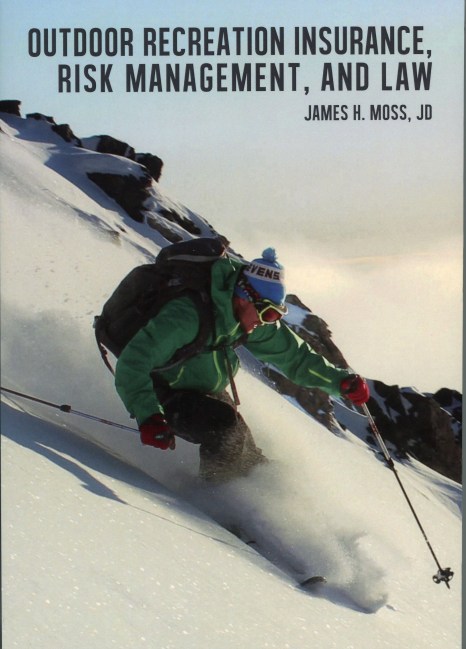
Outdoor Recreation Insurance, Risk Management, and Law
To see Jim’s complete bio go here and to see his CV you can find it here. To find out the purpose of this website go here.
If you are interested in having me write your release, download the form and return it to me.
Connect
If you like this let your friends know or post it on FB, Twitter, or LinkedIn
Facebook Page: Outdoor Recreation & Adventure Travel Law
LinkedIn https://www.linkedin.com/in/recreationlaw/
Threads https://www.threads.net/@recreation_law
X https://twitter.com/RecreationLaw
Email: Jim@Rec-Law.US
By Recreation Law Rec-law@recreation-law.com James H. Moss
@2018-2023 Summit Magic Publishing, LLC
G-YQ06K3L262
#AdventureTourism, #AdventureTravelLaw, #AdventureTravelLawyer, #AttorneyatLaw, #Backpacking, #BicyclingLaw, #Camps, #ChallengeCourse, #ChallengeCourseLaw, #ChallengeCourseLawyer, #CyclingLaw, #FitnessLaw, #FitnessLawyer, #Hiking, #HumanPowered, #HumanPoweredRecreation, #IceClimbing, #JamesHMoss, #JimMoss, #Law, #Mountaineering, #Negligence, #OutdoorLaw, #OutdoorRecreationLaw, #OutsideLaw, #OutsideLawyer, #RecLaw, #Rec-Law, #RecLawBlog, #Rec-LawBlog, #RecLawyer, #RecreationalLawyer, #RecreationLaw, #RecreationLawBlog, #RecreationLawcom, #Recreation-Lawcom, #Recreation-Law.com, #RiskManagement, #RockClimbing, #RockClimbingLawyer, #RopesCourse, #RopesCourseLawyer, #SkiAreas, #Skiing, #SkiLaw, #Snowboarding, #SummerCamp, #Tourism, #TravelLaw, #YouthCamps, #ZipLineLawyer, #RecreationLaw, #OutdoorLaw, #OutdoorRecreationLaw, #SkiLaw,
Corwin, et al., v. NYC Bike Share, LLC, et al., 238 F. Supp. 3d 475; 2017 U.S. Dist. LEXIS 29034
Posted: February 22, 2018 Filed under: Assumption of the Risk, Cycling, Legal Case, New York, Release (pre-injury contract not to sue), Uncategorized | Tags: affirmative defenses, Assumption of risk, bicycle, Bike, Bike Share, Citi Bike, Contractor, Cyclists, genuine, helmet, Immunity, installation, installed, lane, matter of law, Membership, municipality, negligence claims, New York City Bike Share, Notice, Open and Obvious, parking, planning, Primary Assumption of the Risk, Public Policy, Qualified Immunity, recreational, Release, Release / Waiver, release agreement, rider, riding, roadway, safe, station, street, Summary judgment, Traffic, user, wear, Wheel Leave a commentTo Read an Analysis of this decision see
Only a New York City bike share case create a 34-page opinion on just motions that are filed. The results are all over the board, both the defendants and the plaintiff winning issues on an electronic release
Corwin, et al., v. NYC Bike Share, LLC, et al., 238 F. Supp. 3d 475; 2017 U.S. Dist. LEXIS 29034
Ronald D. Corwin, et al., Plaintiffs, -against- NYC Bike Share, LLC, et al., Defendants.
14-CV-1285 (SN)
UNITED STATES DISTRICT COURT FOR THE SOUTHERN DISTRICT OF NEW YORK
238 F. Supp. 3d 475; 2017 U.S. Dist. LEXIS 29034
March 1, 2017, Decided
March 1, 2017, Filed
SUBSEQUENT HISTORY: Reconsideration denied by Corwin v. NYC Bike Share, LLC, 2017 U.S. Dist. LEXIS 53812 (S.D.N.Y., Apr. 7, 2017)
Summary judgment granted by Corwin v. NYC Bike Share, LLC, 2017 U.S. Dist. LEXIS 57254 (S.D.N.Y., Apr. 13, 2017)
CORE TERMS: bike, station, wheel, helmet, bicycle, summary judgment, street, cyclist’s, parking, user, roadway, lane, public policy, matter of law, traffic, wear, installation, riding, notice, negligence claims, qualified immunity, affirmative defenses, municipality, contractor, installed, recreational, planning, genuine, rider, safe
COUNSEL: [**1] For Ronald D. Corwin, Beth Blumenthal, Plaintiffs: Martin William Edelman, LEAD ATTORNEY, Edelman & Edelman, P.C., New York, NY; Michael K. O’Donnell, LEAD ATTORNEY, Law Office of Michael K. O’donnell, Greenwich, CT; Neil R. Finkston, Law Office of Neil R. Finkston, Great Neck, NY.
For NYC Bike Share LLC, Alta Bicycle Share, Inc., Defendants, Cross Claimants, Cross Defendants: Peter W. Beadle, Law Offce of Vaccaro & White, LLP, New York, NY; Steve Vaccaro, Law Offices of Vaccaro and White, New York, NY.
For City of New York, Defendant: Eileen Theresa Budd, Lewis Brisbois Bisgaard & Smith LLP, New York, NY; Howard Martin Wagner, Trief and Olk, New York, NY; Judith Feinberg Goodman, Goodman & Jacobs LLP, New York, NY.
For Alta Planning + Design, Inc., Alta Planning Design Architecture of New York, PLLC, Defendants, Cross Defendants: Kevin Jude O’Neill, LEAD ATTORNEY, Gogick, Byrne & O’Neil, LLP, New York, NY; Katherine Buchanan, The Law Firm of Hall & Hall, LLP, Staten Island, NY.
For MetroExpress Services, Inc., Defendant: Kevin F. Pinter, LEAD ATTORNEY, Nicoletti, Gonson, Spinner & Owen, LLP, New York, NY; Gary Richard Greenman, Nicoletti Gonson Spinner LLP, New York, NY.
For Sealcoat USA, [**2] Inc., Defendant, Cross Defendant: John P. Cookson, LEAD ATTORNEY, McElroy, Deutsch, Mulvaney & Carpenter, LLP (NY), New York, NY; Brian L. Battisti, Morrison Mahoney, LLP(NYC), New York, NY.
For Sealcoat USA Inc., ADR Provider: Mitchell John Baker, LEAD ATTORNEY, Baker, Leshko, Saline & Blosser, LLP, White Plains, NY.
For Metro Express, Inc., Interested Party: Kevin F. Pinter, LEAD ATTORNEY, Nicoletti, Gonson, Spinner & Owen, LLP, New York, NY; Gary Richard Greenman, Nicoletti Gonson Spinner LLP, New York, NY.
For New York City Department of Transportation, Cross Claimant, Cross Defendant: Kimberly Kristen Brown, Hoey, King,Epstein, Prezioso & Marquez, New York, NY.
For NYC Bike Share LLC, Cross Claimant, Cross Defendant: Steve Vaccaro, Law Offices of Vaccaro and White, New York, NY.
For City of New York, Cross Claimant, Cross Defendant: Eileen Theresa Budd, Lewis Brisbois Bisgaard & Smith LLP, New York, NY.
For Alta Planning Design, Inc., Alta Planning Design Architecture of New York, PLLC, Cross Claimants, Cross Defendants: Kevin Jude O’Neill, LEAD ATTORNEY, Gogick, Byrne & O’Neil, LLP, New York, NY.
For Beth Blumenthal, Cross Defendant: Martin William Edelman, LEAD ATTORNEY, Edelman & [**3] Edelman, P.C., New York, NY; Michael K. O’Donnell, LEAD ATTORNEY, Law Office of Michael K. O’donnell, Greenwich, CT.
For City of New York, Cross Claimant, Cross Defendant: Eileen Theresa Budd, Lewis Brisbois Bisgaard & Smith LLP, New York, NY; Judith Feinberg Goodman, Goodman & Jacobs LLP, New York, NY.
For MetroExpress Services, Inc., MetroExpress Services, Inc., Cross Defendant, Cross Claimants: Gary Richard Greenman, Nicoletti Gonson Spinner LLP, New York, NY.
For Sealcoat USA, Inc., Cross Claimant: John P. Cookson, LEAD ATTORNEY, McElroy, Deutsch, Mulvaney & Carpenter, LLP (NY), New York, NY.
JUDGES: SARAH NETBURN, United States Magistrate Judge.
OPINION BY: SARAH NETBURN
OPINION
[*480] OPINION & ORDER
SARAH NETBURN, United States Magistrate Judge:
On October 25, 2013, Ronald D. Corwin, an annual member of the Citi Bike bicycle sharing program, was riding a Citi Bike in Midtown Manhattan. Upon passing through a Citi Bike station located on East 56th Street and Madison Avenue, he collided with a concrete wheel stop and violently hit his head against the cement. Alleging [*481] that the Citi Bike station in question was improperly designed, installed, and maintained, Corwin brought claims for common-law and gross negligence and [**4] professional negligence and malpractice, and Beth Blumenthal, Corwin’s wife, brought derivative claims for loss of her husband’s services, society, companionship, and consortium.1
1 As Blumenthal’s claims depend entirely on the viability of Corwin’s causes of actions, the two claims are referred to in shorthand as “Corwin’s” throughout the text of the opinion. Where the Court grants summary judgment or partial summary judgment to defendants on certain of Corwin’s claims, Blumenthal’s claims are dismissed as well. Vega-Santana v. Nat’l R.R. Passenger Corp., 956 F. Supp. 2d 556, 562 (S.D.N.Y. 2013) (“Where the primary cause of action is dismissed on summary judgment, the loss of consortium claim must be dismissed as well.”).
On February 27, 2014, Corwin brought claims against three defendants: the City of New York (“City”), who planned, oversaw, and collaborated with the other defendants in implementing the Citi Bike program; NYC Bike Share, LLC (“NYCBS”), the company operating the Citi Bike system, and the New York City Department of Transportation (“DOT”). ECF No. 1, Compl. On December 31, 2014, Corwin amended his complaint to remove the DOT and add three additional defendants: Alta Bicycle Share, Inc. (now named “Motivate, Inc.”), which is NYCBS’s parent company; and Alta Planning + Design (“APD”) and Alta Planning + Design + Architecture of New York (“APDNY”), a design company and its wholly-owned subsidiary who drafted site plans for the Citi Bike system. ECF No. 27, First Am. Compl. After conducting significant discovery, Corwin moved for and was granted leave to amend his complaint to join two additional defendants, Metro Express Services, Inc. (“Metro Express”) and Sealcoat USA, Inc. (“Sealcoat”), both contractors who are [**5] alleged to have participated, in violation of the station’s design plan, in the installation of the wheel stop struck by Corwin. ECF No. 192, Second Am. Compl.
All of the defendants move separately for summary judgment on a variety of grounds.2 All defendants argue that the condition was open and obvious and that Corwin’s negligence claims generally fail as a matter of law. The City, NYCBS, and APD argue that Corwin’s common-law negligence claims were released by the Bicycle Rental, Liability Waiver, and Release Agreement (“Release Agreement”) that he had to sign as a condition of Citi Bike membership, and that they are barred by the doctrine of primary assumption of the risk. APD, Metro Express and Sealcoat argue that, as third-party entities in a contractual relationship with Corwin, they owed him no duty of care. APD additionally argues that the Citi Bike station’s deviation from the design is an absolute bar to liability, and that there was no causation between its design and Corwin’s injury. The City also contends that Corwin’s claims are barred due to the doctrine of qualified immunity and its lack of written notice of the condition pursuant to a municipal notice statute.
2 As their liability is exclusively a product of being a parent company of a wholly owned subsidiary, Alta Bicycle Share, Inc./Motivate, Inc. moves for summary judgment together with NYCBS, and APD moves together with APDNY. For the sake of brevity, these motions are referred to as the “NYCBS” and “APD” motions, respectively.
For his [**6] part, Corwin moves for partial summary judgment on two issues. First, he argues that the Release Agreement is unenforceable on numerous statutory, public policy, and contract formation grounds, and that defendants’ affirmative defenses [*482] relying on the Agreement should be dismissed as a matter of law. Second, he contends that the fact that he was not wearing a helmet at the time of the accident is irrelevant as a matter of law to issues of assumption of the risk, comparative fault, or failure to mitigate damages, and therefore defendants’ affirmative defenses relying on this argument should be dismissed.
For the following reasons, the cross-motions for summary judgment are GRANTED in part and DENIED in part. Corwin’s motion to dismiss defendants’ affirmative defenses relying on the Release Agreement is DENIED as to NYCBS; the Agreement is enforceable as a matter of law as to NYCBS. Corwin’s motion to dismiss the affirmative defenses relating to the Release Agreement is GRANTED as to the City because a contractual waiver of the City’s non-delegable duty to maintain public thoroughfares would be contrary to public policy. Corwin’s motion to dismiss defendants’ affirmative defenses relating [**7] to his non-use of a helmet is GRANTED in part; defendants may not argue that this is relevant to questions of liability to establish comparative negligence or assumption of the risk, but if liability is found, may argue that Corwin failed to mitigate damages. The City’s motion for summary judgment is DENIED; as stated above, the Release Agreement is ineffective to waive Corwin’s claims at to the City, and the City has not demonstrated its entitlement to judgment as a matter of law on qualified immunity, notice, or other grounds. NYCBS’s motion for summary judgment is GRANTED in part; because the Court finds that the Release Agreement is enforceable as to NYCBS, Corwin’s common-law negligence claims are barred, but he may still maintain gross negligence claims. APD’s motion for summary judgment is GRANTED because APD and APDNY did not owe any duty to Corwin. Accordingly, APD and APDNY are dismissed from this case. Metro Express and Sealcoat’s motions for summary judgment are DENIED because a genuine dispute of material fact exists as to whether they owed Corwin a duty of care under applicable New York law.
BACKGROUND
I. History of the Citi Bike Program
Beginning in 2009, the City of New [**8] York began to study the feasibility of installing a bike share system in and around City streets, located in curbside parking lanes, on sidewalks, and near public spaces and parks. ECF No. 293, City’s Rule 56.1 Statement (“City St.”) ¶ 2. On April 10, 2012, the City and NYCBS entered into an agreement for the design, construction, operation, maintenance, and publicizing of “Citi Bike,” a network of self-service bike share stations with publicly available bicycles. ECF No. 310, Corwin’s Rule 56.1 Statement (“Corwin St.”) ¶ 2. The system became operational in May 2013. City St. ¶ 5; ECF No. 317, NYCBS’s Rule 56.1 Statement (“NYCBS St.”) ¶ 1.
The City-NYCBS contract required NYCBS to design and install on-street bike parking stations “with appropriate protections and markings from adjacent parking and moving traffic. . . . [including] non-permanent bollards and paint markings.” City St. ¶ 31. The contract also noted that all protections and markings were to be preapproved by the DOT’s Division of Traffic. Id.
The design for the Citi Bike stations was modeled in part on the City’s previous experience with “bike corrals,” which were also placed in parking lanes and were designed by the DOT’s Highway Design Unit and [**9] Pedestrian and Bicycle Group. City St. ¶¶ 41-42. These corrals had many elements that would ultimately be integrated [*483] into the Citi Bike stations, such as wheel stops, paint marking and bollards. Id. ¶ 42.
At the time that the NYCBS contract was signed with the City, APD and APDNY were subsidiaries of Alta Bicycle Share, Inc., NYCBS’s parent company. Id. ¶ 48. APD assembled a team of architects, engineers, and designers to collaborate with the City on station design. Id. ¶¶ 49-50. Using a bike corral on Smith and Sackett Street as an exemplar, the APD and the City developed “Station Siting Guidelines” that included the use of unpainted, concrete wheel stops. Id. ¶¶ 51-57. Though the City originally approved the use of rubber wheel stops, it instructed NYCBS to replace them with concrete wheel stops because the rubber stops were not sufficiently durable. Id. ¶ 96. The wheel stops were considered by APD to be necessary to prevent damage to the station equipment by encroaching vehicles. Id. ¶ 58.
The final design for Citi Bike stations situated in parking lanes included white thermoplastic markings and three-foot tall, reflective, flexible delineators on or near the markings. Wheel stops [**10] were to be used in the stations to protect the station equipment. Id. ¶¶ 64-66. These elements were collectively referred to as “street treatment.” Id. ¶ 81. While NYCBS installed the station equipment directly, it contracted the installation of street treatment to Metro Express, allegedly without the City’s awareness. Id. ¶ 83. MetroExpress, in turn, subcontracted this work to another entity, Sealcoat, allegedly without the awareness of either the City or NYCBS. Id. ¶¶ 85-86.
The City considered, but chose not to mandate that Citi Bike riders wear helmets. It also did not provide helmets for Citi Bike riders on demand. Id. ¶ 8. The City came to this conclusion because (a) New York law did not mandate that adult cyclists wear helmets and it did not want to promote different standards for Citi Bike riders and other cyclists as a matter of public policy; (b) it believed, based on studies conducted in other cities, that mandatory helmet laws decreased bicycle ridership in general and bike share system use in particular; (c) certain statistics indicated that mandatory helmet laws actually decreased cyclist safety by reducing the number of cyclists on the road; and (d) research suggested [**11] that helmeted cyclists tended to ride more recklessly than those without helmets. Id. ¶¶ 9-16; Corwin St. ¶ 10. The City also specifically evaluated the feasibility and wisdom of instituting a public helmet distribution system, but ultimately concluded that there were numerous logistical barriers to such a system, such as hygiene, the fact that the structural integrity of helmets would be compromised if they were involved in an accident, and lack of proper fitting and sizing capabilities. City St. ¶¶ 18-22. The City further considered what it viewed as unfavorable experiences with such systems in Seattle, Boston, and Melbourne, Australia. Id. ¶ 25. The City did, however, provide annual Citi Bike members with discounted vouchers for helmets and expanded its helmet giveaway and fitting programs. Id. ¶¶ 27-28.
II. Design and Installation of Citi Bike Station on East 56th Street and Madison Avenue
The station where Ronald Corwin’s accident occurred was located at the intersection of East 56th Street and Madison Avenue. Id. ¶ 98. The City issued a permit to NYCBS for the installation of the station on July 22, 2013, and the station equipment was installed on July 30, 2013. Id. ¶¶ 103-04. [**12] The City approved APD’s design drawing of the station on August 6, 2013, including all street treatment. Id. ¶ 100. The approved design had only one wheel stop at the west end of the station, [*484] no thermoplastic striping within the boxes at the ends of the station, a station width of eight feet, and a total of six delineators. ECF No. 301, Alta Planning and Design Rule 56.1 Statement (“APD St.”) ¶ 30. None of the site plan drawings, including the approved drawing, contained a wheel stop at the east end of the station closest to Madison Avenue.
The street treatment at the East 56th Street and Madison Avenue station was installed on or about October 22, 2013. APD St. ¶ 31. Notwithstanding its absence on the approved plan, a wheel stop was installed at the east end of the station as well, and the station did not conform to the approved plan in several other respects: the station footprint was made wider by the installation of thermoplastic striping more than eight feet in width, additional delineators were added, and cross-hatched striping was installed on either end of the station underneath the wheel stops. Id. ¶ 34. Though this is disputed by the defendants, Corwin argues that the wider footprint [**13] is relevant because, as it provided less clearance between the edge of the station and moving traffic, it would have encouraged a cyclist to use the station itself as a temporary riding lane. ECF No. 335, Decl. of Pl.’s Exp. James E. Green, ¶¶ 56-58. The City denies approving the installation of a second wheel stop at this site, and claims that its records do not show that it had written notice regarding the additional wheel stop. City St. ¶¶ 102, 106, 108.
The entity responsible for installing the wheel stop is contested; Metro Express and Sealcoat contend that an October 18, 2013 email from NYCBS informed them only of the need for repairs to the station, and that after Sealcoat representative Ryan Landeck visited the station on October 22, 2013, he reported that there was nothing to be done at the station in a October 24, 2013 email to Metro Express. ECF No. 368-3, Landeck Depo. at 41, 51; ECF No. 368-4, Landeck Oct. 24, 2013 E-mail. Metro Express further contends that the City had often instructed NYCBS, who in turn had instructed Metro Express to install “Supplemental Street Treatments” not depicted on station plans, and that such supplemental installations included second wheel [**14] stops. ECF No. 368-8, May 17, 2013 Email; ECF No. 335-20, Strasser 06/28/16 Depo. at 48-51. Metro Express alleges that on July 17, 2013, and October 9, 2013, it was specifically ordered by NYCBS to install a second wheel stop not depicted on station plans at three stations around the network. ECF 368-10; 368-11; 368-12; 368-13; 368-14. There is no direct evidence in the record, however, that such a request was ever issued for the East 56th Street and Madison Avenue station.
III. Ronald Corwin’s Citi Bike Membership and Release Agreement
Ronald Corwin signed up online for an annual Citi Bike membership on June 25, 2013. Corwin St. ¶ 15. Corwin does not remember the details of the process, and did not recall clicking on or reading the Bicycle Rental, Liability Waiver, and Release Agreement as a condition of membership. Id. ¶ 18. Nevertheless, he did admit in deposition testimony that “I don’t deny that I signed whatever it is I had to sign in order to get my Citi Bike Pass.” NYCBS St. ¶ 21. NYCBS has not, however, produced a version of the Agreement dated contemporaneously to Corwin’s registration, or Corwin’s actual electronic signature. Corwin St. ¶ 22.
While the applicability and enforceability [**15] of the Release Agreement is disputed by the parties, there is no serious dispute as to its content. NYCBS has produced an agreement dated July 25, 2014, and Justin Ginsburgh, former General Manager of [*485] NYCBS and current Vice President of Business Development of its parent company Motivate Inc./Alta Bicycle Share, testified that this agreement was active on the date that Corwin became a member. ECF No. 316, Ginsburgh Decl. ¶¶ 10; ECF No. 371-3, Ginsburgh Supp. Decl. ¶¶ 2-3; ECF 316-1, Bicycle Rental, Liability Waiver, and Release Agreement (“Release Agreement”). Ginsburgh attested that it would be impossible to become a Citi Bike member without first being shown the Release Agreement in a scrollable text box and then clicking a box stating “I certify that I am the Member, I am 18 years old or over, and I have read and agree to the conditions set forth in (sic) User Agreement.” NYCBS St. ¶¶ 17-18; City St. ¶¶ 118-20.
The Release Agreement contains several provisions, which are reproduced below in relevant part:
Section 6. Releases:
In exchange for You being allowed to use any of the Services, Citi Bike bicycles, Stations, Bike Docks, or related information, You . . . do hereby fully and forever release [**16] and discharge all Released Persons for all Claims that You have or may have against any Released Person, except for Claims caused by the Released Person’s gross negligence or willful misconduct. Such releases are intended to be general and complete releases of all Claims. The Released Persons may plead such releases as a complete and sufficient defense to any Claim, as intended 3rd beneficiaries of such releases.
“Claims” is defined in the Release Agreement as “any and all claims, injuries, demands, liabilities, disputes, causes of action (including statutory, contract, negligence, or other tort theories), proceedings [or] damages that arise from or relate to (a) any of the Services, including any of the Citi Bike bicycles, Stations, Bike Docks, or related information . . . .” “Released Persons” is defined in the Agreement, as relevant, as including: “(i) NYCBS and all of its owners, managers, affiliates, employees, agents, representatives, successors, and assigns [and] (ii) the City of New York.”
Section 7. Disclaimers:
You do hereby acknowledge and agree that your use of any of the services, Citi Bike bicycles, stations, bike docks, or releated [sic] information, is at your sole risk. . . . [**17] All of the services, Citi Bike bicycles, stations, bike docks, or related information are provided “as is” and “as available” (and you rely on them solely at your own risk). . . . You assume full responsibility and risk of loss for using any of the services, Citi Bike bicycles, stations, bike docks, or releated [sic] information, and NYCBS and all other released persons are not liable for any claim attributable to any of the foregoing.
Section 8. Limited Liability:
You do hereby acknowledge and agree that, except as may otherwise be limited by New York General Obligation Law Section 5-326, NYCBS and all other released persons are not responsible or liable for any claim, including those that arise out of or relate to (A) any risk, danger or hazard described in the Agreement, (B) Your use of or inability to use, any of the services, Citi Bike bicycles, stations, bike docks, or releated (sic) information, (C) your breach of this agreement or your violation of any law, (D) any negligence, misconduct, or other action or inaction by you, (E) your failure to wear a bicycles helmet while using Citi Bike bicycle, or (F) any negligence, misconduct, or other action or inaction of any third party. You do hereby waive all claims with respect to any [**18] [*486] of the foregoing, including those based in contract, tort (including negligence), statutory, or other grounds, even if NYCBS or any of the other released persons has been advised of the possibility of such claims. The total liability of NYCBS and all other released persons for all claims, including those based in contract, tort (including negligence), statutory, or other grounds, is limited to the sum of $100.
Section 9. Assumption of Risk by Member:
Member agrees that riding a Citi Bike bicycle involves many obvious and not-so-obvious risks, dangers, and hazards, which may result in injury or death to Member or others, as well as damage to property, and that such risks, dangers, and hazards cannot always be predicted or avoided. Member agrees that such risks, dangers, and hazards are Member’s sole responsibility.
IV. Ronald Corwin’s Ride and Accident
At 10:57 a.m. on October 25, 2013, Ronald Corwin picked up a Citi Bike at a station located on the southeastern corner of 6th Avenue and East 56th Street. From there, he travelled in the direction of Grand Central Station. Corwin St. ¶ 25; NYCBS St. ¶ 32. He was not wearing a helmet. Corwin St. ¶ 26; City St. ¶ 137. Corwin proceeded eastbound in the [**19] traffic lane on East 56th Street, with vehicular traffic proceeding to his left. NYCBS St. ¶ 34. Because Corwin claimed to have been “under pressure” from the vehicular traffic, he turned into the Citi Bike station on East 56th Street and Madison Avenue. Id. ¶ 35. The station area was indicated by a perimeter of 4 inch white thermoplastic stripes on the asphalt roadway, and three foot tall white flexible delineators with gray reflective tape spaced approximately every 10 feet along the thermoplastic striping. Id. ¶ 36. At either end of the station, unpainted concrete wheel stops measuring 5 feet, 10.5 inches long by five inches high, were installed on the roadway. Id. ¶ 40. These wheel stops were framed by a box of white thermoplastic striping with diagonal cross-hatching, staked out by three-foot tall flexible delineators. Id. ¶ 41. While he was travelling within the station “envelope,” the front wheel of Corwin’s Citi Bike hit the concrete wheel stop installed near the crosswalk at the Madison Avenue end of the station, causing him to crash onto the pavement and sustain serious injury. Corwin St. ¶ 26.
ANALYSIS
I. Standard of Review
Under Federal Rule of Civil Procedure 56(a), the court “shall grant summary judgment if [**20] the movant shows that there is no genuine dispute as to any material fact and the movant is entitled to judgment as a matter of law.” See also Celotex Corp. v. Catrett, 477 U.S. 317, 322-23, 106 S. Ct. 2548, 91 L. Ed. 2d 265 (1986). The moving party must show that “under the governing law, there can be but one reasonable conclusion as to the verdict.” Anderson v. Liberty Lobby, Inc., 477 U.S. 242, 250, 106 S. Ct. 2505, 91 L. Ed. 2d 202 (1986). The moving party bears the initial burden of establishing that there are no material facts in dispute and must provide “affirmative evidence” from which a factfinder could return a verdict in its favor. Id. at 257. Then “the burden shifts to the nonmovant to point to record evidence creating a genuine issue of material fact.” Salahuddin v. Goord, 467 F.3d 263, 273 (2d Cir. 2006). “[T]he trial court’s task at the summary judgment motion stage of the litigation is carefully limited to discerning whether there are any genuine issues of material fact to be tried, not to [*487] deciding them. Its duty, in short, is confined at this point to issue-finding; it does not extend to issue-resolution.” Gallo v. Prudential Residential Servs., LP, 22 F.3d 1219, 1224 (2d Cir. 1994).
In determining whether summary judgment is appropriate, the court must resolve all ambiguities and draw all reasonable inferences in the light most favorable to the non-moving party. See Scott v. Harris, 550 U.S. 372, 378, 127 S. Ct. 1769, 167 L. Ed. 2d 686 (2007). Summary judgment is improper if “there is any evidence in the record from any source from which a reasonable inference [**21] could be drawn in favor of the nonmoving party. . . .” Chambers v. TRM Copy Ctrs. Corp., 43 F.3d 29, 37 (2d Cir. 1994). To create a disputed fact sufficient to deny summary judgment, the non-moving party must produce evidence in the record and “may not rely simply on conclusory statements or on contentions that the affidavits supporting the motion are not credible. . . .” Ying Jing Gan v. City of New York, 996 F.2d 522, 532 (2d Cir. 1993). Instead, the response “must set forth specific facts demonstrating that there is a genuine issue for trial.” Wright v. Goord, 554 F.3d 255, 266 (2d Cir. 2009) (citation and internal quotation marks omitted).
II. Waiver and Release
It is undisputed that in order to become a member of Citi Bike, Corwin would have been required to assent to a release of claims as set forth in the Bicycle Rental, Liability Waiver, and Release Agreement (“Release Agreement”). This Agreement covered “any and all claims, injuries, demands, liabilities, causes of action (including statutory, contract, negligence, or other tort theories) . . . that arise from or relate to (a) any of the Services, including any of the Citi Bike bicycles, Stations, Bike Docks, or related information or (b) Your use of any of the foregoing.” It required Corwin to “discharge all Released Persons for all Claims that You have or may have against any Released Person, except [**22] for Claims caused by the Released Person’s gross negligence or willful misconduct.” ECF 316-1, Release Agreement. As relevant here, the Agreement expressly included NYCBS and the City of New York, as well as all of NYCBS’s “owners, managers, affiliates, employees, agents, representatives, successors, and assigns” within the definition of “Released Persons.” Id.
Corwin moves for partial summary judgment to strike the City and NYCBS’s affirmative defenses based on the Release Agreement, arguing that the Agreement is ambiguous, contrary to law, and/or void as a matter of public policy. For their part, the City and NYCBS move for summary judgment arguing that Corwin’s negligence claims against them are waived by the release, with the exception of those sounding in gross negligence. Though it is not expressly named in the release, APD also argues that the claims against it are released because of its relationship to NYCBS.
As a threshold issue, the Court considers if there is a genuine dispute as to whether Corwin signed a release and, if so, its scope. Corwin argues that because defendants have failed to produce an actual copy of the Release Agreement with his electronic signature, or a [**23] copy of the Agreement as it existed when he became an annual member, defendants cannot demonstrate that he signed the waiver at all. Defendants have produced a declaration from Justin Ginsburgh, former General Manager of NYCBS and current Vice President of Business Development of its parent company Motivate Inc./Alta Bicycle Share, that describes the membership process and states that Corwin would have [*488] had to agree to the terms of the Agreement in order to become a member. ECF No. 316, Ginsburgh Decl., ¶¶ 7-9. Ginsburgh also declares that the Release Agreement appended to his declaration, dated July 15, 2014, was a “true and complete copy of the User Agreement that was in effect in May 2013 when Mr. Corwin became a Citi Bike member.”3 Id. at ¶ 10; ECF No. 371-3, Ginsburgh Supp. Decl., ¶¶ 2-3 (“The User Agreement . . . was fully in effect when plaintiff Ronald Corwin obtained his Citi Bike membership on June 25, 2013.”). Ginsburgh had previously noted in deposition testimony, however, that he was no longer in his General Manager position as of April 1, 2014, and therefore “[didn’t] know if any changes occurred [to the membership signup] after that.” ECF No. 360-6, Justin Ginsburgh Depo. [**24] at 463. Corwin stated in deposition testimony that he completed the membership application and “signed whatever it is [he] had to sign in order to get [his] Citi Bike pass,” but did not remember the contents of the Agreement or whether he had read it. ECF No. 315-4, Ronald Corwin 9/9/2015 Depo. at 195.
3 The first Ginsburgh Declaration inaccurately references Corwin becoming a Citi Bike member in May 2013; in fact, Corwin became a Citi Bike member on June 25, 2013.
Corwin has failed to “set forth specific facts demonstrating that there is a genuine issue for trial,” Wright, 554 F.3d at 266, as to the existence and scope of the Agreement. Defendants have produced declaration testimony from Justin Ginsburgh, and Corwin has challenged the credibility of those statements. He has not, however, despite extensive discovery, introduced any evidence that there was an agreement with different terms in effect when Corwin became a Citi Bike member, or even any evidence that raises doubt as to whether the Agreement provided by defendants was in effect. Nor has Corwin provided any evidence that he was somehow able to sign up for his Citi Bike membership without following the process described by Ginsburgh, which required him to manifest assent to the Release Agreement. Therefore, Corwin has failed to raise a genuine dispute of material fact regarding the existence of a contract between [**25] the parties. Accordingly, whether or not Corwin’s claims are barred by the Release Agreement shall depend solely on the effectiveness of Corwin’s assent under the circumstances, and the enforceability of the waiver provisions as to the various defendants.
A. Unconscionability Analysis in Online “Clickwrap” Contracts
The first question for the Court’s consideration is whether, absent any overarching questions of statutory or common law public policy, the contract is enforceable on its own terms or whether, as Corwin argues, it is an “unconscionable and unenforceable contract of adhesion.” A contract or clause is unconscionable when it was “both procedurally and substantively unconscionable when made–i.e., some showing of an absence of meaningful choice on the part of one of the parties together with contract terms which are unreasonably favorable to the other party.” Gillman v. Chase Manhattan Bank, N.A., 73 N.Y.2d 1, 10, 534 N.E.2d 824, 537 N.Y.S.2d 787 (1988) (internal quotation marks and citations omitted); see also Desiderio v. Nat’l Ass’n of Sec. Dealers, Inc., 191 F.3d 198, 207 (2d Cir. 1999).
The parties agree that the contract in question is a “clickwrap” agreement. Such an agreement requires the user to take an affirmative action, usually, the clicking of a box that states that he or she has read and agrees to the terms of [*489] service. “[U]nder a clickwrap arrangement, [**26] potential licensees are presented with the proposed license terms and forced to expressly and unambiguously manifest either assent or rejection prior to being given access to the product.” Register.com, Inc. v. Verio, Inc., 356 F.3d 393, 429 (2d Cir. 2004). Clickwrap agreements are “more readily enforceable [than online contracts that do not require the user to take an affirmative action], since they ‘permit courts to infer that the user was at least on inquiry notice of the terms of the agreement, and has outwardly manifested consent by clicking a box.'” Meyer v. Kalanick, No. 15-CV-9796 (JSR), 199 F. Supp. 3d 752, 2016 U.S. Dist. LEXIS 99921, 2016 WL 4073071, at *6 (S.D.N.Y. July 29, 2016) (citing Cullinane v. Uber Techs., Inc., No. 14-CV-14750 (DPW), 2016 U.S. Dist. LEXIS 89540, 2016 WL 3751652, at *6 (D. Mass. July 11, 2016)). While the Court of Appeals has not categorically ruled on the issue, it has strongly implied that such contracts are presumptively enforceable. See, e.g., Starkey v. G Adventures, Inc., 796 F.3d 193, 197 (2d Cir. 2015) (noting that case would have been “simpler to resolve had [defendant] used a ‘clickwrap’ mechanism to provide reasonable notice and to obtain [plaintiff’s] assent”). Accordingly, most lower courts have enforced such contracts, absent extraordinary circumstances. See Berkson v. Gogo LLC, 97 F. Supp. 3d 359, 397 (E.D.N.Y. 2015) (collecting cases); Centrifugal Force, Inc. v. Softnet Commc’n, Inc., No. 08-CV-5463 (CM), 2011 U.S. Dist. LEXIS 20536, 2011 WL 744732, at *7 (S.D.N.Y. Mar. 1, 2011) (“In New York, clickwrap agreements are valid and enforceable contracts.”).
Nevertheless, a user’s clicking of a box is not, without more, sufficient to signal their assent to any contract term. The touchstone in most courts’ analysis of the enforceability [**27] of clickwrap contracts turns on whether the website provided “reasonably conspicuous notice that [users] are about to bind themselves to contract terms.” Specht v. Netscape Commc’ns Corp., 306 F.3d 17, 32 (2d Cir. 2002) (Sotomayor, J.). In many cases, this becomes a fact-intensive inquiry because “electronic agreements fall along a spectrum in the degree to which they provide notice, and it is difficult to draw bright-line rules because each user interface differs from others in distinctive ways.” Meyer, 2016 U.S. Dist. LEXIS 99921, 2016 WL 4073071, at *8.
In Berkson, Judge Weinstein of the Eastern District of New York, surveying cases from federal courts nationwide, provided a useful set of parameters to guide this inquiry. First, terms of use should not be enforced if a reasonably prudent user would not have had at the very least inquiry notice of the terms of the agreement. Berkson, 97 F. Supp. 3d at 401 (citing Nguyen v. Barnes & Noble Inc., 763 F.3d 1171, 1177 (9th Cir. 2014)). Second, terms should be enforced when a user is encouraged by the design and content of the website and the agreement’s webpage to examine the terms, such as when they are clearly available through hyperlink. Id. (citing Ticketmaster Corp. v. Tickets.Com, Inc., No. 99-CV-7654 (HLH), 2003 U.S. Dist. LEXIS 6483, 2003 WL 21406289, at *2 (C.D. Cal. Mar. 7, 2003)). Conversely, terms should not be enforced when they are “buried at the bottom of a webpage” or “tucked away in obscure corners.” Id. at 401-02 (collecting cases refusing to enforce such agreements). Special attention [**28] should be paid to whether the site design brought the consumer’s attention to “material terms that would alter what a reasonable consumer would understand to be her default rights when initiating an online [transaction],” and, in appropriate cases, such terms should not be enforced even when the contract is otherwise enforceable. Id. at 402; see also Meyer, 2016 U.S. Dist. LEXIS 99921, 2016 WL 4073071, at *10 (“When contractual terms as significant as . . . the right to sue in court are accessible only via a small and distant hyperlink . . . with text [*490] about agreement thereto presented even more obscurely, there is a genuine risk that a fundamental principle of contract formation will be left in the dust: the requirement for a manifestation of mutual assent.”) (internal quotation marks and citation omitted). Broad exculpatory clauses waiving liability for negligence would certainly qualify as material terms that alter a contracting party’s commonly-understood default rights.
In this case, NYCBS represents that “before the prospective member can proceed to pay for the membership, each person is shown the . . . ‘User Agreement.’ The User Agreement is displayed on the page in its own scrollable text box, which may also be opened in a new window for ease [**29] of viewing and printing.” ECF No. 316, Ginsburgh Decl., at ¶ 7. The “continue” button allowing Corwin to provide his payment information would not activate until Corwin clicked on a statement reading “I certify that I am the Member, I am 18 years old or over, and I have read and agree to the conditions set forth in [sic] User Agreement.” Id. at ¶¶ 8-9; Release Agreement, ECF No. 316-1 at 56. The Release Agreement itself, roughly 10 pages in length, contained a bold-faced and underlined section in larger font titled “Releases; Disclaimers; Limited Liability; Assumption of the Risk.” The text of the sections in question are in normal-sized font. Though Corwin stated that he had no specific recollection of reading and signing the Release Agreement, he did admit “I don’t deny that I signed whatever it is I had to sign in order to get my Citi Bike pass.” ECF No. 315-4, Ronald Corwin 9/9/2015 Depo. at 195.
Applying the considerations in Berkson, the Release Agreement is enforceable. The full scrollable text of the agreement was available on the same page a user must utilize to register, requiring no clicking of hyperlinks, and the user cannot continue to input his payment information until [**30] he signals assent to the agreement by taking the affirmative step of clicking a box. While it is possible to imagine clearer signaling of the importance of the waiver provisions to an unwary or unsophisticated consumer, the terms are not hidden or buried in an obscure part of the website, but rather are in plain view. Accordingly, the Release Agreement is not unconscionable, and Corwin is not entitled to strike the City and NYCBS’s affirmative defenses on this basis.
B. Ambiguity
To be enforceable, an exculpatory agreement must be stated in clear, coherent, unambiguous language and expressly release a defendant from ordinary claims. See, e.g., Spancake v. Aggressor Fleet Ltd., No. 91-CV-5628 (DLC), 1995 U.S. Dist. LEXIS 7319, 1995 WL 322148, at *4 (S.D.N.Y. May 26, 1995). Corwin argues that the waiver is unenforceable due to ambiguity, finding a conflict between Section 8 (“Limited Liability”), which purports to release defendants from claims arising from riders’ “failure to wear a bicycle helmet while using a Citi Bike bicycle,” and Section 5, which does not list failing to wear a helmet as one of 11 “Prohibited Acts.” ECF 316-1, Release Agreement.
There is plainly no contradiction between Section 5 and Section 8. Section 5 lists actions, such as defacing a Citi Bike bicycle, transferring a bicycle to a non-member, or using a cellphone while riding that [**31] could presumably lead to contractual consequences for the member. Not wearing a helmet is not prohibited, which is also consistent with New York law allowing adult cyclists to ride without a helmet. See infra Part III.
Section 8 instead provides a non-exhaustive list of circumstances for which the [*491] contract seeks to limit liability. On its face, the fact that this list is not identical to that in Section 5 presents no contradiction, as they are presented for entirely different purposes.4 Moreover, the examples in Section 8 are meant only to illustrate some of the circumstances under which liability is to be limited; the section refers to limited liability for “any claim, including those that arise out of or relate to . . . your failure to wear a bicycle helmet while using Citi Bike bicycle.” Id. (emphasis added).
4 On wholly separate grounds, in Part III of its opinion, the Court grants Corwin summary judgment on Defendants’ affirmative defenses that Corwin’s failure to wear a bicycle helmet relieves them of liability because as a matter of New York law, the failure to wear a helmet goes only to the question of mitigation of damages. This does not, however, affect the clear and unambiguous nature of the waiver provisions.
As such, the Release Agreement is not void due to ambiguity.
C. Unenforceability on Public Policy Grounds
New York law “frowns upon contracts intended to exculpate a party from the consequences of his own negligence and though, with certain exceptions, they are enforceable, such agreements are subject to close judicial scrutiny.” Gross v. Sweet, 49 N.Y.2d 102, 106, 400 N.E.2d 306, 424 N.Y.S.2d 365 (1979). Therefore, an exculpatory contract must express “in unequivocal terms the [**32] intention of the parties to relieve a defendant of liability for the defendant’s negligence.” Lago v. Krollage, 78 N.Y.2d 95, 100, 575 N.E.2d 107, 571 N.Y.S.2d 689 (1991); Roane v. Greenwich Swim Comm., 330 F. Supp. 2d 306, 321 (S.D.N.Y. 2004) (finding that appearance of the actual word “negligence” was significant in determining whether exculpatory contract was to be enforced). But “even an agreement that clearly and unambiguously attempts to exempt a party only from liability for ordinary negligence will not be enforced . . . if it is found to violate public policy . . . .” Ash v. New York Univ. Dental Ctr., 164 A.D.2d 366, 369, 564 N.Y.S.2d 308 (1st Dep’t 1990).
Public policy “is to be ascertained by reference to the laws and legal precedents and not from general considerations of supposed public interests.” Lubov v. Horing & Welikson, P.C., 72 A.D.3d 752, 753, 898 N.Y.S.2d 244 (2d Dep’t 2010) (citation omitted); see also Lewis v. N.Y. State Dep’t of Civil Serv., 60 A.D.3d 216, 222, 872 N.Y.S.2d 578 (3d Dep’t 2009) (defining New York public policy as “the law of the [s]tate, whether found in the Constitution, the statutes or judicial records”) (citation omitted). Parties may, however, “agree to give up statutory or constitutional rights in a contract, as long as public policy is not violated.” J. D’Addario & Co., Inc. v. Embassy Indus., Inc., 20 N.Y.3d 113, 119, 980 N.E.2d 940, 957 N.Y.S.2d 275 (2012).
Corwin argues that the Release Agreement violates three sources of public policy–New York City Administrative Code § 19-110, which provides that municipal permit holders may be held liable for their own negligence, New York General Obligations Law § 5-326, which invalidates exculpatory clauses in agreements with operators of recreational facilities, and [**33] the City’s non-delegable common-law duty to maintain the public streets.
i. New York City Administrative Code § 19-110
New York City Administrative Code (“NYCAC”) § 19-110 reads:
Liability for damage. In all cases where any person shall engage in any activity for which a permit is required pursuant to [the subchapter concerning streets [*492] and sidewalks], such person shall be liable for any damage which may be occasioned to persons, animals, or property by reason of negligence in any manner connected with the work.
Corwin argues that this statute represents a “public policy” intended to provide a “statutory remedy” against all persons who negligently perform work subject to the issuance of a permit. He notes that there was no explicit reference to waiving any rights or remedies under NYCAC § 19-110 in the Release Agreement, but even if there were, such a waiver would be unenforceable because of an alleged public policy to protect the public and ensure a remedy against any person acting under a permit to individuals injured by their negligence.
Case law regarding § 19-110 (and its predecessor provision, § 19-107) is sparse, and no court has held that § 19-110 provides a statutory right at all–much less a non-waivable statutory right elevated to [**34] the status of public policy. Instead, the available case law deals exclusively with whether the statute can be invoked as a basis for the City to seek indemnification, as opposed to contribution, from a negligent municipal contractor. See City of New York v. Consol. Edison Co., 198 A.D.2d 31, 31-32, 603 N.Y.S.2d 47 (1st Dep’t 1993) (finding that statute did not provide a basis for indemnification, but rather only that a contractor was responsible for its own negligence); Petrucci v. City of New York, 167 A.D.2d 29, 34, 569 N.Y.S.2d 624 (1st Dep’t 1991) (concluding that statute did not provide a basis for indemnification of the City, but only an “intent to render the contractor responsible for those damages actually caused to injured third parties or property by its own negligence or carelessness”); Libardi v. City of New York, 201 A.D.2d 539, 540-41, 607 N.Y.S.2d 717 (2d Dep’t 1994) (same).
This limited case law appears to do no more than clarify, in line with common-law negligence principles, that the City may seek contribution for damages to third parties occasioned by a negligent contractor or property owner conducting work pursuant to a municipal permit. It is plainly insufficient to constitute an overarching public policy guaranteeing Corwin the right to sue any contractor notwithstanding a contractual waiver. Indeed, Corwin has cited no case in which the statute was interpreted to provide a plaintiff a private right of action or a “statutory [**35] remedy” differing in any way from a common-law negligence claim. Accordingly, NYCAC § 19-110 cannot serve as a basis for invalidating the Release Agreement.
ii. New York General Obligations Law § 5-326
New York has a statutory restriction that invalidates exculpatory clauses or agreements between users and owners and operators of recreational facilities. N.Y. General Obligations Law (“GOL”) § 5-326 provides:
Every covenant, agreement or understanding in or in connection with, or collateral to, any contract, membership application, ticket of admission or similar writing, entered into between the owner or operator of any pool, gymnasium, place of amusement or recreation, or similar establishment and the user of such facilities, pursuant to which such owner or operator receives a fee or other compensation for the use of such facilities, which exempts the said owner or operator from liability for damages caused by or resulting from the negligence of the owner, operator or person in charge of such establishment, or their agents, servants or employees, shall be [*493] deemed to be void as against public policy and wholly unenforceable.
The Release Agreement explicitly refers to this statute, noting that Released Persons are not “responsible or liable . . . except as may [**36] otherwise be limited by New York General Obligations Law 5-326.” ECF No. 316-1.
In order for GOL § 5-326 to apply, the plain text of the statute indicates that the agreement in question must (1) be made between a user and an owner or operator of a “place of amusement or recreation” or “similar establishment,” and (2) a fee or other compensation must be paid for “use” of a “facility” covered by the statute. Courts that have considered situations where equipment was rented and taken out of the control of the facility owner or operator have additionally considered whether the owner or operator exercised a substantial level of control over the environment in which the recreational activity takes place. See, e.g., Dumez v. Harbor Jet Ski, Inc., 117 Misc. 2d 249, 250, 458 N.Y.S.2d 119 (Sup. Ct. Niagara Cty. 1981).
Corwin argues that the Citi Bike program was primarily, or at the very least, substantially, a “recreational” program, and that the defendants’ business plan presupposed a significant number of daily and recreational users. He cites to a state court proceeding in which a neighborhood association challenged the installation of a Citi Bike station in a public park on the grounds that it was purely a commuter program. There, the City argued and the court held that the program fulfilled a valid recreational purpose. Friends of Petrosino Square v. Sadik-Khan, 42 Misc. 3d 226, 977 N.Y.S.2d 580 (Sup. Ct. N.Y. Cty. 2013), aff’d, 126 A.D.3d 470, 5 N.Y.S.3d 397 (1st Dep’t 2015). Therefore, [**37] according to Corwin, because the Citi Bike rental station where the accident occurred was a “place of recreation,” and he paid a fee to access the facility in the form of his annual membership, GOL § 5-326 operates to invalidate the exculpatory clause in the contract.5
5 Corwin also argues that the express language in the Release Agreement referencing GOL § 5-326 operates as an admission that negligence claims stemming from Citi Bike are not waivable and “is compelling proof of defendants’ recognition that [the] waiver is void.” ECF No. 361, Pl.’s Reply Mem. at 8. This is incorrect. Rather, the reference to GOL § 5-326 is plainly to ensure that the waiver provisions are not overbroad, putting users on notice that any such claims, were they to exist, would not be waived. It is not an admission that such claims actually could exist, or that in this case they do exist.
While the parties may dispute whether Corwin’s fateful Citi Bike ride was “recreational” in character, it is clear that the applicability of GOL § 5-326 cannot possibly turn on whether the given individual was using the bicycle recreationally or for commuting purposes. Defendants, moreover, argue that the statute does not apply because the membership fee does not entitle the user access or use of any physical facility; the fee is solely for the rental of a bike, while any individual is free to traverse the Citi Bike stations or New York City streets.
Several New York courts have held that GOL § 5-326 does not apply to accidents occurring on publicly accessible roadways, trails, or fields. See Deutsch v. Woodridge Segway, LLC, 117 A.D.3d 776, 777, 985 N.Y.S.2d 716 (2d Dep’t 2014) (statute not applied to plaintiff who rented a Segway vehicle and was taken on defendant-guided tour of muddy public trail “because the fee she paid to the defendant was for the rental of the Segway vehicle, and was not an admission [**38] fee for the use of the public trail over which the tour was conducted”); [*494] Brookner v. N.Y. Roadrunners Club, Inc., 51 A.D.3d 841, 842, 858 N.Y.S.2d 348 (2d Dep’t 2008) (statute not applied to marathon runner because entry fee “was for his participation in the marathon, and was not an admission fee allowing him to use the City-owned public roadway over which the marathon was run” and “public roadway in Brooklyn where the plaintiff alleges he was injured is not a ‘place of amusement or recreation'”); Tedesco v. Triborough Bridge & Tunnel Auth., 250 A.D.2d 758, 758, 673 N.Y.S.2d 181 (2d Dep’t 1998) (statute not applied to cyclist on paid bike tour “since the Verrazano Narrows Bridge, where the plaintiff . . . was injured, is not a ‘place of amusement or recreation'”); Stuhlweissenburg v. Town of Orangetown, 223 A.D.2d 633, 634, 636 N.Y.S.2d 853 (2d Dep’t 1996) (statute not applied to accident occurring in softball game where no fee was paid to access field).
On the other hand, other courts have applied GOL § 5-326 to certain accidents on publicly accessible roadways, trails, or fields. See Williams v. City of Albany, 271 A.D.2d 855, 856-57, 706 N.Y.S.2d 240 (3d Dep’t 2000) (declining to follow Stuhlweissenburg and invalidating waiver for accident occurring in publicly accessible field for plaintiff playing in privately-operated flag football league); Filson v. Cold River Trail Rides, Inc., 242 A.D.2d 775, 777, 661 N.Y.S.2d 841 (3d Dep’t 1997) (invalidating waiver in horseback-riding accident guided by defendant but occurring on publicly accessible parkland); Wright v. Freeport Hudson Anglers, Inc., 2009 N.Y. Misc. LEXIS 4712 (Sup Ct. Nassau Cnty. Apr. 8, 2009) (invalidating waiver for sea accident occurring in fishing tournament).
In seeking to reconcile [**39] the case law, Defendants point out that every court to consider the applicability of GOL § 5-326 to an accident occurring on a public, paved, urban street has found the statute to be inapplicable. Corwin, for his part, argues that these cases are inapposite because the bike station was not part of a public road at all, but rather a separate “recreational facility” that happened to be located on a public road.6
6 If true, this, of course, would contradict Corwin’s argument that the Release Agreement is unenforceable as to the City because it purports to waive the City’s non-delegable duty to maintain its roads.
Considering the case law and the legislative intent animating the statute, the Court finds as a matter of law that a Citi Bike station is not a “facility” for the purposes of § 5-326. The stations are plainly more properly characterized as storage facilities for bicycles rather than facilities for recreation in and of themselves. Even if riders incidentally enter or pass through the stations on their bicycles, or if the design of the particular bike station that was the site of the accident encouraged riders to pass through it, this does not turn them into “places of amusement or recreation.” Assuming without deciding that Citi Bike is properly characterized as a primarily recreational program, the intended sites for that recreational use are the City’s roadways and bike lanes–the very types of [**40] paved public thoroughfares that courts have held are not “places of amusement or recreation.” See, e.g., Brookner, 51 A.D.3d at 842. Therefore, the station can only be defined in two ways: either it is part of the public road on which riders are meant to engage in recreational activity, or it is a storage facility that is not part of the roadway. Either way, it is not a “place of amusement or recreation” or “similar establishment,” as required to trigger the statute. Accordingly, GOL § 5-326 cannot serve as a basis for invalidating the Release Agreement.
iii. City’s Common Law Duty to Maintain the Roads
New York courts have long held “that a municipality owe[s] to the public the absolute [*495] duty of keeping its streets in a reasonably safe condition.” Friedman v. State, 67 N.Y.2d 271, 283, 493 N.E.2d 893, 502 N.Y.S.2d 669 (1986) (quotations omitted); see also Wittorf v. City of New York., 23 N.Y.3d 473, 480, 991 N.Y.S.2d 578, 15 N.E.3d 333 (2014) (“[A] municipality has a duty to maintain its roads and highways in a reasonably safe condition and liability will flow for injuries resulting from a breach of that duty.”). As this duty has been characterized as “absolute” and “non-delegable” (though subject to the doctrine of qualified immunity, see infra Part IV), Corwin argues that the City’s duty applies to the bike station and wheel stop at issue and cannot be released by means of a private contract. The City [**41] contends that while it does indeed have a duty to maintain public roadways, a contractual waiver of this duty is permissible and would not offend any overarching public policy.
Before considering whether the City’s duty to maintain public roadways may be released by contract to a voluntary participant in a public transportation program such as Citi Bike, the Court must first determine whether the Citi Bike station where Corwin’s accident occurred properly falls within the scope of that duty. Indeed, defendants argue repeatedly that cyclists are not intended to use bike station areas as a travel lane, and that those facilities are intended only for the storage, retrieval, and return of bicycles. They contend that the presence of the concrete wheel stops and surrounding cross-hatching, white thermoplastic striping, and flexible delineators plainly distinguished the bike station from the adjoining roadway, and should have indicated to a cyclist that it was an area in which cycling was not permitted.
In determining the scope of a municipality’s duty, New York courts have generally considered whether the municipality affirmatively undertook to provide an improved area adjacent to the road, [**42] such as a shoulder. If so, it has generally been held to be responsible for its maintenance. See Bottalico v. State, 59 N.Y.2d 302, 305, 451 N.E.2d 454, 464 N.Y.S.2d 707 (1983) (finding highway shoulder to be within scope of duty because it was “both foreseeable and contemplated that, once provided, an improved shoulder at times will be driven upon”). The touchstone of this analysis is foreseeability. It does not necessarily depend on the reasonableness of a plaintiff’s conduct. A municipality is required to “maintain the shoulder in a reasonably safe condition for foreseeable uses, including its use resulting from a driver’s negligence.” Id. at 304; see also Stiuso v. City of New York, 87 N.Y.2d 889, 891, 663 N.E.2d 321, 639 N.Y.S.2d 1009 (1995) (same); Saulpaugh v. State, 132 A.D.2d 781, 781-82, 517 N.Y.S.2d 328 (4th Dep’t 1987) (same).
On the other hand, no duty exists where a paved roadway “is more than adequate for safe public passage and travel beyond those limits is neither contemplated nor foreseeable.” Tomassi v. Town of Union, 46 N.Y.2d 91, 97, 385 N.E.2d 581, 412 N.Y.S.2d 842 (1978) (noting that “utility poles, drainage ditches, culverts, trees and shrubbery are often in close proximity to the traveled right of way . . . [b]ut for the careful driver, the placement of these items near the pavement creates no unreasonable danger”). The courts have repeatedly denied recovery for roadway users whose injury stemmed from the lack of maintenance of areas near the roadway whose use was unforeseeable even in emergencies. [**43] See, e.g., Preston v. State, 6 A.D.3d 835, 836, 775 N.Y.S.2d 115 (3d Dep’t 2004) (no recovery for driver hitting tree seven feet from the edge of the travel line, where “nothing in the record indicat[ed] [*496] that defendant affirmatively took any action to create or maintain the area”); Green v. Cty. of Allegany, 300 A.D.2d 1077, 1077, 752 N.Y.S.2d 487 (4th Dep’t 2002) (no recovery for failure to maintain drainage ditch and culvert headwall); Muller v. State, 240 A.D.2d 881, 882, 658 N.Y.S.2d 727 (3d Dep’t 1997) (no recovery for failure to maintain drainage ditch headwall beyond the traversable shoulder where the “emergency use of such additional area was neither contemplated nor foreseeable”).
The record does not demonstrate that the City actively contemplated that cyclists would be passing through Citi Bike stations; indeed, precisely the alleged failure to contemplate this possibility forms the basis for Corwin’s argument that the City is not entitled to qualified immunity on this issue. The Court does find, however, that the possibility of cyclists passing through Citi Bike stations located in on-street parking lanes was foreseeable. At times, defendants’ representatives have seemed to admit that riding in the parking lane was, if not expressly permitted, at least a common practice of cyclists. ECF No. 335-24, Jon Orcutt 09/03/15 Depo. at 396-97. (“There are plenty of places with a wide parking lane . . . where [**44] a wide parking lane is kind of implemented as a stealth bike lane.”) This conclusion is buttressed by a brief traffic study conducted by Corwin’s expert, James M. Green. ECF No. 335, Green Decl. ¶¶ 35, 57 (finding that cyclists regularly circulated through the station at issue and arguing that this was a “foreseeable consequence of this Station design,” which was wider and jutted further out into the traffic lane). But even absent the expert’s study, logic dictates that, just as an automobile is not generally permitted to drive on an improved shoulder but may swerve into it (negligently or not) in a situation where the circumstances so require, it is foreseeable that a cyclist such as Corwin may (negligently or not) enter into the Citi Bike station seeking safety when feeling pressured by tight traffic.
This is, perhaps, an imperfect analogy: whereas the express and primary purpose of an improved highway shoulder is to provide a safe outlet for motorists in emergency situations, this is not so for Citi Bike stations, whose primary purpose is the storage, retrieval, and return of bicycles. Nevertheless, the applicable case law does not require that the primary purpose of the improved [**45] space abutting the road be for such emergency uses; as stated above, foreseeability is sufficient to trigger the municipality’s duty. Nor have courts drawn distinctions between motorists and other roadway users; instead, they have found that cyclists may bring claims predicated on state or municipal government’s failure to maintain roadways. See, e.g., Cotty v. Town of Southampton, 64 A.D.3d 251, 255, 880 N.Y.S.2d 656 (2d Dep’t 2009) (primary assumption of risk doctrine “not designed to relieve a municipality of its duty to maintain its roadways in a safe condition . . . and such a result does not become justifiable merely because the roadway happens to be in use by a person operating a bicycle”); Caraballo v. City of Yonkers, 54 A.D.3d 796, 796-97, 865 N.Y.S.2d 229 (2d Dep’t 2008) (“[T[he infant plaintiff cannot be said, as a matter of law, to have assumed the risk of being injured by a defective condition of a pothole on a public street, merely because he was participating in the activity of recreational noncompetitive bicycling, and using the bicycle as a means of transportation.” (citations omitted)).
Finally, there can be no question that the duty to maintain the roads applies not only to the physical condition of the road itself, but also to the placement of [*497] obstacles or hazards that make use of the road unsafe. Annino v. City of Utica, 276 N.Y. 192, 196-97, 11 N.E.2d 726 (1937) (municipality found liable [**46] for a tripod dangerously placed over a manhole cover so as to constitute a dangerous obstruction); Whitney v. Town of Ticonderoga, 127 N.Y. 40, 44, 27 N.E. 403 (1891) (“[T]he impairment of a highway for public use may be no less such by an obstruction placed in it than by a physical disturbance or injury to the bed of the roadway.”).
Accordingly, the Court finds that the Citi Bike station, including all of its on-street equipment located in the parking lane, falls within the City’s non-delegable duty to maintain the public roads. Therefore, the Court must now decide whether the City can waive this duty by contract as a condition of participating in the Citi Bike public transportation program.
“[E]ven an agreement that clearly and unambiguously attempts to exempt a party only from liability for ordinary negligence will not be enforced by the courts . . . if it is found to violate public policy either by way of conflicting with an overriding public interest or because it constitutes an abuse of a special relationship between the parties, or both.” Ash, 164 A.D.2d at 369. Indeed, when choosing to invalidate such clauses, courts have often analyzed the “public interest” and “special relationship” prongs together. See id. at 369-71 (invalidating exculpatory clause between dental clinic and patient both [**47] because of the public interest in protecting the welfare of its citizens and ensuring medical quality and the uniqueness of the physician-patient relationship); Conklin v. Canadian-Colonial Airways, Inc., 266 N.Y. 244, 247-48, 194 N.E. 692 (1935) (invalidating clause between common carrier and passenger because allowing public service corporations to disclaim all liability for negligence by contract is contrary to public interest, and passengers are not typically given a choice in contracting); Johnston v. Fargo, 184 N.Y. 379, 384-85, 77 N.E. 388 (1906) (invalidating exculpatory clause between employer and employees both because of the state interest in the “maintenance of proper and reasonable safeguards to human life and limb” and the unequal bargaining power between the parties). On the other hand, courts have readily enforced exculpatory clauses in arm’s length commercial transactions between two private parties, see, e.g., Florence v. Merchants Cent. Alarm Co., Inc., 51 N.Y.2d 793, 412 N.E.2d 1317, 433 N.Y.S.2d 91 (1980), when not expressly prohibited by statute.
No case has considered the specific question of whether a municipality’s duty to keep its streets in a reasonably safe condition for travel can be waived by contract. For almost two centuries, however, New York state courts have spoken of an “absolute” duty that could not be delegated to third parties. See Annino, 276 N.Y. at 196 (1937) (“The city owed to the public the absolute duty of [**48] keeping its streets in a reasonably safe condition for travel and was bound to exercise reasonable care to accomplish that end.”) (emphasis added) (citations omitted); Storrs v. City of Utica, 17 N.Y. 104, 108-09 (1858) (finding that municipal corporations “owe[] to the public the duty of keeping its streets in a safe condition for travel” and “although the work may be let out by contract, the corporation still remains charged with the care and control of the street in which the improvement is carried on . . . [and cannot] either avoid indictment in behalf of the public or its liability to individuals who are injured.”). The only significant exception to this nondelegable duty is that “it is intended to protect the traveling public”–therefore, [*498] the duty has been held not to extend to injured employees of independent contractors working on road construction projects. Lopes v. Rostad, 45 N.Y.2d 617, 624-25, 384 N.E.2d 673, 412 N.Y.S.2d 127 (1978). In reaching this conclusion, the Lopes court stated that, because the government is responsible for providing the public with roads and highways for travel:
[w]ith this responsibility comes the further obligation to assure, insofar as is reasonably possible, that the thoroughfares of travel will be constructed and maintained in a safe condition. A governmental body would hardly [**49] have fulfilled its responsibility if the roadways it provided for public use were a source of public danger. It is for this reason that “[g]overnments have ever been most zealous to afford special protection to the users of streets, highways and other means of transportation” (1936 Report of NY, Law Rev Comm, p 955).
Id. at 625.
Corwin, a cyclist passing through a bike station located in a parking lane on a public street, falls within the category of those deemed protected by a municipality’s duty to maintain its roadways. While it is certainly understandable that the City would seek to limit its exposure to liability stemming from those using the Citi Bike program, its desire to see this salutary transportation initiative succeed is not sufficiently related to the key, centuries-old public policy of guaranteeing the safety of the users of City streets. It is this public policy that underlies its non-delegable duty to keep streets and roadways safe. The City has designed a public transportation system that involves physical installations in parking lanes on heavily transited streets, and permitted a contractor, NYCBS, to implement and manage that program. Even though the purported liability waiver is confined [**50] to road conditions in the circumscribed area of the bike stations, the Court finds that the enforcement of such a waiver against over a million Citi Bike users is contrary to the public policy that dictates that the City has the duty to guarantee road safety.7
7 The waiver would certainly be effective as to claims unrelated to road conditions, such as, for example, the quality of the bicycles or the malfunctioning of the rental kiosks.
After all, the fact that Corwin was riding a Citi Bike, as opposed to his own bicycle, at the time of his accident was purely coincidental. The City does not articulate any public policy in barring Corwin’s claim but permitting a claim brought by a non-member of Citi Bike who strikes the same wheel stop while riding his own bicycle. There is no basis for immunizing the City from suit by one class of cyclists–who participate in a highly publicized transportation program such as Citi Bike–while allowing non-Citi Bike users to bring suit for the same accident occurring in the same area of the street. Simply put, the law clearly imposes upon the City a duty to ensure road safety for all pedestrians, cyclists, motorists, and road users on all sections of the road that are foreseeably transitable.
At oral argument, counsel for the City indicated that the execution of transportation programs such as Citi Bike would not be feasible without [**51] such waivers of liability. But the City is not left wholly unprotected. As discussed in Parts IV and V of this opinion, the finder of fact may determine that the City is entitled to qualified immunity in regards to the station design, or that the City was not “affirmatively negligent” and is thus protected by the notice provisions of New York Administrative Code § 7-201. Therefore, the Court does not believe that its invalidation of the [*499] waiver as to road conditions and hazards within the bike stations threatens the viability of the Citi Bike program.
D. Conclusion
For the foregoing reasons, the Release Agreement effectively releases Corwin’s common-law negligence claims against NYCBS, allowing only claims of gross negligence to proceed against it. The waiver does not apply to the City, however, because such a release of the City’s duty would be contrary to public policy; accordingly, Corwin may proceed with his common-law negligence claims against the City. The Court need not decide if the APD is a “Released Person” under the Agreement, as it grants summary judgment to APD on all claims in Part VIII of this opinion on other grounds.
III. Affirmative Defenses Based on Corwin’s Failure to Wear [**52] a Helmet
Defendants have set out various affirmative defenses–including comparative negligence, primary assumption of the risk, and failure to mitigate damages–premised on the uncontested fact that Corwin was not wearing a bicycle helmet at the time of the crash. Corwin moves for partial summary judgment on all of these defenses, arguing that there was no statutory obligation that he do so, that the City and NYCBS themselves represented that wearing a helmet was unnecessary, and that New York Vehicle and Traffic Law (“VTL”) § 1238(7) and case law in New York and other jurisdictions expressly prohibits such conduct from being considered for the purposes of liability or damages.
As a preliminary matter, Corwin argues that defendants have failed to produce sufficient evidence to raise a factual question as to whether there was an unreasonable risk of a head injury while riding a Citi Bike without a helmet. Summary judgment is improper if “there is any evidence in the record from any source from which a reasonable inference could be drawn in favor of the nonmoving party . . . .” Chambers, 43 F.3d at 37. There are disputed questions of material fact in this case as to both (a) whether a reasonably prudent person in Corwin’s [**53] circumstances would have worn a helmet and (b) whether wearing such a helmet would have mitigated the damages Corwin suffered. See, e.g., ECF No. 344, Decl. of Elizabeth McCalley (arguing that Corwin would not have sustained many of his severe injuries had he worn a helmet).
There is no dispute that Corwin was not obligated to wear a helmet while riding a Citi Bike or any other bicycle; unlike the seatbelt requirements of N.Y. VTL § 1229-c, there is no statutory obligation for an adult bicyclist to wear a helmet while riding a bike on a public road. N.Y. VTL § 1238(5) does require children under the age of fourteen to do so, but imposes no affirmative obligations on individuals over that age. A subsection of the same statute also indicates that “the failure of any person to comply with the provisions of this section shall not constitute contributory negligence or assumption of risk, and shall not in any way bar, preclude or foreclose an action for personal injury or wrongful death by or on behalf of such person, nor in any way diminish or reduce the damages recoverable in any such action.” VTL § 1238(7); see also Lamica v. Precore, 273 A.D.2d 647, 647-48, 709 N.Y.S.2d 694 (3d Dep’t 2000) (in accident involving helmetless child on bicycle, dismissing defendants’ counterclaim that parents were negligent [**54] for failing to ensure child wore helmet). Therefore, Corwin argues, if New York has seen fit to preclude expressly the consideration of helmet evidence for either liability or damages purposes even when wearing a helmet is mandated [*500] by law, surely the failure to wear a helmet by someone not obligated to do so by law should be similarly inadmissible.
The fact that New York has categorically barred the consideration of such evidence in a statute aimed at the protection of children does not, however, imply that the state has a general public policy against the admission of such evidence for all bicycle riders. Indeed, though Corwin argues that it would be “anomalous and irrational” to admit helmet evidence for an older rider under no legal obligation to wear a helmet, there is a clear and obvious rationale for the limited reach of the statute: a desire to prevent families from being burdened with costs stemming from accidents occurring on account of their young children’s inability to perceive risks, and a determination that parents should not be found negligent for failing to ensure that their children wear helmets. No court has interpreted VTL § 1238(7) to stand for a general public policy that the [**55] failure to wear a helmet is inadmissible for purposes of measuring comparative negligence or mitigation of damages, and the Court declines to do so today.
While the New York Court of Appeals has not spoken authoritatively on the specific question of whether the non-use of a bicycle helmet is admissible under such circumstances, the framework that it adopted regarding the non-use of seat belts in automobiles is instructive. At a time when no law mandated that occupants of a passenger car wore seat belts, the court explicitly rejected the failure to wear a seat belt as a basis for contributory negligence8 or primary assumption of the risk, but concluded that:
nonuse of an available seat belt . . . is a factor which the jury may consider, in light of all the other facts received in evidence, in arriving at its determination as to whether the plaintiff has exercised due care, not only to avoid injury to himself, but to mitigate any injury he would likely sustain. However . . . the plaintiff’s nonuse of an available seat belt should be strictly limited to the jury’s determination of the plaintiff’s damages and should not be considered by the triers of fact in resolving the issue of liability. [**56]
Spier v. Barker, 35 N.Y.2d 444, 449-50, 323 N.E.2d 164, 363 N.Y.S.2d 916 (1974).
8 Though the Spier decision was rendered before New York’s adoption of the comparative fault system and therefore discussed only if a plaintiff would be wholly barred from recovery under the then-existing doctrine of contributory negligence, New York courts have consistently considered seat belt evidence exclusively for purposes of mitigation of damages, and not for the apportionment of comparative fault. See, e.g., Stein v. Penatello, 185 A.D.2d 976, 976-77, 587 N.Y.S.2d 37 (2d Dep’t 1992).
Therefore, in cases involving the failure to wear a seat belt, New York law imposes a pre-accident obligation to mitigate damages, and the burden of proving that the injured party failed to do so rests upon the defendant. Davis v. Davis, 49 A.D.2d 1024, 1024, 374 N.Y.S.2d 482 (4th Dep’t 1975). Lower New York courts have applied the same principles to other types of protective gear as well. See, e.g., Penzell v. State, 120 Misc. 2d 600, 466 N.Y.S.2d 562, 567 (Ct. Cl. 1983) (motorcycle helmets); Giannetti v. Darling Del. Carting Co., 175 Misc. 2d 1, 666 N.Y.S.2d 372, 374-76 (Sup. Ct. Suffolk Cnty. 1997) (safety gloves in fast food restaurant). And, indeed, in the state court proceedings parallel to this case, the Appellate Division explicitly applied this reasoning to bicycle helmets, noting that “[Corwin’s] failure to use a helmet is akin to a plaintiff’s failure to use a seatbelt in a motor vehicle case. It is well settled that any such failure does not go to comparative liability, but rather to how [*501] damages, if any, should be assessed.” Corwin v. City of New York, 141 A.D.3d 484, 490, 36 N.Y.S.3d 118 (1st Dep’t 2016) (citation omitted).9
9 State courts in other jurisdictions have also drawn analogies between seat belt and helmet use. See, e.g., Stehlik v. Rhoads, 2002 WI 73, 253 Wis. 2d 477, 645 N.W.2d 889 (Wis. 2002) (same principles govern seat belt and helmet defenses for ATV rider); Meyer v. City of Des Moines, 475 N.W.2d 181, 186 (Iowa 1991) (same for moped rider); Warfel v. Cheney, 157 Ariz. 424, 758 P.2d 1326 (Ariz. App. 1988) (same for motorcyclist).
To be sure, some courts across the country have reached contrary conclusions.10 See, e.g., Cordy v. Sherwin Williams Co., 975 F. Supp. 639, 647-48 (D.N.J. 1997) (noting that nothing in federal or state law alerts adult cyclists that their rights may be prejudiced by failure to wear a helmet, finding fewer safety concerns with helmetless biking and rejecting analogy to seat belt laws); Walden v. State, 250 Mont. 132, 818 P.2d 1190, 1196-97 (Mont. 1991) (holding same in state where evidence [**57] of seat belt use is inadmissible for mitigation of damages purposes). The decision in Corwin, however, and the logic of Spier and the New York cases extending it beyond the seat belt domain, compel denial of Corwin’s motion for summary judgment as it pertains to the affirmative defenses relating to mitigation of damages.
10 Corwin relies on Phelan v. State of New York, 11 Misc. 3d 151, 804 N.Y.S.2d 886 (N.Y. Ct. Cl. 2005), where the New York Court of Claims declined to consider a bicyclist’s non-use of a helmet in mitigation of damages. The case, however, is distinguishable as “no persuasive testimony, medical or otherwise, was proffered to establish that [plaintiff’s] injuries would have been either avoided or reduced had she worn a helmet.” Id. at 167. Therefore, the defendant failed to make even a prima facie case that damages should be mitigated by the decedent’s failure to wear a helmet. To the extent that Phelan also based the decision on the fact the “[d]ecedent was not required to wear a helmet [by law],” this is inconsistent with the Appellate Division’s decision in Corwin, 141 A.D.3d 484, 36 N.Y.S.3d 118, and the logic of Spier v. Barker, 35 N.Y.2d 444, 323 N.E.2d 164, 363 N.Y.S.2d 916.
Nevertheless, even as Spier and its progeny indicate that Corwin’s non-use of a helmet will be admissible for the purposes of calculating damages, the cases also hold that such evidence is inadmissible on questions of liability. Therefore, defendants shall not be permitted to argue that Corwin was comparatively negligent for failing to wear a helmet.11 For the same reason and for the reasons expressed in Part VI of this Opinion, defendants will also not be permitted to argue that Corwin’s claims are barred by the doctrine of primary assumption of risk. See also Cotty, 64 A.D.3d at 256 (2d Dep’t 2009) (“[R]iding a bicycle on a paved public roadway normally does not constitute a sporting activity for purposes of applying the primary assumption of risk doctrine.”).
11 Of course, defendants may still argue at trial that Corwin was comparatively negligent for other reasons, including, inter alia, the speed, manner, and location of where he was riding his bicycle.
Accordingly, Corwin’s motion for summary judgment is DENIED as to the City’s Seventh and Ninth affirmative defenses (ECF. No. 200), NYCBS’s Sixth affirmative [**58] defense (ECF No. 199), and Metro Express’s Sixth affirmative defense (ECF No. 213) concerning the relevance of his non-use of a helmet to mitigation of damages, and GRANTED as the City’s Second and Eighth affirmative defenses, NYCBS’s First and Seventh affirmative defenses and Metro Express’s Second and Seventh affirmative defenses, inasmuch as those defenses assert the relevance of his non-use of a helmet to comparative negligence and assumption of the risk. Sealcoat [*502] did not explicitly reference Corwin’s failure to use a helmet as an affirmative defense, (ECF No. 211) and in Part VIII, the Court grants summary judgment to APD and APDNY, thus rendering the question of summary judgment on their First affirmative defense moot.
IV. Qualified Immunity
A. City’s Qualified Immunity for Bike Station Design and Wheel Stop Placement
The City of New York moves for summary judgment on the grounds that its involvement in the design and planning of the Citi Bike program is a uniquely governmental function for which it is entitled to qualified immunity as a matter of law. See Valdez v. City of New York, 18 N.Y.3d 69, 76, 960 N.E.2d 356, 936 N.Y.S.2d 587 (2011) (“Even if a plaintiff establishes all elements of a negligence claim, a state or municipal defendant engaging in a governmental [**59] function can avoid liability if it . . . proves that the alleged negligent act or omission involved the exercise of discretionary authority.”).
“When a negligence claim is asserted against a municipality, the first issue for a court to decide is whether the municipal entity was engaged in a proprietary function or acted in a governmental capacity at the time the claim arose.” Applewhite v. Accuhealth, Inc., 21 N.Y.3d 420, 425, 995 N.E.2d 131, 972 N.Y.S.2d 169 (2013). A municipality engages in governmental functions when its acts are “undertaken for the protection and safety of the public pursuant to the general police powers,” and in proprietary functions when “its activities essentially substitute for or supplement traditionally private enterprises.” Id. (citations omitted). If a municipality acts in a governmental capacity, the plaintiff must prove that he was owed a special duty, and that the exercise of governmental authority was not discretionary. Turturro v. City of New York, 28 N.Y.3d 469, 478-79, 45 N.Y.S.3d 874, 68 N.E.3d 693 (2016).
Traffic planning decisions, including decisions about the design of roads and other facilities, are proprietary functions, arising from a municipality’s “proprietary duty to keep its roads and highways in a reasonably safe condition.” Wittorf, 23 N.Y.3d at 480. This duty, while “nondelegable . . . is measured by the courts with consideration given [**60] to the proper limits on intrusion into the municipality’s planning and decision-making functions.” Friedman, 67 N.Y.2d at 283 (internal quotation marks and citations omitted). As such, “in the specific proprietary field of roadway safety, a municipality is afforded ‘a qualified immunity from liability arising out of a highway planning decision'” under certain circumstances. Turturro, 28 N.Y.3d at 479-80 (quoting Friedman, 67 N.Y.2d at 283)).
Such immunity arises only when the defendant can “demonstrate that a public planning body considered and passed upon the same question of risk as would go to a jury in the case at issue.” Jackson v. N.Y. City Transit Auth., 30 A.D.3d 289, 290-91, 818 N.Y.S.2d 32 (1st Dep’t 2006) (finding general evaluation of buses referencing passengers’ ability to grab onto overhead racks insufficient to grant qualified immunity on claim that transit authority should have installed grab bars and handholds); Leon v. N.Y. City Transit Auth., 96 A.D.3d 554, 554-55, 947 N.Y.S.2d 33 (1st Dep’t 2012) (denying qualified immunity for passenger injured by falling in gap between train car and platform when City had only studied the risk that train would scrape platform); see [*503] also Turturro, 28 N.Y.3d at 483 (no qualified immunity for City’s failure to study speeding traffic on avenue); Poveromo v. Town of Cortlandt, 127 A.D.3d 835, 837, 6 N.Y.S.3d 617 (2d Dep’t 2015) (no qualified immunity for municipality’s failure to install certain traffic devices at an intersection absent a study); Kuhland v. City of New York, 81 A.D.3d 786, 787, 916 N.Y.S.2d 637 (2d Dep’t 2011) (no qualified immunity for design of traffic [**61] intersection in absence of any pedestrian traffic studies); cf. Levi v. Kratovac, 35 A.D.3d 548, 549, 827 N.Y.S.2d 196 (2d Dep’t 2006) (qualified immunity granted for design of traffic intersection pursuant to a pedestrian safety study and reasonable traffic plan).
In light of these principles, the key question is whether the City’s planning of the Citi Bike program “passed upon the same question of risk” that this case presents–namely, that the placement of unpainted concrete wheel stops within Citi Bike stations could pose a tripping danger to cyclists. The City describes a collaborative process between it and APD based on its experiences with “bike corrals” that employed similar features, including wheel stops. ECF No. 293, City St. ¶¶ 40-42, 50. The City indicates that it viewed wheel stops as “the most important safety feature that was also installed in 2011.” Id. ¶ 46. Accordingly, the result of its collaboration with APD was a set of guidelines including the use of “non-permanent bollards, wheel stops, and paint markings.” Id. ¶ 55; ECF No. 289-19, 04/23/12 Station Siting Guidelines at 11. The City notes that APD and APDNY considered a wheel stop to be a necessary feature to protect the bike station from vehicles encroaching on the station and [**62] damaging the equipment or injuring individuals who may be within the station. City St. ¶ 58; ECF No. 289-3, Adrian Witte 08/14/15 Depo. at 20-21; ECF No. 289-5, Jeff Olson 09/29/15 Depo. at 410-11. The City did not, however, approve of the use of wheel stops that extend outside of the parking lane and into the travel lane. City St. ¶ 66; ECF No. 291, Sameer Barkho Decl. ¶ 10. The City determined that a yellow and black object marker, which had been included in the original design of some bike corrals, was “optional” because the on-street bike parking station sat in a parking lane and not a travel lane, and “pavement markings were more than sufficient to signal to an approaching motorist or bicyclist the presence of the on-street bike parking station and the presence of the wheel stop in the parking lane.” Id. ¶ 11. On the contrary, wheel stops would be situated within a white painted rectangular box with “white paint markings forming diagonal lines within the rectangular box.” Id. at ¶ 12.
The record plainly indicates that the decision to install concrete wheel stops in Citi Bike stations was the product of careful consideration and deliberation between the City and APD’s design and [**63] engineering experts. This mere fact, however, does not suffice for the City to be entitled to qualified immunity as a matter of law. Corwin does not merely seek to have the fact finder “examine the criteria that were considered by the State’s professional staff, emphasize factors allegedly overlooked, and, with the benefit of hindsight, rule that the studies were inadequate as a matter of law.” Friedman, 67 N.Y.2d at 285-86. Rather, he argues that though the City considered the need and efficacy of wheel stop placement to prevent cars from encroaching into the stations and harming individuals or property, it conducted no studies whatsoever as to whether such wheel stops could constitute tripping hazards for cyclists passing through such stations.
[*504] Though it is a close question, because the City has obviously given the coloring, placement, and demarcation of wheel stops some thought, the Court finds that there is a genuine dispute of material fact as to whether the City studied or “passed upon the same question of risk” presented in this case. While there is extensive testimony in the record that the City believed that wheel stops were of great importance in protecting stations from automobiles, the City has presented [**64] no specific study that suggests that it considered the effect of wheel stop placement or design on the safety of pedestrians or cyclists passing through the station, or whether the City considered that the wheel stops might be in the foreseeable paths of cyclists who, by custom or necessity, pass through the Citi Bike station footprints. In particular, it is not clear on what basis the City decided that object markers were to be made “optional,” or if the City considered the adequacy of shorter wheel stops that would extend no further into the parking lane than the bikes themselves. Therefore, as a reasonable fact-finder could find that the City did not study or pass on the “same question of risk,” the City is not entitled to qualified immunity as a matter of law on the specific question of wheel stop placement. At trial, the jury will be asked special interrogatories to resolve these disputed facts.
B. City’s Qualified Immunity for Failure to Provide Bicycle Helmets to Citi Bike Users
The City also moves for summary judgment on the basis of qualified immunity on Corwin’s claims that “the intentional failure and refusal of the Defendants to design Citi Bike to include a convenient system [**65] of helmet rentals–as in place in Melbourne, Vancouver and Seattle–or otherwise provide helmets at all Citi Bike sites, was negligent . . . .” ECF No. 192, Second Am. Compl. ¶ 352.
The record plainly demonstrates that the City’s decision not to mandate or provide helmets to Citi Bike users was the fruit of a well-reasoned policy based on extensive study of the “same question of risk as would go to a jury in the case at issue.” Jackson, 30 A.D.3d at 290. As early as 2009, the City’s Feasibility Study noted that “increasing the number of bicyclists is one of the most reliable ways to increase bicyclist safety,” and cast doubt on the feasibility of helmet distribution. City St. ¶ 4; ECF No. 290-1, Bike Share Feasibility Study. The director of the City’s Bike Share Unit stated that the City found that “mandatory helmet laws decreased bicycle ridership in general and decreased participation in bike share programs in particular. [The City] considered statistics showing that mandatory helmets laws actually decreased the safety of bicycling . . . [and] bicycle riders wearing helmets tend to ride more recklessly than riders who do not.” ECF No. 290, John Frost Decl. ¶ 5. The City specifically noted that in Melbourne, [**66] Australia, mandatory helmet laws resulted in a lowered rate of bicycle usage. City St. ¶ 13; ECF No. 289-2, Kate Fillin-Yeh 08/20/15 Depo. at 46-48. The City also specifically considered installing automatic helmet rental machines and rejected the proposal on hygiene and structural integrity grounds in public comments justifying the policy choice. ECF No. 290, John Frost Decl. ¶ 6; ECF No. 289-1, Stephanie Levinsky-Shaw 08/12/15 Depo. at 222. Nevertheless, the City encouraged bicycle helmet use by distributing discount voucher coupons for the purchase of helmets to annual members and expanding helmet fitting and giveaway programs. ECF No. 290, Frost Decl. ¶ 7; ECF No. 289-2, Fillin-Yeh Depo. at 56, 60.
[*505] Contrary to Corwin’s contentions, the fact that Defendants may raise the issue of his non-use of a helmet to prove a failure to mitigate damages does not affect the City’s qualified immunity on this issue. Corwin will, of course, be free to demonstrate that his “conduct was not unreasonable under the circumstances and that he did not breach a duty of care because adults are not required to wear helmets while riding bicycles in New York City and the Citi Bike program does not provide helmets.” [**67] Corwin, 141 A.D.3d at 495 (Andrias, J., dissenting). He may not, however, seek to hold the City liable for what was a well-reasoned and studied determination made in the public interest. See Weiss v. Fote, 7 N.Y.2d 579, 588, 167 N.E.2d 63, 200 N.Y.S.2d 409 (1960) (“[C]ourts should not be permitted to review determinations of governmental planning bodies under the guise of allowing them to be challenged in negligence suits.”). Accordingly, the City is granted summary judgment on Corwin’s negligence claim regarding its failure to provide helmets because it has qualified immunity on this issue.
V. New York City Administrative Code § 7-201
New York City Administrative Code § 7-201(c)(2) provides that:
No civil action shall be maintained against the city for damage to property or injury to person or death sustained in consequence of any street . . . being out of repair, unsafe, dangerous or obstructed, unless it appears that written notice of the defective, unsafe, dangerous or obstructed condition, was actually given to the commissioner of transportation . . . or where there was previous injury to person or property as a result of the . . . condition, and written notice thereof was given to a city agency, or there was written acknowledgement from the city of the . . . condition, and there was a failure or neglect [**68] within fifteen days after the receipt of such notice to repair or remove the defect, danger or obstruction complained of, or the place otherwise made reasonably safe.
Popularly known as the “Pothole Law,” the purpose of § 7-201(c)(2) is to prevent municipal liability for “nonfeasance” and to limit it to cases where the municipality had actual notice and opportunity to correct the hazardous condition. Katz v. City of New York, 87 N.Y.2d 241, 243, 661 N.E.2d 1374, 638 N.Y.S.2d 593 (1995). It is uncontested that the City did not have written notice of the installation of the specific wheel stop at the Madison Avenue end of the Citi Bike station where the crash occurred until after the accident, and that the drawing accompanying the permit does not show a wheel stop at that location. City St. ¶¶ 107-12. City records do not demonstrate any written complaints or claims of injury regarding a wheel stop at that location. Id. at ¶¶ 111-13.
There are, however, two exceptions to § 7-201(c)(2)–“that the municipality affirmatively created the defect through an act of negligence or that a special use resulted in a special benefit to the locality.” Yarborough v. City of New York, 10 N.Y.3d 726, 728, 882 N.E.2d 873, 853 N.Y.S.2d 261 (2008) (citation omitted).
Corwin does not merely allege that the City failed to remediate a dangerous condition created by a third party; indeed, his entire theory of liability [**69] is predicated on the premise that the City was affirmatively negligent in the design and placement of Citi Bike stations and wheel stops in the system as a whole. Additionally, he argues that the City was on notice of contractors’ failures to install stations as per plan specifications and yet failed to monitor them effectively, and ultimately approved an [*506] identical policy of putting wheel stops on both ends of Citi Bike stations. ECF No. 335-33, NYC Comptroller Audit; ECF No. 336-25, Station Plan w/ 2 Wheel Stops. The City, for its part, notes that neither it nor NYCBS, with whom it had a contractual relationship, actually installed the wheel stop at issue; rather, it alleges that it was installed by Sealcoat, a contractor of MetroExpress, who itself was NYCBS’s contractor. City St. ¶¶ 83-84.
The Court finds that there is a genuine dispute of material fact as to whether the City was affirmatively negligent so as to lose the written notice protections of § 7-201(c)(2). While Corwin cannot produce “smoking gun” evidence that the City affirmatively directed NYCBS or its agents to install the specific wheel stop in question, Corwin does provide evidence indicating that similar wheel stops were installed [**70] elsewhere in the City and that modifications to station plan installations were often done informally. See ECF No. 368-6 (10/30/2013 email from Dani Simons, NYCBS, to Stephanie Levitsky, DOT, stating “I do not know why [the wheel stop is] not in the drawings. I do know that [NYCBS directors] Hasib [Ikramullah] and Michael [Pellegrino] have both told me that we’ve started putting them on the cross-walk side of stations in high traffic areas . . . .”); ECF No. 336-19 (07/01/2013 email from Stephanie Levinsky to Jon Orcutt referencing “numerous on the fly modification[s]”); ECF No. 368-8 (May 15, 2013 email from DOT to NYCBS referencing “supplemental street treatments” not on the initial plan diagrams).
This evidence could lead a reasonable finder of fact to conclude that either the specific wheel stop in question, or all wheel stops that enter into the foreseeable pathway of a cyclist, were installed pursuant to affirmative acts of negligence by the City. The fact that the City had no direct contractual relationship or knowledge of the involvement of Metro Express or Sealcoat is not dispositive. Just as the City cannot delegate its duty to maintain the roads to a contractor, it cannot do so to a subcontractor [**71] of that contractor.
Accordingly, the question of whether the affirmative negligence exception to the written notice protections of § 7-201(c)(2) applies is a disputed question of fact to be resolved at trial, and the City is not entitled to summary judgment because it was not provided notice of the allegedly defective condition.12
12 Because the Court finds that the “affirmative negligence” exception may apply and because neither party has adequately briefed the “special use resulting in a special benefit” exception to § 7-201(c)(2), the Court declines to address the “special use” exception in this opinion.
VI. Primary Assumption of the Risk
The City, NYCBS, and APD also move for summary judgment on the grounds that the doctrine of primary assumption of the risk bars Corwin’s negligence claims. In voluntarily undertaken recreational activities, the duty of a defendant is “to make the conditions as safe as they appear to be. If the risks of the activity are fully comprehended or perfectly obvious, plaintiff has consented to them and defendant has performed its duty.” Turcotte v. Fell, 68 N.Y.2d 432, 439, 502 N.E.2d 964, 510 N.Y.S.2d 49 (1986). In this case, the Release Agreement signed by Corwin contained explicit provisions on assumption of the risk, which state, inter alia, that “Member agrees that riding a Citi Bike bicycle involves many obvious and not-so-obvious risks, dangers, and hazards, which may result in injury or death . . . and that such risks, dangers, and hazards cannot always be predicted or [*507] avoided. Member agrees that such risks, dangers, [**72] and hazards are Member’s sole responsibility.” ECF No. 316-1, Release Agreement. Whether or not the broad assumption of the risk language is applicable depends on what courts consider to be the risks inherent in bicycling, recreational or otherwise, on a paved road in an urban environment.
The New York Court of Appeals has cautioned that the doctrine of assumption of risk is justifiable exclusively for its utility in “‘facilitat[ing] free and vigorous participation in athletic activities'” and warned that the doctrine must be “closely circumscribed” and not “applied outside this limited context” lest it unduly displace the state’s comparative negligence regime. Trupia v. Lake George Cent. Sch. Dist., 14 N.Y.3d 392, 395, 927 N.E.2d 547, 901 N.Y.S.2d 127 (2010) (citing Benitez v. New York City Bd. of Educ., 73 N.Y.2d 650, 657, 541 N.E.2d 29, 543 N.Y.S.2d 29 (1989)).13 Accordingly, the assumption of the risk doctrine is not applicable to this case. “In determining whether a bicycle rider has subjected himself or herself to the doctrine of primary assumption of risk, we must consider whether the rider is engaged in a sporting activity, such that his or her consent to the dangers inherent in the activity may reasonably be inferred.” Cotty, 64 A.D.3d at 255. Courts have consistently held that riding a bicycle on a paved road is not such a “sporting activity.” The fact that an individual may be engaging in a recreational [**73] or leisure activity is not enough because the doctrine “is not designed to relieve a municipality of its duty to maintain its roadways in a safe condition.” Id.; see also Moore v. City of New York, 29 A.D.3d 751, 752, 816 N.Y.S.2d 131 (2d Dep’t 2006) (plaintiff did not assume risk of recreational cycling on paved park road); Vestal v. Cty. of Suffolk, 7 A.D.3d 613, 614-15, 776 N.Y.S.2d 491 (2d Dep’t 2004) (“[T]he injured plaintiff cannot be said as a matter of law to have assumed the risk of being injured as a result of a defective condition on a paved pathway merely because she participated in the activity of bicycling,” even where County argued that the pathway was “abandoned”).
13 In its reply memorandum of law, NYCBS appears to characterize Trupia as permitting an open-ended “social benefit” analysis to determine whether the assumption of risk doctrine applies and discusses the numerous beneficial aspects of the Citi Bike program as a public transit system. Trupia, however, was limited to discussing the social benefit to certain risky athletic activities and explicitly warns against applying the doctrine in any other context. 14 N.Y.3d 392, 395, 927 N.E.2d 547, 901 N.Y.S.2d 127.
To be sure, courts have held that the doctrine of assumption of the risk applied in other contexts involving recreational cyclists. See, e.g., DeJesus v. City of New York, 29 A.D.3d 401, 402, 815 N.Y.S.2d 502 (1st Dep’t 2006) (plaintiff assumed risk for riding on pedestrian-only pathway in housing development); Chrem v. City of New York, 293 A.D.2d 301, 302, 741 N.Y.S.2d 201 (1st Dep’t 2002) (plaintiff assumed risk of steep drop-off in the back of a dirt mound not designated for cycling); Furgang v. Club Med, Inc., 299 A.D.2d 162, 162, 753 N.Y.S.2d 359 (1st Dep’t 2002) (“[T]he risk of encountering ruts and bumps while riding a bike over a rough roadway without a helmet is so obvious [that] as a matter of law, plaintiff assumed any risk inherent in the activity . . . .”); Goldberg v. Town of Hempstead, 289 A.D.2d 198, 198, 733 N.Y.S.2d 691 (2d Dep’t 2001) (“Since the risk of striking a hole and falling is an inherent risk in riding a bicycle on most outdoor surfaces, [**74] and the defective condition in this case was open and obvious, the infant plaintiff assumed [*508] the risk associated with riding her bicycle on the ballfield.”) (citations omitted); Calise v. City of New York, 239 A.D.2d 378, 379, 657 N.Y.S.2d 430 (2d Dep’t 1997) (plaintiff assumed the risk of hitting an exposed tree root on unpaved path in public park). These cases, however, are readily distinguishable because they all involved individuals riding a bicycle on an unpaved path or other area plainly not designated for cycling. While defendants contend that the Citi Bike station was such an “undesignated” area, the station was obviously integrated into the public roadway, and Corwin has at the very least raised a genuine dispute of material fact as to whether the design of this station compelled or encouraged him to ride through it to avoid riding dangerously close to traffic. Therefore, his brief passage through the parking lane and bike station cannot be analogized to a considered decision to engage in recreational mountain biking or to ride down an undesignated pedestrian walkway.
Accordingly, the doctrine of primary assumption of the risk is unavailable, and defendants are not entitled to summary judgment on this theory.
VII. “Open and Obvious”
A defendant has “no duty [**75] to protect or warn against an open and obvious condition which is not inherently dangerous.” Stern v. River Manor Care Ctr., Inc., 106 A.D.3d 990, 990, 965 N.Y.S.2d 377 (2d Dep’t 2013). Whether a condition was open and obvious is generally a question of fact inappropriate for summary judgment and “depends on the totality of the specific facts of each case.” Russo v. Home Goods, Inc., 119 A.D.3d 924, 925-26, 990 N.Y.S.2d 95 (2d Dep’t 2014). Nevertheless, “a court may determine that a risk was open and obvious as a matter of law when the established facts compel that conclusion . . . .” Tagle v. Jakob, 97 N.Y.2d 165, 169, 763 N.E.2d 107, 737 N.Y.S.2d 331 (2001). Defendants contend that Corwin’s claims fail as a matter of law because the concrete wheel stop, located in a striped white box with “zebra” cross-hatching underneath and surrounded by four three-foot-tall flexible delineators, was “open and obvious.”
Defendants’ claims are buttressed by cases holding that wheel stops located in parking lots or similar environments were sufficiently “open and obvious” so as to bar claims by injured pedestrians. See, e.g., May v. Ruby Tuesday, Inc., No. 13-CV-170 (FJS)(ATB), 2014 U.S. Dist. LEXIS 140090, 2014 WL 4966544, at *5-6 (N.D.N.Y. Oct. 2, 2014) (parking lot wheel stop open and obvious especially given plaintiff’s admission that she had previously seen it); Abraido v. 2001 Marcus Ave, LLC, 126 A.D.3d 571, 571-72, 4 N.Y.S.3d 43 (1st Dep’t 2015) (wheel stop in well-lit parking lot open and obvious); Bellini v. Gypsy Magic Enters., Inc., 112 A.D.3d 867, 868, 978 N.Y.S.2d 73 (2d Dep’t 2013) (parking lot wheel stop open and obvious when plaintiff admitted she was attempting to step over it); Wachspress v. Cent. Parking Sys. of New York, Inc., 111 A.D.3d 499, 499-500, 974 N.Y.S.2d 439 (1st Dep’t 2013) (parking [**76] lot wheel stop open and obvious); Zimkind v. Costco Wholesale Corp., 12 A.D.3d 593, 593-94, 785 N.Y.S.2d 108 (2d Dep’t 2004) (same).
Whether or not a potential hazard is readily visible to the naked eye is evidently an important consideration in determining whether it is open and obvious, but it does not definitively resolve the question because “[t]he nature or location of some hazards, while they are technically visible, make them likely to be overlooked.” Westbrook v. WR Activities-Cabrera Mkts., 5 A.D.3d 69, 72, 773 N.Y.S.2d 38 (1st Dep’t 2004). On at least two occasions, New York courts, considering the broader context of plaintiffs’ encounter with wheel stops, declined [*509] to find that they were “open and obvious.” In Rivera v. Queens Ballpark Co., LLC, 134 A.D.3d 796, 797-98, 22 N.Y.S.3d 106 (2d Dep’t 2015), the court found that a concrete wheel stop that began in a designated parking space but partially extended into and obstructed a pedestrian walkway was not “open and obvious” as a matter of law. Similarly, in O’Leary v. Saugerties Cent. Sch. Dist., 277 A.D.2d 662, 662, 716 N.Y.S.2d 424 (3d Dep’t 2000), a plaintiff who tripped over a concrete parking lot wheel stop raised a triable issue of fact by arguing that it was undetectable and camouflaged by cars parked bumper-to-bumper.
Were the Court to view the wheel stop, cross-hatching, and delineators in isolation, it would be hard-pressed to distinguish them from the conspicuous parking lot wheel stops that New York courts have found to be “open and obvious” as a matter of law. Notwithstanding [**77] Corwin’s argument that the wheel stop was “camouflaged” because it was not painted in a bright color that would contrast it with its surroundings, photographic evidence submitted by both Corwin and defendants suggests to the Court that it would have been readily visible to an observant pedestrian. Nevertheless, the types of obstacles that a pedestrian might expect to encounter in a parking lot are substantially different from those that a cyclist would expect in an on-street bike station. Therefore, the Court finds that Corwin has raised a genuine issue of material fact as to whether the wheel stop was open and obvious to an attentive person in his position–that is, a cyclist traveling within a station that arguably invited use as a bike lane.
The declaration of James M. Green, Corwin’s engineering expert, brings forth various issues relevant in this analysis. First, Green alleges that the Citi Bike station in question was wider than the specifications required, presenting Corwin with the “choice of continuing through the bike parking facility, or turning out into traffic, with only approximately 0.75 feet between [him] and moving vehicular traffic.” ECF No. 335, Green Decl. ¶ 56. An [**78] hour-long traffic study conducted by Green found that “cyclists circulate through the [Citi Bike] station with regularity” and that this was a “foreseeable consequence of this Station design.” Id. ¶¶ 35, 57. Green therefore argues that the wheel stop, though in a parking lane, was placed within the foreseeable path of a cyclist. Id. ¶ 46. He further concluded that various factors, including the wheel stop’s partial obscuring by parked bicycles, its lack of contrast against the grey asphalt, and a cyclist’s need simultaneously to pay attention to dynamic vehicular and pedestrian traffic, would have made the wheel stop inconspicuous, not “open and obvious.” Id. ¶¶ 48-49.
In determining whether summary judgment is appropriate, the Court must resolve all ambiguities and draw all reasonable inferences in the light most favorable to the non-moving party. See Scott, 550 U.S. at 378. Drawing all inferences in his favor, Corwin has distinguished the cases that feature garden-variety wheel stops in parking lots. Similar to the scenario in Rivera, 134 A.D.3d at 797, where the court did not find that a wheel stop was open and obvious as a matter of law when it partially obstructed a pedestrian walkway, there is a genuine dispute of material [**79] fact as to whether the wheel stop hazardously obstructed a path that was foreseeably and actually utilized by cyclists.
Accordingly, defendants are not entitled to summary judgment on the grounds that the wheel stop that caused Corwin’s accident was “open and obvious.”
[*510] VIII. Claims against Alta Planning + Design, Inc. and Alta Planning + Design + Architecture of New York, PLLC
Alta Planning + Design, Inc. and Alta Planning + Design + Architecture of New York, PLLC (collectively, “APD”), the architects and designers for the Citi Bike project who collaborated with the City to generate site plans for stations, move for summary judgment on Corwin’s claims of common law, gross, and professional negligence. APD notes that the key elements of the station that Corwin alleges caused his crash–primarily, the installation of the additional wheel stop at the east end of the station and the increased width of the station footprint–were installed in violation of its approved design. Corwin alleges that, even if APD did not recommend the installation of the specific wheel stop, their recommendation of unpainted concrete wheel stops throughout the Citi Bike system, and wheel stops’ placement within the [**80] foreseeable path of cyclists passing through stations were substantial factors in his accident. The Court need not resolve this dispute, however, because it finds that, regardless of the propriety of its recommendations to the City, APD did not owe a duty of care to Corwin under Espinal v. Melville Snow Contractors, Inc., 98 N.Y.2d 136, 773 N.E.2d 485, 746 N.Y.S.2d 120 (2002).
It is uncontested that, as an architecture firm, APD did not have any contractual obligations to install, inspect, or maintain Citi Bike stations and, therefore, could not be liable to Corwin under any theory dependent on its control of Citi Bike stations or wheel stops. See Gibbs v. Port Auth. of New York, 17 A.D.3d 252, 254, 794 N.Y.S.2d 320 (1st Dep’t 2005) (“Liability for a dangerous condition on property may only be predicated upon occupancy, ownership, control or special use of such premises . . . .”). It is similarly clear that APD had no direct contractual obligation to Corwin. Therefore, any duty to Corwin would necessarily flow out of APD’s contractual obligation to Alta Bicycle Share/NYCBS. “In the ordinary case, a contractual obligation, standing alone, will impose a duty only in favor of the promisee and intended third-party beneficiaries.” Eaves Brooks Costume Co. v. Y.B.H. Realty Corp., 76 N.Y.2d 220, 226, 556 N.E.2d 1093, 557 N.Y.S.2d 286 (1990); see also H.R. Moch Co. v. Rensselaer Water Co., 247 N.Y. 160, 168, 159 N.E. 896 (1928) (Cardozo, J.) (noting that a contrary holding would imply that a contracting party would be forced into “the involuntary assumption [**81] of a series of new relations, inescapably hooked together”).
In Espinal, the New York Court of Appeals, synthesizing decades of case law, announced three exceptions to the general principle that contracting parties do not owe a duty of care to third persons. These exceptions are:
(1) where the contracting party, in failing to exercise reasonable care in the performance of his duties, ‘launche[s] a force or instrument of harm’ (Moch, 247 N.Y. at 168); (2) where the plaintiff detrimentally relies on the continued performance of the contracting party’s duties (see Eaves Brooks, 76 N.Y.2d at 226) and (3) where the contracting party has entirely displaced the other party’s duty to maintain the premises safely (see Palka v. Servicemaster Mgmt. Servs. Corp., 83 N.Y.2d 579, 589, 634 N.E.2d 189, 611 N.Y.S.2d 817 (1994)).
Espinal, 98 N.Y.2d at 140.
Corwin could not have relied on APD’s continuing performance under its contract with Alta Bicycle Share/NYCBS because [*511] APD had no such obligations except submitting site plans, and it had no effect on the duty of the other defendants to maintain the bike stations safely. Therefore, the only Espinal exception that arguably applies is that APD “launched a force or instrument of harm” with its allegedly negligent site plans and recommendations for wheel stop placements. This standard is met where “the promisor, while engaged affirmatively in [**82] discharging a contractual obligation, creates an unreasonable risk of harm to others, or increases that risk.” Church v. Callanan Indus., Inc., 99 N.Y.2d 104, 111, 782 N.E.2d 50, 752 N.Y.S.2d 254 (2002); see also Guzman v. Wackenhut Corp., 394 F. App’x 801, 803 (2d Cir. 2010) (summary order).
On these facts, accepting the argument that providing allegedly negligent design advice and site plans is sufficient to “launch a force or instrument of harm” would lead to the very limitless expansion of tort liability that New York law seeks to prevent. Moch Co., 247 N.Y. at 165 (Cardozo, J.) (“An intention to assume an obligation of indefinite extension to every member of the public is seen to be the more improbable when we recall the crushing burden that the obligation would impose.”). Indeed, Corwin’s argument is that APD’s negligence consists not of specific malfeasance relating to the design of the Citi Bike station where his accident occurred,14 but its general negligence in approving the type, appearance, and placement of wheel stops throughout the Citi Bike system. The logical conclusion of this argument is that by providing services to Alta Bicycle Share/NYCBS, APD would be subjecting itself to potential tort liability to literally millions of potential plaintiffs who could be involved in an accident involving wheel stops in any one of hundreds of Citi Bike stations–even as [**83] it had no responsibility for the maintenance or installation of the allegedly hazardous obstructions.15 This is not the law as summarized in Espinal.
14 Indeed, as APD argues, the Citi Bike station at issue in this case did not conform to its plan at all. See ECF No. 321-30, APD Expert Report. Corwin’s own expert would seem to agree. In a rebuttal report, James M. Green contended that “the original Engineering design [presented by APD] was proper in minimizing the clearance behind the parked bicycles and leaving out a wheel stop at the [relevant] intersection and was not followed during the construction of the bike station.” ECF No. 321-24, Green 01/06/16 Rebuttal Report at 9.
15 Corwin’s evidence that APD actually had some responsibility for the installation of Citi Bike stations, which appears to consist of a single May 22, 2013 email from APD engineer Adrian Witte referring the installation of station “bridging” (ECF No. 336-28), and deposition testimony references to the “collaborative” process between APD, NYCBS, and the City (ECF No. 335-6. Jeff Olson 08/26/15 Depo. at ¶¶ 401-02, 484, 530), is insufficient to raise a genuine dispute of material fact about APD’s lack of responsibility over Citi Bike stations.
Finally, Corwin argues that APD was an alter ego of Alta Bicycle Share/NYCBS because APD served as the parent company over Alta Bicycle Share before its sale in 2014. ECF No. 192, Second Am. Compl. ¶ 16. “It is well-settled that the party seeking to pierce the corporate veil has the burden of establishing that there is a basis to do so.” Maggio v. Becca Constr. Co., 229 A.D.2d 426, 427, 644 N.Y.S.2d 802 (2d Dep’t 1996) (citations omitted). Notwithstanding the close relationship between APD and Alta Bicycle Share/NYCBS, and their former association, Corwin has failed to establish that APD is anything but a legitimate and separate business entity engaging in planning and design. “Those seeking to pierce a corporate veil of course bear a heavy burden of showing that the corporation was dominated as to the transaction [*512] attacked and that such domination was the instrument of fraud or otherwise resulted in wrongful or inequitable consequences. . . . An inference of abuse does not arise . . . where a corporation was formed for legal purposes or is engaged in legitimate business.” TNS Holdings, Inc. v. MKI Sec. Corp., 92 N.Y.2d 335, 339-40, 703 N.E.2d 749, 680 N.Y.S.2d 891 (1998); see also Joseph Kali Corp. v. A. Goldner, Inc., 49 A.D.3d 397, 398-99, 859 N.Y.S.2d 1 (1st Dep’t 2008) (refusing to pierce corporate veil [**84] between two entities operated by same principal). On the record before it, the Court sees no conceivable equitable reason to disregard the corporate form in this case.
As the Court concludes that APD did not owe any duty to Corwin under Espinal, it need not consider APD’s alternate arguments regarding proximate causation and its defense that Corwin’s claim arose out of a deviation from its design. The Court GRANTS APD’s motion for summary judgment in its entirety.
IX. Claims against Metro Express Services, Inc. and Sealcoat USA, Inc.
Defendants Metro Express Services, Inc. and Sealcoat USA, Inc. (“Metro Express” and “Sealcoat,” respectively), third-party contractors who are alleged to have installed or sub-contracted the installation of the specific wheel stop that caused Corwin’s injuries, move for summary judgment, arguing that they did not owe Corwin a duty of care under Espinal, 98 N.Y.2d 136, 773 N.E.2d 485, 746 N.Y.S.2d 120 (2002), and that the wheel stop is an open and obvious condition as a matter of law. Having already rejected the “open and obvious” argument in Part VII of this opinion, the Court considers whether Metro Express and Sealcoat had a duty to Corwin under one of the three Espinal exceptions discussed in Part VIII.
As was true [**85] for APD, there is no argument that Corwin “detrimentally relie[d] on the continued performance of the contracting party’s duties” or that Metro Express or Sealcoat “entirely displaced the other party’s duty to maintain the premises safely.” Id. at 140. Detrimental reliance becomes a consideration only when there is some form of continued contractual performance by the third-party contractor and is not relevant when the alleged negligent conduct concerns a one-time installation of station equipment (even if the contractor may have installed said equipment in many stations). And there is no evidence in the record that Metro Express or Sealcoat assumed any responsibilities, much less exclusive responsibilities, for the maintenance and safety of Citi Bike facilities.
Therefore, the only issue is whether there is a genuine dispute of material fact that Metro Express or Sealcoat “launch[ed] a force or instrument of harm.” Corwin contends that the wheel stop on the east side of the Citi Bike station was an “instrument of harm,” and a contractor negligently responsible for its installation could be found liable under Espinal. To be sure, “[a] builder or contractor is justified in relying upon the plans and specifications [**86] which he has contracted to follow unless they are so apparently defective that an ordinary builder of ordinary prudence would be put upon notice that the work was dangerous and likely to cause injury.” Ryan v. Feeney & Sheehan Bldg. Co., 239 N.Y. 43, 46, 145 N.E. 321 (1924). There are, however, genuine disputes of material fact as to whether the contractors installed the wheel stop in question and whether they did so pursuant to a plan provided them by NYCBS.
Citing ambiguities in emails received from NYCBS, Metro Express contends that a full installation of street treatments [*513] was never ordered for the Citi Bike station at issue, and in fact NYCBS only ordered Metro Express and Sealcoat to carry out repairs. ECF No. 366, Metro Express Reply Mem. at 3-4. Metro Express further notes that Sealcoat reported that there was nothing wrong with the station and never invoiced or received payment for any work. Id. at 5. Finally, it contends that Metro Express was never provided with a plan for the Station, and that NYCBS had been instructing Metro Express to install “supplemental street treatments” not depicted on the station plans, noting two specific instances in which they were ordered to do so in stations at Jay Street and Tech Place, and Charles Street and Greenwich [**87] Ave. Id. at 7-9.
While Metro Express and Sealcoat certainly raise issues of fact about their liability, there is sufficient information in the record to preclude a finding that they are entitled to judgment as a matter of law. For example, in addition to NYCBS’s allegations that Metro Express and Sealcoat were responsible for the installation, Ryan Landeck, Sealcoat Vice President, admitted in non-party deposition testimony in 2015 that Sealcoat had installed the wheel stop in question under Metro Express’s direction. ECF No. 289-10, Landeck 11/19/15 Depo. at 34, 45.16
16 Mr. Landeck later testified at a deposition that took place after Sealcoat was joined in the case that Sealcoat found that there was nothing to do be done at that location and Sealcoat did not invoice or receive payment for its alleged work at the station. ECF No. 368-3, Landeck 05/25/2016 Depo. at 51, 55. An October 23, 2013 email from Landeck to Michael Strasser, General Manager at Metro Express, further stated that “nothing was wrong at this station.” ECF No. 368-4.
Accordingly, the Court concludes that, unlike APD, there is a material dispute whether Metro Express and/or Sealcoat “launched a force or instrument of harm” if plaintiffs prove at trial that they negligently installed the wheel stop at the East 56th Street and Madison Avenue Citi Bike station in contravention of the site plan and the directions received from NYCBS. Unlike the case for APD, who provided general designs for hundreds of Citi Bike stations, there is no danger of an undue ballooning of tort liability because the contractors would be liable only for their own negligence and have an absolute defense if they can demonstrate [**88] that they were carrying out a pre-existing plan. Cf. In re World Trade Ctr. Lower Manhattan Disaster Site Litig., 44 F. Supp. 3d 409, 430 (S.D.N.Y. 2014) (finding that Espinal and Moch stood for “the general public policy that courts will not impose a tort duty on a contracting party where doing so would expose the party to potentially unlimited and undefined liability” and finding a duty where there was “no risk of . . . boundless tort liability”).
Therefore, because the Court finds that a question of fact exists regarding whether Metro Express and/or Sealcoat “launched a force or instrument of harm,” Metro Express and Sealcoat’s motions for summary judgment are DENIED.
X. Gross Negligence Claims
Given that Corwin’s common-law negligence claims against NYCBS are barred by the enforceability of the Release Agreement as discussed in Part II of the opinion, NYCBS moves for summary judgment on the grounds that Corwin’s gross negligence claims fail as a matter of law.17
17 The City has also moved for summary judgment on this point; however, the Court has found that Corwin’s common-law negligence claims may proceed as to the City.
Under New York law, gross negligence is “conduct that evinces a reckless [*514] disregard for the rights of others or ‘smacks’ of intentional wrongdoing.” Am. Tel. & Tel. Co. v. City of New York, 83 F.3d 549, 556 (2d Cir. 1996) (quoting Colnaghi, U.S.A., Ltd. v. Jewelers Prot. Servs., Ltd., 81 N.Y.2d 821, 823-24, 611 N.E.2d 282, 595 N.Y.S.2d 381 (1993)). “[T]he act or omission must be of an aggravated character, as distinguished from the failure to exercise ordinary care.” Curley v. AMR Corp., 153 F.3d 5, 13 (2d Cir. 1998). “In order to establish a prima facie case in gross [**89] negligence, a plaintiff ‘must prove by a fair preponderance of the credible evidence’ that the defendant ‘not only acted carelessly in making a mistake, but that it was so extremely careless that it was equivalent to recklessness.'” Travelers Indem. Co. of Connecticut v. Losco Grp., Inc., 204 F. Supp. 2d 639, 644 (S.D.N.Y. 2002) (quoting Hong Kong Exp. Credit Ins. Corp. v. Dun & Bradstreet, 414 F. Supp. 153, 160 (S.D.N.Y. 1975)).
Drawing all reasonable inferences in favor of Corwin, the nonmoving party, summary judgment is not appropriate on Corwin’s gross negligence claims. If, as argued by Corwin’s expert James M. Green, NYCBS is proven at trial to have unjustifiably ignored sound engineering practices and placed camouflaged wheel stops in the direct and foreseeable paths of cyclists, a reasonable factfinder could conclude that their conduct was sufficiently reckless and/or aggravated to meet the gross negligence standard. The defendants’ motion for summary judgment on Corwin’s gross negligence claims is therefore denied.
CONCLUSION
Corwin’s motion for summary judgment on defendants’ affirmative defenses relying on the Release Agreement is GRANTED as to the City and DENIED as to NYCBS. Corwin’s motion for summary judgment on defendants’ affirmative defenses relating to his non-use of a helmet is GRANTED in part; defendants may not argue that this is relevant to questions [**90] of liability to establish comparative negligence or assumption of the risk, but if liability is found, may argue that Corwin failed to mitigate damages. The City’s motion for summary judgment is DENIED. NYCBS’s motion for summary judgment is GRANTED in part; because the Court finds that the Release Agreement is enforceable, Corwin’s common-law negligence and professional negligence and malpractice claims are dismissed, but he may still maintain gross negligence claims. APD’s motion for summary judgment is GRANTED. Metro Express and Sealcoat’s motions for summary judgment are DENIED.
The Clerk of Court is respectfully directed to terminate Dkt. Nos. 288, 295, 303, 304, 309, and 314 and terminate defendants Alta Planning + Design, Inc. and Alta Planning Design Architecture of New York, PLLC from the case.
SO ORDERED.
/s/ Sarah Netburn
SARAH NETBURN
United States Magistrate Judge
DATED: New York, New York
March 1, 2017
G-YQ06K3L262
http://www.recreation-law.com
Rocky Mountain Bicycles Recall Mountain Bicycles Due to Crash Hazard
Posted: December 29, 2017 Filed under: Mountain Biking | Tags: Altitude, Brake Cable, Brake Cable Housing, Downtube, Instinct, logo, Pipeline, Rocky Mountain, Rocky Mountain Bicycles Leave a commentHazard: The brake cable housing was not secured properly during manufacturing, which can cause brake failure, posing a crash hazard to the rider.
Consumers should stop using the recalled bicycles immediately and contact an authorized Rocky Mountain dealer for free inspection and free repair.
Recall Date: December 27, 2017
Recall Number: 18-069
Name of Product: Mountain bicycles
Remedy: Repair
Consumer Contact: Rocky Mountain at 866-522-2803 from 9 a.m. to  5 p.m. ET Monday through Friday, via email at info@bikes.comor online at http://www.bikes.com and click on Safety/Recall at the bottom of the page.
 Pictures available here: https://www.cpsc.gov/Recalls/2018/Rocky-Mountain-Bicycles-Recall-Mountain-Bicycles-Due-to-Crash-Hazard
Units: About 1,300 (in addition, 1,800 were sold in Canada)
Description: This recall involves all model year 2018 Altitude, Instinct and Pipeline mountain bicycles. The carbon fiber and aluminum bicycles were sold in different colors. The model name is printed on a sticker on the top tube of the bicycles. Rocky Mountain is printed on the down tube. The Rocky Mountain logo is also printed on the headbadge on the headtube. The specified platform family is also printed on the rear triangle of the bicycle at the seatstay.
Incidents/Injuries: None reported
Sold At: Rocky Mountain bicycle dealers nationwide from June 2017 through November 2017 for between $2,600 and $7,300.
Manufacturer(s): Rocky Mountain Bicycles, of Canada
Importer(s): Rocky Mountain Bicycles, of Canada
Distributor(s): Rocky Mountain Bicycles, of Canada
 Manufactured In: Taiwan and Canada
Retailers: If you are a retailer of a recalled product you have a duty to notify your customers of a recall. If you can, email your clients or include the recall information in your next marketing communication to your clients. Post any Recall Poster at your stores and contact the manufacturer to determine how you will handle any recalls.
For more information on this see:
For Retailers
Recalls Call for Retailer Action
Combination of a Products Liability statute, an Expert Witness Report that was just not direct enough and odd facts holds a retailer liable as manufacture for product defect.
Product Liability takes a different turn. You must pay attention, just not rely on the CPSC.
Retailer has no duty to fit or instruct on fitting bicycle helmet
Summary Judgment granted for bicycle manufacturer and retailer on a breach of warranty and product liability claim.
For Manufacturers
The legal relationship created between manufactures and US consumers
 What do you think? Leave a comment.
If you like this let your friends know or post it on FB, Twitter or LinkedIn
Author: Outdoor Recreation Insurance, Risk Management and Law
Copyright 2017 Recreation Law (720) Edit Law
Email: Rec-law@recreation-law.com
Google+: +Recreation
Twitter: RecreationLaw
Facebook: Rec.Law.Now
Facebook Page: Outdoor Recreation & Adventure Travel Law
Blog:
www.recreation-law.com
Mobile Site: http://m.recreation-law.com
By Recreation Law Rec-law@recreation-law.com James H. Moss
#AdventureTourism, #AdventureTravelLaw, #AdventureTravelLawyer, #AttorneyatLaw, #Backpacking, #BicyclingLaw, #Camps, #ChallengeCourse, #ChallengeCourseLaw, #ChallengeCourseLawyer, #CyclingLaw, #FitnessLaw, #FitnessLawyer, #Hiking, #HumanPowered, #HumanPoweredRecreation, #IceClimbing, #JamesHMoss, #JimMoss, #Law, #Mountaineering, #Negligence, #OutdoorLaw, #OutdoorRecreationLaw, #OutsideLaw, #OutsideLawyer, #RecLaw, #Rec-Law, #RecLawBlog, #Rec-LawBlog, #RecLawyer, #RecreationalLawyer, #RecreationLaw, #RecreationLawBlog, #RecreationLawcom, #Recreation-Lawcom, #Recreation-Law.com, #RiskManagement, #RockClimbing, #RockClimbingLawyer, #RopesCourse, #RopesCourseLawyer, #SkiAreas, #Skiing, #SkiLaw, #Snowboarding, #SummerCamp, #Tourism, #TravelLaw, #YouthCamps, #ZipLineLawyer, Recall, CPSC, Consumer Product Safety Council,
Cyclists looking for more insurance sought to prove he was employed at the time, court rules he was not. Therefore, he will defend a negligent homicide claim on his own.
Posted: December 18, 2017 Filed under: Cycling, Insurance, New York | Tags: Bicycling, Central Park, Crosswalk, Cycling, Employee, Employer, Excising Control, Exercise of Control, fatality, Negligent Hiring, Negligent Retention, Propensity, Riding Dangerously, Scope of Employment, Supervision and Control, vicarious liability, Vicariously Liable Leave a commentBy bringing a party to a lawsuit with more insurance or money, many times the defendant can escape with fewer damages. This can happen by the defendant’s actions or sometimes when the plaintiff and the defendant work together to create liability for a third party.
Fein, etc., v. Cook, 2017 N.Y. App. Div. LEXIS 6607; 2017 NY Slip Op 06603
State: New York
Plaintiff: Randall Fein, etc.,
Defendant: Neil L. Cook, Defendant, Asphalt Green, Inc., Defendant-Respondent
Plaintiff Claims: Negligence
Defendant Defenses: Was working for his employer at the time of the accident
Holding: Not working for his employer and not covered by his employer’s Insurance
Year: 2017
Summary
The plaintiff and/or defendant attempted to bring the defendant’s employer into the lawsuit as a way to bring more money to the settlement table. The defendant while riding a bicycle killed a pedestrian in a crosswalk in Central Park, New York.
The attempt failed because there was no indication the defendant was under the supervision and control of the employer at the time of the accident.
Facts
The defendant was riding his bicycle when he struck and killed a pedestrian in the crosswalk.
Decedent died from injuries sustained when, while in the middle of a crosswalk in Central Park, he was struck by a bike ridden by defendant Neil Cook, a bicyclist and coach employed by AGI, which operates, among other things, a fitness facility on the Upper East Side.
Defendant cyclists attempted to bring into the case his employer where he worked as a bicycle coach. His employer, Asphalt Green, Inc. (AGI), would have more insurance, more resources to pay off the plaintiff and possibly allow the defendant to escape damages he could never pay.
This decision was based on a motion for summary judgment filed by the Defendant/Respondent alleged employer AGI.
It cannot be determined from the decision if the employer AGI was brought in by the plaintiff or the defendant. Nor was it developed that the plaintiff and defendant had agreed to some type of reduction in damages against the defendant if the employee was found to be working for the defendant at the time, making the employer also liable.
Analysis: making sense of the law based on these facts.
Under New York law, to be working at the time the employer had to be exercising some control over the employee/defendant at the time of the accident. The court did not find any facts to support that allegation and found “there is no indication that AGI was exercising any control over Cook at the time of the accident.”
Nor was the employer separately liable for a claim of negligent hiring and retention of the defendant. To be liable under that theory the employee had to be working for the employer at the time of the accident and the employer had to have known of the employee’s propensity to ride dangerously in Central Park, where the accident happened.
There is no evidence that AGI knew or should have known of Cook’s alleged propensity to dangerously ride his bicycle in Central Park, an element necessary to support the claim for negligent hiring and retention.
The alleged employer was dismissed from the case.
So Now What?
This was a simple way to bring a lot more money to the table for the plaintiff. It might have been done so with the defendant’s help and/or consent. By agreeing to this the defendant might have been able to negotiate with the plaintiff a reduction in the damages he might owe or be completely dismissed from the case upon settlement with the alleged employer.
Although a scary set of facts, you actually see agreements like this often in litigation as the plaintiff’s attempt to get more money than the defendant might have or ever have and the defendant willing to throw his employer under the buss to save his own jersey.
Probably, the defendant already was terminated from his job. You would not want to employ a cycling coach who had killed someone while riding a bike.
What do you think? Leave a comment.
Copyright 2017 Recreation Law (720) 334 8529
If you like this let your friends know or post it on FB, Twitter or LinkedIn


Author: Outdoor Recreation Insurance, Risk Management and Law
Facebook Page: Outdoor Recreation & Adventure Travel Law
Email: Rec-law@recreation-law.com
By Recreation Law Rec-law@recreation-law.com James H. Moss
#AdventureTourism, #AdventureTravelLaw,
#AdventureTravelLawyer, #AttorneyatLaw, #Backpacking, #BicyclingLaw, #Camps,
#ChallengeCourse, #ChallengeCourseLaw, #ChallengeCourseLawyer, #CyclingLaw,
#FitnessLaw, #FitnessLawyer, #Hiking, #HumanPowered, #HumanPoweredRecreation,
#IceClimbing, #JamesHMoss, #JimMoss, #Law, #Mountaineering, #Negligence,
#OutdoorLaw, #OutdoorRecreationLaw, #OutsideLaw, #OutsideLawyer, #RecLaw,
#Rec-Law, #RecLawBlog, #Rec-LawBlog, #RecLawyer, #RecreationalLawyer,
#RecreationLaw, #RecreationLawBlog, #RecreationLawcom, #Recreation-Lawcom,
#Recreation-Law.com, #RiskManagement, #RockClimbing, #RockClimbingLawyer,
#RopesCourse, #RopesCourseLawyer, #SkiAreas, #Skiing, #SkiLaw, #Snowboarding,
#SummerCamp, #Tourism, #TravelLaw, #YouthCamps, #ZipLineLawyer, #RecreationLaw,
#OutdoorLaw, #OutdoorRecreationLaw, #SkiLaw, Cycling, Bicycling, Crosswalk,
Central Park, Fatality, Employee, Employer, Supervision and Control, Vicarious
Liability, Vicariously Liable, Scope of Employment, Propensity, Riding
Dangerously, Exercise of Control, Excising Control, Negligent Hiring, Negligent
Retention,
Fein, etc., v. Cook, 2017 N.Y. App. Div. LEXIS 6607; 2017 NY Slip Op 06603
Posted: November 26, 2017 Filed under: Cycling, Legal Case, New York | Tags: Bicycling, Central Park, Crosswalk, Cycling, Employee, Employer, Excising Control, Exercise of Control, fatality, Negligent Hiring, Negligent Retention, Propensity, Riding Dangerously, Scope of Employment, Supervision and Control, vicarious liability, Vicariously Liable Leave a commentFein, etc., v. Cook, 2017 N.Y. App. Div. LEXIS 6607; 2017 NY Slip Op 06603
Randall Fein, etc., Plaintiff-Appellant, v Neil L. Cook, Defendant, Asphalt Green, Inc., Defendant-Respondent.
4478, 110902/10
SUPREME COURT OF NEW YORK, APPELLATE DIVISION, FIRST DEPARTMENT
2017 N.Y. App. Div. LEXIS 6607; 2017 NY Slip Op 06603
September 26, 2017, Decided
September 26, 2017, Entered
NOTICE:
THE LEXIS PAGINATION OF THIS DOCUMENT IS SUBJECT TO CHANGE PENDING RELEASE OF THE FINAL PUBLISHED VERSION. THIS OPINION IS UNCORRECTED AND SUBJECT TO REVISION BEFORE PUBLICATION IN THE OFFICIAL REPORTS.
COUNSEL: [*1] Clyde & Co., New York (Jeffrey J. Ellis of counsel), for appellant.
Rutherford & Christie, LLP, New York (Michael C. Becker of counsel), for respondent.
JUDGES: Sweeny, J.P., Renwick, Kapnick, Kern, Moulton, JJ.
OPINION
Order, Supreme Court, New York County (Richard F. Braun, J.), entered August 22, 2016, which granted defendant Asphalt Green, Inc.’s (AGI) motion for summary judgment, to the extent of dismissing the amended complaint as against it, unanimously affirmed, without costs.
Decedent died from injuries sustained when, while in the middle of a crosswalk in Central Park, he was struck by a bike ridden by defendant Neil Cook, a bicyclist and coach employed by AGI, which operates, among other things, a fitness facility on the Upper East Side.
The motion court correctly determined that AGI could not be held vicariously liable for Cook’s alleged negligence, as Cook was acting outside the scope of his employment. At the time of the accident, Cook was engaged in a weekend bicycle ride, in a public park, using a bicycle that he purchased and equipped, was alone and was not coaching anyone, and was not acting in furtherance of any duties owed to AGI (see Riviello v Waldron, 47 NY2d 297, 391 N.E.2d 1278, 418 N.Y.S.2d 300 [1979]; Weimer v Food Merchants, 284 AD2d 190, 726 N.Y.S.2d 423 [1st Dept 2001]).
Cook’s unsupported belief, as set forth in an [*2] affirmative defense, that his bicycle riding had a work component to it, and his unsworn Response to the Notice to Admit (see CPLR 3123[a]), which improperly sought admissions as to employment status, a contested issue central to the action (see Berg v Flower Fifth Ave. Hosp., 102 AD2d 760, 476 N.Y.S.2d 895 [1st Dept 1984]), do not create triable issues of fact as to whether Cook was acting in the scope of employment. Unlike in Aycardi v Robinson (128 AD3d 541, 9 N.Y.S.3d 262 [1st Dept 2015]), relied upon by plaintiff, there is no indication that AGI was exercising any control over Cook at the time of the accident (see Lundberg v State of New York, 25 NY2d 467, 255 N.E.2d 177, 306 N.Y.S.2d 947 [1969]).
The motion court correctly dismissed plaintiff’s direct negligence claim against AGI. There is no evidence that AGI knew or should have known of Cook’s alleged propensity to dangerously ride his bicycle in Central Park, an element necessary to support the claim for negligent hiring and retention (see White v Hampton Mgt. Co. L.L.C., 35 AD3d 243, 244, 827 N.Y.S.2d 120 [1st Dept 2006]), and plaintiff’s conclusory allegations of deficient training are insufficient to defeat summary judgment (see Richardson v New York Univ., 202 AD2d 295, 296-297, 609 N.Y.S.2d 180 [1st Dept 1994]).
We have considered plaintiff’s remaining arguments and find them unavailing.
THIS CONSTITUTES THE DECISION AND ORDER OF THE SUPREME COURT, APPELLATE DIVISION, FIRST DEPARTMENT.
ENTERED: SEPTEMBER 26, 2017
Defendant was not sanctioned for failing to preserve broken bicycle parts, but only because the plaintiff could not prove the defendant’s acts were willful and contumacious.
Posted: November 20, 2017 Filed under: Cycling, New York | Tags: asking, bicycle, Bicycle Parts, Bike, confirmed, contumacious, deposition, destroy, destroyed, discarding, Email, failed to demonstrate, front wheel, layperson, material evidence, negligently, Notice, pick, preservation of evidence, prima facie case, Quick Release, repair, repaired, replaced, riding, shop, stricken, subject accident, threw, willful, Willful and contumacious Leave a commentPreservation of evidence has become a major issue of lots of litigation. Every business not needs to create a plan for how long to retain documents, email, records, etc., and why those records are destroyed when they are.
John v. CC Cyclery, 2017 N.Y. Misc. LEXIS 3213; 2017 NY Slip Op 31810(U)
State: New York; Supreme Court of New York, Kings County
Plaintiff: Hywel John
Defendant: CC Cyclery and CO LLC and William Svenstrup
Plaintiff Claims: Motion to strike defenses of the defendant for failing to preserve evidence
Defendant Defenses: failure to preserve the evidence was not willful
Holding: for the Defendant
Year: 2017
Summary
When you are placed on notice of possible litigation, you must preserve all evidence surrounding the facts of the litigation. That includes in this case, broken bicycle parts. Failing to preserve evidence can result in sanctions, including denial of your defenses.
Facts
The plaintiff had his bicycle serviced at the defendant’s bicycle shop. While riding his bicycle one day the front wheel of the bike dislodged causing him to fall to the ground.
After the accident, he took his bicycle back to the defendant. While the plaintiff was at the shop, he requested information about the defendant’s insurance policy. The defendant did not provide that information to the plaintiff. The plaintiff later emailed the defendant an ask for the same information and again was not provided it.
The defendant repaired the damages to the bike. After replacing the broken parts, he eventually threw them away.
In his post-accident repair of plaintiff’s bicycle, Mr. Underwood stated that he replaced several of the parts, including a device called a quick release. Mr. Underwood further admitted that upon showing plaintiff which bicycle parts he fixed, he threw away the broken parts including the quick release. Additionally, Mr. Underwood testified that he held onto the defective parts “until the trash came” on the week that plaintiff picked up his bicycle….
Again, the plaintiff asked for information about the shop’s insurance policy. Again, the shop refused to provide that information. The shop also claimed that it never touched the plaintiff’s quick release, so therefore the shop could not be
at fault for the plaintiff’s accident.
The plaintiff then filed this lawsuit. Upon being placed on notice of a potential litigation, the law requires all parties to preserve evidence. Because the broken parts of the bicycle were thrown away, the plaintiff filed a motion asking for sanctions against the defendant for failing to preserve the evidence.
Analysis: making sense of the law based on these facts.
The basis of the plaintiff’s motion was:
Plaintiff contends that defendants’ Answer should be stricken pursuant to CPLR § 3126 because Mr. Underwood disposed of the bicycle
parts without first “advis[ing] plaintiff or anyone else that he intended to throw out or destroy the purportedly defective parts”. Plaintiff asserts that “Mr. Underwood threw out these parts in spite of having preserved and retained exclusive possession and control over these parts at CC Cyclery from November 28, 2014 (DOA) and continuing until sometime after the plaintiff returned to the shop to pick up his bicycle on January 23, 2015”. According to plaintiff, defendants “knew or should have known that the parts removed and replaced from
plaintiff’s bicycle were significant and material evidence in a reasonably foreseeable litigation, based upon plaintiff’s repeated requests for insurance information in order for him to effectuate a claim for the damages he sustained in this accident”
In order for the court to grant any sanctions against the defendant, the plaintiff must prove the acts of the defendant were done in a willful or contumacious manner.
The issue then resolves around the point in time that the defendant should have known that possible litigation was imminent. The plaintiff argued this occurred, and the defendant was placed on notice when he asked for the defendant’s
insurance information. The defendant argued that since the defendant was a lay person, how could he interpret this as being placed on notice.
Additionally, defendants aver that Mr. Underwood–an unrepresented layperson at the time–would not have interpreted plaintiff’s request for insurance as notice that he was required to preserve the replaced bicycle parts
The defense also argued that loss of the broken bicycle parts was more damaging to them because they could not show how the plaintiff failed to keep his bicycle in proper condition and failed to provide for proper maintenance for his bike.
The court denied the plaintiff’s motion for several reasons. First, the plaintiff could not show that the destruction of the evidence, the broken parts was not “willful, contumacious or in bad faith.” Nor at the time of the destruction of the evidence was the defendant on notice of possible litigation.
Moreover, under the common law, “when a party negligently loses or intentionally destroys key evidence, thereby depriving the non-responsible party from being able to prove its claim or defense, the responsible party may be sanctioned by the striking of its pleading”
Additionally, a pleading may be stricken where the evidence lost or destroyed is so central to the case .that it renders the party seeking the evidence “prejudicially bereft of appropriate means to confront a claim with incisive evidence”. Notably, “even if the evidence was destroyed before the spoliator became a party, [the pleading may nonetheless be stricken] provided [the party] was on notice that the evidence might be needed for future litigation
The plaintiff’s motion was denied.
So Now What?
Although not a new area of the law, destruction of evidence has taken on new meaning and value in the digital age. Communications by phone never needed to be kept because there was no way to keep them. Emails can be preserved indefinitely, and this has created tons of litigation setting out the rules for when evidence must be preserved and when it can be destroyed.
When in doubt, unless told to destroy it by your attorney or your insurance company, keep it. Better, give the broken parts back to your customer. 99% of the time the parts will be thrown away by the time the customer gets back home.
However, this is an area you need to check with your attorney about. Create a plan for how long you are going to hold on to documents, preserve emails and other digital information and what to with broken parts.
Sanctions for failing to preserve evidence in many other states do not have such a high bar to protect the defendant. Willful
and contumacious in most other states is far beyond what is required. So, in many other locals, sanctions are easily levied.
By the way Contumacious means stubbornly or willfully disobedient to authority or is a stubborn refusal to obey authority or, particularly in law, the willful contempt of the order or summons of a court. The term is derived from the Latin word contumacia, meaning firmness or stubbornness.[i]
What do you think? Leave a comment.
Copyright 2017 Recreation Law (720) 334 8529
If you like this let your friends know or post it on FB, Twitter or LinkedIn


Author: Outdoor Recreation Insurance, Risk Management and Law
Facebook Page: Outdoor Recreation & Adventure Travel Law
Email: Rec-law@recreation-law.com
By Recreation Law Rec-law@recreation-law.com James H. Moss
#AdventureTourism, #AdventureTravelLaw,
#AdventureTravelLawyer, #AttorneyatLaw, #Backpacking, #BicyclingLaw, #Camps,
#ChallengeCourse, #ChallengeCourseLaw, #ChallengeCourseLawyer, #CyclingLaw,
#FitnessLaw, #FitnessLawyer, #Hiking, #HumanPowered, #HumanPoweredRecreation,
#IceClimbing, #JamesHMoss, #JimMoss, #Law, #Mountaineering, #Negligence,
#OutdoorLaw, #OutdoorRecreationLaw, #OutsideLaw, #OutsideLawyer, #RecLaw,
#Rec-Law, #RecLawBlog, #Rec-LawBlog, #RecLawyer, #RecreationalLawyer,
#RecreationLaw, #RecreationLawBlog, #RecreationLawcom, #Recreation-Lawcom,
#Recreation-Law.com, #RiskManagement, #RockClimbing, #RockClimbingLawyer,
#RopesCourse, #RopesCourseLawyer, #SkiAreas, #Skiing, #SkiLaw, #Snowboarding,
#SummerCamp, #Tourism, #TravelLaw, #YouthCamps, #ZipLineLawyer, #RecreationLaw,
#OutdoorLaw, #OutdoorRecreationLaw, #SkiLaw,
bicycle, subject accident, notice, deposition, replaced,
shop, repair, contumacious, stricken, willful, pick, material evidence, prima
facie case, failed to demonstrate, negligently, discarding, layperson,
destroyed, destroy, threw, front wheel, confirmed, repaired, riding, asking,
email, bike, preservation of evidence, Willful and contumacious, Willful,
contumacious, quick release, bicycle parts,
John v. CC Cyclery, 2017 N.Y. Misc. LEXIS 3213; 2017 NY Slip Op 31810(U)
Posted: November 19, 2017 Filed under: Cycling, Legal Case, New York | Tags: asking, bicycle, Bicycle Parts, Bike, confirmed, contumacious, deposition, destroy, destroyed, discarding, Email, failed to demonstrate, front wheel, layperson, material evidence, negligently, Notice, pick, preservation of evidence, prima facie case, Quick Release, repair, repaired, replaced, riding, shop, stricken, subject accident, threw, willful, Willful and contumacious Leave a commentJohn v. CC Cyclery, 2017 N.Y. Misc. LEXIS 3213; 2017 NY Slip Op 31810(U)
Hywel John, Plaintiff, -VS- CC Cyclery and CO LLC and William Svenstrup, Defendants. Index No. 501255/15
501255/15
SUPREME COURT OF NEW YORK, KINGS COUNTY
2017 N.Y. Misc. LEXIS 3213; 2017 NY Slip Op 31810(U)
August 22, 2017, Decided
NOTICE: THIS OPINION IS UNCORRECTED AND WILL NOT BE PUBLISHED IN THE PRINTED OFFICIAL REPORTS.
CORE TERMS: bicycle, subject accident, notice, deposition, replaced, shop, repair, contumacious, stricken, willful, pick, material evidence, prima facie case, failed to demonstrate, negligently, discarding, layperson, destroyed, destroy, threw, front wheel, confirmed, repaired, riding, asking, email, bike
JUDGES: [*1] PRESENT: HON. LARRY D. MARTIN, J.S.C.
OPINION BY: LARRY D. MARTIN
OPINION
Upon the foregoing papers, plaintiff Hywel John (“plaintiff”) moves for an order: (1) pursuant to CPLR § 3126, striking the Answer of defendants CC Cyclery and Co LLC and William Svenstrup (collectively, “defendants”) on the grounds of negligent and/or intentional spoliation of material evidence; and (2) extending the time to file a Note of Issue (NOI).
Brief Facts & Procedural History
Plaintiff commenced the instant action to recover compensatory damages for personal injuries he allegedly sustained on. November 28, 2014, when the front wheel of a bicycle (the “subject bicycle”) he was riding dislodged, causing him to be flung from the bicycle onto the ground (the “subject accident”). In the verified bill of particulars, plaintiff alleges, among other things, that defendants “negligently repaired and maintained” (Bill of Particulars, ¶ 13) the subject bicycle.
At his January 11, 2016 deposition, plaintiff testified that he initially went to defendants’ repair shop, CC Cyclery and Co. LLC (“Cyclery”), to have guards placed on the subject bicycle’s wheels and a rack fitted onto the back (Plaintiff’s Affirmation, exhibit E, Hywel Deposition, 26: 24-25; [*2] 27: 13-14; 22-23). Plaintiff returned to Cyclery on the date of the subject accident to pick up his bicycle, and was riding along Avenue A, in Brooklyn, New York, when the subject accident occurred [**2] (id. at 31: 22-25; 32:2-11). Plaintiff testified that immediately after his accident, he returned to Cyclery, informed an individual named Mr. Jeff Underwood (“Mr. Underwood”) of what transpired and left the bicycle in the shop’s possession for further repairs to be performed (id. at 64: 7-12).
Thereafter, plaintiff emailed Mr. Underwood on December 3, 2014 asking for the company’s insurance information, claiming that he was “pretty concerned about [his] healthcare contribution going forward” as well as his “lack of ability to work properly over the next couple of months” due to his injuries (id. at exhibit M). Mr. Underwood responded to plaintiff in an email dated December 9, 2014 stating, among other things, “your front wheel had to be straightened and the tire had to be replaced . . .” and “I also switched out the quick release on the front to a Allen bolt . . .” (id. at exhibit L). Mr. Underwood did not address plaintiff’s request for insurance information in his email. According to plaintiff, he returned [*3] to Cyclery on January 23, 2015 to pick up his bike and, once again, asked Mr. Underwood for the company’s insurance information (id. at 68: 15-17). However, plaintiff claims that Mr. Underwood refused to comply with plaintiff’s request for insurance information (id. at 68: 18-20).
At Mr. Underwood’s deposition on July 26, 2016, he stated that he is the former owner of Cyclery and, among other things, was working as a mechanic for the company at the time of the subject accident (id. at exhibit H, Underwood Deposition, 17: 5-9; 18: 12-14). Mr. Underwood confirmed that he made repairs to plaintiff’s bicycle both before and after the subject accident. Moreover, during his deposition, Mr. Underwood identified a photo of the subject bicycle (previously marked as Defendants’ exhibit A) and confirmed that it accurately depicted the condition of the bike on the date of the accident (id. at 53: 23-25; 54: 2-3; see exhibit K).
In his post-accident repair of plaintiff’s bicycle, Mr. Underwood stated that he replaced several of the parts, including a device called a quick release (id. at 60: 5-22). Mr. Underwood further admitted that upon showing plaintiff which bicycle parts he fixed, he threw away the broken parts including the quick [*4] release (id. at 61: 15-23). Additionally, Mr. Underwood testified that he held onto the defective parts “until the trash came” on the week that plaintiff picked up his bicycle [**3] (id. at 64: 5-9).
According to Mr. Underwood, plaintiff asked him to talk to the shop owner about submitting an insurance claim on plaintiff’s behalf, and Mr. Underwood replied that the company could not do so (id. at 63: 16-19). Mr. Underwood asserted that he never touched the quick release device prior to the subject accident, and, therefore, defendants could not be at fault for plaintiff’s accident (id. at exhibit H, 52: 3-5; 8; 19-21).
Plaintiff thereafter commenced the instant action on February 4, 2015. On March 1, 2016, plaintiff served defendants with a notice to “preserve and retain any and all parts and equipment f[ro]m the plaintiff’s bicycle . . .” (see id. at exhibit F). On May 5, 2016, a compliance conference was held and an order was issued directing, among other things, for plaintiff to “preserve the bicycle at issue for inspection by defendants” (id. at exhibit G).
Discussion
Plaintiff contends that defendants’ Answer should be stricken pursuant to CPLR § 3126 because Mr. Underwood disposed of the bicycle parts without first “advis[ing] plaintiff or [*5] anyone else that he intended to throw out or destroy the purportedly defective parts” (Plaintiff’s Affirmation, ¶ 45). Plaintiff asserts that “Mr. Underwood threw out these parts in spite of having preserved and retained exclusive possession and control over these parts at CC Cyclery from November 28, 2014 (DOA) and continuing until sometime after the plaintiff returned to the shop to pick up his bicycle on January 23, 2015” (id.). According to plaintiff, defendants “knew or should have known that the parts removed and replaced from plaintiff’s bicycle were significant and material evidence in a reasonably foreseeable litigation, based upon plaintiff’s repeated requests for insurance information in order for him to effectuate a claim for the damages he sustained in this accident” (id. at ¶ 54).
In response, defendants assert that they did not act in a willful or contumacious manner in discarding the bicycle parts. Rather, defendants contend that plaintiff’s act in asking Mr. Underwood about insurance was “merely a request for insurance information that [plaintiff] could use to obtain additional health care contributions” and did not constitute notice “that the accident would result [*6] in [**4] litigation with claims of negligence on the part of the defendants” (see Defendants’ Affirmation in Opp, ¶ 4). Additionally, defendants aver that Mr. Underwood–an unrepresented layperson at the time–would not have interpreted plaintiff’s request for insurance as notice that he was required to preserve the replaced bicycle parts (see Defendants’ Affirmation in Opp, ¶ 4). In any event, defendants argue that striking their Answer is not an appropriate sanction in this instance because the missing bicycle parts do not prejudice or impede plaintiff’s ability to make out his prima facie case (id. at ¶ 5). In fact, defendants assert that the loss of such evidence is more prejudicial to them, “as it will be evidence that they now lack to show that plaintiff failed to keep his bicycle in proper condition and failed to request a proper maintenance from defendants at the time that he [initially] brought the bicycle in to be repaired” (id. at ¶ 6).
Based upon a review of the record submitted by the parties and the relevant law, the Court denies plaintiff’s motion. CPLR § 3126 provides for the striking out of a party’s pleadings when that party “refuses to obey an order for disclosure or wilfully fails [*7] to disclose information which the court finds ought to have been disclosed . . .” (CPLR § 3126 [3]). However, such a drastic remedy is “unwarranted absent a ‘clear showing that the failure to comply with discovery demands was willful, contumacious or in bad faith'” (Foncette v LA Express, 295 AD2d 471, 472, 744 N.Y.S.2d 429 [2d Dept 2002]). Moreover, under the common law, “when a party negligently loses or intentionally destroys key evidence, thereby depriving the non-responsible party from being able to prove its claim or defense, the responsible party may be sanctioned by the striking of its pleading” (Baglio v St. John’s Queens Hosp., 303 AD2d 341, 342, 755 N.Y.S.2d 427 [2d Dept 2003]). Additionally, a pleading may be stricken where the evidence lost or destroyed is so central to the case .that it renders the party seeking the evidence “prejudicially bereft of appropriate means to confront a claim with incisive evidence” (Foncette, 295 AD2d at 472; see Awon v Harran Transp. Co., Inc., 69 AD3d 889, 890, 895 N.Y.S.2d 135 [2d Dept 2010]). Notably, “even if the evidence was destroyed before the spoliator became a party, [the pleading may nonetheless be stricken] provided [the party] was on notice that the evidence might be needed for future litigation” (Baglio, 303 AD2d at 342).
[**5] As an initial matter, the Court notes that a Notice to Preserve Evidence was not served on defendants until more than one year after the subject accident occurred and the instant action was commenced (see MetLife Auto & Home v Joe Basil Chevrolet, Inc., 1 NY3d 478, 484, 807 N.E.2d 865, 775 N.Y.S.2d 754 [2004]) [*8] . Absent such notice, the Court finds that plaintiff’s act in requesting insurance information was insufficient to put a layperson such as Mr. Underwood on notice that litigation was contemplated.
Moreover, the Court finds that plaintiff has failed to demonstrate that Mr. Underwood’s act in discarding the removed bicycle parts was willful and contumacious (see Di Domenico v C & S Aeromatik Supplies, 252 AD2d 41, 52, 682 N.Y.S.2d 452 [2d Dept 1998]). Plaintiff also fails to establish that Mr. Underwood’s actions have completely deprived him of the ability to prove his prima facie case (cf. Baglio, 303 AD2d at 342). As defendants note, plaintiff still has at his disposal the photograph reflecting the defective condition of the bicycle at the time of the accident, as well as Mr. Underwood’s undisputed deposition testimony detailing which portions of the bicycle he fixed and which portions he discarded. Thus, while it cannot be said that plaintiff is not adversely affected by the loss of the defective bicycle parts, the Court finds that plaintiff has failed to demonstrate that he is prejudiced by this loss (see Awon, 69 AD3d at 890; Foncette, 295 AD2d at 472).
Conclusion
Accordingly, that portion of plaintiff’s motion seeking to strike defendants’ Answer is denied. That portion of plaintiff’s motion seeking an order providing for the filing of [*9] the NOI is denied as moot. A review of the court’s record indicates that plaintiff filed the NOI herein on October 14, 2016. The parties are reminded of their September 6, 2017 appearance in JCP.
The foregoing constitutes the decision and order of the Court.
ENTER,
/s/ Larry Martin
HON. LARRY MARTIN
J.S.C.
Non-governmental park not liable under Georgia Recreational Use Statute because cyclists failed to negotiate a barricade. The dangerous condition was open, obvious and visible to all including the deceased.
Posted: November 13, 2017 Filed under: Cycling, Georgia | Tags: actual knowledge, barricade, bicycle, bicyclist, block, captain, cone, Dangerous Condition, distance, evidence sufficient, feet, genuine, Georgia Recreational Use Statute, guard, injured party, issues of material fact, matter of law, Non-governmental Park, prong, property owners, punctuation, recreational, recreational purposes, Recreational Use, stationed, Stone Mountain Memorial Association, stream, subjective, Summary judgment, user, visible, warn, Warning, willful Leave a commentBecause cyclists failed to look up and did not see the barricades in time, does not change the fact the barricades were visible for hundreds of feet.
State: Georgia; Court of Appeals of Georgia
Plaintiff: Nancy Amestoy
Defendant: Stone Mountain Memorial Association
Plaintiff Claims: (1) was liable for Martin’s death due to its failure to warn of the allegedly dangerous condition of the barricades, (2) had actual knowledge that the barricades posed a risk of serious bodily injury or death, and (3) willfully failed to warn of the alleged danger (despite knowing of the risk posed by the barricades).
Defendant Defenses: Georgia Recreational Use Statute
Holding: For the Defendant at trial Court, Plaintiff on appeal
Year: 2016
Summary
The Georgia Recreational Use Statute extends immunity to non-governmental landowners. Here a cyclist died after failing to look up and see barricades blocking a road. Because the barricades were open and obvious, the Recreational Use Statute protected the landowner from suit.
Facts
The deceased was on a bike ride. The road he was riding had been closed for a foot race. The closure was accomplished by two saw horse barricades. The deceased in attempting to negotiate between them fell suffering head injuries, while wearing a helmet, and died.
…between 7:30 and 7:45 a.m. on the day in question, officers with SMMA’s public-safety department engaged in temporary traffic-control efforts on portions of Stone Mountain Park’s Robert E. Lee Boulevard in anticipation of a 5k walk/run event that was scheduled to begin at 8:00 a.m. These temporary traffic-control efforts consisted of two saw-horse style barricades placed side-by-side across the road’s southbound lanes, spanning approximately ten-feet wide with an approximately one-and-a-half foot gap between them. Both barricades bore orange and white stripes and “do not enter” signs.
It appeared to witnesses that the deceased did not look up until the last minute to see the barricades.
…Martin Amestoy was observed riding his bicycle toward the barricades at what a witness believed was a “safe, normal speed”; however, Amestoy’s head was down. Amestoy then traveled between the barricades, striking the inside corner of the lefthand barricade with his handlebar, and was thrown forward off of his bike.3 Although he was wearing a helmet, Amestoy suffered severe head trauma and died later that day.
The plaintiff, wife of the deceased, sued for:
(1) was liable for Martin’s death due to its failure to warn of the allegedly dangerous condition of the barricades, (2) had actual
knowledge that the barricades posed a risk of serious bodily injury or death, and (3) willfully failed to warn of the alleged danger (despite knowing of the risk posed by the barricades).
The defendant filed a motion for summary judgment stating it was not liable because of the Georgia Recreational Use Act. The plaintiff argued that the exception to the act applied, if the landowner of and did not warn of a dangerous condition. The Trial court agreed and the defendant immediately appealed that order.
SMMA responded and filed a motion for summary judgment, contending that it was immune from suit under the RPA. The trial court ultimately denied SMMA’s motion when it concluded that genuine issues of material fact remained as to whether (1) the barricades were a dangerous condition and (2) SMMA had actual knowledge that this condition was dangerous.
Analysis: making sense of the law based on these facts.
The defendant appealed the decision based upon the facts that:
… (1) there was no evidence that it had actual knowledge of a dangerous condition, (2) the allegedly dangerous condition was
open and obvious as a matter of law, and (3) there was no evidence that it willfully failed to warn of the allegedly dangerous condition. Because the allegedly dangerous condition–i.e., the barricades blocking the southbound lanes of Robert E. Lee Boulevard–was open and obvious as a matter of law….
Under the Georgia Recreational Use Act, the landowner owes no duty of care to keep the premises safe for others entering the land for recreational purposes.
In enacting the RPA, the General Assembly sought to “encourage property owners to make their property available to the public for recreational purposes by limiting the owners’ liability.”8 In this regard, OCGA § 51-3-22 provides that “an owner of land owes no duty of care to keep the premises safe for entry or use by others for recreational purposes or to give any warning of a dangerous condition, use, structure, or activity on the premises to persons entering for recreational purposes.”
There is a liability for willful or malicious failure to guard or warn against a dangerous condition, use, structure or activity. Under Georgia’s law:
…”willful failure” involves “a conscious, knowing, voluntary, intentional failure, rather than a mere inadvertent, accidental, involuntary, inattentive, inert, or passive omission.” And malice requires either “an actual intent to cause the particular harm produced or the wanton and [willful] doing of the act with an awareness of the plain and strong likelihood that harm may result.” Thus, in order for the “willful or malicious failure” exception to apply, Nancy Amestoy must show that the property owner (SMMA) had actual knowledge that (1) the property was being used for recreational purposes; (2) a condition existed involving unreasonable risk of death or serious bodily harm; (3) the condition was not apparent to those using the property; and (4) having the foregoing knowledge, the property owner chose not to warn users in disregard of the possible con-sequences. Constructive knowledge is insufficient to meet this burden of proof, and the property owner has no duty to inspect the property. Importantly, the plaintiff must satisfy each prong of this four-part test to succeed against a recreational property owner under this exception.
The court held the plaintiff failed to produce any evidence to create a jury question on whether or not the condition was not apparent to those using the property, the third prong of the test.
The court cited witness statements and statements from the investigators that the barriers where visible at least for hundreds of feet.
Considering the above testimony, Nancy Amestoy presented no evidence that SMMA had actual knowledge that the barricades were not apparent to park users when they were open and obvious, as overwhelmingly demonstrated by the foregoing testimony and photographic evidence.
The Appellate Court reversed the trial court and granted the defendant’s motion for summary judgment based on the Georgia Recreational Use Statute.
So Now What?
The first take away is the Georgia Recreational Use Statute protects parks owned non-governmental landowners from suit. The second is, even though the statute has an exception for “willful or malicious failure to guard or warn against a dangerous condition, use, structure, or activity,” the landowner must have actual knowledge, not just constructive knowledge of the dangerous condition.
Here because the barricades were visible for hundreds of feet, the barricades did not constitute a dangerous condition.
If you are a cyclist, look up once in a while.
What do you think? Leave a comment.
Copyright 2017 Recreation Law (720) 334 8529
If you like this let your friends know or post it on FB, Twitter or LinkedIn


Author: Outdoor Recreation Insurance, Risk Management and Law
Facebook Page: Outdoor Recreation & Adventure Travel Law
Email: Rec-law@recreation-law.com
By Recreation Law Rec-law@recreation-law.com James H. Moss
#AdventureTourism, #AdventureTravelLaw,
#AdventureTravelLawyer, #AttorneyatLaw, #Backpacking, #BicyclingLaw, #Camps,
#ChallengeCourse, #ChallengeCourseLaw, #ChallengeCourseLawyer, #CyclingLaw,
#FitnessLaw, #FitnessLawyer, #Hiking, #HumanPowered, #HumanPoweredRecreation,
#IceClimbing, #JamesHMoss, #JimMoss, #Law, #Mountaineering, #Negligence,
#OutdoorLaw, #OutdoorRecreationLaw, #OutsideLaw, #OutsideLawyer, #RecLaw,
#Rec-Law, #RecLawBlog, #Rec-LawBlog, #RecLawyer, #RecreationalLawyer,
#RecreationLaw, #RecreationLawBlog, #RecreationLawcom, #Recreation-Lawcom,
#Recreation-Law.com, #RiskManagement, #RockClimbing, #RockClimbingLawyer,
#RopesCourse, #RopesCourseLawyer, #SkiAreas, #Skiing, #SkiLaw, #Snowboarding,
#SummerCamp, #Tourism, #TravelLaw, #YouthCamps, #ZipLineLawyer, #RecreationLaw,
#OutdoorLaw, #OutdoorRecreationLaw, #SkiLaw,
barricade, actual knowledge, dangerous condition, prong,
summary judgment, visible, punctuation, warn, recreational purposes, property
owners, warning, ‘willful, feet, bicyclist, matter of law, issues of material
fact, recreational, genuine, guard, user, captain, injured party, subjective,
stream, block, cone, stationed, distance, bicycle, evidence sufficient, Georgia
Recreational Use Statute, Recreational Use, Stone Mountain Memorial
Association, Non-governmental Park,
Connecticut court rejects motion for summary judgment because plaintiff claimed he did not have enough time to read the release before he signed it
Posted: October 30, 2017 Filed under: Connecticut, Cycling, Release (pre-injury contract not to sue) | Tags: arranged, bicycle, Bike, borrow, chaotic, custom, disputed, entities, entitled to judgment, exculpatory, Felt Racing, genuine, LLC., movant, moving party, nonmoving party, participating, Pedal Power, pre-sized, primary function, Products Liability, Public Policy, question of fact, quotation marks omitted, Release, relieve, ride, rider, riding, sponsored, sponsors, sufficient time, Summary judgment, tort law, unambiguous Leave a commentPlaintiff successfully argued he did not have enough time to read the release before he signed it. The court bought it.
DeWitt, Jr. v. Felt Racing, LLC et al., 2017 Conn. Super. LEXIS 235
State: Connecticut, Superior Court of Connecticut, Judicial District of New Haven at New Haven
Plaintiff: Guy DeWitt, Jr.
Defendant: Felt Racing, LLC and Pedal Power, LLC
Plaintiff Claims: no time to read the release, not told he needed to sign a release
Defendant Defenses: Release
Holding: for the plaintiff
Year: 2017
Summary
This case looks at demoing a bike in Connecticut. The rider/plaintiff argued that he did not have enough time to read the release, and the bike shop was chaotic creating confusing for him. He was injured when the handlebars broke causing him to fall.
Facts
The plaintiff participated in the Wednesday night right put on by Pedal Power, LLC, one of the defendants. That night Pedal Power made arrangements for people to demo Felt Bicycles. Most people did so and sent their information to Felt Racing so the bikes were fit and ready to go when they arrived.
The plaintiff arrived with his own bike. However, once he got there he decided to demo a felt bicycle. While the bike was being fitted for him, he was handed a release to sign. The plaintiff stated the place was chaotic, and he did not have time to read the release.
During the ride, the handlebar failed or cracked causing the plaintiff to fall and hit a tree.
What is disputed is whether the plaintiff was given sufficient time to read and consider the Release and Waiver. The plaintiff claims that he did not read it because there wasn’t time to do so. “Everything was very chaotic and rushed there What is disputed is whether the plaintiff was given sufficient time to read and consider the Release and Waiver. The plaintiff claims that he did not read it because there wasn’t time to do so. “Everything was very chaotic and rushed there to make the ride. I just did not have the time to read that . . .” Further, the plaintiff claims that there was no mention of it until his bike was taken, and the Felt employees had begun custom fitting the Felt bike to him. The defendants, on the other hand, denied during oral argument that the scene was “chaotic” or that the plaintiff was coerced into riding the Felt bike because he had his own personal bike that he could ride. to make the ride. I just did not have the time to read that . . .” Further, the plaintiff claims that there was no mention of it until his bike was taken, and the Felt employees had begun custom fitting the Felt bike to him. The defendants, on the other hand, denied during oral argument that the scene was “chaotic” or that the plaintiff was coerced into riding the Felt bike because he had his own personal bike that he could ride.
The defendants filed a motion for summary judgment, and this was the analysis of the motion by the court.
Analysis: making sense of the law based on these facts.
Each state has its own requirements for when a court can grant a motion for summary judgment. The court in this case set forth those requirements before starting an analysis of the facts as they applied to the law.
“A motion for summary judgment is designed to eliminate the delay and expense of litigating an issue when there is no real issue to be tried. Practice Book section 17-49 provides that summary judgment shall be rendered forthwith if the pleadings, affidavits and any other proof submitted show that there is no genuine issue as to any material fact and that the moving party is entitled to judgment as a matter of law. In deciding a motion for summary judgment, the trial court must view the evidence in the light most favorable to the nonmoving party.”
Most states apply similar standards to deciding motions for summary judgment. The major point is there is no genuine issue of fact’s material to the case. Meaning no matter how you look at the facts, the motion is going to win because the law is clear.
Additional statements in the case indicated the court was not inclined to grant any motion for summary judgment.
“Summary judgment is particularly ‘ill-adapted to negligence cases, where . . . the ultimate issue in contention involves a mixed question of fact and law . . . [T]he conclusion of negligence is necessarily one of fact . . .”
“The courts hold the movant to a strict standard. To satisfy [their] burden the movant[s] must make a showing that it is clear what the truth is, and that excludes any real doubt as to the existence of any genuine issue of material fact, the nonmoving party has no obligation to submit documents establishing the existence of such an issue . . . Once the moving party has met its burden, however, the opposing party must present evidence that demonstrates the existence of some disputed factual issue.”
The court then analyzed the entire issue of why summary judgments are rarely granted in this judge’s opinion.
“[T]he fundamental policy purposes of the tort compensation system [are] compensation of innocent parties, shifting the loss to responsible parties or distributing it among appropriate entities, and deterrence of wrongful conduct . . . It is sometimes said that compensation for losses is the primary function of tort law . . . [but it] is perhaps more accurate to describe the primary function as one of determining when tort system is the prophylactic factor of preventing future harm . . . The courts are concerned not only with compensation of the victim, but with admonition of the wrongdoer.” “Thus, it is consistent with public policy ‘to posit the risk of negligence upon the actor’ and, if this policy is to be abandoned, ‘it has generally been to allow or require that the risk shift to another party better or equally able to bear it, not shift the risk to the weak bargainer.’
The writing on the wall, or in the opinion, makes it pretty clear this judge was not inclined to grant motions for summary judgment in tort cases when the risk of the injury would transfer to the plaintiff.
The court then reviewed the requirements of what is required in a release under Connecticut law.
…requirements for an enforceable agreement as well as the elements which demonstrate that an agreement violates public policy and renders the agreement unenforceable: the agreement concerns a business of a type suitable for regulation; the party seeking to enforce the agreement is engaged in performing a service of great importance to the public; the party holds itself out as willing to perform a service for any member of the public; there is an economic component to the transaction; the agreement is an adhesive contract; and as a result of the transaction, the plaintiff is placed under the control of the seller.
Nowhere in the requirements does it state a requirement that the plaintiff have enough time to read the release, even if did go ahead and sign the release.
The language quoted sounds like similar language found in other decisions in other states regarding releases.
Connecticut also requires “that in order for an exculpatory clause to validly release the defendant, it must be clear and contain specific reference to the term “negligence.”
In this release, the term negligence is only found once.
The plaintiff argued that he did not have time to sign the release, and the place was chaotic. This was enough for the court to say there were material facts at issue in this case. “If the plaintiff was not afforded the opportunity to read and consider the Waiver and Release, then the agreement cannot be enforced. It is for the trier of fact to determine this.”
The defendants created the conditions under which the plaintiff could participate in the ride on a Felt bicycle. Enforcement of an agreement requiring the plaintiff to assume the risk of the defendants’ actions when there is a question of fact regarding whether the plaintiff had been given sufficient time to read and consider the Waiver and Release, would violate public policy, even if the language of the agreement was explicit and clear. For this reason, this court denies the defendants’ motions for summary judgment.
The motion for summary judgment was denied.
So Now What?
This is the first time I have read a decision where the claim there was not enough time to read the release was upheld by a court. Normally, the court states if the release is signed the signor read and agreed to the terms.
This is one more argument that will eliminate releases in Connecticut. There have been several already, and although there are several decisions that support releases, there is a growing list of decisions that are providing opportunities for the courts to throw them out.
The final issue to be aware of is the language in this case is identical to language in most other release cases. However, here that language was used to throw out a release rather than support it.
Other Connecticut Decisions Involving Releases
Connecticut court works hard to void a release for a cycling event
Connecticut court determines that a release will not bar a negligent claim created by statute.
What do you think? Leave a comment.
Copyright 2017 Recreation Law (720) 334 8529
If you like this let your friends know or post it on FB, Twitter or LinkedIn


Author: Outdoor Recreation Insurance, Risk Management and Law
Facebook Page: Outdoor Recreation & Adventure Travel Law
Email: Rec-law@recreation-law.com
By Recreation Law Rec-law@recreation-law.com James H.Moss
#AdventureTourism, #AdventureTravelLaw,
#AdventureTravelLawyer, #AttorneyatLaw, #Backpacking, #BicyclingLaw, #Camps,
#ChallengeCourse, #ChallengeCourseLaw, #ChallengeCourseLawyer, #CyclingLaw,
#FitnessLaw, #FitnessLawyer, #Hiking, #HumanPowered, #HumanPoweredRecreation,
#IceClimbing, #JamesHMoss, #JimMoss, #Law, #Mountaineering, #Negligence,
#OutdoorLaw, #OutdoorRecreationLaw, #OutsideLaw, #OutsideLawyer, #RecLaw,
#Rec-Law, #RecLawBlog, #Rec-LawBlog, #RecLawyer, #RecreationalLawyer,
#RecreationLaw, #RecreationLawBlog, #RecreationLawcom, #Recreation-Lawcom,
#Recreation-Law.com, #RiskManagement, #RockClimbing, #RockClimbingLawyer,
#RopesCourse, #RopesCourseLawyer, #SkiAreas, #Skiing, #SkiLaw, #Snowboarding,
#SummerCamp, #Tourism, #TravelLaw, #YouthCamps, #ZipLineLawyer, #RecreationLaw,
#OutdoorLaw, #OutdoorRecreationLaw, #SkiLaw,
bike, ride, summary judgment, public policy, relieve,
bicycle, quotation marks omitted, disputed, participating, chaotic, riding,
custom, rider, tort law, moving party, entitled to judgment, nonmoving party,
question of fact, primary function, exculpatory, unambiguous, genuine, movant,
entities, sufficient time, sponsored, pre-sized, arranged, sponsors, borrow,
Felt Racing, LLC, Pedal Power, LLC, Products Liability, Release,


 Recreation Law