
Application Process Open for 2015 Zack Martin Breaking Barriers Grant from the American Alpine Club
Posted: April 11, 2015 Filed under: Climbing, Mountaineering | Tags: x, y, z Leave a commentThe American Alpine Club is pleased to announce a CALL FOR APPLICATIONS for the 2015 ZACK MARTIN BREAKING BARRIERS GRANT. ZMBB grant applications are due, this year, on April 30.. Below you will find grant information and the grant application process (at the bottom of the ZMBB Grant page)
A special thanks to Black Diamond and Petzl for supporting this grant through special merchandise deals for the recipients.
Regards
“JP” John Parsons
john.p.parsons
720-254-6165 cell
The AAC Grants Webpage
Zack Martin Breaking Barriers Grant Page
The Zack Martin Breaking Barriers Grant (ZMBB) is a dual-purpose grant fund. The primary objective is humanitarian and the secondary objective is climbing, alpinism and/or exploration in the natural environment. The grantee must meet both objectives and is strongly encouraged to obtain additional funding. The humanitarian objective must be reasonable, and sustainable. Objectives that continue after implementation will receive the highest level of consideration. Focus the objective to affect the greatest human change. The alpine objective should focus on climbing and/or exploration but need not be at the leading edge of climbing or alpinism.
Zack Martin died just before his 25th birthday on Thanksgiving Day 2002. He was a recipient of AAC grants, the Anatoli Boukreev grant and others. Zack was concerned about the general arrogance and self-serving aspirations of climbers and explorers. He committed that on all future expeditions he would not only climb and explore but more importantly he would perform humanitarian service in the local community. He would “break a barrier” in the alpine environment and “break a barrier” in the heart of man. As Zack often said, “The only barrier holding you back is yourself.”
The American Alpine Club Webpage
The Donate To The Zack Martin Fund
American Alpine Club
c/o Donations—The Zack Martin Grant Fund
710 10th St
Suite 100
Golden, CO 80401
Include on check:
Zack Martin Breaking Barriers Fund
(all funds are tax deductible)
To be removed from this mail contact john.p.parsons
Today is International Mountain Day 2014
Posted: December 11, 2014 Filed under: Mountaineering | Tags: Mountain Leave a commentInternational Mountain Day 2014
International Mountain Day is an opportunity to create awareness about the importance of mountains to life, to highlight the opportunities and constraints in mountain development and to build partnerships that will bring positive change to the world’s mountains and highlands
AMGA Terrain and Supervision Guidelines? Making more rules does not make things safer. Rarely does that work, look at the laws concerning our highways and the highway deaths. Making more rules does lead to more lawsuits. Again, look at our highways.
Posted: December 5, 2014 Filed under: Mountaineering | Tags: American Mountain Guides Association, AMGA, Bureau of Land Management, Guidelines, IFMGA, International Federation of Mountain Guides Associations, Mountaineering, National Park Service, National Wilderness Preservation System, Terrain, UIAGM, United States Congress, United States Department of the Interior, United States Fish and Wildlife Service, United States Forest Service 8 CommentsThe latest actions of AMGA hit a lot of nerves and rightfully so. As usual, the lack of understanding and the desire to create something (not sure what) labeled standards are going to create lawsuits. The new Terrain & Supervision Guidelines won’t solve any problems; they’ll only create new ones.
I’ve attached the new requirements here below, so you can review them yourself. If not, you can download your own set here: Terrain & Supervision Guidelines. I’m not sure why the AMGA has created the new requirements. I’ve been told it is a money thing, I’ve been told it is a safety thing, I’ve been told it is a back door into trying to get permits on NPS lands; I have no real idea. I do know it won’t accomplish any of those goals. I did not contact the AMGA to find out what or why.
Attorneys love to deal in fuzzy it gives them latitude to litigate. The only time they don’t like fuzzy is when something is solid and proves their case without having to work very hard. The new Terrain & Supervision Guidelines are the classic sharp line to help prove the defendant was wrong and everything else is fuzzy so no one really knows how to help the defendant.
Let me reminisce.
I quit providing pro bono legal work to the AMGA over fifteen years ago when another attorney said he could get the AMGA into national parks. I told the AMGA that would never happen. I moved on. Fifteen years later and at least two attorneys failing to pull AMGA guides into parks, the AMGA might be going around to the back door believing the back door will open.
Back doors meaning the NPS employees in individual parks who lead the rescues have to deal with the current concessionaires; who they don’t like (familiarity breed’s contempt). It is always easier to like someone who is sucking up in the belief; you can get them in a park to guide.
The problem is the door is not at any park; the door is in Washington DC no matter what the AMGA wants to believe. It doesn’t start at 1849 C St NW, Washington, DC 20240, the Department of the Interior address, either, but at Congress. Congress made the laws the NPS, and the USFS are enforcing on commercial guides on Federal lands. Until the AMGA can raise millions, probably $10 million dollars to lobby Congress, nothing will even look like it is going to change. And I suspect that the $10 million is not enough because the current companies that own permits and concessions will lobby against it, and they are bigger. Remember the big hotel concessions in the parks also run raft trips, trail rides and work with climbing guides.
However, I’ve also been told that the AMGA has backed off from the position that AMGA guides should be allowed to guide in National Parks.
I have found some legal disasters in the new Terrain & Supervision Guidelines.
The guidelines won’t apply to staff hired prior to 2008. An arbitrary number I guess, or probably the number when the last member of the committee became certified and was hired. I sat through board meetings when the first date of guides to be grandfathered under the UIAGM was determined. It was ugly, funny and basically a turf war. Trial attorneys will tear this up. (How come Guide X made it and Guide Y did not. Guide Y has thousands of year’s more recent experience, and Guide X has not been on a mountain since 08?)
The guidelines require that everything has to be documented “in the guide’s personnel file.” Thank heavens the AMGA has reviewed all HR laws in the US and knows this will not create problems. If personal files are paper, then you better get accordion files. To back this up, you’ll have to collect all the information supporting the requirements in the guidelines first, and then add the review of the supervising guides and the evaluations. Weather conditions, snow conditions, terrain maps, route maps, etc., can take a lot of space in a file folder.
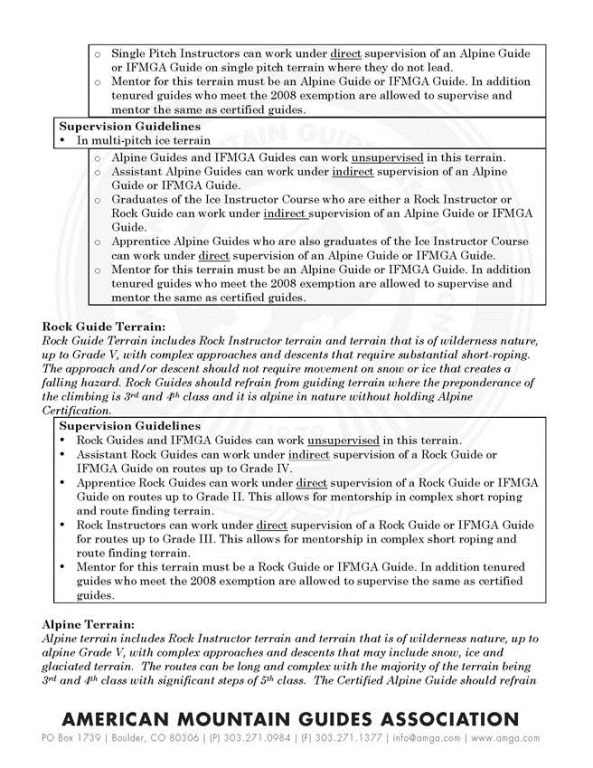
My favorite rule is one that requires a guide who has not made the qualifications yet, must be under the direct supervision of a guide who has met the qualifications. Unless the guide, who has met the qualifications, has to take guests down the mountain, then the two guides can be in radio contact. The rules allow the least experienced guide to remain up high, alone.
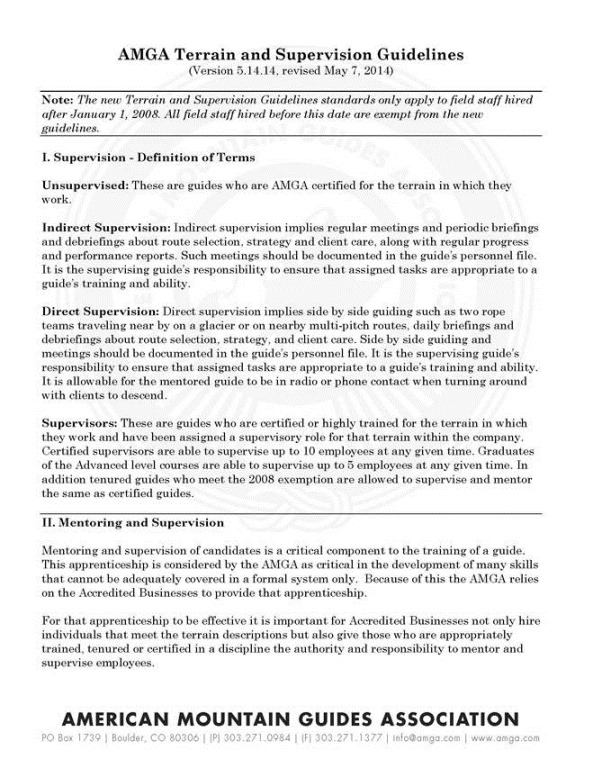
Direct Supervision: Direct supervision implies side by side guiding such as two rope teams traveling near by on a glacier or on nearby multi-pitch routes, daily briefings and debriefings about route selection, strategy, and client care. Side by side guiding and meetings should be documented in the guide’s personnel file. It is the supervising guide’s responsibility to ensure that assigned tasks are appropriate to a guide’s training and ability. It is allowable for the mentored guide to be in radio or phone contact when turning around with clients to descend.
What if the guide who has been certified, leaves to summit with a group of clients, can the one who hasn’t been certified stay with the clients who don’t/can’t summit. They’ll be in radio contact?
So you make a rule, then you make an exception to the rule. On Denali in a few years, this will be a disaster. The new concession requirements for climbing concessions are going to reduce the number of guides with a commercial group. Rescues will be done without commercial guides because a guide won’t be able to leave the group and work the rescue with these guidelines. (Rescues in the future on Denali are going to be a mess with the latest version of the commercial rules anyway, that is a whole other article.)
The languages of the guidelines are full of legal land mines. Here are some of my favorites.
…who are appropriately trained, tenured or certified
It is the supervising guide’s responsibility to ensure that assigned tasks are appropriate to a guide’s training and ability.
Certified supervisors
…is not of wilderness in nature
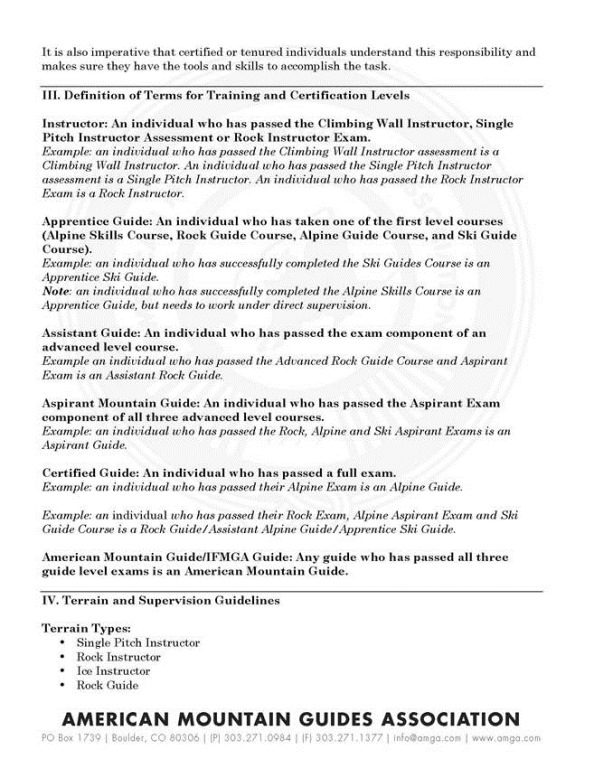
My favorite are the terms applied to different people.
Apprentice Guide
Assistant Guide
Aspirant Mountain Guide
Certified Guide
So does that mean you are a patrol leader or a star scout? More importantly do you get a badge?
Here are some more phrases that seem innocuous but don’t make sense.
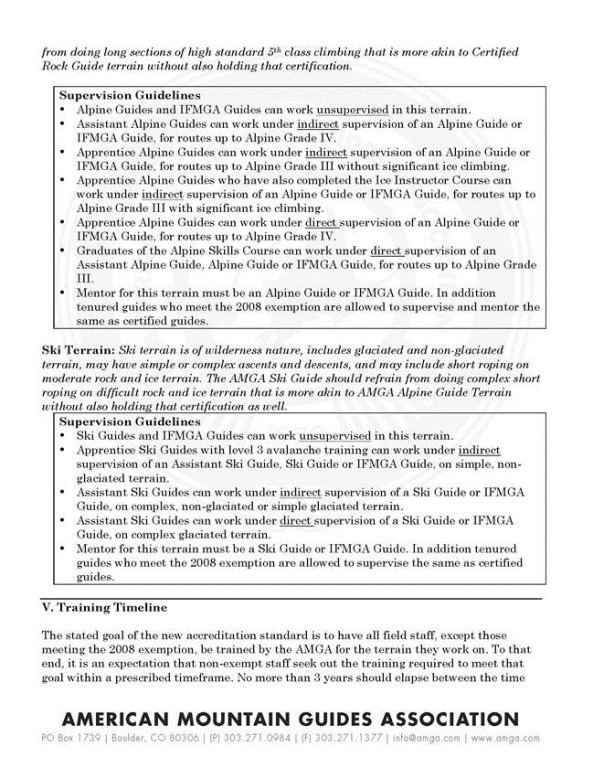
The stated goal of the new accreditation standard is to have all field staff, except those meeting the 2008 exemption, be trained by the AMGA for the terrain they work on.
So guides who met the requirements prior to 2008 cannot have a lick of training, sense or experience now and not be up to date on the requirements.
How is this going to happen? So I have a concession to guide on Denali. Am I supposed to bring you on one of my trips to tell me that you can train me on this terrain? What about the NPS on this issue and their current regulations. I guess you can come, go sign up and pay the fee, and I’ll take you where I am permitted to go.
AMGA courses are considered the baseline technical training for specific terrain types and are not a substitute for in-house training.
Yet above, they said this is the best you can get? What is this going to mean in court? The AMGA is just the baseline, yet the states the IFMGA (UIAGM) are now the baseline.
(The IFMGA (UIAGM) was founded to allow guides in Europe to guide everywhere and is the International Organization the AMGA must follow.)
I doubt that this has been run by the IFMGA (UIAGM).
Do Something
What’s going to happen? The big concessionaire members of the AMGA are either going to leave and financially sink the AMGA or revolt. No one will be happy either way. They don’t need greater chances of being sued. People die on mountains, and I would guess these new guidelines are not going to change that. They know the terrain and have in place, with NPS approval a way of guiding customers and training staff.
I have not taken the time to compare these guidelines with current NPS regulations for various mountains. I suspect there may be some conflicts. What is a concessionaire supposed to do, not follow the NPS and lose their permit or not follow these. Let’s see I pay money to the AMGA I make money with my NPS permit. Who am I going to follow?
These guidelines, like all standards for people, will only create a checklist for the attorney representing an injured client to sue. The guidelines will be taken and incorporated in interrogatories about each member of the guiding team. One misstep on the mountain or in discovery and these guidelines will change the lawsuit from what we can defend to how much we have to pay.
Don’t get me wrong. The American Mountain Guides Association has some of the greatest people I know as members and as an organization has accomplished tons. However, it is faced with an impossible job with no money to accomplish the job: the promise the AMGA made to the IFMGA in 1993 is never going to come through.
However, making standards, guidelines for people do not stop lawsuits; they only help the plaintiff’s win lawsuits.
Click on the link to download your own copy of the Terrain & Supervision Guidelines.
See the following articles where association guidelines were used to sue the association member:
ACA Standards are used by Expert for the Plaintiff in a lawsuit against a Camp http://rec-law.us/zmKgoi
Great article about the risks of an organization creating standards for members of the industry – and I did not write it http://rec-law.us/1rk8oHR
If your organization says you do something and you are a member of the organization you better do it or be able to explain why you did not http://rec-law.us/1gOLpju
Expert Witness Report: ACA “Standards” are used by Expert for the Plaintiff in a lawsuit against a Camp http://rec-law.us/y7QlJ3
Industry standards are proof of gross negligence and keep defendant in lawsuit even with good release http://rec-law.us/1dqBdxo
Plaintiff uses standards of ACCT to cost defendant $4.7 million http://rec-law.us/11UdbEn
So if you write standards, you can, then use them to make money when someone sues your competitors http://rec-law.us/1gCGce8
Trade Association Standards sink a Summer Camp when plaintiff uses them to prove Camp was negligent http://rec-law.us/wszt7N

What do you think? Leave a comment.
If you like this let your friends know or post it on FB, Twitter or LinkedIn
Copyright 2013 Recreation Law (720) Edit Law
Email: Rec-law@recreation-law.com
Google+: +Recreation
Twitter: RecreationLaw
Facebook: Rec.Law.Now
Facebook Page: Outdoor Recreation & Adventure Travel Law
Blog: www.recreation-law.com
International Mountain Guides has Trips All Over the World
Posted: November 22, 2014 Filed under: Mountaineering | Tags: Aconcagua, Boliva, Everest, Himalayas, IMG, Mountaineering, Rainier Leave a comment
|
||||||||


 Quick Links
Commercial Summer Fatalities: 2014
Posted: July 30, 2014 Filed under: Mountaineering, Paddlesports | Tags: Chattooga River, Commercial, Commercial Raft Company, Mountaineering, Raft, Rafting, Rock climbing, Whitewater, Whitewater Rafting Leave a commentOur condolences to the families of the deceased.
This list is not guaranteed to be accurate. The information is found from web searches and news dispatches. If you have a source for information on any fatality please leave a comment.
Whitewater fatalities are light blue
Medical fatalities are light red
This is up to date as of July 27, 2014
If this information is incorrect or incomplete please let me know. Thank You.
|
Date |
State |
Activity |
Where |
How |
Outfitter or Guide Service |
Sex |
Home |
Age |
Source |
Source |
|
5/28 |
AZ |
Whitewater Kayaking |
Colorado River, Grand Canyon, Badger Rapid |
Did not right his kayak |
|
M |
|
43 |
|
|
|
6/3 |
AZ |
Whitewater Rafting |
Colorado River, Grand Canyon |
Allergic reaction |
|
F |
Seattle, WA |
54 |
|
|
|
6/7 |
CO |
Whitewater Rafting |
Clear Creek |
Fell out of raft, possible respirator problems |
|
M |
Brighton, CO |
41 |
||
|
6/10 |
CO |
Whitewater Rafting |
Arkansas River, Salt Lick |
boat flipped or dump trucked |
Royal Gorge Rafting |
M |
Enid, OK |
48 |
||
|
6/14 |
CO |
Whitewater Rafting |
Arkansas River, Royal Gorge |
respiratory problems before he and five other rafters were tossed out |
|
M |
Colorado Springs, CO |
44 |
||
|
6/16 |
CO |
Whitewater Rafting |
Roaring Fork river |
Fell out of raft |
Blazing Adventures |
M |
Denver, CO |
44 |
|
|
|
6/27 |
ID |
Whitewater Rafting |
Salmon River, The Slide |
Ejected from raft |
Epley’s Whitewater Adventure |
M |
Poulsbo, WA |
50 |
||
|
7/15 |
WY |
Mountaineering |
Grand Teton |
Fell |
Jackson Hole Mountain Guides |
F |
Edmond, OK |
43 |
||
|
7/24 |
CO |
Whitewater Rafting |
Fell out of raft |
Timberline Tours |
F |
Dallas, TX |
57 |
Several of the water fatalities can be medical. A sudden full body cold water immersion can cause vasoconstriction in the hear resulting in death. See the Wikipedia listing Cold shock response.
If you are unable to see this graph, please email me at Rec-law@recreation-law.com and I will send you a PDF of the page.
What do you think? Leave a comment.
If you like this let your friends know or post it on FB, Twitter or LinkedIn
Copyright 2014 Recreation Law (720) 334 8529
Email: Rec-law@recreation-law.com
Google+: +Recreation
Twitter: RecreationLaw
Facebook: Rec.Law.Now
Facebook Page: Outdoor Recreation & Adventure Travel Law
Blog: www.recreation-law.com
Mobile Site: http://m.recreation-law.com
By Recreation Law Rec-law@recreation-law.com James H. Moss #Authorrank
<rel=”author” link=” https://plus.google.com/u/0/b/112453188060350225356/” />
#RecreationLaw, #Recreation-Law.com, #OutdoorLaw, #OutdoorRecreationLaw, #AdventureTravelLaw, #law, #TravelLaw, #JimMoss, #JamesHMoss, #Tourism, #AdventureTourism, #Rec-Law, #RiskManagement, #CyclingLaw, #BicyclingLaw, #FitnessLaw, #Recreation-Law.com, #Backpacking, #Hiking, #Mountaineering, #IceClimbing, #RockClimbing, #RopesCourse, #ChallengeCourse, #SummerCamp, #Camps, #YouthCamps, #Skiing, #Ski Areas, #Negligence, #Snowboarding, #RecreationLaw, #@RecreationLaw, #Cycling.Law, #SkiLaw, #Outside.Law, #Recreation.Law, #RecreationLaw.com, #OutdoorLaw, #RecreationLaw, #OutdoorRecreationLaw, #AdventureTravelLaw, #Law, #TravelLaw, #JimMoss, #JamesHMoss, #AttorneyatLaw, #Tourism, #AdventureTourism, #RecLaw, #RecLawBlog, #RecreationLawBlog, #RiskManagement, #HumanPowered, #HumanPoweredRecreation,# CyclingLaw, #BicyclingLaw, #FitnessLaw, #RecreationLaw.com, #Backpacking, #Hiking, #Mountaineering, #IceClimbing, #RockClimbing, #RopesCourse, #ChallengeCourse, #SummerCamp, #Camps, #YouthCamps, #Skiing, #Ski Areas, #Negligence, #Snowboarding, sport and recreation laws, ski law, cycling law, Colorado law, law for recreation and sport managers, bicycling and the law, cycling and the law, ski helmet law, skiers code, skiing accidents, Recreation Lawyer, Ski Lawyer, Paddlesports Lawyer, Cycling Lawyer, Recreational Lawyer, Fitness Lawyer, Rec Lawyer, Challenge Course Lawyer, Ropes Course Lawyer, Zip Line Lawyer, Rock Climbing Lawyer, Adventure Travel Lawyer, Outside Lawyer, Recreation Lawyer, Ski Lawyer, Paddlesports Lawyer, Cycling Lawyer, #RecreationalLawyer, #FitnessLawyer, #RecLawyer, #ChallengeCourseLawyer, #RopesCourseLawyer, #ZipLineLawyer, #RockClimbingLawyer, #AdventureTravelLawyer, #OutsideLawyer, Good Samaritan, Samaritan, First Aid, Whitewater Rafting, Rafting, Commercial, Commercial Raft Company, Commercial Guide Service,
WordPress Tags: Commercial,Summer,Fatalities,condolences,families,information,news,Whitewater,Medical,Thank,Date,State,Where,Outfitter,Guide,Service,Home,Source,Colorado,River,Grand,Canyon,Badger,Rapid,SVpdfb,Allergic,reaction,Seattle,Clear,Creek,Fell,respirator,Brighton,Arkansas,Salt,Lick,boat,Royal,Gorge,Enid,Springs,Fork,Adventures,Denver,Salmon,Slide,Epley,Adventure,Poulsbo,Teton,Jackson,Hole,Mountain,Guides,Edmond,Numbers,Timberline,Tours,Dallas,Several,immersion,death,Wikipedia,Cold,response,graph,recreation,Leave,Twitter,LinkedIn,Edit,Email,Google,RecreationLaw,Facebook,Page,Outdoor,Travel,Blog,Mobile,Site,James,Moss,Authorrank,author,OutdoorLaw,OutdoorRecreationLaw,AdventureTravelLaw,TravelLaw,JimMoss,JamesHMoss,Tourism,AdventureTourism,RiskManagement,CyclingLaw,BicyclingLaw,FitnessLaw,RopesCourse,ChallengeCourse,SummerCamp,Camps,YouthCamps,Areas,Negligence,SkiLaw,Outside,AttorneyatLaw,RecLaw,RecLawBlog,RecreationLawBlog,HumanPoweredRecreation,managers,helmet,accidents,Lawyer,Paddlesports,Recreational,Challenge,Course,Ropes,Line,Rock,RecreationalLawyer,FitnessLawyer,RecLawyer,ChallengeCourseLawyer,RopesCourseLawyer,ZipLineLawyer,RockClimbingLawyer,AdventureTravelLawyer,OutsideLawyer,Samaritan,Raft,Company
Nepal Mountaineering Association working on Himalayan issues
Posted: July 3, 2014 Filed under: Mountaineering | Tags: Climbing, Everest, Himalayas, International Climbing and Mountaineering Federation, Mount Everest, Mt. Everest, Nepal, Nepal Mountaineering Association, Recreation, Sherpa people, UIAA Leave a commentReport to the International Climbing and Mountaineering Federation (UIAA) shows efforts and hard work to make mountaineering a great sport and occupation
Ang Tshering Sherpa has filed a report with the UIAA with updates on the work the association is doing. The association has been around for years, however the avalanche on Mt. Everest this spring has prompted this new round of action on behalf of the association.
This is a very comprehensive report showing work on dozens of topics.
See Nepal Himalaya issues being addressed by the Nepal Mountaineering Association
What do you think? Leave a comment.
If you like this let your friends know or post it on FB, Twitter or LinkedIn
Copyright 2014 Recreation Law (720) 334-8529
Call or Email me if you need legal services around these issues.
Email: Rec-law@recreation-law.com
Google+: +Recreation
Twitter: RecreationLaw
Facebook: Rec.Law.Now
Facebook Page: Outdoor Recreation & Adventure Travel Law
Mobile Site: http://m.recreation-law.com
By Recreation Law Rec-law@recreation-law.com James H. Moss #Authorrank
<rel=”author” link=” https://plus.google.com/u/0/b/112453188060350225356/” />
#AdventureTourism, #AdventureTravelLaw, #AdventureTravelLawyer, #AttorneyatLaw, #Backpacking, #BicyclingLaw, #Camps, #ChallengeCourse, #ChallengeCourseLaw, #ChallengeCourseLawyer, #CyclingLaw, #FitnessLaw, #FitnessLawyer, #Hiking, #HumanPowered, #HumanPoweredRecreation, #IceClimbing, #JamesHMoss, #JimMoss, #Law, #Mountaineering, #Negligence, #OutdoorLaw, #OutdoorRecreationLaw, #OutsideLaw, #OutsideLawyer, #RecLaw, #Rec-Law, #RecLawBlog, #Rec-LawBlog, #RecLawyer, #RecreationalLawyer, #RecreationLaw, #RecreationLawBlog, #RecreationLawcom, #Recreation-Lawcom, #Recreation-Law.com, #RiskManagement, #RockClimbing, #RockClimbingLawyer, #RopesCourse, #RopesCourseLawyer, #SkiAreas, #Skiing, #SkiLaw, #Snowboarding, #SummerCamp, #Tourism, #TravelLaw, #YouthCamps, #ZipLineLawyer, International Climbing and Mountaineering Federation, UIAA, Nepal Mountaineering Association, Mt. Everest, Everest, Nepal,
Sustainable Summits: The International Mountain Conference on Environmental Practices
Posted: July 1, 2014 Filed under: Mountaineering | Tags: #AAC, American Alpine Club, American Mountaineering Center, Colorado, Denali, Golden, Mount Everest, Seven Summits, Sustainable Summits, UIAA Leave a commentThe American Alpine Club (AAC), in collaboration with Denali National Park will host this event at the Mountaineering Center in Golden Colorado July 20-23.
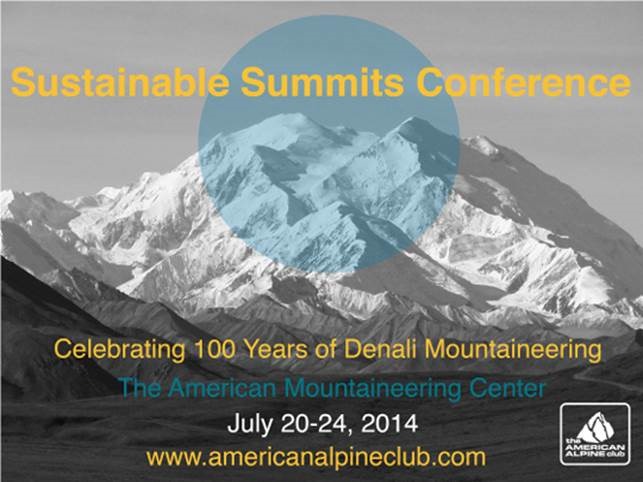
Registration for the Sustainable Summits Conference, July 20-24, is open to all individuals interested in mountain sustainability, as well as those seeking training and professional networking opportunities. For conference information and online registration go to http://www.americanalpineclub.org/p/sustainable_summits.
Contacts:
Roger Robinson, conference co-director sustainable.summits@gmail.com
Remy Rodriguez rrodriguez@americanalpineclub.org
What do you think? Leave a comment.
If you like this let your friends know or post it on FB, Twitter or LinkedIn
Copyright 2014 Recreation Law (720) 334-8529
Call or Email me if you need legal services around these issues.
Email: Rec-law@recreation-law.com
Google+: +Recreation
Twitter: RecreationLaw
Facebook: Rec.Law.Now
Facebook Page: Outdoor Recreation & Adventure Travel Law
Mobile Site: http://m.recreation-law.com
By Recreation Law Rec-law@recreation-law.com James H. Moss #Authorrank
<rel=”author” link=” https://plus.google.com/u/0/b/112453188060350225356/” />
#AdventureTourism, #AdventureTravelLaw, #AdventureTravelLawyer, #AttorneyatLaw, #Backpacking, #BicyclingLaw, #Camps, #ChallengeCourse, #ChallengeCourseLaw, #ChallengeCourseLawyer, #CyclingLaw, #FitnessLaw, #FitnessLawyer, #Hiking, #HumanPowered, #HumanPoweredRecreation, #IceClimbing, #JamesHMoss, #JimMoss, #Law, #Mountaineering, #Negligence, #OutdoorLaw, #OutdoorRecreationLaw, #OutsideLaw, #OutsideLawyer, #RecLaw, #Rec-Law, #RecLawBlog, #Rec-LawBlog, #RecLawyer, #RecreationalLawyer, #RecreationLaw, #RecreationLawBlog, #RecreationLawcom, #Recreation-Lawcom, #Recreation-Law.com, #RiskManagement, #RockClimbing, #RockClimbingLawyer, #RopesCourse, #RopesCourseLawyer, #SkiAreas, #Skiing, #SkiLaw, #Snowboarding, #SummerCamp, #Tourism, #TravelLaw, #YouthCamps, #ZipLineLawyer, AAC, UIAA, American Alpine Club, Sustainable Summits, Denali, Golden, Colorado, American Mountaineering Center,
Want to Maximize a Visit to Colorado? San Juan Mountain Guides can help!
Posted: June 24, 2014 Filed under: Colorado, Mountaineering | Tags: Alaska, Canyoning, Mountaineering, Peru, Rock climbing, San Juan, San Juan Mountain Guides, San Juan Mountains, SJMG, Via Ferrata, Washington, Weminuche Wilderness Leave a comment
|


You run a guide service. Should you refer travel insurance to your clients?
Posted: June 18, 2014 Filed under: Insurance, Mountaineering | Tags: Everest, Financial Services, Health insurance, Insurance, Insurance policy, Life Insurance, Sherpa, Travel Guard, Travel insurance, TravelEx, Whole life insurance Leave a commentYes, however, you need to understand, and probably communicate to your clients that travel insurance is extremely limited for outdoor recreation activities.
Travel insurance was created for European vacations. You booked a 12-day trip to Europe. If you got sick, or the bus, you were traveling on died, and you came home on day eight, then your travel insurance sent you a check for 1/3 of what you spent except your trip. It was simple math and very simple underwriting defined by the travel insurance policies. Europe was like the US, and the risks were known.
The UK added to travel insurance because its health care system did not extend beyond its boundaries. So UK travelers leaving the UK have always bought travel health insurance. Again, this is simple underwriting: travelers are normally in good health and so the only real risk was an accident while traveling.
Everest Base camp does not really fit into the underwriting of either of those types of polices, yet the policies have not changed since they were first written.
Understanding Policies
First, there are two types of travel insurance that are very different and both called travel insurance. One covers medical and sometimes evacuation home or at least to a local hospital when you are outside of your home country. The second reimburses you for costs if your trip is canceled (before departure) or interrupted (after the trip starts).
Most travel medical policies are fairly easy to understand and read. They have a specific limit on how much they will pay, and a specific time frame where your injury and medical services must occur. As I stated earlier, I’ve found the best ones are those sold for UK travelers. I’ve even purchased some policies that paid for rescue up to 20,000 feet.
Travel Medical insurance policies are great to have because of the limits that HMO’s and PPO’s my place on services outside of the US. When in doubt spend the money and buy a policy if you are traveling outside of the US>
Travel Insurance Policies
Travel insurance policies are also easy to understand if you take the time to read the policy. Most policies are online and easy to find. If you are traveling for an outdoor recreation trip, you must read the policies.
And by policies, I mean the actual policy, not the lengthy description listed on the website. Most travel insurance companies have their policy online if you dig enough. If not call or email the company, tell them you are getting ready to travel in a few months and want to see a copy of their policy. Tell them you have read the coverage review on the website, but you want more information. TravelEx, a leading company calls their policy “Description of Coverage.”
As an example, the policies sold by online sites that you are booking your air or hotel through are very specific and will only cover your air or hotel – nothing more. A sleeping bag or tents are not either of those.
Travel insurance policies are very different from other insurance policies you may purchase in the US. The policies are written so absolutely only what is listed is covered with no exceptions. They are written to say for $XX you get $XX paid back if something listed in the policy occurs. If it is not listed it is not covered.
Many policies will have a grace period or cancellation period. You can purchase the policy and then have 10-15 days to cancel the policy if it is not what you want.
Travel Insurance policies may have a small medical benefit. However, this is not insurance. Meaning after you have paid the medical bill you can file a claim and ask to be reimbursed for the amount of the bill up to the limits of the policy. The medical benefit is usually around $10,000 so if you have a large medical bill you are going to eat the rest and will only be paid the $10K once you show the insurance company paid receipts.
Any claim will only be paid by including your receipts with the claim. So keep every receipt. If you are having a hard time tracking your receipts use your phone or camera to photograph the receipts. Several good apps are also available to track receipts. Again if you don’t have receipts, you won’t receive any money from the insurance company.
Claims
Claims are paid if the cause of your claim fits squarely in the list of coverage. As an example, this is the list of coverage’s from a common travel insurance policy.
Trip Cancellation and Interruption Covered Reasons Coverage is provided for the following unforeseeable events or their consequences, which occur while coverage is, in effect, under this Policy if there is a change in plans by you, a Family Member traveling with you, or Traveling Companion:
1. Sickness, Injury or death of you or your Traveling Companion and/or you or your Traveling Companion’s Family Member or Business Partner. The Sickness must commence while coverage is in effect, require the examination of a Physician, in person, at the time of Trip Cancellation or Trip Interruption and, in the written opinion of the treating Physician, be so disabling as to prevent you from taking or continuing your Covered Trip.
2. Common Carrier delays resulting from inclement weather, or mechanical breakdown or organized labor strikes that affect public transportation;
3. arrangements canceled by an airline, cruise line, motor coach company, or tour operator, resulting from inclement weather, mechanical breakdown or organized labor strikes that affect public transportation.
4. arrangements canceled by a tour operator, cruise line, airline, rental car company, hotel, condominium, railroad, motor coach company, or other supplier of travel services, resulting from Financial Insolvency;
5. being directly involved in a documented traffic accident while en route to departure;
6. being hijacked, quarantined, required to serve on a jury, or required by a court order to appear as a witness in a legal action, provided you, Family Member traveling with you or a Traveling Companion is not 1) a party to the legal action, or 2) appearing as a law enforcement officer;
7. your Home made uninhabitable by fire, flood, volcano, earthquake, hurricane or other natural disaster;
8. your destination made uninhabitable by fire, flood, volcano, earthquake, hurricane or other natural disaster;
9. mandatory evacuation ordered by local authorities at your destination due to hurricane or other natural disaster;
10. being called into active military service to provide aid or relief in the event of a natural disaster;
11. a documented theft of passports or visas;
12. a Terrorist Act which occurs in your departure city or in a city which is a scheduled destination for your Covered Trip provided the Terrorist Act occurs within 30 days of the Scheduled Departure Date for your Covered Trip or during your Covered Trip;
13. a cancellation of your Covered Trip if your arrival on the Covered Trip is delayed and causes you to lose 50% or more of the scheduled Covered Trip duration due to the reasons covered under the Covered Trip Delay Benefit;
14. a transfer of employment of 250 miles or more;
15. your involuntary termination of employment or layoff and was not under your control. You must have been continuously employed with the same employer for 1 year prior to the termination or layoff. This provision is not applicable to temporary employment, independent contractors or self-employed persons;
16. your host at destination is hospitalized or dies, provided you made previous arrangements to stay at the host’s personal residence during the Covered Trip.
If you claim does not fit within one of the 16 listed above claims you do not have a chance. The next issue then is to look at your claim and see if it fits the claim you have identified perfectly. The language of the coverage list is defined in the policy in preceding paragraphs.
For Example, let’s look at the Everest season ending this year.
You might first think that if you bought a policy and could not climb Mount Everest this year because of the deaths and closing of the ice fall you would have a claim under paragraph 2, “organized labor strikes.” However, I don’t think that would qualify because Sherpa’s are not common carriers nor are they public transportation. Common carriers are airlines, bus lines, etc., and I doubt much in Nepal except the airline would qualify. Public transportation is like your local city bus service…..which has not made to the south side base camp yet.
Paragraph 3 would not work for about the same reasons.
Paragraph 8 may qualify. “your destination made uninhabitable by fire, flood, volcano, earthquake, hurricane or other natural disaster” However, the top of Mt. Everest, your destination was fine; the route to your destination was destroyed.
Paragraph 9 would work if the Nepalese government had closed base camp or Everest from the south side, however, all news reports stated just the opposite, the Nepalese government worked hard to keep the Sherpa’s on the mountain and working.
As you can see, the language of the policy fits European vacations, the issues and claims the policies were originally written for.
Another policy My Travel Guard had this list of claims:
The Company will reimburse the Insured a benefit, up to the Maximum Limit shown in the Schedule or Declarations Page if an Insured cancels his/her Trip or is unable to continue on his/her Trip due to any of the following Unforeseen events:
(a) Sickness, Injury or death of an Insured, Family Member, Traveling Companion or Business Partner;
(1) Sickness or Injury of an Insured, Traveling Companion or Family Member traveling with the Insured must be so disabling as to reasonably cause a Trip to be canceled or interrupted or which results in medically imposed restrictions as certified by a Physician at the time of Loss preventing continued participation in the Trip;
(2) Sickness or Injury of a Family Member not traveling with the Insured Such disability must be so disabling as to reasonably cause a Trip to be canceled or interrupted and must be certified by a Physician;
(3) Sickness or Injury of the Business Partner must be so disabling as to reasonably cause the Insured to cancel or interrupt the Trip to assume daily management of the business. Such disability must be certified by a Physician;
(b) Inclement Weather causing delay or cancellation of travel;
(c) Strike causing complete cessation of travel services at the point of departure or Destination;
(d) the Insured’s Primary Residence or Destination being made Uninhabitable or Inaccessible by Natural Disaster, vandalism or burglary;
(e) the Insured or Traveling Companion is hijacked, quarantined, subpoenaed or required to serve on a jury;
(f) the Insured or Traveling Companion is called to active military service or military leave is revoked or reassigned.
The following only apply if the Additional Unforeseen Events Upgrade is purchased:
(a) Sickness, Injury, death or hospitalization of the Insured’s Host at Destination. A Physician must certify the Sickness or Injury;
(b) Financial Default of an airline, Cruise line or tour operator provided the Financial Default occurs more than 14 days following an Insured’s effective date for the Trip Cancellation or Trip Interruption Benefits. There is no coverage for the Financial Default of any person, organization, agency, or firm from whom the Insured purchased travel arrangements supplied by others;
(c) a Terrorist Incident in a City listed on the Insured’s itinerary within 30 days of the Insured’s scheduled arrival;
(d) the Insured or Traveling Companion is involuntarily terminated or laid off through no fault of his or her own provided that he or she has been an active employee for the same employer for at least 1 year. Termination must occur following the effective date of coverage. This provision is not applicable to temporary employment, seasonal employment, independent contractors or self-employed persons;
(e) the Insured and/or Traveling Companion is directly involved in or delayed due to an traffic accident, substantiated by a police report, while en route to the Insured’s Destination;
(f) the Insured or a Traveling Companion being the victim of a Felonious Assault within 10 days prior to the Departure Date. No coverage is provided for Felonious Assault committed by another Insured, Family Member, Traveling Companion or Traveling Companion’s Family Member;
(g) mechanical/equipment failure of a Common Carrier that occurs on a scheduled Trip and causes complete cessation of the Insured’s travel and results in a Loss of 50% of the Insured’s Trip length;
(h) the Insured or Traveling Companion is required to work during his/her scheduled Trip. He/she must provide proof of requirement to work, such as a notarized statement signed by an officer of his/her employer. In the situation of self-employment, proof of self-employment and a notarized statement confirming that the Insured is unable to travel due to his or her job obligations will be required;
(i) the Insured or Traveling Companion is directly involved in a merger, acquisition, government required product recall or bankruptcy proceedings and must be currently employed by the company that is involved in said event;
(j) the Insured’s or Traveling Companion’s company is deemed to be unsuitable for business due to burglary or Natural Disaster and the Insured or Traveling Companion is directly involved as a Key Employee of the disaster recovery team.
Here paragraph c might qualify, if you can call the actions of the Sherpa’s a strike. “Strike causing complete cessation of travel services at the point of departure or Destination” However, once you read the definition of a strike as defined in the policy, it will not qualify.
“Strike” means a stoppage of work which:
(a) is announced, organized, and sanctioned by a labor union; and
(b) interferes with the normal departure and arrival of a Common Carrier.
Again, Sherpa’s are not common carriers and not recognized by any labor union.
After reading all the covered claims, I don’t think any would apply to the Everest disaster this year.
So
If you are looking for insurance coverage for an outdoor recreation trip start with what you already have and then try to fill in the gaps with what you can buy.
Your homeowner’s/condo/renter’s insurance may provide coverage for your gear while traveling. That coverage is usually only for it being total loss, not just delayed. You may have additional protection so check this policy first.
The credit cards you paid for your trip with, may provide coverage that a lot of travel policies cover.
Go over your health insurance policy with a fine-tooth comb. Make sure you understand what coverage you have and do not have. Again, buy a policy to fill in the gaps. Compare the coverage on the travel insurance policies to the coverage provided by a travel medical insurance policy. Most travel medical insurance policies have a broader coverage.
Keep track of all of your receipts. Without receipts, you don’t have a claim. Keep a diary tracking date and times because you may have to prove what happened when. You might be able to job your memory with your photographs also.
The risk of outdoor recreation trips is greater than just the chance of getting hurt or injured on the water, under the ground or on the mountain. You may never get the chance to try.
What do you think? Leave a comment.
If you like this let your friends know or post it on FB, Twitter or LinkedIn
Copyright 2014 Recreation Law (720) 334-8529
Call or Email me if you need legal services around these issues.
Email: Rec-law@recreation-law.com
Google+: +Recreation
Twitter: RecreationLaw
Facebook: Rec.Law.Now
Facebook Page: Outdoor Recreation & Adventure Travel Law
Mobile Site: http://m.recreation-law.com
By Recreation Law Rec-law@recreation-law.com James H. Moss #Authorrank
<rel=”author” link=” https://plus.google.com/u/0/b/112453188060350225356/” />
#AdventureTourism, #AdventureTravelLaw, #AdventureTravelLawyer, #AttorneyatLaw, #Backpacking, #BicyclingLaw, #Camps, #ChallengeCourse, #ChallengeCourseLaw, #ChallengeCourseLawyer, #CyclingLaw, #FitnessLaw, #FitnessLawyer, #Hiking, #HumanPowered, #HumanPoweredRecreation, #IceClimbing, #JamesHMoss, #JimMoss, #Law, #Mountaineering, #Negligence, #OutdoorLaw, #OutdoorRecreationLaw, #OutsideLaw, #OutsideLawyer, #RecLaw, #Rec-Law, #RecLawBlog, #Rec-LawBlog, #RecLawyer, #RecreationalLawyer, #RecreationLaw, #RecreationLawBlog, #RecreationLawcom, #Recreation-Lawcom, #Recreation-Law.com, #RiskManagement, #RockClimbing, #RockClimbingLawyer, #RopesCourse, #RopesCourseLawyer, #SkiAreas, #Skiing, #SkiLaw, #Snowboarding, #SummerCamp, #Tourism, #TravelLaw, #YouthCamps, #ZipLineLawyer, TravelEx, Travel Guard, Travel Insurance, Everest, Sherpa,
WordPress Tags: Should,insurance,clients,recreation,Travel,European,vacations,Europe,math,policies,health,system,boundaries,Again,accident,Everest,Base,evacuation,hospital,departure,Most,injury,feet,Medical,money,policy,description,Tell,coverage,information,TravelEx,example,hotel,tents,exceptions,Many,cancellation,receipts,receipt,Several,Claims,Trip,Interruption,Reasons,events,consequences,Member,Companion,death,Partner,examination,Physician,person,opinion,Common,Carrier,breakdown,transportation,airline,operator,rental,condominium,supplier,Financial,Insolvency,jury,action,enforcement,officer,Home,earthquake,hurricane,disaster,destination,relief,event,theft,passports,visas,Terrorist,Date,arrival,duration,Delay,Benefit,employment,termination,layoff,employer,provision,contractors,self,residence,paragraphs,Mount,deaths,paragraph,Sherpa,carriers,airlines,Nepal,Public,Nepalese,government,news,mountain,Another,Guard,Company,Maximum,Limit,Schedule,Declarations,Page,restrictions,Loss,participation,management,Inclement,Weather,Strike,cessation,Primary,Uninhabitable,Inaccessible,Natural,vandalism,burglary,Additional,Upgrade,Host,Default,Cruise,Benefits,agency,Incident,itinerary,employee,victim,Felonious,Assault,equipment,failure,length,requirement,statement,situation,obligations,merger,acquisition,product,bankruptcy,proceedings,recovery,team,Here,definition,stoppage,homeowner,renter,gear,protection,cards,tooth,Make,Compare,Keep,diary,memory,Leave,Twitter,LinkedIn,Call,Email,Google,RecreationLaw,Facebook,Outdoor,Adventure,Blog,Mobile,Site,James,Moss,Authorrank,author,AdventureTourism,AdventureTravelLaw,AdventureTravelLawyer,AttorneyatLaw,BicyclingLaw,Camps,ChallengeCourse,ChallengeCourseLaw,ChallengeCourseLawyer,CyclingLaw,FitnessLaw,FitnessLawyer,HumanPoweredRecreation,JamesHMoss,JimMoss,Negligence,OutdoorLaw,OutdoorRecreationLaw,OutsideLaw,OutsideLawyer,RecLaw,RecLawBlog,LawBlog,RecLawyer,RecreationalLawyer,RecreationLawBlog,RecreationLawcom,Lawcom,RiskManagement,RockClimbingLawyer,RopesCourse,RopesCourseLawyer,SkiAreas,SkiLaw,SummerCamp,Tourism,TravelLaw,YouthCamps,ZipLineLawyer,website,volcano,south

Alberta’s mountain guide service is being sued because two clients were drugged and robbed on Kilimanjaro. After drugging, client still summited the mountain.
Posted: May 26, 2014 Filed under: Mountaineering | Tags: #Africa, Alberta, Berg Adventures International, Canada, Canmore, Kilimanjaro, Mount Kilimanjaro, Mountain Guide, Tanzania, Wally Berg Leave a comment
Plaintiff claims they are suing because statements made by the
 outfitter angered them and because outfitter never called to apologize. Robbed client’s parent is a California attorney.
So according to the news report three people, one the attorney, her daughter and a male friend booked a trip with Berg Adventures International to climb Mt. Kilimanjaro. The mother booked the trip with Berg because of its “its reputation for providing comfortable, full-service travel experiences.”
The mother/plaintiff’s attorney was not present that night; she turned back because of altitude problems. After being drugged and robbed, the two ascended to the summit: “two did continue to the summit, but she claims that was the fastest way off the mountain”
I don’t know what is the fastest way off the summit, however, going up is rarely faster than going down, even if going down requires you to go down and around.
Why did they sue?
Lewis said she decided to sue Berg Adventures International after the company failed to contact her or apologize for what the travellers went through.
She said she was also angered the company posted dispatches from the trip on its website, congratulating her daughter and her friend for their rapid descent of the mountain, without acknowledging that the reason was to seek medical treatment.
I read, and you can read the posted dispatches here: March 6, 2014 – The Team Summits

Ascend past Rebmann Glacier Mt. Kilimanjaro (Photo credit: Wikipedia)
Kilimanjaro. They do not say why the couple decided to summit and then descend so quickly, but they are not negative. At that point in time, I would guess that on one really knew what had happened anyway.
Is this an overreaction, an attempt to get a refund or can you find something that Berg Adventures International did that was negligent?
Reputation comes from third parties, so I’m not sure how that could indicate a negligent act. Besides even if it were advertising the law allows a lot of leeway for puffing or statements made to close a sale.
There is also an issue of jurisdiction. Hopefully, Berg Adventures International used a release, and it had a jurisdiction and venue clause requiring the suit to be in Alberta Canada.
I’m not sure I would have advised my client to apologize, but some contact would have helped. To understand why people may sue based on emotional issues see:
It’s Not Money http://rec-law.us/zxmmqy
Her life is permanently changed, but she really wants an apology http://rec-law.us/yHjVn0
Make sure you understand what the other side is saying http://rec-law.us/1b5m1mt
Money is important in some lawsuits, but the emotions that starts a lawsuit. http://rec-law.us/xbSs4M
Serious Disconnect: Why people sue. http://rec-law.us/wm2cBn
Why do people sue? Not for the money. http://rec-law.us/A0866T
$700,000 in damages after summiting Kilimanjaro seems a little difficult to prove also. The agreement was to try to assist you in summiting…..seems like they did?
See Alberta tour operator faces lawsuit over African misadventure
Dispatches that created the anger can be located here: March 6, 2014 – The Team Summits Kilimanjaro..
What do you think? Leave a comment.
If you like this let your friends know or post it on FB, Twitter or LinkedIn
Copyright 2014 Recreation Law (720) Edit Law
Email: Rec-law@recreation-law.com
Google+: +Recreation
Twitter: RecreationLaw
Facebook: Rec.Law.Now
Facebook Page: Outdoor Recreation & Adventure Travel Law
Mobile Site: http://m.recreation-law.com
By Recreation Law Rec-law@recreation-law.com James H. Moss #Authorrank
<rel=”author” link=” https://plus.google.com/u/0/b/112453188060350225356/” />
#AdventureTourism, #AdventureTravelLaw, #AdventureTravelLawyer, #AttorneyatLaw, #Backpacking, #BicyclingLaw, #Camps, #ChallengeCourse, #ChallengeCourseLaw, #ChallengeCourseLawyer, #CyclingLaw, #FitnessLaw, #FitnessLawyer, #Hiking, #HumanPowered, #HumanPoweredRecreation, #IceClimbing, #JamesHMoss, #JimMoss, #Law, #Mountaineering, #Negligence, #OutdoorLaw, #OutdoorRecreationLaw, #OutsideLaw, #OutsideLawyer, #RecLaw, #Rec-Law, #RecLawBlog, #Rec-LawBlog, #RecLawyer, #RecreationalLawyer, #RecreationLaw, #RecreationLawBlog, #RecreationLawcom, #Recreation-Lawcom, #Recreation-Law.com, #RiskManagement, #RockClimbing, #RockClimbingLawyer, #RopesCourse, #RopesCourseLawyer, #SkiAreas, #Skiing, #SkiLaw, #Snowboarding, #SummerCamp, #Tourism, #TravelLaw, #YouthCamps, #ZipLineLawyer, Kilimanjaro, Canmore, Alberta, Canada, Wally Berg, Mountain Guide, Berg Adventures International,
WordPress Tags: Alberta,mountain,clients,Kilimanjaro,client,Plaintiff,statements,California,attorney,news,daughter,friend,Berg,Adventures,International,reputation,altitude,summit,Lewis,descent,treatment,March,Team,Summits,Besides,leeway,sale,jurisdiction,venue,clause,Canada,Money,life,apology,Make,lawsuits,emotions,lawsuit,Serious,Disconnect,agreement,operator,African,misadventure,Dispatches,Leave,Twitter,LinkedIn,Recreation,Edit,Email,Google,RecreationLaw,Facebook,Page,Outdoor,Adventure,Travel,Blog,Mobile,Site,James,Moss,Authorrank,author,AdventureTourism,AdventureTravelLaw,AdventureTravelLawyer,AttorneyatLaw,BicyclingLaw,Camps,ChallengeCourse,ChallengeCourseLaw,ChallengeCourseLawyer,CyclingLaw,FitnessLaw,FitnessLawyer,HumanPoweredRecreation,JamesHMoss,JimMoss,Negligence,OutdoorLaw,OutdoorRecreationLaw,OutsideLaw,OutsideLawyer,RecLaw,RecLawBlog,LawBlog,RecLawyer,RecreationalLawyer,RecreationLawBlog,RecreationLawcom,Lawcom,RiskManagement,RockClimbingLawyer,RopesCourse,RopesCourseLawyer,SkiAreas,SkiLaw,SummerCamp,Tourism,TravelLaw,YouthCamps,ZipLineLawyer,Guide,outfitter

Honorary member of the Italian Academic Alpine Club acceptance speech is an eloquent statement on why we climb mountains
Posted: March 5, 2014 Filed under: Mountaineering | Tags: Bernard Amy, CAIC, French mountaineer, French Observatoir pour les Pratiques de la Montagne et de l' Alpinisme, honorary, Italian Academic Alpine Club, Membership, Mountaineering, OPMA Leave a commentWhether you climb or not, you should read this speech. It will justify your actions provide you with ideas to defend our desire to climb, no matter the risk.
Bernard Amy is a well-known French mountaineer and President the French Observatoir pour les Pratiques de la Montagne et de l’ Alpinisme (OPMA). He was granted honorary membership in the Italian Academic Alpine Club (CAIC). His acceptance speech can be found here.
Mr. Amy’s speech should be read by every mountaineer and should be read by every person who is attempting to stop a mountaineer. Some Quotes:
Rather, in order to have mountaineering accepted as a risky activity, we must explain what the mountains give us and what we learn from them. In other words, we must not try to explain why we go to the mountains, but what we find there.
Like all passions, the passion for mountaineering is characterized by a permanent element of doubt, a continuous questioning of oneself about the sense of the activity. Be he young or old, a mountaineer needs to feel strong. For this the social recognition of the group is essential.
These are valuable and strong statements by someone who has concentrated to find the thrill, the accomplishment and the satisfaction of standing on the summit.
Congratulations Mr. Amy on your honorary membership in the CAIC. Thank you for providing us support for our future endeavors to keep mountains open and mountain tops great places of worship for our soles.
Bernard Amy says we must explain what the mountains give us and what we learn from them
What do you think? Leave a comment.
If you like this let your friends know or post it on FB, Twitter or LinkedIn
Copyright 2013 Recreation Law (720) Edit Law
Email: Rec-law@recreation-law.com
Google+: +Recreation
Twitter: RecreationLaw
Facebook: Rec.Law.Now
Facebook Page: Outdoor Recreation & Adventure Travel Law
Mobile Site: http://m.recreation-law.com
By Recreation Law Rec-law@recreation-law.com James H. Moss #Authorrank
<rel=”author” link=” https://plus.google.com/u/0/b/112453188060350225356/” />
#RecreationLaw, #Recreation-Law.com, #OutdoorLaw, #OutdoorRecreationLaw, #AdventureTravelLaw, #law, #TravelLaw, #JimMoss, #JamesHMoss, #Tourism, #AdventureTourism, #Rec-Law, #RiskManagement, #CyclingLaw, #BicyclingLaw, #FitnessLaw, #Recreation-Law.com, #Backpacking, #Hiking, #Mountaineering, #IceClimbing, #RockClimbing, #RopesCourse, #ChallengeCourse, #SummerCamp, #Camps, #YouthCamps, #Skiing, #Ski Areas, #Negligence, #Snowboarding, #RecreationLaw, #@RecreationLaw, #Cycling.Law, #SkiLaw, #Outside.Law, #Recreation.Law, #RecreationLaw.com, #OutdoorLaw, #RecreationLaw, #OutdoorRecreationLaw, #AdventureTravelLaw, #Law, #TravelLaw, #JimMoss, #JamesHMoss, #AttorneyatLaw, #Tourism, #AdventureTourism, #RecLaw, #RecLawBlog, #RecreationLawBlog, #RiskManagement, #HumanPowered, #HumanPoweredRecreation,# CyclingLaw, #BicyclingLaw, #FitnessLaw, #RecreationLaw.com, #Backpacking, #Hiking, #Mountaineering, #IceClimbing, #RockClimbing, #RopesCourse, #ChallengeCourse, #SummerCamp, #Camps, #YouthCamps, #Skiing, #Ski Areas, #Negligence, #Snowboarding, sport and recreation laws, ski law, cycling law, Colorado law, law for recreation and sport managers, bicycling and the law, cycling and the law, ski helmet law, skiers code, skiing accidents, Recreation Lawyer, Ski Lawyer, Paddlesports Lawyer, Cycling Lawyer, Recreational Lawyer, Fitness Lawyer, Rec Lawyer, Challenge Course Lawyer, Ropes Course Lawyer, Zip Line Lawyer, Rock Climbing Lawyer, Adventure Travel Lawyer, Outside Lawyer, Recreation Lawyer, Ski Lawyer, Paddlesports Lawyer, Cycling Lawyer, #RecreationalLawyer, #FitnessLawyer, #RecLawyer, #ChallengeCourseLawyer, #RopesCourseLawyer, #ZipLineLawyer, #RockClimbingLawyer, #AdventureTravelLawyer, #OutsideLawyer, Good Samaritan, Samaritan, First Aid, Bernard Amy, French mountaineer, French Observatoir pour les Pratiques de la Montagne et de l’ Alpinisme, OPMA, honorary, membership, Italian Academic Alpine Club, CAIC,
WordPress Tags: Honorary,member,Italian,Academic,Alpine,Club,acceptance,speech,statement,mountains,Whether,Bernard,French,mountaineer,President,Observatoir,Pratiques,Montagne,Alpinisme,OPMA,membership,CAIC,person,Some,Quotes,Rather,passions,passion,recognition,statements,accomplishment,satisfaction,summit,Congratulations,Thank,mountain,Leave,Twitter,LinkedIn,Recreation,Edit,Email,Google,RecreationLaw,Facebook,Page,Outdoor,Adventure,Travel,Blog,Mobile,Site,James,Moss,Authorrank,author,OutdoorLaw,OutdoorRecreationLaw,AdventureTravelLaw,TravelLaw,JimMoss,JamesHMoss,Tourism,AdventureTourism,RiskManagement,CyclingLaw,BicyclingLaw,FitnessLaw,RopesCourse,ChallengeCourse,SummerCamp,Camps,YouthCamps,Areas,Negligence,SkiLaw,Outside,AttorneyatLaw,RecLaw,RecLawBlog,RecreationLawBlog,HumanPoweredRecreation,Colorado,managers,helmet,accidents,Lawyer,Paddlesports,Recreational,Challenge,Course,Ropes,Line,Rock,RecreationalLawyer,FitnessLawyer,RecLawyer,ChallengeCourseLawyer,RopesCourseLawyer,ZipLineLawyer,RockClimbingLawyer,AdventureTravelLawyer,OutsideLawyer,Samaritan
Have you read your health and life policy to see if your activities are excluded. This travel insurance policy excluded mountaineering and skiing
Posted: February 17, 2014 Filed under: Contract, Insurance, Mountaineering, Skiing / Snow Boarding, Wisconsin | Tags: Ambiguous, Exclusion, Grand Teton, Grand Teton National Park, Grand Teton National Policy, Health insurance, Health Insurance Policy, Insurance, Insurance policy, Mountaineering, Policy Exclusion, Ski, Ski Area Boundary, Ski Mountaineering, Ski Resort, skiing, Travel insurance Leave a commentFirst this case defines mountaineering, legally! The court carefully picked its way through the language of the policy to keep the injured plaintiff in the lawsuit a little longer. That probably means the insurance company settled the case rather than spend more money fighting, but that is only speculation.
Redmond v. Sirius International Insurance Corporation, 2014 U.S. Dist. LEXIS 5089
Date of the Decision: January 15, 2014
Plaintiff: Ryan M. Redmond
Defendant: Sirius International Insurance Corporation
Plaintiff Claims: breach of contract and insurance bad faith
Defendant Defenses: the contract
Holding: Cross motions for summary judgment denied, case headed for trial
The plaintiff in this case when ski mountaineering in Grand Teton National Park. Half way up Ellingwood Couloir, the plaintiff and a friend stopped climbing and started to ski down. Two other friends proceeded up the couloir. The plaintiff fell, tumbling down the mountain. He was eventually airlifted from the park.
The plaintiff had purchased a travel policy. The insurance company that issued the travel policy, relying upon the exclusions in the policy, denied coverage for the plaintiff’s injuries. The plaintiff and the defendant insurance company filed motions for summary judgment covering multiple issues, including a dismissal of the case due to the policy exclusions.
Summary of the case
The policy exclusions stated:
All charges, costs, expenses and/or claims (collectively “Charges”) incurred by the Insured Person and directly or indirectly relating to or arising from or in connection with any of the following acts …:
* * *
(11) Charges incurred for any surgery, Treatment or supplies relating to, arising from or in connection with, for, or as a result of:
* * *
(d) any Injury or Illness sustained while taking part in mountaineering activities where specialized climbing equipment, ropes or guides are normally or reasonably should have been used, Amateur Athletics, Professional Athletics, aviation (except when traveling solely as a passenger in a commercial aircraft), hang gliding and parachuting, snow skiing except for recreational downhill and/or cross country snow skiing (no cover provided whilst skiing in violation of applicable laws, rules or regulations; away from prepared and marked in-bound territories; and/or against the advice of the local ski school or local authoritative body), racing of any kind including by horse, motor vehicle (of any type) or motorcycle, spelunking, and subaqua pursuits involving underwater breathing apparatus (except as otherwise expressly set forth in Section Q. Recreational Underwater Activities). Practice or training in preparation for any excluded activity which results in injury will be considered as activity while taking part in such activity; and/or
(e) any Illness or Injury sustained while participating in any sporting, recreational or ad-venture activity where such activity is undertaken against the advice or direction of any local authority or any qualified instructor or contrary to the rules, recommendations and procedures of a recognized governing body for the sport or activity….
Basically the policy attempted to exclude recreational activities except skiing at a ski area.
The court first looked at the requirements for either party to win a motion for summary judgment. Similar in most courts in most cases.
“The court shall grant summary judgment if the movant shows that there is no genuine dispute as to any material fact and the movant is entitled to judgment as a matter of law.” A material fact is one that might affect the outcome of the case, and a nonmoving party’s dispute is “genuine” only if a reasonable finder of fact could find in the nonmoving party’s favor at trial. The court views the facts in the light most favorable to the non-moving party, and likewise it draws all inferences in the non-movant’s favor. The court may not weigh the evidence or make credibility determinations. Thus, the nonmoving party will defeat a motion for summary judgment if it is able to produce admissible evidence that, when viewed in the most favorable light, would be sufficient to enable the finder of fact to return a verdict in its favor.
The court then looked at the requirements on interpreting an insurance policy. Insurance policies are contracts and must meet all contract requirements. Insurance policies in many states also have to meet specific requirements and have different ways of interpreting some specific insurance issues. In Wisconsin policies are interpreted as a contract first.
“An insurance policy is a contract, and as such is subject to the same rules of construction as other contracts.” Because contract interpretation is primarily a question of law, it is a matter that is generally well-suited for summary judgment. “When interpreting an insurance contract courts must look at the contract as a whole.” In construing an insurance contract, the court should do “so as not to render any words, phrases, or terms ineffective or meaningless.” Terms should be given their plain and ordinary meaning. In determining the “plain and ordinary meaning” of a term, courts will frequently turn to dictionaries.
However, if a provision of an insurance contract is ambiguous, it is to be construed strictly against the insurer. An insurance contract is not ambiguous simply because parties each have their own interpretation of a provision. Rather, “[a]n insurance contract is ambiguous when it is susceptible to more than one interpretation and reasonably intelligent persons would honestly differ as to its meaning.”
Construction against the author of a contract is a common occurrence in the law. The party that drafts the contract is the party that loses if the court is faced with a situation where the exact intention of the language is not clear. Instead of tossing a coin, the writer of the contract loses.
The court looked at the exclusion language above to determine if the activity of climbing up a couloir and skiing down is mountain climbing.
First the court determined that mountaineering did not encompass the action of skiing down the mountain. When in doubt in defining words courts use dictionaries.
The Oxford English Dictionary defines “mountaineering” as, “The action or sport of climbing mountains.” Oxford English Dictionary, (January 15, 2014), http://www.oed.com/view/Entry/239554.
Merriam-Webster similarly defines it as “the sport or technique of scaling mountains.” Merriam-Webster, (January 15, 2014), http://www.merriam-webster.com/dictionary/mountaineering.
The definition within the American Heritage Dictionary states, “The climbing of mountains, especially using special equipment and techniques on rock, ice, or snow.
Also called mountain climbing.” American Heritage Dictionary, (January 15, 2014), http://www.ahdictionary.com/word/search.html?q=mountaineering.
The definitions all defined mountaineering as climbing and climbing means going up. However, the court also found that:
Thus, if “mountaineering” is defined by reference to “climbing” and climbing can denote either ascent or descent, then necessarily, “mountaineering” must include both ascent and descent. The court finds this understanding of mountaineering to be the only logical definition. After all, in the context of mountaineering, the proverb “What goes up, must come down,” is generally literally true.
The next issue then if skiing down was not mountaineering and excluded, was the issue, whether the activity which injured the plaintiff violated the ski terms of the policy. The court then had to consider if skiing in a couloir in a national park is skiing out of bounds. The defendant argued that ski mountaineering was encompassed by the term mountaineering. However, the court did not agree. “The court also rejects the defendant’s contention that the mountaineering exclusion encompasses “ski mountaineering,” which the defendant characterizes as a subset of mountaineering.”
The plaintiff argued that ski mountaineering required the use of ropes and other specialized equipment. The court found that the term mountaineering did not encompass ski mountaineering.
Thank heavens for us; the court did not accept either of these definitions.
The next issue was whether or not the acts of the plaintiff fell within the exclusions in the policy concerning skiing. The court reviewed the policy and the skiing exclusion and defined the exclusion this way.
This provision, moving back and forth between coverage and exclusions, is far from a model of clarity. It first excludes coverage for injuries sustained while snow skiing but then immediately excludes from the exclusion (and thus covers) injuries sustained while “recreational downhill and/or cross country snow skiing,” and then adds a parenthetical to now exclude from the exclusion to the exclusion (and thus deny coverage for) injuries sustained while “skiing in violation of applicable laws, rules or regulations; away from prepared and marked in-bound territories; and/or against the advice of the local ski school or local authoritative body.” The net effect of this provision is that injuries sustained as a result of recreational snow skiing are covered provided the skiing was not unlawful, against the advice of certain entities, or “away from prepared and marked in-bound territories.”
(You always wondered what someone learns in law school. You learn to read policy exclusions and then interpret them as explained above. The court found the language in the policy: “This provision, moving back and forth between coverage and exclusions, is far from a model of clarity.”)
The plaintiff argued that he was skiing in an area allowed by the insurance policy because anywhere within Grand Teton National Park was allowed to be skied, and he did not leave the park boundary. Inbounds meaning in the National Park. The court then looked at other aspects of the policy to determine what was meant.
“Recreational” is not ambiguous. It is readily understood as, “An activity or pastime which is pursued for the pleasure or interest it provides.” Oxford English Dictionary, (January 15, 2014), http://www.oed.com/view/Entry/159954.
There is no evidence that Redmond was skiing for any purpose other than the pure pleasure or interest the sport provides, and thus the court concludes that Redmond’s skiing on the day of his injury was recreational.
Thus, competitive or commercial skiing likely would not be covered under the policy.
The net effect of the review was the court could not determine if the actions of the plaintiff were excluded by the policy. The definitions the court used and defined in making this determination do have value.
…Redmond [plaintiff] was skiing away from prepared and marked in-bound territories, this plainly encompasses more than simply skiing in an area where skiing is not barred. Thus, having concluded that “away from” means roughly “outside of,” restating this exclusion as a positive question, the issue before the court becomes, “Was Redmond skiing in a prepared and marked in-bound territory when he was injured?” Only if he was would the policy possibly afford coverage for his injures.
The court then looking at the overview of skiing could not determine what the terms in the skiing exclusion meant.
The court presumes that if a ski area is bordered on the sides by signs and ropes demarcating the boundaries of the permissible skiing area, it is likely “marked” within the scope of the policy. But is this the only kind of identification that will render an area “marked?” What if the area is depicted on a map that includes boundary lines indicating the recommended areas for skiing? If markings on a map are sufficient, who must prepare such a map to render the area marked? Must the map be prepared by the entity in charge of the area, e.g. the National Park Service, or would a map prepared by a person with special knowledge of the area suffice? Or must the markings even relate to the in-bound territories? Would a sign in the vicinity of the mountain stating “Ski at your own risk,” suffice as a marking? Perhaps there are many other plausible understandings of this term.
The court finally determined that the terms “prepared” and “marked” were not defined adequately in the policy. Therefore, the policy was ambiguous. The court could not grant the defendant’s motion for summary judgment. That issue was left for a jury to decide.
The case went on for multiple pages discussing all the motions filed by each side. This issue was the only one of importance.
So Now What?
The Health Insurance Portability and Accountability Act of 1996 (HIPAA) created this exclusion in health insurance policies. The exclusion is legal, but up to an insurance company to enact and place its policies. Several attempts have been made since HIPAA was enacted to correct this issue; however, all have died in committee.
Simply put the court worked hard to determine a way the plaintiff would have insurance. The simple term “ski area,” added to the definition of skiing would have made the purpose of the lawsuit irrelevant. Obviously, the ski area description was solely for skiing inbounds not in a park.
If you enjoy recreating in the outdoors, make sure that you have the insurance coverage you believe you are paying for. Read your policy or find someone who can read it for you. An insurance policy is more than something to read when you can’t get to sleep at night.
What do you think? Leave a comment.
If you like this let your friends know or post it on FaceBook, Twitter or LinkedIn
Copyright 2014 Recreation Law (720) Edit Law
Email: Rec-law@recreation-law.com
Google+: +Recreation
Twitter: RecreationLaw
Facebook: Rec.Law.Now
Facebook Page: Outdoor Recreation & Adventure Travel Law
Blog: www.recreation-law.com
Mobile Site: http://m.recreation-law.com
By Recreation Law Rec-law@recreation-law.com James H. Moss #Authorrank
<rel=”author” link=” https://plus.google.com/u/0/b/112453188060350225356/” />
#AdventureTourism, #AdventureTravelLaw, #AdventureTravelLawyer, #AttorneyatLaw, #Backpacking, #BicyclingLaw, #Camps, #ChallengeCourse, #ChallengeCourseLaw, #ChallengeCourseLawyer, #CyclingLaw, #FitnessLaw, #FitnessLawyer, #Hiking, #HumanPowered, #HumanPoweredRecreation, #IceClimbing, #JamesHMoss, #JimMoss, #Law, #Mountaineering, #Negligence, #OutdoorLaw, #OutdoorRecreationLaw, #OutsideLaw, #OutsideLawyer, #RecLaw, #Rec-Law, #RecLawBlog, #Rec-LawBlog, #RecLawyer, #RecreationalLawyer, #RecreationLaw, #RecreationLawBlog, #RecreationLawcom, #Recreation-Lawcom, #Recreation-Law.com, #RiskManagement, #RockClimbing, #RockClimbingLawyer, #RopesCourse, #RopesCourseLawyer, #SkiAreas, #Skiing, #SkiLaw, #Snowboarding, #SummerCamp, #Tourism, #TravelLaw, #YouthCamps, #ZipLineLawyer, Grand Teton, Grand Teton National Policy, Travel Insurance, Health Insurance, Health Insurance Policy, Skiing, Mountaineering, Ski Mountaineering, Insurance Policy, Ambiguous, Exclusion, Policy Exclusion, Ski Area Boundary,
WordPress Tags: health,life,policy,insurance,plaintiff,lawsuit,money,speculation,Redmond,Sirius,International,Corporation,Dist,LEXIS,Date,Decision,January,Ryan,Defendant,Claims,faith,Defenses,Cross,judgment,Grand,Teton,National,Park,Half,Ellingwood,Couloir,friend,mountain,exclusions,coverage,injuries,dismissal,Summary,Charges,Person,connection,surgery,Treatment,Injury,equipment,Amateur,Athletics,Professional,aviation,aircraft,violation,laws,advice,horse,vehicle,motorcycle,pursuits,apparatus,Section,Recreational,Underwater,Activities,Practice,preparation,direction,instructor,recommendations,procedures,area,requirements,Similar,fact,outcome,finder,inferences,determinations,Thus,verdict,policies,Wisconsin,construction,interpretation,Terms,dictionaries,provision,insurer,Rather,author,occurrence,situation,intention,Instead,writer,exclusion,action,Oxford,English,Dictionary,mountains,Entry,Merriam,Webster,technique,definition,American,Heritage,techniques,Also,definitions,reference,ascent,descent,context,proverb,contention,subset,Thank,heavens,entities,boundary,Inbounds,aspects,pastime,purpose,determination,overview,boundaries,scope,identification,areas,markings,Service,knowledge,jury,importance,HIPAA,Several,committee,description,Read,Leave,FaceBook,Twitter,LinkedIn,Recreation,Edit,Email,Google,RecreationLaw,Page,Outdoor,Adventure,Travel,Blog,Mobile,Site,James,Moss,Authorrank,AdventureTourism,AdventureTravelLaw,AdventureTravelLawyer,AttorneyatLaw,BicyclingLaw,Camps,ChallengeCourse,ChallengeCourseLaw,ChallengeCourseLawyer,CyclingLaw,FitnessLaw,FitnessLawyer,HumanPoweredRecreation,JamesHMoss,JimMoss,Negligence,OutdoorLaw,OutdoorRecreationLaw,OutsideLaw,OutsideLawyer,RecLaw,RecLawBlog,LawBlog,RecLawyer,RecreationalLawyer,RecreationLawBlog,RecreationLawcom,Lawcom,RiskManagement,RockClimbingLawyer,RopesCourse,RopesCourseLawyer,SkiAreas,SkiLaw,SummerCamp,Tourism,TravelLaw,YouthCamps,ZipLineLawyer,Ambiguous,movant,whether
Redmond v. Sirius International Insurance Corporation, 2014 U.S. Dist. LEXIS 5089
Posted: February 17, 2014 Filed under: Contract, Insurance, Legal Case, Mountaineering, Skiing / Snow Boarding, Wisconsin | Tags: Grand Teton, Grand Teton National Park, Grand Teton National Policy, Health insurance, Health Insurance Policy, Mountaineering, Sirius International Insurance Corporation, Ski Mountaineering, skiing, Travel insurance Leave a commentRedmond v. Sirius International Insurance Corporation, 2014 U.S. Dist. LEXIS 5089
Ryan M. Redmond, Plaintiff, v. Sirius International Insurance Corporation, Defendant.
Case No. 12-CV-587
UNITED STATES DISTRICT COURT FOR THE EASTERN DISTRICT OF WISCONSIN
2014 U.S. Dist. LEXIS 5089
January 15, 2014, Decided
January 15, 2014, Filed
PRIOR HISTORY: Redmond v. Sirius Int’l Ins. Corp., 2012 U.S. Dist. LEXIS 110594 (E.D. Wis., Aug. 7, 2012)
CORE TERMS: skiing, bad faith claim, coverage, mountaineering, summary judgment, marked, choice of law, ski, territory, in-bound, mountain, insurer, dictionary, insurance contracts, insurance policies, recreational, insured, climbing, ambiguous, snow, forum selection clause, jury trial, deposition, moot, climb, descent, http, www, com, interest of justice
COUNSEL: [*1] For Ryan M Redmond, Plaintiff: Dean P Laing, Douglas P Dehler, LEAD ATTORNEYS, O’Neil Cannon Hollman DeJong & Laing SC, Milwaukee, WI.
For Sirius International Insurance Corporation, Defendant: Barry A Chasnoff, Mary M Pena, LEAD ATTORNEYS, Akin Gump Strauss Hauer & Feld LLP, San Antonio, TX; Jeffrey A Evans, von Briesen & Roper SC, Milwaukee, WI.
JUDGES: AARON E. GOODSTEIN, U.S. Magistrate Judge.
OPINION BY: AARON E. GOODSTEIN
OPINION
DECISION AND ORDER
I. PROCEDURAL HISTORY
Ryan M. Redmond (“Redmond”) was seriously injured while skiing at Grand Teton National Park on July 2, 2011. When his health insurer, Sirius International Insurance Corporation (“Sirius”), [*2] denied coverage for his injuries, Redmond filed the present action, initially in Waukesha County Circuit Court. Sirius removed the action to federal court on June 8, 2012 based upon the diversity of the parties. On June 14, 2012, Sirius filed its answer and a counterclaim along with a motion to transfer the case to the Southern District of Indiana. Redmond responded to the motion and also filed motions asking that the court strike the defendant’s answer and counterclaim and asking the court to require the defendant to post bond in accordance with Wisconsin law.
On August 7, 2012, the court denied the plaintiff’s motions. With respect to Sirius’ motion to transfer the action to the Southern District of Indiana, the court found that the record was insufficient to permit the court to resolve the motion and therefore held the motion in abeyance as the parties engaged in discovery. On March 20, 2013, the court denied without prejudice the motion to transfer.
On September 9, 2013, the parties filed a total of eight separate motions. (Docket Nos. 54, 56, 58, 60, 63, 66, 70, 75.) The plaintiff subsequently filed two additional motions. (Docket Nos. 84, 107.) Of these 10 motions, the court must [*3] first address the defendant’s renewed motion to transfer the case to Southern District of Indiana, (Docket No. 54), and thus decide whether this court or the Southern District of Indiana should resolve the 9 other motions.
II. MOTION TO TRANSFER
The relevant policy contains a forum selection clause providing that venue for any action related to the policy shall be in “the Circuit and/or Superior Courts of Marion County [Indiana] and in the United States District Court for the Southern District of Indiana, Indianapolis Division (assuming that federal jurisdiction is otherwise appropriate and lawful).” (Docket No. 7 at 3-4.) If the forum selection clause is valid, pursuant to 28 U.S.C. § 1404(a), the “court should transfer the case unless extraordinary circumstances unrelated to the convenience of the parties clearly disfavor a transfer.” Atl. Marine Constr. Co. v. United States Dist. Court, 517 U.S. , , 187 L. Ed. 2d 487, 494, 134 S. Ct. 568 (2013).
Wisconsin law bars such forum selection clauses in insurance policies. Wis. Stat. § 631.83(3)(b). But Wisconsin’s prohibition applies to only “insurance policies and group certificates delivered or issued for delivery in this state, on property ordinarily [*4] located in this state, on persons residing in this state when the policy or group certificate is issued, or on business operations in this state.” Wis. Stat. § 631.01(1). The defendant’s argument against the application of this provision is limited to its view that Redmond was not “residing in” Wisconsin at the time the policy was issued. Sirius does not present, and therefore the court shall not consider any other arguments that may be raised as to why this statutory proscription may be inapplicable to the present dispute.
As the court discussed at length in its prior order, Redmond v. Sirius Int’l Ins. Corp., 2012 U.S. Dist. LEXIS 110594 (E.D. Wis. Aug. 7, 2012), there is a dispute as to whether Redmond was “residing in” Wisconsin when the policy was issued. The court concluded that “residing in” “include[s] [*5] not only those who dwell within the state for a long-term or extended period of time, but also, to the extent that the categories are not redundant, those who have Wisconsin as their domicile, i.e. ‘an individual’s true, fixed, and permanent home where the individual intends to remain permanently and indefinitely and to which, whenever absent, the individual intends to return.'” 2012 U.S. Dist. LEXIS 110594 at *21 (quoting Wis. Stat. §§ 71.01(1n), 71.22(1t)).
Redmond traveled frequently. In fact, the insurance policy that is at issue here was designed specifically to serve the needs of such travelers. He lived in his mother’s home in Delafield, Wisconsin until November 5, 2006 when he left for about six months of missionary work in Peru. He returned to Wisconsin and lived in Wisconsin until August 29, 2010, aside from a total of 30 days of missionary work in Peru and a month working on a Canadian dude ranch.
On August 25, 2010, from his home in Wisconsin, Redmond electronically submitted an application for renewal of his health insurance for the period of October 20, 2010 to October 20, 2011. (Docket No. 88, ¶8.) In doing so, he requested that the policy documents be sent to him in Vermont where he would be attending [*6] school. The application was approved the following day and the declaration and certificate were issued. (Docket No. 88, ¶9.) On August 29, 2010, Redmond left Wisconsin to travel to Vermont where he leased an apartment and attended school from August 30, 2010 through May 20, 2011, returning to Wisconsin in the interim for holidays. (Docket No. 88, ¶¶11-12.) Following May 20, 2011, Redmond returned to Wisconsin. (Docket No. 88, ¶13.)
The court finds that notwithstanding his travels and attendance at school in Vermont, Wisconsin remained Redmond’s domicile, and thus he was “residing in” Wisconsin when the policy was issued. This conclusion is further supported by the facts that Redmond filed taxes, had bank accounts, voted, and registered a vehicle in only Wisconsin. (Docket No. 88, ¶¶16-19.) Consequently, the policy’s forum selection clause is unenforceable under Wis. Stat. § 631.83(3)(b).
Having concluded that the forum selection clause is invalid, the court must turn to Sirius’ alternative argument and consider whether, after balancing all relevant factors, transfer to the Southern District of Indiana remains appropriate pursuant to 28 U.S.C. § 1404(a). “For the convenience of parties [*7] and witnesses, in the interest of justice, a district court may transfer any civil action to any other district or division where it might have been brought.” 28 U.S.C. § 1404(a).
Section 1404 (a) reflects an increased desire to have federal civil suits tried in the federal system at the place called for in the particular case by considerations of convenience and justice. Thus, as the Court recognized in Continental Grain Co. v. Barge FBL-585, 364 U.S. 19, 26, 27, 80 S. Ct. 1470, 4 L. Ed. 2d 1540, [(1960)], the purpose of the section is to prevent the waste “of time, energy and money” and “to protect litigants, witnesses and the public against unnecessary inconvenience and expense….”
Van Dusen v. Barrack, 376 U.S. 612, 616, 84 S. Ct. 805, 11 L. Ed. 2d 945 (1964) (footnotes omitted). There is no dispute that this action could have been filed in the Southern District of Indiana. Thus, the court’s analysis is limited to consideration of the convenience of the parties and witnesses and the interest of justice. The movant “has the burden of establishing, by reference to particular circumstances, that the transferee forum is clearly more convenient.” Coffey v. Van Dorn Iron Works, 796 F.2d 217, 219-20 (7th Cir. 1986).
“With respect to the convenience evaluation, [*8] courts generally consider the availability of and access to witnesses, and each party’s access to and distance from resources in each forum. Other related factors include the location of material events and the relative ease of access to sources of proof.” Research Automation, Inc. v. Schrader-Bridgeport Int’l, Inc., 626 F.3d 973, 978 (7th Cir. 2010) (citations omitted). “The ‘interest of justice’ is a separate element of the transfer analysis that relates to the efficient administration of the court system.” Id.
For this element, courts look to factors including docket congestion and likely speed to trial in the transferor and potential transferee forums; each court’s relative familiarity with the relevant law; the respective desirability of resolving controversies in each locale; and the relationship of each community to the controversy. The interest of justice may be determinative, warranting transfer or its denial even where the convenience of the parties and witnesses points toward the opposite result.
Id. (citations omitted).
Neither forum is especially more convenient for the parties or witnesses. Of the witnesses identified by the parties as likely to testify at trial, four live [*9] in Wyoming, one lives in Colorado, two (or three using the defendant’s count of potential witnesses) live in Indiana, one (the plaintiff) lives in Wisconsin (not Vermont as the defendant states), and one lives in Florida but maintains an apartment and office in Wisconsin. (Docket Nos. 87 at 15; 55 at 10.) The plaintiff’s attorneys have offices in Milwaukee, Wisconsin; the defendant’s attorneys are located in San Antonio, Texas, and are assisted by local counsel. Thus, a number of people are going to have to travel for trial. When traveling from Wyoming, Colorado, or Texas, it makes little difference whether the destination is Indianapolis or Milwaukee. The convenience of a trial in Indianapolis for the witnesses in Indiana would be countered by the inconvenience to the plaintiff, his attorneys, as well as his expert.
The defendant also notes that evidence, such as the plaintiff’s insurance documents, is more likely to be found at offices in Indiana. (Docket No. 55 at 10.) The court finds that in the usual case, the location of documentary evidence is generally an inconsequential consideration. Routine discovery in any case will involve digitizing documents and thus whether parties are [*10] separated by city blocks or time zones, the means and ease of exchange will be the same. The court has no reason to believe this would not be the case here. And after all, discovery is complete so this truly is a non-issue.
The court also recognizes that, although it is unenforceable under Wisconsin law, the fact that the parties agreed to a forum selection may be given some weight in the analysis under § 1404(a). See IFC Credit Corp. v. Aliano Bros. Gen. Contrs., Inc., 437 F.3d 606, 608 (7th Cir. 2006) (citing Stewart Org., Inc. v. Ricoh Corp., 487 U.S. 22, 31, 108 S. Ct. 2239, 101 L. Ed. 2d 22 (1988). However, the fact of the parties’ agreement is counterbalanced by Wisconsin’s strong public policy against forum selection clauses in insurance contracts; thus, the interests of justice lead to the conclusion that this fact merits negligible weight. Cf. id.
With further respect to the interests of justice factor, the defendant points to the fact that the policy states, “Indiana law shall govern all rights and claims raised under this Certificate of Insurance.” (Docket No. 55-1 at ¶6.) Whether Indiana law actually governs this case is the subject of a separate motion. (Docket No. 58.) As discussed below, the court finds [*11] that Indiana law does govern the interpretation of the present contract. Nonetheless, the court does not find that this factor is sufficient to overcome the presumption of preference for the plaintiff’s chosen forum. Although a federal court in Indiana will naturally be more familiar with Indiana law, applying laws from other states is a routine task for federal courts. The defendant has not identified any reason for the court to believe that the legal questions in this action will involve especially novel or complex interpretations of Indiana law such that there is a strong reason to have this matter overseen by a court with more intimate familiarity with Indiana law.
Therefore, having concluded that the forum selection clause is not enforceable and consideration of all the § 1404(a) factors fails to show that the Southern District of Indiana is clearly more convenient and/or favored as a result of a consideration of the interests of justice, the defendant’s motion to transfer this action, (Docket No. 54), shall be denied.
III. CHOICE OF LAW
The relevant insurance policy states, “Indiana law shall govern all rights and claims raised under this Certificate of Insurance.” (Docket No. 55-1 [*12] at ¶6.) Relying upon this provision, the defendant asks the court to conclude that Indiana law applies to the claims raised in this case. (Docket Nos. 58, 59.) The plaintiff responds that Wisconsin law should apply because: (1) the defendant waived its opportunity to make a choice of law argument; (2) the choice of law provision is unconscionable; (3) the choice of law provision is contrary to Wisconsin public policy; (4) the choice of law provision would not apply to the plaintiff’s bad faith claim; (5) a common law choice of law analysis indicates that Wisconsin law should govern. (Docket No. 86.) The defendant replies that a common law choice of law analysis would actually favor Indiana, but in any event, the choice of law provision remains enforceable, is applicable to all the plaintiff’s claims, and the defendant did not waive the choice of law argument.
The court finds that Indiana law governs the present action. The court does not find that the defendant waived the choice of law argument. Choice of substantive law was not relevant to the court’s prior decisions and concluding now that Indiana law applies does not require the court to reassess any prior conclusion.
Nor does the [*13] court find the relevant provision unconscionable. Even accepting the plaintiff’s arguments that a reasonable person would not read the entire policy to recognize that it contained this choice of law provision, much less recognize its implications if he did, the court does not find the provision satisfies the high standard of unconscionability. The plaintiff does not point out what is supposedly so unfavorable about Indiana law that it would make it extremely unfair or oppressive to apply it in this case. If a reasonable person in the plaintiff’s position had been fully aware of the presence and consequences of the choice of law clause, the court has no reason to believe he would not have still agreed to the insurance policy he was offered.
The court finds the plaintiff’s argument that the choice of law provision violates Wisconsin public policy, (Docket No. 86 at 7-8), to be novel but misguided. In the plaintiff’s view, only Wisconsin law could ever govern an insurance dispute involving a Wisconsin resident because Wisconsin’s laws embody the public policy of the state and an insurance contract cannot ever be interpreted in a manner that offends the public policy of the state of Wisconsin. [*14] This argument is founded upon an overly-expansive reading of a quote of Couch on Insurance contained in Appleton Papers, Inc. v. Home Indem. Co., 2000 WI App 104, ¶44, 235 Wis. 2d 39, 612 N.W.2d 760:
A provision that a contract of insurance shall be governed by the law of a given state is void where such an express provision violates a statute of the state of the contract or would, if given force, evade statutory provisions declaring a rule of public policy with reference to contracts made within the jurisdiction, or where the contract stipulation would violate the interests and public policy of the state, since these cannot be changed by the contract of the parties.
What the Wisconsin Court of Appeals was actually saying in this quoted passage is that Wisconsin will not enforce a provision of an insurance contract that offends Wisconsin law simply because the contract contained a choice of law provision stating that the law of another state shall govern. It is for this reason that, notwithstanding the presence of the forum selection clause, it is appropriate to apply Wisconsin law to conclude that the forum selection clause was invalid. The plaintiff does not point to any Wisconsin law or public policy similarly barring [*15] choice of law provisions in insurance contracts. The court rejects the plaintiff’s argument that the court of appeals in Appleton Papers effectively found any choice of law provision unlawful.
Thus, the court turns to the plaintiff’s remaining argument that Wisconsin law would still apply to his bad faith claim. (Docket No. 86 at 8-9.) In support of this argument, the plaintiff begins with the terms of the choice of law provision: “Indiana law shall govern all rights and claims raised under this Certificate of Insurance,” (Docket No. 55-1 at ¶6). Redmond reads this provision as being limited to claims for insurance coverage. (Docket No. 86 at 8.) In Redmond’s view, a claim of bad faith is not “raised under” the policy but rather is a wholly distinct claim.
The court disagrees. Although bad faith is a tort and is distinct from breach of contract, in this case, it is the existence of the contract that creates the relationship necessary for a bad faith claim. Anderson v. Cont’l Ins. Co., 85 Wis. 2d 675, 687, 271 N.W.2d 368, 374 (1978) (the court looks to Wisconsin law here because that is the basis for the plaintiff’s argument). If there was no contract, there could be no claim of bad faith. [*16] Any bad faith claim will depend upon the scope and provisions of the contract. Because a bad faith claim is inextricably linked to the contract, in the court’s view, it is appropriately regarded as a “claim raised under this Certificate of Insurance.”
Accordingly, the court concludes that the choice of law provision contained within the policy is enforceable and applies to all of the plaintiff’s claims. Therefore, the defendant’s motion, (Docket No. 58), shall be granted, and Indiana substantive law shall govern this matter. Consequently, the court shall not consider arguments presented by the plaintiff that are founded solely in Wisconsin law or otherwise unsupported by reference to Indiana law.
IV. MOTIONS FOR SUMMARY JUDGMENT
Having concluded that Indiana law applies and this court must decide the present motions, the court turns to the parties’ motions for summary judgment. Sirius seeks summary judgment in its favor on both Redmond’s breach of contract, (Docket No. 70), and bad faith, (Docket No. 75), claims, as well as its cross-claim for breach of contract, (Docket No. 70), and with respect to the issue of future medical expenses, (Docket No. 66). Redmond seeks summary judgment [*17] on the question of coverage. (Docket No. 63.) The issues raised in all of the motions are largely inter-related and therefore the court shall address them together. At the core of the present dispute is the question of whether the relevant insurance policy afforded coverage for the injuries Redmond suffered and thus the court begins there.
A. Facts
On July 2, 2011, 32-year-old Redmond joined three acquaintances on a trip to ski the Ellingwood Couloir, located in Grand Teton National Park in Wyoming. (Docket No. 83, ¶1.) All were experienced skiers and Redmond considered himself an “expert,” having skied since age two and having skied competitively in high school. (Docket No. 83, ¶¶7-8.) Setting out at 1:00 or 2:00 AM, the group hiked up the mountain using crampons and ice axes to assist their assent. (Docket No. 83, ¶17-18.) Photographs of the group’s ascent have been included in the record. (See Docket No. 68-5.) By about 10:00 AM, the group was about two-thirds of the way up the Ellingwood Couloir when they stopped to rest. (Docket No. 83, ¶19.) Two of the group, including Redmond, rested about 30 minutes, removed their climbing gear, and prepared for their descent; two others continued [*18] climbing, intending to reach the top of the couloir before skiing down. (Docket No. 83, ¶¶25-26.) Redmond was first to ski down the mountain but after skiing only a short distance, he lost his balance and fell. (Docket No. 83, ¶28.) When he ceased tumbling down the mountain, he remained motionless, unconscious, and unresponsive. (Docket No. 83, ¶29.) He was eventually airlifted from the park for medical treatment. (Docket No. 83, ¶29.)
The relevant insurance policy that provided coverage for Redmond for the period of October 20, 2010 to October 20, 2011, contains the following exclusions:
All charges, costs, expenses and/or claims (collectively “Charges”) incurred by the Insured Person and directly or indirectly relating to or arising from or in connection with any of the following acts …:
* * *
(11) Charges incurred for any surgery, Treatment or supplies relating to, arising from or in connection with, for, or as a result of:
* * *
(d) any Injury or Illness sustained while taking part in mountaineering activities where specialized climbing equipment, ropes or guides are normally or reasonably should have been used, Amateur Athletics, Professional Athletics, aviation (except when traveling [*19] solely as a passenger in a commercial aircraft), hang gliding and parachuting, snow skiing except for recreational downhill and/or cross country snow skiing (no cover provided whilst skiing in violation of applicable laws, rules or regulations; away from prepared and marked in-bound territories; and/or against the advice of the local ski school or local authoritative body), racing of any kind including by horse, motor vehicle (of any type) or motorcycle, spelunking, and subaqua pursuits involving underwater breathing apparatus (except as otherwise expressly set forth in Section Q. Recreational Underwater Activities). Practice or training in preparation for any excluded activity which results in injury will be considered as activity while taking part in such activity; and/or
(e) any Illness or Injury sustained while participating in any sporting, recreational or adventure activity where such activity is undertaken against the advice or direction of any local authority or any qualified instructor or contrary to the rules, recommendations and procedures of a recognized governing body for the sport or activity….
(Docket No. 83, ¶33 (emphasis added).) Relying upon section (d) quoted above, [*20] Sirius denied Redmond’s claim. (Docket No. 83, ¶¶36, 38.)
B. Summary Judgment Standard
“The court shall grant summary judgment if the movant shows that there is no genuine dispute as to any material fact and the movant is entitled to judgment as a matter of law.” Fed. R. Civ. P. 56(a); see also Anderson v. Liberty Lobby, Inc., 477 U.S. 242, 248, 106 S. Ct. 2505, 91 L. Ed. 2d 202 (1986); Celotex Corp. v. Catrett, 477 U.S. 317, 324, 106 S. Ct. 2548, 91 L. Ed. 2d 265 (1986). A material fact is one that might affect the outcome of the case, and a nonmoving party’s dispute is “genuine” only if a reasonable finder of fact could find in the nonmoving party’s favor at trial. Anderson, 477 U.S. at 248-49. The court views the facts in the light most favorable to the non-moving party, and likewise it draws all inferences in the non-movant’s favor. Ault v. Speicher, 634 F.3d 942, 945 (7th Cir. 2011). The court may not weigh the evidence or make credibility determinations. Payne v. Pauley, 337 F.3d 767, 770 (7th Cir. 2003). Thus, the nonmoving party will defeat a motion for summary judgment if it is able to produce admissible evidence that, when viewed in the most favorable light, would be sufficient to enable the finder of fact to return a verdict in its favor. Fleishman v. Cont’l Cas. Co., 698 F.3d 598, 603 (7th Cir. 2012).
C. [*21] Analysis
“An insurance policy is a contract, and as such is subject to the same rules of construction as other contracts.” Dunn v. Meridian Mut. Ins. Co., 836 N.E.2d 249, 251 (Ind. 2005) (citing Allstate Ins. Co. v. Dana Corp., 759 N.E.2d 1049, 1054 (Ind. 2001)). Because contract interpretation is primarily a question of law, it is a matter that is generally well-suited for summary judgment. FLM, LLC v. Cincinnati Ins. Co., 973 N.E.2d 1167, 1174 (Ind. Ct. App. 2012) (citing Mahan v. Am. Std. Ins. Co., 862 N.E.2d 669, 676 (Ind. Ct. App. 2007)). “When interpreting an insurance contract courts must look at the contract as a whole.” Dunn, 836 N.E.2d at 252 (citing Meridian Mut. Ins. Co. v. Richie, 540 N.E.2d 27, 29 (Ind. 1989)). In construing an insurance contract, the court should do “so as not to render any words, phrases, or terms ineffective or meaningless.” FLM, 973 N.E.2d at 1174 (citing Mahan, 862 N.E.2d at 676). Terms should be given their plain and ordinary meaning. Id. (citing Mahan, 862 N.E.2d at 676). In determining the “plain and ordinary meaning” of a term, courts will frequently turn to dictionaries. See, e.g., Allgood v. Meridian Sec. Ins. Co., 836 N.E.2d 243, 247 (Ind. 2005); [*22] State Farm Mut. Auto. Ins. Co. v. D’Angelo, 875 N.E.2d 789, 797-98 (Ind. Ct. App. 2007).
However, if a provision of an insurance contract is ambiguous, it is to be construed strictly against the insurer. FLM, 973 N.E.2d at 1174 (quoting Lake States Ins. Co. v. Tech Tools, Inc., 743 N.E.2d 314, 318 (Ind. Ct. App. 2001)). An insurance contract is not ambiguous simply because parties each have their own interpretation of a provision. Id. (citing Mahan, 862 N.E.2d at 676). Rather, “[a]n insurance contract is ambiguous when it is susceptible to more than one interpretation and reasonably intelligent persons would honestly differ as to its meaning.” Id. (quoting Allstate Ins. Co. v. Bradtmueller, 715 N.E.2d 993, 997 (Ind. Ct. App. 1999)).
1. Mountaineering Exclusion
In its motion for summary judgment, the defendant begins with the contention that the plaintiff’s injuries directly or indirectly related to or arose from or were in connection with mountaineering activities “where specialized climbing equipment, ropes or guides are normally or reasonably should have been used.” Mountaineering is not defined in the policy.
There is no dispute between the parties that when he was ascending the mountain, [*23] Redmond was mountaineering. But Redmond was not injured on his ascent, and the parties disagree as to whether his descent on skis constituted mountaineering.
The Oxford English Dictionary defines “mountaineering” as, “The action or sport of climbing mountains.” Oxford English Dictionary, (January 15, 2014), http://www.oed.com/view/Entry/239554. Merriam-Webster similarly defines it as “the sport or technique of scaling mountains.” Merriam-Webster, (January 15, 2014), http://www.merriam-webster.com/dictionary/mountaineering. The definition within the American Heritage Dictionary states, “The climbing of mountains, especially using special equipment and techniques on rock, ice, or snow. Also called mountain climbing.” American Heritage Dictionary, (January 15, 2014), http://www.ahdictionary.com/word/search.html?q=mountaineering.
If a person uses the word “climb” or “climbing” in common conversation, the connotation will generally be of an action involving ascent, e.g. climb a ladder, climbing stairs, or climb a tree. This understanding is reflected in the Oxford English Dictionary’s first definition of “climb,” which states, “To raise oneself by grasping or clinging, or by the aid of hands [*24] and feet; ‘to mount by means of some hold or footing’ (Johnson); to creep up; to ascend, come, or go up, a perpendicular or steep place. Often with up.” Oxford English Dictionary, (December 2, 2013), http://www.oed.com/view/Entry/34342 (emphasis in original).
But as any parent knows from having to frequently call after a rambunctious child, the word “climb” is often used alongside “down,” to denote descent, as in, “Climb down from there before you get hurt!” The Oxford English Dictionary recognizes this usage of “climb” as its second definition of the word “climb” stating, “to descend by the same means.” Oxford English Dictionary, (January 15, 2014), http://www.oed.com/view/Entry/34342.
Thus, if “mountaineering” is defined by reference to “climbing” and climbing can denote either ascent or descent, then necessarily, “mountaineering” must include both ascent and descent. The court finds this understanding of mountaineering to be the only logical definition. After all, in the context of mountaineering, the proverb “What goes up, must come down,” is generally literally true.
But a person is not necessarily “mountaineering” when he is descending a mountain simply because he ascended through [*25] mountaineering. A person who has helicopter waiting for him at a peak or who chooses to parasail off a mountain could not be appropriately regarding as “mountaineering” on his descent, notwithstanding the means of his ascent. Rather, as the Oxford English Dictionary notes in its second definition of “climb,” when used in the context of descent, the action must be “by the same means.” The court understands the “same means” to be referring to the means stated in the first definition of “climb,” i.e. “grasping or clinging, or by the aid of hands and feet.” Thus, whether ascending or descending a mountain by means of “grasping or clinging, or by the aid of hands and feet,” the person is “mountaineering.”
Here, Redmond generally hiked and climbed up and attempted to ski down. Obviously, skiing involves “the aid of hands and feet” but so do countless other obviously distinct activities. Common sense and common usage would not equate skiing with mountaineering; the actions are distinct in both connotation and denotation. Redmond engaged in mountaineering in order to go skiing but that predicate or the fact that the skiing occurred on a mountain (as skiing obviously often will) did not transform [*26] his skiing into mountaineering.
Nor does the court find persuasive the defendant’s argument that the policy’s expansive language barring coverage for injuries “arising from or in connection with, for, or as a result of … mountaineering” operates to bar coverage. Obviously, this provision serves a valuable purpose. Without it, perhaps a person who fell while mountaineering could argue that the mountaineering exclusion should not bar coverage because he was injured when he fell, not when he was mountaineering, which, by definition, would not include an uncontrolled fall. But the defendant’s argument stretches this provision too far. In the view of the defendant, because the causal chain the resulted in Redmond’s injury included a mountaineering link, coverage must be barred. The court disagrees.
The court also rejects the defendant’s contention that the mountaineering exclusion encompasses “ski mountaineering,” which the defendant characterizes as a subset of mountaineering. The plaintiff contends that ski mountaineering requires ropes and other specialized equipment that he was not using on the descent, (Docket No. 64 at 23-24), but even accepting for present discussion that Redmond’s [*27] acts fell within a broad definition of “ski mountaineering,” the court finds that the mountaineering exclusion does not encompass the distinct activity of ski mountaineering. In describing the mountaineering exclusion, the policy states that mountaineering involves activities “where specialized climbing equipment, ropes or guides are normally or reasonably should have been used.” Here, Redmond’s downhill skiing would not have called for specialized climbing equipment, ropes, or guides, and thus, even if it came within a broad general definition of “ski mountaineering,” the activity would not come within the policy’s description of “mountaineering.”
Therefore, the court concludes that the mountaineering exclusion does not apply in this case. Thus, the court turns to whether any of the policy’s skiing exclusions apply.
2. Skiing Exclusions
In the portion of the insurance policy listing its exclusions, it also states:
“any Injury or Illness sustained while taking part in … snow skiing except for recreational downhill and/or cross country snow skiing (no cover provided whilst skiing in violation of applicable laws, rules or regulations; away from prepared and marked in-bound territories; [*28] and/or against the advice of the local ski school or local authoritative body)….”
This provision, moving back and forth between coverage and exclusions, is far from a model of clarity. It first excludes coverage for injuries sustained while snow skiing but then immediately excludes from the exclusion (and thus covers) injuries sustained while “recreational downhill and/or cross country snow skiing,” and then adds a parenthetical to now exclude from the exclusion to the exclusion (and thus deny coverage for) injuries sustained while “skiing in violation of applicable laws, rules or regulations; away from prepared and marked in-bound territories; and/or against the advice of the local ski school or local authoritative body.” The net effect of this provision is that injuries sustained as a result of recreational snow skiing are covered provided the skiing was not unlawful, against the advice of certain entities, or “away from prepared and marked in-bound territories.”
The defendant argues that the plaintiff’s skiing was not “recreational” and points to a case where a court found that a life insurance policy did not provide coverage for an insured who was killed in an avalanche while heli-skiing [*29] (traveling via helicopter to a remote location on a mountain and then skiing down the mountain) because, although the insured listed skiing as one of his “recreational activities” he did not disclose that he engaged in backcountry heli-skiing. (Docket No. 81 at 8-12 (discussing W. Coast Life Ins. Co. v. Hoar, 505 F. Supp. 2d 734 (D. Colo. 2007)).) However, Hoar is distinguishable in that the issue before that court was not whether a policy exclusion applied but rather whether the insurer had adequate notice of the risk it was undertaking when it relied upon his application to issue the policy. Moreover, the court’s conclusion that the insurer was not adequately informed of its risk was not based solely upon the fact that the insured identified simply skiing, as opposed to heli-skiing, as a recreational activity, but also the fact that the insured did not disclose heli-skiing when asked if he engaged in “any hazardous activities.” Id. at 744-49.
“Recreational” is not ambiguous. It is readily understood as, “An activity or pastime which is pursued for the pleasure or interest it provides.” Oxford English Dictionary, (January 15, 2014), http://www.oed.com/view/Entry/159954. Thus, competitive [*30] or commercial skiing likely would not be covered under the policy. There is no evidence that Redmond was skiing for any purpose other than the pure pleasure or interest the sport provides, and thus the court concludes that Redmond’s skiing on the day of his injury was recreational.
Nor is there reason to conclude that his skiing was unlawful or against the advice of any relevant entity. The next question is whether he was skiing “away from prepared and marked in-bound territories” when he was injured.
In Redmond’s view, this phrase, when read alongside the other exclusions, means simply that there is no coverage if he is skiing in an area where he has been told not to ski. (Docket No. 64 at 27.) Thus, the exclusion would not apply here because he was skiing in an area where skiing was permitted; in effect, because skiing was permitted anywhere within Grand Teton National Park, the whole park was a prepared and in-bound territory. (Docket No. 64 at 27.)
Moreover, the term “away from” is ambiguous in the view of the plaintiff. It may be interpreted strictly to suggest the skier’s direction. Thus, there would be no coverage if a skier started on a marked and prepared in-bound area but then [*31] left that area. Or, perhaps, there might be coverage for out-of-bounds skiing provided the skier’s path, at some point, would intersect a marked and prepared in-bound territory and thus he was going towards, rather than away from, the in-bound territory. Therefore, a skier taking a shortcut through an out-of-bounds area would still be covered because he was going towards in-bound territory. Alternatively “away from” might be much broader, meaning generally, “outside,” as in how one might say she is “away from home.”
The court does not find the phrase “away from” to be ambiguous. Simply because a term has more than one denotation does not make it ambiguous; otherwise, the majority of words would probably be ambiguous. The differing understandings must also be reasonable given the context before the court will find a term ambiguous. The latter understanding, i.e. that “away from” means, roughly, “outside,” is the only reasonable understanding of the term given the context in which it is used. There may be some arguable ambiguity as to how far from the prepared and in-bound territory a person must be to be “away from” such territory, e.g. whether the term should be read like the NFL rulebook [*32] where one foot on the line is out of bounds or if there might be a sort of “bubble” around a covered territory so that coverage does not necessarily end at a strict boundary line, see York v. Sterling Ins. Co., 114 A.D.2d 665, 666-67, 494 N.Y.S.2d 243 (N.Y. App. Div. 3d Dep’t 1985) (holding that policy provision excluding coverage for injuries “away from” the insured’s property did not bar coverage for injuries sustained when a person riding a dirt bike on insured’s property lost control, traveled over the insured’s property line, and was injured). The follow-up question as to precisely how far one must be to be “away from” is not an issue presently before this court, although it may be relevant for trial. Thus, the court turns its focus to what is meant by “prepared and marked in-bound territories.”
The court rejects the plaintiff’s contention that the court must lump all the exclusions together and conclude that they mean simply that there is coverage so long as he was not skiing in an area where skiing was not banned. Such an interpretation offends the maxim of contract interpretation that, to the extent possible, every term and provision must be given meaning. In saying that there is no coverage [*33] if Redmond was skiing away from prepared and marked in-bound territories, this plainly encompasses more than simply skiing in an area where skiing is not barred. Thus, having concluded that “away from” means roughly “outside of,” restating this exclusion as a positive question, the issue before the court becomes, “Was Redmond skiing in a prepared and marked in-bound territory when he was injured?” Only if he was would the policy possibly afford coverage for his injures.
The plaintiff’s focus upon “in-bound” overlooks two other essential components to the exclusion–“prepared” and “marked.” The plaintiff refers to these terms in only a single inconsequential footnote, (Docket No. 64 at 31, n. 14).) If the plaintiff does not regard his argument on this point worthy of inclusion of the text of his brief, the court hardly regards it as worthy of much consideration; in fact, the court previously expressed its disapproval of the plaintiff’s efforts to raise arguments in footnotes, (Docket No. 80 at 4).
The court agrees with the defendant that “prepared” and “marked” are words of ordinary use. However, this fact does not necessarily mean that the terms are unambiguous as used in the policy. [*34] The only argument offered by either party that approaches a definition of the term “prepared” is the defendant’s suggestion that it means “groomed.” (Docket Nos. 71 at 23; 103 at 3, 9.) As for “marked” there is only the defendant’s footnote where it notes that Redmond testified he did not observe ropes, signs, fences, or other defined physical boundaries on the mountain that day. (Docket No. 71 at 21-22, fn.78.)
The court finds that both “prepared” and “marked” are subject to different interpretations. Again, simply because there are differing interpretations does not mean that the terms are ambiguous or that the policy affords coverage. Rather, for the term to be ambiguous, the differing interpretations must both be reasonable such that “intelligent persons would honestly differ as to its meaning.” Stevenson by Freeman v. Hamilton Mut. Ins. Co., 672 N.E.2d 467, 471 (Ind. Ct. App. 1996) (citing Harden v. Monroe Guaranty Ins. Co., 626 N.E.2d 814, 817 (Ind. Ct. App. 1993)). There is coverage only if one of those reasonable understandings is consistent with coverage. Thus, the court looks to the various meanings of these terms.
While “marked” is readily understood as having some sort of [*35] visible identification, see Oxford English Dictionary, (January 15, 2014), http://www.oed.com/view/Entry/114174, what is unclear is what sort of mark must be utilized or what these marks must indicate. The court presumes that if a ski area is bordered on the sides by signs and ropes demarcating the boundaries of the permissible skiing area, it is likely “marked” within the scope of the policy. But is this the only kind of identification that will render an area “marked?” What if the area is depicted on a map that includes boundary lines indicating the recommended areas for skiing? If markings on a map are sufficient, who must prepare such a map to render the area marked? Must the map be prepared by the entity in charge of the area, e.g. the National Park Service, or would a map prepared by a person with special knowledge of the area suffice? Or must the markings even relate to the in-bound territories? Would a sign in the vicinity of the mountain stating “Ski at your own risk,” suffice as a marking? Perhaps there are many other plausible understandings of this term.
As for “prepared,” again this term has a readily understandable common meaning, e.g. “To bring into a suitable condition [*36] for some future action or purpose; to make ready in advance; to fit out, equip.” Oxford English Dictionary, (January 15, 2014), http://www.oed.com/view/Entry/150447. This definition is exceptionally broad and thus its application to the context of skiing is unclear. Even the defendant’s own expert testified that he was not familiar with what this might mean in the context of skiing. (Docket No. 68-15 at 32.)
If ground has snow on it, to many persons, it is “prepared” for skiing in that it has been brought into a suitable condition for skiing, and thus the policy may be simply excluding coverage when persons attempt to ski on surfaces not suitable for skiing. Or must there be some sort of human intervention? (See Docket No. 68-12 at 12.) If so, what sort of intervention? In the context of backcountry skiing, would inspection for or the mitigation of avalanche dangers be adequate preparation of the territory? If so, who must do this? Or must there be, as the defendant seems to suggest, formal grooming of the area, using, for example, a snow grooming machine? If the latter definition is appropriate, then would there be coverage under the policy if an insured was making a run after a fresh [*37] snowfall, or must he wait for the snow grooming machine to make a pass over the slopes?
The court finds that neither party has adequately articulated, much less supported, an appropriate conclusive meaning for these terms. While the defendant’s understanding of the terms “prepared” and “marked” is, as discussed below in conjunction with the plaintiff’s bad faith claim, reasonable, this understanding is not necessarily the only reasonable understanding. Therefore, because the court is not satisfied that the terms are unambiguous and support the conclusion that there is no coverage under the policy, the court cannot grant the defendant’s motion for summary judgment. However, nor can the court grant the plaintiff’s motion for summary judgment because the plaintiff has not adequately demonstrated that the terms are, in fact, ambiguous and/or support a finding of coverage. The plaintiff largely asks the court to read the terms out of the policy rather than presenting an alternative reasonable understanding of these terms that is consistent with coverage. Although the court offers here hypothetical interpretations of these terms to demonstrate how they terms are not necessarily un-ambiguous, [*38] absent the defendant’s opportunity to respond to these interpretations, the court is not prepared to conclude that any of these proffered interpretations is reasonable. And in any event, even if reasonable, the court could not conclude that the proffered interpretation would be consistent with coverage because the plaintiff has not presented any such factual support to the court.
Consequently, neither party has succeeded in establishing that summary judgment is warranted on their respective motions relating to coverage. Because the understanding of “in-bound” appears to be at least partially dependent upon the definitions of both “prepared” and “marked,” the court finds itself similarly unable to fix a definition of this term at this time. Therefore, the parties’ motions for summary judgment regarding coverage, (Docket Nos. 63, 70), shall be denied.
3. Future Medical Expenses
Based upon its reading of the plaintiff’s complaint, the defendant understood that the plaintiff was seeking payment for medical expenses related to the accident but not incurred prior to the time the policy terminated. Thus, the defendant filed a motion seeking to foreclose this perceived request for damages. (Docket [*39] No. 66.) In response, the plaintiff states that he is seeking coverage only for medical expenses incurred between the date of the accident, July 2, 2011, and the date his coverage expired, October 19, 2012. The reference in the complaint to “costs of the medical care he will continue to receive in the future,” (Docket No. 1-1 at ¶40), was not a demand for coverage beyond the policy period but rather was necessitated by the fact that the complaint was filed within the policy period. In reply, the defendant asks the court to strike the pertinent portion of the complaint and declare that future medical expenses are not available to the plaintiff.
The court finds that the defendant’s motion, (Docket No. 66), is moot and therefore shall be denied as such. Further, the court finds no reason to strike any portion of the plaintiff’s complaint. The parties agree that the plaintiff is not entitled to payment for medical expenses incurred outside the policy period and the court does not read the complaint as seeking such damages. Thus, there is no controversy on this point that requires action by this court.
4. Bad Faith
It is well-established that insurers have a duty to deal in good faith with [*40] their insureds. Monroe Guar. Ins. Co. v. Magwerks Corp., 829 N.E.2d 968, 975 (Ind. 2005) (citing Freidline v. Shelby Ins. Co., 774 N.E.2d 37, 40 (Ind. 2002). “As a general proposition, ‘[a] finding of bad faith requires evidence of a state of mind reflecting dishonest purpose, moral obliquity, furtive design, or ill will.'” Magwerks, 829 N.E.2d 968, 977 (Ind. 2005) (quoting Colley v. Indiana Farmers Mut. Ins. Group, 691 N.E.2d 1259, 1261 (Ind. Ct. App. 1998)). This may be proven if the plaintiff can establish by clear and convincing evidence “that the insurer had knowledge that there was no legitimate basis for denying liability.” Id. at 976 (quoting Freidline, 774 N.E.2d at 40). “Poor judgment or negligence do not amount to bad faith.” Lumbermens Mut. Cas. Co. v. Combs, 873 N.E.2d 692, 714 (Ind. Ct. App. 2007) (quoting State Farm Mut. Auto Ins. Co. v. Gutierrez, 844 N.E.2d 572, 580 (Ind. Ct. App. 2006). Nor is the lack of a diligent investigation sufficient to support a finding of bad faith. Id. (quoting Gutierrez, 844 N.E.2d at 580). Thus, bad faith is not synonymous with a breach of contract. Even if a denial of coverage was improper, it was not necessarily done in bad faith. Id. [*41] (quoting Erie Ins. Co. v. Hickman, 622 N.E.2d 515 (Ind. 1993)).
Redmond’s claim of bad faith is two-pronged. The first prong is Sirius’ conduct before the suit was filed; the second is Sirius’ conduct in defending this suit and pursuing a counterclaim against Redmond.
With respect to Sirius’ pre-litigation conduct, Redmond contends that Sirius acted in bad faith when it failed to conduct an adequate investigation into his claim and denied his claim. Sirius contends that its investigation was appropriate and its decision reasonable. In support, it points primarily to its “claim log,” which it provided to the court, (Docket No. 73-24). However, absent appropriate foundation to establish that this document is a business record under Fed. R. Evid. 803(6), this document is inadmissible hearsay. The defendant fails to support this document by an affidavit or declaration, nor has the defendant directed the court to any relevant deposition testimony that could provide the necessary foundation.
The defendant also relies upon the deposition testimony of Tammie Peters (“Peters”), the person ultimately responsible for denying Redmond’s claim. However, the defendant has provided the court with only [*42] nine pages of her 154 page deposition (three of the provided pages comprise the cover and certification pages), and not always the pages relied upon by the defendant, (see, e.g., Docket No. 73 at ¶130 (citing “Ex. W, Peters Dep. 10:7-9” which is not included in Docket No. 73-23).) In her deposition, Peters is asked to review Exhibit 11, (see Docket No. 68-10), which the questioner posits consists of articles found on the internet and placed in the claims file of Sirius’ underwriter. (Docket No. 73-23 at 6.) At no point in the deposition excerpts provided to the court by the defendant does Peters authenticate these documents or testify that she relied solely upon them to make her coverage decision. Other documents attached to the defendant’s proposed findings of fact and cited by defendant in its proposed findings of fact and in its briefs are similarly un-authenticated. The only other testimony in the portion of Peters’ deposition provided to the court by the defendant that indicates the basis for Peters’ decision to deny Redmond’s claim is her statement that another employee offered his opinion that the claim was not covered because he reviewed an ambulance report and had done some [*43] internet research regarding where Redmond was skiing. (Docket No. 73-23 at 5.)
In contrast to the defendant’s submissions, the plaintiff has provided the court with the entirety of Peters’ deposition and thus the court turns to this document. (Docket No. 68-12.) Having reviewed this document, the court is able to fill in many of the gaps left by the defendant. In her deposition, Peters discusses Exhibit 7, which she describes as “insured notes” comprised of “notes that were put under the insured, Ryan Redmond.” (Docket No. 68-12 at 15.) Exhibit 7, which was provided to the court by the plaintiff as Docket No. 68-7, is largely the same as the “claim log,” (Docket No. 73-24), provided by the defendant, although the formatting of these documents differs and Docket No. 68-7 includes pages and entries beyond those included in the defendant’s excerpt. Based upon this more complete review, the court concludes that Peters’ testimony regarding this document is sufficient to bring the document within Fed. R. Evid. 803(6), and thus it may be appropriately considered by the court in deciding the present motion.
This document indicates that the decision to deny coverage was made by at least July [*44] 29, 2011. (Docket Nos. 73-24 at 3; 68-12 at 20.) The notes indicate that on July 5, 2011, the underwriter was informed that Redmond was in a “skiing accident with a head injury.” (Docket No. 73-24 at 6.) An hour later, another employer of the underwriter spoke with personnel at the hospital and noted, “Admitted through ER / head trauma / fall from cliff.” (Docket No. 73-24 at 5.) Ten days later, following a conversation with the helicopter ambulance service that assisted in Redmond’s rescue, the notes state, “Appeared scene was Lupine Meadows, but was unsure if that is a ski resort or park.” (Docket No. 73-24 at 4.) Later that day, a follow-up call confirmed that Lupine Meadows was in Grand Teton National Park. (Docket No. 73-24 at 4.) Four days thereafter, the underwriter communicated to the hospital that there might not be coverage because preliminary investigation indicated Redmond’s “injuries were as a result of backcountry skiing.” (Docket No. 73-24 at 4.)
The court is not able to find that the information contained in this document was necessarily sufficient to deny Redmond’s claim. Thus, the court looks to what other information was available to the underwriter. Peters testified [*45] that she also relied upon a report from the helicopter ambulance service that transported Redmond. (Docket No. 68-12 at 20.) This report is included in Exhibit AA to Sirius’ statement of proposed facts, (Docket No. 73-27 at 12-16), and, like many of the defendant’s exhibits, is not authenticated by way of a declaration, affidavit, or deposition testimony. Nonetheless, the court shall consider it because the plaintiff does not dispute that this document is the Omniflight Helicopters-Idaho medical records received by the underwriter. (Docket No. 96, ¶107.) The portion of this report captioned “History of Present Illness” states, in part, “Pt had been backcountry skiing when he fell down steep slope approx. 800 ft. Took approx. 2 hrs before pt could be reached.” (Docket No. 73-27 at 12.)
Taken together, all of this information provided a reasonable basis to deny Redmond’s claim pursuant to the skiing exclusion in the policy. As discussed above, the terms “prepared” and “marked,” as used within the skiing exclusion, can be reasonably understood in different ways. One such reasonable understanding would be the understanding that Peters testified she held, which there is no coverage for skiing [*46] outside of the boundaries of a ski run at a traditional ski resort. One could reasonably understand “backcountry skiing” to mean that Redmond was necessarily not skiing at a traditional ski resort. Subsequent information further corroborated the conclusion that Redmond was skiing in a remote wilderness area. (See Docket No. 73-14 (National Park Service Search & Rescue Report received by the underwriter on Sept. 15, 2011).) Thus, based upon the information provided, the decision to deny coverage was reasonable. This decision might prove incorrect, but it was not done in bad faith. There is simply no evidence that could permit a reasonable finder of fact to conclude by clear and convincing evidence that Peters’ decision to deny the claim was the result of a “dishonest purpose, moral obliquity, furtive design, or ill will.”
Thus, the court turns to the question of whether Sirius’ conduct in this litigation might form the basis for a claim of bad faith. Redmond argues that Sirius acted in bad faith by using tactics to try to get Redmond to concede Sirius’ counterclaim, which Sirius eventually withdrew, and by failing to reconsider the denial of coverage after certain deposition testimony. [*47] (Docket No. 89 at 9.)
On the issue of post-litigation conduct vis-à-vis bad faith, courts across the country have been dealing with two distinct issues. The first is evidentiary: whether an insurer’s conduct in litigation following the filing of a claim alleging bad faith might be used as evidence to support that claim of bad faith. The second is substantive: whether an insurer’s conduct in litigation might itself form the basis for a claim of bad faith. The Court of Appeals of Indiana addressed these issues in Gooch v. State Farm Mut. Auto. Ins. Co., 712 N.E.2d 38 (Ind. Ct. App. 1999), and noted the general reluctance of courts to permit post-litigation conduct as evidence to support a prior claim of bad faith. Id. at 42 (discussing Howard v. State Farm Mut. Auto. Ins. Co., 316 S.C. 445, 450 S.E.2d 582 (1994); Palmer v. Farmers Ins. Exch., 261 Mont. 91, 861 P.2d 895 (1993); Nationwide Mut. Ins. Co. v. Clay, 525 So. 2d 1339 (Ala.1987)). With respect to the second question, however, the Court of Appeals of Indiana concluded that when an insurer is sued, under certain circumstances, its post-litigation conduct might form an independent basis for a new bad faith claim.
In Gooch, the plaintiff [*48] sued her insurer seeking coverage under the uninsured motorist provision of her policy. After the action was filed, the defendant insurer insisted that she also pursue an action against another individual in a foreign jurisdiction, an action the plaintiff believed would be frivolous. Believing that the insurance company was making these demands to frustrate her suit and thus pressure her to settle, the plaintiff amended her complaint to also allege bad faith. The court of appeals concluded that such litigation conduct by an insurer might present a cognizable claim of bad faith, and in doing so the court emphasized that the plaintiff was relying upon conduct that occurred only before she filed her bad faith claim.
What Redmond is attempting to allege here are two distinct bad faith claims. The first related to the denial of his claim; the second related to Sirius’ conduct in the litigation. But as the court addressed in a prior order, (Docket No. 80), Redmond’s complaint raises bad faith only with respect to Sirius’ denial of his claim. Although Gooch involved a case initiated on a wholly distinct coverage claim, an insurer is likely not absolved of its duty of good faith simply because [*49] a plaintiff, like Redmond, initiates a suit alleging bad faith. If a suit is commenced containing a claim of bad faith and an insurer subsequently engages in litigation conduct that itself constitutes a distinct claim of bad faith, in accordance with Gooch, that plaintiff may amend her complaint to state a second distinct claim of bad faith.
Here, Redmond did not seek to amend his complaint to add a claim of post-litigation bad faith. Instead, he has attempted to expand the bad faith claim in his complaint by supplementing his discovery responses. The defendant objected and, as is fully discussed in this court’s prior order, (Docket No. 80), the court rejected this means of constructively amending his complaint. There was no amended complaint and therefore no such claim of post-litigation bad faith is properly before the court. Thus, Redmond necessarily cannot obtain the relief he seeks. Accordingly, the court shall grant the defendant’s motion for summary judgment as to the entirety of Redmond’s bad faith claim.
V. MOTION TO STRIKE PLAINTIFF’S DEMAND FOR A JURY TRIAL
Alongside its choice of law and venue provisions, the insurance policy also states, “All trials regarding disputes under [*50] this insurance shall be exclusively presented to and determined solely by the court as the trier of fact, without a jury.”
The plaintiff contends that this waiver of his right to a jury trial is unenforceable because it was not knowingly and intelligently made and the jury waiver provision is unconscionable. (Docket No. 95.) In reply, the defendant cites IFC Credit Corp. v. United Bus. & Indus. Fed. Credit Un., 512 F.3d 989, 993-94 (7th Cir. 2008), for the proposition that a jury waiver provision need not be knowing, voluntary, or intentional to be enforceable. (Docket No. 102 at 2-3.) However, the contract at issue in IFC was a traditional commercial contract under the Uniform Commercial Code. Although insurance policies are a form of contract and traditional rules of contract interpretation are applied, there is a vast difference between a UCC agreement for the sale of goods and a consumer insurance policy.
In deciding whether a contract provision waiving the right to a jury trial is enforceable, the court looks to the state substantive law that governs the contract. IFC, 512 F.3d at 994. Thus, the court looks to Indiana law. The plaintiff cites only Wisconsin law; the defendant, although [*51] citing Indiana law, does not identify any Indiana case explicitly addressing the question of a jury trial waiver in an insurance contract. The court’s own research has failed to identify any court that has applied Indiana law to directly answer this question.
Notwithstanding, the Court of Appeals for the Seventh Circuit noted that when it comes to the waiver of the right to a jury trial, an agreement to arbitrate a claim (and thus give up not only a jury trial but a judicial forum altogether) is arguably more onerous than an agreement to simply have a claim heard by a court instead of a jury, yet arbitration agreements are regularly enforced in all sorts of contracts without any special requirements. Id. Thus, in the absence of any case law addressing the validity of an insurance contract provision waiving simply the right to a jury trial, the court looks to how Indiana would regard a similar provision waiving the right to present a claim in any judicial forum.
Indiana law does not prohibit the use of arbitration provisions in insurance contracts, see Ind. Code sec. 34-57-2-1; rather, Indiana has a strong policy in favor of enforcing arbitration provisions in all contracts, including [*52] insurance contracts, see, e.g., Pekin Ins. Co. v. Hanquier, 984 N.E.2d 227, 228 (Ind. Ct. App. 2013); HemoCleanse, Inc. v. Phila. Indem. Ins. Co., 831 N.E.2d 259, 262 (Ind. Ct. App. 2005).
If an insurer can include in a standard insurance contract a provision whereby an insured will give up his right to not only a trial by jury but also the right to bring his action in any court, the court has little reason to conclude that a provision waiving the right to a jury trial is inherently unenforceable or any extraordinary means are necessary to render it effective. Thus, the court shall enforce the contract as written.
The plaintiff also raises separate arguments limited to the applicability of the waiver of the right to a jury trial to his bad faith claim. These arguments are basically a restatement of the arguments the plaintiff offered to support his contention that the choice of law provision did not apply to the bad faith claim. For the same reasons set forth above in the discussion of that motion, the court would reject these arguments. But more importantly, having concluded that the defendant is entitled to summary judgment on the plaintiff’s bad faith claim, this aspect of the plaintiff’s [*53] argument is moot.
Finally, the court rejects the plaintiff’s argument that the defendant waived the opportunity to object to the plaintiff’s demand for a jury trial. Under the circumstances of this case, the court finds the present stage of litigation to be an appropriate time for the defendant to raise its objection. Therefore, the defendant’s motion to strike the plaintiff’s demand for a trial by jury, (Docket No. 50), shall be granted.
VI. DEFENDANT’S MOTION TO STRIKE PLAINTIFF’S EXPERT REPORT
The defendant objects to opinions offered by the plaintiff’s expert, Daniel Doucette (“Doucette”), many of which are now moot in light of the court’s decisions on other motions. Thus, having concluded that the defendant is entitled to summary judgment on the plaintiff’s bad faith claim, Doucette’s opinions on this topic are no longer relevant. The only topic on which Doucette opined that remains to be resolved is the question of what the phrase “away from prepared and marked in-bound territories” means.
On this topic, Doucette’s conclusions read more like a legal brief than the opinions of an expert. (See Docket No. 61-1 at 19.) He does not opine as to how this phrase is commonly understood in [*54] the insurance industry, but rather offers general conclusions as to what this phrase might mean in the context of skiing. Although Redmond argues that Doucette is qualified to testify also as a ski expert, (Docket No. 91 at 9-10), the court is not persuaded. Doucette may be an experienced skier, but absent additional knowledge, skill, training, or education, the court finds that Doucette is not qualified to testify as an expert on skiing. The court is not going to open the witness stand to a parade of recreational skiers, each of whom would opine as to the meaning of the relevant phrase. An expert is supposed to assist the trier of fact and Doucette’s opinion on these phrases is not at all helpful.
Therefore, to the extent that his opinions are not moot, the court shall grant the defendant’s motion to exclude Doucette from testifying and strike his expert report, (Docket No. 60).
VII. MOTIONS TO STRIKE
Redmond moved to strike portions of the Sirius’ brief in support of its motion for summary judgment on the plaintiff’s bad faith claim, (Docket No. 84), and to strike Sirius’s reply to its proposed findings of fact, (Docket No. 107.)
The first motion to strike, (Docket No. 84), relates to [*55] the fact that in its brief in support of its motion for summary judgment, Sirius relied upon an email exchange it had not previously disclosed in discovery on the grounds that it was privileged, (see Docket No. 76 at 9-10). In response, Sirius apparently does not oppose the motion to strike, (Docket No. 97 at 4 (“Sirius will withdraw the previously withheld document at issue…”); its opposition is limited to the request for sanctions. Having considered the parties’ briefs on the matter, the court does not find that sanctions are appropriate. Therefore, the motion to strike shall be granted; the request for sanctions shall be denied.
The second motion to strike relates to the fact that Sirius replied to Redmond’s response to Sirius’ proposed findings of fact. Responding to this motion, Sirius’ counsel acknowledges that he misread what was permissible under the relevant local rule, Civ. L.R. 56(b)(3)(B), and agrees to withdraw the pleading. (Docket No. 109.) Therefore, the defendant having withdrawn the relevant pleading, (Docket No. 106), the motion to strike, (Docket No. 107), is moot.
VIII. CONCLUSION
Notwithstanding his travels, Redmond was “residing in” Wisconsin when he renewed his [*56] travel insurance policy with Sirius. Therefore, under Wis. Stat. § 631.83(3)(b), the policy’s forum selection clause is unenforceable. Balancing all other relevant factors, the court does not find that transfer to the Southern District of Indiana pursuant to 28 U.S.C. § 1404(a) is appropriate. Therefore, Sirius’ motion to transfer will be denied.
However, the choice of law provision within the contract shall be given its effect, and therefore Sirius’ motion for an order holding that Indiana law applies to the present case will be granted.
As for the parties’ motions for summary judgment, the court concludes that the mountaineering exclusion is unambiguous and does not exclude coverage for Redmond’s injuries. As for the skiing exclusion, Redmond was engaged in recreational skiing, and there is no evidence that Redmond was skiing “in violation of applicable laws, rules or regulations … and/or against the advice of the local ski school or local authoritative body.” However, the provision excluding coverage for skiing “away from prepared and marked in-bound territories” is subject to varying interpretations and the evidence before the court is insufficient to enable the court to conclude [*57] that either party is entitled to summary judgment on the question of whether the policy provides coverage for Redmond’s injuries.
The court shall grant the defendant’s motion for summary judgment with respect to the plaintiff’s bad faith claim. The evidence is insufficient to permit a reasonable finder of fact to conclude that Sirius acted in bad faith in denying Redmond’s claim. Moreover, Sirius’ litigation conduct cannot form the basis for a bad faith claim because Redmond never amended his complaint to state such a claim.
The defendant’s motion to strike the plaintiff’s demand for a jury trial is granted in accordance with the plain language of the policy, and therefore in any trial in this matter, the court shall serve as the finder of fact.
The report of plaintiff’s expert Daniel Doucette is largely moot in light of other conclusions by the court, but to the extent it is not moot, the defendant’s motion to strike is granted. The plaintiff lacks the qualifications to testify as an expert on skiing and his opinions regarding the meaning of the phrase “away from prepared and marked in-bound territories” are insufficiently supported to come within the appropriate ambit of an expert.
Finally, [*58] with respect to the plaintiff’s motions to strike, the defendant concedes both. Therefore, the plaintiff’s motion to strike portions of the defendant’s brief in support of its motion for summary judgment is granted and its reply to the plaintiff’s response to the defendant’s proposed findings of fact is deemed withdrawn. The court declines to impose sanctions.
IT IS THEREFORE ORDERED that the defendant’s motion to transfer this case to the United States District Court for the Southern District of Indiana, (Docket No. 54), is denied.
IT IS FURTHER ORDERED that the defendant’s motion to strike the plaintiff’s demand for a jury trial, (Docket No. 56), is granted.
IT IS FURTHER ORDERED that the defendant’s motion for an order that Indiana law governs the plaintiff’s claims, (Docket No. 58), is granted.
IT IS FURTHER ORDERED that the defendant’s motion to exclude and strike the expert report of Daniel Doucette, (Docket No. 60), is granted to the extent that the motion is not moot.
IT IS FURTHER ORDERED that the plaintiff’s motion for summary judgment on coverage, (Docket No. 63), is denied.
IT IS FURTHER ORDERED that the defendant’s motion for summary judgment on future medical expenses, (Docket [*59] No. 66), is denied as moot.
IT IS FURTHER ORDERED that the defendant’s motion for summary judgment on the plaintiff’s breach of contract claim and the defendant’s breach of contract counterclaim, (Docket No. 70), is denied
IT IS FURTHER ORDERED that the defendant’s motion for summary judgment on the plaintiff’s bad faith claim, (Docket No. 75), is granted.
IT IS FURTHER ORDERED that the plaintiff’s expedited non-dispositive motion to strike, (Docket No. 84), is granted. The request for sanctions is denied.
IT IS FURTHER ORDERED that the plaintiff’s expedited non-dispositive motion to strike, (Docket No. 107), is denied as moot. The defendant’s reply, (Docket No. 106), is considered withdrawn.
IT IS FURTHER ORDERED that the court shall hold a telephonic conference on January 28, 2014 at 9:00 AM (CST) to discuss scheduling this matter for trial. The court will initiate the call. Not less than 48 hours before the call, counsel participating in the call shall provide to the court via email to GoodsteinPO@wied.uscourts.gov a direct telephone number where counsel may be reached for the call. The court strongly discourages the use of mobile phones for conference calls.
Dated at Milwaukee, Wisconsin [*60] this 15th day of January, 2014.
/s/ Aaron E. Goodstein
AARON E. GOODSTEIN
U.S. Magistrate Judge
WordPress Tags: Redmond,Sirius,International,Insurance,Corporation,Dist,LEXIS,Ryan,Plaintiff,Defendant,Case,STATES,DISTRICT,COURT,EASTERN,WISCONSIN,January,PRIOR,HISTORY,Corp,TERMS,faith,coverage,judgment,mountain,insurer,dictionary,policies,forum,selection,clause,jury,descent,justice,COUNSEL,Dean,Douglas,Dehler,LEAD,ATTORNEYS,Neil,Cannon,Hollman,DeJong,Milwaukee,Barry,Chasnoff,Mary,Pena,Akin,Gump,Strauss,Hauer,Feld,Antonio,Jeffrey,Evans,Briesen,Roper,JUDGES,AARON,GOODSTEIN,Magistrate,Judge,OPINION,DECISION,ORDER,PROCEDURAL,Grand,Teton,National,Park,health,injuries,action,Waukesha,Circuit,June,Southern,Indiana,accordance,August,discovery,March,September,Docket,MOTION,TRANSFER,policy,venue,Superior,Courts,Marion,Indianapolis,Division,jurisdiction,convenience,Marine,Constr,clauses,Stat,prohibition,certificates,certificate,argument,provision,arguments,proscription,length,extent,categories,domicile,fact,Delafield,November,missionary,Peru,Canadian,dude,ranch,renewal,October,Vermont,declaration,apartment,attendance,conclusion,vehicle,factors,Section,system,Thus,Continental,Grain,Barge,purpose,energy,money,litigants,expense,Dusen,Barrack,footnotes,analysis,reference,Coffey,Dorn,Iron,Works,evaluation,resources,location,events,Research,Automation,Schrader,Bridgeport,citations,administration,congestion,forums,controversies,locale,relationship,controversy,denial,Neither,Colorado,Florida,office,offices,Texas,difference,destination,Routine,zones,Credit,Aliano,Bros,Contrs,Stewart,Ricoh,agreement,factor,Whether,interpretation,presumption,preference,Although,laws,task,interpretations,CHOICE,event,decisions,person,implications,presence,consequences,manner,Appleton,Papers,Home,Indem,statute,stipulation,Appeals,tort,existence,Anderson,Cont,basis,scope,MOTIONS,SUMMARY,Facts,Ellingwood,Couloir,Photographs,ascent,gear,treatment,exclusions,Charges,connection,surgery,Injury,equipment,Amateur,Athletics,Professional,aviation,aircraft,violation,advice,horse,motorcycle,pursuits,apparatus,Recreational,Underwater,Activities,Practice,preparation,adventure,direction,instructor,recommendations,procedures,emphasis,Standard,Lobby,Celotex,Catrett,outcome,finder,inferences,Ault,Speicher,determinations,Payne,Pauley,verdict,Fleishman,construction,Dunn,Meridian,Allstate,Dana,Cincinnati,Mahan,Richie,dictionaries,Allgood,State,Farm,Auto,Angelo,Lake,Tech,Tools,Rather,Bradtmueller,Exclusion,contention,Oxford,English,mountains,Entry,Merriam,Webster,technique,definition,American,Heritage,techniques,Also,conversation,connotation,stairs,tree,feet,Johnson,Often,December,Climb,usage,context,proverb,helicopter,Here,Common,denotation,subset,discussion,description,entities,life,avalanche,Coast,Hoar,Supp,Colo,Moreover,pastime,area,path,rulebook,foot,boundary,York,dirt,bike,maxim,components,footnote,inclusion,text,disapproval,efforts,suggestion,boundaries,Again,Stevenson,Freeman,Hamilton,Harden,Monroe,meanings,identification,areas,markings,Service,knowledge,intervention,inspection,mitigation,dangers,example,machine,snowfall,conjunction,definitions,Future,Medical,Expenses,complaint,payment,accident,response,Further,insurers,Guar,Magwerks,Freidline,Shelby,proposition,Colley,Farmers,Group,Poor,negligence,Lumbermens,Combs,Gutierrez,investigation,Erie,Hickman,prong,litigation,foundation,Evid,hearsay,affidavit,testimony,Tammie,Peters,certification,Exhibit,questioner,underwriter,excerpts,findings,statement,employee,submissions,excerpt,hour,employer,personnel,hospital,trauma,cliff,Lupine,Meadows,resort,Later,Four,information,Helicopters,Idaho,Present,Took,Taken,Subsequent,Search,Rescue,Report,Sept,tactics,Gooch,reluctance,Howard,Palmer,Exch,Mont,Nationwide,Clay,motorist,Instead,responses,relief,STRIKE,DEMAND,TRIAL,Alongside,trials,trier,waiver,Indus,Uniform,Commercial,Code,sale,goods,consumer,Seventh,arbitration,agreements,requirements,absence,Pekin,Hanquier,HemoCleanse,Phila,restatement,aspect,Under,objection,EXPERT,opinions,Daniel,Doucette,topic,conclusions,industry,skill,education,opposition,VIII,qualifications,ambit,conference,hours,GoodsteinPO,upon,counterclaim,pursuant,unenforceable,movant,transferee,three,enforceable,skiers,heli,backcountry,skier,internet,ambulance,approx,dispositive
New Group formed to promote Freedom in Mountaineering. Fear that attorneys and media will close the mountains based on fear and failure to understand forced the formation of Italian Observatory for Liberty in Mountaineering
Posted: January 7, 2014 Filed under: Climbing, Mountaineering | Tags: Climbing, Climbing Freedom, International Mountaineering and Climbing Federation, Italian Alpine Club, Jon Heshka, Mountain Climbing, Mountaineering, Observatory for Liberty in Mountaineering, UIAA, Union Internationale des Associations d’Alpinsive Leave a commentLiberty in Mountaineering to resist attempts by national or local authorities to constrain freedom of access and risk taking in mountaineering and climbing
Italian Observatory for Liberty in Mountaineering

Ice climbing (Photo credit: Wikipedia)
Motivation and purposes.
The “Osservatorio per la Libertà in Alpinismo” (Observatory for Liberty in Mountaineering) is a Free Association, recognized by the Italian Alpine Club. Its purpose is the defense of liberty in the various mountaineering practices against the increasing tendency to restrain it. This tendency is typical of advanced societies, where the broad detachment from natural life generates an obsession against dangers in general. This feature of the “société sécuritaire” is fostered by social tensions and by the wide diffusion of information.
The social rejection of the forms of liberty that imply dangers is particularly reactive to accidents in mountaineering, ski-mountaineering and climbing. Out of it comes the restrictive interpretation of laws and the plan of oppressive ones. Local authorities often set constraints to the access to mountain areas which are not justified by environmental concern.
The reaction to all this led the Italian Mountaineers to create the Observatory. Its main purpose is to gather information about the threats to liberty and to react against attempts to constrain the freedom in mountaineering practices. One of its main tasks is to deepen the understanding of the general public opinion and to let the public understand the values of the adventure in mountaineering and of the principles of liberty.
Obviously, liberty cannot reach as far as creating damages to anyone; the Italian Alpine Club runs powerful mountaineering and climbing schools all over the Country and steadily invites its members to have a sound approach to mountaineering. But the Observatory does not accept critical arguments such as “dangers for the rescue teams” and “costs for the national health service”. No space here for details.
The negative vision of mountaineering can lead to constraints on access to adventure terrains, far beyond those that may be justified by environmental concern. This is a field of action for the Observatory, but even more important is the fight for freedom to take risks, which is an inherent feature of mountaineering. Its importance is enhanced by the increasing tendency of advanced societies to infringe the right to risk taking in other fields of human activity.
This brief note is obviously confined to a few essential features of the menace to liberty, but an important point must still be mentioned, since it was recognized during the “Assises de l’Alpinisme” that were held on 2011 in Grenoble and Chamonix: the problem is international, therefore it deserves attention by all Countries of UIAA.
Motivation and purposes.

Schitour am Hochkönig (Österreich) (Photo credit: Wikipedia)
The “Osservatorio per la Libertà in Alpinismo” (Observatory for Liberty in Mountaineering) is a Free Association, recognized by the Italian Alpine Club. Its purpose is the defense of liberty in the various mountaineering practices against the increasing tendency to restrain it. This tendency is typical of advanced societies, where the broad detachment from natural life generates an obsession against dangers in general. This feature of the “société sécuritaire” is fostered by social tensions and by the wide diffusion of information.
The social rejection of the forms of liberty that imply dangers is particularly reactive to accidents in mountaineering, ski-mountaineering and climbing. Out of it comes the restrictive interpretation of laws and the plan of oppressive ones. Local authorities often set constraints to the access to mountain areas which are not justified by environmental concern.
The reaction to all this led the Italian Mountaineers to create the Observatory. Its main purpose is to gather information about the threats to liberty and to react against attempts to constrain the freedom in mountaineering practices. One of its main tasks is to deepen the understanding of the general public opinion and to let the public understand the values of the adventure in mountaineering and of the principles of liberty.
Obviously, liberty cannot reach as far as creating damages to anyone; the Italian Alpine Club runs powerful mountaineering and climbing schools all over the Country and steadily invites its members to have a sound approach to mountaineering. But the Observatory does not accept critical arguments such as “dangers for the rescue teams” and “costs for the National Health Service”. No space here for details.
The negative vision of mountaineering can lead to constraints on access to adventure terrains, far beyond those that may be justified by environmental concern. This is a field of action for the Observatory, but even more important is the fight for freedom to take risks, which is an inherent feature of mountaineering. Its importance is enhanced by the increasing tendency of advanced societies to infringe the right to risk taking in other fields of human activity.
This brief note is obviously confined to a few essential features of the menace to liberty, but an important point must still be mentioned, since it was recognized during the “Assises de l’Alpinisme” that were held on 2011 in Grenoble and Chamonix: the problem is international, therefore it deserves attention by all Countries of UIAA.
Do Something
Do you believe this is becoming a problem? I believe it is a very real problem. If you are a mountaineer you expect death. Yet the park service tried to yank a Denali permit from a commercial outfitter when they had one death. The permitee was given a non-preferential review even though the outfitter had a stellar record prior to the fatality. (See Top National Park Service Officials Reverse Decision Tied To Fatal Climbing Accident.)
I had a lady call me once about a zip line. The zip line was going in down the road from her and she did not want it. I asked her why figuring she would say something about traffic on the road or the type of people zip lines attract and she said because they hurt and kill so many people.
See Jon Heshka and the Right of the Individual to Die Doing What We Love
It is our right to experience the world anyway we want. If that is sitting on a couch watching football, fine. If that is testing yourself against a mountain, the cold, testing yourself against yourself, then I believe it is fantastic. I understand I may die. I don’t believe I will die, but I understand the risks. I have looked at the risks and made the decision to live life rather than wait for death.
For more information about this organization see Italian observatory set to lobby for freedom in the mountains
What do you think? Leave a comment.
If you like this let your friends know or post it on FB, Twitter or LinkedIn
Copyright 2013 Recreation Law (720) Edit Law
Email: Rec-law@recreation-law.com
Google+: +Recreation
Twitter: RecreationLaw
Facebook: Rec.Law.Now
Facebook Page: Outdoor Recreation & Adventure Travel Law
Mobile Site: http://m.recreation-law.com
By Recreation Law Rec-law@recreation-law.com James H. Moss #Authorrank
<rel=”author” link=” https://plus.google.com/u/0/b/112453188060350225356/” />
#RecreationLaw, #Recreation-Law.com, #OutdoorLaw, #OutdoorRecreationLaw, #AdventureTravelLaw, #law, #TravelLaw, #JimMoss, #JamesHMoss, #Tourism, #AdventureTourism, #Rec-Law, #RiskManagement, #CyclingLaw, #BicyclingLaw, #FitnessLaw, #Recreation-Law.com, #Backpacking, #Hiking, #Mountaineering, #IceClimbing, #RockClimbing, #RopesCourse, #ChallengeCourse, #SummerCamp, #Camps, #YouthCamps, #Skiing, #Ski Areas, #Negligence, #Snowboarding, #RecreationLaw, #@RecreationLaw, #Cycling.Law, #SkiLaw, #Outside.Law, #Recreation.Law, #RecreationLaw.com, #OutdoorLaw, #RecreationLaw, #OutdoorRecreationLaw, #AdventureTravelLaw, #Law, #TravelLaw, #JimMoss, #JamesHMoss, #AttorneyatLaw, #Tourism, #AdventureTourism, #RecLaw, #RecLawBlog, #RecreationLawBlog, #RiskManagement, #HumanPowered, #HumanPoweredRecreation,# CyclingLaw, #BicyclingLaw, #FitnessLaw, #RecreationLaw.com, #Backpacking, #Hiking, #Mountaineering, #IceClimbing, #RockClimbing, #RopesCourse, #ChallengeCourse, #SummerCamp, #Camps, #YouthCamps, #Skiing, #Ski Areas, #Negligence, #Snowboarding, sport and recreation laws, ski law, cycling law, Colorado law, law for recreation and sport managers, bicycling and the law, cycling and the law, ski helmet law, skiers code, skiing accidents, Recreation Lawyer, Ski Lawyer, Paddlesports Lawyer, Cycling Lawyer, Recreational Lawyer, Fitness Lawyer, Rec Lawyer, Challenge Course Lawyer, Ropes Course Lawyer, Zip Line Lawyer, Rock Climbing Lawyer, Adventure Travel Lawyer, Outside Lawyer, Recreation Lawyer, Ski Lawyer, Paddlesports Lawyer, Cycling Lawyer, #RecreationalLawyer, #FitnessLawyer, #RecLawyer, #ChallengeCourseLawyer, #RopesCourseLawyer, #ZipLineLawyer, #RockClimbingLawyer, #AdventureTravelLawyer, #OutsideLawyer, Good Samaritan, Samaritan, First Aid, UIAA, Observatory for Liberty in Mountaineering, Italian Alpine Club, International Mountaineering and Climbing Federation, Union Internationale des Associations d’Alpinsive, Climbing, Mountaineering, Mountain Climbing, Climbing Freedom, Jon Heshka,
WordPress Tags: Group,Freedom,Fear,attorneys,media,mountains,failure,formation,Italian,Observatory,Motivation,purposes,Osservatorio,Libertà,Alpinismo,Free,Association,Alpine,Club,purpose,tendency,life,obsession,dangers,tensions,diffusion,information,rejection,accidents,interpretation,laws,Local,constraints,mountain,areas,reaction,Mountaineers,threats,tasks,opinion,adventure,Country,arguments,teams,health,vision,terrains,action,importance,Assises,Alpinisme,Grenoble,Chamonix,attention,Countries,UIAA,National,Service,mountaineer,death,park,Denali,Officials,Reverse,Decision,Fatal,Accident,lady,road,Heshka,Individual,Love,football,Leave,Twitter,LinkedIn,Recreation,Edit,Email,Google,RecreationLaw,Facebook,Page,Outdoor,Travel,Blog,Mobile,Site,James,Moss,Authorrank,author,OutdoorLaw,OutdoorRecreationLaw,AdventureTravelLaw,TravelLaw,JimMoss,JamesHMoss,Tourism,AdventureTourism,RiskManagement,CyclingLaw,BicyclingLaw,FitnessLaw,RopesCourse,ChallengeCourse,SummerCamp,Camps,YouthCamps,Negligence,SkiLaw,Outside,AttorneyatLaw,RecLaw,RecLawBlog,RecreationLawBlog,HumanPoweredRecreation,Colorado,managers,helmet,Lawyer,Paddlesports,Recreational,Challenge,Course,Ropes,Line,Rock,RecreationalLawyer,FitnessLawyer,RecLawyer,ChallengeCourseLawyer,RopesCourseLawyer,ZipLineLawyer,RockClimbingLawyer,AdventureTravelLawyer,OutsideLawyer,Samaritan,International,Federation,Union,Internationale,Associations,Alpinsive,société,sécuritaire,ones,outfitter
The UIAA has a Code for High Altitude Guide Services
Posted: November 27, 2013 Filed under: Mountaineering | Tags: Code of Pratice, Guided, Guided Mountaineering Expeditions, High Altitude, International Mountaineering and Climbing Federation, Recommended Code of Practice for High Altitude Guided Commercial Expeditions, UIAA, Union Internationale des Associations d'Alpinisme Leave a commentThe basics of the code are great: the more a client knows the better the trip and the least likely a problem will occur.
The UIAA (International Mountaineering And Climbing Federation (Union Internationale Des Associations D’alpinisme)) developed a code for high altitude mountaineering. You can find the code at: Recommended Code of Practice for High Altitude Guided Commercial Expeditions
It is quite interesting and I’m curious about your comments and concerns about the code. Even better, are we living up to it?
Recommended Code of Practice for High Altitude Guided Commercial Expeditions
Approved by UIAA General Assembly Malacca October 1998
1. Definition. This Code applies specifically to commercial operators attempting 8000m or other comparable peaks which offer to guide or accompany climbers above Base Camp and also to operators who offer more limited facilities. However it may also concern operators who supply transport etc to Base Camp, and may also supply Base Camp services and High Altitude porters.
2. Rationale. A variety of organisations offer to take clients on 8000m peaks. They vary from those which provide a full service to the summit or nearly to the summit, to those where there is minimal support for clients above Base Camp. However at the present moment it is difficult for clients to deduce from brochures exactly what is offered in terms of guiding and support, and whether it corresponds to their needs. This Code supplies clients with pointers to assist them to make an informed choice.
3. High Altitude Warning. Mountaineers climbing at very high altitude, especially above 8000m are at the limit of their mental and physical powers and may not be capable of assisting others as has always been traditional in mountaineering.
This fact is of particular importance to mountaineers of limited experience who rely on professional guides to bring them safely up and down 8000m peaks. They should be made aware that the risks involved in climbing 8000m peaks are such that a high degree of self-reliance is always necessary.
Guides may have to carry out a rescue of members of their own team or others on the mountain. This may cause clients to miss a summit attempt.
The Code
1. The leader or chief guide and as many as possible of the guides should have high altitude experience appropriate to the altitude of the peak to be climbed. There is no qualification appropriate to high altitude guiding, so the term “guide” does not imply that the person holds a professional qualification. Clients can only judge from the previous experience of the guides, who may be westerners or Sherpas or other local mountaineers.
2. The guiding and portering staff on the mountain and the material supplied must be adequate for the aims of the party and stated level of service offered.
3. A doctor in the party is very desirable but at the very least advance arrangements must be made for medical help. Advance arrangements must also be made for evacuation assistance in case of emergency.
4. The minimum safety equipment available must be walkie-talkie radios, radio or satellite rear-link and recommended medical supplies.
5. Advertising must give a true picture of all the difficulties and dangers involved, and avoid promising the impossible. Biographical information about the guiding team should be included.
6. The client must truthfully reveal his experience, medical history etc to the organiser so that the organiser can make an informed choice about the potential client.
7. Information supplied in advance should include a clear statement of the guiding, porterage and equipment which will be supplied by the organiser, together with details of the clothing and equipment to be supplied by the client.
8. Operators and clients must take account of the UIAA Environmental Objectives and Guidelines and follow the UIAA Expeditions Code of Ethics.
What do you think? Leave a comment.
If you like this let your friends know or post it on FB, Twitter or LinkedIn
Copyright 2013 Recreation Law (720) Edit Law
Email: Rec-law@recreation-law.com
Google+: +Recreation
Twitter: RecreationLaw
Facebook: Rec.Law.Now
Facebook Page: Outdoor Recreation & Adventure Travel Law
Mobile Site: http://m.recreation-law.com
By Recreation Law Rec-law@recreation-law.com James H. Moss #Authorrank
<rel=”author” link=” https://plus.google.com/u/0/b/112453188060350225356/” />
#RecreationLaw, #@RecreationLaw, #Cycling.Law #Fitness.Law, #Ski.Law, #Outside.Law, #Recreation.Law, #Recreation-Law.com, #Outdoor Law, #Recreation Law, #Outdoor Recreation Law, #Adventure Travel Law, #law, #Travel Law, #Jim Moss, #James H. Moss, #Attorney at Law, #Tourism, #Adventure Tourism, #Rec-Law, #Rec-Law Blog, #Recreation Law, #Recreation Law Blog, #Risk Management, #Human Powered, #Human Powered Recreation,# Cycling Law, #Bicycling Law, #Fitness Law, #Recreation-Law.com, #Backpacking, #Hiking, #Mountaineering, #Ice Climbing, #Rock Climbing, #Ropes Course, #Challenge Course, #Summer Camp, #Camps, #Youth Camps, #Skiing, #Ski Areas, #Negligence, #Snowboarding, #RecreationLaw, #@RecreationLaw, #Cycling.Law #Fitness.Law, #SkiLaw, #Outside.Law, #Recreation.Law, #RecreationLaw.com, #OutdoorLaw, #RecreationLaw, #OutdoorRecreationLaw, #AdventureTravelLaw, #Law, #TravelLaw, #JimMoss, #JamesHMoss, #AttorneyatLaw, #Tourism, #AdventureTourism, #RecLaw, #RecLawBlog, #RecreationLawBlog, #RiskManagement, #HumanPowered, #HumanPoweredRecreation,# CyclingLaw, #BicyclingLaw, #FitnessLaw, #RecreationLaw.com, #Backpacking, #Hiking, #Mountaineering, #IceClimbing, #RockClimbing, #RopesCourse, #ChallengeCourse, #SummerCamp, #Camps, #YouthCamps, #Skiing, #Ski Areas, #Negligence, #Snowboarding, sport and recreation laws, ski law, cycling law, Colorado law, law for recreation and sport managers, bicycling and the law, cycling and the law, ski helmet law, skiers code, skiing accidents, Recreation Lawyer, Ski Lawyer, Paddlesports Lawyer, Cycling Lawyer, Recreational Lawyer, Fitness Lawyer, Rec Lawyer, Challenge Course Lawyer, Ropes Course Lawyer, Zip Line Lawyer, Rock Climbing Lawyer, Adventure Travel Lawyer, Outside Lawyer, Recreation Lawyer, Ski Lawyer, Paddlesports Lawyer, Cycling Lawyer, #RecreationalLawyer, #FitnessLawyer, #RecLawyer, #ChallengeCourseLawyer, #RopesCourseLawyer, #ZipLineLawyer, #RockClimbingLawyer, #AdventureTravelLawyer, #OutsideLawyer, Good Samaritan, Samaritan, First Aid, EMS, Emergency Medical Systems, UIAA, Recommended Code of Practice for High Altitude Guided Commercial Expeditions, High Altitude, Guided, Guided Mountaineering Expeditions, Code of Pratice, International Mountaineering And Climbing Federation, Union Internationale Des Associations D’alpinisme,
WordPress Tags: UIAA,Code,High,Altitude,basics,client,International,Federation,Union,Internationale,Associations,Practice,Commercial,Expeditions,General,Malacca,October,Definition,operators,climbers,Base,Camp,facilities,porters,Rationale,clients,summit,moment,brochures,pointers,Mountaineers,fact,importance,degree,self,reliance,Guides,team,mountain,leader,qualification,person,Sherpas,Advance,evacuation,assistance,equipment,talkie,radios,radio,satellite,dangers,Biographical,information,history,statement,account,Environmental,Guidelines,Ethics,Leave,Twitter,LinkedIn,Recreation,Edit,Email,Google,RecreationLaw,Facebook,Page,Outdoor,Adventure,Travel,Blog,Mobile,Site,James,Moss,Authorrank,author,Outside,Attorney,Tourism,Risk,Management,Human,Rock,Ropes,Course,Challenge,Summer,Camps,Youth,Areas,Negligence,SkiLaw,OutdoorLaw,OutdoorRecreationLaw,AdventureTravelLaw,TravelLaw,JimMoss,JamesHMoss,AttorneyatLaw,AdventureTourism,RecLaw,RecLawBlog,RecreationLawBlog,RiskManagement,HumanPoweredRecreation,CyclingLaw,BicyclingLaw,FitnessLaw,RopesCourse,ChallengeCourse,SummerCamp,YouthCamps,Colorado,managers,helmet,accidents,Lawyer,Paddlesports,Recreational,Line,RecreationalLawyer,FitnessLawyer,RecLawyer,ChallengeCourseLawyer,RopesCourseLawyer,ZipLineLawyer,RockClimbingLawyer,AdventureTravelLawyer,OutsideLawyer,Samaritan,Emergency,Medical,Systems,Pratice,alpinisme,organiser
UIAA looking at how 8000 meter peaks are identified
Posted: September 5, 2013 Filed under: Mountaineering | Tags: 8000, 8000 Meters, 8000m, Alps, Climbing, Himalayas, International Mountaineering and Climbing Federation, Karakorum, Mountaineering, Mountains, Reinhold Messner, Survey of India, UIAA, Union Internationale des Associations d'Alpinisme Leave a commentNew way to identify peaks would add eight new peaks to the 8000 meter list
The UIAA (International Mountaineering and Climbing Federation) is the worldwide organization that defines, for lack of a better word, mountaineering. One of the organizations latest investigations is to re-define what is an 8000 meter peak. Currently there are 14 of these peaks, first climbed by Reinhold Messner. The change in definition would add 8 peaks to the list.
Below is the current analysis of how the new definition would work and how it would apply.
1) Initial goal: defining one or more criteria for identifying 8000er peaks for a new, enlarged and officially accepted list. Earlier literature on the subject indicates the possibility of a topographic criterion (a peak is a topographic entity) and a mountaineering criterion (let us not forget that a list of this type is targeted primarily at mountaineers). Successive goal: applying the new criteria, as rigorously as we choose, to all possible new 8000ers.
2) Working assumption. Definitive judgments on the list, that we will propose, will be down to those 8000er climbers that want to collaborate with us. Their judgments will be primarily useful with regard to possible new 8000ers that they themselves have climbed, or at least observed and documented close-up. On the other hand, we should avoid judgments that are too heterogeneous and difficult to reconcile. For this reason, I think we should propose criteria in a clear form and that can be easily applied, we should also make a first attempt to compile the list of the new 8000ers. Naturally everyone will be able to propose modifications but an attempt at a list would certainly simplify the process.
3) From the concept of a mountain to the concept of a peak. This is a general discourse but I think it is useful to mention it briefly because it serves to avoid that confusion which has unfortunately tarnished earlier articles on the enlargement of the 8000er list.
Many mountaineers ask why there are 14 8000ers and on what basis they have been chosen. If it is true that the compilers of the Survey of India had to triangulate the highest point of a mountain, I think that in those places and times, one was impressed above all by the overall bulk of a mountain and by its majestic proportions (as always happens among mountain dwellers). Thus were the 14 8000ers established, the 14 highest and most imposing mountains. When climbers began to reach their peaks, perceptions began to change: the mountaineer began to see that there was another peak of the same mountain: which was the higher? Was it separated from him by a sufficiently deep col, could it therefore be considered as a peak? So a mountain could have several peaks. Was it worth climbing that other peak, perhaps via a new route? All niceties, of course, as long as you were not even dreaming of climbing to the summit of these mountains. However the concept of peaks is gaining ground until it becomes, perhaps, the dominant concept, at least in certain areas. The inadequacy of the 14 standard 8000ers and the request to enlarge the number of them, in my opinion, reflects the evolution of these ideas, from the intuitive and immediate idea of a mountain to the (more rational) idea of a peak. In other words we are talking about extending to the Himalayas and Karakorum what happened in the Alps some time ago, passing from the concept of a mountain (or massif) to the concept of a peak. The two concepts should not be confused, note that we will be listing peaks. The concept of a mountain continues to be useful in some cases, when, for example, the eternal problem of ridge gendarmes and their relation to the mother mountain arises. However we will examine this later.
4) Possible topographic criteria.
Preliminary sources of information. As well as the texts published at the time of the choice of the 82 Alpine 4000ers (see the site http://www.club4000.it), the following sites are useful for the 8000ers and for the criteria for making choices on them:
[1] en.wikipedia.org/wiki/Topographic_prominence, that clearly defines prominence.

[2] http://www.8000ers.com, including a lot of data on the 8000ers.
[3] www.peaklist.org
The possible topographic criteria are as follows:
(a) Criterion of the maximum adjacent col. This criterion was used around 20 years ago to define the Alpine 4000ers. It was very simple and immediate, and had a favourable welcome from the international commission and the UIAA. Note that, in many cases, the concepts of maximum adjacent col and of prominence (see below) are the same thing. Recent studies (see sites [1-3] above), however, suggest that this criterion should be more rigorous regarding the definition of maximum adjacent col. Unfortunately this greater rigour would reduce the simplicity of the concept.
(b) Criterion of prominence (or orometrical prominence). This is the principal criterion proposed in sites [1-3] above and today carries a broad consensus. The definition, as explained in site [1] above, is simple, using Fig. 1.
 FIG. 1
Suppose that we want to assess the prominence of peak X, that has two higher peaks nearby (M1 and M2). Follow the ridge that unites X to M1 and identify the lowest col on it (col C1), this is the minimum col. Do the same on the ridge that unites X to M2 and identify a second minimum col, that is C2. Then select the higher of the minimum cols, C2, which is then called the key col. The height difference between X and the key col (line p) is the prominence of peak X. Naturally, if there were several higher peaks in the vicinity, each of the ridges and minimum cols would be considered. If there were only one higher peak, there would be only one ridge and the minimum col will automatically be the key col. In reality the idea of prominence has two faces. If the peak that we are considering is isolated (i.e. some distance from the higher peaks), the measuring of prominence becomes complicated and requires a knowledge of many, many cols as well as the use of dedicated software and obviously a computer, indeed it is of little interest to mountaineers. For example, the key col of Mont Blanc is next to Lake Onega in Russia, the key col of Mount McKinley (Alaska) is located by Lake Nicaragua in Central America, and so on. If instead peak X is a satellite of a higher peak nearby, e.g. one of the 14 8000ers (that luckily is the case for us), then the evaluation of prominence becomes much simpler.
(c) Concept of dominance. This is an interesting concept because it expresses the percentage of individuality of a peak, independent of its absolute altitude. If however we look at the formula that expresses dominance D (see site [2] above): D = (P/Alt) 100, where P is the prominence and Alt the absolute altitude of the peak, we note immediately that Alt in our case is always close to 8000, or at least little distant from it, therefore the formula in practice becomes D = P/80. D is therefore in fixed proportion to P (about 80 times smaller than P). So D is effectively a duplicate measure of P and is of little use to us. It could however be useful when we compare mountain groups with very different altitudes.
In conclusion, considering the popularity of prominence, its simplicity of application, at least in our case, the fact that data on the prominence of 8000er satellites (which are those peaks that interest us) is available on site [2] above, and finally (the most important issue) the fact that the use of a concept already broadly accepted is another reason why the UIAA should not raise too many objections to our proposal – all these things have convinced me of the value of using this measure in our work on the topographic aspects (let me know what you think about it).
(5) Choice of the critical value of prominence. This is the crucial point: we have to choose a number, even if only approximate – if not, we are locked into the realm of personal opinions. There are two routes we can take. The first is that followed, for example, in site [2] above to find a valid value for prominence in order to divide the mountains into categories of greater or lesser importance. One idea is 30 metres because that has been for a long time the length of a climbing rope. In the work done for the Alpine 4000ers, however, I preferred another idea that seemed more realistic and closer to what mountaineers have in mind.
Please indulge me for a moment and I will briefly illustrate the idea. The starting point, and this is fundamental, connected to the idea of a peak, is identifying the peak with respect to the surrounding area. In other words we think of the peak as a point that stands at a certain difference in height with respect to the surrounding area. OK but what is the minimum difference in height, above which we consider the feature to be a peak? If we see a mass that rises 300 metres above the surrounding ground, that is a peak; if we see a mass that rises 30 cm, that is a rock. Obviously there is within each of our minds a critical value above which we talk about a peak, even if none of us has probably ever tried to put a figure on that value. The problem is indeed putting a figure on the critical value of prominence. To get at it, I considered the 4000ers that, in the numerous earlier lists, were accepted by some and rejected by others because they did not stand out enough. These 4000ers were evidently the key that could resolve the problem. I calculated therefore the average of the height differences between these doubtful 4000ers and their respective highest adjacent cols. The average height difference was in the range of 30-40 metres. It was therefore apparent that, below 30 metres, mountaineers do not speak of peaks. This was the minimum height difference acceptable to call a 4000er a peak. It is important to note that this criterion and this value of 30 metres were not inventing anything new nor were they overturning existing criteria or values. They did however make explicit what had been hidden in the earlier lists, even if still in an implicit form.
To use this procedure in our case we must select an initial base, for example one or more lists proposed previously for the new 8000ers which are candidates to enter into an official list. In this field there are very few lists proposed, and in general they are drawn up by a few isolated mountaineers. There is however an earlier work (see the very useful document of Luciano Ratto sent to us on 5 April) carried out by a group of 43 Slovakian 8000er climbers, who have made a total of 85 ascents to peaks over 8000 metres, among which all the 14 official ones plus a few minor peaks, and have used their extensive experience to compile a list of possible new 8000ers (the table appears on the site http://www.8000.sk/21×8000.pdf). In my opinion, it would be senseless not to give due weight to this valuable work and I think it could be our starting point. The small number of other lists, compiled by isolated mountaineers, would have little bearing on our case, according to me, given that the opinions of these few others would have little weight compared to those of the 43 Slovakians. Note that, even when we worked on the 4000ers, we were not able to benefit by the opinions of this many mountaineers and experts. No criterion of choice has been indicated in the Slovakian list; moreover, at the moment of publication, several of the 8000er climbers were no longer alive for which, more so than for a work founded on criteria that have been pondered over and shared, it is perhaps likely that many of the opinions were individual, and that those opinions have not been closely coordinated. Nevertheless, our aim is to extract that critical value, previously unexpressed, that is hidden within the list, using a method similar (if not identical) to that followed for the 4000ers.
The list in question includes 6 satellite peaks considered worthy to join the main 8000ers, i.e. (1) Broad Peak Central; (2) Yalung Kang (Kangchenjunga group); (3) Kangchenjunga South Peak; (4) Lhotse Shar; (5) Lhotse Central Peak I (or Middle West Tower); (6) Kangchenjunga Central Peak. Note that the Slovakians also include the South (or South East) Peak of Makalu, at the time believed to be 8010 metres. Subsequently this peak has been ignored, see site [2] above – in particular the accurate Kielkowski guide assesses its height at 7803 m. Therefore I do not think it needs to be considered among the possible 8000ers.
As we shall shortly speak of the measured values of the various prominences of the 8000er satellites, I should say that the practical methods used to evaluate them are in general connected to photographs and the contour lines of the best maps, as well as naturally to the direct testimonies of those who have observed them close-up. Regarding Google Earth, it is easy to verify that the altimetry, especially in the high mountains, is somewhat approximate. If this inaccuracy were systematic, when I calculate the difference in height between a peak and a col (that is connected to the prominence), this difference would eliminate the systematic error on the two absolute values and all would be well. Unfortunately I have seen that, in many cases, this is not so, for which reason I am reluctant to use Google Earth. Note that even for the prominences listed in site [2] above, only maps and photographs, and not Google Earth, are used.
At this point let us look at Table 1, drawn from site [2] above, in which prominence data is collected for various 8000er satellite peaks (naturally the prominence values are a point on which the 8000er climbers could give useful opinions).
TABLE 1
|
PEAK |
PROMINENCE (metres) |
PEAK |
PROMINENCE (metres) |
|
|
|
|
|
|
Broad Peak Central |
181 |
Annapurna East Peak |
50 |
|
Kangchenjunga West Peak (or Yalung Kang) |
135 |
Yalung Shoulder |
40 |
|
Kangchenjunga South Peak |
116 |
Lhotse Central Peak II |
37 |
|
Lhotse Shar |
72 |
K2 P. 8134 (SW-Ridge) |
35 |
|
Lhotse Central Peak I |
65 |
Annapurna Central Peak |
30 |
|
Kangchenjunga Central Peak |
63 |
K2 SE Peak |
30 |
|
|
|
Everest West Peak |
30 |
|
|
|
Kangchenjunga SE Peak |
30 |
|
|
|
Nanga Parbat South Peak |
30 |
|
|
|
Shisha Pangma Central Peak |
30 |
|
|
|
Everest NE Pinnacle II |
25 |
|
|
|
Everest NE Shoulder |
19 |
|
|
|
Everest NE Pinnacle III |
13 |
|
|
|
Lhotse N Pinnacle II |
12 |
|
|
|
Lhotse N Pinnacle I |
10 |
|
|
|
Lhotse N Pinnacle III |
10 |
As you can see in the Table, the six 8000ers proposed as true peaks by the 43 Slovakians (on the left) have prominences ranging from 63 to 181 m. In the second column are the excluded peaks that have prominences ranging from 50 m to very low values for the minor gendarmes.
It is immediately apparent that there is a singular connection between those peaks considered true 8000ers by the 43 Slovakians and the peaks which have prominences greater than the critical band between 50 and 63 m (centred therefore on a value of about 60m).
It is notable too, looking at the group of 8000ers proposed by the 43 Slovakians and the other peaks that have been discarded, that there are no cases of peaks being accepted with prominences lower than those of the excluded peaks. In other words, the prominence values account entirely for the distinction between the two groups of peaks. Another significant point is that, in site [2] above, the prominence value of 60 m has been chosen to separate categories of mountains of varying importance (categories B and C, more important above 60 m of prominence, category D under that value). Finally, a further positive point, these results eliminate the problem of the simple gendarmes, a problem that recurs often among mountaineers (personally I recall the disputes about the Grand Gendarme of the Weisshorn being a 4000er, subsequently it was excluded from the list). In general the simple gendarme, entirely assimilated to the mass of the mother mountain, should not be considered a peak, regardless of its prominence, such discussions have always been nebulous and of little use because decisions can rarely be taken according to rational, and not personal, criteria. Well, in the current case, this possible source of dispute does not arise because the large family of gendarmes and spurs are all relegated to the group of the excluded peaks (something that I personally agree with), not because of personal disputes but on the basis of an easily verifiable criterion, that of prominence.
In conclusion the Slovakian list would seem to offer a solid and realistic base for our purposes. Therefore it seems to me to be quite justified to propose, as the critical value for topographic acceptance of the true 8000ers, a prominence of about 60 m.
It is clear that if the critical value of 60 m of prominence is accepted, the six peaks listed in the left part of Table 1 enter automatically into a preliminary list of possible new 8000ers. A curiosity: the prominences of the 14 original 8000ers are much greater than 60 m – the smallest is that of Lhotse at 610 m. The risk of having to remove one of the original peaks from our list is avoided!
Lastly, even if the problem of the gendarmes fortunately should not concern us further, it must however be said that that the distance of the gendarme from the mother peak represents an extension of the topographic criterion from the height difference to the horizontal difference, and this horizontal difference is important in certain cases. For example, as we will see shortly, for the two satellite peaks of Annapurna, that will be evaluated on the basis of the mountaineering criterion, their significant horizontal difference can be a valid measure of their independence from the mother peak and can help us in deciding on their acceptance or rejection.
(6) Mountaineering criterion. This is obviously an important criterion for us, and could be useful above all when a possible 8000er, rejected on a topographic basis, excited a lively mountaineering interest. The mountaineering criterion is obviously related to climbing the peak in question, whether that concerns the quantity of ascents or the quality of the routes on it. But on all the climbing routes that can be considered, priority should be given, in my opinion, to those routes than can be defined as specific routes, those climbing routes that terminate on the peak, those routes used by mountaineers that have considered the peak an end in itself and therefore autonomous in a mountaineering sense. If the peak in question, regardless of the first criterion, gained a positive evaluation on this second criterion, it could still be inserted in the list of the true 8000ers.
We should not give however, in my opinion, an excessive importance to the mountaineering criterion, as has happened in earlier articles in which this criterion claimed all the space and relegated the topographic criterion to second place. Let us not forget that a peak is an objective reality, a protuberance that rises above the ground surrounding it and exists independently of the routes marked out on it. Therefore it seems right to me to use the mountaineering criterion as the secondary consideration.
Another question on the mountaineering criterion. In general, in earlier articles in which a peak’s mountaineering importance was evaluated, the routes already marked out were considered. This approach puts us on tricky ground. Every time an important new route was opened, perhaps one that we have already defined to be specific to the peak, we would have to make changes to our list and the list would lose meaning and value. In other words the mountaineering criterion, considered in this way, becomes a moving target and therefore unreliable and a source of confusion. Much better, if you ask me, to consider the general mountaineering value of a peak, in the sense of evaluating its mountaineering interest, whether for the routes already open or for possible routes still to be opened, for example on evident and definite pillars or spurs, routes that appear enticing and have not yet been traced only because they exceed the technical level reached up to this point. In this way the mountaineering criterion can also become a fixed criterion, if it is tied to the structure of the mountain and therefore of great utility and solidity, just like the topographic criterion.
IN CONCLUSION. According to the criteria expounded above, the procedure to follow to accept or not an 8000er into the group of the true peaks is ultimately quite simple (at least as a procedure). First step: if the topographic criterion of prominence is favourable, the peak is accepted with no further consideration. In the case of prominence a little under the prescribed minimum or if there is a particular mountaineering interest, we pass to the mountaineering criterion. This, if favourable, can let the peak pass into the accepted list. Finally, if there is a negative outcome to both criteria, the peak must be discarded.
(7) This is a possible list of peaks of 8000 m that could join the true and accepted 8000ers. It is a list that makes no claims, useful more than anything else for looking at the applicability of the criteria outlined above, nothing more.
Broad Peak Central, Kangchenjunga West Peak (or Yalung Kang), Kangchenjunga South Peak, Lhotse Shar, Lhotse Central Peak I, Kangchenjunga Central Peak: they would pass the tests outlined above.
Annapurna East Peak, Annapurna Central Peak: they do not meet the topographic criteria (the first of the two failing only by a few metres) and nor are they accepted by the 43 Slovakian 8000er climbers. But, as well as the significant distance of these two peaks, both from each other and from the principal peak (a favourable fact because it witnesses to their independence, even if we have not proposed this as a true and proper criterion), in this case it may be right to consider the mountaineering criterion. We could then observe that the routes traced on the North and South faces (Himalayan Index), and also further possible routes on the South face with its great spurs and buttresses, could make the case for adding these two peaks to the list.
Other comments.
Broad Peak group: Forepeak and Broad Tooth (not cited in site [2] above). The first is a summit feature without significant character whereas Broad Tooth is a spur almost indistinguishable from the main body of the mountain. Not worth pursuing.
Everest S Peak: (absent in site [2] above). From good photos taken with people in them, a prominence of about 30 m is evident. Does not meet the topographic criterion.
There remains the East summit of Manaslu, 8013 m, almost never cited among the possible 8000ers, nor is it cited in site [2] above (see photo on last page). Given that the altitude of 8013 m has not been contradicted by more recent measurements (see the case of the Makalu SE peak) and considering the difference between 8163 and 8013 m (150 m), it is possible that its prominence exceeds 60 m (see photo). But it appears to me that the Manaslu pyramid is a unit that reaches 8163 m, and that the East summit is a gendarme not sufficiently independent from the principal pyramid. This of course is only my opinion.
In conclusion, according to this list, there would be eight other 8000ers possibly to add to the 14 main ones. Note: the same eight had already been mentioned as possible true 8000ers in an article of the CISDAE (Italian Centre for Study and Documentation on Extra-European Mountaineering) in the Scarpone (magazine of Club Alpino Italiano) of October 2006.
Problem of nomenclature. If our project should ever reach the UIAA, it is worth noting that (i) there is often more than one name for the peaks of the various satellite 8000ers (and not only the satellites) and (ii) such names are often hybrids between the local language and the cardinal points in English. For example, I like a name like Lhotse Shar but a local name mixed with South, North, West, etc, does not appeal. This will get sorted out in time.
So do you want to climb 22 peaks above 8000 meteres?

What do you think? Leave a comment.
If you like this let your friends know or post it on FaceBook, Twitter or LinkedIn
Copyright 2013 Recreation Law (720) Edit Law
Email: Rec-law@recreation-law.com
Google+: +Recreation
Twitter: RecreationLaw
Facebook: Rec.Law.Now
Facebook Page: Outdoor Recreation & Adventure Travel Law
Blog: www.recreation-law.com
Mobile Site: http://m.recreation-law.com
By Recreation Law Rec-law@recreation-law.com James H. Moss Jim Moss
#RecreationLaw, #@RecreationLaw, #Cycling.Law #Fitness.Law, #Ski.Law, #Outside.Law, #Recreation.Law, #Recreation-Law.com, #Outdoor Law, #Recreation Law, #Outdoor Recreation Law, #Adventure Travel Law, #law, #Travel Law, #Jim Moss, #James H. Moss, #Attorney at Law, #Tourism, #Adventure Tourism, #Rec-Law, #Rec-Law Blog, #Recreation Law, #Recreation Law Blog, #Risk Management, #Human Powered, #Human Powered Recreation,# Cycling Law, #Bicycling Law, #Fitness Law, #Recreation-Law.com, #Backpacking, #Hiking, #Mountaineering, #Ice Climbing, #Rock Climbing, #Ropes Course, #Challenge Course, #Summer Camp, #Camps, #Youth Camps, #Skiing, #Ski Areas, #Negligence, #Snowboarding, #RecreationLaw, #@RecreationLaw, #Cycling.Law #Fitness.Law, #SkiLaw, #Outside.Law, #Recreation.Law, #RecreationLaw.com, #OutdoorLaw, #RecreationLaw, #OutdoorRecreationLaw, #AdventureTravelLaw, #Law, #TravelLaw, #JimMoss, #JamesHMoss, #AttorneyatLaw, #Tourism, #AdventureTourism, #RecLaw, #RecLawBlog, #RecreationLawBlog, #RiskManagement, #HumanPowered, #HumanPoweredRecreation,# CyclingLaw, #BicyclingLaw, #FitnessLaw, #RecreationLaw.com, #Backpacking, #Hiking, #Mountaineering, #IceClimbing, #RockClimbing, #RopesCourse, #ChallengeCourse, #SummerCamp, #Camps, #YouthCamps, #Skiing, #Ski Areas, #Negligence, #Snowboarding, sport and recreation laws, ski law, cycling law, Colorado law, law for recreation and sport managers, bicycling and the law, cycling and the law, ski helmet law, skiers code, skiing accidents, Recreation Lawyer, Ski Lawyer, Paddlesports Lawyer, Cycling Lawyer, Recreational Lawyer, Fitness Lawyer, Rec Lawyer, Challenge Course Lawyer, Ropes Course Lawyer, Zip Line Lawyer, Rock Climbing Lawyer, Adventure Travel Lawyer, Outside Lawyer, Recreation Lawyer, Ski Lawyer, Paddlesports Lawyer, Cycling Lawyer, #RecreationalLawyer, #FitnessLawyer, #RecLawyer, #ChallengeCourseLawyer, #RopesCourseLawyer, #ZipLineLawyer, #RockClimbingLawyer, #AdventureTravelLawyer, #OutsideLawyer, UIAA, 8000, 8000m, 8000 Meters, Mountains, Mountaineering, International Mountaineering and Climbing Federation,
WordPress Tags: UIAA,meter,International,Federation,investigations,Reinhold,Messner,definition,analysis,Initial,goal,criteria,Earlier,literature,criterion,mountaineers,Successive,assumption,Definitive,judgments,climbers,modifications,From,concept,mountain,enlargement,Many,basis,Survey,India,proportions,dwellers,Thus,mountains,perceptions,mountaineer,worth,niceties,summit,areas,inadequacy,opinion,evolution,Himalayas,Karakorum,Alps,massif,concepts,example,relation,Possible,Preliminary,information,texts,Alpine,Topographic_prominence,prominence,data,Note,Recent,consensus,Suppose,cols,difference,knowledge,computer,Mont,Blanc,Lake,Onega,Russia,Mount,McKinley,Alaska,Nicaragua,Central,America,satellite,evaluation,dominance,percentage,altitude,formula,proportion,altitudes,conclusion,fact,satellites,objections,proposal,aspects,Choice,realm,opinions,categories,importance,length,moment,area,differences,procedure,candidates,Luciano,Ratto,April,Slovakian,ascents,Slovakians,experts,publication,method,Broad,Peak,Yalung,Kang,Kangchenjunga,South,Lhotse,Shar,Middle,West,Tower,East,Makalu,Kielkowski,prominences,contour,testimonies,Google,Earth,inaccuracy,error,Table,Annapurna,Shoulder,Ridge,Everest,Nanga,Parbat,Shisha,Pangma,Pinnacle,column,connection,band,account,distinction,Another,category,Grand,Gendarme,Weisshorn,discussions,decisions,purposes,acceptance,extension,rejection,protuberance,pillars,outcome,North,Himalayan,Index,Forepeak,Tooth,photos,Does,Manaslu,Given,measurements,unit,article,CISDAE,Italian,Centre,Study,Documentation,Extra,European,magazine,Club,Alpino,Italiano,October,Problem,nomenclature,hybrids,English,Leave,FaceBook,Twitter,LinkedIn,Recreation,Edit,Email,RecreationLaw,Page,Outdoor,Adventure,Travel,Blog,Mobile,Site,James,Moss,Outside,Attorney,Tourism,Risk,Management,Human,Rock,Ropes,Course,Challenge,Summer,Camp,Camps,Youth,Negligence,SkiLaw,OutdoorLaw,OutdoorRecreationLaw,AdventureTravelLaw,TravelLaw,JimMoss,JamesHMoss,AttorneyatLaw,AdventureTourism,RecLaw,RecLawBlog,RecreationLawBlog,RiskManagement,HumanPoweredRecreation,CyclingLaw,BicyclingLaw,FitnessLaw,RopesCourse,ChallengeCourse,SummerCamp,YouthCamps,Colorado,managers,helmet,accidents,Lawyer,Paddlesports,Recreational,Line,RecreationalLawyer,FitnessLawyer,RecLawyer,ChallengeCourseLawyer,RopesCourseLawyer,ZipLineLawyer,RockClimbingLawyer,AdventureTravelLawyer,OutsideLawyer,Meters,topographic,gendarmes,favourable,metres,ones,whether,pyramid
Summer 2013 Commercial Fatalities 8/26/13
Posted: September 4, 2013 Filed under: Alaska, Mountaineering, Pennsylvania, Tennessee, Whitewater Rafting, Wyoming | Tags: Cambridge, Cedar Hills Utah, Chattooga River, Colorado Springs, Death, Exum Mountain Guides, fatality, Grand Teton, Kenai Peninsula, Mountaineering, Nashville Tennessee, NOVA Alaska, Ocoee River, Ohiopyle State Park, Raft, Tennesee, TN, Whitewater Rafting, Wildwater Ltd, Wyoming, Youghiogheny River 3 CommentsThis list is not guaranteed to be accurate. The information is found from web searches and news dispatches. Those references are part of the chart. If you have a source for information on any fatality please leave a comment or contact me. Thank you.
If this information is incorrect or incomplete please let me know. This is up to date as of August 14, 2013. Thanks.
Rafting, Mountaineering and other summer sports are probably still safer than your kitchen or bathroom. This information is not to scare you away from any activity but to help you understand the risks and to study.
Red is a probable death due to medical issues.
Dark blue is a death of an employee while working.
| Date | Activity | State | Location | What | Age | Sex | Home | Ref |
| 5/27 | Whitewater Rafting | AK |
Kenai Peninsula’s Six Mile Creek, Zig Zag Rapid |
washed out of a boat filled with clients and a guide as they entered rapid |
47 | M | Cambridge, UK | |
| 6/8 | Whitewater Rafting | TN | Chattooga River | boat flipped | 58 | M | Nashville, TN | |
| 6/20 | Mountaineering | WY | Lower Saddle of the Grand Teton | slipped on snowfield and slid | 55 | M | Colorado Springs, CO | |
| 7/3 | Summer Camp | CA | Camp Tawonga | Tree fell | 21 | F | Santa Cruz, CA | http://rec-law.us/16RpK3K & http://rec-law.us/124h7TI |
| 7/6 | Whitewater Rafting | PA | Youghiogheny River, Ohiopyle State Park | Foot entanglement with rope | 22 | M | Lancaster, PA | http://rec-law.us/12dNcIz & http://rec-law.us/1btCuRC |
| 7/9 | Summer Camp | UT | Mt. Dell Scout Ranch, UT | Run over by flat bed truck | 14 | M | Cedar Hills, UT | http://rec-law.us/159p1tz |
| 8/14 | Whitewater Rafting | WV | New River, WV | washed out of boat into “meat grinder” area | 16 | M | Germany | http://rec-law.us/1dfgQl8 |
| 8/24 | Whitewater Rafting | TN | Ocoee River, TN | fell out in Grumpy’s rapid | 52 | F | Rex, GA | http://rec-law.us/17fRPnc & http://rec-law.us/1dJZYTU |
| 8/25 | Whitewater Rafting | TN | Ocoee River, TN | fell out in Grumpy’s rapid | 36 | F | Smyrna, TN | http://rec-law.us/17fRPnc & http://rec-law.us/12FJFmh |
Our condolences go to the families of the deceased. Our thoughts extend to the families and staff at the areas who have to deal with these tragedies.
Overall it has been a low fatality year!
What do you think? Leave a comment.
If you like this let your friends know or post it on FB, Twitter or LinkedIn
Copyright 2013 Recreation Law (720) Edit Law
Email: Rec-law@recreation-law.com
Google+: +Recreation
Twitter: RecreationLaw
Facebook: Rec.Law.Now
Facebook Page: Outdoor Recreation & Adventure Travel Law
Mobile Site: http://m.recreation-law.com
By Recreation Law Rec-law@recreation-law.com James H. Moss #Authorrank
<rel=”author” link=” https://plus.google.com/u/0/b/112453188060350225356/” />
#RecreationLaw, #@RecreationLaw, #Cycling.Law #Fitness.Law, #Ski.Law, #Outside.Law, #Recreation.Law, #Recreation-Law.com, #Outdoor Law, #Recreation Law, #Outdoor Recreation Law, #Adventure Travel Law, #law, #Travel Law, #Jim Moss, #James H. Moss, #Attorney at Law, #Tourism, #Adventure Tourism, #Rec-Law, #Rec-Law Blog, #Recreation Law, #Recreation Law Blog, #Risk Management, #Human Powered, #Human Powered Recreation,# Cycling Law, #Bicycling Law, #Fitness Law, #Recreation-Law.com, #Backpacking, #Hiking, #Mountaineering, #Ice Climbing, #Rock Climbing, #Ropes Course, #Challenge Course, #Summer Camp, #Camps, #Youth Camps, #Skiing, #Ski Areas, #Negligence, #Snowboarding, #RecreationLaw, #@RecreationLaw, #Cycling.Law #Fitness.Law, #SkiLaw, #Outside.Law, #Recreation.Law, #RecreationLaw.com, #OutdoorLaw, #RecreationLaw, #OutdoorRecreationLaw, #AdventureTravelLaw, #Law, #TravelLaw, #JimMoss, #JamesHMoss, #AttorneyatLaw, #Tourism, #AdventureTourism, #RecLaw, #RecLawBlog, #RecreationLawBlog, #RiskManagement, #HumanPowered, #HumanPoweredRecreation,# CyclingLaw, #BicyclingLaw, #FitnessLaw, #RecreationLaw.com, #Backpacking, #Hiking, #Mountaineering, #IceClimbing, #RockClimbing, #RopesCourse, #ChallengeCourse, #SummerCamp, #Camps, #YouthCamps, #Skiing, #Ski Areas, #Negligence, #Snowboarding, sport and recreation laws, ski law, cycling law, Colorado law, law for recreation and sport managers, bicycling and the law, cycling and the law, ski helmet law, skiers code, skiing accidents, Recreation Lawyer, Ski Lawyer, Paddlesports Lawyer, Cycling Lawyer, Recreational Lawyer, Fitness Lawyer, Rec Lawyer, Challenge Course Lawyer, Ropes Course Lawyer, Zip Line Lawyer, Rock Climbing Lawyer, Adventure Travel Lawyer, Outside Lawyer, Recreation Lawyer, Ski Lawyer, Paddlesports Lawyer, Cycling Lawyer, #RecreationalLawyer, #FitnessLawyer, #RecLawyer, #ChallengeCourseLawyer, #RopesCourseLawyer, #ZipLineLawyer, #RockClimbingLawyer, #AdventureTravelLawyer, #OutsideLawyer, Whitewater Rafting, Mountaineering, Exum Mountain Guides, NOVA Alaska, Wildwater Ltd, Youghiogheny River, entanglement, Kenai Peninsula’s Six Mile Creek, Zig Zag Rapid, Chattooga River, Jawbone rapid, Lower Saddle of the Grand Teton, Camp Tawonga, Swimmers Rapids, Summer Camp, BSA, Boy Scouts of America, Ohiopyle State Park, Ocoee River, TN, Tennesee,
WordPress Tags:
Summer,Commercial,Fatalities,information,news,references,Thank,August,Thanks,kitchen,bathroom,death,Dark,employee,Date,State,Location,Home,Whitewater,Kenai,Peninsula,Mile,Creek,Rapid,boat,clients,Cambridge,Chattooga,River,Nashville,Lower,Saddle,Grand,Teton,Colorado,Springs,Camp,Tawonga,Tree,Santa,Cruz,Youghiogheny,Ohiopyle,Park,Foot,entanglement,Lancaster,Dell,Scout,Ranch,truck,Cedar,Hills,meat,grinder,area,Germany,Ocoee,Grumpy,Smyrna,condolences,families,areas,tragedies,Overall,Leave,Twitter,LinkedIn,Recreation,Edit,Email,Google,RecreationLaw,Facebook,Page,Outdoor,Adventure,Travel,Blog,Mobile,Site,James,Moss,Authorrank,author,Outside,Attorney,Tourism,Risk,Management,Human,Rock,Ropes,Course,Challenge,Camps,Youth,Negligence,SkiLaw,OutdoorLaw,OutdoorRecreationLaw,AdventureTravelLaw,TravelLaw,JimMoss,JamesHMoss,AttorneyatLaw,AdventureTourism,RecLaw,RecLawBlog,RecreationLawBlog,RiskManagement,HumanPoweredRecreation,CyclingLaw,BicyclingLaw,FitnessLaw,RopesCourse,ChallengeCourse,SummerCamp,YouthCamps,laws,managers,helmet,accidents,Lawyer,Paddlesports,Recreational,Line,RecreationalLawyer,FitnessLawyer,RecLawyer,ChallengeCourseLawyer,RopesCourseLawyer,ZipLineLawyer,RockClimbingLawyer,AdventureTravelLawyer,OutsideLawyer,Exum,Mountain,Guides,NOVA,Alaska,Wildwater,Swimmers,Rapids,Scouts,America,Tags,June,Reference
News May 27, 2013
Posted: May 31, 2013 Filed under: Climbing, Cycling, Mountaineering, Paddlesports, Ski Area, Skiing / Snow Boarding | Tags: Alabama, Arapahoe Basin, California, Cycling, Kenai Peninsula, MISSISSIPPI, Mountaineering, Nebraska, Paddlesports, Six Mile Creek, skiing, YMCA Leave a commentRundown of weekly news that might be of interest!
Legal
The age that minors become adults.
I am constantly writing about the different legal issues of minors, here you can check on what that means for your state.
The age when a minor becomes an adult is currently 18 in 47 states. Alabama and Nebraska state law says an adult is someone who is 19 or older and Mississippi an adult is 21 or older.
There are exceptions for all the laws on minority in each state. A minor can become an adult if they marry, if they are emancipated or by special statutory exceptions.
Against the law now for kids to not pay attention?
Parents sue because kids were playing. Group of kids on a YMCA outing to a miniature golf course were playing around. One kid hit another in the mouth with a golf club and injured the girl. The parents are suing for inadequate supervision.
How many adults would you have to have to keep kids from playing around? 10 kids, 20 adults? The only result of these suits is kids are not going to be taken care of by adults except their parents.
Commercial whitewater fatality on the Kenai Peninsula‘s Six Mile Creek.
Skiing
Vail just got bigger!
Vail resorts just signed a 50 year lease to run The Canyons in Utah. This will make the Vail Season pretty amazing. Nine resorts (the PR forgot about #A-Basin) will be available to season pass holders in three states: CO, UT and CA.
Is resort a fake? Town is
New 23 lift resort has been approved in #BC Canada. Approval was granted by a town council of a town that does not exist…..
Paddlesports
Rituals v. Habits
Great article about how commercial boatman, sometimes pick up habits that become rituals in the Grand Canyon.
If you can call water flowing between concrete walls on a concrete floor a river……
The Los Angeles River is now open to the public again. Or at least 2.5 miles of it.
Training
Future Career or future disability
Training kids too hard to early does not create great athletic prodigies, only injuries.
#Nike has stopped its support for #LiveStrong.
Mountaineering
Climb meaning sitting in you easy chair with a beer
New iOs App allows you to climb Mtn Everest.
One way to get down
Video of a base jump? Paraglide off Mt. Everest
Overachievers!
Not satisfied to climb Mt #Everest once, David Liano Gonzalez climbed it twice, in the same season, once from the South Side (Nepalese) and once from the North Side (Chinese).
It’s still climbing….right?
Companies are considering putting a ladder on the Hilliary Step on Mt. Everest. There is already a ladder on the North side.
Nepal demanding payment for summit broadcast
There are actually rules for climbing Mt. #Everest. One of those is you cannot #broadcast from sacred areas. The summit is a sacred area. Now Nepal wants paid for a broadcast.
OR Business
Things change
#Nike has stopped its support for #LiveStrong.
OR Life
Animals are amazing
Video of amazing ways that animals defend themselves.
Oh, I’m a survivor
What happens after 400 years under a #glacier and the glacier retreats? Well if you are a #Moss you start to grow again.
This is just so wrong
10 Apps for Enjoying the Great Outdoors
Environment
With Glaciers retreating the mountains are coming down also.
Cycling
Infographic for cycling pre-ride checklist.
Mind the Ride
A bike riding group, Denver Cruisers (http://rec-law.us/17t1bOD) which rides every Wednesday night around downtown Denver has created a bicycle awareness campaign.
The campaign is pretty stark, very good and great for a group just not to promote themselves.
What do you think? Leave a comment.
If you like this let your friends know or post it on FB, Twitter or LinkedIn
What do you think? Leave a comment.
If you like this let your friends know or post it on FB, Twitter or LinkedIn
Copyright 2013 Recreation Law (720) Edit Law
Email: Rec-law@recreation-law.com
Google+: +Recreation
Twitter: RecreationLaw
Facebook: Rec.Law.Now
Facebook Page: Outdoor Recreation & Adventure Travel Law
Mobile Site: http://m.recreation-law.com
By Recreation Law Rec-law@recreation-law.com James H. Moss #Authorrank
<rel=”author” link=” https://plus.google.com/u/0/b/112453188060350225356/” />
#RecreationLaw, #@RecreationLaw, #Cycling.Law #Fitness.Law, #Ski.Law, #Outside.Law, #Recreation.Law, #Recreation-Law.com, #Outdoor Law, #Recreation Law, #Outdoor Recreation Law, #Adventure Travel Law, #law, #Travel Law, #Jim Moss, #James H. Moss, #Attorney at Law, #Tourism, #Adventure Tourism, #Rec-Law, #Rec-Law Blog, #Recreation Law, #Recreation Law Blog, #Risk Management, #Human Powered, #Human Powered Recreation,# Cycling Law, #Bicycling Law, #Fitness Law, #Recreation-Law.com, #Backpacking, #Hiking, #Mountaineering, #Ice Climbing, #Rock Climbing, #Ropes Course, #Challenge Course, #Summer Camp, #Camps, #Youth Camps, #Skiing, #Ski Areas, #Negligence, #Snowboarding, #RecreationLaw, #@RecreationLaw, #Cycling.Law #Fitness.Law, #SkiLaw, #Outside.Law, #Recreation.Law, #RecreationLaw.com, #OutdoorLaw, #RecreationLaw, #OutdoorRecreationLaw, #AdventureTravelLaw, #Law, #TravelLaw, #JimMoss, #JamesHMoss, #AttorneyatLaw, #Tourism, #AdventureTourism, #RecLaw, #RecLawBlog, #RecreationLawBlog, #RiskManagement, #HumanPowered, #HumanPoweredRecreation,# CyclingLaw, #BicyclingLaw, #FitnessLaw, #RecreationLaw.com, #Backpacking, #Hiking, #Mountaineering, #IceClimbing, #RockClimbing, #RopesCourse, #ChallengeCourse, #SummerCamp, #Camps, #YouthCamps, #Skiing, #Ski Areas, #Negligence, #Snowboarding, sport and recreation laws, ski law, cycling law, Colorado law, law for recreation and sport managers, bicycling and the law, cycling and the law, ski helmet law, skiers code, skiing accidents, Recreation Lawyer, Ski Lawyer, Paddlesports Lawyer, Cycling Lawyer, Recreational Lawyer, Fitness Lawyer, Rec Lawyer, Challenge Course Lawyer, Ropes Course Lawyer, Zip Line Lawyer, Rock Climbing Lawyer, Adventure Travel Lawyer, Outside Lawyer, Recreation Lawyer, Ski Lawyer, Paddlesports Lawyer, Cycling Lawyer, #RecreationalLawyer, #FitnessLawyer, #RecLawyer, #ChallengeCourseLawyer, #RopesCourseLawyer, #ZipLineLawyer, #RockClimbingLawyer, #AdventureTravelLawyer, #OutsideLawyer,
WordPress Tags: News,Rundown,Legal,minors,adults,Alabama,Nebraska,Mississippi,exceptions,laws,Against,attention,Parents,Group,YMCA,girl,supervision,Commercial,whitewater,Kenai,Peninsula,Mile,Creek,Vail,resorts,Canyons,Utah,Season,Nine,Basin,holders,resort,Town,Canada,Approval,council,Paddlesports,Rituals,Habits,Great,article,Grand,Canyon,river,Angeles,Future,Career,prodigies,injuries,Nike,LiveStrong,Climb,beer,Everest,Video,Paraglide,Overachievers,David,Liano,Gonzalez,South,Side,Nepalese,North,Chinese,Companies,Hilliary,Step,ZcpsTx,Nepal,payment,summit,areas,area,Life,Animals,survivor,Moss,Apps,Outdoors,Environment,Glaciers,mountains,Infographic,checklist,Mind,Ride,bike,Denver,Cruisers,downtown,bicycle,Leave,Twitter,LinkedIn,Recreation,Edit,Email,Google,RecreationLaw,Facebook,Page,Outdoor,Adventure,Travel,Blog,Mobile,Site,James,Authorrank,author,Outside,Attorney,Tourism,Risk,Management,Human,Rock,Ropes,Course,Challenge,Summer,Camp,Camps,Youth,Negligence,SkiLaw,OutdoorLaw,OutdoorRecreationLaw,AdventureTravelLaw,TravelLaw,JimMoss,JamesHMoss,AttorneyatLaw,AdventureTourism,RecLaw,RecLawBlog,RecreationLawBlog,RiskManagement,HumanPoweredRecreation,CyclingLaw,BicyclingLaw,FitnessLaw,RopesCourse,ChallengeCourse,SummerCamp,YouthCamps,Colorado,managers,helmet,accidents,Lawyer,Recreational,Line,RecreationalLawyer,FitnessLawyer,RecLawyer,ChallengeCourseLawyer,RopesCourseLawyer,ZipLineLawyer,RockClimbingLawyer,AdventureTravelLawyer,OutsideLawyer,golf,glacier
International Mountain Guides Autumn Himalayan Schedule Taking Shape
Posted: February 1, 2013 Filed under: Mountaineering | Tags: Ama Dablam, Cho Oyu, Everest, Himalaya, Himalayas, IMG, International Mountain Guides, Khumbu, Lhasa, Nepal, Tibet Leave a comment
|

2013 Mugs Stump Award
Posted: November 16, 2012 Filed under: Climbing, Mountaineering | Tags: Mugs Stump, Mugs Stump Award Leave a commentDeadline for applications for the Mugs Stump Award is December 14, 2012
This award is to further great climbs in the honor and memory of Mugs Stump. The award is giving to small climbing
teams with fast and light alpine objectives. Special attention is giving to applicants and teams that leaving no trace of their passage. For more information go to Mugs Stump Award. Past winners and more information on the award can be found here.
What do you think? Leave a comment.
If you like this let your friends know or post it on FaceBook, Twitter or LinkedIn
Copyright 2012 Recreation Law (720) Edit Law
Email: blog@rec-law.us
Twitter: RecreationLaw
Facebook: Rec.Law.Now
Facebook Page: Outdoor Recreation & Adventure Travel Law
Blog: www.recreation-law.com
Mobile Site: http://m.recreation-law.com
#RecreationLaw, #@RecreationLaw, #Cycling.Law #Fitness.Law, #Ski.Law, #Outside.Law, #Recreation.Law, #Recreation-Law.com, #Outdoor Law, #Recreation Law, #Outdoor Recreation Law, #Adventure Travel Law, #law, #Travel Law, #Jim Moss, #James H. Moss, #Attorney at Law, #Tourism, #Adventure Tourism, #Rec-Law, #Rec-Law Blog, #Recreation Law, #Recreation Law Blog, #Risk Management, #Human Powered, #Human Powered Recreation,# Cycling Law, #Bicycling Law, #Fitness Law, #Recreation-Law.com, #Backpacking, #Hiking, #Mountaineering, #Ice Climbing, #Rock Climbing, #Ropes Course, #Challenge Course, #Summer Camp, #Camps, #Youth Camps, #Skiing, #Ski Areas, #Negligence, #Snowboarding, #RecreationLaw, #@RecreationLaw, #Cycling.Law #Fitness.Law, #SkiLaw, #Outside.Law, #Recreation.Law, #RecreationLaw.com, #OutdoorLaw, #RecreationLaw, #OutdoorRecreationLaw, #AdventureTravelLaw, #Law, #TravelLaw, #JimMoss, #JamesHMoss, #AttorneyatLaw, #Tourism, #AdventureTourism, #RecLaw, #RecLawBlog, #RecreationLawBlog, #RiskManagement, #HumanPowered, #HumanPoweredRecreation,# CyclingLaw, #BicyclingLaw, #FitnessLaw, #RecreationLaw.com, #Backpacking, #Hiking, #Mountaineering, #IceClimbing, #RockClimbing, #RopesCourse, #ChallengeCourse, #SummerCamp, #Camps, #YouthCamps, #Skiing, #Ski Areas, #Negligence, #Snowboarding, sport and recreation laws, ski law, cycling law, Colorado law, law for recreation and sport managers, bicycling and the law, cycling and the law, ski helmet law, skiers code, skiing accidents, Recreation Lawyer, Ski Lawyer, Paddlesports Lawyer, Cycling Lawyer, Recreational Lawyer, Fitness Lawyer, Rec Lawyer, Challenge Course Lawyer, Ropes Course Lawyer, Zip Line Lawyer, Rock Climbing Lawyer, Adventure Travel Lawyer, Outside Lawyer, Recreation Lawyer, Ski Lawyer, Paddlesports Lawyer, Cycling Lawyer, #RecreationalLawyer, #FitnessLawyer, #RecLawyer, #ChallengeCourseLawyer, #RopesCourseLawyer, #ZipLineLawyer, #RockClimbingLawyer, #AdventureTravelLawyer, #OutsideLawyer, Mugs Stump, Mugs Stump Award,
WordPress Tags: Mugs,Stump,Award,Deadline,December,memory,teams,Special,attention,applicants,information,Past,winners,Leave,FaceBook,Twitter,LinkedIn,Recreation,Edit,Email,RecreationLaw,Page,Outdoor,Adventure,Travel,Blog,Mobile,Site,Outside,Moss,James,Attorney,Tourism,Risk,Management,Human,Rock,Ropes,Course,Challenge,Summer,Camp,Camps,Youth,Areas,Negligence,SkiLaw,OutdoorLaw,OutdoorRecreationLaw,AdventureTravelLaw,TravelLaw,JimMoss,JamesHMoss,AttorneyatLaw,AdventureTourism,RecLaw,RecLawBlog,RecreationLawBlog,RiskManagement,HumanPoweredRecreation,CyclingLaw,BicyclingLaw,FitnessLaw,RopesCourse,ChallengeCourse,SummerCamp,YouthCamps,Colorado,managers,helmet,accidents,Lawyer,Paddlesports,Recreational,Line,RecreationalLawyer,FitnessLawyer,RecLawyer,ChallengeCourseLawyer,RopesCourseLawyer,ZipLineLawyer,RockClimbingLawyer,AdventureTravelLawyer,OutsideLawyer
Article attempts to describe people dying on Everest as part psychological trap
Posted: June 20, 2012 Filed under: Mountaineering | Tags: Climbing, Everest, Mount Everest, Mountain Climbing, Mountaineering, Mt Everest, Nepal, South Col Leave a commentProbably, the article is right; however, the article misses one major issue; a lot of people climbing Everest are there because they can afford it, not because they know what they are doing.
This past 2012 Everest season garnered a lot of press. A month of slow news days put Everest back in the spotlight. When four people died in one

Mount Everest from Kalapatthar. (Photo credit: Wikipedia)
day, it made everyone’s news radar. This article, Everest’s Psychological Trap: How the tallest mountain warps climbers’ minds attempts to describe how people believe they can get beyond their turnaround time and still survive.
I believe the article is right.
The article describes the phenomenon as a mind trap. There are several different variations to the mind trap, one which the author calls the red lining. Red lining is having a turnaround time, a drop-dead time as I call you. (If you don’t turn around, then, you will drop dead.)
The author then explains that once you pass your turnaround time, there is nothing to stop you or make you think. There are no more deadlines. When you are sleeping and you hit the snooze button, you still have to be at work by 8:00 AM. On Everest once you pass your turn-around time; you still have the rest of your life, which you may be counting in hours rather than in a year.
The problem is that once we go over the red line, there are no more boundaries. Nothing calling you back to the safe side. And in a brutally tough environment like Everest, once Mother Nature’s jaws slam shut, there may be no one to help you.
The article does miss that last sentence which to this day is miss understood by everyone who has not been above tree line and a lot of people on Everest. By help, the only thing that can be done is to yell at you. There is no one above the South Col that can drag you down from there. That can assist you in getting down. It is physically impossible. Once you hit the snow, you are going to lay there until you die or until you regain enough to stand up again and walk back. However, this last thing has only been accomplished by two climbers on Everest that I know about.
One of the four victims supposedly asked for help as her last words. There is no help at 28000’. See ‘Save me’: last words of Mount Everest climber.
I also believe the article applies to people who are attempting to the highest mountain on the Earth the cheapest way possible. A guide can’t save your life once you hit the ground. A guide can tell you to turn around when you hit your time deadline and keep yelling and pulling on you until you do turn around.
If you have the money to hire a better company, you get a better guide to climber ratio. You get someone who by the summit day knows you, understands you a little and can continuously pester you into turning around rather than running off to check on several other people. Someone who can get in your face and turn you around physically and mentally.
Do Something
Climbers who did not hire guides got to Everest by turning around a lot. If you did not learn your body and did not learn to turn around, you did not live long enough to get to Everest. Even so, Everest is littered with bodies of guides and successful mountaineers, who did not understand, chose to ignore or just could only see the summit.
Read the article, it is interesting, whether you are going to Nepal or just watching a Discovery Channel special on Everest.
What do you think? Leave a comment.
If you like this let your friends know or post it on FB, Twitter or LinkedIn
Copyright 2012 Recreation Law (720) Edit Law
Twitter: RecreationLaw
Facebook: Rec.Law.Now
Facebook Page: Outdoor Recreation & Adventure Travel Law
Mobile Site: http://m.recreation-law.com
#RecreationLaw, #@RecreationLaw, #Cycling.Law #Fitness.Law, #Ski.Law, #Outside.Law, #Recreation.Law, #Recreation-Law.com, #Outdoor Law, #Recreation Law, #Outdoor Recreation Law, #Adventure Travel Law, #law, #Travel Law, #Jim Moss, #James H. Moss, #Attorney at Law, #Tourism, #Adventure Tourism, #Rec-Law, #Rec-Law Blog, #Recreation Law, #Recreation Law Blog, #Risk Management, #Human Powered, #Human Powered Recreation,# Cycling Law, #Bicycling Law, #Fitness Law, #Recreation-Law.com, #Backpacking, #Hiking, #Mountaineering, #Ice Climbing, #Rock Climbing, #Ropes Course, #Challenge Course, #Summer Camp, #Camps, #Youth Camps, #Skiing, #Ski Areas, #Negligence, #Snowboarding, #RecreationLaw, #@RecreationLaw, #Cycling.Law #Fitness.Law, #SkiLaw, #Outside.Law, #Recreation.Law, #RecreationLaw.com, #OutdoorLaw, #RecreationLaw, #OutdoorRecreationLaw, #AdventureTravelLaw, #Law, #TravelLaw, #JimMoss, #JamesHMoss, #AttorneyatLaw, #Tourism, #AdventureTourism, #RecLaw, #RecLawBlog, #RecreationLawBlog, #RiskManagement, #HumanPowered, #HumanPoweredRecreation,# CyclingLaw, #BicyclingLaw, #FitnessLaw, #RecreationLaw.com, #Backpacking, #Hiking, #Mountaineering, #IceClimbing, #RockClimbing, #RopesCourse, #ChallengeCourse, #SummerCamp, #Camps, #YouthCamps, #Skiing, #Ski Areas, #Negligence, #Snowboarding, sport and recreation laws, ski law, cycling law, Colorado law, law for recreation and sport managers, bicycling and the law, cycling and the law, ski helmet law, skiers code, skiing accidents, Recreation Lawyer, Ski Lawyer, Paddlesports Lawyer, Cycling Lawyer, Recreational Lawyer, Fitness Lawyer, Rec Lawyer, Challenge Course Lawyer, Ropes Course Lawyer, Zip Line Lawyer, Rock Climbing Lawyer, Adventure Travel Lawyer, Outside Lawyer, Recreation Lawyer, Ski Lawyer, Paddlesports Lawyer, Cycling Lawyer, #RecreationalLawyer, #FitnessLawyer, #RecLawyer, #ChallengeCourseLawyer, #RopesCourseLawyer, #ZipLineLawyer, #RockClimbingLawyer, #AdventureTravelLawyer, #OutsideLawyer, Red Lining, Mind Trap, Mt Everest, #Everest, Mount Everest, #Nepal, #Guide,
WordPress Tags: Article,Everest,news,radar,Psychological,Trap,mountain,climbers,turnaround,phenomenon,variations,author,deadlines,life,hours,boundaries,environment,Mother,Nature,tree,South,Once,victims,Save,Mount,climber,Earth,deadline,money,ratio,summit,mountaineers,Read,Nepal,Discovery,Channel,Leave,Twitter,LinkedIn,Recreation,Edit,RecreationLaw,Facebook,Page,Outdoor,Adventure,Travel,Blog,Mobile,Site,Outside,Moss,James,Attorney,Tourism,Risk,Management,Human,Rock,Ropes,Course,Challenge,Summer,Camp,Camps,Youth,Areas,Negligence,SkiLaw,OutdoorLaw,OutdoorRecreationLaw,AdventureTravelLaw,TravelLaw,JimMoss,JamesHMoss,AttorneyatLaw,AdventureTourism,RecLaw,RecLawBlog,RecreationLawBlog,RiskManagement,HumanPoweredRecreation,CyclingLaw,BicyclingLaw,FitnessLaw,RopesCourse,ChallengeCourse,SummerCamp,YouthCamps,Colorado,managers,helmet,accidents,Lawyer,Paddlesports,Recreational,Line,RecreationalLawyer,FitnessLawyer,RecLawyer,ChallengeCourseLawyer,RopesCourseLawyer,ZipLineLawyer,RockClimbingLawyer,AdventureTravelLawyer,OutsideLawyer,Mind,Guide,four
Amer Alp Club–Zack Martin Call For Grant Applications 2012
Posted: March 22, 2012 Filed under: Climbing, Mountaineering | Tags: American Alpine Club, Anatoli Boukreev, Climbing, Federal grants in the United States, grant, Mountaineering, Petzl Leave a commentThe American Alpine Club is pleased to announce a CALL FOR APPLICATIONS for the 2012 ZACK MARTIN BREAKING BARRIERS GRANT. ZMBB grant applications are due, this year, on April 15. Below you will find grant information and the grant application process (at the bottom of the ZMBB Grant page)
A special thanks to Black Diamond and Petzl for supporting this grant through special merchandise deals for the recipients.
Regards

Image via Wikipedia
“JP” John Parsons
john.p.parsons
720-254-6165 cell
The AAC Grants Webpage
Zack Martin Breaking Barriers Grant Page
The Zack Martin Breaking Barriers Grant (ZMBB) is a dual-purpose grant fund. The primary objective is humanitarian and the secondary objective is climbing, alpinism and/or exploration in the natural environment. The grantee must meet both objectives and is strongly encouraged to obtain additional funding. The humanitarian objective must be reasonable, and sustainable. Objectives that continue after implementation will receive the highest level of consideration. Focus the objective to affect the greatest human change. The alpine objective should focus on climbing and/or exploration but need not be at the leading edge of climbing or alpinism.
Zack Martin died just before his 25th birthday on Thanksgiving Day 2002. He was a recipient of AAC grants, the Anatoli Boukreev grant and others. Zack was concerned about the general arrogance and self-serving aspirations of climbers and explorers. He committed that on all future expeditions he would not only climb and explore but more importantly he would perform humanitarian service in the local community. He would “break a barrier” in the alpine environment and “break a barrier” in the heart of man. As Zack often said, “The only barrier holding you back is yourself.”
The American Alpine Club Webpage
The Donate To The Zack Martin Fund
American Alpine Club
c/o Donations—The Zack Martin Grant Fund
710 10th St
Suite 100
Golden, CO 80401
Include on check:
Zack Martin Breaking Barriers Fund
(all funds are tax deductible)
To be removed from this mail contact john.p.parsons
PR piece with great information on building to climbing a big mountain
Posted: February 21, 2012 Filed under: Mountaineering | Tags: Climbing, Everest, IMG, International Mountain Guides, Mount Everest, Mountaineering, Mountains, Nepal, Recreation, Sherpa Leave a comment
|

|
Start Small (Relatively Speaking) For beginner climbers it’s important to set yourself up for success. Remember you can’t eat an elephant in one bite. We get a lot of “I want to climb Everest….what should I do?” And the answer is always the same: Have you climbed Mt. Rainier? Mt. Baker? Something in the North Cascades? If the answer is no, then we know where we need to start. Unfortunately a lot of folks try to run in crampons before they know how to walk in them. Let’s see if you even like climbing before we get you to the South Col on Everest! Are your knees shot? No excuses…try a trek. Machu Picchu, Everest Base Camp, or even Kilimanjaro! We’ll take care of the weight on your back and the logistics – you just put one foot in front of the other. ________________________________________ |
Ok, I’ve Climbed A Few Things – Now What?
|
We hear this a lot: “Last summer I climbed Mt. Rainier and had a blast! The summer before that my wife and I climbed Shuksan and it was super fun. This year we want another challenge – what do you recommend?” This is a great question and one that is fun to answer. Once you’ve got a couple climbs under your belt the world starts opening up. Climbs in Mexico, Ecuador, and Bolivia, or climbs like Mt. Bona, Mt. Whitney, and Chulu Peak, are popular ‘next steps’ after a first or second climb. Many of these programs feature cultural aspects to them, so be sure look at the non-climbing days on the itinerary to see what else you’d enjoy on the program. ________________________________________ |
Bolivia Was Fun, Now Can I Climb Everest?
| Ok, so you’ve climbed a few things and you’ve got you eyes on one of the big guys! It’s important to keep in mind that every mountain is different and can have its own prerequisites. Take Denali for example, success on Rainier in the summer and a high five on the summit of Aconcagua often isn’t enough. A Denali Prep Course on Rainier is needed to get you qualified for Denali. The same goes for Everest, a summit of Rainier and success at altitude in Mexico just doesn’t cut it, whereas going to Cho Oyuto test your lungs at 8000m is often the route of choice for our Everest climbers.The point being, there is no tried and true recipe to the top of the world. Some people just let the cards fall where they may and climb as their vacation, families, and resources allow. Others set long term goals and map out a 5-year plan.
Regardless of what type of climber you are or what your goals may be: if you’re having fun, you’re doing it right. ________________________________________ |
From A Guide’s Perspective: Staying In Shape
|
By Jess Culver
Lets face it, it’s hard to stay in shape between seasons. It starts when the Halloween candy comes out, gets even worse come Thanksgiving and hits its peak somewhere between Christmas and New Years. Then, the 1st of the year rolls around and you’re a few pounds guiltier and several pounds heavier. Finding the motivation to shed this weight can be tough. Here are some tips I use between seasons. For me, I know I have to be in good shape when the Rainier season opens, which is probably in the back of a lot of your minds as well. With that in mind, I’ve found that setting small goals between big goals really makes the time go by a lot quicker than the alternative: 4-5 days a week on the hamster wheel. I like to sign up for a few running races in the winter and spring. I’ll start small, maybe a 5k, then work up to a 10k and eventually a half-marathon and then the full 26.2. There are countless programs out there that will set you up for success at these races. They work if you’re honest with yourself and stick to the program. And don’t be intimidated by the people that run these races, they are all smiles and are super supportive to all shapes, sizes and speeds. Trust me, you’ll have a blast. (Read more)
______________________________ |
Medical Minutes by Adventure Medical Kits
Q: What should you do if you find yourself in the mountains without adequate eye protection?
A: Improvise
It is possible to improvise a pair of “sunglasses” that will help protect eyes from ultraviolet light, especially in snow and at elevations above 2500m (8000 feet). Cut small slits in a piece of cardboard (e.g., use one side of a cracker or cereal box) or in a piece of duct tape folded back over onto itself (Fig. 25). The slits should be just wide enough to see through, and no larger than the diameter of the eye. Tape or tie these “sunglasses” around the head to minimize the amount of light hitting the eyes.
If you remember from a previous newsletter snow blindness is a sunburn to the eye that results in a corneal abrasion. It results from exposure to intense ultraviolet radiation at high altitude or while traveling in the snow. At higher elevations, more ultraviolet light is easily reflected off snow. Because signs and symptoms of snow blindness are delayed by about 4 to 6 hours from the time of exposure to the light, victims are unaware that the injury is occurring until it is too late to prevent it. Wearing adequate eye protection (100 percent UV-blocking sunglasses with side protectors) can prevent snow blindness. (read more)

Image via Wikipedia
25 Great Years Thanks To You!
Posted: January 10, 2012 Filed under: Mountaineering | Tags: Climbing, Dick Bass, Everest, Guided Climbing, Guides, IMG, IMG (company), International Mountain Guides, Mount Everest, Mount Rainier, Recreation, Seven Summit Leave a commentInternational Mountain Guides is 25 Years Old. Congratulations
|


What do you think? Leave a comment.
If you like this let your friends know or post it on FB, Twitter or Linkedin
Copyright 2012 Recreation Law (720) Edit Law
Twitter: RecreationLaw
Facebook: Rec.Law.Now
Facebook Page: Outdoor Recreation & Adventure Travel Law
Blog: www.recreation-law.com
Mobile Site: http://m.recreation-law.com
#RecreationLaw, #@RecreationLaw, #Cycling.Law #Fitness.Law, #Ski.Law, #Outside.Law, #Recreation.Law, #Recreation-Law.com, #Outdoor Law, #Recreation Law, #Outdoor Recreation Law, #Adventure Travel Law, #law, #Travel Law, #Jim Moss, #James H. Moss, #Attorney at Law, #Tourism, #Adventure Tourism, #Rec-Law, #Rec-Law Blog, #Recreation Law, #Recreation Law Blog, #Risk Management, #Human Powered, #Human Powered Recreation,# Cycling Law, #Bicycling Law, #Fitness Law, #Recreation-Law.com, #Backpacking, #Hiking, #Mountaineering, #Ice Climbing, #Rock Climbing, #Ropes Course, #Challenge Course, #Summer Camp, #Camps, #Youth Camps, #Skiing, #Ski Areas, #Negligence, #Snowboarding, #RecreationLaw, #@RecreationLaw, #Cycling.Law #Fitness.Law, #SkiLaw, #Outside.Law, #Recreation.Law, #RecreationLaw.com, #OutdoorLaw, #RecreationLaw, #OutdoorRecreationLaw, #AdventureTravelLaw, #Law, #TravelLaw, #JimMoss, #JamesHMoss, #AttorneyatLaw, #Tourism, #AdventureTourism, #RecLaw, #RecLawBlog, #RecreationLawBlog, #RiskManagement, #HumanPowered, #HumanPoweredRecreation,# CyclingLaw, #BicyclingLaw, #FitnessLaw, #RecreationLaw.com, #Backpacking, #Hiking, #Mountaineering, #IceClimbing, #RockClimbing, #RopesCourse, #ChallengeCourse, #SummerCamp, #Camps, #YouthCamps, #Skiing, #Ski Areas, #Negligence, #Snowboarding, sport and recreation laws, ski law, cycling law, Colorado law, law for recreation and sport managers, bicycling and the law, cycling and the law, ski helmet law, skiers code, skiing accidents,
IMG releases 2012 Mt Rainier Dates
Posted: September 9, 2011 Filed under: Mountaineering Leave a commentThe long wait is over. We’re not quite done this year but we’re already looking forward to another great season on Mt. Rainier next year. We’ll have all the classic climbs like the 3.5 Day Disappointment Cleaver, 4.5 Day Emmons and 4 or 5 Day Kautz climbs as well some more technical climbs via the Fuhrer Finger & Liberty Ridge routes. And for those of you looking to learn a bit more, the Glacier Skills Seminar or the New Little Tahoma Mountaineering Seminar should fit your needs.
And for those of you with Denali on the brain don’t miss our Winter and Denali Prep Seminars this winter.
Already Climbed Rainier? Try Lobuche Peak In Nepal
Want to trek to Everest Base Camp and do a fun climb too? Check out Lobuche Peak!
We have been climbing 20,000 foot Lobuche Peak since 2007, in both spring and autumn seasons – a total of eight different expeditions. It is a perfect acclimatization climb for our Everest and Ama Dablam climbers, and also a terrific climb for people who just want a fun climb with an incredible view of Mt Everest from the summit. If you have climbed Mt. Rainier, you have the basic skills you need (crampons, ice axe, rope travel). We’ll help you get set up with your ascender and practice using the fixed ropes and rappelling, so you are all ready to go.
The climbing is steep, but straightforward. From our custom IMG Base Camp, we start early before dawn, climbing up rock slabs until we reach the glacier. Then, we are into our crampons and climbing on snow and ice until we reach the summit ridge. After about 400 meters of fixed rope up to the ridge crest it is just one more push up to the 20,000 foot (6000 meter) summit where we enjoy one heck of a view!
For more information go to International Mountain Guides website.
Copyright 2011 Recreation Law (720) Edit Law, Recreation.Law@Gmail.com
Twitter: RecreationLaw
Facebook: Rec.Law.Now
Facebook Page: Outdoor Recreation & Adventure Travel Law
Blog: www.recreation-law.com
Mobile Site: http://m.recreation-law.com
Keywords: #recreationlaw, #@recreationlaw, #cycling.law #fitness.law, #ski.law, #outside.law, #recreation.law, #recreation-law.com, #outdoor law, #recreation law, #outdoor recreation law, #adventure travel law, #law, #travel law, #Jim Moss, #James H. Moss, #attorney at law, #tourism, #adventure tourism, #rec-law, #rec-law blog, #recreation law, #recreation law blog, #risk management, #Human Powered, #human powered recreation,# cycling law, #bicycling law, #fitness law, #recreation-law.com, #backpacking, #hiking, #Mountaineering, #ice climbing, #rock climbing, #ropes course, #challenge course, #summer camp, #camps, #youth camps, #skiing, #ski areas, #negligence, #IMG, #Rainier, #Labuche,
Technorati Tags: Rainier,Dates,Disappointment,Cleaver,Emmons,Kautz,Fuhrer,Finger,Ridge,Glacier,Skills,Seminar,Little,Tahoma,Denali,brain,Winter,Prep,Seminars,Already,Lobuche,Peak,Nepal,Want,Everest,Base,Camp,Check,foot,autumn,expeditions,acclimatization,Dablam,climbers,summit,From,custom,slabs,meters,crest,meter,information,International,Mountain,Guides,Leave,Recreation,Edit,Gmail,Twitter,RecreationLaw,Facebook,Page,Outdoor,Adventure,Travel,Blog,Mobile,Site,Keywords,Moss,James,attorney,tourism,management,Human,youth,areas,negligence,Labuche,crampons
Windows Live Tags: Rainier,Dates,Disappointment,Cleaver,Emmons,Kautz,Fuhrer,Finger,Ridge,Glacier,Skills,Seminar,Little,Tahoma,Denali,brain,Winter,Prep,Seminars,Already,Lobuche,Peak,Nepal,Want,Everest,Base,Camp,Check,foot,autumn,expeditions,acclimatization,Dablam,climbers,summit,From,custom,slabs,meters,crest,meter,information,International,Mountain,Guides,Leave,Recreation,Edit,Gmail,Twitter,RecreationLaw,Facebook,Page,Outdoor,Adventure,Travel,Blog,Mobile,Site,Keywords,Moss,James,attorney,tourism,management,Human,youth,areas,negligence,Labuche,crampons
WordPress Tags: Rainier,Dates,Disappointment,Cleaver,Emmons,Kautz,Fuhrer,Finger,Ridge,Glacier,Skills,Seminar,Little,Tahoma,Denali,brain,Winter,Prep,Seminars,Already,Lobuche,Peak,Nepal,Want,Everest,Base,Camp,Check,foot,autumn,expeditions,acclimatization,Dablam,climbers,summit,From,custom,slabs,meters,crest,meter,information,International,Mountain,Guides,Leave,Recreation,Edit,Gmail,Twitter,RecreationLaw,Facebook,Page,Outdoor,Adventure,Travel,Blog,Mobile,Site,Keywords,Moss,James,attorney,tourism,management,Human,youth,areas,negligence,Labuche,crampons


 Recreation Law