
Murawski v. Camp Nageela, 4 Misc. 3d 1025A; 798 N.Y.S.2d 346; 2004 N.Y. Misc. LEXIS 1542; 2004 NY Slip Op 51045U
Posted: March 26, 2012 Filed under: Legal Case, Summer Camp | Tags: Camp, Long Island, New York, New York City, Recreation, Summary judgment, Summer Camp Leave a commentMurawski v. Camp Nageela, 4 Misc. 3d 1025A; 798 N.Y.S.2d 346; 2004 N.Y. Misc. LEXIS 1542; 2004 NY Slip Op 51045U
[***1] Nina Murawski, individually and as parent and Natural Guardian of Adam Murawski, an Infant, Plaintiffs, v. Camp Nageela, Camp Shevtai Yisroel, Jewish Education Program (JEP) of Long Island, rabbi shenker, rabbi glustein, jeffrey y. Arshravan and Eric Arshravan, an infant, Defendants.
01-2959
SUPREME COURT OF NEW YORK, SUFFOLK COUNTY
4 Misc. 3d 1025A; 798 N.Y.S.2d 346; 2004 N.Y. Misc. LEXIS 1542; 2004 NY Slip Op 51045U
June 10, 2004, Decided
NOTICE: [**1] THIS OPINION IS UNCORRECTED AND WILL NOT BE PUBLISHED IN THE PRINTED OFFICIAL REPORTS.
DISPOSITION: Defendants motion for summary judgment granted; complaint dismissed.
CORE TERMS: infant, supervision, summary judgment, camper, bunkhouse, altercation, personnel, notice, finger, nurse, summer camp, anticipated, fellow, failure to provide, medical care, medical report, counselor, residual, dropped, sworn, mitt
HEADNOTES
[*1025A] Negligence–Duty.
COUNSEL: MALLILO & GROSSMAN, ESQS., Attorneys for Plaintiffs, Flushing, NY.
MOLOD, SPITZ & DeSANTIS, PC, Attorneys for Defendants Camp Nageela, JEP, Rabbi Shenker and Rabbi Glustein, New York, NY.
JUDGES: Denise F. Molia, J.
OPINION BY: Denise F. Molia
OPINION
Denise F. Molia, J.
ORDERED that this motion by defendants Camp Nageela, Jewish Education Program of Long Island, Rabbi Shenker and Rabbi Glustein for summary judgment dismissing the complaint against them is granted.
This is an action to recover damages for personal injuries allegedly sustained by the infant plaintiff, Adam Murawski, then ten years old, when on August 11, 2000, he was assaulted by a fellow camper, defendant Eric Arshravan, in the bunkhouse they shared at defendant Camp Nageela, [**2] a sleep away summer camp operated by defendant Jewish Education Program of Long Island [JEP]. Defendant Rabbi Shenker is the director of JEP and defendant Rabbi Glustein is another employee of JEP. A derivative cause of action is asserted on behalf of infant plaintiff’s mother, plaintiff Nina Murawski.
Plaintiffs seek recovery from the camp defendants on two grounds – improper supervision and a failure to provide proper medical care after the assault. The camp defendants now move for summary judgment dismissing the complaint on the basis that the infant plaintiff’s injuries were the result of a spontaneous altercation that could not have been anticipated by camp officials. Defendants also contend that there was no adverse affect upon the infant plaintiff as a result of any delay in obtaining medical treatment for him. In support, defendants submit, inter alia, copies of the pleadings, a copy of the transcript of the testimony given by the infant plaintiff at his examination before trial, the personal affidavit of defendant Rabbi Shenker, and the sworn medical report of defendants’ examining physician, Dr. Leon Sultan.
At his examination before trial the infant plaintiff Adam [**3] Murawski testified to the effect that he shared a bunkhouse with four or five other boys at the camp, including the infant defendant Eric Arshravan, and a counselor. Adam also testified that Eric was somewhat smaller than him and that the two generally did not “get along well”. Adam stated that he and Eric had once had a previous argument during a kick ball game but that the disagreement did not go beyond Eric’s yelling at him. Adam testified that he that he could not remember whether he had complained about Eric to any of the camp counselors during the two week period prior to the subject incident and that the boys had not engaged in any physical altercations during that time period. Adam further testified that the incident occurred when the two boys were alone in the bunkhouse, that he had gone into the bunkhouse in order to get his baseball mitt and that Eric came in after him. While Adam was looking for his mitt he dropped something and then picked up something of Eric’s because he thought the item he dropped might be underneath or near it. Eric then told Adam to “put it down” and he did so. Adam further testified that the two boys had agreed to share a table and that he thought [**4] Eric became angry because he believed that Adam [***2] had moved one of Eric’s belongings. Shortly thereafter, Eric hit Adam with a hockey stick.
By his personal affidavit, defendant Rabbi Shenker states that at no time prior to the subject incident were the camp personnel advised that Adam had complained of any problems with the infant defendant and that the camp had no written reports of any incidents involving the boys from Adam’s bunkhouse other than the nurse’s report of the subject incident. As for the plaintiffs’ claim that the camp failed to provide proper medical attention for the infant plaintiff, Rabbi Shenker states that Adam was seen by the camp nurse after the incident and she determined that the Adam’s finger should be placed in a splint and that he should be followed, that the camp nurse twice followed up with Adam the next day and was told by Adam that his finger was feeling better. Rabbi Shenker further states that plaintiff Nina Murawski came to the camp two days after the incident to visit Adam and she took him off the camp grounds for several hours. When she brought Adam back to camp, she asked the camp personnel to arrange for an x-ray of Adam’s finger which was later [**5] taken at the emergency room at the local hospital.
The standard of care for persons having children entrusted to their care in a summer camp setting is that of a reasonably prudent parent. In such a setting, constant supervision is neither feasible nor desirable because one of the benefits of such an institution is to inculcate self-reliance in the campers which an overly protective supervision would destroy (Gustin v Association of Camps Farthest Out, Inc., 267 A.D.2d 1001, 700 N.Y.S.2d 327 [1999]). Camps, like schools are not insurers of safety for they cannot reasonably be expected to continuously supervise and control all movements and activities of the campers (Lesser v Camp Wildwood, 282 F. Supp. 2d 139 [2003]). In order to establish a breach of the duty to provide adequate supervision a plaintiff must show that the camp authorities had sufficient specific knowledge or notice of the dangerous conduct which caused the injury; that is, that the third-party acts could have reasonably been anticipated (see, Mirand v City of New York, 84 N.Y.2d 44, 637 N.E.2d 263, 614 N.Y.S.2d 372 [1994].
Here, viewing the record in a light [**6] most favorable to the plaintiffs (see, J. Rosen Furs, Inc. v Sigma Plumbing & Heating Corp., 249 A.D.2d 276, 670 N.Y.S.2d 596 [1998]), there is no factual basis to conclude either that the camp’s agents had knowledge constituting notice of a particular danger to the infant plaintiff prior to the incident or that the incident that caused the infant plaintiff’s injuries was anything other than a sudden, unanticipated independent act by a fellow camper (see, Mirand v City of New York, supra; Foster v New Berlin Central School Dist., 246 A.D.2d 880, 667 N.Y.S.2d 994 [1998]; Schlecker v Connetquot Central School Dist. of Islip, supra). There is also no evidence that the camp’s agents had any actual or constructive notice that the infant defendant was engaged in a prohibited activity or that they had a reasonable opportunity to prevent its continuance prior to the subject altercation (see, Mirand v City of New York, supra; Totan v Bd. of Educ., 133 A.D.2d 366, 519 N.Y.S.2d 374 [1978] app den 70 N.Y.2d 614, 524 N.Y.S.2d 432, 519 N.E.2d 343). The infant plaintiff, [**7] by his own admission, concedes that he notified none of the camp’s personnel concerning his fears of an impeding confrontation with the infant [***3] defendant. Therefore, even assuming, arguendo, that an issue of fact exists regarding the adequacy of the supervision, the need for additional supervision of the infant defendant prior to the incident could not have been apprehended (see, Nocilla v Middle Country School District, 302 A.D.2d 573, 757 N.Y.S.2d 300 [2003]; Foster v New Berlin Central School Dist., supra; McGregor v City of New York, 197 A.D.2d 609, 602 N.Y.S.2d 669 [1993] app den 84 N.Y.2d 802, 617 N.Y.S.2d 136, 641 N.E.2d 157; Schlecker v Connetquot Central School Dist. of Islip, supra).
In opposition, plaintiffs rely upon counsel’s affidavit and the purported affidavit of another camper. Counsel’s affidavit is without probative value as counsel professes no first hand knowledge of the fact and circumstances relating to plaintiffs’ claims (see, Siagkris v K & E Mechanical, Inc., 248 A.D.2d 458, 669 N.Y.S.2d 375 [1998]). The affidavit by the non party infant witness [**8] is also inadmissible as it has not been signed by him. 1 Plaintiff has thus failed to meet the burden of producing proof in admissible form sufficient to require a trial of material questions of fact (Papadopoulos Gardner’s Village, 198 A.D.2d 216, 604 N.Y.S.2d 570 [1984]). The moving defendants are therefore granted summary judgment dismissing plaintiffs’ improper supervision claims.
1 Nor has the Court has considered the affidavit of another non party infant witness attached to the defendants’ Reply papers as that affidavit is not signed by the affiant.
The moving defendants are also entitled to summary judgment with respect to plaintiffs’ remaining claim the gravamen of which is that defendants’ failure to provide the infant plaintiff with prompt medical care for his injuries has resulted in residual injuries. Dr. Leon Sultan, by his sworn medical report, affirms that he is a board-certified orthopedic surgeon who examined Adam Murawski for the defendants. Dr. Sultan opines [**9] that Adam’s left hand is unremarkable in that he is orthopedically stable and neurologically intact, and that the 5th metacarpal fracture is healed without any residual functional impairment. Plaintiffs having come forward with no medical proof to sustain their enhanced injury claim, defendants are entitled to summary judgment.
Accordingly, the motion by defendants Camp Nageela, Jewish Education Program of Long Island, Rabbi Shenker and Rabbi Glustein for summary judgment is granted and the complaint is dismissed as to these defendants. The Court’s computerized records reflect that the action was previously discontinued as to defendants Arshravan by stipulation filed with the County Clerk on August 28, 2001. In addition, plaintiffs’ failure to move for a default within one year after service of the complaint warrants a dismissal of the complaint as against the sole remaining defendant, Camp Shevtai Yisroel (CPLR 3215[c]). The complaint is therefore dismissed in its entirety.
[***4] X FINAL DISPOSITION NON-FINAL DISPOSITION

LaFond v. Salomon North America, Inc. et al., 2011 Mass. Super. LEXIS 344
Posted: March 25, 2012 Filed under: Legal Case, Massachusetts, Skiing / Snow Boarding | Tags: Jurisdiction, Massachusetts, Personal jurisdiction, Salomon, Salomon SAS, Ski binding, skiing, United States, Venue Leave a commentGary LaFond v. Salomon North America, Inc. et al.1
1 Amer Sports Winter & Outdoor Company, and Salomon S.A.
Opinion No.: 118812, Docket Number: SUCV2008-01383
SUPERIOR COURT OF MASSACHUSETTS, AT SUFFOLK
2011 Mass. Super. LEXIS 344
December 19, 2011, Decided
December 20, 2011, File
JUDGES: [*1] Elizabeth M. Fahey, Justice of the Superior Court.
OPINION BY: Elizabeth M. Fahey
OPINION
MEMORANDUM OF DECISION AND ORDER ON DEFENDANT SALOMON S.A.’S MOTION TO DISMISS FOR LACK OF PERSONAL JURISDICTION
The plaintiff, Gary LaFond (“LaFond”), was injured when one of his ski bindings broke while he was skiing in Utah. LaFond brought this action against Salomon North America, Inc., Amer Sports Winter & Outdoor Company (“ASWO”), and Salomon S.A., asserting claims of negligence, breach of implied warranty of merchantability, and violation of G.L.c. 93A. The action is now before the court on Salomon, SA’s motion to dismiss for lack of personal jurisdiction. For the following reasons, the motion is DENIED.
BACKGROUND
The following relevant jurisdictional facts are taken from the materials before the court. LaFond is a resident of Massachusetts. Salomon S.A. is a French corporation with its principal place of business in Annecy, France.2 According to the declaration of the senior legal counsel for Salomon S.A.’s European legal department, Laurence Grollier (“Grollier”), Salomon S.A. does not maintain an office, employees, agents, or real property in Massachusetts. It distributes its Salomon-branded products in the [*2] United States through a single entity, ASWO, which submits orders to Salomon S.A. in France. Salomon S.A. then ships the products to AWSO in Ogden, Utah, but it has no further involvement or control over the resale and distribution of the shipped products. Salomon S.A. has not entered into any contracts to perform services in Massachusetts.
– – – – – – – – – – – – – – Footnotes – – – – – – – – – – – – – – –
2 The corporation states that LaFond has mistakenly referred to it as Salomon S.A., whereas its title should be Salomon S.A.S. Given that the corporation has been entered into the court’s docket as Salomon S.A., the court will use that title.
– – – – – – – – – – – – End Footnotes- – – – – – – – – – – – – –
Salomon S.A. has not visited Massachusetts to market, promote, or solicit sales of its products, including the binding that allegedly caused LaFond’s injury. Salomon S.A. does maintain a website, http://www.salomon.com (“Website”), which is accessible (presumably all the time) in Massachusetts. The Website includes information on Salomon products, but U.S. consumers may not purchase such products directly through the Website. If a consumer wishes to purchase a Salomon product, however, the Website includes a search function whereby said consumer can locate area retail stores that sell Salomon-branded products. Counsel [*3] for LaFond avers in an affidavit that she conducted such a search on the website and located fifty-six Massachusetts retailers that sell Salomon products.
In June 2004, LaFond accessed the Website and researched different Salomon alpine ski bindings. Based in part on the information the Website provided, LaFond decided to buy Salomon 912Ti alpine ski bindings. Knowing that Bob Smith’s Wilderness House (“Wilderness House”) sold Salomon products at its Boston location, he visited that store to buy the Salomon 912Ti bindings, doing so in June 2004.
LaFond alleges that he was skiing in Alta, Utah on January 20, 2007, when the heel plate of his left ski binding broke, causing him to fall and injure himself seriously. Upon returning to Massachusetts, LaFond brought the defective binding back to Wilderness House, reported his January 20, 2007 accident to the store, and requested that the defective binding be replaced with a new Salomon binding. The materials before the court indicate that a new binding was shipped to Wilderness House, but it is not clear who shipped the binding.
DISCUSSION
HN1Go to this Headnote in the case.In order for a Massachusetts court to exercise personal jurisdiction over a non-resident defendant, the [*4] defendant’s conduct must fall within the limits of the Massachusetts long-arm statute, G.L.c. 223A, §3(a)-(h). See Good Hope Indus., Inc. v. Ryder Scott Co., 378 Mass. 1, 5-6, 389 N.E.2d 76 (1979). In addition, the exercise of personal jurisdiction must comply with the due process requirements of the U.S. Constitution. See id. at 5-6. These two parts often converge into a single inquiry, because G.L.c. 223A “functions as ‘an assertion of jurisdiction over the person to the limits allowed by the Constitution of the United States.'” Id. at 6, quoting “Automatic” Sprinkler Corp. of Am. v. Seneca Foods Corp., 361 Mass. 441, 443, 280 N.E.2d 423 (1972).
HN2Go to this Headnote in the case.When confronted with a motion to dismiss under Mass.R.Civ.P. 12(b)(2), the plaintiff bears the burden of establishing facts sufficient to show that the Massachusetts’ court has personal jurisdiction over the defendant. See Droukas v. Divers Training Academy, Inc., 375 Mass. 149, 151, 376 N.E.2d 548 (1978). The court views the jurisdictional facts in the light most favorable to the plaintiff. See Cepeda v. Kass, 62 Mass.App.Ct. 732, 738, 819 N.E.2d 979 (2004). Nevertheless, the court does not have to “credit conclusory allegations or draw farfetched inferences.” Workgroup Tech. Corp. v. MGM Grand Hotel, LLC, 246 F.Sup.2d 102, 108 (D.Mass. 2003) [*5] (citations omitted).
I. Long-Arm Statute
LaFond argues that this court may exercise personal jurisdiction over Salomon S.A. based on three provisions of the long-arm statute, G.L.c. 223A, §3(a), (b), and (f). Because this court finds that jurisdiction is appropriate under G.L.c. 223A, §3(a), it will not address the other provisions.
A. G.L.c. 223A, §3(a
HN3Go to this Headnote in the case.”A court may exercise personal jurisdiction over a person, who acts directly or by an agent, as to a cause of action in law or equity arising from the person’s (a) transacting any business in this commonwealth . . .” G.L.c. 223A, §3(a). The “transacting any business” language is construed broadly. See Tatro v. Manor Care, Inc., 416 Mass. 763, 767, 625 N.E.2d 549 (1994). “Although an isolated (and minor) transaction with a Massachusetts resident may be insufficient, generally the purposeful and successful solicitation of business from residents of the Commonwealth, by a defendant or its agent, will suffice to satisfy this requirement.” Id.
This court concludes that Salomon S.A. has engaged in such purposeful and successful solicitation of business from Massachusetts residents via the Website.3 The Website is not merely a passive instrument that only presents [*6] information about Salomon products. See McBee v. Delica Co., 417 F.3d 107, 124 (1st Cir. 2005) (“[T]he mere existence of a website that is visible in a forum and that gives information about a company and its products is not enough, by itself, to subject a defendant to personal jurisdiction in that forum”); Zippo Mfg. Co. v. Zippo Dot Com, Inc., 952 F.Sup. 1119, 1124 (W.D.Pa. 1997) (“A passive Web site that does little more than make information available to those who are interested in it is not grounds for the exercise of personal jurisdiction”). Rather, it explicitly solicits business from Massachusetts residents by directing them to Massachusetts’ retailers that sell Salomon products.
– – – – – – – – – – – – – – Footnotes – – – – – – – – – – – – – – –
3 It appears that the question of whether a website may confer specific personal jurisdiction over a defendant pursuant to G.L.c. 223A, §3(a) is one of first impression in Massachusetts state courts. The parties did not cite, and this court could not find any Supreme Judicial Court or Appeals Court case addressing the question. This court considered reporting to the Appeals Court the correctness of its decision regarding personal jurisdiction over Salomon S.A., but, after thoroughly examining the relevant [*7] facts and law, ultimately decided not to do so
– – – – – – – – – – – – End Footnotes- – – – – – – – – – – – – –
By thus soliciting business, Salomon S.A. purposefully targets Massachusetts’ residents through the Website. Compare Comer v. Comer, 295 F. Supp. 2d 201, 209-10 (D.Mass. 2003) (no personal jurisdiction over defendant pursuant to G.L.c. 223A, §3(a) where “website is ‘passive’—i.e., it only posts information for those who are interested and, admittedly, makes no mention of any ties to Massachusetts”); Berry v. Cook, 2011 WL 5841768 at *4 (Mass.Super. 2011) [29 Mass. L. Rptr. 97] (advertisement of vacation home through website does not confer personal jurisdiction pursuant to G.L.c. 223A, §3(a) where no evidence that website specifically targeted Massachusetts residents). Cf. Roberts v. Legendary Marine Sales, 447 Mass. 860, 864-65, 857 N.E.2d 1089 (2006) (no personal jurisdiction over defendant pursuant to G.L.c. 223A, §3(d) where website only provided information and did not solicit business in Massachusetts). Accordingly, Salomon S.A. transacts business in Massachusetts.
Further, LaFond’s claims against Salomon S.A. arise out of this business where he stated in an affidavit that he purchased the binding at issue in part based on research he conducted on the [*8] Website. See Tatro, 416 Mass. at 771 (construing §3(a)’s “arising from” language as broadly as “transacting business” language, and holding that “a claim arises from a defendant’s transaction of business in the forum State if the claim was made possible by, or lies in the wake of, the transaction of business in the forum State” (citation omitted)).
The literal requirements of the long-arm statute have therefore been satisfied.
II. Due Process
HN4Go to this Headnote in the case.In addition to fulfilling the statutory requirement of G.L.c. 223A, §3, an assertion of personal jurisdiction over the defendant must also comply with the due process requirements of the United States Constitution. See Good Hope Indus., Inc., 378 Mass. at 5-6. Due process requires that the non-resident defendant have “some minimum contact with the Commonwealth which resulted from an affirmative, intentional act of the defendant, such that it is fair and reasonable to require the defendant to come into the State to defend the action.” Id. at 7. In determining whether the exercise of specific jurisdiction comports with due process, the court must first examine whether “the defendant purposely avails itself of the privilege of conducting activities [*9] in the forum State, thus invoking the benefits and protections of its laws.” Hanson v. Denckla, 357 U.S. 235, 253, 78 S. Ct. 1228, 2 L. Ed. 2d 1283 (1958). The lawsuit must also arise from or relate to the defendant’s specific conduct in the forum state. Burger King Corp. v. Rudzewicz, 471 U.S. 462, 472-73, 105 S. Ct. 2174, 85 L. Ed. 2d 528 (1985). Finally, the court may not exercise personal jurisdiction over the defendant under circumstances “that would offend ‘traditional notions of fair play and substantial justice.'” Asahi Metal Indus. Co. v. Superior Court, 480 U.S. 102, 113, 107 S. Ct. 1026, 94 L. Ed. 2d 92 (1987), quoting International Shoe Co. v. Washington, 326 U.S. 310, 316, 66 S. Ct. 154, 90 L. Ed. 95 (1945).
A. Purposeful Availment
As discussed above, via the website, Salomon specifically targets Massachusetts’ residents and solicits their business. The evidence before this court also indicates that Salomon S.A. fulfills orders it receives from ASWO, the sole distributor of Salomon products in the United States, which then distributes those products to retailers in various states, including Massachusetts. Salomon S.A. lists fifty-six Massachusetts retailers on the Website, and it has clearly not instructed ASWO to refrain from distributing Salomon products to Massachusetts. As such, viewing the facts [*10] in the light most favorable to LaFond, Salomon S.A. purposefully avails itself of the benefits of doing business in Massachusetts by placing its products in the stream of commerce with the intention of reaching consumers, including consumers in Massachusetts.
As the United States District Court in Massachusetts has stated, HN5Go to this Headnote in the case.the purposeful availment “requirement goes beyond simple ‘foreseeability’ to ensure that only those defendants that willingly and purposefully avail themselves of the benefits of a state will be brought to court there.” Hasbro, Inc. v. Clue Computing, Inc., 994 F.Sup. 34, 44-45 (D.Mass. 1997) (personal jurisdiction over defendant complied with due process where it directed its advertising website to all states, doing nothing to avoid Massachusetts); see also Gather, Inc. v. Gatheroo, LLC, 443 F.Sup.2d 108, 117-18 (D.Mass. 2006) (distinguishing case where defendant prohibited sales in forum state and noting that “[n]o such limitation is found in Gatheroo’s [web]site”). Compare Accutest Corp. v. Accu Test Sys., Inc., 532 F.Sup. 416, 420 (D.Mass. 1982) (no personal jurisdiction where, “by instructing its underwriters not to sell stock in Massachusetts, defendant seems [*11] to have purposefully sought to avoid activity in this forum”). Salomon S.A.’s contacts with Massachusetts comply with this requirement.
B. Relatedness
This court has already concluded that LaFond’s claims against Salomon S.A. arise from the latter’s contacts with Massachusetts, so this due process requirement is fulfilled. See Back Bay Farm, LLC v. Collucio, 230 F.Sup.2d 176, 186 (D.Mass. 2002) (“Here, as the court has already determined, Plaintiff’s claim arises from Defendant’s Massachusetts activity. The relatedness element has thus been met”).
C. Fair Play and Substantial Justice
HN6Go to this Headnote in the case.In determining whether its exercise of personal jurisdiction over a defendant constitutes fair play and substantial justice, a court examines the following factors: “(1) the burden on the defendant in appearing; (2) the interest of the forum state in adjudicating the dispute; (3) the interest of the plaintiff in obtaining convenient and effective relief: (4) the interest of the judicial system in obtaining the most effective resolution of the controversy; and (5) the interests common to all sovereigns in promoting substantive social policies.” Back Bay Farm, LLC, 230 F.Sup.2d at 187.
HN7Go to this Headnote in the case.As for the first factor, [*12] it “is only meaningful where a party can demonstrate some kind of special or unusual burden.” Hasbro, Inc., 994 F.Sup. at 45, quoting Pritzker v. Yari, 42 F.3d 53, 64 (1st Cir. 1994). While Salomon S.A. claims that because it is a French company with no office or personnel located in Massachusetts, having to defend itself in Massachusetts would put it at a severe disadvantage, it does not differentiate itself from any other alien corporation with no presence in the forum state.4 As such, Salomon S.A. has not shown any special or unusual burden, and the first factor holds no significance.
– – – – – – – – – – – – – – Footnotes – – – – – – – – – – – – – – –
4 Additionally, the case Salomon S.A. cites to support its assertion that its status as a French company with no Massachusetts presence provides a basis to deny personal jurisdiction is not a personal jurisdiction case. Rather, the case, The Bremen v. Zapata Off-Shore Co., 407 U.S. 1, 92 S. Ct. 1907, 32 L. Ed. 2d 513 (1972), deals with a forum selection clause in a contract between the parties.
– – – – – – – – – – – – End Footnotes- – – – – – – – – – – – – –
The court finds that the next four factors weigh in favor of this court asserting personal jurisdiction over Salomon S.A. First, Massachusetts clearly has an interest in adjudicating the claims of one of its residents injured by a product sold [*13] in Massachusetts and provided by a company that specifically solicits Massachusetts business. Second, as the United States District Court in Massachusetts has recognized, “[t]he average consumer who is injured by a defective product generally lacks the resources necessary to enable him to prosecute his claim effectively against the manufacturer who is situated in a distant jurisdiction.” Mark v. Obear & Sons, Inc., 313 F.Sup. 373, 376 (D.Mass. 1970). This is especially true here where Salomon S.A. is located in a distant foreign country. Third, because witnesses, medical records, documents, and other evidence in this case are likely scattered among Utah (where LaFond’s accident occurred), Massachusetts (where LaFond resides and where the binding was sold), and France (presumably where Salomon S.A. designed and manufactured the binding), Massachusetts is as effective a forum location as Utah or France. Similarly, while Massachusetts and France both have an interest in promoting substantive social policies, Massachusetts’ interest is stronger here given the facts of this case.
Finally, this court notes that failing to assert personal jurisdiction over Salomon S.A. in this case would in [*14] fact not comply with traditional notions of fair play and substantial justice. This court declines to permit “a manufacturer such as [Salomon S.A.] whose plant is a great distance from the State where it causes its products to be marketed . . . as a practical matter [to] insulate itself against suits by injured consumers by the simple expedient of [providing] its products through an independent distributor.” Mark, 313 F.Sup. at 376.
ORDER
Based on the foregoing, it is hereby ORDERED that Salomon S.A.’s motion to dismiss for lack of personal jurisdiction is DENIED.
Elizabeth M. Fahey
Justice of the Superior Court
Dated: December 19, 2011
Great Eastern Trail Association (GET)
Posted: March 23, 2012 Filed under: Camping | Tags: Appalachian Mountain, AppalachianTrail, Backpacker, Finger Lakes Trail, Great Eastern Trail, Potomac Appalachian Trail Club, United States, Woolrich Leave a commentWoolrich Champions the Completion of America’s Next Great Long Distance Hiking Trail
WOOLRICH, Pa., March 15, 2012 — Woolrich, the Original Outdoor Clothing Company®, is working with the Great Eastern Trail Association(GET), its trail affiliates, and industry partners to maintain and complete the braided walking trail that connects some of the most challenging and beautiful hiking trails stretching from Alabama to New York.

Image via Wikipedia
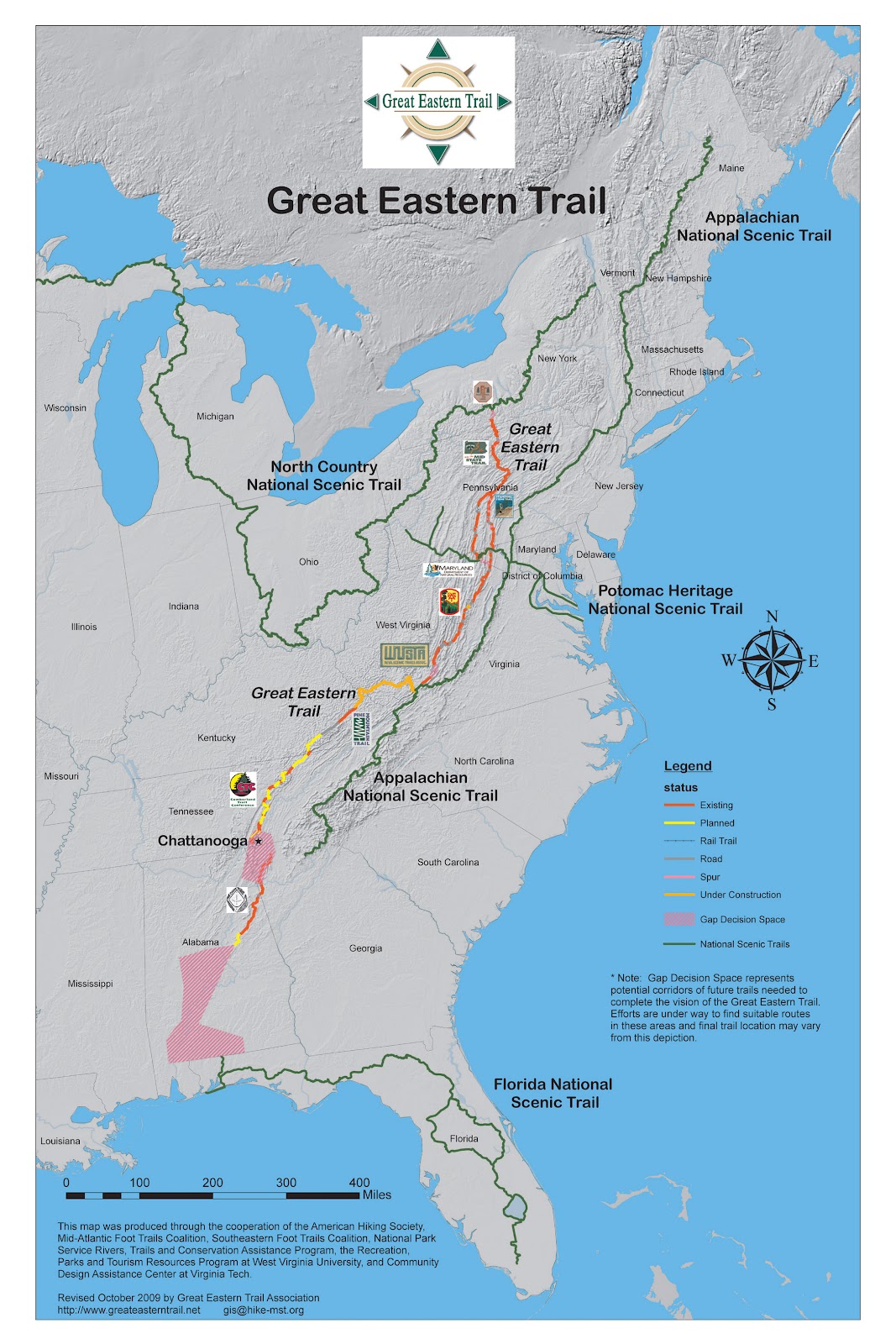 The 1,800 mile long GET is currently about seventy-five percent complete. The trail has several gaps where new trails need to be blazed to link the existing trails. Woolrich maintains a portion of the GET that runs through the middle of its hometown via the Mid State Trail.
“As hikers, too often we take for granted the trails we travel and don’t think about what it takes to maintain or build them,” said Brent Hollowell, Woolrich VP of Marketing. “Trails don’t blaze themselves, and we hope that we can help local clubs mobilize volunteers and make the Great Eastern Trail a reality.”
Late last fall Woolrich brought together leadership from the Great Eastern Trail Association, the Keystone Trail Association (KTA), Backpacker Magazine, and other GET associated clubs for a summit in Woolrich, PA. The attendees devised a strategic plan to help with trail maintenance and promote awareness of the trail.
“Woolrich has stepped up as a leader in helping us realize the completion of the trail,” said Tom Johnson, President of Great Eastern Trail Association. “We appreciate the additional visibility their efforts have brought to the GET and we are sure the positive attention will lead to more volunteers assisting with the actual maintenance work and development of the trail system.”
 Along with providing volunteer gift bags, including a trail work t-shirt, Woolrich hiking socks, and more, Woolrich is supporting its local trail organization, the Keystone Trail Association as the official sponsor of its Trail Care Days.
To further increase awareness of the trail Woolrich is collaborating with its long time partner Backpacker Magazine. Woolrich has developed a series of advertorials focusing on the GET that began appearing in the publication in February.
Backpacker is integrating content related to the Great Eastern Trail into the presentations of its popular national mobile tour, the Get Out More Tour, which stops at retail stores, events and festivals to educate consumers about the skills and equipment needed to enjoy the outdoors while inspiring healthy, active lifestyles.
The Great Eastern Trail was inspired by Benton MacKaye’s original vision for the Appalachian Trail as a network of braided trails running the length of the Appalachian Mountains. In 2000, Lloyd MacAskill of Potomac Appalachian Trail Club published an article in the Appalachian Trailway News calling attention to the existing trails to the west of the AT and saying, “Don’t look now, but parts are already in place.”
To learn more about the trail, participating trail clubs, donate or volunteer for a trail maintenance day visit www.greateasterntrail.net.
About Woolrich
Woolrich Inc., the Original Outdoor Clothing Company, is an authentic American brand that embraces an outdoor lifestyle. Trusted since 1830 by generations of loyal customers, Woolrich continues its tradition of providing quality products for today’s outdoor enthusiast. A brand recognized worldwide, Woolrich product offerings include functional, comfortable and durable men’s and women’s sportswear and outerwear using innovative fabrications for the ultimate in performance capabilities, well-designed home and outdoor living products, and licensed accessory products. In 2010, Woolrich celebrated its 180th Anniversary. It is the original and longest continuously-operating outdoor apparel manufacturer and woolen mill in the United States. Find out more at www.woolrich.com.
About Great Eastern Trail
The Great Eastern Trail (GET) provides a premier hiking experience on a series of existing trails that are being linked to each other into a long-distance footpath in the Appalachian Mountains stretching from Alabama to the Finger Lakes Trail in New York. The trail system is a project of the Great Eastern Trail Association, a non-profit 501(c)(3) organization, which works with the American Hiking Society, sponsors and local trail partners, to create America’s newest long distance trail for hikers. Learn more or donate to the Great Eastern Trail Association at www.greateasterntrail.net.
###
Michael Collin
Account Director • 207.619.4253 207.619.4253
Pale Morning Media • Public relations for the outdoor world
Box 7316 • Portland, ME 04112
81 W Commercial St, Suite 201 • Portland, ME 04101

USA Cycling announces launch of National Track Calendar
Posted: March 23, 2012 Filed under: Cycling | Tags: Colo, Colorado, Cycle Racing, Cycling, Racing, Rock Hill South Carolina, Scratch race, Track cycling, USA Cycling, Velodome Leave a comment
|
|||||||||||||||||||||||||||||||||||||||||||||||||||||||||||||||||||||||||||||||||||||



Amer Alp Club–Zack Martin Call For Grant Applications 2012
Posted: March 22, 2012 Filed under: Climbing, Mountaineering | Tags: American Alpine Club, Anatoli Boukreev, Climbing, Federal grants in the United States, grant, Mountaineering, Petzl Leave a commentThe American Alpine Club is pleased to announce a CALL FOR APPLICATIONS for the 2012 ZACK MARTIN BREAKING BARRIERS GRANT. ZMBB grant applications are due, this year, on April 15. Below you will find grant information and the grant application process (at the bottom of the ZMBB Grant page)
A special thanks to Black Diamond and Petzl for supporting this grant through special merchandise deals for the recipients.
Regards

Image via Wikipedia
“JP” John Parsons
john.p.parsons
720-254-6165 cell
The AAC Grants Webpage
Zack Martin Breaking Barriers Grant Page
The Zack Martin Breaking Barriers Grant (ZMBB) is a dual-purpose grant fund. The primary objective is humanitarian and the secondary objective is climbing, alpinism and/or exploration in the natural environment. The grantee must meet both objectives and is strongly encouraged to obtain additional funding. The humanitarian objective must be reasonable, and sustainable. Objectives that continue after implementation will receive the highest level of consideration. Focus the objective to affect the greatest human change. The alpine objective should focus on climbing and/or exploration but need not be at the leading edge of climbing or alpinism.
Zack Martin died just before his 25th birthday on Thanksgiving Day 2002. He was a recipient of AAC grants, the Anatoli Boukreev grant and others. Zack was concerned about the general arrogance and self-serving aspirations of climbers and explorers. He committed that on all future expeditions he would not only climb and explore but more importantly he would perform humanitarian service in the local community. He would “break a barrier” in the alpine environment and “break a barrier” in the heart of man. As Zack often said, “The only barrier holding you back is yourself.”
The American Alpine Club Webpage
The Donate To The Zack Martin Fund
American Alpine Club
c/o Donations—The Zack Martin Grant Fund
710 10th St
Suite 100
Golden, CO 80401
Include on check:
Zack Martin Breaking Barriers Fund
(all funds are tax deductible)
To be removed from this mail contact john.p.parsons
Tour of Utah Announces the Host Cities for the 2012 race.
Posted: March 20, 2012 Filed under: Cycling | Tags: Cycling, Professional Cycling, Utah 1 Comment
Image via Wikipedia
Time Trial added to the race format for 2012
The Tour of Utah has announced the host cities for the 2012 race. Ogden, Tooele, Salt Lake City, Park City, and Snowboard Ski Resort will either host a start or finish at this year’s race.
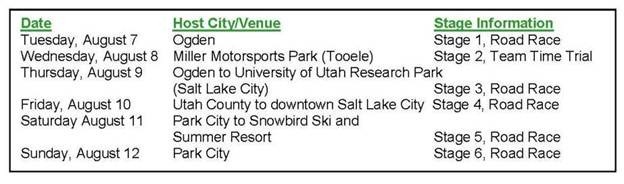
This race is becoming a great lead up to the USA Pro-Challenge which is scheduled a little over a week later.
See: Team Time Trial Highlights Changes for 2012 Tour of Utah; Host Cities Announced
Do Something
Get out and support professional cycling in Utah
What do you think? Leave a comment.
If you like this let your friends know or post it on FB, Twitter or LinkedIn
Copyright 2012 Recreation Law (720) Edit Law
Twitter: RecreationLaw
Facebook: Rec.Law.Now
Facebook Page: Outdoor Recreation & Adventure Travel Law
Mobile Site: http://m.recreation-law.com
#RecreationLaw, #@RecreationLaw, #Cycling.Law #Fitness.Law, #Ski.Law, #Outside.Law, #Recreation.Law, #Recreation-Law.com, #Outdoor Law, #Recreation Law, #Outdoor Recreation Law, #Adventure Travel Law, #law, #Travel Law, #Jim Moss, #James H. Moss, #Attorney at Law, #Tourism, #Adventure Tourism, #Rec-Law, #Rec-Law Blog, #Recreation Law, #Recreation Law Blog, #Risk Management, #Human Powered, #Human Powered Recreation,# Cycling Law, #Bicycling Law, #Fitness Law, #Recreation-Law.com, #Backpacking, #Hiking, #Mountaineering, #Ice Climbing, #Rock Climbing, #Ropes Course, #Challenge Course, #Summer Camp, #Camps, #Youth Camps, #Skiing, #Ski Areas, #Negligence, #Snowboarding, #RecreationLaw, #@RecreationLaw, #Cycling.Law #Fitness.Law, #SkiLaw, #Outside.Law, #Recreation.Law, #RecreationLaw.com, #OutdoorLaw, #RecreationLaw, #OutdoorRecreationLaw, #AdventureTravelLaw, #Law, #TravelLaw, #JimMoss, #JamesHMoss, #AttorneyatLaw, #Tourism, #AdventureTourism, #RecLaw, #RecLawBlog, #RecreationLawBlog, #RiskManagement, #HumanPowered, #HumanPoweredRecreation,# CyclingLaw, #BicyclingLaw, #FitnessLaw, #RecreationLaw.com, #Backpacking, #Hiking, #Mountaineering, #IceClimbing, #RockClimbing, #RopesCourse, #ChallengeCourse, #SummerCamp, #Camps, #YouthCamps, #Skiing, #Ski Areas, #Negligence, #Snowboarding, sport and recreation laws, ski law, cycling law, Colorado law, law for recreation and sport managers, bicycling and the law, cycling and the law, ski helmet law, skiers code, skiing accidents, Tour of Utah, #Cycling, Cycle Racing, Bike Race, #Bicycling, Salt Lake City, #Utah, #UT, Park City, #Ogden
WordPress Tags: Tour,Utah,Announces,Host,Cities,Time,Trial,Ogden,Tooele,Salt,Lake,Park,Snowboard,Resort,Challenge,Team,Highlights,Changes,Leave,Twitter,LinkedIn,Recreation,Edit,RecreationLaw,Facebook,Page,Outdoor,Adventure,Travel,Blog,Mobile,Site,Outside,Moss,James,Attorney,Tourism,Risk,Management,Human,Rock,Ropes,Course,Summer,Camp,Camps,Youth,Areas,Negligence,SkiLaw,OutdoorLaw,OutdoorRecreationLaw,AdventureTravelLaw,TravelLaw,JimMoss,JamesHMoss,AttorneyatLaw,AdventureTourism,RecLaw,RecLawBlog,RecreationLawBlog,RiskManagement,HumanPoweredRecreation,CyclingLaw,BicyclingLaw,FitnessLaw,RopesCourse,ChallengeCourse,SummerCamp,YouthCamps,Colorado,managers,helmet,accidents,Cycle,Bike,Race
Every time someone comes to your business or every time they sign up again they should sign a release. This time it got rid of a major problem.
Posted: March 19, 2012 Filed under: New Jersey, Release (pre-injury contract not to sue), Ski Area | Tags: Adhesion Contract, Exculpatory Agreement, Federal Rules of Civil Procedure, Injury, Mountain Creek, Plaintiff, Pre-injury Release, Release, ski area, skiing, Summary judgment, Unconscionability Leave a commentDearnley v. Mountain Creek, 2012 N.J. Super. Unpub. LEXIS 527
Releases work for future injuries and for injuries that may have all ready occurred.
This is a case where as part of the employment at a ski area, the family of the employee was able to get season passes. A requirement for the season pass was to sign a release.
In this case, the plaintiff was injured skiing on a season pass issued to the family member of an employee. The plaintiff sued the ski resort for his injuries. After the lawsuit had commenced but before trial, the plaintiff got another season pass and signed another release. The second release language was sufficient to stop the lawsuit.
The release was called a post injury release now because it stopped a lawsuit after the injury. Normally, I discuss pre-injury releases. Pre-Injury releases are releases that are signed in case someone is injured in a negligent manner.
Summary of the case
After it was discovered the plaintiff had signed a second release, the defense moved to amend their answer and filed a motion for summary judgment. The trial court granted the motion to amend and add the defense of release and accord and satisfaction. The plaintiff appealed.
“Release” is an affirmative defense. An affirmative defense is one that must be plead immediately in the answer of the defendant or the defense is waived. Release as a defense means that the parties have executed an agreement that releases the defendant from any claims.
“Accord and Satisfaction” are also an affirmative defense. Accord and Satisfaction means the party have come to an agreement, an accord and resolved their differences to the satisfaction of all parties.
The plaintiff argued that the post injury release was unconscionable. The contract should not be enforced because of:
“….inadequacies, such as age, literacy, lack of sophistication, hidden or unduly complex contract terms, bargaining tactics, and the particular setting existing during the contract formation process.”
An unconscionable contract or a contract of adhesion is one that the terms were offered on a take or leave it basis the terms are unjust to the point the court cannot allow the contract to stand. The contract must be so bad as to shock the conscience of the court. However, the contract cannot just be bad to one party.
Here, there are several factors that would not make the contract unconscionable. The contract is not for a necessary service. The services could be received from the same party in other ways. (Instead of signing a release and getting a season pass, the plaintiff could have purchased daily lift tickets and not signed a release.) The services were available from other providers.
The court found there were no coercion, duress, fraud or “sharp practices” by the defendant. The agreement did not change the duty of care nor did it “incentivize negligence.” Each of the contracting parties gained or gave away something of value.
So Now What?
Here the defendant was lucky. The plaintiff unknowingly signed a release to get his season pass that had the language necessary to stop a claim that had already occurred. There are two important points to bring up from this case.
1 Make sure your release has language to top future claims and past claims.
2. Every single time have every single-person sign a release. Get a new season pass, you sign the release again. Go rafting again, you sign the release. Buy another widget sign the release.
You just never know when a release from the future may stop a claim from the past.
What do you think? Leave a comment.
If you like this let your friends know or post it on FB, Twitter or LinkedIn
Copyright 2012 Recreation Law (720) Edit Law
Twitter: RecreationLaw
Facebook: Rec.Law.Now
Facebook Page: Outdoor Recreation & Adventure Travel Law
Mobile Site: http://m.recreation-law.com
#RecreationLaw, #@RecreationLaw, #Cycling.Law #Fitness.Law, #Ski.Law, #Outside.Law, #Recreation.Law, #Recreation-Law.com, #Outdoor Law, #Recreation Law, #Outdoor Recreation Law, #Adventure Travel Law, #law, #Travel Law, #Jim Moss, #James H. Moss, #Attorney at Law, #Tourism, #Adventure Tourism, #Rec-Law, #Rec-Law Blog, #Recreation Law, #Recreation Law Blog, #Risk Management, #Human Powered, #Human Powered Recreation,# Cycling Law, #Bicycling Law, #Fitness Law, #Recreation-Law.com, #Backpacking, #Hiking, #Mountaineering, #Ice Climbing, #Rock Climbing, #Ropes Course, #Challenge Course, #Summer Camp, #Camps, #Youth Camps, #Skiing, #Ski Areas, #Negligence, #Snowboarding, #RecreationLaw, #@RecreationLaw, #Cycling.Law #Fitness.Law, #SkiLaw, #Outside.Law, #Recreation.Law, #RecreationLaw.com, #OutdoorLaw, #RecreationLaw, #OutdoorRecreationLaw, #AdventureTravelLaw, #Law, #TravelLaw, #JimMoss, #JamesHMoss, #AttorneyatLaw, #Tourism, #AdventureTourism, #RecLaw, #RecLawBlog, #RecreationLawBlog, #RiskManagement, #HumanPowered, #HumanPoweredRecreation,# CyclingLaw, #BicyclingLaw, #FitnessLaw, #RecreationLaw.com, #Backpacking, #Hiking, #Mountaineering, #IceClimbing, #RockClimbing, #RopesCourse, #ChallengeCourse, #SummerCamp, #Camps, #YouthCamps, #Skiing, #Ski Areas, #Negligence, #Snowboarding, sport and recreation laws, ski law, cycling law, Colorado law, law for recreation and sport managers, bicycling and the law, cycling and the law, ski helmet law, skiers code, skiing accidents, Mountain Creek, Adhesion Contract, Pre-Injury, Post-Injury, Pre-Injury Release, Post Injury Release, Employee Benefit, #Unconscionable, #Exculpatory, Exculpatory Agreement, #Adhesion,
WordPress Tags: Dearnley,Mountain,Creek,Super,Unpub,LEXIS,Releases,injuries,employment,area,employee,requirement,plaintiff,member,resort,lawsuit,injury,manner,Summary,judgment,satisfaction,Release,defendant,agreement,Accord,differences,inadequacies,literacy,sophistication,tactics,formation,adhesion,basis,conscience,Here,factors,Instead,tickets,providers,coercion,fraud,negligence,Make,person,widget,Leave,Twitter,LinkedIn,Recreation,Edit,RecreationLaw,Facebook,Page,Outdoor,Adventure,Travel,Blog,Mobile,Site,Outside,Moss,James,Attorney,Tourism,Risk,Management,Human,Rock,Ropes,Course,Challenge,Summer,Camp,Camps,Youth,Areas,SkiLaw,OutdoorLaw,OutdoorRecreationLaw,AdventureTravelLaw,TravelLaw,JimMoss,JamesHMoss,AttorneyatLaw,AdventureTourism,RecLaw,RecLawBlog,RecreationLawBlog,RiskManagement,HumanPoweredRecreation,CyclingLaw,BicyclingLaw,FitnessLaw,RopesCourse,ChallengeCourse,SummerCamp,YouthCamps,Colorado,managers,helmet,accidents,Contract,Post,Benefit,Unconscionable,Exculpatory
Dearnley v. Mountain Creek, 2012 N.J. Super. Unpub. LEXIS 527
Posted: March 19, 2012 Filed under: Legal Case, Release (pre-injury contract not to sue), Ski Area | Tags: Adhesion Contract, Appeal, Defendant, Exculpatory Agreement, Law Division, Mountain Creek, New Jersey Superior Court, Pre-injury Release, Release, ski area, skiing, Summary judgment, Unpub Leave a commentDearnley v. Mountain Creek, 2012 N.J. Super. Unpub. LEXIS 527
Derek Dearnley and Vicky Dearnley, his wife, Plaintiffs-Appellants, v. Mountain Creek, its agents, servants and employees, Defendant-Respondent.
Docket no. A-5517-10T1
Superior Court of New Jersey, Appellate Division
2012 N.J. Super. Unpub. LEXIS 527
February 29, 2012, Argued
March 12, 2012, Decided
Notice: not for publication without the approval of the appellate division.
Please consult new jersey rule 1:36-3 for citation of unpublished opinions.
Prior History: [*1]
On appeal from the Superior Court of New Jersey, Law Division, Sussex County, Docket No. L-540-09.
CORE TERMS: season, summary judgment, ski area, unconscionability, unconscionable, affirmative defenses, resort, Law Division, contract of adhesion, exculpatory provisions, releasor’s, surgery, ski, pass holder, bold, tort liability, de novo, contracting party’s, public policy, sliding scale, unenforceable, snowboarding, exculpatory, non-moving, favorable, equitable, adhesion, binding, bargain, quod
COUNSEL: Evan D. Baker argued the cause for appellants (Law Offices of Rosemarie Arnold, attorneys; Mr. Baker, of counsel and on the brief).
Samuel J. McNulty argued the cause for respondent (Hueston McNulty, P.C., attorneys; Mr. McNulty, of counsel and on the brief; John F. Gaffney and Stephen H. Shaw on the brief).
JUDGES: Before Judges Harris and Koblitz.
OPINION
PER CURIAM
Plaintiffs Derek Dearnley and Vicky Dearnley appeal from the June 16, 2011, summary judgment dismissal of their six-count complaint. Plaintiffs sought tort remedies for injuries suffered by Mr. Dearnley while snowboarding at defendant Mountain Creek Resort, Inc.’s ski area in Vernon. We affirm.
I.1
1 This appeal arises from the motion court’s grant of summary judgment in defendant’s favor. Accordingly, we present the evidence in the light most favorable to plaintiffs. See Durand v. The Nutley Sun, N.J. , (2012) (slip op. at 3 n.1) (citing G.D. v. Kenny, 205 N.J. 275, 304 (2011) (citations omitted); R. 4:46-2(c)).
Between 1998 and 2010, Mrs. Dearnley was employed by defendant in its retail department. As part of her compensation benefits, [*2] she and her family members were entitled to apply for, and obtain, a free season pass to use defendant’s facilities at its Vernon ski resort. On November 25, 2008, because her husband desired to take advantage of this benefit for the 2008-2009 winter season, Mrs. Dearnley applied for, and obtained, the pass. She signed, on his behalf, a document entitled, “Season Pass Contract, Student Ski & Ride Voucher Program, Rules and Conditions of Sale, Release of Liability and Indemnity Agreement” (the 2008 agreement). The 2008 agreement contained exculpatory provisions purporting to release tort claims before they occurred. For example, the pass holder “fully release[d] Mountain Creek FROM ANY AND ALL LIABILITY for personal injury, death or property damage arising out of or resulting from [the pass holder’s] participation in this sport, MOUNTAIN CREEK’S NEGLIGENCE, conditions on or about the premises and facilities or the operations of the ski area” (capitalization in the original). The outcome of this appeal, however, does not turn on this language.
On January 4, 2009, Mr. Dearnley was snowboarding at the Mountain Creek ski area when he suffered an accident that he attributes to defendant’s [*3] negligence and breach of its duties under N.J.S.A. 5:13-1 to -11 (the Ski Act). As a result of the accident, Mr. Dearnley incurred serious injuries, which required immediate emergency surgery to stabilize his back by the implantation of metal rods and screws. According to his answers to interrogatories, Mr. Dearnley ultimately spent approximately six weeks in the hospital, had to endure three surgeries, and underwent weeks of physical therapy and rehabilitation.
On October 13, 2009, plaintiffs filed their personal injury and per quod complaint against defendant in the Law Division, Sussex Vicinage. Defendant’s answer listed ten affirmative defenses, but did not assert that the 2008 agreement’s exculpatory provisions barred the action.
Two months later, on December 21, 2009, while his wife was still employed by defendant, Mr. Dearnley applied for a season pass for the 2009-2010 winter season. He was presented with, and signed, a two-page document entitled, “Mountain Creek Resort, Inc. 2009-’10 Season Pass Wavier” (the 2009 agreement). In bold, capitalized print at the top of the first page, the 2009 agreement stated, “RELEASE, WARNINGS AND DISCLAIMERS ON SKIING.”
At the top of the second [*4] page, to which Mr. Dearnley affixed his signature, the following appeared in bold typeface:
I FURTHER RELEASE AND GIVE UP ANY AND ALL CLAIMS AND RIGHTS THAT I MAY NOW HAVE AGAINST MOUNTAIN CREEK RESORT, INC. THIS RELEASES ALL CLAIMS, INCLUDING THOSE OF WHICH I AM NOT AWARE AND THOSE NOT MENTIONED IN THIS RELEASE. THIS RELEASE APPLIES TO CLAIMS RESULTING FROM ANYTHING WHICH HAS HAPPENED UP TO NOW.
The 2009 agreement also stated in bold typeface: “I AM AWARE THAT THIS CONTRACT IS LEGALLY BINDING AND THAT I AM RELEASING LEGAL RIGHTS BY SIGNING IT.”
During discovery, the 2008 and 2009 agreements were exchanged between the parties’ attorneys. Upon the realization of what Mr. Dearnley had signed, plaintiffs filed a motion “for an Order barring the affirmative defenses related to two adhesion contracts.” Defendant filed a cross-motion seeking (1) summary judgment, (2) permission to file an amended answer, and (3) denial of plaintiffs’ motion.
On April 29, 2011, Judge Edward V. Gannon heard oral argument. The judge granted defendant’s motion to amend its answer to permit the pleading of (1) release and (2) accord and satisfaction as affirmative defenses. The judge noted that the 2009 agreement [*5] was executed after both the filing of plaintiffs’ complaint and defendant’s answer, and therefore could not have been contemplated by the first exchange of pleadings. Reciprocally, he denied plaintiff’s motion to bar the affirmative defenses. Finally, he reserved decision on what he called “a matter of first impression with regard to this particular type of release.”
On June 16, 2011, Judge Gannon entered an order granting summary judgment dismissing plaintiffs’ complaint with prejudice. He explained his decision in a thorough ten-page statement of reasons, taking pains to carefully explicate the two agreements and then analyze them under the lens of applicable law. This appeal ensued.
II.
Orders granting summary judgment pursuant to Rule 4:46-2 are reviewed de novo, and we apply the same legal standard employed by the Law Division. Canter v. Lakewood of Voorhees, 420 N.J. Super. 508, 515 (App. Div. 2011). In performing our appellate function we consider, as did the motion court, “‘whether the competent evidential materials presented, when viewed in the light most favorable to the non-moving party, are sufficient to permit a rational factfinder to resolve the alleged disputed issue in [*6] favor of the non-moving party.'” Advance Hous., Inc. v. Twp. of Teaneck, 422 N.J. Super. 317, 327 (App. Div. 2011) (quoting Brill v. Guardian Life Ins. Co. of Am., 142 N.J. 520, 540 (1995)), certif. granted, N.J. (Jan. 24, 2012).
Similarly, when the legal conclusions of a motion court’s Rule 4:46-2 summary judgment decision are reviewed on appeal, “‘[a] trial court’s interpretation of the law and the legal consequences that flow from established facts are not entitled to any special deference[,]’ and, hence, an ‘issue of law is subject to de novo plenary appellate review.'” Estate of Hanges v. Metro. Prop. Cas. Ins. Co., 202 N.J. 369, 382-83 (2010) (quoting City of Atl. City v. Trupos, 201 N.J. 447, 463 (2010)).
Judge Gannon dismissed plaintiffs’ claims based upon the release contained in the 2009 agreement, which was personally executed by Mr. Dearnley months after his injuries and surgeries, months after he hired a lawyer, and months after he filed suit. From our review of the undisputed factual record, we are satisfied that this case does not present any novel or first impression issues. Rather, it revolves around an ordinary release —- not exculpatory —- clause and is governed [*7] by familiar principles of contract interpretation. As Judge Gannon stated,
Invalidating the agreed upon waiver would signal judicial mistrust of our citizen’s ability to intelligently enter contracts, in which benefits derive from the assumptions of burdens. In this case, Mr. Dearnley surrendered his right to maintain this suit in exchange for the benefits afforded to season pass holders. A contracting party’s assumption of a substantial burden is no basis for interfering with our citizens’ right to freely contract.
We affirm substantially for the reasons expressed by Judge Gannon, and add only the following brief comments.
Plaintiffs condemn the 2009 agreement as a contract of adhesion, fraught with unconscionabilty, and contrary to public policy. We emphasize that our review is limited to the 2009 agreement, not the 2008 agreement. We are not concerned with defendant’s efforts to exculpate itself from tort liability before an invitee becomes injured at its ski area. Instead, we parse Mr. Dearnley’s release of a claim after it allegedly accrued.
We begin our analysis of the enforceability of the release contained in the 2009 agreement with recognition of the deep-seated principle that [*8] contracts will be enforced as written. Vasquez v. Glassboro Serv. Ass’n, Inc., 83 N.J. 86, 98-100 (1980). Ordinarily, courts will not rewrite contracts to favor a party, for the purpose of giving that party a better bargain. Relief is not available merely because enforcement of the contract causes oppression, improvidence, or unprofitability, or because it produces hardship to one of the parties. Brunswick Hills Racquet Club, Inc. v. Route 18 Shopping Ctr. Assocs., 182 N.J. 210, 223 (2005). A court cannot “‘abrogate the terms of a contract unless there is a settled equitable principle, such as fraud, mistake, or accident, allowing for such intervention.'” Id. at 223-24 (quoting Dunkin’ Donuts of America, Inc. v. Middletown Donut Corp., 100 N.J. 166, 183-84 (1985)).
Rational personal and economic behavior in the modern post-industrial world is only possible if agreements between parties are respected. The reasonable expectations created by mutual assent ought to receive the protection of the law and courts should not be encouraged to fashion a better arrangement for a party because of a gaffe to which the other party is not privy. In other words, avoidance of a contract is a very stern [*9] remedy that requires clear evidence demonstrating that the consequences of the mistake are so grave that enforcement of the contract would be unconscionable. That formidable threshold has not been surmounted here.
Notwithstanding the foregoing, a contract provision that is procedurally and substantively unconscionable can be set aside. See Muhammad v. Cnty. Bank of Rehoboth Beach, 189 N.J. 1, 15 (2006), cert. denied, 549 U.S. 1338, 127 S. Ct. 2032, 167 L. Ed. 2d 763 (2007). “[P]rocedural unconscionability . . . ‘can include a variety of inadequacies, such as age, literacy, lack of sophistication, hidden or unduly complex contract terms, bargaining tactics, and the particular setting existing during the contract formation process[.]'” Ibid. (quoting Sitogum Holdings, Inc. v. Ropes, 352 N.J. Super. 555, 564-66 (Ch. Div. 2002). A contract of adhesion, presented by the drafting party to the other party on a take-it-or-leave-it basis, as here, typically involves “some characteristics of procedural unconscionability[.]” Id. at 16. The determination “that a contract is one of adhesion, however, ‘is the beginning, not the end, of the inquiry’ into whether a contract, or any specific term therein, [*10] should be deemed unenforceable based on policy considerations.” Id. at 28 (citing Rudbart v. N. Jersey Dist. Water Supply Comm., 127 N.J. 344 (1992)).
Substantive unconscionability essentially refers to the inclusion within a contract of “harsh or unfair one-sided terms.” Id. at 15 (citing Sitogum, supra, 352 N.J. Super. at 564-66). It is also described as “‘the exchange of obligations so one-sided as to shock the court’s conscience.'” B & S Ltd., Inc. v. Elephant & Castle Intern., Inc., 388 N.J. Super. 160, 176 (Ch. Div. 2006)(quoting Sitogum, supra, 352 N.J. Super. at 565).
Generally, courts must undertake “a careful fact sensitive examination into [claims of] substantive unconscionability.” Id. at 16 (footnote omitted). “When making the determination that a contract of adhesion is unconscionable and unenforceable, we consider, using a sliding scale analysis, the way in which the contract was formed and, further, whether enforcement of the contract implicates matters of public interest.” Stelluti v. Casapenn Enters., LLC, 203 N.J. 286, 301 (2010).
The release provisions of the 2009 agreement are not the analytical equivalent of its exculpatory provisions. “The law does not favor exculpatory [*11] agreements because they encourage a lack of care.” Gershon v. Regency Diving Ctr., Inc., 368 N.J. Super. 237, 247 (App. Div. 2004). For that reason, courts closely scrutinize attempts to contract in advance to release tort liability. “‘[C]ourts have not hesitated to strike limited liability clauses that are unconscionable or in violation of public policy.'” Hojnowski v. Vans Skate Park, 187 N.J. 323, 333 (2004) (quoting Lucier v. Williams, 366 N.J. Super. 485, 491 (App. Div. 2004)).
The subject release does not call forth any of the foregoing concerns. Mr. Dearnley’s 2009 agreement with defendant neither eroded defendant’s duty of care nor did it incentivize negligence. Each of the contracting parties gained or gave away something of value. There was no coercion, duress, fraud, or sharp practices afoot. Public policy is not offended by requiring a non-incapacitated adult to honor the type of promise given here. See Raroha v. Earle Fin. Corp., 47 N.J. 229, 234 (1966) (holding that in the absence of fraud, misrepresentation or overreaching by the releasee, in the absence of a showing that the releasor was suffering from an incapacity affecting his ability to understand the meaning of [*12] the release and in the absence of any other equitable ground, it is the law of this State that the release is binding and that the releasor will be held to the terms of the bargain he willingly and knowingly entered).
Judge Gannon properly calibrated the “sliding scale” of our unconscionabilty jurisprudence and correctly determined that the 2009 agreement’s release was enforceable. Mr. Dearnley’s releasor’s remorse is an insufficient basis to return this matter to the Law Division for trial.2
2 Mrs. Dearnley’s claims are entirely derivative of her husband’s and consequently her per quod action must fall in the wake of Mr. Dearnley’s release. See Ryan v. Renny, 203 N.J. 37, 62 n.1 (2011) (noting that “the viability of [that claim] is subject to the survival of [her husband]’s claim” (quoting Sciarrotta v. Global Spectrum, 194 N.J. 345, 350 n.3 (2008)).)
Affirmed.
Lazer Sport Press Release – Lazer Sport launches new website for 2012 along with “Love Lazer” Official Helmeteer Contest!
Posted: March 16, 2012 Filed under: Cycling | Tags: google, Helmets, Lazer, LazerTag Leave a comment
|


If you Listen to the FredCast, and who doesn’t, Take this Survey
Posted: March 15, 2012 Filed under: Cycling, Youth Camps, Zip Line | Tags: Bicycling, Cycling, Fred, FredCast, Podcast, The Wall Street Journal Leave a comment
|
|||||||||||||||||||||


CSCUSA PR reminds people to be safe
Posted: March 13, 2012 Filed under: Avalanche, Colorado, Ski Area | Tags: #Avalanche, #Safety, CAIC, Colorado, CSCUSA, Loveland Ski Area, Resort, Ski, ski area, skiing Leave a commentColorado Ski Country USA Reminds Skiers & Snowboarders to be Safe on the Slopes
Resorts Emphasize Safe Skiing, Prepare for Busy Holiday
Aspen Highlands, Michael Neumann
DENVER, Colo. – February 17, 2012– Colorado Ski Country USA (CSCUSA) and its 22 member resorts remind skiers and snowboarders to practice safe skiing and riding, know and follow Your Responsibility Code, be aware of surroundings and obey terrain closures.
“Guest safety is always the number one priority of our members,” explained Melanie Mills, CSCUSA president and CEO. “President’s Day weekend is a popular time to go skiing, and our resorts are doing absolutely everything they can to make sure guests are safe and have an enjoyable time on the slopes during this busy weekend.”
Individual skier and snowboarder responsibility is the foundation for safe skiing. Loveland Ski Area assistant patrol director and CSCUSA Ski Patroller of the Year, Joey Riefenberg, stresses the importance of being aware of your surroundings, “Skiers and snowboarders need to be proactive about safety, pay attention to who is skiing around you and always look downhill. Go slow and give yourself time to stop. Know that little kids are out and about and need a wide berth, watch where the flows are.”
CSCUSA member resorts across the state are taking extra measures to provide safe skiing environments, including constantly reassessing conditions. “Resorts are working super hard to make sure it’s safe. Everyone is super conscientious of that, and the snowpack,” said Riefenberg. “It’s a funny snowpack this year, really odd, and resorts are on alert, busy knocking all the air out of the snowpack and making sure everything is safe.”
Skiers and snowboarders are also reminded to obey all signage and be especially alert to obeying terrain closures. As snow continues to fall in Ski Country, resorts will open more terrain as conditions safely allow. “We’d love to open everything but things are closed for a reason, because it’s unsafe for you and unsafe for those who have to rescue you,” Riefenberg explained. “Nothing is being saved, we want everyone to have fun, but be safe doing it.”
Ultimately, it is the responsible behavior of skiers and riders that make the slopes safe. Knowing the nationally recognized Your Responsibility Code is crucial to skier and rider responsibility. Referred to simply as The Code, it is comprised of seven principles that collectively outline on-mountain skier etiquette and safe skiing practices.
Responsibilities within The Code include:

Image via Wikipedia
- Always stay in control, and be able to stop or avoid other people or objects.
- People ahead of you have the right of way. It is your responsibility to avoid them.
- You must not stop where you obstruct a trail, or are not visible from above.
- Whenever starting downhill or merging into a trail, look uphill and yield to others.
- Always use devices to help prevent runaway equipment.
- Observe all posted signs and warnings. Keep off closed trails and out of closed areas.
- Prior to using any lift, you must have the knowledge and ability to load, ride and unload safely.
CSCUSA also reminds skiers, snowboarders and other snowsports enthusiasts heading into the backcountry to check with the Colorado Avalanche Information Center (CAIC) on the magnitude and nature of avalanche hazard they may encounter, do not venture out alone, and have proper equipment and education for the conditions. “Backcountry avalanche danger right now is considerable,” states Ethan Greene, director of CAIC. “With the holiday weekend there’s going to be powder snow and nice weather, but don’t be fooled that the hazard is anything less than very serious.”
More information on backcountry conditions can be found at the CAIC website, www.avalanche.state.co.us or by calling 303-499-9650.

American Mountain Bike Challenge Dates
Posted: March 8, 2012 Filed under: Cycling | Tags: #race, Cycling, Mountain bike, Mountain Bike Challenge, Mountain biking, Race Dates, Recreation and Sports, Sports, USA Cycling, XC Racing Leave a comment
Image by Getty Images via @daylife
|
||||||||||||||||||



Image via Wikipedia
New study suggests that North American Avalanche survival time is half what was previously thought
Posted: March 7, 2012 Filed under: Avalanche | Tags: avalanche, Avalanche Study, Burial Time, Canada, Canadian Medical Association Journal, Haegeli, Pascal Haegeli, Recreation, Ski, Survival, Survival Time, Switzerland, Tree Line Leave a commentTen minute survival in western wet snow is shown by the study.
Dr. Pascal Haegeli, a researcher from Vancouver BC has recently published a study in the Canadian Medical Association Journal titled “Comparison of avalanche survival patterns in Canada and Switzerland.” There are several notable things to take away from this study.
1. The survival time for a victim in an avalanche has been 18 minutes based on a study done in Switzerland in 1998. (Falk M, Brugger H, Adler-Kastner L. Avalanche survival chances. Nature 1994;368:21.) This 1998 study is not being dismissed. Differences between the types of snow, terrain, etc. are the cause for the discrepancies between the two studies.
This study says that avalanche survival time is probably only Ten (10) minutes.
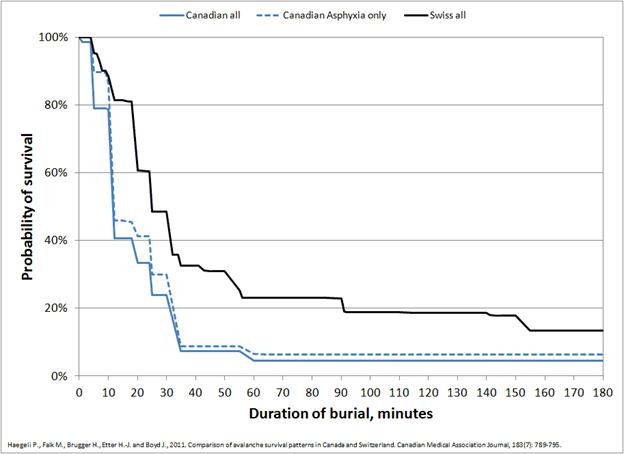
The Swiss study developed the avalanche survival curve based on the amount of time a person was buried.
The probability of survival remains above 91% during the first 18 minutes of burial (“survival phase”). This phase is followed by a precipitous drop to 34% between 19 and 35 minutes be – cause of asphyxiation of most people (“asphyxia phase”). Between 35 and 90 minutes, the survival curve levels out (“latent phase”) because of the survival of people with patent airways. Thereafter, survival drops again as those buried eventually succumb to lethal hypothermia complicated by progressive hypoxia and hypercapnia.
2. There was no statistical difference between the overall survival rate of the Canadian study (Haegeli) and the Swiss study (Brugger).
…the Canadian survival curve showed lower chances of survival at all burial durations compared with the Swiss survival model, with a quicker drop in survival in the first 35 minutes and poorer survival associated with prolonged burials.
3. Most Swiss avalanches occur above tree line. Most North American avalanches occur below the tree line. Trauma fatalities are significantly greater in North America.
In the Canadian sample, trauma accounted for more than half of the deaths among people extricated in the first 10 minutes (Figure 1), which highlights the strong influence of trauma on the early phases of the survival curve. The probability of survival at the end of the first 10 minutes was 77% in the overall survival curve for Canada, as compared with 86% in the asphyxia-only survival curve.
4. There were statistically different survival chances between different climates in North America. Western (maritime) snow climates had shorter overall survival times. Western snow climates are characterized by wetter, heavier snow.
The survival curves for the transitional and maritime snow climates were characterized by a considerably earlier drop in survival compared with the curve for the continental snow climate.
The study also offered speculation that heavier denser snow prevented chest movement preventing the victim from breathing if buried.
Snow density is defined as the overall mass of snow per unit volume (kilograms per meter cubed). Typical densities of seasonal snow vary from 30 kg/m in dry, newly fallen snow to 600 kg/m in wet spring snow.
These results highlight the importance of prompt extrication by companions, especially in areas with a more maritime snow climate. Although the “survival phase” has commonly been described to be about 18 minutes long, our analysis shows that the first 10 minutes might be a more appropriate general guideline for Canada and other areas with a maritime snow climate.

5. The study recommended that Airbags and Transceivers be used as they offered the best options to speed up rescue.
The use of avalanche airbags to prevent burial and avalanche transceivers to speed up the locations of buried avalanche victims are recommended. Both of these safety devices have been shown to reduce mortality significantly.
The study had numerous interesting facts about avalanche burials.
The two longest burials among survivors in the Canadian sample (120 and 300 minutes) both occurred in urban settings, whereas the maximum burial time among survivors in a remote setting was 55 minutes.
So?
When teaching at Colorado Mountain College in the Ski Area Operations program I tell my students the one thing we know about avalanches to an absolute certainty: Avalanches are made of snow.
For other articles on Avalanches see:
Research shows beacons have issues with multivictim searches
Colorado Avalanche Information Center
It’s time to sign up to get the CAIC Avalanche Forecasts
Well written article about the risks of Avalanches and survival with the latest gear.
See this article by Earn Your Turns: Canadian Study reduces Avalanche Survival Time, http://www.earnyourturns.com/9079/avalanche-survival-time-reduced/
What do you think? Leave a comment.
If you like this let your friends know or post it on FB, Twitter or LinkedIn
Copyright 2012 Recreation Law (720) Edit Law
Twitter: RecreationLaw
Facebook: Rec.Law.Now
Facebook Page: Outdoor Recreation & Adventure Travel Law
Mobile Site: http://m.recreation-law.com
#RecreationLaw, #@RecreationLaw, #Cycling.Law #Fitness.Law, #Ski.Law, #Outside.Law, #Recreation.Law, #Recreation-Law.com, #Outdoor Law, #Recreation Law, #Outdoor Recreation Law, #Adventure Travel Law, #law, #Travel Law, #Jim Moss, #James H. Moss, #Attorney at Law, #Tourism, #Adventure Tourism, #Rec-Law, #Rec-Law Blog, #Recreation Law, #Recreation Law Blog, #Risk Management, #Human Powered, #Human Powered Recreation,# Cycling Law, #Bicycling Law, #Fitness Law, #Recreation-Law.com, #Backpacking, #Hiking, #Mountaineering, #Ice Climbing, #Rock Climbing, #Ropes Course, #Challenge Course, #Summer Camp, #Camps, #Youth Camps, #Skiing, #Ski Areas, #Negligence, #Snowboarding, #RecreationLaw, #@RecreationLaw, #Cycling.Law #Fitness.Law, #SkiLaw, #Outside.Law, #Recreation.Law, #RecreationLaw.com, #OutdoorLaw, #RecreationLaw, #OutdoorRecreationLaw, #AdventureTravelLaw, #Law, #TravelLaw, #JimMoss, #JamesHMoss, #AttorneyatLaw, #Tourism, #AdventureTourism, #RecLaw, #RecLawBlog, #RecreationLawBlog, #RiskManagement, #HumanPowered, #HumanPoweredRecreation,# CyclingLaw, #BicyclingLaw, #FitnessLaw, #RecreationLaw.com, #Backpacking, #Hiking, #Mountaineering, #IceClimbing, #RockClimbing, #RopesCourse, #ChallengeCourse, #SummerCamp, #Camps, #YouthCamps, #Skiing, #Ski Areas, #Negligence, #Snowboarding, sport and recreation laws, ski law, cycling law, Colorado law, law for recreation and sport managers, bicycling and the law, cycling and the law, ski helmet law, skiers code, skiing accidents, #Avalanche, Avalanche Study, Pascal Haegeli, #Vancouver, #BC, Canadian Medical Association Journal, #Haegeli, #CMAJ, #CMA, Survival Rate, #Study,
WordPress Tags: North,American,Avalanche,survival,western,Pascal,Haegeli,researcher,Vancouver,Canadian,Medical,Association,Journal,Comparison,Canada,Switzerland,victim,Falk,Brugger,Adler,Kastner,Nature,Differences,terrain,discrepancies,Swiss,person,burial,phase,asphyxiation,asphyxia,airways,Thereafter,difference,durations,burials,Most,avalanches,tree,Trauma,America,deaths,Figure,phases,climates,climate,speculation,chest,unit,meter,Typical,densities,importance,extrication,companions,areas,Although,analysis,guideline,Airbags,Transceivers,options,locations,victims,Both,survivors,settings,Colorado,Mountain,College,Area,Operations,students,Magazine,families,Research,beacons,Information,Center,CAIC,Forecasts,article,gear,Leave,Twitter,LinkedIn,Recreation,Edit,RecreationLaw,Facebook,Page,Outdoor,Adventure,Travel,Blog,Mobile,Site,Outside,Moss,James,Attorney,Tourism,Risk,Management,Human,Rock,Ropes,Course,Challenge,Summer,Camp,Camps,Youth,Negligence,SkiLaw,OutdoorLaw,OutdoorRecreationLaw,AdventureTravelLaw,TravelLaw,JimMoss,JamesHMoss,AttorneyatLaw,AdventureTourism,RecLaw,RecLawBlog,RecreationLawBlog,RiskManagement,HumanPoweredRecreation,CyclingLaw,BicyclingLaw,FitnessLaw,RopesCourse,ChallengeCourse,SummerCamp,YouthCamps,managers,helmet,accidents,Study,CMAJ,Rate
Costs, when you win a lawsuit you normally can recover your costs
Posted: March 5, 2012 Filed under: Ski Area, Skiing / Snow Boarding | Tags: Alpine Meadows, California, Outdoors, Recreation, Rock climbing, Ski, Ski Resort, Snowboard, snowboarding Leave a commentGregorie v. Alpine Meadows Ski Corporation, 2011 U.S. Dist. LEXIS 20275
Costs do not include attorney fees
This case is a lawsuit by the parents of a 24-year-old girl who died snowboarding. The father, in response to her death founded the California Ski & Snowboard Association (CSSO as set forth by the court and California Ski and Snowboard Safety Organization based on their website). An association allegedly started to make ski areas safer. However, the young girl died out of bounds.
The girl and her friend were hiking out of bounds. On the way, they passed two signs warning people of the dangers. While on the High Beaver Tavers she slipped, slid out of bounds and died.
The girl signed a release before skiing at Alpine Meadows in California. On top of that she was described as an experienced snowboarder.
California Ski & Snowboard Association (CSSO) is an organization that I have written about as a wolf in sheep’s clothing (or maybe it should be skin or wool). Originally, the organization came across as wanting to work with ski areas to make them safer. See Grieving Father starts organization to make skiing safer and California Ski and Snowboard Safety Organization turns out to be a Wolf in Sheep’s Clothing.
Recently, the organization has changed its mission to:
Mission
To promote and support safety improvements in California skiing, snowboarding and recreational snow sports and serve as an independent, factual public resource regarding the safety of California ski resorts.
Vision
A recreational skiing and snowboarding environment in which federal and state governments, health and safety organizations and the ski resort industry are proactively and collaboratively working to establish and maintain the safest possible snow sport environment and experience.
Summary of the case
The plaintiffs sued for Premise’s liability, misrepresentation of the risk, negligence, breach of the season pass agreement, two claims of rescission and declaratory relief.
Rescission is a contract claim that attempts to void the contract and place the parties back in the position they were in prior to the signing of the contract. To win a claim for rescission the party wanting out of the agreement must claim material misstatement of the issues creating the contract, or something akin to fraud or misrepresentation.
The defendants filed a motion for summary judgment based on the release (express assumption of the risk) and primary assumption of the risk. The trial court granted the defendants motion and dismissed the claims of the plaintiff.
As is normal, the defendant then filed a bill of costs. This is a motion to recover their costs they expended in defending the lawsuit. Costs are normally granted to the winning party in a suit.
Costs are the actual money spent for things necessary to defend the suit. In federal court, costs are set out by statute.
Federal Rule of Civil Procedure 54(d)(1)
(1) Fees of the clerk and marshal;
(2) [*5] Fees for printed or electronically recorded transcripts necessarily obtained for use in the case;
(3) Fees and disbursements for printing and witnesses;
(4) Fees for exemplification and the costs of making copies of any materials where the copies are necessarily obtained for use in the case;
(5) Docket fees under section 1923 of this title
(6) Compensation of court appointed experts, compensation of interpreters, and salaries, fees, expenses, and costs of special interpretation services under section 1828 of this title.
A better way to look at costs is; those things the party wrote a check to, necessary to litigate.
Costs do not include attorney fees. To recover attorney fees, there must be a violation of a state statute that awarded costs, a contract that awards costs or liquidated damages or an action (claim) by one side or the other that is frivolous, groundless and wholly without any legal merit. “Rule 54(d)(1) provides that costs, “other than attorney’s fees shall be allowed as of course to the prevailing party unless the court otherwise directs.”
Costs are up to the discretion of the court. Normally, the court will allow most costs if the costs were specifically part of the trial or litigation. I look at it this way. If the judge saw the results of what you paid for, then that might be costs.
On the other hand, if money was spent on something that only might or did lead to what the judge might see, then probably not allowed as costs.). “If the depositions are for investigatory or for discovery purposes only, rather than for presentation of the case, courts have found that they are not taxable.”
The decision looks at several of the items the trial court allowed as costs. The original order allowing costs was $72,515.36. The court found that only $51,042.76 of the amount should have been allowed.
So Now What?
There are several interesting issues that are just good to know if you run a ski area or any recreation business. The deposition of the father took three days. Part of that deposition concerned the organization he started, California Ski & Snowboard Association (CSSO); however, no matter why, think about losing three days out of the office for deposition and probably another six days preparing for the deposition. Nine days total for something that if you work hard in the beginning, might have been prevented.
The expert witness of the plaintiff testified for two days. That would be an expensive two days. You and/or your insurance company would be paying probably two lawyers to attend the deposition and paying your expert witness to be questioned. Even if you are not having your expert deposed, just an employee, you are paying the employee to be there. Simply put, depositions on one side or the other can easily cost $1000 per hour.
Winning or losing a lawsuit, is an expensive proposition. Usually, the costs awarded by the court are less than 50% of the actual costs spent. Add to that the time incurred to defend a lawsuit, and it is ridiculous.
What do you think? Leave a comment.
If you like this let your friends know or post it on FB, Twitter or LinkedIn
Copyright 2012 Recreation Law (720) Edit Law
Twitter: RecreationLaw
Facebook: Rec.Law.Now
Facebook Page: Outdoor Recreation & Adventure Travel Law
Mobile Site: http://m.recreation-law.com
#RecreationLaw, #@RecreationLaw, #Cycling.Law #Fitness.Law, #Ski.Law, #Outside.Law, #Recreation.Law, #Recreation-Law.com, #Outdoor Law, #Recreation Law, #Outdoor Recreation Law, #Adventure Travel Law, #law, #Travel Law, #Jim Moss, #James H. Moss, #Attorney at Law, #Tourism, #Adventure Tourism, #Rec-Law, #Rec-Law Blog, #Recreation Law, #Recreation Law Blog, #Risk Management, #Human Powered, #Human Powered Recreation,# Cycling Law, #Bicycling Law, #Fitness Law, #Recreation-Law.com, #Backpacking, #Hiking, #Mountaineering, #Ice Climbing, #Rock Climbing, #Ropes Course, #Challenge Course, #Summer Camp, #Camps, #Youth Camps, #Skiing, #Ski Areas, #Negligence, #Snowboarding, #RecreationLaw, #@RecreationLaw, #Cycling.Law #Fitness.Law, #SkiLaw, #Outside.Law, #Recreation.Law, #RecreationLaw.com, #OutdoorLaw, #RecreationLaw, #OutdoorRecreationLaw, #AdventureTravelLaw, #Law, #TravelLaw, #JimMoss, #JamesHMoss, #AttorneyatLaw, #Tourism, #AdventureTourism, #RecLaw, #RecLawBlog, #RecreationLawBlog, #RiskManagement, #HumanPowered, #HumanPoweredRecreation,# CyclingLaw, #BicyclingLaw, #FitnessLaw, #RecreationLaw.com, #Backpacking, #Hiking, #Mountaineering, #IceClimbing, #RockClimbing, #RopesCourse, #ChallengeCourse, #SummerCamp, #Camps, #YouthCamps, #Skiing, #Ski Areas, #Negligence, #Snowboarding, sport and recreation laws, ski law, cycling law, Colorado law, law for recreation and sport managers, bicycling and the law, cycling and the law, ski helmet law, skiers code, skiing accidents, California Ski & Snowboard Association, CSSO, Alpine Meadows, fatality, snowboarding, costs,
WordPress Tags: Costs,lawsuit,Gregorie,Alpine,Meadows,Corporation,Dist,LEXIS,attorney,parents,girl,response,death,California,Snowboard,Association,CSSO,Organization,areas,friend,dangers,High,Beaver,Tavers,sheep,wool,Father,Wolf,mission,improvements,resource,resorts,Vision,environment,governments,health,resort,industry,Summary,plaintiffs,Premise,misrepresentation,negligence,agreement,relief,Rescission,fraud,defendants,judgment,assumption,plaintiff,defendant,money,statute,Federal,Rule,Civil,Procedure,Fees,clerk,transcripts,disbursements,Docket,Compensation,experts,interpreters,salaries,interpretation,violation,action,discretion,litigation,discovery,purposes,presentation,decision,items,area,recreation,Part,office,Nine,insurance,lawyers,employee,cost,hour,proposition,Leave,Twitter,LinkedIn,Edit,RecreationLaw,Facebook,Page,Outdoor,Adventure,Travel,Blog,Mobile,Site,Outside,Moss,James,Tourism,Risk,Management,Human,Rock,Ropes,Course,Challenge,Summer,Camp,Camps,Youth,SkiLaw,OutdoorLaw,OutdoorRecreationLaw,AdventureTravelLaw,TravelLaw,JimMoss,JamesHMoss,AttorneyatLaw,AdventureTourism,RecLaw,RecLawBlog,RecreationLawBlog,RiskManagement,HumanPoweredRecreation,CyclingLaw,BicyclingLaw,FitnessLaw,RopesCourse,ChallengeCourse,SummerCamp,YouthCamps,Colorado,managers,helmet,accidents,three
Gregorie v. Alpine Meadows Ski Corporation, 2011 U.S. Dist. LEXIS 20275
Posted: March 5, 2012 Filed under: Legal Case, Ski Area, Skiing / Snow Boarding | Tags: Alpine Meadows, Assumption of risk, California, Federal Rules of Civil Procedure, Out of Bounds, Powdr Corporation, ski Area Fatality, snowboarding, Supreme Court Leave a commentGregorie v. Alpine Meadows Ski Corporation, 2011 U.S. Dist. LEXIS 20275
Daniel Gregorie, in his individual capacity and as Successor In Interest to Jessica Gregorie, deceased, and Margaret Gregorie, in her individual capacity and as Successor In Interest to Jessica Gregorie, deceased, Plaintiffs, v. Alpine Meadows Ski Corporation, a California Corporation and Powder Corp., a Delaware Corporation, Defendants.
NO. CIV. S-08-259 LKK/DAD
UNITED STATES DISTRICT COURT FOR THE EASTERN DISTRICT OF CALIFORNIA
2011 U.S. Dist. LEXIS 20275
February 9, 2011, Decided
February 10, 2011, Filed
PRIOR HISTORY: Gregorie v. Alpine Meadows Ski Corp., 405 Fed. Appx. 187, 2010 U.S. App. LEXIS 26328 (9th Cir. Cal., Dec. 7, 2010)
COUNSEL: [*1] For Daniel Gregorie, in his individual capacity and as Successor in Interest to Jessica Gregorie, deceased, Margaret Gregorie, in her individual capacity and as Successor in Interest to Jessica Gregorie, deceased, Plaintiffs: Alisha M. Louie, Melvin D. Honowitz, LEAD ATTORNEYS, Constance J. Yu, Sideman and Bancroft, LLP, San Francisco, CA.
For Alpine Meadows Ski Corporation, a California corporation, POWDR Corporation, a Delaware corporation, Defendants: Jill Haley Penwarden, John E. Fagan, Michael L. Reitzell, Duane Morris LLP, Truckee, CA.
JUDGES: LAWRENCE K. KARLTON, UNITED STATES DISTRICT COURT SENIOR JUDGE.
OPINION BY: LAWRENCE K. KARLTON
OPINION
ORDER
Before the court is defendant’s bill of costs. For the reason described below, the court awards some and denies some costs sought by defendant.
I. BACKGROUND
A. Factual background
Plaintiffs brought an action in wrongful death as the parents and successors in interest of decedent, Jessica Gregorie. Gregorie, a twenty-four year old woman and experienced snowboarder, died while snowboarding at defendant Alpine Meadows Ski Corporation’s (“Alpine Meadows”) ski resort on February 5, 2006. Gregorie had signed a waiver in conjunction with a season pass she purchased from [*2] Alpine Meadows, which provided her agreement to assume all risks of skiing beyond the area boundary, and releasing defendants from liability.
On the date of her death, decedent went snowboarding with her friend Joe Gaffney. Gregorie passed two signs posted at the base of the lift, warning of potential danger. While hiking the “High Beaver Traverse” to reach the “Beaver Bowl” area, Gregorie slipped due to the icy snow conditions. Gregorie was unable to stop, and slid past a large tree with a sign stating “Ski Area Boundary.” A helicopter transported Gregorie to Washoe Medical Center in Reno where she died later that day.
B. Procedural History
Plaintiffs Daniel and Margaret Gregorie commenced this action on February 1, 2008 against Alpine Meadows and Powdr Corporation. In their first and fourth causes of action, plaintiffs alleged premises liability. Their second cause of action alleged misrepresentation of risk of harm. Their third cause of action alleged negligence. Their fifth cause of action alleged breach of the season pass contract entered between Jessica Gregorie and Alpine Meadows. The sixth and eighth causes of action sought recision of that contract on the basis of fraud in the [*3] inducement. The seventh cause of action sought declaratory relief regarding Gregorie’s and defendant’s respective rights and duties under the contract. In addition to declaratory relief, plaintiff’s sought damages, punitive damages, and costs.
On May 29, 2009 defendants moved for summary judgement or adjudication on the basis that the plaintiffs were barred by the doctrines of primary and express assumption of risk and on the basis that Powdr Corporation is not a proper defendant. On August 6, 2009 this court entered an order granting summary judgment as to all causes of action in favor of defendants.
Defendants then submitted a Bill of Costs totaling $72,515.36 on August 7, 2009. Bill of Costs Submitted, Doc. No. 134 (August 14, 2009). Plaintiffs filed objections to the defendants’ Bill of Costs pursuant to Local Rule 54-292(c) and request a hearing.1 Objections, Doc. No. 136 (Aug. 24, 2009). In response to the objections, defendants withdraw their request for taxation of fees for the Clerk in the amount of $350.00, duplicate fees for invoice costs in the amount of $1,974.98, and fees for service of process to Randall Heiken. Response to Objection, Doc. No. 143, (Sept. 15, 2009). Costs [*4] for service of process to Jack Palladino and the California Ski & Snowboard Association, for the deposition transcript of Jack Palladino, the continued deposition transcript of Stanley Gale (Vol. 2), and the continued deposition transcript of Daniel Gregorie (Vol. 3) remain in dispute. Additionally, costs for the videographic recording of those depositions for which the stenographic transcript will also be taxed remain disputed. These include the depositions of Jack Palladino, Stanley Gale, Daniel Gregorie, Billy Martin, Joe Gaffney, Brian Martinezmoles, and Mike Leake.
1 The court finds that a hearing is not necessary in this matter.
II. ANALYSIS
A. Taxation of Costs Generally
[HN1] Federal Rule of Civil Procedure 54(d)(1) and Eastern District Local Rule 292(f) govern the taxation of costs, other than attorney’s fees, awarded to the prevailing party in a civil matter. The Supreme Court has interpreted Rule 54(d)(1) to require that district courts consider only those costs enumerated in 28 U.S.C. § 1920. See Crawford Fitting Co. v. J.T. Gibbons, Inc., 482 U.S. 437, 441-42, 107 S. Ct. 2494, 96 L. Ed. 2d 385 (1987). Section 1920 provides that
[HN2] [a] judge or clerk of the court may tax the following:
(1) Fees of the clerk and marshal;
(2) [*5] Fees for printed or electronically recorded transcripts necessarily obtained for use in the case;
(3) Fees and disbursements for printing and witnesses;
(4) Fees for exemplification and the costs of making copies of any materials where the copies are necessarily obtained for use in the case;
(5) Docket fees under section 1923 of this title
(6) Compensation of court appointed experts, compensation of interpreters, and salaries, fees, expenses, and costs of special interpretation services under section 1828 of this title.
A bill of costs shall be filed in the case and, upon allowance, included in the judgment or decree.
28 U.S.C. § 1920.
[HN3] Rule 54(d)(1) provides that costs, “other than attorney’s fees shall be allowed as of course to the prevailing party unless the court otherwise directs.” Fed R. Civ. P. 54(d)(1). This provision establishes a presumption that costs will be awarded to the prevailing party, but allows the court discretion to decide otherwise. Association of Mexican American Educators v. State of California, 231 F.3d 572, 591-92 (9th Cir. 2000). Courts may also interpret the meaning of the items listed in § 1920. Alflex Corp. v. Underwriters Laboratories, Inc., 914 F.2d 175, 177 (9th Cir. 1990); [*6] BDT Products, Inc. v. Lexmark International Inc., 405 F.3d 415, 419 (6th Cir. 2005). But see In re Paoli R.R. Yard PCB Litigation, 221 F.3d 449, 459, 461 (4th Cir. 2000) (asserting plenary review of the District Court’s interpretation of Federal Rule of Civil Procedure 54(d)(1)).
[HN4] Courts may deny an award of full costs when they state a sound basis for doing so. Chapman v. AI Transport, 229 F.3d 1012, 1038-39 (11th Cir. 2000). The losing party bears the burden of showing that an award is inequitable under the circumstances. Paoli 221 F.3d at 462-63. Among many factors, a prevailing party’s bad conduct is relevant to the determination of whether or not to tax if such conduct is responsible for excessive costs. Id. at 463.
Here, plaintiffs objects to several items on defendants’ bill of costs. They are addressed in turn.
B. Deposition Transcripts
[HN5] In deciding whether a copy of a deposition is taxable as a cost, the court must determine whether it was “necessarily obtained for use in the case” under 28 U.S.C. § 1920. “The court has great latitude in determining whether an award of deposition costs is warranted.” Allen v. United States Steel Corporation, 665 F.2d 689, 697 (5th Cir. 1982); See [*7] also 10 Wright, Miller, & Kane Federal Practice and Procedure § 2676 (3d ed. & Supp. 2010). If the depositions are for investigatory or for discovery purposes only, rather than for presentation of the case, courts have found that they are not taxable. Wright, Miller, Kane supra, § 2676. Where a motion for summary judgment is granted, “whether [the cost of a deposition] can be taxed is generally determined by deciding whether the deposition reasonably seemed necessary at the time it was taken.” Wright, Miller, Kane supra, § 2676.
i. Deposition of Jack Palladino
Jack Palladino is the family attorney of plaintiff Daniel Gregorie and private investigator to the law firm Siderman & Bancroft, LLP, plaintiffs’ counsel in this action. Objections, Doc. No. 136, at 3 (Aug. 24, 2009). Plaintiffs object to taxation of the costs incurred in the deposition of Palladino, especially for two days. They claim that the deposition was not necessary because of plaintiffs good faith effort to provide investigative reports of Palladino and because much of the testimony is protected by attorney-client privilege. Further, they contend that defendants deposed Palladino as a “fishing expedition and [for] harassment [*8] purposes only.” Id. at 3. The court now determines that under the circumstances, at least in part, the deposition of Palladino was conceivably taken for use in the case.
Although the parties initially disputed whether to conduct this deposition, the defendants withdrew their motion to compel the deposition. This suggests that the parties agreed to the conditions of the deposition which did occur. Motion to Compel, Doc. #64 (May 19, 2009); Withdrawal of Motion to Compel, Doc. #66 (May 21, 2009). In the parties’ Joint Statement Regarding Discovery Disagreement, defendants state that they “believe Mr. Palladino has crucial evidence as to statements made by eyewitnesses very shortly after the accident occurred” and that he has “likely interviewed additional witnesses and conduct [sic.] further inquiry into the facts and circumstances” surrounding the accident. Joint Statement, Doc. No. 65 at 5 (May 19, 2009). This suggests that at least in part the deposition was taken for investigative purposes. It is also true that the Magistrate Judge overruled several of the plaintiffs’ privilege-based objections. Exhibit G to Penwarden Declaration, Doc. No. 151 (Sept. 15, 2009). It is difficult for [*9] the court to parse the circumstances and make a certain judgement as to what percentage of the deposition was reasonably believed to be necessary for trial and what percentage was for other purposes. It appears clear, however, that at least one motivation was to piggyback on Palladino’s investigation. The court determines that one half the cost of the deposition of the stenographically recording of this deposition is taxable.
ii. Continued Deposition of Daniel Gregorie (Vol. 3)
Daniel Gregorie is the plaintiff in this action. Plaintiffs concede that defendants were justified in deposing Daniel Gregorie, but contend that questioning directed to Gregorie in his capacity as founder of the California Ski & Snowboard Association (CSSO), during the second and third days of the deposition, was not warranted. Objections, Doc. No. 136, at 4 (Aug. 24, 2009). However, the Magistrate Judge appears to have ordered Gregorie to answer questions directed to his CSSO activities. Minutes, Doc. #57 (April 3, 2009). The Magistrate Judge apparently found that this line questioning was likely to lead to admissible evidence. While the length appears excessive, the Magistrate Judge’s judgment appears sufficient [*10] to dispose of the issue, and the costs of this deposition will be taxed.
iii. Continued Deposition of Stan Gale (Vol. 2)
Stan Gale was designated by plaintiffs as an expert in ski safety. In their objection, plaintiffs maintain that there was no reasonable basis to depose Stan Gale for the full second day of deposition, during which he was questioned in his capacity as a percipient witness. Objections, Doc. No. 136, at 3, 4 (Aug. 24, 2009).
However, the plaintiffs agreed to the questioning of Mr. Gale in his capacity as a percipient witness at the time of the deposition. Objections, Doc. 136, at 4 (Aug. 24, 2009). The defendants were reasonable in believing that testimony obtained from a percipient witness would produce admissible evidence or information useful in presentation of the case. Therefore, the deposition was reasonably necessary at the time it was taken, and stenographic transcription of the full second day of Mr. Gale’s testimony is taxable.
C. Taxing the costs of both stenography and videography for the same deposition.
[HN6] The Ninth Circuit has not addressed the issue of taxation for both stenographic and videographic costs of the same deposition. Several Circuits have expressly [*11] approved of the practice.2 Little v. Mistubishi Motors North America, Inc., 514 F.3d 699, 702 (7th Cir. 2008); BDT Products, Inc. v. Lexmark International Inc., 405 F.3d 415, 420 (6th Cir. 2005); Tilton v. Capital/ABC, Inc., 115 F.3d 1471, 1478 (10th Cir. 1997); Morrison v. Reichhold Chemicals, Inc., 97 F.3d 460, 465 (11th Cir. 1996). The Tenth and Fourth Circuits have gone further by stating that ordinarily a “stenographic transcript of a videotaped deposition will be necessarily obtained for the case” because the deposing party will be required to provide the transcript in a variety of circumstances. Tilton, 115 F.3d at 1478-79 (internal quotations omitted); Little, 514 F.3d at 702.3
2 Defendants cite an unreported case from the Northern District of California allowing taxation of both stenographic and videographic recording of a deposition. MEMC Electronic Materials, No. C-01-4925 SBA, 2004 U.S. Dist. LEXIS 29359, 2004 WL 5361246, at *5 (N.D. Cal. Oct. 22, 2004). It is worth noting that MEMC Electronic Materials, the losing party had requested that the depositions be videotaped. 2004 U.S. Dist. LEXIS 29359, [WL] at *5.
3 This rationale presumes as valid taxation of the videographic recording in the first place, focusing on the question of stenography [*12] as an additional cost.
In 2008, after the above circuit cases were decided, Congress amended a relevant portion of 28 U.S.C. § 1920. Subsection (2) of the statute, which once allowed taxation of “fees of the court reporter for all or any part of the stenographic transcript necessarily obtained for use in the case.” [HN7] The statute now allows taxation of simply “fees for printed or electronically recorded transcripts necessarily obtained for use in the case.” 28 U.S.C. § 1920 (emphasis added). See also EEOC v. CRST Van Expedited, Inc., No. 07-CV-95-LRR, 2010 U.S. Dist. LEXIS 11125, 2010 WL 520564, at *5 (N.D. Iowa Feb. 9, 2010). In Boot, the district court held that the amended language justified taxation of “either stenographic transcription or videotaped depositions-not both.” CRST Van Expedited, Inc., [WL] at *5. The court agrees with the reasoning on Boot, and declines to tax the videotaped depositions.4
4 The court notes that there may be some unusual circumstance where both a transcription and a video deposition may be taxed because both are necessary. This case does not present such an exceptional circumstance.
F. Service of Process
[HN8] Fees for service of process are properly taxed under section 1920. Alflex Corp. v. Underwriters Laboratories, Inc., 914 F.2d 175, 177 (9th Cir. 1990). [*13] The district court regularly taxes costs for service of process. Avila v. Willits Environment, No. C 99-03941 SI, 2009 U.S. Dist. LEXIS 130416, 2009 WL 4254367, at *5 (N.D. Cal. Nov. 24, 2009); Campbell v National Passenger R.R. Corp., 718 F. Supp. 2d 1093, 1106-07 (N.D. Cal. 2010). The question is whether these subpoenas were necessary for use in the case.
i. Jack Palladino
According to plaintiffs, the cost of service of process to Jack Palladino should not be taxed because Palladino was voluntarily available for a deposition. Objections, Doc. No. 136, at 5 (Aug. 24, 2009). However, Palladino’s voluntary availability was subject to conditions, limitations, and claims of privilege. Defendant’s point out that the Magistrate Judge ruled that some of these limitations were “baseless.” Exhibit G to Penwarden Declaration, Doc. #151 at 19 (Sept. 15, 2009). The Magistrate Judge’s order requiring the plaintiff to answer questions, which he would not answer voluntarily, is sufficient to support this court’s finding that the cost of service of process was necessary for the defendants’ use in the case. Accordingly this cost will be taxed.
ii. CSSO
Plaintiffs object to the costs for service of process to the California Ski & Snowboard [*14] Association (CSSO), an organization founded by plaintiff, Dr. Daniel Gregorie. Defendants note that Dr. Gregorie refused to answer questions during his deposition about the CSSO, and that counsel invited the defendants to subpoena the CSSO to obtain responses. Bill of Costs Submitted, Doc. No. 143, at 10 (Sept. 15, 2009). Because plaintiffs do not show why service of process pursuant to their own suggestion was unreasonable, this cost will be taxed.
III. CONCLUSION
For the foregoing reasons, the court ORDERS as follows:
(1) Plaintiffs SHALL BE TAXED in the amount of $51,042.76.
(2) Plaintiffs SHALL NOT BE TAXED for the costs of videotaping any depositions, for half the cost of the transcript of Palladino’s deposition, and for the costs withdrawn by defendants.
IT IS SO ORDERED.
DATED: February 9, 2011.
/s/ Lawrence K Karlton
LAWRENCE K. KARLTON
SENIOR JUDGE
UNITED STATES DISTRICT COURT
Skier/Boarder Fatalities 2011-2012 Ski Season 2/15/12
Posted: February 29, 2012 Filed under: Ski Area | Tags: Fatalities, helmet, Rock climbing, Ski, ski area, Ski Resort, skiing, Snowboard, snowboarding, Sport, Sports, Vail Colorado, Winter sport, winter sports Leave a commentThis list is not guaranteed to be accurate. The information is found from web searches and news dispatches. If you have a source for information on any fatality please leave a comment.
If this information is incorrect or incomplete please let me know. This is up to date as of February 15, 2012. Thanks.
|
# |
Date |
Resort |
Age |
Skier Ability |
Ski/ Tele /Boarder |
Reference |
|
|
1 |
11/18/2011 |
62 |
Skier |
Yes |
|||
|
2 |
11/18/2011 |
Breckenridge |
19 |
Expert |
Boarder |
Yes |
|
|
3 |
11/27/2011 |
Mountain High ski resor |
23 |
Beginner |
Boarder |
Yes |
|
|
4 |
12/18/2011 |
Sugar Bowl ski resort |
7 |
Expert |
Skier |
|
|
|
5 |
1/4/2012 |
Ski Ward |
19 |
Expert |
Skier |
||
|
6 |
1/11/2012 |
Ski Apache |
29 |
Skier |
No |
||
|
7 |
1/12/2012 |
Sugarloaf ski resort |
41 |
Skier |
Yes |
||
|
8 |
1/14/2012 |
Silverton Mountain Ski Area |
25 |
Expert |
Skier |
||
|
9 |
1/17/2012 |
Heavenly Mountain Resort |
34 |
Boarder |
Yes |
||
|
10 |
1/18/2012 |
Aspen Highlands |
30 |
Boarder |
Yes |
||
|
11 |
1/18/2012 |
Mt. Hood Meadows Ski Resort |
15 |
Boarder |
No |
||
|
12 |
1/19/2012 |
Park City |
29 |
Boarder |
Yes |
||
|
13 |
1/20/2012 |
Copper Mountain |
51 |
Yes |
|||
|
14 |
1/20/2012 |
Whiteface Mountain |
25 |
Yes |
|||
|
15 |
1/21/2012 |
Vail |
13 |
Expert |
Skier |
||
|
16 |
1/22/2012 |
Winter Park |
28 |
Expert |
Skier |
||
|
17 |
1/24/2012 |
Steamboat Ski Area |
32 |
Boarder |
|||
|
18 |
1/24/2012 |
Taos Ski Valley |
60 |
Skier |
|||
|
19 |
1/25/2012 |
Keystone Ski Area |
54 |
Skier |
|||
|
20 |
1/27/2012 |
Mt. Hood Skibowl |
17 |
Boarder |
|||
|
21 |
1/29/2012 |
Canyons Ski Resort |
19 |
||||
|
22 |
1/30/2012 |
Seven Springs Mountain Resort |
36 |
Skier |
|||
|
27 |
1/31/2012 |
Solitude Ski Resort |
74 |
Skier |
No |
||
|
23 |
2/1/2012 |
Squaw Valley |
51 |
Skier |
|||
|
26 |
2/4/2012 |
Sugarbush Resort |
41 |
Skier |
Yes |
||
|
33 |
2/4/2012 |
Ski Windham Mountain Resor |
54 |
Skier |
|||
|
24 |
2/5/2012 |
Keystone Ski Area |
58 |
Skier |
No |
||
|
25 |
2/5/2012 |
Ski Windham Mountain Resort |
54 |
Skier |
|||
|
30 |
2/6/2012 |
Mount Snow |
33 |
||||
|
28 |
2/8/2012 |
Vail |
37 |
Yes |
|||
|
29 |
2/9/2012 |
Keystone Ski Area |
72 |
Yes |
|||
|
31 |
2/11/2012 |
Jay Peak Resort |
29 |
Boarder |
Yes |
||
|
32 |
2/11/2012 |
Terry Peak Ski Area |
24 |
Skier |
No |
What do you think? Leave a comment.
If you like this let your friends know or post it on FB, Twitter or Linkedin
Copyright 2012 Recreation Law (720) Edit Law
Twitter: RecreationLaw
Facebook: Rec.Law.Now
Facebook Page: Outdoor Recreation & Adventure Travel Law
#RecreationLaw, #@RecreationLaw, #Cycling.Law #Fitness.Law, #Ski.Law, #Outside.Law, #Recreation.Law, #Recreation-Law.com, #Outdoor Law, #Recreation Law, #Outdoor Recreation Law, #Adventure Travel Law, #law, #Travel Law, #Jim Moss, #James H. Moss, #Attorney at Law, #Tourism, #Adventure Tourism, #Rec-Law, #Rec-Law Blog, #Recreation Law, #Recreation Law Blog, #Risk Management, #Human Powered, #Human Powered Recreation,# Cycling Law, #Bicycling Law, #Fitness Law, #Recreation-Law.com, #Backpacking, #Hiking, #Mountaineering, #Ice Climbing, #Rock Climbing, #Ropes Course, #Challenge Course, #Summer Camp, #Camps, #Youth Camps, #Skiing, #Ski Areas, #Negligence, #Snowboarding, #RecreationLaw, #@RecreationLaw, #Cycling.Law #Fitness.Law, #SkiLaw, #Outside.Law, #Recreation.Law, #RecreationLaw.com, #OutdoorLaw, #RecreationLaw, #OutdoorRecreationLaw, #AdventureTravelLaw, #Law, #TravelLaw, #JimMoss, #JamesHMoss, #AttorneyatLaw, #Tourism, #AdventureTourism, #RecLaw, #RecLawBlog, #RecreationLawBlog, #RiskManagement, #HumanPowered, #HumanPoweredRecreation,# CyclingLaw, #BicyclingLaw, #FitnessLaw, #RecreationLaw.com, #Backpacking, #Hiking, #Mountaineering, #IceClimbing, #RockClimbing, #RopesCourse, #ChallengeCourse, #SummerCamp, #Camps, #YouthCamps, #Skiing, #Ski Areas, #Negligence, #Snowboarding, sport and recreation laws, ski law, cycling law, Colorado law, law for recreation and sport managers, bicycling and the law, cycling and the law, ski helmet law, skiers code, skiing accidents, #Vail, #Breckenridge, #Mountain High Ski Resort, #Ski Ward, #Sugarloaf, #Silverton, Ski Apache, #Sugarloaft, #Heavenly, #Aspen, Mt Hood, Park City, #Copper, #Whiteface, Winter Park, #Steamboat, #Taos, #Keystone, #Canyons, Seven Springs, #Solitude, Ski Windham, Mount Snow, Jay Peak Terry Peak,
WordPress Tags: Skier,Boarder,Fatalities,Season,information,news,February,Thanks,Date,Resort,Tele,Helmet,Reference,Vail,Breckenridge,Expert,Mountain,High,Beginner,Sugar,Bowl,Ward,Apache,Sugarloaf,Silverton,Area,Aspen,Highlands,Meadows,Park,Copper,Whiteface,Winter,Steamboat,Taos,Valley,AihrSt,Skibowl,Canyons,Seven,Springs,Solitude,Squaw,Sugarbush,Windham,Resor,Mount,ABqYPQ,Peak,Terry,Leave,Twitter,Linkedin,Recreation,Edit,RecreationLaw,Facebook,Page,Outdoor,Adventure,Travel,Blog,Outside,Moss,James,Attorney,Tourism,Risk,Management,Human,Rock,Ropes,Course,Challenge,Summer,Camp,Camps,Youth,Areas,Negligence,SkiLaw,OutdoorLaw,OutdoorRecreationLaw,AdventureTravelLaw,TravelLaw,JimMoss,JamesHMoss,AttorneyatLaw,AdventureTourism,RecLaw,RecLawBlog,RecreationLawBlog,RiskManagement,HumanPoweredRecreation,CyclingLaw,BicyclingLaw,FitnessLaw,RopesCourse,ChallengeCourse,SummerCamp,YouthCamps,Colorado,managers,accidents,Sugarloaft
Team 7-Eleven: How an unsung Band of American Cyclists Took on the World and WON
Posted: February 28, 2012 Filed under: Cycling | Tags: 7-Eleven, Cycling, Cycling team, Interbike, Jim Ochowicz, Outdoor literature, Professional Cycling, Team 7-11 Leave a commentIf you love cycling, this book is for you.

I had the opportunity to be at the premier of this book at Interbike several months ago. It was a fantastic occasion with cyclists new and old celebrating this great part, the basic part of US cycling history. (I got there early so I did not meet a lot of the riders; I had a good spot at the bar. No, I was handing drinks back to friends so my copy got signed by a friend. But what signatures! I’m still trying to figure out who signed my book.)
It was right in the middle of the National Outdoor Book Awards, so I did not get around to read it until recently. When I did read it, I finished it in three nights. Thanks Dave for the book, the reminder and the party!
The book itself starts out a little slow because there are a lot of backgrounds and personalities who come together to make this team. Luck, happenstance and boredom at ice rinks created the first US cycling team. It also takes a while of living in basements, building a team in a garage, and finding the people to develop the idea of the team. Then the book quickly starts to roll, and it never slows down from there. The book provides a great background on each rider as he was recruited for the team as well as the personalities of the people who created, funded and kept the team riding. The book has 100 color and dozens of black-and-white photographs. It is great to see celebrities of today, as young riders thirty years ago. Several you can spot immediately.
More importantly for those of you who do not understanding professional cycling this book is a great starter book to understand the professional cycling system and how the riders of today got their start. These tough guys, living in vans, sleeping on floors and riding their hearts out crated the basis for the start of today. Their hard work, grit, determination and in some cases luck makes a great story told in this book.
This book brings out the personalities, the grit, the laughs and pain of America’s first professional cycling team and tells their story.
Pick up this book. It is a great read.
Team 7-Eleven: How an unsung Band of American Cyclists Took on the World – and Won by Geoff Drake with Jim Ochowicz
Hardcover with jacket 100 color photographs
6″ x 9″, 320 pp., $27.95, 978-1-934030-53-0
Download the Table of contents and an excerpt (400kb pdf).
Available from VeloPress.
What do you think? Leave a comment.
If you like this let your friends know or post it on FB, Twitter or LinkedIn
Copyright 2012 Recreation Law (720) Edit Law
Twitter: RecreationLaw
Facebook: Rec.Law.Now
Facebook Page: Outdoor Recreation & Adventure Travel Law
Mobile Site: http://m.recreation-law.com
#RecreationLaw, #@RecreationLaw, #Cycling.Law #Fitness.Law, #Ski.Law, #Outside.Law, #Recreation.Law, #Recreation-Law.com, #Outdoor Law, #Recreation Law, #Outdoor Recreation Law, #Adventure Travel Law, #law, #Travel Law, #Jim Moss, #James H. Moss, #Attorney at Law, #Tourism, #Adventure Tourism, #Rec-Law, #Rec-Law Blog, #Recreation Law, #Recreation Law Blog, #Risk Management, #Human Powered, #Human Powered Recreation,# Cycling Law, #Bicycling Law, #Fitness Law, #Recreation-Law.com, #Backpacking, #Hiking, #Mountaineering, #Ice Climbing, #Rock Climbing, #Ropes Course, #Challenge Course, #Summer Camp, #Camps, #Youth Camps, #Skiing, #Ski Areas, #Negligence, #Snowboarding, #RecreationLaw, #@RecreationLaw, #Cycling.Law #Fitness.Law, #SkiLaw, #Outside.Law, #Recreation.Law, #RecreationLaw.com, #OutdoorLaw, #RecreationLaw, #OutdoorRecreationLaw, #AdventureTravelLaw, #Law, #TravelLaw, #JimMoss, #JamesHMoss, #AttorneyatLaw, #Tourism, #AdventureTourism, #RecLaw, #RecLawBlog, #RecreationLawBlog, #RiskManagement, #HumanPowered, #HumanPoweredRecreation,# CyclingLaw, #BicyclingLaw, #FitnessLaw, #RecreationLaw.com, #Backpacking, #Hiking, #Mountaineering, #IceClimbing, #RockClimbing, #RopesCourse, #ChallengeCourse, #SummerCamp, #Camps, #YouthCamps, #Skiing, #Ski Areas, #Negligence, #Snowboarding, sport and recreation laws, ski law, cycling law, Colorado law, law for recreation and sport managers, bicycling and the law, cycling and the law, ski helmet law, skiers code, skiing accidents, #7-11, #7-Eleven, #Cycling, Professional Cycling, Team 7-Eleven, #VeloPress,
WordPress Tags: Team,Eleven,Band,American,Cyclists,Took,World,Interbike,history,riders,friend,signatures,National,Outdoor,Book,Awards,nights,Thanks,Dave,reminder,backgrounds,personalities,Luck,happenstance,boredom,rinks,basements,rider,dozens,celebrities,Several,starter,system,vans,basis,determination,America,Pick,Geoff,Drake,Ochowicz,Hardcover,jacket,Download,Table,excerpt,Available,Leave,Twitter,LinkedIn,Recreation,Edit,RecreationLaw,Facebook,Page,Adventure,Travel,Blog,Mobile,Site,Outside,Moss,James,Attorney,Tourism,Risk,Management,Human,Rock,Ropes,Course,Challenge,Summer,Camp,Camps,Youth,Areas,Negligence,SkiLaw,OutdoorLaw,OutdoorRecreationLaw,AdventureTravelLaw,TravelLaw,JimMoss,JamesHMoss,AttorneyatLaw,AdventureTourism,RecLaw,RecLawBlog,RecreationLawBlog,RiskManagement,HumanPoweredRecreation,CyclingLaw,BicyclingLaw,FitnessLaw,RopesCourse,ChallengeCourse,SummerCamp,YouthCamps,Colorado,managers,helmet,accidents,Professional
Is there a duty to notify parents when an investigation is being conducted by the state to protect campers?
Posted: February 27, 2012 Filed under: Florida, Jurisdiction and Venue (Forum Selection), Minors, Youth, Children, Summer Camp | Tags: Florida, Jurisdiction, Long-Arm Jurisdiction, Motion (legal), North Carolina, Parental Responsibility, summer camp, Youth Camp Leave a commentCamp Illahee Investors, Inc., v. Blackman, 870 So. 2d 80; 2003 Fla. App. LEXIS 17549; 28 Fla. L. Weekly D 2672
Parents claim the camp was negligent in not informing them the state department of social services was going to or had interviewed their kids.
The problem is the case does not answer the question. This again, is a jurisdiction and venue motion that was appealed. The defendant camp was located in North Carolina. The plaintiffs were Florida’s residents. The only contact the camp had with Florida was 22% of its campers came from Florida, and one of the owners would spend a week in Florida every year drumming up business for the next summer.
The initial allegations giving rise to the litigation are very interesting. The plaintiff’s claim, the camp and the owners were negligent because the:
…Defendants had a duty, after being informed that the North Carolina County Department of Social Services desired to interview the Plaintiffs’ minor children, to notify the Plaintiffs of the fact that the minor children were to be interviewed by the North Carolina County Department of Social Services about possible child abuse….
There was a second allegation that a junior counselor had injured one of the plaintiff’s when he stepped on her feet. (Where they dancing?) This claim was not resolved in this appeal either.
Summary of the case
The plaintiff’s sued in Florida, and the defendants moved to dismiss. The trial court did not dismiss for lack of jurisdiction, and the defendants appealed. The defendants argued that they were:
…not subject to the jurisdiction of a Florida court and, even if jurisdiction existed in Florida, that North Carolina was an adequate alternative forum. Camp Illahee further argued that it was immune from suit under North Carolina law and that Florida’s impact rule required dismissal.
To support their argument the defendant must show the facts that prove their allegations. That is usually done by affidavits of the defendants and possibly others to prove the issue, or really, the lack of contact with the state.
Camp Illahee is a North Carolina corporation; the summer camp is located in North Carolina; Camp Illahee has no offices in Florida; it has no employees in Florida, although some of the employees who work at the camp during the summer are from Florida; Camp Illahee does no advertising in Florida by newspapers, radio, or television, but it has a one and one-half page posting on its internet website advising of “fall reunion and video shows.”
The court must then look at the State Long Arm Statute to determine if the facts make the defendant subject to the jurisdiction of the court. Under Florida’s law that analysis is:
…whether (1) there are sufficient jurisdictional facts to bring the action within the purview of the long-arm statute; and (2) the nonresident defendant involved has sufficient minimum contacts with Florida to satisfy constitutional due process requirements.
The Florida Long Arm Statute sets forth the minimum requirements to establish jurisdiction over out of state parties.
Section 48.193(1)(a)
(1) Any person, whether or not a citizen or resident of this state, who personally or through an agent does any of the acts enumerated in this subsection thereby submits himself or herself and, if he or she is a natural person, his or her personal representative to the jurisdiction of the courts of this state for any cause of action arising from the doing of any of the following acts:
(a) Operating, conducting, engaging in, or carrying on a business or business venture in this state or having an office or agency in this state.
Section 48.193(2):
A defendant who is engaged in substantial and not isolated activity within this state, whether such activity is wholly interstate, intrastate, or otherwise, is subject to the jurisdiction of the courts of this state, whether or not the claim arises from that activity.
The court then applies the information presented by the parties to the requirements of the statutes to see if the defendant has the necessary minimum contacts with the state to be sued in that state and subject to the laws of that state.
So Now What?
The trend from the courts is to allow you to be brought into distant states and their judicial system. This case is a rarity. This is another example of where the agreement between the camp and the parents or any parties to any outdoor recreation, should agree in advance to where any litigation will be developed.
As far as notifying parents of an interview by social services for possible child abuse, I think I would always lean towards notifying the parents. In fact, I think I would notify the parents immediately. A parent must believe that their child is safe. Whether the child is safe is put into question, if social services is investigating your camp.
This may be a PR nightmare or disaster for any camp or program dealing with minors. You will need to make sure you bring in PR professionals and probably your attorney if this situation arises.
You should also set up a program and working relationship where anyone can come and talk to you about problems. Hopefully, before social services had been called, you are on top of the issue and have dealt with it.
What do you think? Leave a comment.
If you like this let your friends know or post it on FB, Twitter or LinkedIn
Copyright 2012 Recreation Law (720) Edit Law
Twitter: RecreationLaw
Facebook: Rec.Law.Now
Facebook Page: Outdoor Recreation & Adventure Travel Law
Mobile Site: http://m.recreation-law.com
#RecreationLaw, #@RecreationLaw, #Cycling.Law #Fitness.Law, #Ski.Law, #Outside.Law, #Recreation.Law, #Recreation-Law.com, #Outdoor Law, #Recreation Law, #Outdoor Recreation Law, #Adventure Travel Law, #law, #Travel Law, #Jim Moss, #James H. Moss, #Attorney at Law, #Tourism, #Adventure Tourism, #Rec-Law, #Rec-Law Blog, #Recreation Law, #Recreation Law Blog, #Risk Management, #Human Powered, #Human Powered Recreation,# Cycling Law, #Bicycling Law, #Fitness Law, #Recreation-Law.com, #Backpacking, #Hiking, #Mountaineering, #Ice Climbing, #Rock Climbing, #Ropes Course, #Challenge Course, #Summer Camp, #Camps, #Youth Camps, #Skiing, #Ski Areas, #Negligence, #Snowboarding, #RecreationLaw, #@RecreationLaw, #Cycling.Law #Fitness.Law, #SkiLaw, #Outside.Law, #Recreation.Law, #RecreationLaw.com, #OutdoorLaw, #RecreationLaw, #OutdoorRecreationLaw, #AdventureTravelLaw, #Law, #TravelLaw, #JimMoss, #JamesHMoss, #AttorneyatLaw, #Tourism, #AdventureTourism, #RecLaw, #RecLawBlog, #RecreationLawBlog, #RiskManagement, #HumanPowered, #HumanPoweredRecreation,# CyclingLaw, #BicyclingLaw, #FitnessLaw, #RecreationLaw.com, #Backpacking, #Hiking, #Mountaineering, #IceClimbing, #RockClimbing, #RopesCourse, #ChallengeCourse, #SummerCamp, #Camps, #YouthCamps, #Skiing, #Ski Areas, #Negligence, #Snowboarding, sport and recreation laws, ski law, cycling law, Colorado law, law for recreation and sport managers, bicycling and the law, cycling and the law, ski helmet law, skiers code, skiing accidents, Camp Illahee, summer camp, camp, camper, social services, North Carolina, Florida, FL, NC,
WordPress Tags: parents,investigation,campers,Camp,Illahee,Investors,Blackman,LEXIS,department,jurisdiction,venue,defendant,North,Carolina,plaintiffs,Florida,residents,owners,allegations,litigation,plaintiff,Defendants,Social,Services,fact,allegation,counselor,feet,Where,Summary,forum,impact,dismissal,argument,affidavits,corporation,offices,employees,newspapers,radio,television,reunion,State,Long,Statute,Under,analysis,action,requirements,Section,person,citizen,agent,subsection,office,agency,information,statutes,laws,trend,system,example,agreement,recreation,Whether,disaster,minors,professionals,attorney,situation,relationship,Leave,Twitter,LinkedIn,Edit,RecreationLaw,Facebook,Page,Outdoor,Adventure,Travel,Blog,Mobile,Site,Outside,Moss,James,Tourism,Risk,Management,Human,Rock,Ropes,Course,Challenge,Summer,Camps,Youth,Areas,Negligence,SkiLaw,OutdoorLaw,OutdoorRecreationLaw,AdventureTravelLaw,TravelLaw,JimMoss,JamesHMoss,AttorneyatLaw,AdventureTourism,RecLaw,RecLawBlog,RecreationLawBlog,RiskManagement,HumanPoweredRecreation,CyclingLaw,BicyclingLaw,FitnessLaw,RopesCourse,ChallengeCourse,SummerCamp,YouthCamps,Colorado,managers,helmet,accidents,camper
Camp Illahee Investors, Inc., v. Blackman, 870 So. 2d 80; 2003 Fla. App. LEXIS 17549; 28 Fla. L. Weekly D 2672
Posted: February 27, 2012 Filed under: Florida, Jurisdiction and Venue (Forum Selection), Legal Case, Minors, Youth, Children, Summer Camp | Tags: Camp, Florida, Long-Arm Jurisdiction, Motion (legal), North Carolina, Recreation, summer camp Leave a commentCamp Illahee Investors, Inc., v. Blackman, 870 So. 2d 80; 2003 Fla. App. LEXIS 17549; 28 Fla. L. Weekly D 2672
Camp Illahee Investors, Inc., a North Carolina Corporation, Appellant, v. Michael Blackman and Patrice Blackman, Individually and as the Parents, Natural Guardians and next best friends of Olivia Blackman and Sophie Blackman, minor children, and Frank Tindall and Elizabeth Tindall, Appellees.
Case No. 2D02-4324
COURT OF APPEAL OF FLORIDA, SECOND DISTRICT
870 So. 2d 80; 2003 Fla. App. LEXIS 17549; 28 Fla. L. Weekly D 2672
November 19, 2003, Opinion Filed
PRIOR HISTORY: [**1] Appeal from nonfinal order of the Circuit Court for Hillsborough County; Daniel E. Gallagher, Senior Judge.
DISPOSITION: Reversed and remanded with directions.
COUNSEL: J. Gregory Giannuzzi of Rissman, Weisberg, Barrett, Hurt, Donahue & McLain, P.A., Tampa, for Appellant.
Jeffrey A. Blau, Tampa, for Appellees Michael Blackman and Patrice Blackman, Individually and as the Parents, Natural Guardians and next best friends of Olivia Blackman and Sophie Blackman, minor children.
No appearance for Appellees, Frank Tindall and Elizabeth Tindall.
JUDGES: SILBERMAN, Judge. STRINGER, J., and THREADGILL, EDWARD F., SENIOR JUDGE, Concur.
OPINION BY: SILBERMAN
OPINION
[*82] SILBERMAN, Judge.
Camp Illahee Investors, Inc., a North Carolina corporation, appeals a nonfinal [*83] order that denied its motion to dismiss for lack of personal jurisdiction. Because jurisdiction was not established under Florida’s long-arm statute, we reverse.
Appellees Michael and Patrice Blackman, individually and on behalf of their minor daughters, sued Camp Illahee and its owners, Frank and Elizabeth Tindall, for alleged torts committed in North Carolina while [**2] the Blackmans’ two daughters were attending summer camp in 2001. 1 In their first amended complaint, the Blackmans alleged that while their daughters were at the camp, someone placed an “anonymous child abuse call” to a county department of social services in North Carolina, whose representatives then interviewed the Blackmans’ daughters. The Blackmans alleged that the “Defendants had a duty, after being informed that the North Carolina County Department of Social Services desired to interview the Plaintiffs’ minor children, to notify the Plaintiffs of the fact that the minor children were to be interviewed by the North Carolina County Department of Social Services about possible child abuse.” The Blackmans also alleged that a junior counselor battered one of the daughters “by stepping on her feet and inflicting other physical injuries and mental abuse” on her.
1 The trial court dismissed the Tindalls from the litigation, and the Blackmans have not appealed that ruling.
Camp Illahee filed a motion to dismiss [**3] and asserted, among other grounds, that it was not subject to the jurisdiction of a Florida court and, even if jurisdiction existed in Florida, that North Carolina was an adequate alternative forum. Camp Illahee further argued that it was immune from suit under North Carolina law and that Florida’s impact rule required dismissal.
Camp Illahee submitted affidavits from the Tindalls, the owners and operators of the camp. The affidavits reflect that Camp Illahee is a North Carolina corporation; the summer camp is located in North Carolina; Camp Illahee has no offices in Florida; it has no employees in Florida, although some of the employees who work at the camp during the summer are from Florida; Camp Illahee does no advertising in Florida by newspapers, radio, or television, but it has a one and one-half page posting on its internet website advising of “fall reunion and video shows.”
Mrs. Tindall’s affidavit also reflects that she travels to various states to engage in the reunion and video shows, which are designed to have “the children get together to talk about Camp, and to become excited for camp the next summer.” The reunions take place in the homes of camp families, and the [**4] families receive a discount in the camp fee for hosting the reunions. The discounts amounted to .15% of Camp Illahee’s gross revenues in 2000 and .08% in 2001. In 2000 and 2001, 22% of the campers were from Florida.
Although Camp Illahee argues that its motion to dismiss could properly have been granted on any of the grounds raised in its motion, the key issue is whether the trial court had long-arm jurisdiction over Camp Illahee. [HN1] Our standard of review on the issue of personal jurisdiction over a foreign corporation is de novo. See Execu-Tech Bus. Sys., Inc. v. New Oji Paper Co., 752 So. 2d 582, 584 (Fla. 2000). [HN2] Additionally, we are required to strictly construe Florida’s long-arm statute. See Esberger v. First Fla. Bus. Consultants, Inc., 338 So. 2d 561, 562 (Fla. 2d DCA 1976).
The pertinent facts relating to jurisdiction are not in dispute. [HN3] The determination [*84] of whether the trial court has personal jurisdiction over Camp Illahee turns on “whether (1) there are sufficient jurisdictional facts to bring the action within the purview of the long-arm statute; and (2) the nonresident defendant involved has sufficient minimum contacts with Florida to [**5] satisfy constitutional due process requirements.” Kin Yong Lung Indus. Co. v. Temple, 816 So. 2d 663, 666 (Fla. 2d DCA 2002); see also Venetian Salami Co. v. Parthenais, 554 So. 2d 499, 502 (Fla. 1989).
In its order denying the motion to dismiss, the trial court did not discuss this two-prong test. Instead, it simply stated, “Jurisdiction as to Camp Illahee Investors, Inc. will remain in Florida pursuant to the doctrine of forum non conveniens, as set forth in Fla. R. Civ. P. 1.061.” However, [HN4] before reaching the issue of forum non conveniens under Florida Rule of Civil Procedure 1.061, the trial court was required to first determine whether it had in personam jurisdiction in accordance with the two-prong test. See La Reunion Francaise, S.A. v. La Costena, 818 So. 2d 657, 659 (Fla. 3d DCA 2002) (concluding that there was no personal jurisdiction over the foreign defendant and, therefore, no need to reach other issues raised in the motion to dismiss, including the issue of forum non conveniens).
After reviewing the record and the applicable statutory language in light of the required two-prong jurisdictional analysis, we conclude [**6] that the trial court should have dismissed the Blackmans’ first amended complaint for lack of in personam jurisdiction. The allegations of the first amended complaint establish that the only possible bases for jurisdiction are under sections 48.193(1)(a) or 48.193(2) of the long-arm statute. Section 48.193(1)(a) [HN5] provides as follows:
(1) Any person, whether or not a citizen or resident of this state, who personally or through an agent does any of the acts enumerated in this subsection thereby submits himself or herself and, if he or she is a natural person, his or her personal representative to the jurisdiction of the courts of this state for any cause of action arising from the doing of any of the following acts:
(a) Operating, conducting, engaging in, or carrying on a business or business venture in this state or having an office or agency in this state.
Section 48.193(2) [HN6] states as follows:
A defendant who is engaged in substantial and not isolated activity within this state, whether such activity is wholly interstate, intrastate, or otherwise, is subject to the jurisdiction of the courts of this state, whether or not the claim arises from that activity.
In the trial [**7] court, the Blackmans asserted that because Mrs. Tindall came to Florida one week a year for the reunion and video shows, Camp Illahee was conducting business in Florida. They also argued that the families that hosted the reunions were agents of Camp Illahee.
Concerning the agency argument, nothing in the record reflects that either an apparent or actual agency relationship existed between the host families and Camp Illahee. In particular, there was no showing that Camp Illahee made any representations that the host families were the agents of Camp Illahee, or that Camp Illahee, as principal, exercised control over the families, as agents. See Ilgen v. Henderson Props., Inc., 683 So. 2d 513, 514-15 (Fla. 2d DCA 1996) (discussing the elements necessary to establish apparent or actual agency); State v. Am. Tobacco Co., 707 So. 2d 851, 854 (Fla. 4th DCA 1998) (stating that control by the principal [*85] over the agent is a necessary element of agency).
The Blackmans’ second argument is premised on section 48.193(1), which confers jurisdiction for “any cause of action arising from the doing of” any of the enumerated items, such as conducting business in Florida. [**8] [HN7] By its terms, section 48.193(1) requires connexity between the defendant’s activities and the cause of action. Wendt v. Horowitz, 822 So. 2d 1252, 1260 (Fla. 2002). Here, the record reflects that the connexity requirement has not been met because the Blackmans’ claims did not arise from the reunions and video shows that took place in Florida during one week per year. Rather, the claims arose out of alleged torts that occurred in North Carolina while the Blackmans’ daughters attended the camp.
Even if the undisputed facts fell within the ambit of section 48.193(1), Camp Illahee must have sufficient minimum contacts with Florida to satisfy due process requirements. See Venetian Salami, 554 So. 2d at 500. [HN8] The test is whether Camp Illahee’s conduct is such that it “should reasonably anticipate being haled into court” in Florida. See Venetian Salami, 554 So. 2d at 500 (quoting World-Wide Volkswagen Corp. v. Woodson, 444 U.S. 286, 297, 62 L. Ed. 2d 490, 100 S. Ct. 559 (1980)); see also Emerson v. Cole, 847 So. 2d 606, 608 (Fla. 2d DCA 2003). We agree with Camp Illahee that the limited contact between it [**9] and Florida as a result of the yearly reunion and video shows is insufficient to establish that it could reasonably anticipate being haled into court in Florida for the allegedly tortious conduct occurring in North Carolina.
A second potential basis for jurisdiction is section 48.193(2), which provides that a defendant is subject to a Florida court’s jurisdiction when the defendant “is engaged in substantial and not isolated activity within this state . . . whether or not the claim arises from that activity.” [HN9] This section “does not require connexity between a defendant’s activities and the cause of action.” Woods v. Nova Cos. Belize Ltd., 739 So. 2d 617, 620 (Fla. 4th DCA 1999). Additionally, if the defendant’s activities meet the requirements of this section, the due process requirement of minimum contacts is fulfilled. Id. However, the record before us does not support a conclusion that Camp Ilahee’s conduct constitutes substantial activity in Florida. See deMco Techs., Inc. v. C.S. Engineered Castings, Inc., 769 So. 2d 1128, 1132 (Fla. 3d DCA 2000) (stating that sporadic sales in Florida could not provide jurisdiction for litigation regarding [**10] an unrelated promissory note); Price v. Point Marine, Inc., 610 So. 2d 1339, 1341 (Fla. 1st DCA 1992) (noting that sporadic activities or visits to Florida consisting of the occasional solicitation of business in Florida do not constitute “substantial and not isolated activity”).
Because the undisputed facts do not demonstrate a basis for jurisdiction under Florida’s long-arm statute, we reverse and remand with directions that the trial court dismiss the Blackmans’ claims without prejudice to their refiling the claims in the appropriate jurisdiction. In light of our conclusion regarding the lack of in personam jurisdiction, the other grounds asserted by Camp Illahee in support of reversal are moot.
Reversed and remanded with directions.
STRINGER, J., and THREADGILL, EDWARD F., SENIOR JUDGE, Concur.
Bicycle Colorado Maintains and Event list for the Region
Posted: February 24, 2012 Filed under: Cycling | Tags: Bicycle Colorado, Bike-to-Work Day, Boulder Colorado, Colorado, Cycling, Denver Post, Sports Leave a commentCheck back frequently at Bicycle Colorado’s Event Page to stay on top of what is happening in the cycling world.
Each event listed is a strong supporter of Bicycle Colorado, helping with our efforts to strengthen bicyclingin Colorado. Please continue to visit this page as additional 2012 events are listed.

Bicycle Colorado @ VeloSwap (Photo credit: Richard Masoner / Cyclelicious)
May 12, 2012 Gran Fondo Moab
May 19, 2012 Buena Vista Bike Fest
May 26-28, 2012 Iron Horse Bicycle Classic
June 3, 2012 Subaru Elephant Rock Cycling Festival
June 9-15, 2012 The Denver Post Ride The Rockies
June 23, 2012 Boulder Sunrise Century
June 27, 2012 Colorado Bike to Work Day
June 30 July 1 27th Annual Great-West Life Bike MS
July 14-15, 2012 Triple Bypass
July 21, 2012 Bob Cook Memorial Mt. Evans Hillclimb
August 4, 2012 Colorado Cyclist Copper Triangle
August 4, 2012 ColoBikeLaw.com Lookout Mountain Hillclimb
August 19, 2012 Deer Creek Challenge
August 26, 2012 Venus de Miles
Sept. 21-23, 2012 The Denver Post Pedal The Plains
October 6, 2012 Tour of the Moon
October 20, 2012 VeloSwap and SportsExpo

Image via Wikipedia
If you have a bicycle event scheduled for 2012 and would like to support Bicycle Colorado’s mission to continue creating a more bicycle-friendly Colorado, please contact Scott Christopher for information about becoming an event member.
Do Something
Get on your bike and have a great time!
What do you think? Leave a comment.
If you like this let your friends know or post it on FB, Twitter or LinkedIn
Copyright 2012 Recreation Law (720) Edit Law

Image via Wikipedia
Twitter: RecreationLaw
Facebook: Rec.Law.Now
Facebook Page: Outdoor Recreation & Adventure Travel Law
Mobile Site: http://m.recreation-law.com
#RecreationLaw, #@RecreationLaw, #Cycling.Law #Fitness.Law, #Ski.Law, #Outside.Law, #Recreation.Law, #Recreation-Law.com, #Outdoor Law, #Recreation Law, #Outdoor Recreation Law, #Adventure Travel Law, #law, #Travel Law, #Jim Moss, #James H. Moss, #Attorney at Law, #Tourism, #Adventure Tourism, #Rec-Law, #Rec-Law Blog, #Recreation Law, #Recreation Law Blog, #Risk Management, #Human Powered, #Human Powered Recreation,# Cycling Law, #Bicycling Law, #Fitness Law, #Recreation-Law.com, #Backpacking, #Hiking, #Mountaineering, #Ice Climbing, #Rock Climbing, #Ropes Course, #Challenge Course, #Summer Camp, #Camps, #Youth Camps, #Skiing, #Ski Areas, #Negligence, #Snowboarding, #RecreationLaw, #@RecreationLaw, #Cycling.Law #Fitness.Law, #SkiLaw, #Outside.Law, #Recreation.Law, #RecreationLaw.com, #OutdoorLaw, #RecreationLaw, #OutdoorRecreationLaw, #AdventureTravelLaw, #Law, #TravelLaw, #JimMoss, #JamesHMoss, #AttorneyatLaw, #Tourism, #AdventureTourism, #RecLaw, #RecLawBlog, #RecreationLawBlog, #RiskManagement, #HumanPowered, #HumanPoweredRecreation,# CyclingLaw, #BicyclingLaw, #FitnessLaw, #RecreationLaw.com, #Backpacking, #Hiking, #Mountaineering, #IceClimbing, #RockClimbing, #RopesCourse, #ChallengeCourse, #SummerCamp, #Camps, #YouthCamps, #Skiing, #Ski Areas, #Negligence, #Snowboarding, sport and recreation laws, ski law, cycling law, Colorado law, law for recreation and sport managers, bicycling and the law, cycling and the law, ski helmet law, skiers code, skiing accidents, Bicycle, Cycling, Bicycle Colorado, Events, Veloswap, Tour of the Moon, Venus de Miles, Lookout Mountain Hillclimb,
WordPress Tags: Bicycle,Colorado,Maintains,Event,Region,Check,Page,supporter,efforts,events,Gran,Fondo,Moab,Buena,Vista,Bike,Fest,Iron,Horse,Classic,June,Subaru,Elephant,Rock,Festival,Denver,Post,Ride,Rockies,Boulder,Sunrise,Century,Work,Annual,Great,West,Life,Triple,Bypass,Cook,Memorial,Evans,Hillclimb,August,Cyclist,Copper,Triangle,ColoBikeLaw,Lookout,Mountain,Deer,Creek,Challenge,Venus,Miles,Sept,Pedal,Plains,October,Tour,Moon,VeloSwap,SportsExpo,mission,Scott,Christopher,information,member,Leave,Twitter,LinkedIn,Recreation,Edit,RecreationLaw,Facebook,Outdoor,Adventure,Travel,Blog,Mobile,Site,Outside,Moss,James,Attorney,Tourism,Risk,Management,Human,Ropes,Course,Summer,Camp,Camps,Youth,Areas,Negligence,SkiLaw,OutdoorLaw,OutdoorRecreationLaw,AdventureTravelLaw,TravelLaw,JimMoss,JamesHMoss,AttorneyatLaw,AdventureTourism,RecLaw,RecLawBlog,RecreationLawBlog,RiskManagement,HumanPoweredRecreation,CyclingLaw,BicyclingLaw,FitnessLaw,RopesCourse,ChallengeCourse,SummerCamp,YouthCamps,managers,helmet,accidents
How And Why Americans Engage With Winter Sports Brands: Research Reveals Social Networking Plays A Major Role In Activity
Posted: February 23, 2012 Filed under: Skiing / Snow Boarding | Tags: Harris Interactive, ski area, skiing, snowboarding, social media, Winter sport, winter sports, X Games Leave a comment
Nearly Half of Winter Sports Participants Recommend Image via Wikipedia Products or Brands to Peers |
Slightly over one in five American adults (21 percent) revealed that they ever participate in any winter sport, according to new research released from IMRE Sports, and conducted on their behalf by Harris Interactive. Among those who ever participate in winter sports, 47 percent make recommendations to their peers about their favorite winter sports products or brands.The research also indicated that among those who ever participate in winter sports, 74 percent use social media sites. Interestingly enough, of that 74 percent, 84 percent utilize the platform to follow brands.Harris Interactive conducted this survey online among 2,292 adult Americans ages 18 and older between December 19 and 21, 2011. The research was spearheaded by the Maryland-based sports marketing agency, IMRE Sports.Coupons and Giveaways atop the type of information Americans prefer from brands via social media channelsThe type of information Americans prefer to receive from brands through social media sites (e.g., Facebook, Twitter) reveals a variety of trends that brands can leverage via promotions and advertising. The research revealed that even more opportunity lies among those Americans who have ever participated in winter sports.Among those who use social media sites and who ever participate in winter sports, coupons (49 percent) and giveaways (41 percent) are the most popular types of information users would prefer to receive from the brands they follow or connect with via social media sites.The research revealed the following statistics among adult Americans who used social media sites, as well as those who used social media sites and ever participated in winter sports:Types of Information / Use social media sites / Use social media sites and participate in winter sportsCoupons, sales or discounts / 45% / 49%
|

Mountain Magazine should apologize to the families who will soon lose loved ones because of its latest magazine.
Posted: February 22, 2012 Filed under: Avalanche, Ski Area 1 CommentSidecountry? Whoever invented the word should be flogged in downtown Breckenridge.
The winter 2012 edition of Mountain Magazine had its cover headline as “Ski in the Sidecountry: There’s untracked powder waiting out there for you. We have the skis, boards, guides, resorts, and advice you need to get after it.” The editorial director’s article was titled Slacker Lexicology and tried to justify the cover title. Then a two-page article, with numerous mistakes, was inside that was the basis for the cover title. The entire purpose, article and cover were solely used to promote gear in time for the SIA show.
Mountain Magazine: You don’t know what you are writing about.

Cover to cover, there was not one paragraph to support the claim the magazine had advice to “get after it.” That’s probably good because most of the information they provided was wrong. Nor was there anything of substance other than buy this neat clothing and gear, and you can ski out of bounds.
What Mountain Magazine does have is the idea that anything to sell a magazine is worth the effort, even if it kills people.
It is not the resorts that are going to pay the price for this stupidity. It is two groups. The idiots who believe that the other side of the rope is fair game and the Search and Rescue volunteers who will go out in all types of whether to rescue those idiots putting their own life on the line.
Even if resort employees are part of the rescue the resorts not liable, and rightfully so. In most cases when an employee leaves the resort to participate in a SAR, he is no longer working for the resort but now working, as a volunteer for the county sheriff. You should not be liable for what happens outside your boundaries or outside of your control. However, the article sure as heck did not point that out. In fact, the article could lead you to believe that if you paid for a lift ticket to ride up, skiing out of bounds is OK, and you are still protected by the resort.
Sidecountry does not exist. Under the law, you are either inbounds or out of bounds. If you are out of bounds, you have no back up, even if you hired a guide except volunteer SAR. If you are out of bounds, there is no avalanche work, no marked hazards, no place at the bottom of the hill to warm up.
There is backcountry, which has the definition attached to the word that indicates, it’s not a resort. If you go in the backcountry you should have training, a beacon, a shovel, a probe, an airbag and at least one friend who have the same.
The entire issue was devoted to selling gear, allegedly, that you could use out of bounds. The article promised you great skiing if you hired a guide to get there.
The article then talked about UIAGM guides as the people to hire to guide you. UIAGM does not make guides. The article has no clue what it’s writing about with regard to the UIAGM and the “statutes” it developed. The UIAGM has organizations for 17 countries that grand guide status based on the UIAGM to its members. Nor does the magazine understand the Special Use Permits the US Forest Service issues to ski areas operating on USFS land. The writer thinks backcountry gates were opened a decade ago. USFS permits have always required backcountry gates; they’ve never been closed. The only comment in the entire article about the risk is “It’s still wild out there.” Does that mean dangerous or wild like Saturday Night Live?
The article even quoted one company as saying they gave a pledge of “safe return” to its customers. I suspect you still have to sign a release. What happens if you don’t come back safely? My $250 bet is not going to stop an angry spouse who watched their spouse sign up at the resort to go die out of bounds.
On top of that, what type of problems is created using a marketing line of safe return. Two people have already died in-bounds due to avalanches this year and out of bounds you are going to be safe?
What about injury? Out of bounds is not covered by the ski patrol. After you are dragged downhill for miles, if possible, or your wait hours for SAR to arrive, you are still hours from definitive medical care. Is that covered in the article?
Do Something

Normally, I link to the article or the website of the magazine, but in this case, it’s not worth it. Or maybe I won’t dignify the site or degrade my article.
Everyone in the US has the right to access USFS lands. Everyone has the right to study and take classes and learn how not to die out of bounds. Everyone has the right to die. However, when a magazine makes the ordinary reader think they can access the dangerous area by calling it sidecountry or making it sound safe, you are not violating any laws, you are just being schmucks.
Way to exploit the first amendment.
Copyright 2012 Recreation Law (720) Edit Law
Twitter: RecreationLaw
Facebook: Rec.Law.Now
Facebook Page: Outdoor Recreation & Adventure Travel Law
Mobile Site: http://m.recreation-law.com
#RecreationLaw, #@RecreationLaw, #Cycling.Law #Fitness.Law, #Ski.Law, #Outside.Law, #Recreation.Law, #Recreation-Law.com, #Outdoor Law, #Recreation Law, #Outdoor Recreation Law, #Adventure Travel Law, #law, #Travel Law, #Jim Moss, #James H. Moss, #Attorney at Law, #Tourism, #Adventure Tourism, #Rec-Law, #Rec-Law Blog, #Recreation Law, #Recreation Law Blog, #Risk Management, #Human Powered, #Human Powered Recreation,# Cycling Law, #Bicycling Law, #Fitness Law, #Recreation-Law.com, #Backpacking, #Hiking, #Mountaineering, #Ice Climbing, #Rock Climbing, #Ropes Course, #Challenge Course, #Summer Camp, #Camps, #Youth Camps, #Skiing, #Ski Areas, #Negligence, #Snowboarding, #RecreationLaw, #@RecreationLaw, #Cycling.Law #Fitness.Law, #SkiLaw, #Outside.Law, #Recreation.Law, #RecreationLaw.com, #OutdoorLaw, #RecreationLaw, #OutdoorRecreationLaw, #AdventureTravelLaw, #Law, #TravelLaw, #JimMoss, #JamesHMoss, #AttorneyatLaw, #Tourism, #AdventureTourism, #RecLaw, #RecLawBlog, #RecreationLawBlog, #RiskManagement, #HumanPowered, #HumanPoweredRecreation,# CyclingLaw, #BicyclingLaw, #FitnessLaw, #RecreationLaw.com, #Backpacking, #Hiking, #Mountaineering, #IceClimbing, #RockClimbing, #RopesCourse, #ChallengeCourse, #SummerCamp, #Camps, #YouthCamps, #Skiing, #Ski Areas, #Negligence, #Snowboarding, sport and recreation laws, ski law, cycling law, Colorado law, law for recreation and sport managers, bicycling and the law, cycling and the law, ski helmet law, skiers code, skiing accidents, mountain magazine, backcountry, out of bounds, in bounds, skiing, snowboarding, ski area, resort, Search and Rescue, SAR,
WordPress Tags: Mountain,Magazine,families,Sidecountry,downtown,Breckenridge,winter,edition,resorts,advice,director,article,Slacker,Lexicology,basis,purpose,gear,Cover,paragraph,information,substance,worth,effort,Search,Rescue,life,resort,employees,employee,boundaries,fact,ticket,Under,avalanche,hill,definition,beacon,friend,UIAGM,clue,statutes,status,Special,Permits,Forest,Service,areas,USFS,writer,gates,decade,Does,Live,customers,spouse,avalanches,injury,hours,reader,area,laws,amendment,Leave,Twitter,LinkedIn,Recreation,Edit,RecreationLaw,Facebook,Page,Outdoor,Adventure,Travel,Blog,Mobile,Site,Outside,Moss,James,Attorney,Tourism,Risk,Management,Human,Rock,Ropes,Course,Challenge,Summer,Camp,Camps,Youth,Negligence,SkiLaw,OutdoorLaw,OutdoorRecreationLaw,AdventureTravelLaw,TravelLaw,JimMoss,JamesHMoss,AttorneyatLaw,AdventureTourism,RecLaw,RecLawBlog,RecreationLawBlog,RiskManagement,HumanPoweredRecreation,CyclingLaw,BicyclingLaw,FitnessLaw,RopesCourse,ChallengeCourse,SummerCamp,YouthCamps,Colorado,managers,helmet,accidents,ones,idiots,backcountry
PR piece with great information on building to climbing a big mountain
Posted: February 21, 2012 Filed under: Mountaineering | Tags: Climbing, Everest, IMG, International Mountain Guides, Mount Everest, Mountaineering, Mountains, Nepal, Recreation, Sherpa Leave a comment
|


|
Start Small (Relatively Speaking) For beginner climbers it’s important to set yourself up for success. Remember you can’t eat an elephant in one bite. We get a lot of “I want to climb Everest….what should I do?” And the answer is always the same: Have you climbed Mt. Rainier? Mt. Baker? Something in the North Cascades? If the answer is no, then we know where we need to start. Unfortunately a lot of folks try to run in crampons before they know how to walk in them. Let’s see if you even like climbing before we get you to the South Col on Everest! Are your knees shot? No excuses…try a trek. Machu Picchu, Everest Base Camp, or even Kilimanjaro! We’ll take care of the weight on your back and the logistics – you just put one foot in front of the other. ________________________________________ |
Ok, I’ve Climbed A Few Things – Now What?
|
We hear this a lot: “Last summer I climbed Mt. Rainier and had a blast! The summer before that my wife and I climbed Shuksan and it was super fun. This year we want another challenge – what do you recommend?” This is a great question and one that is fun to answer. Once you’ve got a couple climbs under your belt the world starts opening up. Climbs in Mexico, Ecuador, and Bolivia, or climbs like Mt. Bona, Mt. Whitney, and Chulu Peak, are popular ‘next steps’ after a first or second climb. Many of these programs feature cultural aspects to them, so be sure look at the non-climbing days on the itinerary to see what else you’d enjoy on the program. ________________________________________ |
Bolivia Was Fun, Now Can I Climb Everest?
| Ok, so you’ve climbed a few things and you’ve got you eyes on one of the big guys! It’s important to keep in mind that every mountain is different and can have its own prerequisites. Take Denali for example, success on Rainier in the summer and a high five on the summit of Aconcagua often isn’t enough. A Denali Prep Course on Rainier is needed to get you qualified for Denali. The same goes for Everest, a summit of Rainier and success at altitude in Mexico just doesn’t cut it, whereas going to Cho Oyuto test your lungs at 8000m is often the route of choice for our Everest climbers.The point being, there is no tried and true recipe to the top of the world. Some people just let the cards fall where they may and climb as their vacation, families, and resources allow. Others set long term goals and map out a 5-year plan.
Regardless of what type of climber you are or what your goals may be: if you’re having fun, you’re doing it right. ________________________________________ |
From A Guide’s Perspective: Staying In Shape
|
By Jess Culver
Lets face it, it’s hard to stay in shape between seasons. It starts when the Halloween candy comes out, gets even worse come Thanksgiving and hits its peak somewhere between Christmas and New Years. Then, the 1st of the year rolls around and you’re a few pounds guiltier and several pounds heavier. Finding the motivation to shed this weight can be tough. Here are some tips I use between seasons. For me, I know I have to be in good shape when the Rainier season opens, which is probably in the back of a lot of your minds as well. With that in mind, I’ve found that setting small goals between big goals really makes the time go by a lot quicker than the alternative: 4-5 days a week on the hamster wheel. I like to sign up for a few running races in the winter and spring. I’ll start small, maybe a 5k, then work up to a 10k and eventually a half-marathon and then the full 26.2. There are countless programs out there that will set you up for success at these races. They work if you’re honest with yourself and stick to the program. And don’t be intimidated by the people that run these races, they are all smiles and are super supportive to all shapes, sizes and speeds. Trust me, you’ll have a blast. (Read more)
______________________________ |
Medical Minutes by Adventure Medical Kits
Q: What should you do if you find yourself in the mountains without adequate eye protection?
A: Improvise
It is possible to improvise a pair of “sunglasses” that will help protect eyes from ultraviolet light, especially in snow and at elevations above 2500m (8000 feet). Cut small slits in a piece of cardboard (e.g., use one side of a cracker or cereal box) or in a piece of duct tape folded back over onto itself (Fig. 25). The slits should be just wide enough to see through, and no larger than the diameter of the eye. Tape or tie these “sunglasses” around the head to minimize the amount of light hitting the eyes.
If you remember from a previous newsletter snow blindness is a sunburn to the eye that results in a corneal abrasion. It results from exposure to intense ultraviolet radiation at high altitude or while traveling in the snow. At higher elevations, more ultraviolet light is easily reflected off snow. Because signs and symptoms of snow blindness are delayed by about 4 to 6 hours from the time of exposure to the light, victims are unaware that the injury is occurring until it is too late to prevent it. Wearing adequate eye protection (100 percent UV-blocking sunglasses with side protectors) can prevent snow blindness. (read more)

Image via Wikipedia
Information, Education and knowledge prevent a mother from suing a camp and the Girl Scouts
Posted: February 20, 2012 Filed under: Minors, Youth, Children, Mississippi, Summer Camp, Youth Camps | Tags: Bedroom, Bunk bed, Cabin, Camp, Child, Girl Scouts, Girl Scouts of America, Recreation, Summer Camp Leave a commentBuck, v. Camp Wilkes, Inc. 906 So. 2d 778; 2004 Miss. App. LEXIS 1141
Besides top bunk of a bunk bed is just not a dangerous instrumentality.
The mother of a thirteen-year old girl sued the Girl Scouts of Gulf Pine Council, Inc., the troop leader of her daughter’s unit and the camp when the girl fell off the top bunk of a bunk bed injuring her. The basis of the suit was the defendant’s actions caused or contributed to the thirteen-year olds fall. After the defendants were dismissed on summary judgment by the trial court the mother appealed claiming the lower court failed to determine the following:
(1) in failing to follow existing standards in granting the defendants’ motions for summary judgment, (2) in finding no merit to Buck’s argument that a causal relationship existed between Boozer’s temporary absence at the time of the accident and Jamie’s falling from the bed, and in applying the wrong standard when considering Boozer and the Girl Scouts’s lack of supervision, and (3) in ruling as a matter of law that a bunk bed is not a dangerous instrumentality and that Appellees‘ use of bunk beds did not amount to a failure on their part to use reasonable care in providing Jamie a reasonably safe place to sleep.
The entire case revolved around what did the injured girl’s mother know?
The mother took her daughter to camp and helped set up her bed the first night. The second night the group moved to another cabin because the first cabin did not have a working refrigerator. The mother was not there for the move or the remaining nights. The girls decided to sleep on the top bunks, even though lower bunks were available.
The second night after the move the third night in total, the thirteen-year old rolled off the bunk and fell suffering injuries.
So?
The first argument was dismissed because there was no legal (causal) relationship between the defendant leader leaving for an errand and the girl falling out of the bunk. No supervision when the girl fell would have prevented her from falling.
The plaintiff then argued, as part of the first appeal argument that the girls should not have been allowed to sleep on the top bunk. However, the court found the plaintiff presented no evidence that bunk beds or sleeping on the top bunk by thirteen-year old girls were dangerous.
The court then looked at whether bunk beds were a dangerous instrumentality. This means that in and of themselves, bunk beds are dangerous. Guns are probably the best example of a dangerous instrumentality. However, the court found that there was no evidence the beds where dangerous on their face. The mother during her deposition testified that she knew her daughter might be sleeping on a bunk bed, expressed no concerns about that fact and did not inform anyone that she did not want her daughter sleeping on the bed.
The court referred to a New York decision that held that an innkeeper is not responsible for the beds, when the parent is the one who chooses whether or not their child can sleep in it.
Finally, the court looked at the failure to warn issue. A land owner owes a duty of care to someone on the land based on the relationship between the land owner and the person. Here, the thirteen-year old was an invitee. A landowner’s duty to an invitee is “exercising reasonable care to keep its premise’s safe, or to warn Jamie [the injured girl] of any hidden or concealed perils of which it knew, or should have known, in the exercise of reasonable care.”
Here again the court had no evidence in front of it showing that bunk beds were dangerous so that the landowner, the camp, needed to inform the mother of the dangers.
So Now What?
What stands out in this case is the fact the mother, and probably the daughter, knew what the daughter was going to do and did not stop those acts. If a parent and a child know and understand what the risk of the activity is, then it is difficult for them to prove that the risks were dangerous. If the risks were dangerous, then why didn’t the mother inform the daughter or the troop leader that she did not want her daughter participating in the particular risks?
Here, the proof came out in a deposition. However, I believe that is relying on luck to hope that discovery will save your case. Better to point out all the risks of the activity to the parents and children and be able to prove that you did point them out.
There are two ways of doing that. The first is to put the risks in a release and have the parents sign the release. This works for single day activities were the risks can be easily identified…..to some extent.
Better to put everything you can on your website. A movie of the cabins showing bunk beds would have also proven the points to the parents and the court. If each cabin is different have the parents look at the cabins that their child is staying in. Always point out that cabins are different and some have other features and numerate the risks.
Do the same with the dining hall, health club, paths and all buildings and activity areas. Give the parents every opportunity to experience the camp without leaving their computer. No matter what you show it will help sell the camp and keep parents informed of the risks.
Proving the parent watched the videos is easy. On all of your literature tell the parents to go to the website and look around. On the release, have the parents agree that they did go to the website and look around.
If you think, the videos are difficult to do, then don’t. Turn it into a project and have the kids make them!
What do you think? Leave a comment.
If you like this let your friends know or post it on FB, Twitter or LinkedIn
Copyright 2012 Recreation Law (720) Edit Law
Twitter: RecreationLaw
Facebook: Rec.Law.Now
Facebook Page: Outdoor Recreation & Adventure Travel Law
Mobile Site: http://m.recreation-law.com
#RecreationLaw, #@RecreationLaw, #Cycling.Law #Fitness.Law, #Ski.Law, #Outside.Law, #Recreation.Law, #Recreation-Law.com, #Outdoor Law, #Recreation Law, #Outdoor Recreation Law, #Adventure Travel Law, #law, #Travel Law, #Jim Moss, #James H. Moss, #Attorney at Law, #Tourism, #Adventure Tourism, #Rec-Law, #Rec-Law Blog, #Recreation Law, #Recreation Law Blog, #Risk Management, #Human Powered, #Human Powered Recreation,# Cycling Law, #Bicycling Law, #Fitness Law, #Recreation-Law.com, #Backpacking, #Hiking, #Mountaineering, #Ice Climbing, #Rock Climbing, #Ropes Course, #Challenge Course, #Summer Camp, #Camps, #Youth Camps, #Skiing, #Ski Areas, #Negligence, #Snowboarding, #RecreationLaw, #@RecreationLaw, #Cycling.Law #Fitness.Law, #SkiLaw, #Outside.Law, #Recreation.Law, #RecreationLaw.com, #OutdoorLaw, #RecreationLaw, #OutdoorRecreationLaw, #AdventureTravelLaw, #Law, #TravelLaw, #JimMoss, #JamesHMoss, #AttorneyatLaw, #Tourism, #AdventureTourism, #RecLaw, #RecLawBlog, #RecreationLawBlog, #RiskManagement, #HumanPowered, #HumanPoweredRecreation,# CyclingLaw, #BicyclingLaw, #FitnessLaw, #RecreationLaw.com, #Backpacking, #Hiking, #Mountaineering, #IceClimbing, #RockClimbing, #RopesCourse, #ChallengeCourse, #SummerCamp, #Camps, #YouthCamps, #Skiing, #Ski Areas, #Negligence, #Snowboarding, sport and recreation laws, ski law, cycling law, Colorado law, law for recreation and sport managers, bicycling and the law, cycling and the law, ski helmet law, skiers code, skiing accidents, camp, Girl Scouts, bunk beds, GSA,
WordPress Tags: Information,Education,knowledge,Girl,Scouts,Buck,Camp,Wilkes,Miss,LEXIS,Besides,bunk,Gulf,Pine,Council,leader,daughter,unit,basis,defendant,defendants,judgment,argument,relationship,Boozer,absence,accident,Jamie,supervision,Appellees,beds,failure,cabin,refrigerator,nights,girls,bunks,injuries,errand,plaintiff,Guns,example,fact,York,decision,innkeeper,owner,person,Here,landowner,premise,perils,dangers,luck,discovery,Better,parents,extent,movie,cabins,hall,health,paths,buildings,areas,Give,computer,literature,Turn,Leave,Twitter,LinkedIn,Recreation,Edit,RecreationLaw,Facebook,Page,Outdoor,Adventure,Travel,Blog,Mobile,Site,Outside,Moss,James,Attorney,Tourism,Risk,Management,Human,Rock,Ropes,Course,Challenge,Summer,Camps,Youth,Negligence,SkiLaw,OutdoorLaw,OutdoorRecreationLaw,AdventureTravelLaw,TravelLaw,JimMoss,JamesHMoss,AttorneyatLaw,AdventureTourism,RecLaw,RecLawBlog,RecreationLawBlog,RiskManagement,HumanPoweredRecreation,CyclingLaw,BicyclingLaw,FitnessLaw,RopesCourse,ChallengeCourse,SummerCamp,YouthCamps,Colorado,managers,helmet,accidents,whether,invitee,website
Buck, v. Camp Wilkes, Inc. 906 So. 2d 778; 2004 Miss. App. LEXIS 1141
Posted: February 20, 2012 Filed under: Legal Case, Minors, Youth, Children, Summer Camp, Youth Camps | Tags: Appeal, Appellant, Bunk bed, Cabin, Camp, Girl Scouts, Girl Scouts of America, Law, MISSISSIPPI, Summary judgment, United States district court Leave a commentBuck, v. Camp Wilkes, Inc. 906 So. 2d 778; 2004 Miss. App. LEXIS 1141
Debbie Buck, as mother and natural guardian of Jamie Buck, Appellant, v. Camp Wilkes, Inc.; Girl Scouts of Gulf Pines Council, Inc.; and Deborah Boozer, Appellees.
NO. 2003-CA-01065-COA
COURT OF APPEALS OF MISSISSIPPI
906 So. 2d 778; 2004 Miss. App. LEXIS 1141
December 14, 2004, Decided
PRIOR HISTORY: [**1] COURT FROM WHICH APPEALED: HARRISON COUNTY CIRCUIT COURT. DATE OF TRIAL COURT JUDGMENT: 4/17/2003. TRIAL JUDGE: HON. JERRY O. TERRY, SR. TRIAL COURT DISPOSITION: TRIAL JUDGE GRANTED SUMMARY JUDGMENT IN FAVOR OF DEFENDANTS DEBORAH BOOZER AND GIRL SCOUTS OF GULF PINES COUNCIL, INC. AND DISMISSED APPELLANTS’ CLAIM WITH PREJUDICE.
DISPOSITION: AFFIRMED.
COUNSEL: ATTORNEYS FOR APPELLANT: JAMES CLAYTON GARDNER, DAVID C. FRAZIER, and WILLIAM L. DENTON.
ATTORNEYS FOR APPELLEES: DORRANCE DEE AULTMAN, ROGER T. CLARK, PATRICK R. BUCHANAN, KIMBERLY DAWN SAUCIER ROSETTI, and SAMUEL TRENT FAVRE.
JUDGES: BEFORE KING, C.J., LEE, P.J., AND IRVING, J. KING, C.J., BRIDGES AND LEE, P.JJ., CHANDLER, GRIFFIS, BARNES AND ISHEE, JJ., CONCUR. MYERS, J., NOT PARTICIPATING.
OPINION BY: IRVING
OPINION
[*779] NATURE OF THE CASE: CIVIL – PERSONAL INJURY
IRVING, J., FOR THE COURT:
P1. Debbie Buck filed a personal injury action on behalf of her minor daughter, Jamie, against Camp Wilkes, Girl Scouts of Gulf Pine Council, Inc., and troop leader Deborah Boozer, for injuries sustained when the child fell out of a bunk bed at camp. In her complaint, Buck alleged that the defendants’ negligent conduct caused Jamie to sustain multiple damages. [**2] In response, Boozer filed a motion for summary judgment, and Girl Scouts filed a joinder, adopting Boozer’s motion. On April 17, 2003, after a hearing on the matter, the trial judge granted Boozer and Girl Scouts’s motion and found that Buck failed to show that the defendants’ actions caused or contributed to Jamie’s fall. On May 14, Buck filed a notice of appeal of the judge’s grant of Boozer and Girl Scouts’s motion.
P2. On May 28, Camp Wilkes filed a motion for summary judgment. The trial court entered a final judgment of dismissal, granting Camp Wilkes’s motion, and Buck again filed a notice of appeal. Buck’s first and second appeal were consolidated.
P3. In this appeal, Buck seeks review of whether the trial court committed reversible error (1) in failing to follow existing standards in granting the defendants’ motions for summary judgment, (2) in finding no merit to Buck’s argument that a causal relationship existed between Boozer’s temporary absence at the time of the accident and Jamie’s falling from the bed, and in applying the wrong standard when considering Boozer and the Girl Scouts’s lack of supervision, and (3) in ruling as a matter of law that a bunk bed is [**3] not a dangerous instrumentality and that Appellees’ use of bunk beds did not amount to a failure on their part to use reasonable care in providing Jamie a reasonably safe place to sleep.
[*780] P4. We find no reversible error; therefore, we affirm the trial court’s grant of summary judgment in favor of the Appellees.
FACTS
P5. In June 2000, thirteen-year-old Jamie Buck attended a Girl Scouts camping trip with her troop at Camp Wilkes. The chaperones for the trip were troop leader, Deborah Boozer, and assistant leader, Jenny White. Upon arriving at the camp, Jamie’s mother helped Jamie set up Jamie’s bed. 1 The next day, however, the troop moved to another cabin because their refrigerator was not working. 2 That night, all of the girls decided to sleep on the top bunks, and everyone, except Jamie, pulled their beds together to make a single bed. The following night, Jamie was asleep on the top bunk when she rolled out of her bed and sustained injuries to her face. Boozer was not present at the time of the accident because she had gone to retrieve supplies but had left the troop’s assistant leader with the girls while she was gone. Additional facts will be related during our discussion [**4] of the issues.
1 The camp furnished bunk beds for the girls to sleep on. The beds did not have any guard rails.
2 The second cabin had a similar layout as the first cabin and also had bunk beds for the girls to sleep on.
DISCUSSION AND ANALYSIS OF THE ISSUES
(1)Standard of Review
P6. Buck first contends that by granting the defendants’ summary judgment motions, the trial judge failed to view the facts and issues in the light most favorable to her.
P7. The law is well established with respect to the grant or denial of summary judgments. [HN1] A summary judgment is proper “if the pleadings, depositions, answers to interrogatories and admissions on file, together with the affidavits, if any, show that there is no genuine issue as to any material fact and that the moving party is entitled to a judgment as a matter of law.” M.R.C.P. 56(c). “All that is required of an opposing party to survive a motion for summary judgment is to establish a genuine issue of material fact by the means available under [**5] the rule.” Lowery v. Guaranty Bank and Trust Co., 592 So. 2d 79, 81 (Miss. 1991) (citing Galloway v. Travelers Ins. Co., 515 So. 2d 678, 682 (Miss. 1987)). [HN2] “In determining whether the entry of summary judgment [is] appropriate, [the appellate court] reviews the judgment de novo, making its own determination on the motion, separate and apart from that of the trial court.” Lowery, 592 So. 2d at 81. “The evidentiary matters are viewed in the light most favorable to the nonmoving party.” Id. “If after this examination, there is no genuine issue of material fact and the moving party is entitled to judgment as a matter of law, then summary judgment is affirmed, but if after examining the evidentiary matters there is a genuine issue of material fact, the grant of summary judgment is reversed.” Lowery, 592 So. 2d at 81 (citing Newell v. Hinton, 556 So. 2d 1037, 1041 (Miss. 1990)).
P8. A thorough examination of the record reveals that Buck failed to meet her burden of producing significant evidence to rebut the defendants’ showing that no genuine issue of material fact existed. Buck also produced [**6] no evidence to show that the defendants’ breached the established standard of care and that such breach was the cause of Jamie’s injuries. As a result, the trial judge appropriately granted the defendants’ summary judgment motions.
[*781] (2) Breach of Duty
P9. Buck argues that the trial court erred in finding that there was no causal relationship between Boozer’s temporary absence at the time of the accident and Jamie’s falling from the bed. Buck also argues that Boozer and Girl Scouts failed to properly supervise Jamie and the other minor children by not requiring the children to sleep on the bottom bunks, or at least, on bunk beds with side rail protectors. 3
3 Buck argues that the beds were donated by the U.S. Navy, and therefore the beds were designed for adults, not minors.
P10. [HN3] “In this negligence action, [Buck] bears the burden of producing evidence sufficient to establish the existence of [a] duty, breach, proximate causation, and damages.” Simpson v. Boyd, 880 So. 2d 1047, 1050 [**7] (P 12) (Miss. 2004) (citing Palmer v. Anderson Infirmary Benevolent Ass’n, 656 So. 2d 790, 794 (Miss. 1995)).
P11. At the conclusion of the motion hearing, the trial judge found that Buck did not produce any evidence to indicate negligence by Boozer or Girl Scouts. We agree with the trial judge’s findings. However, assuming arguendo that Boozer was negligent in leaving the troop with the assistant troop leader, Buck has failed to demonstrate how Boozer’s absence contributed to Jamie’s injuries.
P12. Similarly, Buck has presented no authority that would substantiate her claim that the troop should not have been allowed to sleep on the beds without guard rails, or at least should have been made to sleep on the bottom bunks. Therefore, this argument is without merit.
(3) Dangerous Instrumentality
P13. Buck’s next allegation of error concerns the trial judge’s failure to find that a bunk bed constituted a dangerous instrumentality. The trial judge, relying on the New York case of Rueben v. Olympic Resort, Inc., 24 Misc. 2d 131, 198 N.Y.S. 2d 408 (N.Y. 1960), coupled with Buck’s lack of proof, found no merit in Buck’s contention [**8] that a bunk bed is a dangerous instrumentality. In Reuben, a six-year-old child was vacationing with her family at a hotel when she fell out of the top bunk and was injured. Id. at 409. The bunk bed had no guard rails. Id. Although the court denied the child’s parents recovery on other grounds, it commented that:
This Court is not prepared to state that a bunk bed without a guard rail is a dangerous instrumentality in and of itself. Such a bed, even with a guard rail, might be very dangerous to a child six months of age. Without a guard rail such a bed may be entirely safe for a child of fourteen years. It is for the parents of the child to determine what equipment is necessary or suitable for their own children. The hotel keeper cannot be presumed to know.
Id. at 409-10.
P14. We, like the trial judge and the Reuben court, [HN4] are not prepared to say that a bunk bed being used by a thirteen-year old without guard rails is a dangerous instrumentality. As noted by Camp Wilkes, Buck has failed to show any defect in the design of the bed or offered any evidence that the bed failed to comply with applicable standards, regulations, or guidelines. [**9] Buck even testified in a deposition that she knew what type bed her daughter was sleeping on and that she had no concerns about her daughter sleeping on the top bunk. Buck further stated that she did not inform anyone that she did not want her daughter sleeping on the top [*782] bunk. For the forgoing reasons, we find this issue to be without merit.
P15. Buck also argues that Camp Wilkes, by its use of bunk beds, failed to use reasonable care in providing a safe place for Jamie to sleep and also failed to adequately maintain and inspect its premises in a reasonably prudent manner. Buck further contends that Camp Wilkes failed to warn Jamie of a dangerous condition which the camp knew, or should have known, existed on their premises.
P16. [HN5] Camp Wilkes properly advances that it owed Jamie, as an invitee, the duty of exercising reasonable care to keep its premises safe, or to warn Jamie of any hidden or concealed perils of which it knew, or should have known, in the exercise of reasonable care. Lucas v. Buddy Jones Ford Lincoln Mercury, Inc., 518 So. 2d 646, 648 (Miss. 1988) (citing Downs v. Corder, 377 So. 2d 603, 605 (Miss. 1979)). However, Camp [**10] Wilkes argues that a bunk bed is an item normally encountered on the business premises of camps like Camp Wilkes and that a bunk bed is not a hidden or concealed peril.
P17. We have already found that a bunk bed is not an inherently dangerous instrumentality. We now find that Buck has failed to demonstrate or show that the bunk bed in question was in any way defective. Therefore, we find no merit in Buck’s argument that Camp Wilkes, by its use of bunk beds, failed to use reasonable care in providing a safe place for Jamie to sleep.
P18. Finally, Buck asserts that the Appellees’ actions constituted negligence per se because Jamie was less than fourteen years old at the time of the accident. The record reveals that Buck failed to cite any case law in support of this proposition. [HN6] “Issues cannot be decided based on assertions from the briefs alone.” Pulphus v. State, 782 So. 2d 1220, 1224 (Miss. 2001) (P 15) (citing Robinson v. State, 662 So. 2d 1100, 1104 (Miss. 1995)). Similarly, a failure to cite legal authority in support of a proposition precludes this Court from considering the issue on appeal. Grey v. Grey, 638 So. 2d 488, 491 (Miss. 1994) [**11] (citing Matter of Estate of Mason v. Fort, 616 So. 2d 322, 327 (Miss. 1993)).
P19. However, notwithstanding Buck’s failure to supply any authority in support of her proposition that allowing a thirteen-year old to sleep in a bunk bed not equipped with guard rails constitutes negligence per se, we refuse to embrace such a proposition. Therefore, we affirm the decision of the trial court granting summary judgment to the Appellees.
P20. THE JUDGMENT OF THE CIRCUIT COURT OF HARRISON COUNTY IS AFFIRMED. ALL COSTS OF THIS APPEAL ARE ASSESSED TO THE APPELLANT.
KING, C.J., BRIDGES AND LEE, P.JJ., CHANDLER, GRIFFIS, BARNES AND ISHEE, JJ., CONCUR. MYERS, J., NOT PARTICIPATING.


 Recreation Law