
Snowsports Industries America is hosting Ski Mechanic Workshops
Posted: August 29, 2017 Filed under: Uncategorized | Tags: SIA, Ski Mechanic, Ski Mechanic Workshops, SnowSports Industries America Leave a comment
|
Want to learn more about me? Go to the Outdoor Biz Podcast by Rick Saez and hear me tell about my life in the outdoor recreation community
Posted: August 3, 2017 Filed under: Uncategorized | Tags: Outdoor Business, Podcast, Rick Saze, The Outdoor Biz Podcast Leave a commentIt was great talking to Rick about my outdoor background and how I turned that into a specialization in the law.
The podcast can be found at:
020: Jim Moss- how tax law drove him to Recreation and Adventure Law
iTunes Link: https://itunes.apple.com/us/podcast/the-outdoor-biz-podcast/id1244919639
Stitcher Link: https://www.stitcher.com/s?fid=141199&refid=stpr
Thanks Rick, it was great!
What do you think? Leave a comment.
Copyright 2017 Recreation Law (720) 334 8529
If you like this let your friends know or post it on FB, Twitter or LinkedIn


Author: Outdoor Recreation Insurance, Risk Management and Law
Facebook Page: Outdoor Recreation & Adventure Travel Law
Email: Rec-law@recreation-law.com
Google+: +Recreation
Twitter: RecreationLaw
Facebook: Rec.Law.Now
Facebook Page: Outdoor Recreation & Adventure Travel Law
Mobile Site: http://m.recreation-law.com
By Recreation Law Rec-law@recreation-law.com James H. Moss
#AdventureTourism, #AdventureTravelLaw,
#AdventureTravelLawyer, #AttorneyatLaw, #Backpacking, #BicyclingLaw, #Camps,
#ChallengeCourse, #ChallengeCourseLaw, #ChallengeCourseLawyer, #CyclingLaw,
#FitnessLaw, #FitnessLawyer, #Hiking, #HumanPowered, #HumanPoweredRecreation,
#IceClimbing, #JamesHMoss, #JimMoss, #Law, #Mountaineering, #Negligence,
#OutdoorLaw, #OutdoorRecreationLaw, #OutsideLaw, #OutsideLawyer, #RecLaw,
#Rec-Law, #RecLawBlog, #Rec-LawBlog, #RecLawyer, #RecreationalLawyer,
#RecreationLaw, #RecreationLawBlog, #RecreationLawcom, #Recreation-Lawcom,
#Recreation-Law.com, #RiskManagement, #RockClimbing, #RockClimbingLawyer,
#RopesCourse, #RopesCourseLawyer, #SkiAreas, #Skiing, #SkiLaw, #Snowboarding,
#SummerCamp, #Tourism, #TravelLaw, #YouthCamps, #ZipLineLawyer, Rick Saze, The
Outdoor Biz Podcast, Podcast, Outdoor Business,
I was honored by Outdoor Retailer Celebrating 35 years of the Community that Show has Created
Posted: August 2, 2017 Filed under: Uncategorized | Tags: Community, Denver, Outdoor Retailer, Summer Show, Winter Show Leave a commentI was honored by @OutdoorRetailer in their publication Celebrating Thirty-Five Years of the People and Passions that Turned an Industry into a Community.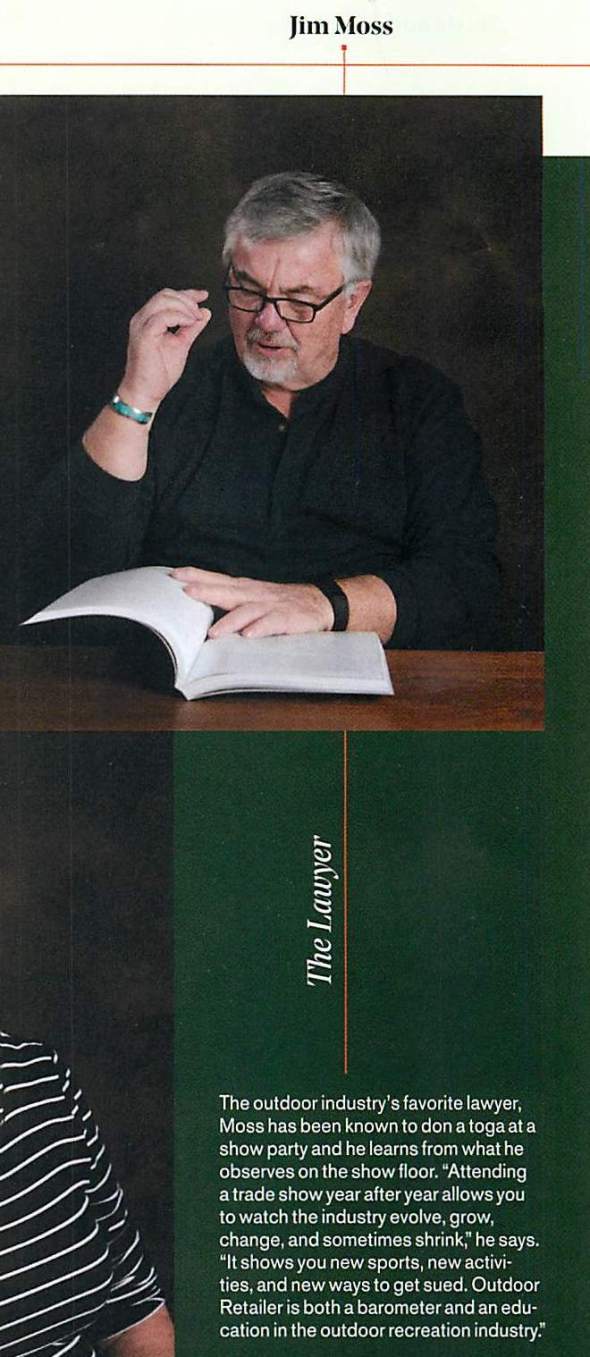
My fellow community members included such luminaries as Peter Kray, Larry Harrison, Yvon Chouinard, Steve Barker, Carson Stanwood, Chad Gallwitz, Sally McCoy, Casey Sheahan, Chris Goddard, Bill Gamber, Peter Metcalf, Conrad Anker, Jen Taylor, James Edward Mills, my good friend Marcus Woolf, and many others. I was truly honored to be included in such a community of people, industry heavy hitters and just plain famous people.
There may not be any real reason to go to the semi annual show you might think, but the feeling of not going, of missing those friends you only see once or twice a year will always bring you back to the show. Where else are you going to get started, get that first interest from a retailer or the media about your idea. Most importantly where else are you going to become part of the outdoor industry.
I remember in 1999 after the tornado had turned the show tents into a field of liter, I worried about what was going to happen to the show. I had worked on several people in the aftermath, including the man who died. I was worried the show would not go on, and I would leave Salt Lake and have no support for my feelings or issues.
I was able to talk to Dr. Eric Weiss, of Adventure Medical Kits who assured me that I had done everything I could to save the people I worked on. I was interviewed by Fred Knapp (Sharp End Publishing) for an article about the tornado, and he asked me one question. I just started talking until I was worn out. It was Outdoor Retailer therapy in a booth. Both would have been difficult if not impossible at home and nowhere could I be in a group of people that understood. I felt safe at a trade show; such a crazy statement. Yet no other industry would even come close to being able to support that statement or feeling of safety. Yet it is the basis for the success of Outdoor Retailer. Because the outdoor industry is a community.
From the thumping of the people, waiting to get on the show floor before the doors opened in Reno and the founding and growth of ORCA (now OIA) to the trying to find a cab and a drink in the first couple of years in Salt Lake, the show has continuously provided an environment to meet, learn, greet and love the people in the outdoor industry community.
It might be the lack of suits. It might be because most of the items on the show floor are for fun. It might be walking the aisles is an Easter egg hunt, looking for that next great idea or invention. It might be because you can have a beer with your friends. I think the biggest reason for the community is smiles. You walk down the aisles of the show floor and you see smiles. Big grins as old friends or just semi annual friends are seeing each other again.
Now it is moving to Denver; If I miss a show, it will only because I’m being recycled in a corn field.
Thank Doug Schnitzspahn (the hardest working man in outdoor media) for finding me on the show floor. Thank you Emerald Expositions and Outdoor Retailer for your help, support and smiles.
Own a Bicycle Retailer, enter to win a Free trip to Interbike
Posted: July 21, 2017 Filed under: Uncategorized | Tags: 2017 Interbike Inovation Award, Bicycle Retailer, Free Trip, Inovation, Inovation Award, Interbike, Interbike 2017, Las Vegas Leave a comment |
|
| Win a trip to Interbike! Nominate your store for the Interbike Innovation AwardsHave you grown your business with omnichannel implementation strategies? Used bike trade-in initiatives? Done an in-store remodel? If you have implemented these or any other innovative ideas and strategies to your business with positive results over the past 12 months, you are eligible for the 2017 Interbike Retailer Innovation Awards. Retailers self-nominate using the form below, then ten winners will be chosen from individual retailer submissions by a group made up of executive staff from Bicycle Retailer and Industry News, The Mann Group and Interbike. See full details here » The ten winners will receive numerous prizes and valuable exposure tools including: Round-trip domestic flight to Interbike 2017 2-night hotel stay in Las Vegas for Interbike 2017 (room & tax) Official IB Award, manufactured by Ashworth Awards PR Toolkit to help promote the accomplishment in your local market including:
The deadline for retailer nominations is this Saturday, July 15.
|
| © 2017 Emerald Expositions 31910 Del Obispo, Ste. 200 San Juan Capistrano, CA 92675 All Rights Reserved. |
Teton Valley’s Tin Cup Challenge and support the American Avalanche
Posted: July 13, 2017 Filed under: Uncategorized | Tags: AAA, American Avalanche Association, Tetons Leave a comment
|

 This summer the AAA is participating in Teton Valley’s Tin Cup Challenge. This innovative philanthropic program hosted by the Community Foundation of Teton Valley (CFTV) supports nonprofit organizations in Teton Valley, Idaho. As a nonprofit organization based in Victor, Idaho, we are excited to join our local community in participating for the first time ever this summer!
 |
Virus-free. www.avast.com |
Tired of TSA messing with your stuff or leaving bike cases open?
Posted: July 11, 2017 Filed under: Uncategorized | Tags: NSSRA, Ship Skis, Shipping, Skis 1 CommentNSSRA Offers Ship Skis as Newest Member Benefit
Program Is Designed To Increase Store Traffic While Offering Customers an Easy Way To Ship Their Gear
MOUNT PROSPECT, IL — The National Ski & Snowboard Retailers Association (NSSRA) Board of Directors is pleased to announce an agreement with Ship Skis to provide ski and board gear shipping services to NSSRA members. Ship Skis provides similar services to the golf industry under the Ship Sticks brand.
NSSRA members who participate in the program will be able to ship their customers’ gear to and from any home, business, or ski resort in the United States or abroad. Retailers will be provided with an easy to complete Ship Skis web page for their websites, which quickly calculates shipping charges. Through Ship Skis, shipping fees are offered at discount rates. This allows NSSRA retailers to earn a margin on their customers shipping charges for facilitating the shipment. Shipments are insured against loss or damage, and Ship Skis will cover up to $200 should the customer have to rent gear for any shipments that are delayed in-transit.
“This is such a natural service to provide our members that we didn’t want to wait until next season to get started,” said NSSRA Chairman of the Board Wilbur Rice. “Many retailers provide similar services for their customers, but the Ship Skis program will save significantly on the cost of shipping skis, boards or other gear to ski resorts.
“I want to thank NSSRA Past Chairman Brad Nelson and Chairman-Elect Teddy Schiavoni for their work in putting this together,” Rice said. “As busy as they have been in their shops, they understood the importance of making Ship Skis available to our members now rather than waiting until next season.”
“We are ecstatic about the new partnership with the NSSRA and proud to join the existing partners in the endeavor to advocate for Ski/Snowboard retailers across the country,” says Nicholas Coleman, CEO. “We believe Ship Skis will extend a unique opportunity to assist every member of the NSSRA with increased foot traffic and revenue at each of its specialty retailers and vendors. This partnership will provide ski/snowboard business vendors and down slope retailers with a way to ensure their customer base has a full-service experience from the counter at the store to the slopes anywhere in the world.”
For more information on Ship Skis, please visit wsmith
For more information on NSSRA, contact NSSRA President Larry Weindruch, lweindruch, or stop by Booth #3628 during the SIA Snow Show.
About NSSRA: The National Ski & Snowboard Retailers Association is a volunteer-led organization dedicated to growing snow sports participation and to support and educate specialty snow sports retailers. Since its founding in 1989, NSSRA has served as the voice of specialty retailers, representing their interest on issues that affect the specialty retail channel. NSSRA publishes research reports for specialty snow sports retailers, offers cost-saving services, and compiles and distributes the Combined Indemnified Bindings List. For more information, please contact NSSRA President Larry Weindruch, (847) 391-9825, or email: lweindruch.
About Ship Skis: Ship Skis provides a door-to-door shipping solution for the traveler who desires a hassle-free traveling experience. As the most reliable and cost effective shipping service available, Ship Skis has partnered with the world’s finest Ski Resorts, Ski Shops and Hotels to allow for an effortless shipping experience. Shipping skis, snowboards, and luggage with Ship Skis allows you to save time and money at the airport by avoiding the long check-in lines, crowded baggage terminals, and expensive baggage fees. Whether your skis, snowboards or luggage are being picked up from your home or office, Ship Skis guarantees an on-time delivery to wherever you’re staying or skiing. For additional information with regards to these convenient services, please visit www.shipskis.com.

So you are moving to a new town. You are worried about wither or not you will fit in and what the other kids are going to say about you when you get there?
Posted: July 6, 2017 Filed under: Uncategorized | Tags: Deme Day, OR, Outdoor Demo, Outdoor Retailer, SIA, Ski Show, Summer Outdoor Retailer, Winter Outdoor Retailer Leave a commentHave no fear, Denver is a pretty easy place to fit in, especially if you are wearing climbing, skiing or any outdoor gear. You look out in street clothes in a lot of cases.
First thing you need to know, Marijuana, nothing else I really need to say.
Lot of more information after that sinks in.
Downtown streets do not run north or south. The streets run NW – SE and NE – SW. So North and South directions down town will be confusing, but only in the downtown.
If you get lost, the mountains are to the west. At night, the big dark areas (or a big cross) are to the west.
Free Mall Shuttle: Go 2 blocks east out the front door of the convention center and you can catch a free shuttle that runs
up and down the 16th street mall. On the shuttle you can access about all the rest of downtown quite easily. (You are not allowed to skateboard or rollerblade on the mall. If you get caught you get a ticket unless you are in your 40’s or above where the cop just looks at you like you are an idiot and that says something about your age, IQ and don’t let him catch you doing this again.) The shuttle goes all the way to the RTD Light Rail station at Union Station where you can catch the A-Line to the airport.
BEER it’s real in Colorado and it has alcohol in it. Not only that you can order two at a time!!!!
Mixed Drinks, they are poured by a person and you can have two at a time. You can even have 10 at a time if you want. A nice tip and a smile can do wonders for your drink. Meaning if the bartender does not move the bottle after the ounce has poured, you get to drink it the extra that comes out. No magic state government finger stops the flow of Wild Turkey! (I try and drink what I am!)
Colorado does not track the waiters or waitresses who serve liquor either so you don’t have to feel like you are being watched when you have a drink.
MarijuanaYup! thought I would repeat it just for the fun of it. 
Cowboy hats can still be seen around town, but they are fading. Big belt buckles, (or as a friend of mine calls them
tombstone for a dead d@$k) are harder to find, thank heavens.
Vehicles & Denver: The city of Denver sees vehicles as another way to make money. They have traffic camera’s
everywhere and will issue tickets for anything, such as being in the crosswalk ($75.00). Even parking in the convention center parking garage with a tire on the yellow parking line is $75.00. Don’t drive in Denver, if you have to move around, walk or take a Pedicab or light rail. There are two pedicab companies I think Denver Pedicabs LLC and Mile High Pedicabs.
I’ve driven to Downtown Denver twice in 12 years and gotten a ticket each time. I don’t drive downtown. In fact I avoid downtown Denver. The most over the past five years I’ve been downtown is for the SIA show. If I do have to go I take RTD
Light rail. See the map below.
B-Cycle: The easiest way to get more than a block from anywhere downtown is to rent a bike at a Denver B-Cycle Station. The easiest way is to go to the website and download the app. The app can tell you where the stations are and how many bikes are there. Using the kiosks is easy. Find the bike you want to ride and with your cell phone number and credit card you’ll be riding in 90 seconds. There is a station right next to the light rail station at the convention center. You can buy a 24 hour ticket which allows you to ride in multiple 30 minute increments. Check the bike back in after 30 minutes, eat dinner, get another bike and ride home.
If you get in a jam, etc., call the B-cycle number (303)825-3325. The staff is awesome and will solve your problem.
Lodging: Lodging should not be a problem in Denver. The best deals might be away from downtown. If that is the case find a hotel that is on RTD light rail. Walkout of the convention center at night, turn left and there is a light rail station and you can go anywhere. (Well not Boulder yet.). The W line has a stop behind the Sheraton which is a great hotel with a dozen bars within walking distance. (My favorite is Chad’s across the street. Use my name, it will make the staff laugh…….) There are five or more nice hotels on the E & F lines going south. Also a couple on the H & R lines, but those would be long rides.
Also south on the C or D line at the Osage Station is the Buckhorn Exchange. It serves a lot of local wildlife as food and has Colorado Liquor license #1 (this is not the place for vegetarians.)
Cycling & lodging or just cycling: If you want to ride a bike the convention center is one block to an entrance to the Cherry
Creek Bike Path. That bike trail goes South East to Aurora and Northwest to REI. At REI, or Confluence Park, you hop on the South Platte River Trail you can ride south to Littleton or North to almost Thornton. From the North part of the South Platter River Trail you can intersect with the Clear Creek Trail and ride to Golden. By the next year you’ll be able to ride to Utah if you really want to.
Airport (DIA): It’s big and confusing. The best way to get downtown is on the light rail. Come off the airport train, up
the escalators and if you turn right to the end of the hall and follow the signs to the train.
Cabs are about $35, the airport is a long way from downtown. Shuttles are much cheaper. Rental cars are on the airport and still a long way away. There is no walking across the street to pick up your care. This is a big city with a big city airport. At the same time, it will be easy to get here with Five big runways.
If you have a hotel downtown, get off the A Train to the airport and walk to the free 16street mall shuttle to get to your
hotel.
Sports: Denver has every professional sports team. During the summer show you can walk to a Rockies game and in the winter to a Nuggets game. You can see indoor and outdoor Lacrosse, Soccer, Ice Hockey at different levels of play, etc., etc., etc.
COPS: You are going to see more, especially along the 16th street mall. They’re there for you. They’ll be friendly and help you out. Do something stupid or take a swing at one and you’ll find concrete is the safest part of the street! And don’t call me. Don’t be dumb and the Denver Police Department has great employees.
Costs: Hotels downtown are the same price as hotels at SLC during the show. But you’ll be paying rack rates not some you’re here so we raised the price cost. You can’t smoke in any hotel room, marijuana or other products. If you do, you’ll find a monster charge on your cleaning bill when you get home. Just like trying to steal stuff from the mini-bar. You’ll probably be
able to use your hotel points and booking rewards, hopefully.
Strip joints. There are several down town and you get to see things, just not use your imagination. If you want to see
everything, you can’t drink.
Jail: got me, I don’t do criminal work and using my name won’t get you anything except a higher bond or my jail time.
Other Activities: You already know about them because this is your industry and your sport.
There are no dress codes in any restaurant in Denver. So you can fit in whatever you are wearing at the show. Here are some notes that will make your first day of school or Outdoor Retailer easier.
I am curious where the outdoor demo is going to be held. There are three big lakes on the outskirts of Denver and several small ones in Denver. Winter I’d guess Echo Mountain just outside of Evergreen, Loveland or Eldora ski areas.
More coming. Stay Tuned or send me your questions.
Denver Light Rail Map

What do you think? Leave a comment.
If you like this
let your friends know or post it on FB, Twitter or LinkedIn
Author: Outdoor Recreation Insurance, Risk Management and Law
Copyright 2017 Recreation Law (720) Edit Law
Email: Rec-law@recreation-law.com
Google+: +Recreation
Twitter: RecreationLaw
Facebook: Rec.Law.Now
Facebook Page: Outdoor Recreation & Adventure Travel Law
Mobile Site: http://m.recreation-law.com
By Recreation
Law Rec-law@recreation-law.com James H. Moss
#AdventureTourism, #AdventureTravelLaw,
#AdventureTravelLawyer, #AttorneyatLaw, #Backpacking, #BicyclingLaw, #Camps,
#ChallengeCourse, #ChallengeCourseLaw, #ChallengeCourseLawyer, #CyclingLaw,
#FitnessLaw, #FitnessLawyer, #Hiking, #HumanPowered, #HumanPoweredRecreation,
#IceClimbing, #JamesHMoss, #JimMoss, #Law, #Mountaineering, #Negligence,
#OutdoorLaw, #OutdoorRecreationLaw, #OutsideLaw, #OutsideLawyer, #RecLaw,
#Rec-Law, #RecLawBlog, #Rec-LawBlog, #RecLawyer, #RecreationalLawyer,
#RecreationLaw, #RecreationLawBlog, #RecreationLawcom, #Recreation-Lawcom,
#Recreation-Law.com, #RiskManagement, #RockClimbing, #RockClimbingLawyer,
#RopesCourse, #RopesCourseLawyer, #SkiAreas, #Skiing, #SkiLaw, #Snowboarding,
#SummerCamp, #Tourism, #TravelLaw, #YouthCamps, #ZipLineLawyer, Outdoor
Retailer, Summer Outdoor Retailer, Winter Outdoor Retailer, Deme Day, Ski Show,
Outdoor Demo, SIA, OR,
Neither a release nor the Pennsylvania Equine Liability Act protects a stable for injuries when the stirrup broke.
Posted: June 19, 2017 Filed under: Uncategorized | Tags: Animal, Assumption of risk, broken, counter, entity, enumerate, Equine, Equine Liability Act, exculpatory, Exculpatory clause, faulty, genuine, Happy Trails and Riding Center, Horse, horseback riding, Immunity, Inc., Inherent Risk, material fact, recklessness, recreational, Rental, ride, rider, riding, Ski, Skier, skiing, Sport, stable, stirrup, Summary judgment, Trail 1 CommentBetween a poorly written release, an Equine statute that requires proof the rider assumed the risk and the “cavalier” attitude of the defendant; the plaintiff will proceed to trial.
Melendez v. Happy Trails and Riding Center, Inc., 2016 U.S. Dist. LEXIS 131576
State: Pennsylvania, United States District Court for the Middle District of Pennsylvania
Plaintiff: Wilberto Melendez
Defendant: Happy Trails and Riding Center, Inc.
Plaintiff Claims: Negligence and Recklessness
Defendant Defenses: Release and Pennsylvania Equine Liability Protection Act
Holding: For the plaintiff
Year: 2016
The plaintiff was part of a group ride. Upon arrival he was told, he had to sign a release which he did. At the office where the plaintiff signed, the release signs were posed as required by the Pennsylvania Equine Activities Immunity Act. During the ride, the plaintiff asked the guides if he could gallop the horse and was told no several times. Eventually at the end of the ride, the plaintiff was allowed to gallop his horse.
Plaintiff then mounted the horse and participated in a guided group horseback ride for the next forty-five minutes without incident. On several occasions during the ride, Plaintiff requested permission from the guide to gallop the horse. Plaintiff was told it was too dangerous to do on the trail. At the end of the ride, one of the guides brought Plaintiff away from the group so that Plaintiff could canter the horse. Plaintiff then put the horse into a gallop and, while rounding a turn, a stirrup broke and Plaintiff fell from the animal.
While galloping the horse, the stirrup broke causing the plaintiff to fall incurring injuries.
The defendant filed a motion for summary judgment based on the release signed by the plaintiff and the Pennsylvania Equine Activities Immunity Act. The court denied the motion because the issue of the stirrup breaking could be considered reckless under Pennsylvania law.
Analysis: making sense of the law based on these facts.
The decision first looks at releases or exculpatory agreements under Pennsylvania law.
An exculpatory clause is valid if (1) the clause does “not contravene public policy”; (2) the contract is “between persons relating entirely to their own private affairs”; and (3) each party is “a free bargaining agent to the agreement so that the contract is not one of adhesion.
Under Pennsylvania, the language of the release must be clear in relieving notifying the possible plaintiff, he or she is releasing the defendant of negligence. “However, a valid exculpatory clause will nevertheless, be unenforceable “unless the language of the parties is clear that a person is being relieved of liability for his own acts of negligence.”
As in most states, releases are not favored and must conform to contract law. However, the term “not favored” is a term of art rather than a term used to determine if the release will be valid.
Contracts immunizing a party against liability for negligence are not favored by law and therefore established standards must be “met before an exculpatory provision will be interpreted and construed to relieve a person of liability for his own or his servants’ acts of negligence.”
In that regard Pennsylvania, courts have set up standards on how releases will be governed.
1) the contract language must be construed strictly, since exculpatory language is not favored by the law; 2) the contract must state the intention of the parties with the greatest particularity, beyond doubt by ex-press stipulation, and no inference from words of general import can establish the intent of the parties; 3) the language of the contract must be construed, in cases of ambiguity, against the party seeking immunity from liability; and 4) the burden of establishing immunity is upon the party invoking protection under the clause.
As in most other states, Pennsylvania does not allow a release to relieve a defendant for intentional or reckless acts. “Further, exculpatory clauses may not immunize a party for intentional or reckless behavior.”
The plaintiff did not argue that the release was not valid. The court reviewed the release on its own and find it valid.
First, the agreement does not violate any public policy of Pennsylvania. In light of the Equine Activities Immunity Act–discussed in the next section–and similar statutes addressing other recreational activities, it is the policy of the state to encourage participation in those activities, despite their inherent danger, and assign the risk of loss to those who choose to participate in them.
Second, the agreement was between two private parties, Happy Trails and Mr. Melendez, concerning the purely private matter of renting a horse for recreational purposes. Finally, this is not a contract of adhesion. (“The signer I is under no compulsion, economic or otherwise, to participate, much less to sign the exculpatory agreement, because it does not relate to essential services, but merely governs a voluntary recreational activity.”). Thus, the agreement is facially valid.
The court also found Pennsylvania law allowed the use of releases for inherently dangerous activities. Horseback riding in Pennsylvania is an inherently dangerous activity.
The plaintiff’s argument centered on the inherent risks of horseback riding. Inherent, a limiting word, defines the risks that are part of horseback riding no matter what. Inherent risks are part of horseback riding and can rarely be reduced or modified by someone because of the horse. However, there are more than just inherent risks in any activity and the plaintiff argued that a stirrup breaking was not an inherent risk and not covered by the release or the statute.
How the bridle or saddle is attached to the horse is under the control of the stable, thus not an inherent risk of horseback riding in must states. How the horse responds; maneuvers or acts is an inherent risk of riding a horse.
Plaintiff contends that Defendant has failed to meet its burden to show either that defective equipment is an inherent risk of horseback riding, or that the language of the agreement shows that Plaintiff expressly assumed the risk of defective equipment.
Plaintiff points out that the agreement does not enumerate defective equipment as a risk. (Id.). Further, Plaintiff argues that a broken stirrup is not an inherent risk of horseback riding as demonstrated by the testimony of both Happy Trails’ owner and a Happy Trails’ employee who both stated they had never seen a stirrup break before. Thus, Plaintiff argues, because the risk was not foreseeable and was not expressly in the agreement, Plaintiff could not appreciate the risk and could therefore not assume it.
(For other articles on the use of “inherent” in a release see: Here is another reason to write releases carefully. Release used the term inherent to describe the risks which the court concluded made the risk inherently dangerous and voids the release and 2015 SLRA – Inherent Risk: Should the Phrase be in your Release?)
The court looked at the issue and rephrased it to a contract analogy. A contract must state the intention of the parties. A release is a contract.
…the contract must state the intention of the parties with the greatest particularity, beyond doubt by express stipulation, and no inference from words of general import can establish the intent of the parties”–is not met in this case because the agreement did not specifically enumerate the risk of defective equipment. Pennsylvania courts, however, have rejected this argument before.
The court then looked at the issue and found that defective equipment was not an inherent risk of horseback riding. This means if you use the term “inherent risk” in your release to describe all of the risks, claims based defective equipment would not be covered by your release in Pennsylvania. However, the release in this case was written broadly so it was not an issue.
Concerning the case at hand, while this Court agrees with Plaintiff that the provision of defective equipment is not an inherent risk in the sport of horseback riding, this point is not dispositive. As one Pennsylvania court explained, “the assumption of the risk doctrine bars a plaintiff from recovering in tort for risks inherent to a certain activity. In contrast, the explicit, broad, and valid language of the exculpatory clause bars all claims, regardless of whether they arise from an inherent risk.”
Pennsylvania courts have held that a release protects against claims for inherent as well as non-inherent risks if written to include those risks, and this release was written broadly.
The plaintiff argued the release should be read narrowly because the release did not identify defective equipment as a risk to be covered. However, the court found that every risk needs not be reviewed or identified in a release.
Plaintiff advances a more narrow reading of the agreement and argues that because the agreement does not enumerate defective equipment as a risk, he did not expressly assume it. The Chepkevich Court, however, was clear that no illustrations or examples are required to give common terms effect in an exculpatory agreement. “All claims” and “negligence” are commonly used terms and Pennsylvania law does not require drafters of exculpatory clauses to enumerate every possible contingency that is included in broader language they choose to use.
The next point the plaintiff argued was the actions of the defendant amounted to recklessness and as such voided the release. The court defined recklessness under Pennsylvania law as:
Recklessness is distinguishable from negligence on the basis that recklessness requires conscious action or inaction which creates a substantial risk of harm to others, whereas negligence suggests unconscious inadvertence.”
Pennsylvania uses the term recklessness to define acts of the defendant that exceed the scope of a release. The majority but not all states use the term gross negligence.
This argument the court did accept. The court found that it was the defendant’s responsibility to inspect the equipment, and the defendant could not provide any evidence of any inspection.
Defendant’s bare assertion that its actions do not rise to the level of recklessness does not satisfy its burden to show that there is no genuine dispute as to a material fact. The record shows that Happy Trails provided a saddle for Plaintiffs ride, that a stirrup on that saddle broke during the ride, and that Plaintiff fell from a horse when the stirrup broke. It was the responsibility of Happy Trails, not the customer, to inspect the equipment, but no records of inspections or repairs were kept, nor was the Happy Trails’ owner able to say if any inspection of the specific stirrup occurred on the day of the accident.
The court on this same topic went on looking at the facts to determine other reckless acts of the defendant. In that review, the court added a comment about the attitude of the defendant/owner of Happy Trails and described his attitude as “cavalier.”
He was unable to say where he procured the saddle in question, how long he had had it, or how old it was. Additionally, Happy Trails’ owner displayed a somewhat cavalier attitude towards safety, asserting that customers assume all risks associated with the activity, including equipment breaking, staff failing to put equipment on the horses correctly, and even staff failing to provide basic equipment like stirrups or a bridal. Viewing the record in a light most favorable to Plaintiff, a question of fact therefore remains as to whether Defendant’s action rose to the level of recklessness
Finding a lack of knowledge about the age or condition of the defendant’s equipment, no record of inspecting or maintaining the equipment and the attitude of the defendant allowed the court to reach a conclusion that the actions of the defendant would be found by a jury to be reckless. As such, a motion for summary judgment could not be granted if there were “genuine dispute as to any material fact.”
The next issue was the application of the Pennsylvania Equine Activities Immunity Act to the case. The court could find no other case law in Pennsylvania that looked at the application of the Pennsylvania Equine Activities Immunity Act to defective equipment. Consequently, the court had to interpret the statute to see if the language of the statute covered defective equipment.
The Pennsylvania Equine Activities Immunity Act like most equine liability protection acts provides immunity to horse owners, stables, etc., for the actions of the animals. (Since Equine Acts have been created, they have been 100% effective. No horses have been sued. Lawsuits against horse owners have increased.) However, the Pennsylvania statute places a burden on the stable or horse owner to prove knowledge of the risk for the immunity to apply.
Most equine protection acts are written to say that when on a horse, or at places where horses, llamas, mules, etc., are, you assume the risk of the actions of the animal. By assuming the risk, the defendant owner is immune from liability for the plaintiff’s injuries. The Pennsylvania statute is different. The Pennsylvania statute states “liability for negligence shall only be barred where the doctrine of knowing voluntary assumption of risk is proven.”
This requirement puts a burden upon the horse owner to provide additional education to the rider.
The court looked at the definition of assumption of risk as defined in the Restatement of Torts, which found four different definitions or as the Restatement defines them doctrines of assumption of the risk.
The Restatement outlines four varieties of the doctrine, the first two of which are of interest in this case. The first, express assumption of risk occurs when lithe plaintiff has given his express consent to relieve the defendant of an obligation to exercise care for his protection, and agrees to take his chances as to injury from a known or possible risk.” Id. (emphasis added). This is the type of assumption of risk examined above in respect to the agreement signed by Plaintiff. The second, implied assumption of risk, occurs when lithe plaintiff has entered voluntarily into some relation with the defendant which he knows to involve the risk, and so is regarded as tacitly or impliedly agreeing to relieve the defendant of responsibility, and to take his own chances.”
The first type of assumption of risk the court found that applied here was express assumption of risk. Express assumption of risk occurs when the plaintiff has consented to the risk. Usually, this consent is given by writing, if written property as part of a release.
The second type applicable in this case was implied assumption of the risk. Implied assumption of the risk has no exactness to the risk assumed. The plaintiff knows there is risk, and the defendant hopes the plaintiff knows of the explicit risk that may injure the plaintiff or that caused the plaintiff’s injuries. If the plaintiff had no knowledge of the risk, then the plaintiff cannot assume the risk.
It is self-evident that a person “cannot be found to have implicitly assumed a risk of which he had no knowledge.” (plurality opinion). As such, lithe defense of assumption of the risk requires that the defendant show that the plaintiff was subjectively aware of the facts which created the danger and…must have appreciated the danger itself and the nature, character and extent which made it unreasonable.”
In this case, there was no evidence that the plaintiff knew of the risk. That risk was of equipment failure that the stirrup would break. Consequently, the plaintiff could not assume the risk.
Thus, for a defendant to prevail on a summary judgment motion based on the assumption of risk defense, it must be “beyond question that the plaintiff voluntarily and knowingly proceeded in the face of an obvious and dangerous condition.”
In short, to preclude Plaintiffs negligence action under the EAIA, Defendant must show that Plaintiff knew that the equipment he was provided with might break and voluntarily continued with the horseback ride in spite of that knowledge.
Because the risk that injured the plaintiff was outside of the risks assumed by the plaintiff, the defense of assumption of the risk did not apply. As such, the Pennsylvania Equine Activities Immunity Act did not provide the defendant with any protection.
With the release not valid and the Pennsylvania Equine Activities Immunity Act not providing any protection both defenses of the defendant failed. The defendant’s motion for summary judgment was denied.
So Now What?
This case would not have meant anything if the plaintiff had simply fallen off the horse. Both the release and the Pennsylvania Equine Activities Immunity Act would have prevented recovery if a claim had even been made.
But broken equipment always creates a different issue. Here it created an issue of whether the actions of the defendant were reckless and proved the plaintiff did not assume the risk.
Another important issue is courts put into their decision the facts they find persuasive or at least interesting. There were several facts in the decision that did not alter or affect the decision on its face, but important enough for the court to identify them anyway. I always find these facts as instructional and a good indication of something that was not enough for the judge to argue but important anyway.
I also believe that they may not have any legal value, but if written into the decision by the judge, they had to have an impact on the judge’s thinking, and consequently, those issues did affect the outcome of the case.
In this decision those facts included:
After his group arrived, Plaintiff went into the stable’s office to register. Plaintiff was presented with a form (the “agreement”), which stated, in pertinent part….
Combined with the next sentence:
An employee of Happy Trails informed Plaintiff that Plaintiff must sign the agreement in order to go horseback riding. Plaintiff signed the agreement.
Meaning, the plaintiff was not told in advance he was going to be required to sign a release.
Another one was the plaintiff being told galloping was too dangerous yet he was eventually allowed to gallop his horse.
On several occasions during the ride, Plaintiff requested permission from the guide to gallop the horse. Plaintiff was told it was too dangerous to do on the trail.
Plaintiff then put the horse into a gallop and, while rounding a turn, a stirrup broke and Plaintiff fell from the animal.
If galloping the horse was too dangerous earlier, what changed? More importantly, galloping the horse led to the broken stirrup which led to the injury.
And then there are the straight out in your face statements a court rarely makes.
Additionally, Happy Trails’ owner displayed a somewhat cavalier attitude towards safety, asserting that customers assume all risks associated with the activity, including equipment breaking, staff failing to put equipment on the horses correctly, and even staff failing to provide basic equipment like stirrups or a bridal.
If this statement or something like it has been at the beginning, you would have known immediately that the defendant was going to lose. Never walk into a courtroom looking like the bad guy and never give the court proof, such as this, that you are.
For other Equine Liability Act articles see:
$1.2 M award in horseback riding fatality in Wyoming http://rec-law.us/1fE4ncB
$2.36 M awarded to boy kicked by horse during inner-city youth program http://rec-law.us/1lk7cTP
A specific statute, a badly written release and an equine liability statute sink instructors and business in horse riding accident. http://rec-law.us/SJZCkU
Decisive Supreme Court Decision on the Validity of Releases in Oklahoma http://rec-law.us/19gxvkT
Equine laws stop suit against horse, outfitter still sued http://rec-law.us/XjgJvw
Good News ASI was dismissed from the lawsuit http://rec-law.us/131HKWH
Hawaii attempts to limit liability increases the amount of money every injured party will recover. Legislation to limit liability lost recreation business the opportunity to use a release http://rec-law.us/1nvfCV5
Hawaii’s deceptive trade practices act sends this case and release back to the trial court http://rec-law.us/Z3HdQj
Indiana Equine Liability Statute used to stop litigation http://rec-law.us/12UFp1N
Lying in a release can get your release thrown out by the court. http://rec-law.us/11ysy4w
Michigan Equine helped the plaintiff more than the stable and helped prove there may be gross negligence on the part of the defendant http://rec-law.us/1ZicaQs
Parental control: should you, are you accepting responsibility for kids and when you should or can you not. http://rec-law.us/1fteMth
Release saves riding school, even after defendant tried to show plaintiff how to win the case. http://rec-law.us/14DC7Ad
What do you think? Leave a comment.
If you like this let your friends know or post it on FB, Twitter or LinkedIn
Author: Outdoor Recreation Insurance, Risk Management and Law
Copyright 2017 Recreation Law (720) Edit Law
Email: Rec-law@recreation-law.com
Google+: +Recreation
Twitter: RecreationLaw
Facebook: Rec.Law.Now
Facebook Page: Outdoor Recreation & Adventure Travel Law
Blog: www.recreation-law.com
Mobile Site: http://m.recreation-law.com
By Recreation Law Rec-law@recreation-law.com James H. Moss
#AdventureTourism, #AdventureTravelLaw, #AdventureTravelLawyer, #AttorneyatLaw, #Backpacking, #BicyclingLaw, #Camps, #ChallengeCourse, #ChallengeCourseLaw, #ChallengeCourseLawyer, #CyclingLaw, #FitnessLaw, #FitnessLawyer, #Hiking, #HumanPowered, #HumanPoweredRecreation, #IceClimbing, #JamesHMoss, #JimMoss, #Law, #Mountaineering, #Negligence, #OutdoorLaw, #OutdoorRecreationLaw, #OutsideLaw, #OutsideLawyer, #RecLaw, #Rec-Law, #RecLawBlog, #Rec-LawBlog, #RecLawyer, #RecreationalLawyer, #RecreationLaw, #RecreationLawBlog, #RecreationLawcom, #Recreation-Lawcom, #Recreation-Law.com, #RiskManagement, #RockClimbing, #RockClimbingLawyer, #RopesCourse, #RopesCourseLawyer, #SkiAreas, #Skiing, #SkiLaw, #Snowboarding, #SummerCamp, #Tourism, #TravelLaw, #YouthCamps, #ZipLineLawyer, Happy Trails and Riding Center, Inc., trail, summary judgment, exculpatory, recklessness, equine, stirrup, stable, immunity, genuine, horse, horseback riding, recreational, animal, material fact, skiing, ride, assumption of risk, faulty, broken, ski, rider, inherent risk, exculpatory clause, riding, sport, skier, enumerate, counter, rental, entity, Equine Liability Act,
GTHI (TRANGO) Recalls Climbing Belay Devices Due to Fall and Injury Hazards
Posted: June 16, 2017 Filed under: Uncategorized | Tags: belay, Belay device, Climbing, Consumer Product Safety Council, CPSC, Recall, Rock climbing, Trango, Vergo Leave a commentVergo belay devices (climbing tool)
Hazard: The handle on the Vergo belay device can loosen and cause the device’s assisted braking capacity to malfunction, posing fall and injury hazards to climbers.
Consumer Contact: Trango email at vergorecall@trango.com, or call 800-860-3653 from 8 a.m. to 4 p.m. MT, Monday through Friday, or online at http://www.trango.com and click on “Product Alerts” for more information.
Units: About 2,600 (in addition, about 100 were sold in Canada)
Description: This recall involves Trango Vergo belay devices with batch numbers 16159 and 16195 printed on the side of the unit. The devices were sold in blue, gold, or purple and feature the word “VERGO” on the front plate of the unit. Belay devices are used with climbing ropes to protect the climber while climbing, to arrest a fall or while being lowered on the rope.
Incidents/Injuries: The firm has received three reports of the belay device’s handle over-rotating and braking malfunction. No injuries have been reported.
Sold at: Authorized GTHI dealers and outdoor specialty stores nationwide and online at http://www.trango.com from October 2016 through April 2017 for about $90.
Distributor(s):Great Trango Holdings Inc. (GTHI), of Lafayette, Colo.
Manufactured In: United States
Retailers: If you are a retailer of a recalled product you have a duty to notify your customers of a recall. If you can, email your clients or include the recall information in your next marketing communication to your clients. Post any Recall Poster at your stores and contact the manufacturer to determine how you will handle any recalls.
For Retailers
Recalls Call for Retailer Action
A recall leads to lawsuits because injuries are connected to the product being recalled thus a lawsuit. Plaintiff’s hope the three can be connected
Combination of a Products Liability statute, an Expert Witness Report that was just not direct enough and odd facts holds a retailer liable as manufacture for product defect.
Product Liability takes a different turn. You must pay attention, just not rely on the CPSC.
Retailer has no duty to fit or instruct on fitting bicycle helmet
Summary Judgment granted for bicycle manufacturer and retailer on a breach of warranty and product liability claim.
For Manufacturers
The legal relationship created between manufactures and US consumers
A recall leads to lawsuits because injuries are connected to the product being recalled thus a lawsuit. Plaintiff’s hope the three can be connected
Combination of a Products Liability statute, an Expert Witness Report that was just not direct enough and odd facts holds a retailer liable as manufacture for product defect.
What do you think? Leave a comment.
Copyright 2017 Recreation Law (720) Edit Law
Email: Rec-law@recreation-law.com
Google+: +Recreation
Twitter: RecreationLaw
Facebook: Rec.Law.Now
Facebook Page: Outdoor Recreation & Adventure Travel Law
Blog: http://www.recreation-law.com
Mobile Site: http://m.recreation-law.com
By Recreation Law Rec-law@recreation-law.com James H. Moss
#AdventureTourism, #AdventureTravelLaw, #AdventureTravelLawyer, #AttorneyatLaw, #Backpacking, #BicyclingLaw, #Camps, #ChallengeCourse, #ChallengeCourseLaw, #ChallengeCourseLawyer, #CyclingLaw, #FitnessLaw, #FitnessLawyer, #Hiking, #HumanPowered, #HumanPoweredRecreation, #IceClimbing, #JamesHMoss, #JimMoss, #Law, #Mountaineering, #Negligence, #OutdoorLaw, #OutdoorRecreationLaw, #OutsideLaw, #OutsideLawyer, #RecLaw, #Rec-Law, #RecLawBlog, #Rec-LawBlog, #RecLawyer, #RecreationalLawyer, #RecreationLaw, #RecreationLawBlog, #RecreationLawcom, #Recreation-Lawcom, #Recreation-Law.com, #RiskManagement, #RockClimbing, #RockClimbingLawyer, #RopesCourse, #RopesCourseLawyer, #SkiAreas, #Skiing, #SkiLaw, #Snowboarding, #SummerCamp, #Tourism, #TravelLaw, #YouthCamps, #ZipLineLawyer, Recall, CPSC, Consumer Product Safety Council, Trango, Vergo, Belay, Belay Device, Climbing, Rock Climbing,
No more fatality charts for skiing fatalities
Posted: May 17, 2017 Filed under: Uncategorized | Tags: Fataltities, In Bounds, Ski Areas Leave a commentFor 10 years, I kept track of fatalities while skiing/boarding inbounds at resorts. Lately several news agencies have been doing the same but with what I consider an evil intent, to create liability for the ski areas or the NSAA.
I’ve never wanted to track this information with the intent of placing blame. People die skiing. People die in the bathroom, getting ready to go skiing, and more than anything, people die driving to and from the ski area. However, these news agencies seem to believe that dying with a pair of skis on or a snowboard requires special reaction from the ski area or the National Ski Area Association (NSAA).
Even funnier, they seem to get upset when the NSAA does nothing when someone dies out of bounds. The name is Ski Area association?
I wanted to know why people died skiing. I wanted to be able to talk with my students at Colorado Mountain College (CMC) in the Ski Area Operations (SAO) program about deaths. I thought if I looked at these deaths, I might learn something. I did. Dying at a ski area is more bad luck than anything else that I can track or understand.
If you don’t want to die at a ski area:
Don’t ski near trees (tress attack skiers!)
Never ski alone (because if you get ill, there is no one to help)
Never ski out of control.
Other than that nothing else seems to make a difference. Definitely, as I’ve always said, wearing a helmet is not going to keep you alive skiing. Helmets were designs to protect your head from minor injuries, nothing more. More people are dying these days wearing a helmet than not wearing a helmet. Maybe Risk Homeostasis is a thing.
The one thing I have learned is there is very little if anything a ski area can do to prevent fatalities while skiing or boarding. Ten years of looking at reports in the media from fatalities and the liability of a ski area does not pop out as a cause of the death.
Several news organizations have been collecting similar data and publicizing it with an obvious intent to create liability for a ski area or kick the NSAA for whatever reason. I don’t want to be associated with those organizations.
I represent several trade associations and am a member of several. The American Bar Association does not track how many lawyers die at work. However, several news organizations, some in ski area country, now believe that is a requirement of the NSAA, and they are not doing their job if they don’t.
I never see reports from the Association of Alternative Weeklies about how many journalists died last week. Should journalists know, probably? Should students know how risky their profession might be, probably? However, you don’t see articles condemning the association when they don’t write up stories about a writer found dead on his keyboard; coffee spilled over his notes and a burnt out joint in the ash tray. (I’m talking Colorado here.)
Nor do these news reporting businesses look at other outside activities. They don’t track mountain biking, road biking, scuba diving, or anything else with any interest. They certainly don’t start a headline about a fatality with the number of deaths in that sport this year or season. Maybe because skiing has such a big economic impact, it gets the special treatment? But then all their reporting is going to do is decrease the amount of money coming into the state.
People die every day all sorts of ways. Some at ski areas, some because they were thinking about skiing I suspect. People die going to and from the ski areas, but I don’t see headlines about how and why the Colorado Department of Transportation is not reporting these deaths. Another person dies on I-70 coming home from a great day of skiing.
I just don’t want to be associated with that group. So last week’s report will also be the last one.
What do you think? Leave a comment.
If you like this let your friends know or post it on FB, Twitter or LinkedIn
Author: Outdoor Recreation Insurance, Risk Management and Law
To Purchase Go Here:
Copyright 2017 Recreation Law (720) Edit Law
Email: Rec-law@recreation-law.com
Google+: +Recreation
Twitter: RecreationLaw
Facebook: Rec.Law.Now
Facebook Page: Outdoor Recreation & Adventure Travel Law
Blog: http://www.recreation-law.com
Mobile Site: http://m.recreation-law.com
By Recreation Law Rec-law@recreation-law.com James H. Moss
#AdventureTourism, #AdventureTravelLaw, #AdventureTravelLawyer, #AttorneyatLaw, #Backpacking, #BicyclingLaw, #Camps, #ChallengeCourse, #ChallengeCourseLaw, #ChallengeCourseLawyer, #CyclingLaw, #FitnessLaw, #FitnessLawyer, #Hiking, #HumanPowered, #HumanPoweredRecreation, #IceClimbing, #JamesHMoss, #JimMoss, #Law, #Mountaineering, #Negligence, #OutdoorLaw, #OutdoorRecreationLaw, #OutsideLaw, #OutsideLawyer, #RecLaw, #Rec-Law, #RecLawBlog, #Rec-LawBlog, #RecLawyer, #RecreationalLawyer, #RecreationLaw, #RecreationLawBlog, #RecreationLawcom, #Recreation-Lawcom, #Recreation-Law.com, #RiskManagement, #RockClimbing, #RockClimbingLawyer, #RopesCourse, #RopesCourseLawyer, #SkiAreas, #Skiing, #SkiLaw, #Snowboarding, #SummerCamp, #Tourism, #TravelLaw, #YouthCamps, #ZipLineLawyer,
Happy 179th Birthday John Muir
Posted: April 21, 2017 Filed under: Uncategorized | Tags: Happy Birthday, John Muir Leave a comment
Look Cycle Recalls Aerostems and Road Bikes Due to Fall, Crash Hazards
Posted: March 30, 2017 Filed under: Uncategorized Leave a commentName of Product: Look Cycle road bikes and Aerostems
Hazard: The stainless steel clamp that secures the stem to the handlebars can corrode and break, posing a fall and crash hazard.
Remedy: Repair
Consumers should immediately stop using bicycles with the recalled Aerostems and return them to the place of purchase for a free repair. Consumers unable to return their bicycles should contact Look Cycle for instructions on receiving a free repair.
Consumer Contact: Look Cycle at 800-822-1980 from 8 a.m. to 5 p.m. ET Monday through Friday, email at aerostemrecall@hawleylambert.com or online at http://www.lookcycle.com/ click on the Safety Notice tab for more information.
Photos available at: https://cpsc.gov/Recalls/2017/Look-Cycle-Recalls-Aerostems–and-Road-Bikes
Recall Details
Units: About 800
Description: This recall involves Look Cycle Aerostems sold either as an after-market component or installed as original equipment on Look Cycle model 695 and 795 road bikes for model years 2014 through 2017. The Look Aerostems are made of black carbon fiber material with a black steel clamp around the handlebars. Recalled models have either no number or the number 380706 printed in white on the bottom of the clamp. A complete list of photos of the recalled stems and bike models can be found on the firm’s website at http://www.lookcycle.com/en/safety-notice.
Incidents/Injuries: The firm has received one report of the stainless steel clamp on an Aerostem breaking. No injuries have been reported.
Sold at: Independent bike stores nationwide from July 2013 through December 2016 for about $500 for the stems sold individually and for between $5,500 and $16,000 installed as original equipment on Look Cycle road 695 and 795 road racing bicycles.
Importer: Hawley LLC, of Lexington, S.C.
Manufactured in: France and Switzerland
Admiralty Law Limitation of Liability Act
Posted: March 23, 2017 Filed under: Uncategorized | Tags: Admiralty and Maritime Law, Admiralty Law, Federal Law, Federal Statute, Limitation of Liability, Navigable Leave a commentTITLE 46. SHIPPING
SUBTITLE III. MARITIME LIABILITY
CHAPTER 305. EXONERATION AND LIMITATION OF LIABILITY
Go to the United States Code Service Archive Directory
46 USCS § 30505
- 30505. General limit of liability
(a) In general. Except as provided in section 30506 of this title [46 USCS § 30506], the liability of the owner of a vessel for any claim, debt, or liability described in subsection (b) shall not exceed the value of the vessel and pending freight. If the vessel has more than one owner, the proportionate share of the liability of any one owner shall not exceed that owner’s proportionate interest in the vessel and pending freight.
(b) Claims subject to limitation. Unless otherwise excluded by law, claims, debts, and liabilities subject to limitation under subsection (a) are those arising from any embezzlement, loss, or destruction of any property, goods, or merchandise shipped or put on board the vessel, any loss, damage, or injury by collision, or any act, matter, or thing, loss, damage, or forfeiture, done, occasioned, or incurred, without the privity or knowledge of the owner.
(c) Wages. Subsection (a) does not apply to a claim for wages.
Ship Skis Service and Recommendations
Posted: February 24, 2017 Filed under: Uncategorized | Tags: Bikes, Ship Skis, Skis, TSA Leave a commentNSSRA Offers Ship Skis as Newest Member Benefit
Program Is Designed To Increase Store Traffic While Offering Customers an Easy Way To Ship Their Gear
MOUNT PROSPECT, IL — The National Ski & Snowboard Retailers Association (NSSRA) Board of Directors is pleased to announce an agreement with Ship Skis to provide ski and board gear shipping services to NSSRA members. Ship Skis provides similar services to the golf industry under the Ship Sticks brand.
NSSRA members who participate in the program will be able to ship their customers’ gear to and from any home, business, or ski resort in the United States or abroad. Retailers will be provided with an easy to complete Ship Skis web page for their websites, which quickly calculates shipping charges. Through Ship Skis, shipping fees are offered at discount rates. This allows NSSRA retailers to earn a margin on their customers shipping charges for facilitating the shipment. Shipments are insured against loss or damage, and Ship Skis will cover up to $200 should the customer have to rent gear for any shipments that are delayed in-transit.
“This is such a natural service to provide our members that we didn’t want to wait until next season to get started,” said NSSRA Chairman of the Board Wilbur Rice. “Many retailers provide similar services for their customers, but the Ship Skis program will save significantly on the cost of shipping skis, boards or other gear to ski resorts.
“I want to thank NSSRA Past Chairman Brad Nelson and Chairman-Elect Teddy Schiavoni for their work in putting this together,” Rice said. “As busy as they have been in their shops, they understood the importance of making Ship Skis available to our members now rather than waiting until next season.”
“We are ecstatic about the new partnership with the NSSRA and proud to join the existing partners in the endeavor to advocate for Ski/Snowboard retailers across the country,” says Nicholas Coleman, CEO. “We believe Ship Skis will extend a unique opportunity to assist every member of the NSSRA with increased foot traffic and revenue at each of its specialty retailers and vendors. This partnership will provide ski/snowboard business vendors and down slope retailers with a way to ensure their customer base has a full-service experience from the counter at the store to the slopes anywhere in the world.”
For more information on Ship Skis, please visit wsmith
For more information on NSSRA, contact NSSRA President Larry Weindruch, lweindruch, or stop by Booth #3628 during the SIA Snow Show.
About NSSRA: The National Ski & Snowboard Retailers Association is a volunteer-led organization dedicated to growing snow sports participation and to support and educate specialty snow sports retailers. Since its founding in 1989, NSSRA has served as the voice of specialty retailers, representing their interest on issues that affect the specialty retail channel. NSSRA publishes research reports for specialty snow sports retailers, offers cost-saving services, and compiles and distributes the Combined Indemnified Bindings List. For more information, please contact NSSRA President Larry Weindruch, (847) 391-9825, or email: lweindruch.
About Ship Skis: Ship Skis provides a door-to-door shipping solution for the traveler who desires a hassle-free traveling experience. As the most reliable and cost effective shipping service available, Ship Skis has partnered with the world’s finest Ski Resorts, Ski Shops and Hotels to allow for an effortless shipping experience. Shipping skis, snowboards, and luggage with Ship Skis allows you to save time and money at the airport by avoiding the long check-in lines, crowded baggage terminals, and expensive baggage fees. Whether your skis, snowboards or luggage are being picked up from your home or office, Ship Skis guarantees an on-time delivery to wherever you’re staying or skiing. For additional information with regards to these convenient services, please visit www.shipskis.com.

McGrath v. SNH Development, Inc. 2008 N.H. Super. LEXIS 45
Posted: February 19, 2017 Filed under: Legal Case, New Hampshire, Skiing / Snow Boarding, Uncategorized | Tags: New Hampshire, NH, Public Policy, Release, ski area, skiing, Snowmobile, Snowmobile Collision Leave a commentMcGrath v. SNH Development, Inc. 2008 N.H. Super. LEXIS 45
Marcella McGrath f/k/a Marcella Widger v. SNH Development, Inc. and John Doe, an unnamed individual
No. 07-C-0111
SUPERIOR COURT OF NEW HAMPSHIRE, HILLSBOROUGH COUNTY
2008 N.H. Super. LEXIS 45
May 19, 2008, Decided
NOTICE:
THE ORDERS ON THIS SITE ARE TRIAL COURT ORDERS THAT ARE NOT BINDING ON OTHER TRIAL COURT JUSTICES OR MASTERS AND ARE SUBJECT TO APPELLATE REVIEW BY THE NEW HAMPSHIRE SUPREME COURT.
SUBSEQUENT HISTORY: Affirmed by McGrath v. SNH Dev., Inc., 158 N.H. 540, 969 A.2d 392, 2009 N.H. LEXIS 43 (2009)
JUDGES: [*1] GILLIAN L. ABRAMSON, PRESIDING JUSTICE.
OPINION BY: GILLIAN L. ABRAMSON
OPINION
ORDER
The plaintiff commenced the instant action alleging negligence against the defendants, SNH Development, Inc. (“SNH Development”) and John Doe, an unnamed individual. The defendants now move for summary judgment, and the plaintiff objects.
For purposes of the defendants’ motion for summary judgment, the parties do not appear to dispute the following facts. SNH Development is a subsidiary of Peak Resorts, Inc. and owns and operates the Crotched Mountain Ski Area in Bennington, New Hampshire. On October 23, 2003, the plaintiff signed an application (the “application”) for a season pass to the Crotched Mountain Ski Area. The application provides:
I understand and accept the fact that alpine skiing in its various forms is a hazardous sport, and I realize that injuries are a common occurrence. I agree, as a condition of being allowed to use the ski area facility, that I freely accept and voluntarily assume all risks of personal injury or death of property damage, release Crotched Mountain its owners and its agents, employees, directors, officers and shareholders from any and all liability for personal injury or property damage [*2] which results in any way from negligence, conditions on or about the premises, the operations of the ski area including, but not limited to, grooming snow making, ski lift operations, actions or omissions of employees or age the area, or my participation in skiing, accepting myself the full responsibility
Defs.’ Mot. for Summ. J., Ex. B. Moreover, on December 20, 2003, the plaintiff signed a Liability Release Agreement, which provides:
I understand and accept the fact that alpine skiing in its various forms is a hazardous sport, and I realize that injuries are a common occurrence. I agree, as a condition of being allowed to use the area facility, that I freely accept and voluntarily assume all risks of personal injury or death or property damage, and release Peak Resorts, Inc, all of its subsidiaries, and its agents, employees, directors, officers, shareholders and the manufacturers and distributors of this equipment and the school and group organizers (collective “providers’), from any and all liability for personal injury, death or property damage which results in any way from negligence, conditions on or about the premises, the operation of the area including, but not limited to grooming, [*3] snowmaking, lift operations, actions or omissions of employees or agents of the areas, or my participating in skiing, snowboarding, blading, accepting myself the full responsibility.
Id. On February 20, 2004, the plaintiff was skiing 1 a trail at the Crotched Mountain Ski Area when an employee of SNH Development drove a snowmobile into the plaintiff’s path, causing a collision.
1 Some of the pleadings state that the plaintiff was skiing, while other’s state that the plaintiff was snowboarding.
The defendants now move for summary judgment, arguing that the plaintiff signed the application and the Liability Release Agreement, both of which are valid, enforceable exculpatory contracts. The plaintiff objects, arguing that the application and the Liability Release Agreement violate public policy and that the parties did not contemplate that the application or the Liability Release Agreement would bar the plaintiff’s negligence claim.
In ruling on a motion for summary judgment, the Court “consider[s] the affidavits and other evidence, and all inferences properly drawn from them, in the light most favorable to the non-moving party.” White v. Asplundh Tree Expert Co., 151 N.H. 544, 547, 864 A.2d 1101 (2004). [*4] The Court must grant a motion for summary judgment if its “review of the evidence does not reveal a genuine issue of material fact, and if the moving party is entitled to judgment as a matter of law Id. A fact is material “if it affects the outcome of the litigation under the applicable substantive law.” Palmer v. Nan King Restaurant, 147 N.H. 681, 683, 798 A.2d 583 (2002).
New Hampshire law generally prohibits exculpatory contracts, but the Court will enforce them if; “(1) do not violate public policy; (2) the plaintiff understood the import of the agreement or a reasonable person in his position would have understood the import of the agreement; and (3) the plaintiff’s claims were within the contemplation of the parties when they executed the contract.” Dean v. MacDonald, 147 N.H. 263, 266-267, 786 A.2d 834 (2001). Thus, the Court considers each of these requirements in turn.
Regarding the first requirement, an exculpatory contract violates public policy if a special relationship existed between the parties or if there was some other disparity in bargaining power. See Barnes v. N.H. Karting Assoc., 128 N.H. 102, 106, 509 A.2d 151 (1986) (“A defendant seeking to avoid liability must show that the exculpatory agreement does [*5] not contravene public policy i.e that no special relationship existed between the parties and that there was no other disparity in bargaining power.”).
A special relationship exists “[w]here the defendant is a common carrier, innkeeper or public utility, or is otherwise charged with a duty of public service….” Id. The plaintiff contends that a special relationship existed between the parties because any person operating a snowmobile has a statutory duty to yield the right of way, RSA 215-C:49, XII (Supp. 2007), and because the Crotched Mountain Ski Area serves the public. Assuming that RSA 215-C:49, XII applies to the operation of a snowmobile on a privately owned ski area, the plaintiff has not offered any legal support for the conclusion that this statute somehow charges the defendants with a duty of public service. Moreover, the fact that the Crotched Mountain Ski Area serves the public is not conclusive. For example, Barnes, involved a negligence claim arising from a collision at an enduro kart racing facility. In Barnes, the New Hampshire Supreme Court noted that the defendant’s served the public but held that the defendant’s were not charged with a duty of public service because [*6] Endurokart racing is not “affected with a public interest.” Barnes, 128 N.H. at 108. Similarly, skiing is a recreational activity not affected with a public interest, and the Court finds that the defendant’s are not charged with a duty of public service.
The Plaintiff also contends that she was at an obvious disadvantage in bargaining power because all ski areas require skiers to sign releases. The Court disagrees.
This case … does not have any hallmarks of a disparity in bargaining power. The [skiing] service offered by the defendant is not a “matter of practical necessity.” Nor did the defendant in this ease have monopoly control over this service such that the plaintiff could not have gone elsewhere.
Audley v. Melton, 138 N.H. 416, 418, 640 A.2d 777 (1994) (quoting Barnes, 128 N.H. at 108). 2
2 The Plaintiff also argues that the application and the Liability Release Agreement violate public policy because they relieve the defendant’s from compliance with RSA chapter 215-C, which governs snowmobiles. Assuming that RSA chapter 215-C applies to the operation of a snowmobile on privately owned ski area, the application and the Liability Release Agreement would have no bearing on the enforcement of RSA chapter 215-C. [*7] See RSA 215-C-32 (Supp.2007) (providing for the enforcement of RSA chapter 215-C).
“Once an exculpatory agreement is found unobjectionable as a matter of public policy, it will be upheld only if it appears that the plaintiff understood the import of the agreement or that reasonable person in his position would have known of the exculpatory provision.” Barnes, 128 N.H. at 107. “The plaintiff’s understanding presents an issue of fact, and the plaintiff should have an opportunity to prove the fact at trial unless the exculpatory language was clear and a misunderstanding was unreasonable.” Wright v. Loon Mt. Recreation Corp., 140 N.H. 166, 169, 663 A.2d 1340 (1995). The Court
therefore examine[s] the language of the release to determine whether “a reasonable person in [the plaintiff’s] position would have known of the exculpatory provision.” A reasonable person would understand the provision if its language “clearly and specifically indicates the intent to release the defendant from liability for personal injury caused by the defendant’s negligence….”
Id. (citations omitted) (quoting Barnes, 128 N.H. at 107). The Court “will assess the clarity. the contract by evaluating it as a whole, not by examining [*8] isolated words and phrases. Id. at 169-170.
The plaintiff does not appear to dispute that she understood the import of the application or the Liability Release Agreement. Rather, the plaintiff argues that the parties did not contemplate that the application or the Liability Release Agreement would bar the plaintiff’s negligence claim. Thus, the Court turns to the third requirement.
“[T]he plaintiff’s claims must have been within the contemplation of the parties at the time of the execution of the agreement. The parties need not, however, have contemplated the precise occurrence that resulted in the plaintiff’s injuries. They may adopt language to cover, a broad range of accidents….” Barnes, 128 N.H. at 107 (citation omitted). To determine the scope of a release, the Court examines its language, strictly construing it against the defendant. Dean, 147 N.H. at 267.
Thus, in order to effectively release a defendant from liability for his own negligence, “the contract must clearly state that the defendant is not responsible for the consequences of his negligence.” There is no requirement that the term “negligence” or any other magic words appear in the release as long “as the language of [*9] the release clearly and specifically indicates the intent to release the defendant from liability for personal injury caused by the defendant’s negligence.”
Audley, 138 N.H. at 418 (citations omitted) (quoting Barnes, 128 N.H. at 107).
The plaintiff contends that the parties did not contemplate that the application or the Liability Release Agreement would bar the plaintiff’s negligence claim because neither the application nor the Liability Release Agreement reference snowmobiles. As rioted above, the parties need not have contemplated a negligence claim arising from a snowmobile accident. Rather, it is sufficient that the parties adopted language to cover a broad range of accidents. The application releases the defendants “from any and all liability for personal injury or property damage which results in any way from negligence,” and the Liability Release Agreement releases the defendants “from any and all liability for personal injury, death or property damage which results in from negligence.” Defs.’ Mot. for Summ. J., Ex. B. This language clearly states that the defendants are not responsible for the consequences of their negligence.
The Plaintiff also contends that the parties did [*10] not contemplate that the application or the Liability Release Agreement would bar the plaintiff’s negligence claim because snowmobiles are not an inherent hazard of skiing. The plaintiff relies on Wright. In Wright, the New Hampshire Supreme Court noted:
The paragraphs preceding the exculpatory clause emphasize the inherent hazards of horseback riding. Because the exculpatory clause is prefaced by the term “therefore,” a reasonable person might understand its language to relate to the inherent dangers of horseback riding and liability for injuries that occur “for that
Wright, 140 N.H. at 170. Here, however, the application and the Liability Release Agreement do not mention the inherent hazards of skiing. Rather, the application and the Liability Release Agreement note that skiing is a hazardous sport and that injuries are a common occurrence and then, without using the term “therefore,” release the defendants from any and all liability. Because the application and the Liability Release Agreement do not use the phrase “inherent hazards of skiing” or the term “therefore,” this case is distinguishable from Wright. A reasonable person would have contemplated that the application and the [*11] Liability Release Agreement would release the defendants from a negligence claim, whether nor not that claim arouse from an inherent hazard of skiing.
Based on the foregoing, the defendant’s motion for summary judgment is GRANTED.
So ORDERED.
Colorado Environmental Film Festival is coming soon!
Posted: February 9, 2017 Filed under: Uncategorized Leave a comment11th Colorado Environmental Film Festival
February 23 – February 25, 2017
American Mountaineering Center – Golden, CO
Join with other environmental activists in rethinking how we inhabit our planet at the 11th annual Colorado Environmental Film Festival (CEFF). This year’s films combine stellar filmmaking, beautiful cinematography and compelling storytelling. CEFF is now the largest film festival of its kind between the coasts and is often the only place you will be able to see these inspiring films. CEFF celebrates the power of film to inspire, educate, and motivate audiences.
The festival presents thought-provoking films and dialogue that raises awareness of a wide-ranging collection of interconnected ecological, social and economic themes. Nearly 140 films were screened from around the state and the globe. Fourty-eight will be shown, with awards given in the following categories: Best Feature Film, Best Short Film, Spirit of Activism, Best Youth Film and Best of the Fest. Each year, CEFF draws top filmmakers, students, leading activists, social innovators and well-known adventurers to the American Mountaineering Center in historic downtown Golden, Colorado. CEFF is an non-profit 501c(3) organization formed in 2005 to provide inspiring environmental films to Colorado residents!
At a Glance
Dates: Thursday, February 23, 2017 thru Saturday, February 25, 2017
Festival Location: American Mountaineering Center, Golden, Colorado
Festival Tickets: On sale at www.ceff.net – Discount tickets are available if purchased in advance online. Two theaters run different films during each time segment – lots of
variety to choose from!
*Friday Film Sessions (10-12:00; 1:45-3:45; 4:00-6:00; 7:30-9:30)
*Saturday Film Sessions (11:00-1:00; 1:30-3:30; 4:00-6:00; 7:00-9:00)
Opening Night CEFF gives back to the community by inviting everyone to join our Opening
Night celebration Thursday, February 23 (7:00-9:30pm) for FREE! Donations gladly accepted.
The evening, hosted by acclaimed local photographer John Fielder, will feature the screening of 3 amazing short films, a short presentation of film awards and a lively panel discussion and question/answer session focusing on the state of the environment in Colorado with three influential leaders in Colorado’s Environmental Community.
2nd Annual Outside Connections March 9th Denver, CO
Posted: January 26, 2017 Filed under: Uncategorized | Tags: Outside Connection, YMCA, YMCA of Metropolitan Denver Leave a commentMarch 9th at 1:00 PM will be the date for the second Annual Outside Connections in Denver.
Read the attached for more information.
Be There!
Happy Holidays and Peace on Earth
Posted: December 24, 2016 Filed under: Uncategorized Leave a comment






Happy Holidays from Clean Trails – December Newsletter
Posted: December 16, 2016 Filed under: Uncategorized | Tags: Clean Trails, Litter, Trails Leave a comment |
|
|


Great Outdoors Colorado (GOCO) awarded $33.2 M in grants.
Posted: December 15, 2016 Filed under: Uncategorized | Tags: CAEE, Colorado Alliance for Environmental Education, GOCO, Great Outdoors Colorado Leave a comment
|
||
|


Montreat College Virtuoso Series 2 Day Risk Outdoor Recreation Management, Insurance & Law Program
Posted: December 13, 2016 Filed under: Uncategorized | Tags: Dealing with Disasters., Insurance & Law, Montreat, Montreat College, Outdoor Risk Management, Releases / Waivers, Risk Management Plans, Virtuosos Series Leave a comment2 Days packed with information you can put to use immediately. Information compiled from 30 years in court and 45 years in the field.
Day 1 February 24, 2017: Assumption of the Risk (legalese for educating your clients)
What paperwork works to keep you out of court and what paperwork sends you to court.
Day 2 February 25, 2017: Risk Management Plans & How to deal with an incident
You’ll also receive a copy of my new book Outdoor Recreation Insurance, Risk Management, and Law
Curriculum
1. Assumption of the Risk
1.1. Still a valid defense in all states
1.2. Defense for claims by minors in all states
1.3. Proof of your guests assuming the risk is the tough part.
1.3.1. Paperwork proves what they know
1.3.1.1. Applications
1.3.1.2. Releases
1.3.1.3. Brochures
1.3.2. The best education is from your website
1.3.2.1. Words
1.3.2.2. Pictures
1.3.2.3. Videos
2. Releases
2.1. Where they work
2.1.1. Where they work for kids
2.2. Why they work
2.2.1. Contract
2.2.2. Exculpatory Clause
2.2.3. Necessary Language
2.2.4. What kills Releases
2.2.4.1. Jurisdiction & Venue
2.2.4.2. Assumption of the Risk
2.2.4.3. Negligence Per Se
2.2.4.4.
3. Risk Management Plans
3.1. Why yours won’t work
3.2. Why they come back and prove your negligence in court
3.2.1. Or at least make you look incompetent
3.3. What is needed in a risk management plan
3.3.1. How do you structure and create a plan
3.3.2. Top down writing or bottom up.
3.3.2.1. Goal is what the front line employee knows and can do
4. Dealing with an Incident
4.1. Why people sue
4.2. What you can do to control this
4.2.1. Integration of pre-trip education
4.2.2. Post Incident help
4.2.3. Post Incident communication
Put the date on your calendar now: February 24 and 25th 2017 at Montreat College, Montreat, NC 28757
$399 for both days and the book!
For more information contact Jim Moss rec.law@recreation.law.com
To register contact John Rogers, Montreat College Team and Leadership Center Director, jrogers@montreat.edu (828) 669- 8012 ext. 2761
Download this Press Release here: pr-1
Woody Pack Provides devices that assist “differently-abled” people. You might know someone who could use their assistance
Posted: December 8, 2016 Filed under: Uncategorized | Tags: Differently-Abled, Paralyzed, Wood Pack, Woody Foundation, Woody Pack Project 1 CommentThe Foundation’s Woody Pack Project makes assistive devices available to people with limited hand functioning due to paralysis.
Woody Beckham suffered a C5/C6 spinal cord injury in 2011 while playing college rugby. Woody’s team was ‘winning big.’ He went in for a tackle, got a knee to the neck, and went down. Woody knew right there, on the field, that he was paralyzed. Life changed for him in a split second. That can happen to climbers too.
Rehab continues for Woody — BUT he’s already giving back.
The Woody Pack contains over 20 devices to help ‘differently-abled people’ keep going and to live a more independent life.
Feel free to pass on the info below to anyone you think might be appropriate
The Woody Foundation’s Woody Pack
There are more videos, but here are a few moving ones:
https://www.youtube.com/watch?v=HDyf2JTTMdg&feature=youtu.be
https://www.youtube.com/watch?v=WtYHVJ19KNA
https://www.youtube.com/watch?v=XFpC8SenAY4
https://www.youtube.com/watch?v=wjwe2eAdDRY
Free Days for US National Parks for 2017: Get out and Get There!
Posted: December 6, 2016 Filed under: Uncategorized | Tags: Free Days, National Park Service, NPS Leave a comment|
|
|||
|
|||
|
National Park Service News Release |
|||
|
Release Date: November 14, 2017 National Park Service Announces Fee Free Days for 2017 Ten More Great Reasons to Visit a National Park WASHINGTON – Combine great scenery and history with great savings and visit a national park for free on one of 10 fee free days in 2017. The ten entrance fee-free days for 2017 will be:
“National parks are known for their priceless beauty,” said National Park Service Director Jonathan B. Jarvis. “They are a bargain anytime but on these ten days in 2017, they really will be priceless. We want everyone to visit their national parks and the fee free days provide extra incentive to experience these amazing places.” During the fee free days, all National Park Service sites will waive their entrance fees for all visitors. Usually, 124 of the 413 national parks charge entrance fees that range from $3 to $30. The other 289 sites do not have entrance fees. The entrance fee waiver for the fee-free days does not cover amenity or user fees for things such as camping, boat launches, transportation, or special tours. To continue the national park adventure beyond these fee free days, the annual $80 America the Beautiful National Parks and Federal Recreation Lands Pass allows unlimited entrance to more than 2,000 federal recreation areas, including all national parks,. There are also free or discounted passes available for senior citizens, current military members, fourth grade students, and disabled citizens. The National Park System includes more than 84 million acres and is comprised of 413 sites including national parks, national historical parks, national monuments, national recreation areas, national battlefields, and national seashores. There is at least one national park in every state. Last year, 307 million people visited a national park. They spent $16.9 billion which supported 295,000 jobs and had a $32 billion impact on the U.S. economy. In addition to national parks, the National Park Service works with tribes, local governments, and partners across the country to help preserve local history and create close-to-home recreational opportunities. Programs such as the National Register of Historic Places, National Heritage Areas, National Wild and Scenic Rivers, and the Rivers, Trails, Conservation Assistance Program revitalize communities, celebrate local heritage, and provide places for people to get outside, be active, and have fun. |


 Recreation Law