
Murawski v. Camp Nageela, 4 Misc. 3d 1025A; 798 N.Y.S.2d 346; 2004 N.Y. Misc. LEXIS 1542; 2004 NY Slip Op 51045U
Posted: March 26, 2012 Filed under: Legal Case, Summer Camp | Tags: Camp, Long Island, New York, New York City, Recreation, Summary judgment, Summer Camp Leave a commentMurawski v. Camp Nageela, 4 Misc. 3d 1025A; 798 N.Y.S.2d 346; 2004 N.Y. Misc. LEXIS 1542; 2004 NY Slip Op 51045U
[***1] Nina Murawski, individually and as parent and Natural Guardian of Adam Murawski, an Infant, Plaintiffs, v. Camp Nageela, Camp Shevtai Yisroel, Jewish Education Program (JEP) of Long Island, rabbi shenker, rabbi glustein, jeffrey y. Arshravan and Eric Arshravan, an infant, Defendants.
01-2959
SUPREME COURT OF NEW YORK, SUFFOLK COUNTY
4 Misc. 3d 1025A; 798 N.Y.S.2d 346; 2004 N.Y. Misc. LEXIS 1542; 2004 NY Slip Op 51045U
June 10, 2004, Decided
NOTICE: [**1] THIS OPINION IS UNCORRECTED AND WILL NOT BE PUBLISHED IN THE PRINTED OFFICIAL REPORTS.
DISPOSITION: Defendants motion for summary judgment granted; complaint dismissed.
CORE TERMS: infant, supervision, summary judgment, camper, bunkhouse, altercation, personnel, notice, finger, nurse, summer camp, anticipated, fellow, failure to provide, medical care, medical report, counselor, residual, dropped, sworn, mitt
HEADNOTES
[*1025A] Negligence–Duty.
COUNSEL: MALLILO & GROSSMAN, ESQS., Attorneys for Plaintiffs, Flushing, NY.
MOLOD, SPITZ & DeSANTIS, PC, Attorneys for Defendants Camp Nageela, JEP, Rabbi Shenker and Rabbi Glustein, New York, NY.
JUDGES: Denise F. Molia, J.
OPINION BY: Denise F. Molia
OPINION
Denise F. Molia, J.
ORDERED that this motion by defendants Camp Nageela, Jewish Education Program of Long Island, Rabbi Shenker and Rabbi Glustein for summary judgment dismissing the complaint against them is granted.
This is an action to recover damages for personal injuries allegedly sustained by the infant plaintiff, Adam Murawski, then ten years old, when on August 11, 2000, he was assaulted by a fellow camper, defendant Eric Arshravan, in the bunkhouse they shared at defendant Camp Nageela, [**2] a sleep away summer camp operated by defendant Jewish Education Program of Long Island [JEP]. Defendant Rabbi Shenker is the director of JEP and defendant Rabbi Glustein is another employee of JEP. A derivative cause of action is asserted on behalf of infant plaintiff’s mother, plaintiff Nina Murawski.
Plaintiffs seek recovery from the camp defendants on two grounds – improper supervision and a failure to provide proper medical care after the assault. The camp defendants now move for summary judgment dismissing the complaint on the basis that the infant plaintiff’s injuries were the result of a spontaneous altercation that could not have been anticipated by camp officials. Defendants also contend that there was no adverse affect upon the infant plaintiff as a result of any delay in obtaining medical treatment for him. In support, defendants submit, inter alia, copies of the pleadings, a copy of the transcript of the testimony given by the infant plaintiff at his examination before trial, the personal affidavit of defendant Rabbi Shenker, and the sworn medical report of defendants’ examining physician, Dr. Leon Sultan.
At his examination before trial the infant plaintiff Adam [**3] Murawski testified to the effect that he shared a bunkhouse with four or five other boys at the camp, including the infant defendant Eric Arshravan, and a counselor. Adam also testified that Eric was somewhat smaller than him and that the two generally did not “get along well”. Adam stated that he and Eric had once had a previous argument during a kick ball game but that the disagreement did not go beyond Eric’s yelling at him. Adam testified that he that he could not remember whether he had complained about Eric to any of the camp counselors during the two week period prior to the subject incident and that the boys had not engaged in any physical altercations during that time period. Adam further testified that the incident occurred when the two boys were alone in the bunkhouse, that he had gone into the bunkhouse in order to get his baseball mitt and that Eric came in after him. While Adam was looking for his mitt he dropped something and then picked up something of Eric’s because he thought the item he dropped might be underneath or near it. Eric then told Adam to “put it down” and he did so. Adam further testified that the two boys had agreed to share a table and that he thought [**4] Eric became angry because he believed that Adam [***2] had moved one of Eric’s belongings. Shortly thereafter, Eric hit Adam with a hockey stick.
By his personal affidavit, defendant Rabbi Shenker states that at no time prior to the subject incident were the camp personnel advised that Adam had complained of any problems with the infant defendant and that the camp had no written reports of any incidents involving the boys from Adam’s bunkhouse other than the nurse’s report of the subject incident. As for the plaintiffs’ claim that the camp failed to provide proper medical attention for the infant plaintiff, Rabbi Shenker states that Adam was seen by the camp nurse after the incident and she determined that the Adam’s finger should be placed in a splint and that he should be followed, that the camp nurse twice followed up with Adam the next day and was told by Adam that his finger was feeling better. Rabbi Shenker further states that plaintiff Nina Murawski came to the camp two days after the incident to visit Adam and she took him off the camp grounds for several hours. When she brought Adam back to camp, she asked the camp personnel to arrange for an x-ray of Adam’s finger which was later [**5] taken at the emergency room at the local hospital.
The standard of care for persons having children entrusted to their care in a summer camp setting is that of a reasonably prudent parent. In such a setting, constant supervision is neither feasible nor desirable because one of the benefits of such an institution is to inculcate self-reliance in the campers which an overly protective supervision would destroy (Gustin v Association of Camps Farthest Out, Inc., 267 A.D.2d 1001, 700 N.Y.S.2d 327 [1999]). Camps, like schools are not insurers of safety for they cannot reasonably be expected to continuously supervise and control all movements and activities of the campers (Lesser v Camp Wildwood, 282 F. Supp. 2d 139 [2003]). In order to establish a breach of the duty to provide adequate supervision a plaintiff must show that the camp authorities had sufficient specific knowledge or notice of the dangerous conduct which caused the injury; that is, that the third-party acts could have reasonably been anticipated (see, Mirand v City of New York, 84 N.Y.2d 44, 637 N.E.2d 263, 614 N.Y.S.2d 372 [1994].
Here, viewing the record in a light [**6] most favorable to the plaintiffs (see, J. Rosen Furs, Inc. v Sigma Plumbing & Heating Corp., 249 A.D.2d 276, 670 N.Y.S.2d 596 [1998]), there is no factual basis to conclude either that the camp’s agents had knowledge constituting notice of a particular danger to the infant plaintiff prior to the incident or that the incident that caused the infant plaintiff’s injuries was anything other than a sudden, unanticipated independent act by a fellow camper (see, Mirand v City of New York, supra; Foster v New Berlin Central School Dist., 246 A.D.2d 880, 667 N.Y.S.2d 994 [1998]; Schlecker v Connetquot Central School Dist. of Islip, supra). There is also no evidence that the camp’s agents had any actual or constructive notice that the infant defendant was engaged in a prohibited activity or that they had a reasonable opportunity to prevent its continuance prior to the subject altercation (see, Mirand v City of New York, supra; Totan v Bd. of Educ., 133 A.D.2d 366, 519 N.Y.S.2d 374 [1978] app den 70 N.Y.2d 614, 524 N.Y.S.2d 432, 519 N.E.2d 343). The infant plaintiff, [**7] by his own admission, concedes that he notified none of the camp’s personnel concerning his fears of an impeding confrontation with the infant [***3] defendant. Therefore, even assuming, arguendo, that an issue of fact exists regarding the adequacy of the supervision, the need for additional supervision of the infant defendant prior to the incident could not have been apprehended (see, Nocilla v Middle Country School District, 302 A.D.2d 573, 757 N.Y.S.2d 300 [2003]; Foster v New Berlin Central School Dist., supra; McGregor v City of New York, 197 A.D.2d 609, 602 N.Y.S.2d 669 [1993] app den 84 N.Y.2d 802, 617 N.Y.S.2d 136, 641 N.E.2d 157; Schlecker v Connetquot Central School Dist. of Islip, supra).
In opposition, plaintiffs rely upon counsel’s affidavit and the purported affidavit of another camper. Counsel’s affidavit is without probative value as counsel professes no first hand knowledge of the fact and circumstances relating to plaintiffs’ claims (see, Siagkris v K & E Mechanical, Inc., 248 A.D.2d 458, 669 N.Y.S.2d 375 [1998]). The affidavit by the non party infant witness [**8] is also inadmissible as it has not been signed by him. 1 Plaintiff has thus failed to meet the burden of producing proof in admissible form sufficient to require a trial of material questions of fact (Papadopoulos Gardner’s Village, 198 A.D.2d 216, 604 N.Y.S.2d 570 [1984]). The moving defendants are therefore granted summary judgment dismissing plaintiffs’ improper supervision claims.
1 Nor has the Court has considered the affidavit of another non party infant witness attached to the defendants’ Reply papers as that affidavit is not signed by the affiant.
The moving defendants are also entitled to summary judgment with respect to plaintiffs’ remaining claim the gravamen of which is that defendants’ failure to provide the infant plaintiff with prompt medical care for his injuries has resulted in residual injuries. Dr. Leon Sultan, by his sworn medical report, affirms that he is a board-certified orthopedic surgeon who examined Adam Murawski for the defendants. Dr. Sultan opines [**9] that Adam’s left hand is unremarkable in that he is orthopedically stable and neurologically intact, and that the 5th metacarpal fracture is healed without any residual functional impairment. Plaintiffs having come forward with no medical proof to sustain their enhanced injury claim, defendants are entitled to summary judgment.
Accordingly, the motion by defendants Camp Nageela, Jewish Education Program of Long Island, Rabbi Shenker and Rabbi Glustein for summary judgment is granted and the complaint is dismissed as to these defendants. The Court’s computerized records reflect that the action was previously discontinued as to defendants Arshravan by stipulation filed with the County Clerk on August 28, 2001. In addition, plaintiffs’ failure to move for a default within one year after service of the complaint warrants a dismissal of the complaint as against the sole remaining defendant, Camp Shevtai Yisroel (CPLR 3215[c]). The complaint is therefore dismissed in its entirety.
[***4] X FINAL DISPOSITION NON-FINAL DISPOSITION

Payouts in Outdoor Recreation
Posted: March 14, 2012 Filed under: Uncategorized | Tags: Boating, Claim, Colorado, Jury Award, Paddling, Payouts, Rafting, Recreation, Settlement, Tours and Outfitters, Whitewater Rafting Leave a comment(Except Skiing Incidents)
The information here has been collected from various sources. The accuracy is not guaranteed.
|
Year |
Payout |
Defendant |
Claim |
Source |
|
|
|
$750,000 |
Remlinger Farms |
Climbing wall |
http://www.schifferman.com/CM/Custom/Settlements-Verdicts.asp |
|
|
2003 |
$250,000 |
Mountain Streams Outfitters |
Drowned whitewater rafting |
|
|
|
2004 |
$936,000 |
Greenfield Community College |
Foot Entrapment at College Summer Camp |
||
|
2008 |
$400,000 |
Sutter County California School District |
Improperly tied into the course |
||
|
2008 |
$5,000,000 |
Camp Ozark |
Youth Camp |
Large Jury Award in death of 9 year old Camper |
|
|
2009 |
$500,000 |
Ohio University |
Failure to supervise and protect from a fire |
||
|
2009 |
$13,000000 |
Cathedral Oaks Athletic Club Summer Camp |
Drowning |
Death we have commented on allegedly has a $14 million verdict |
|
|
2009 |
$4,700000 |
Alpine Towers International |
Improper equipment and failure to train |
$4.7 million dollar verdict in climbing wall case against Alpine Towers in South Carolina Court |
|
|
2009 |
$2,300000 |
Boomers |
Fall from Climbing Wall |
Another multimillion dollar jury verdict in outdoor recreation |
|
|
2009 |
$2,360000 |
Kicked by horse |
|||
|
2010 |
$4,750,000 |
Idlewild Baptist Church |
Ski Collision |
$5 Million because a church took a kid skiing and allowed him to……..ski |
|
|
|
$34,946,000 |
||||
|
|
|
|
|||
Totals by Defendants
|
Summer Camps |
$18.0 M |
|
Ropes/Challenge Courses |
$5.10 M |
|
Youth Church Programs |
$4.75 M |
|
Climbing Walls |
$2.95 M |
|
Outdoor Programs |
$2.61 M |
|
College & Universities |
$1.50 M |
|
$34.91 |
Posted March 7, 2012
What do you think? Leave a comment.
If you like this let your friends know or post it on FB, Twitter or LinkedIn
Copyright 2012 Recreation Law (720) Edit Law
Twitter: RecreationLaw
Facebook: Rec.Law.Now
Facebook Page: Outdoor Recreation & Adventure Travel Law
Mobile Site: http://m.recreation-law.com
#RecreationLaw, #@RecreationLaw, #Cycling.Law #Fitness.Law, #Ski.Law, #Outside.Law, #Recreation.Law, #Recreation-Law.com, #Outdoor Law, #Recreation Law, #Outdoor Recreation Law, #Adventure Travel Law, #law, #Travel Law, #Jim Moss, #James H. Moss, #Attorney at Law, #Tourism, #Adventure Tourism, #Rec-Law, #Rec-Law Blog, #Recreation Law, #Recreation Law Blog, #Risk Management, #Human Powered, #Human Powered Recreation,# Cycling Law, #Bicycling Law, #Fitness Law, #Recreation-Law.com, #Backpacking, #Hiking, #Mountaineering, #Ice Climbing, #Rock Climbing, #Ropes Course, #Challenge Course, #Summer Camp, #Camps, #Youth Camps, #Skiing, #Ski Areas, #Negligence, #Snowboarding, #RecreationLaw, #@RecreationLaw, #Cycling.Law #Fitness.Law, #SkiLaw, #Outside.Law, #Recreation.Law, #RecreationLaw.com, #OutdoorLaw, #RecreationLaw, #OutdoorRecreationLaw, #AdventureTravelLaw, #Law, #TravelLaw, #JimMoss, #JamesHMoss, #AttorneyatLaw, #Tourism, #AdventureTourism, #RecLaw, #RecLawBlog, #RecreationLawBlog, #RiskManagement, #HumanPowered, #HumanPoweredRecreation,# CyclingLaw, #BicyclingLaw, #FitnessLaw, #RecreationLaw.com, #Backpacking, #Hiking, #Mountaineering, #IceClimbing, #RockClimbing, #RopesCourse, #ChallengeCourse, #SummerCamp, #Camps, #YouthCamps, #Skiing, #Ski Areas, #Negligence, #Snowboarding, sport and recreation laws, ski law, cycling law, Colorado law, law for recreation and sport managers, bicycling and the law, cycling and the law, ski helmet law, skiers code, skiing accidents, #Payouts, #settlement, #Claim, Jury Award, #Jury,
WordPress Tags: Payouts,Outdoor,Recreation,Except,Incidents,information,accuracy,Payout,Defendant,Claim,Source,Remlinger,Farms,Custom,Settlements,Verdicts,Mountain,Streams,Outfitters,whitewater,Greenfield,College,Foot,Entrapment,Summer,Camp,Sutter,California,School,District,settlement,Ozark,Youth,Large,Jury,Award,death,Camper,Ohio,Failure,lawsuit,student,Cathedral,Oaks,Athletic,Club,million,verdict,Alpine,Towers,International,Improper,equipment,dollar,South,Carolina,Court,Boomers,Fall,Wall,Another,Work,Ride,horse,Kick,Face,Idlewild,Baptist,Church,Collision,Totals,Defendants,Camps,Ropes,Challenge,Courses,Programs,Walls,Universities,March,Leave,Twitter,LinkedIn,Edit,RecreationLaw,Facebook,Page,Adventure,Travel,Blog,Mobile,Site,Outside,Moss,James,Attorney,Tourism,Risk,Management,Human,Rock,Course,Areas,Negligence,SkiLaw,OutdoorLaw,OutdoorRecreationLaw,AdventureTravelLaw,TravelLaw,JimMoss,JamesHMoss,AttorneyatLaw,AdventureTourism,RecLaw,RecLawBlog,RecreationLawBlog,RiskManagement,HumanPoweredRecreation,CyclingLaw,BicyclingLaw,FitnessLaw,RopesCourse,ChallengeCourse,SummerCamp,YouthCamps,Colorado,managers,helmet,accidents
New study suggests that North American Avalanche survival time is half what was previously thought
Posted: March 7, 2012 Filed under: Avalanche | Tags: avalanche, Avalanche Study, Burial Time, Canada, Canadian Medical Association Journal, Haegeli, Pascal Haegeli, Recreation, Ski, Survival, Survival Time, Switzerland, Tree Line Leave a commentTen minute survival in western wet snow is shown by the study.
Dr. Pascal Haegeli, a researcher from Vancouver BC has recently published a study in the Canadian Medical Association Journal titled “Comparison of avalanche survival patterns in Canada and Switzerland.” There are several notable things to take away from this study.
1. The survival time for a victim in an avalanche has been 18 minutes based on a study done in Switzerland in 1998. (Falk M, Brugger H, Adler-Kastner L. Avalanche survival chances. Nature 1994;368:21.) This 1998 study is not being dismissed. Differences between the types of snow, terrain, etc. are the cause for the discrepancies between the two studies.
This study says that avalanche survival time is probably only Ten (10) minutes.
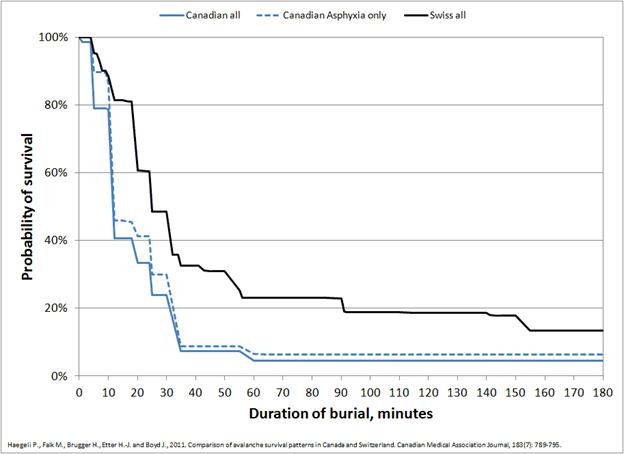
The Swiss study developed the avalanche survival curve based on the amount of time a person was buried.
The probability of survival remains above 91% during the first 18 minutes of burial (“survival phase”). This phase is followed by a precipitous drop to 34% between 19 and 35 minutes be – cause of asphyxiation of most people (“asphyxia phase”). Between 35 and 90 minutes, the survival curve levels out (“latent phase”) because of the survival of people with patent airways. Thereafter, survival drops again as those buried eventually succumb to lethal hypothermia complicated by progressive hypoxia and hypercapnia.
2. There was no statistical difference between the overall survival rate of the Canadian study (Haegeli) and the Swiss study (Brugger).
…the Canadian survival curve showed lower chances of survival at all burial durations compared with the Swiss survival model, with a quicker drop in survival in the first 35 minutes and poorer survival associated with prolonged burials.
3. Most Swiss avalanches occur above tree line. Most North American avalanches occur below the tree line. Trauma fatalities are significantly greater in North America.
In the Canadian sample, trauma accounted for more than half of the deaths among people extricated in the first 10 minutes (Figure 1), which highlights the strong influence of trauma on the early phases of the survival curve. The probability of survival at the end of the first 10 minutes was 77% in the overall survival curve for Canada, as compared with 86% in the asphyxia-only survival curve.
4. There were statistically different survival chances between different climates in North America. Western (maritime) snow climates had shorter overall survival times. Western snow climates are characterized by wetter, heavier snow.
The survival curves for the transitional and maritime snow climates were characterized by a considerably earlier drop in survival compared with the curve for the continental snow climate.
The study also offered speculation that heavier denser snow prevented chest movement preventing the victim from breathing if buried.
Snow density is defined as the overall mass of snow per unit volume (kilograms per meter cubed). Typical densities of seasonal snow vary from 30 kg/m in dry, newly fallen snow to 600 kg/m in wet spring snow.
These results highlight the importance of prompt extrication by companions, especially in areas with a more maritime snow climate. Although the “survival phase” has commonly been described to be about 18 minutes long, our analysis shows that the first 10 minutes might be a more appropriate general guideline for Canada and other areas with a maritime snow climate.

5. The study recommended that Airbags and Transceivers be used as they offered the best options to speed up rescue.
The use of avalanche airbags to prevent burial and avalanche transceivers to speed up the locations of buried avalanche victims are recommended. Both of these safety devices have been shown to reduce mortality significantly.
The study had numerous interesting facts about avalanche burials.
The two longest burials among survivors in the Canadian sample (120 and 300 minutes) both occurred in urban settings, whereas the maximum burial time among survivors in a remote setting was 55 minutes.
So?
When teaching at Colorado Mountain College in the Ski Area Operations program I tell my students the one thing we know about avalanches to an absolute certainty: Avalanches are made of snow.
For other articles on Avalanches see:
Research shows beacons have issues with multivictim searches
Colorado Avalanche Information Center
It’s time to sign up to get the CAIC Avalanche Forecasts
Well written article about the risks of Avalanches and survival with the latest gear.
See this article by Earn Your Turns: Canadian Study reduces Avalanche Survival Time, http://www.earnyourturns.com/9079/avalanche-survival-time-reduced/
What do you think? Leave a comment.
If you like this let your friends know or post it on FB, Twitter or LinkedIn
Copyright 2012 Recreation Law (720) Edit Law
Twitter: RecreationLaw
Facebook: Rec.Law.Now
Facebook Page: Outdoor Recreation & Adventure Travel Law
Mobile Site: http://m.recreation-law.com
#RecreationLaw, #@RecreationLaw, #Cycling.Law #Fitness.Law, #Ski.Law, #Outside.Law, #Recreation.Law, #Recreation-Law.com, #Outdoor Law, #Recreation Law, #Outdoor Recreation Law, #Adventure Travel Law, #law, #Travel Law, #Jim Moss, #James H. Moss, #Attorney at Law, #Tourism, #Adventure Tourism, #Rec-Law, #Rec-Law Blog, #Recreation Law, #Recreation Law Blog, #Risk Management, #Human Powered, #Human Powered Recreation,# Cycling Law, #Bicycling Law, #Fitness Law, #Recreation-Law.com, #Backpacking, #Hiking, #Mountaineering, #Ice Climbing, #Rock Climbing, #Ropes Course, #Challenge Course, #Summer Camp, #Camps, #Youth Camps, #Skiing, #Ski Areas, #Negligence, #Snowboarding, #RecreationLaw, #@RecreationLaw, #Cycling.Law #Fitness.Law, #SkiLaw, #Outside.Law, #Recreation.Law, #RecreationLaw.com, #OutdoorLaw, #RecreationLaw, #OutdoorRecreationLaw, #AdventureTravelLaw, #Law, #TravelLaw, #JimMoss, #JamesHMoss, #AttorneyatLaw, #Tourism, #AdventureTourism, #RecLaw, #RecLawBlog, #RecreationLawBlog, #RiskManagement, #HumanPowered, #HumanPoweredRecreation,# CyclingLaw, #BicyclingLaw, #FitnessLaw, #RecreationLaw.com, #Backpacking, #Hiking, #Mountaineering, #IceClimbing, #RockClimbing, #RopesCourse, #ChallengeCourse, #SummerCamp, #Camps, #YouthCamps, #Skiing, #Ski Areas, #Negligence, #Snowboarding, sport and recreation laws, ski law, cycling law, Colorado law, law for recreation and sport managers, bicycling and the law, cycling and the law, ski helmet law, skiers code, skiing accidents, #Avalanche, Avalanche Study, Pascal Haegeli, #Vancouver, #BC, Canadian Medical Association Journal, #Haegeli, #CMAJ, #CMA, Survival Rate, #Study,
WordPress Tags: North,American,Avalanche,survival,western,Pascal,Haegeli,researcher,Vancouver,Canadian,Medical,Association,Journal,Comparison,Canada,Switzerland,victim,Falk,Brugger,Adler,Kastner,Nature,Differences,terrain,discrepancies,Swiss,person,burial,phase,asphyxiation,asphyxia,airways,Thereafter,difference,durations,burials,Most,avalanches,tree,Trauma,America,deaths,Figure,phases,climates,climate,speculation,chest,unit,meter,Typical,densities,importance,extrication,companions,areas,Although,analysis,guideline,Airbags,Transceivers,options,locations,victims,Both,survivors,settings,Colorado,Mountain,College,Area,Operations,students,Magazine,families,Research,beacons,Information,Center,CAIC,Forecasts,article,gear,Leave,Twitter,LinkedIn,Recreation,Edit,RecreationLaw,Facebook,Page,Outdoor,Adventure,Travel,Blog,Mobile,Site,Outside,Moss,James,Attorney,Tourism,Risk,Management,Human,Rock,Ropes,Course,Challenge,Summer,Camp,Camps,Youth,Negligence,SkiLaw,OutdoorLaw,OutdoorRecreationLaw,AdventureTravelLaw,TravelLaw,JimMoss,JamesHMoss,AttorneyatLaw,AdventureTourism,RecLaw,RecLawBlog,RecreationLawBlog,RiskManagement,HumanPoweredRecreation,CyclingLaw,BicyclingLaw,FitnessLaw,RopesCourse,ChallengeCourse,SummerCamp,YouthCamps,managers,helmet,accidents,Study,CMAJ,Rate
Costs, when you win a lawsuit you normally can recover your costs
Posted: March 5, 2012 Filed under: Ski Area, Skiing / Snow Boarding | Tags: Alpine Meadows, California, Outdoors, Recreation, Rock climbing, Ski, Ski Resort, Snowboard, snowboarding Leave a commentGregorie v. Alpine Meadows Ski Corporation, 2011 U.S. Dist. LEXIS 20275
Costs do not include attorney fees
This case is a lawsuit by the parents of a 24-year-old girl who died snowboarding. The father, in response to her death founded the California Ski & Snowboard Association (CSSO as set forth by the court and California Ski and Snowboard Safety Organization based on their website). An association allegedly started to make ski areas safer. However, the young girl died out of bounds.
The girl and her friend were hiking out of bounds. On the way, they passed two signs warning people of the dangers. While on the High Beaver Tavers she slipped, slid out of bounds and died.
The girl signed a release before skiing at Alpine Meadows in California. On top of that she was described as an experienced snowboarder.
California Ski & Snowboard Association (CSSO) is an organization that I have written about as a wolf in sheep’s clothing (or maybe it should be skin or wool). Originally, the organization came across as wanting to work with ski areas to make them safer. See Grieving Father starts organization to make skiing safer and California Ski and Snowboard Safety Organization turns out to be a Wolf in Sheep’s Clothing.
Recently, the organization has changed its mission to:
Mission
To promote and support safety improvements in California skiing, snowboarding and recreational snow sports and serve as an independent, factual public resource regarding the safety of California ski resorts.
Vision
A recreational skiing and snowboarding environment in which federal and state governments, health and safety organizations and the ski resort industry are proactively and collaboratively working to establish and maintain the safest possible snow sport environment and experience.
Summary of the case
The plaintiffs sued for Premise’s liability, misrepresentation of the risk, negligence, breach of the season pass agreement, two claims of rescission and declaratory relief.
Rescission is a contract claim that attempts to void the contract and place the parties back in the position they were in prior to the signing of the contract. To win a claim for rescission the party wanting out of the agreement must claim material misstatement of the issues creating the contract, or something akin to fraud or misrepresentation.
The defendants filed a motion for summary judgment based on the release (express assumption of the risk) and primary assumption of the risk. The trial court granted the defendants motion and dismissed the claims of the plaintiff.
As is normal, the defendant then filed a bill of costs. This is a motion to recover their costs they expended in defending the lawsuit. Costs are normally granted to the winning party in a suit.
Costs are the actual money spent for things necessary to defend the suit. In federal court, costs are set out by statute.
Federal Rule of Civil Procedure 54(d)(1)
(1) Fees of the clerk and marshal;
(2) [*5] Fees for printed or electronically recorded transcripts necessarily obtained for use in the case;
(3) Fees and disbursements for printing and witnesses;
(4) Fees for exemplification and the costs of making copies of any materials where the copies are necessarily obtained for use in the case;
(5) Docket fees under section 1923 of this title
(6) Compensation of court appointed experts, compensation of interpreters, and salaries, fees, expenses, and costs of special interpretation services under section 1828 of this title.
A better way to look at costs is; those things the party wrote a check to, necessary to litigate.
Costs do not include attorney fees. To recover attorney fees, there must be a violation of a state statute that awarded costs, a contract that awards costs or liquidated damages or an action (claim) by one side or the other that is frivolous, groundless and wholly without any legal merit. “Rule 54(d)(1) provides that costs, “other than attorney’s fees shall be allowed as of course to the prevailing party unless the court otherwise directs.”
Costs are up to the discretion of the court. Normally, the court will allow most costs if the costs were specifically part of the trial or litigation. I look at it this way. If the judge saw the results of what you paid for, then that might be costs.
On the other hand, if money was spent on something that only might or did lead to what the judge might see, then probably not allowed as costs.). “If the depositions are for investigatory or for discovery purposes only, rather than for presentation of the case, courts have found that they are not taxable.”
The decision looks at several of the items the trial court allowed as costs. The original order allowing costs was $72,515.36. The court found that only $51,042.76 of the amount should have been allowed.
So Now What?
There are several interesting issues that are just good to know if you run a ski area or any recreation business. The deposition of the father took three days. Part of that deposition concerned the organization he started, California Ski & Snowboard Association (CSSO); however, no matter why, think about losing three days out of the office for deposition and probably another six days preparing for the deposition. Nine days total for something that if you work hard in the beginning, might have been prevented.
The expert witness of the plaintiff testified for two days. That would be an expensive two days. You and/or your insurance company would be paying probably two lawyers to attend the deposition and paying your expert witness to be questioned. Even if you are not having your expert deposed, just an employee, you are paying the employee to be there. Simply put, depositions on one side or the other can easily cost $1000 per hour.
Winning or losing a lawsuit, is an expensive proposition. Usually, the costs awarded by the court are less than 50% of the actual costs spent. Add to that the time incurred to defend a lawsuit, and it is ridiculous.
What do you think? Leave a comment.
If you like this let your friends know or post it on FB, Twitter or LinkedIn
Copyright 2012 Recreation Law (720) Edit Law
Twitter: RecreationLaw
Facebook: Rec.Law.Now
Facebook Page: Outdoor Recreation & Adventure Travel Law
Mobile Site: http://m.recreation-law.com
#RecreationLaw, #@RecreationLaw, #Cycling.Law #Fitness.Law, #Ski.Law, #Outside.Law, #Recreation.Law, #Recreation-Law.com, #Outdoor Law, #Recreation Law, #Outdoor Recreation Law, #Adventure Travel Law, #law, #Travel Law, #Jim Moss, #James H. Moss, #Attorney at Law, #Tourism, #Adventure Tourism, #Rec-Law, #Rec-Law Blog, #Recreation Law, #Recreation Law Blog, #Risk Management, #Human Powered, #Human Powered Recreation,# Cycling Law, #Bicycling Law, #Fitness Law, #Recreation-Law.com, #Backpacking, #Hiking, #Mountaineering, #Ice Climbing, #Rock Climbing, #Ropes Course, #Challenge Course, #Summer Camp, #Camps, #Youth Camps, #Skiing, #Ski Areas, #Negligence, #Snowboarding, #RecreationLaw, #@RecreationLaw, #Cycling.Law #Fitness.Law, #SkiLaw, #Outside.Law, #Recreation.Law, #RecreationLaw.com, #OutdoorLaw, #RecreationLaw, #OutdoorRecreationLaw, #AdventureTravelLaw, #Law, #TravelLaw, #JimMoss, #JamesHMoss, #AttorneyatLaw, #Tourism, #AdventureTourism, #RecLaw, #RecLawBlog, #RecreationLawBlog, #RiskManagement, #HumanPowered, #HumanPoweredRecreation,# CyclingLaw, #BicyclingLaw, #FitnessLaw, #RecreationLaw.com, #Backpacking, #Hiking, #Mountaineering, #IceClimbing, #RockClimbing, #RopesCourse, #ChallengeCourse, #SummerCamp, #Camps, #YouthCamps, #Skiing, #Ski Areas, #Negligence, #Snowboarding, sport and recreation laws, ski law, cycling law, Colorado law, law for recreation and sport managers, bicycling and the law, cycling and the law, ski helmet law, skiers code, skiing accidents, California Ski & Snowboard Association, CSSO, Alpine Meadows, fatality, snowboarding, costs,
WordPress Tags: Costs,lawsuit,Gregorie,Alpine,Meadows,Corporation,Dist,LEXIS,attorney,parents,girl,response,death,California,Snowboard,Association,CSSO,Organization,areas,friend,dangers,High,Beaver,Tavers,sheep,wool,Father,Wolf,mission,improvements,resource,resorts,Vision,environment,governments,health,resort,industry,Summary,plaintiffs,Premise,misrepresentation,negligence,agreement,relief,Rescission,fraud,defendants,judgment,assumption,plaintiff,defendant,money,statute,Federal,Rule,Civil,Procedure,Fees,clerk,transcripts,disbursements,Docket,Compensation,experts,interpreters,salaries,interpretation,violation,action,discretion,litigation,discovery,purposes,presentation,decision,items,area,recreation,Part,office,Nine,insurance,lawyers,employee,cost,hour,proposition,Leave,Twitter,LinkedIn,Edit,RecreationLaw,Facebook,Page,Outdoor,Adventure,Travel,Blog,Mobile,Site,Outside,Moss,James,Tourism,Risk,Management,Human,Rock,Ropes,Course,Challenge,Summer,Camp,Camps,Youth,SkiLaw,OutdoorLaw,OutdoorRecreationLaw,AdventureTravelLaw,TravelLaw,JimMoss,JamesHMoss,AttorneyatLaw,AdventureTourism,RecLaw,RecLawBlog,RecreationLawBlog,RiskManagement,HumanPoweredRecreation,CyclingLaw,BicyclingLaw,FitnessLaw,RopesCourse,ChallengeCourse,SummerCamp,YouthCamps,Colorado,managers,helmet,accidents,three
Camp Illahee Investors, Inc., v. Blackman, 870 So. 2d 80; 2003 Fla. App. LEXIS 17549; 28 Fla. L. Weekly D 2672
Posted: February 27, 2012 Filed under: Florida, Jurisdiction and Venue (Forum Selection), Legal Case, Minors, Youth, Children, Summer Camp | Tags: Camp, Florida, Long-Arm Jurisdiction, Motion (legal), North Carolina, Recreation, summer camp Leave a commentCamp Illahee Investors, Inc., v. Blackman, 870 So. 2d 80; 2003 Fla. App. LEXIS 17549; 28 Fla. L. Weekly D 2672
Camp Illahee Investors, Inc., a North Carolina Corporation, Appellant, v. Michael Blackman and Patrice Blackman, Individually and as the Parents, Natural Guardians and next best friends of Olivia Blackman and Sophie Blackman, minor children, and Frank Tindall and Elizabeth Tindall, Appellees.
Case No. 2D02-4324
COURT OF APPEAL OF FLORIDA, SECOND DISTRICT
870 So. 2d 80; 2003 Fla. App. LEXIS 17549; 28 Fla. L. Weekly D 2672
November 19, 2003, Opinion Filed
PRIOR HISTORY: [**1] Appeal from nonfinal order of the Circuit Court for Hillsborough County; Daniel E. Gallagher, Senior Judge.
DISPOSITION: Reversed and remanded with directions.
COUNSEL: J. Gregory Giannuzzi of Rissman, Weisberg, Barrett, Hurt, Donahue & McLain, P.A., Tampa, for Appellant.
Jeffrey A. Blau, Tampa, for Appellees Michael Blackman and Patrice Blackman, Individually and as the Parents, Natural Guardians and next best friends of Olivia Blackman and Sophie Blackman, minor children.
No appearance for Appellees, Frank Tindall and Elizabeth Tindall.
JUDGES: SILBERMAN, Judge. STRINGER, J., and THREADGILL, EDWARD F., SENIOR JUDGE, Concur.
OPINION BY: SILBERMAN
OPINION
[*82] SILBERMAN, Judge.
Camp Illahee Investors, Inc., a North Carolina corporation, appeals a nonfinal [*83] order that denied its motion to dismiss for lack of personal jurisdiction. Because jurisdiction was not established under Florida’s long-arm statute, we reverse.
Appellees Michael and Patrice Blackman, individually and on behalf of their minor daughters, sued Camp Illahee and its owners, Frank and Elizabeth Tindall, for alleged torts committed in North Carolina while [**2] the Blackmans’ two daughters were attending summer camp in 2001. 1 In their first amended complaint, the Blackmans alleged that while their daughters were at the camp, someone placed an “anonymous child abuse call” to a county department of social services in North Carolina, whose representatives then interviewed the Blackmans’ daughters. The Blackmans alleged that the “Defendants had a duty, after being informed that the North Carolina County Department of Social Services desired to interview the Plaintiffs’ minor children, to notify the Plaintiffs of the fact that the minor children were to be interviewed by the North Carolina County Department of Social Services about possible child abuse.” The Blackmans also alleged that a junior counselor battered one of the daughters “by stepping on her feet and inflicting other physical injuries and mental abuse” on her.
1 The trial court dismissed the Tindalls from the litigation, and the Blackmans have not appealed that ruling.
Camp Illahee filed a motion to dismiss [**3] and asserted, among other grounds, that it was not subject to the jurisdiction of a Florida court and, even if jurisdiction existed in Florida, that North Carolina was an adequate alternative forum. Camp Illahee further argued that it was immune from suit under North Carolina law and that Florida’s impact rule required dismissal.
Camp Illahee submitted affidavits from the Tindalls, the owners and operators of the camp. The affidavits reflect that Camp Illahee is a North Carolina corporation; the summer camp is located in North Carolina; Camp Illahee has no offices in Florida; it has no employees in Florida, although some of the employees who work at the camp during the summer are from Florida; Camp Illahee does no advertising in Florida by newspapers, radio, or television, but it has a one and one-half page posting on its internet website advising of “fall reunion and video shows.”
Mrs. Tindall’s affidavit also reflects that she travels to various states to engage in the reunion and video shows, which are designed to have “the children get together to talk about Camp, and to become excited for camp the next summer.” The reunions take place in the homes of camp families, and the [**4] families receive a discount in the camp fee for hosting the reunions. The discounts amounted to .15% of Camp Illahee’s gross revenues in 2000 and .08% in 2001. In 2000 and 2001, 22% of the campers were from Florida.
Although Camp Illahee argues that its motion to dismiss could properly have been granted on any of the grounds raised in its motion, the key issue is whether the trial court had long-arm jurisdiction over Camp Illahee. [HN1] Our standard of review on the issue of personal jurisdiction over a foreign corporation is de novo. See Execu-Tech Bus. Sys., Inc. v. New Oji Paper Co., 752 So. 2d 582, 584 (Fla. 2000). [HN2] Additionally, we are required to strictly construe Florida’s long-arm statute. See Esberger v. First Fla. Bus. Consultants, Inc., 338 So. 2d 561, 562 (Fla. 2d DCA 1976).
The pertinent facts relating to jurisdiction are not in dispute. [HN3] The determination [*84] of whether the trial court has personal jurisdiction over Camp Illahee turns on “whether (1) there are sufficient jurisdictional facts to bring the action within the purview of the long-arm statute; and (2) the nonresident defendant involved has sufficient minimum contacts with Florida to [**5] satisfy constitutional due process requirements.” Kin Yong Lung Indus. Co. v. Temple, 816 So. 2d 663, 666 (Fla. 2d DCA 2002); see also Venetian Salami Co. v. Parthenais, 554 So. 2d 499, 502 (Fla. 1989).
In its order denying the motion to dismiss, the trial court did not discuss this two-prong test. Instead, it simply stated, “Jurisdiction as to Camp Illahee Investors, Inc. will remain in Florida pursuant to the doctrine of forum non conveniens, as set forth in Fla. R. Civ. P. 1.061.” However, [HN4] before reaching the issue of forum non conveniens under Florida Rule of Civil Procedure 1.061, the trial court was required to first determine whether it had in personam jurisdiction in accordance with the two-prong test. See La Reunion Francaise, S.A. v. La Costena, 818 So. 2d 657, 659 (Fla. 3d DCA 2002) (concluding that there was no personal jurisdiction over the foreign defendant and, therefore, no need to reach other issues raised in the motion to dismiss, including the issue of forum non conveniens).
After reviewing the record and the applicable statutory language in light of the required two-prong jurisdictional analysis, we conclude [**6] that the trial court should have dismissed the Blackmans’ first amended complaint for lack of in personam jurisdiction. The allegations of the first amended complaint establish that the only possible bases for jurisdiction are under sections 48.193(1)(a) or 48.193(2) of the long-arm statute. Section 48.193(1)(a) [HN5] provides as follows:
(1) Any person, whether or not a citizen or resident of this state, who personally or through an agent does any of the acts enumerated in this subsection thereby submits himself or herself and, if he or she is a natural person, his or her personal representative to the jurisdiction of the courts of this state for any cause of action arising from the doing of any of the following acts:
(a) Operating, conducting, engaging in, or carrying on a business or business venture in this state or having an office or agency in this state.
Section 48.193(2) [HN6] states as follows:
A defendant who is engaged in substantial and not isolated activity within this state, whether such activity is wholly interstate, intrastate, or otherwise, is subject to the jurisdiction of the courts of this state, whether or not the claim arises from that activity.
In the trial [**7] court, the Blackmans asserted that because Mrs. Tindall came to Florida one week a year for the reunion and video shows, Camp Illahee was conducting business in Florida. They also argued that the families that hosted the reunions were agents of Camp Illahee.
Concerning the agency argument, nothing in the record reflects that either an apparent or actual agency relationship existed between the host families and Camp Illahee. In particular, there was no showing that Camp Illahee made any representations that the host families were the agents of Camp Illahee, or that Camp Illahee, as principal, exercised control over the families, as agents. See Ilgen v. Henderson Props., Inc., 683 So. 2d 513, 514-15 (Fla. 2d DCA 1996) (discussing the elements necessary to establish apparent or actual agency); State v. Am. Tobacco Co., 707 So. 2d 851, 854 (Fla. 4th DCA 1998) (stating that control by the principal [*85] over the agent is a necessary element of agency).
The Blackmans’ second argument is premised on section 48.193(1), which confers jurisdiction for “any cause of action arising from the doing of” any of the enumerated items, such as conducting business in Florida. [**8] [HN7] By its terms, section 48.193(1) requires connexity between the defendant’s activities and the cause of action. Wendt v. Horowitz, 822 So. 2d 1252, 1260 (Fla. 2002). Here, the record reflects that the connexity requirement has not been met because the Blackmans’ claims did not arise from the reunions and video shows that took place in Florida during one week per year. Rather, the claims arose out of alleged torts that occurred in North Carolina while the Blackmans’ daughters attended the camp.
Even if the undisputed facts fell within the ambit of section 48.193(1), Camp Illahee must have sufficient minimum contacts with Florida to satisfy due process requirements. See Venetian Salami, 554 So. 2d at 500. [HN8] The test is whether Camp Illahee’s conduct is such that it “should reasonably anticipate being haled into court” in Florida. See Venetian Salami, 554 So. 2d at 500 (quoting World-Wide Volkswagen Corp. v. Woodson, 444 U.S. 286, 297, 62 L. Ed. 2d 490, 100 S. Ct. 559 (1980)); see also Emerson v. Cole, 847 So. 2d 606, 608 (Fla. 2d DCA 2003). We agree with Camp Illahee that the limited contact between it [**9] and Florida as a result of the yearly reunion and video shows is insufficient to establish that it could reasonably anticipate being haled into court in Florida for the allegedly tortious conduct occurring in North Carolina.
A second potential basis for jurisdiction is section 48.193(2), which provides that a defendant is subject to a Florida court’s jurisdiction when the defendant “is engaged in substantial and not isolated activity within this state . . . whether or not the claim arises from that activity.” [HN9] This section “does not require connexity between a defendant’s activities and the cause of action.” Woods v. Nova Cos. Belize Ltd., 739 So. 2d 617, 620 (Fla. 4th DCA 1999). Additionally, if the defendant’s activities meet the requirements of this section, the due process requirement of minimum contacts is fulfilled. Id. However, the record before us does not support a conclusion that Camp Ilahee’s conduct constitutes substantial activity in Florida. See deMco Techs., Inc. v. C.S. Engineered Castings, Inc., 769 So. 2d 1128, 1132 (Fla. 3d DCA 2000) (stating that sporadic sales in Florida could not provide jurisdiction for litigation regarding [**10] an unrelated promissory note); Price v. Point Marine, Inc., 610 So. 2d 1339, 1341 (Fla. 1st DCA 1992) (noting that sporadic activities or visits to Florida consisting of the occasional solicitation of business in Florida do not constitute “substantial and not isolated activity”).
Because the undisputed facts do not demonstrate a basis for jurisdiction under Florida’s long-arm statute, we reverse and remand with directions that the trial court dismiss the Blackmans’ claims without prejudice to their refiling the claims in the appropriate jurisdiction. In light of our conclusion regarding the lack of in personam jurisdiction, the other grounds asserted by Camp Illahee in support of reversal are moot.
Reversed and remanded with directions.
STRINGER, J., and THREADGILL, EDWARD F., SENIOR JUDGE, Concur.
PR piece with great information on building to climbing a big mountain
Posted: February 21, 2012 Filed under: Mountaineering | Tags: Climbing, Everest, IMG, International Mountain Guides, Mount Everest, Mountaineering, Mountains, Nepal, Recreation, Sherpa Leave a comment
|


|
Start Small (Relatively Speaking) For beginner climbers it’s important to set yourself up for success. Remember you can’t eat an elephant in one bite. We get a lot of “I want to climb Everest….what should I do?” And the answer is always the same: Have you climbed Mt. Rainier? Mt. Baker? Something in the North Cascades? If the answer is no, then we know where we need to start. Unfortunately a lot of folks try to run in crampons before they know how to walk in them. Let’s see if you even like climbing before we get you to the South Col on Everest! Are your knees shot? No excuses…try a trek. Machu Picchu, Everest Base Camp, or even Kilimanjaro! We’ll take care of the weight on your back and the logistics – you just put one foot in front of the other. ________________________________________ |
Ok, I’ve Climbed A Few Things – Now What?
|
We hear this a lot: “Last summer I climbed Mt. Rainier and had a blast! The summer before that my wife and I climbed Shuksan and it was super fun. This year we want another challenge – what do you recommend?” This is a great question and one that is fun to answer. Once you’ve got a couple climbs under your belt the world starts opening up. Climbs in Mexico, Ecuador, and Bolivia, or climbs like Mt. Bona, Mt. Whitney, and Chulu Peak, are popular ‘next steps’ after a first or second climb. Many of these programs feature cultural aspects to them, so be sure look at the non-climbing days on the itinerary to see what else you’d enjoy on the program. ________________________________________ |
Bolivia Was Fun, Now Can I Climb Everest?
| Ok, so you’ve climbed a few things and you’ve got you eyes on one of the big guys! It’s important to keep in mind that every mountain is different and can have its own prerequisites. Take Denali for example, success on Rainier in the summer and a high five on the summit of Aconcagua often isn’t enough. A Denali Prep Course on Rainier is needed to get you qualified for Denali. The same goes for Everest, a summit of Rainier and success at altitude in Mexico just doesn’t cut it, whereas going to Cho Oyuto test your lungs at 8000m is often the route of choice for our Everest climbers.The point being, there is no tried and true recipe to the top of the world. Some people just let the cards fall where they may and climb as their vacation, families, and resources allow. Others set long term goals and map out a 5-year plan.
Regardless of what type of climber you are or what your goals may be: if you’re having fun, you’re doing it right. ________________________________________ |
From A Guide’s Perspective: Staying In Shape
|
By Jess Culver
Lets face it, it’s hard to stay in shape between seasons. It starts when the Halloween candy comes out, gets even worse come Thanksgiving and hits its peak somewhere between Christmas and New Years. Then, the 1st of the year rolls around and you’re a few pounds guiltier and several pounds heavier. Finding the motivation to shed this weight can be tough. Here are some tips I use between seasons. For me, I know I have to be in good shape when the Rainier season opens, which is probably in the back of a lot of your minds as well. With that in mind, I’ve found that setting small goals between big goals really makes the time go by a lot quicker than the alternative: 4-5 days a week on the hamster wheel. I like to sign up for a few running races in the winter and spring. I’ll start small, maybe a 5k, then work up to a 10k and eventually a half-marathon and then the full 26.2. There are countless programs out there that will set you up for success at these races. They work if you’re honest with yourself and stick to the program. And don’t be intimidated by the people that run these races, they are all smiles and are super supportive to all shapes, sizes and speeds. Trust me, you’ll have a blast. (Read more)
______________________________ |
Medical Minutes by Adventure Medical Kits
Q: What should you do if you find yourself in the mountains without adequate eye protection?
A: Improvise
It is possible to improvise a pair of “sunglasses” that will help protect eyes from ultraviolet light, especially in snow and at elevations above 2500m (8000 feet). Cut small slits in a piece of cardboard (e.g., use one side of a cracker or cereal box) or in a piece of duct tape folded back over onto itself (Fig. 25). The slits should be just wide enough to see through, and no larger than the diameter of the eye. Tape or tie these “sunglasses” around the head to minimize the amount of light hitting the eyes.
If you remember from a previous newsletter snow blindness is a sunburn to the eye that results in a corneal abrasion. It results from exposure to intense ultraviolet radiation at high altitude or while traveling in the snow. At higher elevations, more ultraviolet light is easily reflected off snow. Because signs and symptoms of snow blindness are delayed by about 4 to 6 hours from the time of exposure to the light, victims are unaware that the injury is occurring until it is too late to prevent it. Wearing adequate eye protection (100 percent UV-blocking sunglasses with side protectors) can prevent snow blindness. (read more)

Image via Wikipedia
Information, Education and knowledge prevent a mother from suing a camp and the Girl Scouts
Posted: February 20, 2012 Filed under: Minors, Youth, Children, Mississippi, Summer Camp, Youth Camps | Tags: Bedroom, Bunk bed, Cabin, Camp, Child, Girl Scouts, Girl Scouts of America, Recreation, Summer Camp Leave a commentBuck, v. Camp Wilkes, Inc. 906 So. 2d 778; 2004 Miss. App. LEXIS 1141
Besides top bunk of a bunk bed is just not a dangerous instrumentality.
The mother of a thirteen-year old girl sued the Girl Scouts of Gulf Pine Council, Inc., the troop leader of her daughter’s unit and the camp when the girl fell off the top bunk of a bunk bed injuring her. The basis of the suit was the defendant’s actions caused or contributed to the thirteen-year olds fall. After the defendants were dismissed on summary judgment by the trial court the mother appealed claiming the lower court failed to determine the following:
(1) in failing to follow existing standards in granting the defendants’ motions for summary judgment, (2) in finding no merit to Buck’s argument that a causal relationship existed between Boozer’s temporary absence at the time of the accident and Jamie’s falling from the bed, and in applying the wrong standard when considering Boozer and the Girl Scouts’s lack of supervision, and (3) in ruling as a matter of law that a bunk bed is not a dangerous instrumentality and that Appellees‘ use of bunk beds did not amount to a failure on their part to use reasonable care in providing Jamie a reasonably safe place to sleep.
The entire case revolved around what did the injured girl’s mother know?
The mother took her daughter to camp and helped set up her bed the first night. The second night the group moved to another cabin because the first cabin did not have a working refrigerator. The mother was not there for the move or the remaining nights. The girls decided to sleep on the top bunks, even though lower bunks were available.
The second night after the move the third night in total, the thirteen-year old rolled off the bunk and fell suffering injuries.
So?
The first argument was dismissed because there was no legal (causal) relationship between the defendant leader leaving for an errand and the girl falling out of the bunk. No supervision when the girl fell would have prevented her from falling.
The plaintiff then argued, as part of the first appeal argument that the girls should not have been allowed to sleep on the top bunk. However, the court found the plaintiff presented no evidence that bunk beds or sleeping on the top bunk by thirteen-year old girls were dangerous.
The court then looked at whether bunk beds were a dangerous instrumentality. This means that in and of themselves, bunk beds are dangerous. Guns are probably the best example of a dangerous instrumentality. However, the court found that there was no evidence the beds where dangerous on their face. The mother during her deposition testified that she knew her daughter might be sleeping on a bunk bed, expressed no concerns about that fact and did not inform anyone that she did not want her daughter sleeping on the bed.
The court referred to a New York decision that held that an innkeeper is not responsible for the beds, when the parent is the one who chooses whether or not their child can sleep in it.
Finally, the court looked at the failure to warn issue. A land owner owes a duty of care to someone on the land based on the relationship between the land owner and the person. Here, the thirteen-year old was an invitee. A landowner’s duty to an invitee is “exercising reasonable care to keep its premise’s safe, or to warn Jamie [the injured girl] of any hidden or concealed perils of which it knew, or should have known, in the exercise of reasonable care.”
Here again the court had no evidence in front of it showing that bunk beds were dangerous so that the landowner, the camp, needed to inform the mother of the dangers.
So Now What?
What stands out in this case is the fact the mother, and probably the daughter, knew what the daughter was going to do and did not stop those acts. If a parent and a child know and understand what the risk of the activity is, then it is difficult for them to prove that the risks were dangerous. If the risks were dangerous, then why didn’t the mother inform the daughter or the troop leader that she did not want her daughter participating in the particular risks?
Here, the proof came out in a deposition. However, I believe that is relying on luck to hope that discovery will save your case. Better to point out all the risks of the activity to the parents and children and be able to prove that you did point them out.
There are two ways of doing that. The first is to put the risks in a release and have the parents sign the release. This works for single day activities were the risks can be easily identified…..to some extent.
Better to put everything you can on your website. A movie of the cabins showing bunk beds would have also proven the points to the parents and the court. If each cabin is different have the parents look at the cabins that their child is staying in. Always point out that cabins are different and some have other features and numerate the risks.
Do the same with the dining hall, health club, paths and all buildings and activity areas. Give the parents every opportunity to experience the camp without leaving their computer. No matter what you show it will help sell the camp and keep parents informed of the risks.
Proving the parent watched the videos is easy. On all of your literature tell the parents to go to the website and look around. On the release, have the parents agree that they did go to the website and look around.
If you think, the videos are difficult to do, then don’t. Turn it into a project and have the kids make them!
What do you think? Leave a comment.
If you like this let your friends know or post it on FB, Twitter or LinkedIn
Copyright 2012 Recreation Law (720) Edit Law
Twitter: RecreationLaw
Facebook: Rec.Law.Now
Facebook Page: Outdoor Recreation & Adventure Travel Law
Mobile Site: http://m.recreation-law.com
#RecreationLaw, #@RecreationLaw, #Cycling.Law #Fitness.Law, #Ski.Law, #Outside.Law, #Recreation.Law, #Recreation-Law.com, #Outdoor Law, #Recreation Law, #Outdoor Recreation Law, #Adventure Travel Law, #law, #Travel Law, #Jim Moss, #James H. Moss, #Attorney at Law, #Tourism, #Adventure Tourism, #Rec-Law, #Rec-Law Blog, #Recreation Law, #Recreation Law Blog, #Risk Management, #Human Powered, #Human Powered Recreation,# Cycling Law, #Bicycling Law, #Fitness Law, #Recreation-Law.com, #Backpacking, #Hiking, #Mountaineering, #Ice Climbing, #Rock Climbing, #Ropes Course, #Challenge Course, #Summer Camp, #Camps, #Youth Camps, #Skiing, #Ski Areas, #Negligence, #Snowboarding, #RecreationLaw, #@RecreationLaw, #Cycling.Law #Fitness.Law, #SkiLaw, #Outside.Law, #Recreation.Law, #RecreationLaw.com, #OutdoorLaw, #RecreationLaw, #OutdoorRecreationLaw, #AdventureTravelLaw, #Law, #TravelLaw, #JimMoss, #JamesHMoss, #AttorneyatLaw, #Tourism, #AdventureTourism, #RecLaw, #RecLawBlog, #RecreationLawBlog, #RiskManagement, #HumanPowered, #HumanPoweredRecreation,# CyclingLaw, #BicyclingLaw, #FitnessLaw, #RecreationLaw.com, #Backpacking, #Hiking, #Mountaineering, #IceClimbing, #RockClimbing, #RopesCourse, #ChallengeCourse, #SummerCamp, #Camps, #YouthCamps, #Skiing, #Ski Areas, #Negligence, #Snowboarding, sport and recreation laws, ski law, cycling law, Colorado law, law for recreation and sport managers, bicycling and the law, cycling and the law, ski helmet law, skiers code, skiing accidents, camp, Girl Scouts, bunk beds, GSA,
WordPress Tags: Information,Education,knowledge,Girl,Scouts,Buck,Camp,Wilkes,Miss,LEXIS,Besides,bunk,Gulf,Pine,Council,leader,daughter,unit,basis,defendant,defendants,judgment,argument,relationship,Boozer,absence,accident,Jamie,supervision,Appellees,beds,failure,cabin,refrigerator,nights,girls,bunks,injuries,errand,plaintiff,Guns,example,fact,York,decision,innkeeper,owner,person,Here,landowner,premise,perils,dangers,luck,discovery,Better,parents,extent,movie,cabins,hall,health,paths,buildings,areas,Give,computer,literature,Turn,Leave,Twitter,LinkedIn,Recreation,Edit,RecreationLaw,Facebook,Page,Outdoor,Adventure,Travel,Blog,Mobile,Site,Outside,Moss,James,Attorney,Tourism,Risk,Management,Human,Rock,Ropes,Course,Challenge,Summer,Camps,Youth,Negligence,SkiLaw,OutdoorLaw,OutdoorRecreationLaw,AdventureTravelLaw,TravelLaw,JimMoss,JamesHMoss,AttorneyatLaw,AdventureTourism,RecLaw,RecLawBlog,RecreationLawBlog,RiskManagement,HumanPoweredRecreation,CyclingLaw,BicyclingLaw,FitnessLaw,RopesCourse,ChallengeCourse,SummerCamp,YouthCamps,Colorado,managers,helmet,accidents,whether,invitee,website
WMS Trailblazer – January 2012
Posted: January 17, 2012 Filed under: First Aid, Utah | Tags: Conference, first aid, Medical, Physcian, Recreation, Wilderness Medical Society (WMS), WMS Leave a comment[Wilderness Medical Society (WMS) Updates]

|
 Leading the worldwide community of Wilderness Medicine
 February 4-8, 2012
25 Great Years Thanks To You!
Posted: January 10, 2012 Filed under: Mountaineering | Tags: Climbing, Dick Bass, Everest, Guided Climbing, Guides, IMG, IMG (company), International Mountain Guides, Mount Everest, Mount Rainier, Recreation, Seven Summit Leave a commentInternational Mountain Guides is 25 Years Old. Congratulations
|


What do you think? Leave a comment.
If you like this let your friends know or post it on FB, Twitter or Linkedin
Copyright 2012 Recreation Law (720) Edit Law
Twitter: RecreationLaw
Facebook: Rec.Law.Now
Facebook Page: Outdoor Recreation & Adventure Travel Law
Blog: www.recreation-law.com
Mobile Site: http://m.recreation-law.com
#RecreationLaw, #@RecreationLaw, #Cycling.Law #Fitness.Law, #Ski.Law, #Outside.Law, #Recreation.Law, #Recreation-Law.com, #Outdoor Law, #Recreation Law, #Outdoor Recreation Law, #Adventure Travel Law, #law, #Travel Law, #Jim Moss, #James H. Moss, #Attorney at Law, #Tourism, #Adventure Tourism, #Rec-Law, #Rec-Law Blog, #Recreation Law, #Recreation Law Blog, #Risk Management, #Human Powered, #Human Powered Recreation,# Cycling Law, #Bicycling Law, #Fitness Law, #Recreation-Law.com, #Backpacking, #Hiking, #Mountaineering, #Ice Climbing, #Rock Climbing, #Ropes Course, #Challenge Course, #Summer Camp, #Camps, #Youth Camps, #Skiing, #Ski Areas, #Negligence, #Snowboarding, #RecreationLaw, #@RecreationLaw, #Cycling.Law #Fitness.Law, #SkiLaw, #Outside.Law, #Recreation.Law, #RecreationLaw.com, #OutdoorLaw, #RecreationLaw, #OutdoorRecreationLaw, #AdventureTravelLaw, #Law, #TravelLaw, #JimMoss, #JamesHMoss, #AttorneyatLaw, #Tourism, #AdventureTourism, #RecLaw, #RecLawBlog, #RecreationLawBlog, #RiskManagement, #HumanPowered, #HumanPoweredRecreation,# CyclingLaw, #BicyclingLaw, #FitnessLaw, #RecreationLaw.com, #Backpacking, #Hiking, #Mountaineering, #IceClimbing, #RockClimbing, #RopesCourse, #ChallengeCourse, #SummerCamp, #Camps, #YouthCamps, #Skiing, #Ski Areas, #Negligence, #Snowboarding, sport and recreation laws, ski law, cycling law, Colorado law, law for recreation and sport managers, bicycling and the law, cycling and the law, ski helmet law, skiers code, skiing accidents,
I won’t tell you how to run your life, you don’t tell me how to run my ski area!
Posted: December 21, 2011 Filed under: Ski Area | Tags: Jim Moss, Recreation, Recreation Law, Recreation-Law.com, Rock climbing, Ropes course, Ski Resort Leave a commentAn article Should Ski Areas Expand When Skier Numbers Are Flat? Raises some interesting questions. However I’m not sure those are questions the public should be asking.
The Ski Area Citizens’ Coalition is saying that ski areas should not be expanding their terrain when the number of skiers is not growing. Basically the Ski Area Citizens’ Coalition is grading ski areas on their environmental footprint and expansion is a negative aspect of their score card. They are then tying its grade to the lack of growth in the number of skiers coming to resorts.
Resorts who receive a good grade are happy with it and resorts who receive a bad grade found fault with the grading system. I had the same response all throughout my formal education.
Grading anyone on its sustainability, its environmental concerns are great. I try and check those issues when I deal or make a purchase from some companies. However tying it into an economic issue, when most resorts are making money is a little lame.
This is different from the National Ski Area Association’sSustainable Slopes Program which grades ski areas on their environmental score card.
What do you think? Leave a comment.
Copyright 2011 Recreation Law (720) Edit Law
Twitter: RecreationLaw
Facebook: Rec.Law.Now
Facebook Page: Outdoor Recreation & Adventure Travel Law
Mobile Site: http://m.recreation-law.com
#RecreationLaw, #@RecreationLaw, #Cycling.Law #Fitness.Law, #Ski.Law, #Outside.Law, #Recreation.Law, #Recreation-Law.com, #Outdoor Law, #Recreation Law, #Outdoor Recreation Law, #Adventure Travel Law, #law, #Travel Law, #Jim Moss, #James H. Moss, #Attorney at Law, #Tourism, #Adventure Tourism, #Rec-Law, #Rec-Law Blog, #Recreation Law, #Recreation Law Blog, #Risk Management, #Human Powered, #Human Powered Recreation,# Cycling Law, #Bicycling Law, #Fitness Law, #Recreation-Law.com, #Backpacking, #Hiking, #Mountaineering, #Ice Climbing, #Rock Climbing, #Ropes Course, #Challenge Course, #Summer Camp, #Camps, #Youth Camps, #Skiing, #Ski Areas, #Negligence, #Snowboarding, #RecreationLaw, #@RecreationLaw, #Cycling.Law #Fitness.Law, #SkiLaw, #Outside.Law, #Recreation.Law, #RecreationLaw.com, #OutdoorLaw, #RecreationLaw, #OutdoorRecreationLaw, #AdventureTravelLaw, #Law, #TravelLaw, #JimMoss, #JamesHMoss, #AttorneyatLaw, #Tourism, #AdventureTourism, #RecLaw, #RecLawBlog, #RecreationLawBlog, #RiskManagement, #HumanPowered, #HumanPoweredRecreation,# CyclingLaw, #BicyclingLaw, #FitnessLaw, #RecreationLaw.com, #Backpacking, #Hiking, #Mountaineering, #IceClimbing, #RockClimbing, #RopesCourse, #ChallengeCourse, #SummerCamp, #Camps, #YouthCamps, #Skiing, #Ski Areas, #Negligence, #Snowboarding, #NSAA, #SustainableSlopes, #NationalSkiAreaAssociation, #SkiAreaCitizensCoalition,
WordPress Tags: life,area,article,Should,Areas,Expand,Skier,Numbers,Flat,Raises,Citizens,Coalition,terrain,footprint,expansion,aspect,card,growth,resorts,system,response,education,money,National,Association,Sustainable,Slopes,Program,Leave,Recreation,Edit,Gmail,Twitter,RecreationLaw,Facebook,Page,Outdoor,Adventure,Travel,Blog,Mobile,Site,Outside,Moss,James,Attorney,Tourism,Risk,Management,Human,Rock,Ropes,Course,Challenge,Summer,Camp,Camps,Youth,Negligence,SkiLaw,OutdoorLaw,OutdoorRecreationLaw,AdventureTravelLaw,TravelLaw,JimMoss,JamesHMoss,AttorneyatLaw,AdventureTourism,RecLaw,RecLawBlog,RecreationLawBlog,RiskManagement,HumanPoweredRecreation,CyclingLaw,BicyclingLaw,FitnessLaw,RopesCourse,ChallengeCourse,SummerCamp,YouthCamps,NSAA,SustainableSlopes,NationalSkiAreaAssociation,SkiAreaCitizensCoalition,skiers

Illinois lawsuit filed over drowning death of a man at a summer camp.
Posted: December 20, 2011 Filed under: Michigan, Summer Camp, Swimming, Youth Camps | Tags: Adventure travel, Law, Outdoor recreation, Recreation, summer camp 1 CommentClaims seem to be based on whether or not there was lighting to swim at night.
The deceased was a fifteen year-old person who drowned while attending a summer camp. Supposedly, he was swimming after dark, after 9:00 PM. The allegations claim that there must be adequate lighting to swim after dark.
What lighting has to do with finding someone after dark in a lake is a little confusing. However, it does not matter if the rule or law makes no sense, you must abide by it.
Most of the information for the article seems to come from the attorney for the plaintiffs. Obviously, the information is slightly slanted……
But?
What can you as the defendant do then? If you respond to the allegations, you can harm a defense, and for sure you will just start a PR war with the plaintiff’s.
Worse you will be caught off guard because the plaintiff will spend days preparing their press release to be given at a press conference, and you will be contacted on the phone by a reporter and given 15 seconds to respond.
Don’t.
Tell the reporter you will look at the press release and review the press conference, and you will have a response. Whatever else the reporter may say, do not worry about it. They’ll argue deadlines; you need to respond, and you can have them read the press release to you. It is all a setup, don’t take the bait.
The only people you really have to make sure understand the truth is the jury from a liability perspective.
However, you also have a business to run, and you need to make sure the plaintiff’s allegations don’t sink your business. Hire an attorney and a PR team and respond. Have your attorney set up a press conference and refute the plaintiff’s allegations.
You have to take a beating, and maybe you’ll have nothing to say at a press conference. If that is the case, you’ll suffer through the slings and arrows of the plaintiff and the press.
However, you do not have the skills, education, training or temperament to deal with a response or the press.
Don’t.
To read the article see Buffalo Grove family sues campground for son’s drowning death.
What do you think? Leave a comment.
Copyright 2011 Recreation Law (720) Edit Law
Facebook Page: Outdoor Recreation & Adventure Travel Law
Mobile Site: http://m.recreation-law.com
#RecreationLaw, #@RecreationLaw, #Cycling.Law #Fitness.Law, #Ski.Law, #Outside.Law, #Recreation.Law, #Recreation-Law.com, #Outdoor Law, #Recreation Law, #Outdoor Recreation Law, #Adventure Travel Law, #law, #Travel Law, #Jim Moss, #James H. Moss, #Attorney at Law, #Tourism, #Adventure Tourism, #Rec-Law, #Rec-Law Blog, #Recreation Law, #Recreation Law Blog, #Risk Management, #Human Powered, #Human Powered Recreation,# Cycling Law, #Bicycling Law, #Fitness Law, #Recreation-Law.com, #Backpacking, #Hiking, #Mountaineering, #Ice Climbing, #Rock Climbing, #Ropes Course, #Challenge Course, #Summer Camp, #Camps, #Youth Camps, #Skiing, #Ski Areas, #Negligence, #Snowboarding, #RecreationLaw, #@RecreationLaw, #Cycling.Law #Fitness.Law, #SkiLaw, #Outside.Law, #Recreation.Law, #RecreationLaw.com, #OutdoorLaw, #RecreationLaw, #OutdoorRecreationLaw, #AdventureTravelLaw, #Law, #TravelLaw, #JimMoss, #JamesHMoss, #AttorneyatLaw, #Tourism, #AdventureTourism, #RecLaw, #RecLawBlog, #RecreationLawBlog, #RiskManagement, #HumanPowered, #HumanPoweredRecreation,# CyclingLaw, #BicyclingLaw, #FitnessLaw, #RecreationLaw.com, #Backpacking, #Hiking, #Mountaineering, #IceClimbing, #RockClimbing, #RopesCourse, #ChallengeCourse, #SummerCamp, #Camps, #YouthCamps, #Skiing, #Ski Areas, #Negligence, #Snowboarding, #BuffaloGrove, #GreenwoodCamp, #LakeoftheWoods, #FamilyCamps, #Press, #PressConference, #PressRelease,
WordPress Tags: Illinois,lawsuit,death,Claims,person,allegations,Most,information,article,attorney,plaintiffs,defendant,plaintiff,Worse,conference,reporter,Tell,response,deadlines,setup,truth,jury,perspective,Hire,team,arrows,skills,education,temperament,Buffalo,Grove,campground,Leave,Recreation,Edit,Twitter,RecreationLaw,Facebook,Page,Outdoor,Adventure,Travel,Blog,Mobile,Site,Outside,Moss,James,Tourism,Risk,Management,Human,Rock,Ropes,Course,Challenge,Summer,Camp,Camps,Youth,Areas,Negligence,SkiLaw,OutdoorLaw,OutdoorRecreationLaw,AdventureTravelLaw,TravelLaw,JimMoss,JamesHMoss,AttorneyatLaw,AdventureTourism,RecLaw,RecLawBlog,RecreationLawBlog,RiskManagement,HumanPoweredRecreation,CyclingLaw,BicyclingLaw,FitnessLaw,RopesCourse,ChallengeCourse,SummerCamp,YouthCamps,BuffaloGrove,GreenwoodCamp,LakeoftheWoods,FamilyCamps,PressConference,PressRelease
Conning v. Dietrich, 2011 NY Slip Op 51340U; 32 Misc. 3d 1215A; 2011 N.Y. Misc. LEXIS 3481
Posted: September 19, 2011 Filed under: Assumption of the Risk, Cycling, Legal Case, New York, Racing, Triathlon | Tags: #Cyclist, amusement, Assumption of risk, assumption of the risk, bicycle, bicyclist, cross-claims, Cycling, experienced, Hazard, issues of fact, mile, Paceline, participated, participating, Recreation, recreational, ride, riding, risk of injuries, roadway, route, shoulder, speed, Sport, Summary judgment, training, triable, Triathlon, verified, weekend Leave a commentConning v. Dietrich, 2011 NY Slip Op 51340U; 32 Misc. 3d 1215A; 2011 N.Y. Misc. LEXIS 3481
Suzanne M. Conning, Plaintiff, against Robert J. Dietrich, BROOKLYN TRIATHLON CLUB and JOHN STEWART, Defendants.
32474/08
SUPREME COURT OF NEW YORK, KINGS COUNTY
2011 NY Slip Op 51340U; 32 Misc. 3d 1215A; 2011 N.Y. Misc. LEXIS 3481
July 15, 2011, Decided
NOTICE: THIS OPINION IS UNCORRECTED AND WILL NOT BE PUBLISHED IN THE PRINTED OFFICIAL REPORTS.
CORE TERMS: bicycle, training, triathlon, route, summary judgment, shoulder, weekend, roadway, ride, cyclist, riding, participating, cycling, recreational, risk of injuries, issues of fact, participated, cross-claims, bicyclist, verified, hazard, sport, assumption of risk, experienced, recreation, amusement, triable, speed, mile, paceline
HEADNOTES
[**1215A] Negligence–Assumption of Risk–Injury during Cycling Event. Release–Scope of Release.
COUNSEL: [***1] For CONNING, Plaintiff: Alan T. Rothbard, Esq., Harrison & Rothbard, P.C., forest Hills, NY.
For DIETRICH, Defendant: Michael J. Caulfield, Esq., Connors & Connors, PC, Staten Island NY.
For STEWART & BTC, Defendant: French & Casey LLP, NY NY.
JUDGES: HON. ARTHUR M. SCHACK, J. S. C.
OPINION BY: ARTHUR M. SCHACK
OPINION
Arthur M. Schack, J. [*2]
Plaintiff SUZANNE M. CONNING (CONNING), a resident of Brooklyn (Kings County), fell off a bicycle while participating in an August 2, 2008 triathlon training ride on New York State Route 28, a designated state bicycle route, in Ulster County. After her fall she was struck by an automobile owned and operated by defendant ROBERT J. DIETRICH (DIETRICH). Plaintiff had been training intensively for two upcoming triathlons she planned to enter. Defendant BROOKLYN TRIATHLON CLUB (BTC) organized weekend trips to allow triathletes, such as plaintiff CONNING, to train for upcoming events. Defendant BTC designated defendant JOHN STEWART (STEWART) to lead its cycling training the weekend of plaintiff CONNING’s accident.
Defendants BTC and STEWART move for summary judgment and dismissal of plaintiff’s verified complaint and all cross-claims against them, pursuant to CPLR Rule 3212, alleging, among [***2] other things, that: plaintiff CONNING assumed the risk of injuries she sustained by voluntarily participating in defendant BTC’s triathlon training weekend; and, plaintiff CONNING signed a valid waiver of liability releasing defendants BTC and STEWART from any liability that they may sustain in a BTC event. Defendant DIETRICH moves for summary judgment and dismissal of plaintiff’s verified complaint and all cross-claims against him, pursuant to CPLR Rule 3212, alleging that: plaintiff CONNING caused her own accident by following the cyclist in front of her too closely; and, there is no evidence that defendant DIETRICH failed to use reasonable care in the operation of his motor vehicle. Plaintiff opposes both motions. For the reasons to follow, the Court grants summary judgment to defendants BTC and STEWART and denies summary judgment to defendant DIETRICH.
Background
Plaintiff CONNING had experience as a “triathalete” before the subject accident, having participated in three prior triathlons and other organized bicycling events, including a thirty-five (35) mile bike tour in September or October 2006. When plaintiff lived in Arizona, from 2001-2005, she participated several times per [***3] month in organized and informal cycling rides and mountain biked several times per year. Subsequently, plaintiff moved to New York and joined BTC in November 2007. In 2008, plaintiff began participating in instructional cycling rides with BTC members. Plaintiff Conning testified in her examination before trial (EBT) that: she gradually increased the frequency of her rides and the distance covered to develop endurance and strength; her training rides included bike paths in Brooklyn with pedestrians and highways with motor vehicles; and, she was aware of the potential hazards a cyclist encounters on roads, including small stones, ruts and cracks.
Defendant BTC organized a triathlon training weekend for the first weekend of August 2008, based in Phoenicia, New York, to train its members in the skills necessary for triathlon events. Plaintiff signed BTC’s waiver of liability, on July 29, 2008, before commencing training with BTC. Then, plaintiff CONNING voluntarily took part in BTC’s three (3) day training camp in preparation for her planned participation in upcoming triathlons. Plaintiff testified, in her [*3] EBT, that on Friday, August 1, 2008, she participated in a twenty (20) mile bicycle [***4] ride and then chose to take a thirty-five (35) mile ride the next day, led by defendant STEWART. In the August 2, 2008-ride, the six riders stayed in a paceline if the road was straight and level. In a paceline, bicycle riders, to reduce wind resistance, ride in a line with each bicycle approximately twelve to eighteen inches behind each other.
After the group traveled about twenty-five (25) miles, while on Route 28, plaintiff CONNING was last in the paceline, to keep weaker cyclists in front of her. The paceline was on the shoulder of Route 28, separated from vehicular traffic by a white line. Plaintiff CONNING testified, in her EBT, that while she was following a fellow cyclist, Cindy Kaplan, she observed the shoulder narrowing and a difference in elevation between the shoulder and the gravel area to the right of the shoulder. When plaintiff observed Ms. Kaplan leave the shoulder and swerve right onto the gravel surface, plaintiff voluntarily followed. Plaintiff testified, in her EBT, that she then attempted to get her bicycle back onto the shoulder, at which point the front wheel of her bicycle caught the slight rise in the shoulder’s elevation. This caused her wheels to stop and [***5] plaintiff CONNING was propelled over her bicycle’s handlebars onto Route 28’s roadway. Then, plaintiff CONNING was struck by defendant DIETRICH’s vehicle, which was traveling on Route 28. Further, plaintiff admitted that prior to the accident she never complained about roadway conditions to STEWART.
Summary Judgment Standard
The proponent of a summary judgment motion must make a prima facie showing of entitlement to judgment as a matter of law, tendering sufficient evidence to eliminate any material issues of fact from the case. (See Alvarez v Prospect Hospital, 68 NY2d 320, 324, 501 N.E.2d 572, 508 N.Y.S.2d 923 [1986]; Zuckerman v City of New York, 49 NY2d 557, 562, 404 N.E.2d 718, 427 N.Y.S.2d 595 [1980]; Sillman v Twentieth Century-Fox Film Corp., 3 NY2d 395, 404, 144 N.E.2d 387, 165 N.Y.S.2d 498 [1957]). Failure to make such a showing requires denial of the motion, regardless of the sufficiency of the opposing papers. (Winegrad v New York University Medical Center, 64 NY2d 851, 476 N.E.2d 642, 487 N.Y.S.2d 316 [1985]; Qlisanr, LLC v Hollis Park Manor Nursing Home, Inc., 51 AD3d 651, 652, 857 N.Y.S.2d 234 [2d Dept 2008]; Greenberg v Manlon Realty, 43 AD2d 968, 969, 352 N.Y.S.2d 494 [2nd Dept 1974]).
CPLR Rule 3212 (b) requires that for a court to grant summary judgment the court must determine if the movant’s papers justify holding as a matter of law [***6] “that there is no defense to the cause of action or that the cause of action or defense has no merit.” The evidence submitted in support of the movant must be viewed in the light most favorable to the non-movant. (Boyd v Rome Realty Leasing Ltd. Partnership, 21 AD3d 920, 921, 801 N.Y.S.2d 340 [2d Dept 2005]; Marine Midland Bank, N.A. v Dino & Artie’s Automatic Transmission Co., 168 AD2d 610, 563 N.Y.S.2d 449 [2d Dept 1990]). Summary judgment shall be granted only when there are no issues of material fact and the evidence requires the court to direct judgment in favor of the movant as a matter of law. (Friends of Animals, Inc., v Associated Fur Mfrs., 46 NY2d 1065, 390 N.E.2d 298, 416 N.Y.S.2d 790 [1979]; Fotiatis v Cambridge Hall Tenants Corp., 70 AD3d 631, 632, 895 N.Y.S.2d 456 [2d Dept 2010]).
Plaintiff’s assumption of risk
Defendants BTC and STEWART make a prima facie entitlement to summary judgment and dismissal of the verified complaint and cross-claims against them because plaintiff CONNING assumed any risks involved with bicycle riding and she executed defendant BTC’s valid waiver of liability. The Court of Appeals, in Turcotte v Fell (68 NY2d 432, 502 N.E.2d 964, 510 N.Y.S.2d 49 [1986]), held, at 437: [*4]
It is fundamental that to recover in a negligence action a plaintiff must establish that the defendant [***7] owed him a duty to use reasonable care, and that it breached that duty . . . The statement that there is or is not a duty, however, begs the essential question — whether the plaintiff’s interests are entitled to legal protection against the defendant’s conduct. Thus, while the determination of the existence of a duty and the concomitant scope of that duty involve a consideration not only of the wrongfulness of the defendant’s action or inaction, they also necessitate an examination of plaintiff’s reasonable expectations of the care owed to him by others.
Further, in Turcotte at 438-439, the Court instructed that risks involved with sporting events:
are incidental to a relationship of free association between the defendant and the plaintiff in the sense that either party is perfectly free to engage in the activity or not as he wishes. Defendant’s duty under such circumstances is a duty to exercise care to make the conditions as safe as they appear to be. If the risks of the activity are fully comprehended or perfectly obvious, plaintiff has consented to them and defendant has performed its duty.
The doctrine of assumption of risk is “intended to facilitate free and vigorous participation [***8] in athletic activities.” (Benitez v New York City Bd. of Educ., 73 NY2d 650, 657, 541 N.E.2d 29, 543 N.Y.S.2d 29 (1989). However, “[a]s a general rule, [sporting event] participants may be held to have consented, by their participation, to those injury-causing events which are known, apparent or reasonably foreseeable consequences of the participation (see Maddox v City of New York, 66 NY2d 270, 277-278, 487 N.E.2d 553, 496 N.Y.S.2d 726 [1985]).” (Turcotte at 439). (See Benitez at 657; Murphy v Steeplechase Amusement Co., 250 NY 479, 482, 166 N.E. 173 [1929]). To establish plaintiff’s assumption of risk, “it is not necessary . . . that the injured plaintiff have foreseen the exact manner in which the injury occurred, so long as he or she is aware of the potential for injury from the mechanism from which the injury results.” (Maddox at 278). “If a participant makes an informed estimate of the risks involved in the activity and willingly undertakes them, then there can be no liability if he is injured as a result of those risks.” (Turcotte at 437). Further, the Turcotte Court, at 438, in defining the risk assumed, instructed that:
in its most basic sense it “means that the plaintiff, in advance, has given his * * * consent to relieve the defendant of an obligation [***9] of conduct toward him, and to take his chances of injury from a known risk arising from what the defendant is to do or leave undone. The situation is then the same as where the plaintiff consents to the infliction of what would otherwise be an intentional tort, except that the consent is to run the risk of unintended injury * * * The result is that the defendant is relieved of legal duty to the plaintiff; and being under no duty, he cannot be charged with negligence” (Prosser and Keeton, Torts § 68, at 480-481 [5th ed]; 4 Harper, James & Gray, [*5] Torts § 21.0 et seq. [2d ed]; Restatement [Second] of Torts § 496A comments b, c; see also, Bohlen, Voluntary Assumption of Risk, 20 Harv. L Rev 14 [assumption of risk is another way of finding no duty of care]; Comment, Assumption of Risk and Vicarious Liability in Personal Injury Actions Brought by Professional Athletes, 1980 Duke LJ 742).
Assumption of risk is frequently invoked in connection with voluntary participation in sports and recreational activities. “By engaging in a sport or recreational activity, a participant consents to those commonly-appreciated risks which are inherent in and arise out of the nature of the sport generally and [***10] flow from such participation.” (Rivera v Glen Oaks Village Owners, Inc., 41 AD3d 817, 820, 839 N.Y.S.2d 183 [2d Dept 2007]). In Sanchez v City of New York (25 AD3d 776, 808 N.Y.S.2d 422 [2d Dept 2006]), the Court dismissed plaintiff’s complaint because “the injured plaintiff assumed the risks inherent in playing baseball in the gymnasium where she sustained her injuries, including those risks associated with any readily observable defect or obstacle in the place where the sport was played.” In Cuesta v Immaculate Conception Roman Catholic Church (168 AD2d 411, 562 N.Y.S.2d 537 [2d Dept 1990]) the Court granted summary judgment to defendant. Plaintiff, voluntarily acted as an umpire in his son’s Little League game. While standing behind the pitcher, he was struck in the eye by a ball thrown by the catcher. The Court held, at 411, that “[t]he injury is one common to the sport of baseball, and was foreseeable by the plaintiff prior to accepting the job as umpire.” In an assumption of risk case, “[p]laintiff can avoid summary judgment only by demonstrating that the risk of injury was somehow unreasonably increased or concealed in the instant circumstances.” (Mondelice v Valley Stream Cent. High School Dist., 2002 N.Y. Misc. LEXIS 1292, 2002 NY Slip Op 50403 [U], *3 [***11] [Sup Ct, Nassau County 2002, Winslow, J.]).
Plaintiff CONNING, in the instant action, was aware of the inherent risks involved in triathlon participation. She was an experienced cyclist and prior to her accident previously participated in triathlons and cycling events. In addition, she participated in weekly training for triathlon events. At the time of her accident no risks inherent in bicycling were veiled or concealed from her. “[B]y engaging in a sport or recreation activity, a participant consents to those commonly appreciated risks which are inherent in and arise out of the nature of the sport generally and flow from such participation.” (Morgan v State, 90 NY2d 471, 484, 685 N.E.2d 202, 662 N.Y.S.2d 421 [1997]). (See Marino v Bingler, 60 AD3d 645, 874 N.Y.S.2d 542 [2d Dept 2009]; Lumley v Motts, 1 AD3d 573, 768 N.Y.S.2d 24 [2d Dept 2003]; Cook v Komorowski, 300 AD2d 1040, 752 N.Y.S.2d 475 [4th Dept 2002]). “A reasonable person of participatory age or experience must be expected to know” that there are risks inherent with cycling. (Morgan at 488) A known, apparent or reasonably foreseeable consequence of participating in a sporting activity will be considered an inherent risk. (See Turcotte at 439; Tilson v Russo, 30 AD3d 856, 857, 818 N.Y.S.2d 311 [3d Dept. 2006]; Rubenstein v Woodstock Riding Club, 208 AD2d 1160, 617 N.Y.S.2d 603 [3d Dept. 1994]). [***12] Plaintiff, an experienced bicyclist, was aware of risks, in cycling on Route 28, when she left the shoulder where her training group was riding and went onto adjacent gravel. She should have been aware that road bikes of the type she was riding are designed to be ridden on pavement and their handling is greatly compromised on gravel.
Moreover, whether the risk of injury is open and obvious is a determinative factor in assessing plaintiff’s comparative fault. (See Palladino v Lindenhurst Union Free School Dist., 84 AD3d 1194, 924 N.Y.S.2d 474 [2d Dept 2011]; Krebs v Town of Wallkill, 84 AD3d 742, 922 N.Y.S.2d 516 [2d Dept 2011]; Bendig v [*6] Bethpage Union Free School Dist., 74 AD3d 1263, 1264, 904 N.Y.S.2d 731 [2d Dept 2010]; Mondelli v County of Nassau, 49 A.D.3d 826, 827, 854 N.Y.S.2d 224 [2d Dept 2008]; Mendoza v Village of Greenport, 52 AD3d 788, 861 N.Y.S.2d 738[2d Dept 2008]). Plaintiff CONNING, in the instant matter, alleges that defendants BTC and STEWART were negligent in allowing her to ride on “a decrepit and narrow path.” However, plaintiff rode her bicycle on the shoulder of Route 28 for one-tenth of a mile (about two city blocks) before her accident. She was able to observe the roadway as she was riding on the shoulder. Also, despite observing the narrowing of the [***13] shoulder, she continued to ride. Plaintiff, did not, as she knew she could have, slowed down or stopped.
Moreover, even for experienced cyclists “[t]he risk of striking a hole and falling is an inherent risk of riding a bicycle on most outdoor surfaces.” (Goldberg v Town of Hempstead, 289 AD2d 198, 733 N.Y.S.2d 691 [2d Dept. 2001]). Similarly, “the risk of encountering ruts and bumps while riding a bicycle over a rough roadway . . . is so obvious . . . or should be to an experienced bicyclist . . . that, as a matter of law, plaintiff assumed any risk inherent in the activity.” (Furgang v Club Med, 299 AD2d 162, 753 N.Y.S.2d 359 [1d Dept 2002]). Plaintiff, in the instant action, was participating in a guided bicycle tour conducted by defendants BTC and STEWART when she hit a rut, an inherent risk, and fell off her bicycle. (See Rivera v Glen Oaks Village Owners, Inc. at 820-821; Reistano v Yonkers Bd. of Educ., 13 AD3d 432, 785 N.Y.S.2d 711 [2d Dept 2004]). In Werbelow v State of New York (7 Misc 3d 1011[A], 801 N.Y.S.2d 244, 2005 NY Slip Op 50549[U] [Ct Cl, 2005]), a self-proclaimed “rather competent rollerblader” was injured after she fell over a “crack” on a New York State bicycle path and the Court found that plaintiff assumed the risk of injury. The Werbelow Court held, at *3, [***14] that “there is no indication that there were unreasonably increased risks’ in this case, or that defendant acted recklessly, intentionally, or concealed the risks, such that the doctrine of assumption of risk would not apply.” “Since the risk of striking a hole and falling is an inherent risk in riding a bicycle on most outdoor surfaces and the defective condition in this case was open and obvious, the infant plaintiff assumed the risk of riding her bicycle on the ballfield.” (Goldberg at 692). (See Rivera v Glen Oaks Village Owners, Inc. at 820). In the instant action, a rut in the road surface or a change in elevation between the shoulder and gravel area or a “decrepit and narrow” shoulder were not unique conditions created by either STEWART or BTC.
It is clear that defendants BTC and STEWART did not take plaintiff on an unreasonably dangerous roadway surface. The EBT testimony demonstrates that the cyclists did not anticipate that every patch of the roadway would be smooth. Cindy Kaplan, one of the cyclists in plaintiff’s training group, testified that “[i]n general the entire route was appropriate, the entire weekend was appropriate because that’s how the roads are Upstate . . . [***15] I guess you can’t expect it to be perfectly paved the whole time.” Plaintiff CONNING came into contact with a ledge or lip in the roadway while trying to get back on the path she diverged from. Unable to navigate the ledge or lip, she fell and was then struck by defendant DIETRICH’s passing car. Prior to plaintiff’s accident, defendant STEWART was diligent in pointing any roadway hazards to the bicycle riders in his group. The shoulder narrowing cannot be considered a roadway hazard because it was open, obvious and not something for cyclists to avoid. Thus, it is manifest that CONNING understood and assumed the risks of the activities she partook in based upon her prior participation in triathlons and cycling events before the date of her accident. Plaintiff CONNING assumed the risk in choosing to participate in the August 2, 2008 cycling event on Route 28 conducted by defendant BTC and led by defendant STEWART, with its known and obvious [*7] risks.
Plaintiff’s waiver of liability
Plaintiff CONNING, on July 29, 2008, signed defendant BTC’s waiver of liability making her aware of the risk of injury prior to her participation in BTC’s triathlon training weekend. This waiver states, in pertinent [***16] part:
I ACKNOWLEDGE that there may be traffic or persons ON THE course route, and I ASSUME THE RISK OF RUNNING, BIKING, SWIMMING OR PARTICIPATING IN ANY OTHER BTC EVENT. I also ASSUME ANY AND ALL OTHER RISKS associated with participating in BTC events including but not limited to falls, contact and/or effects with other participants, effects of weather including heat and/or humidity, defective equipment, the condition of the roads, water hazards, contact with other swimmers or boats, and any hazard that may be posed by spectators or volunteers. All such risks being known and appreciated by me, I further acknowledge that these risks include risks that may be the result of the negligence of the persons or entities mentioned above . . . or of other persons [or] entities. I AGREE NOT TO SUE any of the person or entities mentioned above . . . for any of the claims, losses or liabilities that I have waived, released or discharged herein. [Emphasis added]
It is undisputed that plaintiff CONNING, prior to and as a condition of participating in BTC’s training weekend, read and executed BTC’s waiver of liability. Therefore, she was aware of the risks explicitly stated in the waiver. Once “risks [***17] of the activity are fully comprehended or perfectly obvious” to plaintiff, plaintiff is deemed to have accepted the risks by taking part in the activity. (Turcotte at 439).
It is firmly established that a valid release which is clear and unambiguous on its face and which is knowingly and voluntarily entered into will be enforced as a private agreement between parties.” (Appel v Ford Motor Co., 111 AD2d 731, 732, 490 N.Y.S.2d 228 [2d Dept 1985]). Absent fraud, duress or undue influence, a party who signs a waiver will be bound by its terms. (Skluth v United Merchants & Mfrs., Inc., 163 AD2d 104, 106, 559 N.Y.S.2d 280 [1d Dept. 1990]). Plaintiff CONNING does not claim that she was fraudulently induced or unduly influenced or forced to sign BTC’s waiver of liability. She participated in BTC’s training weekend of her own free will and signed BTC’s waiver of liability as a condition of her participation in BTC’s events. A plain reading of the waiver of liability demonstrates that it relieves BTC and STEWART from liability for any injuries sustained by plaintiff CONNING, whether or not caused by defendants’ negligence.
In Castellanos v Nassau/Suffolk Dek Hockey, Inc. (232 AD2d 354, 648 N.Y.S.2d 143 [2d Dept 1996]), the Court found that the [***18] injury waiver form executed by plaintiff, an experienced deck hockey player, who participated in a deck hockey game at premises owned by one defendant and maintained or controlled by another defendant, was enforceable. The Court held, at 355, that:
The language of the agreement clearly expresses the intention of the parties to relieve the “organizers, sponsors, supervisors, participants, owners of the business and owners of the premises” of liability (see Lago v Krollage, 78 NY2d 95, 99-100, 575 N.E.2d 107, 571 N.Y.S.2d 689 [1991]). Moreover, the [*8] agreement is similarly clear in reciting that the plaintiff was aware of and assumed the risks associated with participating in the game of deck hockey (see Chieco v Paramarketing, Inc., 228 AD2d 462, 643 N.Y.S.2d 668 [2d Dept 1996]).
“In the absence of a contravening public policy, exculpatory provisions in a contract, purporting to insulate one of the parties from liability resulting from that party’s own negligence, although disfavored by the courts, generally are enforced, subject to various qualifications.” (Lago v Krollage at 99). However, an exculpatory agreement, as a matter of public policy, is void, “where it purports to grant exemption from liability for willful or grossly negligent [***19] acts or where a special relationship exists between the parties such that an overriding public interest demands that such a contract provision be rendered ineffectual.” (Lago v Krollage at 100). Thus, “it is clear . . . that the law looks with disfavor upon agreements intended to absolve an individual from the consequences of his negligence . . . and although they are, with certain exceptions, enforceable like any other contract . . . such agreements are always subjected to the closest of judicial scrutiny and will be strictly construed against their drawer.” (Abramowitz v New York University Dental Center, College of Dentistry, 110 AD2d 343, 345, 494 N.Y.S.2d 721 [2d Dept 1985]). (See Lago v Krollage at 100; Gross v Sweet, 49 NY2d 102, 106-107, 400 N.E.2d 306, 424 N.Y.S.2d 365 [1979]; Sterling Investors Services, Inc. v 1155 Nobo Associates, LLC, 30 AD3d 579, 581, 818 N.Y.S.2d 513 [2d Dept 2006]; Dubovsky & Sons, Inc. v Honeywell, Inc., 89 AD2d 993, 994, 454 N.Y.S.2d 329 [2d Dept 1982]).
In 1996, the New York Legislature, as a matter of public policy, enacted General Obligations Law (GOL) § 5-326, which states:
“[e]very covenant, agreement or understanding in or in connection with . . . any contract . . . entered into between the owner or operator of any . . . place of [***20] amusement or recreation . . . and the user of such facilities, pursuant to which such owner or operator receives a fee or other compensation for the use of such facilities, which exempts the said owner or operator from liability for damages caused by or resulting from the negligence of the owner, operator or person in charge of such establishment, or their agents, servants or employees, shall be deemed to be void as against public policy and wholly unenforceable.
Despite plaintiff CONNING’s contention that GOL § 5-326 applies to the instant action, it does not. Plaintiff CONNING did not sign BTC’s waiver of liability to participate in a “place of amusement or recreation” owned or operated by defendant BTC. Clearly, BTC does not own or operate Route 28 and plaintiff paid a fee to defendant BTC for training weekend expenses, not for her use of Route 28. Moreover, GOL § 5-326 does not apply to participants engaged in training events, because they are not recreational. The primary purpose of plaintiff CONNING’s August 2, 2008-ride was triathlon training.
Plaintiff, in Tedesco v Triborough Bridge & Tunnel Auth. (250 AD2d 758, 673 N.Y.S.2d 181 [2d Dept. 1998]), was injured on the Verrazano Narrows Bridge during [***21] a “five borough bicycle tour.” The Court held, at 758, that the release plaintiff signed was enforceable “since the Verrazano Narrows Bridge, where the plaintiff Tedesco was injured, is not a place of amusement or recreation.'” Similarly, in Brookner v New York Roadrunners Club, Inc. (51 AD3d 841, 858 N.Y.S.2d 348 [2d Dept 2008]), [*9] plaintiff sustained injuries in the 2004 New York Marathon, while running on a Brooklyn street. Plaintiff, prior to the race, signed defendant’s waiver of liability. The Court held GOL § 5-326 inapplicable to plaintiff because he paid an entry fee to participate in the Marathon, not an admission fee for use of a city-owned street. Further, the Court held, at 842, that “the public roadway in Brooklyn where the plaintiff alleges that he was injured is not a place of amusement or recreation.'” Similarly, in Bufano v. National Inline Roller Hockey Ass’n. (272 A.D.2d 359, 707 N.Y.S.2d 223 [2d Dept 2000]), the Court held that a member of an inline roller hockey league assumed the risk of injuries sustained from a fight with another player during a game. The Court held, at 359, that GOL § 5-326 did not “void the release Bufano signed, since the $25 he paid was not paid to the owner or operator of a recreational [***22] facility.” Further, the Court instructed, at 359-360, that “the liability release he signed expressed in clear and unequivocal language the intent to relieve the defendants of all liability for personal injuries to Bufano caused by defendants’ negligence. Thus, the release is enforceable.”
Plaintiff CONNING, in the instant action, paid $40 annual membership dues to BTC and paid BTC a registration fee for the August 2008 triathlon training weekend. She signed BTC’s waiver of liability to train on a “course route,” and did not pay a fee to use a “place of amusement or recreation.” Thus, GOL § 5-326 does not void the BTC waiver of liability signed by CONNING. (See Lago v Krollage at 101; Schwartz v Martin, 82 AD3d 1201, 1203, 919 N.Y.S.2d 217 [2d Dept 2011]; Fazzinga v Westchester Track Club, 48 AD3d 410, 411-412, 851 N.Y.S.2d 278 [2d Dept 2008]; Millan v Brown, 295 AD2d 409, 411, 743 N.Y.S.2d 539 [2d Dept 2002]). Further, the waiver of liability signed by plaintiff CONNING expressly relieves defendant BTC and its “employees, representatives, and any agents,” such as defendant STEWART from liability for injuries she sustained during the triathlon training weekend.
New York State Courts have uniformly found that when a sporting activity is [***23] “instructional” rather than “recreational” a waiver of liability will not be deemed void under GOL § 5-326. The Court in Boateng v Motorcycle Safety School, Inc. (51 AD3d 702, 703, 858 N.Y.S.2d 312 [2d Dept. 2008]), held that the release signed by a student motorcyclist, who fell from a motorcycle during a training session, was enforceable and not voided by GOL § 5-326 because “the defendants submitted evidence that the raceway premises, which the defendant leased to conduct its classes, were used for instructional, not recreational or amusement purposes.” (See Thiele v Oakland Valley, Inc., 72 AD3d 803, 898 N.Y.S.2d 481 [2d Dept 2010]; Baschuk v Diver’s Way Scuba, Inc. 209 AD2d 369, 370, 618 N.Y.S.2d 428 [2d Dept 1994]). Plaintiff CONNING, at the time of her accident was not taking a recreational bicycle ride but engaged in triathlon training supervised by defendant STEWART, an agent of defendant BTC. Plaintiff registered with BTC to participate in a triathlon training weekend to train for upcoming triathlons in which she planned to participate. Defendant BTC advertised the August 2008 training weekend as instructional, for participants to develop triathlon skills. Plaintiff confirmed this in her EBT testimony.
Defendants BTC and STEWART [***24] demonstrated that plaintiff CONNING knowingly and voluntarily executed a valid waiver of liability and assumed the risk of injury by riding her bicycle on a public roadway. Plaintiff CONNING’s arguments, in opposition to the instant motion of defendants BTC and STEWART, that her August 2, 2008-ride was “recreational” are mistaken. Moreover, the risks inherent in plaintiff CONNING’s August 2, 2008-instructional [*10] bicycle ride, that she consented to, were fully comprehended by plaintiff and obvious to her as an experienced cyclist. Therefore, without material issues of fact, the motion of defendants BTC and STEWART for summary judgment and dismissal of the verified complaint against them and all cross-claims against them is granted.
Defendant DIETRICH’s motion for summary judgment
Defendant DIETRICH’S summary judgment motion on liability is denied because of the existence of triable issues of fact. “It is well established that on a motion for summary judgment the court is not to engage in the weighing of evidence. Rather, the court’s function is to determine whether by no rational process could the trier of facts find for the nonmoving party’ (Jastrzebski v North Shore School Dist., 223 AD2d 677, 637 N.Y.S.2d 439 [2d Dept 1996]).” [***25] (Scott v Long Island Power Authority, 294 AD2d 348, 741 N.Y.S.2d 708 [2d Dept 2002]). Moreover, “[s]ummary judgment is a drastic remedy which should only be employed when there is no doubt as to the absence of triable issues.” (Stukas v Streiter, 83 AD3d 18, 23, 918 N.Y.S.2d 176 [2d Dept 2011]). As will be explained, there is no doubt that in the instant action, there are triable issues of fact that must be resolved at trial by the finder of fact. (Sillman v Twentieth Century-Fox Film Corp. at 404).
Defendant DIETRICH, the owner and operator of the motor vehicle that collided with plaintiff CONNING, admitted in his deposition that he was aware of the presence of plaintiff CONNING and other bicycle riders about 200 feet before the accident occurred [EBT – p. 19]. He also acknowledged that in the seconds before the accident, his wife, the front seat passenger “said I see a line of bikers up there. Slow down. Be careful.’ Then she said one of them might hit a stone or something in the road and fall into the road. [EBT – p. 17, lines 10-14].'” Further, defendant DIETRICH testified [EBT – p. 18] that he clearly saw the bicycle riders that his wife had spoken about and that the section of Route 28 where the subject accident [***26] occurred was straight [EBT – p. 20]. Moreover, defendant DIETRICH lived near the scene of the accident [EBT – p.10], on many prior occasions had observed bicycle riders on Route 28 [EBT – p. 22] and knew that Route 28 was a designated state bike route [EBT – p. 26]. Defendant DIETRICH stated that the speed limit on Route 28 was 55 miles per hour [EDT – p.23] and prior to the accident he was driving at that rate of speed [EBT – p. 24] until he saw the bikers and reduced his speed [EBT – pp. 39-40].
Defendant DIETRICH’s counsel, in P 22 of his affirmation in support of the motion, offers conjecture, without expert opinion, that “the plaintiff was following the bicyclist in front of her too closely which prevented her from properly using her senses to see what was before her. This caused her to lose control of the bicycle and to fall into the side of the defendant’s vehicle.” Plaintiff CONNING and the other cyclists were traveling in a paceline. If counsel for defendant DIETRICH believes that the paceline or the spacing of the bicycles was improper, counsel for defendant DIETRICH was obligated to present expert opinion in evidentiary form. However, counsel for defendant DIETRICH failed [***27] to do so.
Both plaintiff CONNING and defendant DIETRICH were under the same duty to operate their respective bicycle and motor vehicle in a safe manner, keep a safe lookout and avoid collisions. “A person riding a bicycle on a roadway is subject to all of the duties applicable to the driver of a vehicle (see Vehicle and Traffic Law [VTL] § 1231). (Thoresz v Vallone, 70 AD3d 1031, 894 N.Y.S.2d 769 [2d Dept 2010]). The Court, in Palma v Sherman (55 AD3d 891, 867 N.Y.S.2d 111 [2d Dept 2009], instructed: [*11]
In general, a motorist is required to keep a reasonably vigilant lookout for bicyclists, to sound the vehicle’s horn when a reasonably prudent person would do so in order to warn a bicyclist of danger, and to operate the vehicle with reasonable care to avoid colliding with anyone on the road. A bicyclist is required to use reasonable care for his or her own safety, to keep a reasonably vigilant lookout for vehicles, and to avoid placing himself or herself in a dangerous position (see Vehicle and Traffic Law § 1146; Rosenberg v Kotsek, 41 AD3d 573, 837 N.Y.S.2d 343 [2d Dept 2007]; Trzepacz v Jara, 11 AD3d 531, 782 N.Y.S.2d 852 [2d Dept 2004]; Redcross v State of New York, 241 AD2d 787, 660 N.Y.S.2d 211 [3d Dept 1997]; PJI 2:76A). Each is required to obey the statutes governing [***28] traffic and is entitled to assume that the other also will do so (see Rosenberg v Kotsek, 41 AD3d 573, 837 N.Y.S.2d 343 [2d Dept 2007]; Trzepacz v Jara, 11 AD3d 531, 782 N.Y.S.2d 852 [2d Dept 2004]; Redcross v State of New York, 241 AD2d 787, 660 N.Y.S.2d 211 [3d Dept 1997]; PJI 2:76A).
In the instant action there are material issues of fact whether defendant DIETRICH used that level of ordinary care that a reasonably prudent person would have used under the same circumstances and if not, whether the subject accident was foreseeable. (See PJI 2:10; PJI 2:12). “Whether a breach of duty has occurred, of course, depends upon whether the resulting injury was a reasonably foreseeable consequence of the defendants’ conduct.” (Danielenko v Kinney Rent A Car, Inc., 57 NY2d 198, 204, 441 N.E.2d 1073, 455 N.Y.S.2d 555 [1982]). Defendant DIETRICH had a duty of care to keep his vehicle under control and to reduce his speed to a safe level, which is clear from his acknowledgment that he took his foot off the gas pedal prior to the accident. VTL § 1180 (a) states that “[n]o person shall drive a vehicle at a speed greater than is reasonable and prudent under the conditions and having regard to the actual and potential hazards then existing [Emphasis added].” Thus, there is a triable issue [***29] of fact whether defendant DIETRICH’s rate of speed was “reasonable and prudent under the conditions and having regard to the actual and potential hazards then existing.” Also, VTL § 1146 requires a driver to “exercise due care to avoid colliding with any bicyclist.” It is a triable issue whether defendant DIETRICH could have avoided his collision with plaintiff CONNING.
The Court, by determining that triable issues of fact exist, denies defendant DIETRICH’s motion for summary judgment and dismissal of plaintiff’s verified complaint and all cross-claims against him.
Conclusion
Accordingly, it is
ORDERED, that the motion of defendants BROOKLYN TRIATHLON CLUB and JOHN STEWART for summary judgment and dismissal of the verified complaint and all cross-claims against them, pursuant to CPLR Rule 3212, is granted; and it is further;
ORDERED, that the motion of defendant ROBERT J. DIETRICH for summary judgment [*12] and dismissal of the verified complaint and all cross-claims against him, pursuant to CPLR Rule 3212, is denied.
This constitutes the Decision and Order of the Court.
ENTER
HON. ARTHUR M. SCHACK
J. S. C.
10 First Aid Myths
Posted: December 8, 2010 Filed under: First Aid | Tags: Adventure travel, Epinephrine, first aid, James H. Moss, Myths, Recreation, Ski Resort 3 CommentsThis Presentation was given at the 2010 Association of Outdoor Recreation and Education Conference at Keystone Colorado.
Copyright 2010 Recreation Law (720) Edit Law, blog@rec-law.us
Rice, et als, vs. American Skiing Company, Et Als, 2000 Me. Super. LEXIS 90
Posted: November 25, 2010 Filed under: Legal Case, Maine, Release (pre-injury contract not to sue), Ski Area | Tags: Inc., MAINE, Outdoors, Perfect Turn, Recreation, Resort, Ski, ski lesson, Sunday River, Sunday River Ski Co., Thomas Rice Leave a commentThomas Rice, et als, Plaintiffs vs. American Skiing Company, Et Als, Defendants
Civil Action Docket No. CV-99-06
SUPERIOR COURT OF MAINE, OXFORD COUNTY
2000 Me. Super. LEXIS 90
May 8, 2000, Decided
May 9, 2000, Filed
DISPOSITION: [*1] Plaintiff Laurene’s Motion for Summary Judgment on Defendants’ Counterclaim GRANTED; Defendants’ Motion for Summary Judgment on Count I of Plaintiffs’ Complaint DENIED; and Defendants’ Motion for Summary Judgment on Count II of Plaintiffs’ Complaint GRANTED.
OPINION
DECISION AND ORDER
This matter is before the court on the motion of the plaintiff Laurene Rice for summary judgment, dated December 6, 1999, directed to the defendants’ counterclaim and on the defendants’ motion for summary judgment, dated January 6, 2000, directed to the plaintiffs’ complaint.
FACTUAL BACKGROUND
The plaintiffs Thomas and Laurene Rice are the parents of the plaintiff Nicholas Rice. The defendants Sunday River Skiway Corporation (SRS) and Perfect Turn, Inc. (Perfect Turn), are affiliates of each other and subsidiaries of the defendant American Skiing Company (American Skiing). 1 SRS owns and operates the Sunday River Ski Resort in Newry, Maine (Sunday River). SRS also operates a ski school there called “Perfect Kids Children’s Program” (ski school), but does not require individuals to enroll in the ski instruction program as a precondition to skiing at Sunday River. The defendant Timothy McGuire [*2] is employed by SRS as a ski instructor.
1 On April 26, 2000, the parties filed a stipulation of dismissal without prejudice as to American Skiing Company and Perfect Turn, Inc.
On December 13, 1997, the plaintiffs went to Sunday River to ski. Nicholas was almost nine years old at the time and Laurene enrolled him in the ski school. She selected the Level Three program for people who already had certain skiing skills. 2
2 In deposition testimony, Timothy McGuire described that skill level:
Q. Would you please tell us again what Level Three meant in terms of skill level?
A. That it meant that they were able to form a wedge, to be able to stop and start and to get up on their own if they fall and they can put their skis on by themselves and that they have experience riding the chairlift.
Defendants’ Statement of Material Facts, Ex. B at p. 22.
[*3] Prior to Nicholas’ enrollment in the class, Laurene signed a form entitled “Acknowledgement & Acceptance of Risks & Liability Release” (Ski Enrollment Form) on behalf of herself and her son. The document began with a “WARNING” about the hazards of “Alpine activities” 3 and the challenges of the ski school program, then included language purporting to be a release by Laurene and Nicholas 4 of SRS and
“its owners, affiliates, employees and agents from any and all liability for all personal injury [] arising from any alleged negligence in the operation and maintenance or design of the ski area and other conditions such as those listed in the WARNING above.”
See Affidavit of Joseph R. Saunders, Esq. The document concluded with Laurene’s agreement to indemnify the defendants “for all awards, legal expenses and settlements arising out of” her child’s participation in the ski school and his use of the Sunday River premises. Thomas did not sign the Ski Enrollment Form and there is no evidence that he was involved in the enrollment process. The parents went off to ski while Nicholas was in class.
3 The hazards included many of the dangers or conditions included in the definition of “inherent risks of skiing” in Maine’s Skiers’ and Tramway Passengers’ Responsibilities Act. 32 M.R.S.A. § 15217(1)(A) (Supp. 1999). See Affidavit of Joseph R. Saunders, Esq.
[*4]
4 The document included the following language:
“As a parent/guardian with legal responsibility for a minor participant, I am authorized to sign this agreement for that child. I consent and agree for the minor child to be bound by this agreement ….”
See Affidavit of Joseph R. Saunders, Esq.
The ski class began around 9:30 a.m. McGuire first taught the class “rule number one” which was “you don’t pass the coach.” Nicholas fell at one point during a training run in the morning session. McGuire and the rest of the class went further ahead, then stopped and formed a group. When the boy caught up to them, McGuire was finishing an instruction about a skiing maneuver for stopping called a “hockey stop”.
The class broke for lunch at 11:15 a.m. and resumed shortly after the noon hour on a trail called Mixing Bowl. Ski conditions were good and the trail was in good shape. McGuire took his charges on a “fun run” down the slope again instructing the class not to ski past him. Nicholas fell and the group stopped further on to wait for him. He got up and began skiing toward them. He [*5] started going faster and panicked. As he approached the group, he could not slow down. He tried to do a “hockey stop”, skied off the side of the trail, hit a tree and was injured.
DECISION
A summary judgment is appropriate when there is no genuine issue of material fact and the moving party is entitled to a judgment as a matter of law. Panasonic Communications & Sys. Co. v. State, 1997 ME 43, P10, 691 A.2d 190, 194 (citing Gonzales v. Comm’r, Dep’t of Pub. Safety, 665 A.2d 681, 682-83 (Me. 1995)). Even if the parties differ as to the legal conclusions to be drawn from the historical facts before the court, if there is no serious dispute as to what those facts are, consideration of a summary judgment is proper. North East Ins. Co. v. Soucy, 1997 ME 106, P8, 693 A.2d 1141.
At the heart of it, the plaintiffs allege that the defendants, acting through McGuire, were negligent in their supervision of Nicholas. Laurene’s separate claim for lost wages can only survive on the strength of this negligence claim. The defendants disclaim responsibility by virtue of the immunity provisions of Maine’s Skiers’ and Tramway Passengers’ Responsibilities [*6] Act, 32 M.R.S.A. § 15217 (Supp. 1999), and the provisions of the Ski Enrollment Form signed by Laurene.
Maine’s Skiers and Tramway Passengers’ Responsibilities Act
The threshold issue is whether the Act immunizes the defendants against liability for a claim of negligent supervision. The court concludes that it does not. The Act relieves ski area operator’s from responsibility for injuries that result from the “inherent risks of skiing–such as skiing into a tree. Id. However, the statute expressly provides that it “does not prevent the maintenance of an action against the ski area operator for [] the negligent operation [] of the ski area”. 32 M.R.S.A. § 15217(8)(A). 5 Nicholas’ claim of negligent supervision clearly falls within the Act’s “negligent operation” exclusion.
5 See McGuire v. Sunday River Skiway Corp., 1994 WL 505035, *5 (D. Me.), in which Judge Hornby wrote “McGuire’s argument for liability might have some appeal if her skiing instructor had encouraged her to do something inappropriate during her lesson. That might amount to negligent operation of the ski area.”
[*7] Nicholas’ Claim
The issue then becomes whether the boy’s claim against the defendants has been effectively released by his mother. This issue requires an examination of the meaning and validity of the release language in the Ski Enrollment Form.
Releases in general are not against public policy. See Emery Waterhouse Co. v. Lea, 467 A.2d 986, 993 (Me. 1983). However, for its terms to be valid, a release absolving a defendant of liability for its own negligence “must spell out ‘with greatest particularity’ the intention of the parties contractually to extinguish negligence liability.” The courts have “traditionally disfavored contractual exclusions of negligence liability and have exercised a heightened degree of judicial scrutiny when interpreting contractual language which allegedly exempts a party from liability for his own negligence.” See Hardy v. St. Clair, 1999 ME 142, P3, 739 A.2d 368, 369, citing Doyle v. Bowdoin College, 403 A.2d 1206, 1207 (Me. 1979). The release must be construed strictly. See Doyle, 403 A.2d at 1207-08 (citing Prosser, Torts, § 68 (4th ed. 1971)) (it must appear that [*8] the terms of the release were “brought home to the plaintiff”).
The release that Laurene signed on behalf of herself and Nicholas prevents claims
“against [SRS], its owners, affiliates, employees and agents from any and all liability for all personal injury, including death or property damage arising from any alleged negligence in the operation and maintenance or design of the ski area and other conditions such as those listed in the WARNING above.”
See Affidavit of Joseph R. Saunders, Esq. (emphasis added). This language is unambiguous and, if valid, clearly releases the defendants from liability for damages and losses sustained as a result of negligence in the operation of the ski area, which would include the claim of negligent supervision in this case. The interpretation of an unambiguous contract is a question of law, see Fleet Bank of Maine v. Harriman, 1998 ME 275, P4, 721 A.2d 658.
More to the point of this case, the issue is whether an unambiguous release of negligence claims given by a parent on behalf of her child is valid. The defendants cite Zivich v. Mentor Soccer Club, Inc., 82 Ohio St. 3d 367, 696 N.E.2d 201 (Ohio 1998), as [*9] support for their assertion that a parent can give a binding release of such claims on behalf of the child. However, Zivich stands for the more limited proposition “that parents have the authority to bind their minor children to exculpatory agreements in favor of volunteers and sponsors of nonprofit sports activities where the cause of action sounds in negligence.” 82 Ohio St. 3d at 374 (emphasis added). The decision was grounded on two public policy considerations: first, nonprofit sports organizations would be unable to get volunteers without such releases and would go out of existence; and, second, parental authority to make and give such releases is of constitutional importance. However, the first consideration is inapplicable to the facts of this case–none of the defendants is a nonprofit organization and McGuire was not a volunteer–and the court is not persuaded by the second.
The defendants’ do make a broader public policy argument addressed to the facts of this case. They assert that ski schools are offered by ski areas for the convenience and safety of their guests. If releases on behalf of minors are unenforceable, ski areas will be reluctant to offer [*10] training and instructions to children, whose safety will then be as risk. This is not an inconsequential point. However, it is a risk against which a for-profit business may insure itself. 6 This court cannot conclude that the public policy consideration espoused by the defendants is paramount to the right of the infant to his negligence claim.
6 The court is mindful that in Zivich the Ohio Supreme court determined that “insurance for the [nonprofit] organizations is not the answer, because individual volunteers may still find themselves potentially liable when an injury occurs.” 82 Ohio St. 3d at 371-72. However, the point in Zivich, which involves a volunteer, is distinguishable from this case, which involves a paid employee. While a volunteer may reasonably expect that he should suffer no penalty for the consequences of his gratuitous acts, a paid employee–such as Defendant McGuire–may not.
There are numerous cases holding contrary to the defendants’ position. See, e.g., Scott v. Pacific West Mtn. Resort, 119 Wn.2d 484, 834 P.2d 6 (Wash. 1992) [*11] (en banc); Whitcomb v. Dancer, 140 Vt. 580, 443 A.2d 458, 460 (Vt. 1982). Maine appears to side with these decisions. In the case of Doyle v. Bowdoin College, supra, the Law Court was unequivocal in its declaration, albeit dicta, 7 that “this Court has held that a parent, or guardian, cannot release the child’s or ward’s, cause of action.” Doyle v. Bowdoin College, 403 A.2d at 1208 n.3. This language is too unequivocal to ignore. In fact, other courts holding in line with Scott have cited Doyle as support for this proposition. See Scott, 834 P.2d at 12 n.19; see also International Union v. Johnson Controls, Inc., 499 U.S. 187, 214, 113 L. Ed. 2d 158, 111 S. Ct. 1196 (1991)(White, J., concurring) (“the general rule is that parents cannot waive causes of action on behalf of their children”); Meyer v. Naperville Manner, Inc., 262 Ill. App. 3d 141, 634 N.E.2d 411, 414, 199 Ill. Dec. 572 (Ill. App. 1994).
7 Although it is dicta, courts have cited Doyle for the proposition that a parent cannot release a child’s causes of action.
[*12] The court concludes that the claim for negligent supervision brought on behalf of Nicholas is not barred by the release provisions of the Ski Enrollment Form signed by his mother.
Laurene’s Claim
Laurene’s claim for lost wages arises out of and is dependant upon her son’s claim for negligent supervision. As noted, the release language is unambiguous and clearly releases the defendants from liability for damages and losses “arising from any alleged negligence in the operation [] of the ski area”, which includes the claim of negligent supervision in this case. Although this court concludes that Nicholas’ cause of action survives the release provisions of the Ski Enrollment Form, his mother’s claim does not. See Scott v. Pacific West Mtn. Resort, 834 P.2d at 12 (holding that although child’s cause of action is not barred by parents’ signing of release, parents’ claims based on child’s injury are barred by unambiguous and conspicuous release); see also Childress v. Madison Cty., 777 S.W.2d 1, 7-8 (Tenn. Ct. App. 1989) (although child and child’s father are not bound by release signed by mother, she is barred from bringing claims based [*13] on child’s injuries).
Indemnification Clause
Finally, there remains the issue of whether Laurene is obligated to indemnify the defendants against Nicholas’ cause of action. In Maine, the Law Court views clauses “indemnifying a party against its own negligence with disfavor, and directs courts to construe them strictly against such a result.” See International Paper Co. v. A&A Brochu, 899 F. Supp. 715, 719 (D. Me. 1995), citing Emery Waterhouse, 467 A.2d at 993. However, the court may uphold an indemnification agreement that expressly indemnifies the indemnitee against its own negligence in a manner that clearly reflects the mutual intent of the parties. “[A] clear reflection of mutual intent requires language from the face of which the parties unambiguously agree to indemnification for indemnitee negligence.” See id. In International Paper, the court upheld the validity of such an indemnification clause that provided, as follows:
“SELLER does hereby agree to indemnify and hold harmless PURCHASER from and against any and all claims, damages, debts, demands, suits, actions, attorney fees, court costs and expenses arising [*14] out of, attributable to, or resulting from SELLER’S or any supplier’s said operations, whether the same are caused or alleged to have been caused in whole or in part by the negligence of PURCHASER, Its (sic) agents or employees.”
Id. (emphasis added). However, unlike International Paper, it is not clear that the indemnification provision in this case applies to the defendants’ own negligence. 8 The Ski Enrollment Form provides as follows:
“I hereby indemnify the ski areas named above, its owners, affiliates, employees and agents for all awards, legal expenses and settlements arising out of the child’s participation in this clinic and the use of the ski area premises.”
Employing a strict construction analysis, the court concludes that this language is ambiguous and does not reflect an express mutually intended agreement that Laurene will indemnify the defendants against their own negligence. In fact, it seems more suited to an interpretation that the indemnification is for losses or damages caused by Nicholas while participating in the ski school.
8 See McGraw v. S.D. Warren Co., 656 A.2d 1222, 1224 (Me. 1995), where the court held that Cianbro did not specifically agree to indemnify Warren for damages caused by Warren’s own negligence where the clause provided:
The contractor [Cianbro] is responsible for and shall continuously maintain protection of all the work and property in the vicinity of the work from damage or loss from any cause arising in connection with the contract and any work performed thereunder. [Cianbro] shall indemnify and hold owner [Warren] harmless for any claims, suits, losses or expenses including attorneys’ fees suffered by [Warren] arising out of injury to any person including [Warren’s] or [Cianbro’s] employees or damage to any property, including [Warren’s] property if the injury or damage is caused in whole or in part by [Cianbro] or any of [Cianbro’s] subcontractors, material men or anyone directly or indirectly employed or otherwise controlled by any of them while engaged in the performance of any work hereunder.
[*15] Based on the conclusion that the Ski Enrollment Form does not include an indemnification by Laurene against the defendants’ own negligence, the court does not need to reach the plaintiffs’ further claim that the indemnification clause is unconscionable as a contract of adhesion. See Dairy Farm Leasing Co., Inc. v. Hartley, 395 A.2d 1135, 1139-40 (Me. 1978) (“where a standard-form, printed contract is submitted to the other on a ‘take it or leave it’ basis, upon equitable principles the provisions of the contract are generally construed to meet the reasonable expectations of the party in the inferior bargaining position; when a contract of adhesion is exacted by the overreaching of a party, the defense of unconscionability may be asserted”).
Pursuant to Rule 79(a) M.R.Civ.P., the Clerk is directed to enter this Decision and Order on the Civil Docket by a notation incorporating it by reference, and the entry shall be:
Plaintiff Laurene’s Motion for Summary Judgment on Defendants’ Counterclaim is GRANTED;
Defendants’ Motion for Summary Judgment on Count I of Plaintiffs’ Complaint is DENIED; and
Defendants’ Motion for Summary Judgment on Count II of [*16] Plaintiffs’ Complaint is GRANTED.
Dated: May 8, 2000
/s/ signed
Justice, Superior Court
New York General Obligations Law § 5-326
Posted: February 16, 2010 Filed under: New York | Tags: Adventure travel, New York, Recreation, Rock climbing Leave a commentGENERAL OBLIGATIONS LAW
ARTICLE 5. CREATION, DEFINITION AND ENFORCEMENT OF CONTRACTUAL OBLIGATIONS
TITLE 3. CERTAIN PROHIBITED CONTRACTS AND PROVISIONS OF CONTRACTS
Go to the New York Code Archive Directory
NY CLS Gen Oblig § 5-326 (2011)
§ 5-326. Agreements exempting pools, gymnasiums, places of public amusement or recreation and similar establishments from liability for negligence void and unenforceable
Every covenant, agreement or understanding in or in connection with, or collateral to, any contract, membership application, ticket of admission or similar writing, entered into between the owner or operator of any pool, gymnasium, place of amusement or recreation, or similar establishment and the user of such facilities, pursuant to which such owner or operator receives a fee or other compensation for the use of such facilities, which exempts the said owner or operator from liability for damages caused by or resulting from the negligence of the owner, operator or person in charge of such establishment, or their agents, servants or employees, shall be deemed to be void as against public policy and wholly unenforceable.
HISTORY:
Add, L 1976, ch 414, § 1, eff Sept 1, 1976.
What do you think? Leave a comment.
If you like this let your friends know or post it on FB, Twitter or LinkedIn
Copyright 2012 Recreation Law (720) Edit Law
Twitter: RecreationLaw
Facebook: Rec.Law.Now
Facebook Page: Outdoor Recreation & Adventure Travel Law
Mobile Site: http://m.recreation-law.com
#RecreationLaw, #@RecreationLaw, #Cycling.Law #Fitness.Law, #Ski.Law, #Outside.Law, #Recreation.Law, #Recreation-Law.com, #Outdoor Law, #Recreation Law, #Outdoor Recreation Law, #Adventure Travel Law, #law, #Travel Law, #Jim Moss, #James H. Moss, #Attorney at Law, #Tourism, #Adventure Tourism, #Rec-Law, #Rec-Law Blog, #Recreation Law, #Recreation Law Blog, #Risk Management, #Human Powered, #Human Powered Recreation,# Cycling Law, #Bicycling Law, #Fitness Law, #Recreation-Law.com, #Backpacking, #Hiking, #Mountaineering, #Ice Climbing, #Rock Climbing, #Ropes Course, #Challenge Course, #Summer Camp, #Camps, #Youth Camps, #Skiing, #Ski Areas, #Negligence, #Snowboarding, #RecreationLaw, #@RecreationLaw, #Cycling.Law #Fitness.Law, #SkiLaw, #Outside.Law, #Recreation.Law, #RecreationLaw.com, #OutdoorLaw, #RecreationLaw, #OutdoorRecreationLaw, #AdventureTravelLaw, #Law, #TravelLaw, #JimMoss, #JamesHMoss, #AttorneyatLaw, #Tourism, #AdventureTourism, #RecLaw, #RecLawBlog, #RecreationLawBlog, #RiskManagement, #HumanPowered, #HumanPoweredRecreation,# CyclingLaw, #BicyclingLaw, #FitnessLaw, #RecreationLaw.com, #Backpacking, #Hiking, #Mountaineering, #IceClimbing, #RockClimbing, #RopesCourse, #ChallengeCourse, #SummerCamp, #Camps, #YouthCamps, #Skiing, #Ski Areas, #Negligence, #Snowboarding, sport and recreation laws, ski law, cycling law, Colorado law, law for recreation and sport managers, bicycling and the law, cycling and the law, ski helmet law, skiers code, skiing accidents, New York, #NY,
WordPress Tags: York,Releases,GENERAL,OBLIGATIONS,ARTICLE,CREATION,DEFINITION,ENFORCEMENT,CONTRACTUAL,TITLE,CERTAIN,CONTRACTS,PROVISIONS,Code,Archive,Directory,Oblig,Agreements,gymnasiums,amusement,recreation,establishments,negligence,covenant,agreement,connection,collateral,membership,ticket,admission,owner,operator,gymnasium,establishment,user,facilities,compensation,person,agents,servants,employees,policy,HISTORY,Sept,Leave,Twitter,LinkedIn,Edit,RecreationLaw,Facebook,Page,Outdoor,Adventure,Travel,Blog,Mobile,Site,Outside,Moss,James,Attorney,Tourism,Risk,Management,Human,Rock,Ropes,Course,Challenge,Summer,Camp,Camps,Youth,Areas,SkiLaw,OutdoorLaw,OutdoorRecreationLaw,AdventureTravelLaw,TravelLaw,JimMoss,JamesHMoss,AttorneyatLaw,AdventureTourism,RecLaw,RecLawBlog,RecreationLawBlog,RiskManagement,HumanPoweredRecreation,CyclingLaw,BicyclingLaw,FitnessLaw,RopesCourse,ChallengeCourse,SummerCamp,YouthCamps,Colorado,managers,helmet,accidents,unenforceable
It’s always sad when someone dies, but sometimes the facts can be…..interesting
Posted: March 26, 2009 Filed under: Swimming | Tags: Lifeguard, Naturism, Nudism, Pittsburgh Post Gazette, Recreation, Resort Leave a commentThe Pittsburgh Post Gazette is reporting a lawsuit between the widow and the owner of the pool where the man drowned. The widow argues that the pool should have provided a lifeguard as required under state law. The pool owner argues that a 1984 agreement requires the organization that rented the pool to provide their own life guard.
The interesting part is the organization that rented the pool is a nudist group. The victim was a retired 72 year old man. Can you imagine the issues of getting a teenager or twenty-something to work as a lifeguard, let alone telling a teenage lifeguard’s parents. “Mr. Smith I need Johnny to work a private group next Saturday night. Yes, Yes, the nudist group. Click!”
See Man dies during private nudist party
Youth and Adult Molesters
Posted: September 30, 2008 Filed under: Minors, Youth, Children | Tags: Background check, Boy Scout of America, Child, Recreation, Scout, Washington D.C. 2 CommentsParks and Rec Business Magazine has a great article on background checks for adult volunteers of youth sports. It is a well written and well researched article that talks about an issue that is a common theme in many of my articles. The actions that people are taking only lull them into believing they are doing the right thing. In reality they are wasting time and money. The article Background Checks: Do they really get the job done? points out that most background checks are not going to find molesters.
What the article points out is no matter what an organization does, bad people are going to get through. In order to prevent this from happening, Parents must be involved in the process and keep their eye on the program and their children. Parents must make sure their child is never in a position where they can become a target. For an excellent discussion about this and a program to train kids see the Boy Scout of America program Guide to Safe Scouting. Several other sports organizations have developed similar programs.
From the Parent’s perspective you just can’t expect someone else to babysit your kids. No program whether sports oriented or program oriented is designed to work without the involvement of parents. The Boy Scouts of America requires the parent to agree to become involved when they sign their child up to be a scout. Dropping you children off and picking them up several hours later is a recipe for disaster both for you and your child.
For adult volunteers, be very wary of any parent who simply drops their kids off at your program. If you don’t know the parent, you will if something goes wrong and you won’t want too. The parents who sue are the ones who have no involvement in the program.
While investigating Boy Scout lawsuits I discovered one recurring theme. I boiled that analysis down to one simple question to determine whether or not a parent would sue for an injury to their child. The question? What is the name of the adult leader? If the parent answered Mr. Jones or Mr. Smith there was going to be a lawsuit. If the parents answered Bob or Jim then there was probably not going to be a lawsuit.
The difference was not the answer but how well the parents knew the person who was taking care of their kid and more importantly how well the parents were involved in the program. A parent who was involved in the program did not sue. Those parents knew how the program worked, invested their time in the program and were involved. Those parents knew the adult volunteer as a friend, as someone who invested their time and as such knew them by their first name.
Parents who were not involved did not understand the program, the work, the commitment the time it took adult volunteers to keep their child active and involved. Those parents were recognized more by their cars taillights because the only thing they saw was the parent driving away after dropping off the child.
Parents who are not involved or who do not understand the program are also the ones who will sue. They have no understanding of what the program is trying to accomplish or their understanding is superficial. They see a sports program as purely their child playing ball. They see the BSA or GSA as purely their child going camping. They have no concept of the time the volunteer invests. They do not understand the goals of the program and how those goals are achieved by the activity and not vice versa.
These parent’s kids are also the most likely to be molested because their parents are not around. A molester is looking for the kid that they can find alone. They stand out because they are out standing waiting to be picked up rather than being walked to their car by their parents.
Those programs can also be spotted by parents. Just as the victims are identified as being the ones left alone by parents, the problem adult volunteers are also alone. They seem to be the total and complete volunteer. They drive away or discourage help from other volunteers. They do not want help because it interferes with their ultimate goals.
Both types of people, children with no parental involvement and adults with no other parental involvement are possible problems.
Update on SBTW right to raft case
Posted: July 31, 2008 Filed under: Whitewater Rafting | Tags: Camp, Lawsuit, Pennsylvania, Recreation, Rock climbing, summer camp, Tribune Democrat 1 CommentI reported in an early article Historical Use v. Money, Control & Power that a summer camp in Pennsylvania was suing the state to regain access to raft in a

Image via Wikipedia
state park. The Tribune Democrat is reporting that the summer camp, Summer’s Best Two Weeks lost their attempt to receive an injunction. The article, Raft trip runs aground in court states a three judge panel denied the injunction.
An injunction is as it sounds, an immediate court order requiring someone to do or not to do something.
The article is unclear and I have not seen pleadings to determine if the attempts by SBTW are over or they are continuing their suit. Many times you can be successful on the main litigation after you have lost the injunction motion.
Wow, someone apologized
Posted: July 25, 2008 Filed under: Uncategorized | Tags: Military, Organizations, Portsmouth Herald, Recreation 1 CommentI wrote about Adam Dzialo in Serious Disconnect: Why people sue. If you read this post, please read the comment. Comments: Recreation Law: Serious Disconnect: Why people sue. Adam Dzialo’s father left a post saying the college finally apologized after 9 years.
The Portsmouth Herald Mass News reported in Family of boy injured at camp reaches $936,000 settlementthat the case settled.
Historical Use v. Money, Control and Power
Posted: June 16, 2008 Filed under: Whitewater Rafting | Tags: Outdoor recreation, Outfitter, Pennsylvania, Raft, Raft guide, Recreation, River, Youghiogheny River Leave a comment
Image via Wikipedia
A summer camp in eastern Pennsylvania is suing the state of Pennsylvania over the right to run rafting trips on the Youghiogheny River. This statement does not seem like much at first however it is a very interesting legal argument about a state’s right to control commercial activities on its rivers. See SBTW sues DCNR for right to raft.
In this case the summer camp is Summer’s Best Two Weeks (SBTW), a Christian youth camp that has been running raft trips for its campers for more than 30 years. Several years ago the state licensed four outfitters as the only commercial rafting operators on the Youghiogheny River and ordered SBTW to quit running raft trips.
It is not evident from the information whether SBTW was offered a commercial permit.
The commercial rafting companies were probably excited because they knew they could pick up the $30,000 of rafting that SBTW would provide. Yet it seems no one in the state or the commercial operators understood basic economies: supply and demand. In this case SBTW did not hire one outfitter for one trip. The cost of hiring a commercial raft company to take the campers down the river was more than the summer camp could pay. Simple economics, rafting is fun, but at a price.
I have to admit a little bias in this case. While I was working on the rivers in the west my brother was a raft guide for SBTW.
We do not know the states reasoning for either excluding or not including SBTW. Was it to keep SBTW off the river or where they influenced by commercial companies to increase their income?
This story can be repeated on rivers and trails across the US. You can change out the word camp for college or any other non-profit group and see outfitters believing that by excluding them from being on the same area they can profit from the result. It never works. There is a ceiling on the amount these some groups can pay and in the case of college programs there are different goals. Commercial companies want to provide entertainment for their clients. Colleges may want to educate, teach, build teams or have numerous other goals.
Don’t get me wrong. I’m all for outfitters, they are my bread and butter. But the outdoor industry never looked at the economics of outdoor activities other than their own bottom line. Campers and their parents, college students and their parents, most groups and parents have a fixed amount of money they can be spent on the summer or an education. Once that amount of money is spent, no more activities are undertaken.
There scenario has been played out for years at various recreational hot spots and is going to boil over as the forest service notifies more colleges and universities that they are no longer allowed on USFS land without a permit or a commercial outfitter on a permit.
Personal Press Release
Posted: May 14, 2008 Filed under: Uncategorized | Tags: Climbing, Mount Everest, Mountaineering, PBS, Public Broadcasting Service, Recreation 3 CommentsAs I mentioned in an earlier post, PBS tonight aired Storm Over Everest. I was asked to participate in a panel discussion on the ethics of guided climbing. You can see the panel discussion at Roundtable: The Ethics of Climbing.
Child falls on auto belay at climbing wall
Posted: April 24, 2008 Filed under: Climbing Wall | Tags: Belay device, Belaying, Charlottesville Virginia, Climb, Climbing Wall, Commercial Gyms, Indoor, Recreation 2 Comments
Image via Wikipedia
An 8 year old girl was climbing at the Boar’s Head Sports Club of Charlottesville Virginia on an auto belay device when she fell 15′. She suffered a minor fracture to her foot after landing on the padding at the base of the wall. The contractors who installed the climbing wall is attempting to determine what failed.
What is always interesting in these cases is a competitor not understanding the industry and helping to start a lawsuit. In this case when contacted by the media, a competitor says sure auto ascenders fail. The industry is too small and there is not enough insurance for competitors to be making those dumb statements. See Insurance for Paddlesports Companies
See Off belay: Child falls from Boar’s Head climbing wall
Storm Over Everest
Posted: April 17, 2008 Filed under: Mountaineering, Uncategorized | Tags: Altitude, Climbing, David Breashears, Everest, Expeditions, Mount Everest, Mountaineering, Recreation Leave a commentDavid Breashears has created a stirring and thought provoking movie in Storm over Everest. I saw the movie last year at the Telluride MountainFilm

Image via Wikipedia
Festival. The premise of the story is people who survived the 1996 Everest storms. David went back and interviewed the survivors, all but one I believe, from the 1996 Everest mess. (I am hesitant to call any wilderness high altitude death a disaster, it is simply what the mountain, weather, time and luck create). The recollections and thoughts about what happened ten years later are thought provoking, scary, exhilarating and very interesting.
For more information about the film see PBS Frontline Storm Over Everest which is scheduled to premiere May 13, 2008.
What struck me though was the attitude of the people ten years later. Some of them are still a little dumb founded they were not rescued by their guides. It is not overt statements by the survivors, but subtle statements that show a little confusion or mystery in the participants mind.
If you are an outfitter or guide, you might want to watch to see how your participants may look at you for their safety.
Either way, the movie answers a lot of questions about that chapter of Everest’s history and is truly worth seeing.

Image via Wikipedia
Copyright 2011 Recreation Law 720 Edit Law, Recreaton.Law@Gmail.com
Life is a roller coaster. You can either hang on for dear life and be scared, or you can enjoy the ride, screaming through life with a smile on your face.
Posted: April 9, 2008 Filed under: Uncategorized | Tags: Recreation, Roller coaster Leave a commentLife is a roller coaster. You can either hang on for dear life and be scared, or you can enjoy the

Image via Wikipedia
ride, screaming through life with a smile on your face.
Women dies falling from climbing wall
Posted: March 27, 2008 Filed under: Climbing Wall | Tags: Climb, Commercial Gyms, Gym, Recreation, Rock climbing Leave a commentA 19 year old woman died after falling from a climbing wall as reported by the Wichita Falls Times Record News in Woman dies after fall from tower. The climbing gym is inside a 100 year old elevator which allows participants to climb up to 100 feet. The climbing gym had expressed its sympathy over the incident. See Gym reps express sympathy

Image by Getty Images via @daylife
No other information was given.


 Recreation Law