Posted: July 12, 2018 | Author: Recreation Law | Filed under: Uncategorized | Tags: Ice Climbing Rock Climbing, Mountaineering, UIAA |

The UIAA newsletter.
5 July 2018
 |
|
|
|
|
|
The UIAA Newsletter. 5 July 2018
|
|
|
| In Brief
The 2018 UIAA Respect the Mountains Series commences this weekend with two events taking place in Italy. The application process for the UIAA’s other annual core project in sustainability – the Mountain Protection Award – closed on 30 June with over 20 project submissions received from 17 countries. At both the 2018 Sustainable Summits Conference and Outdoor2018, the UIAA played a key role in discussions related to the future of the mountains. UIAA member federations, delegates and partners are informed that the Calling Notice for the 2018 UIAA General Assembly was published on 30 June. Registration opens next week.
Next Newsletter – Week of 23 July.
Key topics: 2018 UIAA Rock Climbing Festival Award, UIAA Safety Standards |
|
|
|
NATURAL ROCK FOR ADVENTURE CLIMBING:
FRESH CONCERNSAs part of its commitment to raising awareness about the importance of preserving natural rock and to reducing indiscriminate bolting, the UIAA is sharing an article from Norwegian climber Robert Caspersen concerning an expedition made in late 2017 with three friends to climb the high east face of Gessnertind (3020m) in Antarctica.The article was brought to the UIAA’s attention by former UIAA Management Committee member and legendary mountaineer Doug Scott, who spearheaded the UIAA’s seminal paper on ‘UIAA Recommendations on the Preservation of Natural Rock for Adventure Climbing’ in 2014. The paper evaluated the history and appeal of different forms of rock climbing, and considered earlier attitudes to fixed gear. It also considered how the case for adventure climbing can be re-stated more effectively and offered guidance to UIAA member federations in developing countries on how to sustain the balance between sport and adventure climbing
“Thearticle written by Robert Caspersen is exceptionally inspiring and cannot fail, I am sure, to move people towards at least thinking of restricting the use of the bolt,” explains Scott. Full Story. |
|
|
 |
LAUNCH:
2019 UIAA ICE CLIMBING WORLD TOUR CALENDARThe UIAA is delighted to confirm the calendar for the 2019 Ice Climbing World Tour. Comprising a comprehensive and impressive programme of events, the 2019 calendar is the biggest to date and includes six World Cup events, four European Cups, a World Championships, a World Combined Championships and a World Youth Championships. The World Tour will visit ten different countries on three continents and features two events taking place in major cities – Moscow and Denver. Full story.Athletes, officials and member federations are informed that the Competition Regulations for the 2019 UIAA Ice Climbing World Tour are also available. Full story. |
|
|
|
2018 UIAA MOUNTAIN PROTECTION AWARD:
APPLICATION CLOSESThe UIAA Mountain Protection Commission confirms that as of 30 June, the application process for the 2018 UIAA Mountain Protection Award is now closed. The sixth edition of the Award has welcomed over 20 applicants from some 17 countries. The Award Assessment Team are currently reviewing all applications. Projects accepted for the 2018 Award will be contacted in due course. Showcased projects will be uploaded to the UIAA website during the month of July. The winning project will be announced at the 2018 UIAA General Assembly held in Ulaanbaatar, Mongolia on 6 October. Full story. |
|
|
|
|
UIAA SHAPING DISCUSSIONS
AT SUSTAINABLE SUMMITS AND OUTDOOR 2018 Two major international gatherings for the outdoor community took place in June 2018 with the UIAA represented, and leading discussions, at both events. First, the biennial Sustainable Summits Conference took place in Chamonix, France from 12-14 June where the three-day discussions focused on the future for the world’s high mountains. A week after the Sustainable Summits conference, the UIAA was represented at OutDoor, the world’s leading trade fair in the industry which took place in Friedrichshafen, Germany from 17-20 June. Full story. |
|
|
| IN MEMORY
The UIAA is sad to hear about the recent passing of two pioneering figures in the world of climbing and mountaineering. Suk-Ha Hong, who died on 29 May, was an influential presence in Korean mountaineering. Among his legacies are the creation of Man and Mountain magazine and his role in the foundation of Asia’s Piolets d’Or. Suk-Ha Hong was awarded “Order of Civil Merit” by the Korean Government in 2008 for his devotion to mountaineering culture.
On 20 June, elite ice climber and French guide Stéphane Husson was involved in an accident in the Alps and died in hospital the following day. A 16-year old climber was killed in the same accident. Husson played a pivotal role in the development of competition ice climbing in France. Further details. |
|
|
|
|
|
|
|
| The UIAA was founded in 1932 and represents over 90 member associations in 68 countries. The organization’s mission is to promote the growth and protection of climbing and mountaineering worldwide, advance safe and ethical mountain practices and promote responsible access, culture and environmental protection.
The organization operates through the work of its commissions which make recommendations, set policy and advocate on behalf of the climbing and mountaineering community. The UIAA is recognized by the International Olympic Committee (IOC). |
|
|
|
UIAA OFFICE
c/o Schweizer Alpen-Club SAC
Monbijoustrasse 61 Postfach CH-3000
Bern 14, Switzerland
Tel: +41 (0)31 370 1828news |
|
|
|
|
|

Posted: July 11, 2018 | Author: Recreation Law | Filed under: Uncategorized | Tags: backcountry, Backpacking, Boy Scouts of America, BSA, Philmont, Philmont Scout Ranch, Rayado |
PHILMONT SCOUT RANCH ANNOUNCES CLOSURE FOR 2018 SUMMER SEASON – 7/5/18
After careful consideration of the situation and available options, the difficult but prudent decision has been made that the Philmont backcountry will remain closed for treks and individual programs for the remainder of the 2018 summer season. This means that the following programs scheduled for this summer are canceled: 7- and 12-day treks; and individual backcountry programs, including Rayado, ROCS, Trail Crew, STEM and Ranch Hands.
Refund Checks for all affected crews will be sent to the lead contact advisor on Monday, July 9, 2018. Over the next few days, our staff will be contacting the lead advisor or contingent leader of these crews confirming the refund, offering a trek at Philmont for the 2020 season, and answering any questions. Please wait and allow the Philmont team to contact your crew – your assistance will help make sure that Philmont phone lines remain open. Your cooperation will be most appreciated. While High Adventure opportunities are at capacity at Northern Tier and the Florida Sea Base, there are opportunities at The Summit and they would be happy to accommodate your crew.
This has been a difficult and at the same time inspiring summer at Philmont. For the first time in its history, Philmont is closing its backcountry. As difficult as this situation has been for our Philmont family and for Scouts across our country, we have been truly inspired by the incredible enthusiasm and perseverance shown by our staff, the resourcefulness displayed by displaced crews to find other summer adventures, and the understanding and good wishes from thousands of Scouts and Scouters from around the world. For all of these blessings, we are truly grateful.
Fire danger in northern New Mexico is currently classified as “extreme.”
The fire danger has led to closure of most public lands near Philmont. The Carson National Forest’s nearby Questa and Camino Real Ranger Districts, including the Valle Vidal area that Philmont utilizes, have been closed to public access. The New Mexico Game and Fish Department has similarly closed all of its properties that border Philmont, including the Colin Neblett Wildlife Management Area on our western border and the Elliott S.
Barker Wildlife Management Area adjacent to our North Country. Links to these closure notices are included at the end of this release.
On Friday, June 29, 2018, the Morris (Moras) Creek fire started south of the Philmont property line on private neighboring property near the Rayado River Canyon. This fire is currently more than 1500 acres and is burning on Philmont property.
Our ranch managers, volunteer leaders, and national staff have monitored the situation since the Ute Park fire began and attempted to plan alternate trek routes and procedures required by Philmont to manage backcountry emergencies. Because of the Morris (Moras) Creek fire, these alternate trek routes have now been eliminated. The safety of our youth participants, volunteers and staff is the priority at Philmont Scout Ranch and for the Boy Scouts of America.
This decision applies only to Philmont’s backcountry programs. Philmont’s Camping Headquarters and Base Camp area, the Philmont Training Center, the new National Scouting Museum, the Chase Ranch, and the Kit Carson Museum at Rayado will remain open all summer. Training courses at the Philmont Training Center and the National Advanced Youth Leadership Experience
(NAYLE) will proceed as scheduled. This decision does not affect Philmont’s fall programs, including Autumn Adventure and fall PTC training conferences.
The Philmont ranger motto is “scramble – be flexible.” That’s what we at Philmont have been doing all summer as we deal with these unexpected and unfortunate circumstances. Our terrific summer staff has embraced challenges that they didn’t anticipate when they signed on. They expected to be delivering awesome backcountry programs and inspiring high adventure experiences to thousands of Scouts and Scouters. Instead, they have enthusiastically taken on difficult and physically taxing timber stand improvement projects, backcountry fire abatement work, community service projects, and staff jobs at other camps. They are making sure we will be ready to re-open next year! Their willingness to roll up their sleeves, pitch in and meet the challenges we have faced reflects the very best on Scouting and our nation’s youth. They have our sincere thanks!
Our National BSA leadership has been working with airlines to assist crews with refunds, changes, and credits. Please refer to the following contacts for support.
American Airlines—-1-800-221-2255
Southwest Airlines—1-800-435-9792
Alaska Airlines
Posted: July 10, 2018 | Author: Recreation Law | Filed under: Uncategorized | Tags: Beacon, Ortovox, Recall, S3+, Transceiver, Update |
Hazard: The transceiver can fail to work properly due to a software error and fail to transmit the position of survivors of an avalanche, resulting in delayed search and rescue operations.
Remedy: Repair
Consumers should immediately stop using the recalled transceivers and return them to Ortovox for a free repair, including free shipping.
Consumer Contact: ORTOVOX toll-free at 877-384-9252 from 8 a.m. to 5 p.m. MT Monday through Thursday, email at ortovox.warranty@deuterusa.com or online at http://www.ortovox.com and click on RECALL 3+ for more information.
Units: About 20,000 (In addition, about 7,000 were sold in Canada)
Description: This recall involves Ortovox avalanche transceivers, model numbers 1137000006, 1137000001 and 1137000002. They were sold in black/blue (model number 1137000006), black/black (model number 1137000001) and neon green (model number 1137000002). The transceiver is used as a beacon to locate an individual in the event of avalanche burial. ORTOVOX and 3+ are printed on the top of the device. In the open/receive position, the top half of the transceiver displays a blue screen with green border that displays an image and distance reading of the buried individual. The transceivers measure about 5 inches long by 3 inches wide by 1 inch thick in the closed/transmit position. All transceivers manufactured from 2010 through 2018 are included in the recall. The manufacture date is printed inside the battery door on the back of the transceiver with a roman numeral representing the quarter of the year and a two-digit number referring to the year. For example, a manufacture date of IV/17 represents the fourth quarter. The year of manufacture is five years earlier. In this case, the transceiver was manufactured in the fourth quarter of 2012.
Incidents/Injuries: None reported
Sold at: Outdoor specialty stores, ski shops nationwide and direct to avalanche professionals, search and rescue personnel and mountain guides from July 2010 through April 2018 for about $350.
Importer: Deuter USA, of Longmont, Colo.
Distributor: Ortovox, of Germany
Manufacturer: ORTOVOX Sportartikel GmbH, of Germany
Manufactured in: Germany
Retailers: If you are a retailer of a recalled product you have a duty to notify your customers of a recall. If you can, email your clients or include the recall information in your next marketing communication to your clients. Post any Recall Poster at your stores and contact the manufacturer to determine how you will handle any recalls.
For more information on this see:
For Retailers
Recalls Call for Retailer Action
A recall leads to lawsuits because injuries are connected to the product being recalled thus a lawsuit. Plaintiff’s hope the three can be connected
Combination of a Products Liability statute, an Expert Witness Report that was just not direct enough and odd facts holds a retailer liable as manufacture for product defect.
Product Liability takes a different turn. You must pay attention, just not rely on the CPSC.
Retailer has no duty to fit or instruct on fitting bicycle helmet
Summary Judgment granted for bicycle manufacturer and retailer on a breach of warranty and product liability claim.
For Manufacturers
The legal relationship created between manufactures and US consumers
A recall leads to lawsuits because injuries are connected to the product being recalled thus a lawsuit. Plaintiff’s hope the three can be connected
Combination of a Products Liability statute, an Expert Witness Report that was just not direct enough and odd facts holds a retailer liable as manufacture for product defect.
 What do you think? Leave a comment.
If you like this let your friends know or post it on FB, Twitter or LinkedIn
Author: Outdoor Recreation Insurance, Risk Management and Law
To Purchase Go Here:
Copyright 2017 Recreation Law (720) Edit Law
Email: Rec-law@recreation-law.com
Google+: +Recreation
Twitter: RecreationLaw
Facebook: Rec.Law.Now
Facebook Page: Outdoor Recreation & Adventure Travel Law
Blog:
www.recreation-law.com
Mobile Site: http://m.recreation-law.com
By Recreation Law Rec-law@recreation-law.com James H. Moss
#AdventureTourism, #AdventureTravelLaw, #AdventureTravelLawyer, #AttorneyatLaw, #Backpacking, #BicyclingLaw, #Camps, #ChallengeCourse, #ChallengeCourseLaw, #ChallengeCourseLawyer, #CyclingLaw, #FitnessLaw, #FitnessLawyer, #Hiking, #HumanPowered, #HumanPoweredRecreation, #IceClimbing, #JamesHMoss, #JimMoss, #Law, #Mountaineering, #Negligence, #OutdoorLaw, #OutdoorRecreationLaw, #OutsideLaw, #OutsideLawyer, #RecLaw, #Rec-Law, #RecLawBlog, #Rec-LawBlog, #RecLawyer, #RecreationalLawyer, #RecreationLaw, #RecreationLawBlog, #RecreationLawcom, #Recreation-Lawcom, #Recreation-Law.com, #RiskManagement, #RockClimbing, #RockClimbingLawyer, #RopesCourse, #RopesCourseLawyer, #SkiAreas, #Skiing, #SkiLaw, #Snowboarding, #SummerCamp, #Tourism, #TravelLaw, #YouthCamps, #ZipLineLawyer, Recall, CPSC, Consumer Product Safety Council,
Posted: June 19, 2018 | Author: Recreation Law | Filed under: Uncategorized | Tags: #MBA, MBA Program, Outdoor recreation, Outdoor Recreation MBA Program, Western State, Western State University |

Photo by Eric Phillips.
The School of Graduate Studies at Western State Colorado University recently announced the formation of a new and innovative opportunity. Starting with the 2018-19 academic year, Western will offer an Outdoor Industry MBA.
The two-year, online program includes an MBA core as well as specific tracks for either the product or service side of the outdoor-recreation economy, which generates $887 billion annually in consumer spending, according to the Outdoor Industry Association. The program also includes residencies, immersion experiences and guest lectures from outdoor industry experts.
“The Outdoor Industry MBA at Western will give graduate students the tools and connections necessary to make forward-thinking change within this fast-growing industry,” said program director Pete Sherman. “We have a unique approach to class scheduling where we offer the industry-specific courses first. This way, students can apply content from class immediately to the workplace.”
Ideal candidates have a bachelor’s degree, professional experience in the industry and the desire to take their career to the next level. They have a lifestyle rooted in the outdoors, an aspiration to foster growth in this environmentally conscious, sustainable business sector and an interest in strengthening their network within the outdoor industry.
“The Outdoor Industry MBA’s clear focus on the business acumen required to lead the outdoor-recreation industry’s multibillion dollar economy is a significant measurement of Western’s and Colorado’s commitment to our talent pipeline,” said Luis Benitez, director of the Colorado Outdoor Recreation Industry Office.
Classes for Western’s inaugural Outdoor Industry MBA cohort begin Sept. 24, pending accreditation approval. For more information about this one-of-a-kind academic program, visit western.edu/outdoor-industry-mba.
“Western has always been a feeder school for the outdoor industry,” said Adam Howard ’97, president and CEO of Height of Land Media, publisher of Alpinist, Backcountry and Cross Country Skier magazines. “Given its location and culture around outdoor pursuits, I can’t think of a school more poised to bring this MBA program to fruition.”
For More Information Start Here: https://www.western.edu/news/western-unveiling-outdoor-industry-mba-2018-19
Posted: June 14, 2018 | Author: Recreation Law | Filed under: Uncategorized | Tags: Greenway Foundation, Pollution, Water Pollution |
|
|
| On April 19, 2018, The Greenway Foundation entered into litigation for the first time in its 44 year mission to Revitalize Rivers and Reconnect Communities.
Since 1974, The Greenway Foundation (TGF) has been a leading force in the resurrection, reclamation and revitalization of the South Platte River and its numerous tributaries. Thanks to the support of everyone reading this appeal and so many more, over the last four decades these priceless urban waterways have evolved from polluted and abandoned eyesores into once again our community’s greatest natural resources. Whether you value over 100 acres of riverside parks and natural areas, 100 + miles of multi-use recreational trails or more than 100,000 linear feet of stream corridors now healthy enough to sustain numerous species of native cold water fish, these vital environmental assets are testimony to the longstanding goal of TGF that “one day, the best place to live, work and play will be along the banks of the South Platte River ”. “One day” is today.

This 20 inch rainbow trout was caught & released by John Davenport on 5/18/2018 from Shoemaker Plaza. It was part of an experimental March 2017 stocking of 14 to 16 inch trout. They have thrived in this stretch of MileHi Stadium- Elitch Gardens – Confluence Park, moving back and forth for food, shelter and cool temperatures. Denver anglers and visitors are enjoying this new catch & release fishery. |
But now, a new threat is facing this very Watershed due to a recent mandate by the Colorado Department of Public Health and Environment (CDPHE) requiring Denver Water to add orthophosphates to all of its water supplies. Given the interconnected nature of the metropolitan area’s water and wastewater systems the impacts of this decision are regional, affecting multiple utilities and more specifically our plea to you, we need to protect the precious surface waters and ecosystems in the watershed. CDPHE’s claimed basis for this ill-advised decision, (made without consulting the public , concerned groups or even TGF), is to reduce lead in our community’s drinking water systems – a goal shared by everyone in both the public and private sectors, and TGF. But there are other options!
Orthophosphates do, indeed, control corrosion of lead water pipes but their introduction into water systems also triggers increased algae growth, creating harmful algal blooms (HAB’s) which can be harmful or even toxic to drinking water, body contact, aquatic life, birds, mammals and beyond. There are other water treatment measures that also help control levels of lead in drinking systems, including pH adjustment, without the potentially deadly counter effect involved with the use of orthophosphates. Moreover, the introduction of orthophosphates as the treatment method, once implemented, is irreversible. Thus, the damage to the watershed will be continuous and also irreversible.
Despite numerous appeals to CDPHE from TGF, Denver Water, Aurora Water, the Metro Wastewater Reclamation District and many other related public entities to enter into a collaborative discussion of this critical matter, CDPHE unilaterally initiated this ill-advised mandate.
Therefore, at the June, 2018 Meeting of TGF’s Board of Directors, the Board Members instructed my office to take legal action in District Court, asking the Court to issue a stay involving the decision to require the use of orthophosphates in drinking water. We are joined in this litigation by Aurora Water and Metro Wastewater Reclamation District. It is important to note that this is the first time that TGF has ever been involved in litigation of any kind in its 44 year history. TGF’s longstanding approach to doing business in serious matters of this nature has always been to “cooperate and collaborate instead of legislate and litigate”. Cooperative approaches were offered to CDPHE in this critical matter to no avail.
TGF and the other parties involved in this matter are ready to voluntarily and immediately request that the court stay the current legal proceedings if CDPHE will, in turn, issue a stay regarding their decision to mandate use of orthophosphates in our drinking water system. Collaboration can, indeed, triumph over litigation. This offer has been made directly and repeatedly to CDPHE as well as to the office of the Governor of Colorado, including this letter to Governor Hickenlooper that was sent to the Governor by my office last week on Thursday, June 7th. Again, to no avail.
Everyone reading this appeal is strongly encouraged to reach out to the Governor’s office as well. The Governor has the unilateral authority to issue the requested stay of CDPHE’s decision.
Reducing lead in service lines is a goal shared by all. That stated, CDPHE needs to re-evaluate its decision involving the addition of orthophosphates as a means of achieving this goal and, instead, select other effective treatment measures that to do not adversely and permanently harm our watersheds and reservoirs. The Greenway Foundation is firmly dedicated to engaging with anyone and everyone to see this goal evolve to reality. However, as long as CDPHE’s decision involving the use of orthophosphates remains in place, TGF’s unwanted but unavoidable leadership in the related litigation measures will remain in place.
I welcome any and all questions, thoughts, suggestions regarding this critical issue. I will periodically post related updates as this matter moves forward.
As always, your support of The Greenway Foundation is greatly appreciated!
Jeff Shoemaker
Executive Director
|
|
|
|
|
|
|
|
|
|
|

Posted: June 12, 2018 | Author: Recreation Law | Filed under: Uncategorized | Tags: SERR, Southeastern Recreation Research Conference |
Save The Date
Southeastern Recreation Research Conference
March 24-26, 2019
Athens, GA
http://www.serrconference.org
The 41st Annual Southeastern Recreation Research (SERR) Conference is officially scheduled for March 24-26, 2019 in beautiful downtown Athens, GA at the Graduate Hotel.
SERR provides an excellent opportunity for researchers, students, and managers throughout the natural resources, recreation, and tourism fields to learn about and discuss innovative and interdisciplinary research related to recreation and tourism in the Southeastern US, the US, and internationally. Registration to attend SERR and the call for poster and oral presentations will go out this fall.
Go to http://www.serrconference.org/ to learn more.
Best Regards,
Bynum Boley, Jamie Thorn, and Rob Porter (Conference Co-Chairs)
B. Bynum Boley, Ph.D.
Assistant Professor of Parks, Recreation, and Tourism Management
Warnell School of Forestry and Natural Resources
180 East Green Street
University of Georgia
Athens, GA 30602-2152
phone: 706-583-8930
fax: 706-542-8356
email: bboley@uga.edu
Posted: June 8, 2018 | Author: Recreation Law | Filed under: Uncategorized | Tags: Inovation, Inovation Awards, Interbike |

WIN A FREE TRIP TO INTERBIKE 2018 |
| DEADLINE APPROACHING FOR INTERBIKE’S RETAILER INNOVATION AWARDS
The deadline to nominate yourself for the 2018 Interbike Retailer Innovation Awards is June 22. The retailer category recognizes and celebrates independent bicycle retailers that have implemented innovative ideas and strategies into their businesses that led to positive results within the past year. Whether it is a used bike trade-in program, an in-store remodel or merchandising initiative, staff training, hiring practices, local events or growing the bicycle community in your area, we want to hear your story.
Ten award-winners will be chosen from individual retailer submissions by a panel of executives from BRAIN, The Mann Group, The National Bicycle Dealers Association and Interbike and will receive free round-trip travel and accommodations to this year’s show, a store profile in Bicycle Retailer and Industry News and more. Nominations are being accepted now until June 22.
|
Posted: June 1, 2018 | Author: Recreation Law | Filed under: Uncategorized | Tags: @CoClassicPro, Colorado Classic Professional Bike Race, Velorama |
| Tickets Start at $10

|
| COLD WAR KIDS | VINCE STAPLES
RAINBOW KITTEN SURPRISE
LO MOON | BRENT COWLES
GET TICKETS! |
|
| An enhanced experience for concert lovers…
Includes private viewing area close to the stage; private bar and restrooms; dedicated access; festival re-entry. |
|
| Early-Bird pricing on 3-Day General Admission Pass for $90 is sold out.
But you can still get a 3-Day GA Pass, now for $100. |
|
| Velorama Aug 17-19, 2018 three days of bands, bikes, brews, and experiential events. |
|
|
|
|
|
|
| RPM Events Group | Velorama | Colorado Classic | 299 Milwaukee Street, Suite 202, Denver, CO 80206 |
|
|
|
|
Posted: May 30, 2018 | Author: Recreation Law | Filed under: Uncategorized | Tags: Consumer Product Safety Council, consumer protection, CPSC, Federal Government, Outdoor Industry, Recalls, Rescue Equipment, Safety Equipment |
1. Consumer Product Safety Commission (CPSC) only has jurisdiction over consumer products.
To define “consumer products” under the CPSC you start with everything and then subtract from everything the following.
- Food
- Drugs
- Cosmetics
- Medical devices
- Tobacco products
- Firearms and ammunition
- Motor vehicles
- Pesticides
- Aircraft
- Boats
- Fixed site amusement rides
The classification is also identified as anything that is:
- For sale to a consumer for use in or around a permanent or temporary household or residence, a school, in recreation, or otherwise;
- For the personal use, consumption or enjoyment of a consumer in or around a permanent or temporary household or residence, a school, in recreation, or otherwise (15 U.S.C. § 2052).
The term in recreation then is an outdoor recreation, adventure travel and a cycling catch all. All outdoor products are considered consumer products and subject to the CPSC.
Bicycles are a special classification of the CPSC over which the CPSC has broad powers and greater authority and control.
2. Who Must Report if you are in the OR Industry?
Manufacturers, importers, distributors and retailers are all equally liable under the CPSA (Consumer Product Safety Act) and are all equally responsible to report defective products (15 U.S.C. § 2064(b)). The person who brings the product into the US if it is not manufactured in the US is responsible along with all other people in the chain of distribution.
A “distributor” is defined as “a person to whom a consumer product is delivered or sold for purposes of distribution in commerce, except that such term does not include a manufacturer or retailer of such a product (15 U.S.C. § 2052(a)(7)). Consequently, the definition of a distributor is very broad and covers any entity from the docks to the retailer.
A “retailer” is defined as “a person to whom a consumer product is delivered or sold for purposes of sale or distribution by such person to a consumer (15 U.S.C. § 2052(a)(7), 15 U.S.C. § 2052(a)(13)).
Consequently, everyone who touches a product once it is manufactured in the US or arrives in the US, other than someone doing so for transportation purposes only, is liable for a recall of the product. That liability extends to failing to report a defective product.
3. A reporting requirement is triggered when:
There is a duty to report a defective product by anyone in the chain of distribution when:
- a product fails to comply with a consumer product safety rule or a voluntary consumer product safety standard upon which the CPSC has relied, such as the voluntary standards.
- A product fails to comply with the CPSA or another Act, such as the Flammable Fabrics Act.
- A product contains a defect that could create a substantial product hazard.
- A product creates an unreasonable risk of serious injury or death (15 U.S.C. § 1193-1204, 15 U.S.C. § 2064(b)).
This creates a massive unknown black hole for the outdoor industry. The OR industry creates dozens of products may have a warranty issue, but do not violate any statute and do not create a substantial hazard or create a risk of injury or death to the user.
Examples of these are Avalanche Probes or Avalanche Beacons, and other rescue equipment. No matter what goes wrong with a probe or beacon, it will not cause injury or death to the consumer. The defective probe will not kill or injury anyone unless the searcher just stabs someone. Consequently, this creates a real issue for many.
However, the law says injury to the consumer. If there is no injury, the product may not work, but it is not the cause of the injury and thus not subject to a recall.
The CPSC takes a different view.
Your question has been forwarded to me for a response. We may find a product to be defective if it does not function as intended, and the problem can lead to a hazard. The hazard does not necessarily need to stem from direct contact with the product itself. If its failure to operate as expected can expose anyone to a hazard, then we may potentially find that product to be defective and creating a risk of injury. To use your Avalanche Beacon example, since its purpose is a life safety device intended to assist in the location of someone buried in an avalanche, if it does not function as designed, it could be determined to contain a defect which creates a risk of injury. Such an analysis is contingent on the facts of each particular case.
Blake G. Rose
Director
Defect Investigations Division
Office of Compliance and Field Operations U.S. Consumer Product Safety Commission
I think this can require a lot of interpretations and leaves a real gap for because the explicit language of the law is different. The above statement is the CPSC interpretation of that language. You will need to look at what the problem is and will it lead to injury to a non-user. In many cases, it won’t, it is a warranty issue.
This issue is: How much are you will to risk and push the issue? If not, then recall your product no matter what the issue.
4. Voluntary Standards
If a product fails to meet standards that are voluntary such as those created by the ASTM, ANSI or such other agency or trade association, then the CPSC has interpreted their regulations to say that product is defective and must be recalled.
At the same time, a product can meet the voluntary standard such as those of the American National Standards Institute (ANSI) (16 C.F.R. § 1115.12(g)) and still need to be recalled because it is defective in a way that is not covered by the voluntary standard.
5. When do you have to report?
You must report any product that has a “a fault, flaw, or irregularity that causes weakness, failure, or inadequacy in form or function.” (16 C.F.R. § 1115.4) If the product has a defect, then the issue is whether the defect creates a substantial product hazard.
A “substantial product hazard” is:
- A failure to comply with an applicable consumer product safety rule, which failure creates a substantial risk of injury to the public,
- A product defect which (because of the pattern of defect, the number of defective products distributed in commerce, the severity of the risk, or otherwise) creates a substantial risk of injury to the public (16 C.F.R. § 1115.2(a)).
A “substantial product hazard” exists when a defect creates a “substantial risk of injury.” The focus is on the risk of injury, not on actual injury reports or the severity of injuries (16 C.F.R. § 1115.12(g). Although in my experience, the severity and actual injuries having already occurred ends any discussion by the CPSC.
6. Unreasonable Risk of Serious Injury or Death
“Serious injuries” are defined by the CPSC as “injuries necessitating hospitalization, which require actual medical or surgical treatment, fractures, lacerations requiring sutures, concussions, injuries to the eye, ear, or internal organs requiring medical treatment, and injuries necessitating absence from school or work of more than one day.’ (16 C. F. R. § 1115.6)
The requirements are not cumulative. Meaning a consumer can suffer serious injury if they receive sutures but don’t go to the hospital or miss work. The threshold has been met by just one issue.
The factors that are used to decide whether a risk of serious injury is “unreasonable” are the utility of the product, the level of exposure to consumers, the nature and severity of the hazard, whether the product is state of the art, the availability of alternative designs, and the feasibility of eliminating the risk without compromising utility (16 C. F. R. § 1115.6(b)).
I also think this clause affects the definition of defect. There is no unreasonable risk of series injury or death to any victim.
7. Burden is on the Chain of Distribution to watch.
Regardless of which category the report will come under, you must pay attention to product testing results as well as watch for warranty claims, consumer complaints, product liability lawsuits and other quality related complaints for any indication that reportable defects or reportable injuries exist.
8. When to Report
If a product contains a defect that has the actual or potential risk to cause injury, the CPSC will initiate a recall, generally with the manufacturer’s cooperation and input. However, the CPSC can imitate a recall even if the manufacturer opposes the recall.
9. Corrective Action Plan (CAP)
A CAP is a document that describes the remedial action that the company is voluntarily undertaking with the CPSC’s approval to protect the public from an allegedly defective product (16 C.F.R. 1115.20(a)). (The threat of a fine does not remove the concept of voluntary from the CPSC nomenclature.)
The CPSC can initiate an enforcement action if it cannot reach agreement with the company on the corrective action plan, or if it becomes aware of additional facts that were not disclosed by the company.
10. Components of the Corrective Action Plan
The CPSC can create the CAP it believes is necessary to solve the problem. Consequently, no CAP is the same as a prior one, in theory.
The corrective action plan may include:
- A description of the alleged hazard, including the alleged defect and any associated potential injuries
-
Details pertaining to the vehicle and method of public notification such as a
- Letter
- Press Release
- Advertising
- Who a notice will be sent to
- The model number and description of the product
- Instructions for safe handling or use of the product pending the corrective action
- An explanation of the cause of the hazard if known
-
The corrective action being taken to eliminate the hazard such as
- Repair
- Replacement
- Refund
- Whether the products are to be returned a plan for their disposition
- Steps taken to prevent reoccurrence of the hazard in the future
- Action taken to correct products in the distribution chain.
- In addition to this information, a corrective action plan
- Must be signed by company representatives
- Must acknowledge and agree that the CPSC has the power to monitor the action
- That the CPSC publicize the terms of the corrective action plan
- May contain a statement that the submission of the corrective action plan does not constitute an admission by the company that either reportable information or a substantial product hazard exists.
Some factors that are considered when the CPSC is determining whether to accept the corrective action plan are.
- The promptness of the company’s reporting
- Any remedial actions taken
- And the likelihood that the company will fully comply with the plan based upon any prior corrective actions.
Consequently, maintaining a good relationship with the CPSC pays off. This is not an agency that aggressiveness works in achieving your goals. Employees of the CPSC regularly deal with the largest companies in the world, and threats are a joke.
In that same vein, I work hard to maintain my reputation with the CPSC and want to conform to the three steps identified above.
The CPSC can approve the plan, reject the plan and issue a complaint against the company which begins an administrative or judicial action, or take other action to ensure the plan is adequate, such as suggesting revisions to the plan (16 C.F.R. 1115.20(a)(2)).
11. Recall Notice
The CPSC views a direct recall notice, or one that is sent directly to specifically identified consumers, as the most effective form of a recall notice. In any recall, at least two of the following forms of notice must be used:
- Letters, web site postings, e-mail, text message
- Computer, radio or television transmission
- Video news release, press release, recall alert or web stream.
- Newspaper, magazine, catalog or other publication
- Advertisement, newsletter or service bulletin (16 C.F.R. 1115.26).
In most cases, the CPSC will require a combination of notices and requires the manufacturer to monitor and report the effectiveness of the notices.
If a recall notice is posted on a web site, a link to the relevant information must be placed prominently on the home page (16 C.F.R. 1115.26). Because this is the first thing, most consumers will respond to in the eyes of the CPSC, the larger the notice and more prominent the notice the better.
The notice on the home page, and link to information on how to respond to the recall must be left on the page until the CPSC has released the manufacturer from the recall.
12. Penalties
Penalties that can be levied by the CPSC increased in 2008. A fine of up to $100,000 for a single violation of the CPSA, and up to a maximum of $15 million for a series of violations can be levied by the CPSC (15 U.S.C. § 2069).
This increased in the amount and ability to fine, has changed the approach of many companies in dealing with the CPSC. Before the fine increase, the fines were nominal and a lot of companies would ignore the CPSC and hope they would not be discovered. Now, the fines are so substantial that you ignore the CPSC at your own peril.
13. Failure to report
A failure to report a defective product or having the report created from the anonymous webpage or 800 number is the easiest way to incur the wrath of the CPSC. A failure to timely respond to the CPSC, and the completeness of the response increases the severity of any penalty for failure to report. The CPSC will also look at:
- Whether a company had a reasonable safety and compliance program, in effect, at the time of the violation, including a system of collecting and analyzing information relating to safety issues such as incident reports and warranty claims;
- Whether a company has a history of noncompliance with the CPSC that is deserving of a higher penalty for repeated noncompliance.
- Whether a company has benefited economically from a delay in complying with the requirements;
- Whether a company has failed to respond to the CPSC in a timely and complete fashion in response to requests for information or for remedial action (16C.F.R.1l19).
CPSC also examines the severity of the risk of injury, the occurrence or absence of injury, and the number of defective products or the amount of substance distributed.
The CPSC must also consider the nature, circumstances, extent and gravity of the violation, including the nature of the product defect or the substance; the appropriateness of the penalty in relation to the size of the business or of the person charged, including how to mitigate undue adverse economic impacts on small businesses; and other factors as appropriate.
14. Preparing for a Recall
The best way to prepare for a recall is to read. If at any time you believe you may need to recall a product you should do two things.
- Assign someone to be the sole person responsible for dealing with the CPSC and with the recall. This person is going to spend 90% of their time the first two to three weeks dealing with the recall. After the CPSC approves the CAP then the responsible person only needs to track the responses to the recall and report every month.
-
Read the following:
- http://www.cpsc.gov/recallguidance.
- If you believe you can benefit from the Fast Track Program: http://www.cpsc.gov/fasttrack
-
Download and read the CPSC Recall Handbook:
- In English: https://www.cpsc.gov/s3fs-public/8002.pdf
- In Spanish: https://www.cpsc.gov/s3fs-public/8002.pdf
- If you understand and are prepared the CPSC recall is not the nightmare that it has been labeled. It is not an easy and smooth process either. It will also cost the company thousands of dollars in time, fees and expenses apart from the cost of the actual recall.
-
And you are working with Federal Bureaucrats. A couple of hints:
- Make sure you understand their terminology.
- Get clear deadlines and dates
-
Follow up with every report or response you file to make sure it was.
- Received
- Correct or met the requirements/needs of the CPSC.
- Do not be afraid to ask for clarification, help or knowledge until you fully understand what the issue is.
- Do not be afraid to point out issues that are not clear, confusing, or you don’t understand or agree with.
- Ask your compliance officer after the CAP has been filed and approved what the CPSC expected goal is in response to your recall. That will determine when you can end the recall.
Once I was asking when we no longer had to file monthly reports. The contact I was working with at the CPSC, pulled up the reports and said, wow, you are done. After the reports start rolling in on time and correct, they can get lost in the system or ignored. You will have to stay on top of the reports and the CPSC to make sure they help you succeed and get off the program.
If you don’t ask you will be filing reports for years.
There is no way to plan for a recall. It is much better to plan to make sure you don’t have a recall. Quality control is the most important department in making sure a recall does not happen. If it does, you can quickly get up to speed. Working with your attorney and PR agency (yes, the CPSC wants you to have a PR firm or person) you can get through the first couple of weeks and then concentrate on running the business.
15. Starting a recall can take a month before the CPSC responds, what do I do.
If you want to get the word out because there is a real issue and people’s lives or well-being is at stake, the CPSC recall process is slow. After filing the initial notice, the CPSC will get back to you with questions and requirements for a plan in a couple of days. You will have twenty days to respond. The CPSC can take another week or two to finalize the recall information, notices and press releases.
That can be too long in our industry.
Nothing in the regulations says you cannot notify people of the recall on your own. The CPSC will tell you that you may have to do it again, if they do not like the way, you did it, the press release or notices you used, etc. You will do it again because the CPSC will want it done again. However, that is a small price to pay if you save one of your user’s life or limb.
Get the world to your retailers, distribution change, major media outlets and social media immediately. Whatever users you have contact information for contact them immediately. Do the same for user groups, associations and any professionals using your equipment.
Include what you do in any communication with the CPSC. You can upload these documents when you file the report, or as you send them out. The CPSC is going to respond that you did it wrong. However, I have to believe that if they understand your issues, the risk, and your efforts, they must believe and appreciate what you did, in an attempt to save lives.
The CPSC is a federal regulatory body, and no matter the urgency is going to respond, their way and only their way. You must follow their rules. However, nothing prevents you from jumping the gun and notifying people any way you can to save people.
What do you think? Leave a comment.
Copyright 2018 Recreation Law (720) 334 8529
If you like this let your friends know or post it on FB, Twitter or LinkedIn


If you are interested in having me write your release, fill out this Information Form and Contract and send it to me.
Author: Outdoor Recreation Insurance, Risk Management and Law
To Purchase Go Here:
Facebook Page: Outdoor Recreation & Adventure Travel Law
Email: Rec-law@recreation-law.com
Google+: +Recreation
Twitter: RecreationLaw
Facebook: Rec.Law.Now
Facebook Page: Outdoor Recreation & Adventure Travel Law
Blog:
www.recreation-law.com
Mobile Site: http://m.recreation-law.com
By Recreation Law Rec-law@recreation-law.com James H. Moss
#AdventureTourism, #AdventureTravelLaw, #AdventureTravelLawyer, #AttorneyatLaw, #Backpacking, #BicyclingLaw, #Camps, #ChallengeCourse, #ChallengeCourseLaw, #ChallengeCourseLawyer, #CyclingLaw, #FitnessLaw, #FitnessLawyer, #Hiking, #HumanPowered, #HumanPoweredRecreation, #IceClimbing, #JamesHMoss, #JimMoss, #Law, #Mountaineering, #Negligence, #OutdoorLaw, #OutdoorRecreationLaw, #OutsideLaw, #OutsideLawyer, #RecLaw, #Rec-Law, #RecLawBlog, #Rec-LawBlog, #RecLawyer, #RecreationalLawyer, #RecreationLaw, #RecreationLawBlog, #RecreationLawcom, #Recreation-Lawcom, #Recreation-Law.com, #RiskManagement, #RockClimbing, #RockClimbingLawyer, #RopesCourse, #RopesCourseLawyer, #SkiAreas, #Skiing, #SkiLaw, #Snowboarding, #SummerCamp, #Tourism, #TravelLaw, #YouthCamps, #ZipLineLawyer,
Posted: May 16, 2018 | Author: Recreation Law | Filed under: Uncategorized | Tags: AED Good Samaritan, AED Good Samaritan Act, Good Samaritan, Good Samaritan law, Guide, Outfitter, Pennsylvania Good Samaritan Act |
It is hard to understand the law because there are so many variations of the law and fifty different states with laws. It is harder to understand the law when the person explaining it to you is not a lawyer or worse, wrong.
You don’t go to law school for fun. Law school is NOT fun. You go to law school to understand how the law works. Law School is just the first step. You must study and understand what is going on to understand an area of the law.
If you did not go to law school, and you need legal help, ask a lawyer.
I got a question the other day from a client. He was preparing to give a speech to a group of lodge owners and wanted to make sure he was going to say the right thing about the Good Samaritan Act. He had read a lot of websites and particularly one website and thought he understood the issues.
He did not. Neither did the websites. In fact, one of the websites, which was based on the course and book he had just taken described what the Good Samaritan law was based for that course. The course, book and class were wrong too.
My client was off, and the website was wrong. The problem is the wrong was enough to get you in trouble as a professional, program college or business.
You really need to beware of non-lawyers telling you what the law says.
First, there is not one Good Samaritan Law, there are at least fifty, in reality, there are more than 150. Each state has its own Good Samaritan law. Many states have many different laws covering rescue, first aid, AED use, the Heimlich maneuver and other aspects of providing support to injured people without becoming liable.
Everyone explains the Good Samaritan law as you are not liable if you help someone in need and are not paid for that help. Sort of.
All the following are requirements from different state Good Samaritan laws. You are covered…
You are NOT covered by Good Samaritan Laws in some states if….
Just look at the requirement that the care be rendered at the scene of the accident. You are helping someone get out of the backcountry, and you adjust their band aid, away from the accident scene. In man states you are not covered by the state Good Samaritan act.
As a Guide are you covered by the Good Samaritan Act? NO!
My client’s confusion was the fine line between compensation for your services, and compensation as a guide or employee, because you are paid to provide first aid. Meaning as a guide, who may or may not be required to provide first aid or have first aid training, are you covered under the Good Samaritan law, if you provide first aid training to one of your guests. In most cases no.
There is no Good Samaritan coverage if:
You are employed and part of your job is to provide first aid
Because you are required to have a level of first aid training
The industry requires people to be trained in first aid
The guest knows you are trained in first aid and relies on that knowledge you gave them
The landowner or river owner requires it under a permit or concession
You placed the guest in the peril that caused the injury.
You picked the location where the guide is fishing
You picked the route up the mountain
You told the guest to follow the map you gave them on the ride or hike
You are a guide, and you took the client out; you are not covered by the Good Samaritan laws in most states.
You are a guide, the definition meaning you will take care of the client.
And the issues above are not changed in the Outdoor Recreation Industry by using Independent Contractors. In all cases, the guide and the outfitter are liable.
Consequently, a website, class or book cannot in one paragraph tell you whether your actions are going to be covered by the Good Samaritan law.
I hope you are covered by the Good Samaritan law, but find out for sure.
Do Something
It sucks but getting legal advice from someone other than attorney does not work.
What do you think? Leave a comment.
Copyright 2018 Recreation Law (720) 334 8529
If you like this let your friends know or post it on FB, Twitter or LinkedIn


If you are interested in having me write your release, fill out this Information Form and Contract and send it to me.
Author: Outdoor Recreation Insurance, Risk Management and Law
To Purchase Go Here:
Facebook Page: Outdoor Recreation & Adventure Travel Law
Email: Rec-law@recreation-law.com
Google+: +Recreation
Twitter: RecreationLaw
Facebook: Rec.Law.Now
Facebook Page: Outdoor Recreation & Adventure Travel Law
Blog:
www.recreation-law.com
Mobile Site: http://m.recreation-law.com
By Recreation Law Rec-law@recreation-law.com James H. Moss
#AdventureTourism, #AdventureTravelLaw, #AdventureTravelLawyer, #AttorneyatLaw, #Backpacking, #BicyclingLaw, #Camps, #ChallengeCourse, #ChallengeCourseLaw, #ChallengeCourseLawyer, #CyclingLaw, #FitnessLaw, #FitnessLawyer, #Hiking, #HumanPowered, #HumanPoweredRecreation, #IceClimbing, #JamesHMoss, #JimMoss, #Law, #Mountaineering, #Negligence, #OutdoorLaw, #OutdoorRecreationLaw, #OutsideLaw, #OutsideLawyer, #RecLaw, #Rec-Law, #RecLawBlog, #Rec-LawBlog, #RecLawyer, #RecreationalLawyer, #RecreationLaw, #RecreationLawBlog, #RecreationLawcom, #Recreation-Lawcom, #Recreation-Law.com, #RiskManagement, #RockClimbing, #RockClimbingLawyer, #RopesCourse, #RopesCourseLawyer, #SkiAreas, #Skiing, #SkiLaw, #Snowboarding, #SummerCamp, #Tourism, #TravelLaw, #YouthCamps, #ZipLineLawyer,
Posted: May 14, 2018 | Author: Recreation Law | Filed under: Uncategorized | Tags: #ORLawTextbook, #ORRiskManagment, #OutdoorRecreationRiskManagementInsurance&Law, #OutdoorRecreationTextbook, @SagamorePub, Accidents, Angry Guest, Dealing with Claims, General Liability Insurance, Guide, http://www.rec-law.us/ORLawTextbook, Injured Guest, Insurance policy, James H. Moss J.D., Jim Moss, Liability insurance, OR Textbook, Outdoor Recreation Insurance, Outdoor Recreation Law, Outdoor Recreation Risk Management, Outfitter, RecreationLaw, Risk Management, risk management plan, Textbook, Understanding, Understanding Insurance, Understanding Risk Management, Upset Guest |
 An injured guest is everyone’s business owner’s nightmare. What happened, how do you make sure it does not happen again, what can you do to help the guest, can you help the guests are just some of the questions that might be keeping you up at night.
This book can help you understand why people sue and how you can and should deal with injured, angry or upset guests of your business.
This book is designed to help you rest easy about what you need to do and how to do it. More importantly, this book will make sure you keep your business afloat and moving forward.
You did not get into the outdoor recreation business to worry or spend nights staying awake. Get prepared and learn how and why so you can sleep and quit worrying.

Table of Contents
Chapter 1 Outdoor Recreation Risk Management, Law, and Insurance: An Overview
Chapter 2 U.S. Legal System and Legal Research
Chapter 3 Risk 25
Chapter 4 Risk, Accidents, and Litigation: Why People Sue
Chapter 5 Law 57
Chapter 6 Statutes that Affect Outdoor Recreation
Chapter 7 Pre-injury Contracts to Prevent Litigation: Releases
Chapter 8 Defenses to Claims
Chapter 9 Minors
Chapter 10 Skiing and Ski Areas
Chapter 11 Other Commercial Recreational Activities
Chapter 12 Water Sports, Paddlesports, and water-based activities
Chapter 13 Rental Programs
Chapter 14 Insurance
$130.00 plus shipping

Posted: May 9, 2018 | Author: Recreation Law | Filed under: Uncategorized | Tags: Adhesion Contract, Amicus Curiae, Assumption of risk, Certiorari, Definitions, Derivative Claim, Duty of care, Express Assumption of risk, Failure to Warn, Foreseeability, Forum non conveniens, Fraudulent Misrepresentation, Gross negligence, Implied Assumption of the Risk, Inherently Dangerous, Lex loci contractus, Negligence, Negligence per se, Negligent Misrepresentation, Open and Obvious, Phrases, Primary Assumption of Risk, Product liability, Public Policy, Punitive damages, recklessness, Release, Remittitur, Rescue Doctrine, Respondeat Superior, Secondary Assumption of Risk, Sudden Emergency Doctrine, Unconscionable, Wanton or Reckless, willful, Wrongful Death |
The articles next to the term or phrase and state identify an article where the court has defined the term in the legal decision and it is quoted in the article.
This does not cover every decision posted on Recreation-law.com. However, you might find it helpful to understand some terms.
| Term or Phrase |
State
|
Article that Defines the Term or Phrase
|
| Adhesion Agreement |
Colorado |
Colorado Federal District Court judge references a ski area lift ticket in support of granting the ski area’s motion for summary judgment and dismissing the lawsuit. |
| Admiralty Law |
Nevada |
Admiralty law did not stop a release from barring a claim for negligence for a parasailing injury. |
| Agency |
New Jersey |
The use of the PGA name was not enough to tire the PGA to a golf camp where they had no relationship or control. As such, they were dismissed from the suit because they had no duty to the injured minor. |
| Amicus Curiae |
Colorado |
10th Circuit Court of Appeals upholds Colorado law concerning releases in a whitewater rafting fatality. |
| Ambiguity |
Minnesota |
Plaintiff argues under Minnesota law the language on the back of the season pass created an ambiguity which should void the season pass release for a ski area. |
| Apparent Authority |
New Jersey |
The use of the PGA name was not enough to tire the PGA to a golf camp where they had no relationship or control. As such, they were dismissed from the suit because they had no duty to the injured minor. |
|
Pennsylvania |
Apparent Agency requires actual acts to hold a hotel liable for the injuries allegedly caused by a tour company |
| Assumption of Risk |
|
Assumption of the Risk http://rec-law.us/wMtiET |
|
|
Assumption of Risk — Checklist |
|
California |
Assumption of the Risk to be a bar to a claim the defendant must now owe a duty to the plaintiff that means the plaintiff must be involved in recreation or a sport. |
|
Hawaii |
The risk of hiking over lava fields is an obvious risk; falling while hiking is also a possibility….so is suing when you do both…but you won’t win |
|
Massachusetts |
Duty of care for a Massachusetts campground is to warn of dangerous conditions. |
|
New York |
If you have a manual, you have to follow it, if you have rules you have to follow them, if you have procedures, you have to follow them or you lose in court.
Skier assumes the risk on a run he had never skied before because his prior experience. |
|
Ohio |
Ohio Appellate decision defines assumption of the risk under Ohio law and looks at whether spectators assume the risk. |
|
Pennsylvania |
The harder a court works to justify its decision the more suspect the reasoning. |
|
Pennsylvania |
PA court upholds release in bicycle race. |
|
Pennsylvania |
Scary and Instructional case on assumption of the risk in a climbing wall case in Pennsylvania |
|
South Carolina |
Assumption of the risk is used to defeat a claim for injuries on a ropes course. |
| Express Assumption of risk |
California |
BSA (Cub Scout) volunteer was not liable for injuries to cub because cub assumed the risk of his injuries. The BSA & Council were not liable because volunteer was not an agent. |
|
Delaware |
If you agree to the rules you have to follow the rules |
|
Pennsylvania |
Neither a release nor the Pennsylvania Equine Liability Act protects a stable for injuries when the stirrup broke. |
| Implied Assumption of the risk |
Missouri |
Missouri decision about ski rental form and a release that does not conform to MO law spell a mess for the ski resort |
|
Pennsylvania |
Neither a release nor the Pennsylvania Equine Liability Act protects a stable for injuries when the stirrup broke. |
| Primary Assumption of Risk |
Delaware |
If you agree to the rules you have to follow the rules |
|
Minnesota |
Assumption of Risk used to defend against claim for injury from snow tubing in Minnesota |
|
Ohio |
In Ohio, Primary Assumption of the Risk is a complete bar to claims for injuries from hiking at night.
BSA (Cub Scout) volunteer not liable for injuries to cub because cub assumed the risk of his injuries. BSA & Council not liable because volunteer was not an agent.
Ohio Appellate decision defines assumption of the risk under Ohio law and looks at whether spectators assume the risk. |
|
New York |
New York Decision explains the doctrine of Primary Assumption of the Risk for cycling. |
|
South Carolina |
South Carolina Supreme Court writes a clear decision on Assumption of the Risk for sporting activities. |
Secondary
Assumption of Risk |
Arkansas |
Proof of negligence requires more than an accident and injuries. A Spectator at a rodeo needed proof of an improperly maintained gate. |
|
California |
Most references in case law to assumption of the risk are to this California decision |
|
Ohio |
Ohio Appellate decision defines assumption of the risk under Ohio law and looks at whether spectators assume the risk. |
| Business Invitee |
Pennsylvania |
Release lacked language specifying the length of time it was valid. Since the court could not determine the time the case was sent to a jury for that determination. |
|
Ohio |
Poorly written release on a sign in sheet barely passes protecting Ohio defendant swimming area from suit. |
| Causation |
Indiana |
An ugly case balancing the marketing program to make people feel safe, which is then used to prove the incident giving rise to the negligence claim, was foreseeable. |
| Certiorari |
Colorado |
Colorado Supreme Court rules that an inbounds Avalanche is an inherent risk assumed by skiers based upon the Colorado Skier Safety Act. |
| Common Carrier |
California |
Balloon ride in California is not a common carrier, and the release signed by the plaintiff bars the plaintiff’s claims even though she did not read or speak English |
| Contracts |
|
|
| Meeting of the Minds |
North Carolina |
When is a case settled? When all parties (and maybe their attorneys) agree it is settled |
| Consideration |
|
What is a Release? |
| Concurring Opinion |
Utah |
The safety precautions undertaken by the defendant in this mountain bike race were sufficient to beat the plaintiff’s claims of gross negligence in this Utah mountain bike fatality |
| Contribution |
Massachusetts |
Industry standards are proof of gross negligence and keep defendant in lawsuit even with good release |
| Declaratory Judgment |
New Hampshire |
What happens if you fail to follow the requirements of your insurance policy and do not get a release signed? In New Hampshire you have no coverage. |
| Derivative Claim |
|
Sign in sheet language at Michigan health club was not sufficient to create a release. |
| Duty of Care |
California |
Balloon ride in California is not a common carrier, and the release signed by the plaintiff bars the plaintiff’s claims even though she did not read or speak English |
|
New Jersey |
Is a negligent act to open a car door into a bike lane when a cyclists is in the lane in New Jersey |
|
South Carolina |
South Carolina Supreme Court writes a clear decision on Assumption of the Risk for sporting activities. |
|
Washington |
Summer Camp, Zip line injury and confusing legal analysis in Washington
Good News ASI was dismissed from the lawsuit |
| Essential Public Services |
Colorado |
10th Circuit Court of Appeals upholds Colorado law concerning releases in a whitewater rafting fatality. |
|
New Hampshire |
New Hampshire court upholds release and defines the steps under NH law to review a release. |
| Expert Witness |
Connecticut |
Summer camp being sued for injury from falling off horse wins lawsuit because the plaintiff failed to find an expert to prove their case. |
| Failure to Warn |
New York |
“Marketing makes promises Risk Management has to pay for” in this case the marketing eliminated the protection afforded by the warning labels |
| Foreseeability |
Colorado |
Be Afraid, be very afraid of pre-printed forms for your recreation business |
|
Illinois |
When there is no proof that the problem created by the defendant caused the injury, there is no proximate causation, therefore no negligence |
|
New Jersey |
Is a negligent act to open a car door into a bike lane when a cyclists is in the lane in New Jersey |
|
Ohio |
Liability of race organizer for State Park Employees? |
|
Washington |
Dive Buddy (co-participant) not liable for death of the diver because the cause of death was too distant from the acts of the plaintiff. |
|
Idaho |
Federal Court in Idaho holds camp not liable for assault on third party by runaway minors. |
| Forum non conveniens |
Kansas |
If you fall down in a foreign country, and you have paid money to be there, you probably have to sue there. |
| Fraud |
Colorado |
10th Circuit Court of Appeals upholds Colorado law concerning releases in a whitewater rafting fatality |
| Fraudulent Inducement |
New Hampshire |
Did a Federal District Court in New Hampshire allow a release to bar a minor’s claims? |
| Fraudulent Misrepresentation |
Georgia |
Lying in a release can get your release thrown out by the court. |
|
California |
Defendant tells plaintiff the release has no value and still wins lawsuit, but only because the plaintiff was an attorney |
| Gross Negligence |
California |
Release saves riding school, even after defendant tried to show plaintiff how to win the case. |
|
Idaho |
Statements made to keep a sold trip going come back to haunt defendant after whitewater rafting death. |
|
Maryland |
Sky Diving Release defeats claim by Naval Academy studenthttp://rec-law.us/1tQhWNN |
|
Massachusetts |
Colleges, Officials, and a Ski Area are all defendants in this case. |
|
Massachusetts |
Industry standards are proof of gross negligence and keep defendant in lawsuit even with good release |
|
Michigan |
Good Release stops lawsuit against Michigan bicycle renter based on marginal acts of bicycle renter
Allowing climber to climb with harness on backwards on health club climbing wall enough for court to accept gross negligence claim and invalidate release. |
|
Nebraska |
In Nebraska a release can defeat claims for gross negligence for health club injury |
|
New Hampshire |
In this mountain biking case, fighting each claim pays off. |
|
New Jersey |
New Jersey upholds release for injury in faulty bike at fitness club |
|
New York |
New York judge uses NY law to throw out claim for gross negligence because the facts did not support the claim |
|
Pennsylvania |
Scary and Instructional case on assumption of the risk in a climbing wall case in Pennsylvania |
|
|
Pennsylvania wrongful death statute is written in a way that a split court determined the deceased release prevented the surviving family members from suing. |
|
Tennessee |
75 Ft waterfall, middle of the night, no lights and a BAC of .18% results in two fatalities and one lawsuit. However, facts that created fatalities were the defense |
|
Texas |
Suit against a city for construction retaining wall in City Park identifies defenses to be employed to protect park patrons. |
|
Utah |
Utah’s decision upholds a release for simple negligence but not gross negligence in a ski accident.
The safety precautions undertaken by the defendant in this mountain bike race were sufficient to beat the plaintiff’s claims of gross negligence in this Utah mountain bike fatality |
| Inherently Dangerous |
Missouri |
Here is another reason to write releases carefully. Release used the term inherent to describe the risks which the court concluded made the risk inherently dangerous and voids the release. |
| Inherent Risks |
California |
This California decision looks at assumption of the risk as it applies to non-competitive long distance bicycle rides and also determines that assumption of the risk also overcomes a violation of a statute (negligence per se). |
| Interlocutory Appeal |
Tennessee |
Tennessee still does not allow a parent to sign away a minor’s right to sue, but might enforce a jurisdiction and venue clause, maybe an arbitration clause |
|
Utah |
Utah courts like giving money to injured kids |
| Invitee |
Missouri |
Missouri decision about ski rental form and a release that does not conform to MO law spell a mess for the ski resort |
|
Mississippi |
Mississippi retailer not liable for injury to a child who rode a bicycle through aisles he found on the store floor. |
| Joint Venture |
Missouri |
Here is another reason to write releases carefully. Release used the term inherent to describe the risks which the court concluded made the risk inherently dangerous and voids the release. |
| Judgment Notwithstanding the Verdict (JNOV or J.N.O.V.) |
Maryland |
Skiing collision in Utah were the collision was caused by one skier falling down in front of the other skier |
|
Missouri |
Here is another reason to write releases carefully. Release used the term inherent to describe the risks which the court concluded made the risk inherently dangerous and voids the release. |
| Lex loci contractus |
Tennessee |
Tennessee still does not allow a parent to sign away a minor’s right to sue, but might enforce a jurisdiction and venue clause, maybe an arbitration clause |
| Long Arm Statute Requirements |
New York |
To sue a Vermont ski area there must be more than a web presence to sue in New York |
| Material Breach of a Contract |
Texas |
University climbing wall release along with Texas Recreational Use Act and Texas Tort Claims Act defeat injured climber’s lawsuit |
| Motion to Dismiss |
Colorado |
Colorado Premises Liability act eliminated common law claims of negligence as well as CO Ski Area Safety Act claims against a landowner. |
|
Illinois |
When an organization makes rules and regulations that a subsidiary organization is supposed to obey, and then fails to follow, both organizations are liable to any plaintiff injured due to the failure to follow or enforce the organizational rules, policies, regulations or standards. |
| Negligence |
Georgia |
Georgia court finds no requirement for employee to interview when higher trained first aid providers are present |
|
Idaho |
Idaho Supreme Court holds is no relationship between signs posted on the side of the trampoline park in a duty owed to the injured plaintiff |
|
Illinois |
When an organization makes rules and regulations that a subsidiary organization is supposed to obey, and then fails to follow, both organizations are liable to any plaintiff injured due to the failure to follow or enforce the organizational rules, policies, regulations or standards. |
|
Indiana |
Indiana decision upholds release signed by mother for claims of an injured daughter for the inherent risks of softball.
An ugly case balancing the marketing program to make people feel safe, which is then used to prove the incident giving rise to the negligence claim, was foreseeable. |
|
Louisiana |
Louisiana State University loses climbing wall case because or climbing wall manual and state law. |
|
Maryland |
Plaintiff failed to prove that her injuries were due to the construction of the water park slide and she also assumed the risk. |
|
Massachusetts |
Industry standards are proof of gross negligence and keep defendant in lawsuit even with good release |
|
Mississippi |
Mississippi decision requires advance planning and knowledge of traveling in a foreign country before taking minors there. |
|
Pennsylvania |
Pennsylvania Supreme Court decision on duty to have and use an AED defines how statutes are to be interpreted and when liability can attach and cannot attach to a statute |
|
South Dakota |
Great analysis of the “Rescue Doctrine” in a ballooning case from South Dakota |
|
Texas |
University climbing wall release along with Texas Recreational Use Act and Texas Tort Claims Act defeat injured climber’s lawsuit |
| Negligence (Collateral) |
Missouri |
Here is another reason to write releases carefully. Release used the term inherent to describe the risks which the court concluded made the risk inherently dangerous and voids the release. |
| Negligence Per Se |
Colorado |
Instructional Colorado decision Negligence, Negligence Per Se and Premises Liability |
|
Florida |
Motion for Summary Judgement failed because the plaintiff’s claim was based upon a failure to follow a statute or rule creating a negligence per se defense to the release in this Pennsylvania sailing case. |
|
South Dakota |
Great analysis of the “Rescue Doctrine” in a ballooning case from South Dakota |
|
Illinois (does not exist) |
When an organization makes rules and regulations that a subsidiary organization is supposed to obey, and then fails to follow, both organizations are liable to any plaintiff injured due to the failure to follow or enforce the organizational rules, policies, regulations or standards. |
| Negligent Misrepresentation |
New York |
The basics of winning a negligence claim is having some facts that show negligence, not just the inability to canoe by the plaintiff |
| No Duty Rule |
Pennsylvania |
The harder a court works to justify its decision the more suspect the reasoning. |
| Open and Obvious |
Michigan |
The assumption of risk defense is still available when the claim is based on a condition of the land. This defense is called the open and obvious doctrine. |
|
New York |
“Marketing makes promises Risk Management has to pay for” in this case the marketing eliminated the protection afforded by the warning labels |
|
Pennsylvania |
Release lacked language specifying the length of time it was valid. Since the court could not determine the time the case was sent to a jury for that determination. |
|
Rhode Island |
|
| Passive-Retailer Doctrine |
Utah |
Retailers in a minority of states may have a defense to product liability claims when they have nothing to do with the manufacture of the product |
| Premises Liability |
Colorado |
Instructional Colorado decision Negligence, Negligence Per Se and Premises Liability |
|
Mississippi |
Mississippi retailer not liable for injury to a child who rode a bicycle through aisles he found on the store floor. |
| Prima facie |
New Jersey |
New Jersey does not support fee shifting provisions (indemnification clauses) in releases in a sky diving case. |
| Prior Material Breach |
Texas |
University climbing wall release along with Texas Recreational Use Act and Texas Tort Claims Act defeat injured climber’s lawsuit |
| Product Liability |
|
Georgia Federal Court finds that assumption of the risk is a valid defense in a head injury case against a bicycle helmet manufacturer. |
|
Tennessee |
Pacific Cycle not liable for alleged defective skewer sold to plaintiff by Wal-Mart |
|
Utah |
Retailers in a minority of states may have a defense to product liability claims when they have nothing to do with the manufacture of the product |
| Negligent Product Liability |
Illinois |
Plaintiff fails to prove a product liability claim because she can’t prove what tube was the result of her injury |
| Public Policy |
California |
Defendant tells plaintiff the release has no value and still wins lawsuit, but only because the plaintiff was an attorney |
|
Delaware |
Delaware Supreme Court decision quickly determines a health club release is not void because of public policy issues and is clear and unequivocal |
|
Oregon |
Oregon Supreme Court finds release signed at ski area is void as a violation of public policy. |
|
Pennsylvania |
Release lacked language specifying the length of time it was valid. Since the court could not determine the time the case was sent to a jury for that determination. |
|
New Hampshire |
New Hampshire court upholds release and defines the steps under NH law to review a release.
Did a Federal District Court in New Hampshire allow a release to bar a minor’s claims? |
|
Tennessee |
Tennessee still does not allow a parent to sign away a minor’s right to sue, but might enforce a jurisdiction and venue clause, maybe an arbitration clause |
| Punitive Damages |
New York |
“Marketing makes promises Risk Management has to pay for” in this case the marketing eliminated the protection afforded by the warning labels |
| Rescue Doctrine |
South Dakota |
Great analysis of the “Rescue Doctrine” in a ballooning case from South Dakota |
| Recklessness |
Missouri |
Here is another reason to write releases carefully. Release used the term inherent to describe the risks which the court concluded made the risk inherently dangerous and voids the release. |
|
New Jersey |
New Jersey does not support fee shifting provisions (indemnification clauses) in releases in a sky diving case. |
|
Ohio |
BSA (Cub Scout) volunteer was not liable for injuries to cub because cub assumed the risk of his injuries. The BSA & Council were not liable because volunteer was not an agent.
Ohio Appellate decision defines assumption of the risk under Ohio law and looks at whether spectators assume the risk. |
|
Pennsylvania |
Neither a release nor the Pennsylvania Equine Liability Act protects a stable for injuries when the stirrup broke. |
| Release |
Connecticut |
Connecticut court rejects motion for summary judgment because plaintiff claimed he did not have enough time to read the release before he signed it |
|
Colorado |
10th Circuit Court of Appeals upholds Colorado law concerning releases in a whitewater rafting fatality
Colorado Federal District Court judge references a ski area lift ticket in support of granting the ski area’s motion for summary judgment and dismissing the lawsuit. |
|
New Hampshire |
New Hampshire court upholds release and defines the steps under NH law to review a release. |
|
Oklahoma |
Oklahoma Federal Court opinion: the OK Supreme Court would void a release signed by the parent for a minor. |
|
New Hampshire |
Did a Federal District Court in New Hampshire allow a release to bar a minor’s claims? |
|
Pennsylvania |
Tubing brings in a lot of money for a small space, and a well-written release keeps the money flowing
Release lacked language specifying the length of time it was valid. Since the court could not determine the time the case was sent to a jury for that determination.
Neither a release nor the Pennsylvania Equine Liability Act protects a stable for injuries when the stirrup broke. |
|
Texas |
University climbing wall release along with Texas Recreational Use Act and Texas Tort Claims Act defeat injured climber’s lawsuit |
| Release Fair Notice Requirement under Texas law |
Texas |
Federal Court in Texas upholds clause in release requiring plaintiff to pay defendants costs of defending against plaintiff’s claims. |
| Remittitur |
Missouri |
Here is another reason to write releases carefully. Release used the term inherent to describe the risks which the court concluded made the risk inherently dangerous and voids the release. |
| res ipsa loquitur |
Illinois |
When an organization makes rules and regulations that a subsidiary organization is supposed to obey, and then fails to follow, both organizations are liable to any plaintiff injured due to the failure to follow or enforce the organizational rules, policies, regulations or standards. |
| Respondeat superior |
Missouri |
US Army and BSA not liable for injured kids on Army base. No control by the BSA and recreational use defense by US Army. |
|
New Jersey |
The use of the PGA name was not enough to tire the PGA to a golf camp where they had no relationship or control. As such, they were dismissed from the suit because they had no duty to the injured minor. |
| Restatement (Second) of Torts |
Pennsylvania |
The harder a court works to justify its decision the more suspect the reasoning. |
| Standard |
Colorado
California |
Words: You cannot change a legal definition |
|
New York |
New York Decision explains the doctrine of Primary Assumption of the Risk for cycling |
|
Ohio |
In Ohio, Primary Assumption of the Risk is a complete bar to claims for injuries from hiking at night |
|
Rhode Island |
Rhode Island, applying New Hampshire law states a skier assumes the risk of a collision. |
| Standard of Review |
Pennsylvania |
Pennsylvania Supreme Court decision on duty to have and use an AED defines how statutes are to be interpreted and when liability can attach and cannot attach to a statute |
| Sudden Emergency Doctrine |
New York |
Eighteen year old girl knocks speeding cyclists over to protect children; Sudden Emergency Doctrine stops suit |
| Summary Judgment |
Connecticut |
Connecticut court rejects motion for summary judgment because plaintiff claimed he did not have enough time to read the release before he signed it |
|
Pennsylvania |
Pennsylvania Supreme Court decision on duty to have and use an AED defines how statutes are to be interpreted and when liability can attach and cannot attach to a statute |
| Superseding or Intervening Causation |
Indiana |
An ugly case balancing the marketing program to make people feel safe, which is then used to prove the incident giving rise to the negligence claim, was foreseeable. |
| Tort |
Louisiana |
Louisiana court holds a tubing operation is not liable for drowning or failure to properly perform CPR |
| Unconscionable |
Delaware |
Delaware Supreme Court decision quickly determines a health club release is not void because of public policy issues and is clear and unequivocal |
| United States Constitution |
Fourteenth Amendment |
Buy something online and you may not have any recourse if it breaks or you are hurt |
| Willful, Wanton or Reckless |
Illinois |
When an organization makes rules and regulations that a subsidiary organization is supposed to obey, and then fails to follow, both organizations are liable to any plaintiff injured due to the failure to follow or enforce the organizational rules, policies, regulations or standards. |
|
Ohio |
Ohio Appellate decision upholds the use of a release for a minor for a commercial activity. |
|
Ohio |
Poorly written release on a sign in sheet barely passes protecting Ohio defendant swimming area from suit. |
|
Minnesota |
Plaintiff argues under Minnesota law the language on the back of the season pass created an ambiguity which should void the season pass release for a ski area. |
|
Missouri |
Missouri decision about ski rental form and a release that does not conform to MO law spell a mess for the ski resort |
|
Nebraska |
Fees are charged, recreation is happening, but can the recreational use act still protect a claim, yes, if the fees are not for the recreation |
|
Washington |
Dive Buddy (co-participant) not liable for death of the diver because the cause of death was too distant from the cause of the death. |
|
Wyoming |
Rental agreement release was written well enough it barred claims for injuries on the mountain at Jackson Hole Mountain Resort in Wyoming |
| Wrongful Death |
Ohio |
Poorly written release on a sign in sheet barely passes protecting Ohio defendant swimming area from suit. |
|
|
|
Last Updated April 24, 2018
Posted: May 4, 2018 | Author: Recreation Law | Filed under: Uncategorized | Tags: NAU, Northern Arizona University, Online MS, Parks and Recreation Management |
Master of Science in Parks and Recreation Management
at Northern Arizona University
|
|
|
|
 |
| Thinking about attending graduate school? The Master of Science in Parks and Recreation Management might be perfect for you. This challenging program prepares parks and recreation managers for leadership roles in public and commercial organizations. The program emphasizes the development of a manager’s ability to forecast and address the evolution recreation and utilize optimal practices in leadership, management, and in the delivery of recreational services. Specific attention is directed at leadership issues, agency management, the utilization of geographic information systems, legal issues, diversity perspective, and in emerging trends in park, leisure, tourism, and recreation. For more details and application information, please visit the Master of Science in Parks and Recreation Management website. |
|
|
|
|
|
|
|
|
For more information contact the
Chair of Geography, Planning, and Recreation:Dr. Alan Lew at Alan.Lew or call 928-523-2650 |
|
Copyright © 2017 Northern Arizona University,
College of Social and Behavioral Sciences, All rights reserved.Our mailing address is:
5 E McConnell Dr
PO Box: 15700
Flagstaff, AZ 86011 |
|
|
|
Posted: May 1, 2018 | Author: Recreation Law | Filed under: Uncategorized | Tags: 50th Anniversary of the Wild and Scenic River's Act, Fiftieth Anniversary, Wild and Scenec Rivers |
If you are getting ready for your summer recreation business, it is always a good idea to make sure your paperwork is up to date and ready to go. This is a checklist to help you check your release and make sure your release is doing more than wasting paper.
Not all of these clauses mentioned in the checklist may be needed. However, some of them are critical, and they may all be modified based on your activity, program, employees, and ability to undertake the risks. Some changes are always needed based on your activities, your guests and the state or local you are working in.
I’ve divided this checklist into three major parts:
- Required for your Release to be Valid: What is absolutely required?
- Needed: What you should have for your release to be valid in most states.
- What Your Release Cannot Have: What you should never have in your document.
There are some subsections also that are self-explanatory. This will probably not be in all releases, but may be required in your release based on what you are trying to accomplish or what you are doing.
First make sure your state or the states you operate in allow the use of a release. See States that do not Support the Use of a Release. Then check to see if any of the states you operate in or are based allow a parent to sign away a minor’s right to sue. See States that allow a parent to sign away a minor’s right to sue.
Required for your Release to be Valid
Contract: A release is a contract. The legal requirements required in your state for your electronic or piece of paper release to be a contract.
Notice of Legal Document: Does your release someplace on its face, give notice to the person signing it that they are signing a release or a legal document? Courts want to see that the guest knew they were giving up some legal rights.
Parties: You must identify who is to be protected by the release and who the release applies to. That means the correct legal names as well as any business name.
Assumption of Risk Language: Does your release contain language that explains the risk of the activities the release is designed to protect litigation against. This is any area that is growing in release law.
Agreement to Assume Risks: Do your release have language that states the signor agrees to assume the risk. Assumption of the Risk is the second defense after your release in stopping a lawsuit.
Magic Word: Negligence: Does your release have the signor give up their right to sue for negligence? The required language and how it must be explained is getting more specific in all states and yet are different in most states.
Plain Language: Is the release written so that it can be understood? Is it written in plain English?
Venue: Does your release have a Venue Clause?
Jurisdiction: Does your release have a Jurisdiction Clause?
Signatures: Does your release have a place for the signor to date and sign the release? For a contract to be valid, it must have a signature, or if electronic acknowledgment.
Continuing Duty to Inform: Information to complete the continuing duty to inform for manufacturers
Items that may be Needed Dependent upon the Purpose of the Release.
Parental Release: Signature of Parent or Guardian AND correct legal language signing away a minor’s right to sue.
Statement the Signor has conveyed the necessary information to minor child.
Statement the Signor will continue to convey necessary information to a minor child.
Reference to any Required Statute
Signor has viewed the Website.
Signor has viewed the Videos.
Signor has read the additional information.
Notice the Release is a Legal Document:
Notice of Legal Consequence: Does your release state there may be legal consequences to the signor upon signing?
Opening/Introduction: Does your release have an opening or introduction explaining its purpose
Assumption of Risk Language
Minor Injuries Noticed
Major Injuries Noticed
Death
Mental Trauma
Signor can Assume Risks.
Risks identified that are not normally Not Associated with Activity.
Drug & Alcohol Statement
Company Right to Eject/Refuse
Signor is in Good Physical Condition.
Able to Undertake the activity
Good Mental Condition
Release Protects Against
Lost Personal Property.
Lost Money
Lost Time
Loss of Life
Medical Bills
Injuries
Indemnification Clause
First party costs
Third party costs
Severance Clause
Enforceability of the Release Post Activity
Breach of Covenant of Good Faith
Language Dependent on How the Release is to be used.
Product Liability Language
Release of Confidential Medical Information
Demo Language
Rental Agreement Clause
SAR & Medical Issues
Permission to release medical information
Medical Evacuation
Medical Release
Medical Transportation
Waiver of medical confidentiality
Waiver of HIV status
Alternative Resolution
Arbitration
Mediation
Items I include in the releases I write.
How Release is to be interpreted.
Statement as to Insurance
Signor has Adequate Insurance.
Incidental issues covered.
Signor has Previous Experience.
Signor Read and Understood the Contract
Agreement that the document has been read.
Agreement that the signor agrees to the terms.
What Your Release Cannot Have
Places to Initial: This just requires more effort on your staff to check and is not legally required.
Small Print: If a judge can’t read it, then it does not exist.
Attempting to Hide your Release: You attempt to hide your release; the judge will act like he or she never found it. The below are all examples of attempting to hide a release.
No heading or indication of the legal nature
Release Hidden within another document
Important sections with no heading or not bolded: No hiding your release
Multiple pages that are not associated with each other: splitting up your release is hiding it.
No indication or notice of the rights the signor is giving up: Some day the statement I did not understand it will resonate with a judge. This prevents that.
Most Importantly, had your Release Updated Recently.
If you have been following this website and reading these posts, you understand you need to have an attorney write your release. That attorney must:
- Understand Release law in your state or the states where you operate.
- Understand your business and operation
- Understand the risks you and your guests undertake.
- Understand the people you are marketing too, to make them guests.
- Make sure nothing in your marketing voids your release.
Nothing in your marketing program should invalidate your release. Does your marketing create liability not covered in your release? Is your marketing directed to the correct people that your release was written for?
When you write your release with your attorney, make sure it is going to work for you.
What do you think? Leave a comment.
Copyright 2018 Recreation Law (720) 334 8529
If you like this let your friends know or post it on FB, Twitter or LinkedIn


If you are interested in having me write your release, fill out this Information Form and Contract and send it to me.
Author: Outdoor Recreation Insurance, Risk Management and Law
To Purchase Go Here:
Facebook Page: Outdoor Recreation & Adventure Travel Law
Email: Rec-law@recreation-law.com
Google+: +Recreation
Twitter: RecreationLaw
Facebook: Rec.Law.Now
Facebook Page: Outdoor Recreation & Adventure Travel Law
Blog:
www.recreation-law.com
Mobile Site: http://m.recreation-law.com
By Recreation Law Rec-law@recreation-law.com James H. Moss
#AdventureTourism, #AdventureTravelLaw, #AdventureTravelLawyer, #AttorneyatLaw, #Backpacking, #BicyclingLaw, #Camps, #ChallengeCourse, #ChallengeCourseLaw, #ChallengeCourseLawyer, #CyclingLaw, #FitnessLaw, #FitnessLawyer, #Hiking, #HumanPowered, #HumanPoweredRecreation, #IceClimbing, #JamesHMoss, #JimMoss, #Law, #Mountaineering, #Negligence, #OutdoorLaw, #OutdoorRecreationLaw, #OutsideLaw, #OutsideLawyer, #RecLaw, #Rec-Law, #RecLawBlog, #Rec-LawBlog, #RecLawyer, #RecreationalLawyer, #RecreationLaw, #RecreationLawBlog, #RecreationLawcom, #Recreation-Lawcom, #Recreation-Law.com, #RiskManagement, #RockClimbing, #RockClimbingLawyer, #RopesCourse, #RopesCourseLawyer, #SkiAreas, #Skiing, #SkiLaw, #Snowboarding, #SummerCamp, #Tourism, #TravelLaw, #YouthCamps, #ZipLineLawyer,
Posted: April 27, 2018 | Author: Recreation Law | Filed under: Uncategorized | Tags: Outing Club, Penn State, Risk Management |
If you have not been watching the news, you might not know that the Penn State Outing clubs have been restricted to Campus. They are not allowed to go outdoors. 100 Years of Helping students, relax, learn, grow, explore and graduate have been eliminated by a group of old scared board members, their attorneys and risk managers. You can read more about the issues here.
Read the article and then contact Penn State and let them know how stupid and antiquated this thinking is!
In this age of football concussions this entire argument is stupid!
Twitter: @Penn_State
President’s Office
The Pennsylvania State University
201 Old Main
University Park, PA 16802
EMAIL: president@psu.edu
TELEPHONE: 814-865-7611
FAX: 814-863-8583
Department of News and Media Relations
The Pennsylvania State University
312 Old Main
University Park, PA 16802
TELEPHONE: 814-865-7517
FAX: 814-863-3428
Risk Management Office
The Pennsylvania State University
227 West Beaver Avenue
Suite 103 Rider Building
State College, PA 16801
Phone: (814) 865-6307
RISK MANAGEMENT STAFF
Name
|
Title
|
Email
|
Phone
|
Cristene Boob
|
Contract Coordinator
|
|
865-0512
|
Julie Farris
|
Senior Contract Coordinator
|
|
865-2072
|
Kim Hannon
|
Insurance Support Assistant
|
|
863-5545
|
Gary Langsdale
|
University Risk Officer
|
|
865-6308
|
Clay Mattson
|
Outreach Contract Coordinator
|
|
867-5451
|
Lorrie Neiburg
|
Health Care Operations Risk Mgr.
|
|
717-531-0003
ext. 283639
|
Richel Perretti
|
Contract Manager
|
|
863-5538
|
Amy Shilling
|
Contracts Support Assistant
|
|
867-4906
|
David Snowe
|
Assistant Director
|
|
863-4241
|
Jared Wise
|
Claims Supervisor
|
|
863-5539
|
Posted: April 26, 2018 | Author: Recreation Law | Filed under: Uncategorized | Tags: Grand Canyon, Grand Canyon History Symposiumm |
A Call for Presentation Proposals for the 2019 Grand Canyon History Symposium
A Celebration of 100 Years of Grand Canyon National Park
The Grand Canyon Historical Society is pleased to announce the 5th Grand Canyon History Symposium, to be held February 20-24, 2019 at Grand Canyon’s South Rim. We encourage everyone who has done research on, or been a part of, Grand Canyon regional history to consider presenting. Proposals must be received by Friday, May 4, 2018.
Background
Since January 2002, there have been four history symposia, bringing together historians, witnesses to history, park employees, and others with a passion for Grand Canyon history. The presentations from each symposium were assembled into a collection of essays. It is the Grand Canyon Historical Society’s intent to publish the proceedings from this symposium as well.
Grand Canyon National Park Focus
The 2019 Symposium Selection Committee will be reviewing presentation proposals with preference in selection given to those that tie into Grand Canyon National Park’s 100 years of history. Presentations concerning the history of the greater Grand Canyon and its adjacent areas within the Colorado Plateau will also be considered. Dates of the 2019 History Symposium presentations will be Thursday Feb. 21st, Friday Feb. 22nd and Saturday Feb 23rd.
Since the 2016 Symposium had a limited number of presenters, many who submitted were not selected. Candidates who were not chosen are encouraged to re-submit their proposals for the 2019 Symposium. Those who have presented or submitted proposals for the previous four Symposia are also encouraged to submit a new proposal.
Submitting a Proposal
To be considered, please submit the following information by Friday, May 4, 2018:
__ Name __ Mailing address __ Phone number(s) __ Email address
__ Presentation title with a 150-300 word abstract or summary of your presentation
__ 75 word bio
__ Audio-visual requirements
__ Acknowledgment that, if selected, you agree to submit your complete PowerPoint presentation, not to exceed 20 minutes, and up to 3,000 word presentation in essay form by Friday, January 11, 2019
Send to:
symposium@grandcanyonhistory.org (preferred)
or Grand Canyon Historical Society, PO Box 1667, Grand Canyon, AZ 86023
Notification of Proposals Selected
All individuals who submitted a proposal will be notified, regardless of selection, via email by Friday, May 25, 2018
Complete details and updates on the Symposium are available at http://www.GrandCanyonHistory.org.
Questions may be directed to:
Richard Quartaroli, Presenters Chair, at symposium@grandcanyonhistory.org or
Dave Mortenson, President, Grand Canyon Historical Society, at president@grandcanyonhistory.org.
Posted: April 4, 2018 | Author: Recreation Law | Filed under: Uncategorized | Tags: #Vivosport, Fitbit, Garmin, Sync |
Yes, the Garmin Vivosport can still record information, and if you recharge on a computer, you can sync the information. However, that is not what a fitness tracker is made for.
As it sits back on my desk, my Vivosport is a brick. A $200 brick actually a $169.99 brick if you go to the Garmin Vivosport website. I rounded up……
I flew to a different time zone. I landed and missed my first meetings because I did not realize my Vivosport did not automatically update. I did make happy hour!
I spent 20 minutes getting the date changed. I have four watches at home; it would have taken 20 seconds to change the date on them. I normally change the time when the plan leaves the runway. I’m ready when I walk down the gangway to be where I need to be when I need to be. I got use to my fitness trackers updating the time.
Upon arriving home, I quickly changed the Vivosport back to the right date.
I then synched my Vivosport, and it fixed the date automatically, there went 35 minutes of frustration, but then I did not pay to have a watch only be correct when it is hooked to a machine.
I took it off. It is plugged into my desk, still with the wrong date on it; it did not update for daylight saving’s time. If I sync it, it probably will. However, there is no reason to sync it.
The Garmin Vivosport is not my first fitness tracker. I had a Fitbit for 20 months. However, it literally fell off my wrist. The band where it connected to the Fitbit just disintegrated. Fitbit still works, but there was nothing I could do to put it back on my arm. Hence, the reason why I purchased the Garmin Vivosport. Never had a Garmin product fall apart, so it had to be better.
Fitbit for $100 for 20 months. Garmin Vivosport for four months for $200. Not thinking I made the right move.
Synching a fitness tracker is like watching a friend’s vacation photos, not videos, photos! At best, it is a history that I no longer recognize or know about. I know I’ve been there done that it’s just too late; it no longer has interest 2-4 days later.
What it is not doing, what I paid the money for it to do, is tell me in real time what I am doing, or not doing. Yes, it still comes on and says to move, but how much? What I have I done today, how long have I been sitting, how much more do I need to do? Is today a good day or a bad day, do I need to change some things around to catch up? My working Vivosport answered a lot of questions that I enjoyed and wanted to know. Now, it answers nothing. It provides no information without the manual and smaller fingers to help you learn how to find it.
I’m spoiled. I like a screen that I got to know that said to get off your butt and do something. It also told me how much of that something I needed to do.
I’m going to start working to send it back. It might be a hurdle, but between persistence and my law degree, I’ll get my money back. When I do, I’ll tell you how I got it done so you can get your money back also.
Unless you like your paperweight.
Update on my Garmin 1000
Keeping it plugged into a computer all the time, catching the occasional update also does not work. It just doesn’t seem to like it. When I check to see if it is charged and up to date, Garmin Express can’t find it, and the Edge 1000 needs to be turned off, reset or restarted.
So now it sits on my desk, with me hoping to remember to plug it in before in enough time to top off the charge and catch any updates.
Both situations seem to need software fixes. The Velosport I can understand dealing with Verizon, I don’t like Verizon either half the time. The Edge, I don’t understand why they can’t fix that issue. I know Garmin knows about it.
What do you think? Leave a comment.
Copyright 2018 Recreation Law (720) 334 8529
If you like this let your friends know or post it on FB, Twitter or LinkedIn


If you are interested in having me write your release, fill out this Information Form and Contract and send it to me.
Author: Outdoor Recreation Insurance, Risk Management and Law
To Purchase Go Here:
Facebook Page: Outdoor Recreation & Adventure Travel Law
Email: Rec-law@recreation-law.com
Google+: +Recreation
Twitter: RecreationLaw
Facebook: Rec.Law.Now
Facebook Page: Outdoor Recreation & Adventure Travel Law
Blog:
www.recreation-law.com
Mobile Site: http://m.recreation-law.com
By Recreation Law Rec-law@recreation-law.com James H. Moss
#AdventureTourism, #AdventureTravelLaw, #AdventureTravelLawyer, #AttorneyatLaw, #Backpacking, #BicyclingLaw, #Camps, #ChallengeCourse, #ChallengeCourseLaw, #ChallengeCourseLawyer, #CyclingLaw, #FitnessLaw, #FitnessLawyer, #Hiking, #HumanPowered, #HumanPoweredRecreation, #IceClimbing, #JamesHMoss, #JimMoss, #Law, #Mountaineering, #Negligence, #OutdoorLaw, #OutdoorRecreationLaw, #OutsideLaw, #OutsideLawyer, #RecLaw, #Rec-Law, #RecLawBlog, #Rec-LawBlog, #RecLawyer, #RecreationalLawyer, #RecreationLaw, #RecreationLawBlog, #RecreationLawcom, #Recreation-Lawcom, #Recreation-Law.com, #RiskManagement, #RockClimbing, #RockClimbingLawyer, #RopesCourse, #RopesCourseLawyer, #SkiAreas, #Skiing, #SkiLaw, #Snowboarding, #SummerCamp, #Tourism, #TravelLaw, #YouthCamps, #ZipLineLawyer,
Posted: March 28, 2018 | Author: Recreation Law | Filed under: Uncategorized | Tags: Adjuster, Claim, Client, Friend, Guest, Insurance Company, Lawsuit, Litigation, Problem, Settlement |
As you prepare for the upcoming season, checking each piece of equipment and training staff, your personal pre-season checklist needs to be updated: how will you handle an emergency? Each member of your staff must be prepared, trained in First Aid and CPR and know how to respond to a crisis. But are you prepared for the responsibilities of making sure an injured guest will not sue you?
As you prepare for the upcoming season, checking each piece of equipment and training your staff, your personal pre-season checklist needs to be updated: how will you handle an emergency? Each member of your staff must be prepared, trained in First Aid and CPR and know how to respond to a crisis. But are you prepared for the responsibilities of making sure an injured guest will not sue you? This article will probably be the exact opposite of how you have approached problems in the past. I suggest, however, that you read and think, and then call your insurance agent.
Most times, we, the soon-to-be-defendant, place the idea of a lawsuit in the mind of an injured party. I was once involved in a lawsuit that started when the defendant called the plaintiff and offered to settle the lawsuit. The plaintiff hadn’t started a lawsuit, but like everyone today, had threatened to get an attorney. Because the defendant believed he had a lawsuit, the plaintiff called an attorney, and a lawsuit was started. Too often, we have been trained by our auto insurance cards to say nothing, get names and addressees, and tell the injured parties that our insurance companies or adjusters will call. Try this test. Get your staff together and ask them to say the first word that comes to mind after you say adjuster, settlement, claim, or insurance company. Eventually, the words remind them of money. We have, by following the advice of our insurance carriers, put the idea of money into the minds of injured parties.
By immediately bringing in third parties to handle problems, we remove the caring attitude on which the outdoor industry was founded and bring in strangers to handle a problem. Our care for the environment and its relationship with human’s dissolves when a human is injured by or in the environment. The majority of people that sue over an injury do not want money; they want their problems taken care of. Think about the last car accident you were involved in. Did you want a check or did you want your car fixed? If the inconvenience you encounter is eliminated, and you are returned to your situation prior to the accident, you won’t worry about the accident or getting money. Our first goal should be to place people in the position they were in before they were injured, not with money, but with the ability to get along, get well, and get back to the program.
How often do we shun an injured guest? Don’t shun them, get them back. Fulfill your commitment to provide them with the adventure and the relationship your course or brochure promised. This effort to bring back an injured participant will bring additional rewards.
When a guest is injured on a trip, he/she is dealing with an instructor and organization that he/she knows and trusts. The guests won’t worry about money. Put yourself in an injured party’s place. Who would you rather deal with, the guide and company with whom you have spent four days and have gotten to know and trust, or an adjuster that you don’t know? How would you feel if the people with whom you have just spent time building trust disappear? Don’t disappear.
Try this. When someone gets hurt, call your insurance agent, notify your attorney, and go to the hospital to tell them you are sorry that their vacation was ruined. Ask them if there is anything they need. Help them arrange special transportation home. Help them get back into the program or catch up with the trip. Give them a rain check, ask them to come back and use it, send them flowers, and help them get well. Double check their insurance form with the information from their medical release form (Outdoor Network, Winter 1990, Volume 1, Issue 8), make sure the deductible is covered under your liability med-pay, and help them recover. Why should they sue you? You are now a friend helping them, not someone who disappeared when the injury occurred to be replaced by a clipboard-carrying adjuster.
When you get mad at a friend, what do you feel? Anger. When you get mad at someone, you don’t know, you get an attorney. Prevent the lawsuit from arising by making an injured guest comfortable, make them like you, keep the adjuster who only talks money out of the equation. Insurance companies can only pay; they can’t eliminate the emotional problems. You can.
Too often, we are afraid of saying anything, for fear that it will come back and haunt us in a courtroom. That fear alienates us from someone we just spent days trying to get to know. We have to know our guests to help them get the most from the experience, and yet we run for cover when they get injured. A rafting company had an attorney that was injured on a rafting trip. The attorney was air-lifted out of the canyon and taken to the hospital. the staff visit her and made her hospital stay more comfortable. For the price of some flowers, and the time it cost to stop by and say hello before and after work, they made a friend. The attorney walked back into the canyon after she got well and rejoined the trip. She never sued.
The rafting company took a potentially devastating incident and turned it into a minor incident. Also, it was probably great advertising: “The trip was rough and exciting. I was injured, and the staff was super. I even hiked back in order to rejoin the trip.”
Clearing this with your insurance company will be the biggest hurdle. Walking into a hospital room and showing someone, you care will remind you of the first time you strapped on a climbing harness. Some of my clients and I have developed a program with the insurance companies that makes them less concerned. After an accident occurs, the insured, the insurance company, and I get on the phone and plan a procedure for helping the insured. Coverage is reviewed, and limits are set on the amount of money to be spent in covering the insured’s expenses and my fees. The insurance company is not left in the dark, and the insured knows that we are only a phone call away to answer questions and provide support. Call your insurance agent and find out how they feel about a program like this.
Next time one of your guests is injured, think about how they feel. They are probably a long way from home, alone, in a strange hospital. How much better would you feel if someone stopped by once in a while and asked about you? How more secure would you be if you knew you could call someone and ask them to pick up another book for you on their way home from work? How mad could you get if they sympathized with your injury, wanted you to get well, and wanted you to come back and see them again?
What do you think? Leave a comment.
Copyright 2018 Recreation Law (720) 334 8529
If you like this let your friends know or post it on FB, Twitter or LinkedIn


If you are interested in having me write your release, fill out this Information Form and Contract and send it to me.
Author: Outdoor Recreation Insurance, Risk Management and Law
To Purchase Go Here:
Facebook Page: Outdoor Recreation & Adventure Travel Law
Email: Rec-law@recreation-law.com
By Recreation Law Rec-law@recreation-law.com James H. Moss
#AdventureTourism, #AdventureTravelLaw, #AdventureTravelLawyer, #AttorneyatLaw, #Backpacking, #BicyclingLaw, #Camps, #ChallengeCourse, #ChallengeCourseLaw, #ChallengeCourseLawyer, #CyclingLaw, #FitnessLaw, #FitnessLawyer, #Hiking, #HumanPowered, #HumanPoweredRecreation, #IceClimbing, #JamesHMoss, #JimMoss, #Law, #Mountaineering, #Negligence, #OutdoorLaw, #OutdoorRecreationLaw, #OutsideLaw, #OutsideLawyer, #RecLaw, #Rec-Law, #RecLawBlog, #Rec-LawBlog, #RecLawyer, #RecreationalLawyer, #RecreationLaw, #RecreationLawBlog, #RecreationLawcom, #Recreation-Lawcom, #Recreation-Law.com, #RiskManagement, #RockClimbing, #RockClimbingLawyer, #RopesCourse, #RopesCourseLawyer, #SkiAreas, #Skiing, #SkiLaw, #Snowboarding, #SummerCamp, #Tourism, #TravelLaw, #YouthCamps, #ZipLineLawyer, #RecreationLaw, #OutdoorLaw, #OutdoorRecreationLaw, #SkiLaw,
Posted: March 27, 2018 | Author: Recreation Law | Filed under: Uncategorized | Tags: American Avalanche Association, American Avalanche Association (A3), avalanche, Executive Director |
| EXECUTIVE DIRECTOR
The American Avalanche Association (A3) has an excellent opportunity to make a national impact among avalanche professionals and backcountry users.
We are actively seeking candidates who are experienced in running non-profits and who have exceptional leadership, fundraising, and project management skills to serve as Executive Director of A3. Top candidates will be leaders with exceptional interpersonal and communication skills who are able to foster a spirit of collaboration and teamwork amongst a wide range of outdoor professionals.
The A3 Executive Director is responsible for daily operations, fundraising, programs oversight, and community relations to a membership of 1,500 current and aspiring avalanche professionals. The organization has grown steadily over the years, continually improving member services, publications, and oversight of avalanche education standards. Our publications include The Avalanche Review, The Snowy Torrents, SWAG, and Avalanche.org.
Responsibilities:
- Oversee daily operations of a 501(c)3 non-profit, including supervising and managing staff, to effectively execute programs and initiatives that advance the A3 mission.
- Pursue a multi-pronged development strategy—including individual donors, corporate sponsorships, and grants—with annual and multi-year benchmarks and goals.
- Envision and coordinate fundraising events.
- Oversee and contribute to current organizational programs, projects, and initiatives, including: publications, professional and recreational education guidelines, Avalanche.org course provider listings, Certified Instructor Program, and research grants.
- Act as connector and hub amongst avalanche professionals and avalanche-related organizations to facilitate collaboration, partnership, and sharing of ideas/information across the avalanche industry in the U.S.
- Work with the A3 Board of Trustees (and external consultants, as needed) to develop, coordinate, and implement strategies that fulfill both the A3 mission of supporting excellence in avalanche safety, education and research and foster building a better and stronger community of avalanche professionals.
Essential Qualifications
- Bachelor’s degree and 3+ years of prior professional management experience.
- Prior experience with fundraising, including donor cultivation and stewardship.
- Energetic and self-directed with excellent leadership, time management, and organizational skills, including an attention to detail, and the ability to multitask effectively.
- Experience and drive to work remotely.
- Exceptional communications skills, both oral and written, including the ability to effectively listen and work with a diverse range of perspectives and opinions.
- Strong, strategically-focused analytical skills, good common sense, and the ability to think critically and creatively.
- Proficient computer skills, including word processing, email, spreadsheets, database operations, financial management, basic website updates, and internet/social media tools.
- Strong personal connection to and passion for the mission of A3.
- Integrity, positive attitude, solution-oriented, sense of humor, mission driven, dedication.
Preferred Skills & Experience
- Experience with budget preparation and oversight and financial record keeping.
- Ability to work effectively in collaboration with diverse groups of people.
- Familiarity with the non-profit sector, and specifically experience working with a Board of Trustees.
- Ability to work occasional weekends and evenings for special programs and meetings.
- Ability to simultaneously be detail-oriented and facilitate big-picture objectives.
Additional Details
This will be a full-time, year-round position and the successful candidate will work remotely from their location. Starting salary range $48,000 to $55,000 annually, DOE. Benefits negotiable (health insurance stipend, retirement, paid time off, holidays). The Executive Director reports to the A3 Board of Trustees.
How to Apply: Resumes with a cover letter and references will be accepted through April 05, 2018.
Submit applications to: employment
At the American Avalanche Association, we honor diversity in the workplace and support one another with respect and trust. |
|
|
|
|
Posted: March 21, 2018 | Author: Recreation Law | Filed under: Uncategorized | Tags: ACA, Accreditation, American Camp Association, Check Lists, education, Marketing, Standards, training |
Marketing is not a way to manage risks or stop lawsuits. Marketing Makes Promises that Risk Management Must Pay For.
In an effort to sell services and promote their organization, many trade associations accredit, certify or anoint its members, with various titles, quasi degrees and paper to put on their wall and website. There is always a charge for the program and in many cases; the trade association’s budget is based on selling this program. Many times, these new programs are sold as a cure-all or at least help in risk management or litigation defense.
They are neither. At best, these are training programs; generally, they have little value other than for marketing. Worse, an accreditation can help you lose a lawsuit.
Several trade associations offer this marketing program as a way to show your future clients that you uphold the standards, or whatever of the trade association. (Ignoring the issue that people want to know if you meet their standards, not those of a trade association.) If you pay for the program you will be inspected/reviewed by “trained” members of the association who, then say you have a qualifying program or not. A trade organization will offer the idea that accreditation can provide risk management or better defenses to litigation. Because the program is up to speed on the latest and greatest or at least the tried and true for its industry.
These generally fail for several reasons.
- Because no trade association represents a large segment of the industry and in most cases, they represent less than half of the trade. Granted, the better programs are usually members of the trade association, but that still does give them the clout or numbers needed to dictate how a member should run its business.
- There are dozens of instances where a different way is being used, successfully by other members or non-members of the association. Consequently, the association’s way is proved ineffective or just not the only way.
- State laws and prior litigation have changed the standards, and the trade association has not caught up making their standards look dated.
On top of that, trade associates move by their members. A new idea developed and used by one member needs to float t the surface and be discovered by the group writing the standards. By the time that happens, the standard is written, vetted, reviewed and published several years have passed. You need to react immediately to changes in your industry, not wait for someone to write it down.
Worse no new ideas are created because of fear that the idea will not qualify under the accreditation program creating liability for the member. If you develop a new way to run a program, that is safer but requires less people, you will be liable if you run the program without the required number of people because the association standard requires it. Even if your new idea has that extra person just standing around.
Marketing is not a defense against a lawsuit.
As much as we may wish, showing that an organization may hold itself to a higher standard to prevent litigation or help win a lawsuit, does not work. Standards of care or levels of doing something are not created by trade associations. The issue at trial is whether or not the defendant in litigation is determined by the jury to have met the standard of care proposed by the Expert Witnesses in the trial. Trying does not change that; trying to be good, trying to stay on top of things, trying to be educated does not cause a change.
In reality, it is a minimum two-step process that keeps one from losing in court. The first step is staying current. The second step is staying above the minimum required level of care a jury will accept. However, even these two steps may not be enough with the volume of information that flows today, and the speed which things change. Again the definition of the problem with trade associations and accreditation. The process to create the process is always behind the time curve. As such, the program that received the blessings of the trade association is probably out of date in a courtroom.
Marketing is simply an attempt to influence the decision making of someone. If that person believes that you are a better organization or offer a better program than your competitor, then your marketing was successful. Factors too numerous to discuss and of little relevance to this article go into marketing and how it influences a person’s decision. If you believe the seal on the door or the diploma on the wall going to influence someone to try your program, then take that route, just make sure you understand what you are buying and why.
On a side note, when I had an office, I had art on the walls, Not a single degree or diploma. In twenty years, only one person asked me where my diplomas were. I did not care to look at diplomas; I wanted to look at wildlife and nature scenes. I was spending more time in the office than anyone. Twenty years and only one person cared what diploma I had.
Someone who arrives at your business is going to have higher expectations. The person who sees the promises your marketing makes is going to expect that level or greater service. That expectation will apply, even if the accreditation has nothing to do with the program or the issues of your guests. You are accredited; therefore, I should not have been hurt.
That does not mean you should not tell the world how great you are. It means you must meet the marketing you are promoting.
Marketing also affects and to some extent, shows the world how you think of yourself. A current example is zip lines. For fifty years zip lines were used by the military to train recruits and by movies about the military to thrill viewers. The next twenty years zip lines were used in team building programs as part of a ropes or challenge course. Now zip lines have been used purely as an amusement device. People go out for a day of zip lining like they used to rent go karts or play a round of golf. Your marketing efforts to steer your possible clients back to the idea of team building are going to interfere and have to overcome the general expectations that zip lines are just fun.
Accreditation meets that same issue in the minds of the people coming to your program. Is the certificate on the wall to show me how good you are or on the wall to convince me not to sue? Alternatively, is the certificate proof that you did not take the proper care of me causing my injury. Marketing to cross purposes or marketing to reverse community beliefs is difficult.
Marketing makes Promises that Risk Management has to Pay For.
As stated earlier, the expectations of someone who has researched your diplomas, seals and other marketing accomplishments are going to have a higher expectation that you are not going to injure them. Your commitment to staying current, your efforts to obtain the seal of approval and the paper on the wall are proof, in your guest’s minds, that you are better than your competitors. Better may mean to provide a better program or service. It better definitely means your participants will not be injured.
The American Camp Association (ACA) has an accreditation program that the ACA recognizes for what it is, a marketing program. “ACA Accreditation: Valuable Marketing Tools.” The web page even makes that known. (http://www.acacamps.org/accreditation/marketing). Numerous other instances can be found where accreditation is synonymous with marketing.
- Private Duty Service Expansion through Accreditation and Marketing Excellence
- Importance of Accreditation as a Marketing Strategy
- Use CLE Accreditation as a Marketing Tool
Marketing is not risk management and not good at providing a defense to litigation. The two are opposite in purpose. Marketing is trying to bring people to the program by telling people the program is great and to some extent, safe. If someone is injured, then the program was not safe and the marketing was not true. Having your marketing turn on you while you are a defendant is one of the worst situations to find yourself when involved in litigation. Having your marketing prove that you were a bad operator is the worst.
That does not mean you should not get the best training you can receive in running your business, no matter what the name of the certificate you receive at the end.
Accreditation does have a legal definition and support.
Accreditation from a legal standpoint is defined by Federal Statutes. The Department of Education oversees accreditation of colleges and universities in the United States. A list of accredited college and universities and the agencies that can accredit a college or university can be found at the Department’s website. (There is also a list of those colleges that are no longer recognized.) The department of education also has a statutory scheme for determining how an educational organization will be accredited, which can be found at USC § 1099b. Recognition of accrediting agency or association.
From a legal standpoint, an accredited educational intuition is on that list. It is eligible for federal and state assistance and students of those colleges are eligible for federal financial aid.
Accreditation from any other organization for any other purpose is done to enhance or market the organization seeking the approval and the agency granting the approval. Let’s first look at what this means.
If you are not seeking to offer federal financial aid to your students or receive federal aid, then accreditation can be anything you want. If you want to be accredited, send me $10.00, and I will accredit you. (You have been accredited by James H. Moss) My accreditation has the same legal value and possibly the same marketing value as any other accreditation you can receive. The issues are not. What was done, but what can you hang on your wall and advertise to prospective clients who make you look good? (The $10 will get you a cheap diploma you have to print yourself.)
A good attorney will always look behind the diploma to see what is being covered up. Throw rugs hide spots on carpets, and pictures hide holes on the wall. Attorneys know that paperwork on the wall may be covering up something that the program felt they lacked. In some cases, he or she may only find a hole in the wall. In many cases, he will see that the accreditation is just marketing. Even without an injury that can be associated with a violation of the accreditation requirements, the attorney will use the accreditation against the organization. As the owner proudly runs through his accomplishments on the witness stand, mentioning that his organization is accredited by XYZ trade association the plaintiffs’ attorney will be prepared.
The plaintiff’s attorney will have gone through each of the accreditation requirements that the organization no longer meets or violated and have the owner admit to the problems. If the accreditation is not really based on any real requirements, (like mine), then that will also be pointed out. Either the organization manager or owner will come away looking like they bought the paper to impress guests, or they earned it and then ignored it. A marketing program gone awry.
In many cases, this “accreditation mills” type of accreditation may be probably safer from a legal perspective. There is no list of items or requirements that can be used to show you violated that as an accredited organization, you should not have broken.
You are, in fact, buying marketing when you seek accreditation. This purchase works both ways providing the accrediting agency with value because they can list the organizations that have received accreditation, thus promoting themselves. The organizations that receive accreditation have come to the trade association for its seal of approval boosting the association’s standings the eyes of the industry.
However, accreditation can have a negative side also. Accreditation usually is accompanied by a list of the requirements that must be met. The more the accrediting organization wants to promote itself the longer the list. For an agency that has been accredited, this list then becomes a set of rules which they have agreed to meet. Any failure to meet these rules or regulations cannot be violated. Example:
If the accreditation says you will have one guide per five guests any variation from this at the time of an injury, and the plaintiffs (injured person) attorney has proof that you violated your own rules or standards of operation. In effect, you have provided the plaintiffs with a list of rules which you have agreed not to violate at risk of losing your accreditation.
If accreditation was a true accreditation, it would be removed when an accredited organization fails to continue to meet accreditation. Remember the Department of Education has that list of colleges that no longer are accredited. I’ve never seen a trade association do this (doesn’t mean they don’t).
By providing the plaintiff’s attorney with a list of requirements for accreditation you have also provided the plaintiff’s attorney with the standards that you have breached. The standard is what a reasonable man or organization would do in your situation. Instead of having to dig and hire expects to achieve that information, the plaintiff only has to look up the requirements for accreditation. If the injured guest, the plaintiff’s attorney’s client, was injured when something on that list was not met, then the attorney has proof of a breach of a standard.
It is irritating to see an expert witness report from the plaintiff that goes through each of the points the defendant missed for the diploma hanging on the wall. Most times the plaintiff’s expert witness was trained by the trade association that created the accreditation.
How do you think the Defendant feels watching someone trained by an association he paid money to join and more money to receive their marketing program testify against them?
In the above case, if the accreditation required one guide per five guests and there were twenty guests than the program needs four guides. If one guide stops to look at a flower or slows to tie his shoe, the program now has one guide per 6 or seven guests. If a guest is injured at that moment, the plaintiff’s attorney will argue that the injury could have been prevented with more guides, the standard required a specific number of guides, the defendant organization knew it needed more guides, (it was accredited) and if failed to provide the necessary number of guides.
Accreditation, like any outside review can cost you.
Whenever you have someone come into a program and provide you with a review of your program, that review may come back to haunt you. It is subject to discovery in litigation. Discovery means any document or witness that may have information that may lead to information about the case must be provided to the opposing side. Any document, such as an accreditation review, whether you passed it or not, must be given to the opposing side. Consequently, you want to make sure that any outside review is done in a professional manner and that negative comments and issues are either handled correctly, fixed immediately, or are not part of the written review.
Accreditation has greater value, greater weight for the plaintiff when you have failed to meet the requirements you paid to have reviewed. If the accreditation was so valuable to you, it cost you time and money to receive, how could you, then ignore it without violating the rules?
An example of this that went wrong is the case of Adam Dzialo. (See Marketing is marketing and Risk Management is not marketing, http://rec-law.us/1bPWl1c; Money is important in some lawsuits, but the emotions that start a lawsuit., http://rec-law.us/xbSs4M; Serious Disconnect: Why people sue., http://rec-law.us/wm2cBn, Wow, someone apologized, http://rec-law.us/xEIujw) Adam was enrolled in a summer camp run by Greenfield Community College. The college had just undergone a review to achieve accreditation. The accreditation report stated the number of instructors for the whitewater class was insufficient. Adam suffered a leg entrapment during a whitewater class suffering permanent brain injuries. The number of instructors for the class was below the number required to achieve accreditation, and this became a major issue during the litigation. The review provided in the accreditation process was used by the plaintiff to argue the defendant was negligent.
The defendant was told their program was insufficient, and they ignored that notice. Is the defendant liable?!
Accreditation from the perspective of an advanced degree
If you do not want your program to be marketed as an amusement but something that provides greater benefits, you might align yourself with educational organizations. As such, an “accreditation” may add that aura of validity as an educational organization rather than a summer camp. No matter that most kids would rather go to a fun summer camp than an educational one. (Not that those concepts are totally separate.)
In a courtroom, however, the marketing will be stripped bare and what you are will be laid out in the courtroom. No matter how much money you spend on marketing, if the jury sees you as an amusement park, you are an amusement park, and your marketing program will be exposed as a ruse.
It is easy to strip away an accreditation program. A plaintiff’s lawyer simply goes to the list of developed by the US Department of Education of accreditation agencies and looks for the association that accredited you. As the defendant, you are then in a position of trying to prove the value of your accreditation or diploma on the wall. What did you pay for it and why? What value does it really have? If it is not recognized, isn’t it no more than a marketing program or worse a scam.
The department of education has a statutory scheme for determining how an educational organization will be accredited. USC § 1099b. Recognition of accrediting agency or association. The department of education itself does not accredit educational institutions.
Many times an accrediting association believes that by creating a list of objectives, rules and items to meet the accrediting goals, they have done a good job. In essence, the more rules and paper the better the accreditation. However, as the Department of Education and as most people already know, more does not mean better. The accreditation is based on the “the institution’s mission, goals and objectives, resources and resource allocation, student admission requirements, student support services and the quality of the faculty and educational offerings.” The accreditation is based on the college’s goals as well as the accrediting organizations’ goals.
More may mean very bad.
One of the basic tenets of education is teaching. Helping the student understand, comprehend and be able to use the knowledge gained. One of the tenets of accreditation is the educational organization employs instructors who know the subject matter of what they are teaching but also employs people who have been trained to teach. Very few association accreditation checklists look at whether the instructors have degrees in teaching.
Accreditation at best is just one of many ways an organization can show they strive to be as good as they can and to maintain good practices. It is among a list of things that an organization can do. That other equally important, if not more important items include constant training of employees, maintain professional relationships with trade associations and attending conferences, staying current in the industry. However, the paper on the wall or the seal of approval on the front door, do not prove that this was either effective or provides any protection. The issue is and always has been doing the defendant organization breach a duty of care to the injured plaintiff.
So, what does it mean when you do not meet the standards or accreditation of the trade association when someone was injured?
A legal duty is the duty owed to the plaintiff or what would a reasonable person do in the defendant’s situation. Duty is the first of four steps that the plaintiff must prove to prove negligence. Those steps are:
- Duty
- Breach of a duty
- Injury proximately caused by the breach of duty.
- Damages from the injury
For the plaintiff to win his or her lawsuit, the plaintiff must prove all four elements of negligence. As you can see, nothing in the definition of negligence is based on the diplomas on the wall or the certificates in a file.
The hardest part of any negligence suit to prove for the plaintiff is, was there a duty and a breach of the duty. Duty is defined as the standard of care of a reasonable person or organization in the same position as the defendant. Normally, the plaintiff and his or her attorney would hire expert witnesses to determine if the duty was breached. However, if there is a written document which the defendant has agreed to abide by in running his or her organization, the written document will be substituted by the plaintiff as the standard of care. Those requirements that you met to be accredited are then transposed by the plaintiff as the standards of care that you agreed to meet. Your agreement to meet those requirements is evidence by you proclaiming them to the guests.
By agreeing to them or by calling them standards, it is a foregone conclusion, almost, that, that is the standard of care you breached.
In effect, once accreditation is obtained, it becomes the level of operation that the organization can never fall below. It becomes a list of requirements the organization must always meet every day.
Accreditation or lack thereof, can also come back to haunt you in another way. Like any misrepresentation, if you claim you have a level of training or skill, and you don’t. That is misrepresentation or fraud. Even if the accreditation has no value as a defense and is only a marketing ploy, failure to have what you claim is fraud, and you are liable for any injury your misrepresentation caused.
A good example of that is you are accredited by XYZ Association on January 1, 2012 for a three-year term. Your accreditation says you have your staff trained in current CPR. In January of 2014, the American Red Cross changes how CPR is taught, and none of your staff are current. In fact, 99% of the people trained in CPR are no longer current. If on January 2, 2014, you have someone have a heart attack on your property who dies, are you liable because you stated and held yourself out as being accredited and yet you were not?
Professional relationships, membership in trade associations, employee training and staying current rarely have the possible kick back that the certificate on the wall may have. Those ways of maintaining professionalism do not come with a list of ways that you have failed to be professional.
Another way that any type of training can come back to haunt an industry is in raising the expectation of the guests of the industry above the normal level of care.
Any value of accreditation that once existed has been diluted by its adoption by numerous other industries. Once the sole domain of higher education, as stated earlier anyone and everyone are now offering accreditation for anything and everything. As such, the term has lost any significance in its value to the public. And that value has always been as a marketing tool rather than a legal defense.
Accreditation to be valuable must occur regularly and be current.
Another major issue is once a program receives accreditation. The program ceases to stay current. The program rests on its laurels on in this case the accreditation. The accreditation provides a false sense of accomplishment and finality, when just the opposite is true.
Staying current in an industry is the only way to stay in the winning column in litigation.
Major Organizations do not offer Accreditation.
Very few trade associations offer accreditation. They know that the cost of keeping the accreditation up to the level it should be along with the risk it subjects its membership too, do not justify the time and expense. Some of the organizations that do not offer accreditation in the outdoor recreation industry are the National Ski Area Association, Boy Scouts of America, Girl Scouts of America and America Outdoors. All of these organizations represent large groups of people. Commercial or business ventures that are serious about their business and represent a large segment of their industry.
Is Accreditation bad?
No accreditation is not a bad thing, unless you are sold on the idea and achieve the accreditation on a mistaken theory that it will assist in either staying out of court or winning in court.
However, like all programs you must know what you are buying. No longer are the days of caveat emptor the rule of the day. That legal pronouncement was created when determining the age of your transportation consisted of looking at the horse’s teeth and walking around the animal. Now days you can look at a car engine for hours and never know if it will run for a day or a lifetime.
The plaintiff is opening your program’s hood and looking forward to seeing if your program runs. You are saying it will because of the paper on the wall or the seal on your website. The trade association went through a checklist of items and issues to hand you a piece of paper. None of those items can guaranty the safety of the guest. All of those items can be used by the guest to prove the program liable and hold you and the trade association accountable.
As it applies to you when you are looking at marketing your program as well as when your clients are looking at your program. If you believe that a marketing program will protect you, you are not studying the program hard enough. Neither will accreditation guaranty the safety of your guests.
- Make sure you know what you are accomplishing before you start.
- Justify why you are going down that route.
- Make sure if your path can be interpreted two ways, that you cover both options to make them good ideas.
- If you find problems fix them immediately.
- You understand the difference between risk management and marketing.
References:
The Database of Accredited Postsecondary Institutions and Programs
What do you think? Leave a comment.
If you like this let your friends know or post it on FB, Twitter or LinkedIn.
Copyright 2018 Recreation Law (720) Edit Law
Email: Rec-law@recreation-law.com
Google+: +Recreation
Twitter: RecreationLaw
Facebook: Rec.Law.Now
Facebook Page: Outdoor Recreation & Adventure Travel Law
Blog: www.recreation-law.com
Mobile Site: http://m.recreation-law.com
© 2018 Recreation Law Rec-law@recreation-law.com James H. Moss
Posted: March 16, 2018 | Author: Recreation Law | Filed under: Uncategorized | Tags: Bicycle helmet, Bicycle Helmet Recall, Louis Garneau, Louis Garneau Bicycle Helmet, Louis Garneau Course Helmet, Recall |
Hazard: The bicycle helmets do not comply with the impact requirements of the federal safety standard for bicycle helmets, posing a risk of head injury.
Remedy: Replace. Consumers should immediately stop using the recalled helmets and contact Louis Garneau for instructions on how to receive a free replacement helmet.
Consumer Contact: Louis Garneau at 800-448-1984 from 8 a.m. to 6 p.m. ET Monday through Friday or online at http://www.garneau.com/us/en/ and click on “Recall Notice” at the bottom of the page for more information.
Photos available at: https://www.cpsc.gov/Recalls/2018/Louis-Garneau-Recalls-Bicycle-Helmets-Due-to-Risk-of-Head-Injury
Units: About 650 in the U.S. (In addition, about 550 were sold in Canada.)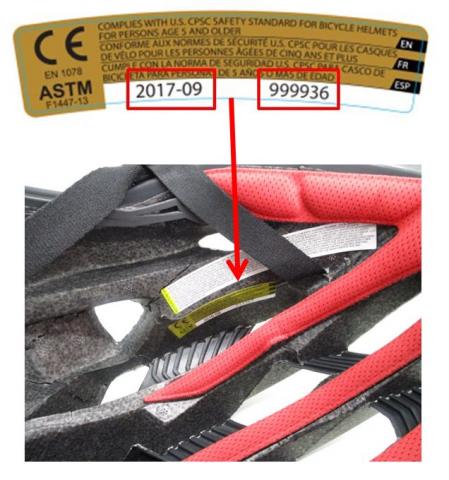
Description: This recall involves Louis Garneau Course Helmets with model number LG1261 printed on the inside of the helmet. “Garneau,” “Course” and “LG” are printed on both sides of the recalled bicycle helmets. They were sold in matte black and matte fluo yellow. The manufacturer’s date and serial number are printed on a sticker inside the helmet.
Only lot and serial numbers listed below are included in the recall.
Helmet Lot/ Manufacturer’s Date/ Serial Number Range available here: https://www.cpsc.gov/Recalls/2018/Louis-Garneau-Recalls-Bicycle-Helmets-Due-to-Risk-of-Head-Injury
Incidents/Injuries: None reported
Sold At: Authorized bicycle dealers nationwide from December 2015 through January 2018 for between $180 and $240.
Importer: Louis Garneau USA Inc., of Derby, Vt.
Manufacturer: Strategic Sports Limited, of China
Manufactured in: China
Retailers: If you are a retailer of a recalled product you have a duty to notify your customers of a recall. If you can, email your clients or include the recall information in your next marketing communication to your clients. Post any Recall Poster at your stores and contact the manufacturer to determine how you will handle any recalls.
For more information on this see:
For Retailers
Recalls Call for Retailer Action
A recall leads to lawsuits because injuries are connected to the product being recalled thus a lawsuit. Plaintiff’s hope the three can be connected
Combination of a Products Liability statute, an Expert Witness Report that was just not direct enough and odd facts holds a retailer liable as manufacture for product defect.
Product Liability takes a different turn. You must pay attention, just not rely on the CPSC.
Retailer has no duty to fit or instruct on fitting bicycle helmet
Summary Judgment granted for bicycle manufacturer and retailer on a breach of warranty and product liability claim.
For Manufacturers
The legal relationship created between manufactures and US consumers
A recall leads to lawsuits because injuries are connected to the product being recalled thus a lawsuit. Plaintiff’s hope the three can be connected
Combination of a Products Liability statute, an Expert Witness Report that was just not direct enough and odd facts holds a retailer liable as manufacture for product defect.
 What do you think? Leave a comment.
If you like this let your friends know or post it on FB, Twitter or LinkedIn
Author: Outdoor Recreation Insurance, Risk Management and Law
To Purchase Go Here:
Copyright 2018 Recreation Law (720) Edit Law
Email: Rec-law@recreation-law.com
Google+: +Recreation
Twitter: RecreationLaw
Facebook: Rec.Law.Now
Facebook Page: Outdoor Recreation & Adventure Travel Law
Blog:
www.recreation-law.com
Mobile Site: http://m.recreation-law.com
By Recreation Law Rec-law@recreation-law.com James H. Moss
#AdventureTourism, #AdventureTravelLaw, #AdventureTravelLawyer, #AttorneyatLaw, #Backpacking, #BicyclingLaw, #Camps, #ChallengeCourse, #ChallengeCourseLaw, #ChallengeCourseLawyer, #CyclingLaw, #FitnessLaw, #FitnessLawyer, #Hiking, #HumanPowered, #HumanPoweredRecreation, #IceClimbing, #JamesHMoss, #JimMoss, #Law, #Mountaineering, #Negligence, #OutdoorLaw, #OutdoorRecreationLaw, #OutsideLaw, #OutsideLawyer, #RecLaw, #Rec-Law, #RecLawBlog, #Rec-LawBlog, #RecLawyer, #RecreationalLawyer, #RecreationLaw, #RecreationLawBlog, #RecreationLawcom, #Recreation-Lawcom, #Recreation-Law.com, #RiskManagement, #RockClimbing, #RockClimbingLawyer, #RopesCourse, #RopesCourseLawyer, #SkiAreas, #Skiing, #SkiLaw, #Snowboarding, #SummerCamp, #Tourism, #TravelLaw, #YouthCamps, #ZipLineLawyer, Recall, CPSC, Consumer Product Safety Council,
Posted: March 13, 2018 | Author: Recreation Law | Filed under: Uncategorized | Tags: Blumenfeld and Associates, Expedition News, Expeditions, Jeff Blumenfeld |
|
|
| EXPEDITION NEWS, founded in 1994, is the monthly review of significant expeditions, research projects and newsworthy adventures. It is distributed online to media representatives, corporate sponsors, educators, research librarians, explorers, environmentalists, and outdoor enthusiasts. This forum on exploration covers projects that stimulate, motivate and educate.
March 2018 – Volume Twenty-Four, Number Three
Celebrating Our 24th Year! |
|
| EXPEDITION NOTES

Berua, one of the local guides you might meet along the Papua New Guinea trek. (Photo taken by Philipp Engelhorn in 2006)
Teammates Wanted for Papua New Guinea Trek
Author and television producer James Campbell is looking for six qualified backpackers to join him on a trek across the Papuan Peninsula of Papua New Guinea in June 2018. This will be Campbell’s second trip on the trail.
In 2006, Campbell organized a small team of outside adventurers to retrace, for the first time, the 150-mile WWII route of a battalion of American soldiers. Military historians call the 42-day trek “one of the cruelest in military history.” Navigating the same swamps, thick jungles, and 9,000-foot mountains, it took Campbell’s team 21 days to cover the distance from a village called Gabagaba on the Peninsula’s south coast to the village of Buna on the north coast.
This June, to commemorate the 75th anniversary of the Battle of Buna, which U.S. Army historians call the first major land victory of the Southwest Pacific, Campbell will repeat the trek. Inspired by Campbell’s 2006 journey, the PNG government is now considering setting aside a portion of the territory along the trail as a national wilderness park to protect the remote Highland villages as well as a mountain ecosystem that includes birds of paradise, tree kangaroos, cassowaries, native possums, and rare butterflies and orchids.
Campbell’s hope is that this repeat trek will provide the PNG government with the nudge it needs to establish the park.
Campbell’s 2006 trek was unsupported. Since then, an Australian company, Getaway Trekking, has set up an operation on the trail. Getaway is committed to preserving and protecting both the ecosystem and the local cultures. Getaway’s operating principle is that much of the money paid by future trekkers will go directly back into the villages for labor, food (from local gardens) and accommodation.
For Campbell’s three-week, June 2018 trek, Getaway will provide all logistical support. Costs include all in-country accommodation, transport, food on the trail, internal flights, and a personal carrier. Participants will be responsible for getting to and from PNG.
For more information: bogmoose, 608 333 1177.
Adventure Canada Partners with the Sedna Epic Expedition
Adventure Canada is partnering with the Sedna Epic Expedition, an international team of women – ocean explorers, scientists, artists, educators and scuba diving professionals -to scout, document, and record disappearing sea ice in the Arctic. The project will combine indigenous and scientific knowledge to document climate change while it empowers Inuit girls and young women in the Arctic.
Team Sedna will mount a snorkel and dive expedition aboard Adventure Canada’s vessel, the Ocean Endeavour, from August 6-17, 2018, during the Arctic Safari expedition to Nunavut and western Greenland. Adventure Canada embraces Inuit culture and traditions, and has successfully operated in the Arctic for more than 30 years.
“Sedna’s sea women, Inuit advisors, and young Inuit team members look forward to collaborating with Adventure Canada’s resource team, and to deliver our signature, hands-on ocean outreach program in Nunavut’s Inuit communities,” said Susan R. Eaton, the Calgary-based founder and leader of the Sedna Epic Expedition.
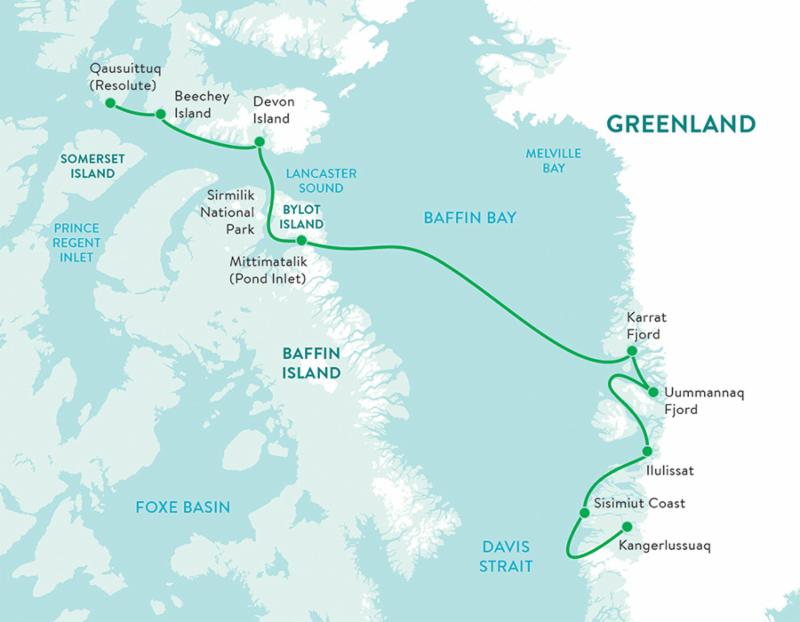
Route of the Ocean Endeavour in August 2018.
The experiential ocean outreach program for Inuit youth and elders will take place in Qausuittuq (Resolute) and Mittimatalik (Pond Inlet) where Sedna’s sea women will showcase sea critters in mobile aquariums and lead underwater robot-building workshops and snorkel safaris, bringing the ocean to eye level for Inuit communities and Adventure Canada travelers.
During the Arctic Safari expedition, Sedna’s team will engage with passengers aboard the Ocean Endeavour, inviting them to participate in their citizen science ocean programs, including a ship-based marine mammal and seabird survey. The sea women will present lectures on topics ranging from climate change to maritime archaeology and underwater photography and videography.
For information about joining Sedna’s team of women explorers during Adventure Canada’s Arctic Safari, visit www.sednaepic.com or call Susan R. Eaton at 403 605 0159. Learn more about Adventure Canada at www.adventurecanada.com.
Science Guys
“When you explore, two things happen: you discover things and you have an adventure,” says science educator, mechanical engineer, television host, and New York Times bestselling author, William Sanford “Bill” Nye, who closed the 2018 American Library Association conference in Denver last month. He shared the stage with co-author Gregory Mone, a novelist, science journalist, speaker, and children’s book author.

Bill Nye (left) and Gregory Mone
As creator of the Emmy award-winning, syndicated television show Bill Nye the Science Guy, Nye first became a household name while introducing the millennial generation to science and engineering. He now appears in his much-anticipated return to the screen, in the Netflix series, Bill Nye Saves the World. Nye is on a mission to help foster a scientifically literate society.
Nicknamed the “Shiny Object Man,” Nye seems to be interested in everything. “Three things everyone wants,” he tells the librarians, “is clean water, electricity and the internet. Electricity is astonishing. It can process all this information and it can make toast.”
Mone has covered artificial intelligence, robots, physics, and biology as a magazine writer. In Jack and the Geniuses, inspired by the 100 volumes of Tom Swift books first published in 1910, Nye and Mone take middle-grade readers on a scientific adventure that features real-world science and scientific facts along with action and a mystery that will leave kids guessing until the end, making the books ideal for STEM education.
“We want Jack and the Geniuses to push back on the anti-science movement,” Nye says.
On the subject of alien life, Nye comments, “If we would find evidence of life on Mars or Europa (smallest of the four Galilean moons orbiting Jupiter), it would change the course of human history.”
QUOTE OF THE MONTH
“Space travel is the best thing we can do to extend the life of humanity. … I will go if I can be assured that SpaceX would go on without me . . . I’ve said I want to die on Mars, just not on impact.”
– Elon Musk, PayPal founder, Tesla CEO, and SpaceX CEO/CTO (Source: Vanity Fair, March 10, 2013
EXPEDITION FOCUS
Adventure Scientists Help Adventurers Add Value
Wherever you travel, there are scientists desperate for data from around the world. You can provide an invaluable service – becoming the eyes and ears of researchers worldwide – by simply collecting data and shipping it back to a non-profit organization based in Bozeman, Montana, called Adventure Scientists.

Since its founding in 2011, Adventure Scientists has sent thousands of explorers and adventurers on missions to collect data from remote, difficult-to-access locations for its conservation partners. These partnerships have led to the discovery of more than three dozen new species, provided key information to guide climate change decision-making, and helped protect threatened wildlife habitat around the world.
Consider Expedition 196, an attempt to visit all the countries of the world. Without a purpose besides setting a Guinness World Record, it would have been merely an expensive stunt. But Cassandra De Pecol, 27, wanted to achieve more. She added legitimacy to her travel adventure by filling 33 separate liter-sized water sample bottles along her route and shipping them all back to Adventure Scientists for its study of the insidious proliferation of microplastics in the world’s oceans.
Microplastics – or plastic particles smaller than five millimeters in size – pose a significant environmental risk when they enter waterways, according to the Adventure Scientists website. The sources of these often microscopic particles can be from washing nylon apparel, cosmetics, even toothpaste, and debris such as plastic bottles and bags.
Sadly, Adventure Scientists found evidence of microplastics in an average 74% of samples received worldwide – 89% for saltwater samples, 51% for freshwater. The data is part of one of the largest microplastics studies on earth.
“The numbers are absolutely shocking,” Adventure Scientists founder and executive director Gregg Treinish tells the 2017 National Geographic Explorers Festival on June 16, 2017, in Washington, DC.
Treinish, 36, a wildlife biologist and backcountry guide who has hiked the 2,200-mile Appalachian Trail and spent nearly two years hiking 7,800 miles along the Andes, wanted his journeys to make a difference, considering the enormous problems the world faces, from coral bleaching, illegal timber harvests, deforestation, and shark finning, to name a few issues. (See: https://www.youtube.com/watch?v=wpYsvlYH3aw#t=02h25m11s )
“It’s important that this data is used to influence change,” Treinish says.
Take roadkill for instance, a sad fact-of-life for millions of animals each year. According to Treinish, researchers need annual data about wildlife-vehicle collisions (WVC) across the U.S. In 2011-2012, there were 1.23 million deer-vehicle collisions in the U.S., costing more than $4 billion in vehicle damage, according to State Farm.
With the necessary data, Treinish says they can identify which species are most at risk, whether any “hot spots” exist that are extraordinarily perilous to animals, and where to place wildlife underpasses and overpasses that in some locations have reduced roadkill deaths 80%.
Treinish, named a National Geographic Emerging Explorer in 2013, said he founded Adventure Scientists in 2011 to link adventurers in hard-to-reach places to scientists who needed data from those locations.
“I started biological and ecological expeditioning, using my outdoor skill sets to make a difference in the world. I was sure that given the proper tools and a similar skill set, there were others like me.
“I have been proven right thousands of times ever since. Explorers come to us to have an adventure with a purpose. We send them on missions worldwide.”
In addition to the study of roadkill and microplastics, the organization has collected data about animal feces (scat) to study the antibiotic resistance of Enterococcus bacteria which exists within every animal on the planet, including humans; studied pikas in high alpine environments; researched how butterflies can be biodiversity indicators for ecosystem health; and is creating a genetic reference library of endangered trees along the U.S. West Coast.
Becoming an Adventure Scientist volunteer could possibly help explorers raise funds for their next project, and certainly provide much-needed data for researchers. It all starts by visiting their website and telling them where and when you plan to travel. There is no cost to participate. Adventure Scientists will even pay shipping costs for samples.
For more information: www.adventurescientists.org
Trip Report: Paddling the African Great Lakes
By Tamsin Venn, publisher, Atlantic Coastal Kayaker Magazine
In January, explorer Ross Exler, 31, set out on a quest to paddle the African Great Lakes. The goal was to paddle across the three largest: Lake Malawi, Lake Tanganyika, and Lake Victoria. Reportedly, the expedition would be the first unsupported, human powered, solo crossing of those lakes.

Ross Exler
The total distance is about 1,000 miles of kayaking and 600 miles of biking from lake to lake through remote regions of Malawi, Mozambique, Tanzania, and Uganda.
Good news. On Feb. 20, 2018, he started down Lake Tanganyika, having completed Lake Malawi, dubbed the “Lake of the Stars” by David Livingstone where the hundreds of lanterns fishermen use to attract the lake’s sardines, usipa, resembles stars in the sky.
He expects to complete the expedition sometime this month.
Exler, a resident of Manhasset, N.Y., notes, “Almost all of the people are dependent on the lake and the land around it for subsistence fishing and agriculture. Unfortunately, their practices are not sustainable. About half of the population is under 14, so the population is growing quickly and problems will just be exacerbated.”
Exler is completely self supported with the use of a folding expedition kayak, designed by Mark Eckhart of Long Haul Folding Kayak in Cedaredge, Colo., and a folding bicycle and trailer. The company’s goal is to provide a safe and reliable way to reach the most remote locations in the world.
He will work with The Nature Conservancy’s Tuungane Project, on Lake Tanganyika, that addresses the extreme poverty that underpins the region’s environmental degradation. TNC’s efforts are introducing fisheries education and management, terrestrial conservation, healthcare, women’s health services and education, agricultural training, and other efforts to increase the quality of life.
Exler plans to visit some of the project villages and team up on social media to try to get TNC’s work and general knowledge of the African Great Lakes in front of a larger audience.
For more information:
www.rossexler.com, https://www.nature.org/ourinitiatives/regions/africa/wherewework/tuungane-project.xml
MEDIA MATTERS

Will Steger is on the move again.
There’s No Stopping Will Steger
There’s no stopping peripatetic explorer Will Steger of Ely, Minn. According to a story in the Minneapolis Star-Tribune (Mar. 1), Steger will take an unprecedented solo trek in Canadian Arctic Barren Lands, a place that, reportedly, no one has considered exploring at this time of year.
Starting March 21, the 73-year-old explorer will travel alone on a 1,000-mile, 70-day journey through the Barren Lands, a remote region in the Canadian Arctic with a nasty reputation for high wind. It will be Steger’s longest solo expedition and, he said, it will push him in ways like never before, according to the story by Scott Stowell.
To his knowledge, this trip will be the first time anyone has attempted to cross the Barrens’ rivers systems during breakup, that transitional weather period between winter and spring.
“Steger’s adventure will begin from the Chipewyan Indian village of Black Lake in northwestern Saskatchewan just east of Lake Athabasca. He plans to reach his final destination at the Caribou Inuit community of Baker Lake in Nunavut near Hudson Bay in early June. It’s likely Steger won’t encounter other people in the 1,000 miles between the two villages that bookend the expedition. He’ll be a minimum of three hours away from the nearest human by bush flight,” writes Stowell.
Steger says, “I need these breaks to regenerate. I think every human being should have [them]. Very few people take time out because they’re so busy they can’t afford it.”
Read the story here:
http://www.startribune.com/minnesota-explorer-steger-will-take-unprecedentedsolo-trek-in-canadian-arctic/475559763/

Mae Jemison appears in Boulder. (Photo by Casey A. Cass/University of Colorado)
“Space Isn’t Just for Rocket Scientists and Billionaires”
More than 1,200 guests – including bright-eyed elementary schoolers who aspire to be astronauts, inspired mid-career female scientists and fellow Star Trek fans – filed into an auditorium on the University of Colorado Boulder campus last month for a sold-out address by former NASA astronaut Mae Jemison, the first woman of color to go into space.
Her takeaway message: The challenges of space exploration mirror the challenges faced in the world today, and we all have a part to play in its success.
“Space isn’t just for rocket scientists and billionaires,” Jemison said. “We have to figure out how to make it accessible.”
Before flying on the Space Shuttle Endeavor in 1992, Jemison graduated from Stanford and Cornell universities, worked as a physician and served as a Peace Corps medical officer in West Africa. At 61, she is now principal of the 100 Year Starship, a U.S. Defense Advanced Research Projects Agency (DARPA) -funded project working to make human travel beyond the solar system a reality in the next century.
Future space exploration will be fundamentally different than the current model, she said, and will require all of the same elements – energy, food, medical care, even clothing – needed to sustain life on Earth. Achieving audacious goals in space demands the intelligence of a diverse array of contributors, not just a chosen few, she said.
She admitted she’s afraid of heights and had to determine whether she would rather be afraid of heights or be an astronaut.
Read more here:
https://www.colorado.edu/today/2018/02/28/jemison-if-you-want-seat-table-you-can-have-one
EXPEDITION INK
Travel With Purpose Book Seeks Stories of Voluntourism
EN editor Jeff Blumenfeld is seeking examples of everyday people who devote a portion of their vacation, business or family travel to volunteer services. The most appropriate case studies will be included in his new book titled, Travel With Purpose (Rowman & Littlefield), expected out this fall. If you or a friend or loved one has given back in some way during travel, please contact him at editor.
WEB WATCH

Denali’s Raven
One of the stand out short documentaries presented during last month’s Boulder International Film Festival is Denali’s Raven, an intimate look at a female Alaskan bush pilot who was a former alpinist. Leighan Falley spent years as a ski guide and climber on the Alaskan range. But after becoming a mother, she quit guiding and took to the skies as a mountain pilot, bringing her daughter, named Skye, along for the ride. She works with Talkeetna Air Taxi.
“The transition from being an alpinist and going on expeditions and being a pilot is a good one because I could still go into the Alaskan range every single day and come home to my family every single night.”
A beautiful film, view it here:
https://stories.yeti.com/story/denalis-raven

These two Nepalis had their eyesight restored thanks to Dooley Intermed’s 2017 Gift of Sight Expedition.
Gorkha Gift of Sight Documentary
A team of leading ophthalmologists traveled last December to a remote region of Nepal to tend to the eye care needs of over 800 remote villagers in the Upper Gorkha region, near the epicenter of the massive earthquakes and aftershocks in 2015. Centered in the roadless town of Machhakola, the region has a population of over 600,000 and is currently without a dedicated eye care facility. Seventy-one sight-restoring surgeries were conducted. Expedition News was proud to be a part of the project.
The new 11-min. documentary was produced by Daniel Byers of Skyship Films. View it here:
https://vimeo.com/256732590
ON THE HORIZON
Sailing Stories Return to The Explorers Club HQ, April 14, New York
On Apr. 14, 2018, The Explorers Club will host its annual Sailing Stories, a day focused on sailing-based exploration and conservation at its global headquarters in New York. Speakers include:
Pen Hadow, one of the world’s leading explorers of the Arctic Ocean. He led two, 50-ft. yachts into the North Pole’s international waters, the first non-icebreaking vessels in history to do so, to demonstrate the increasing accessibility and emerging threat to wildlife by the reduced sea-ice cover.
Richard Wilson, twice the oldest competitor in Vendée Globe, a single-handed (solo) non-stop yacht race around the world without assistance. Wilson will share how he uses sailing as an educational tool teaching and conveying positive values to children.

Sara Hastreiter
Sara Hastreiter, Volvo Ocean Race sailor, will discuss how sailing in this relentless 40,000 mile, nine month race around the planet, known as the Mt. Everest of sailing, inspired her monumental goal to sail all seven seas and climb the Seven Summits.
Carson Crain, skipper and team leader for the United States in the 2017 Red Bull Youth America’s Cup, will discuss the competitive dynamics in this extreme international sailing competition for under 25-year-old sailors.
Lincoln Paine, a maritime historian and author, will discuss his award-winning book The Sea and Civilization: A Maritime History of the World (Vintage, 2015).
Tickets are $75 before Apr. 9. Purchase by emailing reservations or calling 212 628 8383.
EXPEDITION CLASSIFIEDS
Get Sponsored!
Hundreds of explorers and adventurers raise money each month to travel on world class expeditions to Mt. Everest, Nepal, Antarctica and elsewhere. Now the techniques they use to pay for their journeys are available to anyone who has a dream adventure project in mind, according to the book from Skyhorse Publishing called: Get Sponsored: A Funding Guide for Explorers, Adventurers and Would Be World Travelers.
Author Jeff Blumenfeld, an adventure marketing specialist who has represented 3M, Coleman, Du Pont, Lands’ End and Orvis, among others, shares techniques for securing sponsors for expeditions and adventures.
Buy it here:
http://www.amazon.com/Get-Sponsored-Explorers-Adventurers-Travelers-ebook/dp/B00H12FLH2
Advertise in Expedition News – For more information: blumassoc
EXPEDITION NEWS is published by Blumenfeld and Associates, LLC, 1877 Broadway, Suite 100, Boulder, CO 80302 USA. Tel. 203 326 1200, editor. Editor/publisher: Jeff Blumenfeld. Research editor: Lee Kovel. ©2018 Blumenfeld and Associates, Inc. All rights reserved. ISSN: 1526-8977. Subscriptions: US$36/yr. available by e-mail only. Credit card payments accepted through blumassoc). Read EXPEDITION NEWS at www.expeditionnews.com. Enjoy the
EN blog at www.expeditionnews.blogspot.com.

|
|
|
|
 |
| Expedition News, 1877 Broadway, Suite 100, Boulder, CO 80302 |
|
|
|
|
|
|
Posted: March 9, 2018 | Author: Recreation Law | Filed under: Uncategorized | Tags: Mountains, UIAA |
|
The UIAA newsletter. February 2018
|
|
|
|
|
|
The UIAA Newsletter. February 2018.
|
|
|
| In Brief
The UIAA Alpine Summer Skills guide is now available worldwide as a digital download. In the field of mountain safety, the UIAA and the Indian Mountaineering Foundation (IMF) publish recommendations related to The Chadar Trek. The use of portable hyperbaric chambers is the subject of the UIAA’s latest medical advice profile. In Asia, the reputation of the UIAA Safety Label continues to develop in an rapidly expanding market. The 2018 UIAA Ice Climbing season concludes this weekend in Kirov, Russia following a busy season of World and European Cup events. Newsletter subscribers have the opportunity to enter a competition to win a signed copy of Doug Scott’s latest book – The Ogre. The most recent member association to join the UIAA – Malta Climbing Club – comes under the spotlight. The 2018 UIAA Mountain Protection Award opens in late March coinciding with a special ceremony to commemorate 2017 winner Mount Everest Biogas Project (MEBP). |
|
|
 |
ALPINE SUMMER SKILLS GUIDE
AVAILABLE TO PURCHASE AS DIGITAL DOWNLOADThe UIAA Alpine Skills Summer guide was first published in 2015. Produced in collaboration with the Petzl Foundation, the guide and has been well received worldwide and is currently available in five languages. To mark the launch of a digital version of the publication, the UIAA is running a series of articles from the guide designed to help hikers, climbers and mountaineers develop their skills and knowledge of the mountain environment.
The guide was developed specifically as a reference document for trip leaders and instructors of club and federations within the UIAA – an aide memoire for climbers and mountaineers who attend training courses delivered by instructors and guides who have gained qualifications accredited by the UIAA. Now open to the wider climbing and mountaineering world, the handbook’s four modules focus primarily on summer activities. Full story here
The digital edition of Alpine Skills: Summer, a downloadable application which permits free updates to content, can be purchased here. |
|
 |
2018 UIAA MOUNTAIN PROTECTION AWARD
APPLICATION OPENS ON 24 MARCHApplication for the 2018 UIAA Mountain Protection Award will open immediately after a special presentation is held in Kathmandu, Nepal for Mount Everest Biogas Project (MEBP) winner of the 2017 Award. A dedicated press conference will also be held in Nepal to showcase the Award and will feature representatives from the MEBP and the 2015 winner KTK-BELT Studio. The press conference coincides with the UIAA Management Committee meeting, held from 23-24 March. Details on the press conference, and how to apply for the 2018 Award, will be available shortly. |
|
 |
| UIAA ICE CLIMBING WORLD TOUR
SEASON FINALE
An enthralling 2018 UIAA Ice Climbing World Tour, partnered by The North Face Korea, concludes in Kirov, Russia this weekend with the final act of a dramatic season. The quest to be World Tour champion across both the male and female lead and speed competitions is still wide open. A preview of the season finale will be available to our ice climbing news subscribers tomorrow. Livestreaming will be available on the UIAA Facebook, Twitter and YouTube channels, on the Olympic Channel, and on partner channel EXTREME. To subscribe to ice climbing news please click here. |
|
 |
| PHOTO STORY
An inspirational image of UIAA Honorary Member Jordi Pons Sanginés, 85 years old, ice climbing on Pedraforca (2,506m) in the Pyrenees. The area is a noted paradise for rock climbing, with limestone walls up to 800m high. In the winter several ice falls form, making this spot – some 150 km from Barcelona – a perfect location for ice climbing training.Full picture on our Facebook page. |
|
 |
THE CHADAR TREK:
ESSENTIAL SAFETY ADVICEIncreasingly popular as a trekking destination among both Indian and international adventurers and tourists, the Chadar Trek, an ice passage across a fast flowing river in the Zanskar region of Ladakh, is also a route which presents a number of safety concerns.
With the aim of providing anyone planning on crossing this magnificent ‘ice highway’ with greater safety information, the UIAA Training Panel, with the support of the Indian Mountaineering Foundation (IMF), has provided the following information related to the prevention of accidents and dealing with unforeseen situations. This advice is also available on the IMF website. Full story here. |
|
 |
MALTA
AT THE CROSSROADS OF THE MEDITERRANEANAt the 2017 UIAA General Assembly, the International Climbing and Mountaineering Federation welcomed its latest member. With the election of the Malta Climbing Club (MCC) as full member, the UIAA now represents 91 member associations from 68 countries.
The MCC was set up in 2010, a time when in Malta there was no truly representative climbing organisation. “It was felt that the sport needed a structure which in addition to promoting the sport locally, would also work towards providing local climbers with the support and services that climbers now often take for granted in their own countries all over the world,” explains the federation’s President Simon Alden. Full story here. |
|
| MORE FROM THE UIAA NEWSROOM
At a series of meetings and tradeshows in China, the UIAA Safety team discuss the promotion and development of the UIAA Safety Label and Standards in Asia. A guide on when, and how, to use portable hyperbaric chambers is the topic of the latest UIAA MedCom article. Rock Climbing Festival organisers from Central and South America are invited to apply for the 2018 UIAA Rock Climbing Awards, with cash prizes of up to 5,000 CHF on offer. Registration for UIAA Youth Events in Fontainebleau, France and Iran is open. |
|
|
2-4 March
ICE CLIMBING – WORLD CUP
Kirov, Russia |
|
|
|
23-24 March
UIAA MANAGEMENT COMMITTEE MEETINGS
Kathmandu, Nepal |
|
|
|
23-24 March
UIAA MOUNTAIN PROTECTION AWARD PRESS CONFERENCE
Kathmandu, Nepal |
|
|
|
| The UIAA was founded in 1932 and has 91 member associations in 68 countries representing about 3 million climbers and mountaineers. The organization’s mission is to promote the growth and protection of climbing and mountaineering worldwide, advance safe and ethical mountain practices and promote responsible access, culture and environmental protection.
The organization operates through the work of its commissions which make recommendations, set policy and advocate on behalf of the climbing and mountaineering community. The UIAA is recognized by the International Olympic Committee (IOC). |
|
|
|
UIAA OFFICE
c/o Schweizer Alpen-Club SAC
Monbijoustrasse 61 Postfach CH-3000
Bern 14, Switzerland
Tel: +41 (0)31 370 1828news |
|
|
|
|
|








 Recreation Law