
Glen Canyon Dam LTEMP EIS Upcoming Public Meeting to Discuss Alternatives
Posted: March 30, 2012 Filed under: Arizona | Tags: EIS, Environmental impact statement, Flagstaff Arizona, Glen Canyon, Glen Canyon Dam, Grand Canyon, Lake Powell, LTEMP, LTEMP EIS, NationalParkService, NPS, United States Bureau of Reclamation Leave a commentLTEMP EIS Upcoming Public Meeting to Discuss Alternatives
*********************************************************
The public is invited to participate in a two-day meeting on alternatives being considered for inclusion in the Glen Canyon DamLong Term

Glen Canyon Dam (Photo credit: Wikipedia)
Experimental and Management Plan Environmental Impact Statement (LTEMP EIS) being prepared by the Bureau of Reclamation (Reclamation) and the National Park Service (NPS). The meeting will be held on April 4 and 5 at the High Country Conference Center located at 201 West Butler Avenue, Flagstaff, AZ 86001. The meeting is tentatively scheduled for 8 a.m. to 5 p.m. both days.
The preliminary draft alternatives being considered for evaluation will be presented and discussed at this meeting hosted by Reclamation and the NPS. Stakeholders and other attendees who have alternatives to propose should bring those ideas to the meeting. PowerPoint slides and posters are welcome. To be added to the agenda, register for the meeting as explained below, provide your email address, and indicate that you will be presenting an alternative.
Those wishing to attend the meeting are encouraged to register through the LTEMP EIS Web site at http://ltempeis.anl.gov/involve/pubschedule/, but registration is not required.
Alternatives to be considered in the EIS must meet the purpose and need of the LTEMP. The EIS will document and evaluate the impacts of the alternatives carried forward for analysis.
For More Information
********************
To learn more about how you can participate in the EIS process, visit the “Getting Involved” page of the LTEMP EIS Web Site
(http://ltempeis.anl.gov/involve/index.cfm).
If you have questions or need more information, contact the LTEMP EIS Webmaster at ltempeiswebmaster@anl.gov
Please forward this message to any party you feel may be interested in the LTEMP EIS.
_________________CONTACTS/SUBSCRIPTIONS________________
FEEDBACK

Comment on Senator Udall & Senator Bennet’s wilderness proposals for Colorado
Posted: March 30, 2012 Filed under: Uncategorized | Tags: Arkansas River, Bennet, Brown’s Canyon, Buena Vista, Colorado, Maroon Bells, Proposal, Rafting, Salida, Salida Colorado, Senate, Senator, Udall, Wilderness Leave a comment |
|||||||||||||||||||
|
|||||||||||||||||||

Dear Fellow Coloradan,
If you close your eyes and think the word “Colorado,” what comes to mind? For me it’s towering white-capped mountains and the burning sensation in your lungs when climbing that final 100 yards to the top of a 14,000-foot mountain. For others, it might be finding the perfect spot to catch cutthroat trout or making the first tracks on a powder day. I would hazard a guess that the first thought for many of you involved the immense natural beauty of our state and the quality of life it provides. But preserving our natural lands is about more than just protecting our quality of life – it’s about protecting our livelihood. Wilderness is one of Colorado’s great economic engines. Activities such as hiking, skiing, paddling and fishing contribute more than $10 billion annually to our economy, supporting some 100,000 Colorado jobs and generating $500 million in state tax revenue. Wilderness ensures that skiers and hikers have beautiful vistas, anglers have clean streams in which to fish, and hunters have healthy big-game herds. These resources attract visitors from all over the nation and world. That’s why I’m proud to launch a collaborative, community-driven process – in partnership with Senator Bennet and affected members of the House of Representatives – that I hope will ultimately allow Colorado to create legislation for wilderness and national monument designations in two areas – the Central Mountains and Browns Canyon on the Arkansas River. My goal is to build on work that has been done previously by other members of the Colorado delegation and develop a plan that a majority of the community agrees will support their interests and their local economies. I am proud to use my leadership position on the Environment and Natural Resources Committee to take this work to the next level. In order to facilitate the conversation with these communities, I’ve developed draft maps of possible wilderness boundaries, which will give us a firm base to compare notes and ideas. With our population expected to double by 2050, we need to be proactive so that future generations can experience the beauty, clean water and air, and wildlife that we have today. I’m committed to ensuring that Coloradans have a wide variety of options to access public lands for recreation, including places to bike, ski and snowmobile – as well as backcountry trails and wide-open pristine lands that will be preserved for generations. I’m proud of my successful past work to designate wilderness at James Peak and in Rocky Mountain National Park, as well as the proposed San Juan Mountains Wilderness. I look forward to this process and encourage all Coloradans to join in the conversation. Warm regards,
|
|||||||||||||||||||
 |
|||||||||||||||||||
To unsubscribe from Mark’s Newsletter Updates, please click here or |
|||||||||||||||||||


Amgen Tour of California Slects 2012 teams
Posted: March 29, 2012 Filed under: California, Cycling, Racing | Tags: Amgen, Amgen Tour of California, Bicycle Racing, BMC Racing Team, California, Chris Horner, Cycling, Liquigas-Cannondale, Los Angeles, Robbie McEwen, Tour of California, USA Leave a comment
sixteen teams selected to compete in 2012 amgen tour of california
World Class Field Assembled for America’s Premier Cycling RaceSet for May

Image via Wikipedia
LOS ANGELES (March 13, 2012) – Race organizers have named the 16 teams, including some of the world’s best international and domestic squads, to compete in the 2012 Amgen Tour of California, which will take place May 13 to 20. Comprised of United Cycling International (UCI) Pro, Pro Continental and Continental squads, the 16 world class teams chosen to participate in the 2012 race will include Olympic hopefuls and Tour de France contenders representing more than 20 countries, giving fans around the world a preview of what is to come in July in both France and London.
Since the inaugural race in 2006, the Amgen Tour of California has consistently drawn the world’s best cycling talent while growing to become one of the most important races on the international calendar. In 2012, the race will play an even more significant role as it will be where top competitors test themselves in preparation for the Tour de France and the 2012 Summer Olympic Games taking place in London this summer.
As previously announced by race presenters AEG, the 2012 Amgen Tour of California will start in Santa Rosa on May 13 and travel more than 750 miles throughout some of California’s most majestic and iconic highways, roadways and coastlines before the final stage on May 20 when the race will start in Beverly Hills on Rodeo Drive and finish at L.A. LIVE in downtown Los Angeles.
The 16 elite teams include the newly restructured RadioShack-Nissan-Trek, whose roster includes Amgen Tour of California defending champion Chris Horner, Jens Voigt and current U.S. National Road Race Champion, Matthew Busche who will compete against a field that includes the No. 1-ranked team in the world, Omega Pharma – QuickStep, featuring three-time Amgen Tour of California winner Levi Leipheimer and Tom Boonen; Garmin-Barracuda, featuring Amgen Tour of California veterans Dave Zabriskie and Tom Danielson; and 2011 Tour de France champion BMC Racing including veteran cyclist and fan favorite George Hincapie and one of the fastest rising stars in cycling today, Tejay van Garderen. Also, competing in California for the seventh consecutive year will be the Rabobank Cycling Team, featuring Laurens Ten Dam and Luis Leon Sanchez. Liquigas-Cannondale is set to compete as well, featuring American cyclists, Ted King and Timothy Duggan, as well as Peter Sagan, who has taken multiple stages in previous editions of the Amgen Tour of California. Competing in California for the first time will be the Australian GreenEDGE Cycling Team, who plan to bring Luke Durbridge and Robbie McEwen. AG2R La Mondiale is also on the roster, featuring Nicolas Roche and Rinaldo Nocentini.
The 2012 Amgen Tour of California roster includes the following 16 teams:
UCI ProTeams
- BMC Racing Team (USA)
- Rabobank Cycling Team (NED)
- Garmin- Barracuda (USA)
- RadioShack-Nissan-Trek (LUX)
- Liquigas-Cannondale (ITA)
- Omega Pharma – QuickStep (BEL)
- AG2R La Mondiale (FRA)
- GreenEDGE Cycling Team (AUS)
UCI Professional Continental Teams
- Team Spidertech Powered By C10 (CAN)
- UnitedHealthcare Pro Cycling Team (USA)
- Project 1t4i (NED)
- Colombia-Coldeportes (COL)
UCI Continental Teams
- Team Optum Presented By Kelly Benefit Strategies (USA)
- Bissell Pro Cycling (USA)
- Team Exergy (USA)
- Bontrager Livestrong Team (USA)
“These 16 teams represent the most prestigious field of talent ever to compete in our race and we are honored to have them join us for the seventh edition of the Amgen Tour of California,” said Kristin Bachochin, executive director of the race and senior vice president of AEG Sports. “Cycling fans will see some favorite and familiar faces back in California this May, as well as a few new teams who will be racing with us for the first time. We look forward to presenting another impressive race for fans around the world.”
There are a total of 11 teams returning to the Amgen Tour of California for 2012, including AG2R La Mondiale (FRA); BMC Racing Team (USA); Rabobank Cycling Team (NED); Garmin- Barracuda (USA); RadioShack-Nissan-Trek (LUX); Omega Pharma – QuickStep (BEL); Liquigas-Cannondale (ITA); Team Spidertech Powered By C10 (CAN); UnitedHealthcare Pro Cycling Team (USA); Team Optum Presented By Kelly Benefit Strategies (USA) and Bissell Pro Cycling (USA).
“Amgen Tour of California has always been a first class event, with great courses, amazing organization, and incredible fans,” said Chris Horner, Amgen Tour of California’s defending champion.
“This year’s event looks to be the best ever, with an even more challenging route and a roster of 16 of the best teams in the world. I’m looking forward to coming back to defend my title – it promises to be a fantastic eight days in California!”
“The Amgen Tour of California is always a big goal for our team,” said Jonathan Vaughters, CEO, Slipstream Sports and Director Sportif, Team Garmin-Barracuda. “The Amgen Tour of California is one of the premier races in the U.S. and one we take a lot of pride in. Every year, the competition is intense, the crowds get even bigger, and this year will be no exception. We’re very excited to get back to California and we hope to give fans plenty of reasons to cheer.”
Teams new to the Amgen Tour of California roster include the newly formed GreenEDGE Cycling Team (AUS); Project 1t4i (NED); Colombia-Coldeportes (COL) Team Exergy (USA); and Bontrager Livestrong Team (USA).
“We are thrilled to ride the Amgen Tour of California in our debut season,” said Shayne Bannan, General Manager, GreenEDGE. “It’s a great race and a fantastic event. It’s real priority for us to bring a strong team to California and the riders really want to go there and make their mark for GreenEDGE. There are a lot of races that stand out on the calendar and the Amgen Tour of California is one of those we don’t want to miss. Having it as Robbie McEwen’s last race, will make it extra special for us as an Australian team.”
In addition to the pro cycling teams confirmed for the 2012 Amgen Tour of California, Amgen’s Breakaway from Cancer® team will also be returning, traveling with the race from start to finish to celebrate cancer survivors and raise awareness about the free support services available to people affected by cancer from the four non-profit Breakaway from Cancer partner organizations.
“At Amgen, we are excited for our seventh Amgen Tour and impressed by the caliber of the cycling teams joining the field this year,” said Stuart Arbuckle, vice president and general manager, Amgen Oncology. “We are even more excited about how Amgen’s Breakaway from Cancer initiative has taken off since we launched it in 2006, the inaugural year of the Tour. This year we will host Breakaway Mile events and recognize Breakaway from Cancer Champions in four host cities: Santa Rosa, Livermore, Clovis and Los Angeles, and our Breakaway from Cancer partner organizations will join Amgen to host our Breakaway from Cancer tent in the festival area in every finish city.”
For more information about the teams competing in the 2012 Amgen Tour of California, please visit the official race website, www.AmgenTourofCalifornia.com. For more information about Breakaway from Cancer, visit breakawayfromcancer.com.
About the Amgen Tour of California
The largest cycling event in America, the 2012 Amgen Tour of California is a Tour de France-style cycling road race, presented by AEG that challenges the world’s top professional cycling teams to compete along a demanding course from May 13-20, 2012. In a 2011 poll conducted by CyclingNews.com, the Amgen Tour of California was voted the fourth best race in the world, and the No. 1 race in America.
About AmgenAmgen discovers, develops, manufactures, and delivers innovative human therapeutics. A biotechnology pioneer since 1980, Amgen was one of the first companies to realize the new science’s promise by bringing safe, effective medicines from lab to manufacturing plant to patient. Amgen therapeutics have changed the practice of medicine, helping millions of people around the world in the fight against cancer, kidney disease, rheumatoid arthritis, bone disease and other serious illnesses.
With a deep and broad pipeline of potential new medicines, Amgen remains committed to advancing science to dramatically improve people’s lives. To learn more about our pioneering science and vital medicines, visit http://www.amgen.com. Follow us on www.twitter.com/amgen.
About AEG
AEG is one of the leading sports and entertainment presenters in the world. AEG, a wholly owned subsidiary of The Anschutz Company, owns or controls a collection of companies including facilities such as STAPLES Center, The Home Depot Center, Sprint Center, The O2, NOKIA Theatre L.A. LIVE and Best Buy Theater Times Square; sports franchises including the Los Angeles Kings (NHL), two Major League Soccer franchises, two hockey franchises operated in Europe, management of privately held shares of the Los Angeles Lakers, the ING Bay to Breakers foot race and the Amgen Tour of California cycling road race; AEG Live, the organization’s live-entertainment division, is a collection of companies dedicated to all aspects of live contemporary music performance, touring and a variety of programming and multi-media production. For more information, visit AEG today at www.aegworldwide.com.
About Breakaway from Cancer®
Founded in 2005 by Amgen, Breakaway from Cancer® is a national initiative to increase awareness of important resources available to people affected by cancer – from prevention through survivorship. Breakaway from Cancer is a collaboration between Amgen and four nonprofit partner organizations: Prevent Cancer Foundation, Cancer Support Community (formerly known as The Wellness Community), Patient Advocate Foundation, and National Coalition for Cancer Survivorship. These organizations offer a broad range of support services complementing those provided by a patient’s team of healthcare professionals. For more
information, please visit www.breakawayfromcancer.com or follow us @BreakawayCancer on Twitter.
# # #
Media Contacts: Michael Roth, AEG Steven Bram, GolinHarris
213-742-7155 213-438-8818
mroth sbram
Steven Gregory Bram
Associate, Consumer Marketing
GolinHarris
T. +1 213.438.8818
E. sbram
Skier/Boarder Fatalities 2011-2012 Ski Season 3/15/12
Posted: March 28, 2012 Filed under: Skiing / Snow Boarding | Tags: fatality, helmet, Inbounds, Ski, ski area, Ski Resort, snowboarding, Sport, Vail Colorado, Winter sport Leave a commentThis list is not guaranteed to be accurate. The information is found from web searches and news dispatches. If you have a source for information on any fatality please leave a comment.
If this information is incorrect or incomplete please let me know. This is up to date as of March 15, 2012. Thanks.
|
# |
Date |
Resort |
Age |
Skier Ability |
Ski/ Tele /Boarder |
Helmet |
Reference |
|
1 |
11/18/2011 |
62 |
Skier |
Yes |
|||
|
2 |
11/18/2011 |
Breckenridge |
19 |
Expert |
Boarder |
Yes |
|
|
3 |
11/27/2011 |
Mountain High ski resor |
23 |
Beginner |
Boarder |
Yes |
|
|
4 |
12/18/2011 |
Sugar Bowl ski resort |
7 |
Expert |
Skier |
||
|
6 |
1/11/2012 |
Ski Apache |
29 |
Skier |
No |
||
|
7 |
1/12/2012 |
Sugarloaf ski resort |
41 |
Skier |
Yes |
||
|
8 |
1/14/2012 |
Silverton Mountain Ski Area |
25 |
Expert |
Skier |
||
|
9 |
1/17/2012 |
Heavenly Mountain Resort |
34 |
Boarder |
Yes |
||
|
10 |
1/18/2012 |
Aspen Highlands |
30 |
Boarder |
Yes |
||
|
11 |
1/18/2012 |
Mt. Hood Meadows Ski Resort |
15 |
Boarder |
No |
||
|
12 |
1/19/2012 |
Park City |
29 |
Boarder |
Yes |
||
|
13 |
1/20/2012 |
Copper Mountain |
51 |
Yes |
|||
|
14 |
1/20/2012 |
Whiteface Mountain |
25 |
Yes |
|||
|
15 |
1/21/2012 |
Vail (skied into closed area) |
13 |
Expert |
Skier |
||
|
16 |
1/22/2012 |
Winter Park |
28 |
Expert |
Skier |
||
|
17 |
1/24/2012 |
Steamboat Ski Area |
32 |
Boarder |
|||
|
18 |
1/24/2012 |
Taos Ski Valley |
60 |
Skier |
|||
|
19 |
1/25/2012 |
Keystone Ski Area |
54 |
Skier |
|||
|
20 |
1/27/2012 |
Mt. Hood Skibowl |
17 |
Boarder |
|||
|
22 |
1/30/2012 |
Seven Springs Mountain Resort |
36 |
Skier |
|||
|
27 |
1/31/2012 |
Solitude Ski Resort |
74 |
Skier |
No |
||
|
23 |
2/1/2012 |
Squaw Valley |
51 |
Skier |
|||
|
26 |
2/4/2012 |
Sugarbush Resort |
41 |
Skier |
Yes |
||
|
33 |
2/4/2012 |
Ski Windham Mountain Resor |
54 |
Skier |
|||
|
24 |
2/5/2012 |
Keystone Ski Area |
58 |
Skier |
No |
||
|
30 |
2/6/2012 |
Mount Snow |
33 |
||||
|
28 |
2/8/2012 |
Vail |
37 |
Yes |
|||
|
29 |
2/9/2012 |
Keystone Ski Area |
72 |
Yes |
|||
|
31 |
2/11/2012 |
Jay Peak Resort |
29 |
Boarder |
Yes |
||
|
32 |
2/11/2012 |
Terry Peak Ski Area |
24 |
Skier |
No |
||
|
34 |
2/18/2012 |
Sun Valley |
http://rec-law.us/GB3TCy | ||||
|
35 |
2/19/2012 |
Copper Mountain |
15 |
Boarder |
Yes |
||
|
36 |
2/26/2012 |
Keystone Ski Area |
24 |
Yes |
|||
|
37 |
2/23/2012 |
Northstar California |
52 |
Yes |
|||
|
38 |
3/1/2012 |
Burke Mountain Ski Resort |
70 |
Yes |
|||
|
39 |
3/8/2012 |
Copper Mountain |
18 |
Skier |
Yes |
||
|
40 |
3/9/2012 |
Keystone Ski Area |
23 |
Skier |
No |
||
|
41 |
3/10/2012 |
Terry Peak Ski Area |
54 |
Skier |
|||
|
42 |
3/10/2012 |
Loveland Ski Area |
71 |
Skier |
No |
||
|
43 |
3/14/2012 |
Crested Butte Mountain Resort |
36 |
Skier |
No |
||
|
44 |
3/16/2012 |
Northstar California |
51 |
Skier |
Yes |
||
|
45 |
3/18/2012 |
China Peak Ski Resort |
30 |
Boarder |
|||
|
46 |
3/18/2012 |
Sierra-at-Tahoe |
54 |
Skier |
|||
|
47 |
3/19/2012 |
Sugar Bowl Ski Resort |
20 |
Boarder |
What do you think? Leave a comment.
If you like this let your friends know or post it on FB, Twitter or Linkedin
Copyright 2012 Recreation Law (720) Edit Law

Skier carving a turn off piste (Photo credit: Wikipedia)
Twitter: RecreationLaw
Facebook: Rec.Law.Now
Facebook Page: Outdoor Recreation & Adventure Travel Law
#RecreationLaw, #@RecreationLaw, #Cycling.Law #Fitness.Law, #Ski.Law, #Outside.Law, #Recreation.Law, #Recreation-Law.com, #Outdoor Law, #Recreation Law, #Outdoor Recreation Law, #Adventure Travel Law, #law, #Travel Law, #Jim Moss, #James H. Moss, #Attorney at Law, #Tourism, #Adventure Tourism, #Rec-Law, #Rec-Law Blog, #Recreation Law, #Recreation Law Blog, #Risk Management, #Human Powered, #Human Powered Recreation,# Cycling Law, #Bicycling Law, #Fitness Law, #Recreation-Law.com, #Backpacking, #Hiking, #Mountaineering, #Ice Climbing, #Rock Climbing, #Ropes Course, #Challenge Course, #Summer Camp, #Camps, #Youth Camps, #Skiing, #Ski Areas, #Negligence, #Snowboarding, #RecreationLaw, #@RecreationLaw, #Cycling.Law #Fitness.Law, #SkiLaw, #Outside.Law, #Recreation.Law, #RecreationLaw.com, #OutdoorLaw, #RecreationLaw, #OutdoorRecreationLaw, #AdventureTravelLaw, #Law, #TravelLaw, #JimMoss, #JamesHMoss, #AttorneyatLaw, #Tourism, #AdventureTourism, #RecLaw, #RecLawBlog, #RecreationLawBlog, #RiskManagement, #HumanPowered, #HumanPoweredRecreation,# CyclingLaw, #BicyclingLaw, #FitnessLaw, #RecreationLaw.com, #Backpacking, #Hiking, #Mountaineering, #IceClimbing, #RockClimbing, #RopesCourse, #ChallengeCourse, #SummerCamp, #Camps, #YouthCamps, #Skiing, #Ski Areas, #Negligence, #Snowboarding, sport and recreation laws, ski law, cycling law, Colorado law, law for recreation and sport managers, bicycling and the law, cycling and the law, ski helmet law, skiers code, skiing accidents, #Vail, #Breckenridge, #Mountain High Ski Resort, #Ski Ward, #Sugarloaf, #Silverton, Ski Apache, #Sugarloaft, #Heavenly, #Aspen, Mt Hood, Park City, #Copper, #Whiteface, Winter Park, #Steamboat, #Taos, #Keystone, #Canyons, Seven Springs, #Solitude, Ski Windham, Mount Snow, Jay Peak Terry Peak,
WordPress Tags: Skier,Boarder,Fatalities,Season,information,news,February,Thanks,Date,Resort,Tele,Helmet,Reference,Vail,Breckenridge,Expert,Mountain,High,Beginner,Sugar,Bowl,Ward,Apache,Sugarloaf,Silverton,Area,Aspen,Highlands,Meadows,Park,Copper,Whiteface,Winter,Steamboat,Taos,Valley,AihrSt,Skibowl,Canyons,Seven,Springs,Solitude,Squaw,Sugarbush,Windham,Resor,Mount,ABqYPQ,Peak,Terry,Northstar,California,Burke,ADkQWq,Loveland,Ajhcko,Butte,China,Sierra,Tahoe,GAucKe,Leave,Twitter,Linkedin,Recreation,Edit,RecreationLaw,Facebook,Page,Outdoor,Adventure,Travel,Blog,Outside,Moss,James,Attorney,Tourism,Risk,Management,Human,Rock,Ropes,Course,Challenge,Summer,Camp,Camps,Youth,Areas,Negligence,SkiLaw,OutdoorLaw,OutdoorRecreationLaw,AdventureTravelLaw,TravelLaw,JimMoss,JamesHMoss,AttorneyatLaw,AdventureTourism,RecLaw,RecLawBlog,RecreationLawBlog,RiskManagement,HumanPoweredRecreation,CyclingLaw,BicyclingLaw,FitnessLaw,RopesCourse,ChallengeCourse,SummerCamp,YouthCamps,Colorado,managers,accidents,Sugarloaft
Grand Canyon LTEMP EIS Scoping Report Available and Web-Based Meetings
Posted: March 27, 2012 Filed under: Arizona | Tags: #AZ, Arizona, Colorado River, EIS, Environmental impact statement, Glen Canyon Dam, Grand Canyon, LTEMP, LTEMP EIS, NationalParkService, NPS, United States Bureau of Reclamation Leave a commentLTEMP EIS Scoping Report Available
**********************************
Image via Wikipedia
Public comments on the scope of the Long-Term Experimental and Management Plan (LTEMP) Environmental Impact Statement (EIS) for Glen Canyon Dam operations were gathered by the Bureau of Reclamation (Reclamation) and the National Park Service (NPS) during the Public Scoping Period, which closed on January 31, 2012. A series of public scoping meetings were held in November 2011. During these meetings, Reclamation and the NPS provided the public with information about the LTEMP EIS and opportunities to meet with and ask questions of technical experts.
Reclamation and the NPS have reviewed and evaluated the comments received and developed the “Summary of Public Scoping Comments on the Glen Canyon Dam Long-Term Experimental and Management Plan Environmental Impact Statement” (Scoping Report), which is now available on the Documents page of the LTEMP EIS Web site at http://ltempeis.anl.gov/documents/
Upcoming Web-Based Public Meetings
**********************************
Two Web-based public meetings will be held on March 27, 2012 at 1:00pm and 6:00pm Mountain Daylight Time. The public is invited to participate in these meetings, which will provide a summary of public comments on the scope of the LTEMP EIS. The public will be able to watch a live overview of the Scoping Report, and will have an opportunity to ask questions of technical experts and managers involved in the EIS.
Those wishing to participate are encouraged to register through the LTEMP EIS Web site at http://ltempeis.anl.gov/involve/pubschedule/, but registration is not required. Participants are encouraged to log on to the webcast about 15 minutes before the start of each meeting to ensure they are connected before the meeting begins. For instructions on how to join and how to ask questions during the meetings, see
http://ltempeis.anl.gov/involve/pubschedule/
For More Information
********************
To learn more about how you can participate in the EIS process, visit the “Getting Involved” page of the LTEMP EIS Web Site
(http://ltempeis.anl.gov/involve/index.cfm).
If you have questions or need more information, contact the LTEMP EIS Webmaster at ltempeiswebmaster@anl.gov
Please forward this message to any party you feel may be interested in the LTEMP EIS.
_________________CONTACTS/SUBSCRIPTIONS________________
FEEDBACK
Summer Camp not liable for injuries of camper inflicted by another camper.
Posted: March 26, 2012 Filed under: Summer Camp | Tags: Camp, first aid, Injury, Medical Care, New York, Plaintiff, Recreation, summer camp Leave a commentMurawski v. Camp Nageela, 4 Misc. 3d 1025A; 798 N.Y.S.2d 346; 2004 N.Y. Misc. LEXIS 1542; 2004 NY Slip Op 51045U
No advance knowledge of the possible assault does not make camp liable.
The plaintiff was a ten-year-old boy attending a multi-week summer camp. The plaintiff was attached by a smaller camper causing minor injuries and a broken finger. The plaintiff sued for “improper supervision and a failure to provide proper medical care after the assault.”
The defendants were the camp, camp employees and church officials who ran the camp. The defendants raised the defense of a spontaneous altercation that could not have been anticipated, and any delay in medical treatment caused no adverse effect upon the plaintiff.
The plaintiff shared a cabin with the camper who assaulted him. There had been a yelling altercation between the two boys prior to this incident. Generally, the two boys did not get along. The plaintiff was in the cabin looking for something. The smaller camper thought that the plaintiff was holding something of his when the two started yelling. The smaller camper eventually hit the plaintiff with a hockey stick.
The plaintiff did not complain to anyone about the other camper. The camp had no record of any problems and no one who saw the prior exchanges between thought those exchanges amounted to a major problem.
After the assault, the camp nurse splinted the finger of the plaintiff and followed up with the plaintiff twice. Each time the plaintiff informed the nurse his finger was feeling better. Two days later the plaintiff’s mother came to camp and took the plaintiff away for several hours. When she came back she asked the plaintiff’s finger be x-rayed. (For some reason, some reason this seems like a red flag to me.)
So?
For camps, the first hurdle that is always misunderstood by parents, rarely understood by camps and sometimes missed by courts is the standard of care that a camp owes to a camper. That standard is that of a reasonably prudent parent. That standard does not require constant supervision. The court found that constant supervision would not be a desirable situation because it would not foster self-reliance in the campers.
Camps, like schools are not insurers of safety for they cannot reasonably be expected to continuously supervise and control all movements and activities of the campers. . . .. In order to establish a breach of the duty to provide adequate supervision a plaintiff must show that the camp authorities had sufficient specific knowledge or notice of the dangerous conduct which caused the injury; that is, that the third-party acts could have reasonably been anticipated
Because constant supervision is not required, to be liable under New York law, the plaintiff must prove the camp was on notice that there was a problem or that a camper had exhibited dangerous conduct.
….there is no factual basis to conclude either that the camp’s agents had knowledge constituting notice of a particular danger to the infant plaintiff prior to the incident or that the incident that caused the infant plaintiff’s injuries was anything other than a sudden, unanticipated independent act by a fellow camper.
Thus without knowledge of prior bad acts or an intent on the part of the attacking camper, the camp is not liable for the acts of the smaller camper.
The next issue the court reviewed was the medical care. Several issues supported the camps’ defense.
The camper was inspected by a nurse initially and twice with follow ups. Each time the plaintiff told the nurse he was getting better. There was also no long-term damage to the plaintiff’s finger which would give rise to a claim or greater damages. Also, the plaintiff could not prove that the failure to provide immediate care did not cause injury upon the plaintiff.
So Now What?
You cannot rely on courts to inform parents of the standard of care that you must use with their children. That will eventually lead to insurance premiums you cannot afford.
Nor can you tell parents that you will treat their child with the same care they would. Again, parents never do anything that injures their child and any injury will create a problem for you.
What you can do is inform the parents of two things.
· How hard you work to keep kids safe.
· Kids get hurt.
As I have said repeatedly, absent foam rubber on every tree and trial, kids are going to find a way to get hurt. You need to make sure that parents know that the adventures and excitement that draw kids to your camp are the same things that may issue them. Like riding a bike, it takes a few crashes to learn how to ride a bike, and as you get better you push your limits more and crash some more.
If you do not get this idea across to parents, every time a kid is hurt, you may have to have a judge prove to the parent you are not liable. That is costs too much time and money.
The scary aspect of this case is the issue of medical care. Twenty years ago when I first started looking at cases in the outdoor recreation community, I never saw any allegations concerning medical care or first aid. Recently, I’ve written about two cases where it was an issue, and it seems to be a growing issue.
What do you think? Leave a comment.
If you like this let your friends know or post it on FB, Twitter or LinkedIn
Copyright 2012 Recreation Law (720) Edit Law
Twitter: RecreationLaw
Facebook: Rec.Law.Now
Facebook Page: Outdoor Recreation & Adventure Travel Law
Mobile Site: http://m.recreation-law.com
#RecreationLaw, #@RecreationLaw, #Cycling.Law #Fitness.Law, #Ski.Law, #Outside.Law, #Recreation.Law, #Recreation-Law.com, #Outdoor Law, #Recreation Law, #Outdoor Recreation Law, #Adventure Travel Law, #law, #Travel Law, #Jim Moss, #James H. Moss, #Attorney at Law, #Tourism, #Adventure Tourism, #Rec-Law, #Rec-Law Blog, #Recreation Law, #Recreation Law Blog, #Risk Management, #Human Powered, #Human Powered Recreation,# Cycling Law, #Bicycling Law, #Fitness Law, #Recreation-Law.com, #Backpacking, #Hiking, #Mountaineering, #Ice Climbing, #Rock Climbing, #Ropes Course, #Challenge Course, #Summer Camp, #Camps, #Youth Camps, #Skiing, #Ski Areas, #Negligence, #Snowboarding, #RecreationLaw, #@RecreationLaw, #Cycling.Law #Fitness.Law, #SkiLaw, #Outside.Law, #Recreation.Law, #RecreationLaw.com, #OutdoorLaw, #RecreationLaw, #OutdoorRecreationLaw, #AdventureTravelLaw, #Law, #TravelLaw, #JimMoss, #JamesHMoss, #AttorneyatLaw, #Tourism, #AdventureTourism, #RecLaw, #RecLawBlog, #RecreationLawBlog, #RiskManagement, #HumanPowered, #HumanPoweredRecreation,# CyclingLaw, #BicyclingLaw, #FitnessLaw, #RecreationLaw.com, #Backpacking, #Hiking, #Mountaineering, #IceClimbing, #RockClimbing, #RopesCourse, #ChallengeCourse, #SummerCamp, #Camps, #YouthCamps, #Skiing, #Ski Areas, #Negligence, #Snowboarding, sport and recreation laws, ski law, cycling law, Colorado law, law for recreation and sport, managers, bicycling and the law, cycling and the law, ski helmet law, skiers code, skiing accidents, summer camp, youth camp, #camper, #kids, #minors, Minor Camper.
WordPress Tags: Summer,Camp,injuries,camper,Murawski,Nageela,Misc,LEXIS,Slip,knowledge,plaintiff,supervision,failure,defendants,employees,officials,altercation,treatment,cabin,boys,incident,hours,parents,situation,self,reliance,campers,Camps,insurers,injury,York,basis,agents,danger,infant,Thus,Several,Also,insurance,premiums,Again,Kids,rubber,tree,adventures,excitement,bike,money,aspect,recreation,allegations,Leave,Twitter,LinkedIn,Edit,RecreationLaw,Facebook,Page,Outdoor,Adventure,Travel,Blog,Mobile,Site,Outside,Moss,James,Attorney,Tourism,Risk,Management,Human,Rock,Ropes,Course,Challenge,Youth,Areas,Negligence,SkiLaw,OutdoorLaw,OutdoorRecreationLaw,AdventureTravelLaw,TravelLaw,JimMoss,JamesHMoss,AttorneyatLaw,AdventureTourism,RecLaw,RecLawBlog,RecreationLawBlog,RiskManagement,HumanPoweredRecreation,CyclingLaw,BicyclingLaw,FitnessLaw,RopesCourse,ChallengeCourse,SummerCamp,YouthCamps,Colorado,managers,helmet,accidents,minors,Minor,upon
Murawski v. Camp Nageela, 4 Misc. 3d 1025A; 798 N.Y.S.2d 346; 2004 N.Y. Misc. LEXIS 1542; 2004 NY Slip Op 51045U
Posted: March 26, 2012 Filed under: Legal Case, Summer Camp | Tags: Camp, Long Island, New York, New York City, Recreation, Summary judgment, Summer Camp Leave a commentMurawski v. Camp Nageela, 4 Misc. 3d 1025A; 798 N.Y.S.2d 346; 2004 N.Y. Misc. LEXIS 1542; 2004 NY Slip Op 51045U
[***1] Nina Murawski, individually and as parent and Natural Guardian of Adam Murawski, an Infant, Plaintiffs, v. Camp Nageela, Camp Shevtai Yisroel, Jewish Education Program (JEP) of Long Island, rabbi shenker, rabbi glustein, jeffrey y. Arshravan and Eric Arshravan, an infant, Defendants.
01-2959
SUPREME COURT OF NEW YORK, SUFFOLK COUNTY
4 Misc. 3d 1025A; 798 N.Y.S.2d 346; 2004 N.Y. Misc. LEXIS 1542; 2004 NY Slip Op 51045U
June 10, 2004, Decided
NOTICE: [**1] THIS OPINION IS UNCORRECTED AND WILL NOT BE PUBLISHED IN THE PRINTED OFFICIAL REPORTS.
DISPOSITION: Defendants motion for summary judgment granted; complaint dismissed.
CORE TERMS: infant, supervision, summary judgment, camper, bunkhouse, altercation, personnel, notice, finger, nurse, summer camp, anticipated, fellow, failure to provide, medical care, medical report, counselor, residual, dropped, sworn, mitt
HEADNOTES
[*1025A] Negligence–Duty.
COUNSEL: MALLILO & GROSSMAN, ESQS., Attorneys for Plaintiffs, Flushing, NY.
MOLOD, SPITZ & DeSANTIS, PC, Attorneys for Defendants Camp Nageela, JEP, Rabbi Shenker and Rabbi Glustein, New York, NY.
JUDGES: Denise F. Molia, J.
OPINION BY: Denise F. Molia
OPINION
Denise F. Molia, J.
ORDERED that this motion by defendants Camp Nageela, Jewish Education Program of Long Island, Rabbi Shenker and Rabbi Glustein for summary judgment dismissing the complaint against them is granted.
This is an action to recover damages for personal injuries allegedly sustained by the infant plaintiff, Adam Murawski, then ten years old, when on August 11, 2000, he was assaulted by a fellow camper, defendant Eric Arshravan, in the bunkhouse they shared at defendant Camp Nageela, [**2] a sleep away summer camp operated by defendant Jewish Education Program of Long Island [JEP]. Defendant Rabbi Shenker is the director of JEP and defendant Rabbi Glustein is another employee of JEP. A derivative cause of action is asserted on behalf of infant plaintiff’s mother, plaintiff Nina Murawski.
Plaintiffs seek recovery from the camp defendants on two grounds – improper supervision and a failure to provide proper medical care after the assault. The camp defendants now move for summary judgment dismissing the complaint on the basis that the infant plaintiff’s injuries were the result of a spontaneous altercation that could not have been anticipated by camp officials. Defendants also contend that there was no adverse affect upon the infant plaintiff as a result of any delay in obtaining medical treatment for him. In support, defendants submit, inter alia, copies of the pleadings, a copy of the transcript of the testimony given by the infant plaintiff at his examination before trial, the personal affidavit of defendant Rabbi Shenker, and the sworn medical report of defendants’ examining physician, Dr. Leon Sultan.
At his examination before trial the infant plaintiff Adam [**3] Murawski testified to the effect that he shared a bunkhouse with four or five other boys at the camp, including the infant defendant Eric Arshravan, and a counselor. Adam also testified that Eric was somewhat smaller than him and that the two generally did not “get along well”. Adam stated that he and Eric had once had a previous argument during a kick ball game but that the disagreement did not go beyond Eric’s yelling at him. Adam testified that he that he could not remember whether he had complained about Eric to any of the camp counselors during the two week period prior to the subject incident and that the boys had not engaged in any physical altercations during that time period. Adam further testified that the incident occurred when the two boys were alone in the bunkhouse, that he had gone into the bunkhouse in order to get his baseball mitt and that Eric came in after him. While Adam was looking for his mitt he dropped something and then picked up something of Eric’s because he thought the item he dropped might be underneath or near it. Eric then told Adam to “put it down” and he did so. Adam further testified that the two boys had agreed to share a table and that he thought [**4] Eric became angry because he believed that Adam [***2] had moved one of Eric’s belongings. Shortly thereafter, Eric hit Adam with a hockey stick.
By his personal affidavit, defendant Rabbi Shenker states that at no time prior to the subject incident were the camp personnel advised that Adam had complained of any problems with the infant defendant and that the camp had no written reports of any incidents involving the boys from Adam’s bunkhouse other than the nurse’s report of the subject incident. As for the plaintiffs’ claim that the camp failed to provide proper medical attention for the infant plaintiff, Rabbi Shenker states that Adam was seen by the camp nurse after the incident and she determined that the Adam’s finger should be placed in a splint and that he should be followed, that the camp nurse twice followed up with Adam the next day and was told by Adam that his finger was feeling better. Rabbi Shenker further states that plaintiff Nina Murawski came to the camp two days after the incident to visit Adam and she took him off the camp grounds for several hours. When she brought Adam back to camp, she asked the camp personnel to arrange for an x-ray of Adam’s finger which was later [**5] taken at the emergency room at the local hospital.
The standard of care for persons having children entrusted to their care in a summer camp setting is that of a reasonably prudent parent. In such a setting, constant supervision is neither feasible nor desirable because one of the benefits of such an institution is to inculcate self-reliance in the campers which an overly protective supervision would destroy (Gustin v Association of Camps Farthest Out, Inc., 267 A.D.2d 1001, 700 N.Y.S.2d 327 [1999]). Camps, like schools are not insurers of safety for they cannot reasonably be expected to continuously supervise and control all movements and activities of the campers (Lesser v Camp Wildwood, 282 F. Supp. 2d 139 [2003]). In order to establish a breach of the duty to provide adequate supervision a plaintiff must show that the camp authorities had sufficient specific knowledge or notice of the dangerous conduct which caused the injury; that is, that the third-party acts could have reasonably been anticipated (see, Mirand v City of New York, 84 N.Y.2d 44, 637 N.E.2d 263, 614 N.Y.S.2d 372 [1994].
Here, viewing the record in a light [**6] most favorable to the plaintiffs (see, J. Rosen Furs, Inc. v Sigma Plumbing & Heating Corp., 249 A.D.2d 276, 670 N.Y.S.2d 596 [1998]), there is no factual basis to conclude either that the camp’s agents had knowledge constituting notice of a particular danger to the infant plaintiff prior to the incident or that the incident that caused the infant plaintiff’s injuries was anything other than a sudden, unanticipated independent act by a fellow camper (see, Mirand v City of New York, supra; Foster v New Berlin Central School Dist., 246 A.D.2d 880, 667 N.Y.S.2d 994 [1998]; Schlecker v Connetquot Central School Dist. of Islip, supra). There is also no evidence that the camp’s agents had any actual or constructive notice that the infant defendant was engaged in a prohibited activity or that they had a reasonable opportunity to prevent its continuance prior to the subject altercation (see, Mirand v City of New York, supra; Totan v Bd. of Educ., 133 A.D.2d 366, 519 N.Y.S.2d 374 [1978] app den 70 N.Y.2d 614, 524 N.Y.S.2d 432, 519 N.E.2d 343). The infant plaintiff, [**7] by his own admission, concedes that he notified none of the camp’s personnel concerning his fears of an impeding confrontation with the infant [***3] defendant. Therefore, even assuming, arguendo, that an issue of fact exists regarding the adequacy of the supervision, the need for additional supervision of the infant defendant prior to the incident could not have been apprehended (see, Nocilla v Middle Country School District, 302 A.D.2d 573, 757 N.Y.S.2d 300 [2003]; Foster v New Berlin Central School Dist., supra; McGregor v City of New York, 197 A.D.2d 609, 602 N.Y.S.2d 669 [1993] app den 84 N.Y.2d 802, 617 N.Y.S.2d 136, 641 N.E.2d 157; Schlecker v Connetquot Central School Dist. of Islip, supra).
In opposition, plaintiffs rely upon counsel’s affidavit and the purported affidavit of another camper. Counsel’s affidavit is without probative value as counsel professes no first hand knowledge of the fact and circumstances relating to plaintiffs’ claims (see, Siagkris v K & E Mechanical, Inc., 248 A.D.2d 458, 669 N.Y.S.2d 375 [1998]). The affidavit by the non party infant witness [**8] is also inadmissible as it has not been signed by him. 1 Plaintiff has thus failed to meet the burden of producing proof in admissible form sufficient to require a trial of material questions of fact (Papadopoulos Gardner’s Village, 198 A.D.2d 216, 604 N.Y.S.2d 570 [1984]). The moving defendants are therefore granted summary judgment dismissing plaintiffs’ improper supervision claims.
1 Nor has the Court has considered the affidavit of another non party infant witness attached to the defendants’ Reply papers as that affidavit is not signed by the affiant.
The moving defendants are also entitled to summary judgment with respect to plaintiffs’ remaining claim the gravamen of which is that defendants’ failure to provide the infant plaintiff with prompt medical care for his injuries has resulted in residual injuries. Dr. Leon Sultan, by his sworn medical report, affirms that he is a board-certified orthopedic surgeon who examined Adam Murawski for the defendants. Dr. Sultan opines [**9] that Adam’s left hand is unremarkable in that he is orthopedically stable and neurologically intact, and that the 5th metacarpal fracture is healed without any residual functional impairment. Plaintiffs having come forward with no medical proof to sustain their enhanced injury claim, defendants are entitled to summary judgment.
Accordingly, the motion by defendants Camp Nageela, Jewish Education Program of Long Island, Rabbi Shenker and Rabbi Glustein for summary judgment is granted and the complaint is dismissed as to these defendants. The Court’s computerized records reflect that the action was previously discontinued as to defendants Arshravan by stipulation filed with the County Clerk on August 28, 2001. In addition, plaintiffs’ failure to move for a default within one year after service of the complaint warrants a dismissal of the complaint as against the sole remaining defendant, Camp Shevtai Yisroel (CPLR 3215[c]). The complaint is therefore dismissed in its entirety.
[***4] X FINAL DISPOSITION NON-FINAL DISPOSITION
LaFond v. Salomon North America, Inc. et al., 2011 Mass. Super. LEXIS 344
Posted: March 25, 2012 Filed under: Legal Case, Massachusetts, Skiing / Snow Boarding | Tags: Jurisdiction, Massachusetts, Personal jurisdiction, Salomon, Salomon SAS, Ski binding, skiing, United States, Venue Leave a commentGary LaFond v. Salomon North America, Inc. et al.1
1 Amer Sports Winter & Outdoor Company, and Salomon S.A.
Opinion No.: 118812, Docket Number: SUCV2008-01383
SUPERIOR COURT OF MASSACHUSETTS, AT SUFFOLK
2011 Mass. Super. LEXIS 344
December 19, 2011, Decided
December 20, 2011, File
JUDGES: [*1] Elizabeth M. Fahey, Justice of the Superior Court.
OPINION BY: Elizabeth M. Fahey
OPINION
MEMORANDUM OF DECISION AND ORDER ON DEFENDANT SALOMON S.A.’S MOTION TO DISMISS FOR LACK OF PERSONAL JURISDICTION
The plaintiff, Gary LaFond (“LaFond”), was injured when one of his ski bindings broke while he was skiing in Utah. LaFond brought this action against Salomon North America, Inc., Amer Sports Winter & Outdoor Company (“ASWO”), and Salomon S.A., asserting claims of negligence, breach of implied warranty of merchantability, and violation of G.L.c. 93A. The action is now before the court on Salomon, SA’s motion to dismiss for lack of personal jurisdiction. For the following reasons, the motion is DENIED.
BACKGROUND
The following relevant jurisdictional facts are taken from the materials before the court. LaFond is a resident of Massachusetts. Salomon S.A. is a French corporation with its principal place of business in Annecy, France.2 According to the declaration of the senior legal counsel for Salomon S.A.’s European legal department, Laurence Grollier (“Grollier”), Salomon S.A. does not maintain an office, employees, agents, or real property in Massachusetts. It distributes its Salomon-branded products in the [*2] United States through a single entity, ASWO, which submits orders to Salomon S.A. in France. Salomon S.A. then ships the products to AWSO in Ogden, Utah, but it has no further involvement or control over the resale and distribution of the shipped products. Salomon S.A. has not entered into any contracts to perform services in Massachusetts.
– – – – – – – – – – – – – – Footnotes – – – – – – – – – – – – – – –
2 The corporation states that LaFond has mistakenly referred to it as Salomon S.A., whereas its title should be Salomon S.A.S. Given that the corporation has been entered into the court’s docket as Salomon S.A., the court will use that title.
– – – – – – – – – – – – End Footnotes- – – – – – – – – – – – – –
Salomon S.A. has not visited Massachusetts to market, promote, or solicit sales of its products, including the binding that allegedly caused LaFond’s injury. Salomon S.A. does maintain a website, http://www.salomon.com (“Website”), which is accessible (presumably all the time) in Massachusetts. The Website includes information on Salomon products, but U.S. consumers may not purchase such products directly through the Website. If a consumer wishes to purchase a Salomon product, however, the Website includes a search function whereby said consumer can locate area retail stores that sell Salomon-branded products. Counsel [*3] for LaFond avers in an affidavit that she conducted such a search on the website and located fifty-six Massachusetts retailers that sell Salomon products.
In June 2004, LaFond accessed the Website and researched different Salomon alpine ski bindings. Based in part on the information the Website provided, LaFond decided to buy Salomon 912Ti alpine ski bindings. Knowing that Bob Smith’s Wilderness House (“Wilderness House”) sold Salomon products at its Boston location, he visited that store to buy the Salomon 912Ti bindings, doing so in June 2004.
LaFond alleges that he was skiing in Alta, Utah on January 20, 2007, when the heel plate of his left ski binding broke, causing him to fall and injure himself seriously. Upon returning to Massachusetts, LaFond brought the defective binding back to Wilderness House, reported his January 20, 2007 accident to the store, and requested that the defective binding be replaced with a new Salomon binding. The materials before the court indicate that a new binding was shipped to Wilderness House, but it is not clear who shipped the binding.
DISCUSSION
HN1Go to this Headnote in the case.In order for a Massachusetts court to exercise personal jurisdiction over a non-resident defendant, the [*4] defendant’s conduct must fall within the limits of the Massachusetts long-arm statute, G.L.c. 223A, §3(a)-(h). See Good Hope Indus., Inc. v. Ryder Scott Co., 378 Mass. 1, 5-6, 389 N.E.2d 76 (1979). In addition, the exercise of personal jurisdiction must comply with the due process requirements of the U.S. Constitution. See id. at 5-6. These two parts often converge into a single inquiry, because G.L.c. 223A “functions as ‘an assertion of jurisdiction over the person to the limits allowed by the Constitution of the United States.'” Id. at 6, quoting “Automatic” Sprinkler Corp. of Am. v. Seneca Foods Corp., 361 Mass. 441, 443, 280 N.E.2d 423 (1972).
HN2Go to this Headnote in the case.When confronted with a motion to dismiss under Mass.R.Civ.P. 12(b)(2), the plaintiff bears the burden of establishing facts sufficient to show that the Massachusetts’ court has personal jurisdiction over the defendant. See Droukas v. Divers Training Academy, Inc., 375 Mass. 149, 151, 376 N.E.2d 548 (1978). The court views the jurisdictional facts in the light most favorable to the plaintiff. See Cepeda v. Kass, 62 Mass.App.Ct. 732, 738, 819 N.E.2d 979 (2004). Nevertheless, the court does not have to “credit conclusory allegations or draw farfetched inferences.” Workgroup Tech. Corp. v. MGM Grand Hotel, LLC, 246 F.Sup.2d 102, 108 (D.Mass. 2003) [*5] (citations omitted).
I. Long-Arm Statute
LaFond argues that this court may exercise personal jurisdiction over Salomon S.A. based on three provisions of the long-arm statute, G.L.c. 223A, §3(a), (b), and (f). Because this court finds that jurisdiction is appropriate under G.L.c. 223A, §3(a), it will not address the other provisions.
A. G.L.c. 223A, §3(a
HN3Go to this Headnote in the case.”A court may exercise personal jurisdiction over a person, who acts directly or by an agent, as to a cause of action in law or equity arising from the person’s (a) transacting any business in this commonwealth . . .” G.L.c. 223A, §3(a). The “transacting any business” language is construed broadly. See Tatro v. Manor Care, Inc., 416 Mass. 763, 767, 625 N.E.2d 549 (1994). “Although an isolated (and minor) transaction with a Massachusetts resident may be insufficient, generally the purposeful and successful solicitation of business from residents of the Commonwealth, by a defendant or its agent, will suffice to satisfy this requirement.” Id.
This court concludes that Salomon S.A. has engaged in such purposeful and successful solicitation of business from Massachusetts residents via the Website.3 The Website is not merely a passive instrument that only presents [*6] information about Salomon products. See McBee v. Delica Co., 417 F.3d 107, 124 (1st Cir. 2005) (“[T]he mere existence of a website that is visible in a forum and that gives information about a company and its products is not enough, by itself, to subject a defendant to personal jurisdiction in that forum”); Zippo Mfg. Co. v. Zippo Dot Com, Inc., 952 F.Sup. 1119, 1124 (W.D.Pa. 1997) (“A passive Web site that does little more than make information available to those who are interested in it is not grounds for the exercise of personal jurisdiction”). Rather, it explicitly solicits business from Massachusetts residents by directing them to Massachusetts’ retailers that sell Salomon products.
– – – – – – – – – – – – – – Footnotes – – – – – – – – – – – – – – –
3 It appears that the question of whether a website may confer specific personal jurisdiction over a defendant pursuant to G.L.c. 223A, §3(a) is one of first impression in Massachusetts state courts. The parties did not cite, and this court could not find any Supreme Judicial Court or Appeals Court case addressing the question. This court considered reporting to the Appeals Court the correctness of its decision regarding personal jurisdiction over Salomon S.A., but, after thoroughly examining the relevant [*7] facts and law, ultimately decided not to do so
– – – – – – – – – – – – End Footnotes- – – – – – – – – – – – – –
By thus soliciting business, Salomon S.A. purposefully targets Massachusetts’ residents through the Website. Compare Comer v. Comer, 295 F. Supp. 2d 201, 209-10 (D.Mass. 2003) (no personal jurisdiction over defendant pursuant to G.L.c. 223A, §3(a) where “website is ‘passive’—i.e., it only posts information for those who are interested and, admittedly, makes no mention of any ties to Massachusetts”); Berry v. Cook, 2011 WL 5841768 at *4 (Mass.Super. 2011) [29 Mass. L. Rptr. 97] (advertisement of vacation home through website does not confer personal jurisdiction pursuant to G.L.c. 223A, §3(a) where no evidence that website specifically targeted Massachusetts residents). Cf. Roberts v. Legendary Marine Sales, 447 Mass. 860, 864-65, 857 N.E.2d 1089 (2006) (no personal jurisdiction over defendant pursuant to G.L.c. 223A, §3(d) where website only provided information and did not solicit business in Massachusetts). Accordingly, Salomon S.A. transacts business in Massachusetts.
Further, LaFond’s claims against Salomon S.A. arise out of this business where he stated in an affidavit that he purchased the binding at issue in part based on research he conducted on the [*8] Website. See Tatro, 416 Mass. at 771 (construing §3(a)’s “arising from” language as broadly as “transacting business” language, and holding that “a claim arises from a defendant’s transaction of business in the forum State if the claim was made possible by, or lies in the wake of, the transaction of business in the forum State” (citation omitted)).
The literal requirements of the long-arm statute have therefore been satisfied.
II. Due Process
HN4Go to this Headnote in the case.In addition to fulfilling the statutory requirement of G.L.c. 223A, §3, an assertion of personal jurisdiction over the defendant must also comply with the due process requirements of the United States Constitution. See Good Hope Indus., Inc., 378 Mass. at 5-6. Due process requires that the non-resident defendant have “some minimum contact with the Commonwealth which resulted from an affirmative, intentional act of the defendant, such that it is fair and reasonable to require the defendant to come into the State to defend the action.” Id. at 7. In determining whether the exercise of specific jurisdiction comports with due process, the court must first examine whether “the defendant purposely avails itself of the privilege of conducting activities [*9] in the forum State, thus invoking the benefits and protections of its laws.” Hanson v. Denckla, 357 U.S. 235, 253, 78 S. Ct. 1228, 2 L. Ed. 2d 1283 (1958). The lawsuit must also arise from or relate to the defendant’s specific conduct in the forum state. Burger King Corp. v. Rudzewicz, 471 U.S. 462, 472-73, 105 S. Ct. 2174, 85 L. Ed. 2d 528 (1985). Finally, the court may not exercise personal jurisdiction over the defendant under circumstances “that would offend ‘traditional notions of fair play and substantial justice.'” Asahi Metal Indus. Co. v. Superior Court, 480 U.S. 102, 113, 107 S. Ct. 1026, 94 L. Ed. 2d 92 (1987), quoting International Shoe Co. v. Washington, 326 U.S. 310, 316, 66 S. Ct. 154, 90 L. Ed. 95 (1945).
A. Purposeful Availment
As discussed above, via the website, Salomon specifically targets Massachusetts’ residents and solicits their business. The evidence before this court also indicates that Salomon S.A. fulfills orders it receives from ASWO, the sole distributor of Salomon products in the United States, which then distributes those products to retailers in various states, including Massachusetts. Salomon S.A. lists fifty-six Massachusetts retailers on the Website, and it has clearly not instructed ASWO to refrain from distributing Salomon products to Massachusetts. As such, viewing the facts [*10] in the light most favorable to LaFond, Salomon S.A. purposefully avails itself of the benefits of doing business in Massachusetts by placing its products in the stream of commerce with the intention of reaching consumers, including consumers in Massachusetts.
As the United States District Court in Massachusetts has stated, HN5Go to this Headnote in the case.the purposeful availment “requirement goes beyond simple ‘foreseeability’ to ensure that only those defendants that willingly and purposefully avail themselves of the benefits of a state will be brought to court there.” Hasbro, Inc. v. Clue Computing, Inc., 994 F.Sup. 34, 44-45 (D.Mass. 1997) (personal jurisdiction over defendant complied with due process where it directed its advertising website to all states, doing nothing to avoid Massachusetts); see also Gather, Inc. v. Gatheroo, LLC, 443 F.Sup.2d 108, 117-18 (D.Mass. 2006) (distinguishing case where defendant prohibited sales in forum state and noting that “[n]o such limitation is found in Gatheroo’s [web]site”). Compare Accutest Corp. v. Accu Test Sys., Inc., 532 F.Sup. 416, 420 (D.Mass. 1982) (no personal jurisdiction where, “by instructing its underwriters not to sell stock in Massachusetts, defendant seems [*11] to have purposefully sought to avoid activity in this forum”). Salomon S.A.’s contacts with Massachusetts comply with this requirement.
B. Relatedness
This court has already concluded that LaFond’s claims against Salomon S.A. arise from the latter’s contacts with Massachusetts, so this due process requirement is fulfilled. See Back Bay Farm, LLC v. Collucio, 230 F.Sup.2d 176, 186 (D.Mass. 2002) (“Here, as the court has already determined, Plaintiff’s claim arises from Defendant’s Massachusetts activity. The relatedness element has thus been met”).
C. Fair Play and Substantial Justice
HN6Go to this Headnote in the case.In determining whether its exercise of personal jurisdiction over a defendant constitutes fair play and substantial justice, a court examines the following factors: “(1) the burden on the defendant in appearing; (2) the interest of the forum state in adjudicating the dispute; (3) the interest of the plaintiff in obtaining convenient and effective relief: (4) the interest of the judicial system in obtaining the most effective resolution of the controversy; and (5) the interests common to all sovereigns in promoting substantive social policies.” Back Bay Farm, LLC, 230 F.Sup.2d at 187.
HN7Go to this Headnote in the case.As for the first factor, [*12] it “is only meaningful where a party can demonstrate some kind of special or unusual burden.” Hasbro, Inc., 994 F.Sup. at 45, quoting Pritzker v. Yari, 42 F.3d 53, 64 (1st Cir. 1994). While Salomon S.A. claims that because it is a French company with no office or personnel located in Massachusetts, having to defend itself in Massachusetts would put it at a severe disadvantage, it does not differentiate itself from any other alien corporation with no presence in the forum state.4 As such, Salomon S.A. has not shown any special or unusual burden, and the first factor holds no significance.
– – – – – – – – – – – – – – Footnotes – – – – – – – – – – – – – – –
4 Additionally, the case Salomon S.A. cites to support its assertion that its status as a French company with no Massachusetts presence provides a basis to deny personal jurisdiction is not a personal jurisdiction case. Rather, the case, The Bremen v. Zapata Off-Shore Co., 407 U.S. 1, 92 S. Ct. 1907, 32 L. Ed. 2d 513 (1972), deals with a forum selection clause in a contract between the parties.
– – – – – – – – – – – – End Footnotes- – – – – – – – – – – – – –
The court finds that the next four factors weigh in favor of this court asserting personal jurisdiction over Salomon S.A. First, Massachusetts clearly has an interest in adjudicating the claims of one of its residents injured by a product sold [*13] in Massachusetts and provided by a company that specifically solicits Massachusetts business. Second, as the United States District Court in Massachusetts has recognized, “[t]he average consumer who is injured by a defective product generally lacks the resources necessary to enable him to prosecute his claim effectively against the manufacturer who is situated in a distant jurisdiction.” Mark v. Obear & Sons, Inc., 313 F.Sup. 373, 376 (D.Mass. 1970). This is especially true here where Salomon S.A. is located in a distant foreign country. Third, because witnesses, medical records, documents, and other evidence in this case are likely scattered among Utah (where LaFond’s accident occurred), Massachusetts (where LaFond resides and where the binding was sold), and France (presumably where Salomon S.A. designed and manufactured the binding), Massachusetts is as effective a forum location as Utah or France. Similarly, while Massachusetts and France both have an interest in promoting substantive social policies, Massachusetts’ interest is stronger here given the facts of this case.
Finally, this court notes that failing to assert personal jurisdiction over Salomon S.A. in this case would in [*14] fact not comply with traditional notions of fair play and substantial justice. This court declines to permit “a manufacturer such as [Salomon S.A.] whose plant is a great distance from the State where it causes its products to be marketed . . . as a practical matter [to] insulate itself against suits by injured consumers by the simple expedient of [providing] its products through an independent distributor.” Mark, 313 F.Sup. at 376.
ORDER
Based on the foregoing, it is hereby ORDERED that Salomon S.A.’s motion to dismiss for lack of personal jurisdiction is DENIED.
Elizabeth M. Fahey
Justice of the Superior Court
Dated: December 19, 2011
Great Eastern Trail Association (GET)
Posted: March 23, 2012 Filed under: Camping | Tags: Appalachian Mountain, AppalachianTrail, Backpacker, Finger Lakes Trail, Great Eastern Trail, Potomac Appalachian Trail Club, United States, Woolrich Leave a commentWoolrich Champions the Completion of America’s Next Great Long Distance Hiking Trail
WOOLRICH, Pa., March 15, 2012 — Woolrich, the Original Outdoor Clothing Company®, is working with the Great Eastern Trail Association(GET), its trail affiliates, and industry partners to maintain and complete the braided walking trail that connects some of the most challenging and beautiful hiking trails stretching from Alabama to New York.

Image via Wikipedia
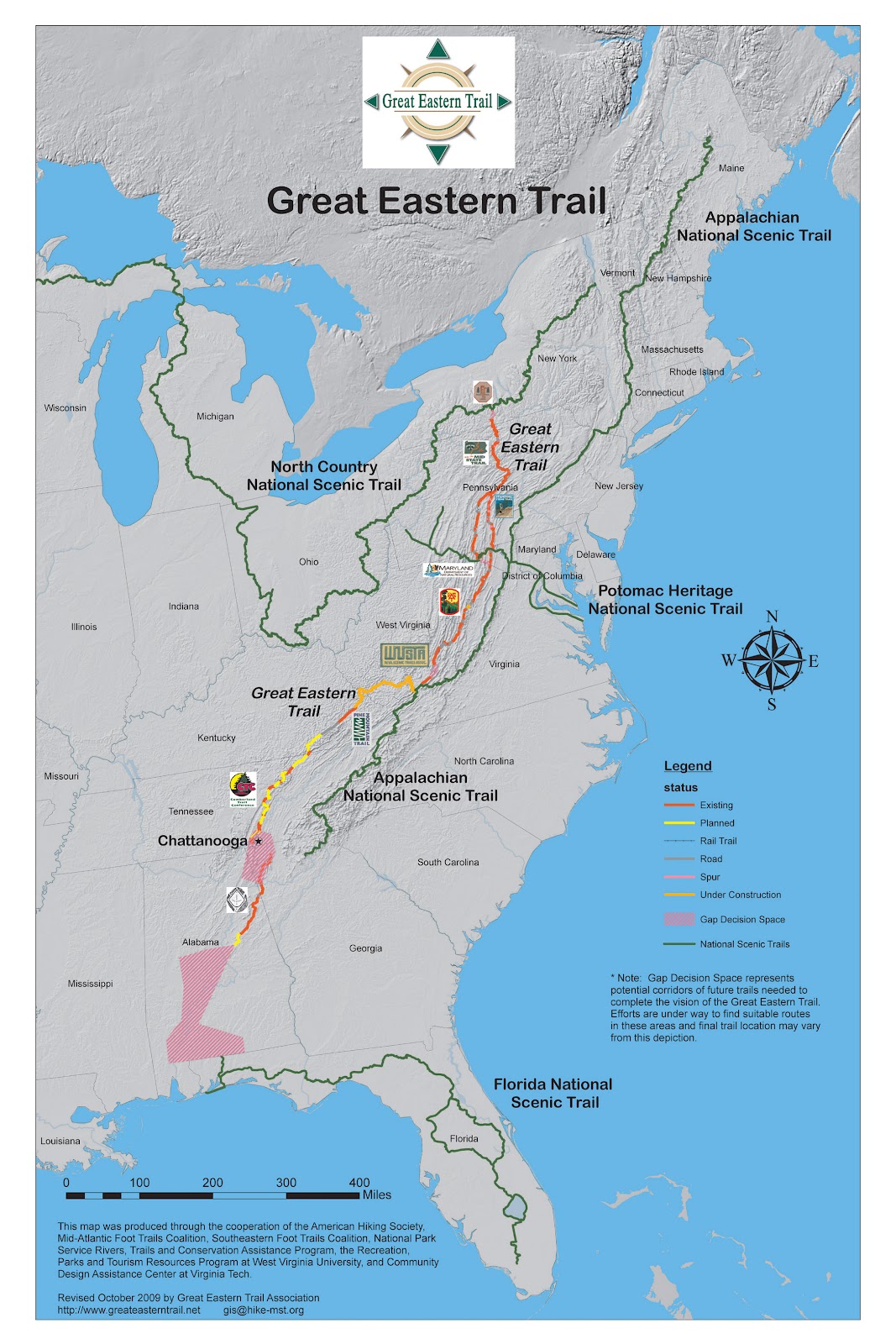 The 1,800 mile long GET is currently about seventy-five percent complete. The trail has several gaps where new trails need to be blazed to link the existing trails. Woolrich maintains a portion of the GET that runs through the middle of its hometown via the Mid State Trail.
“As hikers, too often we take for granted the trails we travel and don’t think about what it takes to maintain or build them,” said Brent Hollowell, Woolrich VP of Marketing. “Trails don’t blaze themselves, and we hope that we can help local clubs mobilize volunteers and make the Great Eastern Trail a reality.”
Late last fall Woolrich brought together leadership from the Great Eastern Trail Association, the Keystone Trail Association (KTA), Backpacker Magazine, and other GET associated clubs for a summit in Woolrich, PA. The attendees devised a strategic plan to help with trail maintenance and promote awareness of the trail.
“Woolrich has stepped up as a leader in helping us realize the completion of the trail,” said Tom Johnson, President of Great Eastern Trail Association. “We appreciate the additional visibility their efforts have brought to the GET and we are sure the positive attention will lead to more volunteers assisting with the actual maintenance work and development of the trail system.”
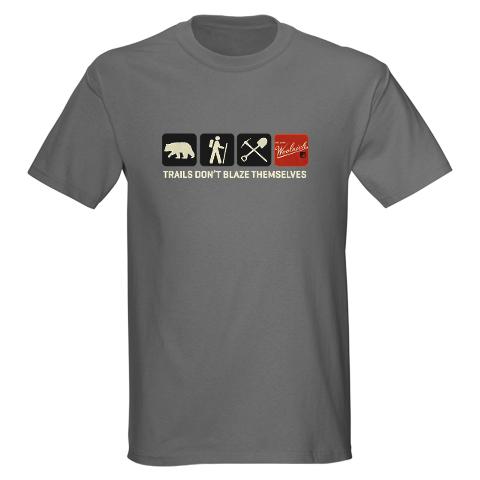 Along with providing volunteer gift bags, including a trail work t-shirt, Woolrich hiking socks, and more, Woolrich is supporting its local trail organization, the Keystone Trail Association as the official sponsor of its Trail Care Days.
To further increase awareness of the trail Woolrich is collaborating with its long time partner Backpacker Magazine. Woolrich has developed a series of advertorials focusing on the GET that began appearing in the publication in February.
Backpacker is integrating content related to the Great Eastern Trail into the presentations of its popular national mobile tour, the Get Out More Tour, which stops at retail stores, events and festivals to educate consumers about the skills and equipment needed to enjoy the outdoors while inspiring healthy, active lifestyles.
The Great Eastern Trail was inspired by Benton MacKaye’s original vision for the Appalachian Trail as a network of braided trails running the length of the Appalachian Mountains. In 2000, Lloyd MacAskill of Potomac Appalachian Trail Club published an article in the Appalachian Trailway News calling attention to the existing trails to the west of the AT and saying, “Don’t look now, but parts are already in place.”
To learn more about the trail, participating trail clubs, donate or volunteer for a trail maintenance day visit www.greateasterntrail.net.
About Woolrich
Woolrich Inc., the Original Outdoor Clothing Company, is an authentic American brand that embraces an outdoor lifestyle. Trusted since 1830 by generations of loyal customers, Woolrich continues its tradition of providing quality products for today’s outdoor enthusiast. A brand recognized worldwide, Woolrich product offerings include functional, comfortable and durable men’s and women’s sportswear and outerwear using innovative fabrications for the ultimate in performance capabilities, well-designed home and outdoor living products, and licensed accessory products. In 2010, Woolrich celebrated its 180th Anniversary. It is the original and longest continuously-operating outdoor apparel manufacturer and woolen mill in the United States. Find out more at www.woolrich.com.
About Great Eastern Trail
The Great Eastern Trail (GET) provides a premier hiking experience on a series of existing trails that are being linked to each other into a long-distance footpath in the Appalachian Mountains stretching from Alabama to the Finger Lakes Trail in New York. The trail system is a project of the Great Eastern Trail Association, a non-profit 501(c)(3) organization, which works with the American Hiking Society, sponsors and local trail partners, to create America’s newest long distance trail for hikers. Learn more or donate to the Great Eastern Trail Association at www.greateasterntrail.net.
###
Michael Collin
Account Director • 207.619.4253 207.619.4253
Pale Morning Media • Public relations for the outdoor world
Box 7316 • Portland, ME 04112
81 W Commercial St, Suite 201 • Portland, ME 04101

USA Cycling announces launch of National Track Calendar
Posted: March 23, 2012 Filed under: Cycling | Tags: Colo, Colorado, Cycle Racing, Cycling, Racing, Rock Hill South Carolina, Scratch race, Track cycling, USA Cycling, Velodome Leave a comment
|
|||||||||||||||||||||||||||||||||||||||||||||||||||||||||||||||||||||||||||||||||||||



Amer Alp Club–Zack Martin Call For Grant Applications 2012
Posted: March 22, 2012 Filed under: Climbing, Mountaineering | Tags: American Alpine Club, Anatoli Boukreev, Climbing, Federal grants in the United States, grant, Mountaineering, Petzl Leave a commentThe American Alpine Club is pleased to announce a CALL FOR APPLICATIONS for the 2012 ZACK MARTIN BREAKING BARRIERS GRANT. ZMBB grant applications are due, this year, on April 15. Below you will find grant information and the grant application process (at the bottom of the ZMBB Grant page)
A special thanks to Black Diamond and Petzl for supporting this grant through special merchandise deals for the recipients.
Regards

Image via Wikipedia
“JP” John Parsons
john.p.parsons
720-254-6165 cell
The AAC Grants Webpage
Zack Martin Breaking Barriers Grant Page
The Zack Martin Breaking Barriers Grant (ZMBB) is a dual-purpose grant fund. The primary objective is humanitarian and the secondary objective is climbing, alpinism and/or exploration in the natural environment. The grantee must meet both objectives and is strongly encouraged to obtain additional funding. The humanitarian objective must be reasonable, and sustainable. Objectives that continue after implementation will receive the highest level of consideration. Focus the objective to affect the greatest human change. The alpine objective should focus on climbing and/or exploration but need not be at the leading edge of climbing or alpinism.
Zack Martin died just before his 25th birthday on Thanksgiving Day 2002. He was a recipient of AAC grants, the Anatoli Boukreev grant and others. Zack was concerned about the general arrogance and self-serving aspirations of climbers and explorers. He committed that on all future expeditions he would not only climb and explore but more importantly he would perform humanitarian service in the local community. He would “break a barrier” in the alpine environment and “break a barrier” in the heart of man. As Zack often said, “The only barrier holding you back is yourself.”
The American Alpine Club Webpage
The Donate To The Zack Martin Fund
American Alpine Club
c/o Donations—The Zack Martin Grant Fund
710 10th St
Suite 100
Golden, CO 80401
Include on check:
Zack Martin Breaking Barriers Fund
(all funds are tax deductible)
To be removed from this mail contact john.p.parsons
Best of Outdoor Retailer and SIA
Posted: March 21, 2012 Filed under: Uncategorized | Tags: helmet, Kali, MIPS architecture, Recco, Ski, Ski Resort, Sports Leave a commentThe best is always the people. However I found some interesting products
12 days, 8 days of exhibit hall, 3 days of on-snow demos and another tradeshow season comes to an end.
Here’s a quick rundown of what I saw that I liked.
Slide On for ski boots: This product makes putting your ski boot on a breeze. From the maker of the Booster Power Strap. If you ski and you aren’t using the Booster Power Strap, try and get off the bunny slope and give them a try.
Nargear: Not a lot of bells and whistles, just make to take your gear and keep it in one bag, no matter how far you throw it.
Snow Angel: No I don’t wear women’s clothing, but this stuff is beautiful. Feels good too. You are on your own for finding out how technical it is.
MIPS: If you need a helmet for any sport that is not a DOT helmet, get one with MIPS inside. It may make the difference
Kali Helmets: Don’t like MIPS, Kali is coming up with some new ideas in helmet technology that will change the way helmets perform.
Protect Helmets: nothing new as far as the helmet goes, but they have the Recco chip in the helmet.
Bern Hard Hat: I’ve told you a thousand times A new idea that makes sense in helmets: the Bern Hard Hat
Ski Retriever: Skiing Powder all the time and don’t like leashes, try technology to not lose a ski.
Fox 40: Fox had mouth guards at the ski show. See A helmet manufacture understands the issues
UClear: I’ve not tested it but if the ear phones eliminate the wind noise and the microphone eliminates all noise, these will be great for people who move
Loki: Did you ever have a coat that you grabbed when you weren’t sure, but when in doubt you always grabbed it. Loki makes coats, sweatshirts and accessories, all that serve multi purposes.
Orthahell Sandals: Ever put something on your feet and have your feet put a smile on your face. In a sandal even.
Suunto: Supposedly they have a new watch that works, by that I mean won’t break in 60 days. We’ll see. Heck, the PR team is beautiful……
Timex: Hard to read, harder to understand how it works, but as John Cameron Sayze used to say, it takes a lickin’ and keeps on tickin’
Eton: A product that made me go wow. Solar powered stereo that you can Bluetooth from your phone or MP3. No need to add songs to another device. Don’t know if it can take the outdoor beating, but works great indoors.
Replay: video camera a little larger than a roll of quarters, but not much larger
Hyalite Equipment: New name, old company solid great gear, bags, pads and bike gear
The Dry Guy: If you don’t own something from the Dry Guy, you are skiing with wet gloves and boots. The latest is a heater & dryer for boots, the Turbo Dryer that can work off your car. Warm boots when you put them on to ski after driving to the resort. Wonderful.
I have a lot more stuff to let you know about, but some I want to make sure the marketing matches reality.
What do you think? Leave a comment.
If you like this let your friends know or post it on FB, Twitter or LinkedIn
Copyright 2012 Recreation Law (720) Edit Law
Twitter: RecreationLaw
Facebook: Rec.Law.Now
Facebook Page: Outdoor Recreation & Adventure Travel Law
Mobile Site: http://m.recreation-law.com
#RecreationLaw, #@RecreationLaw, #Cycling.Law #Fitness.Law, #Ski.Law, #Outside.Law, #Recreation.Law, #Recreation-Law.com, #Outdoor Law, #Recreation Law, #Outdoor Recreation Law, #Adventure Travel Law, #law, #Travel Law, #Jim Moss, #James H. Moss, #Attorney at Law, #Tourism, #Adventure Tourism, #Rec-Law, #Rec-Law Blog, #Recreation Law, #Recreation Law Blog, #Risk Management, #Human Powered, #Human Powered Recreation,# Cycling Law, #Bicycling Law, #Fitness Law, #Recreation-Law.com, #Backpacking, #Hiking, #Mountaineering, #Ice Climbing, #Rock Climbing, #Ropes Course, #Challenge Course, #Summer Camp, #Camps, #Youth Camps, #Skiing, #Ski Areas, #Negligence, #Snowboarding, #RecreationLaw, #@RecreationLaw, #Cycling.Law #Fitness.Law, #SkiLaw, #Outside.Law, #Recreation.Law, #RecreationLaw.com, #OutdoorLaw, #RecreationLaw, #OutdoorRecreationLaw, #AdventureTravelLaw, #Law, #TravelLaw, #JimMoss, #JamesHMoss, #AttorneyatLaw, #Tourism, #AdventureTourism, #RecLaw, #RecLawBlog, #RecreationLawBlog, #RiskManagement, #HumanPowered, #HumanPoweredRecreation,# CyclingLaw, #BicyclingLaw, #FitnessLaw, #RecreationLaw.com, #Backpacking, #Hiking, #Mountaineering, #IceClimbing, #RockClimbing, #RopesCourse, #ChallengeCourse, #SummerCamp, #Camps, #YouthCamps, #Skiing, #Ski Areas, #Negligence, #Snowboarding, sport and recreation laws, ski law, cycling law, Colorado law, law for recreation and sport managers, bicycling and the law, cycling and the law, ski helmet law, skiers code, skiing accidents, SIA, OR, Winter, Ski, Ski Show, Outdoor Retailer
WordPress Tags: Best,Outdoor,Retailer,products,hall,demos,Here,Slide,product,breeze,From,maker,Booster,Power,Strap,bunny,Nargear,gear,Angel,women,Feels,MIPS,helmet,difference,Kali,Helmets,technology,Protect,Recco,Bern,Hard,Powder,leashes,UClear,noise,Loki,purposes,Orthahell,Sandals,feet,Suunto,Heck,team,Timex,John,Cameron,Sayze,Eton,Solar,Bluetooth,songs,device,Replay,Hyalite,Equipment,bike,heater,Turbo,Dryer,Warm,resort,Wonderful,Leave,Twitter,LinkedIn,Recreation,Edit,RecreationLaw,Facebook,Page,Adventure,Travel,Blog,Mobile,Site,Outside,Moss,James,Attorney,Tourism,Risk,Management,Human,Rock,Ropes,Course,Challenge,Summer,Camp,Camps,Youth,Areas,Negligence,SkiLaw,OutdoorLaw,OutdoorRecreationLaw,AdventureTravelLaw,TravelLaw,JimMoss,JamesHMoss,AttorneyatLaw,AdventureTourism,RecLaw,RecLawBlog,RecreationLawBlog,RiskManagement,HumanPoweredRecreation,CyclingLaw,BicyclingLaw,FitnessLaw,RopesCourse,ChallengeCourse,SummerCamp,YouthCamps,Colorado,managers,accidents,Winter
Tour of Utah Announces the Host Cities for the 2012 race.
Posted: March 20, 2012 Filed under: Cycling | Tags: Cycling, Professional Cycling, Utah 1 Comment
Image via Wikipedia
Time Trial added to the race format for 2012
The Tour of Utah has announced the host cities for the 2012 race. Ogden, Tooele, Salt Lake City, Park City, and Snowboard Ski Resort will either host a start or finish at this year’s race.
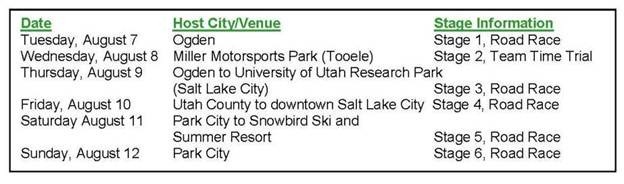
This race is becoming a great lead up to the USA Pro-Challenge which is scheduled a little over a week later.
See: Team Time Trial Highlights Changes for 2012 Tour of Utah; Host Cities Announced
Do Something
Get out and support professional cycling in Utah
What do you think? Leave a comment.
If you like this let your friends know or post it on FB, Twitter or LinkedIn
Copyright 2012 Recreation Law (720) Edit Law
Twitter: RecreationLaw
Facebook: Rec.Law.Now
Facebook Page: Outdoor Recreation & Adventure Travel Law
Mobile Site: http://m.recreation-law.com
#RecreationLaw, #@RecreationLaw, #Cycling.Law #Fitness.Law, #Ski.Law, #Outside.Law, #Recreation.Law, #Recreation-Law.com, #Outdoor Law, #Recreation Law, #Outdoor Recreation Law, #Adventure Travel Law, #law, #Travel Law, #Jim Moss, #James H. Moss, #Attorney at Law, #Tourism, #Adventure Tourism, #Rec-Law, #Rec-Law Blog, #Recreation Law, #Recreation Law Blog, #Risk Management, #Human Powered, #Human Powered Recreation,# Cycling Law, #Bicycling Law, #Fitness Law, #Recreation-Law.com, #Backpacking, #Hiking, #Mountaineering, #Ice Climbing, #Rock Climbing, #Ropes Course, #Challenge Course, #Summer Camp, #Camps, #Youth Camps, #Skiing, #Ski Areas, #Negligence, #Snowboarding, #RecreationLaw, #@RecreationLaw, #Cycling.Law #Fitness.Law, #SkiLaw, #Outside.Law, #Recreation.Law, #RecreationLaw.com, #OutdoorLaw, #RecreationLaw, #OutdoorRecreationLaw, #AdventureTravelLaw, #Law, #TravelLaw, #JimMoss, #JamesHMoss, #AttorneyatLaw, #Tourism, #AdventureTourism, #RecLaw, #RecLawBlog, #RecreationLawBlog, #RiskManagement, #HumanPowered, #HumanPoweredRecreation,# CyclingLaw, #BicyclingLaw, #FitnessLaw, #RecreationLaw.com, #Backpacking, #Hiking, #Mountaineering, #IceClimbing, #RockClimbing, #RopesCourse, #ChallengeCourse, #SummerCamp, #Camps, #YouthCamps, #Skiing, #Ski Areas, #Negligence, #Snowboarding, sport and recreation laws, ski law, cycling law, Colorado law, law for recreation and sport managers, bicycling and the law, cycling and the law, ski helmet law, skiers code, skiing accidents, Tour of Utah, #Cycling, Cycle Racing, Bike Race, #Bicycling, Salt Lake City, #Utah, #UT, Park City, #Ogden
WordPress Tags: Tour,Utah,Announces,Host,Cities,Time,Trial,Ogden,Tooele,Salt,Lake,Park,Snowboard,Resort,Challenge,Team,Highlights,Changes,Leave,Twitter,LinkedIn,Recreation,Edit,RecreationLaw,Facebook,Page,Outdoor,Adventure,Travel,Blog,Mobile,Site,Outside,Moss,James,Attorney,Tourism,Risk,Management,Human,Rock,Ropes,Course,Summer,Camp,Camps,Youth,Areas,Negligence,SkiLaw,OutdoorLaw,OutdoorRecreationLaw,AdventureTravelLaw,TravelLaw,JimMoss,JamesHMoss,AttorneyatLaw,AdventureTourism,RecLaw,RecLawBlog,RecreationLawBlog,RiskManagement,HumanPoweredRecreation,CyclingLaw,BicyclingLaw,FitnessLaw,RopesCourse,ChallengeCourse,SummerCamp,YouthCamps,Colorado,managers,helmet,accidents,Cycle,Bike,Race
Every time someone comes to your business or every time they sign up again they should sign a release. This time it got rid of a major problem.
Posted: March 19, 2012 Filed under: New Jersey, Release (pre-injury contract not to sue), Ski Area | Tags: Adhesion Contract, Exculpatory Agreement, Federal Rules of Civil Procedure, Injury, Mountain Creek, Plaintiff, Pre-injury Release, Release, ski area, skiing, Summary judgment, Unconscionability Leave a commentDearnley v. Mountain Creek, 2012 N.J. Super. Unpub. LEXIS 527
Releases work for future injuries and for injuries that may have all ready occurred.
This is a case where as part of the employment at a ski area, the family of the employee was able to get season passes. A requirement for the season pass was to sign a release.
In this case, the plaintiff was injured skiing on a season pass issued to the family member of an employee. The plaintiff sued the ski resort for his injuries. After the lawsuit had commenced but before trial, the plaintiff got another season pass and signed another release. The second release language was sufficient to stop the lawsuit.
The release was called a post injury release now because it stopped a lawsuit after the injury. Normally, I discuss pre-injury releases. Pre-Injury releases are releases that are signed in case someone is injured in a negligent manner.
Summary of the case
After it was discovered the plaintiff had signed a second release, the defense moved to amend their answer and filed a motion for summary judgment. The trial court granted the motion to amend and add the defense of release and accord and satisfaction. The plaintiff appealed.
“Release” is an affirmative defense. An affirmative defense is one that must be plead immediately in the answer of the defendant or the defense is waived. Release as a defense means that the parties have executed an agreement that releases the defendant from any claims.
“Accord and Satisfaction” are also an affirmative defense. Accord and Satisfaction means the party have come to an agreement, an accord and resolved their differences to the satisfaction of all parties.
The plaintiff argued that the post injury release was unconscionable. The contract should not be enforced because of:
“….inadequacies, such as age, literacy, lack of sophistication, hidden or unduly complex contract terms, bargaining tactics, and the particular setting existing during the contract formation process.”
An unconscionable contract or a contract of adhesion is one that the terms were offered on a take or leave it basis the terms are unjust to the point the court cannot allow the contract to stand. The contract must be so bad as to shock the conscience of the court. However, the contract cannot just be bad to one party.
Here, there are several factors that would not make the contract unconscionable. The contract is not for a necessary service. The services could be received from the same party in other ways. (Instead of signing a release and getting a season pass, the plaintiff could have purchased daily lift tickets and not signed a release.) The services were available from other providers.
The court found there were no coercion, duress, fraud or “sharp practices” by the defendant. The agreement did not change the duty of care nor did it “incentivize negligence.” Each of the contracting parties gained or gave away something of value.
So Now What?
Here the defendant was lucky. The plaintiff unknowingly signed a release to get his season pass that had the language necessary to stop a claim that had already occurred. There are two important points to bring up from this case.
1 Make sure your release has language to top future claims and past claims.
2. Every single time have every single-person sign a release. Get a new season pass, you sign the release again. Go rafting again, you sign the release. Buy another widget sign the release.
You just never know when a release from the future may stop a claim from the past.
What do you think? Leave a comment.
If you like this let your friends know or post it on FB, Twitter or LinkedIn
Copyright 2012 Recreation Law (720) Edit Law
Twitter: RecreationLaw
Facebook: Rec.Law.Now
Facebook Page: Outdoor Recreation & Adventure Travel Law
Mobile Site: http://m.recreation-law.com
#RecreationLaw, #@RecreationLaw, #Cycling.Law #Fitness.Law, #Ski.Law, #Outside.Law, #Recreation.Law, #Recreation-Law.com, #Outdoor Law, #Recreation Law, #Outdoor Recreation Law, #Adventure Travel Law, #law, #Travel Law, #Jim Moss, #James H. Moss, #Attorney at Law, #Tourism, #Adventure Tourism, #Rec-Law, #Rec-Law Blog, #Recreation Law, #Recreation Law Blog, #Risk Management, #Human Powered, #Human Powered Recreation,# Cycling Law, #Bicycling Law, #Fitness Law, #Recreation-Law.com, #Backpacking, #Hiking, #Mountaineering, #Ice Climbing, #Rock Climbing, #Ropes Course, #Challenge Course, #Summer Camp, #Camps, #Youth Camps, #Skiing, #Ski Areas, #Negligence, #Snowboarding, #RecreationLaw, #@RecreationLaw, #Cycling.Law #Fitness.Law, #SkiLaw, #Outside.Law, #Recreation.Law, #RecreationLaw.com, #OutdoorLaw, #RecreationLaw, #OutdoorRecreationLaw, #AdventureTravelLaw, #Law, #TravelLaw, #JimMoss, #JamesHMoss, #AttorneyatLaw, #Tourism, #AdventureTourism, #RecLaw, #RecLawBlog, #RecreationLawBlog, #RiskManagement, #HumanPowered, #HumanPoweredRecreation,# CyclingLaw, #BicyclingLaw, #FitnessLaw, #RecreationLaw.com, #Backpacking, #Hiking, #Mountaineering, #IceClimbing, #RockClimbing, #RopesCourse, #ChallengeCourse, #SummerCamp, #Camps, #YouthCamps, #Skiing, #Ski Areas, #Negligence, #Snowboarding, sport and recreation laws, ski law, cycling law, Colorado law, law for recreation and sport managers, bicycling and the law, cycling and the law, ski helmet law, skiers code, skiing accidents, Mountain Creek, Adhesion Contract, Pre-Injury, Post-Injury, Pre-Injury Release, Post Injury Release, Employee Benefit, #Unconscionable, #Exculpatory, Exculpatory Agreement, #Adhesion,
WordPress Tags: Dearnley,Mountain,Creek,Super,Unpub,LEXIS,Releases,injuries,employment,area,employee,requirement,plaintiff,member,resort,lawsuit,injury,manner,Summary,judgment,satisfaction,Release,defendant,agreement,Accord,differences,inadequacies,literacy,sophistication,tactics,formation,adhesion,basis,conscience,Here,factors,Instead,tickets,providers,coercion,fraud,negligence,Make,person,widget,Leave,Twitter,LinkedIn,Recreation,Edit,RecreationLaw,Facebook,Page,Outdoor,Adventure,Travel,Blog,Mobile,Site,Outside,Moss,James,Attorney,Tourism,Risk,Management,Human,Rock,Ropes,Course,Challenge,Summer,Camp,Camps,Youth,Areas,SkiLaw,OutdoorLaw,OutdoorRecreationLaw,AdventureTravelLaw,TravelLaw,JimMoss,JamesHMoss,AttorneyatLaw,AdventureTourism,RecLaw,RecLawBlog,RecreationLawBlog,RiskManagement,HumanPoweredRecreation,CyclingLaw,BicyclingLaw,FitnessLaw,RopesCourse,ChallengeCourse,SummerCamp,YouthCamps,Colorado,managers,helmet,accidents,Contract,Post,Benefit,Unconscionable,Exculpatory
Dearnley v. Mountain Creek, 2012 N.J. Super. Unpub. LEXIS 527
Posted: March 19, 2012 Filed under: Legal Case, Release (pre-injury contract not to sue), Ski Area | Tags: Adhesion Contract, Appeal, Defendant, Exculpatory Agreement, Law Division, Mountain Creek, New Jersey Superior Court, Pre-injury Release, Release, ski area, skiing, Summary judgment, Unpub Leave a commentDearnley v. Mountain Creek, 2012 N.J. Super. Unpub. LEXIS 527
Derek Dearnley and Vicky Dearnley, his wife, Plaintiffs-Appellants, v. Mountain Creek, its agents, servants and employees, Defendant-Respondent.
Docket no. A-5517-10T1
Superior Court of New Jersey, Appellate Division
2012 N.J. Super. Unpub. LEXIS 527
February 29, 2012, Argued
March 12, 2012, Decided
Notice: not for publication without the approval of the appellate division.
Please consult new jersey rule 1:36-3 for citation of unpublished opinions.
Prior History: [*1]
On appeal from the Superior Court of New Jersey, Law Division, Sussex County, Docket No. L-540-09.
CORE TERMS: season, summary judgment, ski area, unconscionability, unconscionable, affirmative defenses, resort, Law Division, contract of adhesion, exculpatory provisions, releasor’s, surgery, ski, pass holder, bold, tort liability, de novo, contracting party’s, public policy, sliding scale, unenforceable, snowboarding, exculpatory, non-moving, favorable, equitable, adhesion, binding, bargain, quod
COUNSEL: Evan D. Baker argued the cause for appellants (Law Offices of Rosemarie Arnold, attorneys; Mr. Baker, of counsel and on the brief).
Samuel J. McNulty argued the cause for respondent (Hueston McNulty, P.C., attorneys; Mr. McNulty, of counsel and on the brief; John F. Gaffney and Stephen H. Shaw on the brief).
JUDGES: Before Judges Harris and Koblitz.
OPINION
PER CURIAM
Plaintiffs Derek Dearnley and Vicky Dearnley appeal from the June 16, 2011, summary judgment dismissal of their six-count complaint. Plaintiffs sought tort remedies for injuries suffered by Mr. Dearnley while snowboarding at defendant Mountain Creek Resort, Inc.’s ski area in Vernon. We affirm.
I.1
1 This appeal arises from the motion court’s grant of summary judgment in defendant’s favor. Accordingly, we present the evidence in the light most favorable to plaintiffs. See Durand v. The Nutley Sun, N.J. , (2012) (slip op. at 3 n.1) (citing G.D. v. Kenny, 205 N.J. 275, 304 (2011) (citations omitted); R. 4:46-2(c)).
Between 1998 and 2010, Mrs. Dearnley was employed by defendant in its retail department. As part of her compensation benefits, [*2] she and her family members were entitled to apply for, and obtain, a free season pass to use defendant’s facilities at its Vernon ski resort. On November 25, 2008, because her husband desired to take advantage of this benefit for the 2008-2009 winter season, Mrs. Dearnley applied for, and obtained, the pass. She signed, on his behalf, a document entitled, “Season Pass Contract, Student Ski & Ride Voucher Program, Rules and Conditions of Sale, Release of Liability and Indemnity Agreement” (the 2008 agreement). The 2008 agreement contained exculpatory provisions purporting to release tort claims before they occurred. For example, the pass holder “fully release[d] Mountain Creek FROM ANY AND ALL LIABILITY for personal injury, death or property damage arising out of or resulting from [the pass holder’s] participation in this sport, MOUNTAIN CREEK’S NEGLIGENCE, conditions on or about the premises and facilities or the operations of the ski area” (capitalization in the original). The outcome of this appeal, however, does not turn on this language.
On January 4, 2009, Mr. Dearnley was snowboarding at the Mountain Creek ski area when he suffered an accident that he attributes to defendant’s [*3] negligence and breach of its duties under N.J.S.A. 5:13-1 to -11 (the Ski Act). As a result of the accident, Mr. Dearnley incurred serious injuries, which required immediate emergency surgery to stabilize his back by the implantation of metal rods and screws. According to his answers to interrogatories, Mr. Dearnley ultimately spent approximately six weeks in the hospital, had to endure three surgeries, and underwent weeks of physical therapy and rehabilitation.
On October 13, 2009, plaintiffs filed their personal injury and per quod complaint against defendant in the Law Division, Sussex Vicinage. Defendant’s answer listed ten affirmative defenses, but did not assert that the 2008 agreement’s exculpatory provisions barred the action.
Two months later, on December 21, 2009, while his wife was still employed by defendant, Mr. Dearnley applied for a season pass for the 2009-2010 winter season. He was presented with, and signed, a two-page document entitled, “Mountain Creek Resort, Inc. 2009-’10 Season Pass Wavier” (the 2009 agreement). In bold, capitalized print at the top of the first page, the 2009 agreement stated, “RELEASE, WARNINGS AND DISCLAIMERS ON SKIING.”
At the top of the second [*4] page, to which Mr. Dearnley affixed his signature, the following appeared in bold typeface:
I FURTHER RELEASE AND GIVE UP ANY AND ALL CLAIMS AND RIGHTS THAT I MAY NOW HAVE AGAINST MOUNTAIN CREEK RESORT, INC. THIS RELEASES ALL CLAIMS, INCLUDING THOSE OF WHICH I AM NOT AWARE AND THOSE NOT MENTIONED IN THIS RELEASE. THIS RELEASE APPLIES TO CLAIMS RESULTING FROM ANYTHING WHICH HAS HAPPENED UP TO NOW.
The 2009 agreement also stated in bold typeface: “I AM AWARE THAT THIS CONTRACT IS LEGALLY BINDING AND THAT I AM RELEASING LEGAL RIGHTS BY SIGNING IT.”
During discovery, the 2008 and 2009 agreements were exchanged between the parties’ attorneys. Upon the realization of what Mr. Dearnley had signed, plaintiffs filed a motion “for an Order barring the affirmative defenses related to two adhesion contracts.” Defendant filed a cross-motion seeking (1) summary judgment, (2) permission to file an amended answer, and (3) denial of plaintiffs’ motion.
On April 29, 2011, Judge Edward V. Gannon heard oral argument. The judge granted defendant’s motion to amend its answer to permit the pleading of (1) release and (2) accord and satisfaction as affirmative defenses. The judge noted that the 2009 agreement [*5] was executed after both the filing of plaintiffs’ complaint and defendant’s answer, and therefore could not have been contemplated by the first exchange of pleadings. Reciprocally, he denied plaintiff’s motion to bar the affirmative defenses. Finally, he reserved decision on what he called “a matter of first impression with regard to this particular type of release.”
On June 16, 2011, Judge Gannon entered an order granting summary judgment dismissing plaintiffs’ complaint with prejudice. He explained his decision in a thorough ten-page statement of reasons, taking pains to carefully explicate the two agreements and then analyze them under the lens of applicable law. This appeal ensued.
II.
Orders granting summary judgment pursuant to Rule 4:46-2 are reviewed de novo, and we apply the same legal standard employed by the Law Division. Canter v. Lakewood of Voorhees, 420 N.J. Super. 508, 515 (App. Div. 2011). In performing our appellate function we consider, as did the motion court, “‘whether the competent evidential materials presented, when viewed in the light most favorable to the non-moving party, are sufficient to permit a rational factfinder to resolve the alleged disputed issue in [*6] favor of the non-moving party.'” Advance Hous., Inc. v. Twp. of Teaneck, 422 N.J. Super. 317, 327 (App. Div. 2011) (quoting Brill v. Guardian Life Ins. Co. of Am., 142 N.J. 520, 540 (1995)), certif. granted, N.J. (Jan. 24, 2012).
Similarly, when the legal conclusions of a motion court’s Rule 4:46-2 summary judgment decision are reviewed on appeal, “‘[a] trial court’s interpretation of the law and the legal consequences that flow from established facts are not entitled to any special deference[,]’ and, hence, an ‘issue of law is subject to de novo plenary appellate review.'” Estate of Hanges v. Metro. Prop. Cas. Ins. Co., 202 N.J. 369, 382-83 (2010) (quoting City of Atl. City v. Trupos, 201 N.J. 447, 463 (2010)).
Judge Gannon dismissed plaintiffs’ claims based upon the release contained in the 2009 agreement, which was personally executed by Mr. Dearnley months after his injuries and surgeries, months after he hired a lawyer, and months after he filed suit. From our review of the undisputed factual record, we are satisfied that this case does not present any novel or first impression issues. Rather, it revolves around an ordinary release —- not exculpatory —- clause and is governed [*7] by familiar principles of contract interpretation. As Judge Gannon stated,
Invalidating the agreed upon waiver would signal judicial mistrust of our citizen’s ability to intelligently enter contracts, in which benefits derive from the assumptions of burdens. In this case, Mr. Dearnley surrendered his right to maintain this suit in exchange for the benefits afforded to season pass holders. A contracting party’s assumption of a substantial burden is no basis for interfering with our citizens’ right to freely contract.
We affirm substantially for the reasons expressed by Judge Gannon, and add only the following brief comments.
Plaintiffs condemn the 2009 agreement as a contract of adhesion, fraught with unconscionabilty, and contrary to public policy. We emphasize that our review is limited to the 2009 agreement, not the 2008 agreement. We are not concerned with defendant’s efforts to exculpate itself from tort liability before an invitee becomes injured at its ski area. Instead, we parse Mr. Dearnley’s release of a claim after it allegedly accrued.
We begin our analysis of the enforceability of the release contained in the 2009 agreement with recognition of the deep-seated principle that [*8] contracts will be enforced as written. Vasquez v. Glassboro Serv. Ass’n, Inc., 83 N.J. 86, 98-100 (1980). Ordinarily, courts will not rewrite contracts to favor a party, for the purpose of giving that party a better bargain. Relief is not available merely because enforcement of the contract causes oppression, improvidence, or unprofitability, or because it produces hardship to one of the parties. Brunswick Hills Racquet Club, Inc. v. Route 18 Shopping Ctr. Assocs., 182 N.J. 210, 223 (2005). A court cannot “‘abrogate the terms of a contract unless there is a settled equitable principle, such as fraud, mistake, or accident, allowing for such intervention.'” Id. at 223-24 (quoting Dunkin’ Donuts of America, Inc. v. Middletown Donut Corp., 100 N.J. 166, 183-84 (1985)).
Rational personal and economic behavior in the modern post-industrial world is only possible if agreements between parties are respected. The reasonable expectations created by mutual assent ought to receive the protection of the law and courts should not be encouraged to fashion a better arrangement for a party because of a gaffe to which the other party is not privy. In other words, avoidance of a contract is a very stern [*9] remedy that requires clear evidence demonstrating that the consequences of the mistake are so grave that enforcement of the contract would be unconscionable. That formidable threshold has not been surmounted here.
Notwithstanding the foregoing, a contract provision that is procedurally and substantively unconscionable can be set aside. See Muhammad v. Cnty. Bank of Rehoboth Beach, 189 N.J. 1, 15 (2006), cert. denied, 549 U.S. 1338, 127 S. Ct. 2032, 167 L. Ed. 2d 763 (2007). “[P]rocedural unconscionability . . . ‘can include a variety of inadequacies, such as age, literacy, lack of sophistication, hidden or unduly complex contract terms, bargaining tactics, and the particular setting existing during the contract formation process[.]'” Ibid. (quoting Sitogum Holdings, Inc. v. Ropes, 352 N.J. Super. 555, 564-66 (Ch. Div. 2002). A contract of adhesion, presented by the drafting party to the other party on a take-it-or-leave-it basis, as here, typically involves “some characteristics of procedural unconscionability[.]” Id. at 16. The determination “that a contract is one of adhesion, however, ‘is the beginning, not the end, of the inquiry’ into whether a contract, or any specific term therein, [*10] should be deemed unenforceable based on policy considerations.” Id. at 28 (citing Rudbart v. N. Jersey Dist. Water Supply Comm., 127 N.J. 344 (1992)).
Substantive unconscionability essentially refers to the inclusion within a contract of “harsh or unfair one-sided terms.” Id. at 15 (citing Sitogum, supra, 352 N.J. Super. at 564-66). It is also described as “‘the exchange of obligations so one-sided as to shock the court’s conscience.'” B & S Ltd., Inc. v. Elephant & Castle Intern., Inc., 388 N.J. Super. 160, 176 (Ch. Div. 2006)(quoting Sitogum, supra, 352 N.J. Super. at 565).
Generally, courts must undertake “a careful fact sensitive examination into [claims of] substantive unconscionability.” Id. at 16 (footnote omitted). “When making the determination that a contract of adhesion is unconscionable and unenforceable, we consider, using a sliding scale analysis, the way in which the contract was formed and, further, whether enforcement of the contract implicates matters of public interest.” Stelluti v. Casapenn Enters., LLC, 203 N.J. 286, 301 (2010).
The release provisions of the 2009 agreement are not the analytical equivalent of its exculpatory provisions. “The law does not favor exculpatory [*11] agreements because they encourage a lack of care.” Gershon v. Regency Diving Ctr., Inc., 368 N.J. Super. 237, 247 (App. Div. 2004). For that reason, courts closely scrutinize attempts to contract in advance to release tort liability. “‘[C]ourts have not hesitated to strike limited liability clauses that are unconscionable or in violation of public policy.'” Hojnowski v. Vans Skate Park, 187 N.J. 323, 333 (2004) (quoting Lucier v. Williams, 366 N.J. Super. 485, 491 (App. Div. 2004)).
The subject release does not call forth any of the foregoing concerns. Mr. Dearnley’s 2009 agreement with defendant neither eroded defendant’s duty of care nor did it incentivize negligence. Each of the contracting parties gained or gave away something of value. There was no coercion, duress, fraud, or sharp practices afoot. Public policy is not offended by requiring a non-incapacitated adult to honor the type of promise given here. See Raroha v. Earle Fin. Corp., 47 N.J. 229, 234 (1966) (holding that in the absence of fraud, misrepresentation or overreaching by the releasee, in the absence of a showing that the releasor was suffering from an incapacity affecting his ability to understand the meaning of [*12] the release and in the absence of any other equitable ground, it is the law of this State that the release is binding and that the releasor will be held to the terms of the bargain he willingly and knowingly entered).
Judge Gannon properly calibrated the “sliding scale” of our unconscionabilty jurisprudence and correctly determined that the 2009 agreement’s release was enforceable. Mr. Dearnley’s releasor’s remorse is an insufficient basis to return this matter to the Law Division for trial.2
2 Mrs. Dearnley’s claims are entirely derivative of her husband’s and consequently her per quod action must fall in the wake of Mr. Dearnley’s release. See Ryan v. Renny, 203 N.J. 37, 62 n.1 (2011) (noting that “the viability of [that claim] is subject to the survival of [her husband]’s claim” (quoting Sciarrotta v. Global Spectrum, 194 N.J. 345, 350 n.3 (2008)).)
Affirmed.
Lazer Sport Press Release – Lazer Sport launches new website for 2012 along with “Love Lazer” Official Helmeteer Contest!
Posted: March 16, 2012 Filed under: Cycling | Tags: google, Helmets, Lazer, LazerTag Leave a comment
|


Human Dimensions Conference Call for abstracts
Posted: March 16, 2012 Filed under: Uncategorized | Tags: Biodiversity, Breckenridge, Breckenridge Colorado, Colorado, Colorado State University, Conference, Cornell University, Ecosystem services, Fish, Fish and Wildlife, Human Dimensions, Wildlife management Leave a comment
Image via Wikipedia
Don’t Forget to Submit and Abstract
Abstract and Organized Session Proposal Deadline: May 1, 2012
Pathways to Success Conference & Training:
Integrating Human Dimensions into Fisheries and Wildlife Management
Beaver Run Resort
September 24-27, 2012
Visit our website at www.hdfwconference.org to learn more.
Keynote speaker: Gary Machlis, Chief Science Advisor, NPS
Conference Themes:
Biodiversity and Coupled Social-Ecological Systems
Fish and Wildlife Governance
The Changing Nature of Wildlife Conservation
Enduring Issues in HDFW
Improving HDFW Science
Increasing HDFW Capacity
Working with the Public
Implications of Global Change
Human Wildlife Conflict
Wildlife in an Ecosystem Services Paradigm
Discourses about Wildlife
Demographics and Fish and Wildlife Policy
Mike Manfredo
Conference Co-Chair, Pathways to Success Integrating Human Dimension into Fish and Wildlife Management
Human Dimensions of Natural Resources Department

Image via Wikipedia
Jerry Vaske
Conference Co-Chair, Pathways to Success Integrating Human Dimension into Fish and Wildlife Management
Human Dimensions of Natural Resources Department
Colorado State University
Dan Decker
Conference Co-Chair, Pathways to Success Integrating Human Dimension into Fish and Wildlife Management
Professor, Natural Resources
Director, Human Dimensions Research Unit
Esther Duke
Coordinator, Pathways to Success: Integrating Human Dimension into Fish and Wildlife Management Conference
Human Dimensions of Natural Resources Department
Colorado State University
If you Listen to the FredCast, and who doesn’t, Take this Survey
Posted: March 15, 2012 Filed under: Cycling, Youth Camps, Zip Line | Tags: Bicycling, Cycling, Fred, FredCast, Podcast, The Wall Street Journal Leave a comment
|
|||||||||||||||||||||


Payouts in Outdoor Recreation
Posted: March 14, 2012 Filed under: Uncategorized | Tags: Boating, Claim, Colorado, Jury Award, Paddling, Payouts, Rafting, Recreation, Settlement, Tours and Outfitters, Whitewater Rafting Leave a comment(Except Skiing Incidents)
The information here has been collected from various sources. The accuracy is not guaranteed.
|
Year |
Payout |
Defendant |
Claim |
Source |
|
|
|
$750,000 |
Remlinger Farms |
Climbing wall |
http://www.schifferman.com/CM/Custom/Settlements-Verdicts.asp |
|
|
2003 |
$250,000 |
Mountain Streams Outfitters |
Drowned whitewater rafting |
|
|
|
2004 |
$936,000 |
Greenfield Community College |
Foot Entrapment at College Summer Camp |
||
|
2008 |
$400,000 |
Sutter County California School District |
Improperly tied into the course |
||
|
2008 |
$5,000,000 |
Camp Ozark |
Youth Camp |
Large Jury Award in death of 9 year old Camper |
|
|
2009 |
$500,000 |
Ohio University |
Failure to supervise and protect from a fire |
||
|
2009 |
$13,000000 |
Cathedral Oaks Athletic Club Summer Camp |
Drowning |
Death we have commented on allegedly has a $14 million verdict |
|
|
2009 |
$4,700000 |
Alpine Towers International |
Improper equipment and failure to train |
$4.7 million dollar verdict in climbing wall case against Alpine Towers in South Carolina Court |
|
|
2009 |
$2,300000 |
Boomers |
Fall from Climbing Wall |
Another multimillion dollar jury verdict in outdoor recreation |
|
|
2009 |
$2,360000 |
Kicked by horse |
|||
|
2010 |
$4,750,000 |
Idlewild Baptist Church |
Ski Collision |
$5 Million because a church took a kid skiing and allowed him to……..ski |
|
|
|
$34,946,000 |
||||
|
|
|
|
|||
Totals by Defendants
|
Summer Camps |
$18.0 M |
|
Ropes/Challenge Courses |
$5.10 M |
|
Youth Church Programs |
$4.75 M |
|
Climbing Walls |
$2.95 M |
|
Outdoor Programs |
$2.61 M |
|
College & Universities |
$1.50 M |
|
$34.91 |
Posted March 7, 2012
What do you think? Leave a comment.
If you like this let your friends know or post it on FB, Twitter or LinkedIn
Copyright 2012 Recreation Law (720) Edit Law
Twitter: RecreationLaw
Facebook: Rec.Law.Now
Facebook Page: Outdoor Recreation & Adventure Travel Law
Mobile Site: http://m.recreation-law.com
#RecreationLaw, #@RecreationLaw, #Cycling.Law #Fitness.Law, #Ski.Law, #Outside.Law, #Recreation.Law, #Recreation-Law.com, #Outdoor Law, #Recreation Law, #Outdoor Recreation Law, #Adventure Travel Law, #law, #Travel Law, #Jim Moss, #James H. Moss, #Attorney at Law, #Tourism, #Adventure Tourism, #Rec-Law, #Rec-Law Blog, #Recreation Law, #Recreation Law Blog, #Risk Management, #Human Powered, #Human Powered Recreation,# Cycling Law, #Bicycling Law, #Fitness Law, #Recreation-Law.com, #Backpacking, #Hiking, #Mountaineering, #Ice Climbing, #Rock Climbing, #Ropes Course, #Challenge Course, #Summer Camp, #Camps, #Youth Camps, #Skiing, #Ski Areas, #Negligence, #Snowboarding, #RecreationLaw, #@RecreationLaw, #Cycling.Law #Fitness.Law, #SkiLaw, #Outside.Law, #Recreation.Law, #RecreationLaw.com, #OutdoorLaw, #RecreationLaw, #OutdoorRecreationLaw, #AdventureTravelLaw, #Law, #TravelLaw, #JimMoss, #JamesHMoss, #AttorneyatLaw, #Tourism, #AdventureTourism, #RecLaw, #RecLawBlog, #RecreationLawBlog, #RiskManagement, #HumanPowered, #HumanPoweredRecreation,# CyclingLaw, #BicyclingLaw, #FitnessLaw, #RecreationLaw.com, #Backpacking, #Hiking, #Mountaineering, #IceClimbing, #RockClimbing, #RopesCourse, #ChallengeCourse, #SummerCamp, #Camps, #YouthCamps, #Skiing, #Ski Areas, #Negligence, #Snowboarding, sport and recreation laws, ski law, cycling law, Colorado law, law for recreation and sport managers, bicycling and the law, cycling and the law, ski helmet law, skiers code, skiing accidents, #Payouts, #settlement, #Claim, Jury Award, #Jury,
WordPress Tags: Payouts,Outdoor,Recreation,Except,Incidents,information,accuracy,Payout,Defendant,Claim,Source,Remlinger,Farms,Custom,Settlements,Verdicts,Mountain,Streams,Outfitters,whitewater,Greenfield,College,Foot,Entrapment,Summer,Camp,Sutter,California,School,District,settlement,Ozark,Youth,Large,Jury,Award,death,Camper,Ohio,Failure,lawsuit,student,Cathedral,Oaks,Athletic,Club,million,verdict,Alpine,Towers,International,Improper,equipment,dollar,South,Carolina,Court,Boomers,Fall,Wall,Another,Work,Ride,horse,Kick,Face,Idlewild,Baptist,Church,Collision,Totals,Defendants,Camps,Ropes,Challenge,Courses,Programs,Walls,Universities,March,Leave,Twitter,LinkedIn,Edit,RecreationLaw,Facebook,Page,Adventure,Travel,Blog,Mobile,Site,Outside,Moss,James,Attorney,Tourism,Risk,Management,Human,Rock,Course,Areas,Negligence,SkiLaw,OutdoorLaw,OutdoorRecreationLaw,AdventureTravelLaw,TravelLaw,JimMoss,JamesHMoss,AttorneyatLaw,AdventureTourism,RecLaw,RecLawBlog,RecreationLawBlog,RiskManagement,HumanPoweredRecreation,CyclingLaw,BicyclingLaw,FitnessLaw,RopesCourse,ChallengeCourse,SummerCamp,YouthCamps,Colorado,managers,helmet,accidents
CSCUSA PR reminds people to be safe
Posted: March 13, 2012 Filed under: Avalanche, Colorado, Ski Area | Tags: #Avalanche, #Safety, CAIC, Colorado, CSCUSA, Loveland Ski Area, Resort, Ski, ski area, skiing Leave a commentColorado Ski Country USA Reminds Skiers & Snowboarders to be Safe on the Slopes
Resorts Emphasize Safe Skiing, Prepare for Busy Holiday
Aspen Highlands, Michael Neumann
DENVER, Colo. – February 17, 2012– Colorado Ski Country USA (CSCUSA) and its 22 member resorts remind skiers and snowboarders to practice safe skiing and riding, know and follow Your Responsibility Code, be aware of surroundings and obey terrain closures.
“Guest safety is always the number one priority of our members,” explained Melanie Mills, CSCUSA president and CEO. “President’s Day weekend is a popular time to go skiing, and our resorts are doing absolutely everything they can to make sure guests are safe and have an enjoyable time on the slopes during this busy weekend.”
Individual skier and snowboarder responsibility is the foundation for safe skiing. Loveland Ski Area assistant patrol director and CSCUSA Ski Patroller of the Year, Joey Riefenberg, stresses the importance of being aware of your surroundings, “Skiers and snowboarders need to be proactive about safety, pay attention to who is skiing around you and always look downhill. Go slow and give yourself time to stop. Know that little kids are out and about and need a wide berth, watch where the flows are.”
CSCUSA member resorts across the state are taking extra measures to provide safe skiing environments, including constantly reassessing conditions. “Resorts are working super hard to make sure it’s safe. Everyone is super conscientious of that, and the snowpack,” said Riefenberg. “It’s a funny snowpack this year, really odd, and resorts are on alert, busy knocking all the air out of the snowpack and making sure everything is safe.”
Skiers and snowboarders are also reminded to obey all signage and be especially alert to obeying terrain closures. As snow continues to fall in Ski Country, resorts will open more terrain as conditions safely allow. “We’d love to open everything but things are closed for a reason, because it’s unsafe for you and unsafe for those who have to rescue you,” Riefenberg explained. “Nothing is being saved, we want everyone to have fun, but be safe doing it.”
Ultimately, it is the responsible behavior of skiers and riders that make the slopes safe. Knowing the nationally recognized Your Responsibility Code is crucial to skier and rider responsibility. Referred to simply as The Code, it is comprised of seven principles that collectively outline on-mountain skier etiquette and safe skiing practices.
Responsibilities within The Code include:
Image via Wikipedia
- Always stay in control, and be able to stop or avoid other people or objects.
- People ahead of you have the right of way. It is your responsibility to avoid them.
- You must not stop where you obstruct a trail, or are not visible from above.
- Whenever starting downhill or merging into a trail, look uphill and yield to others.
- Always use devices to help prevent runaway equipment.
- Observe all posted signs and warnings. Keep off closed trails and out of closed areas.
- Prior to using any lift, you must have the knowledge and ability to load, ride and unload safely.
CSCUSA also reminds skiers, snowboarders and other snowsports enthusiasts heading into the backcountry to check with the Colorado Avalanche Information Center (CAIC) on the magnitude and nature of avalanche hazard they may encounter, do not venture out alone, and have proper equipment and education for the conditions. “Backcountry avalanche danger right now is considerable,” states Ethan Greene, director of CAIC. “With the holiday weekend there’s going to be powder snow and nice weather, but don’t be fooled that the hazard is anything less than very serious.”
More information on backcountry conditions can be found at the CAIC website, www.avalanche.state.co.us or by calling 303-499-9650.

Why accident reports can come back to haunt you.
Posted: March 12, 2012 Filed under: New Hampshire, Release (pre-injury contract not to sue) | Tags: Alpine Slide, Attitasha Ski Area, Court, Expert Witness, Federal Supplement, Medicaid, Motion in Limine, New Hampshire Department of Safety, Ski Resort 4 CommentsHerbst v. L.B.O. Holding, Inc., 2011 DNH 72; 783 F. Supp. 2d 262; 2011 U.S. Dist. LEXIS 46977; 85 Fed. R. Evid. Serv. (Callaghan) 285
Accident reports can be admitted, if the accident is substantially similar, which proves to the jury that you don’t mind injuring people.
In this case, the plaintiff as an adult, was using a ski area alpine slide when his sled left the track causing him injury. He sued for his injuries. The ski area,

Image via Wikipedia
Attitash Bear Peak Resort, in Bartlett, New Hampshire had filed a motion in limine with the court which gave rise to this decision.
A motion in limine is a motion where one party asks the court to exclude testimony or statements being proffered by the other party. Here the Ski area was attempting to have prior reports from accidents on the alpine slide kept out of the trial. The ski area and the plaintiff were also attempting to restrict or prohibit other testimony and exhibits also.
One of the first issues was the background and history of the plaintiff. The plaintiff was trying to prevent the defendant from brining in the issue that the plaintiff had been convicted of mail fraud. An issue like this is based on whether the felony conviction is a conviction for dishonesty or fraud. Here it was a felony conviction for dishonesty. A felony normally cannot be brought in, absent special circumstances if the conviction is greater than ten (10) years old. Although the plaintiff’s conviction was greater than ten years old, because of the type of conviction, the judge thought it was relevant and allowed the conviction to be used at trial.
The next issue was the amount of medical bills incurred by the plaintiff. The plaintiffs’ medical bills were paid by Medicaid. As such, those bills when paid were discounted substantially. The plaintiff wanted to claim the medical bills were the amount prior to the Medicaid discount. Here the judge found that the full value of the medical bills was to be admitted not the discounted amount paid by Medicaid.
The value of the medical bills is always an important point. The jury usually bases its damages as a function of the medical bills.
The defendant wanted to exclude expert testimony of the plaintiff’s expert witness about warning signs or the inadequacy thereof. The plaintiff’s expert had only mentioned the signs in one sentence of his report and included photographs of the signs in his report. An expert witness report must contain a complete statement of the opinions he or she will express and the basis or the reasons for those opinions. The defense argued the one sentence was not enough to be a complete statement of the opinion. However, the court found it to be enough and will allow the testimony of the expert about the inadequacy of the signage into the trial.
The final argument was the plaintiff wanted to admit into evidence the accident reports of the 22 similar prior accidents. Six of the reports came from the New Hampshire Department of Safety, and 15 were from Attitash itself. One of the reports was based on an observation of the plaintiff’s expert witness when he was at the site investigating the scene.
So?
For an accident report to be admitted into trial the report must be substantially similar to the accident at issue.
Evidence of prior accidents is admissible . . . only if the proponent of the evidence shows that the accidents occurred under circumstances substantially similar to those at issue in the case at bar
The court found that four of the reports would be admitted of the six filed with the state and the 15 kept by the defendant. Those six were substantially similar to the accident that injured the plaintiff. Here, that similarity was the sled leaving the track on a curve.
The court found the following four reports significant and similar.
· the accident on July 12, 2005 (where the rider “came through [the] dip, came to next set of banks, came out of track”);
· the accident on July 23, 2005 (where the “sled came off track” near a bank);
· the accident on August 3, 2005 (where the rider “hit the curve, jumped the track”); and
· the accident on July 16, 2006 (where the rider “came from a right turn into a left turn and his cart flew off”).
The court also agreed to allow the report of the plaintiff’s expert witness of the accident he observed.
The issue then becomes what does this prove?
I believe it proves that it proves to the jury that the defendant has a dangerous track. The jury will see four reports from injuries substantially similar to the one the plaintiff is complaining about. How else could you look at these reports, except as proof that the track was dangerous AND that the defendant had done nothing to correct the problems or make the track safe.
Here were accidents for five years prior to the plaintiff’s accident and one, the expert witness one, occurring after the injury that showed there was a problem.
No matter, how much your employees and expert witness argue that the track is not dangerous, the jury is going to be looking at reports, written documents, prepared by you the defendant, saying the exact opposite.
So Now What?
Do you not create accident reports. No, you must keep records of problems, until they are fixed or used in litigation. However the reason for the reports is critical. If you are keeping them to track accidents, you are doing it for the wrong reason. You use them to do two things and two things only.
· Provide information in case there is a need such as state or federal investigation or litigation.
· To solve problems.
1. Any accident report must be solely that, the basic facts, who, what, where, when; never ever, ever a why.
Accident reports should never have speculation or opinion in them.
2. You must do something with the information you gather on accident reports. You cannot just collect them. If you notice a trend or locations fix it.
If you can’t fix it, put up a sign, put it in the waiver, instruct the people about it and tell them they will get hurt if they don’t pay attention.
Below is the accident report used by a major ski area. If you look, the information collected is done so to gather information and prevent litigation.
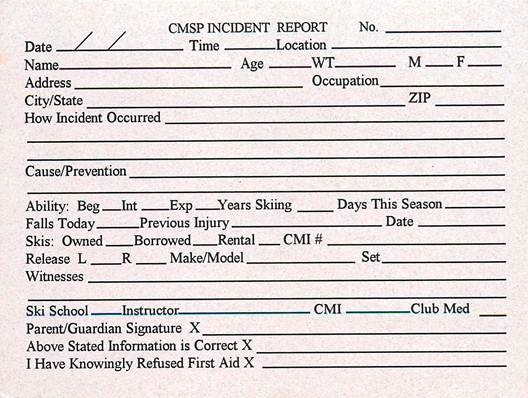
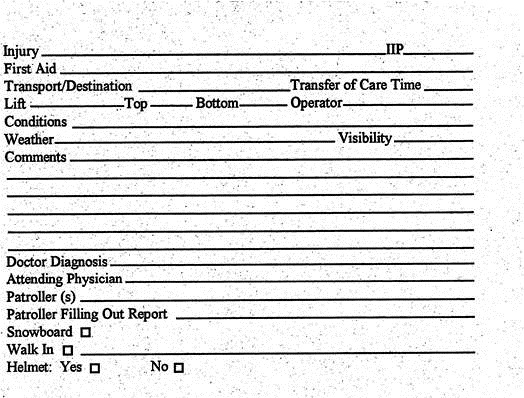
Nothing more than the absolute essentials is captured. These are 5 X 7 cards. The information on the form is 100% from the injured party. No information is put on the card by the patrollers unless it is direct information acquired by the patroller such as the release number setting on the skis, etc.
If there are witnesses then there are 5 X 7 cards for them to complete. There was also a form if a ski school student was injured. If the accident was a life changing incident, major trauma then there were more forms. But for 99% of the accidents, the entire report fit in a patroller’s pocket.
If the injured party cannot fill out the card, then the patroller asks the questions and writes down what the injured party says.
No opinion, no estimates, no guesses, just the facts. (Remember Dragnet the TV show from the 60s.)
Then, once you have the information it must be used. Where are the problems, can we fix the problems, should we warn people about the problems? What can we do to prevent injuries, and if we can’t can we warn people they don’t get injured?
If not, those reports will show up in trial, and probably not to help you.
For an article about bad accident reports see Be Afraid, be very afraid of pre-printed forms for your recreation business.
What do you think? Leave a comment.
If you like this let your friends know or post it on FB, Twitter or LinkedIn
Copyright 2012 Recreation Law (720) Edit Law
Twitter: RecreationLaw
Facebook: Rec.Law.Now
Facebook Page: Outdoor Recreation & Adventure Travel Law
Mobile Site: http://m.recreation-law.com
#RecreationLaw, #@RecreationLaw, #Cycling.Law #Fitness.Law, #Ski.Law, #Outside.Law, #Recreation.Law, #Recreation-Law.com, #Outdoor Law, #Recreation Law, #Outdoor Recreation Law, #Adventure Travel Law, #law, #Travel Law, #Jim Moss, #James H. Moss, #Attorney at Law, #Tourism, #Adventure Tourism, #Rec-Law, #Rec-Law Blog, #Recreation Law, #Recreation Law Blog, #Risk Management, #Human Powered, #Human Powered Recreation,# Cycling Law, #Bicycling Law, #Fitness Law, #Recreation-Law.com, #Backpacking, #Hiking, #Mountaineering, #Ice Climbing, #Rock Climbing, #Ropes Course, #Challenge Course, #Summer Camp, #Camps, #Youth Camps, #Skiing, #Ski Areas, #Negligence, #Snowboarding, #RecreationLaw, #@RecreationLaw, #Cycling.Law #Fitness.Law, #SkiLaw, #Outside.Law, #Recreation.Law, #RecreationLaw.com, #OutdoorLaw, #RecreationLaw, #OutdoorRecreationLaw, #AdventureTravelLaw, #Law, #TravelLaw, #JimMoss, #JamesHMoss, #AttorneyatLaw, #Tourism, #AdventureTourism, #RecLaw, #RecLawBlog, #RecreationLawBlog, #RiskManagement, #HumanPowered, #HumanPoweredRecreation,# CyclingLaw, #BicyclingLaw, #FitnessLaw, #RecreationLaw.com, #Backpacking, #Hiking, #Mountaineering, #IceClimbing, #RockClimbing, #RopesCourse, #ChallengeCourse, #SummerCamp, #Camps, #YouthCamps, #Skiing, #Ski Areas, #Negligence, #Snowboarding, sport and recreation laws, ski law, cycling law, Colorado law, law for recreation and sport managers, bicycling and the law, cycling and the law, ski helmet law, skiers code, skiing accidents, #Accident, Accident Report, Alpine Slide, #Slide, #Sled,
Herbst v. L.B.O. Holding, Inc., 2011 DNH 72; 783 F. Supp. 2d 262; 2011 U.S. Dist. LEXIS 46977; 85 Fed. R. Evid. Serv. (Callaghan) 285
Posted: March 12, 2012 Filed under: Legal Case, New Hampshire, Release (pre-injury contract not to sue) | Tags: Alpine Slide, Attitash, Attitash Ski Area, Federal Supplement, Motion in Limine, New Hampshire, United States, United States district court Leave a commentHerbst v. L.B.O. Holding, Inc., 2011 DNH 72; 783 F. Supp. 2d 262; 2011 U.S. Dist. LEXIS 46977; 85 Fed. R. Evid. Serv. (Callaghan) 285
Edward Herbst v. L.B.O. Holding, Inc., d/b/a Attitash Bear Peak Resort
Civil No. 09-cv-233-JL
UNITED STATES DISTRICT COURT FOR THE DISTRICT OF NEW HAMPSHIRE
2011 DNH 72; 783 F. Supp. 2d 262; 2011 U.S. Dist. LEXIS 46977; 85 Fed. R. Evid. Serv. (Callaghan) 285
May 2, 2011, Decided
May 2, 2011, Filed
COUNSEL: [**1] For Edward Herbst, Dina Herbst, Plaintiffs: R. Peter Taylor, McNeill Taylor & Gallo PA, Dover, NH.
For L.B.O. Holding, Inc., Defendant: Thomas B.S. Quarles, Jr., Devine Millimet & Branch PA (Manchester), Manchester, NH.
JUDGES: Joseph N. Laplante, United States District Judge.
OPINION BY: Joseph N. Laplante
OPINION
[*264] MEMORANDUM ORDER
This case arises from injuries, including a broken ankle, that plaintiff Edward Herbst suffered after falling off an alpine slide at Attitash Bear Peak Resort, a ski area in Bartlett, New Hampshire that offers the slide as a summer recreational activity. Herbst brought suit against the resort’s owner, L.B.O. Holding, Inc. (“Attitash”), asserting claims for strict products liability and negligence. Specifically, he alleges that the slide is unreasonably dangerous to its riders, that Attitash was negligent in operating it, and that Attitash failed to adequately instruct and warn Herbst on its proper use. Attitash denies those allegations and asserts that Herbst’s [*265] own negligence caused the accident. This court has subject-matter jurisdiction under 28 U.S.C. § 1332(a)(1) (diversity).
Both parties have moved in limine to admit or exclude various types of evidence at the upcoming jury trial, currently [**2] scheduled for May 2011. See L.R. 16.2(b)(3). Specifically, Attitash has moved to admit evidence of Herbst’s prior conviction for mail fraud, to exclude evidence of the face amount of Herbst’s medical bills, and to preclude Herbst’s expert witness from testifying about the adequacy of the slide’s warnings. Herbst, in turn, has moved to admit evidence of prior and subsequent accidents on Attitash’s alpine slide. Following oral argument, this court rules on the limine motions as set forth below.
I.Attitash’s motion to admit prior conviction1
1 Document no. 19.
Attitash has moved to admit evidence that Herbst was convicted of felony mail fraud, see 18 U.S.C. § 1341, in a New York federal court on July 30, 1999, when he was 46 years old. See United States v. Herbst, No. 98-cr-771-001 (S.D.N.Y. July 27, 1999). Specifically, Herbst pled guilty to using the mails in connection with bribing an employee of the New York City Department of Finance to reduce or eliminate his overdue property taxes and interest. He served a three-month prison sentence, ending on or before January 1, 2000, and then remained on supervised release for a period of three years.
As a general rule, [HN1] “evidence that any witness [**3] has been convicted of a crime shall be admitted” for impeachment purposes “if it readily can be determined that establishing the elements of the crime required proof or admission of an act of dishonesty or false statement by the witness.” Fed. R. Evid. 609(a)(2). Herbst concedes that his mail fraud conviction involved dishonesty or false statement and therefore falls within that rule. See, e.g., United States v. Orlando-Figueroa, 229 F.3d 33, 46 (1st Cir. 2000).
But evidence of such a conviction “is not admissible if a period of more than ten years has elapsed since the date of the conviction or of the release of the witness from the confinement imposed for that conviction, whichever is later, unless the court determines, in the interests of justice, that the probative value of the conviction supported by specific facts and circumstances substantially outweighs its prejudicial effect.” Fed. R. Evid. 609(b).2
2 Rule 609(b) also requires “sufficient advance written notice to provide the adverse party with a fair opportunity to contest the use” of the prior conviction, which Herbst concedes he has received.
More than ten years have passed since Herbst was released from the confinement imposed [**4] for his mail fraud conviction. Attitash argues that Herbst is to blame for that fact, because he waited nearly three years after his 2006 accident to bring this action, and then requested a trial continuance in 2010. But Attitash has not shown that Herbst acted improperly in either regard, or that he “manipulated either the calendar or the scheduling process in order to postpone the trial and allow the clock to run on [his] conviction.”3 United States v. Nguyen, 542 F.3d 275, 280 (1st Cir. 2008) (rejecting a similar argument that “had [the] trial started a few months earlier–as did the trial of [certain] codefendants–the ten-year window would have [*266] remained open”). So there is no reason not to apply Rule 609(b) here. Id. at 281.
3 Indeed, personal injury actions are routinely brought near the end of the limitations period, so as to allow the nature of the injury to become fully understood.
[HN2] “Given the tenor of Rule 609(b), common sense suggests that felony convictions more than ten years old should be admitted only sparingly and in especially compelling circumstances,” based on a “particularized showing” that their probative value substantially outweighs their prejudicial effect. Id. at 278 [**5] (citing 4 Jack B. Weinstein & Margaret A. Berger, Weinstein’s Federal Evidence § 609.06[1] (2d ed. 2007)). Factors to consider in making that determination “may include (i) the impeachment value of the particular convictions, (ii) their immediacy or remoteness . . .; (iii) the degree of potential prejudice that they portend; (iv) the importance of the defendant’s testimony; and (v) the salience of the credibility issue in the circumstances of the particular case.” United States v. Brito, 427 F.3d 53, 64 (1st Cir. 2005).
Here, Herbst’s mail fraud conviction has a direct bearing on his credibility and veracity, and thus a high degree of impeachment value. He demonstrated a willingness to defraud others to improve his own financial situation. Because Herbst is the primary, and in some respects only, witness to his accident and the ride(s) leading up to it (which allegedly affected his state of mind, making him feel the need to slide faster), and because Attitash contends that Herbst himself was at fault for the accident, his testimony is likely to be of great importance at trial, and his credibility is likely to be a particularly salient issue for the jury.
“Of course, [HN3] the mere fact that [**6] [a witness’s] credibility is in issue . . . cannot, by itself, justify admission of evidence of convictions over ten years old,” because that “would make the ten year limit in Rule 609(b) meaningless.” United States v. Brown, 603 F.2d 1022, 1028 (1st Cir. 1979). But the case for admitting evidence of Herbst’s mail fraud conviction is especially compelling here, given the fraudulent nature of his crime, the likely importance of his testimony and credibility with regard to events that only he (and, in some respects, his daughter) witnessed, and that his conviction, which occurred when he was 46 years old, is barely older than ten years.4
4 In fact, as noted supra, had this action been filed earlier, or trial not been continued, impeachment would have been permitted under Rule 609(a).
While the admission of a prior felony conviction always carries some risk of prejudice, that risk is much lower here than it would be, for example, in a criminal case brought against Herbst. See, e.g., Orlando-Figueroa, 229 F.3d at 46 (noting that “Rule 609 is primarily concerned with potential unfairness to a [criminal] defendant when his prior convictions are offered” and concluding that, even under the particular [**7] circumstances of that criminal case, the court could have admitted evidence of a witness’s mail fraud conviction under Rule 609(b), over the defendant’s objection).
The risk of prejudice is further reduced because Herbst suffered objectively verifiable injuries in the accident (including a broken ankle) and is not the only person who has done so in recent years. See Part IV, infra. Given that evidence, the jury is unlikely to regard the accident itself, or Herbst’s decision to bring this lawsuit, as fraudulent, or to reject his claims merely because he has a criminal history. Rather, it is likely to consider Herbst’s conviction for the limited, and proper, purpose of determining whether to believe his specific testimony regarding his conduct on the slide, the reasons for it (including his state of mind), and the pain and suffering it caused him.
[*267] Having considered the specific facts and circumstances of this case, the court concludes that the probative value of Herbst’s mail fraud conviction substantially outweighs its prejudicial effect, and that it is in the interests of justice to admit it into evidence. Attitash’s motion to admit that evidence is therefore granted. To further reduce [**8] any risk of prejudice, Herbst may request a limiting instruction to the jury, both when the evidence is admitted and in the final jury charge. See, e.g., United States v. Tracy, 36 F.3d 187, 194 (1st Cir. 1994).
II.Attitash’s motion to exclude medical bills5
5 Document no. 20.
Attitash has moved to preclude Herbst from introducing evidence of the face amounts of his medical bills, arguing that the reasonable value of medical services is the amount actually paid for them (here, by Medicaid), not the higher amount billed. [HN4] This court has repeatedly refused, however, “‘to exclude evidence of the billed cost of medical services’ in favor of ‘the amounts actually paid’ in satisfaction of those costs by the plaintiff’s health insurers.” Reed v. Nat’l Council of Boy Scouts of Am., Inc., 706 F. Supp. 2d 180, 190 (D.N.H. 2010) (quoting Aumand v. Dartmouth Hitchcock Med. Ctr., 611 F. Supp. 2d 78, 91 (D.N.H. 2009)); see also Bartlett v. Mut. Pharm. Co., 2010 U.S. Dist. LEXIS 142906, 2010 WL 3156555, at * 2; Williamson v. Odyssey House, Inc., 2000 DNH 238, 2000 WL 1745101, at *1 (DiClerico, D.J.).
As explained more fully in those decisions, Medicaid write-offs fall within the scope of New Hampshire’s collateral source [**9] rule, which “provides that ‘if a plaintiff is compensated in whole or part for his damages by some source independent of the tort-feasor, he is still permitted to make full recovery against the tort-feasor.'” Reed, 706 F. Supp. 2d at 190 (quoting Moulton v. Groveton Papers Co., 114 N.H. 505, 509, 323 A.2d 906 (1974)). Accordingly, this court has not only permitted plaintiffs to present evidence of the amounts billed, but has prohibited defendants from presenting evidence of the amounts actually paid, deeming such evidence unfairly prejudicial. See, e.g., Bartlett, 2010 U.S. Dist. LEXIS 142906, 2010 WL 3156555, at *2 (citing Fed. R. Evid. 403).
Attitash notes that a number of New Hampshire Superior Court judges have reached the opposite conclusion. But this court considered much, if not all, of that case law in Reed, which noted that there is Superior Court precedent in both directions and announced that “unless and until this state’s version of the collateral source rule is changed by the New Hampshire legislature or New Hampshire Supreme Court, this court will continue to apply it to billed amounts ‘written off’ by a plaintiff’s providers, in accordance with existing law here and in the vast majority of other jurisdictions.” [**10] 706 F. Supp. 2d at 190, 194.6
6 This is not to say, however, that the court finds the contrary Superior Court decisions wholly unpersuasive, at least as a policy matter, particularly in the context of private health insurance (as opposed to Medicaid or other public health insurance). But it is this state’s legislature–or, with respect to common-law rules, its Supreme Court–which decides such matters, not this court.
Attitash’s motion in limine is therefore denied. It is important to note, however, that Attitash may still challenge whether the billed amounts reflect the reasonable value of Herbst’s medical services, provided it does not use evidence of the Medicaid write-offs to do so, and otherwise complies with the rules of evidence. See [*268] Bartlett, 2010 U.S. Dist. LEXIS 142906, 2010 WL 3156555, at *2 (citing Reed, 706 F. Supp. 2d at 194).
III.Attitash’s motion to exclude expert testimony on warnings7
7 Document no. 34. The court discussed this issue with the parties at oral argument (before Attitash’s motion had been filed) and then gave both parties an opportunity to brief it before trial.
Attitash has also moved to preclude Herbst’s expert witness, engineer John Mroszczyk, from testifying that the slide’s warnings were [**11] inadequate, arguing that no such opinion was disclosed in his expert report. See [HN5] Fed. R. Civ. P. 26(a)(2)(B) (expert “report must contain . . . a complete statement of all opinions the witness will express and the basis and reasons for them“) and 37(c)(1) (where “a party fails to provide information . . . as required by Rule 26(a),” it “is not allowed to use that information . . . at a trial, unless the failure was substantially justified or is harmless“). The only warning-related opinion expressly set forth in Mroszczyk’s report was that the slide had “a number of instruction and warning signs at the slide loading area” (photos of which he attached to the report), but “no speed limit signs posted along the slide.”
Herbst concedes “that it would certainly have been preferable to ensure that Mroszczyk clearly expressed his opinion” about the warnings in his expert report, see document no. 33, at 4, but nevertheless argues that it is a reasonable inference from the report that he considers the warnings inadequate, and that he should therefore be allowed to offer that opinion at trial. See, e.g., Metavante Corp. v. Emigrant Sav. Bank, 619 F.3d 748, 762 (7th Cir. 2010) (expert report need [**12] not “replicate every word that the expert might say on the stand,” as long as it sufficiently “convey[s] the substance of the expert’s opinion . . . so that the opponent will be ready to rebut, to cross-examine, and to offer a competing expert, if necessary”) (quotation omitted).
Herbst has submitted an affidavit from Mroszczyk clarifying that he “do[es] not believe that any warning in a sign regarding the particular problems” that Herbst encountered on the alpine slide “would be adequate to make this ride safe,” i.e., he “do[es] not believe that this condition in the slide could be made safe by warnings.” Document no. 33-1, at 2. This court agrees that such an opinion can be reasonably inferred from his report, which, after noting the existing signs and the lack of speed limits, states that riders have no ability to gauge their speed anyway and that, even “at a reasonable speed,” they could still “leave the track.” The strong implication is that no warning would be adequate.
The problem with that opinion, at least for Herbst, is that it means that Attitash’s alleged failure to warn did not cause his accident and injuries, because, according to Mroszczyk, no warning would have been adequate [**13] to protect Herbst from the particular problems he encountered. See, e.g., Trull v. Volkswagen of Am., Inc., 145 N.H. 259, 264, 761 A.2d 477 (2000) (“failure to warn must be [a] proximate cause of plaintiff’s injuries”); LeBlanc v. Am. Honda Motor Co., 141 N.H. 579, 586, 688 A.2d 556 (1997) (“[t]he issue in [a] failure to warn claim . . . is whether the danger . . . was or could have been made reasonable by the issuance of adequate warnings”). In other words, the opinion supports Herbst’s unreasonable dangerousness theory, but at the expense of his failure-to-warn theory.
Nevertheless, if Herbst wishes to offer Mroszczyk’s opinion at trial that the slide’s warnings were inadequate because no warning regarding the particular problems [*269] that Herbst encountered would have made the ride safe, this court will allow him to do so. While not expressly disclosed in Mroszczyk’s report, that opinion can be reasonably inferred from the substance of the report, and Attitash has received sufficient notice to “be ready to rebut [it], to cross-examine, and to offer a competing expert, if necessary.” Metavante, 619 F.3d at 762. Attitash’s motion to exclude such testimony is denied.8
8 Mroszczyk should be careful, however, not to venture [**14] beyond the limited opinion set forth above, or to suggest (contrary to that opinion) that some other warning by Attitash would have been adequate to prevent Herbst’s accident.
IV.Herbst’s motion to admit evidence of other accidents9
9 Document no. 15.
Herbst, in turn, has moved to admit evidence of various other accidents on Attitash’s alpine slide, including 21 that occurred between 2004 and 2006 (either prior to or just after his accident), and also one that his expert witness, Mroszczyk, happened to observe in 2010 while conducting a site visit for purposes of inspecting the slide and preparing his expert report in this case.10 Attitash objects that those accidents were not substantially similar to Herbst’s accident and that, in any event, evidence of other accidents–particularly the one Mroszczyk witnessed in 2010–would be unfairly prejudicial, would confuse the jury, and would unduly delay the trial. See Fed. R. Evid. 403.
10 Herbst initially sought to admit evidence of even more accidents, including some involving collisions between two riders. At oral argument and in his subsequent briefing, however, he narrowed his request to those accidents that he considers most similar to his [**15] own.
[HN6] “Evidence of prior accidents is admissible . . . only if the proponent of the evidence shows that the accidents occurred under circumstances substantially similar to those at issue in the case at bar.” Moulton v. Rival Co., 116 F.3d 22, 26-27 (1st Cir. 1997) (quoting McKinnon v. Skil Corp., 638 F.2d 270, 277 (1st Cir. 1981)). Both parties agree that the same requirement applies to subsequent accidents, as other courts have held. See, e.g., Reddin v. Robinson Prop. Group, LP, 239 F.3d 756, 760 (5th Cir. 2001). “At bottom, the ‘substantially similar’ requirement is a more particularized approach to the requirement that evidence be probative.” Trull v. Volkswagen of Am., Inc., 187 F.3d 88, 98 n.9 (1st Cir. 1999).
“‘Substantial similarity’ is a function of the theory of the case.” Moulton, 116 F.3d at 27. Here, Herbst’s theory (supported by expert testimony) is that Attitash’s alpine slide causes riders to move side-to-side within the slide and sometimes to lose control, particularly through curves; and that if a rider reaches the end of a curve embankment in that state, there is a risk of falling off the slide, as allegedly happened in his accident. According to Herbst’s expert, many [**16] curves in the slide pose that risk. In light of that theory, this court construes “substantially similar” to mean, for purposes of this case, that the rider in the other accident must have lost control around a curve and fallen off the slide.
A.2004-2006 accidents
Herbst has made evidentiary proffers regarding each of the accidents at issue. For the 21 accidents occurring between 2004 and 2006, he has submitted accident reports (6 from the New Hampshire Department of Safety and 15 from Attitash itself). The reports, however, provide very little detail. Most of them [*270] indicate that the rider fell off the slide, but not how or where it happened. Mroszczyk believes that each accident “probably” involved loss of control and ejection around a curve, because riders ordinarily would not fall off the slide on a straightaway. But at least two of the accidents were described as occurring on a straightaway, and some had other causes (e.g., a squirrel in the track). So that assumption seems flawed.
This court has closely reviewed each of the accident reports and finds that Herbst has met his burden of showing substantial similarity only as to four accidents:
· the accident on July 12, 2005 (where the [**17] rider “came through [the] dip, came to next set of banks, came out of track”);
· the accident on July 23, 2005 (where the “sled came off track” near a bank);
· the accident on August 3, 2005 (where the rider “hit the curve, jumped the track”); and
· the accident on July 16, 2006 (where the rider “came from a right turn into a left turn and his cart flew off”).
All of the other accidents involved materially different circumstances, or at least were not sufficiently described for this court to deem them substantially similar. See, e.g., Downey v. Bob’s Disc. Furniture Holdings, Inc., 633 F.3d 1, 9 (1st Cir. 2011) (affirming the exclusion of such evidence where plaintiffs proffered only a “bare bones” printout containing a “cryptic description” of prior incidents, with “no details,” and “conducted no investigation into the underlying facts”).11
11 Herbst argues that Attitash admitted, in an interrogatory, that all 15 of the accident reports it produced involved “accidents similar to the plaintiff’s: where an operator left the track and was injured.” But, [HN7] for purposes of discovery, “a flexible treatment of relevance is required and the making of discovery . . . is not a concession or determination [**18] of relevance for purposes of trial,” or admissibility. Fed. R. Civ. P. 26(b)(1), advisory committee notes (1970). Attitash’s interrogatory answer was not an admission of substantial similarity within the meaning of Moulton.
Attitash argues that evidence of even the substantially similar accidents should be excluded as unfairly prejudicial, confusing to the jury, and likely to unduly delay the trial. See Fed. R. Evid. 403. But this court sees little to no risk in any of those respects. Because the accident reports provide so little detail, and appear to be the only available evidence of what happened, the use of such evidence will necessarily be limited in scope. Its main purpose is simply to show that riders occasionally lose control and fall off the track around a curve, as Herbst did, and that Attitash had notice of that risk. That is a proper and probative purpose, which outweighs any of the countervailing concerns listed in Rule 403.
This court therefore grants Herbst’s request to admit evidence of the four accidents noted above, but denies his request to admit evidence of the other accidents between 2004 and 2006. If Herbst believes that this court has overlooked any accident(s) [**19] with circumstances comparably similar to those four accidents, or has additional evidence of substantial similarity beyond that proffered to date, he may raise that issue and/or make a further evidentiary proffer at trial, outside the presence of the jury.
B.2010 accident
For the accident in 2010, Herbst has submitted an affidavit from Mroszczyk explaining what he observed. According to Mroszczyk, that accident, like Herbst’s, involved a rider’s loss of control, side-to-side movement within the slide, and then [*271] ejection from the slide around a curve (albeit a different curve, more than 100 feet down the slide from where Herbst fell). Mroszczyk claims that sequence of events “is precisely what I believe occurred to Mr. Herbst.” Based on that proffer, this court finds that Herbst has sufficiently shown that the 2010 accident was substantially similar to his own, clearing that hurdle for admissibility.12
12 Attitash argues that the 2010 accident resulted from the rider going airborne over a slide feature called “the dip” (not from being ejected around a curve), but that strikes the court as implausible, given the considerable distance between the dip and the place where the rider landed. Attitash [**20] has not proffered any evidence to support that version of events. In any event, if Attitash wishes to challenge Mroszczyk’s testimony regarding how that accident happened, it may do so at trial. An adjuster from Attitash’s insurance company also witnessed the accident and could be called as a witness.
Attitash argues that evidence of the 2010 accident should nevertheless be excluded as unfairly prejudicial, confusing to the jury, and likely to unduly delay the trial. See Fed. R. Evid. 403. It is true that such evidence may pose some risk of prejudice and juror confusion, since the accident happened, incidentally, on the day when Herbst’s expert was inspecting the slide, which might suggest to the jury that accidents happen on the alpine slide with greater frequency than they actually do. Attitash, though, has the ability to present evidence of how often accidents actually happen.13 The jury should not have any trouble understanding or accepting that the timing was just a coincidence.
13 The standard for defendants to introduce evidence of prior accidents is more lenient than for plaintiffs. See Trull, 187 F.3d at 98 n.9.
Conversely, evidence of the 2010 accident has very high probative [**21] value. Mroszczyk’s direct observation of an accident substantially similar to the one that Herbst suffered has the ability to inform, and even corroborate, his expert opinions about what happened to Herbst, and the reason(s) for it. That firsthand experience could make his testimony much more persuasive and helpful to the jury, whereas preventing him from discussing the accident could leave the jury with an incomplete, and potentially inaccurate, understanding of the basis for and reliability of his opinions.
On balance, this court concludes that the probative value of the 2010 accident outweighs the risk of prejudice and juror confusion, and therefore grants Herbst’s motion to admit evidence of that accident. As to Attitash’s argument that such evidence will cause undue delay, this court doubts that will happen, but will keep that concern in mind during trial and will be open to any proposals that Attitash may have (short of outright exclusion) for reasonably limiting the amount of such evidence, and the manner in which it is presented, so as to avoid undue delay and reduce the risk of prejudice.
V.Conclusion
For the reasons set forth above, Attitash’s motion to admit evidence of Herbst’s [**22] prior conviction14 is GRANTED, Attitash’s motion to exclude evidence of Herbst’s medical bills15 is DENIED, Attitash’s motion to preclude Mroszczyk from testifying about the slide’s warnings16 is DENIED, and Herbst’s motion to admit evidence of [*272] prior and subsequent accidents17 is GRANTED in part and DENIED in part.
14 Document no. 19.
15 Document no. 20.
16 Document no. 34.
17 Document no. 15.
SO ORDERED.
/s/ Joseph N. Laplante
Joseph N. Laplante
United States District Judge
Dated: May 2, 2011
SmartWool and Its Smart Strategy: OIA CU Leeds Lecture, March 15
Posted: March 9, 2012 Filed under: Uncategorized | Tags: #CU, #MBA, #OIA, Boulder, Boulder Colorado, Colorado, Folsom Field, Leeds Business Schook, Mark Satkiewicz, Outdoor Industry Assocition, Smartwool, Thursday, University of Colorado, University of Colorado at Boulder Leave a comment |
||||
|
||||
|
||||
| Outdoor Industry Association | 4909 Pearl East Circle | Suite 300 | Boulder, CO 80301 | Privacy Policy ph: 303.444.3353 | fax: 303.444.3284 | Feedback |
||||
|
||||
| You are receiving this email in connection with your company’s interest in Outdoor Industry Association. If you prefer not to receive any emails from Outdoor Industry Association, click here to unsubscribe. Please note, that if you unsubscribe, you will no longer receive important communications from OIA, including upcoming educational events and seminars. | ||||


 Mark Satkiewicz


 |

Grand Canyon Raft Company Summer Job
Posted: March 9, 2012 Filed under: Uncategorized | Tags: Arizona, Arizona Raft Adventures, Colorado River, Employment, Flagstaff Arizona, Grand Canyon, Grand Canyon National Park, NationalParkService, Raft, Whitewater Rafting Leave a comment
Image via Wikipedia
Arizona Raft Adventures & Grand Canyon Discovery
Warehouse Personnel Job summary
Overview:
AzRA/Discoevry is a licensed concessioner for the Grand Canyon National Park. We offer 6 to 16 day rafting tours through Grand Canyon National Park on the Colorado River. We are looking for part/full time warehouse employees to help with pre and post trip logistics. The positions will be up to forty hours a week and run from April to October, 2012.
General Responsibilities:
Maintain a safe and clean warehouse/work area
Be able to work well with others
Be in sound physical condition (able to lift 70 pounds)
Maintenance and repair of river equipment
Assist guide crew in safely loading and unloading trucks
Pre packing equipment for outgoing river trips
Licenses and skills:
Must have a drivers license
Willing to obtain a forklift operator certificate
It is AzRA/Discovery’s to provide equal employment opportunity to all individuals based on job related qualifications. AzRA/Discovery complies with all federal, state, and local non-discrimination laws in all aspects of employment including recruiting, hiring, promotion, development, transfer, and disciplinary action.
DRUG-FREE WORK ENVIRONMENT AND SUBSTANCE ABUSE
AzRA/Discovery has always followed and will continue to follow all State, Federal, and National Park Service rules and regulations concerning a drug-free work environment (pre-employment and random drug testing).
HOW TO APPLY
Send a resume to fred and jed by March 19th. Include with the resume a phone number and your availability. This is no way a river position or away to become a guide.
Thank you,
Fred Thevenin
Arizona Raft Adventures & Grand Canyon Discovery
4050 E Huntington Dr. Flagstaff, AZ 86004
928-526-8200, 800-786-7238
www.azraft.com, AzRA on Facebook, AzRA YouTube Channel
American Mountain Bike Challenge Dates
Posted: March 8, 2012 Filed under: Cycling | Tags: #race, Cycling, Mountain bike, Mountain Bike Challenge, Mountain biking, Race Dates, Recreation and Sports, Sports, USA Cycling, XC Racing Leave a comment
Image by Getty Images via @daylife
|
||||||||||||||||||



Image via Wikipedia


 Recreation Law