
Fish and Wildlife Service in Vernal – Looking For Whitewater Boatmen
Posted: January 12, 2013 Filed under: Whitewater Rafting | Tags: Boat, Employment, Fish, Rafting, Recreation, United States, United States Fish and Wildlife Service, Vernal, Vernal Utah, Whitewater Rafting Leave a commentFish & Wildlife Service – Vernal – Looking For Boatmen
The FWS offices in Vernal and Grand Junction are recruiting people for seasonal work operating boats for fish work. In particular, we are looking for folks with solid whitewater rafting skills who can operate heavy oar rafts. This job is not the same as our seasonal fish tech job, so it focuses on boat operation, although all staff will eventually be proficient on the fish end of things. The link for the announcement is below. The announcement will be open for 2 weeks, starting today.
If you know any boaters looking to have a long season, are maybe a little burned out on taking care of guests, or want to see what’s been living under their boat all these years, please pass this along. There may also be an opportunity for guides looking for early season work before they go to their guiding job for the summer. We really need people in April and May.
From: FWS HR Sent: Friday, January 04, 2013 10:00 AM Subject: Seasonal Small Craft Operator link to USA Jobs
Good morning, below is a link to the Small Craft Operator announcement, which opened today on USA Jobs:
R6-13-813050-D https://www.usajobs.gov/GetJob/ViewDetails/334857400


2012-2013 In bound ski/board fatalities
Posted: January 9, 2013 Filed under: Avalanche, California, Colorado, Idaho, Michigan, Ski Area, Skiing / Snow Boarding | Tags: alpine Meadwos, Boyne Highlands Resort, Copper Mountain, Donner Ski Ranch, helmet, Keystone Resort, Keystone Ski Resort, SEATTLE, Ski, ski season, Snowboard, Snowmass, Squaw Valley Ski Resort, Sun Valley, Sun Valley Idaho, Sun Valley ski resort, Vail, Vail Colorado Leave a commentThis list is not guaranteed to be accurate. The information is found from web searches and news dispatches. Those references are part of the chart. If you have a source for information on any fatality please leave a comment or contact me. Thank you.
Several Corrections have been made to items reported earlier.
If this information is incorrect or incomplete please let me know. This is up to date as of January 8, 2013. Thanks.
Skiing and Snowboarding are still safer than your kitchen or bathroom. This information is not to scare you away from skiing but to help you understand the risks and to study.
2012 – 2013 Ski Season Deaths
Red is a probable death due to medical issues unrelated to skiing
Dark blue is a death of an employee while working
Tab through the Table to See the Entire Table
| # | Date | State | Resort | Where | How | Cause | Ski/Board | Age | Sex | Name | Home town | Helmet | Reference | ||
| 1 | 11/29/12 | ID | Sun Valley ski resort | Bald Mountain Chairlift | Fell off (Medical?) | 56 | M | Dana Mower | Sun Valley, ID & Seattle, WA | http://rec-law.us/Vi4ims | http://rec-law.us/TyVnKu | ||||
| 2 | 12/1/12 | CO | Keystone Resort | River Run Gondola Maze | Standing in Maze (Medical) | Skier | 66 | M | Rex Brian Burton | Castle Rock, CO | http://rec-law.us/SCZHXJ | http://rec-law.us/YkDioj | http://rec-law.us/UjBMfK | ||
| 3 | 12/2/12 | MI | Boyne Highlands Resort | Camelot, (Beginner) | fell within the slope boundaries and did not collide with any type of obstacle | . | Boarder | 17 | F | Kasandra Knapp | Alanson, MI | http://rec-law.us/11JFVOo | |||
| 4 | 12/9 | CO | Vail | Born Free trail | Hiking before resort opened (Medical) | 61 | M | Denver | http://rec-law.us/Zg0OC1 | ||||||
| 5 | 12/9 | CO | Vail | Eagle Bahn Gondola (Medical) | 63 | M | Douglas Voisard | Vail | http://rec-law.us/Zg0OC1 | ||||||
| 6 | 12/21 | CA | Squaw Valley | KT-22 | strike the tree, hitting the left side of his head | Skier | 71 | M | Theodore Stanley Sorensen | Auburn, CA | Yes | http://rec-law.us/10ctrSt | |||
| 7 | 12/24 | CA | Donner Ski Ranch | Avalanche | Boarder | 49 | M | Steven Mark Anderson | Hirschdale | http://rec-law.us/UCaHJz | http://rec-law.us/Sgjsbi | ||||
| 8 | 12/24 | CA | Alpine Meadows | Sherwood Bowl | Avalanche | Skier | 53 | M | Bill Foster | http://rec-law.us/13eiU72 | http://rec-law.us/VGsqh5 | ||||
| 9 | 12/30 | CO | Snowmass | Hanging Valley Headwall | Avalanche | Swept over cliff | Skier | 49 | F | Patricia “Patsy” Hileman | http://rec-law.us/RCv6fd | http://rec-law.us/VOCr8H | |||
| 10 | 1/4 | CO | Copper Mountain | Vein Glory | Hit tree | M | Tristan Bartlett | Houston, TX | No | http://rec-law.us/RCy03u | http://rec-law.us/VyzVnU | http://rec-law.us/WoJEf5 |
Our condolences go to the families of the deceased. Our thoughts extend to the families and staff at the areas who have to deal with these tragedies.
What do you think? Leave a comment.
If you like this let your friends know or post it on FB, Twitter or LinkedIn
Copyright 2013 Recreation Law (720) Edit Law
Twitter: RecreationLaw
Facebook: Rec.Law.Now
Facebook Page: Outdoor Recreation & Adventure Travel Law
Mobile Site: http://m.recreation-law.com
#RecreationLaw, #@RecreationLaw, #Cycling.Law #Fitness.Law, #Ski.Law, #Outside.Law, #Recreation.Law, #Recreation-Law.com, #Outdoor Law, #Recreation Law, #Outdoor Recreation Law, #Adventure Travel Law, #law, #Travel Law, #Jim Moss, #James H. Moss, #Attorney at Law, #Tourism, #Adventure Tourism, #Rec-Law, #Rec-Law Blog, #Recreation Law, #Recreation Law Blog, #Risk Management, #Human Powered, #Human Powered Recreation,# Cycling Law, #Bicycling Law, #Fitness Law, #Recreation-Law.com, #Backpacking, #Hiking, #Mountaineering, #Ice Climbing, #Rock Climbing, #Ropes Course, #Challenge Course, #Summer Camp, #Camps, #Youth Camps, #Skiing, #Ski Areas, #Negligence, #Snowboarding, #RecreationLaw, #@RecreationLaw, #Cycling.Law #Fitness.Law, #SkiLaw, #Outside.Law, #Recreation.Law, #RecreationLaw.com, #OutdoorLaw, #RecreationLaw, #OutdoorRecreationLaw, #AdventureTravelLaw, #Law, #TravelLaw, #JimMoss, #JamesHMoss, #AttorneyatLaw, #Tourism, #AdventureTourism, #RecLaw, #RecLawBlog, #RecreationLawBlog, #RiskManagement, #HumanPowered, #HumanPoweredRecreation,# CyclingLaw, #BicyclingLaw, #FitnessLaw, #RecreationLaw.com, #Backpacking, #Hiking, #Mountaineering, #IceClimbing, #RockClimbing, #RopesCourse, #ChallengeCourse, #SummerCamp, #Camps, #YouthCamps, #Skiing, #Ski Areas, #Negligence, #Snowboarding, sport and recreation laws, ski law, cycling law, Colorado law, law for recreation and sport managers, bicycling and the law, cycling and the law, ski helmet law, skiers code, skiing accidents, Recreation Lawyer, Ski Lawyer, Paddlesports Lawyer, Cycling Lawyer, Recreational Lawyer, Fitness Lawyer, Rec Lawyer, Challenge Course Lawyer, Ropes Course Lawyer, Zip Line Lawyer, Rock Climbing Lawyer, Adventure Travel Lawyer, Outside Lawyer, Recreation Lawyer, Ski Lawyer, Paddlesports Lawyer, Cycling Lawyer, #RecreationalLawyer, #FitnessLawyer, #RecLawyer, #ChallengeCourseLawyer, #RopesCourseLawyer, #ZipLineLawyer, #RockClimbingLawyer, #AdventureTravelLawyer, #OutsideLawyer, Copper Mountain, Snowmass, alpine Meadwos, Donner Ski Ranch, Donner Ski Ranch, Helmet, Vail, Boyne Highlands Resort, Sun Valley ski resort, Keystone Ski Resort,
WordPress Tags: information,news,references,Thank,Several,Corrections,items,January,Thanks,kitchen,bathroom,Season,Deaths,death,Dark,employee,Date,State,Resort,Where,Cause,Board,Name,Home,Helmet,Reference,Valley,Bald,Mountain,Chairlift,Fell,Medical,Dana,Mower,Seattle,TyVnKu,River,Gondola,Maze,Skier,Brian,Burton,Castle,Rock,SCZHXJ,YkDioj,UjBMfK,Boyne,Highlands,Camelot,Beginner,boundaries,obstacle,Boarder,Kasandra,Knapp,Alanson,Vail,Born,Free,Denver,Eagle,Bahn,Douglas,Voisard,Squaw,tree,Stanley,Sorensen,Auburn,Donner,Ranch,Avalanche,Steven,Mark,Anderson,Hirschdale,UCaHJz,Sgjsbi,Alpine,Meadows,Sherwood,Bowl,Bill,Foster,Snowmass,Headwall,Swept,cliff,Patricia,Patsy,Hileman,Copper,Vein,Glory,Tristan,Bartlett,Houston,VyzVnU,condolences,families,areas,tragedies,Leave,Twitter,LinkedIn,Recreation,Edit,RecreationLaw,Facebook,Page,Outdoor,Adventure,Travel,Blog,Mobile,Site,Outside,Moss,James,Attorney,Tourism,Risk,Management,Human,Ropes,Course,Challenge,Summer,Camp,Camps,Youth,Negligence,SkiLaw,OutdoorLaw,OutdoorRecreationLaw,AdventureTravelLaw,TravelLaw,JimMoss,JamesHMoss,AttorneyatLaw,AdventureTourism,RecLaw,RecLawBlog,RecreationLawBlog,RiskManagement,HumanPoweredRecreation,CyclingLaw,BicyclingLaw,FitnessLaw,RopesCourse,ChallengeCourse,SummerCamp,YouthCamps,Colorado,managers,accidents,Lawyer,Paddlesports,Recreational,Line,RecreationalLawyer,FitnessLawyer,RecLawyer,ChallengeCourseLawyer,RopesCourseLawyer,ZipLineLawyer,RockClimbingLawyer,AdventureTravelLawyer,OutsideLawyer,Meadwos
USA Pro Challenge Announces 2013 Route. 8 Colorado Cities get picked
Posted: January 8, 2013 Filed under: Cycling | Tags: Aspen, Bike Racing, Christian Vandevelde, Colorado, Cycling, Denver, Fort Collins Colorado, Levi Leipheimer, Racing, United States, USA Pro Challenge Leave a comment
|
|||||||||||||

Ohio adopts the requirement that a skier assumes the risk of a collision with another skier.
Posted: January 7, 2013 Filed under: Assumption of the Risk, Ohio, Skier v. Skier | Tags: Ohio, Ohio Supreme Court, Risk, Ski, Ski Resort, Sports, Supreme Court, Winter sport Leave a commentHorvath Et Al., v. Ish Et Al., 2012 Ohio 5333; 2012 Ohio LEXIS 2872
In order to recover in a collision on the ski slope the plaintiff must prove the defendant’s actions were reckless or intentional.
This case is between an injured adult and a young snowboarder. The snowboarder and his friends were on the same slope as the adult and his friends. The snowboarders went through the terrain park and upon exiting collided with the plaintiff.
The plaintiff sued for his injuries. The trial court dismissed the complaint based on the assumption of the risk. The plaintiff appealed, and the appellate court reversed the trial court agreeing with the plaintiffs that the Ohio statute created liability on the part of skiers and boarders for any collision.
The Ohio Supreme Court also sent the case back to the trial court but only to determine if the actions of the defendant snowboarder were reckless or intentional. The Supreme Court found that the statute in question, Ohio R.C. 4169.08 or 4169.09 only applied to the ski areas and did not apply to skiers and boarders.
So?
Once the Supreme court held that the statute did not apply, the legal issue was easily decided. The statute in question stated that skiing was a hazardous sport regardless of the safety measures that could be taken.
Under Ohio’s law on sports had held that:
[w]here individuals engage in recreational or sports activities, they assume the ordinary risks of the activity and cannot recover for any injury unless it can be shown that the other participant’s actions were either reckless or intentional
In Ohio, primary assumption of the risk means that a “defendant owes no duty whatsoever to the plaintiff.” The assumption is limited to those risks directly associated with the activity. “To be covered under the [primary-assumption-of-the-risk] doctrine, the risk must be one that is so inherent to the sport or activity that it cannot be eliminated.”
The court then held:
Accordingly, we hold that skiers assume the ordinary risks of skiing, which include collisions with other skiers, and cannot recover for an injury unless it can be shown that the other skier’s actions were reckless or intentional.
So Now What?
Ohio joins most other states with ski areas that require more than simple negligence on the part of the defendant for the plaintiff to recover for a collision on the slopes.
Without this standard of care, the risk of the sport would be totally removed, and skiers and boarders would enter a turnstile before they could enter the slope.
All sports have risk and if you are not willing to accept the risk of the sport then you should search for a sport that has risks that are what you can deal with. Checkers or chess are what I would suggest, although you could be hit by an angry knight if your opponent loses their temper.
Ski Area: Boston Mills Ski Area
Plaintiffs: Angel Horvath and Eugene Horvath
Defendants: David Ish, Tyler Ish and their cousins
Plaintiff Claims: Plaintiff had acted negligently, carelessly, recklessly, willfully, and wantonly in causing the collision with Defendant
Defendant Defenses: Assumption of the Risk
Holding: Reversed and sent back to determine if the defendant acted intentionally or recklessly when he collided with the plaintiff.
| Jim Moss is an attorney specializing in the legal issues of the outdoor recreation community. He represents guides, guide services, outfitters both as businesses and individuals and the products they use for their business. He has defended Mt. Everest guide services, summer camps, climbing rope manufacturers, avalanche beacon manufacturers, and many more manufacturers and outdoor industries. Contact Jim at Jim@Rec-Law.us |
Outdoor Recreation Insurance, Risk Management, and Law
Jim is the author or co-author of six books about the legal issues in the outdoor recreation world; the latest is Outdoor Recreation Insurance, Risk Management and Law.
To see Jim’s complete bio go here and to see his CV you can find it here. To find out the purpose of this website go here.
G-YQ06K3L262
What do you think? Leave a comment.
If you like this let your friends know or post it on FB, Twitter or LinkedIn
 Blue Sky |
 Threads |
 |
 |
 Stimulus |
 X (formerly known as Twitter) logo |
Author: Outdoor Recreation Insurance, Risk Management and Law
Facebook Page: Outdoor Recreation & Adventure Travel Law
Email: Jim@Rec-Law.US
By Recreation Law Rec-law@recreation-law.com James H. Moss
@2024 Summit Magic Publishing, LLC
#RecreationLaw, #@RecreationLaw, #Cycling.Law #Fitness.Law, #Ski.Law, #Outside.Law, #Recreation.Law, #Recreation-Law.com, #Outdoor Law, #Recreation Law, #Outdoor Recreation Law, #Adventure Travel Law, #law, #Travel Law, #Jim Moss, #James H. Moss, #Attorney at Law, #Tourism, #Adventure Tourism, #Rec-Law, #Rec-Law Blog, #Recreation Law, #Recreation Law Blog, #Risk Management, #Human Powered, #Human Powered Recreation,# Cycling Law, #Bicycling Law, #Fitness Law, #Recreation-Law.com, #Backpacking, #Hiking, #Mountaineering, #Ice Climbing, #Rock Climbing, #Ropes Course, #Challenge Course, #Summer Camp, #Camps, #Youth Camps, #Skiing, #Ski Areas, #Negligence, #Snowboarding, #RecreationLaw, #@RecreationLaw, #Cycling.Law #Fitness.Law, #SkiLaw, #Outside.Law, #Recreation.Law, #RecreationLaw.com, #OutdoorLaw, #RecreationLaw, #OutdoorRecreationLaw, #AdventureTravelLaw, #Law, #TravelLaw, #JimMoss, #JamesHMoss, #AttorneyatLaw, #Tourism, #AdventureTourism, #RecLaw, #RecLawBlog, #RecreationLawBlog, #RiskManagement, #HumanPowered, #HumanPoweredRecreation,# CyclingLaw, #BicyclingLaw, #FitnessLaw, #RecreationLaw.com, #Backpacking, #Hiking, #Mountaineering, #IceClimbing, #RockClimbing, #RopesCourse, #ChallengeCourse, #SummerCamp, #Camps, #YouthCamps, #Skiing, #Ski Areas, #Negligence, #Snowboarding, sport and recreation laws, ski law, cycling law, Colorado law, law for recreation and sport managers, bicycling and the law, cycling and the law, ski helmet law, skiers code, skiing accidents, Recreation Lawyer, Ski Lawyer, Paddlesports Lawyer, Cycling Lawyer, Recreational Lawyer, Fitness Lawyer, Rec Lawyer, Challenge Course Lawyer, Ropes Course Lawyer, Zip Line Lawyer, Rock Climbing Lawyer, Adventure Travel Lawyer, Outside Lawyer, Recreation Lawyer, Ski Lawyer, Paddlesports Lawyer, Cycling Lawyer, #RecreationalLawyer, #FitnessLawyer, #RecLawyer, #ChallengeCourseLawyer, #RopesCourseLawyer, #ZipLineLawyer, #RockClimbingLawyer, #AdventureTravelLawyer, #OutsideLawyer,
Horvath Et Al., v. Ish Et Al., 2012 Ohio 5333; 2012 Ohio LEXIS 2872
Posted: January 7, 2013 Filed under: Assumption of the Risk, Legal Case, Ohio, Skier v. Skier | Tags: David, Horvaths, Ohio, Ohio Supreme Court, Ski, Ski Resort, Summary judgment Leave a commentTo Read an Analysis of this decision see: Ohio adopts the requirement that a skier assumes the risk of a collision with another skier.
Horvath Et Al., v. Ish Et Al., 2012 Ohio 5333; 2012 Ohio LEXIS 2872
Horvath Et Al., Appellees, v. Ish Et Al., Appellants.
No. 2011-1089
2012 Ohio 5333; 2012 Ohio LEXIS 2872
April 25, 2012, Submitted
November 20, 2012, Decided
NOTICE:
THIS SLIP OPINION IS SUBJECT TO FORMAL REVISION BEFORE IT IS PUBLISHED IN AN ADVANCE SHEET OF THE OHIO OFFICIAL REPORTS.
PRIOR HISTORY: [**1]
APPEAL from the Court of Appeals for Summit County, No. 25442, 194 Ohio App. 3d 8, 2011 Ohio 2239, 954 N.E.2d 196.
Horvath v. Ish, 194 Ohio App. 3d 8, 2011 Ohio 2239, 954 N.E.2d 196, 2011 Ohio App. LEXIS 1907 (Ohio Ct. App., Summit County, 2011)
DISPOSITION: Judgment affirmed.
CORE TERMS: skier, skiing, sport, ski-area, collision, ski, inherent risks, tramway, negligence per se, slope, ski area, passenger, reckless, standard of care, statutory duties, statutory schemes, owe, common law, summary judgment, owed, duty of care, personal injury, refrain, trail, ordinary care, general assembly, reasonable care, recreational, enumerated, sentence
HEADNOTES
Torts–Sport or recreational activity–Skiers assume the ordinary risks of skiing, which include collisions with other skiers, and cannot recover for an injury unless it can be shown that the other skier’s actions were reckless or intentional.
SYLLABUS
OF THE COURT
Skiers assume the ordinary risks of skiing, which include collisions with other skiers and cannot recover for an injury unless it can be shown that the other skier’s actions were reckless or intentional.
COUNSEL: Paul W. Flowers Co. and Paul W. Flowers; and Sennett Fischer, L.L.C., and James A. Sennett, for appellees.
Gallagher Sharp, Timothy J. Fitzgerald, and Jeremy V. Farrell, for appellants.
JUDGES: LUNDBERG STRATTON, J. O’CONNOR, C.J., and O’DONNELL, LANZINGER, CUPP, and MCGEE BROWN, JJ., concur. PFEIFER, J., concurs in part and dissents in part.
OPINION BY: LUNDBERG STRATTON
OPINION
Lundberg Stratton, J.
I. Introduction
[*P1] The issue before the court is what duty or standard of care is owed by one skier to another for purposes of determining tort liability. We hold that skiers assume the ordinary risks of skiing, which include collisions with other skiers, and cannot recover for an injury unless it can be shown that the other skier’s actions were reckless or intentional.
[*P2] The court of appeals reversed the trial court’s grant of summary judgment in favor of Ish and remanded the case to the trial court [**2] to determine whether Ish had violated any duties under R.C. 4169.08 or 4169.09 and if he did, whether negligence per se applied. The court of appeals also held that a genuine issue of material fact existed whether Ish was reckless. Horvath v. Ish, 194 Ohio App.3d 8, 2011 Ohio 2239, 954 N.E.2d 196, ¶ 18 (9th Dist). We agree that there is a genuine issue of material fact, but only whether Ish’s actions were more than negligent, that is, whether his actions were reckless or intentional under the common law. Therefore, we affirm the judgment of the court of appeals, albeit on somewhat different grounds, and remand the case to the trial court for proceedings consistent with our opinion.
II. Facts and Procedural History
[*P3] On March 6, 2007, Angel Horvath and Eugene Horvath (the couple were married after the accident but before the complaint was filed) were skiing at Boston Mills ski resort. David Ish was snowboarding at Boston Mills on that same date, with his brother, Tyler, and their cousins. In the early evening, Angel and Eugene were skiing down Buttermilk Hill. David, Tyler, and their cousins were snowboarding on the same hill. David and his relatives proceeded through a terrain park 1 [**3] and then reentered Buttermilk Hill, where David and Angel collided. Angel was injured in the accident.
1 A terrain park is an area where snowboarders and skiers can do tricks or stunts using various features including jumps, rails, and half-pipes. See R.C. 4169.01(I).
[*P4] The Horvaths filed a complaint against David Ish and his parents, alleging that David had acted negligently, carelessly, recklessly, willfully, and wantonly in causing the collision with Angel.
[*P5] The Ishes filed a motion for summary judgment, arguing that skiers are subject to primary assumption of the risk, which means that a defendant owes no duty of ordinary care to plaintiff. Thus, the Ishes argued that in order to recover, the Horvaths were required to prove that David had acted recklessly or intentionally in causing the collision. The Ishes further asserted that there was no evidence that David’s actions were reckless or intentional.
[*P6] In opposing the Ishes’ motion for summary judgment, the Horvaths argued that R.C. 4169.08(C) imposes specific duties on skiers and that breaching those duties is negligence per se. The trial court granted the Ishes’ motion for summary judgment.
[*P7] In a two-to-one decision, the court of appeals [**4] reversed the judgment of the trial court, stating that “[b]y reading R.C. 4169.08(C) in context with 4169.09, we find that it is evident that the legislature intended that skiers would be liable for injuries caused to others while skiing.” Horvath, 194 Ohio App.3d 8, 2011 Ohio 2239, 954 N.E.2d 196, ¶ 13. The court of appeals remanded the cause to the trial court to determine whether David Ish’s actions violated any of the responsibilities described in R.C. 4169.08(C) and, if so, whether any such violation invoked the doctrine of negligence per se. Id. at ¶ 14.
[*P8] This case is before this court pursuant to the acceptance of the Ishes’ discretionary appeal. 129 Ohio St. 3d 1503, 2011 Ohio 5358, 955 N.E.2d 386.
III. Analysis
R.C. Chapter 4169
[*P9] We begin our analysis by determining whether R.C. 4169.08 and 4169.09 apply to personal-injury litigation between skiers.
[*P10] When interpreting a statute, a court’s paramount concern is legislative intent. State ex rel. United States Steel Corp. v. Zaleski, 98 Ohio St.3d 395, 2003 Ohio 1630, 786 N.E.2d 39, ¶ 12. “[T]he intent of the law-makers is to be sought first of all in the language employed, and if the words be free from ambiguity and doubt, and express [**5] plainly, clearly and distinctly, the sense of the law-making body, there is no occasion to resort to other means of interpretation ” Slingluff v. Weaver, 66 Ohio St. 621, 64 N.E. 574 (1902), paragraph two of the syllabus. However, “[i]n reviewing a statute, a court cannot pick out one sentence and disassociate it from the context, but must look to the four corners of the enactment to determine the intent of the enacting body.” State v. Wilson, 77 Ohio St.3d 334, 336, 1997 Ohio 35, 673 N.E.2d 1347 (1997). “A court must examine a statute in its entirety rather than focus on an isolated phrase to determine legislative intent.” Massillon City School Dist. Bd. of Edn. v. Massillon, 104 Ohio St.3d 518, 2004 Ohio 6775, 820 N.E.2d 874, ¶ 37.
[*P11] See also R.C. 1.42. With this guidance in mind, we examine R.C. Chapter 4169 in its entirety to determine whether R.C. 4169.08 and 4169.09 apply to personal-injury litigation between skiers.
[*P12] R.C. 4169.02 established a ski-tramway board that is authorized to create rules under R.C. Chapter 119 relating to “public safety in the construction, maintenance, mechanical operation, and inspection of passenger tramways.” 2 R.C. 4169.03 requires that a tramway must be registered [**6] with the board before it can be operated. R.C. 4169.04 provides that tramways must be inspected. R.C. 4169.05 authorizes the board to hear complaints that the construction, maintenance, or mechanical operation of a tramway endangers public safety. R.C. 4169.06 permits a board member to suspend the operation of a tramway if the board determines that an “immediate danger exists.” R.C. 4169.07 provides that ski-area operators are responsible for any tramway they construct and for the maintenance and operation of a passenger tramway in the operator’s ski area. R.C. 4169.07 also states that passengers have certain enumerated responsibilities regarding their use of tramways. R.C. 4169.99 provides that ski-area operators are subject to a monetary fine if they fail to register their tramway with the board, fail to comply with an order from the board, or fail to comply with a rule issued by the board.
2 A “passenger tramway” is “a device used to transport passengers uphill, whether on skis or other devices or without skis or other devices, or in cars on tracks or suspended in the air, by the use of steel cables, chains, or belts or by ropes, and that is usually supported by trestles or towers [**7] with one or two spans.” R.C. 4169.01(F). Chair lifts, rope tows, and conveyors are passenger tramways. R.C. 4169.01(F)(3), (5), and (7).
[*P13] R.C. 4169.08 insulates ski-area operators from liability for injuries that arise from the inherent risks of skiing and otherwise defines certain responsibilities applicable to ski-area operators and ski-area visitors. R.C. 4169.09 addresses the liability of ski-area operators and ski-area visitors for failing to comply with the responsibilities enumerated in R.C. 4169.08(C).
[*P14] And, finally, R.C. 4169.10 immunizes ski-area operators for damages suffered by a person who was committing a theft at the time the person suffered the loss.
[*P15] It is evident that R.C. Chapter 4169, when viewed in its entirety, addresses certain obligations and limitations on liability pertaining to ski-area operators, as well as the relationship between ski-area operators and ski-area visitors. Consequently, neither R.C. 4169.08 nor 4169.09 apply to personal-injury litigation between skiers.
[*P16] Our conclusion is confirmed when we examine R.C. 4169.08 and 4169.09 in greater detail. R.C. 4169.08(A)(1) provides that “the general assembly recognizes that skiing as a recreational sport [**8] is hazardous to skiers regardless of all feasible safety measures that can be taken. It further recognizes that a skier expressly assumes the risk of and legal responsibility for injury, death, or loss to person or property that results from the inherent risks of skiing.” R.C. 4169.08(A)(1) then provides a nonexhaustive list of conditions (e.g., slush) or objects (e.g., out-of-bounds barriers) that are inherent risks of skiing. R.C. 4169.08(A)(2) and (3) provide that ski-area operators are not liable for the death of or injury to ski-area visitors that occur in a freestyle terrain or tubing park, subject to certain qualifications. Thus, R.C. 4169.08(A) effectively insulates ski-area operators from personal-injury lawsuits that arise from the inherent risks of skiing. See Stone v. Alpine Valley Ski Area, 135 Ohio App.3d 540, 545, 734 N.E.2d 888 (11th Dist.1999); Otterbacher v. Brandywine Ski Ctr., Inc., 9th Dist. No. 14269, 1990 Ohio App. LEXIS 4582, 1990 WL 72327, *4 (May 23, 1990).
[*P17] R.C. 4169.08(B) and (C) also state that ski-area operators and skiers have certain enumerated responsibilities. For example, ski-area operators must mark certain snowmaking equipment, and skiers must ski within the limits of their [**9] ability. R.C. 4169.08(B)(1) and (C)(1). And R.C. 4169.09 states that a “ski area operator * * * or skier is liable for injury, death, or loss to person or property * * * caused by the operator’s * * * or skier’s failure to fulfill any of the responsibilities required by this chapter.” Therefore, reading R.C. 4169.08(B) and (C) in context with R.C. Chapter 4169, we find that the responsibilities of ski-area operators and ski-area visitors are reciprocal. In other words, the General Assembly intended that ski-area operators owe skiers certain enumerated responsibilities, and in return skiers owe ski-area operators certain enumerated responsibilities. Thus, we hold that R.C. 4169.08(C) does not create a duty of care that applies between skiers.
[*P18] Accordingly, we hold that R.C. Chapter 4169, and in particular, R.C. 4169.08 and 4169.09, do not apply to personal-injury litigation between skiers.
Common Law
[*P19] Having determined that R.C. Chapter 4169 does not apply to personal-injury litigation between skiers, we turn to the common law to determine the proper standard of care applicable between skiers. This court has held that “[w]here individuals engage in recreational or sports activities, they [**10] assume the ordinary risks of the activity and cannot recover for any injury unless it can be shown that the other participant’s actions were either reckless or intentional as defined in [2 Restatement of the Law 2d, Torts, Section 500, and 1 Restatement of the Law 2d, Torts, Section 8A (1965)].” Marchetti v. Kalish, 53 Ohio St.3d 95, 559 N.E.2d 699, syllabus; see also Thompson v. McNeill 53 Ohio St.3d 102, 559 N.E.2d 705. “Obviously, without our stating so, in Marchetti and Thompson we applied ‘primary’ assumption-of-risk principles in limiting the defendant’s liability.” Gentry v. Craycraft, 101 Ohio St.3d 141, 2004 Ohio 379, 802 N.E.2d 1116, ¶ 11. Primary assumption of the risk means that a defendant owes no duty whatsoever to the plaintiff. Gallagher v. Cleveland Browns Football Co., 74 Ohio St.3d 427, 431-432, 1996 Ohio 320, 659 N.E.2d 1232 (1996).
[*P20] Clearly, skiing is a sport or recreational activity. However, “only those risks directly associated with the activity in question are within the scope of primary assumption of risk.” Id. at 432, citing Cincinnati Baseball Club Co. v. Eno, 112 Ohio St. 175, 3 Ohio Law Abs. 164, 147 N.E. 86 (1925). “To be covered under the [primary-assumption-of-the-risk] doctrine, the risk [**11] must be one that is so inherent to the sport or activity that it cannot be eliminated.” Konesky v. Wood Cty. Agricultural Soc., 164 Ohio App.3d 839, 2005 Ohio 7009, 844 N.E.2d 408, ¶ 19 (6th Dist), citing Westray v. Imperial Pools & Supplies, Inc., 133 Ohio App. 3d 426, 432, 728 N.E.2d 431 (6th Dist.1999). Where the risk at issue is not inherent, then a negligence standard applies. See Gallagher at 432; see also Pope v. Willey, 12th Dist. No. CA2004-10-077, 2005 Ohio 4744, 2005 WL 2179317 (colliding with a truck on a road is not an inherent risk of riding an all-terrain vehicle); Goffe v. Mowell, 2d Dist. No. 98-CA-49, 1999 Ohio App. LEXIS 308, 1999 WL 55693 (Feb. 5, 1999) (faulty racetrack design is not an inherent risk of go-cart racing).
[*P21] The Supreme Court of Pennsylvania has recognized that “other skiers are as much a part of the risk in downhill skiing, if not more so, than the snow and ice, elevation, contour, speed and weather conditions. As anyone who has ever undertaken the sport of skiing is painfully aware, it is a sport in which it is common for the participants to lose control.” Hughes v. Seven Springs Farm, Inc., 563 Pa. 501, 511, 762 A.2d 339 (2000). Other courts have also recognized that collisions [**12] between skiers are an inherent risk in the sport of skiing. See Peterson ex rel. Peterson v. Donahue, 733 N.W.2d 790, 793 (Minn.App.2007); Cheong v. Antablin, 16 Cal.4th 1063, 1069, 68 Cal. Rptr. 2d 859, 946 P.2d 817 (1997); Gern v. Basta, 809 N.Y.S.2d 724, 725, 26 A.D.3d 807 (2006). We agree that collisions between skiers are an inherent risk of skiing.
[*P22] Accordingly, we hold that skiers assume the ordinary risks of skiing, which include collisions with other skiers, and cannot recover for an injury unless it can be shown that the other skier’s actions were reckless or intentional.
IV. Conclusion
[*P23] The judgment of the court of appeals is affirmed, albeit on somewhat different grounds. We agree that there is a genuine issue of material fact to be considered, but only with regard to whether Ish’s actions were more than negligent, that is, whether he acted recklessly or intentionally. Because a genuine issue of fact remains, the court of appeals was correct in holding that the trial court erred in granting summary judgment. Therefore, we affirm the appellate court’s judgment, and we remand this cause to the trial court for further proceedings in accordance with this opinion.
Judgment affirmed.
O’Connor, C.J., and [**13] O’Donnell, Lanzinger, Cupp, and McGee Brown, JJ., concur.
Pfeifer, J., concurs in part and dissents in part.
CONCUR BY: PFEIFER (In Part)
DISSENT BY: PFEIFER (In Part)
DISSENT
Pfeifer, J., concurring in part and dissenting in part.
[*P24] I concur in the majority’s judgment affirming the appellate court’s decision to reverse the trial court’s granting of summary judgment. However, I do not agree with the majority’s baffling interpretation of R.C. 4169.08 and 4169.09. I also do not agree that there is no common-law duty of care between skiers. If legal issues were ski slopes, the one raised in this case would be a bunny hill. Somehow, the majority has careened down the hill and wound up smashed through the wall of the lodge.
A Skier’s Statutory Duties
[*P25] The fact that R.C. Chapter 4169 tends to limit the liability of ski-area operators from liability for injuries suffered by skiers does not mean that it leaves skiers without protection from other skiers. It makes perfect sense that a piece of legislation that shields ski-area operators from liability would also set forth a duty of care between skiers that would leave skiers, not ski facilities, liable for injuries they cause other skiers. Other states-Colorado (Colo.Rev.Stat.Ann. 33-44-109), [**14] Idaho (Idaho Code 6-1106), Maine (32 Maine Rev.Stat.Ann. 15217), Michigan (Mich.Comp.Laws Ann. 408.344), New Mexico (N.M.Stat.Ann. 24-15-10), and West Virginia (W.Va. Code Ann. 20-3A-8), for instance, manage to achieve that balance in their ski-safety statutory schemes. That balance is part of the prevailing view in states with ski statutes:
In a skier collision case, the laws differ from state to state on the duty of care one skier owes to another. The jurisdictions can be divided into two classifications. The prevailing view holds skiers to a standard of reasonable care to avoid injury to another skier. The standard of care is usually founded on a statutory principle obliging a skier to exercise reasonable care and to yield the right of way to the skier below. One skier does not assume the risk of another’s negligence; a skier collision is not a risk “inherent” in the sport as skiing is not a contact sport.
46 American Jurisprudence Proof of Facts 3d 1, Liability of Skier for Collision with Another Skier, Section 2 (1998).
[*P26] The duties between skiers, understood since Norwegians first strapped planks to their feet 4,500 years ago–ski under control and do not run into another skier, among [**15] others–are now part of Ohio statutory law. Those duties are set forth in R.C. 4169.08:
(C) A skier shall have the following responsibilities:
(1) To know the range of the skier’s ability to negotiate any slope or trail or to use any passenger tramway that is associated with a slope or trail, to ski within the limits of the skier’s ability, to ski only on designated slopes and trails, to maintain control of speed and course at all times while skiing, to heed all posted warnings, and to not cross the track of a passenger tramway except at a designated area;
(2) To refrain from acting in a manner that may cause or contribute to the injury of another person, to refrain from causing collision with any person or object while skiing, and to not place any object in a ski area that may cause another skier or a passenger to fall.
[*P27] Contrary to the majority’s assertion, it is possible for the General Assembly in one statutory chapter to protect ski-area operators from liability while at the same time providing some protection for skiers. R.C. 4169.08(C)(2) specifically states that skiers have responsibilities to avoid causing injuries to or colliding with another person, but the majority states that [**16] those responsibilities are owed to ski-area operators, not other persons. R.C. 4169.08(C)(3) requires a person who is involved in a ski accident that injures another to identify himself before leaving the scene, presumably so that the person causing the collision can live up to his responsibilities.
[*P28] But it is R.C. 4169.09 that makes it crystal clear that a skier is liable for injuries he causes to other skiers by failing to meet the duties set forth in R.C. 4169.08(C): “A * * * skier is liable for injury, death, or loss to person or property caused by the * * * skier’s failure to fulfill any of the responsibilities required by this chapter.” How can the majority ignore this simple statutory statement? How can this mean anything other than that a skier is liable for injuries suffered by another person as a result of the skier’s failure to meet his statutory responsibilities? Why does this sentence appear in the statute if it does not establish responsibilities between skiers?
[*P29] If R.C. 4169.08 sets forth only duties between skiers and ski-area operators, the second sentence in R.C. 4169.09 would be sufficient to shield the ski area from liability. The second sentence of R.C. 4169.09 makes [**17] it clear that the ski-area operator is not liable for a skier’s injuries caused by another skier: “A ski area operator * * * is not liable for injury * * * caused by another’s failure to fulfill any of the responsibilities required of another by this chapter.” In blunt terms, an injured person’s only recourse is against the person who caused the injury.
[*P30] Finally, R.C. 4169.09 states that “[a] * * * skier is not entitled to recover for injury * * * caused by the * * * skier’s failure to fulfill any of the responsibilities required by this chapter.” That is, if a skier’s injuries are caused by his own failure to meet his statutory responsibilities, he has recourse against no one.
[*P31] Read as a whole, R.C. 4169.09 states that if a skier violates his responsibilities, he is liable for injuries caused to another, that the ski-area operator is not liable for those injuries, and that a skier who causes his own injuries is not entitled to recover from another, including a ski-area operator, for his injuries. The statute provides protection from liability for ski-area operators from something they cannot control–the behavior of individual skiers–while at the same time making skiers responsible for [**18] injuries they cause for failing to abide by the basic rules of skiing. Only this interpretation provides meaning to all three of the sentences that make up R.C. 4169.09.
Liability for Breach of Skier’s Statutory Duty in Michigan
[*P32] In Rusnak v. Walker, 273 Mich.App. 299, 729 N.W.2d 542 (2006), the court–a special panel called pursuant to Michigan law to resolve an appellate conflict–addressed whether a skier could sue another skier pursuant to Michigan’s Ski Area Safety Act (“SASA”). The statutory scheme in Michigan is substantially similar to Ohio’s. The Michigan law places duties on skiers to ski safely and not injure other skiers, Mich.Comp.Laws Ann. 408.341 and 408.342, and assigns liability for injuries caused by skiers who violate those duties. (“A skier * * * who violates this act * * * shall be liable for that portion of the loss or damage resulting from that violation”). Mich.Comp.Laws Ann. 408.344.
[*P33] But Michigan’s statutory scheme contains an important provision missing from Ohio’s: it lists “collisions * * * with other skiers” as one of the inherent risks of skiing. Mich.Comp.Laws Ann. 408.342. Such a provision is absent from Ohio’s statutory declaration of the inherent risks [**19] of skiing. R.C. 4169.08(A).
[*P34] Even so, the Michigan court held that despite a statutory recognition that colliding with other skiers is an inherent danger of skiing, a skier could recover for injuries caused by another skier’s failure to live up to the responsibilities set forth in the SASA:
As we have already noted, we hold that the SASA assumption-of-risk provision contains clear and unambiguous language, providing in no uncertain terms that a collision between skiers is an obvious and necessary danger that inheres in the sport of skiing. However, in those cases in which a plaintiff can establish that a defendant violated one of the specific duties imposed by the SASA, the plaintiff can still recover damages to the extent that the defendant’s violations caused the plaintiffs injuries. To state it differently, it is possible, and therefore skiers assume the risk, that a collision can occur between skiers when neither skier is violating his or her duties under the SASA. That is, it is an obvious and necessary danger of skiing that sometimes accidents simply happen. But, again, if it can be shown that the collision resulted from a violation of the act, then the violator is to be held liable [**20] for the damage caused, as provided under [Mich.Comp.Laws Ann.] 408.344.
Rusnak, 273 Mich.App. at 305, 729 N.W.2d 542.
[*P35] The court noted in Rusnak that if it were to hold that there is no liability for injuries to a skier caused by another skier’s failure to meet his or her statutory duties, “the duties and liabilities placed on individual skiers would have no meaning.” Id. at 309. But the majority does in this case what Rusnak warns against, finding that the statutory provision–“A * * * skier is liable for injury, death, or loss to person or property caused by the * * * skier’s failure to fulfill any of the responsibilities required by this chapter”–is meaningless.
Ordinary Care
[*P36] In its remand to the trial court, the court of appeals suggested that the trial court should consider whether David Ish violated any of the duties outlined in R.C. 4169.08(C) and, if so, whether the violation would constitute negligence per se. Horvath v. Ish, 194 Ohio App.3d 8, 2011 Ohio 2239, 954 N.E.2d 196, ¶ 14. Violation of a statutory duty is not necessarily negligence per se, and it is not in this case.
[*P37] To successfully prosecute a claim for negligence, a plaintiff must prove that the defendant owed the plaintiff [**21] a duty, that the defendant breached that duty, and that the breach of the duty proximately caused the plaintiffs injury. Wellman v. E. Ohio Gas Co., 160 Ohio St. 103, 108-109, 113 N.E.2d 629 (1953). “[A] duty may be established by common law, legislative enactment, or by the particular facts and circumstances of the case.” Chambers v. St. Mary’s School, 82 Ohio St.3d 563, 565, 1998 Ohio 184, 697 N.E.2d 198 (1998). In certain instances, the failure to perform a statutory duty is negligence per se, meaning that “the plaintiff has conclusively established that the defendant breached the duty that he or she owed to the plaintiff.” Id.
[*P38] But negligence per se does not follow from every violation of a statutory duty; violation of a statute may simply constitute evidence of negligence. “[T]he distinction between the two depends upon the degree of specificity with which the particular duty is stated in the statute.” Sikora v. Wenzel, 88 Ohio St.3d 493, 496, 2000 Ohio 406, 727 N.E.2d 1277 (2000). As this court put it in Swoboda v. Brown, 129 Ohio St. 512, 196 N.E. 274 (1935), paragraph four of the syllabus:
The distinction between negligence and “negligence per se” is the means and method of ascertainment. The former must [**22] be found by the jury from the facts, the conditions, and circumstances disclosed by the evidence; the latter is a violation of a specific requirement of law or ordinance, the only fact for determination by the jury being the commission or omission of the specific act inhibited or required.
That is, when a statute requires performance of specific acts, a jury need only determine whether the specific acts were performed, and if it determines that they were not performed, the defendant is negligent per se; but when the statute instead sets forth general rules of conduct that must be followed, a jury must use its judgment in evaluating the circumstances to determine whether the defendant was negligent. In the latter instance, the typical duty of care for negligence applies:
Where there exists a legislative enactment commanding or prohibiting for the safety of others the doing of a specific act and there is a violation of such enactment solely by one whose duty it is to obey it, such violation constitutes negligence per se; but where there exists a legislative enactment expressing for the safety of others, in general or abstract terms, a rule of conduct, negligence per se has no application [**23] and liability must be determined by the application of the test of due care as exercised by a reasonably prudent person under the circumstances of the case.
Eisenhuth v. Moneyhon, 161 Ohio St. 367, 119 N.E.2d 440 (1954), paragraph one of the syllabus.
[*P39] In this case, the defendant may have violated several of the responsibilities of R.C. 4169.08(C)(1) and (2): failing to ski “within the limits of [his] ability,” failing to “maintain control of [his] speed and course,” failing to “refrain from acting in a manner that may cause or contribute to the injury of another person,” and failing “to refrain from causing collision with any person or object while skiing.” None of the defendant’s violations could be established from the determination of one fact by a trier of fact; the trier of fact would need to consider “the facts, the conditions, and circumstances disclosed by the evidence.” Swoboda at paragraph four of the syllabus. The responsibilities set forth in R.C. 4169.08(C)(1) and (2) are akin to the “rule of conduct” discussed in Eisenhuth; in those instances, negligence per se does not apply, and liability is “determined by the application of the test of due care as exercised by a reasonably [**24] prudent person under the circumstances of the case.” Eisenhuth at paragraph three of the syllabus.
[*P40] Thus, the General Assembly has set forth a statutory duty of ordinary care for skiers. Ingrained in that ordinary-care standard is the recognition that skiers are on skis, are on a slippery surface, and are engaged in a somewhat dangerous activity. R.C. 4169.08(C)(1) and (2) do not require expert ability by all skiers; they require common sense and an appreciation of very basic safety rules of skiing. When a skier fails to use ordinary care to meet the responsibilities set forth in R.C. 4169.08(C), he is liable for any injuries caused by his failure to live up to those rules of conduct, pursuant to R.C. 4169.09.
Common Law
[*P41] As stated above, I dissent from the majority’s holding that R.C. 4169.09 does not recognize a cause of action between skiers. I also dissent from the majority’s holding that a skier must prove that another skier was reckless to successfully assert a common-law claim against another skier. The crux of the majority’s holding regarding the common law is that skiers owe no duty to each other because collisions between skiers are one of the inherent risks of skiing. I disagree [**25] and instead would follow the reasoned approach adopted by the Supreme Court of Connecticut in Jagger v. Mohawk Mountain Ski Area, Inc., 269 Conn. 672, 849 A.2d 813 (2004), in which the court held that “the standard of care implicated in the context of the sport of skiing is that of a duty to refrain from unreasonable conduct and that liability may attach for negligent behavior.” Id. at 698.
[*P42] Like many other states, Connecticut has a ski-safety statutory scheme; such statutory schemes are like snowflakes-no two are exactly alike. See, e.g., Frakt & Rankin, Surveying the Slippery Slope: The Questionable Value of Legislation to Limit Ski Area Liability, 28 Idaho L.Rev. 227, 230 (1992), fn.12. The Connecticut statute at issue in Jagger did not contain the declaration found in the Ohio and Michigan statutes that a skier is liable to another skier for injuries caused by the skier’s failure to meet his or her statutory responsibilities. The Connecticut statute did state that collisions with other skiers are an inherent risk of skiing, Conn.Gen.Stat. 29-212; the court in Jagger found that that provision did not apply to lawsuits between skiers. Jagger, 269 Conn. at 697, 849 A.2d 813, fn. 21.
[*P43] [**26] In Jagger, the court applied a four-part test “to evaluate the various policy considerations relevant to the determination of the extent of the defendant’s duty.” Id. at 700. The court had developed the test in Jaworski v. Kiernan, 241 Conn. 399, 696 A.2d 332 (1997), to determine the standard of care applicable to participants in a soccer game. The elements of the test include
“(1) the normal expectations of participants in the sport in which the plaintiff and the defendant were engaged; (2) the public policy of encouraging continued vigorous participation in recreational sporting activities while weighing the safety of the participants; (3) the avoidance of increased litigation; and (4) the decisions of other jurisdictions.”
Jagger at 700, quoting Jaworski at 407.
[*P44] As for the first factor, the normal expectations of the participants in the sport, I agree with the Jagger court that although ski collisions can be frequent, skiers expect their fellow skiers to abide by the commonly accepted, fundamental rules of skiing:
While collisions with other skiers are fairly common, frequency of occurrence is not the ultimate touchstone in evaluating the expectations of participants in the sport. [**27] Rather, we perceive the expectations of skiers to be that fellow participants in the sport will conduct themselves in a manner befitting the dangerous potentialities attendant with the sport. Thus, skiers will expect that other skiers will follow the rules and generally accepted practices of the sport of skiing. Indeed, our statutory scheme regarding ski liability confirms that skiers should possess such expectations as they take part in the sport. * * * The normal expectations of skiers will be that fellow skiers will ski in a reasonable and appropriate manner.
Id. at 701-702.
[*P45] Like Connecticut’s, our state’s statutory scheme sets forth responsibilities for skiers that should create in the minds of other skiers the expectation that collisions are not an acceptable part of the sport.
[*P46] Further, skiers are reminded by signs throughout ski areas of appropriate behavior. The Skier’s Responsibility Code, promulgated by the National Ski Areas Association, reminds skiers of common safety rules:
Always stay in control, and be able to stop or avoid other people or objects.
People ahead of you have the right of way. It is your responsibility to avoid them.
You must not stop where you obstruct a trail [**28] or are not visible from above.
Whenever starting downhill or merging into a trail, look uphill and yield to others.
Always use devices to help prevent runaway equipment.
Observe all posted signs and warnings. Keep off closed trails and out of closed areas.
Prior to using any lift, you must have the knowledge and ability to load, ride and unload safely.
http://www.nsaa.org/nsaa/safety/responsibilitycode (accessed Nov. 1, 2012)
[*P47] Unlike in sports like football, basketball, or soccer, in which contact with other participants is part of the very nature of the sport, contact with another individual in skiing is outside the nature of the sport; any contact at all between skiers transforms skiing into an unacceptably dangerous proposition. The expectation among skiers is that their fellow skiers appreciate that safety is essential for everyone’s enjoyment of the sport.
[*P48] As for the second factor-balancing the encouragement of participation in the sport against concern for the safety of participants-I agree with the court in Jagger that encouraging responsible behavior by skiers tends to encourage participation:
As for the second Jaworski factor, we conclude that the balancing of the public policy of [**29] the encouragement of vigorous participation in the sport of skiing and the protection of the safety of its participants weighs in favor of a negligence standard. We believe that requiring skiers to participate in the reasonable manner prescribed by the rules of the sport actually will promote participation in the sport of skiing. Should the threshold for liability be placed at a level that only reckless or intentional misconduct can serve as grounds for liability, many of the potential harms caused by coparticipants in the sport will go unremedied and, therefore, dissuade potential participants from taking part in the sport. Additionally, a standard of reasonableness also operates to protect the safety of participants in the sport of skiing.
Jagger, 269 Conn. at 702-703, 849 A.2d 813.
[*P49] I agree that there is a minimal price to pay, if any, for increased safety on ski slopes. That skiers could feel safer when skiing would tend to inure to the benefit of participation rates. Colorado, whose economy is much more dependent on skiing than Ohio’s, statutorily recognizes the right of skiers to recover damages from other skiers who cause injuries. Colo.Rev.Stat.Ann. 33-44-109 (“a skier is not [**30] precluded under this article from suing another skier for any injury to person or property resulting from such other skier’s acts or omissions. Notwithstanding any provision of law or statute to the contrary, the risk of a skier/skier collision is neither an inherent risk nor a risk assumed by a skier in an action by one skier against another”).
[*P50] The third factor, the potential increase in litigation, is a minimal factor in the analysis. Contact with other skiers is not a regular part of skiing; collisions are rare enough that our courts would not be clogged by claims. As the court recognized in Jagger, this situation might be different in other sports:
For instance, in Jaworski we recognized quite correctly that the imposition of a negligence standard in contact sports would result undesirably in the potentiality of a civil action arising out of any foul, any hit batsman, or any clipping penalty. The same potential for undesirable numbers of civil actions is not present in the context of skiing. As discussed previously, abiding by the rules of the sport of skiing will eliminate the overwhelming majority of contact between skiers.
Id. at 703.
[*P51] The fourth element of the Jaworski test is [**31] a consideration of the law in other jurisdictions. We have the benefit of relying on the court’s well-reasoned decision in Jagger. Jagger relied on Novak v. Virene, 224 Ill.App.3d 317, 321, 586 N.E.2d 578, 166 Ill. Dec. 620 (1991), in which the court stated:
As in the individual sports of running and bicycling, there is the possibility of collisions in downhill skiing. But by one’s participation in the sport, one does not voluntarily submit to bodily contact with other skiers, and such contact is not inevitable. Therefore, the concern that the possibility of a negligence lawsuit would damper vigorous participation is inapplicable to downhill skiing. There is no reason to expand the limited contact sports exception to exempt downhill skiers from negligence liability if they negligently collide with other skiers. Many activities in life are fraught with danger, and absent a specific assumption of risk, one may obtain damages when injured by another’s negligence. Defendant’s conduct should be governed by ordinary negligence standards.
Id. at 321.
[*P52] In a Utah case, Ricci v. Schoultz, 963 P.2d 784, 786 (Utah App.1998), the court held that “a skier does have a duty to other skiers to ski reasonably and within [**32] control. However, an inadvertent fall on a ski slope, alone, does not constitute a breach of this duty.” Even though there was no negligence in the Ricci case, the case did hold that negligence was the proper legal standard to apply.
[*P53] Interpreting Vermont law in Dillworth v. Gambardella, 970 F.2d 1113, 1123 (2d Cir.1992), the court held that a skier can be liable to another skier for injuries caused by the skier’s negligence, but made clear that not every collision is caused by negligence:
The law is clear. “[T]he standard of conduct needed to discharge a duty of care in any given situation [is] measured in terms of the avoidance of reasonably foreseeable risks to the person to whom such duty is owed.” Green v. Sherburne Corp., 137 Vt. 310, 403 A.2d 278, 280 (1979). Like all others, skiers owe that degree of care an ordinary prudent person would exercise under like or similar circumstances. See La Faso v. La Faso, 126 Vt. 90, 223 A.2d 814, 817-18 (1966). One skier is not the insurer of another skier’s safety nor, absent negligence, is one skier liable to another for inadvertent or accidental contact. See, e.g., LaVine v. Clear Creek Skiing Corp., 557 F.2d 730, 734-35 (10th Cir.1977).
Thus, [**33] a jury might conclude that skiers who lose control even while exercising due care-that is, have breached no duty owed to other skiers-may pose a danger which is inherent, obvious and necessary to participants in the sport of skiing. * * * “If the fall is due to no breach of duty on the part of the defendant, its risk is assumed in the primary sense, and there can be no recovery.” Sunday [v. Stratton Corp], [136 Vt. 293, 302], 390 A.2d 398 [(1978)]. Where the facts on assumption and breach of duty are in dispute and more than one reasonable inference may be drawn from them, the question of negligence is for the jury. See La Faso, 223 A.2d at 819.
Id. at 1122. Although a skier does assume some risks of skiing, as for the behavior of other skiers, “the only risks [a] plaintiff * * * could be said to have assumed are those which defendant in the exercise of reasonable care under the circumstances could have avoided.” Id. at 1123.
[*P54] Further, in Peterson v. Chichester, 157 Vt. 548, 600 A.2d 1326 (1991), the Vermont Supreme Court upheld a jury verdict in a collision-between-skiers case in which the negligence of the defendant and comparative negligence of the plaintiff were at issue. Similarly, [**34] in Stewart v. Rice, 120 Idaho 504, 817 P.2d 170 (1991), the Supreme Court of Idaho decided a case involving the negligence of a skier in a collision between skiers.
[*P55] Applying the four Jaworski factors to the sport of skiing leads to the conclusion reached by the court in Jagger: “the proper standard of care owed by coparticipants in the sport of skiing is that of reasonable care.” Jagger, 269 Conn. at 704, 849 A.2d 813. Even assuming that the majority correctly found that no statutory duty exists between skiers in Ohio, it should have found a common-law duty of reasonable care between skiers, as courts in Connecticut, Illinois, Utah, Vermont, and Idaho have done.
Recklessness
[*P56] I dissent from the majority’s holdings that neither Ohio’s ski statutes nor the common law creates a duty between skiers. An accident like the one in this case is not one that a person would assume would take place when undertaking the pleasant family activity of skiing. Children, seniors, beginners, and handicapped people use ski slopes; to require, as the majority does, no greater standard of care than to refrain from recklessness will make Ohio’s ski areas more dangerous for everyone. “[Contact between skiers [**35] is neither a part of the sport that skiers agree to confront by their participation, nor is it an inevitable byproduct of the sport of skiing.” Jagger at 704.
[*P57] However, the majority admits that the defendant is liable for the plaintiffs injuries if he was acting recklessly on the slopes on the day in question. I agree that if recklessness is the standard of care in this case that there is a genuine issue of fact for a trier of fact to determine. There is testimony establishing that the defendant was uphill of Angel Horvath and merging onto the slope in question, looking backward, and making a sudden change of course when he struck her. Evidence supports the plaintiffs’ contention that the defendant violated numerous statutory responsibilities contained in R.C. 4169.08(C), a statute that sets forth fundamental safety rules for skiers. Those rules are basic and essential for skier safety. The flouting of those rules should be considered by a trier of fact in determining recklessness.
Conclusion
[*P58] The trial judge erred by granting summary judgment in a case that presents factual issues for trial. The case has now snowballed into a case that eviscerates a statutory scheme that has well served [**36] the sport and industry of skiing for a long time. The General Assembly ensured that we owe a greater duty, a duty of ordinary care, to each other. The majority has removed that duty and today has made skiing in Ohio appreciably more dangerous. I trust that Ohio’s skiers will not look to this court, but instead to their common sense, their peers, and information provided by ski areas to determine what is acceptable behavior on Ohio’s ski slopes.
G-YQ06K3L262
Training Peaks is leading the pack in creating a website that works for training
Posted: January 3, 2013 Filed under: Cycling, Racing | Tags: AdventureTravel, Cycling, Jim Moss, Law, Recreation-Law.com, running, Threshold, training, Training Peaks Leave a commentDon’t pay to just record what you have done, that you can do on a piece of paper
Until recently, all software and web based performance programs just recorded what you did. Although it supplies some ego gratification, it does nothing to provide information on how to get better. To do that you need to compare days, weeks and sometimes months of  training.
Normally that required downloading the info to a spreadsheet and writing your own formula’s to figure out what you had been doing and needed to do. Most coaches worked that way. Once you downloaded your results from your bike or running computer (or phone now days) you sent it in a spreadsheet to your coach.
Training Peaks has been working that direction and announced the next stage in that evolution. Once you upload information to the Training  Peaks site it will compare your heart rate and power readings to previous uploads and let you know if your training is working.
This is still not what is needed to effectively train; however there is at least one program that understands that graphics online do nothing to help you get better. At present, a spreadsheet can do more to increase your performance than any software or web program.
See Coming Soon: Threshold Improvement Notifications and More
What do you think? Leave a comment.
If you like this let your friends know or post it on FaceBook, Twitter or LinkedIn
Copyright 2012 Recreation Law (720) Edit Law
Email: blog@rec-law.us
Twitter: RecreationLaw
Facebook: Rec.Law.Now
Facebook Page: Outdoor Recreation & Adventure Travel Law
Blog: www.recreation-law.com
Mobile Site: http://m.recreation-law.com
#RecreationLaw, #@RecreationLaw, #Cycling.Law #Fitness.Law, #Ski.Law, #Outside.Law, #Recreation.Law, #Recreation-Law.com, #Outdoor Law, #Recreation Law, #Outdoor Recreation Law, #Adventure Travel Law, #law, #Travel Law, #Jim Moss, #James H. Moss, #Attorney at Law, #Tourism, #Adventure Tourism, #Rec-Law, #Rec-Law Blog, #Recreation Law, #Recreation Law Blog, #Risk Management, #Human Powered, #Human Powered Recreation,# Cycling Law, #Bicycling Law, #Fitness Law, #Recreation-Law.com, #Backpacking, #Hiking, #Mountaineering, #Ice Climbing, #Rock Climbing, #Ropes Course, #Challenge Course, #Summer Camp, #Camps, #Youth Camps, #Skiing, #Ski Areas, #Negligence, #Snowboarding, #RecreationLaw, #@RecreationLaw, #Cycling.Law #Fitness.Law, #SkiLaw, #Outside.Law, #Recreation.Law, #RecreationLaw.com, #OutdoorLaw, #RecreationLaw, #OutdoorRecreationLaw, #AdventureTravelLaw, #Law, #TravelLaw, #JimMoss, #JamesHMoss, #AttorneyatLaw, #Tourism, #AdventureTourism, #RecLaw, #RecLawBlog, #RecreationLawBlog, #RiskManagement, #HumanPowered, #HumanPoweredRecreation,# CyclingLaw, #BicyclingLaw, #FitnessLaw, #RecreationLaw.com, #Backpacking, #Hiking, #Mountaineering, #IceClimbing, #RockClimbing, #RopesCourse, #ChallengeCourse, #SummerCamp, #Camps, #YouthCamps, #Skiing, #Ski Areas, #Negligence, #Snowboarding, sport and recreation laws, ski law, cycling law, Colorado law, law for recreation and sport managers, bicycling and the law, cycling and the law, ski helmet law, skiers code, skiing accidents, Recreation Lawyer, Ski Lawyer, Paddlesports Lawyer, Cycling Lawyer, Recreational Lawyer, Fitness Lawyer, Rec Lawyer, Challenge Course Lawyer, Ropes Course Lawyer, Zip Line Lawyer, Rock Climbing Lawyer, Adventure Travel Lawyer, Outside Lawyer, Recreation Lawyer, Ski Lawyer, Paddlesports Lawyer, Cycling Lawyer, #RecreationalLawyer, #FitnessLawyer, #RecLawyer, #ChallengeCourseLawyer, #RopesCourseLawyer, #ZipLineLawyer, #RockClimbingLawyer, #AdventureTravelLawyer, #OutsideLawyer, Training Peaks, Training, Cycling, Running, Threshold,
WordPress Tags: Peaks,paper,performance,Although,gratification,information,info,spreadsheet,formula,Most,Once,bike,computer,direction,evolution,readings,graphics,Soon,Threshold,Improvement,Notifications,Leave,FaceBook,Twitter,LinkedIn,Recreation,Edit,Email,RecreationLaw,Page,Outdoor,Adventure,Travel,Blog,Mobile,Site,Outside,Moss,James,Attorney,Tourism,Risk,Management,Human,Rock,Ropes,Course,Challenge,Summer,Camp,Camps,Youth,Areas,Negligence,SkiLaw,OutdoorLaw,OutdoorRecreationLaw,AdventureTravelLaw,TravelLaw,JimMoss,JamesHMoss,AttorneyatLaw,AdventureTourism,RecLaw,RecLawBlog,RecreationLawBlog,RiskManagement,HumanPoweredRecreation,CyclingLaw,BicyclingLaw,FitnessLaw,RopesCourse,ChallengeCourse,SummerCamp,YouthCamps,Colorado,managers,helmet,accidents,Lawyer,Paddlesports,Recreational,Line,RecreationalLawyer,FitnessLawyer,RecLawyer,ChallengeCourseLawyer,RopesCourseLawyer,ZipLineLawyer,RockClimbingLawyer,AdventureTravelLawyer,OutsideLawyer,software
Goldwin Korea to sponsor the UIAA Ice Climbing World Tour
Posted: December 27, 2012 Filed under: Climbing | Tags: Cheongsong, Climbing, Climbing Competition, Goldwin, Ice climbing, International Olympic Committee, Korea, North Face, UIAA, Union Internationale des Associations d'Alpinisme, World championship Leave a comment
|
|||||||||||||


Want to know how far from normal outdoor recreation is?
Posted: December 20, 2012 Filed under: Climbing | Tags: AdventureTravel, Beth Rodden, Jim Moss, Portaledge, Rock climbing, Tommy Caldwell Leave a commentCheck out this picture and its caption
Do you think our world is not that far outside the norm? This dated picture of Beth Rodden and Tommy Caldwell on a ledge was on Reddit. Besides being old, Tommy and Beth have gone their separate ways, the editor describes their actions as “Even with climbing bolts it’s still hanging off of a m*th3rf*cking rock. My idea of excitement is occasionally taking my tea with sugar.”
Remember this when you are marketing your services. Most people think you are nuts, how is the jury going to look at what you do?
The World’s Scariest Place to Read a Book [PIC]
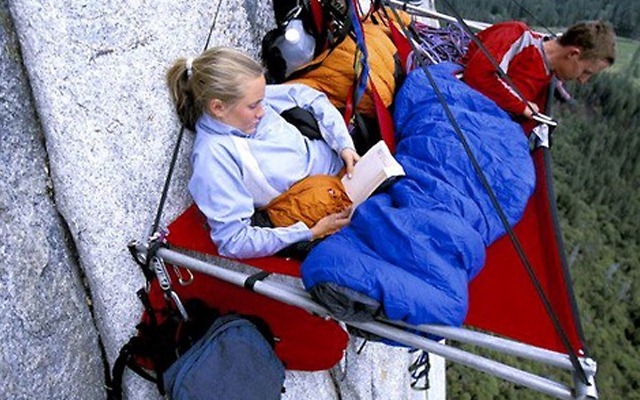
This couple is enjoying some down (or is it up?) time chillaxing on a portaledge attached to what looks to be a very steep cliff.
What do you think? Leave a comment.
If you like this let your friends know or post it on FaceBook, Twitter or LinkedIn
Copyright 2012 Recreation Law (720) Edit Law
Email: blog@rec-law.us
Twitter: RecreationLaw
Facebook: Rec.Law.Now
Facebook Page: Outdoor Recreation & Adventure Travel Law
Blog: www.recreation-law.com
Mobile Site: http://m.recreation-law.com
#RecreationLaw, #@RecreationLaw, #Cycling.Law #Fitness.Law, #Ski.Law, #Outside.Law, #Recreation.Law, #Recreation-Law.com, #Outdoor Law, #Recreation Law, #Outdoor Recreation Law, #Adventure Travel Law, #law, #Travel Law, #Jim Moss, #James H. Moss, #Attorney at Law, #Tourism, #Adventure Tourism, #Rec-Law, #Rec-Law Blog, #Recreation Law, #Recreation Law Blog, #Risk Management, #Human Powered, #Human Powered Recreation,# Cycling Law, #Bicycling Law, #Fitness Law, #Recreation-Law.com, #Backpacking, #Hiking, #Mountaineering, #Ice Climbing, #Rock Climbing, #Ropes Course, #Challenge Course, #Summer Camp, #Camps, #Youth Camps, #Skiing, #Ski Areas, #Negligence, #Snowboarding, #RecreationLaw, #@RecreationLaw, #Cycling.Law #Fitness.Law, #SkiLaw, #Outside.Law, #Recreation.Law, #RecreationLaw.com, #OutdoorLaw, #RecreationLaw, #OutdoorRecreationLaw, #AdventureTravelLaw, #Law, #TravelLaw, #JimMoss, #JamesHMoss, #AttorneyatLaw, #Tourism, #AdventureTourism, #RecLaw, #RecLawBlog, #RecreationLawBlog, #RiskManagement, #HumanPowered, #HumanPoweredRecreation,# CyclingLaw, #BicyclingLaw, #FitnessLaw, #RecreationLaw.com, #Backpacking, #Hiking, #Mountaineering, #IceClimbing, #RockClimbing, #RopesCourse, #ChallengeCourse, #SummerCamp, #Camps, #YouthCamps, #Skiing, #Ski Areas, #Negligence, #Snowboarding, sport and recreation laws, ski law, cycling law, Colorado law, law for recreation and sport managers, bicycling and the law, cycling and the law, ski helmet law, skiers code, skiing accidents, Recreation Lawyer, Ski Lawyer, Paddlesports Lawyer, Cycling Lawyer, Recreational Lawyer, Fitness Lawyer, Rec Lawyer, Challenge Course Lawyer, Ropes Course Lawyer, Zip Line Lawyer, Rock Climbing Lawyer, Adventure Travel Lawyer, Outside Lawyer, Recreation Lawyer, Ski Lawyer, Paddlesports Lawyer, Cycling Lawyer, #RecreationalLawyer, #FitnessLawyer, #RecLawyer, #ChallengeCourseLawyer, #RopesCourseLawyer, #ZipLineLawyer, #RockClimbingLawyer, #AdventureTravelLawyer, #OutsideLawyer, Beth Rodden, Tommy Caldwell, Portaledge, Rock Climbing,
WordPress Tags: Want,recreation,Check,caption,norm,Beth,Rodden,Tommy,Caldwell,ledge,Reddit,Besides,editor,excitement,Remember,Most,jury,TTMEyC,World,Scariest,Place,Read,Book,cliff,Leave,FaceBook,Twitter,LinkedIn,Edit,Email,RecreationLaw,Page,Outdoor,Adventure,Travel,Blog,Mobile,Site,Outside,Moss,James,Attorney,Tourism,Risk,Management,Human,Rock,Ropes,Course,Challenge,Summer,Camp,Camps,Youth,Areas,Negligence,SkiLaw,OutdoorLaw,OutdoorRecreationLaw,AdventureTravelLaw,TravelLaw,JimMoss,JamesHMoss,AttorneyatLaw,AdventureTourism,RecLaw,RecLawBlog,RecreationLawBlog,RiskManagement,HumanPoweredRecreation,CyclingLaw,BicyclingLaw,FitnessLaw,RopesCourse,ChallengeCourse,SummerCamp,YouthCamps,Colorado,managers,helmet,accidents,Lawyer,Paddlesports,Recreational,Line,RecreationalLawyer,FitnessLawyer,RecLawyer,ChallengeCourseLawyer,RopesCourseLawyer,ZipLineLawyer,RockClimbingLawyer,AdventureTravelLawyer,OutsideLawyer,Portaledge
Study shows that head injuries are on the rise on the slopes even though more people are wearing helmets
Posted: December 19, 2012 Filed under: Skiing / Snow Boarding | Tags: ACEP, American College of Emergency Physicians, American College of Emergency Room Physicians, CPSC, Cycling, Head injury, helmet, Mouthguard, Occupational safety and health, Risk Homeostasis, skiing, snowboarding Leave a commentRisk Homeostasis?
A study presented at the American College of Emergency Physicians(ACEP) showed that even with the increased use of helmets on ski slopes head injuries had

increased. Overall injuries on the slopes have remained constant during the same period of time.
The study was based on a review of reports to the U.S. Consumer Product Safety Commission‘s National Electronic Injury Surveillance System (NEISS) Overall helmet use increased from 36.7% to 57.99% during the study period.
The study looked at 68,761 head injuries during the 2004 through 2010 ski seasons. Males represented 68.8% of the injuries, snowboarders 57.9%, and riders between the ages of 11-017 representing 47.7%.
The one difference in the study was children under 10 years old, which showed a decrease in hade injuries dropping from 11.7% to 4.6%.
One brought out by the study was helmets are only good for impacts of 12-15 miles per hour. Most people ski and board faster than that. The true value of a helmet, 12-15 mph of impact protection should be put out there so more people understand what a helmet will and will not do. People are sold helmets with the idea that they will prevent head injuries. They only will prevent injuries in that narrow range of 0-15 mph; over that speed, you probably are going to have an injury.
There were two different ideas put forth as two why head injuries increased. The one idea with the least space about it was Risk Homeostasis or Target Risk. The other was:
My assumptions are that those increases parallel the increase in terrain park use and the level of difficulty and risk in these sports over the last decade,” Christensen said, “and also that we’re simply seeing more people reporting head injuries because there’s been more education and awareness around them.
However, Risk Homeostasiswill also support the greater use of terrain parks and the increased level of difficult and increased risk undertaken by skiers and riders.

English: Freestyle skiing jump (Photo credit: Wikipedia)
Do Something
If you sell helmets tell people the truth. Helmets will reduce some head injuries. Helmets probably will not save your life because if you hit something hard enough to cause brain damage that a helmet will protect you from; you are going to receive other injuries that may kill you.
If you wear a helmet understand what your helmet will and will not do to protect your head.
See Head injuries on rise despite helmets
For additional articles on Risk Homeostasis see:
The Theory of Risk Homeostasis: Implications for Safety and Health
Target Risk: Dealing with the danger of death, disease and damage in everyday decisions
For additional articles on Helmets see:
A helmet manufacture understands the issues(Uvex, Mouthguards) http://rec-law.us/xpxX6n
A new idea that makes sense in helmets: the Bern Hard Hat http://rec-law.us/yPerOd
Does being safe make us stupid? Studies say yes. http://rec-law.us/Ao5BBD
Great article on why helmet laws are stupid http://rec-law.us/zeOaNH
Great editorial questioning why we need laws to “protect” us from ourselves. http://rec-law.us/Ayswbo
Helmet death ignited by misconception and famous personalities http://rec-law.us/wfa0ho
Helmets do not increase risk of a neck injury when skiing http://rec-law.us/wPOUiM
Helmets: why cycling, skiing, skateboarding helmets don’t work http://rec-law.us/RVsgkV

National Sporting Goods Association reports that Helmet use at US Ski Areas increased during the 2009-10 ski season http://rec-law.us/zZTzqa
OSHA Officially recommending helmets for ski area employees http://rec-law.us/xo5yio
Other Voice on the Helmet Debate http://rec-law.us/AzaU9Q
Recent UK poll shows that 10% of cyclists would quite biking if there was a compulsory helmet law. http://rec-law.us/t1ByWk
Skiing/Boarding Helmets and what is the correct message http://rec-law.us/AzeCpS
What do you think? Leave a comment.
If you like this let your friends know or post it on FB, Twitter or LinkedIn
Copyright 2012 Recreation Law (720) Edit Law
Twitter: RecreationLaw
Facebook: Rec.Law.Now
Facebook Page: Outdoor Recreation & Adventure Travel Law
Mobile Site: http://m.recreation-law.com
#RecreationLaw, #@RecreationLaw, #Cycling.Law #Fitness.Law, #Ski.Law, #Outside.Law, #Recreation.Law, #Recreation-Law.com, #Outdoor Law, #Recreation Law, #Outdoor Recreation Law, #Adventure Travel Law, #law, #Travel Law, #Jim Moss, #James H. Moss, #Attorney at Law, #Tourism, #Adventure Tourism, #Rec-Law, #Rec-Law Blog, #Recreation Law, #Recreation Law Blog, #Risk Management, #Human Powered, #Human Powered Recreation,# Cycling Law, #Bicycling Law, #Fitness Law, #Recreation-Law.com, #Backpacking, #Hiking, #Mountaineering, #Ice Climbing, #Rock Climbing, #Ropes Course, #Challenge Course, #Summer Camp, #Camps, #Youth Camps, #Skiing, #Ski Areas, #Negligence, #Snowboarding, #RecreationLaw, #@RecreationLaw, #Cycling.Law #Fitness.Law, #SkiLaw, #Outside.Law, #Recreation.Law, #RecreationLaw.com, #OutdoorLaw, #RecreationLaw, #OutdoorRecreationLaw, #AdventureTravelLaw, #Law, #TravelLaw, #JimMoss, #JamesHMoss, #AttorneyatLaw, #Tourism, #AdventureTourism, #RecLaw, #RecLawBlog, #RecreationLawBlog, #RiskManagement, #HumanPowered, #HumanPoweredRecreation,# CyclingLaw, #BicyclingLaw, #FitnessLaw, #RecreationLaw.com, #Backpacking, #Hiking, #Mountaineering, #IceClimbing, #RockClimbing, #RopesCourse, #ChallengeCourse, #SummerCamp, #Camps, #YouthCamps, #Skiing, #Ski Areas, #Negligence, #Snowboarding, sport and recreation laws, ski law, cycling law, Colorado law, law for recreation and sport managers, bicycling and the law, cycling and the law, ski helmet law, skiers code, skiing accidents, Recreation Lawyer, Ski Lawyer, Paddlesports Lawyer, Cycling Lawyer, Recreational Lawyer, Fitness Lawyer, Rec Lawyer, Challenge Course Lawyer, Ropes Course Lawyer, Zip Line Lawyer, Rock Climbing Lawyer, Adventure Travel Lawyer, Outside Lawyer, Recreation Lawyer, Ski Lawyer, Paddlesports Lawyer, Cycling Lawyer, #RecreationalLawyer, #FitnessLawyer, #RecLawyer, #ChallengeCourseLawyer, #RopesCourseLawyer, #ZipLineLawyer, #RockClimbingLawyer, #AdventureTravelLawyer, #OutsideLawyer, Helmets, Skiing, Snowboarding, Head Injuries, American College of Emergency Physicians, (ACEP), Risk Homeostasis, Target Risk,
WordPress Tags: Study,injuries,helmets,Risk,Homeostasis,American,College,Emergency,Physicians,ACEP,Overall,Consumer,Product,Commission,National,Electronic,Injury,Surveillance,System,NEISS,helmet,Males,riders,difference,impacts,hour,Most,impact,protection,People,Target,assumptions,terrain,park,decade,Christensen,education,parks,truth,life,brain,Head,theory,accidents,propositions,deductions,discussion,dissension,reactions,Implications,Health,danger,death,disease,decisions,Uvex,Mouthguards,Bern,Hard,Does,Studies,Great,article,laws,Ayswbo,misconception,personalities,neck,RVsgkV,information,Goods,Association,Areas,OSHA,area,employees,Voice,Debate,Recent,message,AzeCpS,Leave,Twitter,LinkedIn,Recreation,Edit,RecreationLaw,Facebook,Page,Outdoor,Adventure,Travel,Blog,Mobile,Site,Outside,Moss,James,Attorney,Tourism,Management,Human,Rock,Ropes,Course,Challenge,Summer,Camp,Camps,Youth,Negligence,SkiLaw,OutdoorLaw,OutdoorRecreationLaw,AdventureTravelLaw,TravelLaw,JimMoss,JamesHMoss,AttorneyatLaw,AdventureTourism,RecLaw,RecLawBlog,RecreationLawBlog,RiskManagement,HumanPoweredRecreation,CyclingLaw,BicyclingLaw,FitnessLaw,RopesCourse,ChallengeCourse,SummerCamp,YouthCamps,Colorado,managers,Lawyer,Paddlesports,Recreational,Line,RecreationalLawyer,FitnessLawyer,RecLawyer,ChallengeCourseLawyer,RopesCourseLawyer,ZipLineLawyer,RockClimbingLawyer,AdventureTravelLawyer,OutsideLawyer,skiers
America’s Race returns to Colorado
Posted: December 18, 2012 Filed under: Cycling Leave a comment
|
||||||||||||||
Three websites to help you find a job at a State Park
Posted: December 18, 2012 Filed under: Youth Camps, Zip Line | Tags: Island Beach State Park, Jobs, Park, State park, State Parks, State Parks Jobs, Travel and Tourism Leave a commentState Park Jobs – Interviews with Park Personnel
Find out everything you need to know about state park jobs. Search by state to read interviews with a number of park personnel who provide first-hand information on what it is like to work for a state park system as a ranger, manager, wildlife biologist, and other positions. You’ll learn about the type of training that is required, what experiences are helpful, and tips to obtain state park jobs.
State Park Jobs – Interviews with Park Personnel
Search for state park jobs by job title to read interviews with a number of park personnel who provide first-hand information on what it is like to work for a state park system as a ranger, manager, wildlife biologist, and other positions. You’ll learn about the type of training that is required, what educational background is required, and tips on obtaining state park jobs.
State Park Jobs
Includes links to job openings at state parks, by Cool Works.
http://usparks.about.com/od/stateparkjobs/State_Park_Jobs.htm
Great Holiday Greetings: Sea Kayaker Magazine
Posted: December 15, 2012 Filed under: Sea Kayaking | Tags: Kayak, Sea kayak, Sea Kayaker, Sea Kayaker Magazine, SEATTLE Leave a comment
|
 Happy Holidays!


| This message was sent to recreation.law from:Sea Kayaker Magazine | PO Box 17029 | Seattle, WA 98127-0729 | Email Marketing by  |
| Update Email Address | Forward To a Friend |
European Parliament Ignore 100 Million Cyclists
Posted: December 14, 2012 Filed under: Cycling | Tags: Cycling, European Commission, European Cyclists' Federation, European Parliament, European Union, EuroVelo, Member of the European Parliament, Mode of transport, Transport Leave a comment
|
||||||||||||

Avalanche Center 2012-13 Newsletter #02
Posted: December 13, 2012 Filed under: Youth Camps, Zip Line | Tags: avalanche, Avalanche Center, backcountry, Colorado, Colorado Avalanche Information Center, skiing, Snow, Sports Leave a comment
|

 – Friend us
 – Like us
 – Follow us
2012-2013 In bound ski/board fatalities
Posted: December 12, 2012 Filed under: Skiing / Snow Boarding | Tags: fatality, Keystone Resort, Ski, ski area, Ski Resort, skiing, snowboarding, Sun Valley, Sun Valley Idaho, Winter sport Leave a commentThis list is not guaranteed to be accurate. The information is found from web searches and news dispatches. Those references are part of the chart If you have a source for information on any fatality please leave a comment.
Several Corrections have been made to items reported earlier.
If this information is incorrect or incomplete please let me know. This is up to date as of December 10, 2012. Thanks.
2012 – 2013 Ski Season Deaths
| # | Date | St | Area | Where | How | Cause | Ski/ Board | Age | Sex | Helmet | Ref | Ref | Ref |
| 1 | 11/29 | ID | Sun Valley ski resort | Bald Mountain Chairlift | Fell off (Medical?) | 56 | M | http://rec-law.us/Vi4ims | http://rec-law.us/TyVnKu | ||||
| 2 | 12/1 | CO | Keystone Resort | River Run Gondola Maze | Standing in Maze (Medical) | Skier | 66 | M | http://rec-law.us/SCZHXJ | http://rec-law.us/YkDioj | http://rec-law.us/UjBMfK | ||
| 3 | 12/2 | MI | Boyne Highlands Resort | Camelot, (Beginner) | fell within the slope boundaries and did not collide with any type of obstacle. | Board | 17 | F | http://rec-law.us/11JFVOo |
Our condolences to the families of the deceased. Our good thoughts to the families and staff at the areas who have to deal with these tragedies.
What do you think? Leave a comment.
If you like this let your friends know or post it on FaceBook, Twitter or LinkedIn
Copyright 2012 Recreation Law (720) Edit Law
Email: blog@rec-law.us
Twitter: RecreationLaw
Facebook: Rec.Law.Now
Facebook Page: Outdoor Recreation & Adventure Travel Law
Blog: www.recreation-law.com
Mobile Site: http://m.recreation-law.com
#RecreationLaw, #@RecreationLaw, #Cycling.Law #Fitness.Law, #Ski.Law, #Outside.Law, #Recreation.Law, #Recreation-Law.com, #Outdoor Law, #Recreation Law, #Outdoor Recreation Law, #Adventure Travel Law, #law, #Travel Law, #Jim Moss, #James H. Moss, #Attorney at Law, #Tourism, #Adventure Tourism, #Rec-Law, #Rec-Law Blog, #Recreation Law, #Recreation Law Blog, #Risk Management, #Human Powered, #Human Powered Recreation,# Cycling Law, #Bicycling Law, #Fitness Law, #Recreation-Law.com, #Backpacking, #Hiking, #Mountaineering, #Ice Climbing, #Rock Climbing, #Ropes Course, #Challenge Course, #Summer Camp, #Camps, #Youth Camps, #Skiing, #Ski Areas, #Negligence, #Snowboarding, #RecreationLaw, #@RecreationLaw, #Cycling.Law #Fitness.Law, #SkiLaw, #Outside.Law, #Recreation.Law, #RecreationLaw.com, #OutdoorLaw, #RecreationLaw, #OutdoorRecreationLaw, #AdventureTravelLaw, #Law, #TravelLaw, #JimMoss, #JamesHMoss, #AttorneyatLaw, #Tourism, #AdventureTourism, #RecLaw, #RecLawBlog, #RecreationLawBlog, #RiskManagement, #HumanPowered, #HumanPoweredRecreation,# CyclingLaw, #BicyclingLaw, #FitnessLaw, #RecreationLaw.com, #Backpacking, #Hiking, #Mountaineering, #IceClimbing, #RockClimbing, #RopesCourse, #ChallengeCourse, #SummerCamp, #Camps, #YouthCamps, #Skiing, #Ski Areas, #Negligence, #Snowboarding, sport and recreation laws, ski law, cycling law, Colorado law, law for recreation and sport managers, bicycling and the law, cycling and the law, ski helmet law, skiers code, skiing accidents, Recreation Lawyer, Ski Lawyer, Paddlesports Lawyer, Cycling Lawyer, Recreational Lawyer, Fitness Lawyer, Rec Lawyer, Challenge Course Lawyer, Ropes Course Lawyer, Zip Line Lawyer, Rock Climbing Lawyer, Adventure Travel Lawyer, Outside Lawyer, Recreation Lawyer, Ski Lawyer, Paddlesports Lawyer, Cycling Lawyer, #RecreationalLawyer, #FitnessLawyer, #RecLawyer, #ChallengeCourseLawyer, #RopesCourseLawyer, #ZipLineLawyer, #RockClimbingLawyer, #AdventureTravelLawyer, #OutsideLawyer, Sun Valley ski resort, Keystone Resort, Boyne Highlands Resort,
WordPress Tags: information,news,references,Several,Corrections,items,December,Thanks,Season,Deaths,Date,State,Resort,Where,Cause,Board,Name,Hometown,Helmet,Reference,Valley,Bald,Mountain,Chairlift,Fell,Medical,Dana,Mower,Seattle,TyVnKu,River,Gondloa,Maze,Skier,Brian,Burton,Castle,Rock,SCZHXJ,YkDioj,UjBMfK,Boyne,Highlands,Camelot,Beginner,boundaries,obstacle,Kasandra,Knapp,Alanson,condolences,families,areas,tragedies,Leave,FaceBook,Twitter,LinkedIn,Recreation,Edit,Email,RecreationLaw,Page,Outdoor,Adventure,Travel,Blog,Mobile,Site,Outside,Moss,James,Attorney,Tourism,Risk,Management,Human,Ropes,Course,Challenge,Summer,Camp,Camps,Youth,Negligence,SkiLaw,OutdoorLaw,OutdoorRecreationLaw,AdventureTravelLaw,TravelLaw,JimMoss,JamesHMoss,AttorneyatLaw,AdventureTourism,RecLaw,RecLawBlog,RecreationLawBlog,RiskManagement,HumanPoweredRecreation,CyclingLaw,BicyclingLaw,FitnessLaw,RopesCourse,ChallengeCourse,SummerCamp,YouthCamps,Colorado,managers,accidents,Lawyer,Paddlesports,Recreational,Line,RecreationalLawyer,FitnessLawyer,RecLawyer,ChallengeCourseLawyer,RopesCourseLawyer,ZipLineLawyer,RockClimbingLawyer,AdventureTravelLawyer,OutsideLawyer
Indiana adopts the higher standard of care between participants in sporting events in this Triathlon case
Posted: December 10, 2012 Filed under: Cycling, Indiana, Release (pre-injury contract not to sue), Triathlon | Tags: Co-participant, Cycling, Duty of care, Indiana, Standard of Care, Summary judgment, Triathlon, USA Triathlon Leave a commentMark, v. Moser, 46 N.E.2d 410; 2001 Ind. App. LEXIS 671
This decision examines the different legal decisions involving lawsuits between participants in Indiana and other states.
The plaintiff and the defendant were racing in a triathlon. Both agreed to abide by the rules of USA Triathlon, and both signed releases. While in the bicycle portion

of the race, the defendant cut in front of the plaintiff causing a collision. The defendant was disqualified for violating the USA Triathlon rule concerning endangerment.
No cyclist shall endanger himself or another participant. Any cyclist who intentionally presents a danger to any participant or who, in the judgment of the Head Referee, appears to present a danger to any participants shall be disqualified.
The referee stated the defendant’s conduct was not intentional, “rather, he was disqualified for violating the rule “because, by moving over, an accident occurred.” As you can seem the rule, and its interpretation are subject wide interpretation and would lead to more arguments (lawsuits) after that.
The plaintiff sued the defendant for negligence and for acting intentionally, recklessly and willfully causing her injuries. The defendant filed a motion for summary judgment on both claims. The trial court granted the motion on the negligence claim and denied the motion on the second claim, the international acts.
In some jurisdictions, you can appeal motions for summary judgment that do not finish the case in its entirety. Here the plaintiff appealed the decision. Whether or not you can appeal the decision is dependent on the state rules of civil and appellate procedure.
Summary of the case
The Indian appellate court did a thorough analysis of the legal issues after determining this was an issue of first impression in Indiana. An issue of first impression is one where the court has not ruled on this particular legal issue before.
The issue was what was the standard of care owed by co-participants in a sporting event. The standard for a school sporting event was negligence. The court stated that the standard was negligence, low, because of the duty the school personnel had to exercise reasonable care over the students.
The court then looked at other decisions for the duty between co-participants. The court found three states, Arizona, Nevada and Wisconsin where the duty was negligence. The court found California, Connecticut, Illinois, Kentucky, Louisiana, Massachusetts, Michigan, Missouri, Nebraska, New Jersey, New Mexico, New York, Ohio, and Texas had adopted a “reckless or intentional conduct” or a “willful and wanton or intentional misconduct” standard of care. This is a much higher standard of care than the negligence standard.

The court found the higher standard of care was established because participants assume the risk of the activity, to stop mass litigation that would arise every time a foul occurs, and not to limit the sport because of the fear of liability.
The Indiana court determined that participants in sports activities:
…assume the inherent and foreseeable dangers of the activity and cannot recover for injury unless it can be established that the other participant either intentionally caused injury or engaged in conduct so reckless as to be totally outside the range of ordinary activity involved in the sport.
The court granted the summary judgment as to the first count, the negligence claim and sent the second claim back to the lower court to determine if the plaintiff could prove that the action of the defendant was intentional, reckless and willful when he rode his bike. The court sent it back with this statement.
…the trial court must determine whether Kyle’s [defendant] action was an inherent or reasonably foreseeable part of the sport, such that Rebecca [plaintiff] assumed the risk of injury as a matter of law. In our view, it is reasonably foreseeable that a competitor in a cycling race may attempt to cut in front of co-participants in an effort to advance position. Thus, if Rebecca is unable to develop the facts beyond those presented at this juncture, we would conclude that Kyle’s action was an inherent risk in the event that Rebecca assumed as a matter of law, thereby precluding recovery.
That is a very specific statement as to how the lower court must examine the facts in the case.
The appellate court also made another statement that is very important in this day and age.
As is generally the case, the release form that Rebecca signed does not relieve Kyle from liability as co-participants are not listed among the specific entities or individuals released from liability ac-cording to the plain language of the document.
The court looked at the release to determine if the release stopped the suit even though that was not argued by the parties.
So Now What?

It’s OK to play touch football, softball and have fun in Indiana.
At the same time, the court pointed out the fact that if the release had included the term co-participants in the release, the lawsuit might have started because the defendant would have been protected.
Here just one additional word in the release might have stopped a lawsuit.
What do you think? Leave a comment.
If you like this let your friends know or post it on FaceBook, Twitter or LinkedIn
Copyright 2012 Recreation Law (720) Edit Law
Email: blog@rec-law.us
Twitter: RecreationLaw
Facebook: Rec.Law.Now
Facebook Page: Outdoor Recreation & Adventure Travel Law
Blog: www.recreation-law.com
Mobile Site: http://m.recreation-law.com
#RecreationLaw, #@RecreationLaw, #Cycling.Law #Fitness.Law, #Ski.Law, #Outside.Law, #Recreation.Law, #Recreation-Law.com, #Outdoor Law, #Recreation Law, #Outdoor Recreation Law, #Adventure Travel Law, #law, #Travel Law, #Jim Moss, #James H. Moss, #Attorney at Law, #Tourism, #Adventure Tourism, #Rec-Law, #Rec-Law Blog, #Recreation Law, #Recreation Law Blog, #Risk Management, #Human Powered, #Human Powered Recreation,# Cycling Law, #Bicycling Law, #Fitness Law, #Recreation-Law.com, #Backpacking, #Hiking, #Mountaineering, #Ice Climbing, #Rock Climbing, #Ropes Course, #Challenge Course, #Summer Camp, #Camps, #Youth Camps, #Skiing, #Ski Areas, #Negligence, #Snowboarding, #RecreationLaw, #@RecreationLaw, #Cycling.Law #Fitness.Law, #SkiLaw, #Outside.Law, #Recreation.Law, #RecreationLaw.com, #OutdoorLaw, #RecreationLaw, #OutdoorRecreationLaw, #AdventureTravelLaw, #Law, #TravelLaw, #JimMoss, #JamesHMoss, #AttorneyatLaw, #Tourism, #AdventureTourism, #RecLaw, #RecLawBlog, #RecreationLawBlog, #RiskManagement, #HumanPowered, #HumanPoweredRecreation,# CyclingLaw, #BicyclingLaw, #FitnessLaw, #RecreationLaw.com, #Backpacking, #Hiking, #Mountaineering, #IceClimbing, #RockClimbing, #RopesCourse, #ChallengeCourse, #SummerCamp, #Camps, #YouthCamps, #Skiing, #Ski Areas, #Negligence, #Snowboarding, sport and recreation laws, ski law, cycling law, Colorado law, law for recreation and sport managers, bicycling and the law, cycling and the law, ski helmet law, skiers code, skiing accidents, Recreation Lawyer, Ski Lawyer, Paddlesports Lawyer, Cycling Lawyer, Recreational Lawyer, Fitness Lawyer, Rec Lawyer, Challenge Course Lawyer, Ropes Course Lawyer, Zip Line Lawyer, Rock Climbing Lawyer, Adventure Travel Lawyer, Outside Lawyer, Recreation Lawyer, Ski Lawyer, Paddlesports Lawyer, Cycling Lawyer, #RecreationalLawyer, #FitnessLawyer, #RecLawyer, #ChallengeCourseLawyer, #RopesCourseLawyer, #ZipLineLawyer, #RockClimbingLawyer, #AdventureTravelLawyer, #OutsideLawyer, Triathlon, USA Triathlon, Cycling, Co-participant, Duty of Care,
WordPress Tags: Indiana,participants,events,Triathlon,Mark,Moser,LEXIS,decision,decisions,lawsuits,plaintiff,defendant,Both,bicycle,collision,participant,danger,judgment,Head,Referee,accident,interpretation,arguments,negligence,injuries,jurisdictions,Here,Whether,procedure,Summary,Indian,analysis,event,personnel,students,Arizona,Nevada,Wisconsin,California,Connecticut,Illinois,Kentucky,Louisiana,Massachusetts,Michigan,Missouri,Nebraska,Jersey,Mexico,York,Ohio,Texas,misconduct,litigation,dangers,injury,action,bike,statement,Kyle,Rebecca,competitor,effort,Thus,juncture,recovery,entities,individuals,football,fact,lawsuit,Leave,FaceBook,Twitter,LinkedIn,Recreation,Edit,Email,RecreationLaw,Page,Outdoor,Adventure,Travel,Blog,Mobile,Site,Outside,Moss,James,Attorney,Tourism,Risk,Management,Human,Rock,Ropes,Course,Challenge,Summer,Camp,Camps,Youth,Areas,SkiLaw,OutdoorLaw,OutdoorRecreationLaw,AdventureTravelLaw,TravelLaw,JimMoss,JamesHMoss,AttorneyatLaw,AdventureTourism,RecLaw,RecLawBlog,RecreationLawBlog,RiskManagement,HumanPoweredRecreation,CyclingLaw,BicyclingLaw,FitnessLaw,RopesCourse,ChallengeCourse,SummerCamp,YouthCamps,Colorado,managers,helmet,accidents,Lawyer,Paddlesports,Recreational,Line,RecreationalLawyer,FitnessLawyer,RecLawyer,ChallengeCourseLawyer,RopesCourseLawyer,ZipLineLawyer,RockClimbingLawyer,AdventureTravelLawyer,OutsideLawyer,Care,cyclist,appellate
Mark, v. Moser, 46 N.E.2d 410; 2001 Ind. App. LEXIS 671
Posted: December 10, 2012 Filed under: Cycling, Indiana, Legal Case, Triathlon | Tags: Appellee-Defendant, Indiana, Indianapolis, Summary judgment, Superior court, USA Triathlon Leave a commentMark, v. Moser, 46 N.E.2d 410; 2001 Ind. App. LEXIS 671
Rebecca J. Mark, Appellant-Plaintiff, vs. Kyle Moser, Appellee-Defendant.
No. 29A02-0010-CV-623
COURT OF APPEALS OF INDIANA, SECOND DISTRICT
746 N.E.2d 410; 2001 Ind. App. LEXIS 671
April 19, 2001, Decided
PRIOR HISTORY: [**1] APPEAL FROM THE HAMILTON SUPERIOR COURT. Cause No. 29D03-9806-CT-323. The Honorable William Hughes, Judge.
DISPOSITION: Trial court’s decision affirmed with respect to Count I. Remanded to trial court for further proceedings on Count II consistent with this opinion.
COUNSEL: FOR APPELLANT: JOSEPH A. CHRISTOFF, KONRAD M. L. URBERG, Christoff & Christoff, Fort Wayne, Indiana.
FOR APPELLEE: STEVEN K. HUFFER, DEREK L. MANDEL, Huffer & Weathers, P.C., Indianapolis, Indiana.
JUDGES: BAKER, Judge. BROOK, J., and BARNES, J., concur.
OPINION BY: BAKER
OPINION
[*413] BAKER, Judge
Today we are called upon to clearly define the standard of care one competitor owes another in a sporting event. Although this court may have tangentially addressed the issue in the past, there has been no case since the adoption of the Comparative Fault Act where an in-depth analysis was warranted. Thus, the precise issue we must decide is whether a participant in an athletic activity may recover in tort for injury as the result of another participant’s negligent conduct.
FACTS
The uncontroverted facts are that on September 7, 1997, Rebecca Mark (Rebecca) and Kyle Moser (Kyle) were co-participants in a triathlon competition in [**2] Marion County, which consisted of three events, swimming, bicycling, and running. Before the competition, each triathlon participant agreed to abide by the rules adopted by USA Triathlon. In addition, all the participants signed an entry form, which included a waiver provision and release from liability.
During the bicycling leg of the triathlon, Kyle was riding on the left side of Rebecca and cut in front of her. As a result, the two bicycles collided and Rebecca was hospitalized with serious injuries. Kyle was subsequently disqualified for violating the USA Triathlon rule against endangerment. That rule provides: “No cyclist shall endanger himself or another participant. Any cyclist who intentionally presents a danger to any participant or who, in the judgment of the Head Referee, appears to present a danger to any participants shall be disqualified.” Record at 115. The triathlon referee, Ardith Spence, stated that Kyle’s conduct was not considered intentional; rather, he was disqualified for violating the rule “because, by moving over, an accident occurred.” R. at 111.
On June 7, 1998, Rebecca filed a two-count complaint against Kyle. In Count I, Rebecca alleged that the collision [**3] was caused by Kyle’s negligence and, in the alternative, in Count II, Rebecca alleged that Kyle acted intentionally, recklessly and willfully in causing her injuries. In response, on September 29, 2000, Kyle filed a motion for summary judgment as to both counts of Rebecca’s complaint. Specifically, Kyle argued that Rebecca was barred from recovering on a negligence theory and, instead, asserted that she was required to establish that he intentionally, recklessly, willfully, or wantonly caused her injuries. In addition, Kyle argued that there was no evidence indicating that he had intentionally or recklessly caused the collision between the two bicycles.
The trial court held a hearing on Kyle’s motion on June 7, 2000. Thereafter, on August 3, 2000, the trial court granted summary judgment as to Count I of Rebecca’s complaint and denied it as to Count II. Rebecca now appeals the trial court’s judgment regarding the negligence count.
DISCUSSION AND DECISION
I. Standard of Review
The standard of review of a summary judgment is well settled. [HN1] This court [*414] applies the same standard as the trial court. USA Life One Ins. Co. v. Nuckolls, 682 N.E.2d 534, 537 (Ind. 1997). [**4] We do not weigh the evidence designated by the parties. Instead, we liberally construe the evidence in the light most favorable to the non-moving party. Id. Summary judgment is appropriate only if the pleadings and the evidence show both the absence of a genuine issue of material fact and that the moving party is entitled to judgment as a matter of law. Ind. Trial Rule 56(C); Butler v. City of Indianapolis, 668 N.E.2d 1227, 1228 (Ind. 1996). Where material facts conflict, or undisputed facts lead to conflicting material inferences, summary judgment is inappropriate. Id.
II. The Current State of the Law
A. Indiana Law
Many people might think that Rebecca’s claim would be barred because she in some way incurred, or assumed, the risk of injury by participating in the sporting event. However, under present Indiana law that would not necessarily be the case if the standard of care was negligence. On January 1, 1985, Indiana adopted the Comparative Fault Act (the Act). IND. CODE § 34-51-2-1 to -19. The Act was intended to ameliorate the harshness of the then prevailing common law doctrine of contributory negligence. [**5] Baker v. Osco Drug, Inc., 632 N.E.2d 794, 797 (Ind. Ct. App. 1994). Under the common law rule, a slightly negligent plaintiff was precluded from recovery of any damages, even against a highly culpable tortfeasor. Id. In [HN2] contrast, under the Act, if a plaintiff’s conduct satisfies the statutory definition of “fault,” he will be permitted to recover damages, but those damages will be reduced by his proportion of fault. Id. However, if the plaintiff’s percentage of fault is assessed at greater than fifty percent, his recovery will still be completely barred. Id. For purposes of defining comparative fault, [HN3] the term “fault” includes “any act or omission that is negligent, willful, wanton, reckless, or intentional towards the person or property of others. The term also includes unreasonable assumption of risk not constituting an enforceable express consent, incurred risk, and unreasonable failure to avoid an injury or to mitigate damages.” I.C. § 34-6-2-45(b). [HN4] This inclusion of “incurred risk” in the definition of fault abolishes incurred risk as a complete bar to recovery and establishes that the fault of each party should be apportioned. [**6] Baker, 632 N.E.2d at 797. Thus, under Indiana law, if we adopt negligence as the standard of care between co-participants in a sporting event, it would be a question of fact for the jury to decide whether the plaintiff in any way incurred the risk of harm but is, nevertheless, entitled to recover for his injury.
Our supreme court has not specifically addressed the standard of care between co-participants in athletic events. However, it has addressed the appropriate standard of care owed by an educational institution and its representatives to students for injuries sustained while playing campus sports. [HN5] In this context, the court has adopted a negligence standard. See Beckett v. Clinton Prairie Sch. Corp., 504 N.E.2d 552, 554 (Ind. 1987) (holding that school personnel have a duty to exercise reasonable care over students participating in a school activity under school supervision, in a case involving a collision between two student baseball players). Our supreme court adopted this standard based on its recognition that there is a well-established “duty on the part of school personnel to exercise ordinary and reasonable care for the safety of children [**7] under their authority.” Beckett, 504 N.E.2d at 553; cf. Brewster v. Rankins, 600 N.E.2d 154, 158 (Ind. Ct. App. 1992) (holding that [*415] while school authorities have a duty to exercise reasonable care for the safety of children under their tutelage, they have no duty to prevent a student from injuring other players while practicing his golf swing at home). According to the court, whether school personnel exercised their duty with the level of care of an ordinary prudent person under the same or similar circumstances is generally a factual question for the determination of the jury. Beckett, 504 N.E.2d at 554.
Our supreme court has also recognized, however, [HN6] that if the student athlete can be shown to have incurred the risks inherent in the sports event, this acts as a potential bar to recovery. Id.; see also Clark v. Wiegand, 617 N.E.2d 916, 919 (Ind. 1993) (holding that the question of whether a student in a university judo class incurred the risk of injury from another student so as to bar recovery from the university was a question for the jury). According to the Beckett court, for the “doctrine of incurred [**8] risk” to affect the plaintiff’s likelihood or percentage of recovery, it is not enough that the plaintiff merely has a general awareness of a potential for mishap in engaging in the particular sports activity. Id. Rather, the doctrine involves a subjective analysis focusing upon the plaintiff’s actual knowledge and appreciation of the specific risk and voluntary acceptance of that risk. Clark, 617 N.E.2d at 919 (stating that whether the possibility of sustaining a knee ligament injury while participating in a judo class “was within the plaintiff’s actual knowledge, appreciation, and voluntary acceptance, is a factual matter not easily susceptible to determination as a matter of law”). 1
1 For another case where a student brought suit against the school corporation for injuries caused by a fellow student during a sports event, see Huffman v. Monroe County Community Sch. Corp., 588 N.E.2d 1264 (Ind. 1992). In that case, the plaintiff sustained head and shoulder injuries when a fellow student struck her in the back of the head with a shot put during a track meet. Id. at 1264.
[**9] In Duke’s GMC v. Erskine, 447 N.E.2d 1118, 1118 (Ind. Ct. App. 1983), a panel of this court addressed the situation where a sports participant sued for injuries caused by another player. Duke’s GMC involved a golfer, Erskine, who sued for loss of an eye from being struck by a golf ball at a country club. Id. In addition to being decided prior to Indiana’s adoption of the Comparative Fault Act, Duke’s GMC is distinguishable from the case at bar because the court was not confronted with the standard of care between sports co-participants and because Erskine sued the corporation that paid the dues of its president who hit the golf ball causing the injury, rather than suing the president himself. Id. Specifically, in Duke’s GMC, this court was called upon to decide whether the trial court erred in admitting certain evidence and in the instructions it gave to the jury. In addressing whether the trial court’s instruction regarding incurred risk was erroneous, this court approved the parties’ assertion that a golfer could not incur the risk of another golfer’s negligence as a matter of law. This court then discussed the instruction based on a negligence [**10] standard, but it never addressed the standard of care one competitor owes another in a sporting event. However, when discussing the appropriateness of the trial court’s instructions regarding damages, the Duke’s GMC court did examine how violations of the rules of sport affect the negligence analysis. In so doing, this court recognized that the “rules of sport are at least an indicia of the standard of care which players owe each other,” and concluded that “while a violation [*416] of those rules may not be negligence per se, it may well be evidence of negligence.” 2 Id. at 1124.
2 The parties dispute whether the court in this case proceeded under a standard of negligence or reckless misconduct. Appellant’s brief at 8; Appellee’s brief at 4-5. While the standard is unclear, it appears from the court’s holding and analysis of how violations of the rules of sport affect the negligence analysis, that it permitted the case to proceed under a negligence standard. Duke’s GMC, 447 N.E.2d at 1124.
[**11] [HN7]
Thus, under the current state of Indiana law, in actions for sports-related injuries against school authorities, rather than against a co-participant, liability will attach in the event that negligence is shown. We note, however, that the plaintiff’s negligence claim is subject to the defense of incurred risk, which requires the defendant to establish that the plaintiff had actual knowledge of the risk that resulted in his injury. Should the defendant carry his burden of proof on this defense, the plaintiff’s recovery will be reduced or eliminated depending on the degree of the plaintiff’s fault.
B. Law in Other Jurisdictions
The authority from other jurisdictions is instructive with regard to the standard of care to be applied between co-participants in a sports activity. Other jurisdictions have generally taken one of two approaches to this issue, and have adopted either a negligence or recklessness standard. They have also recognized two principle defenses, contributory negligence and assumption of risk.
Arizona, Nevada, and Wisconsin judge sports injury cases between co-participants according to an “ordinary care” or negligence standard. See Estes v. Tripson, 188 Ariz. 93, 932 P.2d 1364, 1366 (Ariz. Ct. App. 1997); [**12] Auckenthaler v. Grundmeyer, 110 Nev. 682, 877 P.2d 1039, 1043 (Nev. 1994); Lestina v. West Bend Mut. Ins. Co., 176 Wis. 2d 901, 501 N.W.2d 28, 33 (Wis. 1993). The primary argument for adhering to the negligence standard is the belief that this standard is flexible enough to be applied to a wide range of situations because it only requires that a person exercise ordinary care under the circumstances. See Auckenthaler, 877 P.2d at 1043; Lestina, 501 N.W.2d at 33. Thus, “within the factual climate of . . . sporting events, the question posed is whether the defendant participated in a reasonable manner and within the rules of the game or in accordance with the ordinary scope of the activity.” Auckenthaler, 877 P.2d at 1043 (citing Lestina, 501 N.W.2d at 33).
The majority of other states have adopted a “reckless or intentional conduct” or a “willful and wanton or intentional misconduct” standard. These states include California, Connecticut, Illinois, Kentucky, Louisiana, Massachusetts, Michigan, Missouri, Nebraska, New Jersey, New Mexico, New York, Ohio, and Texas. See Knight v. Jewett, 3 Cal. 4th 296, 834 P.2d 696, 711 (Cal. 1992) [**13] (applying a recklessness standard to an injury in an informal game of coed football); Jaworski v. Kiernan, 241 Conn. 399, 696 A.2d 332, 339 (Conn. 1997) (holding that a recklessness or intentional misconduct standard should be used in a case involving a recreational soccer game); Hoke v. Cullinan, 914 S.W.2d 335, 339 (Ky. 1995) (applying a recklessness standard with respect to an injury sustained in a doubles tennis match); Picou v. Hartford Ins. Co., 558 So. 2d 787, 790 (La. Ct. App. 1990) (applying recklessness as the standard for injuries sustained during a softball game); Gauvin v. Clark, 404 Mass. 450, 537 N.E.2d 94, 96 (Mass. 1989) (adopting a “reckless disregard of safety” standard in a case involving a college hockey game); Ritchie-Gamester [*417] v. City of Berkley, 461 Mich. 73, 597 N.W.2d 517, 518 (Mich. 1999) (holding that co-participants owe each other a duty not to engage in reckless misconduct in a case involving a collision between two recreational skaters); Dotzler v. Tuttle, 234 Neb. 176, 449 N.W.2d 774, 779 (Neb. 1990) (adopting a recklessness standard with respect to injuries [**14] sustained in a “pickup” basketball game); Crawn v. Campo, 136 N.J. 494, 643 A.2d 600, 601 (N.J. 1994) (adopting a “reckless disregard for the safety of others” standard in a case involving a “pickup” softball game); Kabella v. Bouschelle, 100 N.M. 461, 672 P.2d 290, 293 (N.M. Ct. App. 1983) (adopting recklessness as the standard for injuries sustained during an informal game of tackle football); Turcotte v. Fell, 68 N.Y.2d 432, 502 N.E.2d 964, 968, 510 N.Y.S.2d 49 (N.Y. 1986) (concluding that a “reckless or intentional” standard applied in a case involving a professional jockey injured during a horse race); Marchetti v. Kalish, 53 Ohio St. 3d 95, 559 N.E.2d 699, 703 (Ohio 1990) (applying the recklessness standard to a minor who was injured participating in a recreational game of “kick the can”); Hathaway v. Tascosa Country Club, Inc., 846 S.W.2d 614, 616 (Tex. App. 1993) (applying a “reckless or intentional” standard in a case involving an injury suffered during a recreational golf game).
Of those states that have adopted a recklessness or intentional misconduct standard, some, including Illinois [**15] and Missouri, have explicitly limited application of this standard to contact sports. See Pfister v. Shusta, 167 Ill. 2d 417, 657 N.E.2d 1013, 1017, 212 Ill. Dec. 668 (Ill. App. Ct. 1995) (holding that participants who voluntarily engage in contact sports cannot recover for injuries resulting from the negligence of other players and, instead, must establish willful and wanton or intentional misconduct); Zurla v. Hydel 289 Ill. App. 3d 215, 681 N.E.2d 148, 152, 224 Ill. Dec. 166 (Ill. App. Ct. 1997) (holding that negligence is the appropriate standard of care between co-participants in golf); Novak v. Virene, 224 Ill. App. 3d 317, 586 N.E.2d 578, 579, 166 Ill. Dec. 620 (Ill. App. Ct. 1991) (concluding that negligence is the appropriate standard between skiers); Gamble v. Bost, 901 S.W.2d 182, 186 (Mo. Ct. App. 1995) (holding that a negligence standard is proper in bowling, a non-contact sport) trans. denied; Ross v. Clouser, 637 S.W.2d 11, 14 (Mo. 1982) (adopting a recklessness standard for contact sports). 3
3 One critic has noted that a “shortcoming of the recklessness standard is the inconsistent formulas courts have established to define recklessness.” Ian M. Burnstein, Liability For Injuries Suffered In The Course of Recreational Sports: Application of the Negligence Standard, 71 U. Det. Mercy L. Rev. 993, 1014 (1994). Burnstein points out that the Louisiana Court of Appeals in Bourque v. Duplechin, 331 So. 2d 40, 43 (1976), defined recklessness “in terms of consequences to the victim,” whereas the Illinois Court of Appeals in Nabozny v. Barnhill, 31 Ill. App. 3d 212, 334 N.E.2d 258, 261 (Ill. App. Ct. 1975), defined it in terms of the “actor’s ‘reckless disregard’ for the safety of other players.” Id. The New Mexico Court of Appeals in Kabella, 672 P.2d at 294, “defined reckless disregard as reckless or willful conduct,” and other jurisdictions have used the definition set out in the Restatement (Second) of Torts (1965). Id.
[**16] Courts that have departed from the negligence standard and adopted an elevated standard of care in the co-participant context, have recognized public policy justifications for doing so. Specifically, some courts have feared that use of an ordinary negligence standard could result in a flood of litigation. For example, in Jaworski, the Supreme Court of Connecticut declined to adopt a negligence standard, acknowledging that:
If simple negligence were to be adopted as the standard of care, every punter with whom contact is made, every midfielder [*418] high sticked, every basketball player fouled, every batter struck by a pitch, and every hockey player tripped would have the ingredients for a lawsuit if injury resulted.
696 A.2d at 338. The Jaworski court went on to state that given “the number of athletic events taking place in Connecticut over the course of a year . . . such potential for a surfeit of lawsuits . . . should not be encouraged.” Id.
Several courts have also recognized that “fear of civil liability stemming from negligent acts occurring [during] an athletic event could curtail the proper vigor with which the game should be played and discourage [**17] individual participation.” Ross, 637 S.W.2d at 14. The Supreme Court of New Jersey in Crawn, noted that “one might well conclude that something is terribly wrong with a society in which the most commonly-accepted aspects of play–a traditional source of a community’s conviviality and cohesion–spurs litigation.” 643 A.2d at 600. With the foregoing in mind, the Crawn court went on to adopt “the heightened recklessness standard,” recognizing this as a “commonsense distinction between excessively harmful conduct and the more routine rough-and-tumble of sports that should occur freely on the playing field and should not be second-guessed in courtrooms.” Id.
Apart from policy rationales, some courts have justified adoption of a recklessness or intentional standard of care on the grounds that a participant in a sports activity assumes the risks inherent in that activity. See, e.g., Knight, 834 P.2d at 712; Marchetti, 559 N.E.2d at 703-04; Turcotte, 502 N.E.2d at 967; Ross, 637 S.W.2d at 14. Assumption of risk can be applied in its primary or secondary sense. See Fowler V. [**18] Harper et al., The Law of Torts § 21.0 (3d ed. 1996). Secondary assumption of risk is applied according to a subjective standard. Therefore, “if the plaintiff knows, understands, and appreciates a risk and deliberately encounters it, he assumes that risk in the secondary sense.” Heidi C. Doerhoff, Penalty Box or Jury Box? Deciding Where Professional Sports Tough Guys Should Go, 64 Mo. L. Rev. 739, 751 (1999). Whether the plaintiff appreciated and was willing to encounter the particular risk is a “factual determination[] usually reserved to the jury.” Id.
Secondary assumption of risk has been subsumed by comparative fault in many jurisdictions and is no longer a defense. However, New York and California recognize primary assumption of risk as having survived enactment of their comparative negligence statutes. These two states have retained assumption of risk in the sports injury context by recasting it as a no-duty rule. Essentially, under the primary assumption of risk doctrine, a sports participant defendant owes no duty of care to a co-participant with respect to risks that are considered to be within the ordinary range of activity involved in the sport. [**19] See Knight, 834 P.2d at 711; Turcotte, 502 N.E.2d at 970. Because primary assumption of risk “is a policy-driven concept that flows from the legal relationship of the parties, not their subjective expectations,” it is applied according to an objective, rather than subjective, standard. Doerhoff, 64 Mo. L. Rev. at 751. Thus, for purposes of determining whether the doctrine negates a defendant’s duty of care, thereby barring a plaintiff’s action, the plaintiff’s “knowledge plays a role but [the] inherency [of the risks involved in the particular sport] is the sine qua non.” Morgan v. State, 90 N.Y.2d 471, 685 N.E.2d 202, 208, 662 N.Y.S.2d 421 (N.Y. 1997). Whether a duty of care attends the relationship between the parties “is a question of law reserved to the [*419] court.” Doerhoff, 64 Mo. L. Rev. at 751. If no such duty is found to exist, then an action for personal injury will be barred as a matter of law absent evidence of reckless or intentionally harmful conduct. Turcotte, 502 N.E.2d at 967.
Courts that have adopted the recklessness or intentional standard have also tended to hold rule violations as an inherent and anticipated [**20] part of the game. Burnstein, 71 U. Det. Mercy L. Rev. at 993. The Supreme Court of Connecticut has justified this tendency by reasoning that the “normal expectations of participants in contact team sports includes the potential for injuries resulting from conduct that violates the rules of sport.” Jaworski, 696 A.2d at 337. Thus, “Connecticut, like other jurisdictions that have adopted the reckless or intentional standard of care, allows a participant in a sporting event to escape liability when his conduct is ‘part of the game’ even though it violates [the] rules” of the sport. Mark M. Rembish, Liability for Personal Injuries Sustained in Sporting Events After Jaworski v. Kierney, 18 Quinnipiac L. Rev. 307, 341 (1998).
In sum, the majority of jurisdictions that have considered the issue of the appropriate standard of care between co-participants in sporting activities, have adopted a standard of care that exceeds negligent conduct. The rationale behind this heightened standard of care is the fear of a flood of litigation, the desire to encourage vigorous athletic competition and participation in sporting events, and the perception that risk of injury is a common [**21] and inherent aspect of sports and recreational activity.
C. Analysis
In determining the appropriate standard of care between co-participants in sporting activities in Indiana, we are mindful that in Indiana, as in the rest of the United States, participation in recreational sports has become an increasingly popular leisure time activity. Indeed, over the last decade, more Americans than ever before “have joined recreational softball, basketball, football [and] other types of sports leagues,” and there has also been a dramatic increase in participation in high school and college organized sports. Burnstein, 71 U. Det. Mercy L. Rev. at 993. Our legislature also emphasized and endorsed the growing importance of sporting and recreational activities in Indiana, when it enacted a statute specifically immunizing landowners from liability if they have opened their property for recreational use. See IND. CODE § 14-22-10-2. 4
4 [HN8] The Indiana Recreational Use Statute provides that the owner of premises used for recreational purposes, such as swimming, camping, hiking, and sightseeing, does not assume responsibility or incur liability, for personal injury or property damage caused by an action or failure to act of persons using the premises. I.C. § 14-22-10-2. Baseball and sledding are among the sporting activities that have been recognized as being covered by the Recreational Use Statute. See Cunningham v. Bakker Produce, Inc., 712 N.E.2d 1002 (Ind. Ct. App. 1999), trans. denied; Civils v. Stucker, 705 N.E.2d 524 (Ind. Ct. App. 1999).
[**22] After reviewing the decisions of other jurisdictions that have considered this issue, we are convinced that a negligence standard would be over-inclusive. Specifically, we believe that adopting a negligence standard would create the potential for mass litigation and may deter participation in sports because of fear of incurring liability for the injuries and mishaps incident to the particular activity. Further, we believe that the duty of care between co-participants in sports activities is sufficiently distinguishable from Indiana cases where a student athlete sues an educational institution or its representatives, to merit a heightened standard of care. Specifically, application of a negligence [*420] standard is justified where a student athlete sues a school or its representatives because there is a well-established duty on the part of such institutions and their personnel to exercise ordinary and reasonable care for the safety of those under their authority. See Beckett, 504 N.E.2d at 553. However, no such analogous authority or responsibility exists between co-participants in sporting events, and therefore, we are not compelled to adopt a similar standard in this context. [**23] 5 Finally, as a matter of policy, we prefer to avoid the need to hold a jury trial to determine whether the plaintiff incurred the risk of injury in every case involving a sports injury caused by a co-participant. We can prevent this necessity by adopting an objective primary assumption-of-risk doctrine and a standard of care greater than negligence.
5 Moreover, to the extent Duke’s GMC is inconsistent with this opinion it is disapproved.
Accordingly, we hold that [HN9] voluntary participants in sports activities assume the inherent and foreseeable dangers of the activity and cannot recover for injury unless it can be established that the other participant either intentionally caused injury or engaged in conduct so reckless as to be totally outside the range of ordinary activity involved in the sport. 6 [HN10] The plaintiff’s assumption of risk is primary in nature inasmuch as it flows from the legal relationship of the parties, is evaluated according to an objective standard rather than a subjective standard, and [**24] acts to bar recovery. Thus, it is a question of law for the determination of the court, whether the injury-causing event was an inherent or reasonably foreseeable part of the game, such that the plaintiff is considered to have assumed the risk. If the court determines that the plaintiff did assume the risk, then the plaintiff’s cause fails. If, on the other hand, the court determines that plaintiff did not assume the risk, then the cause proceeds to a jury to determine, as a question of fact, whether the co-participant intentionally or recklessly caused the injury.
6 This author has advanced the position before, in his concurring opinion in Lincke v. Long Beach Country Club, 702 N.E.2d 738, 741 (Ind. Ct. App. 1998), that co-participants in sporting activities should be considered to have assumed the inherent and foreseeable dangers of the activity as a matter of law. Specifically, this author stated that: “Any golfer in the rough of a hole which runs parallel to another should, as a matter of law, know the dangers of approaching golfers. To be surprised that approaching drivers hook or slice is akin to being surprised that not everyone shoots par. We have said often that ‘there comes a point where this Court should not be ignorant as judges of what we know as men [or women].’ This is a shining example of the application of that maxim.” Id. (quoting Willner v. State, 602 N.E.2d 507, 509 (Ind. 1992)).
[**25] In addition, because we recognize that rule infractions, deliberate or otherwise, are an inevitable part of many [HN11] sports, a co-participant’s violation of the rules of the game may be evidence of liability, but shall not per se establish reckless or intentional conduct. We share the Supreme Court of Connecticut’s recognition that:
In athletic competitions, the object obviously is to win. In games, particularly those . . . involving some degree of physical contact, it is reasonable to assume that the competitive spirit of the participants will result in some rules violations and injures. That is why there are penalty boxes, foul shots, free kicks, and yellow cards.
Jaworski, 696 A.2d at 337. Thus, while some injuries may result from rules violations, we believe such violations are nonetheless an accepted part of any competition and among the anticipated risks of participation in the game.
[*421] We are affording enhanced protection against liability to co-participants in sports events, in part, because we recognize that they are not in a position, practically speaking, to protect themselves from claims. Event organizers, sponsors, and the like, are able to safeguard [**26] themselves from liability by securing waivers. They usually accomplish this by requiring each participant to sign a waiver and assumption-of-risk form as a condition of competing in the event. 7 However, in most instances, it is simply infeasible for participants to protect themselves by similar means. Indeed, at large sporting events, participants would have to exchange many releases in order to avoid liability. 8 Under the common law system of contributory fault, application of the doctrine of incurred risk would have allowed the judiciary to protect parties who, as here, cannot take steps to legally protect themselves from liability. However, when our legislature abandoned contributory negligence as a total bar to recovery and established a comparative negligence regime, it did not account for situations where parties are unable to protect themselves from liability. Thus, there is a void in the law. We recognize that [HN12] one of the responsibilities of the judiciary is to fill such voids. Accordingly, we determine that, [HN13] as a matter of law, participants in sporting events will not be permitted to recover against their co-participants for injuries sustained as the result of the inherent [**27] or foreseeable dangers of the sport.
7 Indeed, in the case at bar Rebecca was required to sign an “Acknowledgment, Waiver and Release From Liability” form in order to participate in the Triathlon. R. at 71. The release provided, in part:
(c) I WAIVE, RELEASE, AND DISCHARGE from any and all claims, losses, or liabilities for death, personal injury, partial or permanent disability, property damage, medical or hospital bills, theft or damage of any kind, including economic losses which may in the future arise out of or relate to my participation in or my traveling to a USAT sanctioned event, THE FOLLOWING PERSONS OR ENTITIES: USAT, EVENT SPONSORS, RACE DIRECTORS, EVENT PRODUCERS, VOLUNTEERS, ALL STATES, CITIES, COUNTIES, OR LOCALITIES IN WHICH EVENTS OR SEGMENTS OF EVENTS ARE HELD, AND THE OFFICERS, DIRECTORS, EMPLOYEES, REPRESENTATIVES AND AGENTS OF ANY OF THE ABOVE EVEN IF SUCH CLAIMS, LOSSES, OR LIABILITIES ARE CAUSED BY NEGLIGENT ACTS OR OMISSIONS OF THE PERSONS I AM HEREBY RELEASING OR ARE CAUSED BY THE NEGLIGENT ACTS OR OMISSIONS OF ANY OTHER PERSON OR ENTITY. (d) . . . I also ASSUME ANY AND ALL OTHER RISKS associated with participating in USAT sanctioned events including but not limited to falls, contacts and/or effects with other participants . . . and I further acknowledge that these risks include risks that may be the result of the negligence of the persons or entities mentioned above in paragraph (c) or of other persons or entities.
R. at 71.
As is generally the case, the release form that Rebecca signed does not relieve Kyle from liability as co-participants are not listed among the specific entities or individuals released from liability according to the plain language of the document. See OEC-Diasonics, Inc. v. Major, 674 N.E.2d 1312, 1314 (Ind. 1996) (stating that [HN14] a “release document[] shall be interpreted in the same manner as any other contract document.” Thus, where the language is unambiguous, it should be interpreted as to its clear terms.).
[**28]
8 For example, there were “more than 23,000” participants in the 2000 Mini Marathon in Indianapolis. Indianapolis Life 500 Festival Mini Marathon and 500 Festival 5K, at http://www.500festival.com. (last visited Mar. 7, 2001). Had each of the 23,000 participants attempted to obtain a release from the other 22,999 participants, this would have required the execution and exchange of 52,897,700 release forms. This endeavor would have taken even longer than it would take for this author to complete the requisite 13.1 miles of the mini marathon.
[*422] The foregoing standard means, in essence, that [HN15] an action will lie in tort between co-participants in sports events “when players step outside of their roles as fellow competitors” and recklessly or intentionally inflict harm on another. Doerhoff, 64 Mo. L. Rev. at 744. A player will be considered to have acted in reckless disregard of the safety of another player if “he does an act, or intentionally fails to do an act which it is his duty to the other to do, knowing or having reason to know of facts which would lead a reasonable person to realize, not only that [**29] his conduct creates an unreasonable risk of physical harm to another, but also that such risk is substantially greater than that which is necessary to make his conduct negligent.” Restatement (Second) of Torts § 500 (1965). A player acts intentionally when he desires to cause the consequences of his act, or when he believes that the consequences are substantially certain to result from it. Id. § 8a. Thus, [HN16] recklessness differs from intentional wrongdoing in that while the act must be intended by the actor in order to be considered reckless, the actor does not intend the harm that results from the act.
Applying the foregoing standard, liability will not lie where the injury causing action amounts to a tactical move that is an inherent or reasonably foreseeable part of the game and is undertaken to secure a competitive edge. Thus, where a baseball pitcher throws the ball near the batter to prevent him from crowding the home plate, and the ball ends up striking the batter and causing injury, the pitcher’s conduct would not be actionable. Similarly, there would be no tort liability where the defense in a football game strategically “blitzes” the opposing team’s quarterback resulting [**30] in injury, or where one basketball team is leading by a point and, seconds from the end of the game, a member of that team chooses to foul the opponent when he drives the lane for a “slam dunk,” thereby forcing him to try to win the game at the free throw line.
In contrast, if a co-participant vents his anger at another player by means of a physical attack, such conduct would be actionable. Instances of such tortious conduct would be where one boxer bites his opponent’s ear during a boxing match, 9 or where a soccer or football player punches another player after a tackle. Similarly, if a baseball batter in a fit of anger intentionally flips his bat towards the opposing team’s dugout and injures one of the players, liability might attach for such recklessness.
9 As one commentator has noted, “it is inconceivable that professional boxing or full contact karate matches could be conducted without some injury to one or both participants [as] causing bodily harm is the very essence of the match.” Daniel Lazaroff, Torts & Sports: Participant Liability to Co-participants for Injuries Sustained During Competition, 7 U. Miami Ent. & Sports L. Rev. 191, 194 (1990). However, while injury as the result of a “left hook” or “jab” is considered an inherent or reasonably foreseeable part of professional boxing, injury as the result of a bite is not.
[**31] In light of these examples, it is our view that adoption of the recklessness or intentional conduct standard preserves the fundamental nature of sports by encouraging, rather than inhibiting, competitive spirit, drive, and strategy. Moreover, this standard will avoid judicial review of the kind of risk-laden conduct that is inherent in sports and generally considered to be part of the game, while at the same time imposing liability for acts that are clearly unreasonable and beyond the realm of fair play. Further, we believe that adoption of this standard will not compromise Indiana’s status as the “Amateur Sports Capital of the World.” Tammy Lieber, 20 Years of [*423] Amateur Sports, Indianapolis Bus. J., Apr. 12, 1999, at 3A. 10
10 As a result of the Indiana Sports Corporation’s initiative to turn Indianapolis into the “Amateur Sports Capital of the World,” Indiana has hosted several major sporting events and enjoyed the attendant economic, cultural, and recreational benefits. Lieber, supra, at 41A. Some of the major sporting events that Indiana has hosted include the: Pan American Games; Indianapolis 500 Mile Race; Brickyard 400-NASCAR Winston Cup Series; World Championships in gymnastics, rowing, and track and field; Olympic trials for canoe/kayak, diving, rowing, swimming, track and field and wrestling; U.S. National Championships in diving, figure skating, gymnastics, rowing, and swimming; Hoosier Basketball Classic; Big Ten Men’s and Women’s Swimming and Diving Championships and Outdoor Track and Field Championships; and the International Race of Champions (IROC). In 2001 Indiana will host, among other events, the World Police and Fire Games, Hoosier State Games, Coca Cola Circle City Classic, Youthlinks Indiana Charity Golf Tournament, RCA Tennis Championships, Corporate Challenge, PeyBack Classic II, and the USA Judo National High School and Collegiate Championships. Other sporting events scheduled to take place in Indiana during the next few years include the 14th World Basketball Championship for Men in 2002, the 2003 World Gymnastics Championships, the 2004 World Swimming Championships, and the 2006 NCAA Men’s Final Four. Correspondence from the Indiana Sports Corporation (March 7, 2001) (on file with author).
[**32] D. Rebecca’s Claim
We now return to Rebecca’s contention that the trial court erred in granting summary judgment in favor of Kyle on Count I of her complaint, in which Rebecca alleged that Kyle acted negligently in causing her injuries. In light of our holding regarding the appropriate standard of care between co-participants in a sporting event, allegation or proof of negligent conduct is insufficient to create liability. Thus, Count I of Rebecca’s complaint must fail.
With regard to Count II, alleging that Kyle acted intentionally, recklessly and willfully in causing her injuries, the trial court must determine whether Kyle’s action was an inherent or reasonably foreseeable part of the sport, such that Rebecca assumed the risk of injury as a matter of law. In our view, it is reasonably foreseeable that a competitor in a cycling race may attempt to cut in front of co-participants in an effort to advance position. Thus, if Rebecca is unable to develop the facts beyond those presented at this juncture, we would conclude that Kyle’s action was an inherent risk in the event that Rebecca assumed as a matter of law, thereby precluding recovery.
CONCLUSION
[**33] We thus conclude that the trial court properly granted summary judgment in favor of Kyle as to Count I of Rebecca’s complaint. Accordingly, we affirm the trial court’s decision with respect to Count I. We also remand to the trial court for further proceedings on Count II consistent with this opinion, to determine whether, under the facts of this case as they develop, Rebecca assumed the risk of injury as a matter of law.
BROOK, J., and BARNES, J., concur.

Host Cities announced for the Amgen Tour of California
Posted: December 7, 2012 Filed under: Cycling | Tags: Amgen, Amgen Tour of California Leave a comment
Amgen tour of california HOST CITIES ANNOUNCED FOR 2013
For the First Time Ever, Race will Travel from South to North, Starting in Escondido
LOS ANGELES (November 27, 2012) – Twelve cities have been named official Host City partners for the 2013 Amgen Tour of California by AEG, presenter of

the race, helping to make up the route which will take riders on a South to North course for the first time in the eight-year race history. Considered America’s largest and most prestigious professional road cycling stage race, the eighth consecutive edition of the Amgen Tour of California will travel approximately 750 miles from May 12-19, 2013.
“Taking the Amgen Tour of California from South to North is something we always knew we wanted to do, and we are thrilled with the way things have come together for 2013,” said Kristin Bachochin, executive director of the Amgen Tour of California and senior vice president of AEG Sports. “We think this will bring a whole new element to the competition for the elite cyclists who participate, not to mention some striking California scenery for our worldwide audience. California provides a variety of beautiful yet challenging terrain, helping us achieve our goal of creating a challenging route year after year while showcasing the very best this state has to offer.”
The official race start, Stage 1, will begin and finish in Escondido, a city located in northern San Diego that had previously hosted 2009’s spectacular overall finish. The next day, Stage 2 will take riders through the hot desert terrain from Murrieta to Greater Palm Springs, two cities making their race debut. For Stage 3, the race will return to Palmdale for a stage start and then travel approximately 100 miles west to the city of Santa Clarita. The city, which hosted the race in 2007, 2008, 2009 and 2011, will also serve as the start of Stage 4. From there, the cyclists will ride north toward the Pacific Coast and picturesque Santa Barbara, which last hosted the race in 2008, for the Stage 4 finish.
“I’m very excited to hear about the new South – North route for the 2013 Amgen Tour of California,” said Chris Horner, 2011 Amgen Tour of California champion. “After growing up in San Diego, I love seeing the race back on the roads I’ve ridden for the past 25 years. Being welcomed by thousands of fans in Escondido in 2009 was a highlight of my career, and I’m sure the crowds will be even more amazing for the 2013 edition. The Amgen Tour of California is one of my favorite races of the year, and I’m already looking forward to battling it out on the California roads again this May!”
The race will remain in Santa Barbara for the start of Stage 5 of the 2013 Amgen Tour of California. Ocean views will provide the perfect backdrop for racers and spectators alike as the route heads north to Avila Beach for the Stage 5 finish. San Jose will play host to Stage 6 and the Individual Time Trial, marking the eighth consecutive year the race has visited the city. San Jose is the only city to participate in all eight editions of the race.
Stage 7 will start in Livermore and head to Mt. Diablo for an intense mountaintop finish. The eighth and final stage of the 2013 Amgen Tour of California

will start in San Francisco and finish in Santa Rosa, which played host to the official race start last year.
Commenting on the 2013 route, Tejay van Garderen of the BMC Racing Team, who won the best young rider classification at this year’s Tour de France and placed fourth overall at the 2012 Amgen Tour of California said, “Santa Rosa had big crowds and a huge reception last year for the start, so it will be exciting to go back to the hometown of the BMC Racing Team. I also spent a little time last winter in Santa Barbara, so that should be a fun town to finish in as well. As an American cyclist, the Amgen Tour of California is always a priority for me and our team, and I am looking forward to racing in California again in 2013.”
“Each of the Host City partners announced today is unique in its own way and brings character to our race,” continued to Bachochin. “We are looking forward to another exciting year and another intense competition.”
Amgen returns as the race title sponsor for the eighth consecutive year, continuing to leverage the event to raise awareness of the important resources available to people affected by cancer through its Breakaway from Cancer® initiative. (For more information, www.breakawayfromcancer.com)
“The Amgen Tour of California has provided a platform for us to extend the reach of Breakaway from Cancer, a collaboration between Amgen and four nonprofit organizations dedicated to empowering patients through education, resources, and hope,” said Bob Azelby, vice president and general manager, Amgen Oncology. “Given Amgen’s mission to serve patients, we look forward to honoring cancer survivors and their loved ones in the host communities as the race travels throughout California.”
Carrying an elite distinction, the Amgen Tour of California is listed on the international professional cycling calendar (2. HC, meaning “beyond category”), awarding important, world-ranking points to the top finishers.
The Amgen Tour of California continues to draw global attention as one of the most anticipated cycling events of the year – one that attracts Olympic medalists, World Champions and the top Tour de France competitors.
“As an American pro cyclist and recent California transplant, I am extremely excited to see where the 2013 Amgen Tour of California route will run,” said Peter

Stetina of Team Garmin-Sharp-Barracuda. “Being on an American team, Garmin-Sharp-Barracuda, with American sponsors, The Amgen Tour of California is one of the most important races of the year for us.”
The 12 Host City partners for the 2013 Amgen Tour of California include:
· Stage 1: Sunday, May 12 – Escondido
· Stage 2: Monday, May 13 – Murrieta to Greater Palm Springs
· Stage 3: Tuesday, May 14 – Palmdale to Santa Clarita
· Stage 4: Wednesday, May 15 – Santa Clarita to Santa Barbara
· Stage 5: Thursday, May 16 – Santa Barbara to Avila Beach
· Stage 6: Friday, May 17 – San Jose (Individual Time Trial)
· Stage 7: Saturday, May 18 – Livermore to Mt. Diablo
· Stage 8: Sunday, May 19 – San Francisco to Santa Rosa
In celebration of the Host Cities announcement, the newly designed 2013 race Leader Jersey, produced by the new, official Amgen Tour of California jersey supplier Champion System, is now available for purchase online at www.AmgenTourofCaliforniaStore.com. Also on sale is a special, Limited Edition Jersey, perfect for the cycling fan on your holiday gift list. More details on the Champion System partnership will be released next month. For further information on the 2013 Amgen Tour of California, and to view the 2013 Amgen Tour of California map, visit www.AmgenTourofCalifornia.com.
About the Amgen Tour of California
The largest cycling event in America, the 2013 Amgen Tour of California is a Tour de France-style cycling road race, created and presented by AEG, that challenges the world’s top professional cycling teams to compete along a demanding course from May 12-19, 2013.
Colorado State Board of Education passed the CO Environmental Educational Plan!
Posted: December 6, 2012 Filed under: Youth Camps, Zip Line | Tags: CAEE, Colorado, education, Environment, Environmental Education, x, y, z Leave a commentIt’s time to celebrate!!!! I wanted these two committees to be the first to know that the State Board of Education met today to be presented with the final draft of the Environmental Education Plan and in a surprise move, they voted on the motion, and officially passed and adopted the plan!!!! It passed with Bipartisan support (only 2 no votes) and the acknowledgement that this work is happening in schools across Colorado!
This is a very exciting day! Thank you so much for all your hard work over the past 3,4,5 years in putting all the pieces into motion to make this happen. I can’t tell you how excited I am- I have already cried a couple of times. This is the first step in really making EE a part of the educational experience for all Coloradans.
We will be following up with a press release in the next few days to let everyone know and information on how to thank your state board representatives and the team at CDE and DNR. We had a real champion in Elaine Gantz Berman and several very supportive board members.
This came from Katie Navin of the Colorado Alliance of Environmental Education (CAEE). CAEE got the first state EE plan passed with the help of many organizations, public, private and non-profit. However the greatest part of the Thanks because of the greatest part of the drive, energy, enthusiasm (way too much enthusiasm) and leadership goes to Katie Navin of the CAEE.
Thanks Katie!

If you are interested in how this happened, want to help create and get plans adopted in your state become a member of CAEE (its ony $35) and learn how!!
Plaintiff raised argument in work/team building situation that they were forced to sign release
Posted: December 3, 2012 Filed under: Challenge or Ropes Course, Idaho | Tags: Climbing Wall, Coercion, Employee, Employment, Idaho, Idaho Supreme Court, Northwest Nazarene University, Release, Team Building 3 CommentsMorrison, v. Northwest Nazarene University, 273 P.3d 1253; 2012 Ida. LEXIS 82
Argument that plaintiff was forced to sign a release by an employer did not prevail, but it was taken seriously by the court.
I’ve worried and written on the issue that when a “team-building” exercise is undertaken by an employer how the issue of a release should be handled. If the

employer uses an employer or rope’s course or climbing wall release is this going to give the employee the argument that they were coerced into the act? Where does worker’s compensation arise in employers “required” team building activity? What if the release the employee signs, is one required by the employer?
A defense to a contract is coercion. You cannot be held to a contract if you were forced to enter into the contract.
In this case, the employer contracted with the defendant university to run a team-building exercise. The team-building exercise included using a climbing wall. Prior to the activity, the employer gave the employee a release prepared by the defendant to sign. The release relieved the defendant university of any liability for negligence.
While climbing the belayer, a coworker failed, and the plaintiff was injured. The plaintiff sued the university for failing to train and supervise the belayer. The university moved for summary judgment based upon the release signed by the employee.
Summary of the case
The Idaho Supreme Court first looked at the basis for release law in Idaho. In Idaho, releases are upheld unless one party owes the other party a public duty created by statute or there is an obvious disadvantage in the bargaining power between the parties. The bargaining power must be so unequal that “the party injured has little choice, as a practical matter, but to use the services offered by the party seeking exemption.”
The plaintiff argued the release was void because of the disadvantage of bargaining power between the employee and the employer. The plaintiff argued that:
· all employees were expected to sign the release
· he was not given an option not to sign the release
However, the court pointed out that at no time did the plaintiff say, “that he did not want to climb the climbing wall and that his employer ordered him to do so anyway.”
The release had a statement in it that said:
The undersigned has read and voluntarily signs this release and waiver of liability and indemnity agreement. The undersigned further agrees that no oral representations, statements or inducements apart from the foregoing agreement have been made.”
Between the facts, the plaintiff did not object to signing the release, the team-building exercise or climbing on the wall along with the statement in the release that

he had not been coerced his defense failed.
The plaintiff also argued that the release was overly broad and should not be upheld. In Idaho, the court set forth the requirements on how contracts and releases would be interpreted. “Clauses which exclude liability must speak clearly and directly to the particular conduct of the defendant who caused the harm at issue.” However, the language need not “list the specific, allegedly negligent conduct at issue.” In Idaho, that language must be broad enough to cover future negligence.
The parties to a release need not have contemplated the precise occurrence that caused the plaintiff’s injuries but rather may adopt language to cover a broad range of accidents by specifying injuries involving negligence upon the part of the defendant.
In Idaho, the language must not cover every possible accident but have language that allows the plaintiff to understand the board range of possible accidents. As I say, the life-changing ones should be listed as well as the everyday ones. On a frequency and severity scale, you want the ones with high severity and the ones with high frequency listed on your release.
The court upheld the release as a bar to the plaintiff’s claims. However, it was apparent in the decision that the court took seriously both claims raised by the plaintiff.
There was a dissent about the language of the release which would have ruled for the plaintiff on the issue of the language being broad enough to cover the injuries claimed by the plaintiff.
So Now What?
There are many states where I believe this case would not have survived. In this case if the plaintiff would have asked what happens if I don’t sign or said I don’t want to participate; the release would not have worked.
If you are running team building exercises this places you in an ethical as well as a legal conundrum. How do you protect yourself when the people coming to you

First make sure everyone knows they have an out that they can say public or privately that if they don’t want to do something, they don’t have too. That may defeat the purpose of the team-building exercise in your or the employer’s mind but the long-term costs of litigation over the issue should exceed that issue.
This also places you, the business to take a position, which is against your client. However, I believe you have to protect the participant who does not want to participate from your client. This is a dangerous conflict of interest.
Two, decide advance who will take care of the issue of what to do if someone is sued. It might be easier to have the employer indemnify you for any injuries of employees.
Employees should probably be covered under a worker’s comp policy in situations like this so you might always be subject to a subrogation claim for an injury. Releases stop subrogation claims, and indemnification does not. However, if the worker’s compensation carrier realizes they will be suing their insured because of an indemnification policy it might make a difference.
Three, work everything out in advance. Getting the release to the employer in advance of the activity was great. However, there was still a gap in what to do if someone is injured. Obviously, the employer and the university really never contemplated that someone would get injured, other than their insurance company and legal counsel telling them they must use a release. However, people get hurt all the time; bathrooms can only be avoided for so long. If you and the employer understand who insurance is going to step up and what defenses are available to both parties in advance it might eliminate some suits.
What do you think? Leave a comment.
If you like this let your friends know or post it on FaceBook, Twitter or LinkedIn
Copyright 2012 Recreation Law (720) Edit Law
Email: blog@rec-law.us
Twitter: RecreationLaw
Facebook: Rec.Law.Now
Facebook Page: Outdoor Recreation & Adventure Travel Law
Blog: www.recreation-law.com
Mobile Site: http://m.recreation-law.com
#RecreationLaw, #@RecreationLaw, #Cycling.Law #Fitness.Law, #Ski.Law, #Outside.Law, #Recreation.Law, #Recreation-Law.com, #Outdoor Law, #Recreation Law, #Outdoor Recreation Law, #Adventure Travel Law, #law, #Travel Law, #Jim Moss, #James H. Moss, #Attorney at Law, #Tourism, #Adventure Tourism, #Rec-Law, #Rec-Law Blog, #Recreation Law, #Recreation Law Blog, #Risk Management, #Human Powered, #Human Powered Recreation,# Cycling Law, #Bicycling Law, #Fitness Law, #Recreation-Law.com, #Backpacking, #Hiking, #Mountaineering, #Ice Climbing, #Rock Climbing, #Ropes Course, #Challenge Course, #Summer Camp, #Camps, #Youth Camps, #Skiing, #Ski Areas, #Negligence, #Snowboarding, #RecreationLaw, #@RecreationLaw, #Cycling.Law #Fitness.Law, #SkiLaw, #Outside.Law, #Recreation.Law, #RecreationLaw.com, #OutdoorLaw, #RecreationLaw, #OutdoorRecreationLaw, #AdventureTravelLaw, #Law, #TravelLaw, #JimMoss, #JamesHMoss, #AttorneyatLaw, #Tourism, #AdventureTourism, #RecLaw, #RecLawBlog, #RecreationLawBlog, #RiskManagement, #HumanPowered, #HumanPoweredRecreation,# CyclingLaw, #BicyclingLaw, #FitnessLaw, #RecreationLaw.com, #Backpacking, #Hiking, #Mountaineering, #IceClimbing, #RockClimbing, #RopesCourse, #ChallengeCourse, #SummerCamp, #Camps, #YouthCamps, #Skiing, #Ski Areas, #Negligence, #Snowboarding, sport and recreation laws, ski law, cycling law, Colorado law, law for recreation and sport managers, bicycling and the law, cycling and the law, ski helmet law, skiers code, skiing accidents, Recreation Lawyer, Ski Lawyer, Paddlesports Lawyer, Cycling Lawyer, Recreational Lawyer, Fitness Lawyer, Rec Lawyer, Challenge Course Lawyer, Ropes Course Lawyer, Zip Line Lawyer, Rock Climbing Lawyer, Adventure Travel Lawyer, Outside Lawyer, Recreation Lawyer, Ski Lawyer, Paddlesports Lawyer, Cycling Lawyer, #RecreationalLawyer, #FitnessLawyer, #RecLawyer, #ChallengeCourseLawyer, #RopesCourseLawyer, #ZipLineLawyer, #RockClimbingLawyer, #AdventureTravelLawyer, #OutsideLawyer, Northwest Nazarene University, Team Building, Climbing Wall, Release, Employee, Coercion,
WordPress Tags: Plaintiff,argument,team,situation,Morrison,Northwest,Nazarene,LEXIS,employer,employee,Where,worker,compensation,employers,coercion,defendant,Prior,negligence,coworker,judgment,Summary,Idaho,Supreme,Court,basis,statute,disadvantage,exemption,employees,option,statement,waiver,agreement,representations,statements,inducements,requirements,Clauses,occurrence,injuries,accidents,accident,life,frequency,decision,conundrum,purpose,litigation,client,participant,policy,situations,injury,Releases,carrier,difference,Three,insurance,bathrooms,Leave,FaceBook,Twitter,LinkedIn,Recreation,Edit,Email,RecreationLaw,Page,Outdoor,Adventure,Travel,Blog,Mobile,Site,Outside,Moss,James,Attorney,Tourism,Risk,Management,Human,Rock,Ropes,Course,Challenge,Summer,Camp,Camps,Youth,Areas,SkiLaw,OutdoorLaw,OutdoorRecreationLaw,AdventureTravelLaw,TravelLaw,JimMoss,JamesHMoss,AttorneyatLaw,AdventureTourism,RecLaw,RecLawBlog,RecreationLawBlog,RiskManagement,HumanPoweredRecreation,CyclingLaw,BicyclingLaw,FitnessLaw,RopesCourse,ChallengeCourse,SummerCamp,YouthCamps,Colorado,managers,helmet,Lawyer,Paddlesports,Recreational,Line,RecreationalLawyer,FitnessLawyer,RecLawyer,ChallengeCourseLawyer,RopesCourseLawyer,ZipLineLawyer,RockClimbingLawyer,AdventureTravelLawyer,OutsideLawyer,Wall,Release,belayer,upon,ones,subrogation,indemnification
Morrison, v. Northwest Nazarene University, 273 P.3d 1253; 2012 Ida. LEXIS 82
Posted: December 3, 2012 Filed under: Challenge or Ropes Course, Idaho, Legal Case | Tags: Canyon County, Canyon County Idaho, Climbing Wall, Coercion, Employee, Idaho, Indemnity, Negligence, Northwest Nazarene University, Release, Team Building Leave a commentMorrison, v. Northwest Nazarene University, 273 P.3d 1253; 2012 Ida. LEXIS 82
Paul Morrison, Plaintiff-Appellant, v. Northwest Nazarene University, Defendant-Respondent.
Docket No. 37850-2010, 2012 Opinion No. 52
SUPREME COURT OF IDAHO
273 P.3d 1253; 2012 Ida. LEXIS 82
March 22, 2012, Filed
PRIOR HISTORY: [**1]
Appeal from the District Court of the Third Judicial District of the State of Idaho, in and for Canyon County. The Hon. Juneal C. Kerrick, District Judge.
DISPOSITION: The judgment of the district court is affirmed.
COUNSEL: John C. Doubek; Doubek & Pyfer, LLP; Helena, Montana; argued for appellant.
John A. Bailey; Racine Olson Nye Budge & Bailey, Chtd; Pocatello; argued for respondent.
JUDGES: EISMANN, Justice. Chief Justice BURDICK, Justices W. JONES, and HORTON CONCUR. J. JONES, J., concurring in part and dissenting in part.
OPINION BY: EISMANN
OPINION
[*1254] EISMANN, Justice.
This is an appeal challenging the district court’s ruling on summary judgment that the plaintiff’s action for personal injuries suffered when he fell from a climbing wall was barred by the hold harmless agreement he signed prior to engaging in that activity. We affirm the judgment of the district court.
I.
Factual Background.
As a team building exercise, Paul Morrison’s employer wanted him and his coworkers to participate in a program at Northwest Nazarene University that included a climbing wall activity. Several days prior to doing so, Morrison’s employer required him to sign an agreement prepared by the University holding it harmless from any loss or damage he might incur [**2] due to the University’s negligence or that of its employees.
Morrison was severely injured when he fell while on the climbing wall. He filed this action alleging that his injuries were caused by the negligence of the University employees who were supervising the climbing wall activity. One of Morrison’s coworkers was assigned to control the safety rope used to keep the wall climber from falling, and Morrison alleges that his fall was caused by the negligent failure of a University employee to train and supervise that coworker.
The University moved for summary judgment on the ground that Morrison’s cause of action was barred by the hold harmless agreement. The district court agreed and dismissed this action. Morrison then timely appealed.
II.
Did the District Court Err in Failing to Invalidate the Hold Harmless Agreement Due to the Inequality in Bargaining Power
[HN1] “Freedom of contract is a fundamental concept underlying the law of contracts and is an essential element of the free enterprise system.” Rawlings v Layne & Bowler Pump Co., 93 Idaho 496, 499, 465 P.2d 107, 110 (1970). Agreements exempting a party from liability for negligence will be upheld unless the party owes to the other party [**3] a public duty created by statute or the other party is at an obvious disadvantage in bargaining power. Lee v. Sun Valley Co., 107 Idaho 976, 978, 695 P.2d 361, 363 (1984).
In this case, there is no allegation of any public duty that the University owed to Morrison. However, he contends that there was an obvious disadvantage in bargaining power because his employer required that he sign the hold harmless agreement. [HN2] The existence of unequal bargaining power is not, by itself, sufficient to relieve a party from the provisions of a hold harmless agreement. Rather, the party must be “compelled to submit to a provision relieving the other from liability for future negligence [because] . . . the party injured has little choice, as a practical matter, but to use the services offered by the party seeking exemption.” 57A Am. Jur. 2d Negligence § 63 (2004). It is essentially the same test for determining whether unequal bargaining power between parties to a contract is sufficient to constitute procedural unconscionability. See Lovey v. Regence BlueShield of Idaho, 139 Idaho 37, 42, 72 P.3d 877, 882 (2003) (“Lack of voluntariness can be shown . . . by great imbalance on the [*1255] parties’ bargaining [**4] power with the stronger party’s terms being nonnegotiable and the weaker party being prevented by market factors, timing, or other pressures from being able to contract with another party on more favorable terms or to refrain from contracting at all.”)
In this case, Morrison stated in his affidavit: “My said employer told us before we went to the team building exercises that I needed to sign the release in order to participate. All employees were expected to participate and I signed it.” He also stated that he was not given the option of refusing to sign the release and it was required by his employer. Morrison was not injured by signing the release. He was injured by falling from the climbing wall. Absent from his affidavit is any statement that he told his employer that he did not want to climb the climbing wall and that his employer ordered him to do so anyway.1
1 We need not decide whether an employer’s demand that an employee participate in a hazardous activity would be sufficient to void a hold harmless agreement between the employee and the third party that conducted such activity.
[HN3] “With respect to adult participants, the general rule is that releases from liability for injuries [**5] caused by negligent acts arising in the context of recreational activities are enforceable.” 57A Am. Jur. 2d Negligence § 65 (2004). The agreement that Morrison signed stated as a separate paragraph: “The undersigned has read and voluntarily signs this release and waiver of liability and indemnity agreement. The undersigned further agrees that no oral representations, statements or inducements apart from the foregoing agreement have been made.” Morrison has not demonstrated a genuine issue of material fact showing that there was an obvious disadvantage in bargaining power sufficient to relieve him of the provisions of the hold harmless agreement that he signed.
III.
Did the District Court Err in Ruling that the Hold Harmless Agreement Was Valid and that It Applied to the Cause of Action Alleged in the Complaint
Morrison contends that the hold harmless agreement is invalid because it is overly broad and is ineffective to bar his claim because it does not clearly identify the conduct that caused his injuries. [HN4] “Interpretation of unambiguous language in a contract is an issue of law.” McDevitt v. Sportsman’s Warehouse, Inc., 151 Idaho 280, 283, 255 P.3d 1166, 1169 (2011).
The agreement is [**6] entitled “Release / Hold Harmless / Indemnity / Assumption of Risk Agreement,” and it states as follows:
Release: The undersigned, in consideration of being permitted to participate in the Northwest Nazarene University Challenge Course Adventure Program, for educational purposes does irrevocably, personally and for his or her heirs, assigns and legal representatives, release and waive any and all past, present or future claims, demands, and causes of action which the undersigned now has or may in the future have against Northwest Nazarene University, its members, directors, administrators, representatives, officers, agents, employees, and assigns, and each of them (hereinafter jointly and severally referred to as “Releasees”), for any and all past, present or future loss of or damage to property, and/or bodily injury, including death, however caused, resulting from, arising out of or in any way connected with his/her participation in or use of the Northwest Nazarene University Challenge Course Adventure Program.
Hold Harmless/Indemnity: The undersigned agrees to defend, indemnify and hold harmless the Releasees and each of them from any loss, liability, damage or cost she/he might incur [**7] due to her/his participation in or use of the Northwest Nazarene University Challenge Course Adventure Program whether caused by the negligence of the Releasees or otherwise. The undersigned further covenants not to cause any action at law or in equity to be brought or permit such to be brought in his or her behalf, either directly or indirectly, on account of loss or damage to property and/or bodily injury, including death, against the Releasees, resulting [*1256] from, or arising out of, or in any way connected with any claims, demands, and causes of action which now or in the future may be asserted against the Releasees arising out of or by reason of said course described above, including any injury, loss or damage that might occur at any place in connection therewith.
Assumption of Risk: The undersigned further states and affirms that he/she is aware of the fact that the aforesaid course, even under the safest conditions possible, may be hazardous, that he/she assumes the risks of any and all loss or of damage to property and/or bodily injury, including death, however caused, resulting out of or in any way connected with the Northwest Nazarene University Challenge Course Adventure Program; [**8] that he/she is of legal age and is competent to sign this Waiver of Claims and Release of Liability; and that he/she has read and understands all of the provisions herein contained. Risks include but are not limited to the following: [a list of various types of actions that can cause injury and various types of injuries].
Morrison contends that the hold harmless agreement is invalid because it is overbroad. It exempts the University and “its members, directors, administrators, representatives, officers, agents, employees, and assigns, and each of them” from “any and all past, present or future claims, demands, and causes of action which the undersigned now has or may in the future have” for all “bodily injury, including death, however caused, resulting from, arising out of or in any way connected with his/her participation in or use of the Northwest Nazarene University Challenge Course Adventure Program.” It also specifically mentions negligence. The hold harmless agreement is not overbroad. It only applies to all causes of action “resulting from, arising out of or in any way connected with his/her participation in or use of the Northwest Nazarene University Challenge Course Adventure [**9] Program.”2 Due to the dangers inherent in climbing the climbing wall, the University can certainly require such a release from anyone choosing to engage in that activity.
2 There is no contention that the conduct of the University employee was reckless or that the employee intentionally injured Morrison.
The agreement is likewise not inapplicable because of its failure to mention the specific conduct that is alleged to have constituted negligence in this case. In Anderson & Nafziger v. G. T. Newcomb, Inc., 100 Idaho 175, 178, 595 P.2d 709, 712 (1979), this Court stated, “Clauses which exclude liability must speak clearly and directly to the particular conduct of the defendant which caused the harm at issue.” That language can be misinterpreted, because neither that case nor the cases it cited nor our subsequent cases have held that an exculpatory clause must list the specific, allegedly negligent conduct at issue.
The Anderson & Nafziger Court cited three cases as support for the statement. The first one was Valley National Bank v. Tang, 18 Ariz. App. 40, 499 P.2d 991 (Ariz. Ct. App. 1972). In that case, the court stated “that clauses which purport to exclude liability for negligence must speak clearly [**10] and directly to the conduct at issue,” id. at 994, which it explained as meaning that an exculpatory clause would not cover negligence unless the wording was broad enough to include future negligent conduct within its scope. It stated, “The principal reason for such a construction is to assure that there has been actual agreement between the parties that the defendant shall not be liable for the consequences of future conduct which would otherwise be negligent.” Id. The second case was Missouri Pac. R. Co. v. City of Topeka, 213 Kan. 658, 518 P.2d 372 (Kan. 1974). The court held that a contract requiring a railroad to “save the said City of Topeka harmless from all costs, damages and expenses for the payment of which the said city may become liable to any person or persons or corporation by reason of the granting of said right of way to said railway company,” id. at 375, was not broad enough to require the city to pay the railroad the cost of relocating its tracks due to an urban renewal project. The court stated, “As we view the ‘hold harmless’ clause, to which the railroad is deemed to have agreed, there is no suggestion it was intended to [*1257] provide protection against liability for expenses, loss [**11] or damage created or made necessary by actions of the city-franchisor.” Id. at 376. The third case was Walker Bank & Trust Co. v. First Sec. Corp, 9 Utah 2d 215, 341 P.2d 944 (Utah 1959), in which the beneficiary of a life insurance policy sued a bank for damages because the policy had lapsed due to the bank’s failure to charge the insured’s account with drafts for the monthly premiums. The insured had signed an authorization to pay the drafts from her account, but the bank misplaced it. The authorization included a provision stating, “I understand and agree that your compliance herewith shall constitute a gratuity and courtesy accorded me as your customer, and that you assume or incur no liability whatsoever in the premises, and I further agree to hold you harmless of and from any and all claims arising hereunder.” Id. at 947. The court held that the hold harmless agreement only barred claims resulting from the bank’s “compliance herewith,” not its failure to comply with the agreement. The court stated:
It will be noted that the language quoted above purports only to protect the bank from liability arising from its compliance with the authorization, indicating that if it did so it would “incur no [**12] liability whatsoever.” . . . But there is no provision that it would be protected in the event of entire failure to fulfill the arrangement.
Id. (emphasis theirs). None of the cases held that an exculpatory clause was ineffective because the specific conduct that gave rise to the cause of action was not listed.
In Anderson & Nafziger, the buyer contracted to purchase three pivots that the seller agreed to deliver and install in mid-May, and the buyer brought an action for damages when the seller failed to do so. The purchase contract included a provision limiting the seller’s liability which stated as following:
It is hereby understood and agreed that all work ordered hereunder is precarious and uncertain in its nature, and all pulling of pumps, reinstalling pumps, repair work, alterations, well work, sand pumping, corrections, or other work herein specified, etc., shall be strictly at the Purchaser’s risk. The Seller will not be liable for damage of any kind, particularly including loss or damage for diminuation or failure of crop, shortage of water, inability or failure to supply same, or for diminuation or cessation of water flow; nor shall the Seller be liable for any damages or delays [**13] of any kind on account of sticking of pump in the well in any position, either when being pulled out or being reinstated nor shall the Seller be liable for any damages on account of delay in making repairs or installing by virtue of some defect in the well, or by virtue of the well not being in condition to receive the machinery, or by virtue of unforeseen or changing conditions in the well or in or about the premises on which the well is located.
Anderson v. Nafziger, 100 Idaho at 178, 595 P.2d at 712. This Court held that the clause did not preclude liability for crop loss caused by the failure to deliver the pivots because “[a] reading of the total clause indicates that the clause is aimed at limiting the seller’s liability for crop loss which is caused by installation or repair work done by seller.” Id. The clause listed specific types of conduct and causes of damage to which it applied. It did not have a general provision excluding liability for any delay in delivering or installing the equipment.
A review of this Court’s other cases shows that the hold harmless agreement need not specify the exact conduct that was allegedly negligent or caused harm. In H. J. Wood Co. v. Jevons, 88 Idaho 377, 400 P.2d 287 (1965), [**14] a landowner had entered into a contract for the purchase and installation of an irrigation pump in her well. The sales contract included a hold harmless agreement stating as follows:
Seller shall not be liable for damage or for consequential damage, particularly including loss or damage for diminution or failure of crops, shortage of water, or inability or failure to supply same, whether due to improper installation or performance of the machinery or otherwise . . . it being understood and agreed by Buyer that this work is uncertain and precarious in its nature.
[*1258] Id. at 378, 400 P.2d at 289. The landowner sought damages, alleging that she suffered crop losses because “the pump never functioned properly,” because the seller “removed the pump to make repairs and failed to provide appellant with a substitute pump,” and because “in making repairs to said pump [the seller] carelessly and negligently lost the tail pipe of said pump in the well, causing an inadequate flow or supply of water during the irrigation season.” Id. at 380, 400 P.2d at 288. The trial court sustained the seller’s objection to any evidence of crop loss, and then dismissed the landowner’s claim. On appeal, this Court held [**15] that it was not error to exclude evidence of crop loss because “[t]he foregoing quoted portion of the contract is unambiguous and clearly exempts respondent from liability for crop damage.” Id. at 381, 400 P.2d at 289. There was nothing in the exculpatory clause specifying that the seller would not be liable for failing to provide the landowner with a substitute pump while hers was being repaired or for negligently losing the tail pipe in the well, both of which were conduct that she alleged caused her damage. In fact, the clause did not even include the word “negligence.”
In Rawlings v Layne & Bowler Pump Co., 93 Idaho 496, 465 P.2d 107 (1970), the landowner entered into a contract for the purchase and installation of irrigation pumping machinery. He later brought an action seeking damages on the ground that he suffered crop loss because of the allegedly negligent installation of the pumping equipment. Paragraph 10 of the contract between the parties included an exculpatory clause stating:
Seller or Holder shall not be liable for consequential damage particularly including loss or damage for diminution or failure of crops, shortage of water, or inability or failure to supply same, due [**16] to installation or performance of the property sold hereunder, or repair work, pump or well service, nor shall Seller be liable for collapsing, telescoping, separating or otherwise injuring the well or pump, for any cause whatsoever, including negligence, since the Buyer and Seller agree that the work is hazardous and precarious in its nature . . . .
Id. at 497, 465 P.2d at 108. The trial court dismissed the landowner’s claim based upon the above contract provision, and the landowner appealed. In upholding the dismissal, we stated, “It is our opinion that the language contained in paragraph 10 of the contract is clear and unambiguous and its effect is to preclude the seller’s liability for consequential damages such as are sought by the appellant.” Id. at 499, 465 P.2d at 110. We did not require that the exculpatory clause mention the specific conduct that was allegedly negligent. In fact, the specific conduct that allegedly constituted negligent installation was not even identified in the opinion.
In Steiner Corp. v. American District Telegraph, 106 Idaho 787, 683 P.2d 435 (1984), the plaintiff contracted with the defendant to install and maintain a fire alarm system in the plaintiff’s [**17] building. The system failed to detect a fire because the defendant had not checked the electrolyte levels in the system’s batteries for eight months even though they were to be inspected monthly. The parties’ contract included a provision stating that the defendant “shall be exempt from liability for loss or damage due directly or indirectly to occurrences, or consequences therefrom, which the service is designed to detect or avert,” and that the exculpatory clause applied if the loss or damage “results directly or indirectly to person or property from performance or nonperformance of obligations imposed by this contract or from negligence, active or otherwise, of the [defendant], its agents or employees.” Id. at 789, 683 P.2d at 437. The plaintiff sued for strict liability, breach of warranty, and negligence. This Court first held that the complaint did not allege a cause of action under those theories, but then stated that even if the plaintiff could allege a cause of action it was barred by the exculpatory clause. Id. at 791, 683 P.2d at 439. We stated, “This unambiguous clause was clearly intended to apply to exclude liability under any of the bases urged by Steiner.” Id. The clause [**18] did not specifically mention the failure to inspect or maintain the batteries.
In Lee v. Sun Valley Co., 107 Idaho 976, 695 P.2d 361 (1984), the plaintiff, prior to going on a trail ride, signed a rental agreement [*1259] that included an exculpatory clause stating:
Upon my acceptance of horse and equipment, I acknowledge that I assume full responsibility for my safety. I further understand that I ride at my own risk, and I agree to hold the above entity, its officers, employees, etc., harmless from every and all claim which may arise from injury, which might occur from use of said horse and/or equipment, in favor of myself, my heirs, representatives or dependents. I understand that the stable does not represent or warrant the quality or character of the horse furnished.
Id. at 977, 695 P.2d at 362. Prior to the plaintiff mounting his horse, the defendant’s employee adjusted the cinch on the saddle. During the ride, the saddle loosened, and the plaintiff was injured when it rotated and the horse reared as he was attempting to dismount. We upheld the dismissal of the plaintiff’s claim on the ground that it was barred by the exculpatory clause, stating, “The agreement clearly and simply states [**19] that Sun Valley should be held ‘harmless for every and all claim which may arise from injury, which might occur from use of said horse and/or equipment,’ which is both unambiguous and applicable to the facts alleged by plaintiff.” Id. at 978, 695 P.2d at 363. The exculpatory clause did not even mention negligence, nor did it specifically list the failure to properly adjust the cinch as being within its scope. Justice Bistline dissented for that very reason. Id. at 981, 695 P.2d at 366.
Finally, in Empire Lumber Co v Thermal-Dynamic Towers, Inc., 132 Idaho 295, 971 P.2d 1119 (1998), a warehouse lease contained a provision stating, “Except for reasonable wear and tear and damage by fire or unavoidable casualty, Lessee will at all times preserve said premises in as good repair as they now are or may hereafter be put to . . . .” Id. at 297, 971 P.2d at 1121. We held that the clause did not exempt the lessee from liability for fire damage caused by the lessee’s negligence, stating, “The lease language does not clearly indicate, as required by this Court’s decision in Anderson & Nafziger, that the parties intended to release TDT from liability for its negligent acts.” Id. at 300, 971 P.2d at 1124. [**20] The clause made no mention of negligence, nor could its language be construed to apply to negligence. [HN5] Hold harmless agreements are strictly construed against the person relying upon them. Anderson & Nafziger, 100 Idaho at 178, 595 P.2d at 712.
The decisions of this Court have not held that a hold harmless agreement must describe the specific conduct or omission that is alleged to be negligent in order for it to bar recovery. That is consistent with the general law. [HN6] “The parties to a release need not have contemplated the precise occurrence that caused the plaintiff’s injuries but rather may adopt language to cover a broad range of accidents by specifying injuries involving negligence on the part of the defendant.” 57A Am. Jur. 2d Negligence § 53 (2004). In this case, the agreement stated that Morrison held the University harmless “from any loss, liability, damage or cost she/he might incur due to her/his participation in or use of the Northwest Nazarene University Challenge Course Adventure Program whether caused by the negligence of the Releasees or otherwise.” That language clearly stated that the clause applied to negligence and to any loss or damage he might incur from his participation [**21] in the program. The district court did not err in dismissing his negligence claim because it was barred by the hold harmless agreement.
IV.
Is the Defendant Entitled to an Award of Attorney Fees
In its issues on appeal, the University states that it “requests attorney fees on appeal pursuant to Idaho Code § 12-120(3), Idaho Code § 12-121, and/or Idaho Rule of Civil Procedure 54(e)(1).” However, it did not again mention attorney fees until it states in the conclusion section of its brief, “Respondent further requests an award of attorney fees on appeal pursuant to Idaho Code § 12-120 (3), Idaho Code § 12-121, and/or I.R.C.P Rule 54(e)(1).” As we held in Weaver v. Searle Brothers, 129 Idaho 497, 503, 927 P.2d 887, 893 (1996), [HN7] where a party requests attorney fees on appeal but does not address the issue in the argument section of [*1260] the party’s brief, we will not address the issue because the party has failed to comply with Idaho Appellate Rule 35.
V.
Conclusion.
We affirm the judgment of the district court. We award the respondent costs, but not attorney fees, on appeal.
Chief Justice BURDICK, Justices W. JONES, and HORTON CONCUR.
CONCUR BY: J. JONES (In Part)
DISSENT BY: J. JONES (In Part)
DISSENT
J. JONES, J., concurring in [**22] part and dissenting in part.
I concur in Part II of the Court’s opinion but dissent with respect to Part III. In my view, the Release/Hold Harmless/Indemnity/Assumption of Risk Agreement (Agreement) does not contain language effective to release Northwest Nazarene University (NNU) from liability for its own negligent actions; the release language in the Agreement is overly broad; and it would be contrary to public policy to provide immunity under the particular facts of this case.
Although this Court disfavors contracts purporting to absolve parties from certain duties and liabilities, contracting parties are free to enter into such agreements if they comply with strict criteria. As this Court summarized in Jesse v. Lindsley, 149 Idaho 70, 75, 233 P.3d 1, 6 (2008):
Freedom of contract is a fundamental concept underlying the law of contracts. Rawlings v. Layne & Bowler Pump Co., 93 Idaho 496, 499, 465 P.2d 107, 110 (1970). A contracting party may absolve himself from certain duties and liabilities under the contract, subject to certain limitations. Anderson & Nafziger v. G.T. Newcomb, Inc., 100 Idaho 175, 178, 595 P.2d 709, 712 (1979). However, courts look with disfavor on such attempts [**23] to avoid liability and construe such provisions strictly against the person relying on them, especially when that person is the preparer of the document. Id. Clauses which exclude liability must speak clearly and directly to the particular conduct of the defendant which caused the harm at issue. Id.
Where a party seeks to obtain contractual absolution from the consequences of that party’s own negligence, the release language must be particularly clear. As stated in 57A American Jurisprudence, 2d Negligence § 52 (2004):
Because the law does not favor contract provisions that relieve a person from his or her own negligence, and such provisions are subject to close judicial scrutiny, a greater degree of clarity is required to make such provisions effective. The exculpatory provision must be expressed in clear, explicit, and unequivocal language showing that this was the intent of the parties. The wording of such an agreement must be so clear and understandable that an ordinarily prudent and knowledgeable party to it will know what he or she is contracting away; it must be unmistakable.
American Jurisprudence continues the discussion in section 53:
To be effective, the intentions of the parties [**24] with regard to an exculpatory provision in a contract should be delineated with the greatest of particularity, and the clause must effectively notify the releasor that he or she is releasing the other person from claims arising from that person’s own negligence.
An exculpatory clause will be given effect if the agreement clearly and unambiguously expresses the parties’ intention to exonerate by using the word “negligence” and specifically including injuries definitely described as to time, place, and the like. Thus, the better practice is to expressly state the word “negligence” somewhere in the exculpatory provision. However, a specific reference to the “negligence” of the maker of the clause or agreement is not required if the clause clearly and specifically indicates an intent to release the defendant from liability for a personal injury caused by the defendant’s negligence, if protection against negligence is the only reasonable construction, or if the hazard experienced was clearly within the contemplation of the provision. However, words conveying a similar import must appear; the provision must specifically and explicitly [*1261] refer to the negligence of the party seeking a release [**25] from liability. A preinjury release will not cover negligence if it neither specifically enumerates negligence, nor contains any other language that could relate to negligence.
A general release will not bar claims outside the parties’ contemplation at the time it was executed. For example, a claim for negligence will not be barred by using broad and sweeping language, as by an agreement to release from “any and all responsibility or liability of any nature whatsoever for any loss of property or personal injury occurring on this trip.” Thus, an exculpatory clause must clearly set out the negligence for which liability is to be avoided.
The parties to a release need not have contemplated the precise occurrence that caused the plaintiff’s injuries but rather may adopt language to cover a broad range of accidents by specifying injuries involving negligence on the part of the defendant.
Id. § 53.
The Agreement addresses four subjects–release, hold harmless, indemnity, and assumption of risk. The first paragraph of the Agreement, entitled “Release,” is a general release of liability,3 whereby participants in NNU’s Challenge Course Adventure Program (Program) release and waive claims against [**26] NNU and its agents and employees for property damage or bodily injury arising out of the Program. The word “negligence” does not appear anywhere in the Release. The second paragraph of the Agreement is a hold harmless/indemnity provision,4 whereby the participant “agrees to defend, indemnify and hold harmless” NNU and its agents and employees from liability incurred due to participation in the Program “whether caused by the negligence of the Releasees or otherwise.” Thus, the participant is obligated to defend and hold harmless the releasees against claims arising out of his or her participation in the Program. This paragraph specifically includes indemnity for claims alleging negligence on the part of NNU and its agents and employees. The last paragraph deals with assumption of risk,5 stating that the participant is aware that the course may be hazardous and that participants assume the risk of property damage and bodily injury. However, as with the Release, this paragraph makes no mention of negligence on the part of NNU and its agents and employees.
3 According to Black’s Law Dictionary, a “release” is “[t]he relinquishment or concession of a right, title, or claim.” Black’s Law Dictionary [**27] 1403 (9th ed. 2009).
4 According to Black’s, a “hold-harmless clause” is synonymous with an “indemnity clause,” which is “[a] contractual provision in which one party agrees to answer for any specified or unspecified liability or harm that the other party might incur.” Id. at 800, 837-38.
5 According to Black’s, “assumption of the risk” is “[t]he principle that one who takes on the risk of loss, injury, or damage cannot maintain an action against a party that causes the loss, injury, or damage.” Id. at 143. Although implied assumption of the risk has been abolished as a defense in Idaho, this Court still recognizes that express assumption of risk may preclude a negligence claim. Salinas v. Vierstra, 107 Idaho 984, 989-90, 695 P.2d 369, 374-75 (1985).
It is significant that only the hold harmless/indemnity paragraph of the Agreement includes a provision relating to the negligence of NNU. The word “negligence” appears nowhere else in the Agreement, particularly not in the Release nor in the assumption of risk paragraph. It is important to keep in mind that a hold harmless/indemnity clause does not operate as a bar to a claim in the same way as a “release” or “assumption of risk” clause might. [**28] So, where the party seeking immunity faces the double whammy of our construction principles–construing release provisions strictly against the person relying on them and requiring such provisions to speak clearly and directly to the particular instrumentality that caused the harm–I simply cannot find that the release language here is sufficient to waive Morrison’s claim. NNU could have included a provision in the Release absolving it and its agents and employees from liability, but it did not. It could have done likewise in the assumption of risk paragraph, but it did not. Where such language is specifically included in one paragraph dealing with specific subject matter [*1262] and not in the other paragraphs, both of which deal with other specific subject matter, I think we ought to give weight to that fact, particularly when required to construe such agreements against the avoidance of liability.
Therefore, in my view, the release paragraph of the Agreement is insufficient to immunize against claims asserting injury for negligent acts by NNU and its agents and employees. In my estimation, NNU had a duty to operate the program in a non-negligent manner and Morrison has asserted sufficient [**29] facts to survive summary judgment as to whether NNU breached such duty. Morrison claims that he was not properly instructed on how to scale down the climbing wall and that the person holding the rope, which is apparently designed to keep a participant from falling, was not properly instructed and supervised in performing that task. According to Morrison:
I had very little knowledge of climbing before [the accident]. I trusted and relied that the people running the course would properly instruct me and the people who were holding the rope that allowed me to scale down the wall. I do not believe that they gave me nor Donna Robbins, who was holding my rope, adequate instruction before this event nor do I believe that they adequately supervised Donna in properly handling the rope while I descended the wall.
The person holding the rope, Donna Robbins, agreed that she had not been properly instructed nor supervised. According to her affidavit, “I did feel that I had not been given adequate training to act as the belayer and I felt that I was neglected by the employees at the Rope Course when I was needing help.” In her statement made immediately after the accident, which was incorporated into [**30] her affidavit, she expanded:
The female assistant on site asked me to balet [sic] if I wasn’t going to climb the wall. I wasn’t comfortable working the equipment but I knew I should be a part of the team and help [belay]. I remember feeling like I was thrown in there and did not receive any further instruction other than where to hold my hands. After she strapped me in I was good to go. Soon she realized I was having trouble knowing what to do and informed me that I needed to pull the rope tight and slide the extra rope through my other hand to make it tight. She then placed another girl to my right and instructed her to coil the rope. I was the only one baleting [sic] and had one girl to my right holding the extra rope. As soon as they pulled the [ladder] away and Paul started climbing, I began to have trouble with the rope. The assistant assured me I was strapped down to the pole behind me and that I needed to walk forward away from the pole until I felt it was tight enough to not leave any slack. As soon as Paul reached the middle of the wall, his legs began to get tired and he would rest a little. But every time he would stop to rest, the rope pulled me into the air and the others [**31] around were laughing and joking around about the [sight] of me and my feet being off the ground and my body being pulled into the air. At first, it was comical but I felt like I couldn’t control him. I knew he had to keep climbing or else this strain on me would begin to hurt. So I just cheered him on. I looked around and everyone was just smiling so I figured I wasn’t going anywhere and there was nothing to worry about. Paul looked down and looked a little worried. He asked me if I was ok. I said yes. When Paul finally got to the top, he rang the bell and was ready to let go. When he did, if felt like an extreme pull on me and the assistant came quickly to briefly explain what to do. She told me to hold onto the [brake] (that also releases the rope). I think she thought she was explaining it to me–but she wasn’t. I told her I didn’t know how to use it. She said “its really easy,” just make sure you pull down the level.” She was walking away from me as she was saying this and she seemed very busy with other people. I didn’t think it would be too difficult. As I pulled the lever, Paul began to come down fast and I honestly don’t remember what I was thinking. I tried to grab the rope [**32] but it just stung my fingers and I knew I couldn’t stop it that way. I kept trying to figure it out quickly. The girl to my right [*1263] was helpless as well. The rope was just flying out her hands. I looked up and Paul’s feet, then butt, hit the rocks very fast and head hit very hard on the wooden frame around the rocks.
My feeling throughout the rock-climbing activity was that I was alone and assigned to do it because I had to. I wasn’t comfortable at all but the assistant felt I was well taken care of. Even though I didn’t answer her twice when she asked for volunteers, so she called me out and handed me the [belay]. But I did want to be a part of the team and help but had never done it before and was pretty intimidated.
Even if we were permitted to import the specific reference to negligent conduct from the hold harmless/indemnity paragraph into the Release, that paragraph suffers from another infirmity. It is overly broad. It purports to release NNU and its agents and employees from any claims for property damage or bodily injury “however caused, resulting from, or arising out of or in any way connected with his/her participation in or use of the Northwest Nazarene University Challenge [**33] Course Adventure Program.” The sweeping nature of the provision runs afoul of the specificity requirements noted in sections 52 and 53 of American Jurisprudence. This Court has found a similar all-encompassing provision in a lease agreement to be overly broad. In Jesse v. Lindsley, we dealt with an exculpatory clause that attempted “to relieve the landlord of liability for any type of injury, wherever it may occur.” 149 Idaho at 76, 233 P.3d at 7. We held, “The clause is too broad and does not speak clearly and directly to the particular conduct of the defendant intended to be immunized,” citing Anderson & Nafziger, 100 Idaho 175, 178, 595 P.2d, 709, 712 (1970). We stated:
While we have not considered the question of the enforceability of an overbroad exculpatory clause, we have considered the issue of enforceability of an overbroad contract provision in another area where a contractual provision is disfavored and strictly construed–covenants not to compete in contracts of employment. See Freiburger v. J-U-B Engineers, Inc., 141 Idaho 415, 420, 111 P.3d 100, 105 (2005). A covenant not to compete is reasonable and enforceable only if the covenant “(1) is not greater than necessary to [**34] protect the employer in some legitimate business interest; (2) is not unduly harsh or oppressive to the employee; and (3) is not injurious to the public.” Id. Applying the same principle here, it appears that the language absolving Lindsley of any liability for any occurrence anywhere on his property is simply too broad.
Id. at 76-77, 233 P.3d at 7-8.
In its opinion, the Court nicely summarizes some of our pre-Jesse cases regarding the degree of specificity required in a lease provision, and in my view none of those cases preclude the result I suggest here. In Lee v. Sun Valley Co., 107 Idaho 976, 695 P.2d 361 (1984), the plaintiff was injured when the saddle on a rented horse slipped, causing the horse to buck. Id. at 977, 695 P.2d at 362. The Court found that the plaintiff’s action was precluded by an agreement he signed acknowledging that he assumed the risk of riding and holding the defendant “harmless from every and all claim which may arise from injury, which might occur from use of said horse and/or equipment.” Id. Although the Court articulated little reasoning for its holding, a fall from a horse due to a loose saddle is a danger inherent in horseback riding itself. Thus, the [**35] agreement’s language was sufficient to put the plaintiff on notice of that risk. Of interest, however, is that the release specifically identified the “equipment” as a potential source of injury, which is not the case here.6 In H. J. Wood Co. [*1264] v. Jevons, the Court evaluated a sales contract for an irrigation pump stating the seller “shall not be liable for damage or for consequential damage, particularly including loss or damage for diminution or failure of crops … whether due to improper installation or performance of the machinery or otherwise.” 88 Idaho 377, 378, 400 P.2d 287, 289 (1965). The plaintiff’s claims for crop loss in that case all stemmed from the allegation that “the pump never functioned properly” and the consequences of that malfunction, which is clearly and directly contemplated by the “performance of the machinery” language in the agreement. See id. Thus, the Court correctly applied the rule.
6 In this regard, a case cited in section 53 of American Jurisprudence is relevant. In Beardslee v. Blomberg, 70 A.D.2d 732, 733, 416 N.Y.S.2d 855 (N.Y. App. Div. 1979), a spectator at a stock car race volunteered to take part in a “Powder Puff Derby,” a stock car race for women. When the spectator’s [**36] car struck a retaining wall of the race track, she alleged the defendant raceway was negligent in “providing her with an unsafe vehicle, a defective helmet, and in failing to supply her with a fire suit.” Id. The defendant relied on a release she had signed to bar her claim (the language of which is not entirely quoted in the opinion), but the New York Supreme Court, Appellate Division, stated:
The release absolves the defendants from liability for any injury plaintiff might sustain while in the “restricted area”, which includes the race track proper. It does not, however, specifically refer to equipment furnished by the defendants. Releases from liability for negligence are closely scrutinized and strictly construed, and a release general in its terms will not bar claims outside the parties’ contemplation at the time it was executed …. Furthermore, since the release herein is not entirely free of ambiguity, an issue of fact exists as to whether the risk of faulty equipment or the failure to furnish essential equipment was within the contemplation of the parties at the time it was executed ….
Id.
Another irrigation equipment contract case, Rawlings v. Layne & Bowler Pump Co., was [**37] similar. 93 Idaho 496, 465 P.2d 107 (1970). There, the claim for crop loss was based on negligent installation of pumping equipment, and the Court barred the claim based on an agreement exculpating the seller from liability for consequential damage “due to installation … of the property sold hereunder.” Id. at 497, 465 P.2d at 108.7 Although the particular negligent conduct was not addressed, further specificity was not necessary to put the buyer on reasonable notice of the claim he was waiving. Id. Buying any item under a contract specifically limiting liability for defects in installation clearly brings to mind the discrete array of possible installation-related conduct that entails. Such a contract does far more to notify the signer than simply including blanket language barring liability for any type of negligent conduct imaginable.
7 The contract later specifically identified negligence of the seller as a possible cause. Id.
Similarly, in Steiner Corp. v. American District Telegraph, the defendant contracted with the plaintiff to perform two discrete services–to install and maintain a fire detection system. 106 Idaho 787, 683 P.2d 435 (1984). When the defendant failed to check [**38] the batteries of the system for eight months, the system failed to detect a fire in the plaintiff’s building. Again, the Court found that such negligence fell under an exculpatory clause holding the defendant harmless for “loss or damage due … to occurrences … which the service is designed to detect or avert” resulting from “performance or nonperformance of obligations imposed by this contract or from negligence” of the defendant. Id. at 789, 683 P.2d at 437. This agreement specifically spoke to the alleged conduct by expressly referring to the discrete duties under the contract–to install and maintain. In signing the agreement, the plaintiff undoubtedly understood he was giving up claims for fire damage arising from failure to maintain the system, which reasonably included checking the batteries.
Conversely, in Anderson & Nafziger, the Court refused to find that a sales agreement for irrigation pivots contemplated liability for crop loss caused by delay in delivering the pivots, based on a strict reading of the agreement’s language. 100 Idaho at 178, 595 P.2d at 712. Although the agreement contained blanket language stating that “[t]he Seller will not be liable for damage of any [**39] kind, particularly including loss or damage for diminuation [sic] or failure of crop,” the Court held that the agreement did not apply. Id. The Court stated, “A reading of the total clause indicates that the clause is aimed at limiting the seller’s liability for crop loss which is caused by installation or repair work done by seller.” Id. With a loose reading, the Court might have found that the blanket language exempting liability “for damage of any kind” extended not only to that caused by installation and repair, but also by delay in delivery. However, the Court declined such a broad reading, focusing strictly on the language in the contract.8
8 Another case, Empire Lumber Co. v. Thermal-Dynamic Towers, Inc., also shows the Court taking a closer look at an exculpatory clause, although the result there was more obvious. 132 Idaho 295, 971 P.2d 1119 (1998). In Empire Lumber, a lessee sought to apply a lease provision to excuse its liability for a fire allegedly caused by its negligence. Id. The Court disagreed because the lease merely stated, “Except for reasonable wear and tear and damage by fire or unavoidable casualty, Lessee will at all times preserve said premises in as good repair [**40] as they now are or may hereafter be put to ….” Id. at 297, 971 P.2d at 1121. As the Court properly found, that clause clearly only contemplated incidental or unavoidable damage–not negligence. Id.
[*1265] The upshot of these pre-Jesse cases is that where the dangers or risks inherent in a particular undertaking are, or should be, apparent to a reasonable person and where the release agreement employs clear and direct language to negate liability for such risks or dangers, the release will be effective to shield the releasee from liability. On the other hand, where a reasonable releasor cannot be expected to comprehend the risk or danger that results in injury and where the release does not contain language that speaks directly to limitation of liability for injury caused by such risk or danger, the release will not be enforced.
In the situation at hand, it cannot be said that the danger of falling from the rock wall was not readily apparent to any reasonable person. Morrison would surely have known that he could lose his grip or footing and fall. However, the activity involved a danger that was not so readily apparent. This activity involved equipment and a procedure that may have appeared [**41] on the surface to alleviate or eliminate the risk. The belaying rope, like a trapeze artist’s safety net, was there, apparently to protect participants from the danger of a fall. This certainly would give a participant a certain measure of comfort and well being–knowing that the element of danger might well be alleviated or eliminated by the safety equipment. It is one thing to expose a participant to the “dangers inherent” in a particular activity and ask him to waive a consequent claim for damages, but it is quite another to give the participant the illusion of protective measures–thereby providing a false sense of security–and then fail to properly implement those protective measures. It is akin to a bait and switch. If protective measures are carried out in a competent manner, then an accident occurring in the course of the proceedings cannot be held against the sponsor. However, if those protective measures are inherently inadequate, by reliance on untutored or incapable personnel in their handling, the sponsors should not be shielded from responsibility by a waiver signed by an unwitting participant.
It makes sense to encourage sponsors of risky activities to adopt safety measures [**42] designed to alleviate or eliminate the risk to participants. It is not particularly good policy, however, to allow sponsors to escape liability when those safety measures are handled in an incompetent or negligent manner, unless participants are clearly put on notice that safety measures or equipment may not provide the margin of safety that one might reasonably anticipate. Nothing in the Release here indicates the employment of “equipment,” as the language in Lee did, nor of the possibility that any safety equipment might be operated in a faulty manner. Sponsors should be encouraged to adopt safety measures, but they should be held accountable where those measures are performed in a negligent fashion.
In the past, this Court has not been reluctant to embrace concepts of this nature, designed to provide redress where it may not have been previously available. For instance, the Court has adopted the doctrine that, “[e]ven when an affirmative duty generally is not present, a legal duty may arise if ‘one voluntarily undertakes to perform an act, having no prior duty to do so.'” Baccus v. Ameripride Services, Inc., 145 Idaho 346, 350, 179 P.3d 309, 313 (2008). “In such case, the duty is [**43] to perform the voluntarily-undertaken act in a non-negligent manner.” Id. As with a voluntarily assumed duty, it makes good sense and policy to require that an activity sponsor who purports to make a risky activity safe, by the apparent incorporation of protective measures, be required to ensure the protective measures are carried out in a non-negligent manner or provide specific warning to participants that a risk of negligence in that regard inheres in the activity.9
9 As we have noted on a number of occasions, “Public policy may be found and set forth in the statutes, judicial decisions or the constitution.” Jesse v. Lindsley, 149 Idaho at 75, 233 P.3d at 6 (quoting Bakker v. Thunder Spring-Wareham, LLC, 141 Idaho 185, 189, 108 P.3d 332, 336 (2005)).
[*1266] For all or any one of the foregoing reasons, I would vacate the judgment of the district court on the ground that the Agreement was ineffective to shield NNU from liability for Morrison’s claim. I would therefore remand for further proceedings.
Spokesmen Podcast Tomorrow
Posted: November 30, 2012 Filed under: Cycling | Tags: Arleigh Jenkins, Carlton Reid, Chris Smith, Cycling, David Bernstein, DL Byron, Donna Tocci, Esq., FredCast, Jim Moss, John Galloway, Neil Browne, Outdoor recreation, Podcast, Richard Kelly, Richard Masoner, Ropes course, Spokesmen, Tim Jackson, VeloCast Leave a comment
Get it in on the discussion of the issues of cycling with the people that know….and me!
We’ve got a Spokesmen cycling podcast scheduled for this Saturday. An early Saturday morning of dealing with the quirks and legal issues of cycling…..and that’s just the people on the podcast.
Go to The Spokesmen to sign up and learn about the podcasts. A great discussion about the legal issues of cycling.
What do you think? Leave a comment.
If you like this let your friends know or post it on FaceBook, Twitter or LinkedIn
Copyright 2012 Recreation Law (720) Edit Law
Email: blog@rec-law.us
Twitter: RecreationLaw
Facebook: Rec.Law.Now
Facebook Page: Outdoor Recreation & Adventure Travel Law
Blog: www.recreation-law.com
Mobile Site: http://m.recreation-law.com
#RecreationLaw, #@RecreationLaw, #Cycling.Law #Fitness.Law, #Ski.Law, #Outside.Law, #Recreation.Law, #Recreation-Law.com, #Outdoor Law, #Recreation Law, #Outdoor Recreation Law, #Adventure Travel Law, #law, #Travel Law, #Jim Moss, #James H. Moss, #Attorney at Law, #Tourism, #Adventure Tourism, #Rec-Law, #Rec-Law Blog, #Recreation Law, #Recreation Law Blog, #Risk Management, #Human Powered, #Human Powered Recreation,# Cycling Law, #Bicycling Law, #Fitness Law, #Recreation-Law.com, #Backpacking, #Hiking, #Mountaineering, #Ice Climbing, #Rock Climbing, #Ropes Course, #Challenge Course, #Summer Camp, #Camps, #Youth Camps, #Skiing, #Ski Areas, #Negligence, #Snowboarding, #RecreationLaw, #@RecreationLaw, #Cycling.Law #Fitness.Law, #SkiLaw, #Outside.Law, #Recreation.Law, #RecreationLaw.com, #OutdoorLaw, #RecreationLaw, #OutdoorRecreationLaw, #AdventureTravelLaw, #Law, #TravelLaw, #JimMoss, #JamesHMoss, #AttorneyatLaw, #Tourism, #AdventureTourism, #RecLaw, #RecLawBlog, #RecreationLawBlog, #RiskManagement, #HumanPowered, #HumanPoweredRecreation,# CyclingLaw, #BicyclingLaw, #FitnessLaw, #RecreationLaw.com, #Backpacking, #Hiking, #Mountaineering, #IceClimbing, #RockClimbing, #RopesCourse, #ChallengeCourse, #SummerCamp, #Camps, #YouthCamps, #Skiing, #Ski Areas, #Negligence, #Snowboarding, sport and recreation laws, ski law, cycling law, Colorado law, law for recreation and sport managers, bicycling and the law, cycling and the law, ski helmet law, skiers code, skiing accidents, Recreation Lawyer, Ski Lawyer, Paddlesports Lawyer, Cycling Lawyer, Recreational Lawyer, Fitness Lawyer, Rec Lawyer, Challenge Course Lawyer, Ropes Course Lawyer, Zip Line Lawyer, Rock Climbing Lawyer, Adventure Travel Lawyer, Outside Lawyer, Recreation Lawyer, Ski Lawyer, Paddlesports Lawyer, Cycling Lawyer, #RecreationalLawyer, #FitnessLawyer, #RecLawyer, #ChallengeCourseLawyer, #RopesCourseLawyer, #ZipLineLawyer, #RockClimbingLawyer, #AdventureTravelLawyer, #OutsideLawyer, Spokesmen, Cycling, Podcast, Fredcast, David Bernstein, Carlton Reid, Arleigh Jenkins, Tim Jackson, Donna Tocci, Richard Masoner, Richard Kelly, DL Byron, Chris Smith, VeloCast, John Galloway, Neil Browne, Jim Moss, Esq.,
WordPress Tags: Spokesmen,Podcast,discussion,quirks,Leave,FaceBook,Twitter,LinkedIn,Recreation,Edit,Email,RecreationLaw,Page,Outdoor,Adventure,Travel,Blog,Mobile,Site,Outside,Moss,James,Attorney,Tourism,Risk,Management,Human,Rock,Ropes,Course,Challenge,Summer,Camp,Camps,Youth,Areas,Negligence,SkiLaw,OutdoorLaw,OutdoorRecreationLaw,AdventureTravelLaw,TravelLaw,JimMoss,JamesHMoss,AttorneyatLaw,AdventureTourism,RecLaw,RecLawBlog,RecreationLawBlog,RiskManagement,HumanPoweredRecreation,CyclingLaw,BicyclingLaw,FitnessLaw,RopesCourse,ChallengeCourse,SummerCamp,YouthCamps,Colorado,managers,helmet,accidents,Lawyer,Paddlesports,Recreational,Line,RecreationalLawyer,FitnessLawyer,RecLawyer,ChallengeCourseLawyer,RopesCourseLawyer,ZipLineLawyer,RockClimbingLawyer,AdventureTravelLawyer,OutsideLawyer,Fredcast,David,Bernstein,Carlton,Reid,Arleigh,Jenkins,Jackson,Donna,Tocci,Richard,Masoner,Byron,Chris,Smith,VeloCast,John,Galloway,Neil,Browne
Electronic gadgets including video cameras interfere with Avalanche Beacons
Posted: November 28, 2012 Filed under: Avalanche | Tags: Attorney at law, avalanche, Avalanche Beacons, Avalanches, Go Pro, Jim Moss, Recco, Recco Reflector, Rock climbing, Ski Resort, Video Cameras 2 CommentsBefore you head out, find out what electronics interfere and which ones you should leave in the car or turn off.
This video popped up the other day: Transceiver / Go Pro Interference. It shows a video camera affecting an avalanche beacon. If you wear a beacon, and you should, in or out of bounds, you should know which of your electronics may affect your beacon.
Dale Atkins, an Avalanche Guru and Recco’s Training and Education Manager for North America told me:

English: Rescuer using RECCO R9 detector on training drill in Colorado.
GoPros cause grief to some transceivers (and probably to all), but this is not a surprise, and it’s not the fault of the transceiver companies. All electronic devices generate electromagnetic fields. The problem is more noticeable with GoPros (and likely with other movie cameras, too) than with our cell phones or radios because communication devices have shielding. GoPros, iPods, power lines, ski lift motors, thunderstorms, etc. do not.
These electronic devices (and phenomena) rarely cause problems for a sending transceiver, and typically only a few centimeters of separation are enough. However, receive is another story. Transceiver companies have for a number of years recommended one separate electronic gear from their receiving transceiver by 30 centimeters. However, over the years this “electronic” gear was usually shielded communication devices, so the 30 cm distance was more than sufficient. However, now with other electronic gizmos, like GoPros that are “on” (powered) all the time, I suspect we’ll see a new recommendation from the transceiver companies. It might say something to the effect that these devices be turned off and removed off the searcher. However, that’s my guess.
Reccois a non-beacon avalanche search device. The handheld device locates buried victims based on a small bar that is usually sewn into their clothing. If you are

English: Avalanche rescue search with RECCO detector
looking for ski or mountaineering clothing, I would suggest you look for something that has the Recco Reflector sewn in and a Recco hangtag.
So?
If you ski wearing a beacon, you should pay attention to what is going on with all the battery operating devices you carry.
If you are an Avalanche Beacon manufacturer, you should probably put a notice or warning in your instructions to let people know of the risks.
What do you think? Leave a comment.
If you like this let your friends know or post it on FaceBook, Twitter or LinkedIn
Copyright 2012 Recreation Law (720) Edit Law
Email: blog@rec-law.us
Twitter: RecreationLaw
Facebook: Rec.Law.Now
Facebook Page: Outdoor Recreation & Adventure Travel Law
Blog: www.recreation-law.com
Mobile Site: http://m.recreation-law.com
#RecreationLaw, #@RecreationLaw, #Cycling.Law #Fitness.Law, #Ski.Law, #Outside.Law, #Recreation.Law, #Recreation-Law.com, #Outdoor Law, #Recreation Law, #Outdoor Recreation Law, #Adventure Travel Law, #law, #Travel Law, #Jim Moss, #James H. Moss, #Attorney at Law, #Tourism, #Adventure Tourism, #Rec-Law, #Rec-Law Blog, #Recreation Law, #Recreation Law Blog, #Risk Management, #Human Powered, #Human Powered Recreation,# Cycling Law, #Bicycling Law, #Fitness Law, #Recreation-Law.com, #Backpacking, #Hiking, #Mountaineering, #Ice Climbing, #Rock Climbing, #Ropes Course, #Challenge Course, #Summer Camp, #Camps, #Youth Camps, #Skiing, #Ski Areas, #Negligence, #Snowboarding, #RecreationLaw, #@RecreationLaw, #Cycling.Law #Fitness.Law, #SkiLaw, #Outside.Law, #Recreation.Law, #RecreationLaw.com, #OutdoorLaw, #RecreationLaw, #OutdoorRecreationLaw, #AdventureTravelLaw, #Law, #TravelLaw, #JimMoss, #JamesHMoss, #AttorneyatLaw, #Tourism, #AdventureTourism, #RecLaw, #RecLawBlog, #RecreationLawBlog, #RiskManagement, #HumanPowered, #HumanPoweredRecreation,# CyclingLaw, #BicyclingLaw, #FitnessLaw, #RecreationLaw.com, #Backpacking, #Hiking, #Mountaineering, #IceClimbing, #RockClimbing, #RopesCourse, #ChallengeCourse, #SummerCamp, #Camps, #YouthCamps, #Skiing, #Ski Areas, #Negligence, #Snowboarding, sport and recreation laws, ski law, cycling law, Colorado law, law for recreation and sport managers, bicycling and the law, cycling and the law, ski helmet law, skiers code, skiing accidents, Recreation Lawyer, Ski Lawyer, Paddlesports Lawyer, Cycling Lawyer, Recreational Lawyer, Fitness Lawyer, Rec Lawyer, Challenge Course Lawyer, Ropes Course Lawyer, Zip Line Lawyer, Rock Climbing Lawyer, Adventure Travel Lawyer, Outside Lawyer, Recreation Lawyer, Ski Lawyer, Paddlesports Lawyer, Cycling Lawyer, #RecreationalLawyer, #FitnessLawyer, #RecLawyer, #ChallengeCourseLawyer, #RopesCourseLawyer, #ZipLineLawyer, #RockClimbingLawyer, #AdventureTravelLawyer, #OutsideLawyer, Recco, Recco Reflector, Avalanche, Avalanche Beacons, Go Pro, Video Cameras, Avalanches,
WordPress Tags: Electronic,gadgets,Avalanche,Beacons,electronics,Transceiver,Interference,beacon,Dale,Atkins,Guru,Recco,Education,Manager,North,America,GoPros,grief,movie,cell,radios,communication,thunderstorms,phenomena,separation,gear,gizmos,recommendation,searcher,device,victims,Reflector,attention,manufacturer,instructions,Leave,FaceBook,Twitter,LinkedIn,Recreation,Edit,Email,RecreationLaw,Page,Outdoor,Adventure,Travel,Blog,Mobile,Site,Outside,Moss,James,Attorney,Tourism,Risk,Management,Human,Rock,Ropes,Course,Challenge,Summer,Camp,Camps,Youth,Areas,Negligence,SkiLaw,OutdoorLaw,OutdoorRecreationLaw,AdventureTravelLaw,TravelLaw,JimMoss,JamesHMoss,AttorneyatLaw,AdventureTourism,RecLaw,RecLawBlog,RecreationLawBlog,RiskManagement,HumanPoweredRecreation,CyclingLaw,BicyclingLaw,FitnessLaw,RopesCourse,ChallengeCourse,SummerCamp,YouthCamps,Colorado,managers,helmet,accidents,Lawyer,Paddlesports,Recreational,Line,RecreationalLawyer,FitnessLawyer,RecLawyer,ChallengeCourseLawyer,RopesCourseLawyer,ZipLineLawyer,RockClimbingLawyer,AdventureTravelLawyer,OutsideLawyer,Video,Cameras,Avalanches,centimeters
Journal of Leisure Research Vol. 44 No. 4
Posted: November 27, 2012 Filed under: Youth Camps, Zip Line | Tags: University of Illinois, x, y, z Leave a comment
|


|
|||||||||||||||||||||||||||||||||||||||||||||||||||||||||||||||

|
|
Utah Rental Release void because the product was subject to recall
Posted: November 26, 2012 Filed under: Skiing / Snow Boarding, Utah | Tags: Consumer Product Safety Commission, CPSC, GGT Enterprises, Llc; K2 Corporation; Jarden Corporation, Product Recall, Public Policy, Release, Rental Fleet, Rental shop, Ski Bindings, Ski Rentals, U.S. Consumer Product Safety Commission, Utah Leave a commentJozewicz v. GGT Enterprises, LLC; 2010 U.S. Dist. LEXIS 53937
The public policy exception allows the release to be void when the recalled product was not pulled from the rental fleet.
This is a Utah ski rental case. The plaintiff rented skis from the defendant. While skiing, the plaintiff fell injuring her neck. She claimed she fell because the bindings prematurely released. The bindings were manufactured by K2 a subsidiary of the Jarden Corporation.
Prior to the plaintiff’s injury, K2 had notified the Consumer Product Safety Commission and issued a recall for the bindings the plaintiff was using. The recall was based due to a tendency for the bindings to unexpectedly release. The recall was issued by the CPSC and K2 had sent notice of the recall to retail and rental shops.
The plaintiff filed this suit in federal court against the defendant rental shop and the binding manufacture K2. The defendant rental shop filed this motion to dismiss because the plaintiff had signed a release when she rented the recalled skis and bindings.
Summary of the case
The defendant rental shop filed a motion for summary judgment because the plaintiff had signed a release upon renting the skis and bindings. The court first looked at releases and Utah’s law and found Utah allows people to “contract away their rights to recover in tort for damages caused by the ordinary negligence of others.” Under Utah’s law, there are three exceptions that can void a release when:
(1) the release offends public policy,
(2) the release is for activities that fit within the public interest exception, or
(3) the release is unclear or ambiguous.
The court found that the second and third exceptions were not at issue here. The first issue, that releases must be compatible with public policy under Utah’s law. The court looked at the public policy exception to the rule slightly different in Utah than in most other states that allow a release to be voided due to public policy issues.
The court looked at the federal law that created the Consumer Products Safety Commission and created the requirement that products be recalled.
Under 15 U.S.C. § 2064(b), manufacturers, distributors, and retailers are required to notify the United States Consumer Product Safety Commission when they become aware a product (1) fails to comply with applicable safety standards, (2) fails to comply with other rules, regulations, standards, or bans under any acts enforced by the Commission, (3) “contains a defect which could create a substantial product hazard,” or (4) “creates unreasonable risk of serious injury or death.”
The court then stated: “The law requires distributors and retailers to heed recall alerts issued by the Commission and ensure defective products are either fixed or not sold.” Finding this requirement puts an extreme burden on shops, retail or rental when dealing with recalled products.
The rental shop argued that the federal law cannot preempt state law, and state law allows releases. The court agreed, however, the court stated the law did not conflict or preempt the Utah law.
The court went on to say.
The rental of the ski bindings at issue in this case became unlawful once the recall notice became effective. Public policy should not favor allowing a party to insulate itself from harms caused to others arising from unlawful acts.
The said that if a release relieved the retailer of the duty to recall products, then the effect of the law would be nullified and would violate the value of the law. Public policy issues should encourage compliance with laws designed to make products safer not void them.
The court held the rental companies arguments were not valid and denied the motion for summary judgment.
So Now What?
If you get a recall notice, and you are in a retail store, rental shop, or distributor, remove the product from the shelves and/or the rental fleet. Period. The judge in his final sentence stated: “GGT’s preinjury release is unenforceable and invalid as a matter of public policy.” There is no leeway in that statement.
This may create disaster in a small rental shop. Most times the shop has one binding on all of its skis. It makes setting the bindings easier and makes training the employees on setting the bindings much easier also.
It can be a scary situation when you open an email and find you have no rental fleet. You should contact the company immediately and tell them that you are out of business effectively unless they respond and assist you in correcting the entire recalled product or replacing it.
This may be an issue you want to discuss with someone when you are negotiating bindings for your rental fleet.
Product recalls are not minor matter. Any product you have in your store that is subject to a recall is no longer available for sale until after the product has been fixed according to the manufacture’s requirements.
 Jim Moss |
Jim Moss is an attorney specializing in the legal issues of the outdoor recreation community. He represents guides, guide services, and outfitters both as businesses and individuals and the products they use for their business. He has defended Mt. Everest guide services, summer camps, climbing rope manufacturers, avalanche beacon manufacturers, and many more manufacturers and outdoor industries. Contact Jim at Jim@Rec-Law.us |
Jim is the author or co-author of six books about legal issues in the outdoor recreation world; the latest is Outdoor Recreation Insurance, Risk Management, and
Outdoor Recreation Insurance, Risk Management, and Law
Law.
To see Jim’s complete bio go here and to see his CV you can find it here. To find out the purpose of this website go here.
G-YQ06K3L262
What do you think? Leave a comment.
If you like this let your friends know or post it on FB, Twitter or LinkedIn
|
Threads |
X (formerly known as Twitter) logo |
 Mastodon |
 |
 |
Blue Sky |
Author: Outdoor Recreation Insurance, Risk Management, and Law To Purchase Go Here:
Facebook Page: Outdoor Recreation & Adventure Travel Law
Email: Jim@Rec-Law.US
By Recreation Law Rec-law@recreation-law.com James H. Moss
Disclaimer
@2008-2024 Summit Magic Publishing, LLC
#RecreationLaw, #@RecreationLaw, #Cycling.Law #Fitness.Law, #Ski.Law, #Outside.Law, #Recreation.Law, #Recreation-Law.com, #Outdoor Law, #Recreation Law, #Outdoor Recreation Law, #Adventure Travel Law, #law, #Travel Law, #Jim Moss, #James H. Moss, #Attorney at Law, #Tourism, #Adventure Tourism, #Rec-Law, #Rec-Law Blog, #Recreation Law, #Recreation Law Blog, #Risk Management, #Human Powered, #Human Powered Recreation,# Cycling Law, #Bicycling Law, #Fitness Law, #Recreation-Law.com, #Backpacking, #Hiking, #Mountaineering, #Ice Climbing, #Rock Climbing, #Ropes Course, #Challenge Course, #Summer Camp, #Camps, #Youth Camps, #Skiing, #Ski Areas, #Negligence, #Snowboarding, #RecreationLaw, #@RecreationLaw, #Cycling.Law #Fitness.Law, #SkiLaw, #Outside.Law, #Recreation.Law, #RecreationLaw.com, #OutdoorLaw, #RecreationLaw, #OutdoorRecreationLaw, #AdventureTravelLaw, #Law, #TravelLaw, #JimMoss, #JamesHMoss, #AttorneyatLaw, #Tourism, #AdventureTourism, #RecLaw, #RecLawBlog, #RecreationLawBlog, #RiskManagement, #HumanPowered, #HumanPoweredRecreation,# CyclingLaw, #BicyclingLaw, #FitnessLaw, #RecreationLaw.com, #Backpacking, #Hiking, #Mountaineering, #IceClimbing, #RockClimbing, #RopesCourse, #ChallengeCourse, #SummerCamp, #Camps, #YouthCamps, #Skiing, #Ski Areas, #Negligence, #Snowboarding, sport and recreation laws, ski law, cycling law, Colorado law, law for recreation and sport managers, bicycling and the law, cycling and the law, ski helmet law, skiers code, skiing accidents, Recreation Lawyer, Ski Lawyer, Paddlesports Lawyer, Cycling Lawyer, Recreational Lawyer, Fitness Lawyer, Rec Lawyer, Challenge Course Lawyer, Ropes Course Lawyer, Zip Line Lawyer, Rock Climbing Lawyer, Adventure Travel Lawyer, Outside Lawyer, Recreation Lawyer, Ski Lawyer, Paddlesports Lawyer, Cycling Lawyer, #RecreationalLawyer, #FitnessLawyer, #RecLawyer, #ChallengeCourseLawyer, #RopesCourseLawyer, #ZipLineLawyer, #RockClimbingLawyer, #AdventureTravelLawyer, #OutsideLawyer, GGT Enterprises, Llc; K2 Corporation; Jarden Corporation, Utah, Release, Rental Fleet , CPSC, Product Recall, Ski Bindings, Ski Rentals, Public Policy,
WordPress Tags: Utah,Rental,Release,product,Jozewicz,Enterprises,Dist,LEXIS,policy,exception,fleet,plaintiff,defendant,neck,bindings,Jarden,Corporation,Prior,injury,Consumer,Commission,tendency,CPSC,Summary,judgment,tort,negligence,Under,exceptions,Products,requirement,manufacturers,distributors,retailers,States,death,Public,retailer,compliance,laws,arguments,distributor,Period,leeway,statement,disaster,Most,employees,situation,sale,requirements,Leave,FaceBook,Twitter,LinkedIn,Recreation,Edit,Email,RecreationLaw,Page,Outdoor,Adventure,Travel,Blog,Mobile,Site,Outside,Moss,James,Attorney,Tourism,Risk,Management,Human,Rock,Ropes,Course,Challenge,Summer,Camp,Camps,Youth,Areas,SkiLaw,OutdoorLaw,OutdoorRecreationLaw,AdventureTravelLaw,TravelLaw,JimMoss,JamesHMoss,AttorneyatLaw,AdventureTourism,RecLaw,RecLawBlog,RecreationLawBlog,RiskManagement,HumanPoweredRecreation,CyclingLaw,BicyclingLaw,FitnessLaw,RopesCourse,ChallengeCourse,SummerCamp,YouthCamps,Colorado,managers,helmet,accidents,Lawyer,Paddlesports,Recreational,Line,RecreationalLawyer,FitnessLawyer,RecLawyer,ChallengeCourseLawyer,RopesCourseLawyer,ZipLineLawyer,RockClimbingLawyer,AdventureTravelLawyer,OutsideLawyer,Recall,Rentals,skis


 Recreation Law