
Benavidez v. The University of Texas — Pan American, 2014 Tex. App. LEXIS 11940
Posted: November 14, 2014 Filed under: Climbing Wall, Release (pre-injury contract not to sue), Texas | Tags: Climbing, Climbing Wall, Rec Center, University, University of Texas, University Rec Center Leave a commentTo Read an Analysis of this decision see: University climbing wall release along with Texas Recreational Use Act and Texas Tort Claims Act defeat injured climber’s lawsuit
Benavidez v. The University of Texas — Pan American, 2014 Tex. App. LEXIS 11940
Rolando Benavidez, Appellant, v. The University of Texas — Pan American, Appellee.
NUMBER 13-13-00006-CV
COURT OF APPEALS OF TEXAS, THIRTEENTH DISTRICT, CORPUS CHRISTI – EDINBURG
2014 Tex. App. LEXIS 11940
October 30, 2014, Delivered
October 30, 2014, Filed
PRIOR HISTORY: [*1] On appeal from the 92nd District Court of Hidalgo County, Texas.
COUNSEL: FOR APPELLANT: Hon. Russell Jackson, Law Office of Thomas J. Henry, Corpus Christi, TX.
FOR APPELLEE: Hon. Elsa Giron Nava, Tort Litigation Division, Austin, TX.
JUDGES: Before Chief Justice Valdez and Justices Rodriguez and Garza. Memorandum Opinion by Chief Justice Valdez.
OPINION BY: ROGELIO VALDEZ
OPINION
MEMORANDUM OPINION
Memorandum Opinion by Chief Justice Valdez
By three issues, which we construe as four, appellant Rolando Benavidez, challenges the trial court’s order granting appellee The University of Texas-Pan American’s (UTPA) plea to the jurisdiction. Benavidez argues that: (1) the release form he signed did not preclude his lawsuit because UTPA did not abide by the safety policies listed on the back of the form; (2) the Texas Recreational Use Statute did not preclude the lawsuit because Benavidez’s pleadings at least raised a fact issue regarding gross negligence; (3) the trial court erred by granting UTPA’s objections to his evidence; and (4) the trial court erred by ordering Benavidez to pay UTPA’s court costs. We affirm.
I. Background
This suit arises out of injuries sustained by Benavidez after falling from a climbing wall on the campus of UTPA. Prior to climbing the wall, the belayer, an employee of UTPA, tied a rope to a harness attached to Benavidez. While Benavidez climbed the wall, the belayer [*2] held on to the opposite end of the rope. After reaching the top of the wall, the belayer instructed Benavidez to “let go.” Subsequently, Benavidez fell thirty-three feet from the top of the wall, breaking his ankle in multiple places and suffering a lumbar spine compression fracture. Another employee of UTPA witnessed Benavidez fall and immediately came to his aid. She provided deposition testimony in which she explained that the figure eight-knot which is used to tie the rope to the harness was “either not tied properly, or not tied at all.”
Before he climbed the wall, Benavidez signed a waiver/release from liability. On the front of the page, the form stated:
By signing this agreement you give up your right to bring a court action to recover compensation or obtain any other remedy for any injury to yourself or your property or for your death however caused arising out of your use of the University of Texas Pan-American Climbing Wall now or any time in the future.
Also on the front of the page, under the heading, “Release/Indemnification and Covenant Not to Sue”, the form stated:
In consideration of my use of the Climbing Wall, I the undersigned user, . . . HEREBY DO RELEASE University [*3] of Texas Pan American . . . from any cause of action, claims, or demands of any nature whatsoever, including but not limited to a claim of negligence . . . against the University on account for personal injury, property damage, death or accident of any kind arising out of or in any way related to my use of the Climbing Wall, whether that use is SUPERVISED OR UNSUPERVISED, howsoever the injury or damages is caused, including, but not limited to the negligence of the University.
Benavidez initialed under this clause in the blank provided. Benavidez then initialed in the spaces provided under paragraphs stating that he: (1) would indemnify and hold harmless UTPA from all causes of action; (2) had full knowledge of the risks associated with climbing the wall; (3) was in good health and had no physical limitations precluding his safe use of the climbing wall; and (4) was of lawful age and was competent to enter into a legally binding agreement. Appellee signed and dated the bottom of the front page of the document in the space provided.
On the backside of the Waiver and Release from Liability, under the title “SAFETY POLICIES AND RULES”, it stated, inter alia:
I Rolando Benavidez [name written [*4] by Benavidez in space provided] accept full responsibility for my own safety while in the UTPA climbing Wall area. I agree to abide by, and help enforce the following safety policies and rules:
o To enter the climbing area, you must have signed a waiver of liability/assumption of the risk and turn into the climbing wall Supervisor.
o Climbers must check in/out at the Climbing Wall desk during operation hours.
o Before each climbing the entrance instructor and belayer must check each climber to ensure that the knot and harness buckle are correctly fastened and that the belay system and belayers harness buckles are safe.
o The belayer must keep their brake hand on the rope and eyes on the climber at all times.
o Belayers must belay while standing up: NO belaying from benches, seated, or in a reclined position.
. . . .
o No food or open drink containers allowed in the climbing wall area.
o No loose chalk.
o No obscene language.
. . . .
o No Jewelry
. . . .
o Any infraction of these rules will result in loss of climbing privileges. Repeated infractions will result in loss of future privileges for inappropriate or unsafe behavior.
These rules were included in a list of twenty-four safety policies and [*5] rules, all listed as bullet points. At the bottom of the document in bold letters, the document stated, “I acknowledge that I have read and agree to abide by the Wellness and recreational Sports Complex safety polices and Rules.” Underneath this statement, Benavidez printed and signed his name.
At the hearing on the plea to the jurisdiction, deposition testimony was admitted in which the belayer explained that although he believed at the time that he tied the knot securing the rope to the harness properly, he must not have appropriately tied a double figure-eight knot as he was instructed to do. The belayer also testified that an entrance examiner did not check the knot before Benavidez began his climb and that UTPA never followed that policy until after Benavidez’s accident occurred.
Benavidez filed suit under section 101.021 of the Texas Tort Claims Act. In his pleadings, Benavidez alleged that his injuries resulted from the belayer’s “failure to properly use the climbing equipment and properly supervise [Benavidez] during the climb.” Under the theory of respondeat superior, Benavidez claimed that his injuries were caused by the negligence and gross negligence of UTPA. Benavidez alleged a cause of [*6] action for negligent use of tangible personal property in that UTPA breached its “legal duty to [Benavidez] to provide supervision of [Benavidez], use safe equipment with [Benavidez], and to properly secure [Benavidez’s] harness prior to climbing.” Benavidez also alleged a cause of action for negligent use or condition of real property in that UTPA breached its duty to provide a safe climbing wall for Benavidez and failed to use ordinary care to protect Benavidez from an unreasonably dangerous condition. In addition, Benavidez alleged that UTPA had subjective awareness of a high degree of risk and acted with “conscious indifference to the rights, safety, or welfare of [Benavidez] or others similarly situated.”
UTPA filed a plea to the jurisdiction alleging that it did not waive immunity under the Texas Tort Claims Act because (1) Benavidez signed a waiver of liability prior to climbing the wall releasing UTPA from liability “for all damages complained of” by Benavidez, and (2) pursuant to the Texas Recreational Use Statute, which further limits a State entity’s waiver of immunity to circumstances in which the State entity fails to exercise a duty of care owed by a landowner to trespasser, [*7] Benavidez was required to demonstrate gross negligence in his pleadings and failed to do so. Benavidez responded by conceding that the Texas Recreational Use Statute applied to his claim and required him to prove gross negligence. Benavidez however contended that, (1) by his pleadings, he raised a fact issue on gross negligence; and (2) he could avoid enforcement of the release from liability as to all of his claims because UTPA committed a prior material breach or failed to satisfy a precondition of the contract by failing to comply with the safety polices.
After holding a hearing, the trial court entered an order granting UTPA’s plea to the jurisdiction and ordered Benavidez to pay UTPA’s court costs. This appeal followed.
II. Standard of Review
[HN1] We review a plea to the jurisdiction under a de novo standard of review. Westbrook v. Penley, 231 S.W. 3d 389, 394 (Tex. 2007). A plea to the jurisdiction seeks to dismiss a case for want of jurisdiction. Tex. Dep’t of Parks & Wildlife v. Miranda, 133 S.W.3d 217, 226-27 (Tex. 2004). When reviewing whether a plea was properly granted, we first look to the pleadings to determine if jurisdiction is proper, construing them liberally in favor of the plaintiff and looking to the pleader’s intent. Id. at 226. “If a plea to the jurisdiction challenges the existence of jurisdictional facts, [*8] we consider relevant evidence submitted by the parties when necessary to resolve the jurisdictional issues raised,” even where those facts may implicate the merits of the cause of action. Id. at 227. If that evidence creates a fact issue as to the jurisdictional issue, then it is for the fact-finder to decide. Id. at 227-28. “However, if the relevant evidence is undisputed or fails to raise a fact question on the jurisdictional issue, the trial court rules on the plea to the jurisdiction as a matter of law.” Id. at 228. In considering this evidence, we “take as true all evidence favorable to the nonmovant” and “indulge every reasonable inference and resolve any doubts in the nonmovant’s favor.” City of Waco v. Kirwan, 298 S.W.3d 618, 621-22 (Tex. 2009).
III. Texas Torts Claim Act
[HN2] As a governmental unit, UTPA is immune from both suit and liability unless the Tort Claims Act has waived that immunity. See Tex. Civ. Prac. & Rem. Code Ann. § 101.001(3)(A) (West, Westlaw through 2013 3d C.S.). Section 101.021 of the Tort Claims Act has been interpreted as waiving sovereign immunity in three general areas: “use of publicly owned automobiles, premises defects, and injuries arising out of conditions or use of property.” Tex. Dep’t of Transp. v. Able, 35 S.W.3d 608, 611 (Tex. 2000). Pursuant to section 101.021, a governmental unit in the state is liable for:
[HN3] (1) property damage, personal [*9] injury, and death proximately caused by the wrongful act or omission or the negligence of an employee acting within his scope of employment if:
(A) the property damage, personal injury, or death arises from the operation or use of a motor-driven vehicle or motor-driven equipment; and
(B) the employee would be personally liable to the claimant according to Texas law; and
(2) personal injury and death so caused by a condition or use of tangible personal or real property if the governmental unit would, were it a private person, be liable to the claimant according to Texas law.
Tex. Civ. Prac. & Rem. Code Ann. § 101.021 (West, Westlaw through 2013 3d C.S.).
In addition, the parties do not dispute that the Texas Recreational Use Statute applies to this case. [HN4] When injury or death results on state-owned, recreational land, the recreational use statute limits the state’s duty even further to that owed by a landowner to a trespasser, which means that the State only waives immunity for conduct that rises to the level of gross negligence. Id. § 75.002 (West, Westlaw through 2013 3d C.S.); see also id. [HN5] §§ 75.003(g) (“To the extent that this chapter limits the liability of a governmental unit under circumstances in which the governmental [*10] unit would be liable under [the Tort Claims Act], this chapter controls.”), 101.058 (same); State v. Shumake, 199 S.W.3d 279, 283 (Tex. 2006).
IV. Release/Waiver of Liability
a. Applicable Law
[HN6] A release operates to extinguish a claim or cause of action and is an absolute bar to the released matter. See Dresser Indus., Inc. v. Page Petroleum, Inc., 853 S.W.2d 505, 509 (Tex. 1993). The Texas Supreme Court has held that in order to be valid, a release must (1) provide fair notice by being conspicuous, and (2) comply with the express negligence doctrine. Id. To be conspicuous, a release must be written, displayed, or presented such that a reasonable person against whom it is to operate ought to have noticed it. See id. 510 (adopting the definition from Tex. Bus. & Com. Code Ann. § 1.201(b)(1) (West, Westlaw through 2013 3d C.S.)). A release satisfies the express negligence doctrine if it expresses the intent of the parties to exculpate a party for its own negligence. Atl. Richfield Co. v. Petroleum Pers., Inc., 768 S.W.2d 724, 726 (Tex. 1989).
The party seeking the protections of a release asserts an affirmative defense. Dresser, 853 S.W.2d at 509. It is therefore the defendant’s burden to establish all elements of the affirmative defense. Id. UTPA argues that it did not waive immunity under the Texas Tort Claims Act because it would not be liable as a private party as it established an affirmative defense as a matter of law. See [*11] Tex. Civ. Prac. & Rem. Code Ann. § 101.021. Accordingly, we apply a traditional summary judgment evidentiary burden to the UTPA’s contention as we would to a private party’s reliance on a release from liability prior to trial. See Tex. Dep’t of Parks & Wildlife v. Miranda, 133 S.W.3d 217, 226 (Tex. 2004); Galveston Indep. Sch. Dist. v. Clear Lake Rehab. Hosp., L.L.C., 324 S.W.3d 802, 807 (Tex. App.–Houston [14th Dist.] 2010, no pet.) (reasoning that [HN7] a governmental entity’s challenge to jurisdictional facts implicating the merits of the plaintiff’s lawsuit “mirrors traditional summary-judgment practice”). The burden was therefore on UTPA to provide evidence establishing that Benavidez had released it from liability on the claims before the court. Clear Lake Rehab. Hosp., L.L.C., 324 S.W.3d at 811.
b. Discussion
In its plea to the jurisdiction, UTPA argued that it did not waive immunity from Benavidez’s Texas Tort Claims Act suit because Benavidez executed the release contract, which “released [UTPA] of all liability for the damage complained of in [Benavidez’s] cause of action.”1 Specifically, UTPA asserted that because the release was executed, Benavidez’s “suit is barred in its entirety and [UTPA] moves for dismissal as a matter of law.” Moreover, both in its plea to the jurisdiction and on appeal UTPA described the release from liability as the “real issue before the court,” and UTPA framed its Texas Recreational Use Statute defense as an alternative [*12] argument, asking the trial court to address the issue if it found that the release was not enforceable. In his appellate brief, Benavidez concedes that UTPA’s plea to the jurisdiction was based on two alternative defenses: “(1) [Benavidez] waived all personal injury claims in a waiver/release from liability form . . . ; and (2) [Benavidez’s] claims are barred by the recreational use statute.”
1 This Court has never held that a state entity’s affirmative defense is a proper basis for granting a plea to the jurisdiction. In its plea to the jurisdiction, UTPA relied on Texas Engineering Extension Service v. Gifford, in which the Waco Court of appeals reversed a denial of a plea to the jurisdiction because it found that the plaintiff had executed a release from liability. No. 10-11-00242-CV, 2012 Tex. App. LEXIS 2030, 2012 WL 851742, at *4 (Tex. App.–Waco Mar. 14, 2012, no pet.) (mem. op.). The Gifford court reasoned that under the Texas Tort Claims Act:
A governmental unit is liable for personal injury if the government would be liable, were it a private person, according to Texas law. [The plaintiff’s] execution of the release and indemnity agreement extinguished any liability owed by [the defendant]. Because a private person would not be liable for [the [*13] plaintiff’s] personal injuries, [the defendant] has not waived its sovereign immunity.
Id. (citing Tex. Civ. Prac. & Rem. Code Ann. § 101.021 (West, Westlaw through 2013 3d C.S.)). In this appeal, we need not determine whether we agree with this analysis. Benavidez does not argue that UTPA’s affirmative defense of release is an improper basis for an order granting a plea to the jurisdiction; therefore, we cannot reverse the trial court’s judgment on this basis and we decline to consider this issue. Tex. R. App. P. 47.1. Accordingly, for purposes of this appeal only, we assume without deciding that the affirmative defense of release, if established as a matter of law, may be a valid basis upon which to grant a plea to the jurisdiction.
Notably, while Benavidez did not specifically plead separable causes of action for negligence and gross negligence, he did claim that the injuries alleged were caused by the negligence and gross negligence of UTPA and that UTPA exhibited “conscious indifference to the rights, safety, or welfare of [Benavidez] or others similarly situated.” Moreover, in his motion for summary judgment, response to the plea to the jurisdiction, and appellate brief and at the hearing on [*14] the plea and at oral arguments on appeal, Benavidez conceded that the Texas Recreational Use Statue applied to his lawsuit, which required him to show gross negligence. He thereby effectively abandoned any separate claim of ordinary negligence, to the extent that it was originally pleaded, and proceeded only with a suit for gross negligence.
By granting the plea to the jurisdiction, which alleged that Benavidez released all claims against UTPA, the trial court therefore held that Benavidez released UTPA from liability for gross negligence. There is some disagreement among the courts of appeals as to whether a party may validly release claims of gross negligence. Some courts have held that negligence and gross negligence are not separable claims and that therefore a release of liability for negligence also releases a party from liability for gross negligence. Tesoro Petroleum Corp. v. Nabors Drilling U.S., 106 S.W.3d 118, 127 (Tex. App.–Houston [1st Dist.] 2002, pet. denied); Newman v. Tropical Visions, Inc., 891 S.W.2d 713, 722 (Tex. App.–San Antonio 1994, writ denied). In contrast, the Dallas Court of Appeals recently held that a plaintiff’s execution of a contract specifically releasing a defendant from liability for negligence did not release the defendant from liability for gross negligence. Van Voris v. Team Chop Shop, LLC, 402 S.W.3d 915, 926 (Tex. App.–Dallas 2013, no pet.). The Dallas Court reasoned that the public policy requiring an express release from negligence [*15] also requires an express release from gross negligence. See id. Other courts have held that pre-accident waivers of gross negligence are invalid as against public policy. Sydlik v. REEIII, Inc., 195 S.W.3d 329, 336 (Tex. App.–Houston [14th Dist.] 2006, no pet.); Smith v. Golden Triangle Raceway, 708 S.W.2d 574, 576 (Tex. App.–Beaumont 1986, no writ).
This Court has never addressed the issue of whether a release from liability for gross negligence is separable from a release of liability from negligence, or whether a release of liability for gross negligence violates public policy. See Blankenship v. Spectra Energy Corp., 13-12-00546-CV, 2013 Tex. App. LEXIS 10169, 2013 WL 4334306, at *5 n.6 (Tex. App.–Corpus Christi Aug. 15, 2013, no pet.) (declining to decide whether a party may release claims of gross negligence because the release was unenforceable for failure to satisfy fair notice requirements and because summary judgment evidence conclusively negated the gross negligence claim). Here, we cannot decide this issue because it has not been raised. Tex. R. App. P. 47.1. On appeal, Benavidez effectively concedes that the release form purports to release UTPA from liability for all personal injury claims, but relies solely on contract defenses as an attempt to avoid enforcement of the release. He does not challenge enforcement of the release on the ground that it was inapplicable to his gross negligence claims; similarly [*16] he does not argue that the release of his gross negligence claims was invalid because it did not comply with fair notice requirements or because it violated public policy. See id. Moreover, Benavidez did not present any of these arguments to the trial court. See. id. R. 33.1.
Accordingly, we now address Benavidez’s first issue, in which he contends that he can avoid enforcement of the release contract because the belayer failed to properly tie the knot, and because UTPA failed to follow its own policy that required an entrance instructor to check the knot after it was tied. Benavidez argues that these actions constituted either a prior material breach of the release contract or a failure to satisfy a precondition of the contract. We disagree.
[HN8] Under Texas law, a release is a contract and is subject to avoidance just like any other contract. Williams v. Glash, 789 S.W.2d 261, 264 (Tex. 1990). When construing a contract, the court’s primary concern is to give effect to the written expression of the parties’ intent. Forbau v. Aetna Life Ins. Co., 876 S.W.2d 132, 133 (Tex. 1994). This court is bound to read all parts of a contract together to ascertain the agreement of the parties. See Royal Indem. Co. v. Marshall, 388 S.W.2d 176, 180 (Tex.1965). The contract must be considered as a whole. Reilly v. Rangers Management, Inc., 727 S.W.2d 527, 529 (Tex.1987); Coker v. Coker, 650 S.W.2d 391, 393 (Tex.1983). Moreover, each part of the contract should be given full effect. [*17] See Barnett v. Aetna Life Ins. Co., 723 S.W.2d 663, 666 (Tex.1987).
[HN9] Under the theory of prior material breach, a party is discharged from its contractual obligations based on the other party’s material breach of the contract. See Mustang Pipeline Co. v. Driver Pipeline Co., 134 S.W.3d 195, 198 (Tex. 2004) (determining that a party was released from further contractual obligations when the other party materially breached). In order for a material breach of contract to occur, the party seeking avoidance must be deprived of part of its consideration or an expected benefit of the contract.2 See id. at 199.
2 [HN10] Texas courts have adopted the factors set forth in the Restatement (Second) of Contracts for determining the materiality of a breach:
(1) the extent to which the injured party will be deprived of the benefit which he reasonably expected;
(2) the extent to which the injured party can be adequately compensated for the part of that benefit of which he will be deprived;
(3) the extent to which the party failing to perform or to offer performance will suffer forfeiture;
(4) the likelihood that the party failing to perform or to offer to perform will cure his failure, taking account of all the circumstances including any reasonable assurances; and
(5) the extent to which the behavior of the party failing to perform or to offer to perform comports [*18] with standards of good faith and fair dealing.
Mustang Pipeline Co., v. Driver Pipeline Co., 134 S.W.3d 195, 199 (Tex. 2004); Restatement (Second) of Contracts § 241(a) (1981).
Alternatively, [HN11] a condition precedent is an event that must occur or act that must be performed before rights can accrue to enforce an obligation. See Centex Corp. v. Dalton, 840 S.W.2d 952, 956 (Tex. 1992). Ordinarily, terms such as “if,” “provided that,” “on condition that,” or similar conditional language indicate the intent to create a condition precedent. Criswell v. European Crossroads Shopping Ctr., 792 S.W.2d 945, 948 (Tex.1990). Conditions precedent, which can cause forfeiture of a contractual right, are not favored under the law, and we will not construe a contract provision as a condition precedent unless we are compelled to do so by language that may be construed in no other way. See Reilly, 727 S.W.2d at 530.
As an initial matter, we cannot conclude that under the plain language of the contract, the safety policies listed on the back of the waiver are part of Benavidez’s agreement to release UTPA from liability on the front of the document; therefore, UTPA could not breach or fail to satisfy a condition of the release contract by failing to follow the safety policies. See Mustang Pipeline Co., 134 S.W.3d at 198; Criswell, 792 S.W.2d at 948. Here, the separate sides of the document constitute separate agreements that were each signed separately by Benavidez; moreover, they contain separate promises to perform [*19] distinct duties. In the agreement on the front of the page, Benavidez agreed to release UTPA from liability for its own negligence resulting from any injury. In the agreement on the back of the page, Benavidez again agreed to accept full responsibility for any accident and agreed to comply with the safety policies listed on the form. In addition, the language of the document reveals that the safety policies referred to the release clause only by requiring the prospective climber to complete the release form before climbing the wall. This in no way indicates that the safety policies are part of the consideration or a condition of the waiver/release from liability.3
3 Benavidez also refers us to deposition testimony from the coordinator of campus activities in which he agreed that both the back and front of the document are part of one agreement. This testimony however does not indicate that the safety policies were consideration for or a precondition of the release from liability. Moreover, the coordinator’s testimony did not indicate that he was giving a legal opinion on whether both sides of the agreement constitute one contract.
In fact, the language of the release clause explicitly states [*20] that the consideration for the release is the climber’s opportunity to climb the wall. Further, the clause stipulates, in capital letters, that the release applies whether climbing is “SUPERVISED OR UNSUPERVISED,” which indicates that UTPA was not promising to undertake any duty or conditioning the release on any action other than providing the climber with access to the climbing wall.
Moreover, even if we were to consider the two sides of the document as one agreement, the safety policies side of the document, by its clear language, does not indicate that UTPA promised to comply with the policies or that compliance with the policies by UTPA was consideration for or a condition precedent of Benavidez’s agreement to release UTPA from liability. See Forbau, 876 S.W.2d at 133. Benavidez argues that the bullet point stating, “Before each climbing the entrance instructor and belayer must check each climber to ensure that the knot and harness buckle are correctly fastened” indicates that UTPA undertook an affirmative contractual duty to follow this policy as part of Benavidez’s agreement to waive liability.4 However, reading the safety policies document as a whole, we find that the language of the agreement placed [*21] the sole responsibility on the climber to ensure that the procedures in the safety polices were followed. See Reilly, 727 S.W.2d at 529. At the top of the safety policy side of the document, it specifically states, “I Rolando Benavidez [name written by Benavidez in the space provided] accept full responsibility for my own safety while in the UTPA climbing Wall area. I agree to abide by, and help enforce the following safety policies and rules.” The safety policies are listed as bullet points beneath this agreement. The language Benavidez refers to is listed among multiple bullet points mostly relating to Benavidez’s conduct, such as “no jewelry” and “no obscene language.” As is clear from the plain language of the agreement, these are policies that Benavidez agreed to abide by and help enforce; no language indicates that UTPA agreed to comply with the policies or that the policies were consideration for or a condition precedent of the release from liability.
4 On appeal, Benavidez claims that the word “before”, used as part of the safety polices, indicates that the bullet point was a condition precedent of the contract. Criswell v. European Crossroads Shopping Ctr., 792 S.W.2d 945, 948 (Tex. 1990). However, the term indicates that the safety policies were to be complied with before Benavidez [*22] climbed the wall not before he released UTPA from liability or before the contract could be enforceable. See id.
Further, the final bullet point of the safety policies stated that, “Any infraction of these rules will result in loss of climbing privileges. Repeated infractions will result in loss of future privileges and possibly additionally sanctions . . . .” The fact that the climber was subject to punishment for failure to follow the policies further indicates that the document was intended to require the climber to comply with and ensure compliance with the safety polices, and was not a promise to comply with the policies by UTPA.
Finally, at the bottom of the safety policies, directly before Benavidez’s signature, it explicitly states: “I acknowledge that I have read and agree to abide by the Wellness and recreational Sports Complex safety polices and Rules.” Neither this language nor any other language on either side of the document indicates that Benavidez premised his acceptance of responsibility on or expected the benefit of the performance of any duty on the part of UTPA. See Mustang Pipeline Co., 134 S.W.3d at 198; Criswell, 792 S.W.2d at 948.
Because we find that, by its clear language, the waiver and release form did not express the intent [*23] of either party to condition the release from liability on any performance by UTPA and did not include a promise by UTPA to follow the safety policies as consideration for the contract, we conclude that UTPA did not breach or fail to satisfy a condition of the release contract. See Forbau, 876 S.W.2d at 133. Therefore, Benavidez could not avoid enforcement of the release. See Mustang Pipeline Co., 134 S.W.3d at 198; Criswell, 792 S.W.2d at 948. We overrule Benavidez’s first issue.
V. Remaining Issues
Because we are affirming the order granting the plea to the jurisdiction based on the trial court’s finding that Benavidez released UTPA from liability on all of his claims, we need not address Benavidez’s second issue in which he argues that the Texas Recreational Use Statute does not bar his suit because he pleaded facts sufficient to raise a fact issue on gross negligence. Tex. R. App. P. 47.1. Moreover, we assume without deciding that all of the evidence presented by Benavidez was admissible; therefore, we need not address Benavidez’s third issue in which he argues that the trial court erred by sustaining UTPA’s objections to his evidence. Id.
Finally, Benavidez argues that the trial court erred by awarding UTPA court costs. [HN12] Under Texas Rule of Civil Procedure 131, the “successful party to a suit shall recover [*24] court costs incurred therein, except where otherwise provided.” Tex. R. Civ. P. 131. A successful party, under the rule, has been defined as “one that obtains a judgment vindicating a civil right.” Bayer Corp. v. DX Terminals, Ltd., 214 S.W.3d 586, 612 (Tex. App.–Houston [14th Dist.] 2006, pet. denied). Benavidez argues that the trial court could not award court costs because to this date, no judgment has been issued by the trial court. However, Benavidez cites no law, and we find none, indicating that the trial court may not award court costs pursuant to Texas Rule of Civil Procedure 131 in an order granting a plea to the jurisdiction. See Tex. R. Civ. P. 131. Accordingly, we overrule Benavidez’s fourth issue.
VI. Conclusion
We affirm the trial court’s order granting UTPA’s plea to the jurisdiction
/s/ Rogelio Valdez
ROGELIO VALDEZ
Chief Justice
Delivered and filed the 30th day of October, 2014.
Nepal Mountaineering Association working on Himalayan issues
Posted: July 3, 2014 Filed under: Mountaineering | Tags: Climbing, Everest, Himalayas, International Climbing and Mountaineering Federation, Mount Everest, Mt. Everest, Nepal, Nepal Mountaineering Association, Recreation, Sherpa people, UIAA Leave a commentReport to the International Climbing and Mountaineering Federation (UIAA) shows efforts and hard work to make mountaineering a great sport and occupation
Ang Tshering Sherpa has filed a report with the UIAA with updates on the work the association is doing. The association has been around for years, however the avalanche on Mt. Everest this spring has prompted this new round of action on behalf of the association.
This is a very comprehensive report showing work on dozens of topics.
See Nepal Himalaya issues being addressed by the Nepal Mountaineering Association
What do you think? Leave a comment.
If you like this let your friends know or post it on FB, Twitter or LinkedIn
Copyright 2014 Recreation Law (720) 334-8529
Call or Email me if you need legal services around these issues.
Email: Rec-law@recreation-law.com
Google+: +Recreation
Twitter: RecreationLaw
Facebook: Rec.Law.Now
Facebook Page: Outdoor Recreation & Adventure Travel Law
Mobile Site: http://m.recreation-law.com
By Recreation Law Rec-law@recreation-law.com James H. Moss #Authorrank
<rel=”author” link=” https://plus.google.com/u/0/b/112453188060350225356/” />
#AdventureTourism, #AdventureTravelLaw, #AdventureTravelLawyer, #AttorneyatLaw, #Backpacking, #BicyclingLaw, #Camps, #ChallengeCourse, #ChallengeCourseLaw, #ChallengeCourseLawyer, #CyclingLaw, #FitnessLaw, #FitnessLawyer, #Hiking, #HumanPowered, #HumanPoweredRecreation, #IceClimbing, #JamesHMoss, #JimMoss, #Law, #Mountaineering, #Negligence, #OutdoorLaw, #OutdoorRecreationLaw, #OutsideLaw, #OutsideLawyer, #RecLaw, #Rec-Law, #RecLawBlog, #Rec-LawBlog, #RecLawyer, #RecreationalLawyer, #RecreationLaw, #RecreationLawBlog, #RecreationLawcom, #Recreation-Lawcom, #Recreation-Law.com, #RiskManagement, #RockClimbing, #RockClimbingLawyer, #RopesCourse, #RopesCourseLawyer, #SkiAreas, #Skiing, #SkiLaw, #Snowboarding, #SummerCamp, #Tourism, #TravelLaw, #YouthCamps, #ZipLineLawyer, International Climbing and Mountaineering Federation, UIAA, Nepal Mountaineering Association, Mt. Everest, Everest, Nepal,
A climbing wall or a rope’s course are structures. The components already have ASTM standards the sole issue is whether or not they were put together properly.
Posted: April 15, 2014 Filed under: Challenge or Ropes Course, Climbing Wall, Zip Line | Tags: ASTM, ASTM International, Building, challenge course, Climbing, Climbing Wall, Contractor, Engineer, Inspections, Recreation, Ropes course Leave a commentOperations need special reviews, but the structure is nothing that different from the building it is in or close too.
I’m always asked to recommend a person to check out a ropes course or a climbing wall. These people are looking for someone who may be self-appointed, maybe knowledgeable, (or maybe not) a person who makes a living check these.
I rarely refer them to someone with that title in the industry. I first ask them if a local contractor or engineer as ever looked at their course.
The structures have a different purpose than the carpenter or engineers are used to, but the construction should not be.
We keep forgetting that climbing walls and rope’s courses are just structures no different from a building. Each of the components has an ASTM standard. An Engineer or contractor can check to see if it was constructed properly and what needs to be done to get it up to speed.
We forget that the foundation of any building or anything attacked to the building is engineering.
By whom and how often should you have your course inspected?
Any time you feel insecure about your course or wall or your insurance company requires it.
Who should inspect your course or wall?
An engineer or contract should inspect your course at least every couple of years or as the engineer or contractor tells you. You can bring in someone with the industry credentials in the other years or with them. You can have someone come in and look at your operation anytime.
I tell my clients to find another operator and trade days. Go check out their course on one day and have them check out your course on another day. That will spot issues you may have, and you probably will learn some new ideas. No use having “inspectors” only who knows new ways of doing things.
I would suspect that if you are part of a larger organization, a college, university or camp that the company or college engineer will tell you when and how often they want the structure inspected.
A bolt is a bolt, whether it holds up a wall or a climbing wall.
What do you think? Leave a comment.
If you like this let your friends know or post it on FB, Twitter or LinkedIn
Copyright 2014 Recreation Law (720) Edit Law
Email: Rec-law@recreation-law.com
Google+: +Recreation
Twitter: RecreationLaw
Facebook: Rec.Law.Now
Facebook Page: Outdoor Recreation & Adventure Travel Law
Mobile Site: http://m.recreation-law.com
By Recreation Law Rec-law@recreation-law.com James H. Moss #Authorrank
<rel=”author” link=” https://plus.google.com/u/0/b/112453188060350225356/” />
#RecreationLaw, #Recreation-Law.com, #OutdoorLaw, #OutdoorRecreationLaw, #AdventureTravelLaw, #law, #TravelLaw, #JimMoss, #JamesHMoss, #Tourism, #AdventureTourism, #Rec-Law, #RiskManagement, #CyclingLaw, #BicyclingLaw, #FitnessLaw, #Recreation-Law.com, #Backpacking, #Hiking, #Mountaineering, #IceClimbing, #RockClimbing, #RopesCourse, #ChallengeCourse, #SummerCamp, #Camps, #YouthCamps, #Skiing, #Ski Areas, #Negligence, #Snowboarding, #RecreationLaw, #@RecreationLaw, #Cycling.Law, #SkiLaw, #Outside.Law, #Recreation.Law, #RecreationLaw.com, #OutdoorLaw, #RecreationLaw, #OutdoorRecreationLaw, #AdventureTravelLaw, #Law, #TravelLaw, #JimMoss, #JamesHMoss, #AttorneyatLaw, #Tourism, #AdventureTourism, #RecLaw, #RecLawBlog, #RecreationLawBlog, #RiskManagement, #HumanPowered, #HumanPoweredRecreation,# CyclingLaw, #BicyclingLaw, #FitnessLaw, #RecreationLaw.com, #Backpacking, #Hiking, #Mountaineering, #IceClimbing, #RockClimbing, #RopesCourse, #ChallengeCourse, #SummerCamp, #Camps, #YouthCamps, #Skiing, #Ski Areas, #Negligence, #Snowboarding, sport and recreation laws, ski law, cycling law, Colorado law, law for recreation and sport managers, bicycling and the law, cycling and the law, ski helmet law, skiers code, skiing accidents, Recreation Lawyer, Ski Lawyer, Paddlesports Lawyer, Cycling Lawyer, Recreational Lawyer, Fitness Lawyer, Rec Lawyer, Challenge Course Lawyer, Ropes Course Lawyer, Zip Line Lawyer, Rock Climbing Lawyer, Adventure Travel Lawyer, Outside Lawyer, Recreation Lawyer, Ski Lawyer, Paddlesports Lawyer, Cycling Lawyer, #RecreationalLawyer, #FitnessLawyer, #RecLawyer, #ChallengeCourseLawyer, #RopesCourseLawyer, #ZipLineLawyer, #RockClimbingLawyer, #AdventureTravelLawyer, #OutsideLawyer, Good Samaritan, Samaritan, First Aid, Climbing Wall, Ropes Course, Challenge Course, Inspections, Engineer, Contractor,
WordPress Tags: components,ASTM,Operations,person,self,industry,contractor,purpose,construction,Engineer,foundation,insurance,credentials,clients,operator,inspectors,college,Leave,Twitter,LinkedIn,Recreation,Edit,Email,Google,RecreationLaw,Facebook,Page,Outdoor,Adventure,Travel,Blog,Mobile,Site,James,Moss,Authorrank,author,OutdoorLaw,OutdoorRecreationLaw,AdventureTravelLaw,TravelLaw,JimMoss,JamesHMoss,Tourism,AdventureTourism,RiskManagement,CyclingLaw,BicyclingLaw,FitnessLaw,RopesCourse,ChallengeCourse,SummerCamp,Camps,YouthCamps,Areas,Negligence,SkiLaw,Outside,AttorneyatLaw,RecLaw,RecLawBlog,RecreationLawBlog,HumanPoweredRecreation,Colorado,managers,helmet,accidents,Lawyer,Paddlesports,Recreational,Challenge,Course,Ropes,Line,Rock,RecreationalLawyer,FitnessLawyer,RecLawyer,ChallengeCourseLawyer,RopesCourseLawyer,ZipLineLawyer,RockClimbingLawyer,AdventureTravelLawyer,OutsideLawyer,Samaritan,Wall,Inspections,whether

The American Alpine Club is pleased to announce a Call For Applications for the 2014 Zack Martin Breaking Barriers Grant
Posted: March 20, 2014 Filed under: Uncategorized | Tags: #AAC, American Alpine Club, Anatoli Boukreev, Climbing, Mountaineering, Petzl, Zack Martin, Zack Martin Breaking Barriers Fund, ZMBBF Leave a commentThe American Alpine Club is pleased to announce a Call for Applications for the 2014 Zack Martin Breaking Barriers Grant. ZMBB grant applications are due, this year, on April 30
A special thanks to Black Diamond and Petzl for supporting this grant through special merchandise deals for the recipients.
The AAC Grants Webpage
http://www.americanalpineclub.org/grants
Zack Martin Breaking Barriers Grant Page
http://www.americanalpineclub.org/grant/zackmartinbreakingbarriersgrant
The Zack Martin Breaking Barriers Grant (ZMBB) is a dual-purpose grant fund. The primary objective is humanitarian and the secondary objective is climbing, alpinism and/or exploration in the natural environment. The grantee must meet both objectives and is strongly encouraged to obtain additional funding. The humanitarian objective must be reasonable, and sustainable. Objectives that continue after implementation will receive the highest level of consideration. Focus the objective to affect the greatest human change. The alpine objective should focus on climbing and/or exploration but need not be at the leading edge of climbing or alpinism.
Zack Martin died just before his 25th birthday on Thanksgiving Day 2002. He was a recipient of AAC grants, the Anatoli Boukreev grant and others. Zack was concerned about the general arrogance and self-serving aspirations of climbers and explorers. He committed that on all future expeditions he would not only climb and explore but more importantly he would perform humanitarian service in the local community. He would “break a barrier” in the alpine environment and “break a barrier” in the heart of man. As Zack often said, “The only barrier holding you back is yourself.”
The American Alpine Club Webpage
http://www.americanalpineclub.org
The Donate To The Zack Martin Fund
American Alpine Club
c/o Donations—The Zack Martin Grant Fund
710 10th St
Suite 100
Golden, CO 80401
Include on check:
Zack Martin Breaking Barriers Fund
What do you think? Leave a comment.
If you like this let your friends know or post it on FB, Twitter or LinkedIn
Copyright 2014 Recreation Law (720) Edit Law
Email: Rec-law@recreation-law.com
Google+: +Recreation
Twitter: RecreationLaw
Facebook: Rec.Law.Now
Facebook Page: Outdoor Recreation & Adventure Travel Law
Mobile Site: http://m.recreation-law.com
By Recreation Law Rec-law@recreation-law.com James H. Moss #Authorrank
<rel=”author” link=” https://plus.google.com/u/0/b/112453188060350225356/” />
#RecreationLaw, #Recreation-Law.com, #OutdoorLaw, #OutdoorRecreationLaw, #AdventureTravelLaw, #law, #TravelLaw, #JimMoss, #JamesHMoss, #Tourism, #AdventureTourism, #Rec-Law, #RiskManagement, #CyclingLaw, #BicyclingLaw, #FitnessLaw, #Recreation-Law.com, #Backpacking, #Hiking, #Mountaineering, #IceClimbing, #RockClimbing, #RopesCourse, #ChallengeCourse, #SummerCamp, #Camps, #YouthCamps, #Skiing, #Ski Areas, #Negligence, #Snowboarding, #RecreationLaw, #@RecreationLaw, #Cycling.Law, #SkiLaw, #Outside.Law, #Recreation.Law, #RecreationLaw.com, #OutdoorLaw, #RecreationLaw, #OutdoorRecreationLaw, #AdventureTravelLaw, #Law, #TravelLaw, #JimMoss, #JamesHMoss, #AttorneyatLaw, #Tourism, #AdventureTourism, #RecLaw, #RecLawBlog, #RecreationLawBlog, #RiskManagement, #HumanPowered, #HumanPoweredRecreation,# CyclingLaw, #BicyclingLaw, #FitnessLaw, #RecreationLaw.com, #Backpacking, #Hiking, #Mountaineering, #IceClimbing, #RockClimbing, #RopesCourse, #ChallengeCourse, #SummerCamp, #Camps, #YouthCamps, #Skiing, #Ski Areas, #Negligence, #Snowboarding, sport and recreation laws, ski law, cycling law, Colorado law, law for recreation and sport managers, bicycling and the law, cycling and the law, ski helmet law, skiers code, skiing accidents, Recreation Lawyer, Ski Lawyer, Paddlesports Lawyer, Cycling Lawyer, Recreational Lawyer, Fitness Lawyer, Rec Lawyer, Challenge Course Lawyer, Ropes Course Lawyer, Zip Line Lawyer, Rock Climbing Lawyer, Adventure Travel Lawyer, Outside Lawyer, Recreation Lawyer, Ski Lawyer, Paddlesports Lawyer, Cycling Lawyer, #RecreationalLawyer, #FitnessLawyer, #RecLawyer, #ChallengeCourseLawyer, #RopesCourseLawyer, #ZipLineLawyer, #RockClimbingLawyer, #AdventureTravelLawyer, #OutsideLawyer, Good Samaritan, Samaritan, First Aid, Zack Martin Breaking Barriers Fund, AAC, ZMBBF, American Alpine Club,
WordPress Tags: American,Alpine,Club,Call,Applications,Zack,Martin,Barriers,Grant,ZMBB,April,Black,Diamond,Petzl,recipients,Grants,Webpage,Page,purpose,exploration,environment,implementation,Focus,recipient,Anatoli,Boukreev,arrogance,self,aspirations,climbers,explorers,expeditions,barrier,Donate,Fund,Donations,Suite,Golden,Include,Leave,Twitter,LinkedIn,Recreation,Edit,Email,Google,RecreationLaw,Facebook,Outdoor,Adventure,Travel,Blog,Mobile,Site,James,Moss,Authorrank,author,OutdoorLaw,OutdoorRecreationLaw,AdventureTravelLaw,TravelLaw,JimMoss,JamesHMoss,Tourism,AdventureTourism,RiskManagement,CyclingLaw,BicyclingLaw,FitnessLaw,RopesCourse,ChallengeCourse,SummerCamp,Camps,YouthCamps,Areas,Negligence,SkiLaw,Outside,AttorneyatLaw,RecLaw,RecLawBlog,RecreationLawBlog,HumanPoweredRecreation,Colorado,managers,helmet,accidents,Lawyer,Paddlesports,Recreational,Challenge,Course,Ropes,Line,Rock,RecreationalLawyer,FitnessLawyer,RecLawyer,ChallengeCourseLawyer,RopesCourseLawyer,ZipLineLawyer,RockClimbingLawyer,AdventureTravelLawyer,OutsideLawyer,Samaritan,ZMBBF,americanalpineclub,alpinism
American Alpine Club Journal is Looking for your Stories
Posted: January 21, 2014 Filed under: Youth Camps, Zip Line | Tags: #AAC, AAC Journal, American Alpine Journal, Big wall climbing, Climb, Climbing, First ascent, Mountain Climbing, Mountaineering, Recreation, Rock climbing Leave a comment
|
|||||
|


New Group formed to promote Freedom in Mountaineering. Fear that attorneys and media will close the mountains based on fear and failure to understand forced the formation of Italian Observatory for Liberty in Mountaineering
Posted: January 7, 2014 Filed under: Climbing, Mountaineering | Tags: Climbing, Climbing Freedom, International Mountaineering and Climbing Federation, Italian Alpine Club, Jon Heshka, Mountain Climbing, Mountaineering, Observatory for Liberty in Mountaineering, UIAA, Union Internationale des Associations d’Alpinsive Leave a commentLiberty in Mountaineering to resist attempts by national or local authorities to constrain freedom of access and risk taking in mountaineering and climbing
Italian Observatory for Liberty in Mountaineering

Ice climbing (Photo credit: Wikipedia)
Motivation and purposes.
The “Osservatorio per la Libertà in Alpinismo” (Observatory for Liberty in Mountaineering) is a Free Association, recognized by the Italian Alpine Club. Its purpose is the defense of liberty in the various mountaineering practices against the increasing tendency to restrain it. This tendency is typical of advanced societies, where the broad detachment from natural life generates an obsession against dangers in general. This feature of the “société sécuritaire” is fostered by social tensions and by the wide diffusion of information.
The social rejection of the forms of liberty that imply dangers is particularly reactive to accidents in mountaineering, ski-mountaineering and climbing. Out of it comes the restrictive interpretation of laws and the plan of oppressive ones. Local authorities often set constraints to the access to mountain areas which are not justified by environmental concern.
The reaction to all this led the Italian Mountaineers to create the Observatory. Its main purpose is to gather information about the threats to liberty and to react against attempts to constrain the freedom in mountaineering practices. One of its main tasks is to deepen the understanding of the general public opinion and to let the public understand the values of the adventure in mountaineering and of the principles of liberty.
Obviously, liberty cannot reach as far as creating damages to anyone; the Italian Alpine Club runs powerful mountaineering and climbing schools all over the Country and steadily invites its members to have a sound approach to mountaineering. But the Observatory does not accept critical arguments such as “dangers for the rescue teams” and “costs for the national health service”. No space here for details.
The negative vision of mountaineering can lead to constraints on access to adventure terrains, far beyond those that may be justified by environmental concern. This is a field of action for the Observatory, but even more important is the fight for freedom to take risks, which is an inherent feature of mountaineering. Its importance is enhanced by the increasing tendency of advanced societies to infringe the right to risk taking in other fields of human activity.
This brief note is obviously confined to a few essential features of the menace to liberty, but an important point must still be mentioned, since it was recognized during the “Assises de l’Alpinisme” that were held on 2011 in Grenoble and Chamonix: the problem is international, therefore it deserves attention by all Countries of UIAA.
Motivation and purposes.

Schitour am Hochkönig (Österreich) (Photo credit: Wikipedia)
The “Osservatorio per la Libertà in Alpinismo” (Observatory for Liberty in Mountaineering) is a Free Association, recognized by the Italian Alpine Club. Its purpose is the defense of liberty in the various mountaineering practices against the increasing tendency to restrain it. This tendency is typical of advanced societies, where the broad detachment from natural life generates an obsession against dangers in general. This feature of the “société sécuritaire” is fostered by social tensions and by the wide diffusion of information.
The social rejection of the forms of liberty that imply dangers is particularly reactive to accidents in mountaineering, ski-mountaineering and climbing. Out of it comes the restrictive interpretation of laws and the plan of oppressive ones. Local authorities often set constraints to the access to mountain areas which are not justified by environmental concern.
The reaction to all this led the Italian Mountaineers to create the Observatory. Its main purpose is to gather information about the threats to liberty and to react against attempts to constrain the freedom in mountaineering practices. One of its main tasks is to deepen the understanding of the general public opinion and to let the public understand the values of the adventure in mountaineering and of the principles of liberty.
Obviously, liberty cannot reach as far as creating damages to anyone; the Italian Alpine Club runs powerful mountaineering and climbing schools all over the Country and steadily invites its members to have a sound approach to mountaineering. But the Observatory does not accept critical arguments such as “dangers for the rescue teams” and “costs for the National Health Service”. No space here for details.
The negative vision of mountaineering can lead to constraints on access to adventure terrains, far beyond those that may be justified by environmental concern. This is a field of action for the Observatory, but even more important is the fight for freedom to take risks, which is an inherent feature of mountaineering. Its importance is enhanced by the increasing tendency of advanced societies to infringe the right to risk taking in other fields of human activity.
This brief note is obviously confined to a few essential features of the menace to liberty, but an important point must still be mentioned, since it was recognized during the “Assises de l’Alpinisme” that were held on 2011 in Grenoble and Chamonix: the problem is international, therefore it deserves attention by all Countries of UIAA.
Do Something
Do you believe this is becoming a problem? I believe it is a very real problem. If you are a mountaineer you expect death. Yet the park service tried to yank a Denali permit from a commercial outfitter when they had one death. The permitee was given a non-preferential review even though the outfitter had a stellar record prior to the fatality. (See Top National Park Service Officials Reverse Decision Tied To Fatal Climbing Accident.)
I had a lady call me once about a zip line. The zip line was going in down the road from her and she did not want it. I asked her why figuring she would say something about traffic on the road or the type of people zip lines attract and she said because they hurt and kill so many people.
See Jon Heshka and the Right of the Individual to Die Doing What We Love
It is our right to experience the world anyway we want. If that is sitting on a couch watching football, fine. If that is testing yourself against a mountain, the cold, testing yourself against yourself, then I believe it is fantastic. I understand I may die. I don’t believe I will die, but I understand the risks. I have looked at the risks and made the decision to live life rather than wait for death.
For more information about this organization see Italian observatory set to lobby for freedom in the mountains
What do you think? Leave a comment.
If you like this let your friends know or post it on FB, Twitter or LinkedIn
Copyright 2013 Recreation Law (720) Edit Law
Email: Rec-law@recreation-law.com
Google+: +Recreation
Twitter: RecreationLaw
Facebook: Rec.Law.Now
Facebook Page: Outdoor Recreation & Adventure Travel Law
Mobile Site: http://m.recreation-law.com
By Recreation Law Rec-law@recreation-law.com James H. Moss #Authorrank
<rel=”author” link=” https://plus.google.com/u/0/b/112453188060350225356/” />
#RecreationLaw, #Recreation-Law.com, #OutdoorLaw, #OutdoorRecreationLaw, #AdventureTravelLaw, #law, #TravelLaw, #JimMoss, #JamesHMoss, #Tourism, #AdventureTourism, #Rec-Law, #RiskManagement, #CyclingLaw, #BicyclingLaw, #FitnessLaw, #Recreation-Law.com, #Backpacking, #Hiking, #Mountaineering, #IceClimbing, #RockClimbing, #RopesCourse, #ChallengeCourse, #SummerCamp, #Camps, #YouthCamps, #Skiing, #Ski Areas, #Negligence, #Snowboarding, #RecreationLaw, #@RecreationLaw, #Cycling.Law, #SkiLaw, #Outside.Law, #Recreation.Law, #RecreationLaw.com, #OutdoorLaw, #RecreationLaw, #OutdoorRecreationLaw, #AdventureTravelLaw, #Law, #TravelLaw, #JimMoss, #JamesHMoss, #AttorneyatLaw, #Tourism, #AdventureTourism, #RecLaw, #RecLawBlog, #RecreationLawBlog, #RiskManagement, #HumanPowered, #HumanPoweredRecreation,# CyclingLaw, #BicyclingLaw, #FitnessLaw, #RecreationLaw.com, #Backpacking, #Hiking, #Mountaineering, #IceClimbing, #RockClimbing, #RopesCourse, #ChallengeCourse, #SummerCamp, #Camps, #YouthCamps, #Skiing, #Ski Areas, #Negligence, #Snowboarding, sport and recreation laws, ski law, cycling law, Colorado law, law for recreation and sport managers, bicycling and the law, cycling and the law, ski helmet law, skiers code, skiing accidents, Recreation Lawyer, Ski Lawyer, Paddlesports Lawyer, Cycling Lawyer, Recreational Lawyer, Fitness Lawyer, Rec Lawyer, Challenge Course Lawyer, Ropes Course Lawyer, Zip Line Lawyer, Rock Climbing Lawyer, Adventure Travel Lawyer, Outside Lawyer, Recreation Lawyer, Ski Lawyer, Paddlesports Lawyer, Cycling Lawyer, #RecreationalLawyer, #FitnessLawyer, #RecLawyer, #ChallengeCourseLawyer, #RopesCourseLawyer, #ZipLineLawyer, #RockClimbingLawyer, #AdventureTravelLawyer, #OutsideLawyer, Good Samaritan, Samaritan, First Aid, UIAA, Observatory for Liberty in Mountaineering, Italian Alpine Club, International Mountaineering and Climbing Federation, Union Internationale des Associations d’Alpinsive, Climbing, Mountaineering, Mountain Climbing, Climbing Freedom, Jon Heshka,
WordPress Tags: Group,Freedom,Fear,attorneys,media,mountains,failure,formation,Italian,Observatory,Motivation,purposes,Osservatorio,Libertà,Alpinismo,Free,Association,Alpine,Club,purpose,tendency,life,obsession,dangers,tensions,diffusion,information,rejection,accidents,interpretation,laws,Local,constraints,mountain,areas,reaction,Mountaineers,threats,tasks,opinion,adventure,Country,arguments,teams,health,vision,terrains,action,importance,Assises,Alpinisme,Grenoble,Chamonix,attention,Countries,UIAA,National,Service,mountaineer,death,park,Denali,Officials,Reverse,Decision,Fatal,Accident,lady,road,Heshka,Individual,Love,football,Leave,Twitter,LinkedIn,Recreation,Edit,Email,Google,RecreationLaw,Facebook,Page,Outdoor,Travel,Blog,Mobile,Site,James,Moss,Authorrank,author,OutdoorLaw,OutdoorRecreationLaw,AdventureTravelLaw,TravelLaw,JimMoss,JamesHMoss,Tourism,AdventureTourism,RiskManagement,CyclingLaw,BicyclingLaw,FitnessLaw,RopesCourse,ChallengeCourse,SummerCamp,Camps,YouthCamps,Negligence,SkiLaw,Outside,AttorneyatLaw,RecLaw,RecLawBlog,RecreationLawBlog,HumanPoweredRecreation,Colorado,managers,helmet,Lawyer,Paddlesports,Recreational,Challenge,Course,Ropes,Line,Rock,RecreationalLawyer,FitnessLawyer,RecLawyer,ChallengeCourseLawyer,RopesCourseLawyer,ZipLineLawyer,RockClimbingLawyer,AdventureTravelLawyer,OutsideLawyer,Samaritan,International,Federation,Union,Internationale,Associations,Alpinsive,société,sécuritaire,ones,outfitter

UIAA looking at how 8000 meter peaks are identified
Posted: September 5, 2013 Filed under: Mountaineering | Tags: 8000, 8000 Meters, 8000m, Alps, Climbing, Himalayas, International Mountaineering and Climbing Federation, Karakorum, Mountaineering, Mountains, Reinhold Messner, Survey of India, UIAA, Union Internationale des Associations d'Alpinisme Leave a commentNew way to identify peaks would add eight new peaks to the 8000 meter list
The UIAA (International Mountaineering and Climbing Federation) is the worldwide organization that defines, for lack of a better word, mountaineering. One of the organizations latest investigations is to re-define what is an 8000 meter peak. Currently there are 14 of these peaks, first climbed by Reinhold Messner. The change in definition would add 8 peaks to the list.
Below is the current analysis of how the new definition would work and how it would apply.
1) Initial goal: defining one or more criteria for identifying 8000er peaks for a new, enlarged and officially accepted list. Earlier literature on the subject indicates the possibility of a topographic criterion (a peak is a topographic entity) and a mountaineering criterion (let us not forget that a list of this type is targeted primarily at mountaineers). Successive goal: applying the new criteria, as rigorously as we choose, to all possible new 8000ers.
2) Working assumption. Definitive judgments on the list, that we will propose, will be down to those 8000er climbers that want to collaborate with us. Their judgments will be primarily useful with regard to possible new 8000ers that they themselves have climbed, or at least observed and documented close-up. On the other hand, we should avoid judgments that are too heterogeneous and difficult to reconcile. For this reason, I think we should propose criteria in a clear form and that can be easily applied, we should also make a first attempt to compile the list of the new 8000ers. Naturally everyone will be able to propose modifications but an attempt at a list would certainly simplify the process.
3) From the concept of a mountain to the concept of a peak. This is a general discourse but I think it is useful to mention it briefly because it serves to avoid that confusion which has unfortunately tarnished earlier articles on the enlargement of the 8000er list.
Many mountaineers ask why there are 14 8000ers and on what basis they have been chosen. If it is true that the compilers of the Survey of India had to triangulate the highest point of a mountain, I think that in those places and times, one was impressed above all by the overall bulk of a mountain and by its majestic proportions (as always happens among mountain dwellers). Thus were the 14 8000ers established, the 14 highest and most imposing mountains. When climbers began to reach their peaks, perceptions began to change: the mountaineer began to see that there was another peak of the same mountain: which was the higher? Was it separated from him by a sufficiently deep col, could it therefore be considered as a peak? So a mountain could have several peaks. Was it worth climbing that other peak, perhaps via a new route? All niceties, of course, as long as you were not even dreaming of climbing to the summit of these mountains. However the concept of peaks is gaining ground until it becomes, perhaps, the dominant concept, at least in certain areas. The inadequacy of the 14 standard 8000ers and the request to enlarge the number of them, in my opinion, reflects the evolution of these ideas, from the intuitive and immediate idea of a mountain to the (more rational) idea of a peak. In other words we are talking about extending to the Himalayas and Karakorum what happened in the Alps some time ago, passing from the concept of a mountain (or massif) to the concept of a peak. The two concepts should not be confused, note that we will be listing peaks. The concept of a mountain continues to be useful in some cases, when, for example, the eternal problem of ridge gendarmes and their relation to the mother mountain arises. However we will examine this later.
4) Possible topographic criteria.
Preliminary sources of information. As well as the texts published at the time of the choice of the 82 Alpine 4000ers (see the site http://www.club4000.it), the following sites are useful for the 8000ers and for the criteria for making choices on them:
[1] en.wikipedia.org/wiki/Topographic_prominence, that clearly defines prominence.

[2] http://www.8000ers.com, including a lot of data on the 8000ers.
[3] www.peaklist.org
The possible topographic criteria are as follows:
(a) Criterion of the maximum adjacent col. This criterion was used around 20 years ago to define the Alpine 4000ers. It was very simple and immediate, and had a favourable welcome from the international commission and the UIAA. Note that, in many cases, the concepts of maximum adjacent col and of prominence (see below) are the same thing. Recent studies (see sites [1-3] above), however, suggest that this criterion should be more rigorous regarding the definition of maximum adjacent col. Unfortunately this greater rigour would reduce the simplicity of the concept.
(b) Criterion of prominence (or orometrical prominence). This is the principal criterion proposed in sites [1-3] above and today carries a broad consensus. The definition, as explained in site [1] above, is simple, using Fig. 1.
 FIG. 1
Suppose that we want to assess the prominence of peak X, that has two higher peaks nearby (M1 and M2). Follow the ridge that unites X to M1 and identify the lowest col on it (col C1), this is the minimum col. Do the same on the ridge that unites X to M2 and identify a second minimum col, that is C2. Then select the higher of the minimum cols, C2, which is then called the key col. The height difference between X and the key col (line p) is the prominence of peak X. Naturally, if there were several higher peaks in the vicinity, each of the ridges and minimum cols would be considered. If there were only one higher peak, there would be only one ridge and the minimum col will automatically be the key col. In reality the idea of prominence has two faces. If the peak that we are considering is isolated (i.e. some distance from the higher peaks), the measuring of prominence becomes complicated and requires a knowledge of many, many cols as well as the use of dedicated software and obviously a computer, indeed it is of little interest to mountaineers. For example, the key col of Mont Blanc is next to Lake Onega in Russia, the key col of Mount McKinley (Alaska) is located by Lake Nicaragua in Central America, and so on. If instead peak X is a satellite of a higher peak nearby, e.g. one of the 14 8000ers (that luckily is the case for us), then the evaluation of prominence becomes much simpler.
(c) Concept of dominance. This is an interesting concept because it expresses the percentage of individuality of a peak, independent of its absolute altitude. If however we look at the formula that expresses dominance D (see site [2] above): D = (P/Alt) 100, where P is the prominence and Alt the absolute altitude of the peak, we note immediately that Alt in our case is always close to 8000, or at least little distant from it, therefore the formula in practice becomes D = P/80. D is therefore in fixed proportion to P (about 80 times smaller than P). So D is effectively a duplicate measure of P and is of little use to us. It could however be useful when we compare mountain groups with very different altitudes.
In conclusion, considering the popularity of prominence, its simplicity of application, at least in our case, the fact that data on the prominence of 8000er satellites (which are those peaks that interest us) is available on site [2] above, and finally (the most important issue) the fact that the use of a concept already broadly accepted is another reason why the UIAA should not raise too many objections to our proposal – all these things have convinced me of the value of using this measure in our work on the topographic aspects (let me know what you think about it).
(5) Choice of the critical value of prominence. This is the crucial point: we have to choose a number, even if only approximate – if not, we are locked into the realm of personal opinions. There are two routes we can take. The first is that followed, for example, in site [2] above to find a valid value for prominence in order to divide the mountains into categories of greater or lesser importance. One idea is 30 metres because that has been for a long time the length of a climbing rope. In the work done for the Alpine 4000ers, however, I preferred another idea that seemed more realistic and closer to what mountaineers have in mind.
Please indulge me for a moment and I will briefly illustrate the idea. The starting point, and this is fundamental, connected to the idea of a peak, is identifying the peak with respect to the surrounding area. In other words we think of the peak as a point that stands at a certain difference in height with respect to the surrounding area. OK but what is the minimum difference in height, above which we consider the feature to be a peak? If we see a mass that rises 300 metres above the surrounding ground, that is a peak; if we see a mass that rises 30 cm, that is a rock. Obviously there is within each of our minds a critical value above which we talk about a peak, even if none of us has probably ever tried to put a figure on that value. The problem is indeed putting a figure on the critical value of prominence. To get at it, I considered the 4000ers that, in the numerous earlier lists, were accepted by some and rejected by others because they did not stand out enough. These 4000ers were evidently the key that could resolve the problem. I calculated therefore the average of the height differences between these doubtful 4000ers and their respective highest adjacent cols. The average height difference was in the range of 30-40 metres. It was therefore apparent that, below 30 metres, mountaineers do not speak of peaks. This was the minimum height difference acceptable to call a 4000er a peak. It is important to note that this criterion and this value of 30 metres were not inventing anything new nor were they overturning existing criteria or values. They did however make explicit what had been hidden in the earlier lists, even if still in an implicit form.
To use this procedure in our case we must select an initial base, for example one or more lists proposed previously for the new 8000ers which are candidates to enter into an official list. In this field there are very few lists proposed, and in general they are drawn up by a few isolated mountaineers. There is however an earlier work (see the very useful document of Luciano Ratto sent to us on 5 April) carried out by a group of 43 Slovakian 8000er climbers, who have made a total of 85 ascents to peaks over 8000 metres, among which all the 14 official ones plus a few minor peaks, and have used their extensive experience to compile a list of possible new 8000ers (the table appears on the site http://www.8000.sk/21×8000.pdf). In my opinion, it would be senseless not to give due weight to this valuable work and I think it could be our starting point. The small number of other lists, compiled by isolated mountaineers, would have little bearing on our case, according to me, given that the opinions of these few others would have little weight compared to those of the 43 Slovakians. Note that, even when we worked on the 4000ers, we were not able to benefit by the opinions of this many mountaineers and experts. No criterion of choice has been indicated in the Slovakian list; moreover, at the moment of publication, several of the 8000er climbers were no longer alive for which, more so than for a work founded on criteria that have been pondered over and shared, it is perhaps likely that many of the opinions were individual, and that those opinions have not been closely coordinated. Nevertheless, our aim is to extract that critical value, previously unexpressed, that is hidden within the list, using a method similar (if not identical) to that followed for the 4000ers.
The list in question includes 6 satellite peaks considered worthy to join the main 8000ers, i.e. (1) Broad Peak Central; (2) Yalung Kang (Kangchenjunga group); (3) Kangchenjunga South Peak; (4) Lhotse Shar; (5) Lhotse Central Peak I (or Middle West Tower); (6) Kangchenjunga Central Peak. Note that the Slovakians also include the South (or South East) Peak of Makalu, at the time believed to be 8010 metres. Subsequently this peak has been ignored, see site [2] above – in particular the accurate Kielkowski guide assesses its height at 7803 m. Therefore I do not think it needs to be considered among the possible 8000ers.
As we shall shortly speak of the measured values of the various prominences of the 8000er satellites, I should say that the practical methods used to evaluate them are in general connected to photographs and the contour lines of the best maps, as well as naturally to the direct testimonies of those who have observed them close-up. Regarding Google Earth, it is easy to verify that the altimetry, especially in the high mountains, is somewhat approximate. If this inaccuracy were systematic, when I calculate the difference in height between a peak and a col (that is connected to the prominence), this difference would eliminate the systematic error on the two absolute values and all would be well. Unfortunately I have seen that, in many cases, this is not so, for which reason I am reluctant to use Google Earth. Note that even for the prominences listed in site [2] above, only maps and photographs, and not Google Earth, are used.
At this point let us look at Table 1, drawn from site [2] above, in which prominence data is collected for various 8000er satellite peaks (naturally the prominence values are a point on which the 8000er climbers could give useful opinions).
TABLE 1
|
PEAK |
PROMINENCE (metres) |
PEAK |
PROMINENCE (metres) |
|
|
|
|
|
|
Broad Peak Central |
181 |
Annapurna East Peak |
50 |
|
Kangchenjunga West Peak (or Yalung Kang) |
135 |
Yalung Shoulder |
40 |
|
Kangchenjunga South Peak |
116 |
Lhotse Central Peak II |
37 |
|
Lhotse Shar |
72 |
K2 P. 8134 (SW-Ridge) |
35 |
|
Lhotse Central Peak I |
65 |
Annapurna Central Peak |
30 |
|
Kangchenjunga Central Peak |
63 |
K2 SE Peak |
30 |
|
|
|
Everest West Peak |
30 |
|
|
|
Kangchenjunga SE Peak |
30 |
|
|
|
Nanga Parbat South Peak |
30 |
|
|
|
Shisha Pangma Central Peak |
30 |
|
|
|
Everest NE Pinnacle II |
25 |
|
|
|
Everest NE Shoulder |
19 |
|
|
|
Everest NE Pinnacle III |
13 |
|
|
|
Lhotse N Pinnacle II |
12 |
|
|
|
Lhotse N Pinnacle I |
10 |
|
|
|
Lhotse N Pinnacle III |
10 |
As you can see in the Table, the six 8000ers proposed as true peaks by the 43 Slovakians (on the left) have prominences ranging from 63 to 181 m. In the second column are the excluded peaks that have prominences ranging from 50 m to very low values for the minor gendarmes.
It is immediately apparent that there is a singular connection between those peaks considered true 8000ers by the 43 Slovakians and the peaks which have prominences greater than the critical band between 50 and 63 m (centred therefore on a value of about 60m).
It is notable too, looking at the group of 8000ers proposed by the 43 Slovakians and the other peaks that have been discarded, that there are no cases of peaks being accepted with prominences lower than those of the excluded peaks. In other words, the prominence values account entirely for the distinction between the two groups of peaks. Another significant point is that, in site [2] above, the prominence value of 60 m has been chosen to separate categories of mountains of varying importance (categories B and C, more important above 60 m of prominence, category D under that value). Finally, a further positive point, these results eliminate the problem of the simple gendarmes, a problem that recurs often among mountaineers (personally I recall the disputes about the Grand Gendarme of the Weisshorn being a 4000er, subsequently it was excluded from the list). In general the simple gendarme, entirely assimilated to the mass of the mother mountain, should not be considered a peak, regardless of its prominence, such discussions have always been nebulous and of little use because decisions can rarely be taken according to rational, and not personal, criteria. Well, in the current case, this possible source of dispute does not arise because the large family of gendarmes and spurs are all relegated to the group of the excluded peaks (something that I personally agree with), not because of personal disputes but on the basis of an easily verifiable criterion, that of prominence.
In conclusion the Slovakian list would seem to offer a solid and realistic base for our purposes. Therefore it seems to me to be quite justified to propose, as the critical value for topographic acceptance of the true 8000ers, a prominence of about 60 m.
It is clear that if the critical value of 60 m of prominence is accepted, the six peaks listed in the left part of Table 1 enter automatically into a preliminary list of possible new 8000ers. A curiosity: the prominences of the 14 original 8000ers are much greater than 60 m – the smallest is that of Lhotse at 610 m. The risk of having to remove one of the original peaks from our list is avoided!
Lastly, even if the problem of the gendarmes fortunately should not concern us further, it must however be said that that the distance of the gendarme from the mother peak represents an extension of the topographic criterion from the height difference to the horizontal difference, and this horizontal difference is important in certain cases. For example, as we will see shortly, for the two satellite peaks of Annapurna, that will be evaluated on the basis of the mountaineering criterion, their significant horizontal difference can be a valid measure of their independence from the mother peak and can help us in deciding on their acceptance or rejection.
(6) Mountaineering criterion. This is obviously an important criterion for us, and could be useful above all when a possible 8000er, rejected on a topographic basis, excited a lively mountaineering interest. The mountaineering criterion is obviously related to climbing the peak in question, whether that concerns the quantity of ascents or the quality of the routes on it. But on all the climbing routes that can be considered, priority should be given, in my opinion, to those routes than can be defined as specific routes, those climbing routes that terminate on the peak, those routes used by mountaineers that have considered the peak an end in itself and therefore autonomous in a mountaineering sense. If the peak in question, regardless of the first criterion, gained a positive evaluation on this second criterion, it could still be inserted in the list of the true 8000ers.
We should not give however, in my opinion, an excessive importance to the mountaineering criterion, as has happened in earlier articles in which this criterion claimed all the space and relegated the topographic criterion to second place. Let us not forget that a peak is an objective reality, a protuberance that rises above the ground surrounding it and exists independently of the routes marked out on it. Therefore it seems right to me to use the mountaineering criterion as the secondary consideration.
Another question on the mountaineering criterion. In general, in earlier articles in which a peak’s mountaineering importance was evaluated, the routes already marked out were considered. This approach puts us on tricky ground. Every time an important new route was opened, perhaps one that we have already defined to be specific to the peak, we would have to make changes to our list and the list would lose meaning and value. In other words the mountaineering criterion, considered in this way, becomes a moving target and therefore unreliable and a source of confusion. Much better, if you ask me, to consider the general mountaineering value of a peak, in the sense of evaluating its mountaineering interest, whether for the routes already open or for possible routes still to be opened, for example on evident and definite pillars or spurs, routes that appear enticing and have not yet been traced only because they exceed the technical level reached up to this point. In this way the mountaineering criterion can also become a fixed criterion, if it is tied to the structure of the mountain and therefore of great utility and solidity, just like the topographic criterion.
IN CONCLUSION. According to the criteria expounded above, the procedure to follow to accept or not an 8000er into the group of the true peaks is ultimately quite simple (at least as a procedure). First step: if the topographic criterion of prominence is favourable, the peak is accepted with no further consideration. In the case of prominence a little under the prescribed minimum or if there is a particular mountaineering interest, we pass to the mountaineering criterion. This, if favourable, can let the peak pass into the accepted list. Finally, if there is a negative outcome to both criteria, the peak must be discarded.
(7) This is a possible list of peaks of 8000 m that could join the true and accepted 8000ers. It is a list that makes no claims, useful more than anything else for looking at the applicability of the criteria outlined above, nothing more.
Broad Peak Central, Kangchenjunga West Peak (or Yalung Kang), Kangchenjunga South Peak, Lhotse Shar, Lhotse Central Peak I, Kangchenjunga Central Peak: they would pass the tests outlined above.
Annapurna East Peak, Annapurna Central Peak: they do not meet the topographic criteria (the first of the two failing only by a few metres) and nor are they accepted by the 43 Slovakian 8000er climbers. But, as well as the significant distance of these two peaks, both from each other and from the principal peak (a favourable fact because it witnesses to their independence, even if we have not proposed this as a true and proper criterion), in this case it may be right to consider the mountaineering criterion. We could then observe that the routes traced on the North and South faces (Himalayan Index), and also further possible routes on the South face with its great spurs and buttresses, could make the case for adding these two peaks to the list.
Other comments.
Broad Peak group: Forepeak and Broad Tooth (not cited in site [2] above). The first is a summit feature without significant character whereas Broad Tooth is a spur almost indistinguishable from the main body of the mountain. Not worth pursuing.
Everest S Peak: (absent in site [2] above). From good photos taken with people in them, a prominence of about 30 m is evident. Does not meet the topographic criterion.
There remains the East summit of Manaslu, 8013 m, almost never cited among the possible 8000ers, nor is it cited in site [2] above (see photo on last page). Given that the altitude of 8013 m has not been contradicted by more recent measurements (see the case of the Makalu SE peak) and considering the difference between 8163 and 8013 m (150 m), it is possible that its prominence exceeds 60 m (see photo). But it appears to me that the Manaslu pyramid is a unit that reaches 8163 m, and that the East summit is a gendarme not sufficiently independent from the principal pyramid. This of course is only my opinion.
In conclusion, according to this list, there would be eight other 8000ers possibly to add to the 14 main ones. Note: the same eight had already been mentioned as possible true 8000ers in an article of the CISDAE (Italian Centre for Study and Documentation on Extra-European Mountaineering) in the Scarpone (magazine of Club Alpino Italiano) of October 2006.
Problem of nomenclature. If our project should ever reach the UIAA, it is worth noting that (i) there is often more than one name for the peaks of the various satellite 8000ers (and not only the satellites) and (ii) such names are often hybrids between the local language and the cardinal points in English. For example, I like a name like Lhotse Shar but a local name mixed with South, North, West, etc, does not appeal. This will get sorted out in time.
So do you want to climb 22 peaks above 8000 meteres?

What do you think? Leave a comment.
If you like this let your friends know or post it on FaceBook, Twitter or LinkedIn
Copyright 2013 Recreation Law (720) Edit Law
Email: Rec-law@recreation-law.com
Google+: +Recreation
Twitter: RecreationLaw
Facebook: Rec.Law.Now
Facebook Page: Outdoor Recreation & Adventure Travel Law
Blog: www.recreation-law.com
Mobile Site: http://m.recreation-law.com
By Recreation Law Rec-law@recreation-law.com James H. Moss Jim Moss
#RecreationLaw, #@RecreationLaw, #Cycling.Law #Fitness.Law, #Ski.Law, #Outside.Law, #Recreation.Law, #Recreation-Law.com, #Outdoor Law, #Recreation Law, #Outdoor Recreation Law, #Adventure Travel Law, #law, #Travel Law, #Jim Moss, #James H. Moss, #Attorney at Law, #Tourism, #Adventure Tourism, #Rec-Law, #Rec-Law Blog, #Recreation Law, #Recreation Law Blog, #Risk Management, #Human Powered, #Human Powered Recreation,# Cycling Law, #Bicycling Law, #Fitness Law, #Recreation-Law.com, #Backpacking, #Hiking, #Mountaineering, #Ice Climbing, #Rock Climbing, #Ropes Course, #Challenge Course, #Summer Camp, #Camps, #Youth Camps, #Skiing, #Ski Areas, #Negligence, #Snowboarding, #RecreationLaw, #@RecreationLaw, #Cycling.Law #Fitness.Law, #SkiLaw, #Outside.Law, #Recreation.Law, #RecreationLaw.com, #OutdoorLaw, #RecreationLaw, #OutdoorRecreationLaw, #AdventureTravelLaw, #Law, #TravelLaw, #JimMoss, #JamesHMoss, #AttorneyatLaw, #Tourism, #AdventureTourism, #RecLaw, #RecLawBlog, #RecreationLawBlog, #RiskManagement, #HumanPowered, #HumanPoweredRecreation,# CyclingLaw, #BicyclingLaw, #FitnessLaw, #RecreationLaw.com, #Backpacking, #Hiking, #Mountaineering, #IceClimbing, #RockClimbing, #RopesCourse, #ChallengeCourse, #SummerCamp, #Camps, #YouthCamps, #Skiing, #Ski Areas, #Negligence, #Snowboarding, sport and recreation laws, ski law, cycling law, Colorado law, law for recreation and sport managers, bicycling and the law, cycling and the law, ski helmet law, skiers code, skiing accidents, Recreation Lawyer, Ski Lawyer, Paddlesports Lawyer, Cycling Lawyer, Recreational Lawyer, Fitness Lawyer, Rec Lawyer, Challenge Course Lawyer, Ropes Course Lawyer, Zip Line Lawyer, Rock Climbing Lawyer, Adventure Travel Lawyer, Outside Lawyer, Recreation Lawyer, Ski Lawyer, Paddlesports Lawyer, Cycling Lawyer, #RecreationalLawyer, #FitnessLawyer, #RecLawyer, #ChallengeCourseLawyer, #RopesCourseLawyer, #ZipLineLawyer, #RockClimbingLawyer, #AdventureTravelLawyer, #OutsideLawyer, UIAA, 8000, 8000m, 8000 Meters, Mountains, Mountaineering, International Mountaineering and Climbing Federation,
WordPress Tags: UIAA,meter,International,Federation,investigations,Reinhold,Messner,definition,analysis,Initial,goal,criteria,Earlier,literature,criterion,mountaineers,Successive,assumption,Definitive,judgments,climbers,modifications,From,concept,mountain,enlargement,Many,basis,Survey,India,proportions,dwellers,Thus,mountains,perceptions,mountaineer,worth,niceties,summit,areas,inadequacy,opinion,evolution,Himalayas,Karakorum,Alps,massif,concepts,example,relation,Possible,Preliminary,information,texts,Alpine,Topographic_prominence,prominence,data,Note,Recent,consensus,Suppose,cols,difference,knowledge,computer,Mont,Blanc,Lake,Onega,Russia,Mount,McKinley,Alaska,Nicaragua,Central,America,satellite,evaluation,dominance,percentage,altitude,formula,proportion,altitudes,conclusion,fact,satellites,objections,proposal,aspects,Choice,realm,opinions,categories,importance,length,moment,area,differences,procedure,candidates,Luciano,Ratto,April,Slovakian,ascents,Slovakians,experts,publication,method,Broad,Peak,Yalung,Kang,Kangchenjunga,South,Lhotse,Shar,Middle,West,Tower,East,Makalu,Kielkowski,prominences,contour,testimonies,Google,Earth,inaccuracy,error,Table,Annapurna,Shoulder,Ridge,Everest,Nanga,Parbat,Shisha,Pangma,Pinnacle,column,connection,band,account,distinction,Another,category,Grand,Gendarme,Weisshorn,discussions,decisions,purposes,acceptance,extension,rejection,protuberance,pillars,outcome,North,Himalayan,Index,Forepeak,Tooth,photos,Does,Manaslu,Given,measurements,unit,article,CISDAE,Italian,Centre,Study,Documentation,Extra,European,magazine,Club,Alpino,Italiano,October,Problem,nomenclature,hybrids,English,Leave,FaceBook,Twitter,LinkedIn,Recreation,Edit,Email,RecreationLaw,Page,Outdoor,Adventure,Travel,Blog,Mobile,Site,James,Moss,Outside,Attorney,Tourism,Risk,Management,Human,Rock,Ropes,Course,Challenge,Summer,Camp,Camps,Youth,Negligence,SkiLaw,OutdoorLaw,OutdoorRecreationLaw,AdventureTravelLaw,TravelLaw,JimMoss,JamesHMoss,AttorneyatLaw,AdventureTourism,RecLaw,RecLawBlog,RecreationLawBlog,RiskManagement,HumanPoweredRecreation,CyclingLaw,BicyclingLaw,FitnessLaw,RopesCourse,ChallengeCourse,SummerCamp,YouthCamps,Colorado,managers,helmet,accidents,Lawyer,Paddlesports,Recreational,Line,RecreationalLawyer,FitnessLawyer,RecLawyer,ChallengeCourseLawyer,RopesCourseLawyer,ZipLineLawyer,RockClimbingLawyer,AdventureTravelLawyer,OutsideLawyer,Meters,topographic,gendarmes,favourable,metres,ones,whether,pyramid
Paranoia can only get you so far, and then you get into the absurd.
Posted: July 31, 2013 Filed under: Minors, Youth, Children, Playground | Tags: Barefoot, Climbing, Handrail, playground, Rules, Sign, Signs, Slide, Whirl, Whirls 3 CommentsIs this sign designed to keep kids safe or protect someone from litigation?
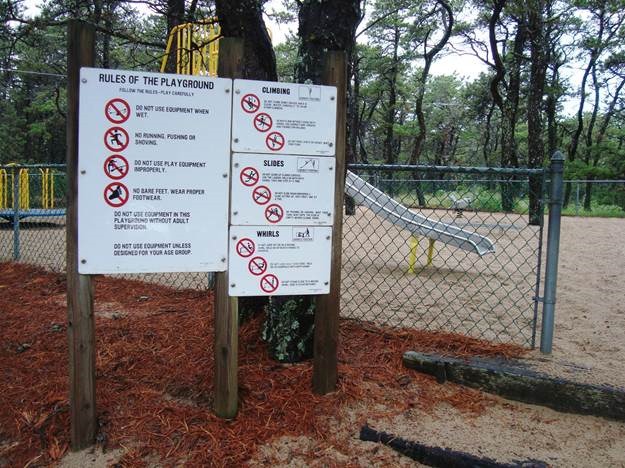
If you can’t read this, here are the rules that are posted on this sign.
Rules of the Playground
Follow the Rules – Play Carefully
Do not use equipment when wet
No running, Pushing or shoving
Do not use play equipment improperly
No bare feet, wear proper footwear
Do not use equipment in this playground without adult supervision
Do not use equipment unless designed for your age group
Climbing
Do not climb down unless area is clear. Watch Carefully to Avoid other climbers
Do not climb without using both hands. Use correct grip, fingers and thumbs for holding
Do not push, shove or crowd. Wait your turn
Slides
Do not climb up sliding surface
Do not slide down improperly. Slide sitting up, feet first one at a time
No pushing or shoving. Wait your turn. Wait until the slide is empty before sliding down
Whirls
Do not jump off or on a moving whirl. Hold on with both hands to handrail
Do not lean back over edge. Hold on to handrails with both hands
Do not stand close to a moving whirl. Keep a clear distance.
First of all, lets looks look at the individual rules.
Do not use play equipment improperly. What is improperly? What is improperly to a five-year-old?
No bare feet, wear proper footwear. No bare feet is easy. However, what is proper footwear? Wingtips, are Nike’s ok or do they have to be a specific brand?
Do not use equipment unless designed for your age group. What is my age group? Is the age group listed on the equipment? There is none listed on the sign.
Use correct grip, fingers and thumbs for holding. What is the correct grip? Am I allowed to wedge my hand into a crack? Should I be taped up before climbing? What if I don’t have some fingers or a thumb?
So some of these rules are absurd, even for adults. If an adult cannot understand the rules, how is a kid?
Rules as a hole?
Slides appeal to kids of all age groups. So unless you have reached the second or third grade (age 7-8?) you can’t read. You are walking along the street, see a playground and go running to the slide. Do you stop and stare at something you can’t understand?
Do you stare at something built at a height way above your head? Do you even slow down as you pass the sign? Do you really think that this is going to prevent a kid from getting hurt?
Seriously
Maybe a sign like this has some legal value, but I would think that anyone would blow that issue out of the water. How can you expect someone who cannot read to obey the rules.
If you really want to stop injuries, you better design your playground so that on one can get hurt. Or better, you figure that kids are going to figure a way to get hurt, no matter how low to the ground and how padded.
What do you think? Leave a comment.
If you like this let your friends know or post it on FB, Twitter or LinkedIn
Copyright 2013 Recreation Law (720) Edit Law
Email: Rec-law@recreation-law.com
Google+: +Recreation
Twitter: RecreationLaw
Facebook: Rec.Law.Now
Facebook Page: Outdoor Recreation & Adventure Travel Law
Mobile Site: http://m.recreation-law.com
By Recreation Law Rec-law@recreation-law.com James H. Moss #Authorrank
<rel=”author” link=” https://plus.google.com/u/0/b/112453188060350225356/” />
#RecreationLaw, #@RecreationLaw, #Cycling.Law #Fitness.Law, #Ski.Law, #Outside.Law, #Recreation.Law, #Recreation-Law.com, #Outdoor Law, #Recreation Law, #Outdoor Recreation Law, #Adventure Travel Law, #law, #Travel Law, #Jim Moss, #James H. Moss, #Attorney at Law, #Tourism, #Adventure Tourism, #Rec-Law, #Rec-Law Blog, #Recreation Law, #Recreation Law Blog, #Risk Management, #Human Powered, #Human Powered Recreation,# Cycling Law, #Bicycling Law, #Fitness Law, #Recreation-Law.com, #Backpacking, #Hiking, #Mountaineering, #Ice Climbing, #Rock Climbing, #Ropes Course, #Challenge Course, #Summer Camp, #Camps, #Youth Camps, #Skiing, #Ski Areas, #Negligence, #Snowboarding, #RecreationLaw, #@RecreationLaw, #Cycling.Law #Fitness.Law, #SkiLaw, #Outside.Law, #Recreation.Law, #RecreationLaw.com, #OutdoorLaw, #RecreationLaw, #OutdoorRecreationLaw, #AdventureTravelLaw, #Law, #TravelLaw, #JimMoss, #JamesHMoss, #AttorneyatLaw, #Tourism, #AdventureTourism, #RecLaw, #RecLawBlog, #RecreationLawBlog, #RiskManagement, #HumanPowered, #HumanPoweredRecreation,# CyclingLaw, #BicyclingLaw, #FitnessLaw, #RecreationLaw.com, #Backpacking, #Hiking, #Mountaineering, #IceClimbing, #RockClimbing, #RopesCourse, #ChallengeCourse, #SummerCamp, #Camps, #YouthCamps, #Skiing, #Ski Areas, #Negligence, #Snowboarding, sport and recreation laws, ski law, cycling law, Colorado law, law for recreation and sport managers, bicycling and the law, cycling and the law, ski helmet law, skiers code, skiing accidents, Recreation Lawyer, Ski Lawyer, Paddlesports Lawyer, Cycling Lawyer, Recreational Lawyer, Fitness Lawyer, Rec Lawyer, Challenge Course Lawyer, Ropes Course Lawyer, Zip Line Lawyer, Rock Climbing Lawyer, Adventure Travel Lawyer, Outside Lawyer, Recreation Lawyer, Ski Lawyer, Paddlesports Lawyer, Cycling Lawyer, #RecreationalLawyer, #FitnessLawyer, #RecLawyer, #ChallengeCourseLawyer, #RopesCourseLawyer, #ZipLineLawyer, #RockClimbingLawyer, #AdventureTravelLawyer, #OutsideLawyer, Playground, Sign, Signs, Rules, Slide, Whirl, Whirls
Louisiana does not allow the use of a release so great training of its patrons saved this climbing wall.
Posted: July 1, 2013 Filed under: Climbing Wall, Louisiana | Tags: belay, Climbing, Defendant, Grigri, Indoor, Louisiana, Recreation, Rock climbing 1 CommentEducation saves the day.
Ravey v. Rockworks, LLC, Et Al. 12-1305 (La.App. 3 Cir. 04/10/13); 2013 La. App. LEXIS 720
Plaintiff: Carl Ravey
Defendant: Rockworks, LLC, Colony Specialty Ins. Co.
Plaintiff Claims:
1. There is an increased duty to provide training and supervision when minors are involved in an inherently dangerous activity.
2. There are genuine issues of material fact regarding the adequacy of training received by the plaintiff party prior to engaging in a hazardous activity and regarding the adequacy of the supervision provided after training.
Defendant Defenses:
Holding: For the Defendant
The more you educate your guests the greater your success at a great trip and a win in court.
This case was based on a Civil Air Patrol Group (CAP) going to a climbing gym as part of its training. The CAP is composed of adults and minors; the plaintiff in this case was an adult in the group. The group went to the defendant’s climbing facilities as part of its training.
The participants paid the individual fees and then attended a 15-20-minute group training with an employee of the climbing wall. After the group training, the participants received training in pairs as belayer and climber. After that training, the belayer and climber were supervised. The plaintiff had climbed 5-6 times before he fell. The belayer was using a GriGri and held the brake open. The belayer released the break lever catching the plaintiff but not before he broke his leg.
The belayer for the plaintiff was 14 at the time of the accident.
The plaintiff brought a suit for negligence, which was dismissed after the defendant filed a motion for summary judgment.
Summary of the case
The first issue was whether the defendant owed the plaintiff a heightened duty of care because a minor was belaying him and/or because climbing is an inherently dangerous activity. The court then looked at what is required to prove negligence in Louisiana: “….a plaintiff must prove five separate elements: (1) duty, (2) breach, (3) cause-in-fact, (4) scope of duty/scope of risk, and (5) actual damages.”
The elements are basically the same as in any other state; they are just further identified and broken down into five requirements rather than the normal four in Louisiana. Most other states define negligence as duty, breach of duty, injury, damages proximately caused to the breach.
The court also explained the elements of duty in Louisiana.
Duty is a question of law. Simply put, the inquiry is whether the plaintiff has any law–statutory, jurisprudential, or arising from general principles of fault–to support his claim. The duty owed to an invitee “is that of reasonable and ordinary care, which includes the prior discovery of reasonably discoverable conditions of the premises that may be unreasonably dangerous, and correction thereof or a warning to the invitee of the danger
This duty necessarily includes a general responsibility to ensure that their members know how to properly use gym equipment.
The court did state that rock climbing is an “unreasonably dangerous activity” that requires a heightened duty upon the part of the gym owner. However, proof of that is evidenced of failing to provide the required supervision which has causation with the lack of supervision and the accident. Gyms are not the insurers of the safety of the patrons.
To prove negligence on the part of Rok Haus [defendant], Ravey [plaintiff] must show both a failure to provide reasonable training and supervision under the circumstances, as well as proof of a causal connection between this lack of reasonable training/supervision and the accident.
The defendant owed the plaintiff a duty of reasonable care. That was met, in the eyes of the court by the plaintiff.
The equipment was visually inspected prior to usage and was functioning properly after the incident. Ravey and Kelley [plaintiff and belayer] were given proper instructions on how to climb the wall and use the equipment properly. Ravey and Kelley were also observed using the equipment to lower climbers properly before they were allowed to climb and belay by themselves. During the time the group was climbing prior to the accident, two Rok Haus [defendant] employees observed the group to ensure they were using the gym’s equipment properly. Ravey made five or six successful climbs on the wall of the gym prior to the accident.
The next issue was whether the trainings the plaintiff and belayer received were adequate. Again, the court referred to the same set of facts.
The belayers must then operate the rope and the Grigri under the supervision of an instructor. After demonstrating an ability to belay the instructor, the belayers are allowed to belay volunteer climbers in the group under the supervision of the instructor.
This safety training session lasted approximately fifteen to twenty minutes. The members of the Civil Air Patrol group were individually instructed in safe climbing and belaying techniques and were observed operating the equipment properly before being allowed to climb and belay on their own. After receiving their safety training in the proper methods of belaying, Ravey, Kelley, and the rest of the Civil Air Patrol group climbed for forty-five minutes to an hour. During this time, two supervisors were present who observed the group to ensure that they were using the gym’s equipment properly. Ravey made five or six climbs on the wall prior to his accident.
The court stated that rock climbing involved substantial risk as a recreational activity. However, that risk was no different from weight lifting or swimming. The duty of the gym owner is to provide a “sound and secure” environment for undertaking any risk activity. There is no requirement to insure against any accident or injury.
The plaintiff could not point to any authority stating that a 14-year-old could not belay or any fact indicating the gym had not provided enough training. Consequently, the court upheld the dismissal of the complaint.
So Now What?
Here the climbing gym won because they had thoroughly trained the participants in climbing, belaying and the procedures of the gym. It also helped that the plaintiff had been belayed successfully 5-6 times prior to the incident which caused his injury.
The plaintiff also could not point out anything that the gym had done or failed to do that contributed to the injury. The training showed the participants how to belay; the belayer simply failed to use the belay device properly.
Education is what will save you. The more you educate your guests the more fun they will have. The more you educate your guests the safer they will be. The more you educate your guests the more prepared they will be. The more you educate your guests, the greater the chance you can prove you did not do anything wrong. The more you educate your guests the more you can prove your guests knew and undertook the risks.
What do you think? Leave a comment.
If you like this let your friends know or post it on FaceBook, Twitter or LinkedIn
Copyright 2013 Recreation Law (720) Edit Law
Email: Rec-law@recreation-law.com
Google+: +Recreation
Twitter: RecreationLaw
Facebook: Rec.Law.Now
Facebook Page: Outdoor Recreation & Adventure Travel Law
Blog: www.recreation-law.com
Mobile Site: http://m.recreation-law.com
By Recreation Law Rec-law@recreation-law.com James H. Moss #Authorrank
<rel=”author” link=” https://plus.google.com/u/0/b/112453188060350225356/” />
#RecreationLaw, #@RecreationLaw, #Cycling.Law #Fitness.Law, #Ski.Law, #Outside.Law, #Recreation.Law, #Recreation-Law.com, #Outdoor Law, #Recreation Law, #Outdoor Recreation Law, #Adventure Travel Law, #law, #Travel Law, #Jim Moss, #James H. Moss, #Attorney at Law, #Tourism, #Adventure Tourism, #Rec-Law, #Rec-Law Blog, #Recreation Law, #Recreation Law Blog, #Risk Management, #Human Powered, #Human Powered Recreation,# Cycling Law, #Bicycling Law, #Fitness Law, #Recreation-Law.com, #Backpacking, #Hiking, #Mountaineering, #Ice Climbing, #Rock Climbing, #Ropes Course, #Challenge Course, #Summer Camp, #Camps, #Youth Camps, #Skiing, #Ski Areas, #Negligence, #Snowboarding, #RecreationLaw, #@RecreationLaw, #Cycling.Law #Fitness.Law, #SkiLaw, #Outside.Law, #Recreation.Law, #RecreationLaw.com, #OutdoorLaw, #RecreationLaw, #OutdoorRecreationLaw, #AdventureTravelLaw, #Law, #TravelLaw, #JimMoss, #JamesHMoss, #AttorneyatLaw, #Tourism, #AdventureTourism, #RecLaw, #RecLawBlog, #RecreationLawBlog, #RiskManagement, #HumanPowered, #HumanPoweredRecreation,# CyclingLaw, #BicyclingLaw, #FitnessLaw, #RecreationLaw.com, #Backpacking, #Hiking, #Mountaineering, #IceClimbing, #RockClimbing, #RopesCourse, #ChallengeCourse, #SummerCamp, #Camps, #YouthCamps, #Skiing, #Ski Areas, #Negligence, #Snowboarding, sport and recreation laws, ski law, cycling law, Colorado law, law for recreation and sport managers, bicycling and the law, cycling and the law, ski helmet law, skiers code, skiing accidents, Recreation Lawyer, Ski Lawyer, Paddlesports Lawyer, Cycling Lawyer, Recreational Lawyer, Fitness Lawyer, Rec Lawyer, Challenge Course Lawyer, Ropes Course Lawyer, Zip Line Lawyer, Rock Climbing Lawyer, Adventure Travel Lawyer, Outside Lawyer, Recreation Lawyer, Ski Lawyer, Paddlesports Lawyer, Cycling Lawyer, #RecreationalLawyer, #FitnessLawyer, #RecLawyer, #ChallengeCourseLawyer, #RopesCourseLawyer, #ZipLineLawyer, #RockClimbingLawyer, #AdventureTravelLawyer, #OutsideLawyer, Civil Air Patrol, CAP, #CAP, Rock Climbing, Climbing Wall, Belayer, Rock Gym, Gym, GriGri, Belay, LA, Louisiana,
WordPress Tags: Louisiana,patrons,Education,Ravey,Rockworks,LEXIS,Plaintiff,Carl,Defendant,Colony,Claims,supervision,minors,fact,adequacy,Defenses,guests,Civil,Patrol,Group,adults,facilities,participants,employee,climber,GriGri,accident,negligence,judgment,Summary,scope,requirements,Most,injury,discovery,premises,correction,danger,equipment,owner,causation,Gyms,insurers,Haus,failure,connection,usage,incident,Kelley,instructions,climbers,employees,trainings,Again,instructor,session,techniques,hour,supervisors,environment,requirement,dismissal,complaint,Here,procedures,device,Leave,FaceBook,Twitter,LinkedIn,Recreation,Edit,Email,Google,RecreationLaw,Page,Outdoor,Adventure,Travel,Blog,Mobile,Site,James,Moss,Authorrank,author,Outside,Attorney,Tourism,Risk,Management,Human,Rock,Ropes,Course,Challenge,Summer,Camp,Camps,Youth,Areas,SkiLaw,OutdoorLaw,OutdoorRecreationLaw,AdventureTravelLaw,TravelLaw,JimMoss,JamesHMoss,AttorneyatLaw,AdventureTourism,RecLaw,RecLawBlog,RecreationLawBlog,RiskManagement,HumanPoweredRecreation,CyclingLaw,BicyclingLaw,FitnessLaw,RopesCourse,ChallengeCourse,SummerCamp,YouthCamps,Colorado,managers,helmet,accidents,Lawyer,Paddlesports,Recreational,Line,RecreationalLawyer,FitnessLawyer,RecLawyer,ChallengeCourseLawyer,RopesCourseLawyer,ZipLineLawyer,RockClimbingLawyer,AdventureTravelLawyer,OutsideLawyer,Wall,Belayer,Belay,whether,five,invitee,belayers
Keeter v. Alpine Towers International, Inc., 399 S.C. 179; 730 S.E.2d 890; 2012 S.C. App. LEXIS 171
Posted: June 17, 2013 Filed under: Challenge or Ropes Course, Climbing Wall, Contract, Legal Case, South Carolina | Tags: Alpine Towers, Alpine Towers International, belay, Belay device, Business, Carowinds, Climbing, Fort Mills, Grigri, negligent design, negligent training, paraplegic, Petzl, Punitive damages, Recreation, Rock climbing, strict liability, Trango 1 CommentKeeter v. Alpine Towers International, Inc., 399 S.C. 179; 730 S.E.2d 890; 2012 S.C. App. LEXIS 171
Lawrence Keeter, Ronald Travis Keeter, and Rebecca Keeter, Appellants/Respondents, v. Alpine Towers International, Inc., and Ashley Sexton, Defendants, Of Whom Alpine Towers International, Inc., is Respondent/Appellant.
Opinion No. 4995
COURT OF APPEALS OF SOUTH CAROLINA
399 S.C. 179; 730 S.E.2d 890; 2012 S.C. App. LEXIS 171
December 6, 2011, Heard
June 27, 2012, Filed
SUBSEQUENT HISTORY: Rehearing denied by Keeter v. Alpine Towers Int’l, Inc., 2012 S.C. App. LEXIS 248 (S.C. Ct. App., July 31, 2012)
PRIOR HISTORY: [***1]
Appeal From York County. Appellate Case No. 2009-137246. John C. Hayes, III, Circuit Court Judge.
DISPOSITION: AFFIRMED IN PART, REVERSED IN PART, AND REMANDED.
COUNSEL: Richard A. Harpootlian and Graham L. Newman, both of Richard A. Harpootlian, P.A., of Columbia, for Appellants/Respondents.
Charles E. Carpenter, Jr., and Carmon V. Ganjehsani, of Carpenter Appeals & Trial Support, LLC, of Columbia, and Thomas C. Salane, of Turner, Padget, Graham & Laney, P.A., of Columbia, for Respondent/Appellant.
JUDGES: FEW, C.J. KONDUROS, J., concurs. THOMAS, J., concurring in a separate opinion.
OPINION BY: FEW
OPINION
[*184] [**893] FEW, C.J.: Lawrence “Larry” Keeter and his parents brought this action against Alpine Towers International, Inc., for strict liability, negligent design, and negligent training after Larry broke his back and became a paraplegic as a result of a fall to the ground from a climbing tower designed, manufactured, and installed by Alpine Towers. The jury awarded actual and punitive damages in favor of Larry and actual damages in favor of his parents for Larry’s medical bills. After both sides filed post-trial motions, the trial court entered separate judgments in favor of Larry and his parents. Alpine Towers appeals the trial court’s decision [***2] to deny its motions for directed verdict and judgment notwithstanding the verdict (JNOV) as to actual and punitive damages, and its motion for a new trial due to an alleged error as to apportionment. Larry appeals the trial court’s ruling requiring him to elect between his three causes of action. We affirm the denial of Alpine Towers’ motions. However, we hold the trial court incorrectly interpreted the jury’s verdict and erred in requiring [*185] Larry to elect. We remand to the trial court with instructions to enter judgment in Larry’s favor against Alpine Towers in the amount of $3,400,500.00 actual damages and $1,110,000.00 punitive damages. 1
1 The judgment in favor of Larry’s parents is not affected by this appeal.
I. Facts
On May 5, 2006, the senior students at Fort Mill High School (Fort Mill) participated in a spring fling recreational field day. During field day, Larry fell more than twenty feet from the climbing tower to the ground. When he hit the ground, Larry broke a vertebra and was rendered a permanent paraplegic. He was seventeen.
Alpine Towers originally sold the climbing tower to Carowinds amusement park near Charlotte, North Carolina. Fort Mill bought the tower from Carowinds [***3] in July 2004 and hired Alpine Towers to move it, install it, and train Fort Mill’s faculty to safely use it. Fort Mill’s contract with Alpine Towers identifies Alpine Towers as “seller” and provides: “Installation includes all hardware, materials, . . . labor, . . . design work, . . . and staff training.” The wooden climbing tower is fifty feet tall, has three sides, and is shaped liked an hourglass. The central safety feature of any climbing tower is the belay system. 2 Alpine Towers designed the belay system on this climbing tower to include four participants–the climber, a primary belayer, a back-up belayer, and a faculty supervisor. The system requires the climber to wear a harness, which is secured to a climbing rope. The rope passes through a pulley at the top of the tower and down to a belay device secured to the ground at the base of the tower. The rope is threaded through the belay device, which uses bends in the rope to create friction to control the speed at which the rope passes through the device. As the [**894] climber ascends, the belayer guides the rope through the belay device to keep the rope taut. If the climber falls from the tower while climbing, [*186] the belayer uses the friction [***4] the belay device creates on the rope to keep the rope from passing back through the device, and thus protects the climber from falling all the way to the ground.
2 Alpine Towers’ instruction manual defines “belay” as “the rope or technique . . . that is used to protect a climber from falling to the ground.” See also Merriam-Webster Collegiate Dictionary 111 (11th ed. 2004) (defining belay as “the securing of a person or a safety rope to an anchor point (as during mountain climbing)”).
After a successful climb, or in the event the climber falls before completing the climb, the belayer lowers the climber to the ground in a controlled fashion by guiding the rope back through the belay device. The friction created on the rope allows the belayer to control the speed of the climber’s descent. 3 Because of the hourglass shape of the tower, a climber being lowered to the ground by the belayer is suspended in air, away from the side of the tower.
3 Alpine Towers’ CEO explained that “not very much” strength is required to hold a climber in the air because the weight is transferred through the belay device to the rope attached to the ground, so that a lightweight belayer can easily lower even a heavy [***5] climber.
Ashley Sexton, a senior at Fort Mill, served as Larry’s primary belayer. Fort Mill trained Ashley to belay as a part of the Junior ROTC program. Larry had never been trained in belaying or climbing, but successfully climbed to the top of the tower. Ashley testified that while she was lowering Larry to the ground “the rope . . . got[] tight in the [belay device] almost as if it were stuck” and would not move. Neither Ashley nor anyone at Fort Mill had been taught what to do if the rope became stuck in the belay device. When Ashley tried to free the rope, she lost the assistance of the device, was unable to control the rope, and Larry fell more than twenty feet to the ground.
Alpine Towers designed the belay system on the climbing tower and trained Fort Mill’s faculty how to use it. Alpine Towers provided no notice or warning to Fort Mill’s faculty that the climbing rope could get stuck in the belay device it designed into the system. Alpine Towers also provided no training or instruction on how the belayer or faculty supervisor should handle the situation if it did. Alpine Towers chose not to incorporate into the design a readily available, automatically locking belay device [***6] Larry’s experts testified would have stopped Larry’s fall. Alpine Towers did not train Fort Mill’s faculty to require the faculty supervisor to stand directly beside the belayer, which Alpine Towers admitted at trial [*187] should always be done to ensure that proper procedures were followed in the climb and to assist the belayers in the event of a situation like the one that resulted in Larry’s fall. When Larry fell, no back-up belayer was present, and no faculty supervisor was close enough to assist Ashley.
II. Procedural History
All of Larry’s damages were caused by the broken back he suffered as a result of his fall. Larry asserted three causes of action presenting three alternative theories of Alpine Towers’ liability for those damages: (1) Alpine Towers was strictly liable for the manufacture and sale of a defective and unreasonably dangerous product; (2) Alpine Towers negligently designed the climbing tower without adequate safety equipment, instructions, and warnings; 4 and (3) Alpine Towers was negligent in failing to properly train Fort Mill’s faculty on how to safely use the climbing tower, particularly in failing to train the faculty to teach student belayers to safely use the belay [***7] system.
4 Because Alpine Towers did the “design work” for the installation of the tower at Fort Mill, Larry’s negligent design theory includes allegations of negligence in failing to design the tower to meet the specific safety needs of Fort Mill.
Larry also filed suit against Ashley for negligence. Larry’s parents filed suit against Alpine Towers and Ashley for Larry’s medical bills. Larry and his parents settled with Fort Mill before filing suit and dismissed Ashley as a defendant before trial. The jury returned a verdict for Larry on each cause of action. It awarded $500.00 for strict liability, 5 $900,000.00 in actual damages and $160,000.00 in punitive damages for negligent design of the tower, and $2,500,000.00 in actual damages and $950,000.00 in punitive [**895] damages for Alpine Tower’s negligence in training Fort Mill’s faculty. The jury also returned a verdict for Larry’s parents for $240,000.00 in actual damages.
5 The jury originally returned a verdict on the strict liability cause of action in favor of Larry, but with zero damages. After the trial court instructed the jury that it must either award damages to Larry or find in favor of Alpine Towers, it returned a $500.00 award.
[*188] Alpine [***8] Towers filed a post-trial motion seeking (1) judgment notwithstanding the verdict as to all causes of action and punitive damages, (2) a new trial, (3) an order requiring Larry to elect between the three causes of action, (4) set-off of the settlement paid by Fort Mill, and (5) apportionment under the Contribution Among Joint Tortfeasors Act. The trial court denied the JNOV, new trial, and apportionment motions. The court required Larry to elect between his causes of action and ordered that the settlement from Fort Mill be set-off against Larry’s recovery from Alpine Towers. Larry also filed a post-trial motion asking the trial court to enter judgment in the cumulative amount of the damage awards rather than require him to elect. The court denied Larry’s motion and ordered that judgment be entered in the amount of $2,500,000.00 in actual damages and $950,000.00 in punitive damages on the negligent training cause of action.
III. Alpine Towers’ Appeal
A. Directed Verdict and JNOV–Actual Damages
[HN1] “In ruling on motions for directed verdict and JNOV, the trial court is required to view the evidence and the inferences that reasonably can be drawn therefrom in the light most favorable to the [***9] party opposing the motions.” McMillan v. Oconee Mem’l Hosp., Inc., 367 S.C. 559, 564, 626 S.E.2d 884, 886 (2006). “When we review a trial judge’s . . . denial of a motion for directed verdict or JNOV, we reverse only when there is no evidence to support the ruling or when the ruling is governed by an error of law.” Austin v. Stokes-Craven Holding Corp., 387 S.C. 22, 42, 691 S.E.2d 135, 145 (2010).
In its motions for directed verdict and JNOV, Alpine Towers contested all liability issues, including the sufficiency of the evidence supporting each of Larry’s causes of action. In its Statement of Issues on Appeal, Alpine Towers contends only that the trial court should have granted its motions because the chain of causation was broken as a matter of law. Specifically, Alpine Towers contends the chain of causation was broken by (1) “the intervening and superseding negligent [*189] acts of Fort Mill High School and Ashley Sexton in failing to follow the warnings, directions, and instructions for proper use of the Tower” and (2) “the intervening and superseding negligent acts of Fort Mill High School in failing to undertake its independent duty to properly supervise its students.” However, because [***10] both Larry and Alpine Towers address in their briefs the sufficiency of the evidence supporting each of Larry’s causes of action, we do as well. We find ample evidence to support the jury’s verdict as to each. We also find ample evidence that Ashley’s negligence and any negligence by Fort Mill was foreseeable to Alpine Towers, and thus their negligence does not break the chain of causation from Alpine Towers’ tortious conduct.
1. Strict Liability
In his strict liability theory, Larry focused on Alpine Towers’ design of the climbing tower to incorporate a belay device called Trango Jaws. The Trango Jaws is operated manually and requires the belayer to properly position the climbing rope in the Trango Jaws to create the friction necessary to stop the rope and then control the rate of the climber’s descent. Larry’s expert witness in biomechanics and sports safety, Gerald George, Ph.D., testified that the Trango Jaws relies on the absence of human error to safely belay a climber. He explained that it was feasible to use an alternative design for the climbing tower incorporating a belay device called a GriGri. 6
6 The GriGri costs approximately $75, and the Trango Jaws costs approximately $24. [***11] The CEO of Alpine Towers testified the difference in cost is an “inconsequential amount of money.”
The GriGri is a mechanical device that, when properly threaded, does not rely on the absence of human error. In the event the belayer loses control of the rope, the GriGri automatically stops the rope, and thus protects the climber from falling to the ground. Larry’s climbing wall safety expert, Dan Hague, testified that the GriGri “locks up automatically, . . . you’re not relying on the actions of the belayer to lock the device up.” [**896] He emphasized that the automatic stopping feature of the GriGri is particularly important when students are belaying climbers because of the heightened likelihood of human error. To account for this foreseeable risk, Hague “always uses the GriGri with kids.” In Hague’s opinion, “this injury would not have occurred had a GriGri [*190] been in use that day.” As a normal part of its business, Alpine Towers sells the GriGri for a variety of uses, including on its own climbing towers. Dr. George testified that without incorporating a “fail-safe” belay device such as the GriGri into the design of a climbing tower used for students, the climbing tower is defective and unreasonably [***12] dangerous.
Alpine Towers’ argument that the evidence in support of Larry’s strict liability cause of action is insufficient is that there is no evidence the tower “was in a defective condition, unreasonably dangerous to the user . . . when it left the hands of the defendant.” See Bragg v. Hi-Ranger, Inc., 319 S.C. 531, 539, 462 S.E.2d 321, 326 (Ct. App. 1995). However, the evidence discussed above amply supports the jury’s finding that it was. Moreover, the GriGri qualifies as a “reasonable alternative design” as required under Branham v. Ford Motor Co., 390 S.C. 203, 225, 701 S.E.2d 5, 16 (2010). The trial court correctly denied Alpine Towers’ directed verdict and JNOV motions as to strict liability.
2. Negligent Design
[HN2] “A negligence theory imposes the additional burden on a plaintiff ‘of demonstrating the defendant . . . failed to exercise due care in some respect, and, unlike strict liability, the focus is on the conduct of the seller or manufacturer, and liability is determined according to fault.'” Branham, 390 S.C. at 210, 701 S.E.2d at 9 (quoting Bragg, 319 S.C. at 539, 462 S.E.2d at 326). In his negligent design theory, Larry also relied on the evidence that Alpine Towers should [***13] have used the GriGri in designing a climbing tower to be used by students, particularly student belayers. However, in addition to evidence that the tower was defective and unreasonably dangerous without the GriGri, Larry presented evidence that Alpine Towers failed to exercise reasonable care in the design. Specifically, Larry presented evidence that Alpine Towers conducted a ten-year study ending in 1999 that concluded the majority of accidents on its climbing towers were caused by human error, specifically belayers dropping their climbers. Despite this knowledge, Alpine Towers chose not to design for human error by including a belay device that would automatically lock and prevent the rope from passing back through the [*191] device, thus preventing a fall to the ground such as the one Larry suffered.
Moreover, Larry’s experts testified to several breaches of Alpine Towers’ duty of reasonable care in designing the warnings and instructions on the tower. In particular, Larry’s experts testified faculty supervisors should be instructed to remain within reaching distance of active belay ropes. Alpine Towers’ employee John Mordhurst conceded this instruction was necessary. Mordhurst testified [***14] a faculty supervisor should be at each belay point, and “[t]hey should be . . . in a position to intervene to grab a rope, . . . so they should be right next to the belayers and belay monitors.” In the 1997 edition of Alpine Towers’ instruction manual for the climbing tower, the section entitled “The Belay System” includes this requirement: “[P]rograms should require staff to check the belayer’s and climber’s systems prior to climbing and lowering; . . . the staff member should stand directly beside the climber.” However, Alpine Towers omitted the statement containing this requirement from the 2004 edition of the instruction manual, the edition it provided to Fort Mill.
Additionally, Dr. George testified Alpine Towers should have placed end user warnings on the tower for someone like Larry, who climbed for the first time without any instruction, and Ashley, who never received an instruction manual. Dr. George explained this was necessary to ensure an inexperienced climber such as Larry will know the dangers of climbing and understand how the belay system is designed to work before deciding to begin a climb. This evidence amply supports the jury’s finding that Alpine Towers failed to [***15] exercise reasonable care in designing a defective and unreasonably dangerous climbing tower. Therefore, the trial court was correct to deny Alpine Towers’ motions as to negligent design.
[**897] 3. Negligent Training
In his negligent training theory, Larry presented evidence that despite knowing Fort Mill’s faculty would not be doing most of the belaying, but rather would be teaching students to belay, Alpine Towers did not instruct the faculty how to teach belaying. Larry proved several key facts in support of this claim. First, Alpine Towers uses a written [*192] syllabus when it conducts classes to teach adults how to belay. However, it did not provide the syllabus to Fort Mill to enable Fort Mill to effectively teach students. Second, the belay system designed by Alpine Towers relies on a faculty supervisor to ensure the students are properly belaying the climbers. In addition to Mordhurst’s testimony as to where the faculty supervisor should be positioned, the CEO of Alpine Towers, Joe Lackey, testified, “the staff member should stand directly behind the climber, . . . not thirty feet away.” The obvious purpose of this requirement is to enable the supervisor to keep the students from making errors [***16] and, if they do, to prevent the tragic consequences Larry suffered. However, Larry presented evidence that Alpine Towers did not teach this to the faculty at Fort Mill. One member of Fort Mill’s faculty who attended the Alpine Towers course testified he did not recall being told that a faculty supervisor should stand beside the belayer. When asked why the requirement that “the staff member should stand directly beside the climber” in the 1997 instruction manual was not included in the 2004 edition, Lackey responded, “I’m not sure why it was taken out.”
Moreover, despite knowing that Fort Mill would be teaching students to belay and that students were more susceptible to making belaying errors than adults, Alpine Towers did not teach Fort Mill that it should test the students’ competency before allowing them to belay a climber. Hague testified “as a matter of course in my industry, participants are tested,” including whether they are “able to . . . belay in a competent manner, catch falls, lower somebody . . . off a climb.” He explained:
In a climbing setting you have to be able to assess whether or not the group as a whole is making progress. . . . Since we’re talking about life safety [***17] here and not about math, if someone is not learning at the same rate as the group, you can’t just move to the next topic. You have to slow down. You have to be able to address that one person until everybody’s caught up. In addition, at the end of the training, there needs to be some type of discrete competency test.
Alpine Towers has several employees who serve on the standards committee for the Association for Challenge [*193] Courses Technology, which Lackey called a “climbing society.” Despite evidence of this standard climbing industry practice, Alpine Towers did not teach Fort Mill that it needed to test, how the tests should be conducted, or what particular skills should be tested. 7
7 Ashley testified she was not given a written test, but was required to do a “demonstration” and be watched by a faculty member to make sure she “knew how to do it.” There was no evidence, however, that Alpine Towers took any steps to ensure Fort Mill gave an adequate test of her competency. In fact, Alpine Towers’ instruction manual says only that students “will demonstrate proficiency in belaying before being permitted to belay.”
This evidence provides ample support for the jury’s finding that Alpine Towers [***18] was negligent in failing to properly train the Fort Mill faculty on how to safely use the tower, and thus the trial court properly denied Alpine Towers’ motions as to negligent training.
We affirm the trial court’s decision to deny Alpine Towers’ motions for directed verdict and JNOV as to the sufficiency of the evidence supporting all three of Larry’s causes of action.
4. Intervening Causation
[HN3] The test for whether a subsequent negligent act by a third party breaks the chain of causation to insulate a prior tortfeasor from liability is whether the subsequent actor’s negligence was reasonably foreseeable. “For an intervening act to break the causal link and insulate the tortfeasor from further liability, the intervening act must be unforeseeable.” McKnight v. S.C. Dep’t of Corr., 385 S.C. 380, 387, 684 S.E.2d 566, 569 [**898] (Ct. App. 2009) (internal quotation marks omitted). The trial court properly charged the jury as follows:
The chain of causation between a defendant’s negligence and the injury itself may be broken by the independent intervening acts or omissions of another person over whom the defendant had no control. In order to decide whether an intervening act breaks the chain of causation, [***19] you must determine whether the intervening act or omission was reasonably foreseeable by the defendant. If the intervening act or omission was a probable consequence of the defendant’s negligence, the defendant is responsible for the plaintiff’s [*194] injuries. If, however, you find that the intervening act or omission was not foreseeable, the defendant is not liable.
By finding in favor of Larry, the jury necessarily found the actions of Ashley and Fort Mill were foreseeable, and therefore the chain of causation was not broken to insulate Alpine Towers from liability. There is ample evidence to support this finding. See Cody P. v. Bank of Am., N.A., 395 S.C. 611, 621-22, 720 S.E.2d 473, 479 (Ct. App. 2011) (“Only in rare or exceptional cases may the question of proximate cause be decided as a matter of law. . . . If there may be a fair difference of opinion regarding whose act proximately caused the injury, then the question of proximate cause must be submitted to the jury.” (internal quotation marks and citations omitted)).
Larry presented evidence that Alpine Towers knew Fort Mill would be using high school students to belay climbers, that adolescents are more susceptible to belaying errors [***20] than adults, and that Alpine Towers conducted a study concluding human error is the most common cause of falls to the ground from climbing towers. Dr. George testified Alpine Towers “knew or should have known . . . of these risks.” He stated it was not merely foreseeable, but “almost predictable,” that high school students would not follow proper procedures for belaying climbers. Hague testified that he has trained “thousands and thousands” of people in belaying over fifteen years, including “many hundreds” of adolescents, he takes different approaches to training depending on the maturity level of the belaying student, adolescents “routinely do not” follow procedures, and Alpine Towers “could easily foresee that adolescents aren’t going to follow all the procedures.”
Therefore, the primary risk associated with the use of a climbing tower is that the belayer, back-up, or faculty supervisor might make an error belaying the climber. Each of Larry’s theories of recovery focused on the allegation that Alpine Towers failed to design for and train against human error in belaying and the supervision of students belaying. This is not a “rare or exceptional” case in which the issue of proximate [***21] cause may be decided as a matter of law. Alpine Towers’ argument that “the intervening and superseding negligent acts of Fort Mill High School and Ashley Sexton” broke the chain of causation fails because there is ample evidence in [*195] the record that precisely the same human error that resulted in Larry’s injury was not only foreseeable to Alpine Towers, but was actually foreseen. Accordingly, we find the trial court properly submitted the question of proximate cause to the jury, and we affirm its decision to deny Alpine Towers’ motions for directed verdict and JNOV as to intervening causation.
B. Directed Verdict and JNOV–Punitive Damages
Alpine Towers also argues the trial court erred in denying its directed verdict and JNOV motions as to punitive damages. We disagree.
[HN4] “When ruling on a directed verdict motion as to punitive damages, the circuit court must view the evidence and the inferences that reasonably can be drawn therefrom in the light most favorable to the nonmoving party.” Hollis v. Stonington Dev., LLC, 394 S.C. 383, 393-94, 714 S.E.2d 904, 909 (Ct. App. 2011) (internal quotation marks omitted). This court applies the same standard as the circuit court. 394 S.C. at 394, 714 S.E.2d at 910. [***22] “The issue of punitive damages must be submitted to the jury if more than one reasonable inference can be drawn from the evidence as to whether the defendant’s behavior was reckless . . . .” Mishoe v. QHG of Lake City, Inc., 366 S.C. 195, 201, 621 S.E.2d 363, 366 (Ct. App. 2005). “Recklessness implies the doing of a negligent [**899] act knowingly; it is a conscious failure to exercise due care. If a person of ordinary reason and prudence would have been conscious of the probability of resulting injury, the law says the person is reckless . . . .” Berberich v. Jack, 392 S.C. 278, 287, 709 S.E.2d 607, 612 (2011) (internal citation and quotation marks omitted).
Larry made two separate claims for punitive damages against Alpine Towers: (1) for reckless behavior in its design of the climbing tower and (2) for reckless behavior in its failure to properly train the Fort Mill faculty on how to safely use the climbing tower. The jury awarded punitive damages on each claim, so we address each independently.
As to Larry’s claim for punitive damages based on Alpine Towers’ reckless behavior in designing the tower, Larry presented evidence that Alpine Towers knew the majority [*196] of accidents occurring on its [***23] climbing towers were caused by human error by belayers and back-up belayers. Mordhurst conceded that of the three options for a belay device in the design of a climbing tower, “the GriGri has [the] highest likelihood of arresting the fall” of a climber and thus protecting him from falling to the ground if the belayer loses control of the rope. Lackey testified the additional cost of a GriGri is “inconsequential.” Alpine Towers’ decision to design its climbing tower to incorporate the Trango Jaws instead of the GriGri under these circumstances is sufficient evidence Alpine Towers was “conscious of the probability of resulting injury” from its negligence, and therefore was reckless. The trial court was correct to submit the issue of punitive damages for reckless design to the jury. 392 S.C. at 287, 709 S.E.2d at 612.
As to Larry’s claim for punitive damages based on Alpine Towers’ reckless behavior in failing to properly train the Fort Mill faculty, in addition to the evidence discussed above, Alpine Towers knew Fort Mill would be using student belayers, whom Alpine Towers knew to be less attentive to following procedures and more susceptible to errors in belaying than adults. Nevertheless, [***24] Alpine Towers (1) chose not to train Fort Mill’s faculty to teach others, particularly students; (2) did not include in the training materials given to Fort Mill the syllabus Alpine Towers uses to teach belaying; (3) removed from its training manual the specific instruction for faculty supervisors to “stand directly behind the climber”; (4) did not teach Fort Mill to follow the industry practice of testing belayers on the basic skills of belaying before allowing them to belay climbers; and (5) did not inform Fort Mill it had the option of an automatically locking belay device such as the GriGri to compensate for the greater risk posed by the use of student belayers. This also is sufficient evidence Alpine Towers was “conscious of the probability of resulting injury” from its negligence, and therefore was reckless. The trial court was correct to submit the issue of punitive damages for reckless training to the jury. Id.
Accordingly, we affirm the trial court’s decision to deny Alpine Towers’ directed verdict and JNOV motions as to punitive damages.
[*197] C. Apportionment of Fort Mill’s Fault
Alpine Towers contends it is entitled to a new trial because the trial court did not allow the jury to [***25] consider the fault of Fort Mill when it apportioned fault under section 15-38-15 of the South Carolina Code (Supp. 2011). 8 However, our ruling affirming the jury’s award of punitive damages makes it unnecessary to address this issue as [HN5] the apportionment statute “does not apply to a defendant whose conduct is determined to be . . . reckless.” § 15-38-15(F).
8 After the jury’s verdict as to liability, the trial court required it to apportion fault between Alpine Towers and Ashley. The jury determined that Ashley was 60% at fault and Alpine Towers was 40% at fault. The jury was not asked to consider the fault of Fort Mill.
IV. Larry’s Appeal
Larry appeals the trial court’s post-trial ruling entering judgment in his favor in the amount of $2,500,000.00 in actual damages and $950,000.00 in punitive damages. He contends the trial court erred in interpreting the verdicts as “three awards” and requiring him to elect which cause of action would be his remedy. We agree.
[HN6] “Election of remedies involves a choice between different forms of redress [**900] afforded by law for the same injury . . . . It is the act of choosing between inconsistent remedies allowed by law on the same set of facts.” Taylor v. Medenica, 324 S.C. 200, 218, 479 S.E.2d 35, 44-45 (1996). [***26] Larry asserted three causes of action, but sought only one remedy–damages–for only one injury–a broken back. When a plaintiff seeks only one remedy, there is nothing to elect. See Adams v. Grant, 292 S.C. 581, 586, 358 S.E.2d 142, 144 (Ct. App. 1986) (“Where a plaintiff presents two causes of action because he is uncertain of which he will be able to prove, but seeks a single recovery, he will not be required to elect.”).
The trial court in this case recognized that Larry’s three causes of action sought only one remedy. In its post-trial order, the court wrote:
Here, both products liability claims and the negligence claim represent three theories for recovery for the same injury and damages–personal injuries sustained by [Larry] in his [*198] fall. [Larry] had one fall and all his injury and damages flow therefrom regardless of the number of acts of omission or commission of [Alpine Towers].
Because Larry sought only one remedy, the doctrine of election of remedies does not apply. [HN7] “As its name states, the doctrine applies to the election of ‘remedies’ not the election of ‘verdicts.'” Austin, 387 S.C. at 57, 691 S.E.2d at 153 (defining a “‘remedy’ as ‘[t]he means by which . . . the violation [***27] of a right is . . . compensated.'” (quoting Black’s Law Dictionary 1163 (5th ed. 1979))).
This court addressed a similar situation in Creach v. Sara Lee Corp., 331 S.C. 461, 502 S.E.2d 923 (Ct. App. 1998). The plaintiff in Creach “bit down on a hard substance in a steak biscuit made by Sara Lee Corporation,” “experience[d] severe pain,” and had to undergo “extensive dental work.” 331 S.C. at 463, 502 S.E.2d at 923-24. She sued Sara Lee and others “alleging negligence, breach of warranty, and strict liability.” 331 S.C. at 463, 502 S.E.2d at 923. After a verdict for Creach on all three causes of action, Sara Lee asked the trial judge to require her to elect her remedy. The judge refused to do so, and this court affirmed, holding “while the complaint stated three different causes of action, only one recovery was sought and only one recovery was awarded. Under these circumstances, no election was required.” 331 S.C. at 464, 502 S.E.2d at 924 (citing Taylor, 324 S.C. at 218, 479 S.E.2d at 44-45). Creach supports our holding that because Larry sought one remedy for one injury, the trial court erred in requiring him to elect.
Nevertheless, the trial court and this court must ensure that Larry [***28] does not receive a double recovery. See Collins Music Co. v. Smith, 332 S.C. 145, 147, 503 S.E.2d 481, 482 (Ct. App. 1998) ( [HN8] “It is well settled in this state that there can be no double recovery for a single wrong and a plaintiff may recover his actual damages only once.” (internal quotation marks omitted)). The determination of whether a verdict grants a double recovery begins with the trial court’s responsibility to interpret the verdict in order to ascertain the jury’s intent. The trial court interpreted the jury’s verdict in this case to be “three awards,” and therefore “inconsistent” because [*199] it allowed Larry a double recovery. We find the trial court erred in its interpretation of the verdict.
The error arose from the verdict form. Because Larry asserted three causes of action, the trial court correctly fashioned the verdict form to require the jury to write its verdict for each cause of action. However, because Larry sought only one remedy–damages–and because the amount of those damages could not vary from one cause of action to another, the trial court should have required the jury to write one amount for Larry’s actual damages, and should not have permitted the jury to write [***29] a damages amount for each of the three causes of action. The use of the three blanks for damages in the verdict form left the verdict ambiguous as to the amount of damages the jury intended to award.
[HN9] To determine the jury’s intent in an ambiguous verdict, the court should consider the entire proceedings, focusing on the events and circumstances that reasonably indicate what the jury intended. See Durst v. S. Ry. Co., 161 S.C. 498, 506, 159 S.E. 844, 848 (1931) (stating “the construction of a verdict should, and can, depend upon, not only the language used by the jury, but other things occurring in the trial may be, and [**901] should be, properly regarded in determining what a jury intended to find”); Howard v. Kirton, 144 S.C. 89, 101, 142 S.E. 39, 43 (1928) (stating it is “the duty of the trial judge to decide what the verdict meant, and, in reaching his conclusion thereabout, it was his duty to take into consideration not only the language of the verdict, but all the matters that occurred in the course of the trial”); see also 75B Am. Jur. 2d Trial § 1545 (2007) (“In the interpretation of an ambiguous verdict, the court may make use of anything in the proceedings that serves to show with [***30] certainty what the jury intended, and, for this purpose, reference may be had, for example, to the pleadings, the evidence, the admissions of the parties, the instructions, or the forms of verdict submitted.”).
To correctly interpret the verdict in this case, the trial court was required to consider several indications of the jury’s intention as to damages. First, the court should have considered its own conclusion that Larry sought only one remedy–damages–and that all of his damages flowed from the broken back resulting from his fall from the tower. Thus, it was not [*200] possible for the damages to vary from one cause of action to another. Second, after the jury returned the verdicts, Larry made a motion asking the court to inquire of the jury whether it meant for the damages awarded to be cumulative. Alpine Towers did not object to the request. While the jury was still in the courtroom, the judge asked the forelady if the jury intended the verdicts to be cumulative.
The Court: . . . Before you leave, I’ve got one last question. On the three causes of action you have awarded different amounts of damages. . . . Was it the jury’s intention to award those cumulatively, that is they add up to [***31] [$3.4 million and $500.00] . . . or did you simply mean that the damages as to each cause of action were to be separate . . . .
Forelady: Ask me that again.
. . .
The Court: . . . You have ordered [$500.00] on one, [$900,000.00] on one, and [$2.5 million] on one. Is it the jury’s intention that those are to be added, that is cumulative, or is the jury’s intention that as to each cause of action that award applies only to that cause of action?
Forelady: It’s cumulative.
The Court: Okay. How about . . . as to the punitive, you had [$160,000.00] and [$950,000.00], which adds up . . . to [$1.1 million] [sic]. Is it the same for that also?
Forelady: It’s cumulative.
The trial court then asked each side separately if there was “anything else before the jury’s dismissed?” Both Larry and Alpine Towers answered that they had nothing further, and the trial court dismissed the jury. 9
9 The trial court found, and Alpine Towers argues on appeal, that Larry should have sought further inquiry into the jury’s intent and that his failure to do so forecloses his argument that the jury intended the verdicts to be cumulative. We disagree. Larry is the party who initially asked the court to inquire whether the [***32] jury intended the verdict to be cumulative. Larry’s counsel stated to the court “you can either inquire of the jury here in the courtroom or you can send them out, whatever you’re comfortable with.” Alpine Towers’ counsel stated, “I wouldn’t oppose that request.” The trial court then made the decision to ask only the forelady. The forelady’s answer, “It’s cumulative,” was the answer Larry was looking for, and therefore Larry had no reason to inquire further on that subject. Alpine Towers, who at that point did have reason to inquire further, said nothing. Therefore, to the extent the lack of further inquiry should be considered, we believe it should be held against Alpine Towers.
[*201] In the context that Larry sought, and could obtain, only one damages award for the same injury, this dialogue adequately demonstrates the jury intended the damage amounts written in the three blanks on the verdict form to be added together for a total award to Larry of $3,400,500.00 actual damages and $1,110,000.00 punitive damages. However, there was more to indicate this was the jury’s intention. During deliberations the jury sent a note to the court stating the jurors were deadlocked as to whether to award [***33] $4.5 million or $5 million and asking for suggestions. The court responded that it had no suggestions. The total amount of damages awarded, including the amount awarded to Larry’s parents, was $4.75 million, 10 which is between the two amounts [**902] listed in the note. Further, the court should have considered that it gave the jury no basis on which to find different damage awards on different causes of action. In fact, the only place in the damages instruction where the court differentiated between the causes of action at all was to explain to the jury it may award punitive damages only on the negligence theories of recovery.
10 At the point of the trial when the jury sent this note, the court had not instructed the jury it must award damages on the strict liability claim or find for the defendant. Thus, the $500.00 damages awarded on that cause of action is not included in this figure.
This court has stated that [HN10] “it is the duty of the court to sustain verdicts when a logical reason for reconciling them can be found.” Daves v. Cleary, 355 S.C. 216, 231, 584 S.E.2d 423, 430 (Ct. App. 2003). In fulfilling this duty, we may not substitute our judgment for that of the jury. See Lorick, 153 S.C. at 319, 150 S.E. at 792 [***34] (stating the court has a right to give “effect to what the jury unmistakably found” but cannot “invade the province of the jury”). The jury’s verdict in this case is readily reconciled as we have explained. We can discern no other way to interpret the verdict consistent with the applicable law and the facts of this case, nor can we find in the record any reason to believe this interpretation does not reflect the intent of the jury. Moreover, during arguments on post-trial motions, counsel for Alpine Towers explained to the trial court what he believed the jury did:
[*202] Let me tell you what I think happened. . . . [When they sent the note asking for suggestions,] they advised that they had arrived at a general block of the amount of the damages that they wanted to give to compensate Mr. Keeter. What they then did because the verdict form is listed in such a way that it says actual damages and punitive damages leaving both blank that they went through and parceled out the total amount of compensatory damages that they wanted to award . . . . And the damages for all three claims are identical . . . , there is no differentiation on the damages . . . . [T]hey arrived at a larger figure then [***35] they parceled it up to fill in the blanks. 11
Interpreting the verdict based on “all the matters that occurred in the course of the trial,” Howard, 144 S.C. at 101, 142 S.E. at 43, we disagree with the trial court and find the jury did not make an “inconsistent damages award.” See 75B Am. Jur. 2d Trial § 1556 (2007) (“In order for a verdict to be deemed inconsistent, there must be inconsistencies within each independent action rather than between verdicts in separate and distinct actions.”). Rather, we find that the jury intended the amounts to be added together for a total verdict in Larry’s favor of $3,400,500.00 actual damages and $1,110,000.00 punitive damages. Accordingly, we hold the trial court erred in its interpretation of the verdicts and judgment should have been entered in the cumulative amount of actual and punitive damages the jury wrote on the verdict form for each of Larry’s causes of action.
11 In fairness to counsel, the statement was made as part of his argument that the verdicts were inconsistent. However, we believe the statement accurately explains why the jury put different damage amounts in different blanks.
V. Conclusion
For the reasons explained above, we affirm [***36] the trial court’s decision to deny Alpine Towers’ motions for directed verdict, JNOV, and for a new trial. We reverse the trial court’s interpretation of the jury verdict and remand with instructions that judgment be entered against Alpine Towers in favor of Larry Keeter in the amount of $3,400,500.00 actual damages and $1,110,000.00 punitive damages.
[*203] AFFIRMED IN PART, REVERSED IN PART, AND REMANDED.
KONDUROS, J., concurs.
CONCUR BY: THOMAS
CONCUR
THOMAS, J., concurring in a separate opinion.
THOMAS, J.: I concur with the majority as to Alpine Towers’ appeal. As to Larry’s appeal, I concur in result. I agree that this case does not involve the need to elect remedies or an inconsistent verdict. I write separately to clarify that questioning the entire jury and then conforming the jury’s verdict to the jury’s intent are the best practices for ensuring a valid verdict.
[**903] First, when a party raises a question about the jury’s intent for the verdict, the best practice is to poll all of the jurors or allow the foreperson to answer the court’s questions after consulting with the entire jury. Lorick & Lowrance, Inc. v. Julius H. Walker Co., 153 S.C. 309, 314-15, 150 S.E. 789, 791 (1929). The need to clarify the jury’s [***37] intent almost invariably arises when the language used on the verdict form is problematic. Without an inquiry of the remaining jurors, questioning only the foreperson unnecessarily risks that the jury’s precise intent will remain unknown. This danger is heightened by the likelihood of arguments that the foreperson misunderstood the court’s questions or provided a response not reflecting the entire jury’s intent.
Second, if the initial inquiry shows the jury’s intent differs from what the jury wrote on the verdict form, the best practice is to either send the jury back to conform the verdict to the jury’s intent or have the correction made in open court with the jury’s consent. Id. at 314-15, 150 S.E. at 791. After the jury is discharged, the court may construe the verdict in a manner that diverges from the language used by the jury only when the surrounding circumstances make the jury’s intent unmistakable and the court’s construction reflects that intent. Id. at 319-20, 150 S.E. at 792-93.
I disagree with the majority’s statement in footnote 9 that Larry had no reason to seek further inquiry of the jury’s intent after the foreperson testified the actual and punitive damages amounts [***38] were cumulative. The movant has the most [*204] incentive to ask the court to send the jury back to conform the verdict to the jury’s intent or have the correction made in open court with the jury’s consent. These practices best ensure the verdict reflects the jury’s intent, and a verdict rendered in accordance with them is nearly impossible to attack by arguing the jury’s intent is unclear. See Billups v. Leliuga, 303 S.C. 36, 39, 398 S.E.2d 75, 76 (Ct. App. 1990) (stating “a jury verdict should be upheld when it is possible to do so and carry into effect the jury’s clear intention,” and holding the jury’s intent was clear despite “some confusion in the jury’s initial written verdict” because the foreperson testified as to the jury’s intent, the clerk published the jury’s intent after the foreperson put the intent in writing, and the remaining jurors were polled to ensure their intent complied with the published intent); cf. Joiner v. Bevier, 155 S.C. 340, 351, 354-55, 152 S.E. 652, 656-57 (1930) (stating the court has the “duty to enforce a verdict, not to make it” and holding that despite some initial difficulty in getting the jury to render a verdict proper in form, the jury’s intent [***39] was “entirely clear” when the verdict after a second set of deliberations “corresponded exactly” with the special findings obtained prior to sending the jury back to deliberate). Moreover, if the above practices are not used, the movant risks having to meet its burden of establishing that the jury’s intent is absolutely clear using solely the surrounding circumstances of the case. Lorick, 153 S.C. at 319-20, 150 S.E. at 792-93. Here, the jury did not conform the verdict to its intent, nor was the jury polled. 12 Therefore, because the burden to establish the jury’s intent remains on Larry as the movant, 13 he must establish the jury’s intent was unmistakable based on the surrounding circumstances of the case.
12 In fairness to Larry, he asked the trial court to determine whether the verdict in his favor was intended to be cumulative. He suggested to the trial court, “[E]ither inquire of the jury . . . in the courtroom or . . . send them out.” The trial court instead only questioned the foreperson in the presence of the other jurors.
13 In discussing the movant’s incentive and burden, I am not referring to our rules of preservation. This issue is preserved because Larry sufficiently raised [***40] it to the trial court by seeking to clarify the jury’s intent in the above-suggested manner before the jury was discharged and the trial court ruled on his motion.
[*205] Despite the uphill battle undertaken in this case to establish the jury’s intent, I agree to remand for an entry of judgment against Alpine Towers in favor of Larry for $3,400,500.00 actual damages and $1,110,000.00 punitive damages. The surrounding circumstances of this case make the jury’s intent unmistakable. Taken together, the forelady’s testimony, the jury note, the jury charge, the total damages awarded, and the single injury alleged can lead to only one conclusion: the jury intended to award Larry [**904] $3,400,000 in actual damages 14 and $1,110,000 in punitive damages.
14 This amount omits the damages awarded for the strict liability claim because the jury note was sent before the jury re-deliberated the strict liability claim.
WordPress Tags: Plaintiff,ACCT,cost,defendant,million,Judgment,insurance,bankruptcy,Keeter,Alpine,Towers,International,LEXIS,Lawrence,Ronald,Travis,Rebecca,Ashley,Sexton,Claims,Defenses,verdict,action,Larry,settlement,Fort,Mill,dollar,South,Carolina,Court,injury,student,disaster,Worse,industry,association,Tower,amusement,park,Carowinds,owner,Seller,degree,agreement,device,instructor,climber,sale,product,equipment,instructions,warnings,system,jury,parents,negligence,Summary,arguments,decision,theory,experts,Gerald,George,Trango,Jaws,absence,error,GriGri,accidents,students,Negligent,failure,manufacturer,climbers,Proof,knowledge,purchaser,manuals,curriculums,syllabus,adults,Second,supervisor,addition,employee,testimony,Lackey,member,feet,Moreover,errors,competency,participants,manner,statements,employees,committee,Challenge,Courses,Technology,Despite,skills,Once,Causation,argument,thunderstorm,actor,fact,Risk,Management,Here,consequences,defendants,event,injuries,Remember,headquarters,resorts,Patrols,area,locations,Instructors,Instructional,conjunction,attorney,information,accident,Belay,humans,coup,instruction,proficiency,Supreme,Leave,FaceBook,Twitter,LinkedIn,Recreation,Edit,Email,Google,RecreationLaw,Page,Outdoor,Adventure,Travel,Blog,Mobile,Site,James,Moss,Authorrank,author,Outside,Tourism,Human,Rock,Ropes,Course,Summer,Camp,Camps,Youth,Areas,SkiLaw,OutdoorLaw,OutdoorRecreationLaw,AdventureTravelLaw,TravelLaw,JimMoss,JamesHMoss,AttorneyatLaw,AdventureTourism,RecLaw,RecLawBlog,RecreationLawBlog,RiskManagement,HumanPoweredRecreation,CyclingLaw,BicyclingLaw,FitnessLaw,RopesCourse,ChallengeCourse,SummerCamp,YouthCamps,Colorado,managers,helmet,Lawyer,Paddlesports,Recreational,Line,RecreationalLawyer,FitnessLawyer,RecLawyer,ChallengeCourseLawyer,RopesCourseLawyer,ZipLineLawyer,RockClimbingLawyer,AdventureTravelLawyer,OutsideLawyer,Petzl,Mills,three,paraplegic,belayer,belayers,third,whether,tortfeasor
Inflatable climbing wall case injury from a party thrown by a health club stretched the release
Posted: June 10, 2013 Filed under: California, Climbing Wall, Release (pre-injury contract not to sue) | Tags: California, Climbing, Climbing Wall, Health club, Indoor, Inflatable Climbing Wall, Paramount, Recreation, Release 2 CommentsIt took an appeal of the issues to win, the trial court held for the plaintiff.
Citation: Vinson v. Paramount Pictures Corporation et al., 2013 Cal. App. Unpub. LEXIS 3380
Plaintiff: Robert Vinson
Defendant: Paramount Pictures Corporation et al.,
Plaintiff Claims: (1) the trial court erred in denying appellants’ motion for nonsuit because a release and waiver signed by Vinson precluded a finding of liability; (2) the trial court erred in finding the primary assumption of the risk doctrine did not apply, and its failure to instruct the jury on the relevant duty owed by appellants was prejudicial; and (3) the trial court abused its discretion by granting a partial new trial on the limited issue of damages.
Defendant Defenses: Release
Holding: Case dismissed based on the release
The case arises from a fall off an inflatable climbing wall at a party. The party was hosted by a health club. The plaintiff had joined a health club or employee club and when he signed a release. It is not clear from the case what the purpose of the club was, but it seems to be a fitness club.
As part of the function of the club, the club hosted a party or event. The party had numerous amusements, including a climbing wall which was operated by a third party. The two individuals operating/belaying the wall claimed they had received an hour’s lesson in how to operate the wall, including how to belay climbers and had not seen the instructions on how to operate the inflatable wall.
The plaintiff argued no one gave him any instructions on how to put on the harness or how to climb on the wall.
While being lowered the plaintiff claimed he fell from the top of the wall landed on the inflatable apron and then bounced onto the concrete. The operators testified the plaintiff was bouncing on the wall and fell when he was 50 to 70% of the way down and never hit the concrete.
The plaintiff sued for his injuries. The trial court threw out the release and a jury awarded the plaintiff $70,000. The plaintiff and defendant appealed.
Summary of the case
The plaintiff appealed the jury trial arguing he was not awarded enough money. The defendant appealed arguing the release should have stopped the suit. The court looked at the release and finding the release was valid did not look at the plaintiff’s appellate arguments.
The court looked at negligence law in California and found generally; persons have a duty to use due care to avoid injuring others, and they can be liable if they do breach the duty causing injury.
A release under California law must be “must be clear, unambiguous, and explicit in expressing the intent of the subscribing parties.” The defining legal issue in determining if a release was valid was:
…whether the particular risk of injury [plaintiff] suffered is inherent in the recreational activity to which the Release applies, but simply the scope of the Release.
The court had to piece together the language in the release; however, the court could find the scope of the release covered “events” of the club, which included the climbing wall and therefore, the release was valid and stopped the claims of the plaintiff.
So Now What?
First, this is another case where a release for one purpose was stretched to cover another. Luckily, it worked. Probably, the event or the climbing wall should have had its own release. The risks found in a gym are different than the risks found at a party, unless the gym had a climbing wall. Even if there was a climbing wall, the release for a gym is not written for an event.
Second, the obvious issues of how the inflatable climbing wall was operated should raise red flags. If you hire a third party to come to your event and run an activity with greater than normal risks, simple falls, at a party, then look into how the risk will be run and maybe the training and/or experience of the people operating the event or amusement.
Third, based upon the wide disparity opinions on what happened, there was no post-accident follow up. No one collected any witness statements, took pictures, or attempted to determine what happened. Granted the plaintiff’s version of events will always differ from the defendants. But one side or the other can always be bolstered by a little paperwork.
Taking care of the injured plaintiff is always the first priority. However, normally there is someone who could have collected statements and taken pictures.
Fourth and Last, the statement by the court “whether the particular risk of injury suffered is inherent in the recreational activity to which the Release applies, but simply the scope of the Release” is great news and at the same time an excuse for using poor releases. It is hard to describe the mental and emotional toll of a trial and an appeal.
However, I can describe the cost. You will have weeks away from your work for both, you and employees. Essentially, a trial will require you to hire someone to replace you part-time and at least another employee full-time to employee to replace others.
It isn’t worth it. Get a well-written release for your business, company or activity.
What do you think? Leave a comment.
If you like this let your friends know or post it on FaceBook, Twitter or LinkedIn
Copyright 2013 Recreation Law (720) Edit Law
Email: Rec-law@recreation-law.com
Google+: +Recreation
Twitter: RecreationLaw
Facebook: Rec.Law.Now
Facebook Page: Outdoor Recreation & Adventure Travel Law
Blog: www.recreation-law.com
Mobile Site: http://m.recreation-law.com
By Recreation Law Rec-law@recreation-law.com James H. Moss #Authorrank
<rel=”author” link=” https://plus.google.com/u/0/b/112453188060350225356/” />
#RecreationLaw, #@RecreationLaw, #Cycling.Law #Fitness.Law, #Ski.Law, #Outside.Law, #Recreation.Law, #Recreation-Law.com, #Outdoor Law, #Recreation Law, #Outdoor Recreation Law, #Adventure Travel Law, #law, #Travel Law, #Jim Moss, #James H. Moss, #Attorney at Law, #Tourism, #Adventure Tourism, #Rec-Law, #Rec-Law Blog, #Recreation Law, #Recreation Law Blog, #Risk Management, #Human Powered, #Human Powered Recreation,# Cycling Law, #Bicycling Law, #Fitness Law, #Recreation-Law.com, #Backpacking, #Hiking, #Mountaineering, #Ice Climbing, #Rock Climbing, #Ropes Course, #Challenge Course, #Summer Camp, #Camps, #Youth Camps, #Skiing, #Ski Areas, #Negligence, #Snowboarding, #RecreationLaw, #@RecreationLaw, #Cycling.Law #Fitness.Law, #SkiLaw, #Outside.Law, #Recreation.Law, #RecreationLaw.com, #OutdoorLaw, #RecreationLaw, #OutdoorRecreationLaw, #AdventureTravelLaw, #Law, #TravelLaw, #JimMoss, #JamesHMoss, #AttorneyatLaw, #Tourism, #AdventureTourism, #RecLaw, #RecLawBlog, #RecreationLawBlog, #RiskManagement, #HumanPowered, #HumanPoweredRecreation,# CyclingLaw, #BicyclingLaw, #FitnessLaw, #RecreationLaw.com, #Backpacking, #Hiking, #Mountaineering, #IceClimbing, #RockClimbing, #RopesCourse, #ChallengeCourse, #SummerCamp, #Camps, #YouthCamps, #Skiing, #Ski Areas, #Negligence, #Snowboarding, sport and recreation laws, ski law, cycling law, Colorado law, law for recreation and sport managers, bicycling and the law, cycling and the law, ski helmet law, skiers code, skiing accidents, Recreation Lawyer, Ski Lawyer, Paddlesports Lawyer, Cycling Lawyer, Recreational Lawyer, Fitness Lawyer, Rec Lawyer, Challenge Course Lawyer, Ropes Course Lawyer, Zip Line Lawyer, Rock Climbing Lawyer, Adventure Travel Lawyer, Outside Lawyer, Recreation Lawyer, Ski Lawyer, Paddlesports Lawyer, Cycling Lawyer, #RecreationalLawyer, #FitnessLawyer, #RecLawyer, #ChallengeCourseLawyer, #RopesCourseLawyer, #ZipLineLawyer, #RockClimbingLawyer, #AdventureTravelLawyer, #OutsideLawyer, Paramount, Release, Climbing Wall, Inflatable Climbing Wall,
WordPress Tags: Inflatable,injury,health,plaintiff,Citation,Paramount,Pictures,Corporation,Unpub,LEXIS,Robert,Vinson,Defendant,Claims,appellants,waiver,assumption,doctrine,failure,jury,discretion,Defenses,Release,Case,employee,purpose,event,amusements,individuals,hour,lesson,climbers,instructions,apron,operators,injuries,Summary,money,arguments,negligence,California,scope,events,Second,amusement,Third,opinions,accident,statements,version,defendants,paperwork,Fourth,Last,statement,news,cost,employees,worth,Leave,FaceBook,Twitter,LinkedIn,Recreation,Edit,Email,Google,RecreationLaw,Page,Outdoor,Adventure,Travel,Blog,Mobile,Site,James,Moss,Authorrank,author,Outside,Attorney,Tourism,Risk,Management,Human,Rock,Ropes,Course,Challenge,Summer,Camp,Camps,Youth,Areas,SkiLaw,OutdoorLaw,OutdoorRecreationLaw,AdventureTravelLaw,TravelLaw,JimMoss,JamesHMoss,AttorneyatLaw,AdventureTourism,RecLaw,RecLawBlog,RecreationLawBlog,RiskManagement,HumanPoweredRecreation,CyclingLaw,BicyclingLaw,FitnessLaw,RopesCourse,ChallengeCourse,SummerCamp,YouthCamps,Colorado,managers,helmet,accidents,Lawyer,Paddlesports,Recreational,Line,RecreationalLawyer,FitnessLawyer,RecLawyer,ChallengeCourseLawyer,RopesCourseLawyer,ZipLineLawyer,RockClimbingLawyer,AdventureTravelLawyer,OutsideLawyer,Wall,whether
American Alpine Club CALL FOR APPLICATIONS for the 2013 ZACK MARTIN BREAKING BARRIERS GRANT
Posted: March 15, 2013 Filed under: Uncategorized | Tags: #AAC, American Alpine Club, Anatoli Boukreev, Climbing, Mountaineering, Petzl, x, y, z, Zack Martin Breaking Barriers Grant Leave a comment
The American Alpine Club is pleased to announce a CALL FOR APPLICATIONS for the 2013 ZACK MARTIN BREAKING BARRIERS GRANT. ZMBB grant applications are due, this year, on April 15. Below you will find grant information and the grant application process (at the bottom of the ZMBB Grant page). This year’s award will be between $4,000 and $5,000 dollars.
If you are not going to submit an application, feel free to forward this email to any potential applicants. Also, as we continue to fundraise, please feel free to review past grant status and donate to the Zack Martin Fund.
A special thanks to Black Diamond and Petzl for supporting this grant through special merchandise deals for the recipients.
Regards
“JP” John Parsons
Zack Martin Grant Founder And Committee Chair
john.p.parsons
720-254-6165 cell
The AAC Grants Webpage
Zack Martin Breaking Barriers Grant Page
The Zack Martin Breaking Barriers Grant (ZMBB) is a dual-purpose grant fund. The primary objective is humanitarian and the secondary objective is climbing, alpinism and/or exploration in the natural environment. The grantee must meet both objectives and is strongly encouraged to obtain additional funding. The humanitarian objective must be reasonable, and sustainable. Objectives that continue after implementation will receive the highest level of consideration. Focus the objective to affect the greatest human change. The alpine objective should focus on climbing and/or exploration but need not be at the leading edge of climbing or alpinism.
Zack Martin died just before his 25th birthday on Thanksgiving Day 2002. He was a recipient of AAC grants, the Anatoli Boukreev grant and others. Zack was concerned about the general arrogance and self-serving aspirations of climbers and explorers. He committed that on all future expeditions he would not only climb and explore but more importantly he would perform humanitarian service in the local community. He would “break a barrier” in the alpine environment and “break a barrier” in the heart of man. As Zack often said, “The only barrier holding you back is yourself.”
The American Alpine Club Webpage
The Donate To The Zack Martin Fund
American Alpine Club
c/o Donations—The Zack Martin Grant Fund
710 10th St
Suite 100
Golden, CO 80401
Include on check:
Zack Martin Breaking Barriers Fund
(all funds are tax deductible)
By Recreation Law Rec-law@recreation-law.com James H. Moss Jim Moss
Via Ferrata recall – Press Release
Posted: March 7, 2013 Filed under: Uncategorized | Tags: Austria, Bern, Climbing, International Olympic Committee, Munich, UIAA, Via Ferrata, x, y, z Leave a comment
|
||||||||||||||||


|
By Recreation Law Rec-law@recreation-law.com James H. Moss Jim Moss |
Goldwin Korea to sponsor the UIAA Ice Climbing World Tour
Posted: December 27, 2012 Filed under: Climbing | Tags: Cheongsong, Climbing, Climbing Competition, Goldwin, Ice climbing, International Olympic Committee, Korea, North Face, UIAA, Union Internationale des Associations d'Alpinisme, World championship Leave a comment
|
|||||||||||||


Article attempts to describe people dying on Everest as part psychological trap
Posted: June 20, 2012 Filed under: Mountaineering | Tags: Climbing, Everest, Mount Everest, Mountain Climbing, Mountaineering, Mt Everest, Nepal, South Col Leave a commentProbably, the article is right; however, the article misses one major issue; a lot of people climbing Everest are there because they can afford it, not because they know what they are doing.
This past 2012 Everest season garnered a lot of press. A month of slow news days put Everest back in the spotlight. When four people died in one

Mount Everest from Kalapatthar. (Photo credit: Wikipedia)
day, it made everyone’s news radar. This article, Everest’s Psychological Trap: How the tallest mountain warps climbers’ minds attempts to describe how people believe they can get beyond their turnaround time and still survive.
I believe the article is right.
The article describes the phenomenon as a mind trap. There are several different variations to the mind trap, one which the author calls the red lining. Red lining is having a turnaround time, a drop-dead time as I call you. (If you don’t turn around, then, you will drop dead.)
The author then explains that once you pass your turnaround time, there is nothing to stop you or make you think. There are no more deadlines. When you are sleeping and you hit the snooze button, you still have to be at work by 8:00 AM. On Everest once you pass your turn-around time; you still have the rest of your life, which you may be counting in hours rather than in a year.
The problem is that once we go over the red line, there are no more boundaries. Nothing calling you back to the safe side. And in a brutally tough environment like Everest, once Mother Nature’s jaws slam shut, there may be no one to help you.
The article does miss that last sentence which to this day is miss understood by everyone who has not been above tree line and a lot of people on Everest. By help, the only thing that can be done is to yell at you. There is no one above the South Col that can drag you down from there. That can assist you in getting down. It is physically impossible. Once you hit the snow, you are going to lay there until you die or until you regain enough to stand up again and walk back. However, this last thing has only been accomplished by two climbers on Everest that I know about.
One of the four victims supposedly asked for help as her last words. There is no help at 28000’. See ‘Save me’: last words of Mount Everest climber.
I also believe the article applies to people who are attempting to the highest mountain on the Earth the cheapest way possible. A guide can’t save your life once you hit the ground. A guide can tell you to turn around when you hit your time deadline and keep yelling and pulling on you until you do turn around.
If you have the money to hire a better company, you get a better guide to climber ratio. You get someone who by the summit day knows you, understands you a little and can continuously pester you into turning around rather than running off to check on several other people. Someone who can get in your face and turn you around physically and mentally.
Do Something
Climbers who did not hire guides got to Everest by turning around a lot. If you did not learn your body and did not learn to turn around, you did not live long enough to get to Everest. Even so, Everest is littered with bodies of guides and successful mountaineers, who did not understand, chose to ignore or just could only see the summit.
Read the article, it is interesting, whether you are going to Nepal or just watching a Discovery Channel special on Everest.
What do you think? Leave a comment.
If you like this let your friends know or post it on FB, Twitter or LinkedIn
Copyright 2012 Recreation Law (720) Edit Law
Twitter: RecreationLaw
Facebook: Rec.Law.Now
Facebook Page: Outdoor Recreation & Adventure Travel Law
Mobile Site: http://m.recreation-law.com
#RecreationLaw, #@RecreationLaw, #Cycling.Law #Fitness.Law, #Ski.Law, #Outside.Law, #Recreation.Law, #Recreation-Law.com, #Outdoor Law, #Recreation Law, #Outdoor Recreation Law, #Adventure Travel Law, #law, #Travel Law, #Jim Moss, #James H. Moss, #Attorney at Law, #Tourism, #Adventure Tourism, #Rec-Law, #Rec-Law Blog, #Recreation Law, #Recreation Law Blog, #Risk Management, #Human Powered, #Human Powered Recreation,# Cycling Law, #Bicycling Law, #Fitness Law, #Recreation-Law.com, #Backpacking, #Hiking, #Mountaineering, #Ice Climbing, #Rock Climbing, #Ropes Course, #Challenge Course, #Summer Camp, #Camps, #Youth Camps, #Skiing, #Ski Areas, #Negligence, #Snowboarding, #RecreationLaw, #@RecreationLaw, #Cycling.Law #Fitness.Law, #SkiLaw, #Outside.Law, #Recreation.Law, #RecreationLaw.com, #OutdoorLaw, #RecreationLaw, #OutdoorRecreationLaw, #AdventureTravelLaw, #Law, #TravelLaw, #JimMoss, #JamesHMoss, #AttorneyatLaw, #Tourism, #AdventureTourism, #RecLaw, #RecLawBlog, #RecreationLawBlog, #RiskManagement, #HumanPowered, #HumanPoweredRecreation,# CyclingLaw, #BicyclingLaw, #FitnessLaw, #RecreationLaw.com, #Backpacking, #Hiking, #Mountaineering, #IceClimbing, #RockClimbing, #RopesCourse, #ChallengeCourse, #SummerCamp, #Camps, #YouthCamps, #Skiing, #Ski Areas, #Negligence, #Snowboarding, sport and recreation laws, ski law, cycling law, Colorado law, law for recreation and sport managers, bicycling and the law, cycling and the law, ski helmet law, skiers code, skiing accidents, Recreation Lawyer, Ski Lawyer, Paddlesports Lawyer, Cycling Lawyer, Recreational Lawyer, Fitness Lawyer, Rec Lawyer, Challenge Course Lawyer, Ropes Course Lawyer, Zip Line Lawyer, Rock Climbing Lawyer, Adventure Travel Lawyer, Outside Lawyer, Recreation Lawyer, Ski Lawyer, Paddlesports Lawyer, Cycling Lawyer, #RecreationalLawyer, #FitnessLawyer, #RecLawyer, #ChallengeCourseLawyer, #RopesCourseLawyer, #ZipLineLawyer, #RockClimbingLawyer, #AdventureTravelLawyer, #OutsideLawyer, Red Lining, Mind Trap, Mt Everest, #Everest, Mount Everest, #Nepal, #Guide,
WordPress Tags: Article,Everest,news,radar,Psychological,Trap,mountain,climbers,turnaround,phenomenon,variations,author,deadlines,life,hours,boundaries,environment,Mother,Nature,tree,South,Once,victims,Save,Mount,climber,Earth,deadline,money,ratio,summit,mountaineers,Read,Nepal,Discovery,Channel,Leave,Twitter,LinkedIn,Recreation,Edit,RecreationLaw,Facebook,Page,Outdoor,Adventure,Travel,Blog,Mobile,Site,Outside,Moss,James,Attorney,Tourism,Risk,Management,Human,Rock,Ropes,Course,Challenge,Summer,Camp,Camps,Youth,Areas,Negligence,SkiLaw,OutdoorLaw,OutdoorRecreationLaw,AdventureTravelLaw,TravelLaw,JimMoss,JamesHMoss,AttorneyatLaw,AdventureTourism,RecLaw,RecLawBlog,RecreationLawBlog,RiskManagement,HumanPoweredRecreation,CyclingLaw,BicyclingLaw,FitnessLaw,RopesCourse,ChallengeCourse,SummerCamp,YouthCamps,Colorado,managers,helmet,accidents,Lawyer,Paddlesports,Recreational,Line,RecreationalLawyer,FitnessLawyer,RecLawyer,ChallengeCourseLawyer,RopesCourseLawyer,ZipLineLawyer,RockClimbingLawyer,AdventureTravelLawyer,OutsideLawyer,Mind,Guide,four
You’re Invited to the 2012 International Climbers’ Meet, hosted by the AAC
Posted: June 7, 2012 Filed under: Youth Camps, Zip Line | Tags: #AAC, American Alpine Club, Climbing, Edmund Hillary, George Lowe, International Climber’s Meet, Mount Everest, Rock climbing, Tenzing Norgay, Yosemite, Yosemite National Park, Yosemite Valley Leave a comment
|
||||
|
||||


Amer Alp Club–Zack Martin Call For Grant Applications 2012
Posted: March 22, 2012 Filed under: Climbing, Mountaineering | Tags: American Alpine Club, Anatoli Boukreev, Climbing, Federal grants in the United States, grant, Mountaineering, Petzl Leave a commentThe American Alpine Club is pleased to announce a CALL FOR APPLICATIONS for the 2012 ZACK MARTIN BREAKING BARRIERS GRANT. ZMBB grant applications are due, this year, on April 15. Below you will find grant information and the grant application process (at the bottom of the ZMBB Grant page)
A special thanks to Black Diamond and Petzl for supporting this grant through special merchandise deals for the recipients.
Regards

Image via Wikipedia
“JP” John Parsons
john.p.parsons
720-254-6165 cell
The AAC Grants Webpage
Zack Martin Breaking Barriers Grant Page
The Zack Martin Breaking Barriers Grant (ZMBB) is a dual-purpose grant fund. The primary objective is humanitarian and the secondary objective is climbing, alpinism and/or exploration in the natural environment. The grantee must meet both objectives and is strongly encouraged to obtain additional funding. The humanitarian objective must be reasonable, and sustainable. Objectives that continue after implementation will receive the highest level of consideration. Focus the objective to affect the greatest human change. The alpine objective should focus on climbing and/or exploration but need not be at the leading edge of climbing or alpinism.
Zack Martin died just before his 25th birthday on Thanksgiving Day 2002. He was a recipient of AAC grants, the Anatoli Boukreev grant and others. Zack was concerned about the general arrogance and self-serving aspirations of climbers and explorers. He committed that on all future expeditions he would not only climb and explore but more importantly he would perform humanitarian service in the local community. He would “break a barrier” in the alpine environment and “break a barrier” in the heart of man. As Zack often said, “The only barrier holding you back is yourself.”
The American Alpine Club Webpage
The Donate To The Zack Martin Fund
American Alpine Club
c/o Donations—The Zack Martin Grant Fund
710 10th St
Suite 100
Golden, CO 80401
Include on check:
Zack Martin Breaking Barriers Fund
(all funds are tax deductible)
To be removed from this mail contact john.p.parsons
Need Office Space: in a beautiful building with other recreation providers
Posted: February 25, 2012 Filed under: Uncategorized | Tags: #AAC, #CMC, American Alpine Club, American Mountaineering Center, Climbing, Colorado Mountain Club, Office Space Leave a commentTim and Jim,
It was great to meet both of you this morning at the CORRP meeting. Here is the information about the office space for rent in the American Mountaineering Center:
High quality office space is currently available for rent at the American Mountaineering Center in downtown Golden, Colorado. Join building owners Colorado Mountain Club and the American Alpine Club in the unique, historic building that boasts a 40-foot indoor climbing wall, 3,000 square feet of conference space, free parking, a 350-seat auditorium, and modern renovations. Attached is more information about the building.
Spaces available – 2,400 square foot office space

Image via Wikipedia
2,500 square foot office space
3,500 square foot office space
350 square foot office
*Option to add spaces together or divide up to smaller space
Please contact Katie Blackett, CEO of the Colorado Mountain Club, (katieblackett or 303-996-2742) for more information. Any ideas on potential tenants would be most appreciated! Please be in touch directly with Katie Blackett.
Warm regards,
Sarah
|


Banff Mountain Film Festival World Tour-March 1 and 2, 2012 Traveling from remote landscapes and cultures to up close and personal with adrenaline-packed action sports, the 2012 World Tour is an exhilarating and provocative exploration of the mountain world. Proceeds benefit the Colorado Mountain Club. Get tickets at .
AMCLeasingBrochure_Feb2012.pdf
PR piece with great information on building to climbing a big mountain
Posted: February 21, 2012 Filed under: Mountaineering | Tags: Climbing, Everest, IMG, International Mountain Guides, Mount Everest, Mountaineering, Mountains, Nepal, Recreation, Sherpa Leave a comment
|


|
Start Small (Relatively Speaking) For beginner climbers it’s important to set yourself up for success. Remember you can’t eat an elephant in one bite. We get a lot of “I want to climb Everest….what should I do?” And the answer is always the same: Have you climbed Mt. Rainier? Mt. Baker? Something in the North Cascades? If the answer is no, then we know where we need to start. Unfortunately a lot of folks try to run in crampons before they know how to walk in them. Let’s see if you even like climbing before we get you to the South Col on Everest! Are your knees shot? No excuses…try a trek. Machu Picchu, Everest Base Camp, or even Kilimanjaro! We’ll take care of the weight on your back and the logistics – you just put one foot in front of the other. ________________________________________ |
Ok, I’ve Climbed A Few Things – Now What?
|
We hear this a lot: “Last summer I climbed Mt. Rainier and had a blast! The summer before that my wife and I climbed Shuksan and it was super fun. This year we want another challenge – what do you recommend?” This is a great question and one that is fun to answer. Once you’ve got a couple climbs under your belt the world starts opening up. Climbs in Mexico, Ecuador, and Bolivia, or climbs like Mt. Bona, Mt. Whitney, and Chulu Peak, are popular ‘next steps’ after a first or second climb. Many of these programs feature cultural aspects to them, so be sure look at the non-climbing days on the itinerary to see what else you’d enjoy on the program. ________________________________________ |
Bolivia Was Fun, Now Can I Climb Everest?
| Ok, so you’ve climbed a few things and you’ve got you eyes on one of the big guys! It’s important to keep in mind that every mountain is different and can have its own prerequisites. Take Denali for example, success on Rainier in the summer and a high five on the summit of Aconcagua often isn’t enough. A Denali Prep Course on Rainier is needed to get you qualified for Denali. The same goes for Everest, a summit of Rainier and success at altitude in Mexico just doesn’t cut it, whereas going to Cho Oyuto test your lungs at 8000m is often the route of choice for our Everest climbers.The point being, there is no tried and true recipe to the top of the world. Some people just let the cards fall where they may and climb as their vacation, families, and resources allow. Others set long term goals and map out a 5-year plan.
Regardless of what type of climber you are or what your goals may be: if you’re having fun, you’re doing it right. ________________________________________ |
From A Guide’s Perspective: Staying In Shape
|
By Jess Culver
Lets face it, it’s hard to stay in shape between seasons. It starts when the Halloween candy comes out, gets even worse come Thanksgiving and hits its peak somewhere between Christmas and New Years. Then, the 1st of the year rolls around and you’re a few pounds guiltier and several pounds heavier. Finding the motivation to shed this weight can be tough. Here are some tips I use between seasons. For me, I know I have to be in good shape when the Rainier season opens, which is probably in the back of a lot of your minds as well. With that in mind, I’ve found that setting small goals between big goals really makes the time go by a lot quicker than the alternative: 4-5 days a week on the hamster wheel. I like to sign up for a few running races in the winter and spring. I’ll start small, maybe a 5k, then work up to a 10k and eventually a half-marathon and then the full 26.2. There are countless programs out there that will set you up for success at these races. They work if you’re honest with yourself and stick to the program. And don’t be intimidated by the people that run these races, they are all smiles and are super supportive to all shapes, sizes and speeds. Trust me, you’ll have a blast. (Read more)
______________________________ |
Medical Minutes by Adventure Medical Kits
Q: What should you do if you find yourself in the mountains without adequate eye protection?
A: Improvise
It is possible to improvise a pair of “sunglasses” that will help protect eyes from ultraviolet light, especially in snow and at elevations above 2500m (8000 feet). Cut small slits in a piece of cardboard (e.g., use one side of a cracker or cereal box) or in a piece of duct tape folded back over onto itself (Fig. 25). The slits should be just wide enough to see through, and no larger than the diameter of the eye. Tape or tie these “sunglasses” around the head to minimize the amount of light hitting the eyes.
If you remember from a previous newsletter snow blindness is a sunburn to the eye that results in a corneal abrasion. It results from exposure to intense ultraviolet radiation at high altitude or while traveling in the snow. At higher elevations, more ultraviolet light is easily reflected off snow. Because signs and symptoms of snow blindness are delayed by about 4 to 6 hours from the time of exposure to the light, victims are unaware that the injury is occurring until it is too late to prevent it. Wearing adequate eye protection (100 percent UV-blocking sunglasses with side protectors) can prevent snow blindness. (read more)

Image via Wikipedia
25 Great Years Thanks To You!
Posted: January 10, 2012 Filed under: Mountaineering | Tags: Climbing, Dick Bass, Everest, Guided Climbing, Guides, IMG, IMG (company), International Mountain Guides, Mount Everest, Mount Rainier, Recreation, Seven Summit Leave a commentInternational Mountain Guides is 25 Years Old. Congratulations
|


What do you think? Leave a comment.
If you like this let your friends know or post it on FB, Twitter or Linkedin
Copyright 2012 Recreation Law (720) Edit Law
Twitter: RecreationLaw
Facebook: Rec.Law.Now
Facebook Page: Outdoor Recreation & Adventure Travel Law
Blog: www.recreation-law.com
Mobile Site: http://m.recreation-law.com
#RecreationLaw, #@RecreationLaw, #Cycling.Law #Fitness.Law, #Ski.Law, #Outside.Law, #Recreation.Law, #Recreation-Law.com, #Outdoor Law, #Recreation Law, #Outdoor Recreation Law, #Adventure Travel Law, #law, #Travel Law, #Jim Moss, #James H. Moss, #Attorney at Law, #Tourism, #Adventure Tourism, #Rec-Law, #Rec-Law Blog, #Recreation Law, #Recreation Law Blog, #Risk Management, #Human Powered, #Human Powered Recreation,# Cycling Law, #Bicycling Law, #Fitness Law, #Recreation-Law.com, #Backpacking, #Hiking, #Mountaineering, #Ice Climbing, #Rock Climbing, #Ropes Course, #Challenge Course, #Summer Camp, #Camps, #Youth Camps, #Skiing, #Ski Areas, #Negligence, #Snowboarding, #RecreationLaw, #@RecreationLaw, #Cycling.Law #Fitness.Law, #SkiLaw, #Outside.Law, #Recreation.Law, #RecreationLaw.com, #OutdoorLaw, #RecreationLaw, #OutdoorRecreationLaw, #AdventureTravelLaw, #Law, #TravelLaw, #JimMoss, #JamesHMoss, #AttorneyatLaw, #Tourism, #AdventureTourism, #RecLaw, #RecLawBlog, #RecreationLawBlog, #RiskManagement, #HumanPowered, #HumanPoweredRecreation,# CyclingLaw, #BicyclingLaw, #FitnessLaw, #RecreationLaw.com, #Backpacking, #Hiking, #Mountaineering, #IceClimbing, #RockClimbing, #RopesCourse, #ChallengeCourse, #SummerCamp, #Camps, #YouthCamps, #Skiing, #Ski Areas, #Negligence, #Snowboarding, sport and recreation laws, ski law, cycling law, Colorado law, law for recreation and sport managers, bicycling and the law, cycling and the law, ski helmet law, skiers code, skiing accidents,
Poorly written release gave the plaintiffs the only chance they had to win
Posted: November 14, 2011 Filed under: Climbing Wall, Michigan | Tags: Climbing, Climbing Wall, Gross negligence, Lawsuit, Michigan, Negligence, Release, Summary judgment Leave a commentLucas v Norton Pines Athletic Club, Inc., 2010 Mich. App. LEXIS 1066
A release should be written to stop litigation, not encourage it.

Wood climbing wall at a camp in Wisconsin,USA (Photo credit: Wikipedia)
In Lucas v. Norton Pines Athletic Club, Inc. the lawsuit stems from the plaintiff falling from the climbing wall in the club. The club was using auto-belay systems, which worked. However, the plaintiff failed to clip into the carabiner on the auto-belay.
When the plaintiff joined the athletic club, he signed a release titled Participant Release of Liability and Assumption of Risk Agreement. To climb on the climbing wall, he had to sign a second release titled Climbing Wall Release of Liability.
The first release, the general club release had a clause that stated release specifically did not cover claims “arising from the willful or wanton negligence of Norton Pines Athletic Club or its officers, agents, or employees.”
The defendant filed a motion for summary judgment based on the releases. The court granted the motion for summary judgment. The plaintiff appealed. The only issue was whether the actions of the defendant were willful or wanton negligence.
The factual issue giving rise to the willful and wanton claim was the club had rules on how to use the climbing wall. The rules required that a member of the club had to have an employee of the club clip them and out of the carabiner before and after climbing.
The plaintiff was an accomplished climber and had developed a routine where he would look at the employee on duty who would visually inspect the carabiner connection to his harness and not physical inspect it.
The plaintiff on this climb did not check with the employee and climbed. Approximately, 20’ up the wall he fell to the ground.
So?
Under Michigan’s law, a release stops claims for ordinary negligence but not for gross negligence. Willful and wanton negligence is the same as gross negligence under Michigan’s law. See Utah’s decision upholds a release for simple negligence but not gross negligence in a ski accident, Good Release stops lawsuit against Michigan bicycle renter based on marginal acts of bicycle renter and Gross Negligence beats a release…but after the trial.
Willful or wanton negligence under Michigan’s law is “if the conduct alleged shows an intent to harm or if not that, such indifference to whether harm will result as to be the equivalent of a willingness that it does.”
One who is properly charged with recklessness or wantonness is not simply more careless than one who is only guilty of negligence. His conduct must be such as to put him in the class with the willful doer of wrong. The only respect in which his attitude is less blameworthy than that of the intentional wrongdoer is that, instead of affirmatively wishing to injure another, he is merely willing to do so. The difference is that between him who casts a missile intending that it shall strike another and him who casts it where he has reason to believe it will strike another, being indifferent whether it does so or not.”
Because the plaintiff’s only pleaded general negligence and reckless misconduct, the release stopped the claims. On top of that, there was no evidence that the club employee acted intentional or affirmatively, only negligently.
So Now What?
There were two major mistakes in this case that in another state or even another judge could have gone the wrong way.
First never tell the person signing your release how to sue you. You want the release to say to everyone who signs it, that you cannot be sued. If you tell them in the release, the release is not good against X, Y and Z, the claims of the plaintiff will be pled to show you did X, Y and Z. Why not, the plaintiff has nothing to lose. But, for the education you provided in the release, you would not have been sued.
Second if you make rules, they cannot be ignored. More so, when the rules you make are tied to your release. Here, the rule was that employees have to clip people in. If you make a rule, and you do not follow it, you set yourself up for a lawsuit.
Releases work if you do not do something that voids them. Always make sure when you have your release written that everything makes sense and does not create a situation where you can void your own release.
What do you think? Leave a comment.
Copyright 2011 Recreation Law (720) Edit Law, Recreation.Law@Gmail.com
Twitter: RecreationLaw
Facebook: Rec.Law.Now
Facebook Page: Outdoor Recreation & Adventure Travel Law
Blog: http://www.recreation-law.com
Mobile Site: http://m.recreation-law.com
Keywords: #RecreationLaw, #@RecreationLaw, #Cycling.Law #Fitness.Law, #Ski.Law, #Outside.Law, #Recreation.Law, #Recreation-Law.com, #Outdoor Law, #Recreation Law, #Outdoor Recreation Law, #Adventure Travel Law, #law, #Travel Law, #Jim Moss, #James H. Moss, #Attorney at Law, #Tourism, #Adventure Tourism, #Rec-Law, #Rec-Law Blog, #Recreation Law, #Recreation Law Blog, #Risk Management, #Human Powered, #Human Powered Recreation,# Cycling Law, #Bicycling Law, #Fitness Law, #Recreation-Law.com, #Backpacking, #Hiking, #Mountaineering, #Ice Climbing, #Rock Climbing, #Ropes Course, #Challenge Course, #Summer Camp, #Camps, #Youth Camps, #Skiing, #Ski Areas, #Negligence, #Snowboarding, #RecreationLaw, #@RecreationLaw, #Cycling.Law #Fitness.Law, #SkiLaw, #Outside.Law, #Recreation.Law, #RecreationLaw.com, #OutdoorLaw, #RecreationLaw, #OutdoorRecreationLaw, #AdventureTravelLaw, #Law, #TravelLaw, #JimMoss, #JamesHMoss, #AttorneyatLaw, #Tourism, #AdventureTourism, #RecLaw, #RecLawBlog, #RecreationLawBlog, #RiskManagement, #HumanPowered, #HumanPoweredRecreation,# CyclingLaw, #BicyclingLaw, #FitnessLaw, #RecreationLaw.com, #Backpacking, #Hiking, #Mountaineering, #IceClimbing, #RockClimbing, #RopesCourse, #ChallengeCourse, #SummerCamp, #Camps, #YouthCamps, #Skiing, #Ski Areas, #Negligence, #Snowboarding, #MI, #Michigan, #Climbing, #ClimbingWall, #NortonPinesAthleticClub,
Technorati Tags: plaintiff,Lucas,Norton,Pines,Athletic,Club,Mich,LEXIS,litigation,lawsuit,auto,systems,Participant,Release,Assumption,Risk,Agreement,Wall,clause,negligence,officers,agents,employees,defendant,judgment,member,employee,climber,connection,Under,Michigan,Willful,Utah,decision,accident,bicycle,renter,Gross,indifference,doer,attitude,wrongdoer,difference,missile,misconduct,person,education,Second,Here,Releases,situation,Leave,Recreation,Edit,Gmail,Twitter,RecreationLaw,Facebook,Page,Outdoor,Adventure,Travel,Blog,Mobile,Site,Keywords,Outside,Moss,James,Attorney,Tourism,Management,Human,Rock,Ropes,Course,Challenge,Summer,Camp,Camps,Youth,Areas,SkiLaw,OutdoorLaw,OutdoorRecreationLaw,AdventureTravelLaw,TravelLaw,JimMoss,JamesHMoss,AttorneyatLaw,AdventureTourism,RecLaw,RecLawBlog,RecreationLawBlog,RiskManagement,HumanPoweredRecreation,CyclingLaw,BicyclingLaw,FitnessLaw,RopesCourse,ChallengeCourse,SummerCamp,YouthCamps,ClimbingWall,NortonPinesAthleticClub,belay,carabiner,whether
Windows Live Tags: plaintiff,Lucas,Norton,Pines,Athletic,Club,Mich,LEXIS,litigation,lawsuit,auto,systems,Participant,Release,Assumption,Risk,Agreement,Wall,clause,negligence,officers,agents,employees,defendant,judgment,member,employee,climber,connection,Under,Michigan,Willful,Utah,decision,accident,bicycle,renter,Gross,indifference,doer,attitude,wrongdoer,difference,missile,misconduct,person,education,Second,Here,Releases,situation,Leave,Recreation,Edit,Gmail,Twitter,RecreationLaw,Facebook,Page,Outdoor,Adventure,Travel,Blog,Mobile,Site,Keywords,Outside,Moss,James,Attorney,Tourism,Management,Human,Rock,Ropes,Course,Challenge,Summer,Camp,Camps,Youth,Areas,SkiLaw,OutdoorLaw,OutdoorRecreationLaw,AdventureTravelLaw,TravelLaw,JimMoss,JamesHMoss,AttorneyatLaw,AdventureTourism,RecLaw,RecLawBlog,RecreationLawBlog,RiskManagement,HumanPoweredRecreation,CyclingLaw,BicyclingLaw,FitnessLaw,RopesCourse,ChallengeCourse,SummerCamp,YouthCamps,ClimbingWall,NortonPinesAthleticClub,belay,carabiner,whether
WordPress Tags: plaintiff,Lucas,Norton,Pines,Athletic,Club,Mich,LEXIS,litigation,lawsuit,auto,systems,Participant,Release,Assumption,Risk,Agreement,Wall,clause,negligence,officers,agents,employees,defendant,judgment,member,employee,climber,connection,Under,Michigan,Willful,Utah,decision,accident,bicycle,renter,Gross,indifference,doer,attitude,wrongdoer,difference,missile,misconduct,person,education,Second,Here,Releases,situation,Leave,Recreation,Edit,Gmail,Twitter,RecreationLaw,Facebook,Page,Outdoor,Adventure,Travel,Blog,Mobile,Site,Keywords,Outside,Moss,James,Attorney,Tourism,Management,Human,Rock,Ropes,Course,Challenge,Summer,Camp,Camps,Youth,Areas,SkiLaw,OutdoorLaw,OutdoorRecreationLaw,AdventureTravelLaw,TravelLaw,JimMoss,JamesHMoss,AttorneyatLaw,AdventureTourism,RecLaw,RecLawBlog,RecreationLawBlog,RiskManagement,HumanPoweredRecreation,CyclingLaw,BicyclingLaw,FitnessLaw,RopesCourse,ChallengeCourse,SummerCamp,YouthCamps,ClimbingWall,NortonPinesAthleticClub,belay,carabiner,whether
Personal Press Release
Posted: May 14, 2008 Filed under: Uncategorized | Tags: Climbing, Mount Everest, Mountaineering, PBS, Public Broadcasting Service, Recreation 3 CommentsAs I mentioned in an earlier post, PBS tonight aired Storm Over Everest. I was asked to participate in a panel discussion on the ethics of guided climbing. You can see the panel discussion at Roundtable: The Ethics of Climbing.
Storm Over Everest
Posted: April 17, 2008 Filed under: Mountaineering, Uncategorized | Tags: Altitude, Climbing, David Breashears, Everest, Expeditions, Mount Everest, Mountaineering, Recreation Leave a commentDavid Breashears has created a stirring and thought provoking movie in Storm over Everest. I saw the movie last year at the Telluride MountainFilm

Image via Wikipedia
Festival. The premise of the story is people who survived the 1996 Everest storms. David went back and interviewed the survivors, all but one I believe, from the 1996 Everest mess. (I am hesitant to call any wilderness high altitude death a disaster, it is simply what the mountain, weather, time and luck create). The recollections and thoughts about what happened ten years later are thought provoking, scary, exhilarating and very interesting.
For more information about the film see PBS Frontline Storm Over Everest which is scheduled to premiere May 13, 2008.
What struck me though was the attitude of the people ten years later. Some of them are still a little dumb founded they were not rescued by their guides. It is not overt statements by the survivors, but subtle statements that show a little confusion or mystery in the participants mind.
If you are an outfitter or guide, you might want to watch to see how your participants may look at you for their safety.
Either way, the movie answers a lot of questions about that chapter of Everest’s history and is truly worth seeing.

Image via Wikipedia
Copyright 2011 Recreation Law 720 Edit Law, Recreaton.Law@Gmail.com
Remember the women who sued her date when she fell rock climbing with him?
Posted: February 15, 2008 Filed under: Rock Climbing, Utah | Tags: Climbing, Recreation, Rock climbing, Utah, Wall Street Journal 4 CommentsLindsey Enloe had met Stephen Stinson and had asked her out on a date. Stinson took Enloe climbing saying he had been climbing for 12 years. Allegedly Stinson had not been truthful about his climbing experience or the fact that he was married. The anchor Stinson set failed and Enloe fell, out of love, and into a hospital. Enloe then sued Stinson for the injuries she incurred in the fall.
The case garnered national attention. The Wall Street Journal said “We wonder how many dates she’ll get now.”
The Intermountain Commercial Salt Lake Times the Record listed the case as settled for $65,000 sometime in August of 2002. That was either an expensive date or an expensive lie. Either way, I suspect the costs for Mr. Stinson did not subside once his wife found out that he had been dating and now owed her $65,000. Even in Utah professionals have to be cheaper!


 Recreation Law