
Commercial Summer Fatalities: 2014
Posted: July 9, 2014 Filed under: Arizona, Colorado, Idaho, Paddlesports, Whitewater Rafting | Tags: Chattooga River, Colorado, Commercial, Commercial Guide Service, Commercial Raft Company, Mountaineering, Rafting, Rock climbing, Whitewater, Whitewater Rafting Leave a commentOur condolences to the families of the deceased.
This list is not guaranteed to be accurate. The information is found from web searches and news dispatches. If you have a source for information on any fatality please leave a comment.
Whitewater fatalities are light blue
Medical fatalities are light red
This is up to date as of July 1, 2014
If this information is incorrect or incomplete please let me know. Thank You.
|
Date |
State |
Activity |
Where |
How |
Outfitter or Guide Service |
Sex |
Home |
Age |
Source |
Source |
|
5/28 |
AZ |
Whitewater Kayaking |
Colorado River, Grand Canyon, Badger Rapid |
Did not right his kayak |
|
M |
|
43 |
|
|
|
6/3 |
AZ |
Whitewater Rafting |
Colorado River, Grand Canyon |
Allergic reaction |
|
F |
Seattle, WA |
54 |
|
|
|
6/7 |
CO |
Whitewater Rafting |
Clear Creek |
Fell out of raft, possible respirator problems |
|
M |
Brighton, CO |
41 |
||
|
6/10 |
CO |
Whitewater Rafting |
Arkansas River, Salt Lick |
boat flipped or dump trucked |
Royal Gorge Rafting |
M |
Enid, OK |
48 |
||
|
6/14 |
CO |
Whitewater Rafting |
Arkansas River, Royal Gorge |
respiratory problems before he and five other rafters were tossed out |
|
M |
Colorado Springs, CO |
44 |
||
|
6/16 |
CO |
Whitewater Rafting |
Roaring Fork river |
Fell out of raft |
Blazing Adventures |
M |
Denver, CO |
44 |
|
|
|
6/27 |
ID |
Whitewater Rafting |
Salmon River, The Slide |
Ejected from raft |
Epley’s Whitewater Adventure |
M |
Poulsbo, WA |
50 |
Several of the water fatalities can be medical. A sudden full body cold water immersion can cause vasoconstriction in the hear resulting in death. See the Wikipedia listing Cold shock response.
If you are unable to see this graph, please email me at Rec-law@recreation-law.com and I will send you a PDF of the page.
What do you think? Leave a comment.
If you like this let your friends know or post it on FB, Twitter or LinkedIn
Copyright 2013 Recreation Law (720) Edit Law
Email: Rec-law@recreation-law.com
Google+: +Recreation
Twitter: RecreationLaw
Facebook: Rec.Law.Now
Facebook Page: Outdoor Recreation & Adventure Travel Law
Mobile Site: http://m.recreation-law.com
By Recreation Law Rec-law@recreation-law.com James H. Moss #Authorrank
<rel=”author” link=” https://plus.google.com/u/0/b/112453188060350225356/” />
#RecreationLaw, #Recreation-Law.com, #OutdoorLaw, #OutdoorRecreationLaw, #AdventureTravelLaw, #law, #TravelLaw, #JimMoss, #JamesHMoss, #Tourism, #AdventureTourism, #Rec-Law, #RiskManagement, #CyclingLaw, #BicyclingLaw, #FitnessLaw, #Recreation-Law.com, #Backpacking, #Hiking, #Mountaineering, #IceClimbing, #RockClimbing, #RopesCourse, #ChallengeCourse, #SummerCamp, #Camps, #YouthCamps, #Skiing, #Ski Areas, #Negligence, #Snowboarding, #RecreationLaw, #@RecreationLaw, #Cycling.Law, #SkiLaw, #Outside.Law, #Recreation.Law, #RecreationLaw.com, #OutdoorLaw, #RecreationLaw, #OutdoorRecreationLaw, #AdventureTravelLaw, #Law, #TravelLaw, #JimMoss, #JamesHMoss, #AttorneyatLaw, #Tourism, #AdventureTourism, #RecLaw, #RecLawBlog, #RecreationLawBlog, #RiskManagement, #HumanPowered, #HumanPoweredRecreation,# CyclingLaw, #BicyclingLaw, #FitnessLaw, #RecreationLaw.com, #Backpacking, #Hiking, #Mountaineering, #IceClimbing, #RockClimbing, #RopesCourse, #ChallengeCourse, #SummerCamp, #Camps, #YouthCamps, #Skiing, #Ski Areas, #Negligence, #Snowboarding, sport and recreation laws, ski law, cycling law, Colorado law, law for recreation and sport managers, bicycling and the law, cycling and the law, ski helmet law, skiers code, skiing accidents, Recreation Lawyer, Ski Lawyer, Paddlesports Lawyer, Cycling Lawyer, Recreational Lawyer, Fitness Lawyer, Rec Lawyer, Challenge Course Lawyer, Ropes Course Lawyer, Zip Line Lawyer, Rock Climbing Lawyer, Adventure Travel Lawyer, Outside Lawyer, Recreation Lawyer, Ski Lawyer, Paddlesports Lawyer, Cycling Lawyer, #RecreationalLawyer, #FitnessLawyer, #RecLawyer, #ChallengeCourseLawyer, #RopesCourseLawyer, #ZipLineLawyer, #RockClimbingLawyer, #AdventureTravelLawyer, #OutsideLawyer, Good Samaritan, Samaritan, First Aid, Whitewater Rafting, Rafting, Commercial, Commercial Raft Company, Commercial Guide Service,
Want to Maximize a Visit to Colorado? San Juan Mountain Guides can help!
Posted: June 24, 2014 Filed under: Colorado, Mountaineering | Tags: Alaska, Canyoning, Mountaineering, Peru, Rock climbing, San Juan, San Juan Mountain Guides, San Juan Mountains, SJMG, Via Ferrata, Washington, Weminuche Wilderness Leave a comment
|


Great photo essay of a Ropes course showing everyone with helmets designed to protect only from above.
Posted: June 12, 2014 Filed under: Challenge or Ropes Course | Tags: challenge course, Climb, Climbing Helmet, Granville, helmet, Ohio, Recreation, Rock climbing, Ropes course, Tree 3 CommentsClimbing helmets only protect from drops. What falls from the sky?

A photographer did a great job of showing a group of people having a great time on a rope’s course in Granville, Ohio. The course and setting are beautiful. Everyone is wearing helmets. All the helmets in the photographs are climbing helmets.
Climbing helmets were designed for rock climbing. They were designed to protect you from a rock falling on your head. They are also tested to make sure if you fall and wedge your head in a crack because of your helmet the helmet will come off.
The only things I can see in the photographs that might fall on the people’s heads are trees. If a whole tree falls on you, there is not much you can do. Dependent upon the size of the tree limb, the helmet may or may not help you much.
But why? Why do you wear a helmet on a rope’s course?
Based on this, shouldn’t all groups hiking in the woods wear helmets?
See Common Ground Canopy Tours take you into the treetops near Oberlin, with zip-lines, sky bridges and more (photo gallery)
What do you think? Leave a comment.
If you like this let your friends know or post it on FB, Twitter or LinkedIn
Copyright 2014 Recreation Law (720) Edit Law
Email: Rec-law@recreation-law.com
Google+: +Recreation
Twitter: RecreationLaw
Facebook: Rec.Law.Now
Facebook Page: Outdoor Recreation & Adventure Travel Law
Mobile Site: http://m.recreation-law.com
By Recreation Law Rec-law@recreation-law.com James H. Moss #Authorrank
<rel=”author” link=” https://plus.google.com/u/0/b/112453188060350225356/” />
#AdventureTourism, #AdventureTravelLaw, #AdventureTravelLawyer, #AttorneyatLaw, #Backpacking, #BicyclingLaw, #Camps, #ChallengeCourse, #ChallengeCourseLaw, #ChallengeCourseLawyer, #CyclingLaw, #FitnessLaw, #FitnessLawyer, #Hiking, #HumanPowered, #HumanPoweredRecreation, #IceClimbing, #JamesHMoss, #JimMoss, #Law, #Mountaineering, #Negligence, #OutdoorLaw, #OutdoorRecreationLaw, #OutsideLaw, #OutsideLawyer, #RecLaw, #Rec-Law, #RecLawBlog, #Rec-LawBlog, #RecLawyer, #RecreationalLawyer, #RecreationLaw, #RecreationLawBlog, #RecreationLawcom, #Recreation-Lawcom, #Recreation-Law.com, #RiskManagement, #RockClimbing, #RockClimbingLawyer, #RopesCourse, #RopesCourseLawyer, #SkiAreas, #Skiing, #SkiLaw, #Snowboarding, #SummerCamp, #Tourism, #TravelLaw, #YouthCamps, #ZipLineLawyer, Ropes Course, Challenge Course, Climbing Helmet, Helmet, Granville, Ohio,

OK, this one just sent me over the edge. The USFS ticketed a rescuer for not getting out of the way. The rescuer had rappelled down and stabilized an injured climber on a ledge.
Posted: March 14, 2014 Filed under: North Carolina, Rock Climbing | Tags: Asheville North Carolina, Emergency Medical Services, Forest Service, Good Samaritan, Helicopter, Linville Gorge, Linville Gorge Wilderness, North Carolina, Pisgah National Forest, Rescue, Rock climbing, Sikorsky UH-60 Black Hawk, USFS 3 CommentsWatch the video or read the transcript then go make a comment! I would also suggest you contact your congressman and let them know the actions of the USFS are way out of line.
Read the transcript at the website Climber involved in rescue issued citation
On top of that, the Good Samaritan rescuer could have been liable to the injured climber if he had followed the instructions and abandoned the injured climber. As many of you know, once you start a rescue or first aid you must continue until relieved by a higher medical authority.
Besides, how is this going to be portrayed with the next rescuer? Will people be willing to help if they may face a ticket?
The biggest wake up should be to the US Forest Service. Most rescue plans for federal lands, USFS, BLM or NPS are dependent upon Good Samaritans. In many plans, the plans would not be possible without the involvement of persons standing by.
The National Forests in North Carolina contact info can be located here and is: Supervisor’s Office
160 Zillicoa St. Suite A
Asheville, NC 28801
828-257-4200 828-257-4200
You can email them here. Tell them you only know what you say on the newscast but their actions can have chilling effect on future rescues. Also, their actions might have put the victim at risk and subject the rescuer to liability.
What do you think? Leave a comment.
If you like this let your friends know or post it on FB, Twitter or LinkedIn
Copyright 2014 Recreation Law (720) Edit Law
Email: Rec-law@recreation-law.com
Google+: +Recreation
Twitter: RecreationLaw
Facebook: Rec.Law.Now
Facebook Page: Outdoor Recreation & Adventure Travel Law
Mobile Site: http://m.recreation-law.com
By Recreation Law Rec-law@recreation-law.com James H. Moss #Authorrank
<rel=”author” link=” https://plus.google.com/u/0/b/112453188060350225356/” />
#RecreationLaw, #Recreation-Law.com, #OutdoorLaw, #OutdoorRecreationLaw, #AdventureTravelLaw, #law, #TravelLaw, #JimMoss, #JamesHMoss, #Tourism, #AdventureTourism, #Rec-Law, #RiskManagement, #CyclingLaw, #BicyclingLaw, #FitnessLaw, #Recreation-Law.com, #Backpacking, #Hiking, #Mountaineering, #IceClimbing, #RockClimbing, #RopesCourse, #ChallengeCourse, #SummerCamp, #Camps, #YouthCamps, #Skiing, #Ski Areas, #Negligence, #Snowboarding, #RecreationLaw, #@RecreationLaw, #Cycling.Law, #SkiLaw, #Outside.Law, #Recreation.Law, #RecreationLaw.com, #OutdoorLaw, #RecreationLaw, #OutdoorRecreationLaw, #AdventureTravelLaw, #Law, #TravelLaw, #JimMoss, #JamesHMoss, #AttorneyatLaw, #Tourism, #AdventureTourism, #RecLaw, #RecLawBlog, #RecreationLawBlog, #RiskManagement, #HumanPowered, #HumanPoweredRecreation,# CyclingLaw, #BicyclingLaw, #FitnessLaw, #RecreationLaw.com, #Backpacking, #Hiking, #Mountaineering, #IceClimbing, #RockClimbing, #RopesCourse, #ChallengeCourse, #SummerCamp, #Camps, #YouthCamps, #Skiing, #Ski Areas, #Negligence, #Snowboarding, sport and recreation laws, ski law, cycling law, Colorado law, law for recreation and sport managers, bicycling and the law, cycling and the law, ski helmet law, skiers code, skiing accidents, Recreation Lawyer, Ski Lawyer, Paddlesports Lawyer, Cycling Lawyer, Recreational Lawyer, Fitness Lawyer, Rec Lawyer, Challenge Course Lawyer, Ropes Course Lawyer, Zip Line Lawyer, Rock Climbing Lawyer, Adventure Travel Lawyer, Outside Lawyer, Recreation Lawyer, Ski Lawyer, Paddlesports Lawyer, Cycling Lawyer, #RecreationalLawyer, #FitnessLawyer, #RecLawyer, #ChallengeCourseLawyer, #RopesCourseLawyer, #ZipLineLawyer, #RockClimbingLawyer, #AdventureTravelLawyer, #OutsideLawyer, Good Samaritan, Samaritan, First Aid, Linville Gorge, North Carolina, Rescue, USFS, Forest Service, Good Samaritan, Rock Climbing,
WordPress Tags: Enter,caption,USFS,rescuer,climber,ledge,Watch,transcript,Read,citation,Samaritan,instructions,Besides,ticket,Forest,Service,Most,Samaritans,involvement,National,Forests,North,Carolina,info,Supervisor,Office,Zillicoa,Suite,Asheville,Tell,newscast,Also,victim,Leave,Twitter,LinkedIn,Recreation,Edit,Email,Google,RecreationLaw,Facebook,Page,Outdoor,Adventure,Travel,Blog,Mobile,Site,James,Moss,Authorrank,author,OutdoorLaw,OutdoorRecreationLaw,AdventureTravelLaw,TravelLaw,JimMoss,JamesHMoss,Tourism,AdventureTourism,RiskManagement,CyclingLaw,BicyclingLaw,FitnessLaw,RopesCourse,ChallengeCourse,SummerCamp,Camps,YouthCamps,Areas,Negligence,SkiLaw,Outside,AttorneyatLaw,RecLaw,RecLawBlog,RecreationLawBlog,HumanPoweredRecreation,Colorado,managers,helmet,accidents,Lawyer,Paddlesports,Recreational,Challenge,Course,Ropes,Line,Rock,RecreationalLawyer,FitnessLawyer,RecLawyer,ChallengeCourseLawyer,RopesCourseLawyer,ZipLineLawyer,RockClimbingLawyer,AdventureTravelLawyer,OutsideLawyer,Linville,Gorge,Rescue

American Alpine Club Journal is Looking for your Stories
Posted: January 21, 2014 Filed under: Youth Camps, Zip Line | Tags: #AAC, AAC Journal, American Alpine Journal, Big wall climbing, Climb, Climbing, First ascent, Mountain Climbing, Mountaineering, Recreation, Rock climbing Leave a comment
|
|||||
|


Wife signed release, husband signed addendum to release and was held to the exculpatory clause in the release
Posted: November 11, 2013 Filed under: Georgia, Health Club, Release (pre-injury contract not to sue) | Tags: Addendum, Contract, Douglasville Health & Athletic Club, Fitness Club, Gordon Johnson, Gym, Health club, James Haddle d/b/a Douglasville Health & Athletic Club, New York City, Public Policy, Release, Rock climbing, Summary judgment, Waiver Leave a commentLanguage of addendum was sufficient to bind husband to contract – but a risky legal move.
Plaintiff: Terrell L. Hembree
Defendant: Gordon Johnson and James Haddle d/b/a Douglasville Health & Athletic Club
Plaintiff Claims: negligence
Defendant Defenses: Release
Holding: for the defendants
The wife of the plaintiff joined the defendant Douglasville Health & Athletic Club. When she joined she signed the Membership Agreement that was referenced by an Agreement Number (13217). When she completed the agreement. She listed her husband, the plaintiff as a family member. The membership agreement on the front referred to rules and conditions that the signor agreed to that were listed on the back. The rules and conditions on the back included exculpatory (release) language.
Several months after his wife joined, the plaintiff joined the health club. He signed a Membership Addendum which stated, “I herewith modify my original membership agreement No. 13217 dated 4-14-92 as stated herein.”
The plaintiff allegedly slipped and fell while playing racquetball injuring his knee. The defendants filed a motion for summary judgment based upon the release signed by the spouse of the plaintiff.
Summary of the case
The plaintiff argued the dismissal of his case was improper because there was the existence of a material issue of a disputed fact. That fact was whether he assented to the release when he joined the defendant club.
Under Georgia law the construction of a written contract is a question of law, which can be decided by a court unless an ambiguity exists in the agreement.
Simply put, when the plaintiff signed the Membership Addendum, he assented to all the terms contained in the original agreement signed by his wife.
Even better the court stated, “It was incumbent upon Hembree [plaintiff] to read the contract and apprise himself of the terms to which he assented.”
Another issue raised by the plaintiff was the release violated the Georgia Fair Business Practices Act (O.C.G.A. § 10-1-393.2). The plaintiff failed to preserve the issue for appeal; however, the court did review the issue.
A health club membership does not violate public policy or violate the Georgia Fair Business Practices Act.
A contracting party may waive or renounce that which the law has established in his favor, provided doing so does not injure others or affect the public interest. O.C.G.A. § 1-3-7. It is well settled that public policy does not prohibit the inclusion of an exculpatory clause, like the one at issue here, in a health club membership.
So Now What?
Normally, a court looks at a release or waiver as a personal contract with a third party. No one can sign away the right to sue of another unless they are legally allowed to do so through a Power of Attorney or as a guardian.
In this case, the court looked at the relationship between the person who signed the original agreement and the person signing the addendum. The addendum specifically referred to the original agreement by a number.
Do not ever rely on this case to have a non-signor on a release held to a release. Always get a signature. In this case, it would have only taken a few more minutes to hand the plaintiff a release and have him read and sign the document.
 James H. “Jim” Moss |
Jim Moss is an attorney specializing in the legal issues of the outdoor recreation community. He represents guides, guide services, and outfitters both as businesses and individuals and the products they use for their business. He has defended Mt. Everest guide services, summer camps, climbing rope manufacturers, avalanche beacon manufacturers, and many more manufacturers and outdoor industries. Contact Jim at Jim@Rec-Law.us |
Jim is the author or co-author of six books about the legal issues in the outdoor recreation world; the latest is Outdoor Recreation Insurance, Risk Management
Outdoor Recreation Insurance, Risk Management, and Law
To see Jim’s complete bio go here and to see his CV you can find it here. To find out the purpose of this website go here.
G-YQ06K3L262
What do you think? Leave a comment.
If you like this let your friends know or post it on FB, Twitter or LinkedIn
 Blue Sky |
 Threads |
 |
 |
 X (formerly known as Twitter) logo |
 Stimulus |
Author: Outdoor Recreation Insurance, Risk Management and Law
Facebook Page: Outdoor Recreation & Adventure Travel Law
Email: Jim@Rec-Law.US
By Recreation Law Rec-law@recreation-law.com James H. Moss
@2024 Summit Magic Publishing, LLC
<rel=”author” link=” https://plus.google.com/u/0/b/112453188060350225356/” />
#RecreationLaw, #@RecreationLaw, #Cycling.Law #Fitness.Law, #Ski.Law, #Outside.Law, #Recreation.Law, #Recreation-Law.com, #Outdoor Law, #Recreation Law, #Outdoor Recreation Law, #Adventure Travel Law, #law, #Travel Law, #Jim Moss, #James H. Moss, #Attorney at Law, #Tourism, #Adventure Tourism, #Rec-Law, #Rec-Law Blog, #Recreation Law, #Recreation Law Blog, #Risk Management, #Human Powered, #Human Powered Recreation,# Cycling Law, #Bicycling Law, #Fitness Law, #Recreation-Law.com, #Backpacking, #Hiking, #Mountaineering, #Ice Climbing, #Rock Climbing, #Ropes Course, #Challenge Course, #Summer Camp, #Camps, #Youth Camps, #Skiing, #Ski Areas, #Negligence, #Snowboarding, #RecreationLaw, #@RecreationLaw, #Cycling.Law #Fitness.Law, #SkiLaw, #Outside.Law, #Recreation.Law, #RecreationLaw.com, #OutdoorLaw, #RecreationLaw, #OutdoorRecreationLaw, #AdventureTravelLaw, #Law, #TravelLaw, #JimMoss, #JamesHMoss, #AttorneyatLaw, #Tourism, #AdventureTourism, #RecLaw, #RecLawBlog, #RecreationLawBlog, #RiskManagement, #HumanPowered, #HumanPoweredRecreation,# CyclingLaw, #BicyclingLaw, #FitnessLaw, #RecreationLaw.com, #Backpacking, #Hiking, #Mountaineering, #IceClimbing, #RockClimbing, #RopesCourse, #ChallengeCourse, #SummerCamp, #Camps, #YouthCamps, #Skiing, #Ski Areas, #Negligence, #Snowboarding, sport and recreation laws, ski law, cycling law, Colorado law, law for recreation and sport managers, bicycling and the law, cycling and the law, ski helmet law, skiers code, skiing accidents, Recreation Lawyer, Ski Lawyer, Paddlesports Lawyer, Cycling Lawyer, Recreational Lawyer, Fitness Lawyer, Rec Lawyer, Challenge Course Lawyer, Ropes Course Lawyer, Zip Line Lawyer, Rock Climbing Lawyer, Adventure Travel Lawyer, Outside Lawyer, Recreation Lawyer, Ski Lawyer, Paddlesports Lawyer, Cycling Lawyer, #RecreationalLawyer, #FitnessLawyer, #RecLawyer, #ChallengeCourseLawyer, #RopesCourseLawyer, #ZipLineLawyer, #RockClimbingLawyer, #AdventureTravelLawyer, #OutsideLawyer, Gordon Johnson, James Haddle d/b/a Douglasville Health & Athletic Club, Douglasville Health & Athletic Club, Health Club, Gym, Fitness Club, Release, Waiver, Addendum, Public Policy,
WordPress Tags: Wife,husband,addendum,clause,Language,Hembree,Johnson,LEXIS,Fulton,Plaintiff,Terrell,Defendant,Gordon,James,Haddle,Douglasville,Health,Athletic,Club,Claims,negligence,Defenses,Release,defendants,Membership,Agreement,Number,member,Several,racquet,ball,knee,judgment,spouse,Summary,dismissal,existence,fact,Under,Georgia,construction,Another,Fair,Practices,policy,inclusion,waiver,Power,Attorney,guardian,relationship,person,signature,Leave,FaceBook,Twitter,LinkedIn,Recreation,Edit,Email,Google,RecreationLaw,Page,Outdoor,Adventure,Travel,Blog,Mobile,Site,Moss,Authorrank,author,Outside,Tourism,Risk,Management,Human,Rock,Ropes,Course,Challenge,Summer,Camp,Camps,Youth,Areas,SkiLaw,OutdoorLaw,OutdoorRecreationLaw,AdventureTravelLaw,TravelLaw,JimMoss,JamesHMoss,AttorneyatLaw,AdventureTourism,RecLaw,RecLawBlog,RecreationLawBlog,RiskManagement,HumanPoweredRecreation,CyclingLaw,BicyclingLaw,FitnessLaw,RopesCourse,ChallengeCourse,SummerCamp,YouthCamps,Colorado,managers,helmet,accidents,Lawyer,Paddlesports,Recreational,Line,RecreationalLawyer,FitnessLawyer,RecLawyer,ChallengeCourseLawyer,RopesCourseLawyer,ZipLineLawyer,RockClimbingLawyer,AdventureTravelLawyer,OutsideLawyer,Public,exculpatory,signor,upon
Death of young climber leads to criminal charges in Italy
Posted: October 8, 2013 Filed under: Climbing, Criminal Liability | Tags: fatality, La Repubblica Torina, manslaughter, quickdraw, Rock climbing, Tito Traversa Leave a commentLawsuit versus criminal charges; US v. Europe
Tito Traversa died in July of this year. He was a very talented promising climber who had already lead 5.14’s. His death allegedly occurred because instead of his quick draws being correctly attached to carabiners, the webbing was attached to the rubber “bands” used to keep the slings from moving on the carabiner. Those bands have a low breaking strength, if any at all. When Tito fell he fell 40 meters (120 feet) to his death.
To read an article on how the quickdraws were incorrectly set up see The Quickdraws that Led to the Death of Tito Traversa.
Here in the US there might be a lawsuit over the issue; however, criminal charges would not be filed unless there was criminal scienter. Scienter is a criminal intent to do something or known as the “criminal mind.”
Just another example of the different ways legally the US and Europe, as well as most other countries are different.
See Manslaughter Charges Filed after Tito’s Accident
For articles about his death see: 12-Year-Old Tito Traversa Dies From Climbing Fall or Superstar Preteen Climber Dies After Fall
What do you think? Leave a comment.
If you like this let your friends know or post it on FB, Twitter or LinkedIn
Copyright 2013 Recreation Law (720) Edit Law
Email: Rec-law@recreation-law.com
Google+: +Recreation
Twitter: RecreationLaw
Facebook: Rec.Law.Now
Facebook Page: Outdoor Recreation & Adventure Travel Law
Mobile Site: http://m.recreation-law.com
By Recreation Law Rec-law@recreation-law.com James H. Moss #Authorrank
<rel=”author” link=” https://plus.google.com/u/0/b/112453188060350225356/” />
#RecreationLaw, #@RecreationLaw, #Cycling.Law #Fitness.Law, #Ski.Law, #Outside.Law, #Recreation.Law, #Recreation-Law.com, #Outdoor Law, #Recreation Law, #Outdoor Recreation Law, #Adventure Travel Law, #law, #Travel Law, #Jim Moss, #James H. Moss, #Attorney at Law, #Tourism, #Adventure Tourism, #Rec-Law, #Rec-Law Blog, #Recreation Law, #Recreation Law Blog, #Risk Management, #Human Powered, #Human Powered Recreation,# Cycling Law, #Bicycling Law, #Fitness Law, #Recreation-Law.com, #Backpacking, #Hiking, #Mountaineering, #Ice Climbing, #Rock Climbing, #Ropes Course, #Challenge Course, #Summer Camp, #Camps, #Youth Camps, #Skiing, #Ski Areas, #Negligence, #Snowboarding, #RecreationLaw, #@RecreationLaw, #Cycling.Law #Fitness.Law, #SkiLaw, #Outside.Law, #Recreation.Law, #RecreationLaw.com, #OutdoorLaw, #RecreationLaw, #OutdoorRecreationLaw, #AdventureTravelLaw, #Law, #TravelLaw, #JimMoss, #JamesHMoss, #AttorneyatLaw, #Tourism, #AdventureTourism, #RecLaw, #RecLawBlog, #RecreationLawBlog, #RiskManagement, #HumanPowered, #HumanPoweredRecreation,# CyclingLaw, #BicyclingLaw, #FitnessLaw, #RecreationLaw.com, #Backpacking, #Hiking, #Mountaineering, #IceClimbing, #RockClimbing, #RopesCourse, #ChallengeCourse, #SummerCamp, #Camps, #YouthCamps, #Skiing, #Ski Areas, #Negligence, #Snowboarding, sport and recreation laws, ski law, cycling law, Colorado law, law for recreation and sport managers, bicycling and the law, cycling and the law, ski helmet law, skiers code, skiing accidents, Recreation Lawyer, Ski Lawyer, Paddlesports Lawyer, Cycling Lawyer, Recreational Lawyer, Fitness Lawyer, Rec Lawyer, Challenge Course Lawyer, Ropes Course Lawyer, Zip Line Lawyer, Rock Climbing Lawyer, Adventure Travel Lawyer, Outside Lawyer, Recreation Lawyer, Ski Lawyer, Paddlesports Lawyer, Cycling Lawyer, #RecreationalLawyer, #FitnessLawyer, #RecLawyer, #ChallengeCourseLawyer, #RopesCourseLawyer, #ZipLineLawyer, #RockClimbingLawyer, #AdventureTravelLawyer, #OutsideLawyer, Good Samaritan, Samaritan, First Aid, EMS, Emergency Medical Systems, La Repubblica Torina, Tito Traversa, manslaughter, quickdraw, rock climbing, fatality,
WordPress Tags: Death,climber,Lawsuit,Europe,Tito,Traversa,rubber,bands,strength,meters,feet,article,Quickdraws,Here,Scienter,Just,example,Manslaughter,Charges,Accident,Dies,From,Fall,Superstar,Leave,Twitter,LinkedIn,Recreation,Edit,Email,Google,RecreationLaw,Facebook,Page,Outdoor,Adventure,Travel,Blog,Mobile,Site,James,Moss,Authorrank,author,Outside,Attorney,Tourism,Risk,Management,Human,Rock,Ropes,Course,Challenge,Summer,Camp,Camps,Youth,Areas,Negligence,SkiLaw,OutdoorLaw,OutdoorRecreationLaw,AdventureTravelLaw,TravelLaw,JimMoss,JamesHMoss,AttorneyatLaw,AdventureTourism,RecLaw,RecLawBlog,RecreationLawBlog,RiskManagement,HumanPoweredRecreation,CyclingLaw,BicyclingLaw,FitnessLaw,RopesCourse,ChallengeCourse,SummerCamp,YouthCamps,Colorado,managers,helmet,accidents,Lawyer,Paddlesports,Recreational,Line,RecreationalLawyer,FitnessLawyer,RecLawyer,ChallengeCourseLawyer,RopesCourseLawyer,ZipLineLawyer,RockClimbingLawyer,AdventureTravelLawyer,OutsideLawyer,Samaritan,Emergency,Medical,Systems,Repubblica,Torina
Lemoine v Cornell University, 2 A.D.3d 1017; 769 N.Y.S.2d 313; 2003 N.Y. App. Div. LEXIS 13209 (NY 2003)
Posted: August 26, 2013 Filed under: Climbing Wall, Legal Case, New York, Release (pre-injury contract not to sue) | Tags: Bacchiocchi v Ranch Parachute Club, Bouldering, Cause of action, Climbing Wall, Cornell University, education, Ithaca, New York, Release, Rock climbing, Supreme Court 4 CommentsLemoine v Cornell University, 2 A.D.3d 1017; 769 N.Y.S.2d 313; 2003 N.Y. App. Div. LEXIS 13209 (NY 2003)
Decided and Entered: December 11, 2003
93723
[*1]Nadine Lemoine, Appellant, v Cornell University, Respondent.
Memorandum and Order
Calendar Date: October 15, 2003
Before: Cardona, P.J., Crew III, Carpinello, Rose and Lahtinen, JJ.
Lo Pinto, Schlather, Solomon & Salk, Ithaca
(Raymond M. Schlather of counsel), for appellant.
Nelson E. Roth, Cornell University, Ithaca, for
respondent.
Cardona, P.J.
Appeal from an order of the Supreme Court (Mulvey, J.), entered January 2, 2003 in Tompkins County, which granted defendant’s motion to dismiss the complaint.
Plaintiff alleges that she sustained injuries on January 30, 2000, when she fell from the Lindseth Climbing Wall at defendant’s university during the first session of a seven-week basic rock climbing course offered by defendant’s outdoor education program. She had taken the same course eight years earlier, but had not taken any further instruction in the intervening years. Plaintiff registered, paid the tuition for the class, watched the orientation video describing safety procedures and signed a release holding defendant harmless from liability for, inter alia, any injuries caused by use of the climbing wall, including those caused by defendant’s own negligence. Plaintiff, as a climbing student, also signed a “Contract to Follow Lindseth Climbing Wall Safety Policies,” which included a promise that she would not climb above the yellow “bouldering” line without the required safety equipment. Prior to the accident, plaintiff, who was not wearing safety equipment, alleged that she was climbing with most of her body above the bouldering line. At the time, plaintiff and approximately 10 other students were under the supervision of two instructors. As she descended, instructor Michael Gilbert allegedly told her where to place her hands and feet. Plaintiff asserts that she lost her footing and fell to the floor [*2]below, which she described as “virtually unpadded.”[FN1] Thereafter, plaintiff commenced this action asserting negligence and gross negligence. Defendant moved to dismiss based upon the release and the safety contract, as well as a claim that plaintiff failed to set forth a cause of action [FN2]. Supreme Court granted defendant’s motion, prompting this appeal.
Plaintiff contends that the release and safety contract are void as against public policy by operation of statute, and, as a result, Supreme Court erred in granting defendant’s motion to dismiss. General Obligation Law § 5-326 states in pertinent part:
“Every covenant, agreement or understanding in or in connection with, or collateral to, any contract, membership application, ticket of admission or similar writing, entered into between the owner or operator of any pool, gymnasium, place of amusement or recreation, or similar establishment and the user of such facilities, pursuant to which such owner or operator receives a fee or other compensation for the use of such facilities, which exempts the said owner or operator from liability for damages caused by or resulting from the negligence of the owner, operator or person in charge of such establishment, or their agents, servants or employees, shall be deemed to be void as against public policy and wholly unenforceable.”
The legislative intent of the statute is to prevent amusement parks and recreational facilities from enforcing exculpatory clauses printed on admission tickets or membership applications because the public is either unaware of them or not cognizant of their effect (see Lux v Cox, 32 F Supp 2d 92, 99 [1998]; McDuffie v Watkins Glen Intl., 833 F Supp 197, 202 [1993]). Facilities that are places of instruction and training (see e.g. Millan v Brown, 295 AD2d 409, 411 [2002]; Chieco v Paramarketing, Inc., 228 AD2d 462, 463 [1996]; Baschuk v Diver’s Way Scuba, 209 AD2d 369, 370 [1994]), rather than “amusement or recreation” (see e.g. Meier v Ma-Do Bars, 106 AD2d 143, 145 [1985]), have been found to be outside the scope of the statute.
In assessing whether a facility is instructional or recreational, courts have examined, inter alia, the organization’s name, its certificate of incorporation, its statement of purpose and whether the money it charges is tuition or a fee for use of the facility (see Fusco v Now & Zen, 294 AD2d 466, 467 [2002]; Bacchiocchi v Ranch Parachute Club, 273 AD2d 173, 175-176 [2000]; Baschuk v Diver’s Way Scuba, supra at 370). Difficulties arise in this area of law in situations where a person is injured at a mixed-use facility, namely, one which provides both recreation and instruction. In some cases, courts have found that General Obligations Law § 5-326 voids the particular release where the facility provides instruction only as an “ancillary” [*3]function, even though it is a situation where the injury occurs while receiving some instruction (see e.g. Bacchiocchi v Ranch Parachute Club, supra at 175-176; Wurzer v Seneca Sport Parachute Club, 66 AD2d 1002, 1002-1003 [1978]). In other mixed-use cases, courts focused less on a facility’s ostensible purpose and more on whether the person was at the facility for the purpose of receiving instruction (Scrivener v Sky’s the Limit, 68 F Supp 2d 277, 281 [1999]; Lux v Cox, supra at 99).
Here, plaintiff points out that her enrollment in the class entitled her to a discounted fee rate in the event that she sought use of the climbing wall on nonclass days and, additionally, defendant allowed its students, alumni and graduates of the rock climbing course to use the wall as long as they paid the regular fee and watched the safety video. Consequently, plaintiff, citing Bacchiocchi v Ranch Parachute Club (supra), argues that since this facility is both recreational and instructional, General Obligations Law § 5-326 must apply. While it may be true that defendant’s facility is a mixed use one, given that defendant is unquestionably an educational institution, along with the fact that the brochure and course materials in the record indicate that the purpose of the climbing wall facility was “for education and training in the sport of rockclimbing,” it is apparent that any recreational use of the wall by nonstudents would be ancillary to its primary educational purpose (cf. Bacchiocchi v Ranch Parachute Club, supra). Furthermore, even focusing primarily on plaintiff’s purpose at the facility, it is undisputed herein that she enrolled in the course, paid tuition, not a fee, for lessons and was injured during one of her instructional periods (cf. Scrivener v Sky’s the Limit, supra at 281). Therefore, under all the circumstances, we find that Supreme Court properly found the statute to be inapplicable.
Having found that the release and safety contract were not voided by the statute, we now decide whether they are dispositive in this case (cf. Gross v Sweet, 49 NY2d 102, 107 [1979]). For example, the release unambiguously acknowledges, inter alia, the inherent risks of rock climbing and the use of the climbing wall, including the risk of injury from falling off the wall onto the floor below, which is what plaintiff describes as happening in this case. The release further holds defendant harmless from liability from any negligence, including that related to plaintiff’s supervised or unsupervised use of the wall. Given plaintiff’s signature and initials on these documents, we conclude that dismissal was proper.
Turning to plaintiff’s contention that, even if the statute is applicable, defendant’s motion to dismiss should not have been granted because the release and safety contract, standing alone, would not defeat a claim adequately alleging gross negligence (see Amica Mut. Ins. Co. v Hart Alarm Sys., 218 AD2d 835, 836 [1995]). Significantly, gross negligence is reckless conduct that borders on intentional wrongdoing and is “different in kind and degree” from ordinary negligence (Sutton Park Dev. Corp. Trading Co. v Guerin & Guerin Agency, 297 AD2d 430, 431 [2002]; see e.g. Green v Holmes Protection of N.Y., 216 AD2d 178, 178-179 [1995]). Where a complaint does not allege facts sufficient to constitute gross negligence, dismissal is appropriate (see Sutton Park Dev. Corp. Trading Co. v Guerin & Guerin Agency, supra at 431). Even assuming that plaintiff’s specific allegations are true, we agree with Supreme Court that they constitute only ordinary negligence and cannot survive the motion to dismiss.
The remaining arguments raised by plaintiff have been examined and found to be either unpersuasive or rendered academic by our decision herein.
Crew III, Carpinello, Rose and Lahtinen, JJ., concur.
ORDERED that the order is affirmed, with costs.
Footnotes
Footnote 1: The incident report form, which plaintiff disputes, states that she “decided to jump down.” Defendant’s employees also assert that the floor was padded and plaintiff was four feet from the ground at the time that she left the wall.
Footnote 2: We note that although defendant’s motion states that it is pursuant CPLR 3211 (a) (1) and (7), it appears from the language therein that it is also premised upon CPLR 3211 (a) (5).
WordPress Tags: Lemoine,Cornell,LEXIS,December,Nadine,Appellant,Respondent,Memorandum,Order,Calendar,Date,October,Cardona,Crew,Carpinello,Rose,Lahtinen,Pinto,Schlather,Solomon,Salk,Ithaca,Raymond,Nelson,Roth,Appeal,Supreme,Court,Mulvey,January,Tompkins,defendant,complaint,Plaintiff,injuries,Lindseth,Wall,session,education,instruction,tuition,procedures,negligence,student,Contract,Policies,equipment,Prior,accident,students,supervision,instructors,instructor,Michael,Gilbert,feet,Thereafter,action,policy,statute,General,Obligation,covenant,agreement,connection,collateral,membership,ticket,admission,owner,operator,gymnasium,amusement,recreation,establishment,user,facilities,compensation,person,agents,servants,employees,parks,clauses,tickets,Supp,McDuffie,Watkins,Glen,Intl,Millan,Brown,Chieco,Baschuk,Diver,Scuba,Meier,Bars,scope,certificate,incorporation,statement,purpose,money,Fusco,Bacchiocchi,Ranch,Parachute,Club,Difficulties,area,situations,Obligations,situation,injury,Wurzer,Seneca,Sport,Scrivener,Limit,Here,enrollment,event,alumni,institution,fact,brochure,lessons,periods,Gross,Sweet,example,Given,signature,dismissal,contention,Amica,Hart,Alarm,degree,Sutton,Park,Corp,Guerin,Agency,Holmes,Protection,Where,allegations,arguments,decision,Footnotes,Footnote,incident,CPLR,alia,upon,pursuant,whether,instructional,supra
Based on the article yes there was going to be a lawsuit
Posted: July 17, 2013 Filed under: Zip Line | Tags: Customer, Customer service, Daytona Beach, Jim Moss, Lawsuit, Rock climbing, Ropes Cours, Tendon, Tuscawilla Park, Volusia County, William Farrell, zip line, Zoom Air 11 CommentsYou can’t make a customer happy when they hurt and you yell at them
Here are the facts as put forth in the article. A man riding a zip line hit a tree. The tree was padded. The man was supposedly stuck in a tree, injured while an employee yelled at him. The injured man supposedly tore a tendon in his right knee and required surgery.
The article says, the lawsuit says a “worker or manager accused [plaintiff] of not following park rules and injuring himself on purpose…”
I’ve torn tendons; they hurt. I would have gone for a sprained ankle if I needed an injury. But again, that is hard to do on a zip line.
“Said employee argued with Plaintiff and his wife over whose fault the accident was until several minutes had elapsed while Plaintiff was still in the tree in agony,” the lawsuit states.
The lawsuit states that the Zoom Air Daytona employee argued about whether Farrell should call an ambulance. The lawsuit said the employee did not help obtain any medical treatment for Farrell. It was Farrell’s wife who got ice for her husband from their vehicle, he said.
Do Something
Or in this case don’t do something. If you believe you have a fraudulent accident occurring on your property your response is no different from any other injured person, legitimate or not. Your investigation should be immediate, thorough and include every witness statement or comment you can find.
The suit claims the man is suing because the defendant did not “”adequately” train its customers or “adequately” supervise its zip lines.”
Customer training is the nightmare of all outdoor companies. Are they listening to you? What do you have to get across to them? What do they need to know? What do you feel you legally need to tell them?
However, I have NEVER seen a claim that you were negligent in not training a customer properly.
See Man claims injury on Daytona Beach park zip line
What do you think? Leave a comment.
If you like this let your friends know or post it on FaceBook, Twitter or LinkedIn
Copyright 2013 Recreation Law (720) Edit Law
Email: Rec-law@recreation-law.com
Google+: +Recreation
Twitter: RecreationLaw
Facebook: Rec.Law.Now
Facebook Page: Outdoor Recreation & Adventure Travel Law
Blog: www.recreation-law.com
Mobile Site: http://m.recreation-law.com
By Recreation Law Rec-law@recreation-law.com James H. Moss Jim Moss
#RecreationLaw, #@RecreationLaw, #Cycling.Law #Fitness.Law, #Ski.Law, #Outside.Law, #Recreation.Law, #Recreation-Law.com, #Outdoor Law, #Recreation Law, #Outdoor Recreation Law, #Adventure Travel Law, #law, #Travel Law, #Jim Moss, #James H. Moss, #Attorney at Law, #Tourism, #Adventure Tourism, #Rec-Law, #Rec-Law Blog, #Recreation Law, #Recreation Law Blog, #Risk Management, #Human Powered, #Human Powered Recreation,# Cycling Law, #Bicycling Law, #Fitness Law, #Recreation-Law.com, #Backpacking, #Hiking, #Mountaineering, #Ice Climbing, #Rock Climbing, #Ropes Course, #Challenge Course, #Summer Camp, #Camps, #Youth Camps, #Skiing, #Ski Areas, #Negligence, #Snowboarding, #RecreationLaw, #@RecreationLaw, #Cycling.Law #Fitness.Law, #SkiLaw, #Outside.Law, #Recreation.Law, #RecreationLaw.com, #OutdoorLaw, #RecreationLaw, #OutdoorRecreationLaw, #AdventureTravelLaw, #Law, #TravelLaw, #JimMoss, #JamesHMoss, #AttorneyatLaw, #Tourism, #AdventureTourism, #RecLaw, #RecLawBlog, #RecreationLawBlog, #RiskManagement, #HumanPowered, #HumanPoweredRecreation,# CyclingLaw, #BicyclingLaw, #FitnessLaw, #RecreationLaw.com, #Backpacking, #Hiking, #Mountaineering, #IceClimbing, #RockClimbing, #RopesCourse, #ChallengeCourse, #SummerCamp, #Camps, #YouthCamps, #Skiing, #Ski Areas, #Negligence, #Snowboarding, sport and recreation laws, ski law, cycling law, Colorado law, law for recreation and sport managers, bicycling and the law, cycling and the law, ski helmet law, skiers code, skiing accidents, Recreation Lawyer, Ski Lawyer, Paddlesports Lawyer, Cycling Lawyer, Recreational Lawyer, Fitness Lawyer, Rec Lawyer, Challenge Course Lawyer, Ropes Course Lawyer, Zip Line Lawyer, Rock Climbing Lawyer, Adventure Travel Lawyer, Outside Lawyer, Recreation Lawyer, Ski Lawyer, Paddlesports Lawyer, Cycling Lawyer, #RecreationalLawyer, #FitnessLawyer, #RecLawyer, #ChallengeCourseLawyer, #RopesCourseLawyer, #ZipLineLawyer, #RockClimbingLawyer, #AdventureTravelLawyer, #OutsideLawyer, Zip Line, Daytona Beach, Tuscawilla Park, Zoom Air, Volusia County, William Farrell, Customer Service, Zip Line, Tendon, Ropes Cours,
WordPress Tags: article,lawsuit,customer,Here,tree,employee,tendon,knee,surgery,worker,manager,plaintiff,park,purpose,tendons,injury,Said,wife,accident,agony,Zoom,Daytona,Farrell,treatment,husband,vehicle,response,person,investigation,statement,defendant,customers,Beach,Leave,FaceBook,Twitter,LinkedIn,Recreation,Edit,Email,Google,RecreationLaw,Page,Outdoor,Adventure,Travel,Blog,Mobile,Site,James,Moss,Outside,Attorney,Tourism,Risk,Management,Human,Rock,Ropes,Course,Challenge,Summer,Camp,Camps,Youth,Areas,Negligence,SkiLaw,OutdoorLaw,OutdoorRecreationLaw,AdventureTravelLaw,TravelLaw,JimMoss,JamesHMoss,AttorneyatLaw,AdventureTourism,RecLaw,RecLawBlog,RecreationLawBlog,RiskManagement,HumanPoweredRecreation,CyclingLaw,BicyclingLaw,FitnessLaw,RopesCourse,ChallengeCourse,SummerCamp,YouthCamps,Colorado,managers,helmet,accidents,Lawyer,Paddlesports,Recreational,Line,RecreationalLawyer,FitnessLawyer,RecLawyer,ChallengeCourseLawyer,RopesCourseLawyer,ZipLineLawyer,RockClimbingLawyer,AdventureTravelLawyer,OutsideLawyer,Tuscawilla,Volusia,William,Service
Why did Everest Get Its Name
Posted: July 12, 2013 Filed under: Uncategorized | Tags: #AAC, American Alpine Club, American Alpine Club Library, Attorney at law, Everest, John Boyle, John Boyle Himalayan Collection, Mt. Everest, Recreation, Rock climbing Leave a commentJohn Boyle presentation July 23, 2013
|
|

What do you think? Leave a comment.
If you like this let your friends know or post it on FB, Twitter or LinkedIn
Copyright 2013 Recreation Law (720) Edit Law
Email: Rec-law@recreation-law.com
Google+: +Recreation
Twitter: RecreationLaw
Facebook: Rec.Law.Now
Facebook Page: Outdoor Recreation & Adventure Travel Law
Mobile Site: http://m.recreation-law.com
By Recreation Law Rec-law@recreation-law.com James H. Moss #Authorrank
<rel=”author” link=” https://plus.google.com/u/0/b/112453188060350225356/” />
#RecreationLaw, #@RecreationLaw, #Cycling.Law #Fitness.Law, #Ski.Law, #Outside.Law, #Recreation.Law, #Recreation-Law.com, #Outdoor Law, #Recreation Law, #Outdoor Recreation Law, #Adventure Travel Law, #law, #Travel Law, #Jim Moss, #James H. Moss, #Attorney at Law, #Tourism, #Adventure Tourism, #Rec-Law, #Rec-Law Blog, #Recreation Law, #Recreation Law Blog, #Risk Management, #Human Powered, #Human Powered Recreation,# Cycling Law, #Bicycling Law, #Fitness Law, #Recreation-Law.com, #Backpacking, #Hiking, #Mountaineering, #Ice Climbing, #Rock Climbing, #Ropes Course, #Challenge Course, #Summer Camp, #Camps, #Youth Camps, #Skiing, #Ski Areas, #Negligence, #Snowboarding, #RecreationLaw, #@RecreationLaw, #Cycling.Law #Fitness.Law, #SkiLaw, #Outside.Law, #Recreation.Law, #RecreationLaw.com, #OutdoorLaw, #RecreationLaw, #OutdoorRecreationLaw, #AdventureTravelLaw, #Law, #TravelLaw, #JimMoss, #JamesHMoss, #AttorneyatLaw, #Tourism, #AdventureTourism, #RecLaw, #RecLawBlog, #RecreationLawBlog, #RiskManagement, #HumanPowered, #HumanPoweredRecreation,# CyclingLaw, #BicyclingLaw, #FitnessLaw, #RecreationLaw.com, #Backpacking, #Hiking, #Mountaineering, #IceClimbing, #RockClimbing, #RopesCourse, #ChallengeCourse, #SummerCamp, #Camps, #YouthCamps, #Skiing, #Ski Areas, #Negligence, #Snowboarding, sport and recreation laws, ski law, cycling law, Colorado law, law for recreation and sport managers, bicycling and the law, cycling and the law, ski helmet law, skiers code, skiing accidents, Recreation Lawyer, Ski Lawyer, Paddlesports Lawyer, Cycling Lawyer, Recreational Lawyer, Fitness Lawyer, Rec Lawyer, Challenge Course Lawyer, Ropes Course Lawyer, Zip Line Lawyer, Rock Climbing Lawyer, Adventure Travel Lawyer, Outside Lawyer, Recreation Lawyer, Ski Lawyer, Paddlesports Lawyer, Cycling Lawyer, #RecreationalLawyer, #FitnessLawyer, #RecLawyer, #ChallengeCourseLawyer, #RopesCourseLawyer, #ZipLineLawyer, #RockClimbingLawyer, #AdventureTravelLawyer, #OutsideLawyer, American Alpine Club, AAC, American Alpine Club Library, John Boyle, John Boyle Himalayan Collection, Mt. Everest, Everest,
WordPress Tags: Everest,Name,John,Boyle,presentation,Leave,Twitter,LinkedIn,Recreation,Edit,Email,Google,RecreationLaw,Facebook,Page,Outdoor,Adventure,Travel,Blog,Mobile,Site,James,Moss,Authorrank,author,Outside,Attorney,Tourism,Risk,Management,Human,Rock,Ropes,Course,Challenge,Summer,Camp,Camps,Youth,Areas,Negligence,SkiLaw,OutdoorLaw,OutdoorRecreationLaw,AdventureTravelLaw,TravelLaw,JimMoss,JamesHMoss,AttorneyatLaw,AdventureTourism,RecLaw,RecLawBlog,RecreationLawBlog,RiskManagement,HumanPoweredRecreation,CyclingLaw,BicyclingLaw,FitnessLaw,RopesCourse,ChallengeCourse,SummerCamp,YouthCamps,Colorado,managers,helmet,accidents,Lawyer,Paddlesports,Recreational,Line,RecreationalLawyer,FitnessLawyer,RecLawyer,ChallengeCourseLawyer,RopesCourseLawyer,ZipLineLawyer,RockClimbingLawyer,AdventureTravelLawyer,OutsideLawyer,American,Alpine,Club,Library,Himalayan,Collection
Louisiana does not allow the use of a release so great training of its patrons saved this climbing wall.
Posted: July 1, 2013 Filed under: Climbing Wall, Louisiana | Tags: belay, Climbing, Defendant, Grigri, Indoor, Louisiana, Recreation, Rock climbing 1 CommentEducation saves the day.
Ravey v. Rockworks, LLC, Et Al. 12-1305 (La.App. 3 Cir. 04/10/13); 2013 La. App. LEXIS 720
Plaintiff: Carl Ravey
Defendant: Rockworks, LLC, Colony Specialty Ins. Co.
Plaintiff Claims:
1. There is an increased duty to provide training and supervision when minors are involved in an inherently dangerous activity.
2. There are genuine issues of material fact regarding the adequacy of training received by the plaintiff party prior to engaging in a hazardous activity and regarding the adequacy of the supervision provided after training.
Defendant Defenses:
Holding: For the Defendant
The more you educate your guests the greater your success at a great trip and a win in court.
This case was based on a Civil Air Patrol Group (CAP) going to a climbing gym as part of its training. The CAP is composed of adults and minors; the plaintiff in this case was an adult in the group. The group went to the defendant’s climbing facilities as part of its training.
The participants paid the individual fees and then attended a 15-20-minute group training with an employee of the climbing wall. After the group training, the participants received training in pairs as belayer and climber. After that training, the belayer and climber were supervised. The plaintiff had climbed 5-6 times before he fell. The belayer was using a GriGri and held the brake open. The belayer released the break lever catching the plaintiff but not before he broke his leg.
The belayer for the plaintiff was 14 at the time of the accident.
The plaintiff brought a suit for negligence, which was dismissed after the defendant filed a motion for summary judgment.
Summary of the case
The first issue was whether the defendant owed the plaintiff a heightened duty of care because a minor was belaying him and/or because climbing is an inherently dangerous activity. The court then looked at what is required to prove negligence in Louisiana: “….a plaintiff must prove five separate elements: (1) duty, (2) breach, (3) cause-in-fact, (4) scope of duty/scope of risk, and (5) actual damages.”
The elements are basically the same as in any other state; they are just further identified and broken down into five requirements rather than the normal four in Louisiana. Most other states define negligence as duty, breach of duty, injury, damages proximately caused to the breach.
The court also explained the elements of duty in Louisiana.
Duty is a question of law. Simply put, the inquiry is whether the plaintiff has any law–statutory, jurisprudential, or arising from general principles of fault–to support his claim. The duty owed to an invitee “is that of reasonable and ordinary care, which includes the prior discovery of reasonably discoverable conditions of the premises that may be unreasonably dangerous, and correction thereof or a warning to the invitee of the danger
This duty necessarily includes a general responsibility to ensure that their members know how to properly use gym equipment.
The court did state that rock climbing is an “unreasonably dangerous activity” that requires a heightened duty upon the part of the gym owner. However, proof of that is evidenced of failing to provide the required supervision which has causation with the lack of supervision and the accident. Gyms are not the insurers of the safety of the patrons.
To prove negligence on the part of Rok Haus [defendant], Ravey [plaintiff] must show both a failure to provide reasonable training and supervision under the circumstances, as well as proof of a causal connection between this lack of reasonable training/supervision and the accident.
The defendant owed the plaintiff a duty of reasonable care. That was met, in the eyes of the court by the plaintiff.
The equipment was visually inspected prior to usage and was functioning properly after the incident. Ravey and Kelley [plaintiff and belayer] were given proper instructions on how to climb the wall and use the equipment properly. Ravey and Kelley were also observed using the equipment to lower climbers properly before they were allowed to climb and belay by themselves. During the time the group was climbing prior to the accident, two Rok Haus [defendant] employees observed the group to ensure they were using the gym’s equipment properly. Ravey made five or six successful climbs on the wall of the gym prior to the accident.
The next issue was whether the trainings the plaintiff and belayer received were adequate. Again, the court referred to the same set of facts.
The belayers must then operate the rope and the Grigri under the supervision of an instructor. After demonstrating an ability to belay the instructor, the belayers are allowed to belay volunteer climbers in the group under the supervision of the instructor.
This safety training session lasted approximately fifteen to twenty minutes. The members of the Civil Air Patrol group were individually instructed in safe climbing and belaying techniques and were observed operating the equipment properly before being allowed to climb and belay on their own. After receiving their safety training in the proper methods of belaying, Ravey, Kelley, and the rest of the Civil Air Patrol group climbed for forty-five minutes to an hour. During this time, two supervisors were present who observed the group to ensure that they were using the gym’s equipment properly. Ravey made five or six climbs on the wall prior to his accident.
The court stated that rock climbing involved substantial risk as a recreational activity. However, that risk was no different from weight lifting or swimming. The duty of the gym owner is to provide a “sound and secure” environment for undertaking any risk activity. There is no requirement to insure against any accident or injury.
The plaintiff could not point to any authority stating that a 14-year-old could not belay or any fact indicating the gym had not provided enough training. Consequently, the court upheld the dismissal of the complaint.
So Now What?
Here the climbing gym won because they had thoroughly trained the participants in climbing, belaying and the procedures of the gym. It also helped that the plaintiff had been belayed successfully 5-6 times prior to the incident which caused his injury.
The plaintiff also could not point out anything that the gym had done or failed to do that contributed to the injury. The training showed the participants how to belay; the belayer simply failed to use the belay device properly.
Education is what will save you. The more you educate your guests the more fun they will have. The more you educate your guests the safer they will be. The more you educate your guests the more prepared they will be. The more you educate your guests, the greater the chance you can prove you did not do anything wrong. The more you educate your guests the more you can prove your guests knew and undertook the risks.
What do you think? Leave a comment.
If you like this let your friends know or post it on FaceBook, Twitter or LinkedIn
Copyright 2013 Recreation Law (720) Edit Law
Email: Rec-law@recreation-law.com
Google+: +Recreation
Twitter: RecreationLaw
Facebook: Rec.Law.Now
Facebook Page: Outdoor Recreation & Adventure Travel Law
Blog: www.recreation-law.com
Mobile Site: http://m.recreation-law.com
By Recreation Law Rec-law@recreation-law.com James H. Moss #Authorrank
<rel=”author” link=” https://plus.google.com/u/0/b/112453188060350225356/” />
#RecreationLaw, #@RecreationLaw, #Cycling.Law #Fitness.Law, #Ski.Law, #Outside.Law, #Recreation.Law, #Recreation-Law.com, #Outdoor Law, #Recreation Law, #Outdoor Recreation Law, #Adventure Travel Law, #law, #Travel Law, #Jim Moss, #James H. Moss, #Attorney at Law, #Tourism, #Adventure Tourism, #Rec-Law, #Rec-Law Blog, #Recreation Law, #Recreation Law Blog, #Risk Management, #Human Powered, #Human Powered Recreation,# Cycling Law, #Bicycling Law, #Fitness Law, #Recreation-Law.com, #Backpacking, #Hiking, #Mountaineering, #Ice Climbing, #Rock Climbing, #Ropes Course, #Challenge Course, #Summer Camp, #Camps, #Youth Camps, #Skiing, #Ski Areas, #Negligence, #Snowboarding, #RecreationLaw, #@RecreationLaw, #Cycling.Law #Fitness.Law, #SkiLaw, #Outside.Law, #Recreation.Law, #RecreationLaw.com, #OutdoorLaw, #RecreationLaw, #OutdoorRecreationLaw, #AdventureTravelLaw, #Law, #TravelLaw, #JimMoss, #JamesHMoss, #AttorneyatLaw, #Tourism, #AdventureTourism, #RecLaw, #RecLawBlog, #RecreationLawBlog, #RiskManagement, #HumanPowered, #HumanPoweredRecreation,# CyclingLaw, #BicyclingLaw, #FitnessLaw, #RecreationLaw.com, #Backpacking, #Hiking, #Mountaineering, #IceClimbing, #RockClimbing, #RopesCourse, #ChallengeCourse, #SummerCamp, #Camps, #YouthCamps, #Skiing, #Ski Areas, #Negligence, #Snowboarding, sport and recreation laws, ski law, cycling law, Colorado law, law for recreation and sport managers, bicycling and the law, cycling and the law, ski helmet law, skiers code, skiing accidents, Recreation Lawyer, Ski Lawyer, Paddlesports Lawyer, Cycling Lawyer, Recreational Lawyer, Fitness Lawyer, Rec Lawyer, Challenge Course Lawyer, Ropes Course Lawyer, Zip Line Lawyer, Rock Climbing Lawyer, Adventure Travel Lawyer, Outside Lawyer, Recreation Lawyer, Ski Lawyer, Paddlesports Lawyer, Cycling Lawyer, #RecreationalLawyer, #FitnessLawyer, #RecLawyer, #ChallengeCourseLawyer, #RopesCourseLawyer, #ZipLineLawyer, #RockClimbingLawyer, #AdventureTravelLawyer, #OutsideLawyer, Civil Air Patrol, CAP, #CAP, Rock Climbing, Climbing Wall, Belayer, Rock Gym, Gym, GriGri, Belay, LA, Louisiana,
WordPress Tags: Louisiana,patrons,Education,Ravey,Rockworks,LEXIS,Plaintiff,Carl,Defendant,Colony,Claims,supervision,minors,fact,adequacy,Defenses,guests,Civil,Patrol,Group,adults,facilities,participants,employee,climber,GriGri,accident,negligence,judgment,Summary,scope,requirements,Most,injury,discovery,premises,correction,danger,equipment,owner,causation,Gyms,insurers,Haus,failure,connection,usage,incident,Kelley,instructions,climbers,employees,trainings,Again,instructor,session,techniques,hour,supervisors,environment,requirement,dismissal,complaint,Here,procedures,device,Leave,FaceBook,Twitter,LinkedIn,Recreation,Edit,Email,Google,RecreationLaw,Page,Outdoor,Adventure,Travel,Blog,Mobile,Site,James,Moss,Authorrank,author,Outside,Attorney,Tourism,Risk,Management,Human,Rock,Ropes,Course,Challenge,Summer,Camp,Camps,Youth,Areas,SkiLaw,OutdoorLaw,OutdoorRecreationLaw,AdventureTravelLaw,TravelLaw,JimMoss,JamesHMoss,AttorneyatLaw,AdventureTourism,RecLaw,RecLawBlog,RecreationLawBlog,RiskManagement,HumanPoweredRecreation,CyclingLaw,BicyclingLaw,FitnessLaw,RopesCourse,ChallengeCourse,SummerCamp,YouthCamps,Colorado,managers,helmet,accidents,Lawyer,Paddlesports,Recreational,Line,RecreationalLawyer,FitnessLawyer,RecLawyer,ChallengeCourseLawyer,RopesCourseLawyer,ZipLineLawyer,RockClimbingLawyer,AdventureTravelLawyer,OutsideLawyer,Wall,Belayer,Belay,whether,five,invitee,belayers
Keeter v. Alpine Towers International, Inc., 399 S.C. 179; 730 S.E.2d 890; 2012 S.C. App. LEXIS 171
Posted: June 17, 2013 Filed under: Challenge or Ropes Course, Climbing Wall, Contract, Legal Case, South Carolina | Tags: Alpine Towers, Alpine Towers International, belay, Belay device, Business, Carowinds, Climbing, Fort Mills, Grigri, negligent design, negligent training, paraplegic, Petzl, Punitive damages, Recreation, Rock climbing, strict liability, Trango 1 CommentKeeter v. Alpine Towers International, Inc., 399 S.C. 179; 730 S.E.2d 890; 2012 S.C. App. LEXIS 171
Lawrence Keeter, Ronald Travis Keeter, and Rebecca Keeter, Appellants/Respondents, v. Alpine Towers International, Inc., and Ashley Sexton, Defendants, Of Whom Alpine Towers International, Inc., is Respondent/Appellant.
Opinion No. 4995
COURT OF APPEALS OF SOUTH CAROLINA
399 S.C. 179; 730 S.E.2d 890; 2012 S.C. App. LEXIS 171
December 6, 2011, Heard
June 27, 2012, Filed
SUBSEQUENT HISTORY: Rehearing denied by Keeter v. Alpine Towers Int’l, Inc., 2012 S.C. App. LEXIS 248 (S.C. Ct. App., July 31, 2012)
PRIOR HISTORY: [***1]
Appeal From York County. Appellate Case No. 2009-137246. John C. Hayes, III, Circuit Court Judge.
DISPOSITION: AFFIRMED IN PART, REVERSED IN PART, AND REMANDED.
COUNSEL: Richard A. Harpootlian and Graham L. Newman, both of Richard A. Harpootlian, P.A., of Columbia, for Appellants/Respondents.
Charles E. Carpenter, Jr., and Carmon V. Ganjehsani, of Carpenter Appeals & Trial Support, LLC, of Columbia, and Thomas C. Salane, of Turner, Padget, Graham & Laney, P.A., of Columbia, for Respondent/Appellant.
JUDGES: FEW, C.J. KONDUROS, J., concurs. THOMAS, J., concurring in a separate opinion.
OPINION BY: FEW
OPINION
[*184] [**893] FEW, C.J.: Lawrence “Larry” Keeter and his parents brought this action against Alpine Towers International, Inc., for strict liability, negligent design, and negligent training after Larry broke his back and became a paraplegic as a result of a fall to the ground from a climbing tower designed, manufactured, and installed by Alpine Towers. The jury awarded actual and punitive damages in favor of Larry and actual damages in favor of his parents for Larry’s medical bills. After both sides filed post-trial motions, the trial court entered separate judgments in favor of Larry and his parents. Alpine Towers appeals the trial court’s decision [***2] to deny its motions for directed verdict and judgment notwithstanding the verdict (JNOV) as to actual and punitive damages, and its motion for a new trial due to an alleged error as to apportionment. Larry appeals the trial court’s ruling requiring him to elect between his three causes of action. We affirm the denial of Alpine Towers’ motions. However, we hold the trial court incorrectly interpreted the jury’s verdict and erred in requiring [*185] Larry to elect. We remand to the trial court with instructions to enter judgment in Larry’s favor against Alpine Towers in the amount of $3,400,500.00 actual damages and $1,110,000.00 punitive damages. 1
1 The judgment in favor of Larry’s parents is not affected by this appeal.
I. Facts
On May 5, 2006, the senior students at Fort Mill High School (Fort Mill) participated in a spring fling recreational field day. During field day, Larry fell more than twenty feet from the climbing tower to the ground. When he hit the ground, Larry broke a vertebra and was rendered a permanent paraplegic. He was seventeen.
Alpine Towers originally sold the climbing tower to Carowinds amusement park near Charlotte, North Carolina. Fort Mill bought the tower from Carowinds [***3] in July 2004 and hired Alpine Towers to move it, install it, and train Fort Mill’s faculty to safely use it. Fort Mill’s contract with Alpine Towers identifies Alpine Towers as “seller” and provides: “Installation includes all hardware, materials, . . . labor, . . . design work, . . . and staff training.” The wooden climbing tower is fifty feet tall, has three sides, and is shaped liked an hourglass. The central safety feature of any climbing tower is the belay system. 2 Alpine Towers designed the belay system on this climbing tower to include four participants–the climber, a primary belayer, a back-up belayer, and a faculty supervisor. The system requires the climber to wear a harness, which is secured to a climbing rope. The rope passes through a pulley at the top of the tower and down to a belay device secured to the ground at the base of the tower. The rope is threaded through the belay device, which uses bends in the rope to create friction to control the speed at which the rope passes through the device. As the [**894] climber ascends, the belayer guides the rope through the belay device to keep the rope taut. If the climber falls from the tower while climbing, [*186] the belayer uses the friction [***4] the belay device creates on the rope to keep the rope from passing back through the device, and thus protects the climber from falling all the way to the ground.
2 Alpine Towers’ instruction manual defines “belay” as “the rope or technique . . . that is used to protect a climber from falling to the ground.” See also Merriam-Webster Collegiate Dictionary 111 (11th ed. 2004) (defining belay as “the securing of a person or a safety rope to an anchor point (as during mountain climbing)”).
After a successful climb, or in the event the climber falls before completing the climb, the belayer lowers the climber to the ground in a controlled fashion by guiding the rope back through the belay device. The friction created on the rope allows the belayer to control the speed of the climber’s descent. 3 Because of the hourglass shape of the tower, a climber being lowered to the ground by the belayer is suspended in air, away from the side of the tower.
3 Alpine Towers’ CEO explained that “not very much” strength is required to hold a climber in the air because the weight is transferred through the belay device to the rope attached to the ground, so that a lightweight belayer can easily lower even a heavy [***5] climber.
Ashley Sexton, a senior at Fort Mill, served as Larry’s primary belayer. Fort Mill trained Ashley to belay as a part of the Junior ROTC program. Larry had never been trained in belaying or climbing, but successfully climbed to the top of the tower. Ashley testified that while she was lowering Larry to the ground “the rope . . . got[] tight in the [belay device] almost as if it were stuck” and would not move. Neither Ashley nor anyone at Fort Mill had been taught what to do if the rope became stuck in the belay device. When Ashley tried to free the rope, she lost the assistance of the device, was unable to control the rope, and Larry fell more than twenty feet to the ground.
Alpine Towers designed the belay system on the climbing tower and trained Fort Mill’s faculty how to use it. Alpine Towers provided no notice or warning to Fort Mill’s faculty that the climbing rope could get stuck in the belay device it designed into the system. Alpine Towers also provided no training or instruction on how the belayer or faculty supervisor should handle the situation if it did. Alpine Towers chose not to incorporate into the design a readily available, automatically locking belay device [***6] Larry’s experts testified would have stopped Larry’s fall. Alpine Towers did not train Fort Mill’s faculty to require the faculty supervisor to stand directly beside the belayer, which Alpine Towers admitted at trial [*187] should always be done to ensure that proper procedures were followed in the climb and to assist the belayers in the event of a situation like the one that resulted in Larry’s fall. When Larry fell, no back-up belayer was present, and no faculty supervisor was close enough to assist Ashley.
II. Procedural History
All of Larry’s damages were caused by the broken back he suffered as a result of his fall. Larry asserted three causes of action presenting three alternative theories of Alpine Towers’ liability for those damages: (1) Alpine Towers was strictly liable for the manufacture and sale of a defective and unreasonably dangerous product; (2) Alpine Towers negligently designed the climbing tower without adequate safety equipment, instructions, and warnings; 4 and (3) Alpine Towers was negligent in failing to properly train Fort Mill’s faculty on how to safely use the climbing tower, particularly in failing to train the faculty to teach student belayers to safely use the belay [***7] system.
4 Because Alpine Towers did the “design work” for the installation of the tower at Fort Mill, Larry’s negligent design theory includes allegations of negligence in failing to design the tower to meet the specific safety needs of Fort Mill.
Larry also filed suit against Ashley for negligence. Larry’s parents filed suit against Alpine Towers and Ashley for Larry’s medical bills. Larry and his parents settled with Fort Mill before filing suit and dismissed Ashley as a defendant before trial. The jury returned a verdict for Larry on each cause of action. It awarded $500.00 for strict liability, 5 $900,000.00 in actual damages and $160,000.00 in punitive damages for negligent design of the tower, and $2,500,000.00 in actual damages and $950,000.00 in punitive [**895] damages for Alpine Tower’s negligence in training Fort Mill’s faculty. The jury also returned a verdict for Larry’s parents for $240,000.00 in actual damages.
5 The jury originally returned a verdict on the strict liability cause of action in favor of Larry, but with zero damages. After the trial court instructed the jury that it must either award damages to Larry or find in favor of Alpine Towers, it returned a $500.00 award.
[*188] Alpine [***8] Towers filed a post-trial motion seeking (1) judgment notwithstanding the verdict as to all causes of action and punitive damages, (2) a new trial, (3) an order requiring Larry to elect between the three causes of action, (4) set-off of the settlement paid by Fort Mill, and (5) apportionment under the Contribution Among Joint Tortfeasors Act. The trial court denied the JNOV, new trial, and apportionment motions. The court required Larry to elect between his causes of action and ordered that the settlement from Fort Mill be set-off against Larry’s recovery from Alpine Towers. Larry also filed a post-trial motion asking the trial court to enter judgment in the cumulative amount of the damage awards rather than require him to elect. The court denied Larry’s motion and ordered that judgment be entered in the amount of $2,500,000.00 in actual damages and $950,000.00 in punitive damages on the negligent training cause of action.
III. Alpine Towers’ Appeal
A. Directed Verdict and JNOV–Actual Damages
[HN1] “In ruling on motions for directed verdict and JNOV, the trial court is required to view the evidence and the inferences that reasonably can be drawn therefrom in the light most favorable to the [***9] party opposing the motions.” McMillan v. Oconee Mem’l Hosp., Inc., 367 S.C. 559, 564, 626 S.E.2d 884, 886 (2006). “When we review a trial judge’s . . . denial of a motion for directed verdict or JNOV, we reverse only when there is no evidence to support the ruling or when the ruling is governed by an error of law.” Austin v. Stokes-Craven Holding Corp., 387 S.C. 22, 42, 691 S.E.2d 135, 145 (2010).
In its motions for directed verdict and JNOV, Alpine Towers contested all liability issues, including the sufficiency of the evidence supporting each of Larry’s causes of action. In its Statement of Issues on Appeal, Alpine Towers contends only that the trial court should have granted its motions because the chain of causation was broken as a matter of law. Specifically, Alpine Towers contends the chain of causation was broken by (1) “the intervening and superseding negligent [*189] acts of Fort Mill High School and Ashley Sexton in failing to follow the warnings, directions, and instructions for proper use of the Tower” and (2) “the intervening and superseding negligent acts of Fort Mill High School in failing to undertake its independent duty to properly supervise its students.” However, because [***10] both Larry and Alpine Towers address in their briefs the sufficiency of the evidence supporting each of Larry’s causes of action, we do as well. We find ample evidence to support the jury’s verdict as to each. We also find ample evidence that Ashley’s negligence and any negligence by Fort Mill was foreseeable to Alpine Towers, and thus their negligence does not break the chain of causation from Alpine Towers’ tortious conduct.
1. Strict Liability
In his strict liability theory, Larry focused on Alpine Towers’ design of the climbing tower to incorporate a belay device called Trango Jaws. The Trango Jaws is operated manually and requires the belayer to properly position the climbing rope in the Trango Jaws to create the friction necessary to stop the rope and then control the rate of the climber’s descent. Larry’s expert witness in biomechanics and sports safety, Gerald George, Ph.D., testified that the Trango Jaws relies on the absence of human error to safely belay a climber. He explained that it was feasible to use an alternative design for the climbing tower incorporating a belay device called a GriGri. 6
6 The GriGri costs approximately $75, and the Trango Jaws costs approximately $24. [***11] The CEO of Alpine Towers testified the difference in cost is an “inconsequential amount of money.”
The GriGri is a mechanical device that, when properly threaded, does not rely on the absence of human error. In the event the belayer loses control of the rope, the GriGri automatically stops the rope, and thus protects the climber from falling to the ground. Larry’s climbing wall safety expert, Dan Hague, testified that the GriGri “locks up automatically, . . . you’re not relying on the actions of the belayer to lock the device up.” [**896] He emphasized that the automatic stopping feature of the GriGri is particularly important when students are belaying climbers because of the heightened likelihood of human error. To account for this foreseeable risk, Hague “always uses the GriGri with kids.” In Hague’s opinion, “this injury would not have occurred had a GriGri [*190] been in use that day.” As a normal part of its business, Alpine Towers sells the GriGri for a variety of uses, including on its own climbing towers. Dr. George testified that without incorporating a “fail-safe” belay device such as the GriGri into the design of a climbing tower used for students, the climbing tower is defective and unreasonably [***12] dangerous.
Alpine Towers’ argument that the evidence in support of Larry’s strict liability cause of action is insufficient is that there is no evidence the tower “was in a defective condition, unreasonably dangerous to the user . . . when it left the hands of the defendant.” See Bragg v. Hi-Ranger, Inc., 319 S.C. 531, 539, 462 S.E.2d 321, 326 (Ct. App. 1995). However, the evidence discussed above amply supports the jury’s finding that it was. Moreover, the GriGri qualifies as a “reasonable alternative design” as required under Branham v. Ford Motor Co., 390 S.C. 203, 225, 701 S.E.2d 5, 16 (2010). The trial court correctly denied Alpine Towers’ directed verdict and JNOV motions as to strict liability.
2. Negligent Design
[HN2] “A negligence theory imposes the additional burden on a plaintiff ‘of demonstrating the defendant . . . failed to exercise due care in some respect, and, unlike strict liability, the focus is on the conduct of the seller or manufacturer, and liability is determined according to fault.'” Branham, 390 S.C. at 210, 701 S.E.2d at 9 (quoting Bragg, 319 S.C. at 539, 462 S.E.2d at 326). In his negligent design theory, Larry also relied on the evidence that Alpine Towers should [***13] have used the GriGri in designing a climbing tower to be used by students, particularly student belayers. However, in addition to evidence that the tower was defective and unreasonably dangerous without the GriGri, Larry presented evidence that Alpine Towers failed to exercise reasonable care in the design. Specifically, Larry presented evidence that Alpine Towers conducted a ten-year study ending in 1999 that concluded the majority of accidents on its climbing towers were caused by human error, specifically belayers dropping their climbers. Despite this knowledge, Alpine Towers chose not to design for human error by including a belay device that would automatically lock and prevent the rope from passing back through the [*191] device, thus preventing a fall to the ground such as the one Larry suffered.
Moreover, Larry’s experts testified to several breaches of Alpine Towers’ duty of reasonable care in designing the warnings and instructions on the tower. In particular, Larry’s experts testified faculty supervisors should be instructed to remain within reaching distance of active belay ropes. Alpine Towers’ employee John Mordhurst conceded this instruction was necessary. Mordhurst testified [***14] a faculty supervisor should be at each belay point, and “[t]hey should be . . . in a position to intervene to grab a rope, . . . so they should be right next to the belayers and belay monitors.” In the 1997 edition of Alpine Towers’ instruction manual for the climbing tower, the section entitled “The Belay System” includes this requirement: “[P]rograms should require staff to check the belayer’s and climber’s systems prior to climbing and lowering; . . . the staff member should stand directly beside the climber.” However, Alpine Towers omitted the statement containing this requirement from the 2004 edition of the instruction manual, the edition it provided to Fort Mill.
Additionally, Dr. George testified Alpine Towers should have placed end user warnings on the tower for someone like Larry, who climbed for the first time without any instruction, and Ashley, who never received an instruction manual. Dr. George explained this was necessary to ensure an inexperienced climber such as Larry will know the dangers of climbing and understand how the belay system is designed to work before deciding to begin a climb. This evidence amply supports the jury’s finding that Alpine Towers failed to [***15] exercise reasonable care in designing a defective and unreasonably dangerous climbing tower. Therefore, the trial court was correct to deny Alpine Towers’ motions as to negligent design.
[**897] 3. Negligent Training
In his negligent training theory, Larry presented evidence that despite knowing Fort Mill’s faculty would not be doing most of the belaying, but rather would be teaching students to belay, Alpine Towers did not instruct the faculty how to teach belaying. Larry proved several key facts in support of this claim. First, Alpine Towers uses a written [*192] syllabus when it conducts classes to teach adults how to belay. However, it did not provide the syllabus to Fort Mill to enable Fort Mill to effectively teach students. Second, the belay system designed by Alpine Towers relies on a faculty supervisor to ensure the students are properly belaying the climbers. In addition to Mordhurst’s testimony as to where the faculty supervisor should be positioned, the CEO of Alpine Towers, Joe Lackey, testified, “the staff member should stand directly behind the climber, . . . not thirty feet away.” The obvious purpose of this requirement is to enable the supervisor to keep the students from making errors [***16] and, if they do, to prevent the tragic consequences Larry suffered. However, Larry presented evidence that Alpine Towers did not teach this to the faculty at Fort Mill. One member of Fort Mill’s faculty who attended the Alpine Towers course testified he did not recall being told that a faculty supervisor should stand beside the belayer. When asked why the requirement that “the staff member should stand directly beside the climber” in the 1997 instruction manual was not included in the 2004 edition, Lackey responded, “I’m not sure why it was taken out.”
Moreover, despite knowing that Fort Mill would be teaching students to belay and that students were more susceptible to making belaying errors than adults, Alpine Towers did not teach Fort Mill that it should test the students’ competency before allowing them to belay a climber. Hague testified “as a matter of course in my industry, participants are tested,” including whether they are “able to . . . belay in a competent manner, catch falls, lower somebody . . . off a climb.” He explained:
In a climbing setting you have to be able to assess whether or not the group as a whole is making progress. . . . Since we’re talking about life safety [***17] here and not about math, if someone is not learning at the same rate as the group, you can’t just move to the next topic. You have to slow down. You have to be able to address that one person until everybody’s caught up. In addition, at the end of the training, there needs to be some type of discrete competency test.
Alpine Towers has several employees who serve on the standards committee for the Association for Challenge [*193] Courses Technology, which Lackey called a “climbing society.” Despite evidence of this standard climbing industry practice, Alpine Towers did not teach Fort Mill that it needed to test, how the tests should be conducted, or what particular skills should be tested. 7
7 Ashley testified she was not given a written test, but was required to do a “demonstration” and be watched by a faculty member to make sure she “knew how to do it.” There was no evidence, however, that Alpine Towers took any steps to ensure Fort Mill gave an adequate test of her competency. In fact, Alpine Towers’ instruction manual says only that students “will demonstrate proficiency in belaying before being permitted to belay.”
This evidence provides ample support for the jury’s finding that Alpine Towers [***18] was negligent in failing to properly train the Fort Mill faculty on how to safely use the tower, and thus the trial court properly denied Alpine Towers’ motions as to negligent training.
We affirm the trial court’s decision to deny Alpine Towers’ motions for directed verdict and JNOV as to the sufficiency of the evidence supporting all three of Larry’s causes of action.
4. Intervening Causation
[HN3] The test for whether a subsequent negligent act by a third party breaks the chain of causation to insulate a prior tortfeasor from liability is whether the subsequent actor’s negligence was reasonably foreseeable. “For an intervening act to break the causal link and insulate the tortfeasor from further liability, the intervening act must be unforeseeable.” McKnight v. S.C. Dep’t of Corr., 385 S.C. 380, 387, 684 S.E.2d 566, 569 [**898] (Ct. App. 2009) (internal quotation marks omitted). The trial court properly charged the jury as follows:
The chain of causation between a defendant’s negligence and the injury itself may be broken by the independent intervening acts or omissions of another person over whom the defendant had no control. In order to decide whether an intervening act breaks the chain of causation, [***19] you must determine whether the intervening act or omission was reasonably foreseeable by the defendant. If the intervening act or omission was a probable consequence of the defendant’s negligence, the defendant is responsible for the plaintiff’s [*194] injuries. If, however, you find that the intervening act or omission was not foreseeable, the defendant is not liable.
By finding in favor of Larry, the jury necessarily found the actions of Ashley and Fort Mill were foreseeable, and therefore the chain of causation was not broken to insulate Alpine Towers from liability. There is ample evidence to support this finding. See Cody P. v. Bank of Am., N.A., 395 S.C. 611, 621-22, 720 S.E.2d 473, 479 (Ct. App. 2011) (“Only in rare or exceptional cases may the question of proximate cause be decided as a matter of law. . . . If there may be a fair difference of opinion regarding whose act proximately caused the injury, then the question of proximate cause must be submitted to the jury.” (internal quotation marks and citations omitted)).
Larry presented evidence that Alpine Towers knew Fort Mill would be using high school students to belay climbers, that adolescents are more susceptible to belaying errors [***20] than adults, and that Alpine Towers conducted a study concluding human error is the most common cause of falls to the ground from climbing towers. Dr. George testified Alpine Towers “knew or should have known . . . of these risks.” He stated it was not merely foreseeable, but “almost predictable,” that high school students would not follow proper procedures for belaying climbers. Hague testified that he has trained “thousands and thousands” of people in belaying over fifteen years, including “many hundreds” of adolescents, he takes different approaches to training depending on the maturity level of the belaying student, adolescents “routinely do not” follow procedures, and Alpine Towers “could easily foresee that adolescents aren’t going to follow all the procedures.”
Therefore, the primary risk associated with the use of a climbing tower is that the belayer, back-up, or faculty supervisor might make an error belaying the climber. Each of Larry’s theories of recovery focused on the allegation that Alpine Towers failed to design for and train against human error in belaying and the supervision of students belaying. This is not a “rare or exceptional” case in which the issue of proximate [***21] cause may be decided as a matter of law. Alpine Towers’ argument that “the intervening and superseding negligent acts of Fort Mill High School and Ashley Sexton” broke the chain of causation fails because there is ample evidence in [*195] the record that precisely the same human error that resulted in Larry’s injury was not only foreseeable to Alpine Towers, but was actually foreseen. Accordingly, we find the trial court properly submitted the question of proximate cause to the jury, and we affirm its decision to deny Alpine Towers’ motions for directed verdict and JNOV as to intervening causation.
B. Directed Verdict and JNOV–Punitive Damages
Alpine Towers also argues the trial court erred in denying its directed verdict and JNOV motions as to punitive damages. We disagree.
[HN4] “When ruling on a directed verdict motion as to punitive damages, the circuit court must view the evidence and the inferences that reasonably can be drawn therefrom in the light most favorable to the nonmoving party.” Hollis v. Stonington Dev., LLC, 394 S.C. 383, 393-94, 714 S.E.2d 904, 909 (Ct. App. 2011) (internal quotation marks omitted). This court applies the same standard as the circuit court. 394 S.C. at 394, 714 S.E.2d at 910. [***22] “The issue of punitive damages must be submitted to the jury if more than one reasonable inference can be drawn from the evidence as to whether the defendant’s behavior was reckless . . . .” Mishoe v. QHG of Lake City, Inc., 366 S.C. 195, 201, 621 S.E.2d 363, 366 (Ct. App. 2005). “Recklessness implies the doing of a negligent [**899] act knowingly; it is a conscious failure to exercise due care. If a person of ordinary reason and prudence would have been conscious of the probability of resulting injury, the law says the person is reckless . . . .” Berberich v. Jack, 392 S.C. 278, 287, 709 S.E.2d 607, 612 (2011) (internal citation and quotation marks omitted).
Larry made two separate claims for punitive damages against Alpine Towers: (1) for reckless behavior in its design of the climbing tower and (2) for reckless behavior in its failure to properly train the Fort Mill faculty on how to safely use the climbing tower. The jury awarded punitive damages on each claim, so we address each independently.
As to Larry’s claim for punitive damages based on Alpine Towers’ reckless behavior in designing the tower, Larry presented evidence that Alpine Towers knew the majority [*196] of accidents occurring on its [***23] climbing towers were caused by human error by belayers and back-up belayers. Mordhurst conceded that of the three options for a belay device in the design of a climbing tower, “the GriGri has [the] highest likelihood of arresting the fall” of a climber and thus protecting him from falling to the ground if the belayer loses control of the rope. Lackey testified the additional cost of a GriGri is “inconsequential.” Alpine Towers’ decision to design its climbing tower to incorporate the Trango Jaws instead of the GriGri under these circumstances is sufficient evidence Alpine Towers was “conscious of the probability of resulting injury” from its negligence, and therefore was reckless. The trial court was correct to submit the issue of punitive damages for reckless design to the jury. 392 S.C. at 287, 709 S.E.2d at 612.
As to Larry’s claim for punitive damages based on Alpine Towers’ reckless behavior in failing to properly train the Fort Mill faculty, in addition to the evidence discussed above, Alpine Towers knew Fort Mill would be using student belayers, whom Alpine Towers knew to be less attentive to following procedures and more susceptible to errors in belaying than adults. Nevertheless, [***24] Alpine Towers (1) chose not to train Fort Mill’s faculty to teach others, particularly students; (2) did not include in the training materials given to Fort Mill the syllabus Alpine Towers uses to teach belaying; (3) removed from its training manual the specific instruction for faculty supervisors to “stand directly behind the climber”; (4) did not teach Fort Mill to follow the industry practice of testing belayers on the basic skills of belaying before allowing them to belay climbers; and (5) did not inform Fort Mill it had the option of an automatically locking belay device such as the GriGri to compensate for the greater risk posed by the use of student belayers. This also is sufficient evidence Alpine Towers was “conscious of the probability of resulting injury” from its negligence, and therefore was reckless. The trial court was correct to submit the issue of punitive damages for reckless training to the jury. Id.
Accordingly, we affirm the trial court’s decision to deny Alpine Towers’ directed verdict and JNOV motions as to punitive damages.
[*197] C. Apportionment of Fort Mill’s Fault
Alpine Towers contends it is entitled to a new trial because the trial court did not allow the jury to [***25] consider the fault of Fort Mill when it apportioned fault under section 15-38-15 of the South Carolina Code (Supp. 2011). 8 However, our ruling affirming the jury’s award of punitive damages makes it unnecessary to address this issue as [HN5] the apportionment statute “does not apply to a defendant whose conduct is determined to be . . . reckless.” § 15-38-15(F).
8 After the jury’s verdict as to liability, the trial court required it to apportion fault between Alpine Towers and Ashley. The jury determined that Ashley was 60% at fault and Alpine Towers was 40% at fault. The jury was not asked to consider the fault of Fort Mill.
IV. Larry’s Appeal
Larry appeals the trial court’s post-trial ruling entering judgment in his favor in the amount of $2,500,000.00 in actual damages and $950,000.00 in punitive damages. He contends the trial court erred in interpreting the verdicts as “three awards” and requiring him to elect which cause of action would be his remedy. We agree.
[HN6] “Election of remedies involves a choice between different forms of redress [**900] afforded by law for the same injury . . . . It is the act of choosing between inconsistent remedies allowed by law on the same set of facts.” Taylor v. Medenica, 324 S.C. 200, 218, 479 S.E.2d 35, 44-45 (1996). [***26] Larry asserted three causes of action, but sought only one remedy–damages–for only one injury–a broken back. When a plaintiff seeks only one remedy, there is nothing to elect. See Adams v. Grant, 292 S.C. 581, 586, 358 S.E.2d 142, 144 (Ct. App. 1986) (“Where a plaintiff presents two causes of action because he is uncertain of which he will be able to prove, but seeks a single recovery, he will not be required to elect.”).
The trial court in this case recognized that Larry’s three causes of action sought only one remedy. In its post-trial order, the court wrote:
Here, both products liability claims and the negligence claim represent three theories for recovery for the same injury and damages–personal injuries sustained by [Larry] in his [*198] fall. [Larry] had one fall and all his injury and damages flow therefrom regardless of the number of acts of omission or commission of [Alpine Towers].
Because Larry sought only one remedy, the doctrine of election of remedies does not apply. [HN7] “As its name states, the doctrine applies to the election of ‘remedies’ not the election of ‘verdicts.'” Austin, 387 S.C. at 57, 691 S.E.2d at 153 (defining a “‘remedy’ as ‘[t]he means by which . . . the violation [***27] of a right is . . . compensated.'” (quoting Black’s Law Dictionary 1163 (5th ed. 1979))).
This court addressed a similar situation in Creach v. Sara Lee Corp., 331 S.C. 461, 502 S.E.2d 923 (Ct. App. 1998). The plaintiff in Creach “bit down on a hard substance in a steak biscuit made by Sara Lee Corporation,” “experience[d] severe pain,” and had to undergo “extensive dental work.” 331 S.C. at 463, 502 S.E.2d at 923-24. She sued Sara Lee and others “alleging negligence, breach of warranty, and strict liability.” 331 S.C. at 463, 502 S.E.2d at 923. After a verdict for Creach on all three causes of action, Sara Lee asked the trial judge to require her to elect her remedy. The judge refused to do so, and this court affirmed, holding “while the complaint stated three different causes of action, only one recovery was sought and only one recovery was awarded. Under these circumstances, no election was required.” 331 S.C. at 464, 502 S.E.2d at 924 (citing Taylor, 324 S.C. at 218, 479 S.E.2d at 44-45). Creach supports our holding that because Larry sought one remedy for one injury, the trial court erred in requiring him to elect.
Nevertheless, the trial court and this court must ensure that Larry [***28] does not receive a double recovery. See Collins Music Co. v. Smith, 332 S.C. 145, 147, 503 S.E.2d 481, 482 (Ct. App. 1998) ( [HN8] “It is well settled in this state that there can be no double recovery for a single wrong and a plaintiff may recover his actual damages only once.” (internal quotation marks omitted)). The determination of whether a verdict grants a double recovery begins with the trial court’s responsibility to interpret the verdict in order to ascertain the jury’s intent. The trial court interpreted the jury’s verdict in this case to be “three awards,” and therefore “inconsistent” because [*199] it allowed Larry a double recovery. We find the trial court erred in its interpretation of the verdict.
The error arose from the verdict form. Because Larry asserted three causes of action, the trial court correctly fashioned the verdict form to require the jury to write its verdict for each cause of action. However, because Larry sought only one remedy–damages–and because the amount of those damages could not vary from one cause of action to another, the trial court should have required the jury to write one amount for Larry’s actual damages, and should not have permitted the jury to write [***29] a damages amount for each of the three causes of action. The use of the three blanks for damages in the verdict form left the verdict ambiguous as to the amount of damages the jury intended to award.
[HN9] To determine the jury’s intent in an ambiguous verdict, the court should consider the entire proceedings, focusing on the events and circumstances that reasonably indicate what the jury intended. See Durst v. S. Ry. Co., 161 S.C. 498, 506, 159 S.E. 844, 848 (1931) (stating “the construction of a verdict should, and can, depend upon, not only the language used by the jury, but other things occurring in the trial may be, and [**901] should be, properly regarded in determining what a jury intended to find”); Howard v. Kirton, 144 S.C. 89, 101, 142 S.E. 39, 43 (1928) (stating it is “the duty of the trial judge to decide what the verdict meant, and, in reaching his conclusion thereabout, it was his duty to take into consideration not only the language of the verdict, but all the matters that occurred in the course of the trial”); see also 75B Am. Jur. 2d Trial § 1545 (2007) (“In the interpretation of an ambiguous verdict, the court may make use of anything in the proceedings that serves to show with [***30] certainty what the jury intended, and, for this purpose, reference may be had, for example, to the pleadings, the evidence, the admissions of the parties, the instructions, or the forms of verdict submitted.”).
To correctly interpret the verdict in this case, the trial court was required to consider several indications of the jury’s intention as to damages. First, the court should have considered its own conclusion that Larry sought only one remedy–damages–and that all of his damages flowed from the broken back resulting from his fall from the tower. Thus, it was not [*200] possible for the damages to vary from one cause of action to another. Second, after the jury returned the verdicts, Larry made a motion asking the court to inquire of the jury whether it meant for the damages awarded to be cumulative. Alpine Towers did not object to the request. While the jury was still in the courtroom, the judge asked the forelady if the jury intended the verdicts to be cumulative.
The Court: . . . Before you leave, I’ve got one last question. On the three causes of action you have awarded different amounts of damages. . . . Was it the jury’s intention to award those cumulatively, that is they add up to [***31] [$3.4 million and $500.00] . . . or did you simply mean that the damages as to each cause of action were to be separate . . . .
Forelady: Ask me that again.
. . .
The Court: . . . You have ordered [$500.00] on one, [$900,000.00] on one, and [$2.5 million] on one. Is it the jury’s intention that those are to be added, that is cumulative, or is the jury’s intention that as to each cause of action that award applies only to that cause of action?
Forelady: It’s cumulative.
The Court: Okay. How about . . . as to the punitive, you had [$160,000.00] and [$950,000.00], which adds up . . . to [$1.1 million] [sic]. Is it the same for that also?
Forelady: It’s cumulative.
The trial court then asked each side separately if there was “anything else before the jury’s dismissed?” Both Larry and Alpine Towers answered that they had nothing further, and the trial court dismissed the jury. 9
9 The trial court found, and Alpine Towers argues on appeal, that Larry should have sought further inquiry into the jury’s intent and that his failure to do so forecloses his argument that the jury intended the verdicts to be cumulative. We disagree. Larry is the party who initially asked the court to inquire whether the [***32] jury intended the verdict to be cumulative. Larry’s counsel stated to the court “you can either inquire of the jury here in the courtroom or you can send them out, whatever you’re comfortable with.” Alpine Towers’ counsel stated, “I wouldn’t oppose that request.” The trial court then made the decision to ask only the forelady. The forelady’s answer, “It’s cumulative,” was the answer Larry was looking for, and therefore Larry had no reason to inquire further on that subject. Alpine Towers, who at that point did have reason to inquire further, said nothing. Therefore, to the extent the lack of further inquiry should be considered, we believe it should be held against Alpine Towers.
[*201] In the context that Larry sought, and could obtain, only one damages award for the same injury, this dialogue adequately demonstrates the jury intended the damage amounts written in the three blanks on the verdict form to be added together for a total award to Larry of $3,400,500.00 actual damages and $1,110,000.00 punitive damages. However, there was more to indicate this was the jury’s intention. During deliberations the jury sent a note to the court stating the jurors were deadlocked as to whether to award [***33] $4.5 million or $5 million and asking for suggestions. The court responded that it had no suggestions. The total amount of damages awarded, including the amount awarded to Larry’s parents, was $4.75 million, 10 which is between the two amounts [**902] listed in the note. Further, the court should have considered that it gave the jury no basis on which to find different damage awards on different causes of action. In fact, the only place in the damages instruction where the court differentiated between the causes of action at all was to explain to the jury it may award punitive damages only on the negligence theories of recovery.
10 At the point of the trial when the jury sent this note, the court had not instructed the jury it must award damages on the strict liability claim or find for the defendant. Thus, the $500.00 damages awarded on that cause of action is not included in this figure.
This court has stated that [HN10] “it is the duty of the court to sustain verdicts when a logical reason for reconciling them can be found.” Daves v. Cleary, 355 S.C. 216, 231, 584 S.E.2d 423, 430 (Ct. App. 2003). In fulfilling this duty, we may not substitute our judgment for that of the jury. See Lorick, 153 S.C. at 319, 150 S.E. at 792 [***34] (stating the court has a right to give “effect to what the jury unmistakably found” but cannot “invade the province of the jury”). The jury’s verdict in this case is readily reconciled as we have explained. We can discern no other way to interpret the verdict consistent with the applicable law and the facts of this case, nor can we find in the record any reason to believe this interpretation does not reflect the intent of the jury. Moreover, during arguments on post-trial motions, counsel for Alpine Towers explained to the trial court what he believed the jury did:
[*202] Let me tell you what I think happened. . . . [When they sent the note asking for suggestions,] they advised that they had arrived at a general block of the amount of the damages that they wanted to give to compensate Mr. Keeter. What they then did because the verdict form is listed in such a way that it says actual damages and punitive damages leaving both blank that they went through and parceled out the total amount of compensatory damages that they wanted to award . . . . And the damages for all three claims are identical . . . , there is no differentiation on the damages . . . . [T]hey arrived at a larger figure then [***35] they parceled it up to fill in the blanks. 11
Interpreting the verdict based on “all the matters that occurred in the course of the trial,” Howard, 144 S.C. at 101, 142 S.E. at 43, we disagree with the trial court and find the jury did not make an “inconsistent damages award.” See 75B Am. Jur. 2d Trial § 1556 (2007) (“In order for a verdict to be deemed inconsistent, there must be inconsistencies within each independent action rather than between verdicts in separate and distinct actions.”). Rather, we find that the jury intended the amounts to be added together for a total verdict in Larry’s favor of $3,400,500.00 actual damages and $1,110,000.00 punitive damages. Accordingly, we hold the trial court erred in its interpretation of the verdicts and judgment should have been entered in the cumulative amount of actual and punitive damages the jury wrote on the verdict form for each of Larry’s causes of action.
11 In fairness to counsel, the statement was made as part of his argument that the verdicts were inconsistent. However, we believe the statement accurately explains why the jury put different damage amounts in different blanks.
V. Conclusion
For the reasons explained above, we affirm [***36] the trial court’s decision to deny Alpine Towers’ motions for directed verdict, JNOV, and for a new trial. We reverse the trial court’s interpretation of the jury verdict and remand with instructions that judgment be entered against Alpine Towers in favor of Larry Keeter in the amount of $3,400,500.00 actual damages and $1,110,000.00 punitive damages.
[*203] AFFIRMED IN PART, REVERSED IN PART, AND REMANDED.
KONDUROS, J., concurs.
CONCUR BY: THOMAS
CONCUR
THOMAS, J., concurring in a separate opinion.
THOMAS, J.: I concur with the majority as to Alpine Towers’ appeal. As to Larry’s appeal, I concur in result. I agree that this case does not involve the need to elect remedies or an inconsistent verdict. I write separately to clarify that questioning the entire jury and then conforming the jury’s verdict to the jury’s intent are the best practices for ensuring a valid verdict.
[**903] First, when a party raises a question about the jury’s intent for the verdict, the best practice is to poll all of the jurors or allow the foreperson to answer the court’s questions after consulting with the entire jury. Lorick & Lowrance, Inc. v. Julius H. Walker Co., 153 S.C. 309, 314-15, 150 S.E. 789, 791 (1929). The need to clarify the jury’s [***37] intent almost invariably arises when the language used on the verdict form is problematic. Without an inquiry of the remaining jurors, questioning only the foreperson unnecessarily risks that the jury’s precise intent will remain unknown. This danger is heightened by the likelihood of arguments that the foreperson misunderstood the court’s questions or provided a response not reflecting the entire jury’s intent.
Second, if the initial inquiry shows the jury’s intent differs from what the jury wrote on the verdict form, the best practice is to either send the jury back to conform the verdict to the jury’s intent or have the correction made in open court with the jury’s consent. Id. at 314-15, 150 S.E. at 791. After the jury is discharged, the court may construe the verdict in a manner that diverges from the language used by the jury only when the surrounding circumstances make the jury’s intent unmistakable and the court’s construction reflects that intent. Id. at 319-20, 150 S.E. at 792-93.
I disagree with the majority’s statement in footnote 9 that Larry had no reason to seek further inquiry of the jury’s intent after the foreperson testified the actual and punitive damages amounts [***38] were cumulative. The movant has the most [*204] incentive to ask the court to send the jury back to conform the verdict to the jury’s intent or have the correction made in open court with the jury’s consent. These practices best ensure the verdict reflects the jury’s intent, and a verdict rendered in accordance with them is nearly impossible to attack by arguing the jury’s intent is unclear. See Billups v. Leliuga, 303 S.C. 36, 39, 398 S.E.2d 75, 76 (Ct. App. 1990) (stating “a jury verdict should be upheld when it is possible to do so and carry into effect the jury’s clear intention,” and holding the jury’s intent was clear despite “some confusion in the jury’s initial written verdict” because the foreperson testified as to the jury’s intent, the clerk published the jury’s intent after the foreperson put the intent in writing, and the remaining jurors were polled to ensure their intent complied with the published intent); cf. Joiner v. Bevier, 155 S.C. 340, 351, 354-55, 152 S.E. 652, 656-57 (1930) (stating the court has the “duty to enforce a verdict, not to make it” and holding that despite some initial difficulty in getting the jury to render a verdict proper in form, the jury’s intent [***39] was “entirely clear” when the verdict after a second set of deliberations “corresponded exactly” with the special findings obtained prior to sending the jury back to deliberate). Moreover, if the above practices are not used, the movant risks having to meet its burden of establishing that the jury’s intent is absolutely clear using solely the surrounding circumstances of the case. Lorick, 153 S.C. at 319-20, 150 S.E. at 792-93. Here, the jury did not conform the verdict to its intent, nor was the jury polled. 12 Therefore, because the burden to establish the jury’s intent remains on Larry as the movant, 13 he must establish the jury’s intent was unmistakable based on the surrounding circumstances of the case.
12 In fairness to Larry, he asked the trial court to determine whether the verdict in his favor was intended to be cumulative. He suggested to the trial court, “[E]ither inquire of the jury . . . in the courtroom or . . . send them out.” The trial court instead only questioned the foreperson in the presence of the other jurors.
13 In discussing the movant’s incentive and burden, I am not referring to our rules of preservation. This issue is preserved because Larry sufficiently raised [***40] it to the trial court by seeking to clarify the jury’s intent in the above-suggested manner before the jury was discharged and the trial court ruled on his motion.
[*205] Despite the uphill battle undertaken in this case to establish the jury’s intent, I agree to remand for an entry of judgment against Alpine Towers in favor of Larry for $3,400,500.00 actual damages and $1,110,000.00 punitive damages. The surrounding circumstances of this case make the jury’s intent unmistakable. Taken together, the forelady’s testimony, the jury note, the jury charge, the total damages awarded, and the single injury alleged can lead to only one conclusion: the jury intended to award Larry [**904] $3,400,000 in actual damages 14 and $1,110,000 in punitive damages.
14 This amount omits the damages awarded for the strict liability claim because the jury note was sent before the jury re-deliberated the strict liability claim.
WordPress Tags: Plaintiff,ACCT,cost,defendant,million,Judgment,insurance,bankruptcy,Keeter,Alpine,Towers,International,LEXIS,Lawrence,Ronald,Travis,Rebecca,Ashley,Sexton,Claims,Defenses,verdict,action,Larry,settlement,Fort,Mill,dollar,South,Carolina,Court,injury,student,disaster,Worse,industry,association,Tower,amusement,park,Carowinds,owner,Seller,degree,agreement,device,instructor,climber,sale,product,equipment,instructions,warnings,system,jury,parents,negligence,Summary,arguments,decision,theory,experts,Gerald,George,Trango,Jaws,absence,error,GriGri,accidents,students,Negligent,failure,manufacturer,climbers,Proof,knowledge,purchaser,manuals,curriculums,syllabus,adults,Second,supervisor,addition,employee,testimony,Lackey,member,feet,Moreover,errors,competency,participants,manner,statements,employees,committee,Challenge,Courses,Technology,Despite,skills,Once,Causation,argument,thunderstorm,actor,fact,Risk,Management,Here,consequences,defendants,event,injuries,Remember,headquarters,resorts,Patrols,area,locations,Instructors,Instructional,conjunction,attorney,information,accident,Belay,humans,coup,instruction,proficiency,Supreme,Leave,FaceBook,Twitter,LinkedIn,Recreation,Edit,Email,Google,RecreationLaw,Page,Outdoor,Adventure,Travel,Blog,Mobile,Site,James,Moss,Authorrank,author,Outside,Tourism,Human,Rock,Ropes,Course,Summer,Camp,Camps,Youth,Areas,SkiLaw,OutdoorLaw,OutdoorRecreationLaw,AdventureTravelLaw,TravelLaw,JimMoss,JamesHMoss,AttorneyatLaw,AdventureTourism,RecLaw,RecLawBlog,RecreationLawBlog,RiskManagement,HumanPoweredRecreation,CyclingLaw,BicyclingLaw,FitnessLaw,RopesCourse,ChallengeCourse,SummerCamp,YouthCamps,Colorado,managers,helmet,Lawyer,Paddlesports,Recreational,Line,RecreationalLawyer,FitnessLawyer,RecLawyer,ChallengeCourseLawyer,RopesCourseLawyer,ZipLineLawyer,RockClimbingLawyer,AdventureTravelLawyer,OutsideLawyer,Petzl,Mills,three,paraplegic,belayer,belayers,third,whether,tortfeasor
Colorado Department of Transportation looking to hire a Bicycle/Pedestrian Specialized Analyst
Posted: June 14, 2013 Filed under: Colorado, Cycling | Tags: AdventureTravel, Attorney at law, Bicycling, Colorado, Colorado Department of Transportation, Cycling, Denver, Department of Transportation, Jim Moss, Pedistrian, Rock climbing Leave a commentYou’ll be dodging big trucks but making a difference!

Colorado Department of Transportation (Photo credit: Wikipedia)
Class Title: GENERAL PROFESSIONAL IV
Type of Announcement: This position is open only to Colorado state residents.
Closing Date/Time: Wed. 06/26/13 11:59 PM Mountain Time
Primary Physical Work Address: 4201 East Arkansas Ave., Denver, CO 80222
Salary: $4,733.00 – $6,828.00 Monthly
FLSA Status: Exempt; position is not eligible for overtime compensation.
Job Type: Full Time
Location: Denver Metro, Colorado
How To Apply: Thank you for your interest. Submit an on-line application by clicking the link below or submit a State of Colorado Application for Announced Vacancy and all supplemental questions according to the instructions provided below. Failure to submit a complete and timely application may result in the rejection of your application. Applicants are responsible for ensuring that application materials are received by the appropriate Human Resources office before the closing date and time listed above.
If not applying on-line, submit application to: CDOT Workforce Staffing Attn: Erin Hardin, 4201 E. Arkansas Ave. Suite 290, Denver, CO 80222
Department Contact Information: Erin Hardin, 303.757.9797, erin.hardin@state.co.us
Methods of Appointment: Appointment to the vacancy or vacancies represented by this announcement is expected to be from the eligible list created. However, at the discretion of the appointing authority, the position(s) may be filled by another method of appointment for a valid articulated business reason.
Transcripts Required: An unofficial copy of transcripts must be submitted at the time of application. Transcripts from colleges or universities outside the United States must be assessed for U.S. equivalency by a NACES educational credential evaluation service. This documentation is the responsibility of the applicant and must be included as part of your application materials. Failure to provide a transcript or credential evaluation report may result in your application being rejected and you will not be able to continue in the selection process for this announcement.
For more information and to apply go to: http://rec-law.us/12HqwTG
What do you think? Leave a comment.
If you like this let your friends know or post it on FB, Twitter or LinkedIn
Copyright 2013 Recreation Law (720) Edit Law
Email: Rec-law@recreation-law.com
Google+: +Recreation
Twitter: RecreationLaw
Facebook: Rec.Law.Now
Facebook Page: Outdoor Recreation & Adventure Travel Law
Blog: www.recreation-law.com
Mobile Site: http://m.recreation-law.com
By Recreation Law Rec-law@recreation-law.com James H. Moss #Authorrank
<rel=”author” link=” https://plus.google.com/u/0/b/112453188060350225356/” />
#RecreationLaw, #@RecreationLaw, #Cycling.Law #Fitness.Law, #Ski.Law, #Outside.Law, #Recreation.Law, #Recreation-Law.com, #Outdoor Law, #Recreation Law, #Outdoor Recreation Law, #Adventure Travel Law, #law, #Travel Law, #Jim Moss, #James H. Moss, #Attorney at Law, #Tourism, #Adventure Tourism, #Rec-Law, #Rec-Law Blog, #Recreation Law, #Recreation Law Blog, #Risk Management, #Human Powered, #Human Powered Recreation,# Cycling Law, #Bicycling Law, #Fitness Law, #Recreation-Law.com, #Backpacking, #Hiking, #Mountaineering, #Ice Climbing, #Rock Climbing, #Ropes Course, #Challenge Course, #Summer Camp, #Camps, #Youth Camps, #Skiing, #Ski Areas, #Negligence, #Snowboarding, #RecreationLaw, #@RecreationLaw, #Cycling.Law #Fitness.Law, #SkiLaw, #Outside.Law, #Recreation.Law, #RecreationLaw.com, #OutdoorLaw, #RecreationLaw, #OutdoorRecreationLaw, #AdventureTravelLaw, #Law, #TravelLaw, #JimMoss, #JamesHMoss, #AttorneyatLaw, #Tourism, #AdventureTourism, #RecLaw, #RecLawBlog, #RecreationLawBlog, #RiskManagement, #HumanPowered, #HumanPoweredRecreation,# CyclingLaw, #BicyclingLaw, #FitnessLaw, #RecreationLaw.com, #Backpacking, #Hiking, #Mountaineering, #IceClimbing, #RockClimbing, #RopesCourse, #ChallengeCourse, #SummerCamp, #Camps, #YouthCamps, #Skiing, #Ski Areas, #Negligence, #Snowboarding, sport and recreation laws, ski law, cycling law, Colorado law, law for recreation and sport managers, bicycling and the law, cycling and the law, ski helmet law, skiers code, skiing accidents, Recreation Lawyer, Ski Lawyer, Paddlesports Lawyer, Cycling Lawyer, Recreational Lawyer, Fitness Lawyer, Rec Lawyer, Challenge Course Lawyer, Ropes Course Lawyer, Zip Line Lawyer, Rock Climbing Lawyer, Adventure Travel Lawyer, Outside Lawyer, Recreation Lawyer, Ski Lawyer, Paddlesports Lawyer, Cycling Lawyer, #RecreationalLawyer, #FitnessLawyer, #RecLawyer, #ChallengeCourseLawyer, #RopesCourseLawyer, #ZipLineLawyer, #RockClimbingLawyer, #AdventureTravelLawyer, #OutsideLawyer, CDOT, Colorado, Department of Transportation, Colorado Department of Transportation, Bicycling, Cycling, Pedistrian,
WordPress Tags: Colorado,Department,Transportation,Bicycle,Pedestrian,Analyst,trucks,difference,Class,Title,GENERAL,PROFESSIONAL,Type,Announcement,residents,Date,Time,Mountain,Primary,Physical,Work,East,Arkansas,Denver,Salary,FLSA,Status,Exempt,compensation,Full,Location,Metro,Thank,Submit,State,Application,Vacancy,instructions,Failure,rejection,Applicants,Human,Resources,office,CDOT,Workforce,Attn,Erin,Hardin,Suite,Contact,Information,Methods,Appointment,vacancies,discretion,method,Transcripts,colleges,universities,States,NACES,credential,evaluation,documentation,applicant,transcript,selection,Leave,Twitter,LinkedIn,Recreation,Edit,Email,Google,RecreationLaw,Facebook,Page,Outdoor,Adventure,Travel,Blog,Mobile,Site,James,Moss,Authorrank,author,Outside,Attorney,Tourism,Risk,Management,Rock,Ropes,Course,Challenge,Summer,Camp,Camps,Youth,Areas,Negligence,SkiLaw,OutdoorLaw,OutdoorRecreationLaw,AdventureTravelLaw,TravelLaw,JimMoss,JamesHMoss,AttorneyatLaw,AdventureTourism,RecLaw,RecLawBlog,RecreationLawBlog,RiskManagement,HumanPoweredRecreation,CyclingLaw,BicyclingLaw,FitnessLaw,RopesCourse,ChallengeCourse,SummerCamp,YouthCamps,laws,managers,helmet,accidents,Lawyer,Paddlesports,Recreational,Line,RecreationalLawyer,FitnessLawyer,RecLawyer,ChallengeCourseLawyer,RopesCourseLawyer,ZipLineLawyer,RockClimbingLawyer,AdventureTravelLawyer,OutsideLawyer,Pedistrian
Vinson v. Paramount Pictures Corporation et al., 2013 Cal. App. Unpub. LEXIS 3380
Posted: June 9, 2013 Filed under: California, Climbing Wall, Legal Case, Release (pre-injury contract not to sue) | Tags: Climbing Wall, Los Angeles County Superior Court, Paramount Pictures, Plaintiff, Rock climbing, Vinson Leave a commentVinson v. Paramount Pictures Corporation et al., 2013 Cal. App. Unpub. LEXIS 3380
Robert Vinson, Plaintiff and Respondent, v. Paramount Pictures Corporation et al., Defendants and Appellants.
B237965
COURT OF APPEAL OF CALIFORNIA, SECOND APPELLATE DISTRICT, DIVISION FOUR
2013 Cal. App. Unpub. LEXIS 3380
May 14, 2013, Opinion Filed
NOTICE: NOT TO BE PUBLISHED IN OFFICIAL REPORTS. CALIFORNIA RULES OF COURT, RULE 8.1115(a), PROHIBITS COURTS AND PARTIES FROM CITING OR RELYING ON OPINIONS NOT CERTIFIED FOR PUBLICATION OR ORDERED PUBLISHED, EXCEPT AS SPECIFIED BY RULE 8.1115(b). THIS OPINION HAS NOT BEEN CERTIFIED FOR PUBLICATION OR ORDERED PUBLISHED FOR THE PURPOSES OF RULE 8.1115.
PRIOR HISTORY: [*1]
APPEAL from a judgment of the Superior Court of Los Angeles County, No. BC446030, Michelle R. Rosenblatt, Judge.
DISPOSITION: Reversed and remanded.
CORE TERMS: rope, inflatable, unambiguous, climbing, nonsuit, rock-climbing, fitness, economic damages, new trial, injury suffered, sponsored, noneconomic damages, climber’s, climb, private agreement, ordinary negligence, recreational activities, expressing, misconduct, membership, participating, partial, harness, signing, pulley, top, risk of injury, claims of negligence, injuries resulting, preclude liability
COUNSEL: Lewis Brisbois Bisgaard & Smith, Jeffry A. Miller; Matthew B. Stucky; Pollard Mavredakis Cranert Crawford & Stevens and Terrence L. Cranert for Defendants and Appellants.
Law Offices of I. Allan Oberman, I. Allan Oberman; and Debra Fischl for Plaintiff and Respondent.
JUDGES: EPSTEIN, P. J.; MANELLA, J., SUZUKAWA, J. concurred.
OPINION BY: EPSTEIN, P. J.
OPINION
Appellants Paramount Pictures Corporation, Viacom, Inc. and Elite Special Events, Inc. (collectively appellants) appeal from a money judgment in favor of respondent Robert Vinson. The jury awarded Vinson past economic damages sustained after a fall from an inflatable rock-climbing wall at an event hosted and sponsored by appellants, finding appellants’ negligence caused the harm to Vinson. They contend: (1) the trial court erred in denying appellants’ motion for nonsuit because a release and waiver signed by Vinson precluded a finding of liability; (2) the trial court erred in finding the primary assumption of the risk doctrine did not apply, and its failure to instruct the jury on the relevant duty owed by appellants was prejudicial; [*2] and (3) the trial court abused its discretion by granting a partial new trial on the limited issue of damages.
We conclude the release signed by Vinson was valid as to the rock-climbing activity underlying his claims. Vinson expressly consented to waive any claims based on injuries incurred while participating in any activities sponsored by appellants, precluding liability. We reverse the judgment.
FACTUAL AND PROCEDURAL SUMMARY
Vinson was a member of the Paramount “Studio Club” (the Club). To be a member of the Club, he was required to complete an application and pay a fee. The application contained a section entitled “Assumption of Risk and Release” (the Release). The Release provided, in relevant part: “By enrolling as a member in [the Club], member hereby acknowledges that from time to time the Club sponsors certain events and activities that might present a risk of harm to the participants. In consideration of the Club’s arranging such events and activities . . . , member hereby assumes all risks associated with or resulting from such participation and member . . . releases . . . [appellants] of and from any and all claims . . . , which member may have or which may hereafter accrue [*3] on account of . . . any and all known and unknown, foreseen and unforeseen bodily and personal injuries . . . resulting or to result from any accident . . . which may occur as a result . . . of the member’s participation in any of the events or activities sponsored by the Club.” In January 2009, Vinson signed the application and initialed the Release provision.
In December 2009, the Club held a holiday party at Paramount Studios. The party included carnival games, food booths and performances. One attraction was an inflatable rock-climbing wall. The wall was approximately 30 feet tall with inflated protrusions which serve as hand and foot holds for potential climbers. When climbing on this type of wall, a climber is strapped into a harness connected to a rope. The rope then passes through a pulley at the top of the wall and loops back down to an operator of the wall. That operator uses a device called a grigri to control the amount of rope let out. The parties presented conflicting accounts of what occurred during Vinson’s participation in this activity.
Vinson claimed he was given no instruction on how to secure the harness or how to climb the wall. He testified that once he reached [*4] the top of the wall, he asked the two operators attending the wall what to do next. Vinson said the operators told him to remove his hands from the wall, grab the rope, and lean back. Shortly thereafter, all of the tension in the rope gave way and Vinson went into a free fall. He stated that he hit an inflatable apron at the base of the wall, bounced at least three feet into the air, then came crashing down on the concrete pavement surrounding the wall.
Appellants presented testimony that the operator holding the rope for Vinson gave him instructions on how to put on the harness and how to climb the wall. Once Vinson reached the top, he began to jump up and down off the wall and push back and forth, in response to encouragement from his friends below. Testimony indicated that the operator holding the rope told Vinson to stop and eventually began lowering him down the wall. At some point between 50 and 75 percent down the wall, enough slack was released on the rope to allow Vinson to reach the bottom. Vinson jumped and landed on the inflatable apron and, according to both of the operators, never hit the concrete.
Based on testimony from the operators themselves and an expert in rock-wall [*5] climbing, the operators should have had full control of the rope at all times, regardless of what the climber was doing. The amount of rope released from such a mechanism is solely controlled by the operators and thus the pace of a climber’s descent is determined by the operator releasing rope through the pulley system. The operators testified that neither of them had seen the manual that accompanied the inflatable wall and provided detailed instructions on how to operate it. The operator who controlled Vinson’s climb received only one hour of training. An expert testified that one half to a full day of training is typical, followed by constant supervision during the first day of operating a wall. The expert testified that, based on the evidence, the operator in this case failed to understand the mechanics of the pulley system and was negligent in his operation during Vinson’s climb. Vinson produced evidence that he suffered physical and psychological injuries as a result of the fall, leading to lost wages and lost earnings.
Vinson brought suit against appellants for past and future economic damages and past and future noneconomic damages. At the close of Vinson’s evidence, appellants [*6] moved for nonsuit on two grounds. First, they argued the Release, signed by Vinson, constituted a waiver of any claims arising out of participation in any events at the Club, precluding liability. The trial court found the Release was “not clear, unambiguous, and explicit in expressing either the activity, the risk, or the intent of the parties” and denied appellants’ motion on that ground. Second, they argued the primary assumption of the risk doctrine should apply to preclude liability because Vinson assumed the risks inherent in climbing the wall. They argued that general negligence principles did not apply, and because there was no evidence that the operators increased the risk of injury beyond that inherent in the activity, a nonsuit should be granted. The court found the climbing of an inflatable rock wall was somewhere between a carnival ride and a sport. It concluded the doctrine did not apply and denied the motion for nonsuit.
The jury returned a verdict for Vinson, finding appellants were negligent and that their negligence caused Vinson’s injuries. It awarded Vinson $70,620 in past economic damages, but nothing for future economic damages and nothing for the noneconomic damages [*7] he sought. Vinson moved for new trial limited to the issue of general damages or, in the alternative, for an addittur in an amount to be determined by the court. The court concluded there was no proper reason for the jury to award Vinson over $70,000 in special damages yet find that he did not incur any pain and suffering as a result of the incident. It reasoned that even if the jury found Vinson was malingering, and thereby inflating his claim for general damages, awarding no noneconomic damages was improper. The court granted Vinson’s motion for a partial new trial subject to appellants’ consent to an additur in the amount of $80,000. Appellants declined to accept the additur, and this appeal followed.
DISCUSSION
Appellants contend the trial court erred in denying their motion for nonsuit on two grounds. They argue the court should have found Vinson’s signature on the Release precluded liability. They also argue that even if the Release did not bar the claim, voluntarily participating in the climbing activity involved an assumption of the risk that negated appellants’ duty to eliminate the risks inherent in that activity.
Persons generally have a duty to use due care to avoid injuring [*8] others, and liability may result if their negligent conduct causes injury to another. (Civ. Code, § 1714; Knight v. Jewett (1992) 3 Cal.4th 296, 315.) However, a private party may expressly agree to release any claims of negligence against another by contract; such an agreement “is valid unless it contravenes public policy.” (6 Witkin, Summary of Cal. Law (10th ed. 2005) Torts, § 1292, p. 686; see also City of Santa Barbara v. Superior Court (2007) 41 Cal.4th 747, 758 [future liability for ordinary negligence generally may be released].)1 Implied assumption of the risk, on the other hand, involves exemption from liability based on the nature of a specific activity and the relationship of the parties to that activity, rather than on an express agreement. (Amezcua v. Los Angeles Harley-Davidson, Inc. (2011) 200 Cal.App.4th 217, 228.)
1 Our Supreme Court has noted that California courts have invalidated releases of liability for ordinary negligence when it is determined that the “particular release concerns a service that transcends a purely private agreement and affects the public interest.” (City of Santa Barbara v. Superior Court, supra, 41 Cal.4th at pp. 757-758.) But, private agreements [*9] made in connection with various sporting events or recreational activities generally have been upheld, as they do not involve necessary services and therefore do not contravene public policy or “transcend the realm of purely private matters.” (Id. at p. 759.) We find this release, signed in consideration for participation in various activities at a private club, constitutes “a purely private agreement”; Vinson’s participation in the rock-climbing activity did not involve necessary services and was a recreational activity well within the broad range of activities in which a number of California cases have upheld express waivers. (Id. at pp. 757, 759-760.)
“To be effective, a written release purporting to exculpate a tortfeasor from future negligence or misconduct must be clear, unambiguous, and explicit in expressing the intent of the subscribing parties.” (Bennett v. United States Cycling Federation (1987) 193 Cal.App.3d 1485, 1490, declined to follow by Madison v. Superior Court (1988) 203 Cal.App.3d 589, 602, fn. 9.) “‘It is also necessary that the expressed terms of the agreement be applicable to the particular misconduct of the defendant . . . .’ [Citation.].” (Ibid., italics omitted.) [*10] “With respect to the question of express waiver, the legal issue is not whether the particular risk of injury [plaintiff] suffered is inherent in the recreational activity to which the Release applies [citations], but simply the scope of the Release.” (Cohen v. Five Brooks Stable (2008) 159 Cal.App.4th 1476, 1484.)
The trial court denied appellants’ motion for nonsuit based on the signing of the Release, concluding it did not apply to Vinson’s claim because the “release [did] not ensure that [Vinson] knew the risks and hazards of this activity when he was signing a waiver of liability for negligence” on appellants’ part. The court reasoned that the Release was “not clear, unambiguous, and explicit in expressing either the activity, the risk, or the intent of the parties.”
Appellants argue the Release was explicitly intended to cover any activity at the Club and was sufficiently unambiguous to cover the activity at issue. They argue it was unnecessary to specifically identify rock-climbing as a covered activity, or the risks involved, in order for the Release to be effective. We agree.
Here, the plain language of the Release is explicit as to its breadth. According to its terms, the signer [*11] was releasing “any and all claims” against appellants based on “any and all injuries” resulting from “any accident” arising out of his or her “participation in any of the events or activities sponsored by the Club.” Vinson argues the specific activity involved here, inflatable rock wall climbing, was not comprehended by the release. Similarly, the trial court relied on the theory that the Release failed to identify the specific risk involved or that the risks were unknown to Vinson when he signed it. However, “[w]hen a release expressly releases the defendant from any liability, it is not necessary that the plaintiff have had a specific knowledge of the particular risk that ultimately caused the injury.” (Benedek v. PLC Santa Monica (2002) 104 Cal.App.4th 1351, 1357.) “While it is true that the express terms of any release agreement must be applicable to the particular misconduct of the defendant [citation], that does not mean that every possible specific act of negligence of the defendant must be spelled out in the agreement or even discussed by the parties.” (Madison v. Superior Court (1988) 203 Cal.App.3d 589, 601.) Furthermore, “[t]he inclusion of the term ‘negligence’ is simply [*12] not required to validate an exculpatory clause.” (Sanchez v. Bally’s Total Fitness Corp. (1998) 68 Cal.App.4th 62, 67.)
In Sanchez v. Bally’s Total Fitness Corp., supra, 68 Cal.App.4th at page 67, the court dealt with a release in the fitness center context. The court found the defendant health club unremarkably foresaw potential injuries to members of its club and rationally required them to sign a release and assumption of risk as a condition of membership. (Ibid.) The release broadly covered injuries “‘arising out of or connected with the use of the fitness center.”‘ (Id. at p. 69.) The court found the release covered the injury suffered by the plaintiff as it occurred while using the fitness center.
In Benedek v. PLC Santa Monica, supra, 104 Cal.App.4th at page 1358, the court discussed a release signed by the plaintiff upon joining the defendant fitness center. The release stated the signer was waiving liability for injuries suffered while on the defendant’s premises, “‘whether using exercise equipment or not.'” (Ibid.) The court found the purpose of the release was to protect the defendant from future liability in consideration for granting the plaintiff access to defendant’s premises. [*13] (Ibid.) The plaintiff was then injured while adjusting a television on defendant’s premises. (Id. at p. 1355.) The court rejected the plaintiff’s argument that the release should not apply to an activity which was secondary to his membership in the fitness center, especially when the risk of a falling television was not known to him at the time the release was signed. (Id. at pp. 1357-1359.) The court concluded that the broad, unambiguous language of the release served to preclude liability on the part of the defendant for any injuries suffered by plaintiff on defendant’s premises. (Id. at p. 1358.)
Here, Vinson signed a release of all claims for any injuries suffered on appellants’ premises in consideration for membership in the Club and access to certain events. Similar to the releases discussed in the cases above, we find the language of the release signed by Vinson broad and unambiguous. The fact that the activity resulting in the injury was not specifically mentioned in the express terms of the release does not make it ineffective. Having consented to release any claims against appellants based on injuries incurred while participating in any activities at the Club, Vinson absolved [*14] appellants of liability for ordinary negligence during his participation in this particular activity.
Because we have concluded Vinson expressly released appellants from liability, thereby serving as a bar to his claim of negligence, appellants’ contentions regarding primary assumption of the risk are moot.
Appellants also contend the jury’s decision to award substantial economic damages, but no noneconomic damages, was clearly a compromise verdict. They argue the trial court’s granting of a partial new trial solely on the issue of damages was an abuse of discretion, and a full new trial should have been ordered. Again, we need not address this issue as we have concluded the negligence claim was precluded by Vinson’s signing of the Release.
DISPOSITION
The judgment is reversed, and the case remanded with instructions. Appellants to have their costs on appeal.
NOT TO BE PUBLISHED IN THE OFFICIAL REPORTS
EPSTEIN, P. J.
We concur:
MANELLA, J.
SUZUKAWA, J.
News Week of June 3, 2013
Posted: June 7, 2013 Filed under: Uncategorized | Tags: Cycling, Defendant, Jim Moss, Risk Management, Rock climbing, Summary judgment Leave a commentUpdate on what is happening outside with a legal and risk management slant
Legal
Minors and Releases
PowerPoint presentation I gave on the legal issues of minor’s and releases. Where can a parent sign away a minor’s right to sue and where that will not work.
Good News ASI was dismissed from the lawsuit
Bad news, the post-accident investigation proved the college was negligent according to the court.
This is a follow-up to the article, I wrote Bad luck or about time, however, you look at this decision, you will change the way you work in the Outdoor Recreation Industry. The original article was about a motion to dismiss which the defendant safety audit company lost.
This article is the result of a motion for summary judgment filed on behalf of the defendant auditor which the court granted.
Paddlesports
Chart if you don’t know.
Infographic: How to pick the perfect campsite on a paddling trip. Of course you missed dinner and got attached by bugs by the time you followed this. Memorize it and enjoy the trip.
Cycling
Cycling v. Smoking
Cyclists don’t get sick, smokers cost employers $5.8 K a year $3K in lost time and $2K in health care costs.
Infographic title is The complete guide to interval training. Graphic helps you choose which types of training and why.
Bike share programs work
Does bike share programs work. This infographic would seem to indicate it does. Although no city has the breath of Paris, it is amazing how successful the program is in many US cities.
Bike commuting is growing in the US
Infographic of where bike commuting is growing. Portland of course is through the roof, 443%, San Fran at 258% is impressive. There are a lot of places with large growth that the whole concept would seem to be foreign. Looking good.
Whose city is it?
Video of a man who is determined to stop bike theft in NYC. How, he buys and installs his own bike rack on the sidewalk. This is awesome. He dresses up, puts out cones and everyone ignores him because he looks like a city worker.
But he got caught and had to remove it. This is the stupid part. A perfectly good bike rack has to be removed because it probably is not on some city bureaucrat’s planning map.
Cycling saves money
Study out of the #UK shows that people who commute to work by bike have half the sick days. Cyclists have 2.4 sick days per year compared to the national average of 4.5 sick days.
Bike shop owners are old white males
Bike shop owners are white males
NBDA (National Bicycle Dealers Association) report shows that “89% of bike shop owners are men, 96% are white, 66% are baby boomers (age 48 to 67) and 26% Gen X (age 26-47).”
Cycling is Growing
However growth is in the women and minorities community! “League of American Bicyclists and the Sierra Club also reports that people of color are playing a key role in shifting transportation demand toward safer, more equitable and more accessible bicycling in their communities.”
Mountaineering
New National Alpine Club being formed in Kazakh
New Alpine club is being formed, the Kazakh Alpine Club. In most European countries alpine clubs hold a lot of power, some are supported by their governments.
Environment
Beautiful surf shots….if you can ignore the ocean pollution.
Golf Courses going Green
Golf courses are recognizing they are green oasis and working to be better at protecting our world. They are saving money doing it also.
Google Street View finds the Galapagos
#Google street view finds the Galapagos Islands. The Galapagos are extremely fragile and over run. Will this help or hurt?
Private effort to create massive park
Money raising is on-going to create the largest park in the US. The 500,000 acre American Prairie Reserve has raised 20% of the funding and received several gifts of land. The plan is to put a large segment of the US prairie back to what it was.
This a very interesting article on many fronts
The main story is a woman fell hiking in the Pyrenees mountains of France. She fell over 1000’. When rescuers found her body it had been devoured by vultures, Bones, clothes and shoes were the only thing left.
Why is just as interesting. Because of mad cow disease, all dead livestock must be incinerated. Vultures are finding it difficult to feed with no livestock carcasses.
Another result is the vultures are attacking animals now and farmers are saying they should be killed for threatening livestock. As well as the vultures are spreading their range across Europe and being found in areas they did not formerly habitat.
What do you think? Leave a comment.
If you like this let your friends know or post it on FB, Twitter or LinkedIn
Copyright 2013 Recreation Law (720) Edit Law
Email: Rec-law@recreation-law.com
Google+: +Recreation
Twitter: RecreationLaw
Facebook: Rec.Law.Now
Facebook Page: Outdoor Recreation & Adventure Travel Law
Mobile Site: http://m.recreation-law.com
By Recreation Law Rec-law@recreation-law.com James H. Moss #Authorrank
<rel=”author” link=” https://plus.google.com/u/0/b/112453188060350225356/” />
#RecreationLaw, #@RecreationLaw, #Cycling.Law #Fitness.Law, #Ski.Law, #Outside.Law, #Recreation.Law, #Recreation-Law.com, #Outdoor Law, #Recreation Law, #Outdoor Recreation Law, #Adventure Travel Law, #law, #Travel Law, #Jim Moss, #James H. Moss, #Attorney at Law, #Tourism, #Adventure Tourism, #Rec-Law, #Rec-Law Blog, #Recreation Law, #Recreation Law Blog, #Risk Management, #Human Powered, #Human Powered Recreation,# Cycling Law, #Bicycling Law, #Fitness Law, #Recreation-Law.com, #Backpacking, #Hiking, #Mountaineering, #Ice Climbing, #Rock Climbing, #Ropes Course, #Challenge Course, #Summer Camp, #Camps, #Youth Camps, #Skiing, #Ski Areas, #Negligence, #Snowboarding, #RecreationLaw, #@RecreationLaw, #Cycling.Law #Fitness.Law, #SkiLaw, #Outside.Law, #Recreation.Law, #RecreationLaw.com, #OutdoorLaw, #RecreationLaw, #OutdoorRecreationLaw, #AdventureTravelLaw, #Law, #TravelLaw, #JimMoss, #JamesHMoss, #AttorneyatLaw, #Tourism, #AdventureTourism, #RecLaw, #RecLawBlog, #RecreationLawBlog, #RiskManagement, #HumanPowered, #HumanPoweredRecreation,# CyclingLaw, #BicyclingLaw, #FitnessLaw, #RecreationLaw.com, #Backpacking, #Hiking, #Mountaineering, #IceClimbing, #RockClimbing, #RopesCourse, #ChallengeCourse, #SummerCamp, #Camps, #YouthCamps, #Skiing, #Ski Areas, #Negligence, #Snowboarding, sport and recreation laws, ski law, cycling law, Colorado law, law for recreation and sport managers, bicycling and the law, cycling and the law, ski helmet law, skiers code, skiing accidents, Recreation Lawyer, Ski Lawyer, Paddlesports Lawyer, Cycling Lawyer, Recreational Lawyer, Fitness Lawyer, Rec Lawyer, Challenge Course Lawyer, Ropes Course Lawyer, Zip Line Lawyer, Rock Climbing Lawyer, Adventure Travel Lawyer, Outside Lawyer, Recreation Lawyer, Ski Lawyer, Paddlesports Lawyer, Cycling Lawyer, #RecreationalLawyer, #FitnessLawyer, #RecLawyer, #ChallengeCourseLawyer, #RopesCourseLawyer, #ZipLineLawyer, #RockClimbingLawyer, #AdventureTravelLawyer, #OutsideLawyer, News, Update,
WordPress Tags: News,Week,June,Update,management,Legal,Minors,Releases,PowerPoint,presentation,Where,ZORtCW,lawsuit,accident,investigation,college,article,luck,decision,Outdoor,Recreation,Industry,defendant,judgment,auditor,Paddlesports,Chart,Infographic,campsite,dinner,Memorize,Cyclists,smokers,cost,employers,health,interval,Graphic,Bike,Does,Although,breath,Paris,cities,Portland,roof,Fran,growth,concept,Whose,Video,theft,sidewalk,cones,worker,bureaucrat,money,Study,owners,males,NBDA,National,Bicycle,Dealers,Association,women,minorities,League,American,Bicyclists,Sierra,Club,role,transportation,Alpine,Kazakh,European,governments,Environment,Beautiful,surf,pollution,Golf,Courses,oasis,Google,Street,View,Galapagos,Islands,Private,effort,park,Prairie,Reserve,segment,woman,Pyrenees,mountains,France,rescuers,vultures,Bones,disease,livestock,carcasses,Another,farmers,Europe,areas,habitat,Leave,Twitter,LinkedIn,Edit,Email,RecreationLaw,Facebook,Page,Adventure,Travel,Blog,Mobile,Site,James,Moss,Authorrank,author,Outside,Attorney,Tourism,Risk,Human,Rock,Ropes,Course,Challenge,Summer,Camp,Camps,Youth,Negligence,SkiLaw,OutdoorLaw,OutdoorRecreationLaw,AdventureTravelLaw,TravelLaw,JimMoss,JamesHMoss,AttorneyatLaw,AdventureTourism,RecLaw,RecLawBlog,RecreationLawBlog,RiskManagement,HumanPoweredRecreation,CyclingLaw,BicyclingLaw,FitnessLaw,RopesCourse,ChallengeCourse,SummerCamp,YouthCamps,Colorado,managers,helmet,accidents,Lawyer,Recreational,Line,RecreationalLawyer,FitnessLawyer,RecLawyer,ChallengeCourseLawyer,RopesCourseLawyer,ZipLineLawyer,RockClimbingLawyer,AdventureTravelLawyer,OutsideLawyer
Good News ASI was dismissed from the lawsuit
Posted: June 3, 2013 Filed under: Climbing Wall, Release (pre-injury contract not to sue), Washington | Tags: ASI, Climbing Rope, Climbing Wall, Jim Moss, Kosseff, Negligence, Rock climbing, Super Shut, Washington, Whitman College Leave a commentBad news, the post-accident investigation proved the college was negligent according to the court.
Foster, et al., v. Alex Kosseff, et al., 2013 U.S. Dist. LEXIS 40566 (E.D. Wash. 2013)
Plaintiff: Stephanie Foster, et al.
Defendant: Alex Kosseff, et al.
Plaintiff Claims: Negligence: Plaintiff was the intended beneficiary of the defendant’s work;
Defendant Defenses: No duty owed to the plaintiff
Holding: For the defendant
This is a follow-up to the article, I wrote Bad luck or about time, however, you look at this decision, you will change the way you work in the Outdoor Recreation Industry. The original article was about a motion to dismiss which the defendant safety audit company lost.
This article is the result of a motion for summary judgment filed on behalf of the defendant auditor which the court granted.
The plaintiff was a student at the defendant college, Whitman College, and also worked in the Outdoor Program at the college. While working the plaintiff was asked to bring down the ropes still on the climbing wall. She climbed up to a platform next to the wall and removed the ropes. She then “hooked” into the remaining rope intending to rappel suffering severe injuries to her spine.
The initial report prepared by the defendant auditors (meaning the individuals and the company the individual(s) worked for) was titled “Draft Risk Management Audit.” The report included extensive language about what the audit would and would not do and was quoted by the court.
The college hired the same auditor to investigate the accident. (Can you say conflict of interest?) The auditor submitted a report on his investigation into the accident. The report stated that the plaintiff had climbed above the Super Shut anchors which released the rope causing her to fall.
The court reviewed the accident report prepared by the defendant and made the following statement.
Thus, Kosseff concluded that both Whitman College and Ms. Foster were negligent in using the Super Shut anchors for a purpose for which they were not designed.
Summary of the case
The first argument the court reviewed was whether the plaintiff was an intended beneficiary of the work with the defendant auditor. The court quickly found that to be true. The Draft Audit stated the audit was being done for the college, employees, and students. The college hired the audit for the benefit of the college, students, and employees.
The second issue discussed was the scope of an audit. The court first went through the elements to prove negligence and what makes up the first part of the element’s duty, under Washington’s law.
There are four elements in a common law negligence claim in Washington: duty, breach, causation and damages. As to the first element, a duty of care is defined as “an obligation, to which the law will give recognition and effect, to conform to a particular standard of conduct toward another.” Whether a duty of care exists is a matter of law to be decided by the court rather than by a jury. This is a “threshold question” which involves three separate inquiries: “Does an obligation exist? What is the measure of care required? To whom and with respect to what risks is the obligation owed?”
Under Washington’s law, someone who inspects the premises of another does not become the insurer of anyone injured by the negligence of the inspection. In most states, an inspecting party is only “liable for undiscovered hazards which he or she undertook to discover in the first place.” Meaning, you are only liable for what you say you are going to discover and don’t.
Consequently, the defendant could not be liable, unless he had agreed to inspect the elements of the wall. The audit was directed at procedures and programs, not equipment. On top of that, even if the audit looked at equipment, it did not look at how that equipment was used or in this case, misused.
Because the audit was not directed at the equipment that caused the accident, the defendant auditor was dismissed from the suit.
So Now What?
1. If you are a college, with a climbing wall, it needs to be inspected by engineers.
2. If you are a college, do not create a conflict of interest by hiring the company that gave you a review to investigate an accident that the review might have missed. Again, can you say Conflict of Interest?
3. If you are any business do not have an accident investigated by anyone other than who your attorney or insurance company hires. Here, the defendant with the conflict of interest nailed the defendant college to the judgment wall with its report.
Because the report was not done by legal counsel, the report can be used by the plaintiff to prove the defendant was negligent. That, however, will not be too difficult since the court in this decision already came to that conclusion based upon the accident report. However, a report that was protected by privilege would not have hung the defendant.
Although the plaintiff is probably upset that one defendant was dismissed, they have to be happy with the decision because of this issue.
The initial outcome of this case is good; the company being paid to review the college was dismissed from the case. However, the long-term effects are multiple.
· Initially, the one defendant won, but only by sinking its co-defendants.
· Long term, colleges are going to be hesitant to build climbing walls because this case is going to settle or go to trial for a large amount of money. Spinal cord injuries are multimillion-dollar cases.
· The entire industry has to wise up. Contracts that are created by legitimate risk management firms will be signed in advance and have tons of disclaimer and indemnification language. However, the issue is not who can sue or defend who, but what are you getting for your money?
As a side note, this part of the Draft Audit was quoted by the court.
If an accident does occur, participation in this voluntary program can protect the organization’s reputation and serve, if necessary, as part of a legal defense.
Instead of a defense, it created a legal claim and proof of negligence…….
Relevant Cases:
Other Cases concerning Climbing Walls:
Gross Negligence beats a release…but after the trial
Poorly written release gave the plaintiff’s the only chance they had to win
What do you think? Leave a comment.
 Jim Moss |
Jim Moss is an attorney specializing in the legal issues of the outdoor recreation community. He represents guides, guide services, and outfitters both as businesses and individuals and the products they use for their business. He has defended Mt. Everest guide services, summer camps, climbing rope manufacturers; avalanche beacon manufacturers, and many more manufacturers and outdoor industries. Contact Jim at Jim@Rec-Law.us |
Outdoor Recreation Insurance, Risk Management, and Law
Jim is the author or co-author of eight books about legal issues in the outdoor recreation world; the latest is Outdoor Recreation Insurance, Risk Management, and Law. To Purchase Go Here:
To see Jim’s complete bio go here and to see his CV you can find it here. To find out the purpose of this website go here.
If you are interested in having me write your release, download the form and return it to me.
If you like this let your friends know or post it on FB, Twitter, or LinkedIn
By Recreation Law Rec-law@recreation-law.com James H. Moss
@2023 Summit Magic Publishing, LLC
G-YQ06K3L262
|
X (formerly known as Twitter) logo |
 Recreation Law logo |
Stimulus |
 |
 Mastodon |
 |
Blue Sky Logo |
 Threads |
<rel=”author” link=” https://plus.google.com/u/0/b/112453188060350225356/” />
#RecreationLaw, #@RecreationLaw, #Cycling.Law #Fitness.Law, #Ski.Law, #Outside.Law, #Recreation.Law, #Recreation-Law.com, #Outdoor Law, #Recreation Law, #Outdoor Recreation Law, #Adventure Travel Law, #law, #Travel Law, #Jim Moss, #James H. Moss, #Attorney at Law, #Tourism, #Adventure Tourism, #Rec-Law, #Rec-Law Blog, #Recreation Law, #Recreation Law Blog, #Risk Management, #Human Powered, #Human Powered Recreation,# Cycling Law, #Bicycling Law, #Fitness Law, #Recreation-Law.com, #Backpacking, #Hiking, #Mountaineering, #Ice Climbing, #Rock Climbing, #Ropes Course, #Challenge Course, #Summer Camp, #Camps, #Youth Camps, #Skiing, #Ski Areas, #Negligence, #Snowboarding, #RecreationLaw, #@RecreationLaw, #Cycling.Law #Fitness.Law, #SkiLaw, #Outside.Law, #Recreation.Law, #RecreationLaw.com, #OutdoorLaw, #RecreationLaw, #OutdoorRecreationLaw, #AdventureTravelLaw, #Law, #TravelLaw, #JimMoss, #JamesHMoss, #AttorneyatLaw, #Tourism, #AdventureTourism, #RecLaw, #RecLawBlog, #RecreationLawBlog, #RiskManagement, #HumanPowered, #HumanPoweredRecreation,# CyclingLaw, #BicyclingLaw, #FitnessLaw, #RecreationLaw.com, #Backpacking, #Hiking, #Mountaineering, #IceClimbing, #RockClimbing, #RopesCourse, #ChallengeCourse, #SummerCamp, #Camps, #YouthCamps, #Skiing, #Ski Areas, #Negligence, #Snowboarding, sport and recreation laws, ski law, cycling law, Colorado law, law for recreation and sport managers, bicycling and the law, cycling and the law, ski helmet law, skiers code, skiing accidents, Recreation Lawyer, Ski Lawyer, Paddlesports Lawyer, Cycling Lawyer, Recreational Lawyer, Fitness Lawyer, Rec Lawyer, Challenge Course Lawyer, Ropes Course Lawyer, Zip Line Lawyer, Rock Climbing Lawyer, Adventure Travel Lawyer, Outside Lawyer, Recreation Lawyer, Ski Lawyer, Paddlesports Lawyer, Cycling Lawyer, #RecreationalLawyer, #FitnessLawyer, #RecLawyer, #ChallengeCourseLawyer, #RopesCourseLawyer, #ZipLineLawyer, #RockClimbingLawyer, #AdventureTravelLawyer, #OutsideLawyer,
WordPress Tags: News,lawsuit,accident,investigation,college,Foster,Alex,Kosseff,Dist,LEXIS,Wash,Plaintiff,Stephanie,Defendant,Claims,Negligence,beneficiary,Defenses,article,luck,decision,Outdoor,Recreation,Industry,judgment,auditor,student,Whitman,Program,platform,injuries,spine,auditors,individuals,Draft,Risk,Management,Audit,Super,Shut,statement,Thus,purpose,Summary,argument,employees,students,scope,Washington,causation,obligation,recognition,Whether,jury,threshold,Does,Under,premises,insurer,inspection,procedures,equipment,Again,Conflict,Interest,attorney,insurance,Here,conclusions,Although,outcome,defendants,Long,colleges,money,Spinal,cord,dollar,Contracts,disclaimer,participation,reputation,Instead,Relevant,Cases,Walls,Gross,Michigan,climber,GVzUUV,Leave,FaceBook,Twitter,LinkedIn,Edit,Email,Google,RecreationLaw,Page,Adventure,Travel,Blog,Mobile,Site,James,Moss,Authorrank,author,Outside,Tourism,Human,Rock,Ropes,Course,Challenge,Summer,Camp,Camps,Youth,Areas,SkiLaw,OutdoorLaw,OutdoorRecreationLaw,AdventureTravelLaw,TravelLaw,JimMoss,JamesHMoss,AttorneyatLaw,AdventureTourism,RecLaw,RecLawBlog,RecreationLawBlog,RiskManagement,HumanPoweredRecreation,CyclingLaw,BicyclingLaw,FitnessLaw,RopesCourse,ChallengeCourse,SummerCamp,YouthCamps,Colorado,managers,helmet,accidents,Lawyer,Paddlesports,Recreational,Line,RecreationalLawyer,FitnessLawyer,RecLawyer,ChallengeCourseLawyer,RopesCourseLawyer,ZipLineLawyer,RockClimbingLawyer,AdventureTravelLawyer,OutsideLawyer
2013 National Extension Tourism (NET) Conference Registration is Open
Posted: May 18, 2013 Filed under: Uncategorized | Tags: #Tourism, Detroit, Fort Shelby, Michigan, Outdoor recreation, Rock climbing, Social Sciences, summer camp, x, y, z Leave a commentColleagues: For your information, registration for the 2013 National Extension Tourism (NET) Conference, to be held in Detroit, MI, August 6-9, 2013, is now open. Visit http://extensiontourism.net/conference/net-2013-registration/ for more information.
Steven W. Burr, Ph.D.
Associate Professor of Recreation Resources Management
Director, Institute for Outdoor Recreation and Tourism
Extension Specialist in Outdoor Recreation and Tourism
5220 Old Main Hill
Logan, UT 84322-5220
(435) 797-7094 Office
(435) 797-4048 Fax
email: steve.burr
website: www.extension.usu.edu/iort

The 2013 National Extension Tourism (NET) Conference will be held August 6-9, 2013, in Fort Shelby, Michigan. Visit the NET website at http://www.extensiontourism.net/ for more information.
2013 NET Conference Flyer_final.pdf
Bad luck or about time, however, you look at this decision, you will change the way you work in the Outdoor Recreation Industry
Posted: February 25, 2013 Filed under: Climbing Wall, Washington | Tags: Adventure Safety International, Adventure travel, Alex Kosseff, Climbing Wall, Fixe Hardware, LLC's, Plaintiff, Risk Management, Rock climbing, Ropes course, Stephanie Foster, Super Shut, Whitman College Leave a commentFoster, et al., v. Kosseff, et al., 2013 U.S. Dist. LEXIS 5380
It is an industry, and it is not based on dreams or what you think it should be: Welcome to the real world
Simply, someone went into a climbing wall at a university, was paid to review the risk-management issues, created a report, and is now being sued because of it.
The plaintiff was a student and employee of Whitman College of Spokane Washington. The plaintiff worked at the climbing wall as an instructor. She was injured when she fell 32 feet from the climbing wall. (Some of this information I got from a news article Student crushes vertebrae in climbing wall fall.) The court opinion says she was training on the wall. The article says she was cleaning holds when she fell.
She fell because a shut failed to work properly. The decision said the plaintiff failed to use the shut properly. The manufacturer of the Shut was not included in the lawsuit.
Alex Kosseff and Adventure Safety International, LLC, (ASI) were named as defendants. ASI had been hired by the college to perform a “risk management audit.” A document was prepared by ASI, which was titled Whitman College Outdoor Programs Draft Risk Management Audit. One of the major arguments was the report was labeled a draft report.
ASI, according to the article, was also hired by the college after the accident to investigate the complaint.
The plaintiff sued, and ASI filed an answer to the complaint. This motion was then filed moving to have ASI dismissed from the suit.
The court found that the plaintiff could continue her claim against the defendant because she was a third-party beneficiary of the agreement between the college and the defendant or because as an employee of the college at the time of the accident, she was part of the agreement. The plaintiff would not have a claim against the defendant if she was an incidental beneficiary of the contract.
The question then “depends upon the extent to which ASI agreed to undertake the risk management audit for the benefit of the college’s employees and students rather than for the benefit of the college itself.”
So if she was an employee of college at the time of the accident, is the basis for this claim a worker’s compensation subrogation claim?
Summary of the case
The basis of ASI’s motion was it did not owe a duty to the plaintiff.
The crux of ASI’s argument is that it did not owe Plaintiff a duty of care because the dangerous condition which caused her accident was simply “outside the scope of the risk-management audit” that it agreed to perform. Specifically, ASI argues that the scope of the audit was limited to “gain[ing] a general understanding of [Whitman College’s] risk management practices,” and that it did not “guarantee that future operations will be free of safety incidents.”
ASI is saying that they were working for the college, not the plaintiff. The court did not buy the argument.
The court held the audit report was not the only reason for its decision and was not necessarily required by the plaintiff to prove her case. That issue, is whether the defendant owed the plaintiff a duty of care.
The court looked at the plaintiff as the intended recipient, the third-party beneficiary, of the work done by ASI. I also think the court could have held that the plaintiff was the intended beneficiary of the report because she was an employee of the College.
If you are hired to work for a college and the work, you are performing is for the benefit of the patrons of the college, you are possibly liable to the students.
This was just a preliminary motion, there is a lot of litigation and trial left in this case, and ASI may eventually be dismissed. However, ASI will have to find better arguments.
So Now What?
1. If you are performing this type of work, you can be sued. I’ve known it for years, and I’m amazed the number of people who are astounded by this decision.
2. If you do this type of work, you need insurance to cover your liability.
3. If you do this type of work, based on this decision, you can’t miss anything.
4. If you do this type of work you better not be stupid enough to call what you do an audit.
Remember that marketing makes promises that risk management has to pay for. Audit sounded like a cool word to use to describe walking into a program and looking around. However, an audit has a much more definitive definition. Wikipedia uses the following words to define “audit:” thoroughly examines and reasonable assurance that the statements are free from material error.
5. Why are you doing this work? Do you have the credentials and the experience to make these decisions? What is your engineering degree? What ASTM committees that are involved in the creation of the equipment and facilities that you audit are you on? What equipment are you taking with you to perform the appropriate tests?
And this is not the only way that a third party can be brought into a suit like this. They misrepresented their abilities (Which I believe every single one of them is doing) which can lead to liability.
You just can’t say I’ve done it for 10 years. Therefore, I can tell you how to do it. You have to study and inspect and test. You have to take the climbing wall apart and see if the structure is built correctly. Are the bolts the proper size and strength and not just was some pseudo organization says but what the ASTM says it should be? What is the force the climbing wall can sustain? Is all the equipment in the chain where force will be applied, built, and maintained to sustain that force?
This is a bad case, but not one that is unexpected just took longer to occur than I would have guessed.
If you do have an accident, you can’t hire the person who did your inspection to do the accident inspection. Besides that, inspection is not protected and is discoverable by the plaintiff.
The three largest payouts in the OR industry occurred after third-party investigators were hired to determine what happened. In one, the plaintiffs took the investigator’s report and turned it into a complaint.
If you have a wall or run a program hire a professional. Not people you may meet at a show, but people with real credentials after their name.
If you think, you still want to keep doing this, make sure your agreement with the program defines what you can and cannot do, and that you are not liable for the program’s failure to follow your recommendations.
Plaintiff: Stephanie Foster
Defendant: Alex Kosseff, et al.
Plaintiff Claims: Defendant was negligent in failing to discover the risk posed by the Super Shut anchor.
Defendant Defenses: The defendant did not owe the plaintiff a duty of care.
Holding: The defendant’s motion to dismiss was denied.
What do you think? Leave a comment.
|
James H. “Jim” Moss |
Jim Moss is an attorney specializing in the legal issues of the outdoor recreation community. He represents guides, guide services, and outfitters both as businesses and individuals and the products they use for their business. He has defended Mt. Everest guide services, summer camps, climbing rope manufacturers; avalanche beacon manufacturers, and many more manufacturers and outdoor industries. Contact Jim at Jim@Rec-Law.us |

Outdoor Recreation Insurance, Risk Management, and Law
Jim is the author or co-author of eight books about legal issues in the outdoor recreation world; the latest is Outdoor Recreation Insurance, Risk Management, and Law. To Purchase Go Here:
To see Jim’s complete bio go here and to see his CV you can find it here. To find out the purpose of this website go here.
If you are interested in having me write your release, download the form and return it to me.
If you like this let your friends know or post it on FB, Twitter, or LinkedIn
By Recreation Law Rec-law@recreation-law.com James H. Moss
@2023 Summit Magic Publishing, LLC
G-YQ06K3L262
 Threads |
X (formerly known as Twitter) logo |
Recreation Law logo |
Stimulus |
|
Mastodon |
|
Blue Sky Logo |
#RecreationLaw, #@RecreationLaw, #Cycling. Law #Fitness. Law, #Ski. Law, #Outside. Law, #RecreationLaw, #Recreation-Law.com, #Outdoor Law, #Recreation Law, #Outdoor Recreation Law, #Adventure Travel Law, #law, #Travel Law, #Jim Moss, #James H. Moss, #Attorney at Law, #Tourism, #Adventure Tourism, #Rec-Law, #Rec-Law Blog, #Recreation Law, #Recreation Law Blog, #Risk Management, #Human Powered, #Human Powered Recreation,# Cycling Law, #Bicycling Law, #Fitness Law, #Recreation-Law.com, #Backpacking, #Hiking, #Mountaineering, #Ice Climbing, #Rock Climbing, #Ropes Course, #Challenge Course, #Summer Camp, #Camps, #Youth Camps, #Skiing, #Ski Areas, #Negligence, #Snowboarding, #RecreationLaw, #@RecreationLaw, #Cycling.Law #Fitness.Law, #SkiLaw, #Outside.Law, #Recreation.Law, #RecreationLaw.com, #OutdoorLaw, #RecreationLaw, #OutdoorRecreationLaw, #AdventureTravelLaw, #Law, #TravelLaw, #JimMoss, #JamesHMoss, #AttorneyatLaw, #Tourism, #AdventureTourism, #RecLaw, #RecLawBlog, #RecreationLawBlog, #RiskManagement, #HumanPowered, #HumanPoweredRecreation,# CyclingLaw, #BicyclingLaw, #FitnessLaw, #RecreationLaw.com, #Backpacking, #Hiking, #Mountaineering, #IceClimbing, #RockClimbing, #RopesCourse, #ChallengeCourse, #SummerCamp, #Camps, #YouthCamps, #Skiing, #Ski Areas, #Negligence, #Snowboarding, sport and recreation laws, ski law, cycling law, Colorado law, law for recreation and sport managers, bicycling and the law, cycling and the law, ski helmet law, skiers code, skiing accidents, Recreation Lawyer, Ski Lawyer, Paddlesports Lawyer, Cycling Lawyer, Recreational Lawyer, Fitness Lawyer, Rec Lawyer, Challenge Course Lawyer, Ropes Course Lawyer, Zip Line Lawyer, Rock Climbing Lawyer, Adventure Travel Lawyer, Outside Lawyer, Recreation Lawyer, Ski Lawyer, Paddlesports Lawyer, Cycling Lawyer, #RecreationalLawyer, #FitnessLawyer, #RecLawyer, #ChallengeCourseLawyer, #RopesCourseLawyer, #ZipLineLawyer, #RockClimbingLawyer, #AdventureTravelLawyer, #OutsideLawyer, Whitman College, Alex Kosseff, Adventure Safety International, LLC’s, Stephanie Foster, Climbing Wall, Super Shut, Fixe Hardware,
WordPress Tags: Foster,Kosseff,Dist,LEXIS,Stephanie,Plaintiffs,Alex,Defendants,States,District,Court,Eastern,Washington,January,TERMS,beneficiary,failure,citation,incorporation,lawsuit,negligence,quotation,judgment,purpose,recommendations,coverage,discovery,COUNSEL,Susan,Gary,Allen,Ressler,LEAD,ATTORNEY,Tesh,PLLC,Seattle,William,Finger,Frank,Adventure,International,Heather,Evans,Craven,Lackie,Spokane,JUDGES,THOMAS,RICE,Judge,OPINION,ORDER,DEFENDANT,MOTION,DISMISS,argument,response,BACKGROUND,Plaintiff,injury,employer,Whitman,College,accident,complaint,FACTS,student,April,instructor,Outdoor,Program,duties,students,campus,investigation,Super,Shut,Fixe,Industry,manner,action,management,facilities,scope,users,event,Among,Federal,Rule,Civil,Procedure,Elvig,Calvin,Presbyterian,Church,DISCUSSION,Dworkin,Hustler,Magazine,sufficiency,Navarro,Block,relief,Ashcroft,Iqbal,allegations,Bell,Atlantic,Corp,Threadbare,recitals,statements,addition,statement,accusation,Although,inferences,Sheppard,David,Assoc,assertions,enhancement,quotations,Ninth,Circuit,allegation,Lopez,Smith,justice,factors,faith,amendment,Corinthian,Colleges,Consideration,Draft,Audit,Report,Programs,Risk,December,representations,purposes,crux,incidents,proceedings,Roach,Studios,Richard,Feiner,exception,reference,doctrine,Knievel,ESPN,situations,Swartz,KPMG,Ritchie,example,insurance,fraud,filings,citations,inspection,assertion,emphasis,Second,juncture,knowledge,Compl,existence,Department,Labor,Industries,Third,fact,causation,testimony,Further,worth,product,tasks,dangers,employees,representation,disadvantage,exclusion,extent,employee,Burg,Shannon,Wilson,Wash,agreement,Whether,HEREBY,Executive,cognizable,pleadings,pursuant,upon
Want to know how far from normal outdoor recreation is?
Posted: December 20, 2012 Filed under: Climbing | Tags: AdventureTravel, Beth Rodden, Jim Moss, Portaledge, Rock climbing, Tommy Caldwell Leave a commentCheck out this picture and its caption
Do you think our world is not that far outside the norm? This dated picture of Beth Rodden and Tommy Caldwell on a ledge was on Reddit. Besides being old, Tommy and Beth have gone their separate ways, the editor describes their actions as “Even with climbing bolts it’s still hanging off of a m*th3rf*cking rock. My idea of excitement is occasionally taking my tea with sugar.”
Remember this when you are marketing your services. Most people think you are nuts, how is the jury going to look at what you do?
The World’s Scariest Place to Read a Book [PIC]
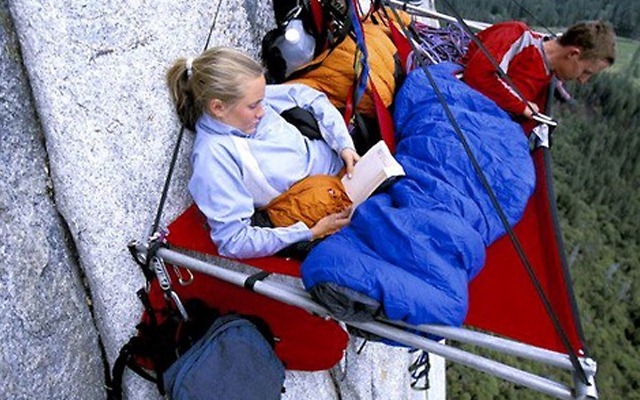
This couple is enjoying some down (or is it up?) time chillaxing on a portaledge attached to what looks to be a very steep cliff.
What do you think? Leave a comment.
If you like this let your friends know or post it on FaceBook, Twitter or LinkedIn
Copyright 2012 Recreation Law (720) Edit Law
Email: blog@rec-law.us
Twitter: RecreationLaw
Facebook: Rec.Law.Now
Facebook Page: Outdoor Recreation & Adventure Travel Law
Blog: www.recreation-law.com
Mobile Site: http://m.recreation-law.com
#RecreationLaw, #@RecreationLaw, #Cycling.Law #Fitness.Law, #Ski.Law, #Outside.Law, #Recreation.Law, #Recreation-Law.com, #Outdoor Law, #Recreation Law, #Outdoor Recreation Law, #Adventure Travel Law, #law, #Travel Law, #Jim Moss, #James H. Moss, #Attorney at Law, #Tourism, #Adventure Tourism, #Rec-Law, #Rec-Law Blog, #Recreation Law, #Recreation Law Blog, #Risk Management, #Human Powered, #Human Powered Recreation,# Cycling Law, #Bicycling Law, #Fitness Law, #Recreation-Law.com, #Backpacking, #Hiking, #Mountaineering, #Ice Climbing, #Rock Climbing, #Ropes Course, #Challenge Course, #Summer Camp, #Camps, #Youth Camps, #Skiing, #Ski Areas, #Negligence, #Snowboarding, #RecreationLaw, #@RecreationLaw, #Cycling.Law #Fitness.Law, #SkiLaw, #Outside.Law, #Recreation.Law, #RecreationLaw.com, #OutdoorLaw, #RecreationLaw, #OutdoorRecreationLaw, #AdventureTravelLaw, #Law, #TravelLaw, #JimMoss, #JamesHMoss, #AttorneyatLaw, #Tourism, #AdventureTourism, #RecLaw, #RecLawBlog, #RecreationLawBlog, #RiskManagement, #HumanPowered, #HumanPoweredRecreation,# CyclingLaw, #BicyclingLaw, #FitnessLaw, #RecreationLaw.com, #Backpacking, #Hiking, #Mountaineering, #IceClimbing, #RockClimbing, #RopesCourse, #ChallengeCourse, #SummerCamp, #Camps, #YouthCamps, #Skiing, #Ski Areas, #Negligence, #Snowboarding, sport and recreation laws, ski law, cycling law, Colorado law, law for recreation and sport managers, bicycling and the law, cycling and the law, ski helmet law, skiers code, skiing accidents, Recreation Lawyer, Ski Lawyer, Paddlesports Lawyer, Cycling Lawyer, Recreational Lawyer, Fitness Lawyer, Rec Lawyer, Challenge Course Lawyer, Ropes Course Lawyer, Zip Line Lawyer, Rock Climbing Lawyer, Adventure Travel Lawyer, Outside Lawyer, Recreation Lawyer, Ski Lawyer, Paddlesports Lawyer, Cycling Lawyer, #RecreationalLawyer, #FitnessLawyer, #RecLawyer, #ChallengeCourseLawyer, #RopesCourseLawyer, #ZipLineLawyer, #RockClimbingLawyer, #AdventureTravelLawyer, #OutsideLawyer, Beth Rodden, Tommy Caldwell, Portaledge, Rock Climbing,
WordPress Tags: Want,recreation,Check,caption,norm,Beth,Rodden,Tommy,Caldwell,ledge,Reddit,Besides,editor,excitement,Remember,Most,jury,TTMEyC,World,Scariest,Place,Read,Book,cliff,Leave,FaceBook,Twitter,LinkedIn,Edit,Email,RecreationLaw,Page,Outdoor,Adventure,Travel,Blog,Mobile,Site,Outside,Moss,James,Attorney,Tourism,Risk,Management,Human,Rock,Ropes,Course,Challenge,Summer,Camp,Camps,Youth,Areas,Negligence,SkiLaw,OutdoorLaw,OutdoorRecreationLaw,AdventureTravelLaw,TravelLaw,JimMoss,JamesHMoss,AttorneyatLaw,AdventureTourism,RecLaw,RecLawBlog,RecreationLawBlog,RiskManagement,HumanPoweredRecreation,CyclingLaw,BicyclingLaw,FitnessLaw,RopesCourse,ChallengeCourse,SummerCamp,YouthCamps,Colorado,managers,helmet,accidents,Lawyer,Paddlesports,Recreational,Line,RecreationalLawyer,FitnessLawyer,RecLawyer,ChallengeCourseLawyer,RopesCourseLawyer,ZipLineLawyer,RockClimbingLawyer,AdventureTravelLawyer,OutsideLawyer,Portaledge
UIAA Event Schedule
Posted: December 7, 2012 Filed under: Uncategorized | Tags: AdventureTravel, Ice climbing, Jim Moss, Recreation-Law.com, RecreationLaw, Rock climbing, UIAA, UIAA Calendar Leave a commentHere is the current UIAA Even Calendar
12 Jan 2013 to 13 Jan 2013

Ice Climbing World Cup (Lead, Speed) & World Championship (Lead)
Cheongsong, Korea
12 Jan 2013 to 13 Jan 2013
Ice Climbing World Youth Championship
Saas-Grund, Switzerland (lead, speed)
18 Jan 2013 to 19 Jan 2013
Ice Climbing World Cup
Saas-Fee, Switzerland (lead, speed)
26 Jan 2013 to 27 Jan 2013
Ice Climbing World Cup
Rabenstein, Italy (lead, speed)
07 Feb 2013 to 09 Feb 2013
Ice Climbing World Cup
Busteni, Romania (lead, speed)
08 Mar 2013 to 10 Mar 2013
Ice Climbing World Cup (Lead, Speed) & World Championship (Speed)
Kirov, Rusia
The schedule is online at UIAA Calendar
What do you think? Leave a comment.
If you like this let your friends know or post it on FaceBook, Twitter or LinkedIn
Copyright 2012 Recreation Law (720) Edit Law
Email: blog@rec-law.us
Twitter: RecreationLaw
Facebook: Rec.Law.Now
Facebook Page: Outdoor Recreation & Adventure Travel Law
Blog: www.recreation-law.com
Mobile Site: http://m.recreation-law.com
#RecreationLaw, #@RecreationLaw, #Cycling.Law #Fitness.Law, #Ski.Law, #Outside.Law, #Recreation.Law, #Recreation-Law.com, #Outdoor Law, #Recreation Law, #Outdoor Recreation Law, #Adventure Travel Law, #law, #Travel Law, #Jim Moss, #James H. Moss, #Attorney at Law, #Tourism, #Adventure Tourism, #Rec-Law, #Rec-Law Blog, #Recreation Law, #Recreation Law Blog, #Risk Management, #Human Powered, #Human Powered Recreation,# Cycling Law, #Bicycling Law, #Fitness Law, #Recreation-Law.com, #Backpacking, #Hiking, #Mountaineering, #Ice Climbing, #Rock Climbing, #Ropes Course, #Challenge Course, #Summer Camp, #Camps, #Youth Camps, #Skiing, #Ski Areas, #Negligence, #Snowboarding, #RecreationLaw, #@RecreationLaw, #Cycling.Law #Fitness.Law, #SkiLaw, #Outside.Law, #Recreation.Law, #RecreationLaw.com, #OutdoorLaw, #RecreationLaw, #OutdoorRecreationLaw, #AdventureTravelLaw, #Law, #TravelLaw, #JimMoss, #JamesHMoss, #AttorneyatLaw, #Tourism, #AdventureTourism, #RecLaw, #RecLawBlog, #RecreationLawBlog, #RiskManagement, #HumanPowered, #HumanPoweredRecreation,# CyclingLaw, #BicyclingLaw, #FitnessLaw, #RecreationLaw.com, #Backpacking, #Hiking, #Mountaineering, #IceClimbing, #RockClimbing, #RopesCourse, #ChallengeCourse, #SummerCamp, #Camps, #YouthCamps, #Skiing, #Ski Areas, #Negligence, #Snowboarding, sport and recreation laws, ski law, cycling law, Colorado law, law for recreation and sport managers, bicycling and the law, cycling and the law, ski helmet law, skiers code, skiing accidents, Recreation Lawyer, Ski Lawyer, Paddlesports Lawyer, Cycling Lawyer, Recreational Lawyer, Fitness Lawyer, Rec Lawyer, Challenge Course Lawyer, Ropes Course Lawyer, Zip Line Lawyer, Rock Climbing Lawyer, Adventure Travel Lawyer, Outside Lawyer, Recreation Lawyer, Ski Lawyer, Paddlesports Lawyer, Cycling Lawyer, #RecreationalLawyer, #FitnessLawyer, #RecLawyer, #ChallengeCourseLawyer, #RopesCourseLawyer, #ZipLineLawyer, #RockClimbingLawyer, #AdventureTravelLawyer, #OutsideLawyer, UIAA, Events, Calendar, Schedule
WordPress Tags: Event,Schedule,World,Lead,Championship,Cheongsong,Korea,Youth,Saas,Grund,Switzerland,Rabenstein,Busteni,Romania,Kirov,Rusia,UIAA,Calendar,Leave,FaceBook,Twitter,LinkedIn,Recreation,Edit,Email,RecreationLaw,Page,Outdoor,Adventure,Travel,Blog,Mobile,Site,Outside,Moss,James,Attorney,Tourism,Risk,Management,Human,Rock,Ropes,Course,Challenge,Summer,Camp,Camps,Areas,Negligence,SkiLaw,OutdoorLaw,OutdoorRecreationLaw,AdventureTravelLaw,TravelLaw,JimMoss,JamesHMoss,AttorneyatLaw,AdventureTourism,RecLaw,RecLawBlog,RecreationLawBlog,RiskManagement,HumanPoweredRecreation,CyclingLaw,BicyclingLaw,FitnessLaw,RopesCourse,ChallengeCourse,SummerCamp,YouthCamps,Colorado,managers,helmet,accidents,Lawyer,Paddlesports,Recreational,Line,RecreationalLawyer,FitnessLawyer,RecLawyer,ChallengeCourseLawyer,RopesCourseLawyer,ZipLineLawyer,RockClimbingLawyer,AdventureTravelLawyer,OutsideLawyer,Events
Electronic gadgets including video cameras interfere with Avalanche Beacons
Posted: November 28, 2012 Filed under: Avalanche | Tags: Attorney at law, avalanche, Avalanche Beacons, Avalanches, Go Pro, Jim Moss, Recco, Recco Reflector, Rock climbing, Ski Resort, Video Cameras 2 CommentsBefore you head out, find out what electronics interfere and which ones you should leave in the car or turn off.
This video popped up the other day: Transceiver / Go Pro Interference. It shows a video camera affecting an avalanche beacon. If you wear a beacon, and you should, in or out of bounds, you should know which of your electronics may affect your beacon.
Dale Atkins, an Avalanche Guru and Recco’s Training and Education Manager for North America told me:

English: Rescuer using RECCO R9 detector on training drill in Colorado.
GoPros cause grief to some transceivers (and probably to all), but this is not a surprise, and it’s not the fault of the transceiver companies. All electronic devices generate electromagnetic fields. The problem is more noticeable with GoPros (and likely with other movie cameras, too) than with our cell phones or radios because communication devices have shielding. GoPros, iPods, power lines, ski lift motors, thunderstorms, etc. do not.
These electronic devices (and phenomena) rarely cause problems for a sending transceiver, and typically only a few centimeters of separation are enough. However, receive is another story. Transceiver companies have for a number of years recommended one separate electronic gear from their receiving transceiver by 30 centimeters. However, over the years this “electronic” gear was usually shielded communication devices, so the 30 cm distance was more than sufficient. However, now with other electronic gizmos, like GoPros that are “on” (powered) all the time, I suspect we’ll see a new recommendation from the transceiver companies. It might say something to the effect that these devices be turned off and removed off the searcher. However, that’s my guess.
Reccois a non-beacon avalanche search device. The handheld device locates buried victims based on a small bar that is usually sewn into their clothing. If you are

English: Avalanche rescue search with RECCO detector
looking for ski or mountaineering clothing, I would suggest you look for something that has the Recco Reflector sewn in and a Recco hangtag.
So?
If you ski wearing a beacon, you should pay attention to what is going on with all the battery operating devices you carry.
If you are an Avalanche Beacon manufacturer, you should probably put a notice or warning in your instructions to let people know of the risks.
What do you think? Leave a comment.
If you like this let your friends know or post it on FaceBook, Twitter or LinkedIn
Copyright 2012 Recreation Law (720) Edit Law
Email: blog@rec-law.us
Twitter: RecreationLaw
Facebook: Rec.Law.Now
Facebook Page: Outdoor Recreation & Adventure Travel Law
Blog: www.recreation-law.com
Mobile Site: http://m.recreation-law.com
#RecreationLaw, #@RecreationLaw, #Cycling.Law #Fitness.Law, #Ski.Law, #Outside.Law, #Recreation.Law, #Recreation-Law.com, #Outdoor Law, #Recreation Law, #Outdoor Recreation Law, #Adventure Travel Law, #law, #Travel Law, #Jim Moss, #James H. Moss, #Attorney at Law, #Tourism, #Adventure Tourism, #Rec-Law, #Rec-Law Blog, #Recreation Law, #Recreation Law Blog, #Risk Management, #Human Powered, #Human Powered Recreation,# Cycling Law, #Bicycling Law, #Fitness Law, #Recreation-Law.com, #Backpacking, #Hiking, #Mountaineering, #Ice Climbing, #Rock Climbing, #Ropes Course, #Challenge Course, #Summer Camp, #Camps, #Youth Camps, #Skiing, #Ski Areas, #Negligence, #Snowboarding, #RecreationLaw, #@RecreationLaw, #Cycling.Law #Fitness.Law, #SkiLaw, #Outside.Law, #Recreation.Law, #RecreationLaw.com, #OutdoorLaw, #RecreationLaw, #OutdoorRecreationLaw, #AdventureTravelLaw, #Law, #TravelLaw, #JimMoss, #JamesHMoss, #AttorneyatLaw, #Tourism, #AdventureTourism, #RecLaw, #RecLawBlog, #RecreationLawBlog, #RiskManagement, #HumanPowered, #HumanPoweredRecreation,# CyclingLaw, #BicyclingLaw, #FitnessLaw, #RecreationLaw.com, #Backpacking, #Hiking, #Mountaineering, #IceClimbing, #RockClimbing, #RopesCourse, #ChallengeCourse, #SummerCamp, #Camps, #YouthCamps, #Skiing, #Ski Areas, #Negligence, #Snowboarding, sport and recreation laws, ski law, cycling law, Colorado law, law for recreation and sport managers, bicycling and the law, cycling and the law, ski helmet law, skiers code, skiing accidents, Recreation Lawyer, Ski Lawyer, Paddlesports Lawyer, Cycling Lawyer, Recreational Lawyer, Fitness Lawyer, Rec Lawyer, Challenge Course Lawyer, Ropes Course Lawyer, Zip Line Lawyer, Rock Climbing Lawyer, Adventure Travel Lawyer, Outside Lawyer, Recreation Lawyer, Ski Lawyer, Paddlesports Lawyer, Cycling Lawyer, #RecreationalLawyer, #FitnessLawyer, #RecLawyer, #ChallengeCourseLawyer, #RopesCourseLawyer, #ZipLineLawyer, #RockClimbingLawyer, #AdventureTravelLawyer, #OutsideLawyer, Recco, Recco Reflector, Avalanche, Avalanche Beacons, Go Pro, Video Cameras, Avalanches,
WordPress Tags: Electronic,gadgets,Avalanche,Beacons,electronics,Transceiver,Interference,beacon,Dale,Atkins,Guru,Recco,Education,Manager,North,America,GoPros,grief,movie,cell,radios,communication,thunderstorms,phenomena,separation,gear,gizmos,recommendation,searcher,device,victims,Reflector,attention,manufacturer,instructions,Leave,FaceBook,Twitter,LinkedIn,Recreation,Edit,Email,RecreationLaw,Page,Outdoor,Adventure,Travel,Blog,Mobile,Site,Outside,Moss,James,Attorney,Tourism,Risk,Management,Human,Rock,Ropes,Course,Challenge,Summer,Camp,Camps,Youth,Areas,Negligence,SkiLaw,OutdoorLaw,OutdoorRecreationLaw,AdventureTravelLaw,TravelLaw,JimMoss,JamesHMoss,AttorneyatLaw,AdventureTourism,RecLaw,RecLawBlog,RecreationLawBlog,RiskManagement,HumanPoweredRecreation,CyclingLaw,BicyclingLaw,FitnessLaw,RopesCourse,ChallengeCourse,SummerCamp,YouthCamps,Colorado,managers,helmet,accidents,Lawyer,Paddlesports,Recreational,Line,RecreationalLawyer,FitnessLawyer,RecLawyer,ChallengeCourseLawyer,RopesCourseLawyer,ZipLineLawyer,RockClimbingLawyer,AdventureTravelLawyer,OutsideLawyer,Video,Cameras,Avalanches,centimeters
Truer words were never spoken!
Posted: November 23, 2012 Filed under: Release (pre-injury contract not to sue) | Tags: AdventureTravel, Attorney at law, Frazz, Jef Mallett, Jim Moss, Rock climbing, Ropes course Leave a comment
Thanks Jef Mallett
What do you think? Leave a comment.
If you like this let your friends know or post it on FaceBook, Twitter or LinkedIn
Copyright 2012 Recreation Law (720) Edit Law
Email: blog@rec-law.us
Twitter: RecreationLaw
Facebook: Rec.Law.Now
Facebook Page: Outdoor Recreation & Adventure Travel Law
Blog: www.recreation-law.com
Mobile Site: http://m.recreation-law.com
#RecreationLaw, #@RecreationLaw, #Cycling.Law #Fitness.Law, #Ski.Law, #Outside.Law, #Recreation.Law, #Recreation-Law.com, #Outdoor Law, #Recreation Law, #Outdoor Recreation Law, #Adventure Travel Law, #law, #Travel Law, #Jim Moss, #James H. Moss, #Attorney at Law, #Tourism, #Adventure Tourism, #Rec-Law, #Rec-Law Blog, #Recreation Law, #Recreation Law Blog, #Risk Management, #Human Powered, #Human Powered Recreation,# Cycling Law, #Bicycling Law, #Fitness Law, #Recreation-Law.com, #Backpacking, #Hiking, #Mountaineering, #Ice Climbing, #Rock Climbing, #Ropes Course, #Challenge Course, #Summer Camp, #Camps, #Youth Camps, #Skiing, #Ski Areas, #Negligence, #Snowboarding, #RecreationLaw, #@RecreationLaw, #Cycling.Law #Fitness.Law, #SkiLaw, #Outside.Law, #Recreation.Law, #RecreationLaw.com, #OutdoorLaw, #RecreationLaw, #OutdoorRecreationLaw, #AdventureTravelLaw, #Law, #TravelLaw, #JimMoss, #JamesHMoss, #AttorneyatLaw, #Tourism, #AdventureTourism, #RecLaw, #RecLawBlog, #RecreationLawBlog, #RiskManagement, #HumanPowered, #HumanPoweredRecreation,# CyclingLaw, #BicyclingLaw, #FitnessLaw, #RecreationLaw.com, #Backpacking, #Hiking, #Mountaineering, #IceClimbing, #RockClimbing, #RopesCourse, #ChallengeCourse, #SummerCamp, #Camps, #YouthCamps, #Skiing, #Ski Areas, #Negligence, #Snowboarding, sport and recreation laws, ski law, cycling law, Colorado law, law for recreation and sport managers, bicycling and the law, cycling and the law, ski helmet law, skiers code, skiing accidents, Recreation Lawyer, Ski Lawyer, Paddlesports Lawyer, Cycling Lawyer, Recreational Lawyer, Fitness Lawyer, Rec Lawyer, Challenge Course Lawyer, Ropes Course Lawyer, Zip Line Lawyer, Rock Climbing Lawyer, Adventure Travel Lawyer, Outside Lawyer, Recreation Lawyer, Ski Lawyer, Paddlesports Lawyer, Cycling Lawyer, #RecreationalLawyer, #FitnessLawyer, #RecLawyer, #ChallengeCourseLawyer, #RopesCourseLawyer, #ZipLineLawyer, #RockClimbingLawyer, #AdventureTravelLawyer, #OutsideLawyer, Frazz, Jef Mallett, Release, Liability Waiver, Monday,
WordPress Tags: Truer,Thanks,Mallett,Leave,FaceBook,Twitter,LinkedIn,Recreation,Edit,Email,RecreationLaw,Page,Outdoor,Adventure,Travel,Blog,Mobile,Site,Outside,Moss,James,Attorney,Tourism,Risk,Management,Human,Rock,Ropes,Course,Challenge,Summer,Camp,Camps,Youth,Areas,Negligence,SkiLaw,OutdoorLaw,OutdoorRecreationLaw,AdventureTravelLaw,TravelLaw,JimMoss,JamesHMoss,AttorneyatLaw,AdventureTourism,RecLaw,RecLawBlog,RecreationLawBlog,RiskManagement,HumanPoweredRecreation,CyclingLaw,BicyclingLaw,FitnessLaw,RopesCourse,ChallengeCourse,SummerCamp,YouthCamps,Colorado,managers,helmet,accidents,Lawyer,Paddlesports,Recreational,Line,RecreationalLawyer,FitnessLawyer,RecLawyer,ChallengeCourseLawyer,RopesCourseLawyer,ZipLineLawyer,RockClimbingLawyer,AdventureTravelLawyer,OutsideLawyer,Frazz,Release,Waiver
You don’t ask for help, you don’t pay, you aren’t a member but you sue when you were not properly trained.
Posted: October 3, 2012 Filed under: Climbing Wall, Idaho | Tags: AdventureTravel, Grigri, Idaho, Jim Moss, Outdoor recreation, Rock climbing, YMCA Leave a commentSettlement in the Wood River, ID YMCA lawsuit
I wrote about this lawsuit, and the injury right after it happened. See Climbing accident at Ketchum Idaho indoor Climbing Walland Update on climbing wall accident at Wood River YMCA Climbing Wall. A lot, more facts came out in this latest article that makes the plaintiff’s position look weak if not worse.
In this suit, the plaintiff claimed:

He contended that the Y was negligent in not training him how to use the climbing equipment and that the rope and self-belay device that he was using suddenly detached from the climbing wall while he was 20 feet up
The YMCA defended saying, “Hopfenbeck had signed a liability release. Furthermore, the Y claimed, he had considerable experience at climbing on indoor walls.”
However, this is the statement that drives me “up a wall.”
In a deposition, Hopfenbeck acknowledged that he had not paid a fee to use the wall, was not a member of the Y in Ketchum and had not asked anyone’s permission to climb. He said he began climbing on his own after taking a ballet class at the Y, but a Y employee did ask him to sign a liability waiver.
When you go use a climbing wall without being a member, without telling anyone, without getting permission to use the wall, how is the Y supposed to train you?
The plaintiff also stated:
Hopfenbeck said another climber there showed him how to use a Grigri belaying device, which can be used to self-belay. He said he practiced with it some, then climbed to the top of the wall and lay back in his harness to rest.
It was the YMCA’s fault he never knew how to use the complicated belay device?
Results – probably not good
This lawsuit was brought in Idaho and settled before the defendant’s motion for summary judgment on the release had been decided by the court. However, I can’t believe that an Idaho jury would allow this plaintiff to recover any money.
How can you trespass, use a device and get hurt then argue you were not trained in how to use the device?
The real problem is there is probably a gate at the Y and the people on the climbing wall probably have a wrist band. YMCA’s all over the world having instituted stricter

polices (however, I doubt they have updated their releases) to make sure no one climbs the wall without signing a release and receiving instruction.
Any settlement is better than a trial, but sometimes you just want to win because the claims are so outlandish.
I hope they deducted the fee for a YMCA membership the year he was hurt from his settlement.
See YMCA settles negligence lawsuit
What do you think? Leave a comment.
Copyright 2012 Recreation Law (720) Edit Law,
Twitter: RecreationLaw
Facebook: Rec.Law.Now
Facebook Page: Outdoor Recreation & Adventure Travel Law
Blog: http://www.recreation-law.com
#recreationlaw, #@recreationlaw, #cycling.law #fitness.law, #ski.law, #outside.law, #recreation.law, #recreation-law.com, #outdoor law, #recreation law, #outdoor recreation law, #adventure travel law, #law, #travel law, #Jim Moss, #James H. Moss, #attorney at law, #tourism, #adventure tourism, #rec-law, #rec-law blog, #recreation law, #recreation law blog, #risk management, #Human Powered, #human powered recreation,# cycling law, #bicycling law, #fitness law, #recreation-law.com, #backpacking, #hiking, #Mountaineering, #ice climbing, #rock climbing, #ropes course, #challenge course, #summer camp, #camps, #youth camps, #skiing, #ski areas, #negligence, #,
WordPress Tags: member,Settlement,Wood,River,YMCA,lawsuit,injury,accident,Ketchum,Idaho,Wall,Update,article,plaintiff,equipment,self,device,feet,Hopfenbeck,statement,permission,ballet,employee,waiver,climber,Grigri,Results,defendant,judgment,jury,money,gate,band,instruction,membership,negligence,Leave,Recreation,Edit,Gmail,Twitter,RecreationLaw,Facebook,Page,Outdoor,Adventure,Travel,Blog,Keywords,Moss,James,attorney,tourism,management,Human,youth,areas,belay
If any of your lawyers who are members of the ABA are so inclined
Posted: August 21, 2012 Filed under: Uncategorized | Tags: Adventure travel, Attorney at law, Jim Moss, Law, Rock climbing, Ropes course, Ski Resort, Twitter Leave a commentABA Legal Blog Nominations are open
You know, just sort of, if you wanted to nominate www.recreation-law.com for an ABA legal blog nomination you could go here……
The name of the site is: Blawg 100 Amici
What do you think? Leave a comment.
If you like this let your friends know or post it on FB, Twitter or LinkedIn
Copyright 2012 Recreation Law (720) Edit Law
Twitter: RecreationLaw
Facebook: Rec.Law.Now
Facebook Page: Outdoor Recreation & Adventure Travel Law
Mobile Site: http://m.recreation-law.com
#RecreationLaw, #@RecreationLaw, #Cycling.Law #Fitness.Law, #Ski.Law, #Outside.Law, #Recreation.Law, #Recreation-Law.com, #Outdoor Law, #Recreation Law, #Outdoor Recreation Law, #Adventure Travel Law, #law, #Travel Law, #Jim Moss, #James H. Moss, #Attorney at Law, #Tourism, #Adventure Tourism, #Rec-Law, #Rec-Law Blog, #Recreation Law, #Recreation Law Blog, #Risk Management, #Human Powered, #Human Powered Recreation,# Cycling Law, #Bicycling Law, #Fitness Law, #Recreation-Law.com, #Backpacking, #Hiking, #Mountaineering, #Ice Climbing, #Rock Climbing, #Ropes Course, #Challenge Course, #Summer Camp, #Camps, #Youth Camps, #Skiing, #Ski Areas, #Negligence, #Snowboarding, #RecreationLaw, #@RecreationLaw, #Cycling.Law #Fitness.Law, #SkiLaw, #Outside.Law, #Recreation.Law, #RecreationLaw.com, #OutdoorLaw, #RecreationLaw, #OutdoorRecreationLaw, #AdventureTravelLaw, #Law, #TravelLaw, #JimMoss, #JamesHMoss, #AttorneyatLaw, #Tourism, #AdventureTourism, #RecLaw, #RecLawBlog, #RecreationLawBlog, #RiskManagement, #HumanPowered, #HumanPoweredRecreation,# CyclingLaw, #BicyclingLaw, #FitnessLaw, #RecreationLaw.com, #Backpacking, #Hiking, #Mountaineering, #IceClimbing, #RockClimbing, #RopesCourse, #ChallengeCourse, #SummerCamp, #Camps, #YouthCamps, #Skiing, #Ski Areas, #Negligence, #Snowboarding, sport and recreation laws, ski law, cycling law, Colorado law, law for recreation and sport managers, bicycling and the law, cycling and the law, ski helmet law, skiers code, skiing accidents, Recreation Lawyer, Ski Lawyer, Paddlesports Lawyer, Cycling Lawyer, Recreational Lawyer, Fitness Lawyer, Rec Lawyer, Challenge Course Lawyer, Ropes Course Lawyer, Zip Line Lawyer, Rock Climbing Lawyer, Adventure Travel Lawyer, Outside Lawyer, Recreation Lawyer, Ski Lawyer, Paddlesports Lawyer, Cycling Lawyer, #RecreationalLawyer, #FitnessLawyer, #RecLawyer, #ChallengeCourseLawyer, #RopesCourseLawyer, #ZipLineLawyer, #RockClimbingLawyer, #AdventureTravelLawyer, #OutsideLawyer, ABA, Blog, Nominations,
WordPress Tags: lawyers,Legal,Blog,Nominations,recreation,nomination,Blawg,Amici,Leave,Twitter,LinkedIn,Edit,RecreationLaw,Facebook,Page,Outdoor,Adventure,Travel,Mobile,Site,Outside,Moss,James,Attorney,Tourism,Risk,Management,Human,Rock,Ropes,Course,Challenge,Summer,Camp,Camps,Youth,Areas,Negligence,SkiLaw,OutdoorLaw,OutdoorRecreationLaw,AdventureTravelLaw,TravelLaw,JimMoss,JamesHMoss,AttorneyatLaw,AdventureTourism,RecLaw,RecLawBlog,RecreationLawBlog,RiskManagement,HumanPoweredRecreation,CyclingLaw,BicyclingLaw,FitnessLaw,RopesCourse,ChallengeCourse,SummerCamp,YouthCamps,Colorado,managers,helmet,accidents,Lawyer,Paddlesports,Recreational,Line,RecreationalLawyer,FitnessLawyer,RecLawyer,ChallengeCourseLawyer,RopesCourseLawyer,ZipLineLawyer,RockClimbingLawyer,AdventureTravelLawyer,OutsideLawyer
Outdoor Retailer (and probably Interbike) new Badge Bar Codes can probably be read from your phone
Posted: July 31, 2012 Filed under: Uncategorized | Tags: Adventure travel, Attorney at law, Badges, Interbike, Jim Moss, LinkedIn, OR, Outdoor Retailer, Rock climbing, Ropes course, Ski Resort, Tradeshow, Twitter Leave a commentThe system is new so bring your paper copy until we know for sure
I was able to confirm today the possibility of paperless entry into the Nielsen Outdoor Shows Outdoor Retailer and Interbike. The system has not been fully tested yet so bring your paper copies of your badges until you know for sure.
This is pretty exciting with the possibility of dropping another layer of paper from the tradeshow industry.
Cool
What do you think? Leave a comment.
If you like this let your friends know or post it on FB, Twitter or LinkedIn
Copyright 2012 Recreation Law (720) Edit Law
Twitter: RecreationLaw
Facebook: Rec.Law.Now
Facebook Page: Outdoor Recreation & Adventure Travel Law
Mobile Site: http://m.recreation-law.com
#RecreationLaw, #@RecreationLaw, #Cycling.Law #Fitness.Law, #Ski.Law, #Outside.Law, #Recreation.Law, #Recreation-Law.com, #Outdoor Law, #Recreation Law, #Outdoor Recreation Law, #Adventure Travel Law, #law, #Travel Law, #Jim Moss, #James H. Moss, #Attorney at Law, #Tourism, #Adventure Tourism, #Rec-Law, #Rec-Law Blog, #Recreation Law, #Recreation Law Blog, #Risk Management, #Human Powered, #Human Powered Recreation,# Cycling Law, #Bicycling Law, #Fitness Law, #Recreation-Law.com, #Backpacking, #Hiking, #Mountaineering, #Ice Climbing, #Rock Climbing, #Ropes Course, #Challenge Course, #Summer Camp, #Camps, #Youth Camps, #Skiing, #Ski Areas, #Negligence, #Snowboarding, #RecreationLaw, #@RecreationLaw, #Cycling.Law #Fitness.Law, #SkiLaw, #Outside.Law, #Recreation.Law, #RecreationLaw.com, #OutdoorLaw, #RecreationLaw, #OutdoorRecreationLaw, #AdventureTravelLaw, #Law, #TravelLaw, #JimMoss, #JamesHMoss, #AttorneyatLaw, #Tourism, #AdventureTourism, #RecLaw, #RecLawBlog, #RecreationLawBlog, #RiskManagement, #HumanPowered, #HumanPoweredRecreation,# CyclingLaw, #BicyclingLaw, #FitnessLaw, #RecreationLaw.com, #Backpacking, #Hiking, #Mountaineering, #IceClimbing, #RockClimbing, #RopesCourse, #ChallengeCourse, #SummerCamp, #Camps, #YouthCamps, #Skiing, #Ski Areas, #Negligence, #Snowboarding, sport and recreation laws, ski law, cycling law, Colorado law, law for recreation and sport managers, bicycling and the law, cycling and the law, ski helmet law, skiers code, skiing accidents, Recreation Lawyer, Ski Lawyer, Paddlesports Lawyer, Cycling Lawyer, Recreational Lawyer, Fitness Lawyer, Rec Lawyer, Challenge Course Lawyer, Ropes Course Lawyer, Zip Line Lawyer, Rock Climbing Lawyer, Adventure Travel Lawyer, Outside Lawyer, Recreation Lawyer, Ski Lawyer, Paddlesports Lawyer, Cycling Lawyer, #RecreationalLawyer, #FitnessLawyer, #RecLawyer, #ChallengeCourseLawyer, #RopesCourseLawyer, #ZipLineLawyer, #RockClimbingLawyer, #AdventureTravelLawyer, #OutsideLawyer, #Interbike, #OR, Outdoor Retailer
WordPress Tags: Outdoor,Retailer,Interbike,Badge,Codes,system,paper,Nielsen,Shows,badges,layer,industry,Cool,Leave,Twitter,LinkedIn,Recreation,Edit,RecreationLaw,Facebook,Page,Adventure,Travel,Blog,Mobile,Site,Outside,Moss,James,Attorney,Tourism,Risk,Management,Human,Rock,Ropes,Course,Challenge,Summer,Camp,Camps,Youth,Areas,Negligence,SkiLaw,OutdoorLaw,OutdoorRecreationLaw,AdventureTravelLaw,TravelLaw,JimMoss,JamesHMoss,AttorneyatLaw,AdventureTourism,RecLaw,RecLawBlog,RecreationLawBlog,RiskManagement,HumanPoweredRecreation,CyclingLaw,BicyclingLaw,FitnessLaw,RopesCourse,ChallengeCourse,SummerCamp,YouthCamps,Colorado,managers,helmet,accidents,Lawyer,Paddlesports,Recreational,Line,RecreationalLawyer,FitnessLawyer,RecLawyer,ChallengeCourseLawyer,RopesCourseLawyer,ZipLineLawyer,RockClimbingLawyer,AdventureTravelLawyer,OutsideLawyer


 Recreation Law